Questions as text
Q1 · The reactivity of an element describes how easily the element forms compounds 0654/32 May/June 2017
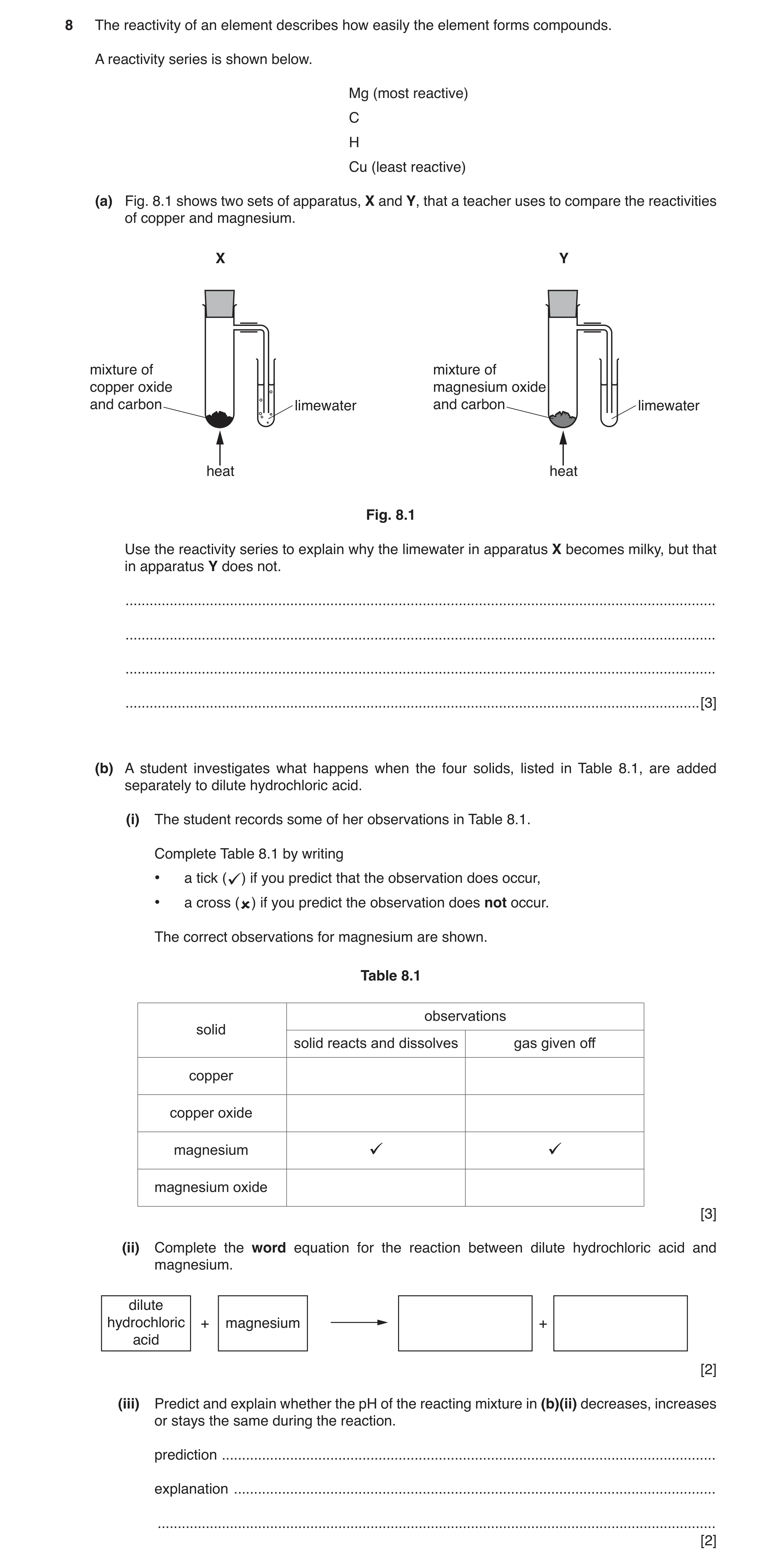
8 The reactivity of an element describes how easily the element forms compounds. A reactivity series is shown below. Mg (most reactive) C H Cu (least reactive) (a) Fig. 8.1 shows two sets of apparatus, X and Y, that a teacher uses to compare the reactivities of copper and magnesium. X Y mixture of mixture of copper oxide magnesium oxide and carbon limewater and carbon limewater heat heat Fig. 8.1 Use the reactivity series to explain why the limewater in apparatus X becomes milky, but that in apparatus Y does not. … … … … [3] (b) A student investigates what happens when the four solids, listed in Table 8.1, are added separately to dilute hydrochloric acid. (i) The student records some of her observations in Table 8.1. Complete Table 8.1 by writing • a tick () if you predict that the observation does occur, • a cross (û) if you predict the observation does not occur. The correct observations for magnesium are shown. Table 8.1 observations solid solid reacts and dissolves gas given off copper copper oxide magnesium magnesium oxide [3] (ii) Complete the word equation for the reaction between dilute hydrochloric acid and magnesium. dilute hydrochloric + magnesium + acid [2] (iii) Predict and explain whether the pH of the reacting mixture in (b)(ii) decreases, increases or stays the same during the reaction. prediction … explanation … … [2]
10 marks
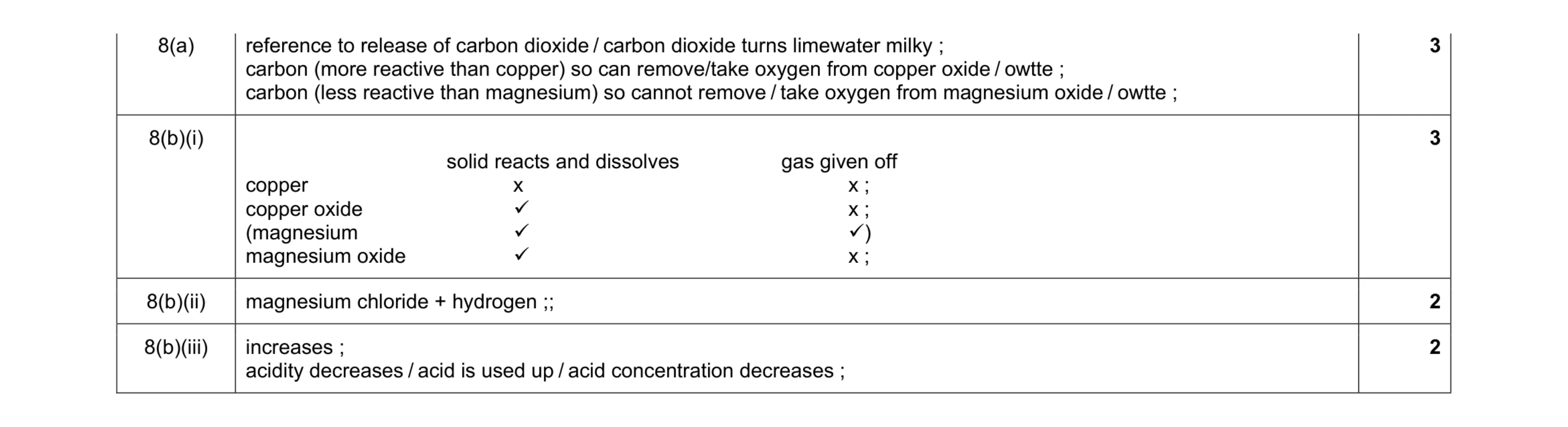
Mark scheme: 8(a) reference to release of carbon dioxide / carbon dioxide turns limewater milky ; carbon (more reactive than copper) so can remove/take oxygen from copper oxide / owtte ; carbon (less reactive than magnesium) so cannot remove / take oxygen from magnesium oxide / owtte ; 3 8(b)(i) solid reacts and dissolves gas given off copper x x ; copper oxide 9 x ; (magnesium 9 9) magnesium oxide 9 x ; 3 8(b)(ii) magnesium chloride + hydrogen ;; 2 8(b)(iii) increases ; acidity decreases / acid is used up / acid concentration decreases ; 2
This question in 0654/32 May/June 2017
Q2 · Calcium, copper, iron and potassium are metallic elements in the fourth period of the… 0654/33 Oct/Nov 2018
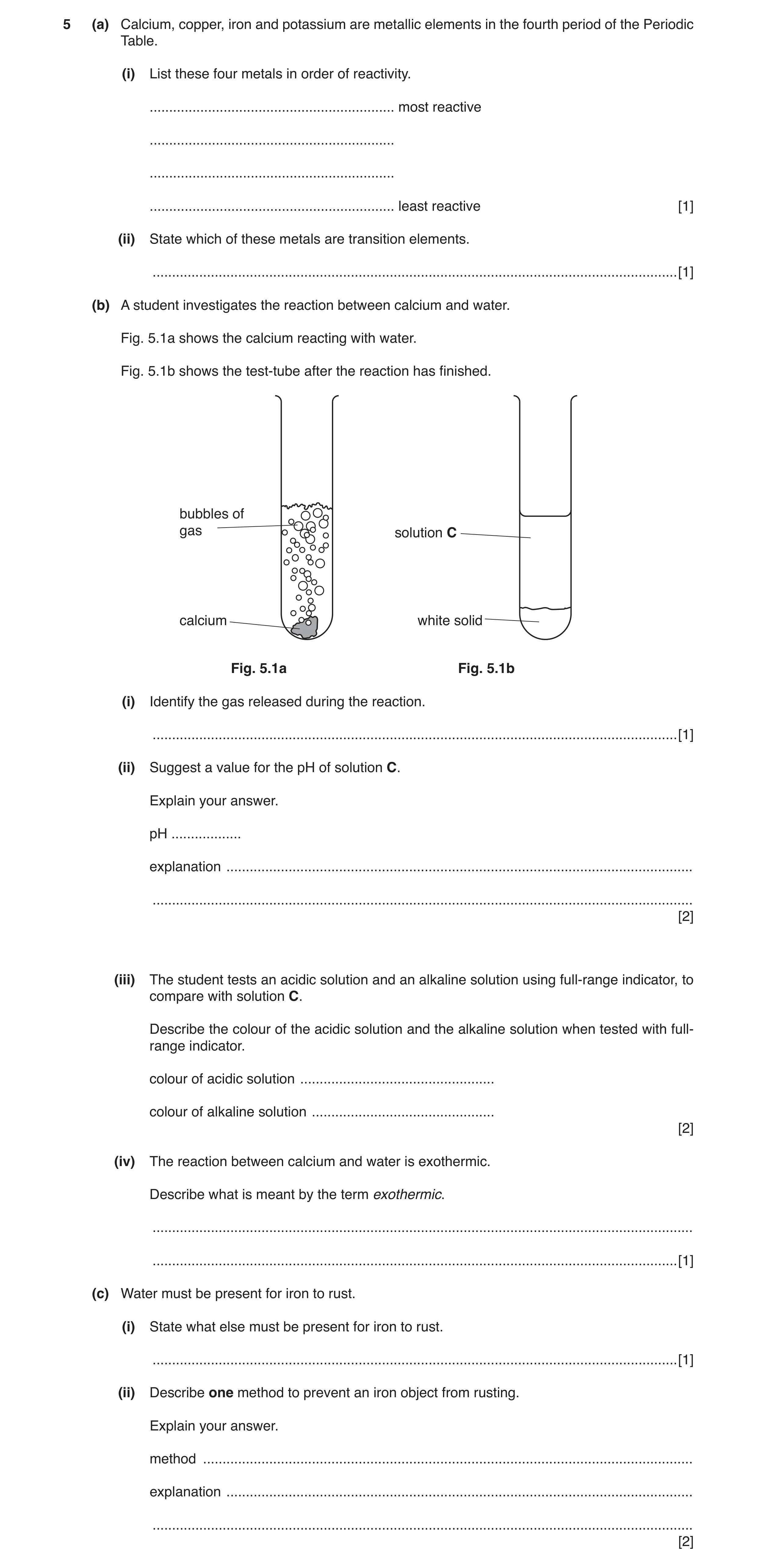
5 (a) Calcium, copper, iron and potassium are metallic elements in the fourth period of the Periodic Table. (i) List these four metals in order of reactivity. … most reactive … … … least reactive [1] (ii) State which of these metals are transition elements. … [1] (b) A student investigates the reaction between calcium and water. Fig. 5.1a shows the calcium reacting with water. Fig. 5.1b shows the test-tube after the reaction has finished. bubbles of gas solution C calcium white solid Fig. 5.1a Fig. 5.1b (i) Identify the gas released during the reaction. … [1] (ii) Suggest a value for the pH of solution C. Explain your answer. pH … explanation … … [2] (iii) The student tests an acidic solution and an alkaline solution using full-range indicator, to compare with solution C. Describe the colour of the acidic solution and the alkaline solution when tested with full- range indicator. colour of acidic solution … colour of alkaline solution … [2] (iv) The reaction between calcium and water is exothermic. Describe what is meant by the term exothermic. … … [1] (c) Water must be present for iron to rust. (i) State what else must be present for iron to rust. … [1] (ii) Describe one method to prevent an iron object from rusting. Explain your answer. method … explanation … … [2]
11 marks
Mark scheme: 5(a)(i) potassium calcium iron copper ; 1 5(a)(ii) copper and iron ; 1 5(b)(i) hydrogen / H2 ; 1 5(b)(ii) 9–14 ; solution becomes alkaline / contains a base / calcium hydroxide ; 2 5(b)(iii) acid – red / orange / yellow ; alkali – blue / purple ; 2 5(b)(iv) temperature increases ; (thermal) energy given out; max 1 5(c)(i) oxygen ; 1 5(c)(ii) cover with oil / grease / paint / electroplate ; (form a barrier to) prevent contact / reaction (between iron and air / water) ; 2
This question in 0654/33 Oct/Nov 2018
Q3 · Most elements in the Periodic Table are metals 0654/31 May/June 2019
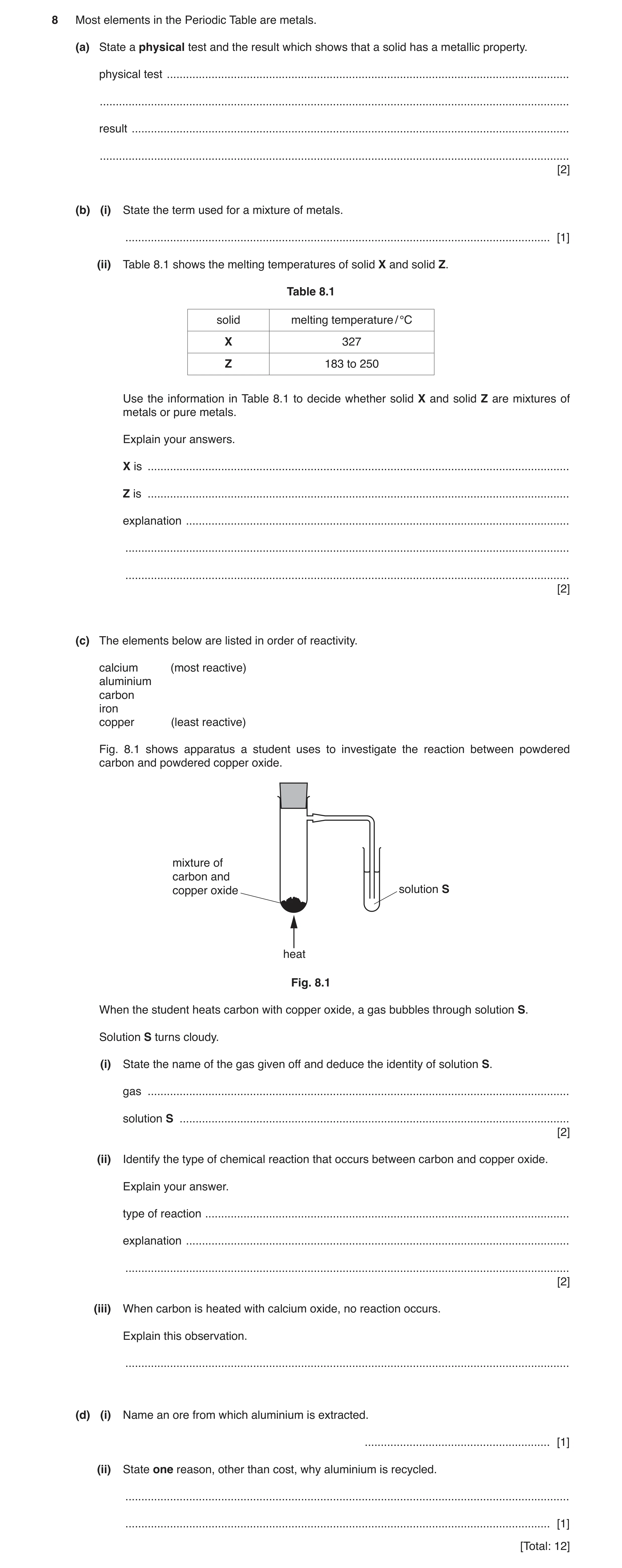
8 Most elements in the Periodic Table are metals. (a) State a physical test and the result which shows that a solid has a metallic property. physical test … … result … … [2] (b) (i) State the term used for a mixture of metals. … [1] (ii) Table 8.1 shows the melting temperatures of solid X and solid Z. Table 8.1 solid melting temperature / °C X 327 Z 183 to 250 Use the information in Table 8.1 to decide whether solid X and solid Z are mixtures of metals or pure metals. Explain your answers. X is … Z is … explanation … … … [2] (c) The elements below are listed in order of reactivity. calcium (most reactive) aluminium carbon iron copper (least reactive) Fig. 8.1 shows apparatus a student uses to investigate the reaction between powdered carbon and powdered copper oxide. mixture of carbon and copper oxide solution S heat Fig. 8.1 When the student heats carbon with copper oxide, a gas bubbles through solution S. Solution S turns cloudy. (i) State the name of the gas given off and deduce the identity of solution S. gas … solution S … [2] (ii) Identify the type of chemical reaction that occurs between carbon and copper oxide. Explain your answer. type of reaction … explanation … … [2] (iii) When carbon is heated with calcium oxide, no reaction occurs. Explain this observation. … (d) (i) Name an ore from which aluminium is extracted. … [1] (ii) State one reason, other than cost, why aluminium is recycled. … … [1] [Total: 12]
12 marks
Mark scheme: 8(a) suitable test for electrical conductivity / thermal conductivity / malleability ; metals conduct electricity / metal conduct thermal energy / metals are malleable ; 2 8(b)(i) alloy ; 1 8(b)(ii) X is a pure metal and Z is a mixture / alloy ; pure metal has unique melting point / a mixture melts over a range of temp ; 2 8(c)(i) carbon dioxide / CO2 ; limewater / aqueous calcium hydroxide ; 2 8(c)(ii) redox / reduction / oxidation ; copper oxide is reduced / loses oxygen / carbon oxidised / gains oxygen ; 2 8(c)(iii) calcium is more reactive than carbon ; 1 8(d)(i) bauxite ; 1 8(d)(ii) saves energy / saves bauxite; 1
This question in 0654/31 May/June 2019
Q4 · Water is a compound of the elements hydrogen and oxygen 0654/32 May/June 2020
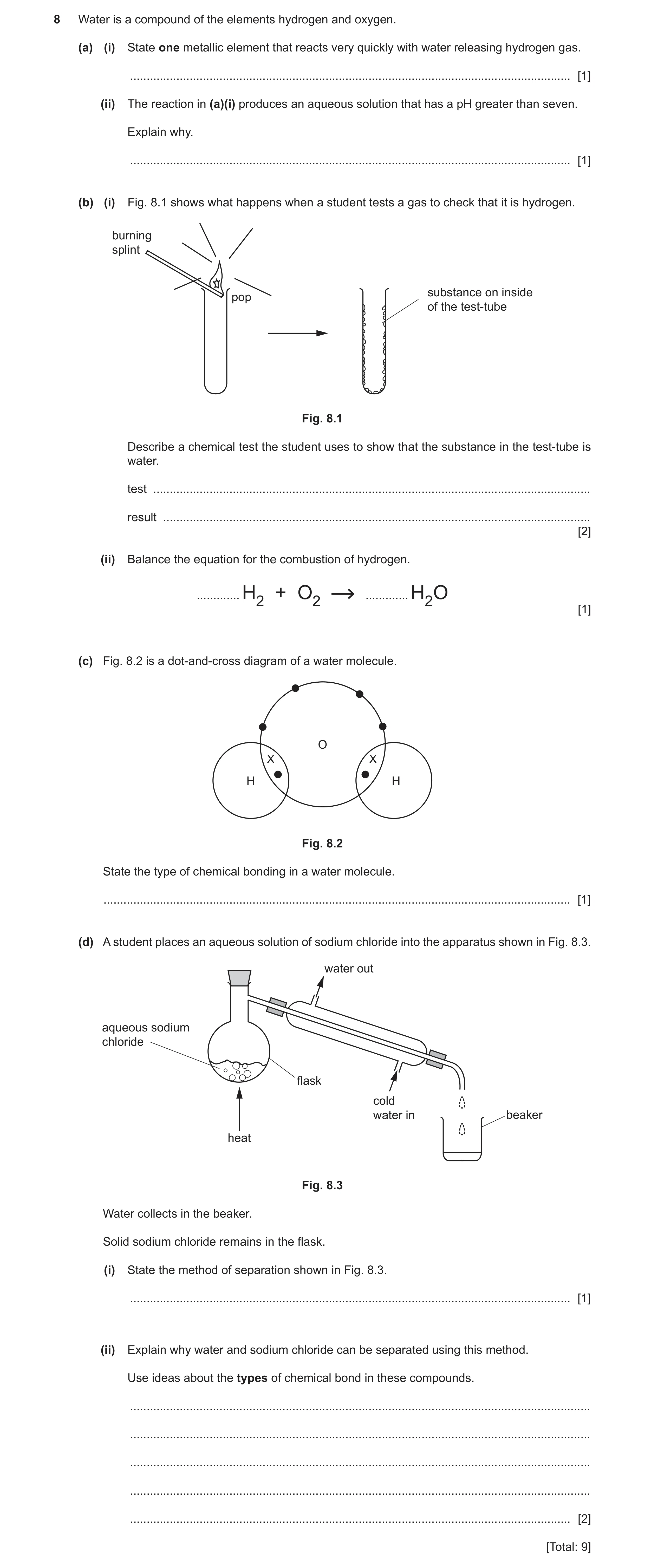
8 Water is a compound of the elements hydrogen and oxygen. (a) (i) State one metallic element that reacts very quickly with water releasing hydrogen gas. … [1] (ii) The reaction in (a)(i) produces an aqueous solution that has a pH greater than seven. Explain why. … [1] (b) (i) Fig. 8.1 shows what happens when a student tests a gas to check that it is hydrogen. burning splint substance on inside pop of the test-tube Fig. 8.1 Describe a chemical test the student uses to show that the substance in the test-tube is water. test … result … [2] (ii) Balance the equation for the combustion of hydrogen. … … H2 + O2 H2O [1] (c) Fig. 8.2 is a dot-and-cross diagram of a water molecule. O X X H H Fig. 8.2 State the type of chemical bonding in a water molecule. … [1] (d) A student places an aqueous solution of sodium chloride into the apparatus shown in Fig. 8.3. water out aqueous sodium chloride flask cold water in beaker heat Fig. 8.3 Water collects in the beaker. Solid sodium chloride remains in the flask. (i) State the method of separation shown in Fig. 8.3. … [1] (ii) Explain why water and sodium chloride can be separated using this method. Use ideas about the types of chemical bond in these compounds. … … … … … [2] [Total: 9]
9 marks
Mark scheme: 8(a)(i) any Group 1 element / other correct (e.g. calcium); 1 8(a)(ii) solution is alkaline / reaction produces (soluble) base / hydroxide of element in (i) ; 1 8(b)(i) cobalt chloride ; blue to pink ; OR anhydrous copper(II) sulfate ; white to blue ; 2 8(b)(ii) 2H2 + O2 → 2 H2O ; 1 8(c) covalent ; 1 8(d)(i) (simple) distillation ; 1 8(d)(ii) the idea that water boils and sodium chloride does not / water is more volatile than sodium chloride ; because covalent compounds tend to have low bpts / ionic compounds high bpts; 2
This question in 0654/32 May/June 2020
Q5 · Metal oxides are formed when metals and oxygen react 0654/31 Oct/Nov 2020
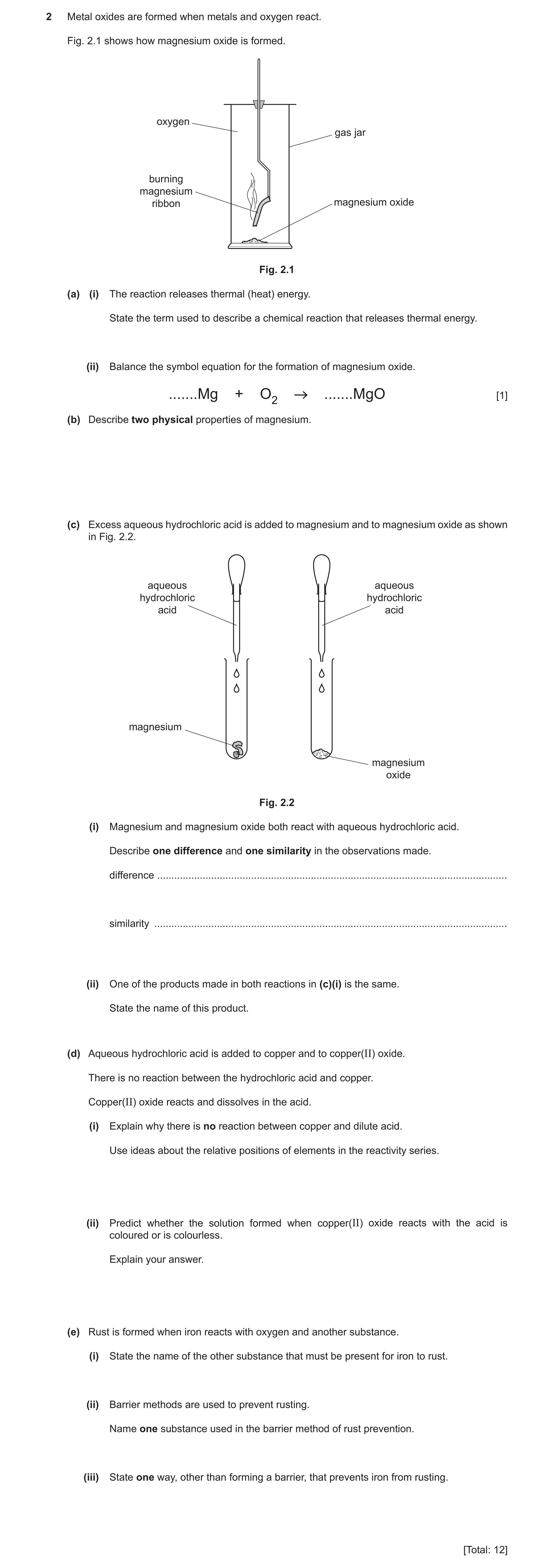
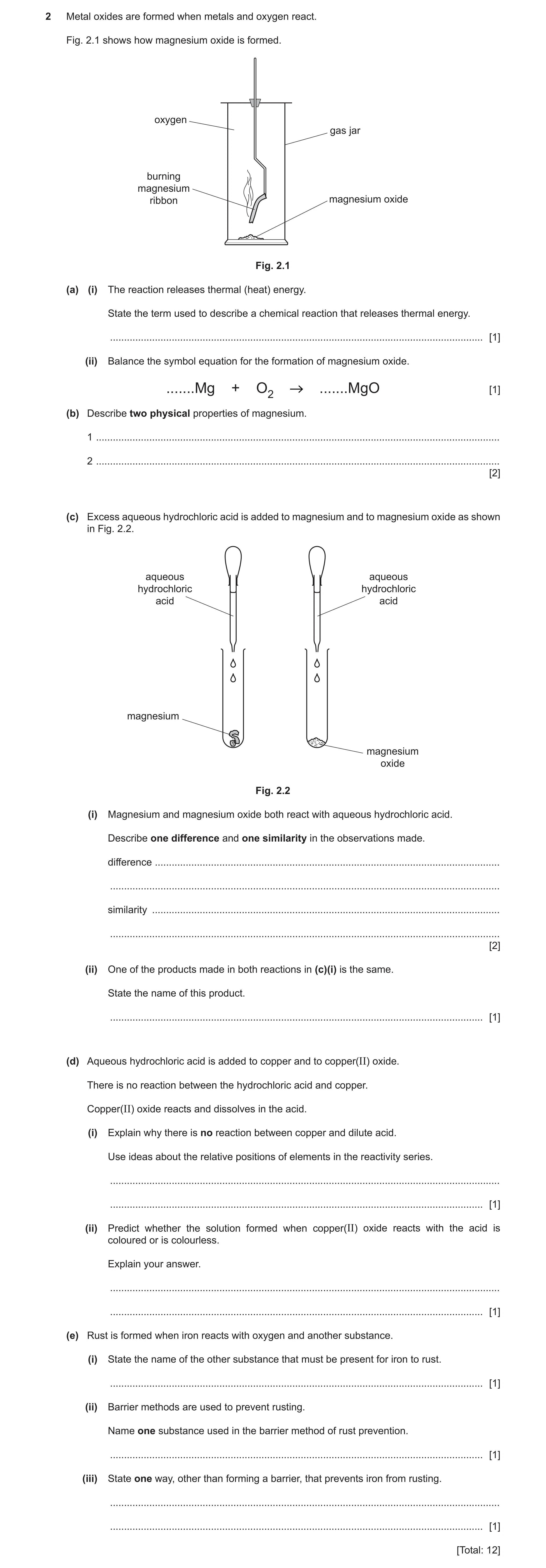
2 Metal oxides are formed when metals and oxygen react. Fig. 2.1 shows how magnesium oxide is formed. oxygen gas jar burning magnesium ribbon magnesium oxide Fig. 2.1 (a) (i) The reaction releases thermal (heat) energy. State the term used to describe a chemical reaction that releases thermal energy. (ii) Balance the symbol equation for the formation of magnesium oxide. [1] … Mg + O2 … MgO (b) Describe two physical properties of magnesium. (c) Excess aqueous hydrochloric acid is added to magnesium and to magnesium oxide as shown in Fig. 2.2. aqueous aqueous hydrochloric hydrochloric acid acid magnesium magnesium oxide Fig. 2.2 (i) Magnesium and magnesium oxide both react with aqueous hydrochloric acid. Describe one difference and one similarity in the observations made. difference �������������������������������������������������������������������������������������������������������������������������� similarity ���������������������������������������������������������������������������������������������������������������������������� (ii) One of the products made in both reactions in (c)(i) is the same. State the name of this product. (d) Aqueous hydrochloric acid is added to copper and to copper(II) oxide. There is no reaction between the hydrochloric acid and copper. Copper(II) oxide reacts and dissolves in the acid. (i) Explain why there is no reaction between copper and dilute acid. Use ideas about the relative positions of elements in the reactivity series. (ii) Predict whether the solution formed when copper(II) oxide reacts with the acid is coloured or is colourless. Explain your answer. (e) Rust is formed when iron reacts with oxygen and another substance. (i) State the name of the other substance that must be present for iron to rust. (ii) Barrier methods are used to prevent rusting. Name one substance used in the barrier method of rust prevention. (iii) State one way, other than forming a barrier, that prevents iron from rusting. [Total: 12]
12 marks
Mark scheme: 2(a)(i) exothermic ; 1 2(a)(ii) 2Mg + O2 → 2MgO ; 1 2(b) (magnesium is) malleable ; ductile ; good (electrical / thermal) conductor ; 2 2(c)(i) difference – gas released with magnesium (and not with the oxide) ; similarity – the solid reacts to form a soluble product / solid dissolves ; 2 2(c)(ii) magnesium chloride / MgCl2 ; 1 Question Answer Marks 2(d)(i) copper is low in the reactivity series ; copper is less reactive than hydrogen ; 1 2(d)(ii) (coloured) copper is a transition metal / transition metal compounds are (usually) coloured / copper compounds are coloured ; 1 2(e)(i) water / water vapour ; 1 2(e)(ii) paint / oil / plastic / (named) unreactive metal ; 1 2(e)(iii) (add other metals to) make it into an alloy / stainless steel ; 1
This question in 0654/31 Oct/Nov 2020
Q6 · Metal oxides are formed when metals and oxygen react 0654/33 Oct/Nov 2020
2 Metal oxides are formed when metals and oxygen react. Fig. 2.1 shows how magnesium oxide is formed. oxygen gas jar burning magnesium ribbon magnesium oxide Fig. 2.1 (a) (i) The reaction releases thermal (heat) energy. State the term used to describe a chemical reaction that releases thermal energy. … [1] (ii) Balance the symbol equation for the formation of magnesium oxide. [1] … Mg + O2 … MgO (b) Describe two physical properties of magnesium. 1 … 2 … [2] (c) Excess aqueous hydrochloric acid is added to magnesium and to magnesium oxide as shown in Fig. 2.2. aqueous aqueous hydrochloric hydrochloric acid acid magnesium magnesium oxide Fig. 2.2 (i) Magnesium and magnesium oxide both react with aqueous hydrochloric acid. Describe one difference and one similarity in the observations made. difference … … similarity … … [2] (ii) One of the products made in both reactions in (c)(i) is the same. State the name of this product. … [1] (d) Aqueous hydrochloric acid is added to copper and to copper(II) oxide. There is no reaction between the hydrochloric acid and copper. Copper(II) oxide reacts and dissolves in the acid. (i) Explain why there is no reaction between copper and dilute acid. Use ideas about the relative positions of elements in the reactivity series. … … [1] (ii) Predict whether the solution formed when copper(II) oxide reacts with the acid is coloured or is colourless. Explain your answer. … … [1] (e) Rust is formed when iron reacts with oxygen and another substance. (i) State the name of the other substance that must be present for iron to rust. … [1] (ii) Barrier methods are used to prevent rusting. Name one substance used in the barrier method of rust prevention. … [1] (iii) State one way, other than forming a barrier, that prevents iron from rusting. … … [1] [Total: 12]
12 marks
Mark scheme: 2(a)(i) exothermic ; 1 2(a)(ii) 2Mg + O2 → 2MgO ; 1 2(b) (magnesium is) malleable ; ductile ; good (electrical / thermal) conductor ; 2 2(c)(i) difference – gas released with magnesium (and not with the oxide) ; similarity – the solid reacts to form a soluble product / solid dissolves ; 2 2(c)(ii) magnesium chloride / MgCl2 ; 1 Question Answer Marks 2(d)(i) copper is low in the reactivity series ; copper is less reactive than hydrogen ; 1 2(d)(ii) (coloured) copper is a transition metal / transition metal compounds are (usually) coloured / copper compounds are coloured ; 1 2(e)(i) water / water vapour ; 1 2(e)(ii) paint / oil / plastic / (named) unreactive metal ; 1 2(e)(iii) (add other metals to) make it into an alloy / stainless steel ; 1
This question in 0654/33 Oct/Nov 2020
Q7 · Information about three colourless liquids J, K and L 0654/32 Feb/March 2021
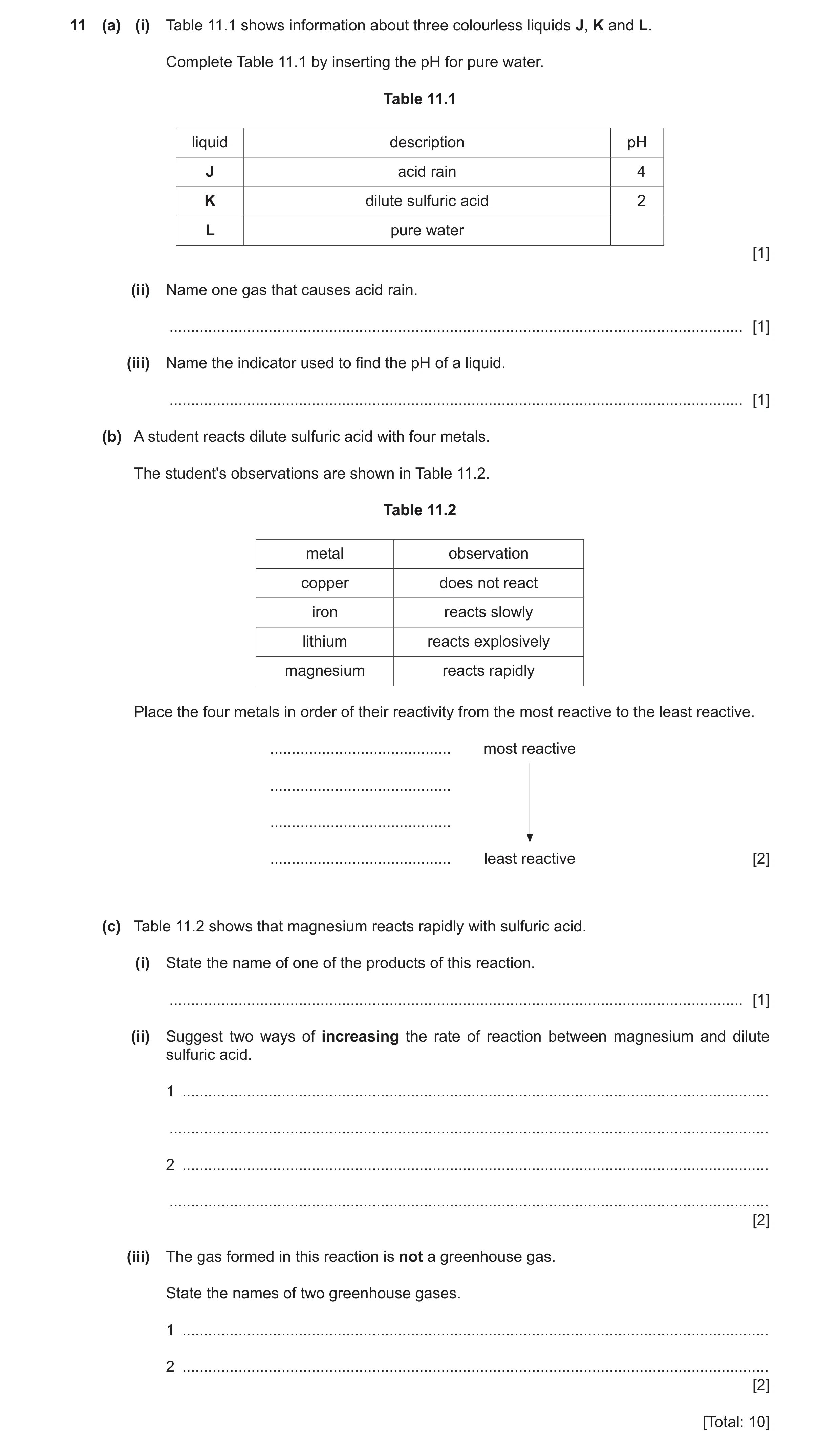
11 (a) (i) Table 11.1 shows information about three colourless liquids J, K and L. Complete Table 11.1 by inserting the pH for pure water. Table 11.1 liquid description pH J acid rain 4 K dilute sulfuric acid 2 L pure water [1] (ii) Name one gas that causes acid rain. … [1] (iii) Name the indicator used to find the pH of a liquid. … [1] (b) A student reacts dilute sulfuric acid with four metals. The student's observations are shown in Table 11.2. Table 11.2 metal observation copper does not react iron reacts slowly lithium reacts explosively magnesium reacts rapidly Place the four metals in order of their reactivity from the most reactive to the least reactive. … most reactive … … … least reactive [2] (c) Table 11.2 shows that magnesium reacts rapidly with sulfuric acid. (i) State the name of one of the products of this reaction. … [1] (ii) Suggest two ways of increasing the rate of reaction between magnesium and dilute sulfuric acid. 1 … … 2 … … [2] (iii) The gas formed in this reaction is not a greenhouse gas. State the names of two greenhouse gases. 1 … 2 … [2] [Total: 10]
10 marks
Mark scheme: 11(a)(i) 7; 1 11(a)(ii) sulfur dioxide / nitrogen dioxide; 1 11(a)(iii) universal ; 1 11(b) lithium magnesium iron copper ;; 2 11(c)(i) hydrogen / magnesium sulfate; 1 11(c)(ii) increase temperature; increase surface area of magnesium; increase concentration of acid; max 2 2 Question Answer Marks 11(c)(iii) carbon dioxide; methane; 2
This question in 0654/32 Feb/March 2021
Q8 · Information about four metallic elements 0654/31 May/June 2021
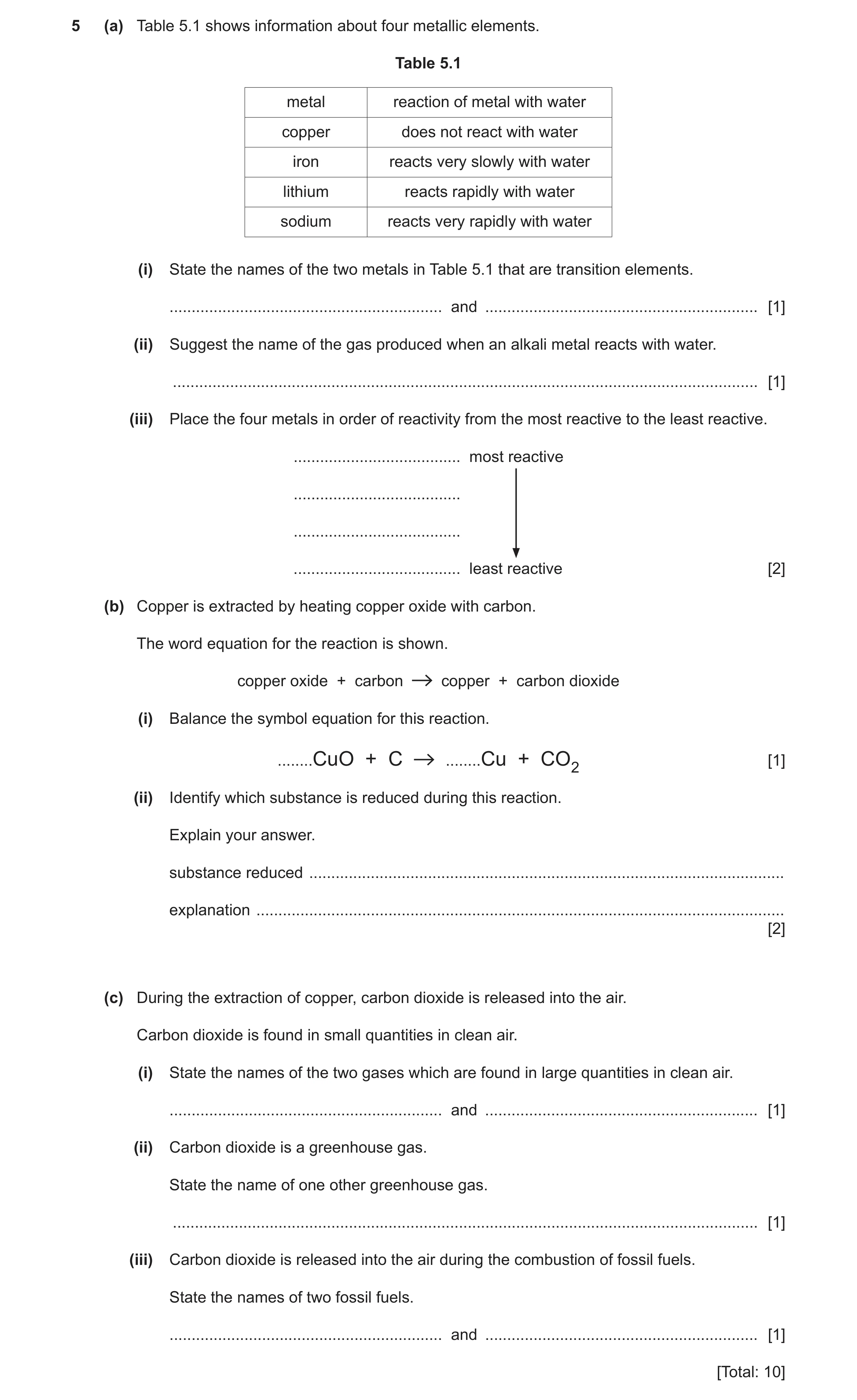
5 (a) Table 5.1 shows information about four metallic elements. Table 5.1 metal reaction of metal with water copper does not react with water iron reacts very slowly with water lithium reacts rapidly with water sodium reacts very rapidly with water (i) State the names of the two metals in Table 5.1 that are transition elements. … and … [1] (ii) Suggest the name of the gas produced when an alkali metal reacts with water. … [1] (iii) Place the four metals in order of reactivity from the most reactive to the least reactive. … most reactive … … … least reactive [2] (b) Copper is extracted by heating copper oxide with carbon. The word equation for the reaction is shown. copper oxide + carbon copper + carbon dioxide (i) Balance the symbol equation for this reaction. [1] … CuO + C … Cu + CO2 (ii) Identify which substance is reduced during this reaction. Explain your answer. substance reduced … explanation … [2] (c) During the extraction of copper, carbon dioxide is released into the air. Carbon dioxide is found in small quantities in clean air. (i) State the names of the two gases which are found in large quantities in clean air. … and … [1] (ii) Carbon dioxide is a greenhouse gas. State the name of one other greenhouse gas. … [1] (iii) Carbon dioxide is released into the air during the combustion of fossil fuels. State the names of two fossil fuels. … and … [1] [Total: 10]
10 marks
Mark scheme: 5(a)(i) copper and iron ; 1 5(a)(ii) hydrogen ; 1 5(a)(iii) sodium lithium iron copper ;; 2 5(b)(i) 2CuO + C → 2Cu + CO2 ; 1 5(b)(ii) copper oxide ; loses oxygen ; 2 Question Answer Marks 5(c)(i) oxygen and nitrogen ; (both required) 1 5(c)(ii) methane ; 1 5(c)(iii) coal / petroleum / natural gas – any two for 1 mark ; 1
This question in 0654/31 May/June 2021
Q9 · A student adds calcium and copper to separate test-tubes of cold water 0654/32 May/June 2022
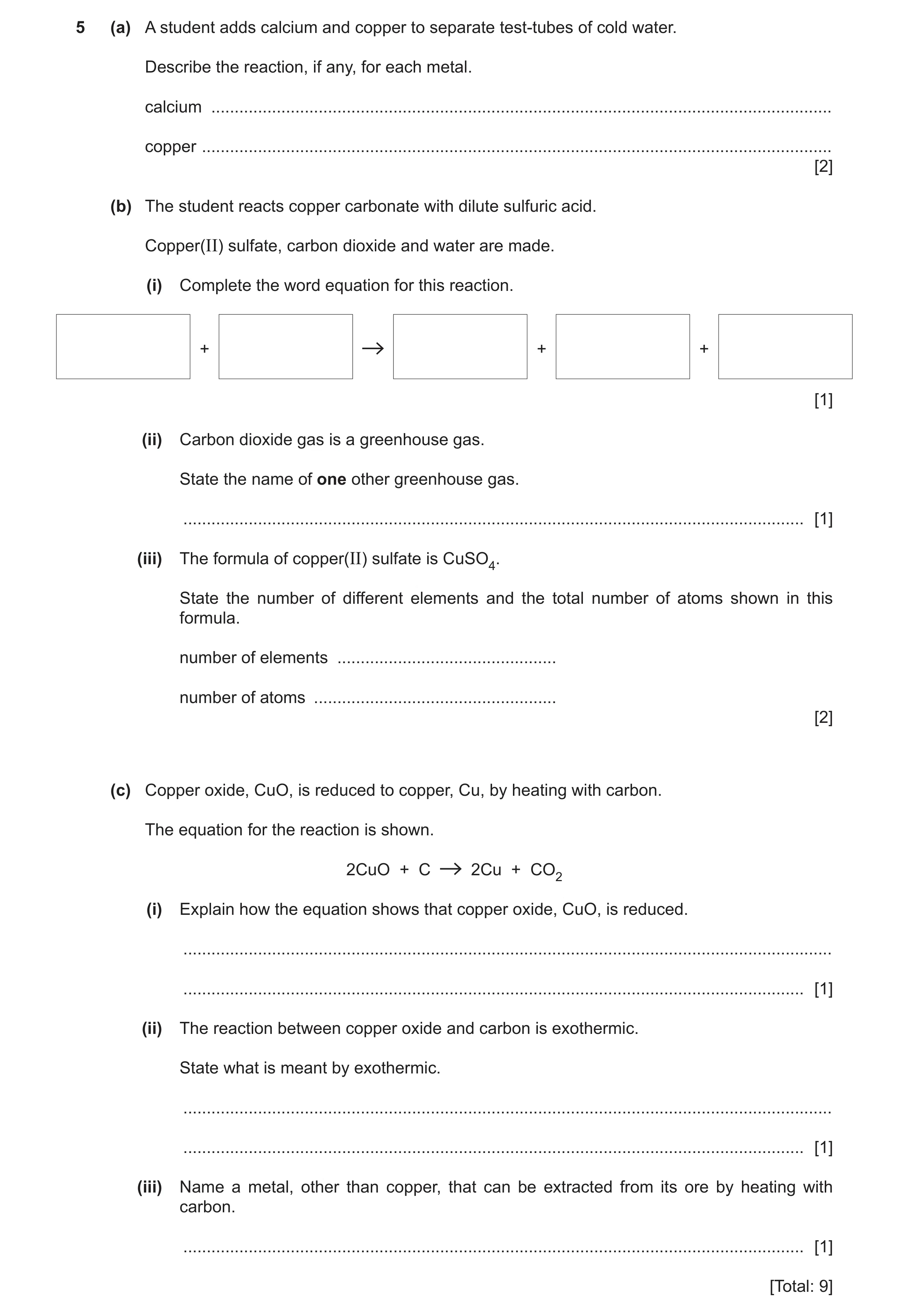
5 (a) A student adds calcium and copper to separate test-tubes of cold water. Describe the reaction, if any, for each metal. calcium … copper … [2] (b) The student reacts copper carbonate with dilute sulfuric acid. Copper(II) sulfate, carbon dioxide and water are made. (i) Complete the word equation for this reaction. + + + [1] (ii) Carbon dioxide gas is a greenhouse gas. State the name of one other greenhouse gas. … [1] (iii) The formula of copper(II) sulfate is CuSO4. State the number of different elements and the total number of atoms shown in this formula. number of elements … number of atoms … [2] (c) Copper oxide, CuO, is reduced to copper, Cu, by heating with carbon. The equation for the reaction is shown. 2CuO + C 2Cu + CO2 (i) Explain how the equation shows that copper oxide, CuO, is reduced. … … [1] (ii) The reaction between copper oxide and carbon is exothermic. State what is meant by exothermic. … … [1] (iii) Name a metal, other than copper, that can be extracted from its ore by heating with carbon. … [1] [Total: 9]
9 marks
Mark scheme: 5(a) (calcium) gas evolved / metal dissolves / white insoluble solid forms ; (copper) no change ; 2 5(b)(i) copper carbonate + sulfuric acid copper sulfate + carbon dioxide + water; 1 5(b)(ii) methane; 1 5(b)(iii) number of elements = 3; number of atoms = 6; 2 5(c)(i) loss of oxygen ; 1 5(c)(ii) gives out (thermal) energy; 1 5(c)(iii) iron; 1
This question in 0654/32 May/June 2022
Q10 · A student adds calcium and copper to separate test-tubes of cold water 0654/33 May/June 2022
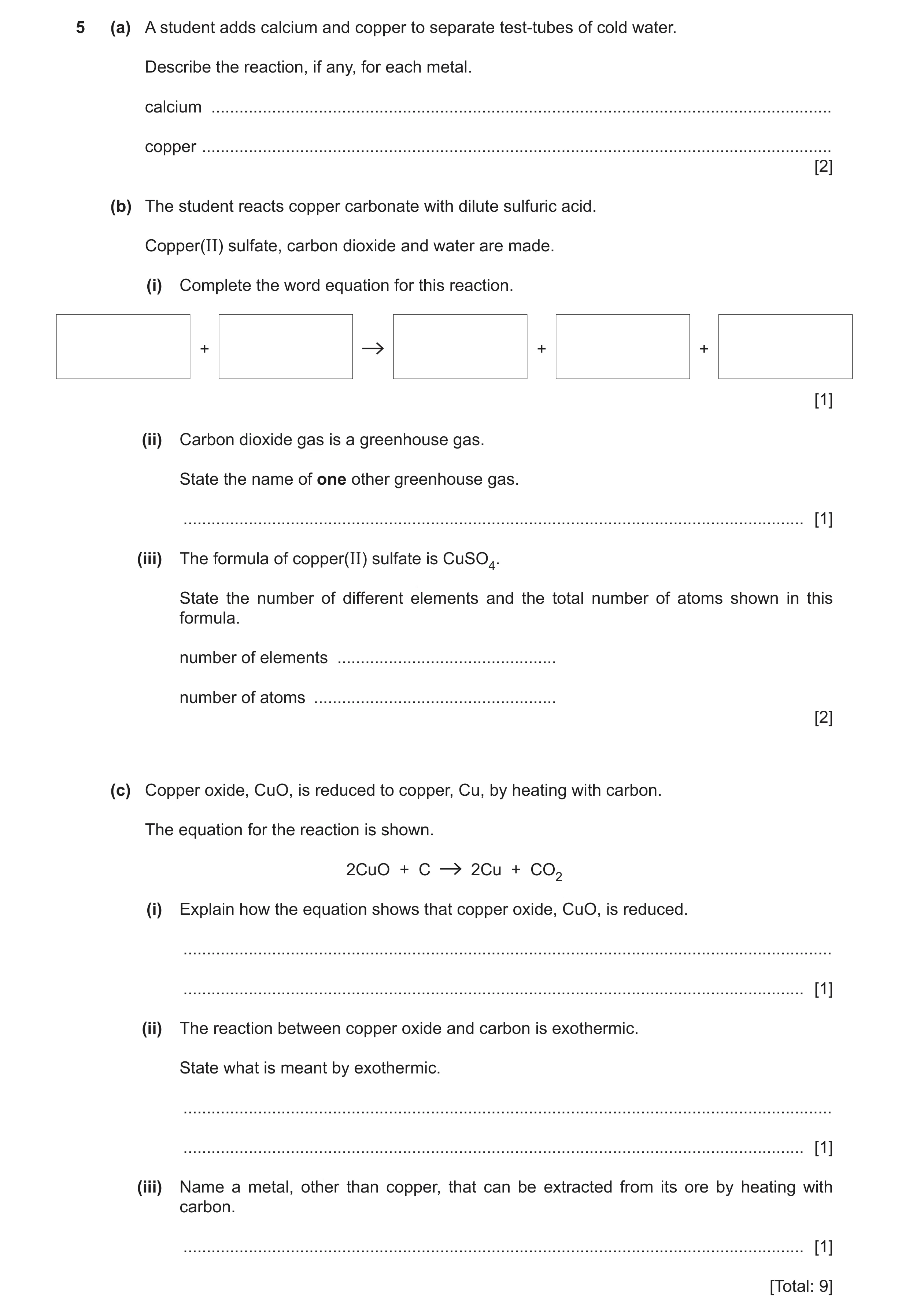
5 (a) A student adds calcium and copper to separate test-tubes of cold water. Describe the reaction, if any, for each metal. calcium … copper … [2] (b) The student reacts copper carbonate with dilute sulfuric acid. Copper(II) sulfate, carbon dioxide and water are made. (i) Complete the word equation for this reaction. + + + [1] (ii) Carbon dioxide gas is a greenhouse gas. State the name of one other greenhouse gas. … [1] (iii) The formula of copper(II) sulfate is CuSO4. State the number of different elements and the total number of atoms shown in this formula. number of elements … number of atoms … [2] (c) Copper oxide, CuO, is reduced to copper, Cu, by heating with carbon. The equation for the reaction is shown. 2CuO + C 2Cu + CO2 (i) Explain how the equation shows that copper oxide, CuO, is reduced. … … [1] (ii) The reaction between copper oxide and carbon is exothermic. State what is meant by exothermic. … … [1] (iii) Name a metal, other than copper, that can be extracted from its ore by heating with carbon. … [1] [Total: 9]
9 marks
Mark scheme: 5(a) (calcium) gas evolved / metal dissolves / white insoluble solid forms ; (copper) no change ; 2 5(b)(i) copper carbonate + sulfuric acid copper sulfate + carbon dioxide + water; 1 5(b)(ii) methane; 1 5(b)(iii) number of elements = 3; number of atoms = 6; 2 5(c)(i) loss of oxygen ; 1 5(c)(ii) gives out (thermal) energy; 1 5(c)(iii) iron; 1
This question in 0654/33 May/June 2022
Q11 · An isotope of magnesium has a proton number (atomic number) of 12 and a nucleon number… 0654/32 Oct/Nov 2022
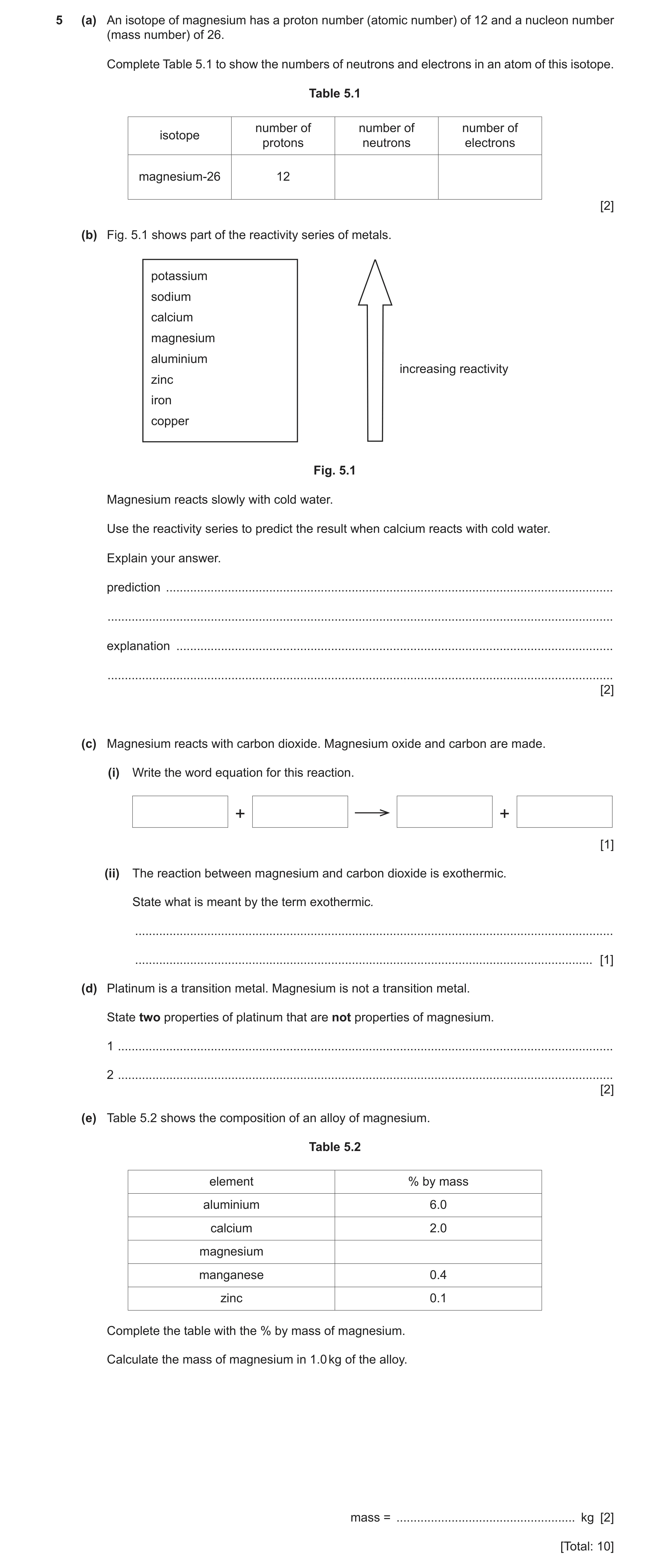
5 (a) An isotope of magnesium has a proton number (atomic number) of 12 and a nucleon number (mass number) of 26. Complete Table 5.1 to show the numbers of neutrons and electrons in an atom of this isotope. Table 5.1 number of number of number of isotope protons neutrons electrons magnesium-26 12 [2] (b) Fig. 5.1 shows part of the reactivity series of metals. potassium sodium calcium magnesium aluminium increasing reactivity zinc iron copper Fig. 5.1 Magnesium reacts slowly with cold water. Use the reactivity series to predict the result when calcium reacts with cold water. Explain your answer. prediction … … explanation … … [2] (c) Magnesium reacts with carbon dioxide. Magnesium oxide and carbon are made. (i) Write the word equation for this reaction. + + [1] (ii) The reaction between magnesium and carbon dioxide is exothermic. State what is meant by the term exothermic. … … [1] (d) Platinum is a transition metal. Magnesium is not a transition metal. State two properties of platinum that are not properties of magnesium. 1 … 2 … [2] (e) Table 5.2 shows the composition of an alloy of magnesium. Table 5.2 element % by mass aluminium 6.0 calcium 2.0 magnesium manganese 0.4 zinc 0.1 Complete the table with the % by mass of magnesium. Calculate the mass of magnesium in 1.0 kg of the alloy. mass = … kg [2] [Total: 10]
10 marks
Mark scheme: 5(a) 2 isotope number of number of number of protons neutrons electrons magnesium-26 12 14; 12; 5(b) calcium reacts quickly/quicker ; 2 calcium is higher in reactivity series than magnesium ; 5(c)(i) magnesium + carbon dioxide → magnesium oxide + carbon ; 1 5(c)(ii) releases (thermal) energy ; 1 5(d) any two from: 2 forms coloured compounds ; acts as catalyst ; variable valency ; 5(e) 91.5 (%) ; 2 0.915 (kg) ;
This question in 0654/32 Oct/Nov 2022
Q12 · State the name given to mixtures made from a metal with other elements 0654/32 Feb/March 2023
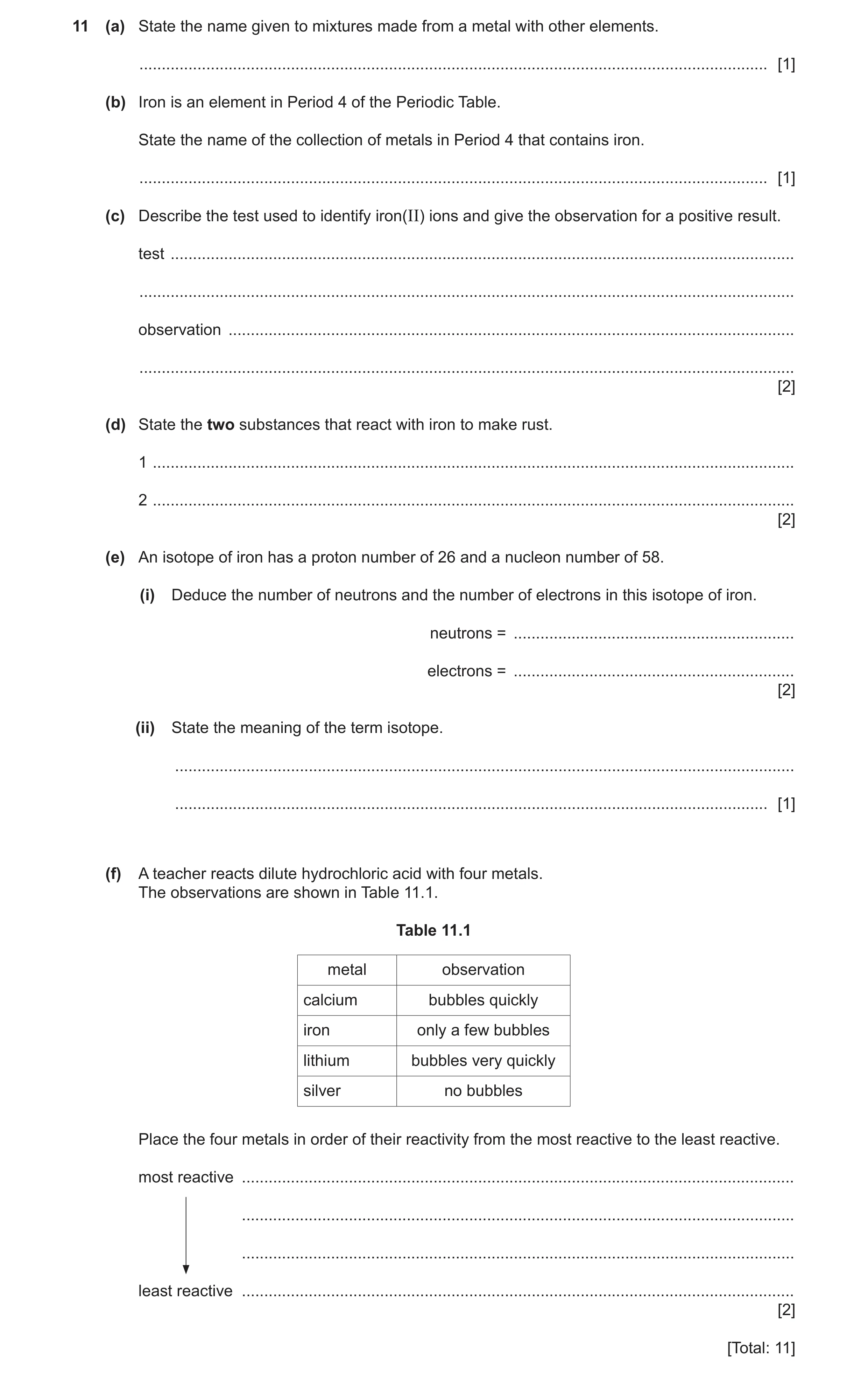
11 (a) State the name given to mixtures made from a metal with other elements. … [1] (b) Iron is an element in Period 4 of the Periodic Table. State the name of the collection of metals in Period 4 that contains iron. … [1] (c) Describe the test used to identify iron(II) ions and give the observation for a positive result. test … … observation … … [2] (d) State the two substances that react with iron to make rust. 1 … 2 … [2] (e) An isotope of iron has a proton number of 26 and a nucleon number of 58. (i) Deduce the number of neutrons and the number of electrons in this isotope of iron. neutrons = … electrons = … [2] (ii) State the meaning of the term isotope. … … [1] (f) A teacher reacts dilute hydrochloric acid with four metals. The observations are shown in Table 11.1. Table 11.1 metal observation calcium bubbles quickly iron only a few bubbles lithium bubbles very quickly silver no bubbles Place the four metals in order of their reactivity from the most reactive to the least reactive. most reactive … … … least reactive … [2] [Total: 11]
11 marks
Mark scheme: 11(a) alloy ; 1 11(b) transition elements / metals ; 1 11(c) aqueous sodium hydroxide ; 2 green precipitate ; 11(d) oxygen ; 2 water ; 11(e)(i) neutrons = 32 ; 2 electrons = 26 ; 11(e)(ii) atoms of the same element that have different numbers of neutrons ; 1 11(f) lithium 2 calcium iron silver lithium and / or silver correct ; all else correct ;
This question in 0654/32 Feb/March 2023
Q13 · Three metals are placed in three different test-tubes of dilute sulfuric acid as shown in… 0654/32 Feb/March 2024
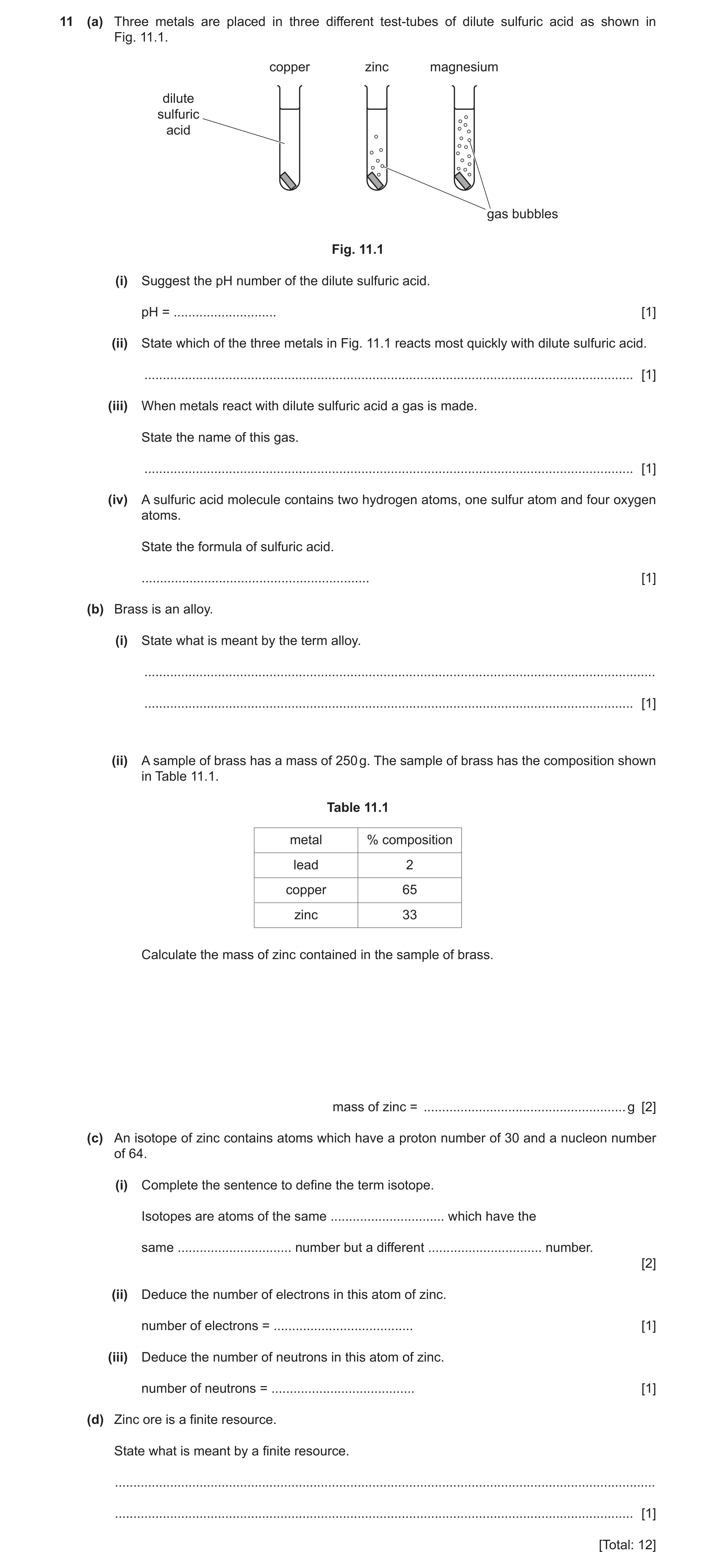
11 (a) Three metals are placed in three different test-tubes of dilute sulfuric acid as shown in Fig. 11.1. copper zinc magnesium dilute sulfuric acid gas bubbles Fig. 11.1 (i) Suggest the pH number of the dilute sulfuric acid. pH = … [1] (ii) State which of the three metals in Fig. 11.1 reacts most quickly with dilute sulfuric acid. … [1] (iii) When metals react with dilute sulfuric acid a gas is made. State the name of this gas. … [1] (iv) A sulfuric acid molecule contains two hydrogen atoms, one sulfur atom and four oxygen atoms. State the formula of sulfuric acid. … [1] (b) Brass is an alloy. (i) State what is meant by the term alloy. … … [1] (ii) A sample of brass has a mass of 250 g. The sample of brass has the composition shown in Table 11.1. Table 11.1 metal % composition lead 2 copper 65 zinc 33 Calculate the mass of zinc contained in the sample of brass. mass of zinc = … g [2] (c) An isotope of zinc contains atoms which have a proton number of 30 and a nucleon number of 64. (i) Complete the sentence to define the term isotope. Isotopes are atoms of the same … which have the same … number but a different … number. [2] (ii) Deduce the number of electrons in this atom of zinc. number of electrons = … [1] (iii) Deduce the number of neutrons in this atom of zinc. number of neutrons = … [1] (d) Zinc ore is a finite resource. State what is meant by a finite resource. … … [1] [Total: 12]
12 marks
Mark scheme: 11(a)(i) in the range from 1 to 6 ; 1 11(a)(ii) magnesium ; 1 11(a)(iii) hydrogen ; 1 11(a)(iv) H2SO4 ; 1 11(b)(i) a mixture of a metals and other elements; 1 11(b)(ii) 33 250 / 100 ; 2 83 ; 11(c)(i) element; 2 proton and nucleon; 11(c)(ii) 30 ; 1 11(c)(iii) 34 ; 1 11(d) (A finite resource is something useful that is) non-renewable / will eventually run out ; 1
This question in 0654/32 Feb/March 2024
Q14 · A list of metals is shown 0654/31 May/June 2024
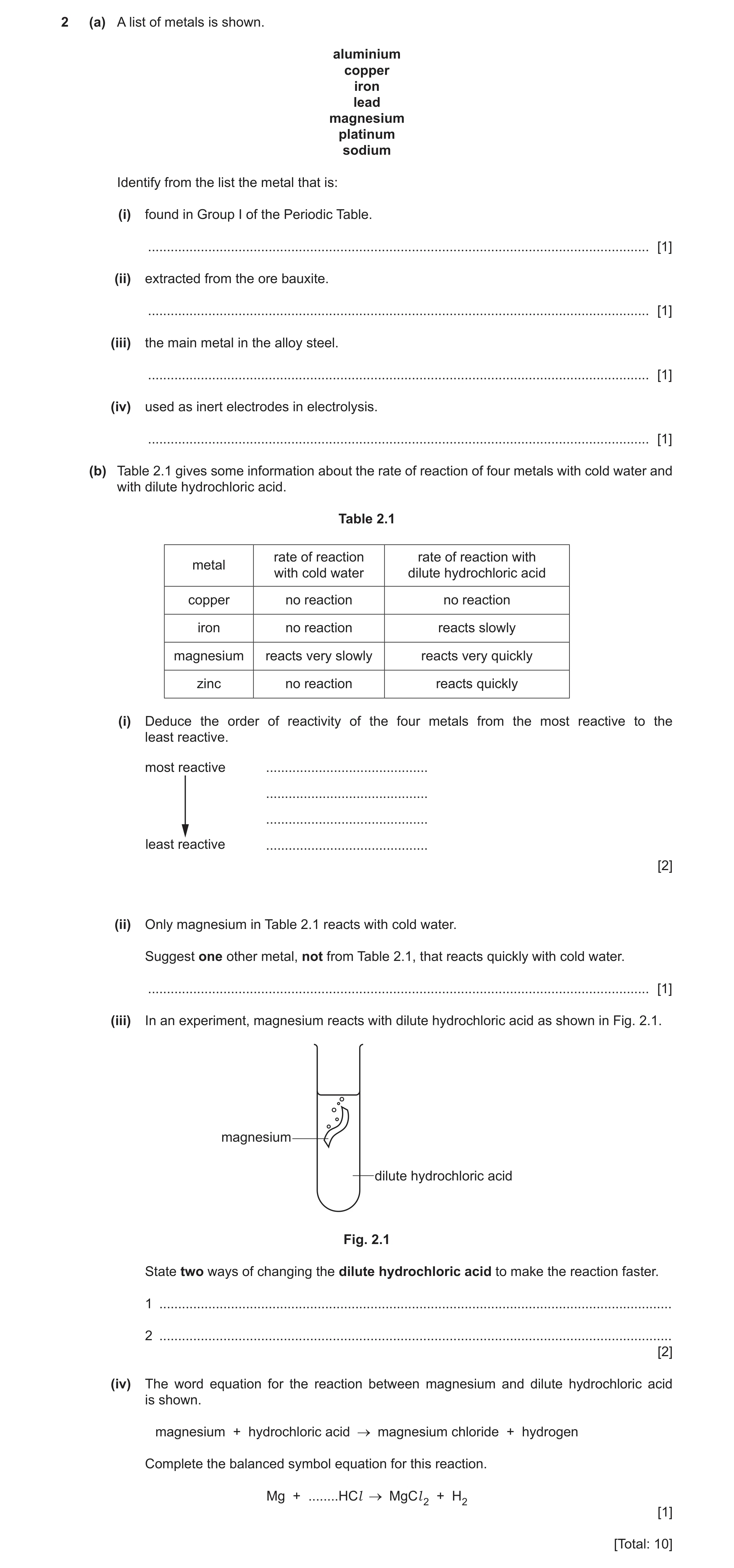
2 (a) A list of metals is shown. aluminium copper iron lead magnesium platinum sodium Identify from the list the metal that is: (i) found in Group I of the Periodic Table. … [1] (ii) extracted from the ore bauxite. … [1] (iii) the main metal in the alloy steel. … [1] (iv) used as inert electrodes in electrolysis. … [1] (b) Table 2.1 gives some information about the rate of reaction of four metals with cold water and with dilute hydrochloric acid. Table 2.1 rate of reaction rate of reaction with metal with cold water dilute hydrochloric acid copper no reaction no reaction iron no reaction reacts slowly magnesium reacts very slowly reacts very quickly zinc no reaction reacts quickly (i) Deduce the order of reactivity of the four metals from the most reactive to the least reactive. most reactive … … … least reactive … [2] (ii) Only magnesium in Table 2.1 reacts with cold water. Suggest one other metal, not from Table 2.1, that reacts quickly with cold water. … [1] (iii) In an experiment, magnesium reacts with dilute hydrochloric acid as shown in Fig. 2.1. magnesium dilute hydrochloric acid Fig. 2.1 State two ways of changing the dilute hydrochloric acid to make the reaction faster. 1 … 2 … [2] (iv) The word equation for the reaction between magnesium and dilute hydrochloric acid is shown. magnesium + hydrochloric acid magnesium chloride + hydrogen Complete the balanced symbol equation for this reaction. Mg + … HCl MgCl 2 + H2 [1] [Total: 10]
10 marks
Mark scheme: 2(a)(i) sodium ; 1 2(a)(ii) aluminium ; 1 2(a)(iii) iron ; 1 2(a)(iv) platinum ; 1 Question Answer Marks 2(b)(i) magnesium zinc iron copper magnesium and copper correct ; zinc and iron correct ; 2 2(b)(ii) lithium, sodium, potassium etc. ; 1 2(b)(iii) increase concentration of acid ; increase temperature of acid ; 2 2(b)(iv) 2 HCl ; 1
This question in 0654/31 May/June 2024
Q15 · The observations for the reactions of four metals with water 0654/31 Oct/Nov 2024
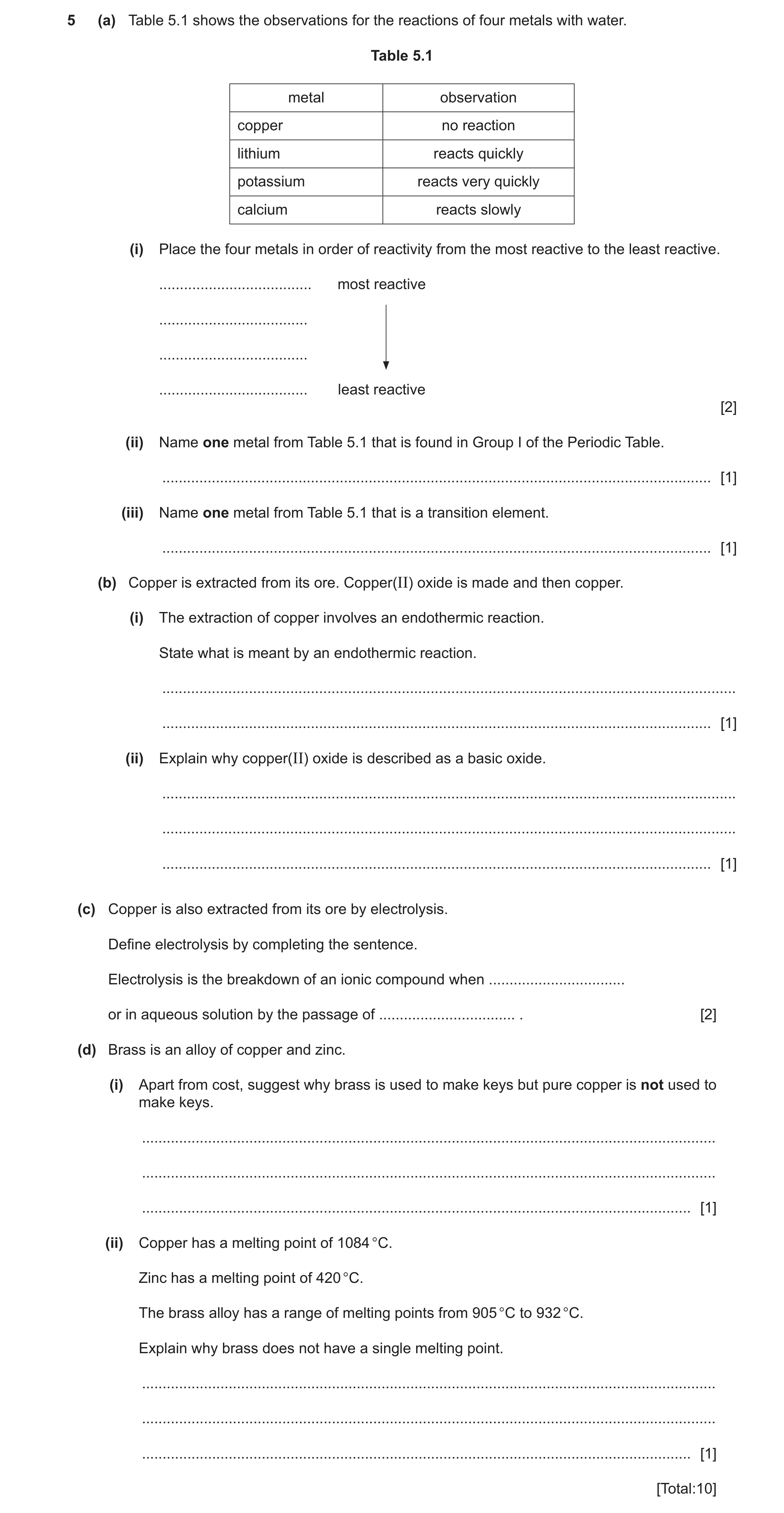
5 (a) Table 5.1 shows the observations for the reactions of four metals with water. Table 5.1 metal observation copper no reaction lithium reacts quickly potassium reacts very quickly calcium reacts slowly (i) Place the four metals in order of reactivity from the most reactive to the least reactive. … most reactive … … … least reactive [2] (ii) Name one metal from Table 5.1 that is found in Group I of the Periodic Table. … [1] (iii) Name one metal from Table 5.1 that is a transition element. … [1] (b) Copper is extracted from its ore. Copper(II) oxide is made and then copper. (i) The extraction of copper involves an endothermic reaction. State what is meant by an endothermic reaction. … … [1] (ii) Explain why copper(II) oxide is described as a basic oxide. … … … [1] (c) Copper is also extracted from its ore by electrolysis. Define electrolysis by completing the sentence. Electrolysis is the breakdown of an ionic compound when … or in aqueous solution by the passage of … . [2] (d) Brass is an alloy of copper and zinc. (i) Apart from cost, suggest why brass is used to make keys but pure copper is not used to make keys. … … … [1] (ii) Copper has a melting point of 1084 °C. Zinc has a melting point of 420 °C. The brass alloy has a range of melting points from 905 °C to 932 °C. Explain why brass does not have a single melting point. … … … [1] [Total:10]
10 marks
Mark scheme: 5(a)(i) potassium 2 lithium calcium copper potassium and copper correct ; lithium and calcium correct ; 5(a)(ii) lithium / potassium ; 1 5(a)(iii) copper ; 1 5(b)(i) temperature decreases / thermal energy is absorbed (from the surroundings) ; 1 5(b)(ii) is a metal oxide ; 1 5(c) molten / liquid ; 2 electricity ; 5(d)(i) brass is more hardwearing / stronger ; 1 5(d)(ii) brass is a mixture ; 1
This question in 0654/31 Oct/Nov 2024
Q16 · The list shows six metals 0654/32 Feb/March 2025
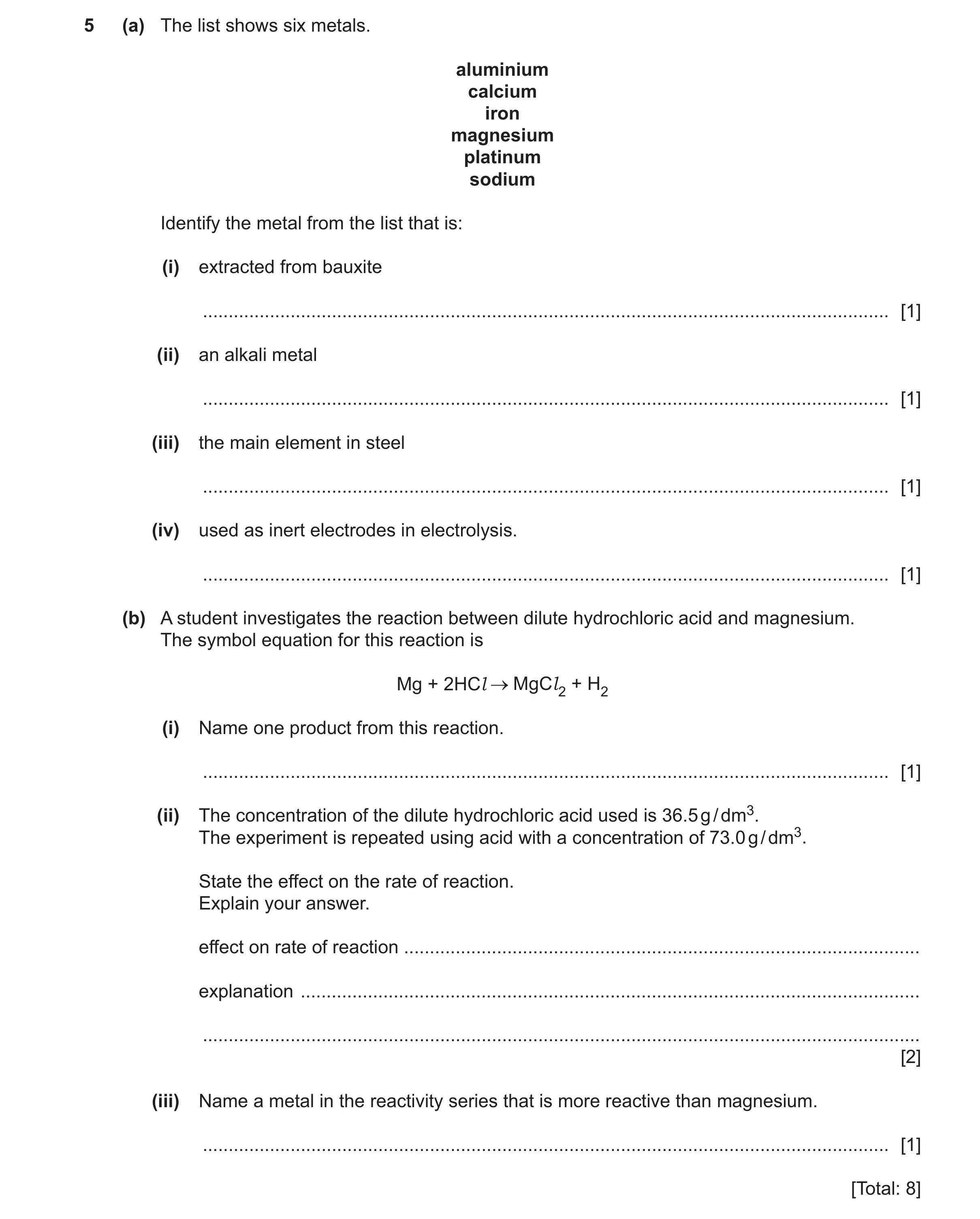
5 (a) The list shows six metals. aluminium calcium iron magnesium platinum sodium Identify the metal from the list that is: (i) extracted from bauxite … [1] (ii) an alkali metal … [1] (iii) the main element in steel … [1] (iv) used as inert electrodes in electrolysis. … [1] (b) A student investigates the reaction between dilute hydrochloric acid and magnesium. The symbol equation for this reaction is Mg + 2HCl MgCl + 2 H2 (i) Name one product from this reaction. … [1] (ii) The concentration of the dilute hydrochloric acid used is 36.5 g / dm3. The experiment is repeated using acid with a concentration of 73.0 g / dm3. State the effect on the rate of reaction. Explain your answer. effect on rate of reaction … explanation … … [2] (iii) Name a metal in the reactivity series that is more reactive than magnesium. … [1] [Total: 8]
8 marks
Mark scheme: 5(a)(i) aluminium ; 1 5(a)(ii) sodium ; 1 5(a)(iii) iron ; 1 5a(iv) platinum ; 1 5(b)(i) magnesium chloride / hydrogen ; 1 5(b)(ii) (rate of reaction) increases ; 2 increased concentration ; 5(b)(iii) calcium / sodium / potassium ; 1
This question in 0654/32 Feb/March 2025
Q17 · The arrangement of atoms in pure aluminium metal and in a mixture of aluminium and… 0654/32 Oct/Nov 2025
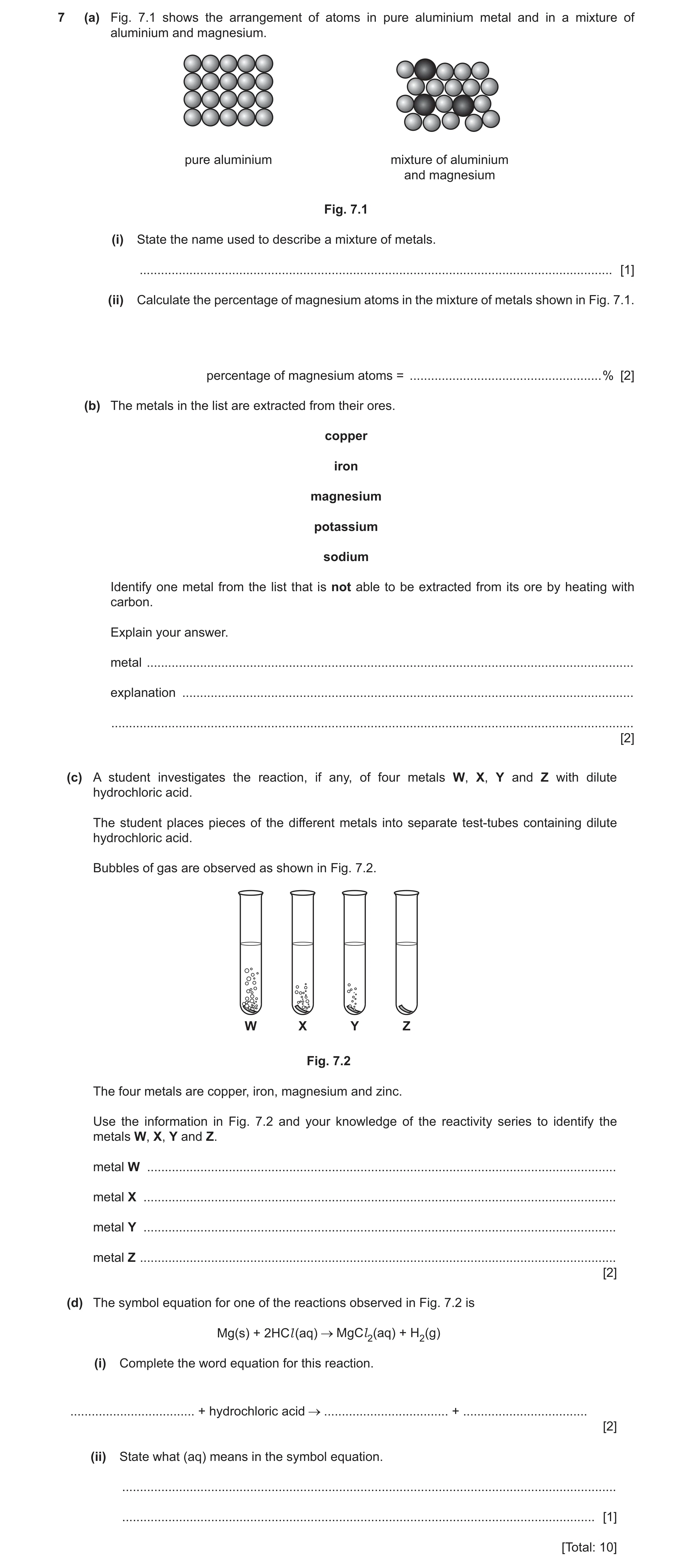
7 (a) Fig. 7.1 shows the arrangement of atoms in pure aluminium metal and in a mixture of aluminium and magnesium. pure aluminium mixture of aluminium and magnesium Fig. 7.1 (i) State the name used to describe a mixture of metals. … [1] (ii) Calculate the percentage of magnesium atoms in the mixture of metals shown in Fig. 7.1. percentage of magnesium atoms = … % [2] (b) The metals in the list are extracted from their ores. copper iron magnesium potassium sodium Identify one metal from the list that is not able to be extracted from its ore by heating with carbon. Explain your answer. metal … explanation … … [2] (c) A student investigates the reaction, if any, of four metals W, X, Y and Z with dilute hydrochloric acid. The student places pieces of the different metals into separate test‑tubes containing dilute hydrochloric acid. Bubbles of gas are observed as shown in Fig. 7.2. W X Y Z Fig. 7.2 The four metals are copper, iron, magnesium and zinc. Use the information in Fig. 7.2 and your knowledge of the reactivity series to identify the metals W, X, Y and Z. metal W … metal X … metal Y … metal Z … [2] (d) The symbol equation for one of the reactions observed in Fig. 7.2 is Mg(s) + 2HCl (aq) MgCl 2(aq) + H2(g) (i) Complete the word equation for this reaction. … + hydrochloric acid … + … [2] (ii) State what (aq) means in the symbol equation. … … [1] [Total: 10]
10 marks
Mark scheme: 7(a)(i) alloy ; 1 7(a)(ii) 3 magnesium atoms out of 20 total or 3 / 20 ; 2 15(%) ; 7(b) sodium or magnesium or potassium ; 2 more reactive than carbon / higher than carbon in the reactivity series ; 7(c) W magnesium 2 X zinc Y iron Z copper magnesium and copper correct – 1 mark zinc and iron correct – 1 mark 7(d)(i) magnesium + (hydrochloric acid) → magnesium chloride + hydrogen 2 all three correct – 2 marks one or two correct – 1 mark 7(d)(ii) aqueous or (in) solution or dissolved in water ; 1
This question in 0654/32 Oct/Nov 2025
Q18 · The arrangement of atoms in pure aluminium metal and in a mixture of aluminium and… 0654/33 Oct/Nov 2025
7 (a) Fig. 7.1 shows the arrangement of atoms in pure aluminium metal and in a mixture of aluminium and magnesium. pure aluminium mixture of aluminium and magnesium Fig. 7.1 (i) State the name used to describe a mixture of metals. … [1] (ii) Calculate the percentage of magnesium atoms in the mixture of metals shown in Fig. 7.1. percentage of magnesium atoms = … % [2] (b) The metals in the list are extracted from their ores. copper iron magnesium potassium sodium Identify one metal from the list that is not able to be extracted from its ore by heating with carbon. Explain your answer. metal … explanation … … [2] (c) A student investigates the reaction, if any, of four metals W, X, Y and Z with dilute hydrochloric acid. The student places pieces of the different metals into separate test‑tubes containing dilute hydrochloric acid. Bubbles of gas are observed as shown in Fig. 7.2. W X Y Z Fig. 7.2 The four metals are copper, iron, magnesium and zinc. Use the information in Fig. 7.2 and your knowledge of the reactivity series to identify the metals W, X, Y and Z. metal W … metal X … metal Y … metal Z … [2] (d) The symbol equation for one of the reactions observed in Fig. 7.2 is Mg(s) + 2HCl (aq) MgCl 2(aq) + H2(g) (i) Complete the word equation for this reaction. … + hydrochloric acid … + … [2] (ii) State what (aq) means in the symbol equation. … … [1] [Total: 10]
10 marks
Mark scheme: 7(a)(i) alloy ; 1 7(a)(ii) 3 magnesium atoms out of 20 total or 3 / 20 ; 2 15(%) ; 7(b) sodium or magnesium or potassium ; 2 more reactive than carbon / higher than carbon in the reactivity series ; 7(c) W magnesium 2 X zinc Y iron Z copper magnesium and copper correct – 1 mark zinc and iron correct – 1 mark 7(d)(i) magnesium + (hydrochloric acid) → magnesium chloride + hydrogen 2 all three correct – 2 marks one or two correct – 1 mark 7(d)(ii) aqueous or (in) solution or dissolved in water ; 1
This question in 0654/33 Oct/Nov 2025
 25 / 29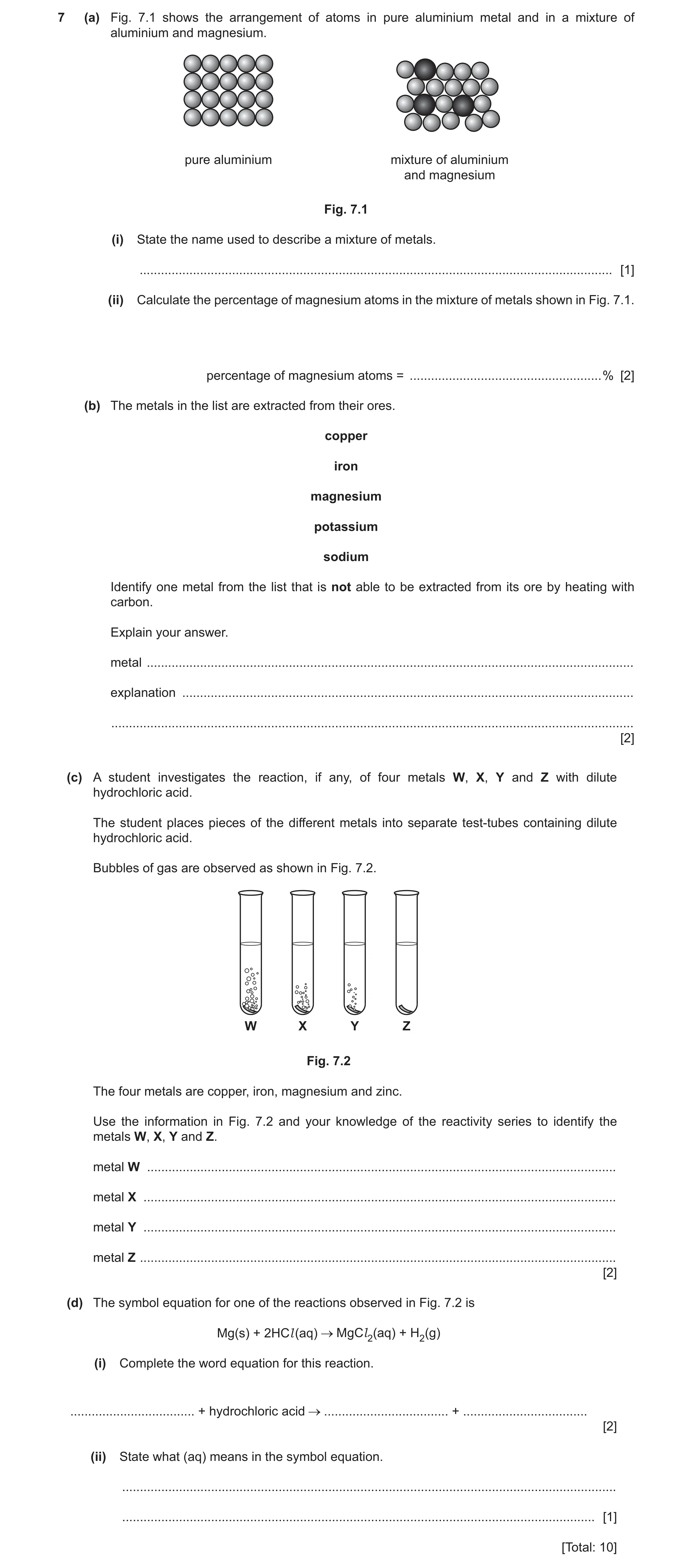
 10
10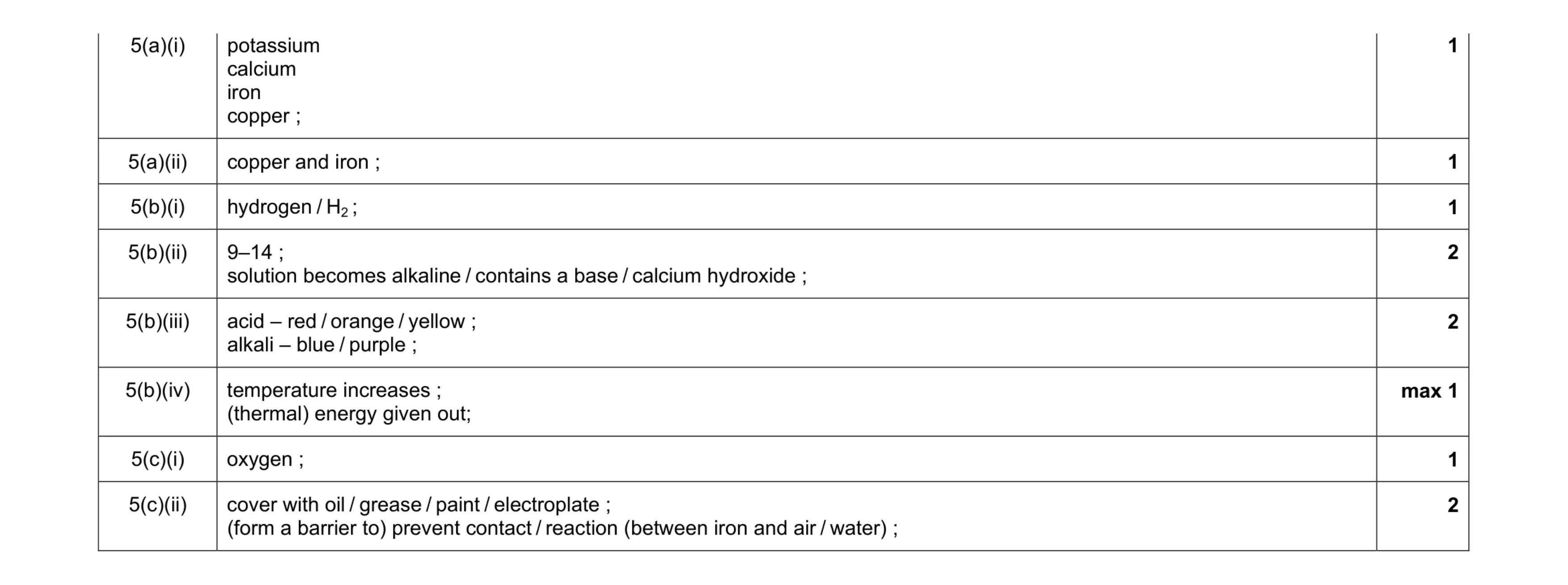 11
11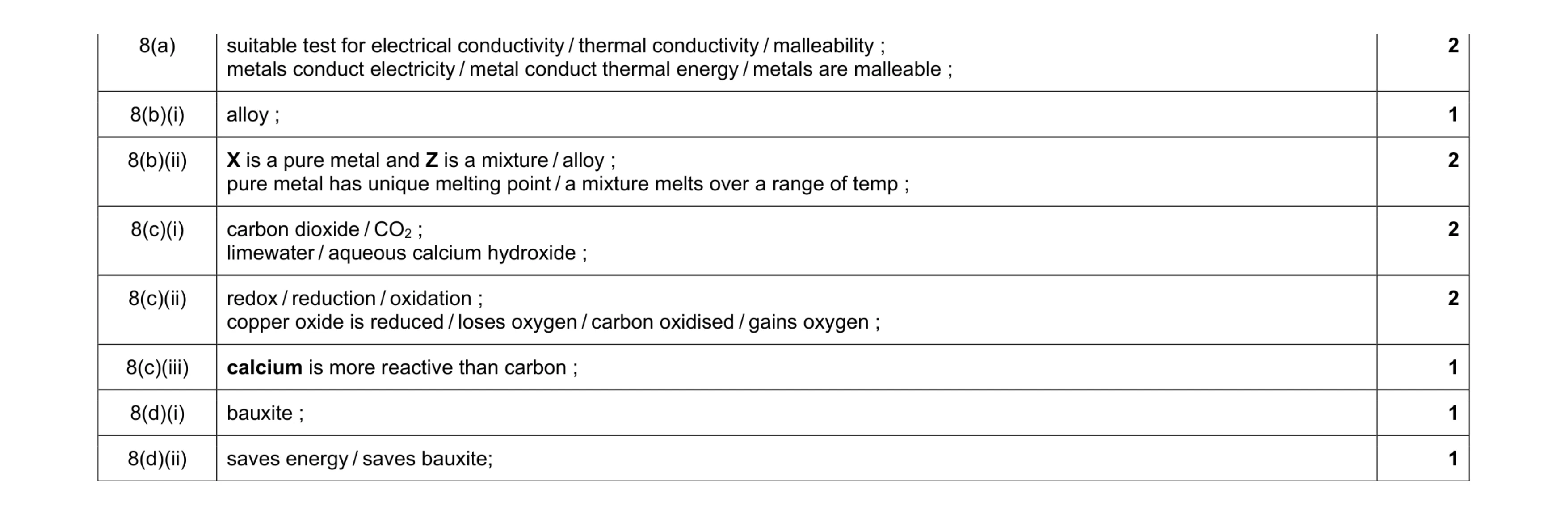 12
12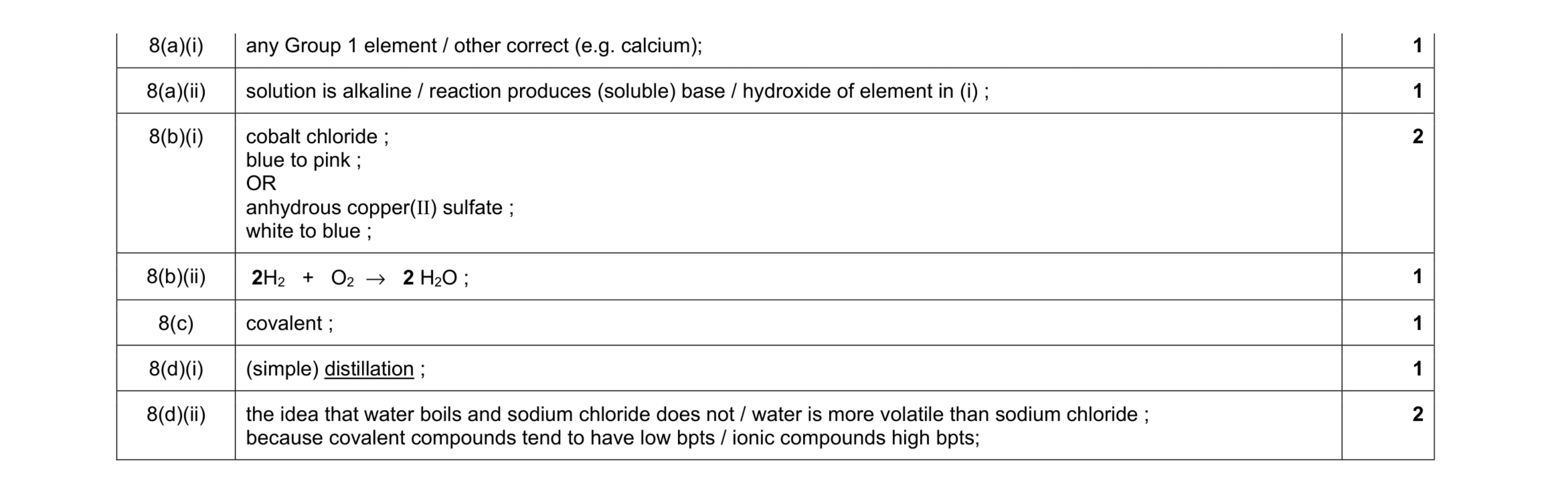 9
9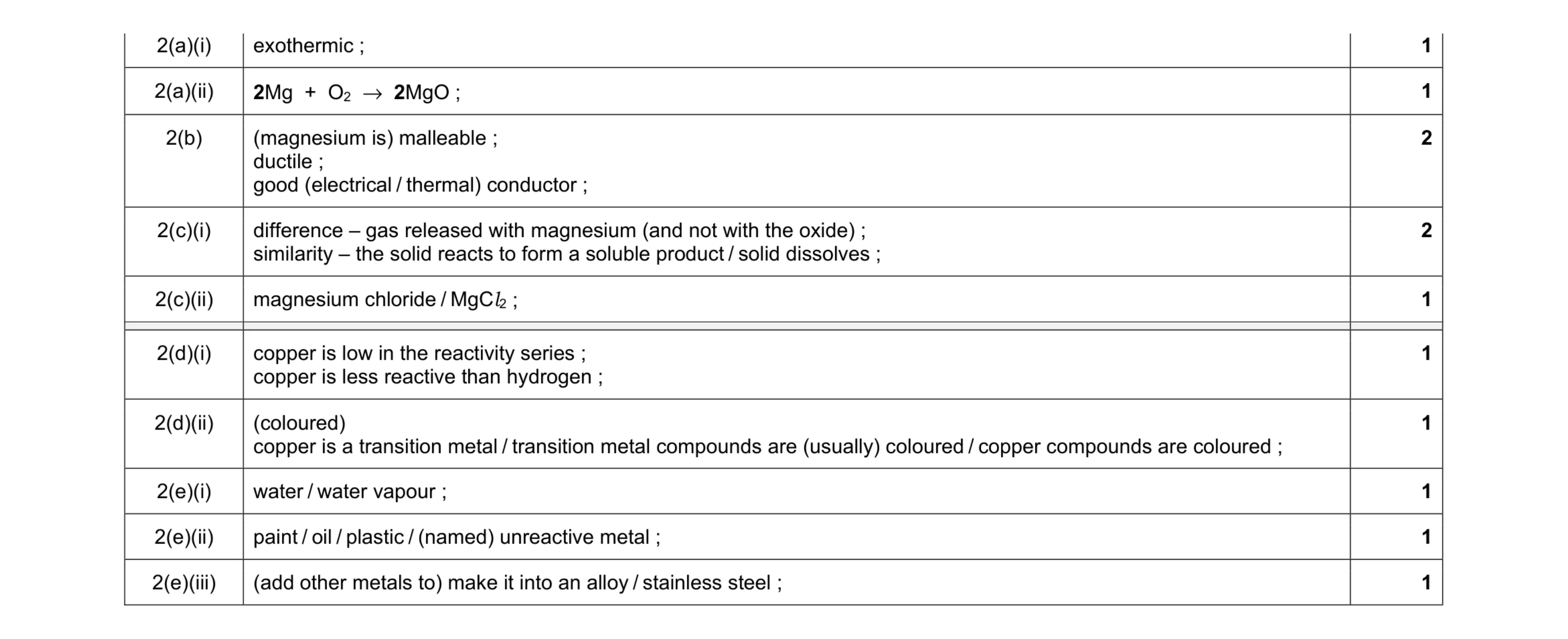 12
12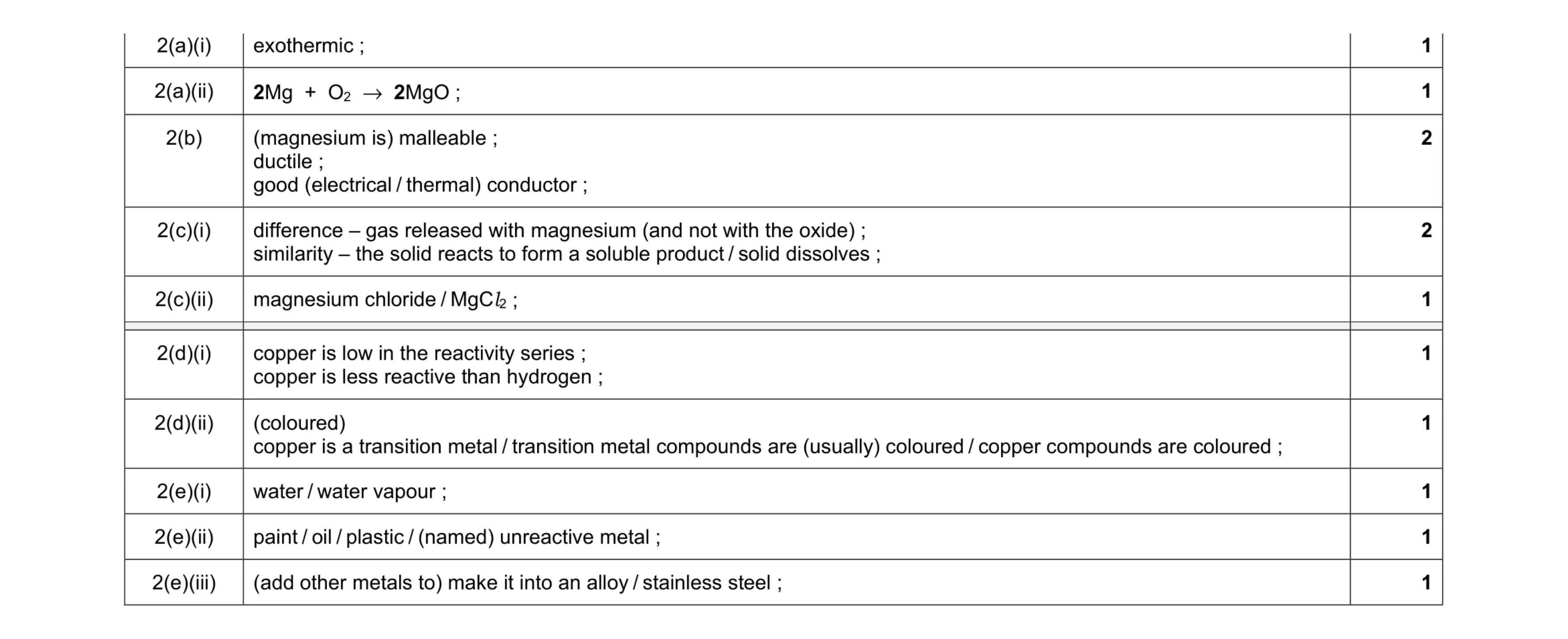 12
12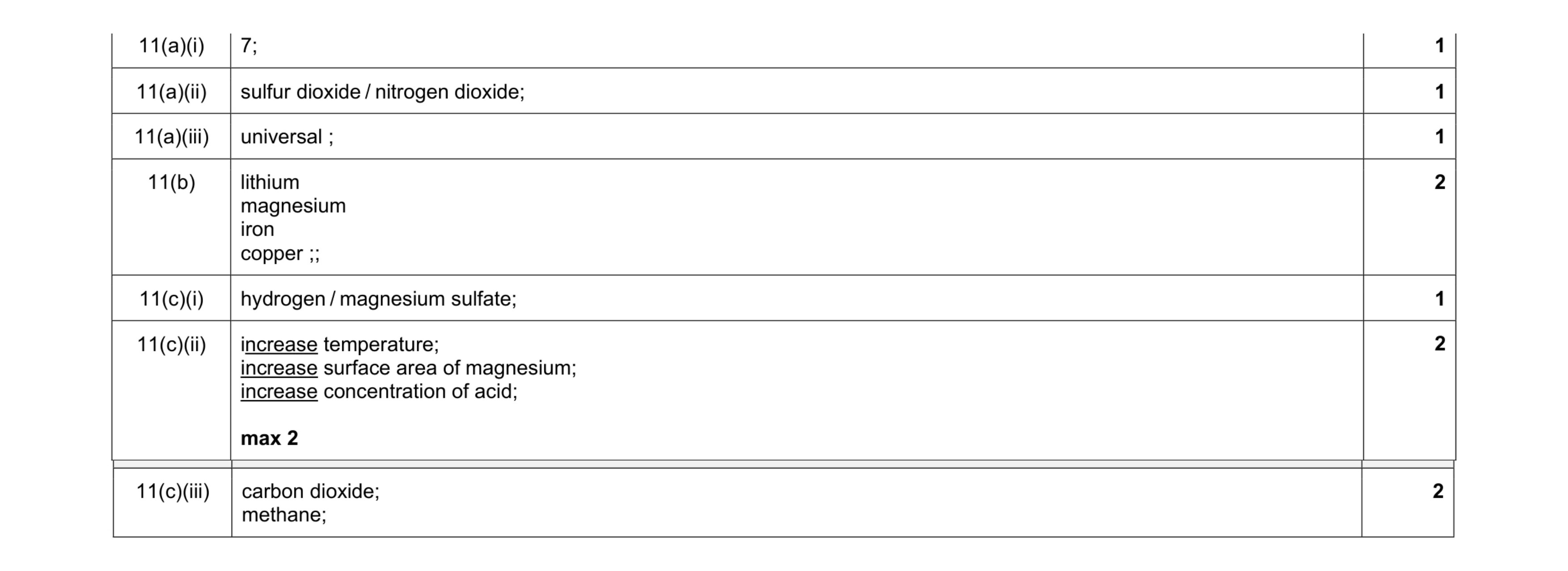 10
10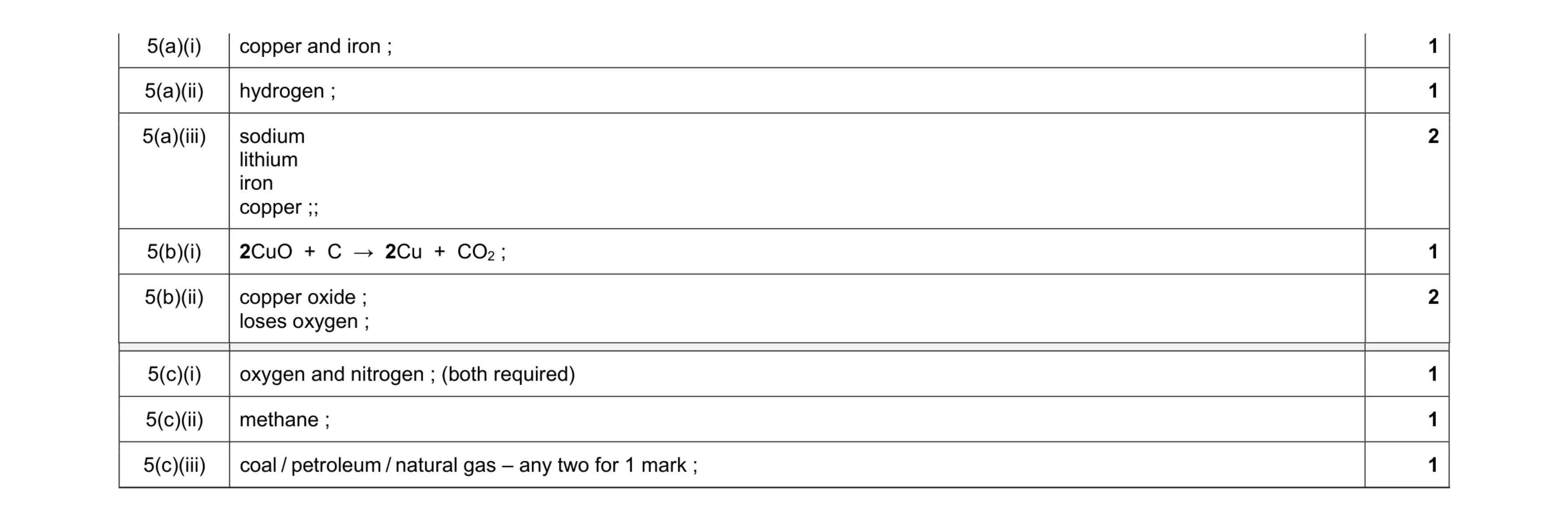 10
10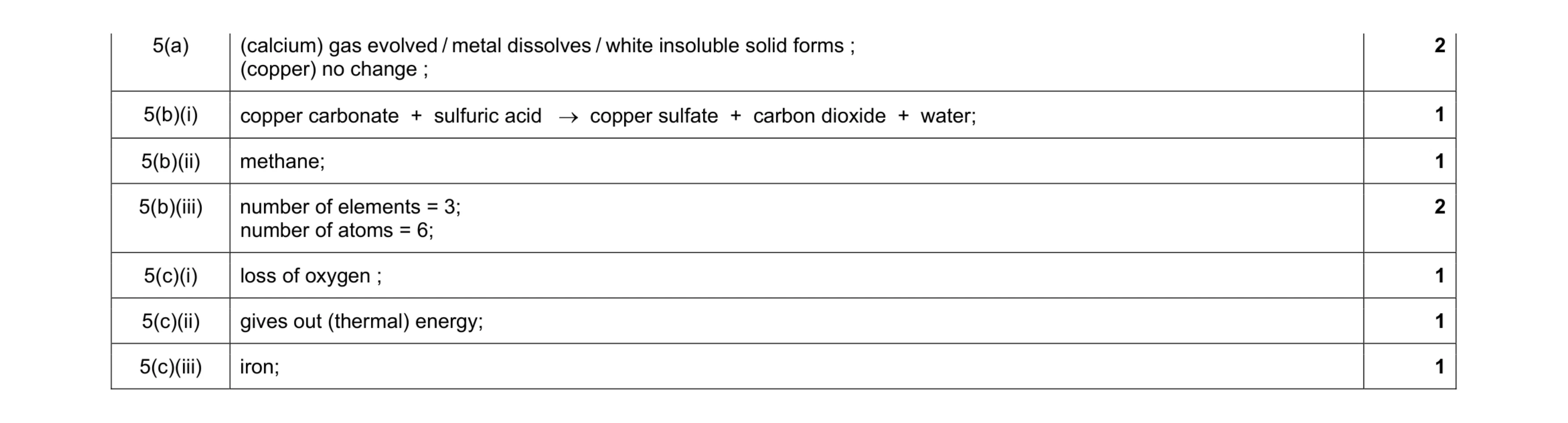 9
9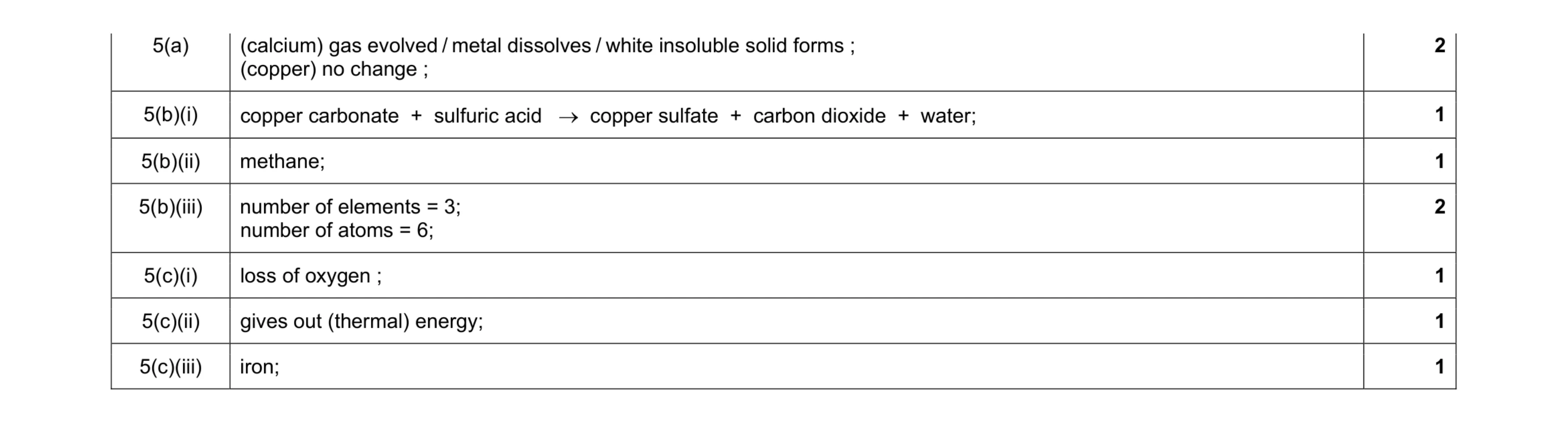 9
9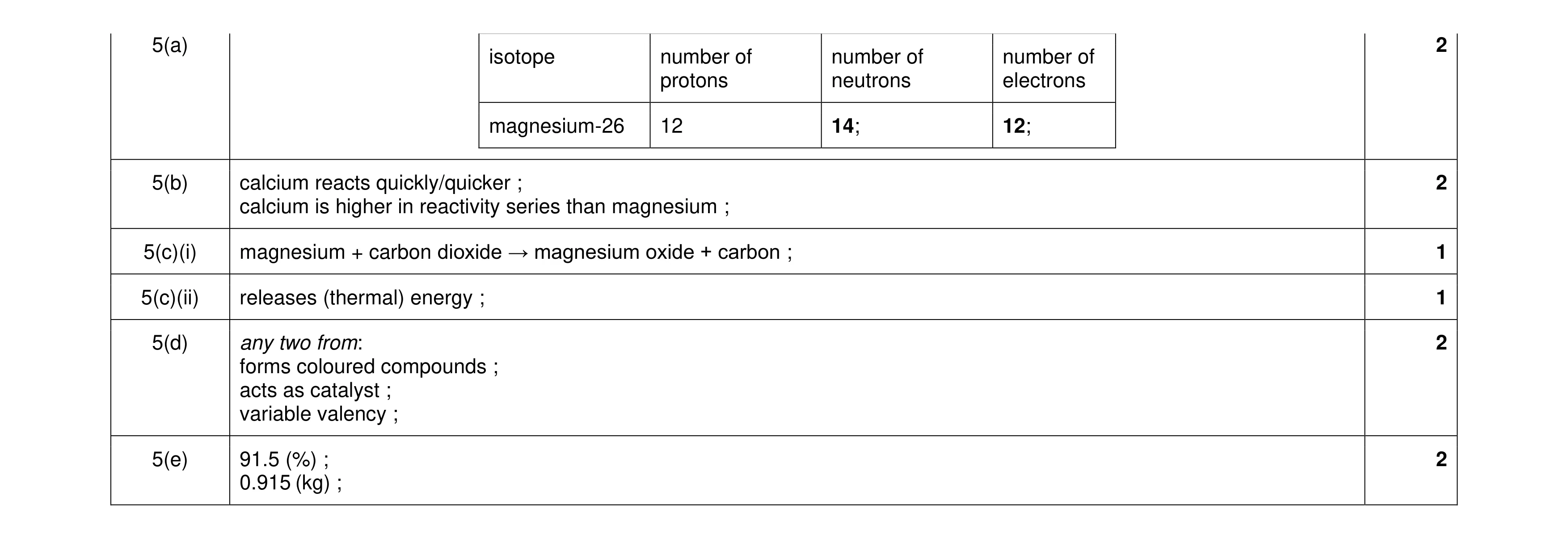 10
10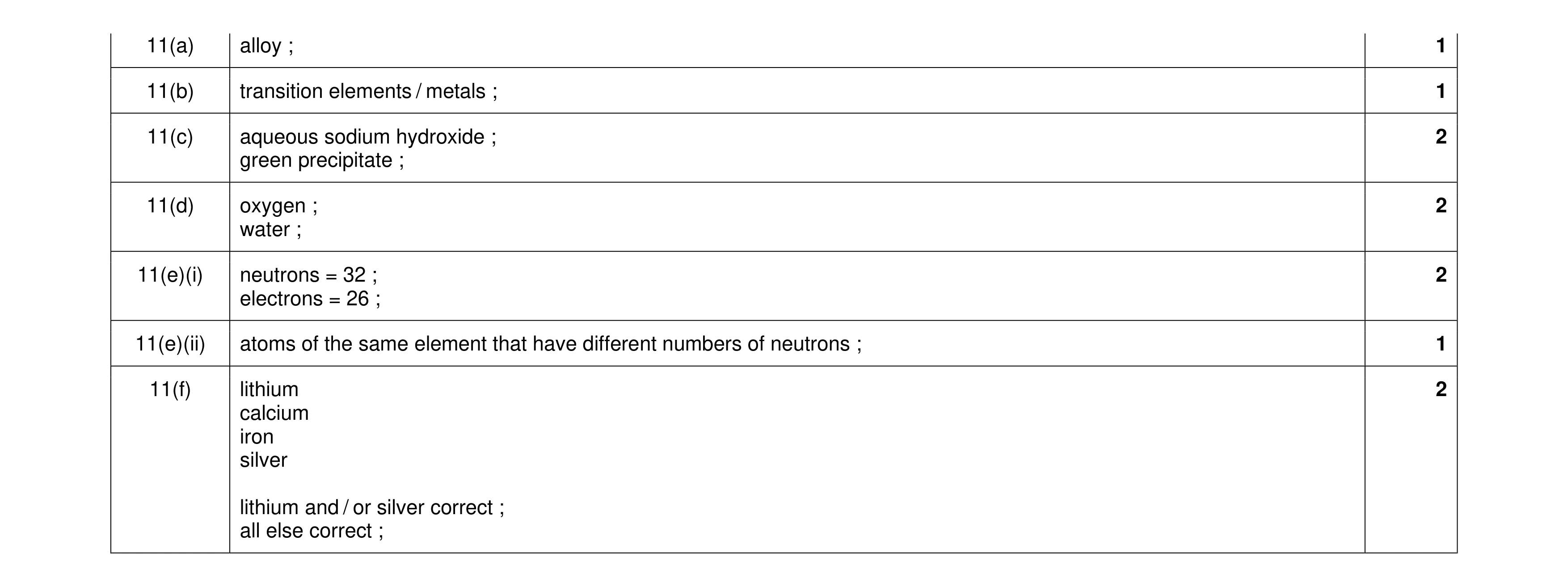 11
11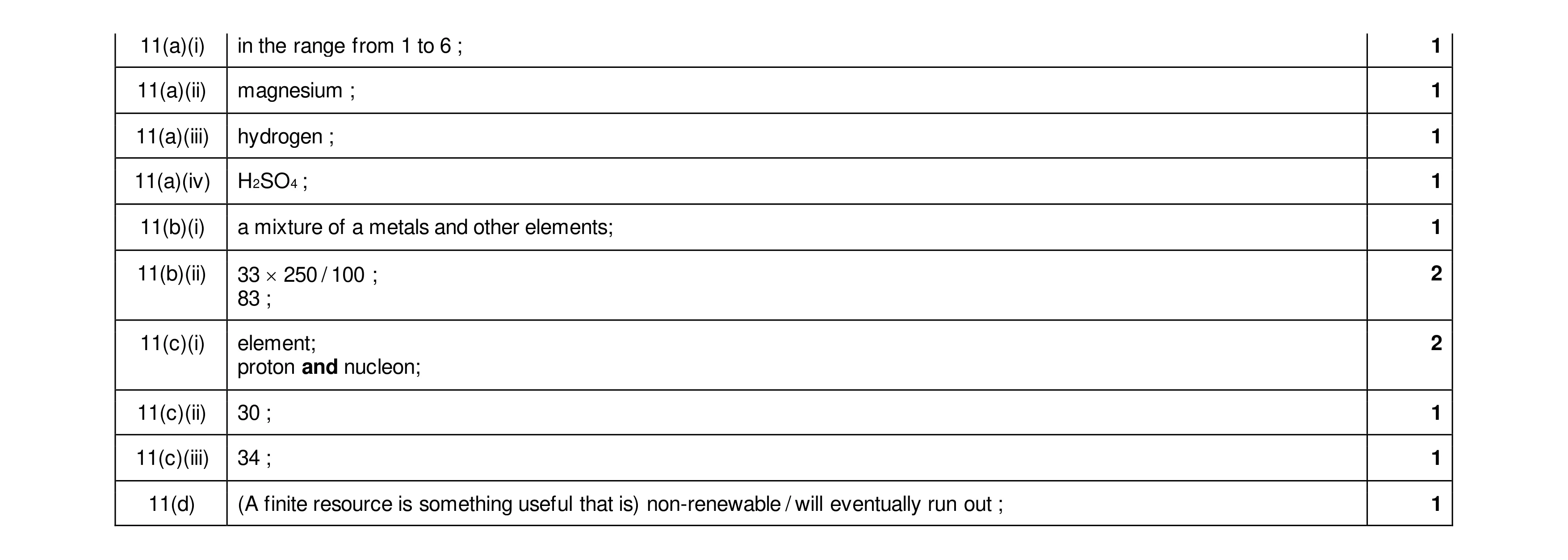 12
12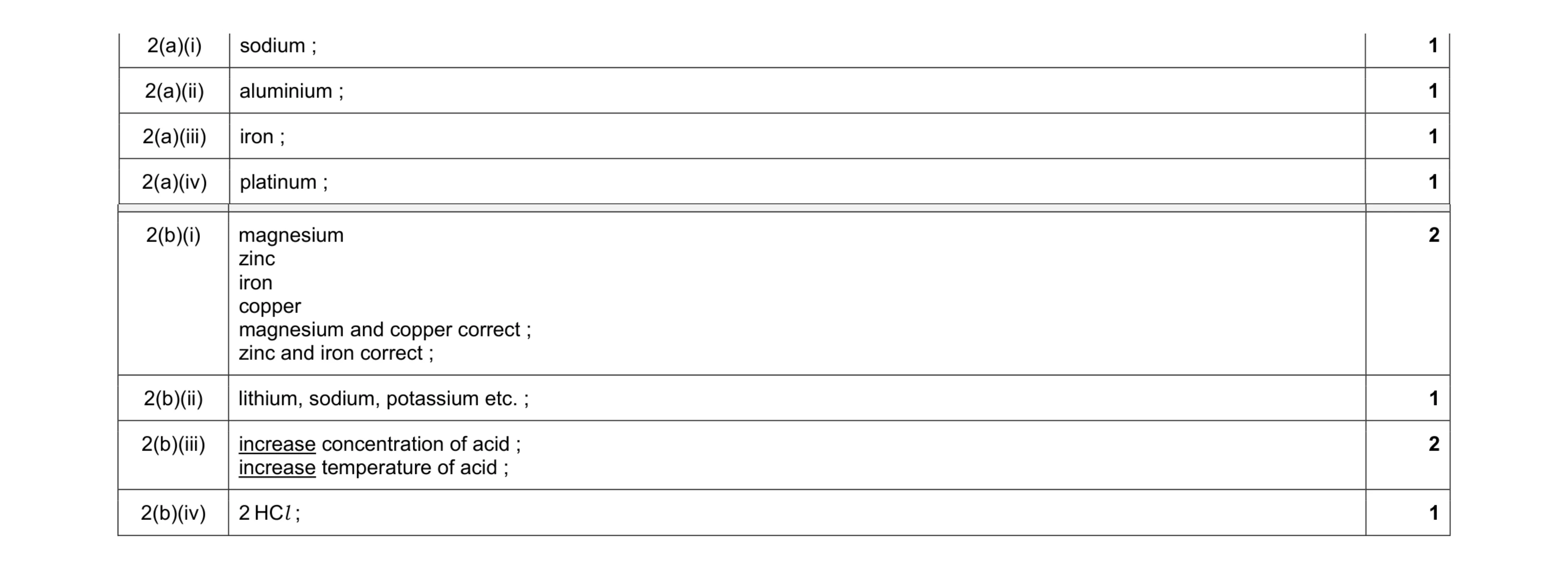 10
10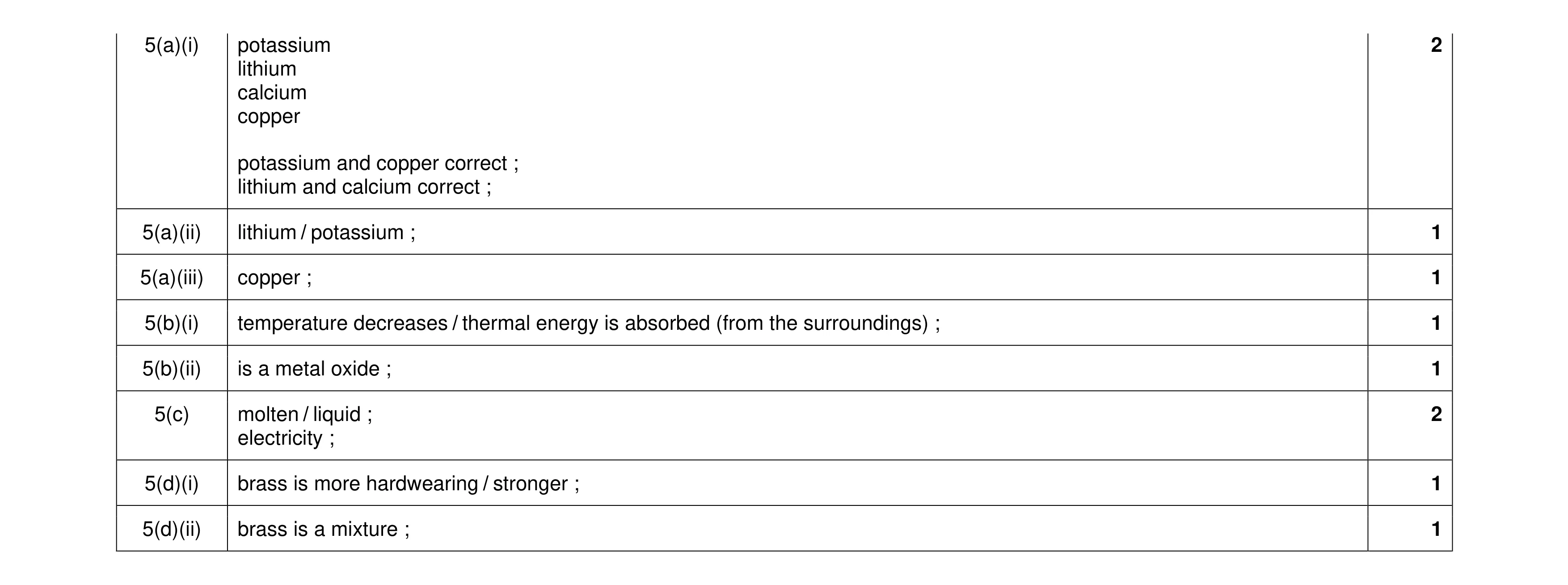 10
10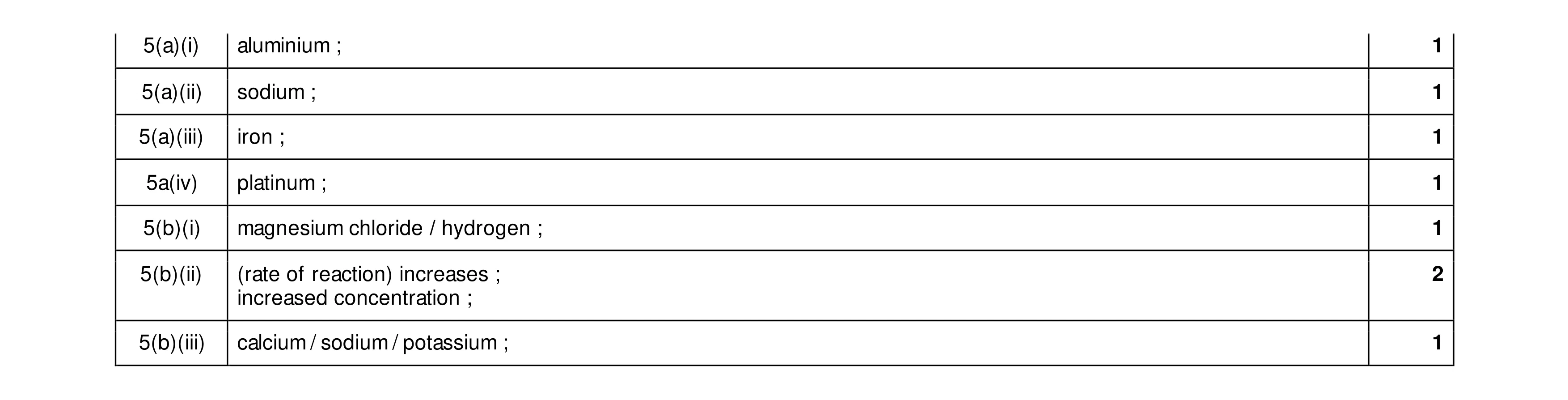 8
8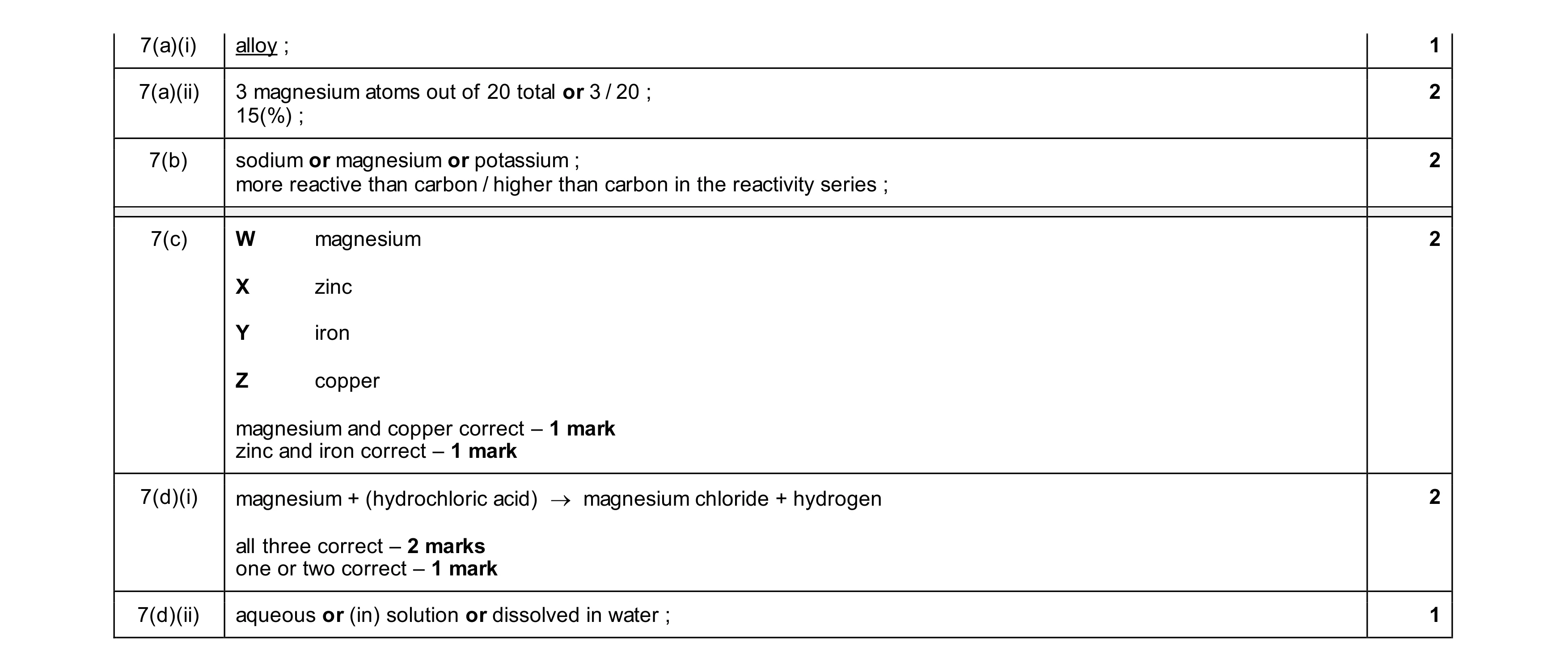 10
10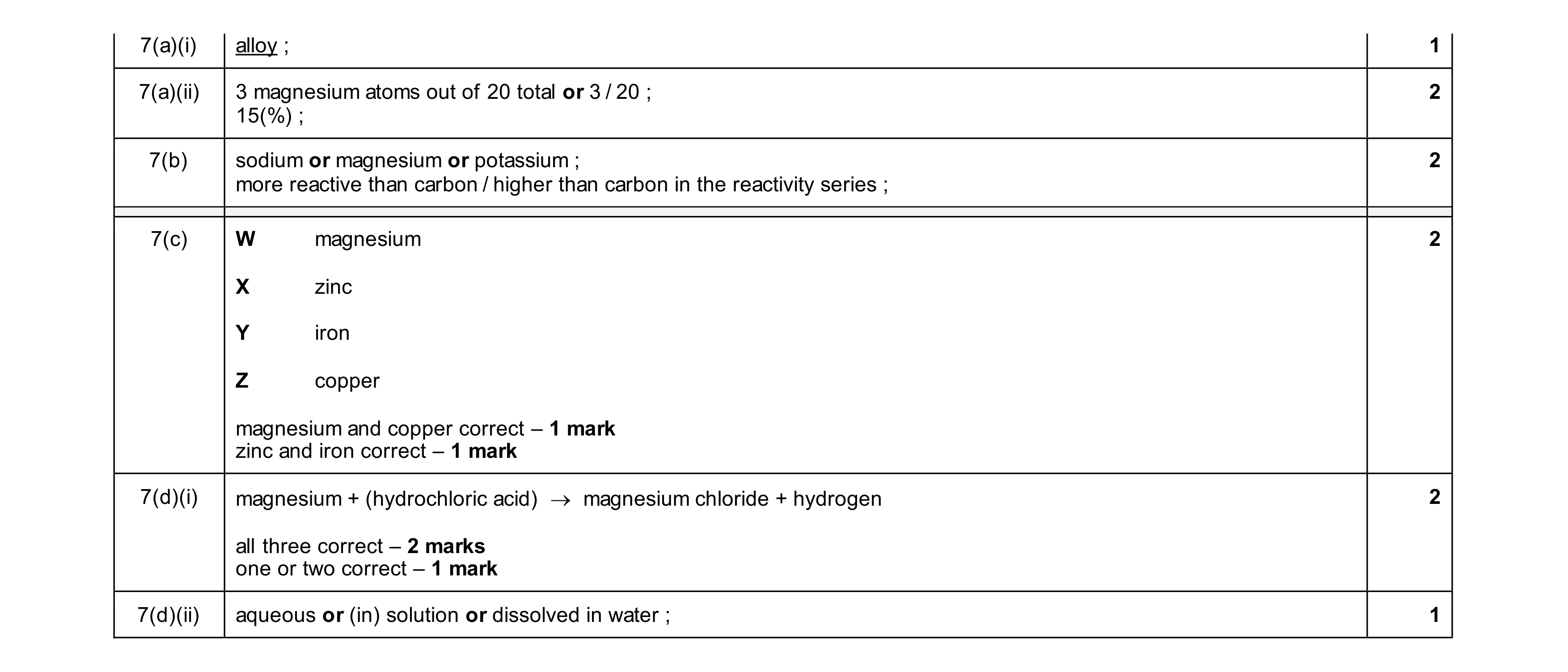 10
10