Questions as text
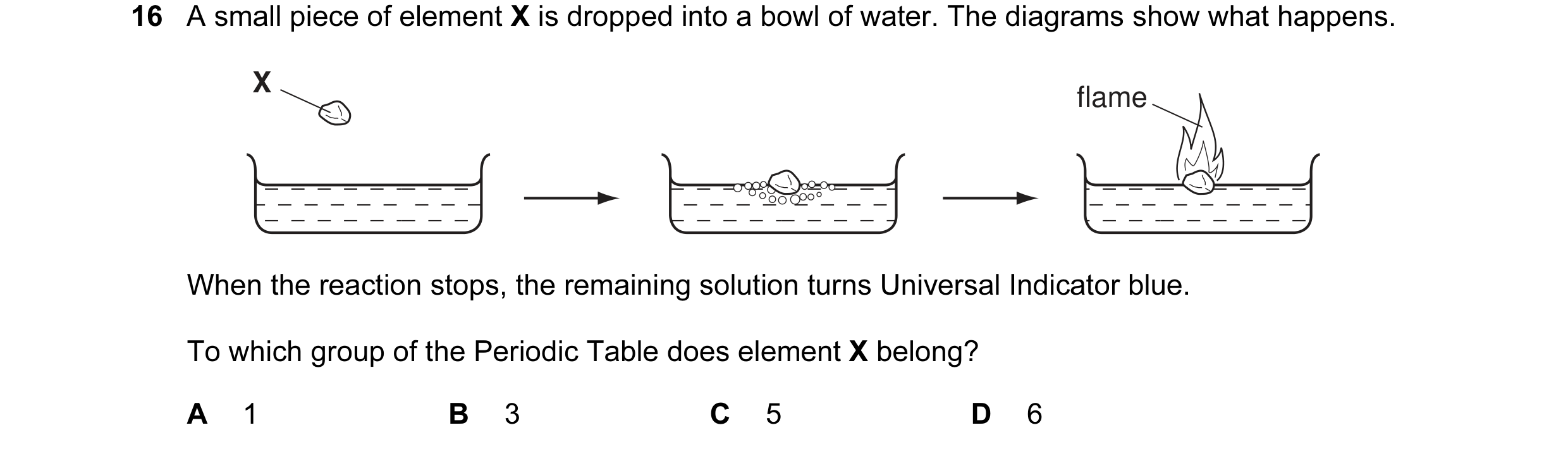
Q1 · A small piece of element X is dropped into a bowl of water 0654/11 May/June 2007
16 A small piece of element X is dropped into a bowl of water. The diagrams show what happens. X flame When the reaction stops, the remaining solution turns Universal Indicator blue. To which group of the Periodic Table does element X belong? A 1 B 3 C 5 D 6
1 marks
Answer: A
This question in 0654/11 May/June 2007
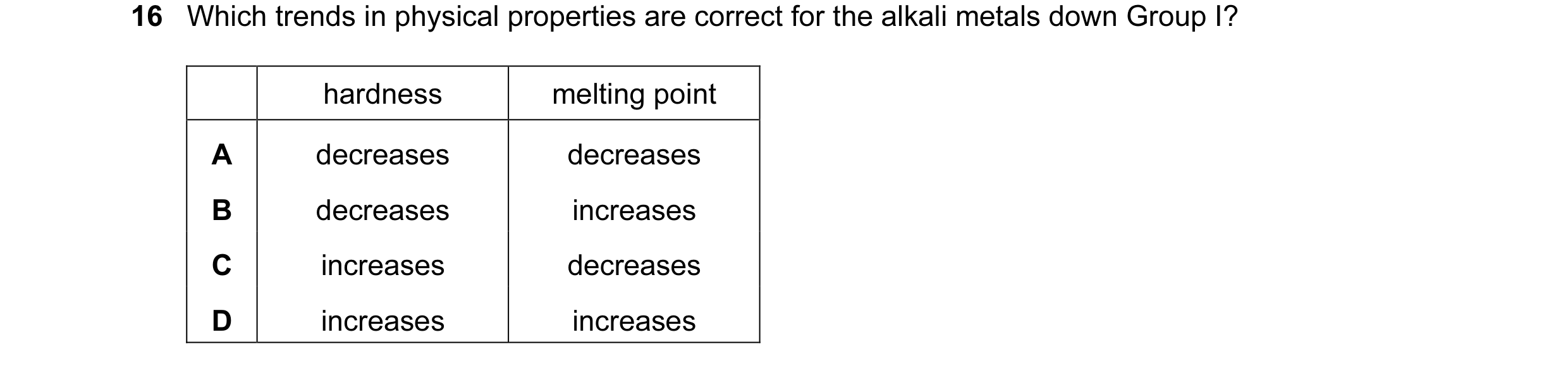
Q2 · Which trends in physical properties are correct for the alkali metals down Group I? 0654/11 May/June 2008
16 Which trends in physical properties are correct for the alkali metals down Group I? hardness melting point A decreases decreases B decreases increases C increases decreases D increases increases
1 marks
Answer: A
This question in 0654/11 May/June 2008
Q3 · Which trends in physical properties are correct for the alkali metals down Group I? 0654/11 May/June 2011
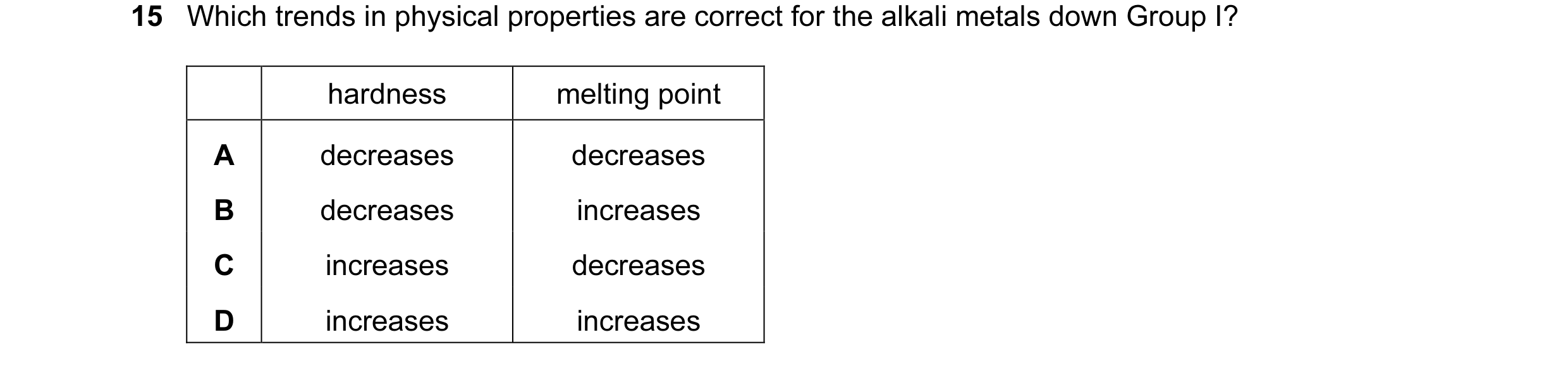
15 Which trends in physical properties are correct for the alkali metals down Group I? hardness melting point A decreases decreases B decreases increases C increases decreases D increases increases
1 marks
Answer: A
This question in 0654/11 May/June 2011
Q4 · Which trends in physical properties are correct for the alkali metals down Group I? 0654/12 May/June 2011
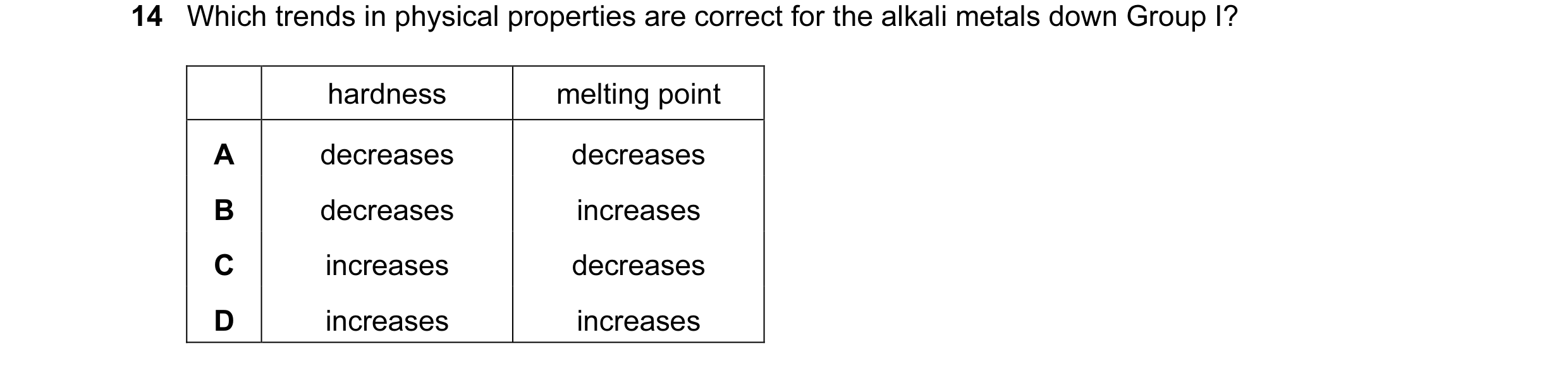
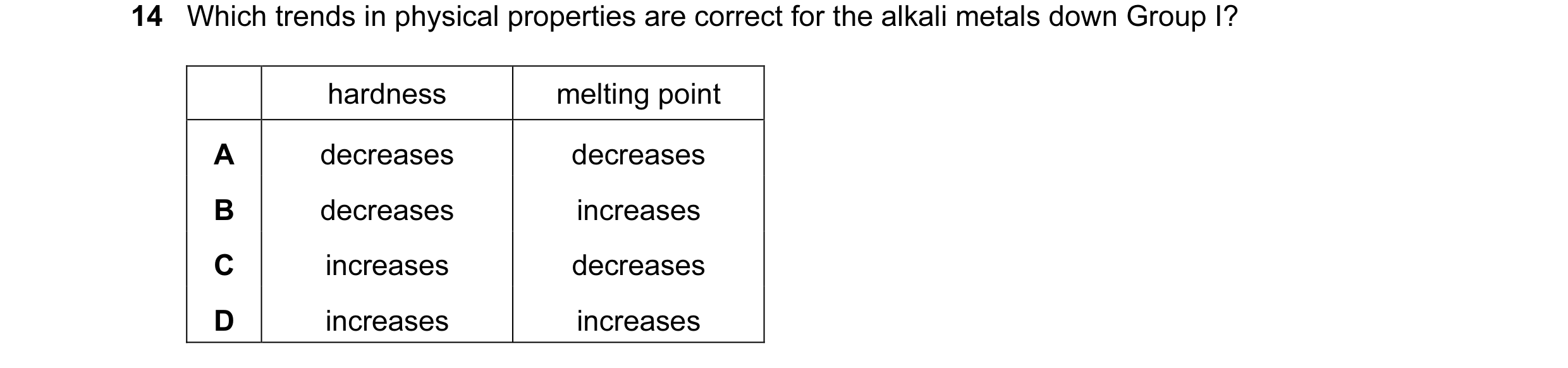
14 Which trends in physical properties are correct for the alkali metals down Group I? hardness melting point A decreases decreases B decreases increases C increases decreases D increases increases
1 marks
Answer: A
This question in 0654/12 May/June 2011
Q5 · Which trends in physical properties are correct for the alkali metals down Group I? 0654/13 May/June 2011
14 Which trends in physical properties are correct for the alkali metals down Group I? hardness melting point A decreases decreases B decreases increases C increases decreases D increases increases
1 marks
Answer: A
This question in 0654/13 May/June 2011
Q6 · Which statement about lithium, sodium and potassium is not correct? 0654/11 May/June 2012
22 Which statement about lithium, sodium and potassium is not correct? A They are in the same group of the Periodic Table. B They are in the same period of the Periodic Table. C They float on water. D They react with water to give a flammable gas.
1 marks
Answer: B
This question in 0654/11 May/June 2012
Q7 · The elements in a Group of the Periodic Table are solid at 20 °C 0654/11 Oct/Nov 2013
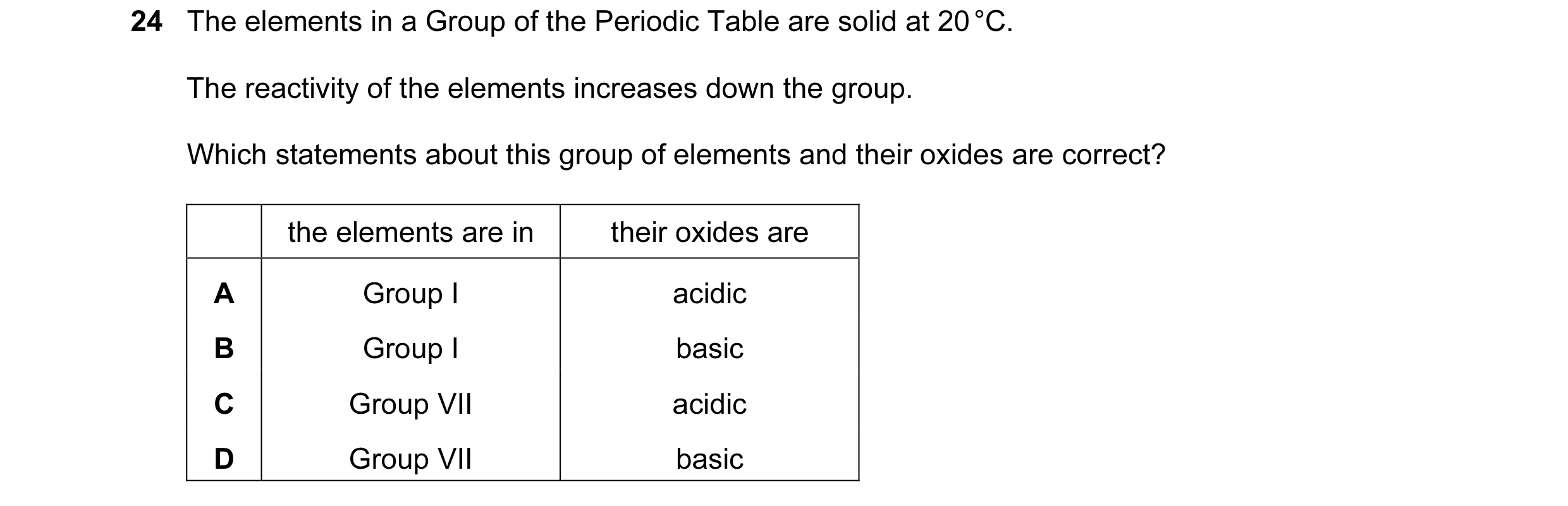
24 The elements in a Group of the Periodic Table are solid at 20 °C. The reactivity of the elements increases down the group. Which statements about this group of elements and their oxides are correct? the elements are in their oxides are A Group I acidic B Group I basic C Group VII acidic D Group VII basic
1 marks
Answer: B
This question in 0654/11 Oct/Nov 2013
Q8 · The elements in a Group of the Periodic Table are solid at 20 °C 0654/12 Oct/Nov 2013
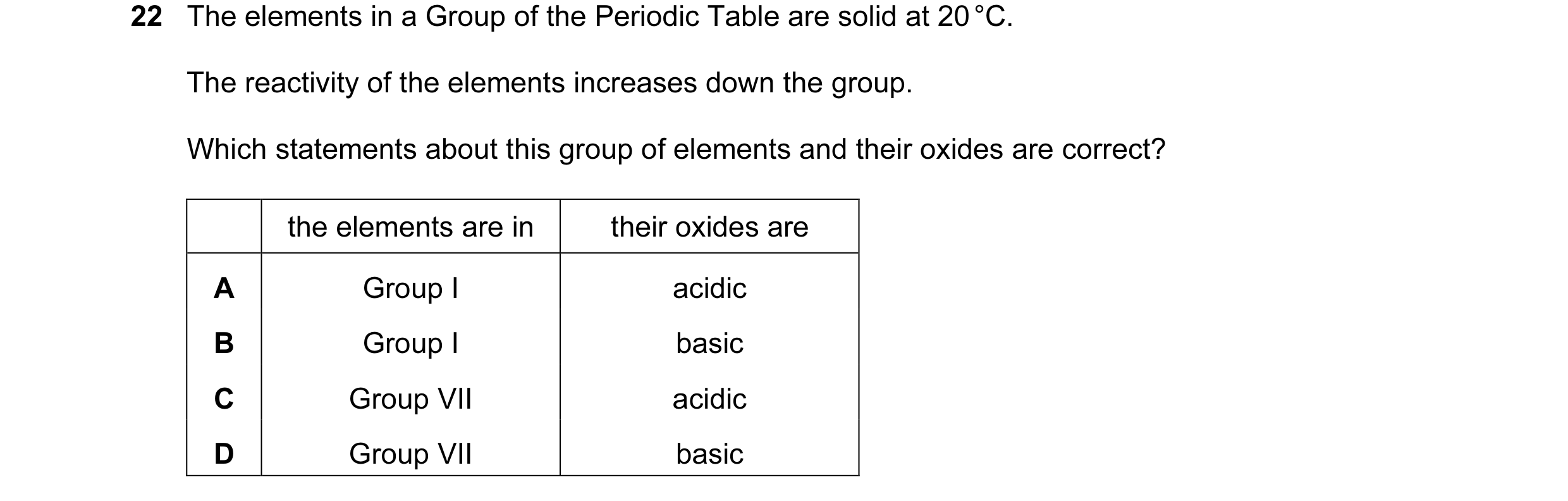
22 The elements in a Group of the Periodic Table are solid at 20 °C. The reactivity of the elements increases down the group. Which statements about this group of elements and their oxides are correct? the elements are in their oxides are A Group I acidic B Group I basic C Group VII acidic D Group VII basic
1 marks
Answer: B
This question in 0654/12 Oct/Nov 2013
Q9 · The elements in a Group of the Periodic Table are solid at 20 °C 0654/13 Oct/Nov 2013
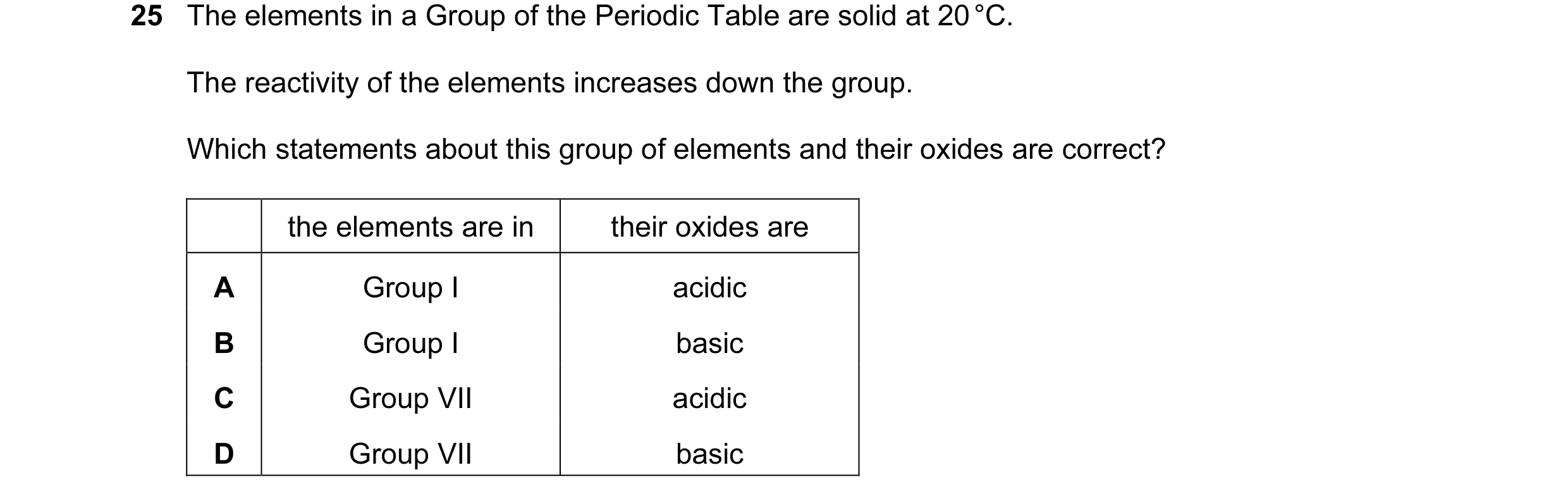
25 The elements in a Group of the Periodic Table are solid at 20 °C. The reactivity of the elements increases down the group. Which statements about this group of elements and their oxides are correct? the elements are in their oxides are A Group I acidic B Group I basic C Group VII acidic D Group VII basic
1 marks
Answer: B
This question in 0654/13 Oct/Nov 2013
Q10 · Which Group I metal and which Group VII non-metal react together most vigorously? 0654/11 May/June 2014
24 Which Group I metal and which Group VII non-metal react together most vigorously? Group I Group VII A potassium bromine B potassium chlorine C sodium bromine D sodium chlorine
1 marks
Answer: B
This question in 0654/11 May/June 2014
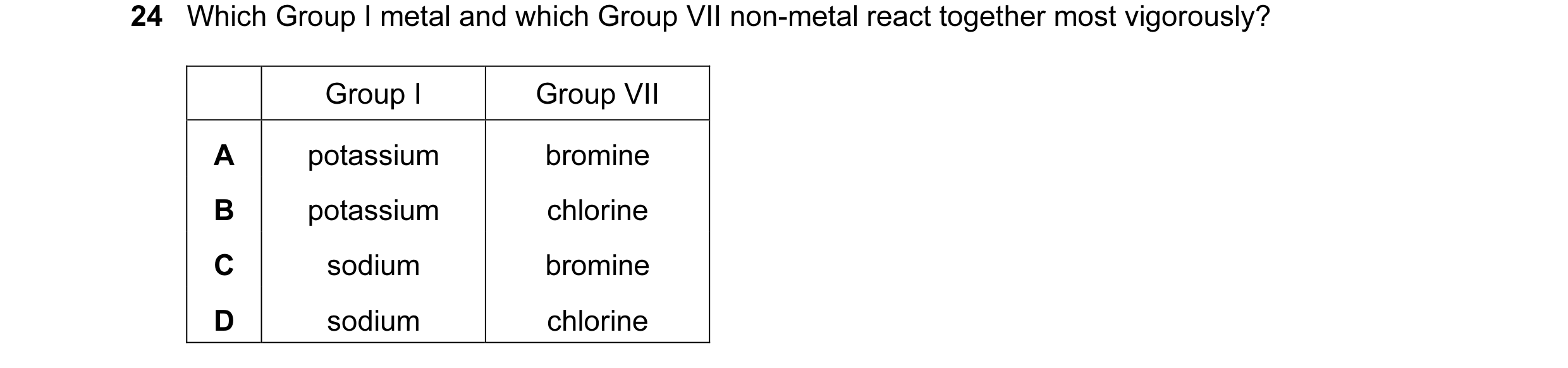
Q11 · Which Group I metal and which Group VII non-metal react together most vigorously? 0654/12 May/June 2014
24 Which Group I metal and which Group VII non-metal react together most vigorously? Group I Group VII A potassium bromine B potassium chlorine C sodium bromine D sodium chlorine
1 marks
Answer: B
This question in 0654/12 May/June 2014
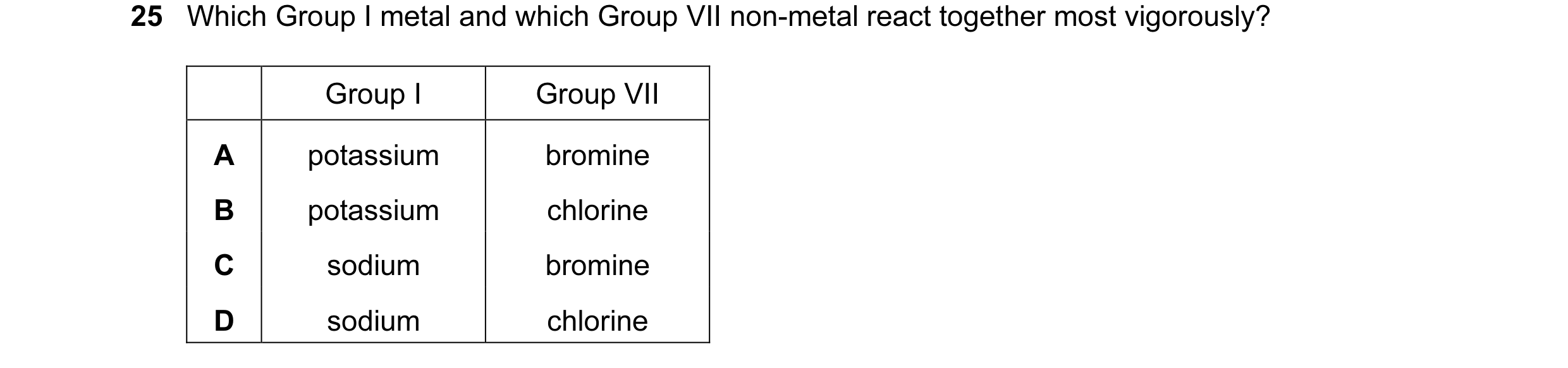
Q12 · Which Group I metal and which Group VII non-metal react together most vigorously? 0654/13 May/June 2014
25 Which Group I metal and which Group VII non-metal react together most vigorously? Group I Group VII A potassium bromine B potassium chlorine C sodium bromine D sodium chlorine
1 marks
Answer: B
This question in 0654/13 May/June 2014
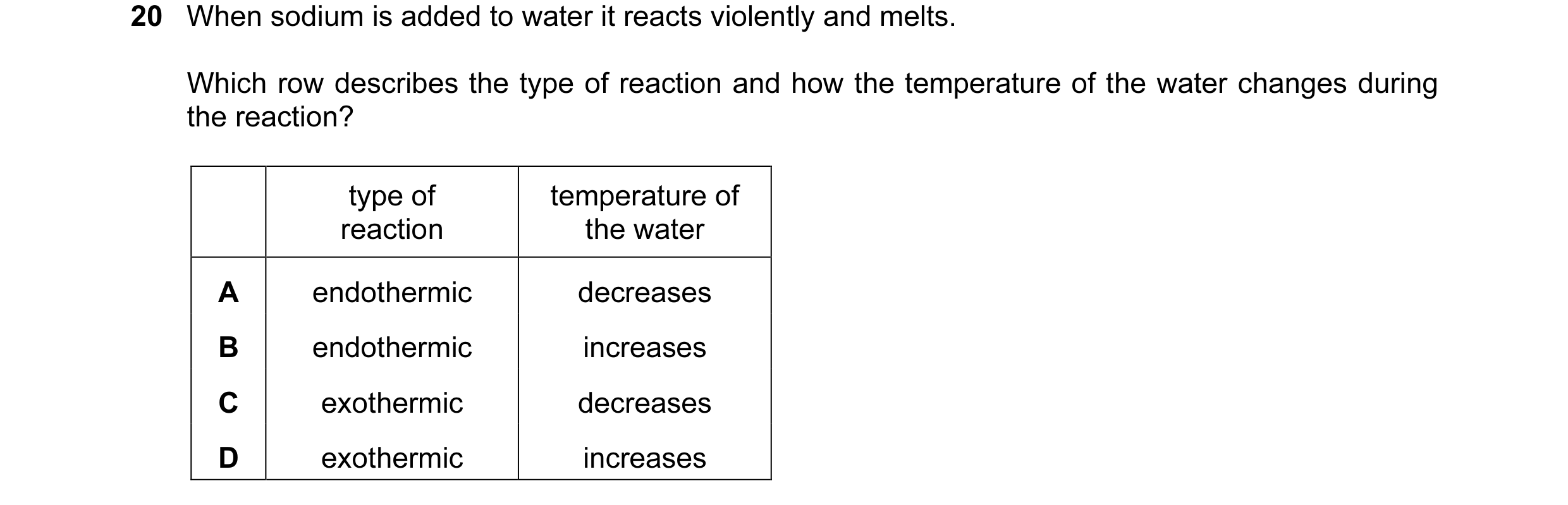
Q13 · When sodium is added to water it reacts violently and melts 0654/13 Oct/Nov 2014
20 When sodium is added to water it reacts violently and melts. Which row describes the type of reaction and how the temperature of the water changes during the reaction? type of temperature of reaction the water A endothermic decreases B endothermic increases C exothermic decreases D exothermic increases
1 marks
Answer: D
This question in 0654/13 Oct/Nov 2014
Q14 · Elements X, Y and Z are the first three members of a group in the Periodic Table 0654/12 May/June 2015
22 Elements X, Y and Z are the first three members of a group in the Periodic Table. The elements are soft. The elements react vigorously with water to produce hydrogen. In which group of the Periodic Table are X, Y and Z found? A Group 0 B Group I C Group II D Group VII
1 marks
Answer: B
This question in 0654/12 May/June 2015
Q15 · Which statement about lithium, sodium and potassium is not correct? 0654/11 Oct/Nov 2016
23 Which statement about lithium, sodium and potassium is not correct? A They are in the same group of the Periodic Table. B They are in the same period of the Periodic Table. C They float on water. D They react with water to give a flammable gas.
1 marks
Answer: B
This question in 0654/11 Oct/Nov 2016
Q16 · Which statement about lithium, sodium and potassium is not correct? 0654/12 Oct/Nov 2016
22 Which statement about lithium, sodium and potassium is not correct? A They are in the same group of the Periodic Table. B They are in the same period of the Periodic Table. C They float on water. D They react with water to give a flammable gas.
1 marks
Answer: B
This question in 0654/12 Oct/Nov 2016
Q17 · Which statement about lithium, sodium and potassium is not correct? 0654/13 Oct/Nov 2016
22 Which statement about lithium, sodium and potassium is not correct? A They are in the same group of the Periodic Table. B They are in the same period of the Periodic Table. C They float on water. D They react with water to give a flammable gas.
1 marks
Answer: B
This question in 0654/13 Oct/Nov 2016
Q18 · Which statement about Group I metals is correct? 0654/11 May/June 2017
22 Which statement about Group I metals is correct? A Potassium is a hard metal and is more reactive than sodium. B Potassium is a soft metal and is less reactive than sodium. C Sodium is a hard metal and is less reactive than lithium. D Sodium is a soft metal and is more reactive than lithium.
1 marks
Answer: D
This question in 0654/11 May/June 2017
Q19 · Which description of the Group I elements is correct? 0654/12 Oct/Nov 2018
22 Which description of the Group I elements is correct? A relatively hard metals B relatively soft metals C low melting point non-metals D unreactive gases
1 marks
Answer: B
This question in 0654/12 Oct/Nov 2018
Q20 · Which row describes properties of Group I elements? 0654/13 May/June 2020
20 Which row describes properties of Group I elements? electrical reaction conductivity with water A conductor does not react B insulator reacts C conductor reacts D insulator does not react
1 marks
Answer: C
This question in 0654/13 May/June 2020
Q21 · Potassium is in Group I of the Periodic Table 0654/11 Oct/Nov 2020
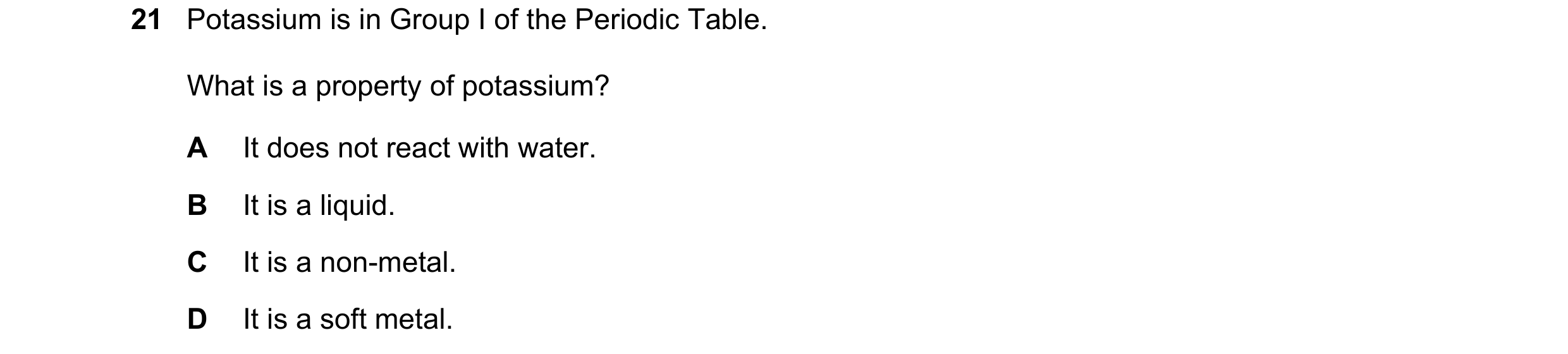
21 Potassium is in Group I of the Periodic Table. What is a property of potassium? A It does not react with water. B It is a liquid. C It is a non-metal. D It is a soft metal.
1 marks
Answer: D
This question in 0654/11 Oct/Nov 2020
Q22 · Which row shows the trends for Group I elements lithium to potassium? 0654/12 Oct/Nov 2020
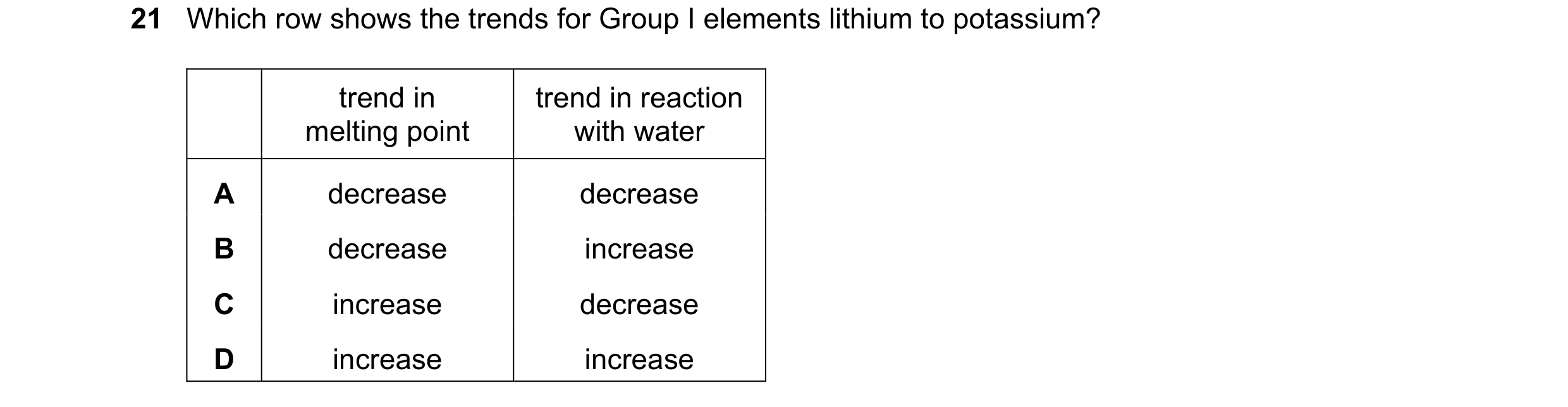
21 Which row shows the trends for Group I elements lithium to potassium? trend in trend in reaction melting point with water A decrease decrease B decrease increase C increase decrease D increase increase
1 marks
Answer: B
This question in 0654/12 Oct/Nov 2020
Q23 · Substance Q is added to cold water 0654/11 May/June 2021
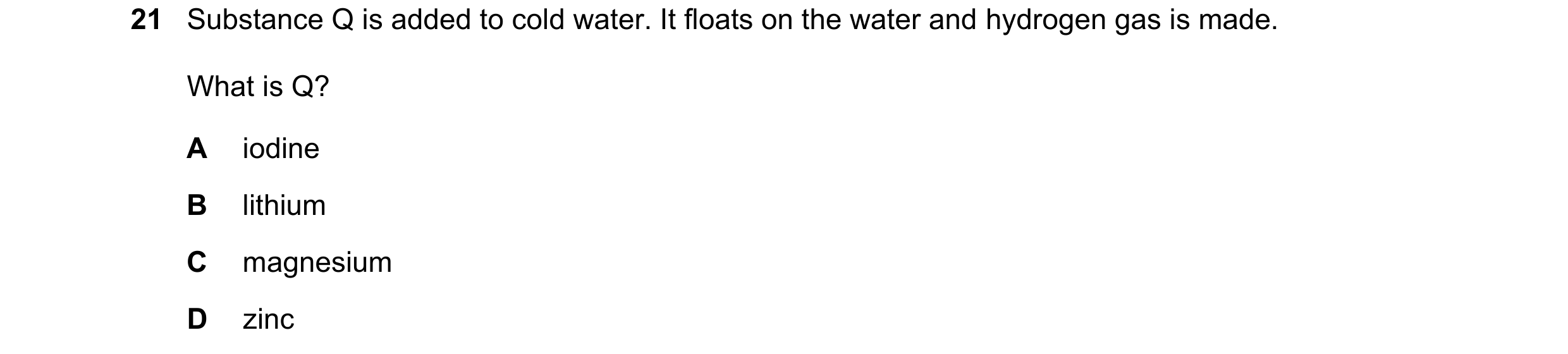
21 Substance Q is added to cold water. It floats on the water and hydrogen gas is made. What is Q? A iodine B lithium C magnesium D zinc
1 marks
Answer: B
This question in 0654/11 May/June 2021
Q24 · Which row describes trends in the properties of Group I elements as the group is… 0654/12 May/June 2021
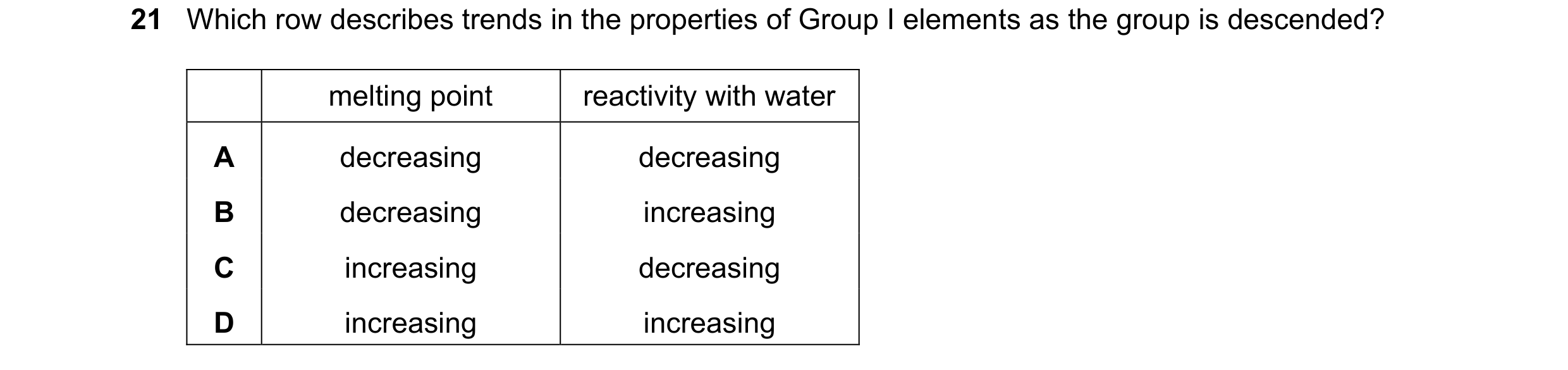
21 Which row describes trends in the properties of Group I elements as the group is descended? melting point reactivity with water A decreasing decreasing B decreasing increasing C increasing decreasing D increasing increasing
1 marks
Answer: B
This question in 0654/12 May/June 2021
Q25 · Which row describes trends in the properties of Group I elements as the group is… 0654/13 May/June 2021
21 Which row describes trends in the properties of Group I elements as the group is descended? melting point reactivity with water A decreasing decreasing B decreasing increasing C increasing decreasing D increasing increasing
1 marks
Answer: B
This question in 0654/13 May/June 2021
Q26 · When a small piece of potassium is placed in water, hydrogen gas is given off very quickly 0654/11 Oct/Nov 2021
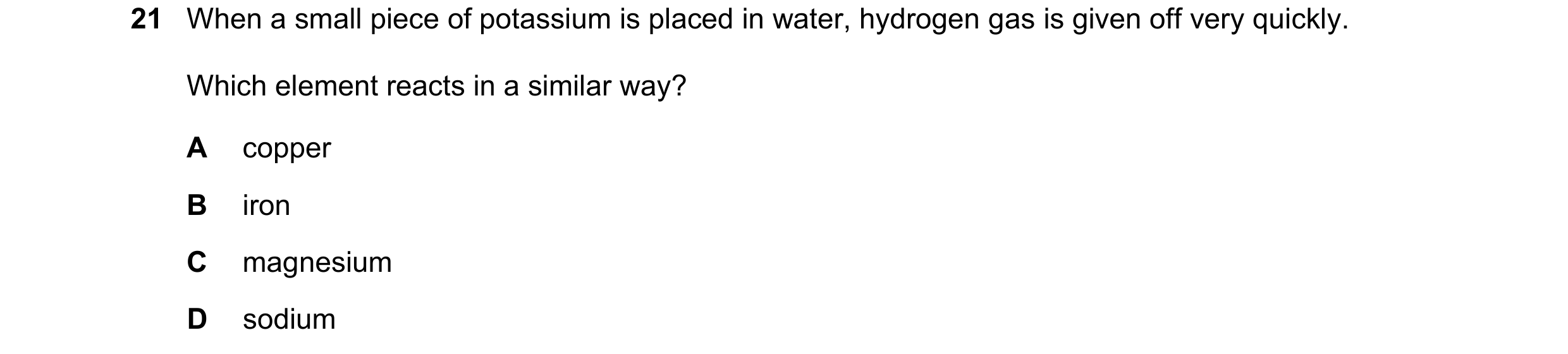
21 When a small piece of potassium is placed in water, hydrogen gas is given off very quickly. Which element reacts in a similar way? A copper B iron C magnesium D sodium
1 marks
Answer: D
This question in 0654/11 Oct/Nov 2021
Q27 · Which statement about the elements in Group I and in Group VII of the Periodic Table is… 0654/13 Oct/Nov 2021
21 Which statement about the elements in Group I and in Group VII of the Periodic Table is correct? A Chlorine has a darker colour than iodine. B Each molecule of a halogen contains one atom. C Potassium reacts with cold water more vigorously than lithium. D The melting point of lithium is lower than the melting point of sodium.
1 marks
Answer: C
This question in 0654/13 Oct/Nov 2021
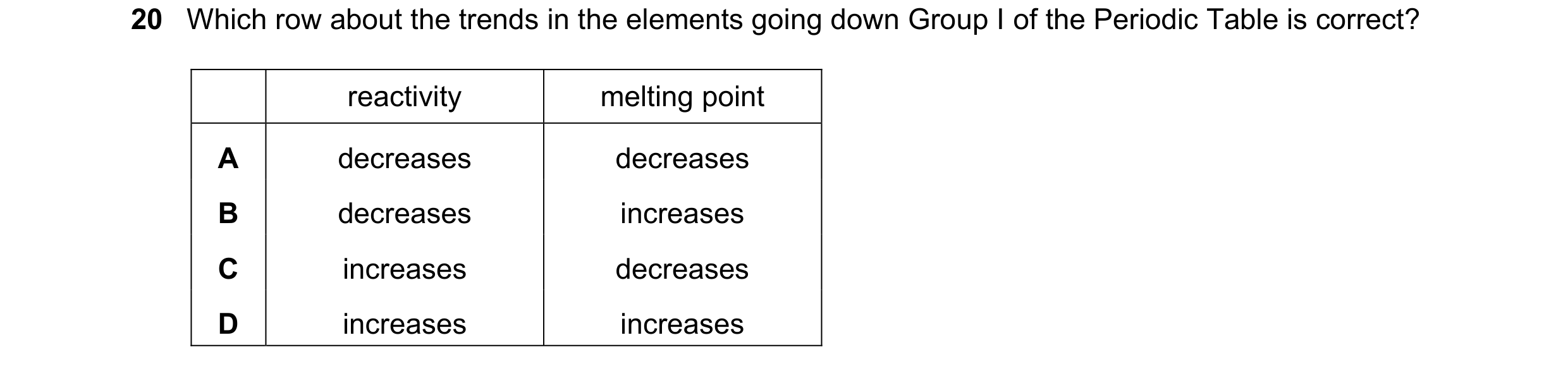
Q28 · Which row about the trends in the elements going down Group I of the Periodic Table is… 0654/12 Feb/March 2022
20 Which row about the trends in the elements going down Group I of the Periodic Table is correct? reactivity melting point A decreases decreases B decreases increases C increases decreases D increases increases
1 marks
Answer: C
This question in 0654/12 Feb/March 2022
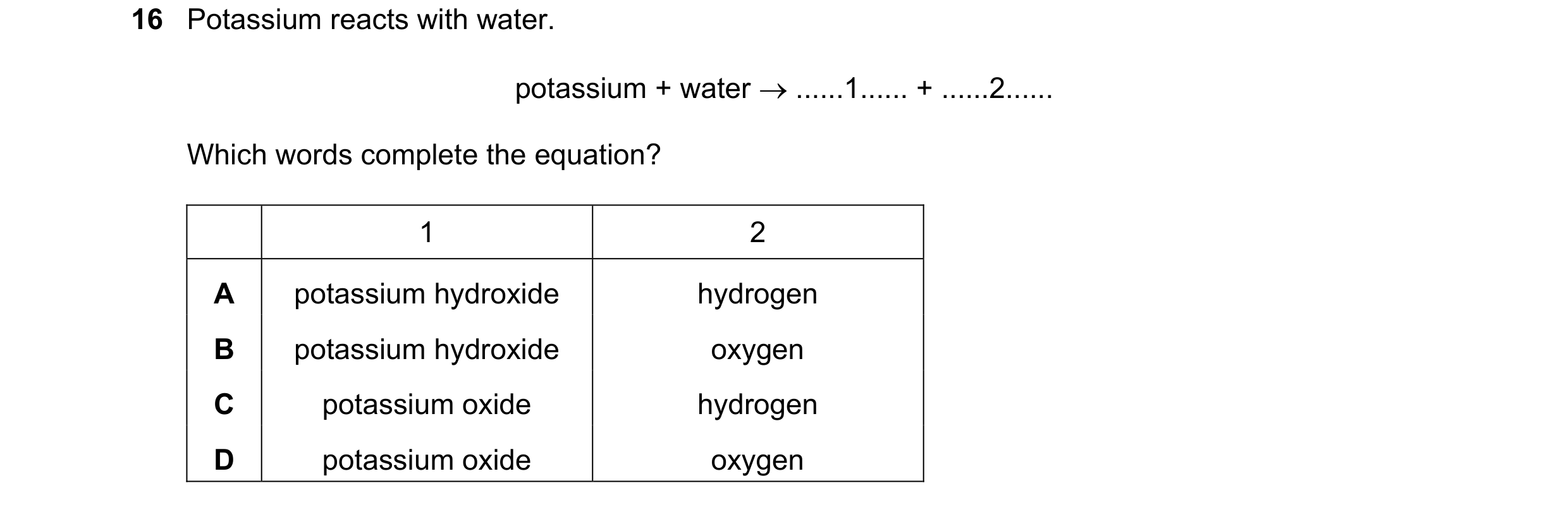
Q29 · Potassium reacts with water 0654/12 Feb/March 2023
16 Potassium reacts with water. potassium + water … 1 … + … 2 … Which words complete the equation? 1 2 A potassium hydroxide hydrogen B potassium hydroxide oxygen C potassium oxide hydrogen D potassium oxide oxygen
1 marks
Answer: A
This question in 0654/12 Feb/March 2023
Q30 · Potassium is in Group I of the Periodic Table 0654/11 Oct/Nov 2023
22 Potassium is in Group I of the Periodic Table. Which statement about potassium is correct? A It is a relatively hard metal. B It is less dense than lithium. C It has a higher melting point than sodium. D It reacts more vigorously with water than sodium.
1 marks
Answer: D
This question in 0654/11 Oct/Nov 2023
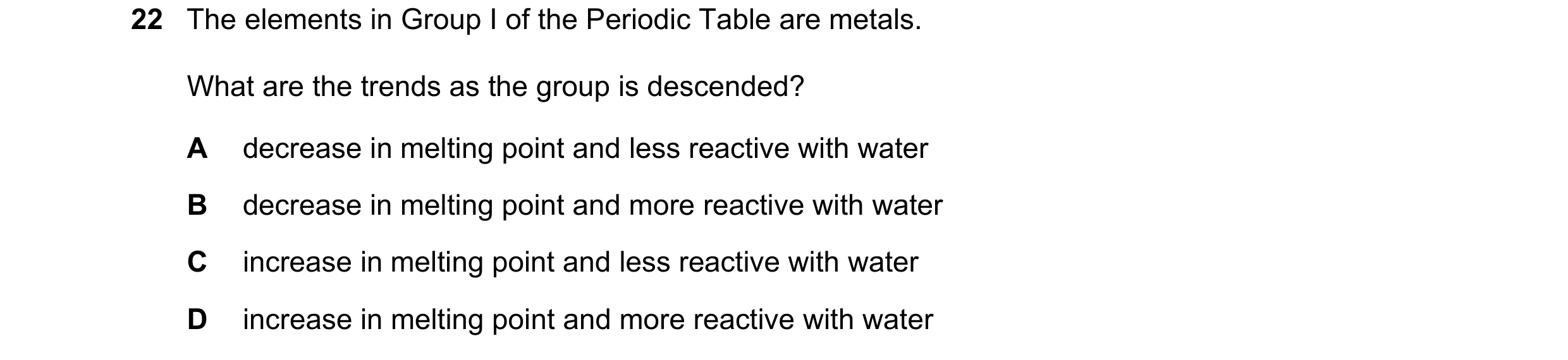
Q31 · The elements in Group I of the Periodic Table are metals 0654/13 Oct/Nov 2023
22 The elements in Group I of the Periodic Table are metals. What are the trends as the group is descended? A decrease in melting point and less reactive with water B decrease in melting point and more reactive with water C increase in melting point and less reactive with water D increase in melting point and more reactive with water
1 marks
Answer: B
This question in 0654/13 Oct/Nov 2023
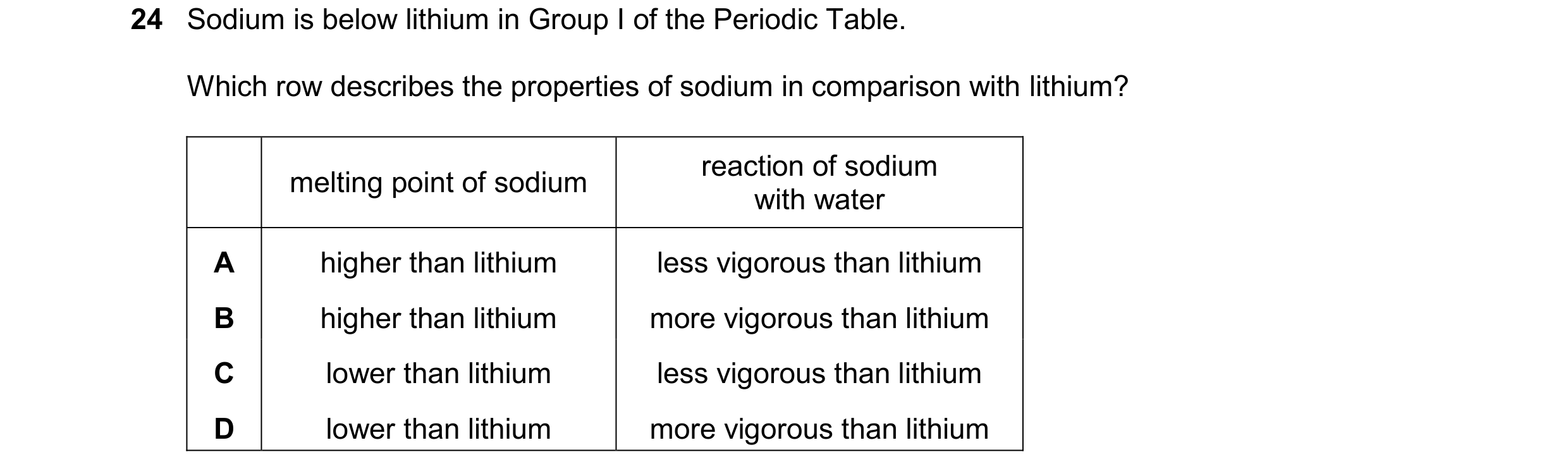
Q32 · Sodium is below lithium in Group I of the Periodic Table 0654/12 Feb/March 2025
24 Sodium is below lithium in Group I of the Periodic Table. Which row describes the properties of sodium in comparison with lithium? reaction of sodium melting point of sodium with water A higher than lithium less vigorous than lithium B higher than lithium more vigorous than lithium C lower than lithium less vigorous than lithium D lower than lithium more vigorous than lithium
1 marks
Answer: D
This question in 0654/12 Feb/March 2025
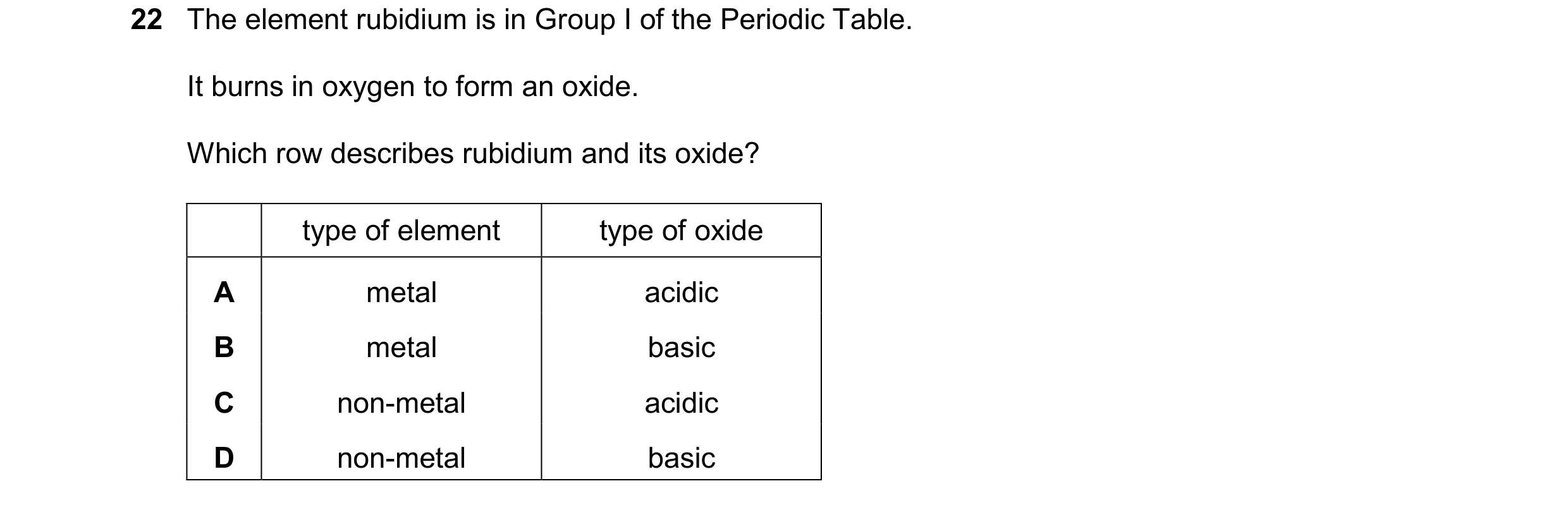
Q33 · The element rubidium is in Group I of the Periodic Table 0654/11 Oct/Nov 2025
22 The element rubidium is in Group I of the Periodic Table. It burns in oxygen to form an oxide. Which row describes rubidium and its oxide? type of element type of oxide A metal acidic B metal basic C non-metal acidic D non-metal basic
1 marks
Answer: B
This question in 0654/11 Oct/Nov 2025
 1 / 7
1 / 7
 2 / 7
2 / 7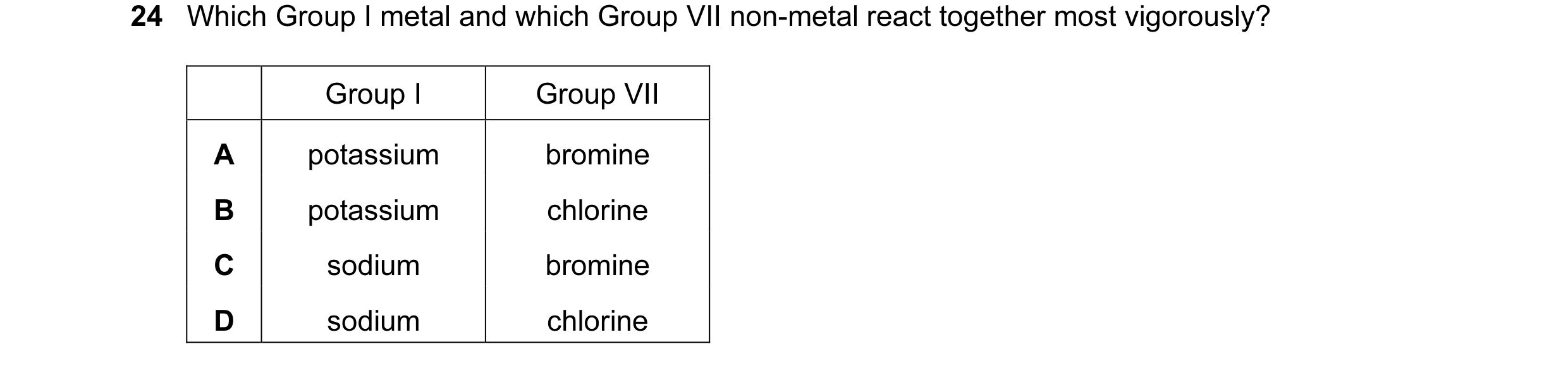
 3 / 7
3 / 7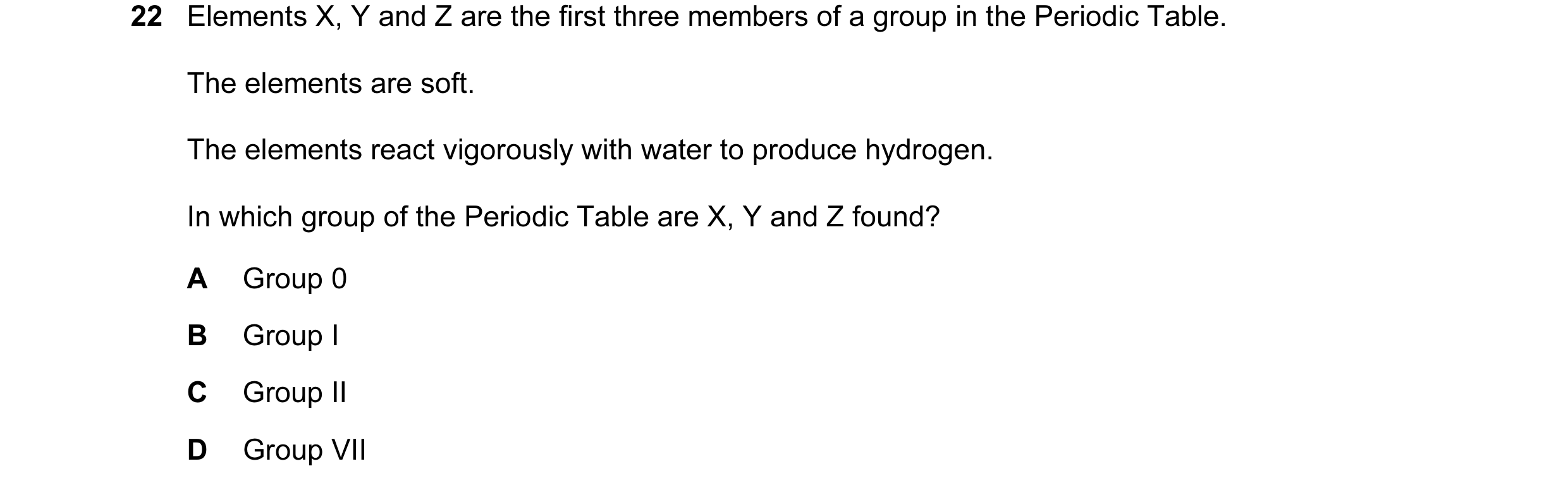




 4 / 7
4 / 7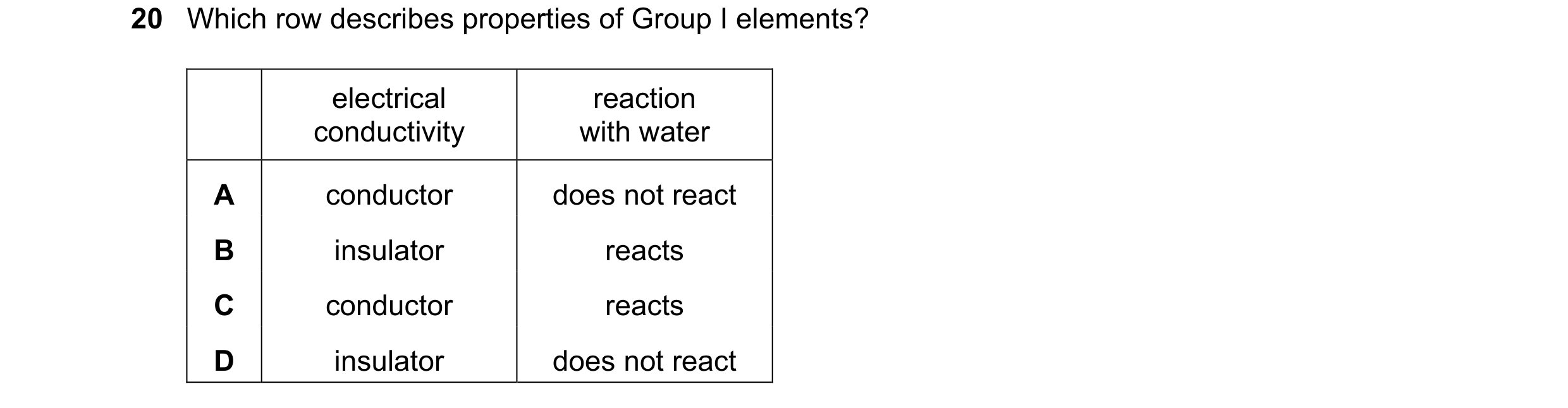
 5 / 7
5 / 7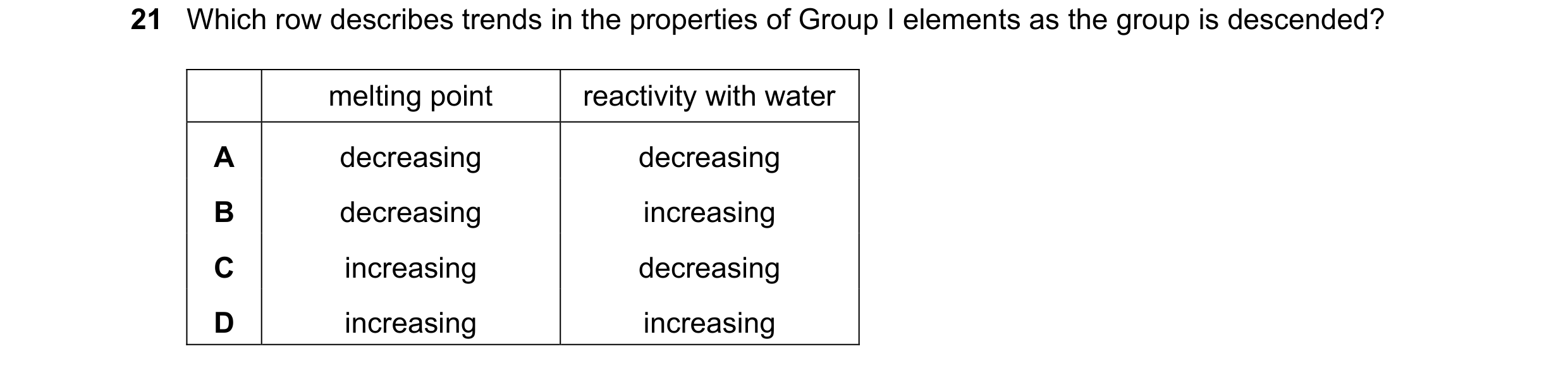

 6 / 7
6 / 7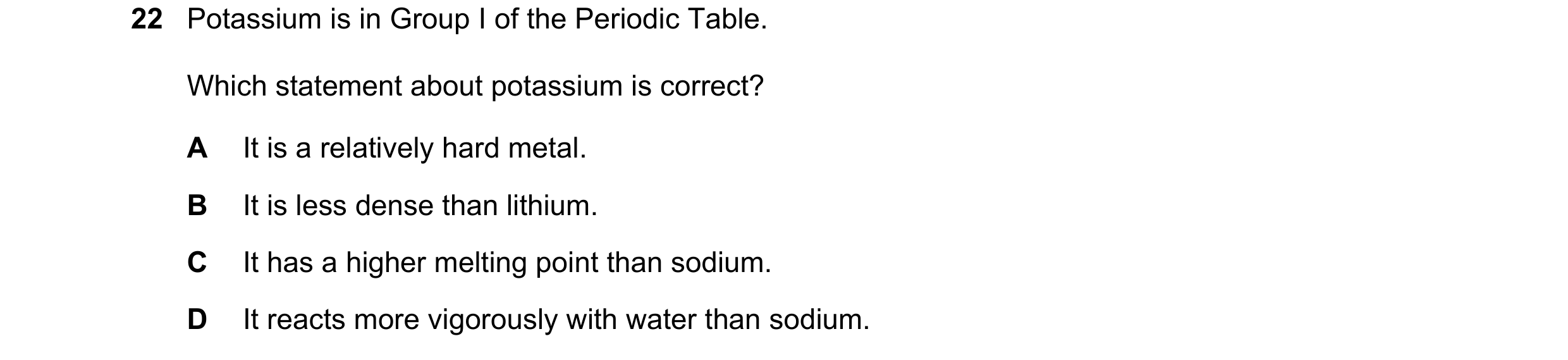
 7 / 7
7 / 7