Questions as text
Q1 · When lithium reacts with water, a gas is produced 0654/33 Oct/Nov 2017
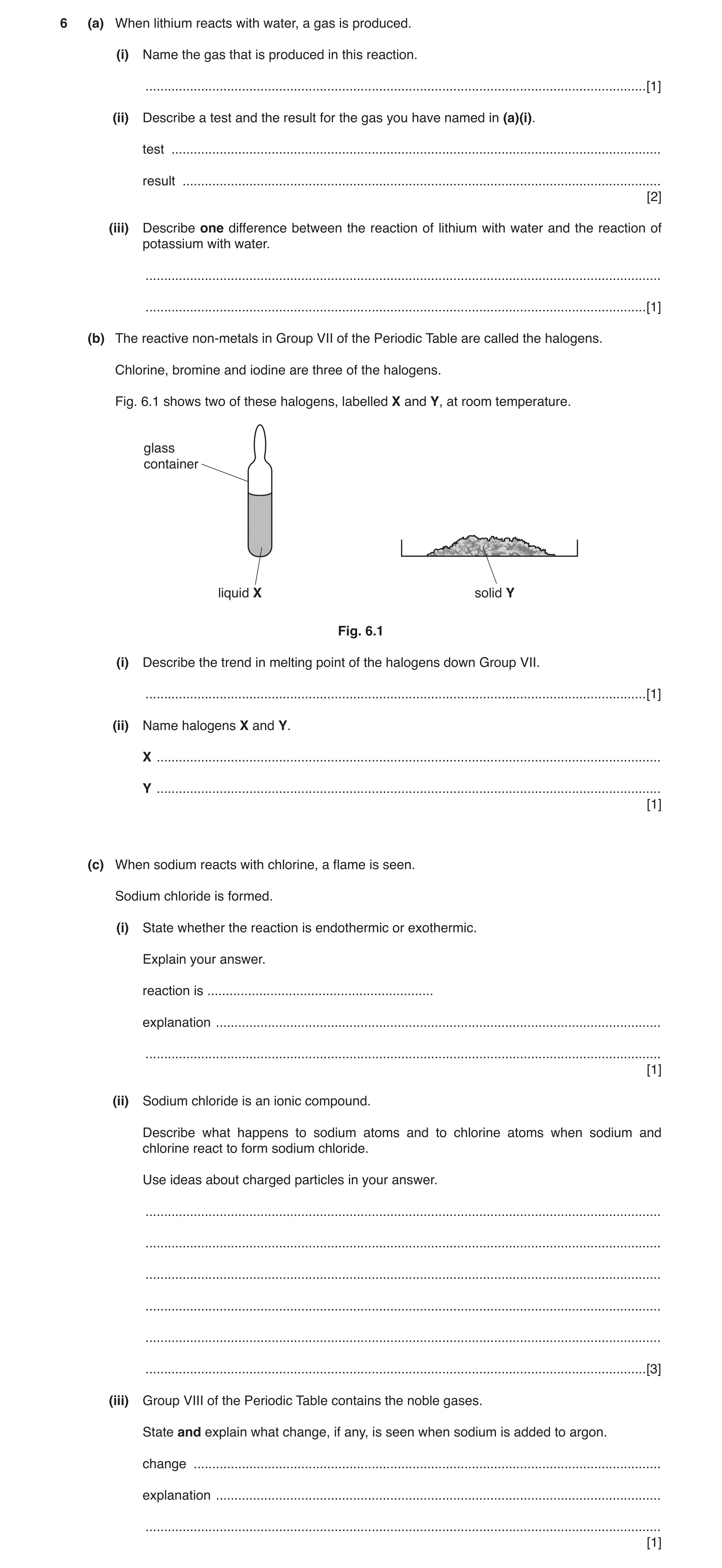
6 (a) When lithium reacts with water, a gas is produced. (i) Name the gas that is produced in this reaction. … [1] (ii) Describe a test and the result for the gas you have named in (a)(i). test … result … [2] (iii) Describe one difference between the reaction of lithium with water and the reaction of potassium with water. … … [1] (b) The reactive non-metals in Group VII of the Periodic Table are called the halogens. Chlorine, bromine and iodine are three of the halogens. Fig. 6.1 shows two of these halogens, labelled X and Y, at room temperature. glass container liquid X solid Y Fig. 6.1 (i) Describe the trend in melting point of the halogens down Group VII. … [1] (ii) Name halogens X and Y. X … Y … [1] (c) When sodium reacts with chlorine, a flame is seen. Sodium chloride is formed. (i) State whether the reaction is endothermic or exothermic. Explain your answer. reaction is … explanation … … [1] (ii) Sodium chloride is an ionic compound. Describe what happens to sodium atoms and to chlorine atoms when sodium and chlorine react to form sodium chloride. Use ideas about charged particles in your answer. … … … … … … [3] (iii) Group VIII of the Periodic Table contains the noble gases. State and explain what change, if any, is seen when sodium is added to argon. change … explanation … … [1]
11 marks
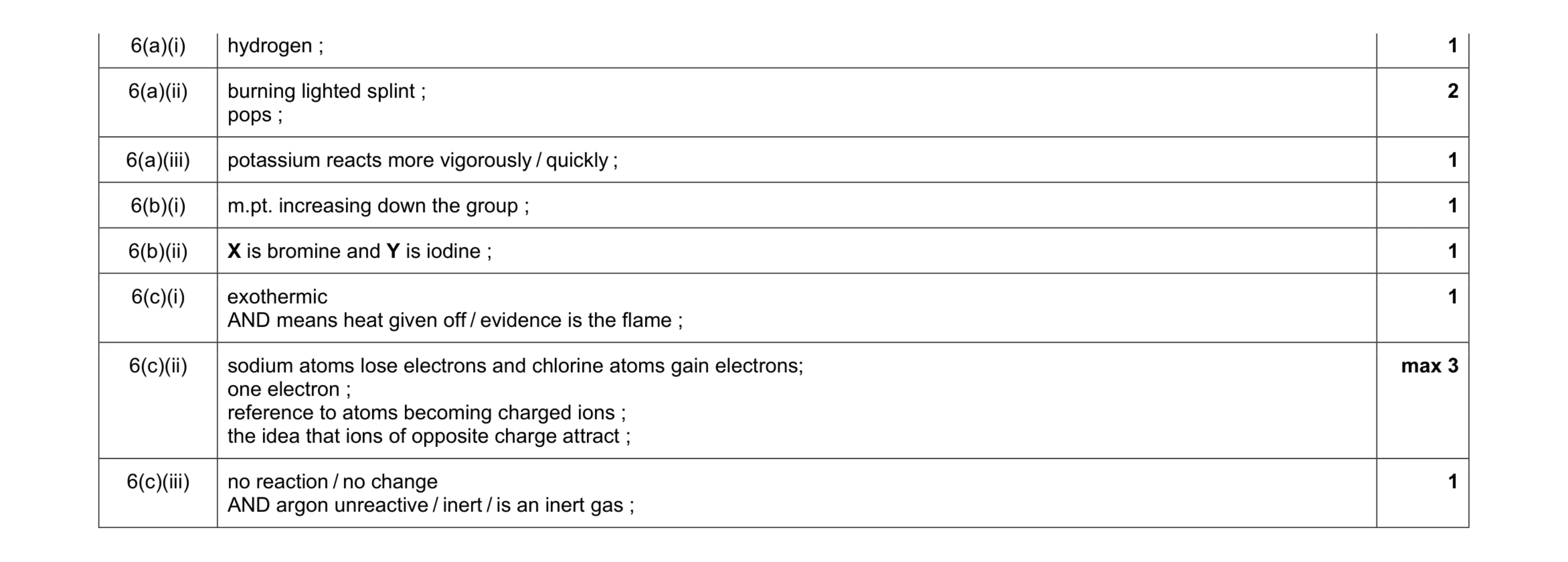
Mark scheme: 6(a)(i) hydrogen ; 1 6(a)(ii) burning lighted splint ; pops ; 2 6(a)(iii) potassium reacts more vigorously / quickly ; 1 6(b)(i) m.pt. increasing down the group ; 1 6(b)(ii) X is bromine and Y is iodine ; 1 6(c)(i) exothermic AND means heat given off / evidence is the flame ; 1 6(c)(ii) sodium atoms lose electrons and chlorine atoms gain electrons; one electron ; reference to atoms becoming charged ions ; the idea that ions of opposite charge attract ; max 3 6(c)(iii) no reaction / no change AND argon unreactive / inert / is an inert gas ; 1
This question in 0654/33 Oct/Nov 2017
Q2 · Copper and potassium are metallic elements in the fourth period of the Periodic Table 0654/32 Oct/Nov 2018
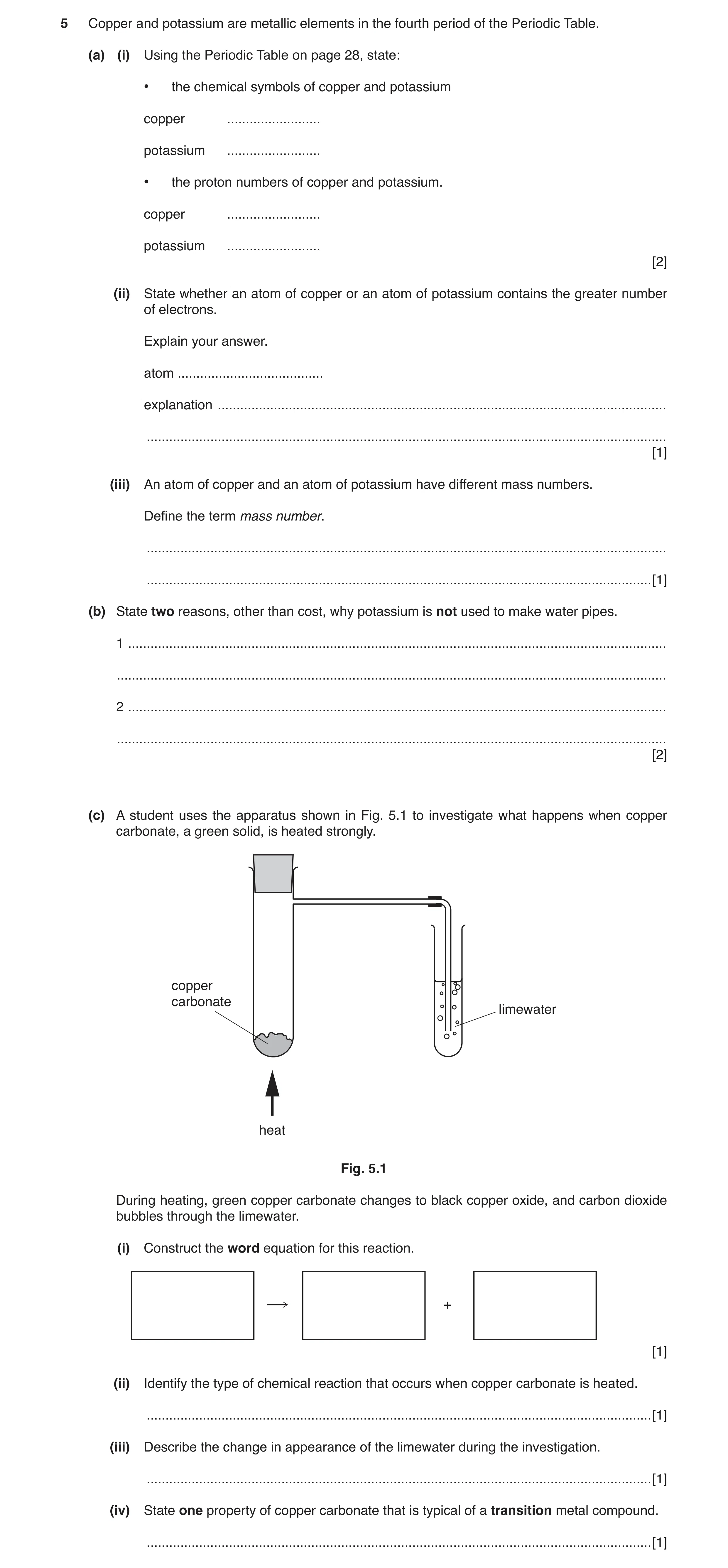
5 Copper and potassium are metallic elements in the fourth period of the Periodic Table. (a) (i) Using the Periodic Table on page 28, state: • the chemical symbols of copper and potassium copper … potassium … • the proton numbers of copper and potassium. copper … potassium … [2] (ii) State whether an atom of copper or an atom of potassium contains the greater number of electrons. Explain your answer. atom … explanation … … [1] (iii) An atom of copper and an atom of potassium have different mass numbers. Define the term mass number. … … [1] (b) State two reasons, other than cost, why potassium is not used to make water pipes. 1 … … 2 … … [2] (c) A student uses the apparatus shown in Fig. 5.1 to investigate what happens when copper carbonate, a green solid, is heated strongly. copper carbonate limewater heat Fig. 5.1 During heating, green copper carbonate changes to black copper oxide, and carbon dioxide bubbles through the limewater. (i) Construct the word equation for this reaction. + [1] (ii) Identify the type of chemical reaction that occurs when copper carbonate is heated. … [1] (iii) Describe the change in appearance of the limewater during the investigation. … [1] (iv) State one property of copper carbonate that is typical of a transition metal compound. … [1]
10 marks
Mark scheme: 5(a)(i) Cu K; 29 19; 2 5(a)(ii) (copper) ref. to the equality of numbers of protons and electrons; 1 5(a)(iii) (total of the) protons plus neutrons (in the nucleus of an atom); 1 5(b) potassium is too malleable / weak; potassium reacts with water; 2 5(c)(i) copper carbonate → copper oxide + carbon dioxide; 1 5(c)(ii) thermal decomposition; 1 5(c)(iii) turns milky; 1 5(c)(iv) coloured; 1
This question in 0654/32 Oct/Nov 2018
Q3 · The Periodic Table shows the elements arranged in order of proton number 0654/31 Oct/Nov 2019
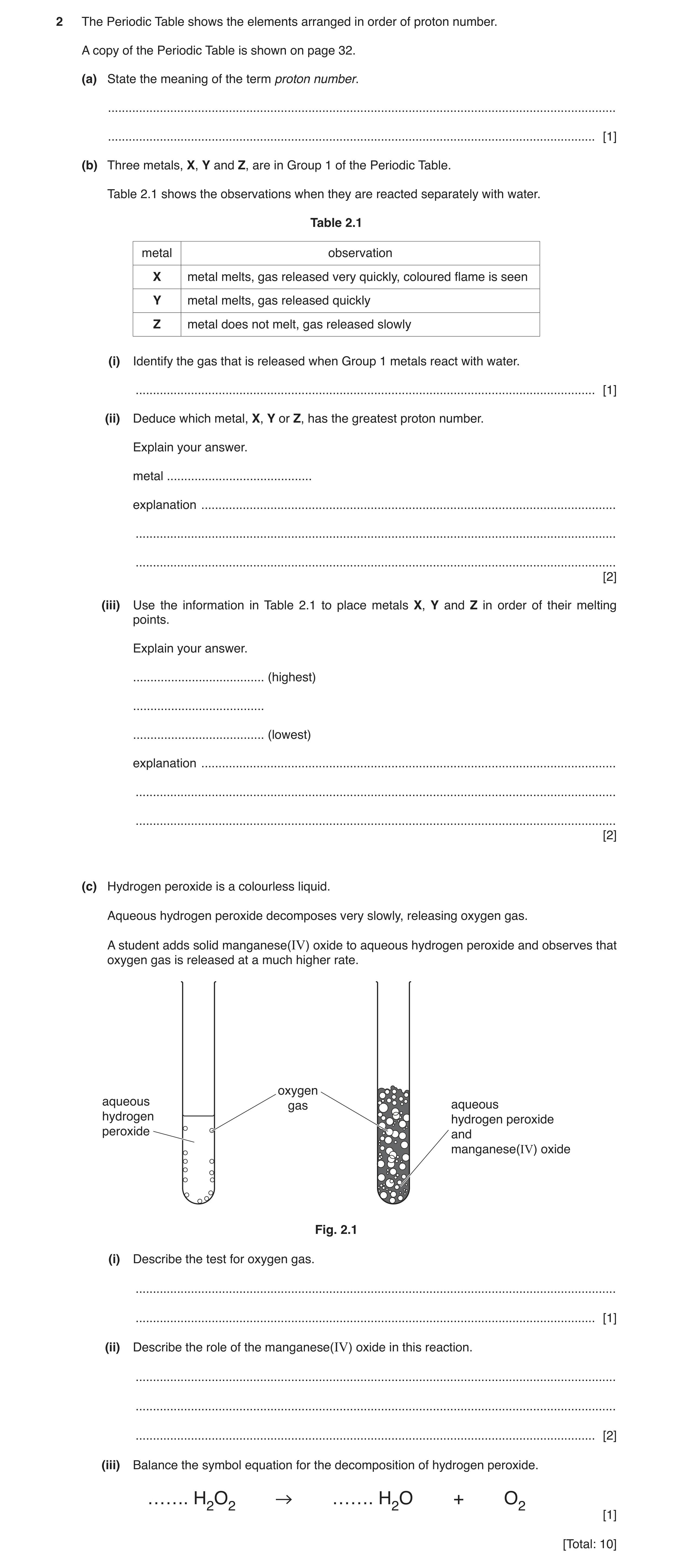
2 The Periodic Table shows the elements arranged in order of proton number. A copy of the Periodic Table is shown on page 32. (a) State the meaning of the term proton number. … … [1] (b) Three metals, X, Y and Z, are in Group 1 of the Periodic Table. Table 2.1 shows the observations when they are reacted separately with water. Table 2.1 metal observation X metal melts, gas released very quickly, coloured flame is seen Y metal melts, gas released quickly Z metal does not melt, gas released slowly (i) Identify the gas that is released when Group 1 metals react with water. … [1] (ii) Deduce which metal, X, Y or Z, has the greatest proton number. Explain your answer. metal … explanation … … … [2] (iii) Use the information in Table 2.1 to place metals X, Y and Z in order of their melting points. Explain your answer. … (highest) … … (lowest) explanation … … … [2] (c) Hydrogen peroxide is a colourless liquid. Aqueous hydrogen peroxide decomposes very slowly, releasing oxygen gas. A student adds solid manganese(IV) oxide to aqueous hydrogen peroxide and observes that oxygen gas is released at a much higher rate. oxygen aqueous gas aqueous hydrogen hydrogen peroxide peroxide and manganese(IV) oxide Fig. 2.1 (i) Describe the test for oxygen gas. … … [1] (ii) Describe the role of the manganese(IV) oxide in this reaction. … … … [2] (iii) Balance the symbol equation for the decomposition of hydrogen peroxide. ……. H2O2 ……. H2O + O2 [1] [Total: 10]
10 marks
Mark scheme: 2(a) number of protons in an atom (of the element) ; 1 2(b)(i) hydrogen / H2 ; 1 2(b)(ii) (X) X reacts most vigorously with water ; reactivity increases down Group 1 / with increasing proton number ; 2 2(b)(iii) Z (highest) Y X (lowest) ; the idea that melting point decreases down Group 1 / as reactivity increases / owtte ; 2 2(c)(i) relights glowing splint ; 1 2(c)(ii) catalyst ; speeds up reaction rate ; 2 2(c)(iii) 2H2O2 → 2H2O + O2 ; 1
This question in 0654/31 Oct/Nov 2019
Q4 · Water is a compound of the elements hydrogen and oxygen 0654/33 May/June 2020
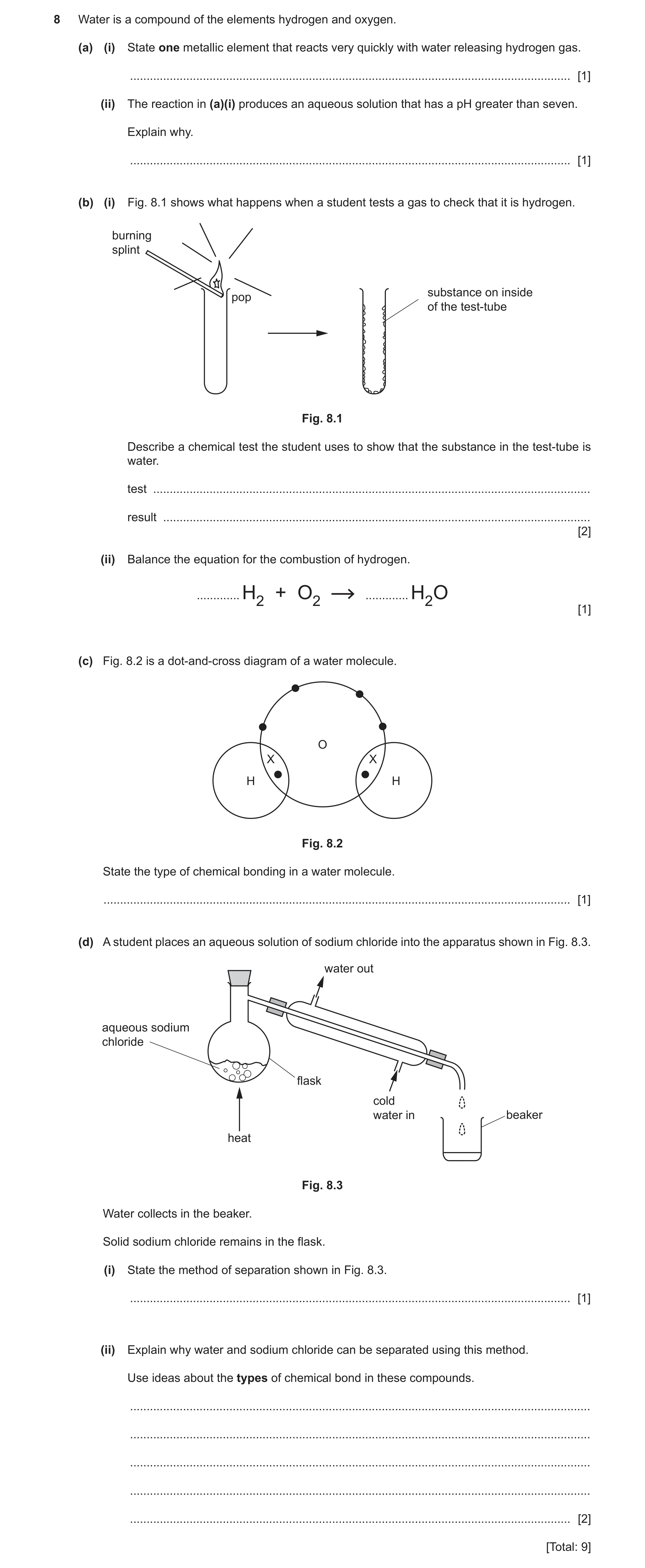
8 Water is a compound of the elements hydrogen and oxygen. (a) (i) State one metallic element that reacts very quickly with water releasing hydrogen gas. … [1] (ii) The reaction in (a)(i) produces an aqueous solution that has a pH greater than seven. Explain why. … [1] (b) (i) Fig. 8.1 shows what happens when a student tests a gas to check that it is hydrogen. burning splint substance on inside pop of the test-tube Fig. 8.1 Describe a chemical test the student uses to show that the substance in the test-tube is water. test … result … [2] (ii) Balance the equation for the combustion of hydrogen. … … H2 + O2 H2O [1] (c) Fig. 8.2 is a dot-and-cross diagram of a water molecule. O X X H H Fig. 8.2 State the type of chemical bonding in a water molecule. … [1] (d) A student places an aqueous solution of sodium chloride into the apparatus shown in Fig. 8.3. water out aqueous sodium chloride flask cold water in beaker heat Fig. 8.3 Water collects in the beaker. Solid sodium chloride remains in the flask. (i) State the method of separation shown in Fig. 8.3. … [1] (ii) Explain why water and sodium chloride can be separated using this method. Use ideas about the types of chemical bond in these compounds. … … … … … [2] [Total: 9]
9 marks
Mark scheme: 8(a)(i) any Group 1 element / other correct (e.g. calcium); 1 8(a)(ii) solution is alkaline / reaction produces (soluble) base / hydroxide of element in (i) ; 1 8(b)(i) cobalt chloride ; blue to pink ; OR anhydrous copper(II) sulfate ; white to blue ; 2 8(b)(ii) 2H2 + O2 → 2 H2O ; 1 8(c) covalent ; 1 8(d)(i) (simple) distillation ; 1 8(d)(ii) the idea that water boils and sodium chloride does not / water is more volatile than sodium chloride ; because covalent compounds tend to have low bpts / ionic compounds high bpts; 2
This question in 0654/33 May/June 2020
Q5 · Lithium, sodium and potassium are alkali metal elements in the Periodic Table 0654/32 Feb/March 2021
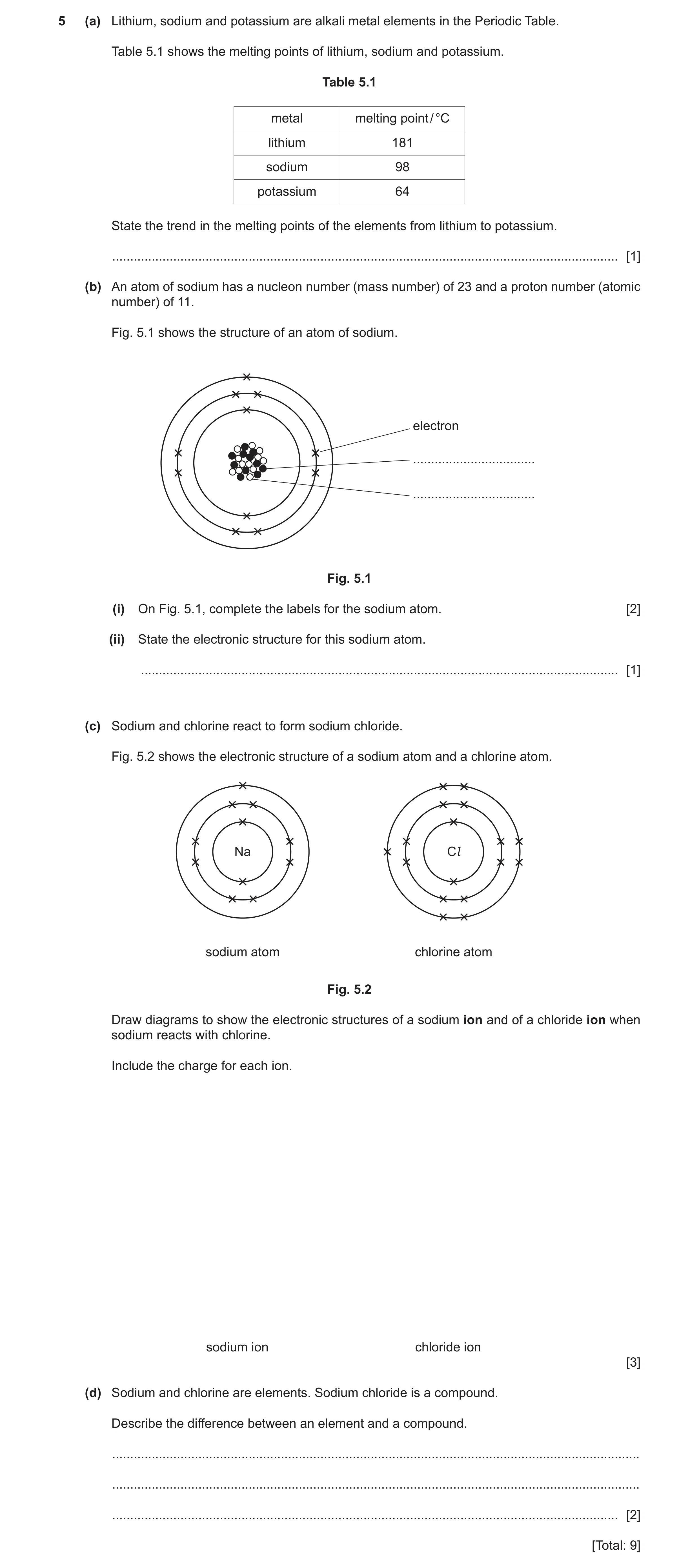
5 (a) Lithium, sodium and potassium are alkali metal elements in the Periodic Table. Table 5.1 shows the melting points of lithium, sodium and potassium. Table 5.1 metal melting point / °C lithium 181 sodium 98 potassium 64 State the trend in the melting points of the elements from lithium to potassium. … [1] (b) An atom of sodium has a nucleon number (mass number) of 23 and a proton number (atomic number) of 11. Fig. 5.1 shows the structure of an atom of sodium. electron … … Fig. 5.1 (i) On Fig. 5.1, complete the labels for the sodium atom. [2] (ii) State the electronic structure for this sodium atom. … [1] (c) Sodium and chlorine react to form sodium chloride. Fig. 5.2 shows the electronic structure of a sodium atom and a chlorine atom. Na Cl sodium atom chlorine atom Fig. 5.2 Draw diagrams to show the electronic structures of a sodium ion and of a chloride ion when sodium reacts with chlorine. Include the charge for each ion. sodium ion chloride ion [3] (d) Sodium and chlorine are elements. Sodium chloride is a compound. Describe the difference between an element and a compound. … … … [2] [Total: 9]
9 marks
Mark scheme: 5(a) melting point decreases (down group) ; 1 5(b)(i) proton; neutron; 2 Question Answer Marks 5(b)(ii) 2.8.1; 1 5(c) sodium ion 2.8 ; chloride ion 2.8.8 ; sodium has positive charge and chloride has negative charge indicated; 3 5(d) an element contains only one type of atom; a compound contains two or more elements (chemically) combined / bonded; 2
This question in 0654/32 Feb/March 2021
Q6 · The melting points of some Group I elements 0654/31 Oct/Nov 2021
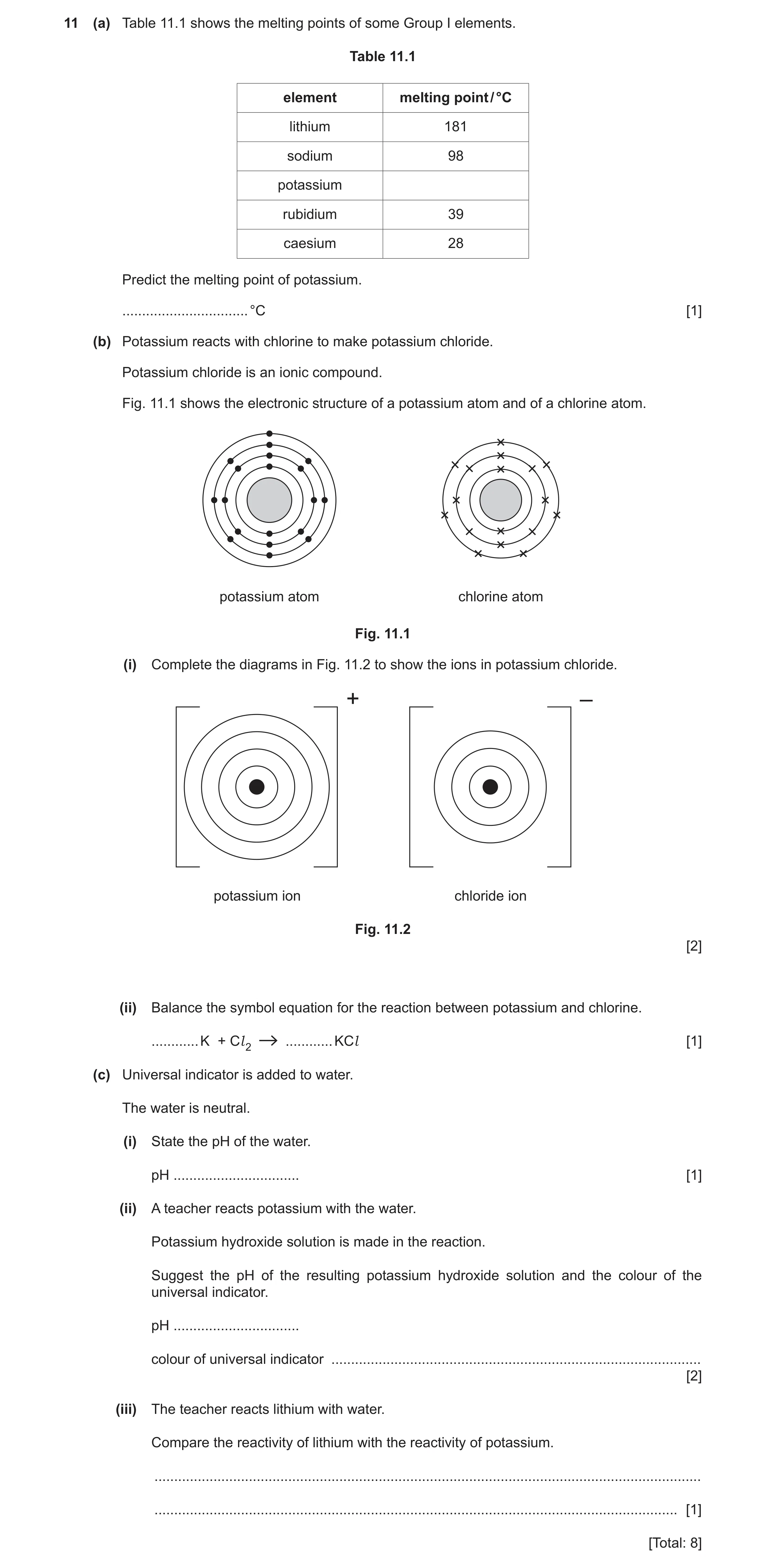
11 (a) Table 11.1 shows the melting points of some Group I elements. Table 11.1 element melting point / °C lithium 181 sodium 98 potassium rubidium 39 caesium 28 Predict the melting point of potassium. … °C [1] (b) Potassium reacts with chlorine to make potassium chloride. Potassium chloride is an ionic compound. Fig. 11.1 shows the electronic structure of a potassium atom and of a chlorine atom. potassium atom chlorine atom Fig. 11.1 (i) Complete the diagrams in Fig. 11.2 to show the ions in potassium chloride. + – potassium ion chloride ion Fig. 11.2 [2] (ii) Balance the symbol equation for the reaction between potassium and chlorine. … K + Cl2 … KCl [1] (c) Universal indicator is added to water. The water is neutral. (i) State the pH of the water. pH … [1] (ii) A teacher reacts potassium with the water. Potassium hydroxide solution is made in the reaction. Suggest the pH of the resulting potassium hydroxide solution and the colour of the universal indicator. pH … colour of universal indicator … [2] (iii) The teacher reacts lithium with water. Compare the reactivity of lithium with the reactivity of potassium. … … [1] [Total: 8]
8 marks
Mark scheme: 11(a) 45 (°C) to 90 (°C) ; 1 11(b)(i) potassium ion 2.8.8. ; chloride ion 2.8.8 ; 2 11(b)(ii) 2 (K + Cl 2 → ) 2 (KCl) ; 1 11(c)(i) 7 ; 1 11(c)(ii) any value between 7 and 14 ; purple ; 2 11(c)(iii) lithium reacts less violently / lithium is less reactive ; 1
This question in 0654/31 Oct/Nov 2021
Q7 · The melting points and reactivity with water of three Group I metals 0654/32 Oct/Nov 2021
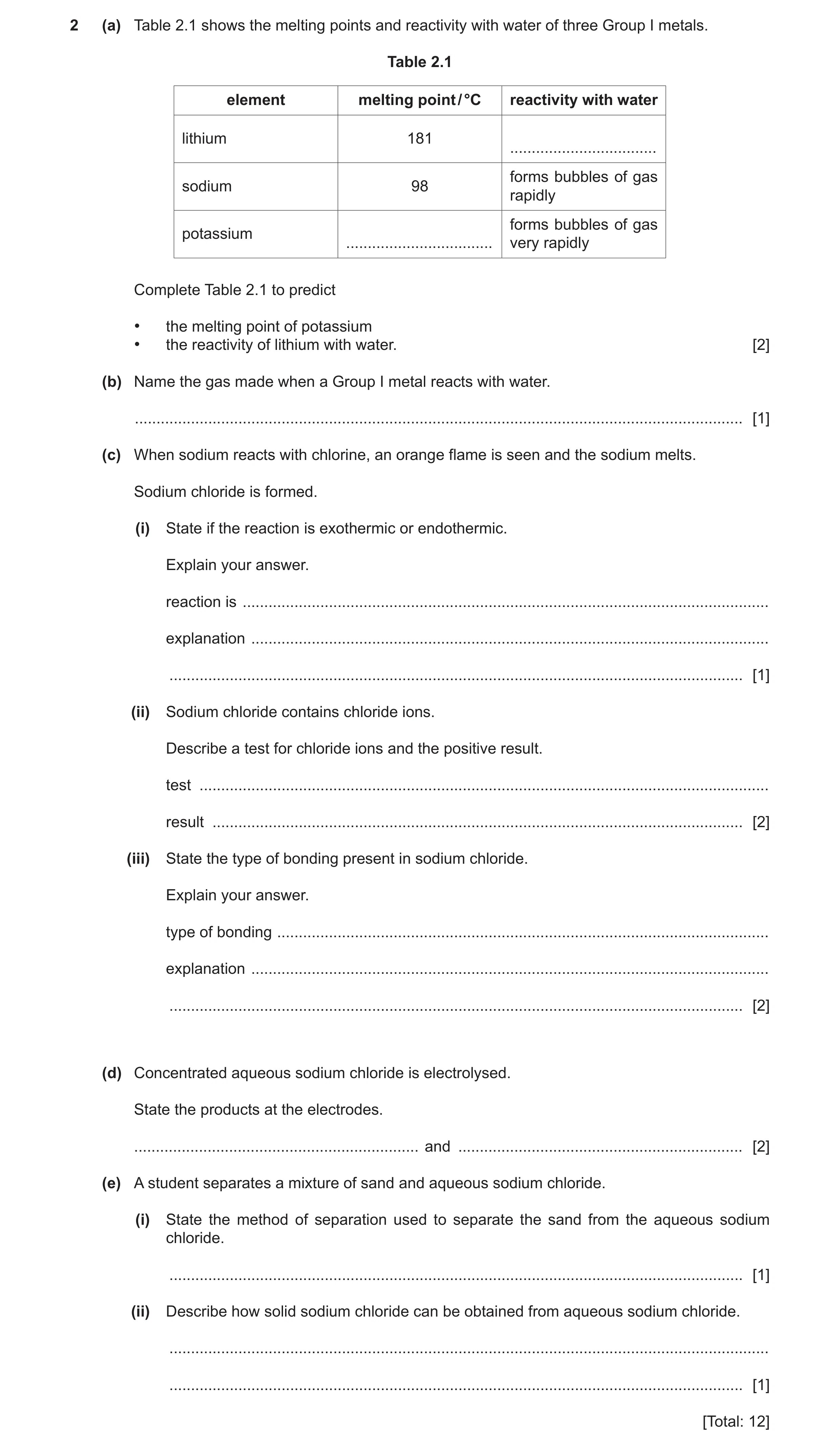
2 (a) Table 2.1 shows the melting points and reactivity with water of three Group I metals. Table 2.1 element melting point / °C reactivity with water lithium 181 … forms bubbles of gas sodium 98 rapidly forms bubbles of gas potassium … very rapidly Complete Table 2.1 to predict • the melting point of potassium • the reactivity of lithium with water. [2] (b) Name the gas made when a Group I metal reacts with water. … [1] (c) When sodium reacts with chlorine, an orange flame is seen and the sodium melts. Sodium chloride is formed. (i) State if the reaction is exothermic or endothermic. Explain your answer. reaction is … explanation … … [1] (ii) Sodium chloride contains chloride ions. Describe a test for chloride ions and the positive result. test … result … [2] (iii) State the type of bonding present in sodium chloride. Explain your answer. type of bonding … explanation … … [2] (d) Concentrated aqueous sodium chloride is electrolysed. State the products at the electrodes. … and … [2] (e) A student separates a mixture of sand and aqueous sodium chloride. (i) State the method of separation used to separate the sand from the aqueous sodium chloride. … [1] (ii) Describe how solid sodium chloride can be obtained from aqueous sodium chloride. … … [1] [Total: 12]
12 marks
Mark scheme: 2(a) below 90 °C ; reacts / forms bubbles of gas slowly / moderately ; 2 2(b) hydrogen ; 1 2(c)(i) exothermic because (thermal) energy released (to melt sodium) ; 1 2(c)(ii) aqueous silver nitrate ; white precipitate ; 2 Question Answer Marks 2(c)(iii) ionic ; bonding between a metal and a non-metal / electron transfer ; 2 2(d) hydrogen ; chlorine ; 2 2(e)(i) filtration ; 1 2(e)(ii) evaporation / crystallisation ; 1
This question in 0654/32 Oct/Nov 2021
Q8 · A list of seven metals from the Periodic Table 0654/32 Feb/March 2022
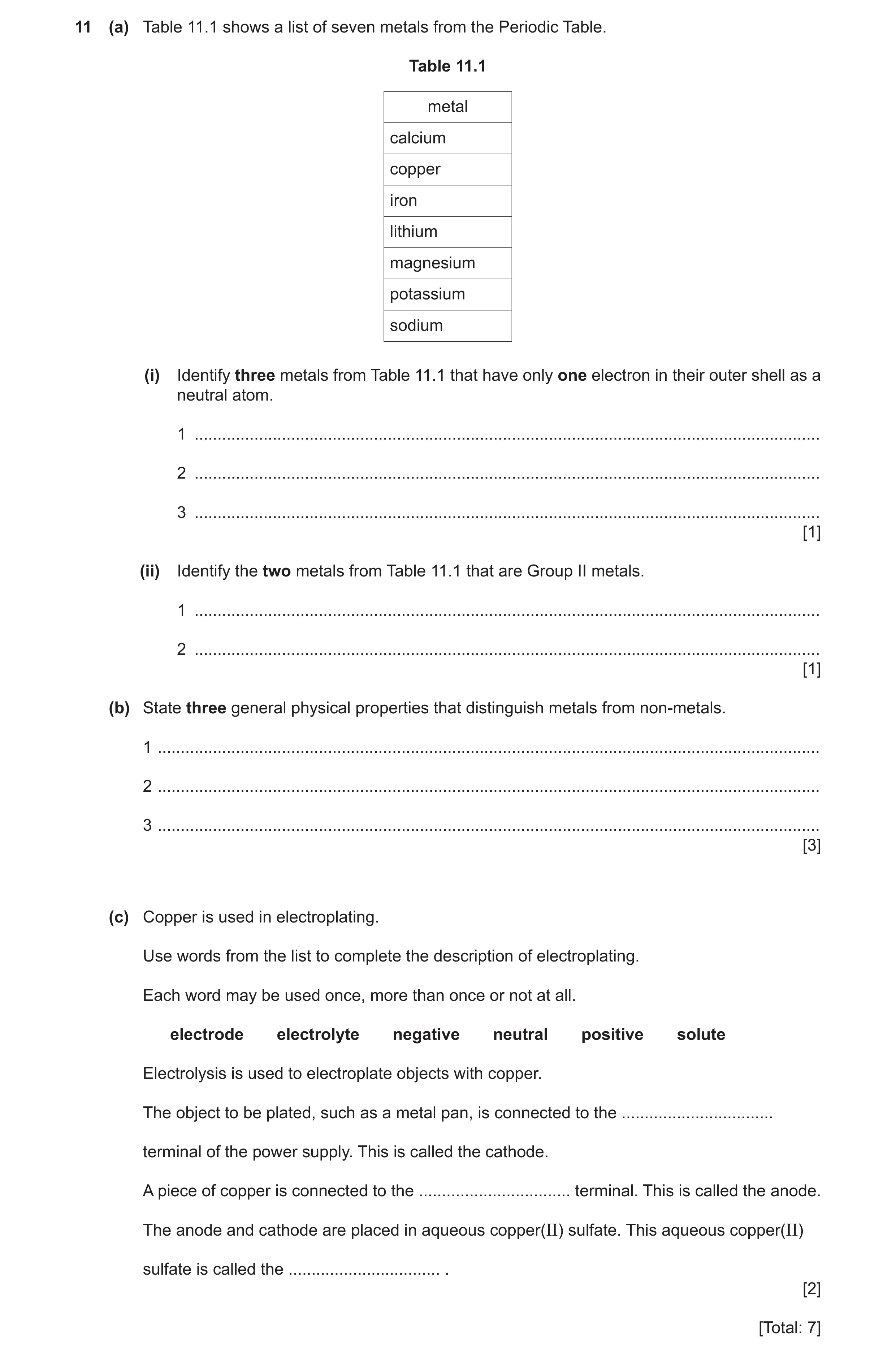
11 (a) Table 11.1 shows a list of seven metals from the Periodic Table. Table 11.1 metal calcium copper iron lithium magnesium potassium sodium (i) Identify three metals from Table 11.1 that have only one electron in their outer shell as a neutral atom. 1 … 2 … 3 … [1] (ii) Identify the two metals from Table 11.1 that are Group II metals. 1 … 2 … [1] (b) State three general physical properties that distinguish metals from non-metals. 1 … 2 … 3 … [3] (c) Copper is used in electroplating. Use words from the list to complete the description of electroplating. Each word may be used once, more than once or not at all. electrode electrolyte negative neutral positive solute Electrolysis is used to electroplate objects with copper. The object to be plated, such as a metal pan, is connected to the … terminal of the power supply. This is called the cathode. A piece of copper is connected to the … terminal. This is called the anode. The anode and cathode are placed in aqueous copper(II) sulfate. This aqueous copper(II) sulfate is called the … . [2] [Total: 7]
7 marks
Mark scheme: 11(a)(i) lithium , potassium and sodium; 1 11(a)(ii) calcium and magnesium; 1 11(b) any three from: good thermal conductors; good electrical conductors; (relatively) high melting point / boiling point; malleable; 3 11(c) negative and positive; electrolyte; 2
This question in 0654/32 Feb/March 2022
Q9 · A list of metals is shown 0654/31 May/June 2024
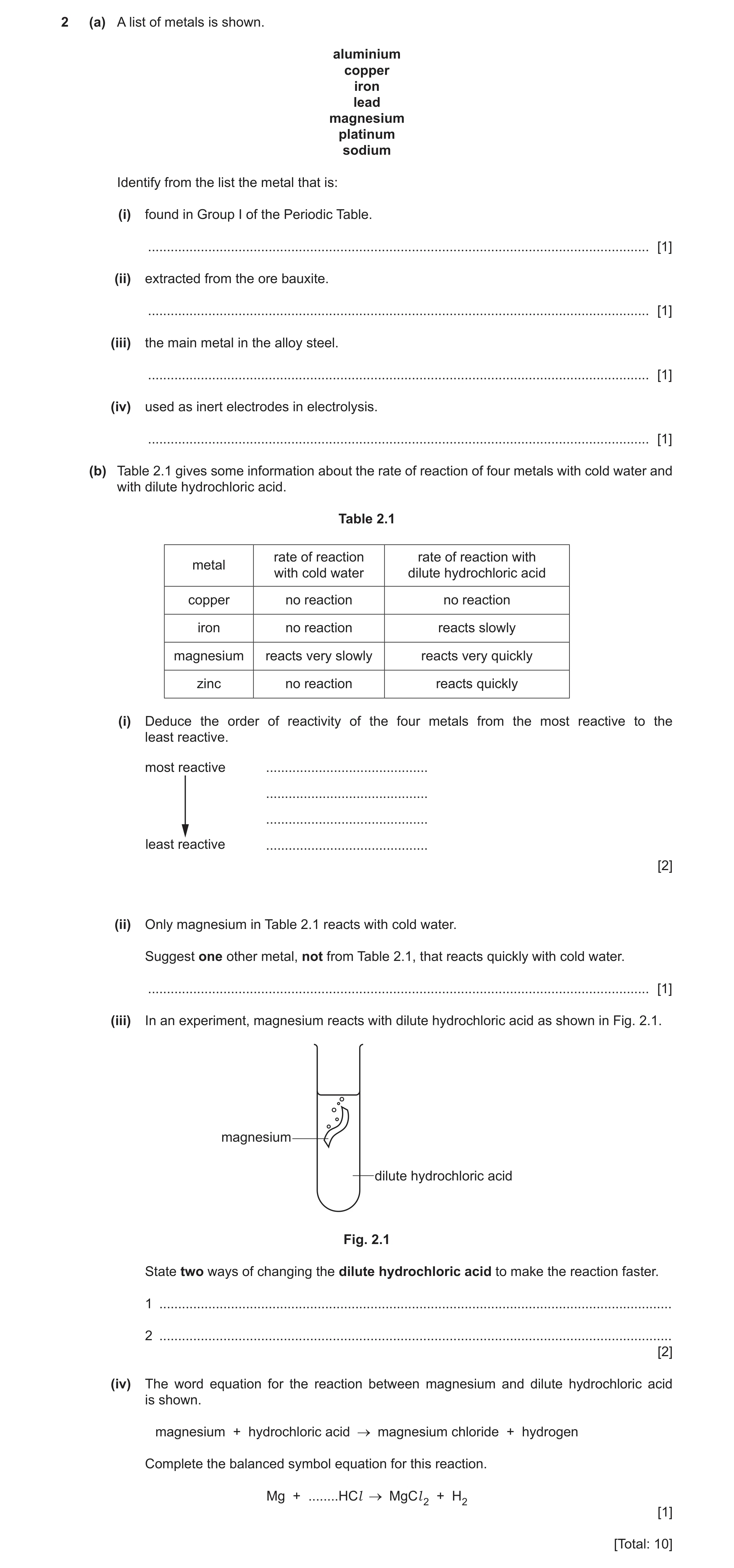
2 (a) A list of metals is shown. aluminium copper iron lead magnesium platinum sodium Identify from the list the metal that is: (i) found in Group I of the Periodic Table. … [1] (ii) extracted from the ore bauxite. … [1] (iii) the main metal in the alloy steel. … [1] (iv) used as inert electrodes in electrolysis. … [1] (b) Table 2.1 gives some information about the rate of reaction of four metals with cold water and with dilute hydrochloric acid. Table 2.1 rate of reaction rate of reaction with metal with cold water dilute hydrochloric acid copper no reaction no reaction iron no reaction reacts slowly magnesium reacts very slowly reacts very quickly zinc no reaction reacts quickly (i) Deduce the order of reactivity of the four metals from the most reactive to the least reactive. most reactive … … … least reactive … [2] (ii) Only magnesium in Table 2.1 reacts with cold water. Suggest one other metal, not from Table 2.1, that reacts quickly with cold water. … [1] (iii) In an experiment, magnesium reacts with dilute hydrochloric acid as shown in Fig. 2.1. magnesium dilute hydrochloric acid Fig. 2.1 State two ways of changing the dilute hydrochloric acid to make the reaction faster. 1 … 2 … [2] (iv) The word equation for the reaction between magnesium and dilute hydrochloric acid is shown. magnesium + hydrochloric acid magnesium chloride + hydrogen Complete the balanced symbol equation for this reaction. Mg + … HCl MgCl 2 + H2 [1] [Total: 10]
10 marks
Mark scheme: 2(a)(i) sodium ; 1 2(a)(ii) aluminium ; 1 2(a)(iii) iron ; 1 2(a)(iv) platinum ; 1 Question Answer Marks 2(b)(i) magnesium zinc iron copper magnesium and copper correct ; zinc and iron correct ; 2 2(b)(ii) lithium, sodium, potassium etc. ; 1 2(b)(iii) increase concentration of acid ; increase temperature of acid ; 2 2(b)(iv) 2 HCl ; 1
This question in 0654/31 May/June 2024
Q10 · A teacher reacts sodium with water 0654/32 May/June 2024
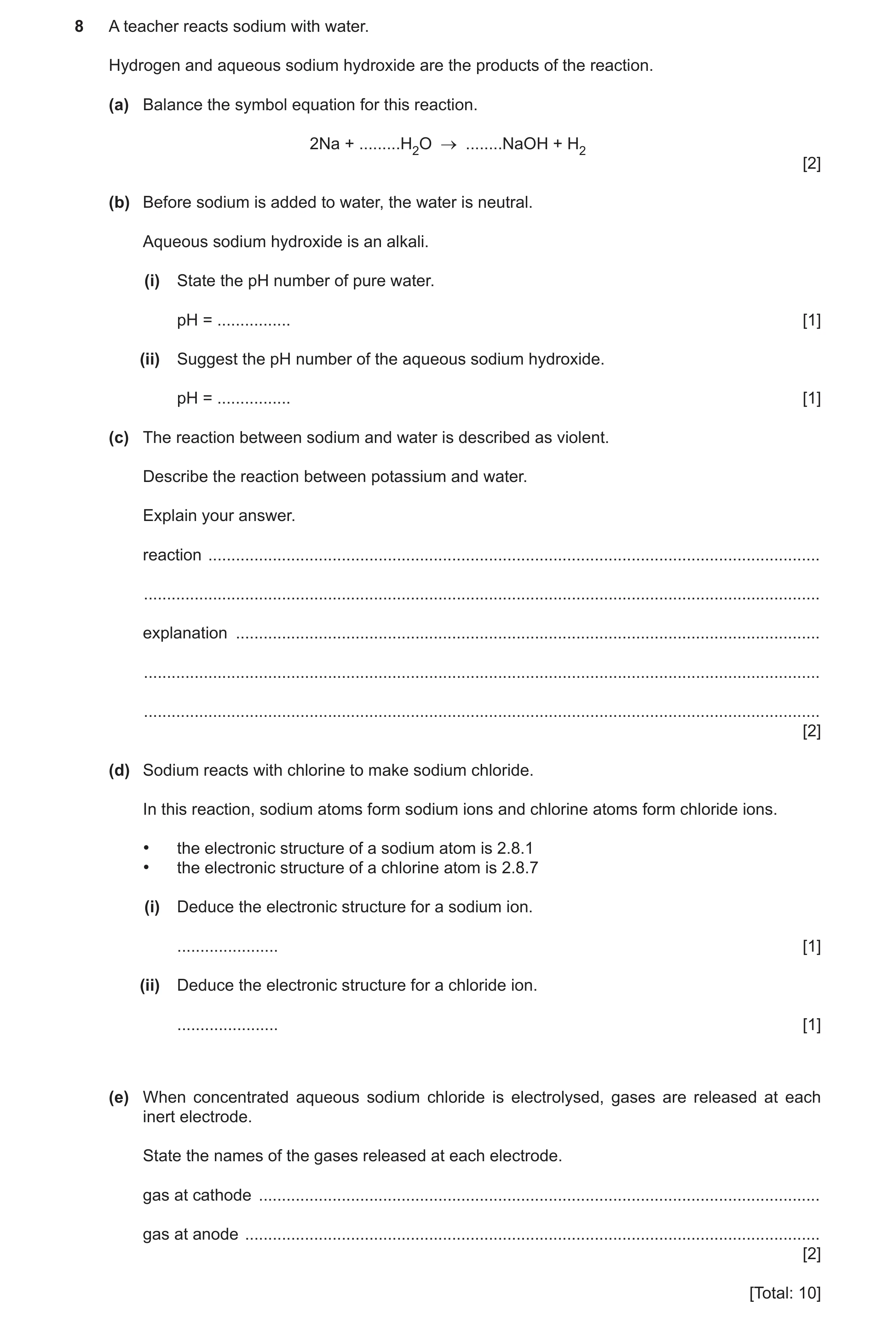
8 A teacher reacts sodium with water. Hydrogen and aqueous sodium hydroxide are the products of the reaction. (a) Balance the symbol equation for this reaction. 2Na + … H2O … NaOH + H2 [2] (b) Before sodium is added to water, the water is neutral. Aqueous sodium hydroxide is an alkali. (i) State the pH number of pure water. pH = … [1] (ii) Suggest the pH number of the aqueous sodium hydroxide. pH = … [1] (c) The reaction between sodium and water is described as violent. Describe the reaction between potassium and water. Explain your answer. reaction … … explanation … … … [2] (d) Sodium reacts with chlorine to make sodium chloride. In this reaction, sodium atoms form sodium ions and chlorine atoms form chloride ions. • the electronic structure of a sodium atom is 2.8.1 • the electronic structure of a chlorine atom is 2.8.7 (i) Deduce the electronic structure for a sodium ion. … [1] (ii) Deduce the electronic structure for a chloride ion. … [1] (e) When concentrated aqueous sodium chloride is electrolysed, gases are released at each inert electrode. State the names of the gases released at each electrode. gas at cathode … gas at anode … [2] [Total: 10]
10 marks
Mark scheme: 8(a) 2Na + 2 H2O 2 NaOH + H2 ;; 2 8(b)(i) 7 ; 1 8(b)(ii) 8–14 ; 1 8(c) even more violent / explosive ; reactivity increases down the group / potassium is more reactive than sodium ; 2 8(d)(i) 2.8 ; 1 8(d)(ii) 2.8.8 ; 1 8(e) cathode–hydrogen ; anode–chlorine ; 2
This question in 0654/32 May/June 2024
Q11 · A teacher reacts sodium with water 0654/33 May/June 2024
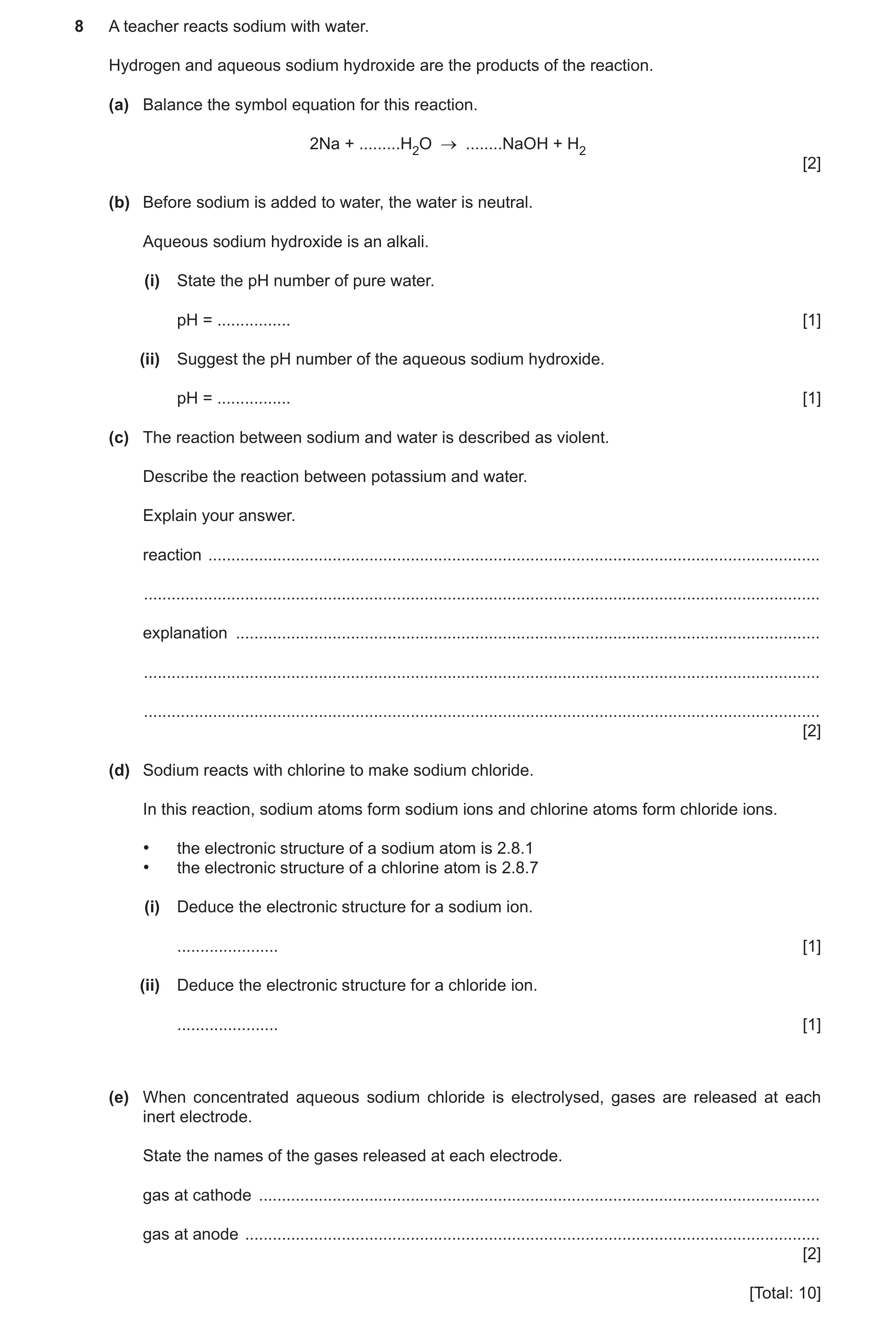
8 A teacher reacts sodium with water. Hydrogen and aqueous sodium hydroxide are the products of the reaction. (a) Balance the symbol equation for this reaction. 2Na + … H2O … NaOH + H2 [2] (b) Before sodium is added to water, the water is neutral. Aqueous sodium hydroxide is an alkali. (i) State the pH number of pure water. pH = … [1] (ii) Suggest the pH number of the aqueous sodium hydroxide. pH = … [1] (c) The reaction between sodium and water is described as violent. Describe the reaction between potassium and water. Explain your answer. reaction … … explanation … … … [2] (d) Sodium reacts with chlorine to make sodium chloride. In this reaction, sodium atoms form sodium ions and chlorine atoms form chloride ions. • the electronic structure of a sodium atom is 2.8.1 • the electronic structure of a chlorine atom is 2.8.7 (i) Deduce the electronic structure for a sodium ion. … [1] (ii) Deduce the electronic structure for a chloride ion. … [1] (e) When concentrated aqueous sodium chloride is electrolysed, gases are released at each inert electrode. State the names of the gases released at each electrode. gas at cathode … gas at anode … [2] [Total: 10]
10 marks
Mark scheme: 8(a) 2Na + 2 H2O 2 NaOH + H2 ;; 2 8(b)(i) 7 ; 1 8(b)(ii) 8–14 ; 1 8(c) even more violent / explosive ; reactivity increases down the group / potassium is more reactive than sodium ; 2 8(d)(i) 2.8 ; 1 8(d)(ii) 2.8.8 ; 1 8(e) cathode–hydrogen ; anode–chlorine ; 2
This question in 0654/33 May/June 2024
 11
11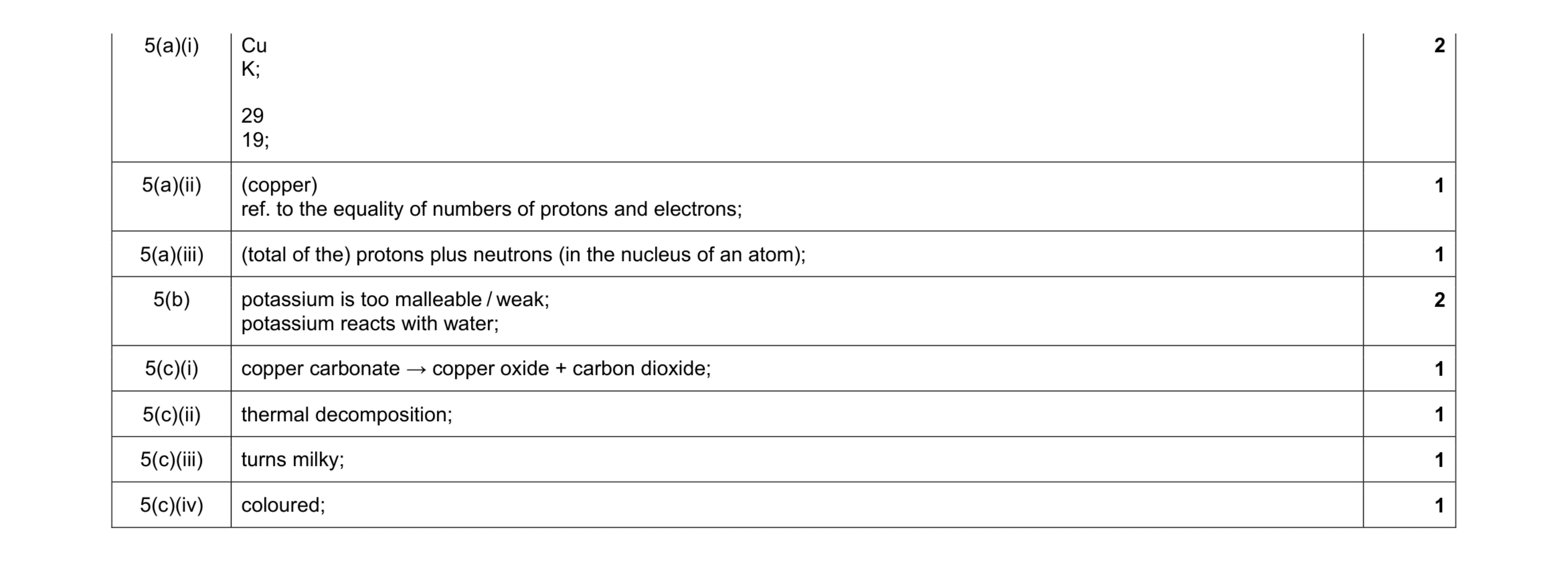 10
10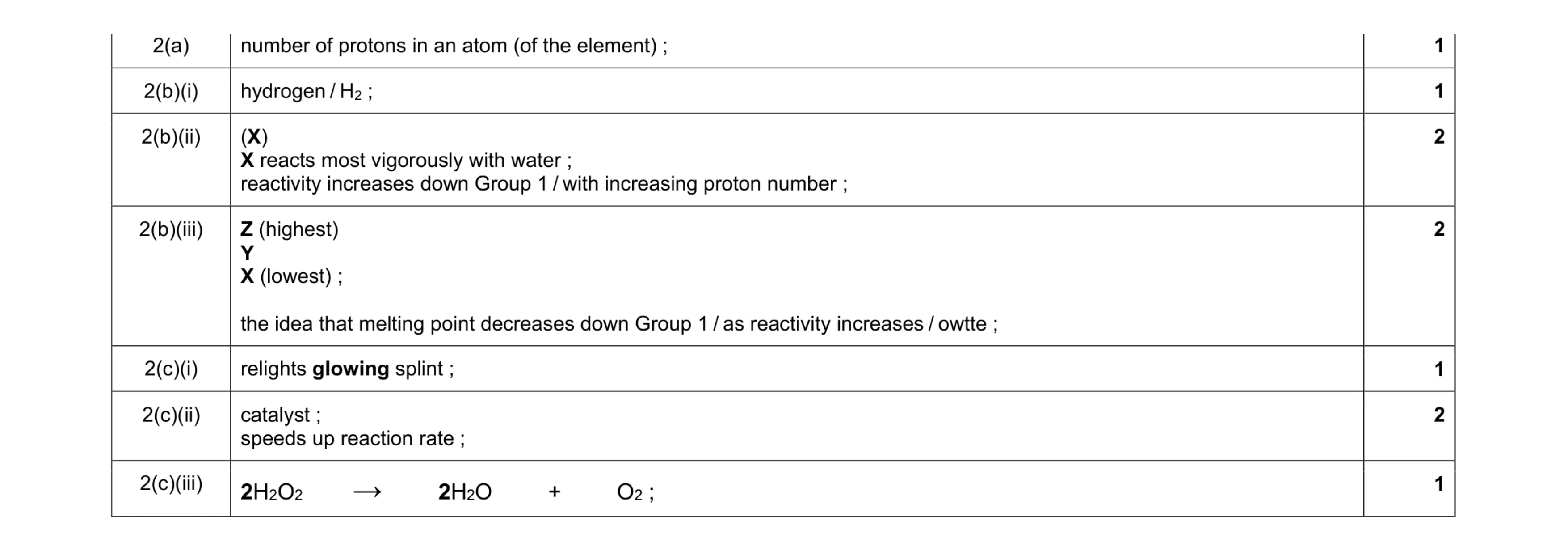 10
10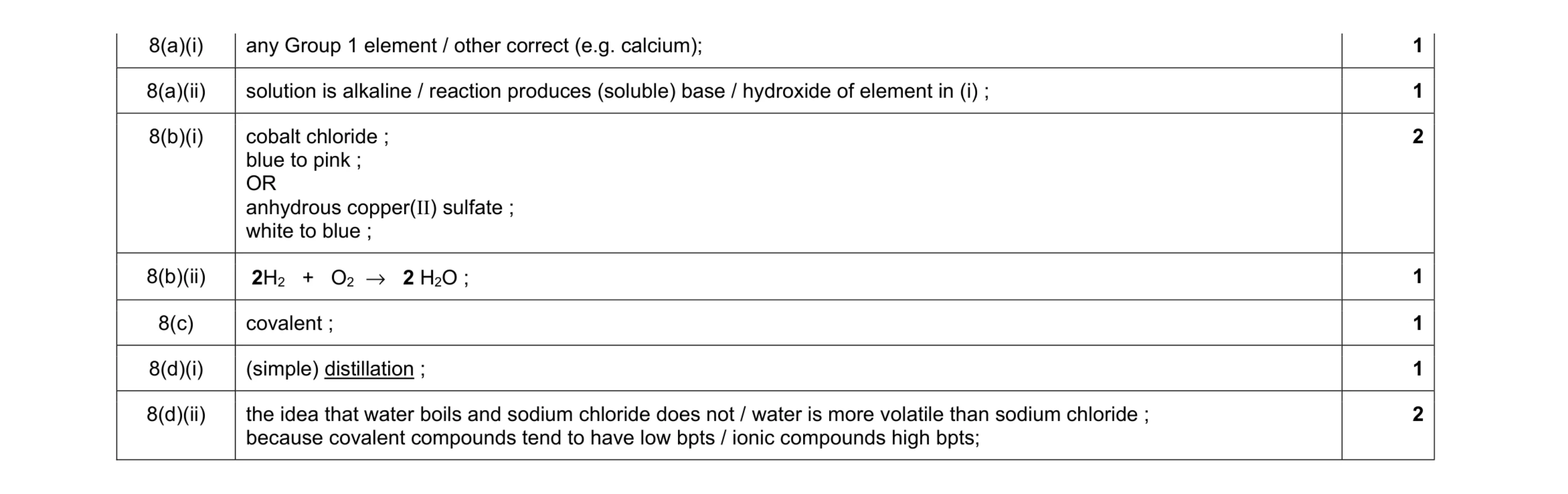 9
9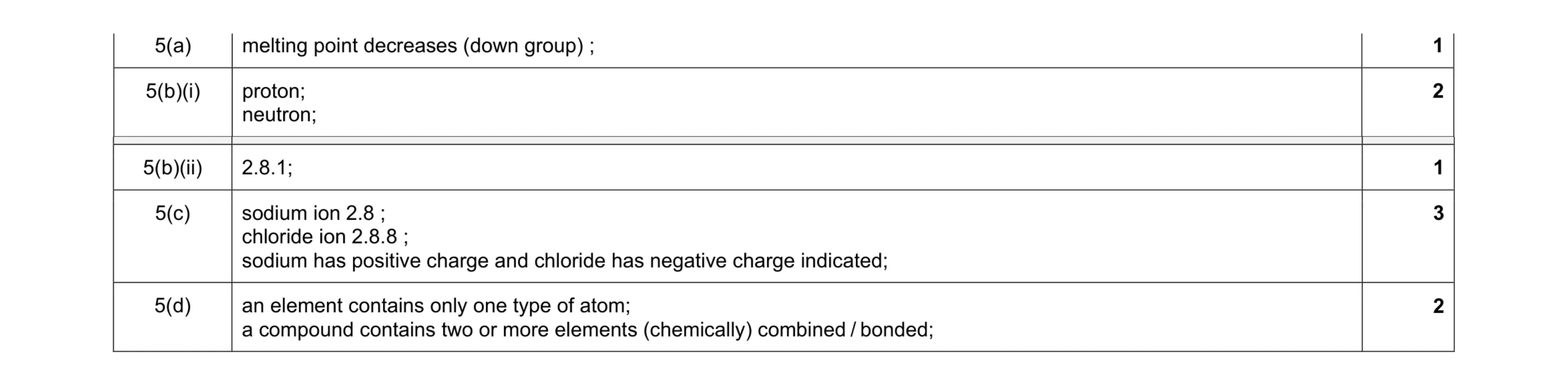 9
9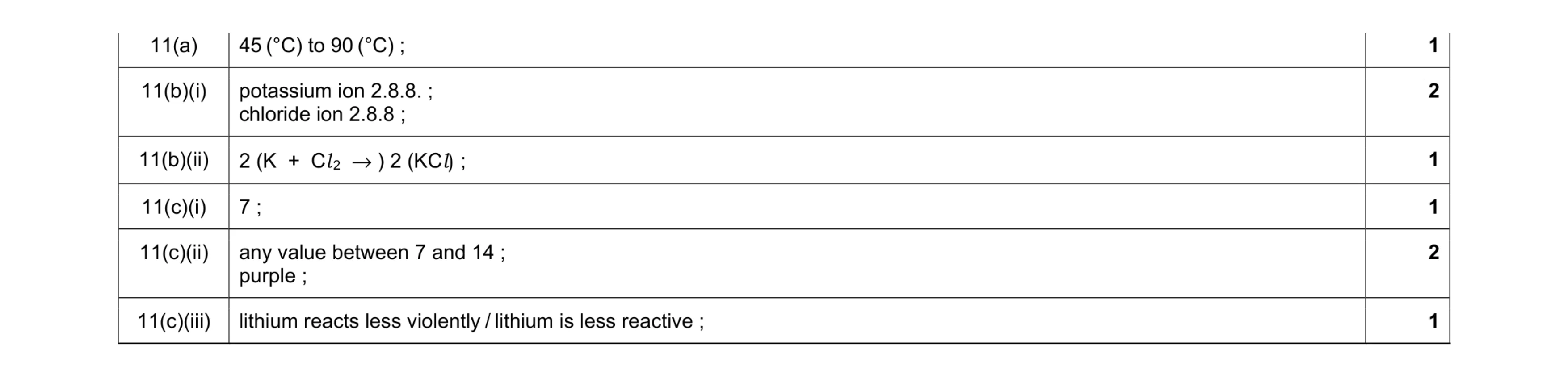 8
8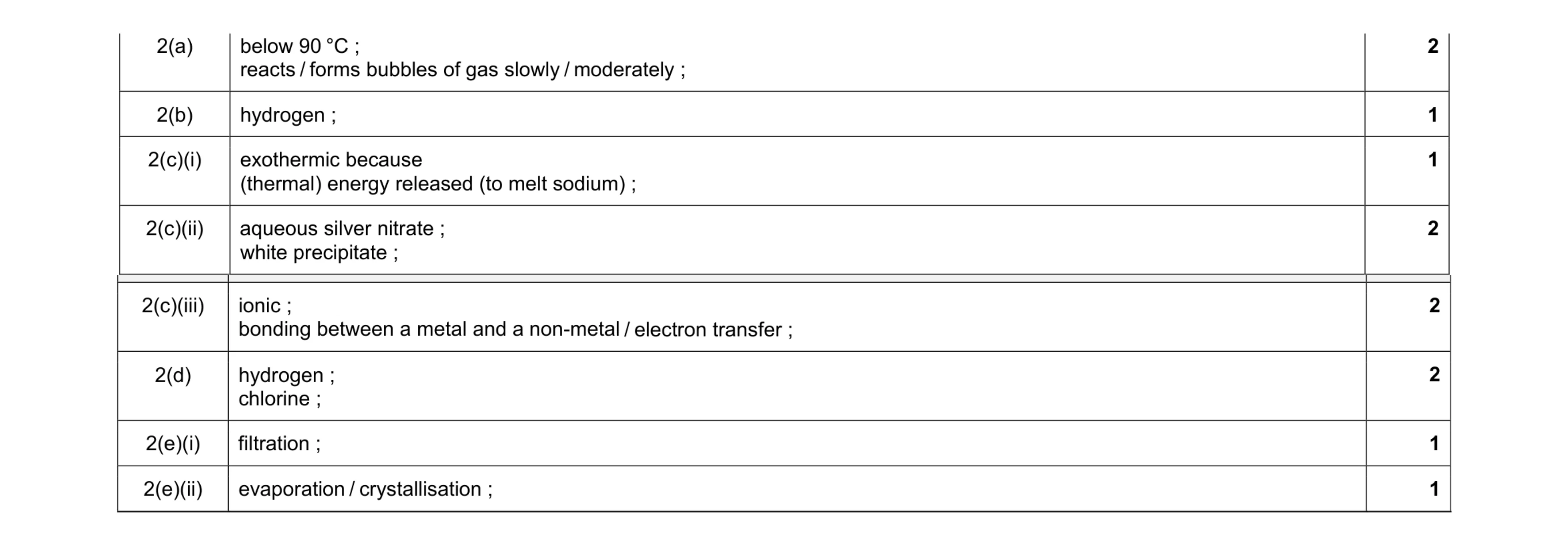 12
12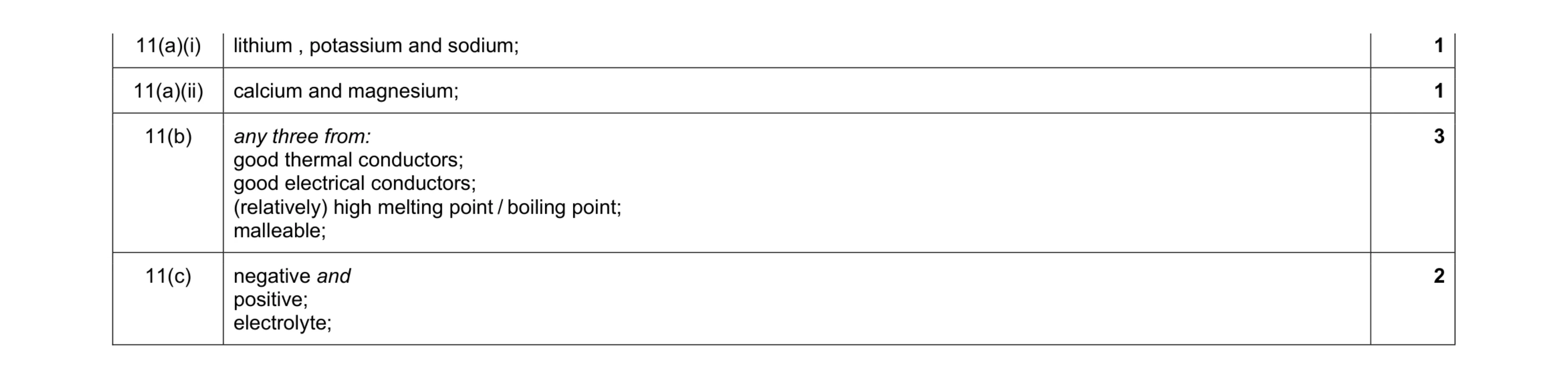 7
7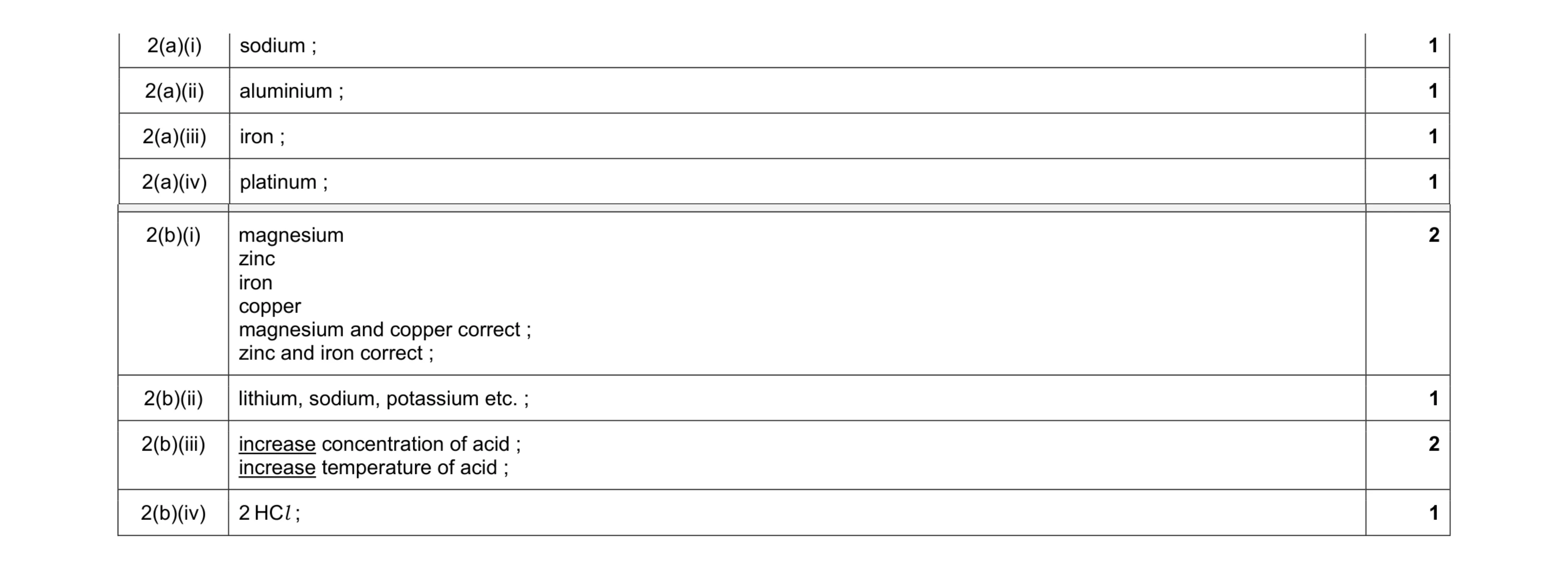 10
10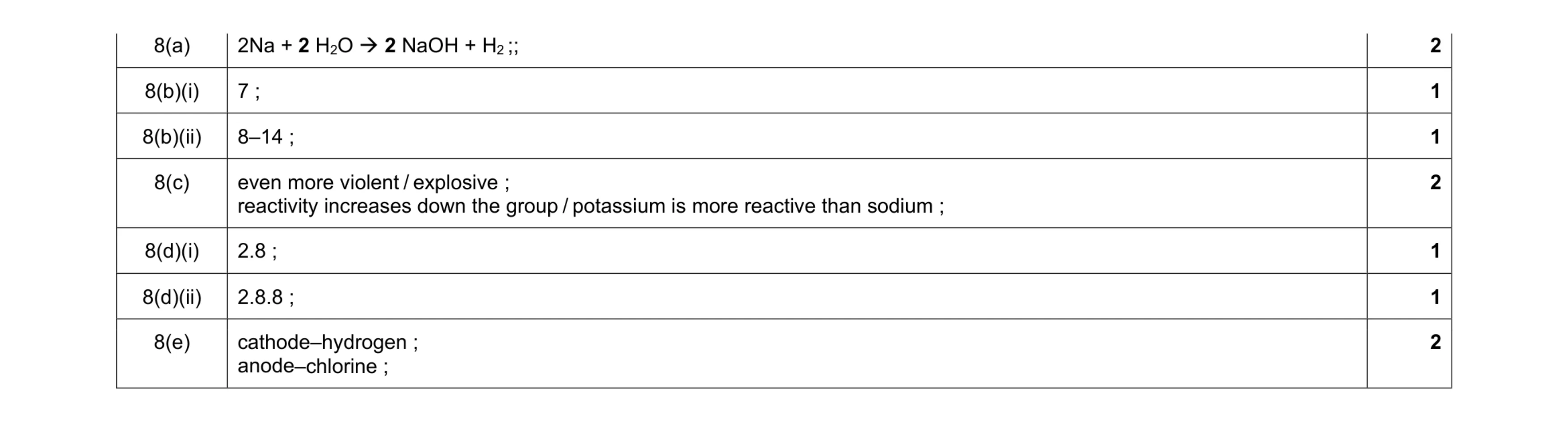 10
10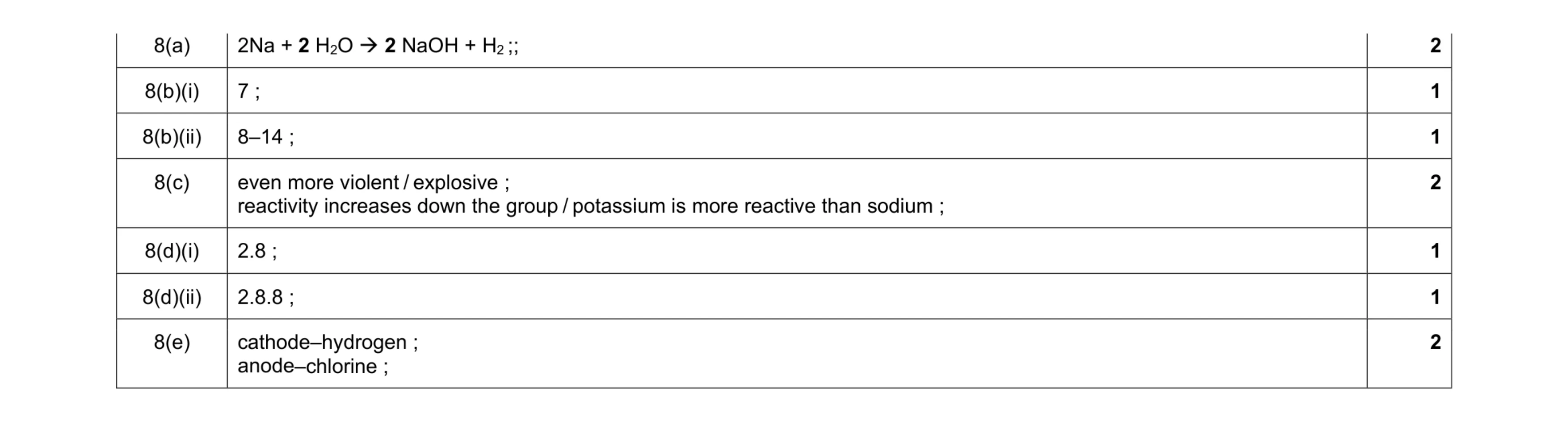 10
10