Questions as text
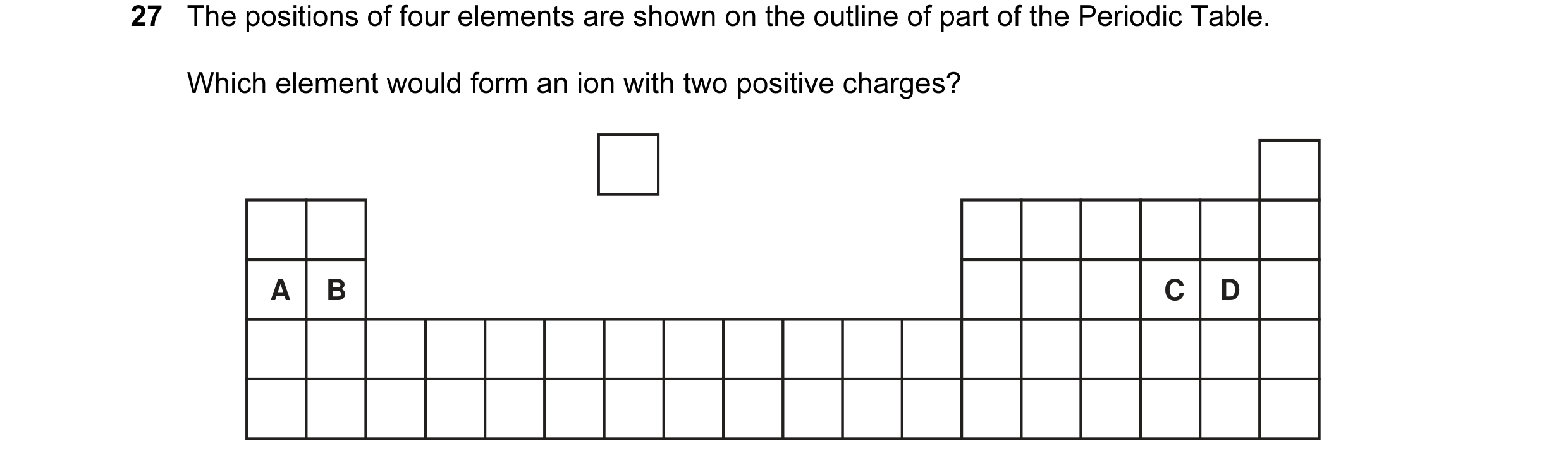
Q1 · The positions of four elements are shown on the outline of part of the Periodic Table 0654/11 May/June 2006
27 The positions of four elements are shown on the outline of part of the Periodic Table. Which element would form an ion with two positive charges? A B C D
1 marks
Answer: B
This question in 0654/11 May/June 2006
Q2 · An element is in Group VI of the Periodic Table 0654/11 Oct/Nov 2006
15 An element is in Group VI of the Periodic Table. What information does this give about the element? A the number of protons in the nucleus B the number of outer electrons C the reactivity of the element D the relative atomic mass of the element
1 marks
Answer: B
This question in 0654/11 Oct/Nov 2006
Q3 · Anatom has 2 electrons in its outer shell 0654/11 Oct/Nov 2007
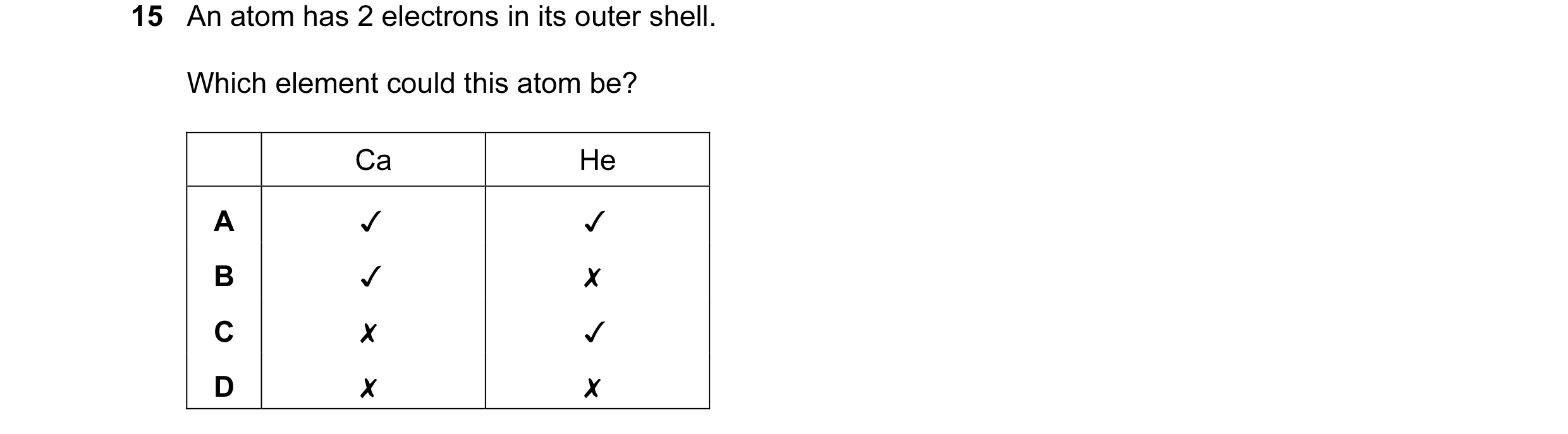
15 Anatom has 2 electrons in its outer shell.
Which element could this atom be?
Ca He
00o DM >
~~ KKM
~*~ K &® OK
1 marks
Answer: A
This question in 0654/11 Oct/Nov 2007
Q4 · An element E is a metal 0654/11 Oct/Nov 2008
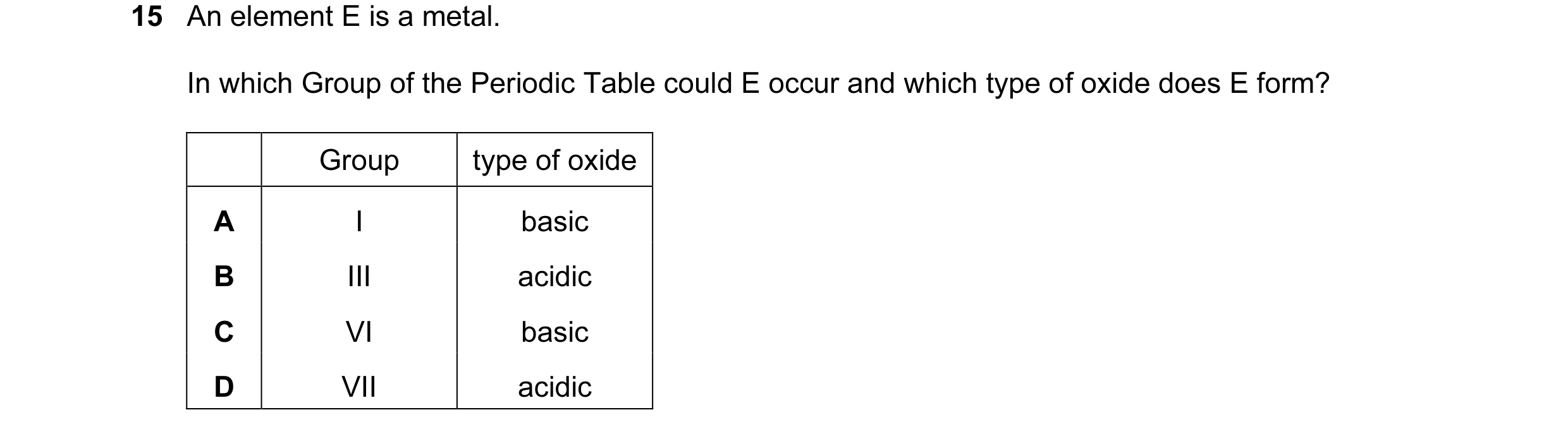
15 An element E is a metal. In which Group of the Periodic Table could E occur and which type of oxide does E form? Group type of oxide A I basic B III acidic C VI basic D VII acidic
1 marks
Answer: A
This question in 0654/11 Oct/Nov 2008
Q5 · The diagram shows part of the Periodic Table 0654/11 Oct/Nov 2008
27 The diagram shows part of the Periodic Table. Which element has the greatest number of outer electrons in its atoms? A B C D
1 marks
Answer: D
This question in 0654/11 Oct/Nov 2008
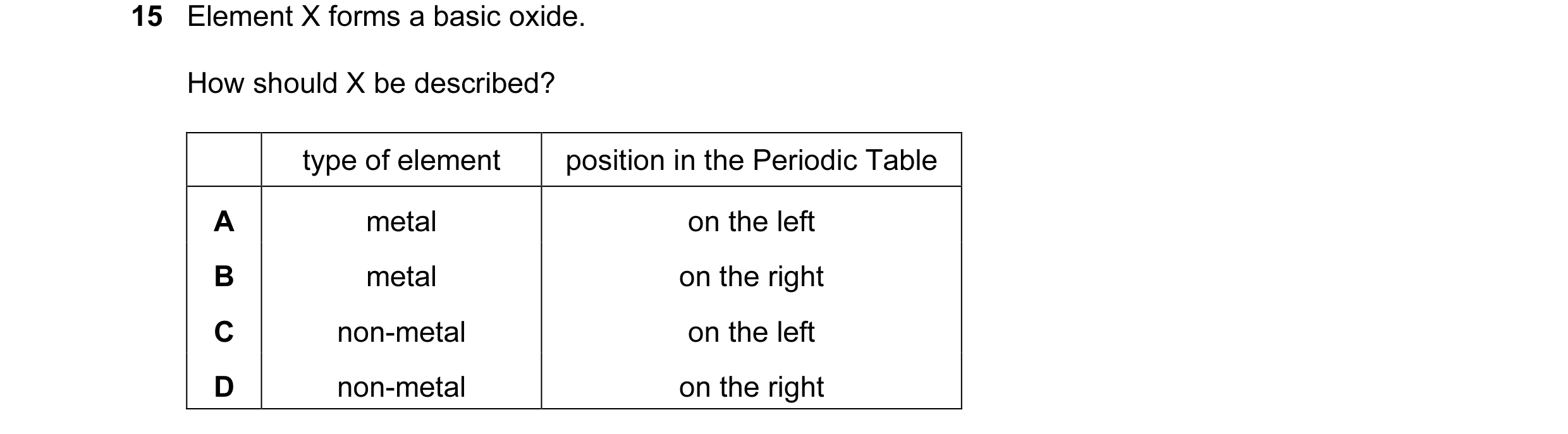
Q6 · Element X forms a basic oxide 0654/11 Oct/Nov 2009
15 Element X forms a basic oxide. How should X be described? type of element position in the Periodic Table A metal on the left B metal on the right C non-metal on the left D non-metal on the right
1 marks
Answer: A
This question in 0654/11 Oct/Nov 2009
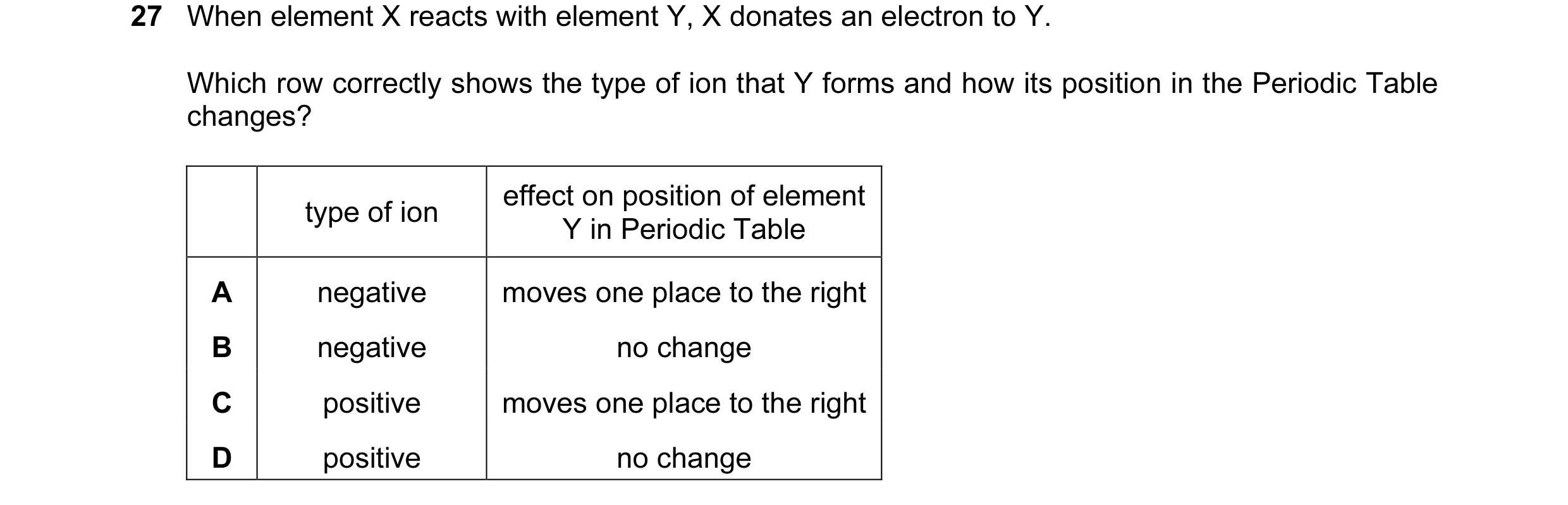
Q7 · When element X reacts with element Y, X donates an electron to Y 0654/11 May/June 2010
27 When element X reacts with element Y, X donates an electron to Y. Which row correctly shows the type of ion that Y forms and how its position in the Periodic Table changes? effect on position of element type of ion Y in Periodic Table A negative moves one place to the right B negative no change C positive moves one place to the right D positive no change
1 marks
Answer: B
This question in 0654/11 May/June 2010
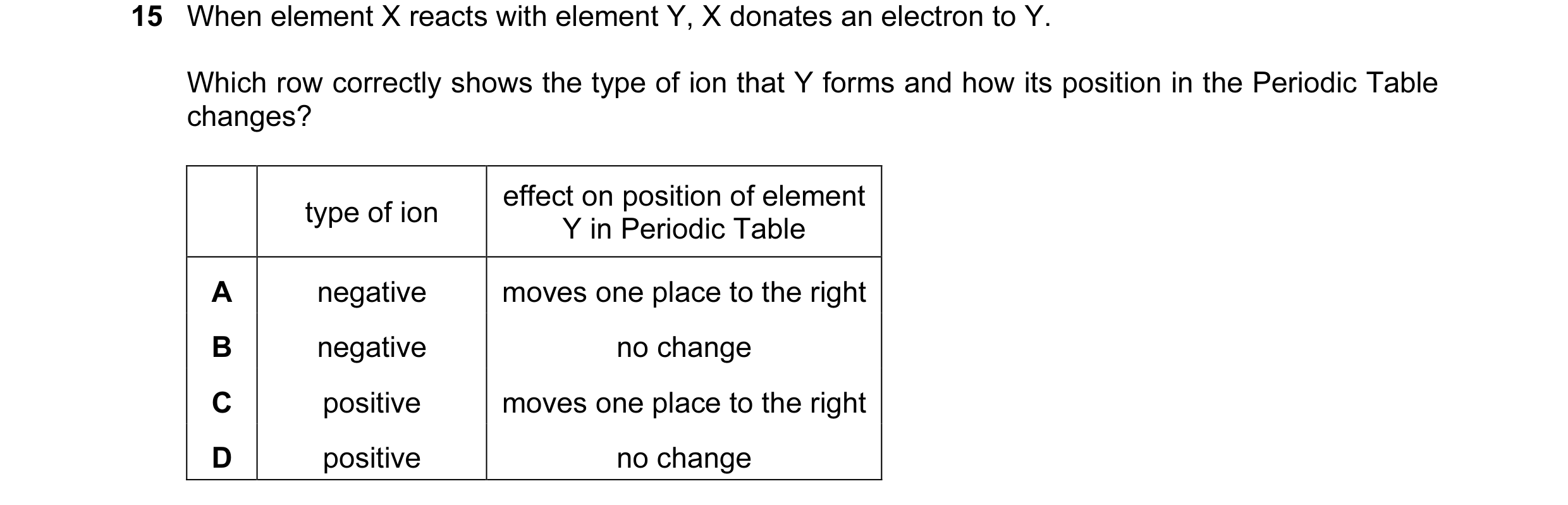
Q8 · When element X reacts with element Y, X donates an electron to Y 0654/12 May/June 2010
15 When element X reacts with element Y, X donates an electron to Y. Which row correctly shows the type of ion that Y forms and how its position in the Periodic Table changes? effect on position of element type of ion Y in Periodic Table A negative moves one place to the right B negative no change C positive moves one place to the right D positive no change
1 marks
Answer: B
This question in 0654/12 May/June 2010
Q9 · The diagram shows part of the Periodic Table 0654/11 Oct/Nov 2011
15 The diagram shows part of the Periodic Table. W Y X Z Which two elements would be the most reactive in their group? A W and Y B W and Z C X and Y D X and Z
1 marks
Answer: C
This question in 0654/11 Oct/Nov 2011
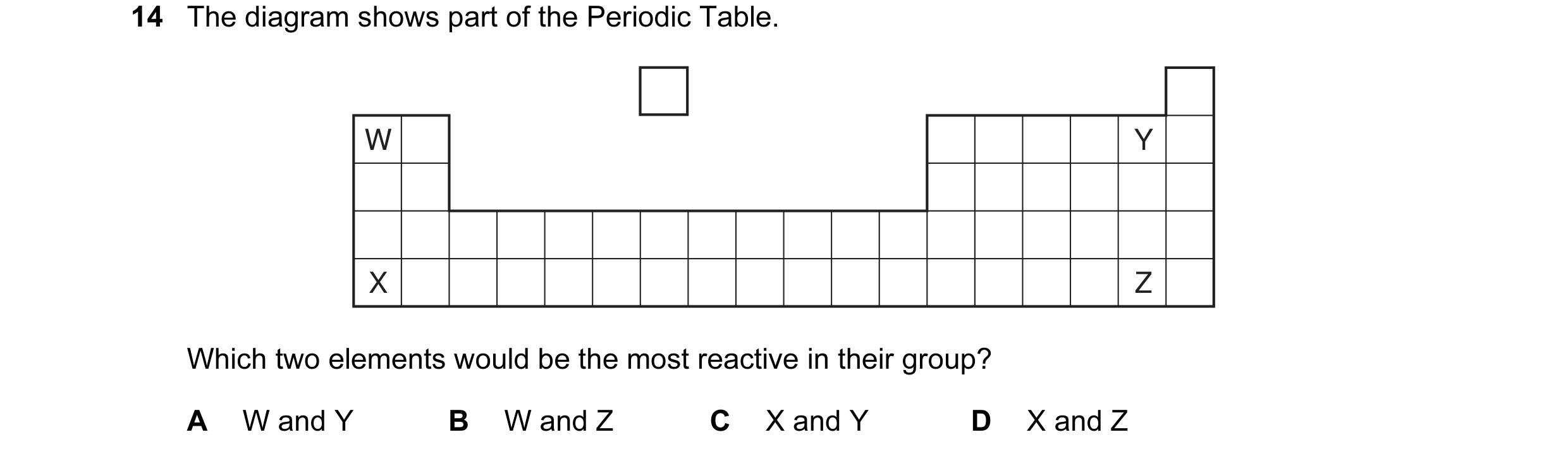
Q10 · The diagram shows part of the Periodic Table 0654/12 Oct/Nov 2011
14 The diagram shows part of the Periodic Table. W Y X Z Which two elements would be the most reactive in their group? A W and Y B W and Z C X and Y D X and Z
1 marks
Answer: C
This question in 0654/12 Oct/Nov 2011
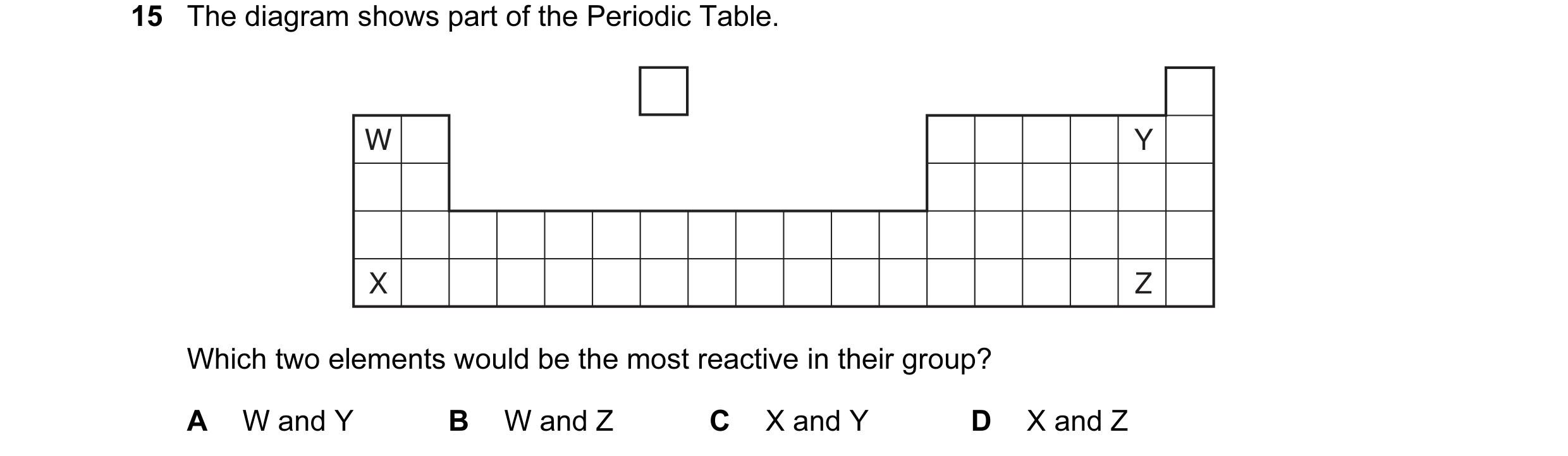
Q11 · The diagram shows part of the Periodic Table 0654/13 Oct/Nov 2011
15 The diagram shows part of the Periodic Table. W Y X Z Which two elements would be the most reactive in their group? A W and Y B W and Z C X and Y D X and Z
1 marks
Answer: C
This question in 0654/13 Oct/Nov 2011
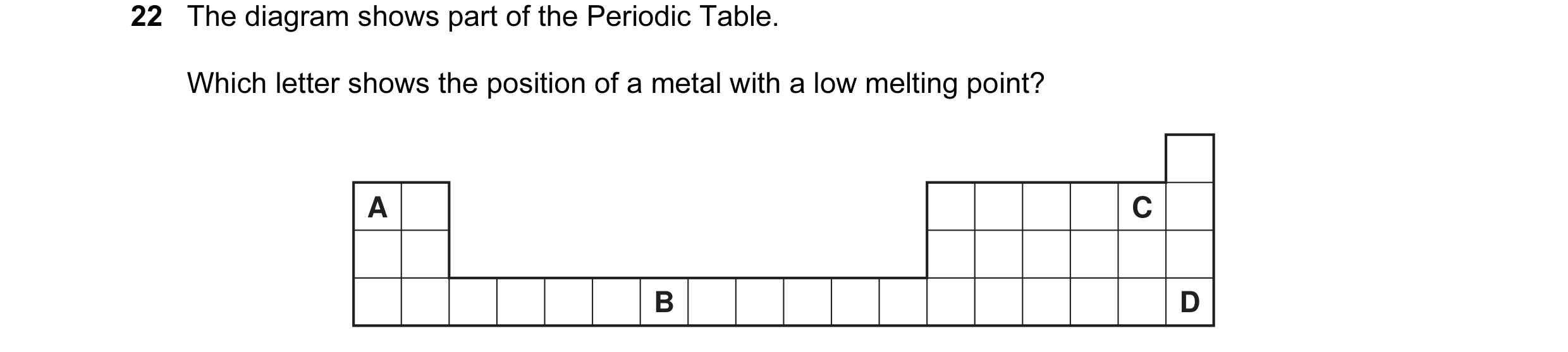
Q12 · The diagram shows part of the Periodic Table 0654/12 May/June 2012
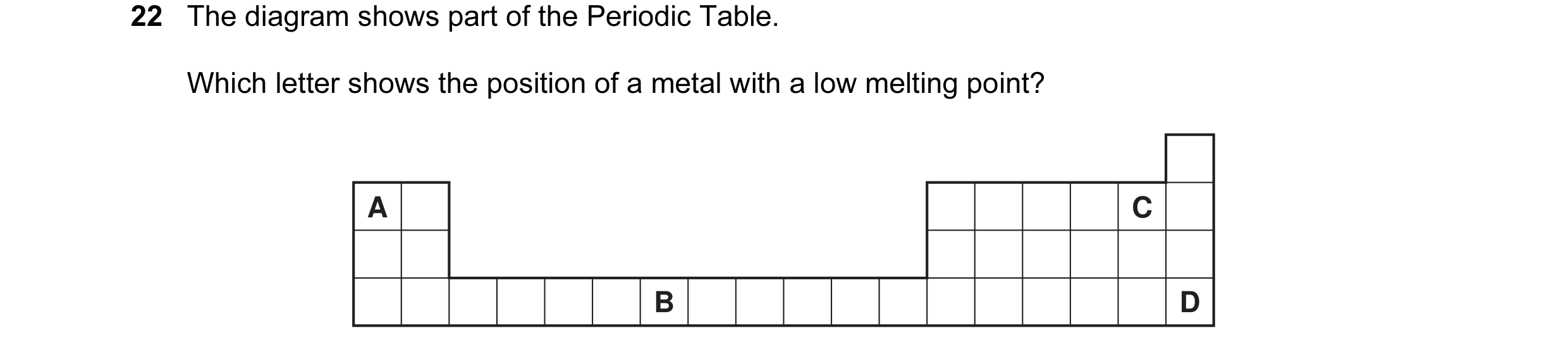
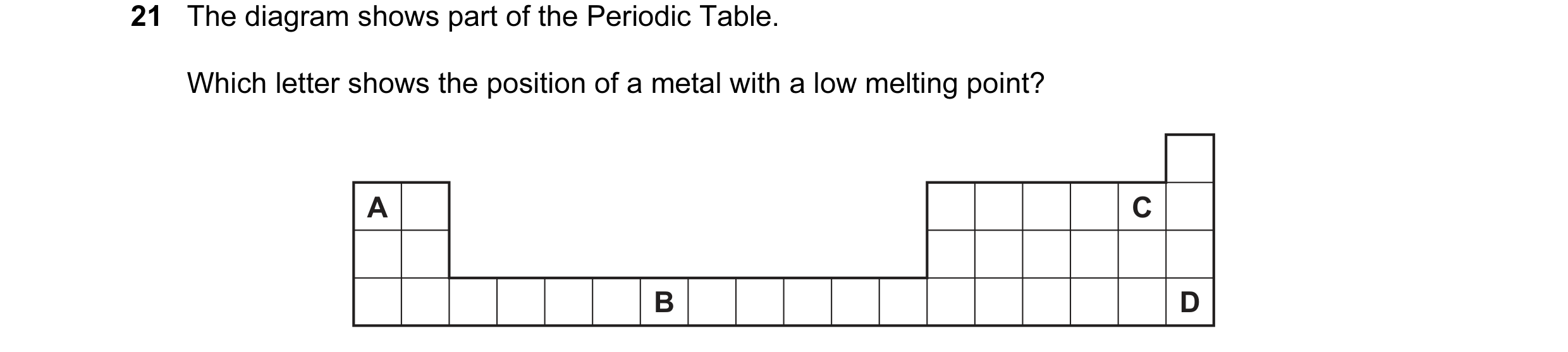
22 The diagram shows part of the Periodic Table. Which letter shows the position of a metal with a low melting point? A C B D
1 marks
Answer: A
This question in 0654/12 May/June 2012
Q13 · The diagram shows part of the Periodic Table 0654/13 May/June 2012
22 The diagram shows part of the Periodic Table. Which letter shows the position of a metal with a low melting point? A C B D
1 marks
Answer: A
This question in 0654/13 May/June 2012
Q14 · Element X is a very dense solid with a high melting point 0654/12 May/June 2013
17 Element X is a very dense solid with a high melting point. Which letter shows the position of X in the Periodic Table? I II III IV V VI VII 0 A C B D
1 marks
Answer: B
This question in 0654/12 May/June 2013
Q15 · The elements from sodium to sulfur are in the same period of the Periodic Table 0654/11 Oct/Nov 2013
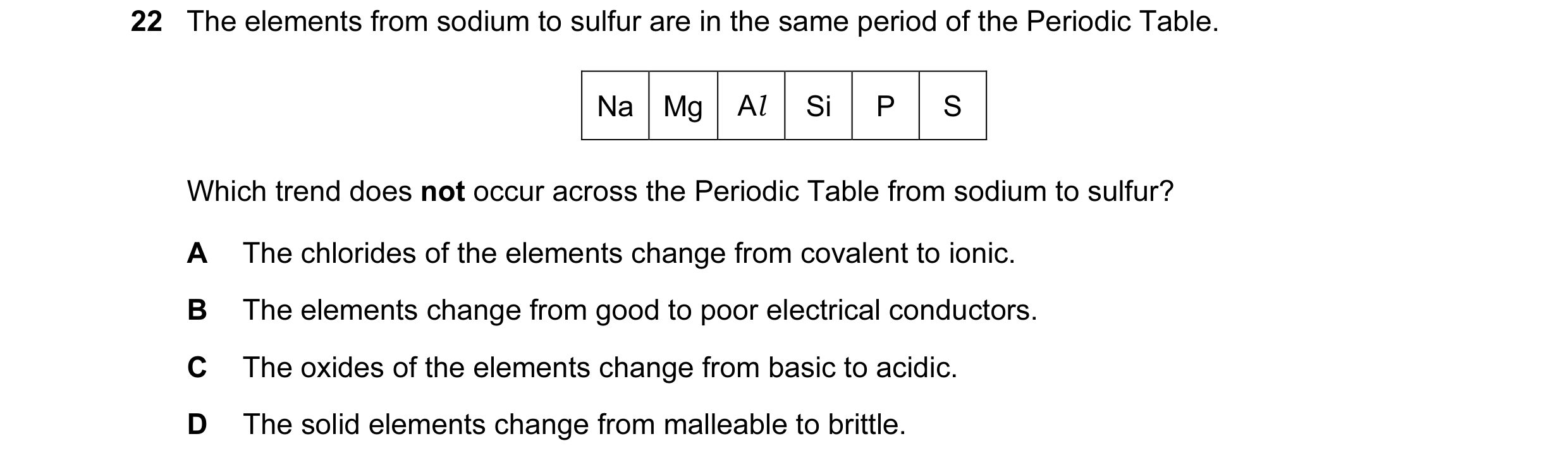
22 The elements from sodium to sulfur are in the same period of the Periodic Table. Na Mg Al Si P S Which trend does not occur across the Periodic Table from sodium to sulfur? A The chlorides of the elements change from covalent to ionic. B The elements change from good to poor electrical conductors. C The oxides of the elements change from basic to acidic. D The solid elements change from malleable to brittle.
1 marks
Answer: A
This question in 0654/11 Oct/Nov 2013
Q16 · The elements from sodium to sulfur are in the same period of the Periodic Table 0654/12 Oct/Nov 2013
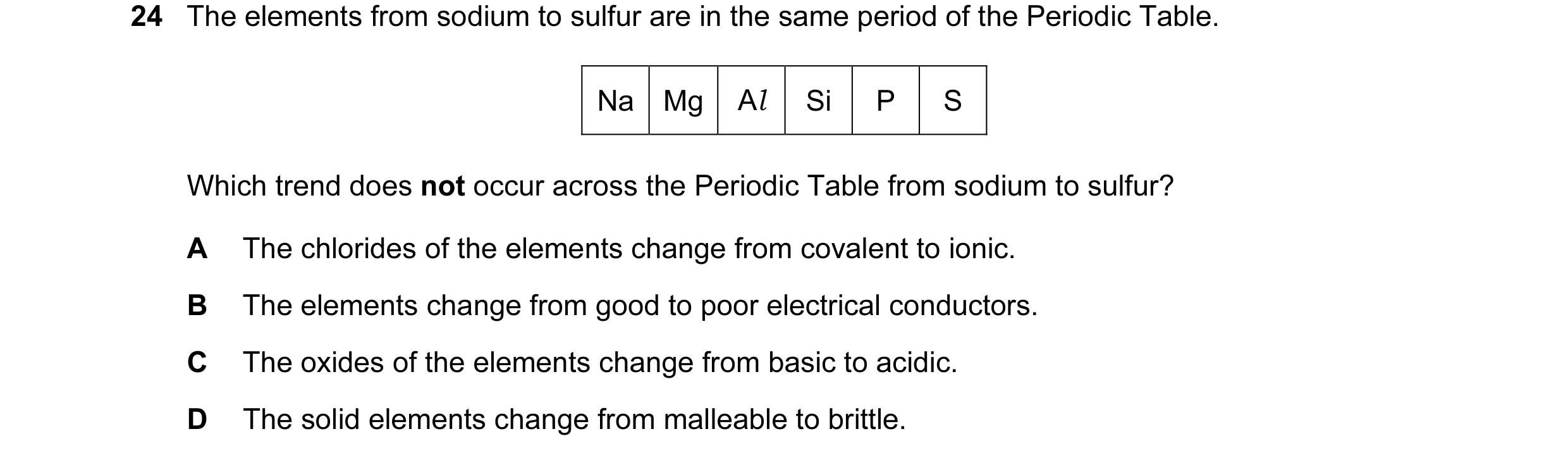
24 The elements from sodium to sulfur are in the same period of the Periodic Table. Na Mg Al Si P S Which trend does not occur across the Periodic Table from sodium to sulfur? A The chlorides of the elements change from covalent to ionic. B The elements change from good to poor electrical conductors. C The oxides of the elements change from basic to acidic. D The solid elements change from malleable to brittle.
1 marks
Answer: A
This question in 0654/12 Oct/Nov 2013
Q17 · Which statement about the trends in the Periodic Table is correct? 0654/11 Oct/Nov 2014
21 Which statement about the trends in the Periodic Table is correct? A Elements are arranged in order of nucleon number. B Elements on the left hand side form acidic oxides. C The melting point of the Group I elements increases down the group. D The proton number increases from left to right across the table.
1 marks
Answer: D
This question in 0654/11 Oct/Nov 2014
Q18 · Which statement about the trends in the Periodic Table is correct? 0654/12 Oct/Nov 2014
21 Which statement about the trends in the Periodic Table is correct? A Elements are arranged in order of nucleon number. B Elements on the left hand side form acidic oxides. C The melting point of the Group I elements increases down the group. D The proton number increases from left to right across the table.
1 marks
Answer: D
This question in 0654/12 Oct/Nov 2014
Q19 · The positions of four elements are shown on the outline of part of the Periodic Table 0654/11 May/June 2015
15 The positions of four elements are shown on the outline of part of the Periodic Table. Which element forms an ion with a charge of 2+? A B C D
1 marks
Answer: B
This question in 0654/11 May/June 2015
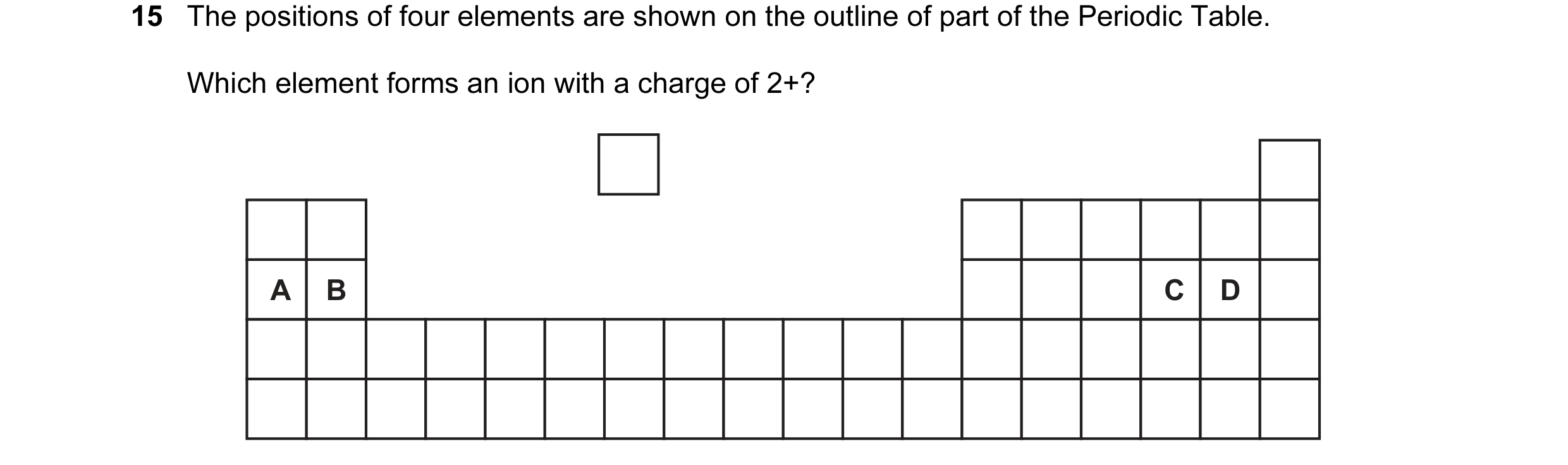
Q20 · The positions of four elements are shown on the outline of part of the Periodic Table 0654/12 May/June 2015
15 The positions of four elements are shown on the outline of part of the Periodic Table. Which element forms an ion with a charge of 2+? A B C D
1 marks
Answer: B
This question in 0654/12 May/June 2015
Q21 · An element is a solid at room temperature and does not conduct electricity 0654/11 Oct/Nov 2015
24 An element is a solid at room temperature and does not conduct electricity. What is the proton number of this element? A 11 B 19 C 35 D 53
1 marks
Answer: D
This question in 0654/11 Oct/Nov 2015
Q22 · An element is a solid at room temperature and does not conduct electricity 0654/12 Oct/Nov 2015
24 An element is a solid at room temperature and does not conduct electricity. What is the proton number of this element? A 11 B 19 C 35 D 53
1 marks
Answer: D
This question in 0654/12 Oct/Nov 2015
Q23 · An element is a solid at room temperature and does not conduct electricity 0654/13 Oct/Nov 2015
23 An element is a solid at room temperature and does not conduct electricity. What is the proton number of this element? A 11 B 19 C 35 D 53
1 marks
Answer: D
This question in 0654/13 Oct/Nov 2015
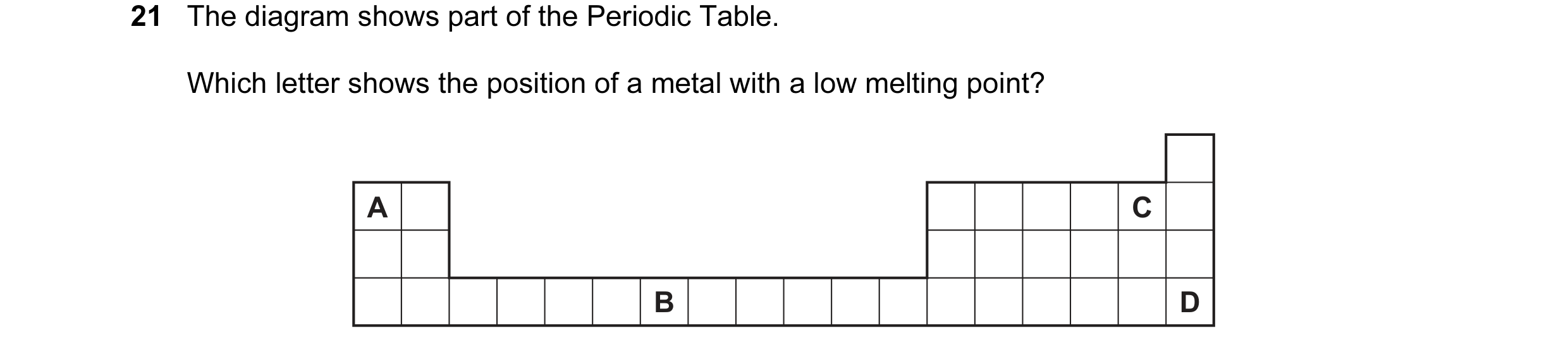
Q24 · The diagram shows part of the Periodic Table 0654/11 May/June 2016
21 The diagram shows part of the Periodic Table. Which letter shows the position of a metal with a low melting point? A C B D
1 marks
Answer: A
This question in 0654/11 May/June 2016
Q25 · The diagram shows part of the Periodic Table 0654/12 May/June 2016
21 The diagram shows part of the Periodic Table. Which letter shows the position of a metal with a low melting point? A C B D
1 marks
Answer: A
This question in 0654/12 May/June 2016
Q26 · The diagram shows part of the Periodic Table 0654/13 May/June 2016
21 The diagram shows part of the Periodic Table. Which letter shows the position of a metal with a low melting point? A C B D
1 marks
Answer: A
This question in 0654/13 May/June 2016
Q27 · Which statement about the Periodic Table is correct? 0654/11 Oct/Nov 2016
22 Which statement about the Periodic Table is correct? A Elements are listed in order of neutron number. B Elements are listed in order of nucleon number. C Elements are listed in order of proton number. D Elements are listed in order of relative atomic mass.
1 marks
Answer: C
This question in 0654/11 Oct/Nov 2016
Q28 · Which trend is observed as the Periodic Table is crossed from left to right? 0654/11 Oct/Nov 2017
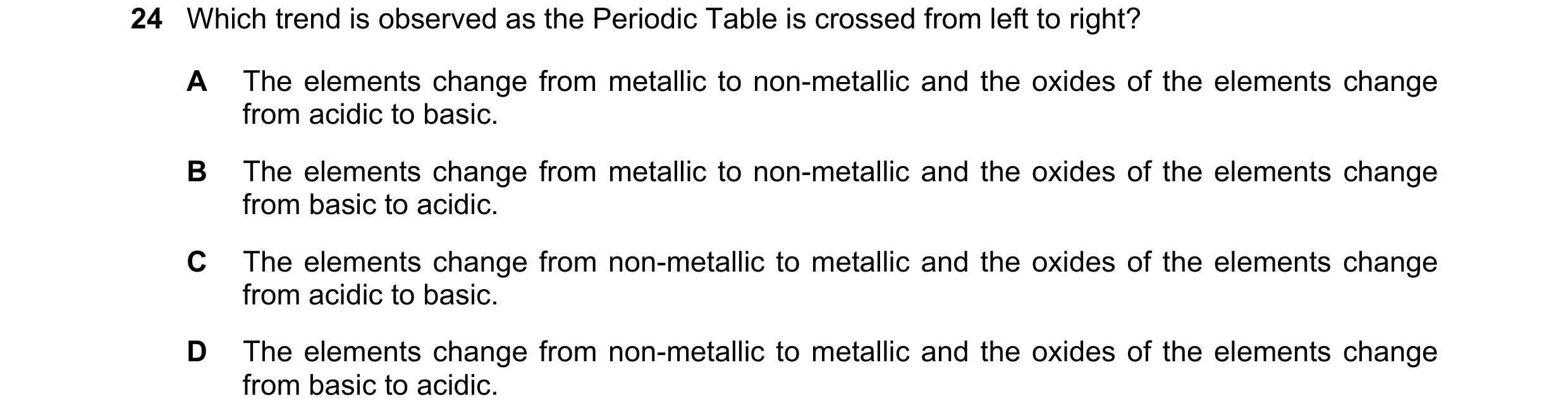
24 Which trend is observed as the Periodic Table is crossed from left to right? A The elements change from metallic to non-metallic and the oxides of the elements change from acidic to basic. B The elements change from metallic to non-metallic and the oxides of the elements change from basic to acidic. C The elements change from non-metallic to metallic and the oxides of the elements change from acidic to basic. D The elements change from non-metallic to metallic and the oxides of the elements change from basic to acidic.
1 marks
Answer: B
This question in 0654/11 Oct/Nov 2017
Q29 · The melting points of three elements in Group I and of three elements in Group VII are… 0654/13 Oct/Nov 2017
24 The melting points of three elements in Group I and of three elements in Group VII are shown. element group melting point (°C) lithium I 179 sodium I 98 potassium I 64 chlorine VII –101 bromine VII –7 iodine VII 114 What is the trend in reactivity in each group as melting point increases? change in Group I change in Group VII reactivity reactivity A less reactive less reactive B less reactive more reactive C more reactive less reactive D more reactive more reactive
1 marks
Answer: A
This question in 0654/13 Oct/Nov 2017
Q30 · Which statement about the trends in the Periodic Table is correct? 0654/11 May/June 2019
21 Which statement about the trends in the Periodic Table is correct? A Elements are arranged in order of nucleon number. B Elements on the left hand side form acidic oxides. C The melting point of the Group I elements increases down the group. D The proton number increases from left to right across the table.
1 marks
Answer: D
This question in 0654/11 May/June 2019
Q31 · Which statement about the trends in the Periodic Table is correct? 0654/12 May/June 2019
22 Which statement about the trends in the Periodic Table is correct? A Elements are arranged in order of nucleon number. B Elements on the left hand side form acidic oxides. C The melting point of the Group I elements increases down the group. D The proton number increases from left to right across the table.
1 marks
Answer: D
This question in 0654/12 May/June 2019
Q32 · Which statement about the trends in the Periodic Table is correct? 0654/13 May/June 2019
22 Which statement about the trends in the Periodic Table is correct? A Elements are arranged in order of nucleon number. B Elements on the left hand side form acidic oxides. C The melting point of the Group I elements increases down the group. D The proton number increases from left to right across the table.
1 marks
Answer: D
This question in 0654/13 May/June 2019
Q33 · Which statement about the Periodic Table is correct? 0654/11 Oct/Nov 2019
23 Which statement about the Periodic Table is correct? A Elements are listed in order of neutron number. B Elements are listed in order of nucleon number. C Elements are listed in order of proton number. D Elements are listed in order of relative atomic mass.
1 marks
Answer: C
This question in 0654/11 Oct/Nov 2019
Q34 · Which statement about the Periodic Table is correct? 0654/12 Oct/Nov 2019
22 Which statement about the Periodic Table is correct? A Elements are listed in order of neutron number. B Elements are listed in order of nucleon number. C Elements are listed in order of proton number. D Elements are listed in order of relative atomic mass.
1 marks
Answer: C
This question in 0654/12 Oct/Nov 2019
Q35 · Which statement about the Periodic Table is correct? 0654/13 Oct/Nov 2019
20 Which statement about the Periodic Table is correct? A Elements are listed in order of neutron number. B Elements are listed in order of nucleon number. C Elements are listed in order of proton number. D Elements are listed in order of relative atomic mass.
1 marks
Answer: C
This question in 0654/13 Oct/Nov 2019
Q36 · Which statement about elements in the Periodic Table is correct? 0654/13 Oct/Nov 2020
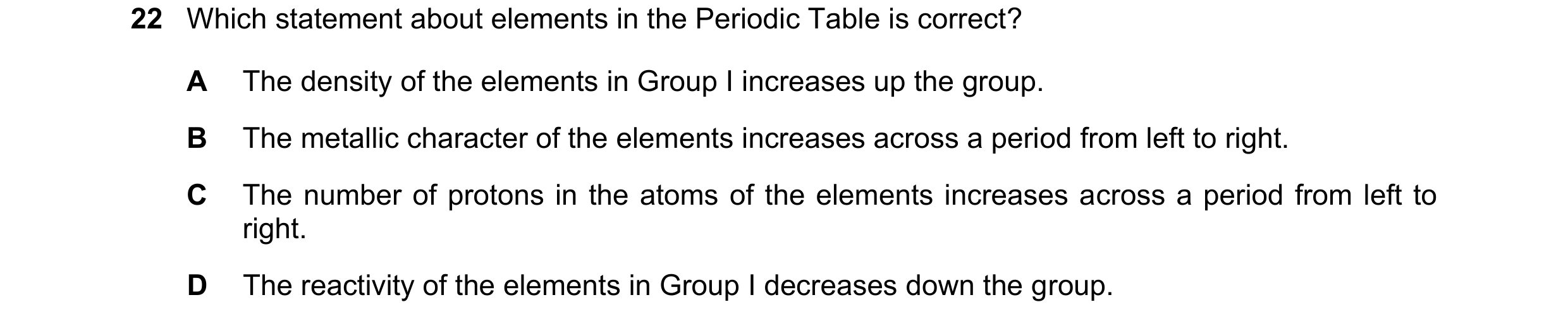
22 Which statement about elements in the Periodic Table is correct? A The density of the elements in Group I increases up the group. B The metallic character of the elements increases across a period from left to right. C The number of protons in the atoms of the elements increases across a period from left to right. D The reactivity of the elements in Group I decreases down the group.
1 marks
Answer: C
This question in 0654/13 Oct/Nov 2020
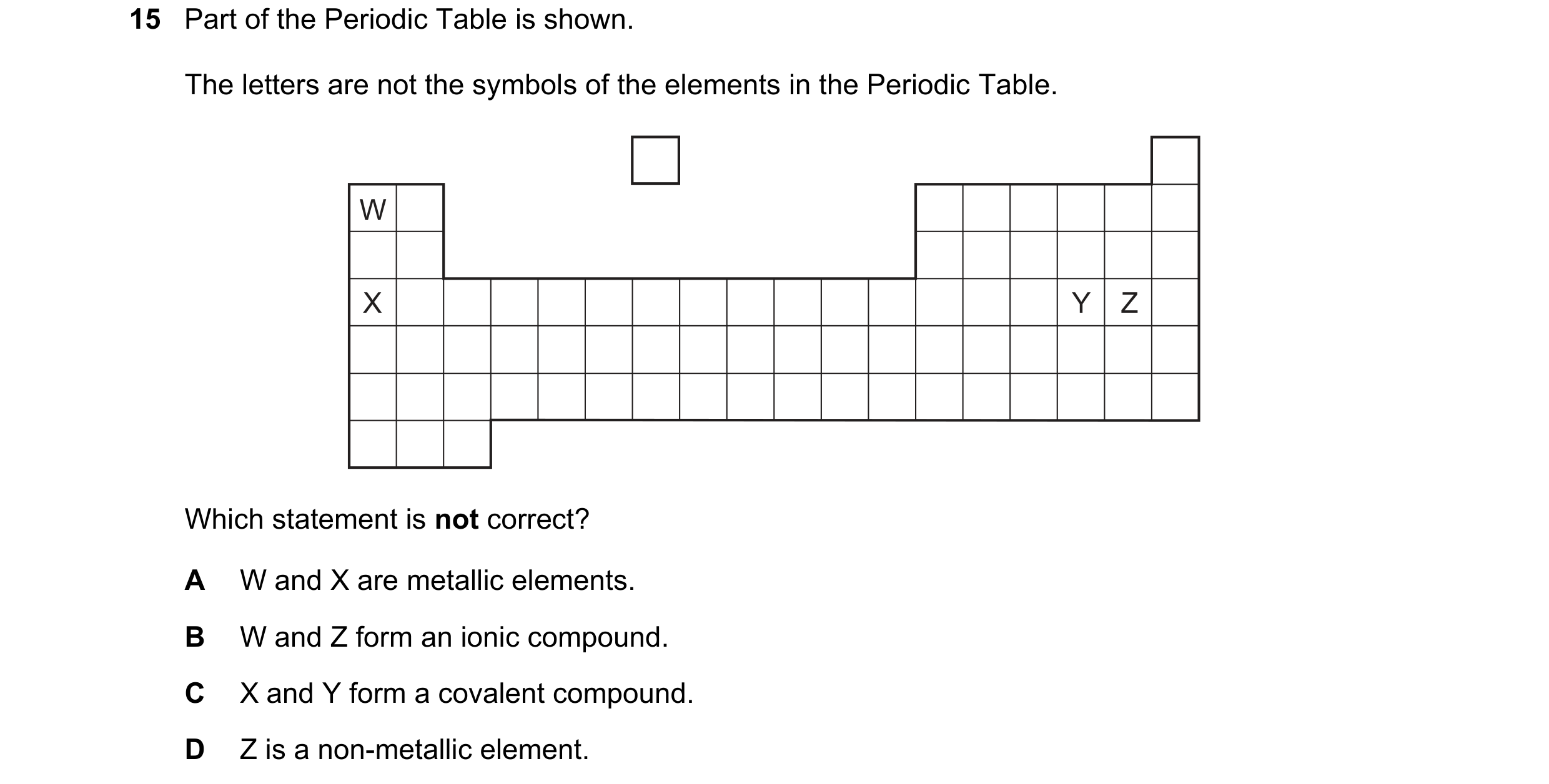
Q37 · Part of the Periodic Table is shown 0654/11 Oct/Nov 2021
15 Part of the Periodic Table is shown. The letters are not the symbols of the elements in the Periodic Table. W X Y Z Which statement is not correct? A W and X are metallic elements. B W and Z form an ionic compound. C X and Y form a covalent compound. D Z is a non-metallic element.
1 marks
Answer: C
This question in 0654/11 Oct/Nov 2021
Q38 · Which statement about sulfur is correct? 0654/11 May/June 2023
24 Which statement about sulfur is correct? A It is a metallic element. B It is used to make sulfuric acid. C It is in Group VII of the Periodic Table. D An atom of sulfur contains 32 electrons.
1 marks
Answer: B
This question in 0654/11 May/June 2023
Q39 · The diagram shows the positions of some elements in the Periodic Table 0654/11 May/June 2025
16 The diagram shows the positions of some elements in the Periodic Table. Which element is in Group II and Period 3? C A D B
1 marks
Answer: A
This question in 0654/11 May/June 2025
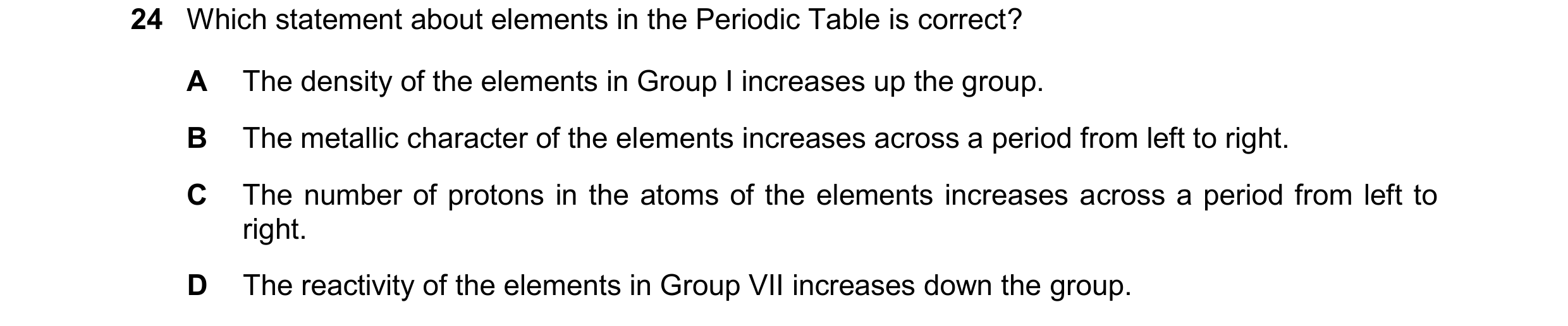
Q40 · Which statement about elements in the Periodic Table is correct? 0654/12 Oct/Nov 2025
24 Which statement about elements in the Periodic Table is correct? A The density of the elements in Group I increases up the group. B The metallic character of the elements increases across a period from left to right. C The number of protons in the atoms of the elements increases across a period from left to right. D The reactivity of the elements in Group VII increases down the group.
1 marks
Answer: C
This question in 0654/12 Oct/Nov 2025
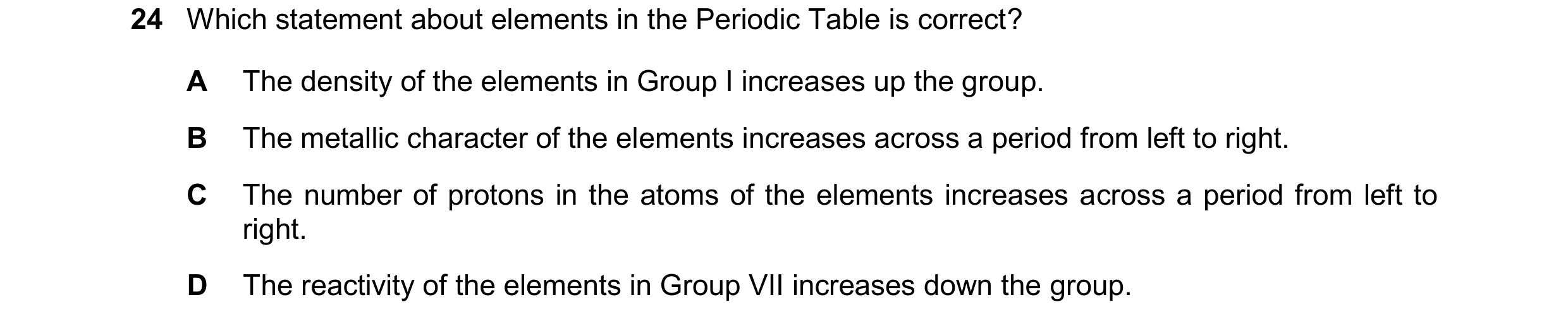
Q41 · Which statement about elements in the Periodic Table is correct? 0654/13 Oct/Nov 2025
24 Which statement about elements in the Periodic Table is correct? A The density of the elements in Group I increases up the group. B The metallic character of the elements increases across a period from left to right. C The number of protons in the atoms of the elements increases across a period from left to right. D The reactivity of the elements in Group VII increases down the group.
1 marks
Answer: C
This question in 0654/13 Oct/Nov 2025
 1 / 9
1 / 9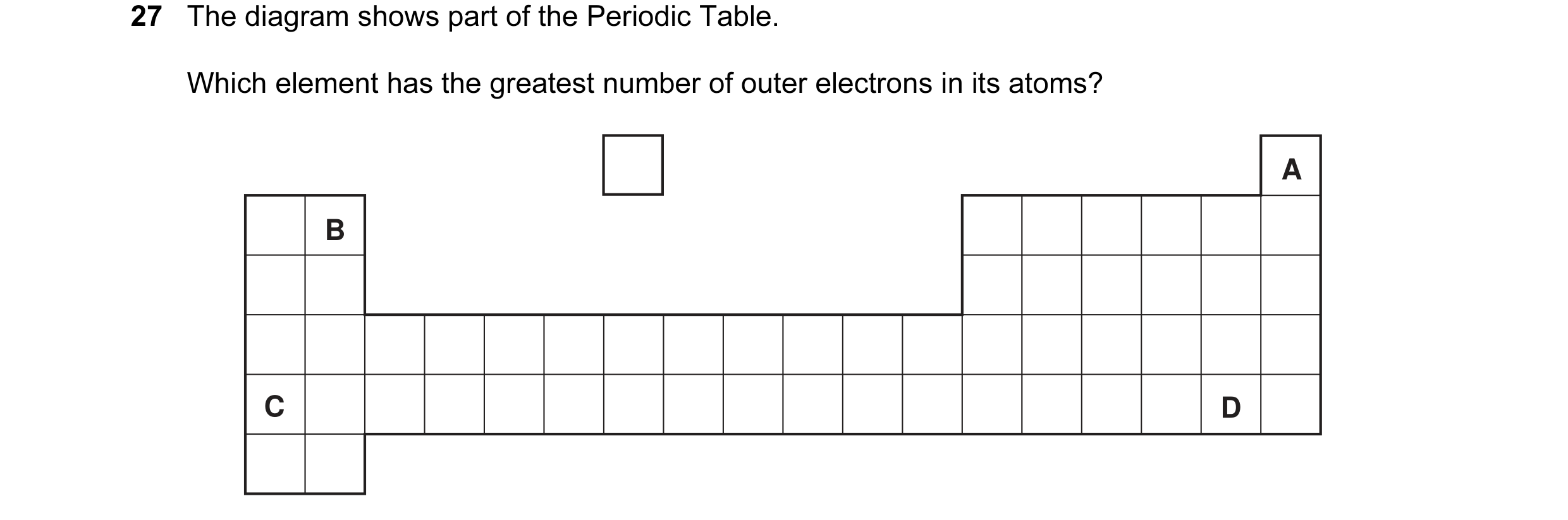
 2 / 9
2 / 9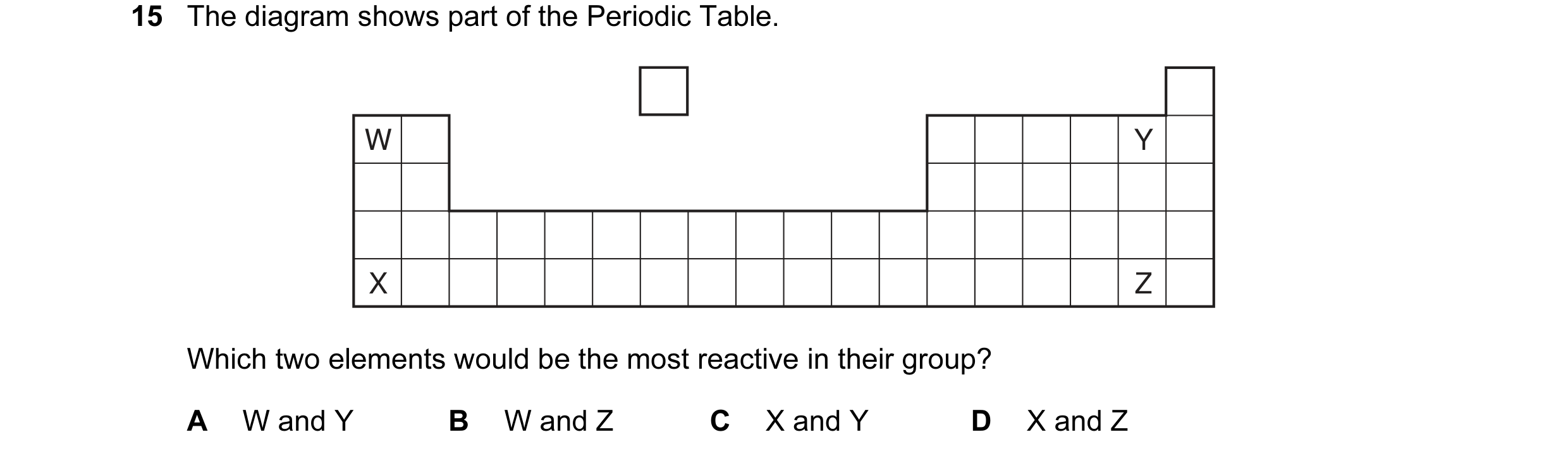
 3 / 9
3 / 9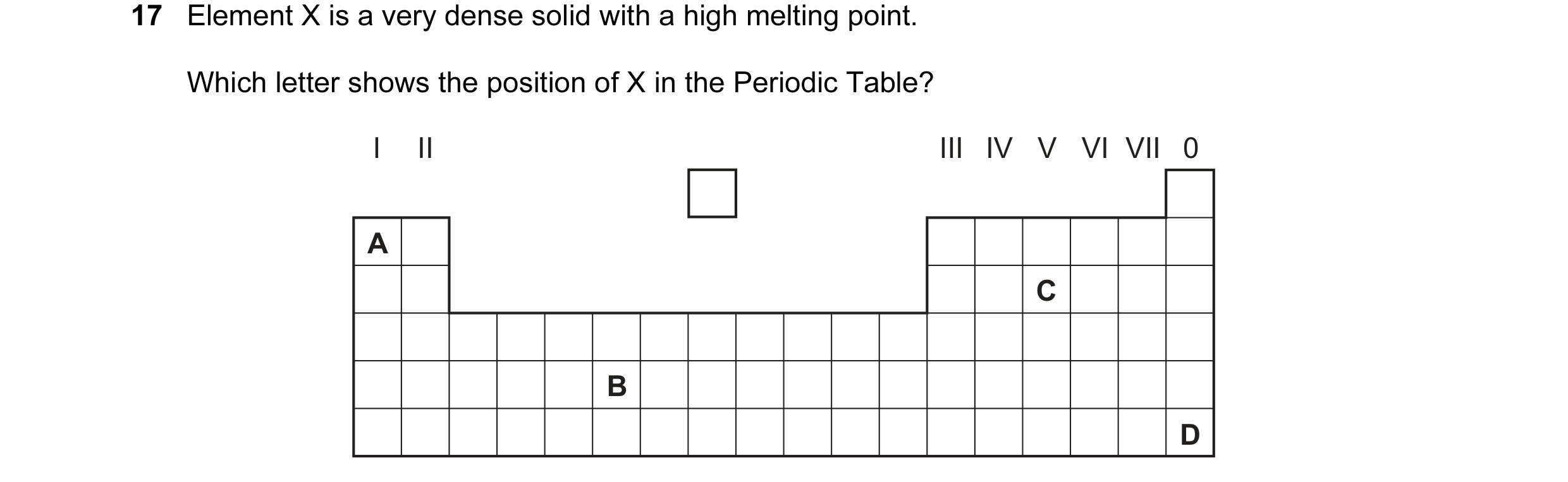

 4 / 9
4 / 9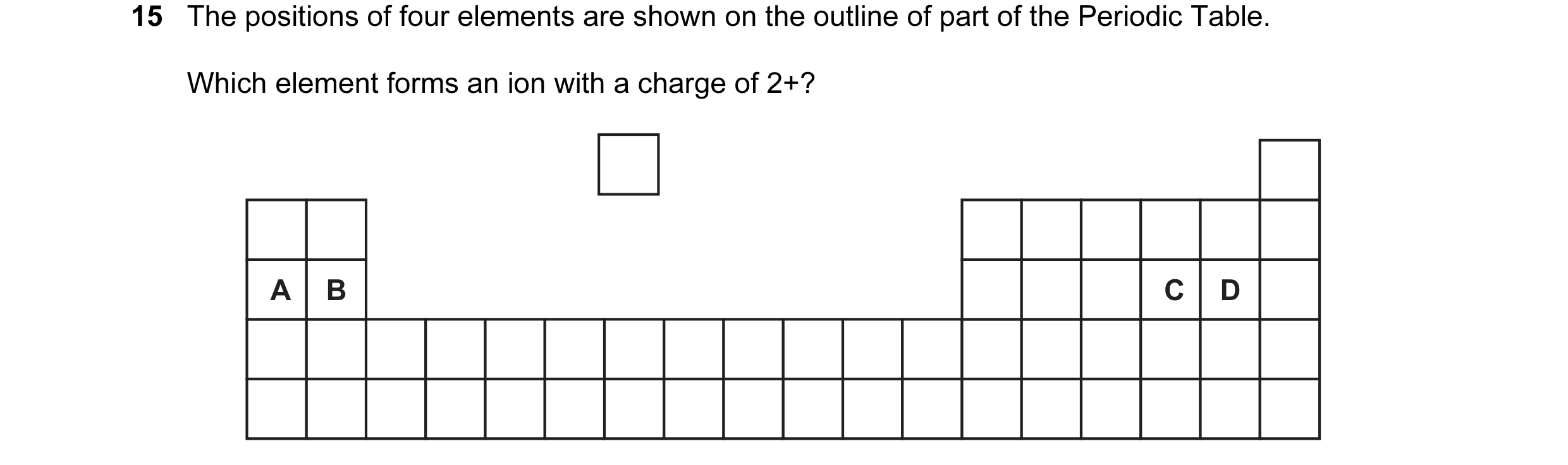



 5 / 9
5 / 9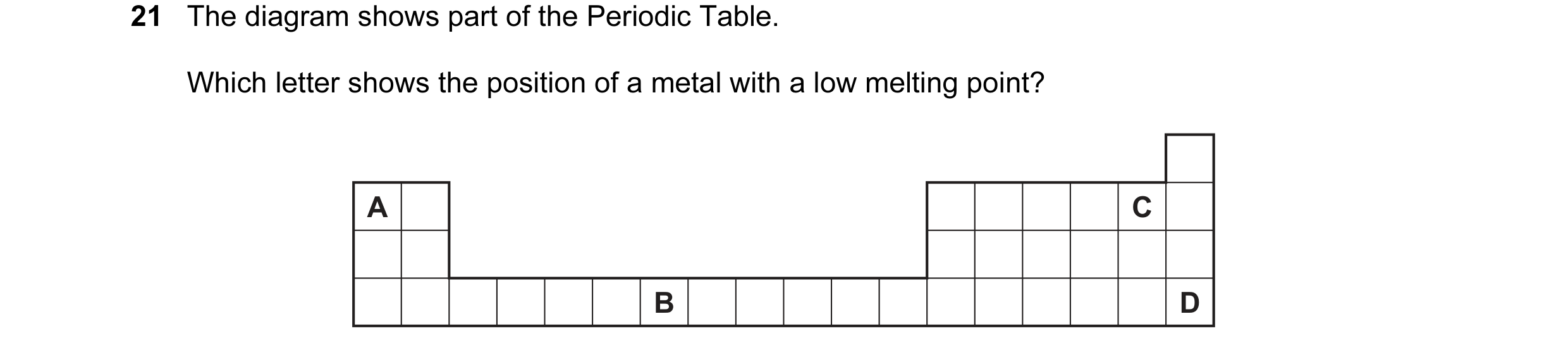

 6 / 9
6 / 9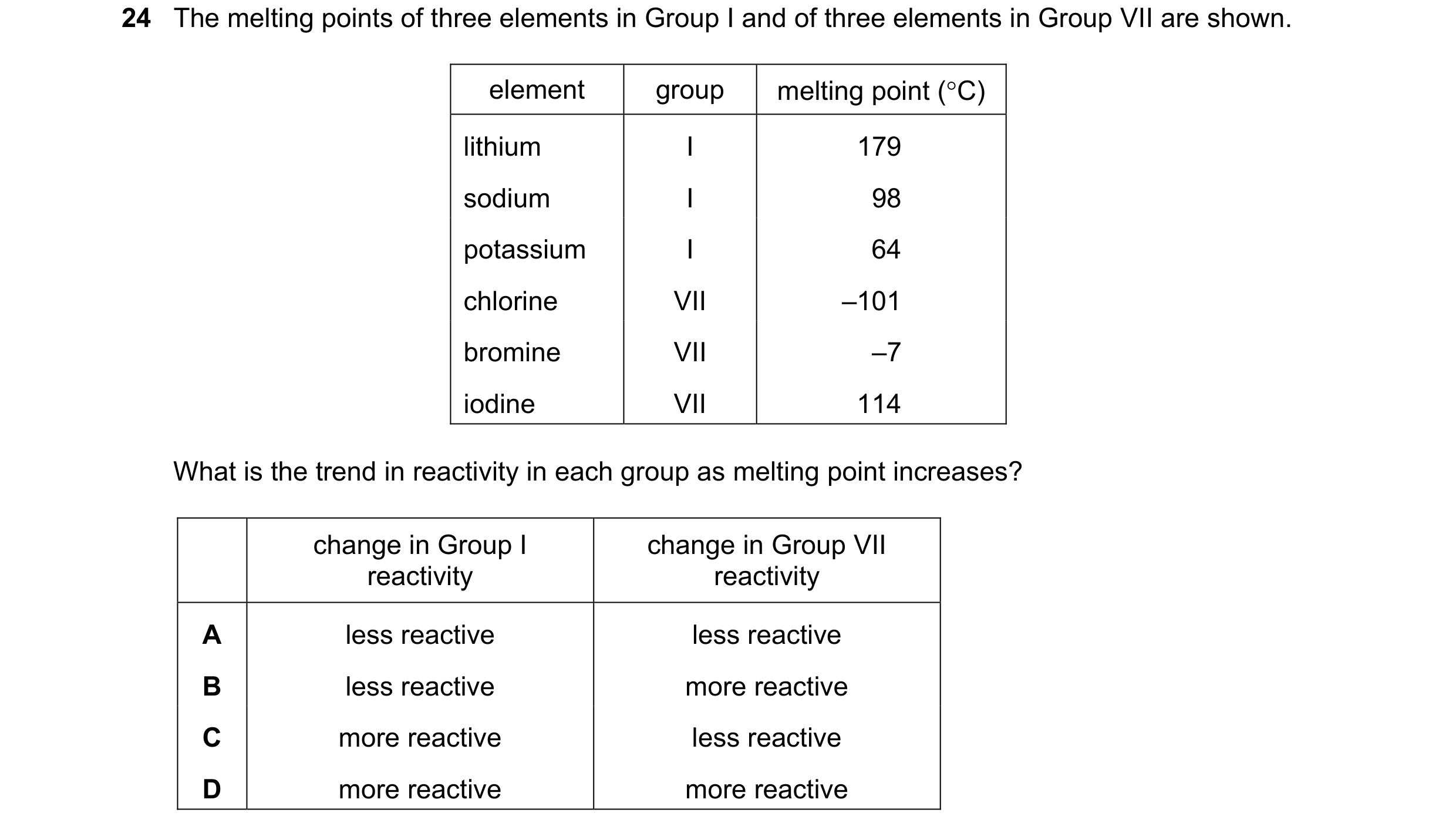



 7 / 9
7 / 9

 8 / 9
8 / 9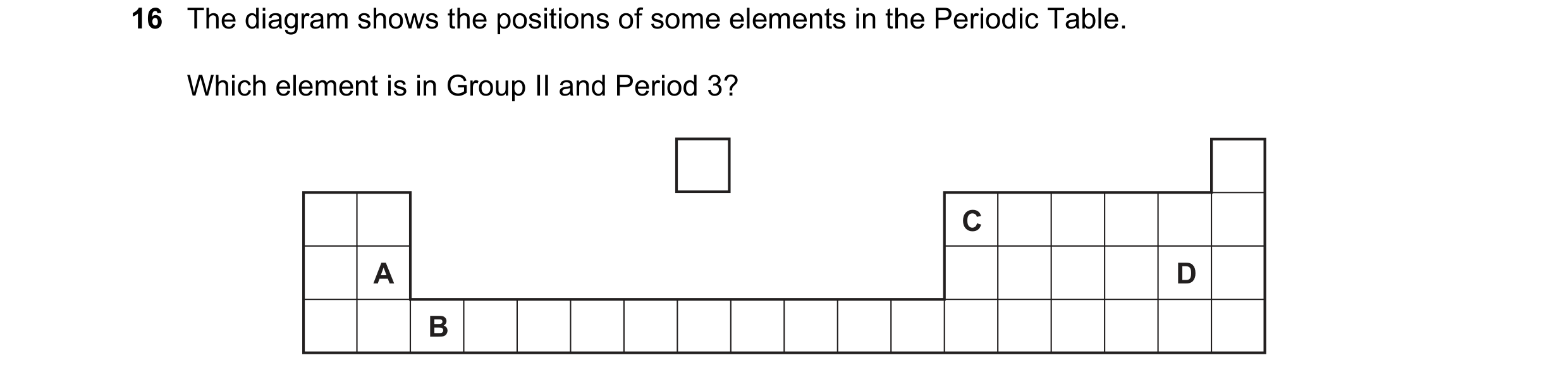
 9 / 9
9 / 9