Questions as text
Q1 · Part of the Periodic Table is shown 0654/21 May/June 2017
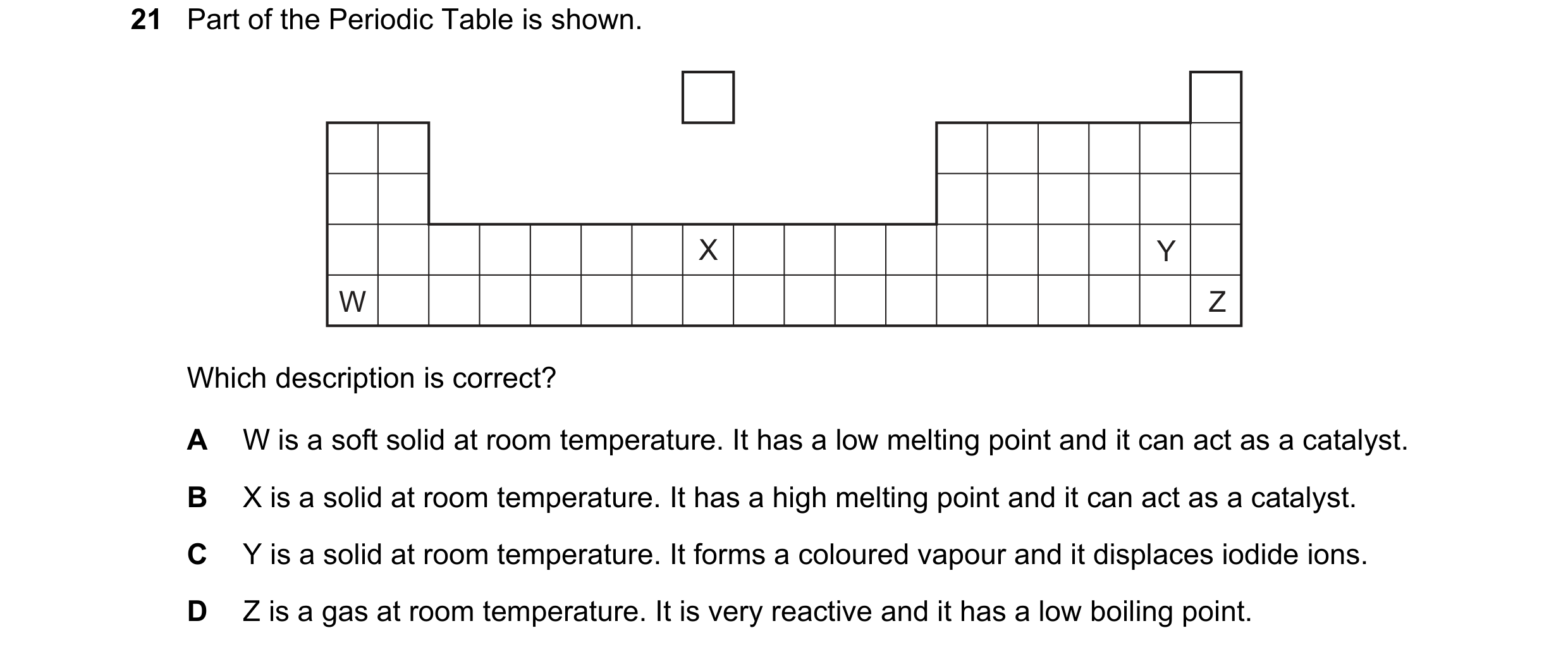
21 Part of the Periodic Table is shown. X Y W Z Which description is correct? A W is a soft solid at room temperature. It has a low melting point and it can act as a catalyst. B X is a solid at room temperature. It has a high melting point and it can act as a catalyst. C Y is a solid at room temperature. It forms a coloured vapour and it displaces iodide ions. D Z is a gas at room temperature. It is very reactive and it has a low boiling point.
1 marks
Answer: B
This question in 0654/21 May/June 2017
Q2 · Element X is in Group II of the Periodic Table 0654/22 May/June 2017
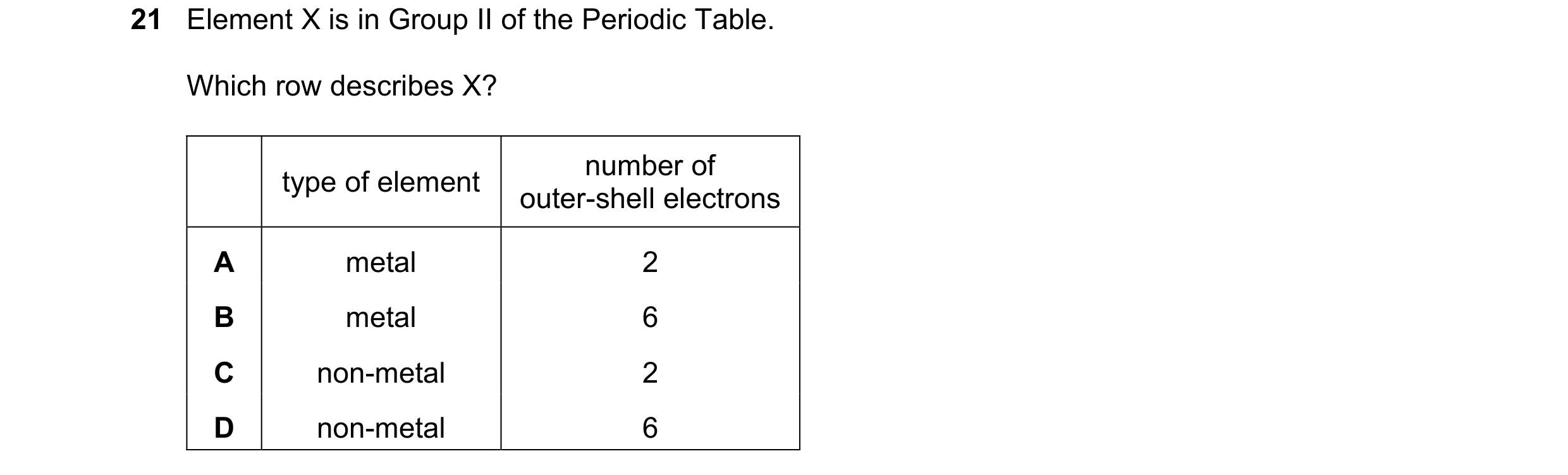
21 Element X is in Group II of the Periodic Table. Which row describes X? number of type of element outer-shell electrons A metal 2 B metal 6 C non-metal 2 D non-metal 6
1 marks
Answer: A
This question in 0654/22 May/June 2017
Q3 · Which trend is observed as the Periodic Table is crossed from left to right? 0654/21 Oct/Nov 2017
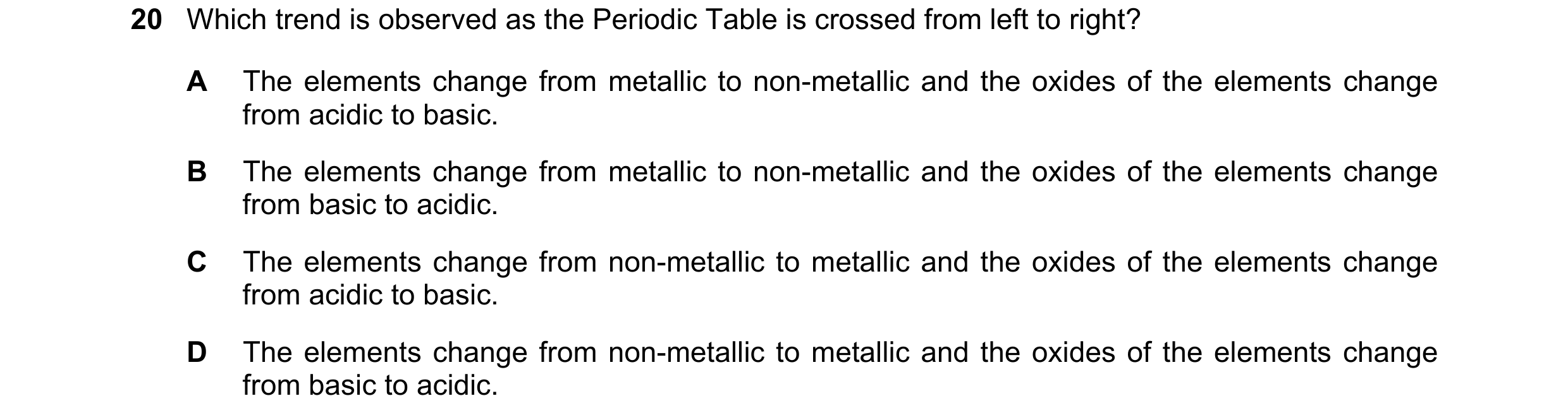
20 Which trend is observed as the Periodic Table is crossed from left to right? A The elements change from metallic to non-metallic and the oxides of the elements change from acidic to basic. B The elements change from metallic to non-metallic and the oxides of the elements change from basic to acidic. C The elements change from non-metallic to metallic and the oxides of the elements change from acidic to basic. D The elements change from non-metallic to metallic and the oxides of the elements change from basic to acidic.
1 marks
Answer: B
This question in 0654/21 Oct/Nov 2017
Q4 · Element X has two outer-shell electrons 0654/23 Oct/Nov 2017
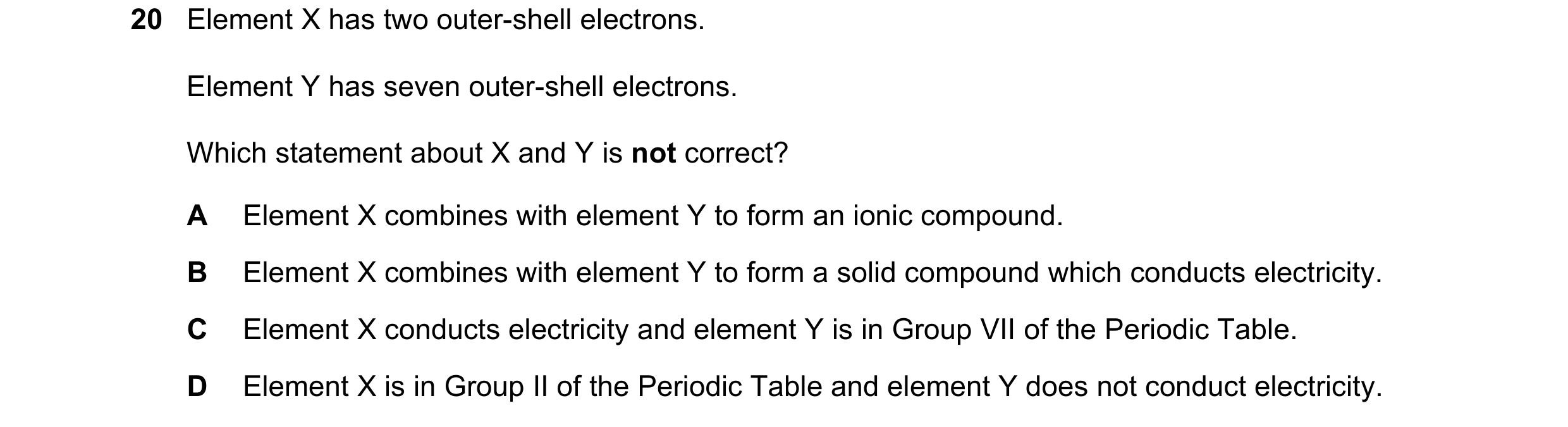
20 Element X has two outer-shell electrons. Element Y has seven outer-shell electrons. Which statement about X and Y is not correct? A Element X combines with element Y to form an ionic compound. B Element X combines with element Y to form a solid compound which conducts electricity. C Element X conducts electricity and element Y is in Group VII of the Periodic Table. D Element X is in Group II of the Periodic Table and element Y does not conduct electricity.
1 marks
Answer: B
This question in 0654/23 Oct/Nov 2017
Q5 · The melting points of three elements in Group I and of three elements in Group VII are… 0654/23 Oct/Nov 2017
21 The melting points of three elements in Group I and of three elements in Group VII are shown. element group melting point (°C) lithium I 179 sodium I 98 potassium I 64 chlorine VII –101 bromine VII –7 iodine VII 114 What is the trend in reactivity in each group as melting point increases? change in Group I change in Group VII reactivity reactivity A less reactive less reactive B less reactive more reactive C more reactive less reactive D more reactive more reactive
1 marks
Answer: A
This question in 0654/23 Oct/Nov 2017
Q6 · Which statement about elements in the Periodic Table is correct? 0654/21 May/June 2019
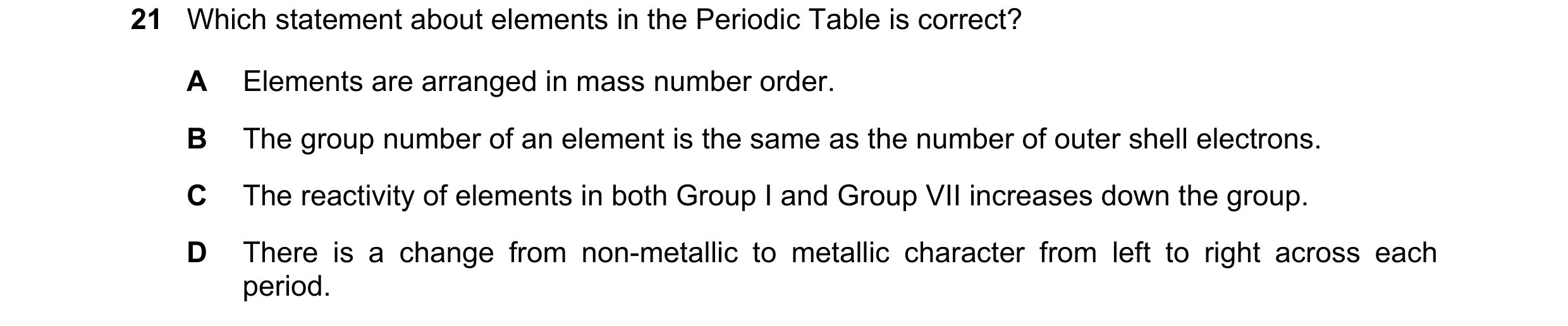
21 Which statement about elements in the Periodic Table is correct? A Elements are arranged in mass number order. B The group number of an element is the same as the number of outer shell electrons. C The reactivity of elements in both Group I and Group VII increases down the group. D There is a change from non-metallic to metallic character from left to right across each period.
1 marks
Answer: B
This question in 0654/21 May/June 2019
Q7 · What do elements in the same group in the Periodic Table have in common? 0654/22 May/June 2019
22 What do elements in the same group in the Periodic Table have in common? A number of electron shells B number of electrons in the outer shell C number of nucleons in the nucleus D proton number
1 marks
Answer: B
This question in 0654/22 May/June 2019
Q8 · Francium and astatine are at the bottom of Group I and Group VII respectively 0654/23 May/June 2019
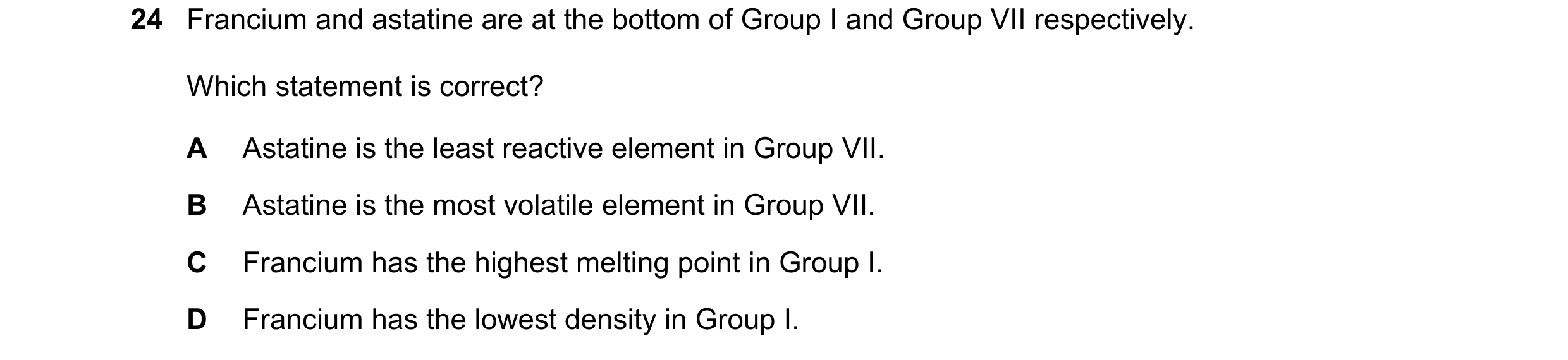
24 Francium and astatine are at the bottom of Group I and Group VII respectively. Which statement is correct? A Astatine is the least reactive element in Group VII. B Astatine is the most volatile element in Group VII. C Francium has the highest melting point in Group I. D Francium has the lowest density in Group I.
1 marks
Answer: A
This question in 0654/23 May/June 2019
Q9 · Which statement about the Periodic Table is correct? 0654/21 Oct/Nov 2019
23 Which statement about the Periodic Table is correct? A Elements are listed in order of neutron number. B Elements are listed in order of nucleon number. C Elements are listed in order of proton number. D Elements are listed in order of relative atomic mass.
1 marks
Answer: C
This question in 0654/21 Oct/Nov 2019
Q10 · Which statement about the Periodic Table is correct? 0654/22 Oct/Nov 2019
22 Which statement about the Periodic Table is correct? A Elements are listed in order of neutron number. B Elements are listed in order of nucleon number. C Elements are listed in order of proton number. D Elements are listed in order of relative atomic mass.
1 marks
Answer: C
This question in 0654/22 Oct/Nov 2019
Q11 · Which statement about the Periodic Table is correct? 0654/23 Oct/Nov 2019
21 Which statement about the Periodic Table is correct? A Elements are listed in order of neutron number. B Elements are listed in order of nucleon number. C Elements are listed in order of proton number. D Elements are listed in order of relative atomic mass.
1 marks
Answer: C
This question in 0654/23 Oct/Nov 2019
Q12 · Which row describes a Group II element in period 3 of the Periodic Table? 0654/23 Oct/Nov 2019
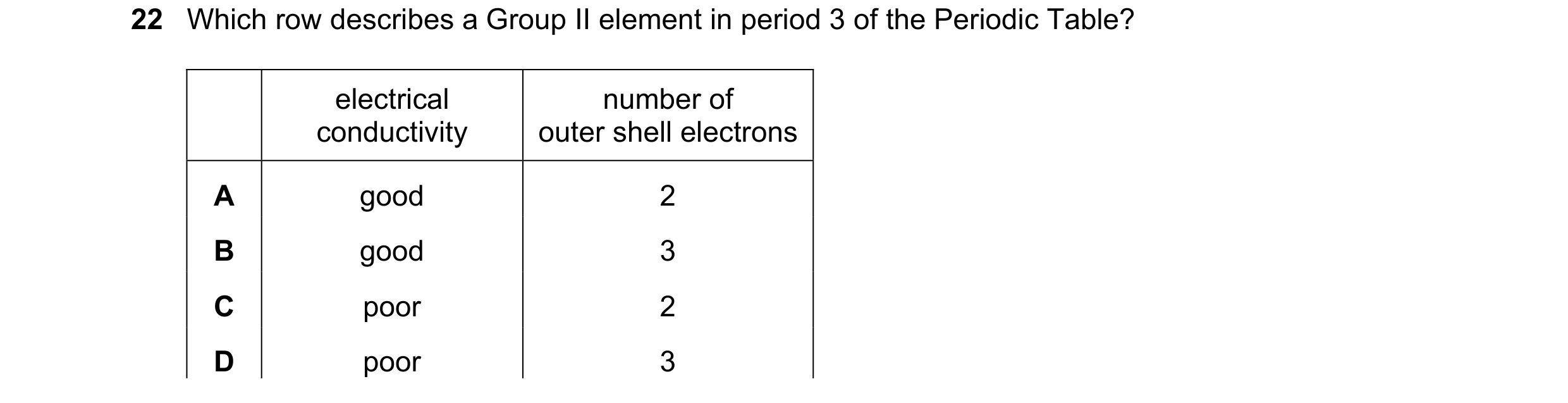
22 Which row describes a Group II element in period 3 of the Periodic Table? electrical number of conductivity outer shell electrons A good 2 B good 3 C poor 2 D poor 3
1 marks
Answer: A
This question in 0654/23 Oct/Nov 2019
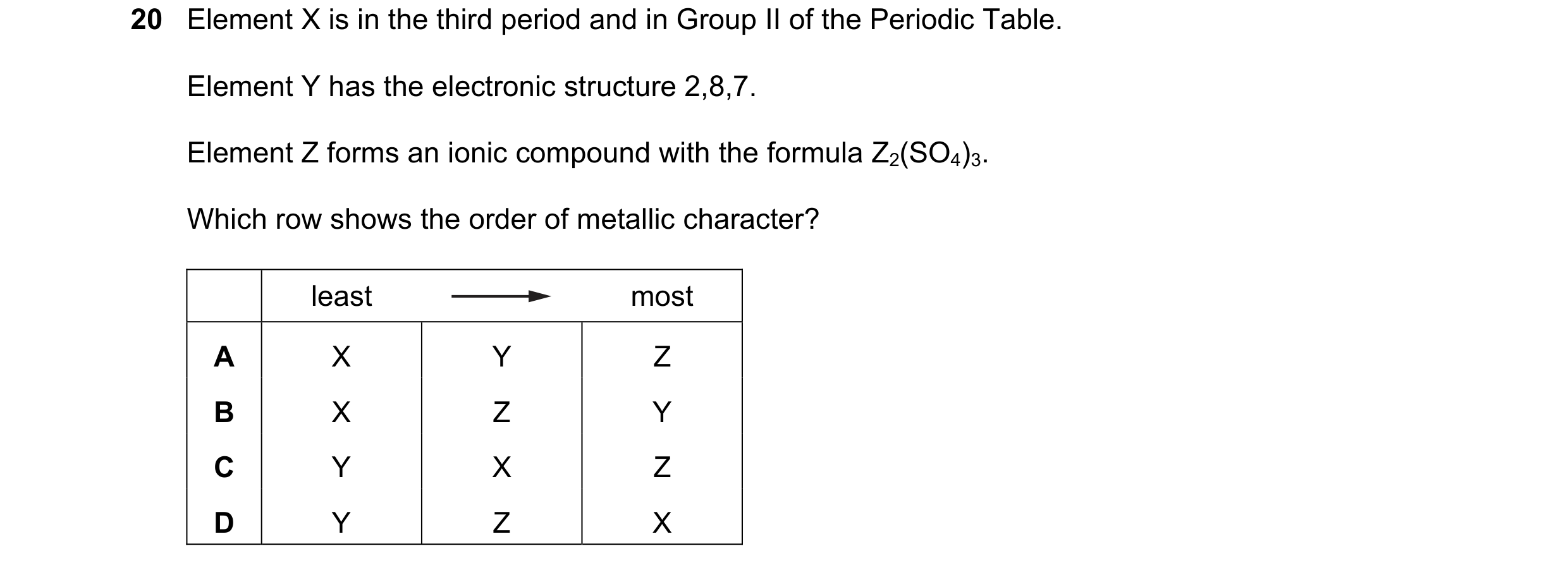
Q13 · Element X is in the third period and in Group II of the Periodic Table 0654/23 May/June 2020
20 Element X is in the third period and in Group II of the Periodic Table. Element Y has the electronic structure 2,8,7. Element Z forms an ionic compound with the formula Z2(SO4)3. Which row shows the order of metallic character? least most A X Y Z B X Z Y C Y X Z D Y Z X
1 marks
Answer: D
This question in 0654/23 May/June 2020
Q14 · Which statement about elements in the Periodic Table is correct? 0654/23 Oct/Nov 2020
21 Which statement about elements in the Periodic Table is correct? A The density of the elements in Group I increases up the group. B The metallic character of the elements increases across a period from left to right. C The number of protons in the atoms of the elements increases across a period from left to right. D The reactivity of the elements in Group I decreases down the group.
1 marks
Answer: C
This question in 0654/23 Oct/Nov 2020
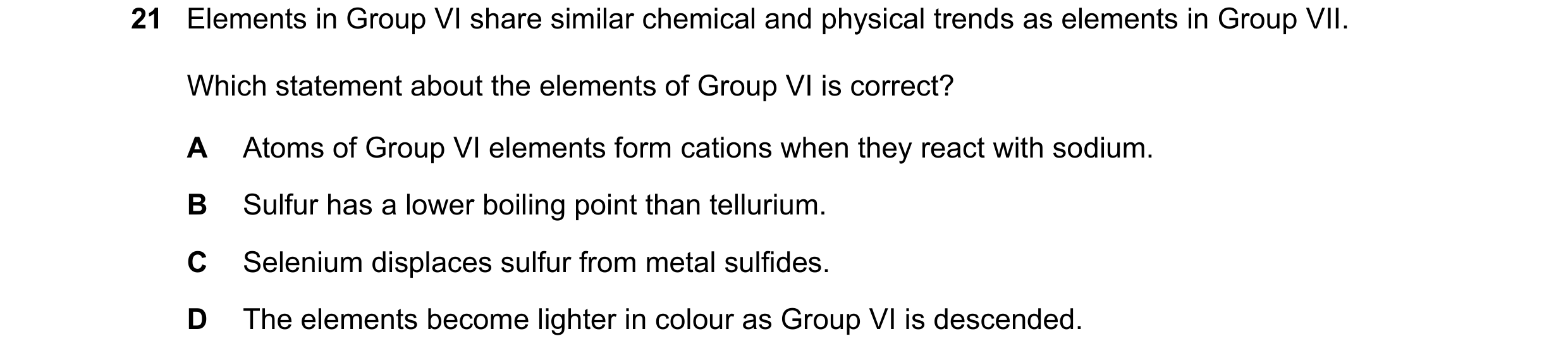
Q15 · Elements in Group VI share similar chemical and physical trends as elements in Group VII 0654/22 Oct/Nov 2024
21 Elements in Group VI share similar chemical and physical trends as elements in Group VII. Which statement about the elements of Group VI is correct? A Atoms of Group VI elements form cations when they react with sodium. B Sulfur has a lower boiling point than tellurium. C Selenium displaces sulfur from metal sulfides. D The elements become lighter in colour as Group VI is descended.
1 marks
Answer: B
This question in 0654/22 Oct/Nov 2024
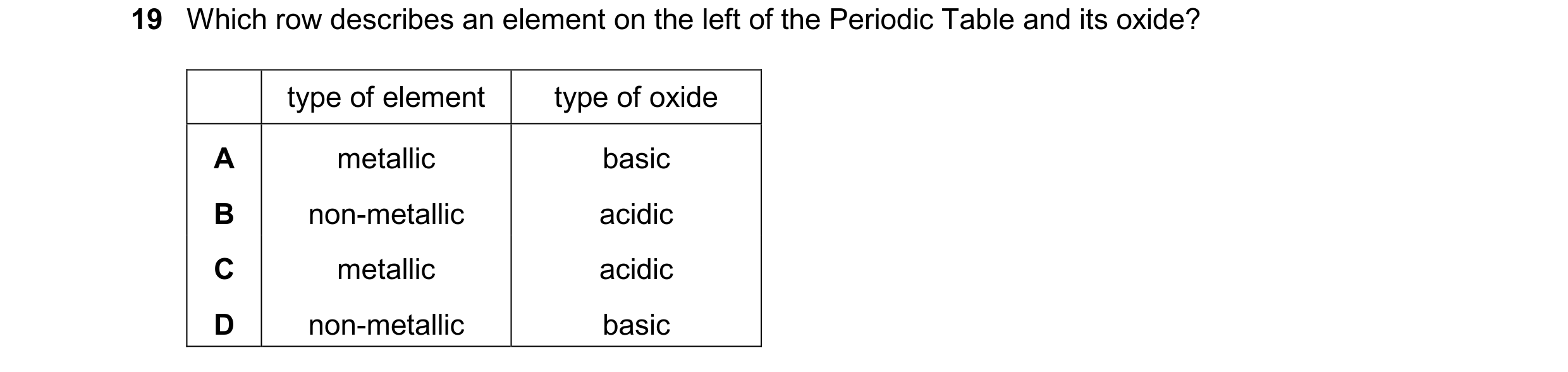
Q16 · Which row describes an element on the left of the Periodic Table and its oxide? 0654/22 May/June 2025
19 Which row describes an element on the left of the Periodic Table and its oxide? type of element type of oxide A metallic basic B non-metallic acidic C metallic acidic D non-metallic basic
1 marks
Answer: A
This question in 0654/22 May/June 2025
Q17 · Which element in Period 3 of the Periodic Table has the greatest metallic character? 0654/23 Oct/Nov 2025
17 Which element in Period 3 of the Periodic Table has the greatest metallic character? A the element with the highest relative atomic mass B the element with the lowest group number C the element with the most outer-shell electrons D the element with the most protons
1 marks
Answer: B
This question in 0654/23 Oct/Nov 2025
 1 / 4
1 / 4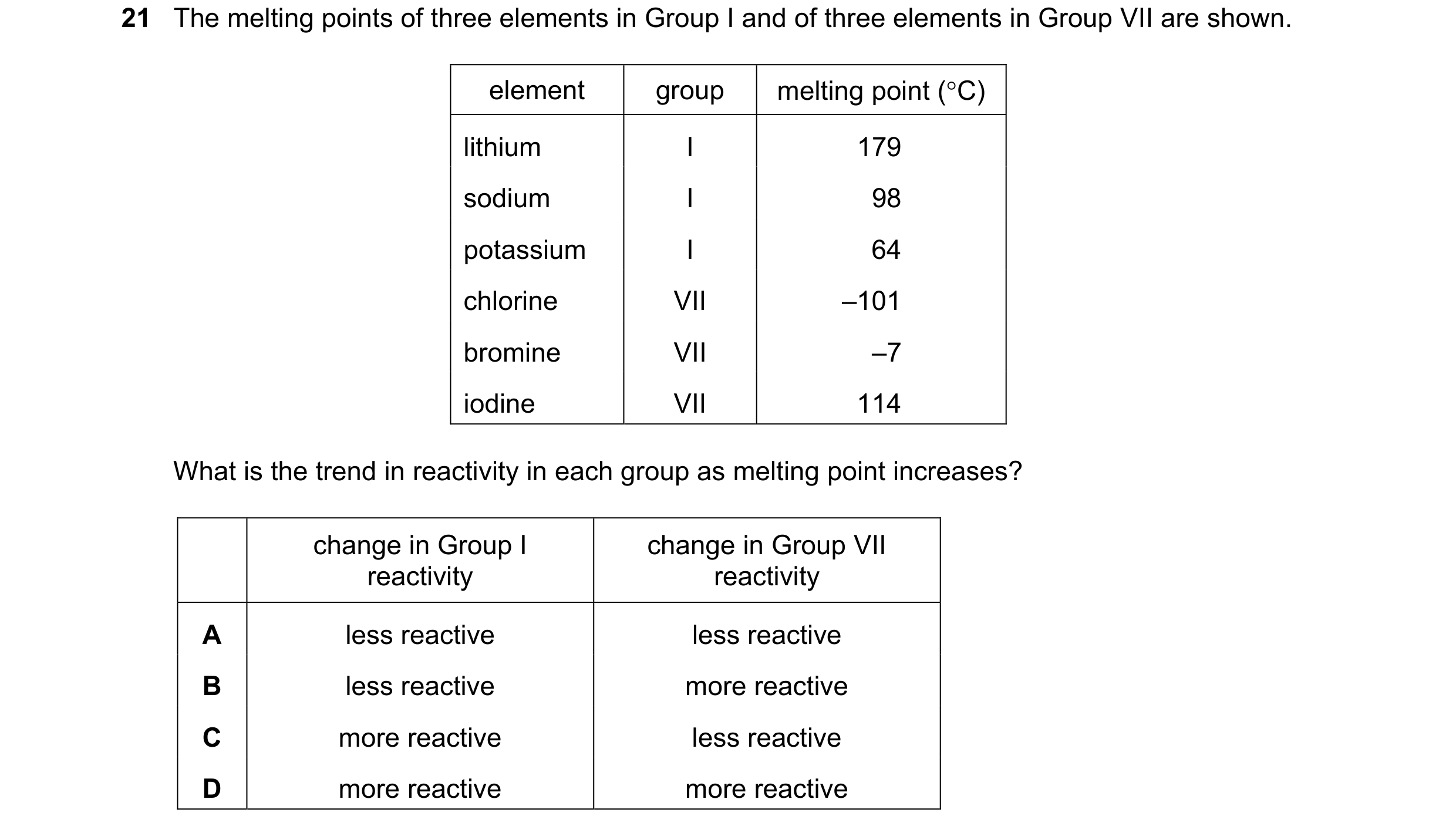

 2 / 4
2 / 4


 3 / 4
3 / 4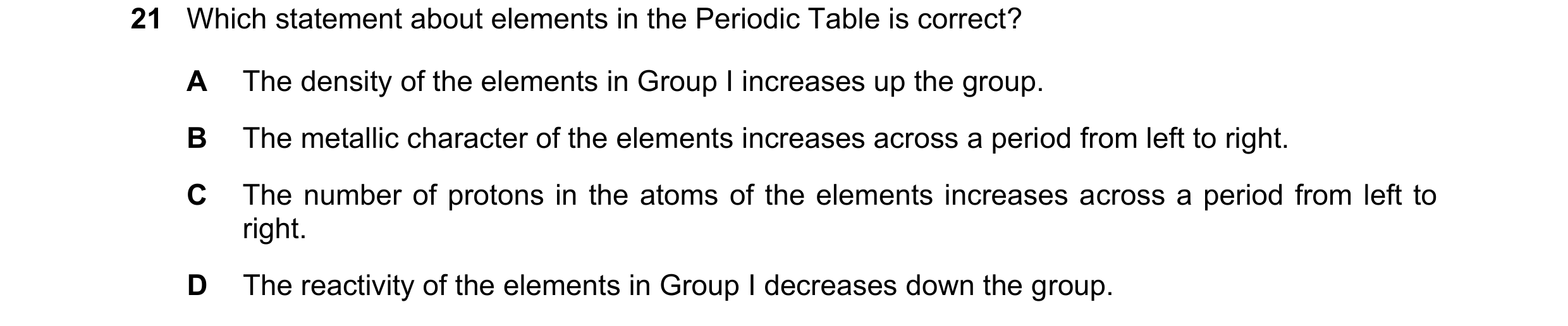
 4 / 4
4 / 4