Questions as text
Q1 · In which change is chemical energy transformed into heat (thermal energy)? 0653/22 Feb/March 2017
18 In which change is chemical energy transformed into heat (thermal energy)? A combustion of refinery gas B cracking of alkanes into alkenes C distillation of seawater D electrolysis of molten lead(II) bromide
1 marks
Answer: A
This question in 0653/22 Feb/March 2017
Q2 · Which statement about the products of the fractional distillation of petroleum is not… 0653/21 May/June 2017
27 Which statement about the products of the fractional distillation of petroleum is not correct? A Fractions obtained from high up the fractional distillation column have low boiling points. B Fractions obtained from low down the fractional distillation column contain large molecules. C Large molecules have weak intermolecular attractive forces. D Refinery gas is used for heating and cooking.
1 marks
Answer: C
This question in 0653/21 May/June 2017
Q3 · Petroleum is separated into different fractions by fractional distillation 0653/22 May/June 2017
27 Petroleum is separated into different fractions by fractional distillation. Which statement about fractional distillation is not correct? A Larger molecules have stronger covalent bonds between their atoms. B The boiling point of hydrocarbons increases with the size of the molecules. C The different fractions have different boiling points. D The smaller molecules have weaker intermolecular attractive forces between them.
1 marks
Answer: A
This question in 0653/22 May/June 2017
Q4 · In the fractional distillation of petroleum, fractions X and Y are removed at the… 0653/22 Oct/Nov 2017
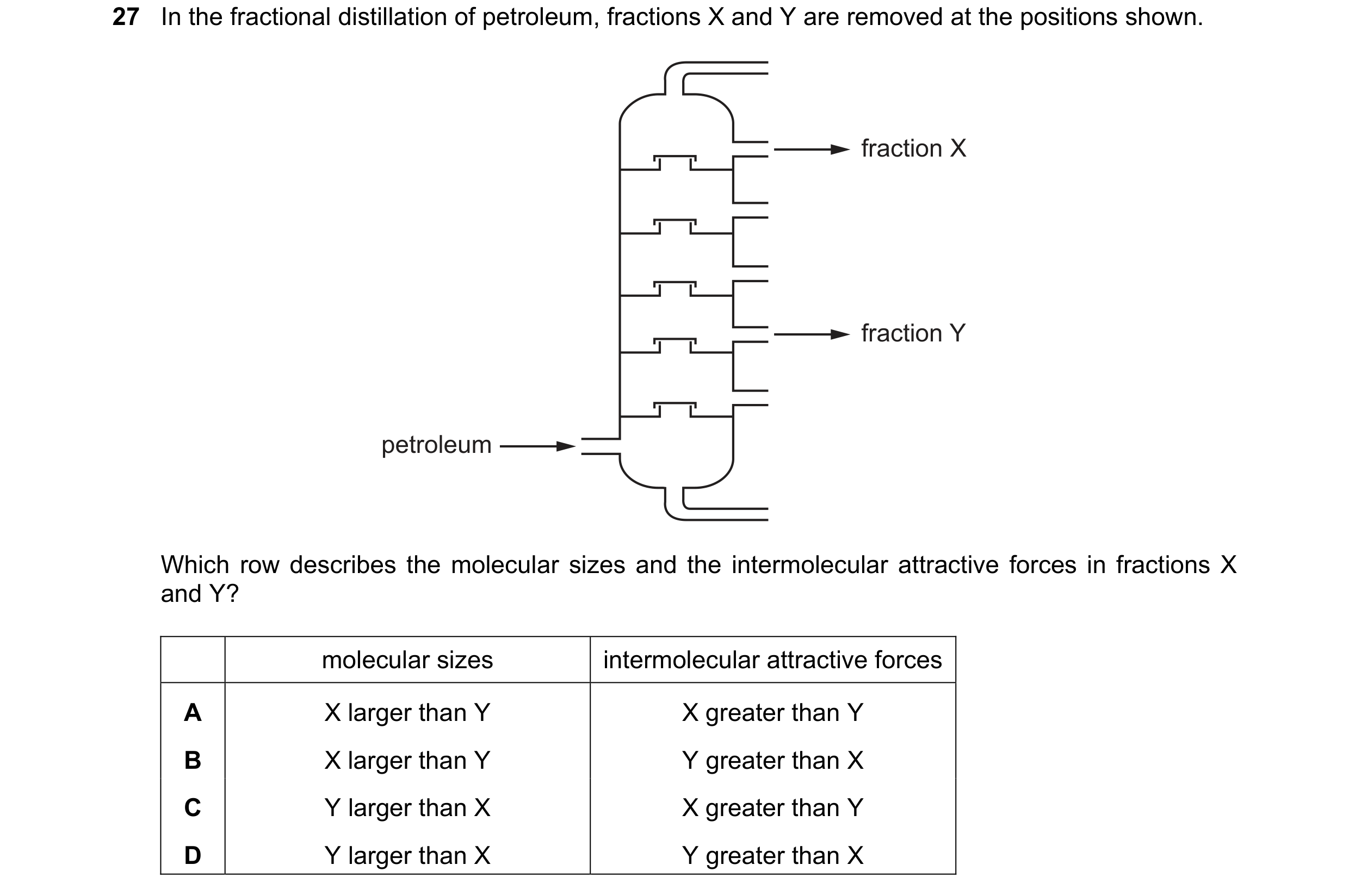
27 In the fractional distillation of petroleum, fractions X and Y are removed at the positions shown. fraction X fraction Y petroleum Which row describes the molecular sizes and the intermolecular attractive forces in fractions X and Y? molecular sizes intermolecular attractive forces A X larger than Y X greater than Y B X larger than Y Y greater than X C Y larger than X X greater than Y D Y larger than X Y greater than X
1 marks
Answer: D
This question in 0653/22 Oct/Nov 2017
Q5 · Which statement about the fractional distillation of petroleum is not correct? 0653/23 Oct/Nov 2017
27 Which statement about the fractional distillation of petroleum is not correct? A Fractions obtained from higher up the fractional distillation column have higher boiling point ranges. B Fractions obtained from lower down the fractional distillation column contain larger molecules. C Refinery gas is used for heating and cooking. D Smaller molecules have weaker intermolecular attractive forces.
1 marks
Answer: A
This question in 0653/23 Oct/Nov 2017
Q6 · The fractional distillation of petroleum is shown 0653/22 May/June 2018
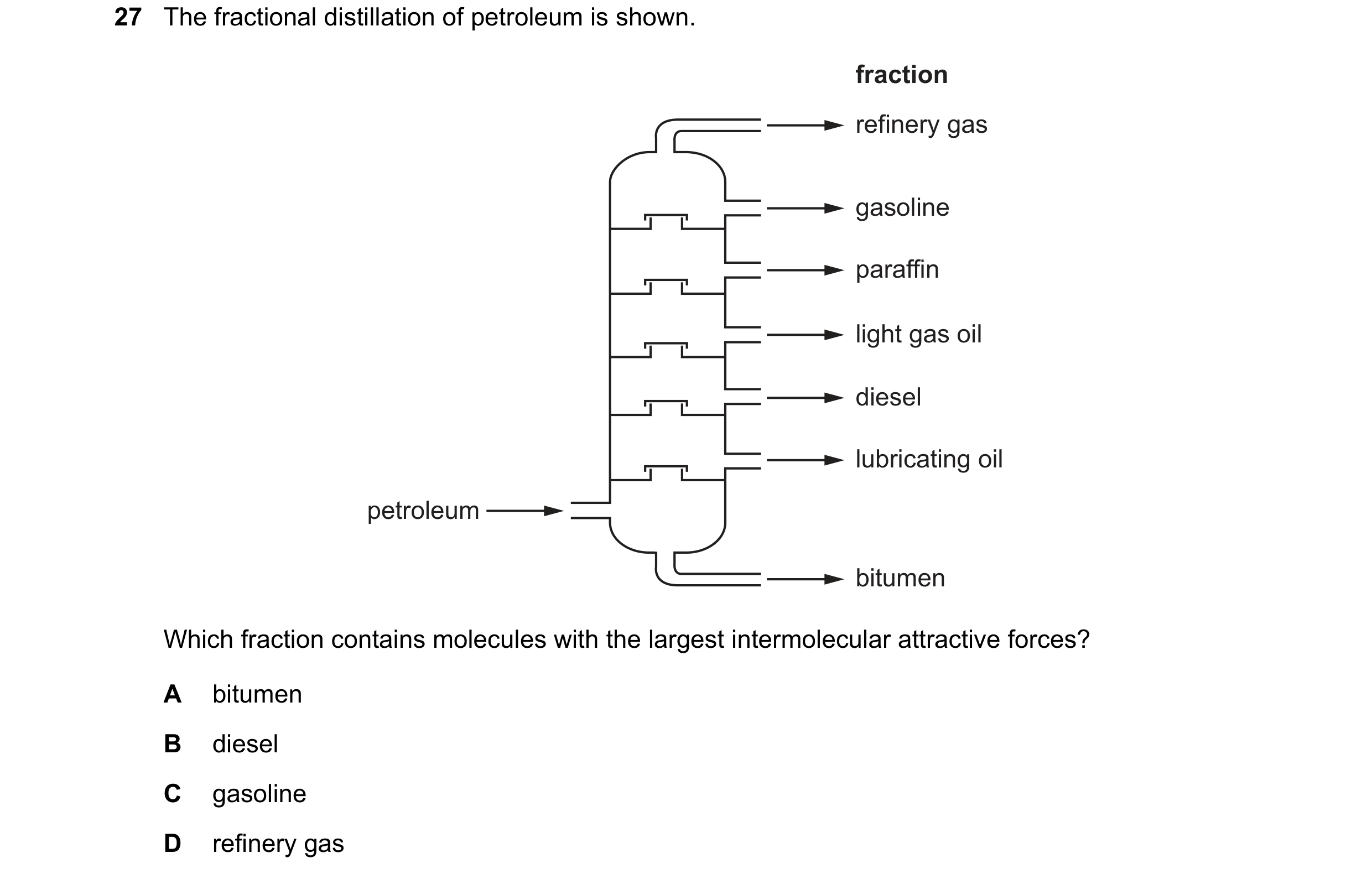
27 The fractional distillation of petroleum is shown. fraction refinery gas gasoline paraffin light gas oil diesel lubricating oil petroleum bitumen Which fraction contains molecules with the largest intermolecular attractive forces? A bitumen B diesel C gasoline D refinery gas
1 marks
Answer: A
This question in 0653/22 May/June 2018
Q7 · Gasoline is a hydrocarbon fuel obtained from petroleum 0653/21 Oct/Nov 2018
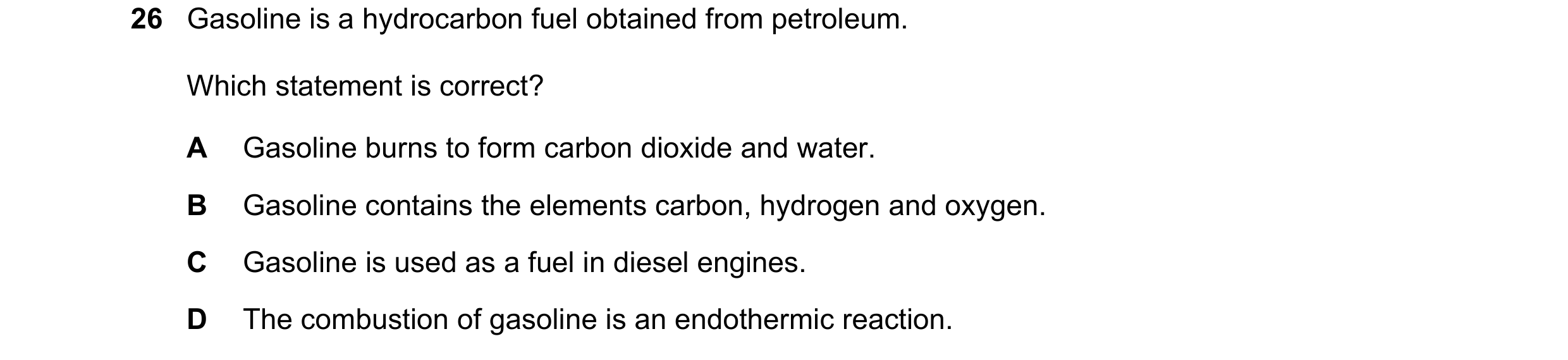
26 Gasoline is a hydrocarbon fuel obtained from petroleum. Which statement is correct? A Gasoline burns to form carbon dioxide and water. B Gasoline contains the elements carbon, hydrogen and oxygen. C Gasoline is used as a fuel in diesel engines. D The combustion of gasoline is an endothermic reaction.
1 marks
Answer: A
This question in 0653/21 Oct/Nov 2018
Q8 · Gasoline is a hydrocarbon fuel obtained from petroleum 0653/22 Oct/Nov 2018
26 Gasoline is a hydrocarbon fuel obtained from petroleum. Which statement is correct? A Gasoline burns to form carbon dioxide and water. B Gasoline contains the elements carbon, hydrogen and oxygen. C Gasoline is used as a fuel in diesel engines. D The combustion of gasoline is an endothermic reaction.
1 marks
Answer: A
This question in 0653/22 Oct/Nov 2018
Q9 · Petroleum is separated into fractions by fractional distillation 0653/22 Oct/Nov 2018
27 Petroleum is separated into fractions by fractional distillation. Which labelled fraction contains molecules with the largest intermolecular attractive forces? A B C D petroleum
1 marks
Answer: D
This question in 0653/22 Oct/Nov 2018
Q10 · Gasoline is a hydrocarbon fuel obtained from petroleum 0653/23 Oct/Nov 2018
26 Gasoline is a hydrocarbon fuel obtained from petroleum. Which statement is correct? A Gasoline burns to form carbon dioxide and water. B Gasoline contains the elements carbon, hydrogen and oxygen. C Gasoline is used as a fuel in diesel engines. D The combustion of gasoline is an endothermic reaction.
1 marks
Answer: A
This question in 0653/23 Oct/Nov 2018
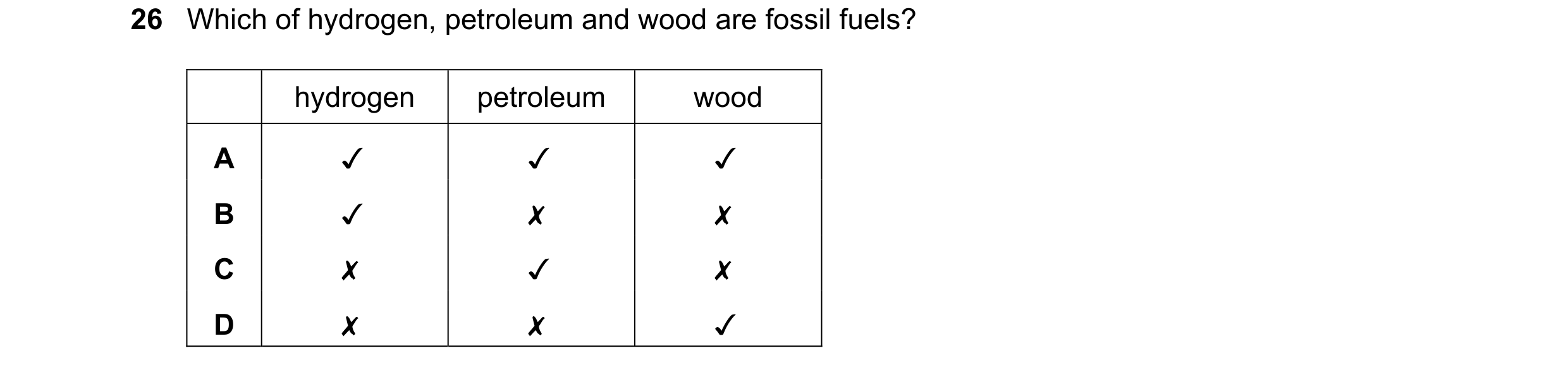
Q11 · Which of hydrogen, petroleum and wood are fossil fuels? 0653/22 Feb/March 2019
26 Which of hydrogen, petroleum and wood are fossil fuels?
hydrogen petroleum wood
A J J J
B v x x
Cc x Jv x
D x x J
1 marks
Answer: C
This question in 0653/22 Feb/March 2019
Q12 · Which statement shows that petroleum is a mixture? 0653/21 May/June 2019
25 Which statement shows that petroleum is a mixture? A Petroleum can be burned as a fuel. B Petroleum can be separated into fractions by distillation. C Petroleum is a fossil fuel formed over millions of years. D Petroleum is a thick, black liquid.
1 marks
Answer: B
This question in 0653/21 May/June 2019
Q13 · Which row identifies the temperature used and describes the change to the alkane… 0653/22 May/June 2019
27 Which row identifies the temperature used and describes the change to the alkane molecules during the cracking process? temperature change to the / °C alkane molecules A 100 become larger B 100 become smaller C 500 become larger D 500 become smaller
1 marks
Answer: D
This question in 0653/22 May/June 2019
Q14 · Which statement shows that petroleum is a mixture? 0653/23 May/June 2019
25 Which statement shows that petroleum is a mixture? A Petroleum can be burned as a fuel. B Petroleum can be separated into fractions by distillation. C Petroleum is a fossil fuel formed over millions of years. D Petroleum is a thick, black liquid.
1 marks
Answer: B
This question in 0653/23 May/June 2019
Q15 · Which statement about cracking is not correct? 0653/23 May/June 2019
27 Which statement about cracking is not correct? A A high temperature and a catalyst are used. B Alkenes are made. C Hydrogen can be made. D Larger alkanes are made from smaller alkanes.
1 marks
Answer: D
This question in 0653/23 May/June 2019
Q16 · Which statement about fractions obtained from petroleum is not correct? 0653/21 Oct/Nov 2019
27 Which statement about fractions obtained from petroleum is not correct? A Different fractions have different boiling points. B Gasoline contains molecules of only one hydrocarbon. C Molecules in diesel oil are smaller than molecules in bitumen. D Naphtha is used as a feedstock for making chemicals.
1 marks
Answer: B
This question in 0653/21 Oct/Nov 2019
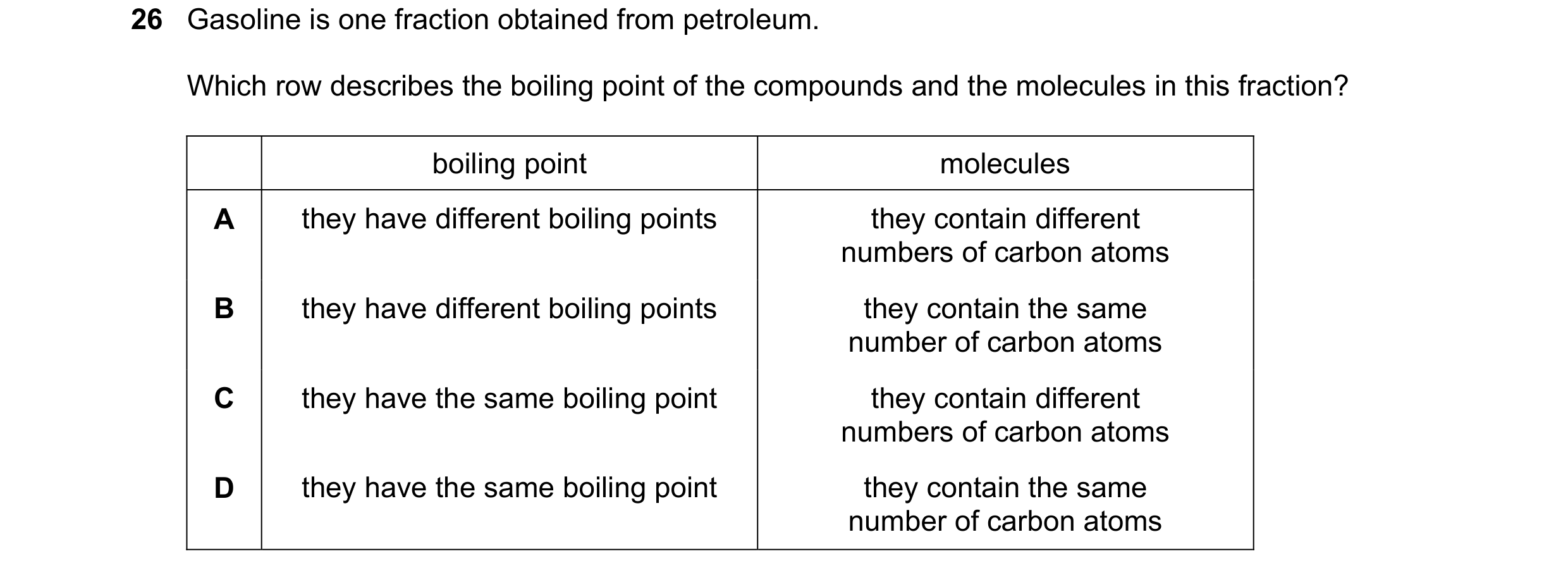
Q17 · Gasoline is one fraction obtained from petroleum 0653/22 Oct/Nov 2019
26 Gasoline is one fraction obtained from petroleum. Which row describes the boiling point of the compounds and the molecules in this fraction? boiling point molecules A they have different boiling points they contain different numbers of carbon atoms B they have different boiling points they contain the same number of carbon atoms C they have the same boiling point they contain different numbers of carbon atoms D they have the same boiling point they contain the same number of carbon atoms
1 marks
Answer: A
This question in 0653/22 Oct/Nov 2019
Q18 · A simple fractionating column is shown 0653/23 Oct/Nov 2019
26 A simple fractionating column is shown. fraction 1 fraction 2 fraction 3 fraction 4 petroleum Which statement about the fractions is correct? A Fraction 1 contains compounds with the highest boiling points. B Fraction 2 contains larger hydrocarbon molecules than fraction 3. C Fraction 3 is more viscous than fraction 4. D Fraction 4 is the least flammable.
1 marks
Answer: D
This question in 0653/23 Oct/Nov 2019
Q19 · What is formed during the complete combustion of a hydrocarbon? 0653/22 Feb/March 2020
27 What is formed during the complete combustion of a hydrocarbon? A carbon dioxide and water B carbon dioxide and hydrogen C carbon monoxide and carbon dioxide D carbon monoxide and water
1 marks
Answer: A
This question in 0653/22 Feb/March 2020
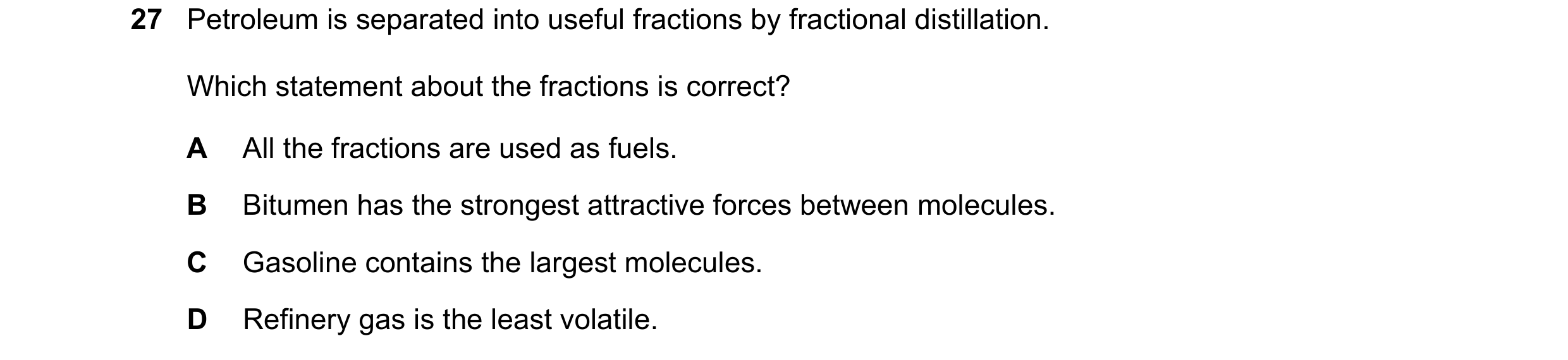
Q20 · Petroleum is separated into useful fractions by fractional distillation 0653/21 May/June 2020
27 Petroleum is separated into useful fractions by fractional distillation. Which statement about the fractions is correct? A All the fractions are used as fuels. B Bitumen has the strongest attractive forces between molecules. C Gasoline contains the largest molecules. D Refinery gas is the least volatile.
1 marks
Answer: B
This question in 0653/21 May/June 2020
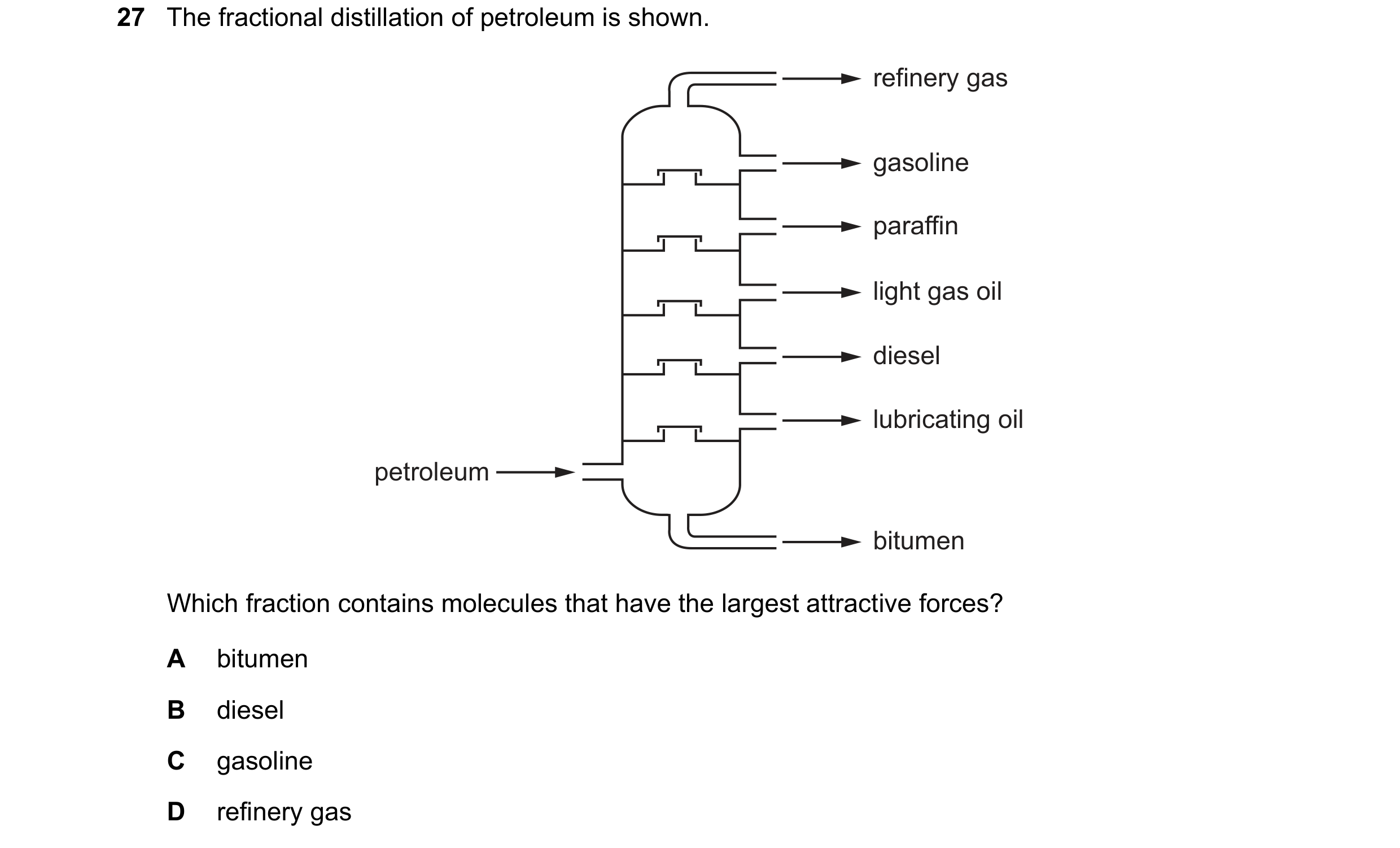
Q21 · The fractional distillation of petroleum is shown 0653/21 Oct/Nov 2021
27 The fractional distillation of petroleum is shown. refinery gas gasoline paraffin light gas oil diesel lubricating oil petroleum bitumen Which fraction contains molecules that have the largest attractive forces? A bitumen B diesel C gasoline D refinery gas
1 marks
Answer: A
This question in 0653/21 Oct/Nov 2021
Q22 · The fractional distillation of petroleum is shown 0653/22 Oct/Nov 2021
27 The fractional distillation of petroleum is shown. refinery gas gasoline paraffin light gas oil diesel lubricating oil petroleum bitumen Which fraction contains molecules that have the largest attractive forces? A bitumen B diesel C gasoline D refinery gas
1 marks
Answer: A
This question in 0653/22 Oct/Nov 2021
Q23 · The fractional distillation of petroleum is shown 0653/23 Oct/Nov 2021
27 The fractional distillation of petroleum is shown. refinery gas gasoline paraffin light gas oil diesel lubricating oil petroleum bitumen Which fraction contains molecules that have the largest attractive forces? A bitumen B diesel C gasoline D refinery gas
1 marks
Answer: A
This question in 0653/23 Oct/Nov 2021
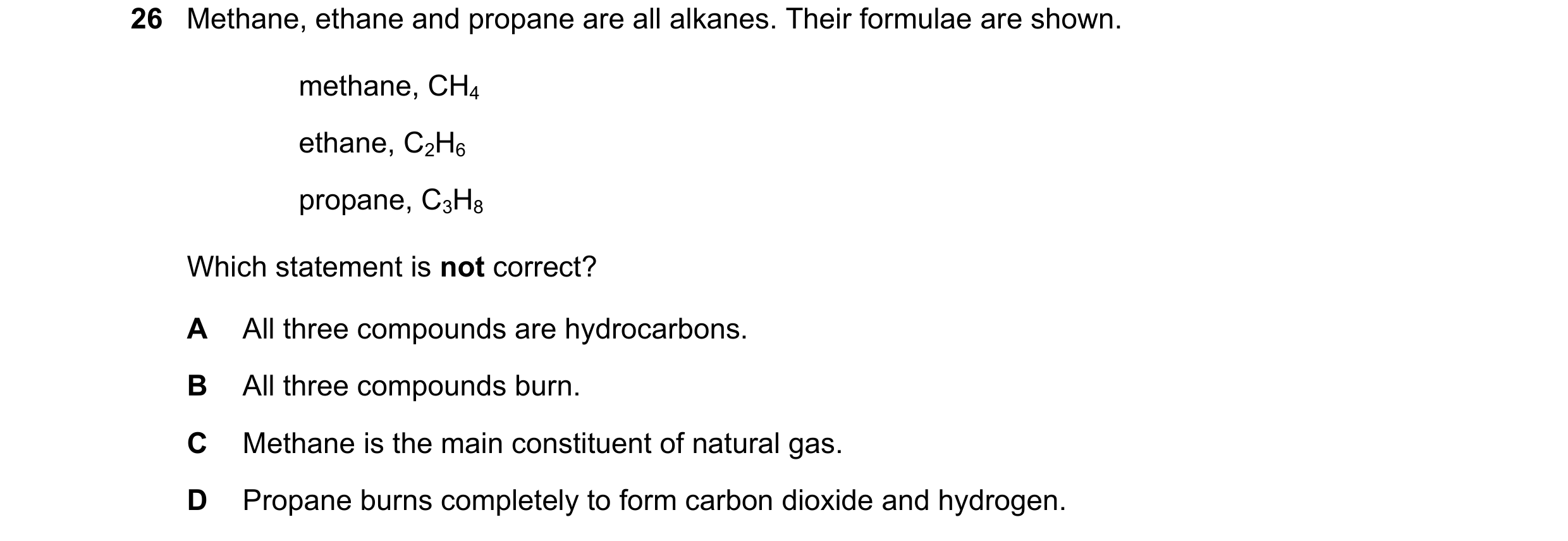
Q24 · Methane, ethane and propane are all alkanes 0653/21 May/June 2022
26 Methane, ethane and propane are all alkanes. Their formulae are shown. methane, CH4 ethane, C2H6 propane, C3H8 Which statement is not correct? A All three compounds are hydrocarbons. B All three compounds burn. C Methane is the main constituent of natural gas. D Propane burns completely to form carbon dioxide and hydrogen.
1 marks
Answer: D
This question in 0653/21 May/June 2022
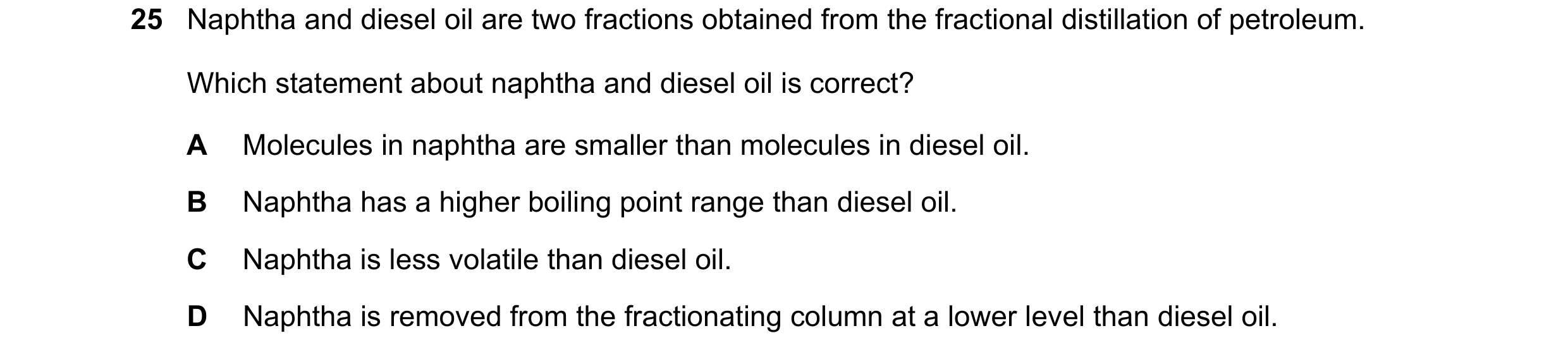
Q25 · Naphtha and diesel oil are two fractions obtained from the fractional distillation of… 0653/21 Oct/Nov 2022
25 Naphtha and diesel oil are two fractions obtained from the fractional distillation of petroleum. Which statement about naphtha and diesel oil is correct? A Molecules in naphtha are smaller than molecules in diesel oil. B Naphtha has a higher boiling point range than diesel oil. C Naphtha is less volatile than diesel oil. D Naphtha is removed from the fractionating column at a lower level than diesel oil.
1 marks
Answer: A
This question in 0653/21 Oct/Nov 2022
Q26 · Bitumen and gasoline are fractions obtained from petroleum by fractional distillation 0653/22 Oct/Nov 2022
25 Bitumen and gasoline are fractions obtained from petroleum by fractional distillation. Which statement explains why the boiling range of the bitumen fraction is higher than the boiling range of the gasoline fraction? A It contains smaller molecules. B It leaves the fractional distillation column at the bottom. C Its molecules have greater forces of attraction. D Its molecules have stronger covalent bonds.
1 marks
Answer: C
This question in 0653/22 Oct/Nov 2022
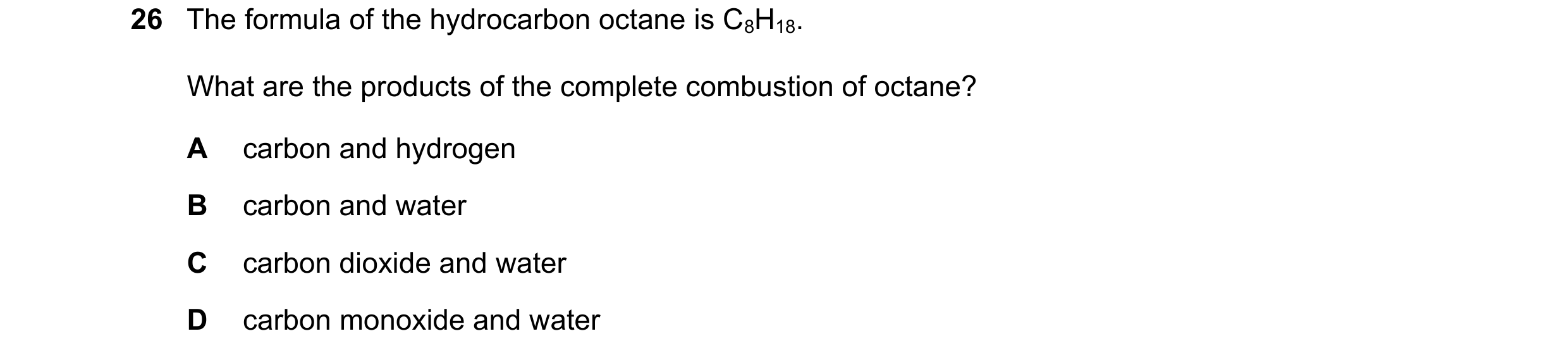
Q27 · The formula of the hydrocarbon octane is C8H18 0653/22 Oct/Nov 2022
26 The formula of the hydrocarbon octane is C8H18. What are the products of the complete combustion of octane? A carbon and hydrogen B carbon and water C carbon dioxide and water D carbon monoxide and water
1 marks
Answer: C
This question in 0653/22 Oct/Nov 2022
Q28 · Which products are obtained by the cracking of larger alkane molecules? 0653/21 May/June 2024
27 Which products are obtained by the cracking of larger alkane molecules? A smaller alkane molecules, smaller alkene molecules and hydrogen B smaller alkane molecules only C smaller alkene molecules and hydrogen only D smaller alkene molecules only
1 marks
Answer: A
This question in 0653/21 May/June 2024
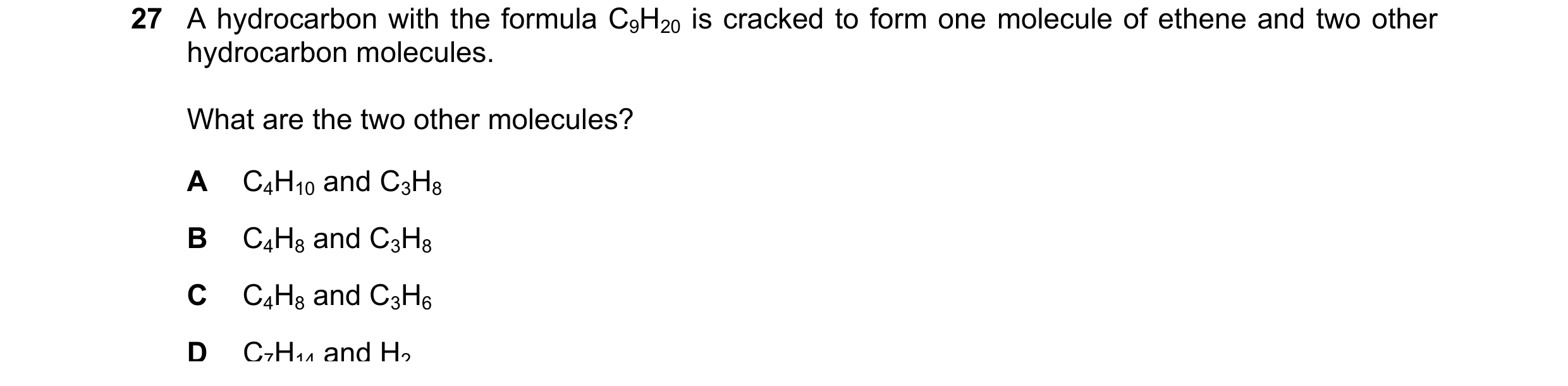
Q29 · A hydrocarbon with the formula C9H20 is cracked to form one molecule of ethene and two… 0653/22 May/June 2024
27 A hydrocarbon with the formula C9H20 is cracked to form one molecule of ethene and two other hydrocarbon molecules. What are the two other molecules? A C4H10 and C3H8 B C4H8 and C3H8 C C4H8 and C3H6 D C7H14 and H2
1 marks
Answer: B
This question in 0653/22 May/June 2024
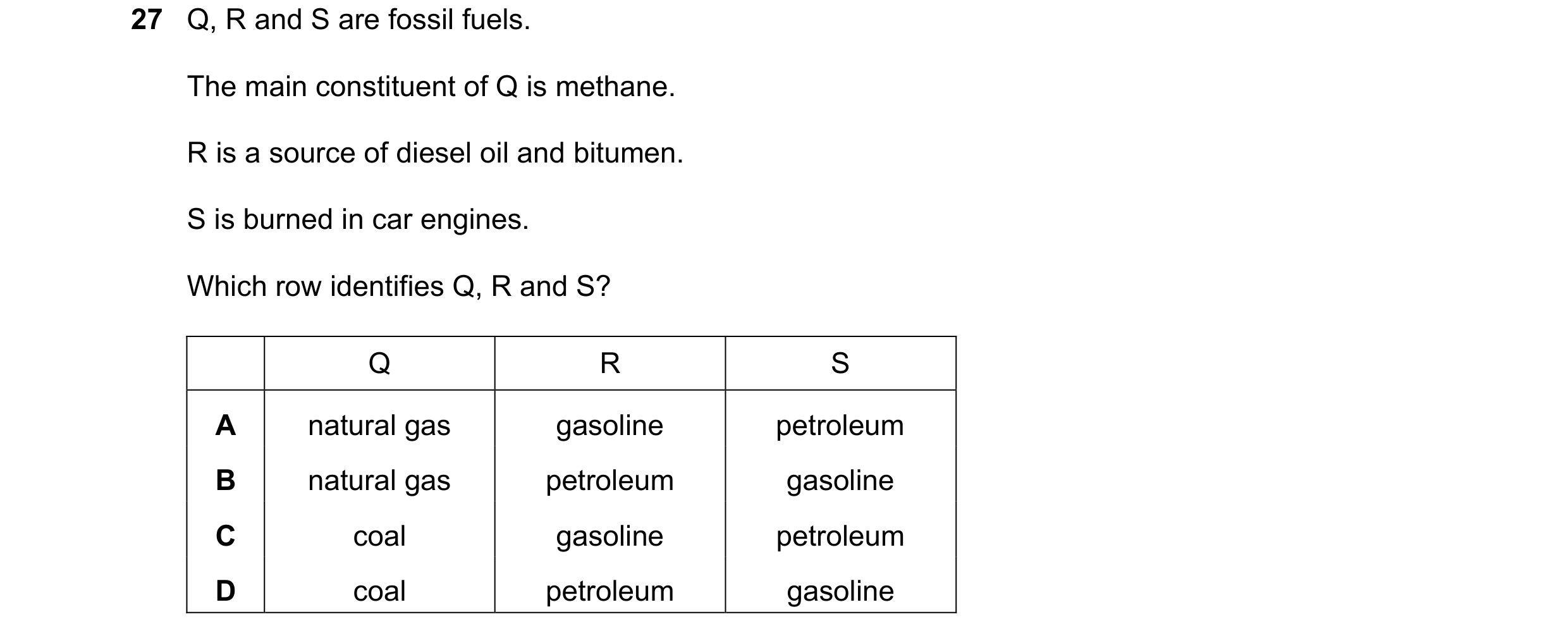
Q30 · Q, R and S are fossil fuels 0653/23 Oct/Nov 2024
27 Q, R and S are fossil fuels. The main constituent of Q is methane. R is a source of diesel oil and bitumen. S is burned in car engines. Which row identifies Q, R and S? Q R S A natural gas gasoline petroleum B natural gas petroleum gasoline C coal gasoline petroleum D coal petroleum gasoline
1 marks
Answer: B
This question in 0653/23 Oct/Nov 2024
Q31 · Which process is a physical change? 0653/22 May/June 2025
24 Which process is a physical change? A combustion of solid carbon B cracking of an alkane to give an alkene C fractional distillation of petroleum D rusting of iron
1 marks
Answer: C
This question in 0653/22 May/June 2025
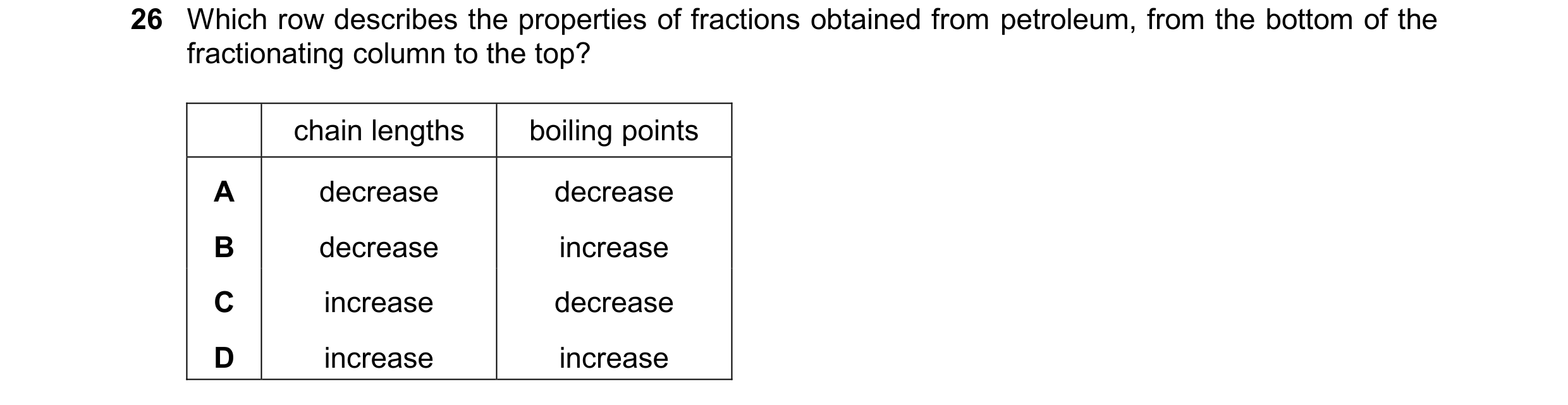
Q32 · Which row describes the properties of fractions obtained from petroleum, from the bottom… 0653/23 May/June 2025
26 Which row describes the properties of fractions obtained from petroleum, from the bottom of the fractionating column to the top? chain lengths boiling points A decrease decrease B decrease increase C increase decrease D increase increase
1 marks
Answer: A
This question in 0653/23 May/June 2025
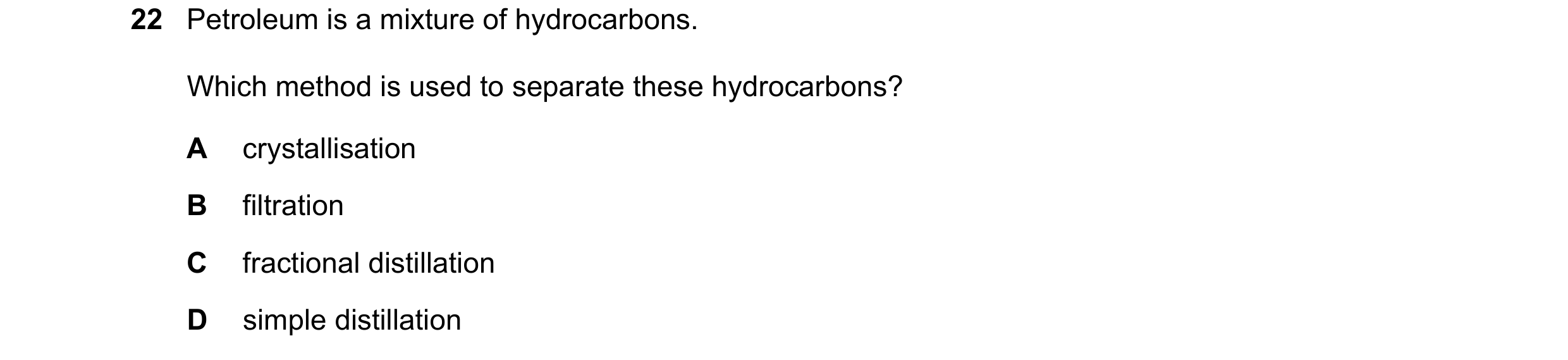
Q33 · Petroleum is a mixture of hydrocarbons 0653/21 Oct/Nov 2025
22 Petroleum is a mixture of hydrocarbons. Which method is used to separate these hydrocarbons? A crystallisation B filtration C fractional distillation D simple distillation
1 marks
Answer: C
This question in 0653/21 Oct/Nov 2025
Q34 · Which process is a physical change? 0653/23 Oct/Nov 2025
16 Which process is a physical change? A addition of carbon dioxide to limewater B addition of sodium to water C electrolysis of molten lead(II) bromide D separation of petroleum by fractional distillation
1 marks
Answer: D
This question in 0653/23 Oct/Nov 2025


 1 / 9
1 / 9
 2 / 9
2 / 9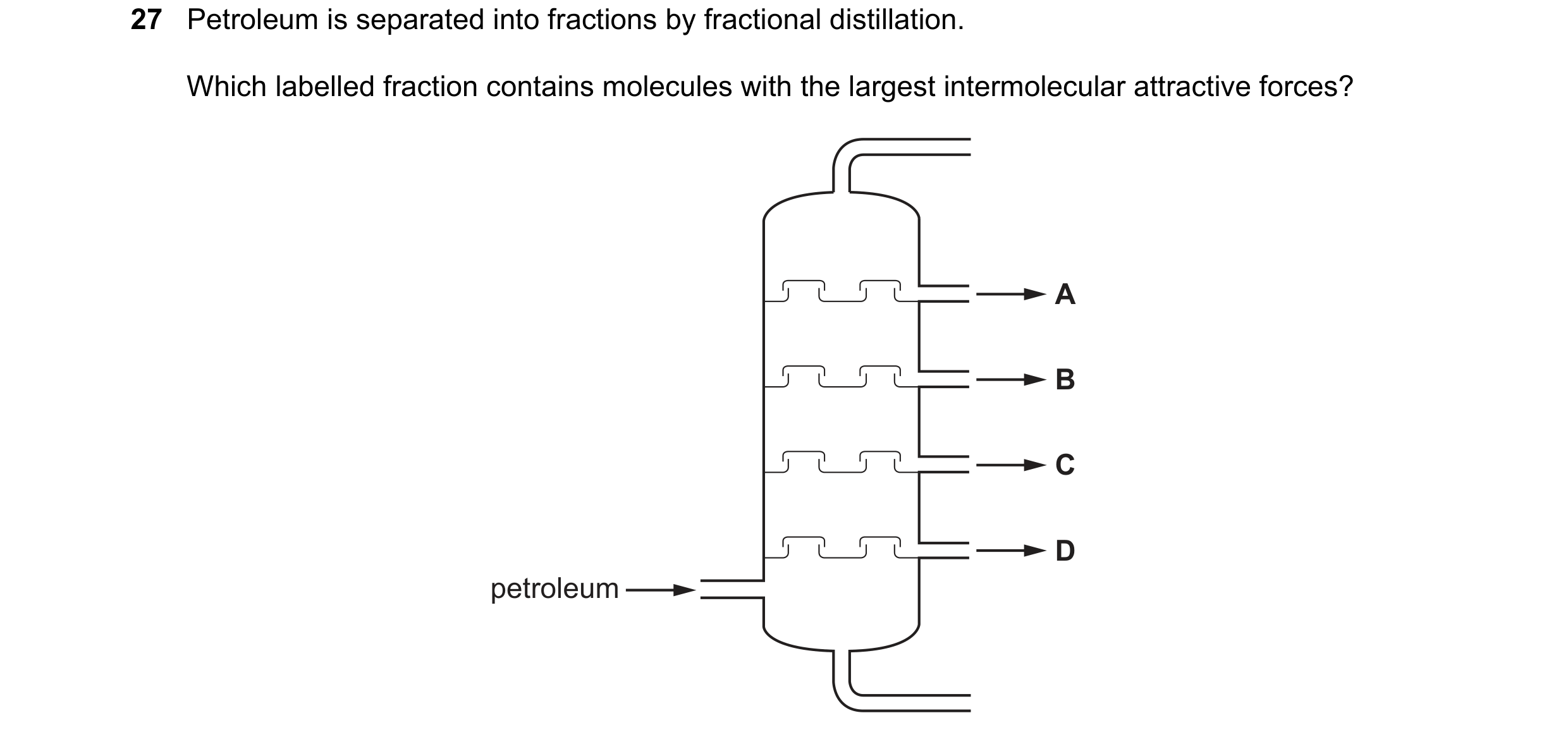
 3 / 9
3 / 9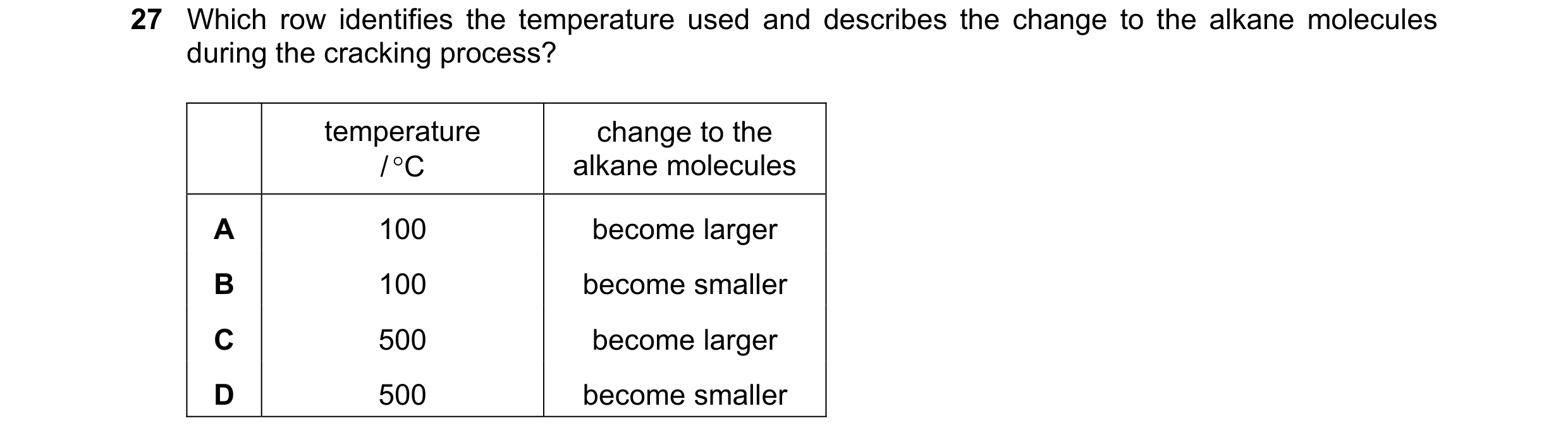



 4 / 9
4 / 9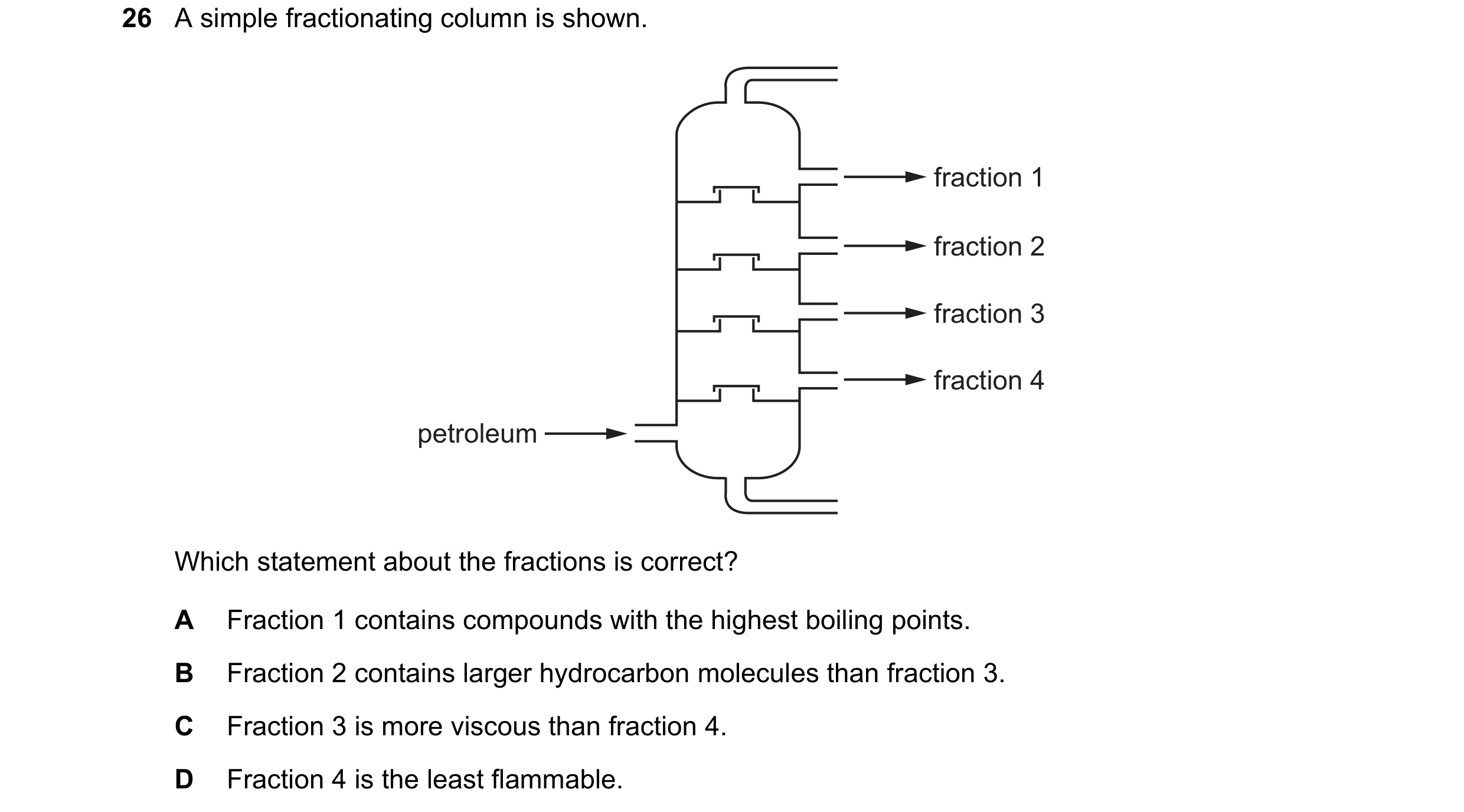

 5 / 9
5 / 9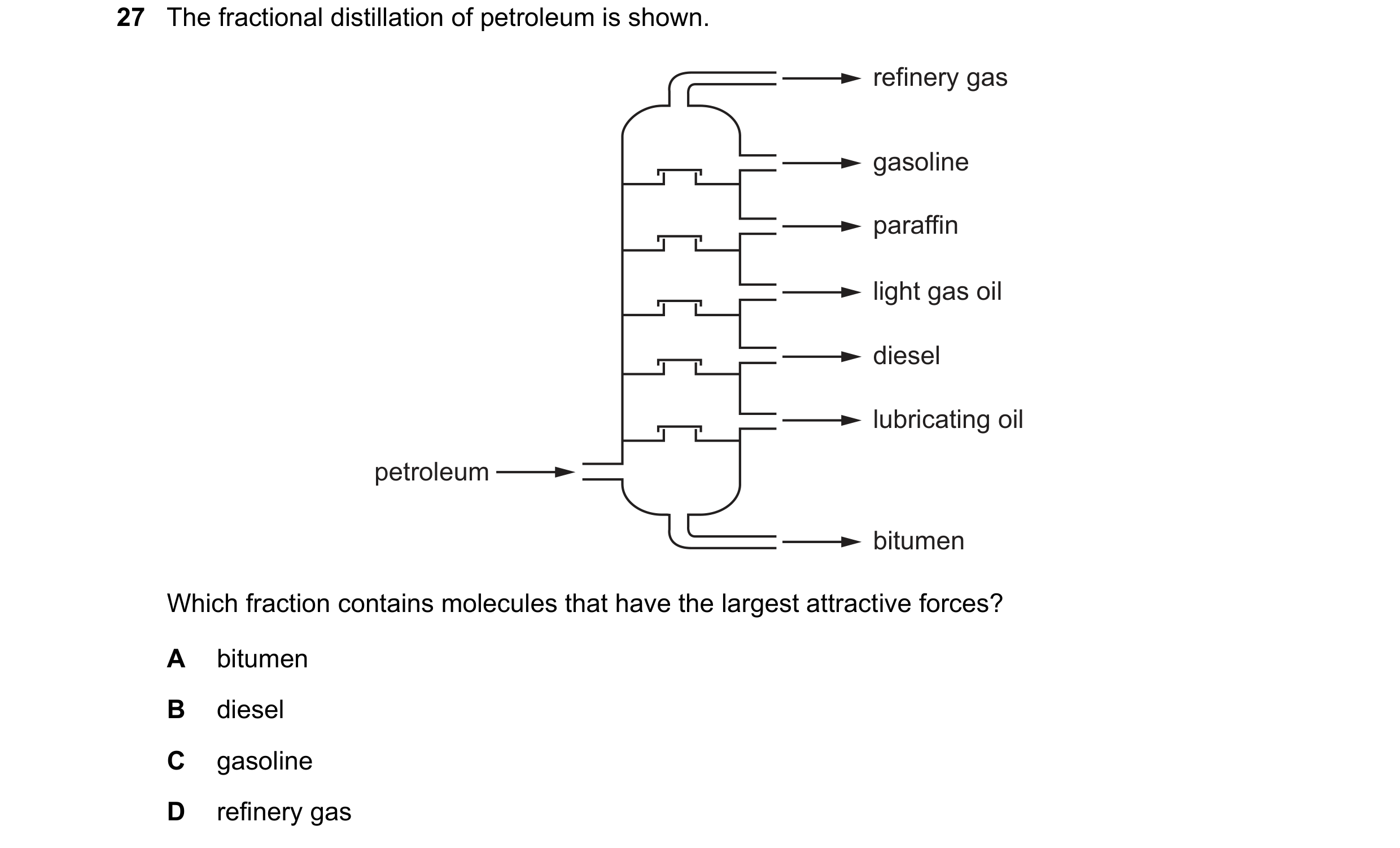
 6 / 9
6 / 9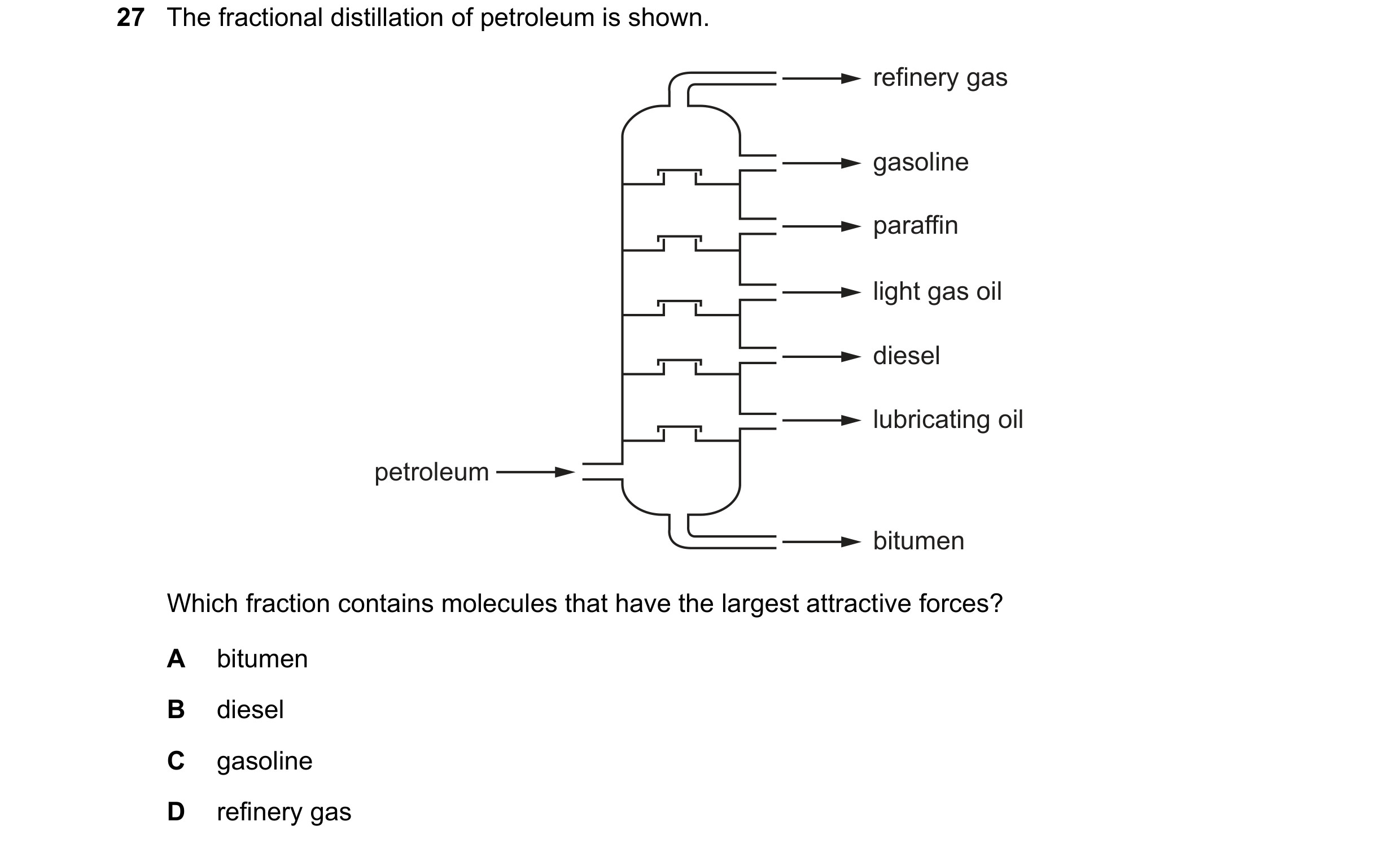
 7 / 9
7 / 9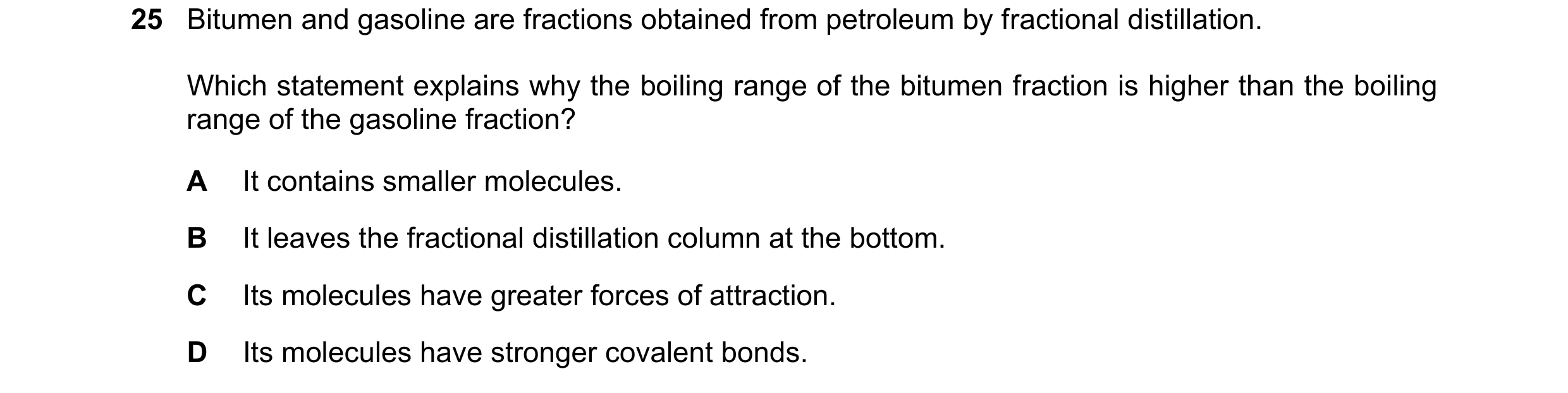

 8 / 9
8 / 9
 9 / 9
9 / 9