Questions as text
Q1 · Natural gas and petroleum (crude oil) are fossil fuels 0653/32 Feb/March 2017
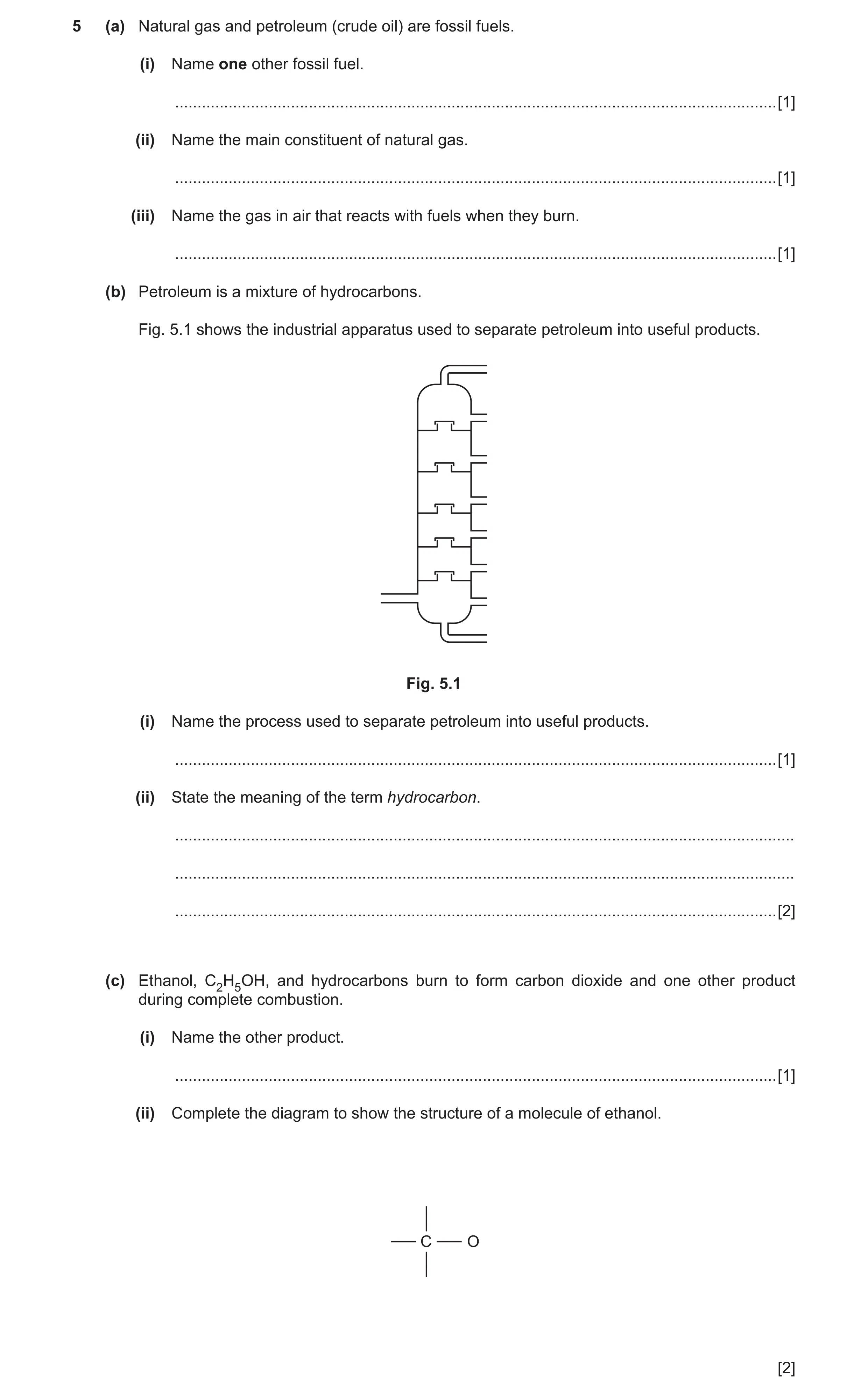
5 (a) Natural gas and petroleum (crude oil) are fossil fuels. (i) Name one other fossil fuel. … [1] (ii) Name the main constituent of natural gas. … [1] (iii) Name the gas in air that reacts with fuels when they burn. … [1] (b) Petroleum is a mixture of hydrocarbons. Fig. 5.1 shows the industrial apparatus used to separate petroleum into useful products. Fig. 5.1 (i) Name the process used to separate petroleum into useful products. … [1] (ii) State the meaning of the term hydrocarbon. … … … [2] (c) Ethanol, C2H5OH, and hydrocarbons burn to form carbon dioxide and one other product during complete combustion. (i) Name the other product. … [1] (ii) Complete the diagram to show the structure of a molecule of ethanol. C O [2]
9 marks
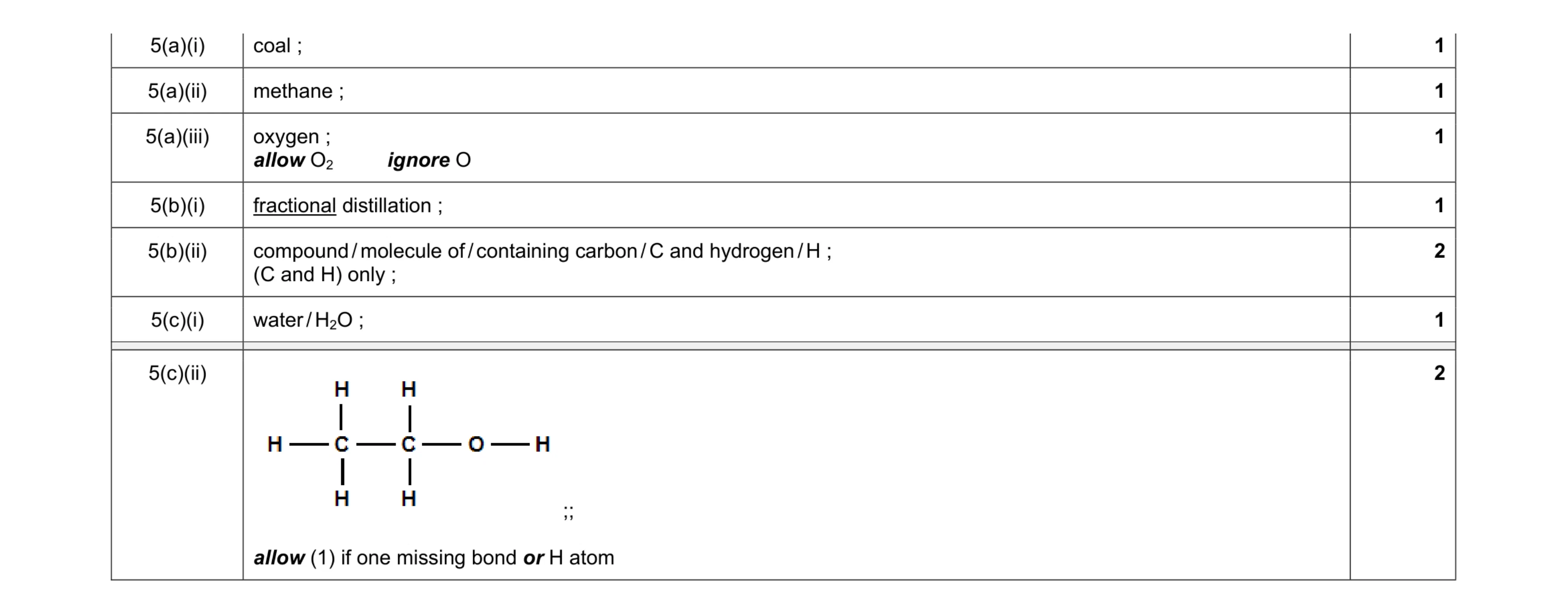
Mark scheme: 5(a)(i) coal ; 1 5(a)(ii) methane ; 1 5(a)(iii) oxygen ; allow O2 ignore O 1 5(b)(i) fractional distillation ; 1 5(b)(ii) compound / molecule of / containing carbon / C and hydrogen / H ; (C and H) only ; 2 5(c)(i) water / H2O ; 1 Question Answer Marks 5(c)(ii) ;; allow (1) if one missing bond or H atom 2
This question in 0653/32 Feb/March 2017
Q2 · A molecule of methane contains one carbon atom bonded to four hydrogen atoms 0653/31 May/June 2017
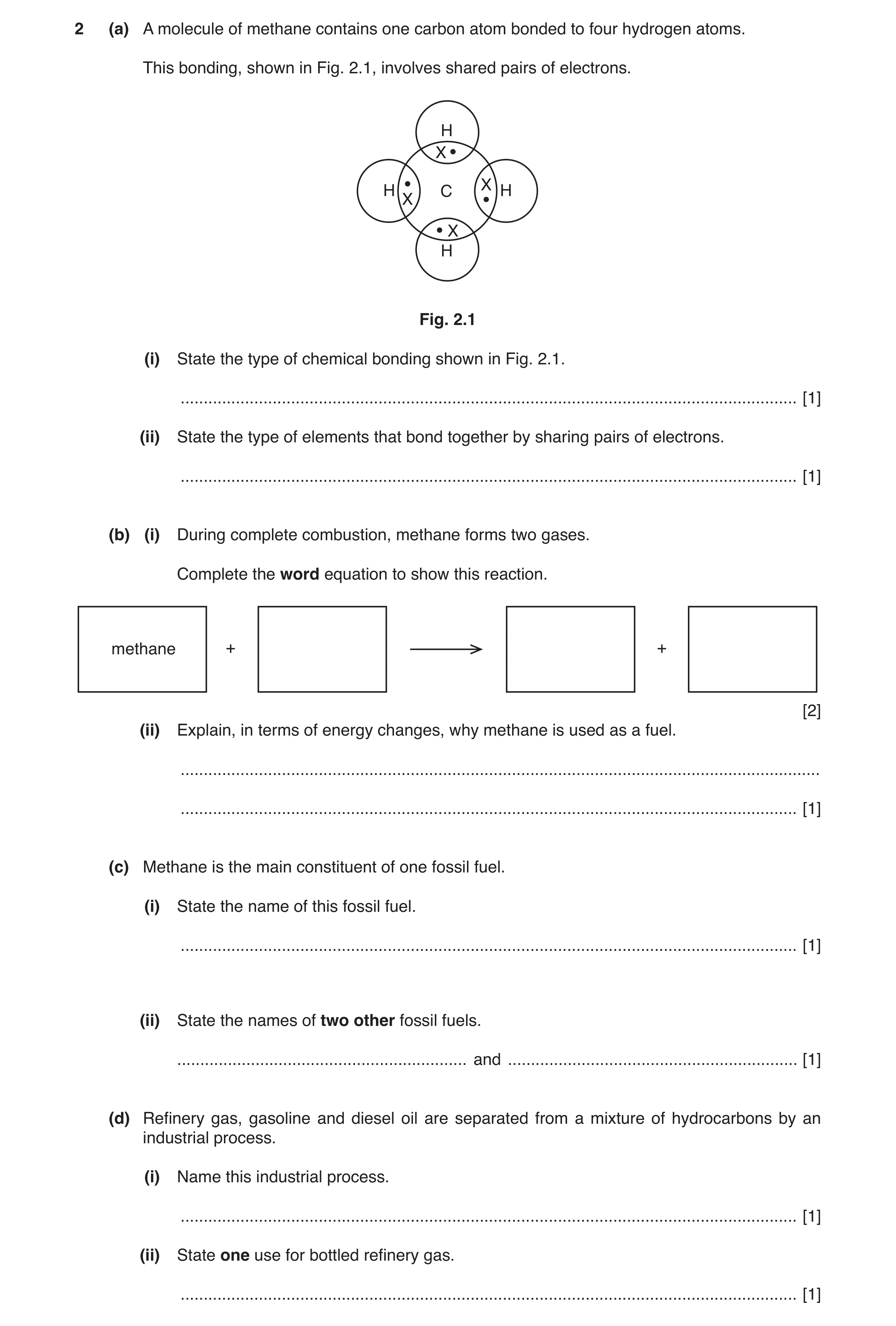
2 (a) A molecule of methane contains one carbon atom bonded to four hydrogen atoms. This bonding, shown in Fig. 2.1, involves shared pairs of electrons. H X X H C H X X H Fig. 2.1 (i) State the type of chemical bonding shown in Fig. 2.1. … [1] (ii) State the type of elements that bond together by sharing pairs of electrons. … [1] (b) (i) During complete combustion, methane forms two gases. Complete the word equation to show this reaction. methane + + [2] (ii) Explain, in terms of energy changes, why methane is used as a fuel. … … [1] (c) Methane is the main constituent of one fossil fuel. (i) State the name of this fossil fuel. … [1] (ii) State the names of two other fossil fuels. … and … [1] (d) Refinery gas, gasoline and diesel oil are separated from a mixture of hydrocarbons by an industrial process. (i) Name this industrial process. … [1] (ii) State one use for bottled refinery gas. … [1]
9 marks
Mark scheme: 2(a)(i) covalent ; 1 2(a)(ii) non-metal(lic) ; 1 2(b)(i) (methane) + oxygen Æ carbon dioxide + water Oxygen on LHS ; RHS any order ; 2 2(b)(ii) releases heat / thermal energy when it reacts / burns / is used ; 1 2(c)(i) natural gas ; 1 2(c)(ii) coal and petroleum (either order) ; 1 2(d)(i) fractional distillation ; 1 Question Answer Marks 2(d)(ii) heating / cooking ; 1
This question in 0653/31 May/June 2017
Q3 · Petroleum is a mixture of hydrocarbons 0653/32 May/June 2017
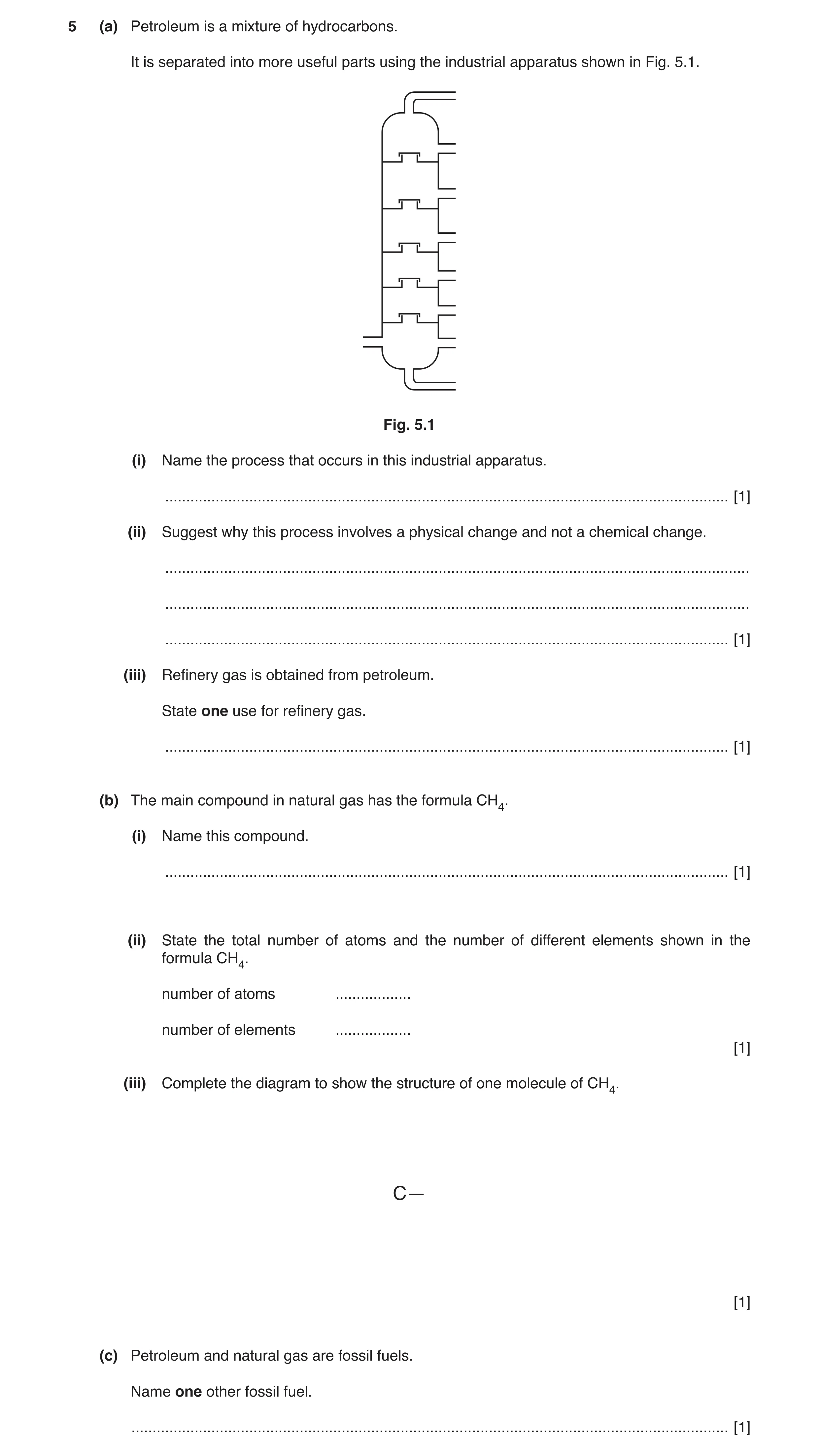
5 (a) Petroleum is a mixture of hydrocarbons. It is separated into more useful parts using the industrial apparatus shown in Fig. 5.1. Fig. 5.1 (i) Name the process that occurs in this industrial apparatus. … [1] (ii) Suggest why this process involves a physical change and not a chemical change. … … … [1] (iii) Refinery gas is obtained from petroleum. State one use for refinery gas. … [1] (b) The main compound in natural gas has the formula CH4. (i) Name this compound. … [1] (ii) State the total number of atoms and the number of different elements shown in the formula CH4. number of atoms … number of elements … [1] (iii) Complete the diagram to show the structure of one molecule of CH4. C— [1] (c) Petroleum and natural gas are fossil fuels. Name one other fossil fuel. … [1]
7 marks
Mark scheme: 5(a)(i) 1 5(a)(ii) no new substance made / involves only changes of state ; 1 5(a)(iii) cooking / heating allow bottling / bottled gas ; 1 5(b)(i) methane ; 1 5(b)(ii) (atoms) five / 5 and (elements) two / 2 ; 1 5(b)(iii) C atom joined to 4 H atoms by single bonds ; allow correct dot-and-cross diagrams 1 5(c) coal ; 1
This question in 0653/32 May/June 2017
Q4 · Petroleum is a mixture of hydrocarbons 0653/33 May/June 2017
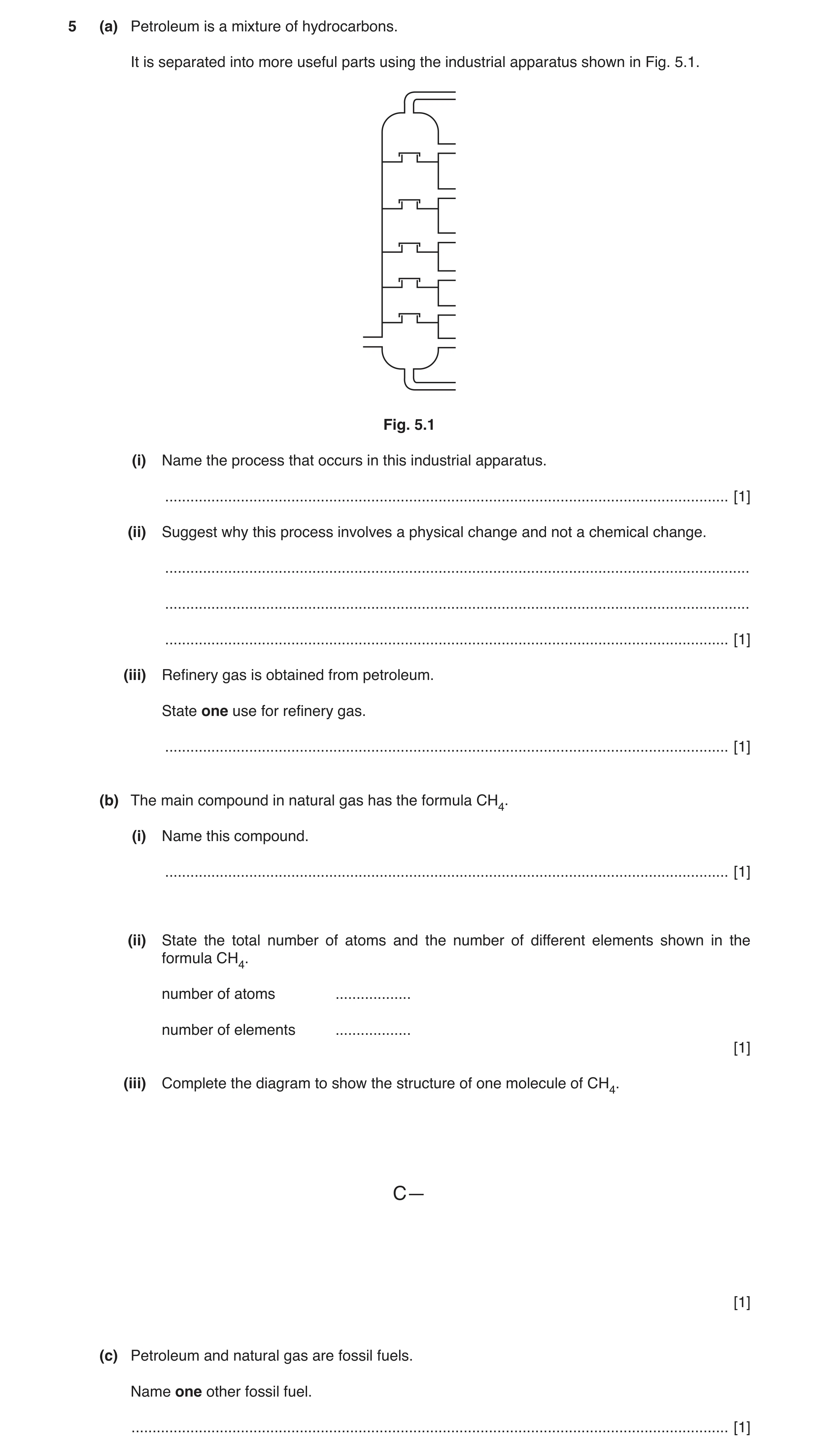
5 (a) Petroleum is a mixture of hydrocarbons. It is separated into more useful parts using the industrial apparatus shown in Fig. 5.1. Fig. 5.1 (i) Name the process that occurs in this industrial apparatus. … [1] (ii) Suggest why this process involves a physical change and not a chemical change. … … … [1] (iii) Refinery gas is obtained from petroleum. State one use for refinery gas. … [1] (b) The main compound in natural gas has the formula CH4. (i) Name this compound. … [1] (ii) State the total number of atoms and the number of different elements shown in the formula CH4. number of atoms … number of elements … [1] (iii) Complete the diagram to show the structure of one molecule of CH4. C— [1] (c) Petroleum and natural gas are fossil fuels. Name one other fossil fuel. … [1]
7 marks
Mark scheme: 5(a)(i) 1 5(a)(ii) no new substance made / involves only changes of state ; 1 5(a)(iii) cooking / heating allow bottling / bottled gas ; 1 5(b)(i) methane ; 1 5(b)(ii) (atoms) five / 5 and (elements) two / 2 ; 1 5(b)(iii) C atom joined to 4 H atoms by single bonds ; allow correct dot-and-cross diagrams 1 5(c) coal ; 1
This question in 0653/33 May/June 2017
Q5 · Ethene is a hydrocarbon 0653/31 Oct/Nov 2017
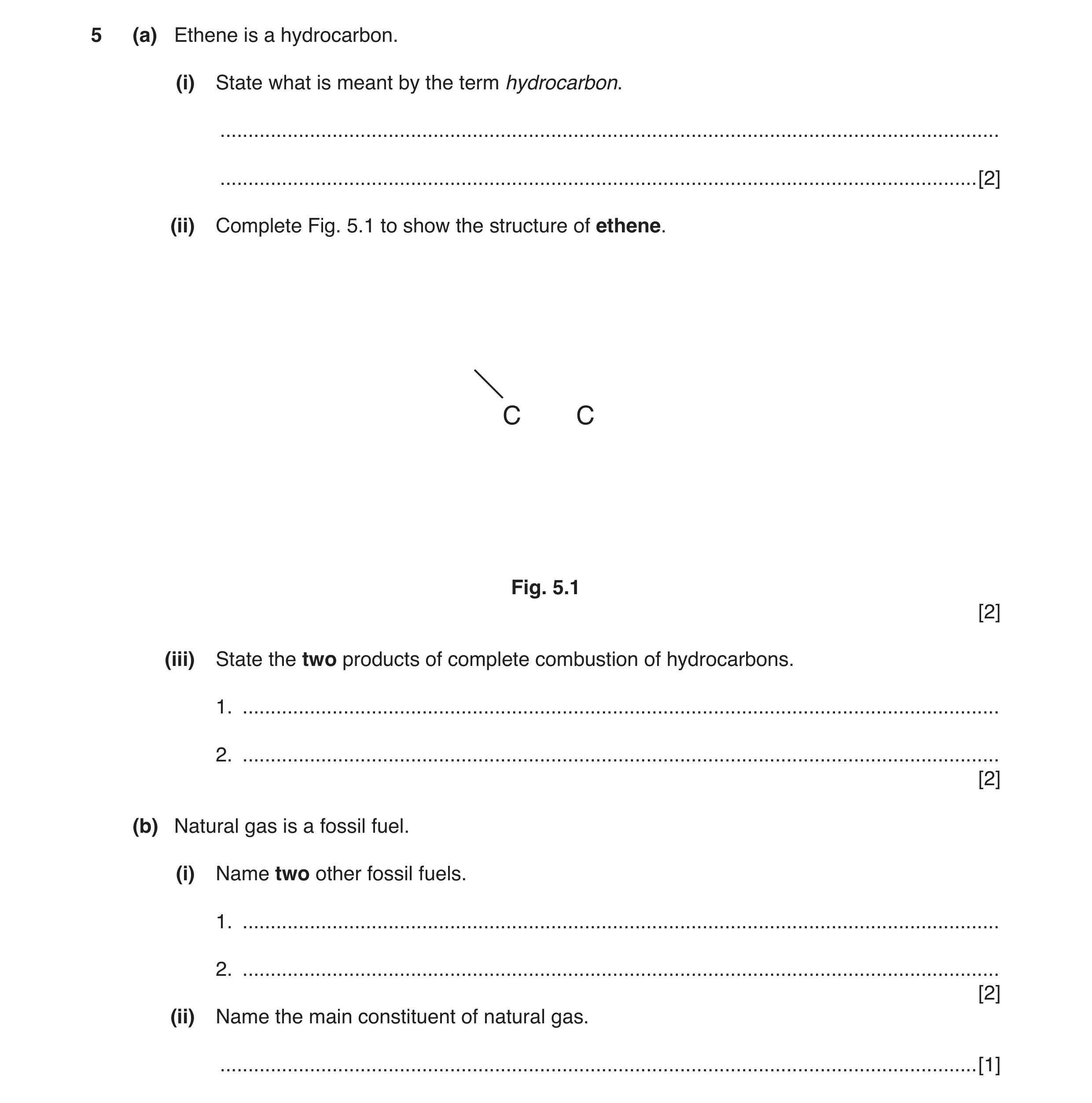
5 (a) Ethene is a hydrocarbon. (i) State what is meant by the term hydrocarbon. … … [2] (ii) Complete Fig. 5.1 to show the structure of ethene. C C Fig. 5.1 [2] (iii) State the two products of complete combustion of hydrocarbons. 1. … 2. … [2] (b) Natural gas is a fossil fuel. (i) Name two other fossil fuels. 1. … 2. … [2] (ii) Name the main constituent of natural gas. … [1]
9 marks
Mark scheme: 5(a)(i) molecule / compound of carbon and hydrogen / C and H bonded ; only (C&H) ; 2 5(a)(ii) C=C double bond ; 4 correct C–H bonds ; 2 5(a)(iii) carbon dioxide / CO2 ; water / H2O ; 2 5(b)(i) coal ; petroleum ; 2 5(b)(ii) methane ; 1 H H C C H H
This question in 0653/31 Oct/Nov 2017
Q6 · Pure water can be separated from sea water using the apparatus shown in Fig 0653/33 Oct/Nov 2017
5 (a) Pure water can be separated from sea water using the apparatus shown in Fig. 5.1. water out condenser cold water in sea water pure water heat Fig. 5.1 (i) Name this process. … [1] (ii) Describe the change in the temperature of the pure water as it passes through the condenser. … [1] (b) The purification of a water supply involves filtration and chlorination. Explain how filtration and chlorination purify the water supply. filtration … … chlorination … … [2] (c) Petroleum is separated into different fractions, as shown in Fig. 5.2. refinery gas gasoline gas oil hot petroleum Fig. 5.2 (i) State one use for refinery gas and one use for gas oil. refinery gas … gas oil … [2] (ii) Gasoline is a mixture of hydrocarbons. Explain what is meant by a hydrocarbon. … … [2] (d) The structures of six compounds are shown in Fig. 5.3. H H H O C O H C H H C C H H H H A B C H H H H C C H C C OH O H H H H H H D E F Fig. 5.3 (i) Using letters A to F, identify the two products of the complete combustion of hydrocarbons. … and … [1] (ii) Using letters A to F, identify the main constituent of natural gas. … [1]
10 marks
Mark scheme: 5(a)(i) distillation ; 1 5(a)(ii) decrease ; 1 5(b) (filtration) remove (named) solids ; (chlorination) kill microbes / bacteria / sterilizes ; 2 5(c)(i) (refinery gas) bottled gas / heating / cooking ; (gas oil) diesel fuel / diesel engines / diesel vehicles ; 2 5(c)(ii) compound / molecule containing hydrogen and carbon ; only (C and H); 2 5(d)(i) A F ; 1 5(d)(ii) B ; 1
This question in 0653/33 Oct/Nov 2017
Q7 · Petroleum is separated into more useful substances using the process shown in Fig 0653/31 Oct/Nov 2018
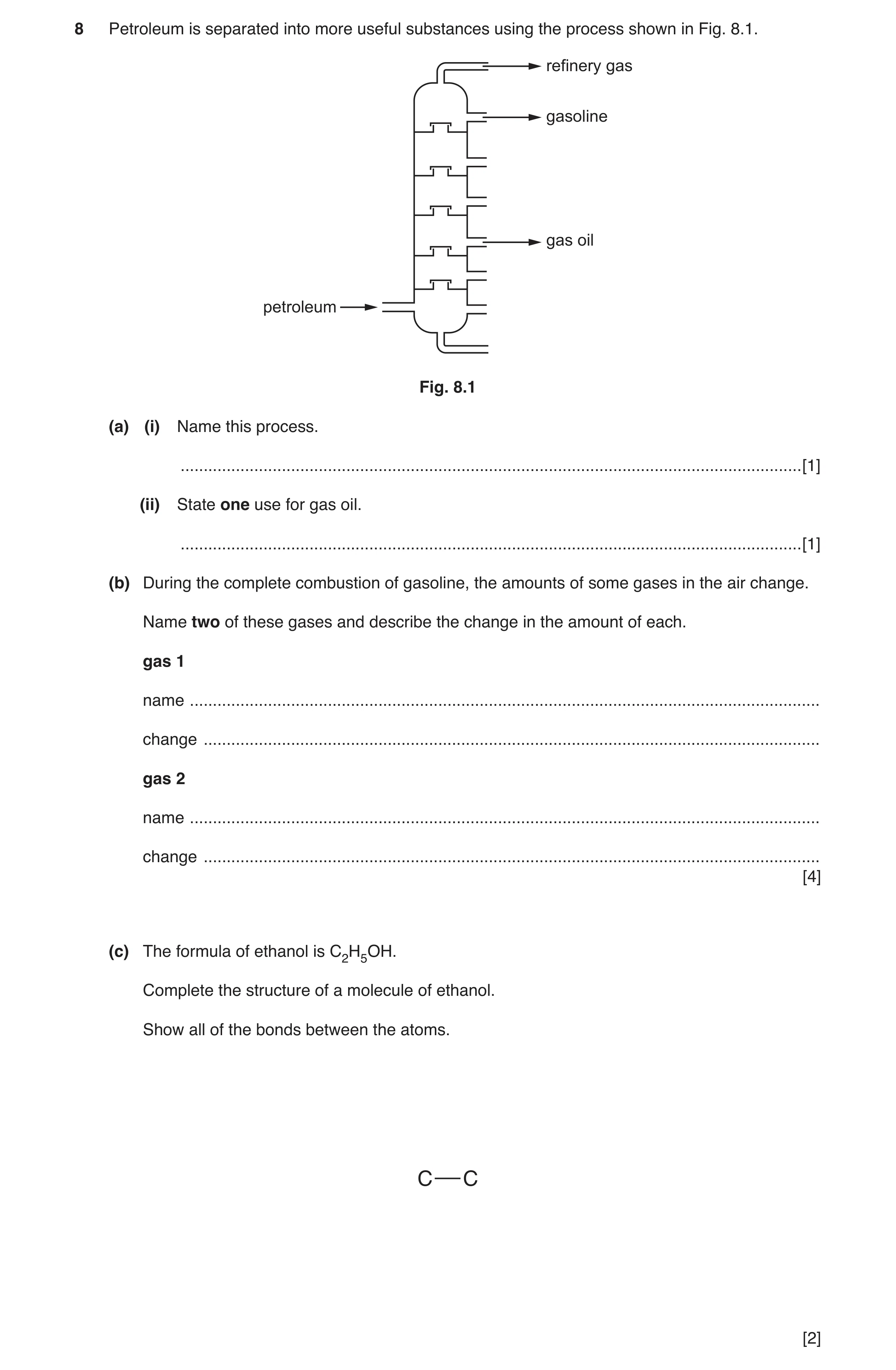
8 Petroleum is separated into more useful substances using the process shown in Fig. 8.1. refinery gas gasoline gas oil petroleum Fig. 8.1 (a) (i) Name this process. … [1] (ii) State one use for gas oil. … [1] (b) During the complete combustion of gasoline, the amounts of some gases in the air change. Name two of these gases and describe the change in the amount of each. gas 1 name … change … gas 2 name … change … [4] (c) The formula of ethanol is C2H5OH. Complete the structure of a molecule of ethanol. Show all of the bonds between the atoms. C C [2]
8 marks
Mark scheme: 8(a)(i) fractional distillation ; 1 8(a)(ii) fuel (in diesel engines) ; 1 8(b) any two gases of: name oxygen ; change decrease ; or name carbon dioxide ; change increase ; or name water (vapour) ; change increase ; 2nd mark dependent on correct gas named Max 4 4 8(c) correct arrangement of atoms ; all (single) bonds shown correctly ; 2
This question in 0653/31 Oct/Nov 2018
Q8 · Natural gas and coal are fossil fuels 0653/32 Oct/Nov 2018
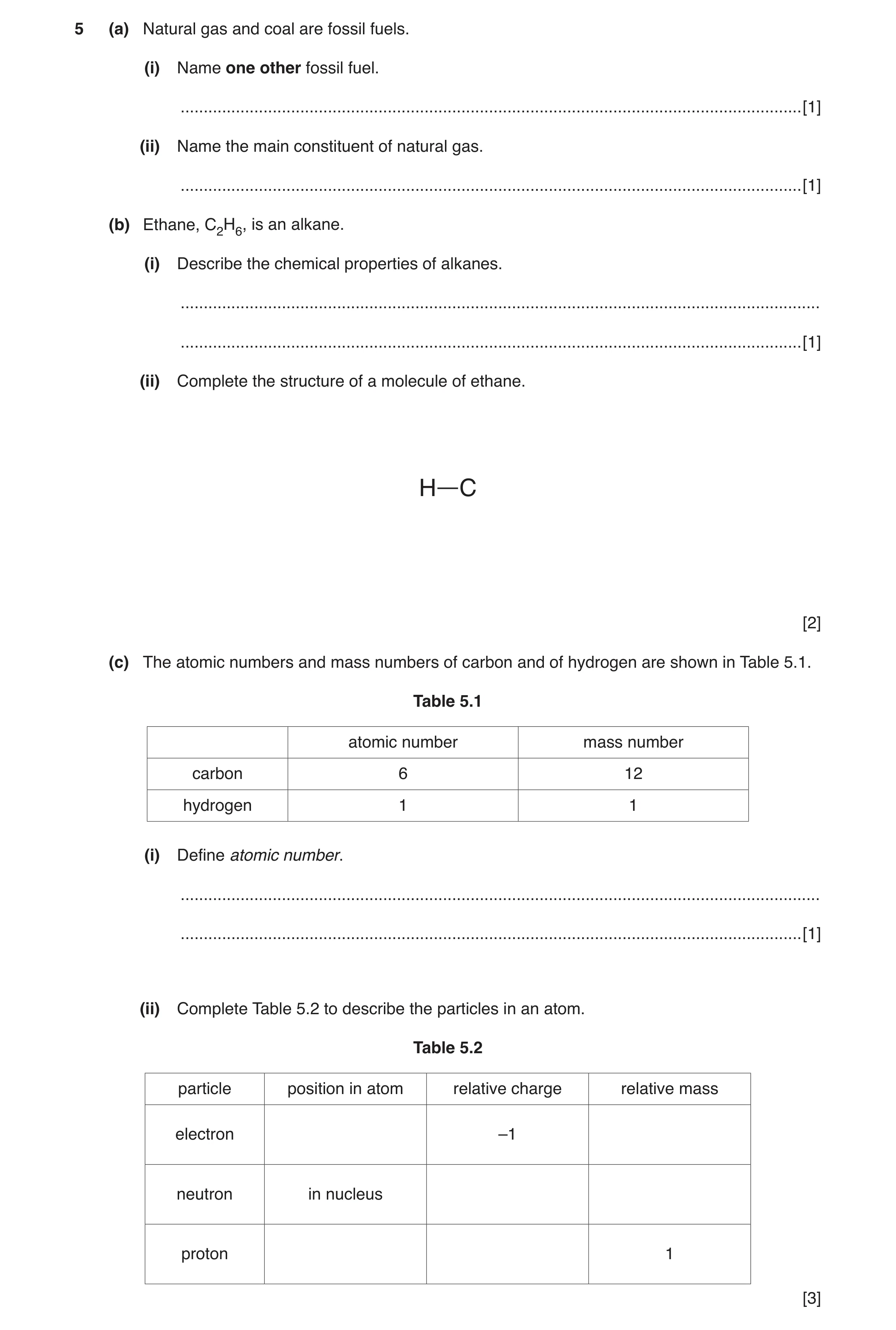
5 (a) Natural gas and coal are fossil fuels. (i) Name one other fossil fuel. … [1] (ii) Name the main constituent of natural gas. … [1] (b) Ethane, C2H6, is an alkane. (i) Describe the chemical properties of alkanes. … … [1] (ii) Complete the structure of a molecule of ethane. H C [2] (c) The atomic numbers and mass numbers of carbon and of hydrogen are shown in Table 5.1. Table 5.1 atomic number mass number carbon 6 12 hydrogen 1 1 (i) Define atomic number. … … [1] (ii) Complete Table 5.2 to describe the particles in an atom. Table 5.2 particle position in atom relative charge relative mass electron –1 neutron in nucleus proton 1 [3]
9 marks
Mark scheme: 5(a)(i) petroleum ; 1 5(a)(ii) methane ; 1 5(b)(i) unreactive / (only) burn / combust ; 1 5(b)(ii) C – C single bond ; All else correct ; 2 5(c)(i) number of protons (in an atom / nucleus) ; 1 5(c)(ii) 2 or 3 correct entries = 1 mark 4 or 5 correct entries = 2 marks All correct = 3 marks 3
This question in 0653/32 Oct/Nov 2018
Q9 · Petroleum is separated into useful fractions, as shown in Fig 0653/33 Oct/Nov 2018
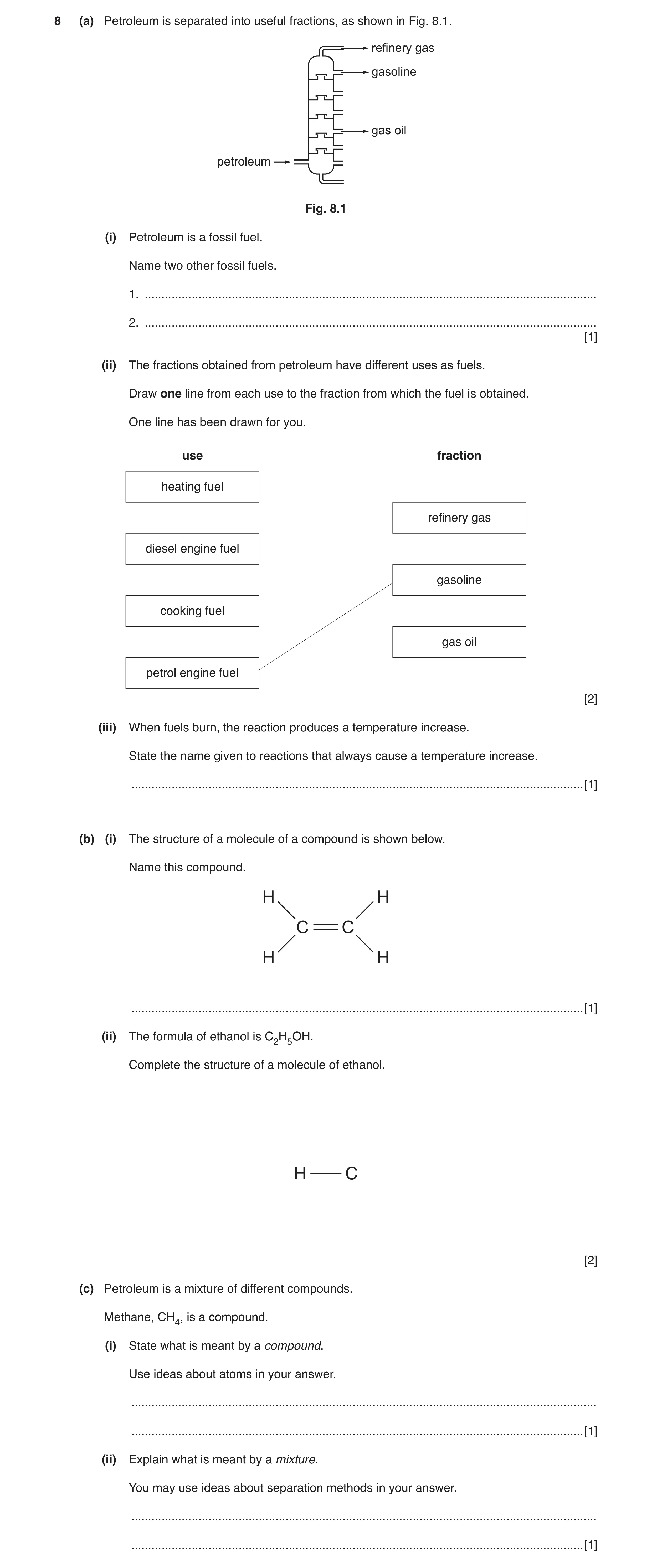
8 (a) Petroleum is separated into useful fractions, as shown in Fig. 8.1. refinery gas gasoline gas oil petroleum Fig. 8.1 (i) Petroleum is a fossil fuel. Name two other fossil fuels. 1. … 2. … [1] (ii) The fractions obtained from petroleum have different uses as fuels. Draw one line from each use to the fraction from which the fuel is obtained. One line has been drawn for you. use fraction heating fuel refinery gas diesel engine fuel gasoline cooking fuel gas oil petrol engine fuel [2] (iii) When fuels burn, the reaction produces a temperature increase. State the name given to reactions that always cause a temperature increase. … [1] (b) (i) The structure of a molecule of a compound is shown below. Name this compound. H H C C H H … [1] (ii) The formula of ethanol is C2H5OH. Complete the structure of a molecule of ethanol. H C [2] (c) Petroleum is a mixture of different compounds. Methane, CH4, is a compound. (i) State what is meant by a compound. Use ideas about atoms in your answer. … … [1] (ii) Explain what is meant by a mixture. You may use ideas about separation methods in your answer. … … [1]
9 marks
Mark scheme: 8(a)(i) coal (and) natural gas ; (either order) 1 Question Answer Marks 8(a)(ii) three correct lines = 2 marks one or two correct lines = 1 mark ; 2 8(a)(iii) exothermic ; 1 8(b)(i) ethene ; 1 8(b)(ii) C-C bond correct and C-H bonds correct ; O-H correctly bonded to C ; 2 8(c)(i) atoms of more than one element joined together ; 1 8(c)(ii) different chemical substances not joined together / can be separated by (suitable named) separation technique; 1
This question in 0653/33 Oct/Nov 2018
Q10 · Petroleum is a fossil fuel 0653/32 Feb/March 2019
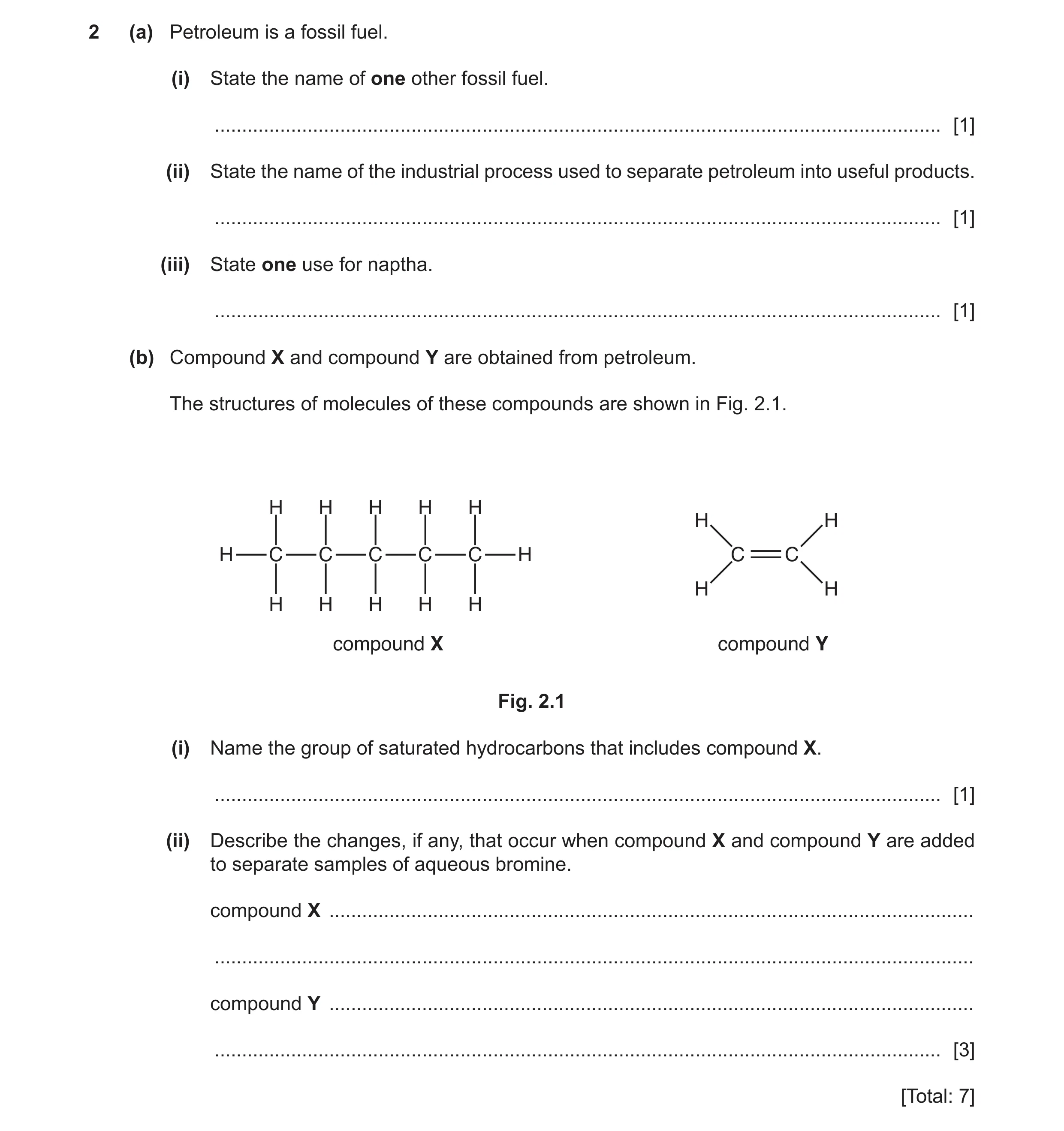
2 (a) Petroleum is a fossil fuel. (i) State the name of one other fossil fuel. … [1] (ii) State the name of the industrial process used to separate petroleum into useful products. … [1] (iii) State one use for naptha. … [1] (b) Compound X and compound Y are obtained from petroleum. The structures of molecules of these compounds are shown in Fig. 2.1. H H H H H H H H C C C C C H C C H H H H H H H compound X compound Y Fig. 2.1 (i) Name the group of saturated hydrocarbons that includes compound X. … [1] (ii) Describe the changes, if any, that occur when compound X and compound Y are added to separate samples of aqueous bromine. compound X … … compound Y … … [3] [Total: 7]
7 marks
Mark scheme: 2(a)(i) coal / natural gas ; 1 2(a)(ii) fractional distillation ; 1 2(a)(iii) feedstock / for making chemicals ; 1 2(b)(i) alkane(s) ; 1 Question Answer Marks 2(b)(ii) (compound X) no change ; (compound Y) brown / orange (to) ; colourless / decolourises ; 3
This question in 0653/32 Feb/March 2019
Q11 · The composition of clean air is shown in Fig 0653/31 May/June 2019
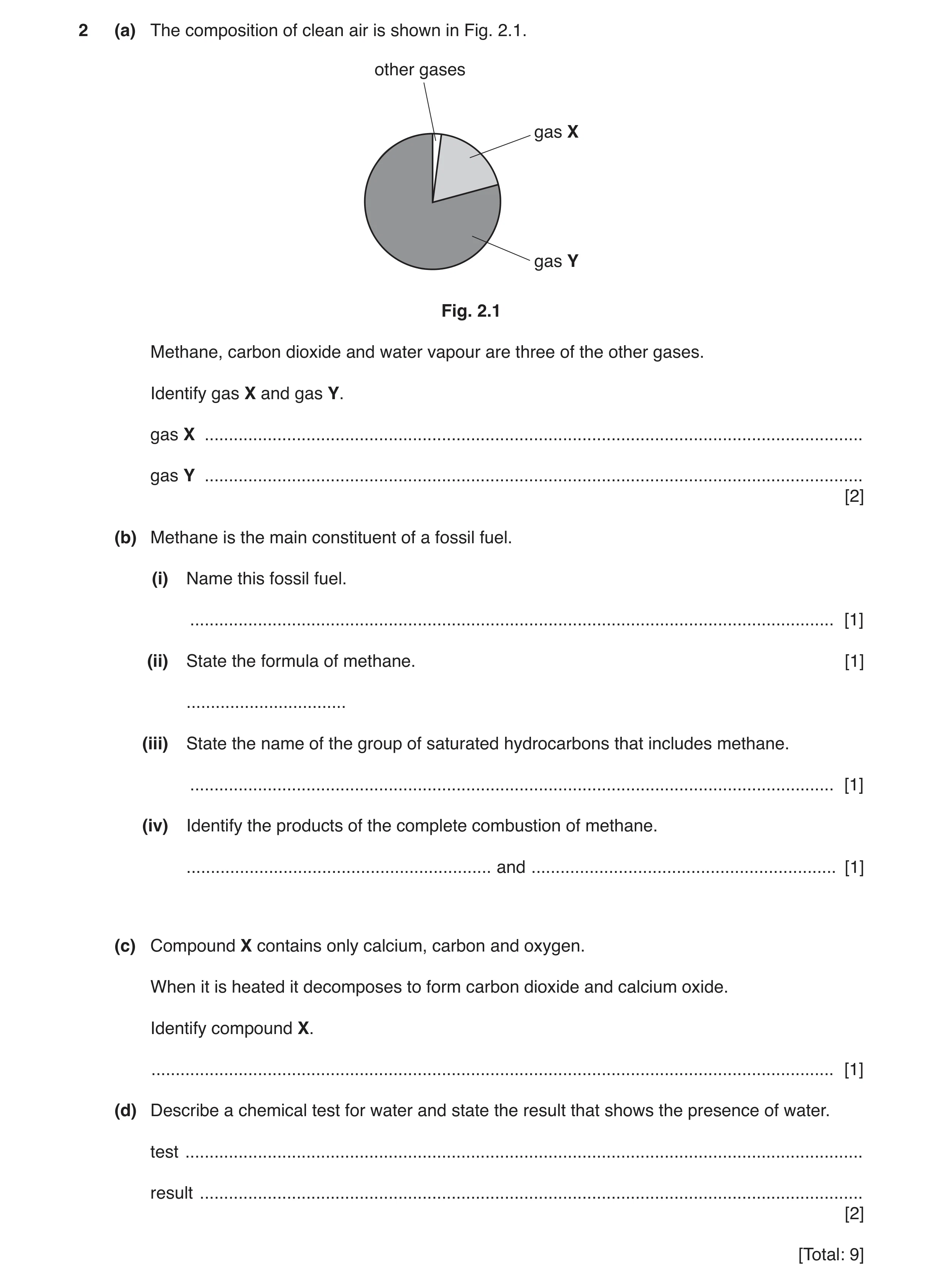
2 (a) The composition of clean air is shown in Fig. 2.1. other gases gas X gas Y Fig. 2.1 Methane, carbon dioxide and water vapour are three of the other gases. Identify gas X and gas Y. gas X … gas Y … [2] (b) Methane is the main constituent of a fossil fuel. (i) Name this fossil fuel. … [1] (ii) State the formula of methane. [1] … (iii) State the name of the group of saturated hydrocarbons that includes methane. … [1] (iv) Identify the products of the complete combustion of methane. … and … [1] (c) Compound X contains only calcium, carbon and oxygen. When it is heated it decomposes to form carbon dioxide and calcium oxide. Identify compound X. … [1] (d) Describe a chemical test for water and state the result that shows the presence of water. test … result … [2] [Total: 9]
9 marks
Mark scheme: 2(a) (gas X) oxygen / O2 ; (gas Y) nitrogen / N2 ; 2 2(b)(i) natural gas ; 1 2(b)(ii) CH4 ; 1 2(b)(iii) alkane ; 1 2(b)(iv) carbon dioxide / CO2 and water / H2O ; 1 Question Answer Marks 2(c) calcium carbonate / CaCO3 ; 1 2(d) (test) (anhydrous) copper ((II)) sulfate ; (result) turns (from white to) blue ; or (test) (anhydrous) cobalt ((II)) chloride ; (result) turns (from blue to) pink / red ; 2
This question in 0653/31 May/June 2019
Q12 · Refinery gas, gasoline and gas oil are fuels obtained from petroleum in the process shown… 0653/32 Feb/March 2020
5 Refinery gas, gasoline and gas oil are fuels obtained from petroleum in the process shown in Fig. 5.1. refinery gas gasoline gas oil petroleum Fig. 5.1 (a) Suggest one use for bottled refinery gas fuel. … [1] (b) Petroleum is a mixture that contains alkanes. Alkanes are saturated compounds that contain carbon and hydrogen atoms only. The complete combustion of alkanes forms water and one other compound. (i) Name the type of compound that contains carbon and hydrogen atoms only. … [1] (ii) Identify one other compound that is formed during the complete combustion of alkanes. … [1] (iii) Describe one chemical test for water and give the positive result. test … result … [2] (c) Methane, CH4, is an alkane. The structure of a molecule of methane is shown in Fig. 5.2. H H C H H Fig. 5.2 (i) Name the type of bonding in methane. … [1] (ii) Explain how bonds form between carbon atoms and hydrogen atoms in methane. Use ideas about electrons. … … [1] (d) Ethene is an alkene. Alkenes are unsaturated compounds. (i) Describe the difference in the structure of molecules of alkenes and alkanes. Use ideas about bonds. … … [1] (ii) Name the addition polymer that forms from ethene monomer units. … [1] [Total: 9]
9 marks
Mark scheme: 5(a) heating / cooking ; 1 5(b)(i) hydrocarbon ; 1 5(b)(ii) carbon dioxide ; 1 5(b)(iii) reagent copper sulfate OR cobalt chloride ; result (white to) blue OR (blue to) pink ; result must match the reagent 2 5(c)(i) covalent ; 1 5(c)(ii) shared (pair) ; 1 5(d)(i) alkenes double (bonds) and alkanes (only) single (bonds) ; 1 5(d)(ii) poly(ethene) ; 1
This question in 0653/32 Feb/March 2020
Q13 · A liquid fuel contains atoms of carbon and hydrogen only 0653/32 May/June 2020
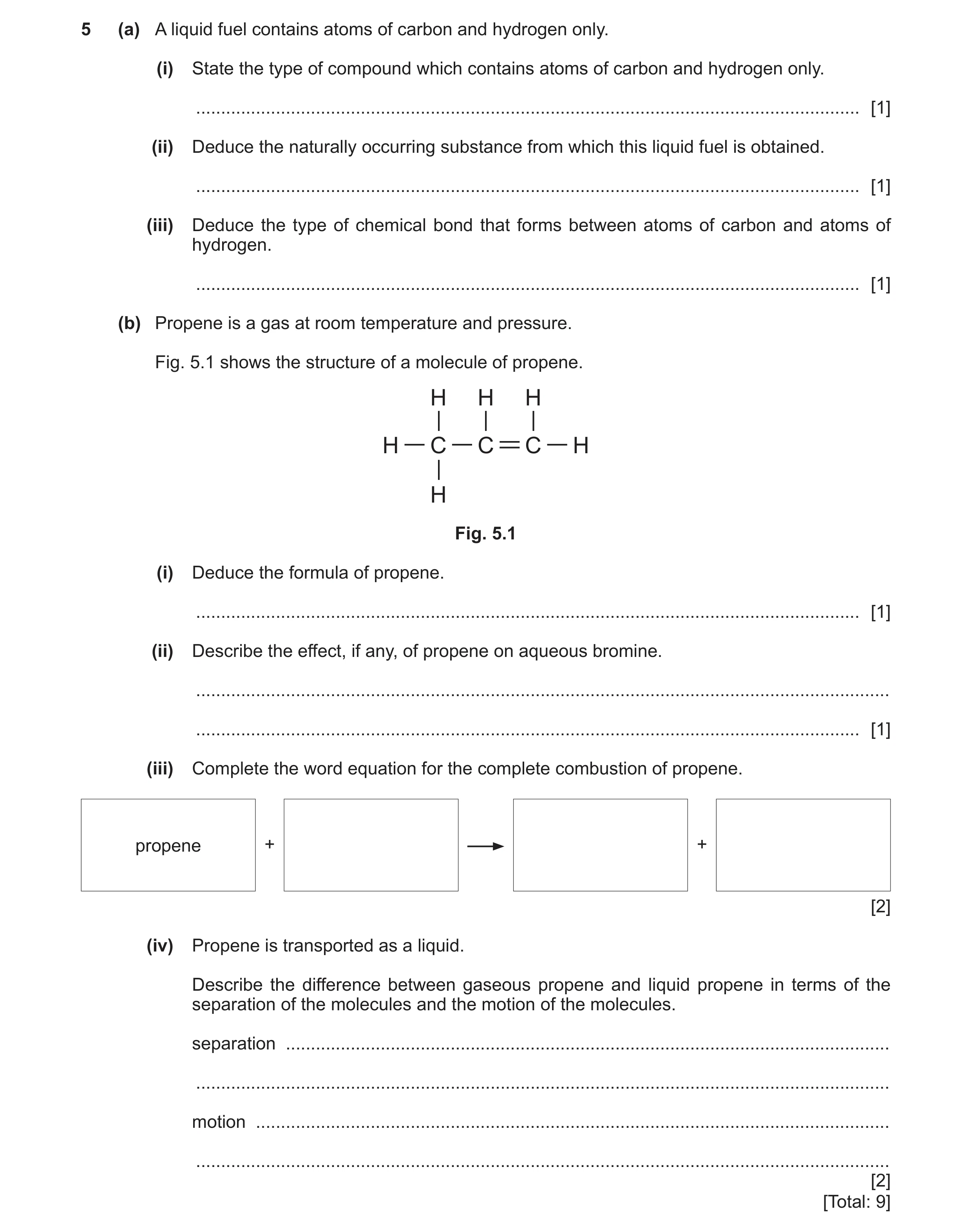
5 (a) A liquid fuel contains atoms of carbon and hydrogen only. (i) State the type of compound which contains atoms of carbon and hydrogen only. … [1] (ii) Deduce the naturally occurring substance from which this liquid fuel is obtained. … [1] (iii) Deduce the type of chemical bond that forms between atoms of carbon and atoms of hydrogen. … [1] (b) Propene is a gas at room temperature and pressure. Fig. 5.1 shows the structure of a molecule of propene. H H H H C C C H H Fig. 5.1 (i) Deduce the formula of propene. … [1] (ii) Describe the effect, if any, of propene on aqueous bromine. … … [1] (iii) Complete the word equation for the complete combustion of propene. propene + + [2] (iv) Propene is transported as a liquid. Describe the difference between gaseous propene and liquid propene in terms of the separation of the molecules and the motion of the molecules. separation … … motion … … [2] [Total: 9]
9 marks
Mark scheme: 5(a)(i) hydrocarbon ; 1 5(a)(ii) petroleum ; 1 5(a)(iii) covalent ; 1 5(b)(i) C3H6 ; 1 5(b)(ii) decolourises / (from orange to) colourless ; 1 5(b)(iii) reactants correct = 1 mark products correct = 1 mark 2 Question Answer Marks 5(b)(iv) (separation) (gas molecules) greater separation / further apart ; (motion) (gas molecules) move faster ; 2
This question in 0653/32 May/June 2020
Q14 · Natural gas and petroleum are two types of fossil fuel 0653/32 Feb/March 2021
2 Natural gas and petroleum are two types of fossil fuel. (a) Name one other fossil fuel. … [1] (b) State the main constituent of natural gas. … [1] (c) Petroleum is separated by the process shown in Fig. 2.1. refinery gas gasoline naphtha gas oil petroleum bitumen Fig. 2.1 (i) Name this process. … [1] (ii) State one use for bitumen. … [1] (d) Ethane and ethene are both hydrocarbons. Ethane is an alkane. Ethene is an alkene. (i) Two compounds are made during the complete combustion of ethane and of ethene. Water is one of these compounds. Identify the other compound. … [1] (ii) Describe one difference between molecules of ethane and molecules of ethene. … … [1] (e) The structure of a molecule of another hydrocarbon is shown in Fig. 2.2. H H H H C C C H H H H Fig. 2.2 Deduce the formula of this hydrocarbon. … [1] [Total: 7]
7 marks
Mark scheme: 2(a) coal ; 1 2(b) methane / CH4 ; 1 2(c)(i) fractional distillation ; 1 2(c)(ii) (for making) roads ; 1 2(d)(i) carbon dioxide / CO2 ; 1 2(d)(ii) ethene, is unsaturated / contains double bonds ; 1 2(e) C3H8 ; 1
This question in 0653/32 Feb/March 2021
Q15 · The structures of ethane and of ethene are shown in Fig 0653/32 May/June 2021
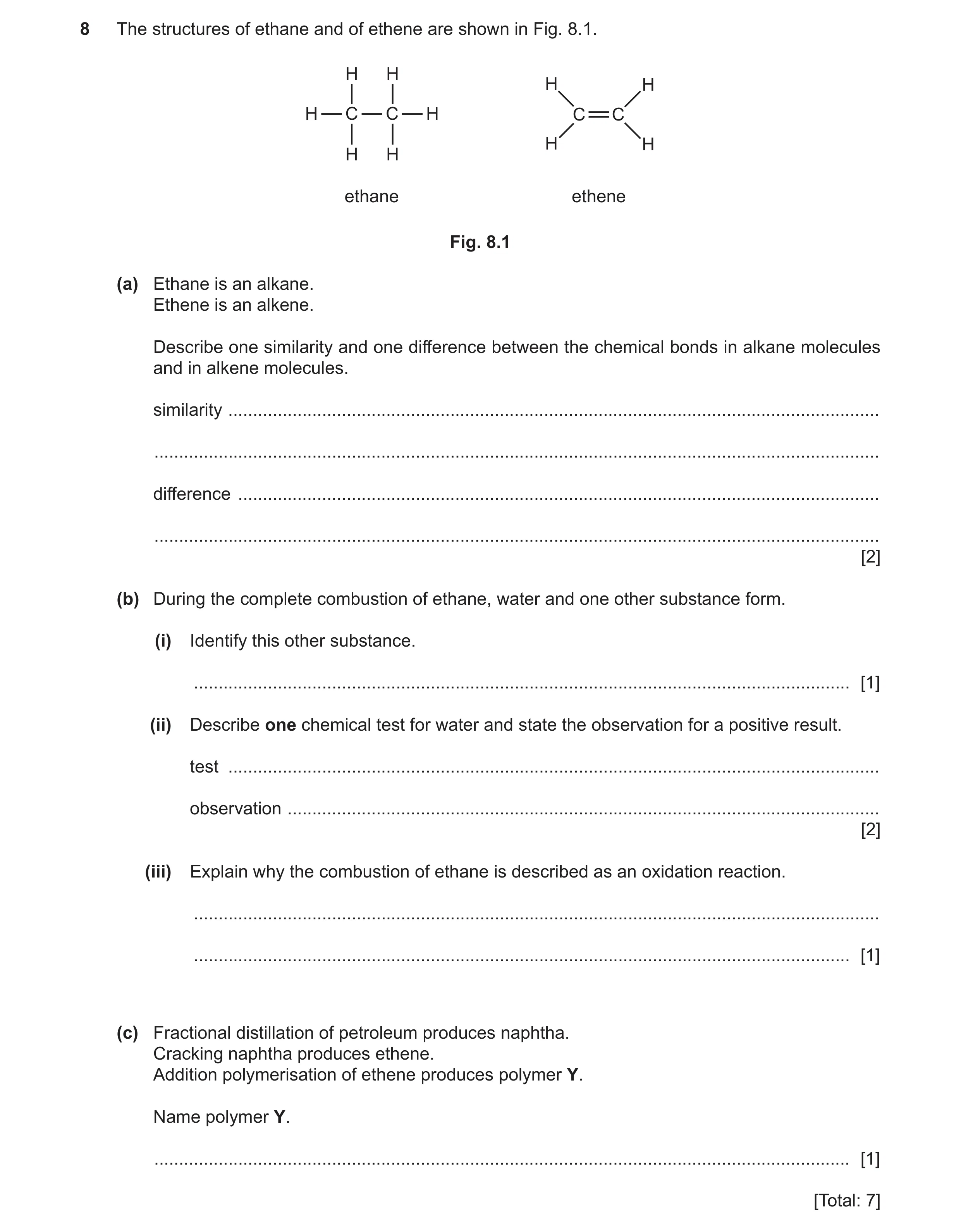
8 The structures of ethane and of ethene are shown in Fig. 8.1. H H H H H C C H C C H H H H ethane ethene Fig. 8.1 (a) Ethane is an alkane. Ethene is an alkene. Describe one similarity and one difference between the chemical bonds in alkane molecules and in alkene molecules. similarity … … difference … … [2] (b) During the complete combustion of ethane, water and one other substance form. (i) Identify this other substance. … [1] (ii) Describe one chemical test for water and state the observation for a positive result. test … observation … [2] (iii) Explain why the combustion of ethane is described as an oxidation reaction. … … [1] (c) Fractional distillation of petroleum produces naphtha. Cracking naphtha produces ethene. Addition polymerisation of ethene produces polymer Y. Name polymer Y. … [1] [Total: 7]
7 marks
Mark scheme: 8(a) similarity: covalent bonds ; difference: alkanes only single (bonds) / alkenes contain double (bonds) ; 2 8(b)(i) carbon dioxide / CO2 ; 1 Question Answer Marks 8(b)(ii) test: copper(II) sulfate OR cobalt(II) chloride ; result: white to blue blue to pink ; RESULT MUST MATCH TEST 2 8(b)(iii) (ethane / molecules / carbon / hydrogen / it) gains oxygen ; 1 8(c) poly(ethene) ; 1
This question in 0653/32 May/June 2021
Q16 · The boxes on the left of Fig 0653/31 Oct/Nov 2021
5 (a) The boxes on the left of Fig. 5.1 show some separation and collection methods. The boxes on the right of Fig. 5.1 show some substances and the mixtures they come from. Complete Fig. 5.1 to show the method used to separate and collect each substance from its mixture. Draw one line from each box on the left to one box on the right. Distillation of water from salty water has been done as an example for you. method substance and its mixture dyes chromatography ink insoluble copper oxide crystallisation aqueous copper sulfate naphtha distillation petroleum salt filtration salty water water fractional distillation salty water Fig. 5.1 [2] (b) Evaporation is also used to separate some mixtures. During evaporation, a liquid becomes a gas. (i) Explain why evaporation is a physical change and not a chemical change. … … [1] (ii) Describe how the structure of a gas is different to the structure of a liquid in terms of particle arrangement and particle motion. particle arrangement … … particle motion … … [2] (c) Copper sulfate and water are made when copper oxide reacts with an acid. State the name of this acid. … [1] (d) State one use for naphtha. … [1] [Total: 7]
7 marks
Mark scheme: 5(a) two correct ; all correct ; 2 5(b)(i) only a state change / no new substance made ; 1 5(b)(ii) particles in a gas are: ORA far apart / (more) spread out ; move more freely ; 2 5(c) sulfuric (acid) ; 1 5(d) (as a) feedstock / for making chemicals ; 1
This question in 0653/31 Oct/Nov 2021
Q17 · A salt solution is made by dissolving solid salt in water 0653/32 Feb/March 2022
5 (a) A salt solution is made by dissolving solid salt in water. (i) Describe the separation, arrangement and motion of particles in the solid salt. separation … … arrangement … … motion … … [3] (ii) An ink solution is made by dissolving a solid dye in water. The dye used to make the ink solution is a mixture of more than one coloured substance. State a method that can be used to separate the different coloured substances in the ink. … [1] (b) A concentrated sodium chloride solution is made by dissolving 35 g of solid sodium chloride in 100 cm3 of water. (i) Suggest a mass of solid sodium chloride to make 100 cm3 of dilute (less concentrated) sodium chloride solution. mass … g [1] (ii) Identify the product that forms at the anode (the positive electrode) during the electrolysis of concentrated aqueous sodium chloride using inert electrodes. … [1] (c) Petroleum is a liquid fossil fuel. (i) Name one solid fossil fuel. … [1] (ii) State the process used to separate hydrocarbons in petroleum. … [1] (iii) Describe one difference in the chemical properties of saturated hydrocarbons and unsaturated hydrocarbons. … … [1] [Total: 9]
9 marks
Mark scheme: 5(a)(i) (separation) close together ; (arrangement) regular ; (motion) vibrate / don’t move about ; 3 5(a)(ii) chromatography ; 1 5(b)(i) any value less than 35 (g) ; 1 5(b)(ii) chlorine / Cl2 ; 1 Question Answer Marks 5(c)(i) coal ; 1 5(c)(ii) fractional distillation ; 1 5(c)(iii) any one from: saturated hydrocarbons are unreactive / unsaturated hydrocarbons reactive ; unsaturated hydrocarbons react with (aqueous) bromine / decolourise bromine water ; unsaturated hydrocarbons form polymers ; 1
This question in 0653/32 Feb/March 2022
Q18 · Fossil fuels release heat energy during combustion 0653/31 May/June 2022
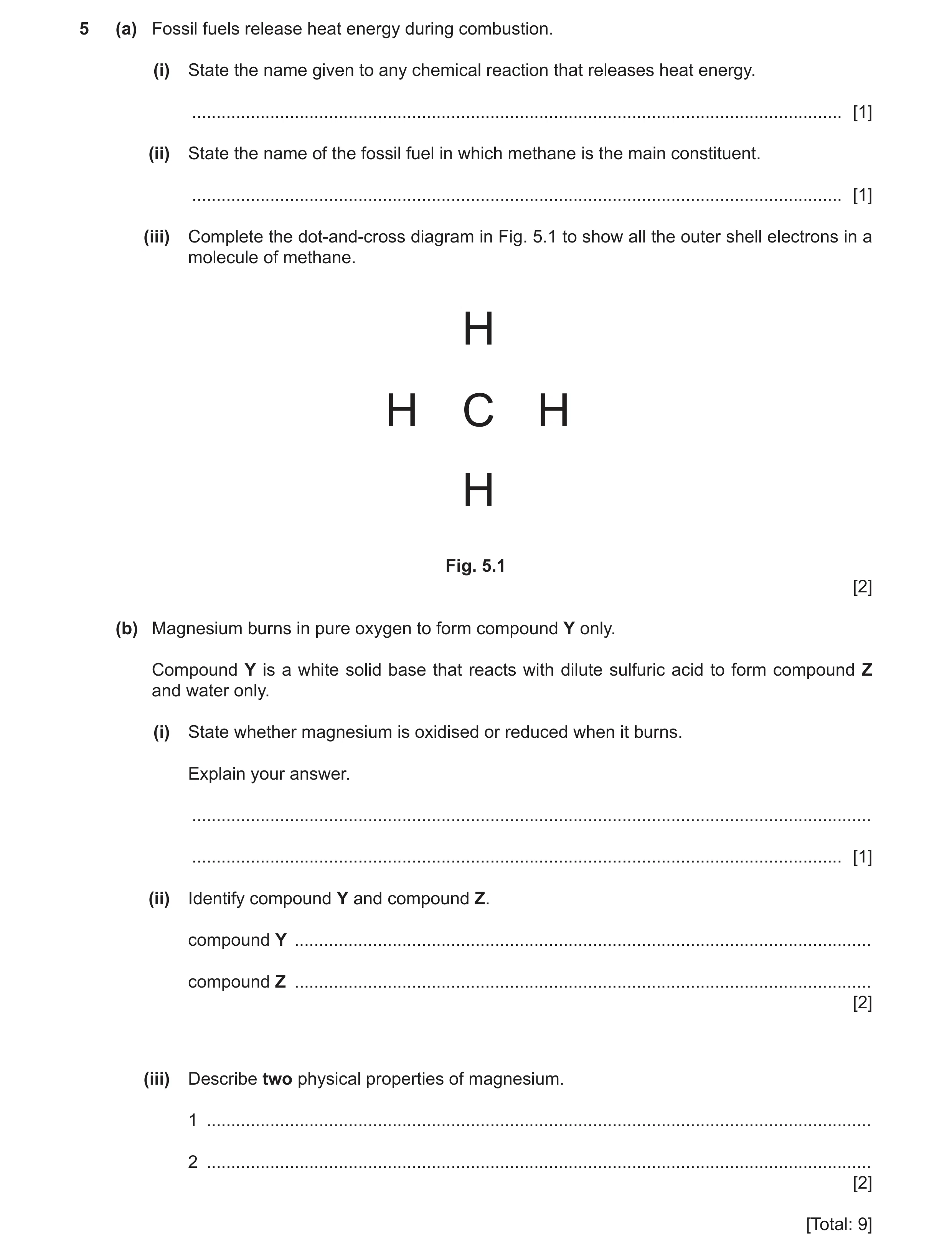
5 (a) Fossil fuels release heat energy during combustion. (i) State the name given to any chemical reaction that releases heat energy. … [1] (ii) State the name of the fossil fuel in which methane is the main constituent. … [1] (iii) Complete the dot-and-cross diagram in Fig. 5.1 to show all the outer shell electrons in a molecule of methane. H H C H H Fig. 5.1 [2] (b) Magnesium burns in pure oxygen to form compound Y only. Compound Y is a white solid base that reacts with dilute sulfuric acid to form compound Z and water only. (i) State whether magnesium is oxidised or reduced when it burns. Explain your answer. … … [1] (ii) Identify compound Y and compound Z. compound Y … compound Z … [2] (iii) Describe two physical properties of magnesium. 1 … 2 … [2] [Total: 9]
9 marks
Mark scheme: 5(a)(i) exothermic ; 1 5(a)(ii) natural gas ; 1 5(a)(iii) ;; one bonding pair correct ; four bonding pairs shown around the C atom ; 2 5(b)(i) oxidised AND gains oxygen ; 1 5(b)(ii) (compound Y) magnesium oxide / MgO ; (compound Z) magnesium sulfate / MgSO4 ; 2 5(b)(iii) any two from: high melting point ; high boiling point ; malleable ; (good) heat conductor ; (good) electrical conductor ; 2
This question in 0653/31 May/June 2022
Q19 · A student investigates the gases in air 0653/33 May/June 2022
2 A student investigates the gases in air. (a) The student leaves blue cobalt(II) chloride paper in air for a few hours. The cobalt(II) chloride paper turns pink. (i) Identify the substance in air that makes the cobalt(II) chloride paper turn pink. … [1] (ii) The student also leaves a small sample of anhydrous copper(II) sulfate in air for a few hours. State the colour change that is observed when anhydrous copper(II) sulfate is left in air for a few hours. from … to … [1] (b) The student passes clean air through one sample of limewater. Then he blows air from his lungs through another sample of limewater, as shown in Fig. 2.1. clean air from air lungs limewater Fig. 2.1 Carbon dioxide from the student’s lungs turns the limewater milky within a few seconds. The clean air takes a long time to turn the limewater milky. Suggest why the air from the student’s lungs turns the limewater milky faster than the clean air does. … … [1] (c) The student leaves damp blue litmus paper in polluted air for a few hours. The litmus paper turns red. Suggest one common pollutant in the air, other than carbon dioxide, that makes the litmus paper turn red. State one adverse effect of this pollutant on people’s health. common pollutant … adverse effect … [2] (d) The student increases the temperature of water in a beaker, as shown in Fig. 2.2. The Bunsen burner uses natural gas. water Bunsen burner Fig. 2.2 (i) State the name of the main constituent of natural gas. … [1] (ii) Name one piece of apparatus that can be used to measure the temperature of the water. … [1] (iii) State the name given to any chemical reaction that causes a temperature increase. … [1] [Total: 8]
8 marks
Mark scheme: 2(a)(i) water (vapour) / H2O ; 1 2(a)(ii) (from) white (to) blue ; 1 2(b) (air from lungs has) higher concentration of carbon dioxide ; 1 2(c) common pollutant: sulfur dioxide / SO2 OR oxide of nitrogen / NOx ; adverse effect: causes, inflammation/irritation of the respiratory system/eyes/nose/throat / causes asthma / breathing problems / causes skin irritation ; 2 2(d)(i) methane ; 1 2(d)(ii) thermometer ; 1 2(d)(iii) exothermic ; 1
This question in 0653/33 May/June 2022
Q20 · Petroleum is separated into useful fractions by the process shown in Fig 0653/33 May/June 2022
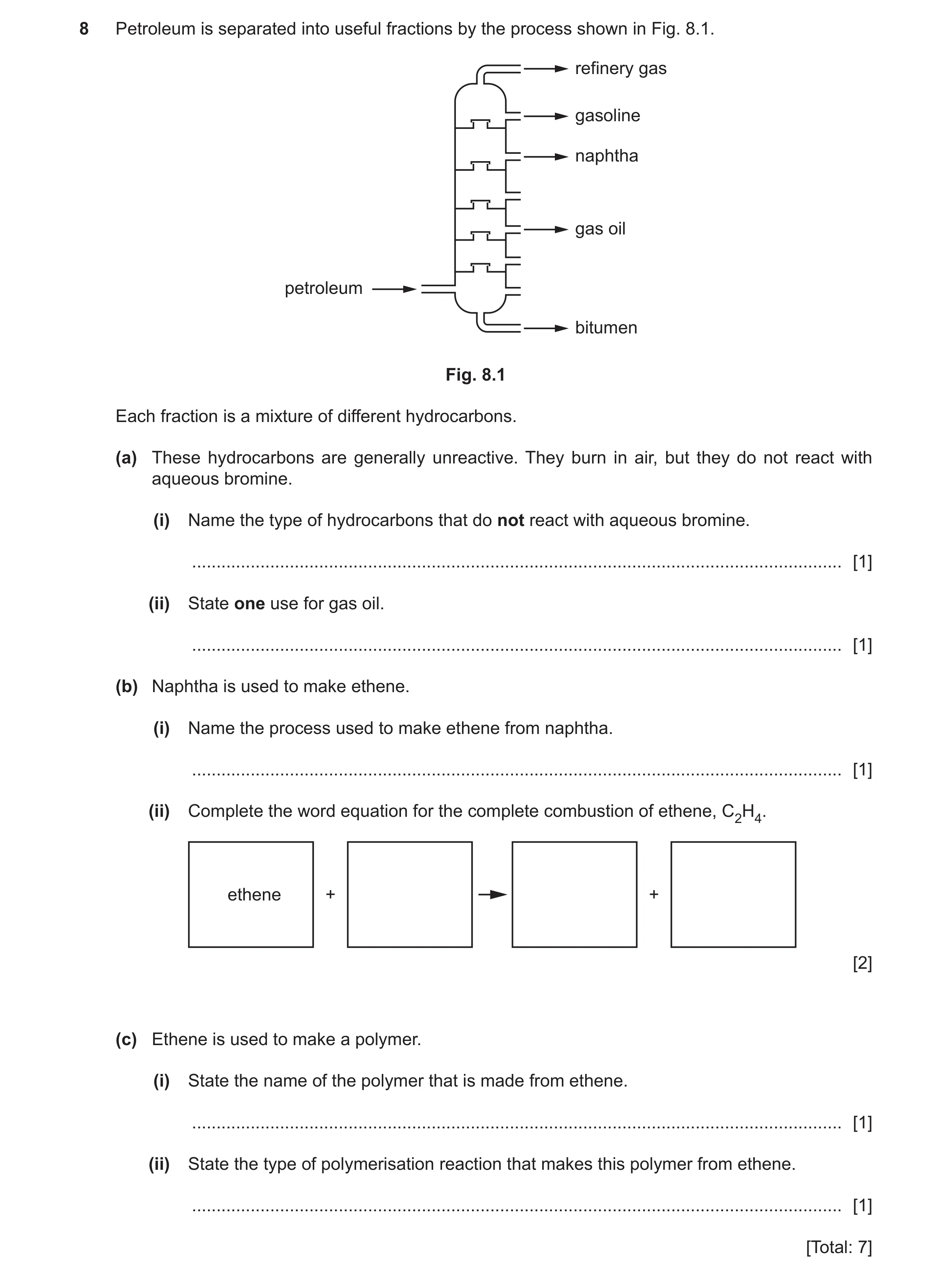
8 Petroleum is separated into useful fractions by the process shown in Fig. 8.1. refinery gas gasoline naphtha gas oil petroleum bitumen Fig. 8.1 Each fraction is a mixture of different hydrocarbons. (a) These hydrocarbons are generally unreactive. They burn in air, but they do not react with aqueous bromine. (i) Name the type of hydrocarbons that do not react with aqueous bromine. … [1] (ii) State one use for gas oil. … [1] (b) Naphtha is used to make ethene. (i) Name the process used to make ethene from naphtha. … [1] (ii) Complete the word equation for the complete combustion of ethene, C2H4. ethene + + [2] (c) Ethene is used to make a polymer. (i) State the name of the polymer that is made from ethene. … [1] (ii) State the type of polymerisation reaction that makes this polymer from ethene. … [1] [Total: 7]
7 marks
Mark scheme: 8(a)(i) alkane(s) ; 1 8(a)(ii) diesel (engine) fuel ; 1 8(b)(i) cracking ; 1 Question Answer Marks 8(b)(ii) ;; All three boxes correct (2) Two boxes correct (1) One or no boxes correct (0) 2 8(c)(i) poly(ethene) ; 1 8(c)(ii) addition (polymerisation) ; 1
This question in 0653/33 May/June 2022
Q21 · Describe a chemical test for water and state the positive result 0653/31 Oct/Nov 2022
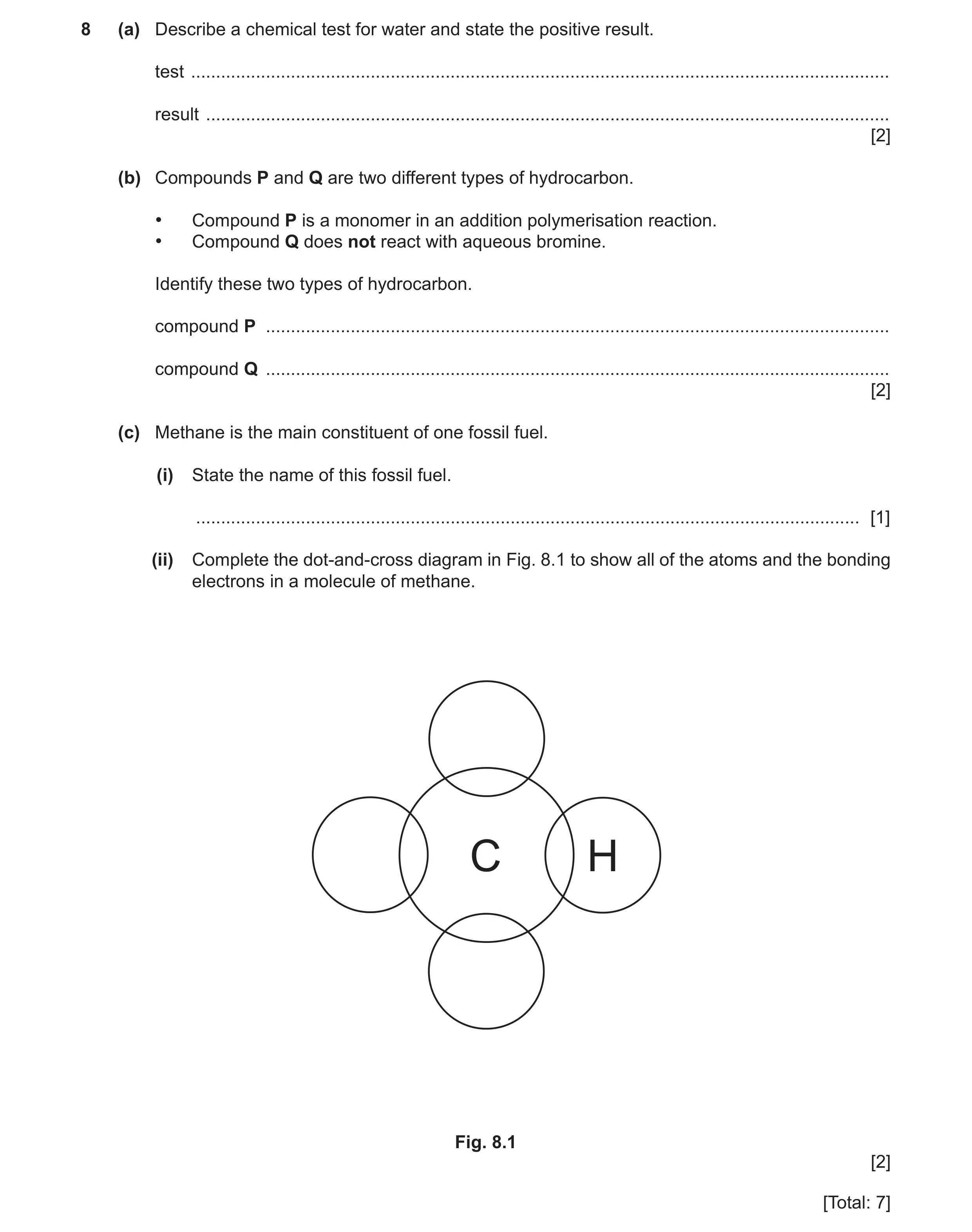
8 (a) Describe a chemical test for water and state the positive result. test … result … [2] (b) Compounds P and Q are two different types of hydrocarbon. • Compound P is a monomer in an addition polymerisation reaction. • Compound Q does not react with aqueous bromine. Identify these two types of hydrocarbon. compound P … compound Q … [2] (c) Methane is the main constituent of one fossil fuel. (i) State the name of this fossil fuel. … [1] (ii) Complete the dot-and-cross diagram in Fig. 8.1 to show all of the atoms and the bonding electrons in a molecule of methane. C H Fig. 8.1 [2] [Total: 7]
7 marks
Mark scheme: 8(a) test copper(II) sulfate ; 2 result turns (white to) blue ; OR test cobalt(II) chloride ; result turns (blue to) pink ; 8(b) compound P alkene / unsaturated ; 2 compound Q alkane / saturated ; 8(c)(i) natural gas ; 1 8(c)(ii) one pair of electrons correct ; 2 everything else correct ;
This question in 0653/31 Oct/Nov 2022
Q22 · Methane, CH4, and ethene, C2H4, are hydrocarbons 0653/32 Feb/March 2023
8 Methane, CH4, and ethene, C2H4, are hydrocarbons. (a) Methane is the main constituent of one fossil fuel. (i) State the name of this fossil fuel. … [1] (ii) State the type of chemical bonding in methane. … [1] (iii) Complete Fig. 8.1 to show the dot‑and‑cross diagram of a molecule of methane. Show only the outer shell electrons. H H C H H Fig. 8.1 [1] (iv) State the two products of the complete combustion of methane. 1 … 2 … [2] (b) Ethene is an unsaturated hydrocarbon. (i) State what is meant by the terms unsaturated and hydrocarbon. unsaturated … … hydrocarbon … … [2] (ii) State the process that produces ethene and other unsaturated hydrocarbon molecules from alkanes. … [1] (c) Hydrocarbon W turns aqueous bromine colourless. State whether hydrocarbon W is saturated or unsaturated. Give a reason for your answer. hydrocarbon W … reason … … [1] [Total: 9]
9 marks
Mark scheme: 8(a)(i) natural gas ; 1 8(a)(ii) covalent ; 1 8(a)(iii) four bonding pairs around the C atom ; 1 8(a)(iv) carbon dioxide / CO2 ; 2 water / H2O ; 8(b)(i) (unsaturated) contains a double bond ; 2 (hydrocarbon) contains carbon and hydrogen only ; 8(b)(ii) cracking ; 1 8(c) (hydrocarbon W) unsaturated AND 1 (reason) alkenes react with aqueous bromine / this shows a positive test for an alkene ;
This question in 0653/32 Feb/March 2023
Q23 · Natural gas and petroleum are fossil fuels 0653/32 Oct/Nov 2023
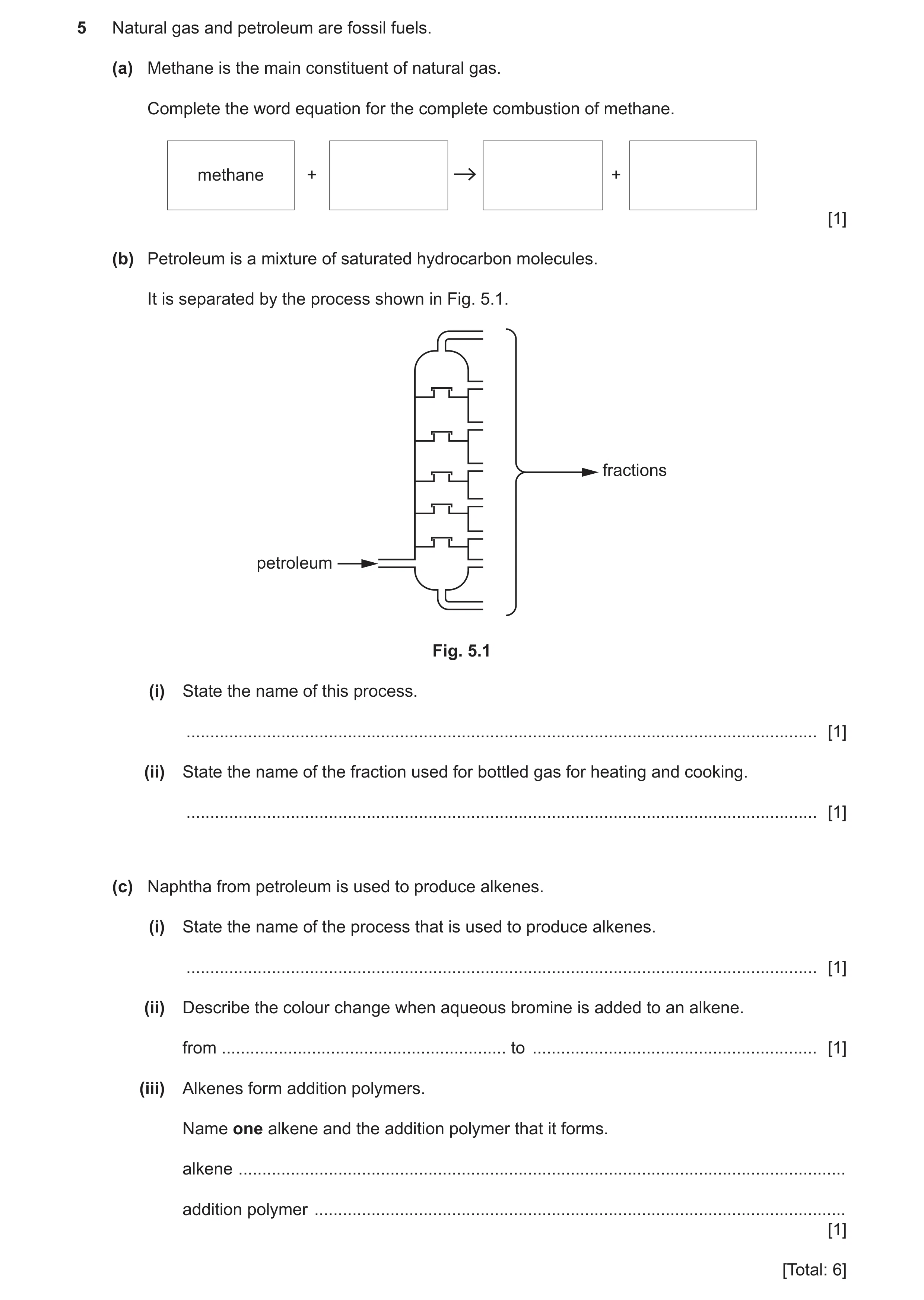
5 Natural gas and petroleum are fossil fuels. (a) Methane is the main constituent of natural gas. Complete the word equation for the complete combustion of methane. methane + + [1] (b) Petroleum is a mixture of saturated hydrocarbon molecules. It is separated by the process shown in Fig. 5.1. fractions petroleum Fig. 5.1 (i) State the name of this process. … [1] (ii) State the name of the fraction used for bottled gas for heating and cooking. … [1] (c) Naphtha from petroleum is used to produce alkenes. (i) State the name of the process that is used to produce alkenes. … [1] (ii) Describe the colour change when aqueous bromine is added to an alkene. from … to … [1] (iii) Alkenes form addition polymers. Name one alkene and the addition polymer that it forms. alkene … addition polymer … [1] [Total: 6]
6 marks
Mark scheme: 5(a) 1 all correct ; 5(b)(i) fractional distillation ; 1 5(b)(ii) refinery gas ; 1 5(c)(i) cracking ; 1 5(c)(ii) orange / brown (to) colourless ; 1 5(c)(iii) any named alkene AND its addition polymer, e.g., ethene AND poly(ethene) ; 1
This question in 0653/32 Oct/Nov 2023
Q24 · Natural gas and petroleum are fossil fuels 0653/33 Oct/Nov 2023
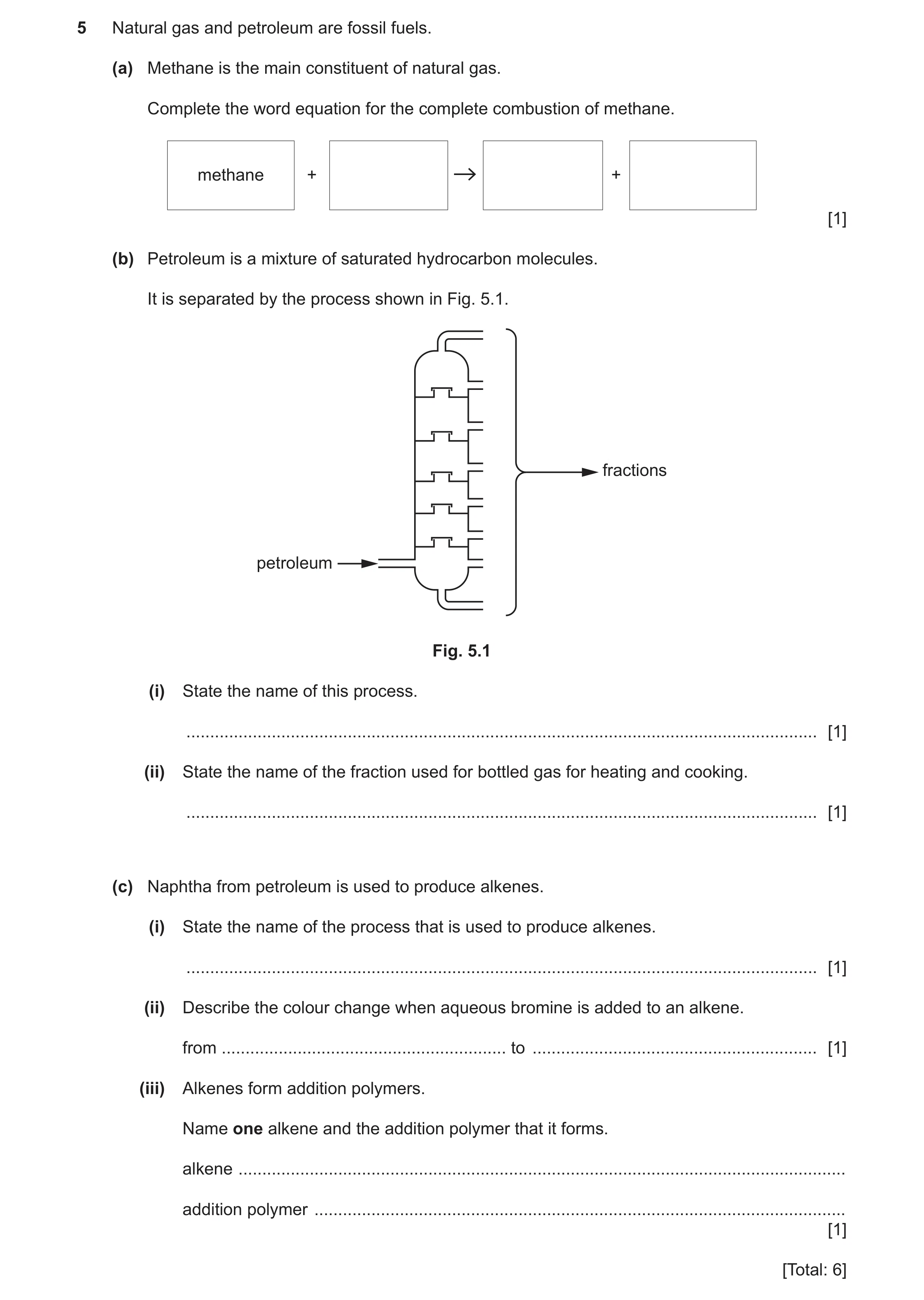
5 Natural gas and petroleum are fossil fuels. (a) Methane is the main constituent of natural gas. Complete the word equation for the complete combustion of methane. methane + + [1] (b) Petroleum is a mixture of saturated hydrocarbon molecules. It is separated by the process shown in Fig. 5.1. fractions petroleum Fig. 5.1 (i) State the name of this process. … [1] (ii) State the name of the fraction used for bottled gas for heating and cooking. … [1] (c) Naphtha from petroleum is used to produce alkenes. (i) State the name of the process that is used to produce alkenes. … [1] (ii) Describe the colour change when aqueous bromine is added to an alkene. from … to … [1] (iii) Alkenes form addition polymers. Name one alkene and the addition polymer that it forms. alkene … addition polymer … [1] [Total: 6]
6 marks
Mark scheme: 5(a) 1 all correct ; 5(b)(i) fractional distillation ; 1 5(b)(ii) refinery gas ; 1 5(c)(i) cracking ; 1 5(c)(ii) orange / brown (to) colourless ; 1 5(c)(iii) any named alkene AND its addition polymer, e.g., ethene AND poly(ethene) ; 1
This question in 0653/33 Oct/Nov 2023
Q25 · Petroleum is a mixture of hydrocarbons 0653/31 May/June 2024
5 Petroleum is a mixture of hydrocarbons. Fig. 5.1 shows the process that separates petroleum into hydrocarbons and another process, process B. refinery gas process B ethene strong heat petroleum fraction A Fig. 5.1 (a) (i) Circle the name of the process that separates petroleum into hydrocarbons. chromatography crystallisation filtration fractional distillation [1] (ii) State one use for refinery gas. … [1] (iii) State one use for fraction A. … [1] (b) Process B produces the unsaturated hydrocarbon ethene. (i) State the name of process B. … [1] (ii) Explain why ethene is described as unsaturated and as a hydrocarbon. unsaturated … … hydrocarbon … … [2] (iii) Describe a chemical test for unsaturated hydrocarbons. State the observation for a positive result. test … observation … … [2] (iv) State the type of chemical reaction that converts ethene monomer units to poly(ethene). … [1] (c) Petroleum is one example of a fossil fuel. Another fossil fuel has a greenhouse gas as its main constituent. State the name of this other fossil fuel. … [1] [Total: 10]
10 marks
Mark scheme: 5(a)(i) fractional distillation (circled) ; 1 5(a)(ii) heating / cooking ; 1 5(a)(iii) road surfaces ; 1 5(b)(i) cracking ; 1 5(b)(ii) (unsaturated) contains a (C=C) double bond ; (hydrocarbon) contains hydrogen and carbon only ; 2 5(b)(iii) (test) (aqueous) bromine ; (observation) decolourises / turns (from orange to) colourless ; 2 5(b)(iv) addition polymerisation ; 1 5(c) natural gas ; 1
This question in 0653/31 May/June 2024
Q26 · The structures of compounds P and Q are shown in Fig 0653/32 May/June 2024
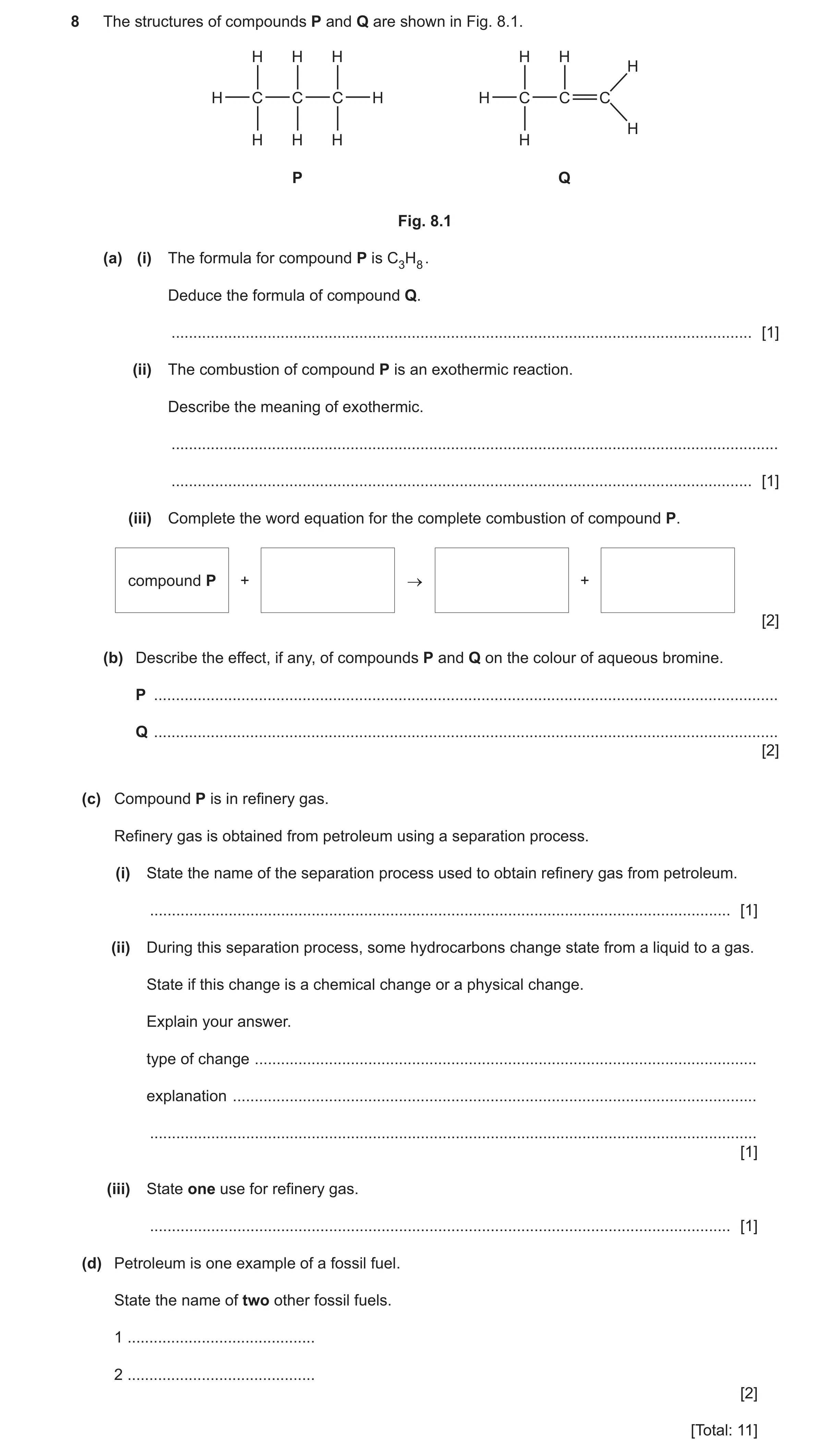
8 The structures of compounds P and Q are shown in Fig. 8.1. H H H H H H H C C C H H C C C H H H H H P Q Fig. 8.1 (a) (i) The formula for compound P is C3H8 . Deduce the formula of compound Q. … [1] (ii) The combustion of compound P is an exothermic reaction. Describe the meaning of exothermic. … … [1] (iii) Complete the word equation for the complete combustion of compound P. compound P + + [2] (b) Describe the effect, if any, of compounds P and Q on the colour of aqueous bromine. P … Q … [2] (c) Compound P is in refinery gas. Refinery gas is obtained from petroleum using a separation process. (i) State the name of the separation process used to obtain refinery gas from petroleum. … [1] (ii) During this separation process, some hydrocarbons change state from a liquid to a gas. State if this change is a chemical change or a physical change. Explain your answer. type of change … explanation … … [1] (iii) State one use for refinery gas. … [1] (d) Petroleum is one example of a fossil fuel. State the name of two other fossil fuels. 1 … 2 … [2] [Total: 11]
11 marks
Mark scheme: 8(a)(i) C3H6 ; 1 8(a)(ii) (reaction that) gives out thermal energy ; 1 8(a)(iii) ;; ;; ;; oxygen correct = (1) products correct (either order) = (1) 2 8(b) (P) stays orange / orange-brown ; (Q) decolourises / (turns) colourless ; 2 8(c)(i) fractional distillation ; 1 8(c)(ii) (type of change) physical AND (explanation) no new substance is made / can be reversed ; 1 8(c)(iii) heating / cooking ; 1 8(d) natural gas ; coal ; 2
This question in 0653/32 May/June 2024
Q27 · Complete the sentences about fuels 0653/31 Oct/Nov 2024
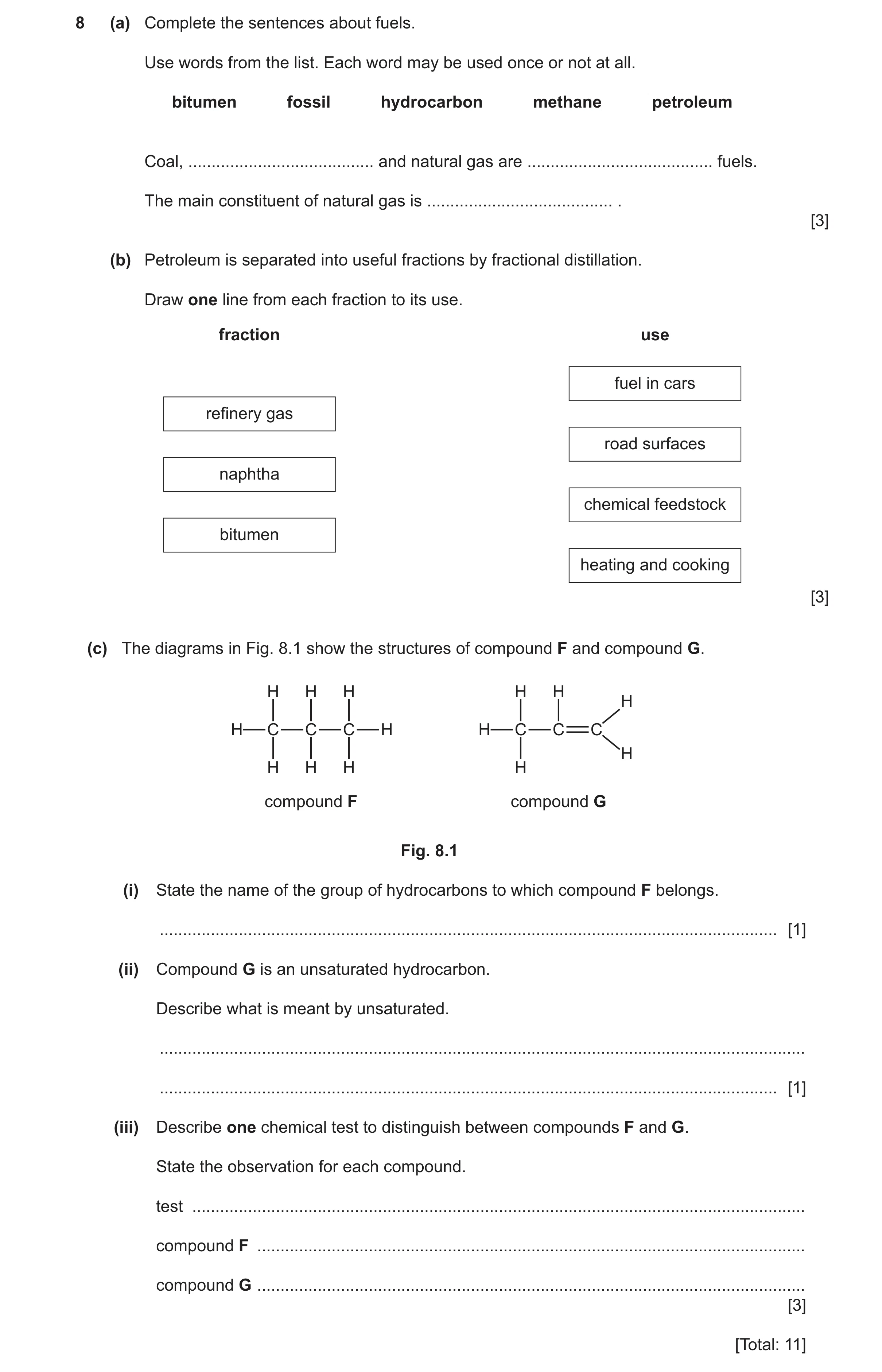
8 (a) Complete the sentences about fuels. Use words from the list. Each word may be used once or not at all. bitumen fossil hydrocarbon methane petroleum Coal, … and natural gas are … fuels. The main constituent of natural gas is … . [3] (b) Petroleum is separated into useful fractions by fractional distillation. Draw one line from each fraction to its use. fraction use fuel in cars refinery gas road surfaces naphtha chemical feedstock bitumen heating and cooking [3] (c) The diagrams in Fig. 8.1 show the structures of compound F and compound G. H H H H H H H C C C H H C C C H H H H H compound F compound G Fig. 8.1 (i) State the name of the group of hydrocarbons to which compound F belongs. … [1] (ii) Compound G is an unsaturated hydrocarbon. Describe what is meant by unsaturated. … … [1] (iii) Describe one chemical test to distinguish between compounds F and G. State the observation for each compound. test … compound F … compound G … [3] [Total: 11]
11 marks
Mark scheme: 8(a) petroleum ; 3 fossil ; methane ; 8(b) 3 fraction use fuel in cars refinery gas road surfaces naphtha chemical feedstock bitumen heating and cooking correct line for refinery gas ; correct line for naphtha ; correct line for bitumen ; 8(c)(i) alkane(s) ; 1 8(c)(ii) contains a carbon–carbon double bond ; 1 8(c)(iii) test add aqueous bromine ; 3 compound F no change ; compound G decolorises / turns (from red-orange to) colourless ;
This question in 0653/31 Oct/Nov 2024
Q28 · The percentage of gases in a sample of natural gas 0653/32 Feb/March 2025
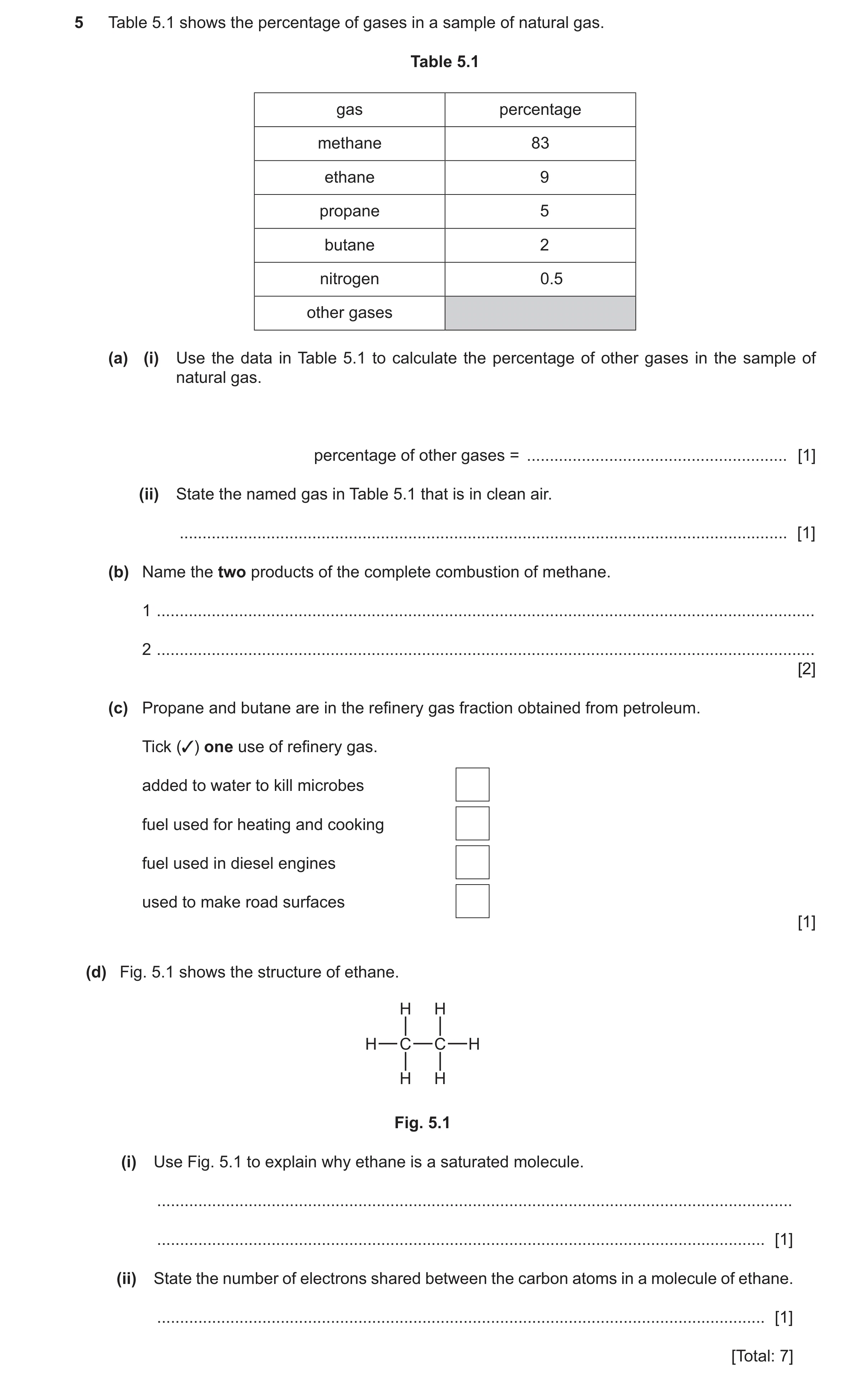
5 Table 5.1 shows the percentage of gases in a sample of natural gas. Table 5.1 gas percentage methane 83 ethane 9 propane 5 butane 2 nitrogen 0.5 other gases (a) (i) Use the data in Table 5.1 to calculate the percentage of other gases in the sample of natural gas. percentage of other gases = … [1] (ii) State the named gas in Table 5.1 that is in clean air. … [1] (b) Name the two products of the complete combustion of methane. 1 … 2 … [2] (c) Propane and butane are in the refinery gas fraction obtained from petroleum. Tick (3) one use of refinery gas. added to water to kill microbes fuel used for heating and cooking fuel used in diesel engines used to make road surfaces [1] (d) Fig. 5.1 shows the structure of ethane. H H H C C H H H Fig. 5.1 (i) Use Fig. 5.1 to explain why ethane is a saturated molecule. … … [1] (ii) State the number of electrons shared between the carbon atoms in a molecule of ethane. … [1] [Total: 7]
7 marks
Mark scheme: 5(a)(i) 0.5 (%) ; 1 5(a)(ii) nitrogen ; 1 5(b) carbon dioxide ; 2 water ; either order 5(c) fuel used for heating and cooking ; 1 more than one answer ticked = 0 marks 5(d)(i) the (C-C) bond is single / contains single bonds only ; 1 5(d)(ii) two / 2 ; 1
This question in 0653/32 Feb/March 2025
 6 / 38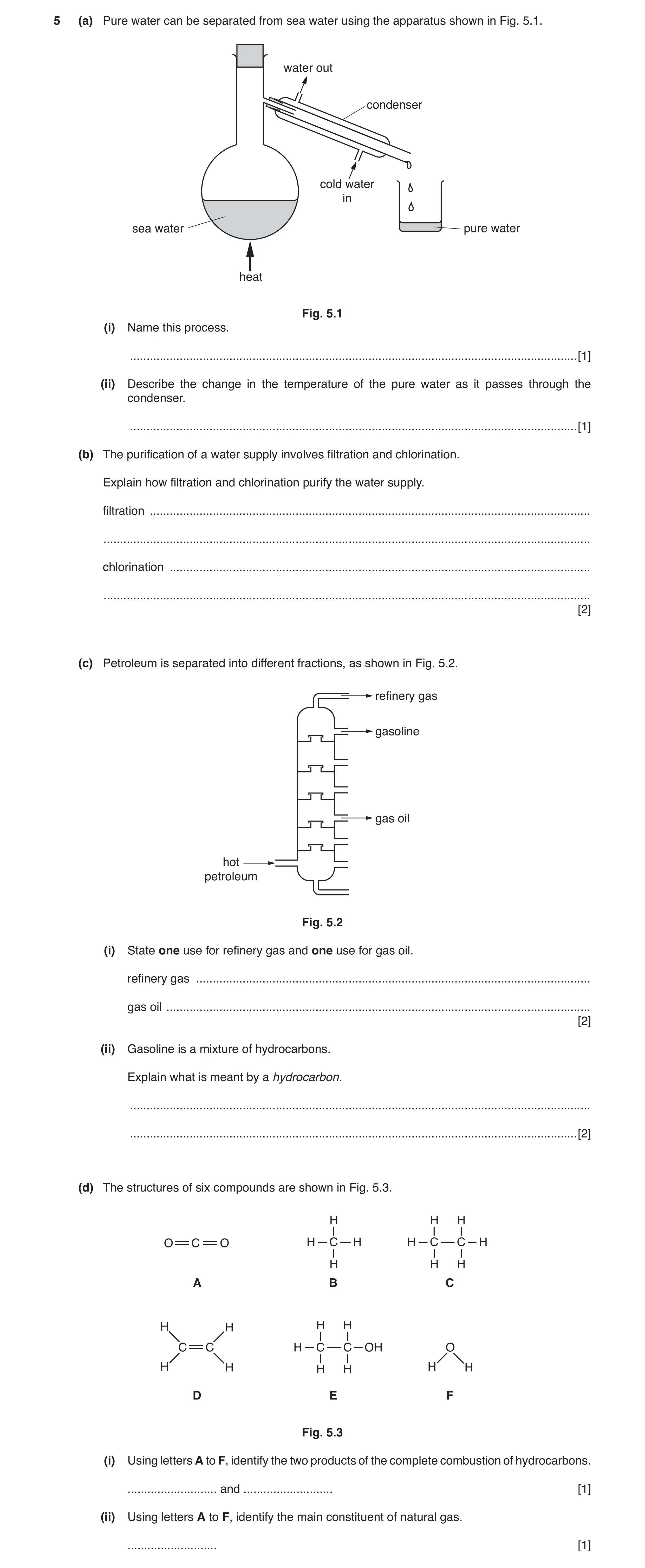
 13 / 38
 14 / 38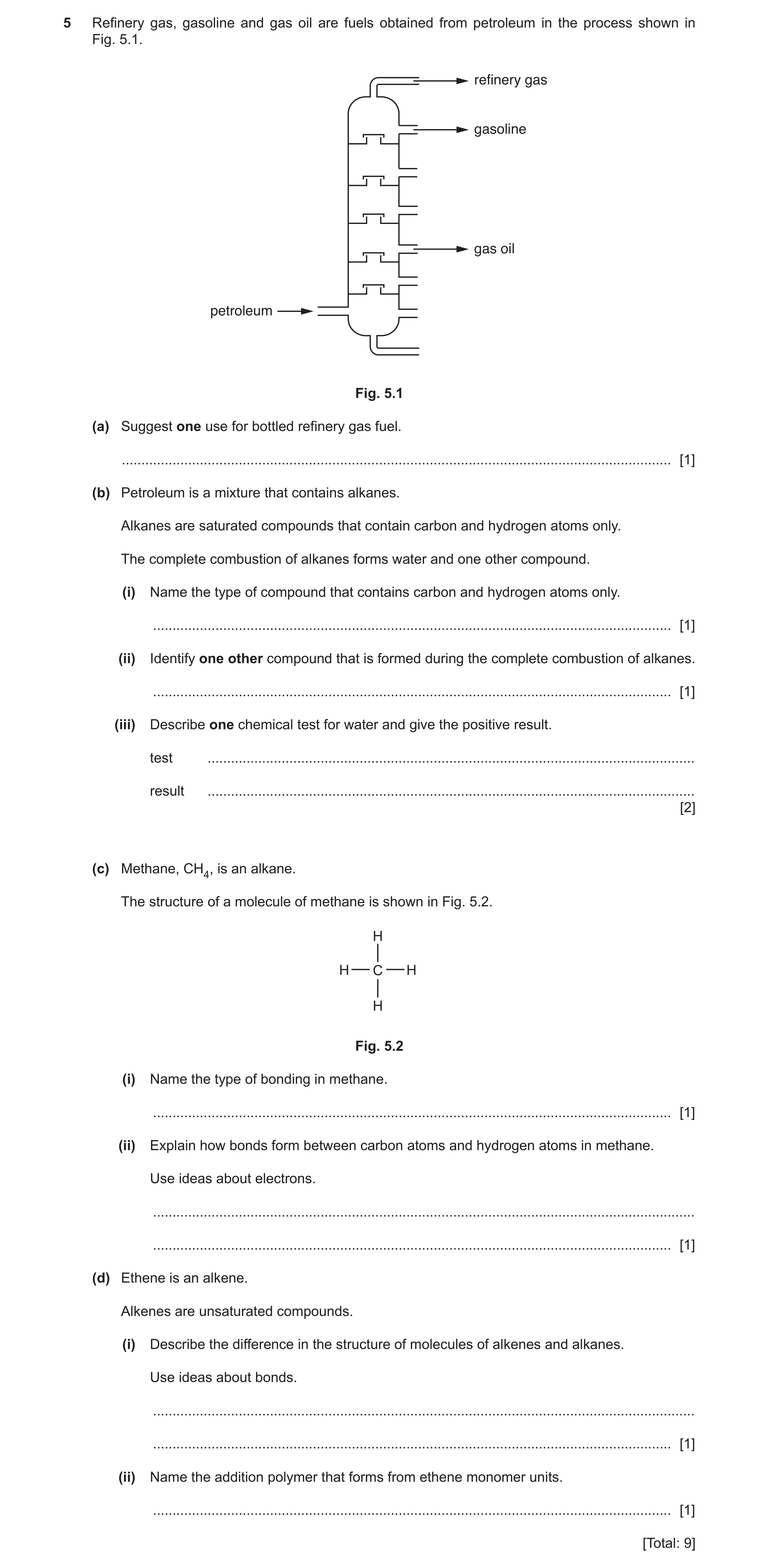
 17 / 38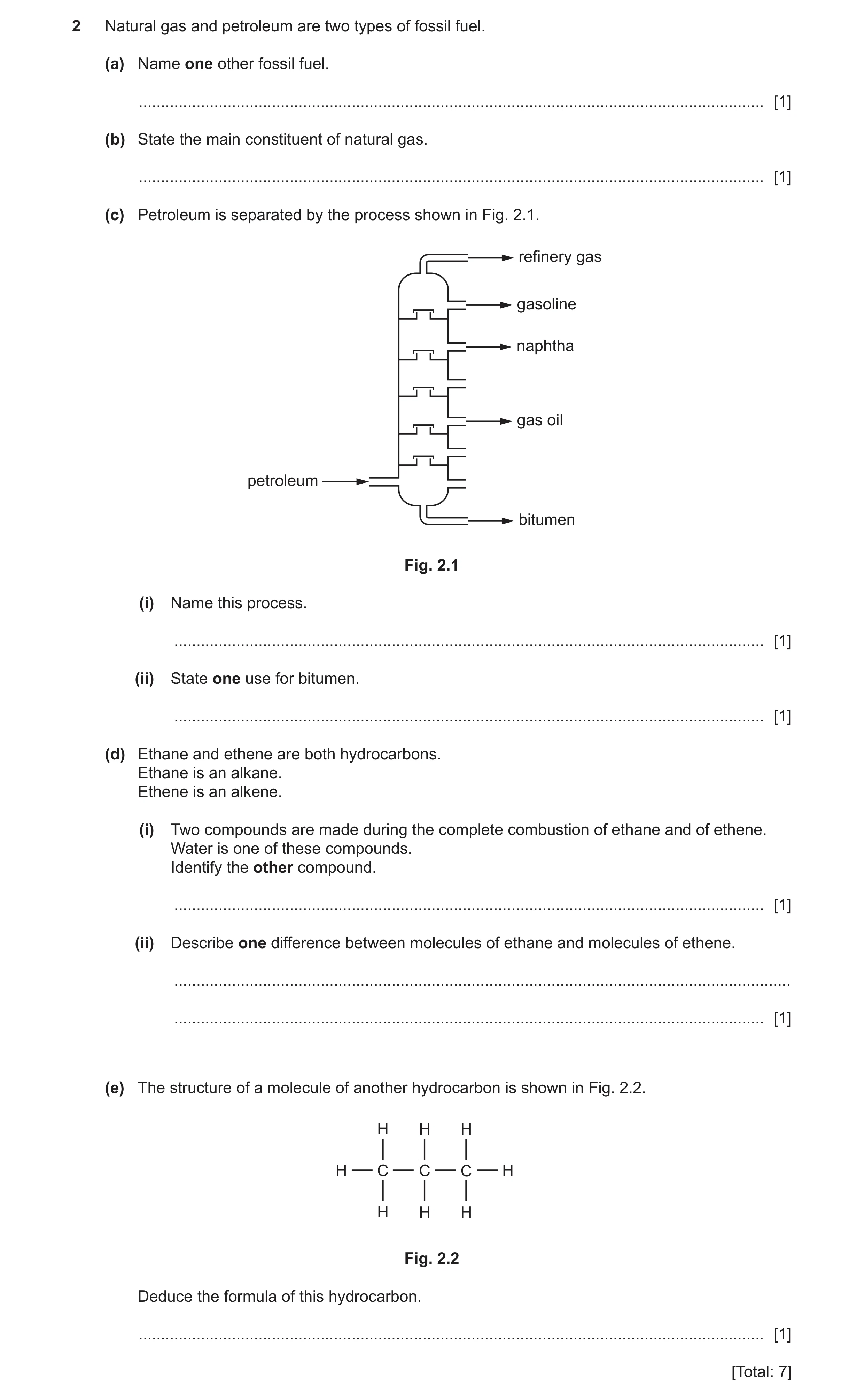
 20 / 38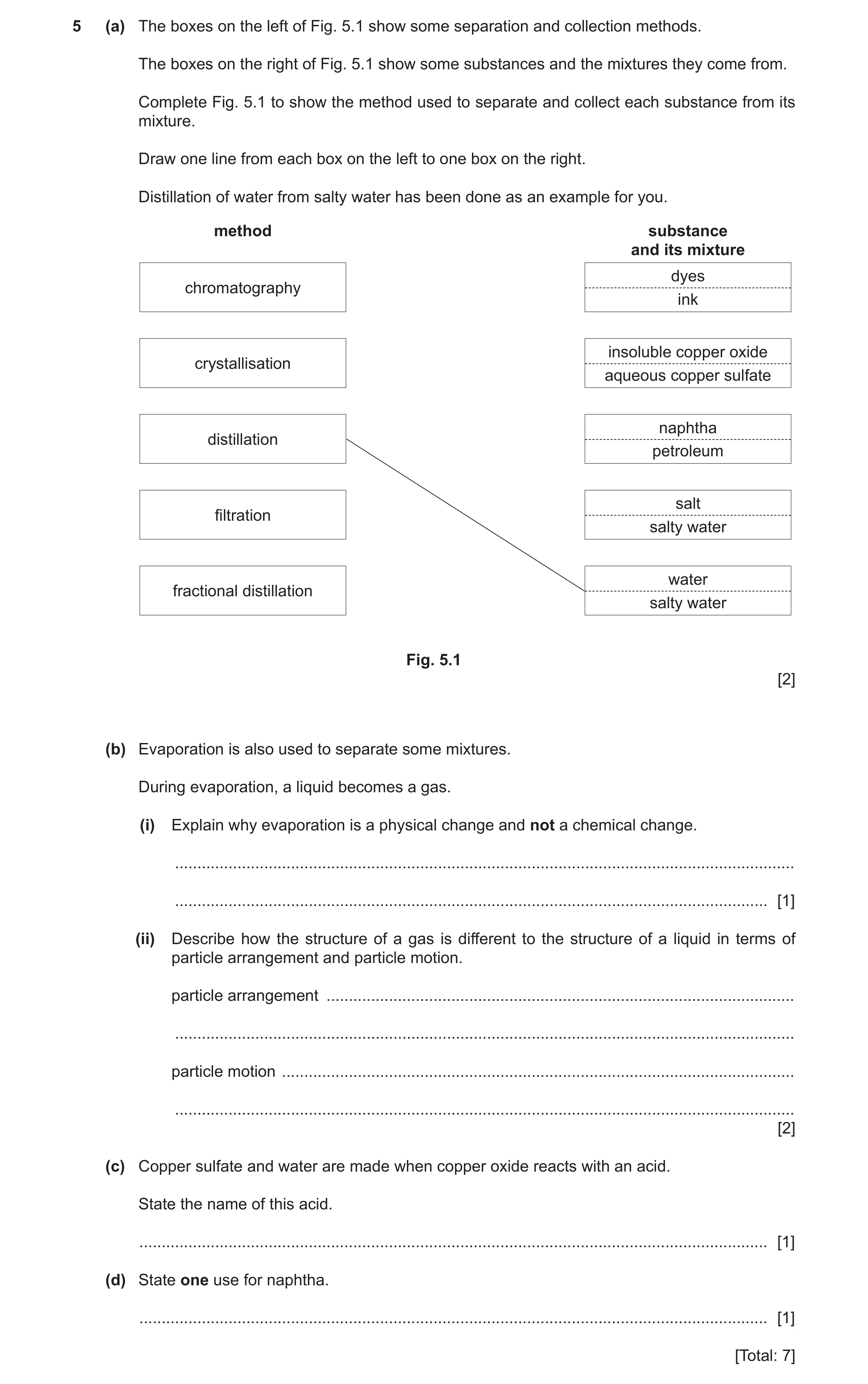
 23 / 38
 24 / 38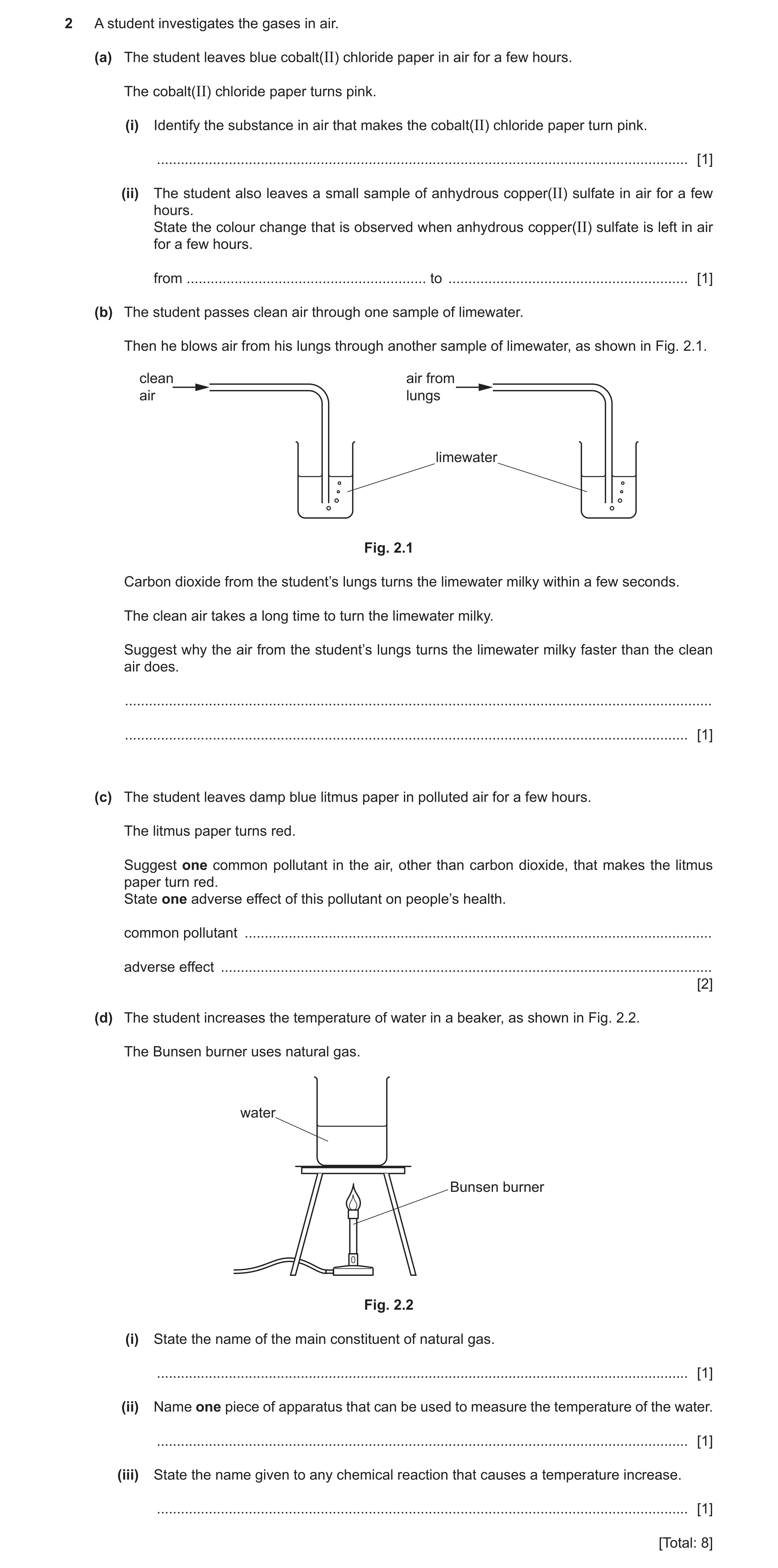
 27 / 38
 28 / 38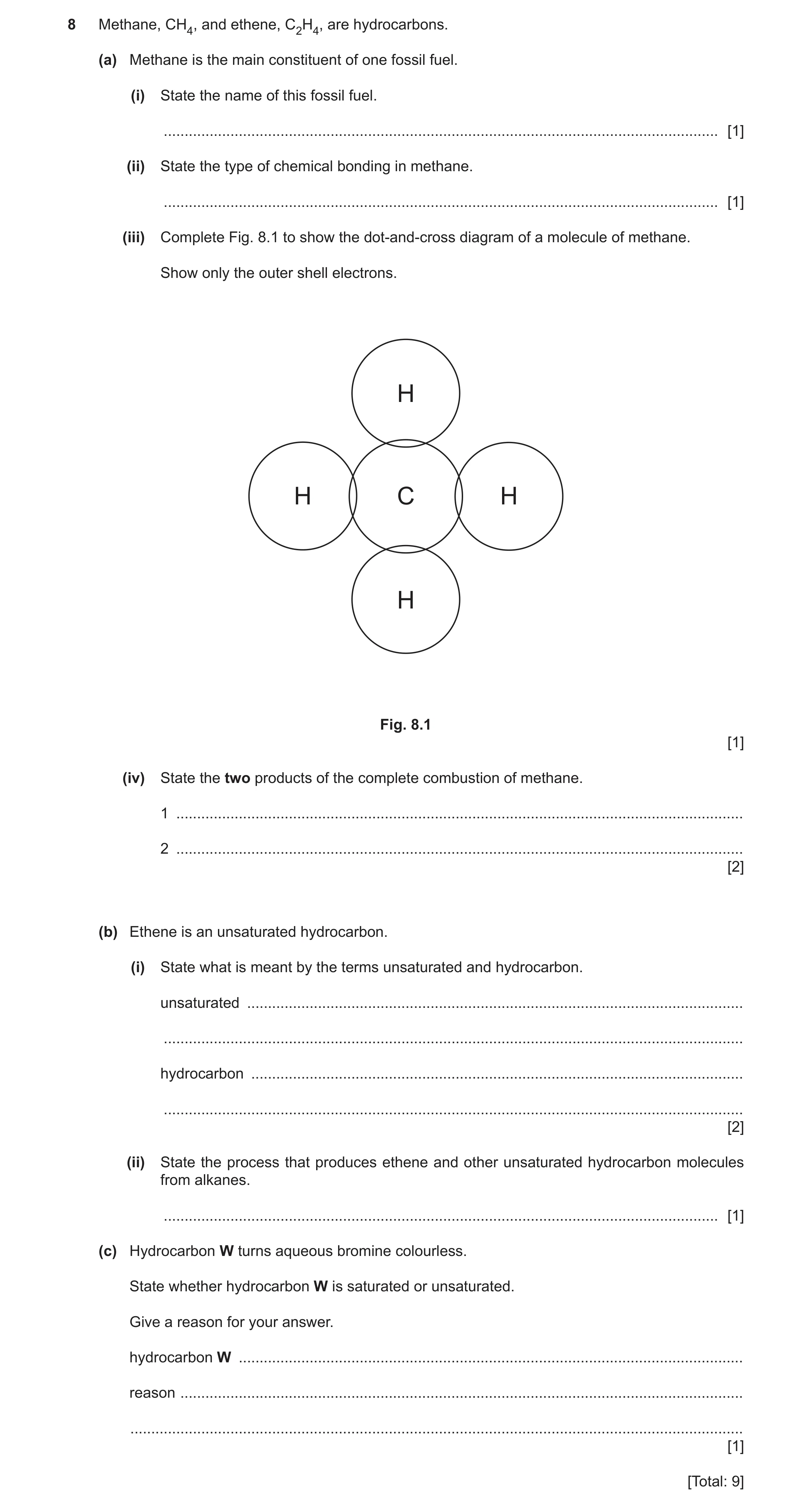
 31 / 38
 32 / 38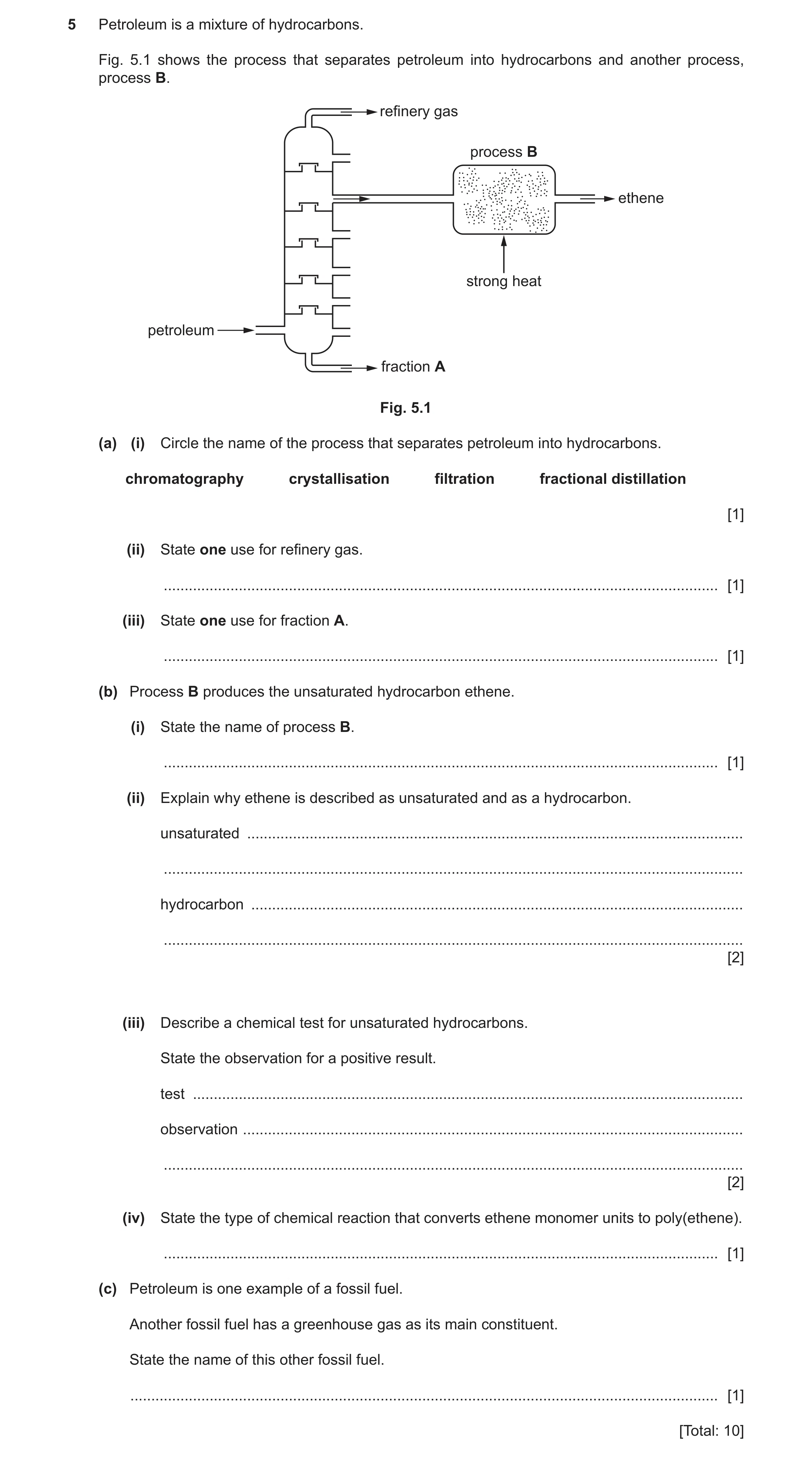
 9
9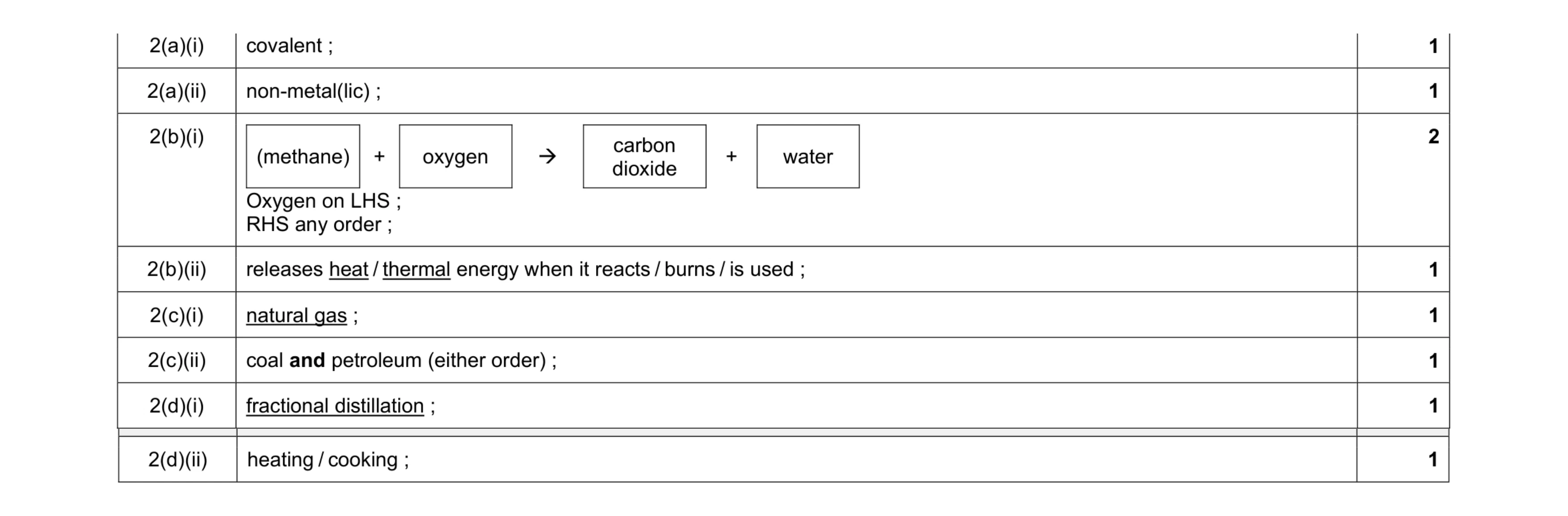 9
9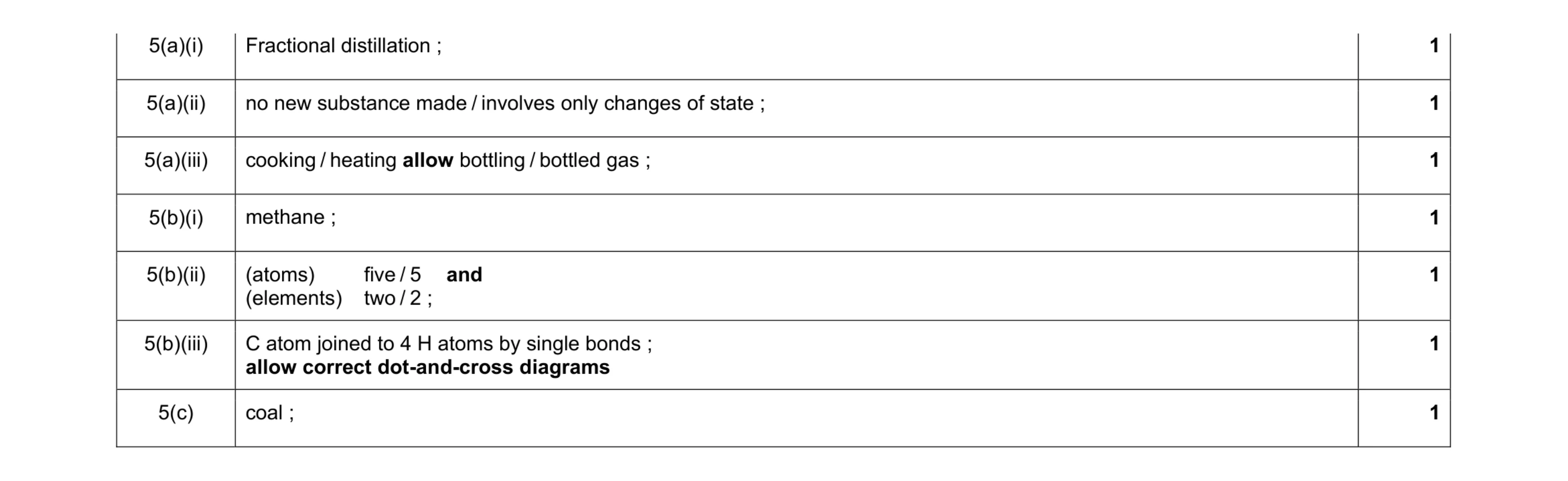 7
7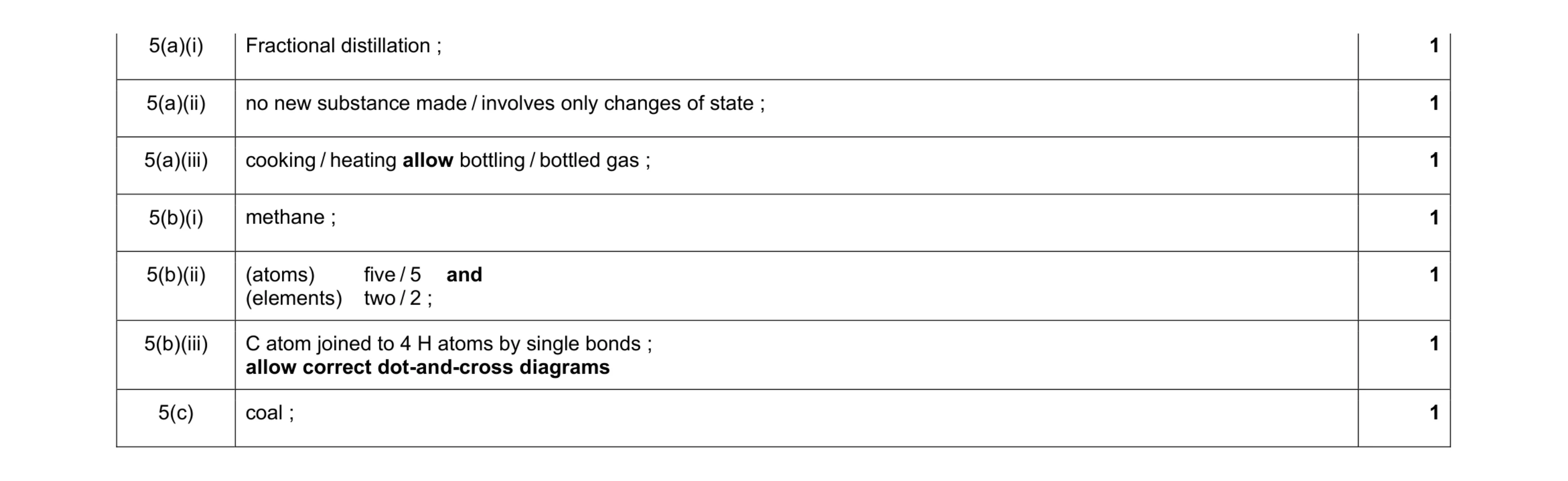 7
7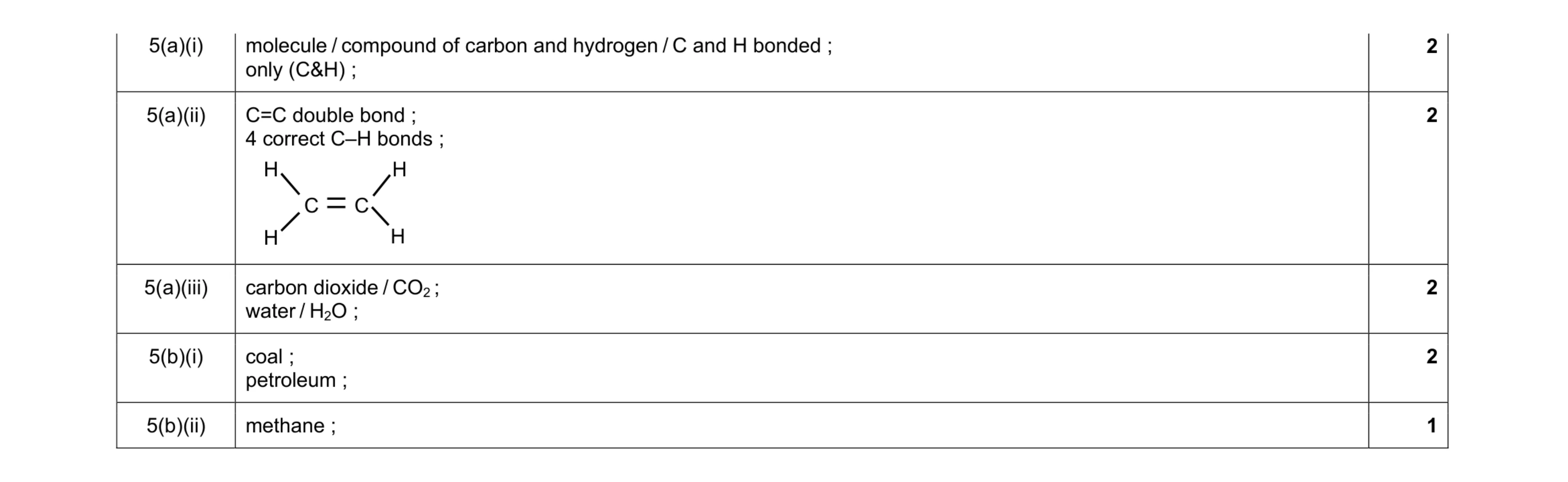 9
9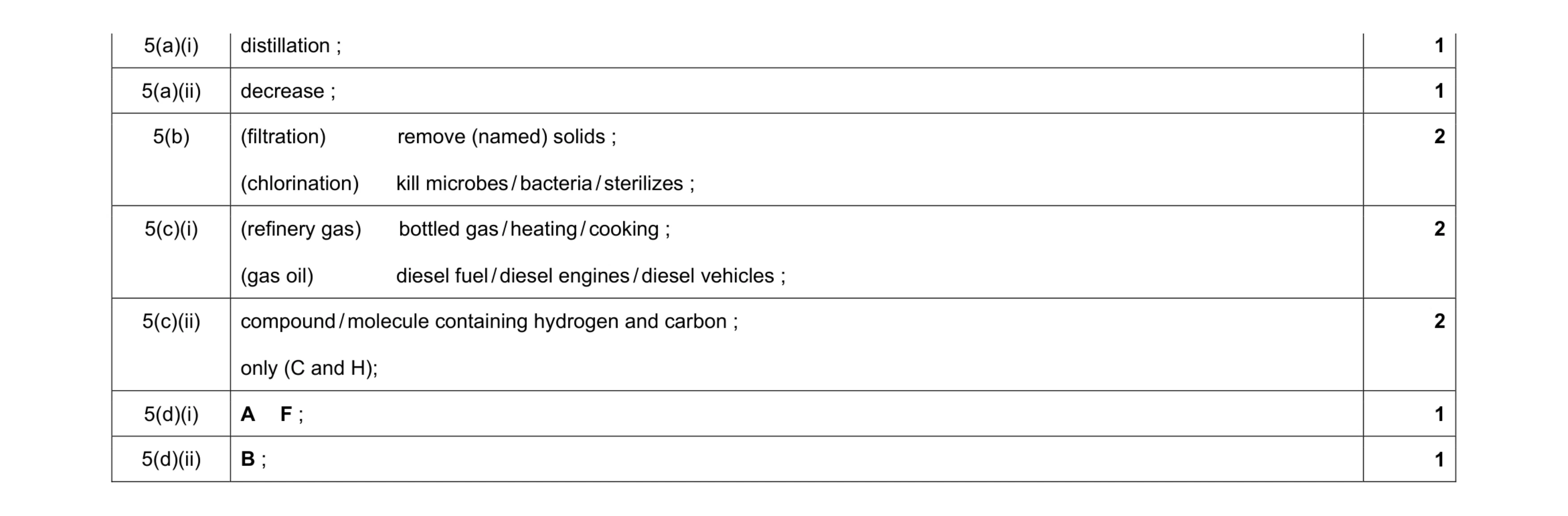 10
10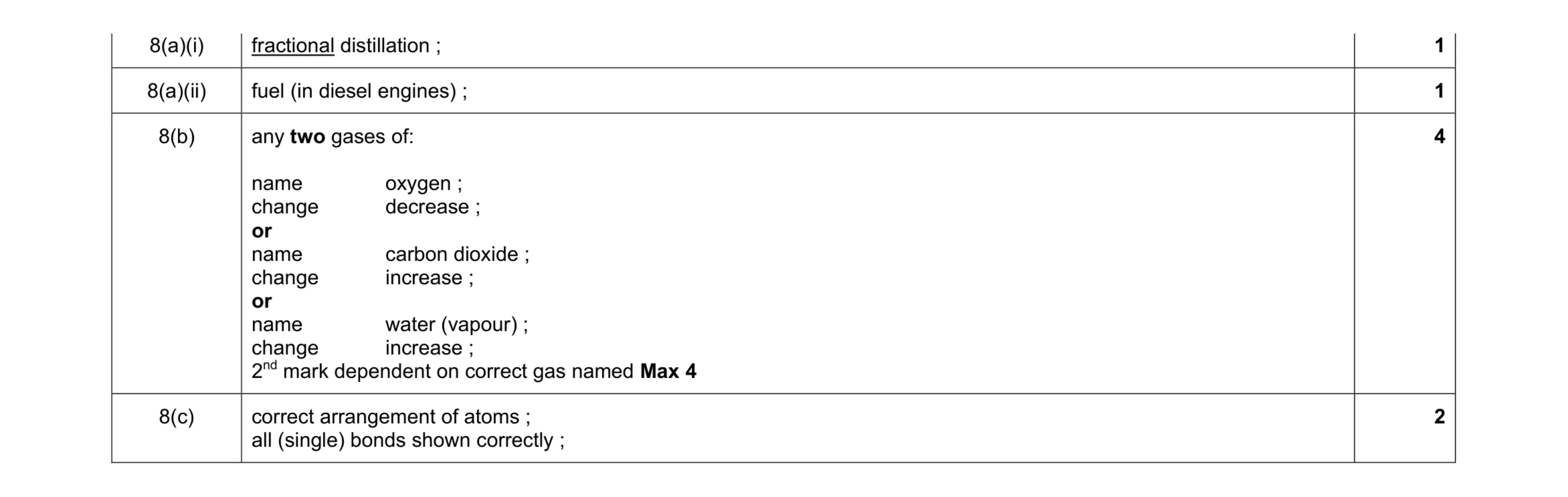 8
8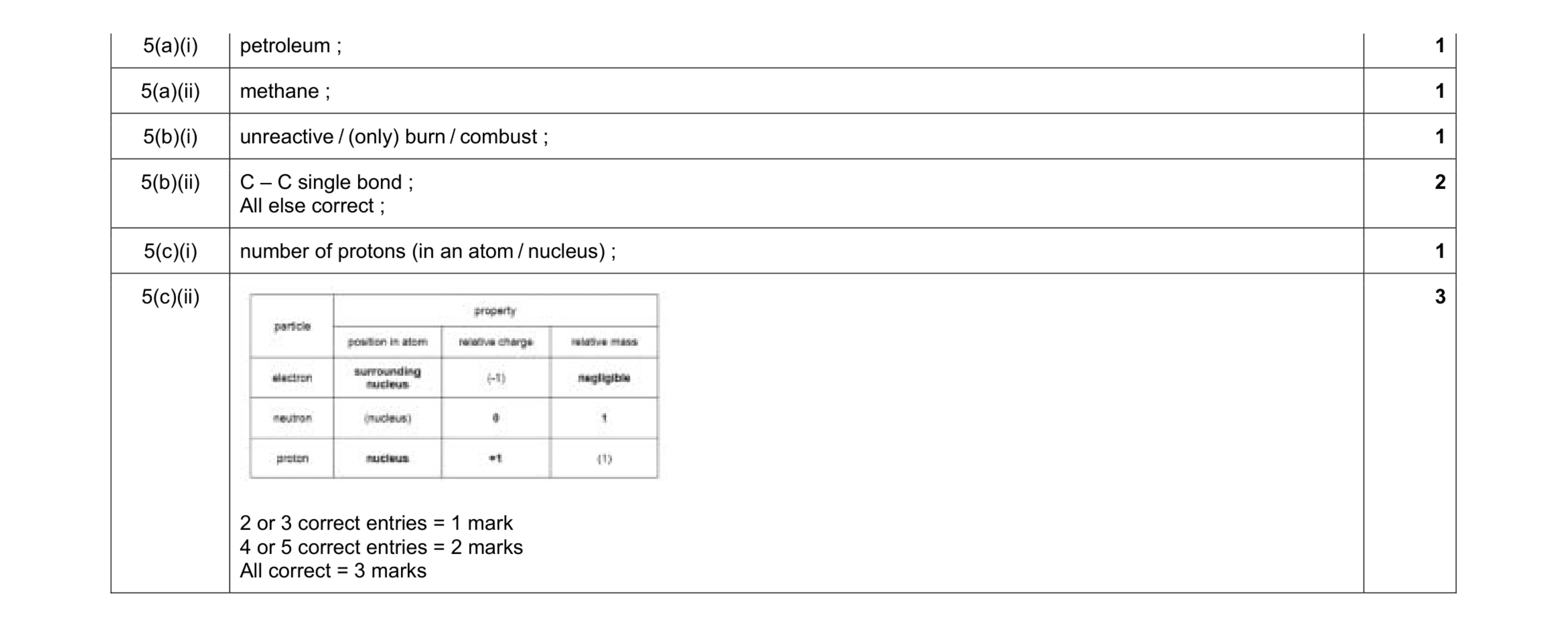 9
9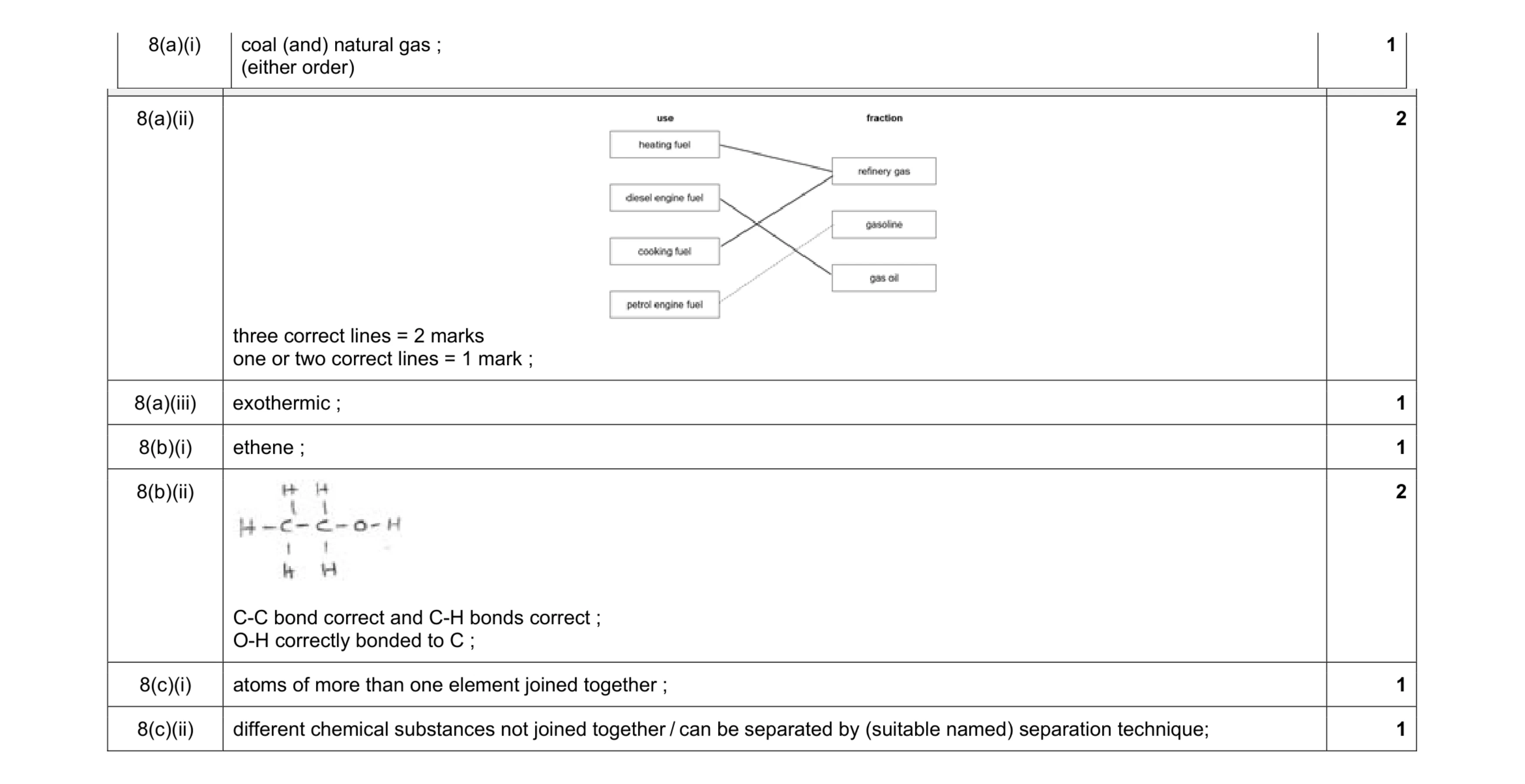 9
9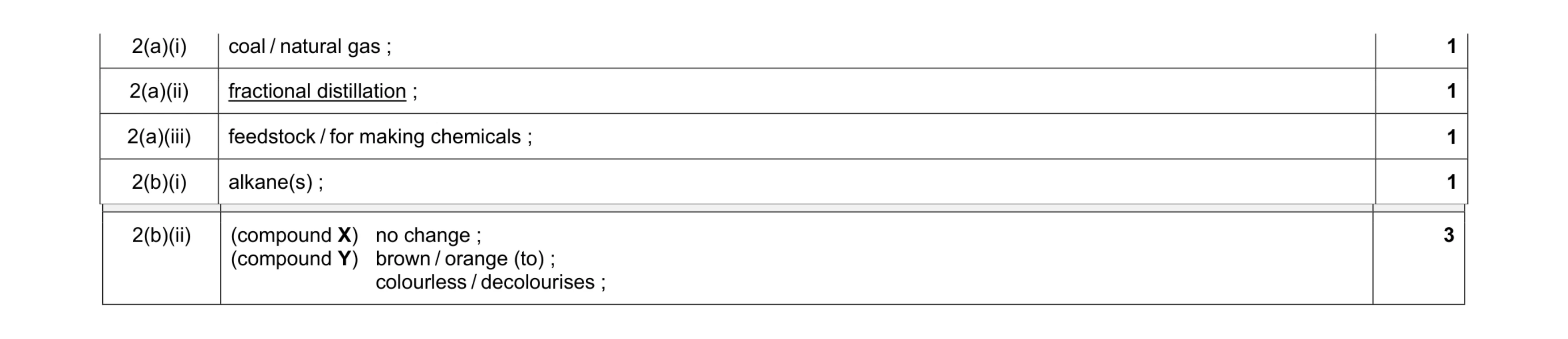 7
7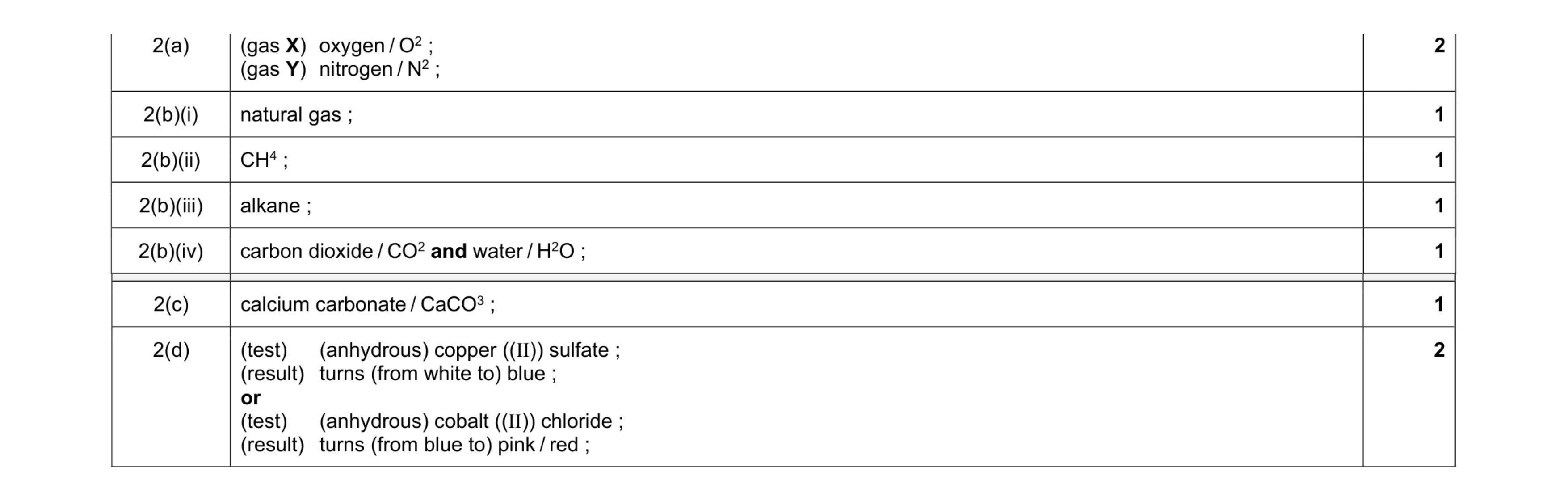 9
9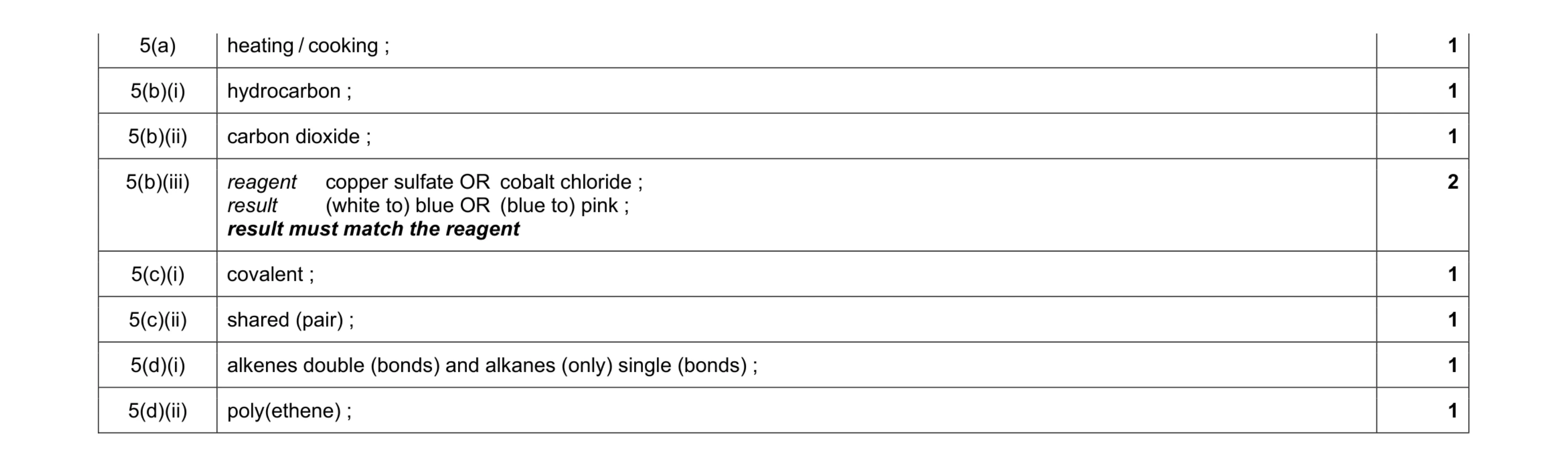 9
9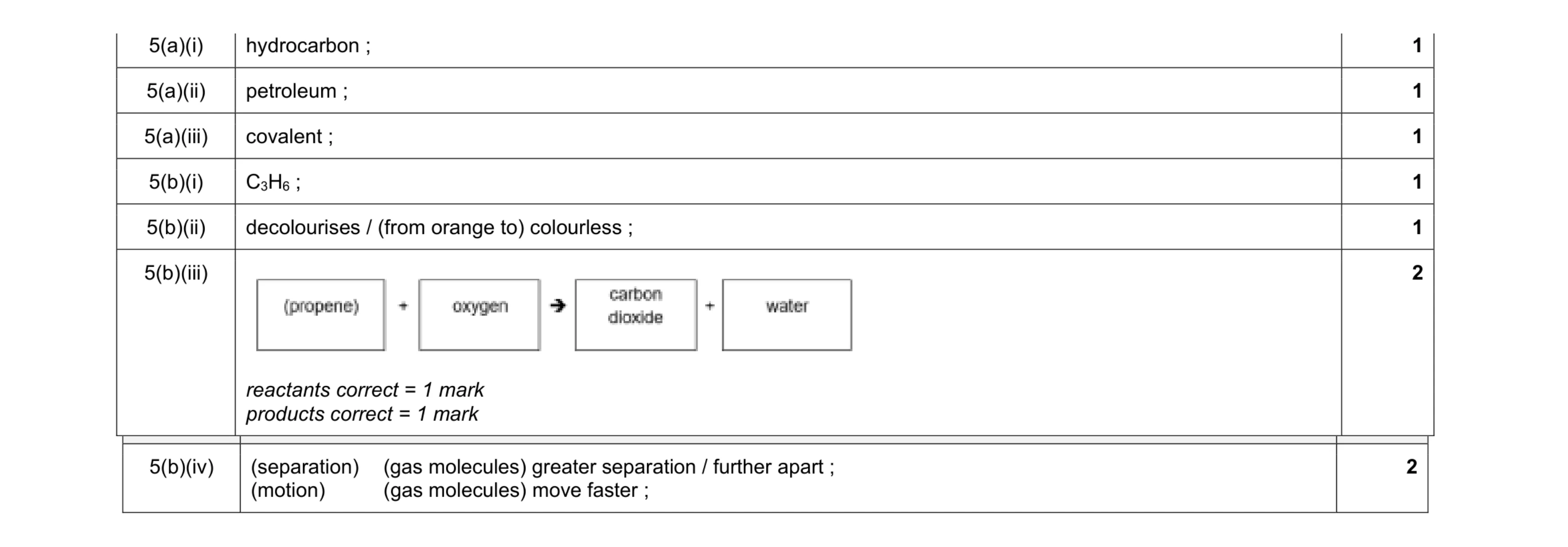 9
9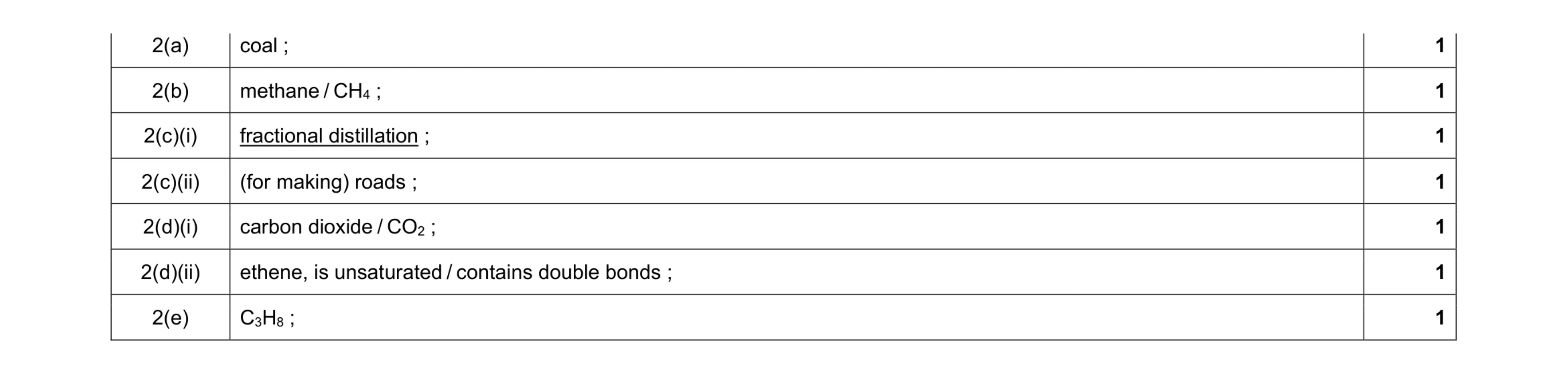 7
7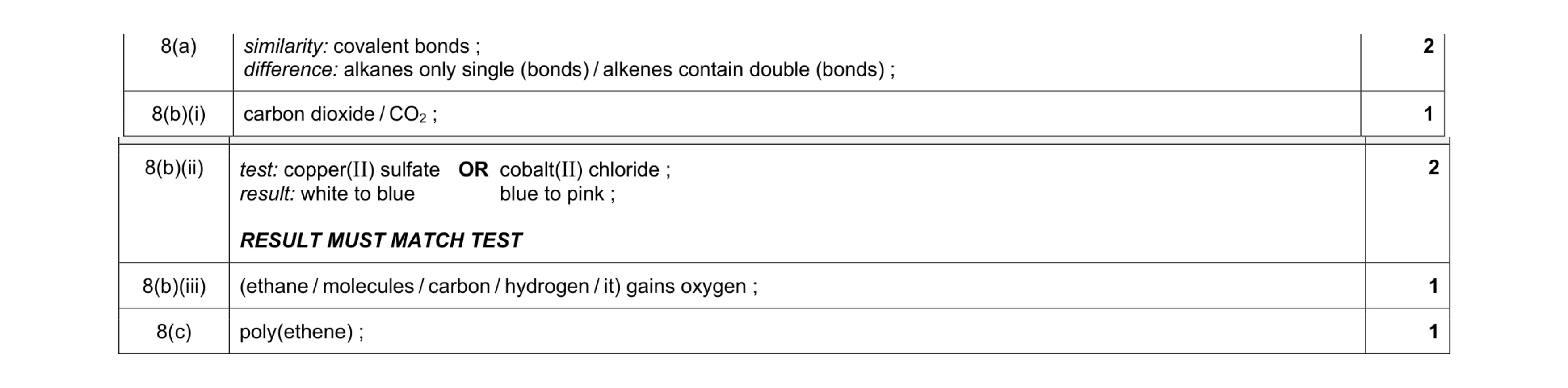 7
7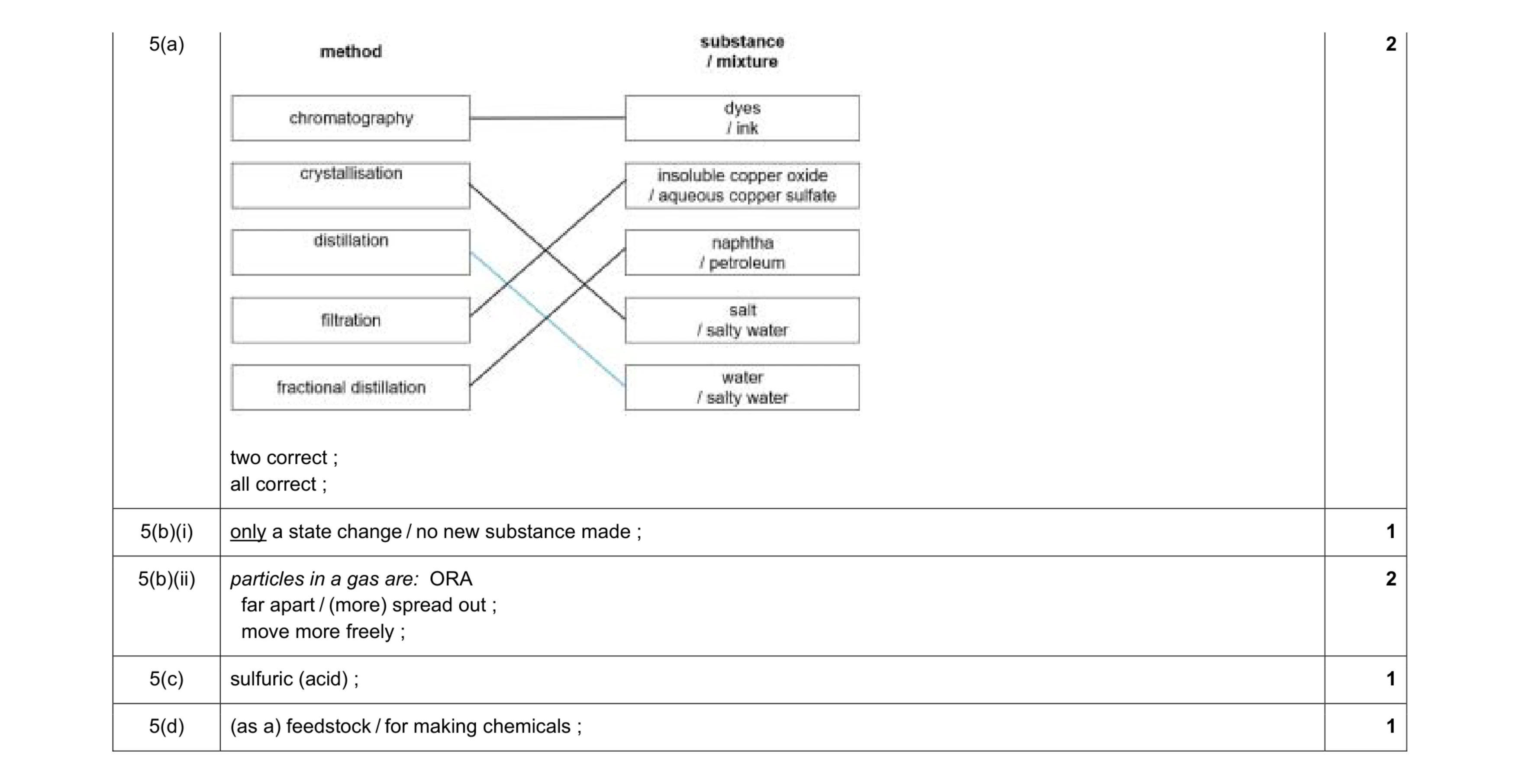 7
7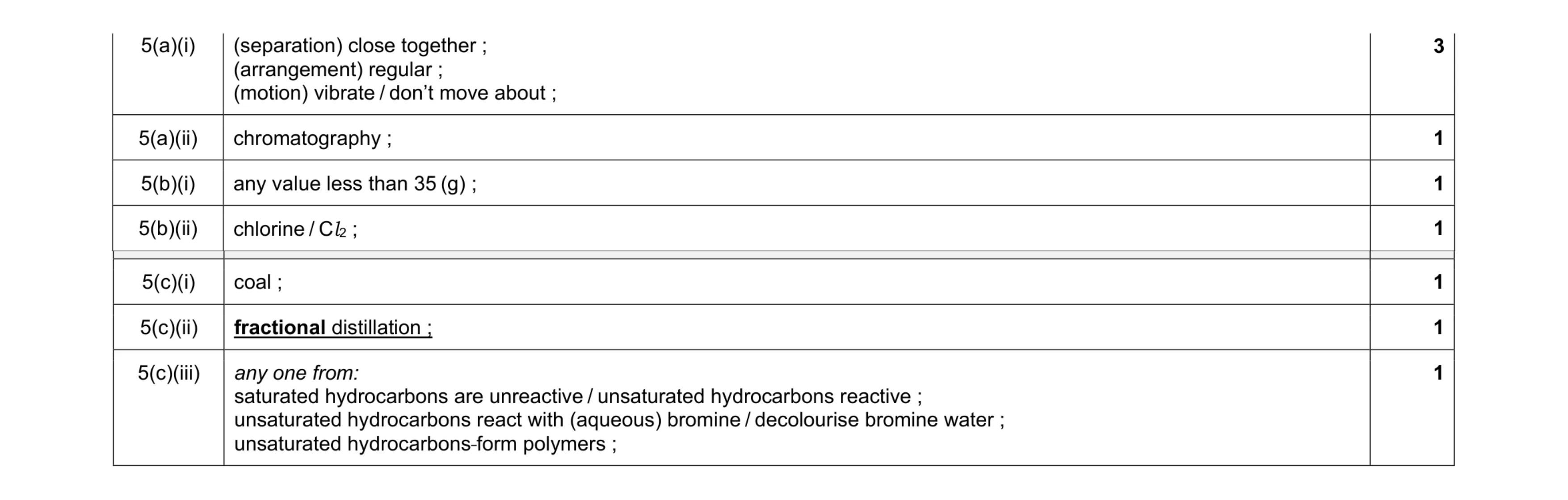 9
9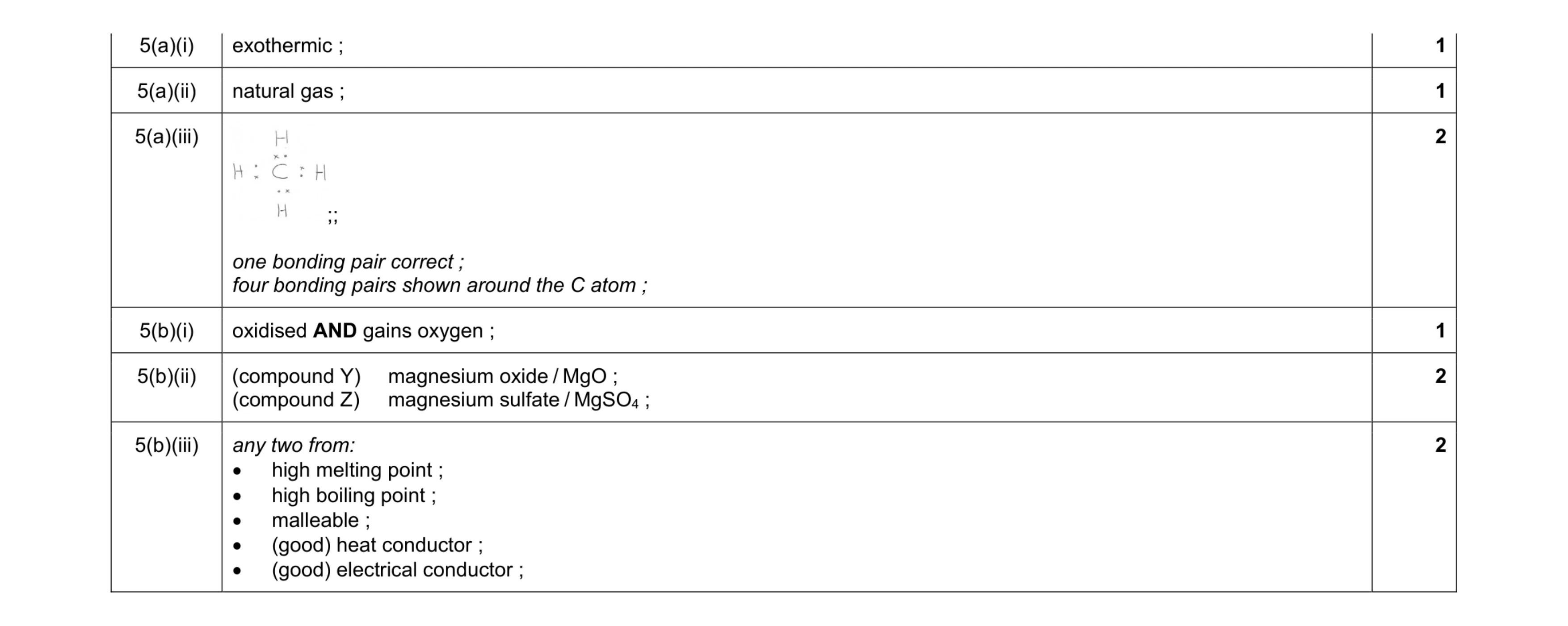 9
9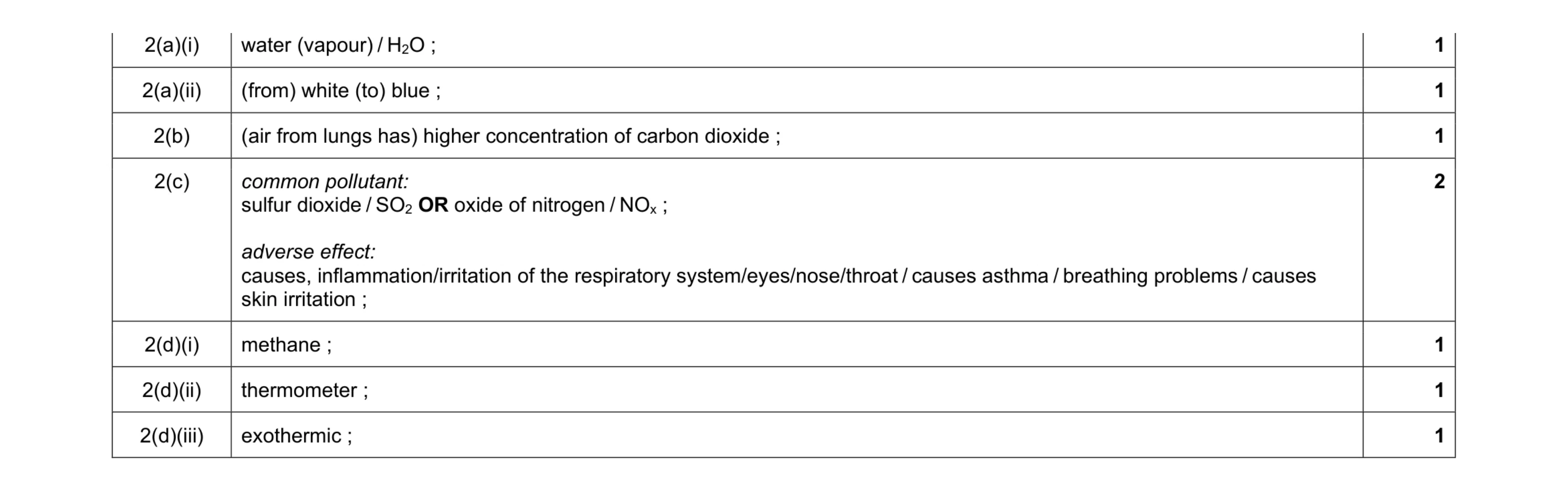 8
8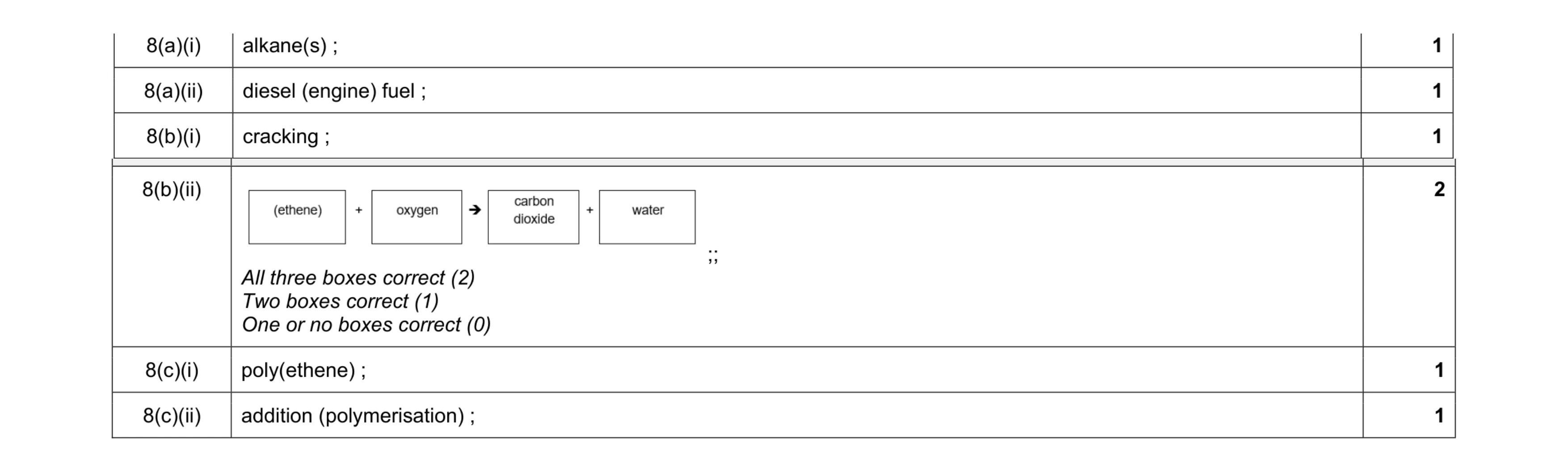 7
7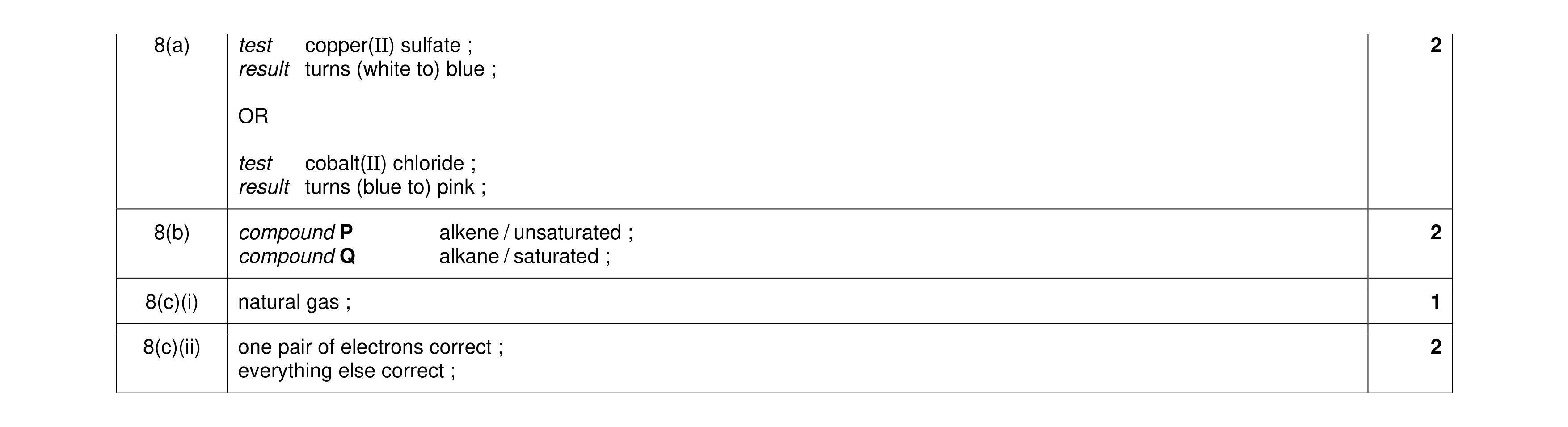 7
7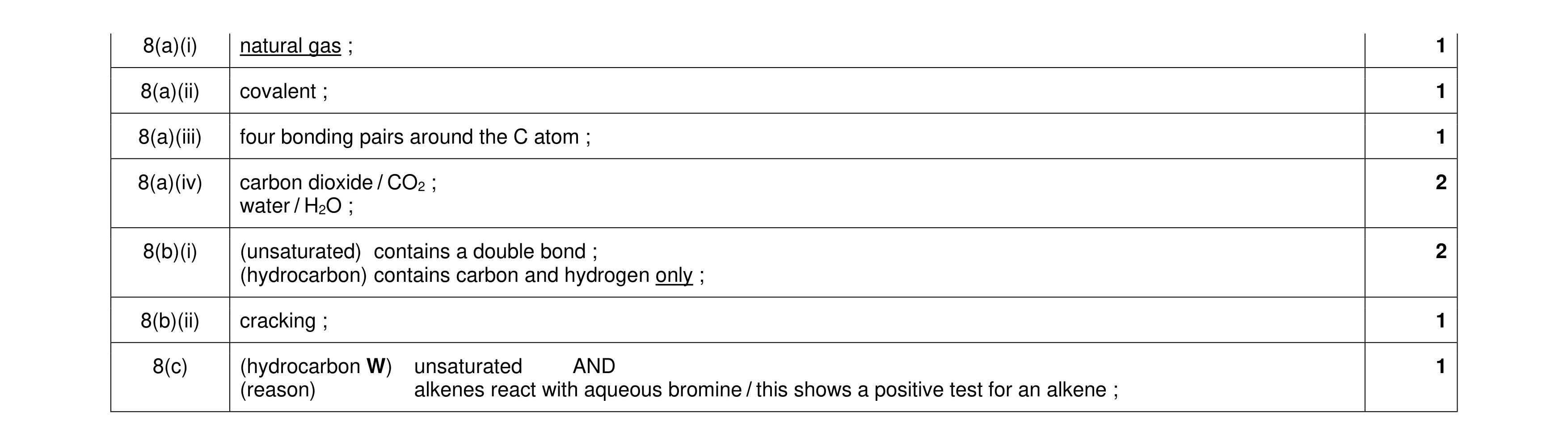 9
9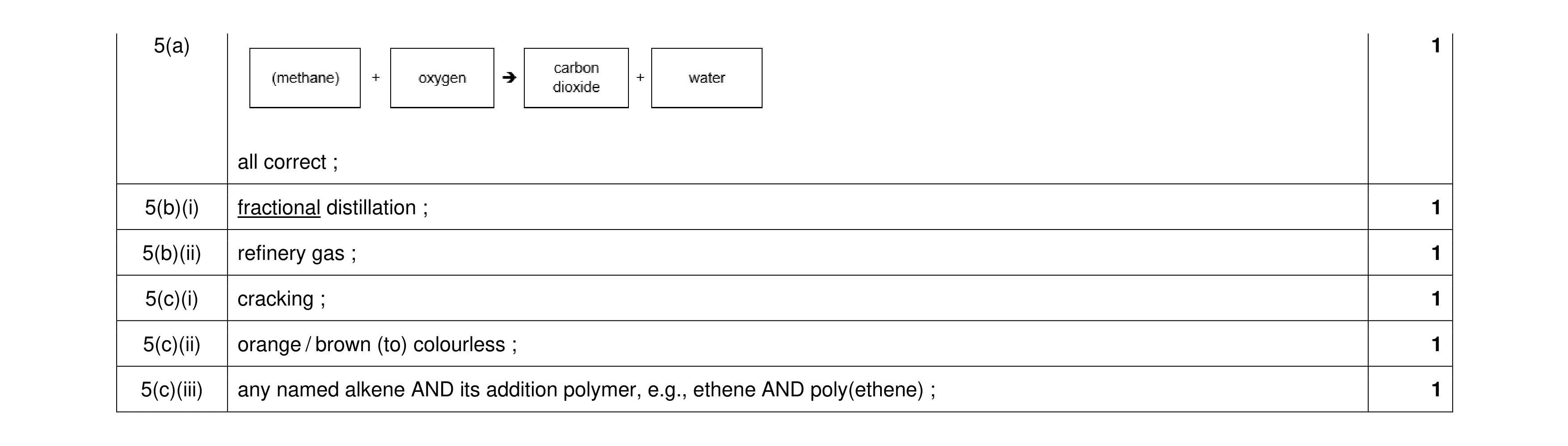 6
6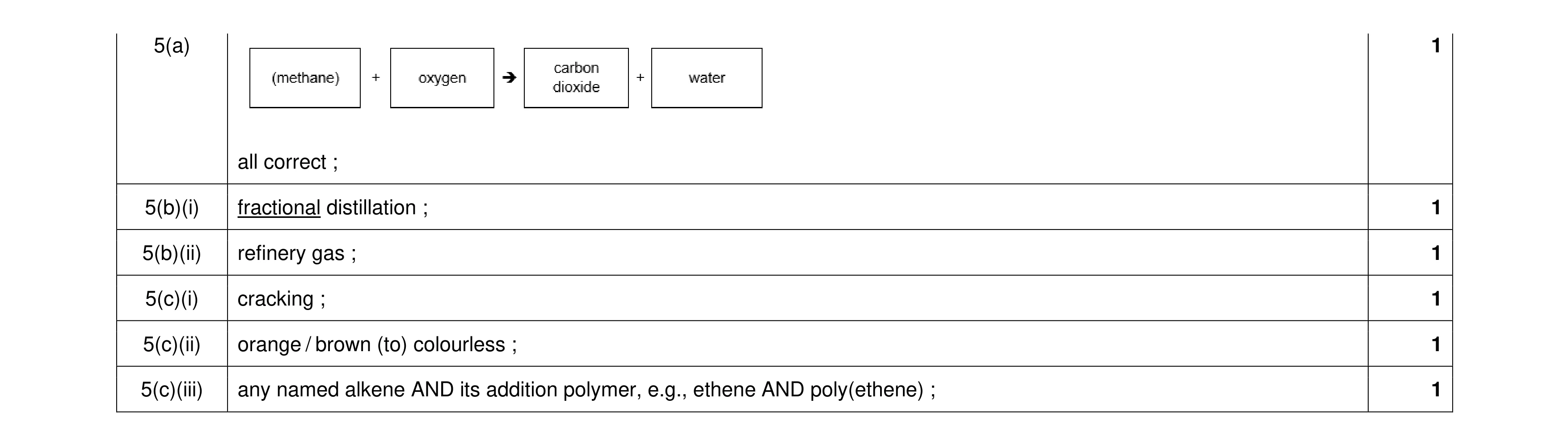 6
6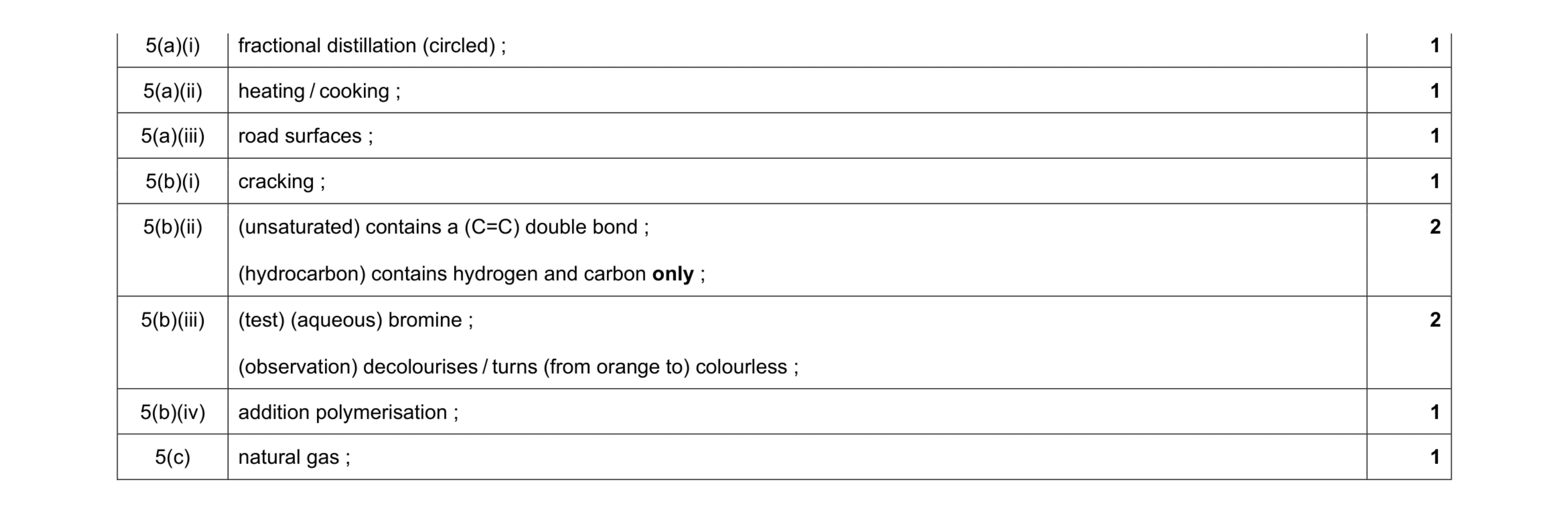 10
10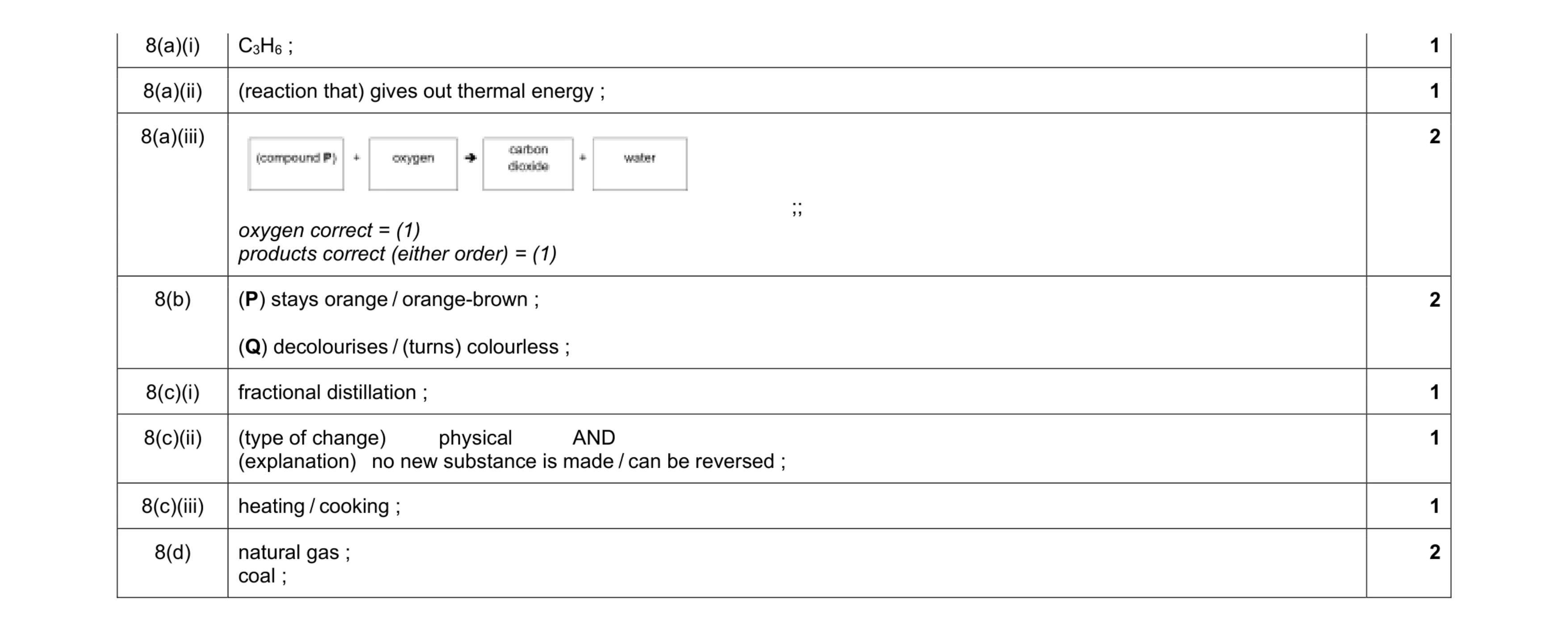 11
11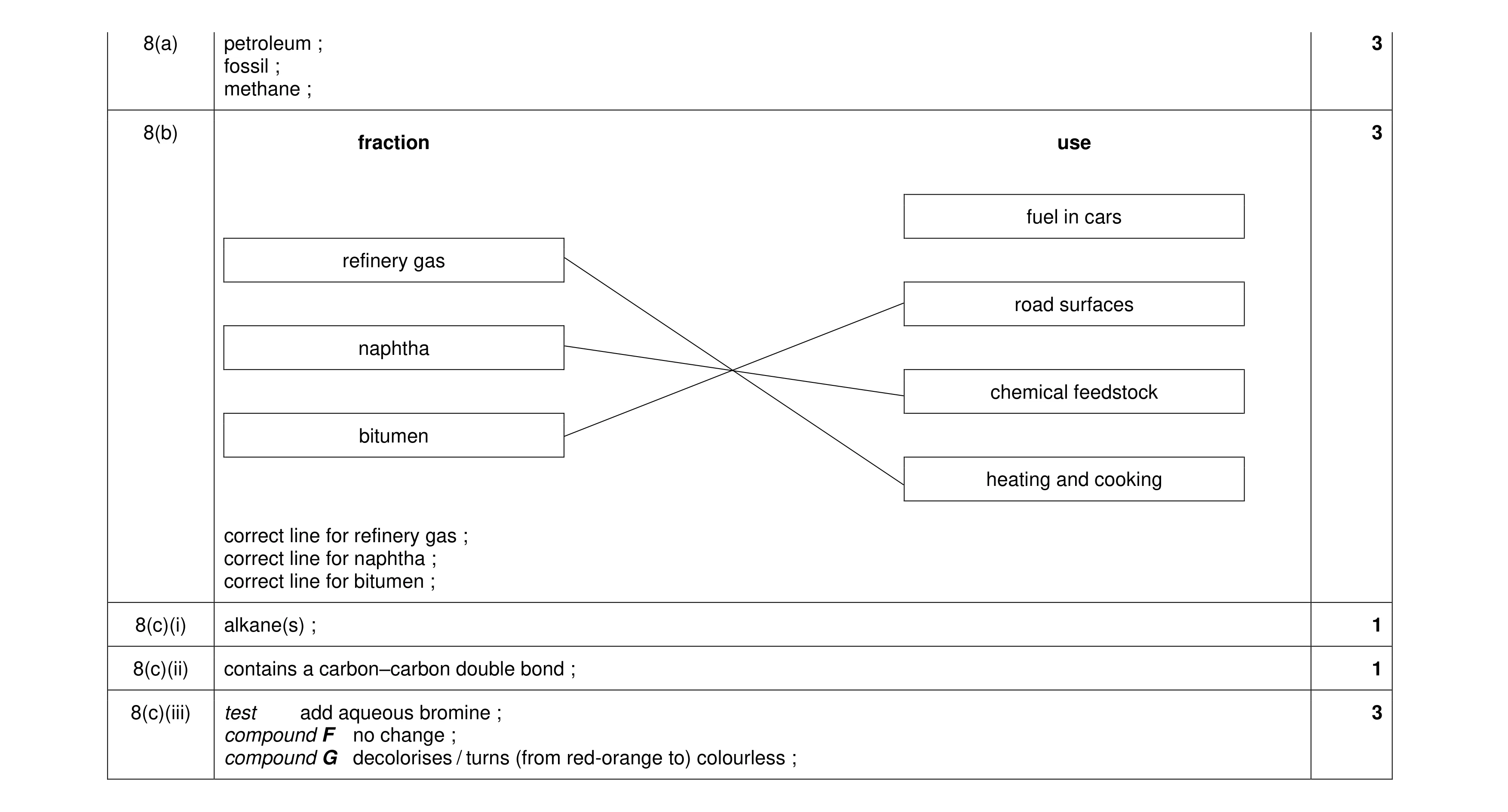 11
11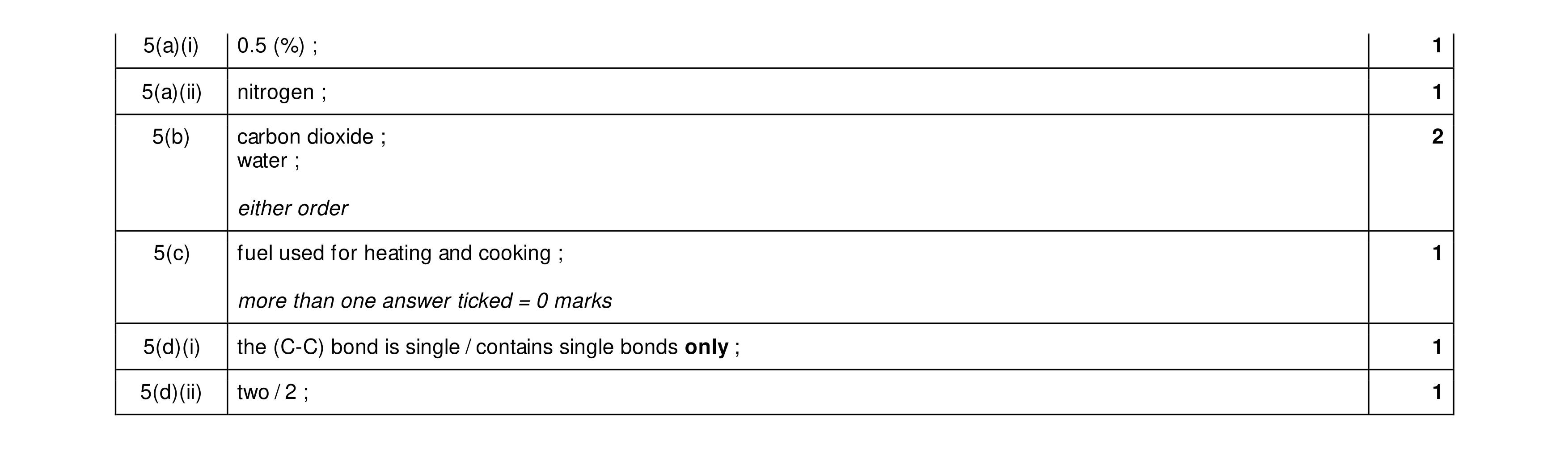 7
7