Questions as text
Q1 · Use lines to connect the box on the left to different boxes on the right to make correct… 0653/32 May/June 2017
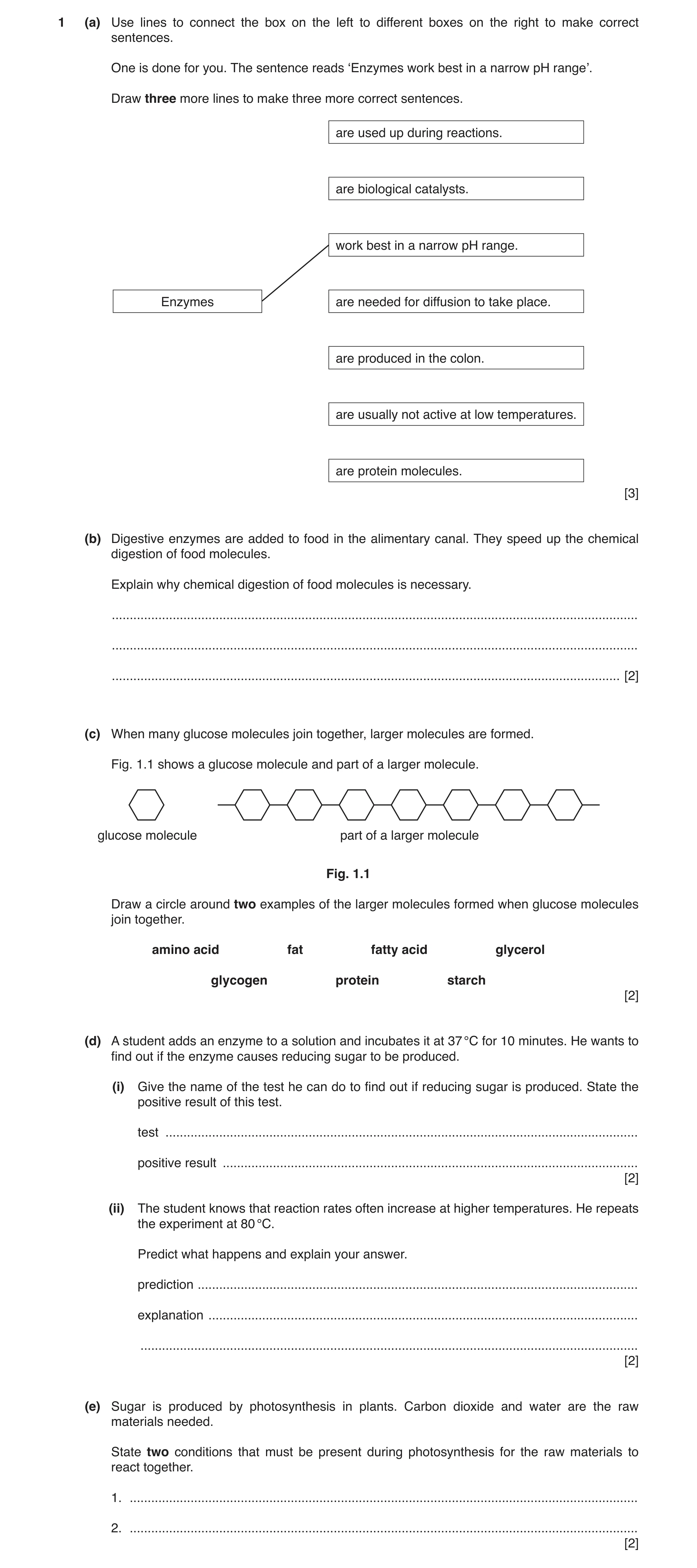
1 (a) Use lines to connect the box on the left to different boxes on the right to make correct sentences. One is done for you. The sentence reads ‘Enzymes work best in a narrow pH range’. Draw three more lines to make three more correct sentences. are used up during reactions. are biological catalysts. work best in a narrow pH range. Enzymes are needed for diffusion to take place. are produced in the colon. are usually not active at low temperatures. are protein molecules. [3] (b) Digestive enzymes are added to food in the alimentary canal. They speed up the chemical digestion of food molecules. Explain why chemical digestion of food molecules is necessary. … … … [2] (c) When many glucose molecules join together, larger molecules are formed. Fig. 1.1 shows a glucose molecule and part of a larger molecule. glucose molecule part of a larger molecule Fig. 1.1 Draw a circle around two examples of the larger molecules formed when glucose molecules join together. amino acid fat fatty acid glycerol glycogen protein starch [2] (d) A student adds an enzyme to a solution and incubates it at 37 °C for 10 minutes. He wants to find out if the enzyme causes reducing sugar to be produced. (i) Give the name of the test he can do to find out if reducing sugar is produced. State the positive result of this test. test … positive result … [2] (ii) The student knows that reaction rates often increase at higher temperatures. He repeats the experiment at 80 °C. Predict what happens and explain your answer. prediction … explanation … … [2] (e) Sugar is produced by photosynthesis in plants. Carbon dioxide and water are the raw materials needed. State two conditions that must be present during photosynthesis for the raw materials to react together. 1. … 2. … [2]
13 marks
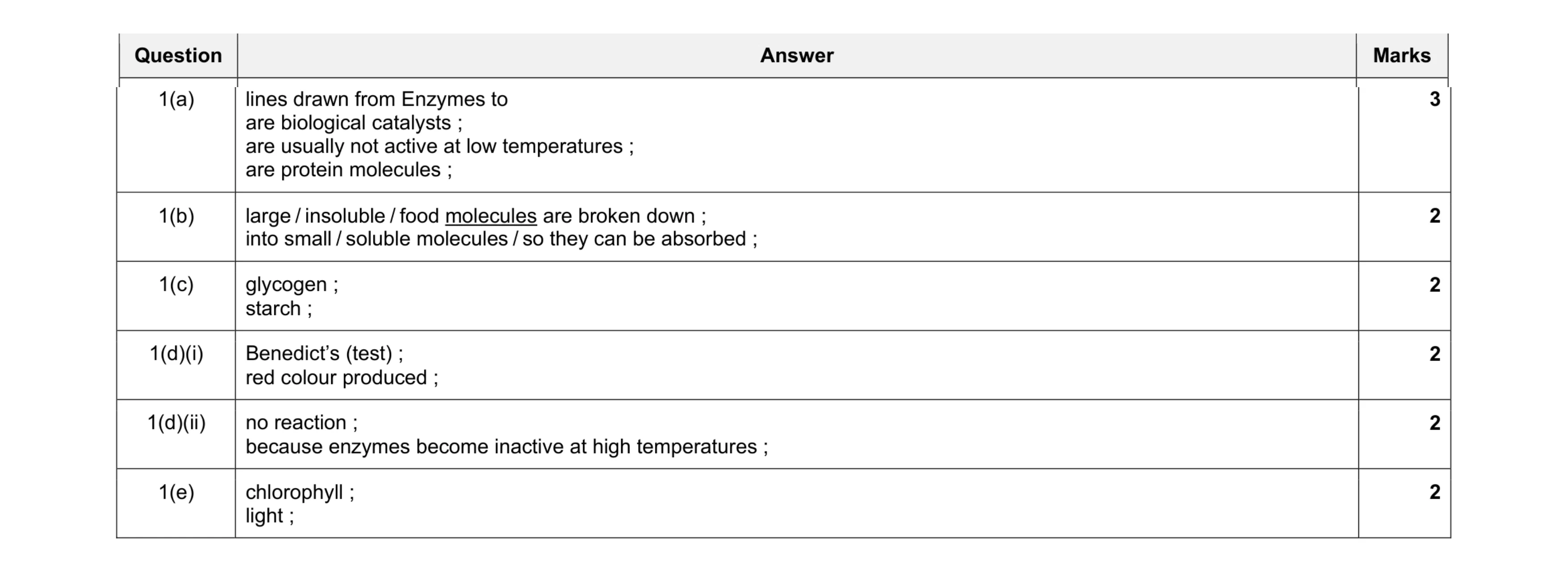
Mark scheme: 1(a) lines drawn from Enzymes to are biological catalysts ; are usually not active at low temperatures ; are protein molecules ; 3 1(b) large / insoluble / food molecules are broken down ; into small / soluble molecules / so they can be absorbed ; 2 1(c) glycogen ; starch ; 2 1(d)(i) Benedict’s (test) ; red colour produced ; 2 1(d)(ii) no reaction ; because enzymes become inactive at high temperatures ; 2 1(e) chlorophyll ; light ; 2
This question in 0653/32 May/June 2017
Q2 · Use lines to connect the box on the left to different boxes on the right to make correct… 0653/33 May/June 2017
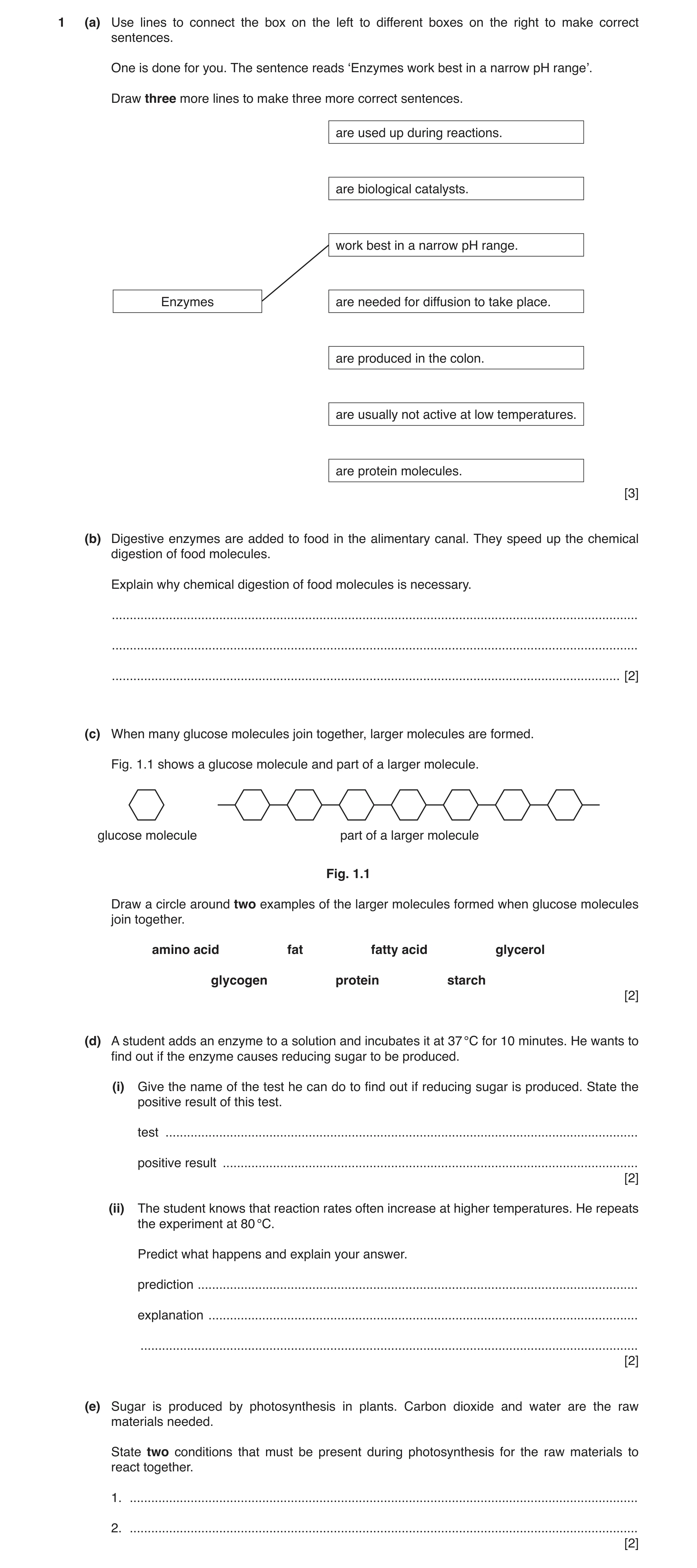
1 (a) Use lines to connect the box on the left to different boxes on the right to make correct sentences. One is done for you. The sentence reads ‘Enzymes work best in a narrow pH range’. Draw three more lines to make three more correct sentences. are used up during reactions. are biological catalysts. work best in a narrow pH range. Enzymes are needed for diffusion to take place. are produced in the colon. are usually not active at low temperatures. are protein molecules. [3] (b) Digestive enzymes are added to food in the alimentary canal. They speed up the chemical digestion of food molecules. Explain why chemical digestion of food molecules is necessary. … … … [2] (c) When many glucose molecules join together, larger molecules are formed. Fig. 1.1 shows a glucose molecule and part of a larger molecule. glucose molecule part of a larger molecule Fig. 1.1 Draw a circle around two examples of the larger molecules formed when glucose molecules join together. amino acid fat fatty acid glycerol glycogen protein starch [2] (d) A student adds an enzyme to a solution and incubates it at 37 °C for 10 minutes. He wants to find out if the enzyme causes reducing sugar to be produced. (i) Give the name of the test he can do to find out if reducing sugar is produced. State the positive result of this test. test … positive result … [2] (ii) The student knows that reaction rates often increase at higher temperatures. He repeats the experiment at 80 °C. Predict what happens and explain your answer. prediction … explanation … … [2] (e) Sugar is produced by photosynthesis in plants. Carbon dioxide and water are the raw materials needed. State two conditions that must be present during photosynthesis for the raw materials to react together. 1. … 2. … [2]
13 marks
Mark scheme: 1(a) lines drawn from Enzymes to are biological catalysts ; are usually not active at low temperatures ; are protein molecules ; 3 1(b) large / insoluble / food molecules are broken down ; into small / soluble molecules / so they can be absorbed ; 2 1(c) glycogen ; starch ; 2 1(d)(i) Benedict’s (test) ; red colour produced ; 2 1(d)(ii) no reaction ; because enzymes become inactive at high temperatures ; 2 1(e) chlorophyll ; light ; 2
This question in 0653/33 May/June 2017
Q3 · A sealed glass jar containing soil and plants 0653/31 Oct/Nov 2017
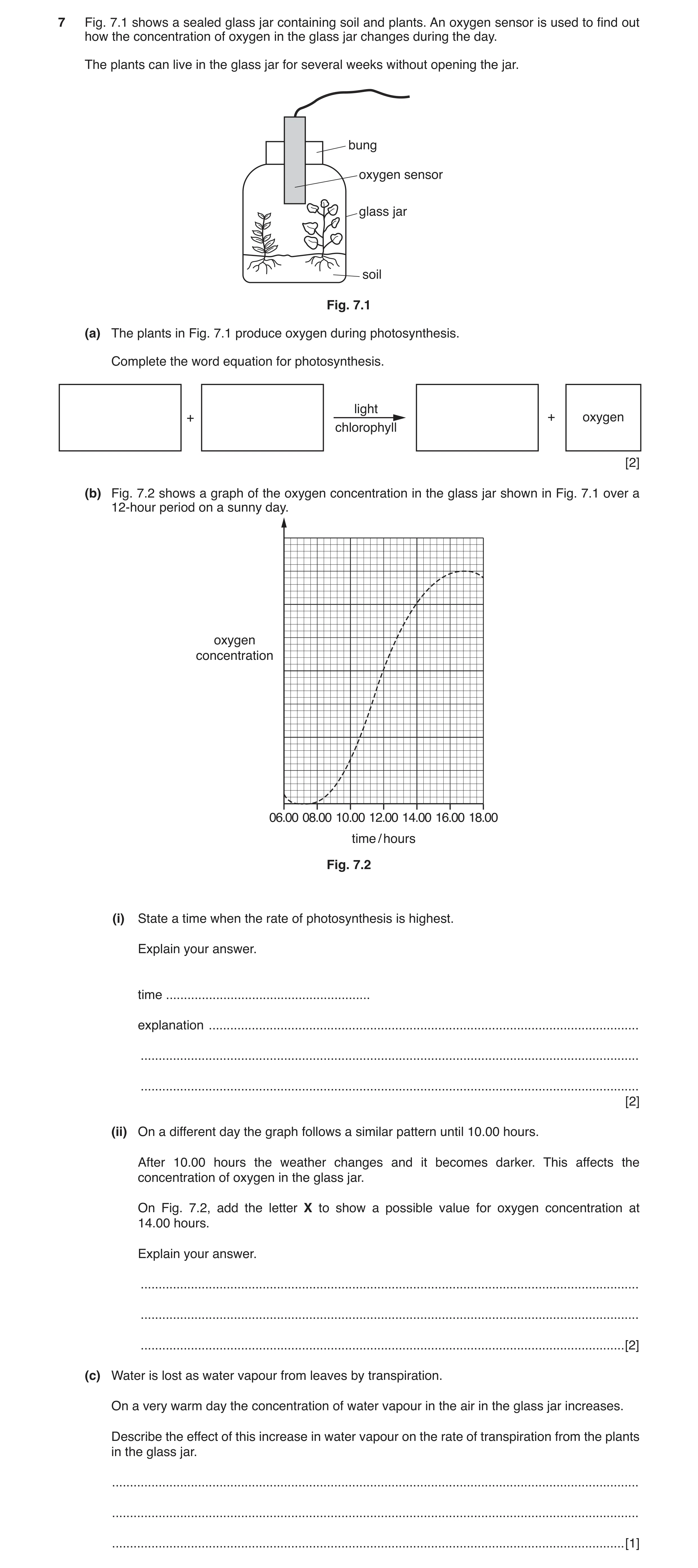
7 Fig. 7.1 shows a sealed glass jar containing soil and plants. An oxygen sensor is used to find out how the concentration of oxygen in the glass jar changes during the day. The plants can live in the glass jar for several weeks without opening the jar. bung oxygen sensor glass jar soil Fig. 7.1 (a) The plants in Fig. 7.1 produce oxygen during photosynthesis. Complete the word equation for photosynthesis. light + + oxygen chlorophyll [2] (b) Fig. 7.2 shows a graph of the oxygen concentration in the glass jar shown in Fig. 7.1 over a 12-hour period on a sunny day. oxygen concentration 06.00 08.00 10.00 12.00 14.00 16.00 18.00 time / hours Fig. 7.2 (i) State a time when the rate of photosynthesis is highest. Explain your answer. time … explanation … … … [2] (ii) On a different day the graph follows a similar pattern until 10.00 hours. After 10.00 hours the weather changes and it becomes darker. This affects the concentration of oxygen in the glass jar. On Fig. 7.2, add the letter X to show a possible value for oxygen concentration at 14.00 hours. Explain your answer. … … … [2] (c) Water is lost as water vapour from leaves by transpiration. On a very warm day the concentration of water vapour in the air in the glass jar increases. Describe the effect of this increase in water vapour on the rate of transpiration from the plants in the glass jar. … … … [1]
7 marks
Mark scheme: 7(a) carb → su 7(b)(i) any max bon dioxide + wa ugar / glucose ; time between 10 ximum rate of ox ater ; 0.00 and 13.00 ygen production ; n / gradient of gra aph is steep(est ) ; 2 2 Question Answer Marks 7(b)(ii) letter X drawn at 14.00 anywhere below line graph ; (rate of) photosynthesis (oxygen production) dependent on (amount of) light ; 2 7(c) reduces / causes less / prevents transpiration ; 1
This question in 0653/31 Oct/Nov 2017
Q4 · During transpiration water is lost from the leaves of a plant 0653/32 Oct/Nov 2017
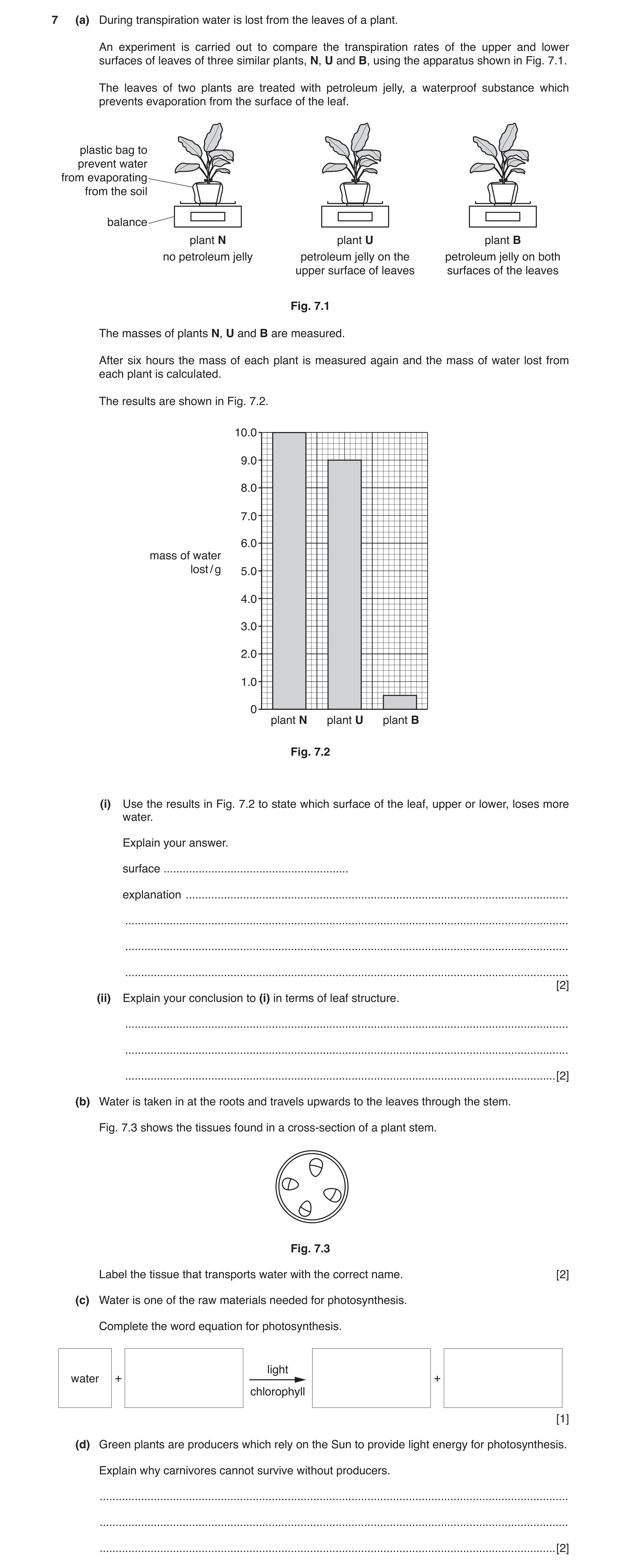
7 (a) During transpiration water is lost from the leaves of a plant. An experiment is carried out to compare the transpiration rates of the upper and lower surfaces of leaves of three similar plants, N, U and B, using the apparatus shown in Fig. 7.1. The leaves of two plants are treated with petroleum jelly, a waterproof substance which prevents evaporation from the surface of the leaf. plastic bag to prevent water from evaporating from the soil balance plant N plant U plant B no petroleum jelly petroleum jelly on the petroleum jelly on both upper surface of leaves surfaces of the leaves Fig. 7.1 The masses of plants N, U and B are measured. After six hours the mass of each plant is measured again and the mass of water lost from each plant is calculated. The results are shown in Fig. 7.2. 10.0 9.0 8.0 7.0 6.0 mass of water lost / g 5.0 4.0 3.0 2.0 1.0 0 plant N plant U plant B Fig. 7.2 (i) Use the results in Fig. 7.2 to state which surface of the leaf, upper or lower, loses more water. Explain your answer. surface … explanation … … … … [2] (ii) Explain your conclusion to (i) in terms of leaf structure. … … … [2] (b) Water is taken in at the roots and travels upwards to the leaves through the stem. Fig. 7.3 shows the tissues found in a cross-section of a plant stem. Fig. 7.3 Label the tissue that transports water with the correct name. [2] (c) Water is one of the raw materials needed for photosynthesis. Complete the word equation for photosynthesis. lightwater + + chlorophyll [1] (d) Green plants are producers which rely on the Sun to provide light energy for photosynthesis. Explain why carnivores cannot survive without producers. … … … [2]
9 marks
Mark scheme: 7(a)(i) lower surface when upper leaf is greased water loss is not reduced by much ; when lower surface is covered there is a great reduction in water loss ; 2 7(a)(ii) most transpiration occurs through the stomata ; which are (mostly) found on lower surface of leaf ; 2 7(b) xylem ; position of tissue correctly labelled ; 2 7(c) carbon dioxide, sugar / glucose, oxygen ; 1 Question Answer Marks 7(d) Any two from carnivores cannot produce their own food / cannot photosynthesise ; carnivores get energy by eating herbivores ; herbivores feed on producers ; max 2
This question in 0653/32 Oct/Nov 2017
Q5 · Some processes occurring in a forest growing on a hill 0653/33 Oct/Nov 2017
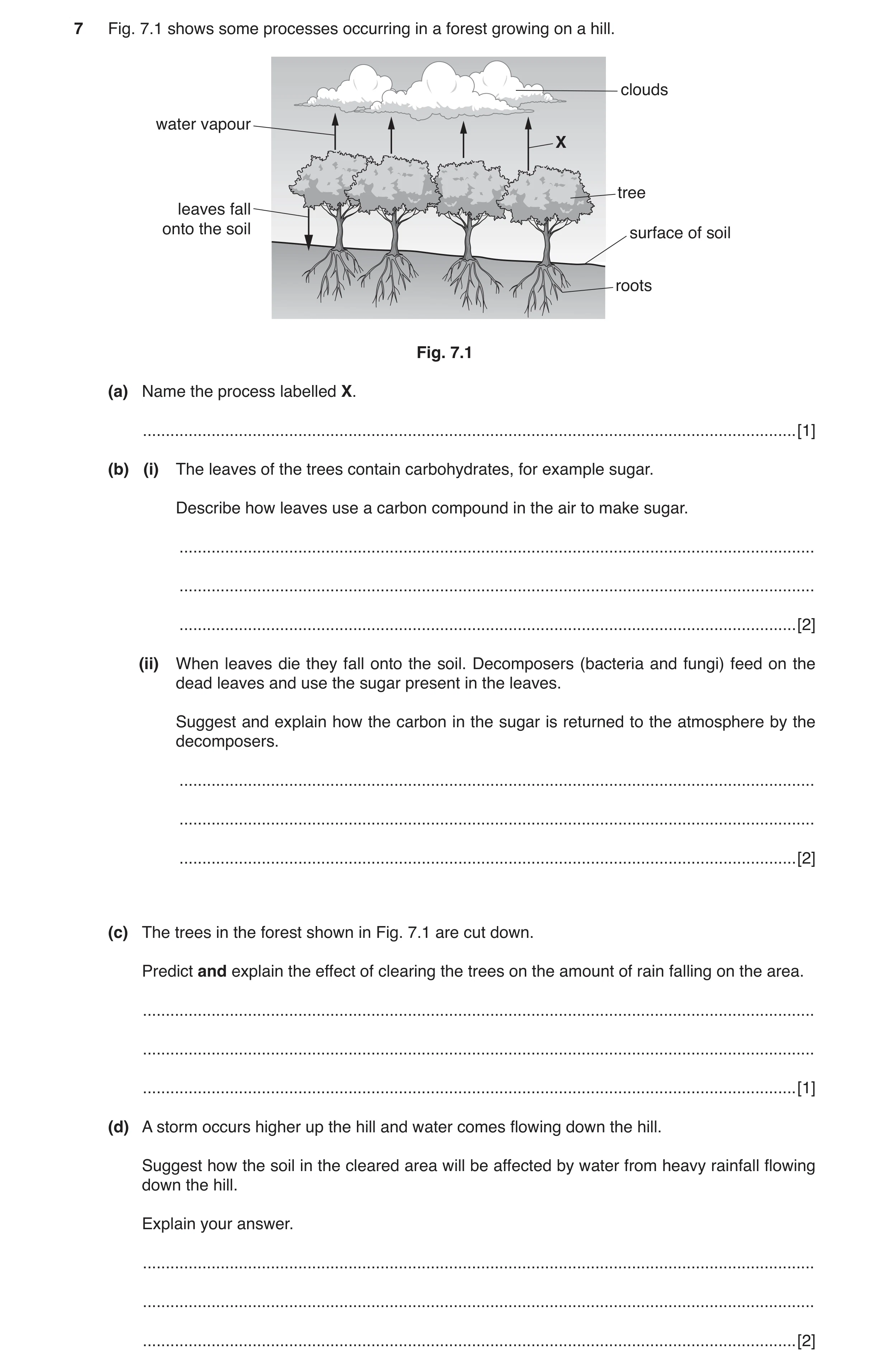
7 Fig. 7.1 shows some processes occurring in a forest growing on a hill. clouds water vapour X tree leaves fall onto the soil surface of soil roots Fig. 7.1 (a) Name the process labelled X. … [1] (b) (i) The leaves of the trees contain carbohydrates, for example sugar. Describe how leaves use a carbon compound in the air to make sugar. … … … [2] (ii) When leaves die they fall onto the soil. Decomposers (bacteria and fungi) feed on the dead leaves and use the sugar present in the leaves. Suggest and explain how the carbon in the sugar is returned to the atmosphere by the decomposers. … … … [2] (c) The trees in the forest shown in Fig. 7.1 are cut down. Predict and explain the effect of clearing the trees on the amount of rain falling on the area. … … … [1] (d) A storm occurs higher up the hill and water comes flowing down the hill. Suggest how the soil in the cleared area will be affected by water from heavy rainfall flowing down the hill. Explain your answer. … … … [2]
8 marks
Mark scheme: 7(a) transpiration ; 1 7(b)(i) carbon dioxide from the air ; is used in photosynthesis / reacts with water ; 2 7(b)(ii) by respiration ; carbon dioxide released ; 2 7(c) rainfall reduced (no mark) less water being transpired / evaporated from trees ; 1 7(d) soil easily eroded ; due to lack of tree roots ; 2
This question in 0653/33 Oct/Nov 2017
Q6 · Substances in food can be identified using test solutions 0653/31 May/June 2018
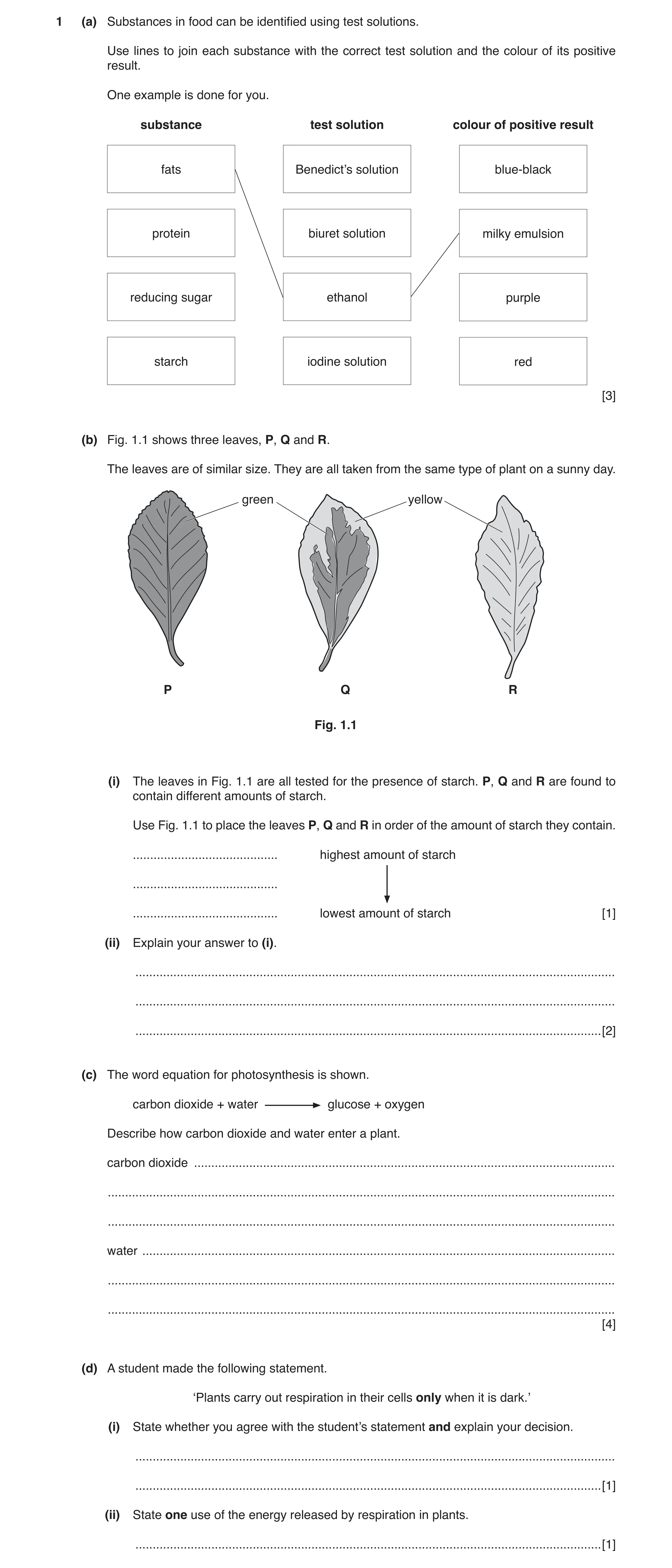
1 (a) Substances in food can be identified using test solutions. Use lines to join each substance with the correct test solution and the colour of its positive result. One example is done for you. substance test solution colour of positive result fats Benedict’s solution blue‑black protein biuret solution milky emulsion reducing sugar ethanol purple starch iodine solution red [3] (b) Fig. 1.1 shows three leaves, P, Q and R. The leaves are of similar size. They are all taken from the same type of plant on a sunny day. green yellow P Q R Fig. 1.1 (i) The leaves in Fig. 1.1 are all tested for the presence of starch. P, Q and R are found to contain different amounts of starch. Use Fig. 1.1 to place the leaves P, Q and R in order of the amount of starch they contain. … highest amount of starch … … lowest amount of starch [1] (ii) Explain your answer to (i). … … … [2] (c) The word equation for photosynthesis is shown. carbon dioxide + water glucose + oxygen Describe how carbon dioxide and water enter a plant. carbon dioxide … … … water … … … [4] (d) A student made the following statement. ‘Plants carry out respiration in their cells only when it is dark.’ (i) State whether you agree with the student’s statement and explain your decision. … … [1] (ii) State one use of the energy released by respiration in plants. … [1]
12 marks
Mark scheme: 1(a) boxes connected as shown fats Benedict’s solution blue / black protein biuret solution milky emulsion reducing sugar ethanol purple starch iodine solution red ;;; 1 mark for each 2 correct lines 3 1(b)(i) P,Q and R in the correct order ; 1 1(b)(ii) green areas contain chlorophyll ; reference to photosynthesis ; 2 1(c) (carbon doxide) through stomata ; by diffusion ; (water) through root hair cells; from the soil / ground / by diffusion ; 4 1(d)(i) false – no mark respiration takes place all the time / owtte ; 1 1(d)(ii) any one of protein synthesis ; cell division ; growth ; max1
This question in 0653/31 May/June 2018
Q7 · The rate of photosynthesis in trees in a European forest changes during the year 0653/32 May/June 2018
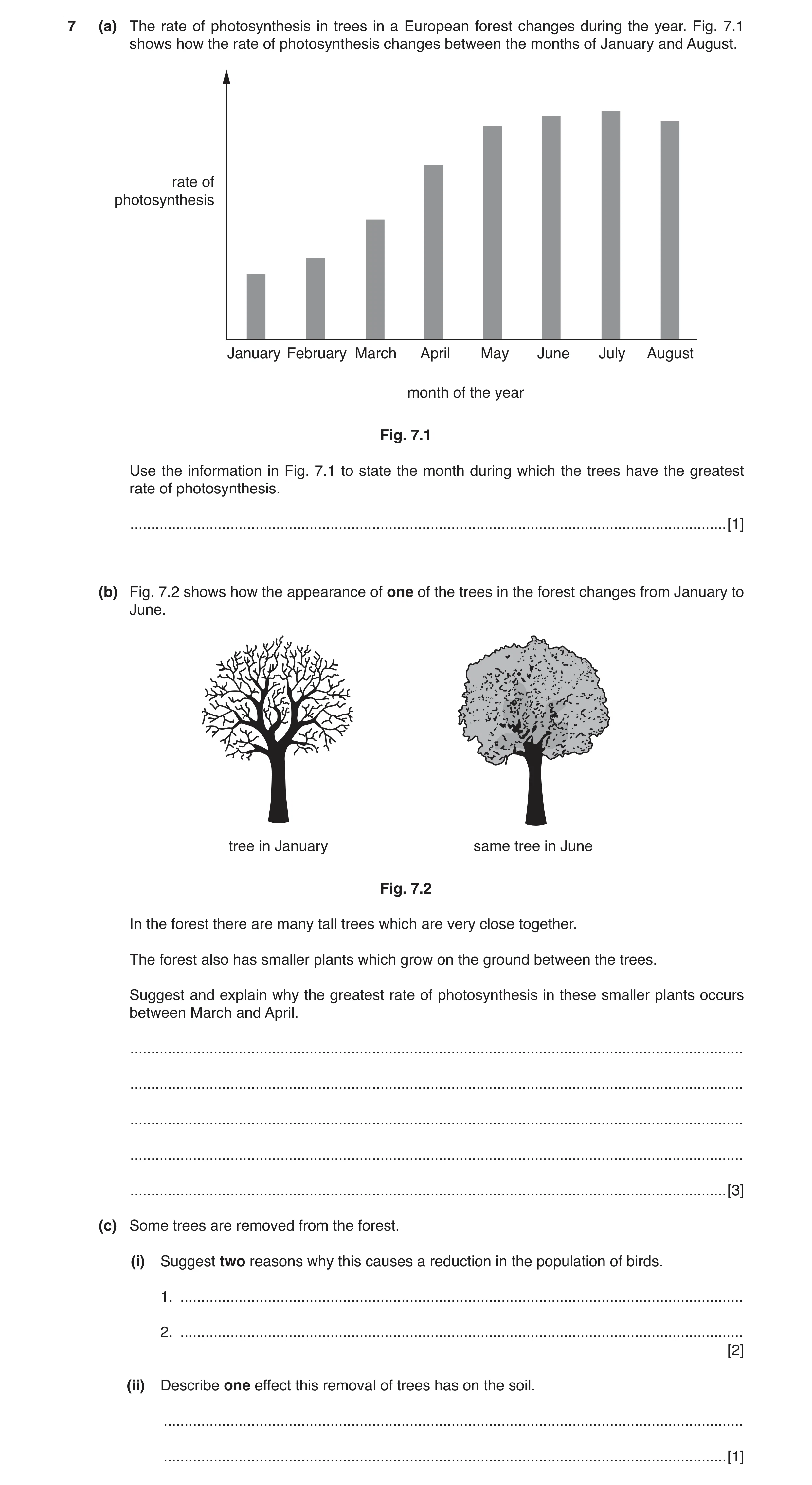
7 (a) The rate of photosynthesis in trees in a European forest changes during the year. Fig. 7.1 shows how the rate of photosynthesis changes between the months of January and August. rate of photosynthesis January February March April May June July August month of the year Fig. 7.1 Use the information in Fig. 7.1 to state the month during which the trees have the greatest rate of photosynthesis. … [1] (b) Fig. 7.2 shows how the appearance of one of the trees in the forest changes from January to June. tree in January same tree in June Fig. 7.2 In the forest there are many tall trees which are very close together. The forest also has smaller plants which grow on the ground between the trees. Suggest and explain why the greatest rate of photosynthesis in these smaller plants occurs between March and April. … … … … … [3] (c) Some trees are removed from the forest. (i) Suggest two reasons why this causes a reduction in the population of birds. 1. … 2. … [2] (ii) Describe one effect this removal of trees has on the soil. … … [1]
7 marks
Mark scheme: 7 7 7 7( 7(a) July ; 7(b) (more) less sh idea th (c)(i) loss of loss of birds m (c)(ii) soil mo ) light is availabl hading by trees hat light is neede f habitat ; f food that may l migrate from / lea ore likely to beco e (on forest floo ; ed for photosynt ive in the trees ave the area ; ome eroded ; or) ; thesis ; ; m 1 3 max2 1
This question in 0653/32 May/June 2018
Q8 · The rate of photosynthesis in trees in a European forest changes during the year 0653/33 May/June 2018
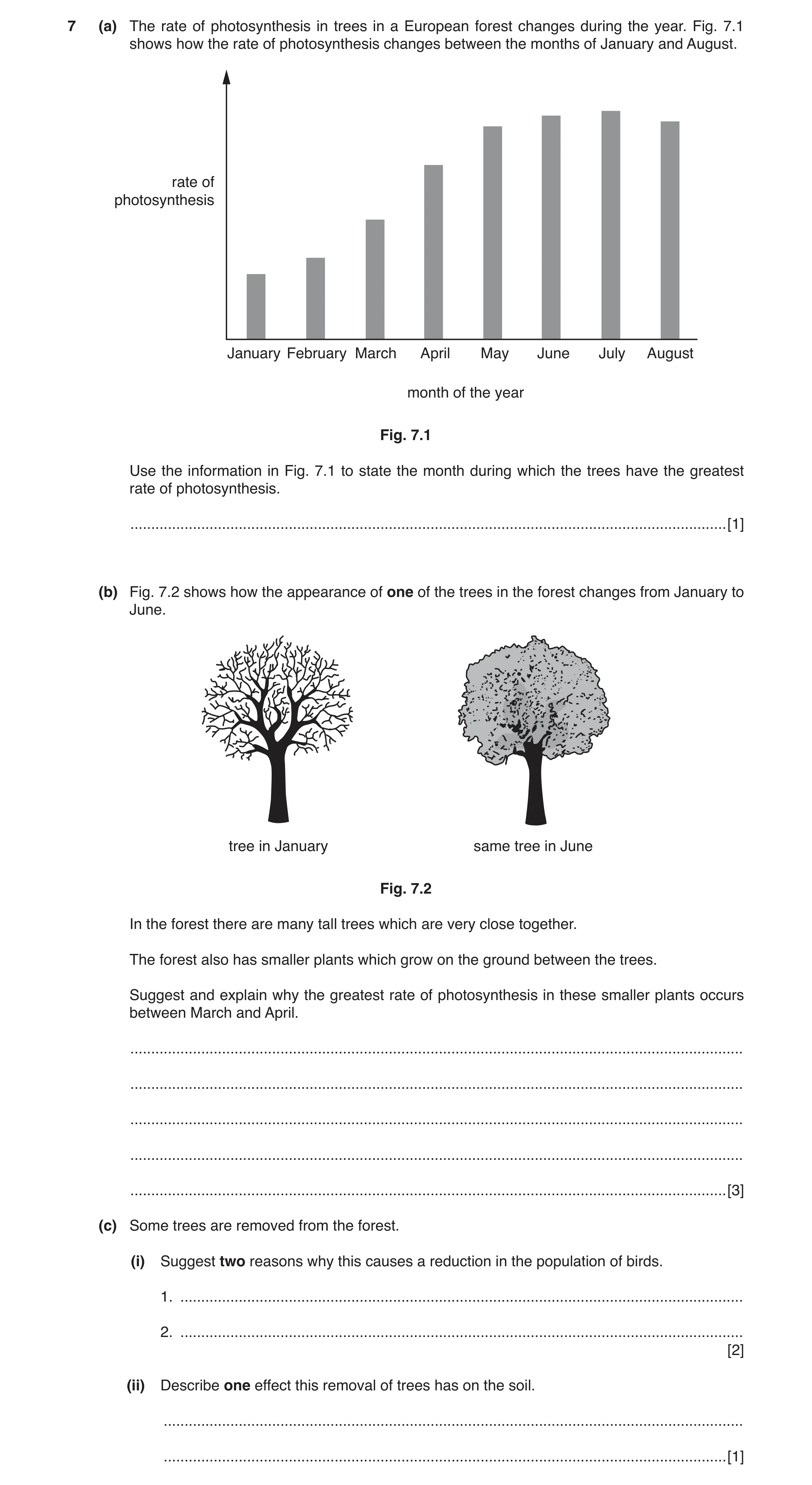
7 (a) The rate of photosynthesis in trees in a European forest changes during the year. Fig. 7.1 shows how the rate of photosynthesis changes between the months of January and August. rate of photosynthesis January February March April May June July August month of the year Fig. 7.1 Use the information in Fig. 7.1 to state the month during which the trees have the greatest rate of photosynthesis. … [1] (b) Fig. 7.2 shows how the appearance of one of the trees in the forest changes from January to June. tree in January same tree in June Fig. 7.2 In the forest there are many tall trees which are very close together. The forest also has smaller plants which grow on the ground between the trees. Suggest and explain why the greatest rate of photosynthesis in these smaller plants occurs between March and April. … … … … … [3] (c) Some trees are removed from the forest. (i) Suggest two reasons why this causes a reduction in the population of birds. 1. … 2. … [2] (ii) Describe one effect this removal of trees has on the soil. … … [1]
7 marks
Mark scheme: 7 7 7 7( 7(a) July ; 7(b) (more) less sh idea th (c)(i) loss of loss of birds m (c)(ii) soil mo ) light is availabl hading by trees hat light is neede f habitat ; f food that may l migrate from / lea ore likely to beco e (on forest floo ; ed for photosynt ive in the trees ave the area ; ome eroded ; or) ; thesis ; ; m 1 3 max2 1
This question in 0653/33 May/June 2018
Q9 · The list shows some processes that occur in living organisms 0653/31 Oct/Nov 2018
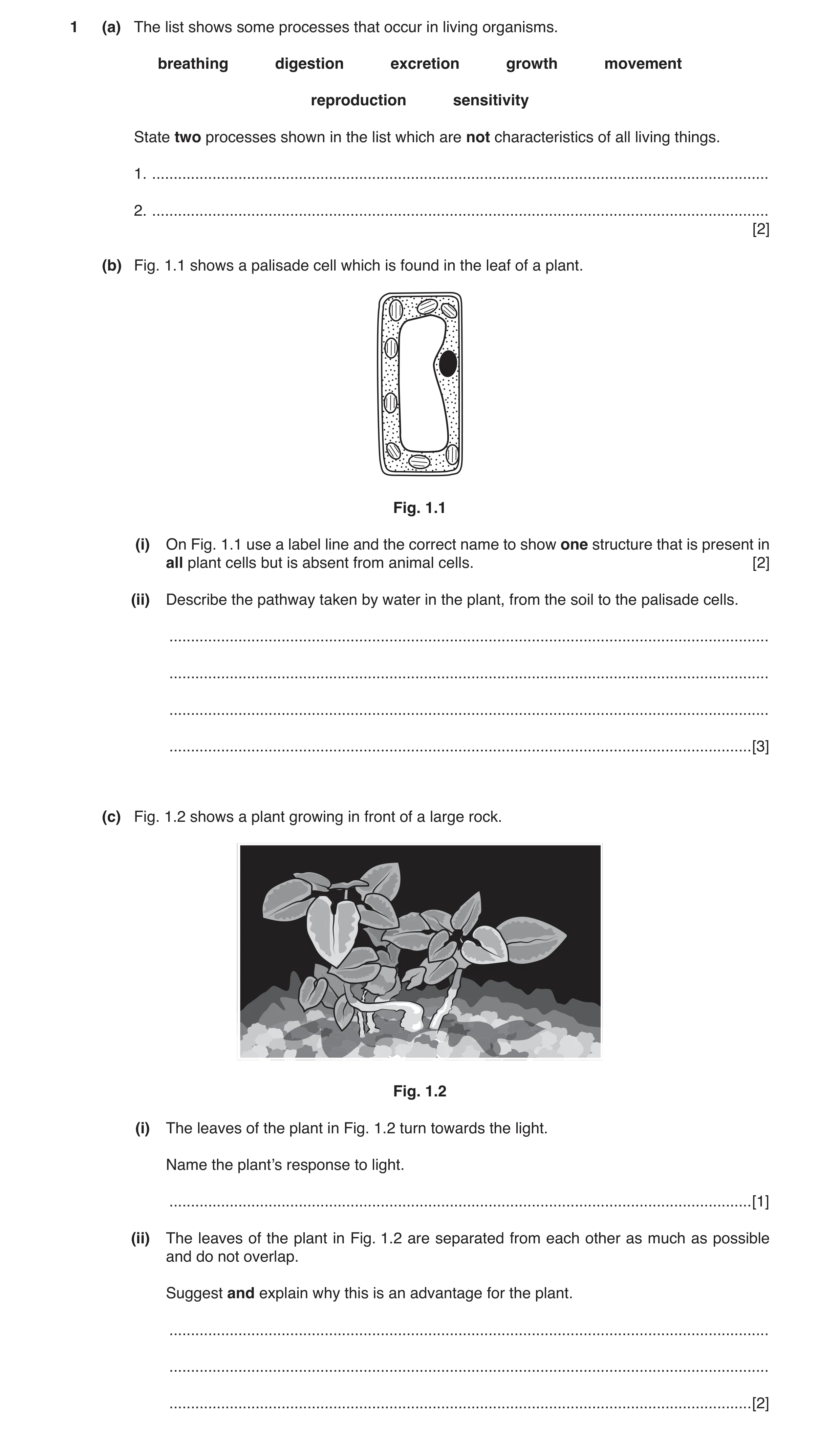
1 (a) The list shows some processes that occur in living organisms. breathing digestion excretion growth movement reproduction sensitivity State two processes shown in the list which are not characteristics of all living things. 1. … 2. … [2] (b) Fig. 1.1 shows a palisade cell which is found in the leaf of a plant. Fig. 1.1 (i) On Fig. 1.1 use a label line and the correct name to show one structure that is present in all plant cells but is absent from animal cells. [2] (ii) Describe the pathway taken by water in the plant, from the soil to the palisade cells. … … … … [3] (c) Fig. 1.2 shows a plant growing in front of a large rock. Fig. 1.2 (i) The leaves of the plant in Fig. 1.2 turn towards the light. Name the plant’s response to light. … [1] (ii) The leaves of the plant in Fig. 1.2 are separated from each other as much as possible and do not overlap. Suggest and explain why this is an advantage for the plant. … … … [2]
10 marks
Mark scheme: 1(a) breathing ; digestion ; 2 1(b)(i) vacuole named ; and label line drawn to vacuole ; OR cell wall named ; and label line drawn to cell wall ; 2 1(b)(ii) root hair cells ; up stem ; through xylem ; extra detail (e.g. by osmosis) ; Max 3 3 1(c)(i) phototropism ; 1 1(c)(ii) leaves have maximum exposure / more sunlight ; for photosynthesis ; 2
This question in 0653/31 Oct/Nov 2018
Q10 · Cross-sections through a root and a stem of a flowering plant 0653/32 Oct/Nov 2018
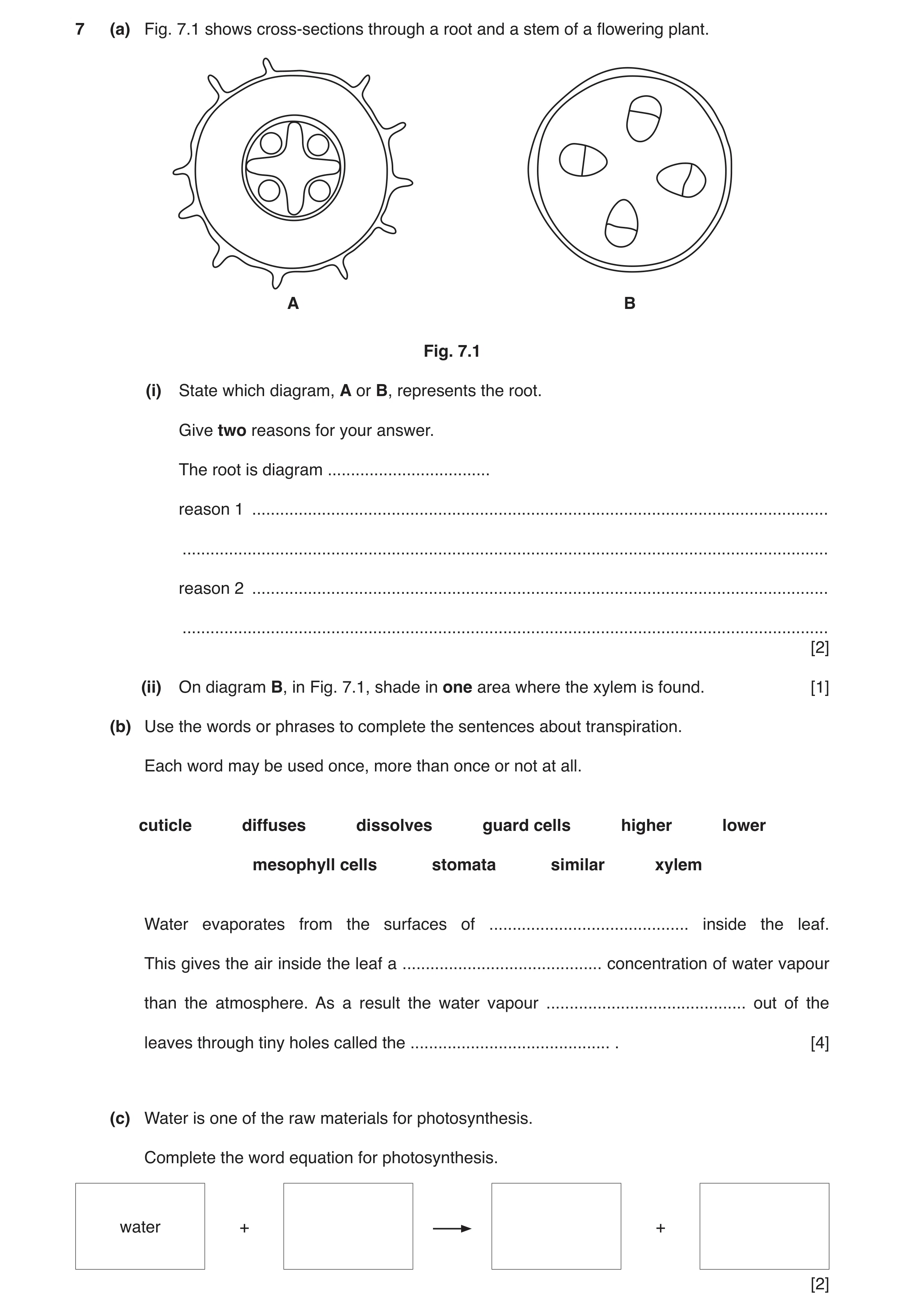
7 (a) Fig. 7.1 shows cross-sections through a root and a stem of a flowering plant. A B Fig. 7.1 (i) State which diagram, A or B, represents the root. Give two reasons for your answer. The root is diagram … reason 1 … … reason 2 … … [2] (ii) On diagram B, in Fig. 7.1, shade in one area where the xylem is found. [1] (b) Use the words or phrases to complete the sentences about transpiration. Each word may be used once, more than once or not at all. cuticle diffuses dissolves guard cells higher lower mesophyll cells stomata similar xylem Water evaporates from the surfaces of … inside the leaf. This gives the air inside the leaf a … concentration of water vapour than the atmosphere. As a result the water vapour … out of the leaves through tiny holes called the … . [4] (c) Water is one of the raw materials for photosynthesis. Complete the word equation for photosynthesis. water + + [2]
9 marks
Mark scheme: 7(a)(i) A no mark presence of root hairs ; xylem / phloem / vascular tissue (stele) found in the central area ; 2 7(a)(ii) one area of xylem correctly shaded in B ; 1 7(b) mesophyll cells ; higher ; diffuses ; stomata ; 4 7(c) carbon dioxide ; sugar / glucose + oxygen ; 2
This question in 0653/32 Oct/Nov 2018
Q11 · Rainforest is often cleared for agriculture 0653/33 Oct/Nov 2018
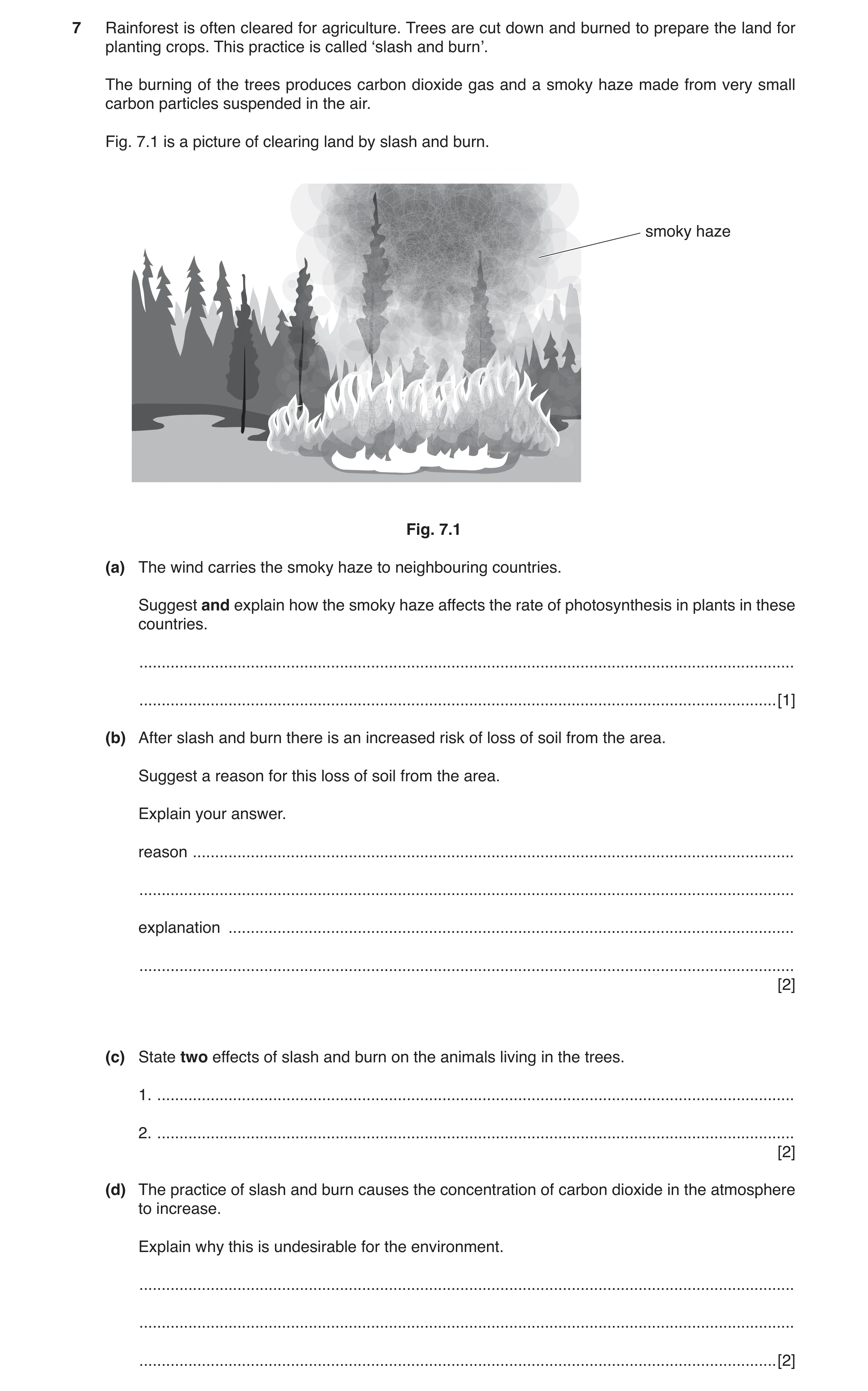
7 Rainforest is often cleared for agriculture. Trees are cut down and burned to prepare the land for planting crops. This practice is called ‘slash and burn’. The burning of the trees produces carbon dioxide gas and a smoky haze made from very small carbon particles suspended in the air. Fig. 7.1 is a picture of clearing land by slash and burn. smoky haze Fig. 7.1 (a) The wind carries the smoky haze to neighbouring countries. Suggest and explain how the smoky haze affects the rate of photosynthesis in plants in these countries. … … [1] (b) After slash and burn there is an increased risk of loss of soil from the area. Suggest a reason for this loss of soil from the area. Explain your answer. reason … … explanation … … [2] (c) State two effects of slash and burn on the animals living in the trees. 1. … 2. … [2] (d) The practice of slash and burn causes the concentration of carbon dioxide in the atmosphere to increase. Explain why this is undesirable for the environment. … … … [2]
7 marks
Mark scheme: 7(a) rate is reduced (no mark) haze / smoke particles reduce light / block stomata ; 1 7(b) (reason) lack of tree roots in soil ; (explanation) roots stabilise the soil ; or (reason) trees and plants not present to protect soil / bare soil is exposed ; (explanation) wind and rain can easily reach soil to erode it ; 2 7(c) any two of lose their habitats / move to new areas ; lose food supplies ; may be suffocated / burned by the burning process ; Max 2 2 7(d) carbon dioxide is a greenhouse gas ; contributes to global warming ; any valid consequence of global warming ; Max 2 2
This question in 0653/33 Oct/Nov 2018
Q12 · Some leaves of the plant Mimosa pudica 0653/33 May/June 2019
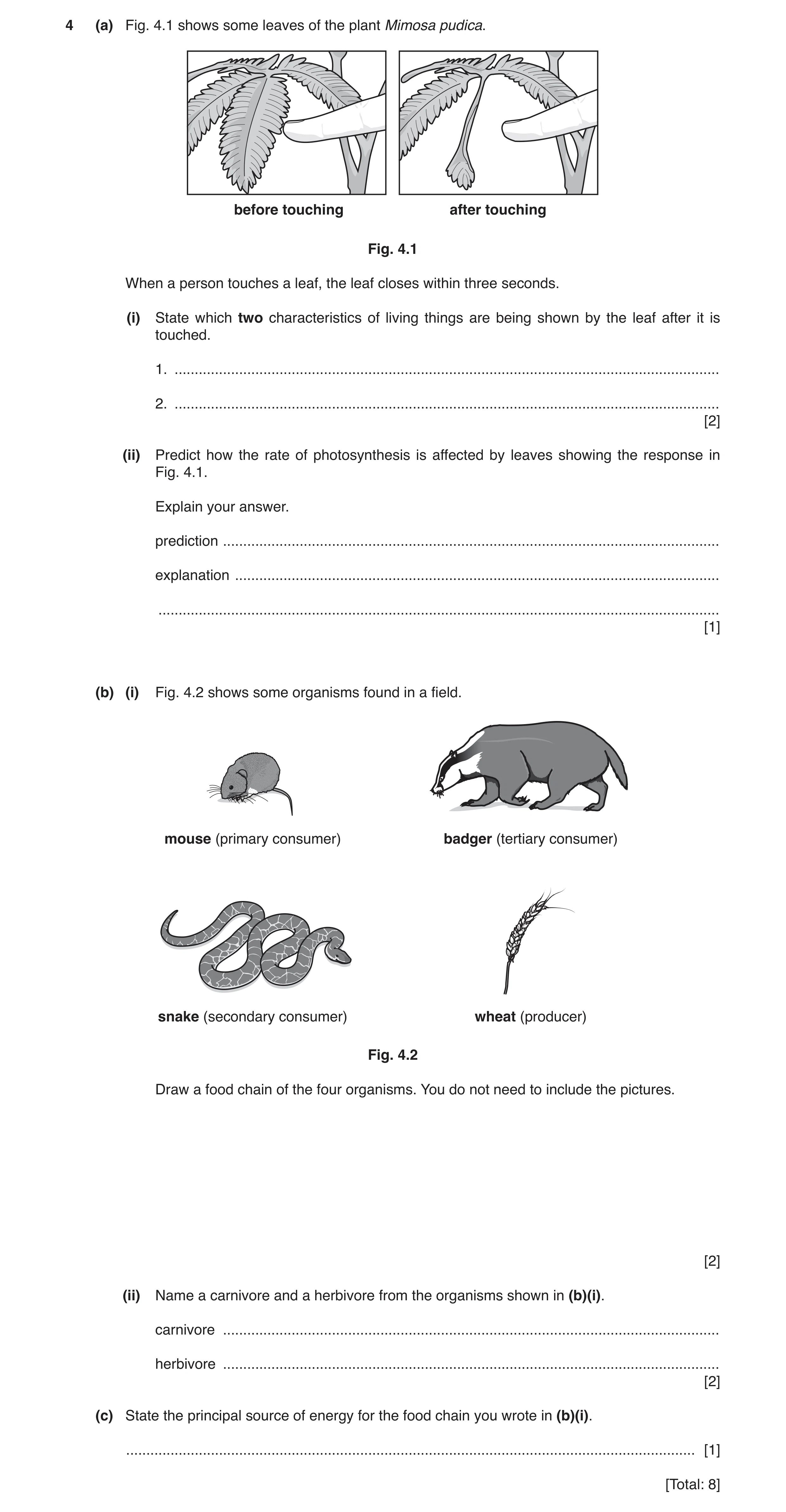
4 (a) Fig. 4.1 shows some leaves of the plant Mimosa pudica. before touching after touching Fig. 4.1 When a person touches a leaf, the leaf closes within three seconds. (i) State which two characteristics of living things are being shown by the leaf after it is touched. 1. … 2. … [2] (ii) Predict how the rate of photosynthesis is affected by leaves showing the response in Fig. 4.1. Explain your answer. prediction … explanation … … [1] (b) (i) Fig. 4.2 shows some organisms found in a field. mouse (primary consumer) badger (tertiary consumer) snake (secondary consumer) wheat (producer) Fig. 4.2 Draw a food chain of the four organisms. You do not need to include the pictures. [2] (ii) Name a carnivore and a herbivore from the organisms shown in (b)(i). carnivore … herbivore … [2] (c) State the principal source of energy for the food chain you wrote in (b)(i). … [1] [Total: 8]
8 marks
Mark scheme: 4(a)(i) sensitivity ; movement ; 2 4(a)(ii) rate stops / reduces and less leaf area / less light (energy) absorbed ; 1 Question Answer Marks 4(b)(i) wheat mouse snake badger correct order of organisms ; arrows going in correct direction ; 2 4(b)(ii) snake / badger ; mouse ; 2 4(c) Sun ; 1
This question in 0653/33 May/June 2019
Q13 · Plants need water to survive 0653/31 Oct/Nov 2019
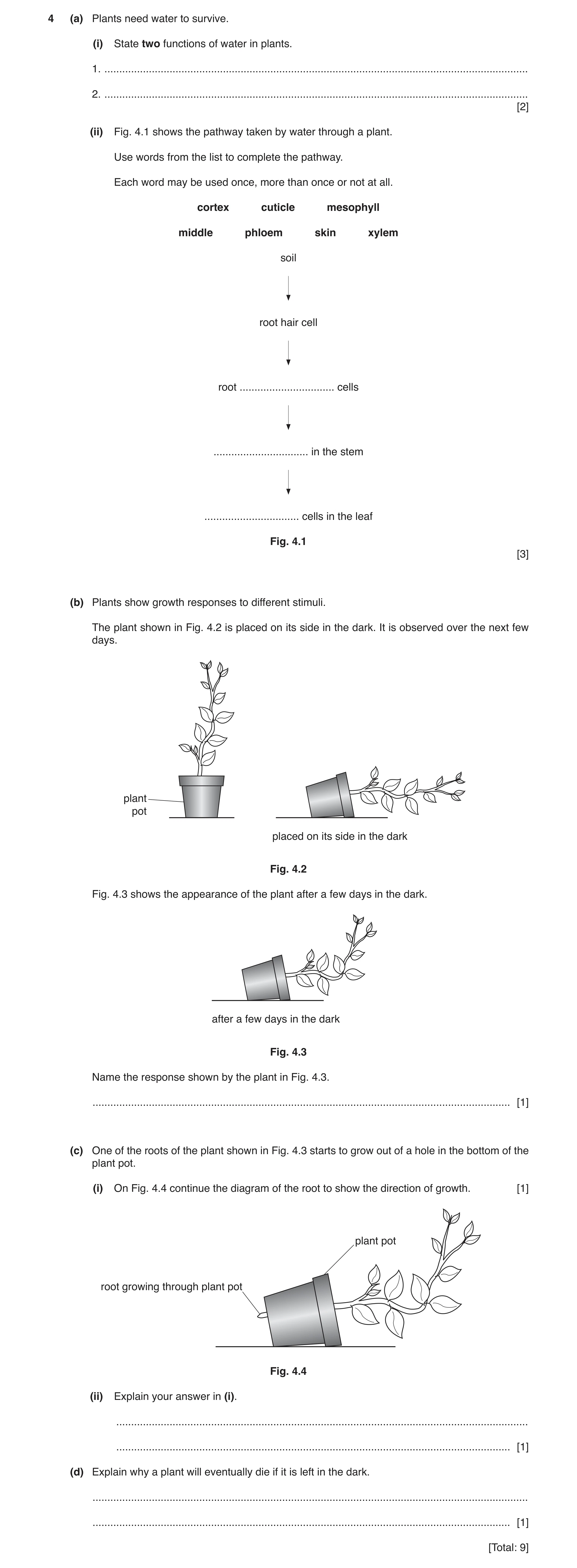
4 (a) Plants need water to survive. (i) State two functions of water in plants. 1. … 2. … [2] (ii) Fig. 4.1 shows the pathway taken by water through a plant. Use words from the list to complete the pathway. Each word may be used once, more than once or not at all. cortex cuticle mesophyll middle phloem skin xylem soil root hair cell root … cells … in the stem … cells in the leaf Fig. 4.1 [3] (b) Plants show growth responses to different stimuli. The plant shown in Fig. 4.2 is placed on its side in the dark. It is observed over the next few days. plant pot placed on its side in the dark Fig. 4.2 Fig. 4.3 shows the appearance of the plant after a few days in the dark. after a few days in the dark Fig. 4.3 Name the response shown by the plant in Fig. 4.3. … [1] (c) One of the roots of the plant shown in Fig. 4.3 starts to grow out of a hole in the bottom of the plant pot. (i) On Fig. 4.4 continue the diagram of the root to show the direction of growth. [1] plant pot root growing through plant pot Fig. 4.4 (ii) Explain your answer in (i). … … [1] (d) Explain why a plant will eventually die if it is left in the dark. … … [1] [Total: 9]
9 marks
Mark scheme: 4(a)(i) any two from: for photosynthesis ; transport in plants ; as a solvent ; 2 4(a)(ii) cortex ; xylem ; mesophyll ; 3 4(b) gravitropism ; 1 4(c)(i) root continued and bending downwards ; 1 4(c)(ii) roots respond to gravity; 1 4(d) no light for photosynthesis ; 1
This question in 0653/31 Oct/Nov 2019
Question 14 0653/32 Oct/Nov 2019
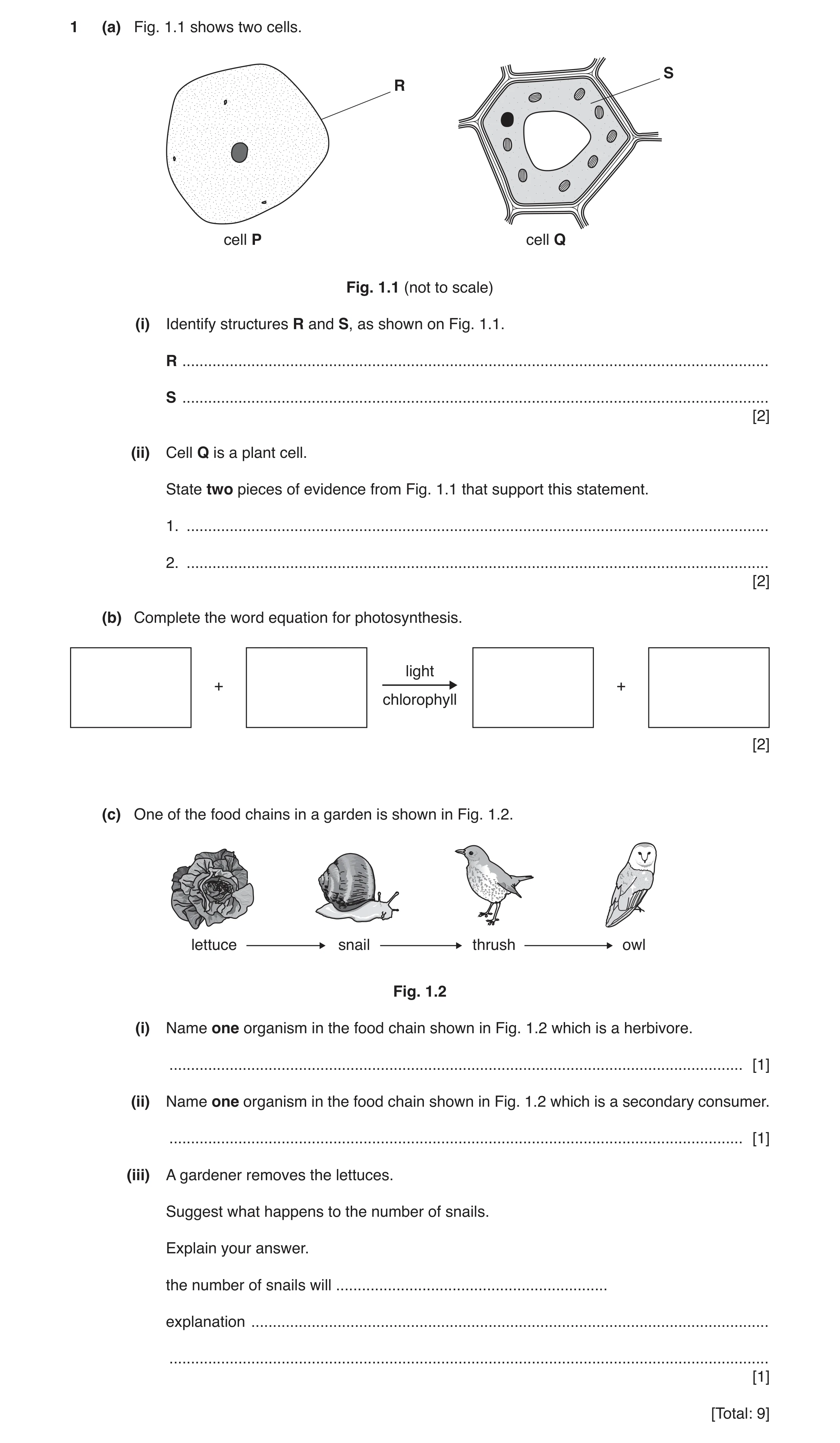
1 (a) Fig. 1.1 shows two cells. S R cell P cell Q Fig. 1.1 (not to scale) (i) Identify structures R and S, as shown on Fig. 1.1. R … S … [2] (ii) Cell Q is a plant cell. State two pieces of evidence from Fig. 1.1 that support this statement. 1. … 2. … [2] (b) Complete the word equation for photosynthesis. light + + chlorophyll [2] (c) One of the food chains in a garden is shown in Fig. 1.2. lettuce snail thrush owl Fig. 1.2 (i) Name one organism in the food chain shown in Fig. 1.2 which is a herbivore. … [1] (ii) Name one organism in the food chain shown in Fig. 1.2 which is a secondary consumer. … [1] (iii) A gardener removes the lettuces. Suggest what happens to the number of snails. Explain your answer. the number of snails will … explanation … … [1] [Total: 9]
9 marks
Mark scheme: 1(a)(i) R cell membrane ; S cytoplasm ; 2 1(a)(ii) any two from: (it has a) cell wall ; (it has a large) vacuole ; (it has) chloroplasts ; 2 1(b) (LHS) carbon dioxide + water ; (RHS) glucose + oxygen ; 2 1(c)(i) snail ; 1 1(c)(ii) thrush ; 1 1(c)(iii) decrease and (they have) less food / no food ; 1
This question in 0653/32 Oct/Nov 2019
Question 15 0653/33 Oct/Nov 2019
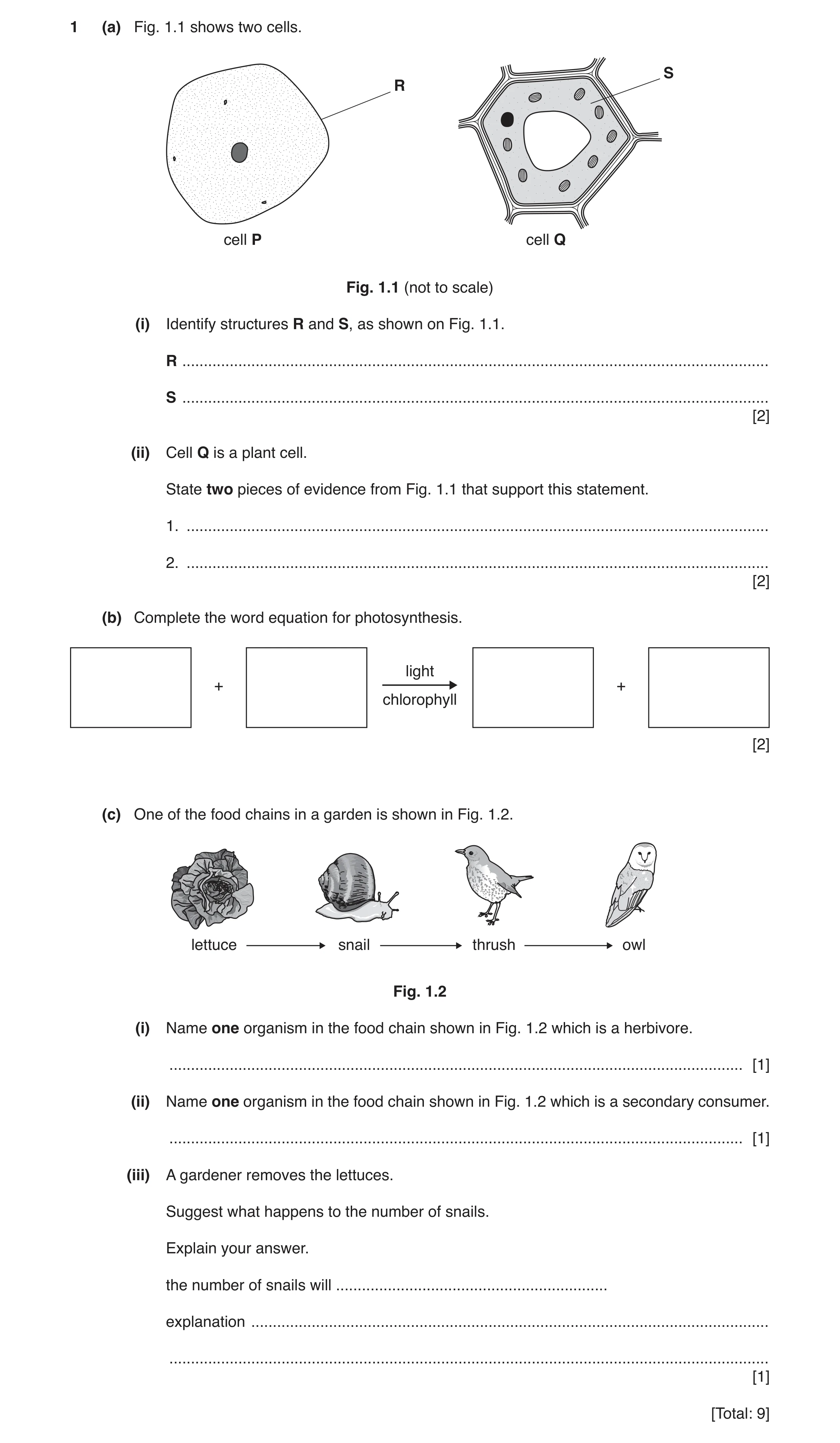
1 (a) Fig. 1.1 shows two cells. S R cell P cell Q Fig. 1.1 (not to scale) (i) Identify structures R and S, as shown on Fig. 1.1. R … S … [2] (ii) Cell Q is a plant cell. State two pieces of evidence from Fig. 1.1 that support this statement. 1. … 2. … [2] (b) Complete the word equation for photosynthesis. light + + chlorophyll [2] (c) One of the food chains in a garden is shown in Fig. 1.2. lettuce snail thrush owl Fig. 1.2 (i) Name one organism in the food chain shown in Fig. 1.2 which is a herbivore. … [1] (ii) Name one organism in the food chain shown in Fig. 1.2 which is a secondary consumer. … [1] (iii) A gardener removes the lettuces. Suggest what happens to the number of snails. Explain your answer. the number of snails will … explanation … … [1] [Total: 9]
9 marks
Mark scheme: 1(a)(i) R cell membrane ; S cytoplasm ; 2 1(a)(ii) any two from: (it has a) cell wall ; (it has a large) vacuole ; (it has) chloroplasts ; 2 1(b) (LHS) carbon dioxide + water ; (RHS) glucose + oxygen ; 2 1(c)(i) snail ; 1 1(c)(ii) thrush ; 1 1(c)(iii) decrease and (they have) less food / no food ; 1
This question in 0653/33 Oct/Nov 2019
Q16 · Diagrams of a plant cell before and after the cell is immersed in concentrated sugar… 0653/31 Oct/Nov 2020
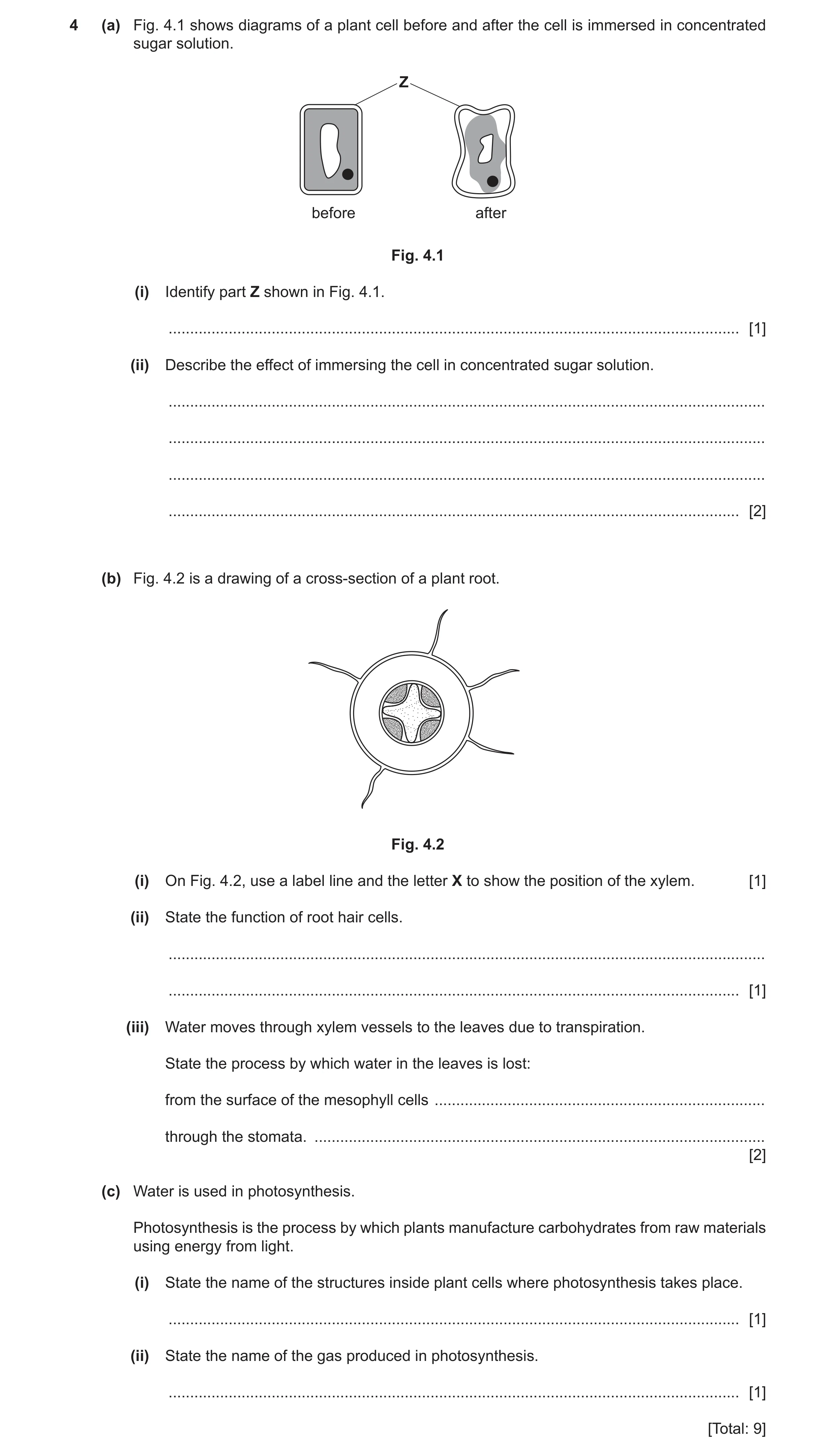
4 (a) Fig. 4.1 shows diagrams of a plant cell before and after the cell is immersed in concentrated sugar solution. Z before after Fig. 4.1 (i) Identify part Z shown in Fig. 4.1. … [1] (ii) Describe the effect of immersing the cell in concentrated sugar solution. … … … … [2] (b) Fig. 4.2 is a drawing of a cross-section of a plant root. Fig. 4.2 (i) On Fig. 4.2, use a label line and the letter X to show the position of the xylem. [1] (ii) State the function of root hair cells. … … [1] (iii) Water moves through xylem vessels to the leaves due to transpiration. State the process by which water in the leaves is lost: from the surface of the mesophyll cells … through the stomata. … [2] (c) Water is used in photosynthesis. Photosynthesis is the process by which plants manufacture carbohydrates from raw materials using energy from light. (i) State the name of the structures inside plant cells where photosynthesis takes place. … [1] (ii) State the name of the gas produced in photosynthesis. … [1] [Total: 9]
9 marks
Mark scheme: 4(a)(i) cell wall ; 1 4(a)(ii) any two from: (cell / cytoplasm / vacuole) shrinks ; water moves out / water moves across partially permeable membrane ; by, osmosis / diffusion ; 2 Question Answer Marks 4(b)(i) label line in any xylem cell ; 1 4(b)(ii) take in, water / mineral ions ; 1 4(b)(iii) evaporation ; diffusion ; 2 4(c)(i) chloroplasts ; 1 4(c)(ii) oxygen ; 1
This question in 0653/31 Oct/Nov 2020
Q17 · A food web for a pond habitat 0653/32 Oct/Nov 2020
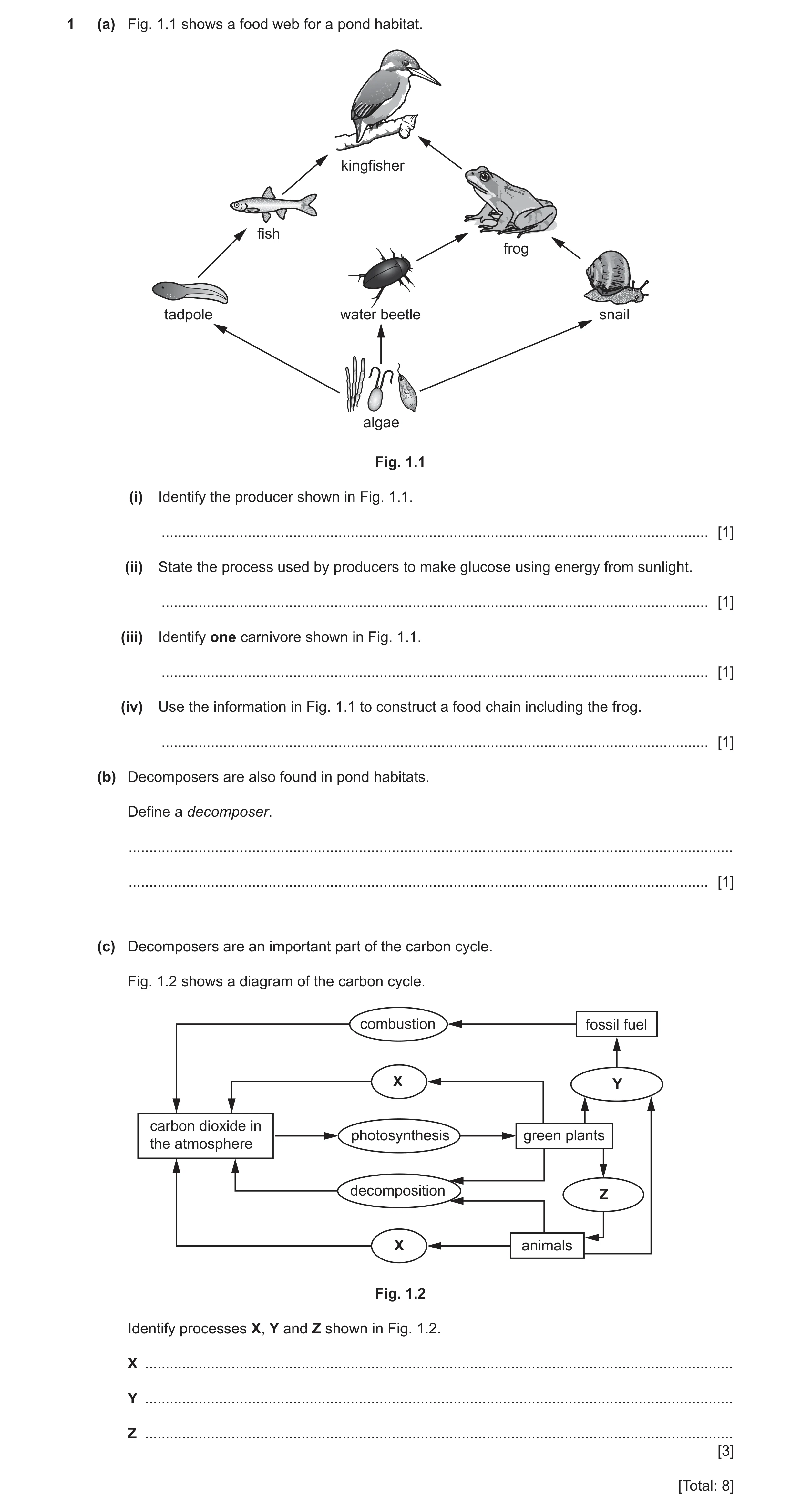
1 (a) Fig. 1.1 shows a food web for a pond habitat. kingfisher fish frog tadpole water beetle snail algae Fig. 1.1 (i) Identify the producer shown in Fig. 1.1. … [1] (ii) State the process used by producers to make glucose using energy from sunlight. … [1] (iii) Identify one carnivore shown in Fig. 1.1. … [1] (iv) Use the information in Fig. 1.1 to construct a food chain including the frog. … [1] (b) Decomposers are also found in pond habitats. Define a decomposer. … … [1] (c) Decomposers are an important part of the carbon cycle. Fig. 1.2 shows a diagram of the carbon cycle. combustion fossil fuel X Y carbon dioxide in photosynthesis green plants the atmosphere decomposition Z X animals Fig. 1.2 Identify processes X, Y and Z shown in Fig. 1.2. X … Y … Z … [3] [Total: 8]
8 marks
Mark scheme: 1(a)(i) algae ; 1 1(a)(ii) photosynthesis ; 1 1(a)(iii) frog / fish / kingfisher ; 1 1(a)(iv) algae → snail / water beetle → frog → kingfisher ; 1 1(b) (an organism that) gets its energy from dead or waste organic matter ; 1 1(c) X respiration ; Y fossilisation ; Z feeding ; 3 Question Answer Marks
This question in 0653/32 Oct/Nov 2020
Q18 · Plant cells as seen with a microscope 0653/33 Oct/Nov 2020
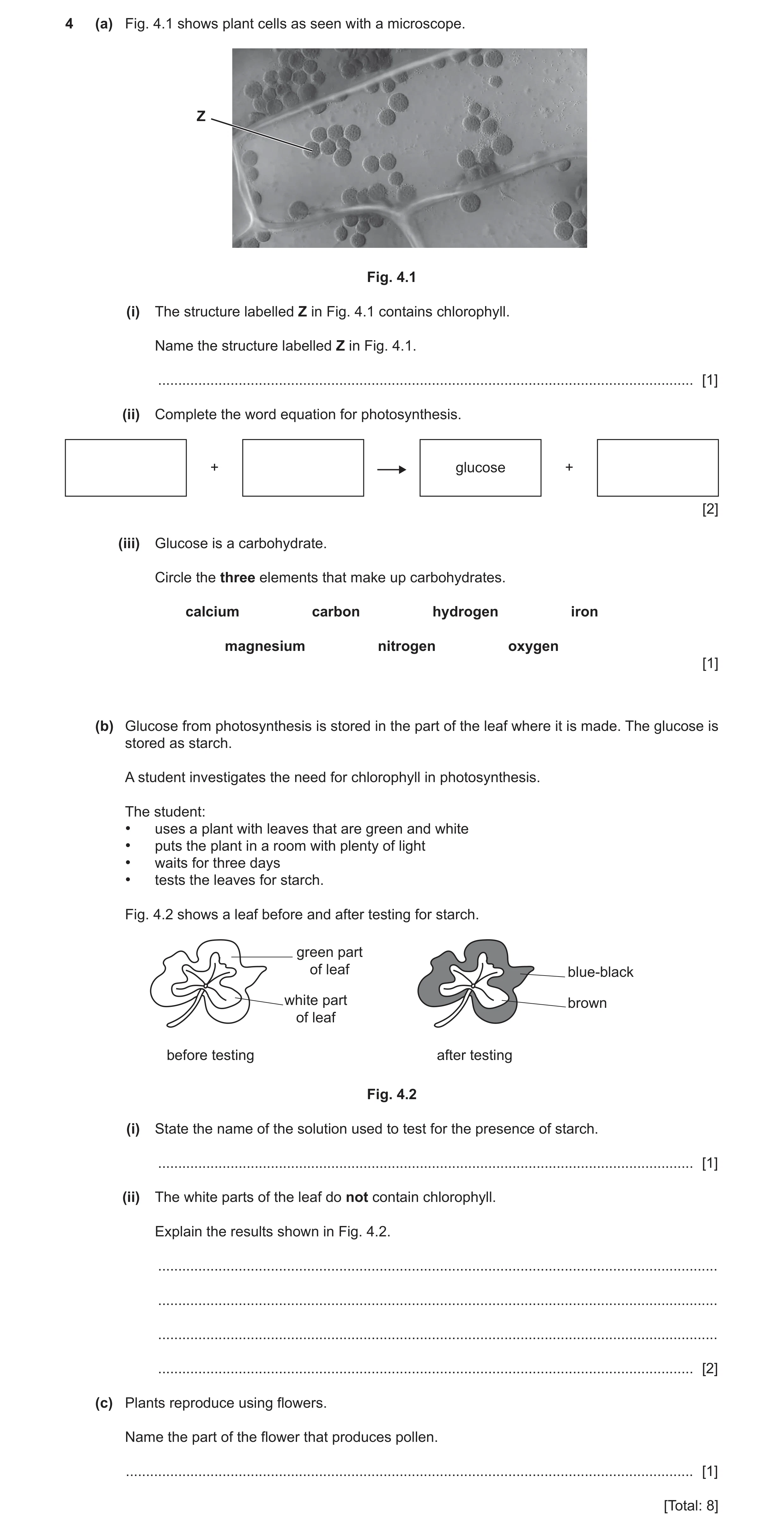
4 (a) Fig. 4.1 shows plant cells as seen with a microscope. Z Fig. 4.1 (i) The structure labelled Z in Fig. 4.1 contains chlorophyll. Name the structure labelled Z in Fig. 4.1. … [1] (ii) Complete the word equation for photosynthesis. + glucose + [2] (iii) Glucose is a carbohydrate. Circle the three elements that make up carbohydrates. calcium carbon hydrogen iron magnesium nitrogen oxygen [1] (b) Glucose from photosynthesis is stored in the part of the leaf where it is made. The glucose is stored as starch. A student investigates the need for chlorophyll in photosynthesis. The student: • uses a plant with leaves that are green and white • puts the plant in a room with plenty of light • waits for three days • tests the leaves for starch. Fig. 4.2 shows a leaf before and after testing for starch. green part of leaf blue-black white part brown of leaf before testing after testing Fig. 4.2 (i) State the name of the solution used to test for the presence of starch. … [1] (ii) The white parts of the leaf do not contain chlorophyll. Explain the results shown in Fig. 4.2. … … … … [2] (c) Plants reproduce using flowers. Name the part of the flower that produces pollen. … [1] [Total: 8]
8 marks
Mark scheme: 4(a)(i) chloroplast ; 1 4(a)(ii) (LHS) carbon dioxide + water ; (RHS) (glucose) + oxygen ; 2 4(a)(iii) carbon AND hydrogen AND oxygen ; 1 4(b)(i) iodine (solution) ; 1 4(b)(ii) no starch in white area OR iodine stays brown so no starch / ORA ; no photosynthesis takes place in white area / ORA OR chlorophyll is needed for photosynthesis ; 2 4(c) anther ; 1
This question in 0653/33 Oct/Nov 2020
Q19 · Part of a food web from a lake 0653/32 Feb/March 2021
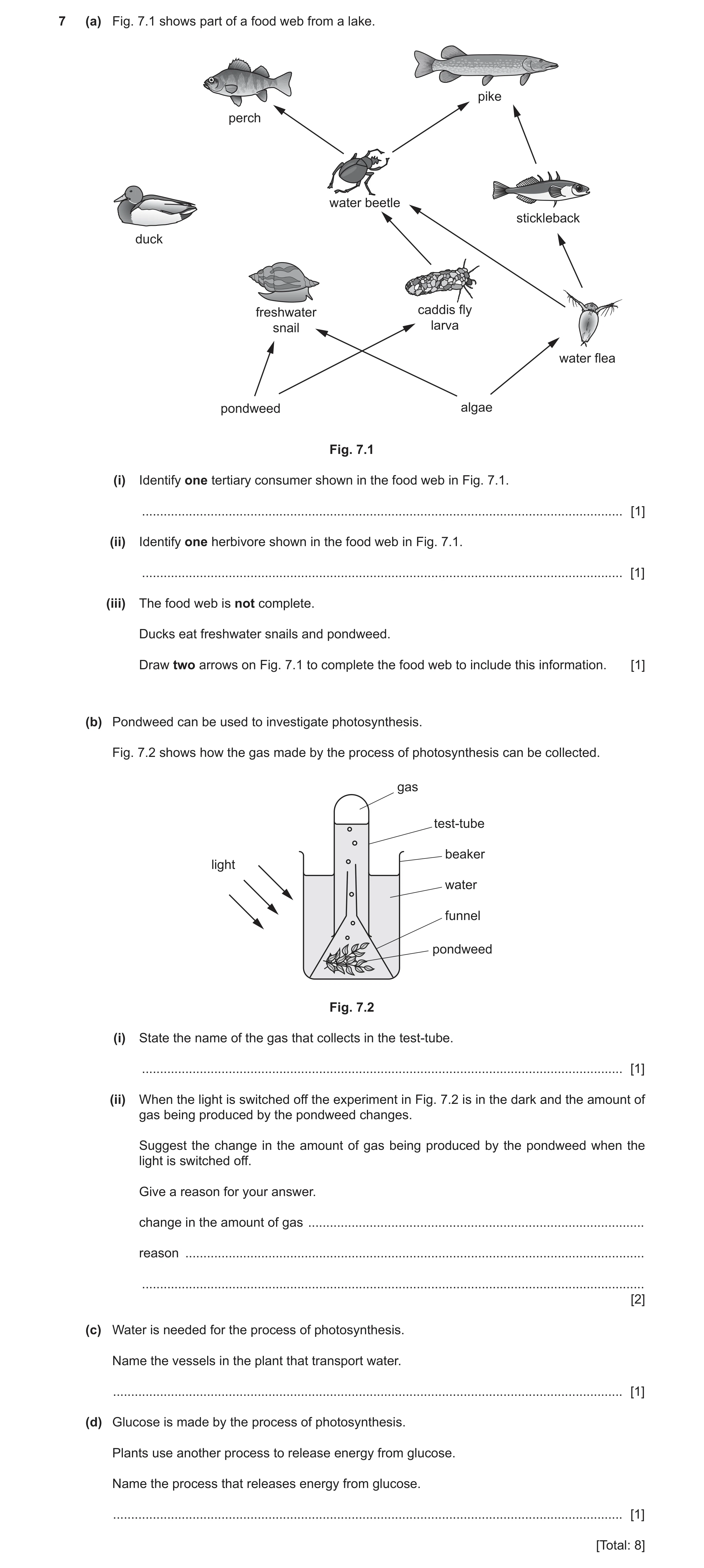
7 (a) Fig. 7.1 shows part of a food web from a lake. pike perch water beetle stickleback duck freshwater caddis fly snail larva water flea pondweed algae Fig. 7.1 (i) Identify one tertiary consumer shown in the food web in Fig. 7.1. … [1] (ii) Identify one herbivore shown in the food web in Fig. 7.1. … [1] (iii) The food web is not complete. Ducks eat freshwater snails and pondweed. Draw two arrows on Fig. 7.1 to complete the food web to include this information. [1] (b) Pondweed can be used to investigate photosynthesis. Fig. 7.2 shows how the gas made by the process of photosynthesis can be collected. gas test-tube beaker light water funnel pondweed Fig. 7.2 (i) State the name of the gas that collects in the test-tube. … [1] (ii) When the light is switched off the experiment in Fig. 7.2 is in the dark and the amount of gas being produced by the pondweed changes. Suggest the change in the amount of gas being produced by the pondweed when the light is switched off. Give a reason for your answer. change in the amount of gas … reason … … [2] (c) Water is needed for the process of photosynthesis. Name the vessels in the plant that transport water. … [1] (d) Glucose is made by the process of photosynthesis. Plants use another process to release energy from glucose. Name the process that releases energy from glucose. … [1] [Total: 8]
8 marks
Mark scheme: 7(a)(i) perch / pike ; 1 7(a)(ii) freshwater snail / caddis fly larva / water flea ; 1 7(a)(iii) arrow from freshwater snail to duck AND arrow from pondweed to duck ; 1 7(b)(i) oxygen ; 1 7(b)(ii) less / no, gas produced ; (because) light is needed for photosynthesis ; 2 7(c) xylem ; 1 7(d) (aerobic) respiration ; 1
This question in 0653/32 Feb/March 2021
Q20 · A student investigates the effect of temperature on enzyme activity 0653/31 May/June 2021
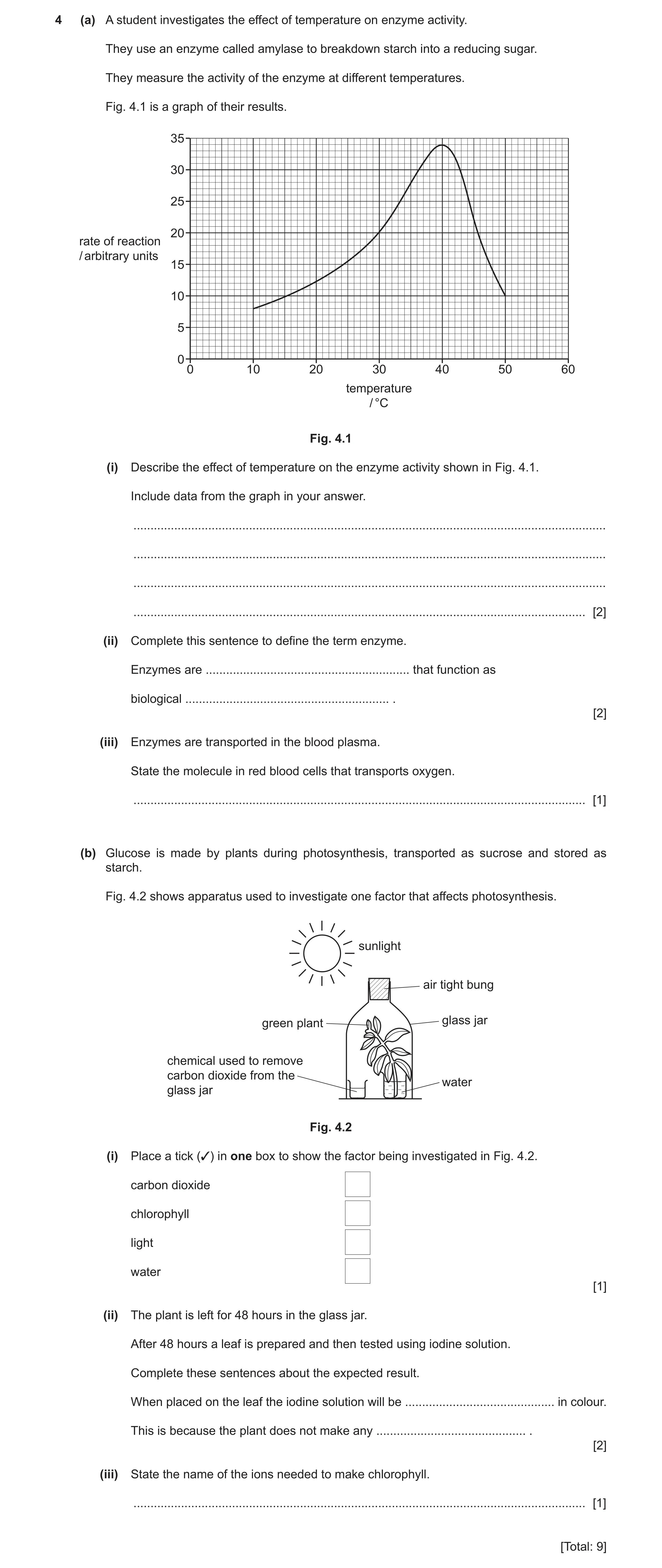
4 (a) A student investigates the effect of temperature on enzyme activity. They use an enzyme called amylase to breakdown starch into a reducing sugar. They measure the activity of the enzyme at different temperatures. Fig. 4.1 is a graph of their results. 35 30 25 20 rate of reaction / arbitrary units 15 10 5 0 0 10 20 30 40 50 60 temperature / °C Fig. 4.1 (i) Describe the effect of temperature on the enzyme activity shown in Fig. 4.1. Include data from the graph in your answer. … … … … [2] (ii) Complete this sentence to define the term enzyme. Enzymes are … that function as biological … . [2] (iii) Enzymes are transported in the blood plasma. State the molecule in red blood cells that transports oxygen. … [1] (b) Glucose is made by plants during photosynthesis, transported as sucrose and stored as starch. Fig. 4.2 shows apparatus used to investigate one factor that affects photosynthesis. sunlight air tight bung green plant glass jar chemical used to remove carbon dioxide from the water glass jar Fig. 4.2 (i) Place a tick (✓) in one box to show the factor being investigated in Fig. 4.2. carbon dioxide chlorophyll light water [1] (ii) The plant is left for 48 hours in the glass jar. After 48 hours a leaf is prepared and then tested using iodine solution. Complete these sentences about the expected result. When placed on the leaf the iodine solution will be … in colour. This is because the plant does not make any … . [2] (iii) State the name of the ions needed to make chlorophyll. … [1] [Total: 9]
9 marks
Mark scheme: 4(a)(i) as temperature increases, rate increases then falls ; peak or optimum (rate) at 40°C / maximum rate 34 (arbitrary units) ; OR activity increases, to 40°C / from a rate of 8 to 34 ; above 40°C the activity decreases / decreases from 34 ; 2 4(a)(ii) proteins ; catalysts ; 2 4(a)(iii) haemoglobin ; 1 4(b)(i) carbon dioxide chlorophyll light water ; 1 4b(ii) orange / brown ; starch ; 2 4(b)(iii) magnesium ; 1
This question in 0653/31 May/June 2021
Q21 · Nutrition is one of the characteristics of living organisms 0653/33 May/June 2021
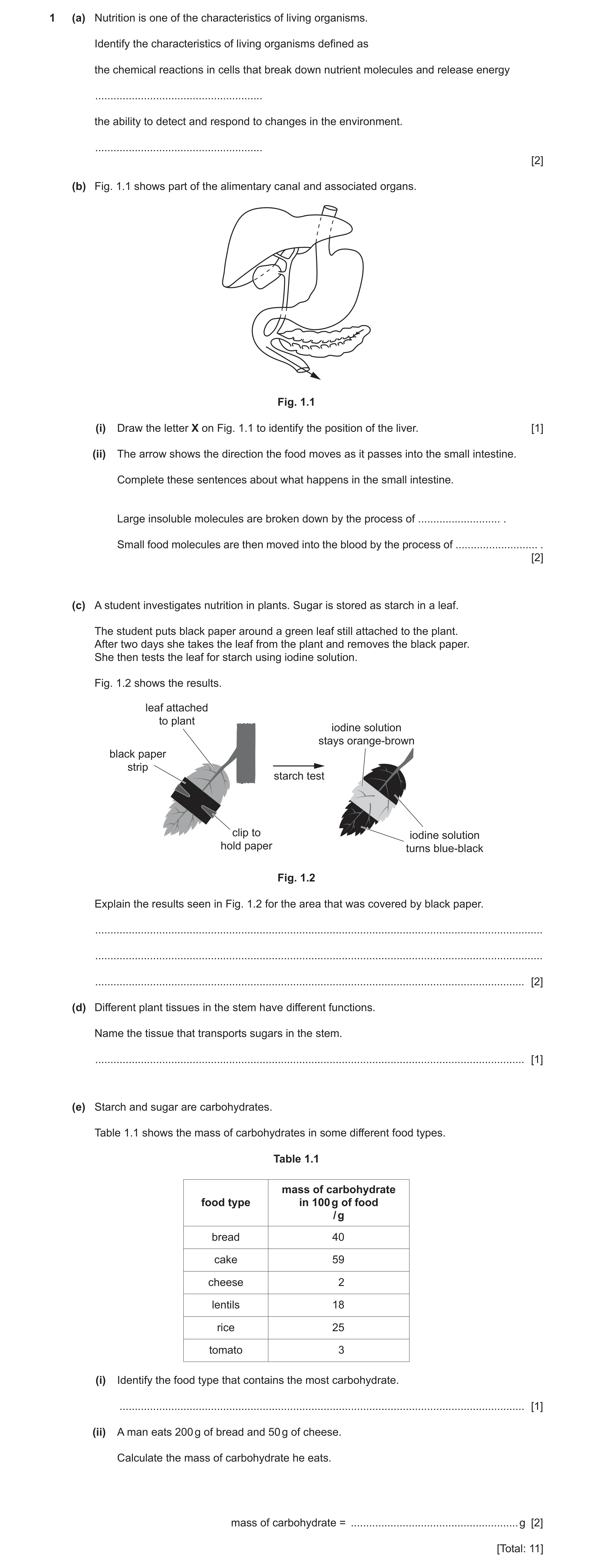
1 (a) Nutrition is one of the characteristics of living organisms. Identify the characteristics of living organisms defined as the chemical reactions in cells that break down nutrient molecules and release energy … the ability to detect and respond to changes in the environment. … [2] (b) Fig. 1.1 shows part of the alimentary canal and associated organs. Fig. 1.1 (i) Draw the letter X on Fig. 1.1 to identify the position of the liver. [1] (ii) The arrow shows the direction the food moves as it passes into the small intestine. Complete these sentences about what happens in the small intestine. Large insoluble molecules are broken down by the process of … . Small food molecules are then moved into the blood by the process of … . [2] (c) A student investigates nutrition in plants. Sugar is stored as starch in a leaf. The student puts black paper around a green leaf still attached to the plant. After two days she takes the leaf from the plant and removes the black paper. She then tests the leaf for starch using iodine solution. Fig. 1.2 shows the results. leaf attached to plant iodine solution stays orange-brown black paper strip starch test clip to iodine solution hold paper turns blue-black Fig. 1.2 Explain the results seen in Fig. 1.2 for the area that was covered by black paper. … … … [2] (d) Different plant tissues in the stem have different functions. Name the tissue that transports sugars in the stem. … [1] (e) Starch and sugar are carbohydrates. Table 1.1 shows the mass of carbohydrates in some different food types. Table 1.1 mass of carbohydrate food type in 100 g of food / g bread 40 cake 59 cheese 2 lentils 18 rice 25 tomato 3 (i) Identify the food type that contains the most carbohydrate. … [1] (ii) A man eats 200 g of bread and 50 g of cheese. Calculate the mass of carbohydrate he eats. mass of carbohydrate = … g [2] [Total: 11]
11 marks
Mark scheme: 1(a) respiration ; sensitivity ; 2 1(b)(i) centre of X must be on liver ; 1 1(b)(ii) digestion ; absorption ; 2 1(c) no starch is made ; as light is needed for photosynthesis ; 2 1(d) phloem ; 1 1(e)(i) cake ; 1 1(e)(ii) (40 x 2) + (2 x 0.5) ; 81 (g) ; 2
This question in 0653/33 May/June 2021
Q22 · A photograph of a butterfly feeding on a lavender flower 0653/32 Feb/March 2022
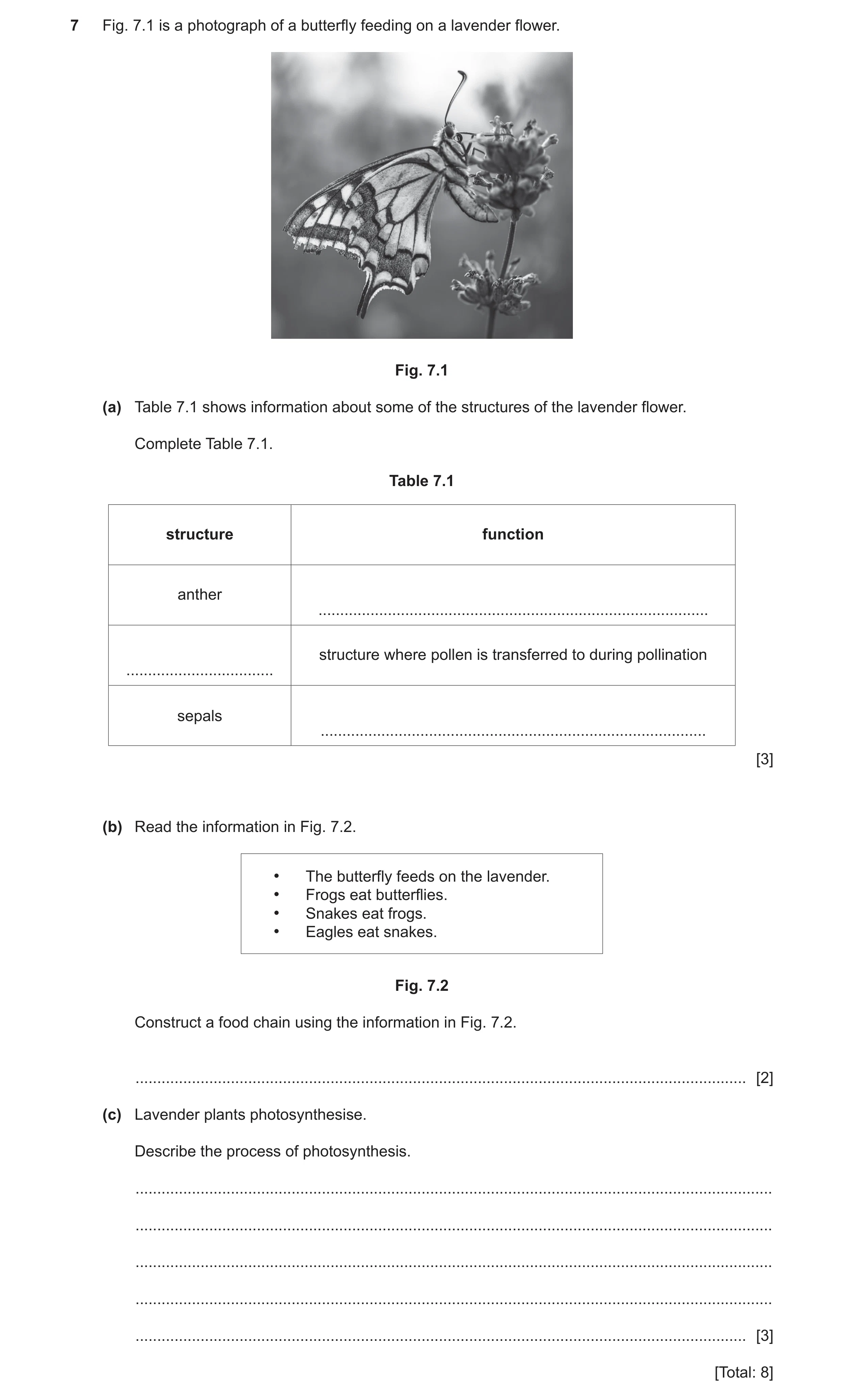
7 Fig. 7.1 is a photograph of a butterfly feeding on a lavender flower. Fig. 7.1 (a) Table 7.1 shows information about some of the structures of the lavender flower. Complete Table 7.1. Table 7.1 structure function anther … structure where pollen is transferred to during pollination … sepals … [3] (b) Read the information in Fig. 7.2. • The butterfly feeds on the lavender. • Frogs eat butterflies. • Snakes eat frogs. • Eagles eat snakes. Fig. 7.2 Construct a food chain using the information in Fig. 7.2. … [2] (c) Lavender plants photosynthesise. Describe the process of photosynthesis. … … … … … [3] [Total: 8]
8 marks
Mark scheme: 7(a) (anther) – produce pollen ; stigma ; (sepals) – protect (developing) flower / bud ; 3 Question Answer Marks 7(b) lavender → butterfly → frog → snake → eagle ;; one mark for correct order one mark for arrows in correct direction 2 7(c) uses water and carbon dioxide ; makes glucose / makes carbohydrates and oxygen ; needs light and chlorophyll ; 3
This question in 0653/32 Feb/March 2022
Q23 · A cell from the spongy mesophyll of a plant 0653/31 Oct/Nov 2022
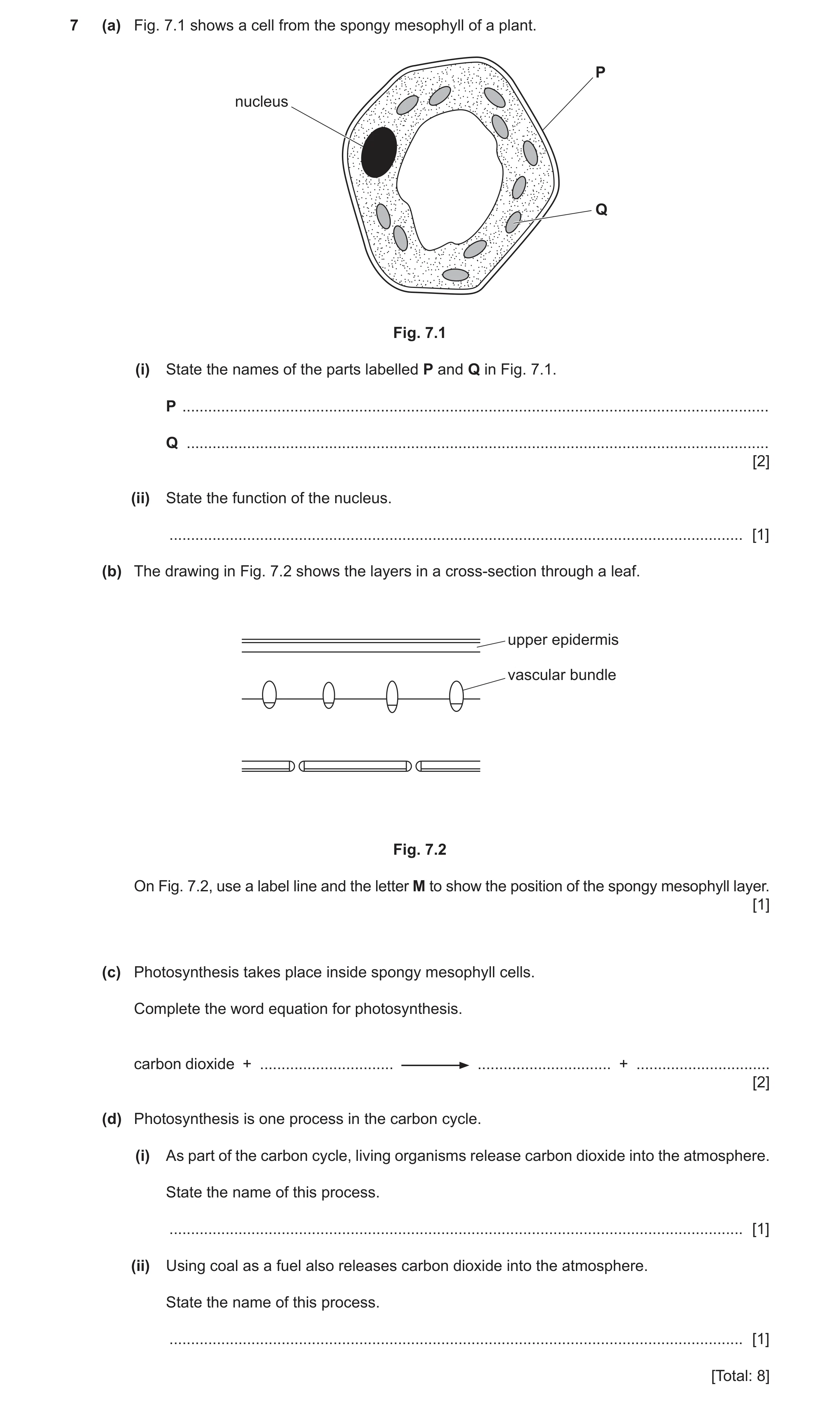
7 (a) Fig. 7.1 shows a cell from the spongy mesophyll of a plant. P nucleus Q Fig. 7.1 (i) State the names of the parts labelled P and Q in Fig. 7.1. P … Q … [2] (ii) State the function of the nucleus. … [1] (b) The drawing in Fig. 7.2 shows the layers in a cross-section through a leaf. upper epidermis vascular bundle Fig. 7.2 On Fig. 7.2, use a label line and the letter M to show the position of the spongy mesophyll layer. [1] (c) Photosynthesis takes place inside spongy mesophyll cells. Complete the word equation for photosynthesis. carbon dioxide + … … + … [2] (d) Photosynthesis is one process in the carbon cycle. (i) As part of the carbon cycle, living organisms release carbon dioxide into the atmosphere. State the name of this process. … [1] (ii) Using coal as a fuel also releases carbon dioxide into the atmosphere. State the name of this process. … [1] [Total: 8]
8 marks
Mark scheme: 7(a)(i) P (cell) wall ; 2 Q chloroplast ; 7(a)(ii) controls the cell (activities) ; 1 7(b) M below line of vascular bundles above lower epidermis ; 1 7(c) water ; 2 glucose + oxygen ; 7(d)(i) respiration ; 1 7(d)(ii) combustion ; 1
This question in 0653/31 Oct/Nov 2022
Q24 · The leaves of some plants have green and white areas 0653/31 May/June 2023
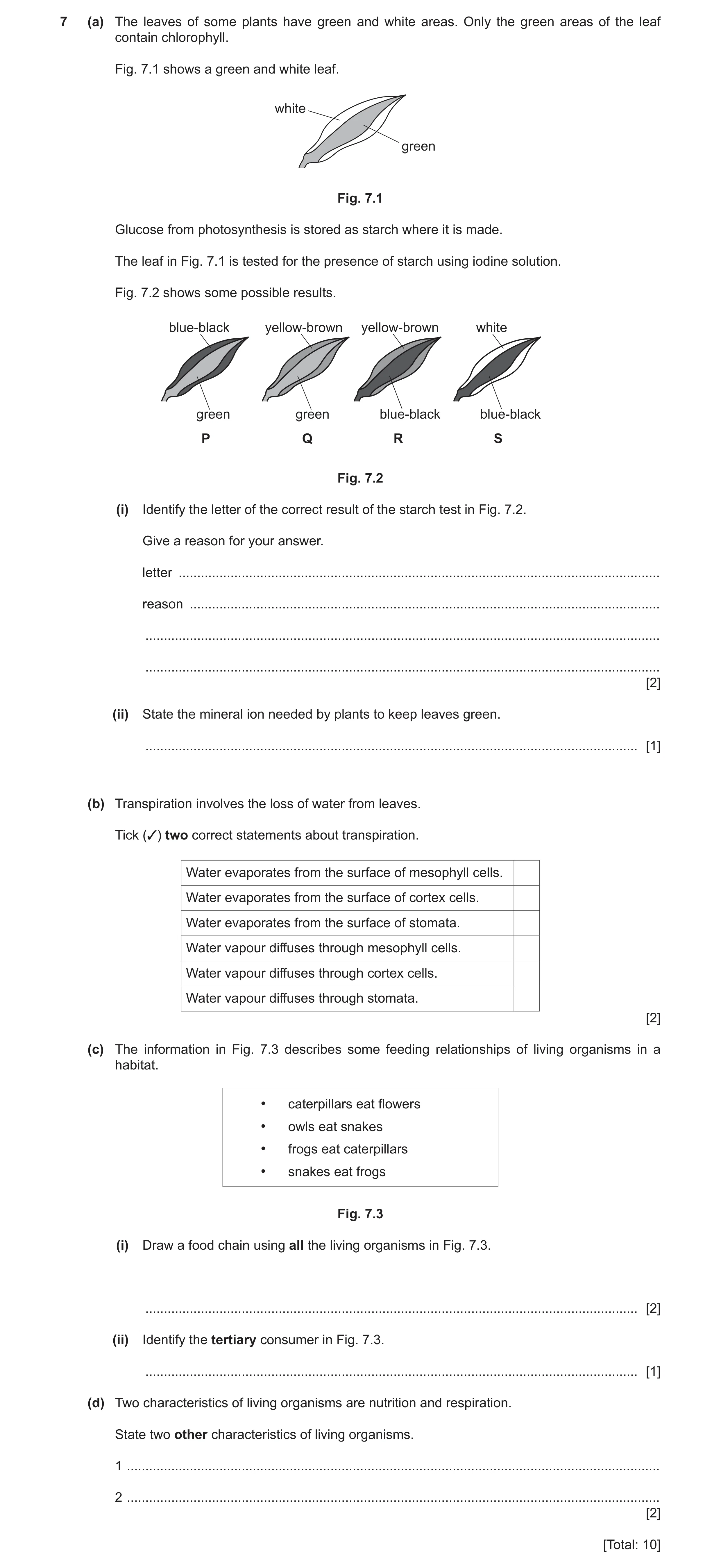
7 (a) The leaves of some plants have green and white areas. Only the green areas of the leaf contain chlorophyll. Fig. 7.1 shows a green and white leaf. white green Fig. 7.1 Glucose from photosynthesis is stored as starch where it is made. The leaf in Fig. 7.1 is tested for the presence of starch using iodine solution. Fig. 7.2 shows some possible results. blue-black yellow-brown yellow-brown white green green blue-black blue-black P Q R S Fig. 7.2 (i) Identify the letter of the correct result of the starch test in Fig. 7.2. Give a reason for your answer. letter … reason … … … [2] (ii) State the mineral ion needed by plants to keep leaves green. … [1] (b) Transpiration involves the loss of water from leaves. Tick (3) two correct statements about transpiration. Water evaporates from the surface of mesophyll cells. Water evaporates from the surface of cortex cells. Water evaporates from the surface of stomata. Water vapour diffuses through mesophyll cells. Water vapour diffuses through cortex cells. Water vapour diffuses through stomata. [2] (c) The information in Fig. 7.3 describes some feeding relationships of living organisms in a habitat. • caterpillars eat flowers • owls eat snakes • frogs eat caterpillars • snakes eat frogs Fig. 7.3 (i) Draw a food chain using all the living organisms in Fig. 7.3. … [2] (ii) Identify the tertiary consumer in Fig. 7.3. … [1] (d) Two characteristics of living organisms are nutrition and respiration. State two other characteristics of living organisms. 1 … 2 … [2] [Total: 10]
10 marks
Mark scheme: 7(a)(i) R ; then any one from: chlorophyll is needed for photosynthesis ; (iodine) solution turns blue-black when starch is present ; (iodine) solution remains yellow-brown when starch is absent ; 7(a)(ii) magnesium (ions) ; 1 Question Answer Marks 7(b) Water evaporates from the surface of mesophyll cells. Water evaporates from the surface of cortex cells. Water evaporates from the surface of stomata. Water vapour diffuses through mesophyll cells. Water vapour diffuses through cortex cells. Water vapour diffuses through stomata. ;; 2 7(c)(i) flower(s) caterpillar(s) frog(s) snake(s) owl(s) ;; one mark for correct order one mark for correct arrows 2 7(c)(ii) snake ; 1 7(d) any two from: movement ; growth ; sensitivity ; reproduction ; excretion ; 2
This question in 0653/31 May/June 2023
Q25 · A student investigates photosynthesis 0653/32 May/June 2023
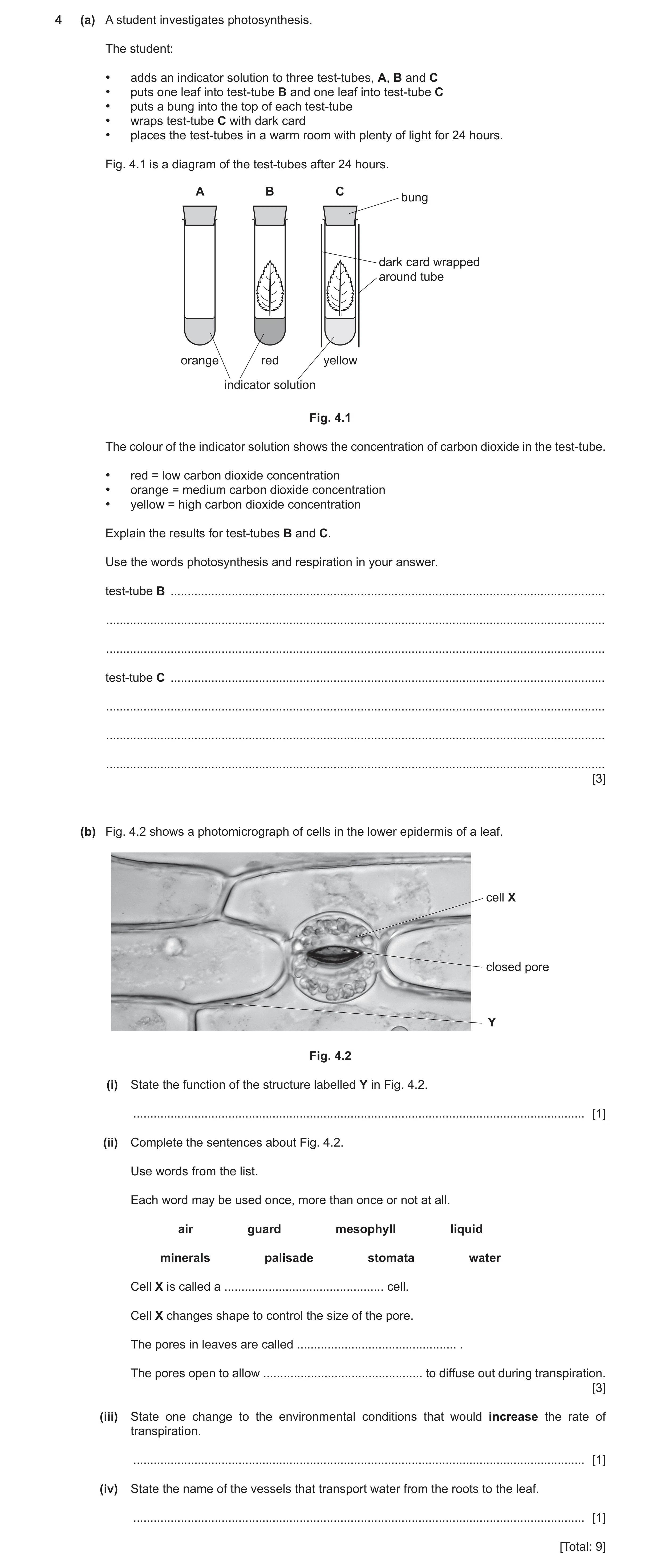
4 (a) A student investigates photosynthesis. The student: • adds an indicator solution to three test‑tubes, A, B and C • puts one leaf into test‑tube B and one leaf into test‑tube C • puts a bung into the top of each test‑tube • wraps test‑tube C with dark card • places the test‑tubes in a warm room with plenty of light for 24 hours. Fig. 4.1 is a diagram of the test‑tubes after 24 hours. A B C bung dark card wrapped around tube orange red yellow indicator solution Fig. 4.1 The colour of the indicator solution shows the concentration of carbon dioxide in the test‑tube. • red = low carbon dioxide concentration • orange = medium carbon dioxide concentration • yellow = high carbon dioxide concentration Explain the results for test‑tubes B and C. Use the words photosynthesis and respiration in your answer. test‑tube B … … … test‑tube C … … … … [3] (b) Fig. 4.2 shows a photomicrograph of cells in the lower epidermis of a leaf. cell X closed pore Y Fig. 4.2 (i) State the function of the structure labelled Y in Fig. 4.2. … [1] (ii) Complete the sentences about Fig. 4.2. Use words from the list. Each word may be used once, more than once or not at all. air guard mesophyll liquid minerals palisade stomata water Cell X is called a … cell. Cell X changes shape to control the size of the pore. The pores in leaves are called … . The pores open to allow … to diffuse out during transpiration. [3] (iii) State one change to the environmental conditions that would increase the rate of transpiration. … [1] (iv) State the name of the vessels that transport water from the roots to the leaf. … [1] [Total: 9]
9 marks
Mark scheme: 4(a) test-tube B: (more) carbon dioxide used up in photosynthesis (than produced in respiration) ; test-tube C: no photosynthesis / only respiration ; carbon dioxide made in respiration ; 4(b)(i) support ; 1 4(b)(ii) guard ; stomata ; water ; 3 4(b)(iii) decreased humidity / increased temperature ; 1 4(b)(iv) xylem ; 1
This question in 0653/32 May/June 2023
Q26 · Part of a food web 0653/33 May/June 2023
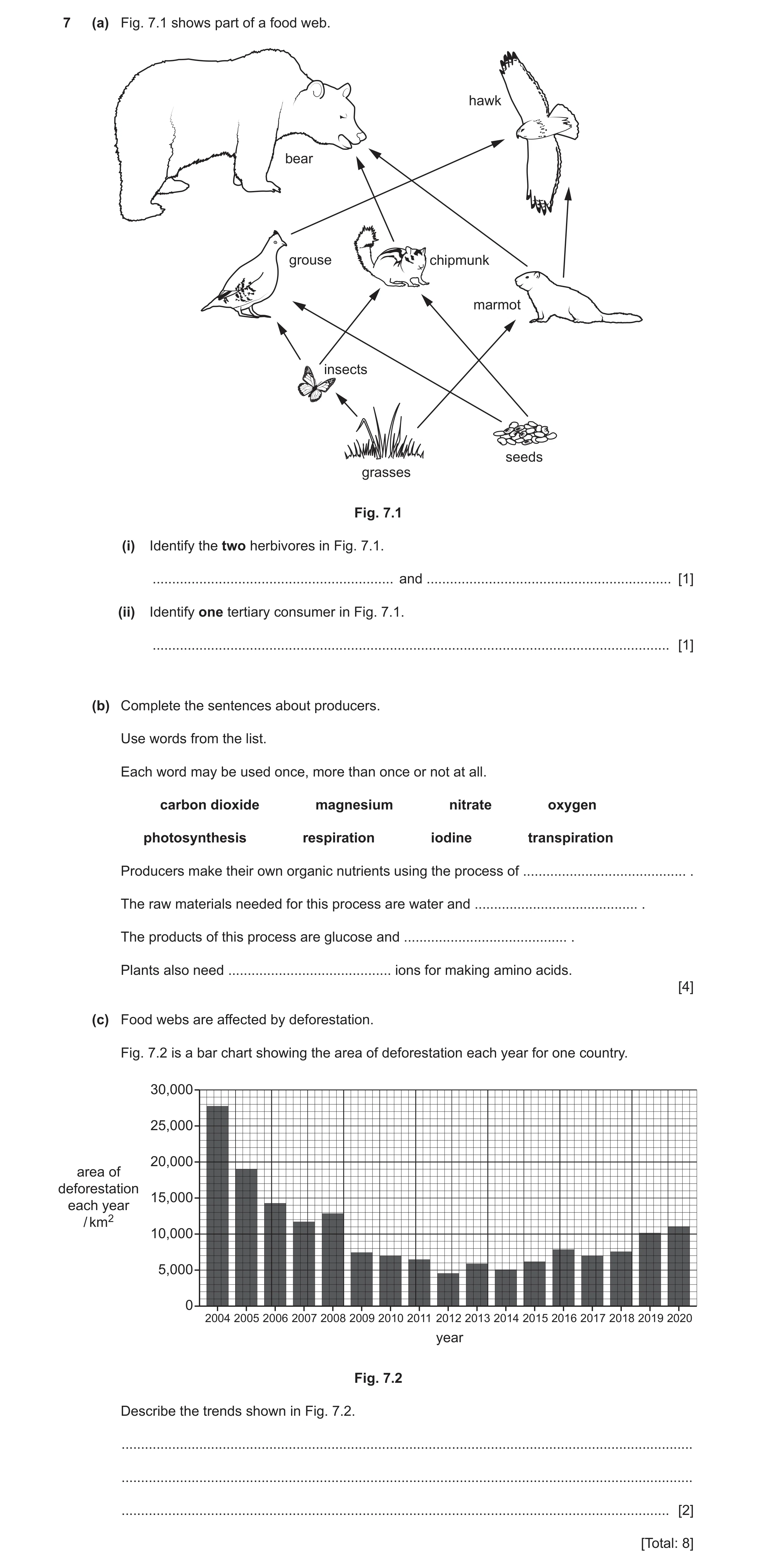
7 (a) Fig. 7.1 shows part of a food web. hawk bear grouse chipmunk marmot insects seeds grasses Fig. 7.1 (i) Identify the two herbivores in Fig. 7.1. … and … [1] (ii) Identify one tertiary consumer in Fig. 7.1. … [1] (b) Complete the sentences about producers. Use words from the list. Each word may be used once, more than once or not at all. carbon dioxide magnesium nitrate oxygen photosynthesis respiration iodine transpiration Producers make their own organic nutrients using the process of … . The raw materials needed for this process are water and … . The products of this process are glucose and … . Plants also need … ions for making amino acids. [4] (c) Food webs are affected by deforestation. Fig. 7.2 is a bar chart showing the area of deforestation each year for one country. 30,000 25,000 20,000 area of deforestation 15,000 each year / km2 10,000 5,000 0 2004 2005 2006 2007 2008 2009 2010 2011 2012 2013 2014 2015 2016 2017 2018 2019 2020 year Fig. 7.2 Describe the trends shown in Fig. 7.2. … … … [2] [Total: 8]
8 marks
Mark scheme: 7(a)(i) insects and marmot ; 1 7(a)(ii) hawk / bear ; 1 7(b) photosynthesis ; carbon dioxide ; oxygen ; nitrate ; 4 7(c) the area of deforestation decreases then increases ; identifies lowest point is in 2012 / overall the decrease is greater than the increase / decreases to 4500 km2 (pa) ; 2
This question in 0653/33 May/June 2023
Q27 · Some of the parts of an insect-pollinated flower 0653/33 May/June 2024
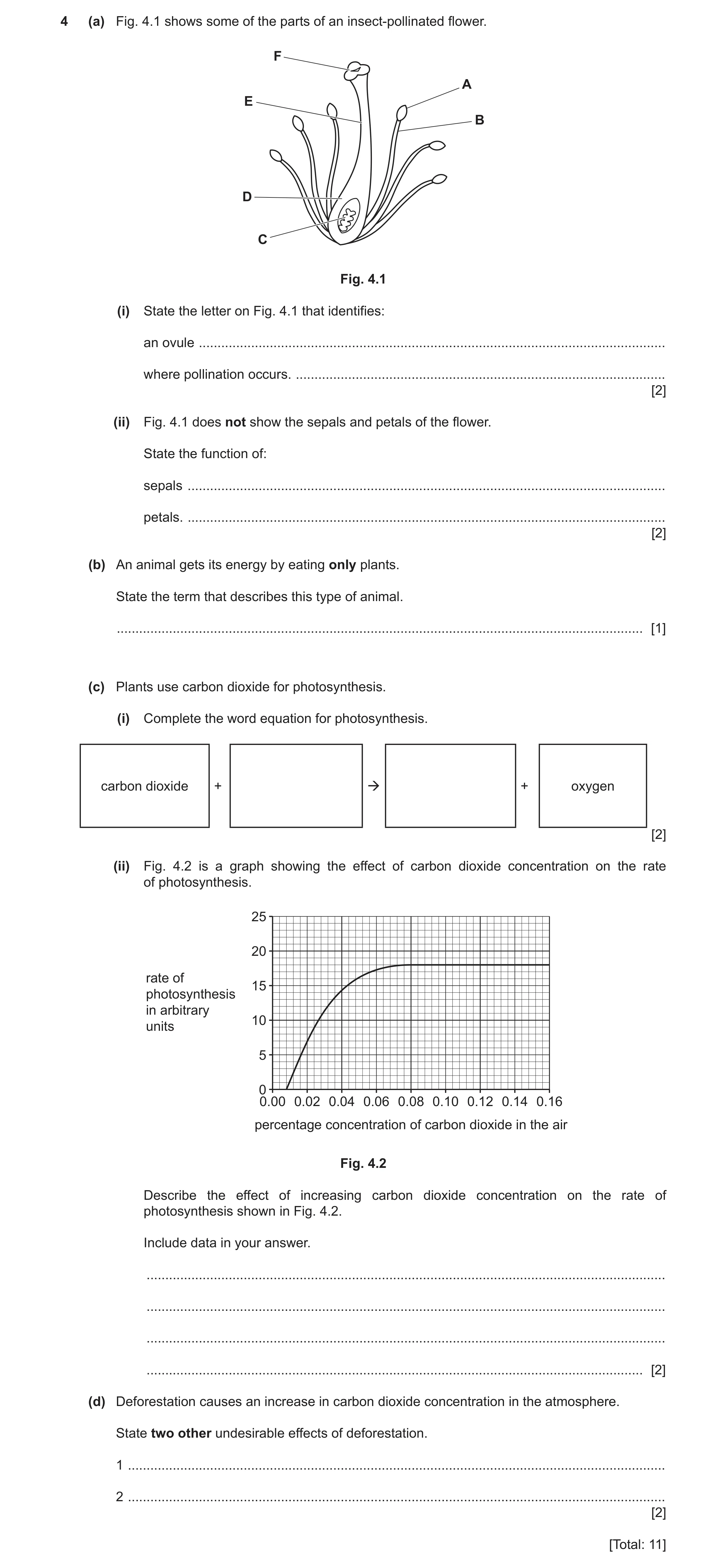
4 (a) Fig. 4.1 shows some of the parts of an insect-pollinated flower. F A E B D C Fig. 4.1 (i) State the letter on Fig. 4.1 that identifies: an ovule … where pollination occurs. … [2] (ii) Fig. 4.1 does not show the sepals and petals of the flower. State the function of: sepals … petals. … [2] (b) An animal gets its energy by eating only plants. State the term that describes this type of animal. … [1] (c) Plants use carbon dioxide for photosynthesis. (i) Complete the word equation for photosynthesis. carbon dioxide + + oxygen [2] (ii) Fig. 4.2 is a graph showing the effect of carbon dioxide concentration on the rate of photosynthesis. 25 20 rate of 15 photosynthesis in arbitrary 10 units 5 0 0.00 0.02 0.04 0.06 0.08 0.10 0.12 0.14 0.16 percentage concentration of carbon dioxide in the air Fig. 4.2 Describe the effect of increasing carbon dioxide concentration on the rate of photosynthesis shown in Fig. 4.2. Include data in your answer. … … … … [2] (d) Deforestation causes an increase in carbon dioxide concentration in the atmosphere. State two other undesirable effects of deforestation. 1 … 2 … [2] [Total: 11]
11 marks
Mark scheme: 4(a)(i) C ; F ; 2 4(a)(ii) protect, bud / flower ; attract, insects / pollinators ; 2 4(b) herbivore ; 1 4(c)(i) water ; glucose ; 2 4(c)(ii) (rate of photosynthesis) increases then levels off ; use of data, e.g. maximum rate = 18 (arbitrary units) / stops increasing at 0.07 (%) ; 2 Question Answer Marks 4(d) any two from: habitat destruction ; disrupts food chain ; extinction ; loss of soil ; flooding ; 2
This question in 0653/33 May/June 2024
Q28 · Plants manufacture carbohydrates by the process of photosynthesis 0653/32 Oct/Nov 2024
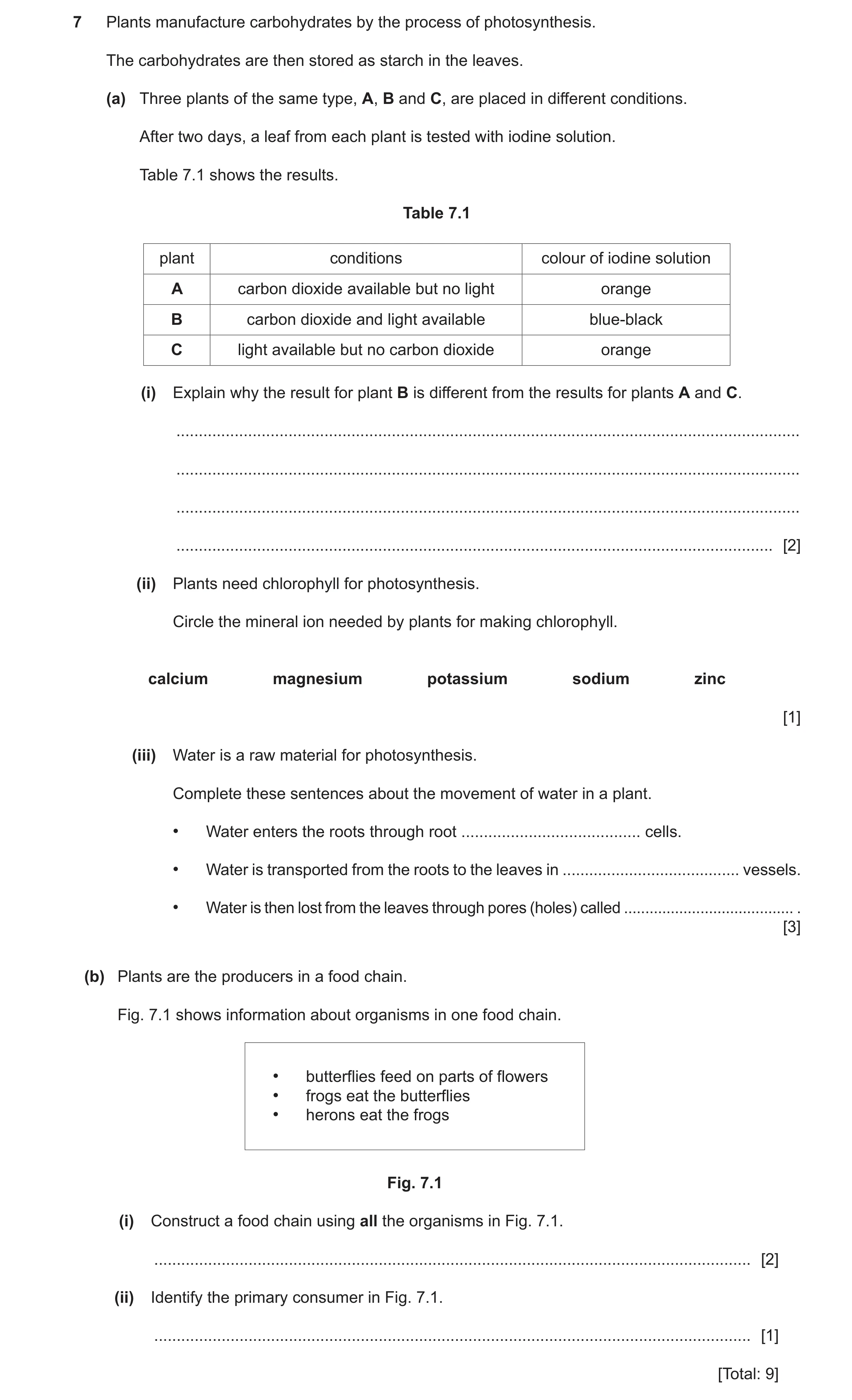
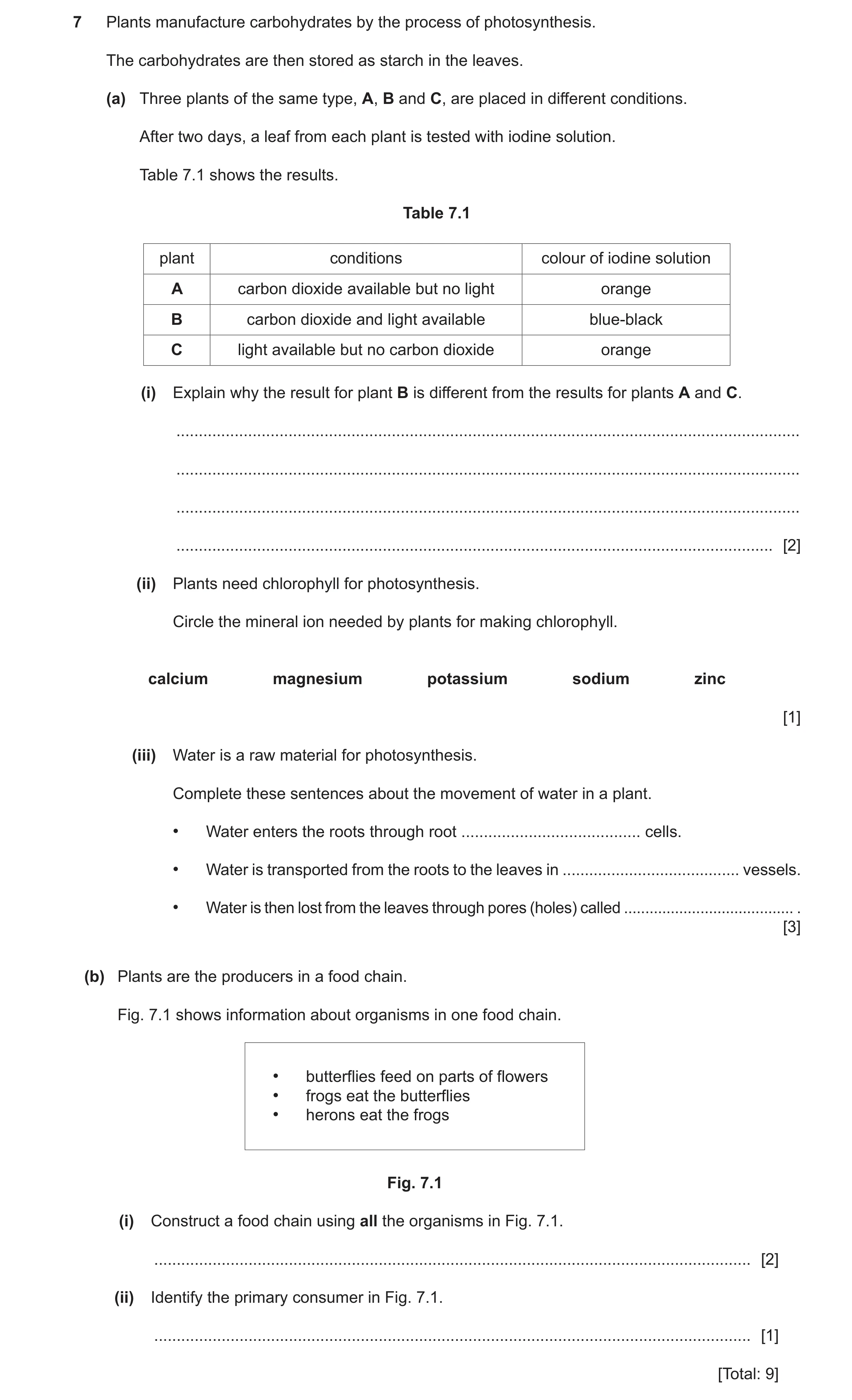
7 Plants manufacture carbohydrates by the process of photosynthesis. The carbohydrates are then stored as starch in the leaves. (a) Three plants of the same type, A, B and C, are placed in different conditions. After two days, a leaf from each plant is tested with iodine solution. Table 7.1 shows the results. Table 7.1 plant conditions colour of iodine solution A carbon dioxide available but no light orange B carbon dioxide and light available blue-black C light available but no carbon dioxide orange (i) Explain why the result for plant B is different from the results for plants A and C. … … … … [2] (ii) Plants need chlorophyll for photosynthesis. Circle the mineral ion needed by plants for making chlorophyll. calcium magnesium potassium sodium zinc [1] (iii) Water is a raw material for photosynthesis. Complete these sentences about the movement of water in a plant. • Water enters the roots through root … cells. • Water is transported from the roots to the leaves in … vessels. • Water is then lost from the leaves through pores (holes) called … . [3] (b) Plants are the producers in a food chain. Fig. 7.1 shows information about organisms in one food chain. • butterflies feed on parts of flowers • frogs eat the butterflies • herons eat the frogs Fig. 7.1 (i) Construct a food chain using all the organisms in Fig. 7.1. … [2] (ii) Identify the primary consumer in Fig. 7.1. … [1] [Total: 9]
9 marks
Mark scheme: 7(a)(i) any two from: 2 blue-black shows the presence of starch / only one where starch was made ; only plant B had both carbon dioxide and light (needed for photosynthesis) ; 7(a)(ii) magnesium ; 1 7(a)(iii) hair ; 3 xylem ; stomata ; 7(b)(i) flowers → butterflies → frogs → herons 2 correct order of all organisms ; correct arrows ; 7(b)(ii) butterflies ; 1
This question in 0653/32 Oct/Nov 2024
Q29 · Plants manufacture carbohydrates by the process of photosynthesis 0653/33 Oct/Nov 2024
7 Plants manufacture carbohydrates by the process of photosynthesis. The carbohydrates are then stored as starch in the leaves. (a) Three plants of the same type, A, B and C, are placed in different conditions. After two days, a leaf from each plant is tested with iodine solution. Table 7.1 shows the results. Table 7.1 plant conditions colour of iodine solution A carbon dioxide available but no light orange B carbon dioxide and light available blue-black C light available but no carbon dioxide orange (i) Explain why the result for plant B is different from the results for plants A and C. … … … … [2] (ii) Plants need chlorophyll for photosynthesis. Circle the mineral ion needed by plants for making chlorophyll. calcium magnesium potassium sodium zinc [1] (iii) Water is a raw material for photosynthesis. Complete these sentences about the movement of water in a plant. • Water enters the roots through root … cells. • Water is transported from the roots to the leaves in … vessels. • Water is then lost from the leaves through pores (holes) called … . [3] (b) Plants are the producers in a food chain. Fig. 7.1 shows information about organisms in one food chain. • butterflies feed on parts of flowers • frogs eat the butterflies • herons eat the frogs Fig. 7.1 (i) Construct a food chain using all the organisms in Fig. 7.1. … [2] (ii) Identify the primary consumer in Fig. 7.1. … [1] [Total: 9]
9 marks
Mark scheme: 7(a)(i) any two from: 2 blue-black shows the presence of starch / only one where starch was made ; only plant B had both carbon dioxide and light (needed for photosynthesis) ; 7(a)(ii) magnesium ; 1 7(a)(iii) hair ; 3 xylem ; stomata ; 7(b)(i) flowers → butterflies → frogs → herons 2 correct order of all organisms ; correct arrows ; 7(b)(ii) butterflies ; 1
This question in 0653/33 Oct/Nov 2024
Question 30 0653/31 Oct/Nov 2025
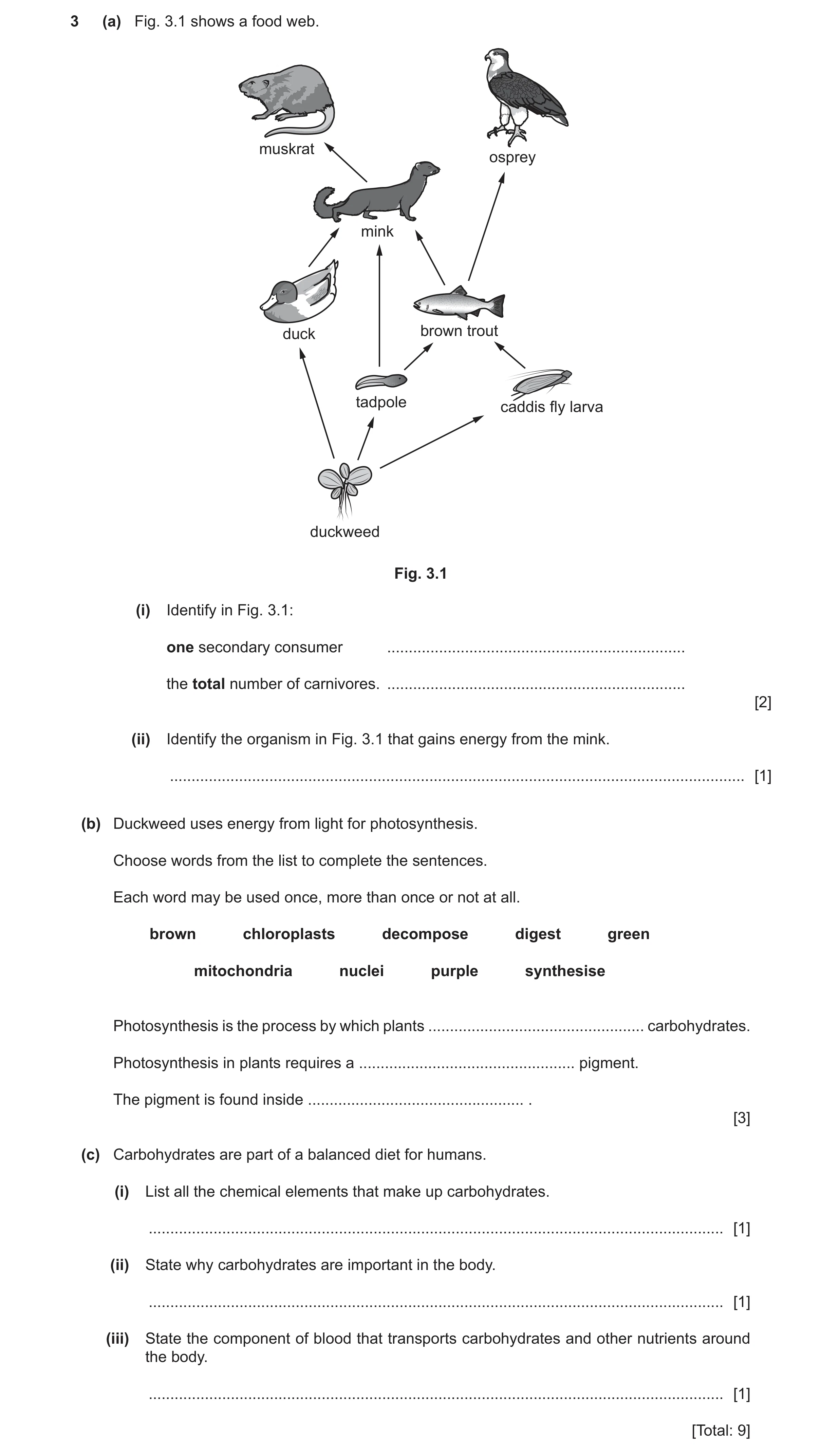
3 (a) Fig. 3.1 shows a food web. muskrat osprey mink duck brown trout tadpole caddis fly larva duckweed Fig. 3.1 (i) Identify in Fig. 3.1: one secondary consumer … the total number of carnivores. … [2] (ii) Identify the organism in Fig. 3.1 that gains energy from the mink. … [1] (b) Duckweed uses energy from light for photosynthesis. Choose words from the list to complete the sentences. Each word may be used once, more than once or not at all. brown chloroplasts decompose digest green mitochondria nuclei purple synthesise Photosynthesis is the process by which plants … carbohydrates. Photosynthesis in plants requires a … pigment. The pigment is found inside … . [3] (c) Carbohydrates are part of a balanced diet for humans. (i) List all the chemical elements that make up carbohydrates. … [1] (ii) State why carbohydrates are important in the body. … [1] (iii) State the component of blood that transports carbohydrates and other nutrients around the body. … [1] [Total: 9]
9 marks
Mark scheme: 3(a)(i) as (brown) trout / mink ; 2 4 ; 3(a)(ii) muskrat ; 1 3(b) synthesise ; 3 green ; chloroplasts ; 3(c)(i) carbon AND oxygen AND hydrogen ; 1 3(c)(ii) (needed) for energy ; 1 3(c)(iii) plasma ; 1
This question in 0653/31 Oct/Nov 2025
Q31 · A diagram of an animal cell and a plant cell 0653/32 Oct/Nov 2025
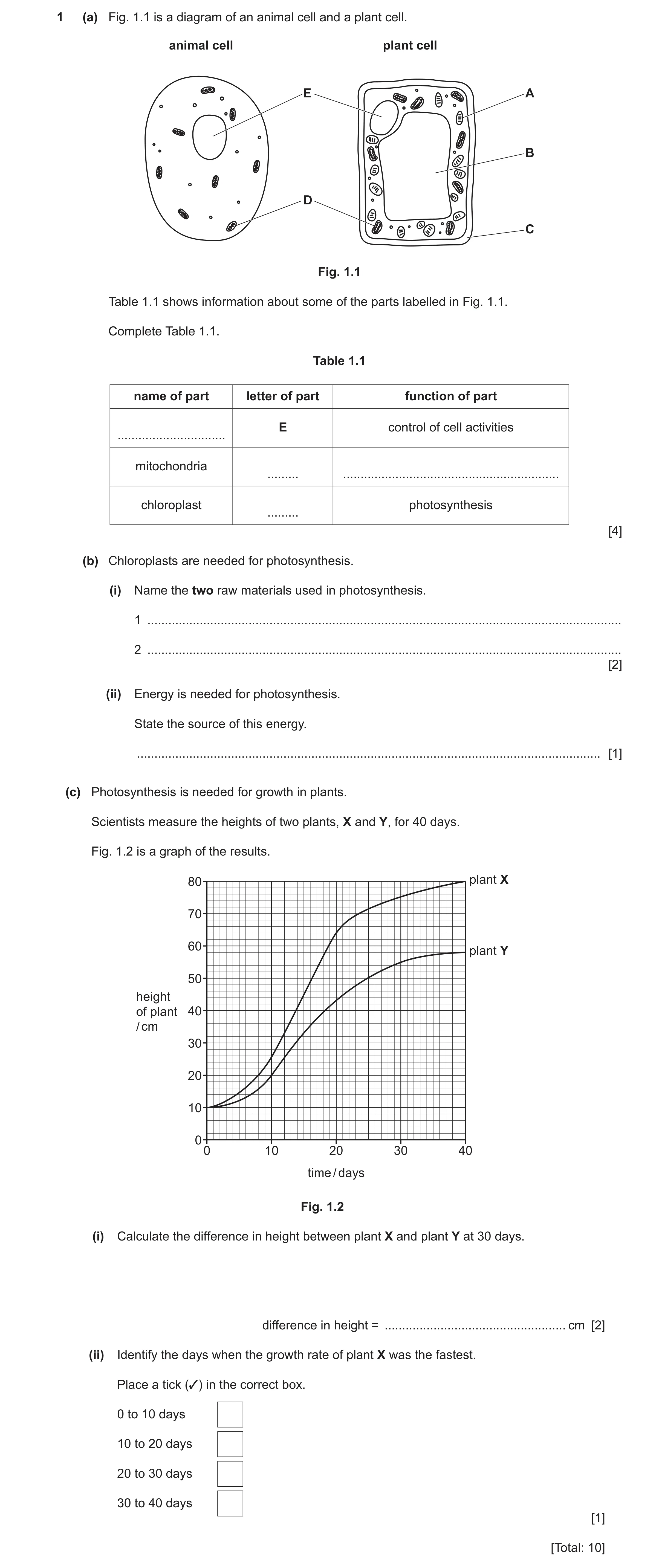
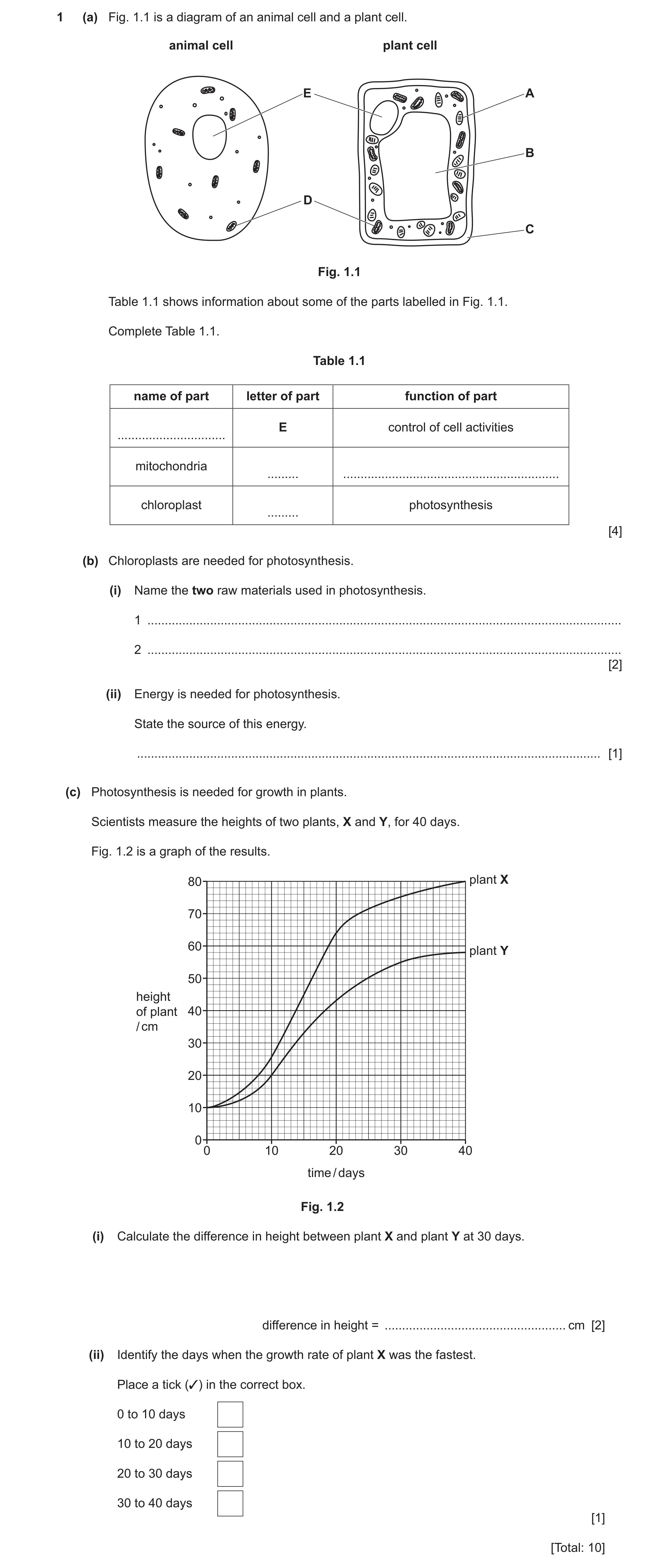
1 (a) Fig. 1.1 is a diagram of an animal cell and a plant cell. animal cell plant cell E A B D C Fig. 1.1 Table 1.1 shows information about some of the parts labelled in Fig. 1.1. Complete Table 1.1. Table 1.1 name of part letter of part function of part E control of cell activities … mitochondria … … chloroplast photosynthesis … [4] (b) Chloroplasts are needed for photosynthesis. (i) Name the two raw materials used in photosynthesis. 1 … 2 … [2] (ii) Energy is needed for photosynthesis. State the source of this energy. … [1] (c) Photosynthesis is needed for growth in plants. Scientists measure the heights of two plants, X and Y, for 40 days. Fig. 1.2 is a graph of the results. 80 plant X 70 60 plant Y 50 height of plant 40 / cm 30 20 10 0 0 10 20 30 40 time / days Fig. 1.2 (i) Calculate the difference in height between plant X and plant Y at 30 days. difference in height = … cm [2] (ii) Identify the days when the growth rate of plant X was the fastest. Place a tick (✓) in the correct box. 0 to 10 days 10 to 20 days 20 to 30 days 30 to 40 days [1] [Total: 10]
10 marks
Mark scheme: Question Answer Marks 1(a) 4 name of part letter function of part nucleus ; (E) (control of cell activities) (mitochondria) D ; respiration ; (chloroplast) A ; (photosynthesis) 1(b)(i) carbon dioxide ; 2 water ; 1(b)(ii) light ; 1 1(c)(i) 75 – 55 ; 2 20 ; 1(c)(ii) 10 to 20 days ; 1
This question in 0653/32 Oct/Nov 2025
Q32 · A diagram of an animal cell and a plant cell 0653/33 Oct/Nov 2025
1 (a) Fig. 1.1 is a diagram of an animal cell and a plant cell. animal cell plant cell E A B D C Fig. 1.1 Table 1.1 shows information about some of the parts labelled in Fig. 1.1. Complete Table 1.1. Table 1.1 name of part letter of part function of part E control of cell activities … mitochondria … … chloroplast photosynthesis … [4] (b) Chloroplasts are needed for photosynthesis. (i) Name the two raw materials used in photosynthesis. 1 … 2 … [2] (ii) Energy is needed for photosynthesis. State the source of this energy. … [1] (c) Photosynthesis is needed for growth in plants. Scientists measure the heights of two plants, X and Y, for 40 days. Fig. 1.2 is a graph of the results. 80 plant X 70 60 plant Y 50 height of plant 40 / cm 30 20 10 0 0 10 20 30 40 time / days Fig. 1.2 (i) Calculate the difference in height between plant X and plant Y at 30 days. difference in height = … cm [2] (ii) Identify the days when the growth rate of plant X was the fastest. Place a tick (✓) in the correct box. 0 to 10 days 10 to 20 days 20 to 30 days 30 to 40 days [1] [Total: 10]
10 marks
Mark scheme: Question Answer Marks 1(a) 4 name of part letter function of part nucleus ; (E) (control of cell activities) (mitochondria) D ; respiration ; (chloroplast) A ; (photosynthesis) 1(b)(i) carbon dioxide ; 2 water ; 1(b)(ii) light ; 1 1(c)(i) 75 – 55 ; 2 20 ; 1(c)(ii) 10 to 20 days ; 1
This question in 0653/33 Oct/Nov 2025
 13
13 13
13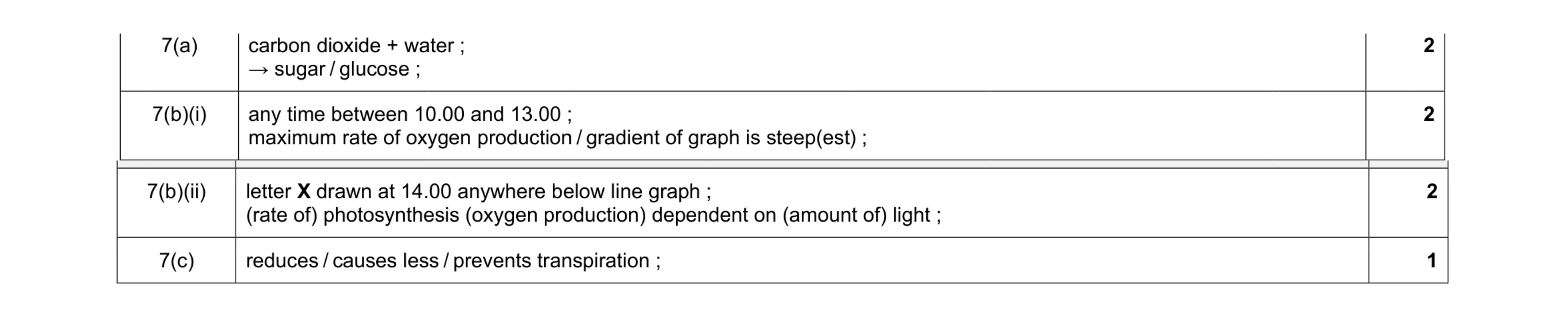 7
7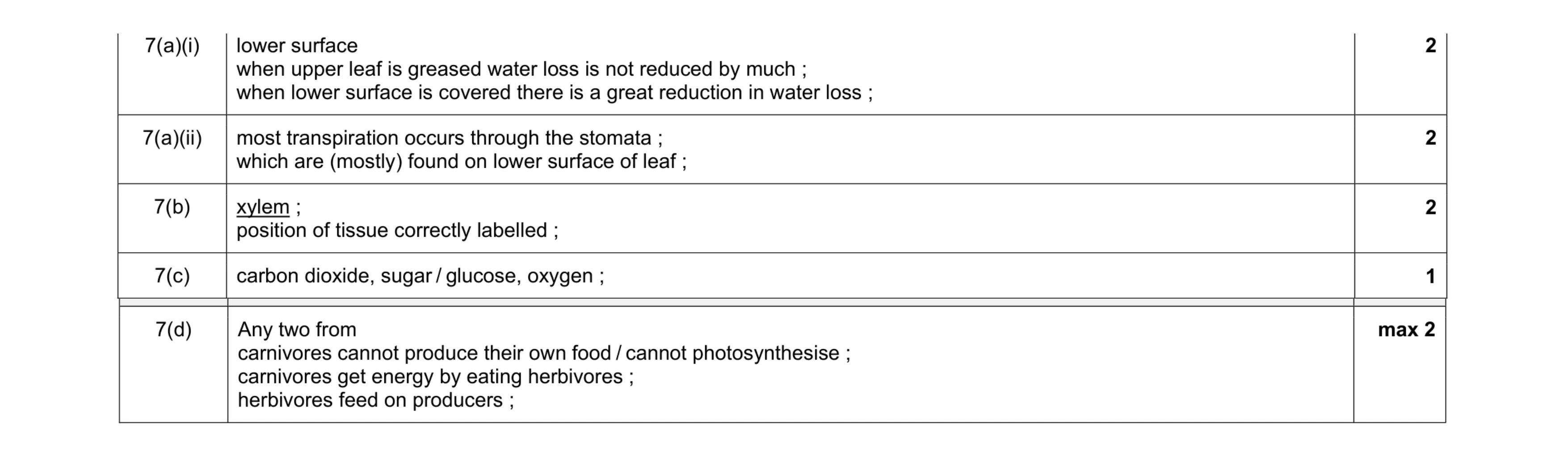 9
9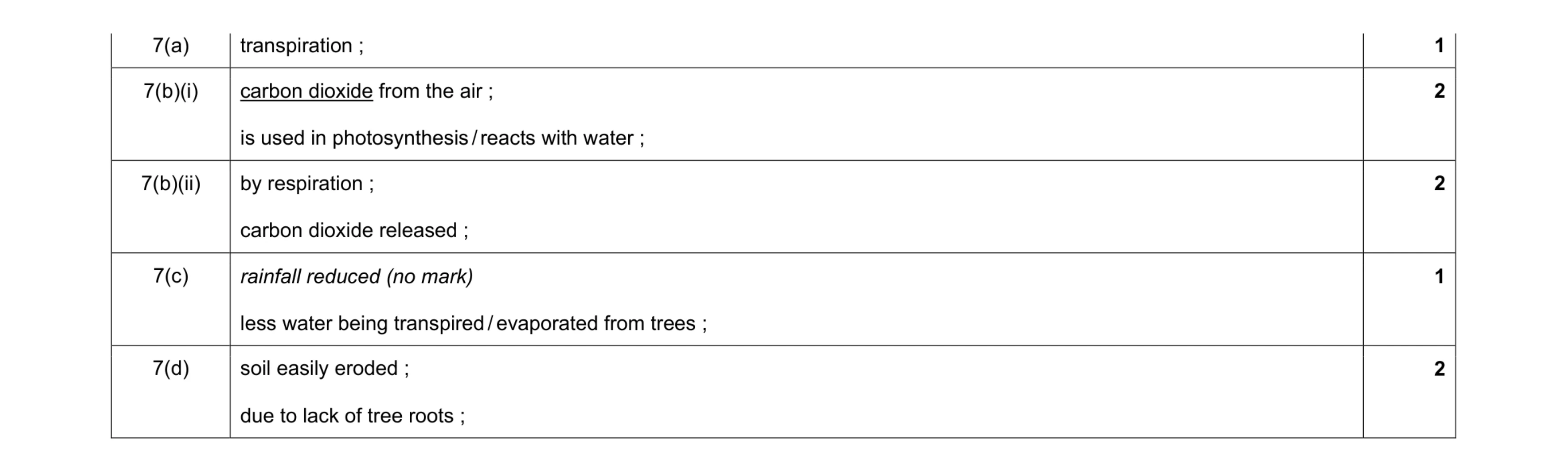 8
8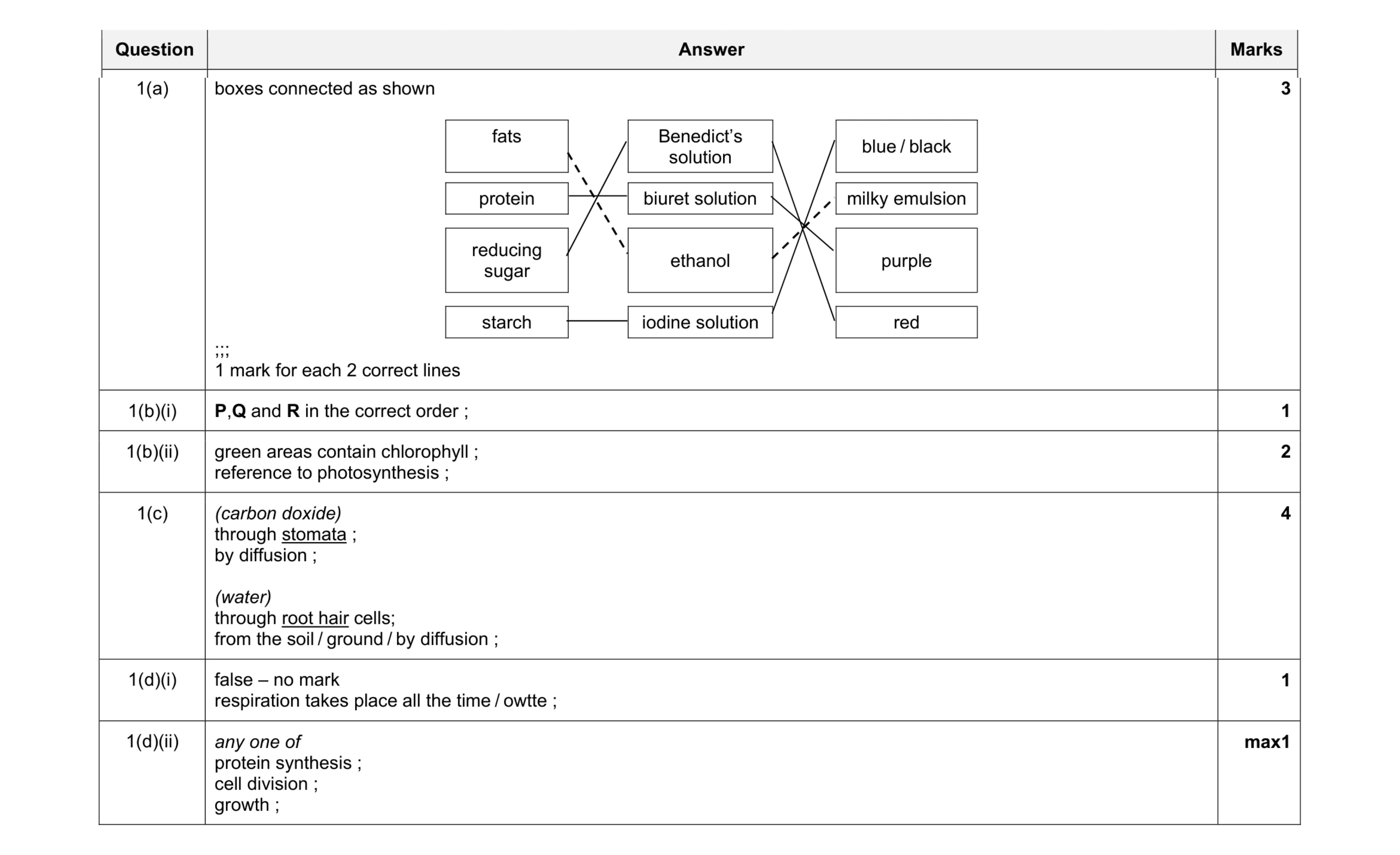 12
12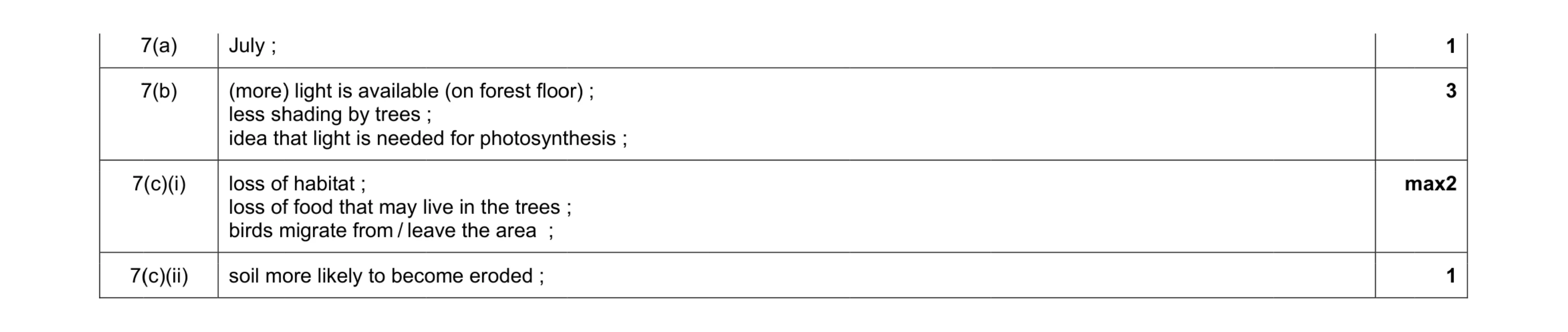 7
7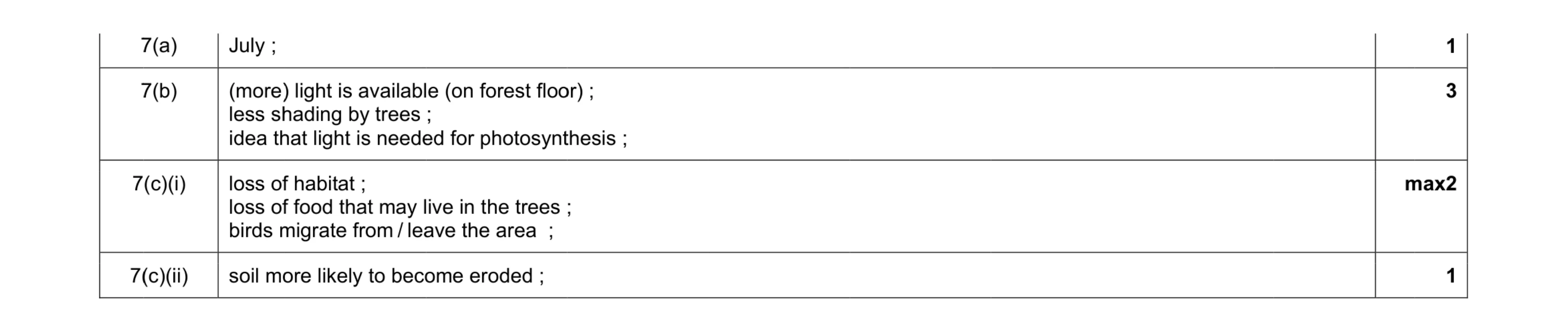 7
7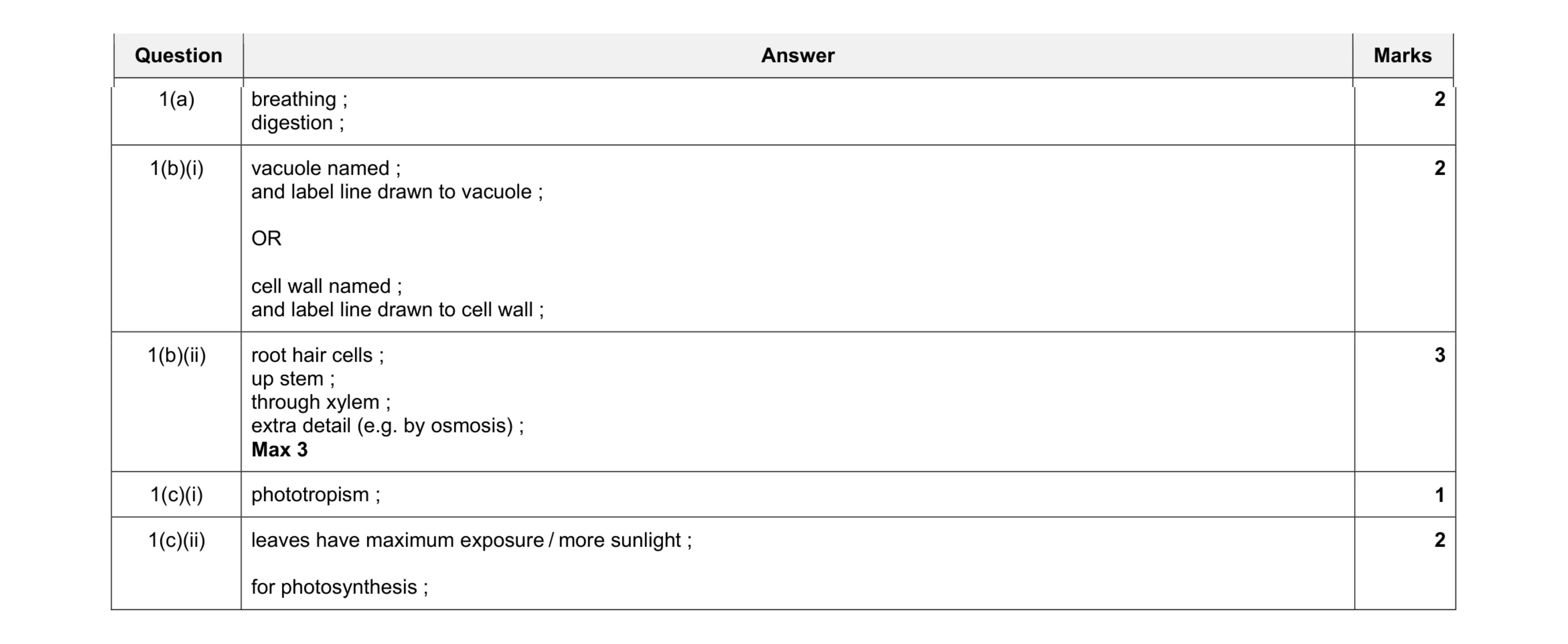 10
10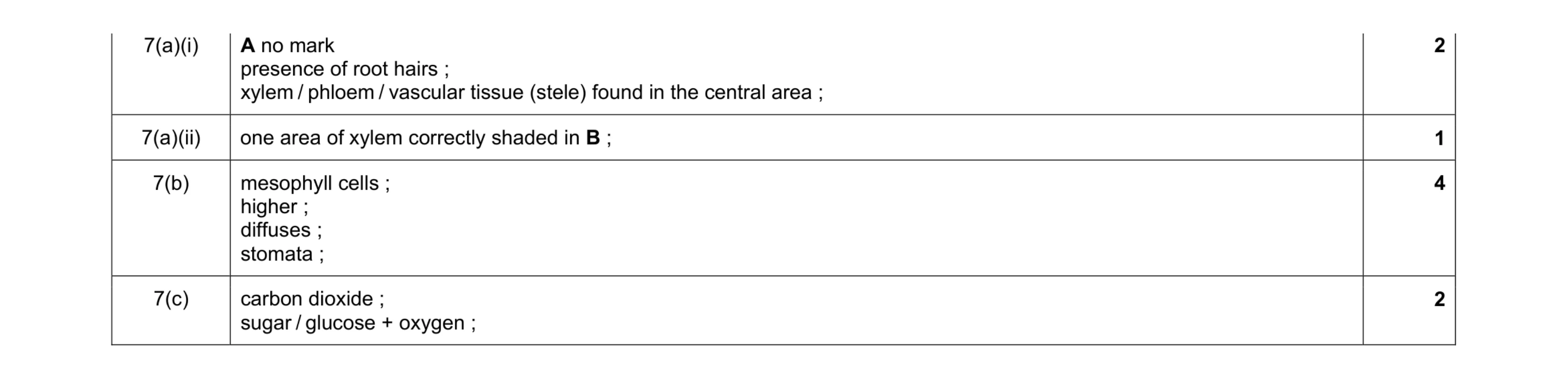 9
9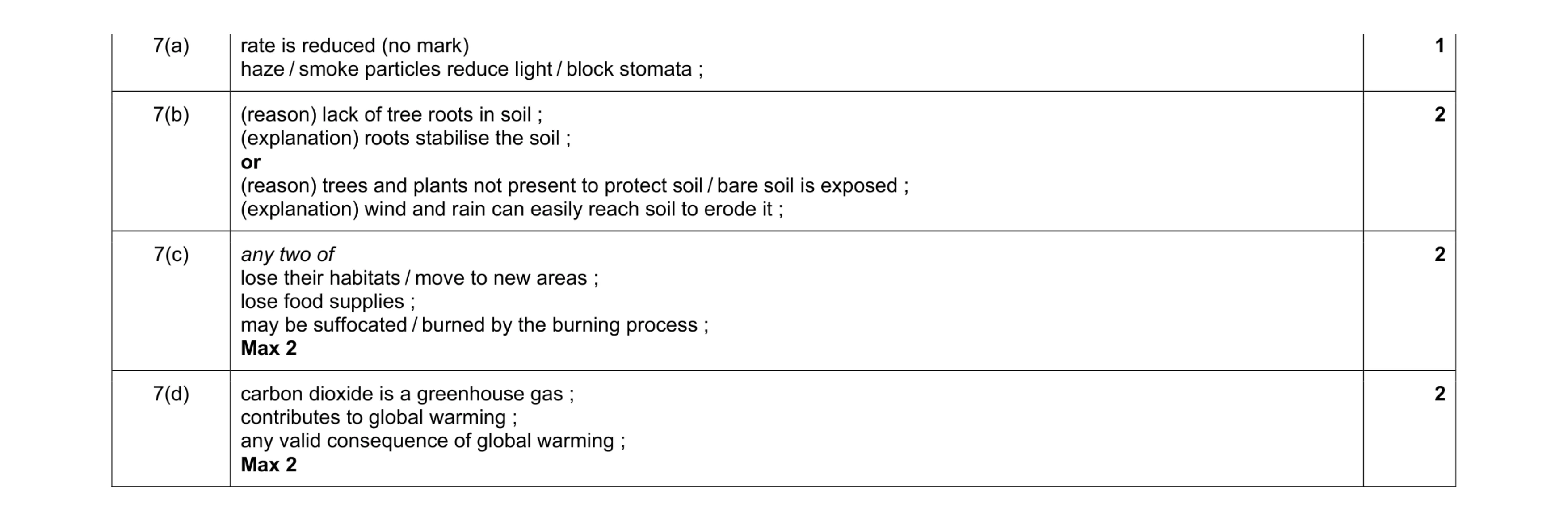 7
7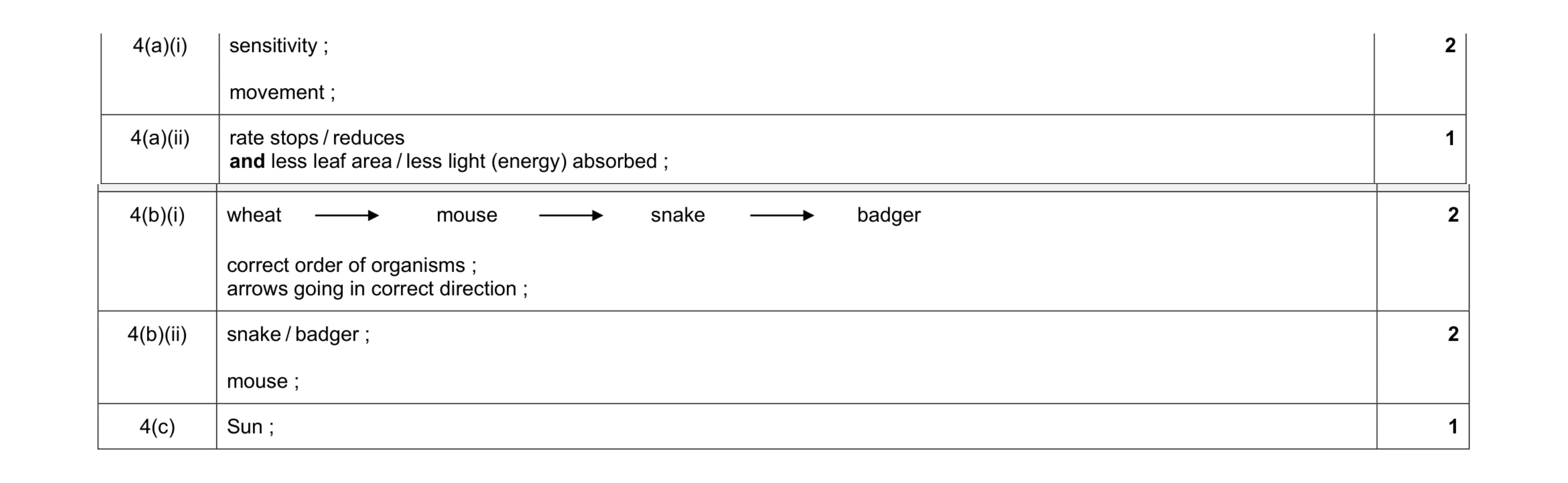 8
8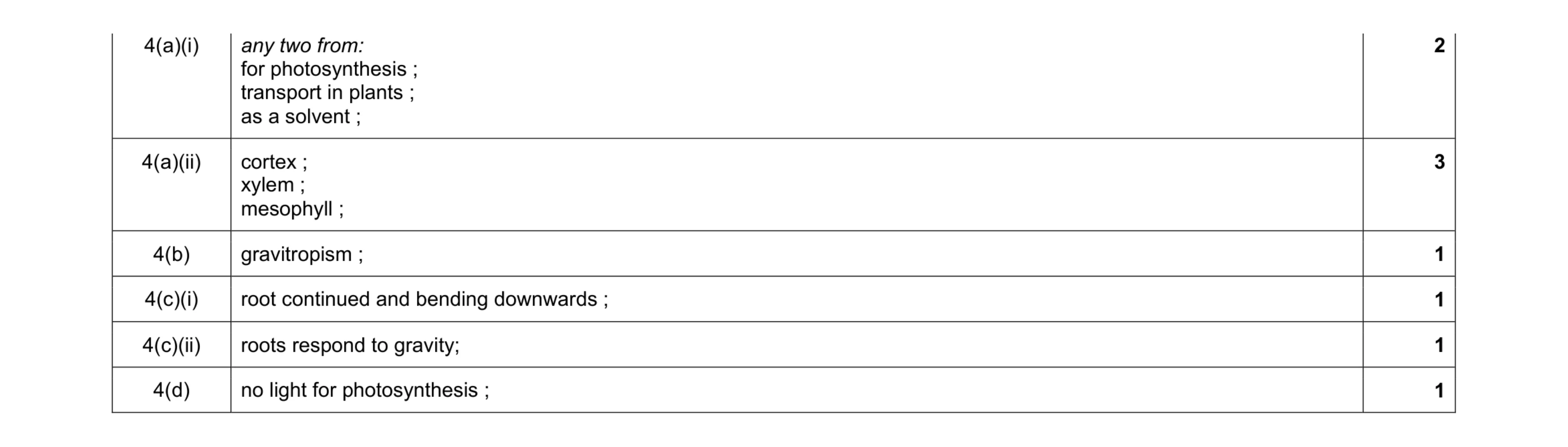 9
9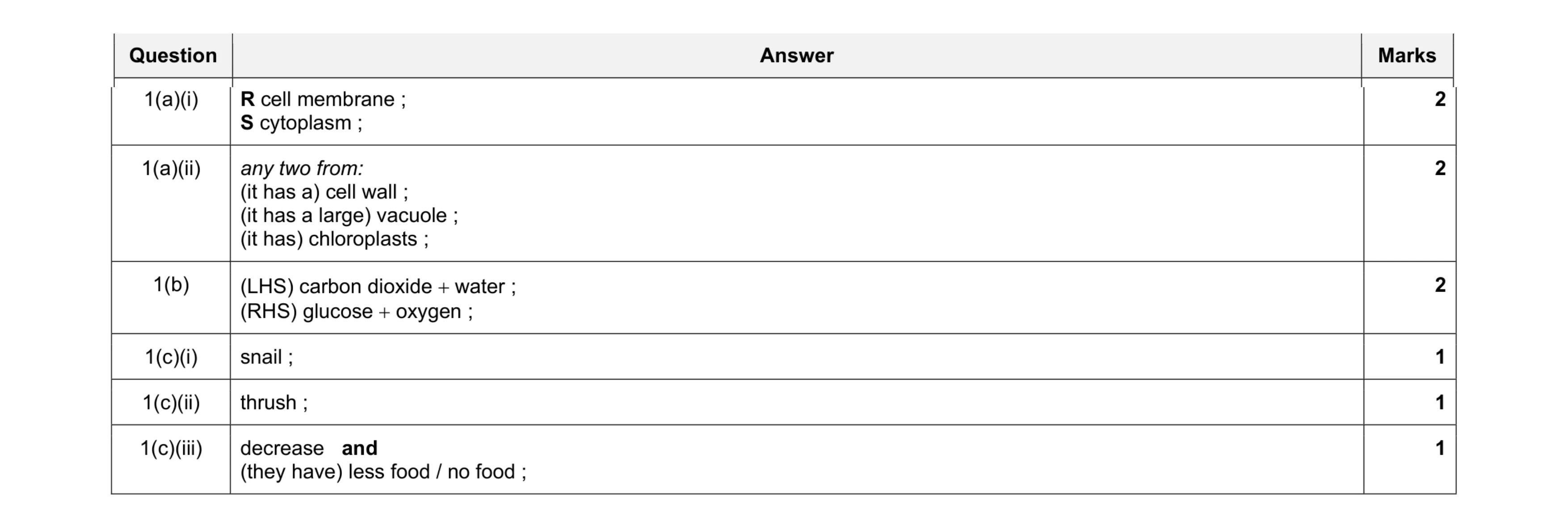 9
9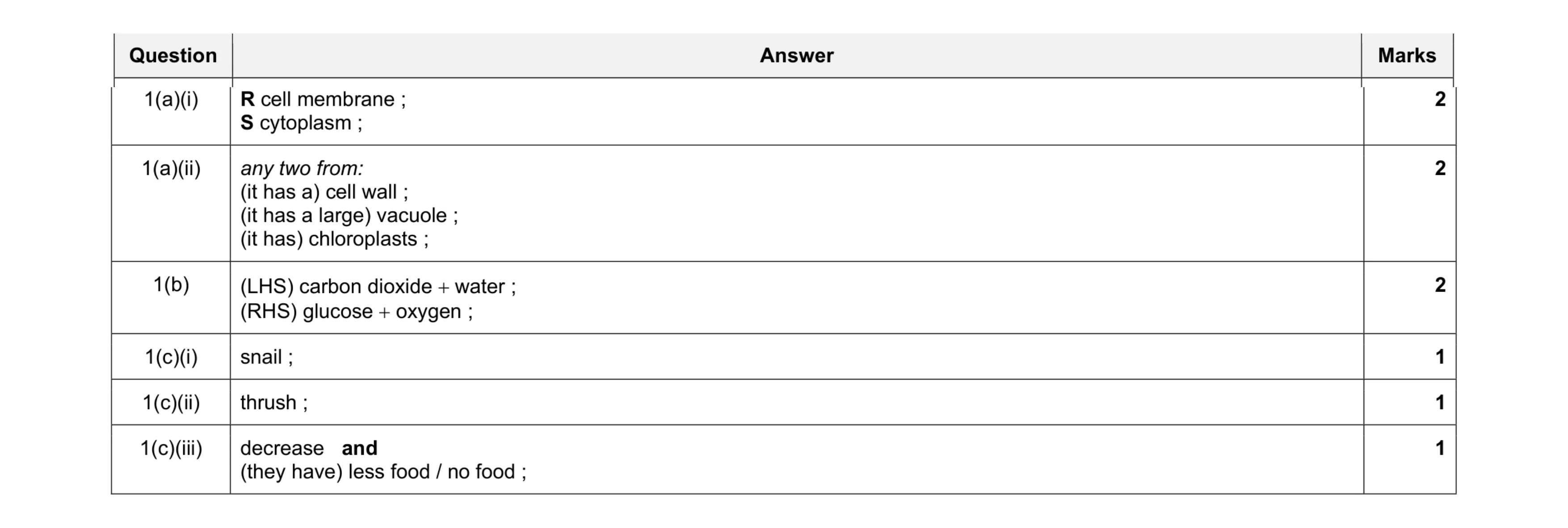 9
9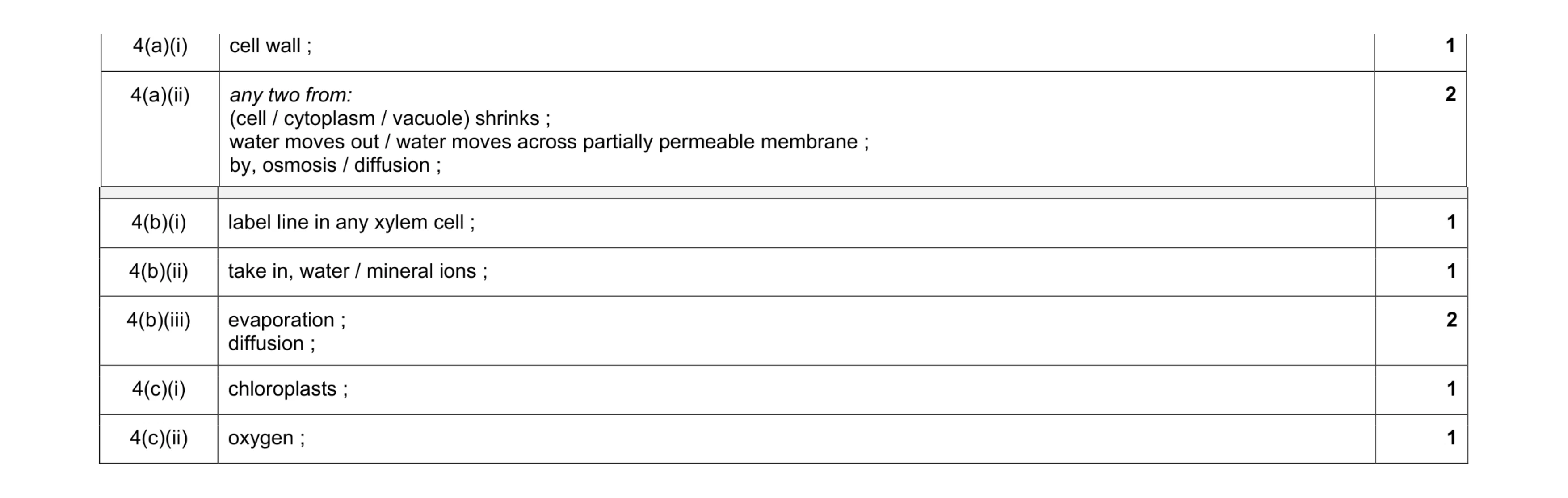 9
9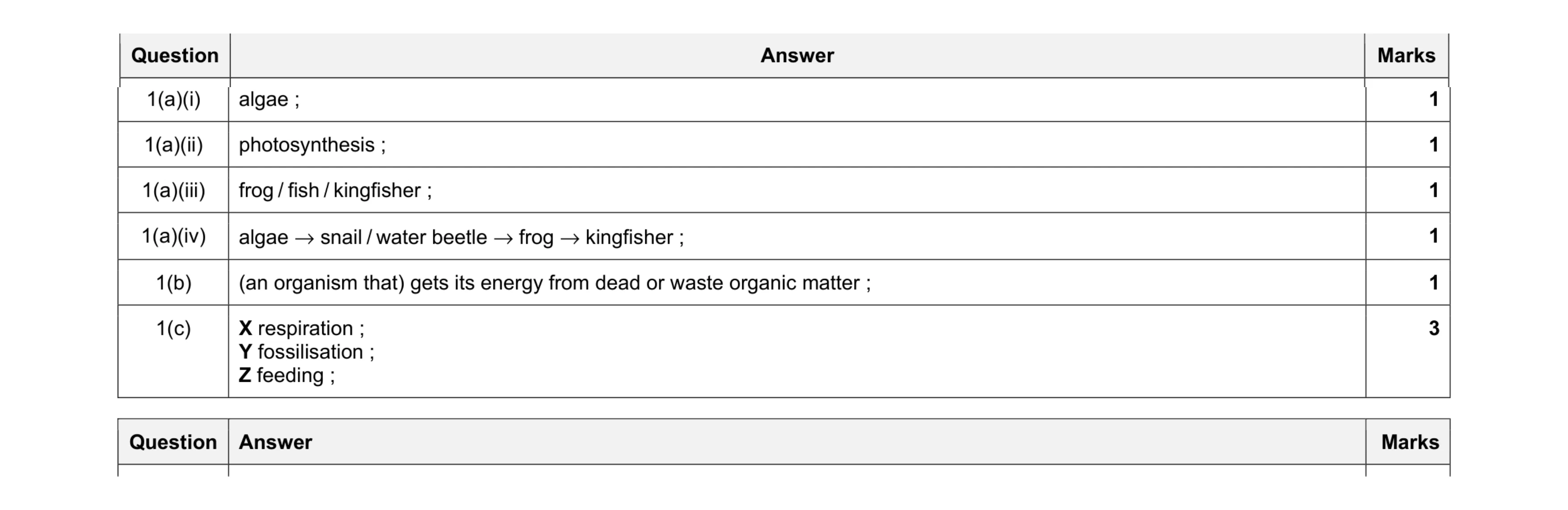 8
8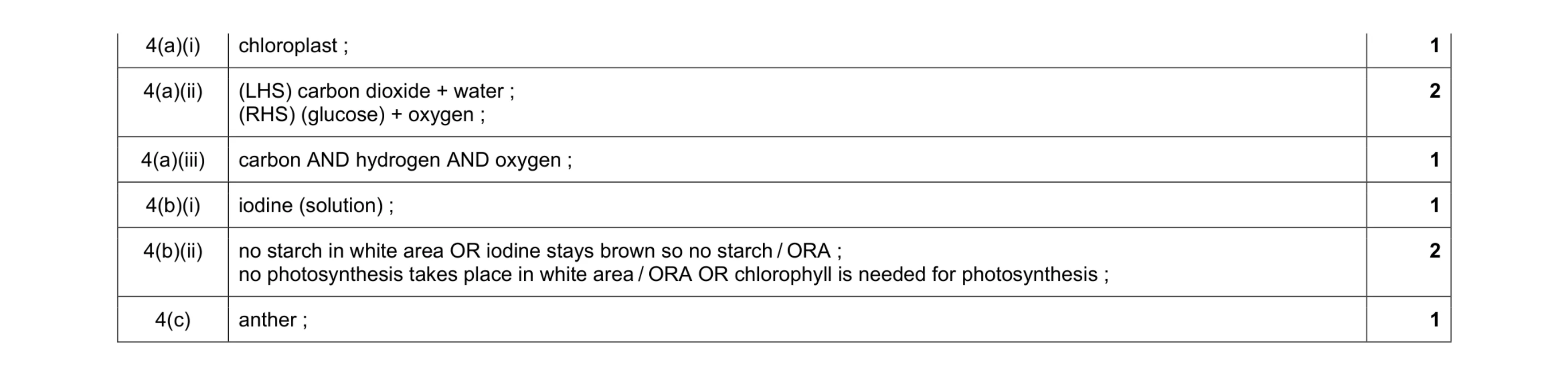 8
8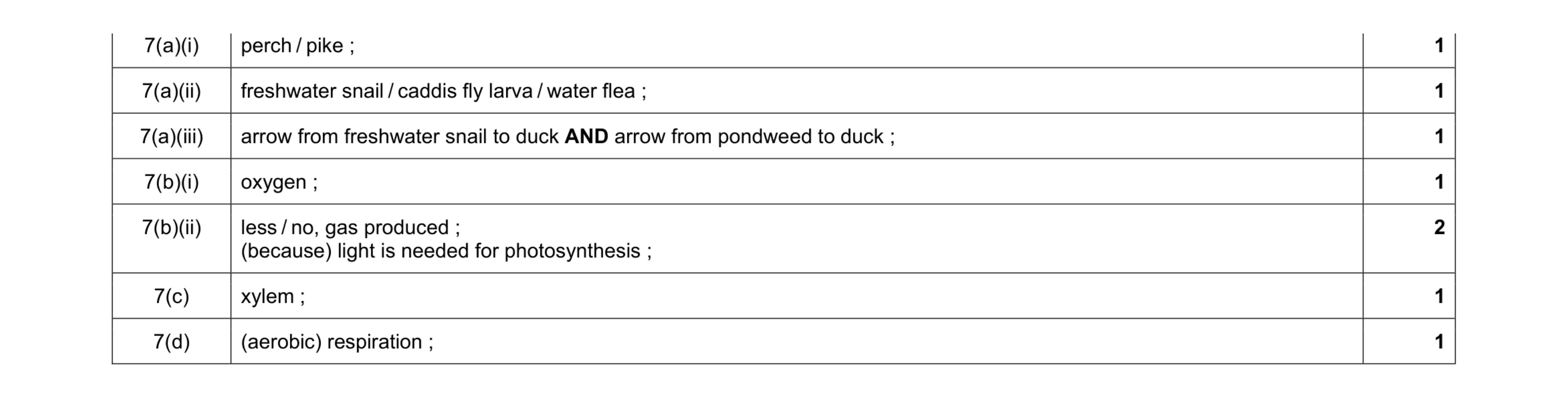 8
8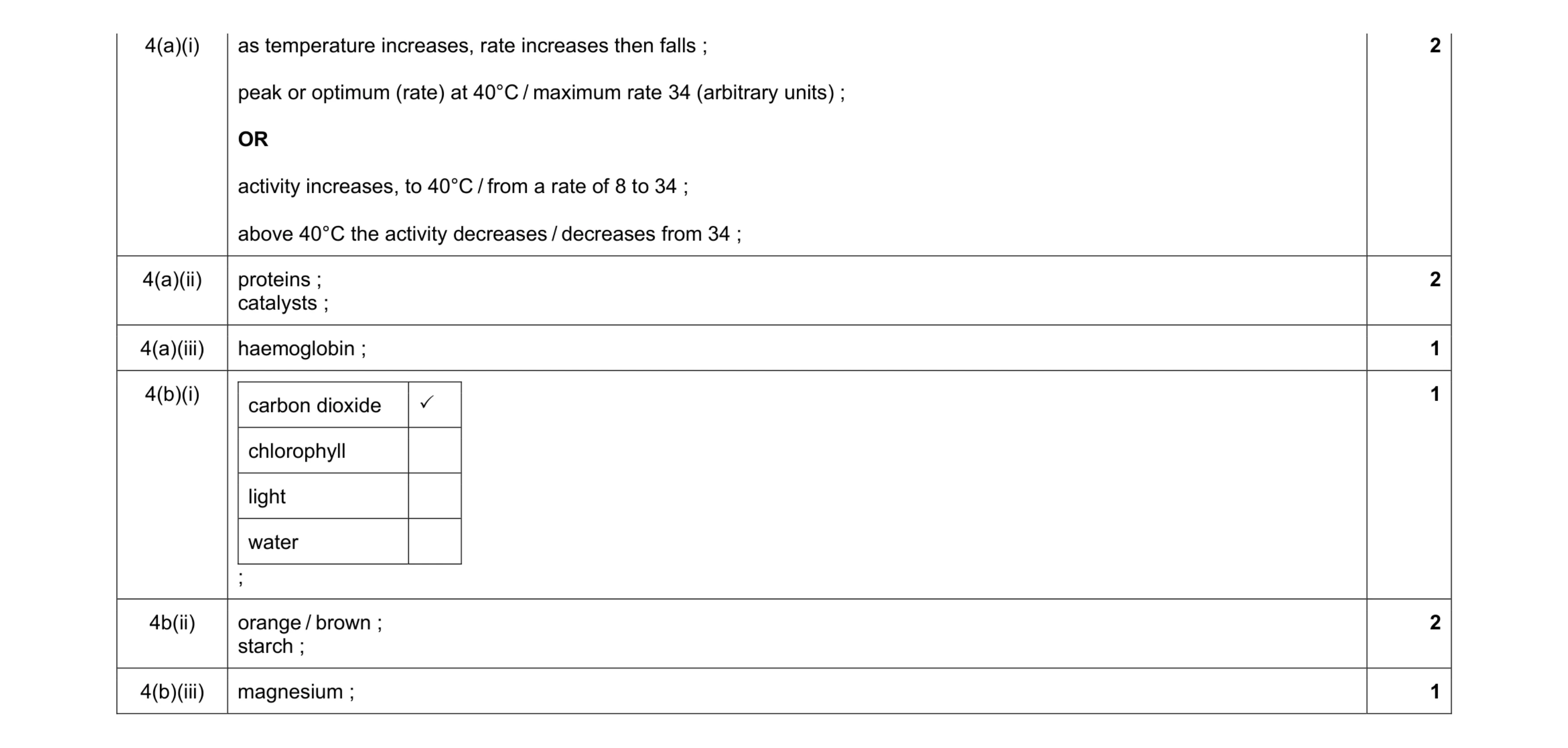 9
9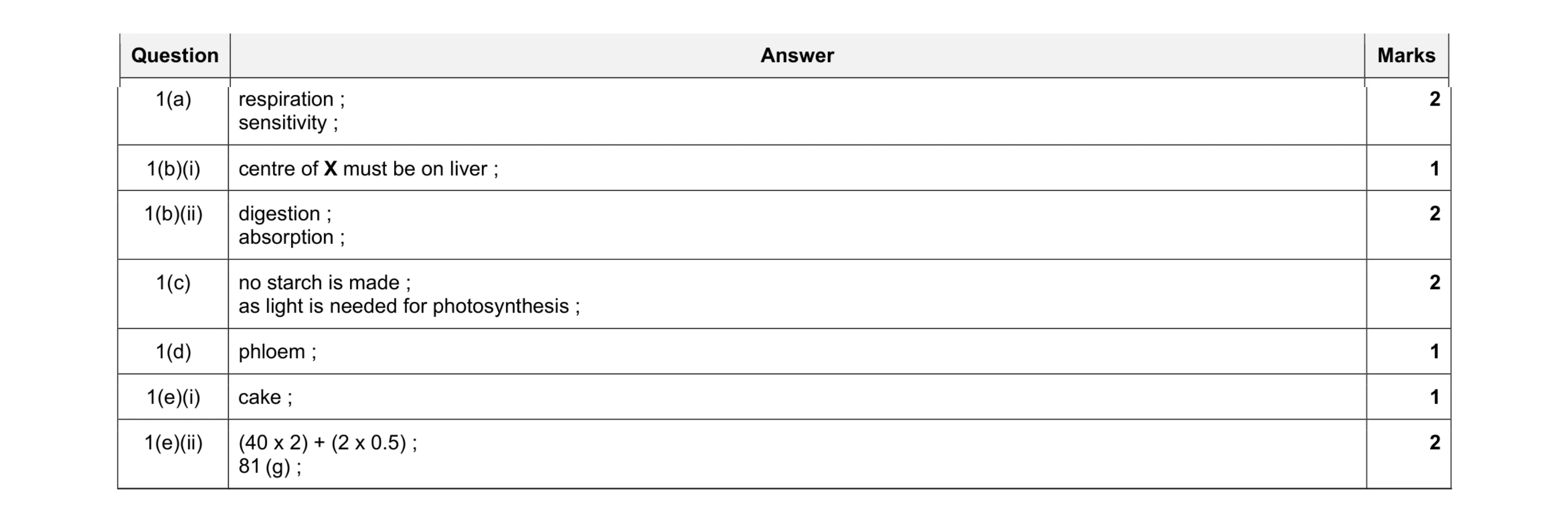 11
11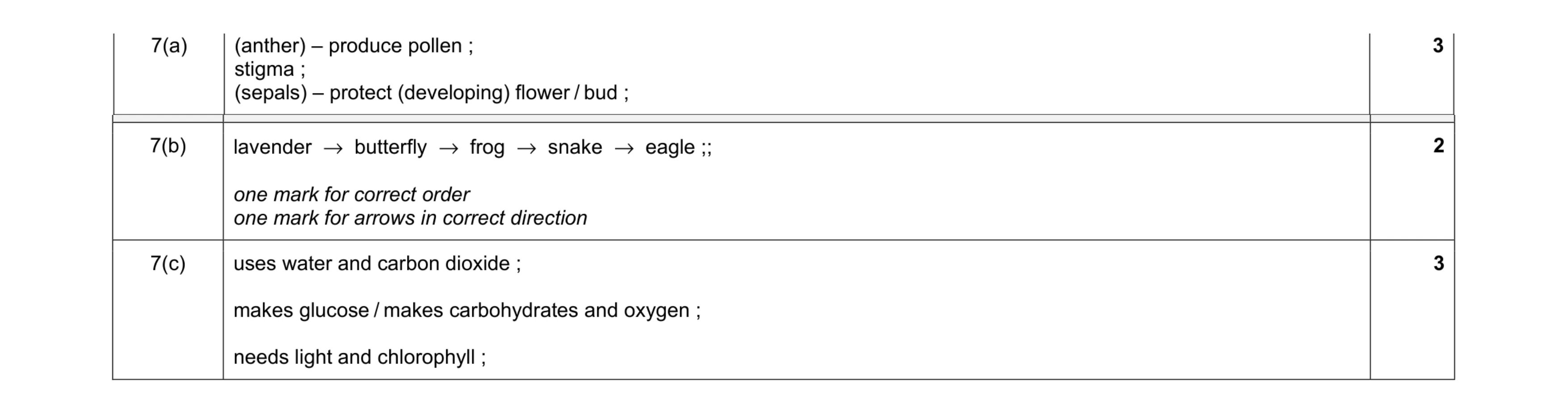 8
8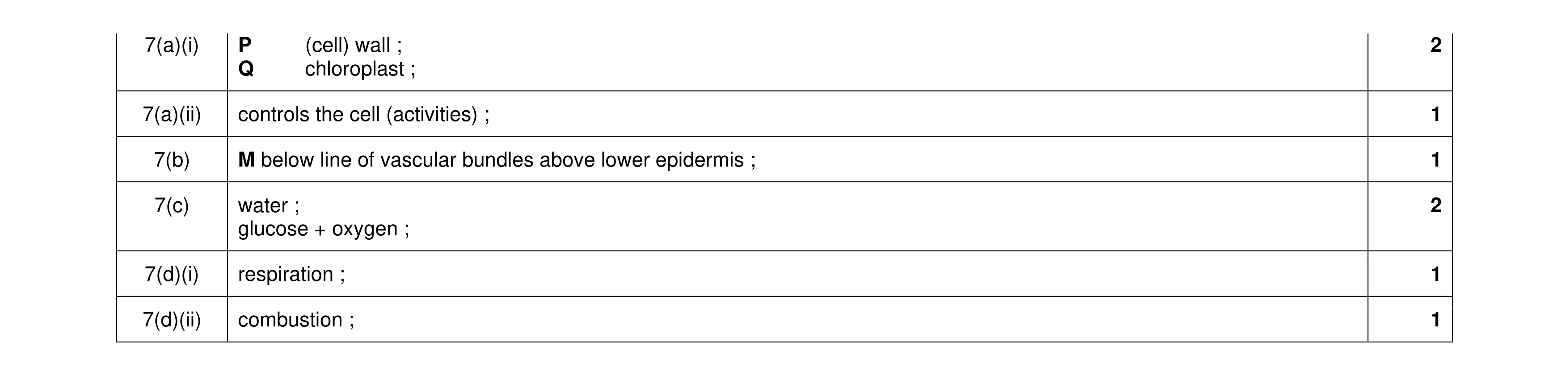 8
8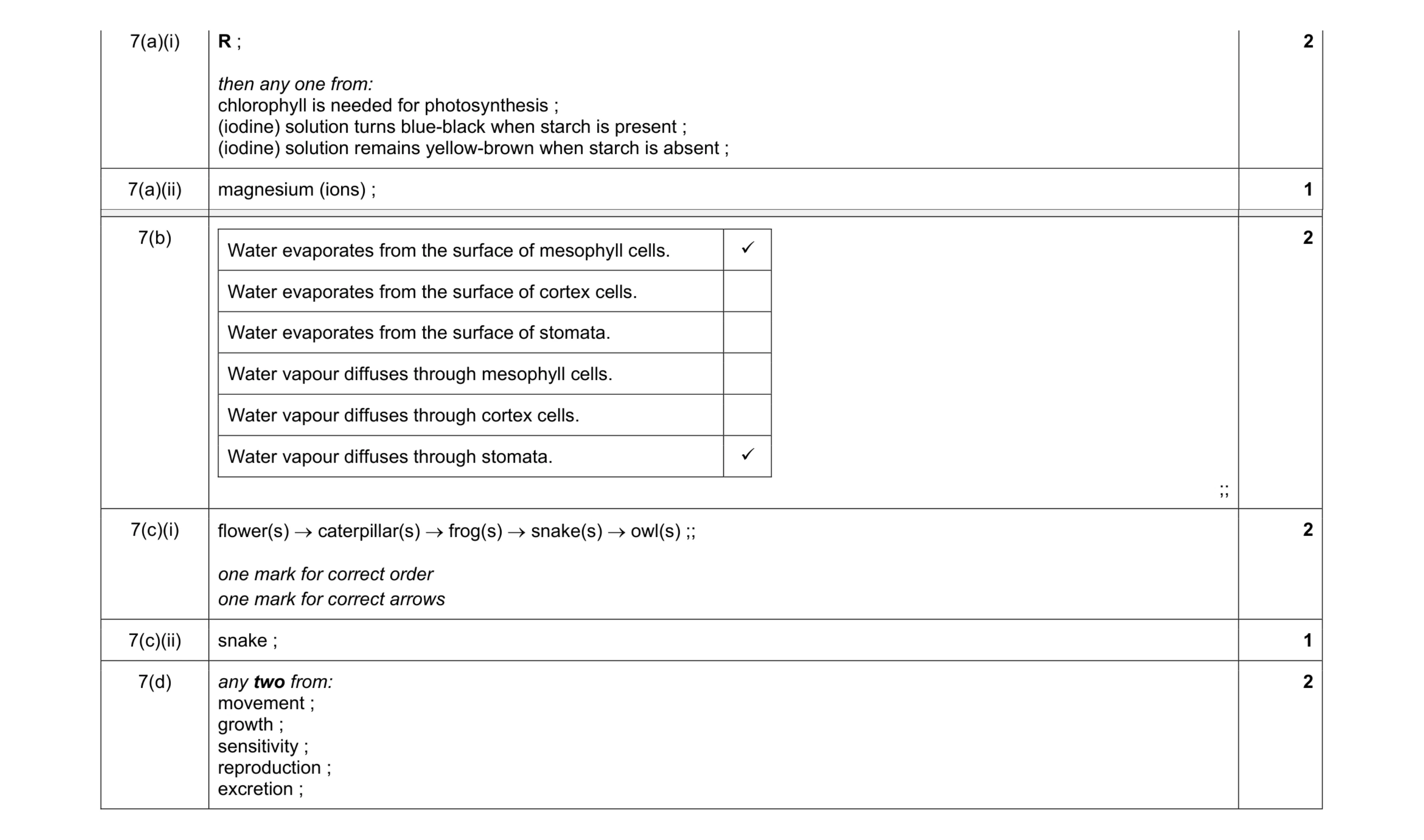 10
10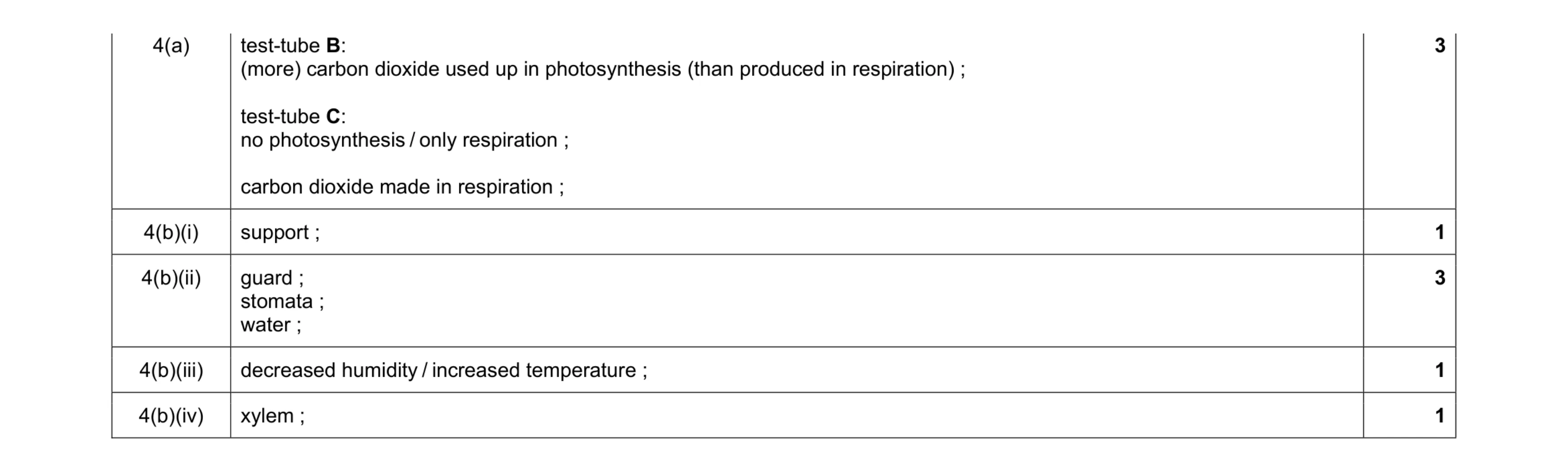 9
9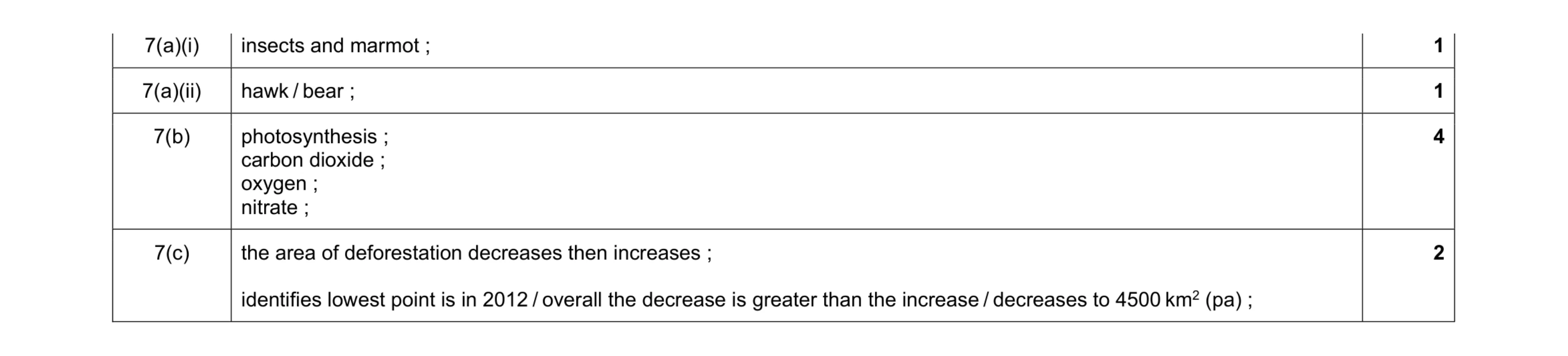 8
8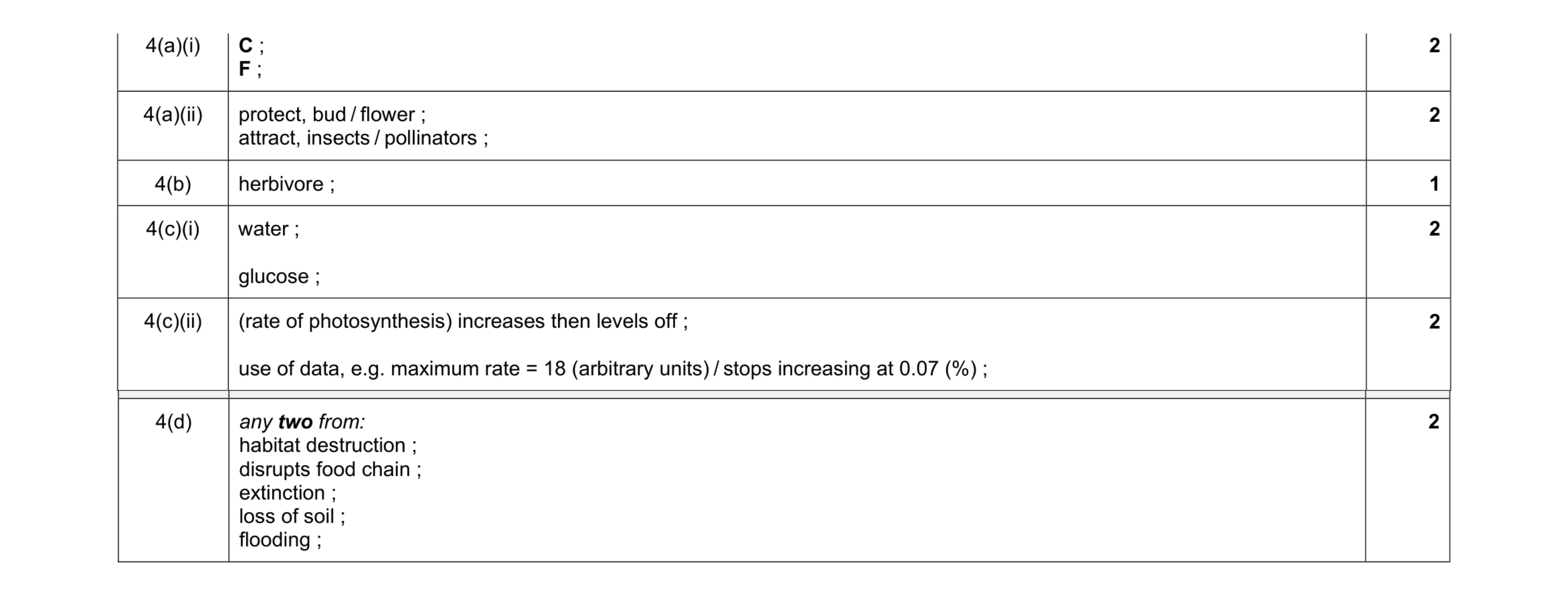 11
11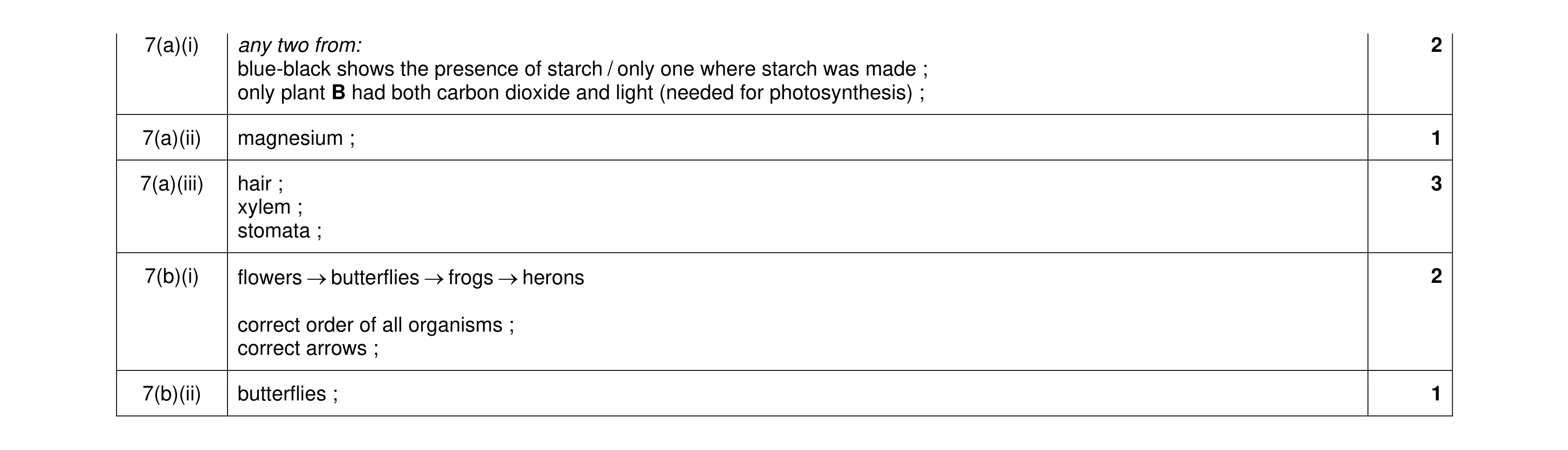 9
9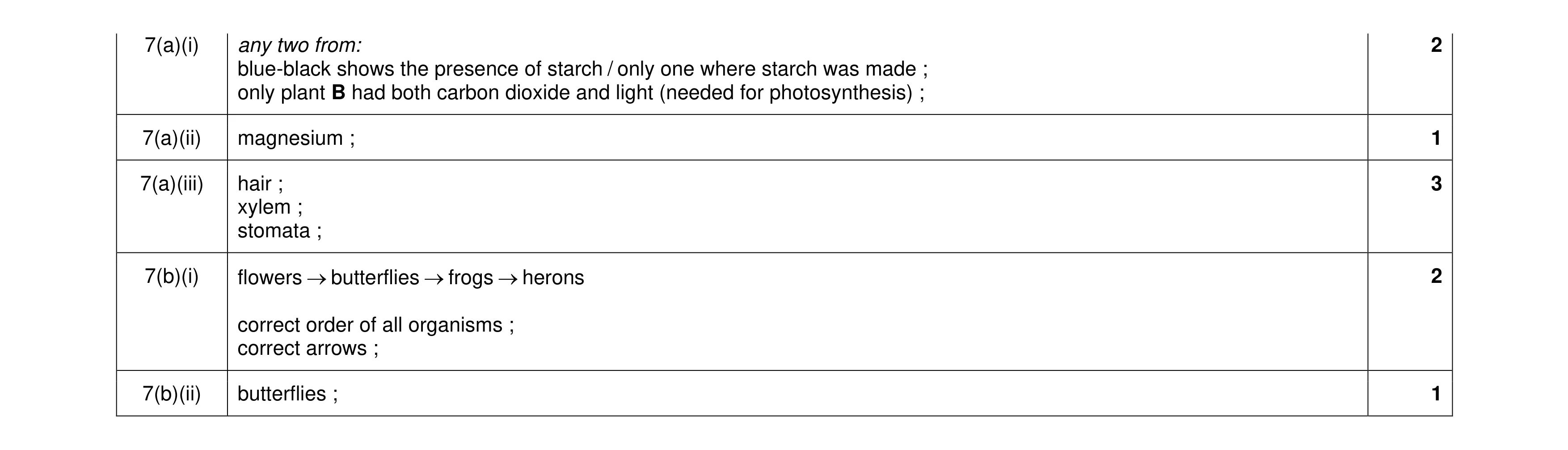 9
9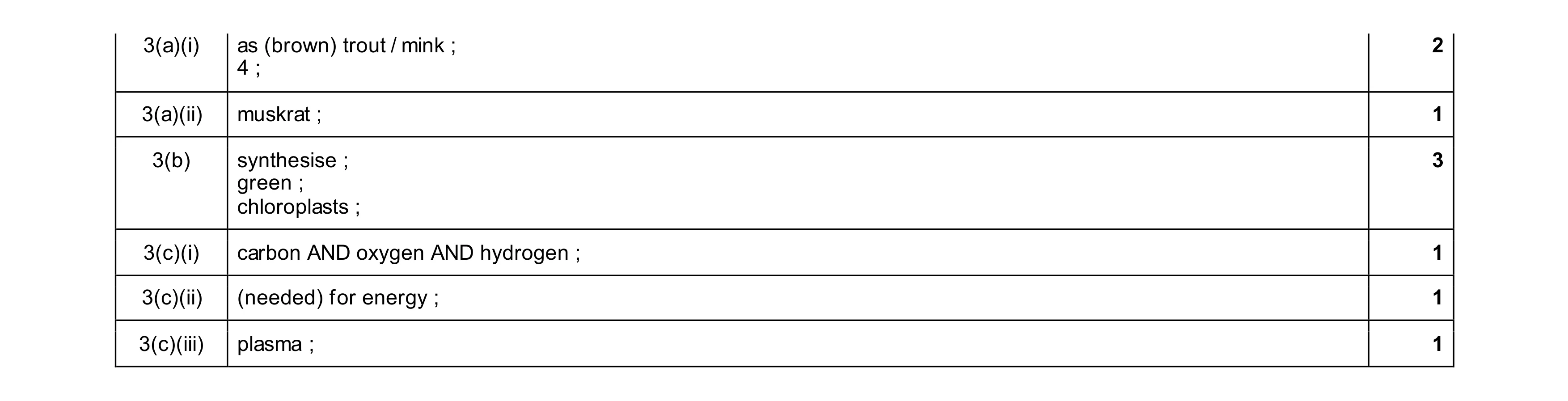 9
9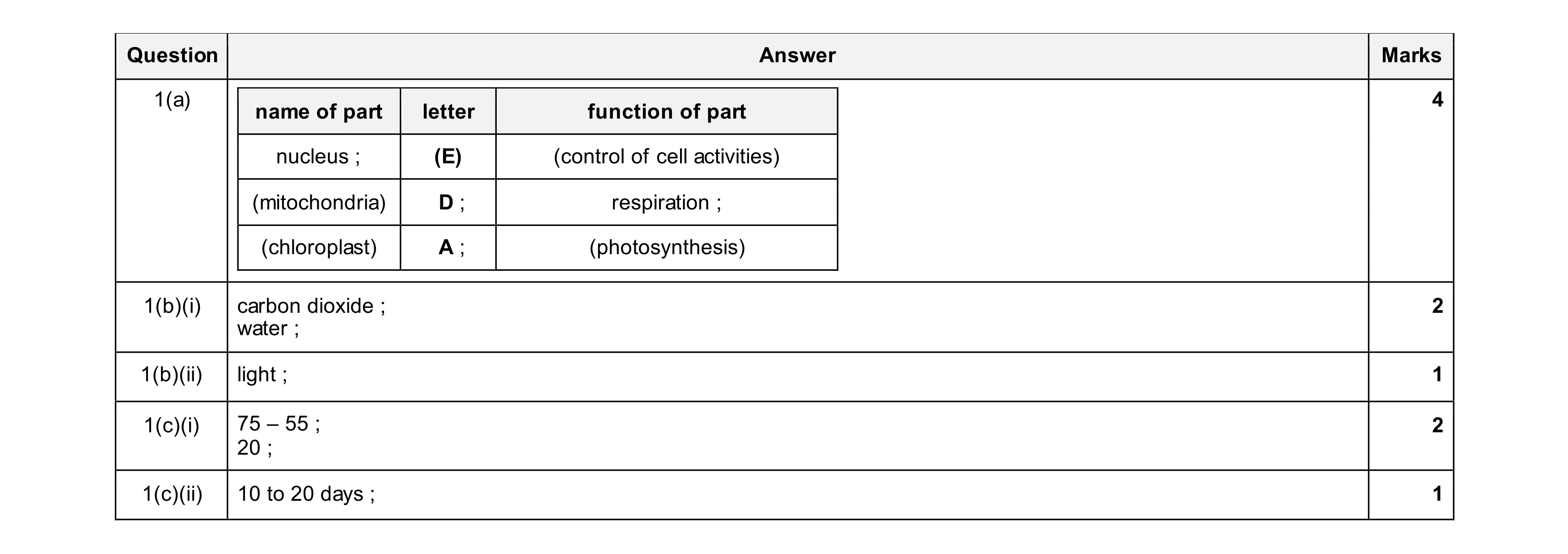 10
10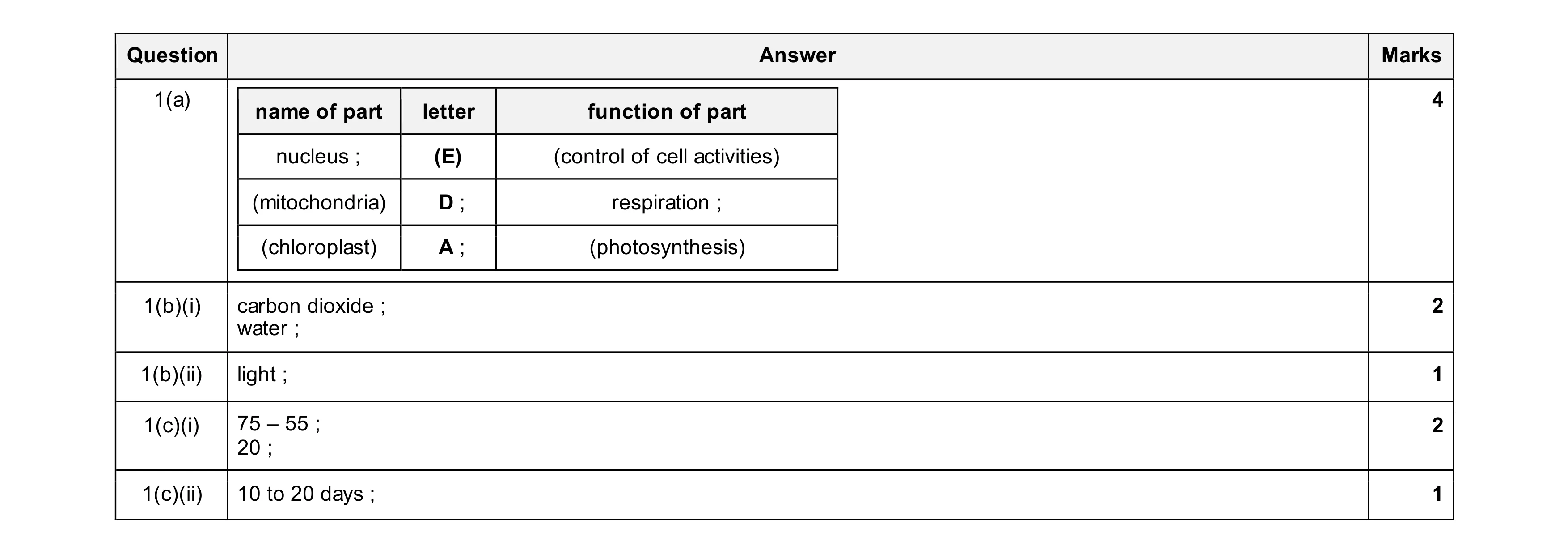 10
10