Questions as text
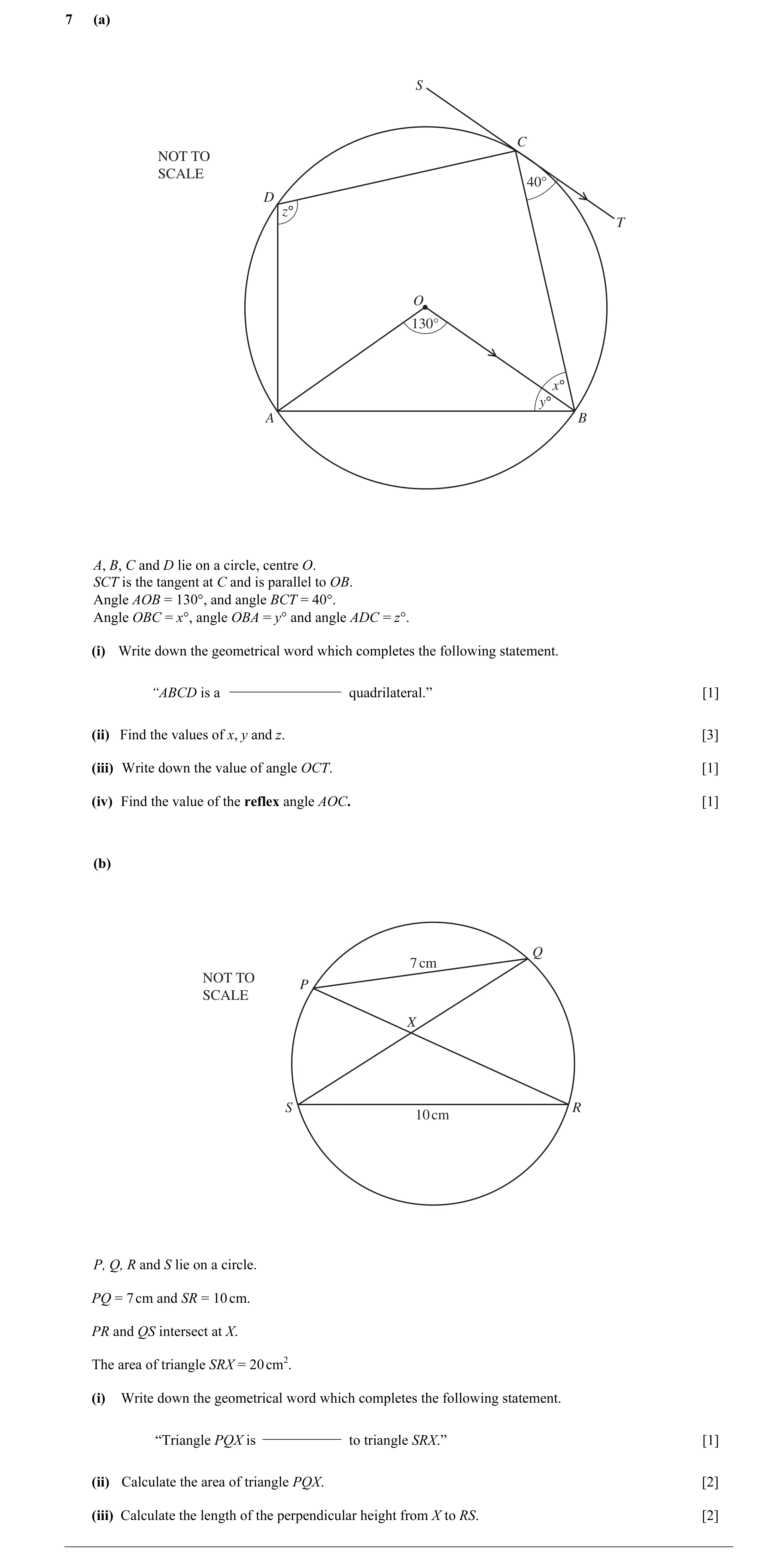
Q1 · S C NOT TO SCALE 40° D z° T O 130° x° y° A B A, B, C and D lie on a circle, centre O 0580/41 May/June 2008
7 (a) S C NOT TO SCALE 40° D z° T O 130° x° y° A B A, B, C and D lie on a circle, centre O. SCT is the tangent at C and is parallel to OB. Angle AOB = 130°, and angle BCT = 40°. Angle OBC = x°, angle OBA = y° and angle ADC = z°. (i) Write down the geometrical word which completes the following statement. “ABCD is a quadrilateral.” [1] (ii) Find the values of x, y and z. [3] (iii) Write down the value of angle OCT. [1] (iv) Find the value of the reflex angle AOC. [1] (b) Q 7 cm NOT TO P SCALE X S R 10 cm P, Q, R and S lie on a circle. PQ = 7 cm and SR = 10 cm. PR and QS intersect at X. The area of triangle SRX = 20 cm2. (i) Write down the geometrical word which completes the following statement. “Triangle PQX is to triangle SRX.” [1] (ii) Calculate the area of triangle PQX. [2] (iii) Calculate the length of the perpendicular height from X to RS. [2]
11 marks
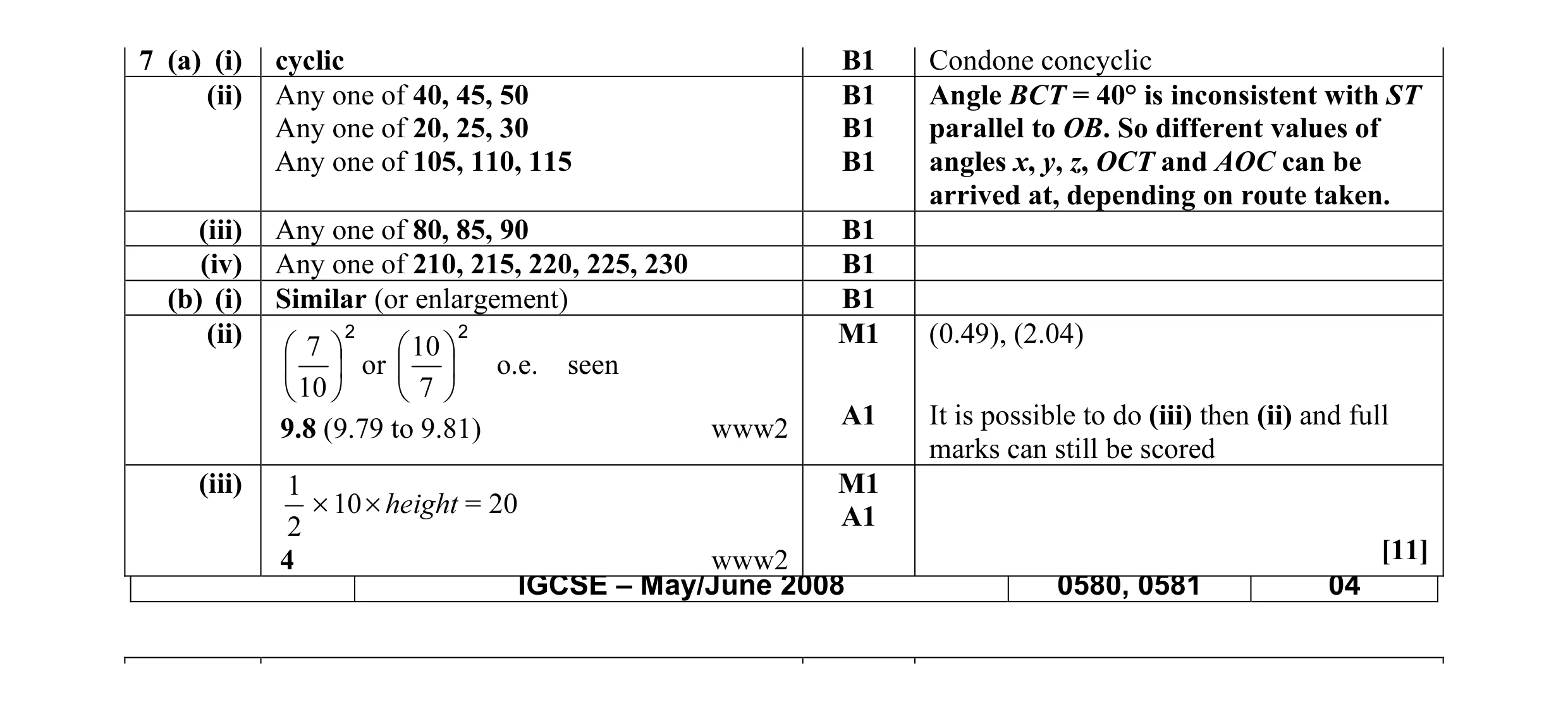
Mark scheme: 7 (a) (i) cyclic B1 Condone concyclic (ii) Any one of 40, 45, 50 B1 Angle BCT = 40° is inconsistent with ST Any one of 20, 25, 30 B1 parallel to OB. So different values of Any one of 105, 110, 115 B1 angles x, y, z, OCT and AOC can be arrived at, depending on route taken. (iii) Any one of 80, 85, 90 B1 (iv) Any one of 210, 215, 220, 225, 230 B1 (b) (i) Similar (or enlargement) B1 (ii) 2 2 M1 (0.49), (2.04) 7 10 or o.e. seen 10 7 A1 It is possible to do (iii) then (ii) and full 9.8 (9.79 to 9.81) www2 marks can still be scored (iii) 1 M1 ×10×height = 20 A1 2 [11] 4 www2 IGCSE – May/June 2008 0580, 0581 04
This question in 0580/41 May/June 2008
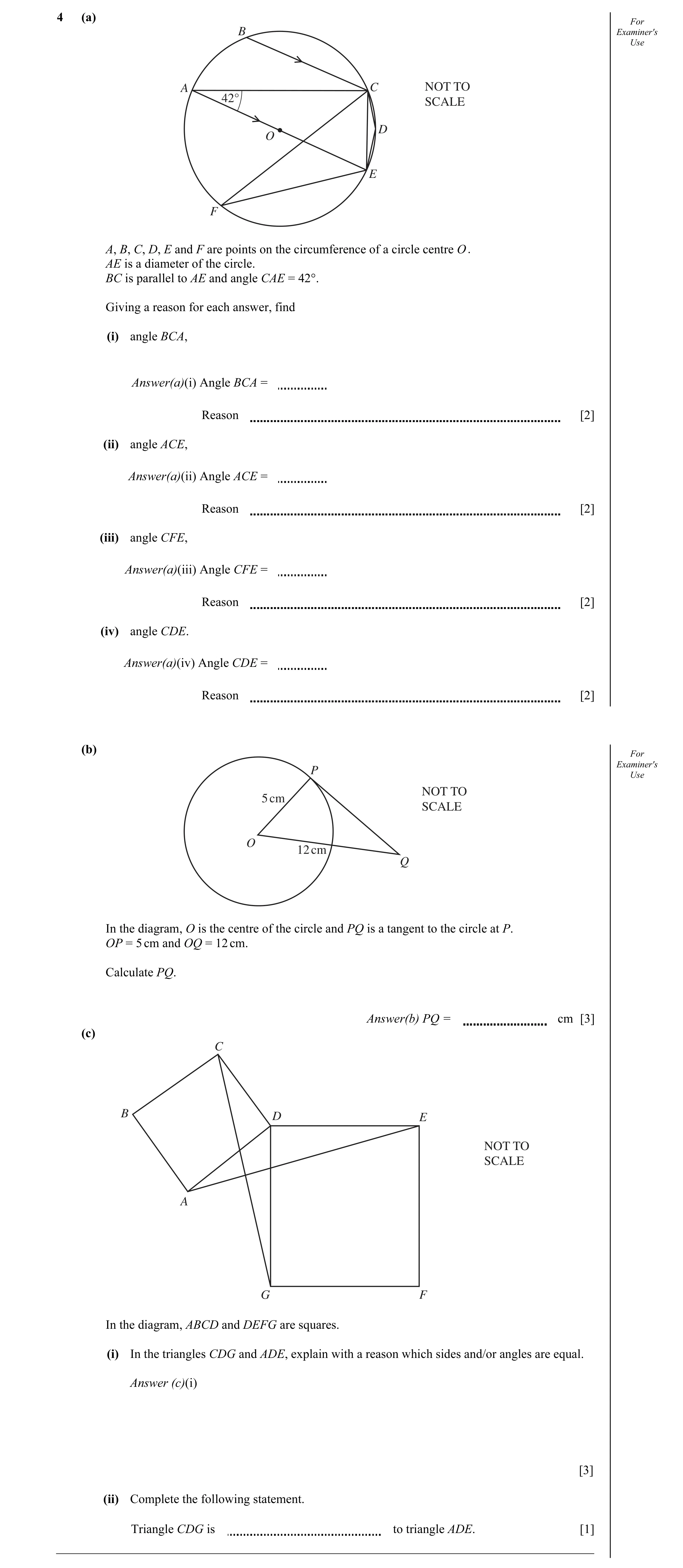
Q2 · For B Examiner's Use A C NOT TO 42° SCALE D O E F A, B, C, D, E and F are points on the… 0580/42 May/June 2012
4 (a) For B Examiner's Use A C NOT TO 42° SCALE D O E F A, B, C, D, E and F are points on the circumference of a circle centre O . AE is a diameter of the circle. BC is parallel to AE and angle CAE = 42°. Giving a reason for each answer, find (i) angle BCA, Answer(a)(i) Angle BCA = Reason [2] (ii) angle ACE, Answer(a)(ii) Angle ACE = Reason [2] (iii) angle CFE, Answer(a)(iii) Angle CFE = Reason [2] (iv) angle CDE. Answer(a)(iv) Angle CDE = Reason [2] (b) For Examiner's P Use NOT TO 5 cm SCALE O 12 cm Q In the diagram, O is the centre of the circle and PQ is a tangent to the circle at P. OP = 5 cm and OQ = 12 cm. Calculate PQ. Answer(b) PQ = cm [3] (c) C B D E NOT TO SCALE A G F In the diagram, ABCD and DEFG are squares. (i) In the triangles CDG and ADE, explain with a reason which sides and/or angles are equal. Answer (c)(i) [3] (ii) Complete the following statement. Triangle CDG is to triangle ADE. [1]
15 marks
Mark scheme: 4 In all parts of (a) candidates may refer to angles marked in diagram. Allow if clear even if reason is more complicated as long as it is full. Reasons dependent on correct answers (a) (i) 42 1 Not alternate segment Alternate oe 1 (ii) 90 1 Allow diameter semicircle oe 1 (iii) 42 1 same arc same segment oe 1 (iv) 138 1 key words must not be spoiled cyclic quad oe 1 (b) 10.9 (10.90 to 10.91) www 3 3 M2 for 12 2 − 5 2 oe i.e explicit or M1 for 12 2 = 5 2 + PQ 2 oe i.e implicit Allow full marks for 119 as final answer Use of trig method must be complete to explicit expression for possible M2 (c) (i) AD = CD and DE = DG 1 Extra pair of sides loses this mark. (Angle) CDG = (angle)ADE 1 Extra pair of angles loses this mark (Sides of) square or 90° + angle ADG R1 As in (a), for all 3 marks allow references to oe diagram if completely clear. R mark dep on at least one pair of sides stated or pair of angles stated (ii) Congruent 1 IGCSE – May/June 2012 0580 42
This question in 0580/42 May/June 2012
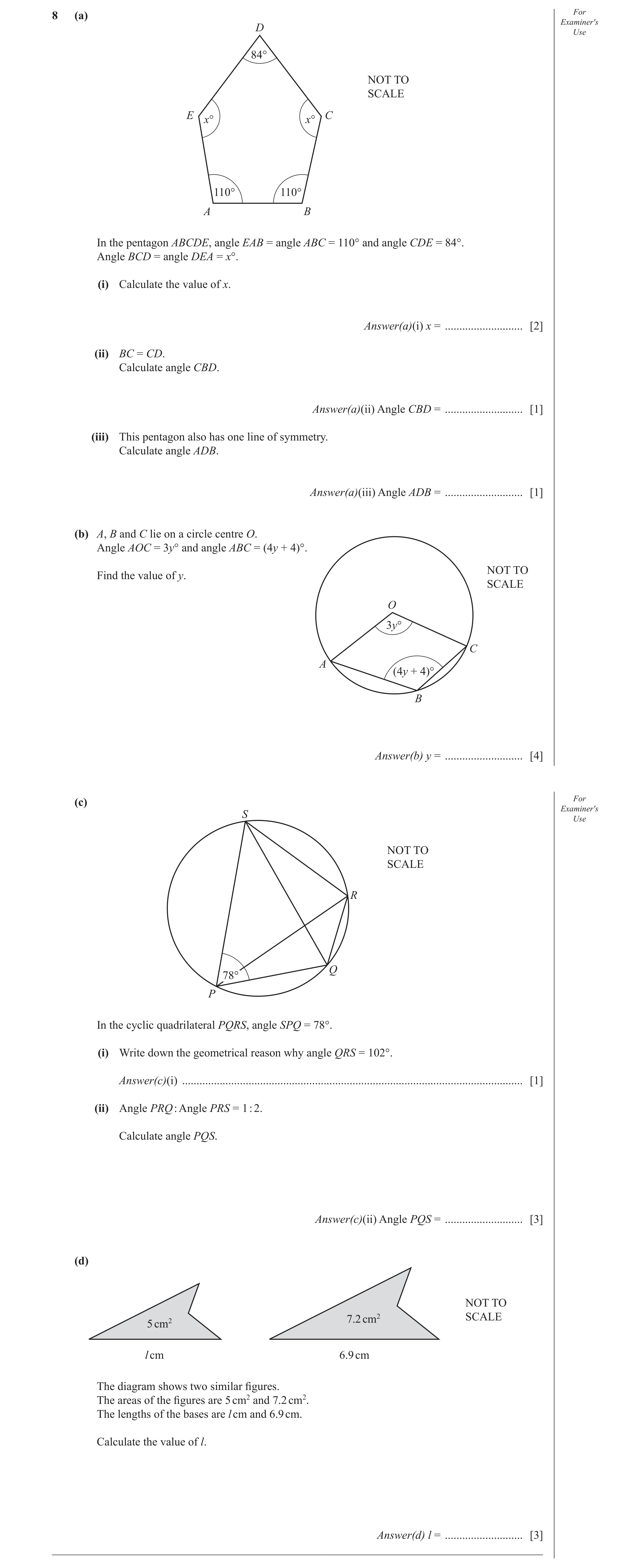
Q3 · For Examiner′s D Use 84° NOT TO SCALE E C x° x° 110° 110° A B In the pentagon ABCDE… 0580/41 May/June 2013
8 (a) For Examiner′s D Use 84° NOT TO SCALE E C x° x° 110° 110° A B In the pentagon ABCDE, angle EAB = angle ABC = 110° and angle CDE = 84°. Angle BCD = angle DEA = x°. (i) Calculate the value of x. Answer(a)(i) x = … [2] (ii) BC = CD. Calculate angle CBD. Answer(a)(ii) Angle CBD = … [1] (iii) This pentagon also has one line of symmetry. Calculate angle ADB. Answer(a)(iii) Angle ADB = … [1] (b) A, B and C lie on a circle centre O. Angle AOC = 3y° and angle ABC = (4y + 4)°. NOT TO Find the value of y. SCALE O 3y° C A (4y + 4)° B Answer(b) y = … [4] (c) For Examiner′s S Use NOT TO SCALE R Q 78° P In the cyclic quadrilateral PQRS, angle SPQ = 78°. (i) Write down the geometrical reason why angle QRS = 102°. Answer(c)(i) … [1] (ii) Angle PRQ : Angle PRS = 1 : 2. Calculate angle PQS. Answer(c)(ii) Angle PQS = … [3] (d) NOT TO 7.2 cm2 SCALE 5 cm2 l cm 6.9 cm The diagram shows two similar fi gures. The areas of the fi gures are 5 cm2 and 7.2 cm2. The lengths of the bases are l cm and 6.9 cm. Calculate the value of l. Answer(d) l = … [3] _____________________________________________________________________________________
15 marks
Mark scheme: 8 (a) (i) 118 2 M1 for (3 × 180 – 2 × 110 – 84) [÷ 2] or better (ii) 31 1FT FT (180 – their (i)) ÷ 2 (iii) 22 1FT FT 84 – 2 × their (ii) or 2 × their (ii) – 40, only if positive answer and less than 84 (b) 32 4 B2 for 360 – 3y = 2(4y + 4) oe and B1 for 11y = 352 oe or M1 for angle at centre = 2 × angle at circumference soi (c) (i) Opposite angles [cyclic quad] add to 1 180 (ii) 68 3 M1 for [angle PRS =] 102 ÷ 3 × 2 and M1 for angle PQS = angle PRS or angle PRQ = angle PSQ 5 (d) 5.75 3 M2 for 6.9 × oe 2.7 or M1 for evidence of ratio of areas = (ratio of sides)2 or sf = 1.2 2 2
This question in 0580/41 May/June 2013
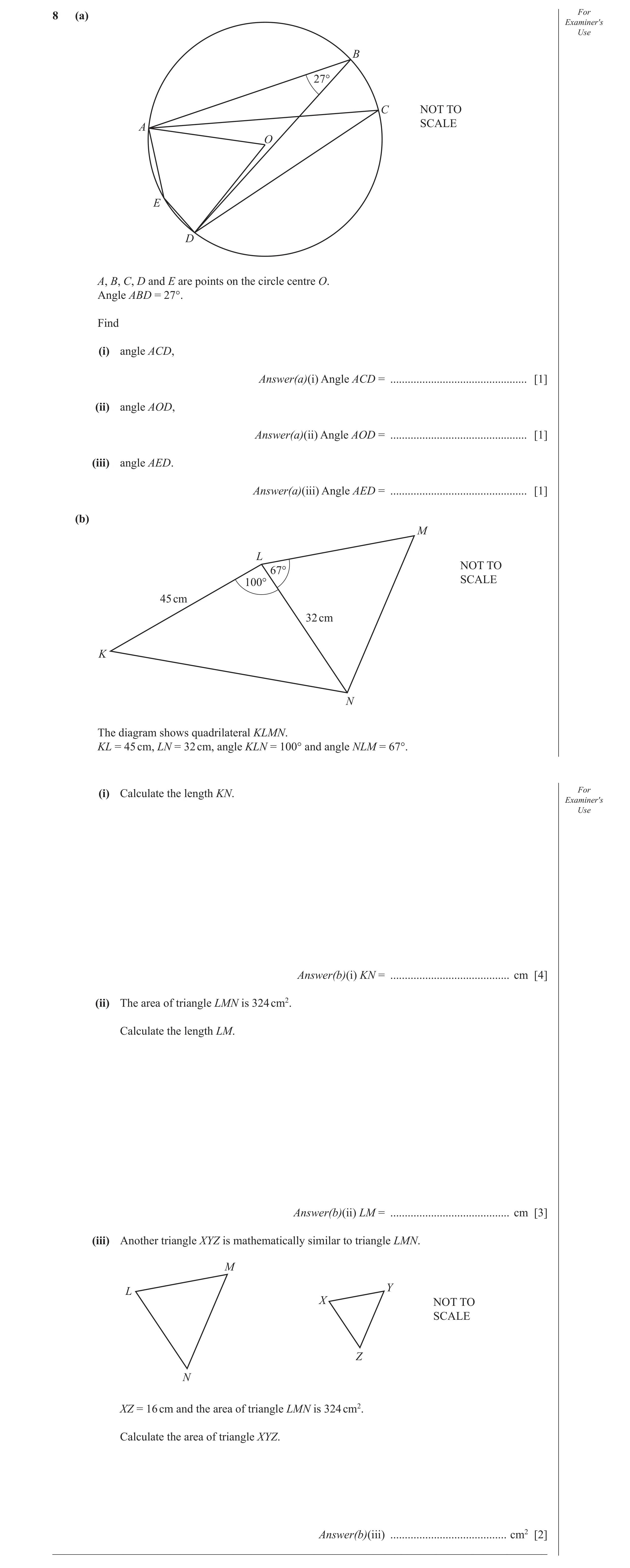
Q4 · For Examiner′s Use B 27° C NOT TO SCALE A O E D A, B, C, D and E are points on the circle… 0580/43 May/June 2013
8 (a) For Examiner′s Use B 27° C NOT TO SCALE A O E D A, B, C, D and E are points on the circle centre O. Angle ABD = 27°. Find (i) angle ACD, Answer(a)(i) Angle ACD = … [1] (ii) angle AOD, Answer(a)(ii) Angle AOD = … [1] (iii) angle AED. Answer(a)(iii) Angle AED = … [1] (b) M L NOT TO 67° 100° SCALE 45 cm 32 cm K N The diagram shows quadrilateral KLMN. KL = 45 cm, LN = 32 cm, angle KLN = 100° and angle NLM = 67°. (i) Calculate the length KN. For Examiner′s Use Answer(b)(i) KN = … cm [4] (ii) The area of triangle LMN is 324 cm2. Calculate the length LM. Answer(b)(ii) LM = … cm [3] (iii) Another triangle XYZ is mathematically similar to triangle LMN. M Y L X NOT TO SCALE Z N XZ = 16 cm and the area of triangle LMN is 324 cm2. Calculate the area of triangle XYZ. Answer(b)(iii) … cm2 [2] _____________________________________________________________________________________
12 marks
Mark scheme: 8 (a) (i) 27 1 (ii) 54 1 (iii) 153 1 (b) (i) 59.6 or 59.57… www 4 M2 for 452 + 322 – 2 × 45 × 32 × cos100 or M1 for implicit cos rule and A1 for 3549…. (ii) 22.[0] or 21.99… www 3 M2 for 324 ÷ (½ × 32 × sin67) or M1 for [324 =] ½ × 32 × x × sin67 (iii) 81[.0] 2 B1 for 22 or (½)2 oe seen or ½ × 16 × ½ their(b)(ii) × sin67 IGCSE – May/June 2013 0580 43
This question in 0580/43 May/June 2013
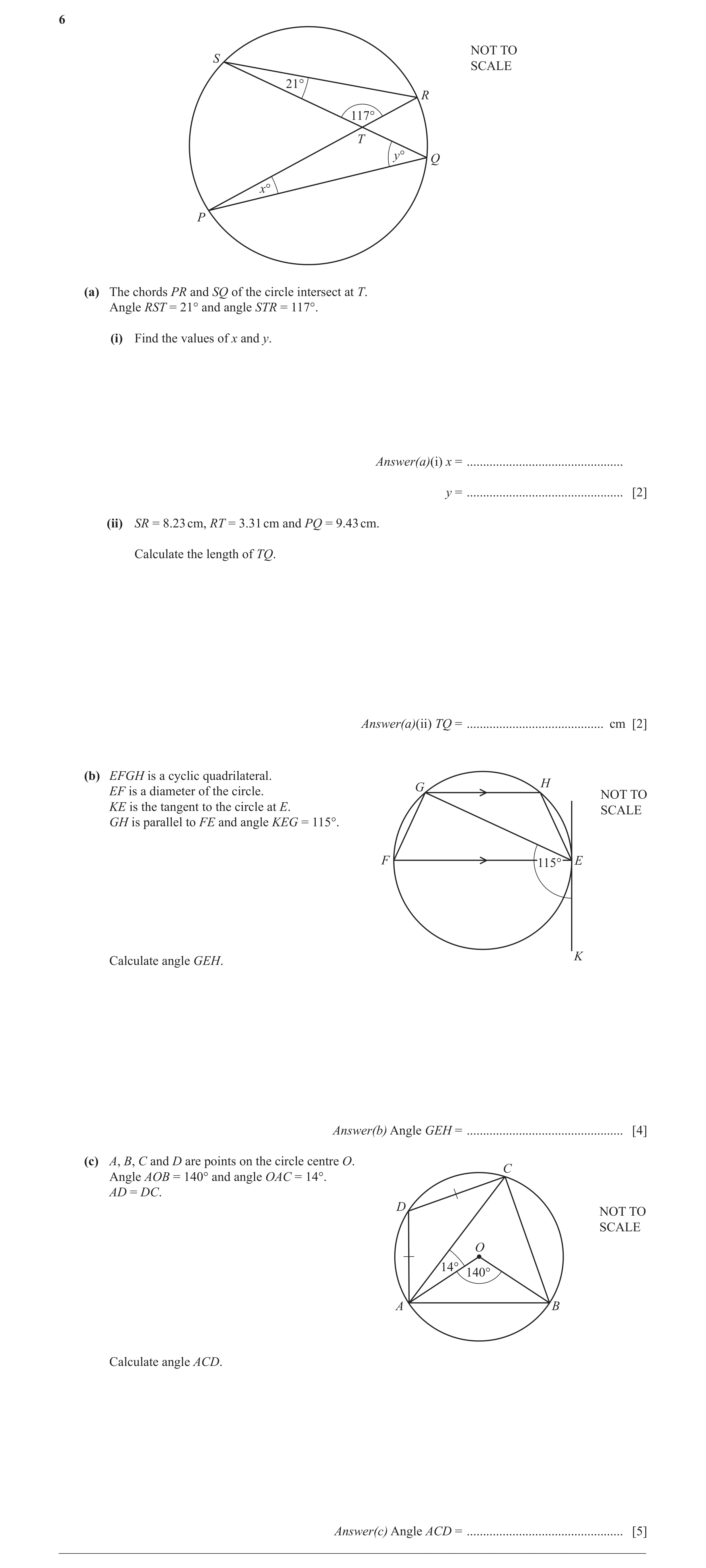
Q5 · NOT TO S SCALE 21° R 117° T y° Q x° P (a) The chords PR and SQ of the circle intersect at… 0580/42 May/June 2014
6 NOT TO S SCALE 21° R 117° T y° Q x° P (a) The chords PR and SQ of the circle intersect at T. Angle RST = 21° and angle STR = 117°. (i) Find the values of x and y. Answer(a)(i) x = … y = … [2] (ii) SR = 8.23 cm, RT = 3.31 cm and PQ = 9.43 cm. Calculate the length of TQ. Answer(a)(ii) TQ = … cm [2] (b) EFGH is a cyclic quadrilateral. H EF is a diameter of the circle. G NOT TO KE is the tangent to the circle at E. SCALE GH is parallel to FE and angle KEG = 115°. F 115° E Calculate angle GEH. K Answer(b) Angle GEH = … [4] (c) A, B, C and D are points on the circle centre O. C Angle AOB = 140° and angle OAC = 14°. AD = DC. D NOT TO SCALE O 14° 140° A B Calculate angle ACD. Answer(c) Angle ACD = … [5] __________________________________________________________________________________________
13 marks
Mark scheme: 6 (a) (i) [x =] 21, [y =] 42 2 B1 B1 .331 .8 23 (ii) 3.79 or 3.8[0] or 3.792 to 3.802 2 M1 for = oe TQ .943 sin 21 or sin their x sin 117 or = oe TQ .9 43 (b) 40 4 B3 for angle between HE and tangent = 25 or GFH = 40 or EGH = 25 and angle EHG = 115 (accept 90 and 25 at H for 115) B2 for angle EGH = 25 or angle EHG = 115 (accept 90 and 25 at H for 115) B1 for angle FEG = 25 or angle EFG = 65 (c) 38 5 B4 for angle ADC = 104 or M4 for x + 14 + 20 + x + 70 =180 or better or B3 for angle OBA = 20 and angle OBC = 56 or angle CBA = 76 or reflex angle AOC = 208 or B2 for angle OAB or OBA = 20 and angle ACB = 70 or obtuse angle AOC = 152 or angle BOC = 68 or B1 for angle OAB or OBA = 20 or angle ACB = 70 IGCSE – May/June 2014 0580 42 Qu Answers Mark Part Marks 24
This question in 0580/42 May/June 2014
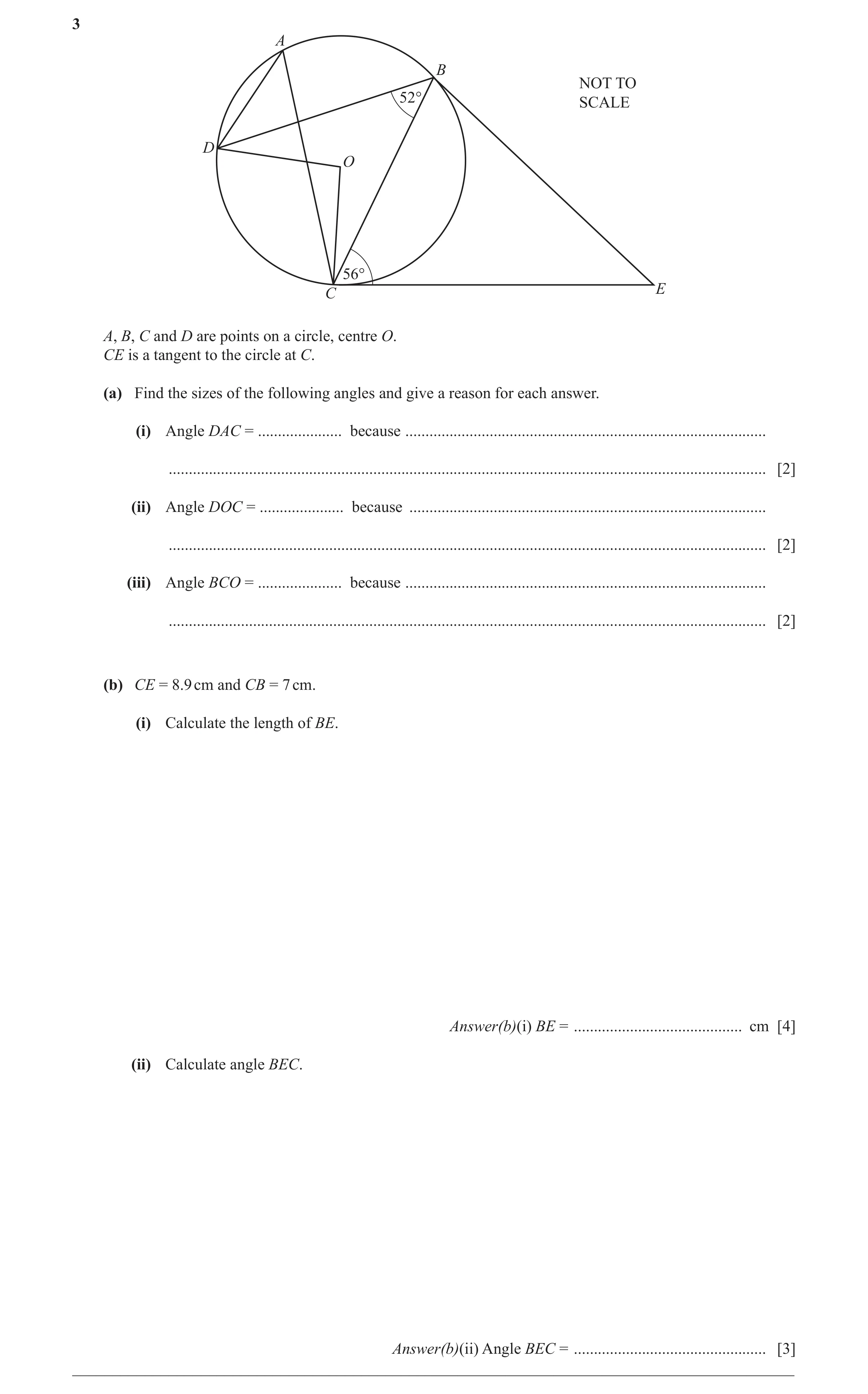
Q6 · A B NOT TO 52° SCALE D O 56° C E A, B, C and D are points on a circle, centre O 0580/43 Oct/Nov 2014
3 A B NOT TO 52° SCALE D O 56° C E A, B, C and D are points on a circle, centre O. CE is a tangent to the circle at C. (a) Find the sizes of the following angles and give a reason for each answer. (i) Angle DAC = … because … … [2] (ii) Angle DOC = … because … … [2] (iii) Angle BCO = … because … … [2] (b) CE = 8.9 cm and CB = 7 cm. (i) Calculate the length of BE. Answer(b)(i) BE = … cm [4] (ii) Calculate angle BEC. Answer(b)(ii) Angle BEC = … [3] __________________________________________________________________________________________
13 marks
Mark scheme: 3 (a) (i) 52 1 Angles in same segment 1dep Accept same arc, same side of same chord (ii) 104 1 Angle at centre is twice angle at 1 Accept double, 2 × but not middle, edge circumference (iii) 34 1 Angle between tangent and radius 1 Accept right angle, perpendicular = 90° (b) (i) 7.65 to 7.651 4 M2 for 8.92 + 72 – 2 × 8.9 × 7 × cos56 or M1 for correct implicit formula and A1 for 58.5 to 58.6 7 sin 56 M2 for [sinBEC =] oe (ii) 49.3 or 49.33 to 49.34… 3 their (b)(i) or sin 56 sin BEC M1 for = oe their (b)(i) 7
This question in 0580/43 Oct/Nov 2014
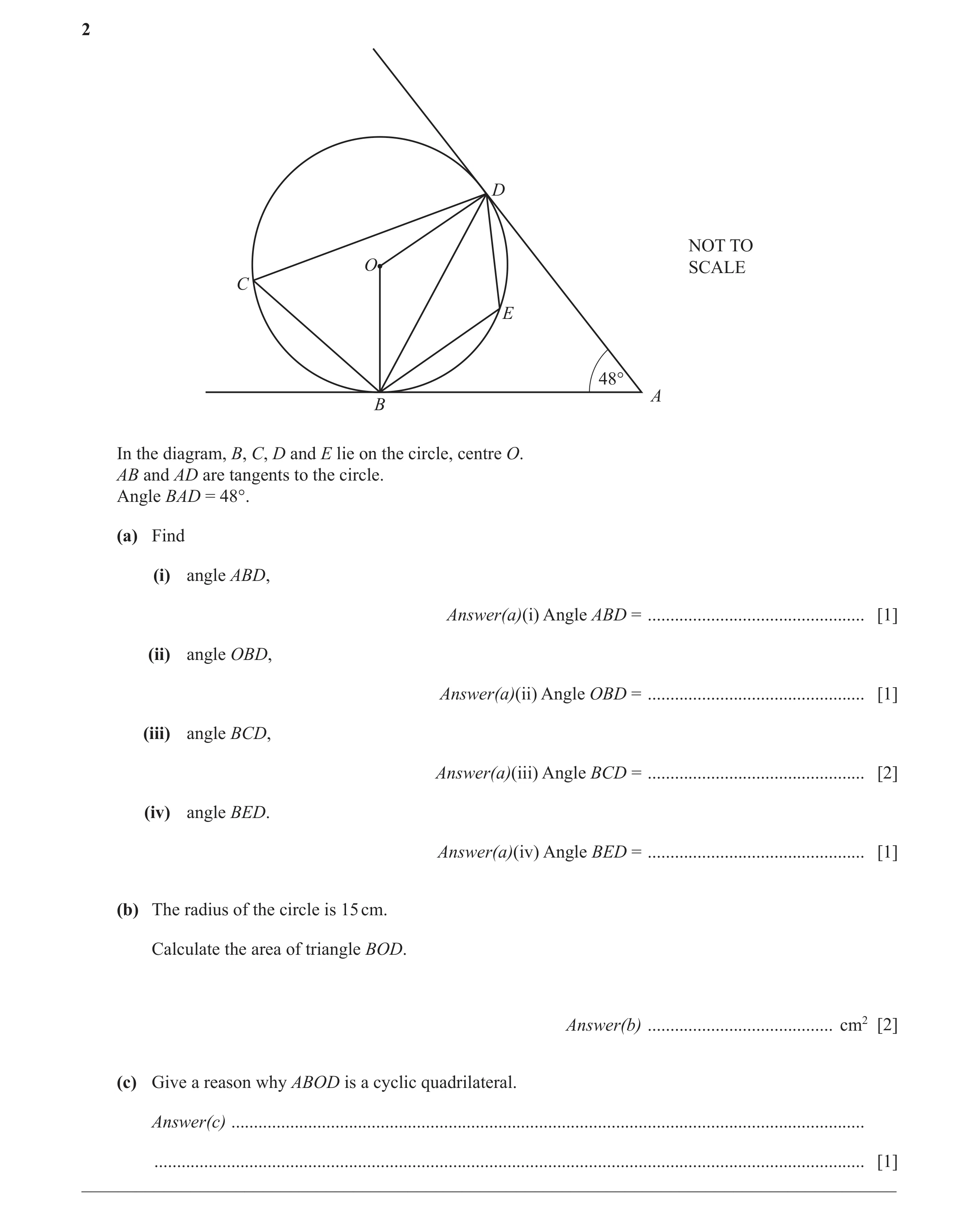
Q7 · D NOT TO O SCALE C E 48° A B In the diagram, B, C, D and E lie on the circle, centre O 0580/42 May/June 2015
2 D NOT TO O SCALE C E 48° A B In the diagram, B, C, D and E lie on the circle, centre O. AB and AD are tangents to the circle. Angle BAD = 48°. (a) Find (i) angle ABD, Answer(a)(i) Angle ABD = … [1] (ii) angle OBD, Answer(a)(ii) Angle OBD = … [1] (iii) angle BCD, Answer(a)(iii) Angle BCD = … [2] (iv) angle BED. Answer(a)(iv) Angle BED = … [1] (b) The radius of the circle is 15 cm. Calculate the area of triangle BOD. Answer(b) … cm2 [2] (c) Give a reason why ABOD is a cyclic quadrilateral. Answer(c) … … [1] __________________________________________________________________________________________
8 marks
Mark scheme: 2 (a) (i) 66 1 (ii) 24 1FT FT 90 – their (a)(i) (iii) 66 2FT FT 90 – their (a)(ii) M1 for [BOD =] 180 – 48 or 180 – 2 × their (a)(ii) (iv) 114 1FT FT 180 – their (a)(iii) (b) 83.6 or 83.60[…] 2 M1 for 1 × 15 × 15 × sin(180 – 48) oe 2 or 1 × 15 × 15 × sin(180 – 2 × their (a)(ii)) oe 2 (c) Opposite angles add up to 180 1 OR Angle in a semicircle [ =90]
This question in 0580/42 May/June 2015
Q8 · E D 120° 140° NOT TO SCALE F C A B In the hexagon ABCDEF, AB is parallel to ED and AF is… 0580/43 May/June 2015
6 (a) E D 120° 140° NOT TO SCALE F C A B In the hexagon ABCDEF, AB is parallel to ED and AF is parallel to CD. Angle ABC = 90°, angle CDE = 140° and angle DEF = 120°. Calculate angle EFA. Answer(a) Angle EFA = … [4] (b) D C NOT TO 30° SCALE X 100° B A In the cyclic quadrilateral ABCD, angle ABC = 100° and angle BDC = 30°. The diagonals intersect at X. (i) Calculate angle ACB. Answer(b)(i) Angle ACB = … [2] (ii) Angle BXC = 89°. Calculate angle CAD. Answer(b)(ii) Angle CAD = … [2] (iii) Complete the statement. Triangles AXD and BXC are … . [1] (c) R NOT TO S SCALE Y Q P P, Q, R and S lie on a circle. PR and QS intersect at Y. PS = 11 cm, QR = 10 cm and the area of triangle QRY = 23 cm2. Calculate the area of triangle PYS. Answer(c) … cm2 [2] (d) A regular polygon has n sides. n Each exterior angle is equal to 10 degrees. (i) Find the value of n. Answer(d)(i) n = … [3] (ii) Find the size of an interior angle of this polygon. Answer(d)(ii) … [2]
16 marks
Mark scheme: 6 (a) 100 nfww 4 M3 for a correct calculation that would lead to the answer or B2 two correct relevant different size angles in their diagram or one relevant angle and total in their polygon or angle EDA + angle FAD = 140 or B1 for one relevant angle or total in their polygon (b) (i) 50 2 B1 for angle ADC = 80 or angle BAC = 30 or angle ADB = 50 soi (ii) 41 2FT FT 91 – their (b)(i) B1 for angle XBC = 41 (iii) Similar 1 2 10 2 (c) 27.8 or 27.83 2 M1 for evidence of 11 or 1.21 or 10 11 or 0.826(4…) (d) (i) 60 3 n 360 M2 for = oe 10 n 180( n − 2) n e.g. = 180 − n 10 or B1 for exterior sum = 360 or 180(n – 2) seen (ii) 174 2 their n 360 M1 for or for their n < 1800 10 their n Qu Answers Mark Part Marks
This question in 0580/43 May/June 2015
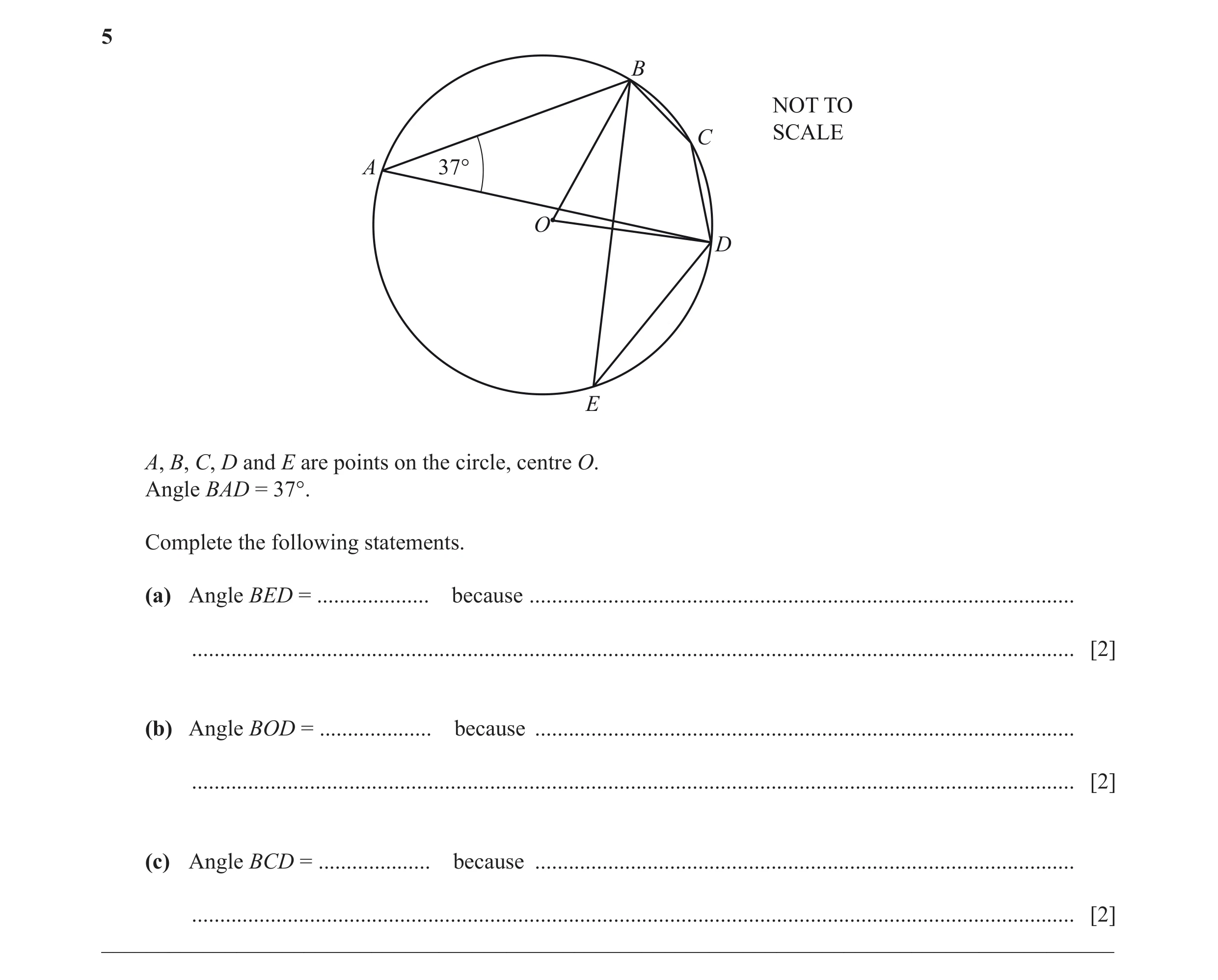
Q9 · B NOT TO C SCALE A 37° O D E A, B, C, D and E are points on the circle, centre O 0580/41 Oct/Nov 2015
5 B NOT TO C SCALE A 37° O D E A, B, C, D and E are points on the circle, centre O. Angle BAD = 37°. Complete the following statements. (a) Angle BED = … because … … [2] (b) Angle BOD = … because … … [2] (c) Angle BCD = … because … … [2] __________________________________________________________________________________________
6 marks
Mark scheme: 5 (a) 37 or [angle] BAD 1 [Angles in ] same segment [are 1dep Dependent on 37 or [angle] BAD equal] (b) 74 or 2 [× angle] BAD or 1 2 [× angle] BED Angle at centre is twice angle at 1dep Dependent on 2 × 37 or 2 [× angle] BAD circumference or 2 [× angle] BED Must use the terms circumference, centre and angle (c) 143 or 180 – [angle] BAD 1 or 180 – [angle] BED [Opposite angles of] cyclic quad 1dep Dependent on 180 – 37 [are supplementary] or 180 – [angle] BAD or 180 – [angle] BED
This question in 0580/41 Oct/Nov 2015
Q10 · A, B, C and D lie on the circumference of the circle 0580/42 Oct/Nov 2015
6 (a) (i) A, B, C and D lie on the circumference of the circle. D C 43° t° NOT TO SCALE A B Find the value of t. Answer(a)(i) t = … [1] (ii) X, Y and Z lie on the circumference of the circle, centre O. Z X NOT TO w° O SCALE 28° Y Find the value of w, giving reasons for your answer. Answer(a)(ii) w = … because … … … [3] (iii) E, F, G and H lie on the circumference of the circle. H G 5p° NOT TO SCALE p° F E Find the value of p, giving a reason for your answer. Answer(a)(iii) p = … because … … [3] (b) R NOT TO O SCALE P N M Q The diagram shows a circle, centre O. PQ and QR are chords. OM is the perpendicular from O to PQ. (i) Complete the statement. PM : PQ = … : … [1] (ii) ON is the perpendicular from O to QR and PQ = QR. Complete the statements to show that triangle OMQ is congruent to triangle ONQ. … is a common side. … = … because M is the midpoint of PQ and N is the midpoint of RQ. … = … because equal chords are equidistant from … [4]
12 marks
Mark scheme: 6 (a) (i) 43 1 (ii) 62 1 Isosceles triangle or OYZ is 1 isosceles Angle at centre is twice angle at 1 circumference (iii) 30 2 M1 for p + 5p = 180 oe [Opposite angles of a]cyclic 1 quadrilateral [add up to 180°] (b) (i) 1 : 2 oe 1 (ii) OQ 1 MQ = NQ 1 OM = ON 1 Centre or O 1 Not origin
This question in 0580/42 Oct/Nov 2015
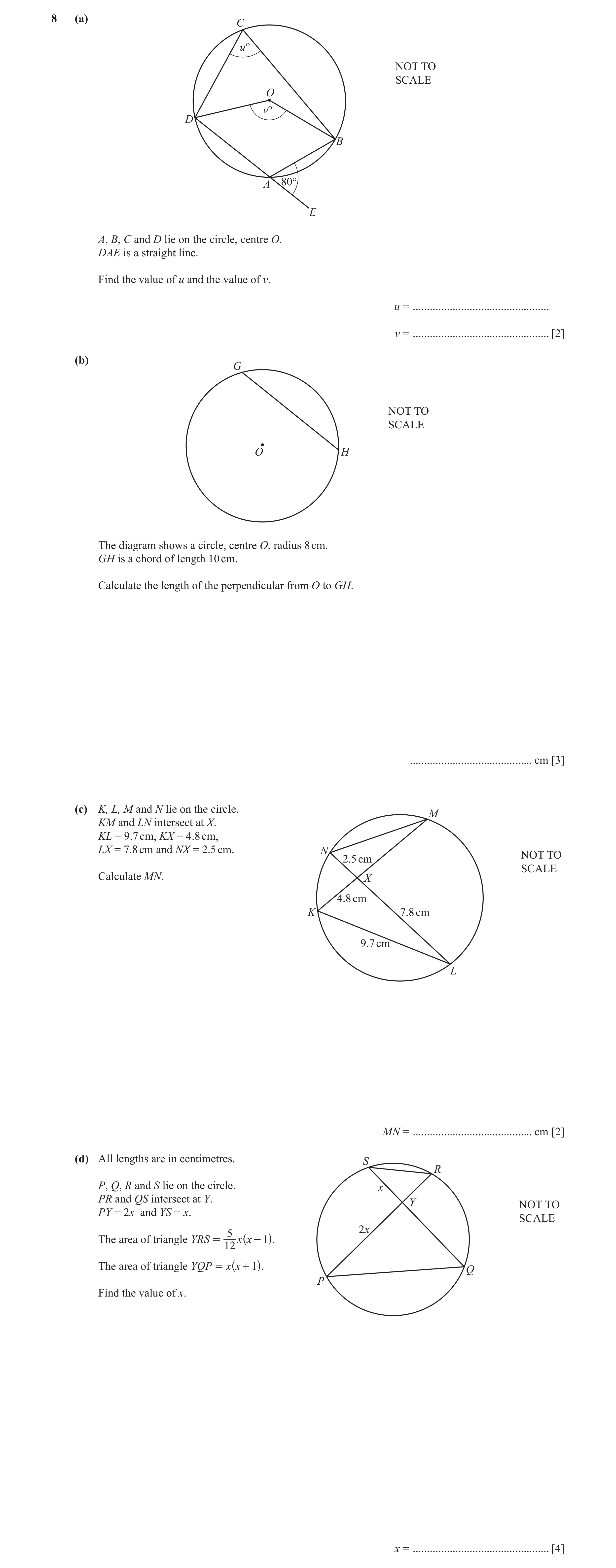
Q11 · C u° NOT TO SCALE O v° D B A 80° E A, B, C and D lie on the circle, centre O 0580/42 Oct/Nov 2016
8 (a) C u° NOT TO SCALE O v° D B A 80° E A, B, C and D lie on the circle, centre O. DAE is a straight line. Find the value of u and the value of v. u = … v = … [2] (b) G NOT TO SCALE O H The diagram shows a circle, centre O, radius 8 cm. GH is a chord of length 10 cm. Calculate the length of the perpendicular from O to GH. … cm [3] (c) K, L, M and N lie on the circle. M KM and LN intersect at X. KL = 9.7 cm, KX = 4.8 cm, LX = 7.8 cm and NX = 2.5 cm. N NOT TO 2.5 cm SCALE Calculate MN. X 4.8 cm K 7.8 cm 9.7 cm L MN = … cm [2] (d) All lengths are in centimetres. S R P, Q, R and S lie on the circle. x PR and QS intersect at Y. Y NOT TO PY = 2x and YS = x. SCALE 2x 5 The area of triangle YRS = x ^x - 1h. 12 The area of triangle YQP = x ^x + 1h. Q P Find the value of x. x = … [4]
11 marks
Mark scheme: 8 (a) [u = ] 80 1 [v = ] 160 1 (b) 6.24 or 6.244 to 6.245 3 M2 for 8 2 − 5 2 oe or M1 for l 2 + 52 = 82 oe or B1 for suitable right angled triangle drawn with 5 on correct side 4.8 9.7 (c) 5.05 or 5.052…. 2 M1 for = oe 2.5 MN (d) 4 nfww 4 M3 for [ x n ]( x + 1) = 4 × 125 [ x n ]( x − 1) oe, n = 1, 2 or 3 [ x ]( x + 1) 2[ x ] 2 or M2 for = oe 5 12 [ x ]( x − 1) [ x ] 1 2 or M1 for 22 or soi 2
This question in 0580/42 Oct/Nov 2016
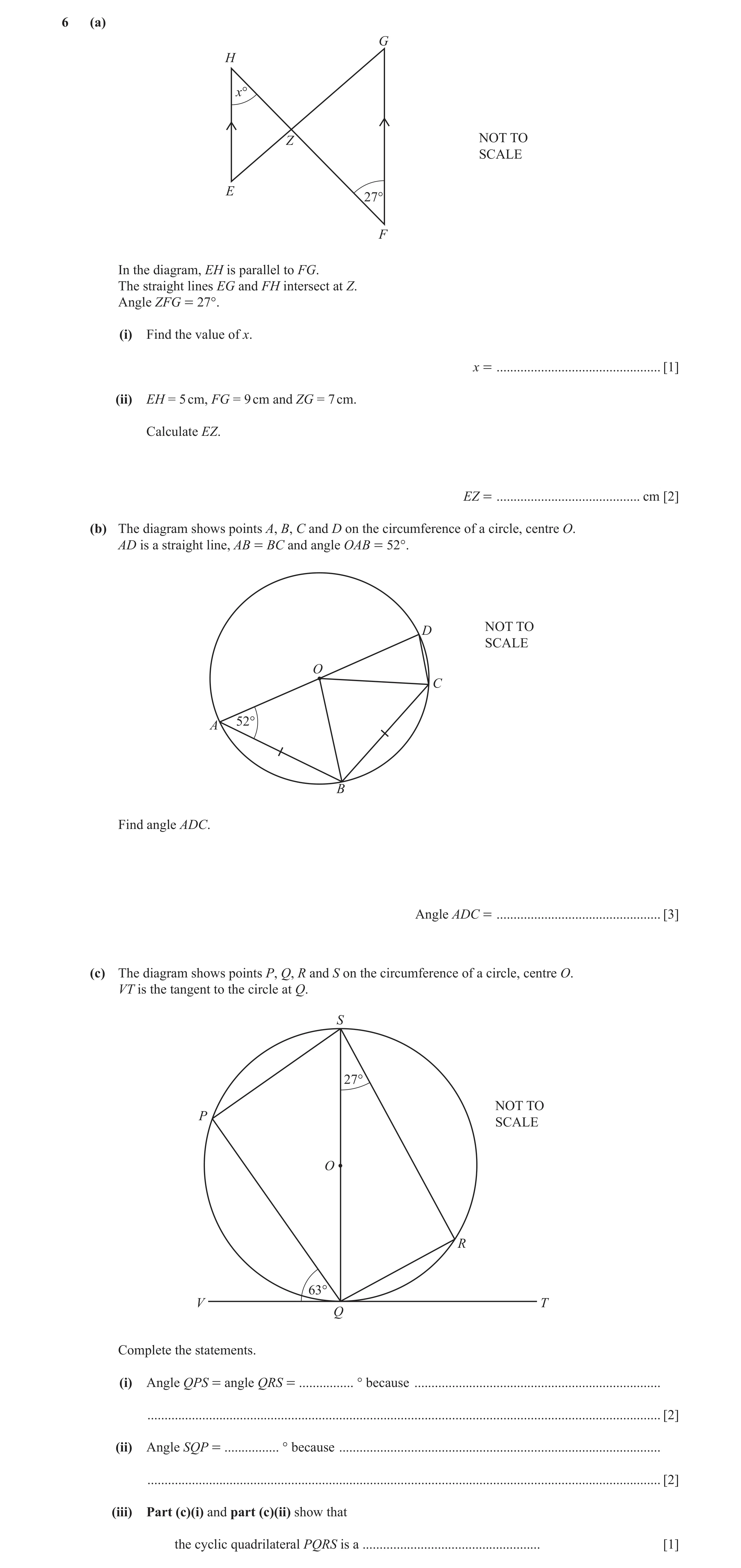
Q12 · G H x° Z NOT TO SCALE E 27° F In the diagram, EH is parallel to FG 0580/42 Feb/March 2017
6 (a) G H x° Z NOT TO SCALE E 27° F In the diagram, EH is parallel to FG. The straight lines EG and FH intersect at Z. Angle ZFG = 27°. (i) Find the value of x. x = … [1] (ii) EH = 5 cm, FG = 9 cm and ZG = 7 cm. Calculate EZ. EZ = … cm [2] (b) The diagram shows points A, B, C and D on the circumference of a circle, centre O. AD is a straight line, AB = BC and angle OAB = 52°. D NOT TO SCALE O C A 52° B Find angle ADC. Angle ADC = … [3] (c) The diagram shows points P, Q, R and S on the circumference of a circle, centre O. VT is the tangent to the circle at Q. S 27° NOT TO P SCALE O R 63° V T Q Complete the statements. (i) Angle QPS = angle QRS = … ° because … … [2] (ii) Angle SQP = … ° because … … [2] (iii) Part (c)(i) and part (c)(ii) show that the cyclic quadrilateral PQRS is a … [1]
11 marks
Mark scheme: 6 (a) (i) 27 1 7 9 (ii) 3.89 or 3.888 to 3.889 2 M1 for = oe EZ 5 (b) 76 cao 3 B2 for ABC = 104 or AOC = 152 or COD = 28 or OBA = 52 and OBC = 52 or BCD = 128 and OCB = 52 or B1 for any one of OBA,OBC, OCB = 52 or BCD = 128
This question in 0580/42 Feb/March 2017
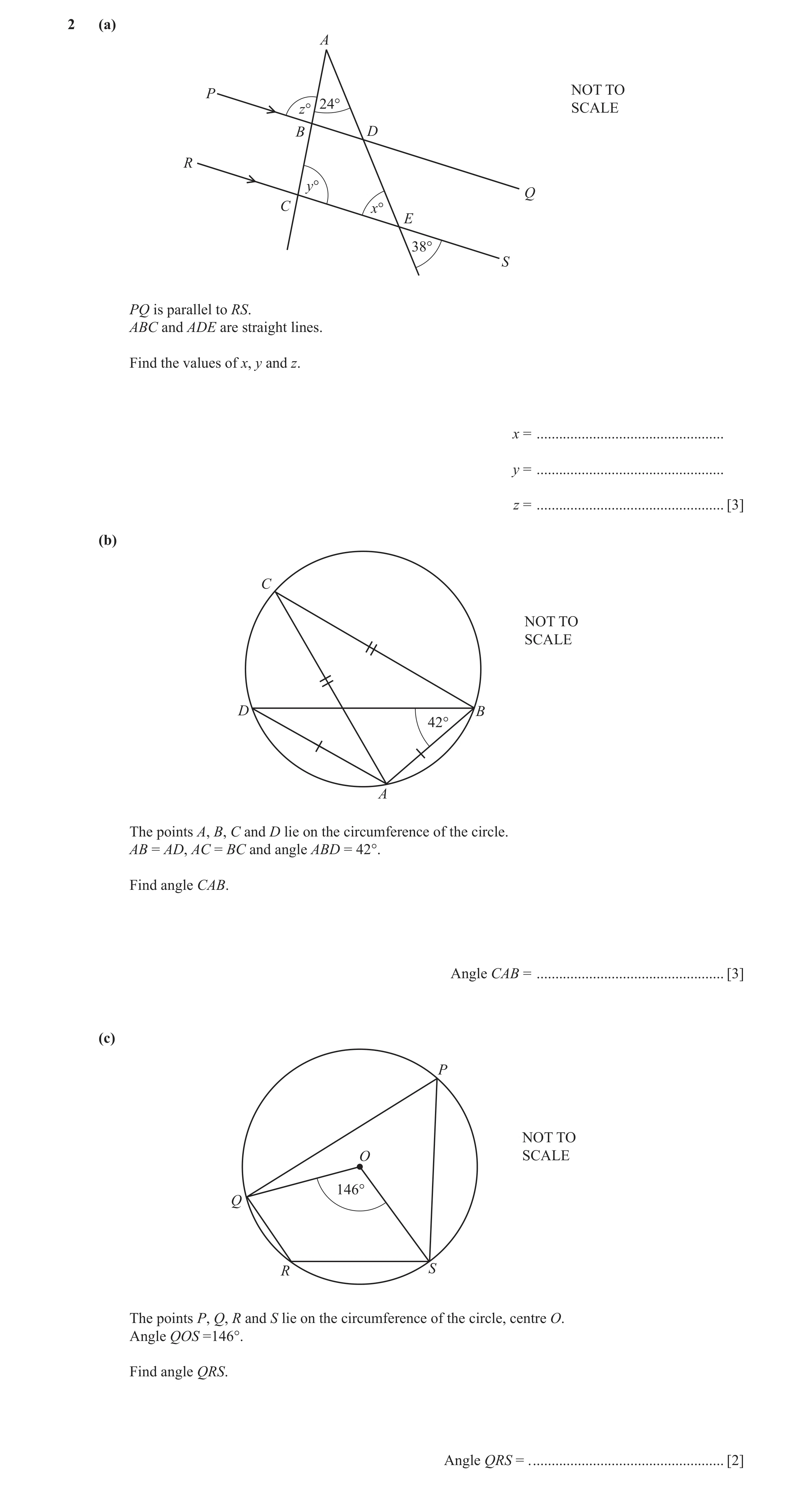
Q13 · A P NOT TO 24° SCALE z° B D R y° Q C x° E 38° S PQ is parallel to RS 0580/43 May/June 2017
2 (a) A P NOT TO 24° SCALE z° B D R y° Q C x° E 38° S PQ is parallel to RS. ABC and ADE are straight lines. Find the values of x, y and z. x = … y = … z = … [3] (b) C NOT TO SCALE D B 42° A The points A, B, C and D lie on the circumference of the circle. AB = AD, AC = BC and angle ABD = 42°. Find angle CAB. Angle CAB = … [3] (c) P NOT TO O SCALE 146° Q R S The points P, Q, R and S lie on the circumference of the circle, centre O. Angle QOS =146°. Find angle QRS. Angle QRS = . … [2]
8 marks
Mark scheme: 2(a) 38 1 118 1 62 1FT FT 180 – their y 2(b) 69 3 B2 for ACB = 42 or B1 for ADB = 42 If zero scored, SC1 for ACB = their ADB 2(c) 107 2 B1 for QPS = 73 or [reflex] QOS = 214
This question in 0580/43 May/June 2017
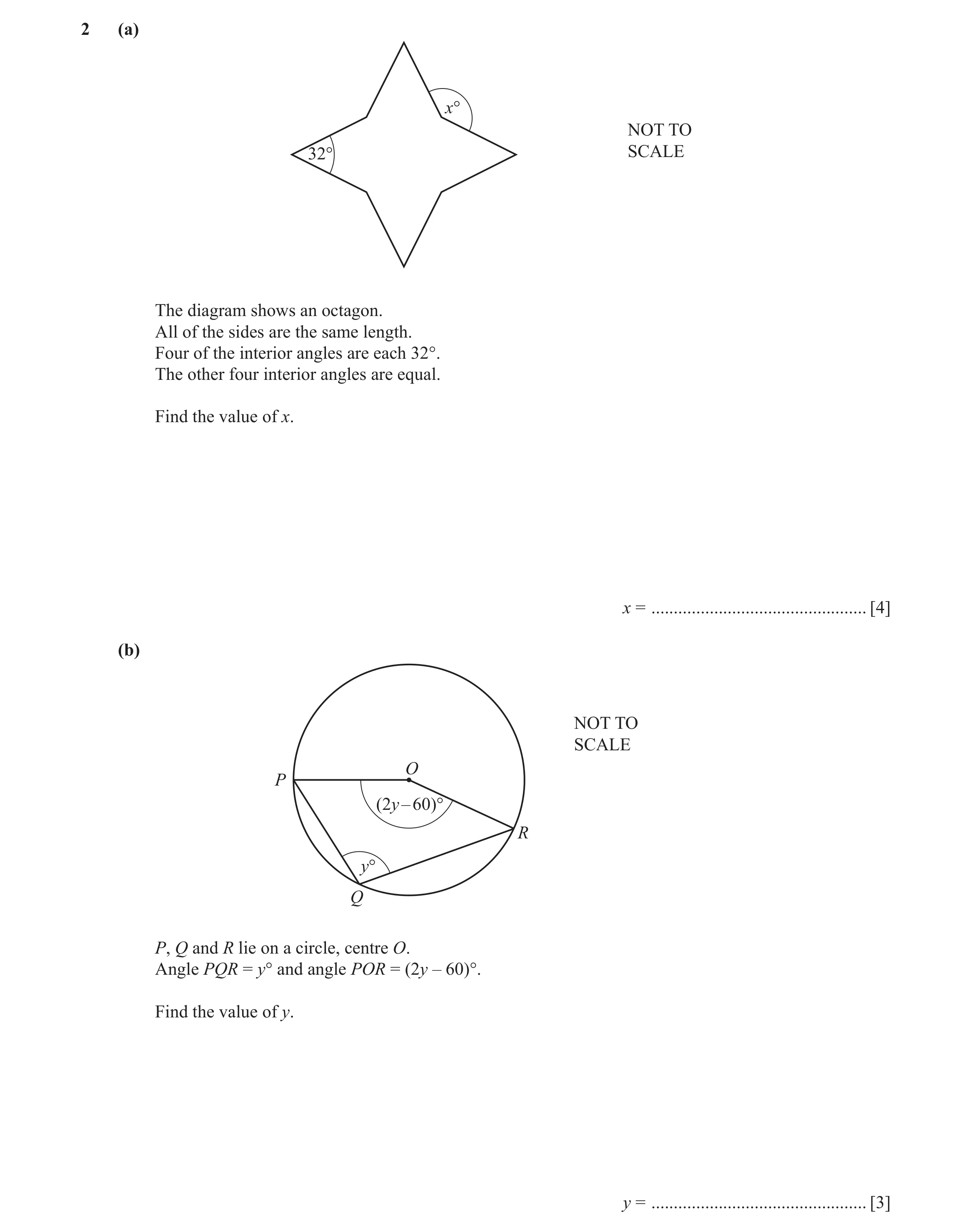
Q14 · X° NOT TO 32° SCALE The diagram shows an octagon 0580/41 Oct/Nov 2017
2 (a) x° NOT TO 32° SCALE The diagram shows an octagon. All of the sides are the same length. Four of the interior angles are each 32°. The other four interior angles are equal. Find the value of x. x = … [4] (b) NOT TO SCALE O P (2y – 60)° R y° Q P, Q and R lie on a circle, centre O. Angle PQR = y° and angle POR = (2y – 60)°. Find the value of y. y = … [3]
7 marks
Mark scheme: 2(a) 122 4 B3 for 238 or 61 or 58 correctly identified in working or on diagram or B2 for 952 seen or 74 or 119 or 29 correctly identified in working or on diagram OR Method 1 using sum of interior angles M1 for (8 – 2) × 180 or 1080 isw M1 for their 1080 – 4 × 32 M1 for 360 – their 952 ÷ 4 OR Method 2 using isosceles triangles and square M1 for (180 – 32) ÷ 2 or for 90 M1 for their 74 × 2 + 90 or 90 – their 74 M1 for 360 – their 74 × 2 + 90 or 90 + 2(90 – their 74) OR Method 3 using four kites joined to centre M1 for 360 ÷ 4 M1 for (360 – (their 90 + 32)) ÷ 2 M1 for 2(180 – their 119) OR Method 4 using square around outside M1 for 90 – 32 M1 for (90 – 32) ÷ 2 M1 for 180 – 2(their 29) 2(b) 105 3 M2 for 360 = 2 × y + (2y – 60) oe or 2(180 – y) = 2y – 60 oe or B1 identifying in working or on diagram a relevant angle in terms of y
This question in 0580/41 Oct/Nov 2017
Q15 · The exterior angle of a regular polygon is x° and the interior angle is 8x° 0580/41 May/June 2018
8 (a) The exterior angle of a regular polygon is x° and the interior angle is 8x°. Calculate the number of sides of the polygon. … [3] (b) C NOT TO SCALE O D B 58° A A, B, C and D are points on the circumference of the circle, centre O. DOB is a straight line and angle DAC = 58°. Find angle CDB. Angle CDB = … [3] (c) R O NOT TO SCALE 48° P Q P, Q and R are points on the circumference of the circle, centre O. PO is parallel to QR and angle POQ = 48°. (i) Find angle OPR. Angle OPR = … [2] (ii) The radius of the circle is 5.4 cm. Calculate the length of the major arc PQ. … cm [3]
11 marks
Mark scheme: 8(a) 18 3 B2 for 20 nfww or M1 for 8 x + x = 180 or better 8(b) 32 3 B1 for angle DBC = 58 B1 for angle BCD = 90 8(c)(i) 24 2 B1 for angle PRQ = 24 8(c)(ii) 29.4 or 29.40 to 29.41 3 360 − 48 M2 for × 2 × π × 5.4 360 or B2 for answer (minor arc) 4.52 or 4.523 to 4.524… 48 or M1 for × 2 × π × 5.4 360
This question in 0580/41 May/June 2018
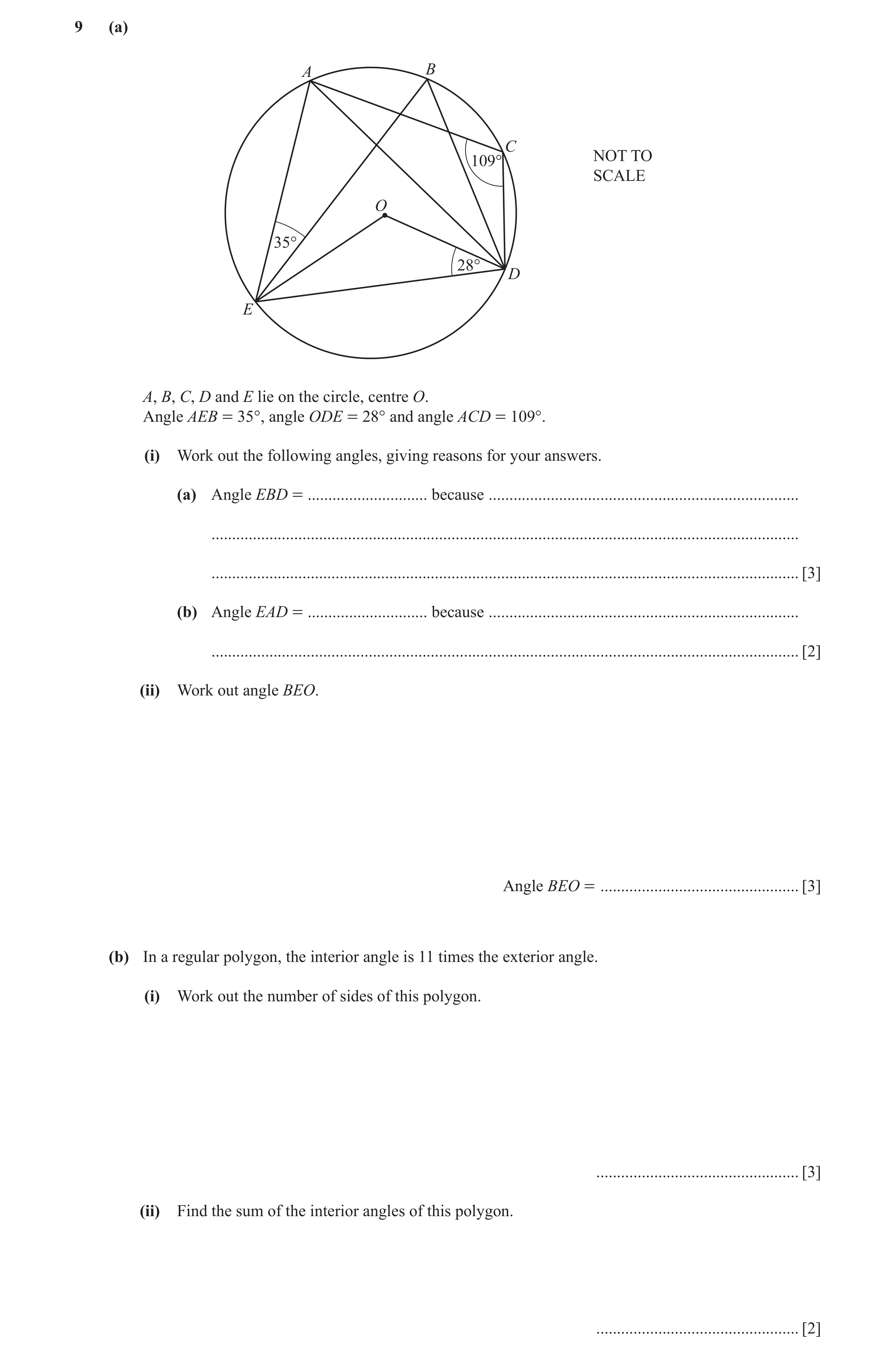
Q16 · A B C NOT TO 109° SCALE O 35° 28° D E A, B, C, D and E lie on the circle, centre O 0580/42 May/June 2018
9 (a) A B C NOT TO 109° SCALE O 35° 28° D E A, B, C, D and E lie on the circle, centre O. Angle AEB = 35°, angle ODE = 28° and angle ACD = 109°. (i) Work out the following angles, giving reasons for your answers. (a) Angle EBD = … because … … … [3] (b) Angle EAD = … because … … [2] (ii) Work out angle BEO. Angle BEO = … [3] (b) In a regular polygon, the interior angle is 11 times the exterior angle. (i) Work out the number of sides of this polygon. … [3] (ii) Find the sum of the interior angles of this polygon. … [2]
13 marks
Mark scheme: 9(a)(i)(a) 62 and 3 B2 for 62 and one correct reason Isosceles [triangle] or B1 for 62 with no/wrong reason and or for angle EOD = 124 soi Angle at centre is twice angle at or for no/wrong angle with correct circumference oe reason 9(a)(i)(b) 62 and 2 2FT their (a)(i)(a) and correct reason [Angles in] same segment oe or B1FT for their (a)(i)(a) with no/wrong angle at centre is twice angle at reason circumference oe or for no/wrong angle with correct reason 9(a)(ii) 8 3 M2 for (180 –109) – 28 – 35 oe or M1 for [angle AED = ] 180 – 109 oe 9(b)(i) 24 3 x = ext angle B2 for [x = ] 15 isw or M1 for x + 11x = 180 oe 180( n − 2) 360 or for = × 11 [ n ] [ n ] 9(b)(ii) 3960 2 FT (their 24 – 2) × 180 dep on (b)(i) an integer and > 6 M1 for (their 24 – 2) × 180 oe or their 24 × 11 × their 15 oe or 11 × 360
This question in 0580/42 May/June 2018
Q17 · C B NOT TO O SCALE D 55° 61° E A In the diagram, A, B, C and D lie on the circle, centre O 0580/42 Oct/Nov 2018
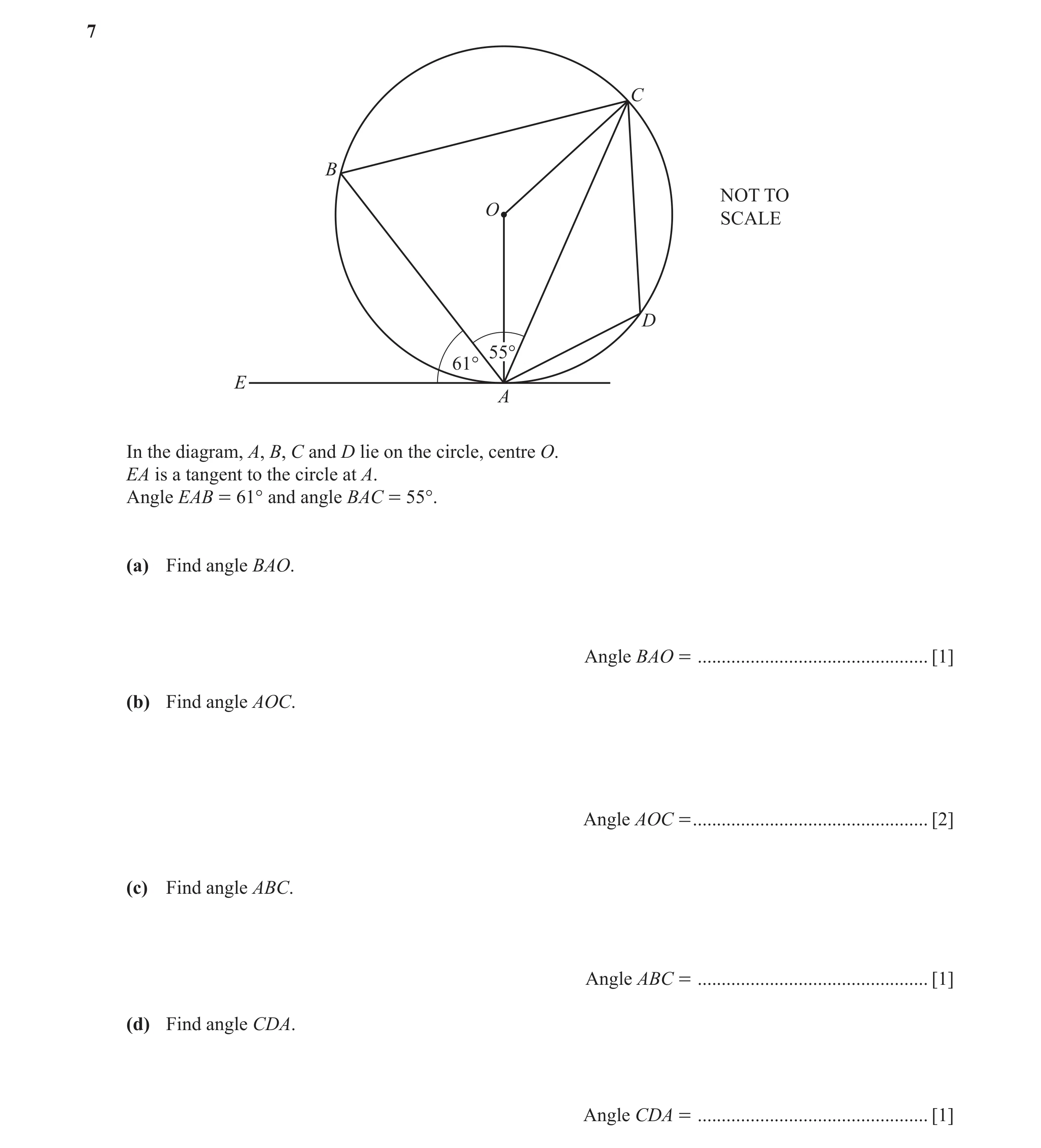
7 C B NOT TO O SCALE D 55° 61° E A In the diagram, A, B, C and D lie on the circle, centre O. EA is a tangent to the circle at A. Angle EAB = 61° and angle BAC = 55°. (a) Find angle BAO. Angle BAO = … [1] (b) Find angle AOC. Angle AOC = … [2] (c) Find angle ABC. Angle ABC = … [1] (d) Find angle CDA. Angle CDA = … [1]
5 marks
Mark scheme: 7(a) 29 1 7(b) 128 2 FT 180 – 2 (55 – their (a)) M1 for angle OCA or angle OAC = 55 – their (a) soi 7(c) 64 1 FT their (b) ÷ 2 7(d) 116 1 FT 180 – their (c)
This question in 0580/42 Oct/Nov 2018
Q18 · A C 26° NOT TO SCALE F B x° D E AC is parallel to FBD, ABC is an isosceles triangle and… 0580/42 May/June 2019
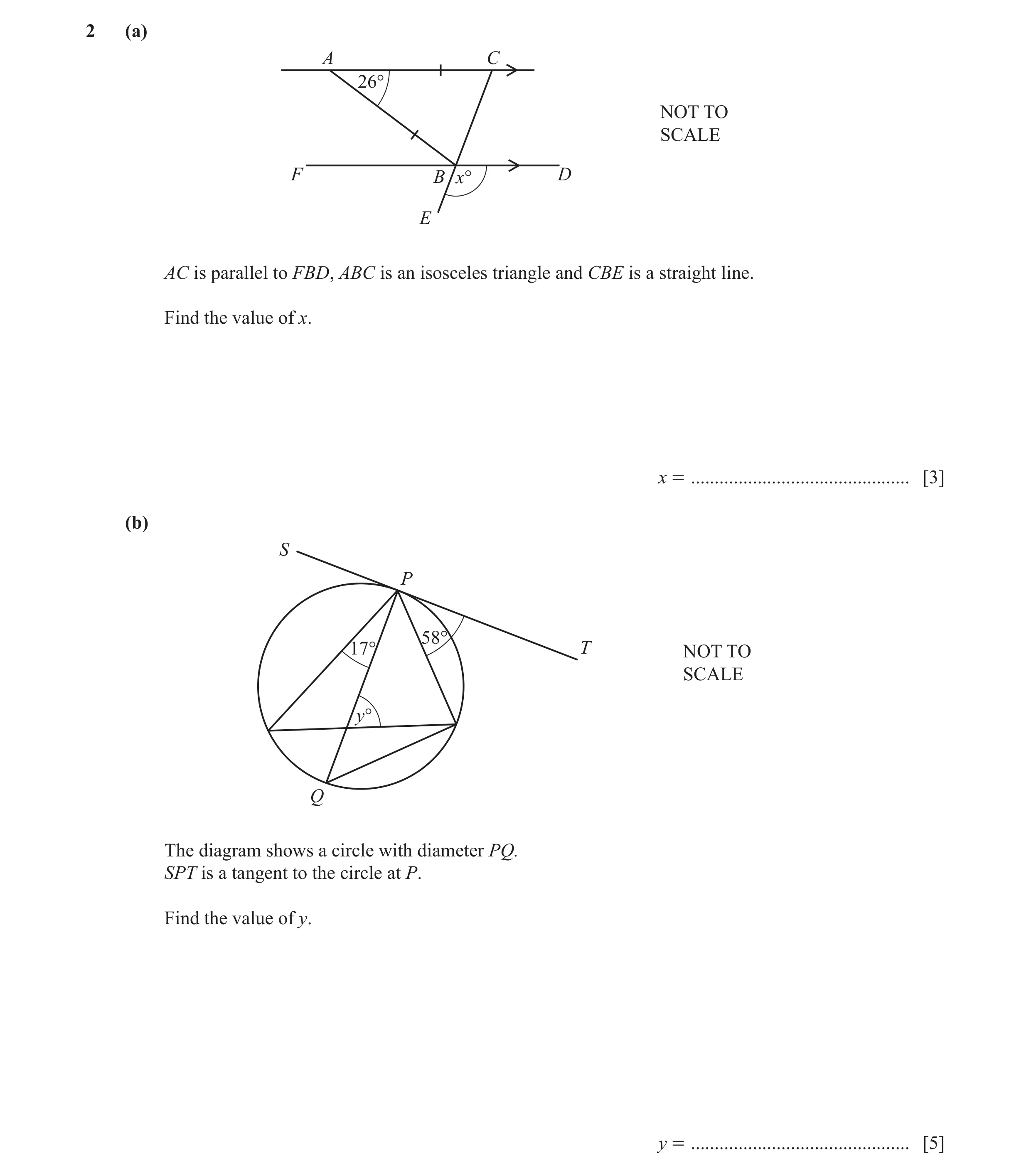
2 (a) A C 26° NOT TO SCALE F B x° D E AC is parallel to FBD, ABC is an isosceles triangle and CBE is a straight line. Find the value of x. x = … [3] (b) S P 58° 17° T NOT TO SCALE y° Q The diagram shows a circle with diameter PQ. SPT is a tangent to the circle at P. Find the value of y. y = … [5]
8 marks
Mark scheme: 2(a) 103 3 M1 for angle ABC or angle ACB = 1 (180 − 26 ) 2 oe M1 for angle ABF = 26 or angle CBD or angle FBE = 77 or exterior angle ACB = 103 correctly identified or in correct position 2(b) 75 5 B4 for 105 at a or b or 73 at c and 32 at d or B3 for 58 at m or 58 at e and 17 at k or B2 for 32 at d and 90 soi at (c+k) or 32 at d and 17 at k or 73 at c or B1 for 90 soi at (c + k) or between tangent and radius or 32 at d or 17 at k S P d 58° 17° T c m a y° b k e Q
This question in 0580/42 May/June 2019
Q19 · A D NOT TO 128°128° SCALE 28° C O 30° B In the diagram, A, B, C and D lie on the circle… 0580/43 Oct/Nov 2019
6 (a) A D NOT TO 128°128° SCALE 28° C O 30° B In the diagram, A, B, C and D lie on the circle, centre O. Angle ADC = 128°, angle ACD = 28° and angle BCO = 30°. (i) Show that obtuse angle AOC = 104°. Give a reason for each step of your working. [3] (ii) Find angle BAO. Angle BAO = … [2] (iii) Find angle ABD. Angle ABD = … [1] (iv) The radius, OC, of the circle is 9.6 cm. Calculate the total perimeter of the sector OADC. … cm [3] (b) NOT TO SCALE The diagram shows two mathematically similar solid metal prisms. The volume of the smaller prism is 648 cm3 and the volume of the larger prism is 2187 cm3. The area of the cross-section of the smaller prism is 36 cm2. (i) Calculate the area of the cross-section of the larger prism. … cm2 [3] (ii) The larger prism is melted down into a sphere. Calculate the radius of the sphere. 4 3 [The volume, V, of a sphere with radius r is V = r r .] 3 … cm [3]
15 marks
Mark scheme: 6(a)(i) Angle ABC=52 nfww B1 ALTERNATIVE [Reflex] angle AOC = 256 Opposite angles in cyclic quad oe B1 Angle at centre=2 × angle at Angles in opposite segments circumference/arc [Angle AOC=104] B1 Angles around a point Angle at centre=2 × angle at circumference/arc nfww 6(a)(ii) 22 nfww 2 B1 for angle OAC = 38 or angle CAD = 24 6(a)(iii) 28 1 6(a)(iv) 36.6 or 36.62 to 36.63 nfww 3 B2 for 7.4 or 17.42 to 17.43 104 or M2 for 9.6 × 2 + × 2 × π × 9.6 360 104 or M1 for × 2 × π × 9.6 360 6(b)(i) 81 3 A 2187 M2 for = 3 oe or better 36 648 648 2187 or for A × × 3 = 2187 oe 36 648 or better A3 2187 2 or M1 for = oe 36 3 648 2 2187 648 or 3 or 3 648 2187 6(b)(ii) 8.05 or 8.051 to 8.052… 3 3 2187 × 3 M2 for r = oe 4 × π 4πr 3 or M1 for = 2187 3 648 × 3 4πr 3 SC2 for or SC1 for = 648 4 × π 3
This question in 0580/43 Oct/Nov 2019
Q20 · The interior angle of a regular polygon with n sides is 150° 0580/43 May/June 2020
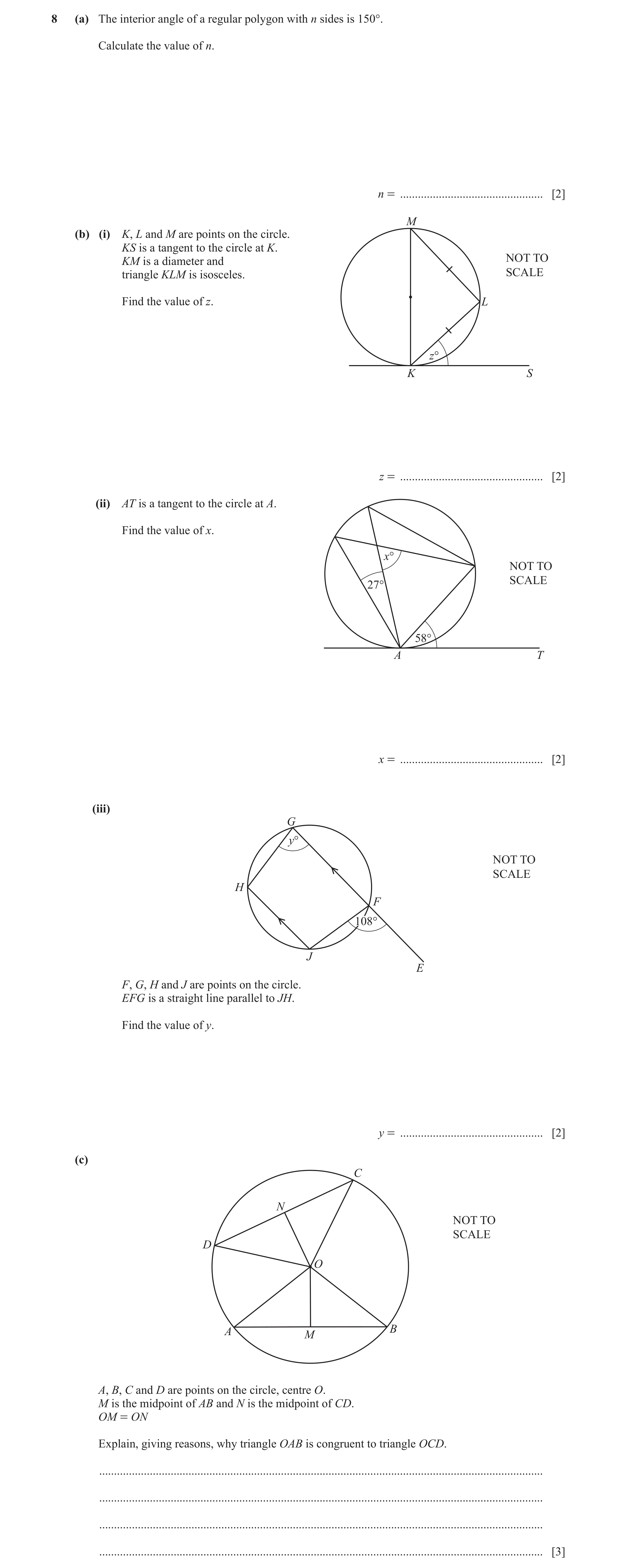
8 (a) The interior angle of a regular polygon with n sides is 150°. Calculate the value of n. n = … [2] M (b) (i) K, L and M are points on the circle. KS is a tangent to the circle at K. KM is a diameter and NOT TO triangle KLM is isosceles. SCALE Find the value of z. L z° K S z = … [2] (ii) AT is a tangent to the circle at A. Find the value of x. x° NOT TO SCALE 27° 58° A T x = … [2] (iii) G y° NOT TO SCALE H F 108° J E F, G, H and J are points on the circle. EFG is a straight line parallel to JH. Find the value of y. y = … [2] (c) C N NOT TO SCALE D O A B M A, B, C and D are points on the circle, centre O. M is the midpoint of AB and N is the midpoint of CD. OM = ON Explain, giving reasons, why triangle OAB is congruent to triangle OCD. … … … … [3]
11 marks
Mark scheme: 8(a) 12 2 ( n − 2 ) × 180 360 M1 for 150 = or oe n 180 − 150 8(b)(i) 45 2 B1 for angles at M or K = 45 or angle at L = 90 8(b)(ii) 85 2 B1 for either angle in alt segment = 58 8(b)(iii) 72 2 B1 for either angle at J or H=108 or angle at F=72 8(c) OA = OB = OC = OD B1 Radii AB = CD B1 chords equidistant from centre are equal SSS implies congruent B1
This question in 0580/43 May/June 2020
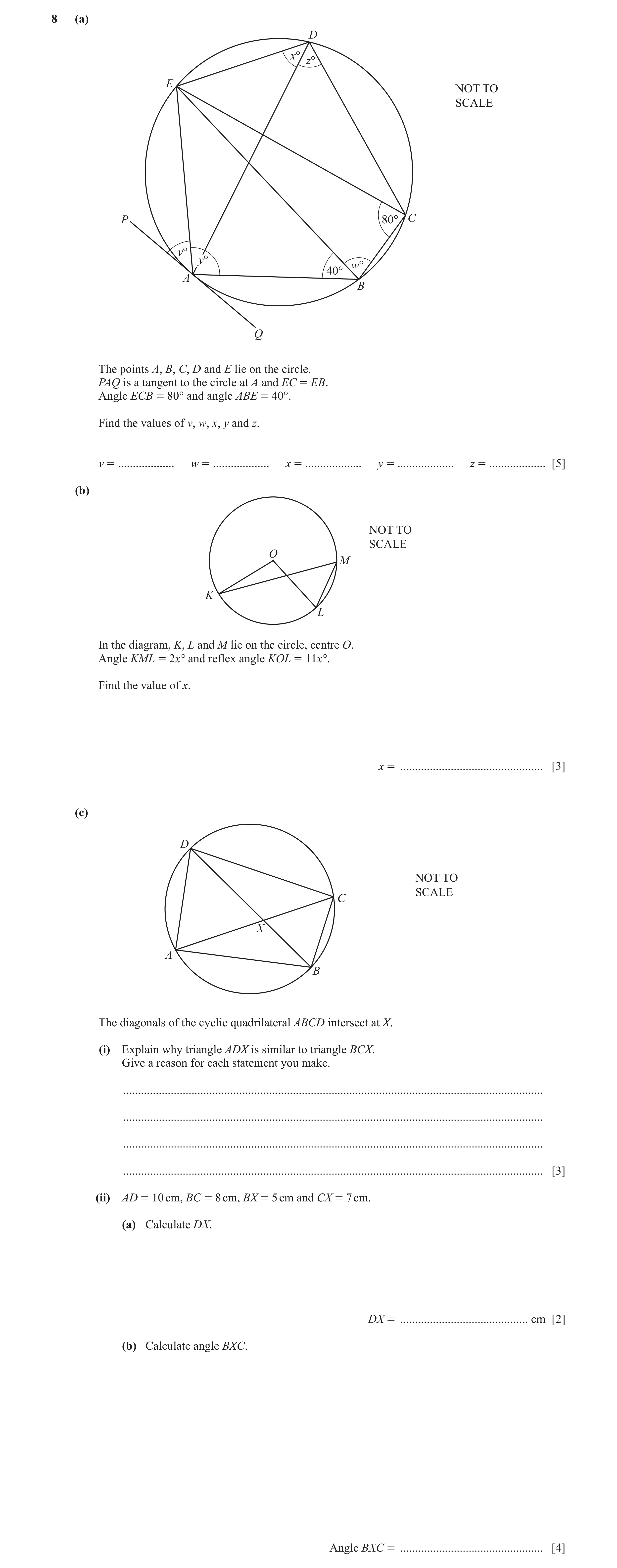
Q21 · D x° z° E NOT TO SCALE P 80° C v° y° w° 40° A B Q The points A, B, C, D and E lie on the… 0580/42 Oct/Nov 2020
8 (a) D x° z° E NOT TO SCALE P 80° C v° y° w° 40° A B Q The points A, B, C, D and E lie on the circle. PAQ is a tangent to the circle at A and EC = EB. Angle ECB = 80° and angle ABE = 40°. Find the values of v, w, x, y and z. v = … w = … x = … y = … z = … [5] (b) NOT TO SCALE O M K L In the diagram, K, L and M lie on the circle, centre O. Angle KML = 2x° and reflex angle KOL = 11x°. Find the value of x. x = … [3] (c) D NOT TO SCALE C X A B The diagonals of the cyclic quadrilateral ABCD intersect at X. (i) Explain why triangle ADX is similar to triangle BCX. Give a reason for each statement you make. … … … … [3] (ii) AD = 10 cm, BC = 8 cm, BX = 5 cm and CX = 7 cm. (a) Calculate DX. DX = … cm [2] (b) Calculate angle BXC. Angle BXC = … [4]
17 marks
Mark scheme: 8(a) [v = ] 40 5 B1 for each [w = ] 80 FT angle z as 140 – their w [x = ] 40 [y = ] 100 [z = ] 60 8(b) 24 3 M2 for 360 – 11x = 2 × 2x oe or M1 for 360 – 11x seen or obtuse angle KOL = 2 × 2x oe 8(c)(i) angle ADX = angle BCX oe M2 Accept in any order same segment oe M1 for one correct pair with reason angle DAX = angle CBX oe If 0 scored, SC1 for two correct pairs of same segment oe equal angles identified with incorrect/no reasons angle AXD = BXC oe [vertically] opposite oe corresponding angles are equal oe A1 8(c)(ii)(a) 8.75 or 8¾ 2 8 7 M1 for = oe 10 DX 8(c)(ii)(b) 81.8 or 81.78 to 81.79 4 5 2 + 7 2 − 8 2 M2 for [cos[BXC] =] oe 2 × 5 × 7 or M1 for 8 2 = 5 2 + 7 2 −×2 5 × 7 × cos(...) oe 10 A1 for oe 70
This question in 0580/42 Oct/Nov 2020
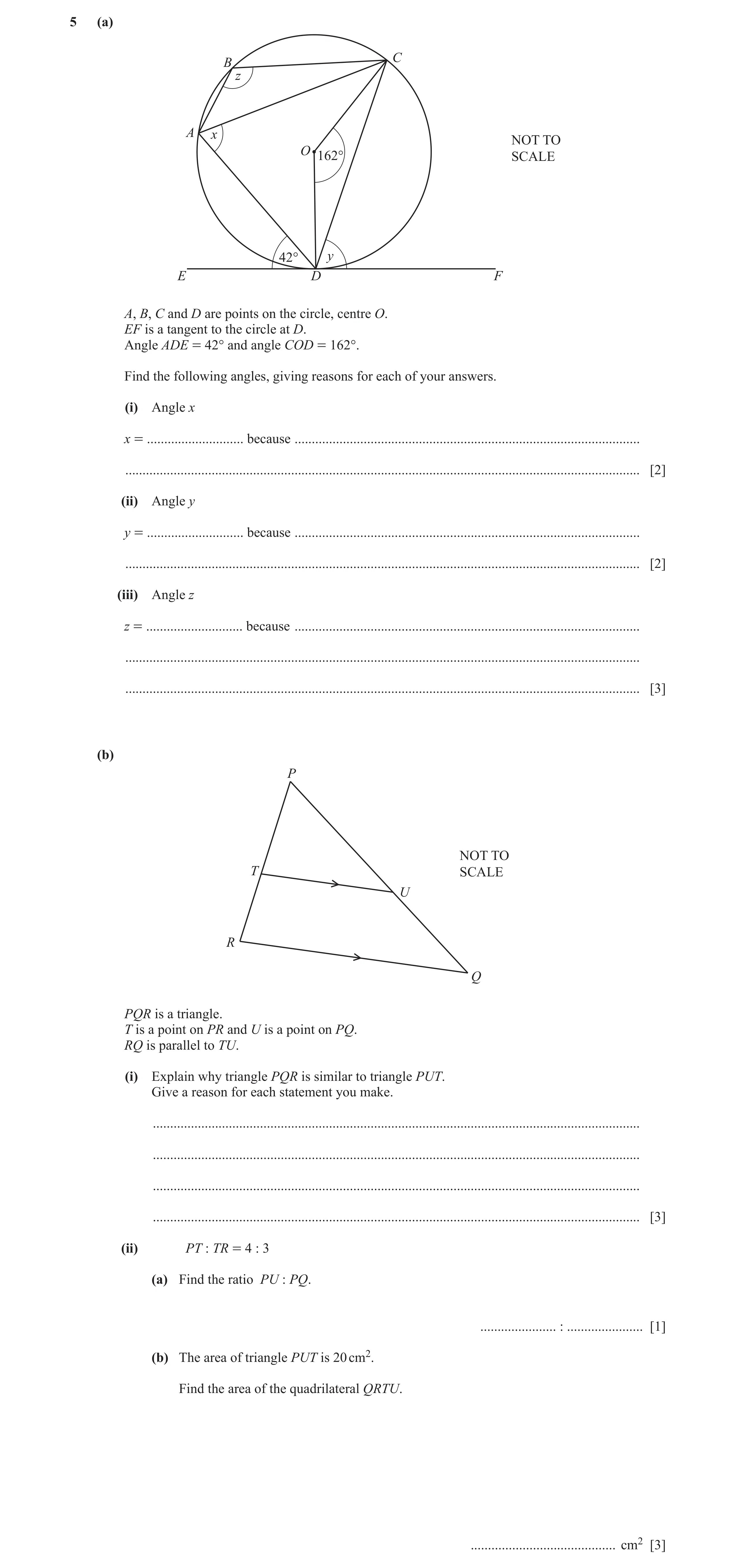
Q22 · C B z A x NOT TO O 162° SCALE 42° y E D F A, B, C and D are points on the circle, centre O 0580/43 Oct/Nov 2020
5 (a) C B z A x NOT TO O 162° SCALE 42° y E D F A, B, C and D are points on the circle, centre O. EF is a tangent to the circle at D. Angle ADE = 42° and angle COD = 162°. Find the following angles, giving reasons for each of your answers. (i) Angle x x = … because … … [2] (ii) Angle y y = … because … … [2] (iii) Angle z z = … because … … … [3] (b) P NOT TO T SCALE U R Q PQR is a triangle. T is a point on PR and U is a point on PQ. RQ is parallel to TU. (i) Explain why triangle PQR is similar to triangle PUT. Give a reason for each statement you make. … … … … [3] (ii) PT : TR = 4 : 3 (a) Find the ratio PU : PQ. … : … [1] (b) The area of triangle PUT is 20 cm2. Find the area of the quadrilateral QRTU. … cm2 [3]
14 marks
Mark scheme: 5(a)(i) 81° 2 B1 for 81° Angle at centre is twice angle at circumference oe 5(a)(ii) 81° 2 FT their (a)(i) Alternate segment [theorem] oe B1FT for 81° 5(a)(iii) 123° 3 FT their acute (a)(ii) + 42 Angles on a straight line [= 180] B1 for each element Opposite angles in a cyclic quadrilateral are supplementary oe 5(b)(i) Angle PTU = angle PRQ corresponding M2 Accept in any order Angle PUT = angle PQR corresponding Angle RPQ is common oe M1 for one correct pair with reason If 0 scored, SC1 for two correct pairs of equal angles identified with incorrect/no reasons Corresponding angles are equal oe A1 5(b)(ii)(a) 4 : 7 oe 1 5(b)(ii)(b) 41.25 oe 3 2 2 2 7 7 − 4 M2 for 20 × oe or 20 × 2 oe 4 4 7 2 4 2 7 2 − 4 2 or M1 for or or 2 or 4 7 4 4 2 7 2 − 4 2
This question in 0580/43 Oct/Nov 2020
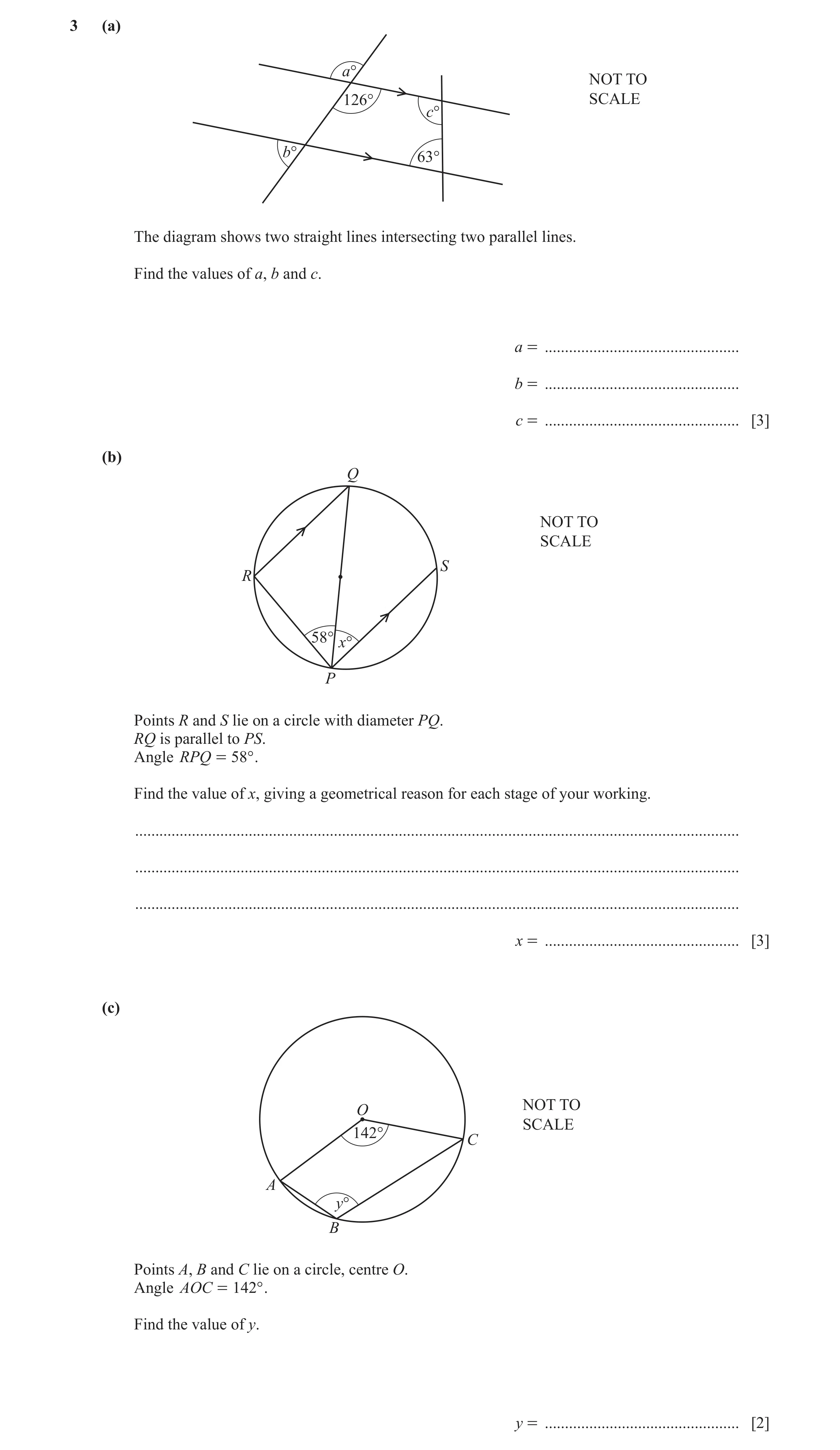
Q23 · A° NOT TO 126° SCALE c° b° 63° The diagram shows two straight lines intersecting two… 0580/42 Feb/March 2021
3 (a) a° NOT TO 126° SCALE c° b° 63° The diagram shows two straight lines intersecting two parallel lines. Find the values of a, b and c. a = … b = … c = … [3] (b) Q NOT TO SCALE S R 58° x° P Points R and S lie on a circle with diameter PQ. RQ is parallel to PS. Angle RPQ = 58° . Find the value of x, giving a geometrical reason for each stage of your working. … … … x = … [3] (c) NOT TO O SCALE 142° C A y° B Points A, B and C lie on a circle, centre O. Angle AOC = 142° . Find the value of y. y = … [2]
8 marks
Mark scheme: 3(a) 126 3 B1 for each 54 117 3(b) angle [in a] semicircle is 90 B1 Do not accept triangle for angle Allied, co-interior [add to 180] B1 or Angles in triangle [ = 180] and alternate oe 32 B1 3(c) 109 2 B1 for 218 or 71 in correct places or correctly labelled
This question in 0580/42 Feb/March 2021
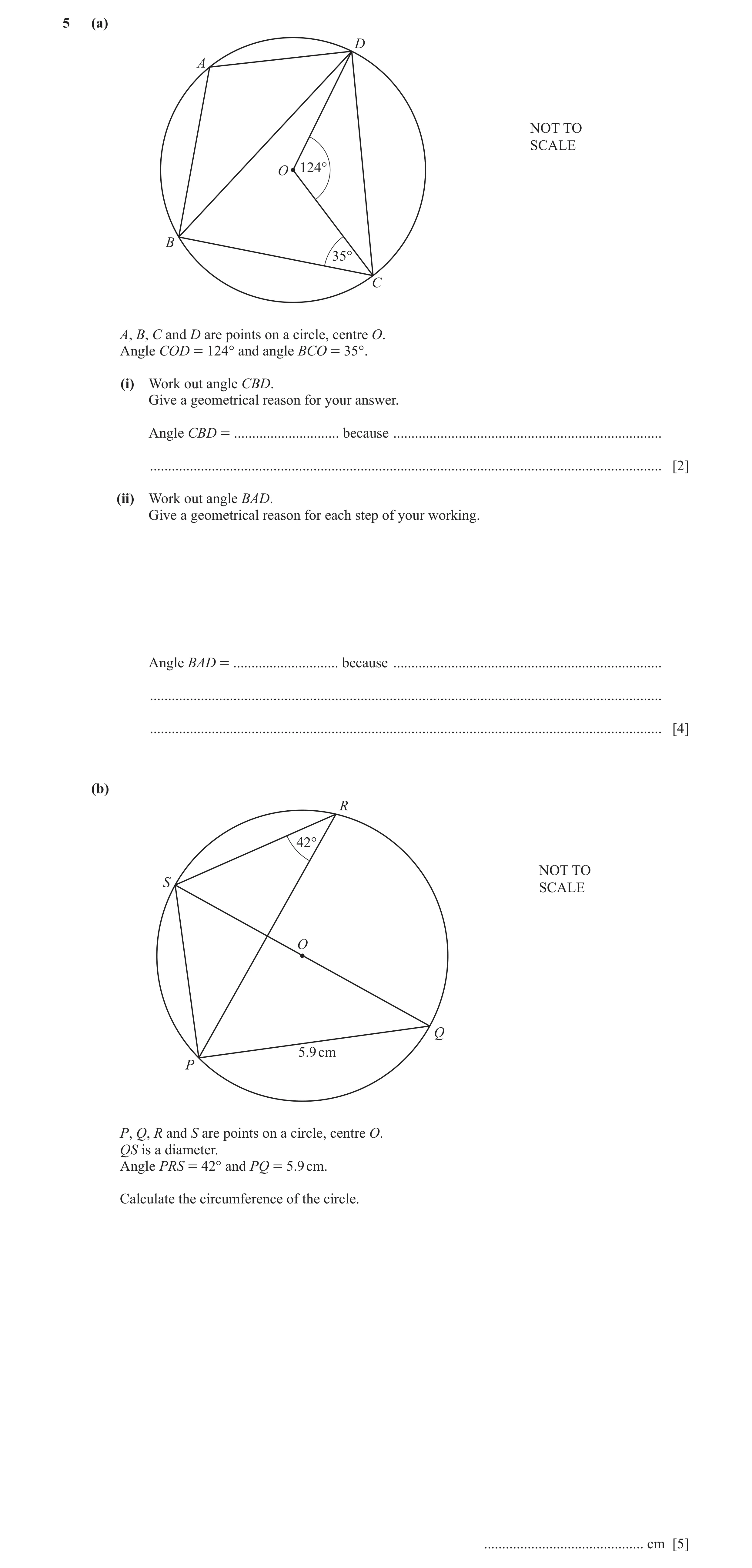
Q24 · D A NOT TO SCALE O 124° B 35° C A, B, C and D are points on a circle, centre O 0580/41 Oct/Nov 2021
5 (a) D A NOT TO SCALE O 124° B 35° C A, B, C and D are points on a circle, centre O. Angle COD = 124° and angle BCO = 35°. (i) Work out angle CBD. Give a geometrical reason for your answer. Angle CBD = … because … … [2] (ii) Work out angle BAD. Give a geometrical reason for each step of your working. Angle BAD = … because … … … [4] (b) R 42° NOT TO S SCALE O Q 5.9 cm P P, Q, R and S are points on a circle, centre O. QS is a diameter. Angle PRS = 42° and PQ = 5.9 cm. Calculate the circumference of the circle. … cm [5]
11 marks
Mark scheme: 5(a)(i) 62 2 B1 for either and Angle at centre is twice angle at circumference oe 5(a)(ii) 117 4 B2 for 117 and or B1 for [angle OCD =] 28 Isosceles [triangle] B1dep for isosceles [triangle] and and Opposite angles in a cyclic quadrilateral B1 for opposite angles in a cyclic are supplementary quadrilateral are supplementary 5(b) 24.9 or 24.94 to 24.95 5 B1 for angle PQS = 42 M2 for QS = 5.9 ÷ cos 42 oe 5.9 or M1 for cos42= oe QS M1dep for their SQ × π oe
This question in 0580/41 Oct/Nov 2021
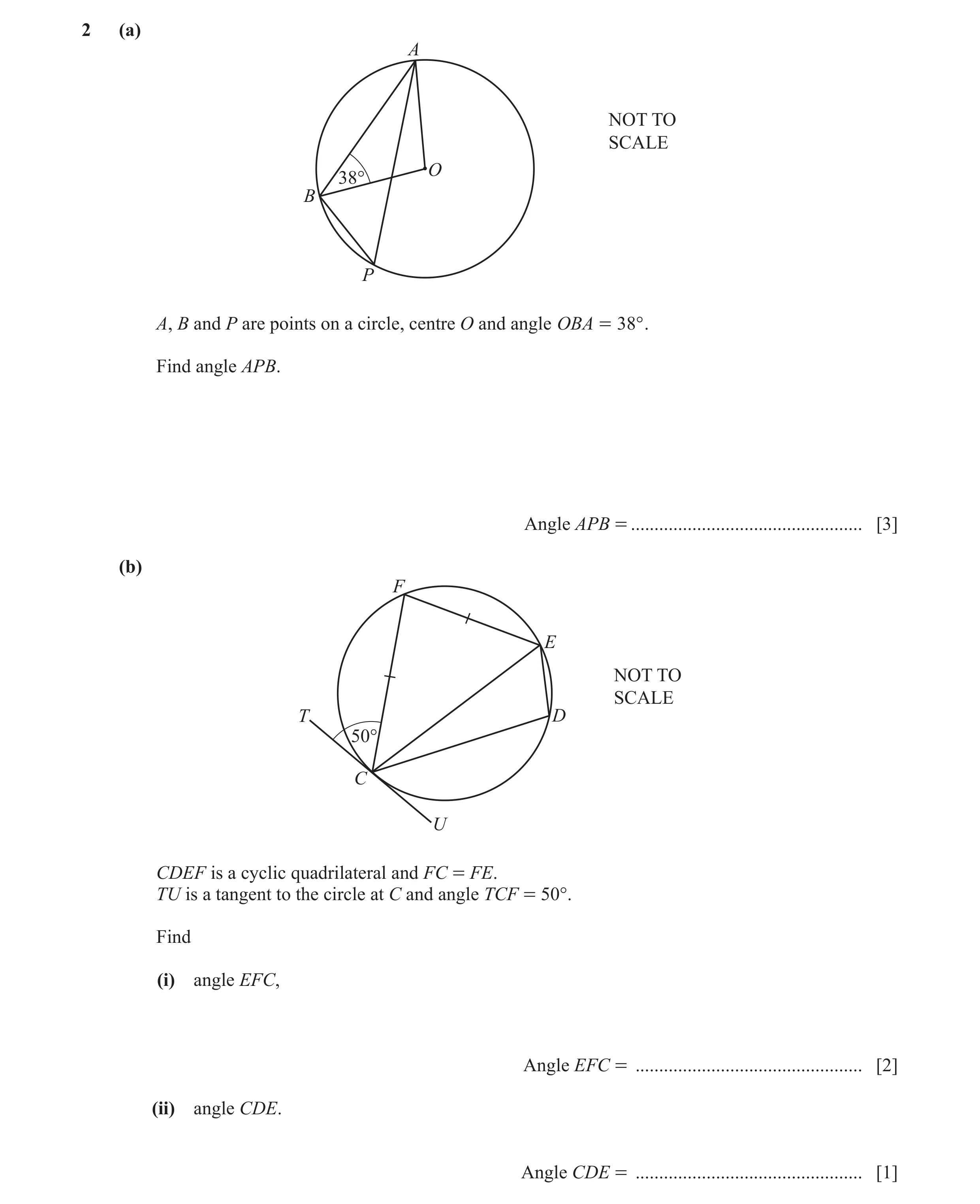
Q25 · A NOT TO SCALE O 38° B P A, B and P are points on a circle, centre O and angle OBA = 38° 0580/43 Oct/Nov 2021
2 (a) A NOT TO SCALE O 38° B P A, B and P are points on a circle, centre O and angle OBA = 38° . Find angle APB. Angle APB = … [3] (b) F E NOT TO SCALE T D 50° C U CDEF is a cyclic quadrilateral and FC = FE. TU is a tangent to the circle at C and angle TCF = 50°. Find (i) angle EFC, Angle EFC = … [2] (ii) angle CDE. Angle CDE = … [1]
6 marks
Mark scheme: 2(a) 52° 3 M1 for 180 – 2 × 38, implied by 104 M1 for their AOB ÷ 2 2(b)(i) 80° 2 B1 for FEC =50 or FCE = 50 2(b)(ii) 100° 1 FT 180 – their (i)
This question in 0580/43 Oct/Nov 2021
Q26 · The interior angle of a regular polygon is 156° 0580/42 Feb/March 2022
6 (a) The interior angle of a regular polygon is 156°. Calculate the number of sides of this polygon. … [2] (b) NOT TO SCALE C O 52° A B A, B and C lie on a circle, centre O. Angle OBA = 52°. Calculate angle ACB. Angle ACB = … [2] (c) S R W 112° NOT TO SCALE Q T P P, Q, R, S and T lie on a circle. WSR is a straight line and angle WSP = 112°. Calculate angle PTR. Angle PTR = … [2] (d) K NOT TO SCALE O M F G H G, K and M lie on a circle, centre O. FGH is a tangent to the circle at G and MG is parallel to OH. Show that triangle GKM is mathematically similar to triangle OHG. Give a geometrical reason for each statement you make. … … … … … [4]
10 marks
Mark scheme: 6(a) 15 2 360 180 ( n − 2 ) M1 for or for = 156 oe 180 − 156 n 6(b) 38 2 B1 for AOB = 76 6(c) 68 2 B1 for RSP = 68 or RQP = 112 6(d) Two pairs of equal angles identified M3 M2 for one pair of equal angles identified with fully with fully correct reasons correct reasons KMG = 90 angle in semicircle and OGH = 90 angle between tangent and radius OR KMG = OGH alternate segment OR GOH = MGK alternate angles OR Angle FGM = angle GHO corresponding and angle FGM = GKM alternate segment and angle H = angle K or M1 for KMG = 90, angle in semicircle or OGH = 90, angle between tangent and radius Two or three pairs of angles equal A1 Dep on M3 with no incorrect work seen [so similar] oe
This question in 0580/42 Feb/March 2022
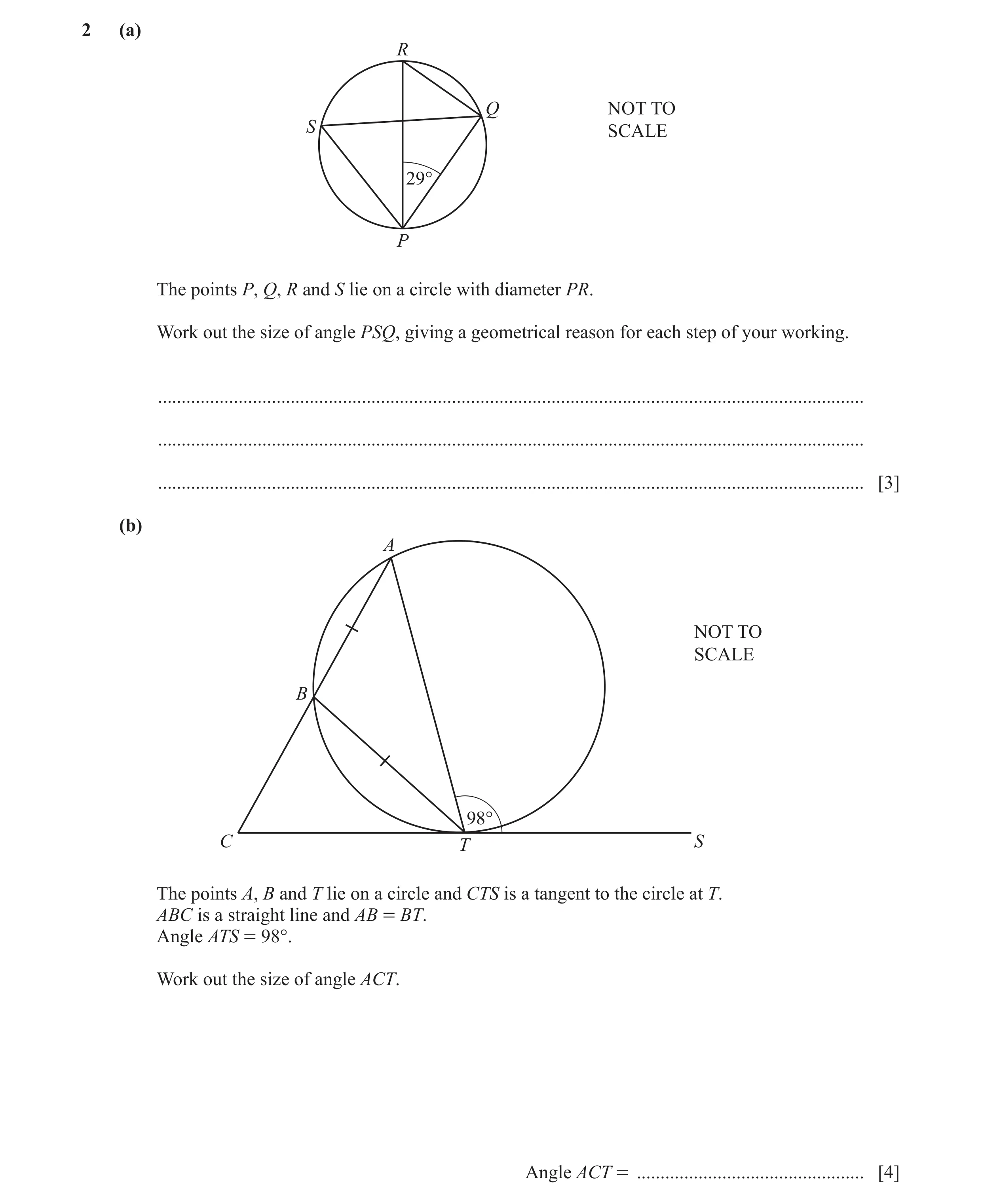
Q27 · R Q NOT TO S SCALE 29° P The points P, Q, R and S lie on a circle with diameter PR 0580/42 May/June 2022
2 (a) R Q NOT TO S SCALE 29° P The points P, Q, R and S lie on a circle with diameter PR. Work out the size of angle PSQ, giving a geometrical reason for each step of your working. … … … [3] (b) A NOT TO SCALE B 98° C T S The points A, B and T lie on a circle and CTS is a tangent to the circle at T. ABC is a straight line and AB = BT. Angle ATS = 98°. Work out the size of angle ACT. Angle ACT = … [4]
7 marks
Mark scheme: 2(a) PQR = 90 angle in semi-circle B1 PRQ = 61 angle sum of triangle B1 [= 180] PSQ = 61 angle in same segment B1 If 0 scored SC1 for PSQ = PRQ [= 61] soi 2(b) 57 4 B1 for ABT = 98 B1 for TAB or ATB = 41 B1 for BTC = 41 or TBC = 82 or ATC =82 soi
This question in 0580/42 May/June 2022
Q28 · A NOT TO SCALE 9.5 cm O 10 cm B 7.7 cm D C E A, B and C are points on the circle, centre O 0580/43 Oct/Nov 2022
8 A NOT TO SCALE 9.5 cm O 10 cm B 7.7 cm D C E A, B and C are points on the circle, centre O. DE is a tangent to the circle at C. AC = 10 cm , AB = 9.5 cm and BC = 7.7 cm . (a) Show that angle ABC = 70.2° , correct to 1 decimal place. [4] (b) Find (i) angle AOC Angle AOC = … [1] (ii) angle ACO Angle ACO = … [1] (iii) angle ACD. Angle ACD = … [1] (c) Calculate the radius, OC, of the circle. OC = … cm [3] (d) Calculate the area of triangle ABC as a percentage of the area of the circle. … % [4]
14 marks
Mark scheme: 8(a) 9.52 + 7.7 2 − 10 2 M2 M1 for 102 = 9.52 + 7.72 – 2×9.5×7.7cosB oe or better [cos B = ] oe 2 9.5 7.7 70.206 to 70.207 or 70.21 to 70.22 A2 2477 A1 for oe or 0.339 or 0.3386…. 7315 8(b)(i) 140.4 1 8(b)(ii) 19.8 1 FT (180 – their (b)(i)) ÷ 2 8(b)(iii) 70.2 1 FT 90 – their (b)(ii) 8(c) 5.31 or 5.314 to 5.315 3 5 M2 for oe cos their(b)(ii) 5 or M1 for = cos(their (b)(ii)) oe r 8(d) 38.8 or 38.9 or 38.78 to 38.85 4 0.5 9.5 7.7 sin70.2 M3 for [ 100] their( (c)) 2 OR M1 for 0.5 × 9.5 × 7.7 × sin70.2 M1 for (their (c)2)
This question in 0580/43 Oct/Nov 2022
Q29 · 42° NOT TO SCALE x° The diagram shows an isosceles triangle with the base extended 0580/42 May/June 2023
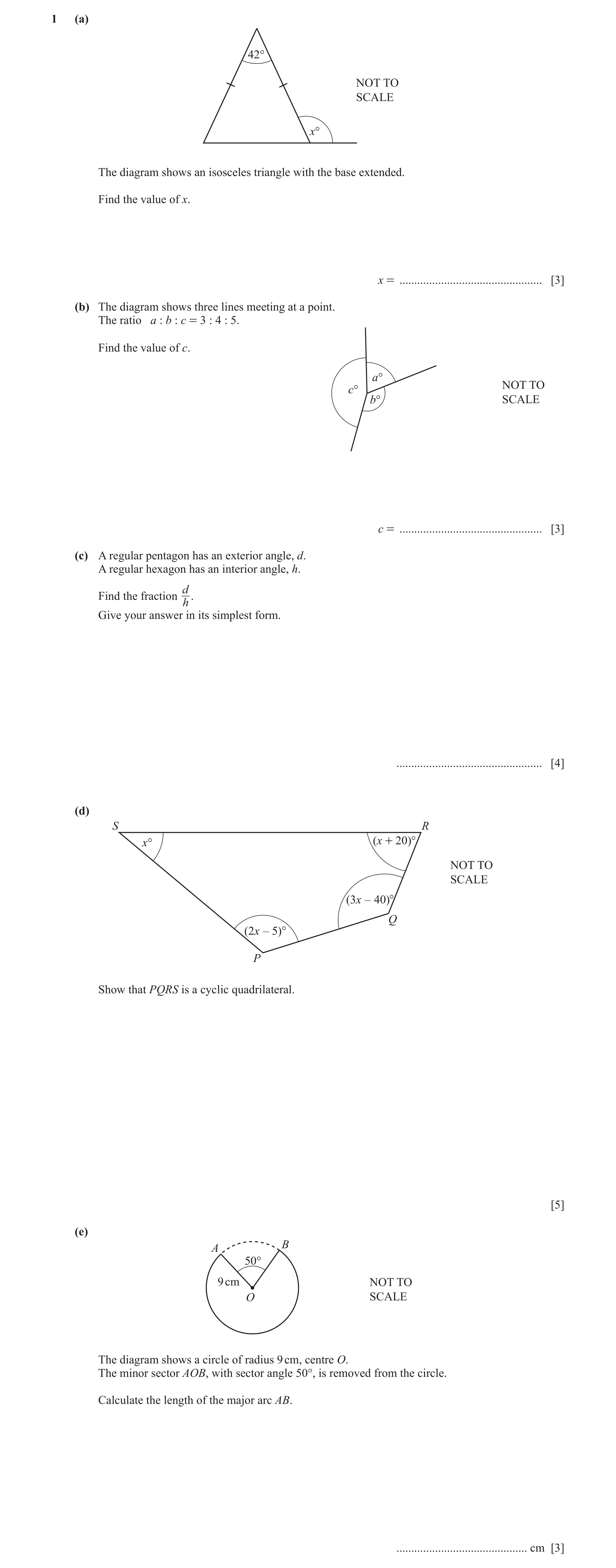
1 (a) 42° NOT TO SCALE x° The diagram shows an isosceles triangle with the base extended. Find the value of x. x = … [3] (b) The diagram shows three lines meeting at a point. The ratio a : b : c = 3 : 4 : 5. Find the value of c. a° NOT TO c° b° SCALE c = … [3] (c) A regular pentagon has an exterior angle, d. A regular hexagon has an interior angle, h. d Find the fraction . h Give your answer in its simplest form. … [4] (d) S R x° ( x + 20)° NOT TO SCALE ( 3x – 40)° Q ( 2x – 5)° P Show that PQRS is a cyclic quadrilateral. [5] (e) B A 50° 9 cm NOT TO O SCALE The diagram shows a circle of radius 9 cm, centre O. The minor sector AOB, with sector angle 50°, is removed from the circle. Calculate the length of the major arc AB. … cm [3]
18 marks
Mark scheme: Question Answer Marks Partial Marks 1(a) 111 3 42 M2 for 180 –180 oe or 42 + 2 180 42 oe 2 180 42 or M1 for oe 2 1(b) 150 3 M1 for k ÷ (3 + 4 + 5) [×p] where p = 1, 3, 4 or 5 5 or oe 12 B1 for 360 used 1(c) 3 4 72 cao nfww B3 for 5 120 or B2 for [d = ] 72 or [h = ] 120 or M1 for 360 ÷ 5 oe isw or 180 – (360 ÷ 6) isw or for (6 – 2) × 180 [÷ 6] 1(d) x + 2x – 5 + x + 20 + 3x – 40 = 360 M1 Accept equivalent equation e.g. 7x – 25 = 360 7x = 360 + 5 – 20 + 40 or better M1 FT their equation, accept e.g. 7x = 385 x = 55 B1 55 and 125 B1dep Dep on M1M1B1 or 105 and 75 Accept 55 + 3 × 55 – 40 = 180 or 2 × 55 – 5 + 55 + 20 = 180 If B0 scored, SC1 for 55, 75, 105 and 125 Opposite angles sum to 180 oe A1 Dep on M1M1B1B1 [so PQRS is a cyclic quadrilateral ] 1(e) 48.7 or 48.69 to 48.70… 3 360 50 M2 for 2 π oe9 360 50 or M1 for 2 π oe9 360
This question in 0580/42 May/June 2023
Q30 · North 114° A NOT TO SCALE C B A, B and C are three towns and the bearing of C from A is… 0580/43 May/June 2023
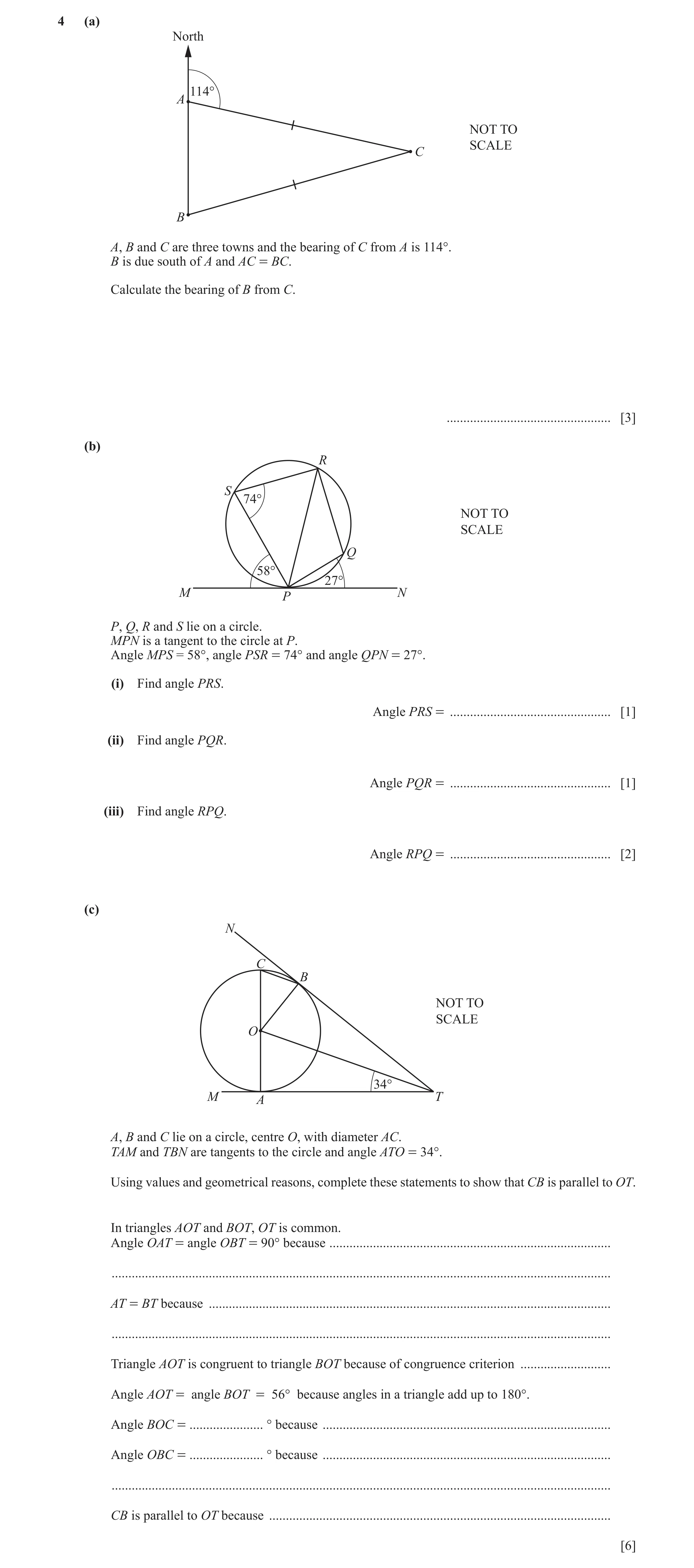
4 (a) North 114° A NOT TO SCALE C B A, B and C are three towns and the bearing of C from A is 114°. B is due south of A and AC = BC. Calculate the bearing of B from C. … [3] (b) R S 74° NOT TO SCALE Q 58° 27° M P N P, Q, R and S lie on a circle. MPN is a tangent to the circle at P. Angle MPS = 58°, angle PSR = 74° and angle QPN = 27°. (i) Find angle PRS. Angle PRS = … [1] (ii) Find angle PQR. Angle PQR = … [1] (iii) Find angle RPQ. Angle RPQ = … [2] (c) N C B NOT TO SCALE O 34° M A T A, B and C lie on a circle, centre O, with diameter AC. TAM and TBN are tangents to the circle and angle ATO = 34°. Using values and geometrical reasons, complete these statements to show that CB is parallel to OT. In triangles AOT and BOT, OT is common. Angle OAT = angle OBT = 90° because … … AT = BT because … … Triangle AOT is congruent to triangle BOT because of congruence criterion … Angle AOT = angle BOT = 56° because angles in a triangle add up to 180°. Angle BOC = … ° because … Angle OBC = … ° because … … CB is parallel to OT because … [6]
13 marks
Mark scheme: 4(a) 246 3 B2 for BCS(outh) = 66 or BCA = 48 and ACN(orth) = 66 or BCW(est) = 24 or ACS(outh) = 114 or B1 for ABC = 66 or BAC = 66 or BCA = 48 or ACN(orth) = 66 4(b)(i) 58 1 4(b)(ii) 106 1 4(b)(iii) 47 2 B1 for PRQ = 27 or B1FT for SPR, either = 48 or = 106 – their (b)(i) or B1FT for RPQ = their (b)(i) – 11 4(c) Radius perpendicular to tangent 1 Tangents to circle from a/same point oe 1 RHS 1 68 angles on a [straight] line add up/sum to 1 180 oe 56 [base angles of] isosceles triangle 1 OBC = BOT Alternate angles 1 Angles and reason required and dependent on OBC and BOT correct
This question in 0580/43 May/June 2023
Q31 · D NOT TO 83.2 m SCALE 38° C B A 54.5 m ACD is a right-angled triangle 0580/41 Oct/Nov 2023
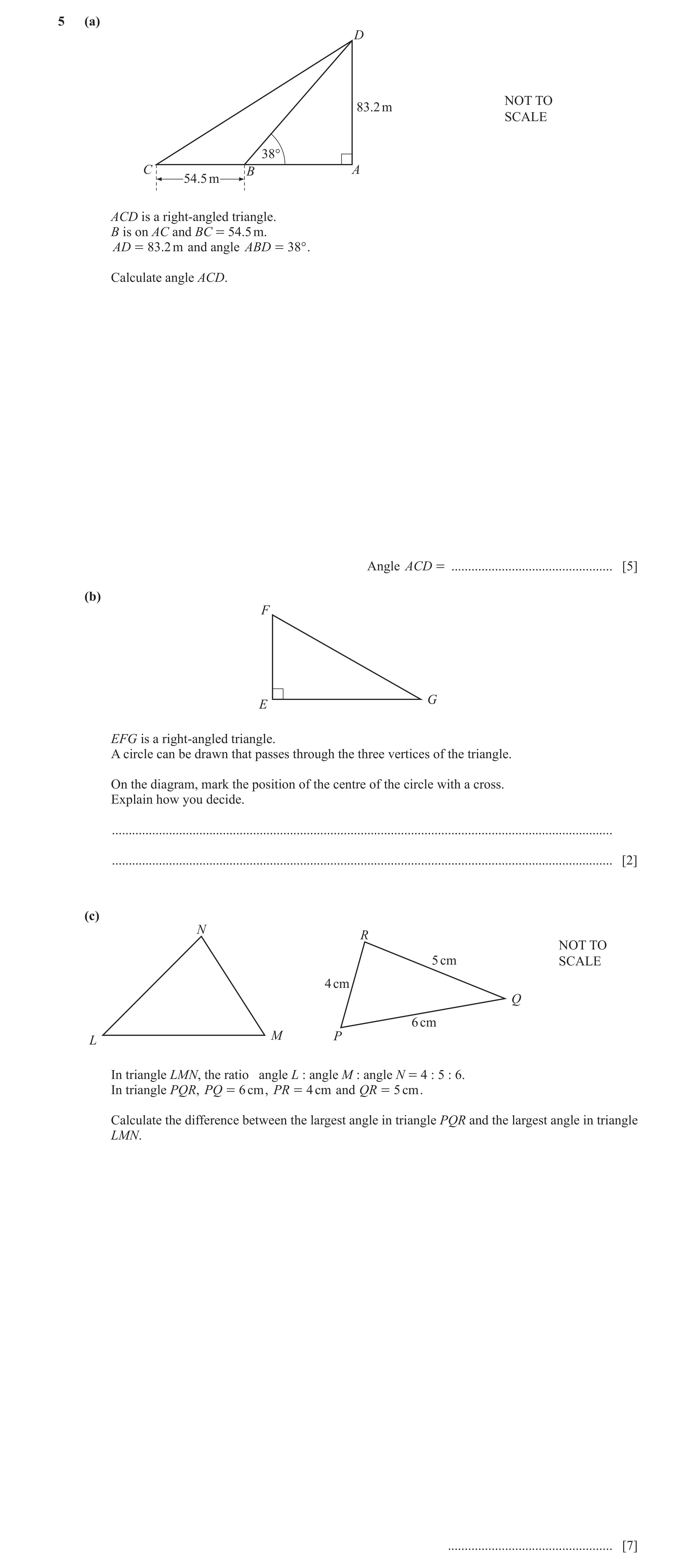
5 (a) D NOT TO 83.2 m SCALE 38° C B A 54.5 m ACD is a right-angled triangle. B is on AC and BC = 54.5 m. AD = 83.2 m and angle ABD = 38° . Calculate angle ACD. Angle ACD = … [5] (b) F G E EFG is a right-angled triangle. A circle can be drawn that passes through the three vertices of the triangle. On the diagram, mark the position of the centre of the circle with a cross. Explain how you decide. … … [2] (c) N R NOT TO 5 cm SCALE 4 cm Q 6 cm M P L In triangle LMN, the ratio angle L : angle M : angle N = 4 : 5 : 6. In triangle PQR, PQ = 6 cm , PR = 4 cm and QR = 5 cm . Calculate the difference between the largest angle in triangle PQR and the largest angle in triangle LMN. … [7]
14 marks
Mark scheme: 5(a) 27.3 or 27.32 to 27.33 5 83.2 M4 for tan[ACD] = oe 83.2 + 54.5 tan38 or 83.2 M3 for [AC =] +54.5 oe tan38 or for [CD =] 2 83.2 2 83.2 54.5 + − 2(54.5) cos(180 − 38) sin38 sin38 oe or 83.2 83.2 M2 for [AB =] oe or for [BD =] oe tan38 sin 38 83.2 83.2 or M1 for tan38 = oe or sin38 = oe AB BD 5(b) Centre marked at midpoint of B2 B1 for marking the centre at mid-point of FG FG. and Angle in a semi-circle is 90 5(c) 10.8 or 10.81 to 10.82 7 B2 for 72 180 or M1 for [ 6] 4 + 5 + 6 and, for triangle PQR B4 for [angle R=]82.8 or 82.81 to 82.83 5 or B3 for [cosR =] oe or better 40 4 2 + 5 2 − 6 2 or M2 for 2 4 5 or M1 for 62 = 42 + 52 – 245cosR After 0 scored for triangle PQR, SC1 for [P =] 55.8 or 55.77 to 55.78 or Q = 41.4 or 41.40 to 41.41
This question in 0580/41 Oct/Nov 2023
Q32 · E D NOT TO SCALE C F A B ABCDEF is a regular hexagon 0580/42 Oct/Nov 2023
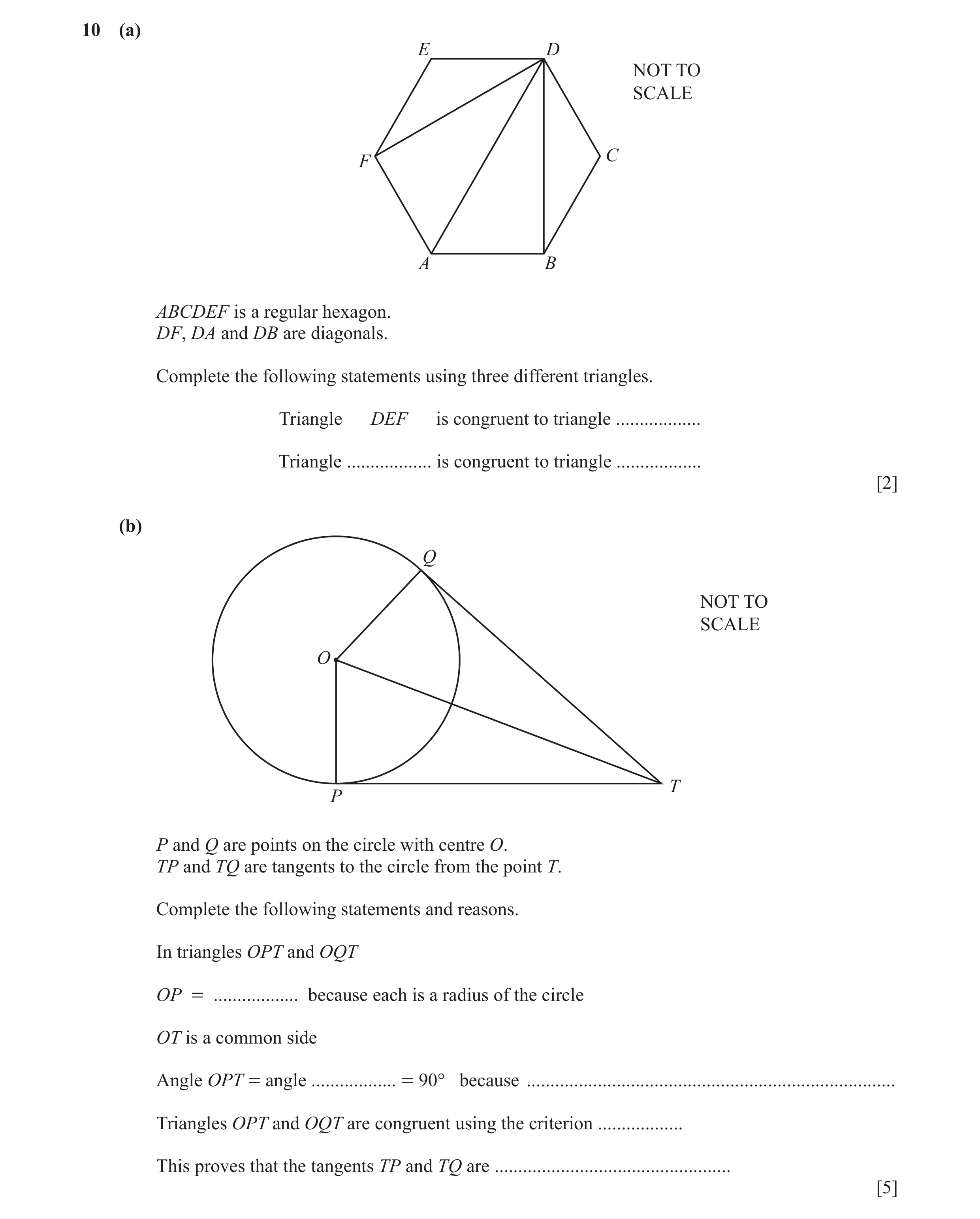
10 (a) E D NOT TO SCALE C F A B ABCDEF is a regular hexagon. DF, DA and DB are diagonals. Complete the following statements using three different triangles. Triangle DEF is congruent to triangle … Triangle … is congruent to triangle … [2] (b) Q NOT TO SCALE O T P P and Q are points on the circle with centre O. TP and TQ are tangents to the circle from the point T. Complete the following statements and reasons. In triangles OPT and OQT OP = … because each is a radius of the circle OT is a common side Angle OPT = angle … = 90° because … Triangles OPT and OQT are congruent using the criterion … This proves that the tangents TP and TQ are … [5]
7 marks
Mark scheme: 10(a) [DEF], BCD 2 B1 for each pair ADF, ADB 10(b) OQ 5 B1 for each OQT Tangent perpendicular to radius RHS equal
This question in 0580/42 Oct/Nov 2023
Q33 · X D A x° NOT TO y° SCALE C B A, B, C and D are points on a circle 0580/42 Feb/March 2024
2 X D A x° NOT TO y° SCALE C B A, B, C and D are points on a circle. ADX and BCX are straight lines. Angle BAD = x° and angle DCX = y°. (a) Explain why x = y. Give a geometrical reason for each statement you make. [2] (b) Show that triangle ABX is similar to triangle CDX. [2] (c) AD = 15 cm, DX = 9 cm and CX = 12 cm. (i) Find BC. BC = … cm [3] (ii) Complete the statement. The ratio area of triangle ABX : area of triangle CDX = … : 1. [1]
8 marks
Mark scheme: 2(a) y + angle BCD = 180 oe B2 B1 for angles on a straight line AND angles on a straight line AND OR x + angle BCD = 180 oe AND opposite angles of a cyclic quadrilateral are opposite angles of a cyclic quadrilateral supplementary are supplementary OR OR angles in opposite segments are angles in opposite segments are supplementary supplementary leading to x = y with no errors 2(b) Allow any two statements from: M1 CXD is common angle or angle AXB = angle CXD x = y or angle BAX = angle DCX angle ABX = angle CDX States all three equal pairs of angles A1 OR 2/all angles equal so triangles similar 2(c)(i) 6 nfww 3 B2 for BX = 18 nfww 24 BC + 12 or M2 for = oe 12 9 24 BX or M1 for = oe 12 9 If 0 scored, SC1 for answer 18 2(c)(ii) 4 1
This question in 0580/42 Feb/March 2024
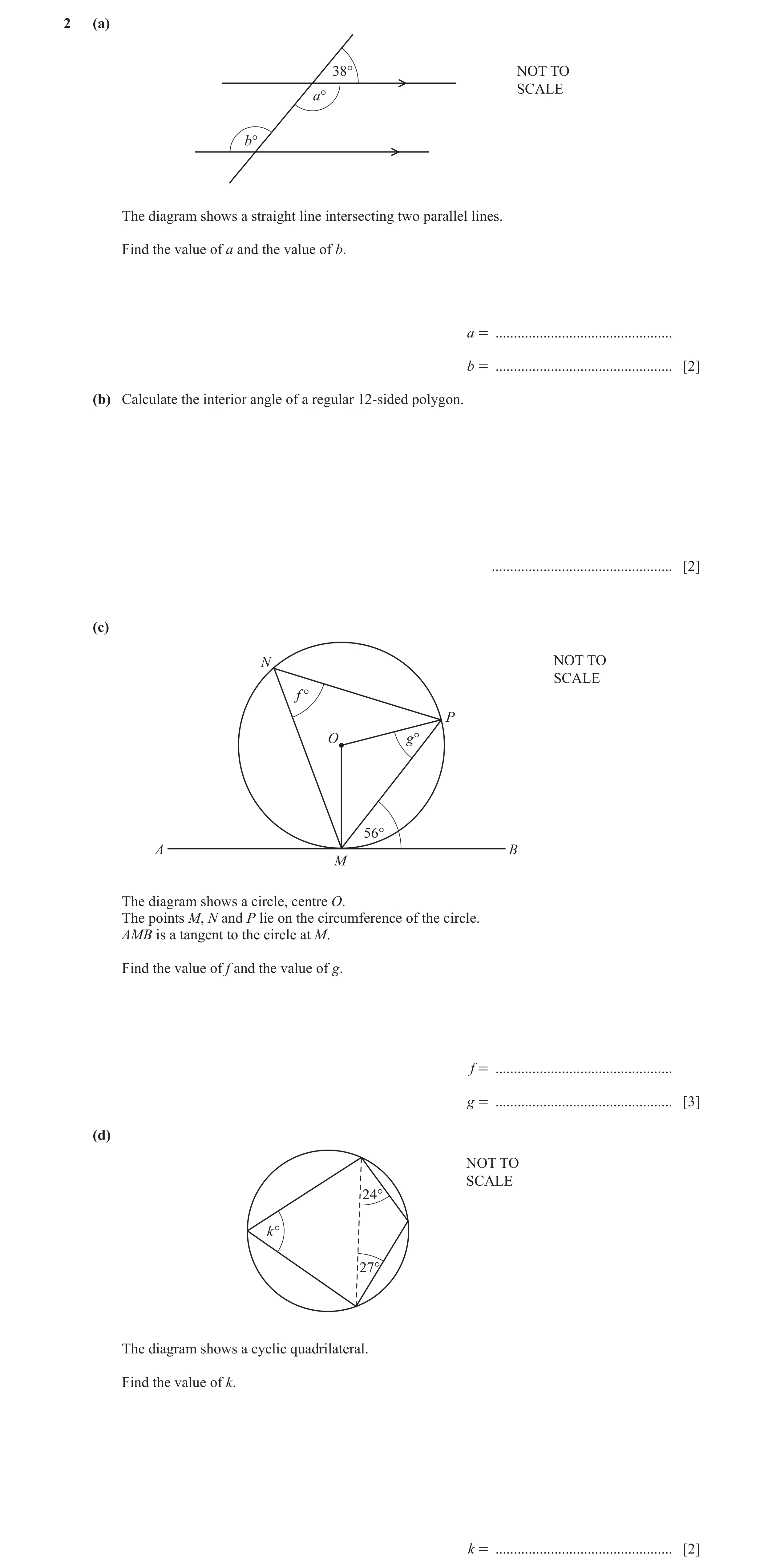
Q34 · 38° NOT TO SCALE a° b° The diagram shows a straight line intersecting two parallel lines 0580/42 May/June 2024
2 (a) 38° NOT TO SCALE a° b° The diagram shows a straight line intersecting two parallel lines. Find the value of a and the value of b. a = … b = … [2] (b) Calculate the interior angle of a regular 12-sided polygon. … [2] (c) N NOT TO SCALE f ° P O g° 56° A B M The diagram shows a circle, centre O. The points M, N and P lie on the circumference of the circle. AMB is a tangent to the circle at M. Find the value of f and the value of g. f = … g = … [3] (d) NOT TO SCALE 24° k ° 27° The diagram shows a cyclic quadrilateral. Find the value of k. k = … [2]
9 marks
Mark scheme: 2(a) 142 2 B1 for each 142 FT angle b = their angle a 2(b) 150 2 360 M1 for oe isw 12 or 180 12 2 oe isw 2(c) 56 B1 34 B2 M1 for angle at centre = 2 × their 56 oe soi or for angle OMB = 90 oe soi 2(d) 51 2 B1 for opp angle = 129 soi
This question in 0580/42 May/June 2024
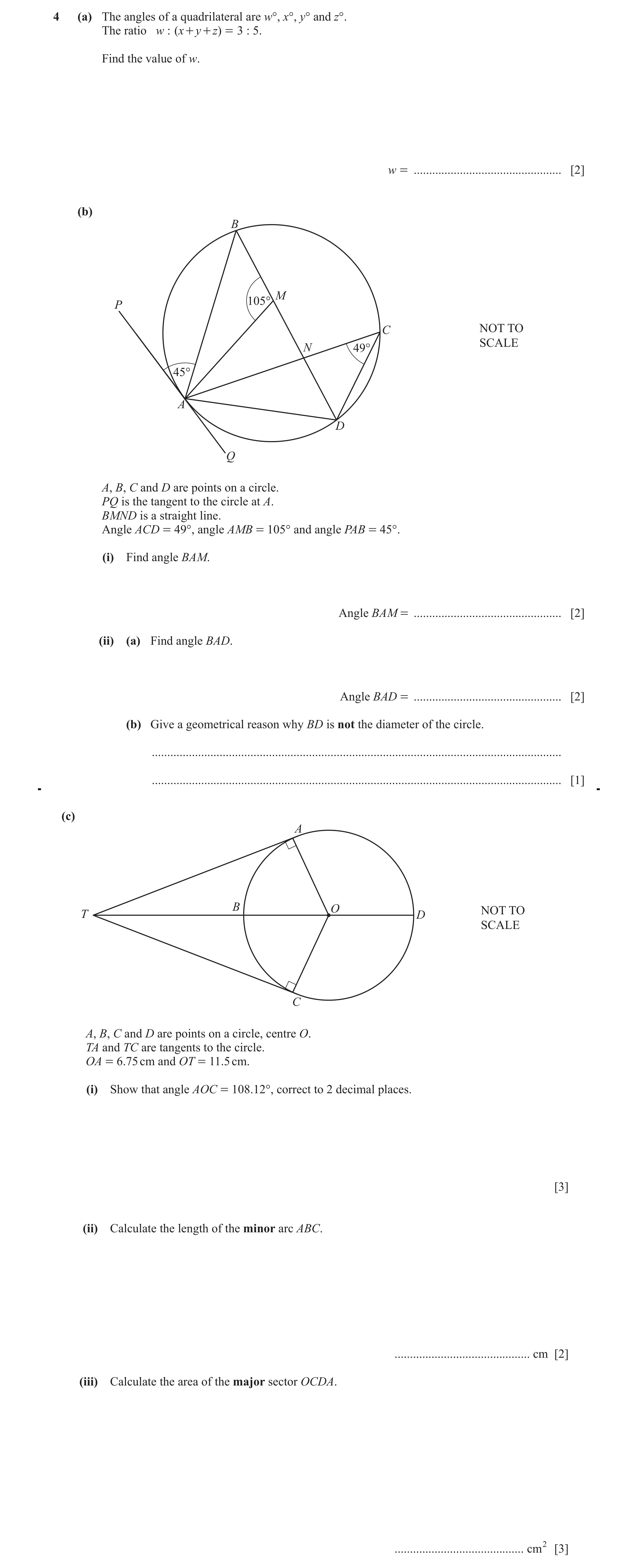
Q35 · The angles of a quadrilateral are w°, x°, y° and z° 0580/42 Oct/Nov 2024
4 (a) The angles of a quadrilateral are w°, x°, y° and z°. The ratio w : ( x + y + z) = 3 : 5. Find the value of w. w = … [2] (b) B M 105° P C NOT TO SCALE N 49° 45° A D Q A, B, C and D are points on a circle. PQ is the tangent to the circle at A. BMND is a straight line. Angle ACD = 49°, angle AMB = 105° and angle PAB = 45°. (i) Find angle BAM. Angle BAM = … [2] (ii) (a) Find angle BAD. Angle BAD = … [2] (b) Give a geometrical reason why BD is not the diameter of the circle. … … [1] (c) A B O NOT TO T D SCALE C A, B, C and D are points on a circle, centre O. TA and TC are tangents to the circle. OA = 6.75 cm and OT = 11.5 cm. (i) Show that angle AOC = 108.12°, correct to 2 decimal places. [3] (ii) Calculate the length of the minor arc ABC. … cm [2] (iii) Calculate the area of the major sector OCDA. … cm2 [3]
15 marks
Mark scheme: 4(a) 135 2 360 M1 for × k, where k = 1, 3 or 5 oe 5 + 3 4(b)(i) 26 2 B1 for ABD = 49 4(b)(ii)(a) 86 2 B1 for QAD = 49 or for BDA = 45 or for BCA = 45 4(b)(ii)(b) Angle in a semicircle = 90 1 4(c)(i) −1 6.75 M2 6.75 [2 ] cos oe M1 for cos(…) = oe 11.5 11.5 108.117… A1 4(c)(ii) 12.7 or 12.73 to 12.74 2 108.12 M1 for 2 π 6.75 360 4(c)(iii) 100 or 100.1 to 100.2 3 360 − 108.12 M2 for π 6.752 oe 360 108.12 or M1 for π 6.752 360 360 − 108.12 If 0 scored, SC1 for π k 360
This question in 0580/42 Oct/Nov 2024
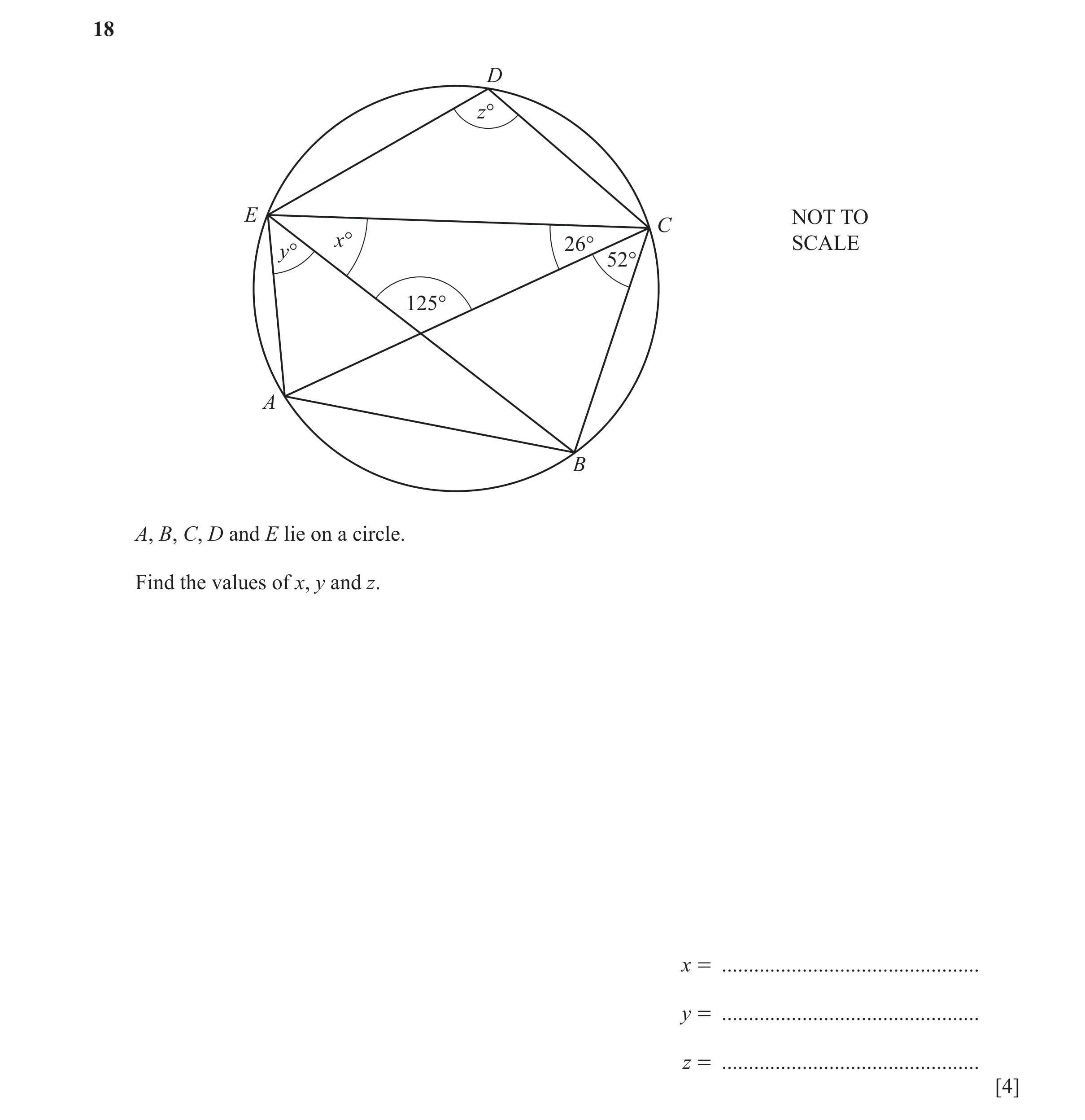
Q36 · D z° E NOT TO C x° 26° SCALE y° 52° 125° A B A, B, C, D and E lie on a circle 0580/42 May/June 2025
18 D z° E NOT TO C x° 26° SCALE y° 52° 125° A B A, B, C, D and E lie on a circle. Find the values of x, y and z. x = … y = … z = … [4]
4 marks
Mark scheme: 18 [x =] 29 4 B1 for 29 [y =] 52 [z =] 107 B1 for 52 B2FT for 107 or for z = their x + their y + 26 or B1 for EAC = 73 or EBC = 73 or B1FT for EAC = 180 – (their x + their y + 26)
This question in 0580/42 May/June 2025
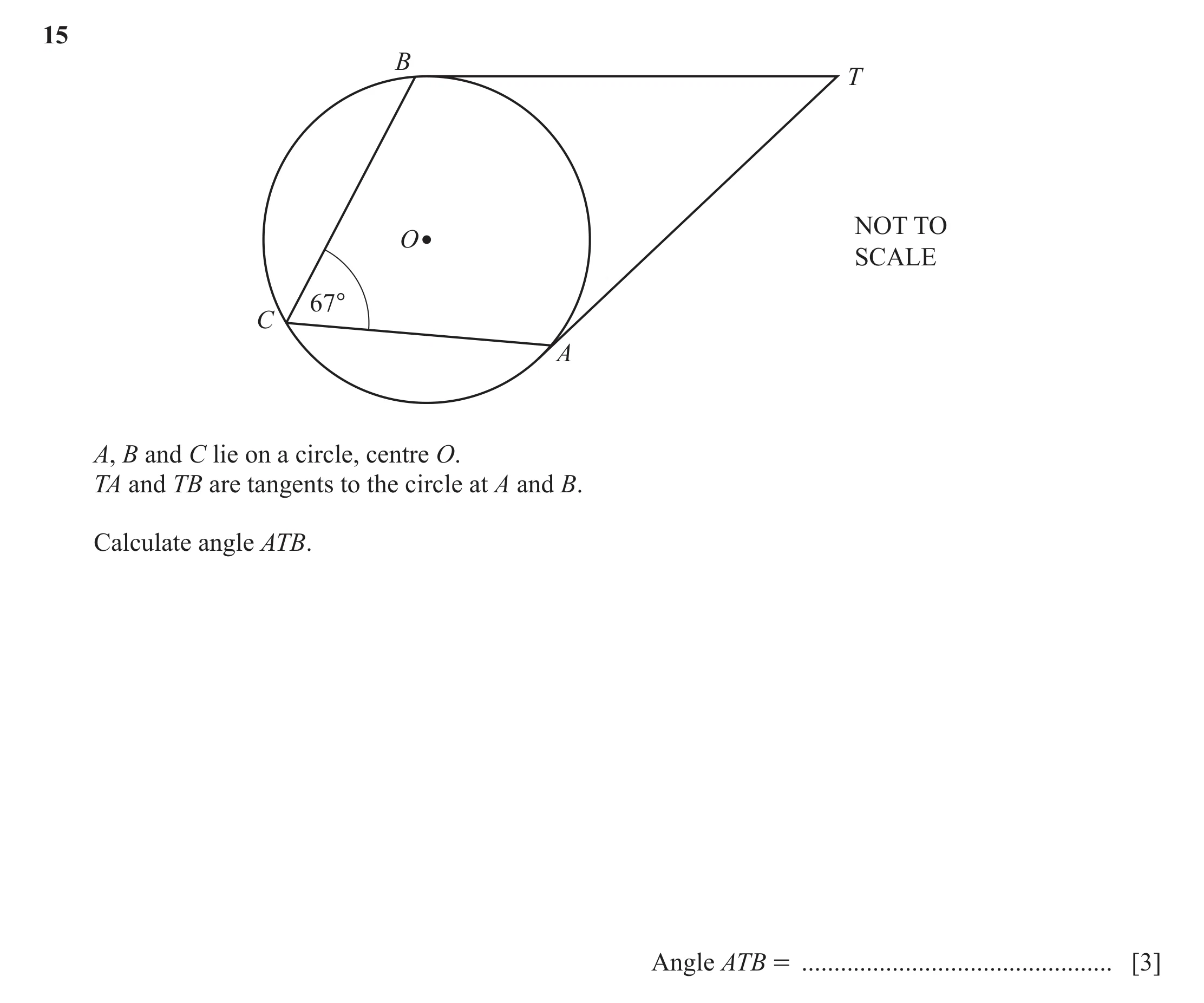
Q37 · B T NOT TO O SCALE 67° C A A, B and C lie on a circle, centre O 0580/41 Oct/Nov 2025
15 B T NOT TO O SCALE 67° C A A, B and C lie on a circle, centre O. TA and TB are tangents to the circle at A and B. Calculate angle ATB. Angle ATB = … [3]
3 marks
Mark scheme: 15 46 3 M2 for [angle ATB] = 180 – 2 × 67 oe OR M1 for [obtuse] angle AOB = 2 × 67 M1 for angle OAT or angle OBT = 90 OR M1 for angle TBA = 67 or angle TAB = 67 M1 for angle TDA or TDB = 90 where D is the intersection of OT and AB OR M1 for angle BOT = 67 or angle AOT = 67 M1 for angle OTB = 180 – 67 – 90 or angle OTA = 180 – 67 – 90
This question in 0580/41 Oct/Nov 2025
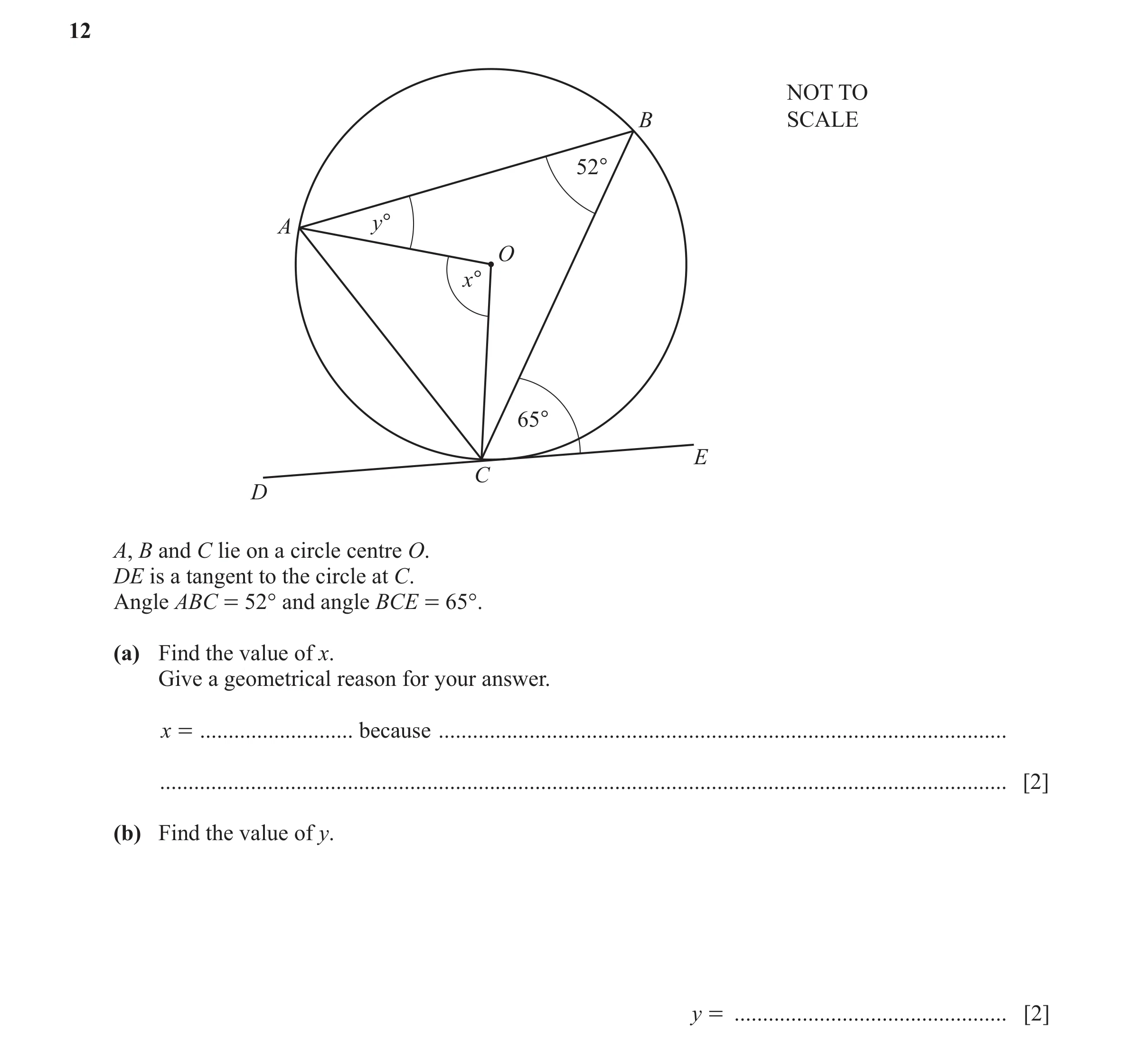
Q38 · NOT TO B SCALE 52° A y° O x° 65° E C D A, B and C lie on a circle centre O 0580/42 Oct/Nov 2025
12 NOT TO B SCALE 52° A y° O x° 65° E C D A, B and C lie on a circle centre O. DE is a tangent to the circle at C. Angle ABC = 52° and angle BCE = 65°. (a) Find the value of x. Give a geometrical reason for your answer. x = … because … … [2] (b) Find the value of y. y = … [2]
4 marks
Mark scheme: 12(a) 104 2 B1 for each and angle at the centre is twice the angle at the circumference 12(b) 27 2 B1 for angle BAC = 65 or angle ACD = 52 or M1 for OCB = 25 and reflex AOC = 360 – their 180 − their 104 104 or for OAC or OCA = 38 FT 2
This question in 0580/42 Oct/Nov 2025
 13 / 58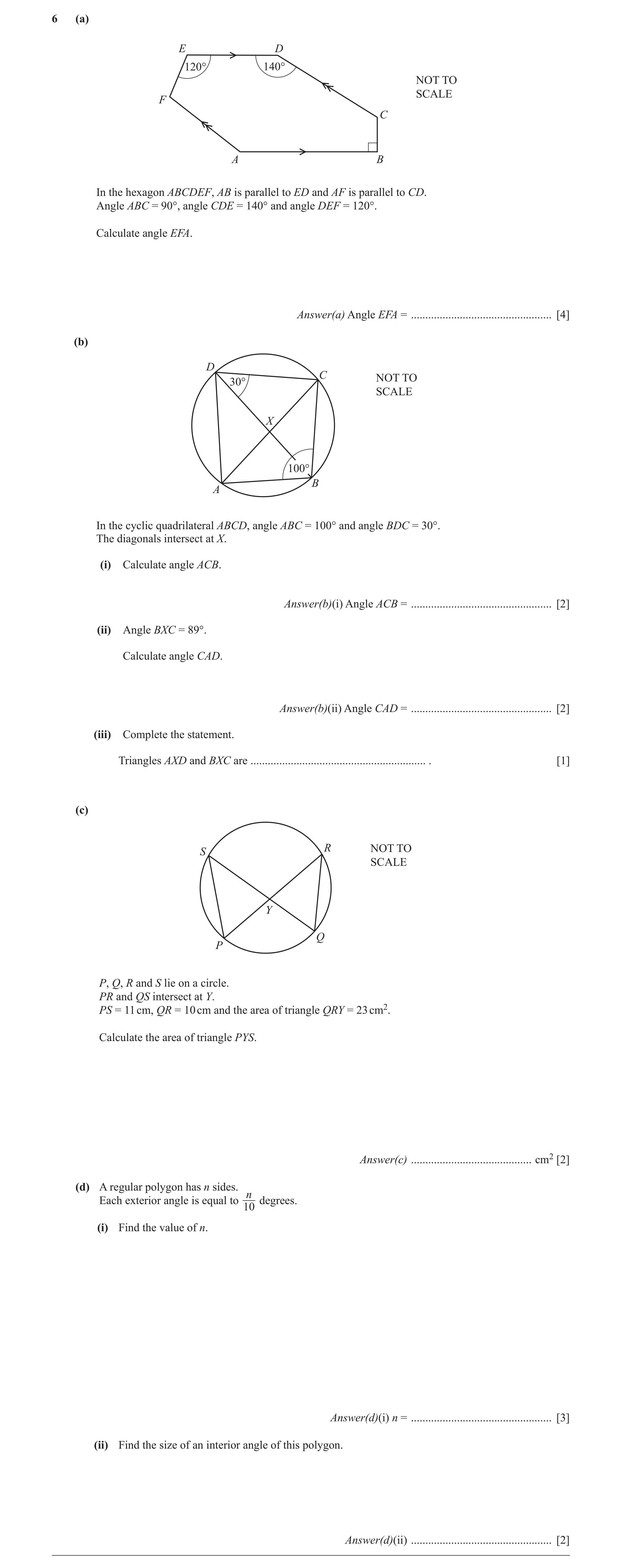
 16 / 58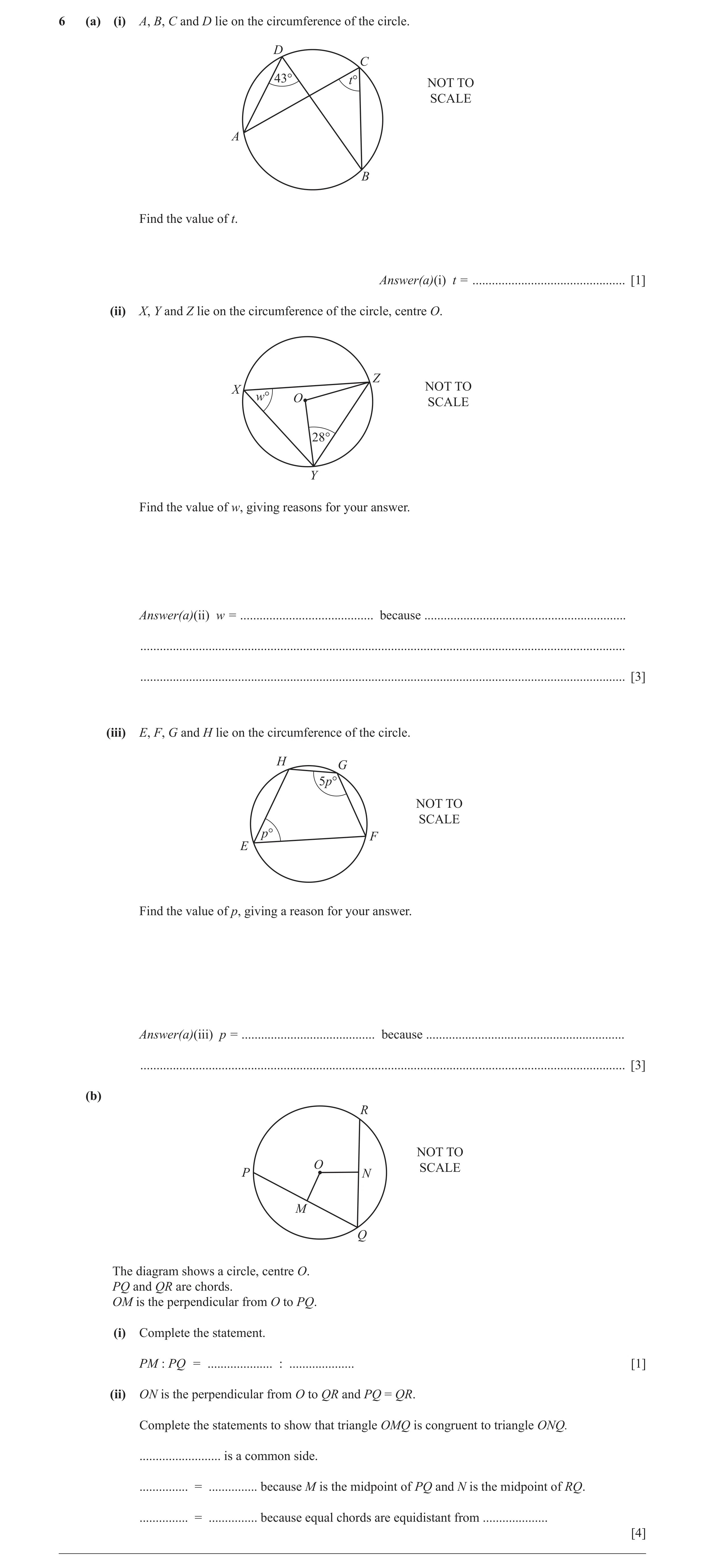
 23 / 58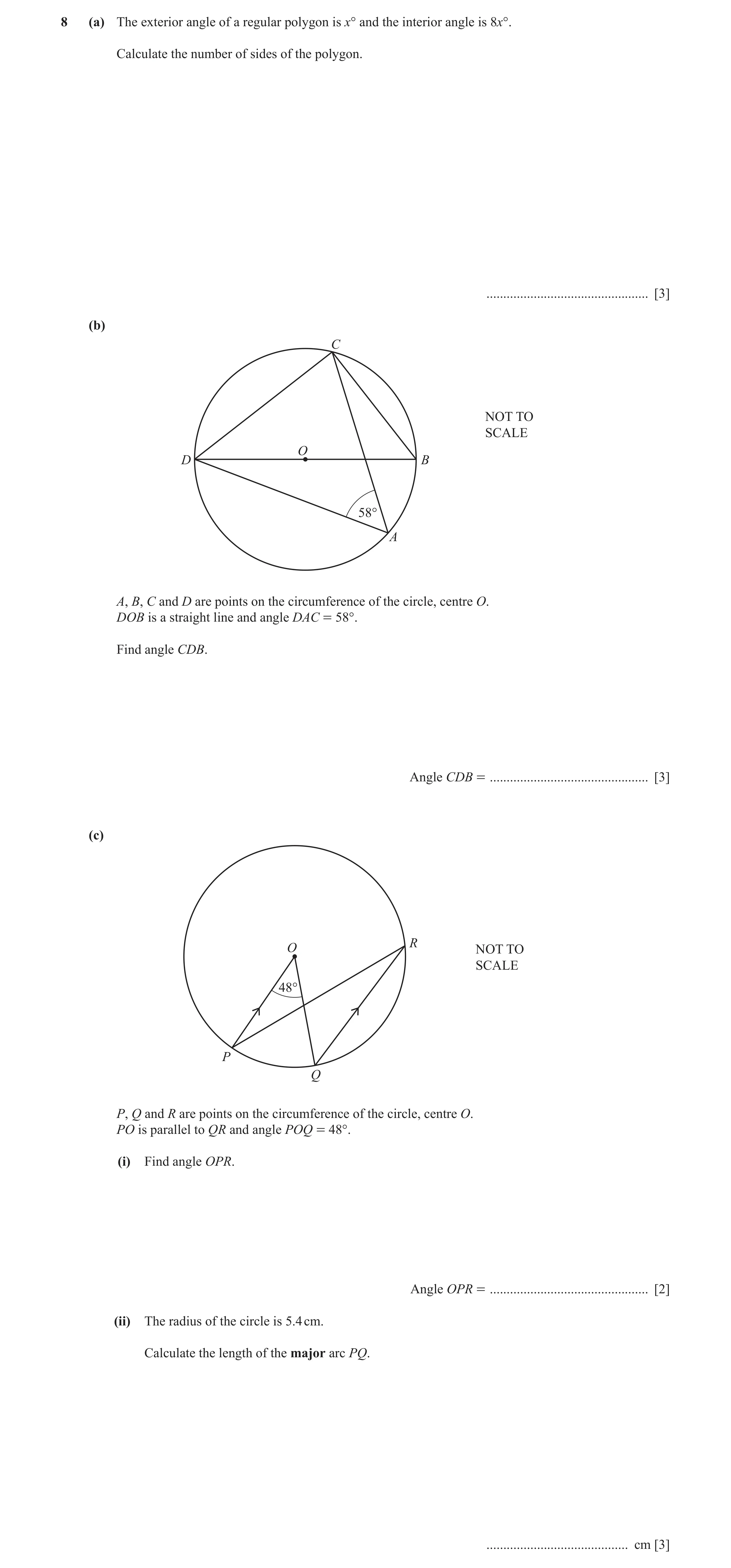
 27 / 58
 28 / 58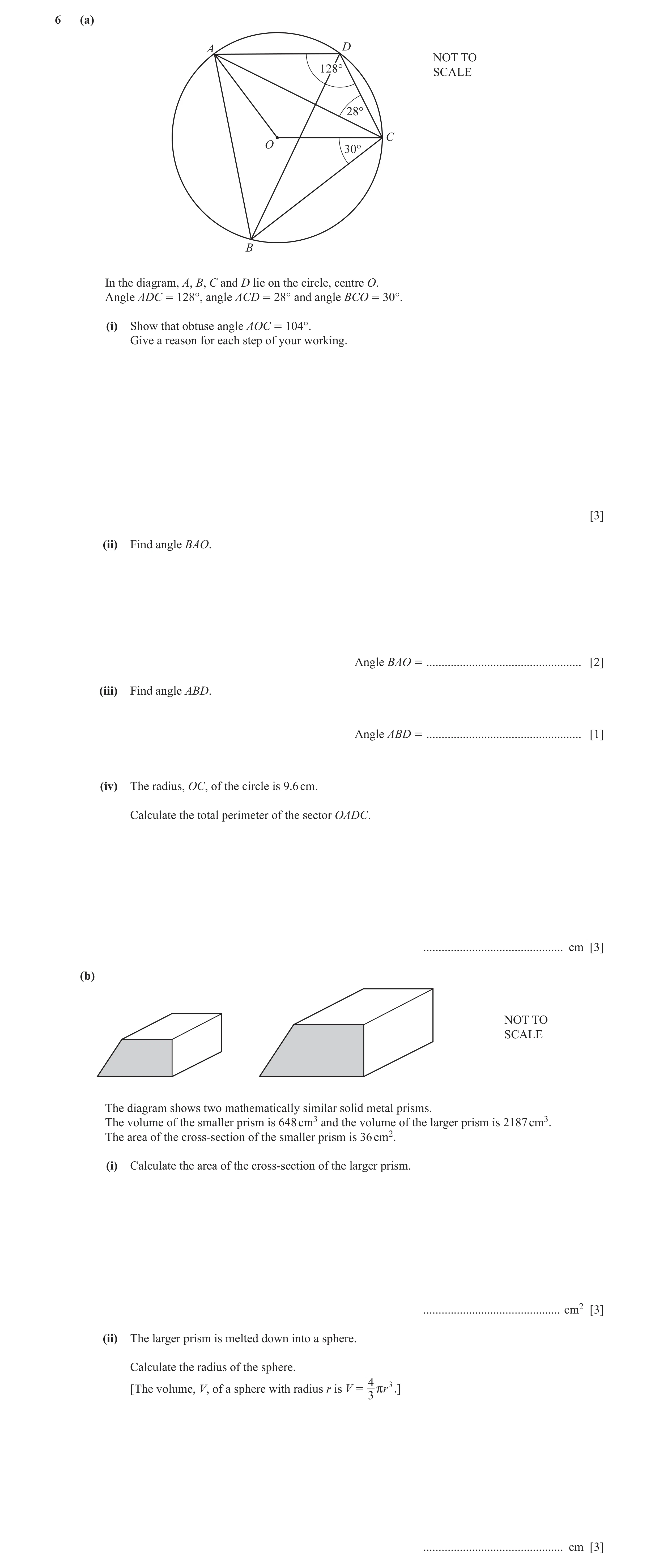
 39 / 58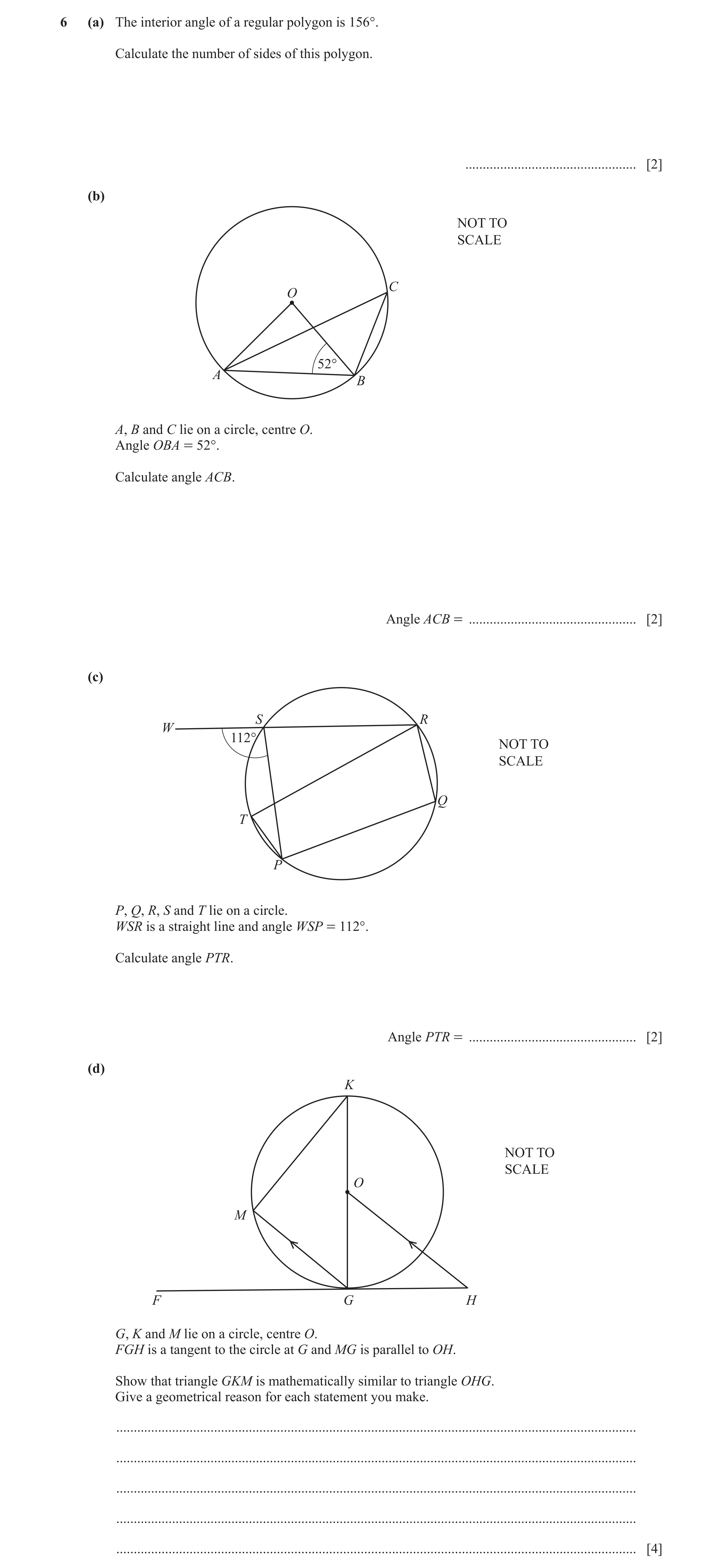
 42 / 58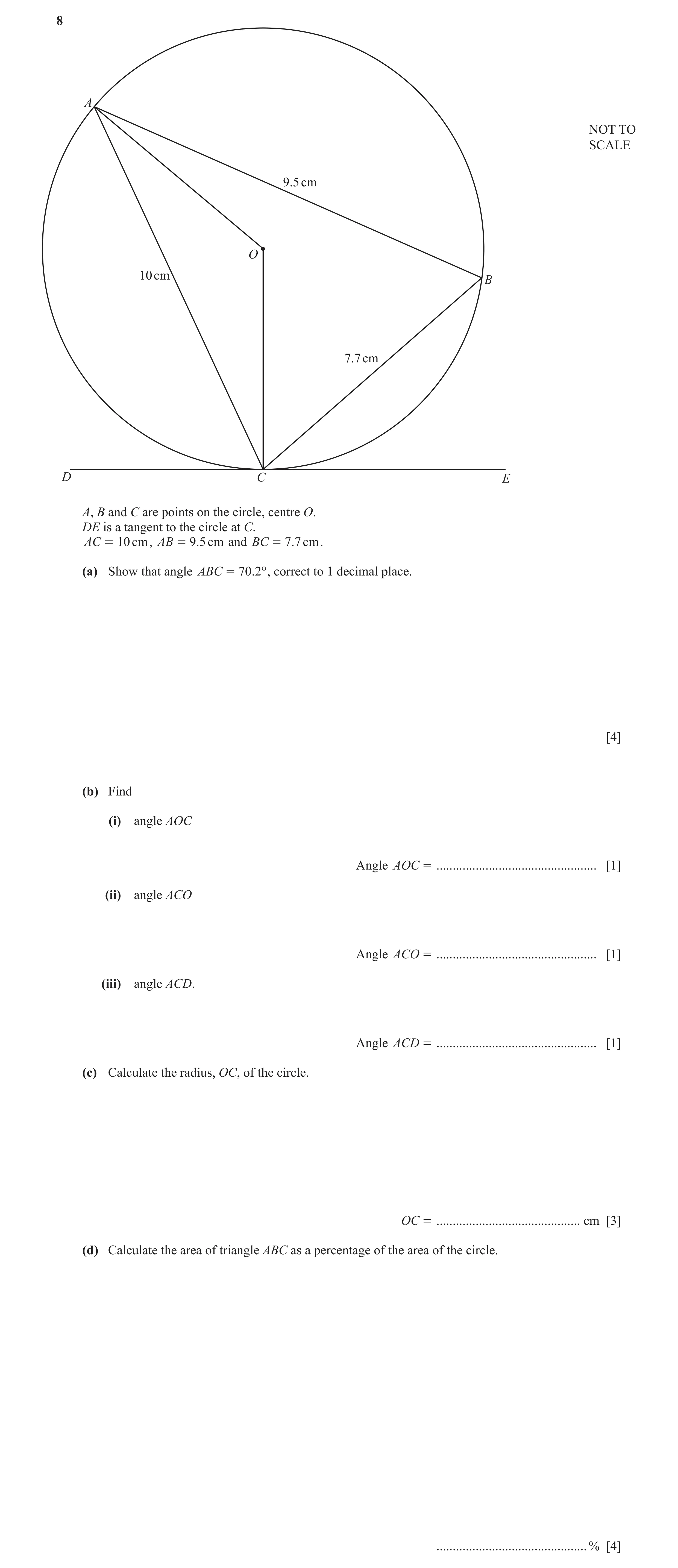
 50 / 58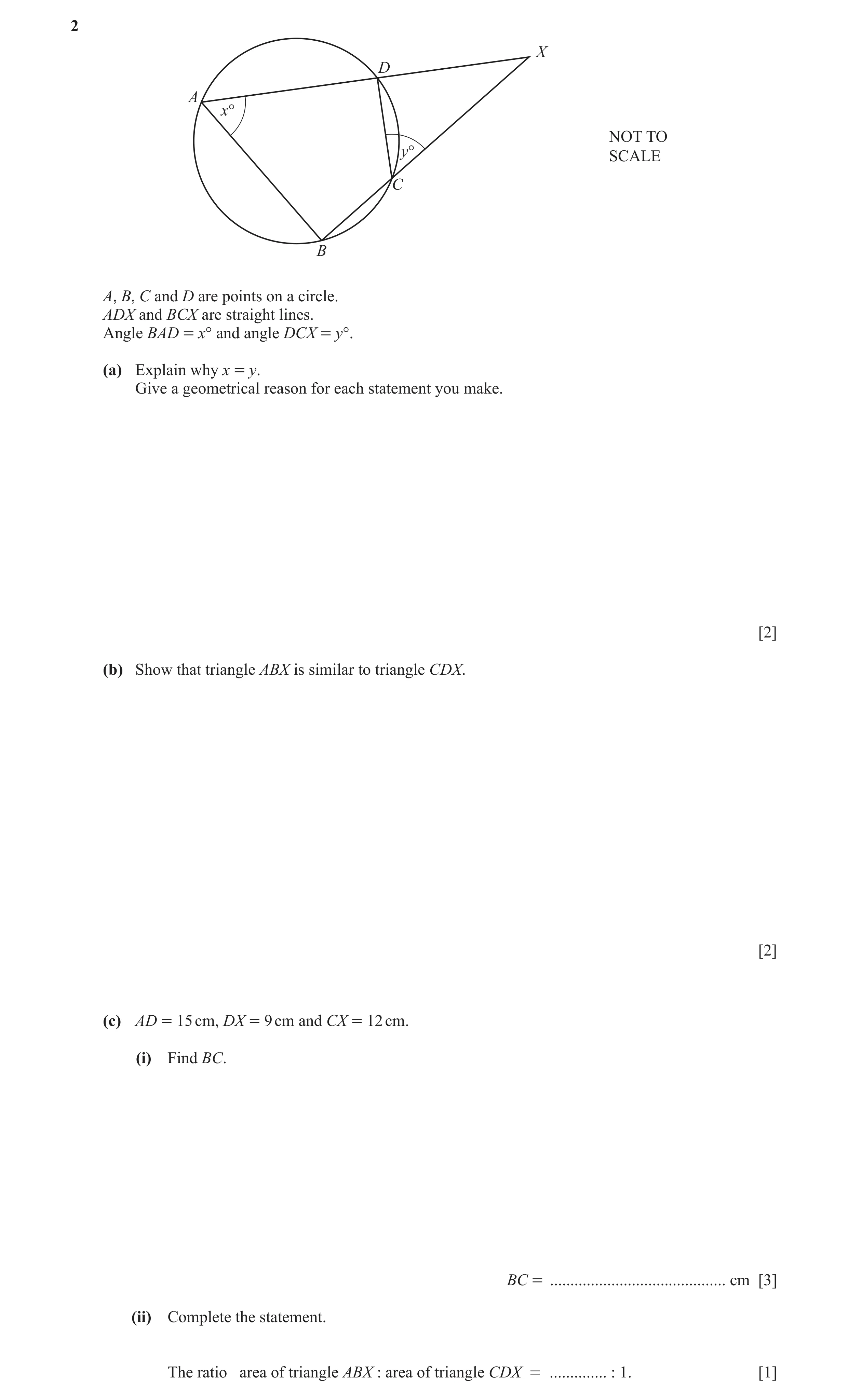
 56 / 58
 57 / 58
 58 / 58
 11
11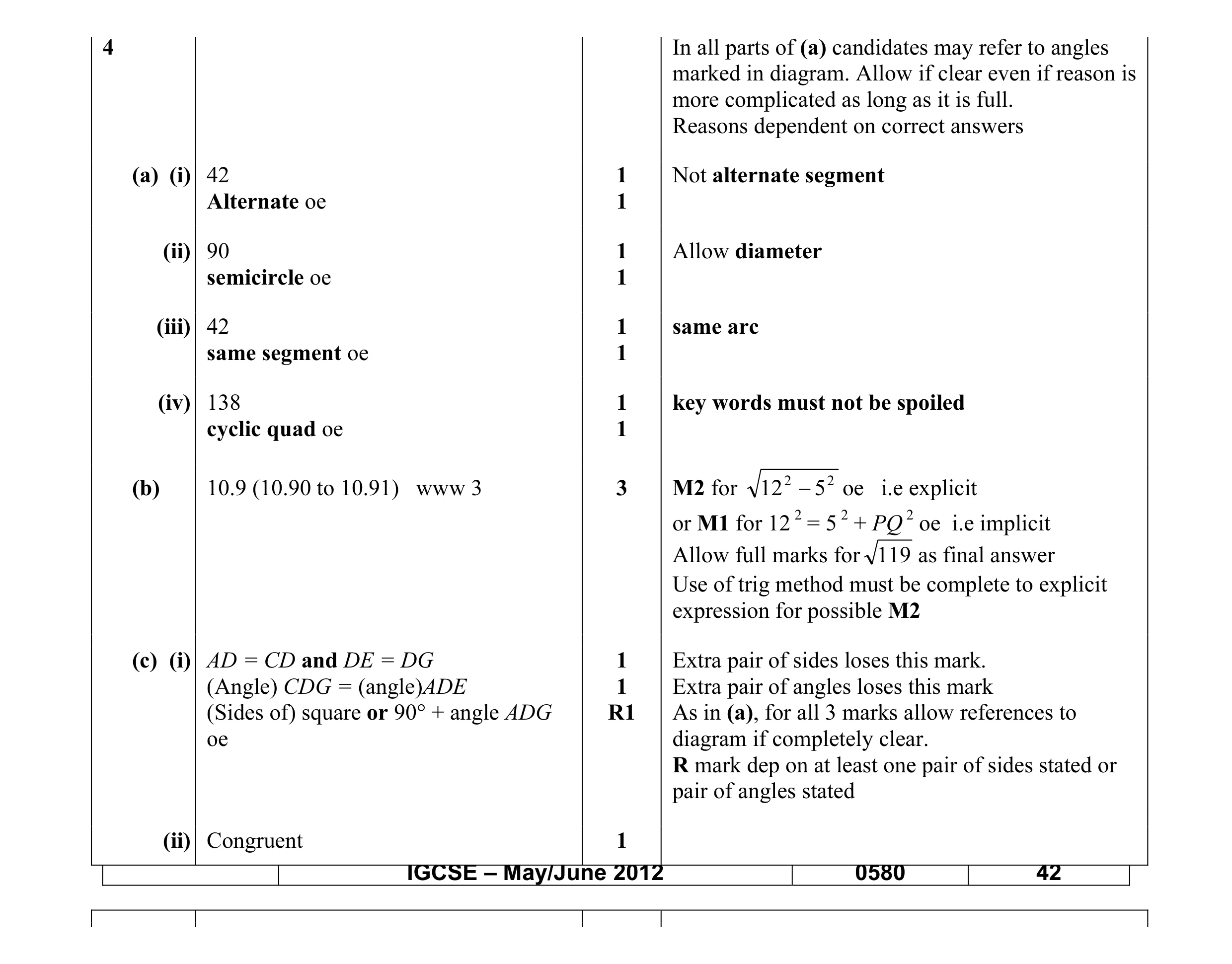 15
15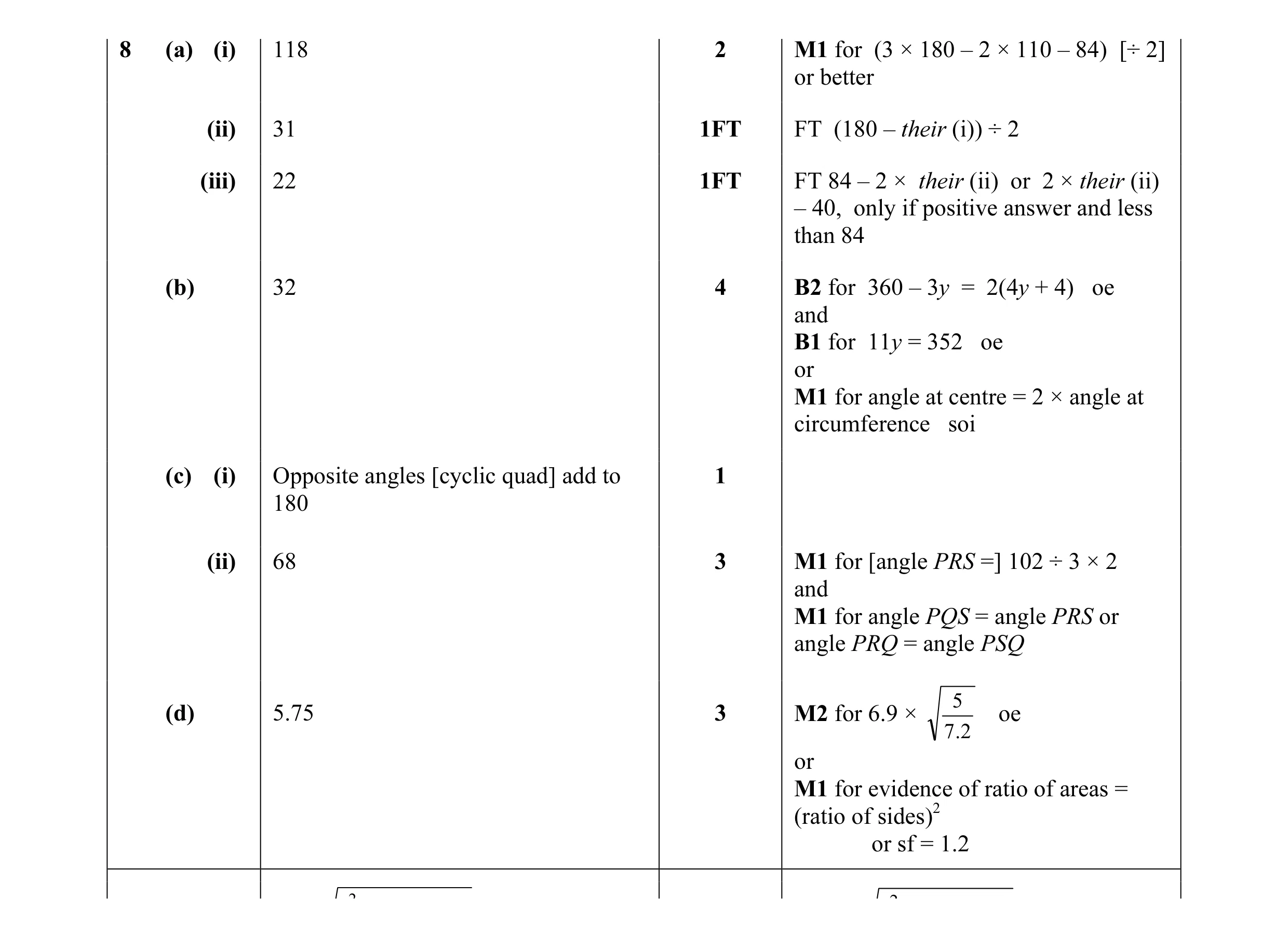 15
15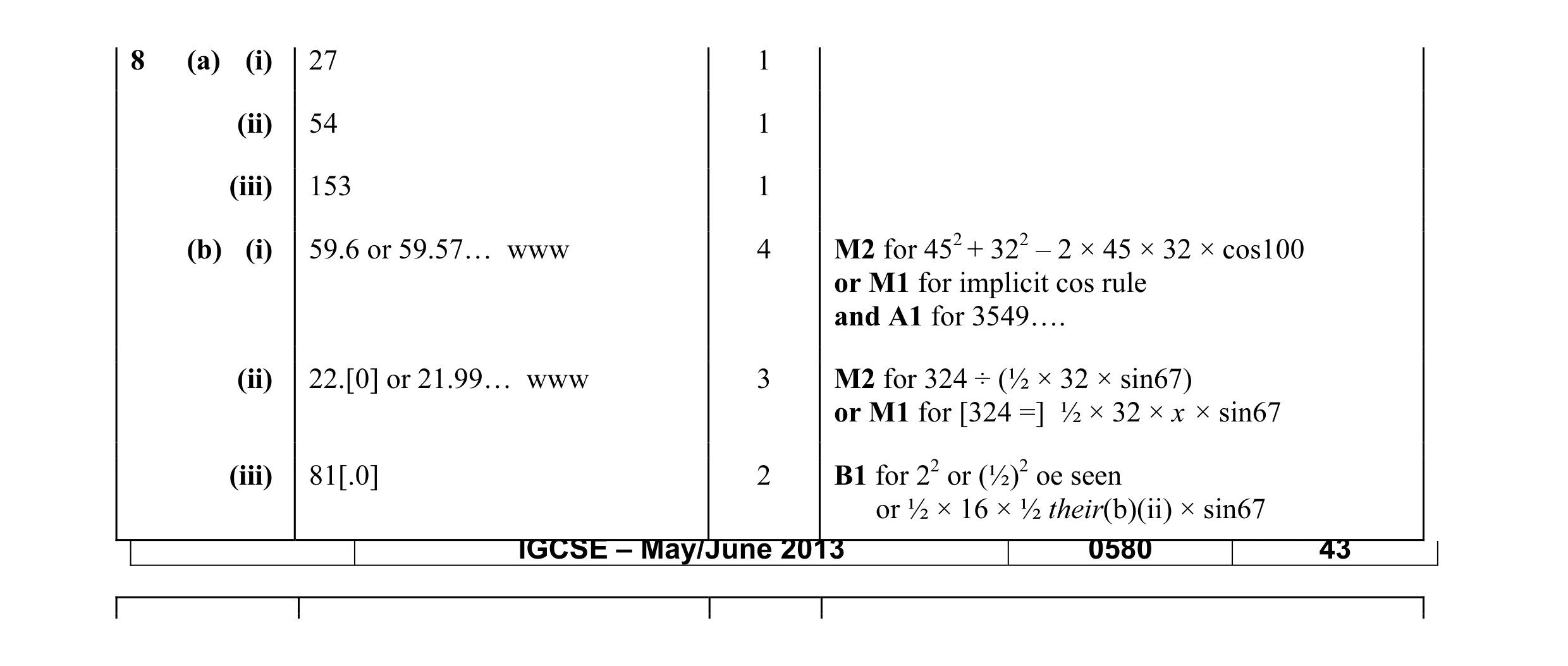 12
12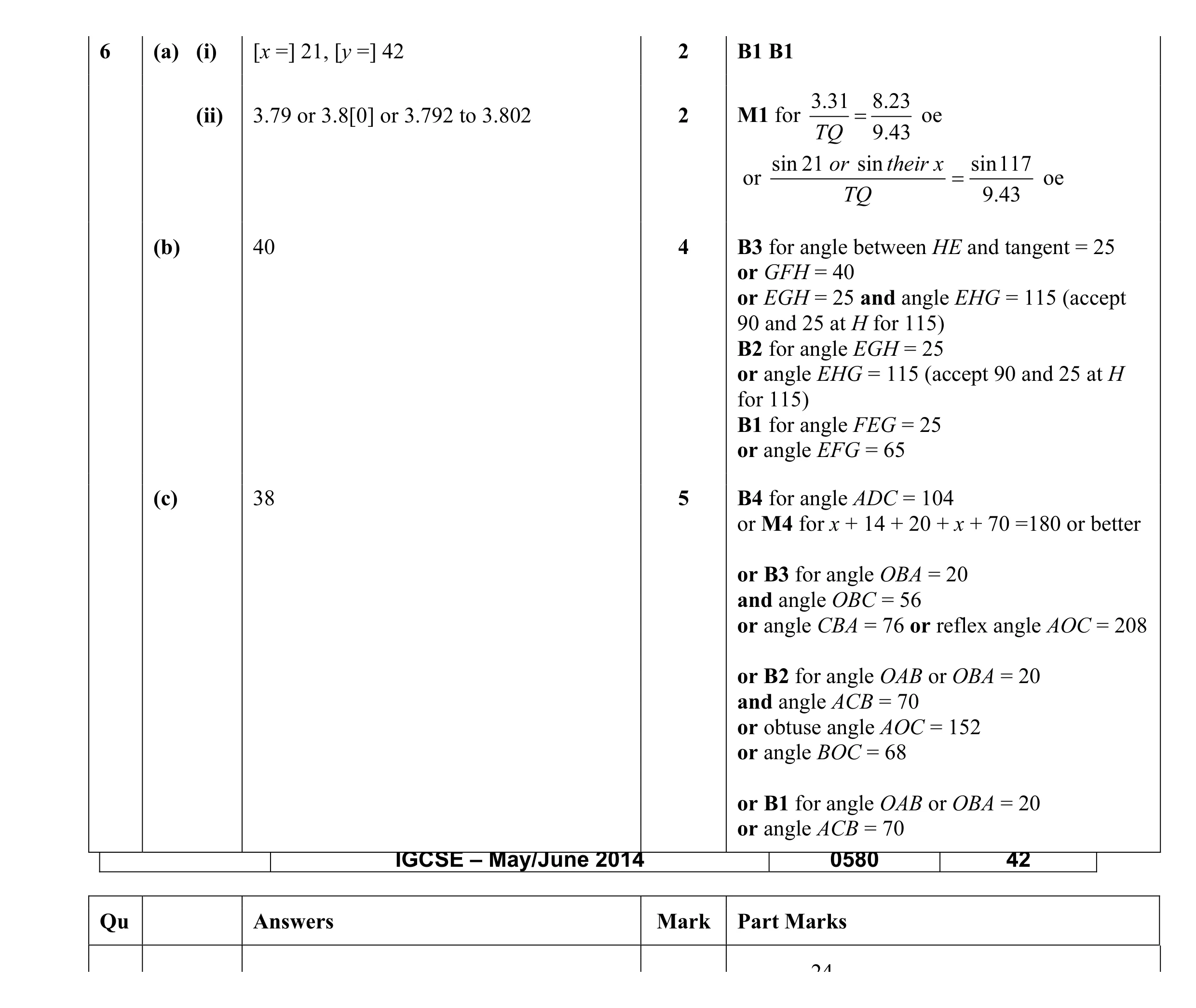 13
13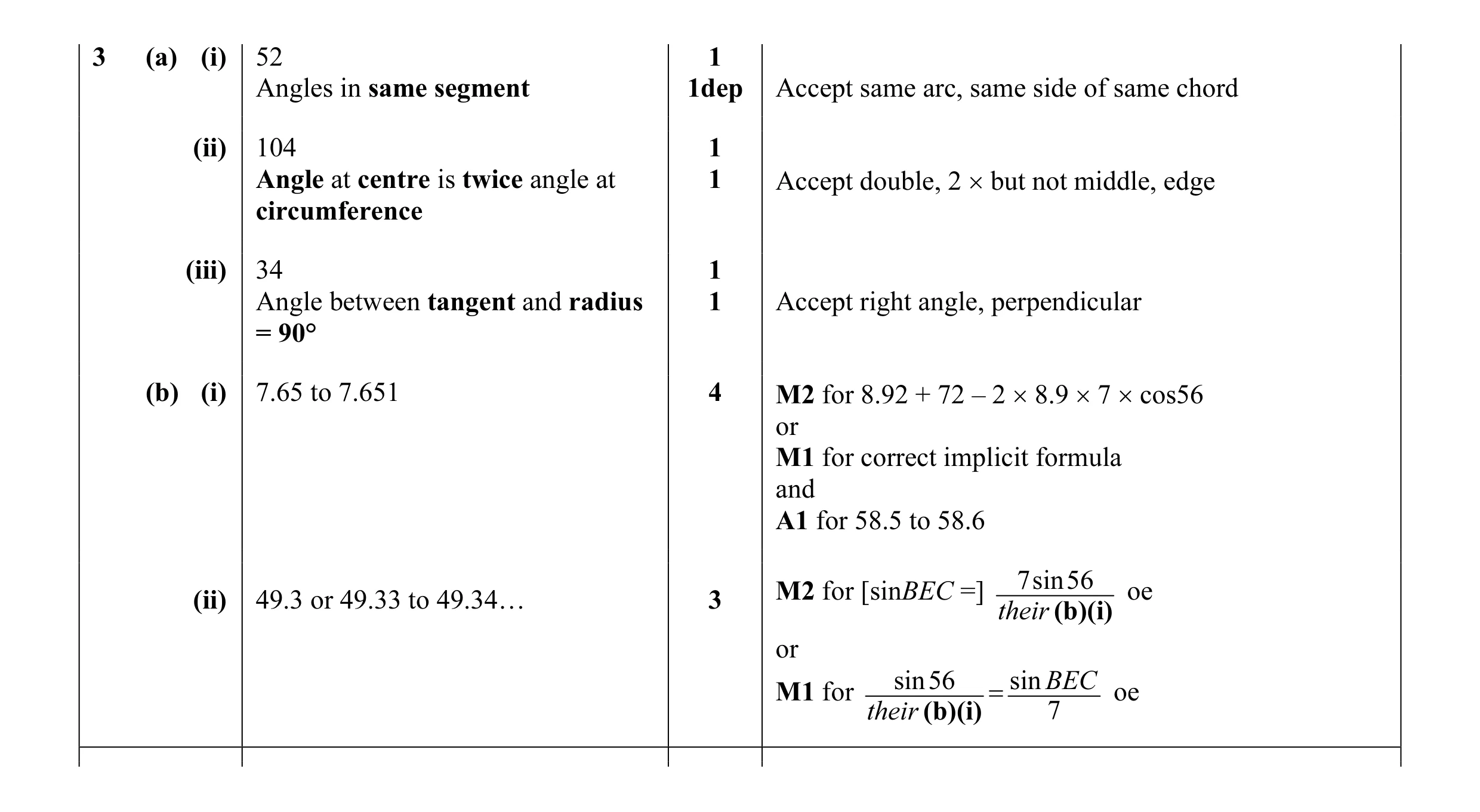 13
13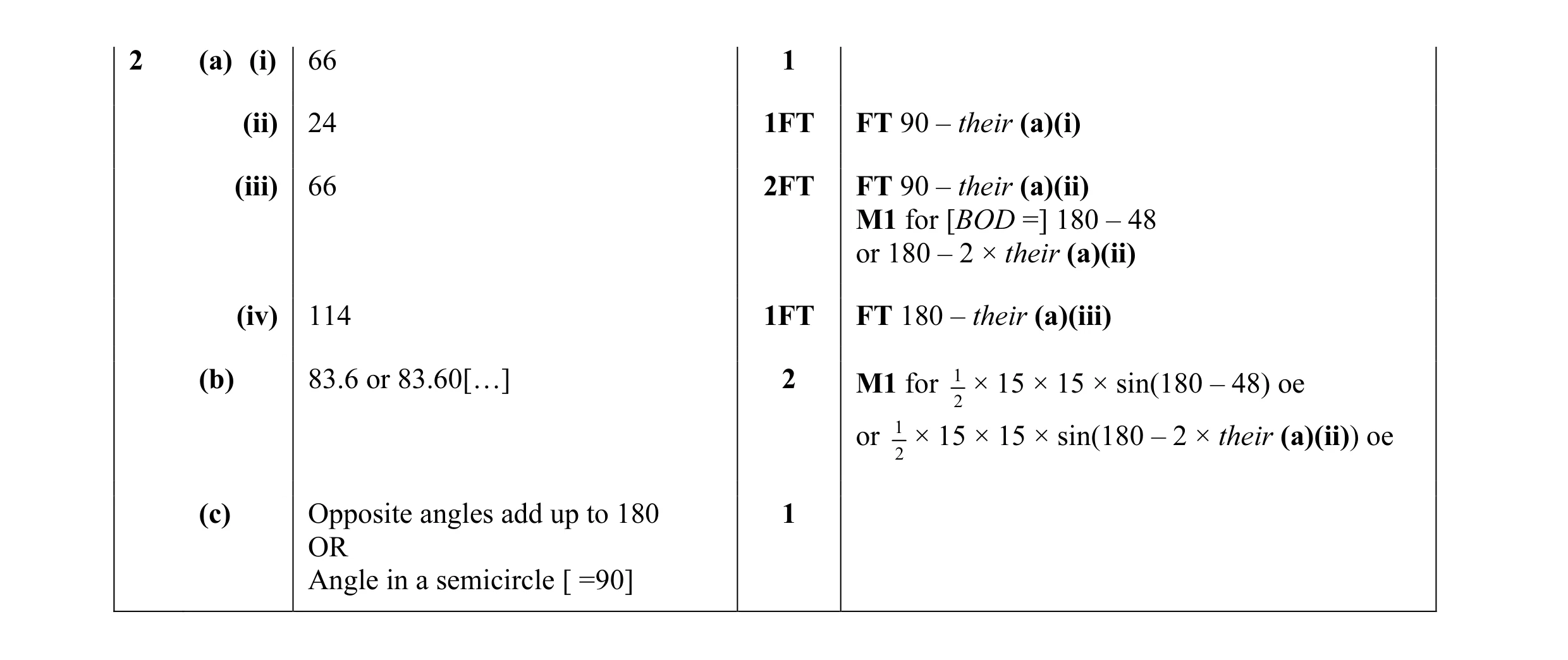 8
8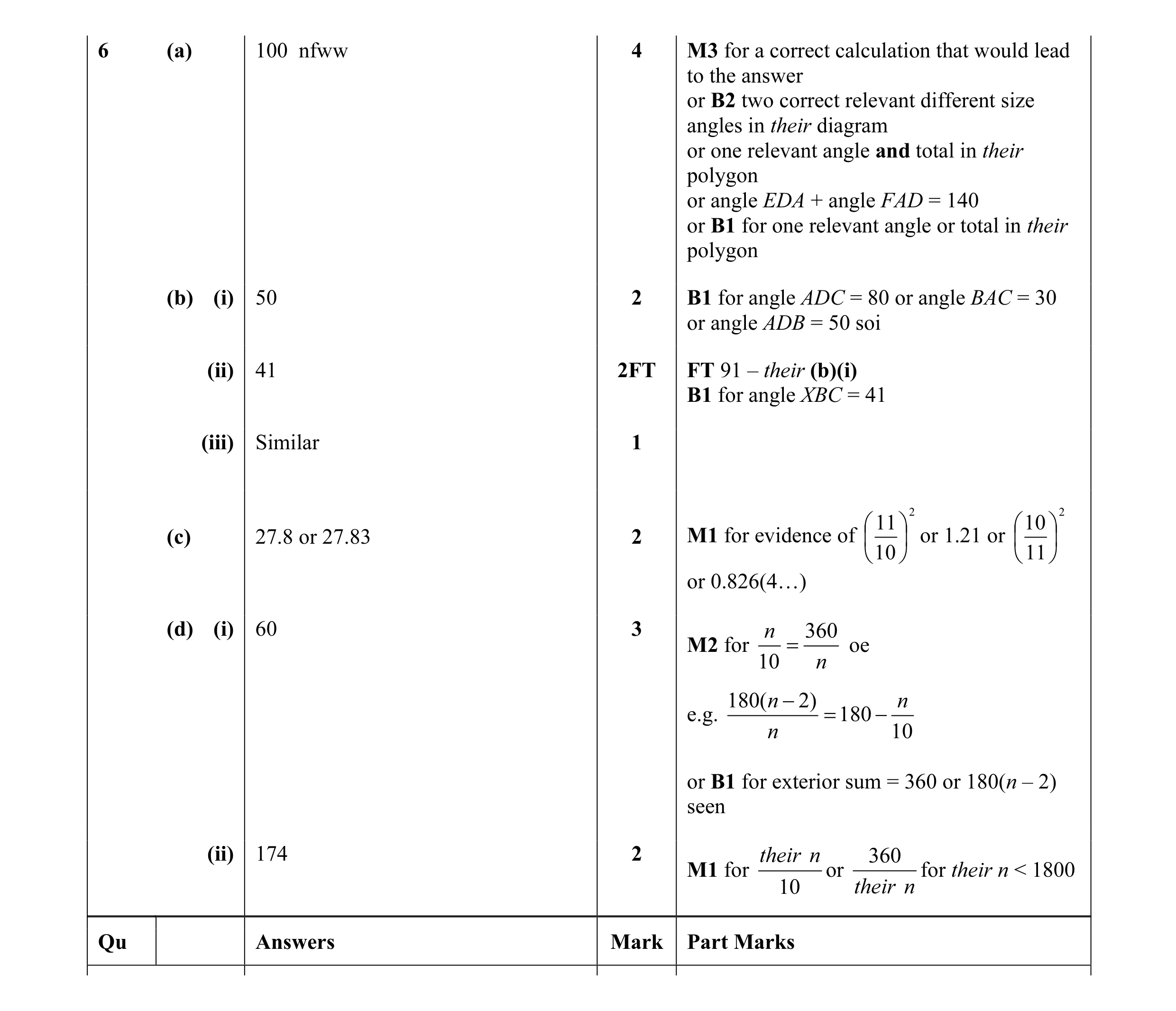 16
16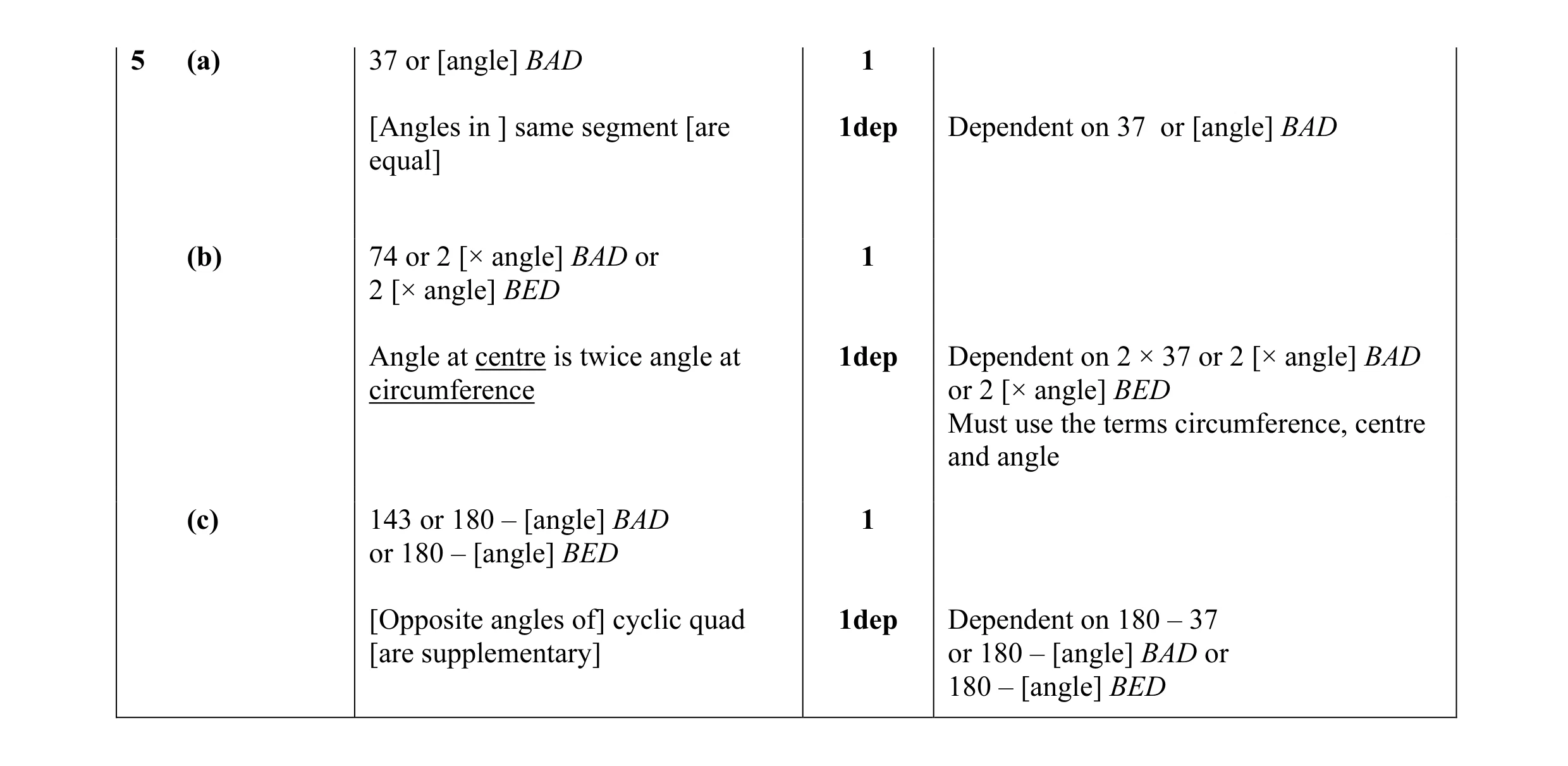 6
6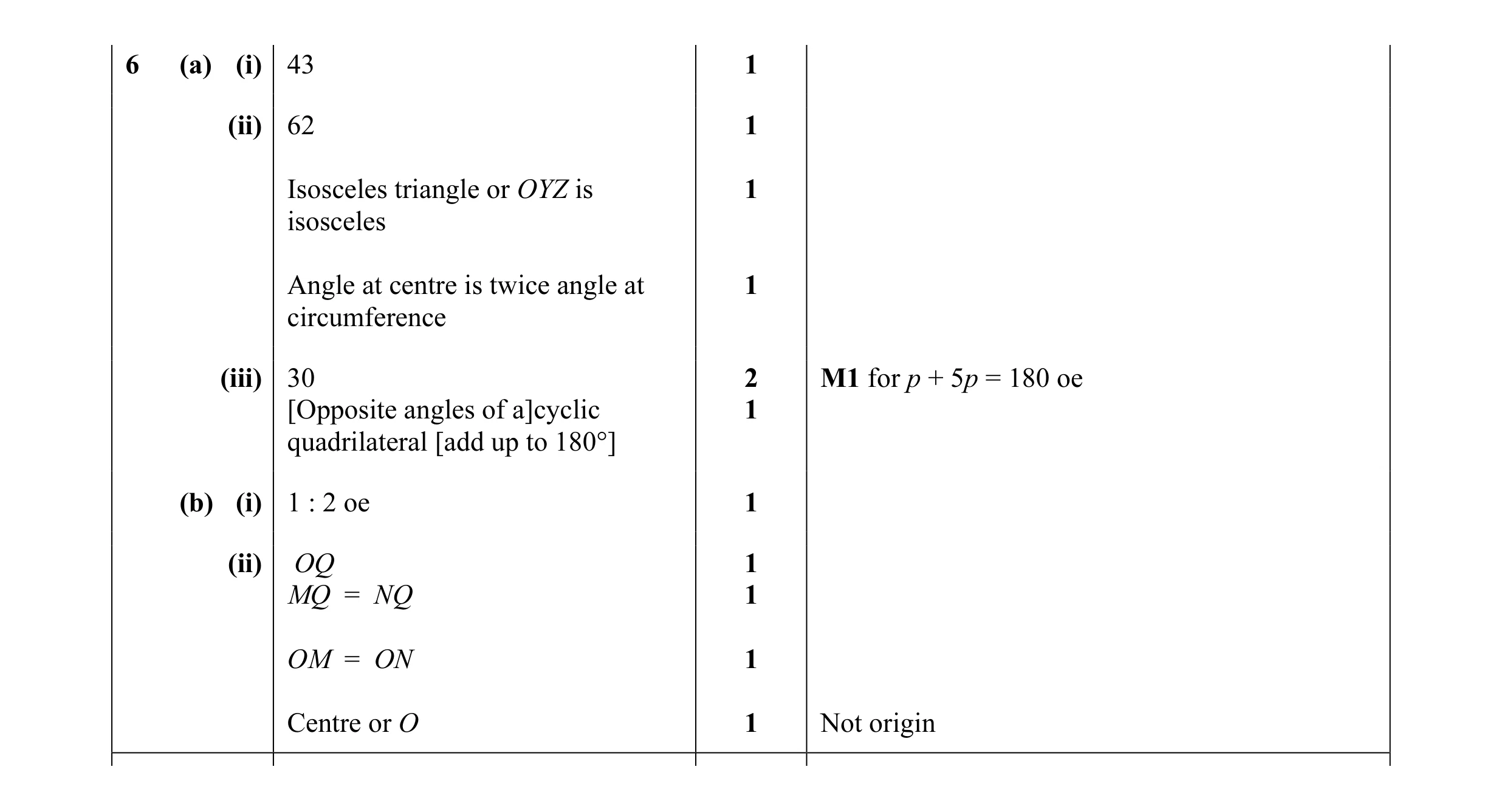 12
12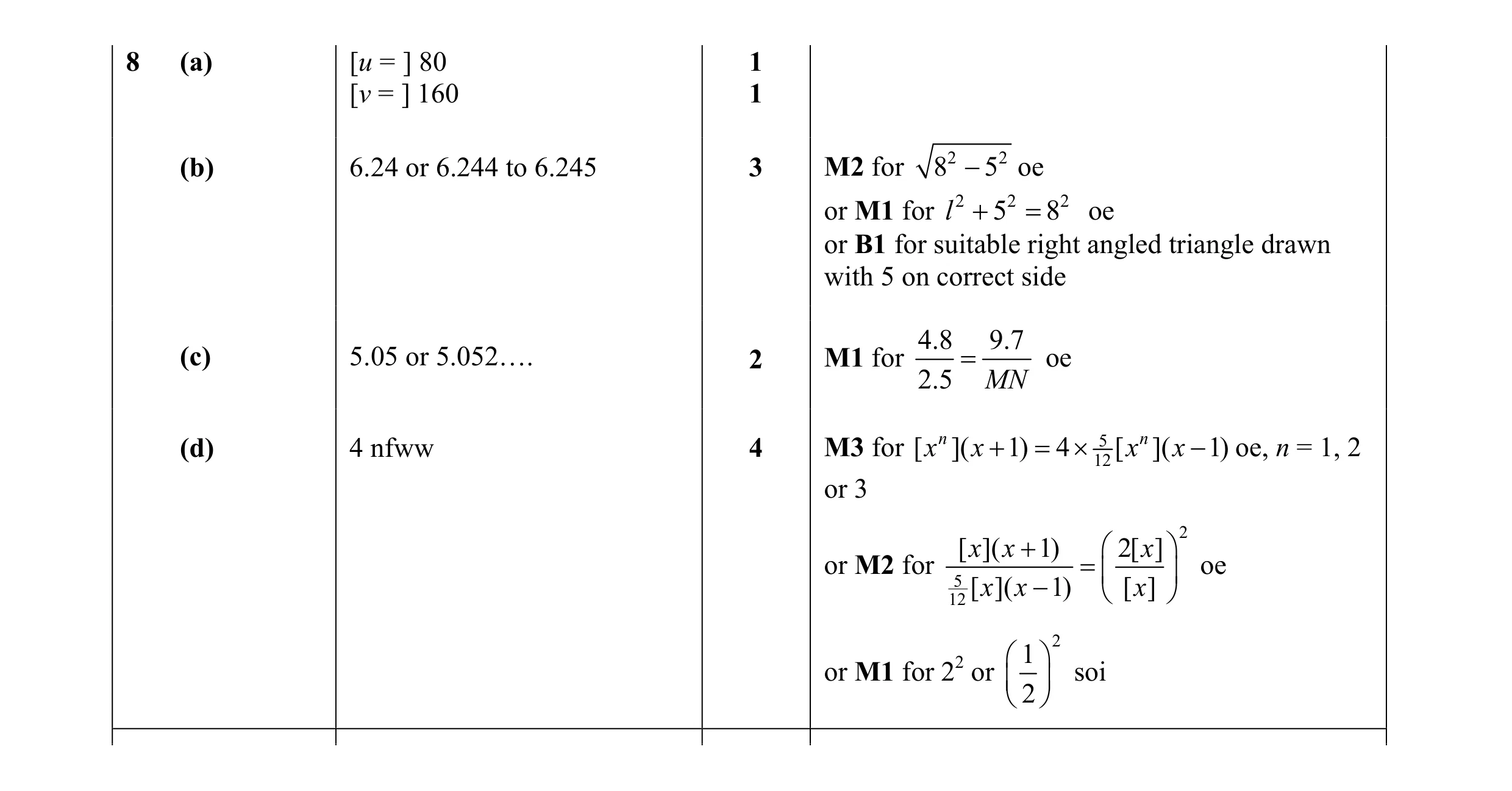 11
11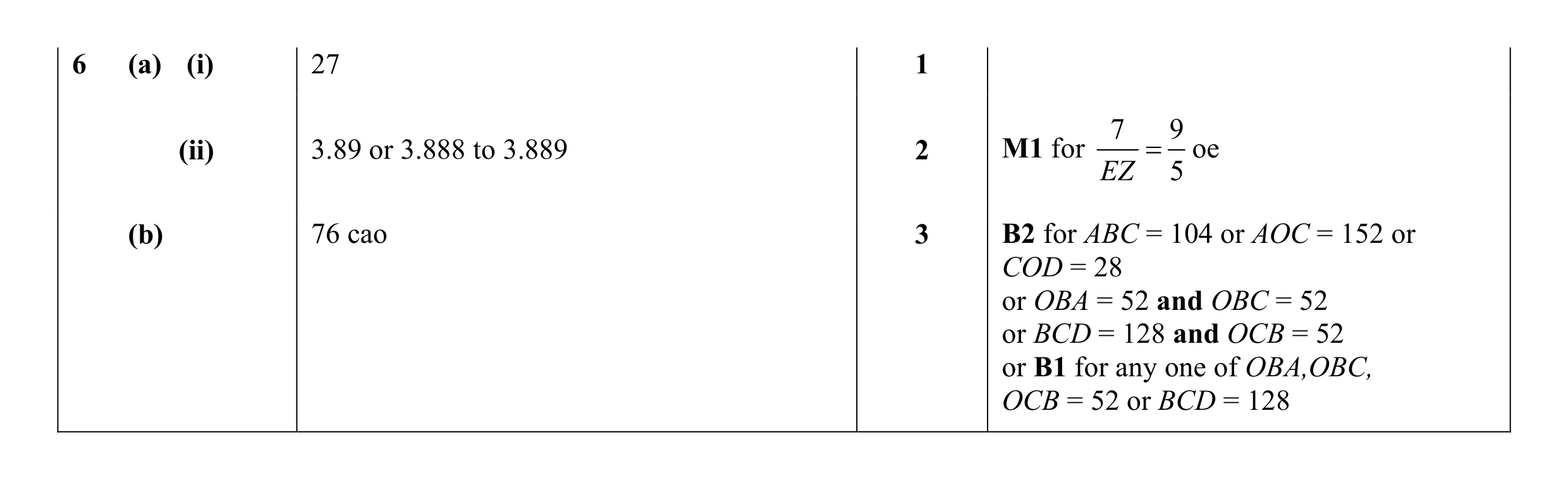 11
11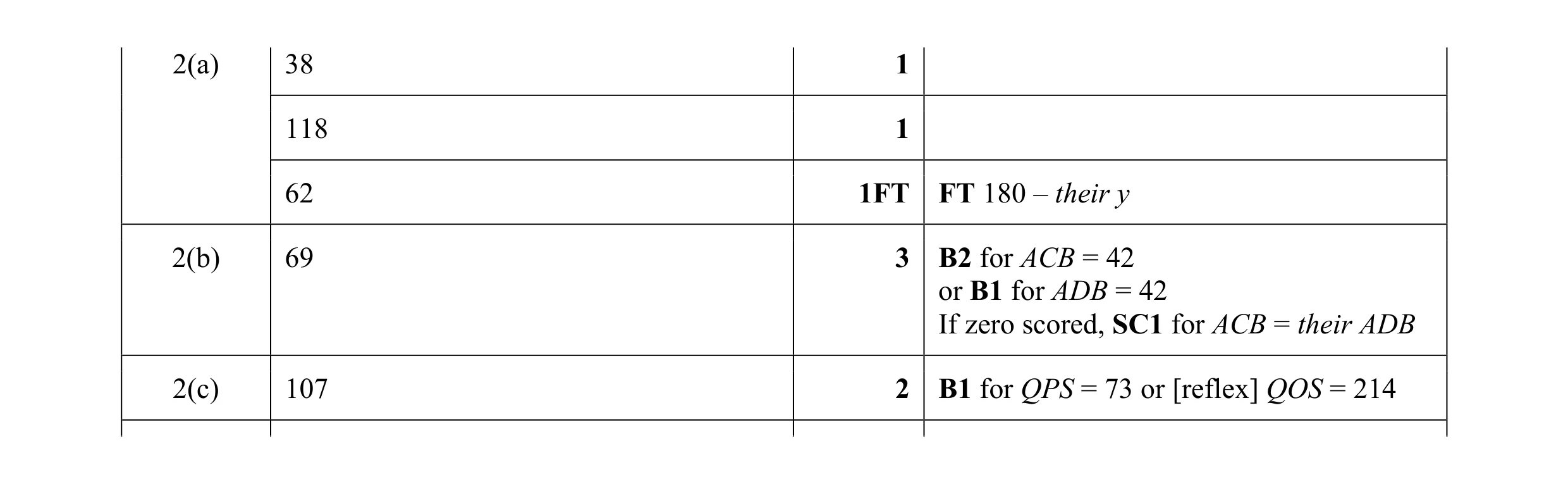 8
8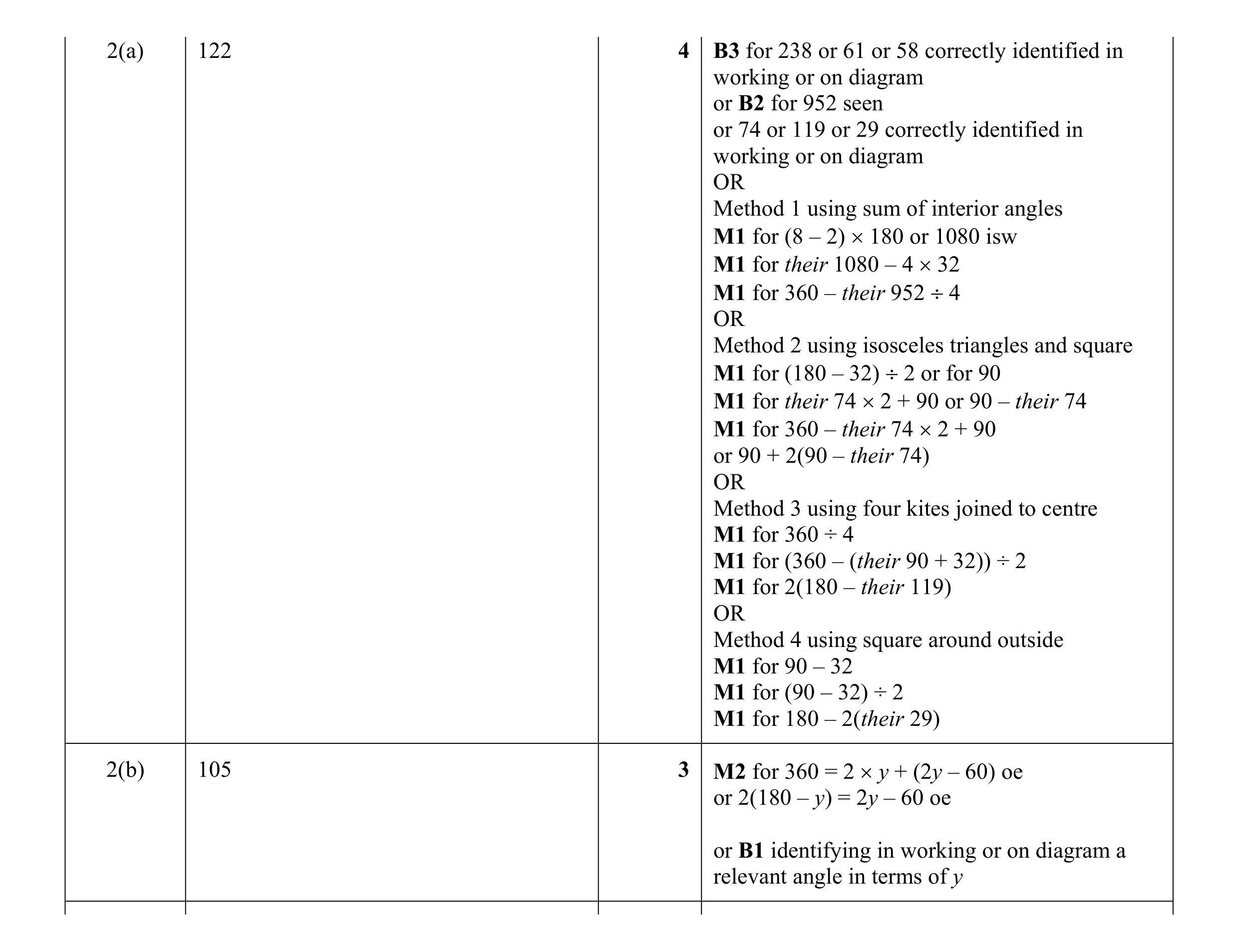 7
7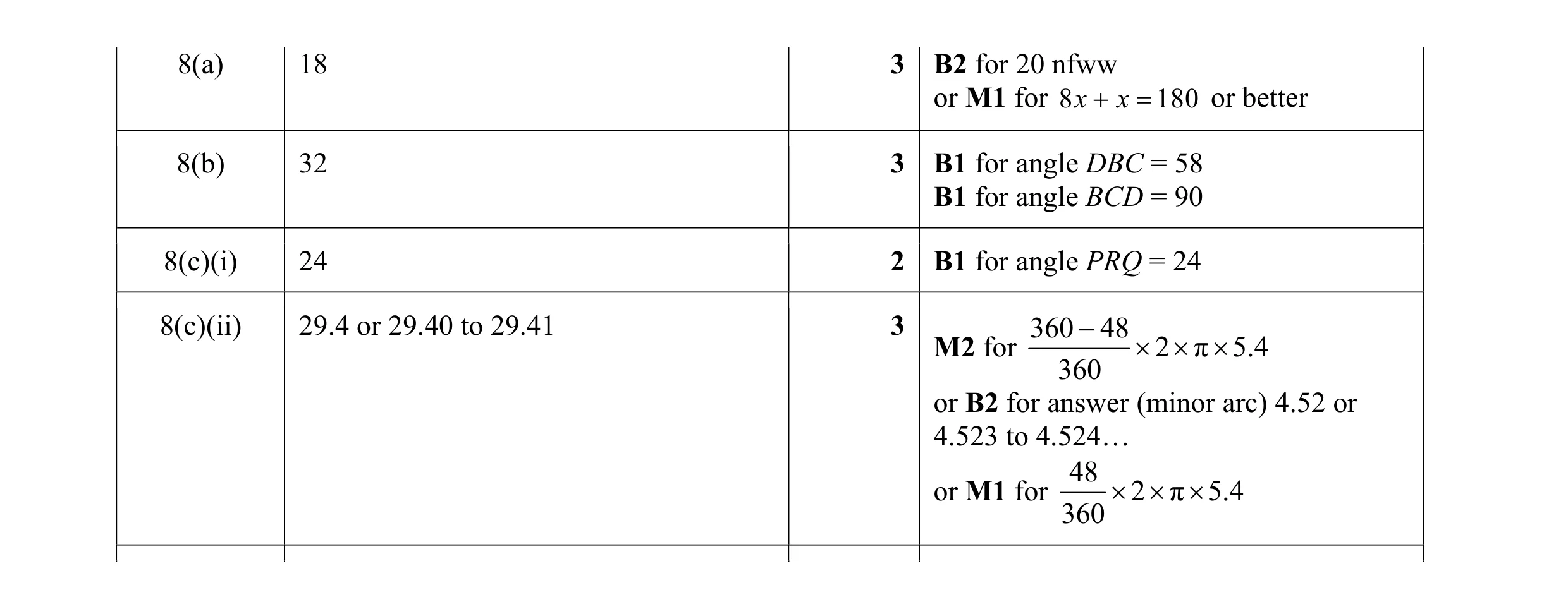 11
11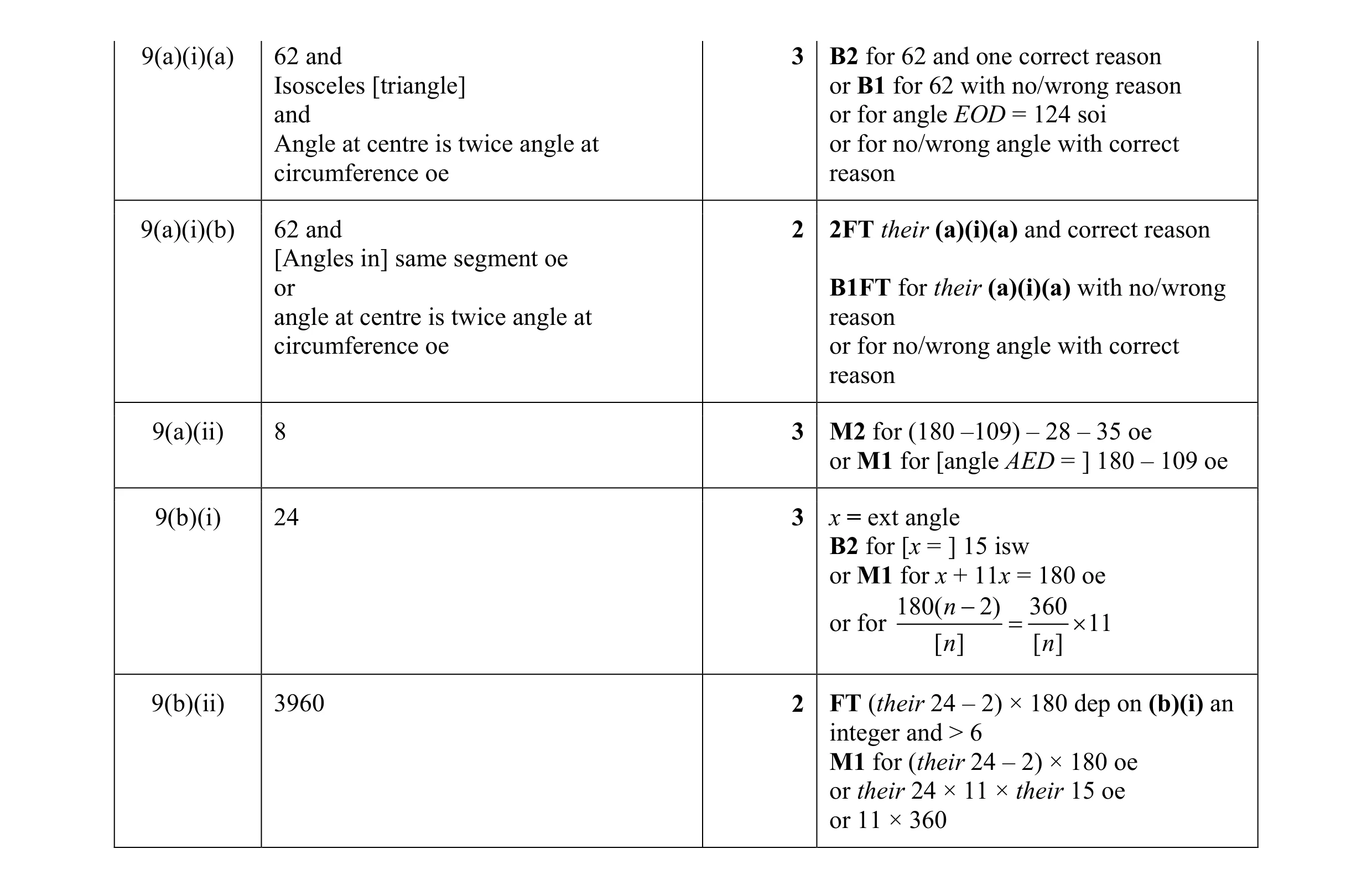 13
13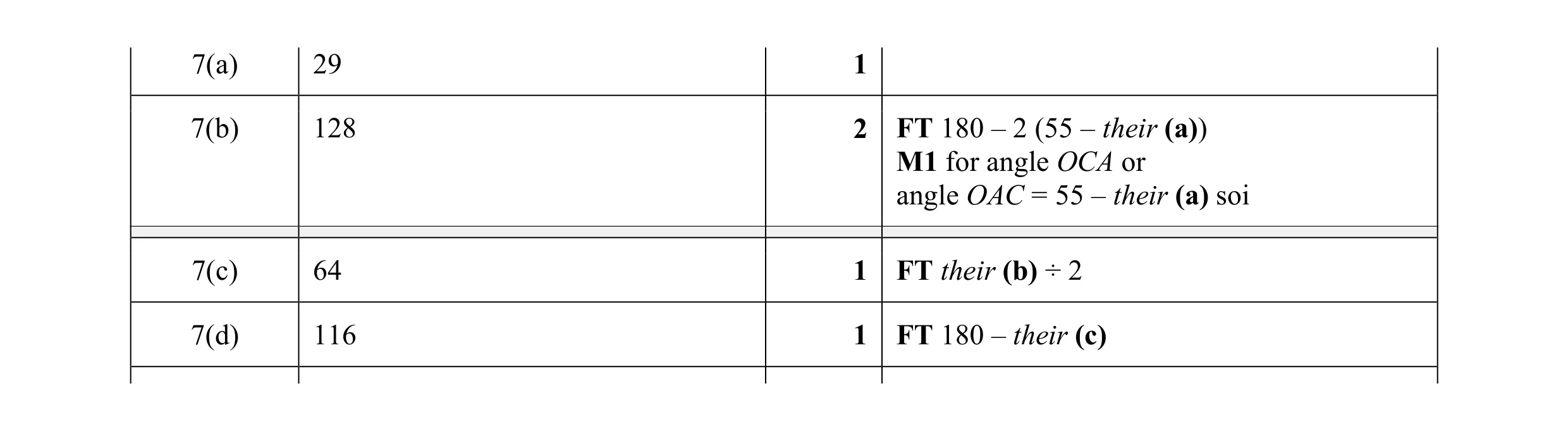 5
5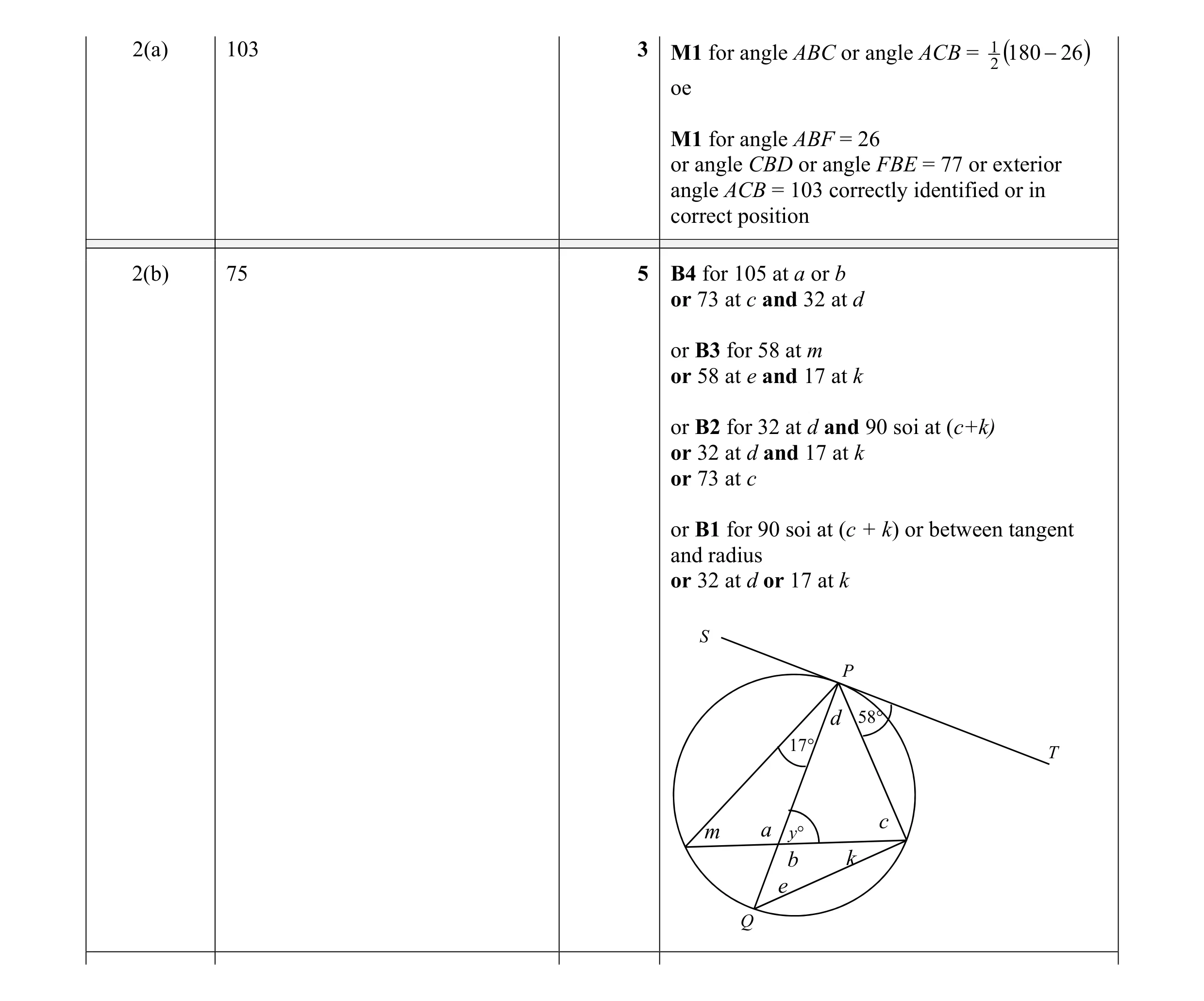 8
8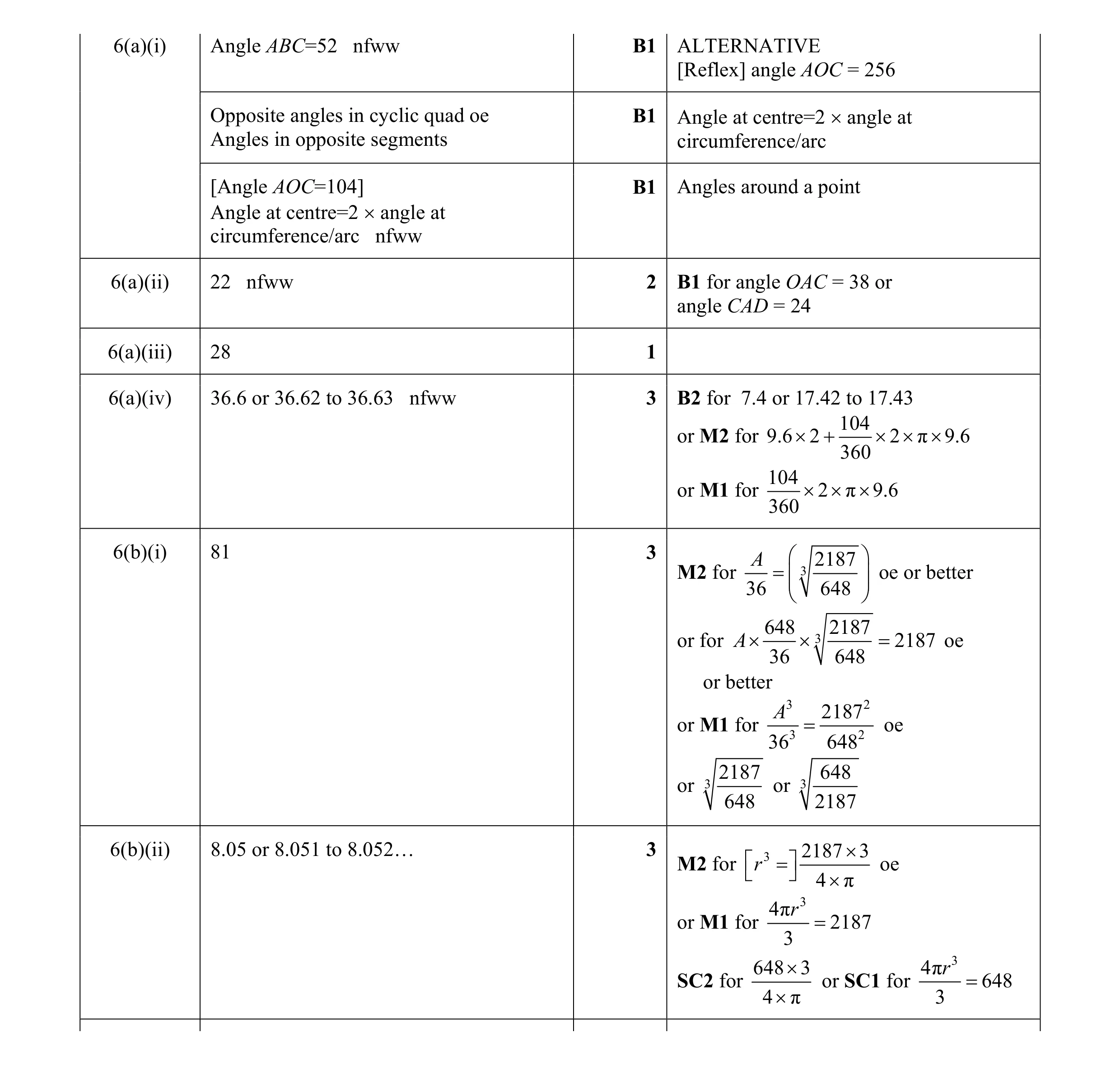 15
15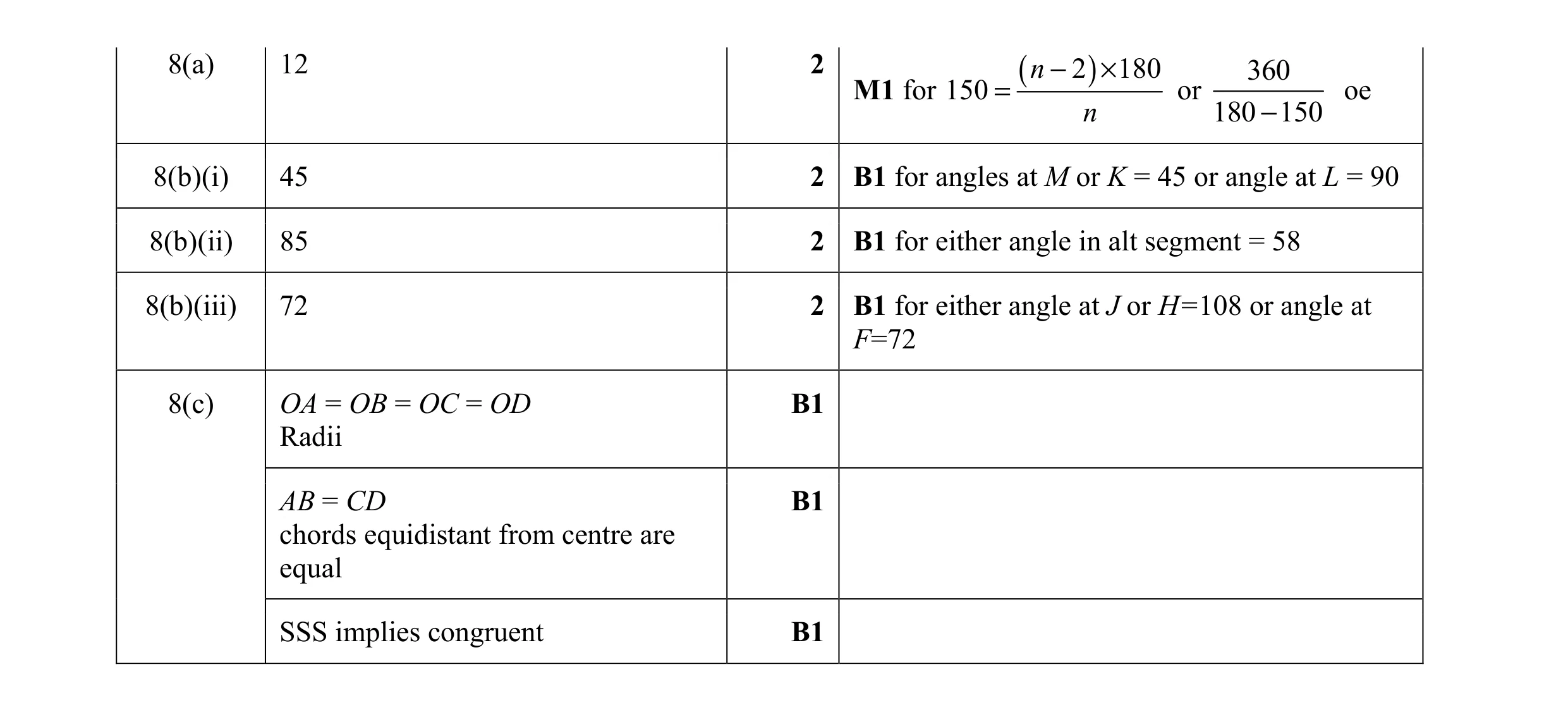 11
11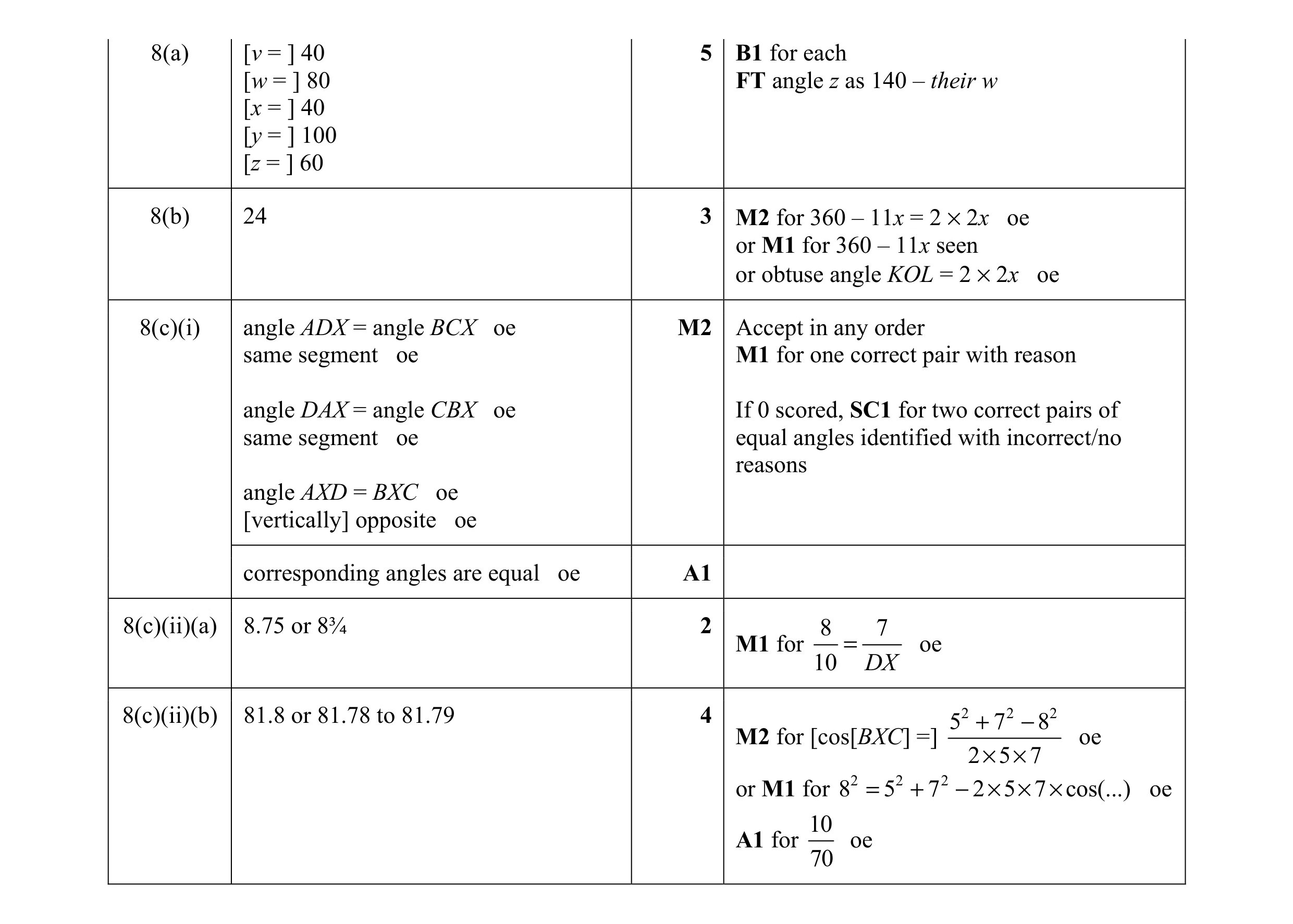 17
17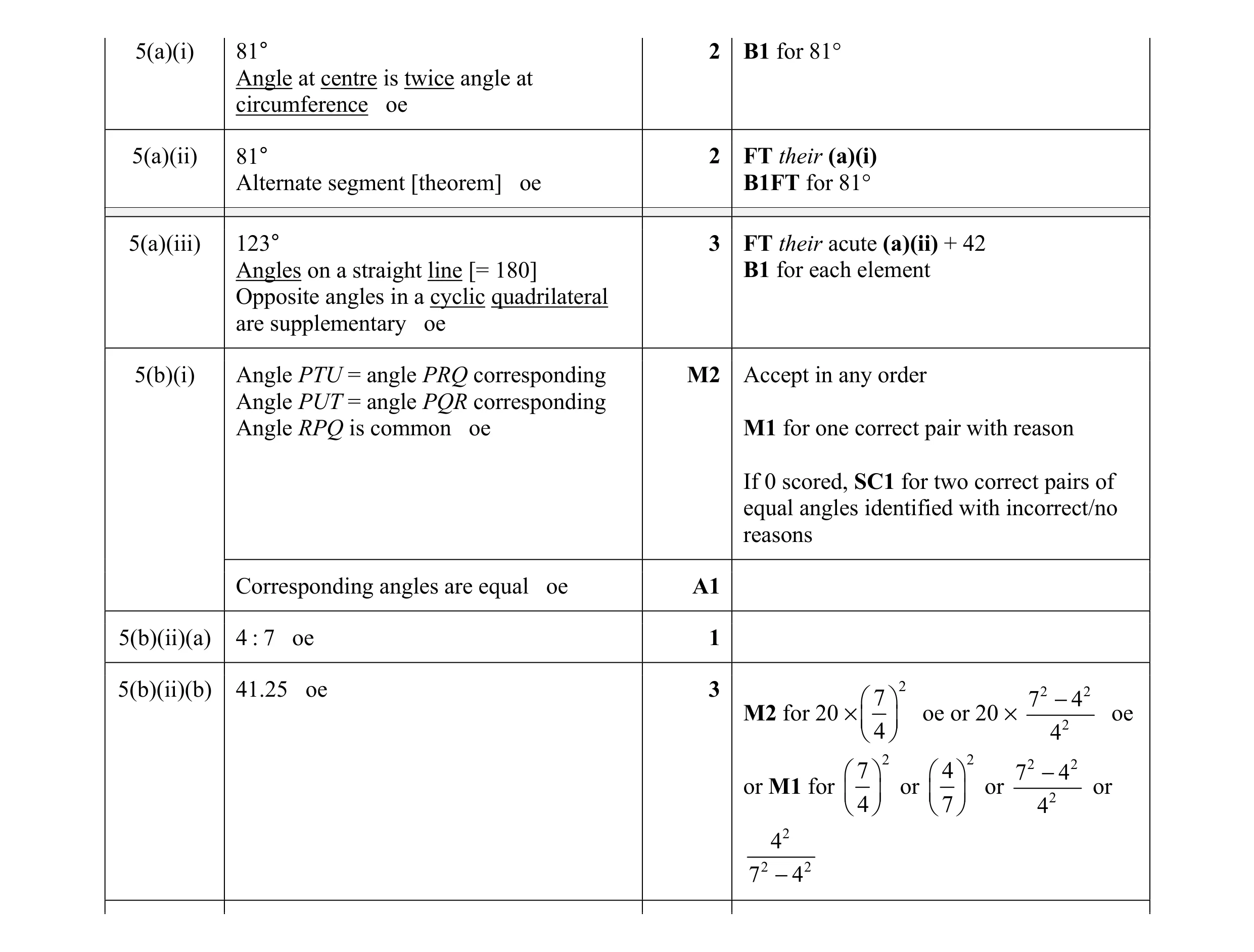 14
14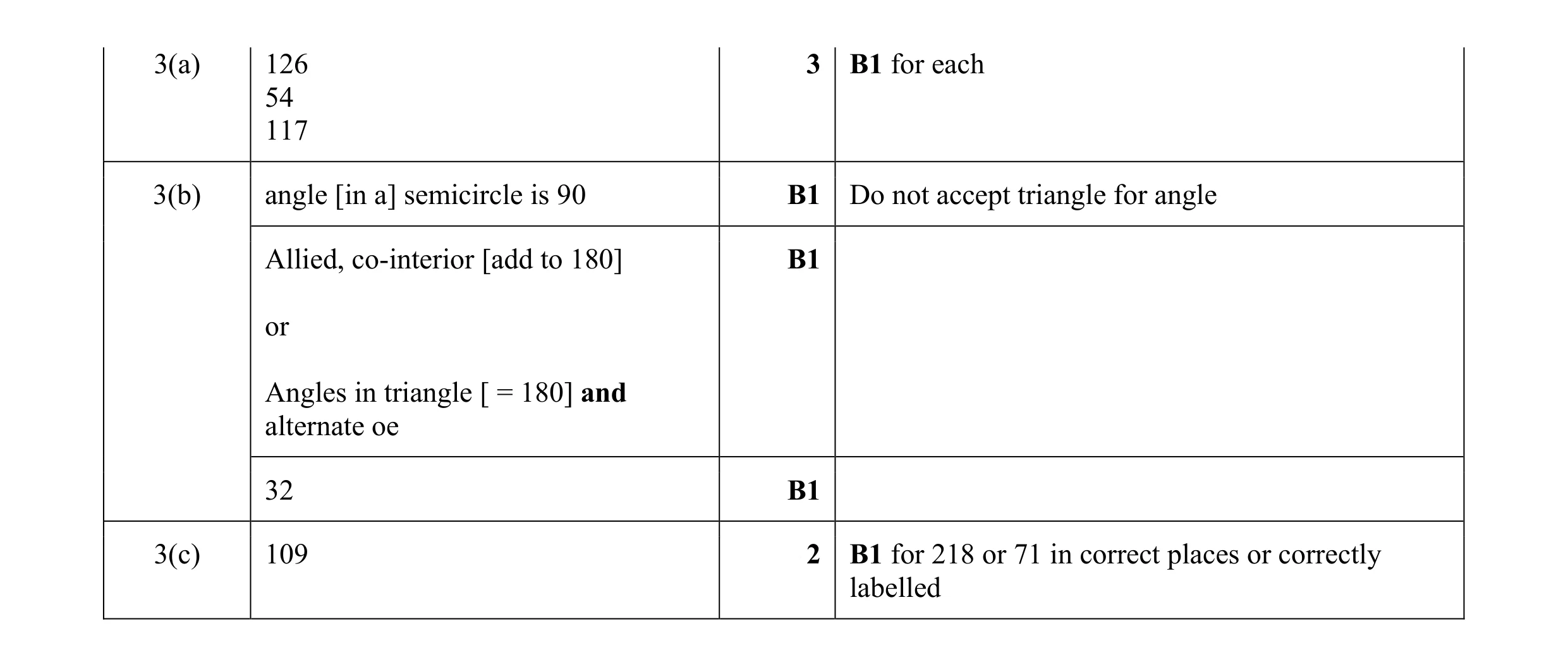 8
8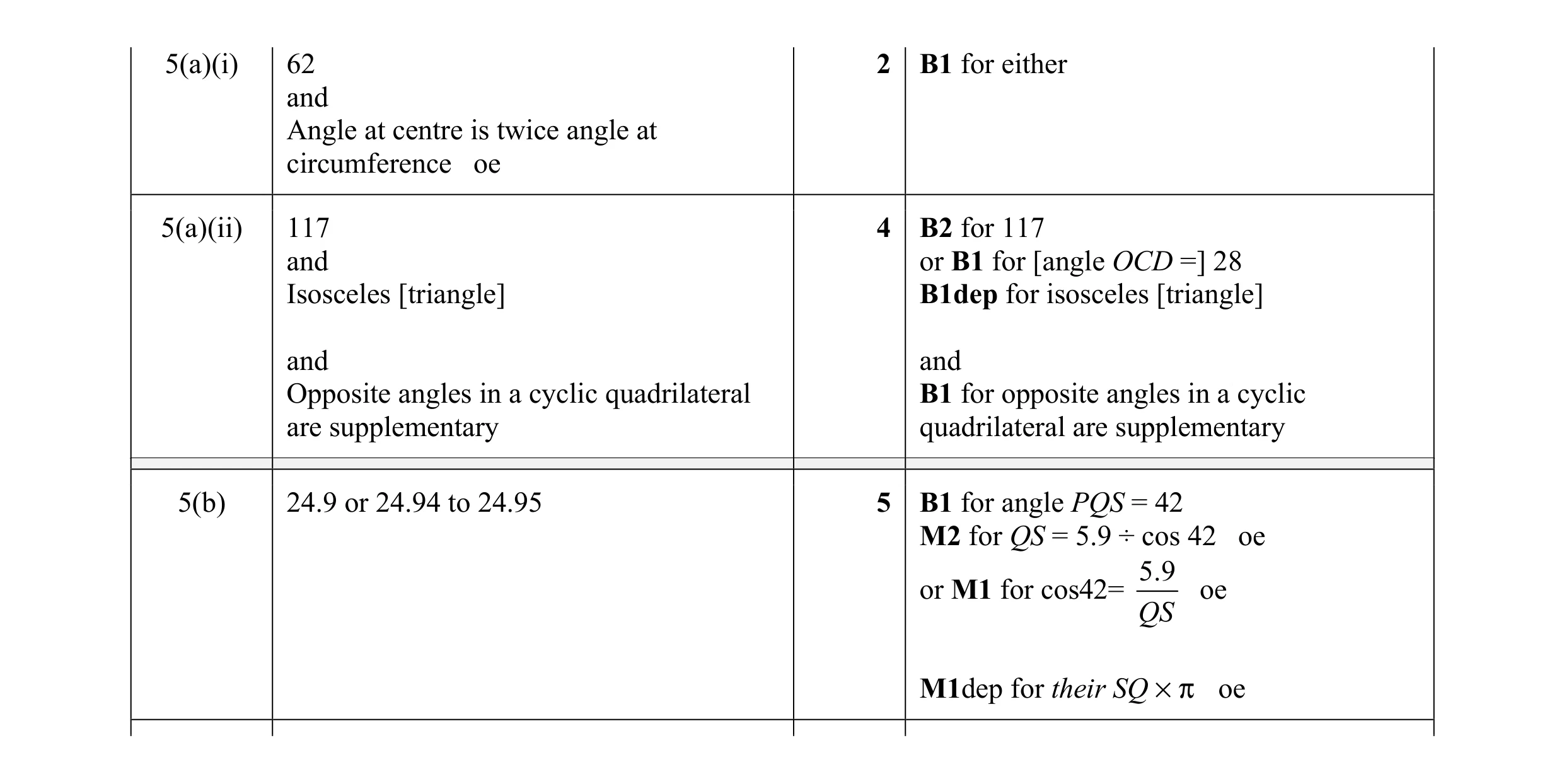 11
11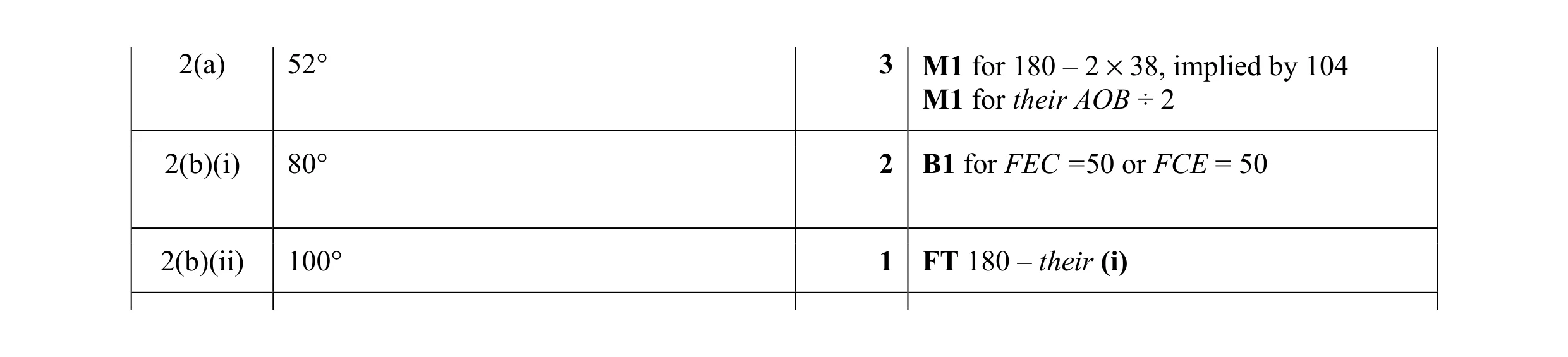 6
6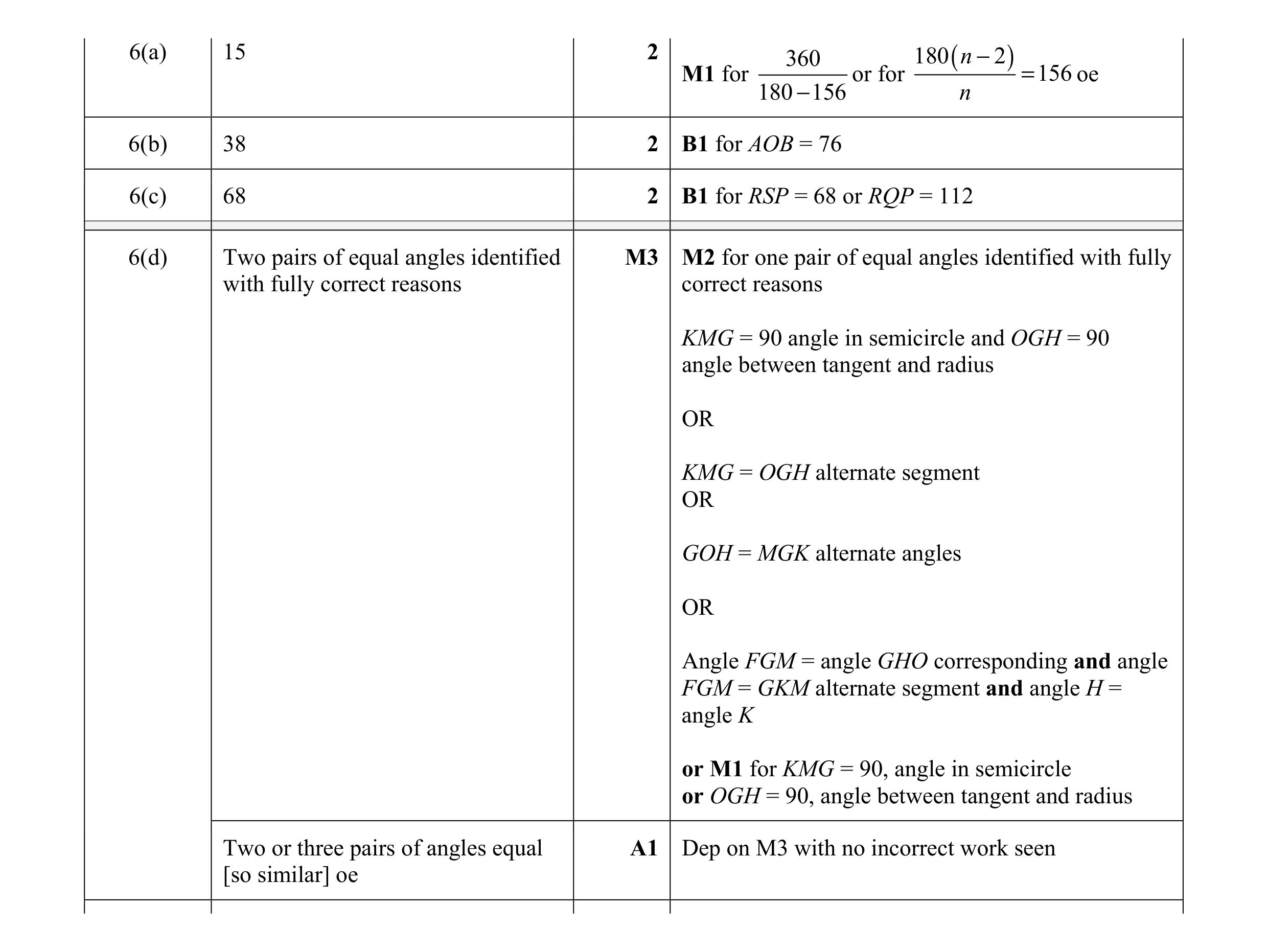 10
10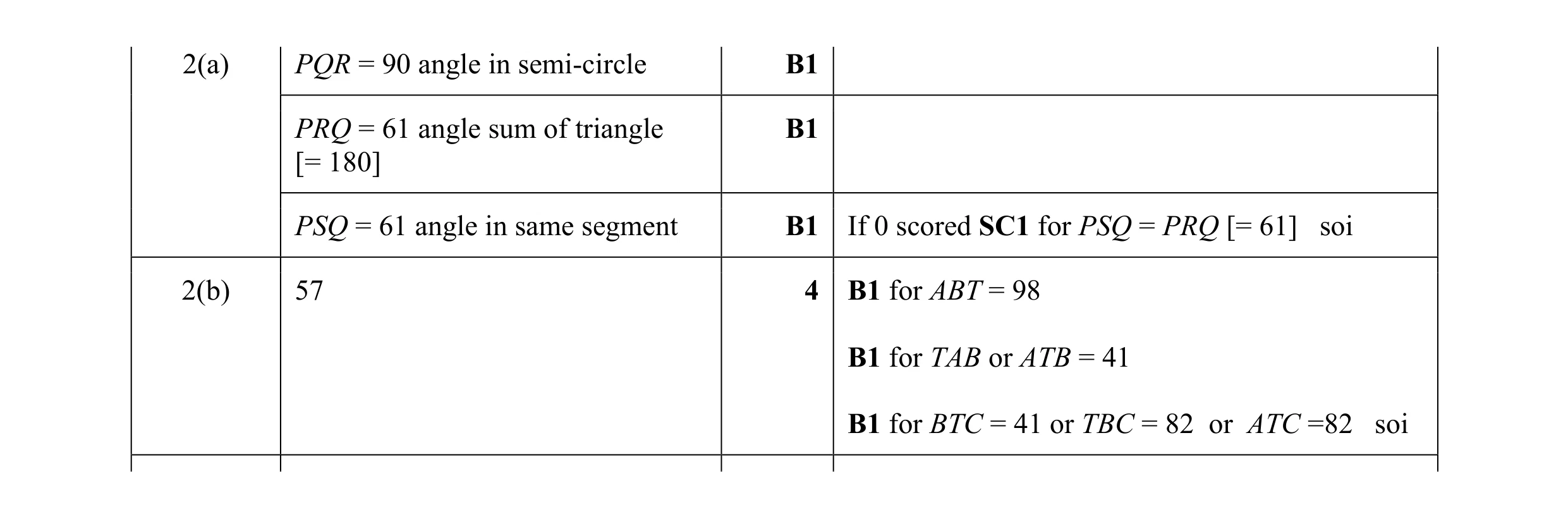 7
7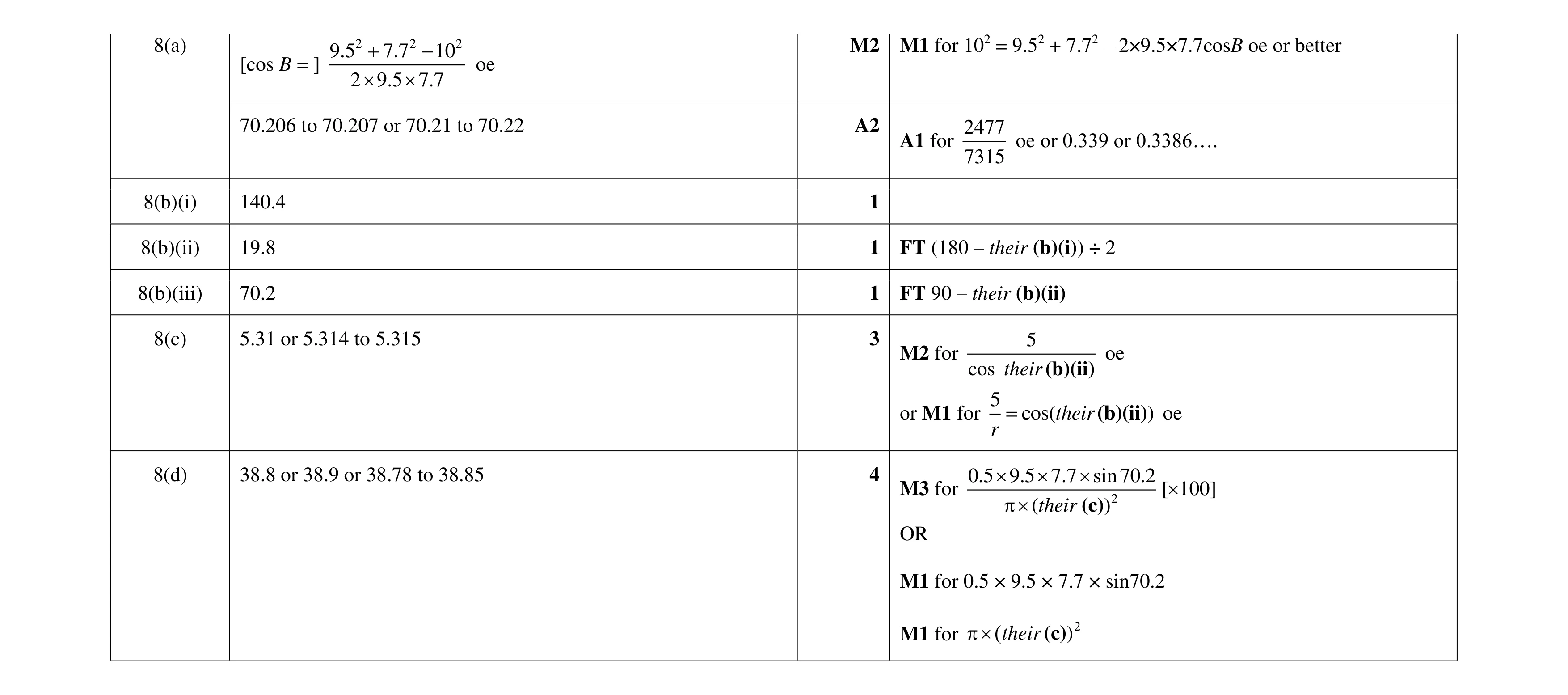 14
14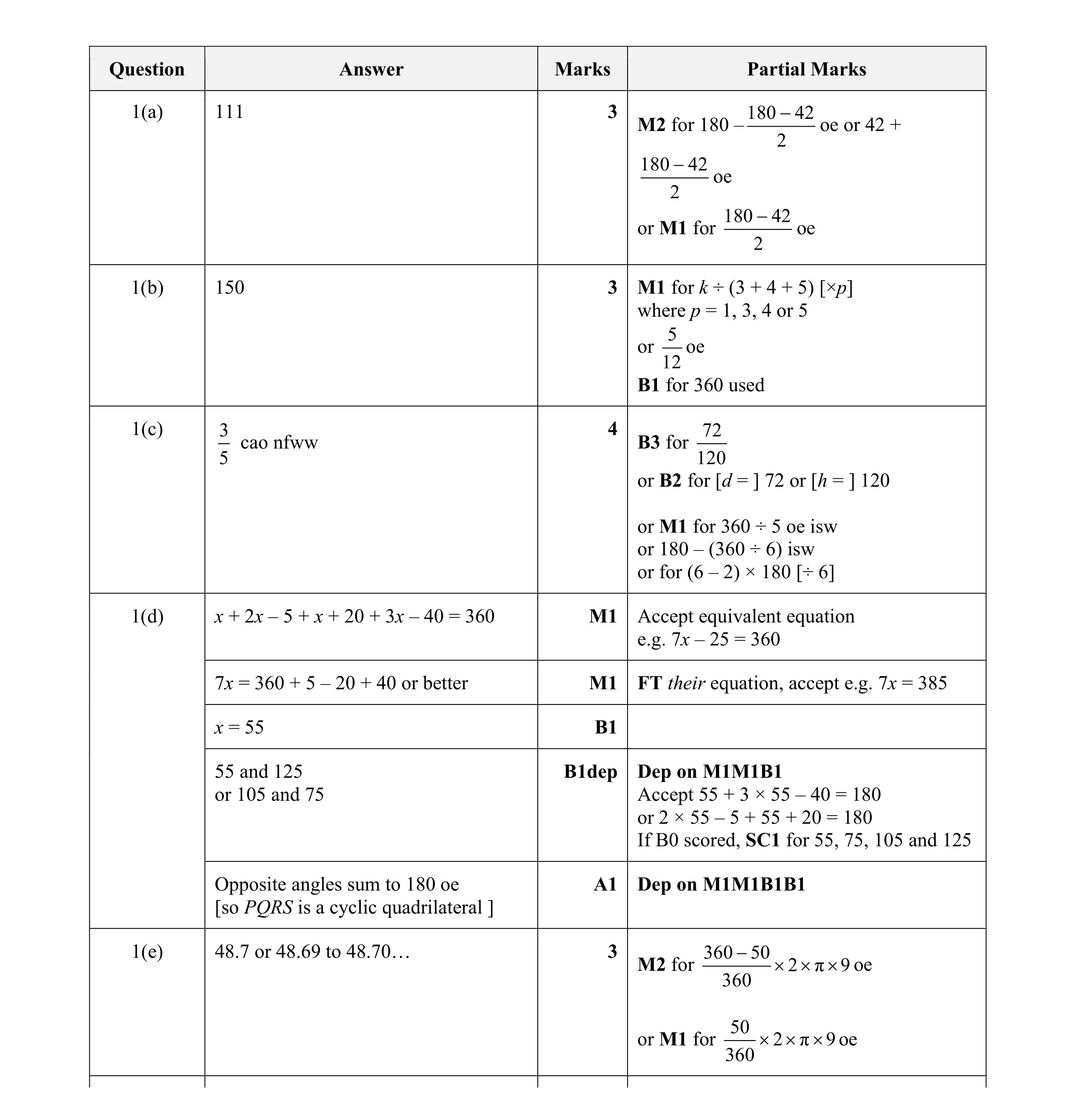 18
18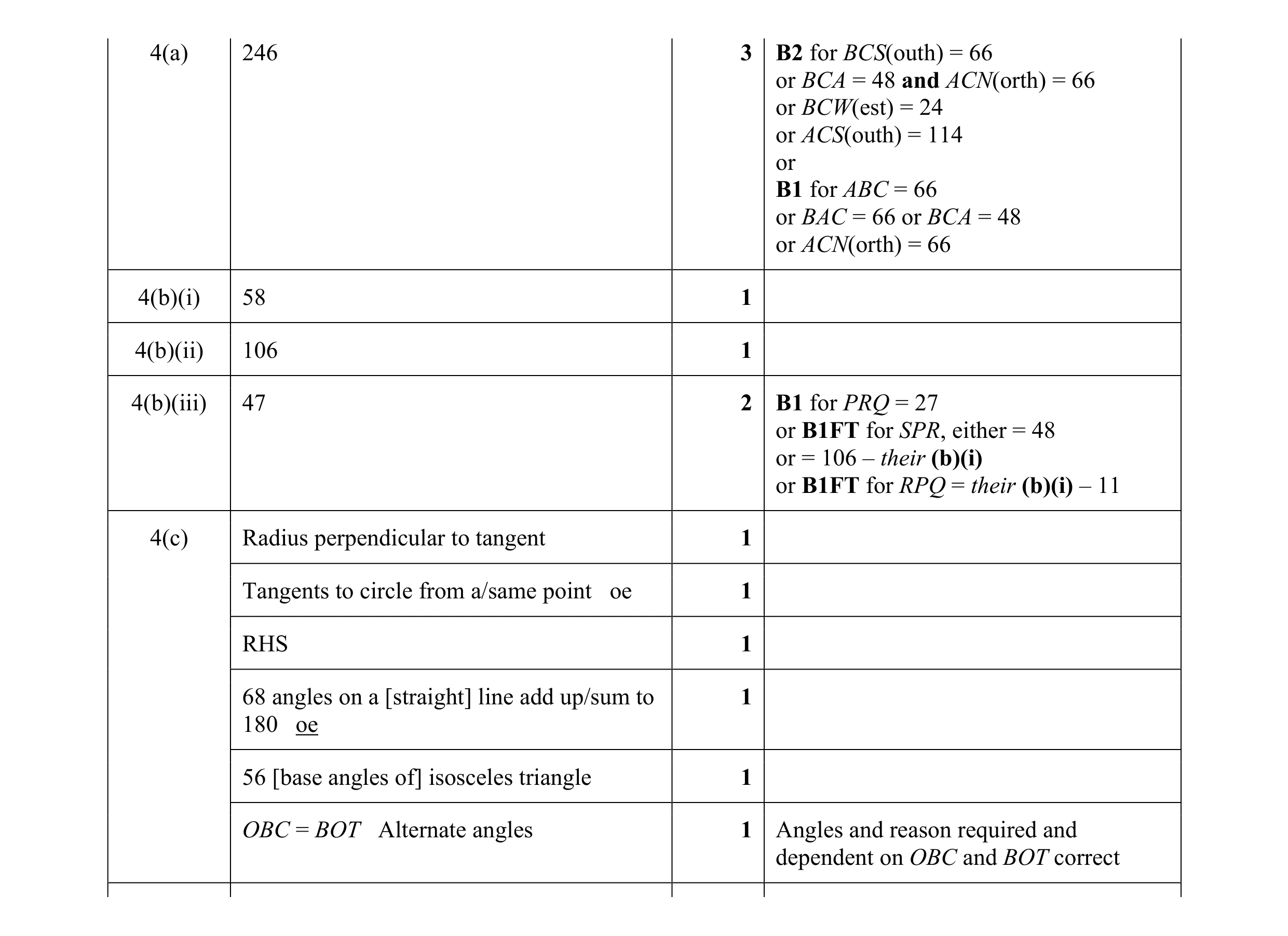 13
13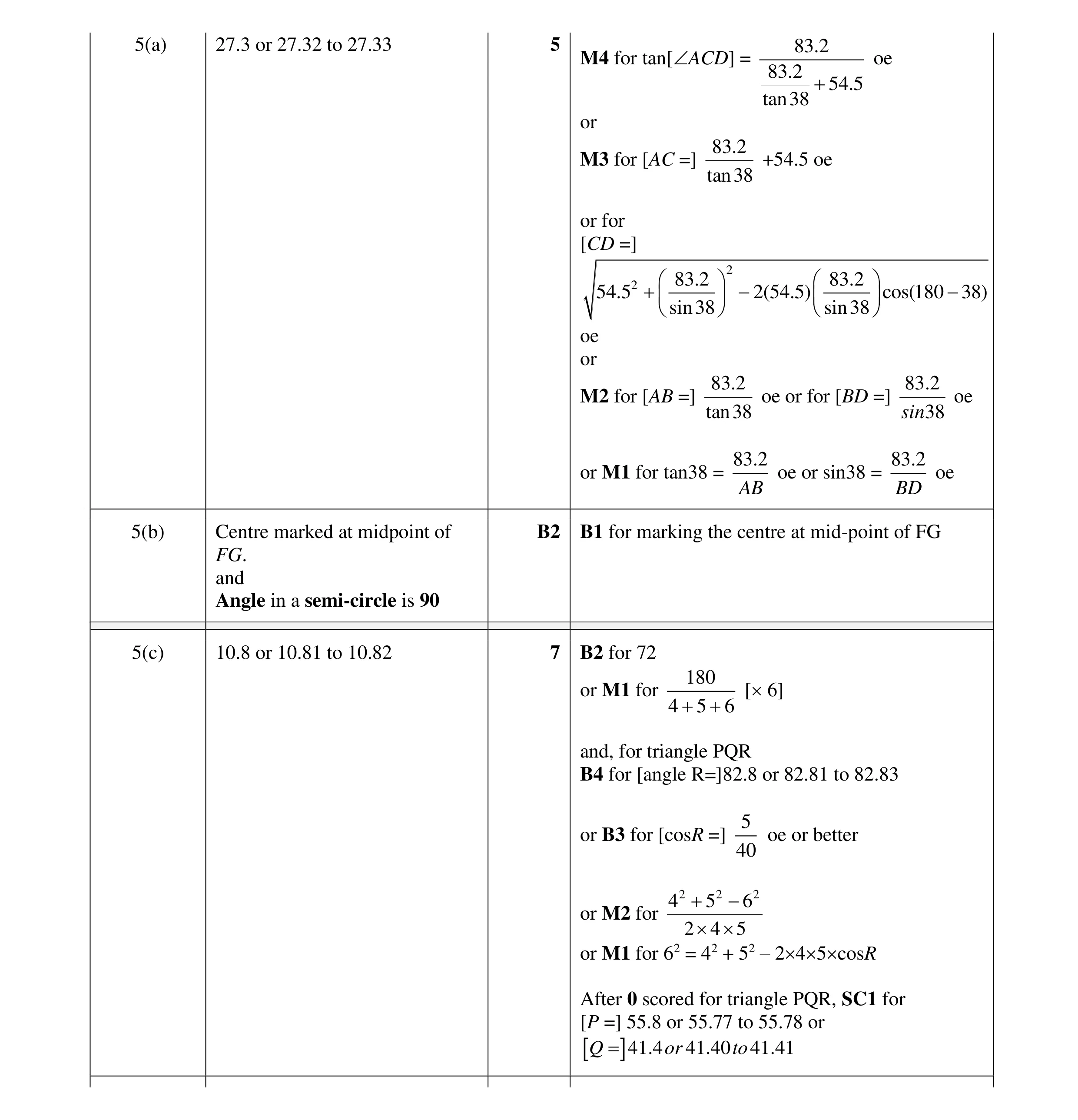 14
14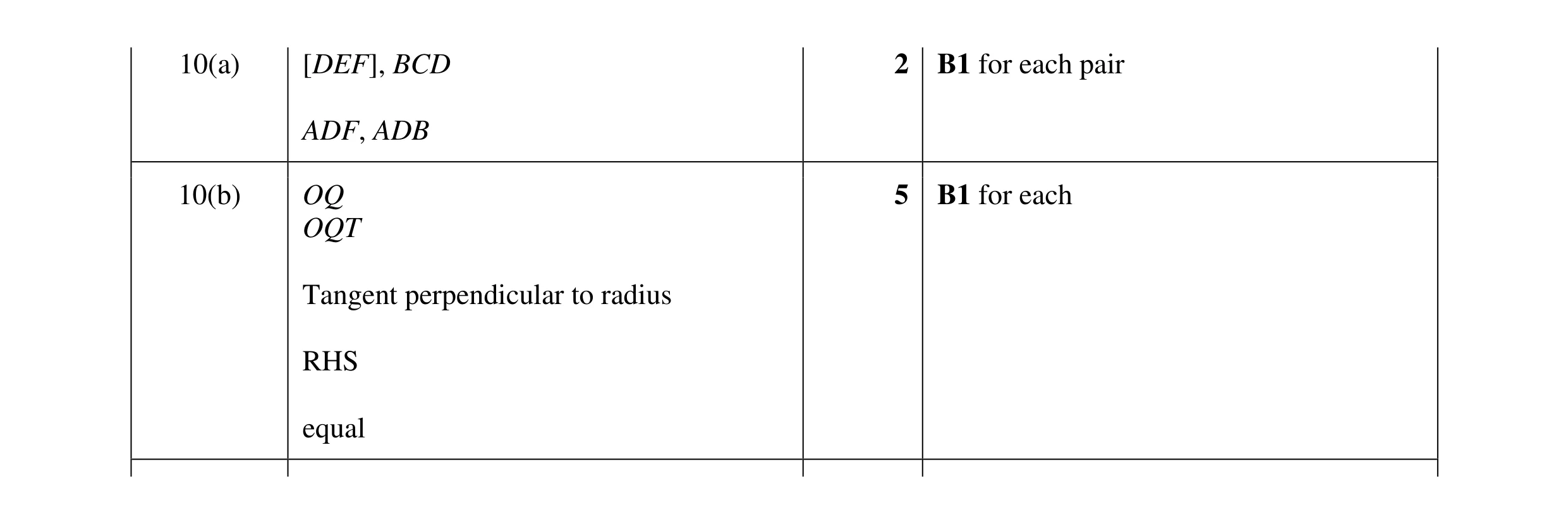 7
7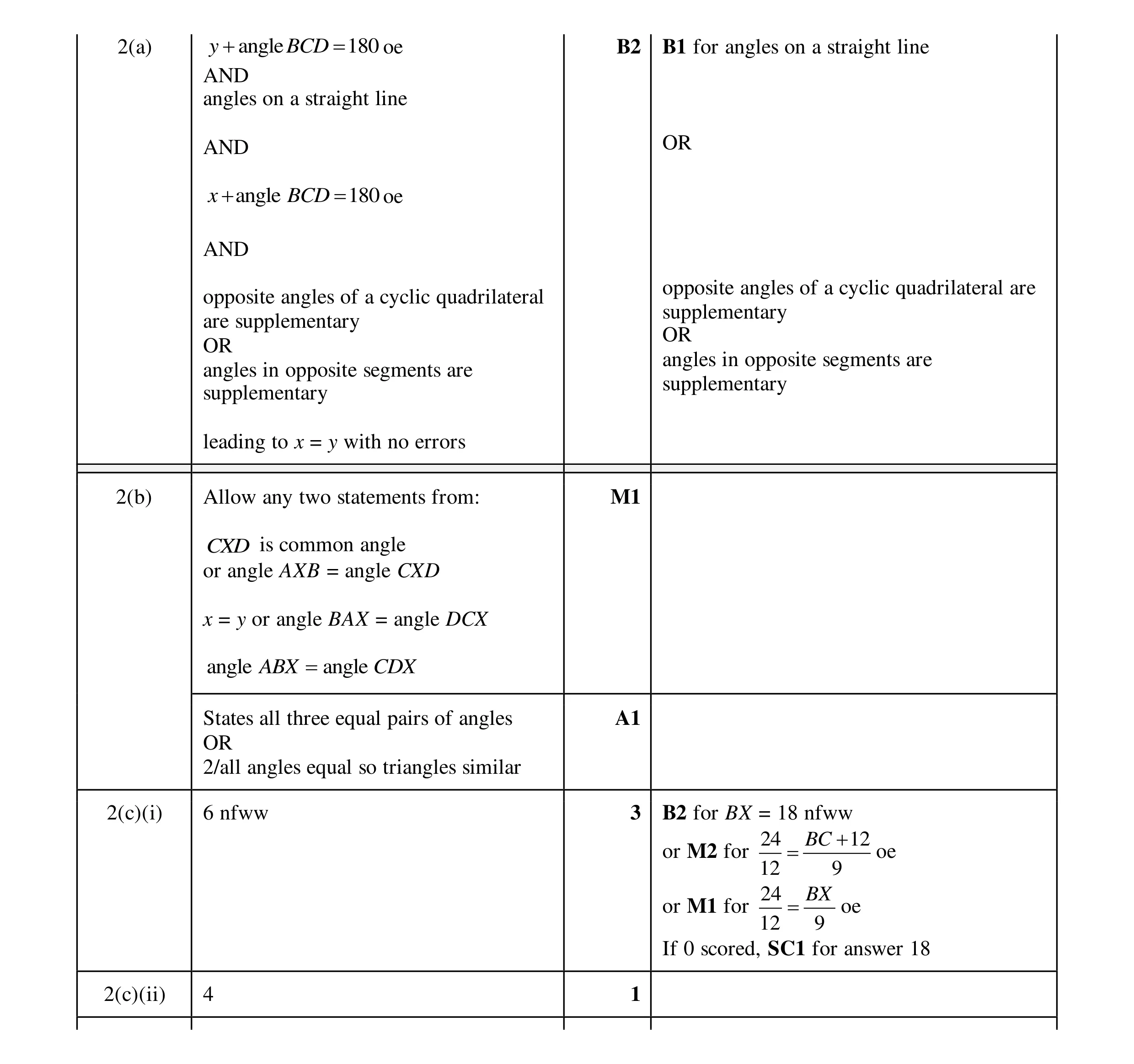 8
8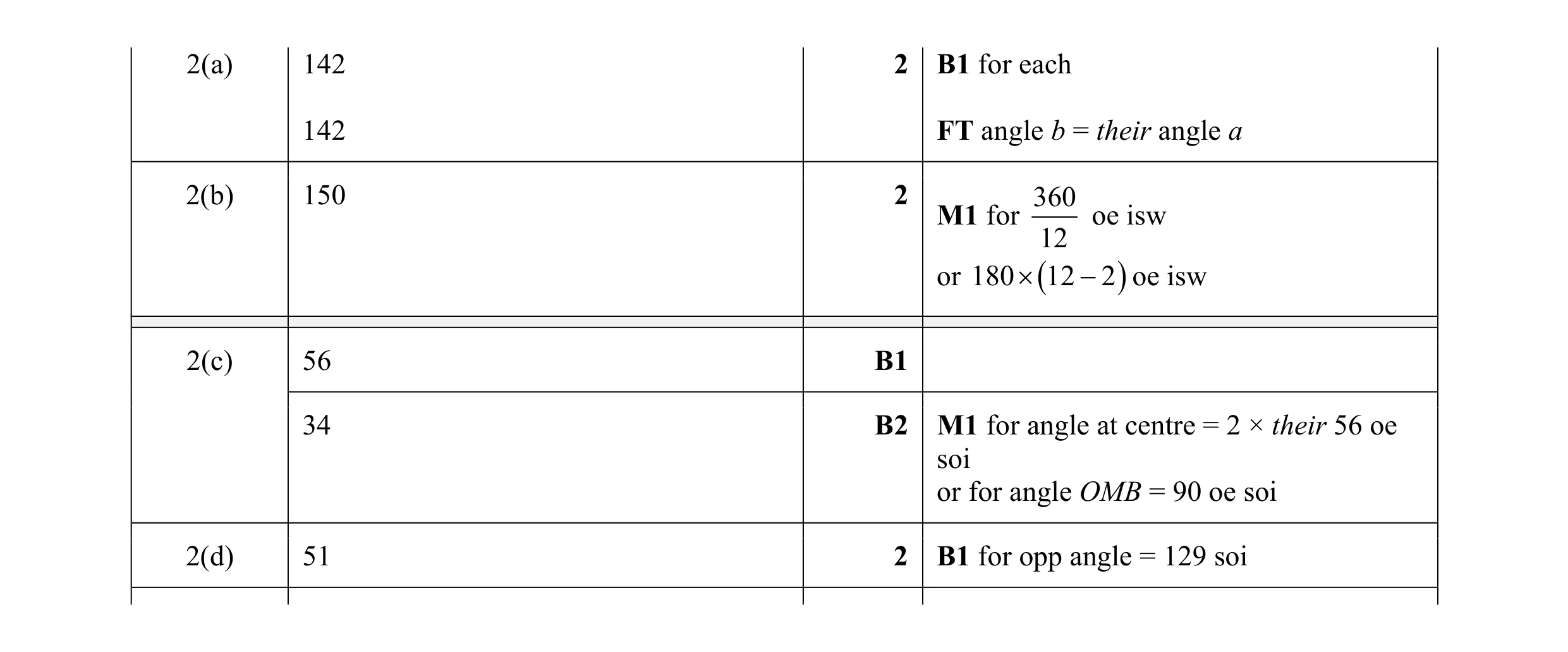 9
9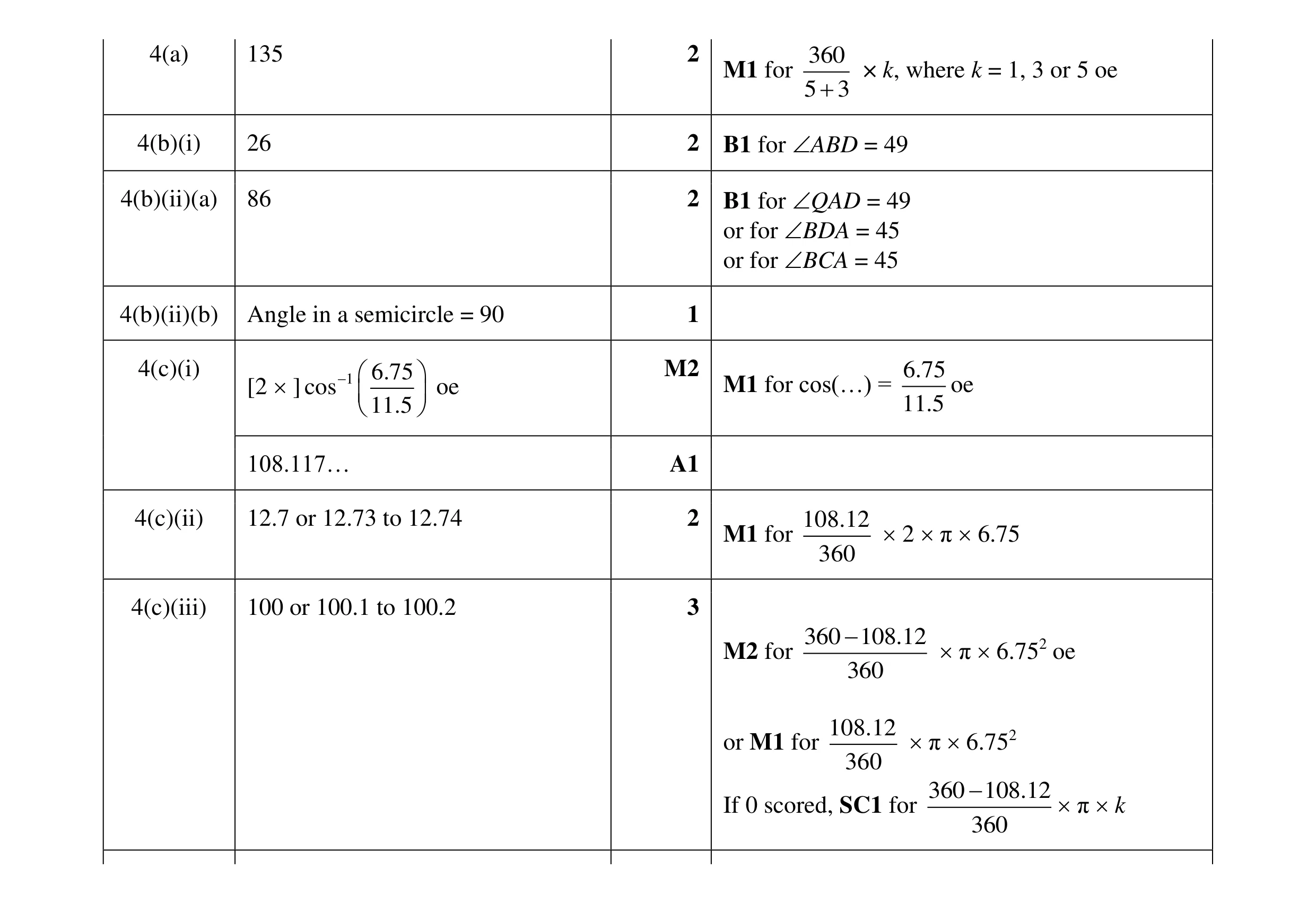 15
15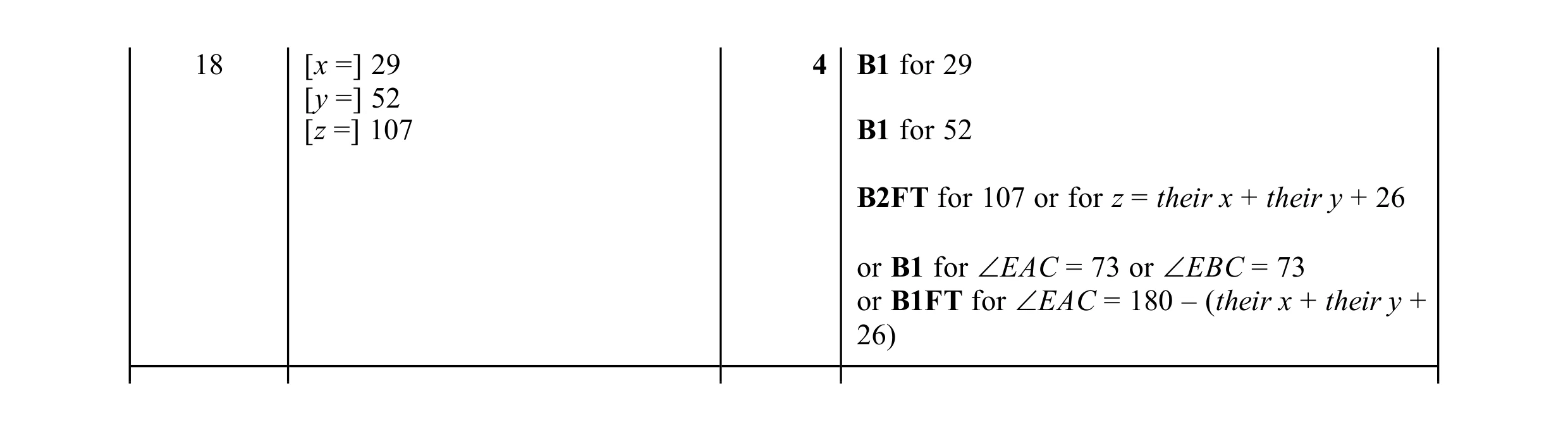 4
4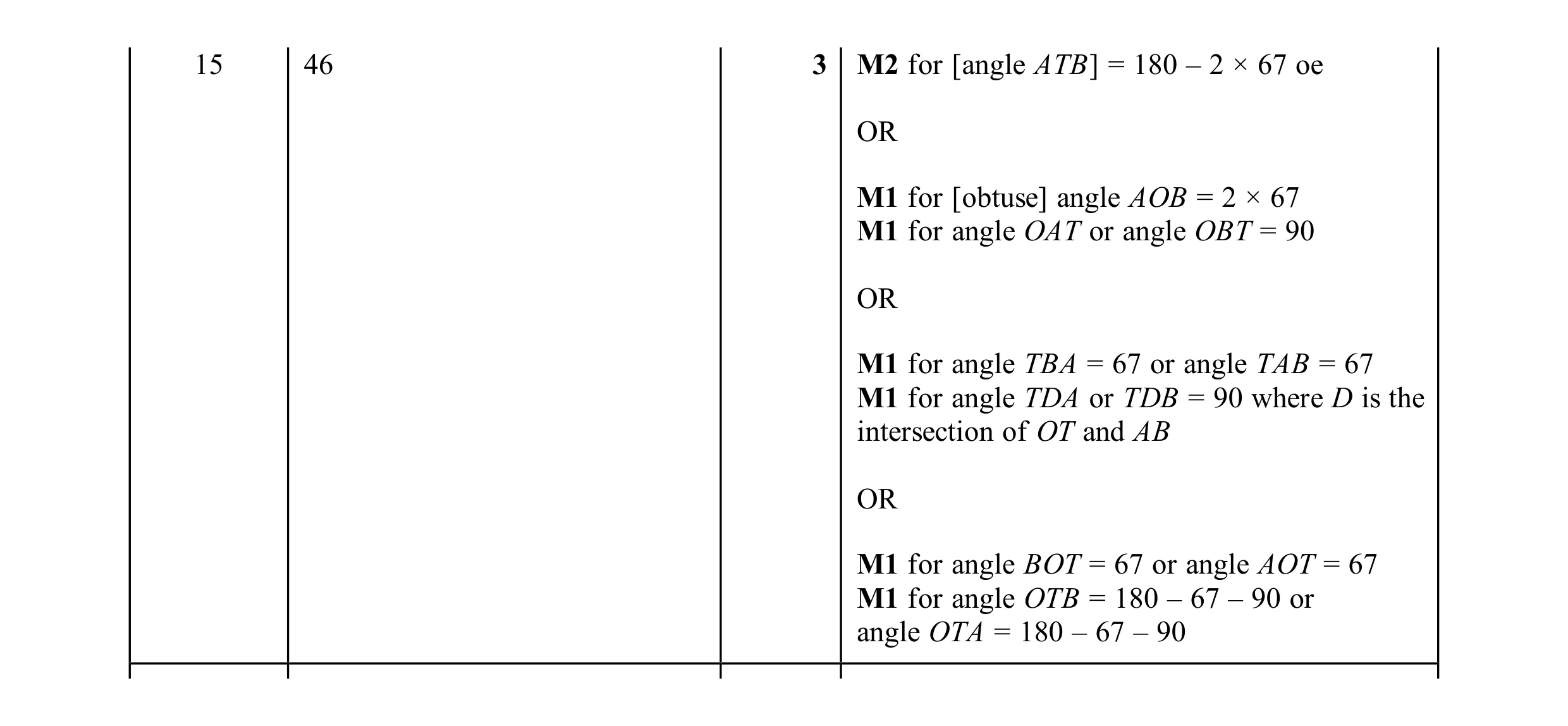 3
3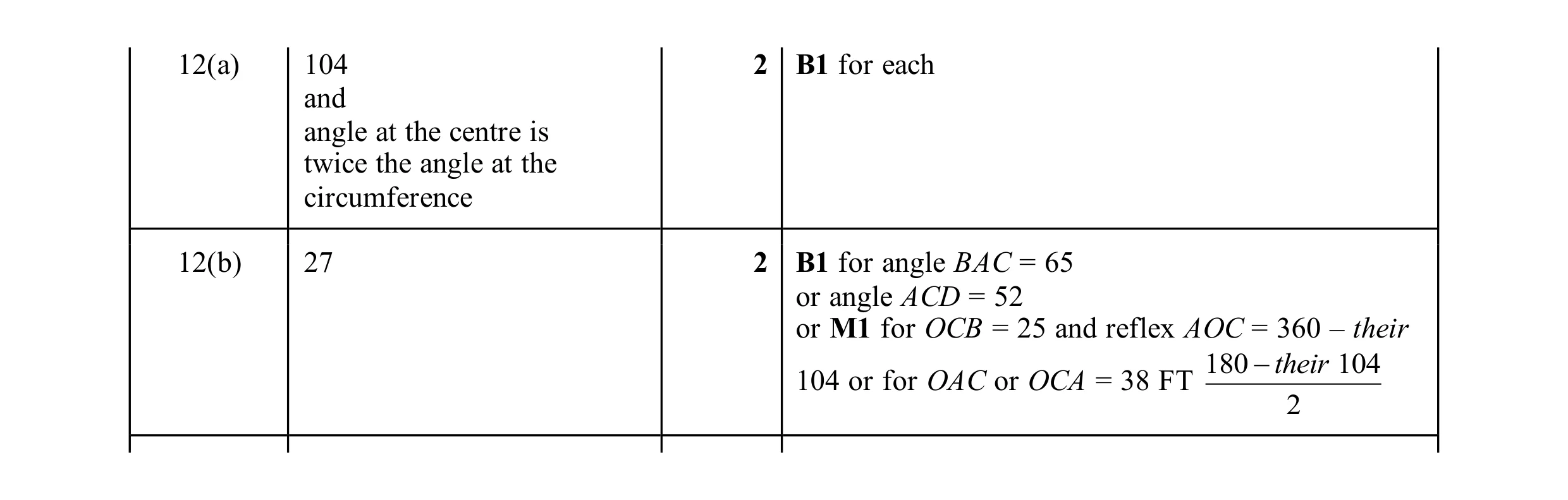 4
4