Cambridge IGCSE Mathematics 0580 — 2014 Oct/Nov Paper 4 · Variant 3
0580/43/O/N/14 · 8 questions · 130 marks · ≈146 min
The question paper and its mark scheme, free to read here and free to download. This is Cambridge’s own paper, exactly as it was sat.
Question paper16 pages
Mark scheme7 pages
Answers below. Sit the paper first if you are practising.
Questions as text
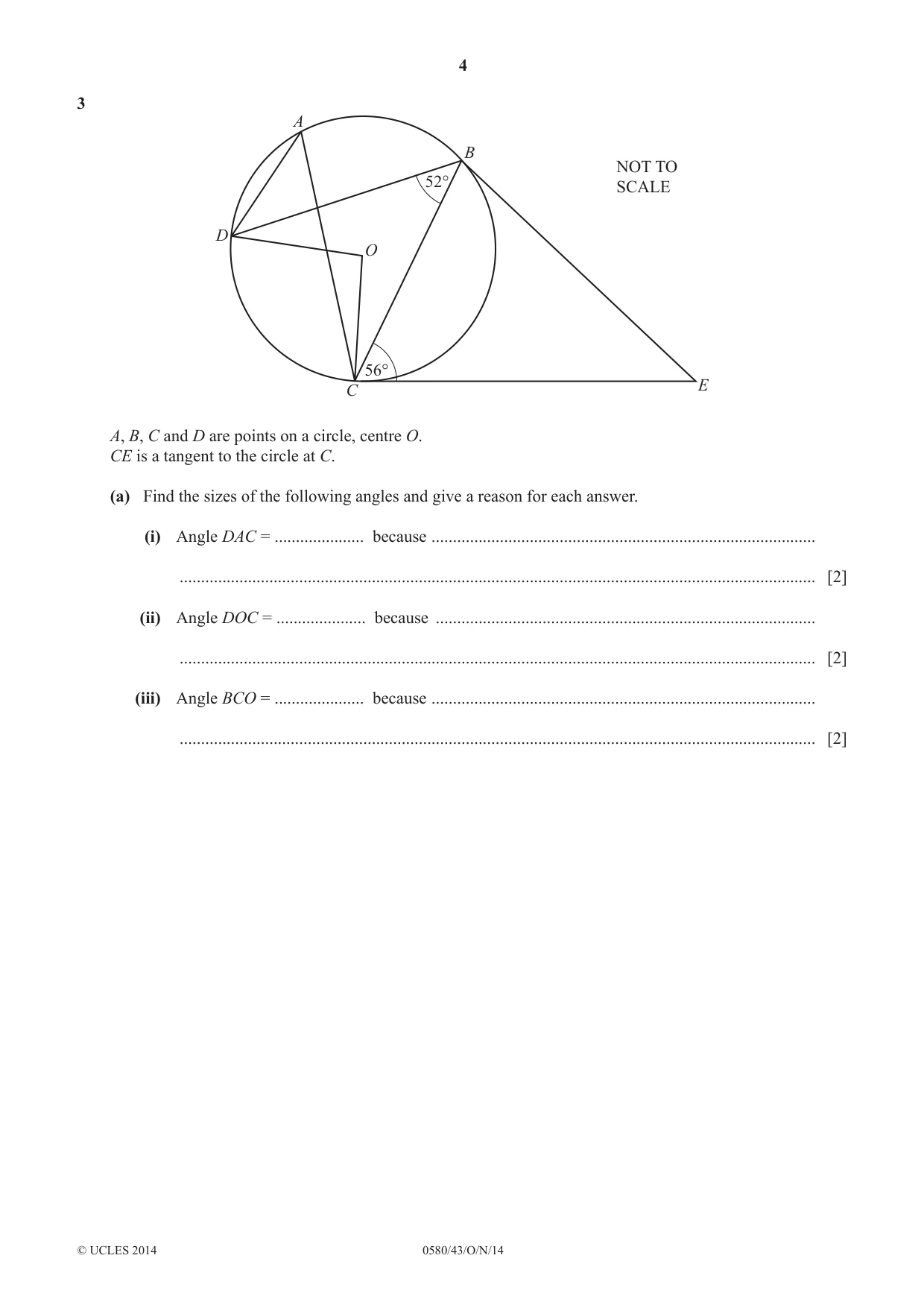
Q3 · A B NOT TO 52° SCALE D O 56° C E A, B, C and D are points on a circle, centre O
3 A B NOT TO 52° SCALE D O 56° C E A, B, C and D are points on a circle, centre O. CE is a tangent to the circle at C. (a) Find the sizes of the following angles and give a reason for each answer. (i) Angle DAC = ..................... because .......................................................................................... ..................................................................................................................................................... [2] (ii) Angle DOC = ..................... because ......................................................................................... ..................................................................................................................................................... [2] (iii) Angle BCO = ..................... because .......................................................................................... ..................................................................................................................................................... [2] (b) CE = 8.9 cm and CB = 7 cm. (i) Calculate the length of BE. Answer(b)(i) BE = .......................................... cm [4] (ii) Calculate angle BEC. Answer(b)(ii) Angle BEC = ................................................ [3] __________________________________________________________________________________________
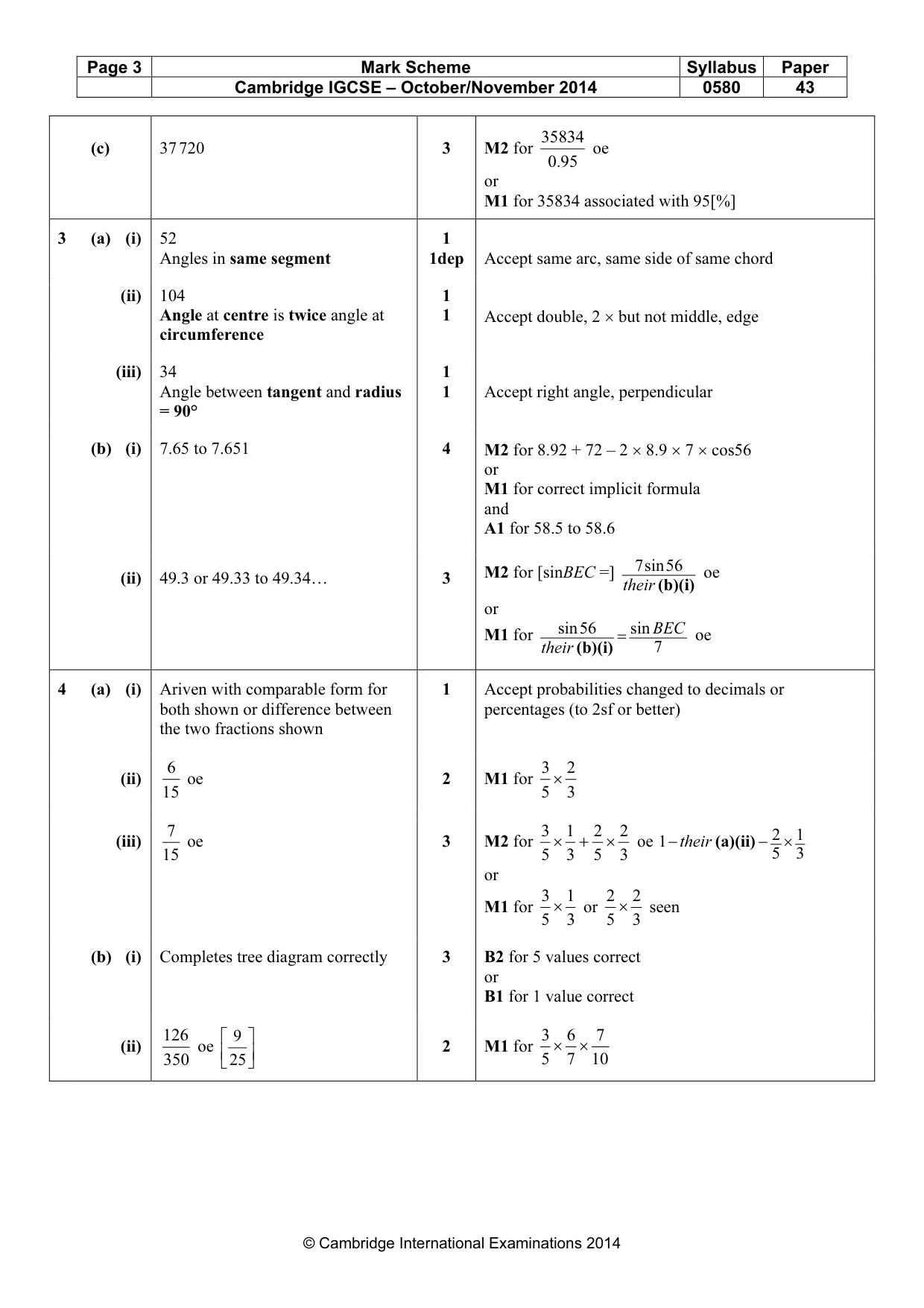
Mark scheme: 3 (a) (i) 52 1 Angles in same segment 1dep Accept same arc, same side of same chord (ii) 104 1 Angle at centre is twice angle at 1 Accept double, 2 × but not middle, edge circumference (iii) 34 1 Angle between tangent and radius 1 Accept right angle, perpendicular = 90° (b) (i) 7.65 to 7.651 4 M2 for 8.92 + 72 – 2 × 8.9 × 7 × cos56 or M1 for correct implicit formula and A1 for 58.5 to 58.6 7 sin 56 M2 for [sinBEC =] oe (ii) 49.3 or 49.33 to 49.34… 3 their (b)(i) or sin 56 sin BEC M1 for = oe their (b)(i) 7
Q4 · Yeung and Ariven compete in a triathlon race
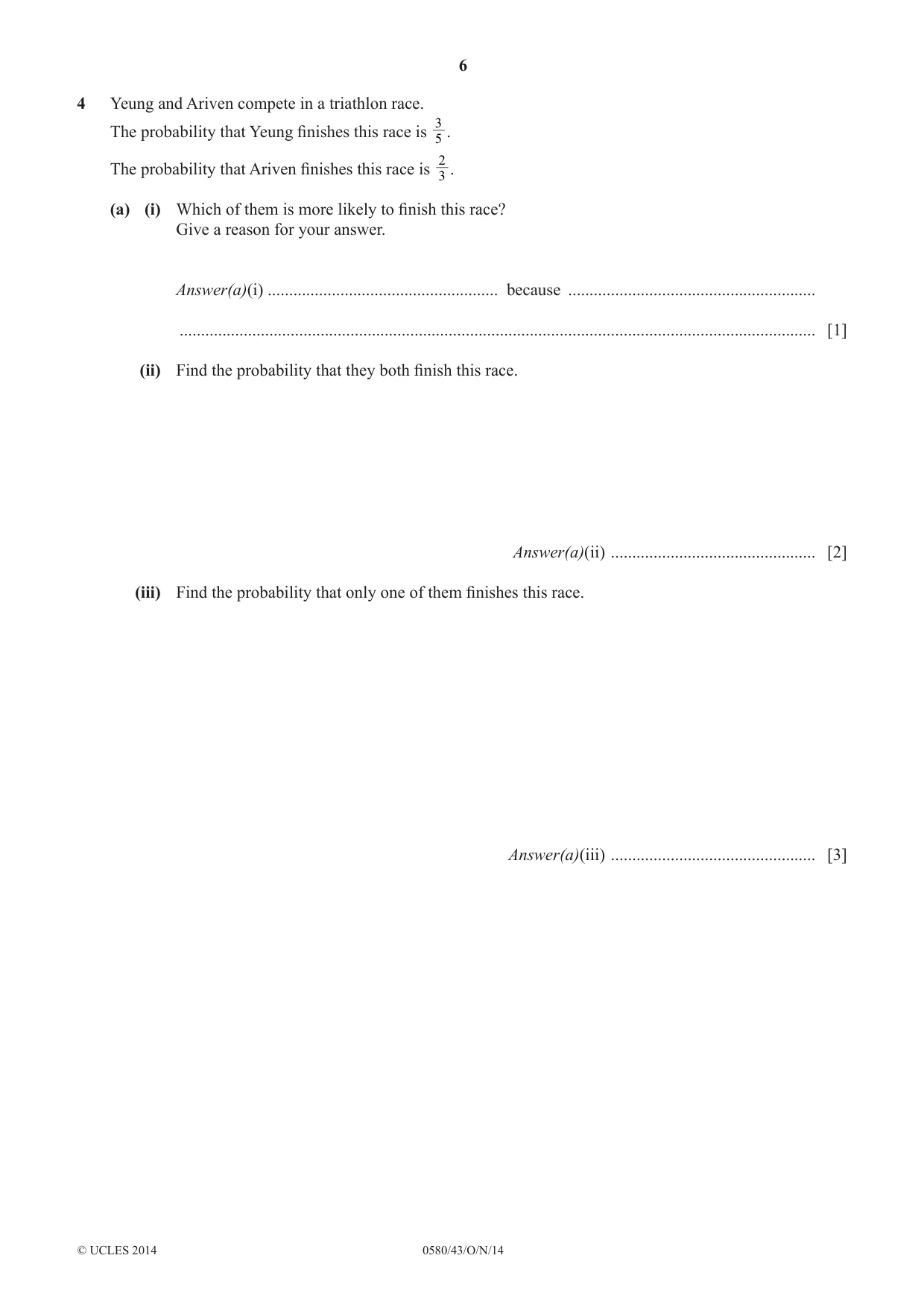
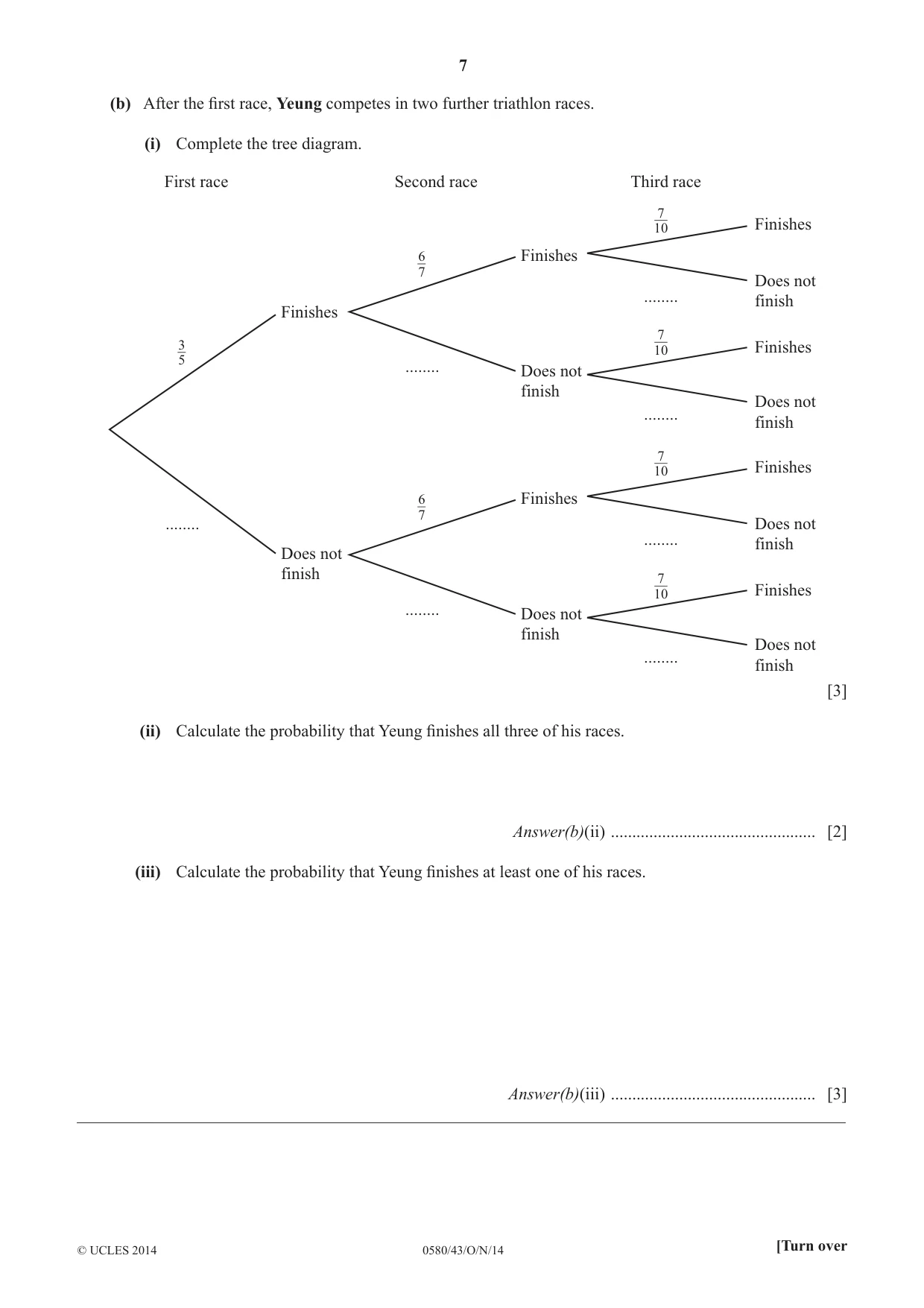
4 Yeung and Ariven compete in a triathlon race. 3 The probability that Yeung fi nishes this race is . 5 2 The probability that Ariven fi nishes this race is . 3 (a) (i) Which of them is more likely to fi nish this race? Give a reason for your answer. Answer(a)(i) ...................................................... because .......................................................... ..................................................................................................................................................... [1] (ii) Find the probability that they both fi nish this race. Answer(a)(ii) ................................................ [2] (iii) Find the probability that only one of them fi nishes this race. Answer(a)(iii) ................................................ [3] (b) After the fi rst race, Yeung competes in two further triathlon races. (i) Complete the tree diagram. First race Second race Third race 7 10 Finishes 6 Finishes 7 Does not ........ finish Finishes 7 3 10 Finishes 5 ........ Does not finish Does not ........ finish 7 10 Finishes 6 Finishes 7 ........ Does not ........ finish Does not finish 7 10 Finishes ........ Does not finish Does not ........ finish [3] (ii) Calculate the probability that Yeung fi nishes all three of his races. Answer(b)(ii) ................................................ [2] (iii) Calculate the probability that Yeung fi nishes at least one of his races. Answer(b)(iii) ................................................ [3] __________________________________________________________________________________________
Mark scheme: 4 (a) (i) Ariven with comparable form for 1 Accept probabilities changed to decimals or both shown or difference between percentages (to 2sf or better) the two fractions shown 6 3 2 (ii) oe 2 M1 for × 15 5 3 7 3 1 2 2 2 1 (iii) oe 3 M2 for × + × oe 1 − their (a)(ii) − × 15 5 3 5 3 5 3 or 3 1 2 2 M1 for × or × seen 5 3 5 3 (b) (i) Completes tree diagram correctly 3 B2 for 5 values correct or B1 for 1 value correct 126 9 3 6 7 (ii) oe 2 M1 for × × 350 25 5 7 10 344 2 1 3 (iii) oe 3 M2 for 1 − their × their × their oe 5 7 10 350 3 2 6 2 1 7 or + × + × × 5 5 7 5 7 10 2 1 3 M1 for their × their × their oe 5 7 10 or identifies the 7 routes or attempt to add 7 probabilities with at least 5 correct 9 27 3 9 6 18 1 + + + + + + oe 25 175 50 350 25 175 25
Q5 · -1 1 -2 - 3 5 P = Q = R = f 1 0 p f0 1 p e 5 o (a) Work out (i) 4P, Answer(a)(i) [1] (ii)…
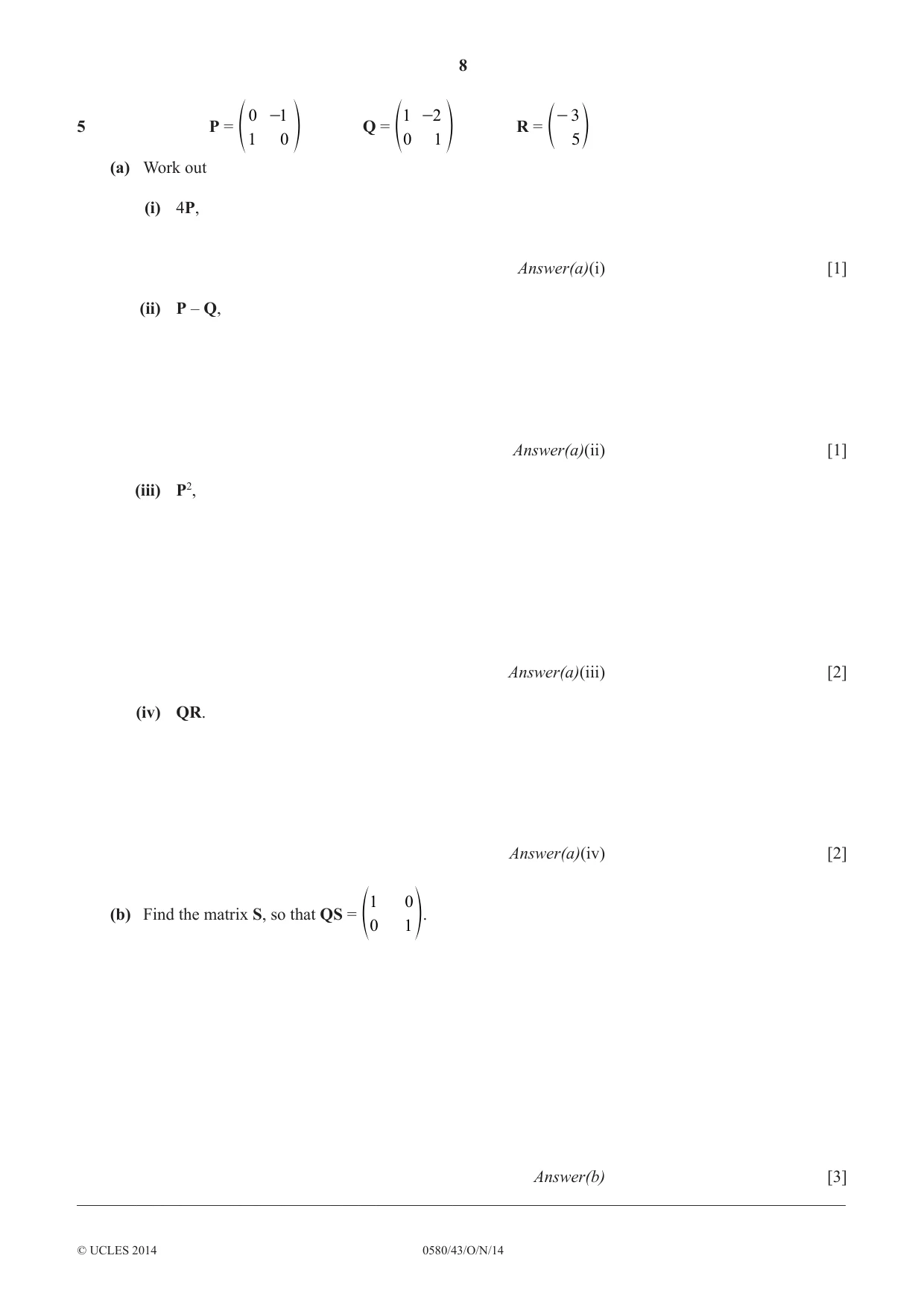
0 -1 1 -2 - 3 5 P = Q = R = f 1 0 p f0 1 p e 5 o (a) Work out (i) 4P, Answer(a)(i) [1] (ii) P – Q, Answer(a)(ii) [1] (iii) P2, Answer(a)(iii) [2] (iv) QR. Answer(a)(iv) [2] 1 0 (b) Find the matrix S, so that QS = 0 1 f p. Answer(b) [3] __________________________________________________________________________________________
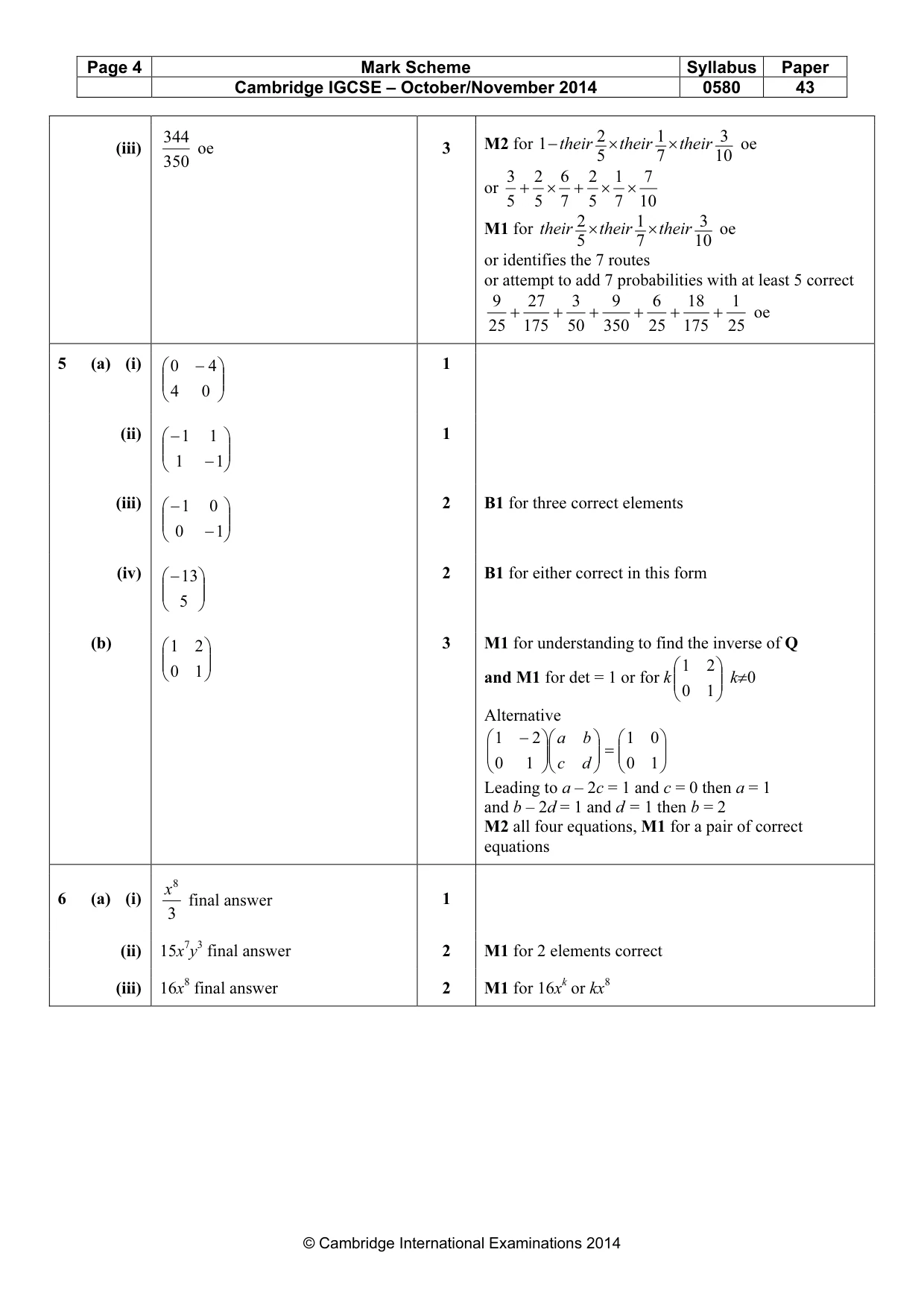
Mark scheme: 5 (a) (i) 0 − 4 1 4 0 (ii) − 1 1 1 1 − 1 (iii) − 1 0 2 B1 for three correct elements 0 − 1 (iv) − 13 2 B1 for either correct in this form 5 (b) 1 2 3 M1 for understanding to find the inverse of Q 1 2 0 1 and M1 for det = 1 or for k k≠0 0 1 Alternative 1 − 2 a b 1 0 = c d 0 1 0 1 Leading to a – 2c = 1 and c = 0 then a = 1 and b – 2d = 1 and d = 1 then b = 2 M2 all four equations, M1 for a pair of correct equations 8x
Question 6
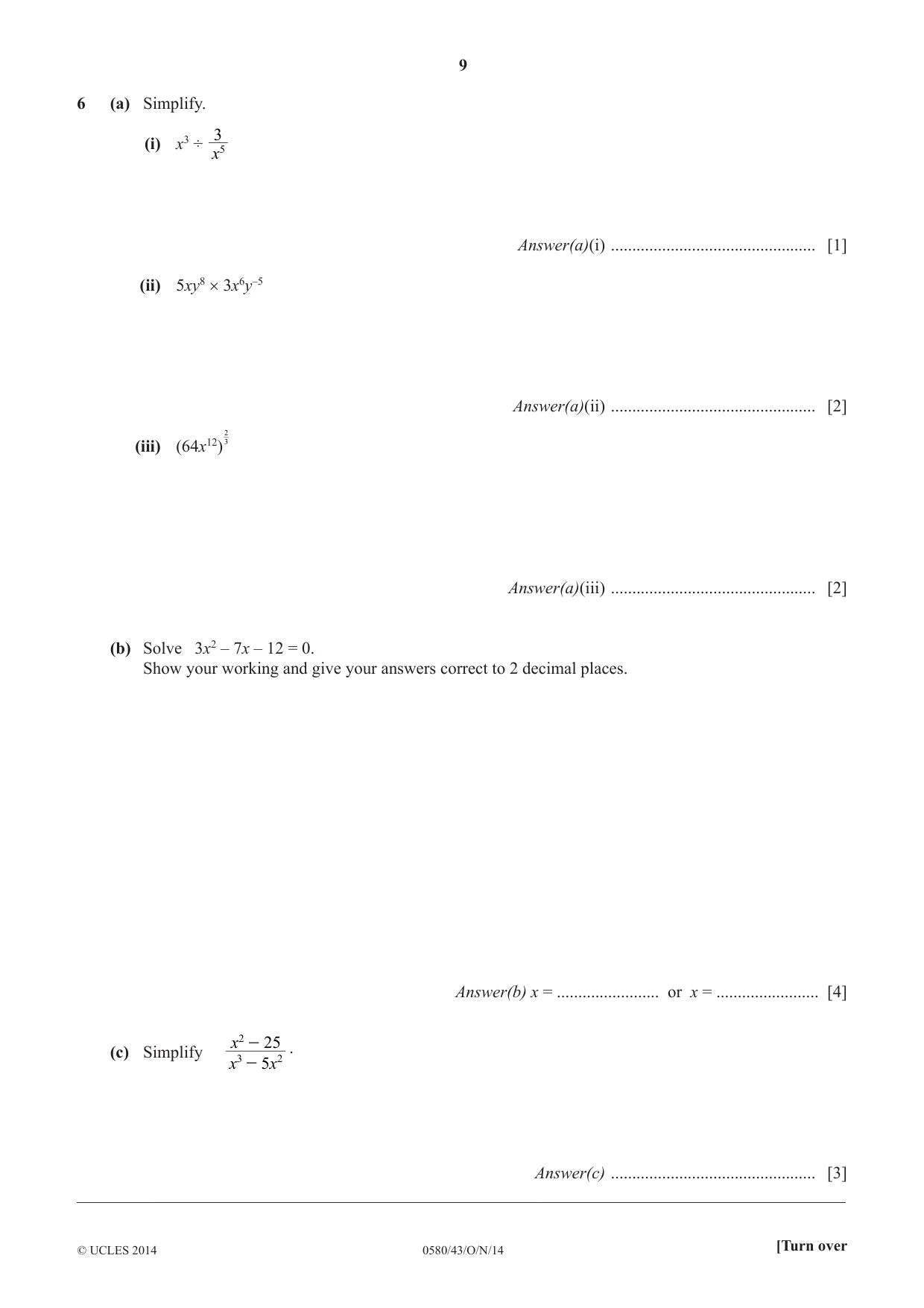
6 (a) Simplify. (i) x3 ÷ 53 x Answer(a)(i) ................................................ [1] (ii) 5xy8 × 3x6y–5 Answer(a)(ii) ................................................ [2] 2 (iii) (64x12) 3 Answer(a)(iii) ................................................ [2] (b) Solve 3x2 – 7x – 12 = 0. Show your working and give your answers correct to 2 decimal places. Answer(b) x = ........................ or x = ........................ [4] x2 - 25 . (c) Simplify 3 2 x - 5 x Answer(c) ................................................ [3] __________________________________________________________________________________________
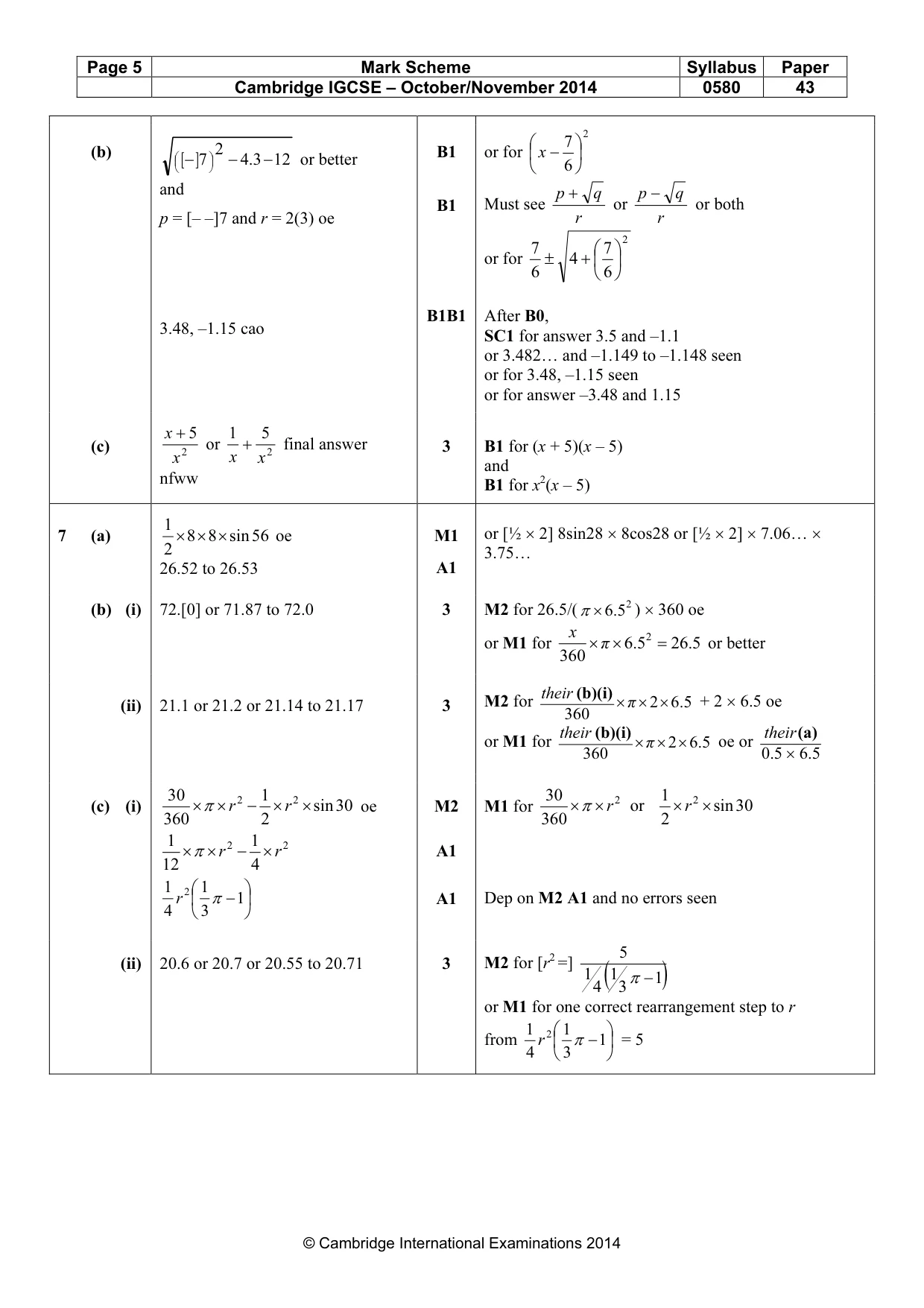
Mark scheme: x 6 (a) (i) final answer 1 3 (ii) 15x7y3 final answer 2 M1 for 2 elements correct (iii) 16x8 final answer 2 M1 for 16xk or kx8 2 7 (b) 2 B1 or for x − [ − ]7 − 3.4 − 12 or better 6 and p + q p − q B1 Must see or or both p = [– –]7 and r = 2(3) oe r r 2 7 7 or for ± 4 + 6 6 B1B1 After B0, 3.48, –1.15 cao SC1 for answer 3.5 and –1.1 or 3.482… and –1.149 to –1.148 seen or for 3.48, –1.15 seen or for answer –3.48 and 1.15 x + 5 1 5 (c) 2 or + 2 final answer 3 B1 for (x + 5)(x – 5) x x x and nfww B1 for x2(x – 5) 1 [½ 2] 8 i 28 8 28 [½ 2] 7 06
Q7 · A P NOT TO SCALE 56° 6.5 cm 8 cm 8 cm x O C B Q The diagram shows a triangle and a sector…
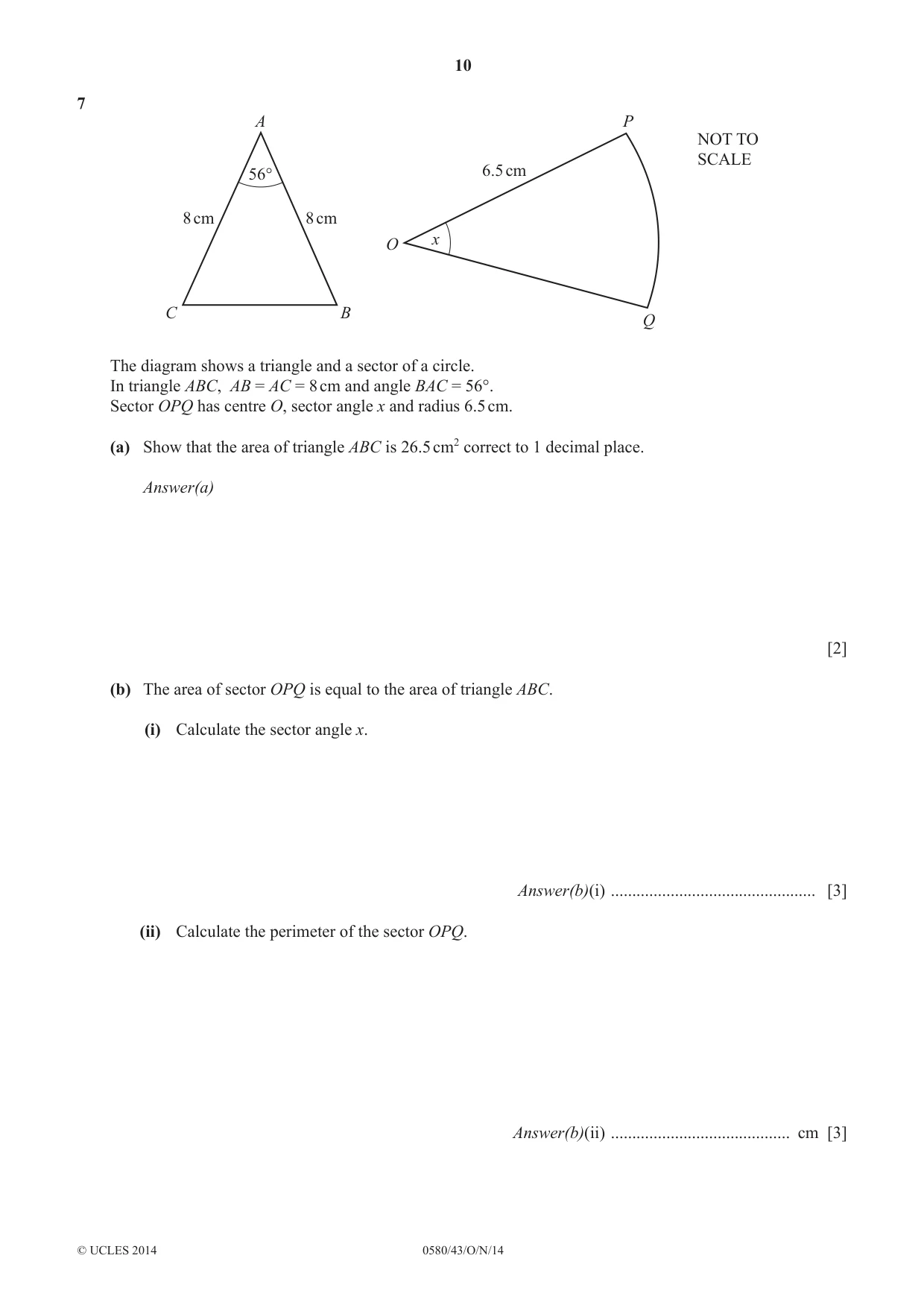
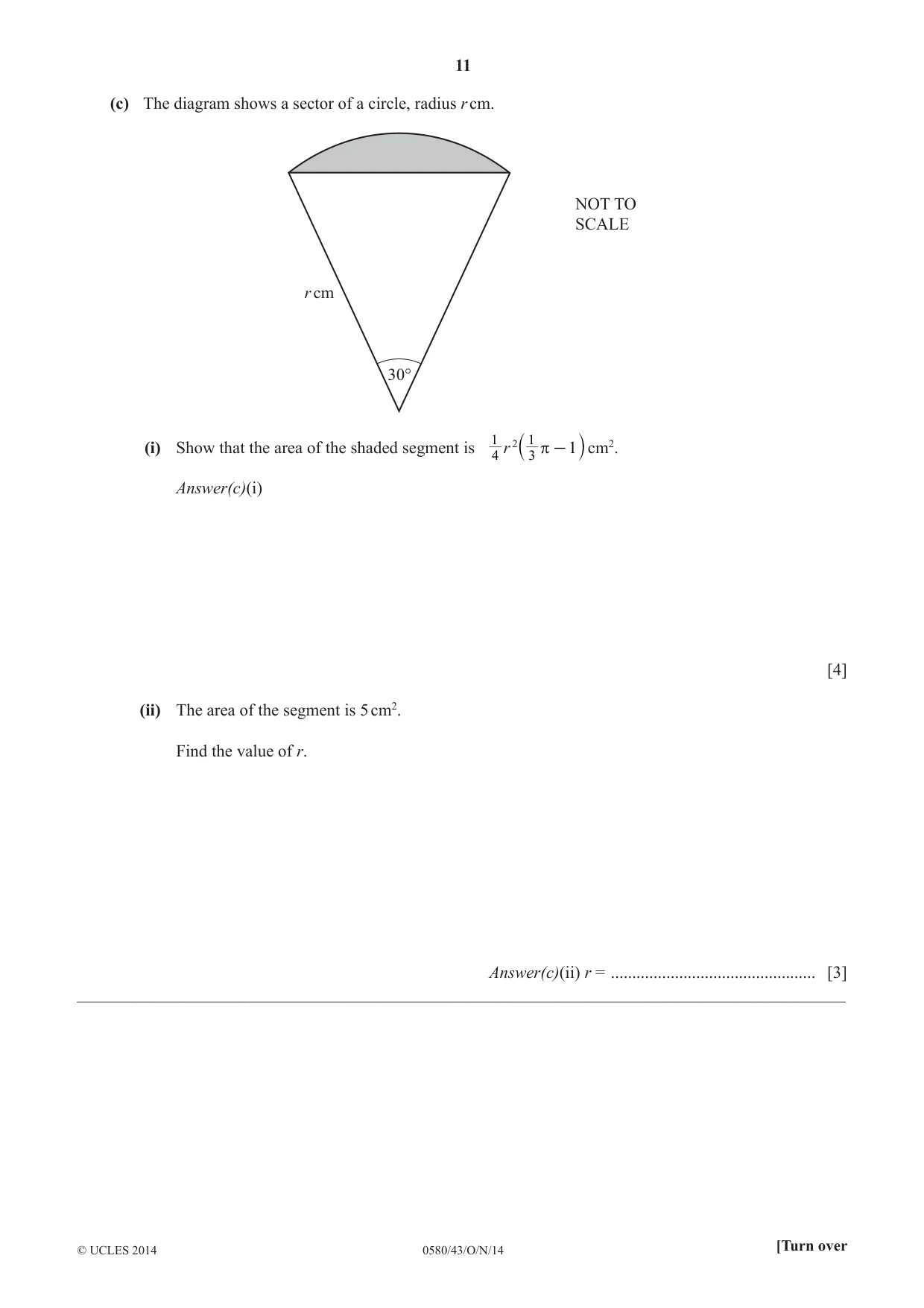
7 A P NOT TO SCALE 56° 6.5 cm 8 cm 8 cm x O C B Q The diagram shows a triangle and a sector of a circle. In triangle ABC, AB = AC = 8 cm and angle BAC = 56°. Sector OPQ has centre O, sector angle x and radius 6.5 cm. (a) Show that the area of triangle ABC is 26.5 cm2 correct to 1 decimal place. Answer(a) [2] (b) The area of sector OPQ is equal to the area of triangle ABC. (i) Calculate the sector angle x. Answer(b)(i) ................................................ [3] (ii) Calculate the perimeter of the sector OPQ. Answer(b)(ii) .......................................... cm [3] (c) The diagram shows a sector of a circle, radius r cm. NOT TO SCALE r cm 30° 1 2 1 (i) Show that the area of the shaded segment is r π - 1 cm2. 4 3 ` j Answer(c)(i) [4] (ii) The area of the segment is 5 cm2. Find the value of r. Answer(c)(ii) r = ................................................ [3] __________________________________________________________________________________________
Mark scheme: 1 7 (a) × 8 × 8 × sin 56 oe M1 or [½ × 2] 8sin28 × 8cos28 or [½ × 2] × 7.06… × 2 3.75… 26.52 to 26.53 A1 (b) (i) 72.[0] or 71.87 to 72.0 3 M2 for 26.5/( π × 5.6 2 ) × 360 oe x 2 or M1 for ×π × 5.6 = 265. or better 360 their (b)(i) (ii) 21.1 or 21.2 or 21.14 to 21.17 3 M2 for ×π × 2 × 5.6 + 2 × 6.5 oe 360 their (b)(i) their (a) or M1 for ×π × 2 × 5.6 oe or 360 5.0 × 5.6 30 2 1 2 30 2 1 2 (c) (i) × π × r − × r × sin 30 oe M2 M1 for × π × r or × r × sin 30 360 2 360 2 1 2 1 2 ×π × r − × r A1 12 4 1 2 1 r π −1 A1 Dep on M2 A1 and no errors seen 4 3 5 (ii) 20.6 or 20.7 or 20.55 to 20.71 3 M2 for [r2 =] 1 ( 1 π − )1 4 3 or M1 for one correct rearrangement step to r 1 2 1 from r π −1 = 5 4 3
Q8 · A straight line joins the points (–1, –4) and (3, 8)
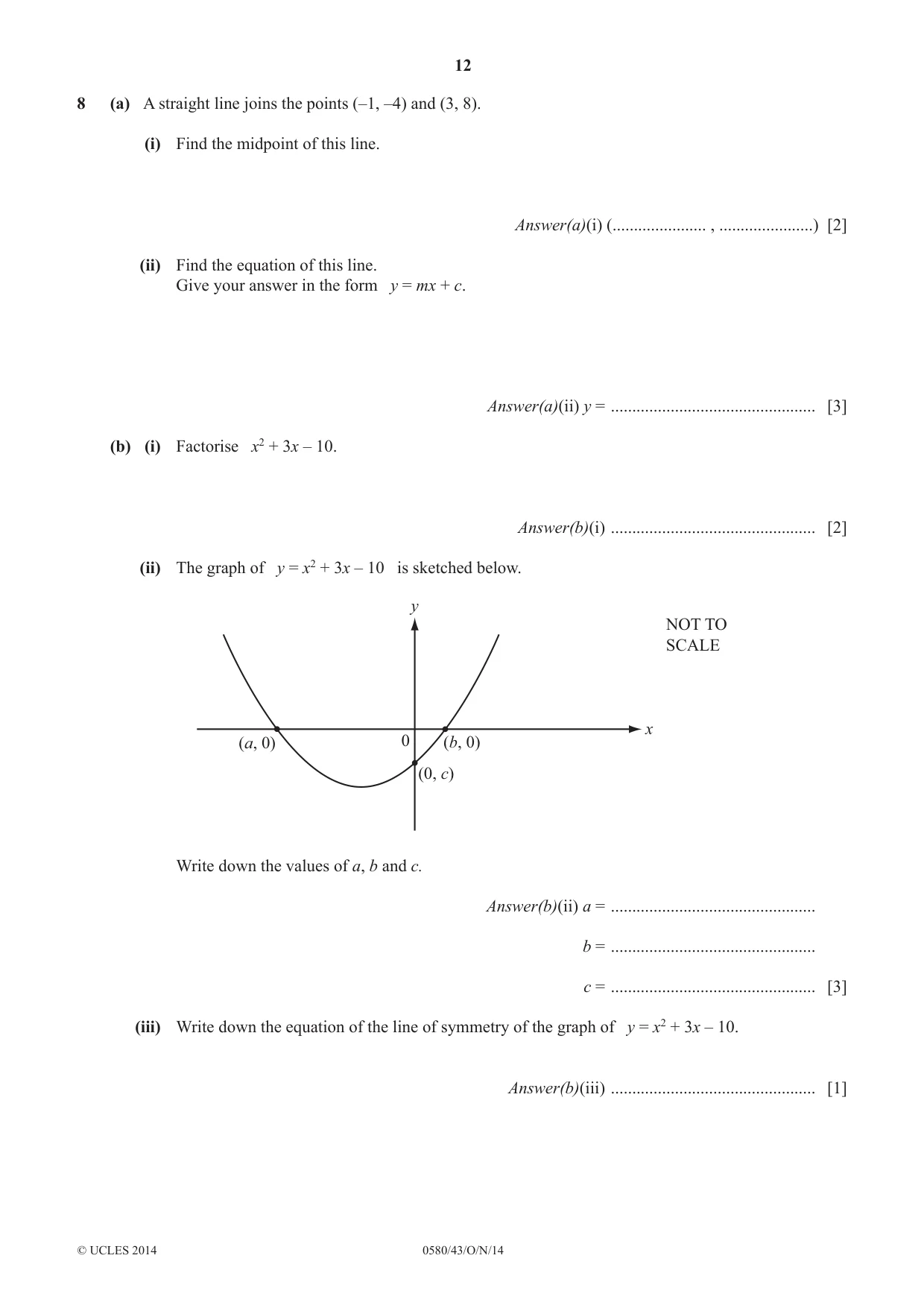
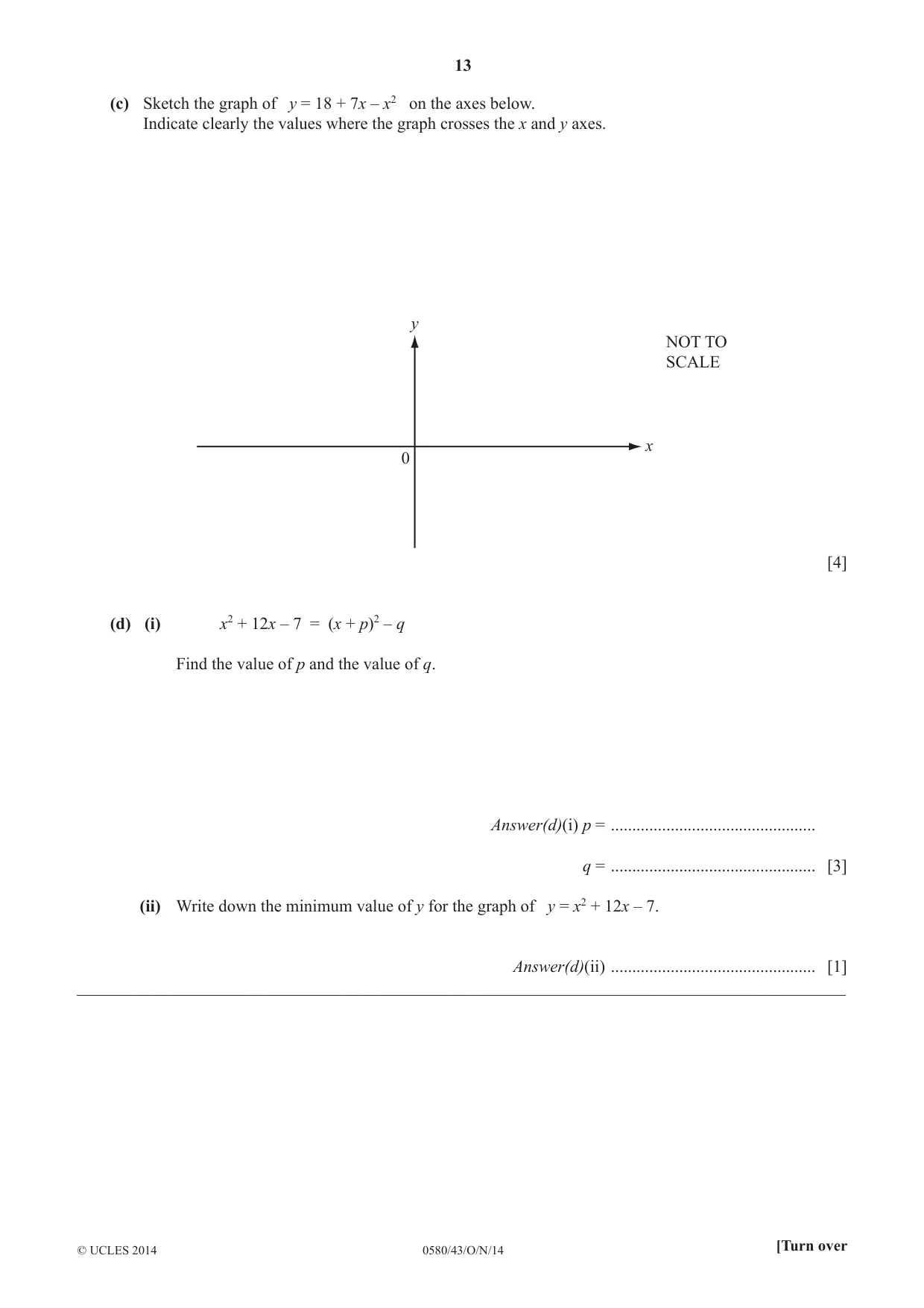
8 (a) A straight line joins the points (–1, –4) and (3, 8). (i) Find the midpoint of this line. Answer(a)(i) (...................... , ......................) [2] (ii) Find the equation of this line. Give your answer in the form y = mx + c. Answer(a)(ii) y = ................................................ [3] (b) (i) Factorise x2 + 3x – 10. Answer(b)(i) ................................................ [2] (ii) The graph of y = x2 + 3x – 10 is sketched below. y NOT TO SCALE x (a, 0) 0 (b, 0) (0, c) Write down the values of a, b and c. Answer(b)(ii) a = ................................................ b = ................................................ c = ................................................ [3] (iii) Write down the equation of the line of symmetry of the graph of y = x2 + 3x – 10. Answer(b)(iii) ................................................ [1] (c) Sketch the graph of y = 18 + 7x – x2 on the axes below. Indicate clearly the values where the graph crosses the x and y axes. y NOT TO SCALE x 0 [4] (d) (i) x2 + 12x – 7 = (x + p)2 – q Find the value of p and the value of q. Answer(d)(i) p = ................................................ q = ................................................ [3] (ii) Write down the minimum value of y for the graph of y = x2 + 12x – 7. Answer(d)(ii) ................................................ [1] __________________________________________________________________________________________
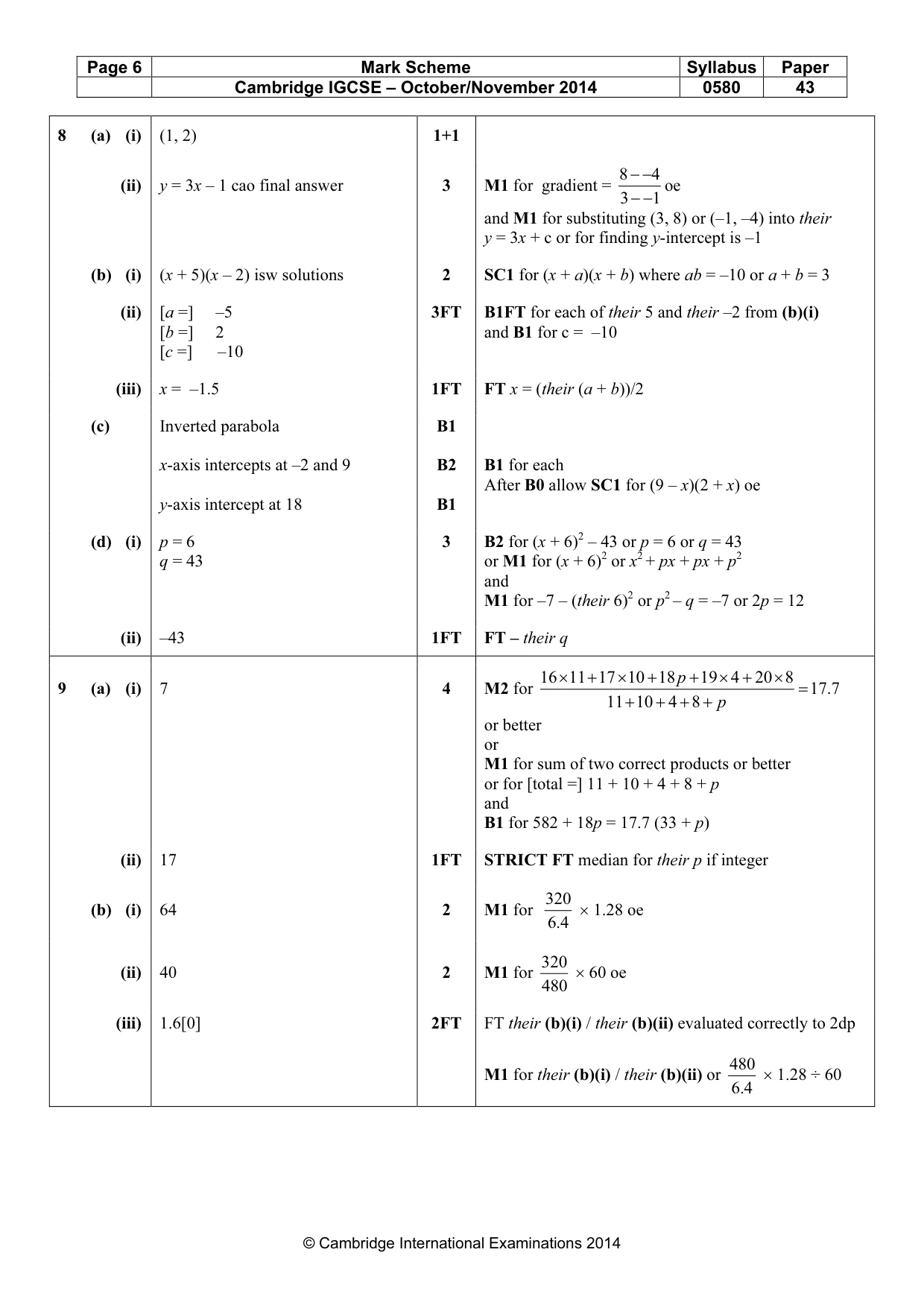
Mark scheme: 8 (a) (i) (1, 2) 1+1 8 − −4 (ii) y = 3x – 1 cao final answer 3 M1 for gradient = oe 3 − −1 and M1 for substituting (3, 8) or (–1, –4) into their y = 3x + c or for finding y-intercept is –1 (b) (i) (x + 5)(x – 2) isw solutions 2 SC1 for (x + a)(x + b) where ab = –10 or a + b = 3 (ii) [a =] –5 3FT B1FT for each of their 5 and their –2 from (b)(i) [b =] 2 and B1 for c = –10 [c =] –10 (iii) x = –1.5 1FT FT x = (their (a + b))/2 (c) Inverted parabola B1 x-axis intercepts at –2 and 9 B2 B1 for each After B0 allow SC1 for (9 – x)(2 + x) oe y-axis intercept at 18 B1 (d) (i) p = 6 3 B2 for (x + 6)2 – 43 or p = 6 or q = 43 q = 43 or M1 for (x + 6)2 or x2 + px + px + p2 and M1 for –7 – (their 6)2 or p2 – q = –7 or 2p = 12 (ii) –43 1FT FT – their q 16 × 11 + 17 × 10 + 18 p + 19 × 4 + 20 × 8
Q9 · Ricardo asks some motorists how many litres of fuel they use in one day
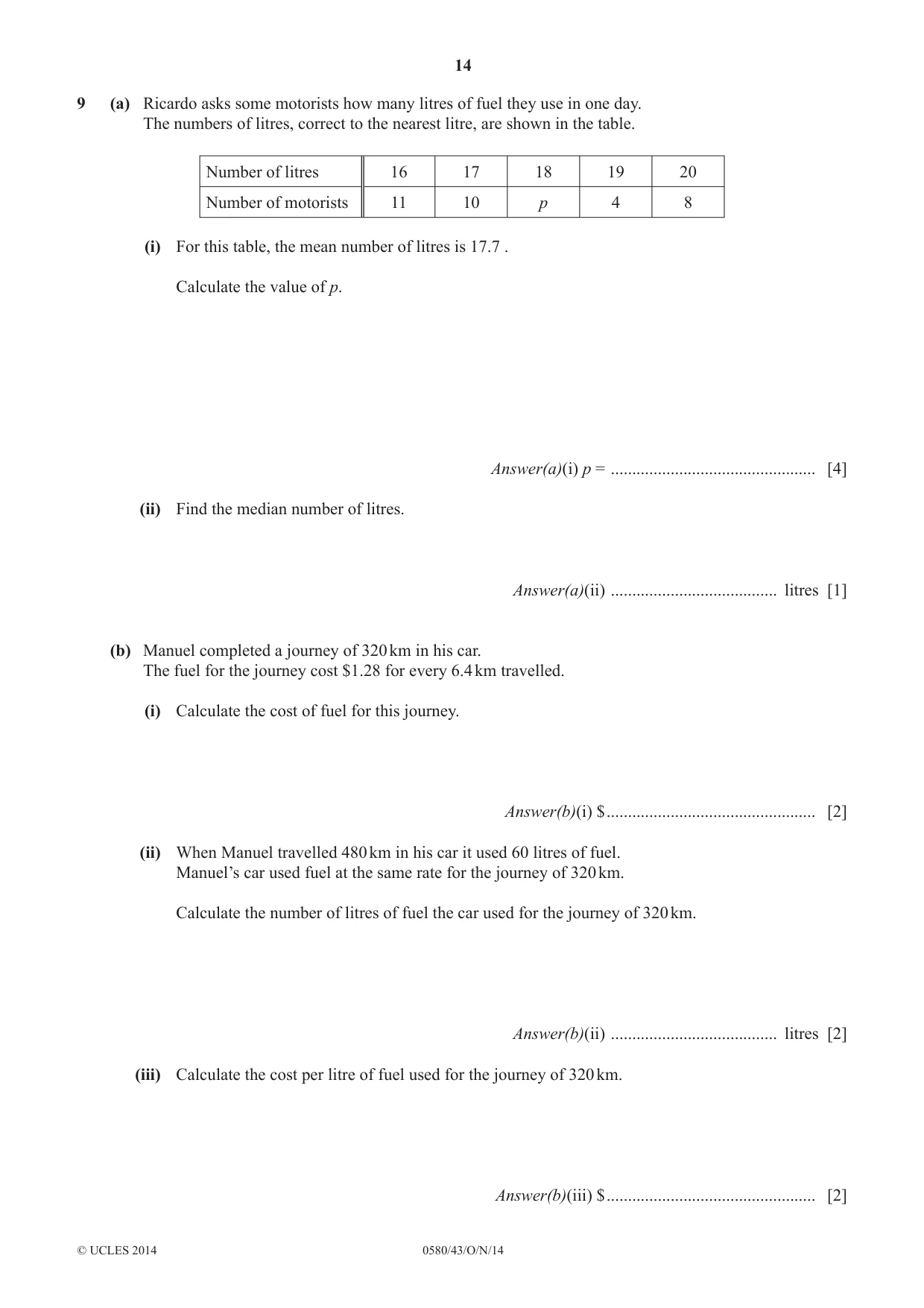
9 (a) Ricardo asks some motorists how many litres of fuel they use in one day. The numbers of litres, correct to the nearest litre, are shown in the table. Number of litres 16 17 18 19 20 Number of motorists 11 10 p 4 8 (i) For this table, the mean number of litres is 17.7 . Calculate the value of p. Answer(a)(i) p = ................................................ [4] (ii) Find the median number of litres. Answer(a)(ii) ....................................... litres [1] (b) Manuel completed a journey of 320 km in his car. The fuel for the journey cost $1.28 for every 6.4 km travelled. (i) Calculate the cost of fuel for this journey. Answer(b)(i) $ ................................................. [2] (ii) When Manuel travelled 480 km in his car it used 60 litres of fuel. Manuel’s car used fuel at the same rate for the journey of 320 km. Calculate the number of litres of fuel the car used for the journey of 320 km. Answer(b)(ii) ....................................... litres [2] (iii) Calculate the cost per litre of fuel used for the journey of 320 km. Answer(b)(iii) $ ................................................. [2] (c) Ellie drives a car at a constant speed of 30 m/s correct to the nearest 5 m/s. She maintains this speed for 5 minutes correct to the nearest 10 seconds. Calculate the upper bound of the distance in kilometres that Ellie could have travelled. Answer(c) .......................................... km [5] __________________________________________________________________________________________
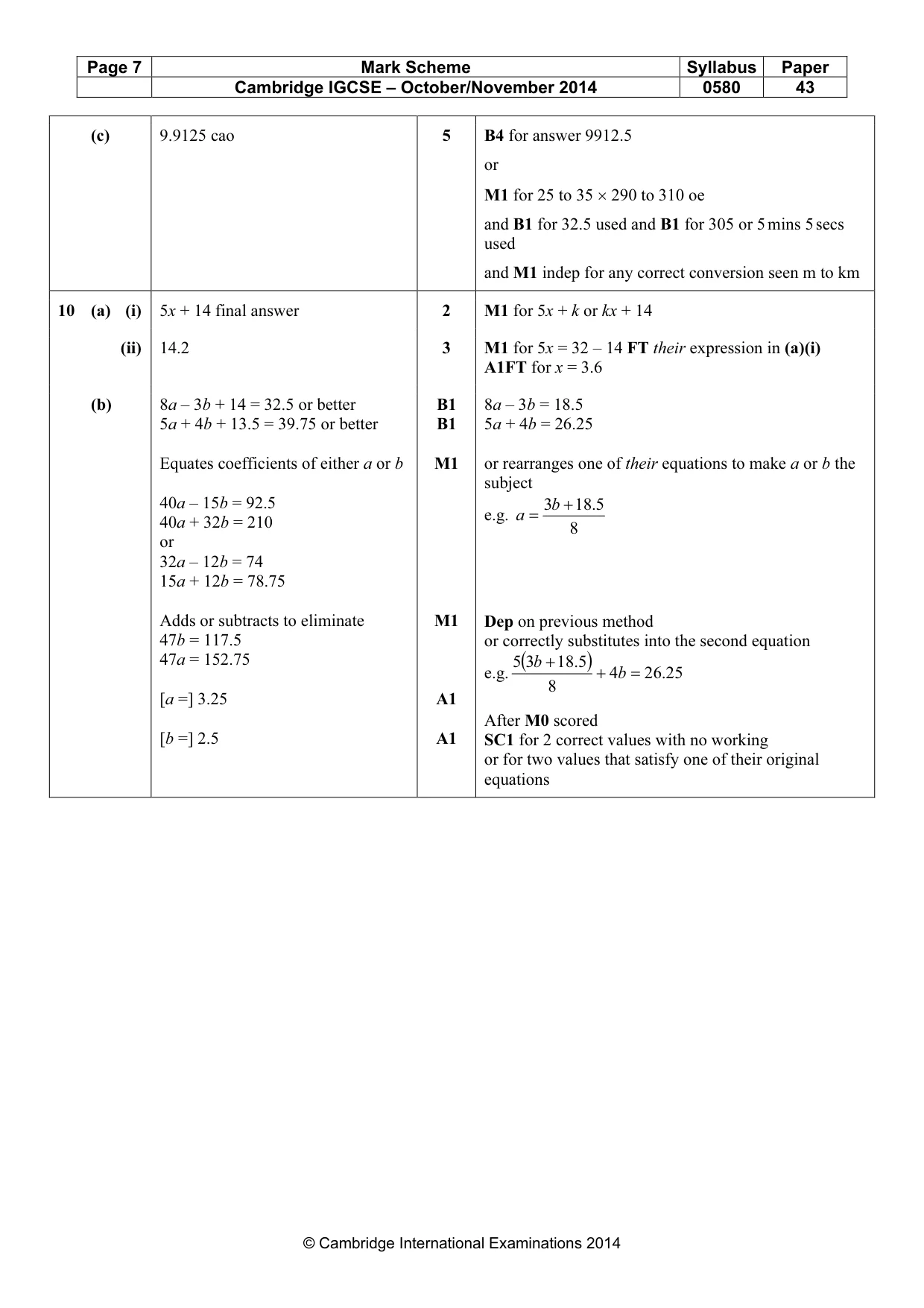
Mark scheme: 16 × 11 + 17 × 10 + 18 p + 19 × 4 + 20 × 8 9 (a) (i) 7 4 M2 for = 177. 11 + 10 + 4 + 8 + p or better or M1 for sum of two correct products or better or for [total =] 11 + 10 + 4 + 8 + p and B1 for 582 + 18p = 17.7 (33 + p) (ii) 17 1FT STRICT FT median for their p if integer 320 (b) (i) 64 2 M1 for × 1.28 oe 4.6 320 (ii) 40 2 M1 for × 60 oe 480 (iii) 1.6[0] 2FT FT their (b)(i) / their (b)(ii) evaluated correctly to 2dp 480 M1 for their (b)(i) / their (b)(ii) or × 1.28 ÷ 60 4.6 (c) 9.9125 cao 5 B4 for answer 9912.5 or M1 for 25 to 35 × 290 to 310 oe and B1 for 32.5 used and B1 for 305 or 5 mins 5 secs used and M1 indep for any correct conversion seen m to km
Q10 · (3x – 5) cm NOT TO (2x – 3) cm SCALE (15 – 2x) cm (2x + 7) cm (i) Write an expression, in…
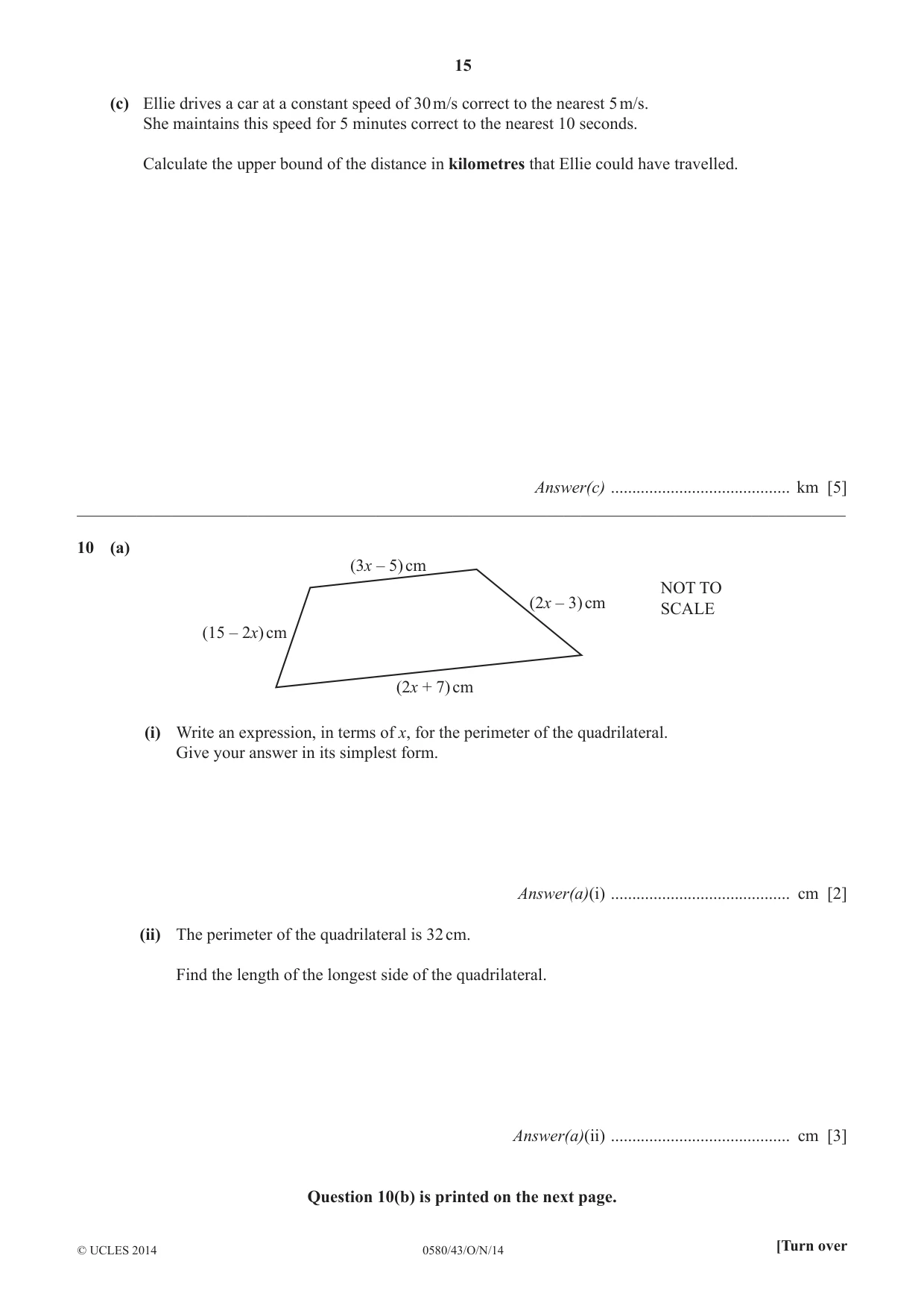
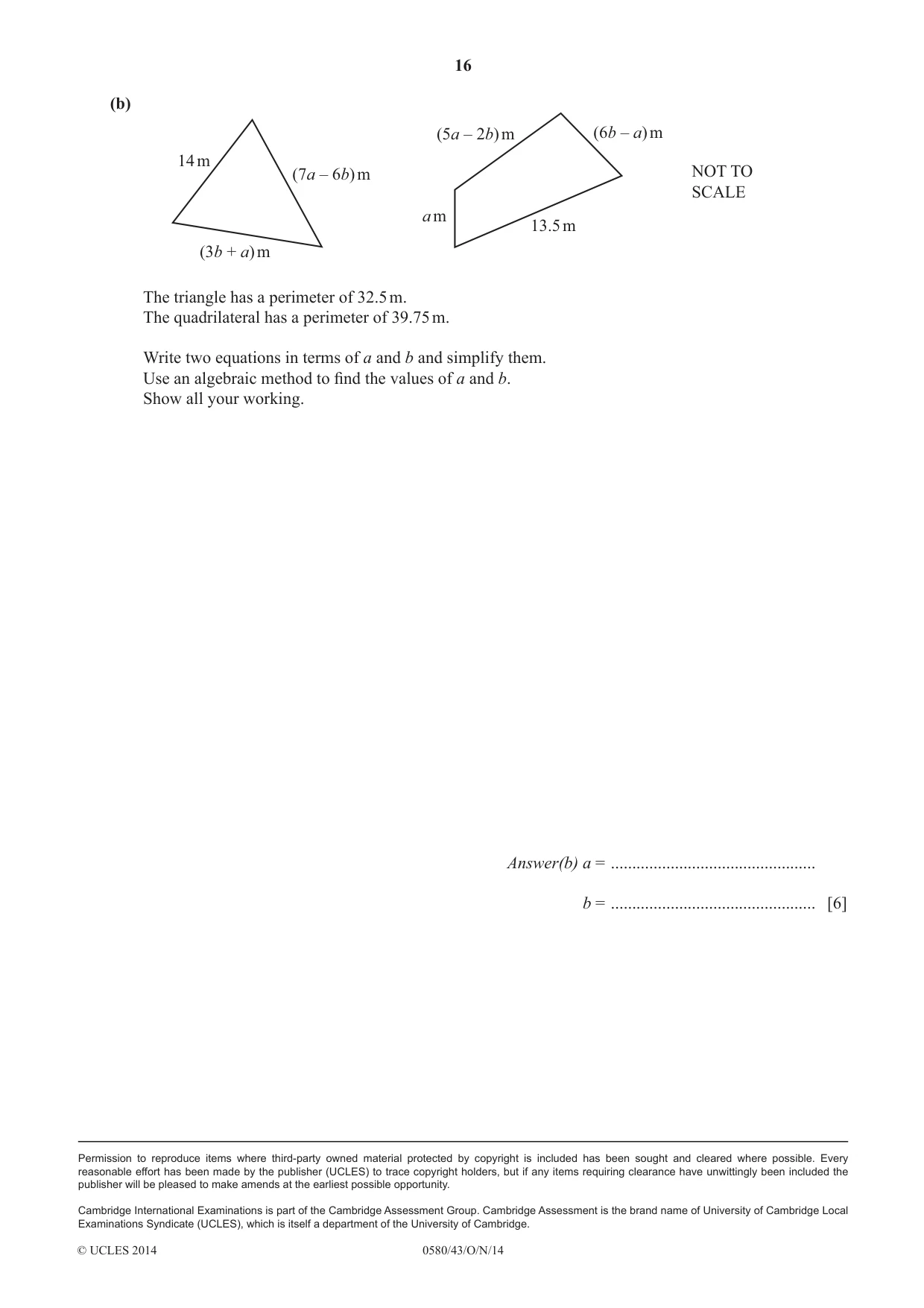
10 (a) (3x – 5) cm NOT TO (2x – 3) cm SCALE (15 – 2x) cm (2x + 7) cm (i) Write an expression, in terms of x, for the perimeter of the quadrilateral. Give your answer in its simplest form. Answer(a)(i) .......................................... cm [2] (ii) The perimeter of the quadrilateral is 32 cm. Find the length of the longest side of the quadrilateral. Answer(a)(ii) .......................................... cm [3] Question 10(b) is printed on the next page. (b) (5a – 2b) m (6b – a) m 14 m (7a – 6b) m NOT TO SCALE a m 13.5 m (3b + a) m The triangle has a perimeter of 32.5 m. The quadrilateral has a perimeter of 39.75 m. Write two equations in terms of a and b and simplify them. Use an algebraic method to fi nd the values of a and b. Show all your working. Answer(b) a = ................................................ b = ................................................ [6]
Mark scheme: 10 (a) (i) 5x + 14 final answer 2 M1 for 5x + k or kx + 14 (ii) 14.2 3 M1 for 5x = 32 – 14 FT their expression in (a)(i) A1FT for x = 3.6 (b) 8a – 3b + 14 = 32.5 or better B1 8a – 3b = 18.5 5a + 4b + 13.5 = 39.75 or better B1 5a + 4b = 26.25 Equates coefficients of either a or b M1 or rearranges one of their equations to make a or b the subject 40a – 15b = 92.5 3b + 185. e.g. a = 40a + 32b = 210 8 or 32a – 12b = 74 15a + 12b = 78.75 Adds or subtracts to eliminate M1 Dep on previous method 47b = 117.5 or correctly substitutes into the second equation 47a = 152.75 5(3b + 185. ) e.g. + 4b = 26.25 8 [a =] 3.25 A1 After M0 scored [b =] 2.5 A1 SC1 for 2 correct values with no working or for two values that satisfy one of their original equations
What was in this paper
The subtopics covered by these 8 questions, and how many questions each got. Open one in a new tab to see every Cambridge question on it.
What you needed in this session
Cambridge’s own grade thresholds for 2014 Oct/Nov, Paper 4 · Variant 3. A higher threshold means an easier paper — the bar moves with how the cohort did.