Cambridge IGCSE Mathematics 0580 — 2021 Oct/Nov Paper 4 · Variant 3
0580/43/O/N/21 · 11 questions · 130 marks · ≈146 min
The question paper and its mark scheme, free to read here and free to download. This is Cambridge’s own paper, exactly as it was sat.
Question paper20 pages
Mark scheme9 pages
Answers below. Sit the paper first if you are practising.
Questions as text
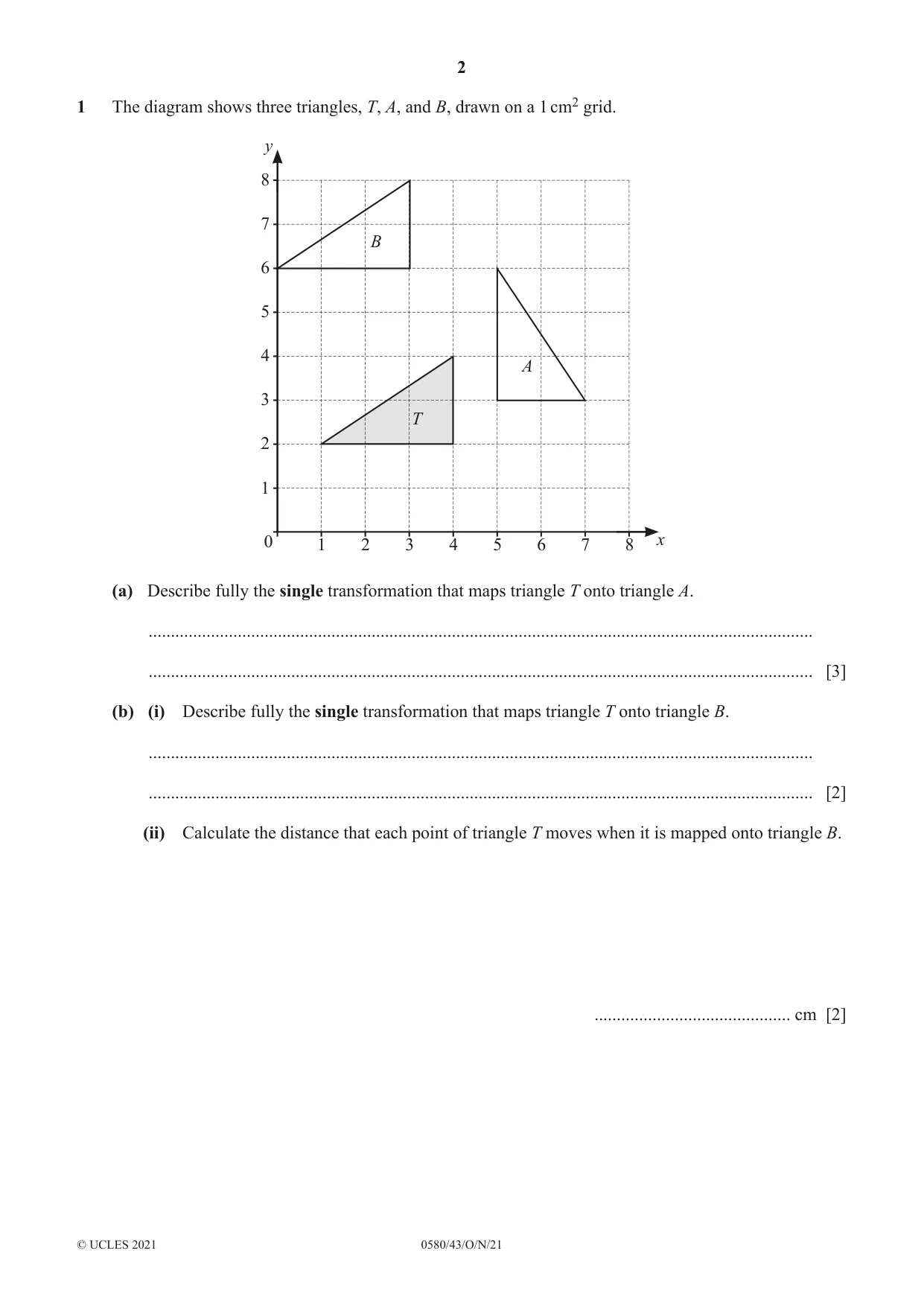
Q1 · The diagram shows three triangles, T, A, and B, drawn on a 1 cm2 grid
1 The diagram shows three triangles, T, A, and B, drawn on a 1 cm2 grid. y 8 7 B 6 5 4 A 3 T 2 1 0 1 2 3 4 5 6 7 8 x (a) Describe fully the single transformation that maps triangle T onto triangle A. ..................................................................................................................................................... ..................................................................................................................................................... [3] (b) (i) Describe fully the single transformation that maps triangle T onto triangle B. ..................................................................................................................................................... ..................................................................................................................................................... [2] (ii) Calculate the distance that each point of triangle T moves when it is mapped onto triangle B. ............................................ cm [2]
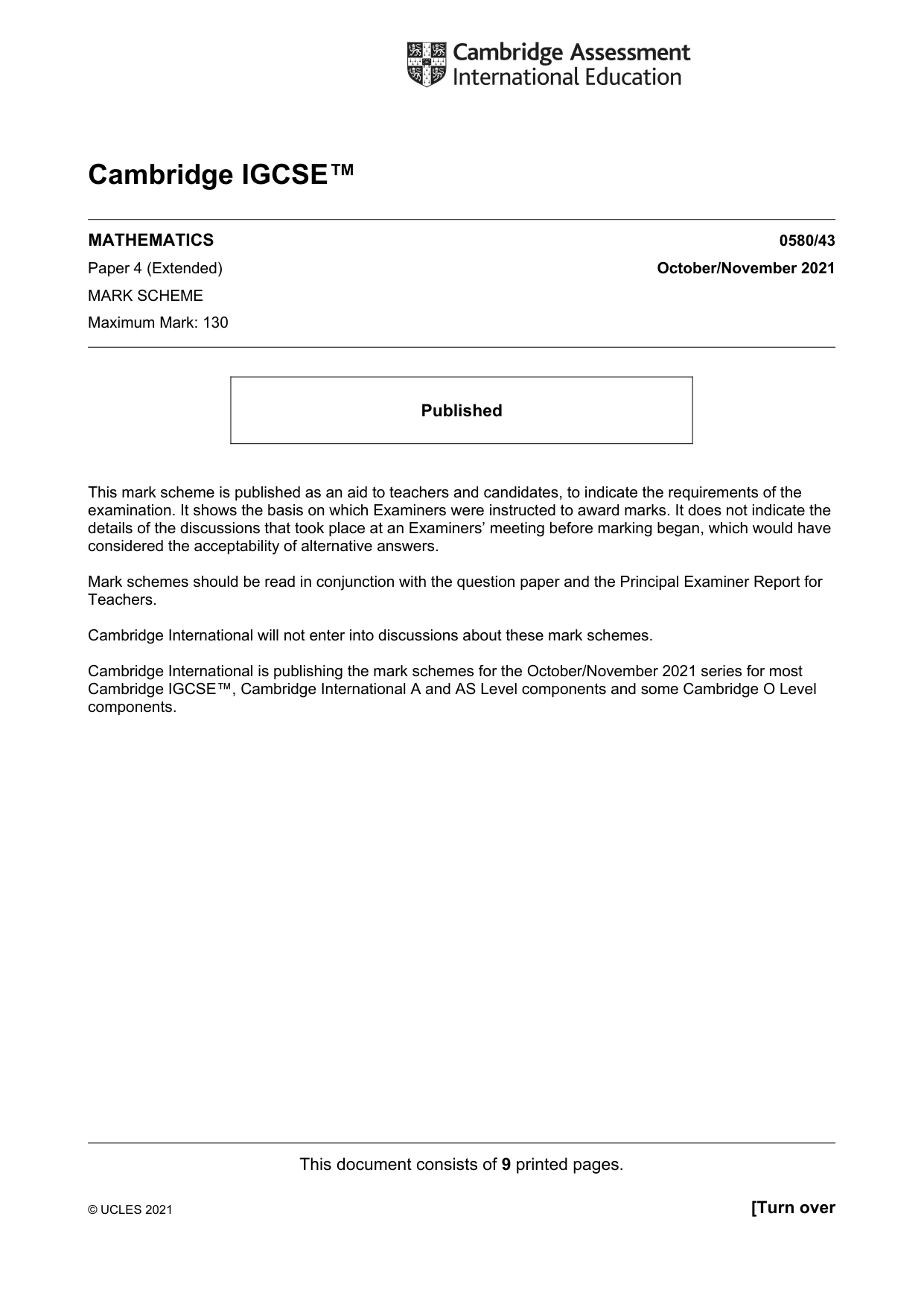
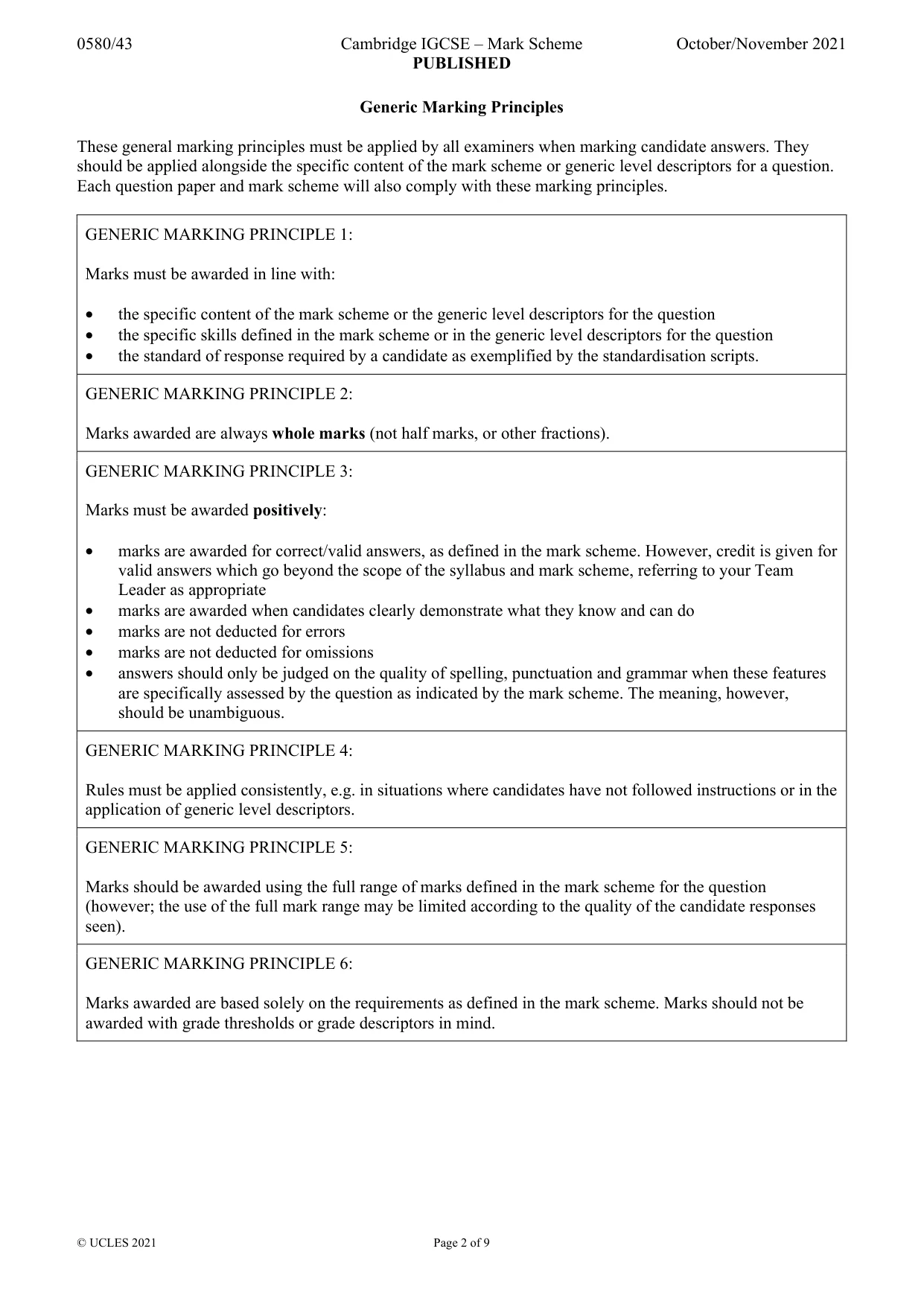
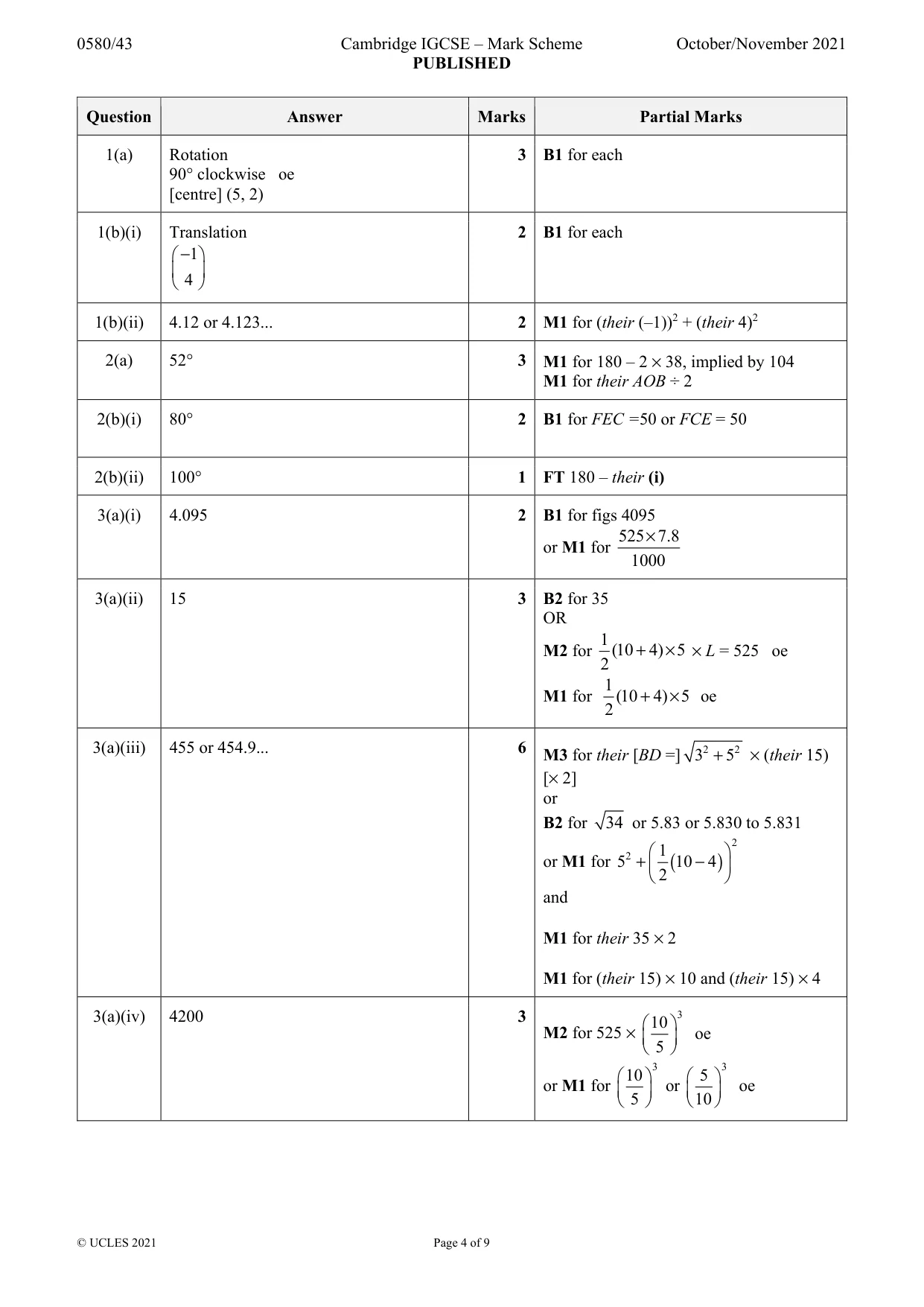
Mark scheme: Question Answer Marks Partial Marks 1(a) Rotation 3 B1 for each 90° clockwise oe [centre] (5, 2) 1(b)(i) Translation 2 B1 for each −1 4 1(b)(ii) 4.12 or 4.123... 2 M1 for (their (–1))2 + (their 4)2
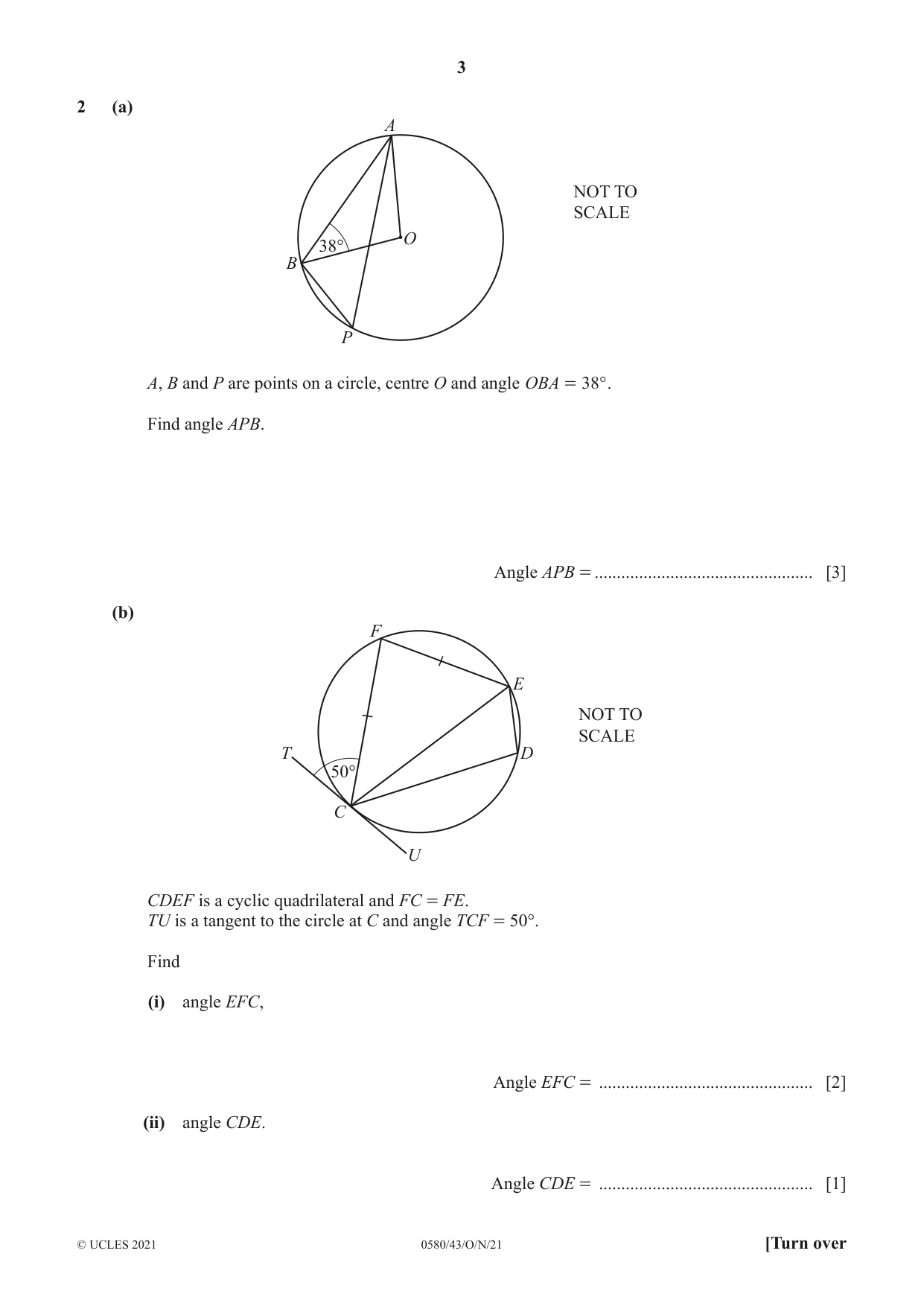
Q2 · A NOT TO SCALE O 38° B P A, B and P are points on a circle, centre O and angle OBA = 38°
2 (a) A NOT TO SCALE O 38° B P A, B and P are points on a circle, centre O and angle OBA = 38° . Find angle APB. Angle APB = ................................................. [3] (b) F E NOT TO SCALE T D 50° C U CDEF is a cyclic quadrilateral and FC = FE. TU is a tangent to the circle at C and angle TCF = 50°. Find (i) angle EFC, Angle EFC = ................................................ [2] (ii) angle CDE. Angle CDE = ................................................ [1]
Mark scheme: 2(a) 52° 3 M1 for 180 – 2 × 38, implied by 104 M1 for their AOB ÷ 2 2(b)(i) 80° 2 B1 for FEC =50 or FCE = 50 2(b)(ii) 100° 1 FT 180 – their (i)
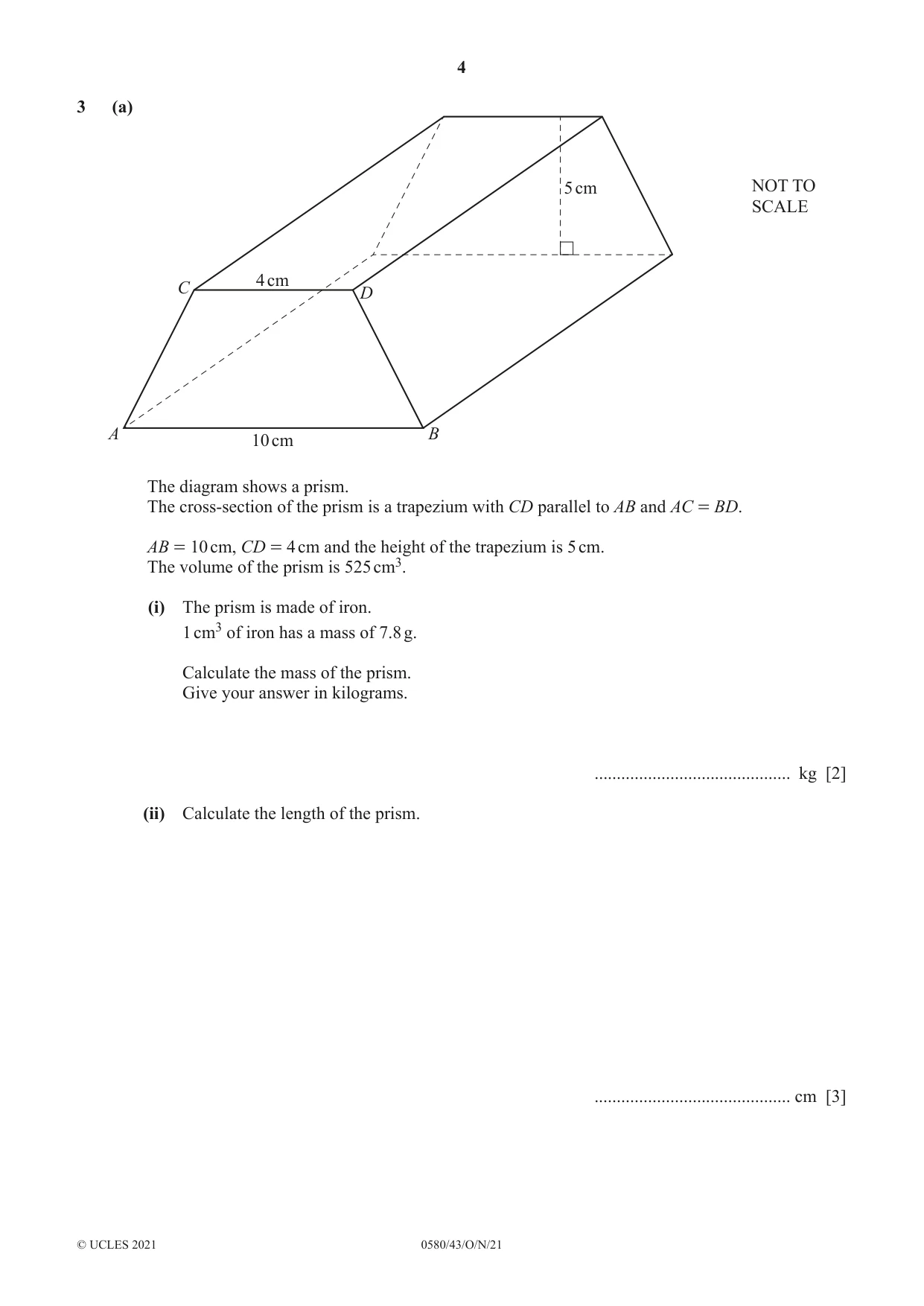
Q3 · 5 cm NOT TO SCALE 4 cm C D A B 10 cm The diagram shows a prism
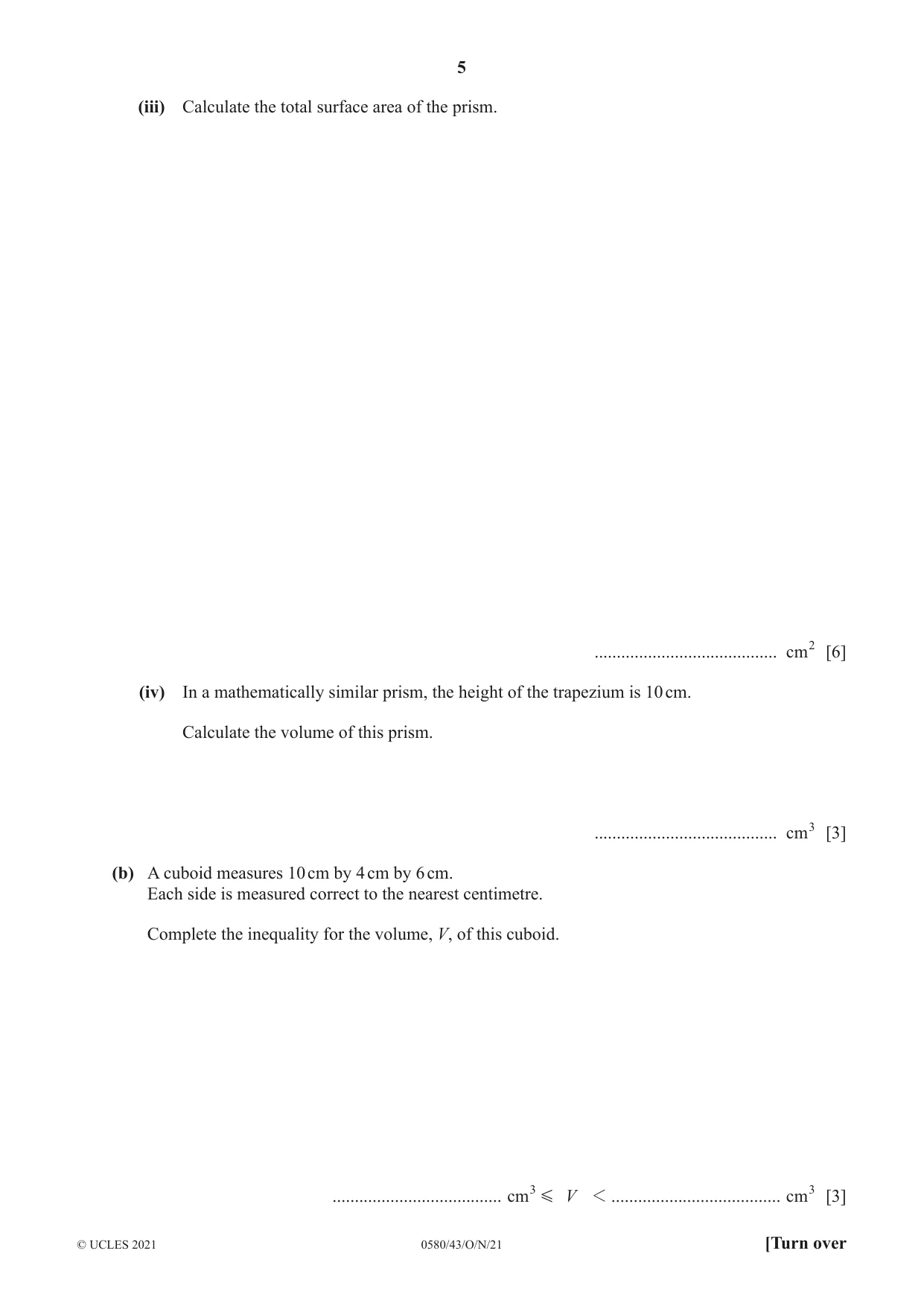
3 (a) 5 cm NOT TO SCALE 4 cm C D A B 10 cm The diagram shows a prism. The cross-section of the prism is a trapezium with CD parallel to AB and AC = BD. AB = 10 cm, CD = 4 cm and the height of the trapezium is 5 cm. The volume of the prism is 525 cm3. (i) The prism is made of iron. 1 cm3 of iron has a mass of 7.8 g. Calculate the mass of the prism. Give your answer in kilograms. ............................................ kg [2] (ii) Calculate the length of the prism. ............................................ cm [3] (iii) Calculate the total surface area of the prism. ......................................... cm2 [6] (iv) In a mathematically similar prism, the height of the trapezium is 10 cm. Calculate the volume of this prism. ......................................... cm3 [3] (b) A cuboid measures 10 cm by 4 cm by 6 cm. Each side is measured correct to the nearest centimetre. Complete the inequality for the volume, V, of this cuboid. ...................................... cm 3 G V 1 ...................................... cm3 [3]
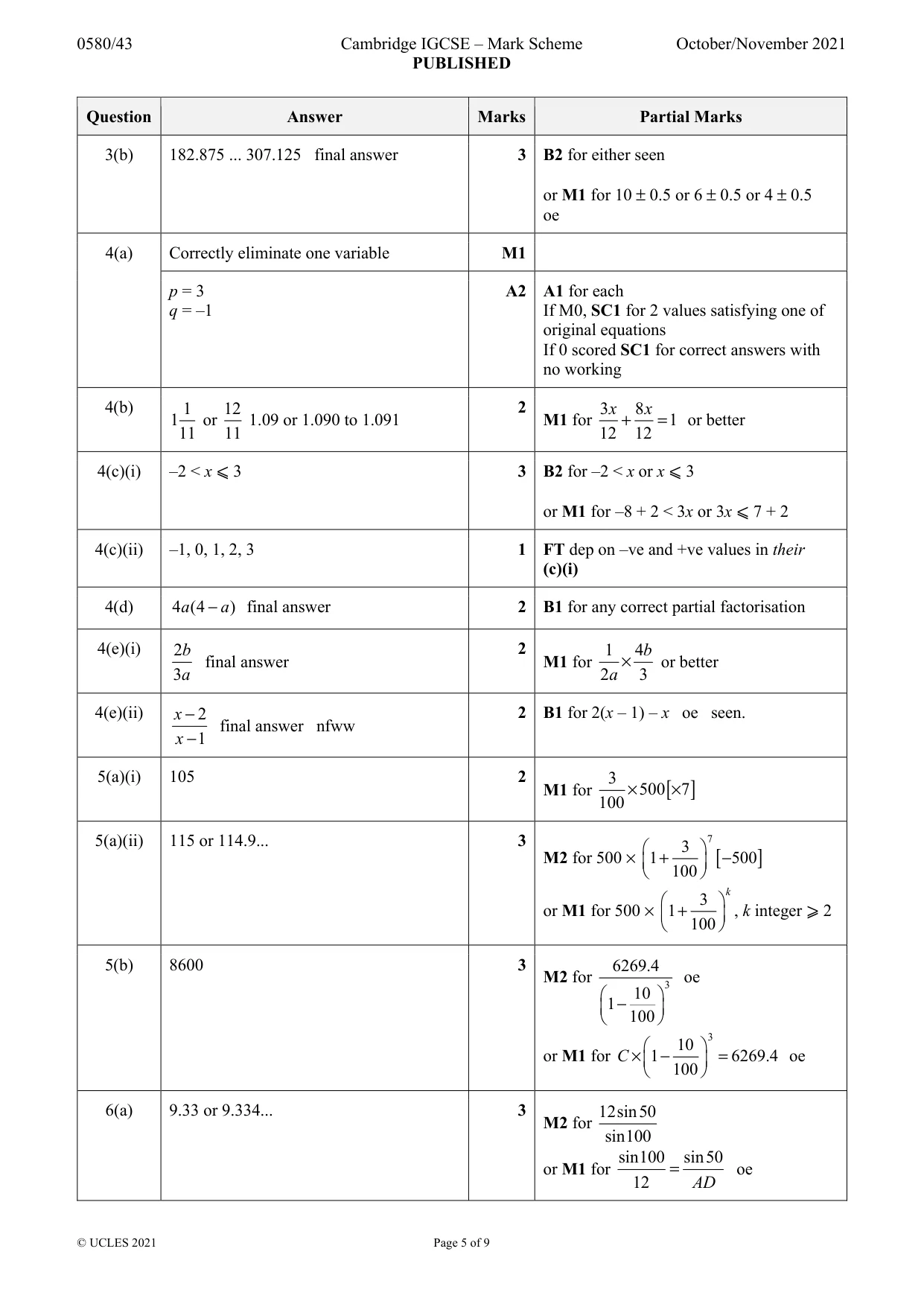
Mark scheme: 3(a)(i) 4.095 2 B1 for figs 4095 525 × 7.8 or M1 for 1000 3(a)(ii) 15 3 B2 for 35 OR 1 M2 for (10 + 4) × 5 × L = 525 oe 2 1 M1 for (10 + 4) × 5 oe 2 3(a)(iii) 455 or 454.9... 6 2 2 M3 for their [BD =] 3 + 5 × (their 15) [× 2] or B2 for 34 or 5.83 or 5.830 to 5.831 2 1 2 or M1 for 5 + (10 − 4 ) 2 and M1 for their 35 × 2 M1 for (their 15) × 10 and (their 15) × 4 3(a)(iv) 4200 3 3 10 M2 for 525 × oe 5 10 3 5 3 or M1 for or oe 5 10 3(b) 182.875 ... 307.125 final answer 3 B2 for either seen or M1 for 10 ± 0.5 or 6 ± 0.5 or 4 ± 0.5 oe
Q4 · Solve the simultaneous equations
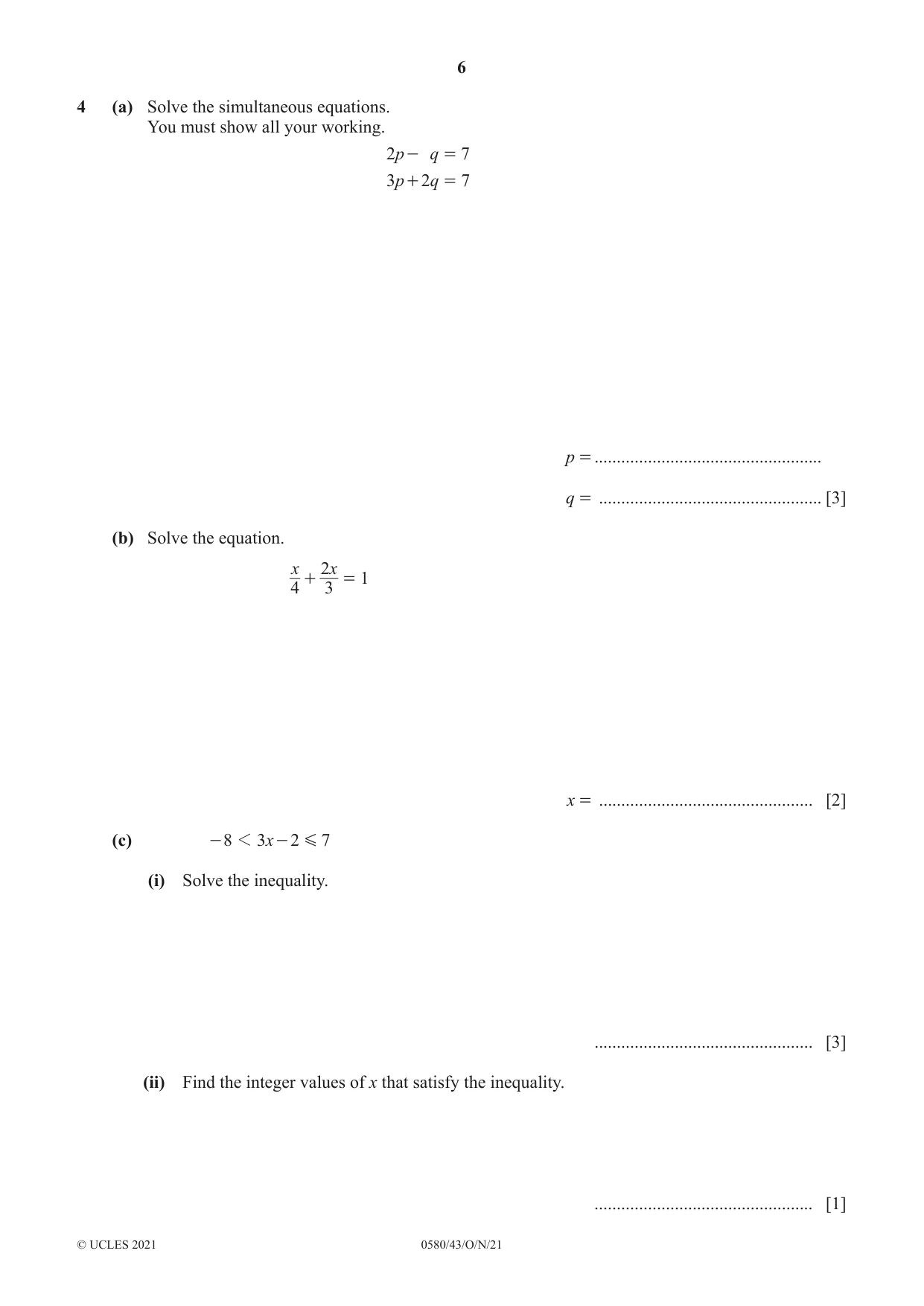
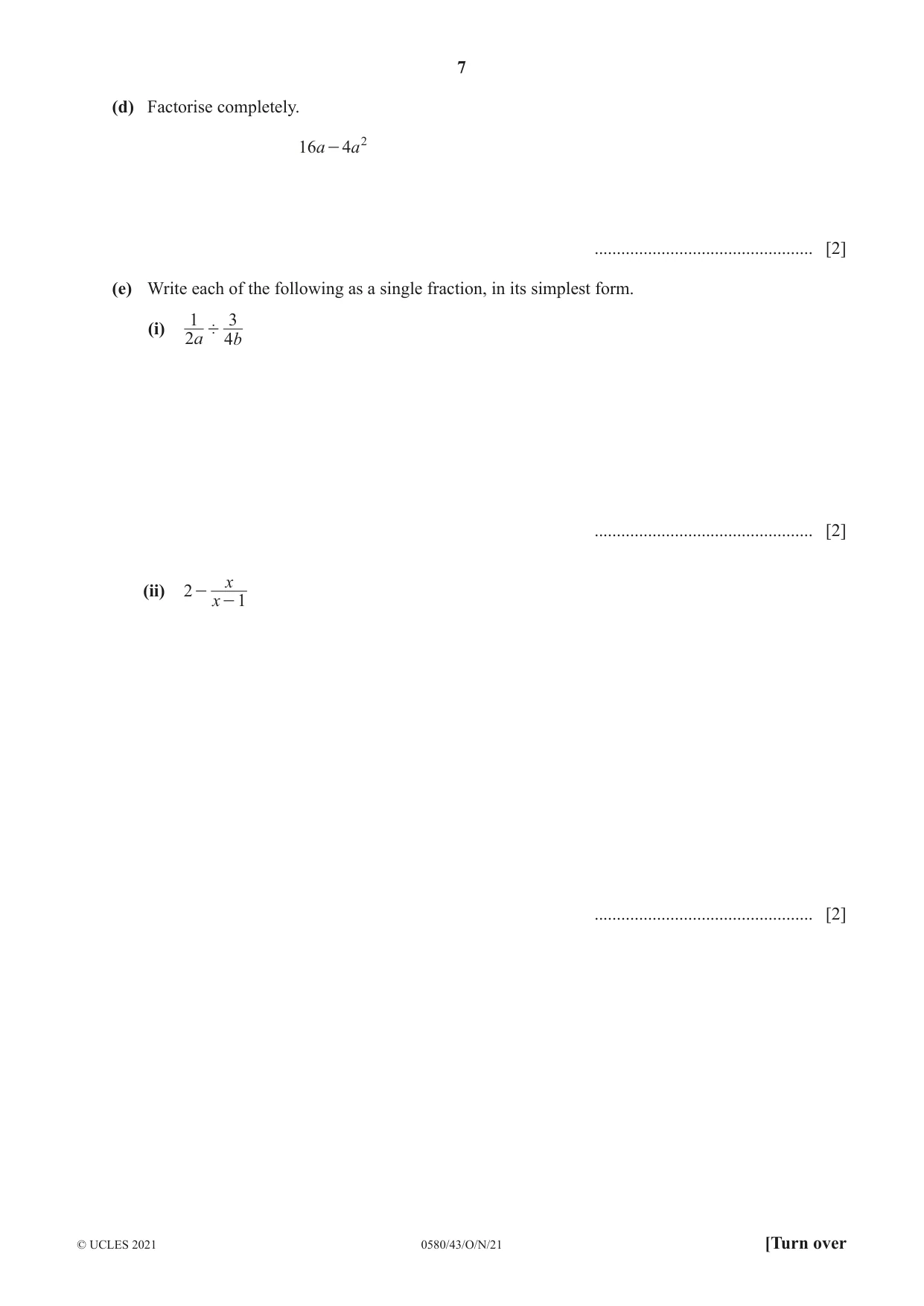
4 (a) Solve the simultaneous equations. You must show all your working. 2p - q = 7 3p + 2q = 7 p = ................................................... q = .................................................. [3] (b) Solve the equation. x 2x + = 1 4 3 x = ................................................ [2] (c) - 8 1 3x - 2 G 7 (i) Solve the inequality. ................................................. [3] (ii) Find the integer values of x that satisfy the inequality. ................................................. [1] (d) Factorise completely. 16a - 4 a 2 ................................................. [2] (e) Write each of the following as a single fraction, in its simplest form. 1 3 (i) ' 2a 4b ................................................. [2] x (ii) 2 - x - 1 ................................................. [2]
Mark scheme: 4(a) Correctly eliminate one variable M1 p = 3 A2 A1 for each q = –1 If M0, SC1 for 2 values satisfying one of original equations If 0 scored SC1 for correct answers with no working 4(b) 1 12 2 3 x 8 x 111 or 11 1.09 or 1.090 to 1.091 M1 for 12 + 12 = 1 or better 4(c)(i) –2 < x ⩽ 3 3 B2 for –2 < x or x ⩽ 3 or M1 for –8 + 2 < 3x or 3x ⩽ 7 + 2 4(c)(ii) –1, 0, 1, 2, 3 1 FT dep on –ve and +ve values in their (c)(i) 4(d) 4 a (4 − a ) final answer 2 B1 for any correct partial factorisation 4(e)(i) 2b 2 1 4b final answer M1 for × or better 3a 2 a 3 4(e)(ii) x − 2 2 B1 for 2(x – 1) – x oe seen. final answer nfww x − 1
Q5 · $500 is invested at a rate of 3% per year
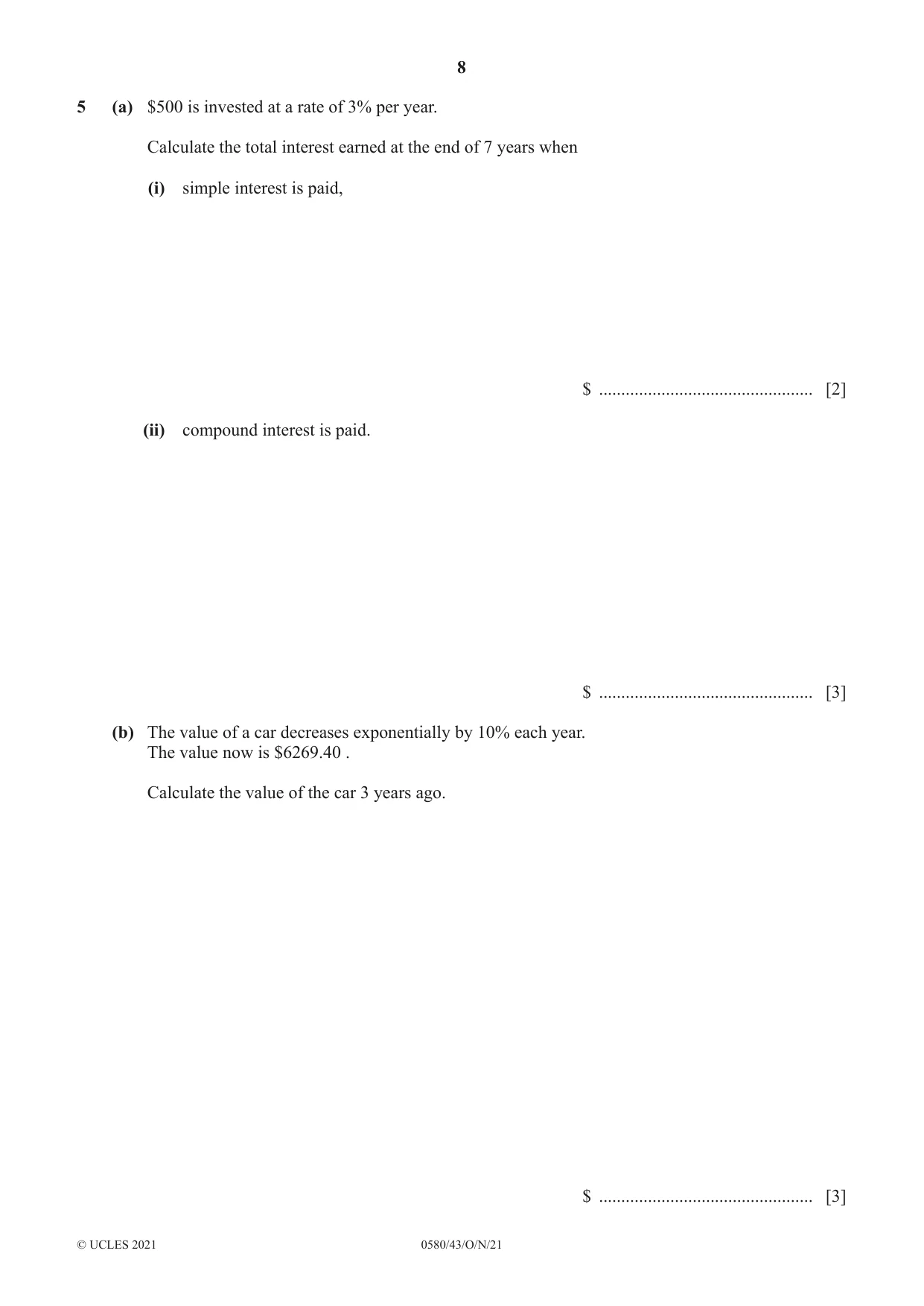
5 (a) $500 is invested at a rate of 3% per year. Calculate the total interest earned at the end of 7 years when (i) simple interest is paid, $ ................................................ [2] (ii) compound interest is paid. $ ................................................ [3] (b) The value of a car decreases exponentially by 10% each year. The value now is $6269.40 . Calculate the value of the car 3 years ago. $ ................................................ [3]
Mark scheme: 5(a)(i) 105 2 3 M1 for × 500 [× 7 ] 100 5(a)(ii) 115 or 114.9... 3 7 3 M2 for 500 × 1 + [ −500 ] 100 3 k or M1 for 500 × 1 + , k integer ⩾ 2 100 5(b) 8600 3 6269.4 M2 for oe 10 3 1 − 100 10 3 or M1 for C × 1 − = 6269.4 oe 100
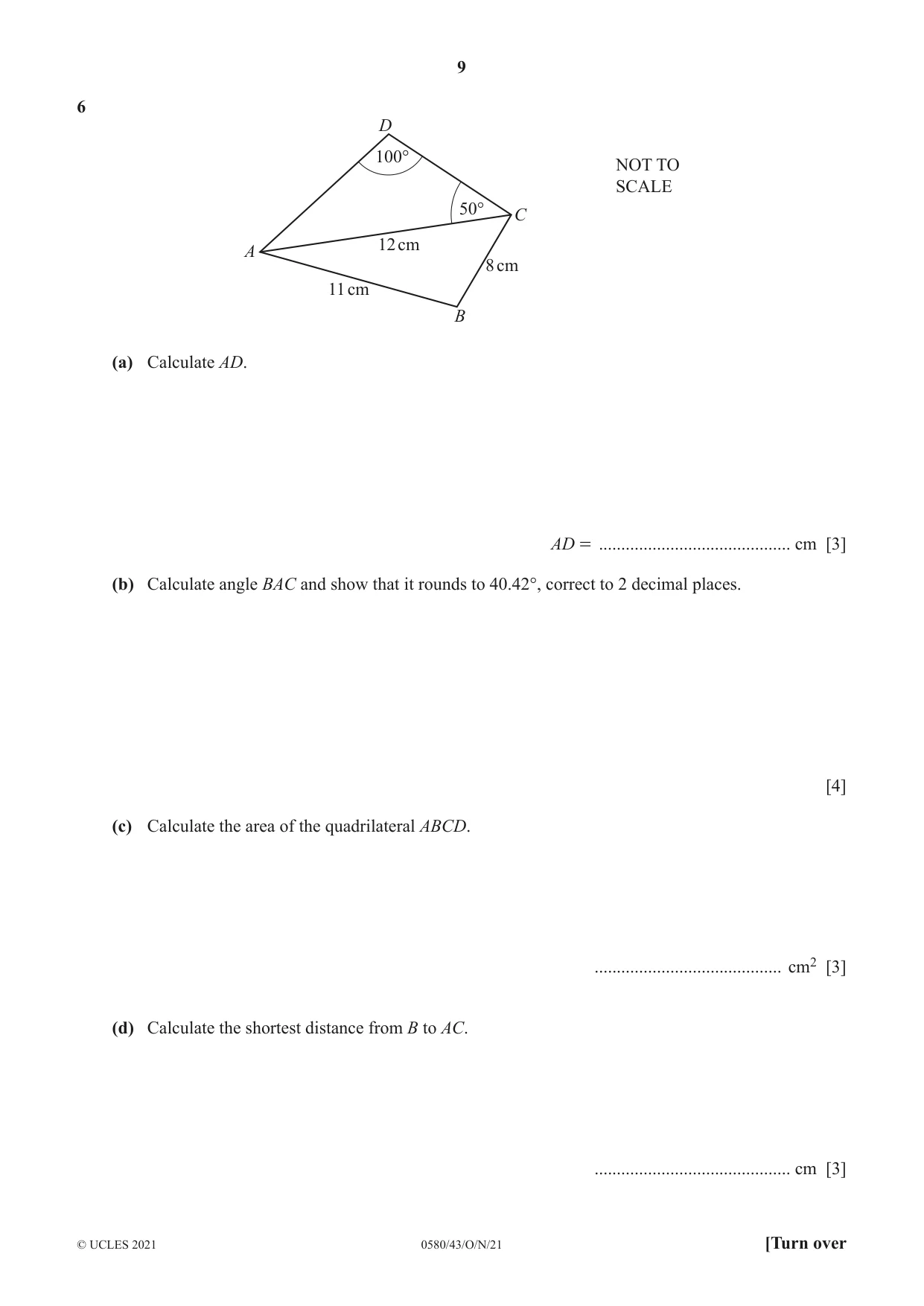
Q6 · D 100° NOT TO SCALE 50° C 12 cm A 8 cm 11 cm B (a) Calculate AD
6 D 100° NOT TO SCALE 50° C 12 cm A 8 cm 11 cm B (a) Calculate AD. AD = ........................................... cm [3] (b) Calculate angle BAC and show that it rounds to 40.42°, correct to 2 decimal places. [4] (c) Calculate the area of the quadrilateral ABCD. .......................................... cm2 [3] (d) Calculate the shortest distance from B to AC. ............................................ cm [3]
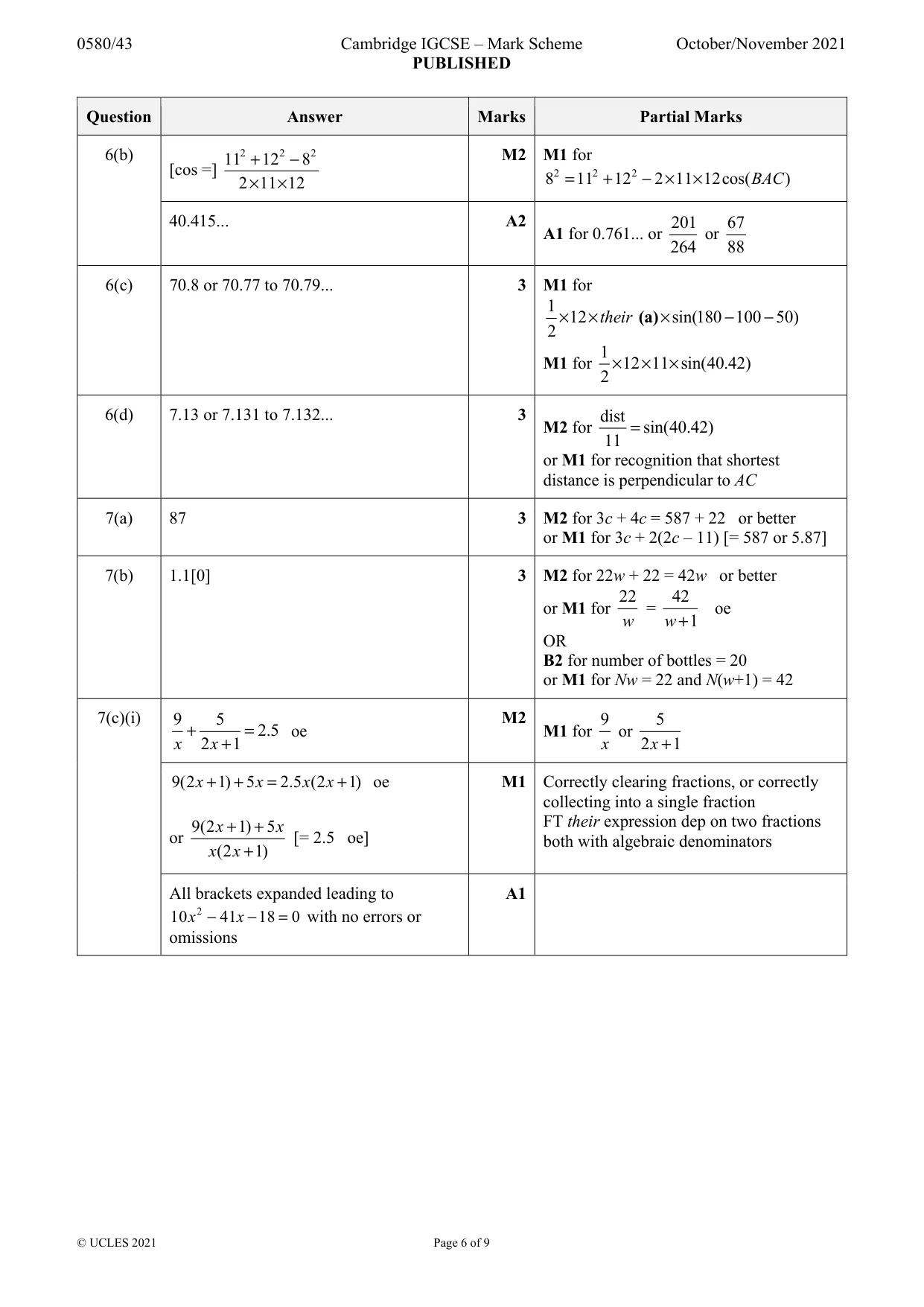
Mark scheme: 6(a) 9.33 or 9.334... 3 12sin50 M2 for sin100 sin100 sin50 or M1 for = oe 12 AD 6(b) 112 + 12 2 − 8 2 M2 M1 for [cos =] 2 2 2 2 × 11 × 12 8 = 11 + 12 − 2 × 11 × 12cos( BAC ) 40.415... A2 201 67 A1 for 0.761... or or 264 88 6(c) 70.8 or 70.77 to 70.79... 3 M1 for 1 × 12 × their (a) × sin(180 − 100 − 50) 2 1 M1 for × 12 × 11 × sin(40.42) 2 6(d) 7.13 or 7.131 to 7.132... 3 dist M2 for = sin(40.42) 11 or M1 for recognition that shortest distance is perpendicular to AC
Q7 · Amir buys 3 cakes that cost c cents each and 2 loaves of bread that cost (2c - 11) cents…
7 (a) Amir buys 3 cakes that cost c cents each and 2 loaves of bread that cost (2c - 11) cents each. He spends a total of $5.87 . Find the value of c. c = ................................................ [3] (b) A bottle of water costs $w. A bottle of juice costs $(w + 1). Alex spends $22 on bottles of water and $42 on bottles of juice. The number of bottles of water is equal to the number of bottles of juice. Find the value of w. w = ................................................ [3] (c) Alicia walks a distance of 9 km at a speed of x km/h. She then runs a distance of 5 km at a speed of (2x + 1) km/h. The total time Alicia takes is 2.5 hours. (i) Show that 10x 2 - 41x - 18 = 0 . [4] (ii) Work out Alicia’s running speed. You must show all your working. ........................................ km/h [4]
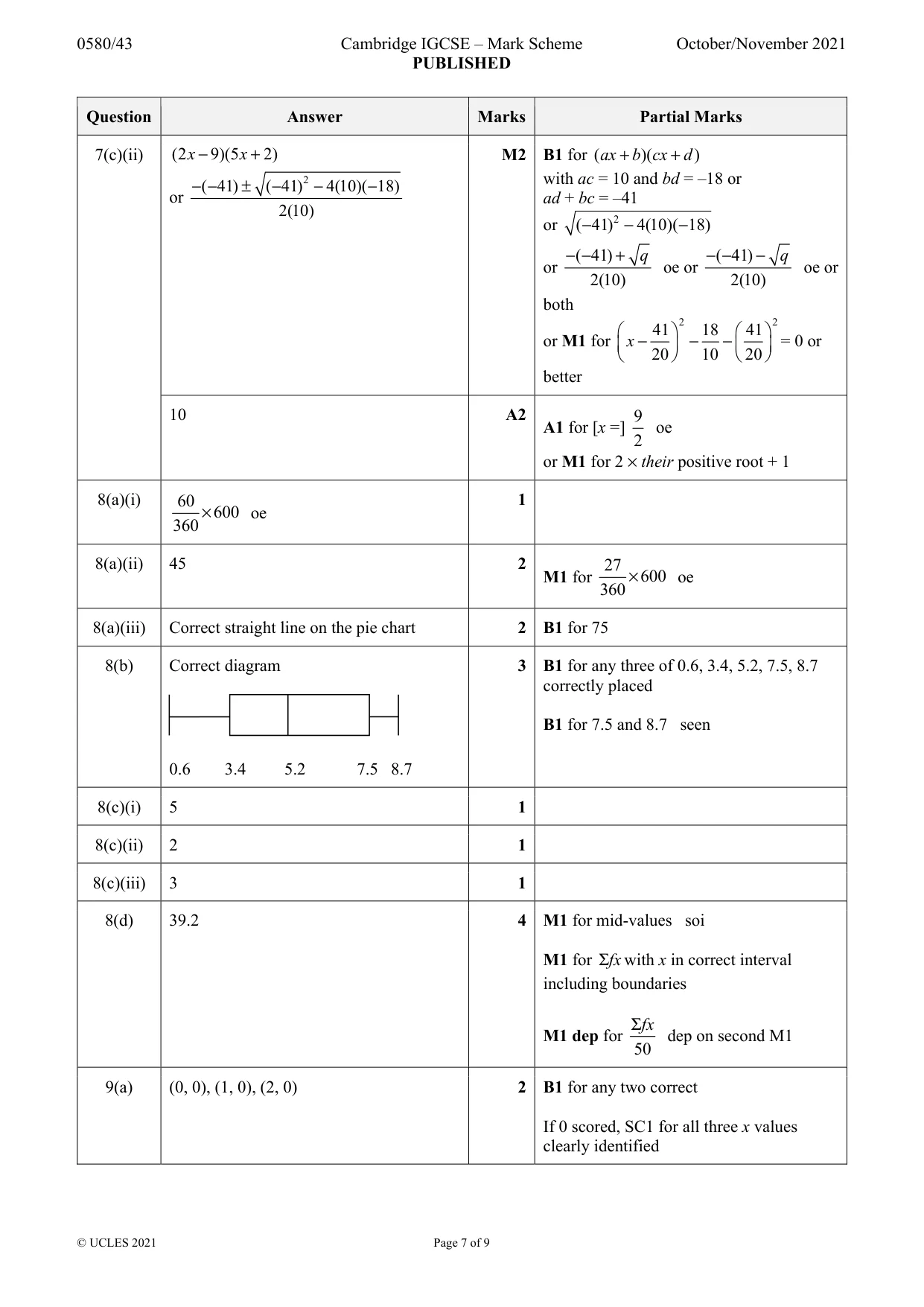
Mark scheme: 7(a) 87 3 M2 for 3c + 4c = 587 + 22 or better or M1 for 3c + 2(2c – 11) [= 587 or 5.87] 7(b) 1.1[0] 3 M2 for 22w + 22 = 42w or better 22 42 or M1 for = oe w w + 1 OR B2 for number of bottles = 20 or M1 for Nw = 22 and N(w+1) = 42 7(c)(i) 9 5 M2 9 5 + = 2.5 oe M1 for or x 2 x + 1 x 2 x + 1 9(2 x + 1) + 5 x = 2.5 x (2 x + 1) oe M1 Correctly clearing fractions, or correctly collecting into a single fraction FT their expression dep on two fractions 9(2 x + 1) + 5 x or [= 2.5 oe] both with algebraic denominators x (2 x + 1) All brackets expanded leading to A1 10 x 2 − 41 x − 18 = 0 with no errors or omissions 7(c)(ii) (2 x − 9)(5 x + 2) M2 B1 for ( ax + b )( cx + d ) 2 with ac = 10 and bd = –18 or −−( 41) ± ( − 41) − 4(10)( − 18) or ad + bc = –41 2(10) or ( − 41) 2 − 4(10)( − 18) −−( 41) + q −−( 41) − q or oe or oe or 2(10) 2(10) both 41 2 18 41 2 or M1 for x − − − = 0 or 20 10 20 better 10 A2 9 A1 for [x =] oe 2 or M1 for 2 × their positive root + 1
Q8 · Jean asks 600 people to choose their favourite sport
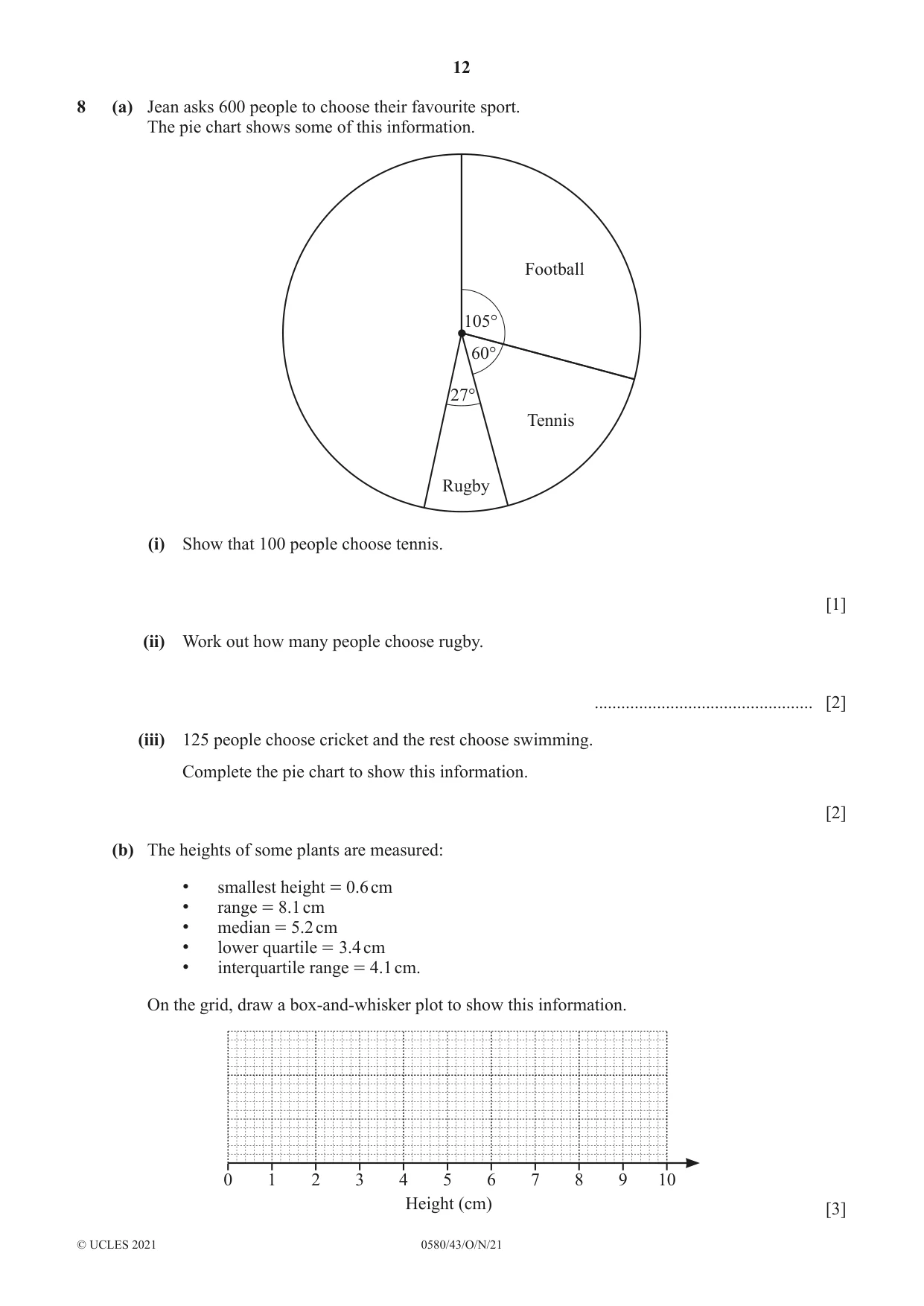
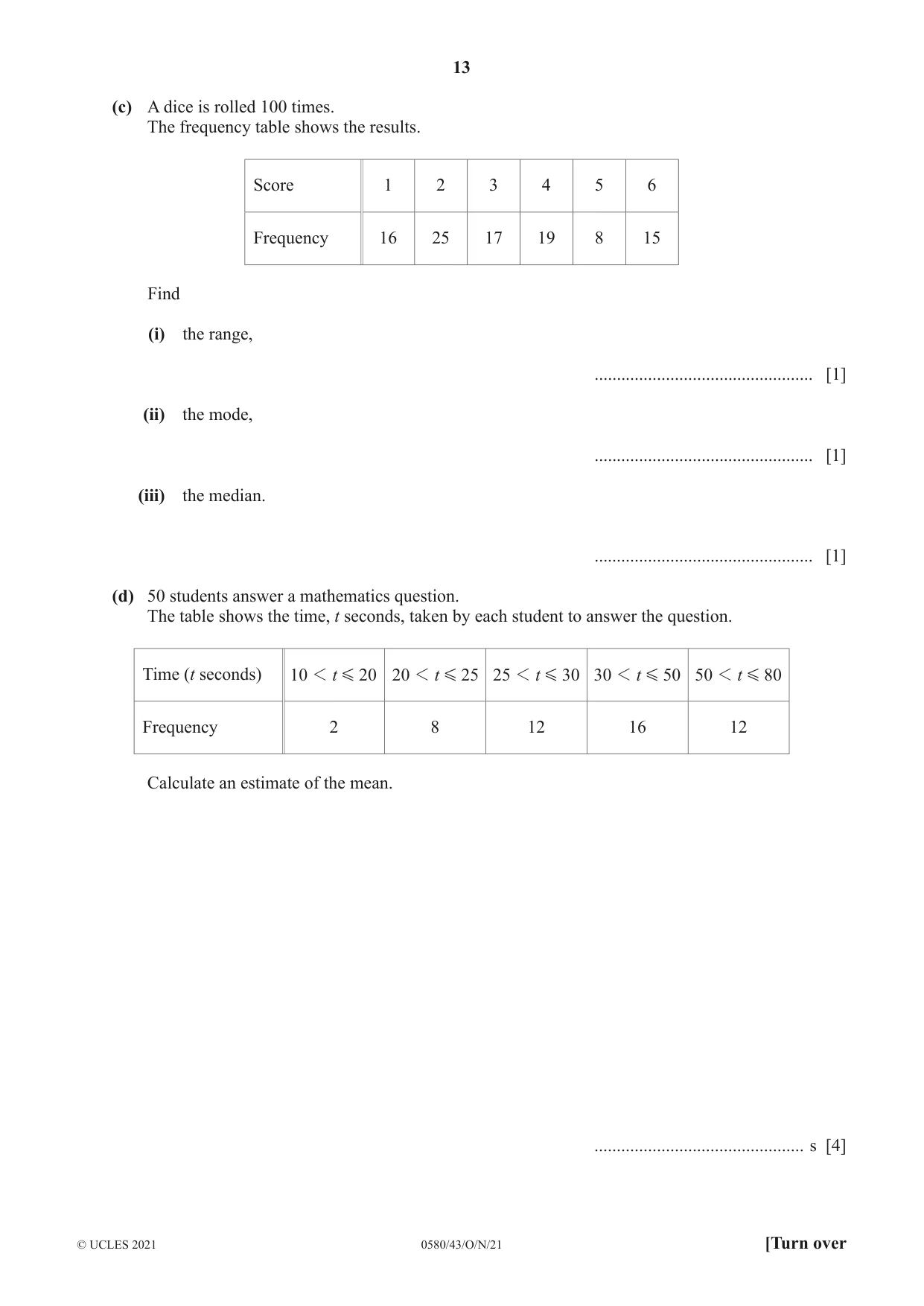
8 (a) Jean asks 600 people to choose their favourite sport. The pie chart shows some of this information. Football 105° 60° 27° Tennis Rugby (i) Show that 100 people choose tennis. [1] (ii) Work out how many people choose rugby. ................................................. [2] (iii) 125 people choose cricket and the rest choose swimming. Complete the pie chart to show this information. [2] (b) The heights of some plants are measured: • smallest height = 0.6 cm • range = 8.1 cm • median = 5.2 cm • lower quartile = 3.4 cm • interquartile range = 4.1 cm. On the grid, draw a box-and-whisker plot to show this information. 0 1 2 3 4 5 6 7 8 9 10 Height (cm) [3] (c) A dice is rolled 100 times. The frequency table shows the results. Score 1 2 3 4 5 6 Frequency 16 25 17 19 8 15 Find (i) the range, ................................................. [1] (ii) the mode, ................................................. [1] (iii) the median. ................................................. [1] (d) 50 students answer a mathematics question. The table shows the time, t seconds, taken by each student to answer the question. Time (t seconds) 10 1 t G 20 2 0 1 t G 25 25 1 t G 30 30 1 t G 50 50 1 t G 80 Frequency 2 8 12 16 12 Calculate an estimate of the mean. ............................................... s [4]
Mark scheme: 8(a)(i) 60 1 × 600 oe 360 8(a)(ii) 45 2 27 M1 for × 600 oe 360 8(a)(iii) Correct straight line on the pie chart 2 B1 for 75 8(b) Correct diagram 3 B1 for any three of 0.6, 3.4, 5.2, 7.5, 8.7 correctly placed B1 for 7.5 and 8.7 seen 0.6 3.4 5.2 7.5 8.7 8(c)(i) 5 1 8(c)(ii) 2 1 8(c)(iii) 3 1 8(d) 39.2 4 M1 for mid-values soi M1 for Σfx with x in correct interval including boundaries Σfx M1 dep for dep on second M1 50
Q9 · F ( x) = x ( x - 1)( x - 2) (a) Find the coordinates of the points where the graph of y =…
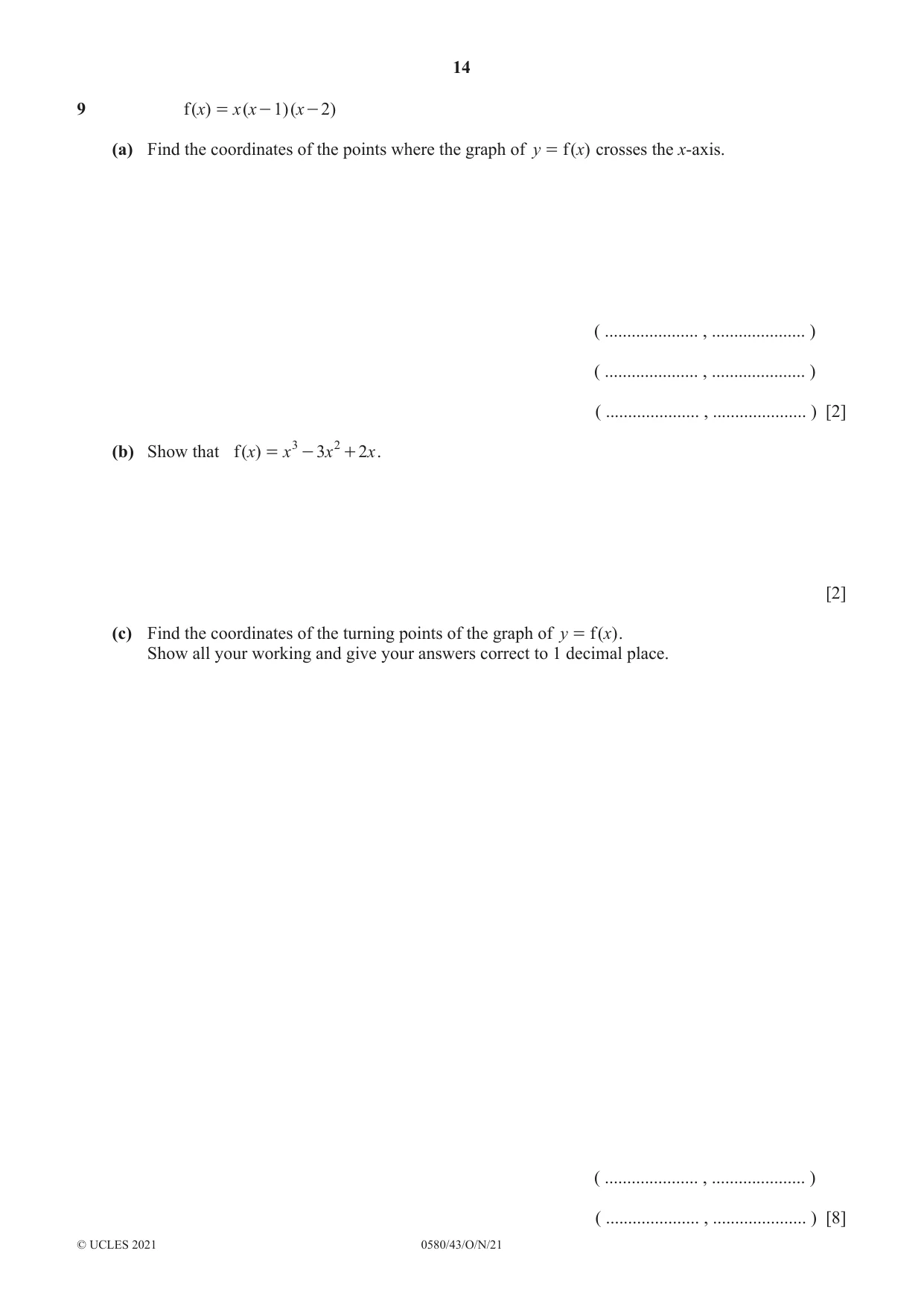
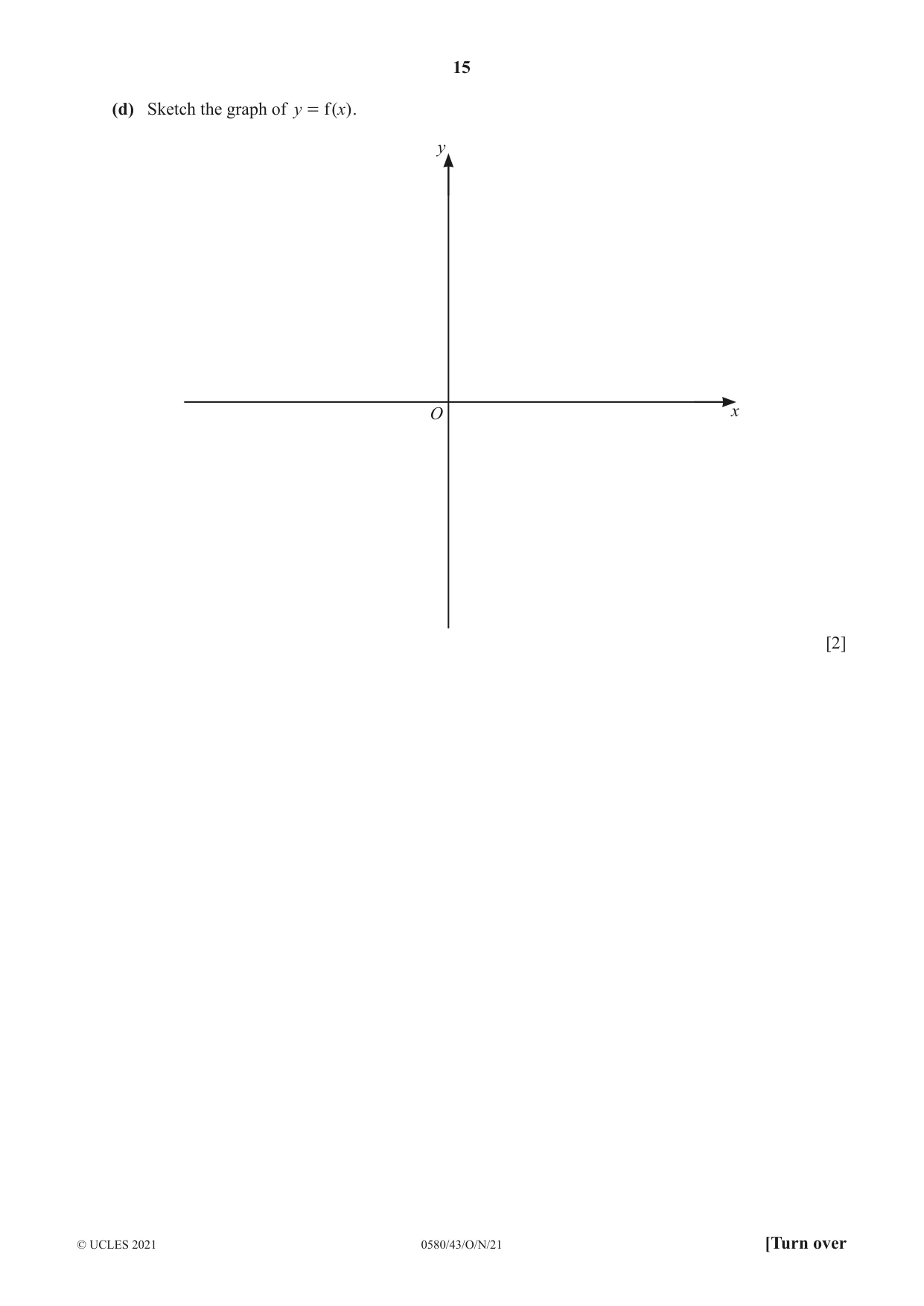
9 f ( x) = x ( x - 1)( x - 2) (a) Find the coordinates of the points where the graph of y = f ( x) crosses the x-axis. ( ..................... , ..................... ) ( ..................... , ..................... ) ( ..................... , ..................... ) [2] (b) Show that (f x) = x 3 - 3x 2 + 2x . [2] (c) Find the coordinates of the turning points of the graph of y = f ( x) . Show all your working and give your answers correct to 1 decimal place. ( ..................... , ..................... ) ( ..................... , ..................... ) [8] (d) Sketch the graph of y = f ( x) . y O x [2]
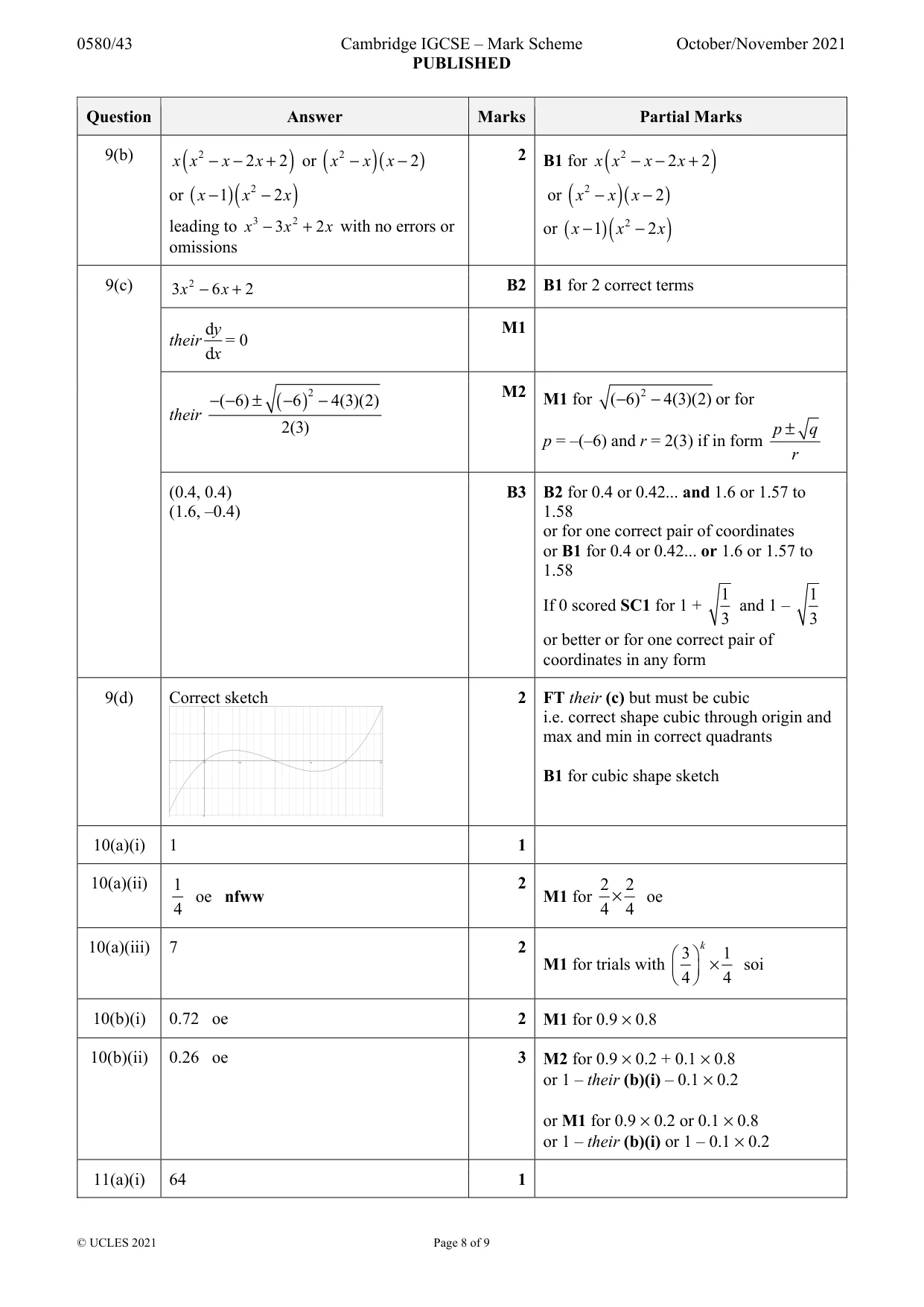
Mark scheme: 9(a) (0, 0), (1, 0), (2, 0) 2 B1 for any two correct If 0 scored, SC1 for all three x values clearly identified 9(b) 2 2 2 2 x x − x − 2 x + 2 or x − x x − x − 2 x + 2 ( ) ( )( x − 2 ) B1 for x ( ) or x − 2 ) or ( x − 1)( x 2 − 2 x ) ( x 2 − x )( leading to x 3 − 3 x 2 + 2 x with no errors or or ( x − 1)( x 2 − 2 x ) omissions 9(c) 3 x 2 − 6 x + 2 B2 B1 for 2 correct terms dy M1 their = 0 dx 2 M2 2 −−( 6) ± ( −6 ) − 4(3)(2) M1 for ( −6) − 4(3)(2) or for their 2(3) p ± q p = –(–6) and r = 2(3) if in form r (0.4, 0.4) B3 B2 for 0.4 or 0.42... and 1.6 or 1.57 to (1.6, –0.4) 1.58 or for one correct pair of coordinates or B1 for 0.4 or 0.42... or 1.6 or 1.57 to 1.58 1 1 If 0 scored SC1 for 1 + and 1 – 3 3 or better or for one correct pair of coordinates in any form 9(d) Correct2222 sketch 2 FT their (c) but must be cubic i.e. correct shape cubic through origin and 1111 max and min in correct quadrants .5.5.5.5 0000 0000 0.50.50.50.5 1111 1.51.51.51.5 2222 2.52.52.52.5 -1-1-1-1 B1 for cubic shape sketch -2-2-2-2
Q10 · Sarah spins a fair four-sided spinner numbered 0, 1, 1 and 3
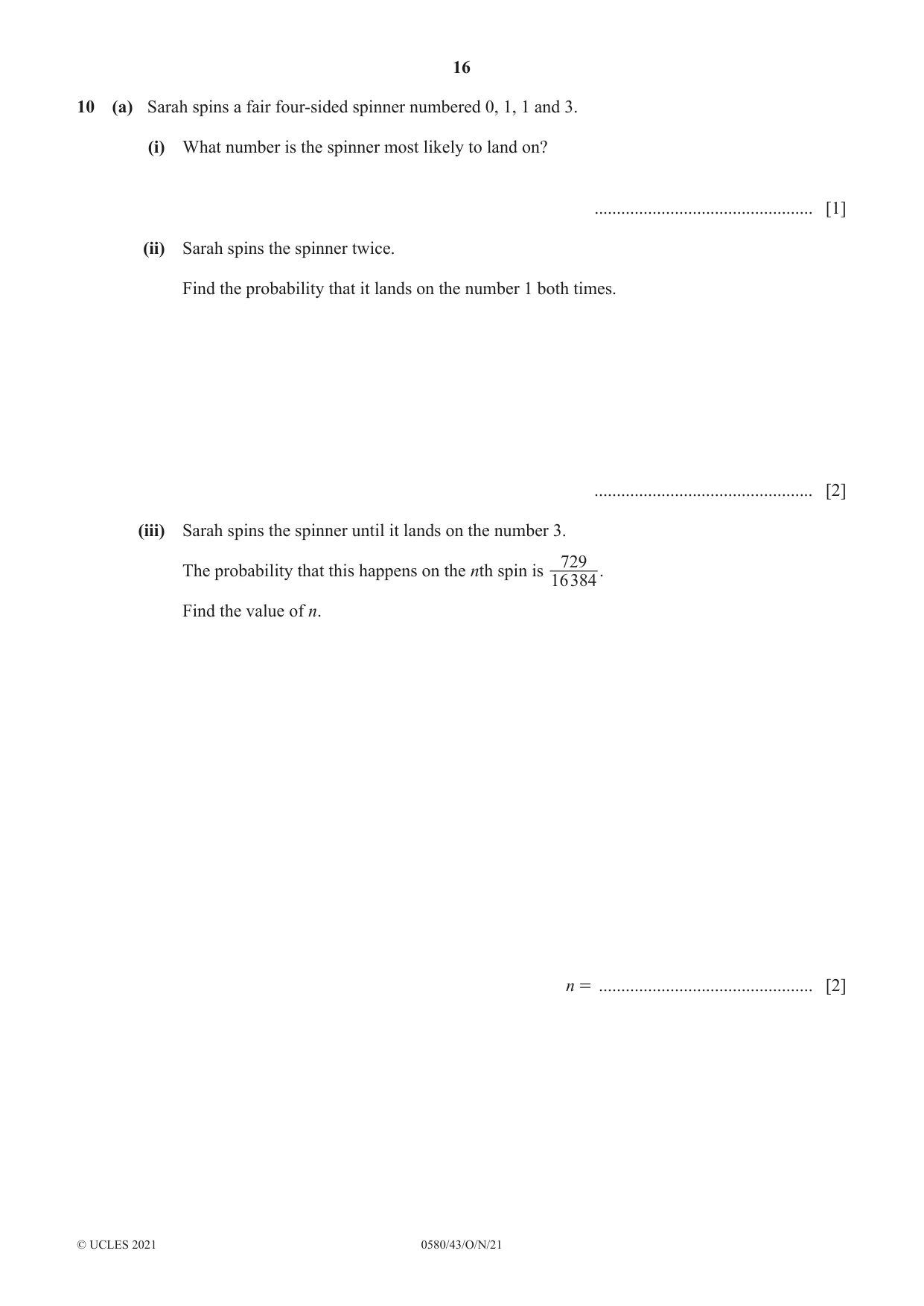
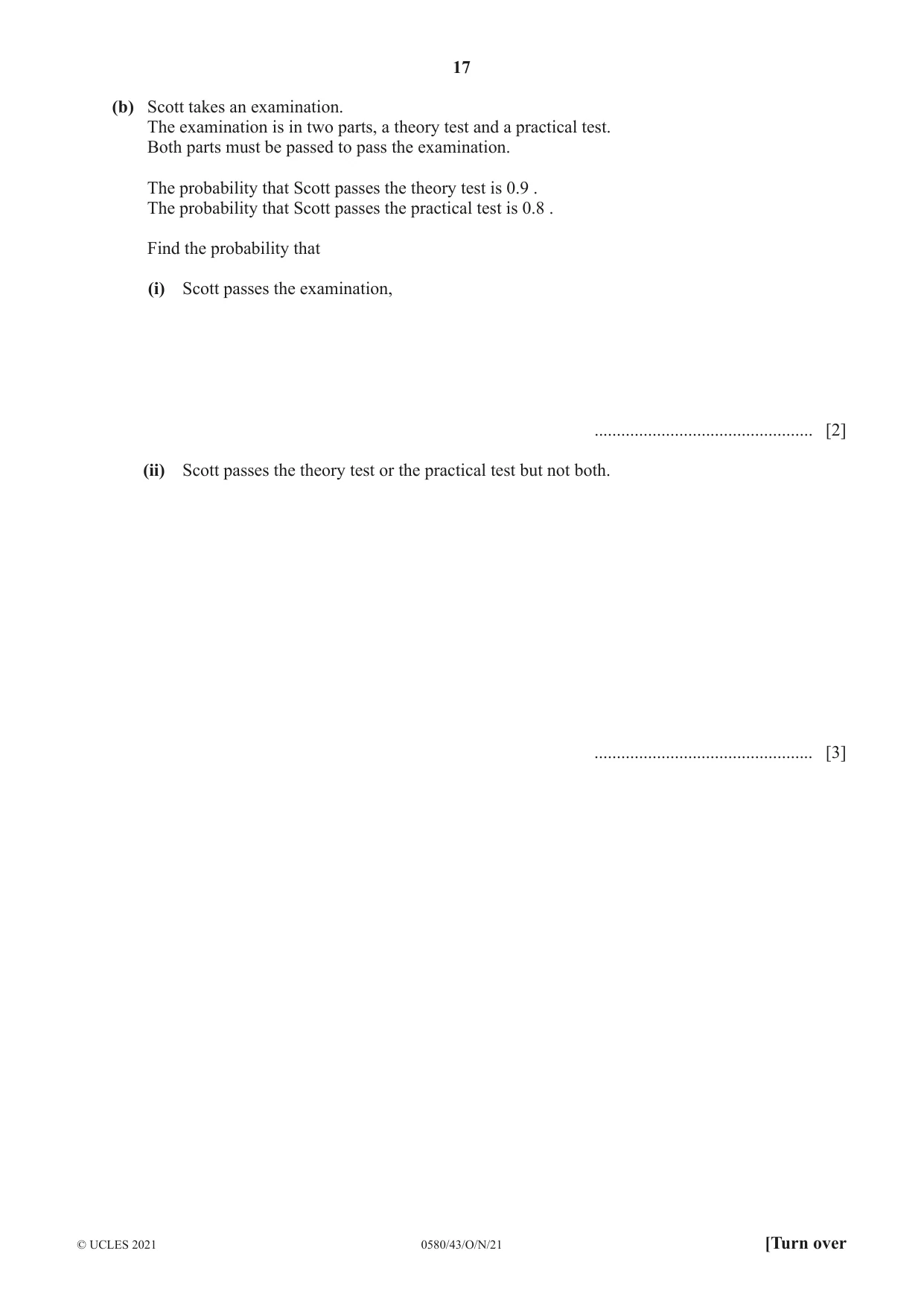
10 (a) Sarah spins a fair four-sided spinner numbered 0, 1, 1 and 3. (i) What number is the spinner most likely to land on? ................................................. [1] (ii) Sarah spins the spinner twice. Find the probability that it lands on the number 1 both times. ................................................. [2] (iii) Sarah spins the spinner until it lands on the number 3. 729 The probability that this happens on the nth spin is . 16384 Find the value of n. n = ................................................ [2] (b) Scott takes an examination. The examination is in two parts, a theory test and a practical test. Both parts must be passed to pass the examination. The probability that Scott passes the theory test is 0.9 . The probability that Scott passes the practical test is 0.8 . Find the probability that (i) Scott passes the examination, ................................................. [2] (ii) Scott passes the theory test or the practical test but not both. ................................................. [3]
Mark scheme: 10(a)(i) 1 1 10(a)(ii) 1 2 2 2 oe nfww M1 for × oe 4 4 4 10(a)(iii) 7 2 k M1 for trials with 3 × 1 soi 4 4 10(b)(i) 0.72 oe 2 M1 for 0.9 × 0.8 10(b)(ii) 0.26 oe 3 M2 for 0.9 × 0.2 + 0.1 × 0.8 or 1 – their (b)(i) – 0.1 × 0.2 or M1 for 0.9 × 0.2 or 0.1 × 0.8 or 1 – their (b)(i) or 1 – 0.1 × 0.2
Q11 · F ( x) = 2 x - 1 g ( x) = x 2 + 2x h ( x) = 4x j ( x) = 2x (a) Find the value of (i)…
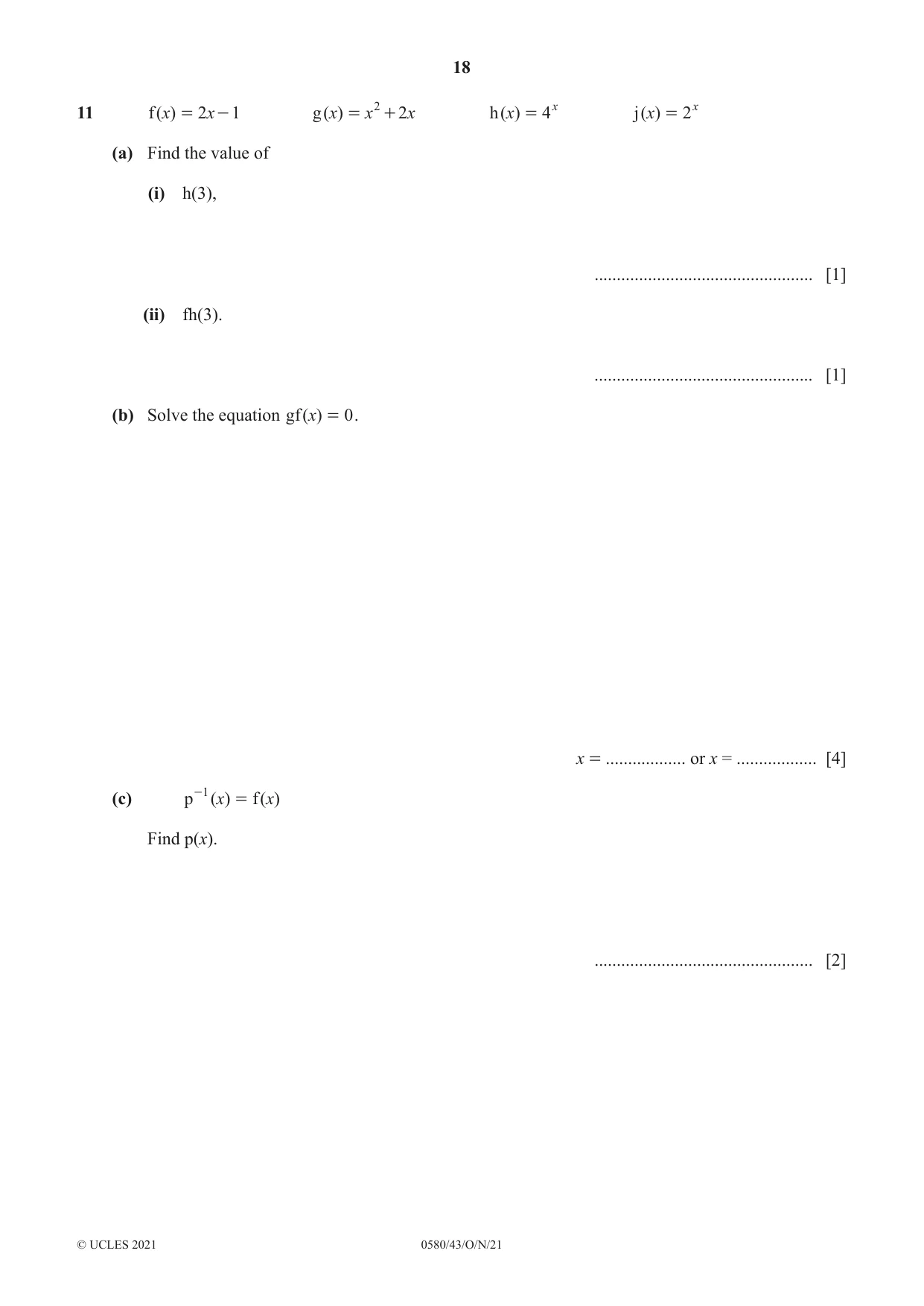
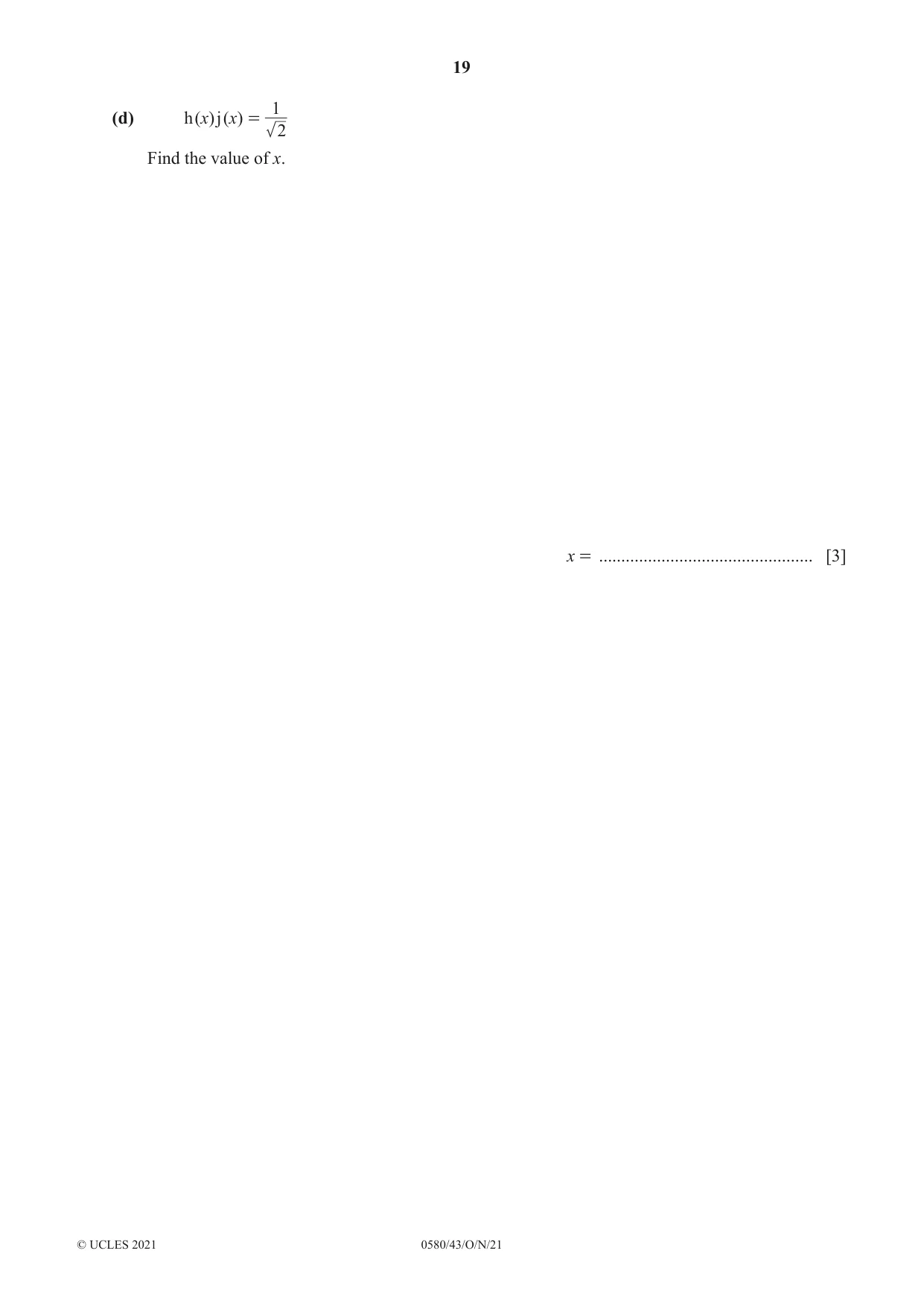
11 f ( x) = 2 x - 1 g ( x) = x 2 + 2x h ( x) = 4x j ( x) = 2x (a) Find the value of (i) h(3), ................................................. [1] (ii) fh(3). ................................................. [1] (b) Solve the equation gf ( x) = 0 . x = .................. or x = .................. [4] (c) p -1 ( x) = f ( x) Find p(x). ................................................. [2] 1(d) h ( x) j ( x) = 2 Find the value of x. x = ................................................ [3]
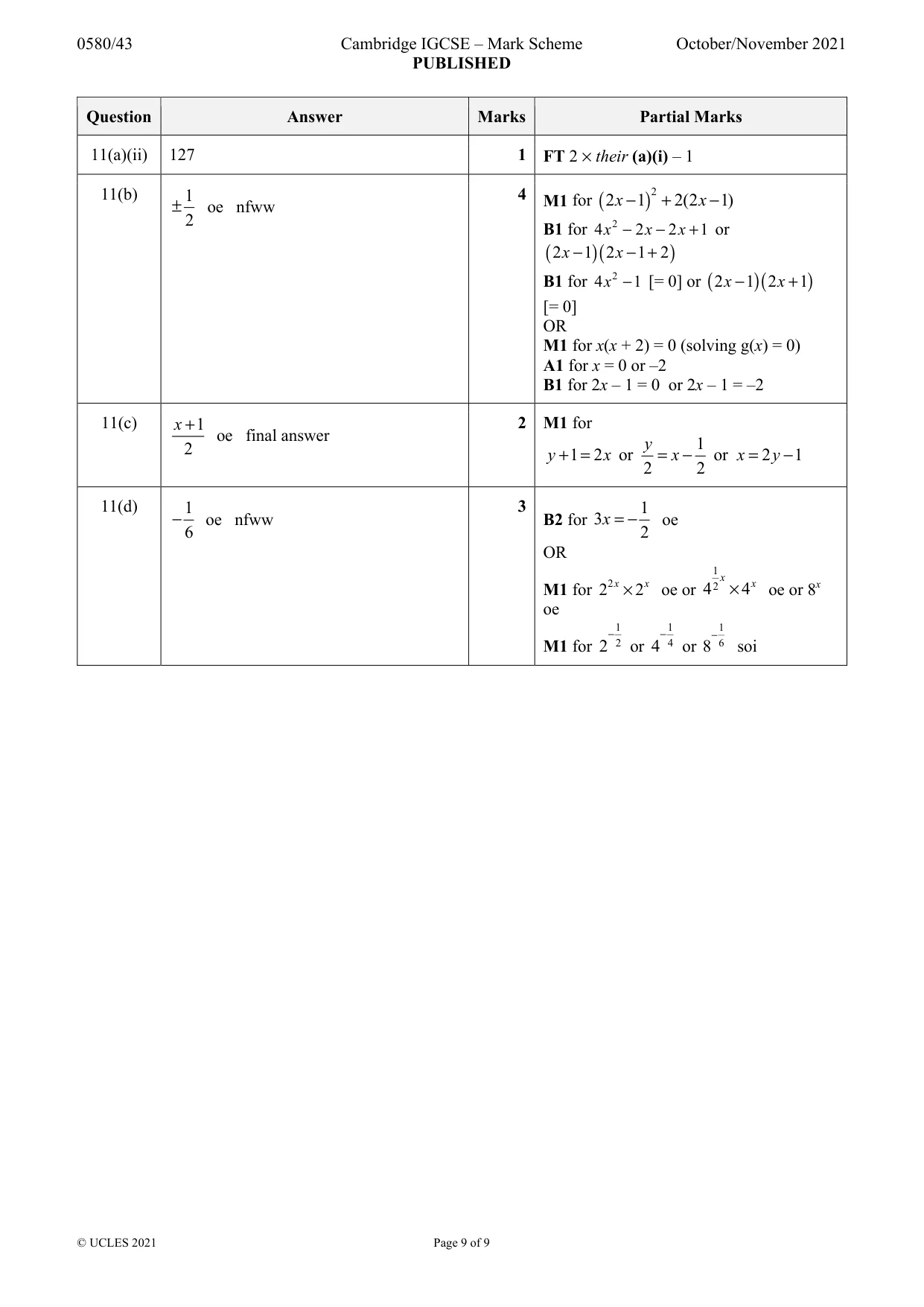
Mark scheme: 11(a)(i) 64 1 11(a)(ii) 127 1 FT 2 × their (a)(i) – 1 4 11(b) 1 M1 for ( 2 x − 1) 2 + 2(2 x − 1) ± oe nfww 2 2 B1 for 4 x − 2 x − 2 x + 1 or ( 2 x − 1)( 2 x −+1 2 ) B1 for 4 x 2 − 1 [= 0] or ( 2 x − 1)( 2 x + 1) [= 0] OR M1 for x(x + 2) = 0 (solving g(x) = 0) A1 for x = 0 or –2 B1 for 2x – 1 = 0 or 2x – 1 = –2 11(c) x + 1 2 M1 for oe final answer y 1 2 y + 1 = 2 x or = x − or x = 2 y − 1 2 2 11(d) 1 3 1 − oe nfww B2 for 3 x = − oe 6 2 OR 1 x M1 for 2 2 x × 2 x oe or 4 2 × 4 x oe or 8x oe 1 1 1 − − − M1 for 2 2 or 4 4 or 8 6 soi
What was in this paper
The subtopics covered by these 11 questions, and how many questions each got. Open one in a new tab to see every Cambridge question on it.
What you needed in this session
Cambridge’s own grade thresholds for 2021 Oct/Nov, Paper 4 · Variant 3. A higher threshold means an easier paper — the bar moves with how the cohort did.