Cambridge IGCSE Mathematics 0580 — 2019 Oct/Nov Paper 4 · Variant 3
0580/43/O/N/19 · 11 questions · 130 marks · ≈146 min
The question paper and its mark scheme, free to read here and free to download. This is Cambridge’s own paper, exactly as it was sat.
Question paper20 pages
Mark scheme8 pages
Answers below. Sit the paper first if you are practising.
Questions as text
Q1 · In a cycling club, the number of members are in the ratio males : females = 8 : 3
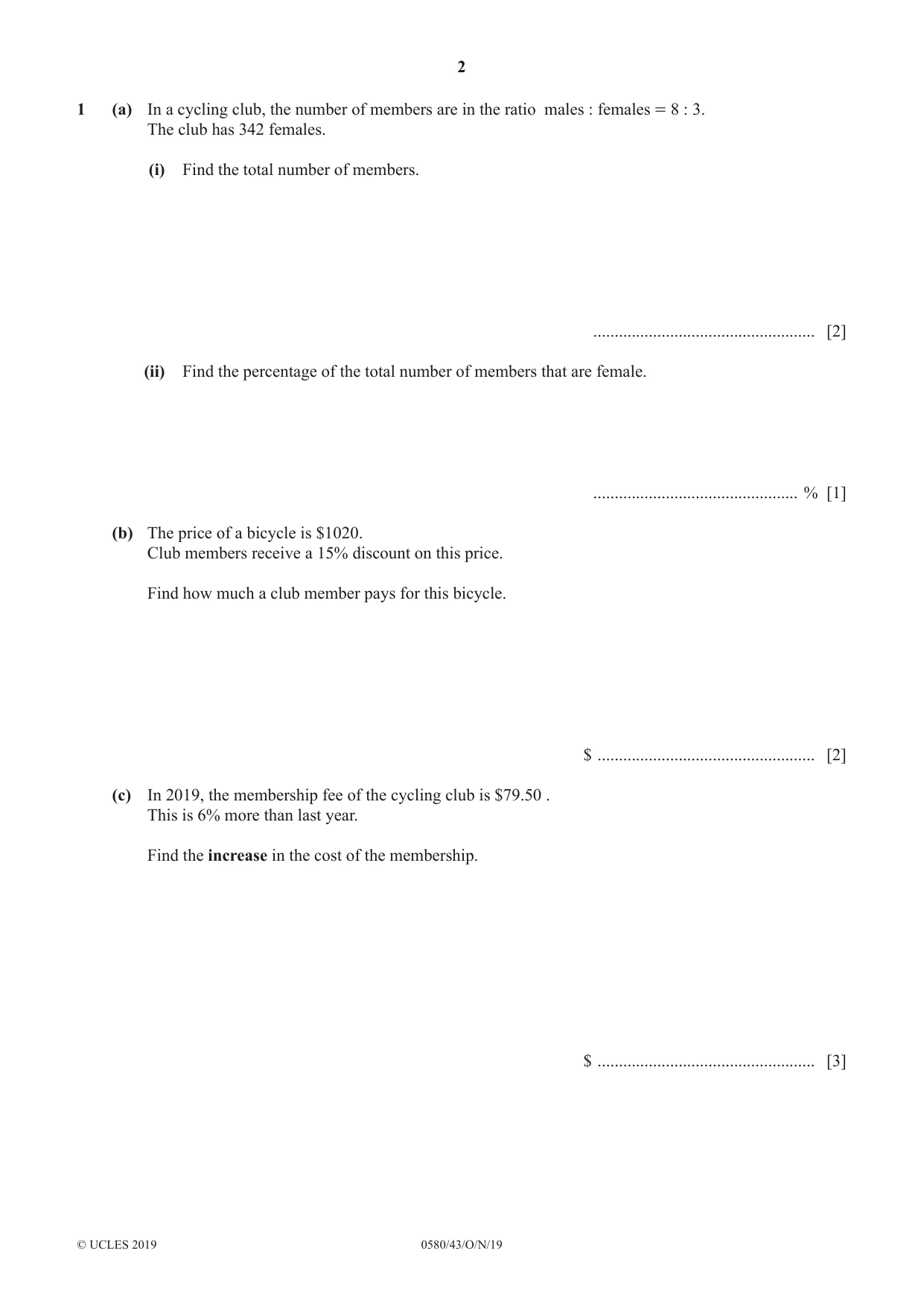
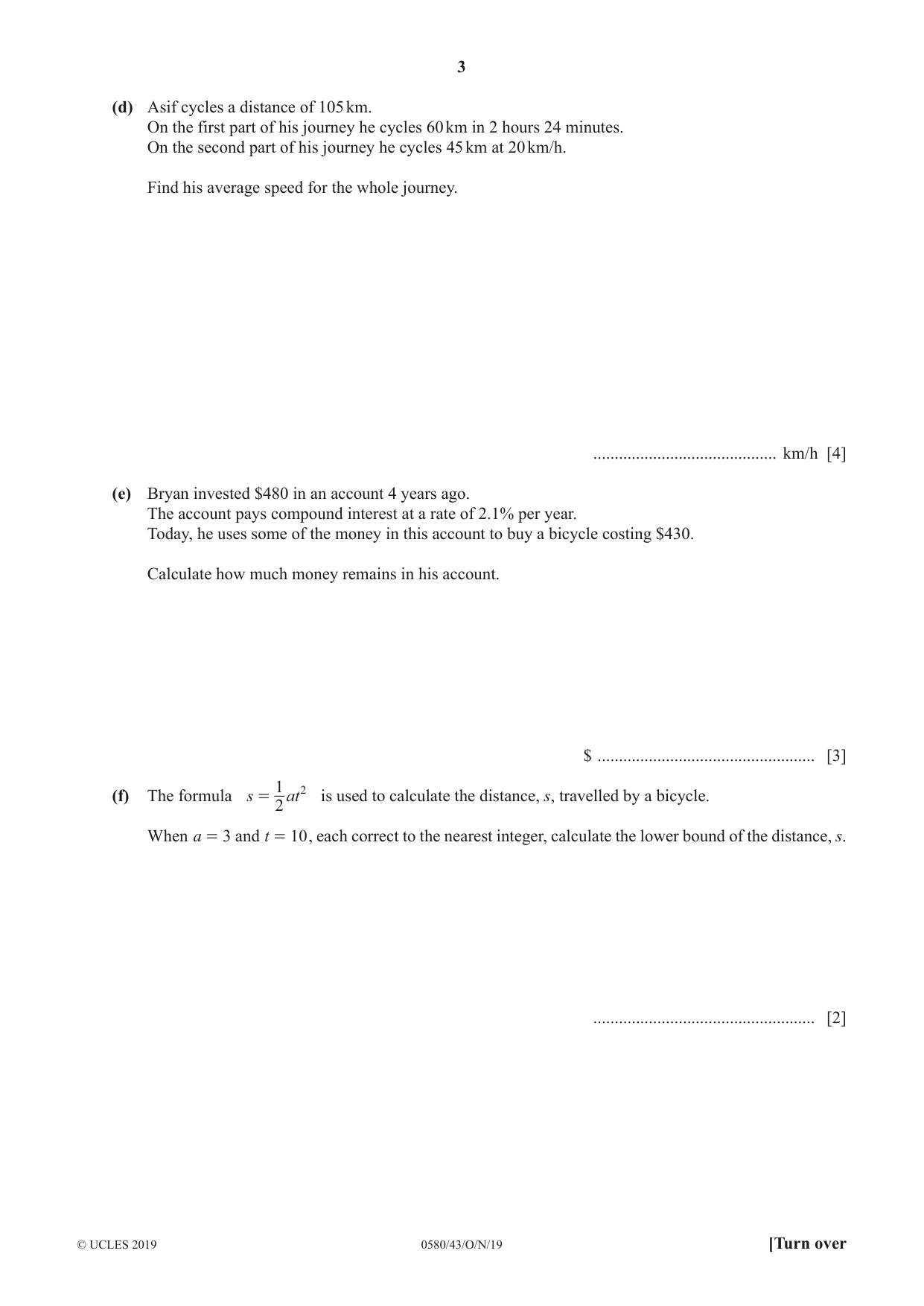
1 (a) In a cycling club, the number of members are in the ratio males : females = 8 : 3. The club has 342 females. (i) Find the total number of members. .................................................... [2] (ii) Find the percentage of the total number of members that are female. ................................................ % [1] (b) The price of a bicycle is $1020. Club members receive a 15% discount on this price. Find how much a club member pays for this bicycle. $ ................................................... [2] (c) In 2019, the membership fee of the cycling club is $79.50 . This is 6% more than last year. Find the increase in the cost of the membership. $ ................................................... [3] (d) Asif cycles a distance of 105 km. On the first part of his journey he cycles 60 km in 2 hours 24 minutes. On the second part of his journey he cycles 45 km at 20 km/h. Find his average speed for the whole journey. ........................................... km/h [4] (e) Bryan invested $480 in an account 4 years ago. The account pays compound interest at a rate of 2.1% per year. Today, he uses some of the money in this account to buy a bicycle costing $430. Calculate how much money remains in his account. $ ................................................... [3] 1 2(f) The formula s = at is used to calculate the distance, s, travelled by a bicycle. 2 When a = 3 and t = 10 , each correct to the nearest integer, calculate the lower bound of the distance, s. .................................................... [2]
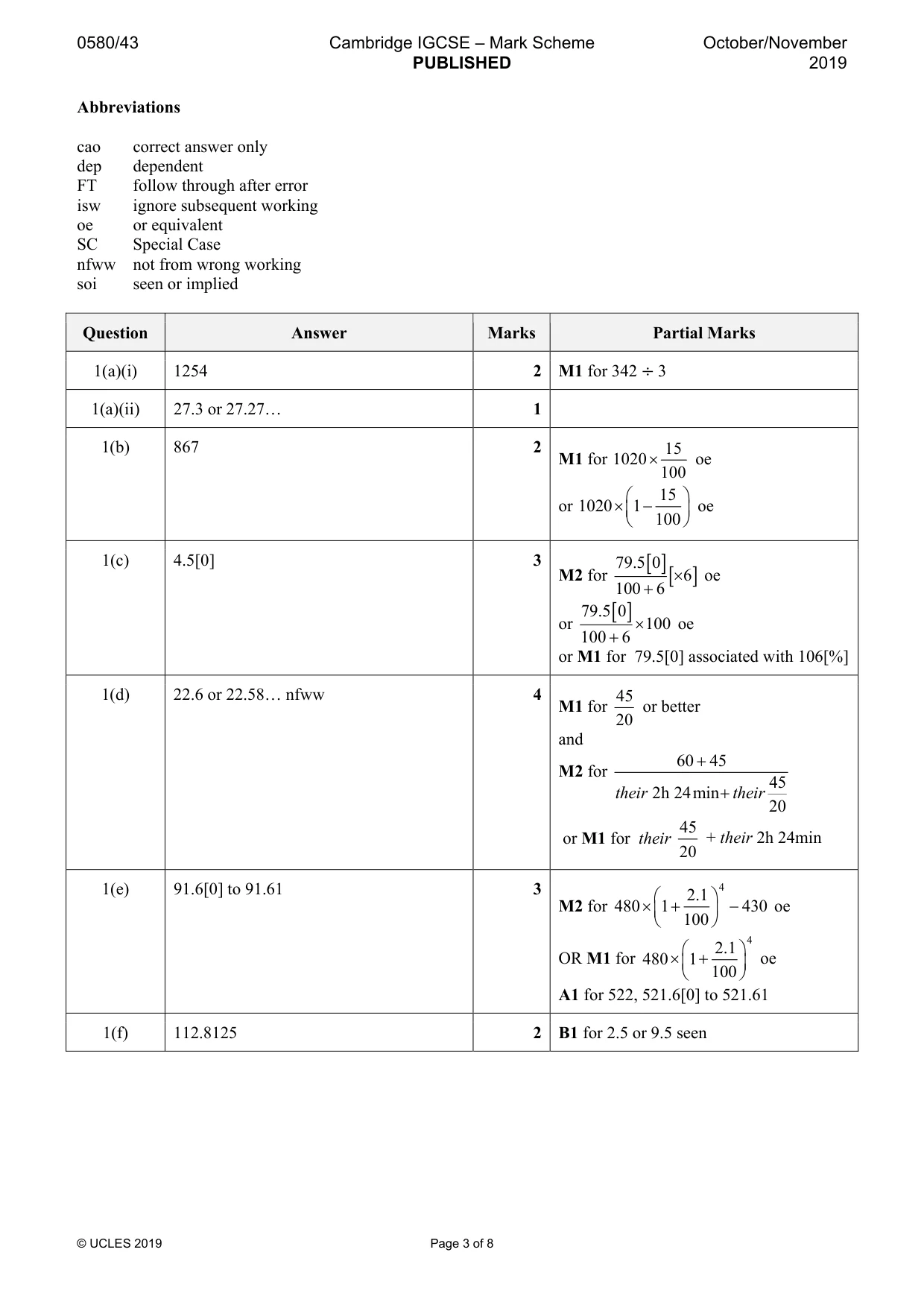
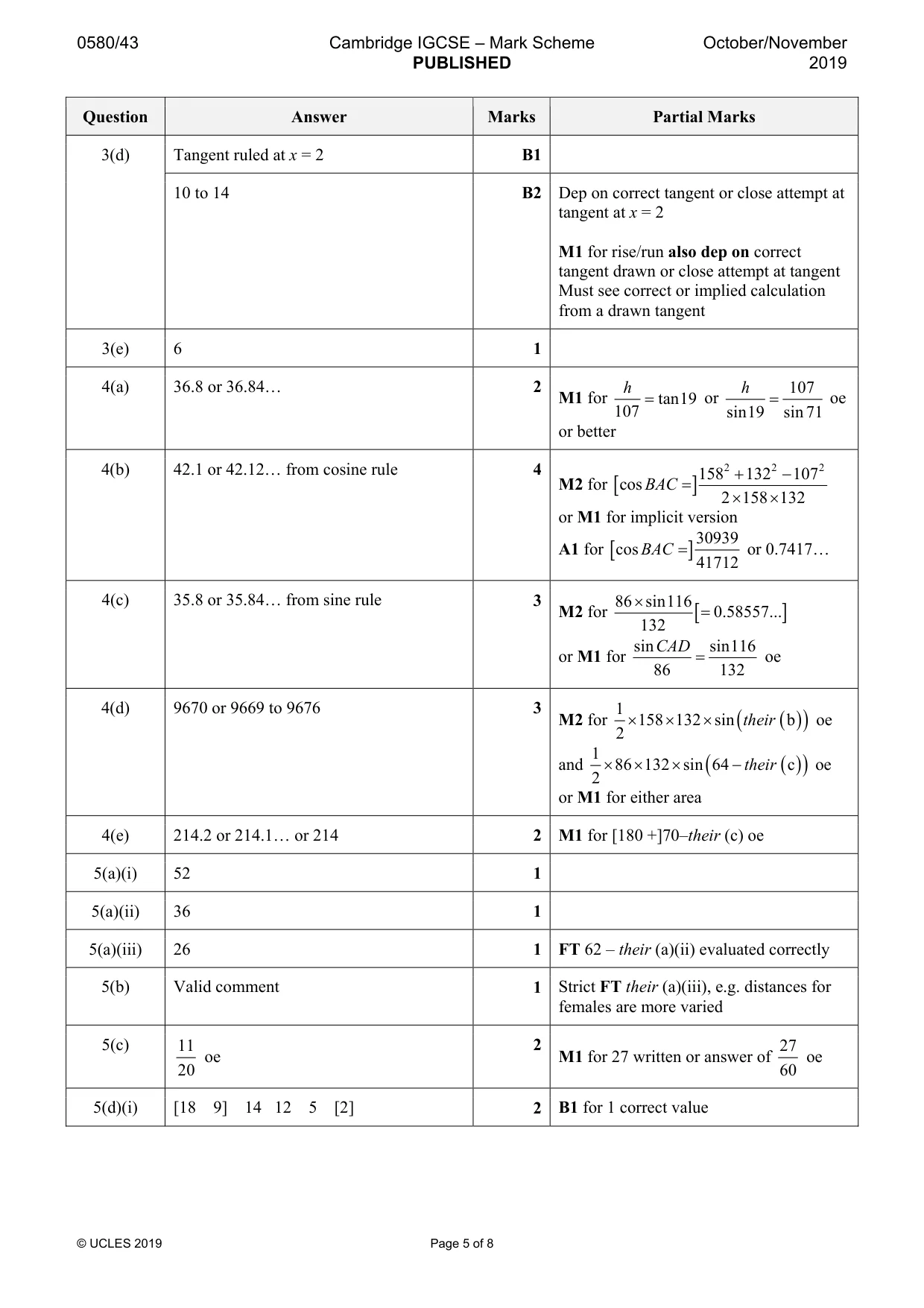
Mark scheme: Question Answer Marks Partial Marks 1(a)(i) 1254 2 M1 for 342 ÷ 3 1(a)(ii) 27.3 or 27.27… 1 1(b) 867 2 15 M1 for 1020 × oe 100 15 or 1020 × 1 − oe 100 1(c) 4.5[0] 3 79.5 [ 0 M2 for ][× 6 ] oe 100 + 6 79.5 [ 0 ] or × 100 oe 100 + 6 or M1 for 79.5[0] associated with 106[%] 1(d) 22.6 or 22.58… nfww 4 45 M1 for or better 20 and 60 + 45 M2 for 45 their 2h 24min + their 20 45 or M1 for their + their 2h 24min 20 1(e) 91.6[0] to 91.61 3 4 2.1 M2 for 480 × 1 + − 430 oe 100 2.1 4 OR M1 for 480 × 1 + oe 100 A1 for 522, 521.6[0] to 521.61 1(f) 112.8125 2 B1 for 2.5 or 9.5 seen
Q2 · The diagram shows a triangle and a quadrilateral
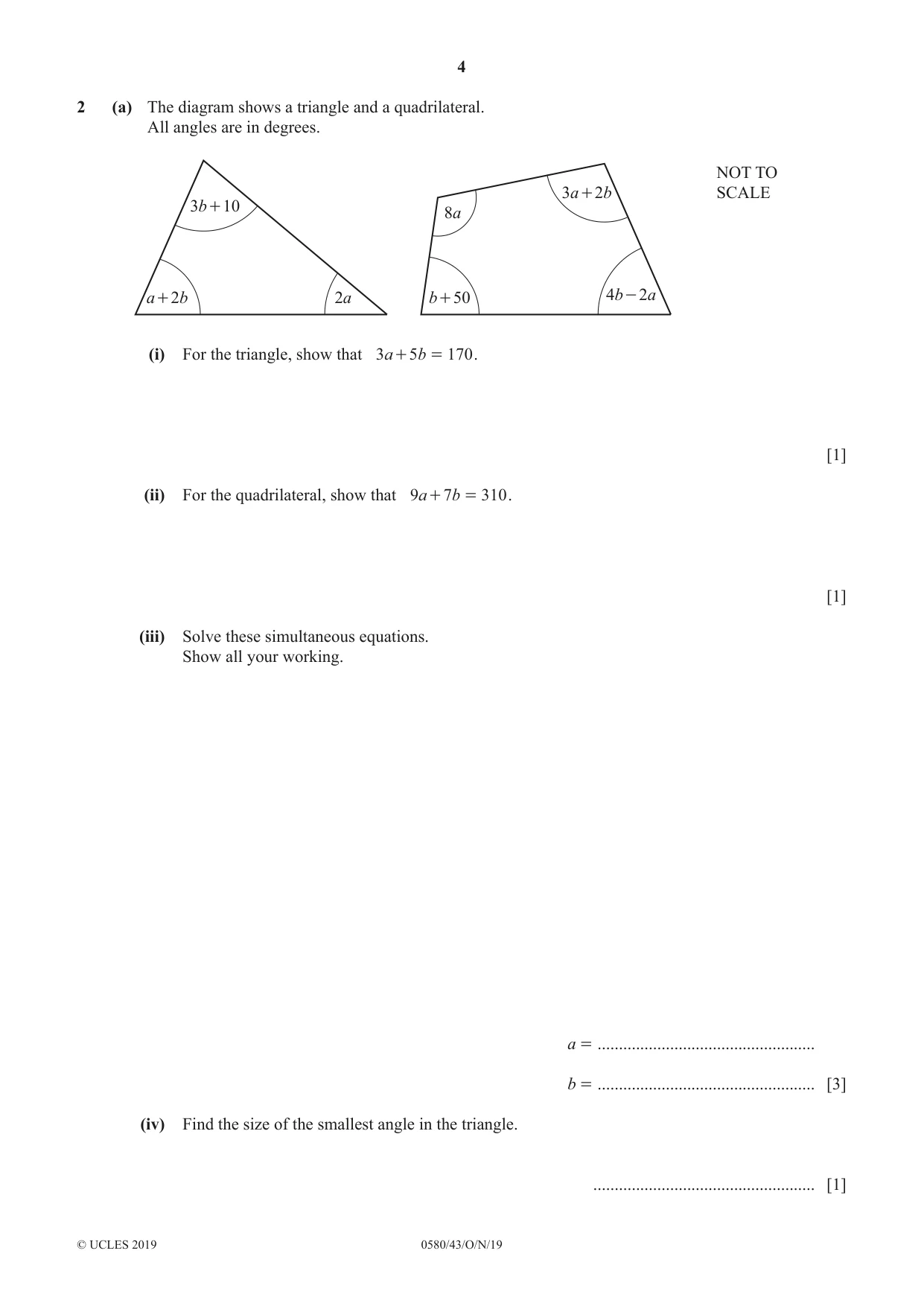
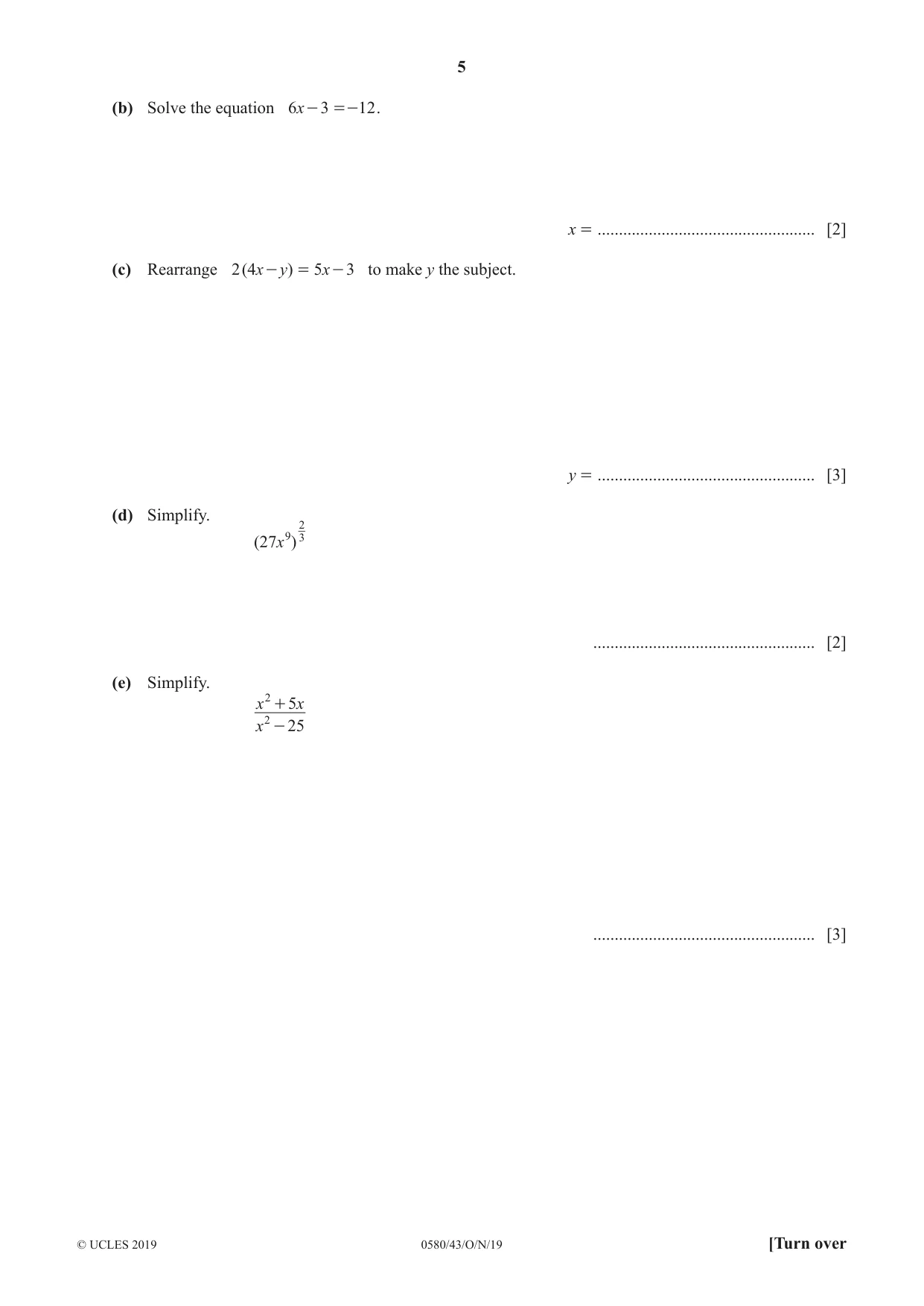
2 (a) The diagram shows a triangle and a quadrilateral. All angles are in degrees. NOT TO 3a + 2b SCALE 3b + 10 8a a + 2b 2a b + 50 4b - 2a (i) For the triangle, show that 3a + 5b = 170 . [1] (ii) For the quadrilateral, show that 9a + 7b = 310 . [1] (iii) Solve these simultaneous equations. Show all your working. a = ................................................... b = ................................................... [3] (iv) Find the size of the smallest angle in the triangle. .................................................... [1] (b) Solve the equation 6x - 3 =- 12 . x = ................................................... [2] (c) Rearrange 2 (4x - y) = 5x - 3 to make y the subject. y = ................................................... [3] (d) Simplify. 2 (27x 9 ) 3 .................................................... [2] (e) Simplify. x 2 + 5x x 2 - 25 .................................................... [3]
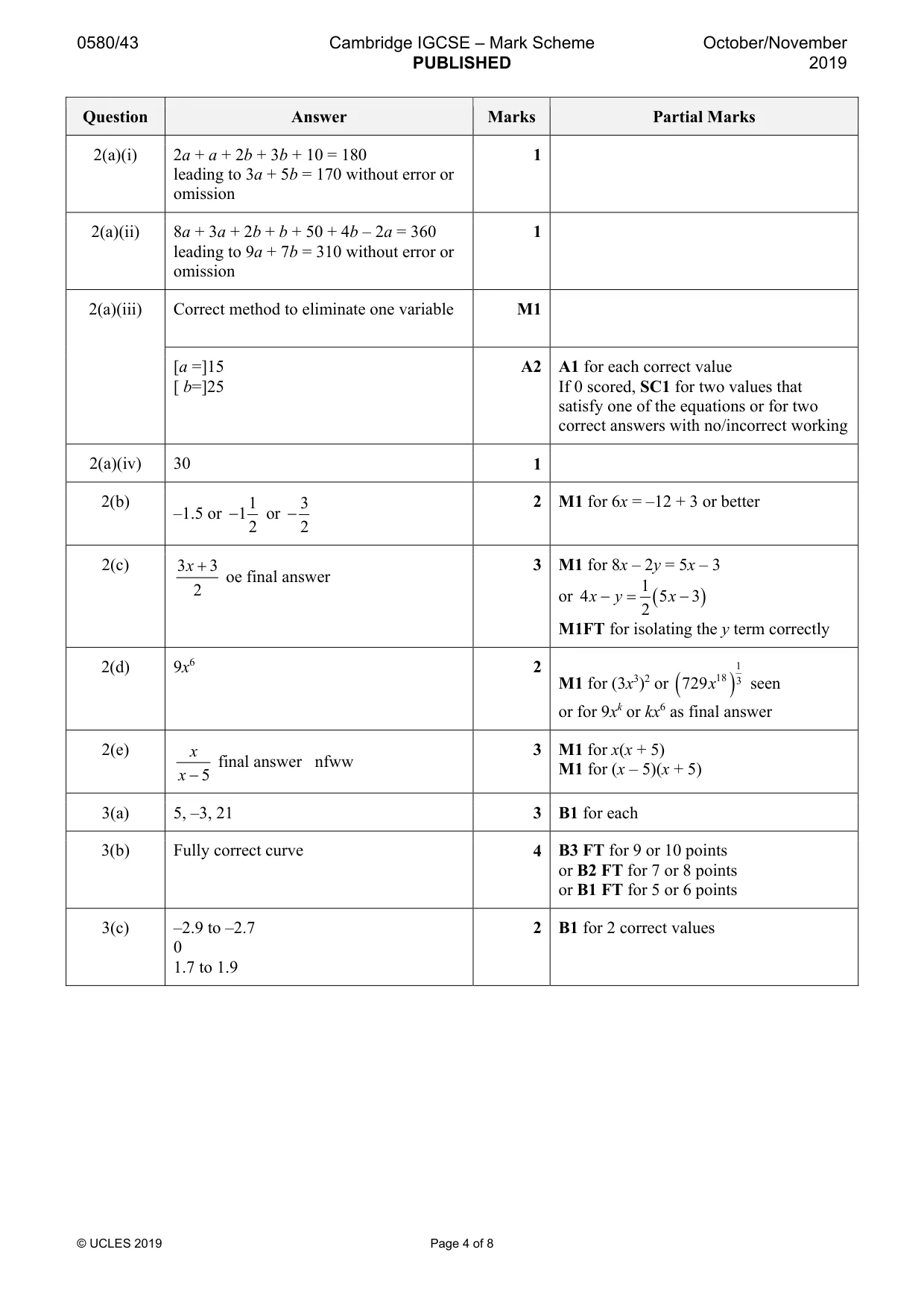
Mark scheme: 2(a)(i) 2a + a + 2b + 3b + 10 = 180 1 leading to 3a + 5b = 170 without error or omission 2(a)(ii) 8a + 3a + 2b + b + 50 + 4b – 2a = 360 1 leading to 9a + 7b = 310 without error or omission 2(a)(iii) Correct method to eliminate one variable M1 [a =]15 A2 A1 for each correct value [ b=]25 If 0 scored, SC1 for two values that satisfy one of the equations or for two correct answers with no/incorrect working 2(a)(iv) 30 1 2(b) 1 3 2 M1 for 6x = –12 + 3 or better –1.5 or − 12 or − 2 2(c) 3 x + 3 3 M1 for 8x – 2y = 5x – 3 oe final answer 2 1 or 4 x − y = ( 5 x − 3 ) 2 M1FT for isolating the y term correctly 2(d) 9x6 2 1 M1 for (3x3)2 or 729x18 3 seen ( ) or for 9xk or kx6 as final answer 2(e) x 3 M1 for x(x + 5) final answer nfww M1 for (x – 5)(x + 5) x − 5
Q3 · The table shows some values for y = x 3 + x 2 - 5x
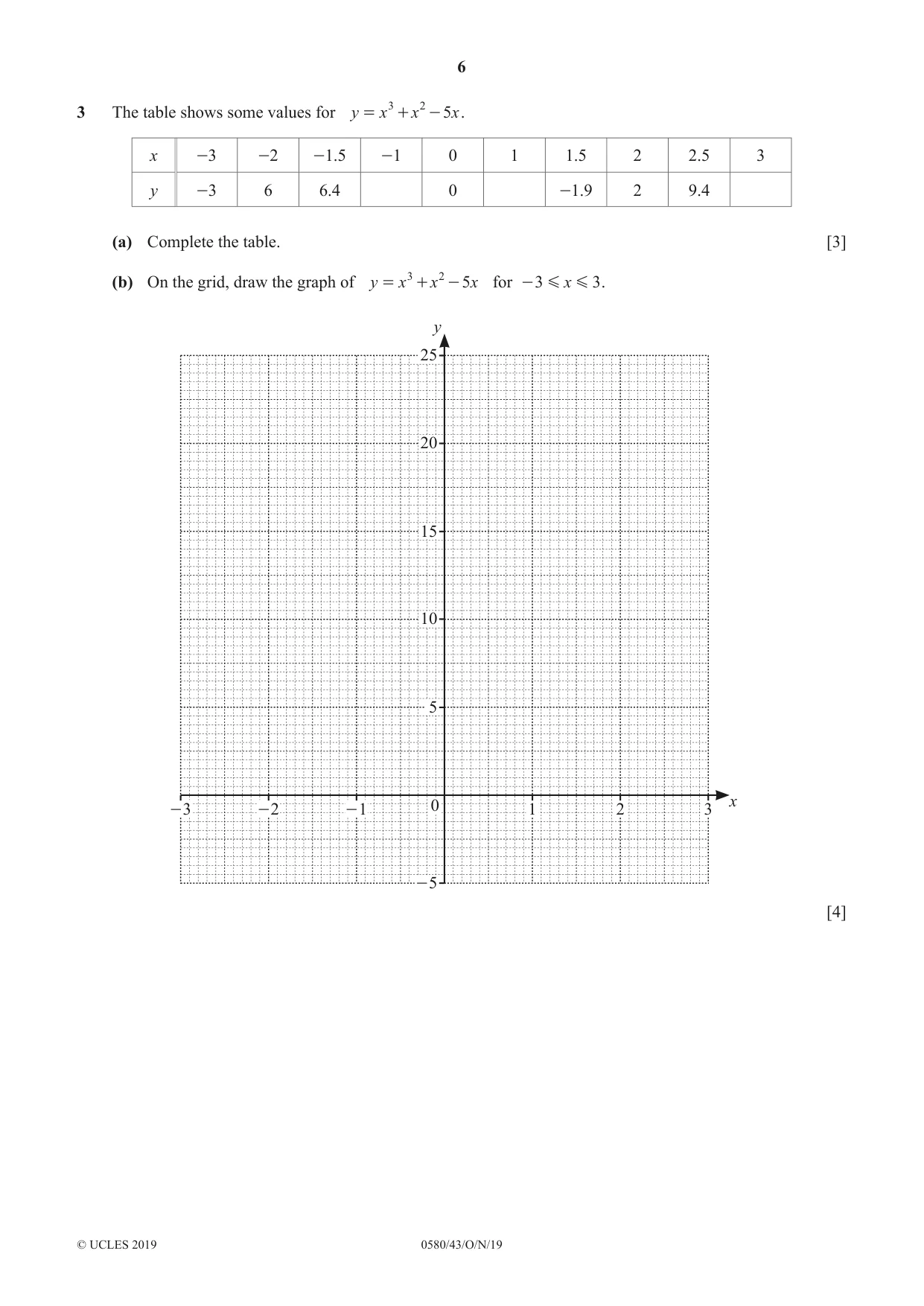
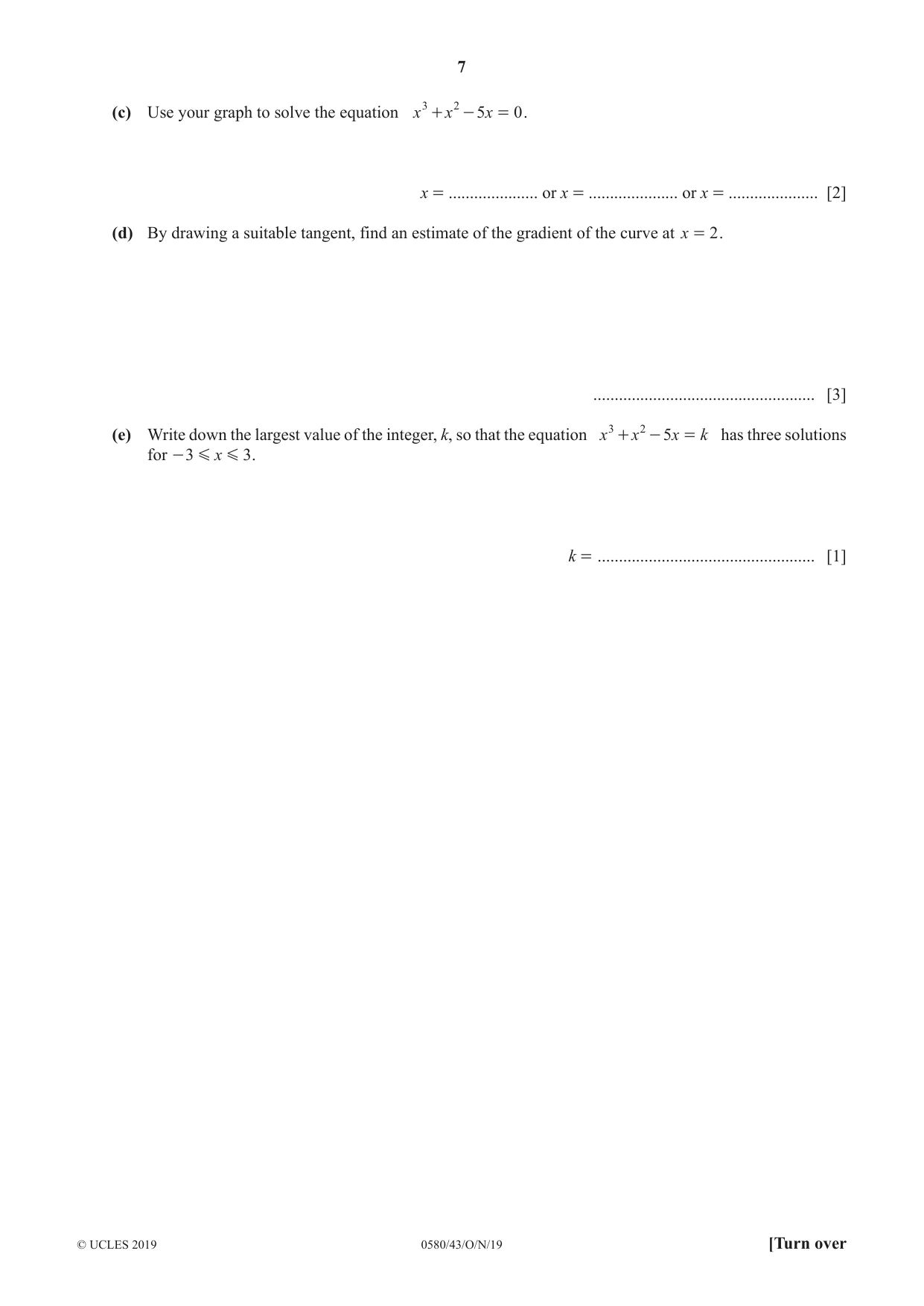
3 The table shows some values for y = x 3 + x 2 - 5x . x -3 -2 -1.5 -1 0 1 1.5 2 2.5 3 y -3 6 6.4 0 -1.9 2 9.4 (a) Complete the table. [3] (b) On the grid, draw the graph of y = x 3 + x 2 - 5x for - 3 G x G 3 . y 25 20 15 10 5 x - 3 - 2 - 1 0 1 2 3 - 5 [4] (c) Use your graph to solve the equation x 3 + x 2 - 5x = 0 . x = ..................... or x = ..................... or x = ..................... [2] (d) By drawing a suitable tangent, find an estimate of the gradient of the curve at x = 2 . .................................................... [3] (e) Write down the largest value of the integer, k, so that the equation x 3 + x 2 - 5x = k has three solutions for - 3 G x G 3 . k = ................................................... [1]
Mark scheme: 3(a) 5, –3, 21 3 B1 for each 3(b) Fully correct curve 4 B3 FT for 9 or 10 points or B2 FT for 7 or 8 points or B1 FT for 5 or 6 points 3(c) –2.9 to –2.7 2 B1 for 2 correct values 0 1.7 to 1.9 3(d) Tangent ruled at x = 2 B1 10 to 14 B2 Dep on correct tangent or close attempt at tangent at x = 2 M1 for rise/run also dep on correct tangent drawn or close attempt at tangent Must see correct or implied calculation from a drawn tangent 3(e) 6 1
Q4 · B 107 m C NOT TO SCALE 158 m 132 m 86 m North 116° D A The diagram shows a field, ABCD…
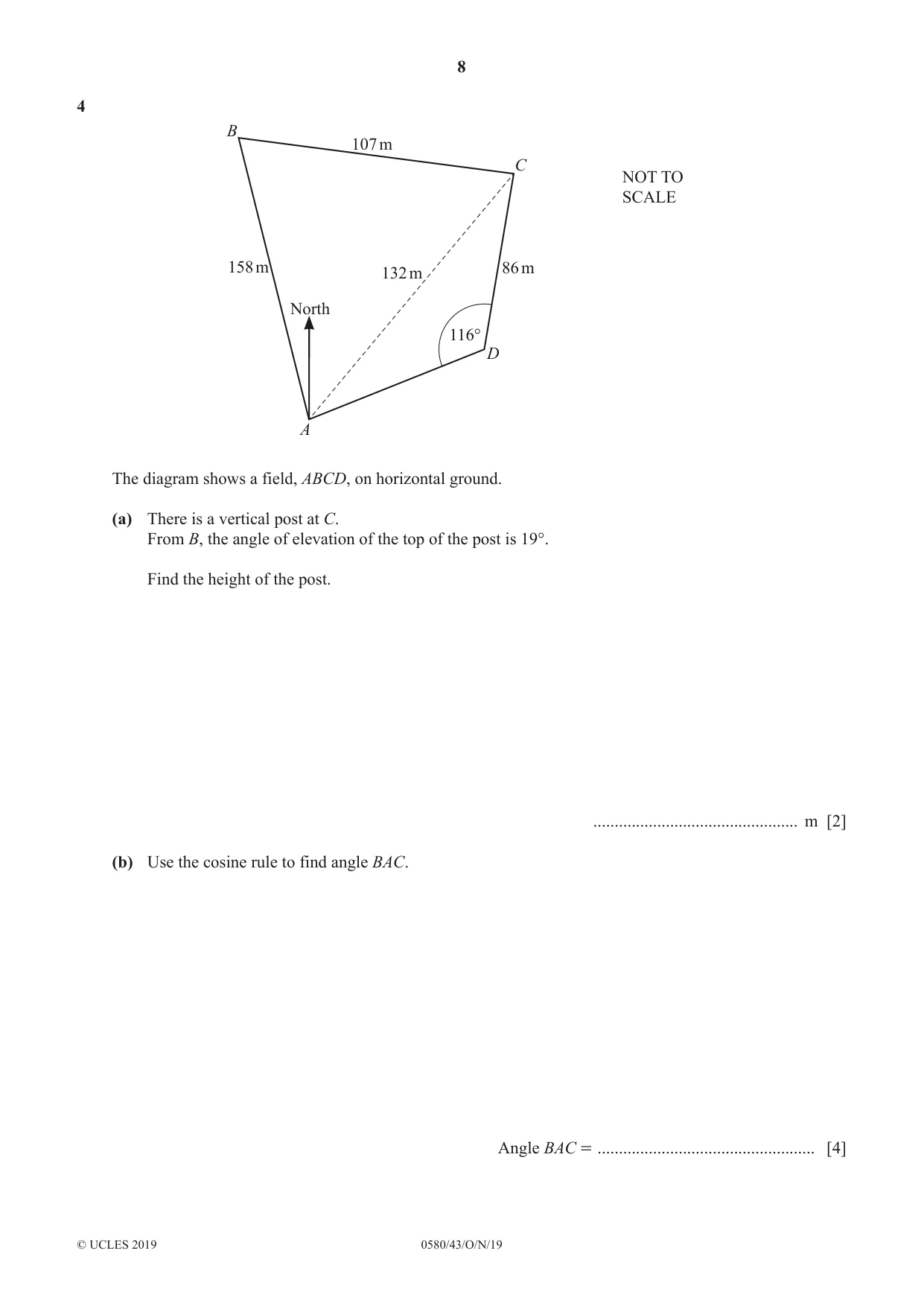
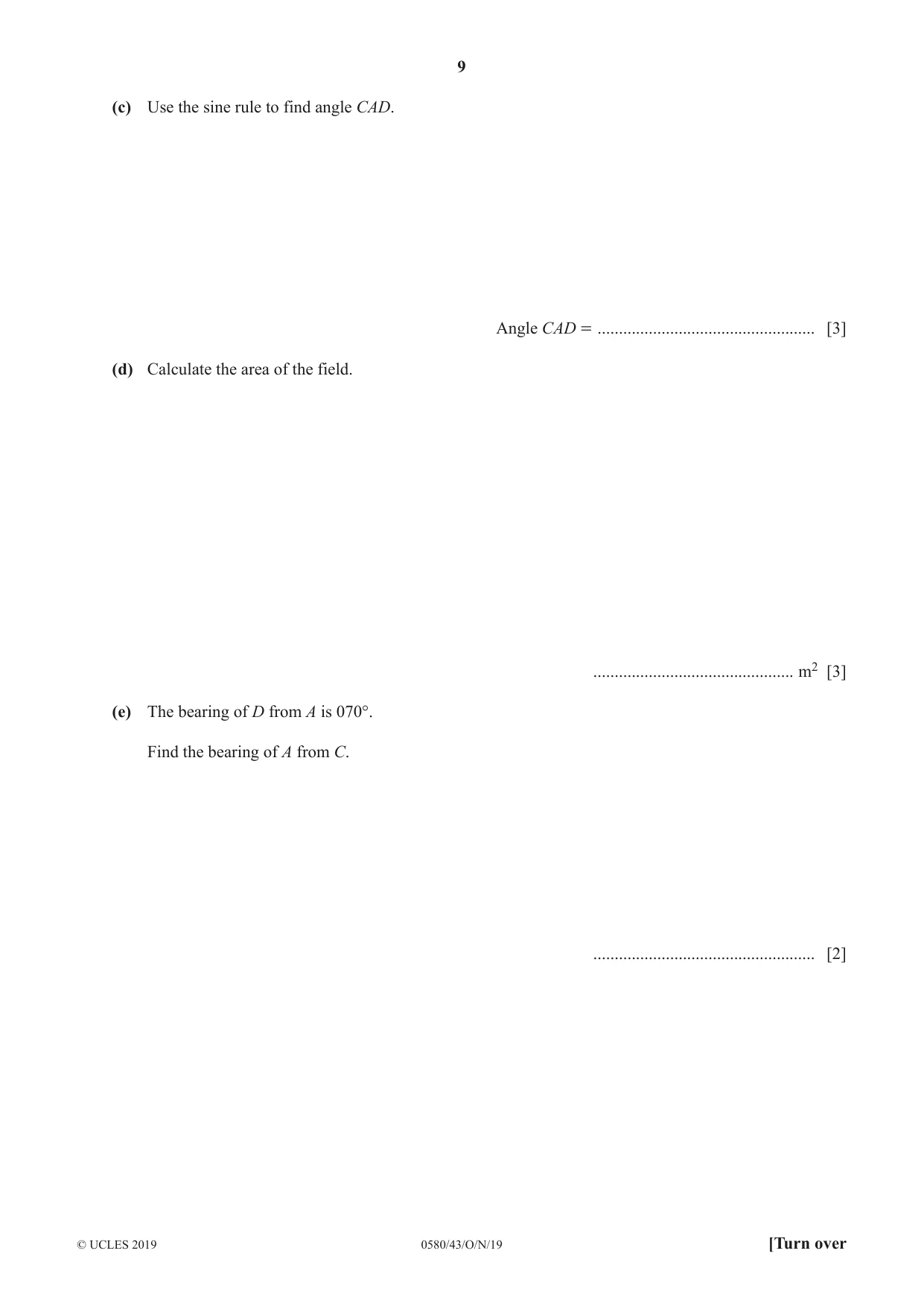
4 B 107 m C NOT TO SCALE 158 m 132 m 86 m North 116° D A The diagram shows a field, ABCD, on horizontal ground. (a) There is a vertical post at C. From B, the angle of elevation of the top of the post is 19°. Find the height of the post. ................................................ m [2] (b) Use the cosine rule to find angle BAC. Angle BAC = ................................................... [4] (c) Use the sine rule to find angle CAD. Angle CAD = ................................................... [3] (d) Calculate the area of the field. ............................................... m2 [3] (e) The bearing of D from A is 070°. Find the bearing of A from C. .................................................... [2]
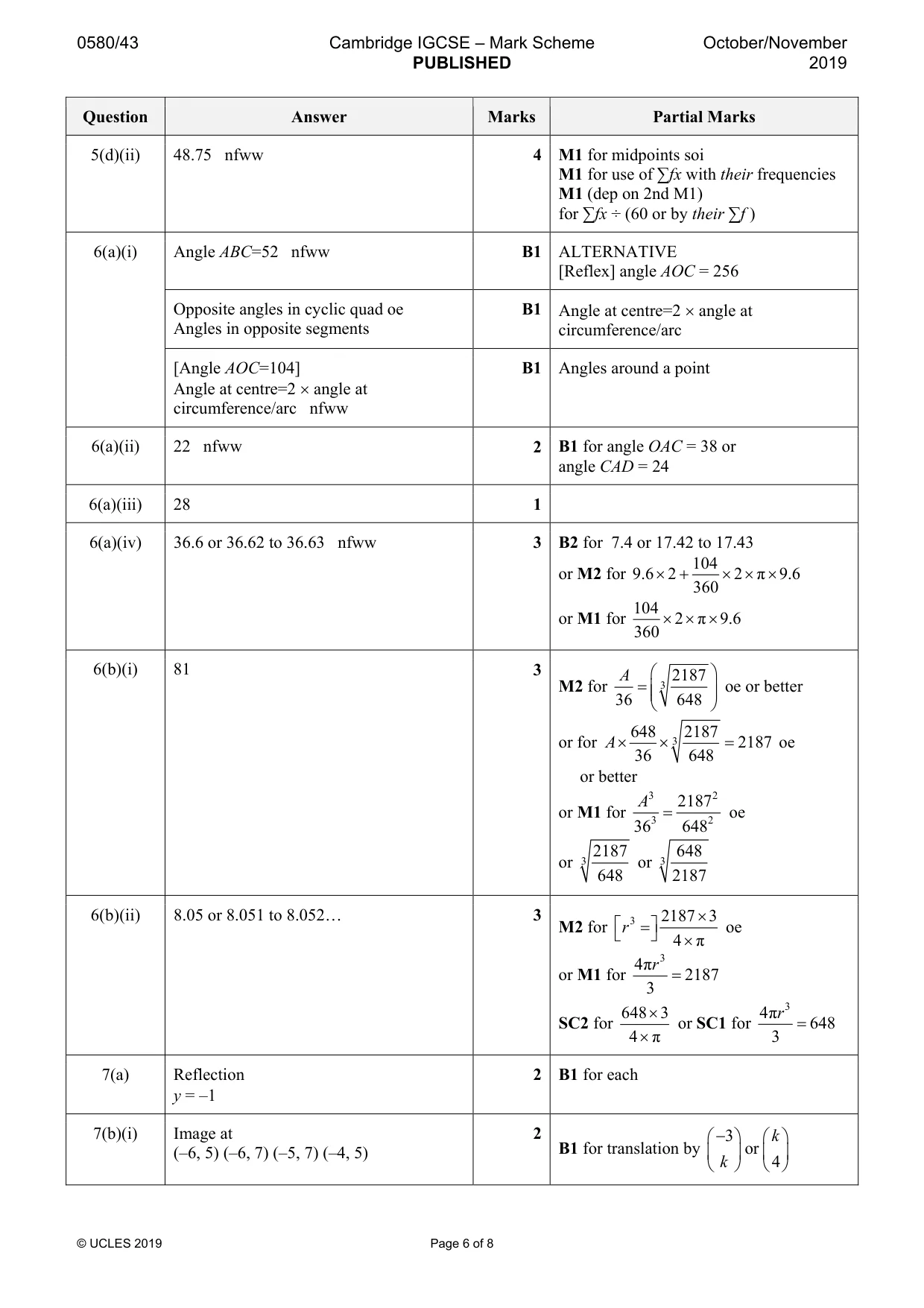
Mark scheme: 4(a) 36.8 or 36.84… 2 h h 107 M1 for = tan19 or = oe 107 sin19 sin71 or better 4(b) 42.1 or 42.12… from cosine rule 4 158 2 + 132 2 − 107 2 M2 for [ cos BAC = ] 2 × 158 × 132 or M1 for implicit version A1 for [ cos BAC = ]30939 or 0.7417… 41712 4(c) 35.8 or 35.84… from sine rule 3 86 × sin116 M2 for [ = 0.58557...] 132 sin CAD sin116 or M1 for = oe 86 132 4(d) 9670 or 9669 to 9676 3 1 M2 for × 158 × 132 × sin ( their ( b ) ) oe 2 1 and × 86 × 132 × sin ( 64 − their ( c ) ) oe 2 or M1 for either area 4(e) 214.2 or 214.1… or 214 2 M1 for [180 +]70–their (c) oe
Q5 · The cumulative frequency diagram shows information about the distance, d km, travelled by…
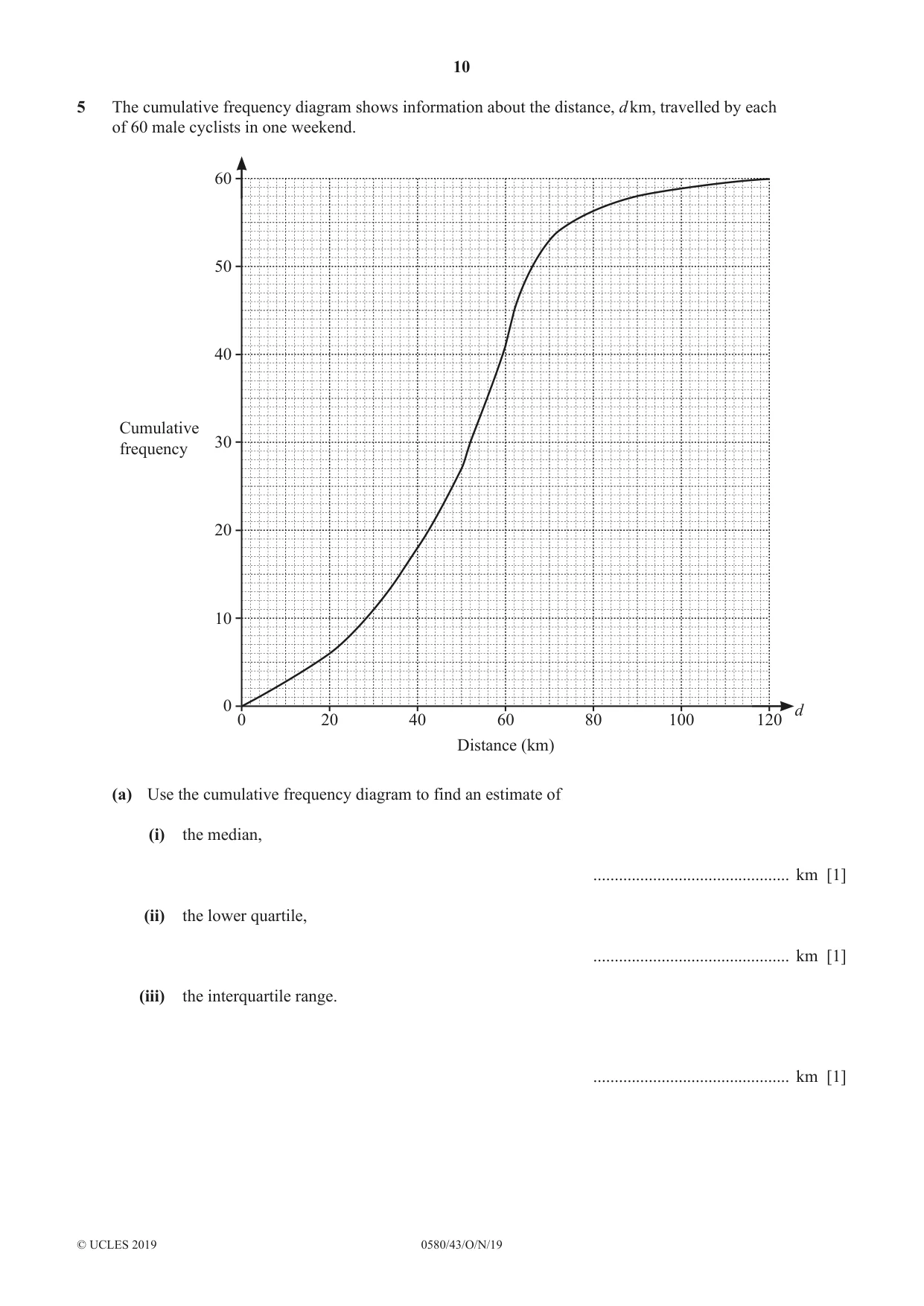
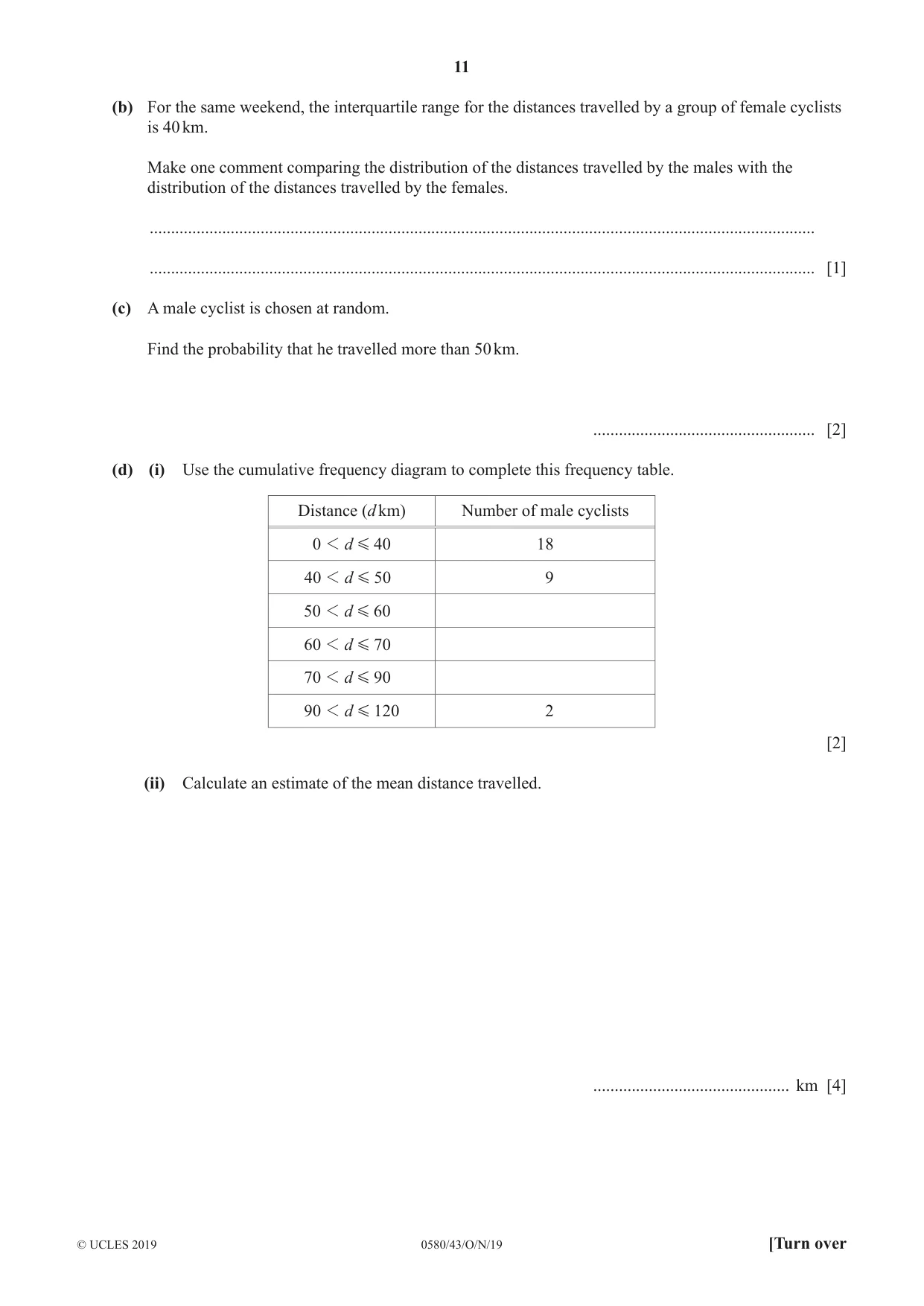
5 The cumulative frequency diagram shows information about the distance, d km, travelled by each of 60 male cyclists in one weekend. 60 50 40 Cumulative 30 frequency 20 10 0 d 0 20 40 60 80 100 120 Distance (km) (a) Use the cumulative frequency diagram to find an estimate of (i) the median, .............................................. km [1] (ii) the lower quartile, .............................................. km [1] (iii) the interquartile range. .............................................. km [1] (b) For the same weekend, the interquartile range for the distances travelled by a group of female cyclists is 40 km. Make one comment comparing the distribution of the distances travelled by the males with the distribution of the distances travelled by the females. ............................................................................................................................................................ ............................................................................................................................................................ [1] (c) A male cyclist is chosen at random. Find the probability that he travelled more than 50 km. .................................................... [2] (d) (i) Use the cumulative frequency diagram to complete this frequency table. Distance (d km) Number of male cyclists 0 1 d G 40 18 40 1 d G 50 9 50 1 d G 60 60 1 d G 70 70 1 d G 90 90 1 d G 120 2 [2] (ii) Calculate an estimate of the mean distance travelled. .............................................. km [4]
Mark scheme: 5(a)(i) 52 1 5(a)(ii) 36 1 5(a)(iii) 26 1 FT 62 – their (a)(ii) evaluated correctly 5(b) Valid comment 1 Strict FT their (a)(iii), e.g. distances for females are more varied 5(c) 11 2 27 oe M1 for 27 written or answer of oe 20 60 5(d)(i) [18 9] 14 12 5 [2] 2 B1 for 1 correct value 5(d)(ii) 48.75 nfww 4 M1 for midpoints soi M1 for use of ∑fx with their frequencies M1 (dep on 2nd M1) for ∑fx ÷ (60 or by their ∑f )
Q6 · A D NOT TO 128°128° SCALE 28° C O 30° B In the diagram, A, B, C and D lie on the circle…
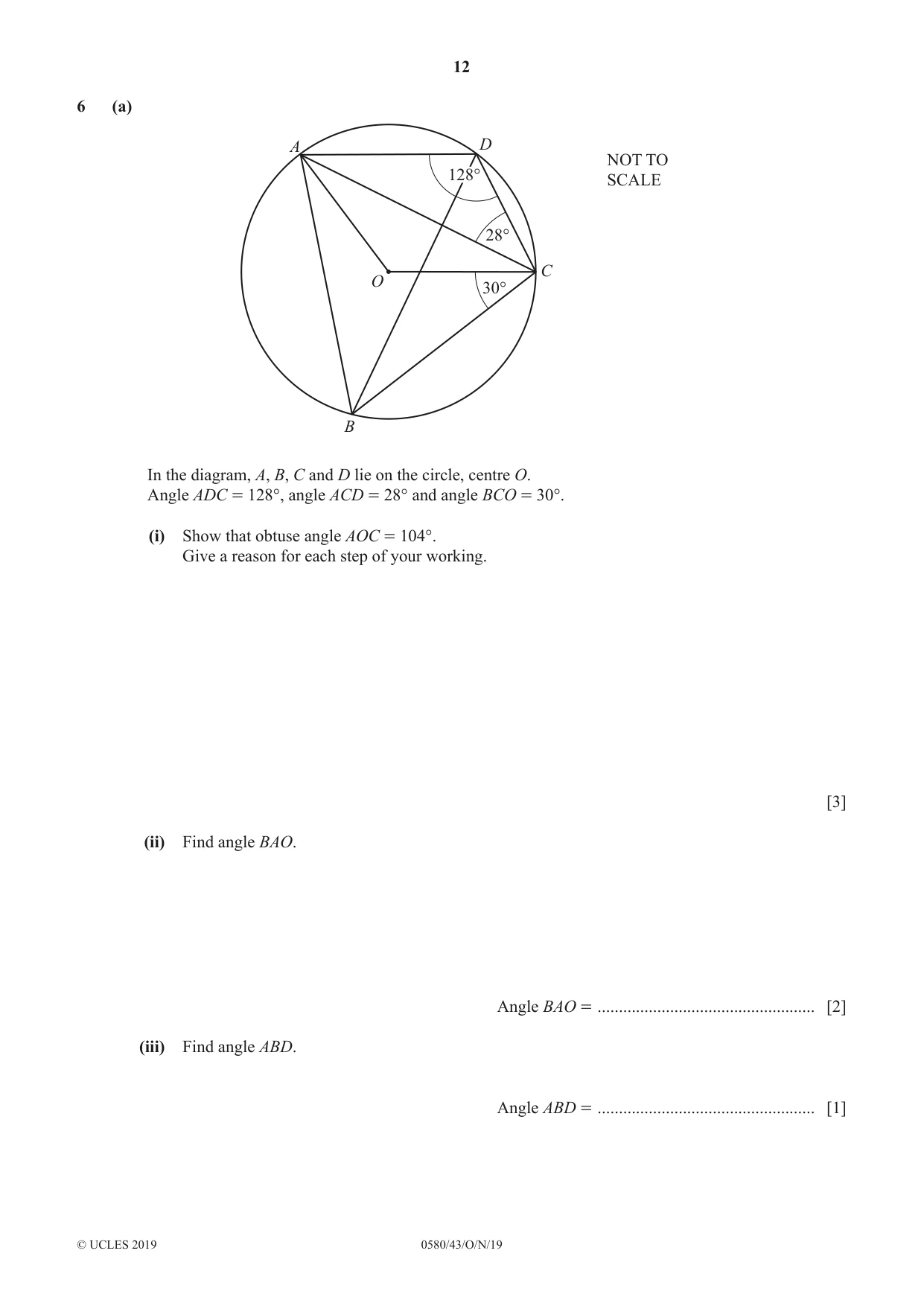
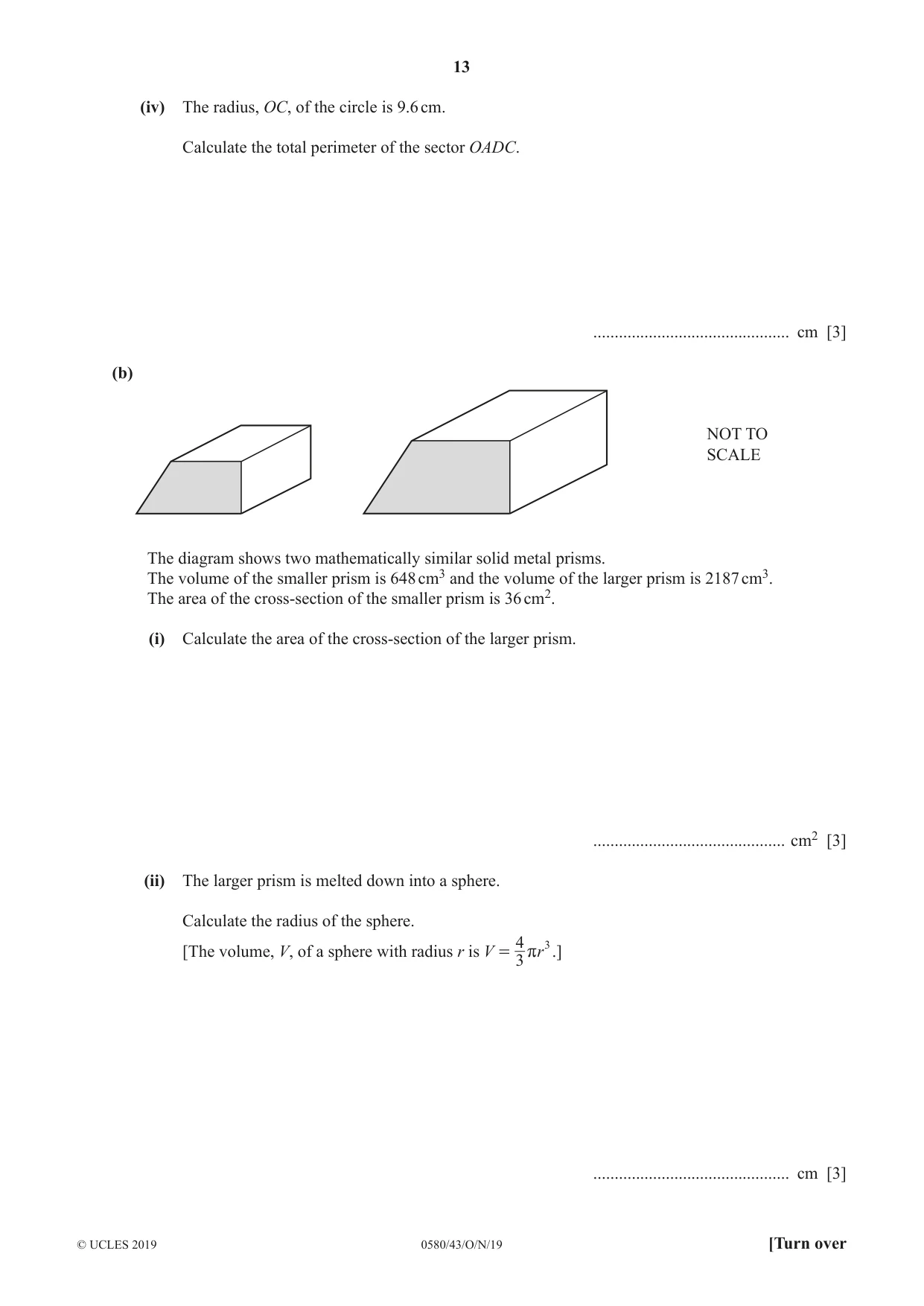
6 (a) A D NOT TO 128°128° SCALE 28° C O 30° B In the diagram, A, B, C and D lie on the circle, centre O. Angle ADC = 128°, angle ACD = 28° and angle BCO = 30°. (i) Show that obtuse angle AOC = 104°. Give a reason for each step of your working. [3] (ii) Find angle BAO. Angle BAO = ................................................... [2] (iii) Find angle ABD. Angle ABD = ................................................... [1] (iv) The radius, OC, of the circle is 9.6 cm. Calculate the total perimeter of the sector OADC. .............................................. cm [3] (b) NOT TO SCALE The diagram shows two mathematically similar solid metal prisms. The volume of the smaller prism is 648 cm3 and the volume of the larger prism is 2187 cm3. The area of the cross-section of the smaller prism is 36 cm2. (i) Calculate the area of the cross-section of the larger prism. ............................................. cm2 [3] (ii) The larger prism is melted down into a sphere. Calculate the radius of the sphere. 4 3 [The volume, V, of a sphere with radius r is V = r r .] 3 .............................................. cm [3]
Mark scheme: 6(a)(i) Angle ABC=52 nfww B1 ALTERNATIVE [Reflex] angle AOC = 256 Opposite angles in cyclic quad oe B1 Angle at centre=2 × angle at Angles in opposite segments circumference/arc [Angle AOC=104] B1 Angles around a point Angle at centre=2 × angle at circumference/arc nfww 6(a)(ii) 22 nfww 2 B1 for angle OAC = 38 or angle CAD = 24 6(a)(iii) 28 1 6(a)(iv) 36.6 or 36.62 to 36.63 nfww 3 B2 for 7.4 or 17.42 to 17.43 104 or M2 for 9.6 × 2 + × 2 × π × 9.6 360 104 or M1 for × 2 × π × 9.6 360 6(b)(i) 81 3 A 2187 M2 for = 3 oe or better 36 648 648 2187 or for A × × 3 = 2187 oe 36 648 or better A3 2187 2 or M1 for = oe 36 3 648 2 2187 648 or 3 or 3 648 2187 6(b)(ii) 8.05 or 8.051 to 8.052… 3 3 2187 × 3 M2 for r = oe 4 × π 4πr 3 or M1 for = 2187 3 648 × 3 4πr 3 SC2 for or SC1 for = 648 4 × π 3
Q7 · Y 8 7 6 5 4 3 2 A 1 x - 8 - 7 - 6 - 5 - 4 - 3 - 2 - 1 0 1 2 3 4 5 6 - 1 - 2 - 3 B - 4 - 5…
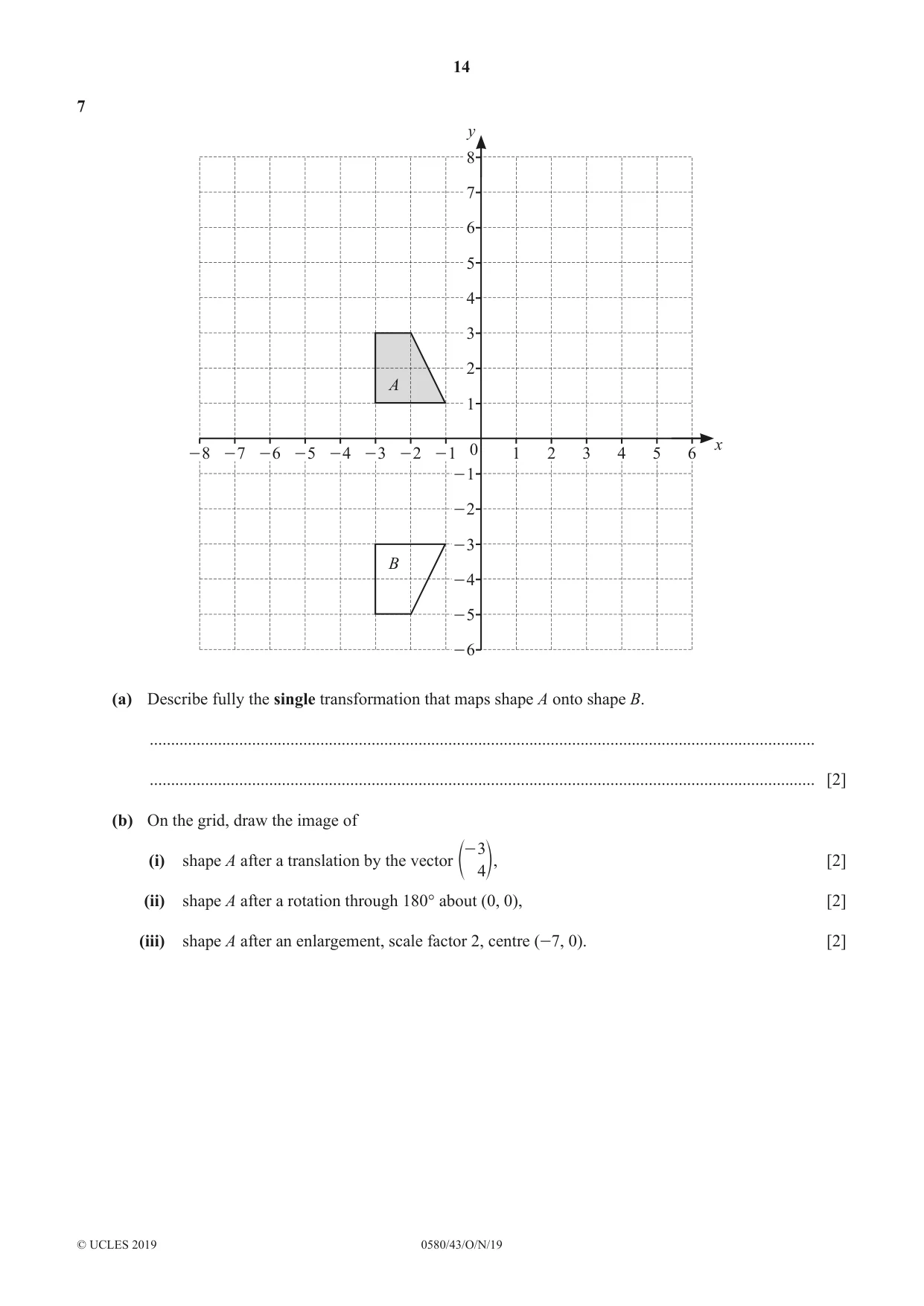
7 y 8 7 6 5 4 3 2 A 1 x - 8 - 7 - 6 - 5 - 4 - 3 - 2 - 1 0 1 2 3 4 5 6 - 1 - 2 - 3 B - 4 - 5 - 6 (a) Describe fully the single transformation that maps shape A onto shape B. ............................................................................................................................................................ ............................................................................................................................................................ [2] (b) On the grid, draw the image of - 3 (i) shape A after a translation by the vector [2] e 4o, (ii) shape A after a rotation through 180° about (0, 0), [2] (iii) shape A after an enlargement, scale factor 2, centre (-7, 0). [2]
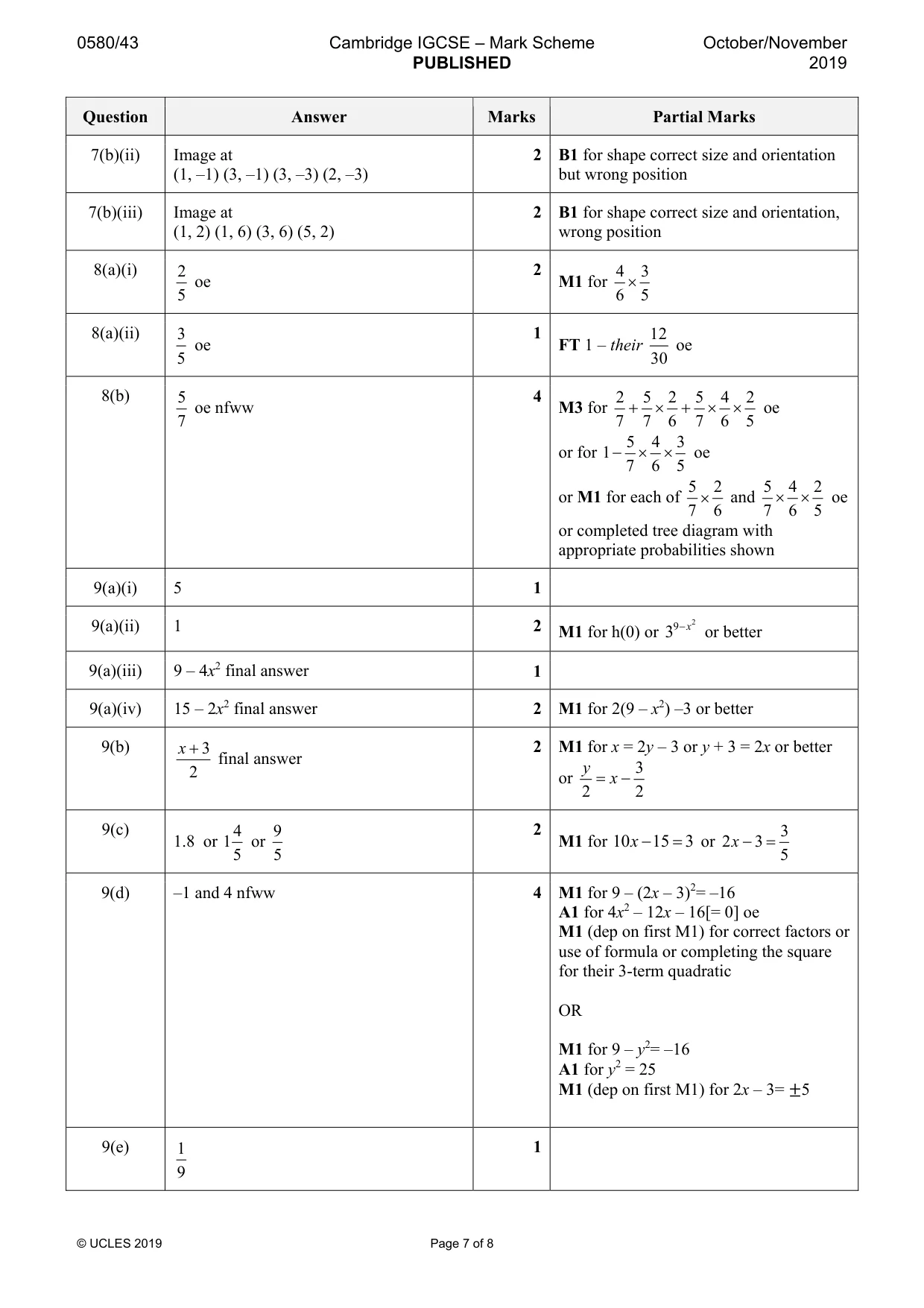
Mark scheme: 7(a) Reflection 2 B1 for each y = –1 7(b)(i) Image at 2 −3 k (–6, 5) (–6, 7) (–5, 7) (–4, 5) B1 for translation by or k 4 7(b)(ii) Image at 2 B1 for shape correct size and orientation (1, –1) (3, –1) (3, –3) (2, –3) but wrong position 7(b)(iii) Image at 2 B1 for shape correct size and orientation, (1, 2) (1, 6) (3, 6) (5, 2) wrong position
Q8 · A bag contains 4 red marbles and 2 yellow marbles
8 (a) A bag contains 4 red marbles and 2 yellow marbles. Behnaz picks two marbles at random without replacement. Find the probability that (i) the marbles are both red, .................................................... [2] (ii) the marbles are not both red. .................................................... [1] (b) Another bag contains 5 blue marbles and 2 green marbles. Bryn picks one marble at random without replacement. If this marble is not green, he picks another marble at random without replacement. He continues until he picks a green marble. Find the probability that he picks a green marble on his first, second or third attempt. .................................................... [4]
Mark scheme: 8(a)(i) 2 2 4 3 oe M1 for × 5 6 5 8(a)(ii) 3 1 12 oe FT 1 – their oe 5 30 8(b) 5 4 2 5 2 5 4 2 oe nfww M3 for + × + × × oe 7 7 7 6 7 6 5 5 4 3 or for 1 − × × oe 7 6 5 5 2 5 4 2 or M1 for each of × and × × oe 7 6 7 6 5 or completed tree diagram with appropriate probabilities shown
Q9 · F (x) = 2x - 3 g (x) = 9 - x 2 h (x) = 3x (a) Find (i) f (4 )…
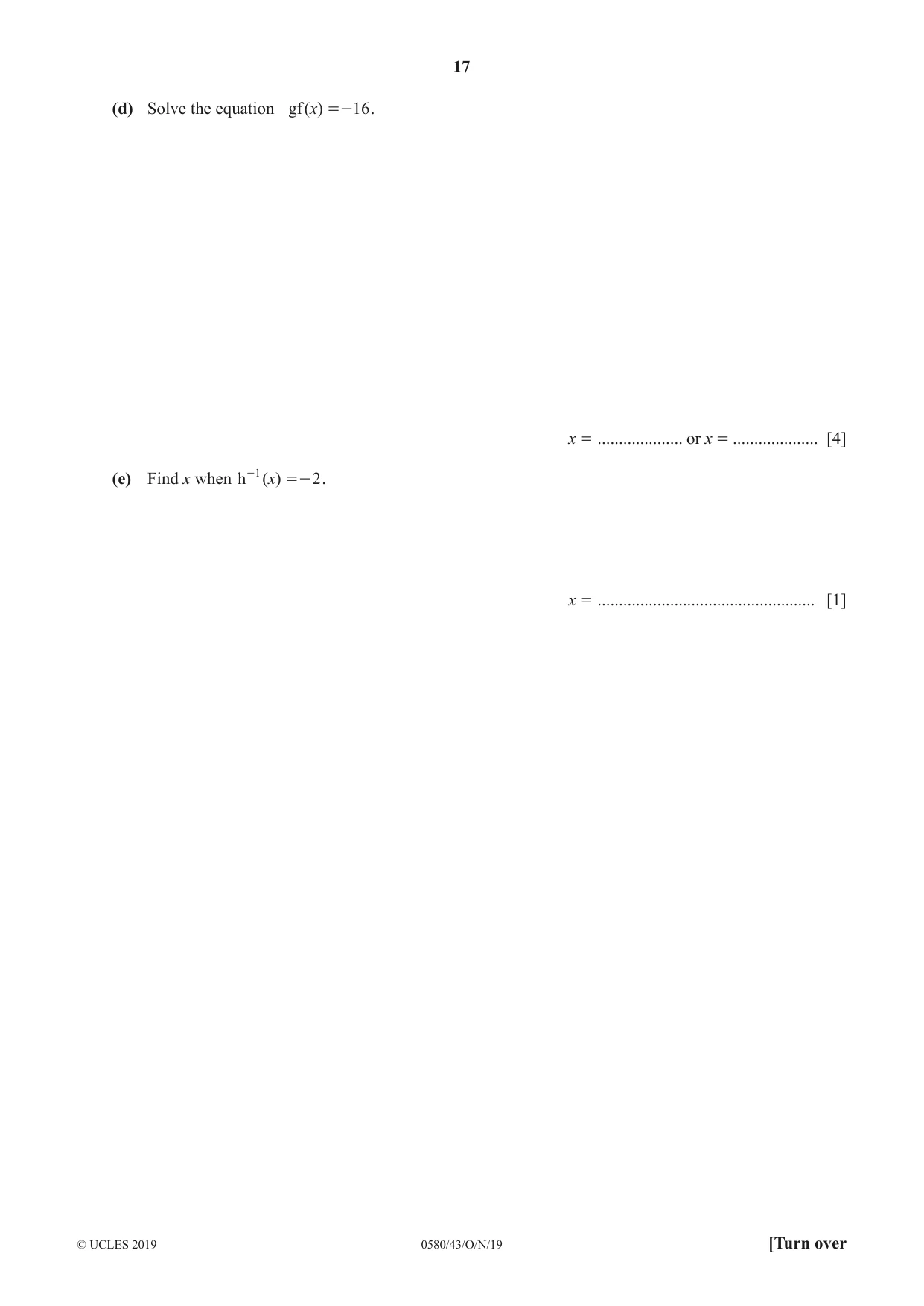
9 f (x) = 2x - 3 g (x) = 9 - x 2 h (x) = 3x (a) Find (i) f (4 ) , .................................................... [1] (ii) hg ( 3) , .................................................... [2] (iii) g (2x) in its simplest form, .................................................... [1] (iv) fg (x) in its simplest form. .................................................... [2] (b) Find f - 1 ( x) . f - 1 ( x) = ................................................... [2] (c) Find x when 5f ()x = 3 . x = ................................................... [2] (d) Solve the equation gf (x) =- 16 . x = .................... or x = .................... [4] (e) Find x when h - 1 (x) =- 2 . x = ................................................... [1]
Mark scheme: 9(a)(i) 5 1 9(a)(ii) 1 2 M1 for h(0) or 93 −x 2 or better 9(a)(iii) 9 – 4x2 final answer 1 9(a)(iv) 15 – 2x2 final answer 2 M1 for 2(9 – x2) –3 or better 9(b) x + 3 2 M1 for x = 2y – 3 or y + 3 = 2x or better final answer 2 y 3 or = x − 2 2 9(c) 4 9 2 3 1.8 or 15 or 5 M1 for 10 x − 15 = 3 or 2 x − 3 = 5 9(d) –1 and 4 nfww 4 M1 for 9 – (2x – 3)2= –16 A1 for 4x2 – 12x – 16[= 0] oe M1 (dep on first M1) for correct factors or use of formula or completing the square for their 3-term quadratic OR M1 for 9 – y2= –16 A1 for y2 = 25 M1 (dep on first M1) for 2x – 3= ±5 9(e) 1 1 9
Question 10
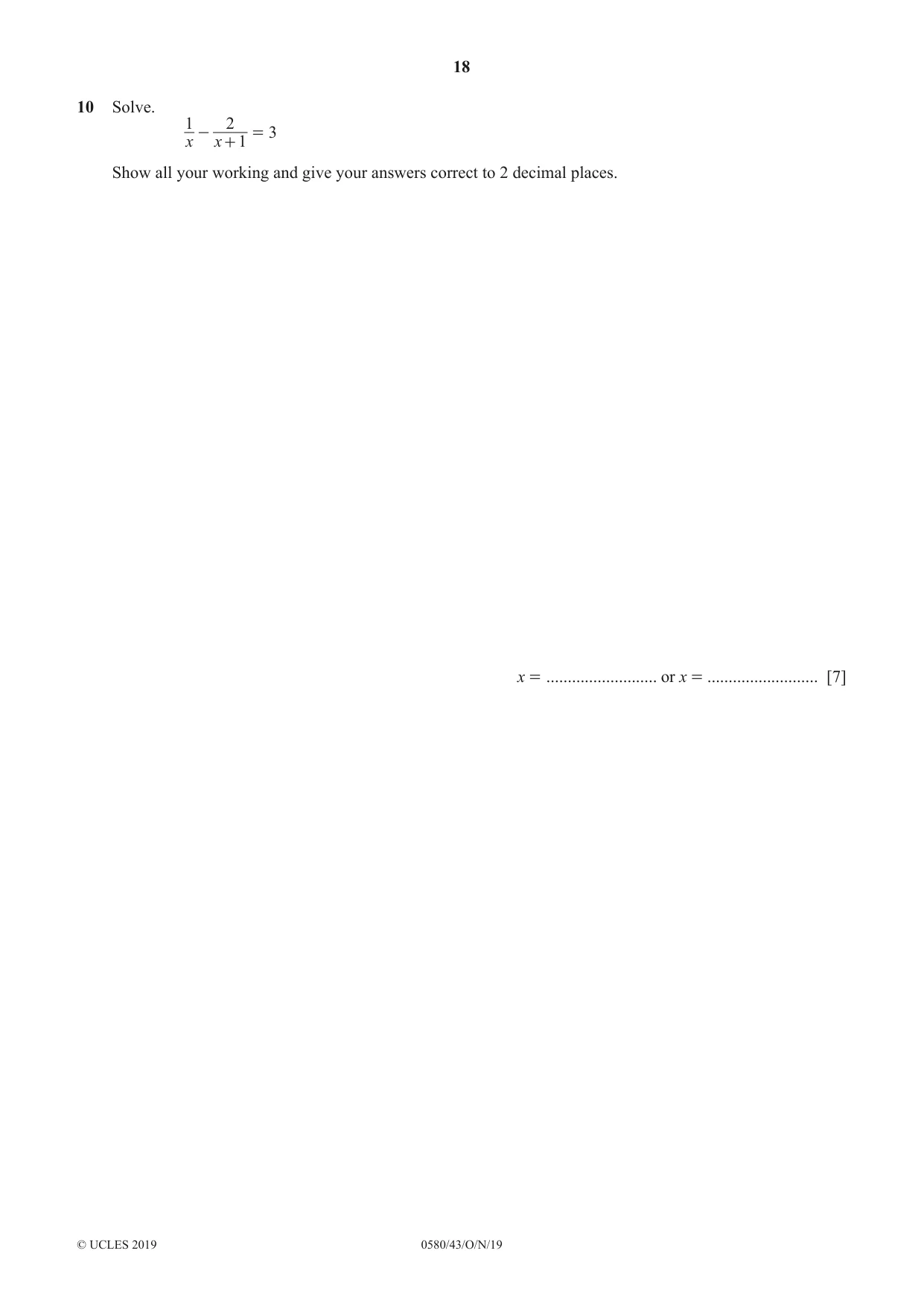
10 Solve. 1 2 - = 3 x x + 1 Show all your working and give your answers correct to 2 decimal places. x = .......................... or x = .......................... [7]
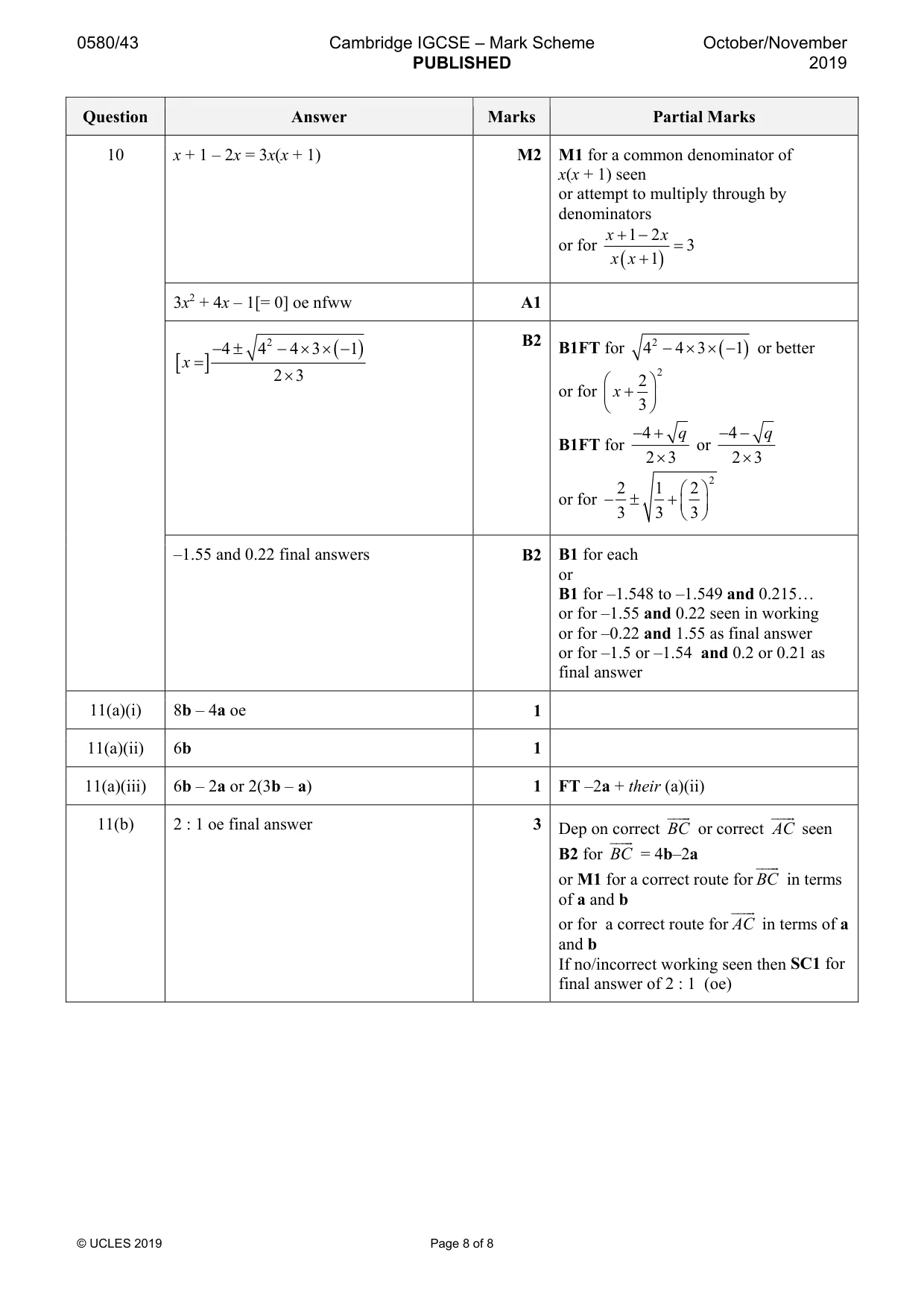
Mark scheme: 10 x + 1 – 2x = 3x(x + 1) M2 M1 for a common denominator of x(x + 1) seen or attempt to multiply through by denominators x + 1 − 2 x or for = 3 x ( x + 1) 3x2 + 4x – 1[= 0] oe nfww A1 2 B2 2 −±4 4 −×4 3 × ( −1) B1FT for 4 − 4 × 3 × ( − 1) or better [ x = ] 2 2 × 3 2 or for x + 3 −+4 q −−4 q B1FT for or 2 × 3 2 × 3 2 1 2 2 or for − ± + 3 3 3 –1.55 and 0.22 final answers B2 B1 for each or B1 for –1.548 to –1.549 and 0.215… or for –1.55 and 0.22 seen in working or for –0.22 and 1.55 as final answer or for –1.5 or –1.54 and 0.2 or 0.21 as final answer
Q11 · B A C Q NOT TO P SCALE O OAB is a triangle and ABC and PQC are straight lines
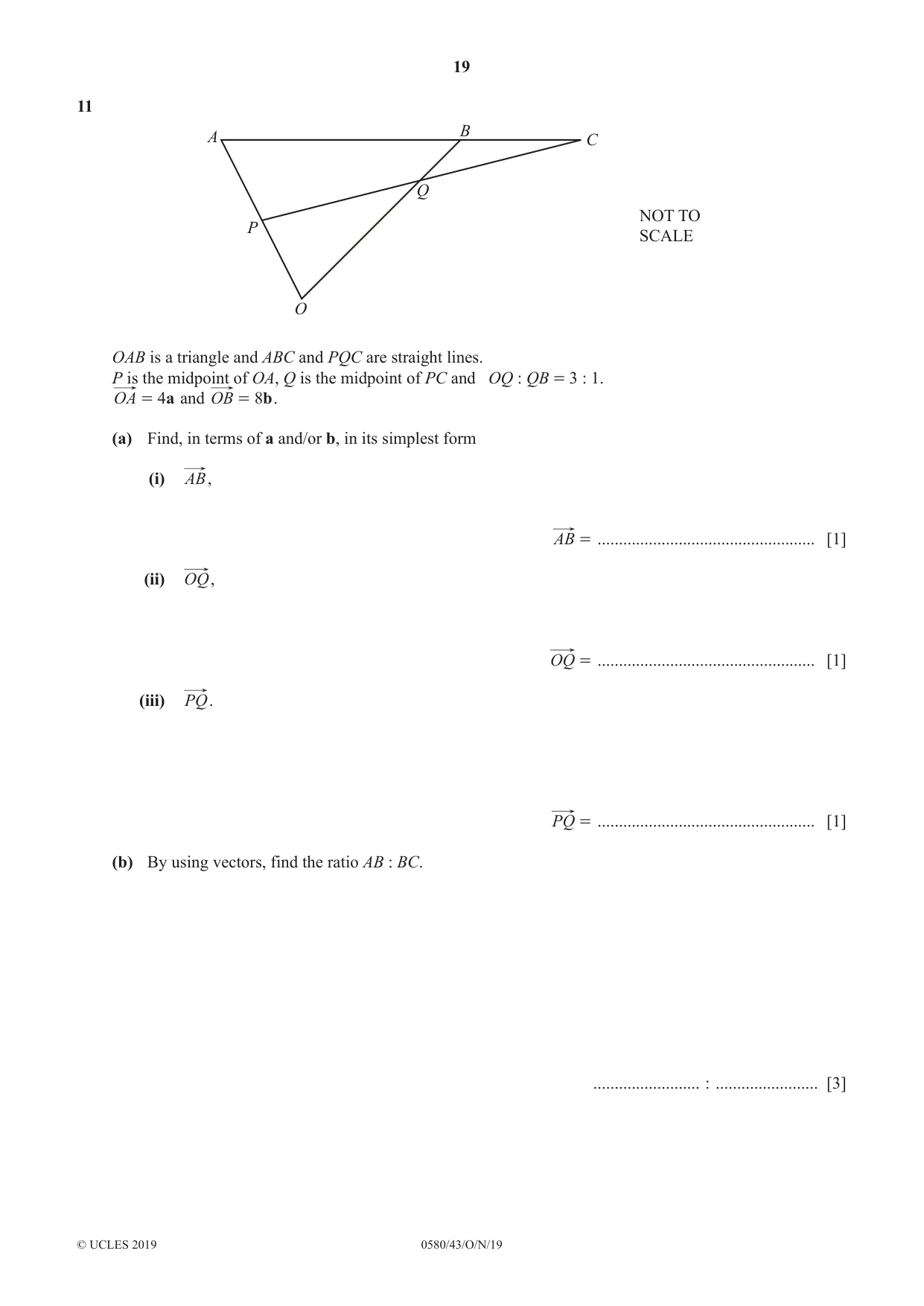
11 B A C Q NOT TO P SCALE O OAB is a triangle and ABC and PQC are straight lines. P is the midpoint of OA, Q is the midpoint of PC and OQ : QB = 3 : 1. OA = 4a and OB = 8b . (a) Find, in terms of a and/or b, in its simplest form (i) AB, AB = ................................................... [1] (ii) OQ, OQ = ................................................... [1] (iii) PQ. PQ = ................................................... [1] (b) By using vectors, find the ratio AB : BC. ......................... : ........................ [3]
Mark scheme: 11(a)(i) 8b – 4a oe 1 11(a)(ii) 6b 1 11(a)(iii) 6b – 2a or 2(3b – a) 1 FT –2a + their (a)(ii) JJJG JJJG 11(b) 2 : 1 oe final answer 3 Dep on correct BC or correct AC seen JJJG B2 for BC = 4b–2a JJJG or M1 for a correct route for BC in terms of a and b JJJG or for a correct route for AC in terms of a and b If no/incorrect working seen then SC1 for final answer of 2 : 1 (oe)
What was in this paper
The subtopics covered by these 11 questions, and how many questions each got. Open one in a new tab to see every Cambridge question on it.
What you needed in this session
Cambridge’s own grade thresholds for 2019 Oct/Nov, Paper 4 · Variant 3. A higher threshold means an easier paper — the bar moves with how the cohort did.