Cambridge IGCSE Mathematics 0580 — 2015 Oct/Nov Paper 4 · Variant 2
0580/42/O/N/15 · 10 questions · 130 marks · ≈146 min
The question paper and its mark scheme, free to read here and free to download. This is Cambridge’s own paper, exactly as it was sat.
Question paper16 pages
Mark scheme7 pages
Answers below. Sit the paper first if you are practising.
Questions as text
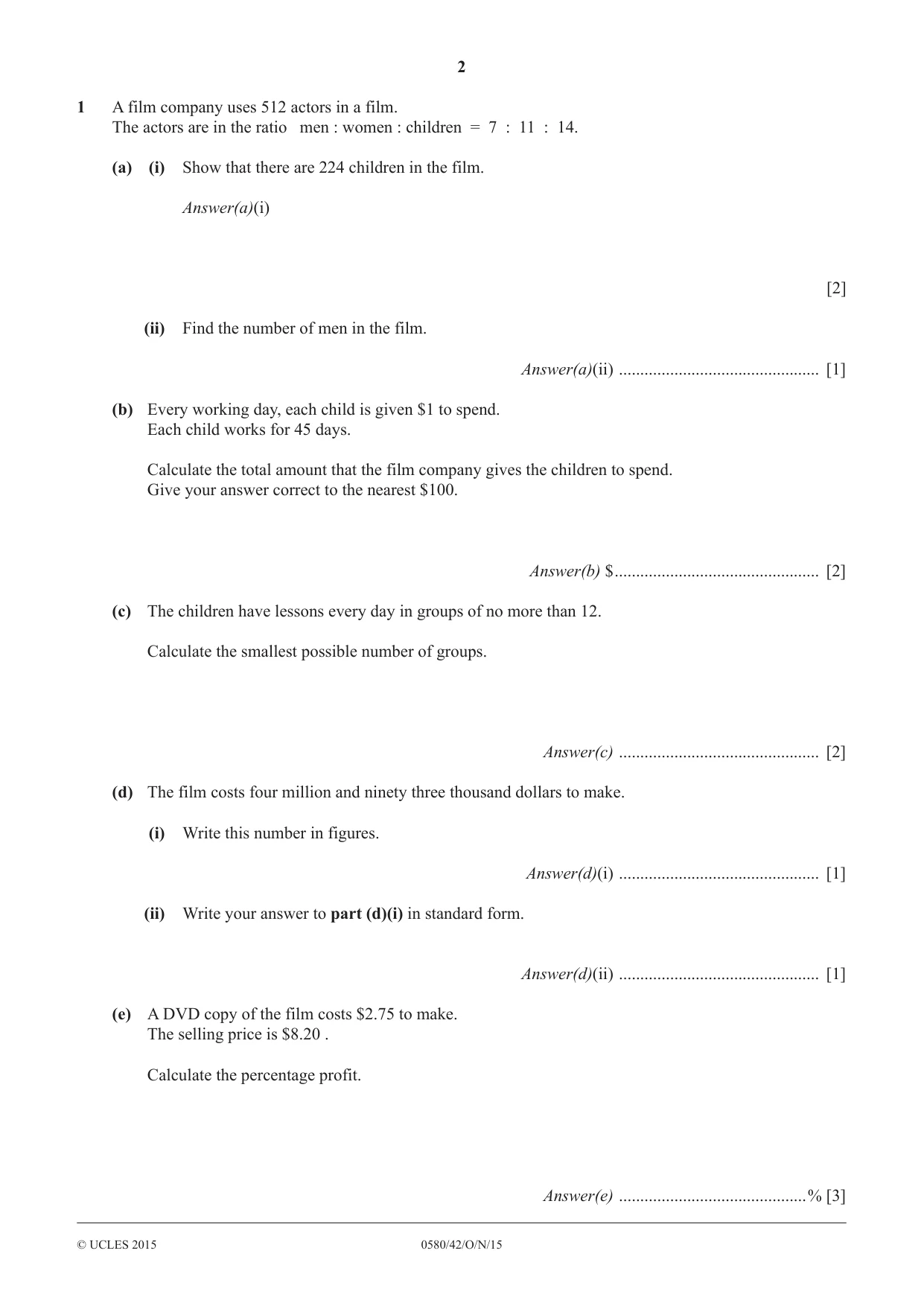
Q1 · A film company uses 512 actors in a film
1 A film company uses 512 actors in a film. The actors are in the ratio men : women : children = 7 : 11 : 14. (a) (i) Show that there are 224 children in the film. Answer(a)(i) [2] (ii) Find the number of men in the film. Answer(a)(ii) ............................................... [1] (b) Every working day, each child is given $1 to spend. Each child works for 45 days. Calculate the total amount that the film company gives the children to spend. Give your answer correct to the nearest $100. Answer(b) $ ................................................ [2] (c) The children have lessons every day in groups of no more than 12. Calculate the smallest possible number of groups. Answer(c) ............................................... [2] (d) The film costs four million and ninety three thousand dollars to make. (i) Write this number in figures. Answer(d)(i) ............................................... [1] (ii) Write your answer to part (d)(i) in standard form. Answer(d)(ii) ............................................... [1] (e) A DVD copy of the film costs $2.75 to make. The selling price is $8.20 . Calculate the percentage profit. Answer(e) ............................................% [3]
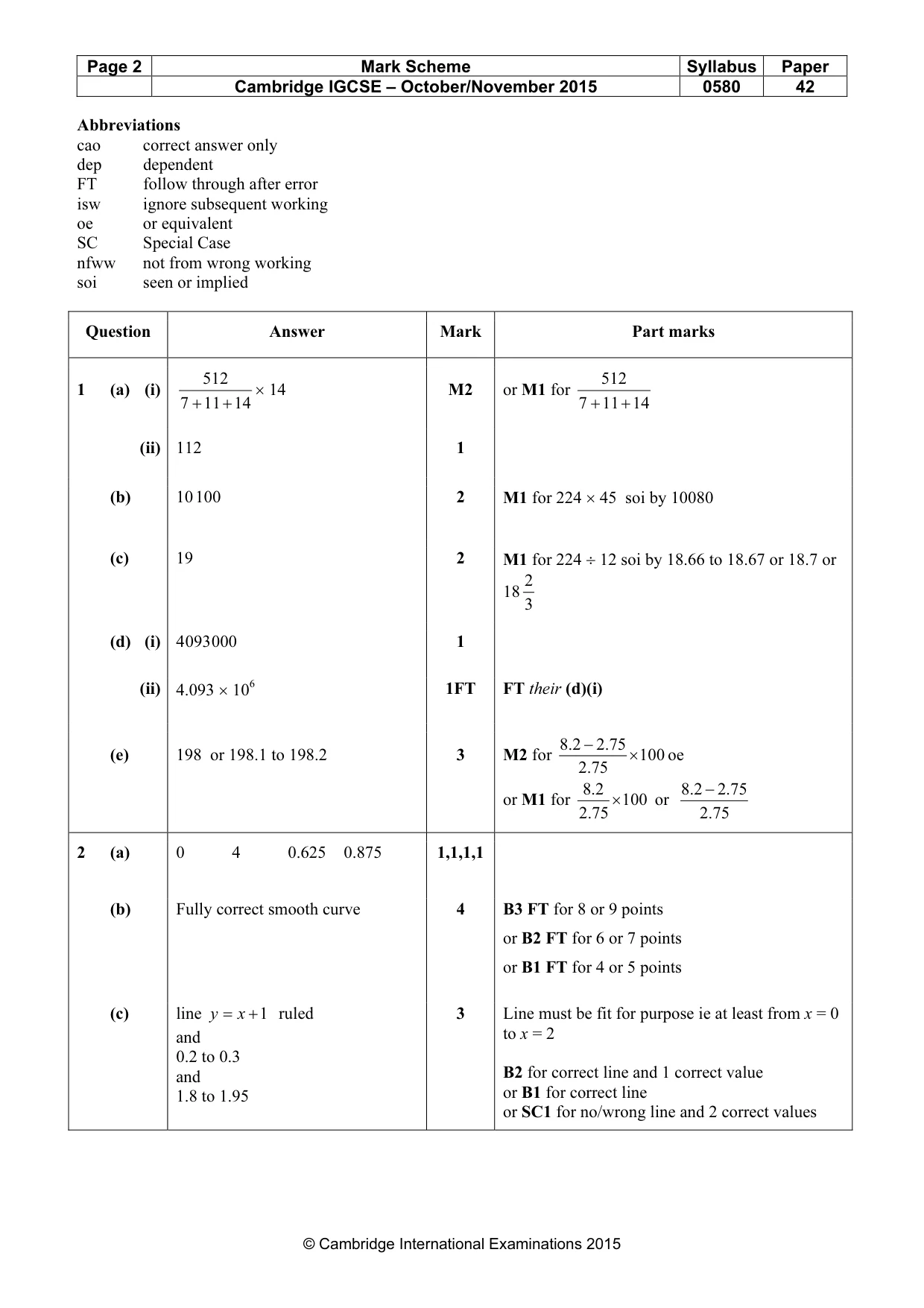
Mark scheme: Question Answer Mark Part marks 512512 5125121 (a) (i) × 14 M2 or M1 for 7 + 11 + 14 7 + 11 + 14 (ii) 112 1 (b) 10 100 2 M1 for 224 × 45 soi by 10080 (c) 19 2 M1 for 224 ÷ 12 soi by 18.66 to 18.67 or 18.7 or 2 18 3 (d) (i) 4 093 000 1 (ii) 4.093 × 10⁶ 1FT FT their (d)(i) 2.8 − .275 (e) 198 or 198.1 to 198.2 3 M2 for × 100 oe .275 2.8 2.8 − .275 or M1 for × 100 or .275 .275
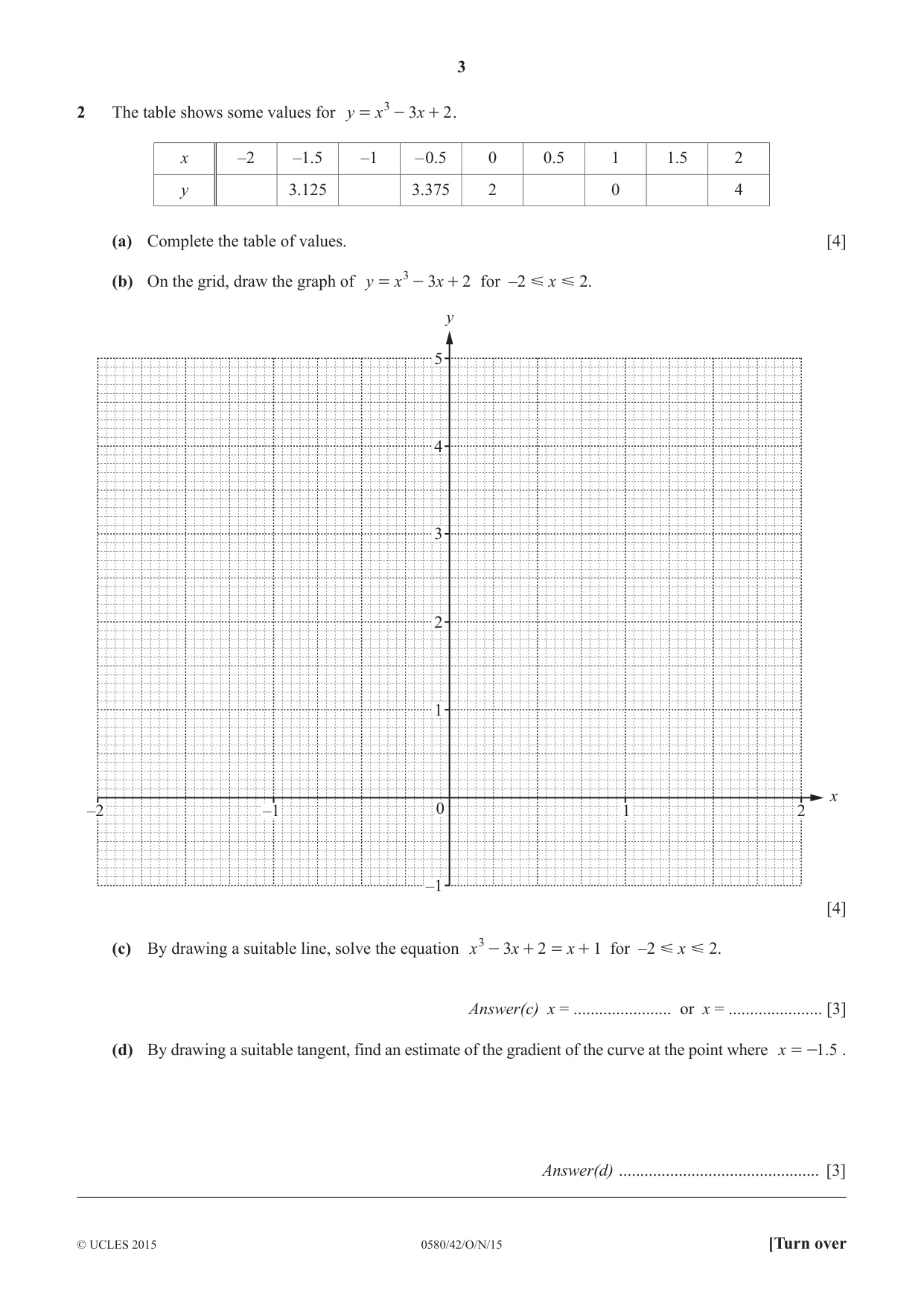
Q2 · The table shows some values for y = x 3 - 3x + 2
2 The table shows some values for y = x 3 - 3x + 2 . x –2 –1.5 –1 –0.5 0 0.5 1 1.5 2 y 3.125 3.375 2 0 4 (a) Complete the table of values. [4] (b) On the grid, draw the graph of y = x 3 - 3x + 2 for –2 x 2. y 5 4 3 2 1 x –2 –1 0 1 2 –1 [4] (c) By drawing a suitable line, solve the equation x 3 - 3x + 2 = x + 1 for –2 x 2. Answer(c) x = ....................... or x = ...................... [3] (d) By drawing a suitable tangent, find an estimate of the gradient of the curve at the point where x = -1.5 . Answer(d) ............................................... [3]
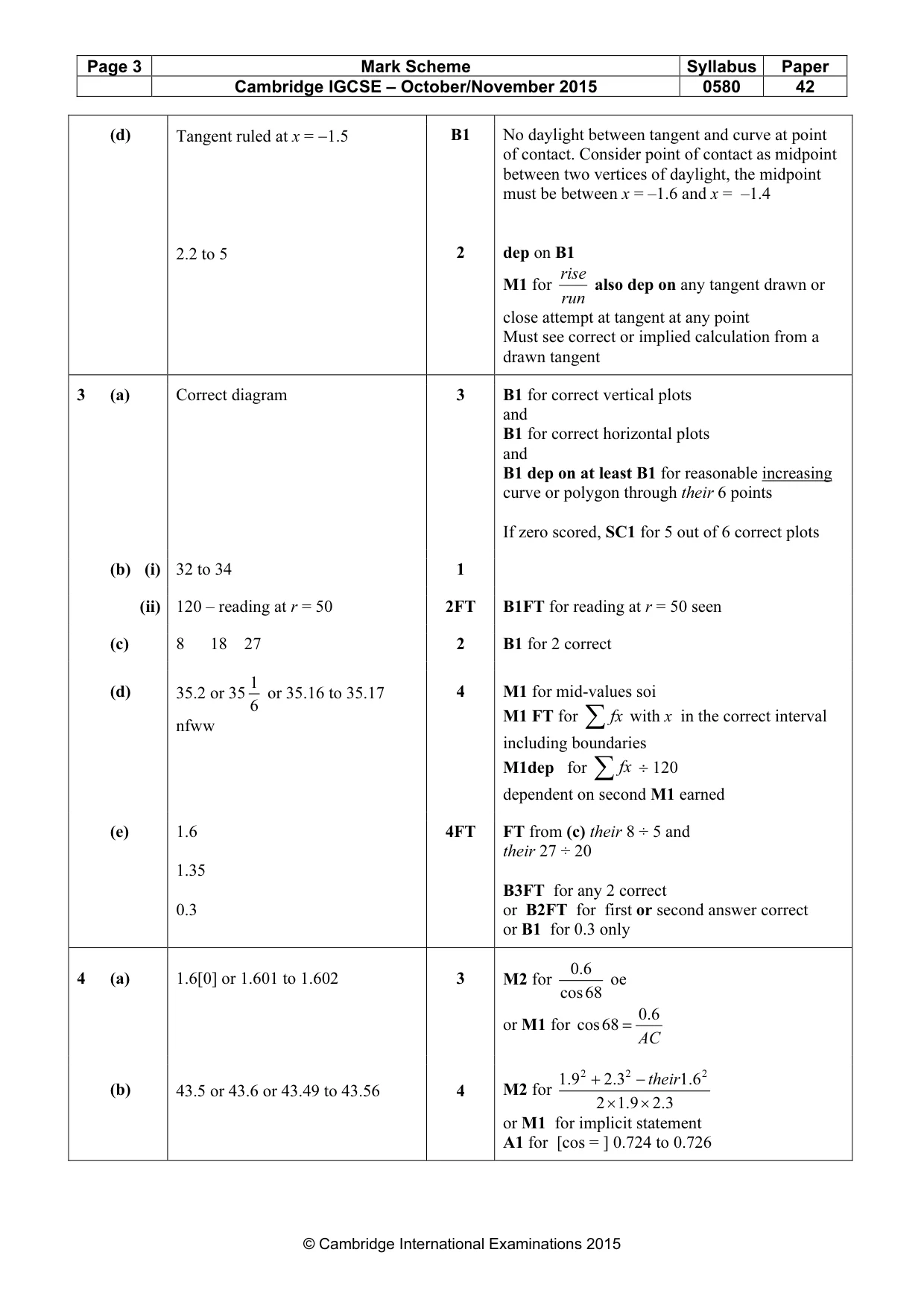
Mark scheme: 2 (a) 0 4 0.625 0.875 1,1,1,1 (b) Fully correct smooth curve 4 B3 FT for 8 or 9 points or B2 FT for 6 or 7 points or B1 FT for 4 or 5 points (c) line y = x + 1 ruled 3 Line must be fit for purpose ie at least from x = 0 and to x = 2 0.2 to 0.3 B2 for correct line and 1 correct value and 1.8 to 1.95 or B1 for correct line or SC1 for no/wrong line and 2 correct values (d) Tangent ruled at x = −1.5 B1 No daylight between tangent and curve at point of contact. Consider point of contact as midpoint between two vertices of daylight, the midpoint must be between x = –1.6 and x = –1.4 2 dep on B1 2.2 to 5 rise M1 for also dep on any tangent drawn or run close attempt at tangent at any point Must see correct or implied calculation from a drawn tangent
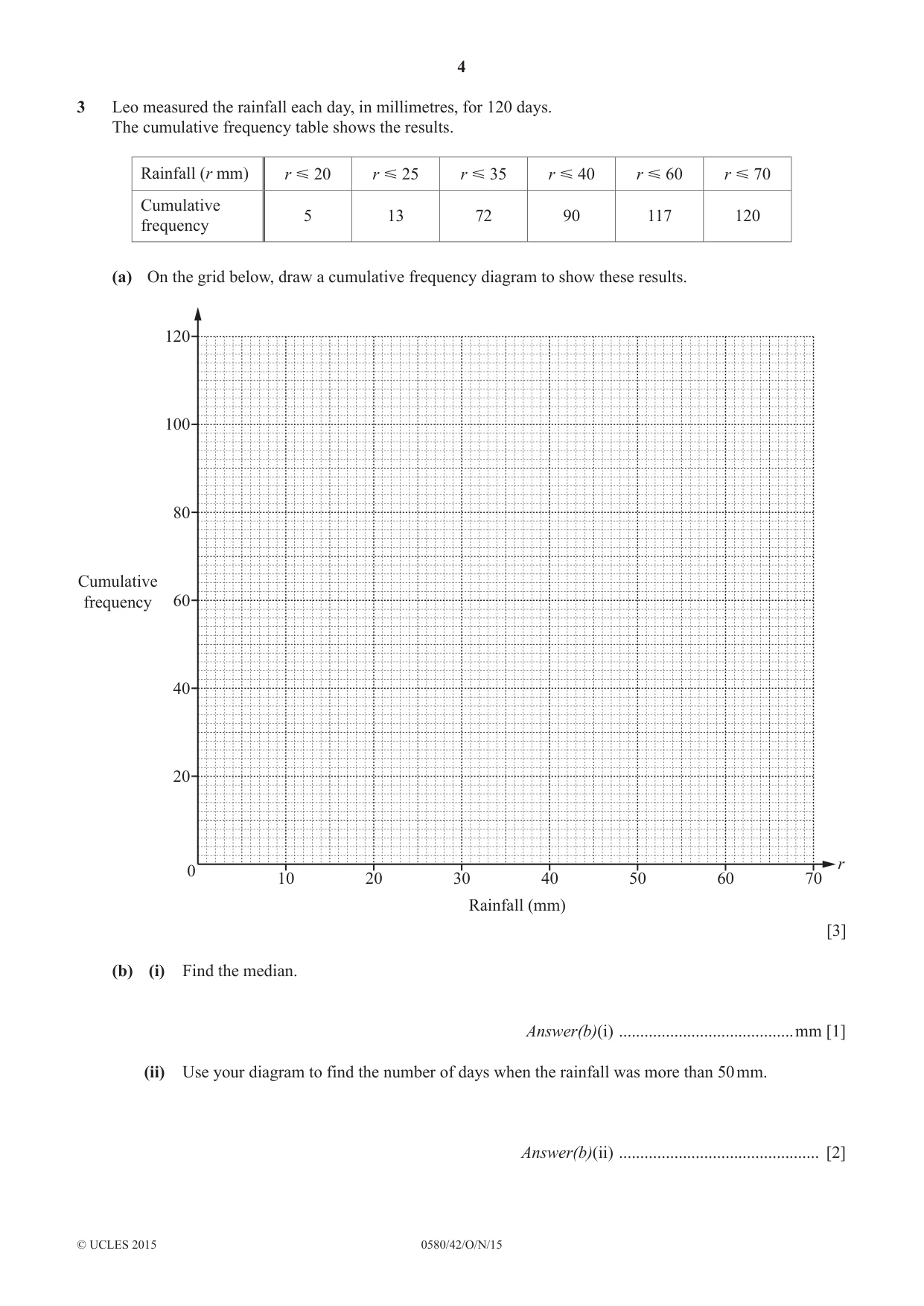
Q3 · Leo measured the rainfall each day, in millimetres, for 120 days
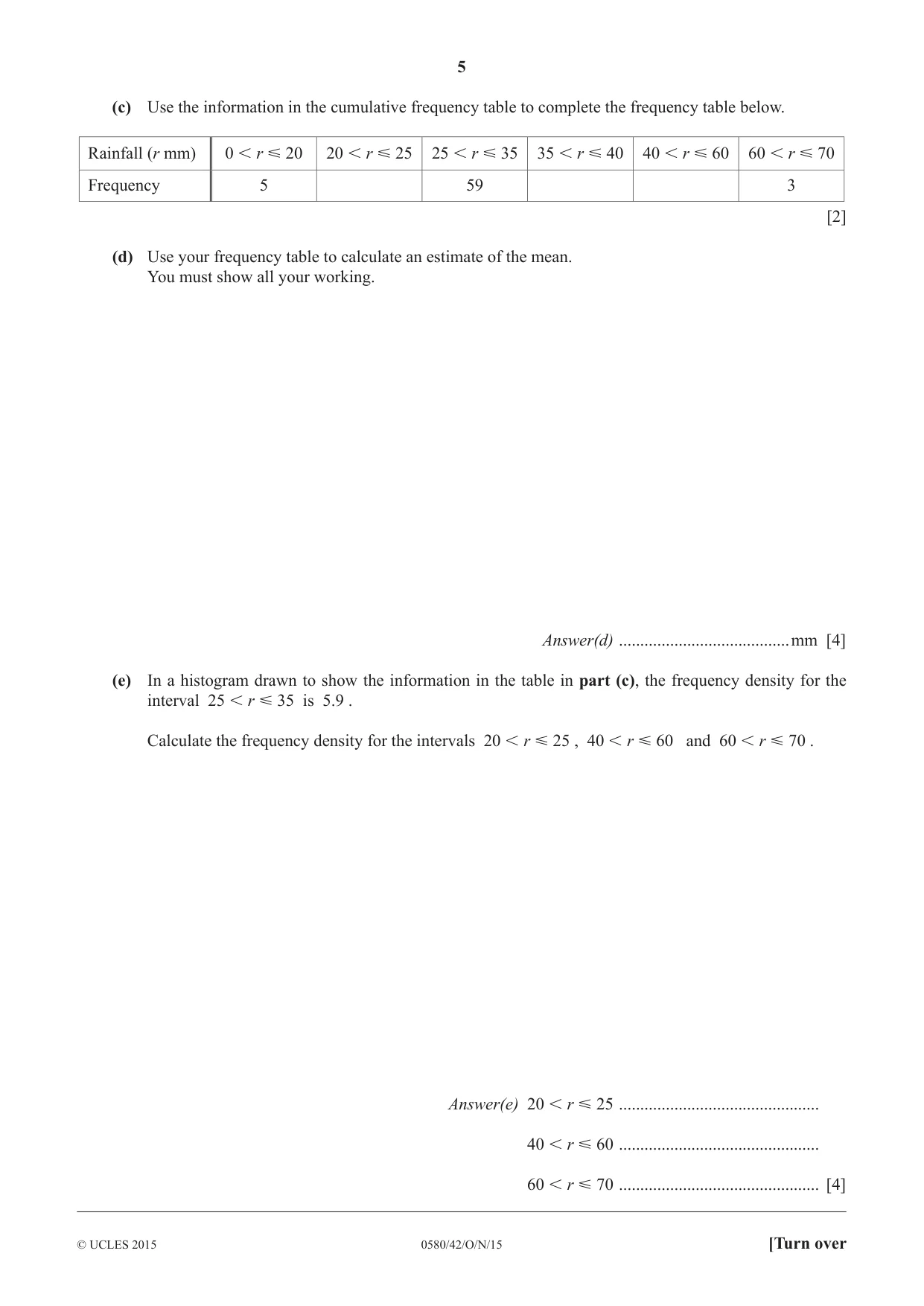
3 Leo measured the rainfall each day, in millimetres, for 120 days. The cumulative frequency table shows the results. Rainfall (r mm) r 20 r 25 r 35 r 40 r 60 r 70 Cumulative 5 13 72 90 117 120 frequency (a) On the grid below, draw a cumulative frequency diagram to show these results. 120 100 80 Cumulative frequency 60 40 20 r 0 10 20 30 40 50 60 70 Rainfall (mm) [3] (b) (i) Find the median. Answer(b)(i) .........................................mm [1] (ii) Use your diagram to find the number of days when the rainfall was more than 50 mm. Answer(b)(ii) ............................................... [2] (c) Use the information in the cumulative frequency table to complete the frequency table below. Rainfall (r mm) 0 r 20 20 r 25 25 r 35 35 r 40 40 r 60 60 r 70 Frequency 5 59 3 [2] (d) Use your frequency table to calculate an estimate of the mean. You must show all your working. Answer(d) ........................................mm [4] (e) In a histogram drawn to show the information in the table in part (c), the frequency density for the interval 25 r 35 is 5.9 . Calculate the frequency density for the intervals 20 r 25 , 40 r 60 and 60 r 70 . Answer(e) 20 r 25 ............................................... 40 r 60 ............................................... 60 r 70 ............................................... [4]
Mark scheme: 3 (a) Correct diagram 3 B1 for correct vertical plots and B1 for correct horizontal plots and B1 dep on at least B1 for reasonable increasing curve or polygon through their 6 points If zero scored, SC1 for 5 out of 6 correct plots (b) (i) 32 to 34 1 (ii) 120 – reading at r = 50 2FT B1FT for reading at r = 50 seen (c) 8 18 27 2 B1 for 2 correct 1 (d) 4 M1 for mid-values soi 35.2 or 35 or 35.16 to 35.17 6 with x in the correct interval M1 FT for ∑fx nfww including boundaries 120 M1dep for ∑fx ÷ dependent on second M1 earned (e) 1.6 4FT FT from (c) their 8 ÷ 5 and their 27 ÷ 20 1.35 B3FT for any 2 correct 0.3 or B2FT for first or second answer correct or B1 for 0.3 only 0 6
Q4 · A NOT TO SCALE B D C The diagram shows a tent ABCD
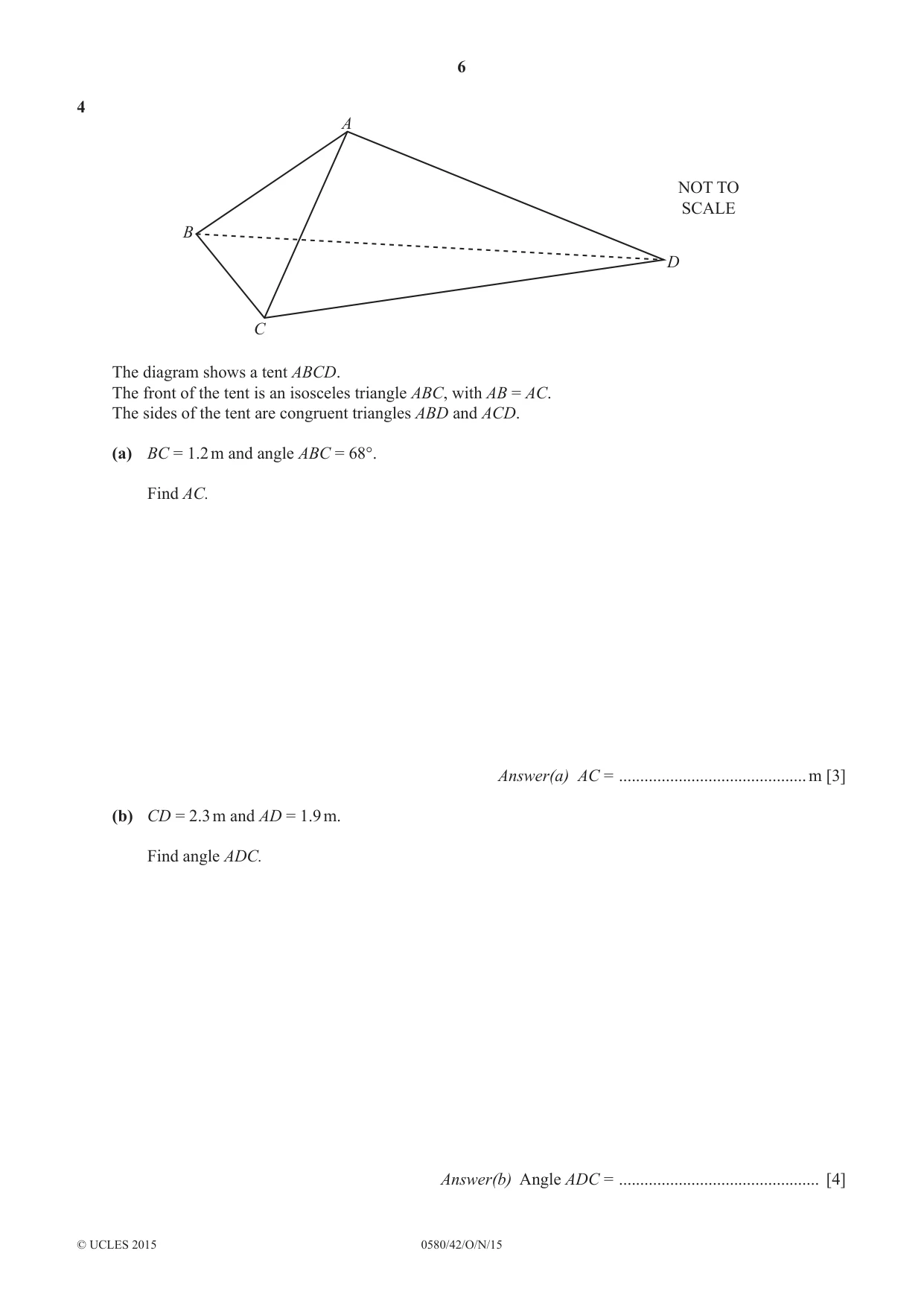
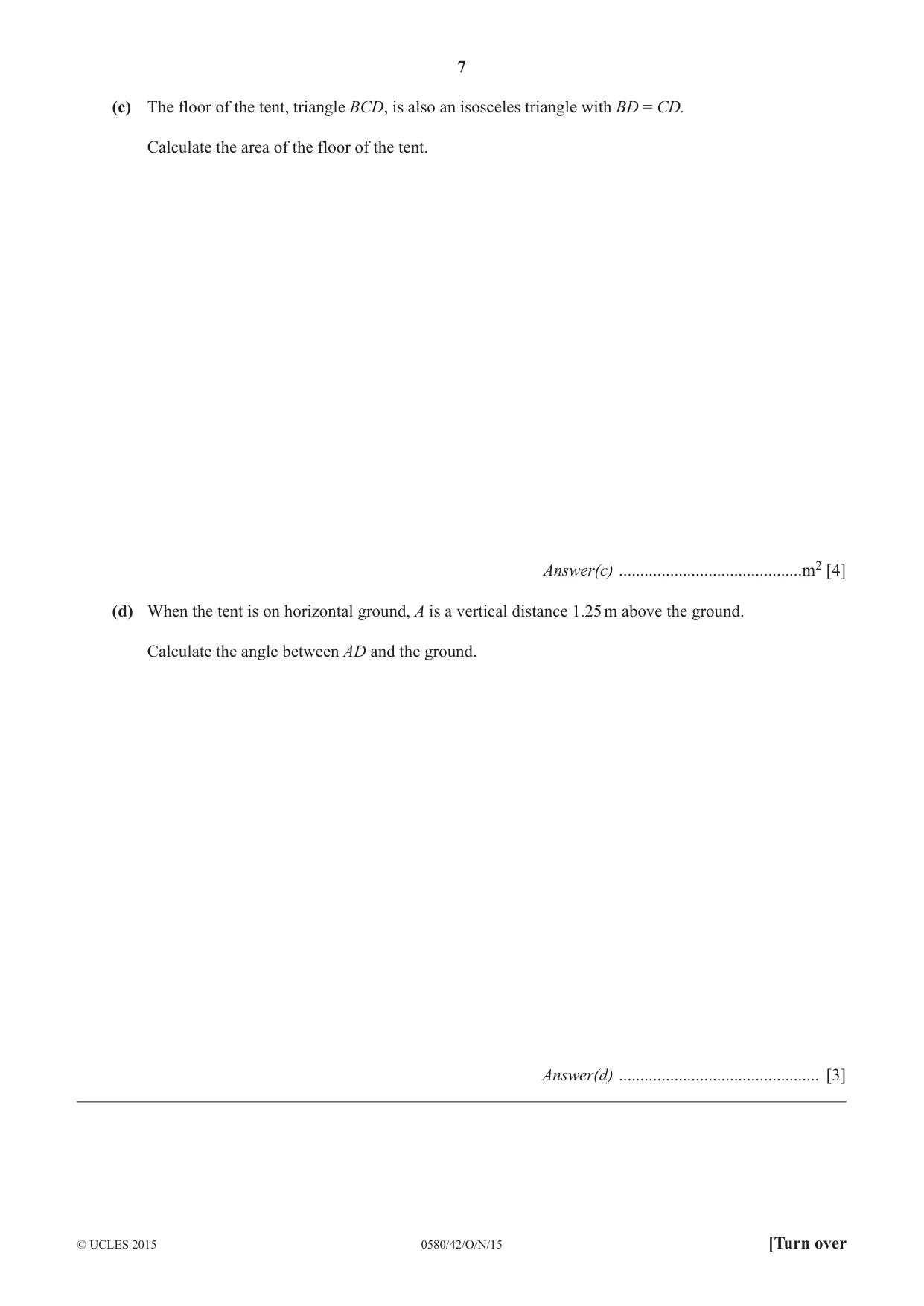
4 A NOT TO SCALE B D C The diagram shows a tent ABCD. The front of the tent is an isosceles triangle ABC, with AB = AC. The sides of the tent are congruent triangles ABD and ACD. (a) BC = 1.2 m and angle ABC = 68°. Find AC. Answer(a) AC = ............................................m [3] (b) CD = 2.3 m and AD = 1.9 m. Find angle ADC. Answer(b) Angle ADC = ............................................... [4] (c) The floor of the tent, triangle BCD, is also an isosceles triangle with BD = CD. Calculate the area of the floor of the tent. Answer(c) ...........................................m2 [4] (d) When the tent is on horizontal ground, A is a vertical distance 1.25 m above the ground. Calculate the angle between AD and the ground. Answer(d) ............................................... [3]
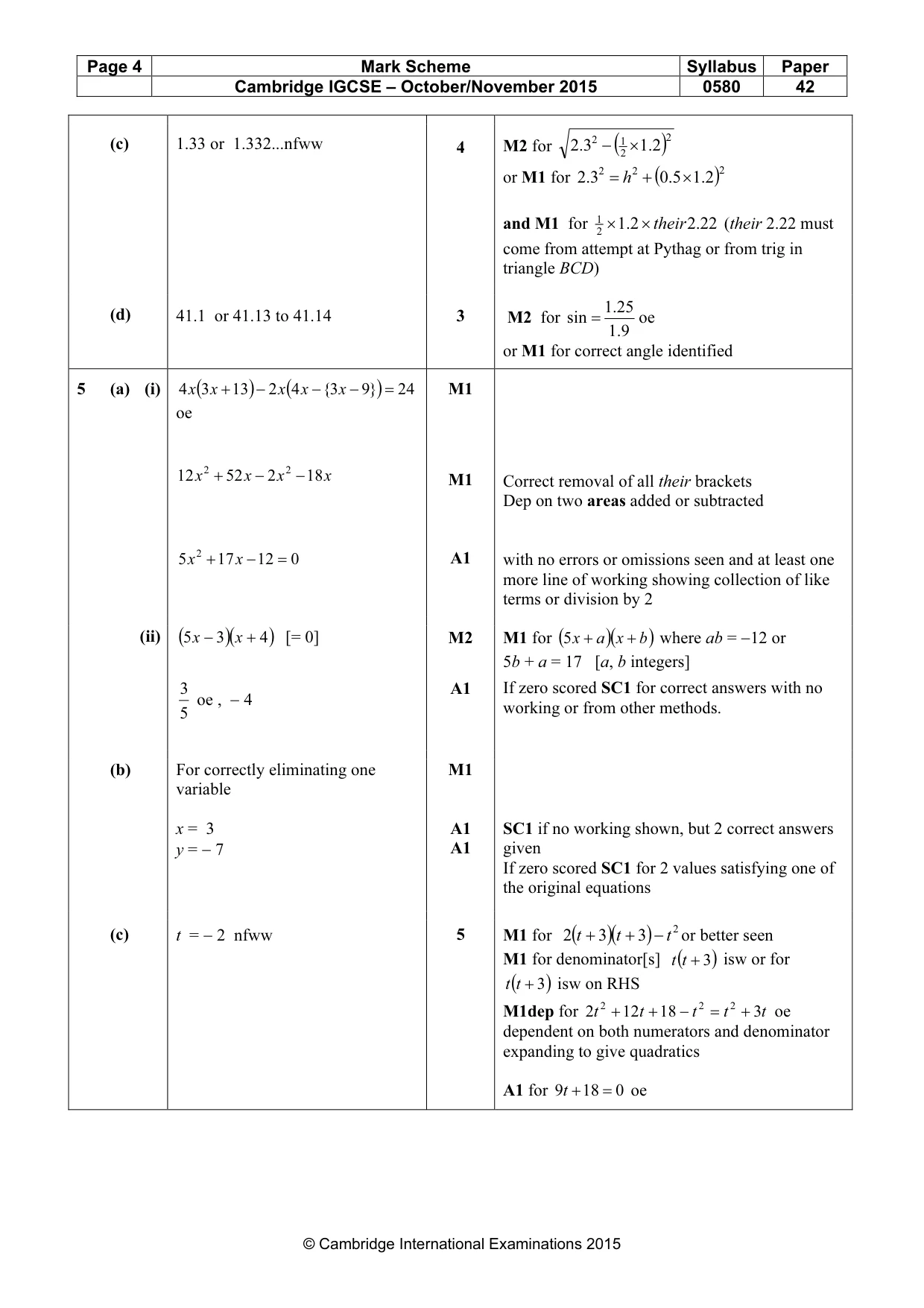
Mark scheme: 6.0 4 (a) 1.6[0] or 1.601 to 1.602 3 M2 for oe cos 68 6.0 or M1 for cos 68 = AC 9.1 2 + 3.2 2 − their6.1 2 (b) 43.5 or 43.6 or 43.49 to 43.56 4 M2 for 2 × 9.1 × 3.2 or M1 for implicit statement A1 for [cos = ] 0.724 to 0.726 1 (c) 1.33 or 1.332...nfww 4 M2 for 3.22 − ( × 2.1 )2 2 or M1 for 3.22 = h 2 + (5.0 × 2.1 )2 and M1 for 12 × 2.1 × their .222 (their 2.22 must come from attempt at Pythag or from trig in triangle BCD) .125 (d) oe 41.1 or 41.13 to 41.14 3 M2 for sin = 9.1 or M1 for correct angle identified
Q5 · The area of shape ABCDEF is 24 cm2
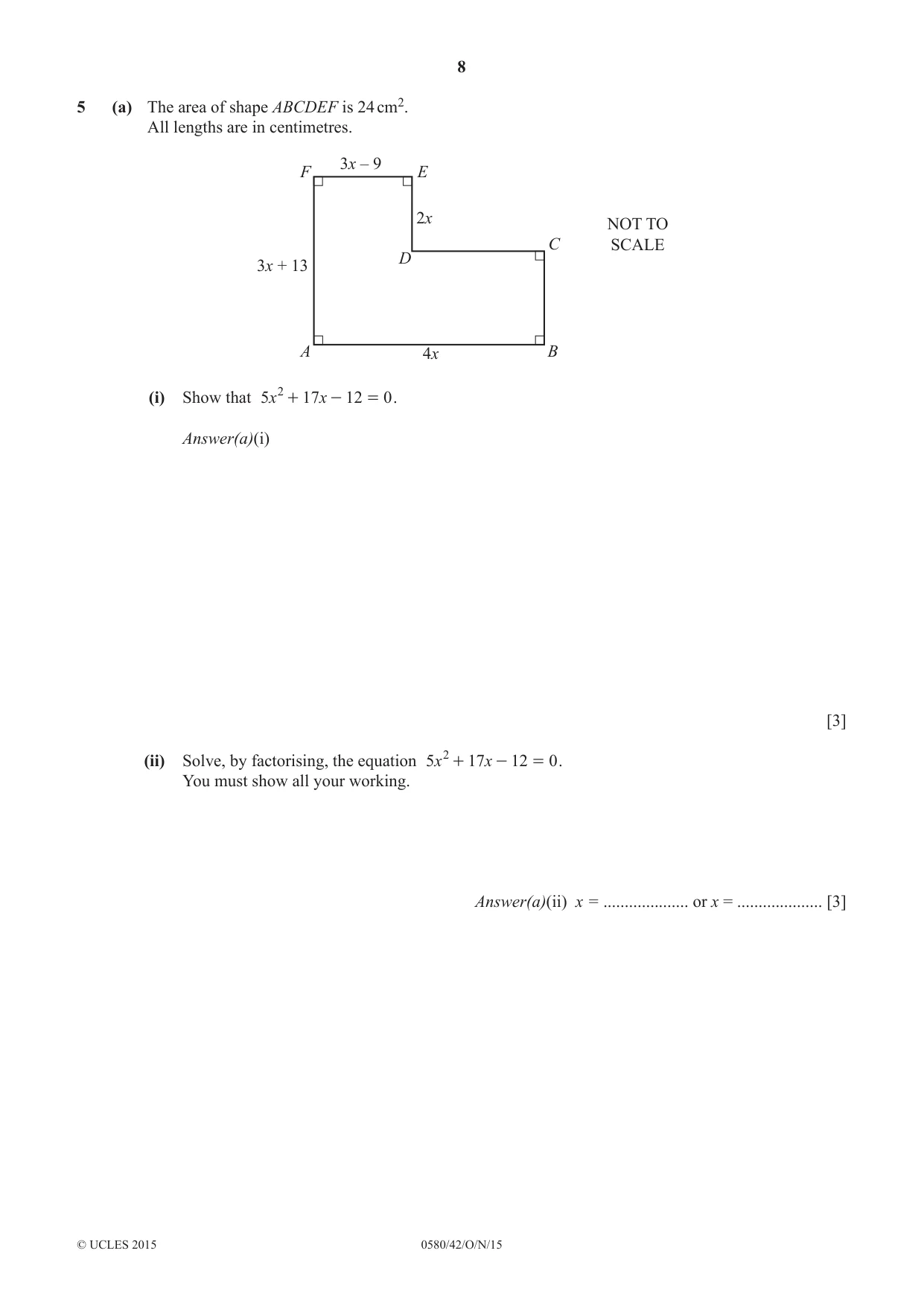
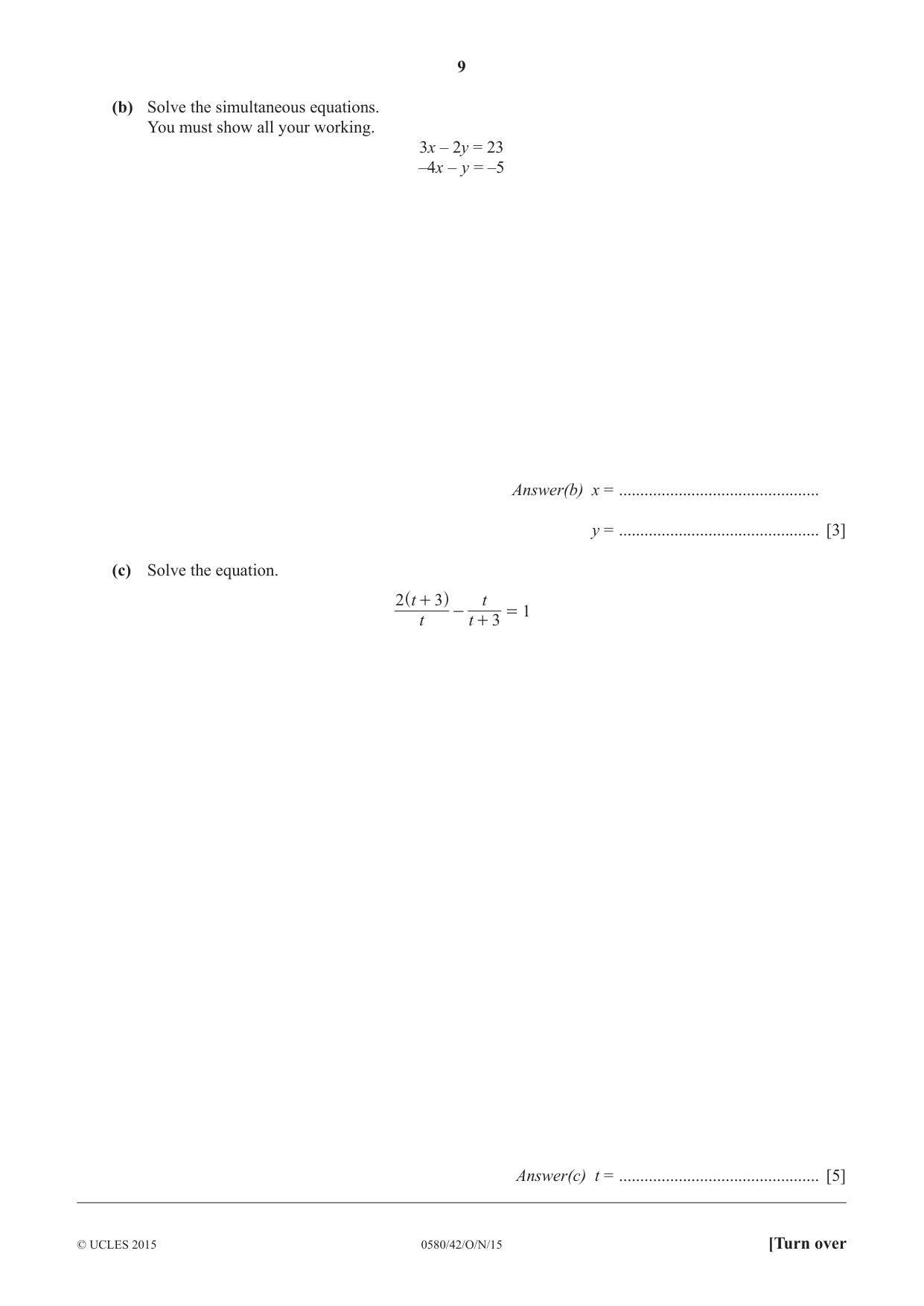
5 (a) The area of shape ABCDEF is 24 cm2. All lengths are in centimetres. 3x – 9 F E 2x NOT TO C SCALE D 3x + 13 A 4x B (i) Show that 5x 2 + 17x - 12 = 0 . Answer(a)(i) [3] (ii) Solve, by factorising, the equation 5x 2 + 17x - 12 = 0 . You must show all your working. Answer(a)(ii) x = .................... or x = .................... [3] (b) Solve the simultaneous equations. You must show all your working. 3x – 2y = 23 –4x – y = –5 Answer(b) x = ............................................... y = ............................................... [3] (c) Solve the equation. 2 ^t + 3h t - = 1 t t + 3 Answer(c) t = ............................................... [5]
Mark scheme: 5 (a) (i) 4 x (3 x + 13 ) − 2 x (4 x − {3 x − 9}) = 24 M1 oe 12 x 2 + 52 x − 2 x 2 − 18 x M1 Correct removal of all their brackets Dep on two areas added or subtracted 5 x 2 + 17 x − 12 = 0 A1 with no errors or omissions seen and at least one more line of working showing collection of like terms or division by 2 (ii) (5 x − 3 )( x + 4 ) [= 0] M2 M1 for (5 x + a )( x + b ) where ab = −12 or 5b + a = 17 [a, b integers] 3 A1 If zero scored SC1 for correct answers with no oe , − 4 5 working or from other methods. (b) For correctly eliminating one M1 variable x = 3 A1 SC1 if no working shown, but 2 correct answers y = − 7 A1 given If zero scored SC1 for 2 values satisfying one of the original equations (c) t = − 2 nfww 5 M1 for 2(t + 3)(t + 3) − t 2 or better seen M1 for denominator[s] t (t + 3 ) isw or for t (t + 3 ) isw on RHS M1dep for 2t 2 + 12 t + 18 − t 2 = t 2 + 3t oe dependent on both numerators and denominator expanding to give quadratics A1 for 9t + 18 = 0 oe
Q6 · A, B, C and D lie on the circumference of the circle
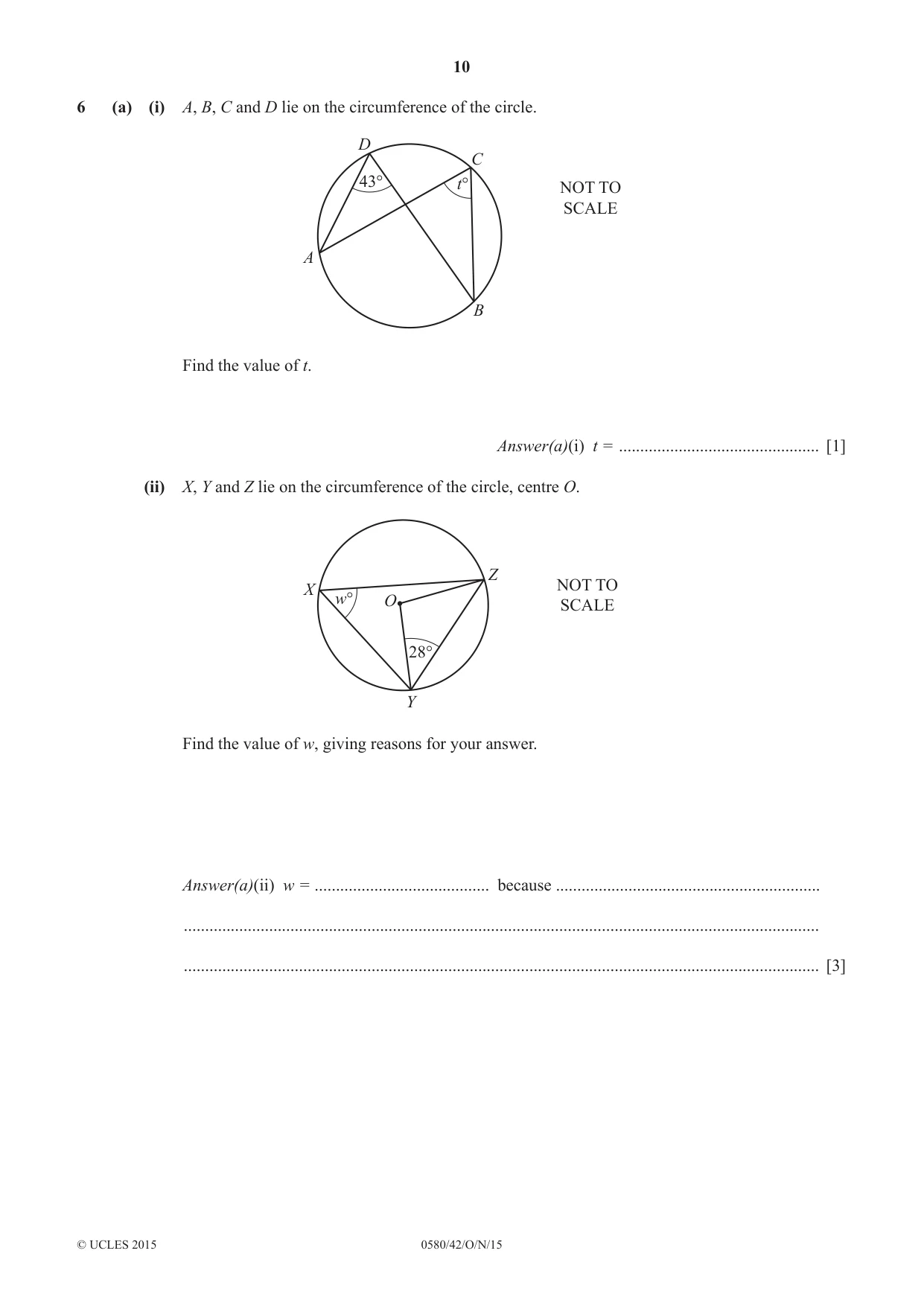
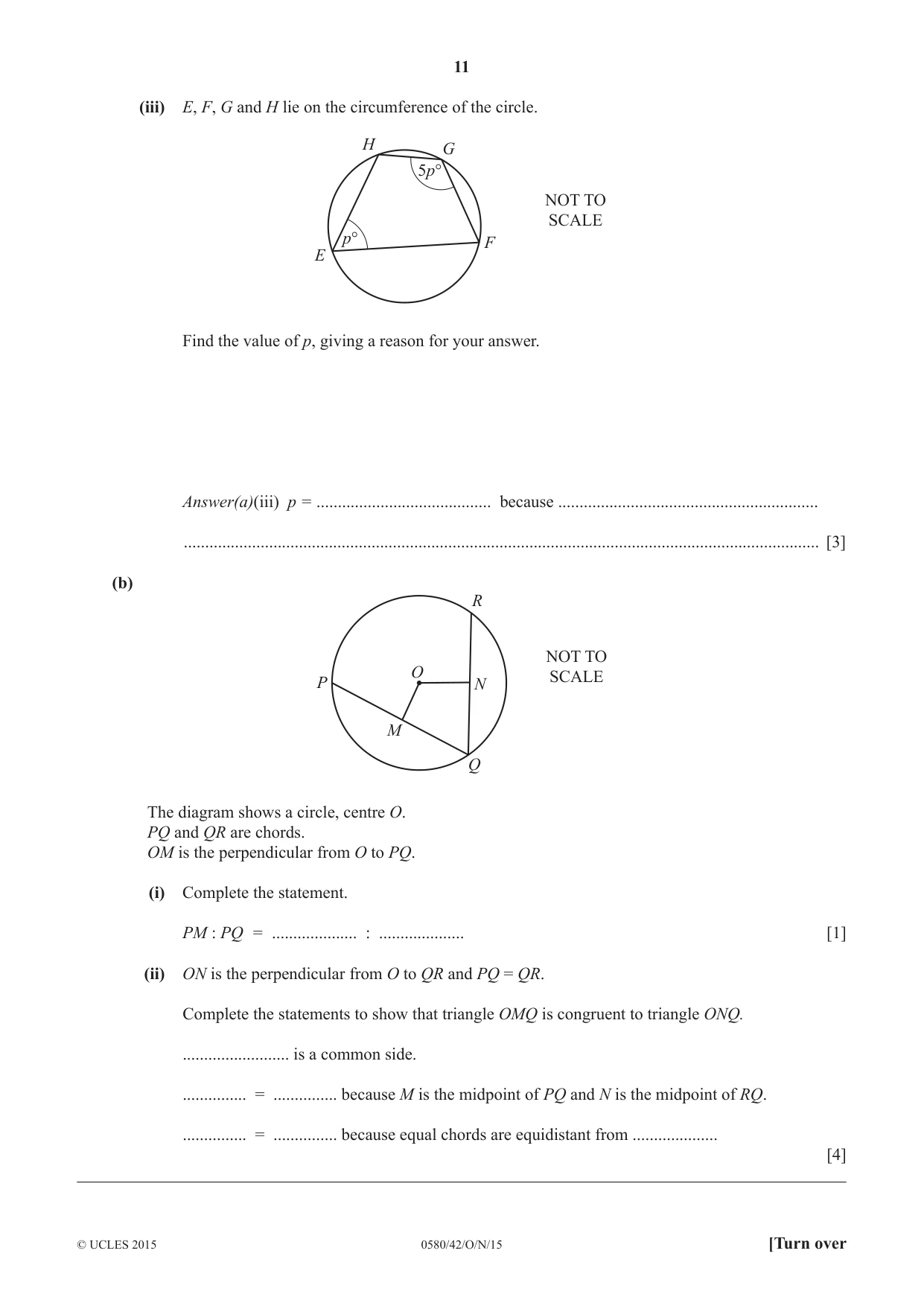
6 (a) (i) A, B, C and D lie on the circumference of the circle. D C 43° t° NOT TO SCALE A B Find the value of t. Answer(a)(i) t = ............................................... [1] (ii) X, Y and Z lie on the circumference of the circle, centre O. Z X NOT TO w° O SCALE 28° Y Find the value of w, giving reasons for your answer. Answer(a)(ii) w = ......................................... because .............................................................. ..................................................................................................................................................... ..................................................................................................................................................... [3] (iii) E, F, G and H lie on the circumference of the circle. H G 5p° NOT TO SCALE p° F E Find the value of p, giving a reason for your answer. Answer(a)(iii) p = ......................................... because ............................................................. ..................................................................................................................................................... [3] (b) R NOT TO O SCALE P N M Q The diagram shows a circle, centre O. PQ and QR are chords. OM is the perpendicular from O to PQ. (i) Complete the statement. PM : PQ = .................... : .................... [1] (ii) ON is the perpendicular from O to QR and PQ = QR. Complete the statements to show that triangle OMQ is congruent to triangle ONQ. ......................... is a common side. ............... = ............... because M is the midpoint of PQ and N is the midpoint of RQ. ............... = ............... because equal chords are equidistant from .................... [4]
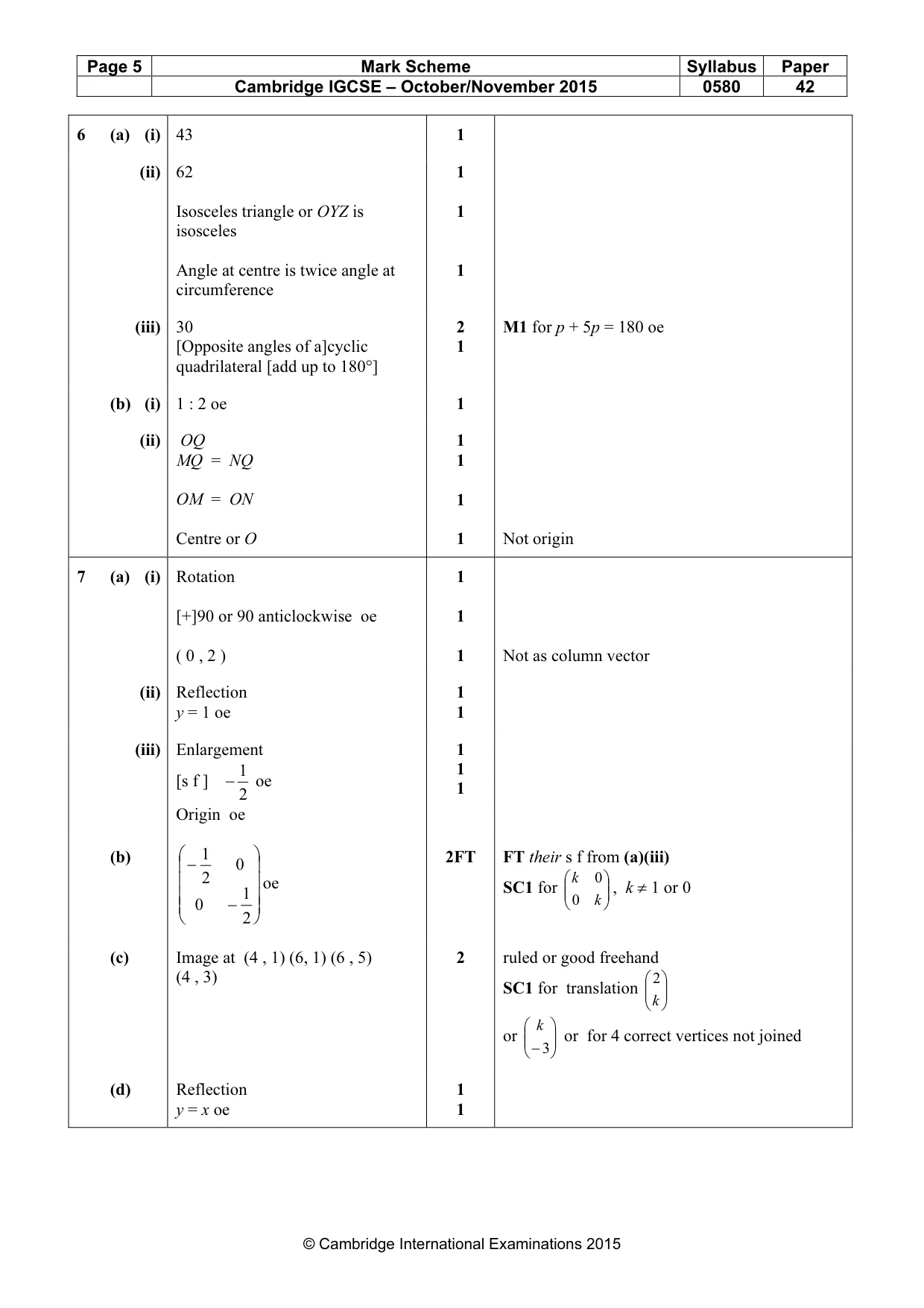
Mark scheme: 6 (a) (i) 43 1 (ii) 62 1 Isosceles triangle or OYZ is 1 isosceles Angle at centre is twice angle at 1 circumference (iii) 30 2 M1 for p + 5p = 180 oe [Opposite angles of a]cyclic 1 quadrilateral [add up to 180°] (b) (i) 1 : 2 oe 1 (ii) OQ 1 MQ = NQ 1 OM = ON 1 Centre or O 1 Not origin
Q7 · Y 9 8 7 6 B A 5 4 3 2 1 x 0 –7 –6 –5 –4 –3 –2 –1 1 2 3 4 5 6 7 8 9 –1 –2 D –3 C –4 –5 –6…
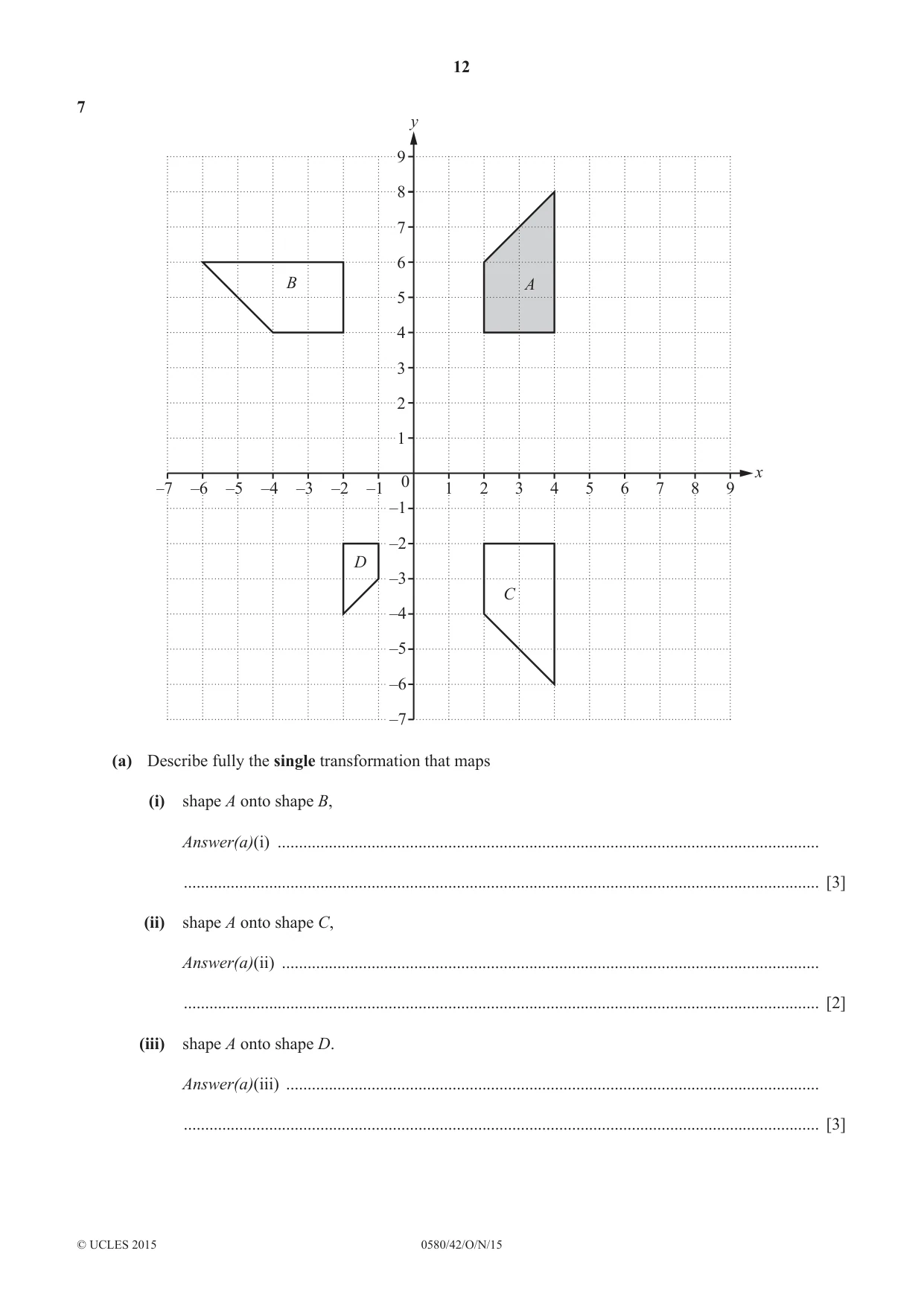
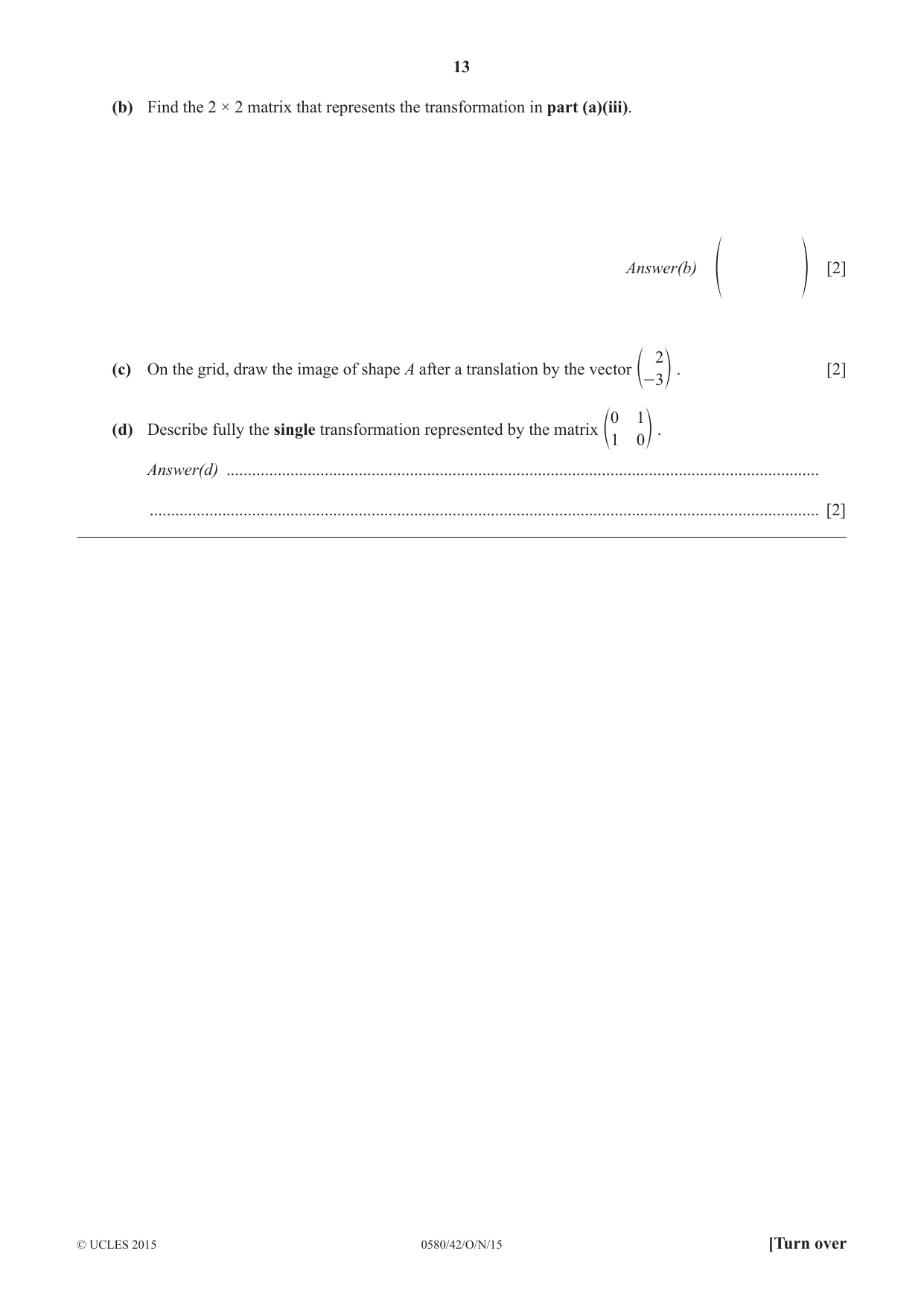
7 y 9 8 7 6 B A 5 4 3 2 1 x 0 –7 –6 –5 –4 –3 –2 –1 1 2 3 4 5 6 7 8 9 –1 –2 D –3 C –4 –5 –6 –7 (a) Describe fully the single transformation that maps (i) shape A onto shape B, Answer(a)(i) ............................................................................................................................... ..................................................................................................................................................... [3] (ii) shape A onto shape C, Answer(a)(ii) .............................................................................................................................. ..................................................................................................................................................... [2] (iii) shape A onto shape D. Answer(a)(iii) ............................................................................................................................. ..................................................................................................................................................... [3] (b) Find the 2 × 2 matrix that represents the transformation in part (a)(iii). Answer(b) [2] f p 2 (c) On the grid, draw the image of shape A after a translation by the vector . [2] e- 3 o 0 1 (d) Describe fully the single transformation represented by the matrix . e 1 0 o Answer(d) ........................................................................................................................................... ............................................................................................................................................................. [2]
Mark scheme: 7 (a) (i) Rotation 1 [+]90 or 90 anticlockwise oe 1 ( 0 , 2 ) 1 Not as column vector (ii) Reflection 1 y = 1 oe 1 (iii) Enlargement 1 1 1 [s f ] −2 oe 1 Origin oe (b) 1 2FT FT their s f from (a)(iii) − 0 2 oe SC1 for k 0 , k ≠ 1 or 0 1 0 − 0 k 2 (c) Image at (4 , 1) (6, 1) (6 , 5) 2 ruled or good freehand (4 , 3) 2 SC1 for translation k k or or for 4 correct vertices not joined −3 (d) Reflection 1 y = x oe 1
Q8 · A line AB joins the points A (3, 4) and B (5, 8)
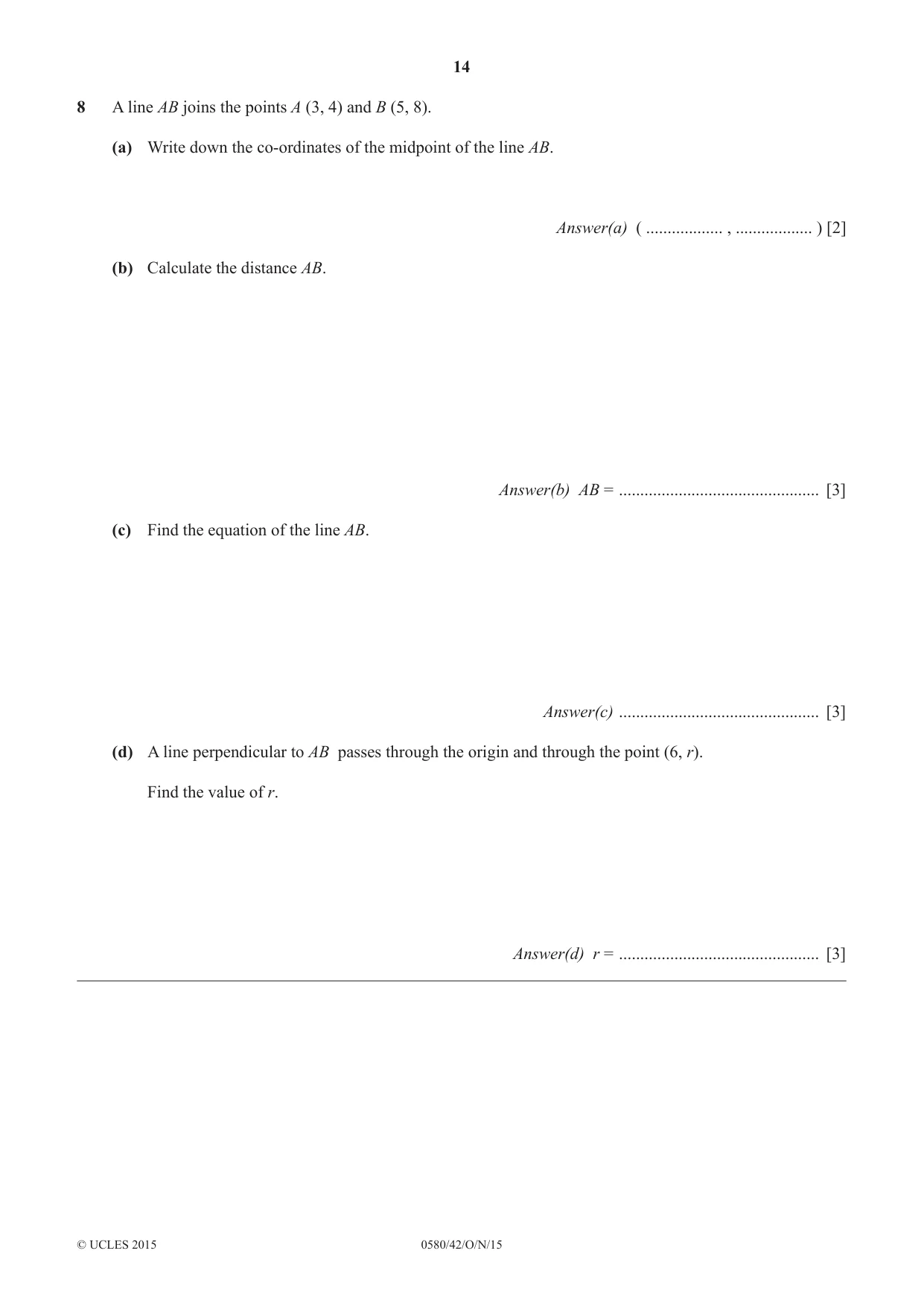
8 A line AB joins the points A (3, 4) and B (5, 8). (a) Write down the co-ordinates of the midpoint of the line AB. Answer(a) ( .................. , .................. ) [2] (b) Calculate the distance AB. Answer(b) AB = ............................................... [3] (c) Find the equation of the line AB. Answer(c) ............................................... [3] (d) A line perpendicular to AB passes through the origin and through the point (6, r). Find the value of r. Answer(d) r = ............................................... [3]
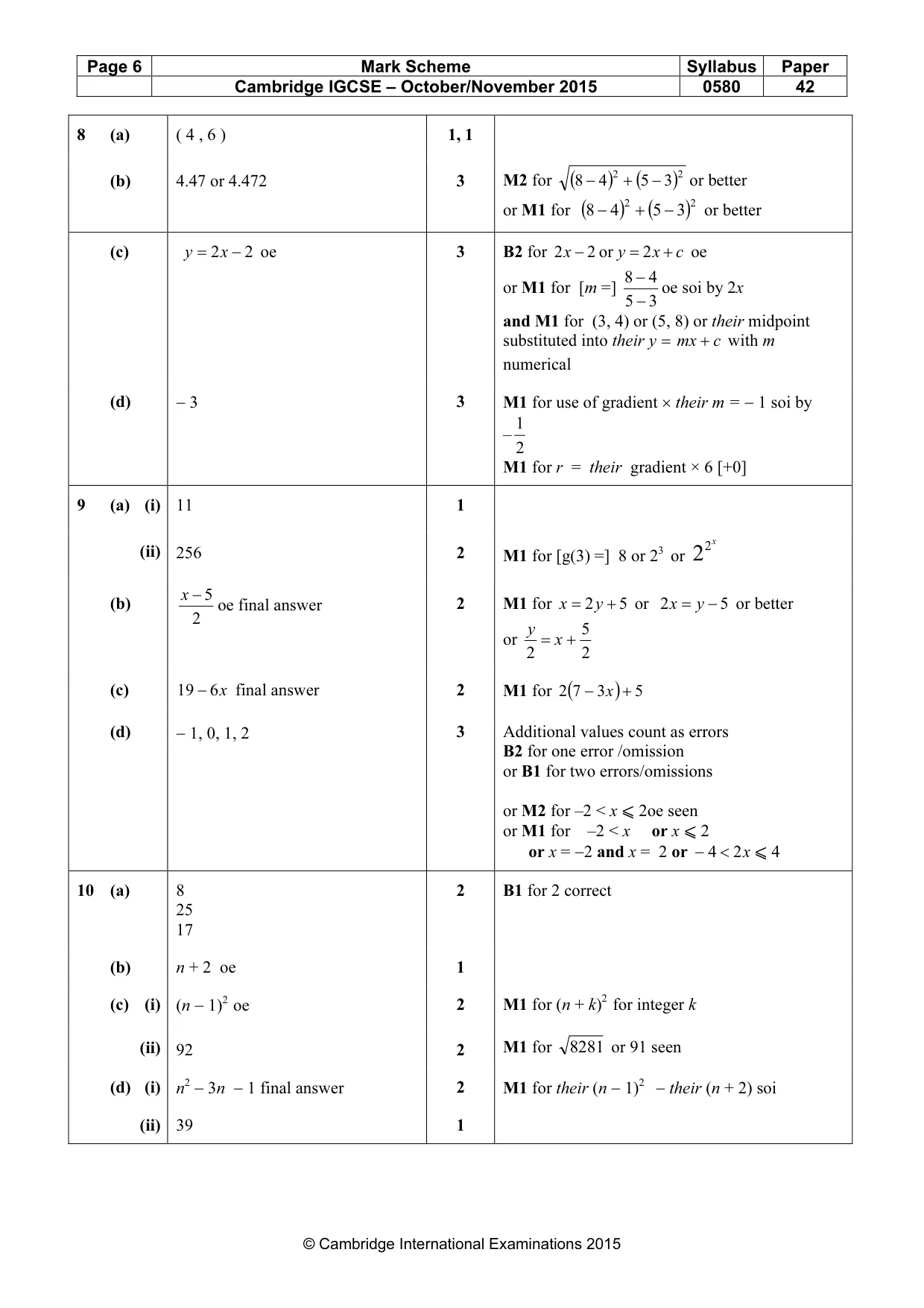
Mark scheme: 8 (a) ( 4 , 6 ) 1, 1 (b) 4.47 or 4.472 3 M2 for (8 − 4 )2 + (5 − 3 )2 or better or M1 for (8 − 4 )2 + (5 − 3)2 or better (c) y = 2 x − 2 oe 3 B2 for 2 x − 2 or y = 2 x + c oe 8 − 4 or M1 for [m =] oe soi by 2x 5 − 3 and M1 for (3, 4) or (5, 8) or their midpoint substituted into their y = mx + c with m numerical (d) − 3 3 M1 for use of gradient × their m = − 1 soi by 1 – 2 M1 for r = their gradient × 6 [+0]
Q9 · F(x) = 2x + 5 g(x) = 2x h(x) = 7 - 3x (a) Find (i) f(3), Answer(a)(i)…
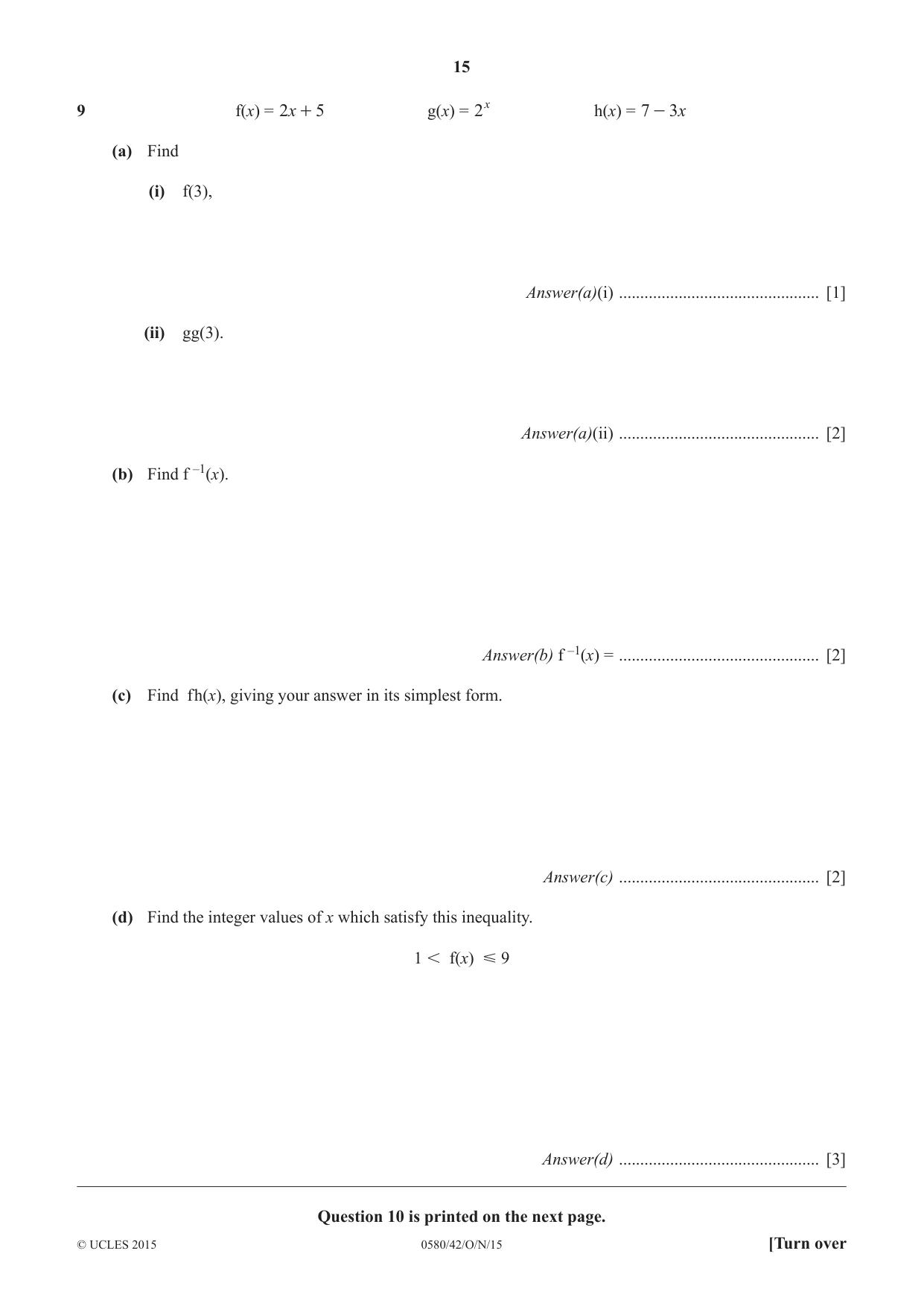
9 f(x) = 2x + 5 g(x) = 2x h(x) = 7 - 3x (a) Find (i) f(3), Answer(a)(i) ............................................... [1] (ii) gg(3). Answer(a)(ii) ............................................... [2] (b) Find f –1(x). Answer(b) f –1(x) = ............................................... [2] (c) Find fh(x), giving your answer in its simplest form. Answer(c) ............................................... [2] (d) Find the integer values of x which satisfy this inequality. 1 f(x) 9 Answer(d) ............................................... [3] Question 10 is printed on the next page.
Mark scheme: 9 (a) (i) 11 1 (ii) 256 2 M1 for [g(3) =] 8 or 23 or 2 2 x x − 5 (b) 2 M1 for x = 2 y + 5 or 2 x = y − 5 or better oe final answer 2 y 5 or = x + 2 2 (c) 19 − 6 x final answer 2 M1 for 2 (7 −x3 ) + 5 (d) − 1, 0, 1, 2 3 Additional values count as errors B2 for one error /omission or B1 for two errors/omissions or M2 for –2 < x ⩽ 2oe seen or M1 for –2 < x or x ⩽ 2 or x = −2 and x = 2 or − 4 < 2 x ⩽ 4
Q10 · The table shows the first five terms of sequences A, B and C
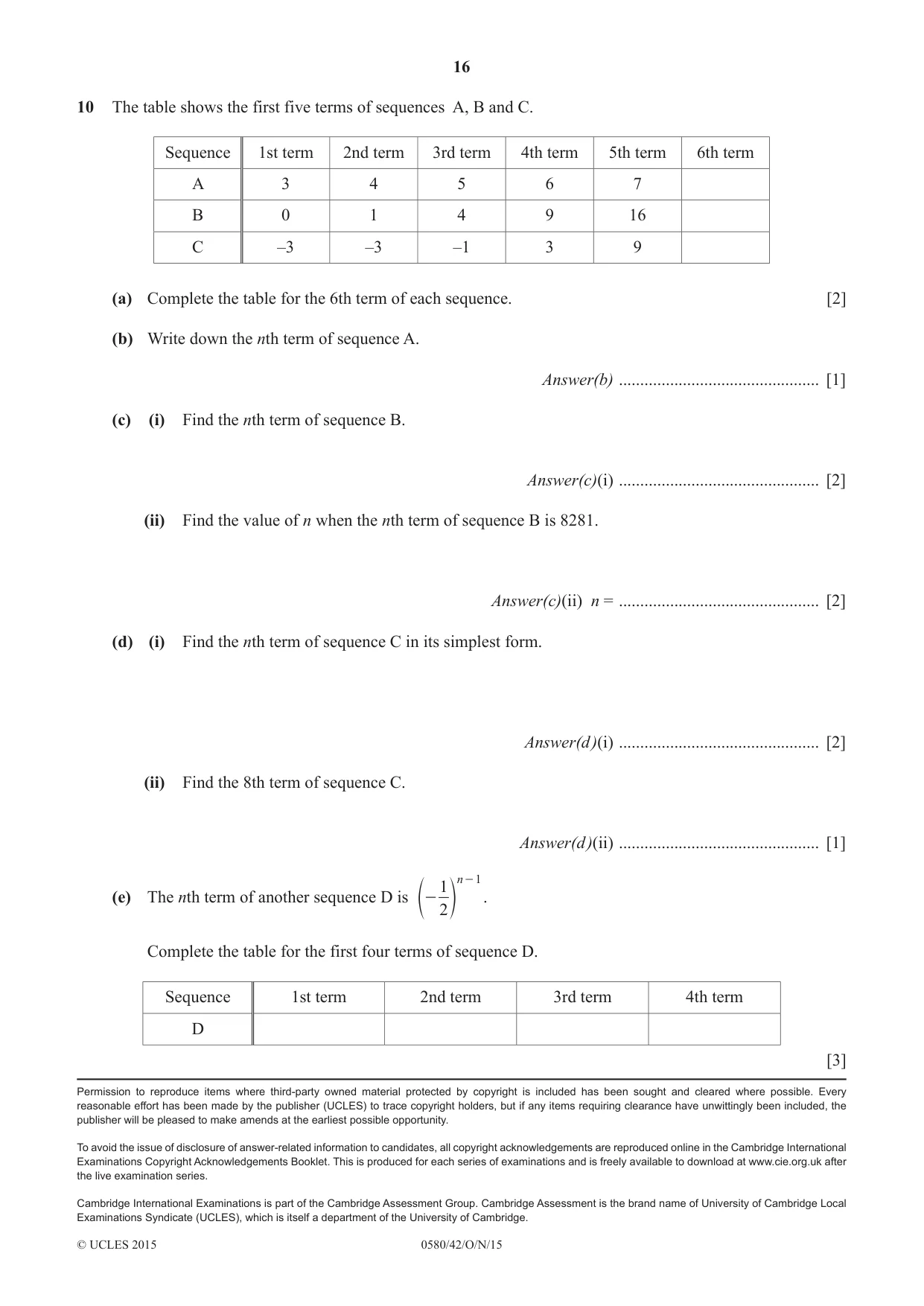
10 The table shows the first five terms of sequences A, B and C. Sequence 1st term 2nd term 3rd term 4th term 5th term 6th term A 3 4 5 6 7 B 0 1 4 9 16 C –3 –3 –1 3 9 (a) Complete the table for the 6th term of each sequence. [2] (b) Write down the nth term of sequence A. Answer(b) ............................................... [1] (c) (i) Find the nth term of sequence B. Answer(c)(i) ............................................... [2] (ii) Find the value of n when the nth term of sequence B is 8281. Answer(c)(ii) n = ............................................... [2] (d) (i) Find the nth term of sequence C in its simplest form. Answer(d)(i) ............................................... [2] (ii) Find the 8th term of sequence C. Answer(d)(ii) ............................................... [1] n - 1 1 (e) The nth term of another sequence D is - . e 2 o Complete the table for the first four terms of sequence D. Sequence 1st term 2nd term 3rd term 4th term D [3]
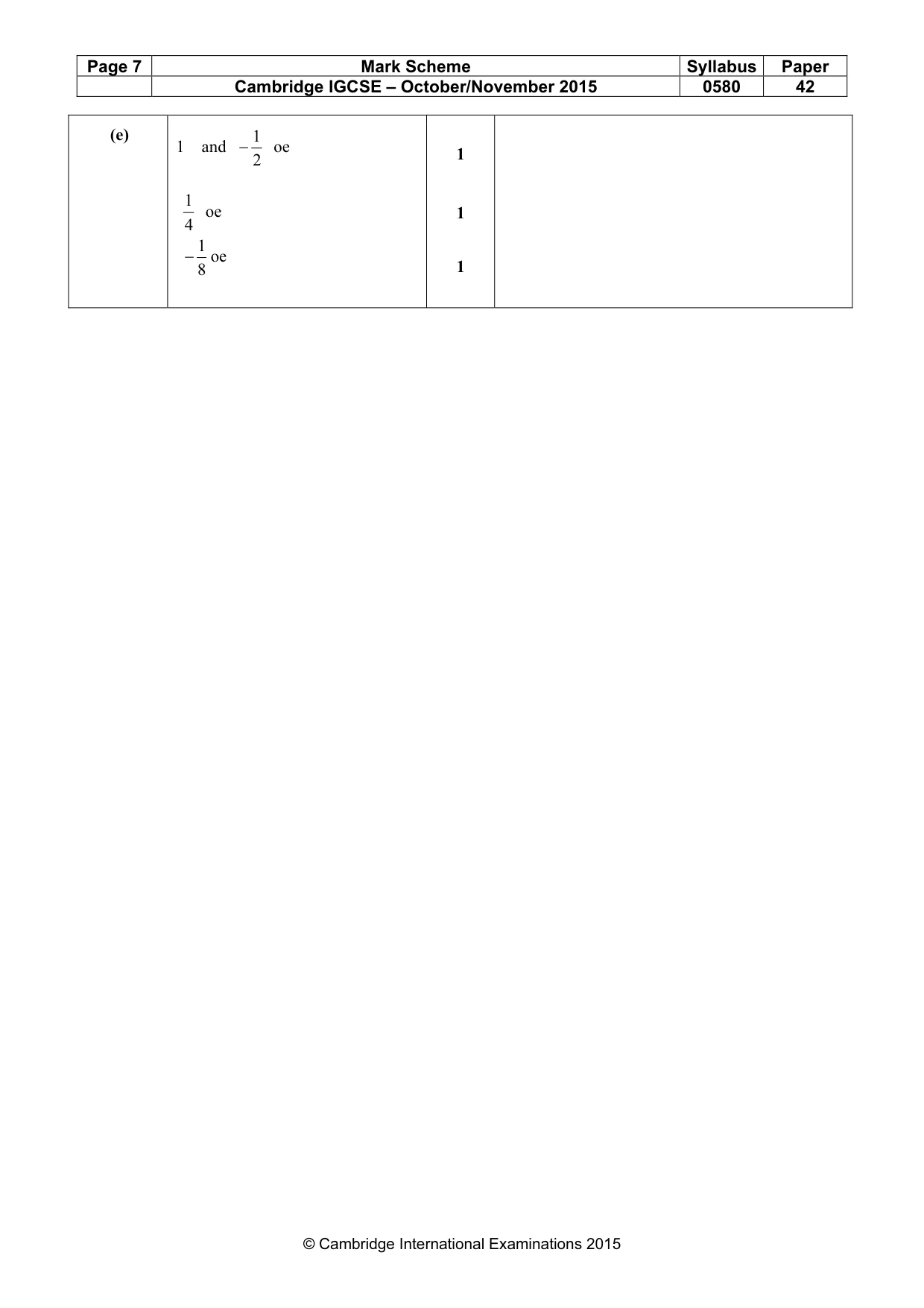
Mark scheme: 10 (a) 8 2 B1 for 2 correct 25 17 (b) n + 2 oe 1 (c) (i) (n − 1)2 oe 2 M1 for (n + k)2 for integer k (ii) 92 2 M1 for 8281 or 91 seen (d) (i) n2 − 3n − 1 final answer 2 M1 for their (n − 1)2 − their (n + 2) soi (ii) 39 1 (e) 1 1 and −2 oe 1 1 oe 1 4 1 oe 1 −8
What was in this paper
The subtopics covered by these 10 questions, and how many questions each got. Open one in a new tab to see every Cambridge question on it.
What you needed in this session
Cambridge’s own grade thresholds for 2015 Oct/Nov, Paper 4 · Variant 2. A higher threshold means an easier paper — the bar moves with how the cohort did.