Cambridge IGCSE Mathematics 0580 — 2016 Oct/Nov Paper 4 · Variant 2
0580/42/O/N/16 · 10 questions · 130 marks · ≈146 min
The question paper and its mark scheme, free to read here and free to download. This is Cambridge’s own paper, exactly as it was sat.
Question paper20 pages
Mark scheme8 pages
Answers below. Sit the paper first if you are practising.
Questions as text
Q1 · Each year the value of a car decreases by 15% of its value at the beginning of that year
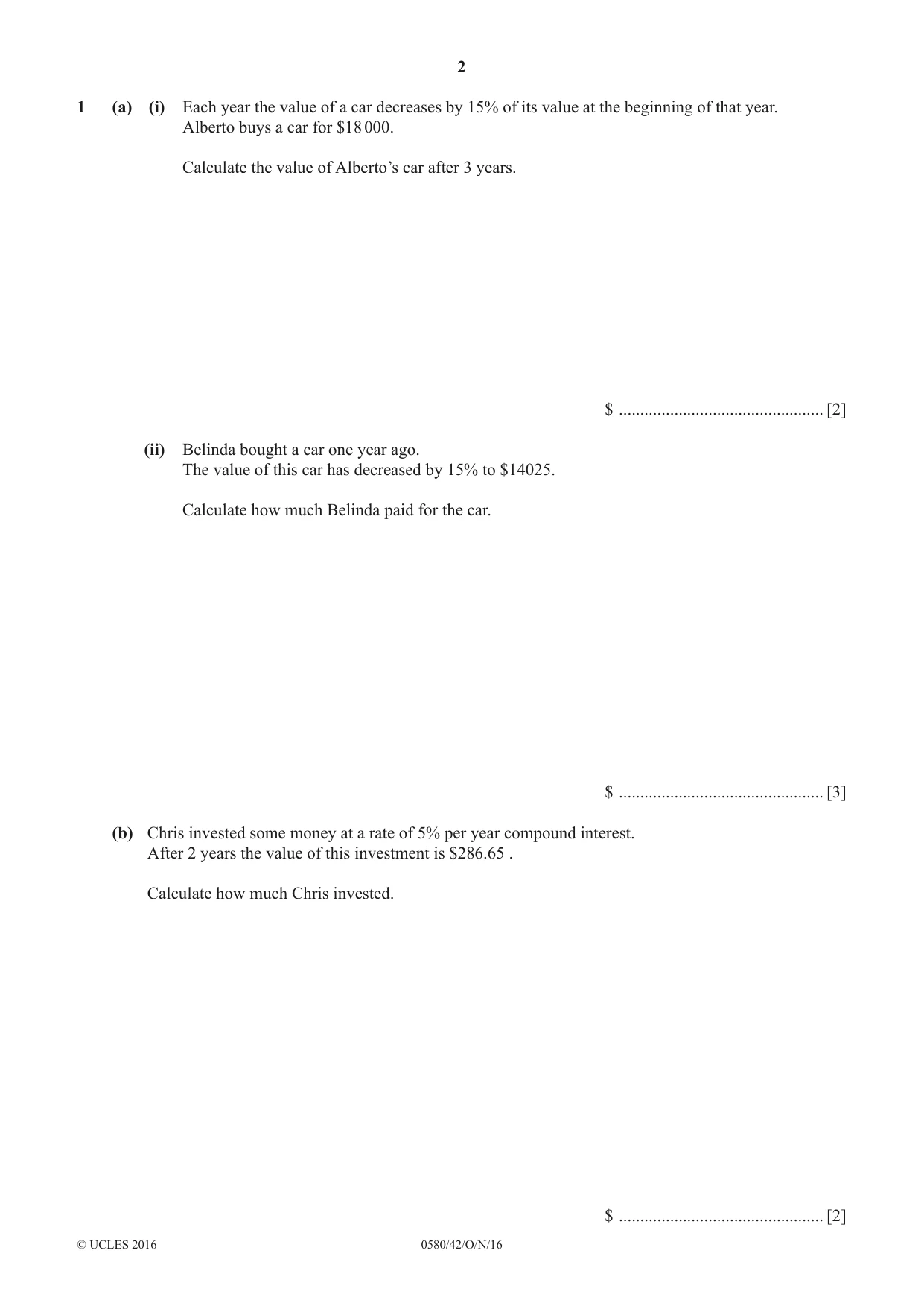
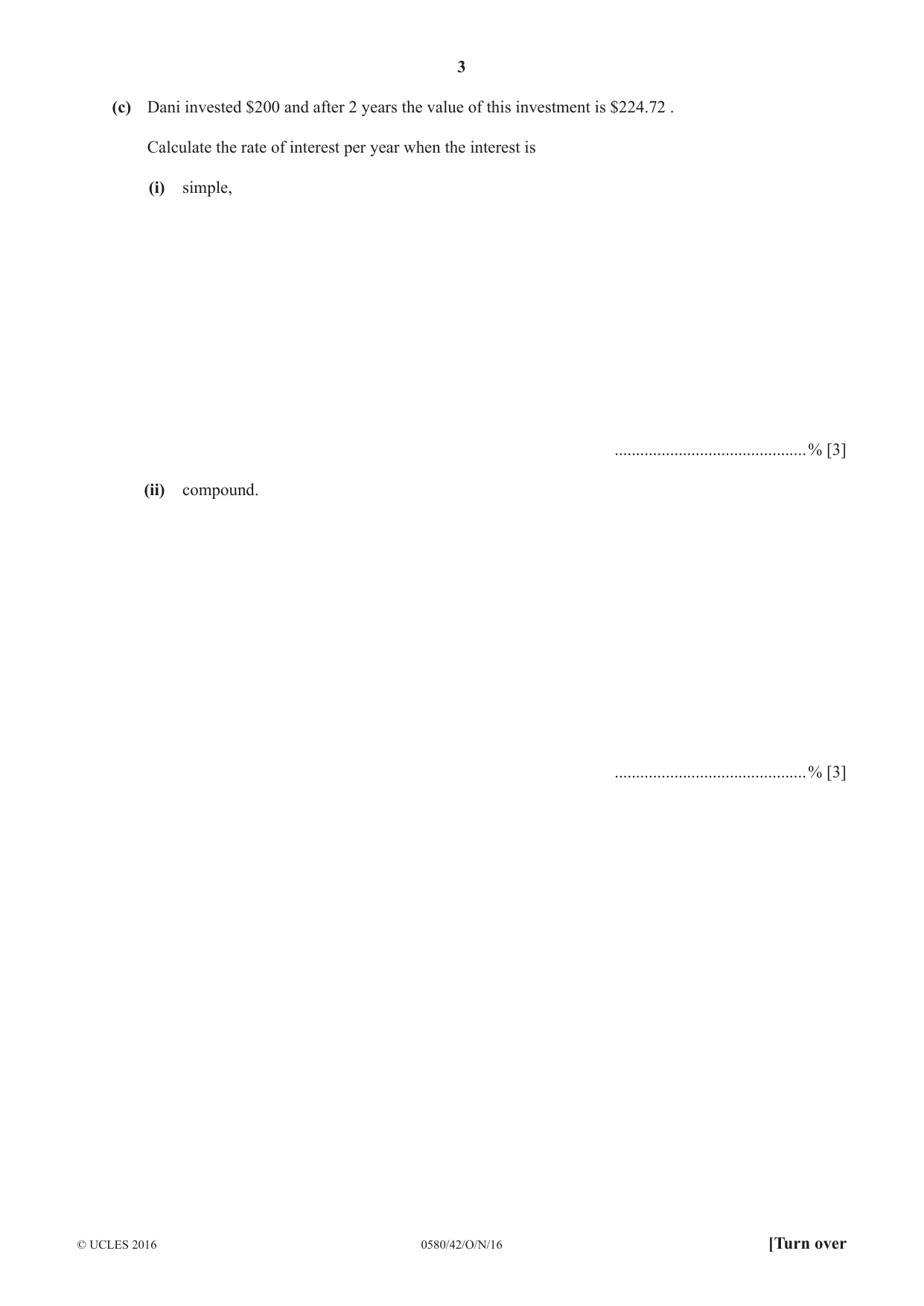
1 (a) (i) Each year the value of a car decreases by 15% of its value at the beginning of that year. Alberto buys a car for $18 000. Calculate the value of Alberto’s car after 3 years. $ ................................................ [2] (ii) Belinda bought a car one year ago. The value of this car has decreased by 15% to $14025. Calculate how much Belinda paid for the car. $ ................................................ [3] (b) Chris invested some money at a rate of 5% per year compound interest. After 2 years the value of this investment is $286.65 . Calculate how much Chris invested. $ ................................................ [2] (c) Dani invested $200 and after 2 years the value of this investment is $224.72 . Calculate the rate of interest per year when the interest is (i) simple, .............................................% [3] (ii) compound. .............................................% [3]
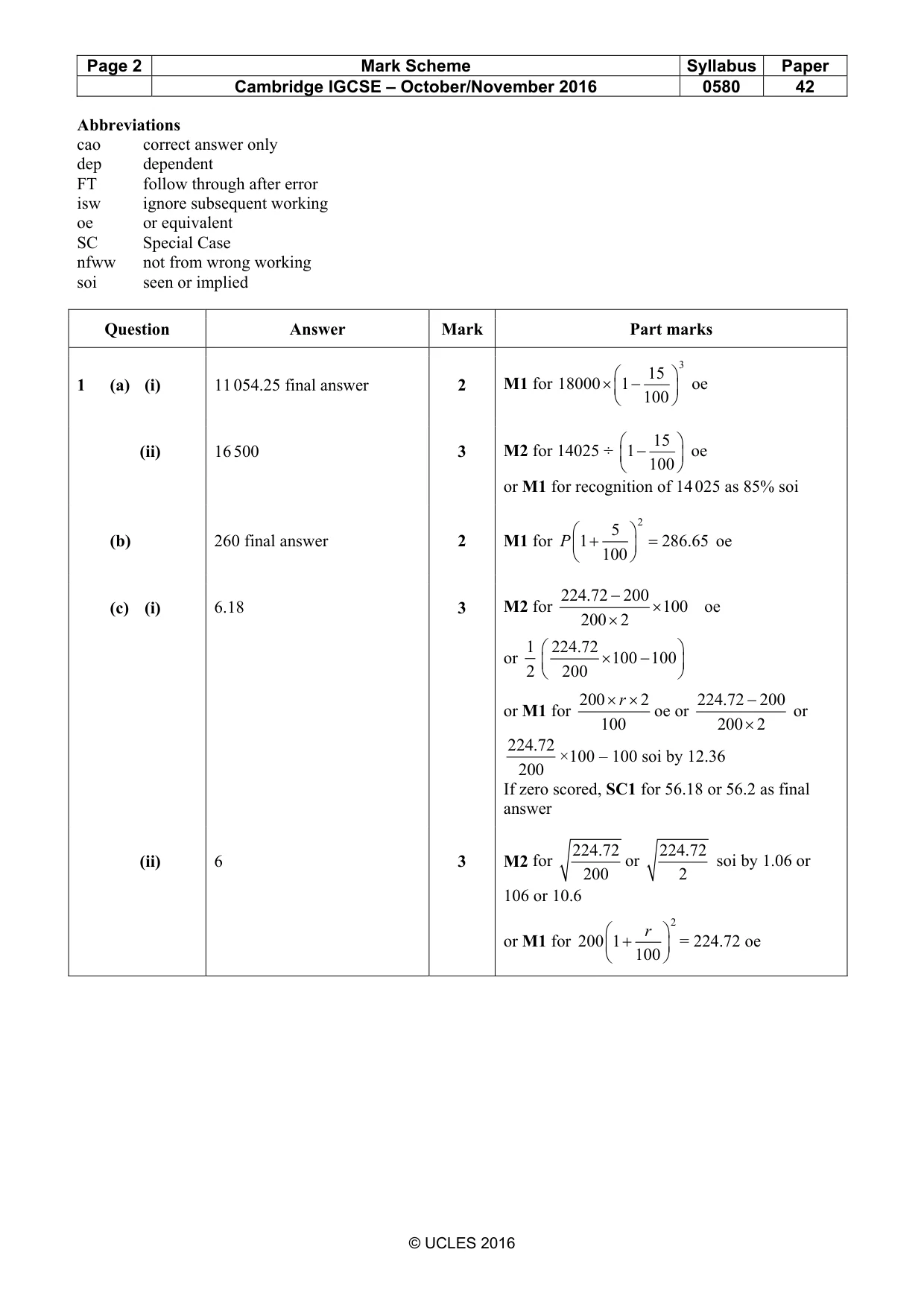
Mark scheme: Question Answer Mark Part marks 1515 31 (a) (i) 11 054.25 final answer 2 M1 for 18000 × 1 − oe 100 15 (ii) 16 500 3 M2 for 14025 ÷ 1 − oe 100 or M1 for recognition of 14 025 as 85% soi 5 2 (b) 260 final answer 2 M1 for P 1 + = 286.65 oe 100 224.72 − 200 (c) (i) 6.18 3 M2 for × 100 oe 200 × 2 1 224.72 or × 100 − 100 2 200 200 × r × 2 224.72 − 200 or M1 for oe or or 100 200 × 2 224.72 ×100 – 100 soi by 12.36 200 If zero scored, SC1 for 56.18 or 56.2 as final answer 224.72 224.72 (ii) 6 3 M2 for or soi by 1.06 or 200 2 106 or 10.6 r 2 or M1 for 200 1 + = 224.72 oe 100
Q2 · X 3 22 (a) Complete the table of values for y = - x + 1
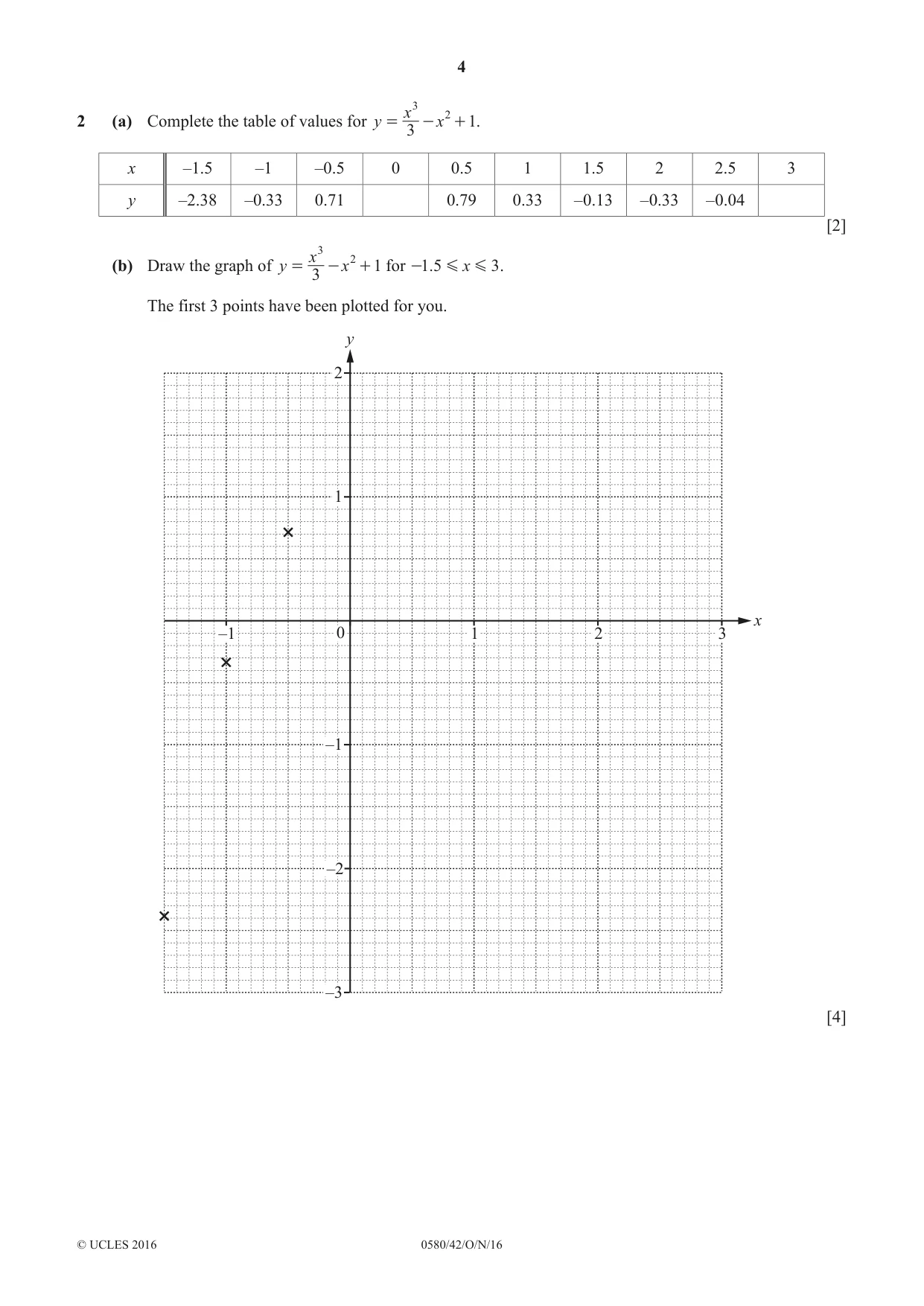
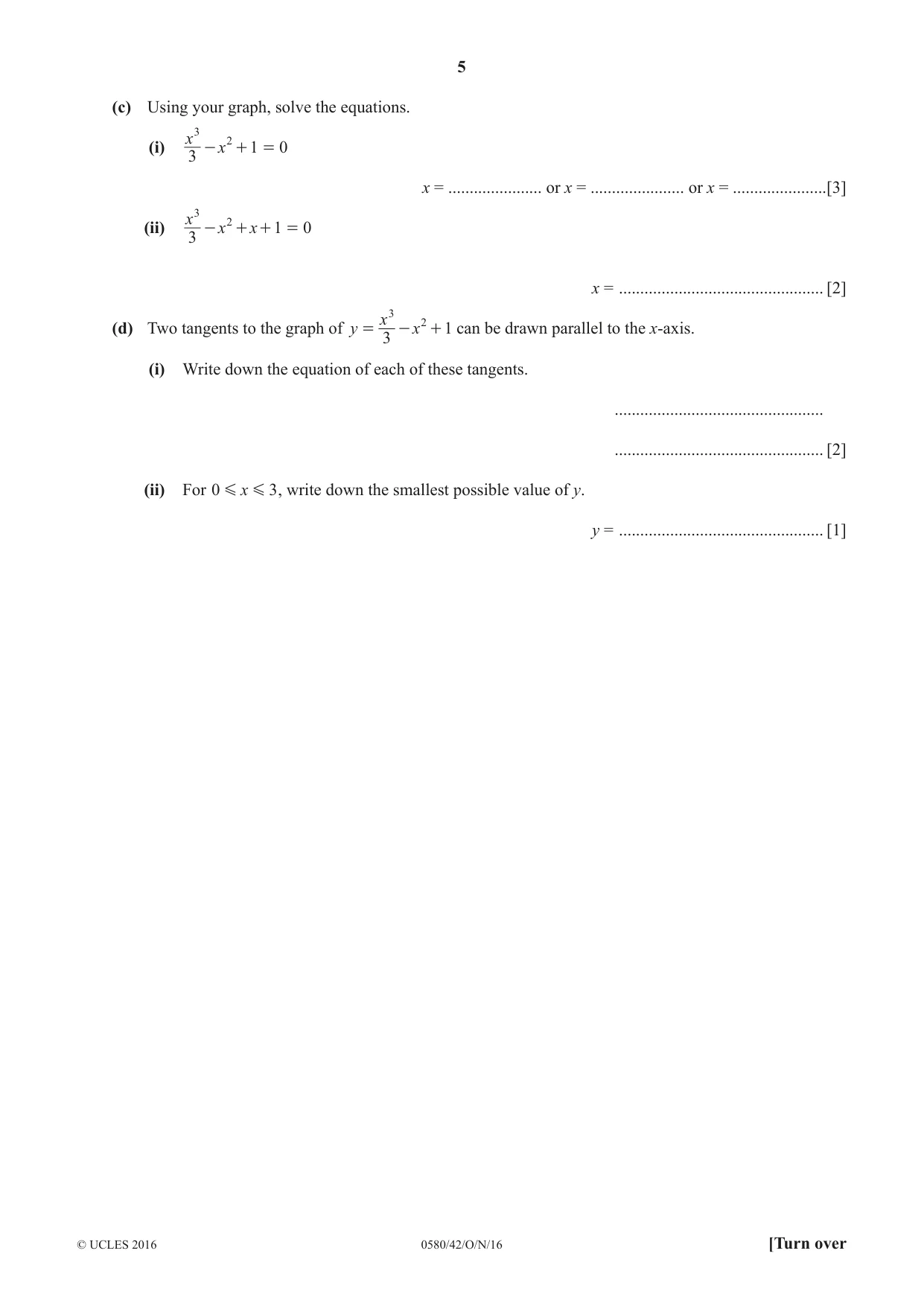
x 3 22 (a) Complete the table of values for y = - x + 1. 3 x –1.5 –1 –0.5 0 0.5 1 1.5 2 2.5 3 y –2.38 –0.33 0.71 0.79 0.33 –0.13 –0.33 –0.04 [2] x 3 2 (b) Draw the graph of y = - x + 1 for -1.5 G x G 3 . 3 The first 3 points have been plotted for you. y 2 1 x –1 0 1 2 3 –1 –2 –3 [4] (c) Using your graph, solve the equations. x 3 2 (i) - x + 1 = 0 3 x = ...................... or x = ...................... or x = ......................[3] x 3 2 (ii) - x + x + 1 = 0 3 x = ................................................ [2] x 3 2(d) Two tangents to the graph of y = - x + 1 can be drawn parallel to the x-axis. 3 (i) Write down the equation of each of these tangents. ................................................. ................................................. [2] (ii) For 0 G x G 3 , write down the smallest possible value of y. y = ................................................ [1]
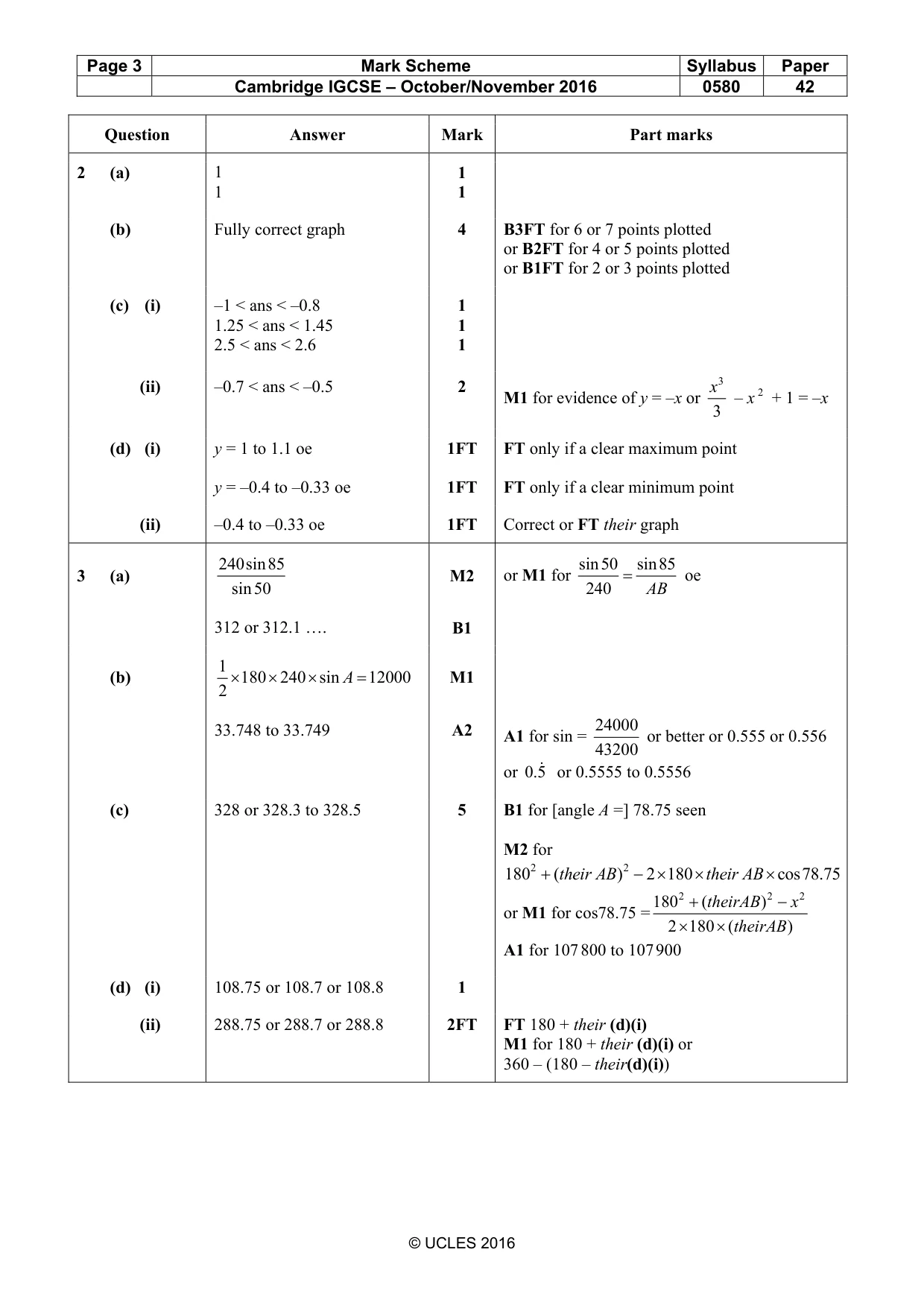
Mark scheme: 2 (a) 1 1 1 1 (b) Fully correct graph 4 B3FT for 6 or 7 points plotted or B2FT for 4 or 5 points plotted or B1FT for 2 or 3 points plotted (c) (i) –1 < ans < –0.8 1 1.25 < ans < 1.45 1 2.5 < ans < 2.6 1 (ii) –0.7 < ans < –0.5 2 x 3 2 M1 for evidence of y = –x or – x + 1 = –x 3 (d) (i) y = 1 to 1.1 oe 1FT FT only if a clear maximum point y = –0.4 to –0.33 oe 1FT FT only if a clear minimum point (ii) –0.4 to –0.33 oe 1FT Correct or FT their graph 240sin85 sin50 sin85
Q3 · D 180 m North C NOT TO 85° SCALE 240 m A 50° B The diagram shows a field, ABCD
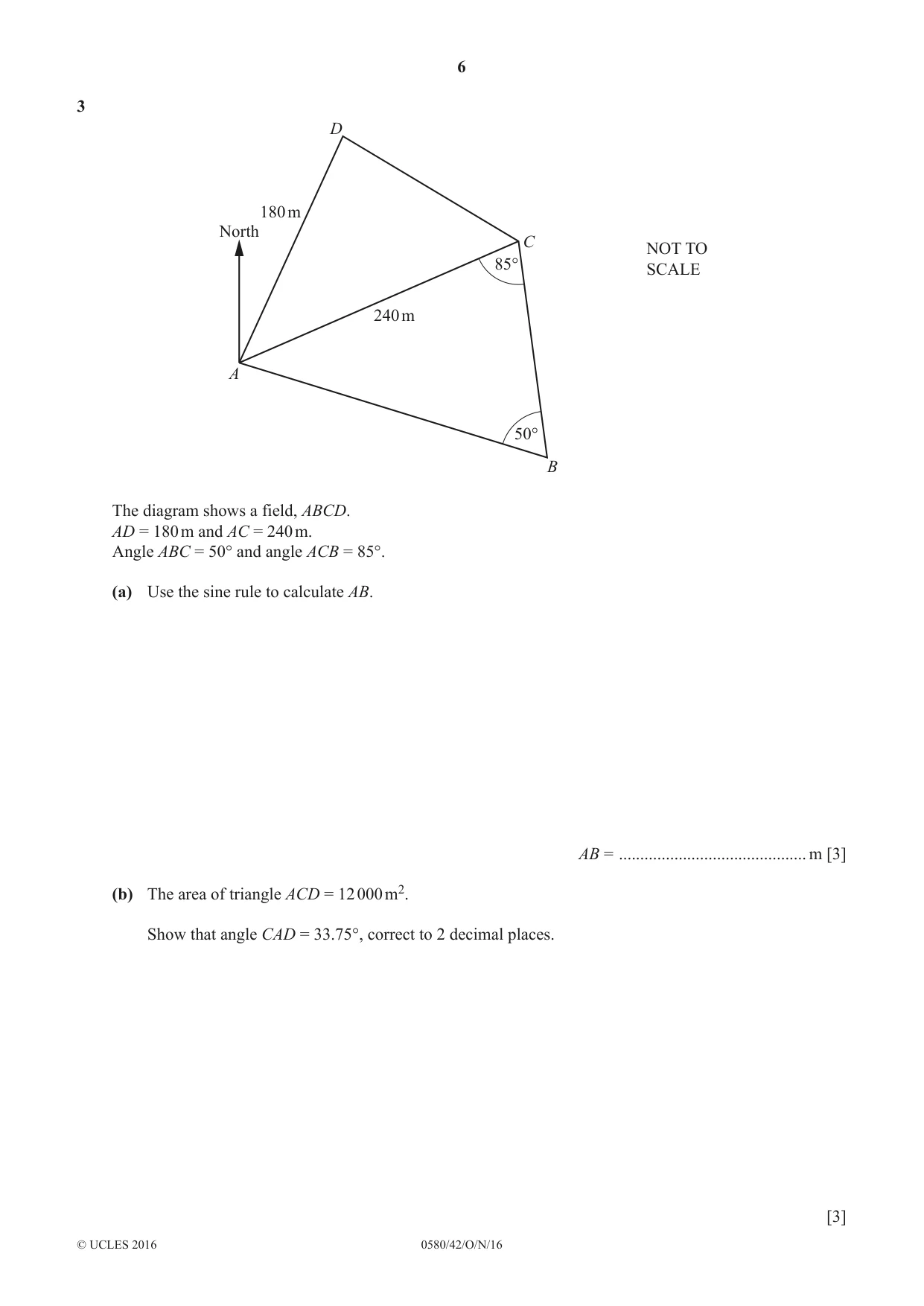
3 D 180 m North C NOT TO 85° SCALE 240 m A 50° B The diagram shows a field, ABCD. AD = 180 m and AC = 240 m. Angle ABC = 50° and angle ACB = 85°. (a) Use the sine rule to calculate AB. AB = ............................................ m [3] (b) The area of triangle ACD = 12 000 m2. Show that angle CAD = 33.75°, correct to 2 decimal places. [3] (c) Calculate BD. BD = ............................................ m [5] (d) The bearing of D from A is 030°. Find the bearing of (i) B from A, ................................................. [1] (ii) A from B. ................................................. [2]
Mark scheme: 240sin85 sin50 sin85 3 (a) M2 or M1 for = oe sin50 240 AB 312 or 312.1 …. B1 1 (b) × 180 × 240 × sin A = 12000 M1 2 24000 33.748 to 33.749 A2 A1 for sin = or better or 0.555 or 0.556 43200 or 0.5 or 0.5555 to 0.5556 (c) 328 or 328.3 to 328.5 5 B1 for [angle A =] 78.75 seen M2 for 180 2 + (their AB ) 2 −×2 180 × their AB × cos78.75 180 2 + (theirAB ) 2 − x 2 or M1 for cos78.75 = 2 × 180 × (theirAB ) A1 for 107 800 to 107 900 (d) (i) 108.75 or 108.7 or 108.8 1 (ii) 288.75 or 288.7 or 288.8 2FT FT 180 + their (d)(i) M1 for 180 + their (d)(i) or 360 – (180 – their(d)(i))
Q4 · 200 people run 10 km
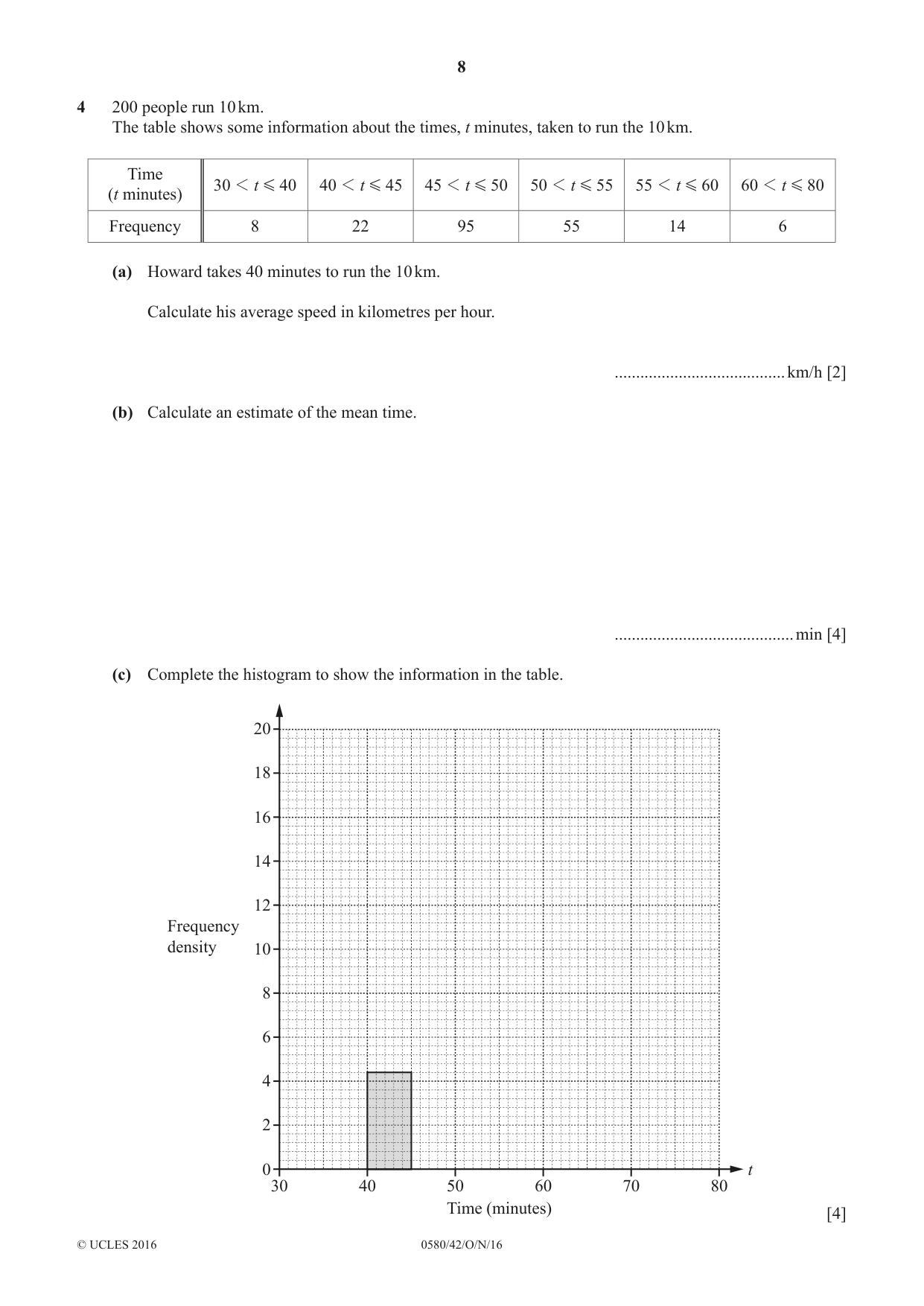
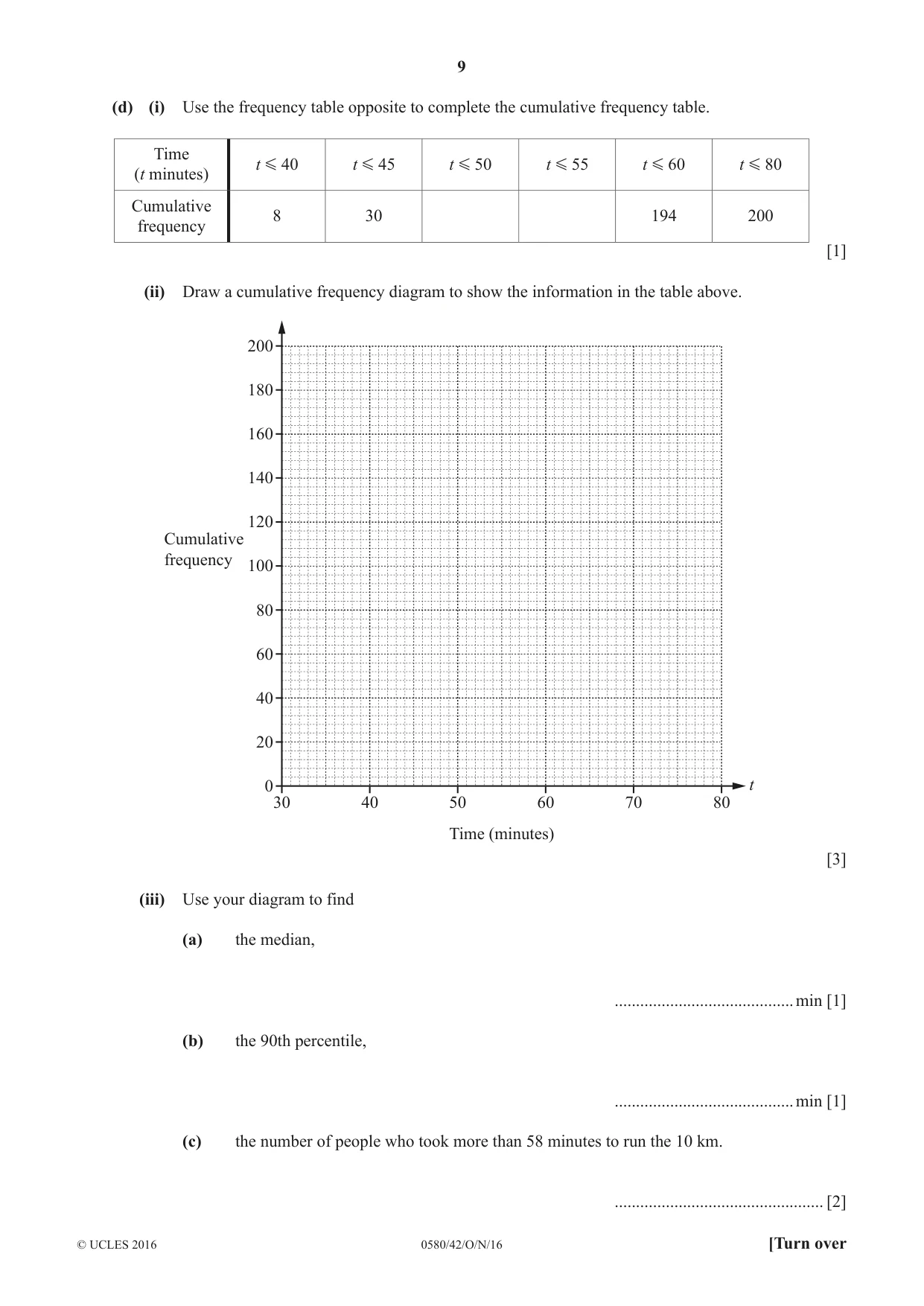
4 200 people run 10 km. The table shows some information about the times, t minutes, taken to run the 10 km. Time 30 1 t G 40 40 1 t G 45 45 1 t G 50 50 1 t G 55 55 1 t G 60 60 1 t G 80 (t minutes) Frequency 8 22 95 55 14 6 (a) Howard takes 40 minutes to run the 10 km. Calculate his average speed in kilometres per hour. ........................................km/h [2] (b) Calculate an estimate of the mean time. ..........................................min [4] (c) Complete the histogram to show the information in the table. 20 18 16 14 12 Frequency density 10 8 6 4 2 0 t 30 40 50 60 70 80 Time (minutes) [4] (d) (i) Use the frequency table opposite to complete the cumulative frequency table. Time t G 40 t G 45 t G 50 t G 55 t G 60 t G 80 (t minutes) Cumulative 8 30 194 200 frequency [1] (ii) Draw a cumulative frequency diagram to show the information in the table above. 200 180 160 140 120 Cumulative frequency 100 80 60 40 20 0 t 30 40 50 60 70 80 Time (minutes) [3] (iii) Use your diagram to find (a) the median, ..........................................min [1] (b) the 90th percentile, ..........................................min [1] (c) the number of people who took more than 58 minutes to run the 10 km. ................................................. [2]
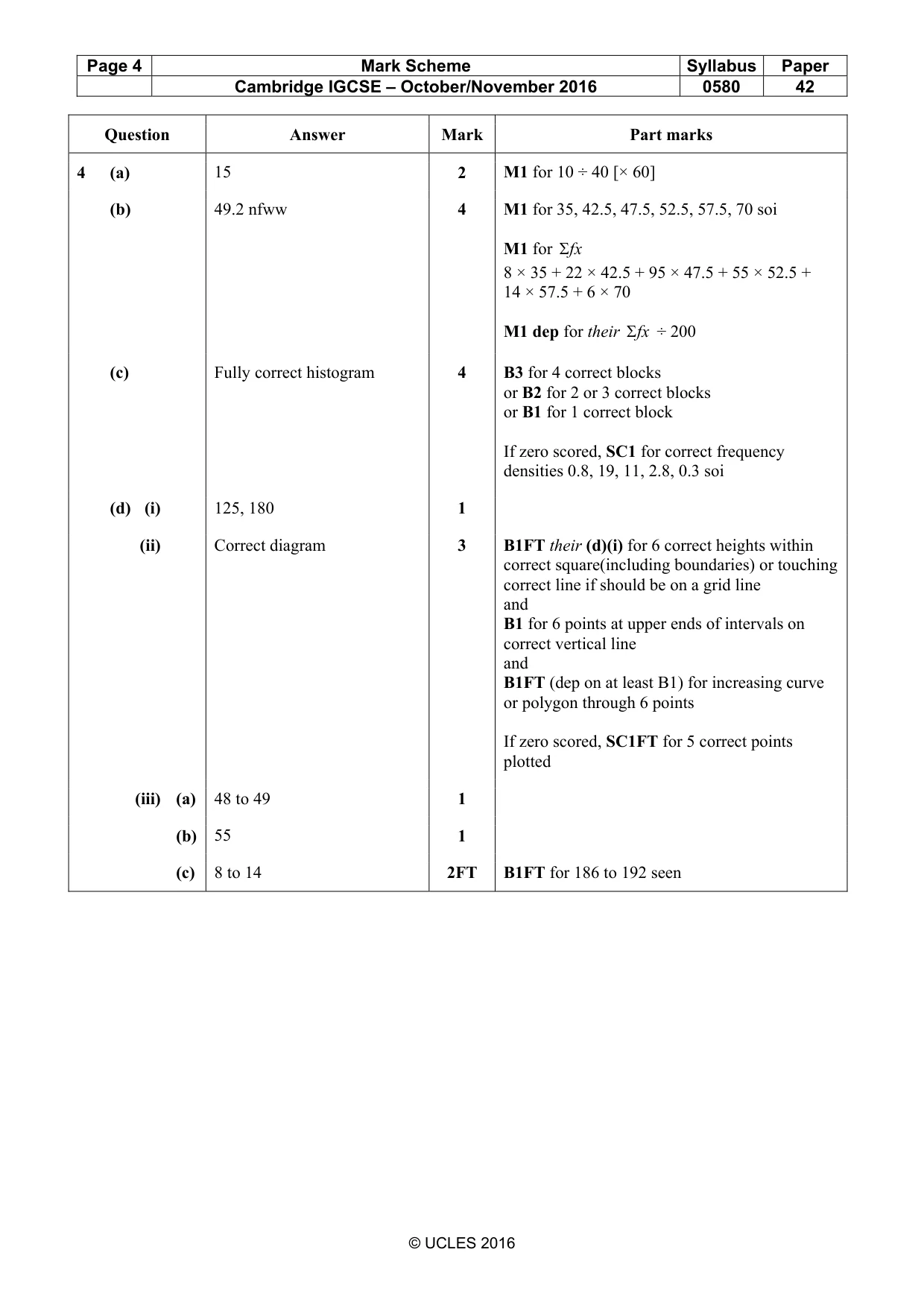
Mark scheme: 4 (a) 15 2 M1 for 10 ÷ 40 [× 60] (b) 49.2 nfww 4 M1 for 35, 42.5, 47.5, 52.5, 57.5, 70 soi M1 for Σ fx 8 × 35 + 22 × 42.5 + 95 × 47.5 + 55 × 52.5 + 14 × 57.5 + 6 × 70 M1 dep for their Σ fx ÷ 200 (c) Fully correct histogram 4 B3 for 4 correct blocks or B2 for 2 or 3 correct blocks or B1 for 1 correct block If zero scored, SC1 for correct frequency densities 0.8, 19, 11, 2.8, 0.3 soi (d) (i) 125, 180 1 (ii) Correct diagram 3 B1FT their (d)(i) for 6 correct heights within correct square(including boundaries) or touching correct line if should be on a grid line and B1 for 6 points at upper ends of intervals on correct vertical line and B1FT (dep on at least B1) for increasing curve or polygon through 6 points If zero scored, SC1FT for 5 correct points plotted (iii) (a) 48 to 49 1 (b) 55 1 (c) 8 to 14 2FT B1FT for 186 to 192 seen
Q5 · The probability that a plant will produce flowers is
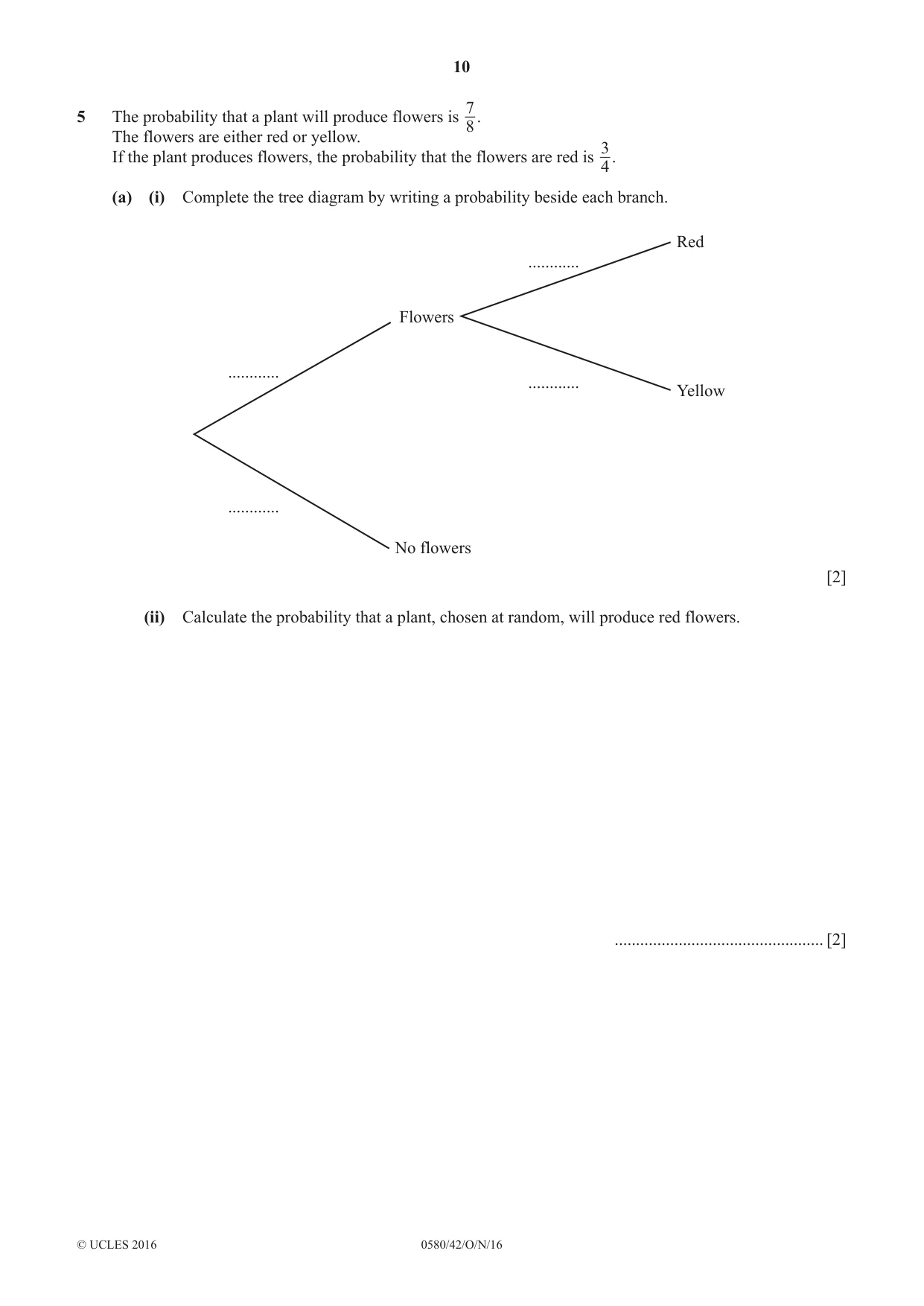
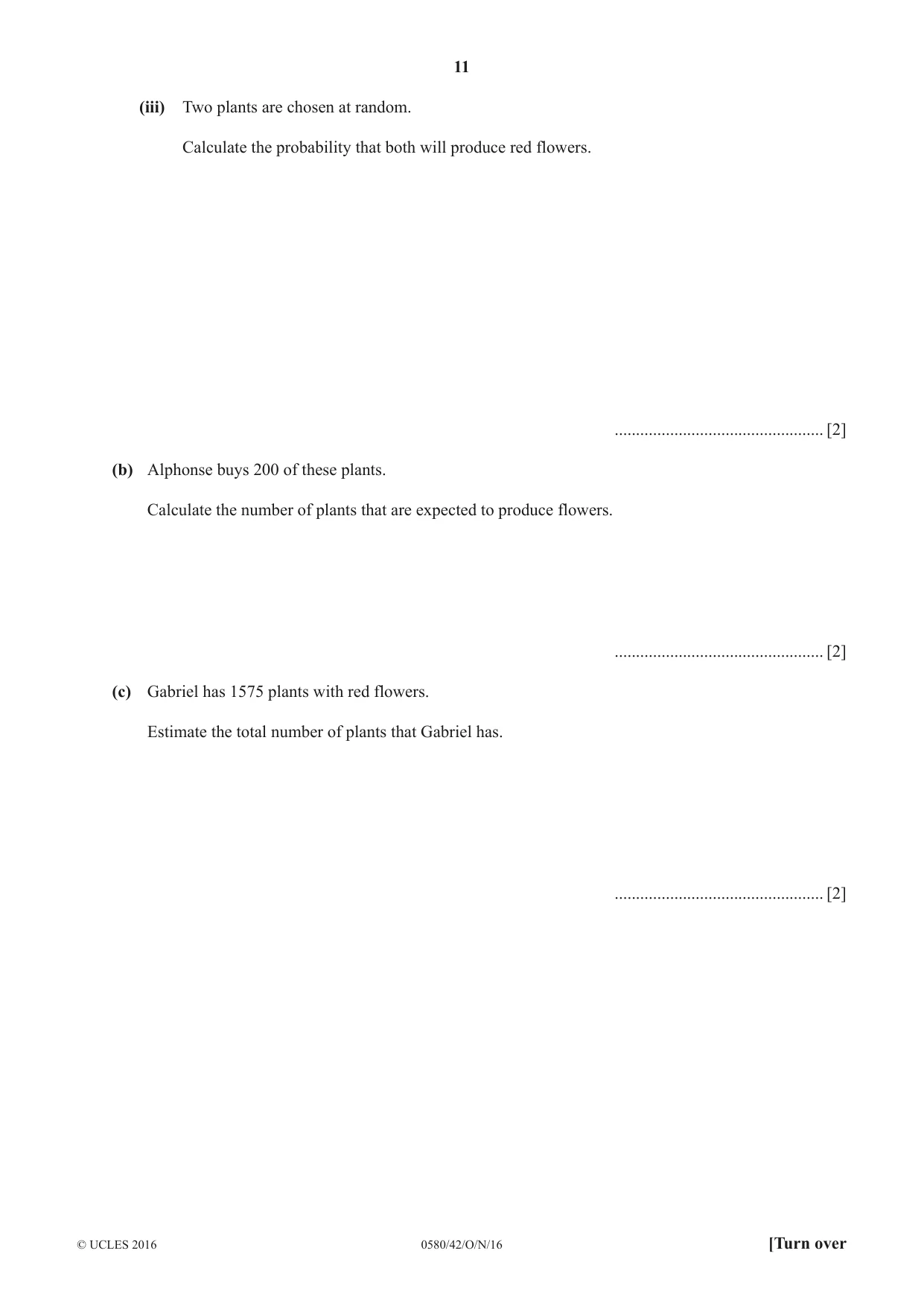
75 The probability that a plant will produce flowers is . 8 The flowers are either red or yellow. 3 If the plant produces flowers, the probability that the flowers are red is . 4 (a) (i) Complete the tree diagram by writing a probability beside each branch. Red ............ Flowers ............ ............ Yellow ............ No flowers [2] (ii) Calculate the probability that a plant, chosen at random, will produce red flowers. ................................................. [2] (iii) Two plants are chosen at random. Calculate the probability that both will produce red flowers. ................................................. [2] (b) Alphonse buys 200 of these plants. Calculate the number of plants that are expected to produce flowers. ................................................. [2] (c) Gabriel has 1575 plants with red flowers. Estimate the total number of plants that Gabriel has. ................................................. [2]
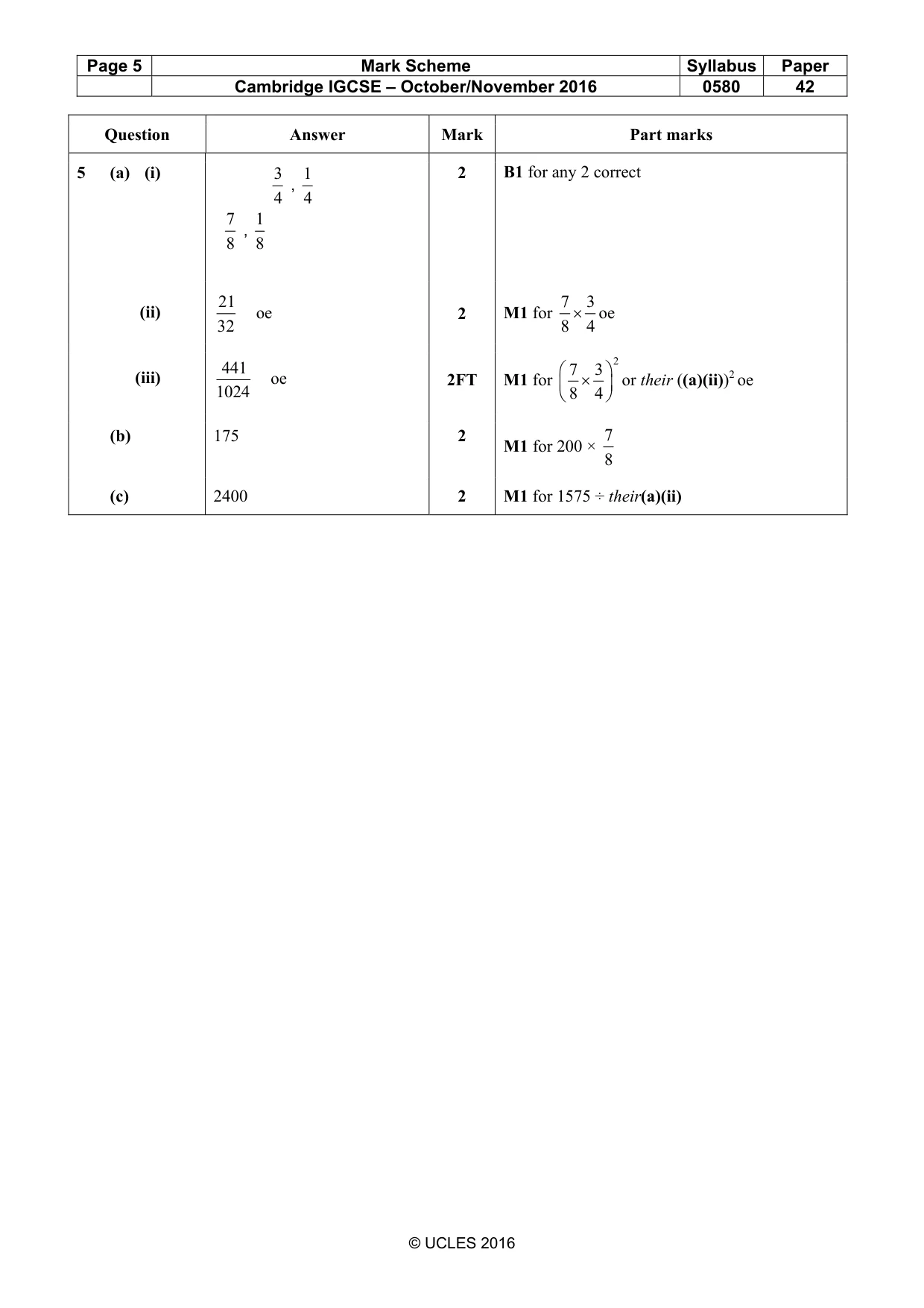
Mark scheme: 5 (a) (i) 3 1 2 B1 for any 2 correct , 4 4 7 1 , 8 8 21 7 3 (ii) oe 2 M1 for × oe 32 8 4 441 7 3 2 (iii) oe 2FT M1 for × or their ((a)(ii))2 oe 1024 8 4 (b) 175 2 7 M1 for 200 × 8 (c) 2400 2 M1 for 1575 ÷ their(a)(ii)
Q6 · NOT TO 0.8 cm SCALE 0.8 cm 1.1 cm 1.5 cm The diagram shows two sweets
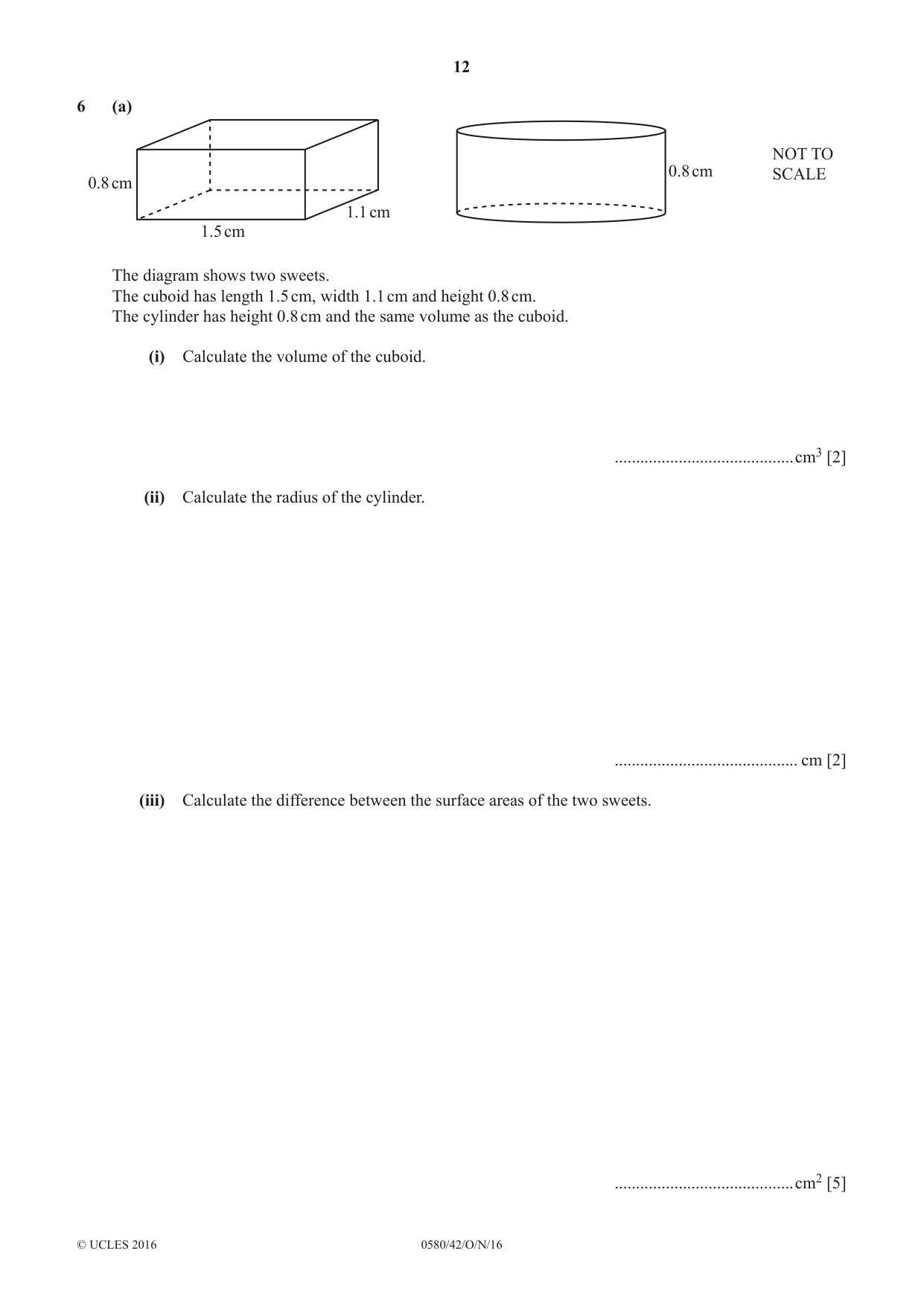
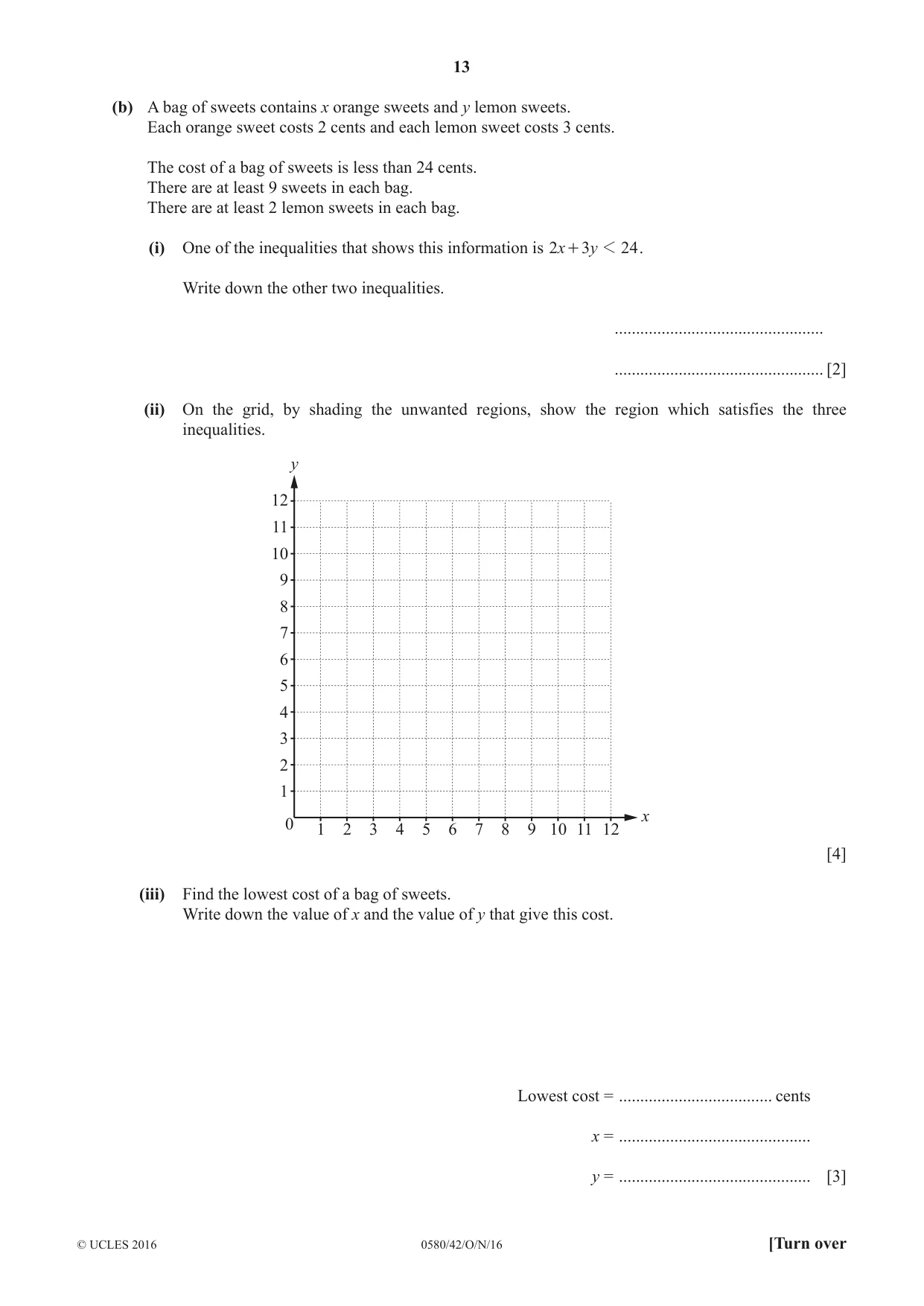
6 (a) NOT TO 0.8 cm SCALE 0.8 cm 1.1 cm 1.5 cm The diagram shows two sweets. The cuboid has length 1.5 cm, width 1.1 cm and height 0.8 cm. The cylinder has height 0.8 cm and the same volume as the cuboid. (i) Calculate the volume of the cuboid. ..........................................cm3 [2] (ii) Calculate the radius of the cylinder. ........................................... cm [2] (iii) Calculate the difference between the surface areas of the two sweets. ..........................................cm2 [5] (b) A bag of sweets contains x orange sweets and y lemon sweets. Each orange sweet costs 2 cents and each lemon sweet costs 3 cents. The cost of a bag of sweets is less than 24 cents. There are at least 9 sweets in each bag. There are at least 2 lemon sweets in each bag. (i) One of the inequalities that shows this information is 2x + 3y 1 24 . Write down the other two inequalities. ................................................. ................................................. [2] (ii) On the grid, by shading the unwanted regions, show the region which satisfies the three inequalities. y 12 11 10 9 8 7 6 5 4 3 2 1 x 0 1 2 3 4 5 6 7 8 9 10 11 12 [4] (iii) Find the lowest cost of a bag of sweets. Write down the value of x and the value of y that give this cost. Lowest cost = .................................... cents x = ............................................. y = ............................................. [3]
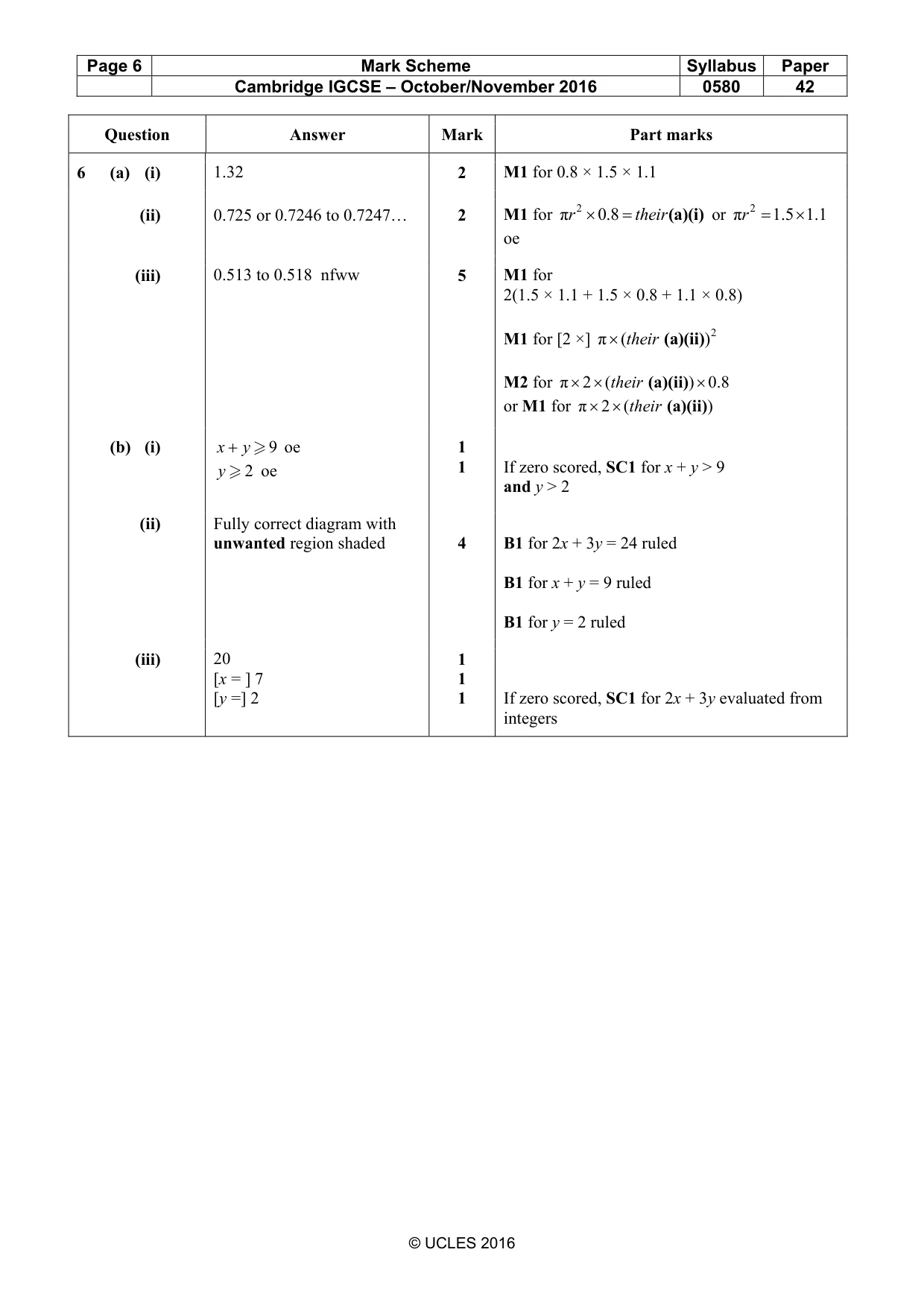
Mark scheme: 6 (a) (i) 1.32 2 M1 for 0.8 × 1.5 × 1.1 (ii) 0.725 or 0.7246 to 0.7247… 2 M1 for πr 2 × 0.8 = their(a)(i) or πr 2 = 1.5 × 1.1 oe (iii) 0.513 to 0.518 nfww 5 M1 for 2(1.5 × 1.1 + 1.5 × 0.8 + 1.1 × 0.8) M1 for [2 ×] π × (their (a)(ii)) 2 M2 for π × 2 × ( their (a)(ii) ) × 0.8 or M1 for π × 2 × ( their (a)(ii) ) (b) (i) x + y . 9 oe 1 y . 2 oe 1 If zero scored, SC1 for x + y > 9 and y > 2 (ii) Fully correct diagram with unwanted region shaded 4 B1 for 2x + 3y = 24 ruled B1 for x + y = 9 ruled B1 for y = 2 ruled (iii) 20 1 [x = ] 7 1 [y =] 2 1 If zero scored, SC1 for 2x + 3y evaluated from integers
Q7 · $1= 3.67 dirhams Calculate the value, in dollars, of 200 dirhams
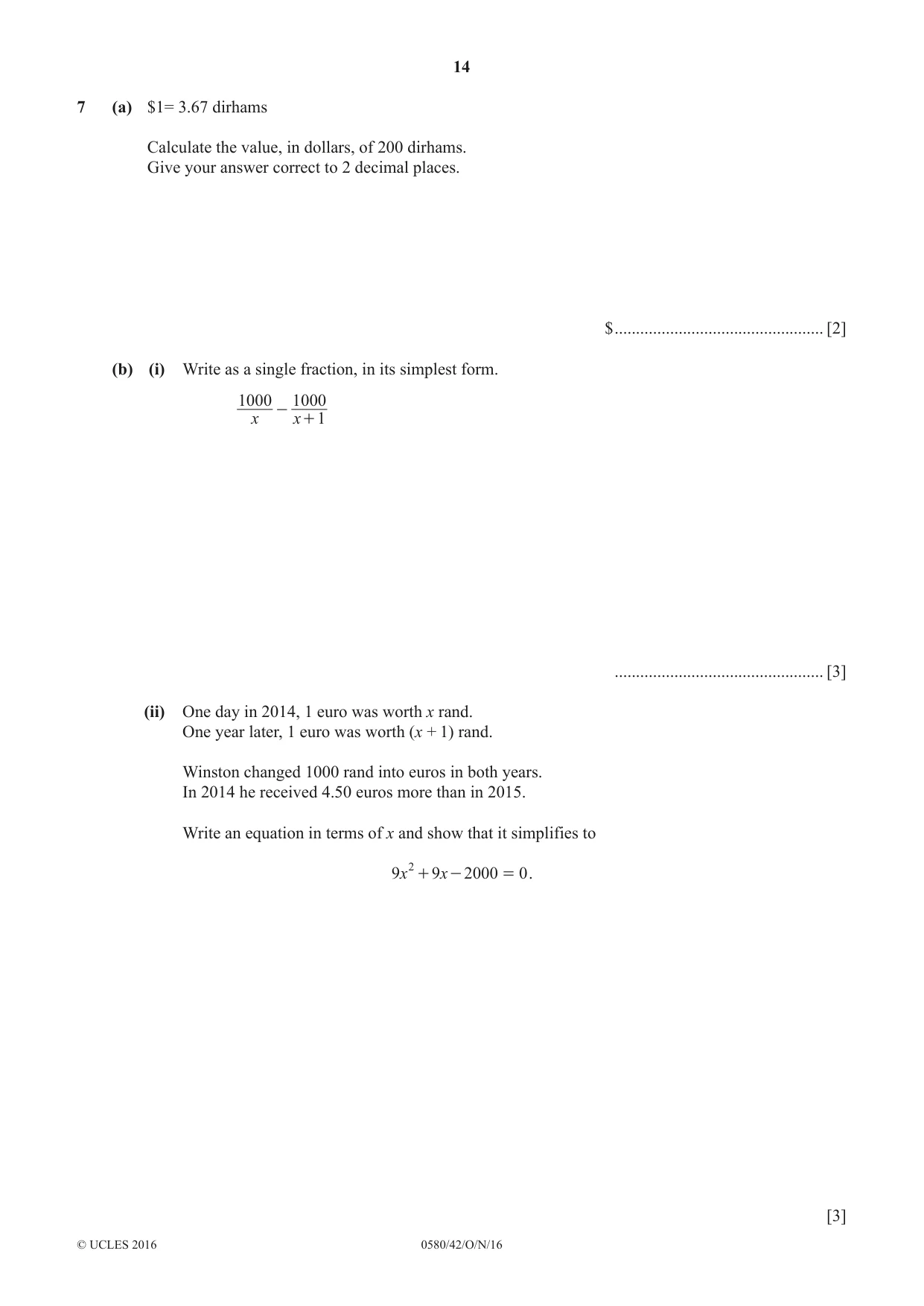
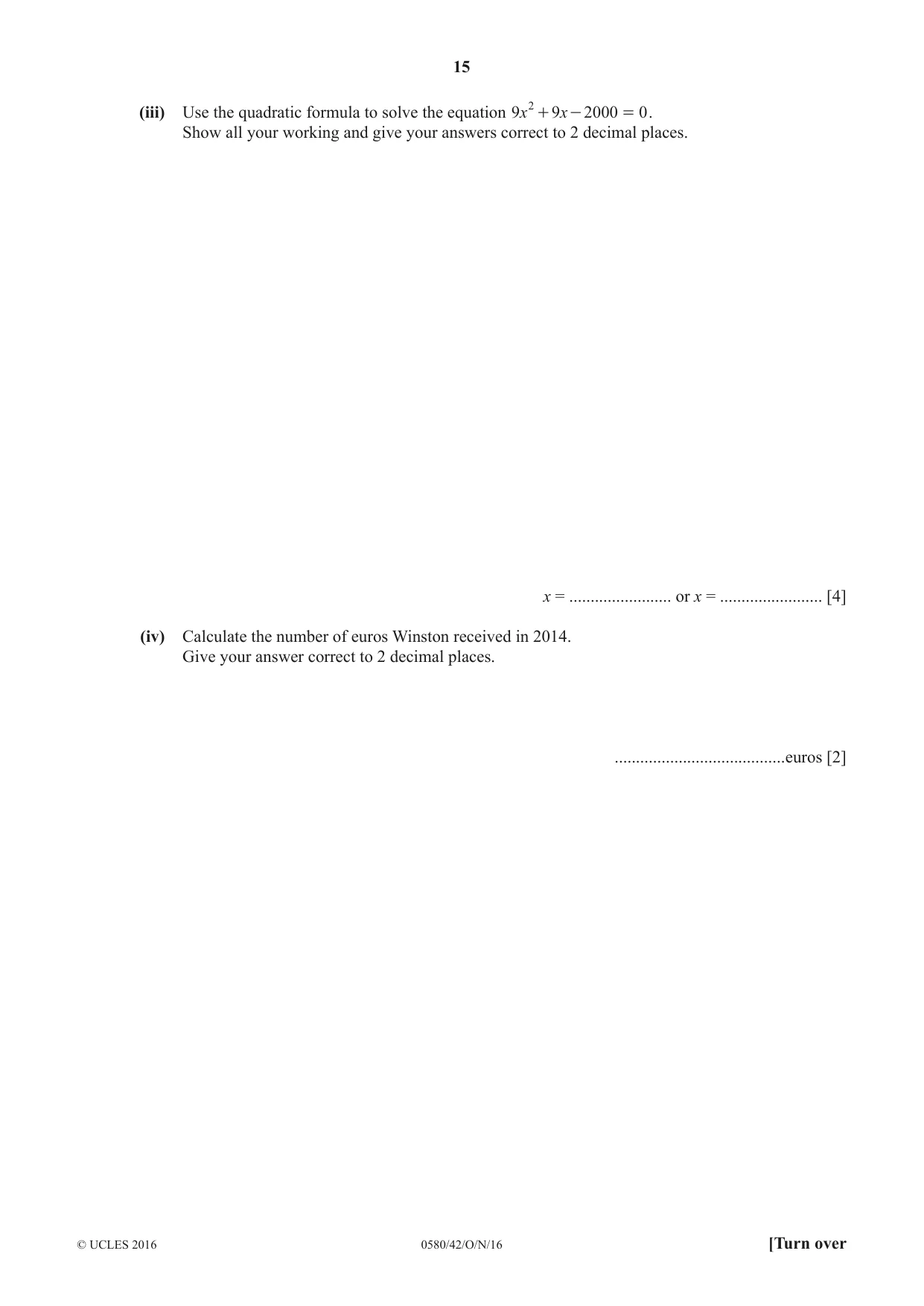
7 (a) $1= 3.67 dirhams Calculate the value, in dollars, of 200 dirhams. Give your answer correct to 2 decimal places. $ ................................................. [2] (b) (i) Write as a single fraction, in its simplest form. 1000 1000 - x x + 1 ................................................. [3] (ii) One day in 2014, 1 euro was worth x rand. One year later, 1 euro was worth (x + 1) rand. Winston changed 1000 rand into euros in both years. In 2014 he received 4.50 euros more than in 2015. Write an equation in terms of x and show that it simplifies to 9x 2 + 9x - 2000 = 0 . [3] (iii) Use the quadratic formula to solve the equation 9x 2 + 9x - 2000 = 0 . Show all your working and give your answers correct to 2 decimal places. x = ........................ or x = ........................ [4] (iv) Calculate the number of euros Winston received in 2014. Give your answer correct to 2 decimal places. ........................................euros [2]
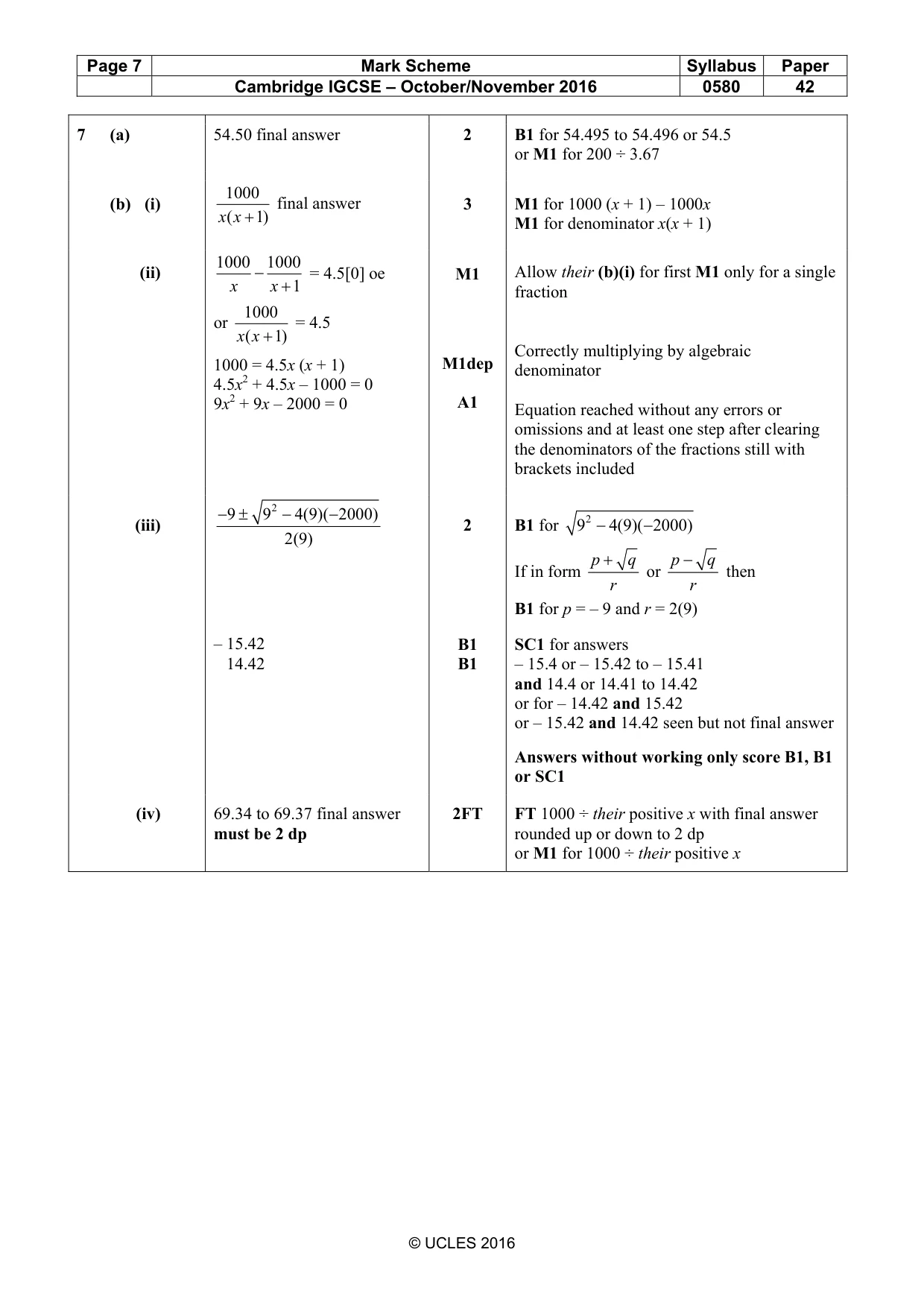
Mark scheme: 7 (a) 54.50 final answer 2 B1 for 54.495 to 54.496 or 54.5 or M1 for 200 ÷ 3.67 1000 (b) (i) final answer 3 M1 for 1000 (x + 1) – 1000x x ( x + 1) M1 for denominator x(x + 1) 1000 1000 (ii) − = 4.5[0] oe M1 Allow their (b)(i) for first M1 only for a single x x + 1 fraction 1000 or = 4.5 x ( x + 1) Correctly multiplying by algebraic 1000 = 4.5x (x + 1) M1dep denominator 4.5x2 + 4.5x – 1000 = 0 9x2 + 9x – 2000 = 0 A1 Equation reached without any errors or omissions and at least one step after clearing the denominators of the fractions still with brackets included −±9 9 2 − 4(9)( − 2000) 2 (iii) 2 B1 for 9 − 4(9)( − 2000) 2(9) p + q p − q If in form or then r r B1 for p = – 9 and r = 2(9) – 15.42 B1 SC1 for answers 14.42 B1 – 15.4 or – 15.42 to – 15.41 and 14.4 or 14.41 to 14.42 or for – 14.42 and 15.42 or – 15.42 and 14.42 seen but not final answer Answers without working only score B1, B1 or SC1 (iv) 69.34 to 69.37 final answer 2FT FT 1000 ÷ their positive x with final answer must be 2 dp rounded up or down to 2 dp or M1 for 1000 ÷ their positive x
Q8 · C u° NOT TO SCALE O v° D B A 80° E A, B, C and D lie on the circle, centre O
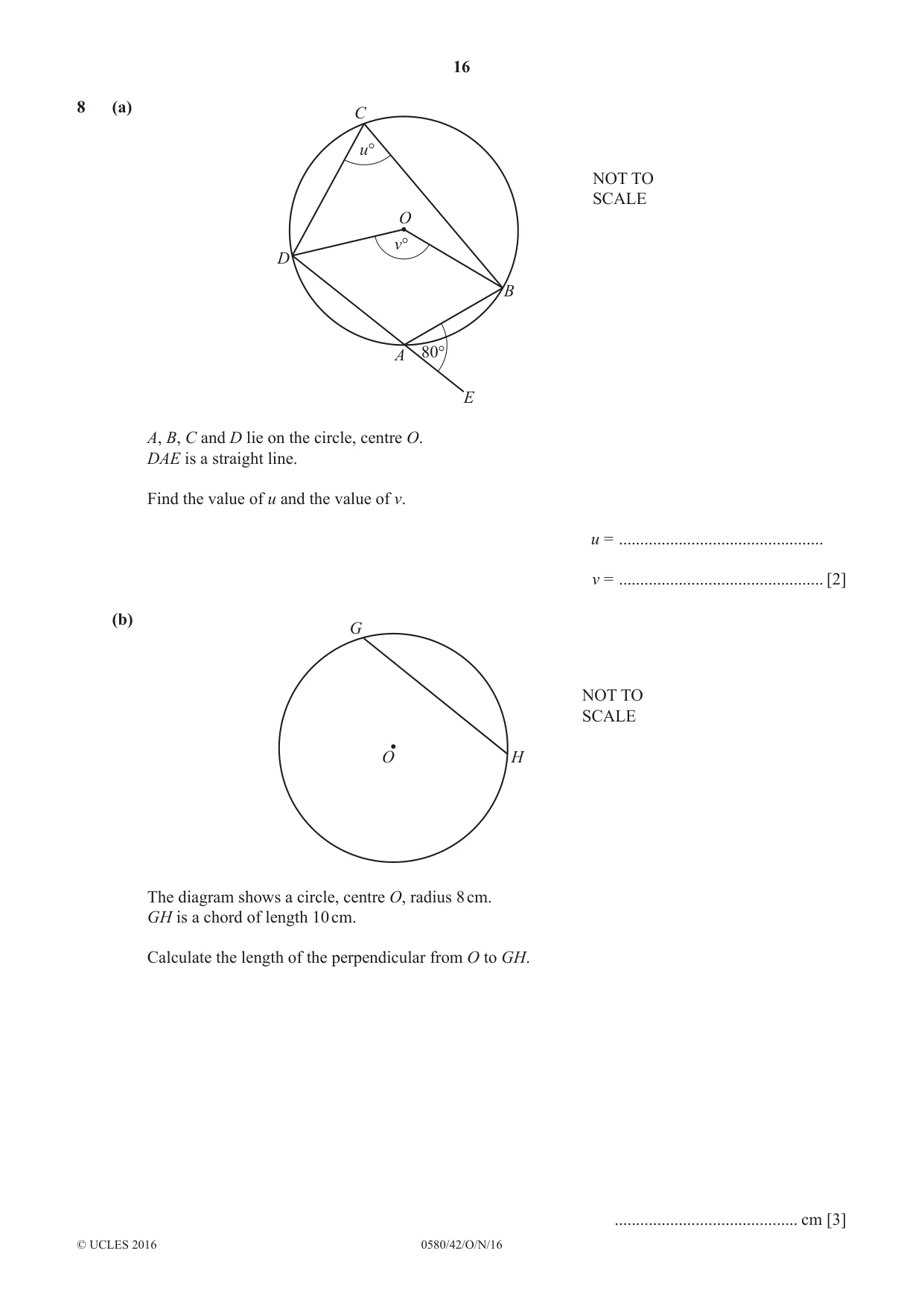
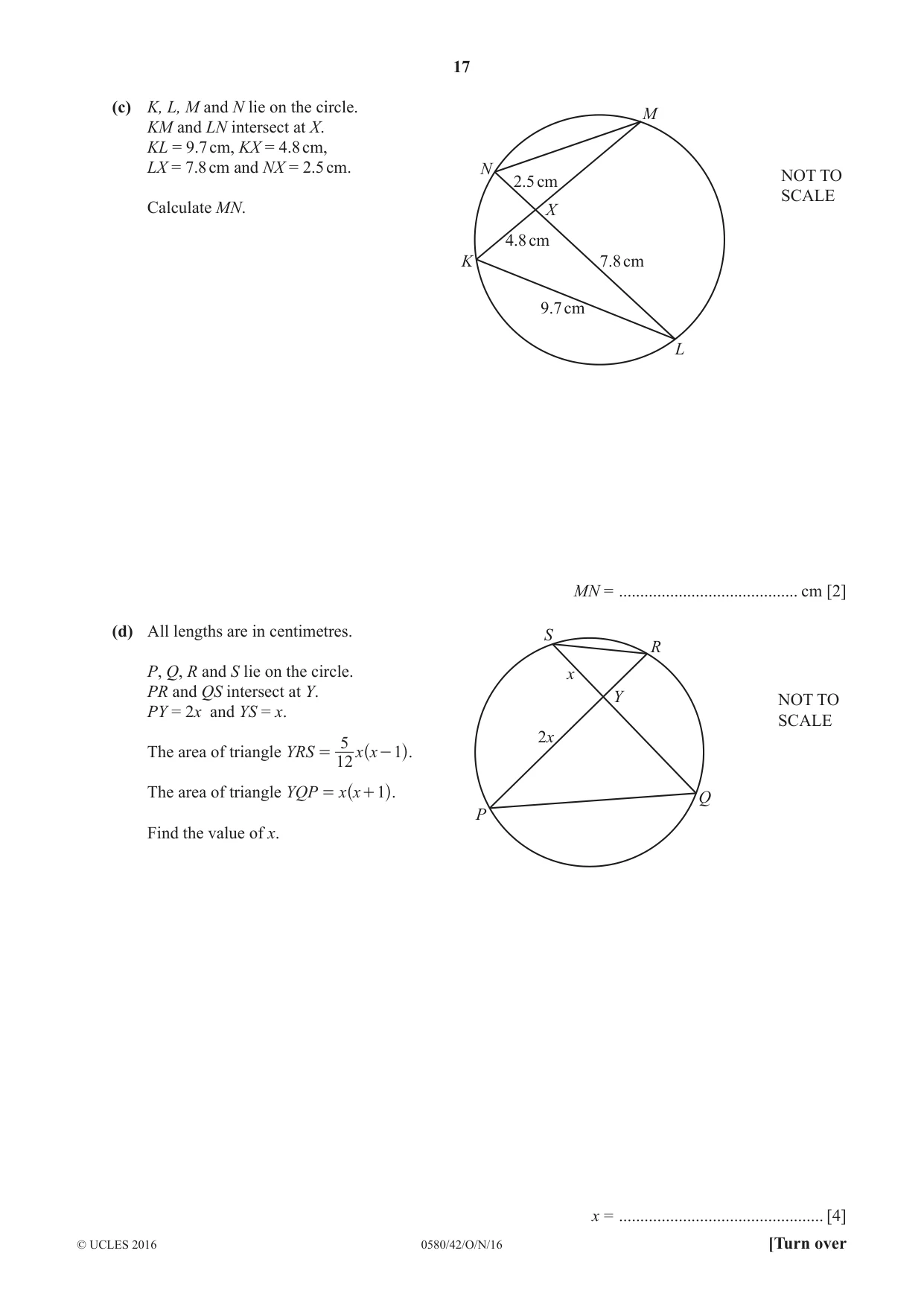
8 (a) C u° NOT TO SCALE O v° D B A 80° E A, B, C and D lie on the circle, centre O. DAE is a straight line. Find the value of u and the value of v. u = ................................................ v = ................................................ [2] (b) G NOT TO SCALE O H The diagram shows a circle, centre O, radius 8 cm. GH is a chord of length 10 cm. Calculate the length of the perpendicular from O to GH. ........................................... cm [3] (c) K, L, M and N lie on the circle. M KM and LN intersect at X. KL = 9.7 cm, KX = 4.8 cm, LX = 7.8 cm and NX = 2.5 cm. N NOT TO 2.5 cm SCALE Calculate MN. X 4.8 cm K 7.8 cm 9.7 cm L MN = .......................................... cm [2] (d) All lengths are in centimetres. S R P, Q, R and S lie on the circle. x PR and QS intersect at Y. Y NOT TO PY = 2x and YS = x. SCALE 2x 5 The area of triangle YRS = x ^x - 1h. 12 The area of triangle YQP = x ^x + 1h. Q P Find the value of x. x = ................................................ [4]
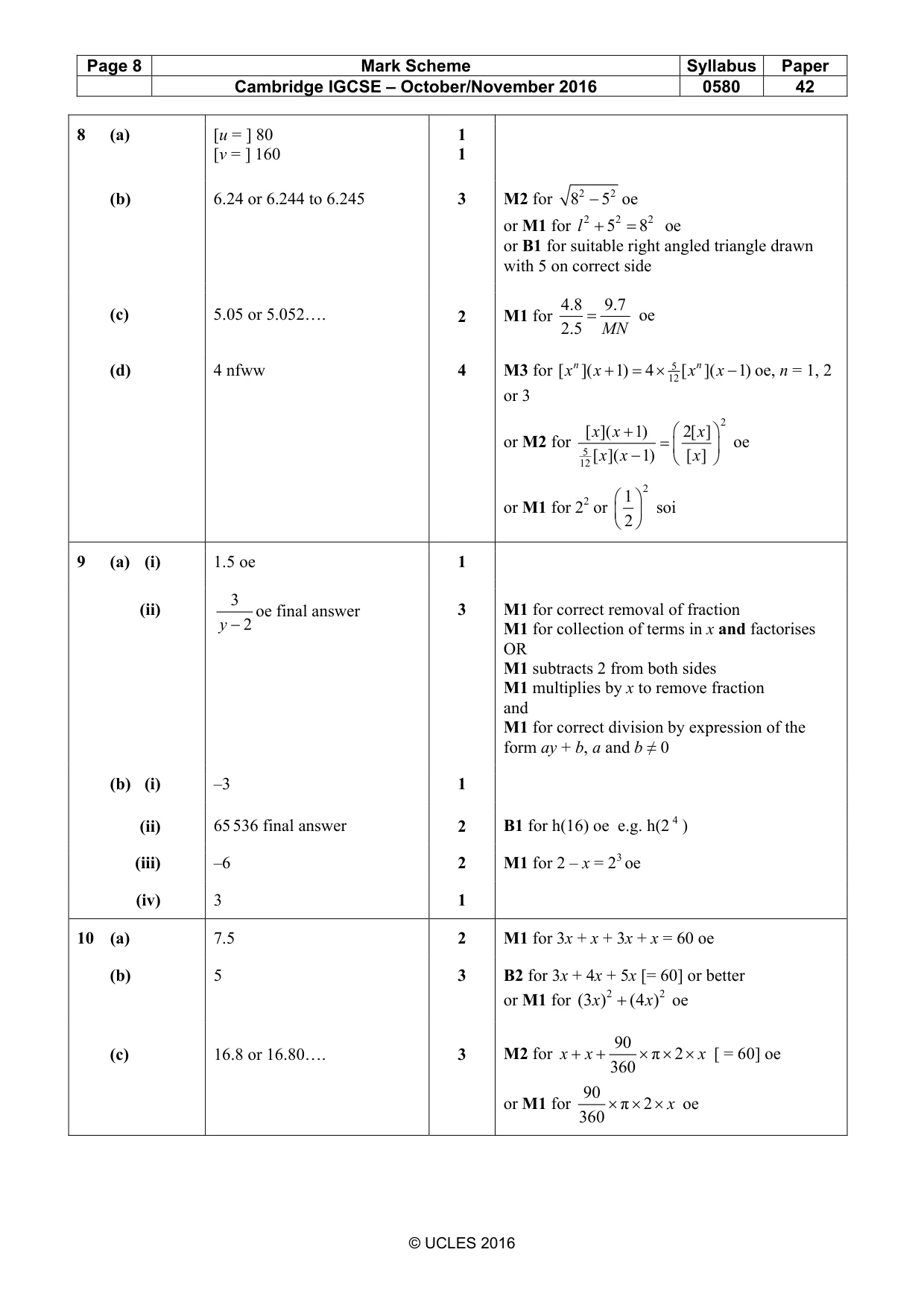
Mark scheme: 8 (a) [u = ] 80 1 [v = ] 160 1 (b) 6.24 or 6.244 to 6.245 3 M2 for 8 2 − 5 2 oe or M1 for l 2 + 52 = 82 oe or B1 for suitable right angled triangle drawn with 5 on correct side 4.8 9.7 (c) 5.05 or 5.052…. 2 M1 for = oe 2.5 MN (d) 4 nfww 4 M3 for [ x n ]( x + 1) = 4 × 125 [ x n ]( x − 1) oe, n = 1, 2 or 3 [ x ]( x + 1) 2[ x ] 2 or M2 for = oe 5 12 [ x ]( x − 1) [ x ] 1 2 or M1 for 22 or soi 2
Q9 · Y = + 2 , x !
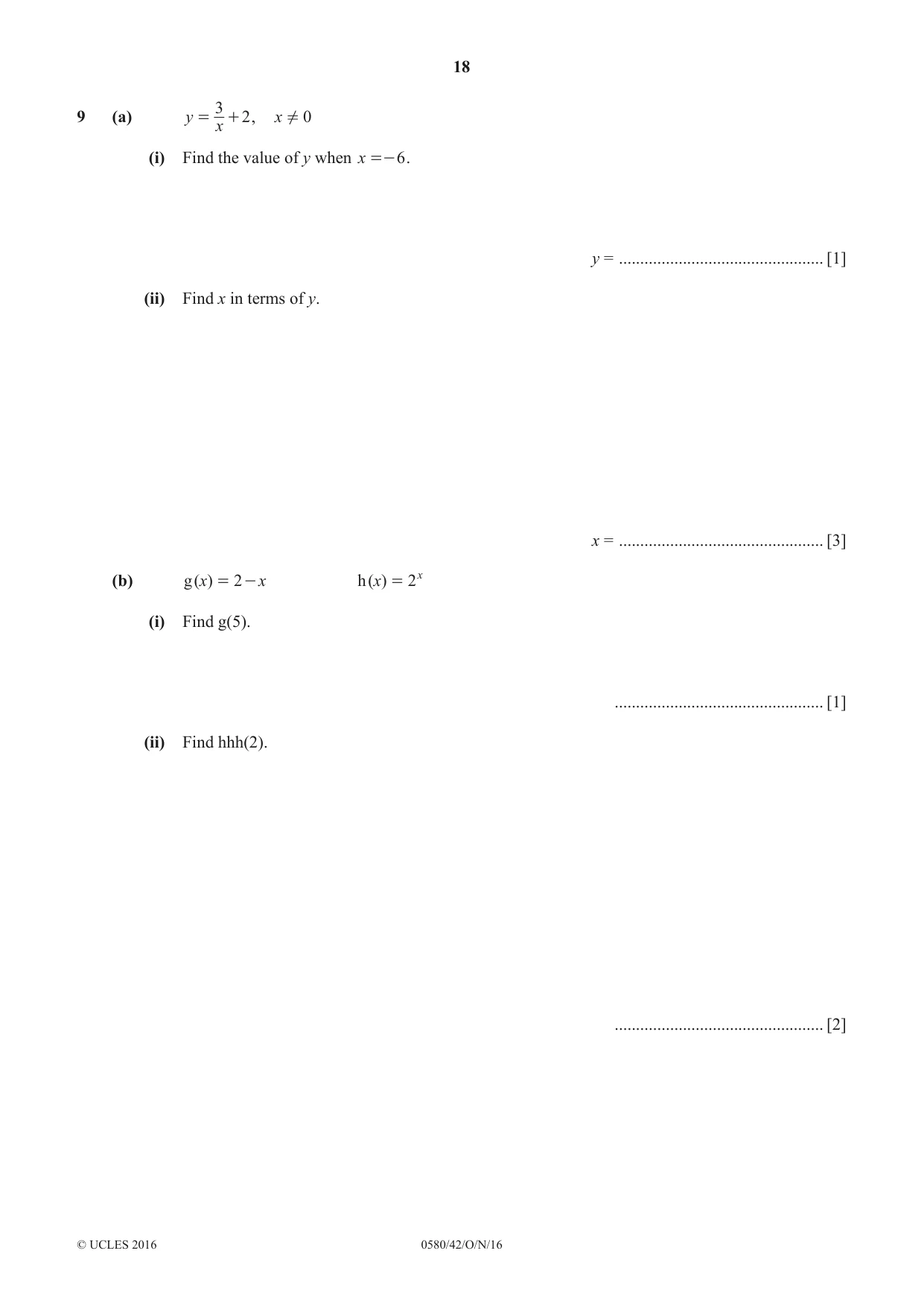
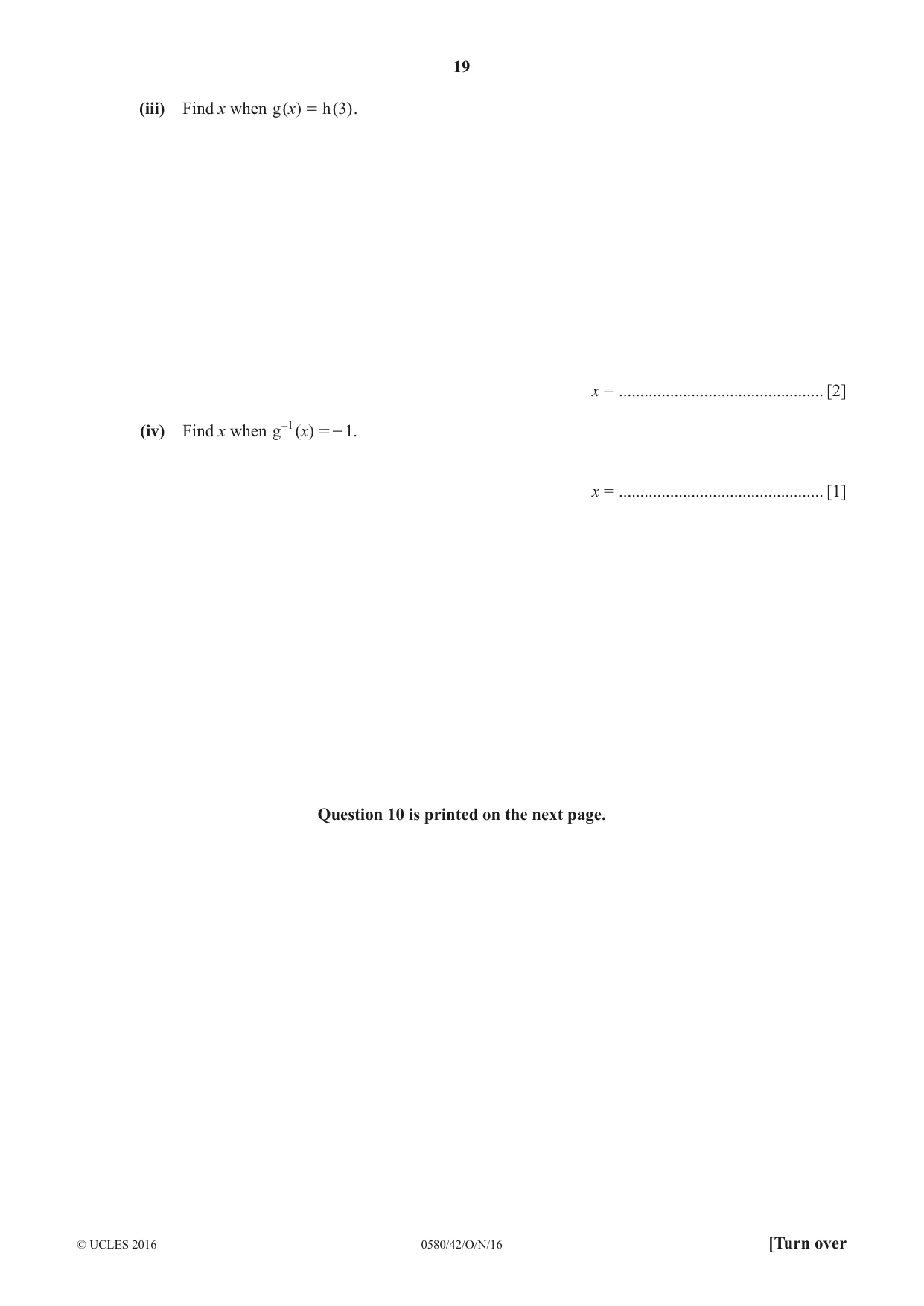
39 (a) y = + 2 , x ! 0 x (i) Find the value of y when x =- 6 . y = ................................................ [1] (ii) Find x in terms of y. x = ................................................ [3] (b) g(x) = 2 - x h( x) = 2 x (i) Find g(5). ................................................. [1] (ii) Find hhh(2). ................................................. [2] (iii) Find x when g( x) = h(3) . x = ................................................ [2] (iv) Find x when g –1 (x) =- 1. x = ................................................ [1] Question 10 is printed on the next page.
Mark scheme: 9 (a) (i) 1.5 oe 1 3 (ii) oe final answer 3 M1 for correct removal of fraction y − 2 M1 for collection of terms in x and factorises OR M1 subtracts 2 from both sides M1 multiplies by x to remove fraction and M1 for correct division by expression of the form ay + b, a and b ≠ 0 (b) (i) –3 1 (ii) 65 536 final answer 2 B1 for h(16) oe e.g. h(2 4 ) (iii) –6 2 M1 for 2 – x = 23 oe (iv) 3 1
Q10 · The perimeter of each of the three shapes is 60 cm
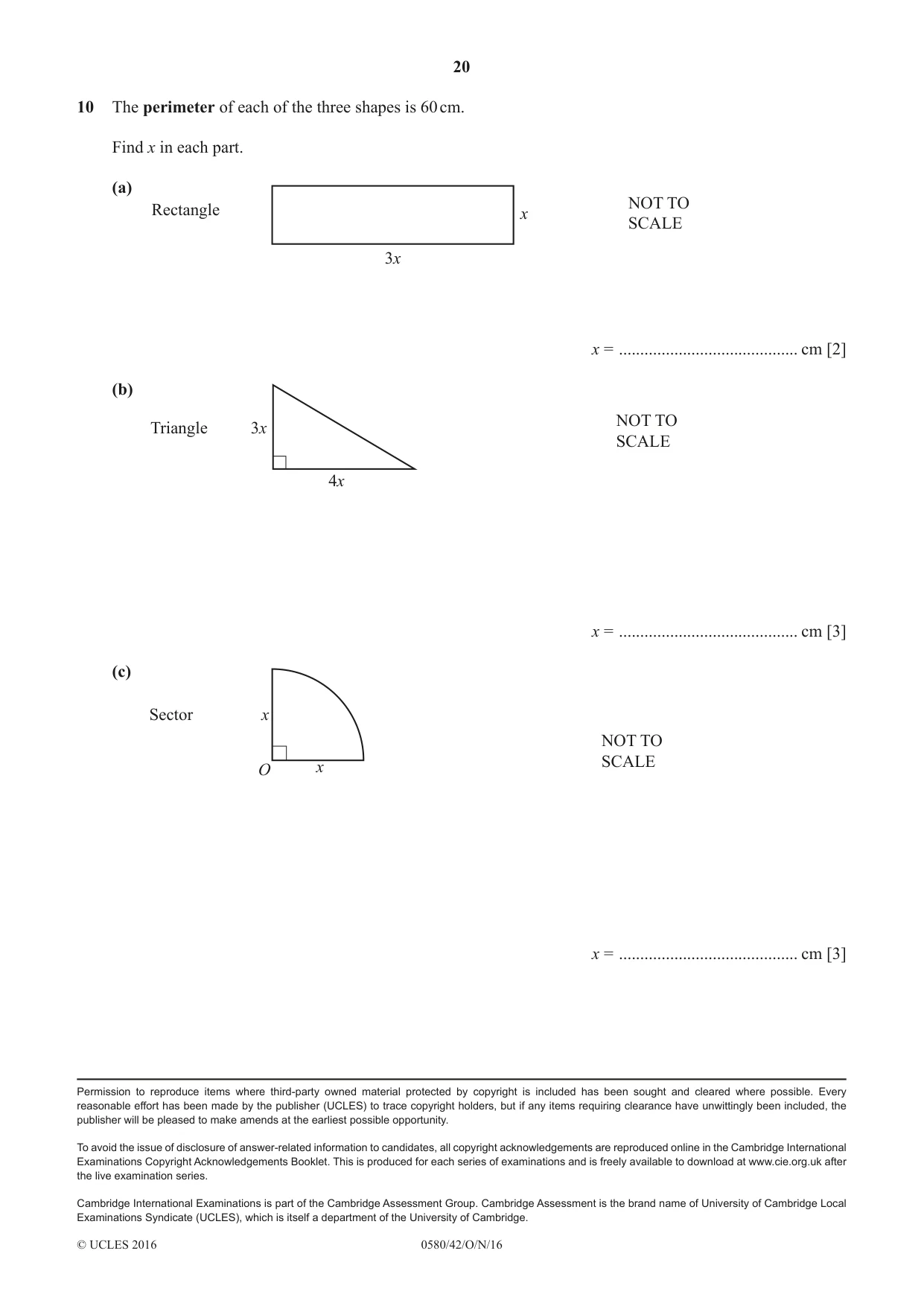
10 The perimeter of each of the three shapes is 60 cm. Find x in each part. (a) NOT TO Rectangle x SCALE 3x x = .......................................... cm [2] (b) NOT TO Triangle 3x SCALE 4x x = .......................................... cm [3] (c) Sector x NOT TO SCALE O x x = .......................................... cm [3]
Mark scheme: 10 (a) 7.5 2 M1 for 3x + x + 3x + x = 60 oe (b) 5 3 B2 for 3x + 4x + 5x [= 60] or better or M1 for (3 x ) 2 + (4 x ) 2 oe 90 (c) 16.8 or 16.80…. 3 M2 for x + x + × π × 2 × x [ = 60] oe 360 90 or M1 for × π × 2 × x oe 360
What was in this paper
The subtopics covered by these 10 questions, and how many questions each got. Open one in a new tab to see every Cambridge question on it.
What you needed in this session
Cambridge’s own grade thresholds for 2016 Oct/Nov, Paper 4 · Variant 2. A higher threshold means an easier paper — the bar moves with how the cohort did.