Cambridge IGCSE Mathematics 0580 — 2015 Oct/Nov Paper 4 · Variant 1
0580/41/O/N/15 · 10 questions · 130 marks · ≈146 min
The question paper and its mark scheme, free to read here and free to download. This is Cambridge’s own paper, exactly as it was sat.
Question paper16 pages
Mark scheme8 pages
Answers below. Sit the paper first if you are practising.
Questions as text
Q1 · Luc is painting the doors in his house
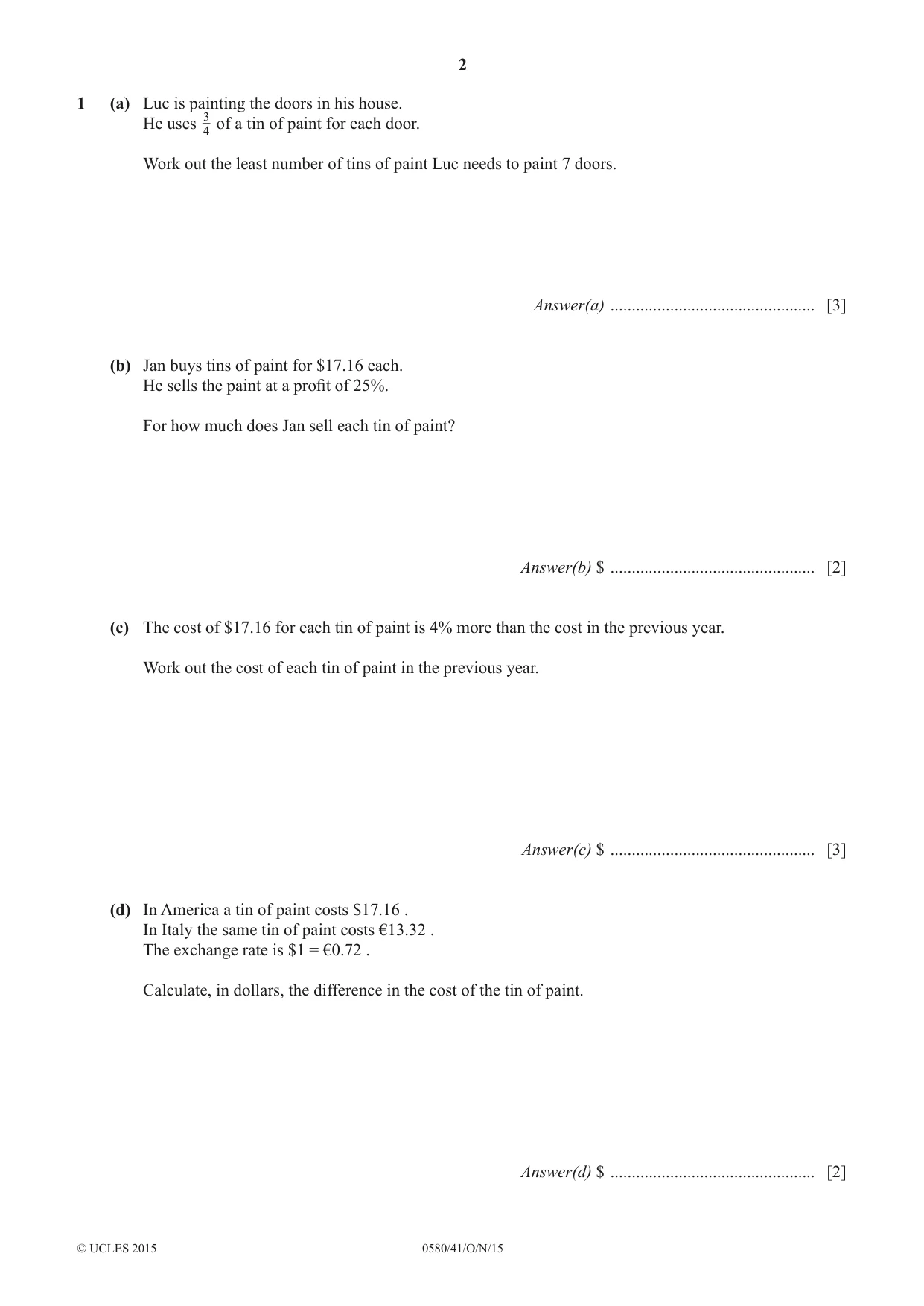
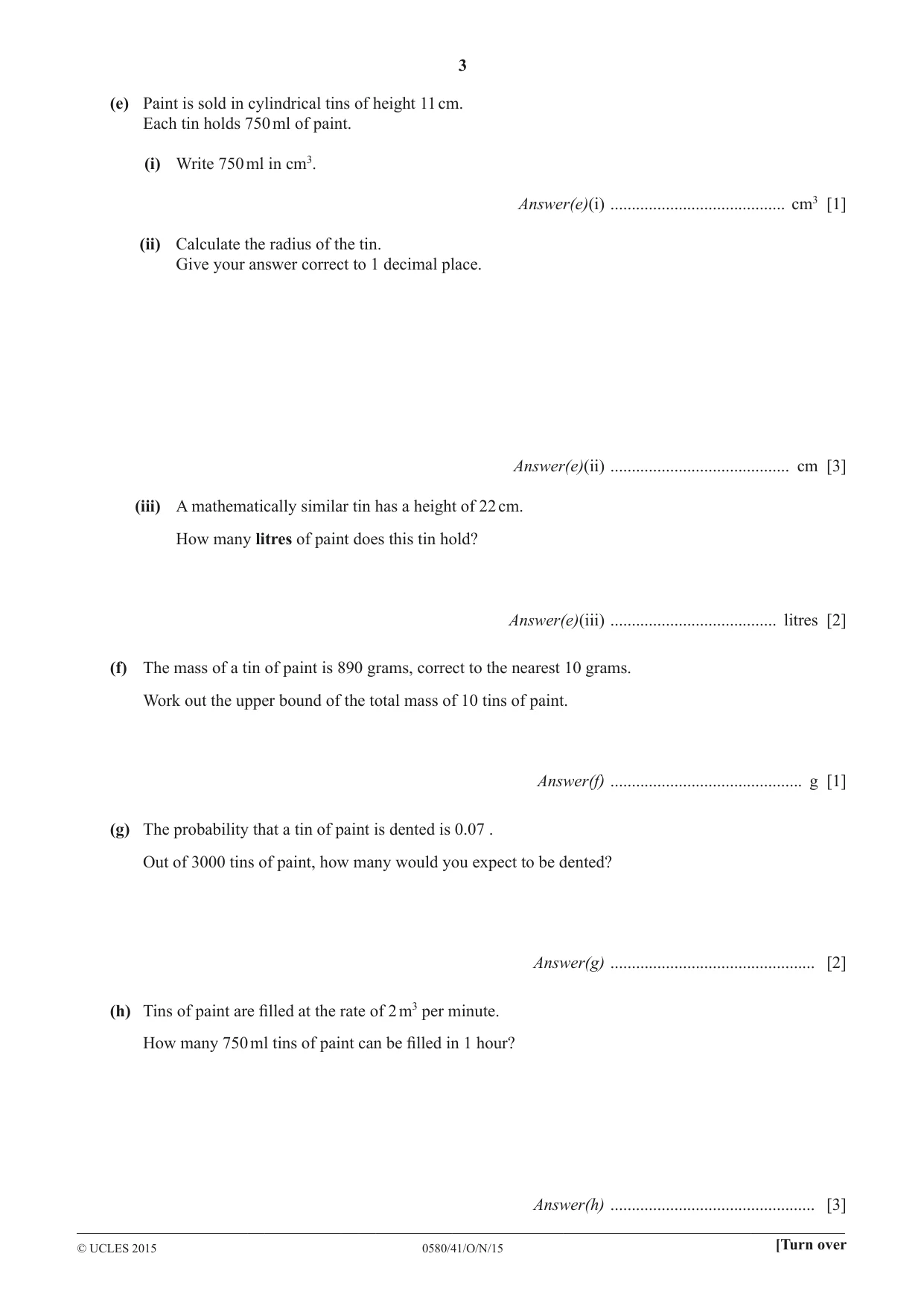
1 (a) Luc is painting the doors in his house. He uses 34 of a tin of paint for each door. Work out the least number of tins of paint Luc needs to paint 7 doors. Answer(a) ................................................ [3] (b) Jan buys tins of paint for $17.16 each. He sells the paint at a profit of 25%. For how much does Jan sell each tin of paint? Answer(b) $ ................................................ [2] (c) The cost of $17.16 for each tin of paint is 4% more than the cost in the previous year. Work out the cost of each tin of paint in the previous year. Answer(c) $ ................................................ [3] (d) In America a tin of paint costs $17.16 . In Italy the same tin of paint costs €13.32 . The exchange rate is $1 = €0.72 . Calculate, in dollars, the difference in the cost of the tin of paint. Answer(d) $ ................................................ [2] (e) Paint is sold in cylindrical tins of height 11 cm. Each tin holds 750 ml of paint. (i) Write 750 ml in cm3. Answer(e)(i) ......................................... cm3 [1] (ii) Calculate the radius of the tin. Give your answer correct to 1 decimal place. Answer(e)(ii) .......................................... cm [3] (iii) A mathematically similar tin has a height of 22 cm. How many litres of paint does this tin hold? Answer(e)(iii) ....................................... litres [2] (f) The mass of a tin of paint is 890 grams, correct to the nearest 10 grams. Work out the upper bound of the total mass of 10 tins of paint. Answer(f) ............................................. g [1] (g) The probability that a tin of paint is dented is 0.07 . Out of 3000 tins of paint, how many would you expect to be dented? Answer(g) ................................................ [2] (h) Tins of paint are filled at the rate of 2 m3 per minute. How many 750 ml tins of paint can be filled in 1 hour? Answer(h) ................................................ [3] __________________________________________________________________________________________
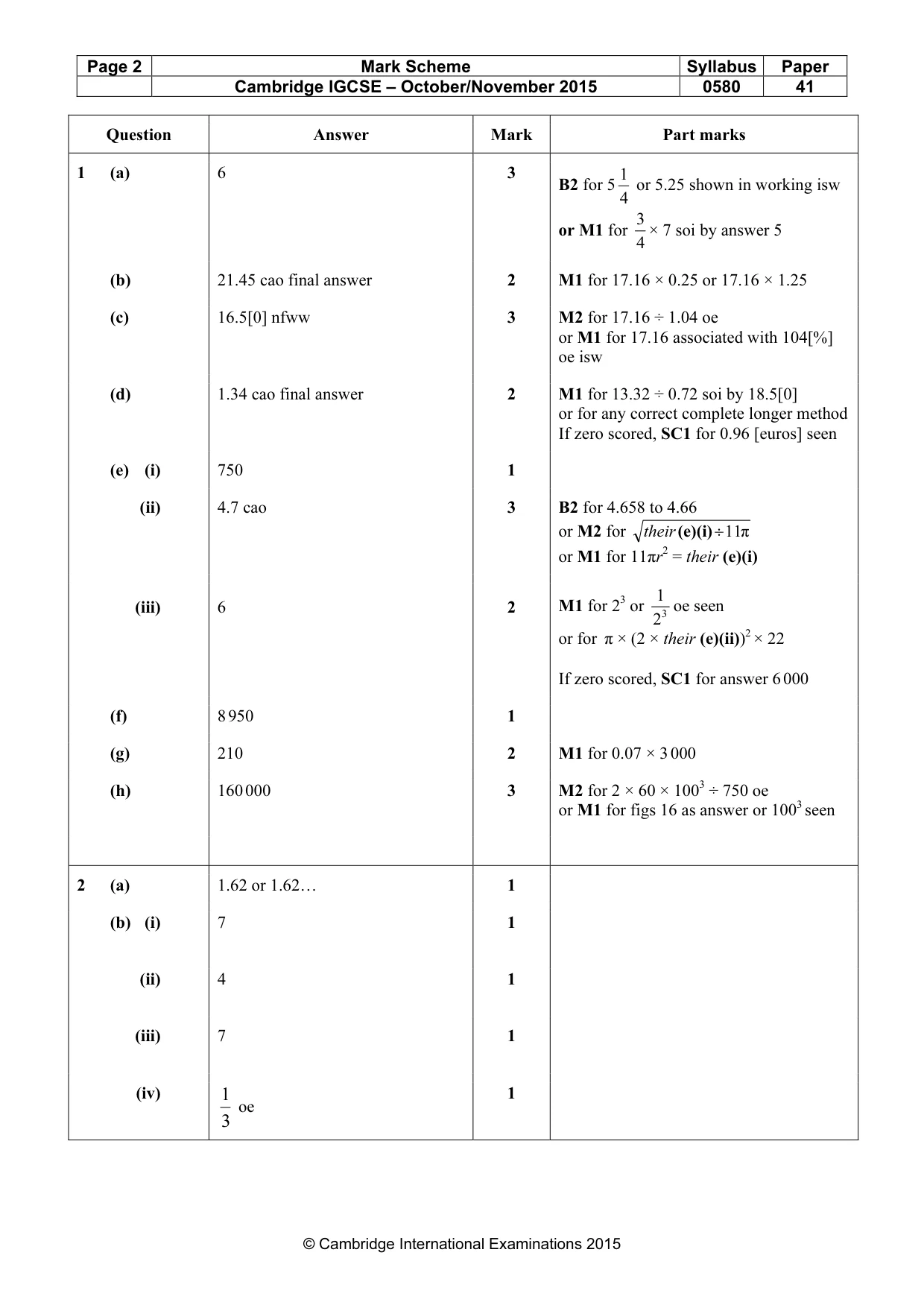
Mark scheme: Question Answer Mark Part marks 1 (a) 6 3 1 B2 for 5 or 5.25 shown in working isw 4 3 or M1 for × 7 soi by answer 5 4 (b) 21.45 cao final answer 2 M1 for 17.16 × 0.25 or 17.16 × 1.25 (c) 16.5[0] nfww 3 M2 for 17.16 ÷ 1.04 oe or M1 for 17.16 associated with 104[%] oe isw (d) 1.34 cao final answer 2 M1 for 13.32 ÷ 0.72 soi by 18.5[0] or for any correct complete longer method If zero scored, SC1 for 0.96 [euros] seen (e) (i) 750 1 (ii) 4.7 cao 3 B2 for 4.658 to 4.66 or M2 for their (e)(i) ÷ 11π or M1 for 11πr2 = their (e)(i) 1 (iii) 6 2 M1 for 23 or 3 oe seen 2 or for π × (2 × their (e)(ii))2 × 22 If zero scored, SC1 for answer 6 000 (f) 8 950 1 (g) 210 2 M1 for 0.07 × 3 000 (h) 160 000 3 M2 for 2 × 60 × 1003 ÷ 750 oe or M1 for figs 16 as answer or 1003 seen
Question 2
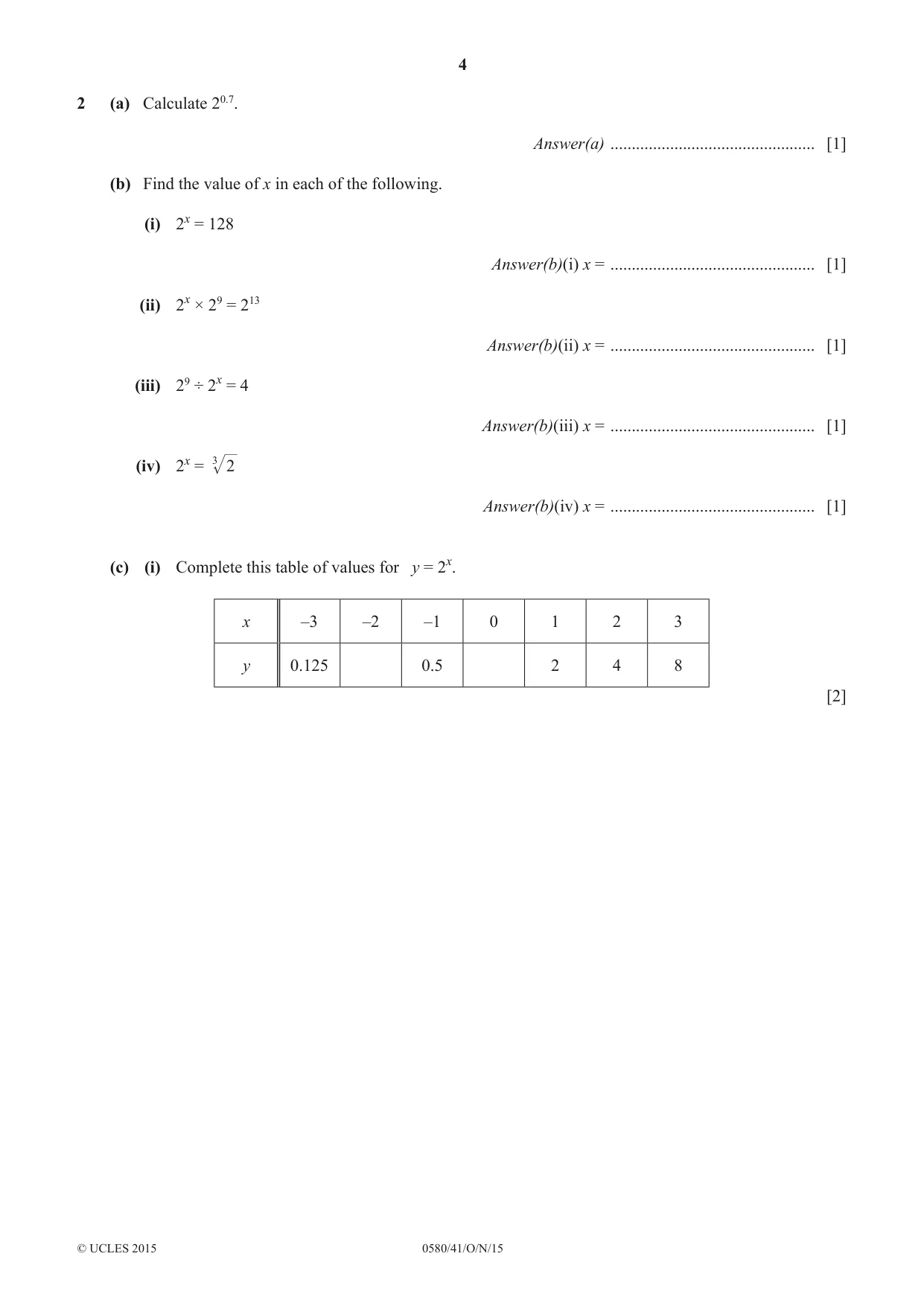
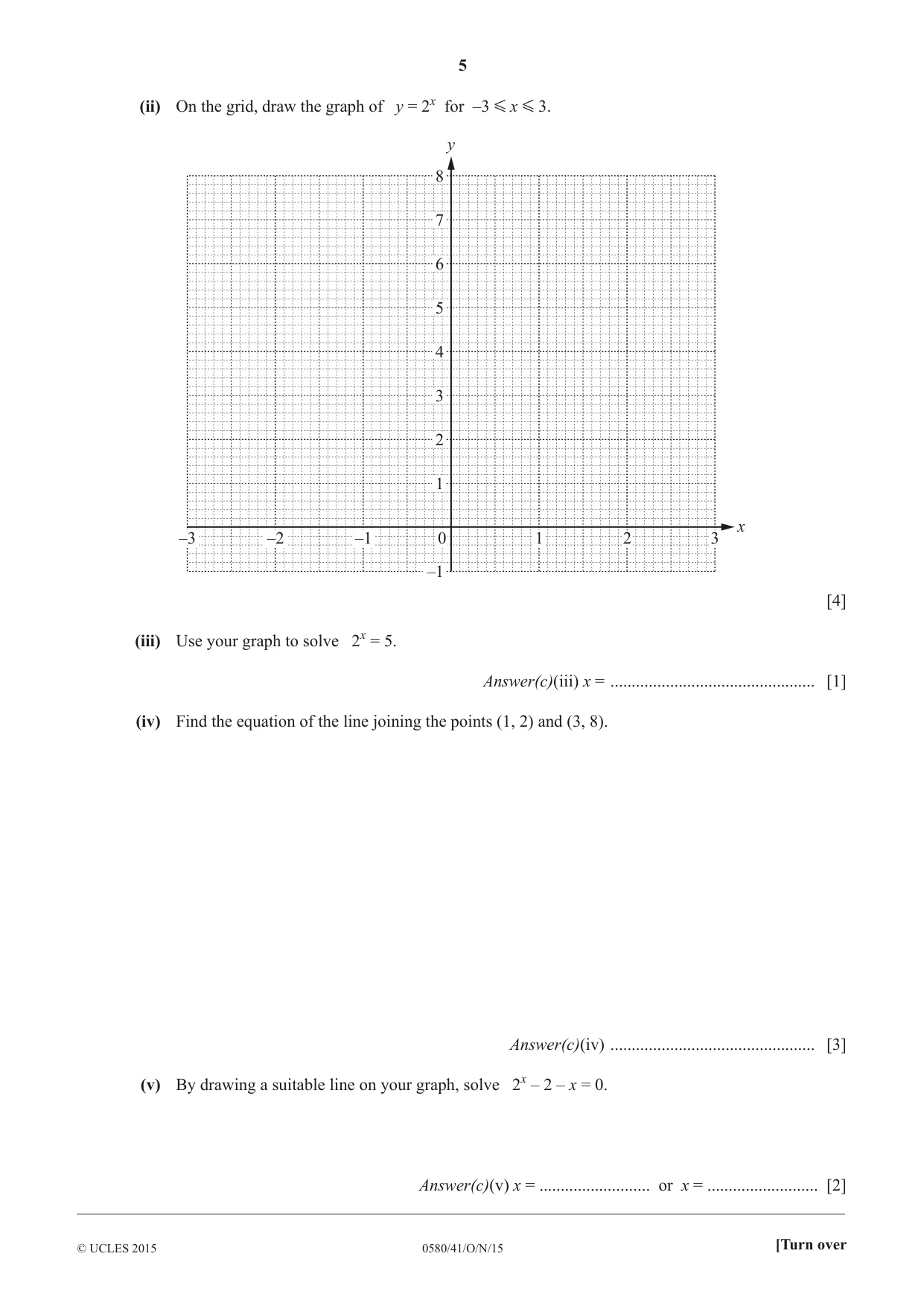
2 (a) Calculate 20.7. Answer(a) ................................................ [1] (b) Find the value of x in each of the following. (i) 2x = 128 Answer(b)(i) x = ................................................ [1] (ii) 2x × 29 = 213 Answer(b)(ii) x = ................................................ [1] (iii) 29 ÷ 2x = 4 Answer(b)(iii) x = ................................................ [1] (iv) 2x = 3 2 Answer(b)(iv) x = ................................................ [1] (c) (i) Complete this table of values for y = 2x. x –3 –2 –1 0 1 2 3 y 0.125 0.5 2 4 8 [2] (ii) On the grid, draw the graph of y = 2x for –3 G x G 3. y 8 7 6 5 4 3 2 1 x –3 –2 –1 0 1 2 3 –1 [4] (iii) Use your graph to solve 2x = 5. Answer(c)(iii) x = ................................................ [1] (iv) Find the equation of the line joining the points (1, 2) and (3, 8). Answer(c)(iv) ................................................ [3] (v) By drawing a suitable line on your graph, solve 2x – 2 – x = 0. Answer(c)(v) x = .......................... or x = .......................... [2] __________________________________________________________________________________________
Mark scheme: 2 (a) 1.62 or 1.62… 1 (b) (i) 7 1 (ii) 4 1 (iii) 7 1 (iv) 1 1 oe 3
Q3 · T 60 m NOT TO SCALE 50 m B 130° A 70 m C A, B and C are points on horizontal ground
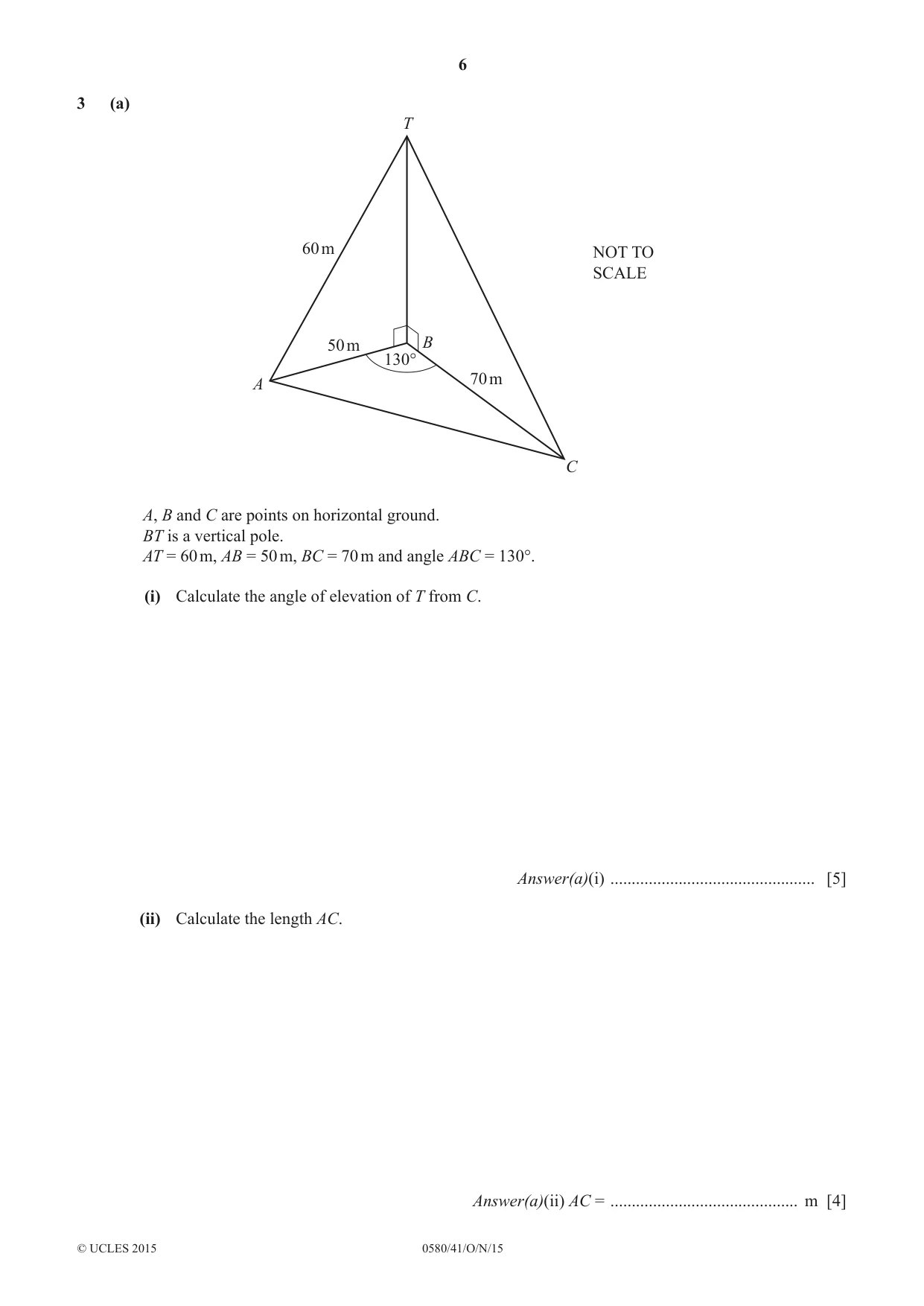
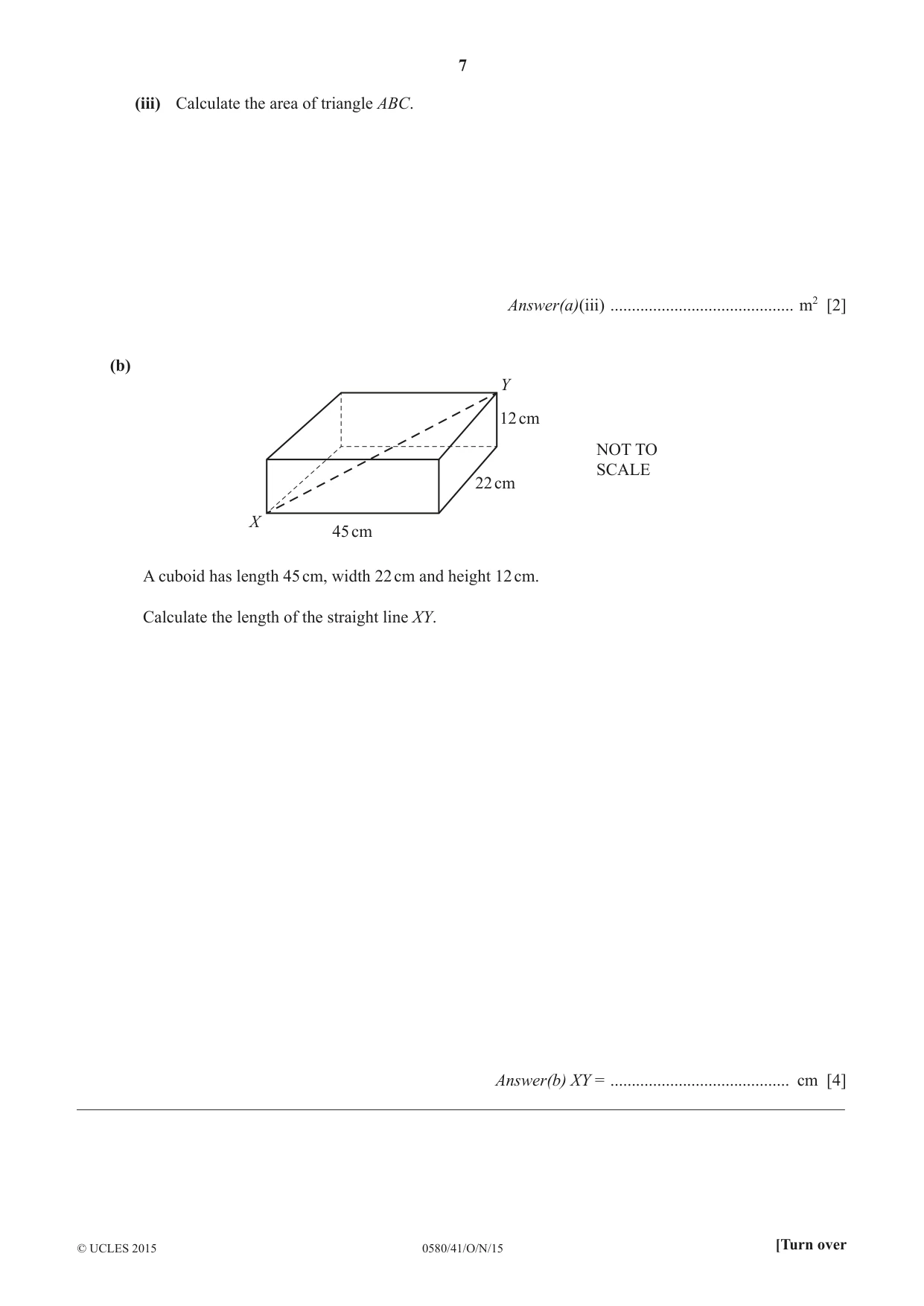
3 (a) T 60 m NOT TO SCALE 50 m B 130° A 70 m C A, B and C are points on horizontal ground. BT is a vertical pole. AT = 60 m, AB = 50 m, BC = 70 m and angle ABC = 130°. (i) Calculate the angle of elevation of T from C. Answer(a)(i) ................................................ [5] (ii) Calculate the length AC. Answer(a)(ii) AC = ............................................ m [4] (iii) Calculate the area of triangle ABC. Answer(a)(iii) ........................................... m2 [2] (b) Y 12 cm NOT TO SCALE 22 cm X 45 cm A cuboid has length 45 cm, width 22 cm and height 12 cm. Calculate the length of the straight line XY. Answer(b) XY = .......................................... cm [4] __________________________________________________________________________________________
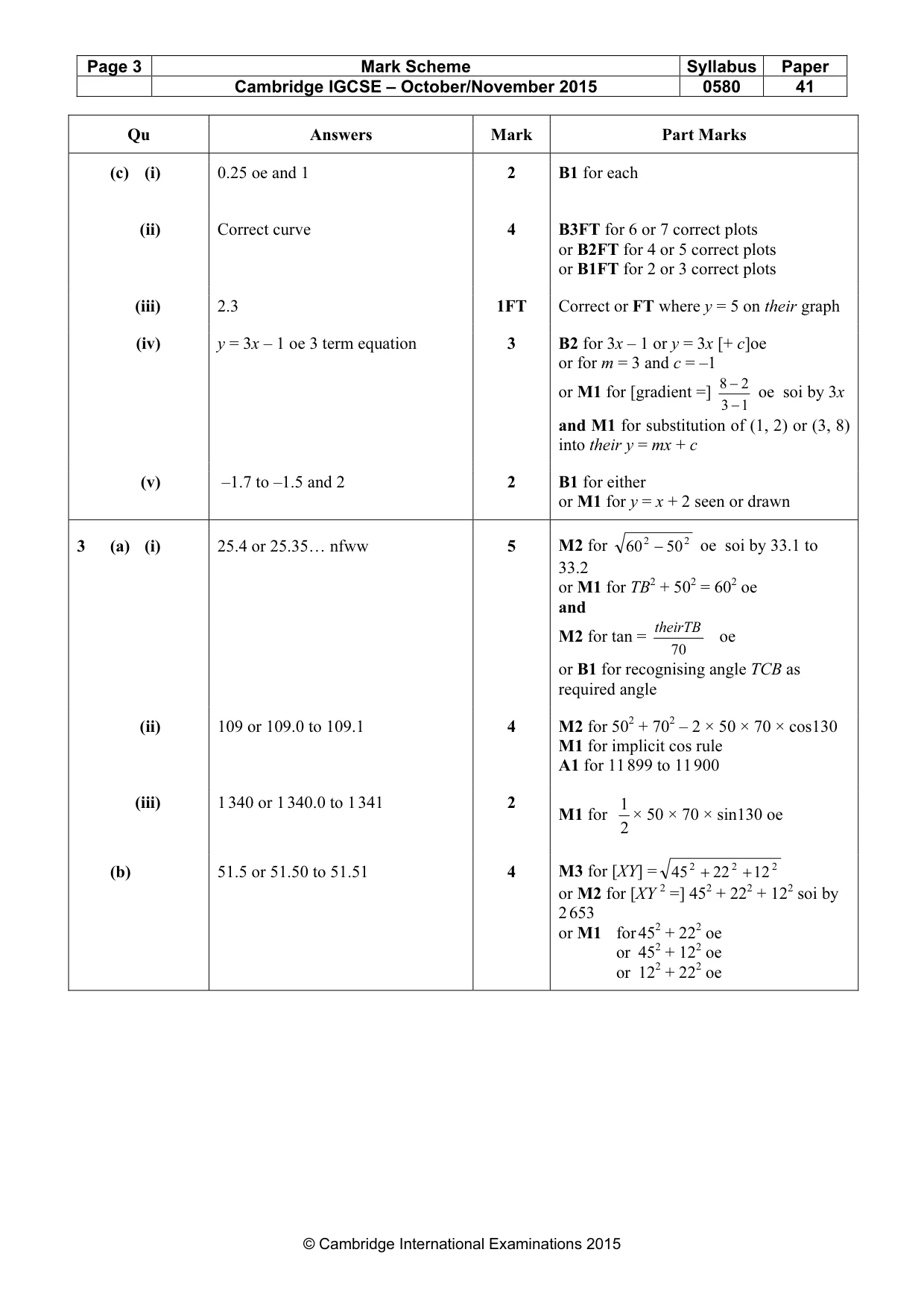
Mark scheme: 3 (a) (i) 25.4 or 25.35… nfww 5 M2 for 60 2 − 50 2 oe soi by 33.1 to 33.2 or M1 for TB2 + 502 = 602 oe and theirTB M2 for tan = oe 70 or B1 for recognising angle TCB as required angle (ii) 109 or 109.0 to 109.1 4 M2 for 502 + 702 – 2 × 50 × 70 × cos130 M1 for implicit cos rule A1 for 11 899 to 11 900 (iii) 1 340 or 1 340.0 to 1 341 2 1 M1 for × 50 × 70 × sin130 oe 2 (b) 51.5 or 51.50 to 51.51 4 M3 for [XY] = 45 2 + 22 2 + 12 2 or M2 for [XY 2 =] 452 + 222 + 122 soi by 2 653 or M1 for 452 + 222 oe or 452 + 122 oe or 122 + 222 oe
Q4 · Ali buys x rose bushes and y lavender bushes
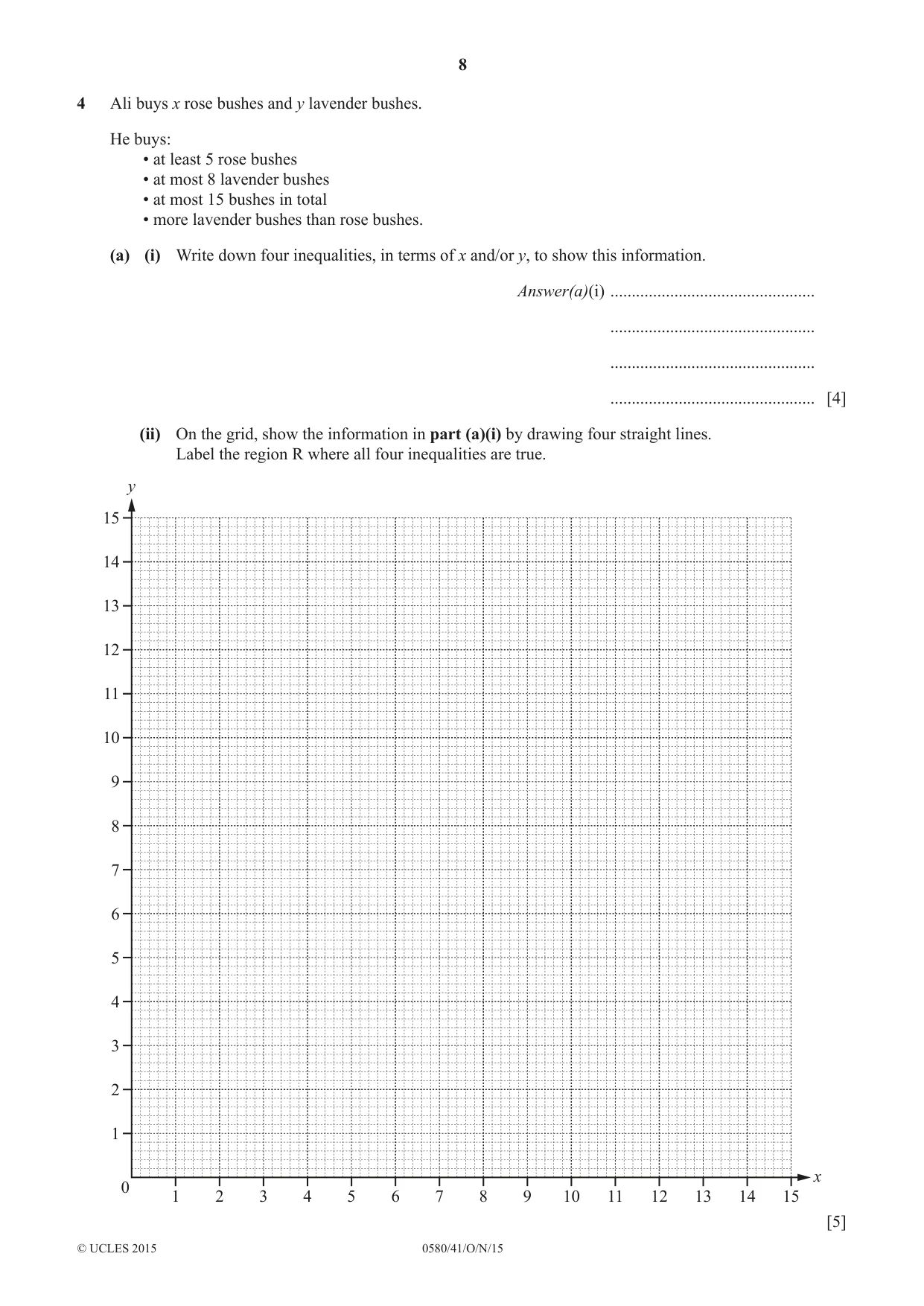
4 Ali buys x rose bushes and y lavender bushes. He buys: • at least 5 rose bushes • at most 8 lavender bushes • at most 15 bushes in total • more lavender bushes than rose bushes. (a) (i) Write down four inequalities, in terms of x and/or y, to show this information. Answer(a)(i) ................................................ ................................................ ................................................ ................................................ [4] (ii) On the grid, show the information in part (a)(i) by drawing four straight lines. Label the region R where all four inequalities are true. y 15 14 13 12 11 10 9 8 7 6 5 4 3 2 1 x 0 1 2 3 4 5 6 7 8 9 10 11 12 13 14 15 [5] (b) Rose bushes cost $6 each and lavender bushes cost $4.50 each. What is the greatest amount of money Ali could spend? Answer(b) $ ................................................ [2] __________________________________________________________________________________________
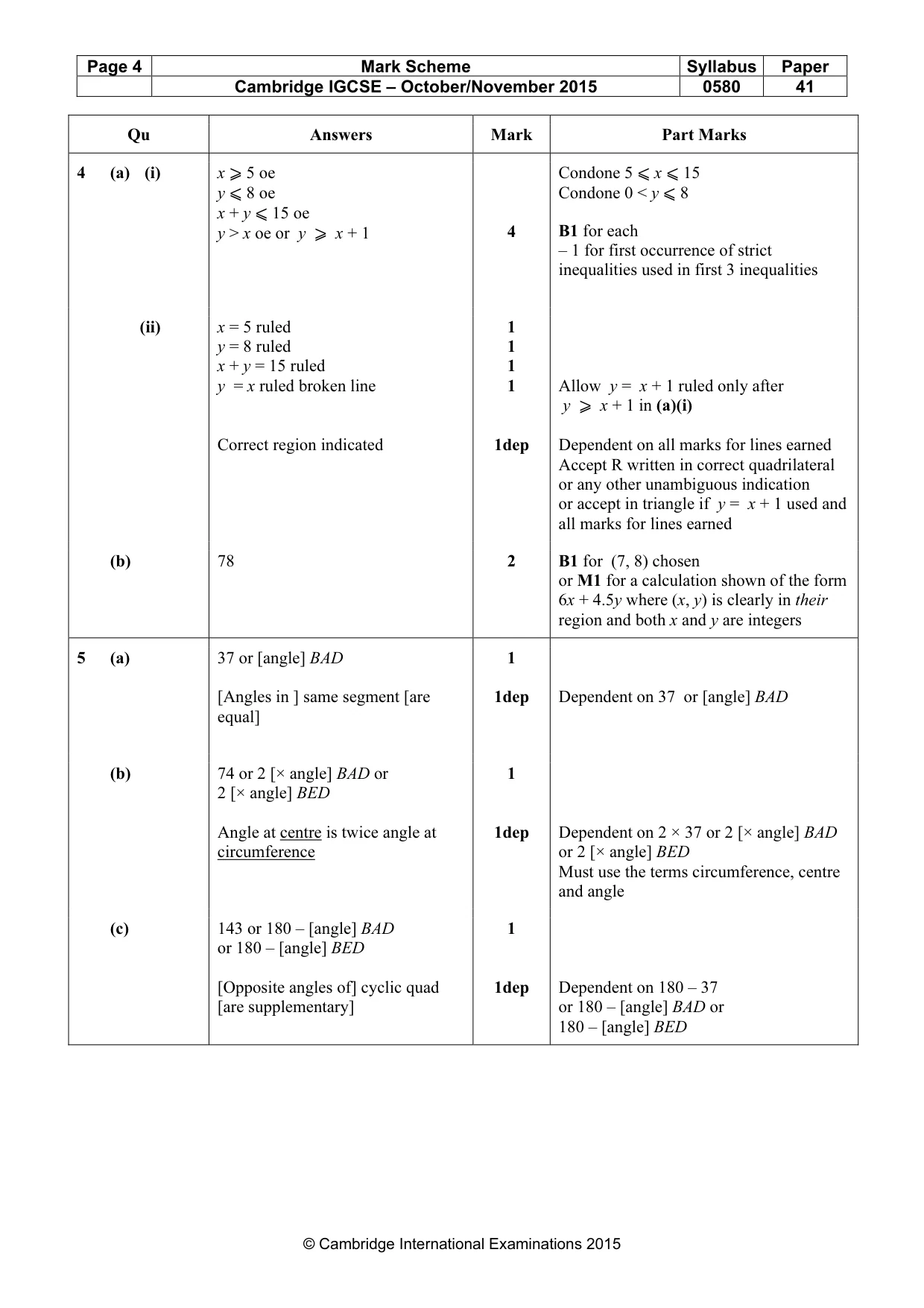
Mark scheme: 4 (a) (i) x ⩾ 5 oe Condone 5 ⩽ x ⩽ 15 y ⩽ 8 oe Condone 0 < y ⩽ 8 x + y ⩽ 15 oe y > x oe or y ⩾ x + 1 4 B1 for each – 1 for first occurrence of strict inequalities used in first 3 inequalities (ii) x = 5 ruled 1 y = 8 ruled 1 x + y = 15 ruled 1 y = x ruled broken line 1 Allow y = x + 1 ruled only after y ⩾ x + 1 in (a)(i) Correct region indicated 1dep Dependent on all marks for lines earned Accept R written in correct quadrilateral or any other unambiguous indication or accept in triangle if y = x + 1 used and all marks for lines earned (b) 78 2 B1 for (7, 8) chosen or M1 for a calculation shown of the form 6x + 4.5y where (x, y) is clearly in their region and both x and y are integers
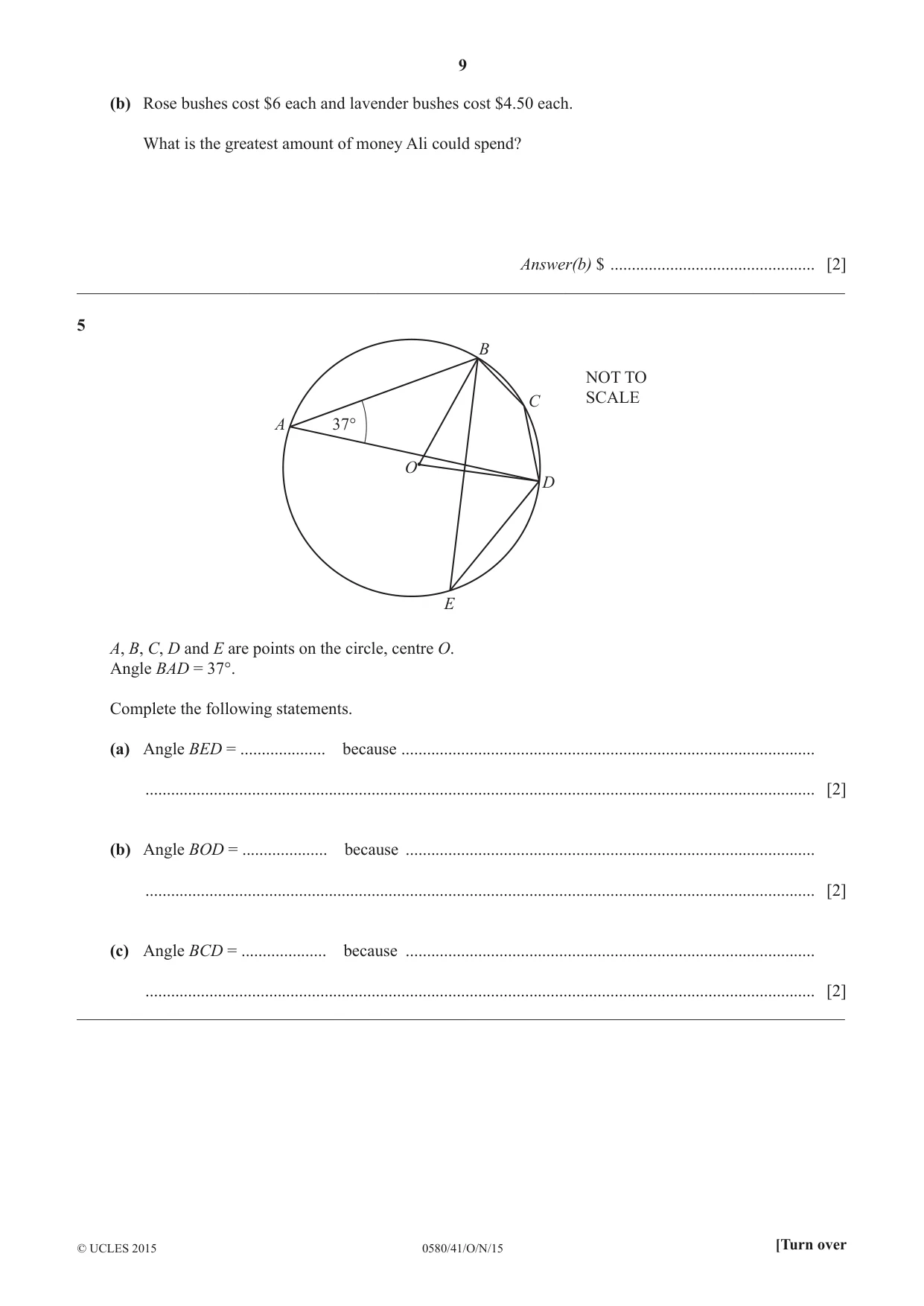
Q5 · B NOT TO C SCALE A 37° O D E A, B, C, D and E are points on the circle, centre O
5 B NOT TO C SCALE A 37° O D E A, B, C, D and E are points on the circle, centre O. Angle BAD = 37°. Complete the following statements. (a) Angle BED = .................... because ................................................................................................. ............................................................................................................................................................. [2] (b) Angle BOD = .................... because ................................................................................................ ............................................................................................................................................................. [2] (c) Angle BCD = .................... because ................................................................................................ ............................................................................................................................................................. [2] __________________________________________________________________________________________
Mark scheme: 5 (a) 37 or [angle] BAD 1 [Angles in ] same segment [are 1dep Dependent on 37 or [angle] BAD equal] (b) 74 or 2 [× angle] BAD or 1 2 [× angle] BED Angle at centre is twice angle at 1dep Dependent on 2 × 37 or 2 [× angle] BAD circumference or 2 [× angle] BED Must use the terms circumference, centre and angle (c) 143 or 180 – [angle] BAD 1 or 180 – [angle] BED [Opposite angles of] cyclic quad 1dep Dependent on 180 – 37 [are supplementary] or 180 – [angle] BAD or 180 – [angle] BED
Q6 · 120 students take a mathematics examination
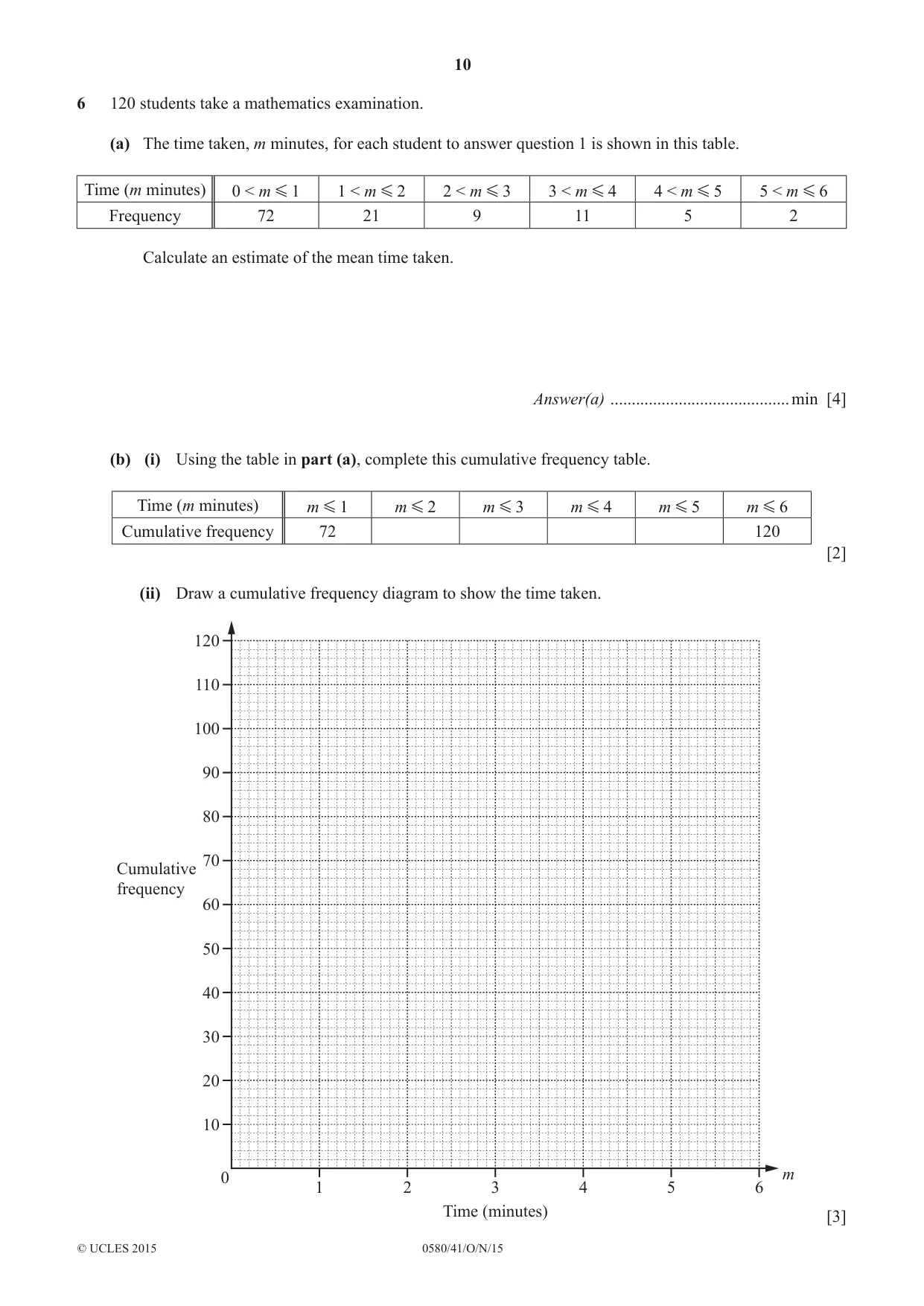
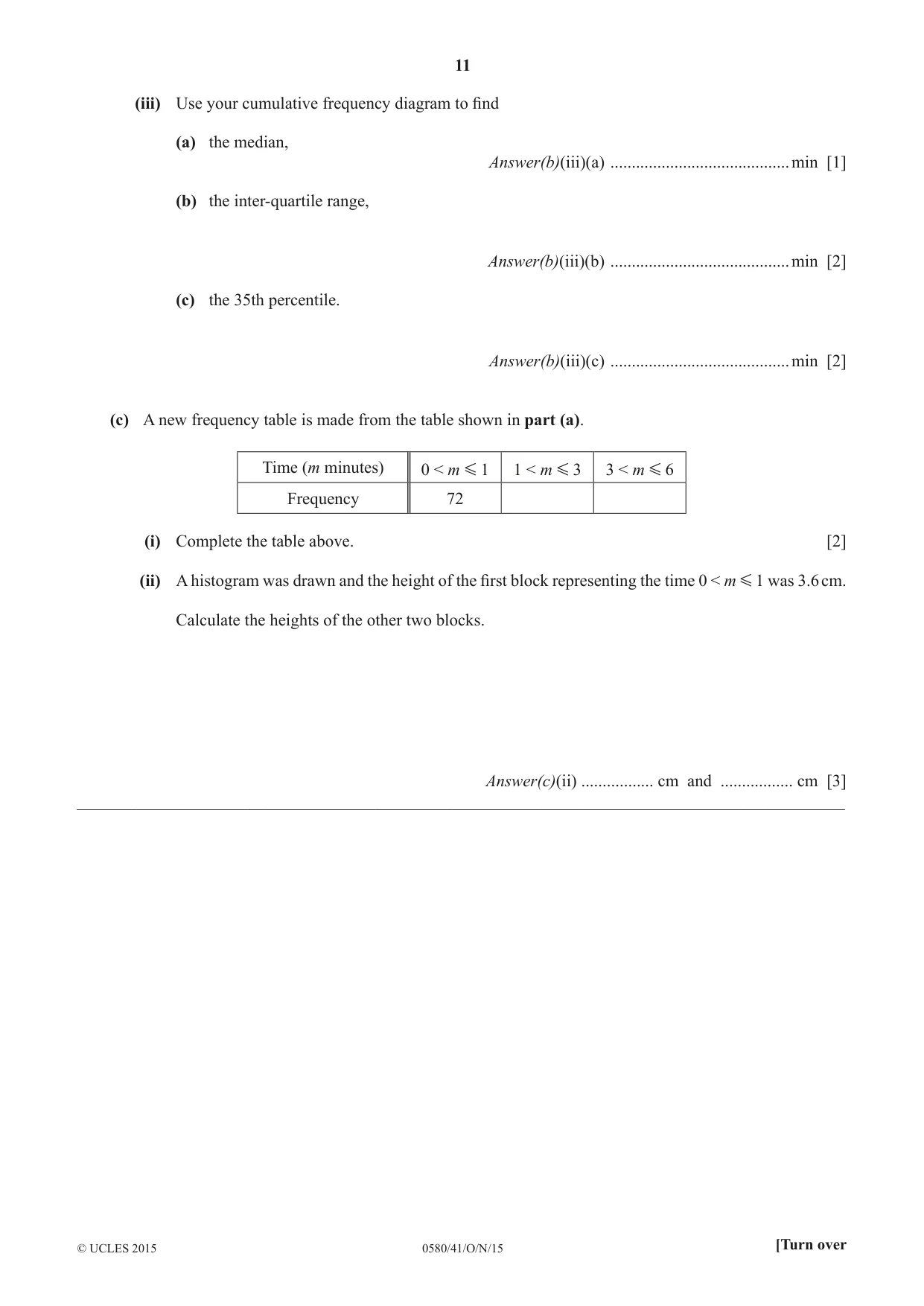
6 120 students take a mathematics examination. (a) The time taken, m minutes, for each student to answer question 1 is shown in this table. Time (m minutes) 0 < m G 1 1 < m G 2 2 < m G 3 3 < m G 4 4 < m G 5 5 < m G 6 Frequency 72 21 9 11 5 2 Calculate an estimate of the mean time taken. Answer(a) ..........................................min [4] (b) (i) Using the table in part (a), complete this cumulative frequency table. Time (m minutes) m G 1 m G 2 m G 3 m G 4 m G 5 m G 6 Cumulative frequency 72 120 [2] (ii) Draw a cumulative frequency diagram to show the time taken. 120 110 100 90 80 70 Cumulative frequency 60 50 40 30 20 10 0 m 1 2 3 4 5 6 Time (minutes) [3] (iii) Use your cumulative frequency diagram to find (a) the median, Answer(b)(iii)(a) ..........................................min [1] (b) the inter-quartile range, Answer(b)(iii)(b) ..........................................min [2] (c) the 35th percentile. Answer(b)(iii)(c) ..........................................min [2] (c) A new frequency table is made from the table shown in part (a). Time (m minutes) 0 < m G 1 1 < m G 3 3 < m G 6 Frequency 72 (i) Complete the table above. [2] (ii) A histogram was drawn and the height of the first block representing the time 0 < m G 1 was 3.6 cm. Calculate the heights of the other two blocks. Answer(c)(ii) ................. cm and ................. cm [3] __________________________________________________________________________________________
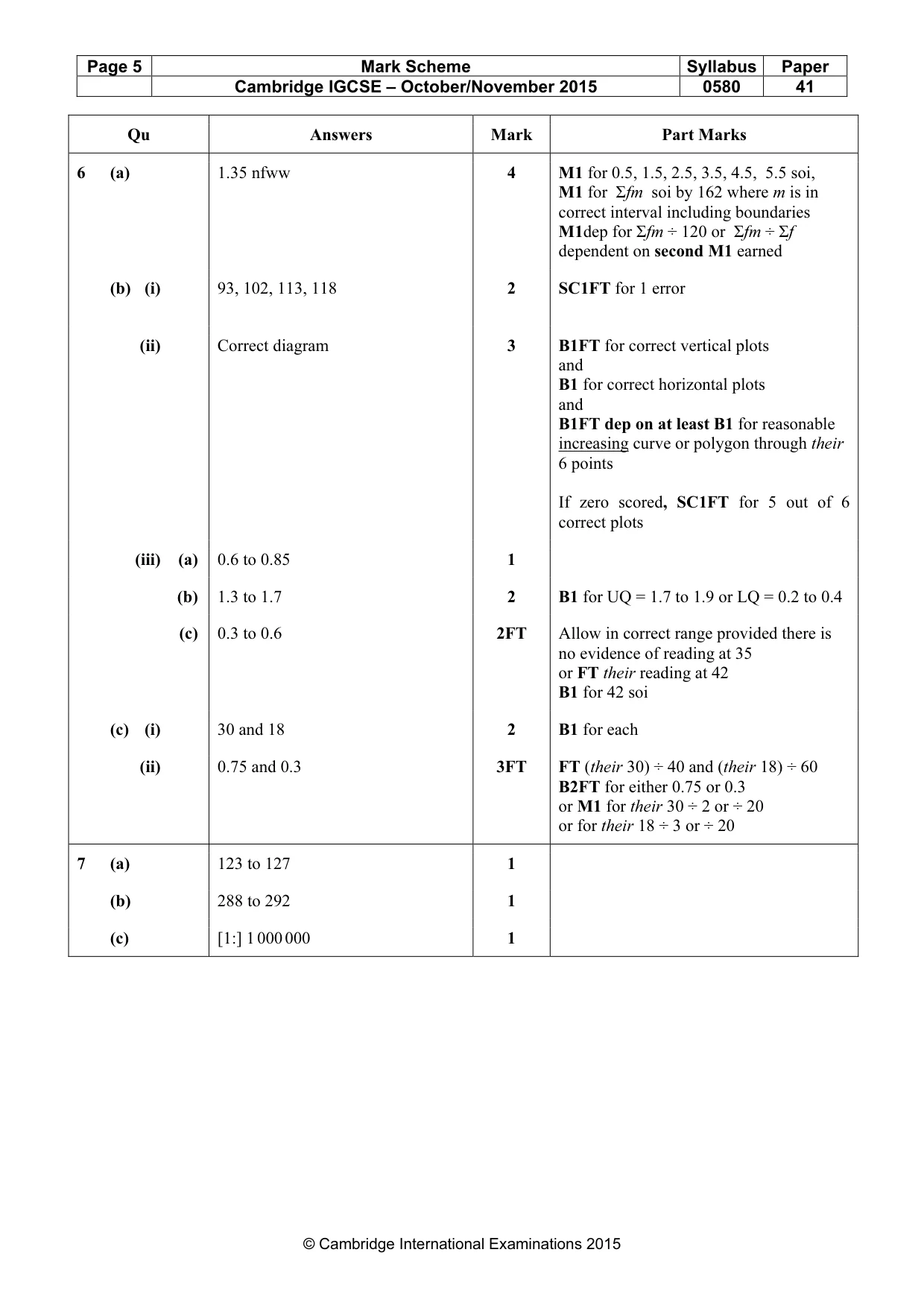
Mark scheme: 6 (a) 1.35 nfww 4 M1 for 0.5, 1.5, 2.5, 3.5, 4.5, 5.5 soi, M1 for Σfm soi by 162 where m is in correct interval including boundaries M1dep for Σfm ÷ 120 or Σfm ÷ Σf dependent on second M1 earned (b) (i) 93, 102, 113, 118 2 SC1FT for 1 error (ii) Correct diagram 3 B1FT for correct vertical plots and B1 for correct horizontal plots and B1FT dep on at least B1 for reasonable increasing curve or polygon through their 6 points If zero scored, SC1FT for 5 out of 6 correct plots (iii) (a) 0.6 to 0.85 1 (b) 1.3 to 1.7 2 B1 for UQ = 1.7 to 1.9 or LQ = 0.2 to 0.4 (c) 0.3 to 0.6 2FT Allow in correct range provided there is no evidence of reading at 35 or FT their reading at 42 B1 for 42 soi (c) (i) 30 and 18 2 B1 for each (ii) 0.75 and 0.3 3FT FT (their 30) ÷ 40 and (their 18) ÷ 60 B2FT for either 0.75 or 0.3 or M1 for their 30 ÷ 2 or ÷ 20 or for their 18 ÷ 3 or ÷ 20
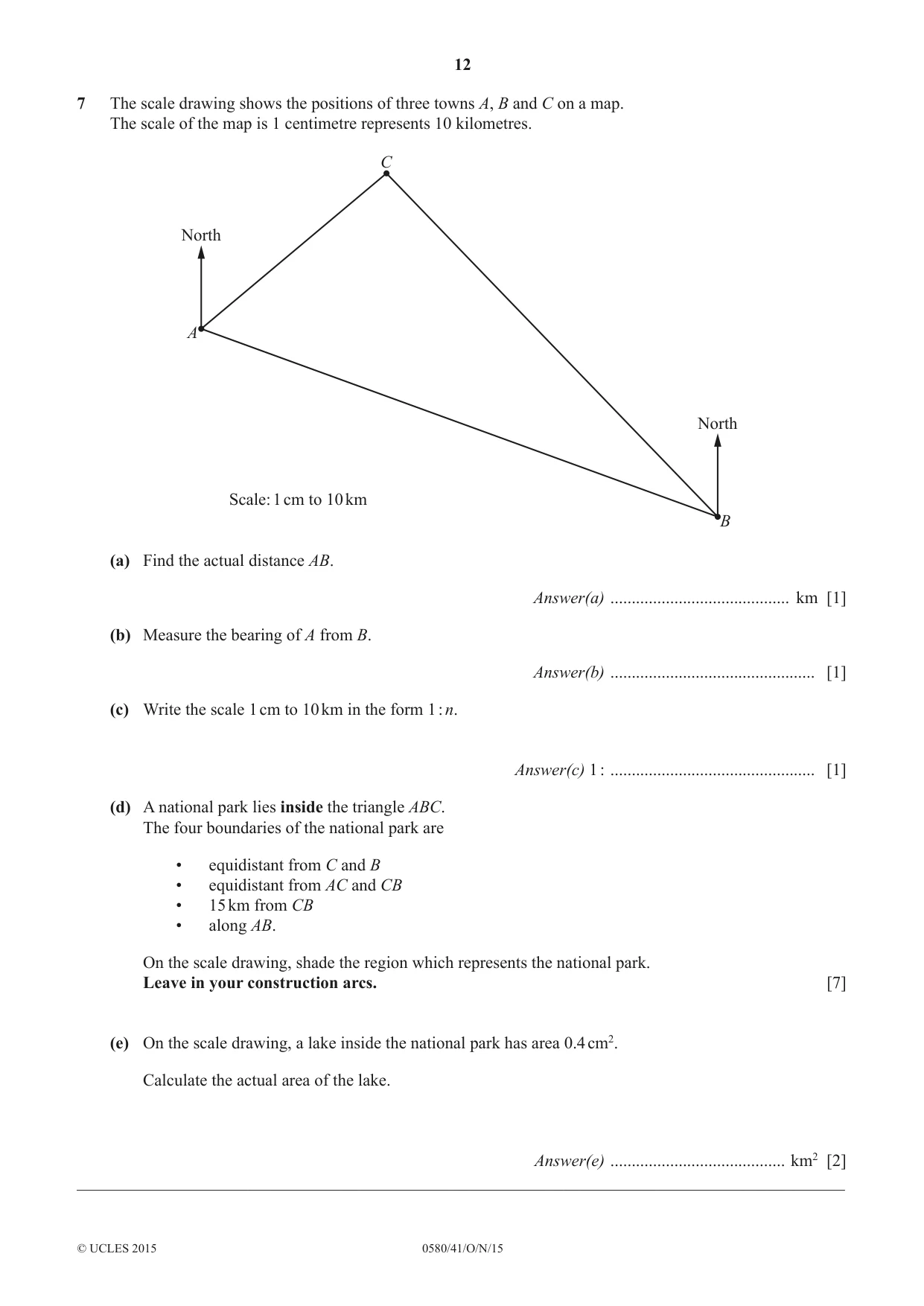
Q7 · The scale drawing shows the positions of three towns A, B and C on a map
7 The scale drawing shows the positions of three towns A, B and C on a map. The scale of the map is 1 centimetre represents 10 kilometres. C North A North Scale: 1 cm to 10 km B (a) Find the actual distance AB. Answer(a) .......................................... km [1] (b) Measure the bearing of A from B. Answer(b) ................................................ [1] (c) Write the scale 1 cm to 10 km in the form 1 : n. Answer(c) 1 : ................................................ [1] (d) A national park lies inside the triangle ABC. The four boundaries of the national park are • equidistant from C and B • equidistant from AC and CB • 15 km from CB • along AB. On the scale drawing, shade the region which represents the national park. Leave in your construction arcs. [7] (e) On the scale drawing, a lake inside the national park has area 0.4 cm2. Calculate the actual area of the lake. Answer(e) ......................................... km2 [2] __________________________________________________________________________________________
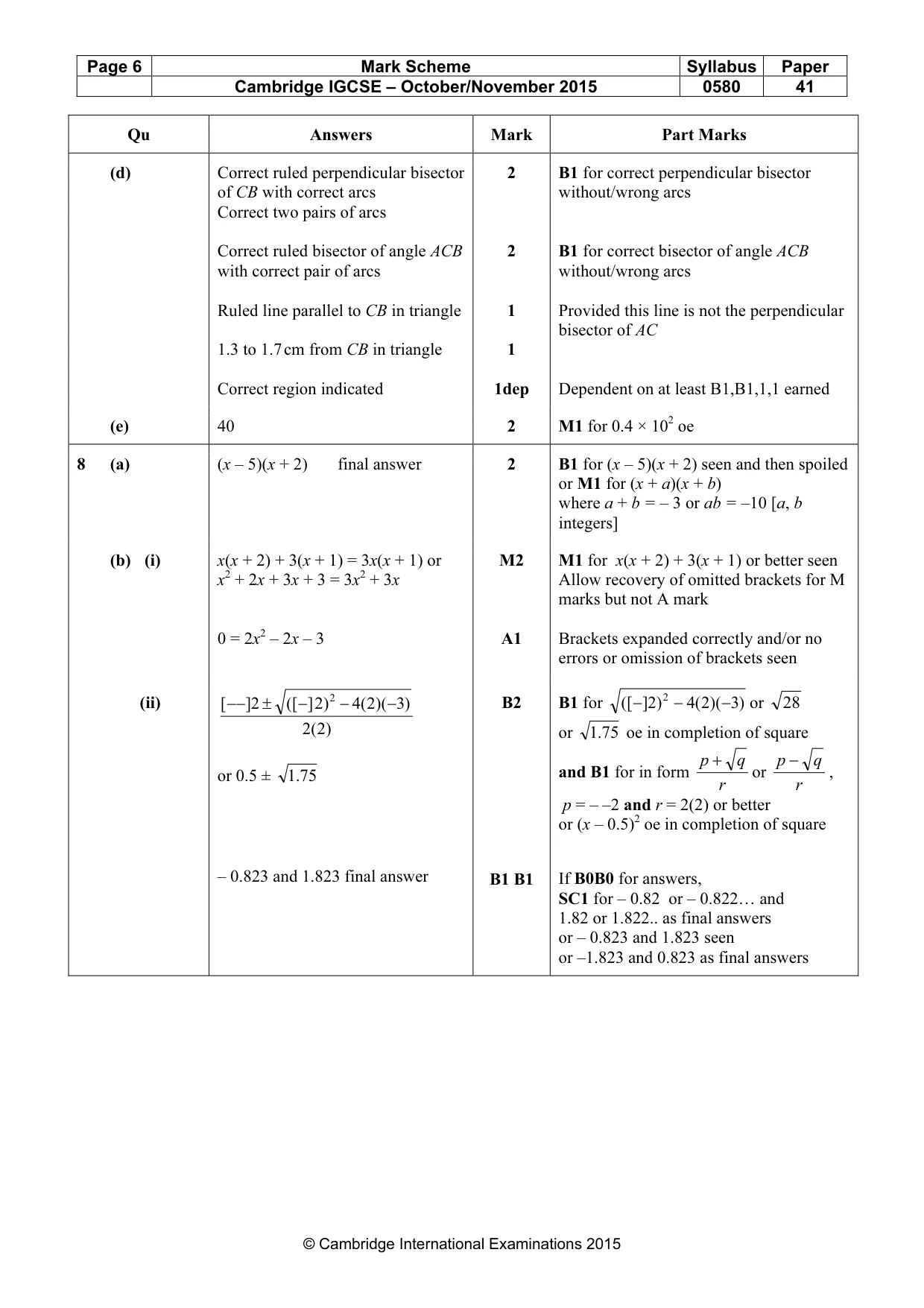
Mark scheme: 7 (a) 123 to 127 1 (b) 288 to 292 1 (c) [1:] 1 000 000 1
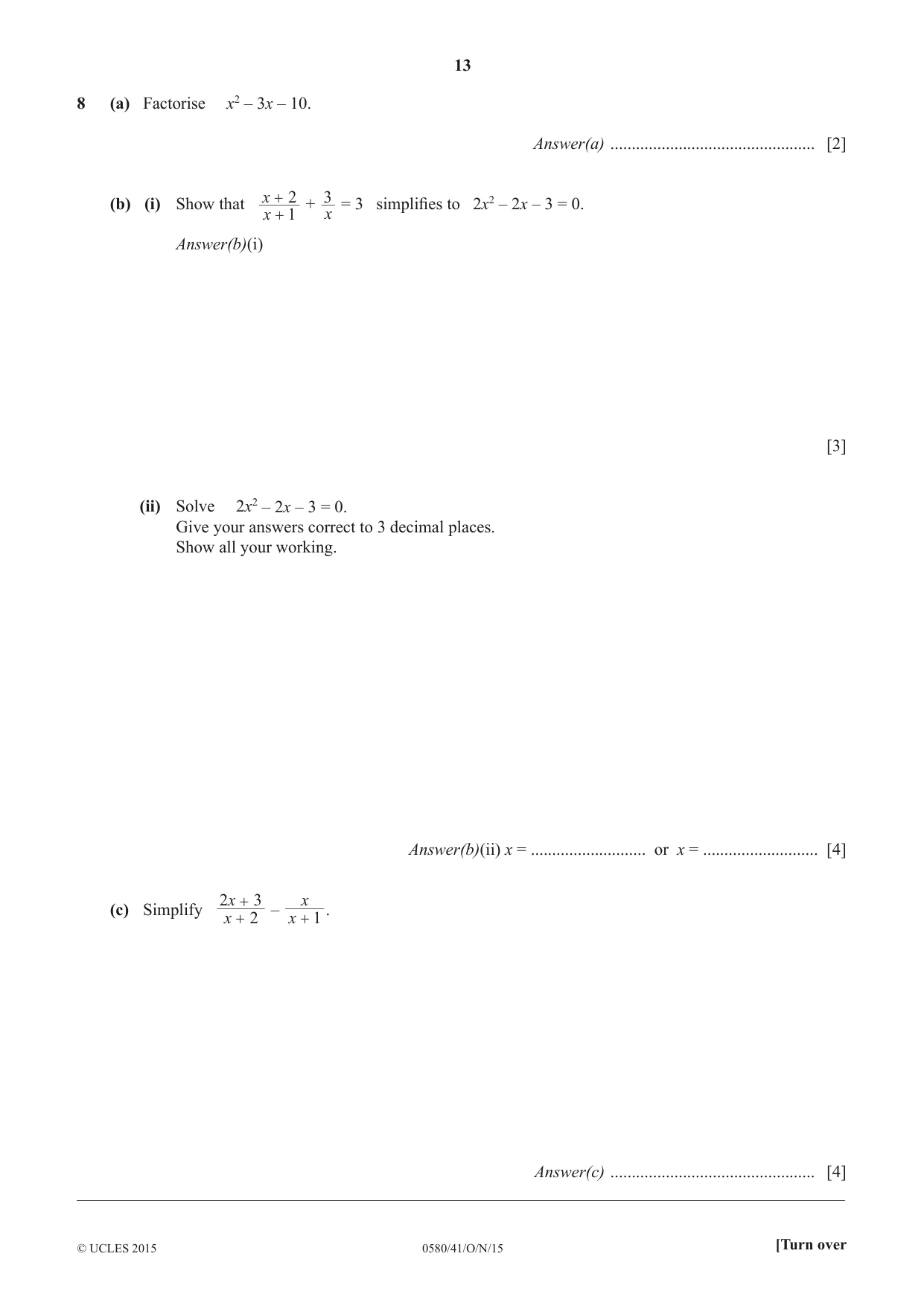
Q8 · Factorise x2 – 3x – 10
8 (a) Factorise x2 – 3x – 10. Answer(a) ................................................ [2] x + 2 3 (b) (i) Show that + = 3 simplifies to 2x2 – 2x – 3 = 0. x + 1 x Answer(b)(i) [3] (ii) Solve 2x2 – 2x – 3 = 0. Give your answers correct to 3 decimal places. Show all your working. Answer(b)(ii) x = ........................... or x = ........................... [4] 2x + 3 x (c) Simplify – . x + 2 x + 1 Answer(c) ................................................ [4] __________________________________________________________________________________________
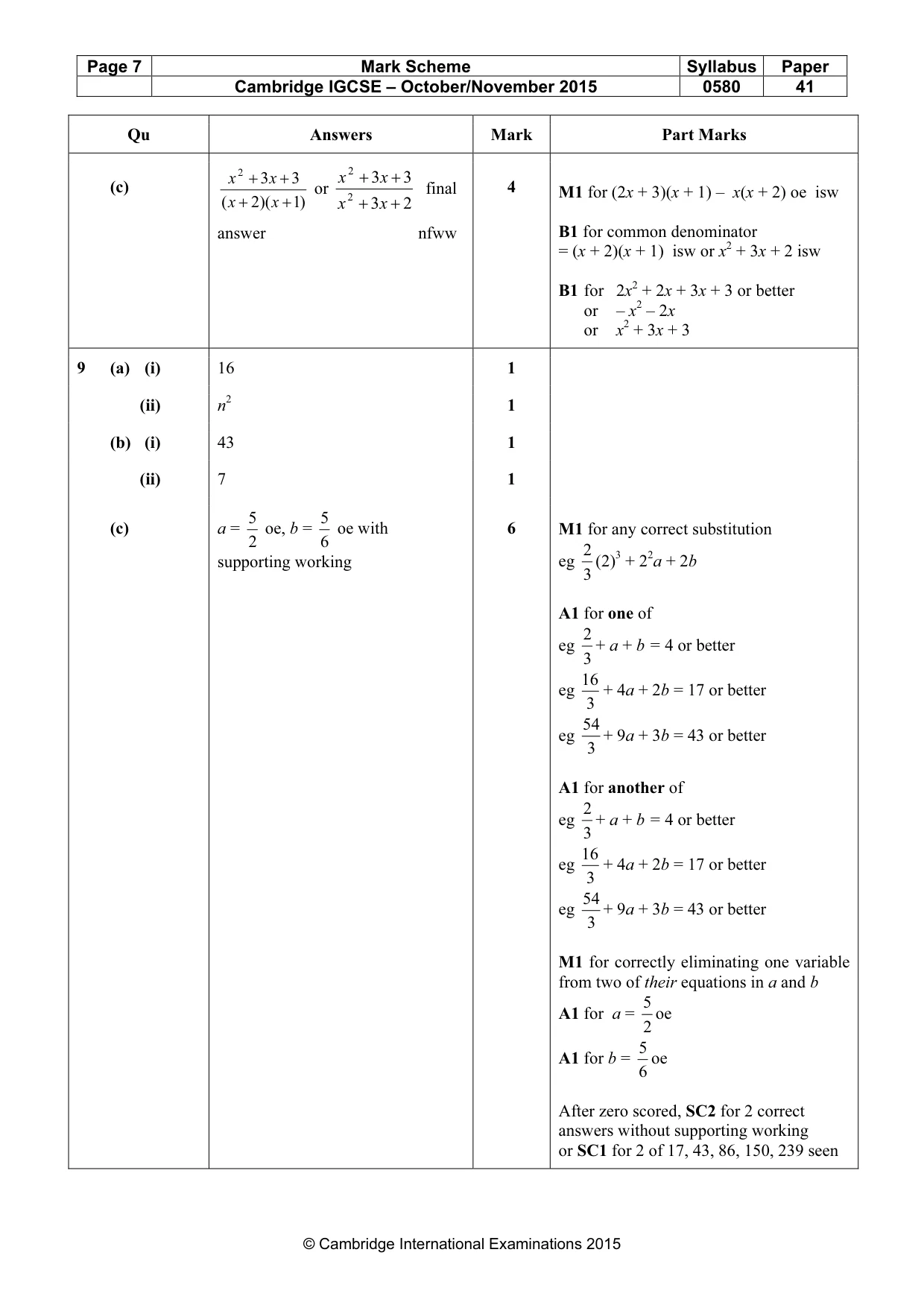
Mark scheme: 8 (a) (x – 5)(x + 2) final answer 2 B1 for (x – 5)(x + 2) seen and then spoiled or M1 for (x + a)(x + b) where a + b = – 3 or ab = –10 [a, b integers] (b) (i) x(x + 2) + 3(x + 1) = 3x(x + 1) or M2 M1 for x(x + 2) + 3(x + 1) or better seen x2 + 2x + 3x + 3 = 3x2 + 3x Allow recovery of omitted brackets for M marks but not A mark 0 = 2x2 – 2x – 3 A1 Brackets expanded correctly and/or no errors or omission of brackets seen (ii) [ −− ]2 ± ([ − ] 2) 2 − 4( 2)( −3) B2 B1 for ([ − ]2 ) 2 − 4 ( 2 )( −3) or 28 2( 2) or .175 oe in completion of square p + q p − q or 0.5 ± .175 and B1 for in form or , r r p = – –2 and r = 2(2) or better or (x – 0.5)2 oe in completion of square – 0.823 and 1.823 final answer B1 B1 If B0B0 for answers, SC1 for – 0.82 or – 0.822… and 1.82 or 1.822.. as final answers or – 0.823 and 1.823 seen or –1.823 and 0.823 as final answers
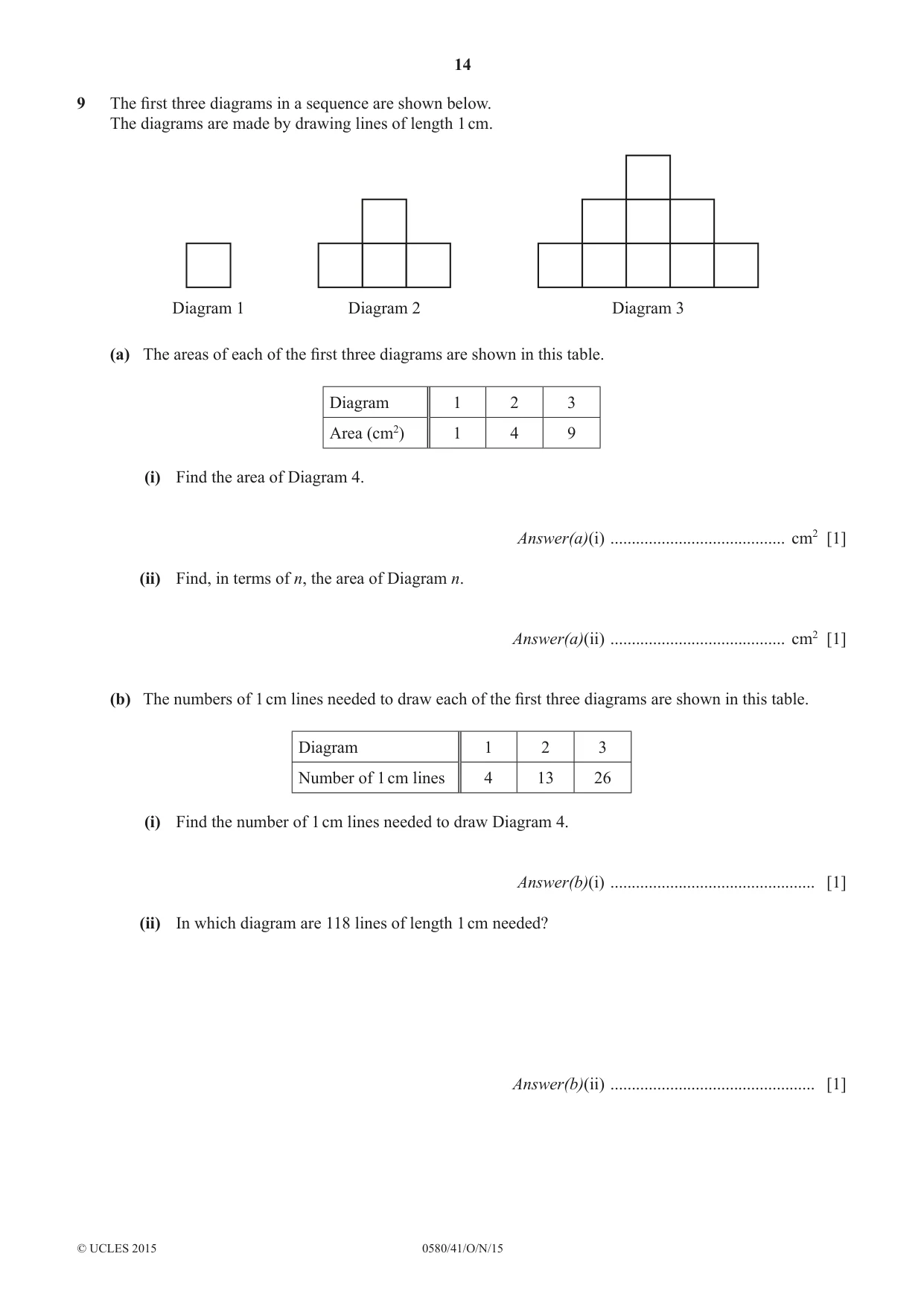
Q9 · The first three diagrams in a sequence are shown below
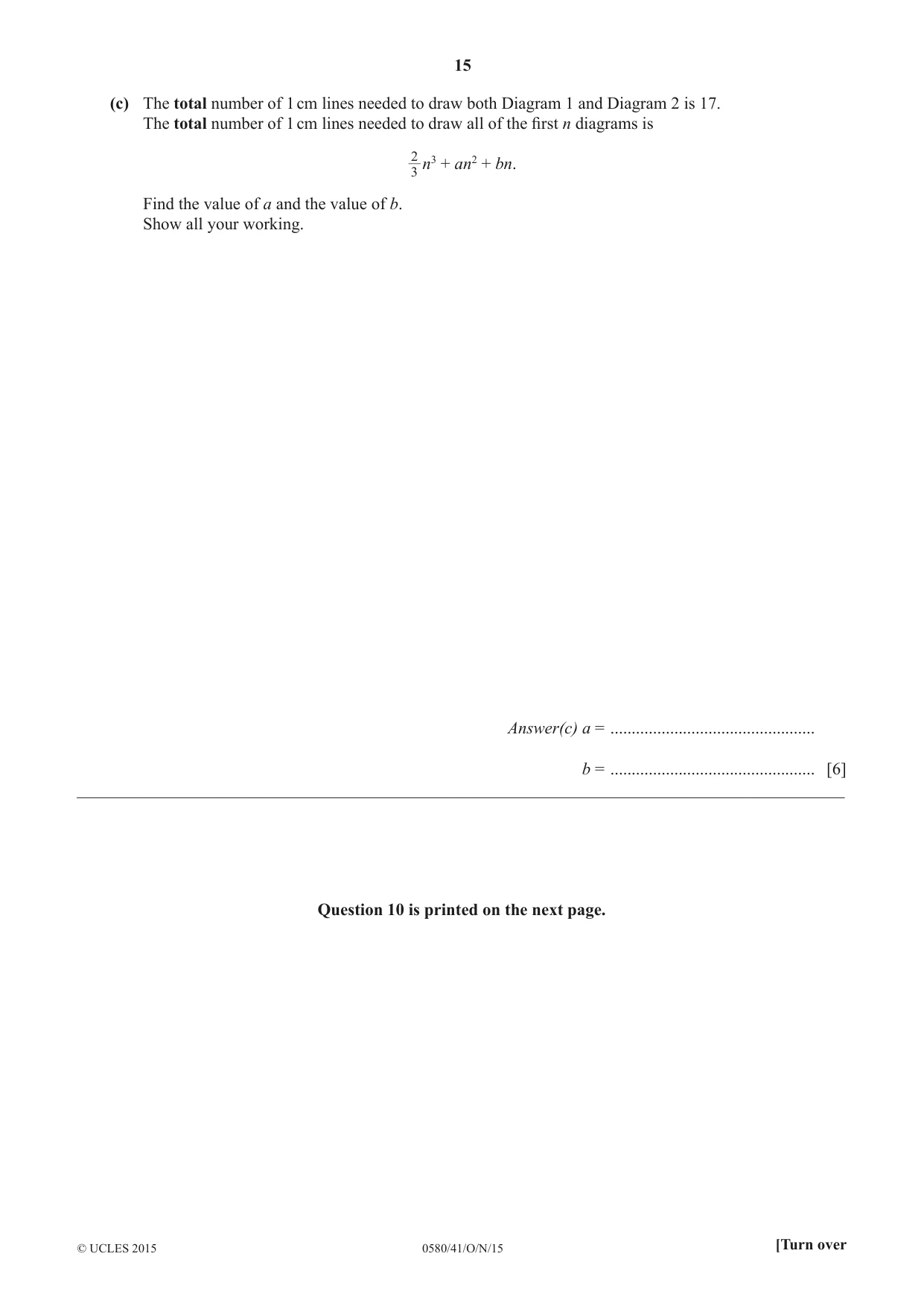
9 The first three diagrams in a sequence are shown below. The diagrams are made by drawing lines of length 1 cm. Diagram 1 Diagram 2 Diagram 3 (a) The areas of each of the first three diagrams are shown in this table. Diagram 1 2 3 Area (cm2) 1 4 9 (i) Find the area of Diagram 4. Answer(a)(i) ......................................... cm2 [1] (ii) Find, in terms of n, the area of Diagram n. Answer(a)(ii) ......................................... cm2 [1] (b) The numbers of 1 cm lines needed to draw each of the first three diagrams are shown in this table. Diagram 1 2 3 Number of 1 cm lines 4 13 26 (i) Find the number of 1 cm lines needed to draw Diagram 4. Answer(b)(i) ................................................ [1] (ii) In which diagram are 118 lines of length 1 cm needed? Answer(b)(ii) ................................................ [1] (c) The total number of 1 cm lines needed to draw both Diagram 1 and Diagram 2 is 17. The total number of 1 cm lines needed to draw all of the first n diagrams is 2 n3 + an2 + bn. 3 Find the value of a and the value of b. Show all your working. Answer(c) a = ................................................ b = ................................................ [6] __________________________________________________________________________________________ Question 10 is printed on the next page.
Mark scheme: 9 (a) (i) 16 1 (ii) n2 1 (b) (i) 43 1 (ii) 7 1 5 5 (c) a = oe, b = oe with 6 M1 for any correct substitution 2 6 2 supporting working eg (2)3 + 22a + 2b 3 A1 for one of 2 eg + a + b = 4 or better 3 16 eg + 4a + 2b = 17 or better 3 54 eg + 9a + 3b = 43 or better 3 A1 for another of 2 eg + a + b = 4 or better 3 16 eg + 4a + 2b = 17 or better 3 54 eg + 9a + 3b = 43 or better 3 M1 for correctly eliminating one variable from two of their equations in a and b 5 A1 for a = oe 2 5 A1 for b = oe 6 After zero scored, SC2 for 2 correct answers without supporting working or SC1 for 2 of 17, 43, 86, 150, 239 seen
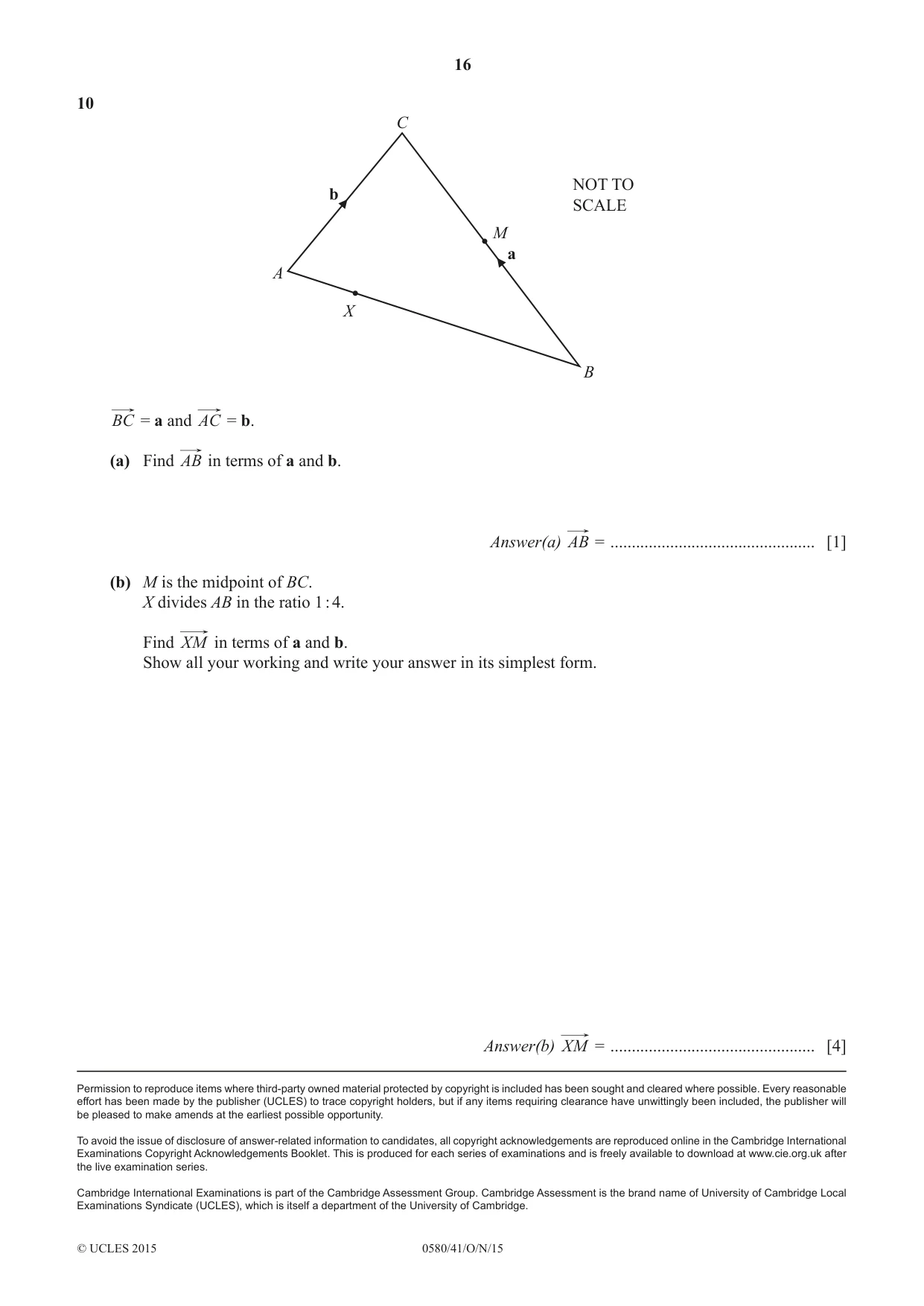
Q10 · C NOT TO b SCALE M a A X B BC = a and AC = b
10 C NOT TO b SCALE M a A X B BC = a and AC = b. (a) Find AB in terms of a and b. Answer(a) AB = ................................................ [1] (b) M is the midpoint of BC. X divides AB in the ratio 1 : 4. Find XM in terms of a and b. Show all your working and write your answer in its simplest form. Answer(b) XM = ................................................ [4]
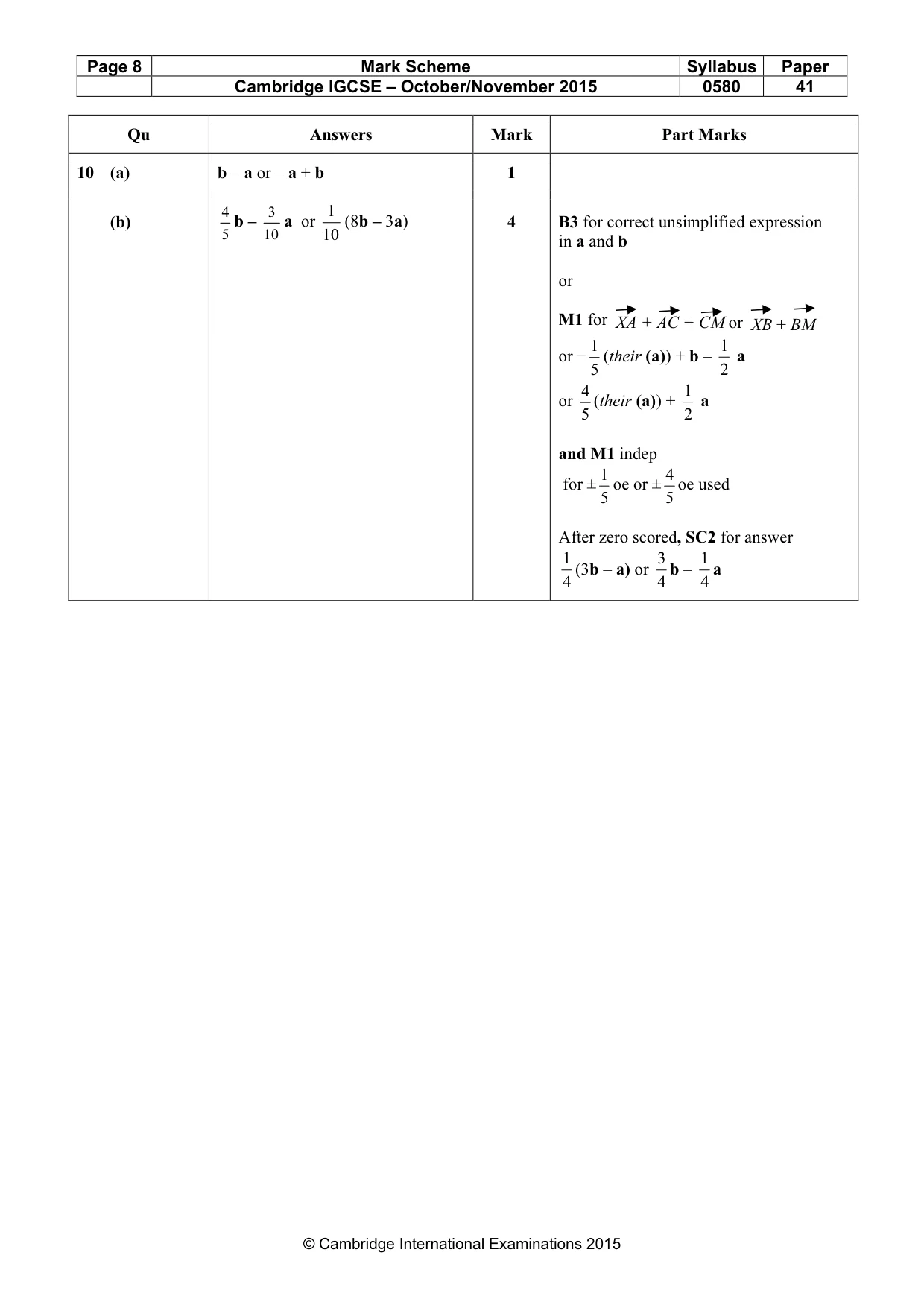
Mark scheme: 10 (a) b – a or – a + b 1 4 3 1 (b) b – a or (8b – 3a) 4 B3 for correct unsimplified expression 5 10 10 in a and b or M1 for XA + AC + CM or XB + BM 1 1 or −5 (their (a)) + b – 2 a 4 1 or (their (a)) + a 5 2 and M1 indep 1 4 for ± oe or ± oe used 5 5 After zero scored, SC2 for answer 1 3 1 (3b – a) or b – a 4 4 4
What was in this paper
The subtopics covered by these 10 questions, and how many questions each got. Open one in a new tab to see every Cambridge question on it.
What you needed in this session
Cambridge’s own grade thresholds for 2015 Oct/Nov, Paper 4 · Variant 1. A higher threshold means an easier paper — the bar moves with how the cohort did.