Cambridge IGCSE Mathematics 0580 — 2008 May/June Paper 4 · Variant 1
0580/41/M/J/08 · 10 questions · 130 marks · ≈146 min
The question paper and its mark scheme, free to read here and free to download. This is Cambridge’s own paper, exactly as it was sat.
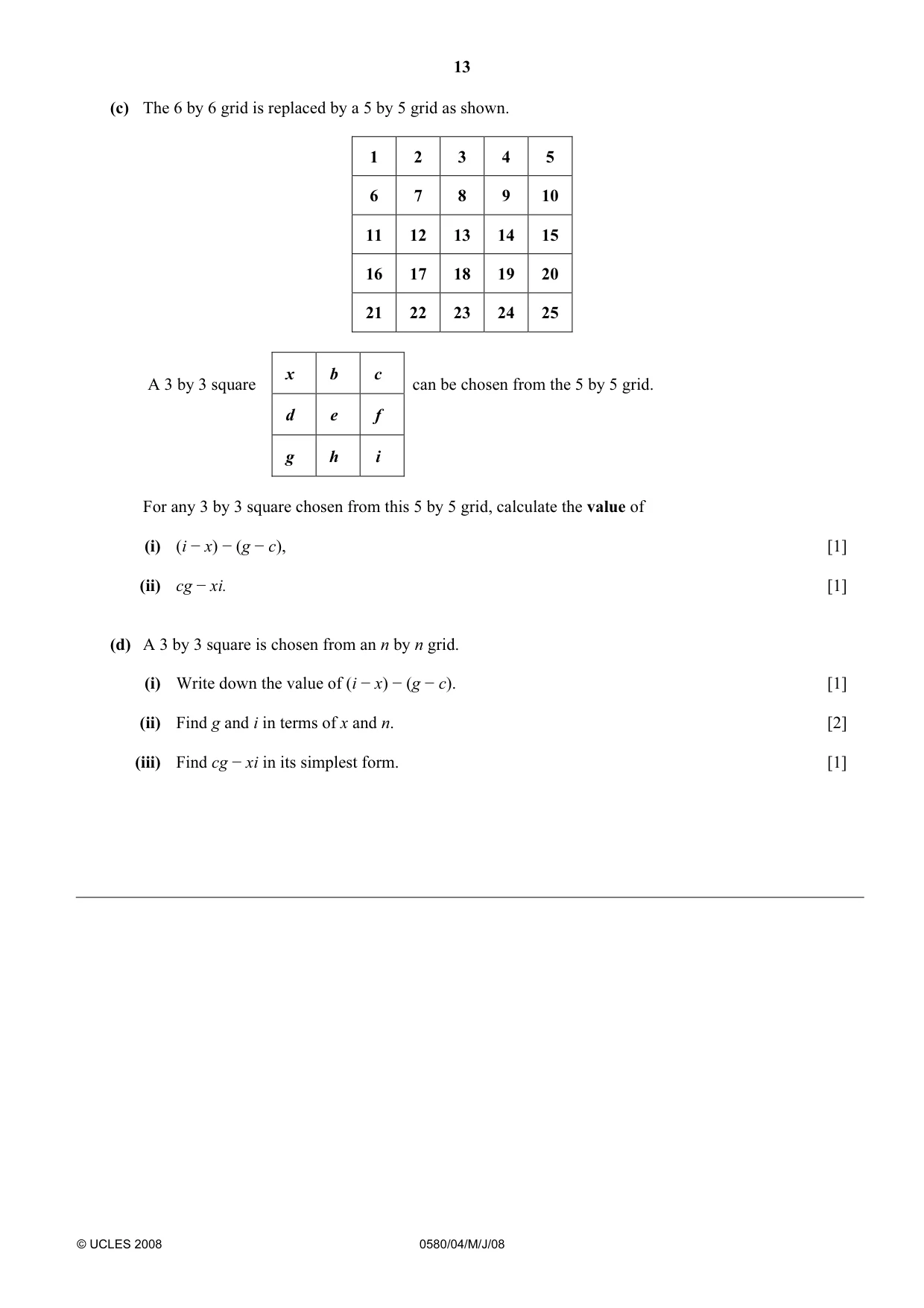
Question paper16 pages


Mark scheme5 pages
Answers below. Sit the paper first if you are practising.
Questions as text
Q1 · Vreni took part in a charity walk
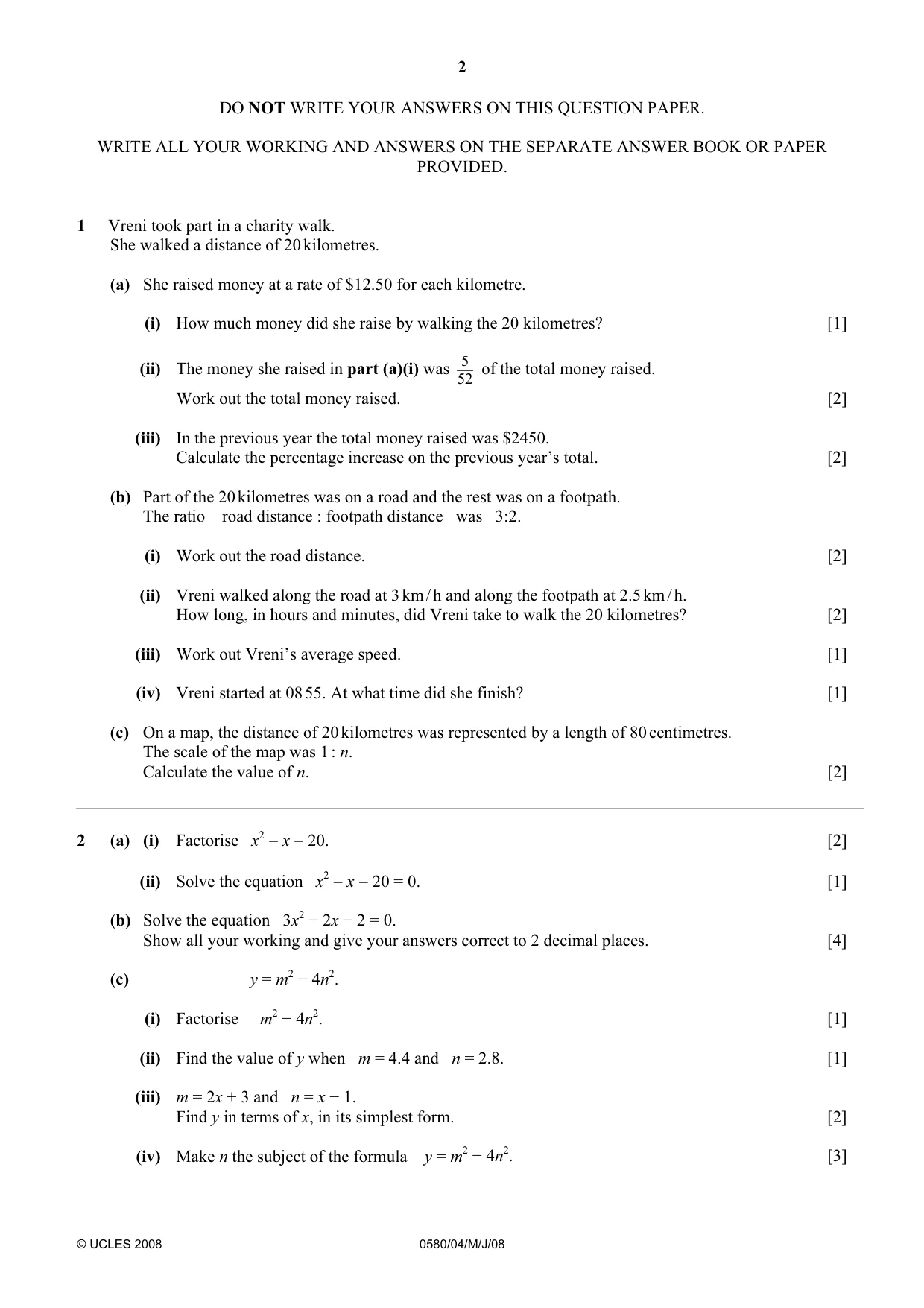
1 Vreni took part in a charity walk. She walked a distance of 20 kilometres. (a) She raised money at a rate of $12.50 for each kilometre. (i) How much money did she raise by walking the 20 kilometres? [1] 5 (ii) The money she raised in part (a)(i) was of the total money raised. 52 Work out the total money raised. [2] (iii) In the previous year the total money raised was $2450. Calculate the percentage increase on the previous year’s total. [2] (b) Part of the 20 kilometres was on a road and the rest was on a footpath. The ratio road distance : footpath distance was 3:2. (i) Work out the road distance. [2] (ii) Vreni walked along the road at 3 km / h and along the footpath at 2.5 km / h. How long, in hours and minutes, did Vreni take to walk the 20 kilometres? [2] (iii) Work out Vreni’s average speed. [1] (iv) Vreni started at 08 55. At what time did she finish? [1] (c) On a map, the distance of 20 kilometres was represented by a length of 80 centimetres. The scale of the map was 1 : n. Calculate the value of n. [2]
Mark scheme: 1 (a) (i) 250 B1 (ii) their (a)(i) ÷ 5× 52 o.e. M1 SC1 for 12.5 ÷ 5× 52, implied by 130 2600 ft www2 A1 ft (iii) their (a)(ii) − 2450 their (a)(ii) 2450 150 × 100 o.e. × 100 − 100 , = M1 2450 2450 100 x A1ft 6.1(22……..) ft www2 ft M & A only if their (a)(ii) > 2450 (b) (i) 20 ÷ 5× 3 M1 12 www2 A1 Accept 12, 8 or 8, 12 (ii) their (b)(i) ÷ 3 and (20 – their (b)(i)) ÷ 2.5 M1 4 and 3.2 or 7.2 or 7h 20 mins seen imply M1 7 hours 12 mins cao www2 A1 Condone poor notation e.g. 7-12 (iii) 2.78 (2.777–2.778) o.e. cao B1 o.e. must have units stated e.g. o.e. in other units 0.7716..m/s, 46.29 – 46.30 m/min (iv) 16 07 o.e. ft B1 ft ft their (b)(ii) + 08 55 iff finishes on same day and (b)(ii) has hours and mins (c) 20× 100000 ÷ 80 o.e. M1 25 000 or 2.5× 10⁴ www2 A1 25 000 seen in final ans. After M0, SC1 for figs 25 or 0.00004 final answer [13]
Q2 · Factorise x2 − x − 20
2 (a) (i) Factorise x2 − x − 20. [2] (ii) Solve the equation x2 − x − 20 = 0. [1] (b) Solve the equation 3x2 − 2x − 2 = 0. Show all your working and give your answers correct to 2 decimal places. [4] (c) y = m2 − 4n2. (i) Factorise m2 − 4n2. [1] (ii) Find the value of y when m = 4.4 and n = 2.8. [1] (iii) m = 2x + 3 and n = x − 1. Find y in terms of x, in its simplest form. [2] (iv) Make n the subject of the formula y = m2 − 4n2. [3] (d) (i) m4 − 16n4 can be written as (m2 − kn2)(m2 + kn2). Write down the value of k. [1] (ii) Factorise completely m4n − 16n5. [2]
Mark scheme: 2 (a) (i) (x + 4)(x – 5) B2 If B0, SC1 if of form (x ± 4)(x ± 5), (ii) –4, 5 ft B1 ft Only ft the SC –4, and 5 not from (x – 4)(x + 5). (b) 2 B1 for (–2)2–4(3)(–2) (or better) seen − ( −2) ± ( −2) − 4.3 − 2 B1,B1 inside a square root. 2.3 The expression must be in the form p + (or− ) q then B1 for p = –(–2) and r r = 2.3 or better Allow recoveries from incomplete lines –0.55, 1.22 cao B1,B1 If B0, SC1 for –0.5 and 1.2 or both answers correct to 2 or more decimal places (rounded or truncated). –0.54858, 1.21525… (c) (i) (m – 2n)(m + 2n) B1 (ii) –12 B1 (iii) B1 for (4x2 + 6x + 6x + 9) or 20x + 5 o.e. cao final ans B2 (x2 – x – x + 1) or (2x + 3 – 2(x – 1))(2x + 3 + 2(x – 1)) (iv) 4n2 = m2 – y o.e. M1 M1 for correct re-arrangement for n2 term –n2) 2 m 2 − y (may be n = o.e. M1 M1 for correct division by 4 or – 4 4 M1 for correctly taking square root of n² m 2 − y M1 term ( n ) = o.e. www3 4 2 2 y ± m m − y Mark final answer SC2 for or o.e. ww 4 4 (d) (i) 4 or –4 or ±4 B1 (ii) n(m4 – 16n4) or M1 Correctly taking out n or a correct factor (m2n – 4n3)(m2 + 4n2) or with n still in one bracket (m2n + 4n3)(m2 – 4n2) or n(m – 2n)(m + 2n)(m2 + 4n2) A1 Must be final answer [17] IGCSE – May/June 2008 0580, 0581 04
Q3 · Bag A Bag B Nadia must choose a ball from Bag A or from Bag B
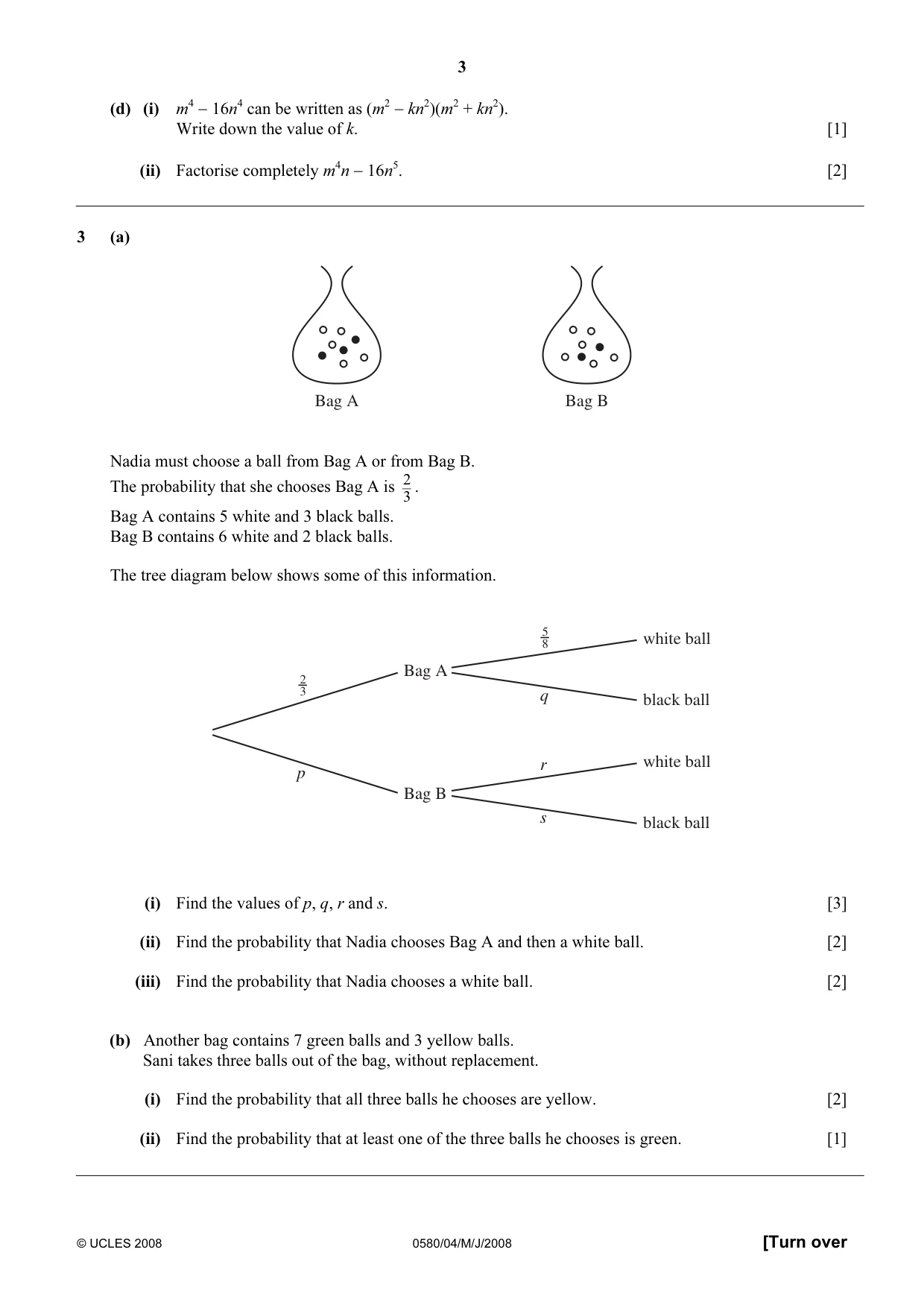
3 (a) Bag A Bag B Nadia must choose a ball from Bag A or from Bag B. 2 The probability that she chooses Bag A is . 3 Bag A contains 5 white and 3 black balls. Bag B contains 6 white and 2 black balls. The tree diagram below shows some of this information. 5 8 white ball Bag A 2 3 q black ball r white ball p Bag B s black ball (i) Find the values of p, q, r and s. [3] (ii) Find the probability that Nadia chooses Bag A and then a white ball. [2] (iii) Find the probability that Nadia chooses a white ball. [2] (b) Another bag contains 7 green balls and 3 yellow balls. Sani takes three balls out of the bag, without replacement. (i) Find the probability that all three balls he chooses are yellow. [2] (ii) Find the probability that at least one of the three balls he chooses is green. [1]
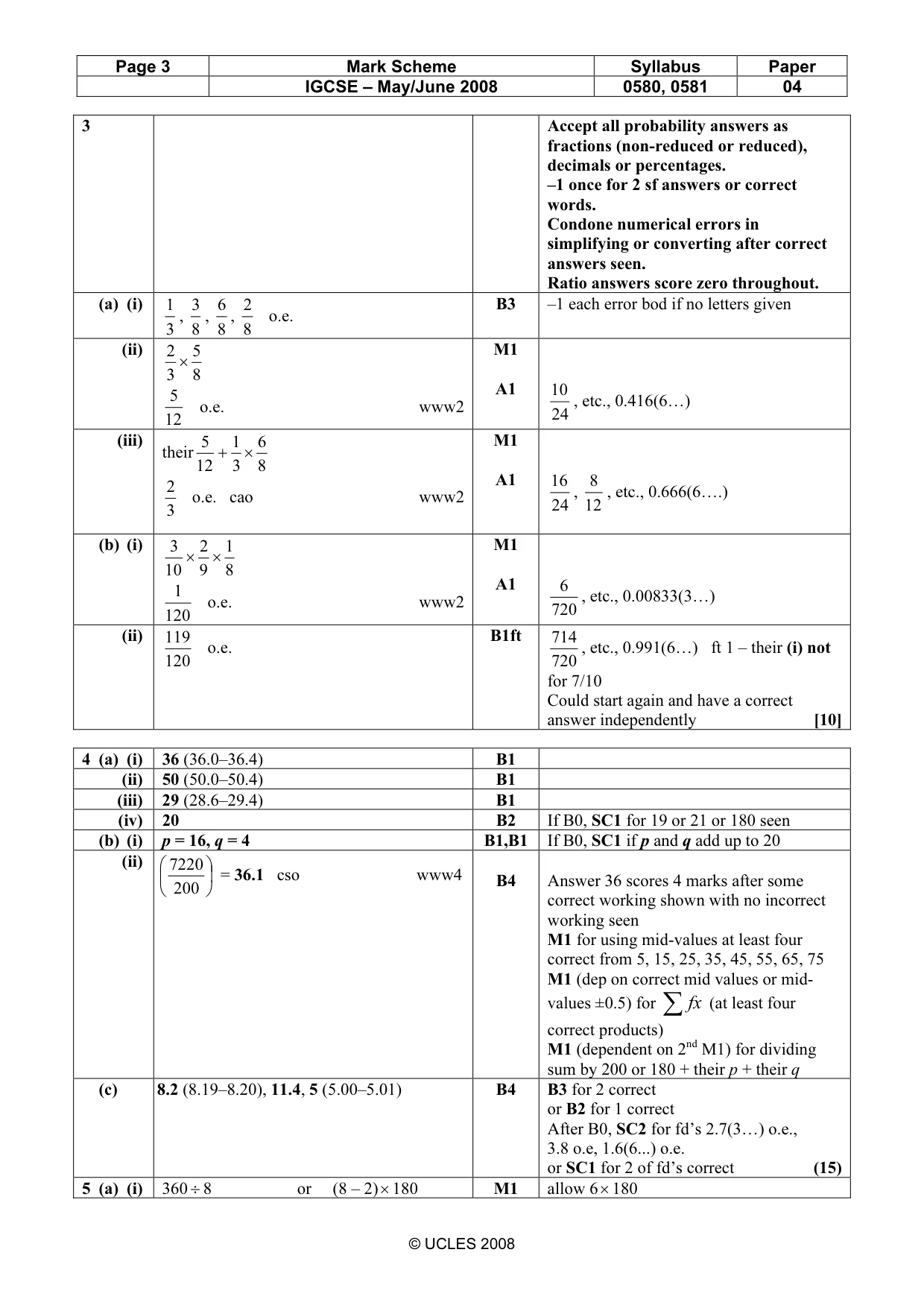
Mark scheme: 3 Accept all probability answers as fractions (non-reduced or reduced), decimals or percentages. –1 once for 2 sf answers or correct words. Condone numerical errors in simplifying or converting after correct answers seen. Ratio answers score zero throughout. (a) (i) 1 3 6 2 B3 –1 each error bod if no letters given , , , o.e. 3 8 8 8 (ii) 2 5 M1 × 3 8 A1 10 5 , etc., 0.416(6…) o.e. www2 24 12 (iii) 5 1 6 M1 their + × 12 3 8 A1 16 8 2 , , etc., 0.666(6….) o.e. cao www2 24 12 3 (b) (i) 3 2 1 M1 × × 10 9 8 A1 6 1 , etc., 0.00833(3…) o.e. www2 720 120 (ii) 119 B1ft 714 o.e. , etc., 0.991(6…) ft 1 – their (i) not 120 720 for 7/10 Could start again and have a correct answer independently [10]
Q4 · 200 180 160 140 120 Cumulative frequency 100 ( h) 80 60 40 20 0 0 10 20 30 40 50 60 70 80…
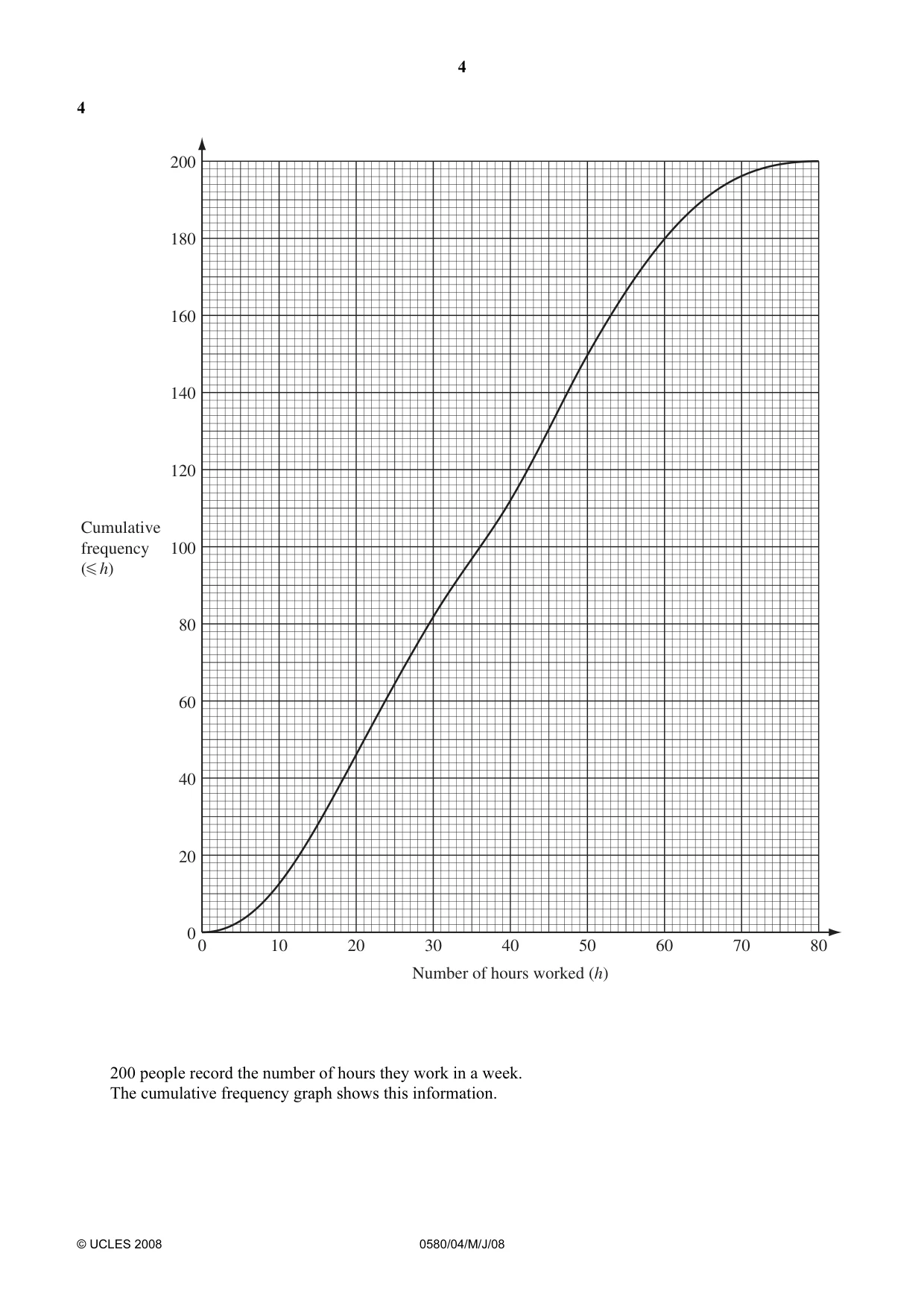
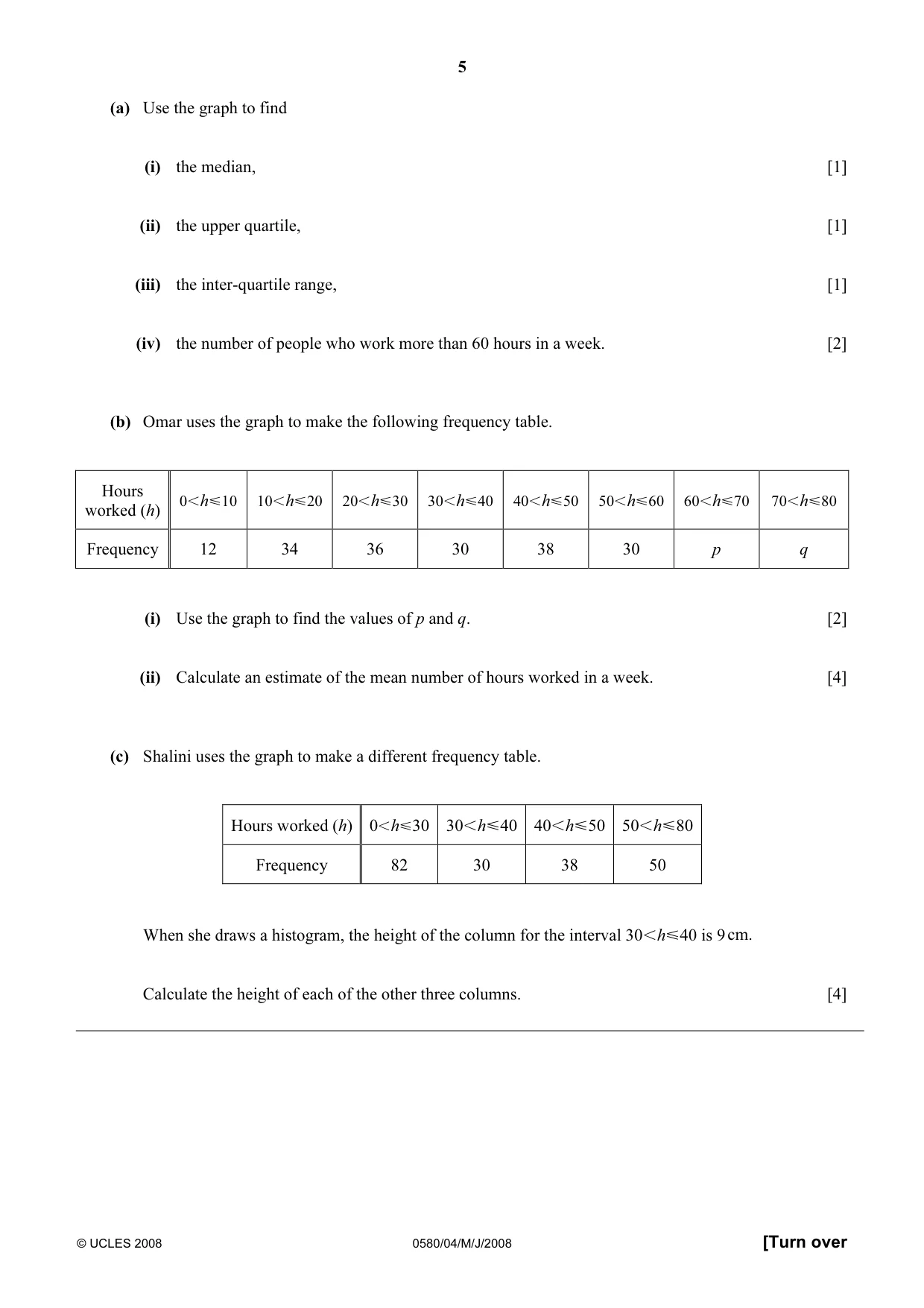
4 200 180 160 140 120 Cumulative frequency 100 ( h) 80 60 40 20 0 0 10 20 30 40 50 60 70 80 Number of hours worked (h) 200 people record the number of hours they work in a week. The cumulative frequency graph shows this information. (a) Use the graph to find (i) the median, [1] (ii) the upper quartile, [1] (iii) the inter-quartile range, [1] (iv) the number of people who work more than 60 hours in a week. [2] (b) Omar uses the graph to make the following frequency table. Hours 0IhY10 10IhY20 20IhY30 30IhY40 40IhY50 50IhY60 60IhY70 70IhY80 worked (h) Frequency 12 34 36 30 38 30 p q (i) Use the graph to find the values of p and q. [2] (ii) Calculate an estimate of the mean number of hours worked in a week. [4] (c) Shalini uses the graph to make a different frequency table. Hours worked (h) 0IhY30 30IhY40 40IhY50 50IhY80 Frequency 82 30 38 50 When she draws a histogram, the height of the column for the interval 30IhY40 is 9 cm. Calculate the height of each of the other three columns. [4]
Mark scheme: 4 (a) (i) 36 (36.0–36.4) B1 (ii) 50 (50.0–50.4) B1 (iii) 29 (28.6–29.4) B1 (iv) 20 B2 If B0, SC1 for 19 or 21 or 180 seen (b) (i) p = 16, q = 4 B1,B1 If B0, SC1 if p and q add up to 20 (ii) 7220 = 36.1 cso www4 B4 Answer 36 scores 4 marks after some 200 correct working shown with no incorrect working seen M1 for using mid-values at least four correct from 5, 15, 25, 35, 45, 55, 65, 75 M1 (dep on correct mid values or mid- values ±0.5) for (at least four ∑fx correct products) M1 (dependent on 2nd M1) for dividing sum by 200 or 180 + their p + their q (c) 8.2 (8.19–8.20), 11.4, 5 (5.00–5.01) B4 B3 for 2 correct or B2 for 1 correct After B0, SC2 for fd’s 2.7(3…) o.e., 3.8 o.e, 1.6(6...) o.e. or SC1 for 2 of fd’s correct (15)
Q5 · E F Q NOT TO SCALE D G O C H P B 12 cm A A circle, centre O, touches all the sides of the…
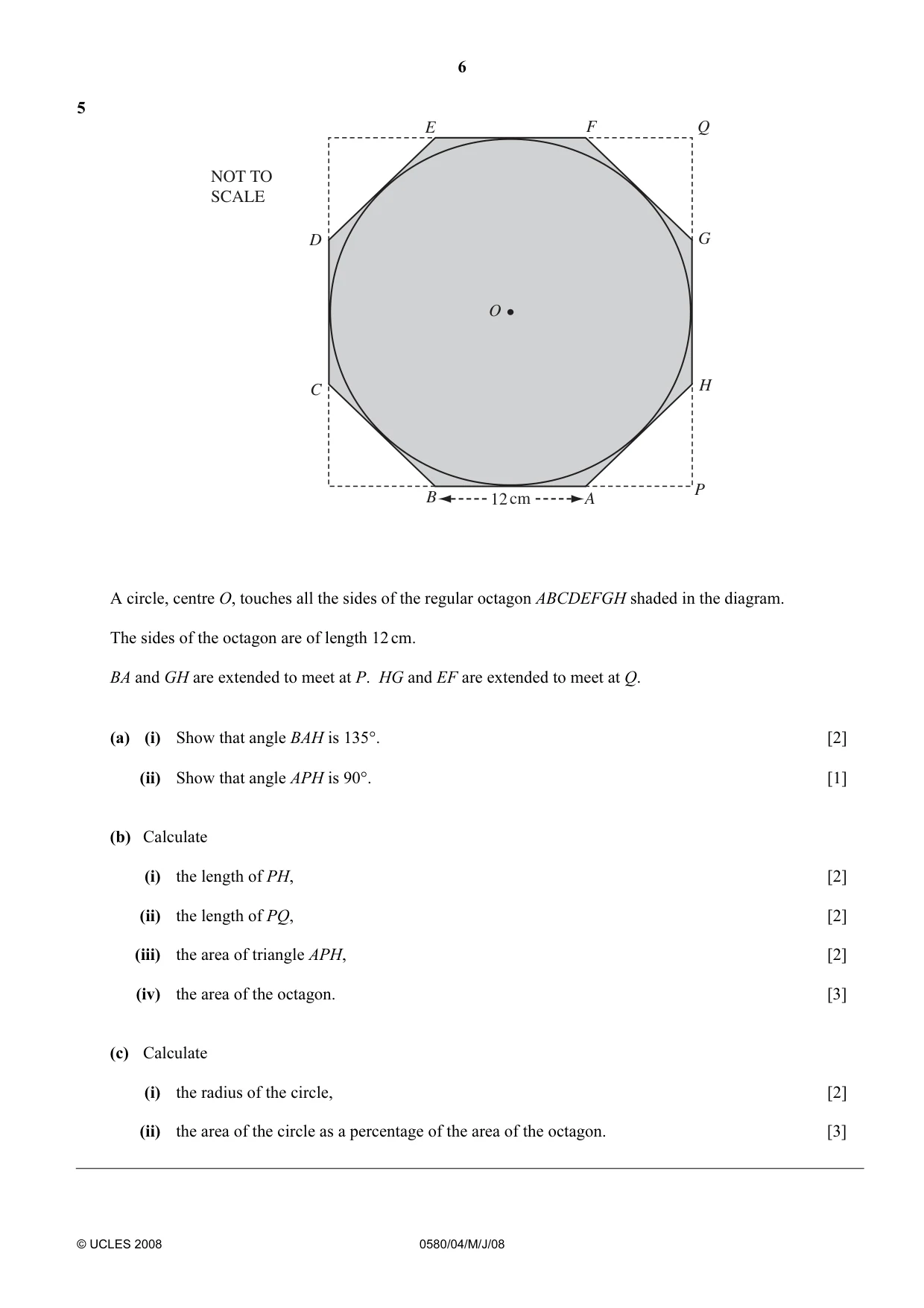
5 E F Q NOT TO SCALE D G O C H P B 12 cm A A circle, centre O, touches all the sides of the regular octagon ABCDEFGH shaded in the diagram. The sides of the octagon are of length 12 cm. BA and GH are extended to meet at P. HG and EF are extended to meet at Q. (a) (i) Show that angle BAH is 135°. [2] (ii) Show that angle APH is 90°. [1] (b) Calculate (i) the length of PH, [2] (ii) the length of PQ, [2] (iii) the area of triangle APH, [2] (iv) the area of the octagon. [3] (c) Calculate (i) the radius of the circle, [2] (ii) the area of the circle as a percentage of the area of the octagon. [3]
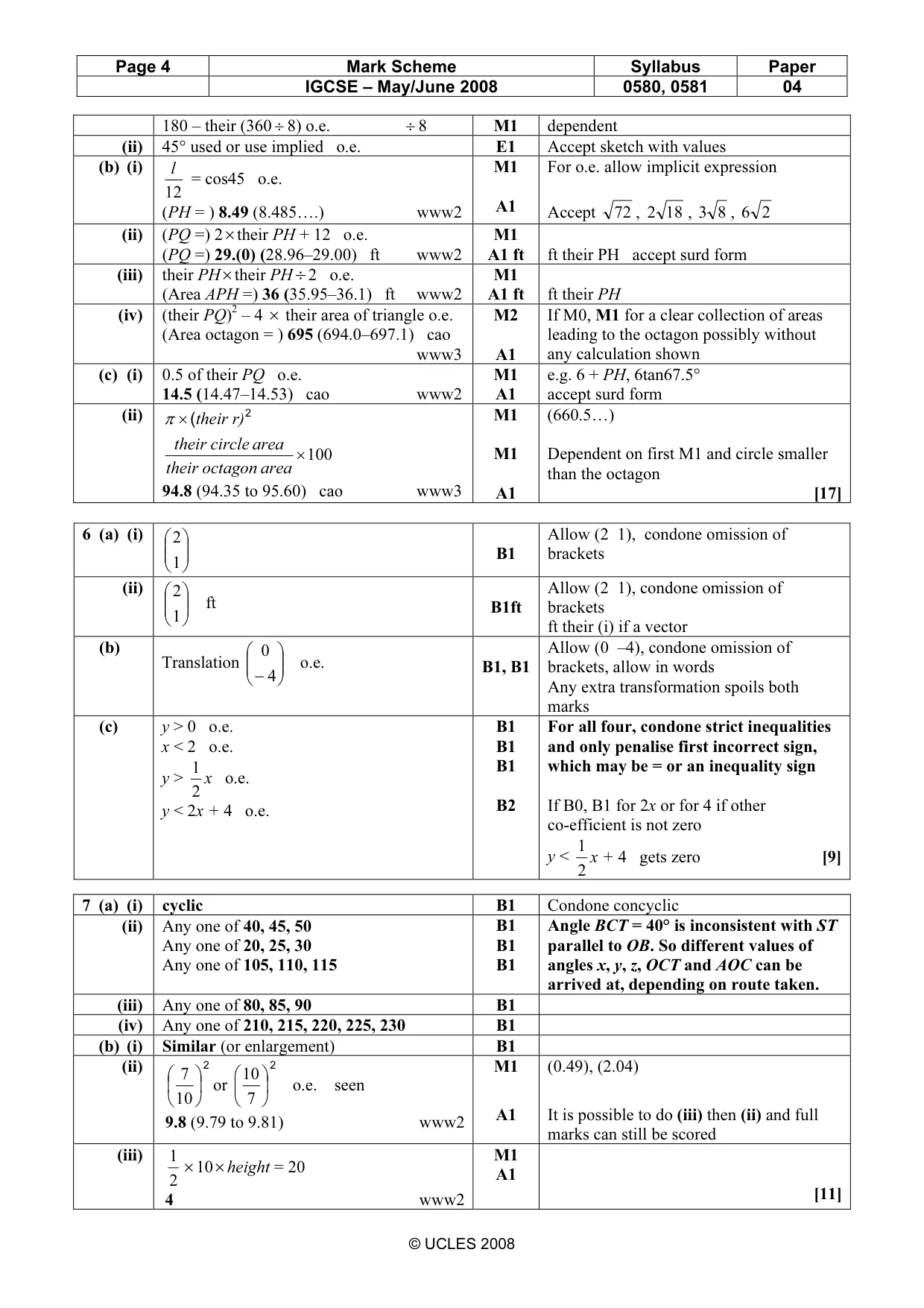
Mark scheme: 5 (a) (i) 360 ÷ 8 or (8 – 2)× 180 M1 allow 6× 180 IGCSE – May/June 2008 0580, 0581 04 180 – their (360 ÷ 8) o.e. ÷ 8 M1 dependent (ii) 45° used or use implied o.e. E1 Accept sketch with values (b) (i) l M1 For o.e. allow implicit expression = cos45 o.e. 12 A1 (PH = ) 8.49 (8.485….) www2 Accept 72 , 2 18 , 3 8 , 6 2 (ii) (PQ =) 2×their PH + 12 o.e. M1 (PQ =) 29.(0) (28.96–29.00) ft www2 A1 ft ft their PH accept surd form (iii) their PH×their PH ÷2 o.e. M1 (Area APH =) 36 (35.95–36.1) ft www2 A1 ft ft their PH (iv) (their PQ)2 – 4 × their area of triangle o.e. M2 If M0, M1 for a clear collection of areas (Area octagon = ) 695 (694.0–697.1) cao leading to the octagon possibly without www3 A1 any calculation shown (c) (i) 0.5 of their PQ o.e. M1 e.g. 6 + PH, 6tan67.5° 14.5 (14.47–14.53) cao www2 A1 accept surd form (ii) π × ( their r) 2 M1 (660.5…) their circle area × 100 M1 Dependent on first M1 and circle smaller their octagon area than the octagon 94.8 (94.35 to 95.60) cao www3 A1 [17]
Q6 · Y C 5 B 4 3 2 1 D A x –4 –3 –2 –1 O 1 2 3 4 –1 The pentagon OABCD is shown on the grid…
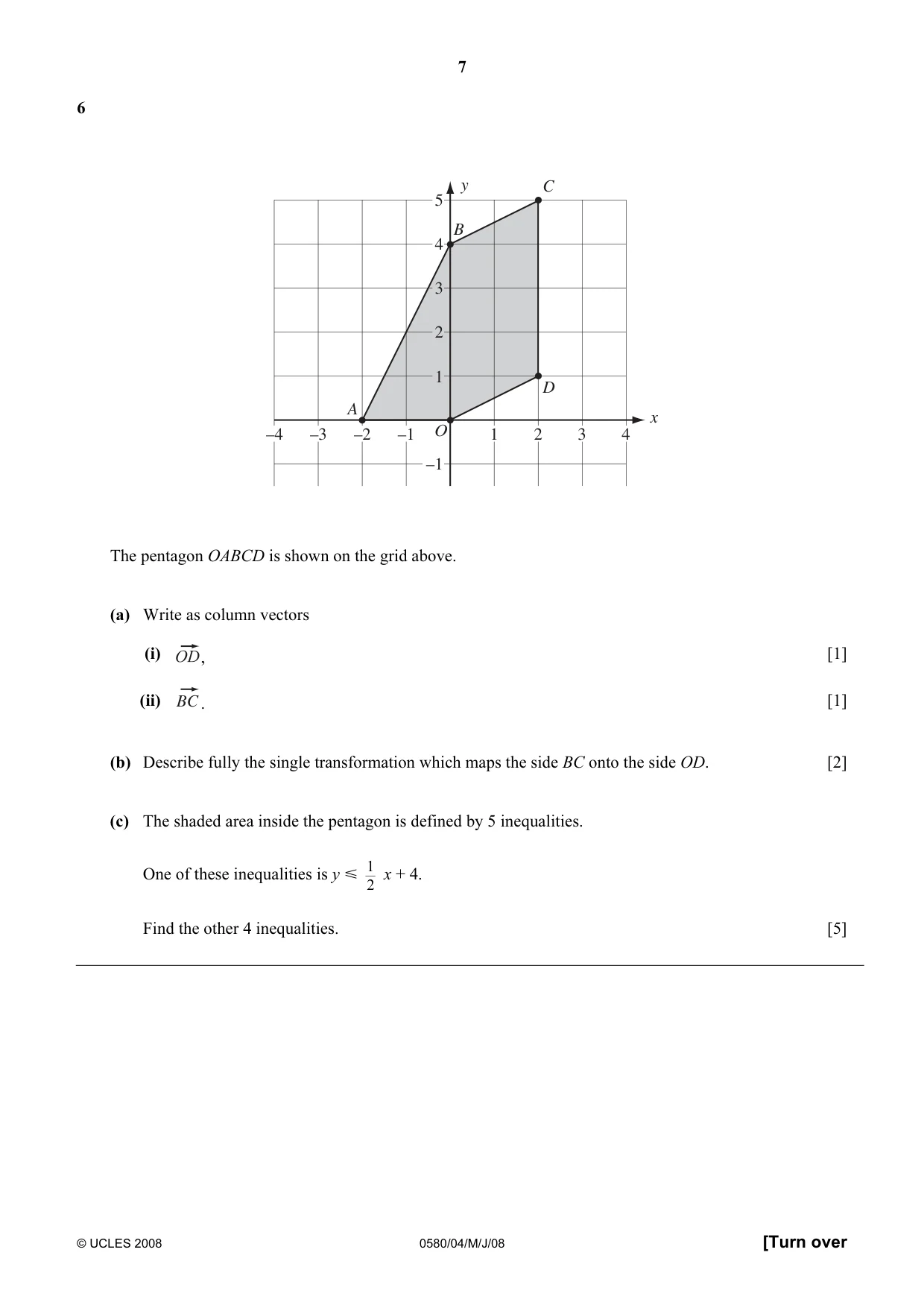
6 y C 5 B 4 3 2 1 D A x –4 –3 –2 –1 O 1 2 3 4 –1 The pentagon OABCD is shown on the grid above. (a) Write as column vectors (i) , [1] (ii) BC . [1] (b) Describe fully the single transformation which maps the side BC onto the side OD. [2] (c) The shaded area inside the pentagon is defined by 5 inequalities. 1 One of these inequalities is y Y x + 4. 2 Find the other 4 inequalities. [5]
Mark scheme: 6 (a) (i) 2 Allow (2 1), condone omission of B1 brackets 1 (ii) 2 Allow (2 1), condone omission of ft B1ft brackets 1 ft their (i) if a vector (b) 0 Allow (0 –4), condone omission of Translation o.e. B1, B1 brackets, allow in words −4 Any extra transformation spoils both marks (c) y > 0 o.e. B1 For all four, condone strict inequalities x < 2 o.e. B1 and only penalise first incorrect sign, 1 B1 which may be = or an inequality sign y > x o.e. 2 B2 If B0, B1 for 2x or for 4 if other y < 2x + 4 o.e. co-efficient is not zero 1 y < x + 4 gets zero [9] 2
Q7 · S C NOT TO SCALE 40° D z° T O 130° x° y° A B A, B, C and D lie on a circle, centre O
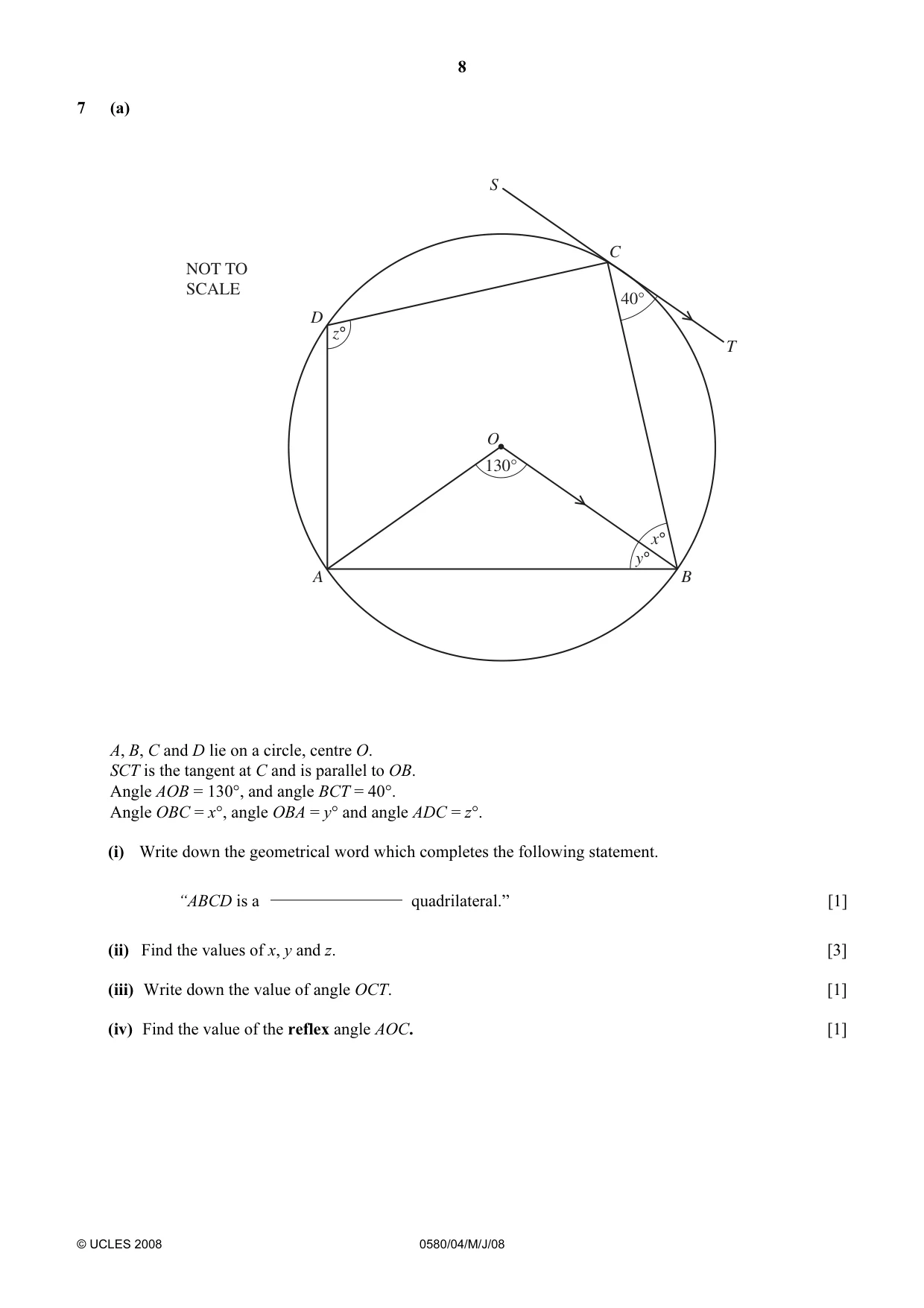
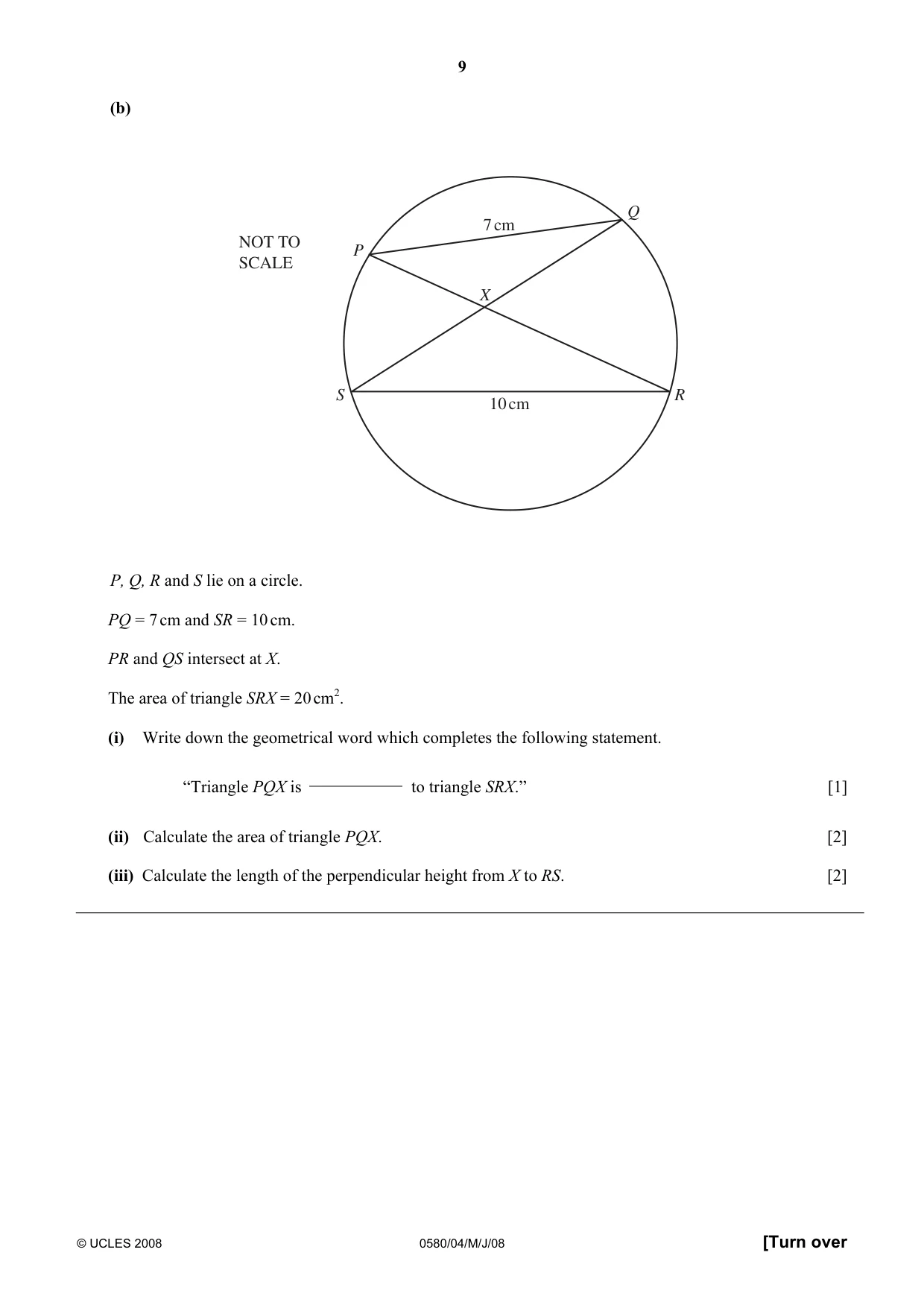
7 (a) S C NOT TO SCALE 40° D z° T O 130° x° y° A B A, B, C and D lie on a circle, centre O. SCT is the tangent at C and is parallel to OB. Angle AOB = 130°, and angle BCT = 40°. Angle OBC = x°, angle OBA = y° and angle ADC = z°. (i) Write down the geometrical word which completes the following statement. “ABCD is a quadrilateral.” [1] (ii) Find the values of x, y and z. [3] (iii) Write down the value of angle OCT. [1] (iv) Find the value of the reflex angle AOC. [1] (b) Q 7 cm NOT TO P SCALE X S R 10 cm P, Q, R and S lie on a circle. PQ = 7 cm and SR = 10 cm. PR and QS intersect at X. The area of triangle SRX = 20 cm2. (i) Write down the geometrical word which completes the following statement. “Triangle PQX is to triangle SRX.” [1] (ii) Calculate the area of triangle PQX. [2] (iii) Calculate the length of the perpendicular height from X to RS. [2]
Mark scheme: 7 (a) (i) cyclic B1 Condone concyclic (ii) Any one of 40, 45, 50 B1 Angle BCT = 40° is inconsistent with ST Any one of 20, 25, 30 B1 parallel to OB. So different values of Any one of 105, 110, 115 B1 angles x, y, z, OCT and AOC can be arrived at, depending on route taken. (iii) Any one of 80, 85, 90 B1 (iv) Any one of 210, 215, 220, 225, 230 B1 (b) (i) Similar (or enlargement) B1 (ii) 2 2 M1 (0.49), (2.04) 7 10 or o.e. seen 10 7 A1 It is possible to do (iii) then (ii) and full 9.8 (9.79 to 9.81) www2 marks can still be scored (iii) 1 M1 ×10×height = 20 A1 2 [11] 4 www2 IGCSE – May/June 2008 0580, 0581 04
Q8 · Answer the whole of this question on a sheet of graph paper
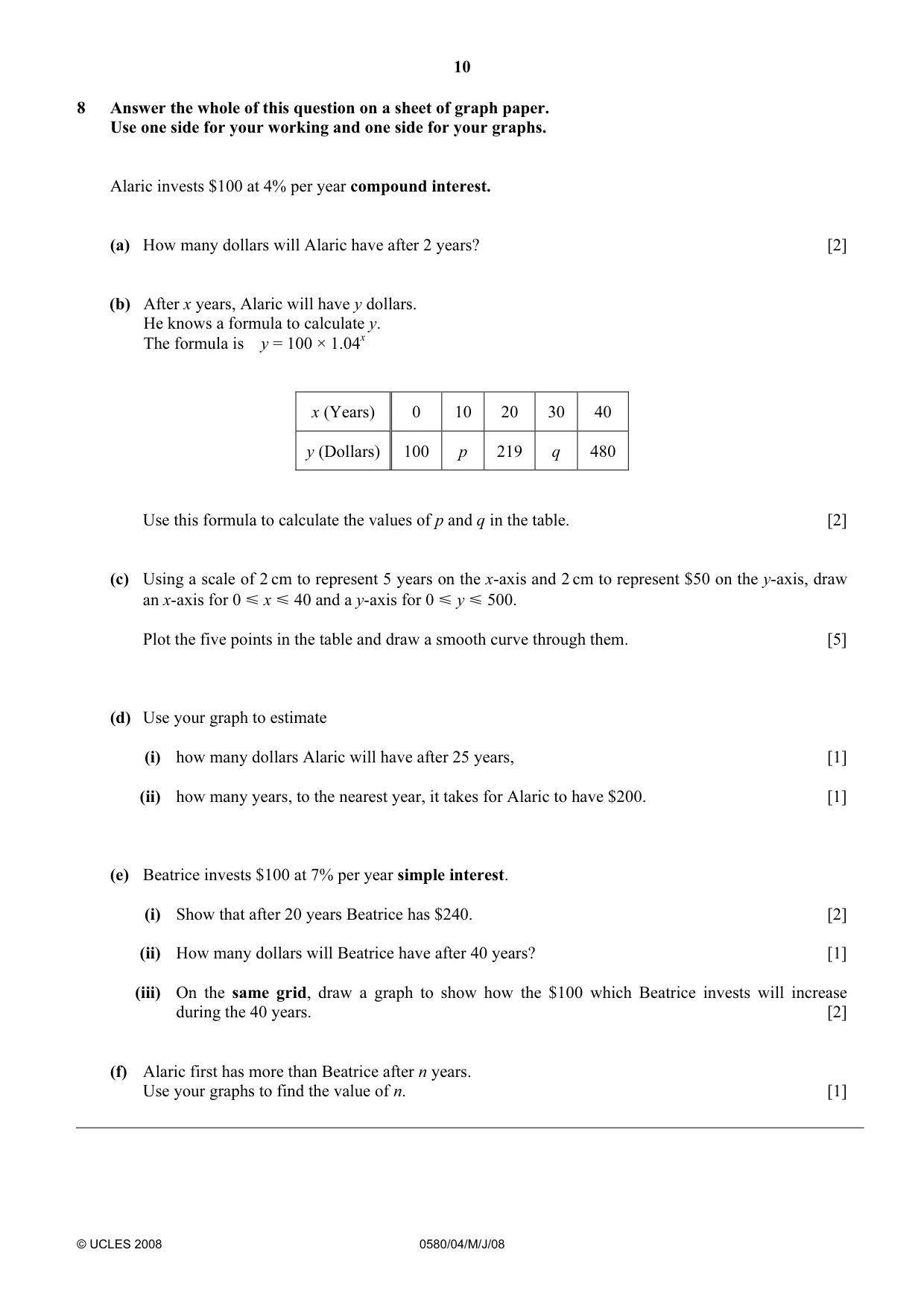
8 Answer the whole of this question on a sheet of graph paper. Use one side for your working and one side for your graphs. Alaric invests $100 at 4% per year compound interest. (a) How many dollars will Alaric have after 2 years? [2] (b) After x years, Alaric will have y dollars. He knows a formula to calculate y. The formula is y = 100 × 1.04x x (Years) 0 10 20 30 40 y (Dollars) 100 p 219 q 480 Use this formula to calculate the values of p and q in the table. [2] (c) Using a scale of 2 cm to represent 5 years on the x-axis and 2 cm to represent $50 on the y-axis, draw an x-axis for 0 Y x Y 40 and a y-axis for 0 Y y Y 500. Plot the five points in the table and draw a smooth curve through them. [5] (d) Use your graph to estimate (i) how many dollars Alaric will have after 25 years, [1] (ii) how many years, to the nearest year, it takes for Alaric to have $200. [1] (e) Beatrice invests $100 at 7% per year simple interest. (i) Show that after 20 years Beatrice has $240. [2] (ii) How many dollars will Beatrice have after 40 years? [1] (iii) On the same grid, draw a graph to show how the $100 which Beatrice invests will increase during the 40 years. [2] (f) Alaric first has more than Beatrice after n years. Use your graphs to find the value of n. [1]
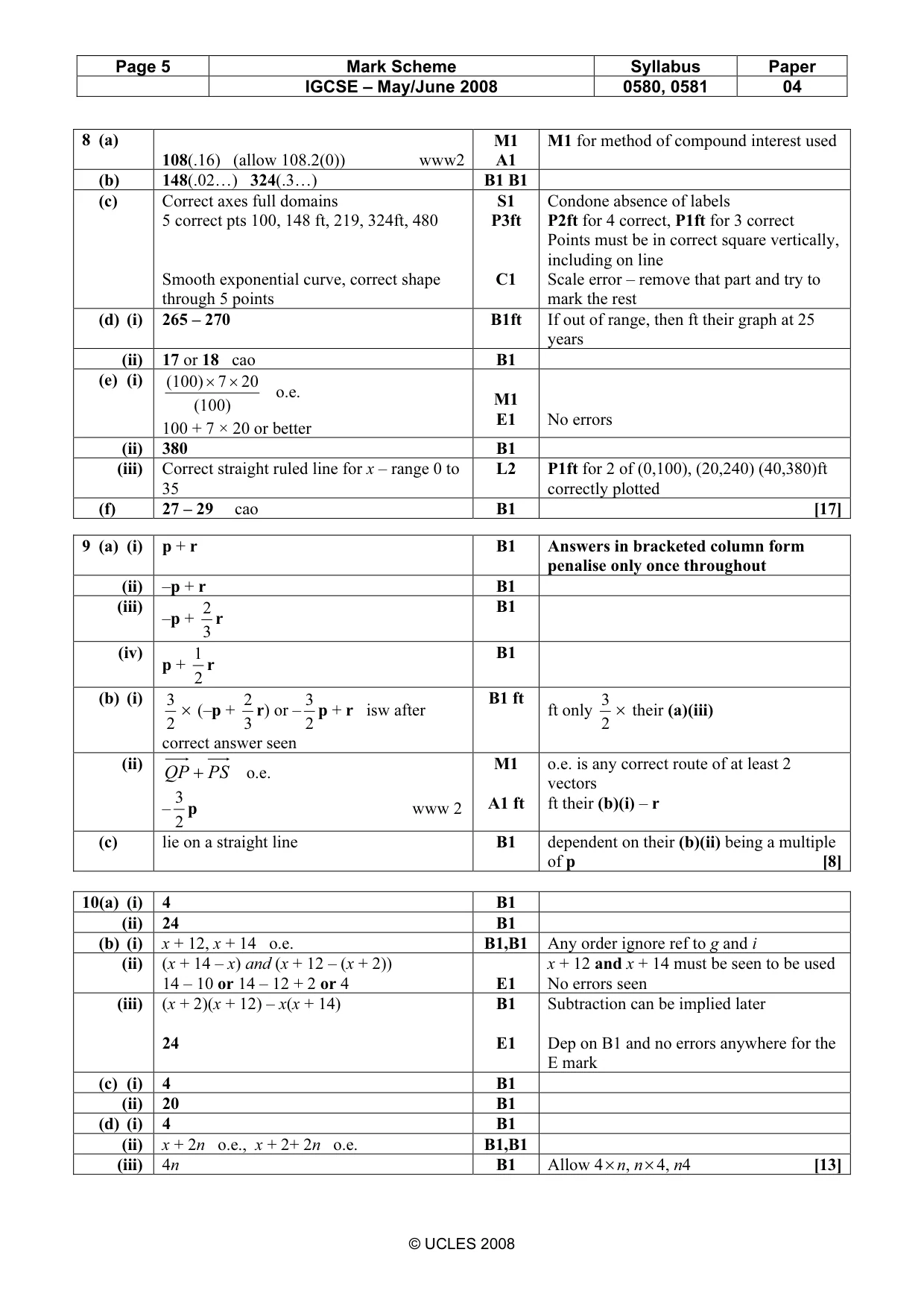
Mark scheme: 8 (a) M1 M1 for method of compound interest used 108(.16) (allow 108.2(0)) www2 A1 (b) 148(.02…) 324(.3…) B1 B1 (c) Correct axes full domains S1 Condone absence of labels 5 correct pts 100, 148 ft, 219, 324ft, 480 P3ft P2ft for 4 correct, P1ft for 3 correct Points must be in correct square vertically, including on line Smooth exponential curve, correct shape C1 Scale error – remove that part and try to through 5 points mark the rest (d) (i) 265 – 270 B1ft If out of range, then ft their graph at 25 years (ii) 17 or 18 cao B1 (e) (i) (100) × 7 × 20 o.e. M1 (100) E1 No errors 100 + 7 × 20 or better (ii) 380 B1 (iii) Correct straight ruled line for x – range 0 to L2 P1ft for 2 of (0,100), (20,240) (40,380)ft 35 correctly plotted (f) 27 – 29 cao B1 [17]
Q9 · S R Q NOT TO SCALE L M O P OPQR is a parallelogram
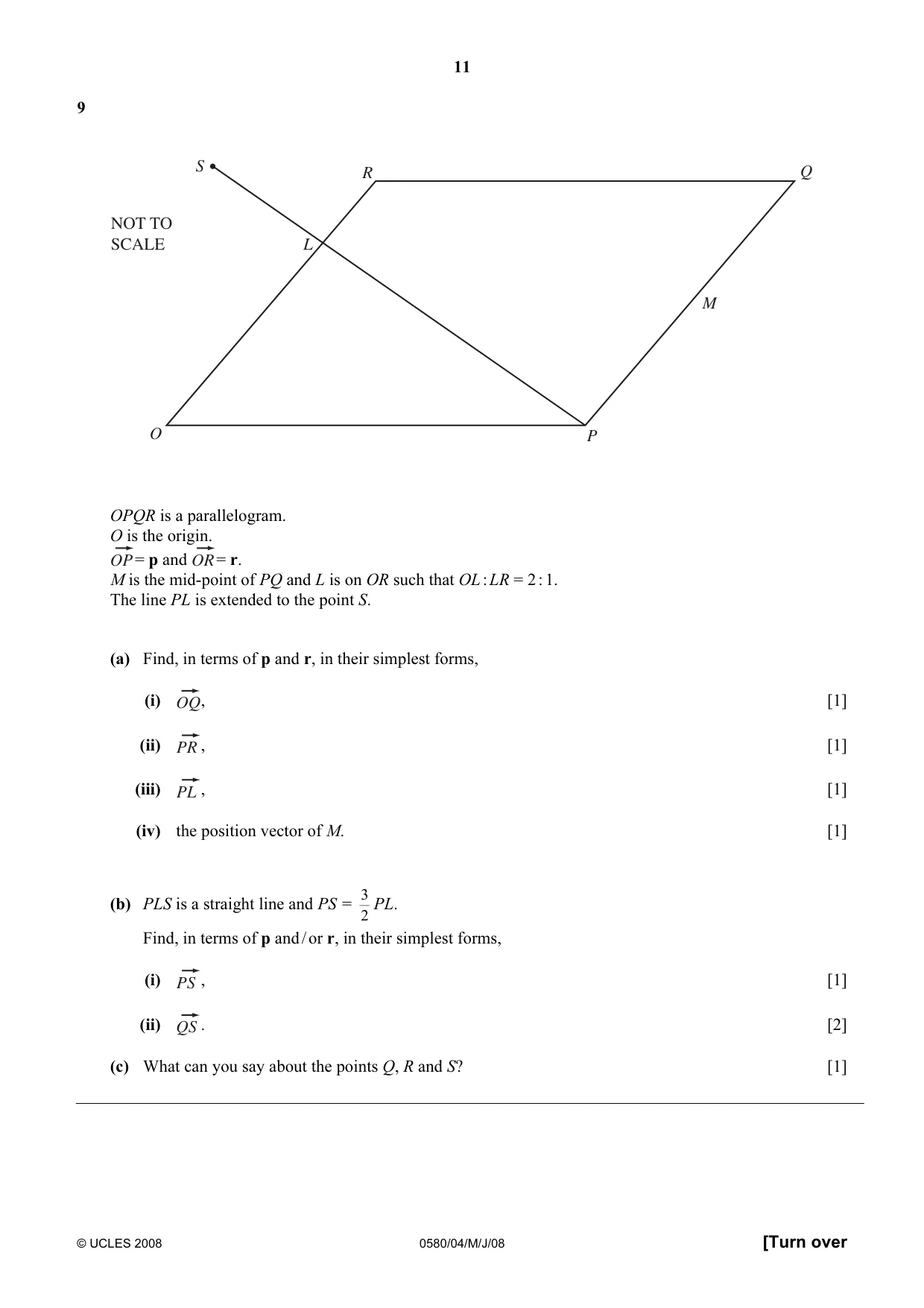
9 S R Q NOT TO SCALE L M O P OPQR is a parallelogram. O is the origin. OP= p and OR= r. M is the mid-point of PQ and L is on OR such that OL : LR = 2 : 1. The line PL is extended to the point S. (a) Find, in terms of p and r, in their simplest forms, (i) OQ, [1] (ii) PR , [1] (iii) PL , [1] (iv) the position vector of M. [1] 3 (b) PLS is a straight line and PS = PL. 2 Find, in terms of p and / or r, in their simplest forms, (i) PS , [1] (ii) QS . [2] (c) What can you say about the points Q, R and S? [1]
Mark scheme: 9 (a) (i) p + r B1 Answers in bracketed column form penalise only once throughout (ii) –p + r B1 (iii) 2 B1 –p + r 3 (iv) 1 B1 p + r 2 (b) (i) 3 2 3 B1 ft 3 × (–p + r) or – p + r isw after ft only × their (a)(iii) 2 3 2 2 correct answer seen (ii) M1 o.e. is any correct route of at least 2 QP + PS o.e. vectors 3 A1 ft ft their (b)(i) – r – p www 2 2 (c) lie on a straight line B1 dependent on their (b)(ii) being a multiple of p [8]
Q10 · 1 2 3 4 5 6 7 8 9 10 11 12 13 14 15 16 17 18 19 20 21 22 23 24 25 26 27 28 29 30 31 32 33…
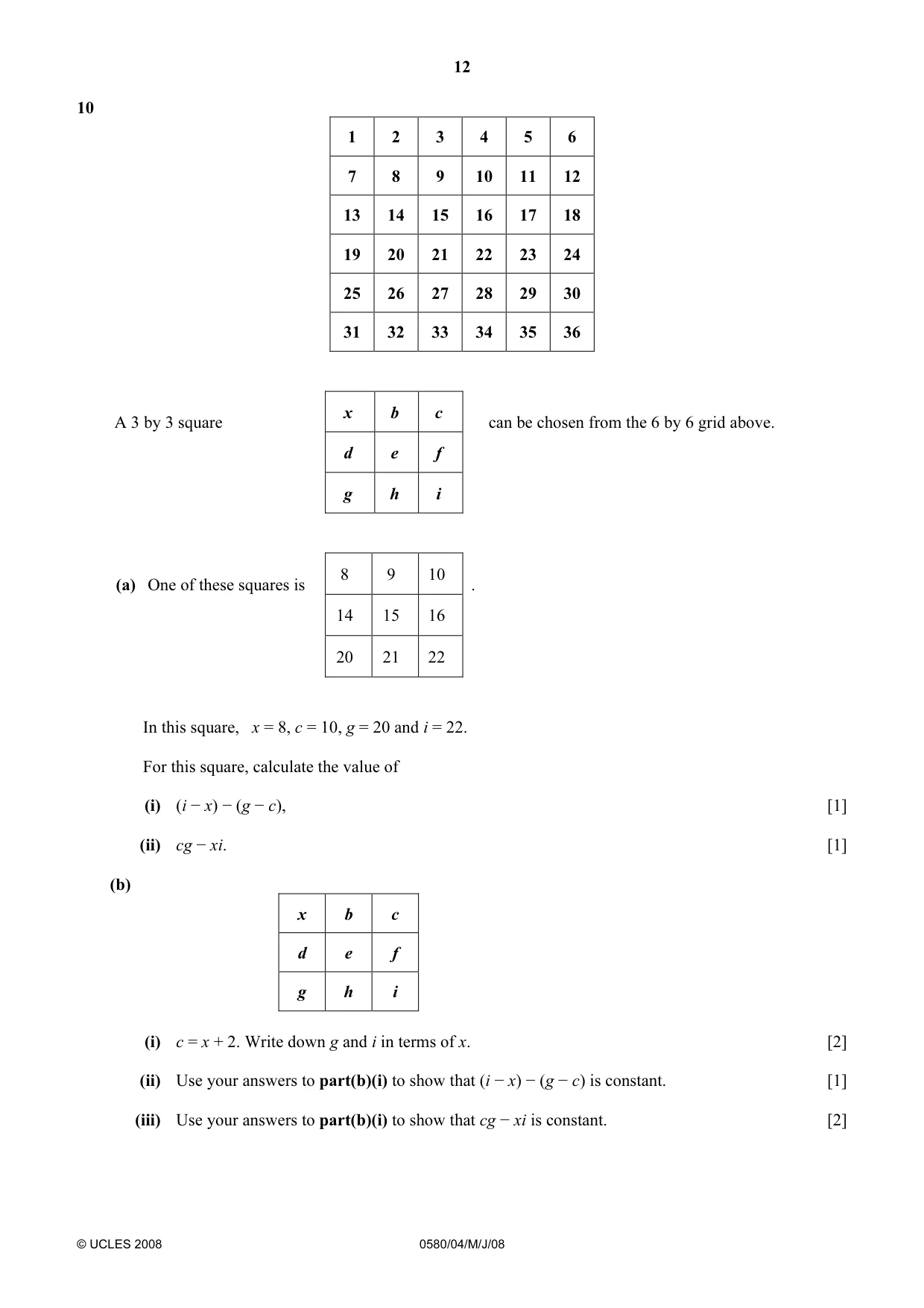
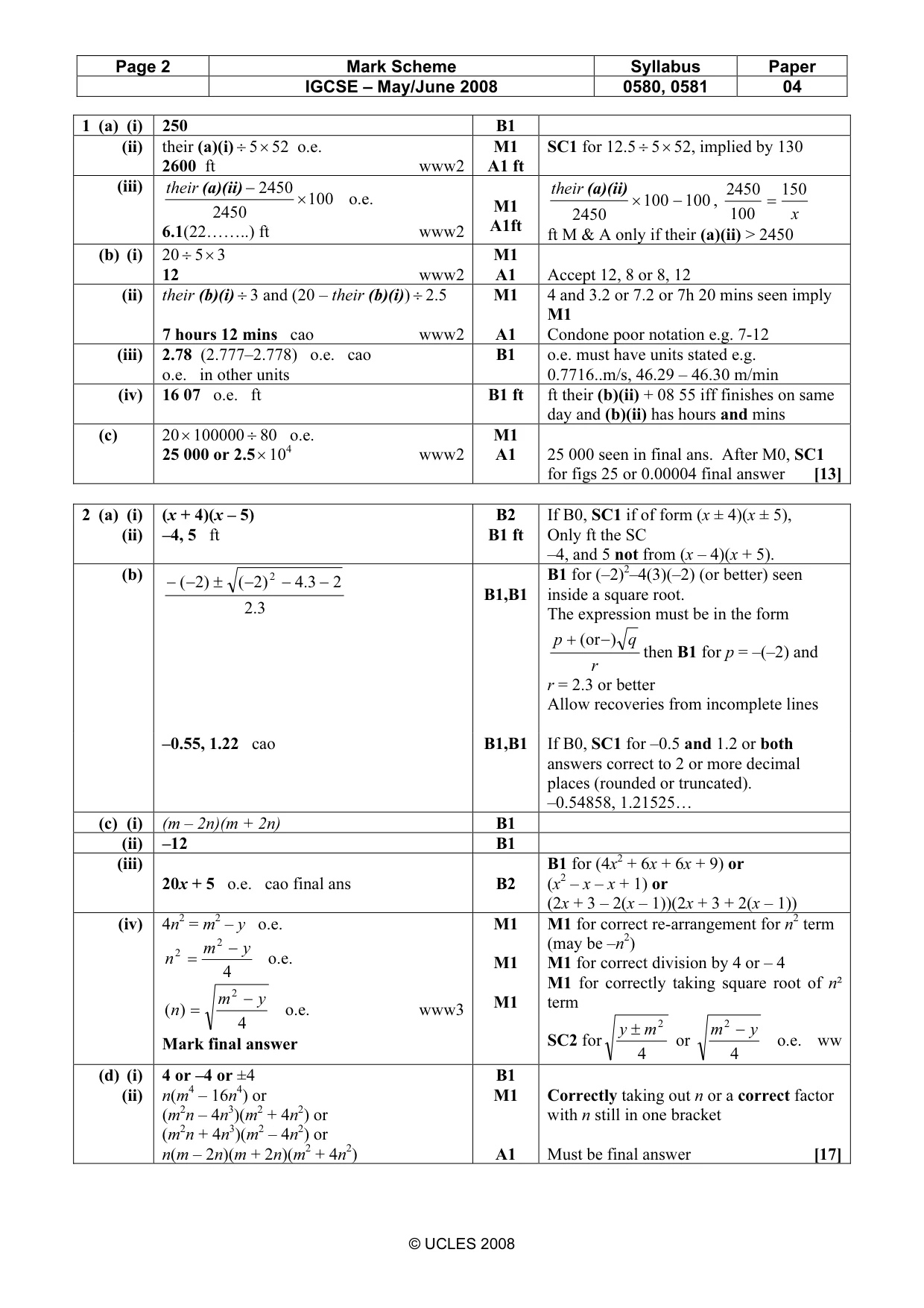
10 1 2 3 4 5 6 7 8 9 10 11 12 13 14 15 16 17 18 19 20 21 22 23 24 25 26 27 28 29 30 31 32 33 34 35 36 x b c A 3 by 3 square can be chosen from the 6 by 6 grid above. d e f g h i 8 9 10 (a) One of these squares is . 14 15 16 20 21 22 In this square, x = 8, c = 10, g = 20 and i = 22. For this square, calculate the value of (i) (i − x) − (g − c), [1] (ii) cg − xi. [1] (b) x b c d e f g h i (i) c = x + 2. Write down g and i in terms of x. [2] (ii) Use your answers to part(b)(i) to show that (i − x) − (g − c) is constant. [1] (iii) Use your answers to part(b)(i) to show that cg − xi is constant. [2] (c) The 6 by 6 grid is replaced by a 5 by 5 grid as shown. 1 2 3 4 5 6 7 8 9 10 11 12 13 14 15 16 17 18 19 20 21 22 23 24 25 x b c A 3 by 3 square can be chosen from the 5 by 5 grid. d e f g h i For any 3 by 3 square chosen from this 5 by 5 grid, calculate the value of (i) (i − x) − (g − c), [1] (ii) cg − xi. [1] (d) A 3 by 3 square is chosen from an n by n grid. (i) Write down the value of (i − x) − (g − c). [1] (ii) Find g and i in terms of x and n. [2] (iii) Find cg − xi in its simplest form. [1]
Mark scheme: 10(a) (i) 4 B1 (ii) 24 B1 (b) (i) x + 12, x + 14 o.e. B1,B1 Any order ignore ref to g and i (ii) (x + 14 – x) and (x + 12 – (x + 2)) x + 12 and x + 14 must be seen to be used 14 – 10 or 14 – 12 + 2 or 4 E1 No errors seen (iii) (x + 2)(x + 12) – x(x + 14) B1 Subtraction can be implied later 24 E1 Dep on B1 and no errors anywhere for the E mark (c) (i) 4 B1 (ii) 20 B1 (d) (i) 4 B1 (ii) x + 2n o.e., x + 2+ 2n o.e. B1,B1 (iii) 4n B1 Allow 4×n, n×4, n4 [13]
What was in this paper
The subtopics covered by these 10 questions, and how many questions each got. Open one in a new tab to see every Cambridge question on it.
What you needed in this session
Cambridge’s own grade thresholds for 2008 May/June, Paper 4 · Variant 1. A higher threshold means an easier paper — the bar moves with how the cohort did.