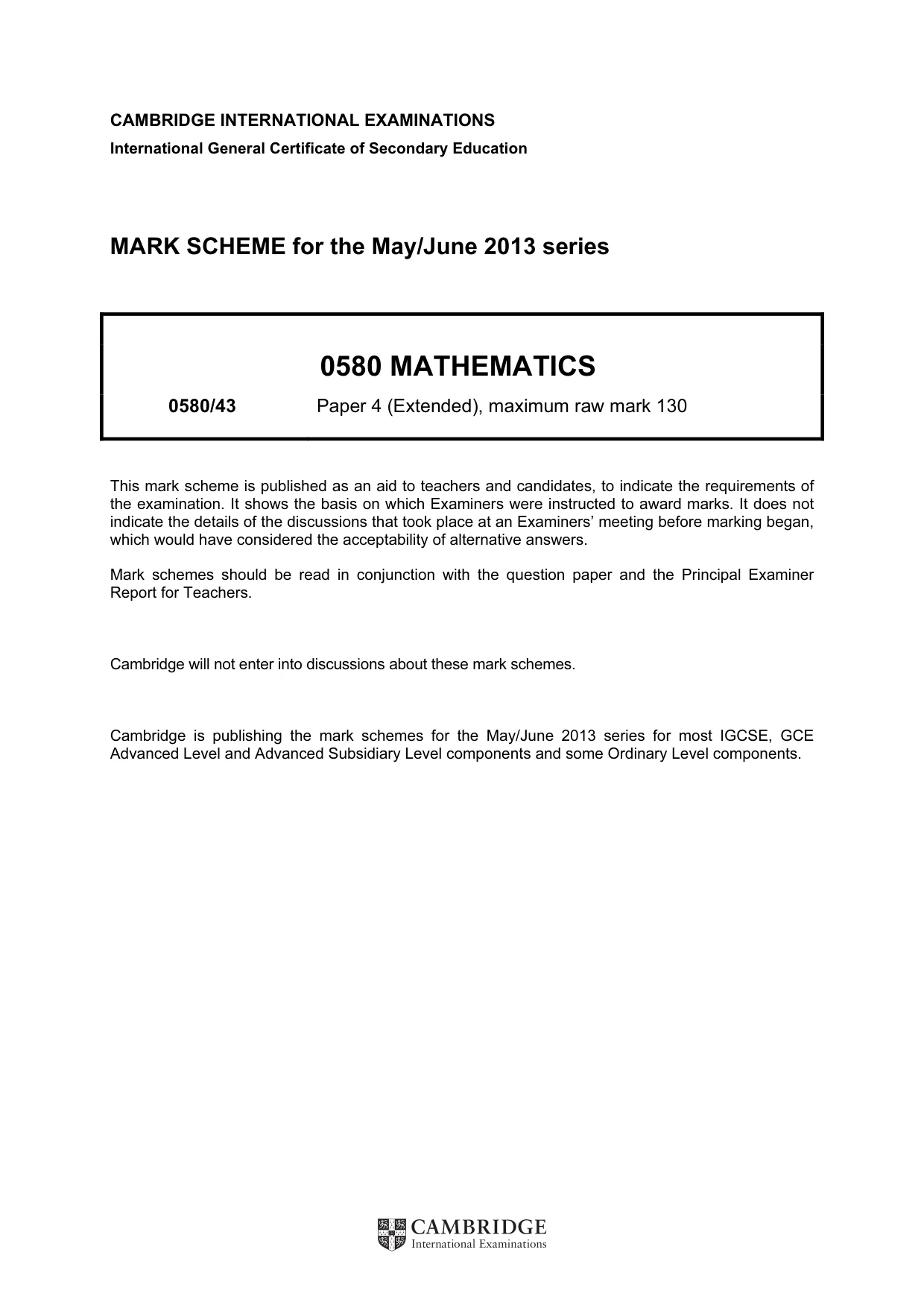
Cambridge IGCSE Mathematics 0580 — 2013 May/June Paper 4 · Variant 3
0580/43/M/J/13 · 10 questions · 130 marks · ≈146 min
The question paper and its mark scheme, free to read here and free to download. This is Cambridge’s own paper, exactly as it was sat.
Question paper20 pages
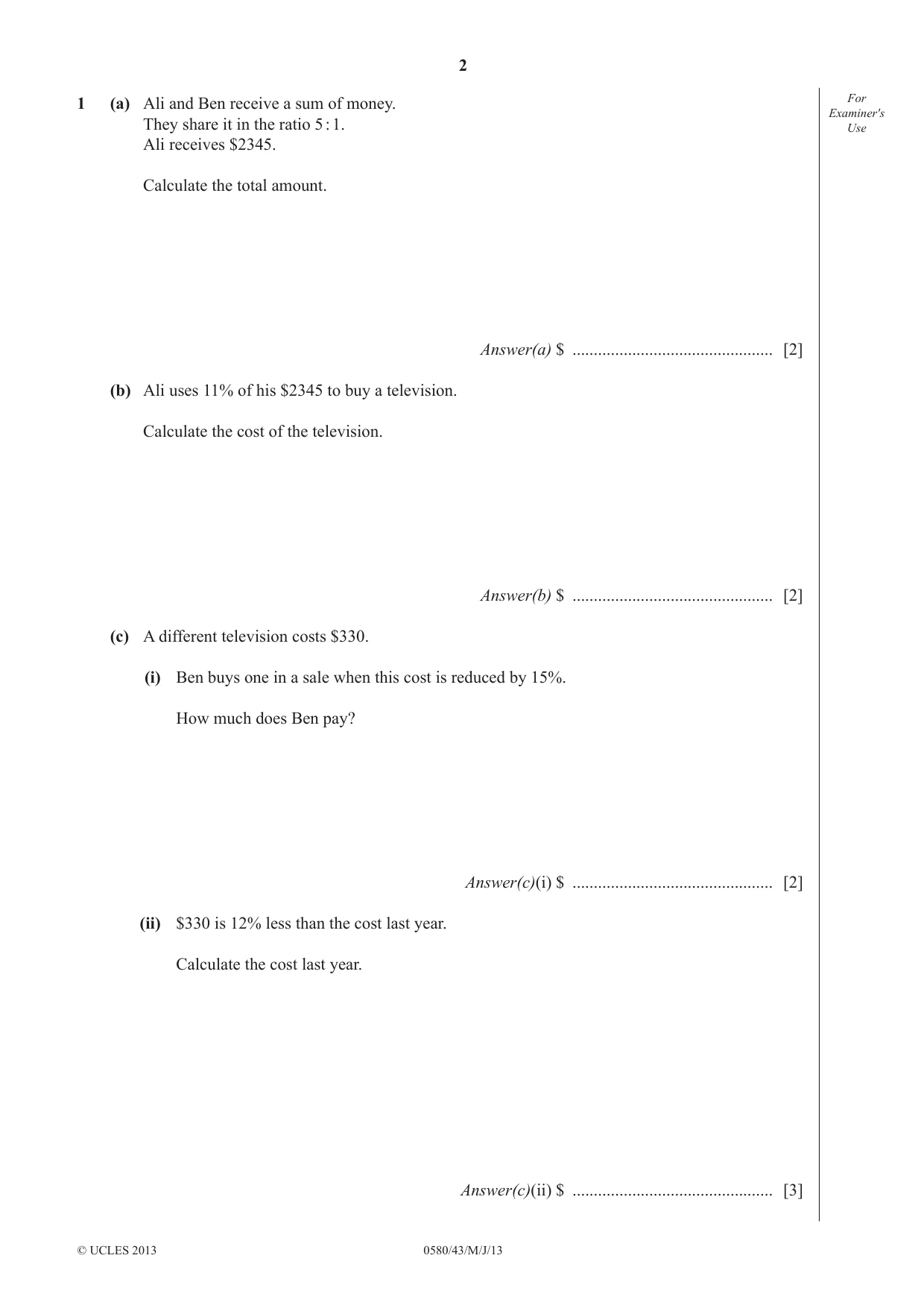
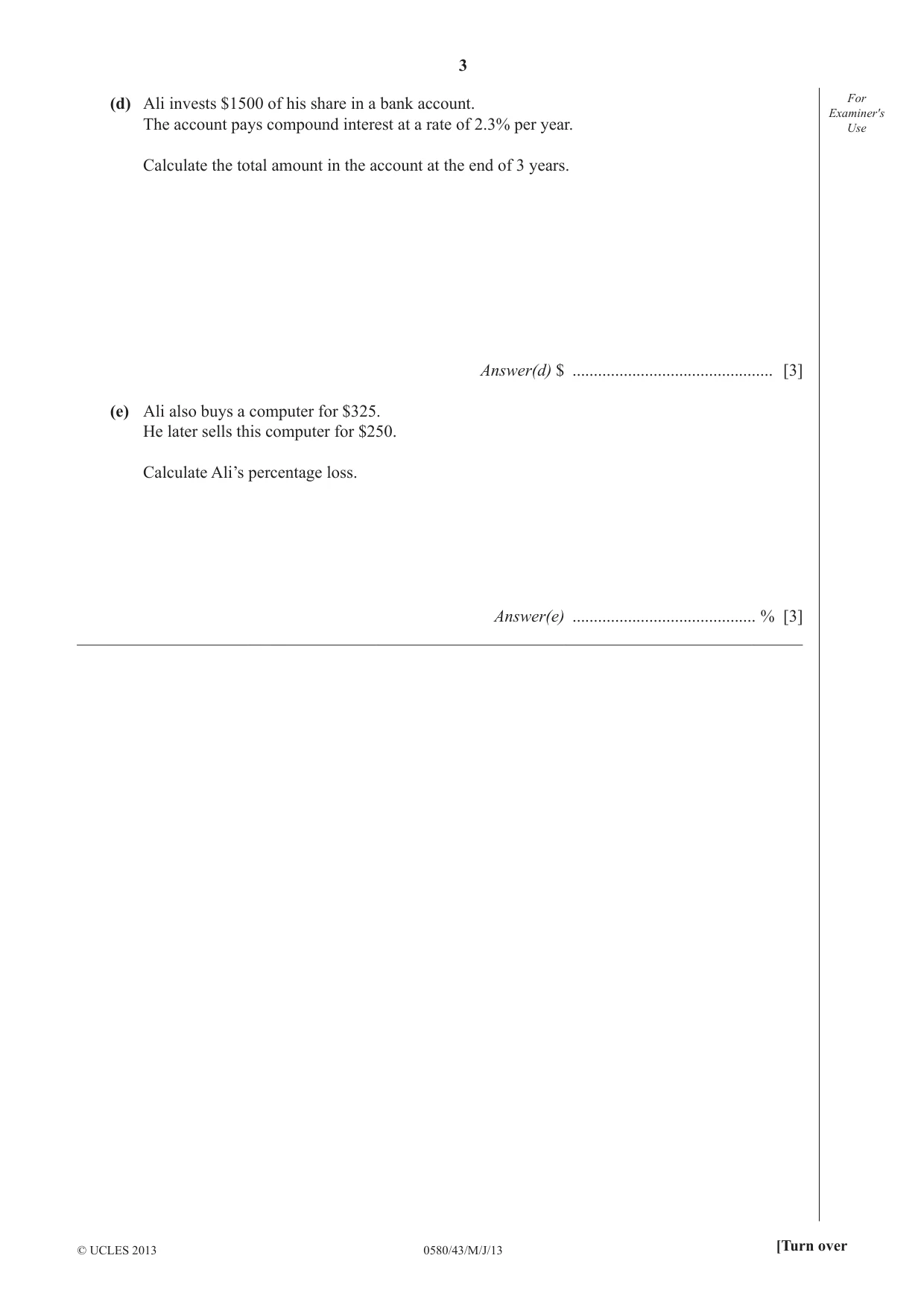
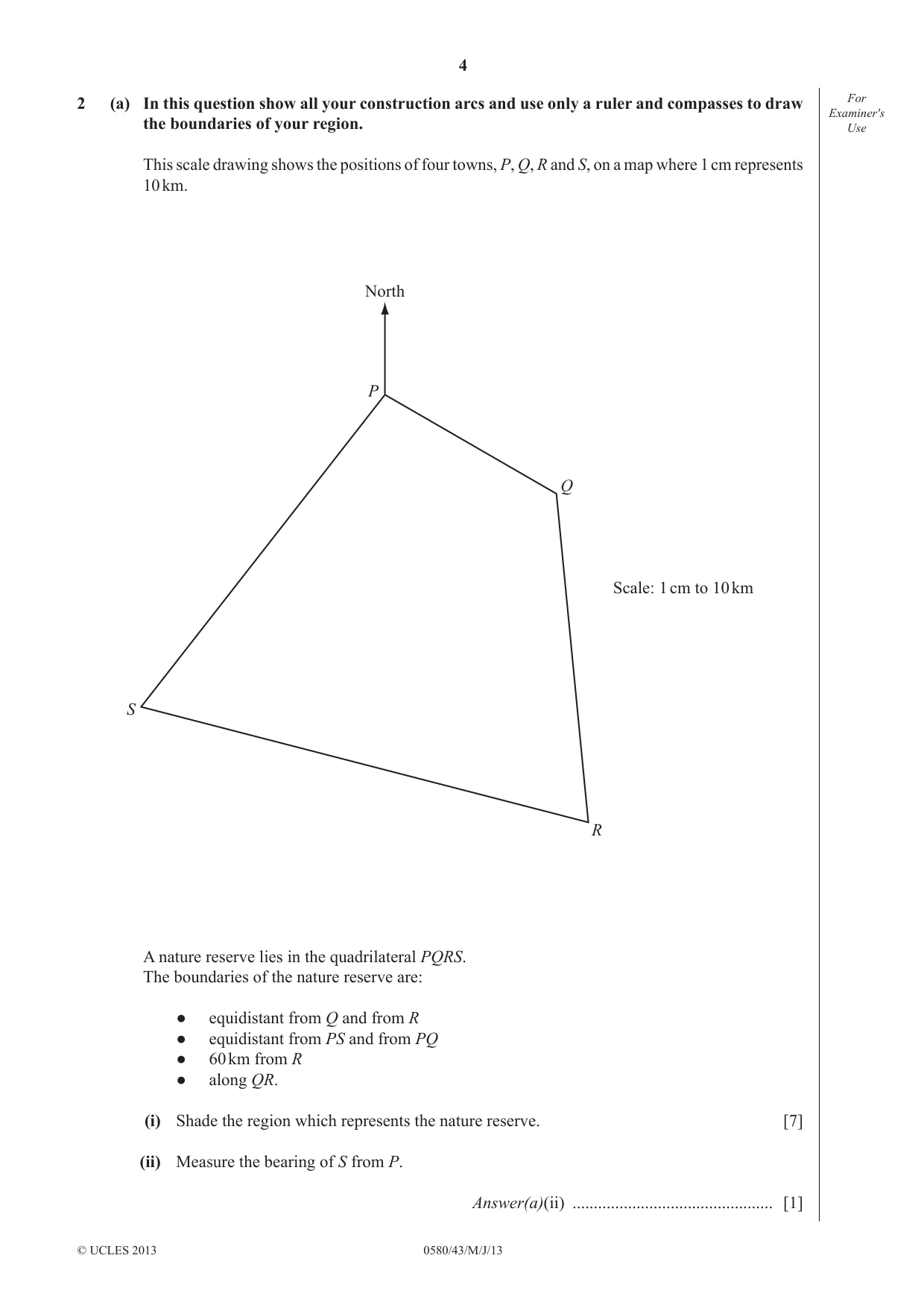
Mark scheme6 pages
Answers below. Sit the paper first if you are practising.
Questions as text
Q1 · Ali and Ben receive a sum of money
1 (a) Ali and Ben receive a sum of money. For Examiner′s They share it in the ratio 5 : 1. Use Ali receives $2345. Calculate the total amount. Answer(a) $ ............................................... [2] (b) Ali uses 11% of his $2345 to buy a television. Calculate the cost of the television. Answer(b) $ ............................................... [2] (c) A different television costs $330. (i) Ben buys one in a sale when this cost is reduced by 15%. How much does Ben pay? Answer(c)(i) $ ............................................... [2] (ii) $330 is 12% less than the cost last year. Calculate the cost last year. Answer(c)(ii) $ ............................................... [3] (d) Ali invests $1500 of his share in a bank account. For Examiner′s The account pays compound interest at a rate of 2.3% per year. Use Calculate the total amount in the account at the end of 3 years. Answer(d) $ ............................................... [3] (e) Ali also buys a computer for $325. He later sells this computer for $250. Calculate Ali’s percentage loss. Answer(e) ........................................... % [3] _____________________________________________________________________________________
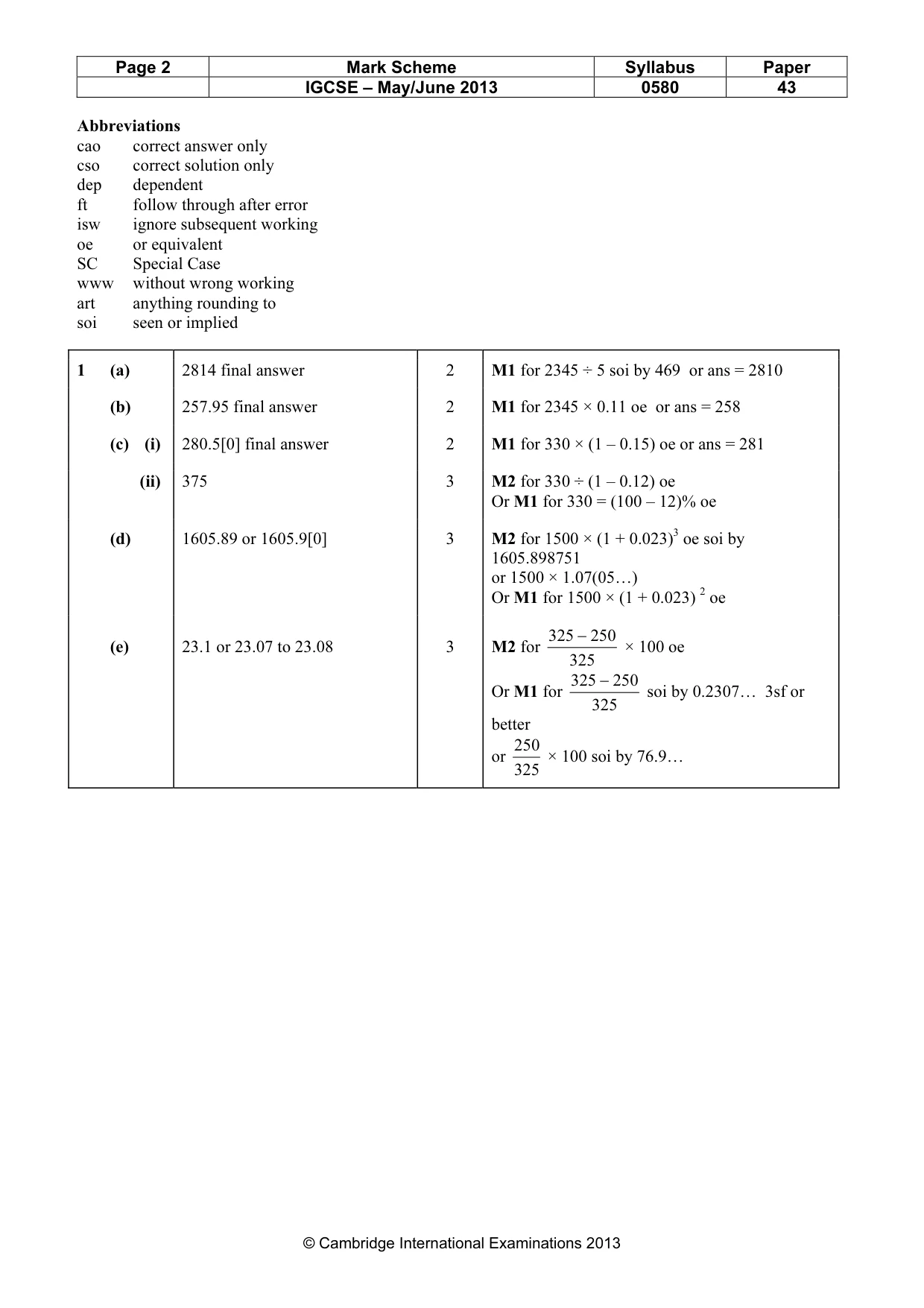
Mark scheme: 1 (a) 2814 final answer 2 M1 for 2345 ÷ 5 soi by 469 or ans = 2810 (b) 257.95 final answer 2 M1 for 2345 × 0.11 oe or ans = 258 (c) (i) 280.5[0] final answer 2 M1 for 330 × (1 – 0.15) oe or ans = 281 (ii) 375 3 M2 for 330 ÷ (1 – 0.12) oe Or M1 for 330 = (100 – 12)% oe (d) 1605.89 or 1605.9[0] 3 M2 for 1500 × (1 + 0.023)3 oe soi by 1605.898751 or 1500 × 1.07(05…) 2 Or M1 for 1500 × (1 + 0.023) oe 325 − 250 (e) 23.1 or 23.07 to 23.08 3 M2 for × 100 oe 325 325 − 250 Or M1 for soi by 0.2307… 3sf or 325 better 250 or × 100 soi by 76.9… 325 IGCSE – May/June 2013 0580 43
Q2 · In this question show all your construction arcs and use only a ruler and compasses to…
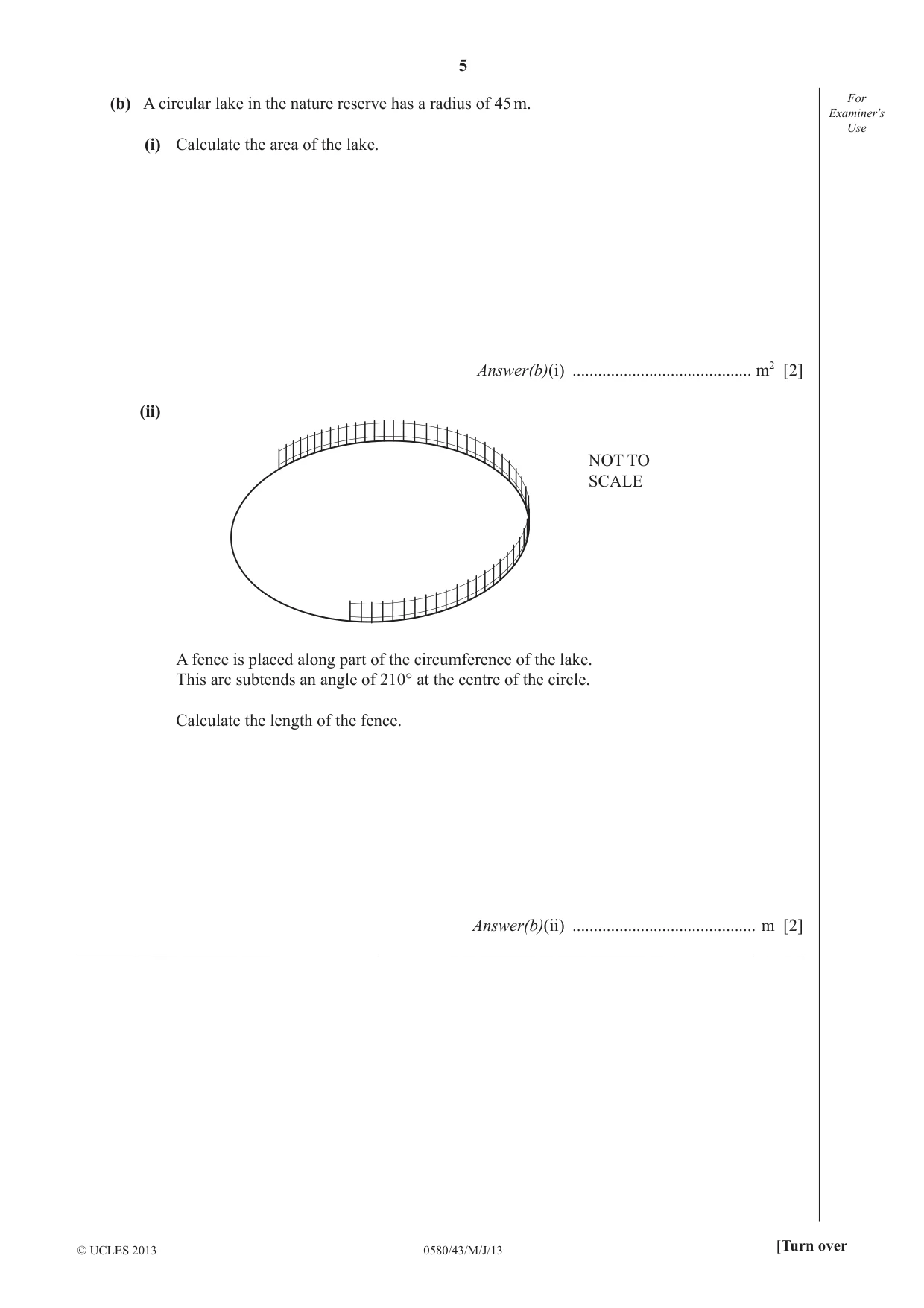
2 (a) In this question show all your construction arcs and use only a ruler and compasses to draw For Examiner′s the boundaries of your region. Use This scale drawing shows the positions of four towns, P, Q, R and S, on a map where 1 cm represents 10 km. North P Q Scale: 1 cm to 10 km S R A nature reserve lies in the quadrilateral PQRS. The boundaries of the nature reserve are: ● equidistant from Q and from R ● equidistant from PS and from PQ ● 60 km from R ● along QR. (i) Shade the region which represents the nature reserve. [7] (ii) Measure the bearing of S from P. Answer(a)(ii) ............................................... [1] (b) A circular lake in the nature reserve has a radius of 45 m. For Examiner′s Use (i) Calculate the area of the lake. Answer(b)(i) .......................................... m2 [2] (ii) NOT TO SCALE A fence is placed along part of the circumference of the lake. This arc subtends an angle of 210° at the centre of the circle. Calculate the length of the fence. Answer(b)(ii) ........................................... m [2] _____________________________________________________________________________________
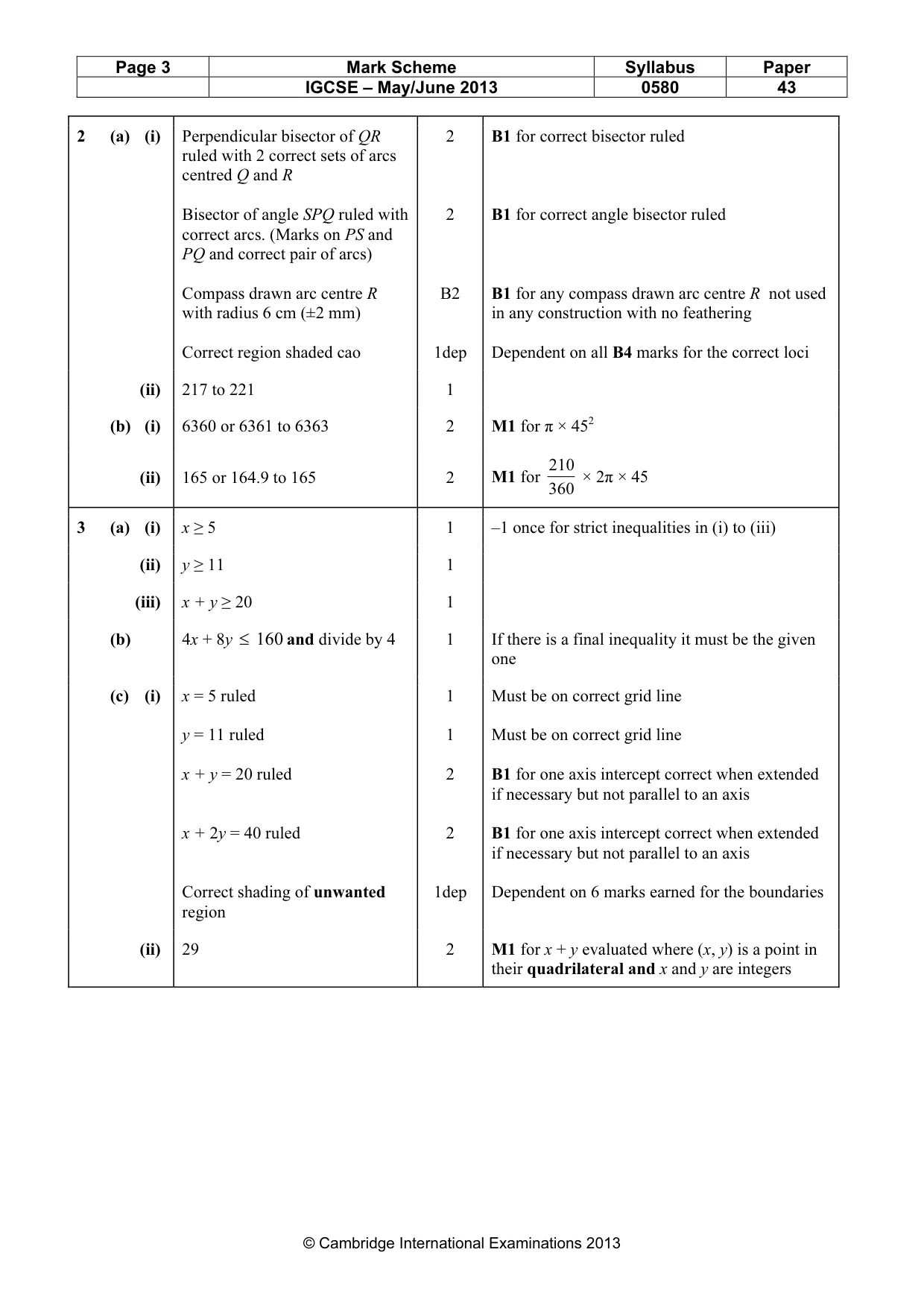
Mark scheme: 2 (a) (i) Perpendicular bisector of QR 2 B1 for correct bisector ruled ruled with 2 correct sets of arcs centred Q and R Bisector of angle SPQ ruled with 2 B1 for correct angle bisector ruled correct arcs. (Marks on PS and PQ and correct pair of arcs) Compass drawn arc centre R B2 B1 for any compass drawn arc centre R not used with radius 6 cm (±2 mm) in any construction with no feathering Correct region shaded cao 1dep Dependent on all B4 marks for the correct loci (ii) 217 to 221 1 (b) (i) 6360 or 6361 to 6363 2 M1 for π × 452 210 (ii) 165 or 164.9 to 165 2 M1 for × 2π × 45 360
Q3 · Luk wants to buy x goats and y sheep
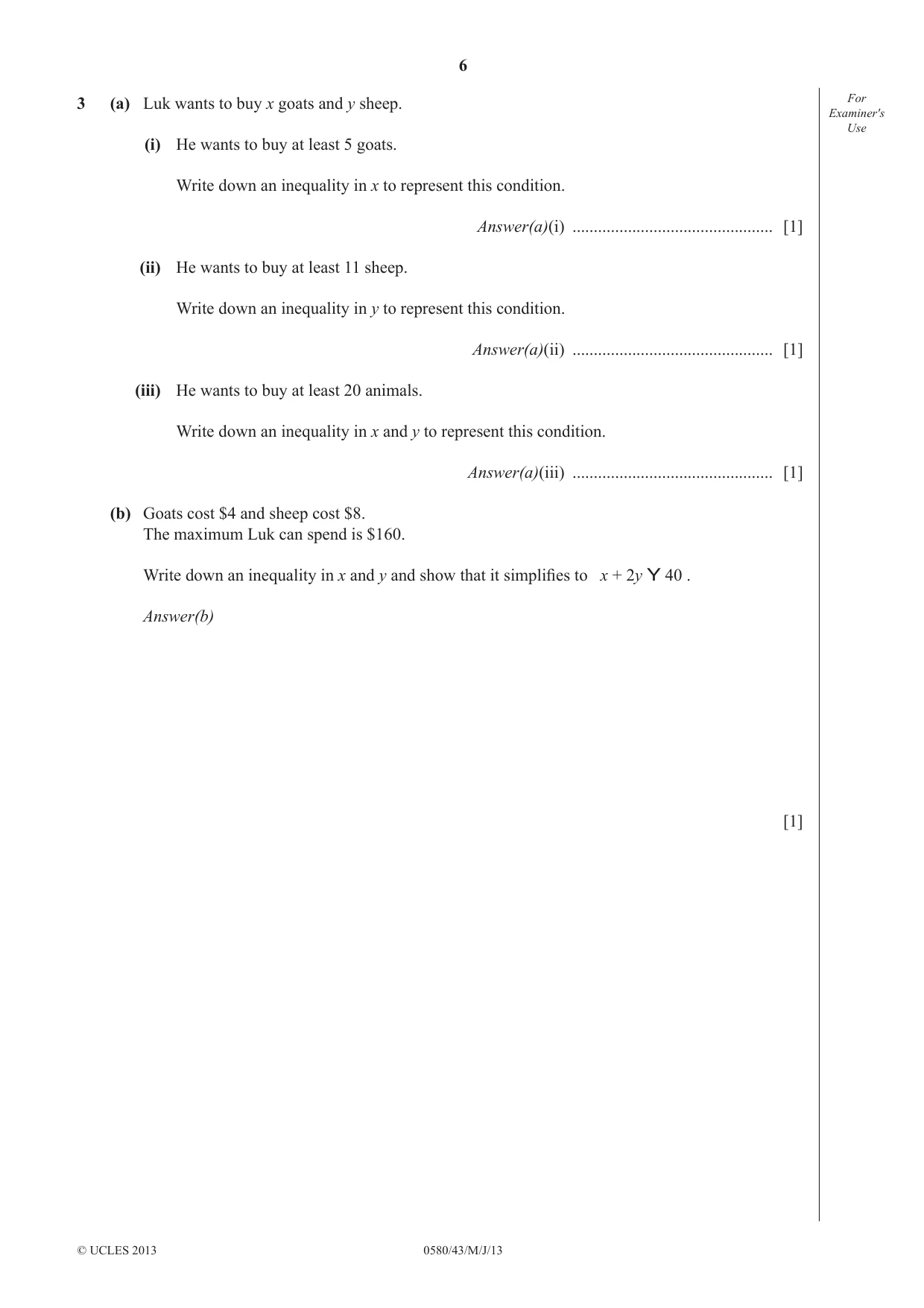
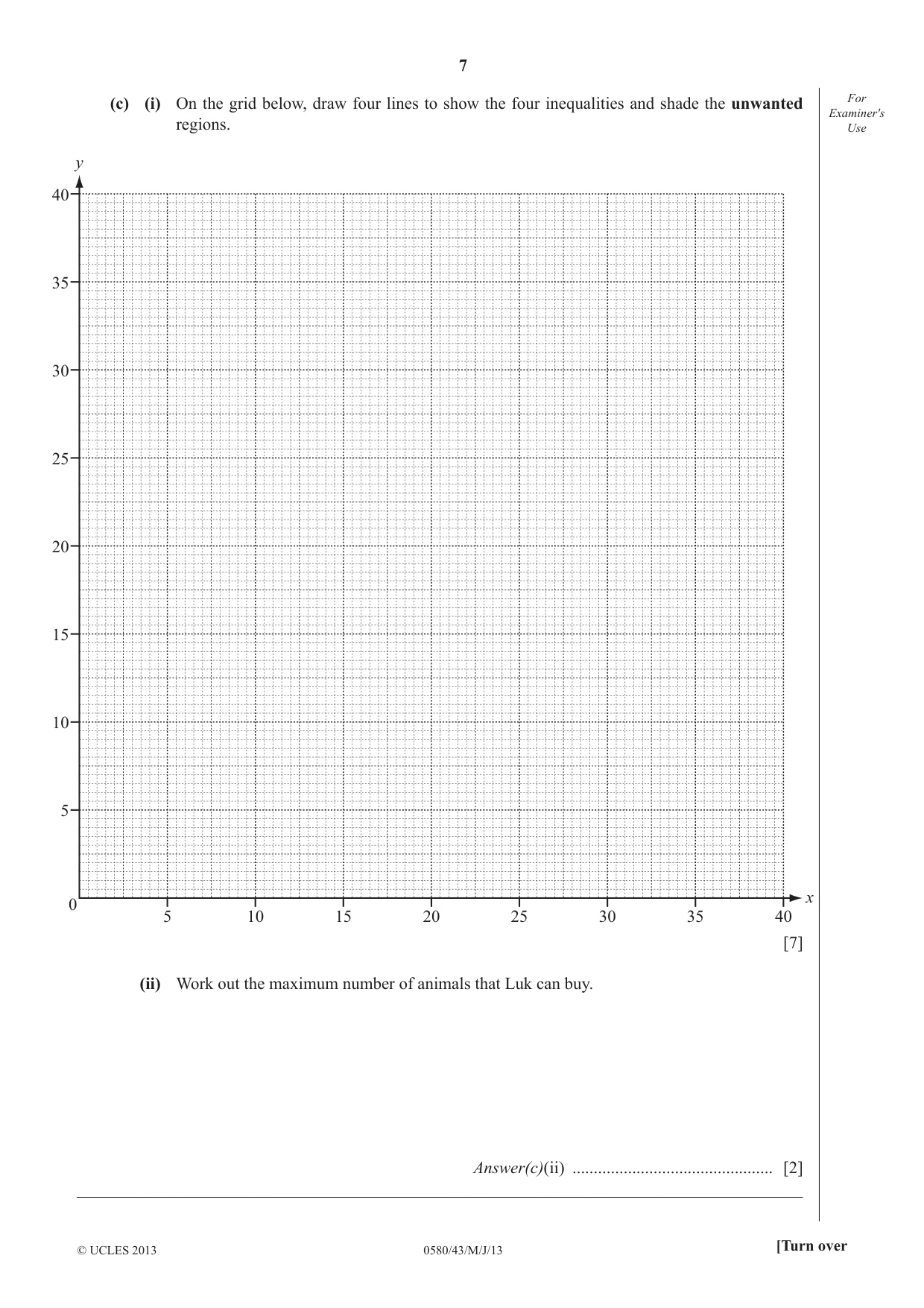
3 (a) Luk wants to buy x goats and y sheep. For Examiner′s Use (i) He wants to buy at least 5 goats. Write down an inequality in x to represent this condition. Answer(a)(i) ............................................... [1] (ii) He wants to buy at least 11 sheep. Write down an inequality in y to represent this condition. Answer(a)(ii) ............................................... [1] (iii) He wants to buy at least 20 animals. Write down an inequality in x and y to represent this condition. Answer(a)(iii) ............................................... [1] (b) Goats cost $4 and sheep cost $8. The maximum Luk can spend is $160. Write down an inequality in x and y and show that it simplifi es to x + 2y Y 40 . Answer(b) [1] (c) (i) On the grid below, draw four lines to show the four inequalities and shade the unwanted For Examiner′s regions. Use y 40 35 30 25 20 15 10 5 x 0 5 10 15 20 25 30 35 40 [7] (ii) Work out the maximum number of animals that Luk can buy. Answer(c)(ii) ............................................... [2] _____________________________________________________________________________________
Mark scheme: 3 (a) (i) x ≥ 5 1 –1 once for strict inequalities in (i) to (iii) (ii) y ≥ 11 1 (iii) x + y ≥ 20 1 (b) 4x + 8y ≤ 160 and divide by 4 1 If there is a final inequality it must be the given one (c) (i) x = 5 ruled 1 Must be on correct grid line y = 11 ruled 1 Must be on correct grid line x + y = 20 ruled 2 B1 for one axis intercept correct when extended if necessary but not parallel to an axis x + 2y = 40 ruled 2 B1 for one axis intercept correct when extended if necessary but not parallel to an axis Correct shading of unwanted 1dep Dependent on 6 marks earned for the boundaries region (ii) 29 2 M1 for x + y evaluated where (x, y) is a point in their quadrilateral and x and y are integers IGCSE – May/June 2013 0580 43
Q4 · For Examiner′s I Use NOT TO SCALE H J F 7 cm 40 cm E 22 cm G EFGHIJ is a solid metal…
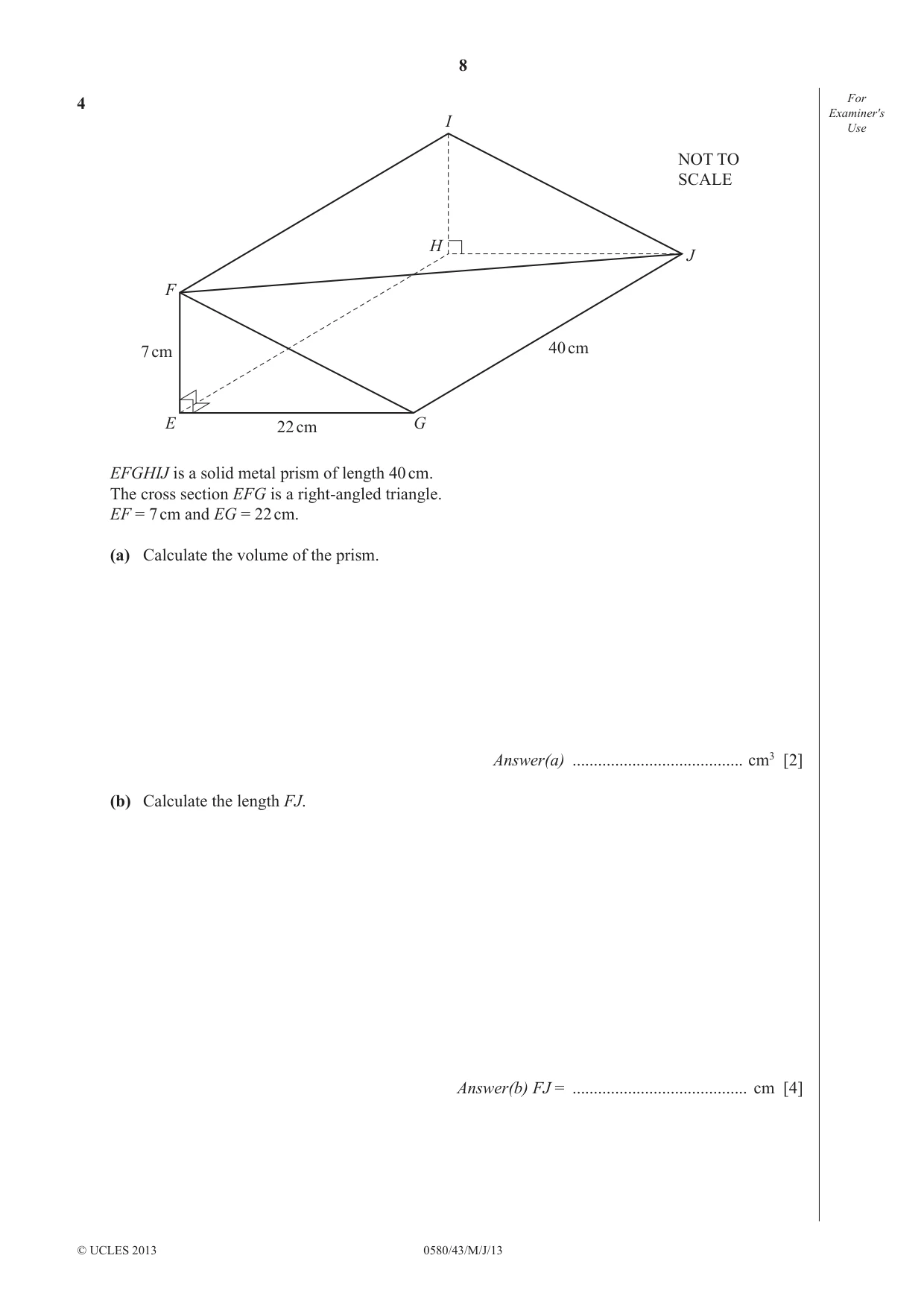
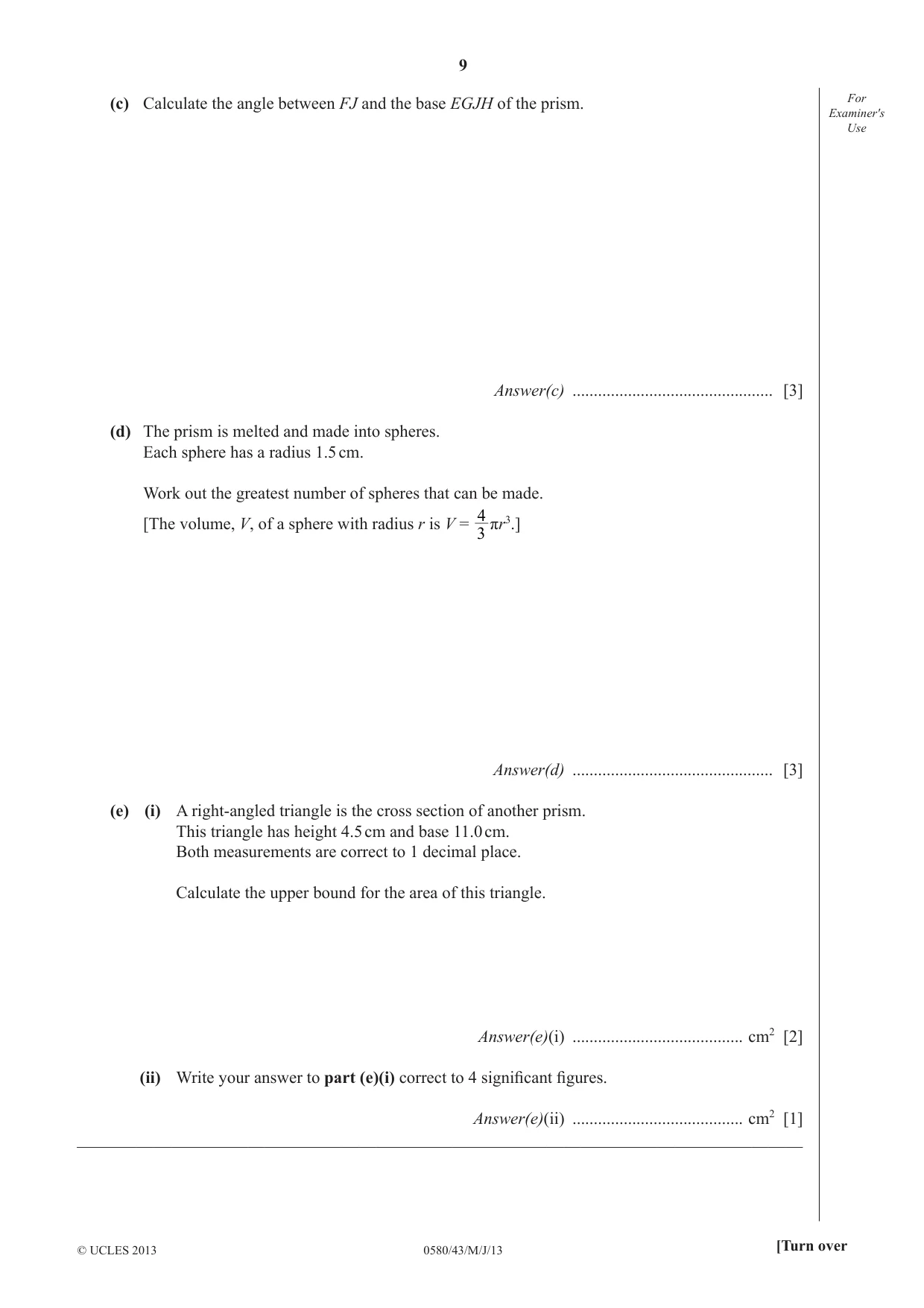
4 For Examiner′s I Use NOT TO SCALE H J F 7 cm 40 cm E 22 cm G EFGHIJ is a solid metal prism of length 40 cm. The cross section EFG is a right-angled triangle. EF = 7 cm and EG = 22 cm. (a) Calculate the volume of the prism. Answer(a) ........................................ cm3 [2] (b) Calculate the length FJ. Answer(b) FJ = ......................................... cm [4] (c) Calculate the angle between FJ and the base EGJH of the prism. For Examiner′s Use Answer(c) ............................................... [3] (d) The prism is melted and made into spheres. Each sphere has a radius 1.5 cm. Work out the greatest number of spheres that can be made. 4 [The volume, V, of a sphere with radius r is V = πr3.] 3 Answer(d) ............................................... [3] (e) (i) A right-angled triangle is the cross section of another prism. This triangle has height 4.5 cm and base 11.0 cm. Both measurements are correct to 1 decimal place. Calculate the upper bound for the area of this triangle. Answer(e)(i) ........................................ cm2 [2] (ii) Write your answer to part (e)(i) correct to 4 signifi cant fi gures. Answer(e)(ii) ........................................ cm2 [1] _____________________________________________________________________________________
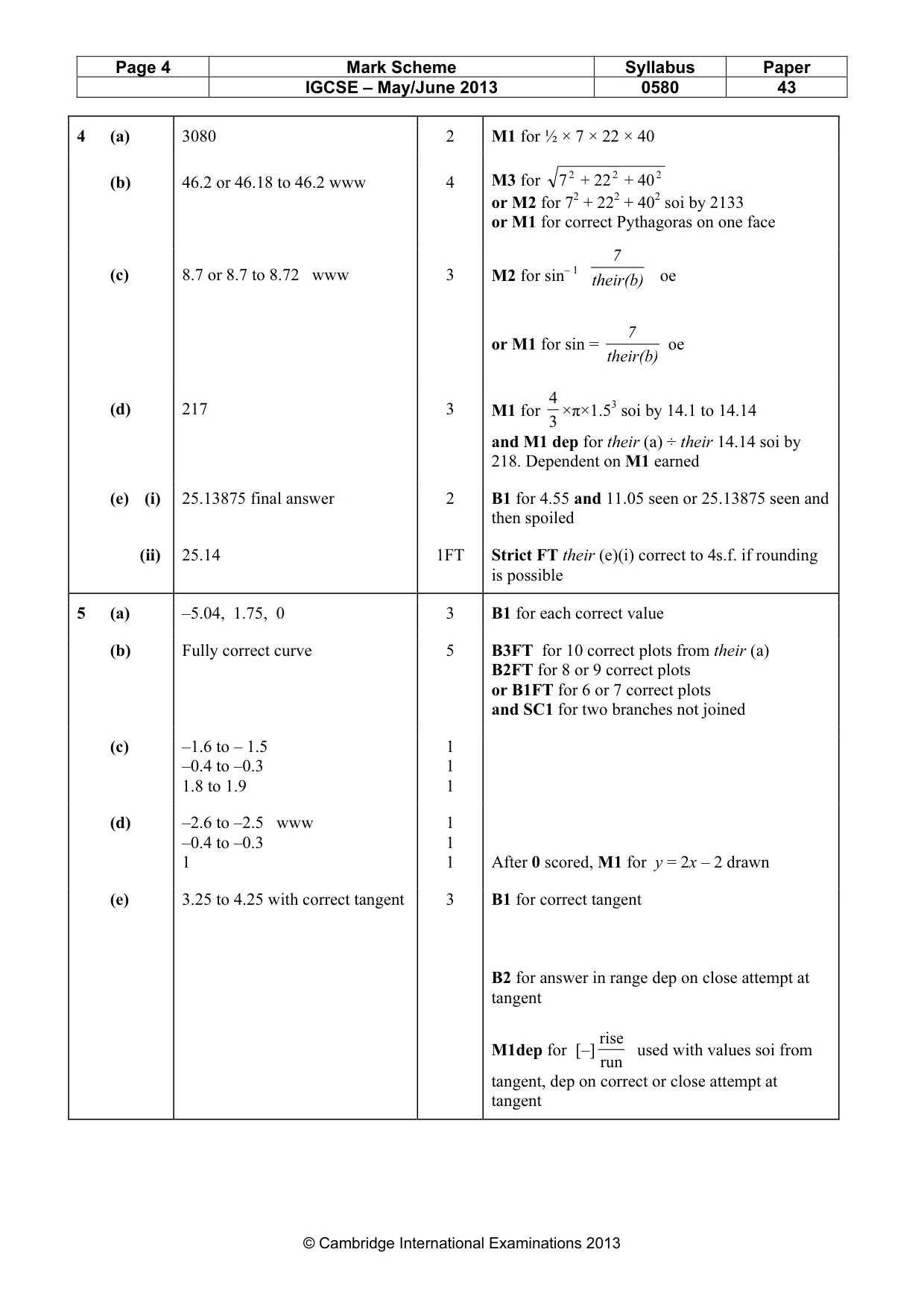
Mark scheme: 4 (a) 3080 2 M1 for ½ × 7 × 22 × 40 (b) 46.2 or 46.18 to 46.2 www 4 M3 for 7 2 + 22 2 + 40 2 or M2 for 72 + 222 + 402 soi by 2133 or M1 for correct Pythagoras on one face 7 (c) 8.7 or 8.7 to 8.72 www 3 M2 for sin– 1 their(b) oe 7 or M1 for sin = oe their(b) 4 (d) 217 3 M1 for ×π×1.53 soi by 14.1 to 14.14 3 and M1 dep for their (a) ÷ their 14.14 soi by 218. Dependent on M1 earned (e) (i) 25.13875 final answer 2 B1 for 4.55 and 11.05 seen or 25.13875 seen and then spoiled (ii) 25.14 1FT Strict FT their (e)(i) correct to 4s.f. if rounding is possible
Q5 · – x2, x ¸ 0
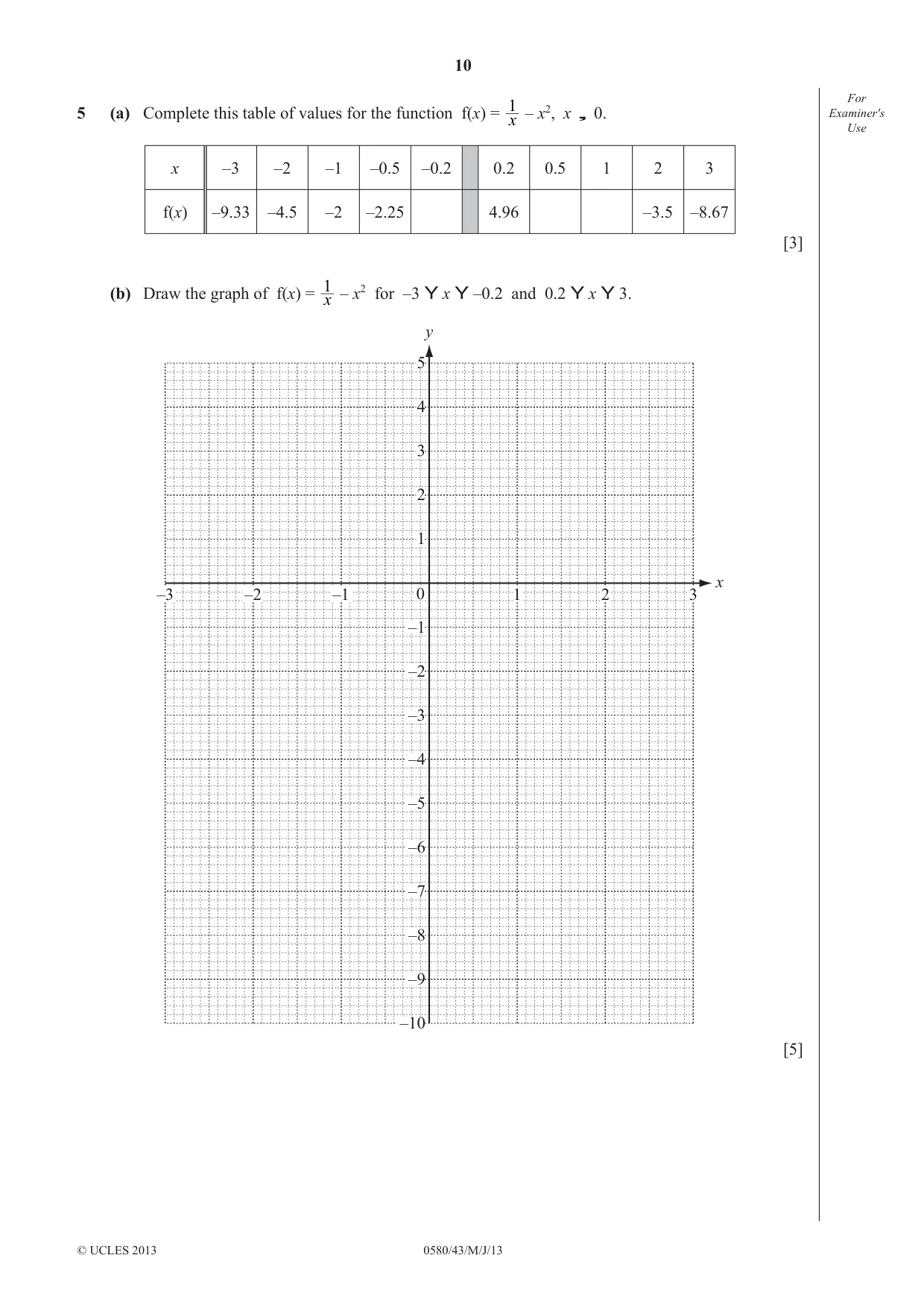
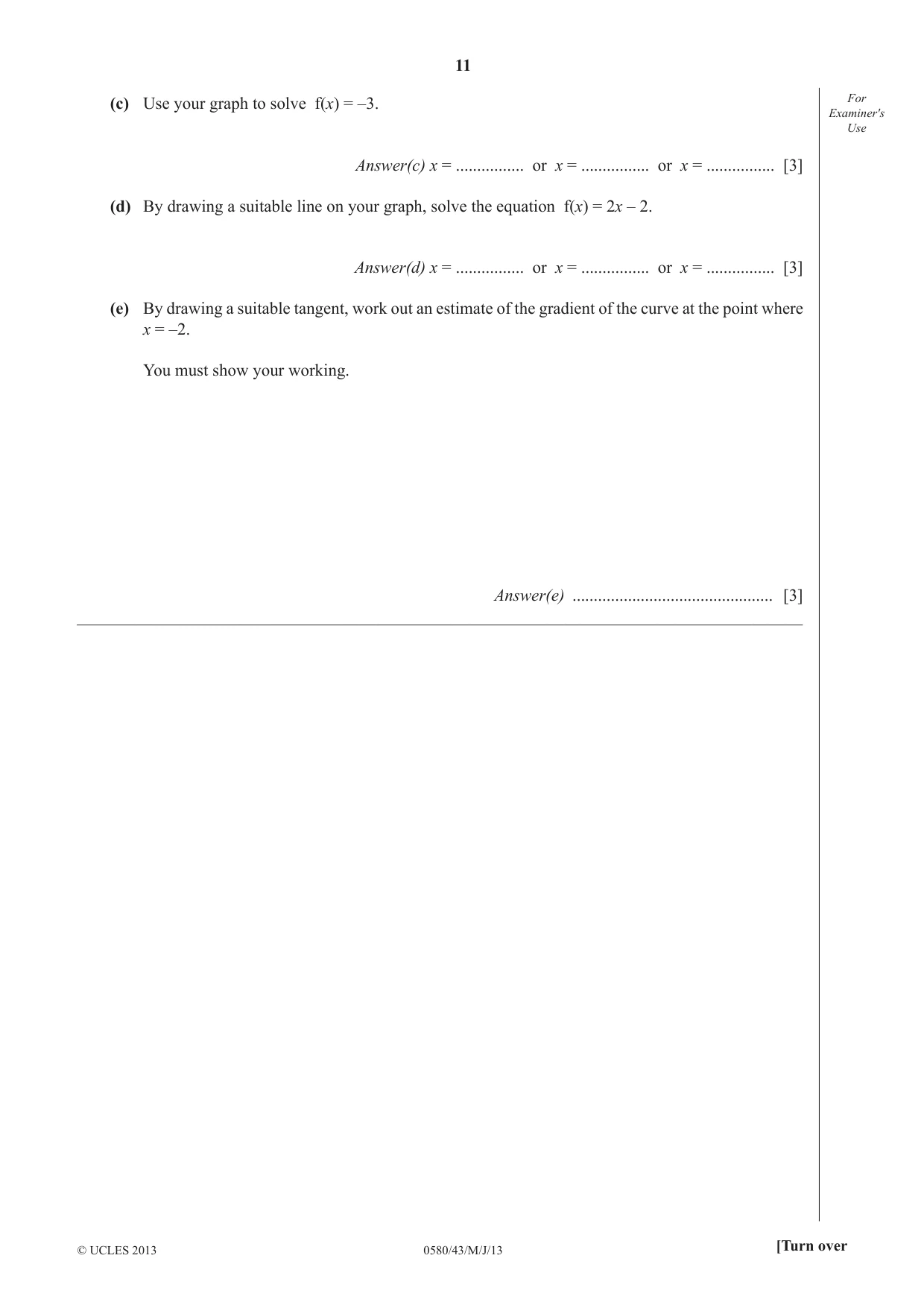
1 – x2, x ¸ 0. Examiner′s5 (a) Complete this table of values for the function f(x) = x Use x –3 –2 –1 –0.5 –0.2 0.2 0.5 1 2 3 f(x) –9.33 –4.5 –2 –2.25 4.96 –3.5 –8.67 [3] 1 – x2 for –3 Y x Y –0.2 and 0.2 Y x Y 3. (b) Draw the graph of f(x) = x y 5 4 3 2 1 x –3 –2 –1 0 1 2 3 –1 –2 –3 –4 –5 –6 –7 –8 –9 –10 [5] (c) Use your graph to solve f(x) = –3. For Examiner′s Use Answer(c) x = ................ or x = ................ or x = ................ [3] (d) By drawing a suitable line on your graph, solve the equation f(x) = 2x – 2. Answer(d) x = ................ or x = ................ or x = ................ [3] (e) By drawing a suitable tangent, work out an estimate of the gradient of the curve at the point where x = –2. You must show your working. Answer(e) ............................................... [3] _____________________________________________________________________________________
Mark scheme: 5 (a) –5.04, 1.75, 0 3 B1 for each correct value (b) Fully correct curve 5 B3FT for 10 correct plots from their (a) B2FT for 8 or 9 correct plots or B1FT for 6 or 7 correct plots and SC1 for two branches not joined (c) –1.6 to – 1.5 1 –0.4 to –0.3 1 1.8 to 1.9 1 (d) –2.6 to –2.5 www 1 –0.4 to –0.3 1 1 1 After 0 scored, M1 for y = 2x – 2 drawn (e) 3.25 to 4.25 with correct tangent 3 B1 for correct tangent B2 for answer in range dep on close attempt at tangent rise M1dep for [–] used with values soi from run tangent, dep on correct or close attempt at tangent IGCSE – May/June 2013 0580 43
Q6 · In a box there are 7 red cards and 3 blue cards
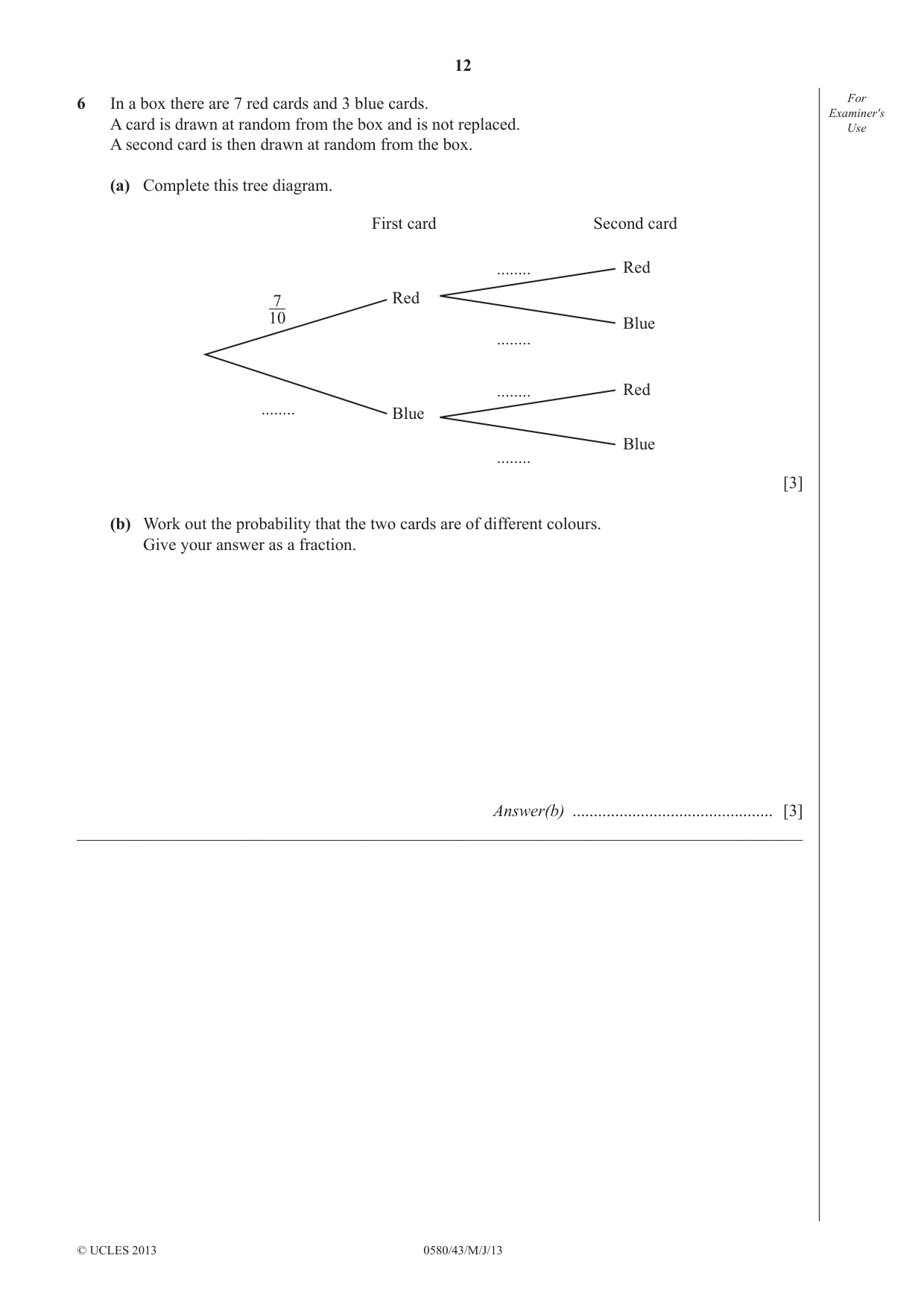
6 In a box there are 7 red cards and 3 blue cards. For Examiner′s A card is drawn at random from the box and is not replaced. Use A second card is then drawn at random from the box. (a) Complete this tree diagram. First card Second card ........ Red 7 Red 10 Blue ........ ........ Red ........ Blue Blue ........ [3] (b) Work out the probability that the two cards are of different colours. Give your answer as a fraction. Answer(b) ............................................... [3] _____________________________________________________________________________________
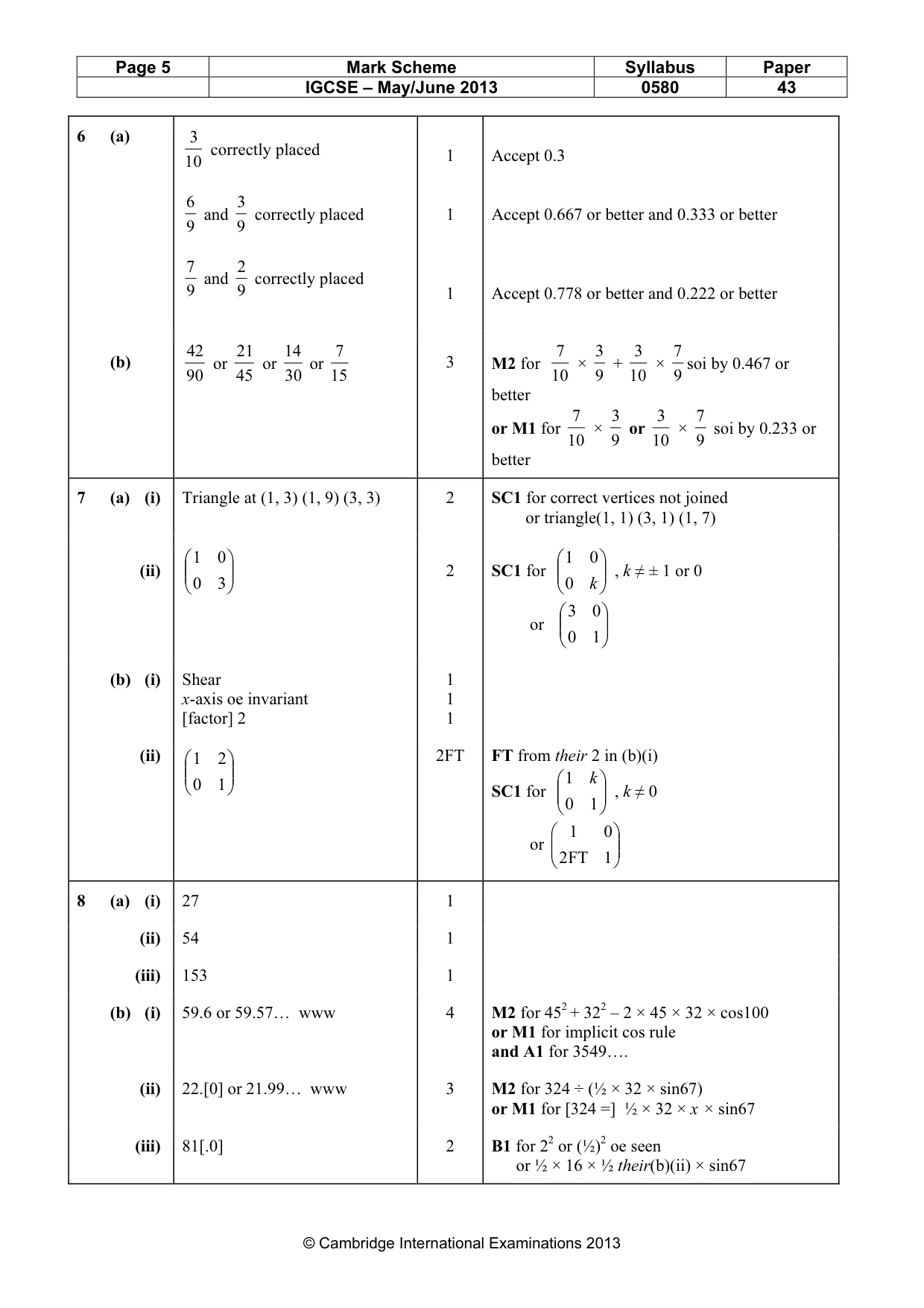
Mark scheme: 6 (a) 3 correctly placed 10 1 Accept 0.3 6 3 and correctly placed 1 Accept 0.667 or better and 0.333 or better 9 9 7 2 and correctly placed 9 9 1 Accept 0.778 or better and 0.222 or better 42 21 14 7 7 3 3 7 (b) or or or 3 M2 for × + × soi by 0.467 or 90 45 30 15 10 9 10 9 better 7 3 3 7 or M1 for × or × soi by 0.233 or 10 9 10 9 better
Q7 · For Examiner′s y Use 10 9 8 7 6 5 4 3 2 A B 1 x 0 1 2 3 4 5 6 7 8 (a) (i) Draw the image…
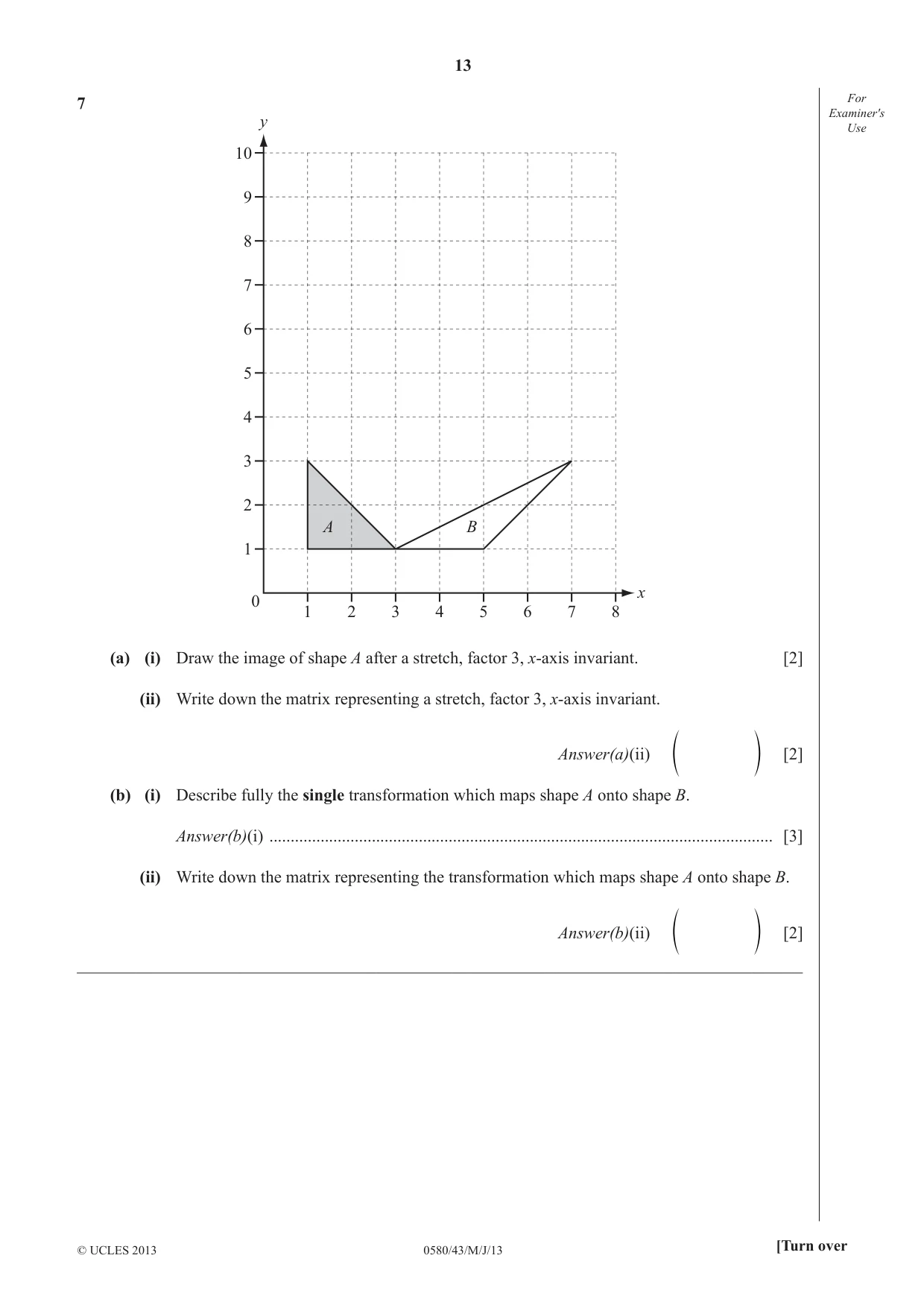
7 For Examiner′s y Use 10 9 8 7 6 5 4 3 2 A B 1 x 0 1 2 3 4 5 6 7 8 (a) (i) Draw the image of shape A after a stretch, factor 3, x-axis invariant. [2] (ii) Write down the matrix representing a stretch, factor 3, x-axis invariant. Answer(a)(ii) [2] e o (b) (i) Describe fully the single transformation which maps shape A onto shape B. Answer(b)(i) ...................................................................................................................... [3] (ii) Write down the matrix representing the transformation which maps shape A onto shape B. Answer(b)(ii) [2] e o _____________________________________________________________________________________
Mark scheme: 7 (a) (i) Triangle at (1, 3) (1, 9) (3, 3) 2 SC1 for correct vertices not joined or triangle(1, 1) (3, 1) (1, 7) 1 0 1 0 (ii) 2 SC1 for , k ≠ ± 1 or 0 0 3 0 k 3 0 or 0 1 (b) (i) Shear 1 x-axis oe invariant 1 [factor] 2 1 (ii) 1 2 2FT FT from their 2 in (b)(i) 1 k 0 1 SC1 for , k ≠ 0 0 1 1 0 or 2 FT 1
Q8 · For Examiner′s Use B 27° C NOT TO SCALE A O E D A, B, C, D and E are points on the circle…
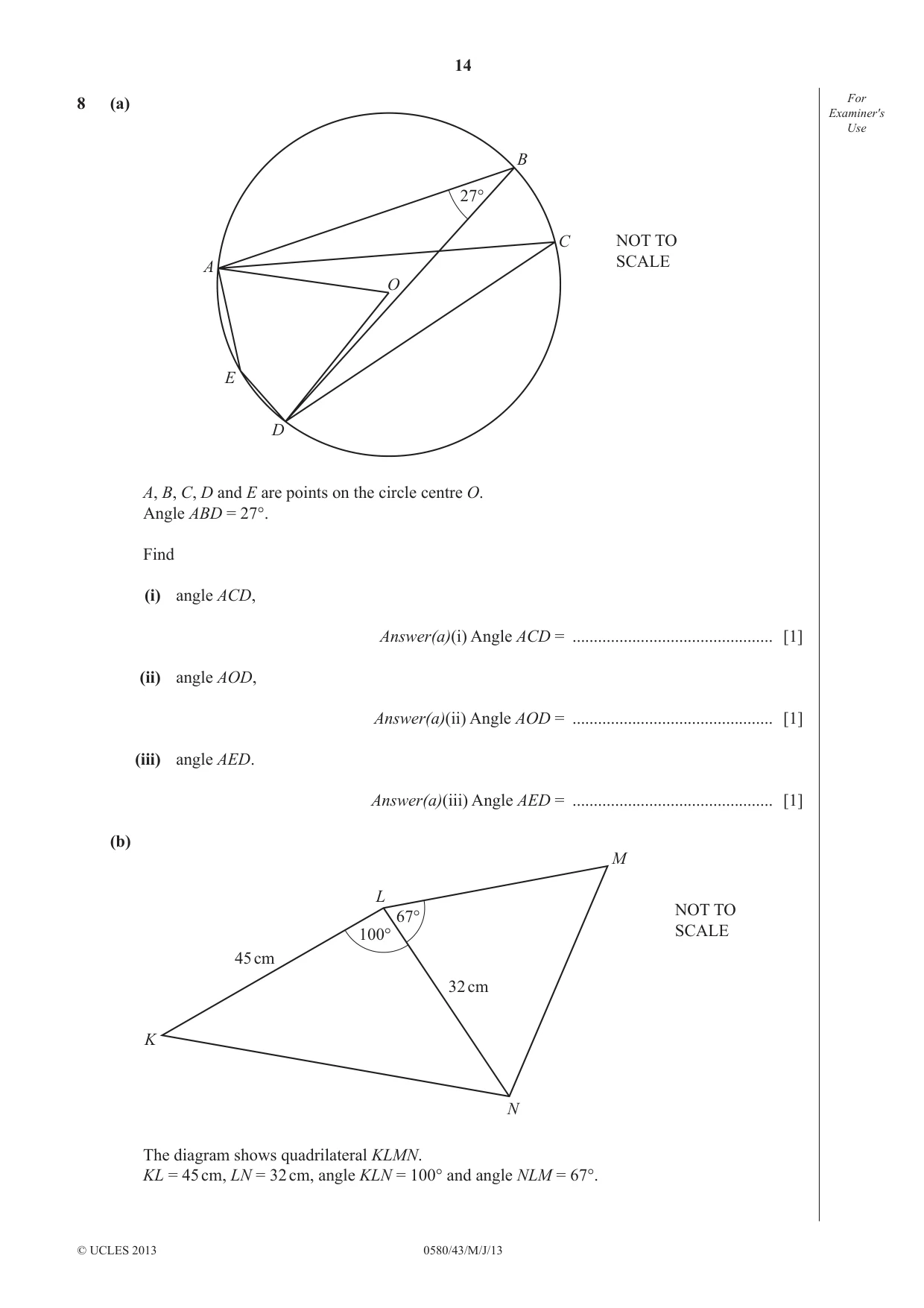
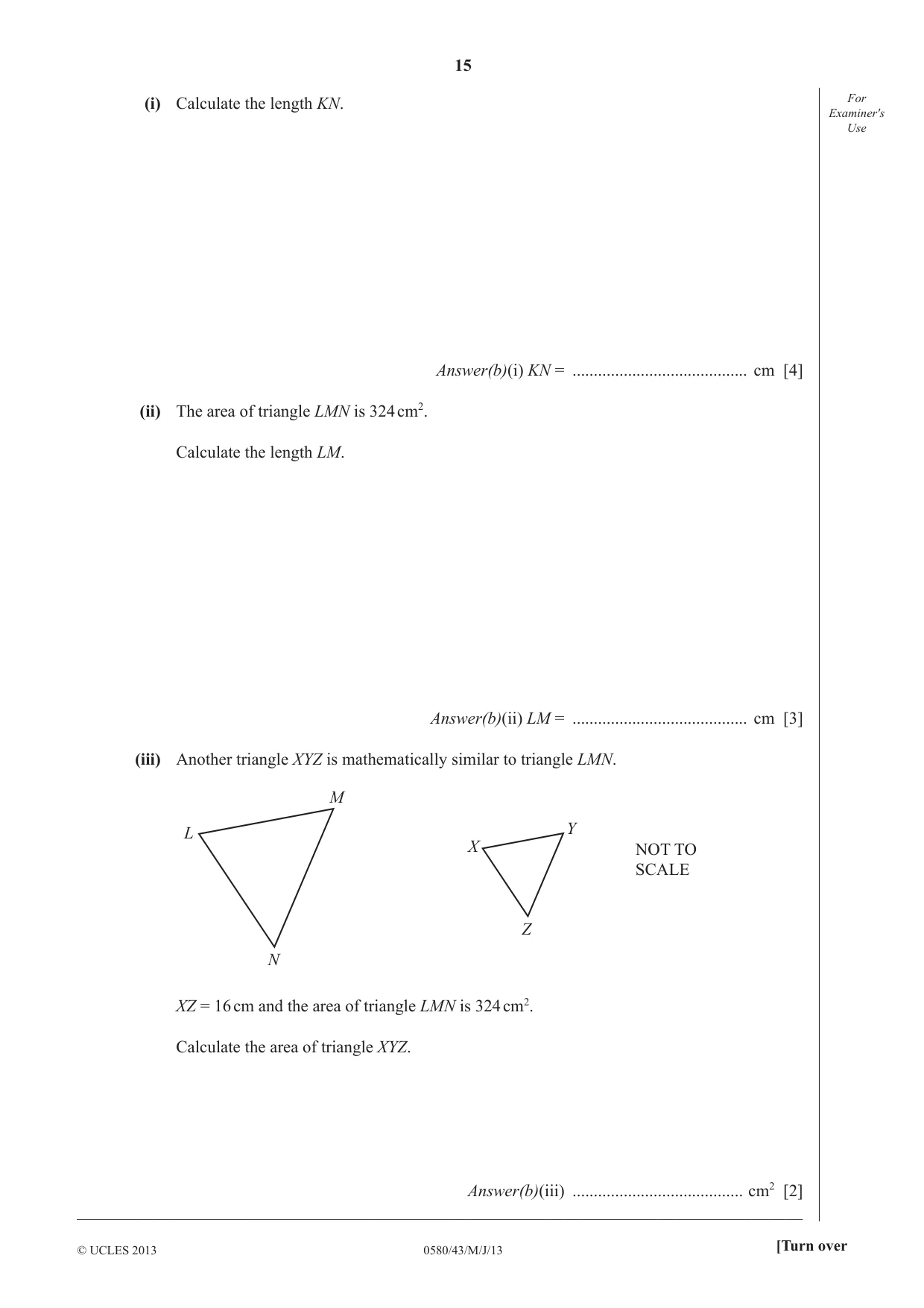
8 (a) For Examiner′s Use B 27° C NOT TO SCALE A O E D A, B, C, D and E are points on the circle centre O. Angle ABD = 27°. Find (i) angle ACD, Answer(a)(i) Angle ACD = ............................................... [1] (ii) angle AOD, Answer(a)(ii) Angle AOD = ............................................... [1] (iii) angle AED. Answer(a)(iii) Angle AED = ............................................... [1] (b) M L NOT TO 67° 100° SCALE 45 cm 32 cm K N The diagram shows quadrilateral KLMN. KL = 45 cm, LN = 32 cm, angle KLN = 100° and angle NLM = 67°. (i) Calculate the length KN. For Examiner′s Use Answer(b)(i) KN = ......................................... cm [4] (ii) The area of triangle LMN is 324 cm2. Calculate the length LM. Answer(b)(ii) LM = ......................................... cm [3] (iii) Another triangle XYZ is mathematically similar to triangle LMN. M Y L X NOT TO SCALE Z N XZ = 16 cm and the area of triangle LMN is 324 cm2. Calculate the area of triangle XYZ. Answer(b)(iii) ........................................ cm2 [2] _____________________________________________________________________________________
Mark scheme: 8 (a) (i) 27 1 (ii) 54 1 (iii) 153 1 (b) (i) 59.6 or 59.57… www 4 M2 for 452 + 322 – 2 × 45 × 32 × cos100 or M1 for implicit cos rule and A1 for 3549…. (ii) 22.[0] or 21.99… www 3 M2 for 324 ÷ (½ × 32 × sin67) or M1 for [324 =] ½ × 32 × x × sin67 (iii) 81[.0] 2 B1 for 22 or (½)2 oe seen or ½ × 16 × ½ their(b)(ii) × sin67 IGCSE – May/June 2013 0580 43
Q9 · Sam asked 80 people how many minutes their journey to work took on one day
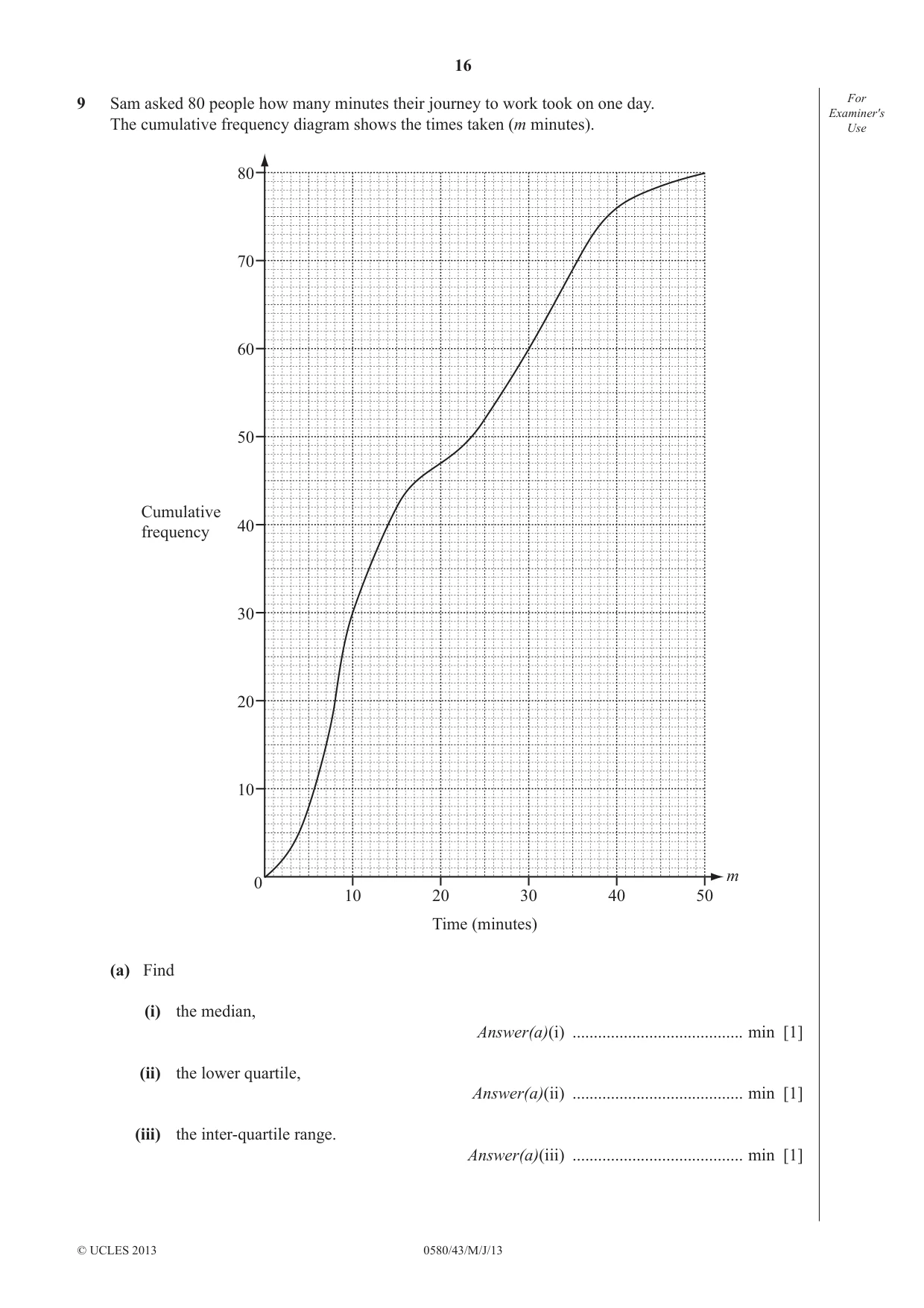
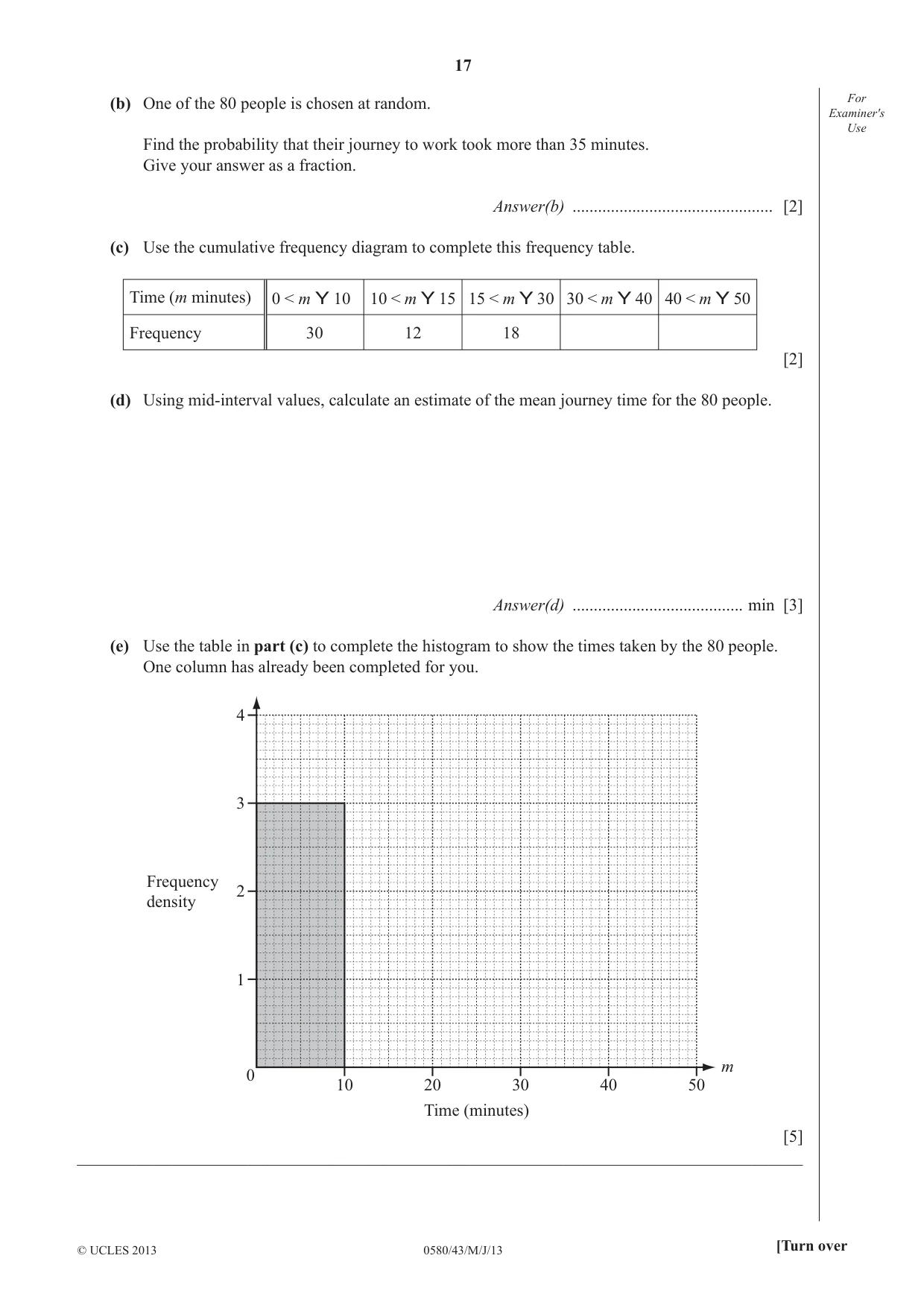
9 Sam asked 80 people how many minutes their journey to work took on one day. For Examiner′s The cumulative frequency diagram shows the times taken (m minutes). Use 80 70 60 50 Cumulative 40 frequency 30 20 10 m 0 10 20 30 40 50 Time (minutes) (a) Find (i) the median, Answer(a)(i) ........................................ min [1] (ii) the lower quartile, Answer(a)(ii) ........................................ min [1] (iii) the inter-quartile range. Answer(a)(iii) ........................................ min [1] (b) One of the 80 people is chosen at random. For Examiner′s Use Find the probability that their journey to work took more than 35 minutes. Give your answer as a fraction. Answer(b) ............................................... [2] (c) Use the cumulative frequency diagram to complete this frequency table. Time (m minutes) 0 < m Y 10 10 < m Y 15 15 < m Y 30 30 < m Y 40 40 < m Y 50 Frequency 30 12 18 [2] (d) Using mid-interval values, calculate an estimate of the mean journey time for the 80 people. Answer(d) ........................................ min [3] (e) Use the table in part (c) to complete the histogram to show the times taken by the 80 people. One column has already been completed for you. 4 3 Frequency 2 density 1 m 0 10 20 30 40 50 Time (minutes) [5] _____________________________________________________________________________________
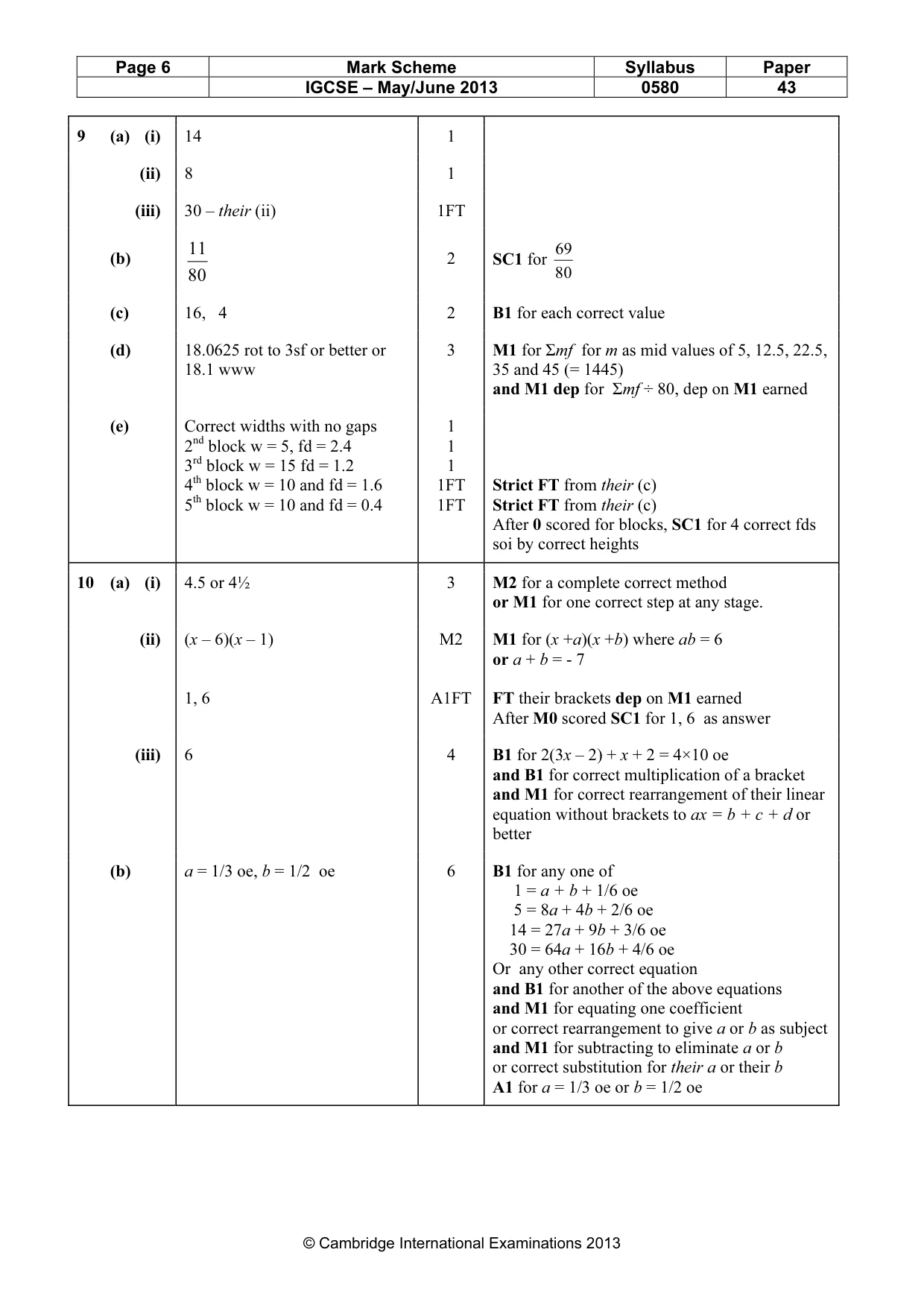
Mark scheme: 9 (a) (i) 14 1 (ii) 8 1 (iii) 30 – their (ii) 1FT 11 69 (b) 2 SC1 for 80 80 (c) 16, 4 2 B1 for each correct value (d) 18.0625 rot to 3sf or better or 3 M1 for Σmf for m as mid values of 5, 12.5, 22.5, 18.1 www 35 and 45 (= 1445) and M1 dep for Σmf ÷ 80, dep on M1 earned (e) Correct widths with no gaps 1 2nd block w = 5, fd = 2.4 1 3rd block w = 15 fd = 1.2 1 4th block w = 10 and fd = 1.6 1FT Strict FT from their (c) 5th block w = 10 and fd = 0.4 1FT Strict FT from their (c) After 0 scored for blocks, SC1 for 4 correct fds soi by correct heights
Q10 · Solve 2(3x – 7) = 13
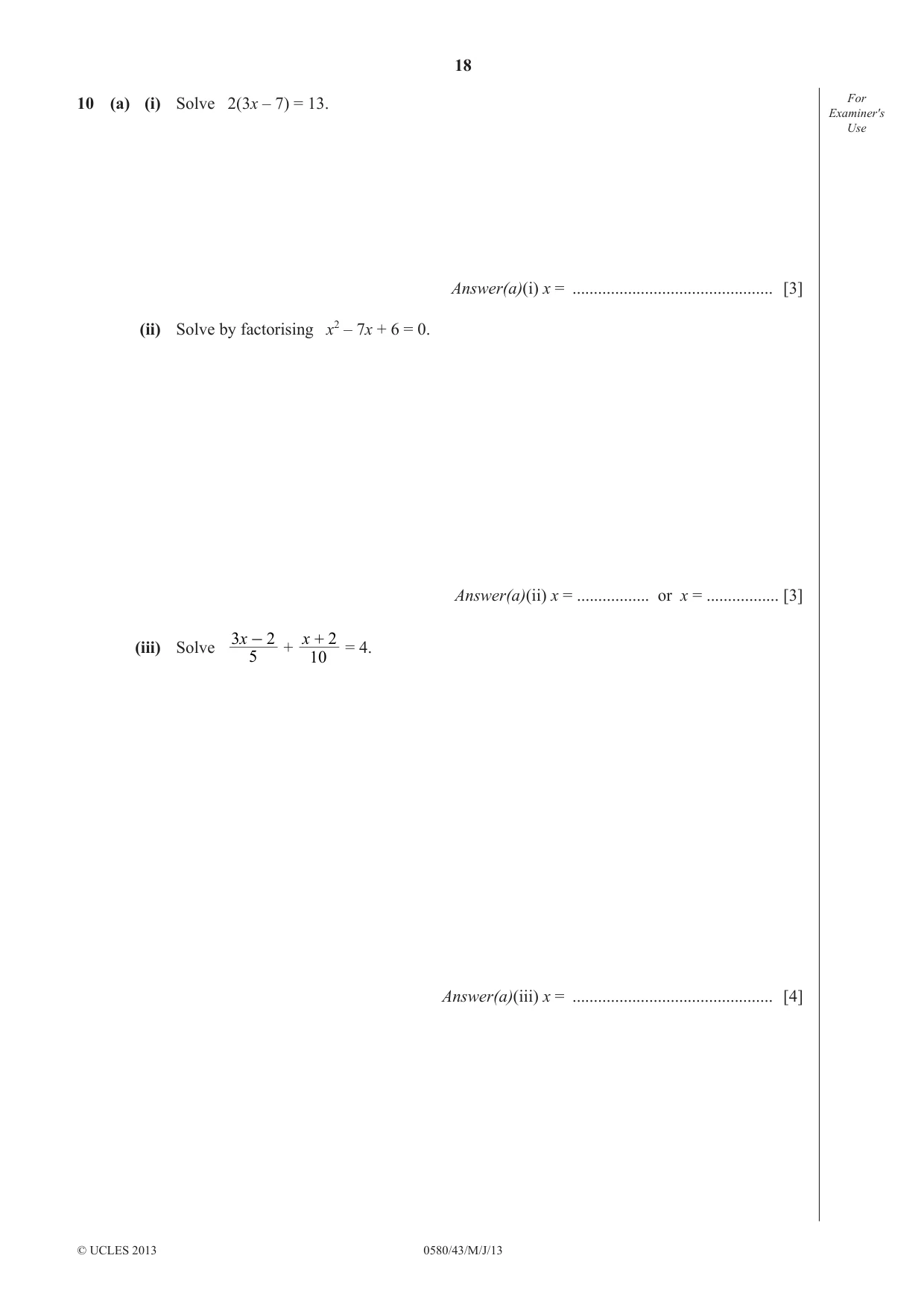
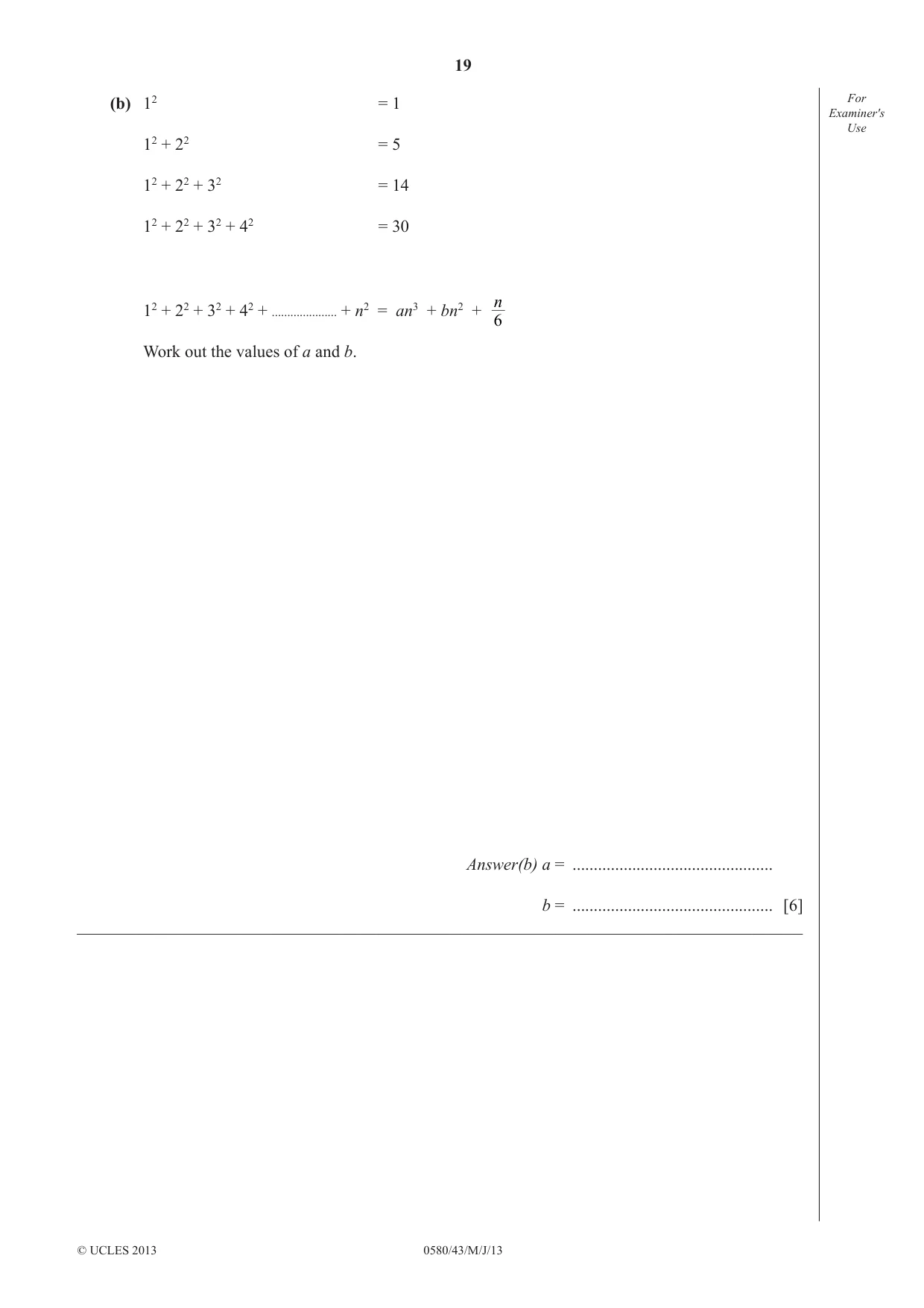
10 (a) (i) Solve 2(3x – 7) = 13. For Examiner′s Use Answer(a)(i) x = ............................................... [3] (ii) Solve by factorising x2 – 7x + 6 = 0. Answer(a)(ii) x = ................. or x = ................. [3] 3x - 2 x + 2 (iii) Solve + = 4. 5 10 Answer(a)(iii) x = ............................................... [4] (b) 12 = 1 For Examiner′s Use 12 + 22 = 5 12 + 22 + 32 = 14 12 + 22 + 32 + 42 = 30 n 12 + 22 + 32 + 42 + ..................... + n2 = an3 + bn2 + 6 Work out the values of a and b. Answer(b) a = ............................................... b = ............................................... [6] _____________________________________________________________________________________
Mark scheme: 10 (a) (i) 4.5 or 4½ 3 M2 for a complete correct method or M1 for one correct step at any stage. (ii) (x – 6)(x – 1) M2 M1 for (x +a)(x +b) where ab = 6 or a + b = - 7 1, 6 A1FT FT their brackets dep on M1 earned After M0 scored SC1 for 1, 6 as answer (iii) 6 4 B1 for 2(3x – 2) + x + 2 = 4×10 oe and B1 for correct multiplication of a bracket and M1 for correct rearrangement of their linear equation without brackets to ax = b + c + d or better (b) a = 1/3 oe, b = 1/2 oe 6 B1 for any one of 1 = a + b + 1/6 oe 5 = 8a + 4b + 2/6 oe 14 = 27a + 9b + 3/6 oe 30 = 64a + 16b + 4/6 oe Or any other correct equation and B1 for another of the above equations and M1 for equating one coefficient or correct rearrangement to give a or b as subject and M1 for subtracting to eliminate a or b or correct substitution for their a or their b A1 for a = 1/3 oe or b = 1/2 oe
What was in this paper
The subtopics covered by these 10 questions, and how many questions each got. Open one in a new tab to see every Cambridge question on it.
What you needed in this session
Cambridge’s own grade thresholds for 2013 May/June, Paper 4 · Variant 3. A higher threshold means an easier paper — the bar moves with how the cohort did.