Cambridge IGCSE Mathematics 0580 — 2020 May/June Paper 4 · Variant 3
0580/43/M/J/20 · 12 questions · 130 marks · ≈146 min
The question paper and its mark scheme, free to read here and free to download. This is Cambridge’s own paper, exactly as it was sat.
Question paper24 pages
Mark scheme8 pages
Answers below. Sit the paper first if you are practising.
Questions as text
Q1 · Campsite fees (per day) Tent ............
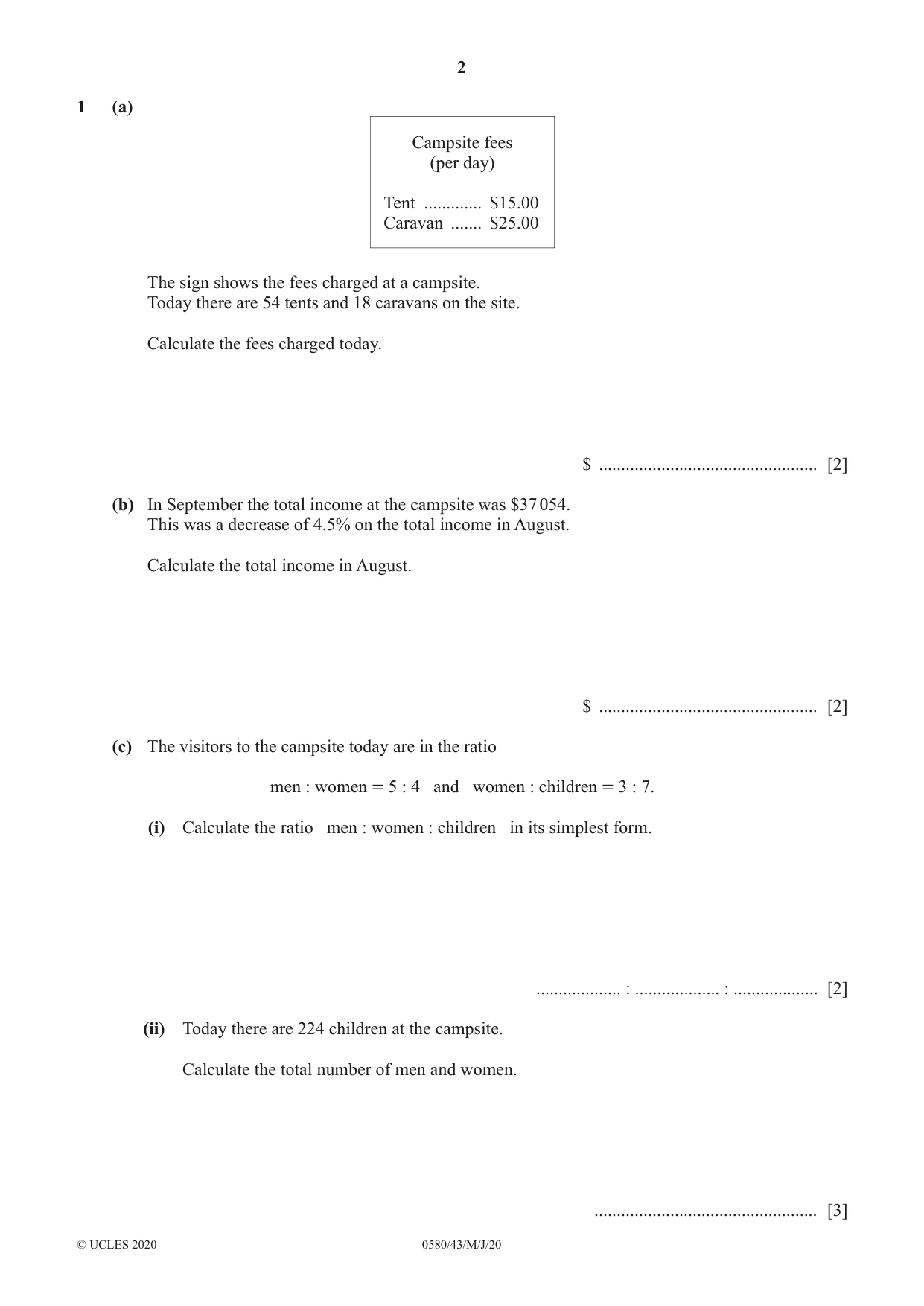
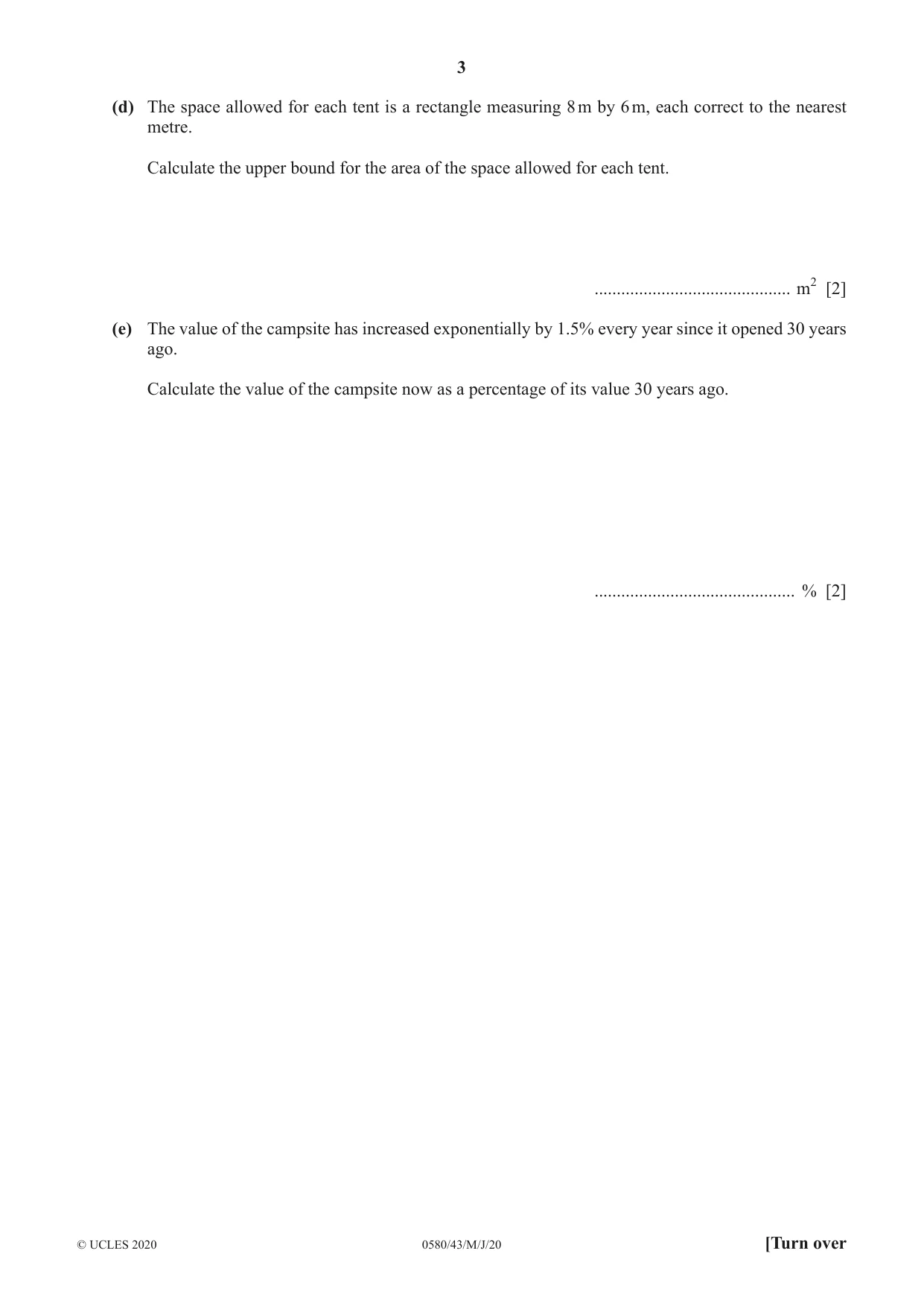
1 (a) Campsite fees (per day) Tent ............. $15.00 Caravan ....... $25.00 The sign shows the fees charged at a campsite. Today there are 54 tents and 18 caravans on the site. Calculate the fees charged today. $ ................................................. [2] (b) In September the total income at the campsite was $37 054. This was a decrease of 4.5% on the total income in August. Calculate the total income in August. $ ................................................. [2] (c) The visitors to the campsite today are in the ratio men : women = 5 : 4 and women : children = 3 : 7. (i) Calculate the ratio men : women : children in its simplest form. ................... : ................... : ................... [2] (ii) Today there are 224 children at the campsite. Calculate the total number of men and women. .................................................. [3] (d) The space allowed for each tent is a rectangle measuring 8 m by 6 m, each correct to the nearest metre. Calculate the upper bound for the area of the space allowed for each tent. ............................................ m2 [2] (e) The value of the campsite has increased exponentially by 1.5% every year since it opened 30 years ago. Calculate the value of the campsite now as a percentage of its value 30 years ago. ............................................. % [2]
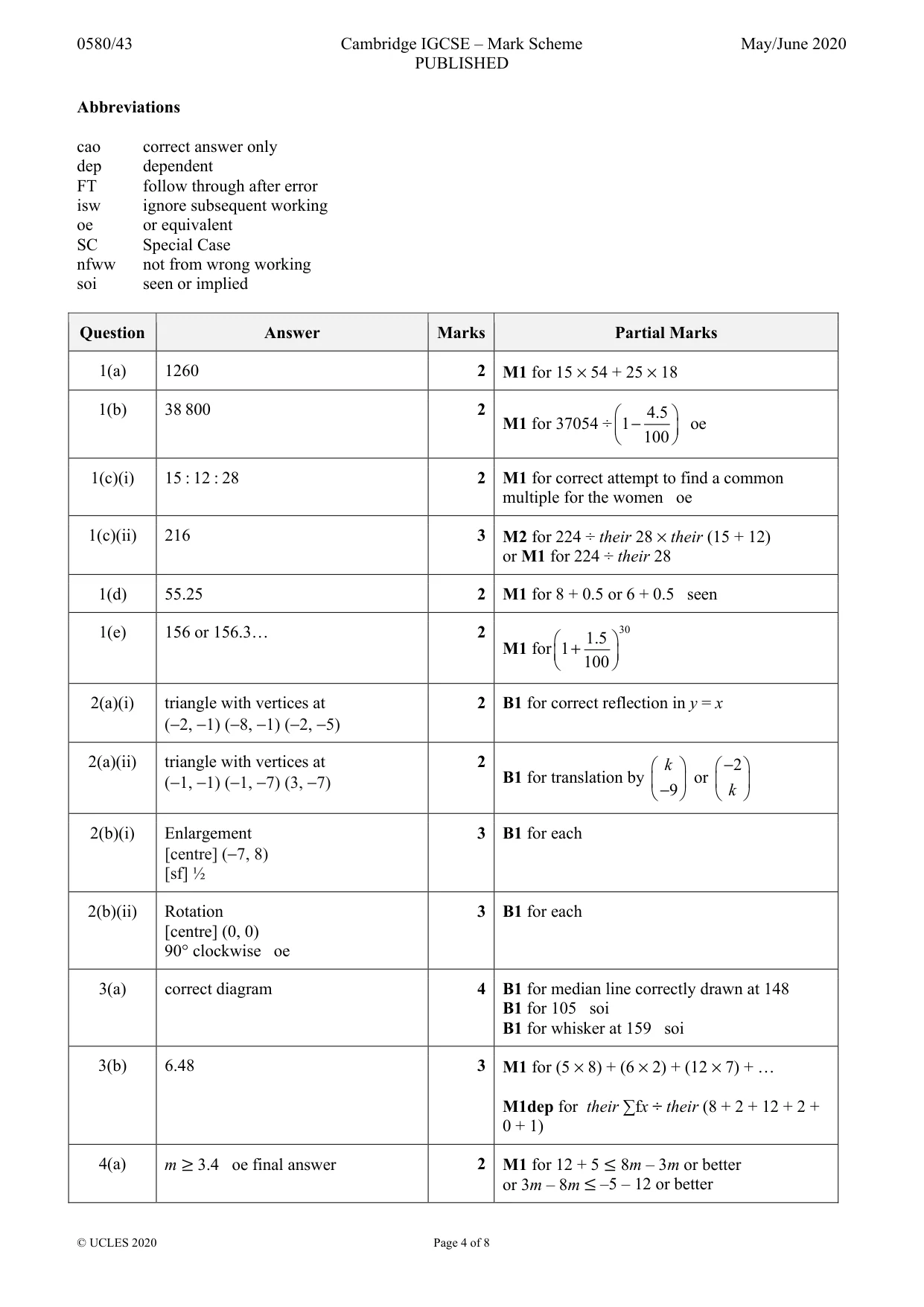
Mark scheme: Question Answer Marks Partial Marks 1(a) 1260 2 M1 for 15 × 54 + 25 × 18 1(b) 38 800 2 4.5 M1 for 37054 ÷ 1 − oe 100 1(c)(i) 15 : 12 : 28 2 M1 for correct attempt to find a common multiple for the women oe 1(c)(ii) 216 3 M2 for 224 ÷ their 28 × their (15 + 12) or M1 for 224 ÷ their 28 1(d) 55.25 2 M1 for 8 + 0.5 or 6 + 0.5 seen 1(e) 156 or 156.3… 2 30 1.5 M1 for 1 + 100
Q2 · Y 10 9 8 7 6 B 5 A 4 3 2 1 – 10 – 9 – 8 – 7 – 6 – 5 – 4 – 3 – 2 – 1 0 1 2 3 4 5 6 7 8 9…
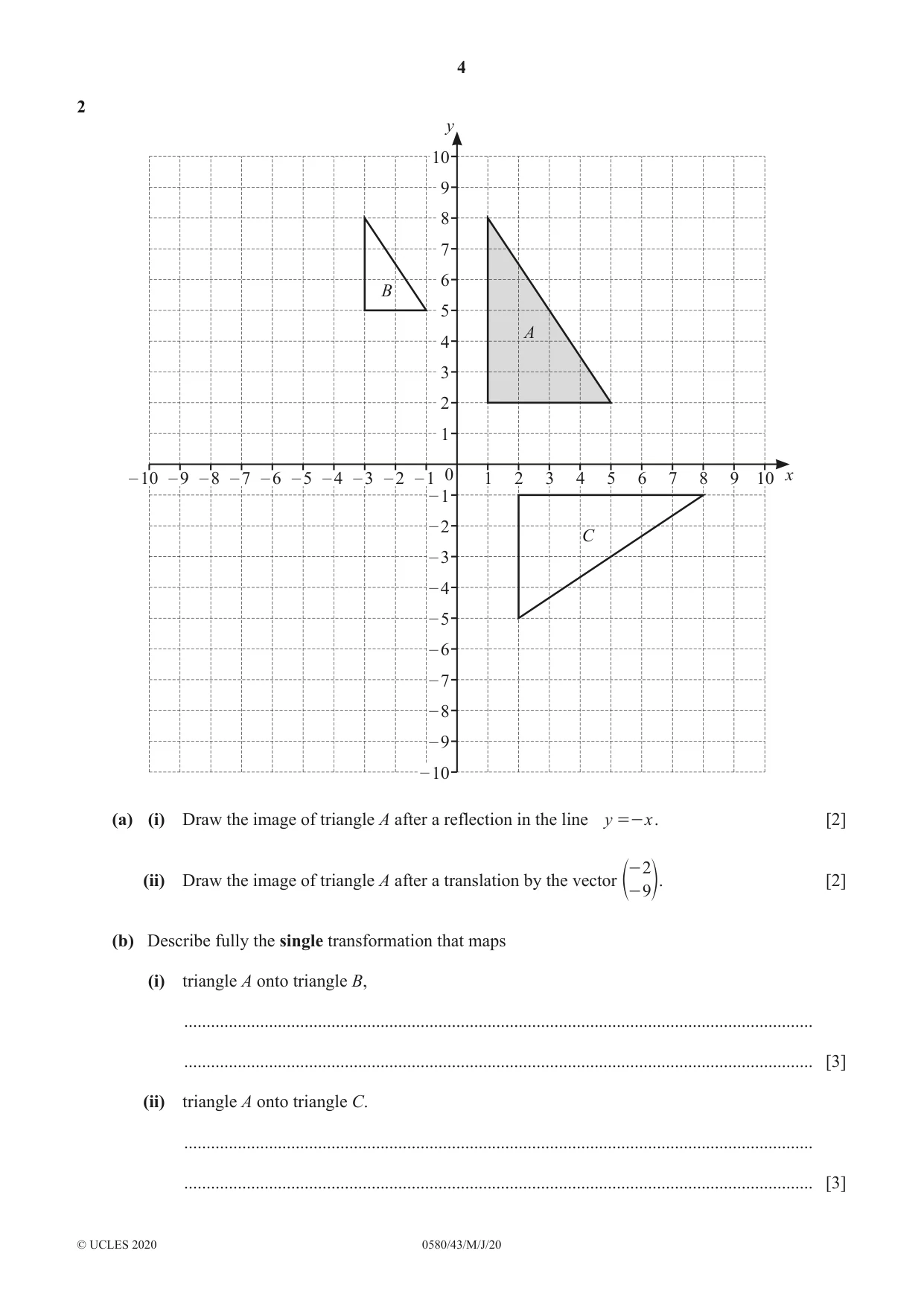
2 y 10 9 8 7 6 B 5 A 4 3 2 1 – 10 – 9 – 8 – 7 – 6 – 5 – 4 – 3 – 2 – 1 0 1 2 3 4 5 6 7 8 9 10 x – 1 – 2 C – 3 – 4 – 5 – 6 – 7 – 8 – 9 – 10 (a) (i) Draw the image of triangle A after a reflection in the line y =- x . [2] - 2 (ii) Draw the image of triangle A after a translation by the vector [2] e- 9o. (b) Describe fully the single transformation that maps (i) triangle A onto triangle B, ............................................................................................................................................. ............................................................................................................................................. [3] (ii) triangle A onto triangle C. ............................................................................................................................................. ............................................................................................................................................. [3]
Mark scheme: 2(a)(i) triangle with vertices at 2 B1 for correct reflection in y = x (−2, −1) (−8, −1) (−2, −5) 2(a)(ii) triangle with vertices at 2 k − 2 B1 for translation by or (−1, −1) (−1, −7) (3, −7) − 9 k 2(b)(i) Enlargement 3 B1 for each [centre] (−7, 8) [sf] ½ 2(b)(ii) Rotation 3 B1 for each [centre] (0, 0) 90° clockwise oe
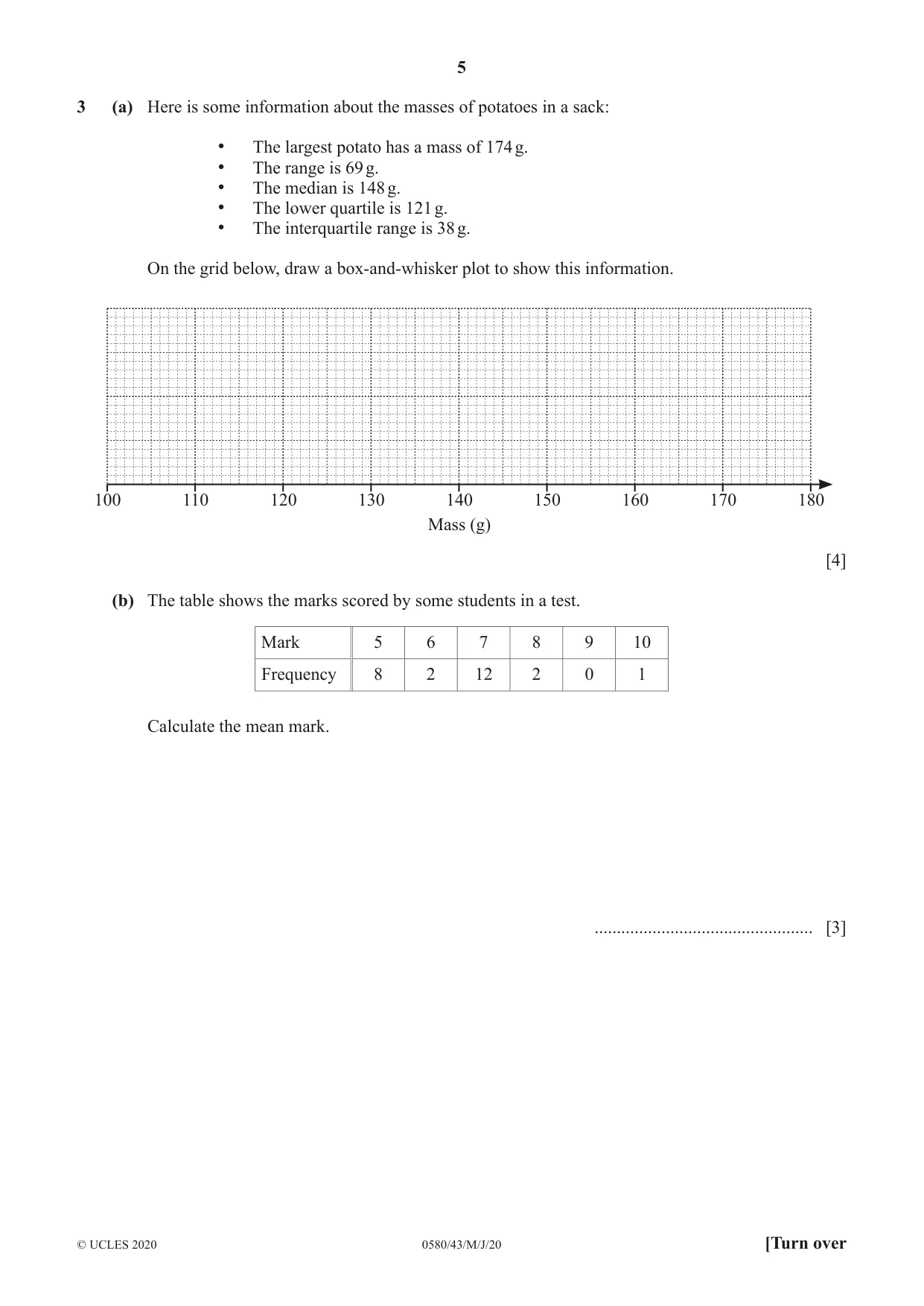
Q3 · Here is some information about the masses of potatoes in a sack: • The largest potato has…
3 (a) Here is some information about the masses of potatoes in a sack: • The largest potato has a mass of 174 g. • The range is 69 g. • The median is 148 g. • The lower quartile is 121 g. • The interquartile range is 38 g. On the grid below, draw a box-and-whisker plot to show this information. 100 110 120 130 140 150 160 170 180 Mass (g) [4] (b) The table shows the marks scored by some students in a test. Mark 5 6 7 8 9 10 Frequency 8 2 12 2 0 1 Calculate the mean mark. ................................................. [3]
Mark scheme: 3(a) correct diagram 4 B1 for median line correctly drawn at 148 B1 for 105 soi B1 for whisker at 159 soi 3(b) 6.48 3 M1 for (5 × 8) + (6 × 2) + (12 × 7) + … M1dep for their ∑fx ÷ their (8 + 2 + 12 + 2 + 0 + 1)
Question 4
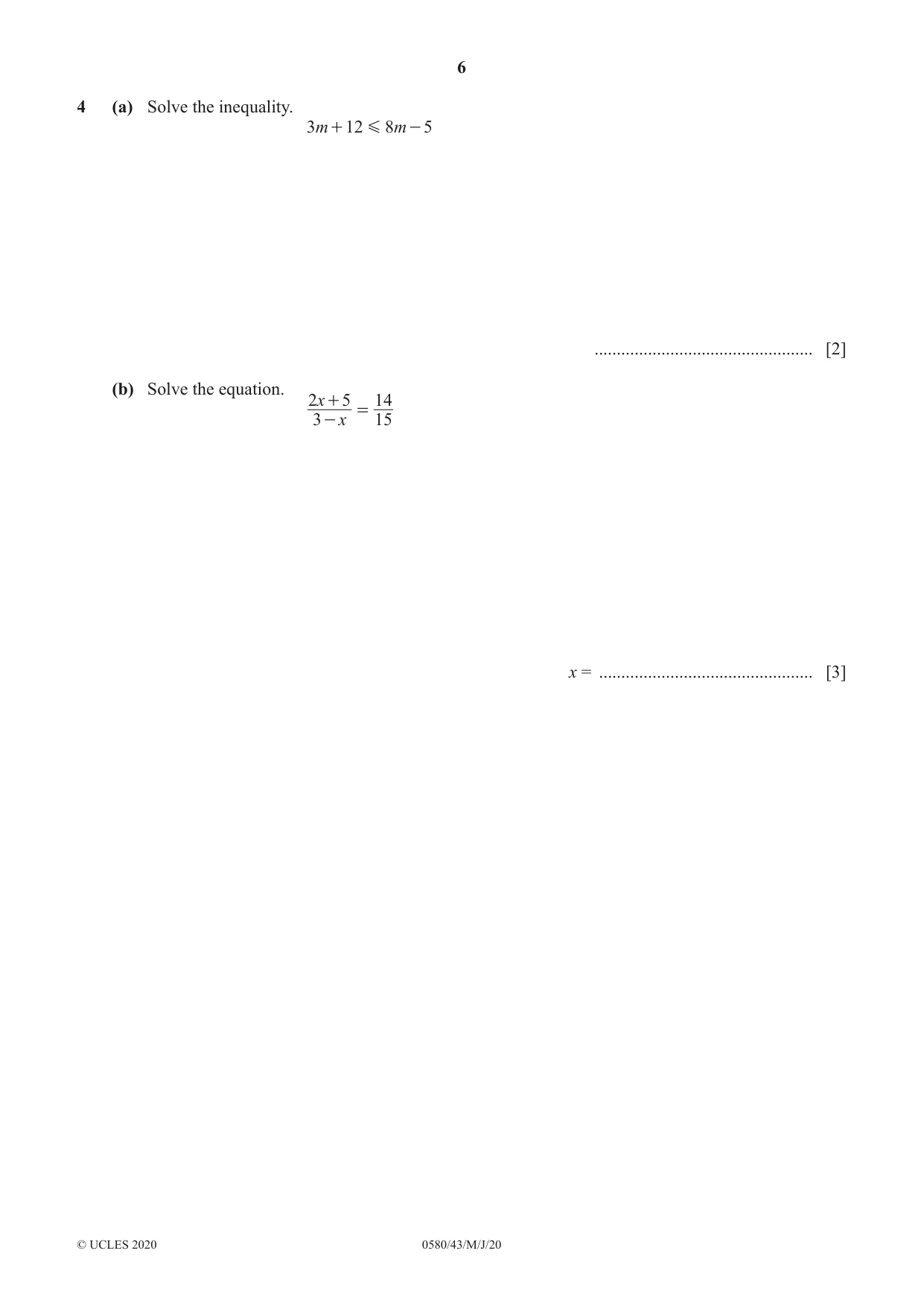
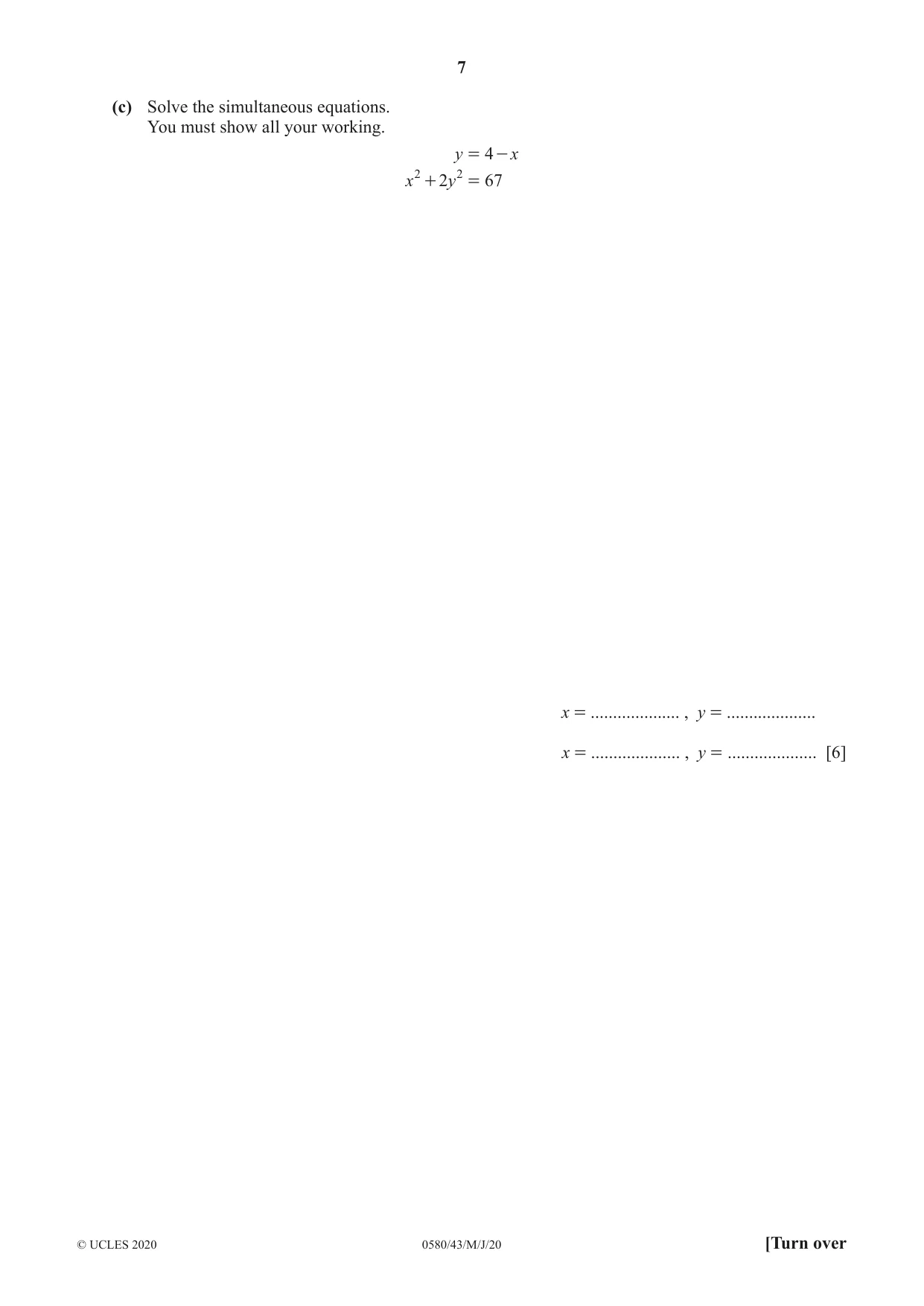
4 (a) Solve the inequality. 3m + 12 G 8m - 5 ................................................. [2] (b) Solve the equation. 2x + 5 14 = 3 - x 15 x = ................................................ [3] (c) Solve the simultaneous equations. You must show all your working. y = 4 - x x 2 + 2y 2 = 67 x = .................... , y = .................... x = .................... , y = .................... [6]
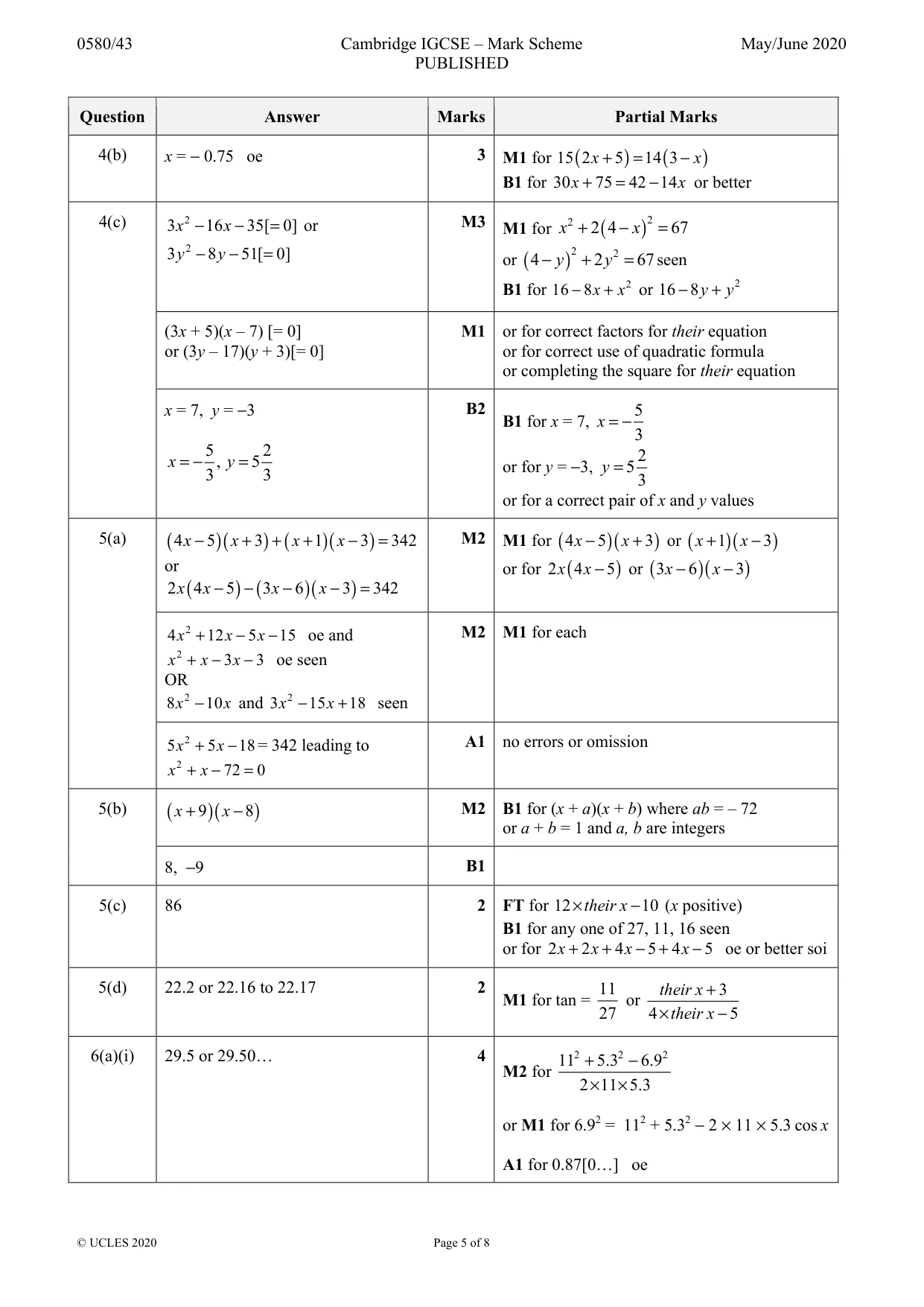
Mark scheme: 4(a) m ≥ 3.4 oe final answer 2 M1 for 12 + 5 ≤ 8m – 3m or better or 3m – 8m ≤ –5 – 12 or better 4(b) x = − 0.75 oe 3 M1 for 15 ( 2 x + 5 ) = 14 ( 3 − x ) B1 for 30 x + 75 = 42 − 14 x or better 4(c) 3 x 2 − 16 x − 35[ = 0] or M3 M1 for x 2 + 2 ( 4 − x ) 2 = 67 3 y 2 − 8 y − 51[ = 0] 2 2 or ( 4 − y ) + 2 y = 67 seen B1 for 16 − 8x + x 2 or 16 − 8y + y 2 (3x + 5)(x – 7) [= 0] M1 or for correct factors for their equation or (3y – 17)(y + 3)[= 0] or for correct use of quadratic formula or completing the square for their equation x = 7, y = −3 B2 5 B1 for x = 7, x = − 3 5 2 2 x = − , y = 5 or for y = −3, y = 5 3 3 3 or for a correct pair of x and y values
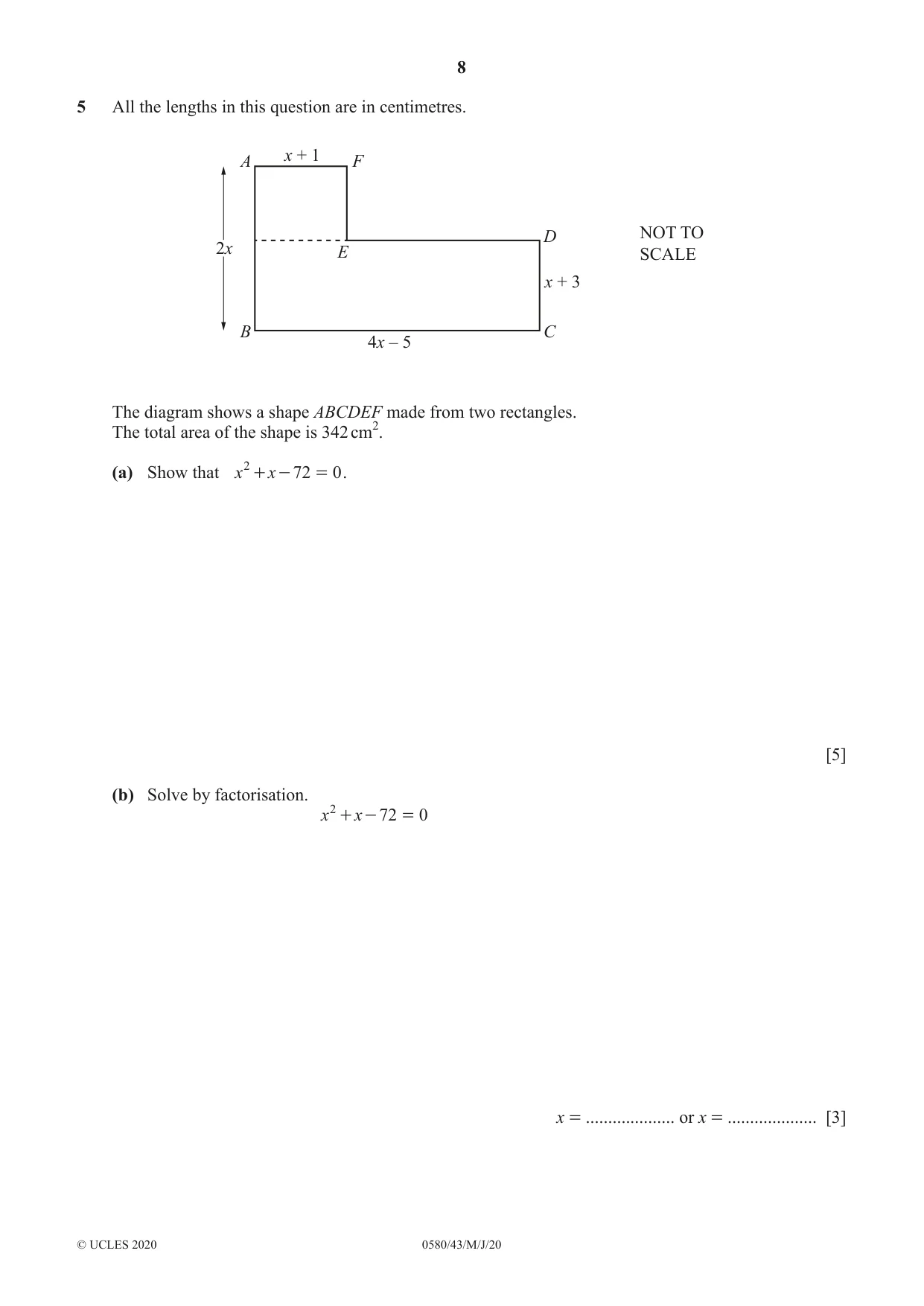
Q5 · All the lengths in this question are in centimetres
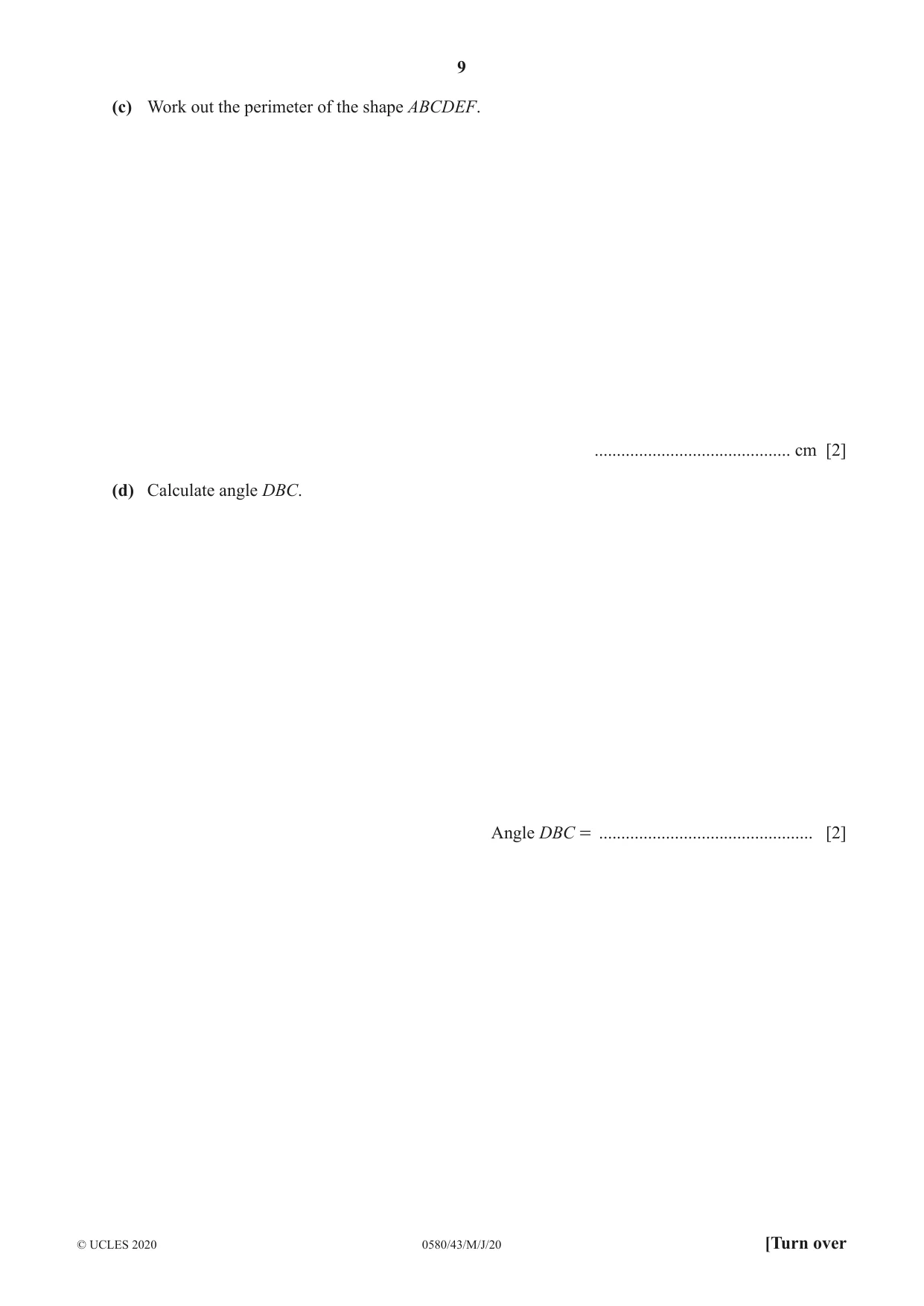
5 All the lengths in this question are in centimetres. x + 1 A F D NOT TO 2x E SCALE x + 3 B C 4x – 5 The diagram shows a shape ABCDEF made from two rectangles. The total area of the shape is 342 cm2. (a) Show that x 2 + x - 72 = 0 . [5] (b) Solve by factorisation. x 2 + x - 72 = 0 x = .................... or x = .................... [3] (c) Work out the perimeter of the shape ABCDEF. ............................................ cm [2] (d) Calculate angle DBC. Angle DBC = ................................................ [2]
Mark scheme: 5(a) ( 4 x − 5 )( x + 3 ) + ( x + 1)( x − 3 ) = 342 M2 M1 for ( 4 x − 5 )( x + 3 ) or ( x + 1)( x − 3 ) or or for 2 x ( 4 x − 5 ) or ( 3 x − 6 )( x − 3 ) 2 x ( 4 x − 5 ) − ( 3 x − 6 )( x − 3 ) = 342 4 x 2 + 12 x − 5 x − 15 oe and M2 M1 for each x 2 + x − 3 x − 3 oe seen OR 8 x 2 − 10 x and 3 x 2 − 15 x + 18 seen 5 x 2 + 5 x − 18 = 342 leading to A1 no errors or omission x 2 + x − 72 = 0 5(b) ( x + 9 )( x − 8 ) M2 B1 for (x + a)(x + b) where ab = – 72 or a + b = 1 and a, b are integers 8, −9 B1 5(c) 86 2 FT for 12 × their x − 10 (x positive) B1 for any one of 27, 11, 16 seen or for 2 x + 2 x + 4 x − 5 + 4 x − 5 oe or better soi 5(d) 22.2 or 22.16 to 22.17 2 11 their x + 3 M1 for tan = or 27 4 × their x − 5
Q6 · C 54° x° NOT TO SCALE 5.3 cm 11 cm G 6.9 cm 42° A B The diagram shows triangle ABC with…
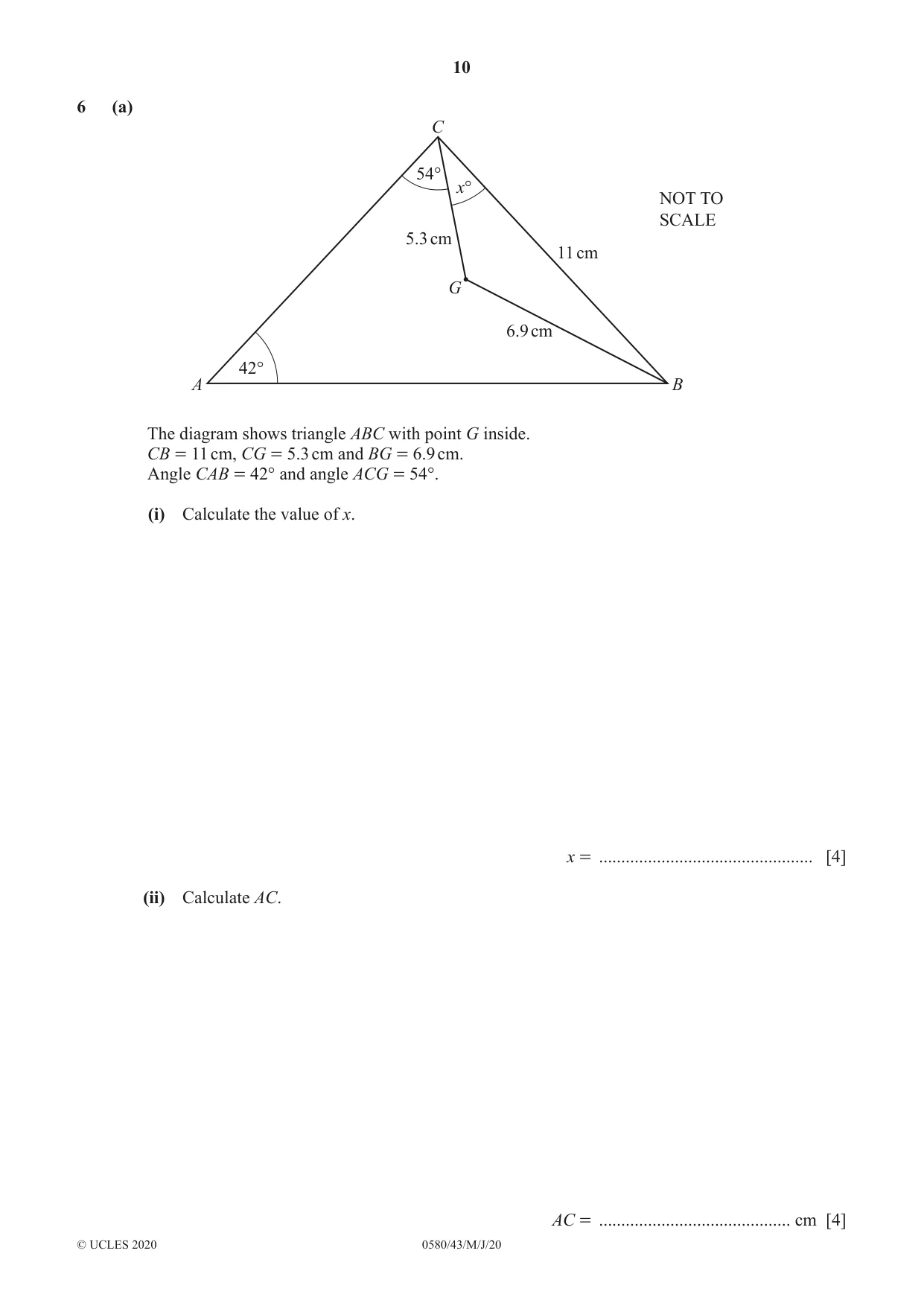
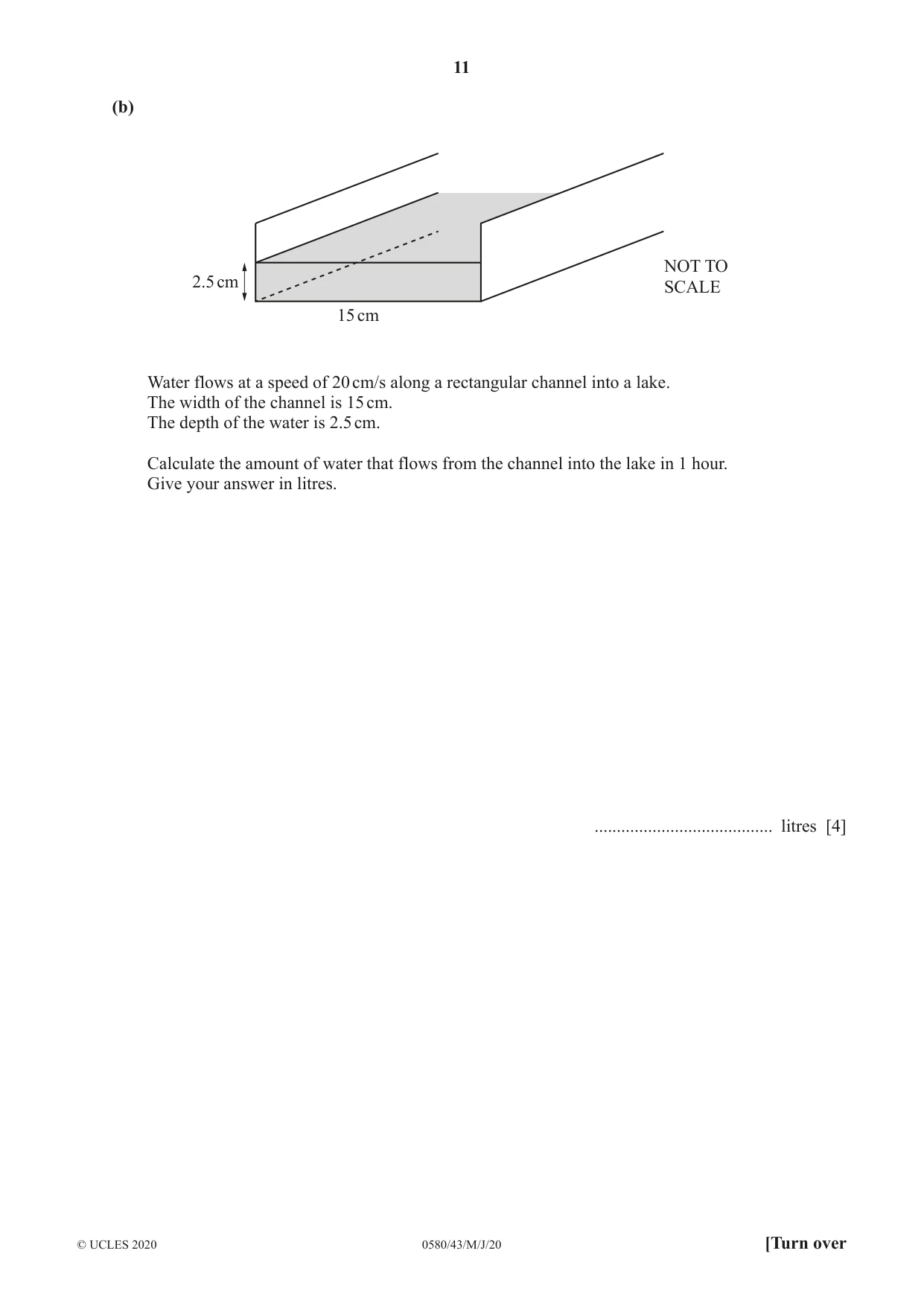
6 (a) C 54° x° NOT TO SCALE 5.3 cm 11 cm G 6.9 cm 42° A B The diagram shows triangle ABC with point G inside. CB = 11 cm, CG = 5.3 cm and BG = 6.9 cm. Angle CAB = 42° and angle ACG = 54°. (i) Calculate the value of x. x = ................................................ [4] (ii) Calculate AC. AC = ........................................... cm [4] (b) NOT TO 2.5 cm SCALE 15 cm Water flows at a speed of 20 cm/s along a rectangular channel into a lake. The width of the channel is 15 cm. The depth of the water is 2.5 cm. Calculate the amount of water that flows from the channel into the lake in 1 hour. Give your answer in litres. ........................................ litres [4]
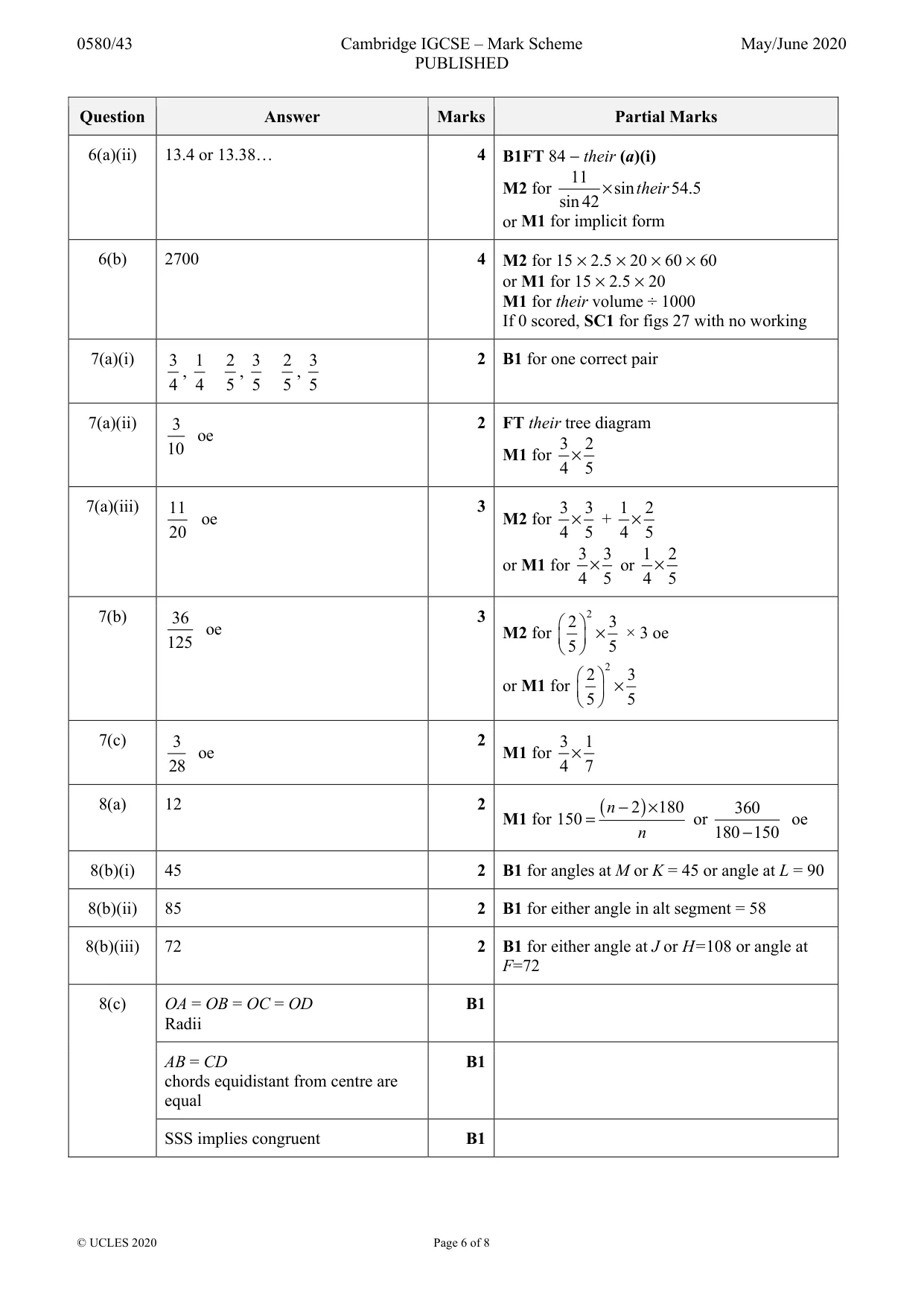
Mark scheme: 6(a)(i) 29.5 or 29.50… 4 112 + 5.32 − 6.9 2 M2 for 2 × 11 × 5.3 or M1 for 6.92 = 112 + 5.32 − 2 × 11 × 5.3 cos x A1 for 0.87[0…] oe 6(a)(ii) 13.4 or 13.38… 4 B1FT 84 − their (a)(i) 11 M2 for × sin their 54.5 sin42 or M1 for implicit form 6(b) 2700 4 M2 for 15 × 2.5 × 20 × 60 × 60 or M1 for 15 × 2.5 × 20 M1 for their volume ÷ 1000 If 0 scored, SC1 for figs 27 with no working
Q7 · On any Saturday, the probability that Arun plays football is 3
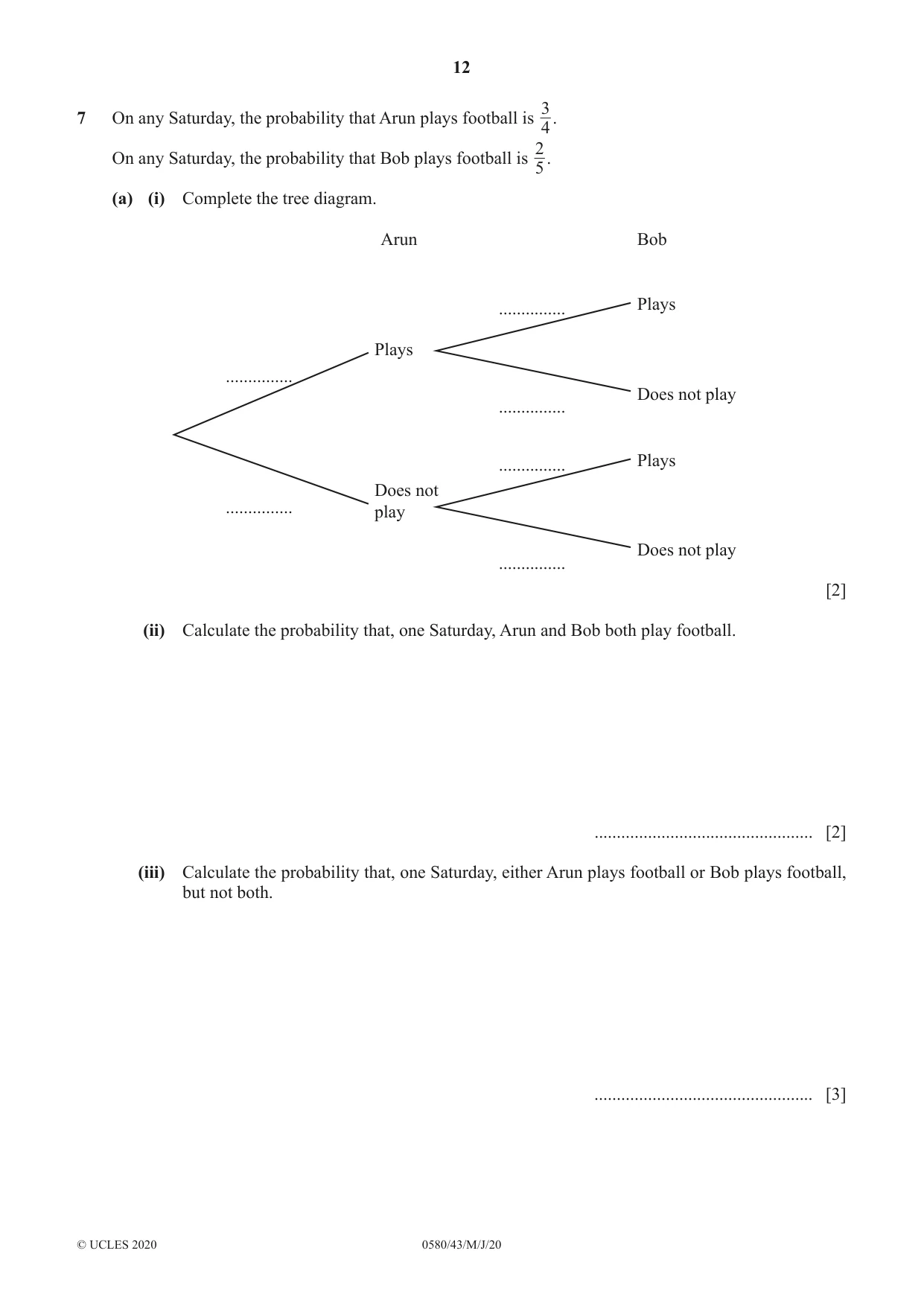
7 On any Saturday, the probability that Arun plays football is 3. 4 On any Saturday, the probability that Bob plays football is 2. 5 (a) (i) Complete the tree diagram. Arun Bob ............... Plays Plays ............... Does not play ............... ............... Plays Does not ............... play Does not play ............... [2] (ii) Calculate the probability that, one Saturday, Arun and Bob both play football. ................................................. [2] (iii) Calculate the probability that, one Saturday, either Arun plays football or Bob plays football, but not both. ................................................. [3] (b) Calculate the probability that Bob plays football for 2 of the next 3 Saturdays. ................................................. [3] (c) When Arun plays football, the probability that he scores the winning goal is 1. 7 Calculate the probability that Arun scores the winning goal one Saturday. ................................................. [2]
Mark scheme: 7(a)(i) 3 1 2 3 2 3 2 B1 for one correct pair , , , 4 4 5 5 5 5 7(a)(ii) 3 2 FT their tree diagram oe 3 2 10 M1 for × 4 5 7(a)(iii) 11 3 3 3 1 2 oe M2 for × + × 20 4 5 4 5 3 3 1 2 or M1 for × or × 4 5 4 5 7(b) 36 3 2 2 3 oe M2 for × × 3 oe 125 5 5 2 ×2 3 or M1 for 5 5 7(c) 3 2 3 1 oe M1 for × 28 4 7
Q8 · The interior angle of a regular polygon with n sides is 150°
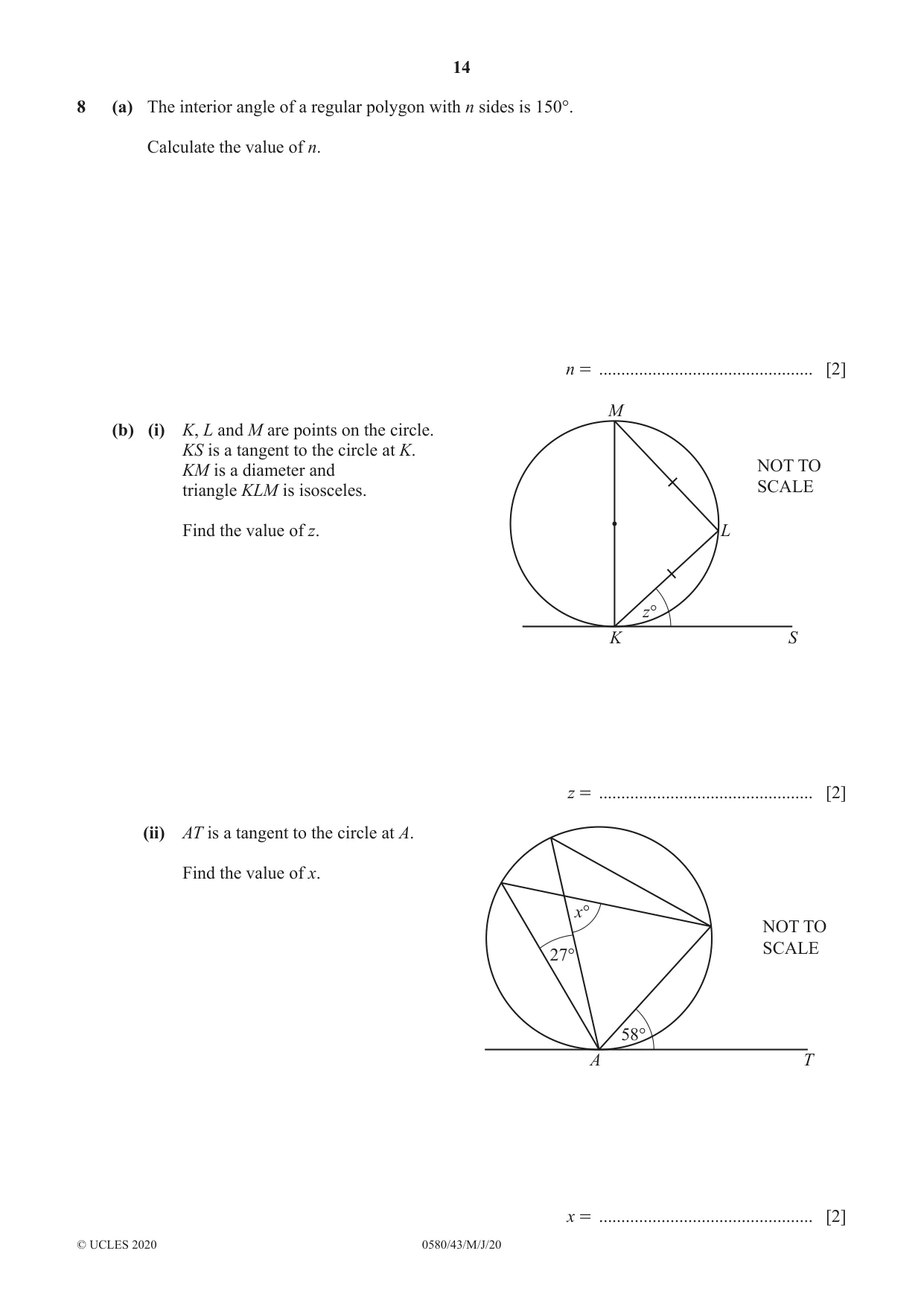
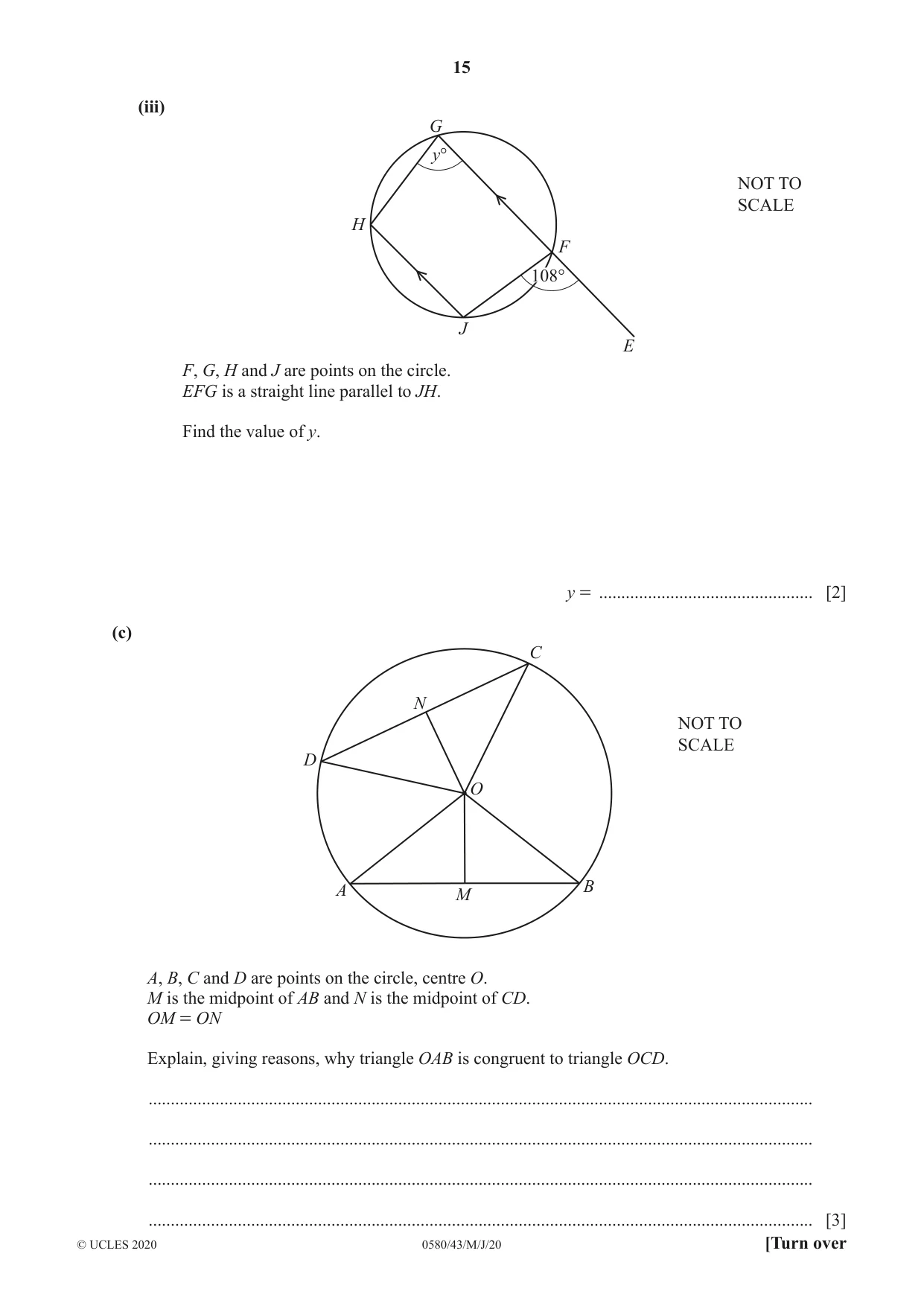
8 (a) The interior angle of a regular polygon with n sides is 150°. Calculate the value of n. n = ................................................ [2] M (b) (i) K, L and M are points on the circle. KS is a tangent to the circle at K. KM is a diameter and NOT TO triangle KLM is isosceles. SCALE Find the value of z. L z° K S z = ................................................ [2] (ii) AT is a tangent to the circle at A. Find the value of x. x° NOT TO SCALE 27° 58° A T x = ................................................ [2] (iii) G y° NOT TO SCALE H F 108° J E F, G, H and J are points on the circle. EFG is a straight line parallel to JH. Find the value of y. y = ................................................ [2] (c) C N NOT TO SCALE D O A B M A, B, C and D are points on the circle, centre O. M is the midpoint of AB and N is the midpoint of CD. OM = ON Explain, giving reasons, why triangle OAB is congruent to triangle OCD. ..................................................................................................................................................... ..................................................................................................................................................... ..................................................................................................................................................... ..................................................................................................................................................... [3]
Mark scheme: 8(a) 12 2 ( n − 2 ) × 180 360 M1 for 150 = or oe n 180 − 150 8(b)(i) 45 2 B1 for angles at M or K = 45 or angle at L = 90 8(b)(ii) 85 2 B1 for either angle in alt segment = 58 8(b)(iii) 72 2 B1 for either angle at J or H=108 or angle at F=72 8(c) OA = OB = OC = OD B1 Radii AB = CD B1 chords equidistant from centre are equal SSS implies congruent B1
Q9 · The equation of line L is 3x - 8y + 20 = 0
9 (a) The equation of line L is 3x - 8y + 20 = 0 . (i) Find the gradient of line L. ................................................. [2] (ii) Find the coordinates of the point where line L cuts the y-axis. ( ................... , ................... ) [1] (b) The coordinates of P are (-3, 8) and the coordinates of Q are (9, -2). (i) Calculate the length PQ. ................................................. [3] (ii) Find the equation of the line parallel to PQ that passes through the point (6, -1). ................................................. [3] (iii) Find the equation of the perpendicular bisector of PQ. ................................................. [4]
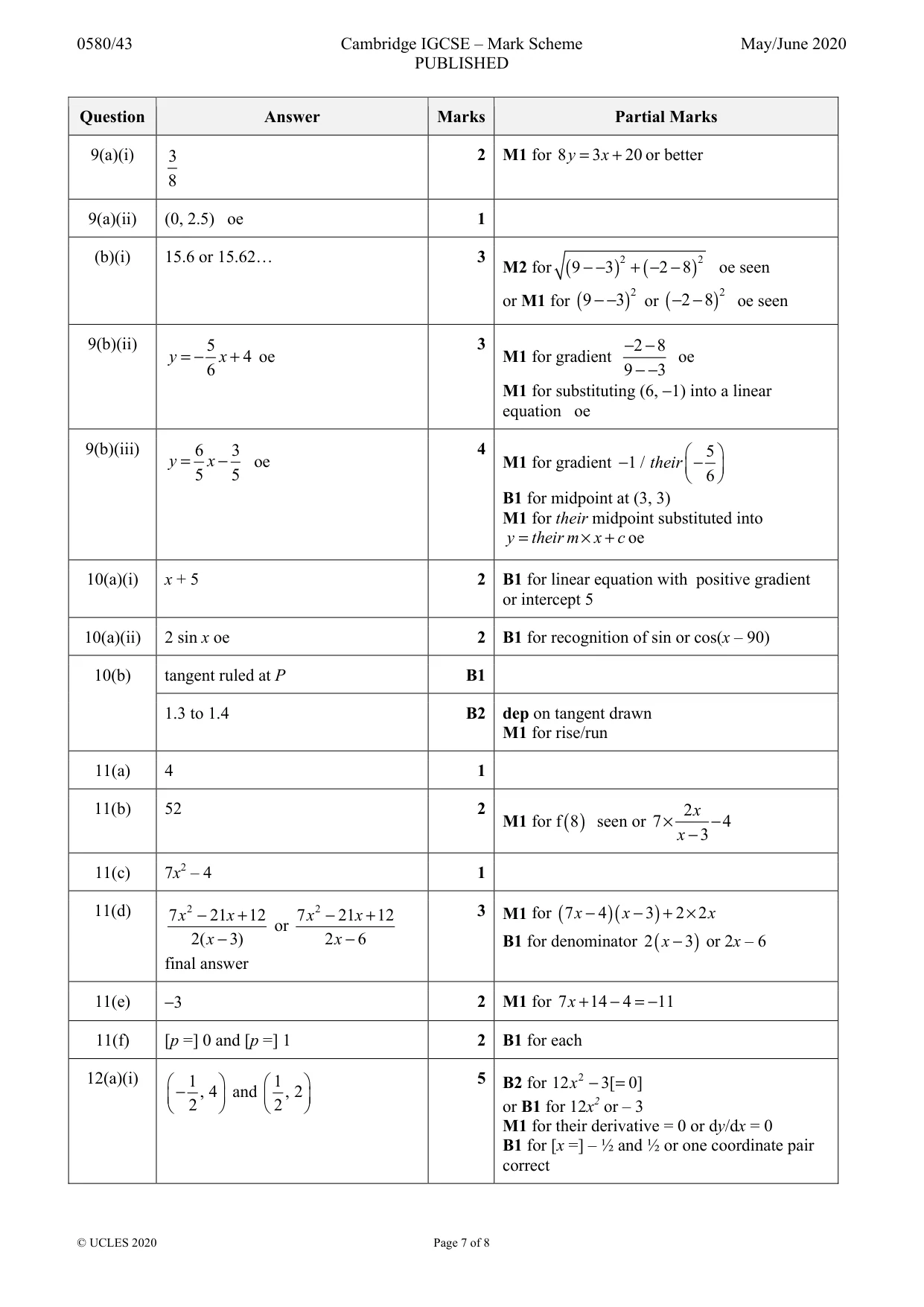
Mark scheme: 9(a)(i) 3 2 M1 for 8 y = 3 x + 20 or better 8 9(a)(ii) (0, 2.5) oe 1 (b)(i) 15.6 or 15.62… 3 2 2 M2 for ( 9 −−3 ) + ( −−2 8 ) oe seen 2 2 or M1 for ( 9 −−3) or ( −−2 8 ) oe seen 9(b)(ii) 5 3 −−2 8 y = − x + 4 oe M1 for gradient oe 6 9 −−3 M1 for substituting (6, −1) into a linear equation oe 9(b)(iii) 6 3 4 5 y = x − oe M1 for gradient −1 / their − 5 5 6 B1 for midpoint at (3, 3) M1 for their midpoint substituted into y = their m × x + c oe
Q10 · The diagrams show the graphs of two functions
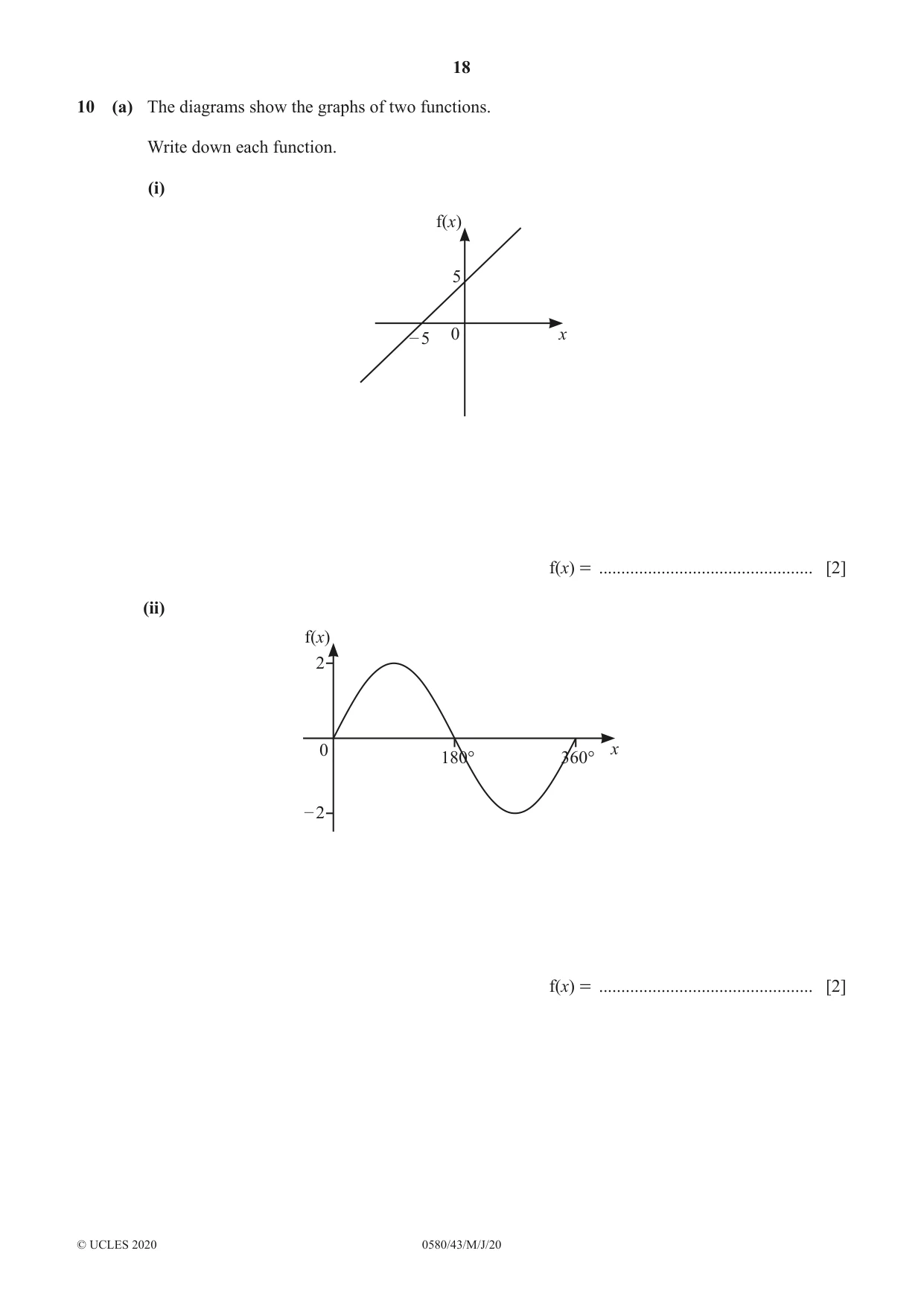
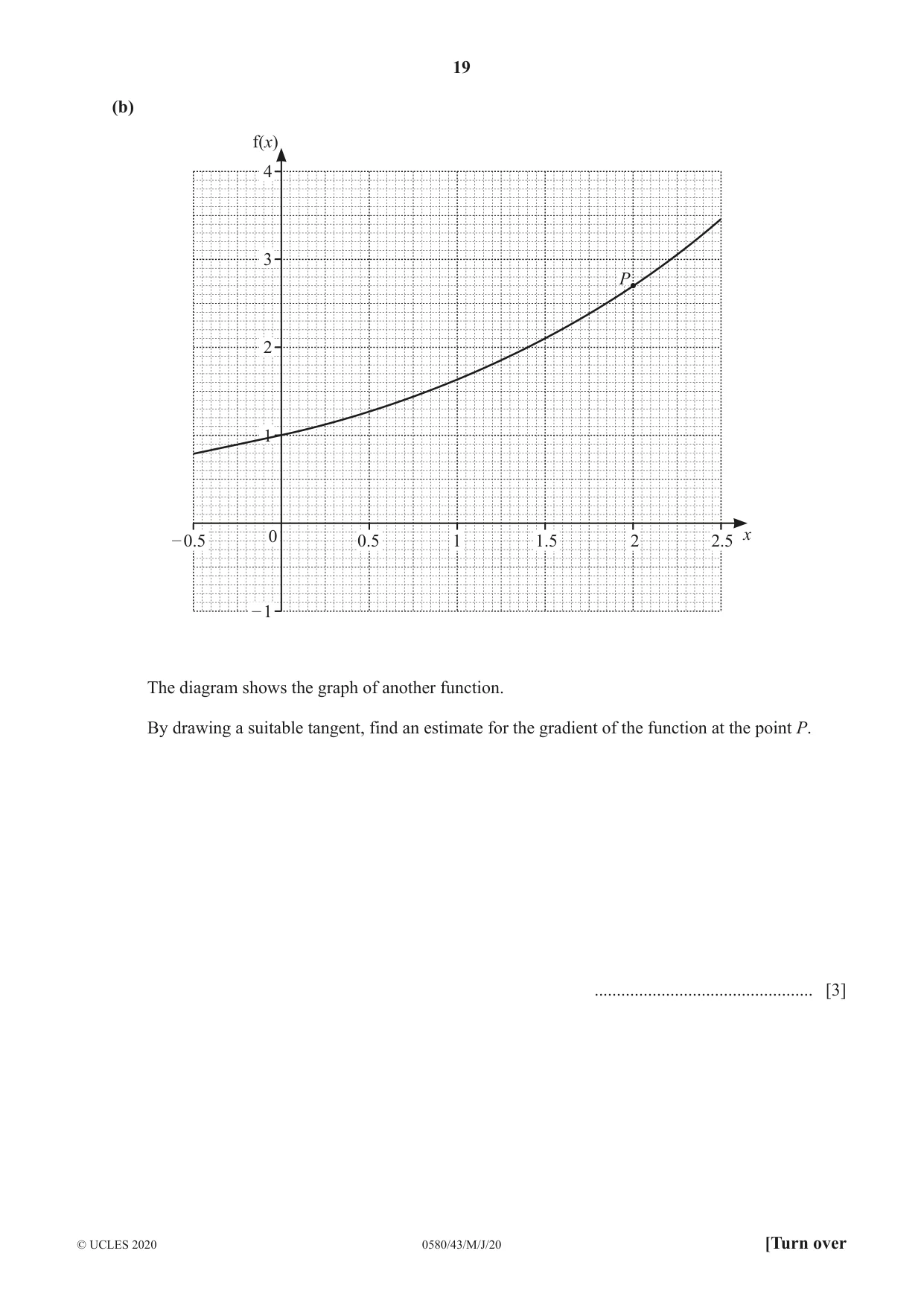
10 (a) The diagrams show the graphs of two functions. Write down each function. (i) f(x) 5 – 5 0 x f(x) = ................................................ [2] (ii) f(x) 2 0 x 180° 360° – 2 f(x) = ................................................ [2] (b) f(x) 4 3 P 2 1 – 0.5 0 0.5 1 1.5 2 2.5 x – 1 The diagram shows the graph of another function. By drawing a suitable tangent, find an estimate for the gradient of the function at the point P. ................................................. [3]
Mark scheme: 10(a)(i) x + 5 2 B1 for linear equation with positive gradient or intercept 5 10(a)(ii) 2 sin x oe 2 B1 for recognition of sin or cos(x – 90) 10(b) tangent ruled at P B1 1.3 to 1.4 B2 dep on tangent drawn M1 for rise/run
Q11 · X11 f ( x) = 7 x - 4 g ( x) = , x !
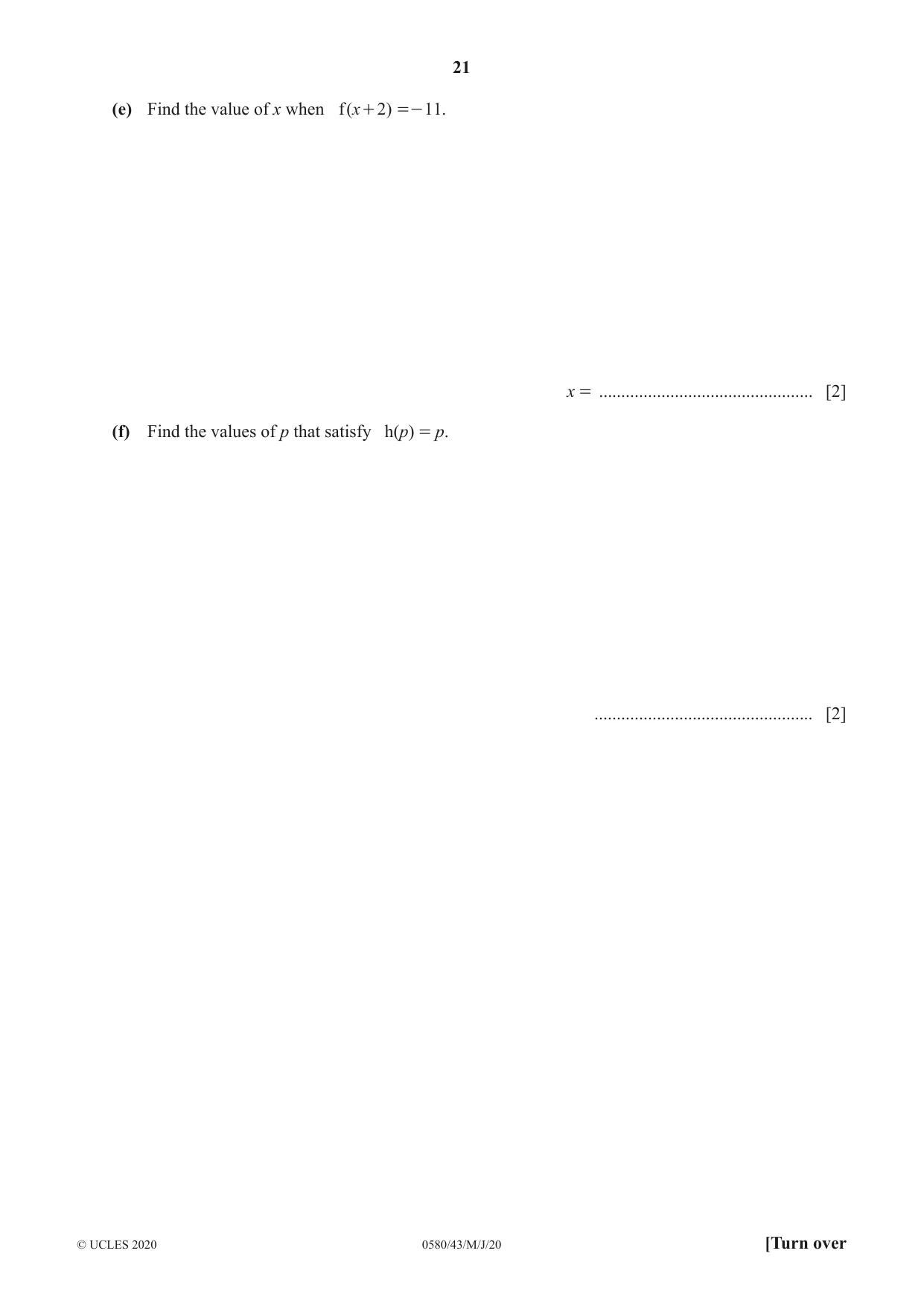
2x11 f ( x) = 7 x - 4 g ( x) = , x ! 3 h ( x) = x2 x - 3 (a) Find g(6). ................................................. [1] (b) Find fg(4). ................................................. [2] (c) Find fh(x). ................................................. [1] f ( x) (d) Find + g ( x) . 2 Give your answer as a single fraction, in terms of x, in its simplest form. ................................................. [3] (e) Find the value of x when f ( x + 2) =- 11. x = ................................................ [2] (f) Find the values of p that satisfy h(p) = p. ................................................. [2]
Mark scheme: 11(a) 4 1 11(b) 52 2 2 x M1 for f( 8 ) seen or 7 × − 4 x − 3 11(c) 7x2 – 4 1 11(d) 7 x 2 − 21x + 12 7 x 2 − 21x + 12 3 M1 for ( 7 x − 4 )( x − 3 ) + 2 × 2 x or 2( x − 3) 2 x − 6 B1 for denominator 2 ( x − 3 ) or 2x – 6 final answer 11(e) −3 2 M1 for 7 x + 14 − 4 = −11 11(f) [p =] 0 and [p =] 1 2 B1 for each
Q12 · A curve has equation y = 4 x 3 - 3x + 3
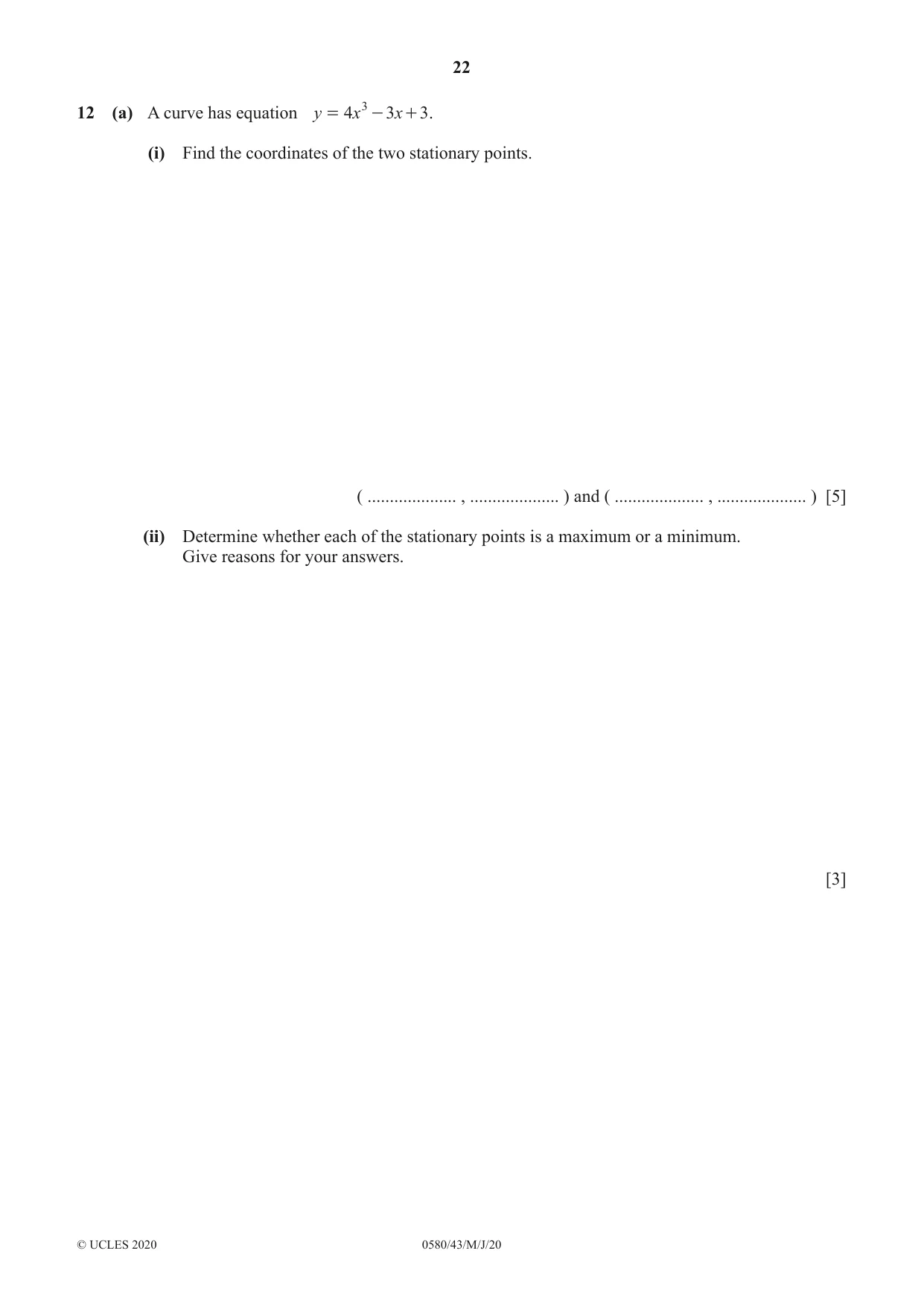
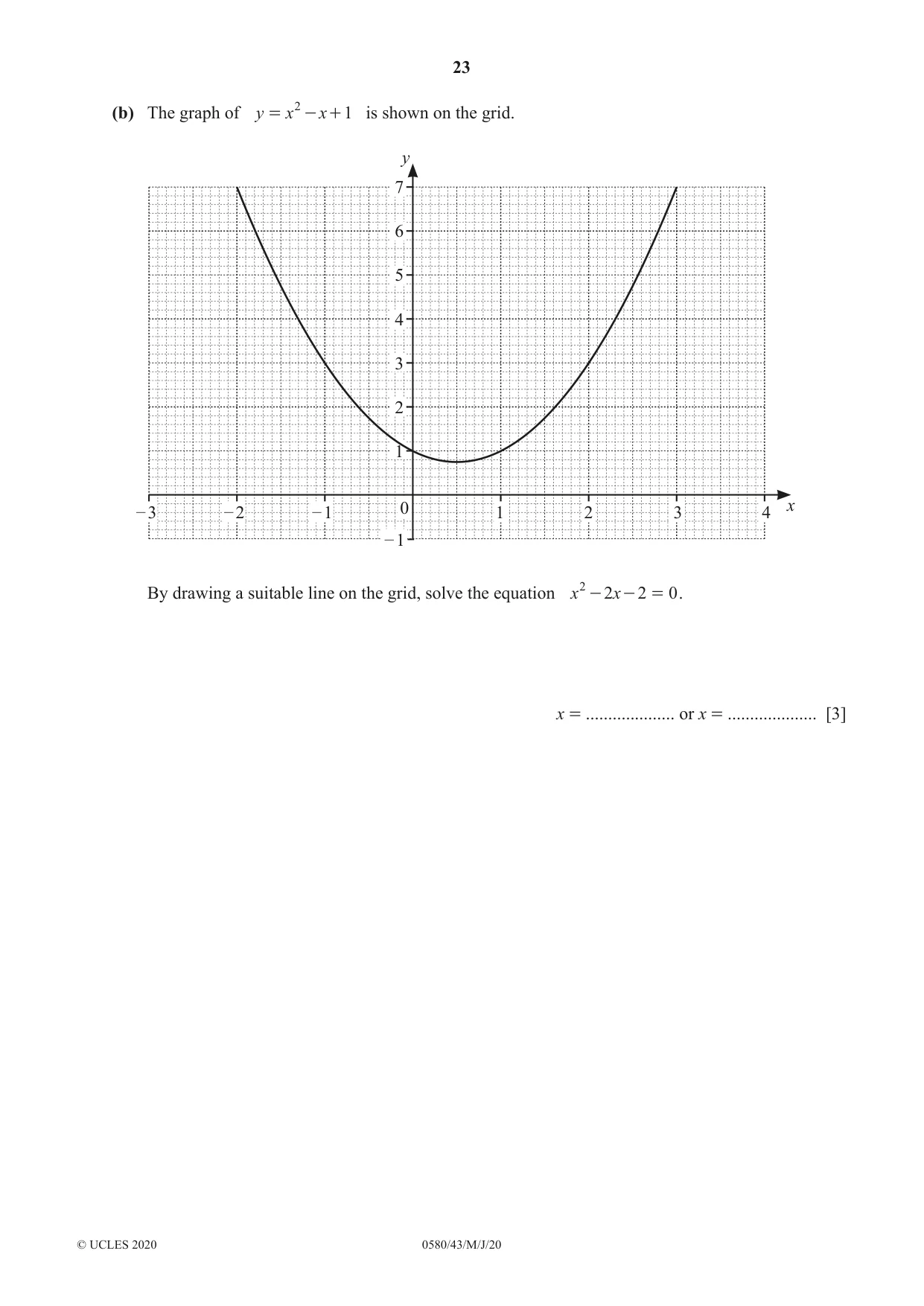
12 (a) A curve has equation y = 4 x 3 - 3x + 3 . (i) Find the coordinates of the two stationary points. ( .................... , .................... ) and ( .................... , .................... ) [5] (ii) Determine whether each of the stationary points is a maximum or a minimum. Give reasons for your answers. [3] (b) The graph of y = x 2 - x + 1 is shown on the grid. y 7 6 5 4 3 2 1 – 3 – 2 – 1 0 1 2 3 4 x – 1 By drawing a suitable line on the grid, solve the equation x 2 - 2x - 2 = 0 . x = .................... or x = .................... [3]
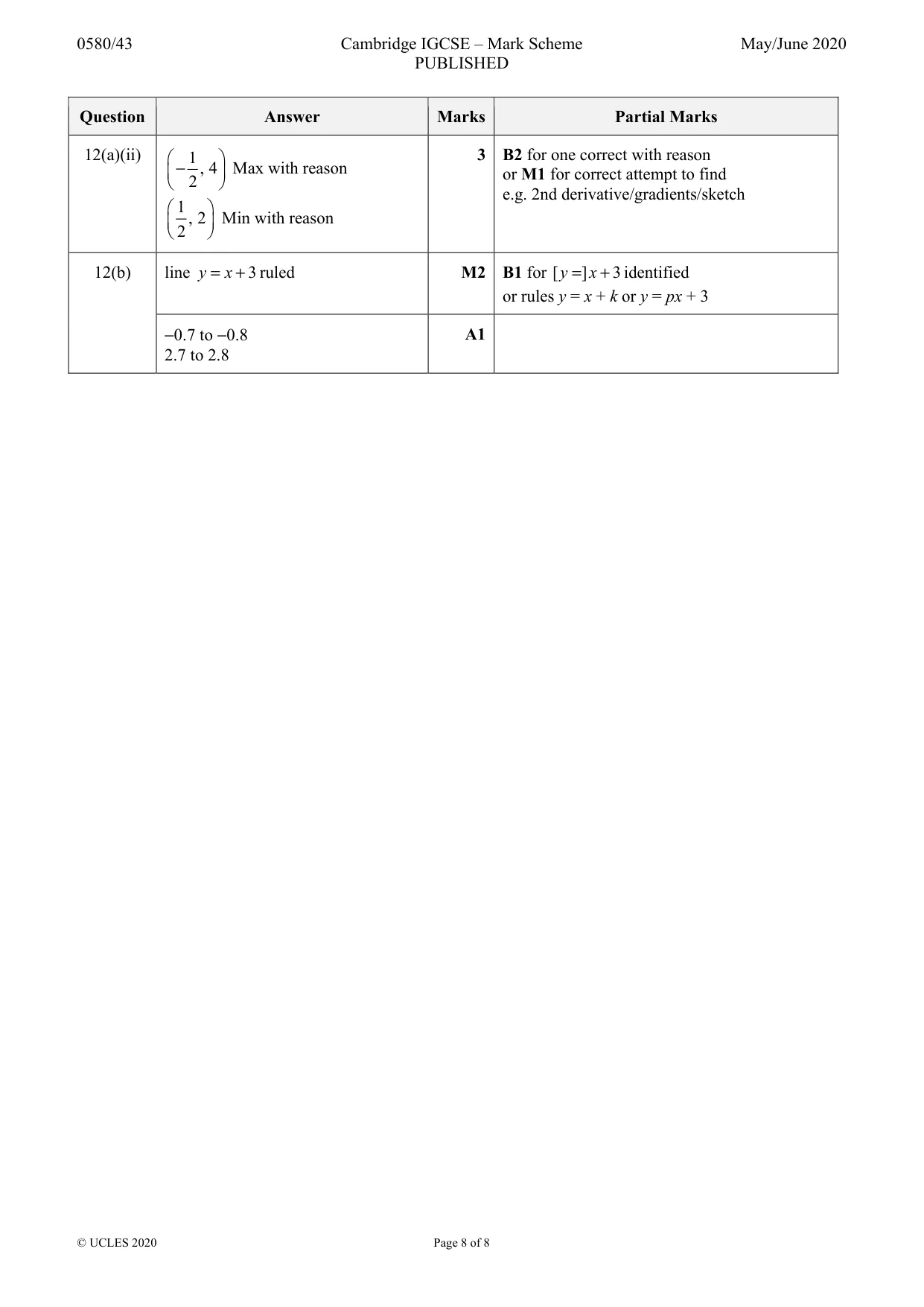
Mark scheme: 12(a)(i) 1 1 5 B2 for 12 x 2 − 3[ = 0] − , 4 and , 2 2 2 or B1 for 12x2 or – 3 M1 for their derivative = 0 or dy/dx = 0 B1 for [x =] – ½ and ½ or one coordinate pair correct 12(a)(ii) 1 3 B2 for one correct with reason − , 4 Max with reason or M1 for correct attempt to find 2 e.g. 2nd derivative/gradients/sketch 1 , 2 Min with reason 2 12(b) line y = x + 3 ruled M2 B1 for [ y = ] x + 3 identified or rules y = x + k or y = px + 3 −0.7 to −0.8 A1 2.7 to 2.8
What was in this paper
The subtopics covered by these 12 questions, and how many questions each got. Open one in a new tab to see every Cambridge question on it.