Cambridge IGCSE Mathematics 0580 — 2023 Oct/Nov Paper 4 · Variant 2
0580/42/O/N/23 · 12 questions · 130 marks · ≈146 min
The question paper and its mark scheme, free to read here and free to download. This is Cambridge’s own paper, exactly as it was sat.
Question paper20 pages
Mark scheme10 pages
Answers below. Sit the paper first if you are practising.
Questions as text
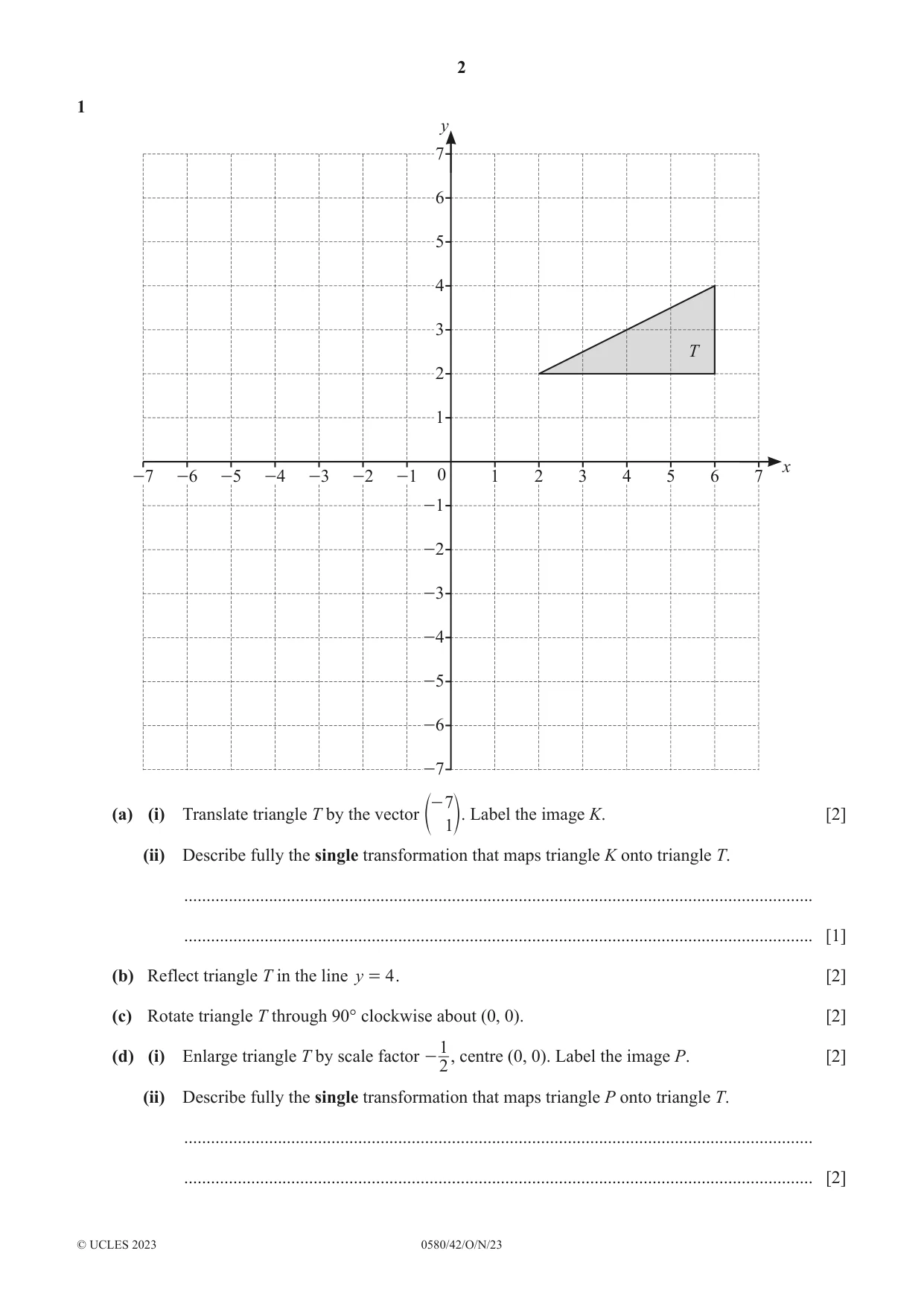
Q1 · Y 7 6 5 4 3 T 2 1 x -7 -6 -5 -4 -3 -2 -1 0 1 2 3 4 5 6 7 -1 -2 -3 -4 -5 -6 -7 - 7 (a) (i)…
1 y 7 6 5 4 3 T 2 1 x -7 -6 -5 -4 -3 -2 -1 0 1 2 3 4 5 6 7 -1 -2 -3 -4 -5 -6 -7 - 7 (a) (i) Translate triangle T by the vector Label the image K. [2] e 1o. (ii) Describe fully the single transformation that maps triangle K onto triangle T. ............................................................................................................................................. ............................................................................................................................................. [1] (b) Reflect triangle T in the line y = 4 . [2] (c) Rotate triangle T through 90° clockwise about (0, 0). [2] 1 (d) (i) Enlarge triangle T by scale factor - , centre (0, 0). Label the image P. [2] 2 (ii) Describe fully the single transformation that maps triangle P onto triangle T. ............................................................................................................................................. ............................................................................................................................................. [2]
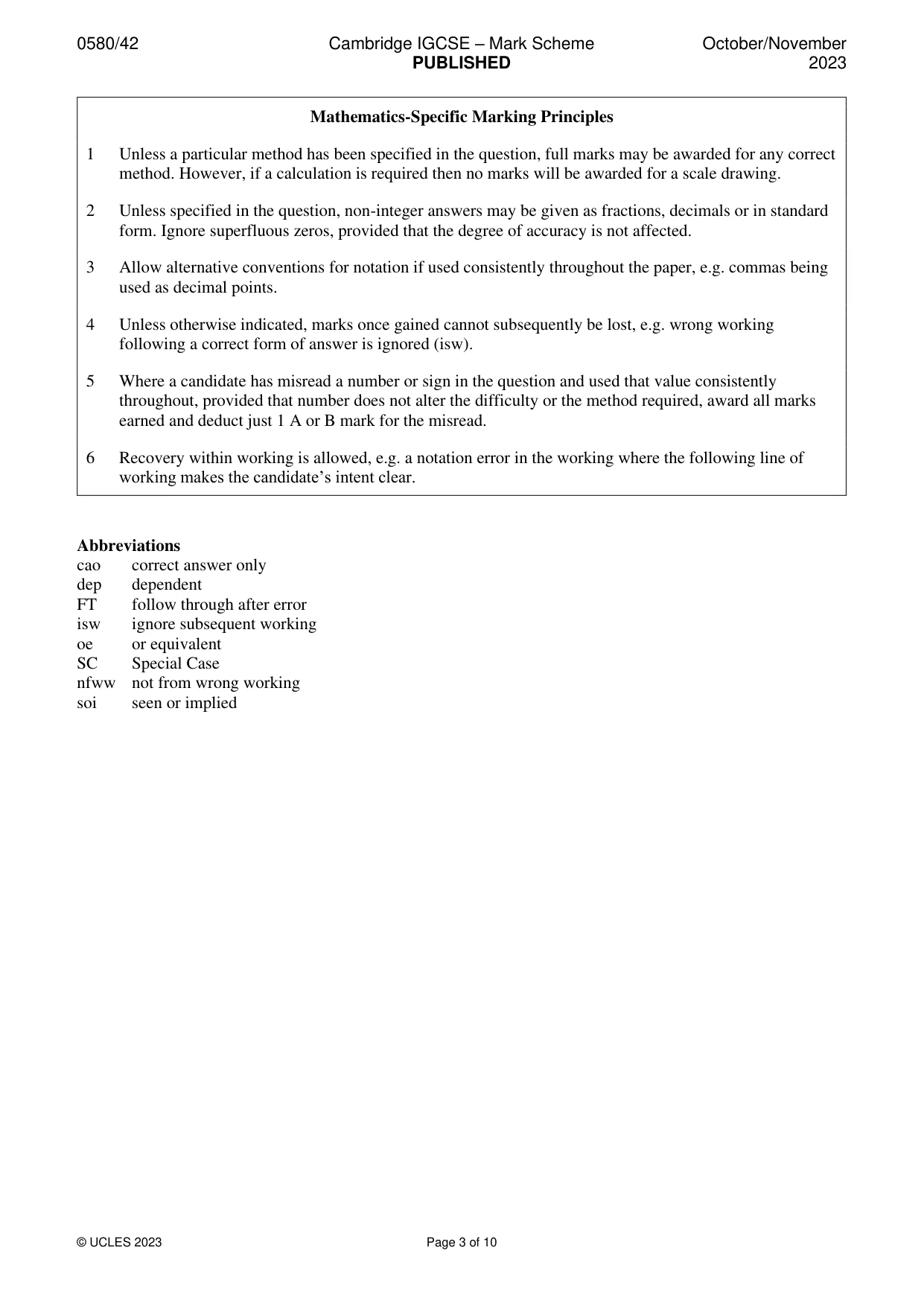
Mark scheme: Question Answer Marks Partial Marks 1(a)(i) Image at (–5, 3), (–1, 3), (–1, 5) 2 −7 k B1 for translation or k 1 1(a)(ii) 7 1 Translation cao −1 1(b) Image at (6, 4), (6, 6), (2, 6) 2 B1 for reflection in line x = 4 or for reflection in line y = k 1(c) Image at (2, –2), (2, –6), (4, –6) 2 B1 for correct size and orientation or for rotation 90˚ anticlockwise about (0, 0) 1(d)(i) Image at (–1, –1), (–3, –1), (–3, –2) 2 B1 for correct size and orientation 1 or for enlargement SF , centre (0, 0) 2 1(d)(ii) Enlargement and [centre] (0, 0) 2 B1 for Enlargement and [centre] (0, 0) [factor] –2 B1 for [factor] –2
Q2 · Daisy records her 50 homework marks
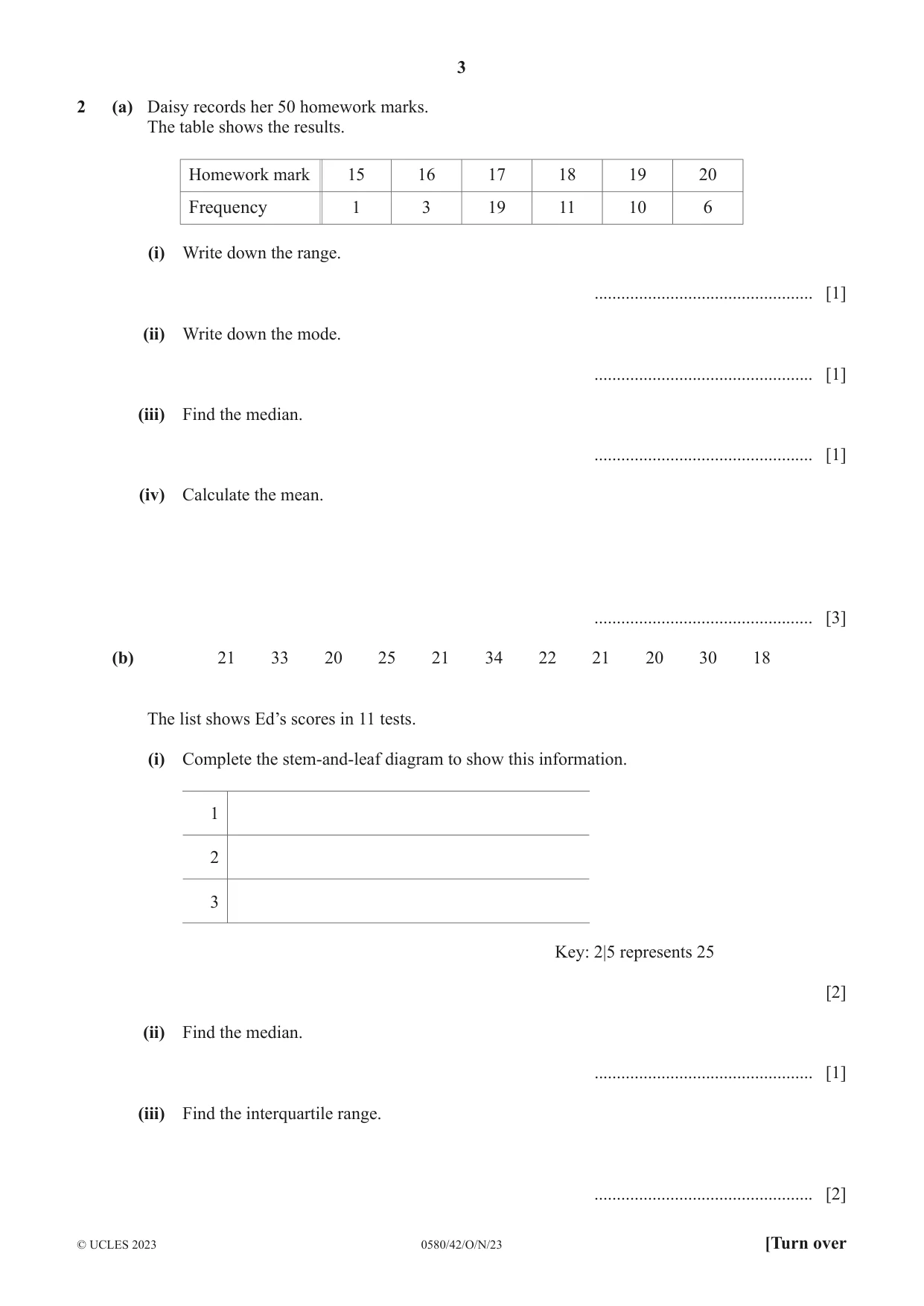
2 (a) Daisy records her 50 homework marks. The table shows the results. Homework mark 15 16 17 18 19 20 Frequency 1 3 19 11 10 6 (i) Write down the range. ................................................. [1] (ii) Write down the mode. ................................................. [1] (iii) Find the median. ................................................. [1] (iv) Calculate the mean. ................................................. [3] (b) 21 33 20 25 21 34 22 21 20 30 18 The list shows Ed’s scores in 11 tests. (i) Complete the stem-and-leaf diagram to show this information. 1 2 3 Key: 2|5 represents 25 [2] (ii) Find the median. ................................................. [1] (iii) Find the interquartile range. ................................................. [2]
Mark scheme: 2(a)(i) 5 1 2(a)(ii) 17 1 2(a)(iii) 18 1 2(a)(iv) 17.88 3 M2 for (1×15 + 3×16 + 19×17 + 11×18 + 10×19 + 6×20) ÷ 50 oe or M1 for 1×15 + 3×16 + 19×17 + 11×18 + 10×19 + 6×20 oe 2(b)(i) 2 1 8 2 0 0 1 1 1 2 5 B1 for two rows correct or for fully correct unordered stem-and- 3 0 3 4 leaf diagram 2(b)(ii) 21 1 2(b)(iii) 10 nfww 2 B1 for [upper qtile] = 30 or [lower qtile] = 20 soi
Q3 · The value of Priya’s car decreases by 10% every year
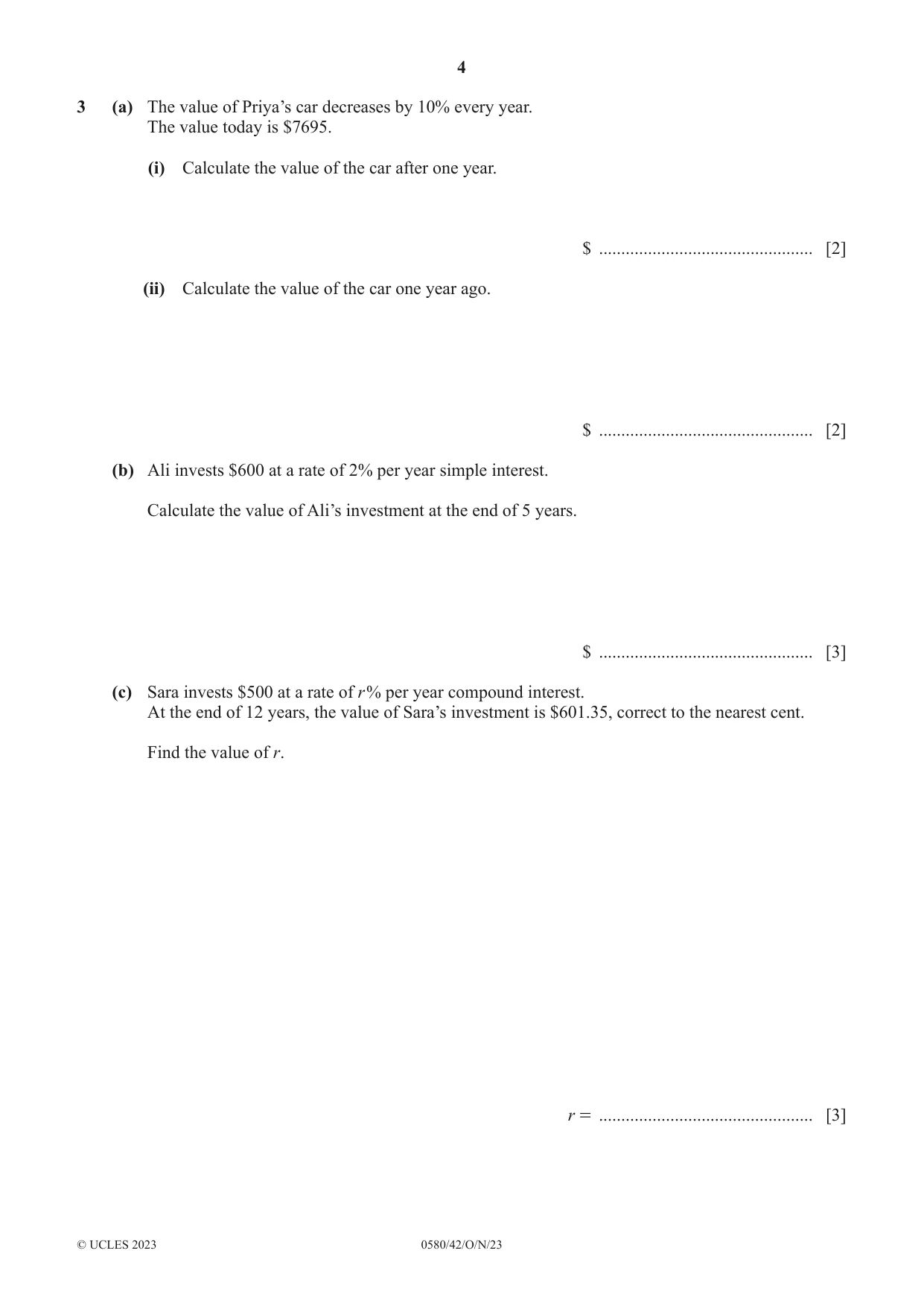
3 (a) The value of Priya’s car decreases by 10% every year. The value today is $7695. (i) Calculate the value of the car after one year. $ ................................................ [2] (ii) Calculate the value of the car one year ago. $ ................................................ [2] (b) Ali invests $600 at a rate of 2% per year simple interest. Calculate the value of Ali’s investment at the end of 5 years. $ ................................................ [3] (c) Sara invests $500 at a rate of r % per year compound interest. At the end of 12 years, the value of Sara’s investment is $601.35, correct to the nearest cent. Find the value of r. r = ................................................ [3] (d) The mass of a radioactive substance decreases exponentially at a rate of 3% each day. (i) Find the overall percentage decrease at the end of 10 days. ............................................. % [2] (ii) Find the number of whole days it takes until the mass of this substance is one half of its original amount. ................................................. [3]
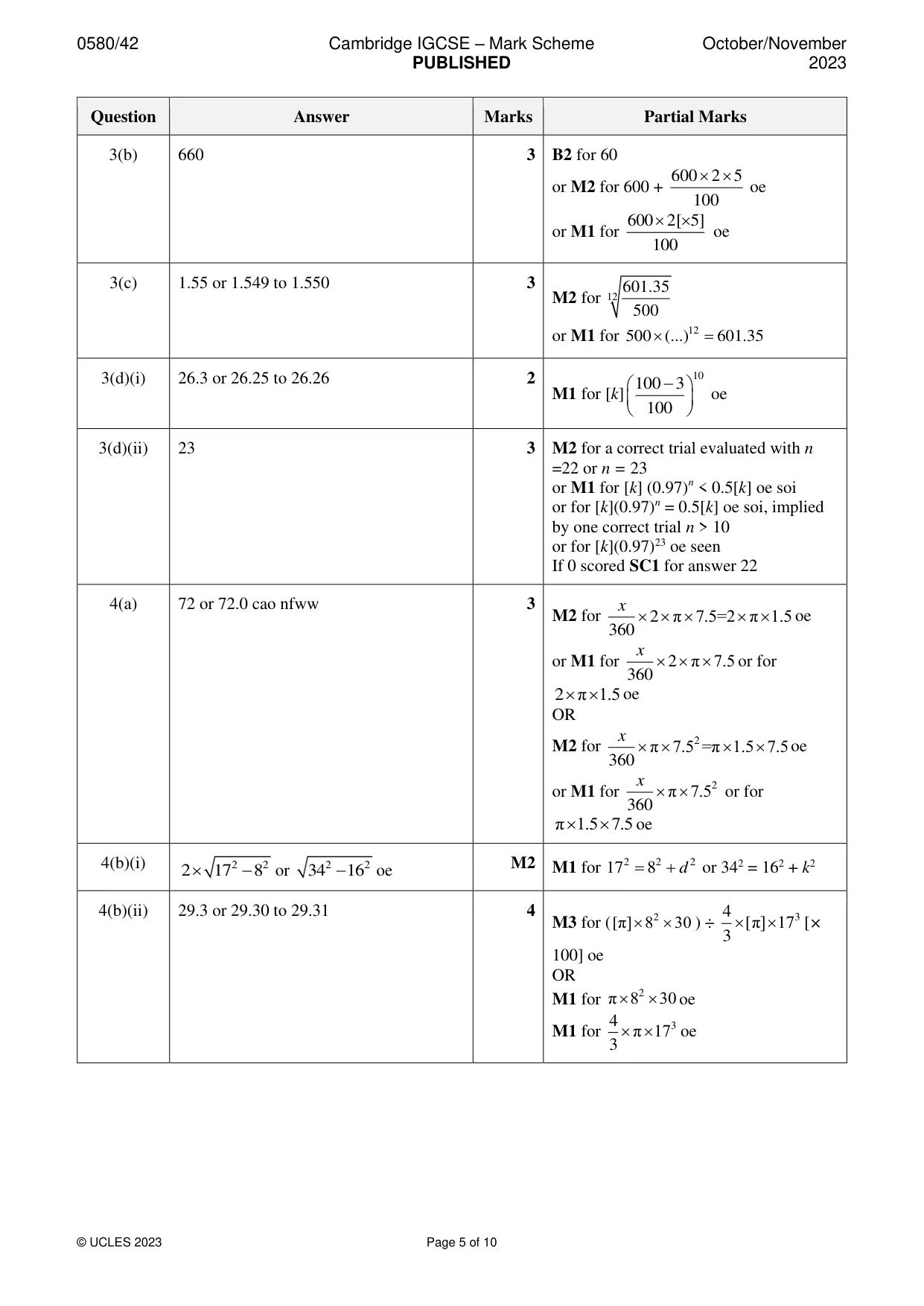
Mark scheme: 3(a)(i) 6925.5[0] cao 2 100 − 10 M1 for 7695 × oe 100 or B1 for answer 769.5 3(a)(ii) 8550 2 100 − 10 M1 for X = 7695 oe 100 3(b) 660 3 B2 for 60 600 2 5 or M2 for 600 + oe 100 600 2[5] or M1 for oe 100 3(c) 1.55 or 1.549 to 1.550 3 601.35 M2 for 12 500 or M1 for 500 (...)12 = 601.35 3(d)(i) 26.3 or 26.25 to 26.26 2 10 100 − 3 M1 for [k] oe 100 3(d)(ii) 23 3 M2 for a correct trial evaluated with n =22 or n = 23 or M1 for [k] (0.97)n < 0.5[k] oe soi or for [k](0.97)n = 0.5[k] oe soi, implied by one correct trial n > 10 or for [k](0.97)23 oe seen If 0 scored SC1 for answer 22
Q4 · O O NOT TO SCALE x° 7.5 cm 7.5 cm A B B 1.5 cm A The diagram shows a sector of a circle…
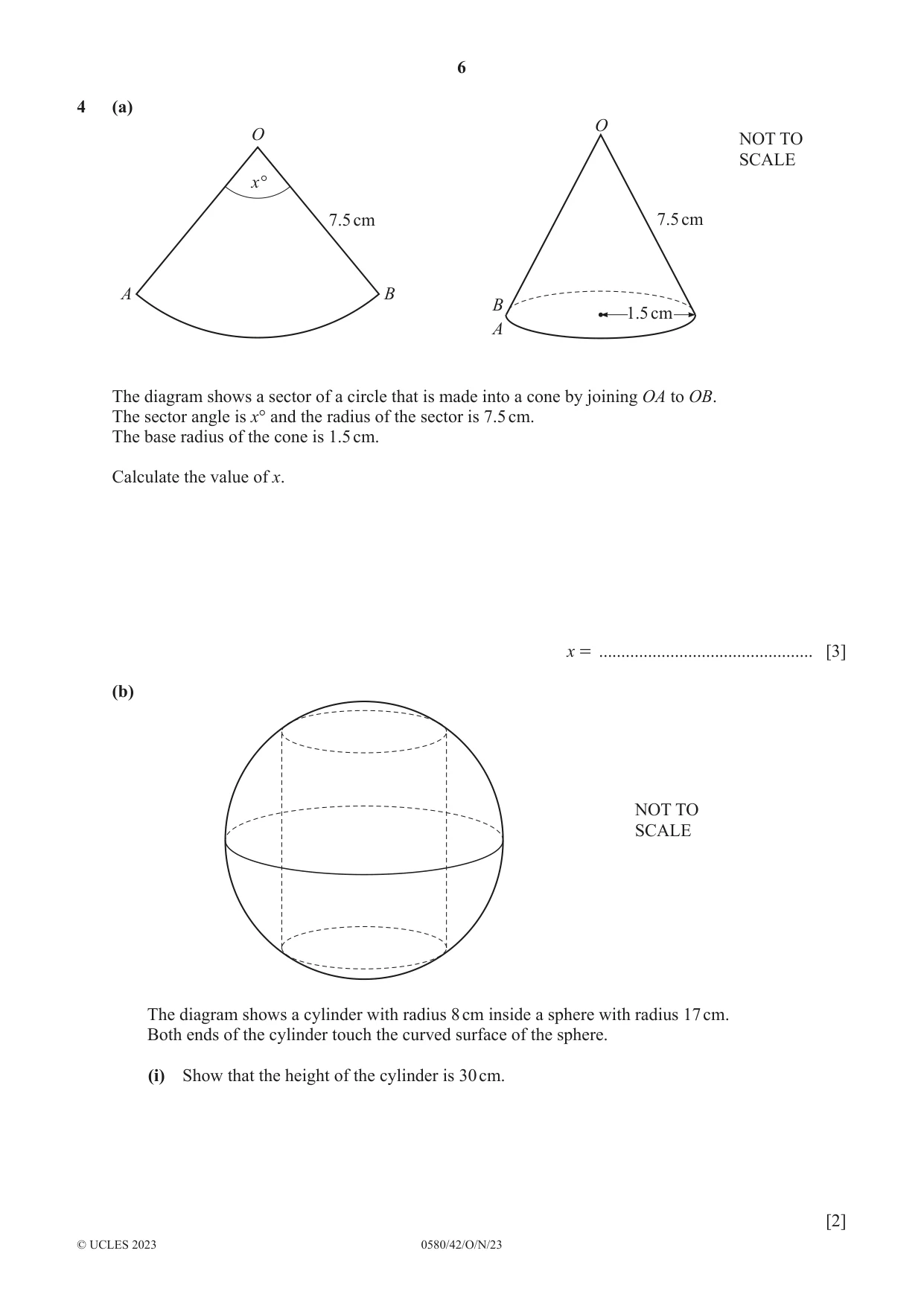
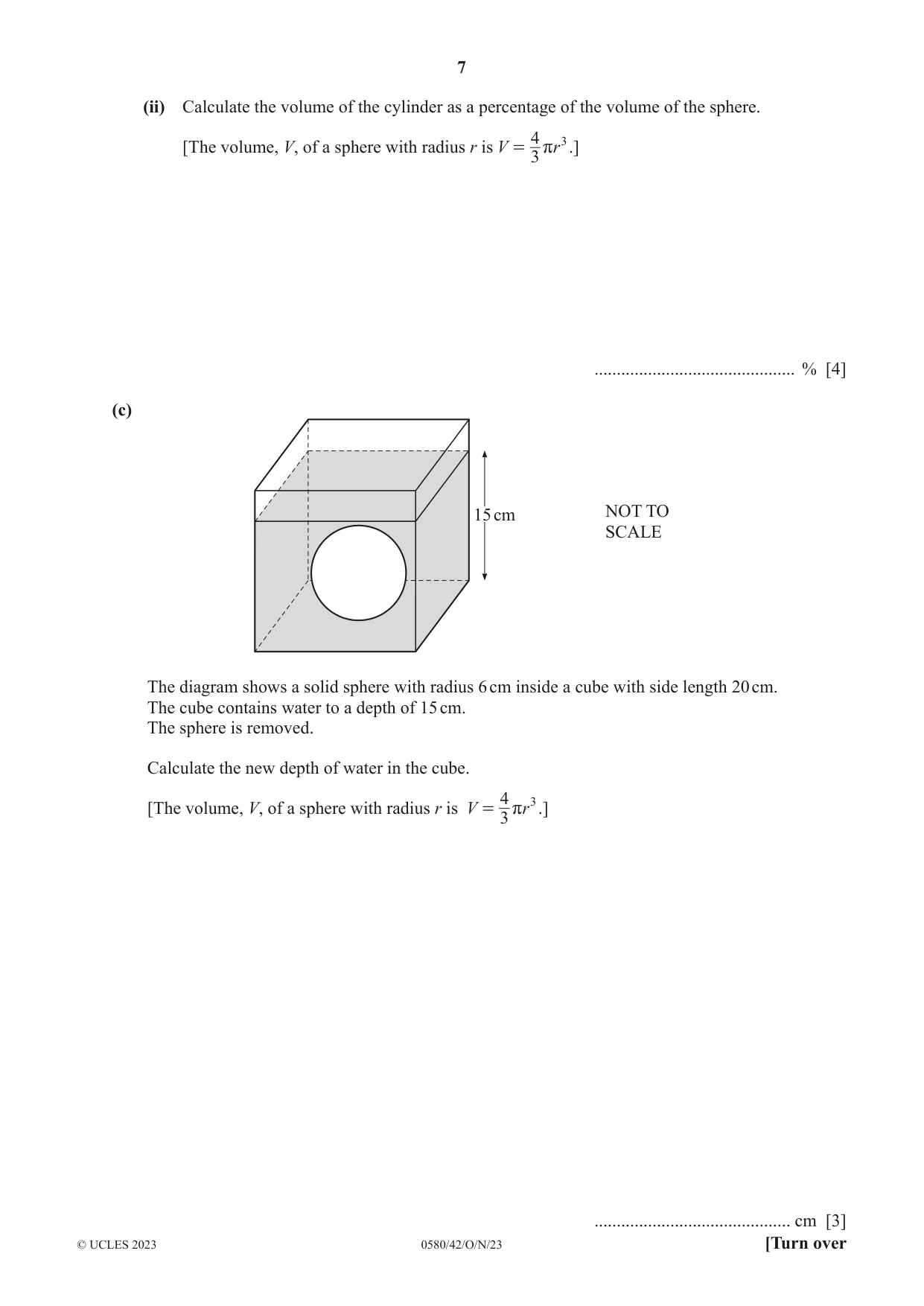
4 (a) O O NOT TO SCALE x° 7.5 cm 7.5 cm A B B 1.5 cm A The diagram shows a sector of a circle that is made into a cone by joining OA to OB. The sector angle is x° and the radius of the sector is 7.5 cm. The base radius of the cone is 1.5 cm. Calculate the value of x. x = ................................................ [3] (b) NOT TO SCALE The diagram shows a cylinder with radius 8 cm inside a sphere with radius 17 cm. Both ends of the cylinder touch the curved surface of the sphere. (i) Show that the height of the cylinder is 30 cm. [2] (ii) Calculate the volume of the cylinder as a percentage of the volume of the sphere. 4 3 [The volume, V, of a sphere with radius r is V = rr .] 3 ............................................. % [4] (c) 15 cm NOT TO SCALE The diagram shows a solid sphere with radius 6 cm inside a cube with side length 20 cm. The cube contains water to a depth of 15 cm. The sphere is removed. Calculate the new depth of water in the cube. 4 3 [The volume, V, of a sphere with radius r is V = rr .] 3 ............................................ cm [3]
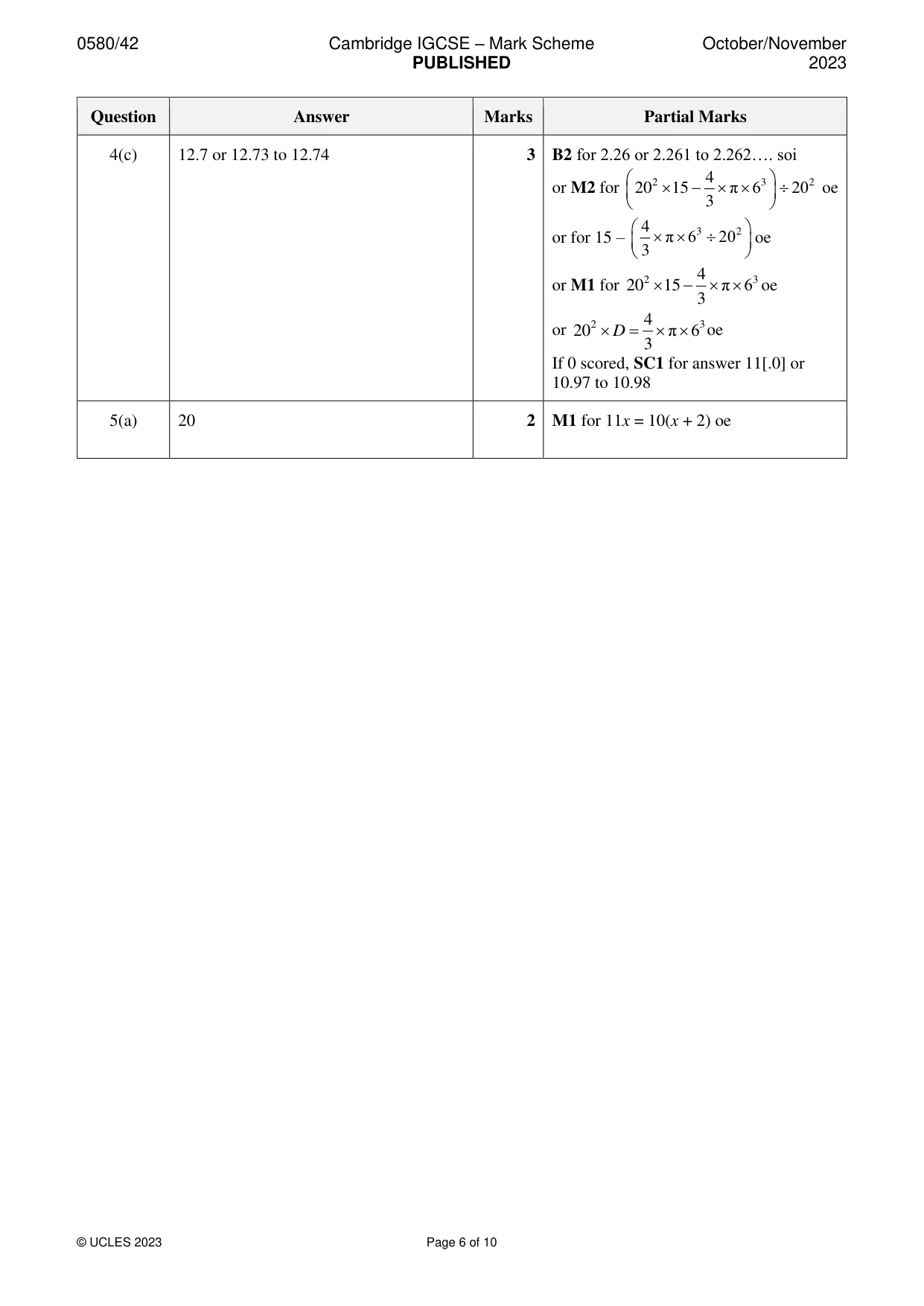
Mark scheme: 4(a) 72 or 72.0 cao nfww 3 x M2 for 2 π 7.5=2 π 1.5 oe 360 x or M1 for 2 π 7.5 or for 360 2 π 1.5 oe OR x 2 M2 for π 7.5 =π 1.5 7.5 oe 360 x 2 or M1 for π 7.5 or for 360 π 1.5 7.5 oe 4(b)(i) M2 M1 for 17 2 = 82 + d 2 or 342 = 162 + k2 2 172 − 82 or 342 − 162 oe 4(b)(ii) 29.3 or 29.30 to 29.31 4 2 4 3 M3 for ( [π] 8 30 ) ÷ [π] 17 [× 3 100] oe OR M1 for π 82 30 oe 4 3 M1 for π 17 oe 3 4(c) 12.7 or 12.73 to 12.74 3 B2 for 2.26 or 2.261 to 2.262…. soi 2 4 3 2 or M2 for 20 15 − π 6 20 oe 3 4 3 2 or for 15 – π 6 20 oe 3 2 4 3 or M1 for 20 15 − π 6 oe 3 2 4 3 or 20 D = π 6 oe 3 If 0 scored, SC1 for answer 11[.0] or 10.97 to 10.98
Q5 · In a shop the cost of a fiction book is $x and the cost of a reference book is $( x + 2)
5 (a) In a shop the cost of a fiction book is $x and the cost of a reference book is $( x + 2) . The cost of 11 fiction books is the same as the cost of 10 reference books. Find the value of x. x = ................................................. [2] (b) In another shop, the cost of a fiction book is $y and the cost of a reference book is $( y + 2) . Maria spends $95 on fiction books and $147 on reference books. She buys a total of 12 books. (i) Show that 6y 2 - 109 y - 95 = 0 . [4] (ii) Factorise 6y 2 - 109y - 95 . ................................................. [2] (iii) Find the value of y. y = ................................................ [1]
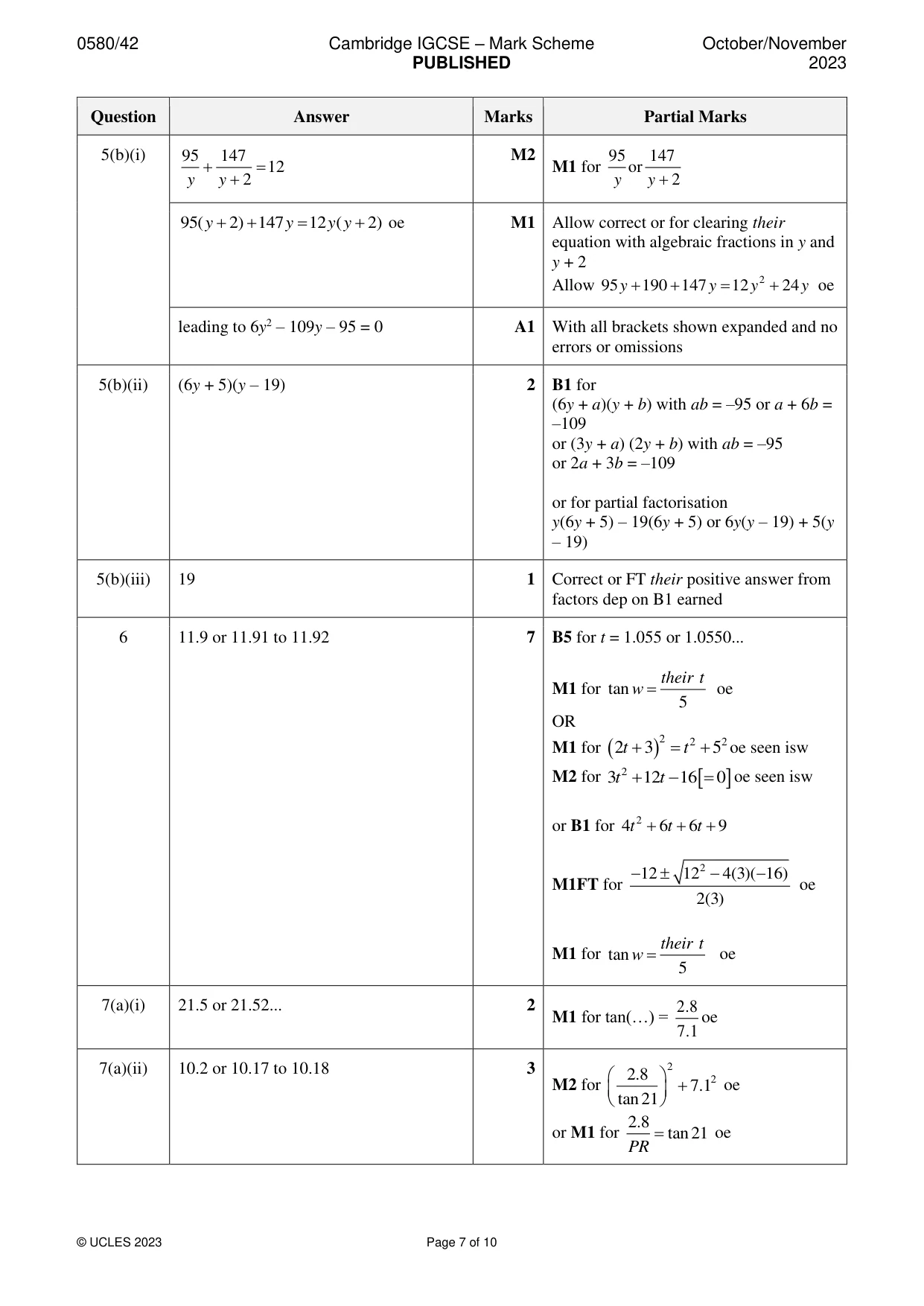
Mark scheme: 5(a) 20 2 M1 for 11x = 10(x + 2) oe 5(b)(i) 95 147 M2 95 147 + = 12 M1 for or y y + 2 y y + 2 95( y + 2) + 147 y = 12 y ( y + 2) oe M1 Allow correct or for clearing their equation with algebraic fractions in y and y + 2 Allow 95 y + 190 + 147 y = 12 y 2 + 24 y oe leading to 6y2 – 109y – 95 = 0 A1 With all brackets shown expanded and no errors or omissions 5(b)(ii) (6y + 5)(y – 19) 2 B1 for (6y + a)(y + b) with ab = –95 or a + 6b = –109 or (3y + a) (2y + b) with ab = –95 or 2a + 3b = –109 or for partial factorisation y(6y + 5) – 19(6y + 5) or 6y(y – 19) + 5(y – 19) 5(b)(iii) 19 1 Correct or FT their positive answer from factors dep on B1 earned
Q6 · NOT TO SCALE (2t + 3) cm t cm w° 5 cm The diagram shows a right-angled triangle
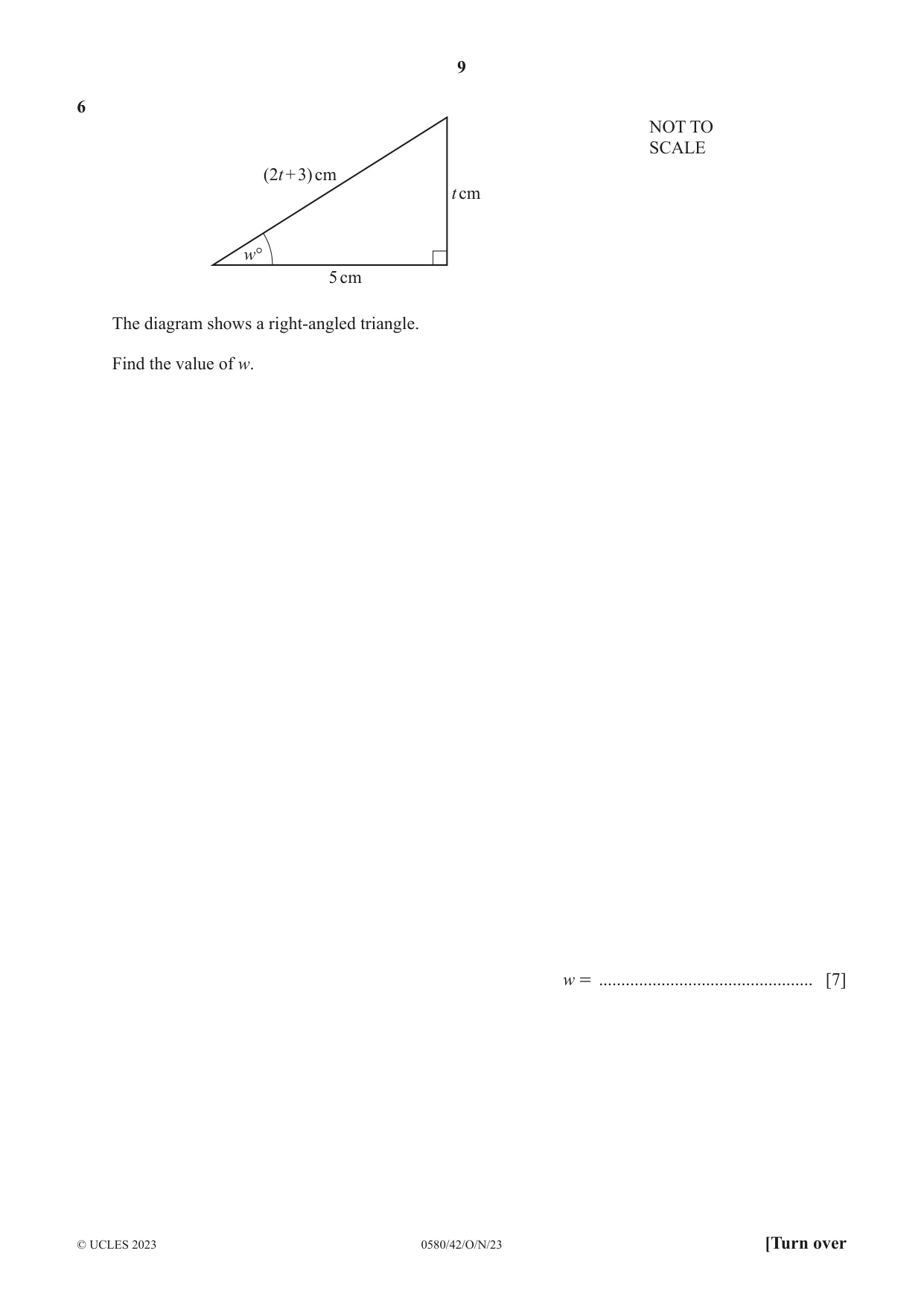
6 NOT TO SCALE (2t + 3) cm t cm w° 5 cm The diagram shows a right-angled triangle. Find the value of w. w = ................................................ [7]
Mark scheme: 6 11.9 or 11.91 to 11.92 7 B5 for t = 1.055 or 1.0550... their t M1 for tan w = oe 5 OR 2 2 2 M1 for ( 2t + 3) = t + 5 oe seen isw M2 for 3t 2 + 12t − 16 = 0 oe seen isw or B1 for 4t 2 + 6t + 6t + 9 −12 12 2 − 4(3)( −16) M1FT for oe 2(3) their t M1 for tan w = oe 5
Q7 · X 2.8 m NOT TO R SCALE 7.1 m P Q The diagram shows a right-angled triangle PQR on…
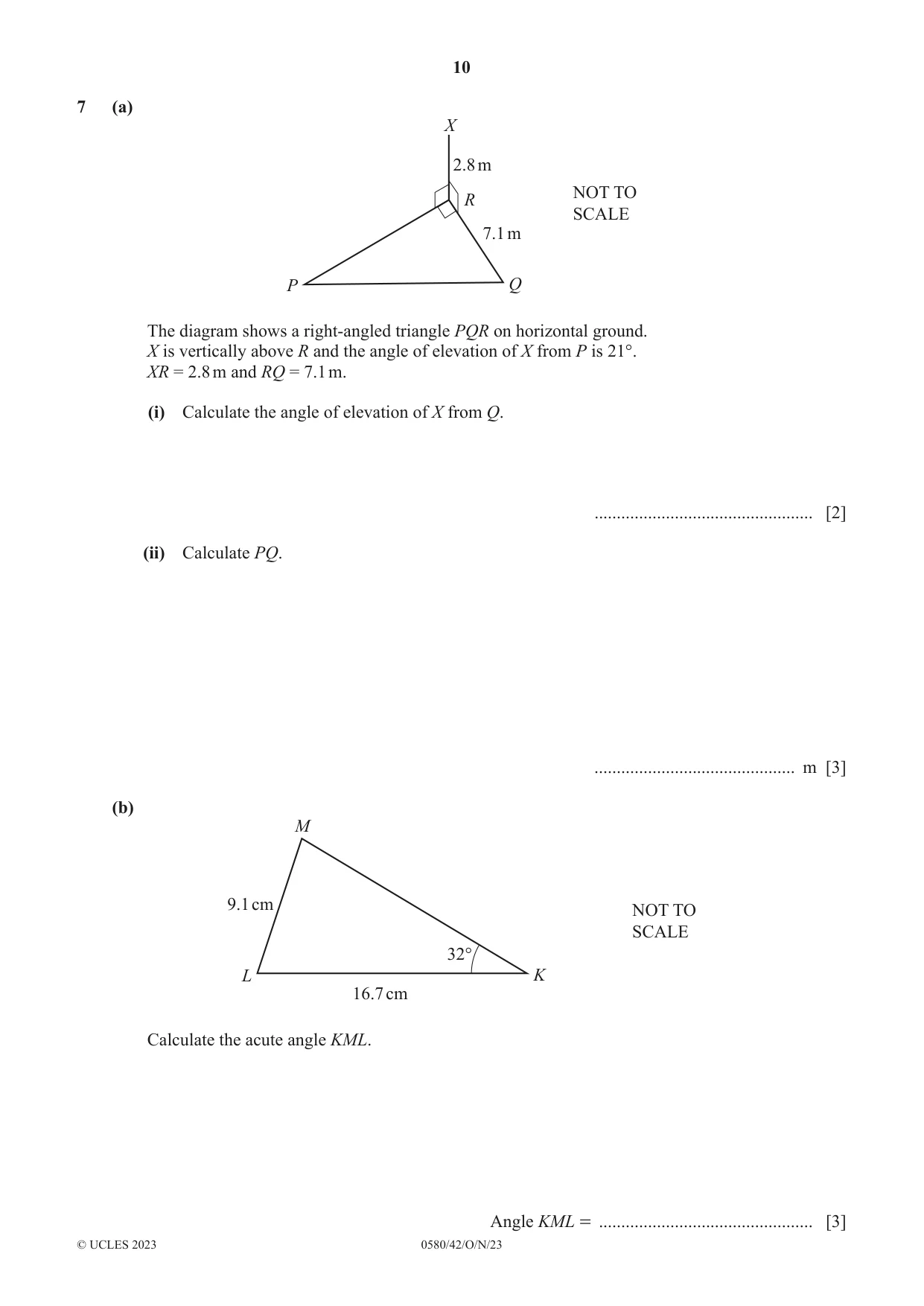
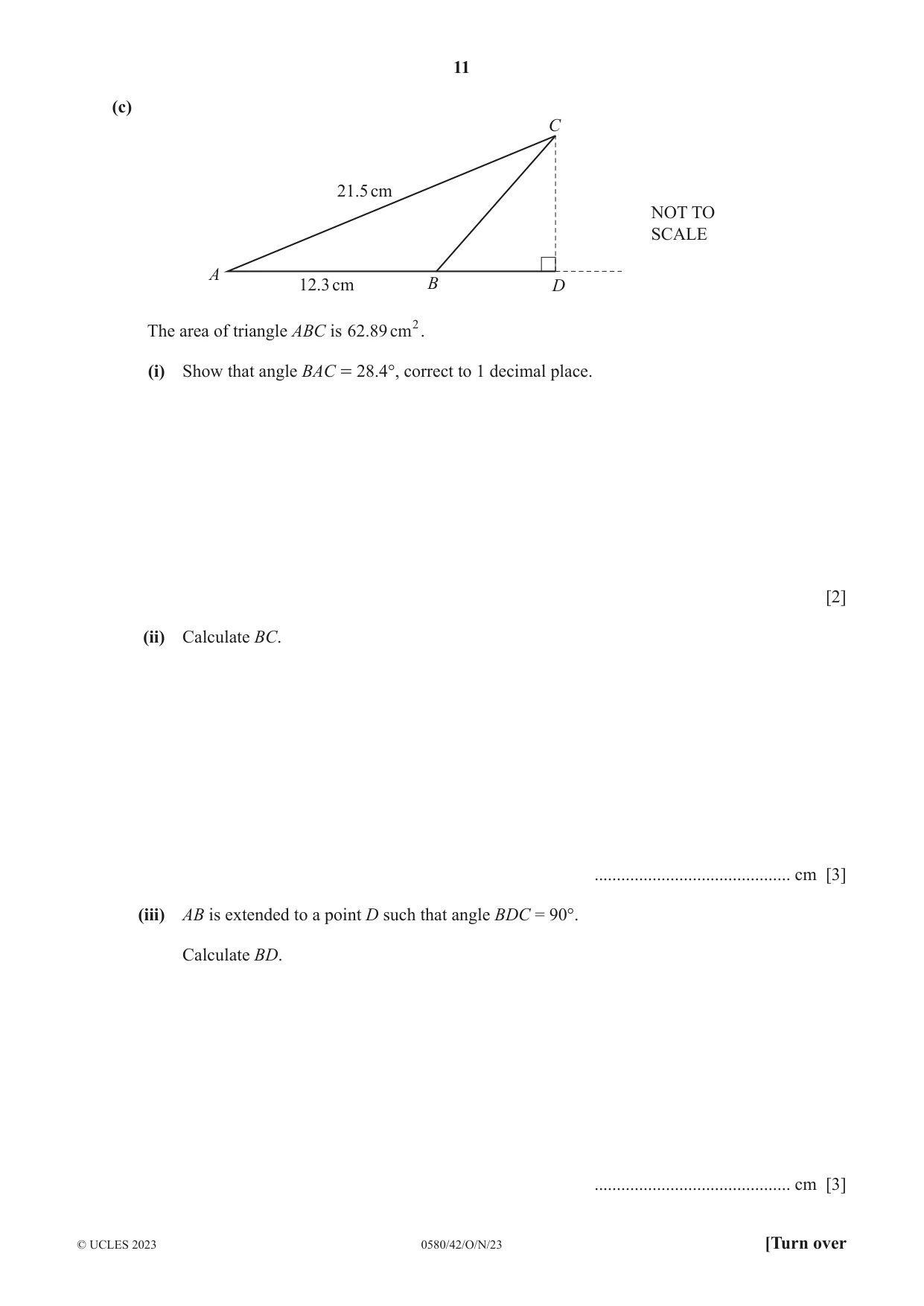
7 (a) X 2.8 m NOT TO R SCALE 7.1 m P Q The diagram shows a right-angled triangle PQR on horizontal ground. X is vertically above R and the angle of elevation of X from P is 21°. XR = 2.8 m and RQ = 7.1 m. (i) Calculate the angle of elevation of X from Q. ................................................. [2] (ii) Calculate PQ. ............................................. m [3] (b) M 9.1 cm NOT TO SCALE 32° L K 16.7 cm Calculate the acute angle KML. Angle KML = ................................................ [3] (c) C 21.5 cm NOT TO SCALE A 12.3 cm B D The area of triangle ABC is 62.89 cm 2. (i) Show that angle BAC = 28.4°, correct to 1 decimal place. [2] (ii) Calculate BC. ............................................ cm [3] (iii) AB is extended to a point D such that angle BDC = 90°. Calculate BD. ............................................ cm [3]
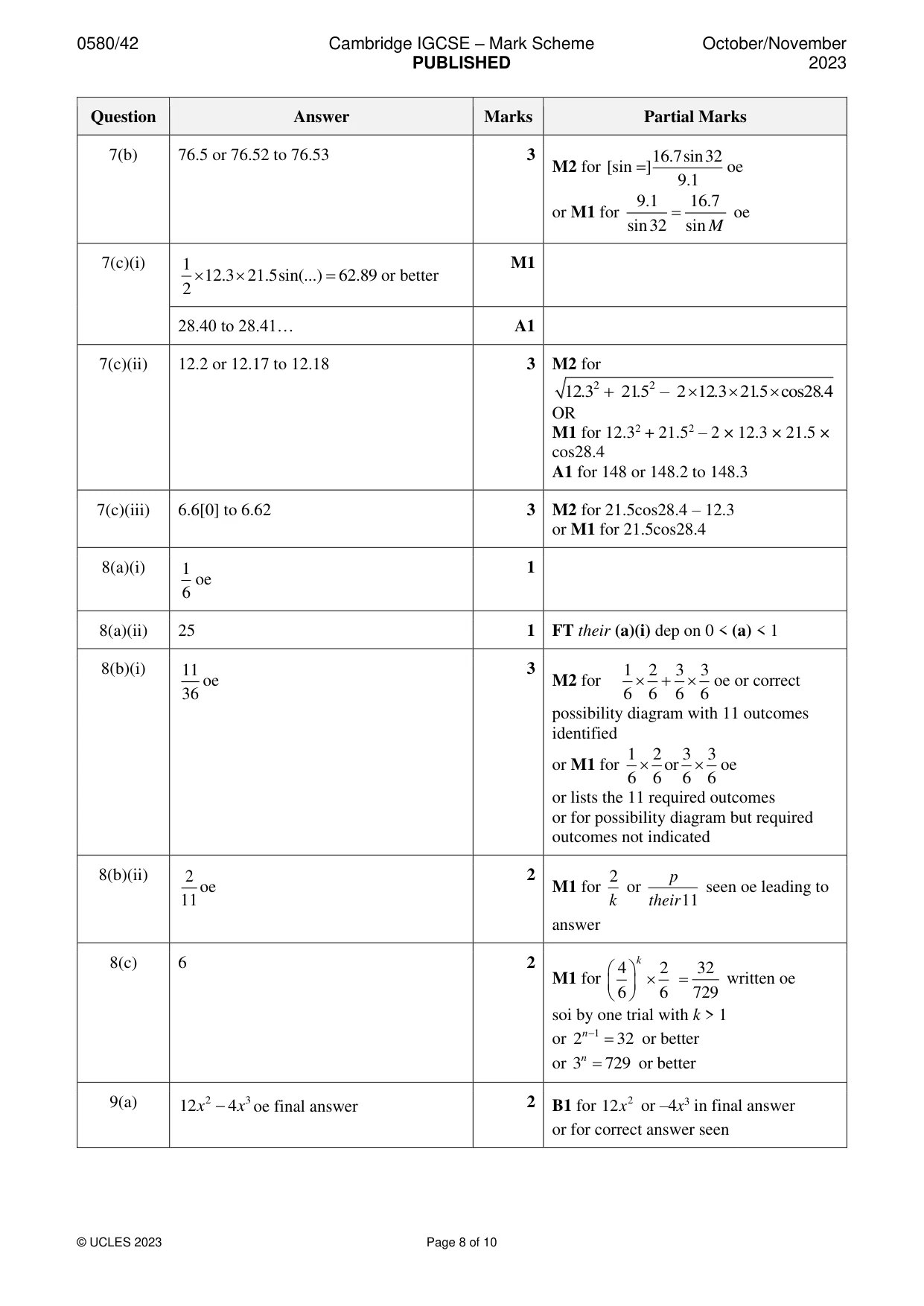
Mark scheme: 7(a)(i) 21.5 or 21.52... 2 2.8 M1 for tan(…) = oe 7.1 7(a)(ii) 10.2 or 10.17 to 10.18 3 2 2.8 2 oe M2 for + 7.1 tan21 2.8 or M1 for = tan21 oe PR 7(b) 76.5 or 76.52 to 76.53 3 16.7sin32 M2 for [sin =] oe 9.1 9.1 16.7 or M1 for = oe sin32 sin M 7(c)(i) 1 M1 12.3 21.5sin(...) = 62.89 or better 2 28.40 to 28.41… A1 7(c)(ii) 12.2 or 12.17 to 12.18 3 M2 for 12.32 + 21.52 – 2 12.3 21.5 cos28.4 OR M1 for 12.32 + 21.52 – 2 × 12.3 × 21.5 × cos28.4 A1 for 148 or 148.2 to 148.3 7(c)(iii) 6.6[0] to 6.62 3 M2 for 21.5cos28.4 – 12.3 or M1 for 21.5cos28.4
Q8 · 2 3 2 3 1 2 Dice A Dice B The diagram shows two fair dice
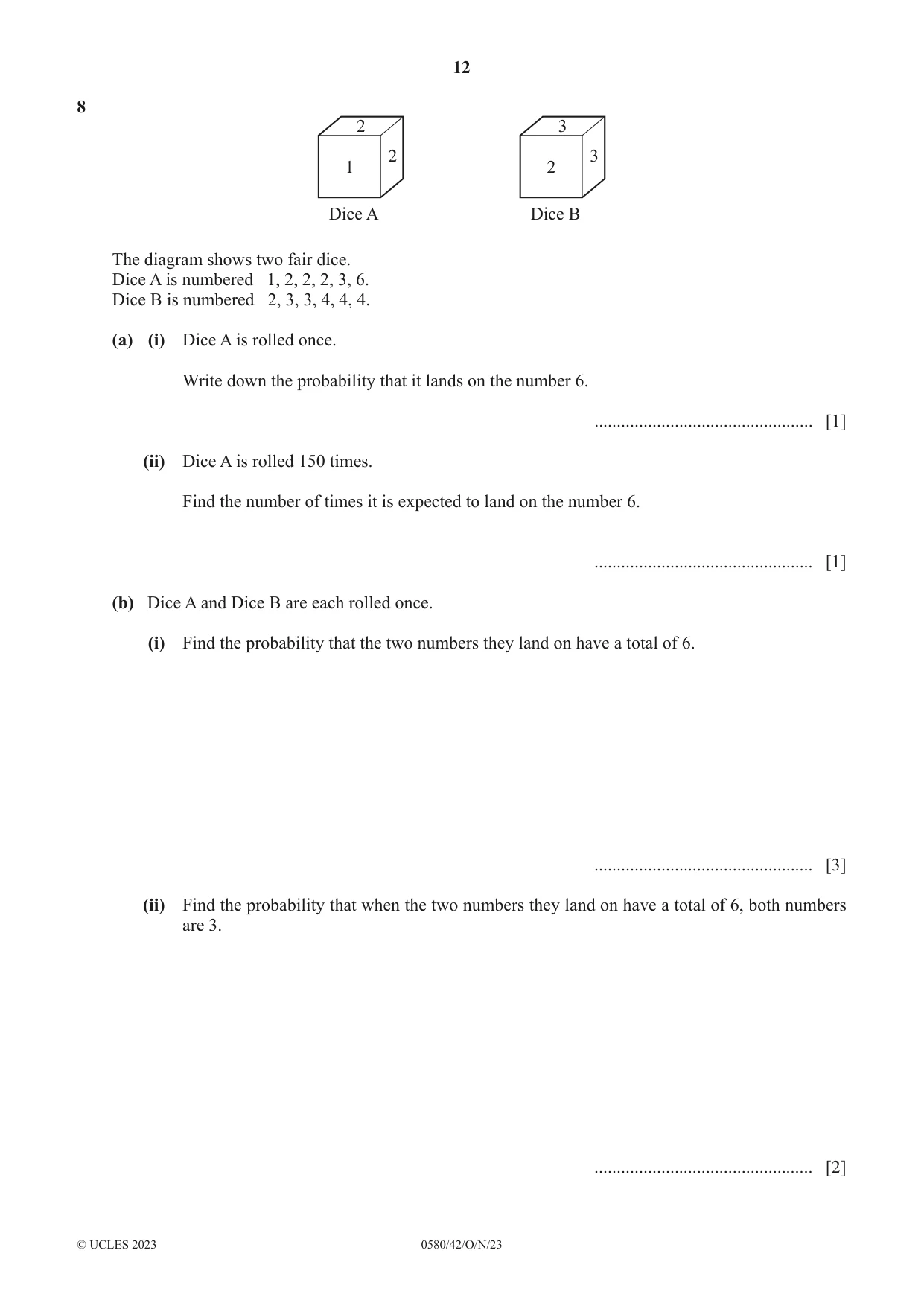
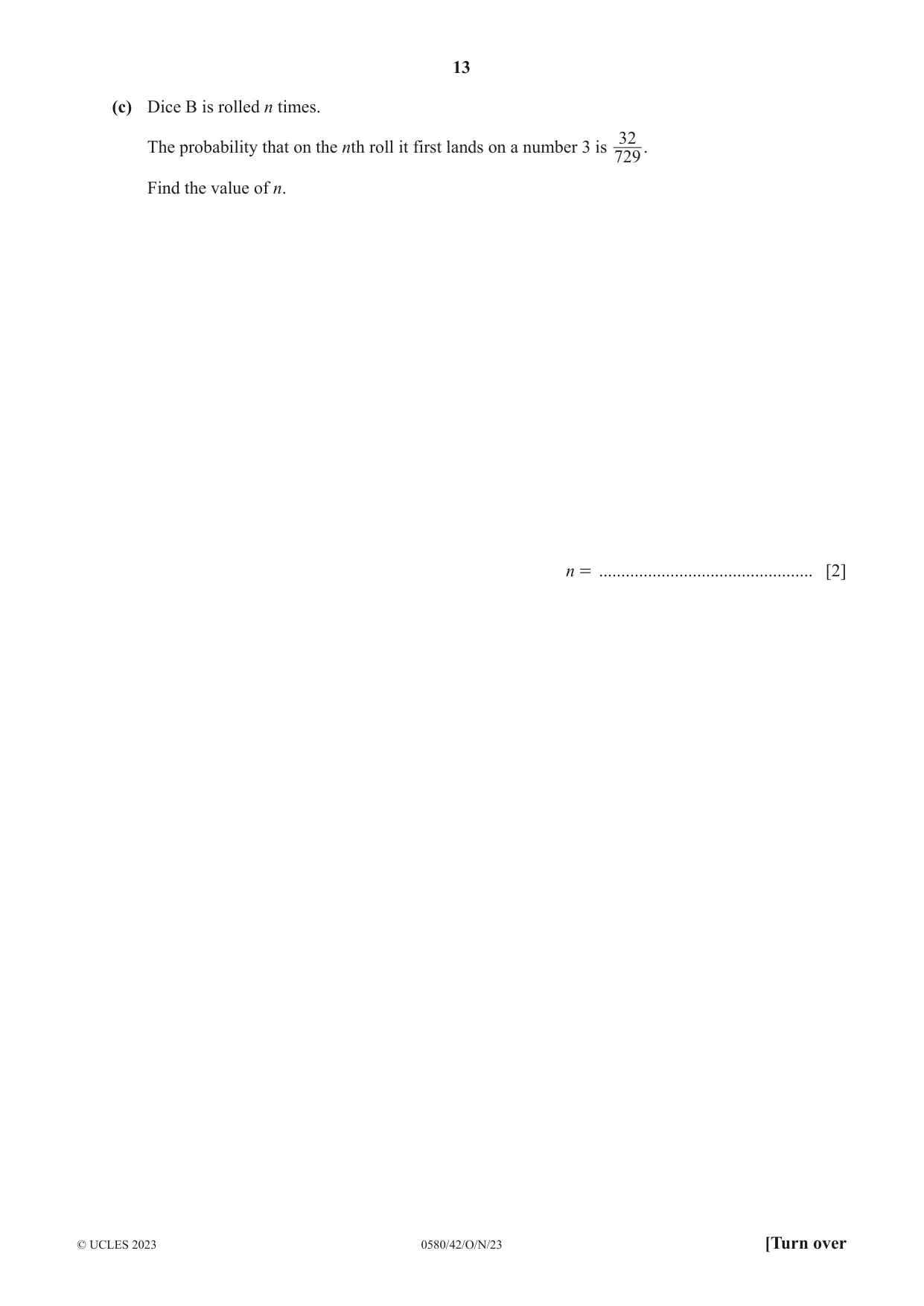
8 2 3 2 3 1 2 Dice A Dice B The diagram shows two fair dice. Dice A is numbered 1, 2, 2, 2, 3, 6. Dice B is numbered 2, 3, 3, 4, 4, 4. (a) (i) Dice A is rolled once. Write down the probability that it lands on the number 6. ................................................. [1] (ii) Dice A is rolled 150 times. Find the number of times it is expected to land on the number 6. ................................................. [1] (b) Dice A and Dice B are each rolled once. (i) Find the probability that the two numbers they land on have a total of 6. ................................................. [3] (ii) Find the probability that when the two numbers they land on have a total of 6, both numbers are 3. ................................................. [2] (c) Dice B is rolled n times. 32 The probability that on the nth roll it first lands on a number 3 is . 729 Find the value of n. n = ................................................ [2]
Mark scheme: 8(a)(i) 1 1 oe 6 8(a)(ii) 25 1 FT their (a)(i) dep on 0 < (a) < 1 8(b)(i) 11 3 1 2 3 3 oe M2 for + oe or correct 36 6 6 6 6 possibility diagram with 11 outcomes identified 1 2 3 3 or M1 for or oe 6 6 6 6 or lists the 11 required outcomes or for possibility diagram but required outcomes not indicated 8(b)(ii) 2 2 2 p 11oe M1 for k or their 11 seen oe leading to answer 8(c) 6 2 k 4 2 32 = written oe M1 for 6 6 729 soi by one trial with k > 1 or 2 n −=1 32 or better or 3n = 729 or better
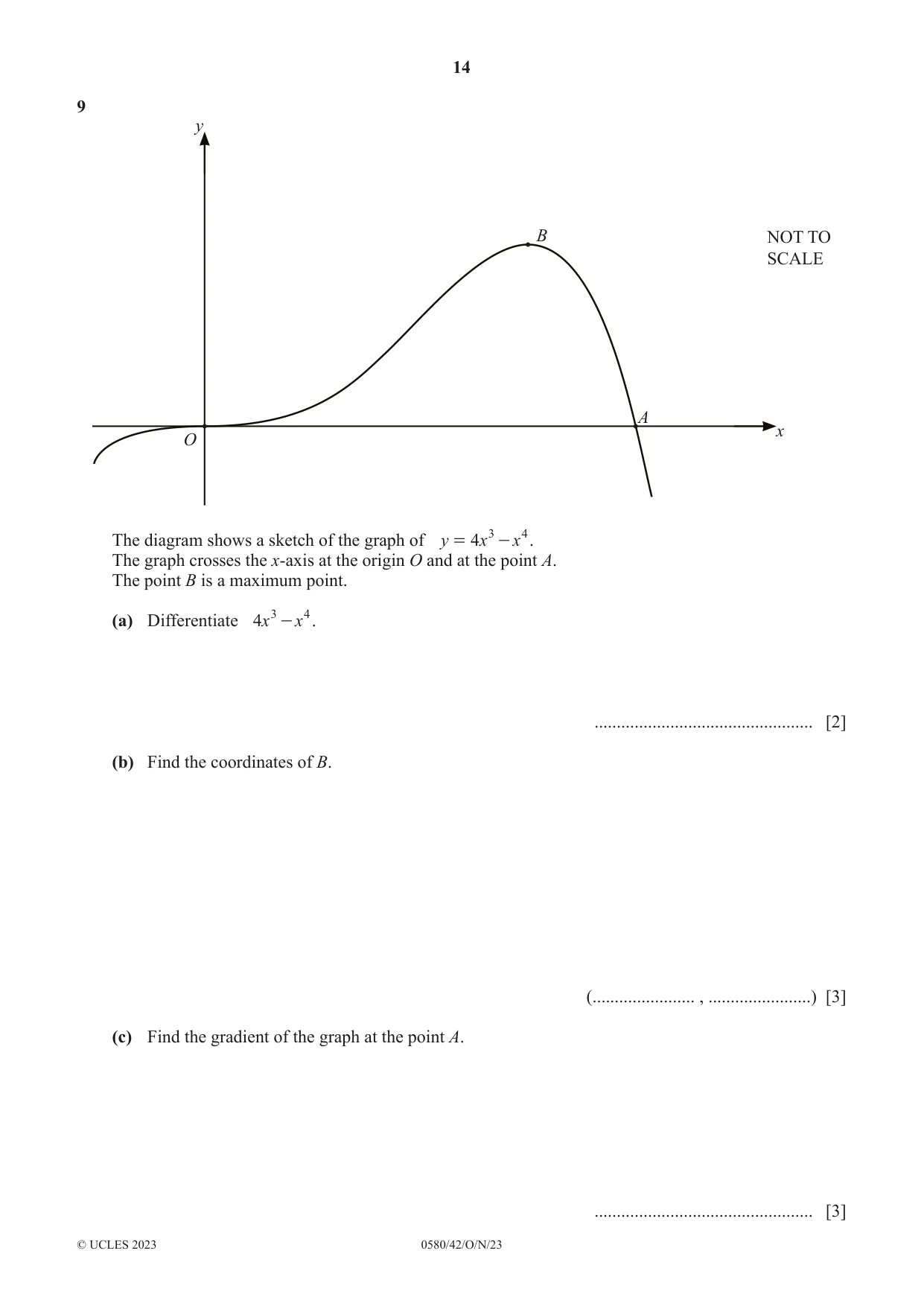
Q9 · Y B NOT TO SCALE A x O The diagram shows a sketch of the graph of y = 4x 3 - x 4
9 y B NOT TO SCALE A x O The diagram shows a sketch of the graph of y = 4x 3 - x 4 . The graph crosses the x-axis at the origin O and at the point A. The point B is a maximum point. (a) Differentiate 4x 3 - x 4 . ................................................. [2] (b) Find the coordinates of B. (....................... , .......................) [3] (c) Find the gradient of the graph at the point A. ................................................. [3]
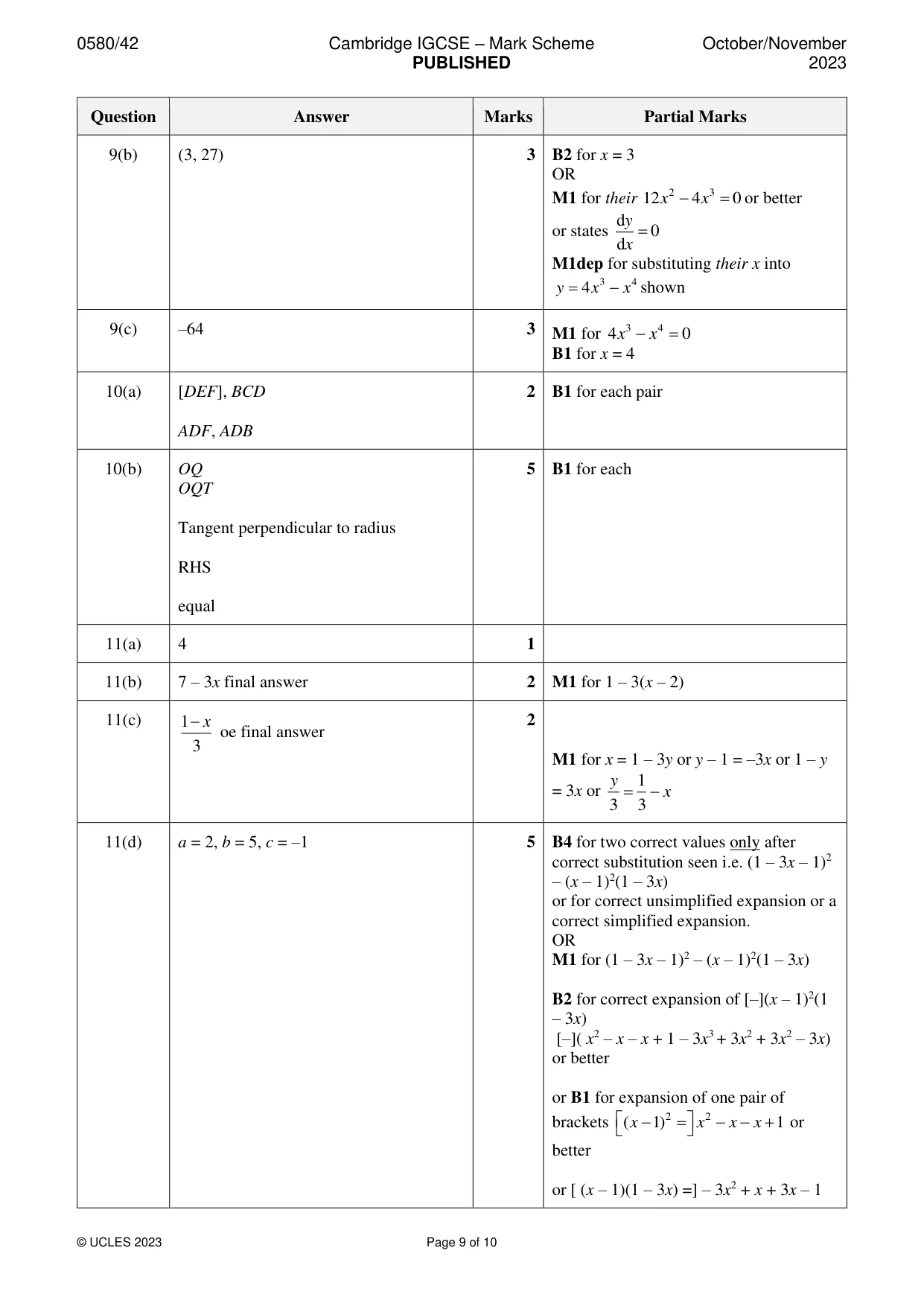
Mark scheme: 9(a) 12 x 2 − 4 x 3 oe final answer 2 B1 for 12x 2 or –4x3 in final answer or for correct answer seen 9(b) (3, 27) 3 B2 for x = 3 OR M1 for their 12 x 2 − 4 x 3 = 0 or better dy or states = 0 dx M1dep for substituting their x into y = 4 x 3 − x 4 shown 9(c) –64 3 M1 for 4 x 3 − x 4 = 0 B1 for x = 4
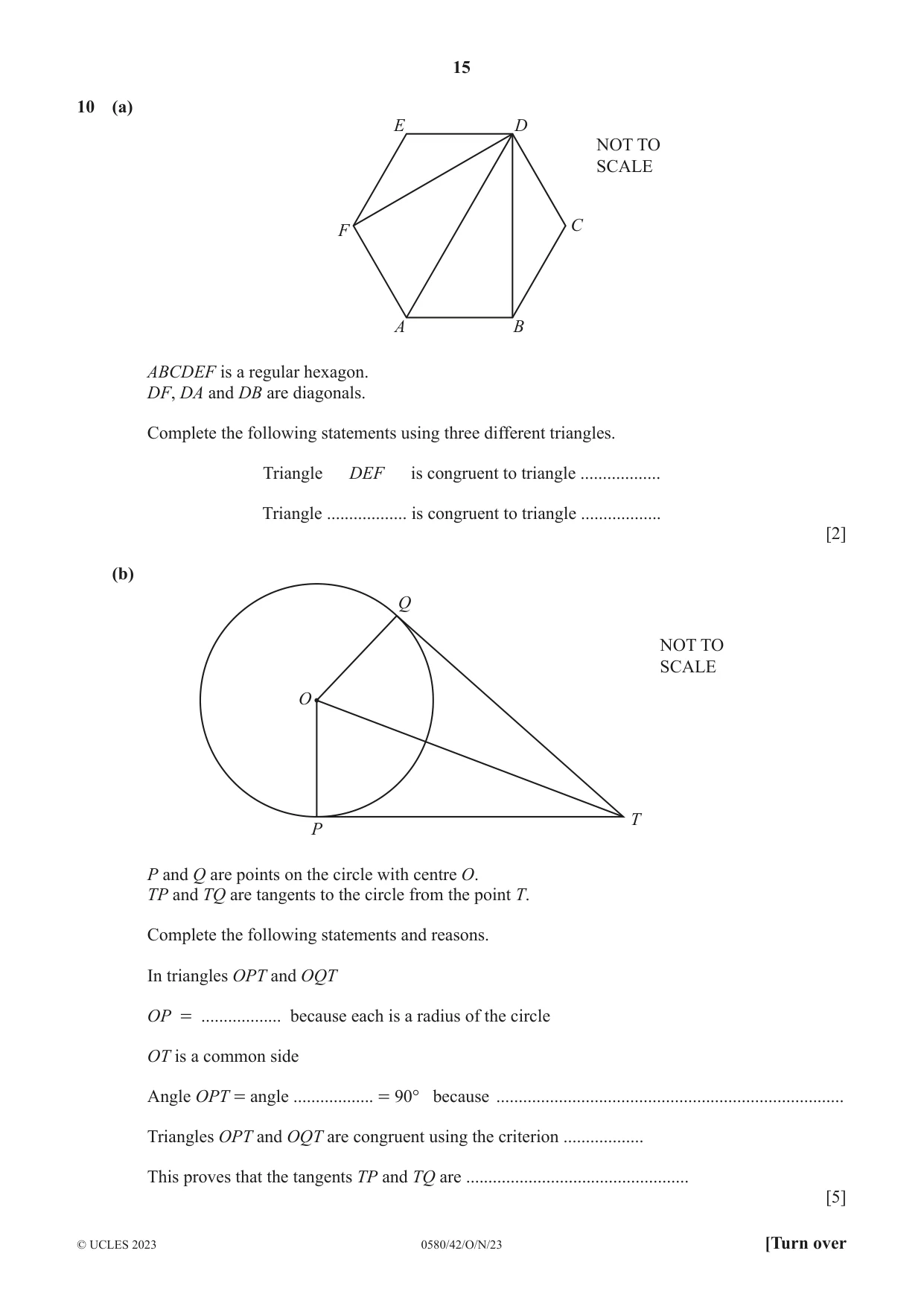
Q10 · E D NOT TO SCALE C F A B ABCDEF is a regular hexagon
10 (a) E D NOT TO SCALE C F A B ABCDEF is a regular hexagon. DF, DA and DB are diagonals. Complete the following statements using three different triangles. Triangle DEF is congruent to triangle .................. Triangle .................. is congruent to triangle .................. [2] (b) Q NOT TO SCALE O T P P and Q are points on the circle with centre O. TP and TQ are tangents to the circle from the point T. Complete the following statements and reasons. In triangles OPT and OQT OP = .................. because each is a radius of the circle OT is a common side Angle OPT = angle .................. = 90° because .............................................................................. Triangles OPT and OQT are congruent using the criterion .................. This proves that the tangents TP and TQ are .................................................. [5]
Mark scheme: 10(a) [DEF], BCD 2 B1 for each pair ADF, ADB 10(b) OQ 5 B1 for each OQT Tangent perpendicular to radius RHS equal
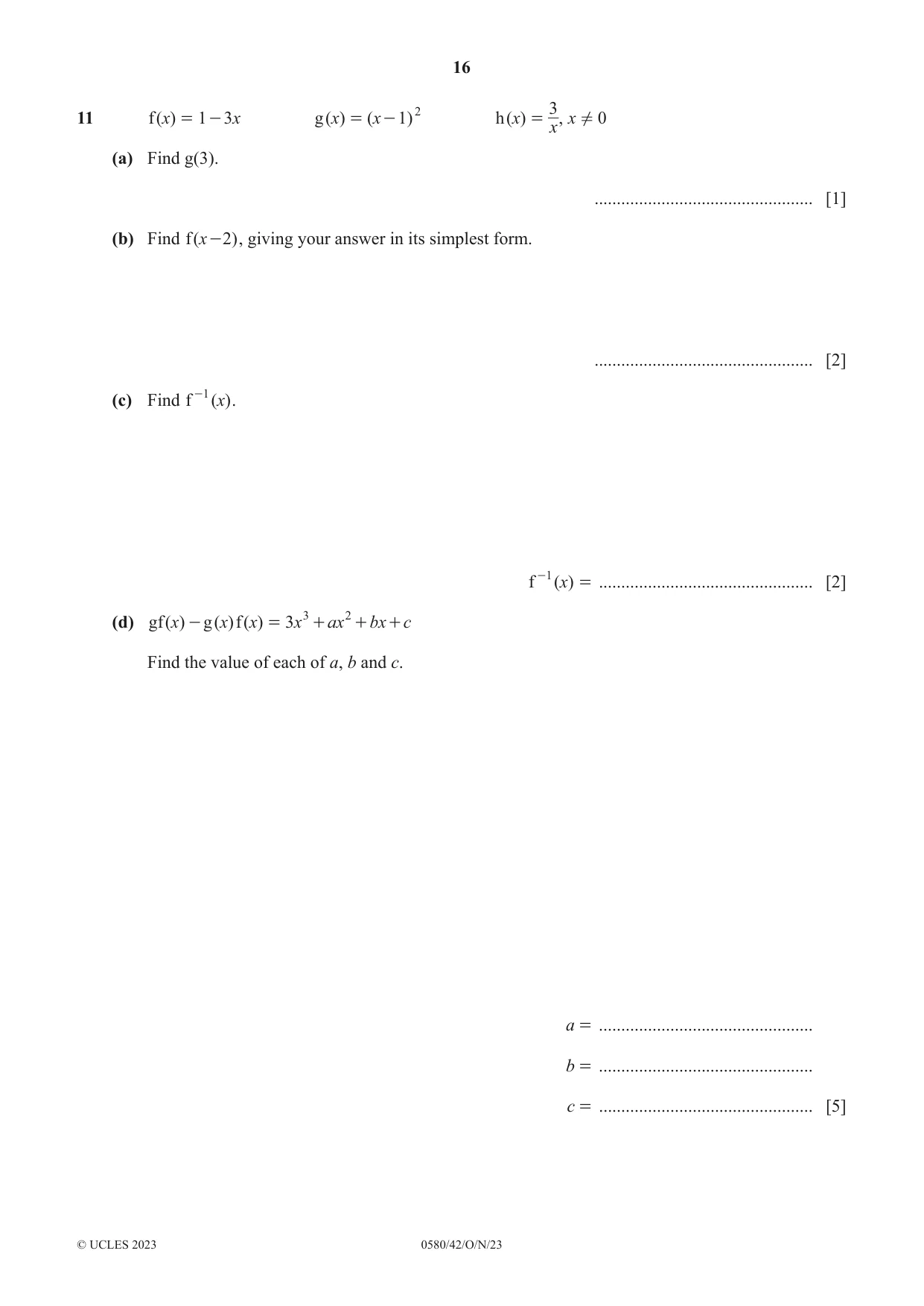
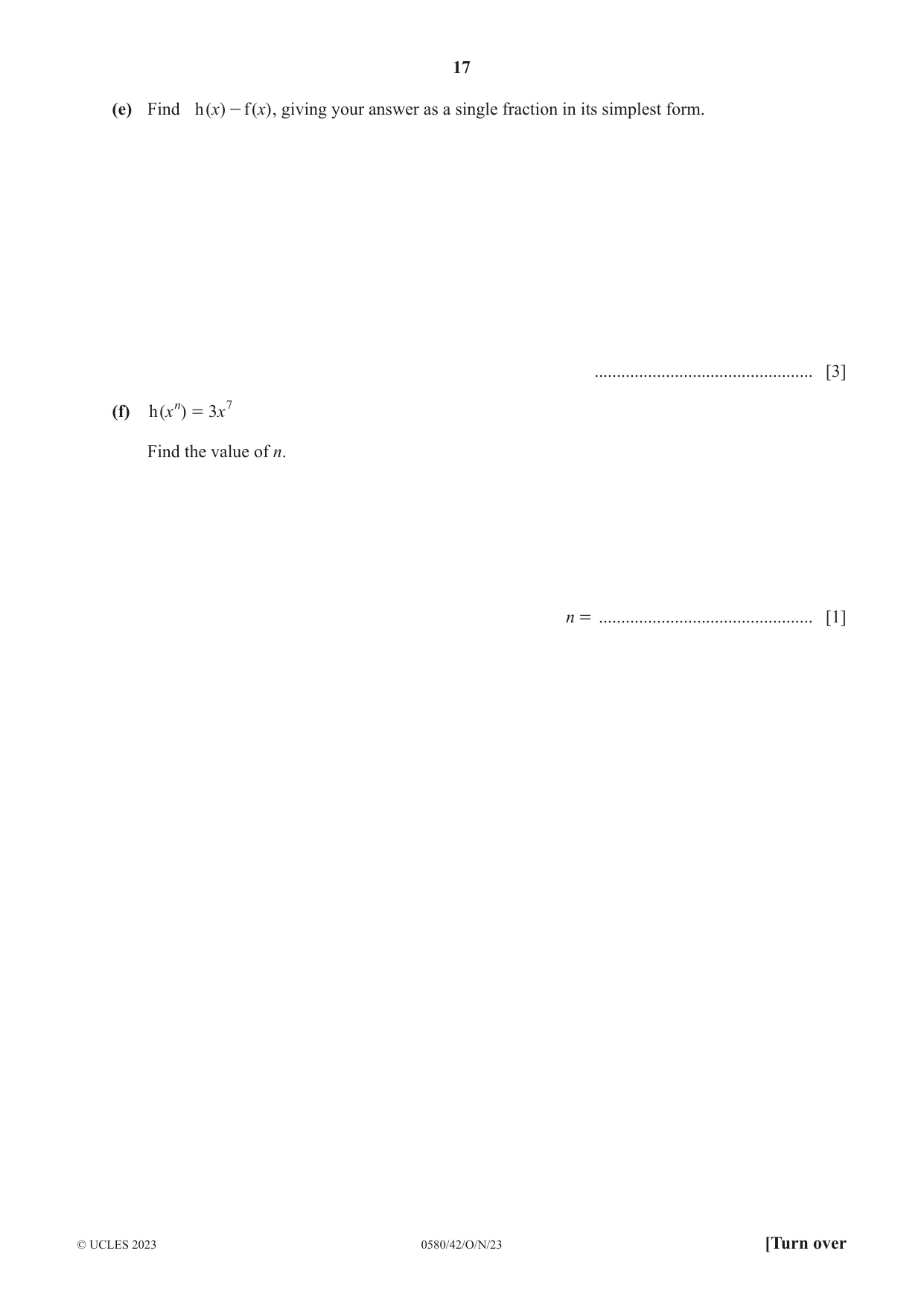
Q11 · 311 f ( )x = 1 - 3 x g ( x) = ( x - 1) h ( x) = , x !
2 311 f ( )x = 1 - 3 x g ( x) = ( x - 1) h ( x) = , x ! 0 x (a) Find g(3). ................................................. [1] (b) Find f ( x - 2 ) , giving your answer in its simplest form. ................................................. [2] (c) Find f -1 ( )x . f -1 ( )x = ................................................ [2] (d) gf ( x) - g ( x) f ( x) = 3x 3 + ax 2 + bx + c Find the value of each of a, b and c. a = ................................................ b = ................................................ c = ................................................ [5] (e) Find h ( x) - f ( x) , giving your answer as a single fraction in its simplest form. ................................................. [3] (f) h ( x n ) = 3x 7 Find the value of n. n = ................................................ [1]
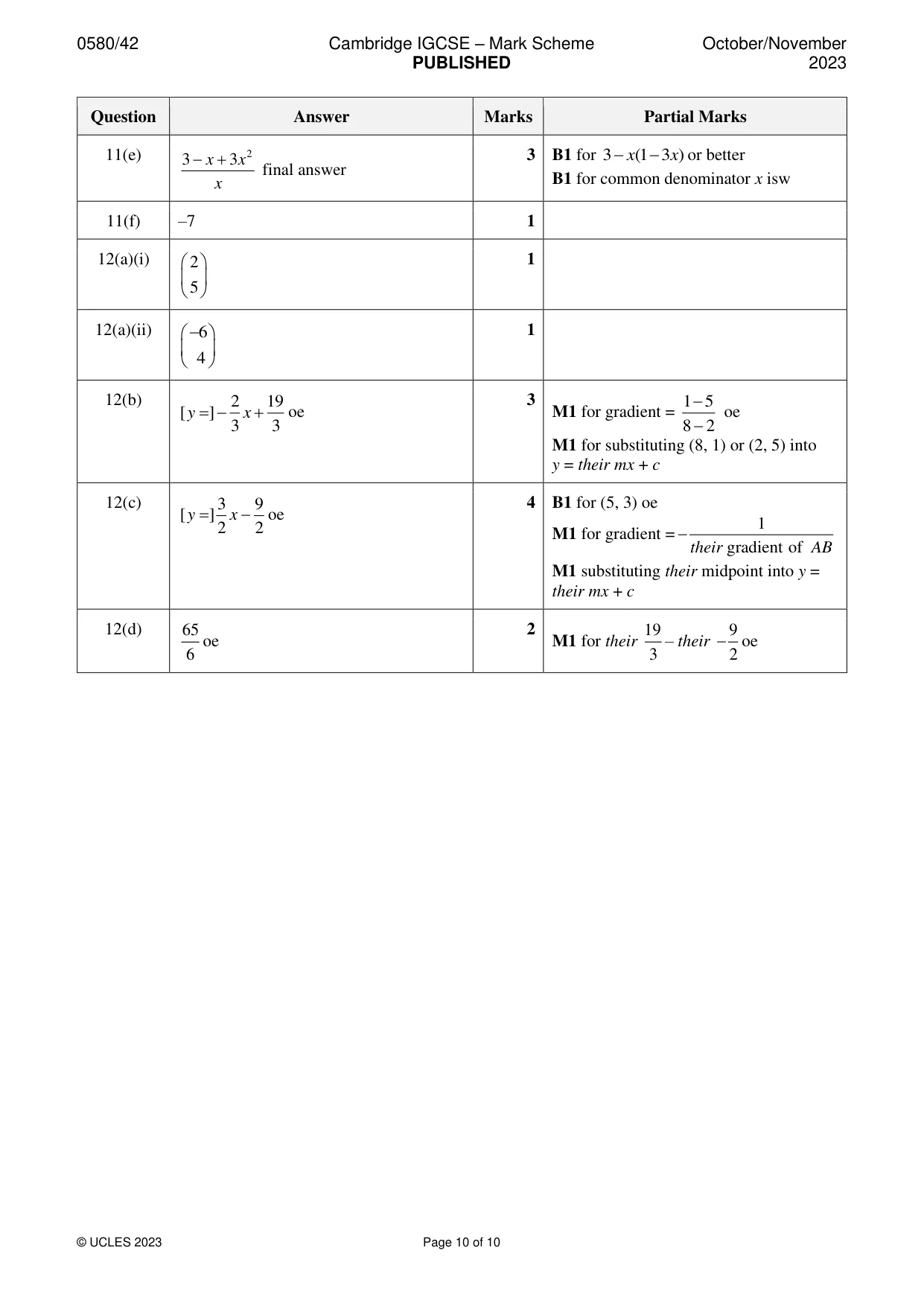
Mark scheme: 11(a) 4 1 11(b) 7 – 3x final answer 2 M1 for 1 – 3(x – 2) 11(c) 1 −x 2 oe final answer 3 M1 for x = 1 – 3y or y – 1 = –3x or 1 – y y 1 = 3x or = − x 3 3 11(d) a = 2, b = 5, c = –1 5 B4 for two correct values only after correct substitution seen i.e. (1 – 3x – 1)2 – (x – 1)2(1 – 3x) or for correct unsimplified expansion or a correct simplified expansion. OR M1 for (1 – 3x – 1)2 – (x – 1)2(1 – 3x) B2 for correct expansion of [–](x – 1)2(1 – 3x) [–]( x2 – x – x + 1 – 3x3 + 3x2 + 3x2 – 3x) or better or B1 for expansion of one pair of brackets ( x − 1) 2 = x 2 − x − x + 1 or better or [ (x – 1)(1 – 3x) =] – 3x2 + x + 3x – 1 11(e) 3 − x + 3 x 2 3 B1 for 3 − x(1 − 3 x) or better final answer x B1 for common denominator x isw 11(f) –7 1
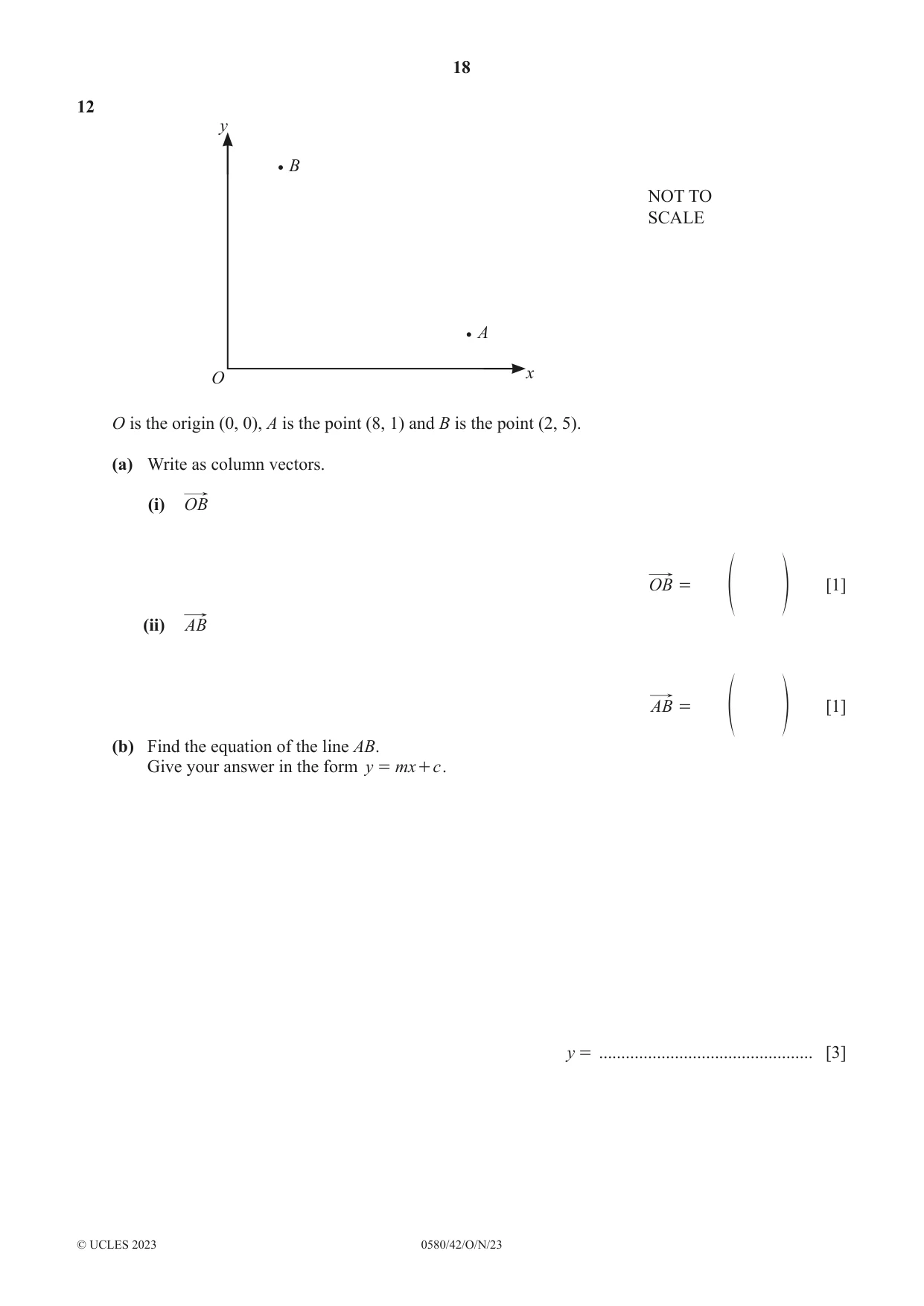
Q12 · Y B NOT TO SCALE A x O O is the origin (0, 0), A is the point (8, 1) and B is the point…
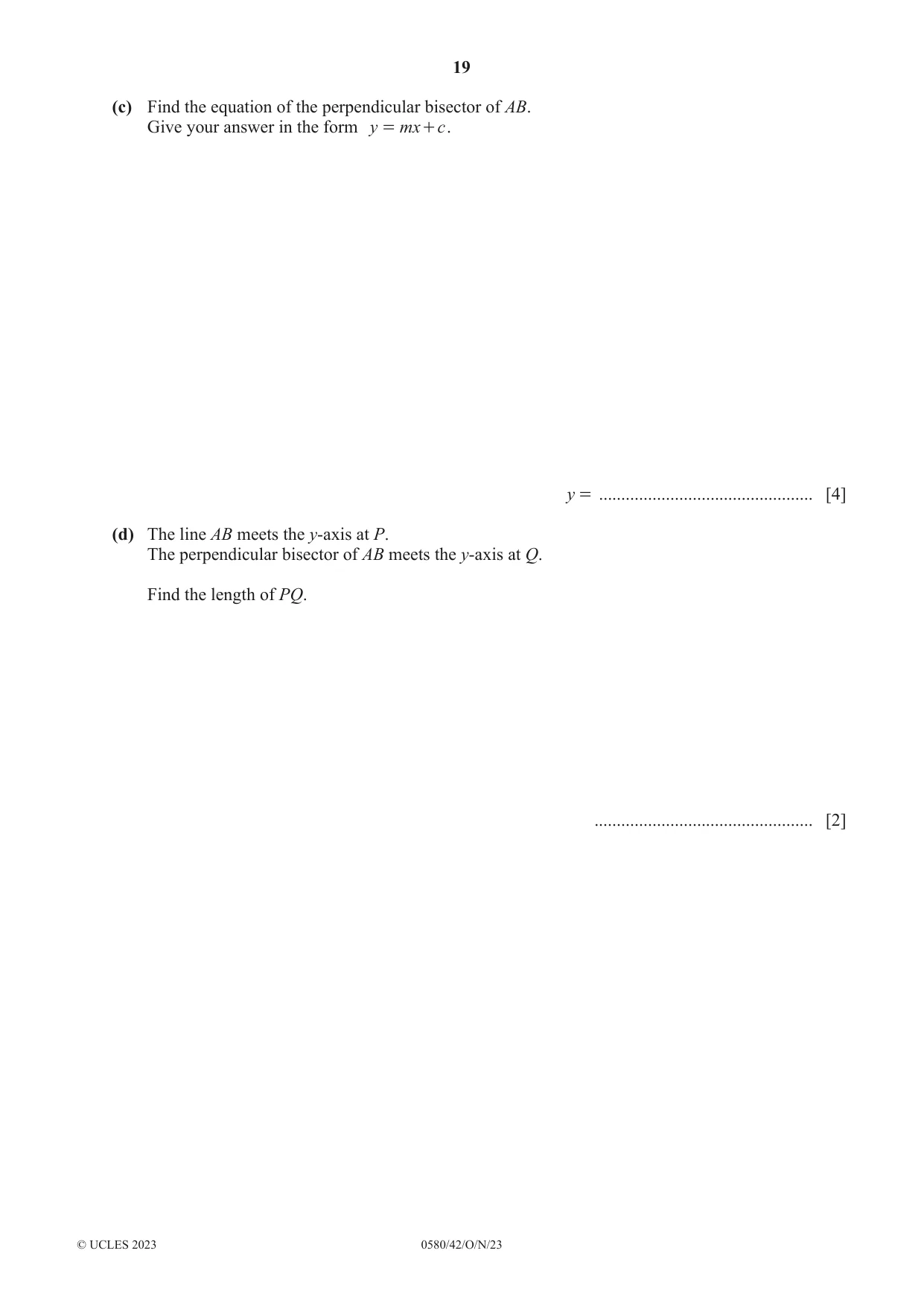
12 y B NOT TO SCALE A x O O is the origin (0, 0), A is the point (8, 1) and B is the point (2, 5). (a) Write as column vectors. (i) OB OB = [1] f p (ii) AB AB = [1] f p (b) Find the equation of the line AB. Give your answer in the form y = mx + c . y = ................................................ [3] (c) Find the equation of the perpendicular bisector of AB. Give your answer in the form y = mx + c . y = ................................................ [4] (d) The line AB meets the y-axis at P. The perpendicular bisector of AB meets the y-axis at Q. Find the length of PQ. ................................................. [2]
Mark scheme: 12(a)(i) 2 1 5 12(a)(ii) −6 1 4 12(b) 2 19 3 1 − 5 [ y =] − x + oe M1 for gradient = oe 3 3 8 − 2 M1 for substituting (8, 1) or (2, 5) into y = their mx + c 12(c) 3 9 4 B1 for (5, 3) oe [ y = x − oe 1 ]2 2 M1 for gradient = −their gradient of AB M1 substituting their midpoint into y = their mx + c 12(d) 65 2 19 9 oe M1 for their – their − oe 6 3 2
What was in this paper
The subtopics covered by these 12 questions, and how many questions each got. Open one in a new tab to see every Cambridge question on it.
What you needed in this session
Cambridge’s own grade thresholds for 2023 Oct/Nov, Paper 4 · Variant 2. A higher threshold means an easier paper — the bar moves with how the cohort did.