Questions as text
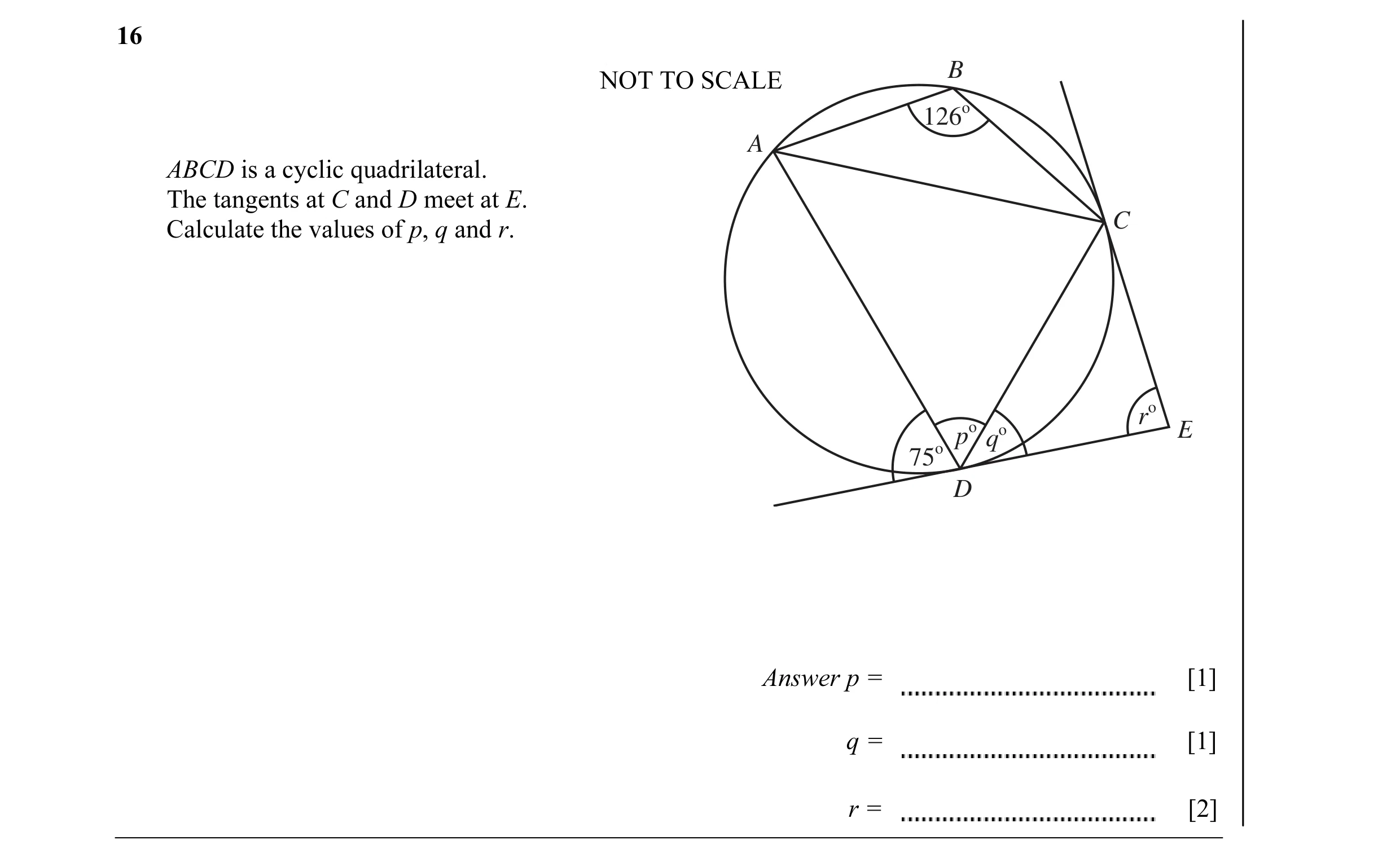
Q1 · B NOT TO SCALE 126o A ABCD is a cyclic quadrilateral 0580/21 Oct/Nov 2004
16 B NOT TO SCALE 126o A ABCD is a cyclic quadrilateral. The tangents at C and D meet at E. Calculate the values of p, q and r. C ro po qo E 75o D Answer p = [1] q = [1] r = [2]
4 marks
Mark scheme: 16 P = 54o 1 q = 51o 1√ 105 – p r = 78o 2√ r = 180 – 2q M1 for use of 180 – 2q
This question in 0580/21 Oct/Nov 2004
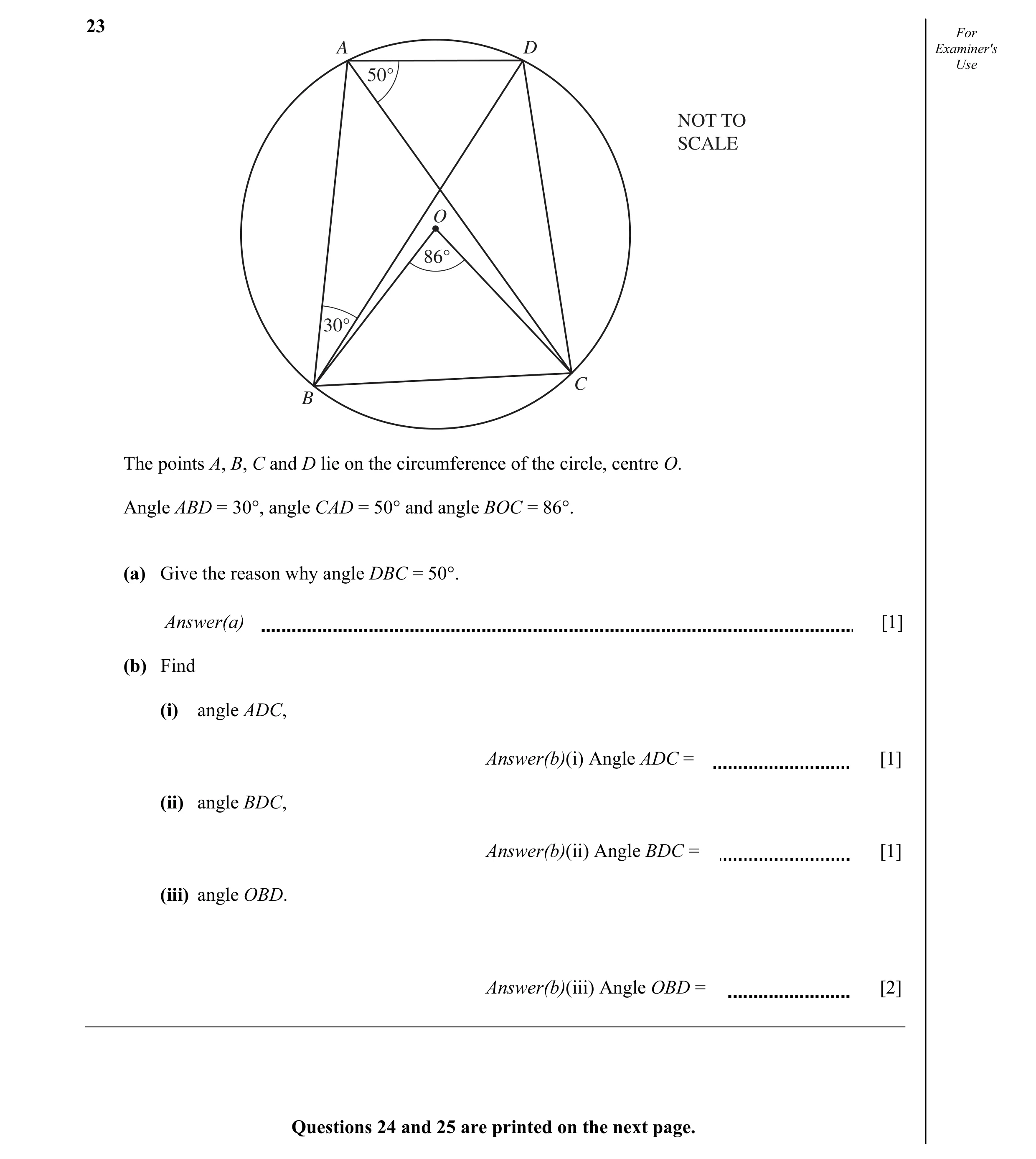
Q2 · For A D Examiner's 50° Use NOT TO SCALE O 86° 30° C B The points A, B, C and D lie on the… 0580/23 Oct/Nov 2010
23 For A D Examiner's 50° Use NOT TO SCALE O 86° 30° C B The points A, B, C and D lie on the circumference of the circle, centre O. Angle ABD = 30°, angle CAD = 50° and angle BOC = 86°. (a) Give the reason why angle DBC = 50°. Answer(a) [1] (b) Find (i) angle ADC, Answer(b)(i) Angle ADC = [1] (ii) angle BDC, Answer(b)(ii) Angle BDC = [1] (iii) angle OBD. Answer(b)(iii) Angle OBD = [2] Questions 24 and 25 are printed on the next page.
5 marks
Mark scheme: 23 (a) (Angles in) same segment 1 Allow (angles on) the same arc (b) (i) 100 1 (ii) 43 1 1 (iii) 3 2 B1 OBC or OCB = (180 – 86) (= 47) 2 IGCSE – October/November 2010 0580 23 x − 2 y
This question in 0580/23 Oct/Nov 2010
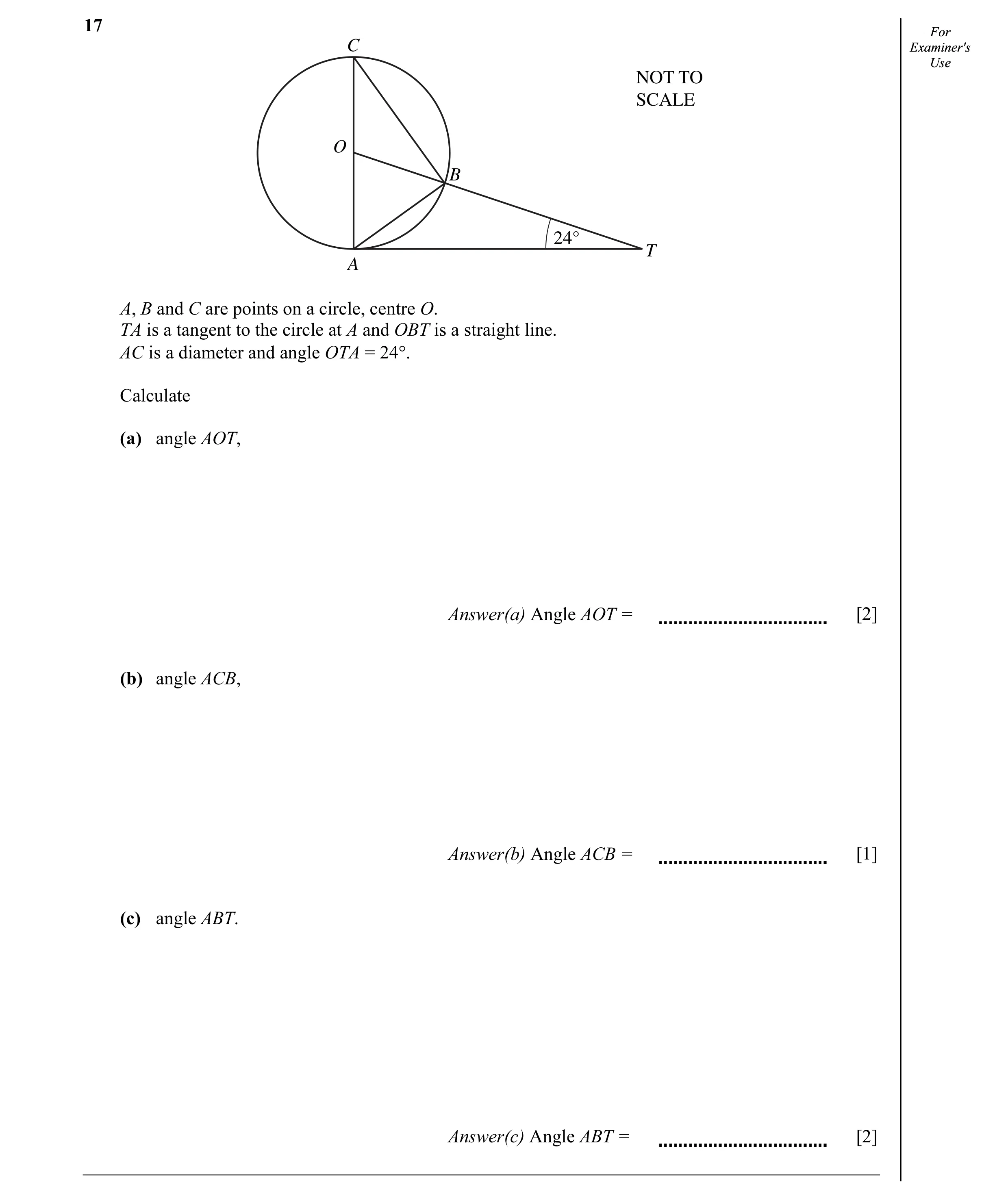
Q3 · ForFor C Examiner'sExaminer's UseUse NOT TO SCALE O B 24° T A A, B and C are points on a… 0580/21 May/June 2011
17 ForFor C Examiner'sExaminer's UseUse NOT TO SCALE O B 24° T A A, B and C are points on a circle, centre O. TA is a tangent to the circle at A and OBT is a straight line. AC is a diameter and angle OTA = 24°. Calculate (a) angle AOT, Answer(a) Angle AOT = [2] (b) angle ACB, Answer(b) Angle ACB = [1] (c) angle ABT. Answer(c) Angle ABT = [2]
5 marks
Mark scheme: q 17 (a) 66° 2 M1 for 90° clearly identified as A (b) 33° 1 (c) 123° 2 B1 for OBA or OAB = 57°
This question in 0580/21 May/June 2011
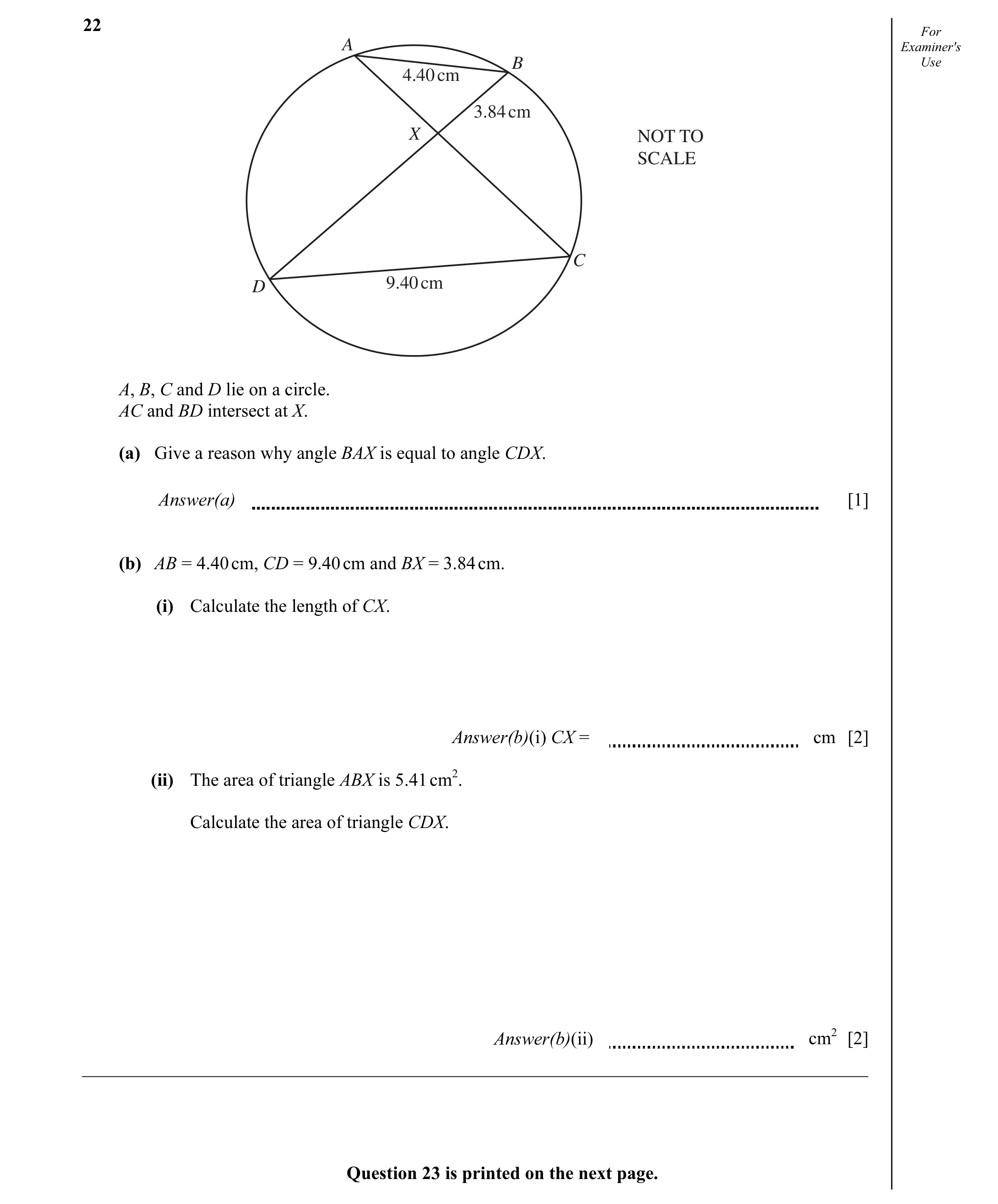
Q4 · For A Examiner's B Use 4.40 cm 3.84 cm X NOT TO SCALE C 9.40 cm D A, B, C and D lie on a… 0580/23 Oct/Nov 2011
22 For A Examiner's B Use 4.40 cm 3.84 cm X NOT TO SCALE C 9.40 cm D A, B, C and D lie on a circle. AC and BD intersect at X. (a) Give a reason why angle BAX is equal to angle CDX. Answer(a) [1] (b) AB = 4.40 cm, CD = 9.40 cm and BX = 3.84 cm. (i) Calculate the length of CX. Answer(b)(i) CX = cm [2] (ii) The area of triangle ABX is 5.41 cm2. Calculate the area of triangle CDX. Answer(b)(ii) cm2 [2] Question 23 is printed on the next page.
5 marks
Mark scheme: 22 (a) Angles in same segment 1 CX 4.9 (b) (i) 8.2(0) 2 M1 for = (= 2.136) oe .384 4.4 2 ∆ 4.9 (ii) 24.7 2 M1 for = (= 4.564) oe .541 4.4 2
This question in 0580/23 Oct/Nov 2011
Q5 · C NOT TO SCALE D 108° O B A A, B, C and D lie on a circle centre O 0580/21 Oct/Nov 2012
6 C NOT TO SCALE D 108° O B A A, B, C and D lie on a circle centre O. Angle ADC = 108°. Work out the obtuse angle AOC. Answer Angle AOC = [2]
2 marks
Mark scheme: 6 144 2 M1 for ABC = 72 or AOC reflex = 216 Angles must be fully stated or marked in correct place on diagram
This question in 0580/21 Oct/Nov 2012
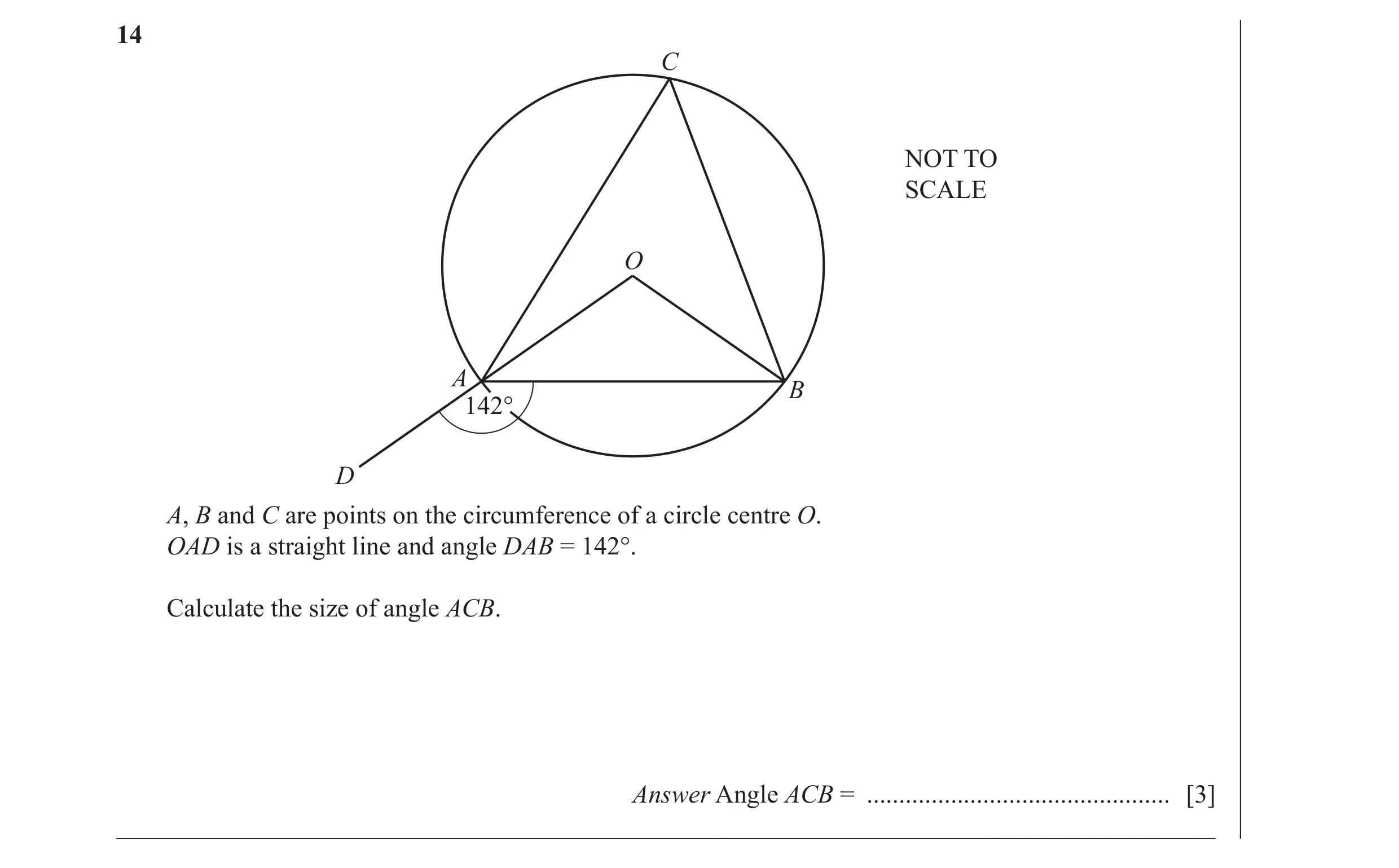
Q6 · C NOT TO SCALE O A B 142° D A, B and C are points on the circumference of a circle centre… 0580/22 Oct/Nov 2013
14 C NOT TO SCALE O A B 142° D A, B and C are points on the circumference of a circle centre O. OAD is a straight line and angle DAB = 142°. Calculate the size of angle ACB. Answer Angle ACB = … [3] _____________________________________________________________________________________
3 marks
Mark scheme: 14 52 3 B2 for AOB = 104 or B1 for OAB or OBA = 38
This question in 0580/22 Oct/Nov 2013
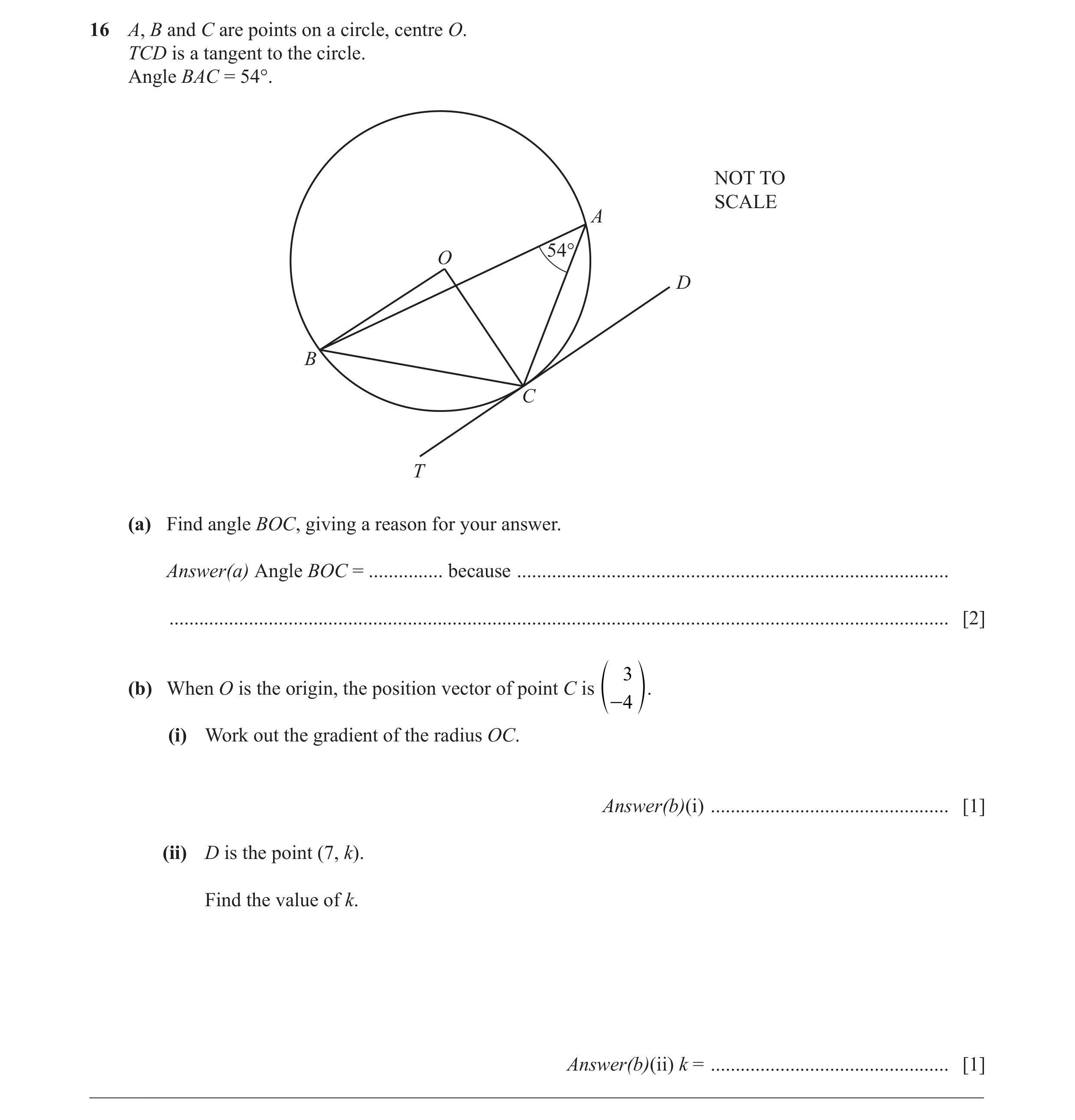
Q7 · A, B and C are points on a circle, centre O 0580/22 Oct/Nov 2014
16 A, B and C are points on a circle, centre O. TCD is a tangent to the circle. Angle BAC = 54°. NOT TO SCALE A O 54° D B C T (a) Find angle BOC, giving a reason for your answer. Answer(a) Angle BOC = … because … … [2] 3 (b) When O is the origin, the position vector of point C is e-4 o. (i) Work out the gradient of the radius OC. Answer(b)(i) … [1] (ii) D is the point (7, k). Find the value of k. Answer(b)(ii) k = … [1] __________________________________________________________________________________________
4 marks
Mark scheme: 16 (a) 108 1 Angle at centre is twice angle at 1 circumference oe 4 (b) (i) − oe 1 3 (ii) −1 1 2
This question in 0580/22 Oct/Nov 2014
Q8 · X° NOT TO SCALE 47° Find the value of x 0580/22 Feb/March 2016
18 (a) x° NOT TO SCALE 47° Find the value of x. x = … [1] (b) 85° 115° NOT TO SCALE 97° y° Find the value of y. y = … [2] (c) 58° NOT TO z° SCALE O The diagram shows a circle, centre O. Find the value of z. z = … [2]
5 marks
Mark scheme: 18 (a) 47 1 (b) 117 2 M1 for 360 − (115 + 85 + 97) (c) 244 2 B1 for 116 seen at centre or 122 seen at circumference
This question in 0580/22 Feb/March 2016
Q9 · P 56° O NOT TO SCALE Q x° y° B A A, B, P and Q lie on the circle, centre O 0580/21 May/June 2016
11 P 56° O NOT TO SCALE Q x° y° B A A, B, P and Q lie on the circle, centre O. Angle APB = 56°. Find the value of (a) x, x = … [1] (b) y. y = … [1]
2 marks
Mark scheme: 11 (a) 112 1 (b) 56 1
This question in 0580/21 May/June 2016
Q10 · P NOT TO SCALE 42°42° Q T W In the diagram, PT is a tangent to the circle at P 0580/21 Oct/Nov 2016
6 P NOT TO SCALE 42°42° Q T W In the diagram, PT is a tangent to the circle at P. PW is a diameter and angle TPQ = 42°. Find angle PWQ. Angle PWQ = … [2]
2 marks
Mark scheme: 6 42 2 M1 for Q = 90 or WPQ = 90 – 42 or WPQ =48 x 2 + 2 y 2 x 2 y
This question in 0580/21 Oct/Nov 2016
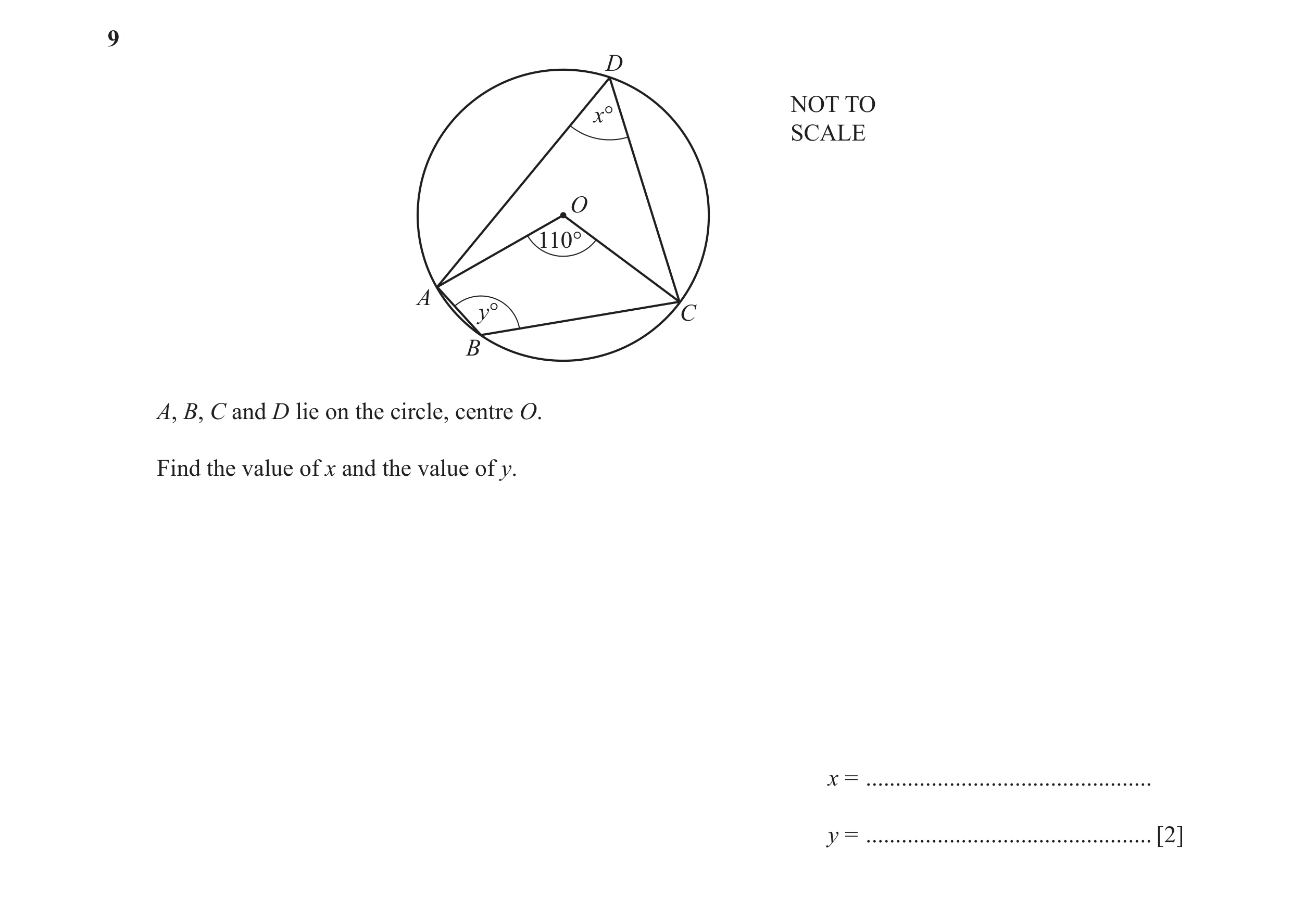
Q11 · D NOT TO x° SCALE O 110° A y° C B A, B, C and D lie on the circle, centre O 0580/21 Oct/Nov 2016
9 D NOT TO x° SCALE O 110° A y° C B A, B, C and D lie on the circle, centre O. Find the value of x and the value of y. x = … y = … [2]
2 marks
Mark scheme: 9 [x =] 55 1 [y =] 125 1FT correct or FT (180 – their x)
This question in 0580/21 Oct/Nov 2016
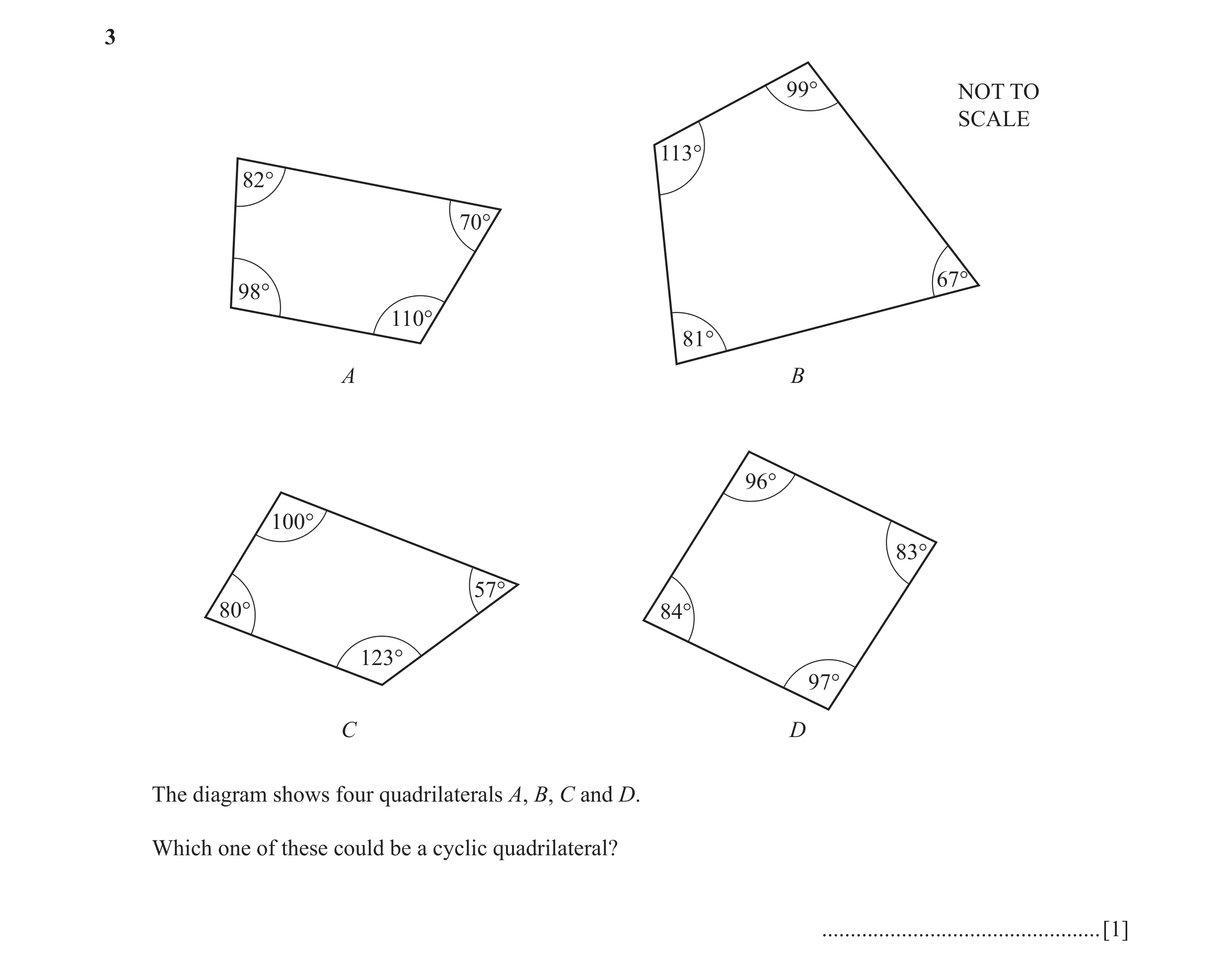
Q12 · 99° NOT TO SCALE 113° 82° 70° 67° 98° 110° 81° A B 96° 100° 83° 57° 80° 84° 123° 97° C D… 0580/23 Oct/Nov 2016
3 99° NOT TO SCALE 113° 82° 70° 67° 98° 110° 81° A B 96° 100° 83° 57° 80° 84° 123° 97° C D The diagram shows four quadrilaterals A, B, C and D. Which one of these could be a cyclic quadrilateral? … [1]
1 marks
Mark scheme: 3 B 1 6
This question in 0580/23 Oct/Nov 2016
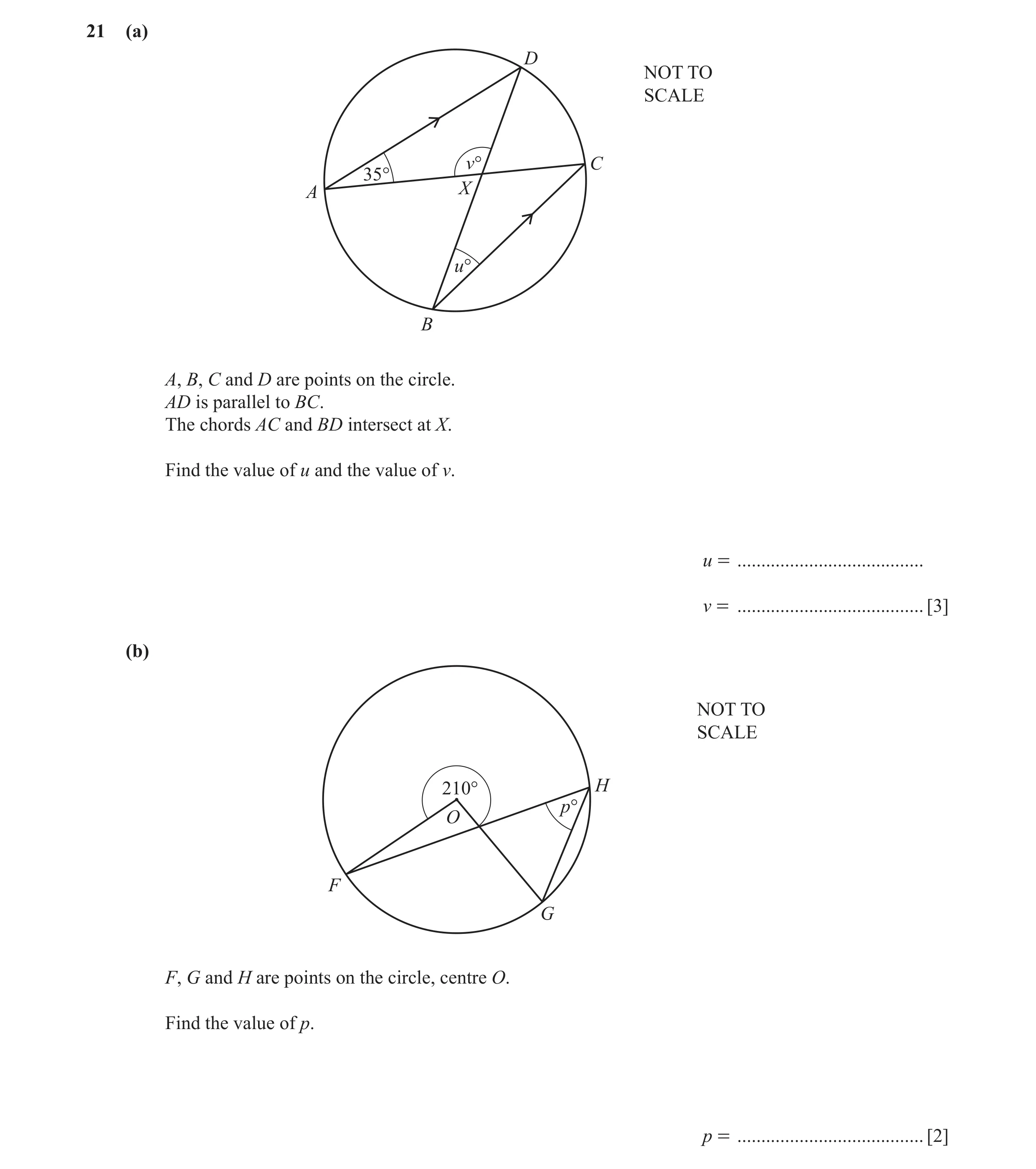
Q13 · D NOT TO SCALE v° C 35° A X u° B A, B, C and D are points on the circle 0580/21 May/June 2017
21 (a) D NOT TO SCALE v° C 35° A X u° B A, B, C and D are points on the circle. AD is parallel to BC. The chords AC and BD intersect at X. Find the value of u and the value of v. u = … v = … [3] (b) NOT TO SCALE 210° H p° O F G F, G and H are points on the circle, centre O. Find the value of p. p = … [2]
5 marks
Mark scheme: 21(a) [u =] 35 1 [v =] 110 2 B1 for ACB or ADB = 35 21(b) 75 2 B1 for 150 360 − 210 or M1 for 2
This question in 0580/21 May/June 2017
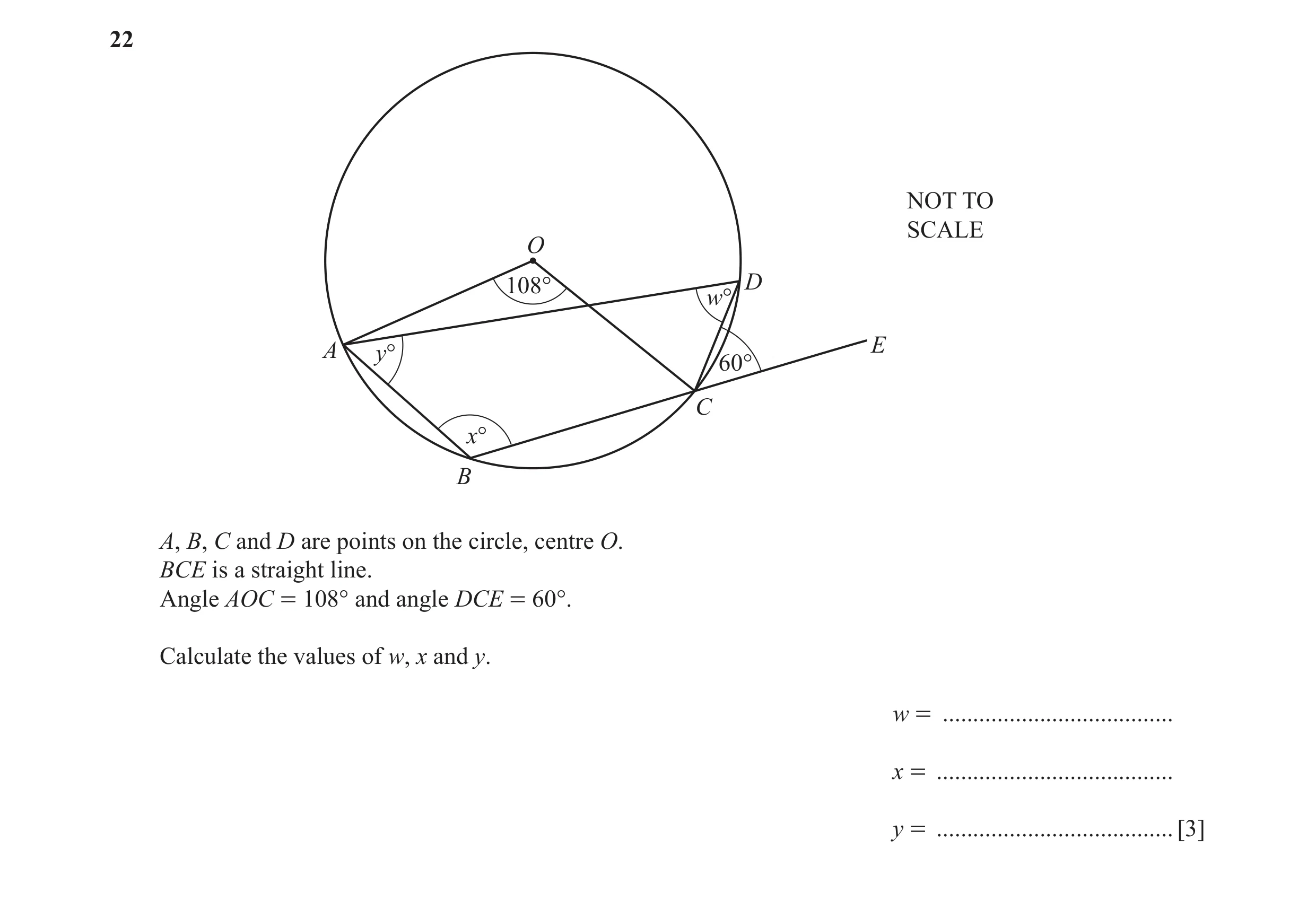
Q14 · NOT TO SCALE O 108° D w° A y° E 60° C x° B A, B, C and D are points on the circle, centre… 0580/22 Oct/Nov 2017
22 NOT TO SCALE O 108° D w° A y° E 60° C x° B A, B, C and D are points on the circle, centre O. BCE is a straight line. Angle AOC = 108° and angle DCE = 60°. Calculate the values of w, x and y. w = … x = … y = … [3]
3 marks
Mark scheme: 22 [w =] 54 3 B1 for [w =] 54 [x =] 126 B1 for [x =] 126 [y =] 60 If B0 B0 for first two B marks then B1 for their w + their x = 180 B1 for [y =] 60 or for their w + their x + their y = 240
This question in 0580/22 Oct/Nov 2017
Q15 · D x° C 47° NOT TO y° SCALE E 85° w° B A The points A, B, C, D and E lie on the… 0580/23 May/June 2018
20 D x° C 47° NOT TO y° SCALE E 85° w° B A The points A, B, C, D and E lie on the circumference of the circle. Angle DCE = 47° and angle CEA = 85°. Find the values of w, x and y. w = … x = … y = … [3]
3 marks
Mark scheme: 20 [w = ] 95 3 B1 for each [x = ] 85 If B0 scored for x and for y, [y = ] 48 SC1 for their x + their y = 133
This question in 0580/23 May/June 2018
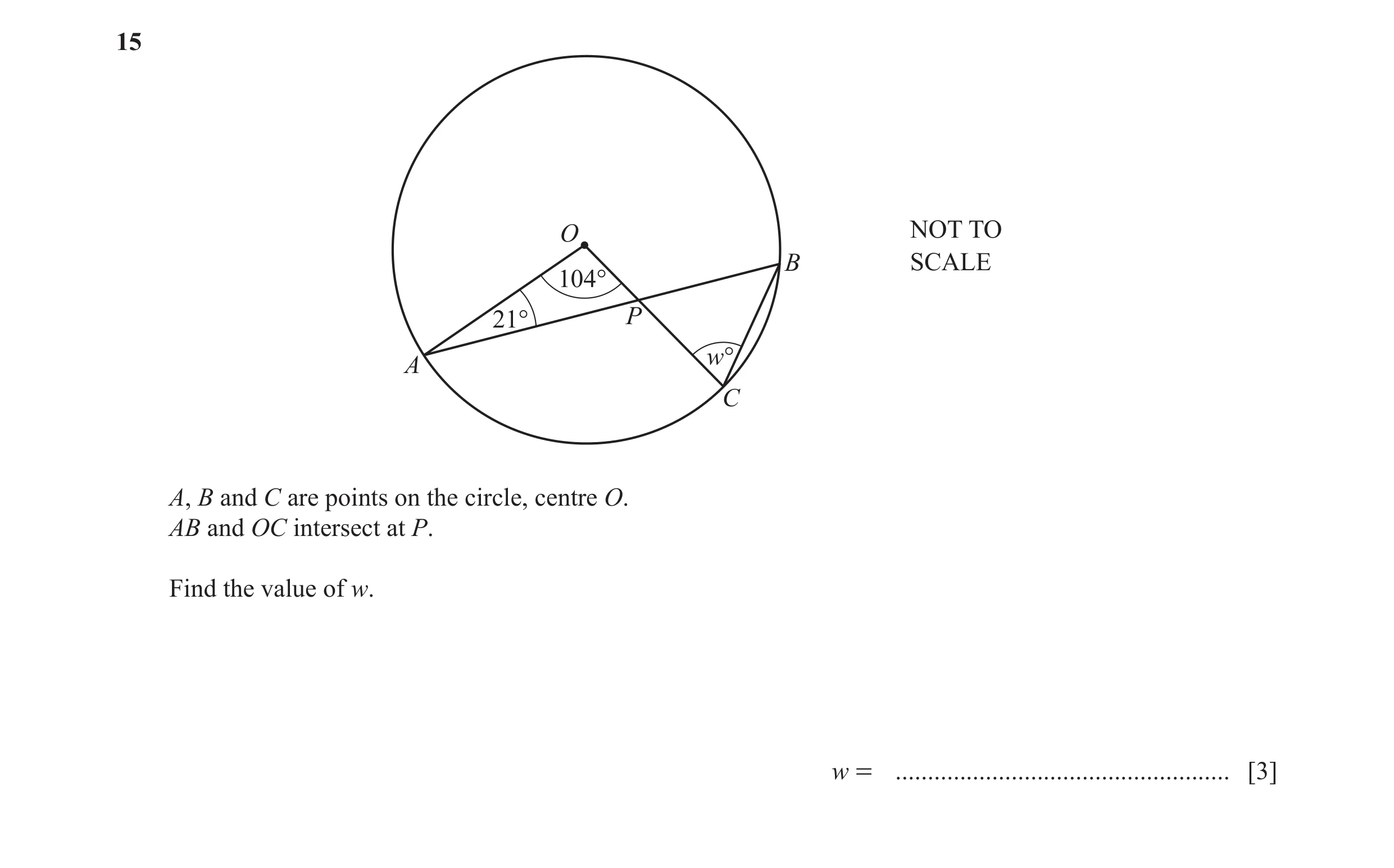
Q16 · O NOT TO B SCALE 104° 21° P w° A C A, B and C are points on the circle, centre O 0580/22 Feb/March 2019
15 O NOT TO B SCALE 104° 21° P w° A C A, B and C are points on the circle, centre O. AB and OC intersect at P. Find the value of w. w = … [3]
3 marks
Mark scheme: 15 73 3 B1 for angle PBC = 52 B1 for APO or BPC = 55 or APC or OPB = 125
This question in 0580/22 Feb/March 2019
Q17 · NOT TO O SCALE C A 130° B A, B and C are points on the circle, centre O 0580/21 May/June 2019
8 NOT TO O SCALE C A 130° B A, B and C are points on the circle, centre O. Find the obtuse angle AOC. Angle AOC = … [2]
2 marks
Mark scheme: 8 100 2 M1 for reflex angle = 2 × 130 or opposite angle of a cyclic quadrilateral shown = 50
This question in 0580/21 May/June 2019
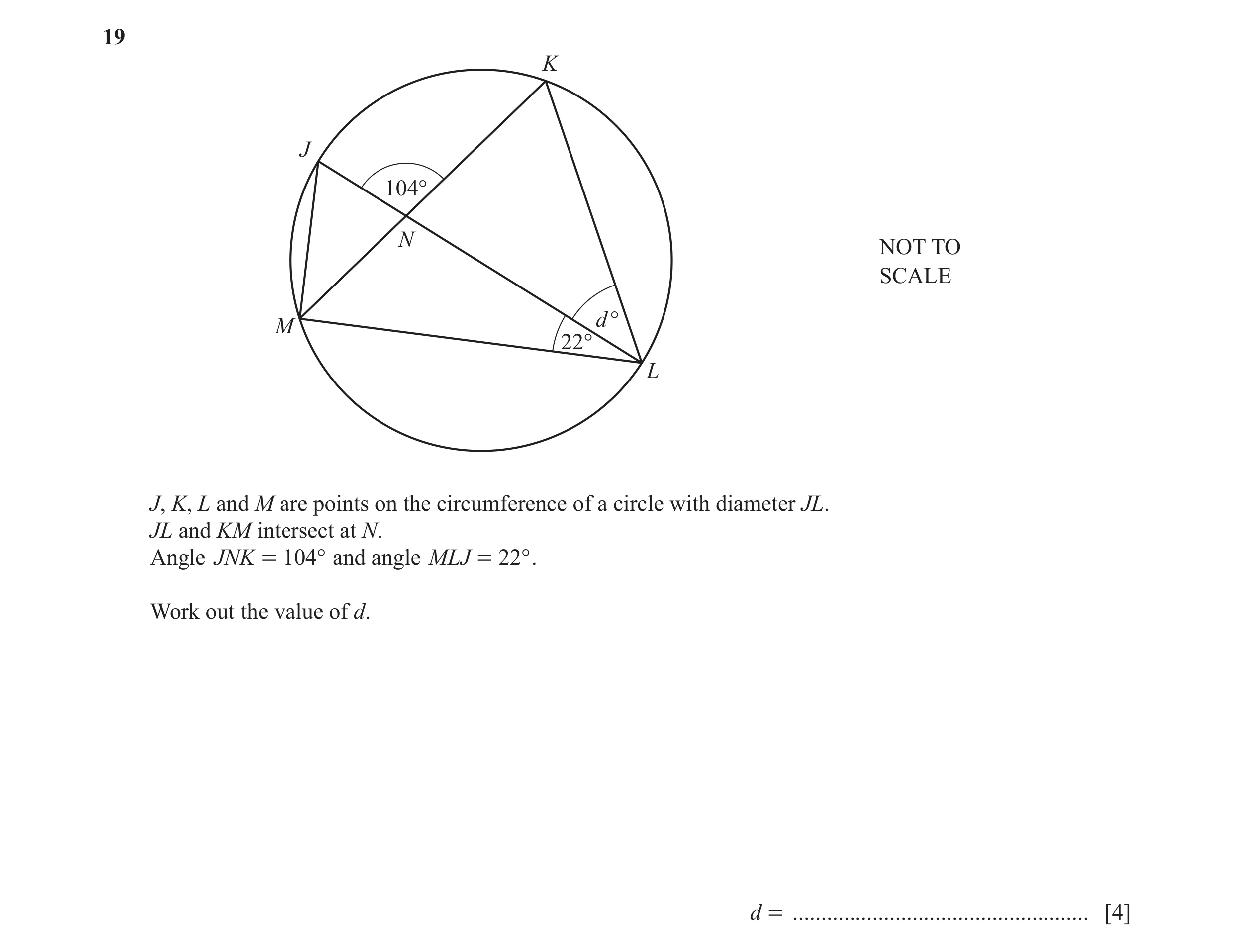
Q18 · K J 104° N NOT TO SCALE d ° M 22° L J, K, L and M are points on the circumference of a… 0580/23 May/June 2019
19 K J 104° N NOT TO SCALE d ° M 22° L J, K, L and M are points on the circumference of a circle with diameter JL. JL and KM intersect at N. Angle JNK = 104° and angle MLJ = 22° . Work out the value of d. d = … [4]
4 marks
Mark scheme: 19 36 4 B1 for angle KNL or MNJ = 76 B2 for angle LJM or LKM = 68 or B1 for angle LMJ = 90 or LKJ = 90 or LCM = 136 (C = centre) OR B1 for MKJ = 22 B2 for LJM or LKM = 68 or B1 for LKJ = 90 or KJL = 54 OR B1 for MNL = 104 B1 for LMN = 54 B1 for LMJ = 90
This question in 0580/23 May/June 2019
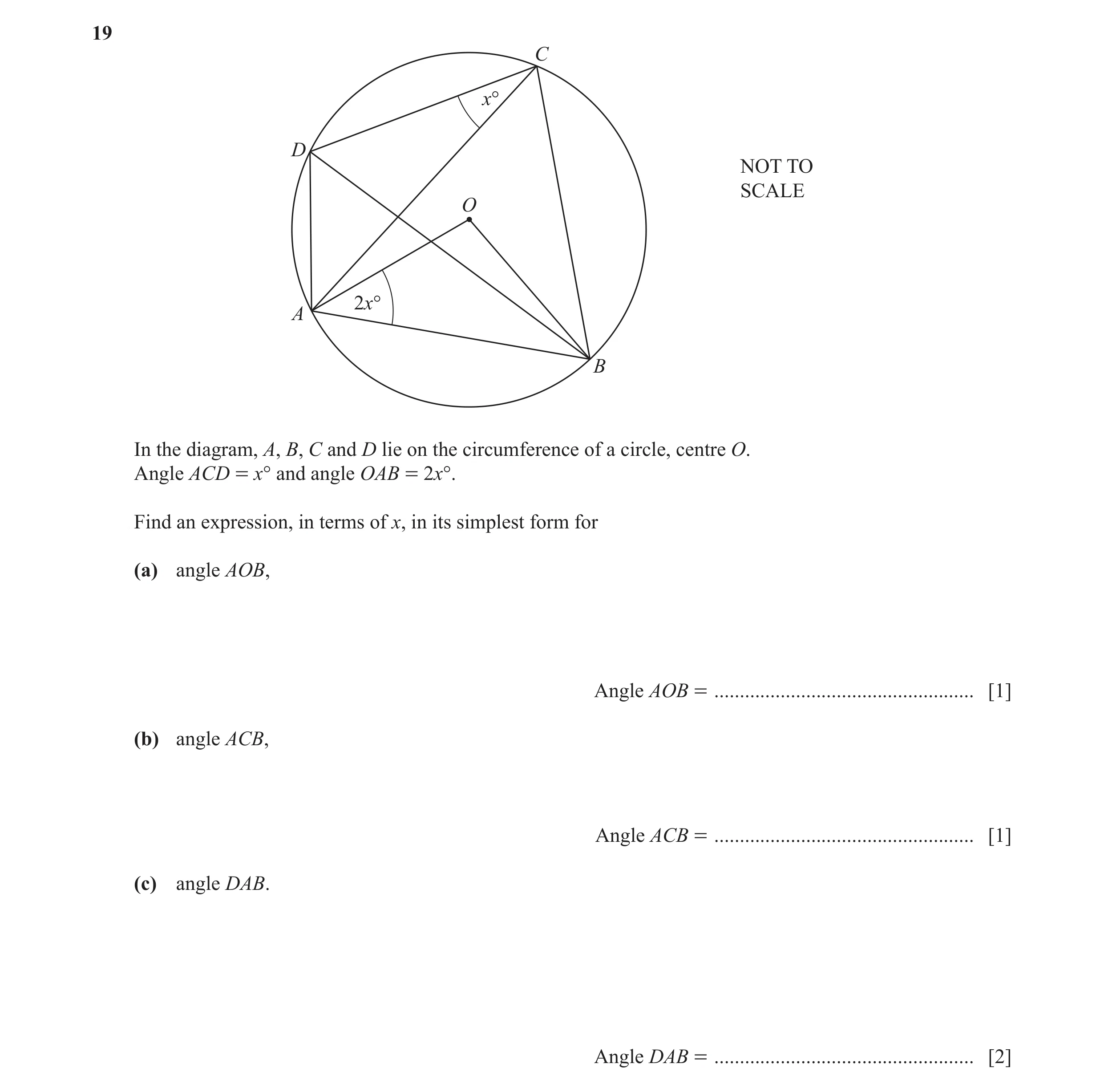
Q19 · C x° D NOT TO SCALE O 2x° A B In the diagram, A, B, C and D lie on the circumference of a… 0580/22 Oct/Nov 2019
19 C x° D NOT TO SCALE O 2x° A B In the diagram, A, B, C and D lie on the circumference of a circle, centre O. Angle ACD = x° and angle OAB = 2x°. Find an expression, in terms of x, in its simplest form for (a) angle AOB, Angle AOB = … [1] (b) angle ACB, Angle ACB = … [1] (c) angle DAB. Angle DAB = … [2]
4 marks
Mark scheme: 19(a) 180 – 4x 1 19(b) 90 – 2x 1 FT their (a) ÷ 2 in its simplest form dep on expression in x in (a) 19(c) 90 + x 2 FT 180 – their (b) – x oe dep on expression in x in (b) then fully simplified M1 for 180 – (90 – 2x + x) oe or 180 – their (b) – x oe dep on expression in x in (b)
This question in 0580/22 Oct/Nov 2019
Q20 · A NOT TO SCALE D B 64° P C Q A, B, C and D lie on the circle 0580/22 Feb/March 2020
15 A NOT TO SCALE D B 64° P C Q A, B, C and D lie on the circle. PCQ is a tangent to the circle at C. Angle ACQ = 64°. Work out angle ABC, giving reasons for your answer. Angle ABC = … because … … … [3]
3 marks
Mark scheme: 15 116° B1 alternate segment theorem B1 angles in opposite segments are B1 supplementary or cyclic quadrilateral or angles at a point on a straight line
This question in 0580/22 Feb/March 2020
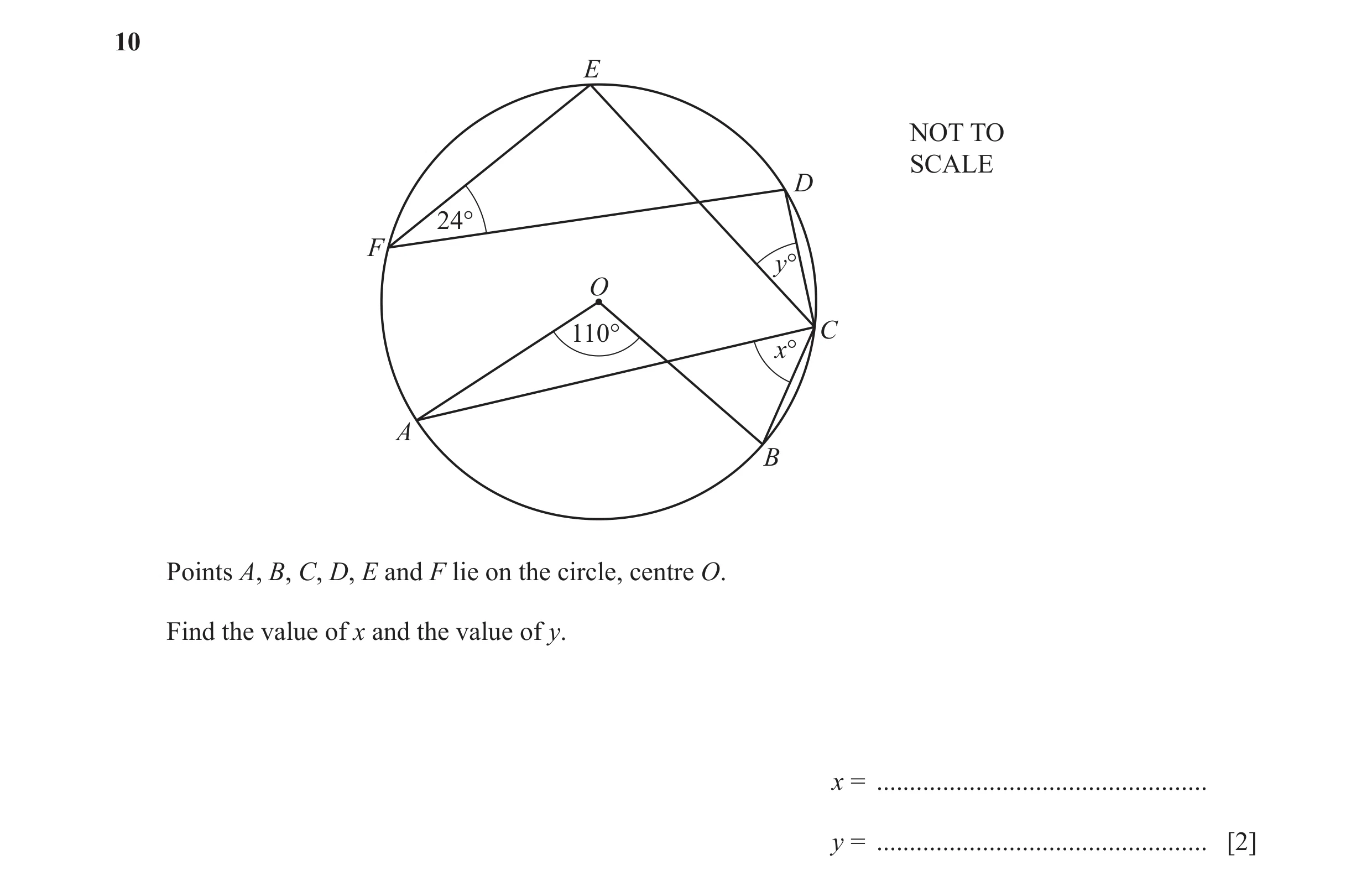
Q21 · E NOT TO SCALE D 24° F y° O 110° C x° A B Points A, B, C, D, E and F lie on the circle… 0580/21 May/June 2020
10 E NOT TO SCALE D 24° F y° O 110° C x° A B Points A, B, C, D, E and F lie on the circle, centre O. Find the value of x and the value of y. x = … y = … [2]
2 marks
Mark scheme: 10 [x =] 55 2 B1 for each [y = ] 24
This question in 0580/21 May/June 2020
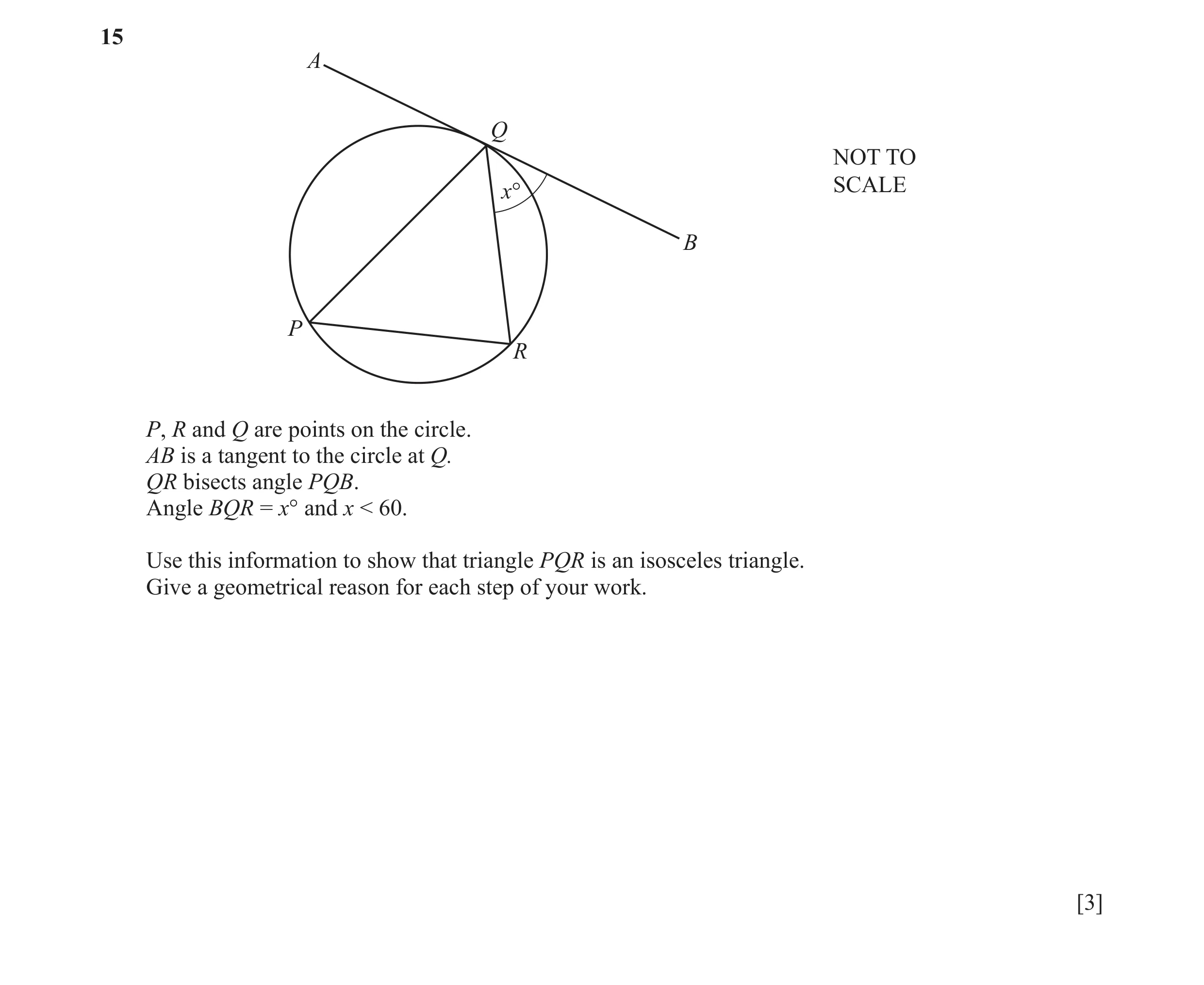
Q22 · A Q NOT TO x° SCALE B P R P, R and Q are points on the circle 0580/21 May/June 2020
15 A Q NOT TO x° SCALE B P R P, R and Q are points on the circle. AB is a tangent to the circle at Q. QR bisects angle PQB. Angle BQR = x° and x < 60. Use this information to show that triangle PQR is an isosceles triangle. Give a geometrical reason for each step of your work. [3]
3 marks
Mark scheme: 15 Complete explanation with 3 B1 for RQP = x° QR bisects angle PQB geometrical reasons B1 for RPQ = x° alternate segment theorem B1 for triangle PQR has two equal angles both less than 60 (so can’t be equilateral) so must be isosceles
This question in 0580/21 May/June 2020
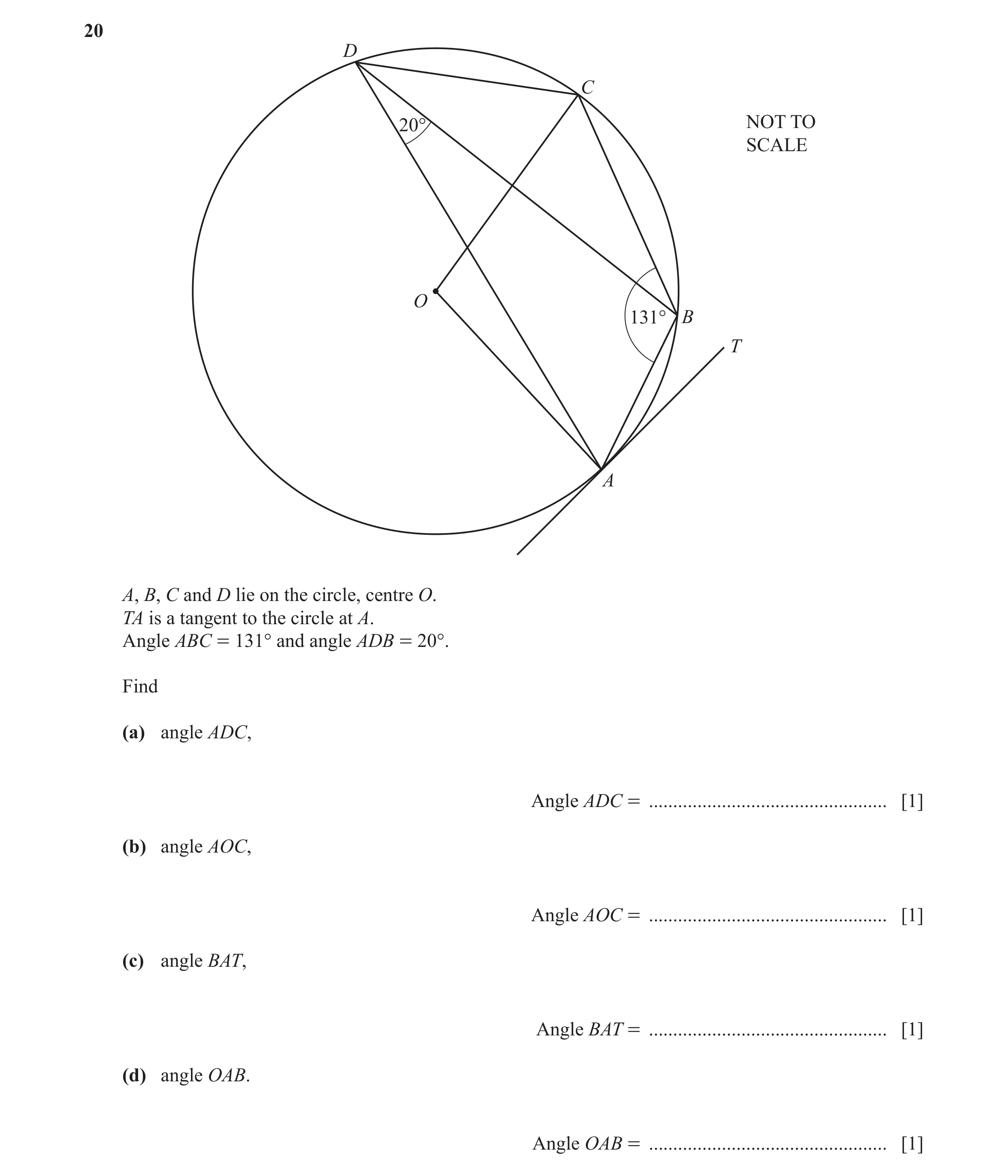
Q23 · D C 20° NOT TO SCALE O 131° B T A A, B, C and D lie on the circle, centre O 0580/22 May/June 2020
20 D C 20° NOT TO SCALE O 131° B T A A, B, C and D lie on the circle, centre O. TA is a tangent to the circle at A. Angle ABC = 131° and angle ADB = 20°. Find (a) angle ADC, Angle ADC = … [1] (b) angle AOC, Angle AOC = … [1] (c) angle BAT, Angle BAT = … [1] (d) angle OAB. Angle OAB = … [1]
4 marks
Mark scheme: 20(a) 49 1 20(b) 98 1 FT 2 × their (a) 20(c) 20 1 20(d) 70 1 FT 90 – their (c)
This question in 0580/22 May/June 2020
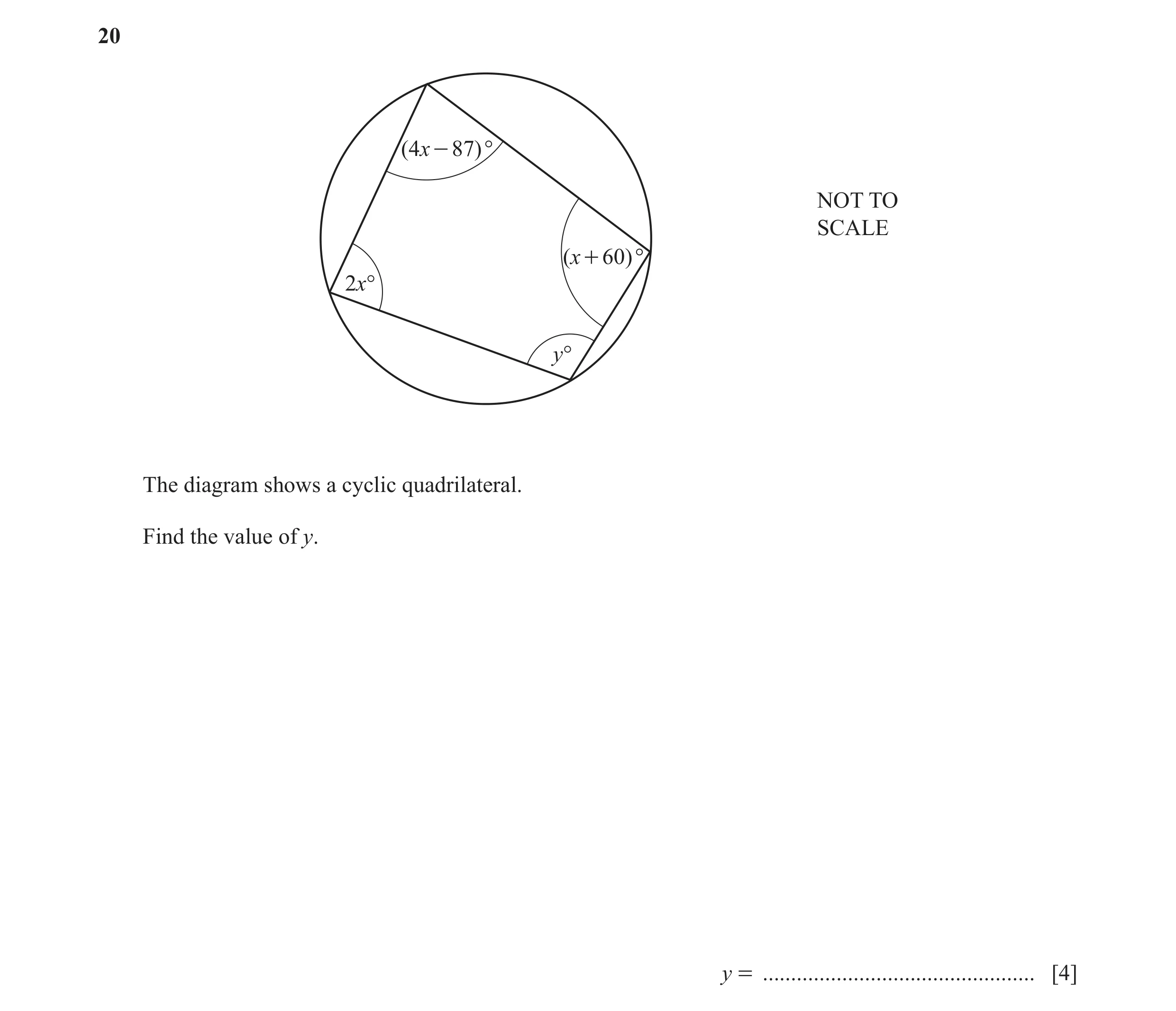
Q24 · ( 4x - 87)° NOT TO SCALE ( x + 60 ) ° 2x° y° The diagram shows a cyclic quadrilateral 0580/21 Oct/Nov 2020
20 ( 4x - 87)° NOT TO SCALE ( x + 60 ) ° 2x° y° The diagram shows a cyclic quadrilateral. Find the value of y. y = … [4]
4 marks
Mark scheme: 20 107 4 B2 for x = 40 or M1 for 2x + x + 60 = 180 oe M1 for correctly substituting their x into 4x – 87 + y = 180 oe or 4x – 87 + x + 60 + y + 2x = 360 oe
This question in 0580/21 Oct/Nov 2020
Q25 · H G K NOT TO SCALE F x° 25° 47° E T Points E, F, G and H lie on the circle and EG = EH 0580/22 Feb/March 2021
15 H G K NOT TO SCALE F x° 25° 47° E T Points E, F, G and H lie on the circle and EG = EH . HF and EG intersect at K. ET is a tangent to the circle at E. Angle FET = 47° and angle FEG = 25°. Find the value of x. x = … [2]
2 marks
Mark scheme: 15 36 2 M1 for angle EHG = 72 or for angle EHF = 47 and GHF = 25
This question in 0580/22 Feb/March 2021
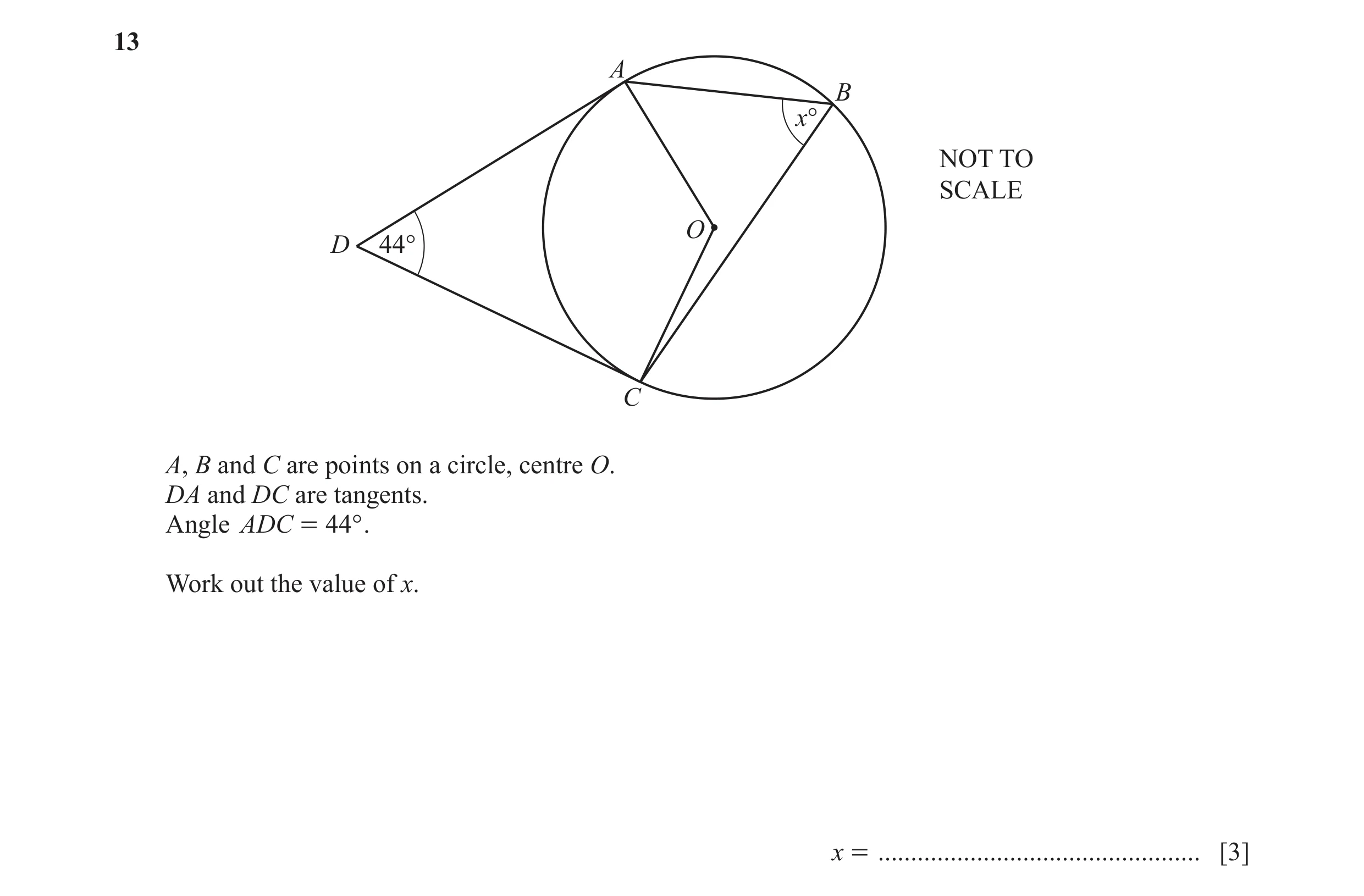
Q26 · A B x° NOT TO SCALE O D 44° C A, B and C are points on a circle, centre O 0580/22 May/June 2021
13 A B x° NOT TO SCALE O D 44° C A, B and C are points on a circle, centre O. DA and DC are tangents. Angle ADC = 44° . Work out the value of x. x = … [3]
3 marks
Mark scheme: 13 68 3 M1 for correctly identifying 90° angle soi or DAC / DCA = 68 M1 for [obtuse angle] AOC identified as 2x soi or x = their DAC / DCA
This question in 0580/22 May/June 2021
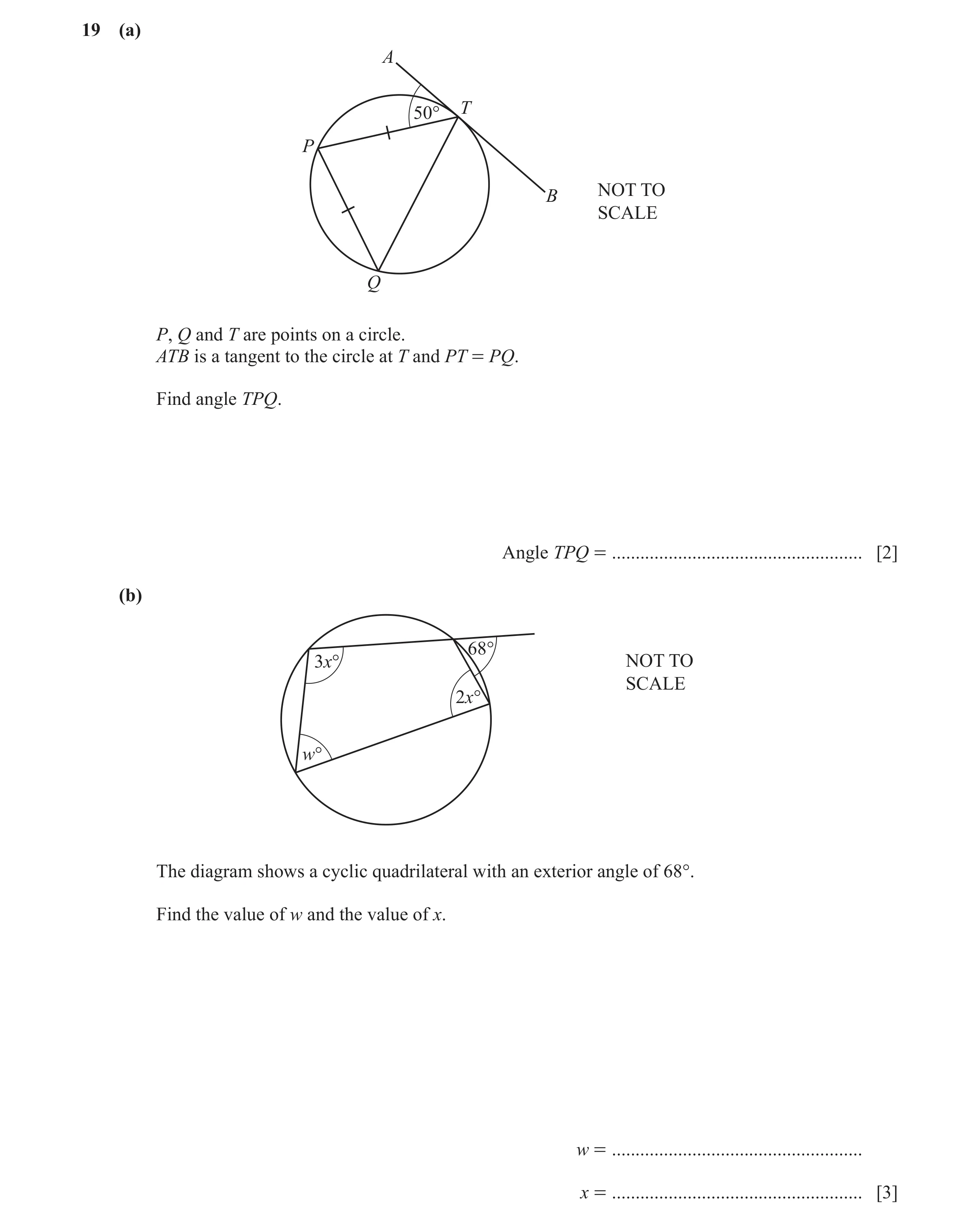
Q27 · A T 50° P NOT TO B SCALE Q P, Q and T are points on a circle 0580/23 May/June 2021
19 (a) A T 50° P NOT TO B SCALE Q P, Q and T are points on a circle. ATB is a tangent to the circle at T and PT = PQ. Find angle TPQ. Angle TPQ = … [2] (b) 68° 3x° NOT TO SCALE 2x° w° The diagram shows a cyclic quadrilateral with an exterior angle of 68°. Find the value of w and the value of x. w = … x = … [3]
5 marks
Mark scheme: 19(a) 80 2 B1 for angle PQT = 50 19(b) [w =] 68 3 B1 for 68 [x =] 36 B2 for 36 or M1 for 3x + 2x + 68 + 112 = 360 or better
This question in 0580/23 May/June 2021
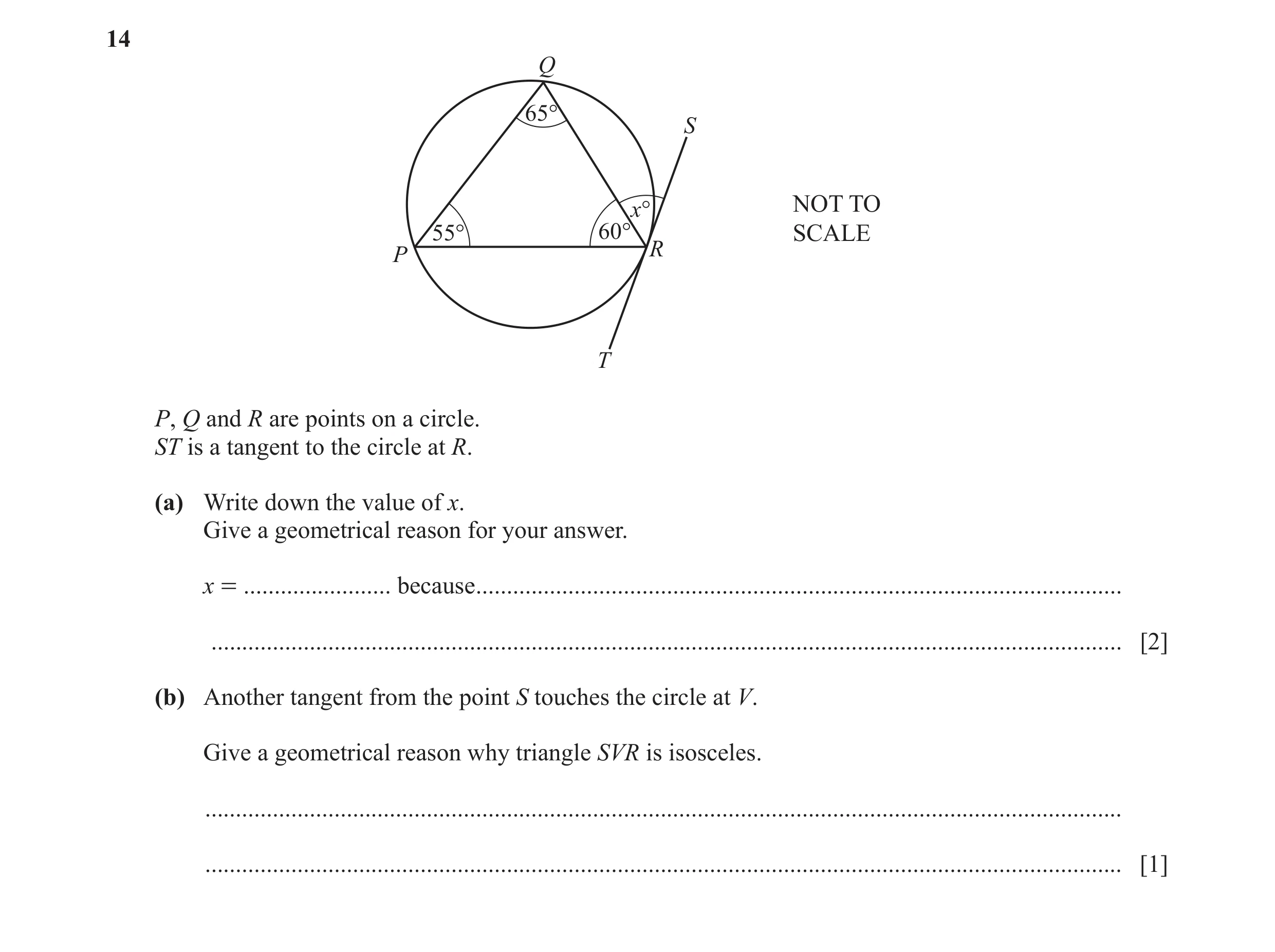
Q28 · Q 65° S x° NOT TO 55° 60° SCALE P R T P, Q and R are points on a circle 0580/22 Oct/Nov 2021
14 Q 65° S x° NOT TO 55° 60° SCALE P R T P, Q and R are points on a circle. ST is a tangent to the circle at R. (a) Write down the value of x. Give a geometrical reason for your answer. x = … because … … [2] (b) Another tangent from the point S touches the circle at V. Give a geometrical reason why triangle SVR is isosceles. … … [1]
3 marks
Mark scheme: 14(a) 55 2 B1 for 55 Alternate segment theorem 14(b) Tangents from an external point are equal 1 in length
This question in 0580/22 Oct/Nov 2021
Q29 · U D 38° 60° NOT TO T SCALE C B x° y° A A, B, C and D are points on a circle 0580/21 May/June 2022
18 U D 38° 60° NOT TO T SCALE C B x° y° A A, B, C and D are points on a circle. TU is a tangent to the circle at D. DA is parallel to CB. Find the value of x and the value of y. x = … y = … [3]
3 marks
Mark scheme: 18 [x = ] 38 3 B1 for [x = ] 38 and [y = ] 22 B2 for [y = ] 22 or M1 for angle ACB = their x or angle BAD = 60 or angle CBA = 120
This question in 0580/21 May/June 2022
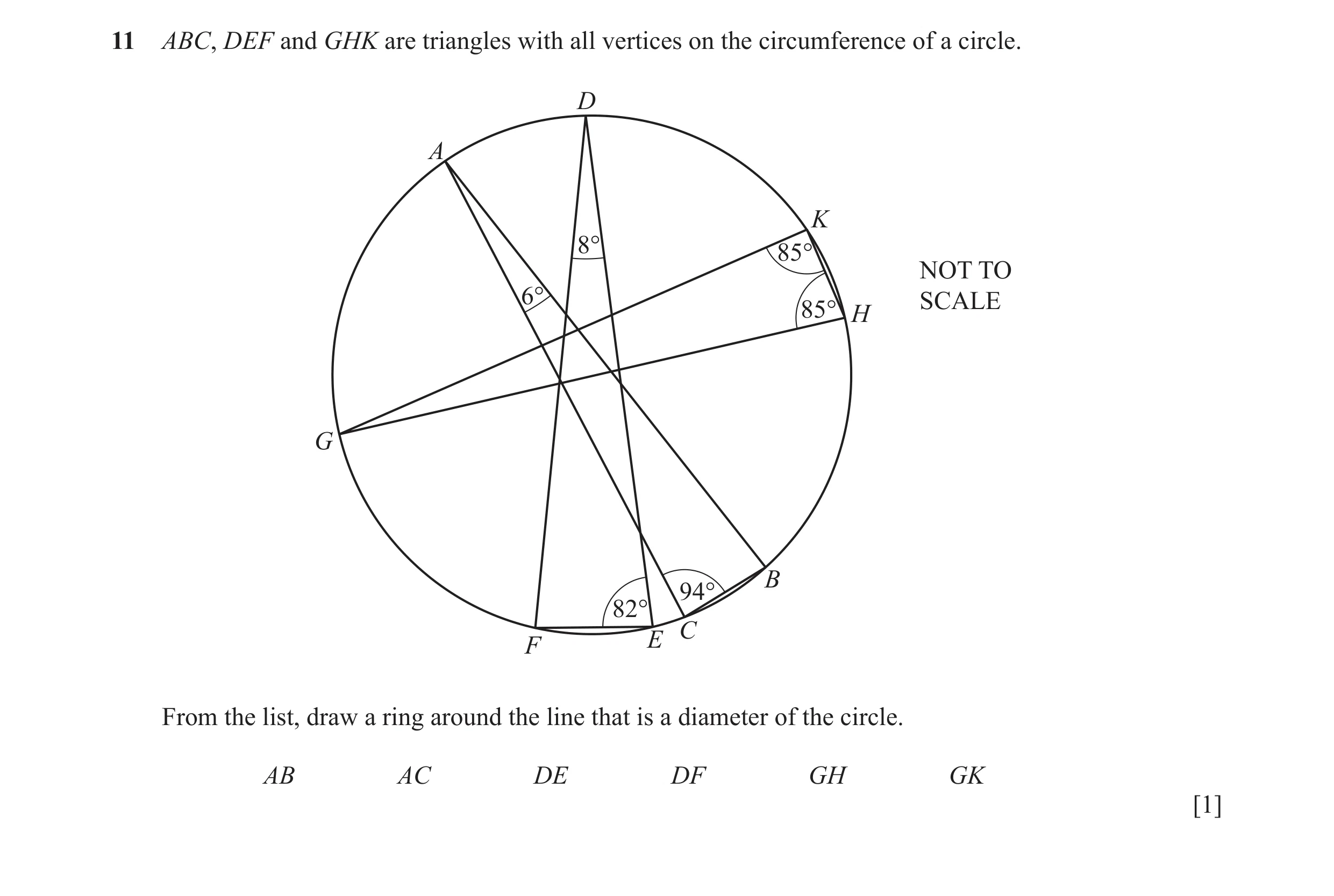
Q30 · ABC, DEF and GHK are triangles with all vertices on the circumference of a circle 0580/23 May/June 2022
11 ABC, DEF and GHK are triangles with all vertices on the circumference of a circle. D A K 8° 85° NOT TO 6° SCALE 85° H G B 94° 82° C F E From the list, draw a ring around the line that is a diameter of the circle. AB AC DE DF GH GK [1]
1 marks
Mark scheme: 11 DE 1
This question in 0580/23 May/June 2022
Q31 · 20° NOT TO 72° SCALE 56° v° x° u° w° The diagram shows a circle and eight chords 0580/21 Oct/Nov 2022
16 20° NOT TO 72° SCALE 56° v° x° u° w° The diagram shows a circle and eight chords. Calculate the values of u, v, w and x. u = … v = … w = … x = … [4]
4 marks
Mark scheme: 16 [u =] 20 4 B1 for each [v =] 52 [w =] 108 [x =] 36
This question in 0580/21 Oct/Nov 2022
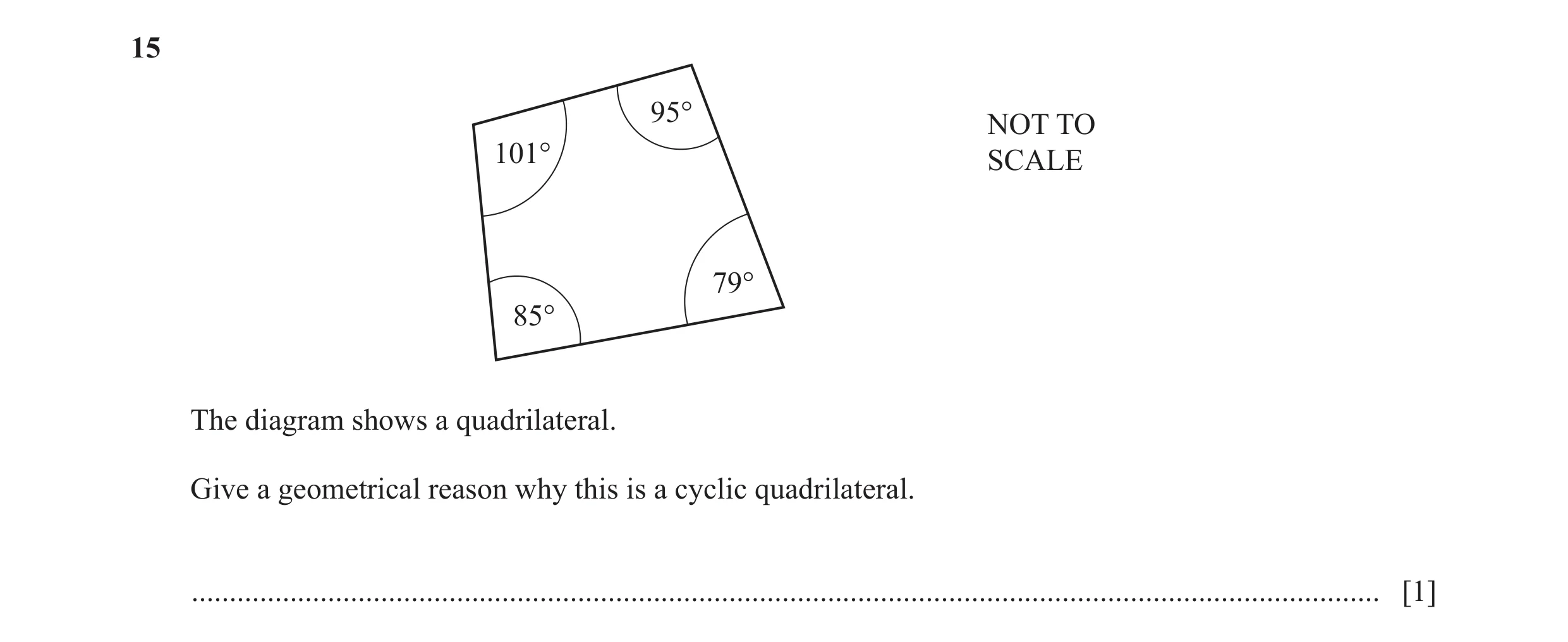
Q32 · 95° NOT TO 101° SCALE 79° 85° The diagram shows a quadrilateral 0580/22 Oct/Nov 2022
15 95° NOT TO 101° SCALE 79° 85° The diagram shows a quadrilateral. Give a geometrical reason why this is a cyclic quadrilateral. … [1]
1 marks
Mark scheme: 15 Opposite angles add up to 180 oe 1
This question in 0580/22 Oct/Nov 2022
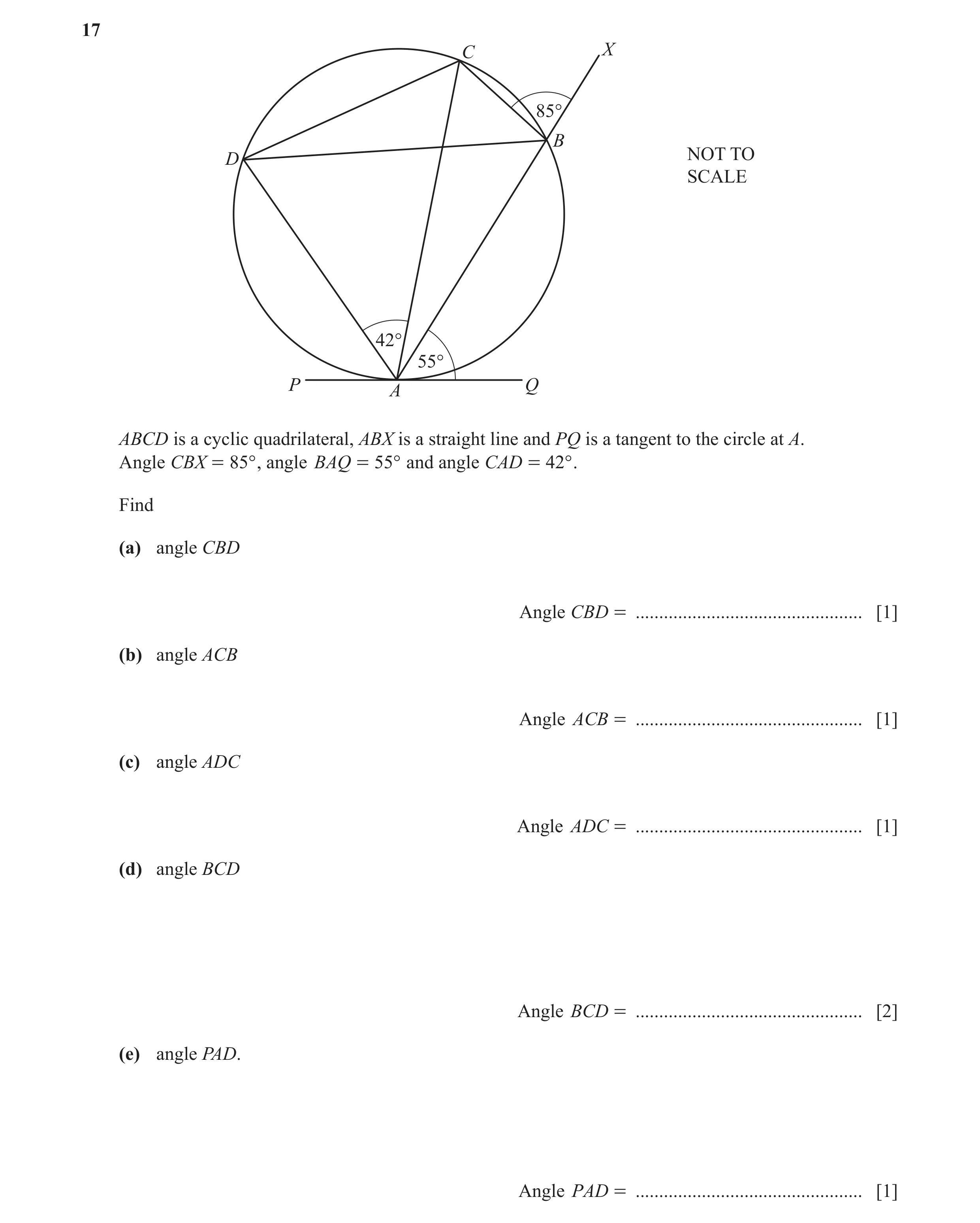
Q33 · C X 85° B D NOT TO SCALE 42° 55° P Q A ABCD is a cyclic quadrilateral, ABX is a straight… 0580/22 Feb/March 2023
17 C X 85° B D NOT TO SCALE 42° 55° P Q A ABCD is a cyclic quadrilateral, ABX is a straight line and PQ is a tangent to the circle at A. Angle CBX = 85° , angle BAQ = 55° and angle CAD = 42° . Find (a) angle CBD Angle CBD = … [1] (b) angle ACB Angle ACB = … [1] (c) angle ADC Angle ADC = … [1] (d) angle BCD Angle BCD = … [2] (e) angle PAD. Angle PAD = … [1]
6 marks
Mark scheme: 17(a) 42 1 17(b) 55 1 17(c) 85 1 17(d) 108 2 M1 for [angle ACD = ] 53 or [angle BAC = ] 30 17(e) 53 1
This question in 0580/22 Feb/March 2023
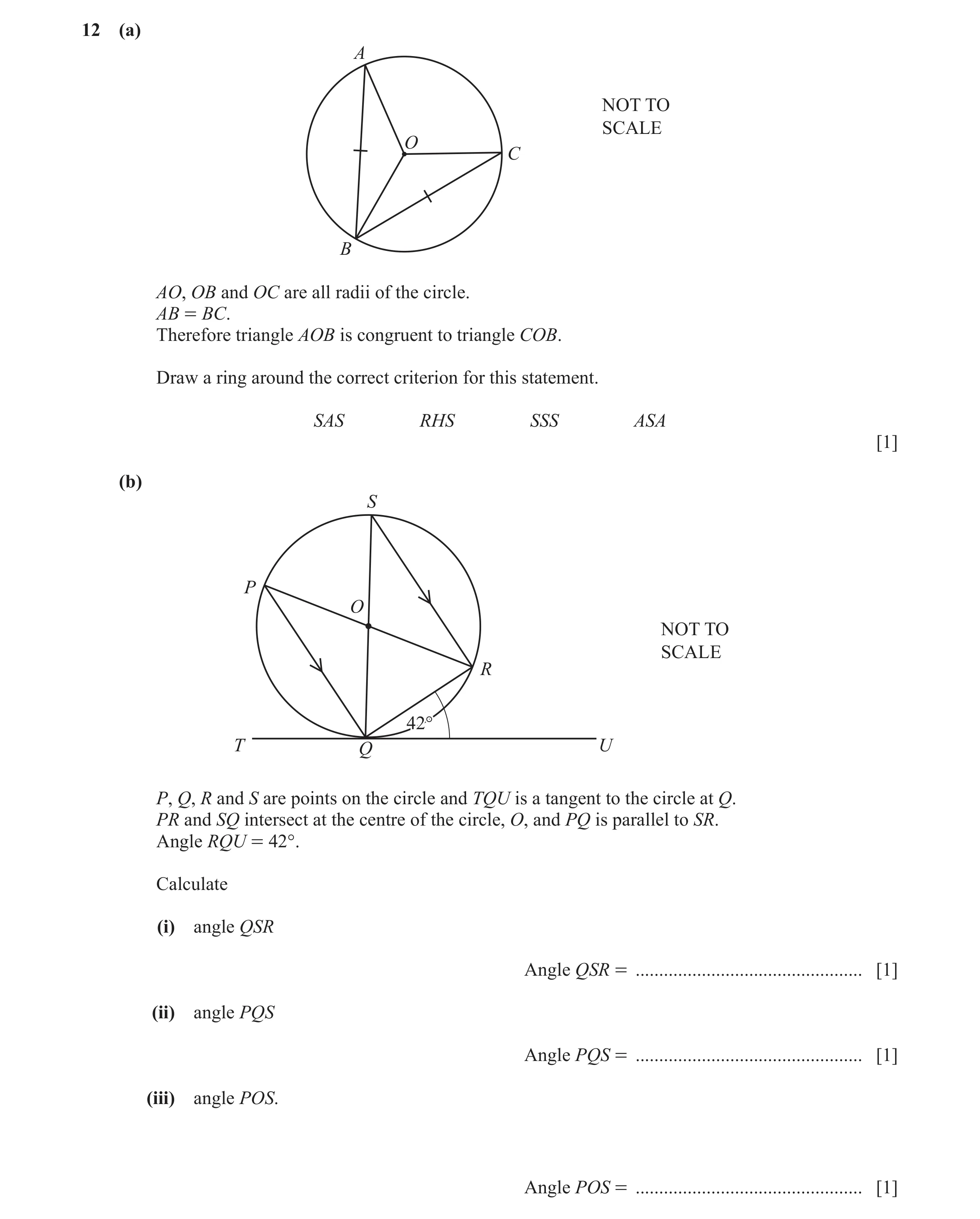
Q34 · A NOT TO SCALE O C B AO, OB and OC are all radii of the circle 0580/21 May/June 2023
12 (a) A NOT TO SCALE O C B AO, OB and OC are all radii of the circle. AB = BC. Therefore triangle AOB is congruent to triangle COB. Draw a ring around the correct criterion for this statement. SAS RHS SSS ASA [1] (b) S P O NOT TO SCALE R 42°42° T Q U P, Q, R and S are points on the circle and TQU is a tangent to the circle at Q. PR and SQ intersect at the centre of the circle, O, and PQ is parallel to SR. Angle RQU = 42°. Calculate (i) angle QSR Angle QSR = … [1] (ii) angle PQS Angle PQS = … [1] (iii) angle POS. Angle POS = … [1]
4 marks
Mark scheme: 12(a) SSS 1 12(b)(i) 42 1 12(b)(ii) 42 1 FT their part (i) 12(b)(iii) 84 1 FT 2 their part (ii)
This question in 0580/21 May/June 2023
Q35 · D NOT TO SCALE E 32° A C x° B A, B, C and D are points on a circle 0580/22 May/June 2023
13 D NOT TO SCALE E 32° A C x° B A, B, C and D are points on a circle. AB is parallel to DC and angle ACD = 32° . Chords AC and DB intersect at E. Find the value of x. x = … [2]
2 marks
Mark scheme: 13 116 2 B1 for ABD = 32, CAB = 32, BDC = 32 or CED = 116 or M1 for 180 – 32 – 32
This question in 0580/22 May/June 2023
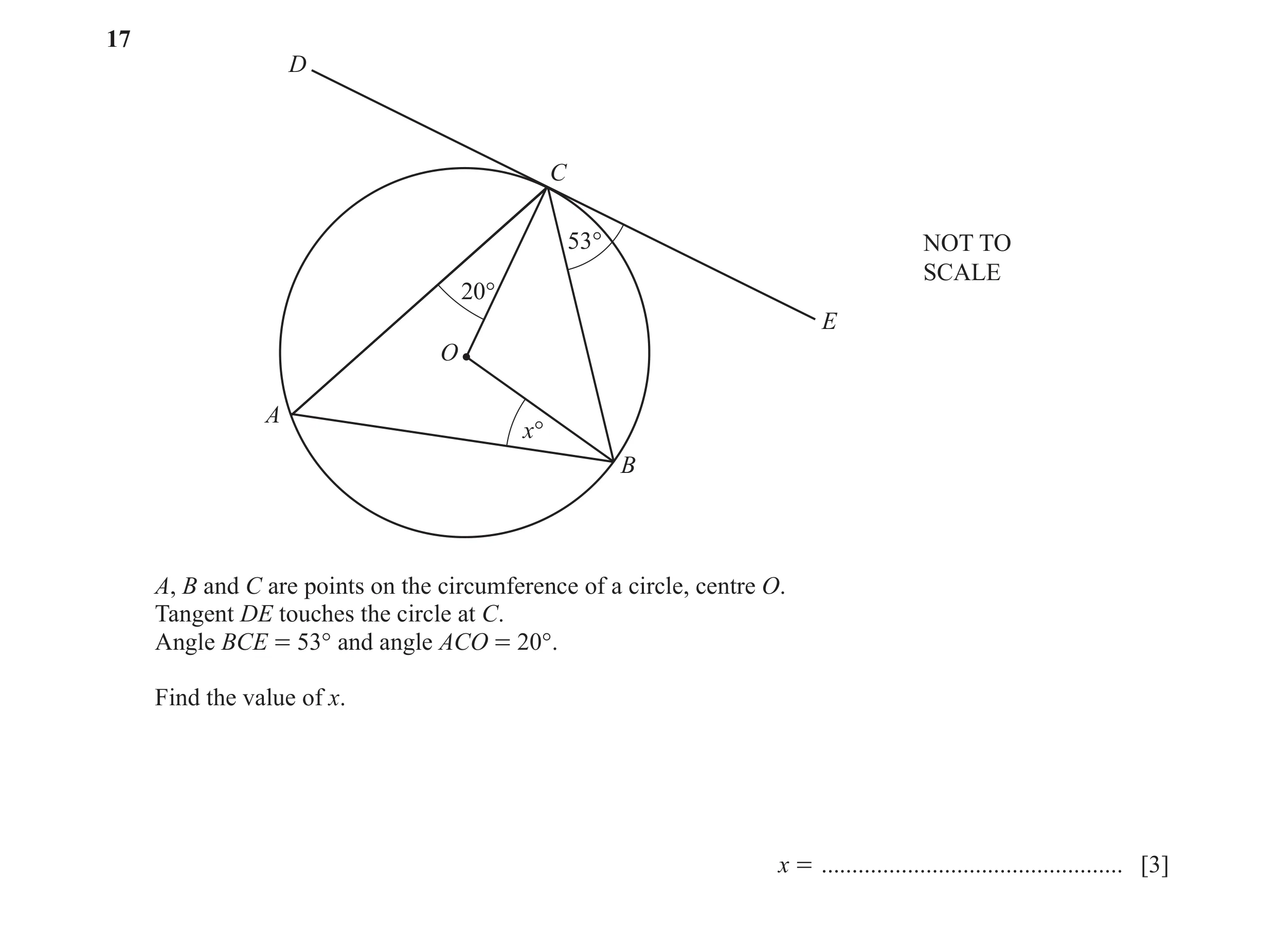
Q36 · D C 53° NOT TO SCALE 20° E O A x° B A, B and C are points on the circumference of a… 0580/21 Oct/Nov 2023
17 D C 53° NOT TO SCALE 20° E O A x° B A, B and C are points on the circumference of a circle, centre O. Tangent DE touches the circle at C. Angle BCE = 53° and angle ACO = 20°. Find the value of x. x = … [3]
3 marks
Mark scheme: 17 33 3 B2 for 254 + 20 + x + 53 = 360 oe or better or 53 + 20 + x + 37 + 37 = 180 oe or better or OAB = 33 or AOB = 114 or 70 and 37 correctly identified or 53 and 20 correctly identified or B1 for any correct relevant angle identified
This question in 0580/21 Oct/Nov 2023
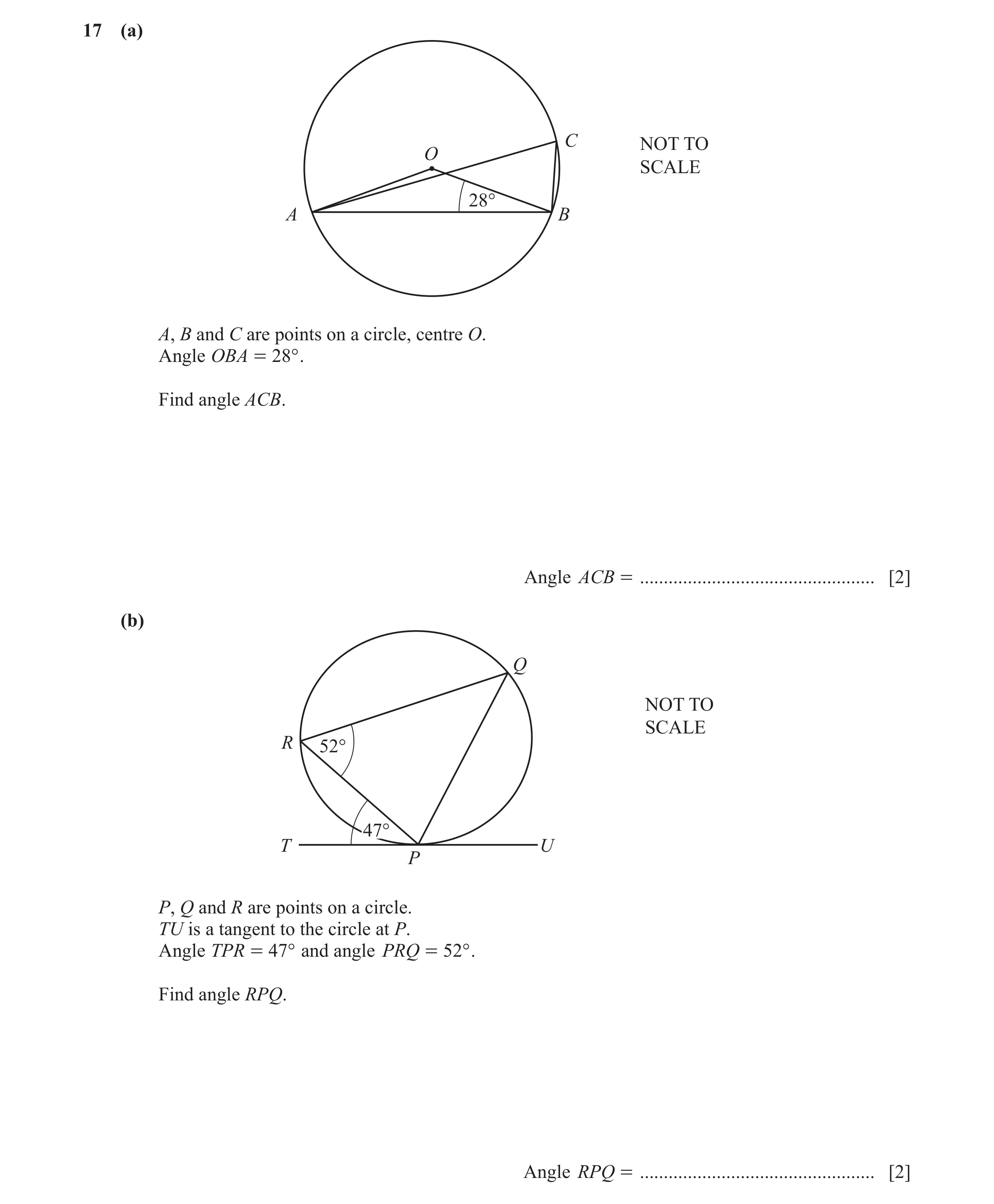
Q37 · C NOT TO O SCALE 28° A B A, B and C are points on a circle, centre O 0580/22 Oct/Nov 2023
17 (a) C NOT TO O SCALE 28° A B A, B and C are points on a circle, centre O. Angle OBA = 28° . Find angle ACB. Angle ACB = … [2] (b) Q NOT TO SCALE R 52° 47°47° T U P P, Q and R are points on a circle. TU is a tangent to the circle at P. Angle TPR = 47° and angle PRQ = 52° . Find angle RPQ. Angle RP Q = … [2]
4 marks
Mark scheme: 17(a) 62 2 B1 for angle AOB = 124 180 − 28 − 28 or M1 for oe 2 17(b) 81 2 B1 for angle RQP = 47 or QPU = 52 or M1 for 180 – 52 – 47
This question in 0580/22 Oct/Nov 2023
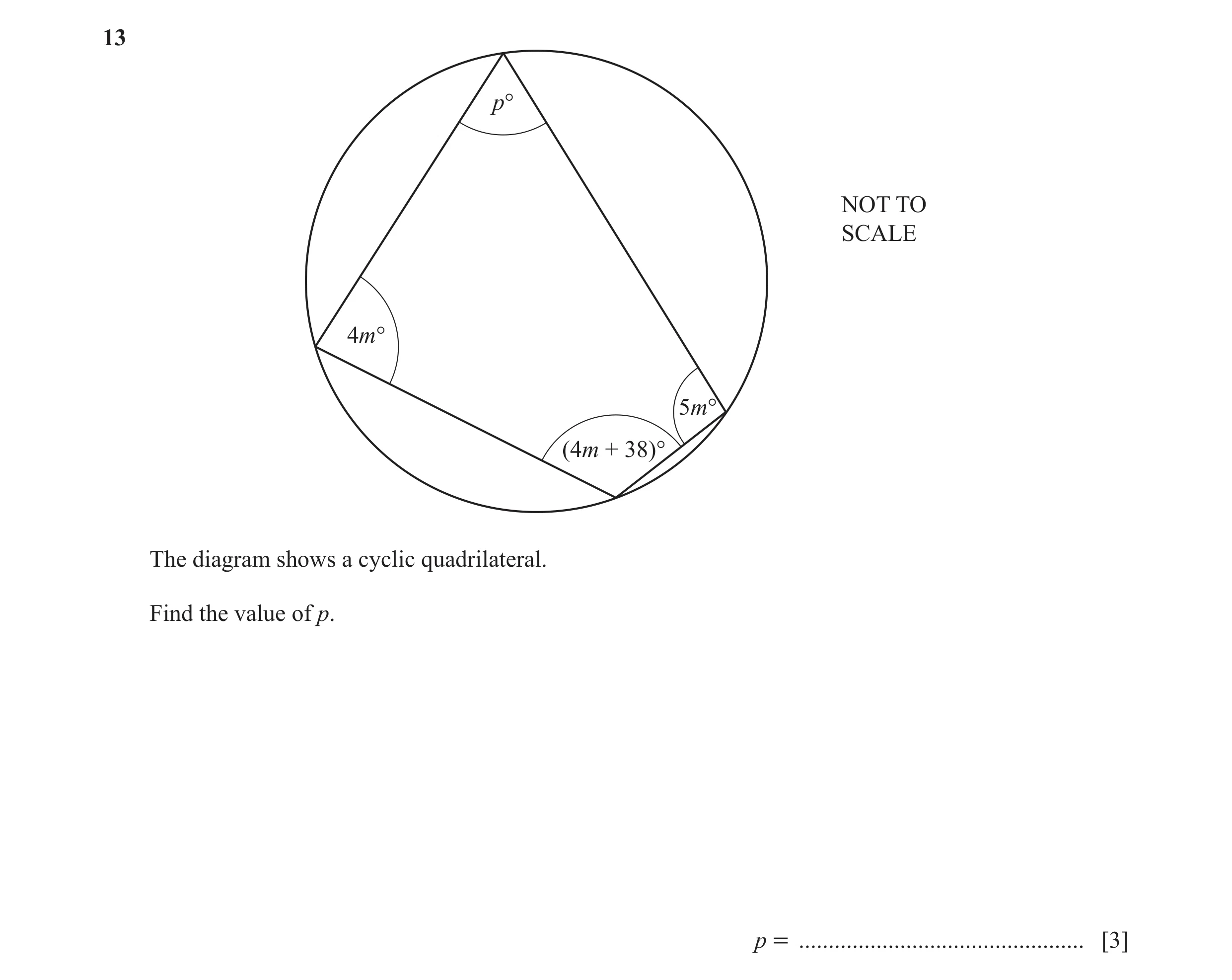
Q38 · P° NOT TO SCALE 4m° 5m° (4m + 38)° The diagram shows a cyclic quadrilateral 0580/21 May/June 2024
13 p° NOT TO SCALE 4m° 5m° (4m + 38)° The diagram shows a cyclic quadrilateral. Find the value of p. p = … [3]
3 marks
Mark scheme: 13 62 3 B2 for m = 20 or M1 for 5m + 4m = 180 soi or p + 4m + 38 = 180 soi
This question in 0580/21 May/June 2024
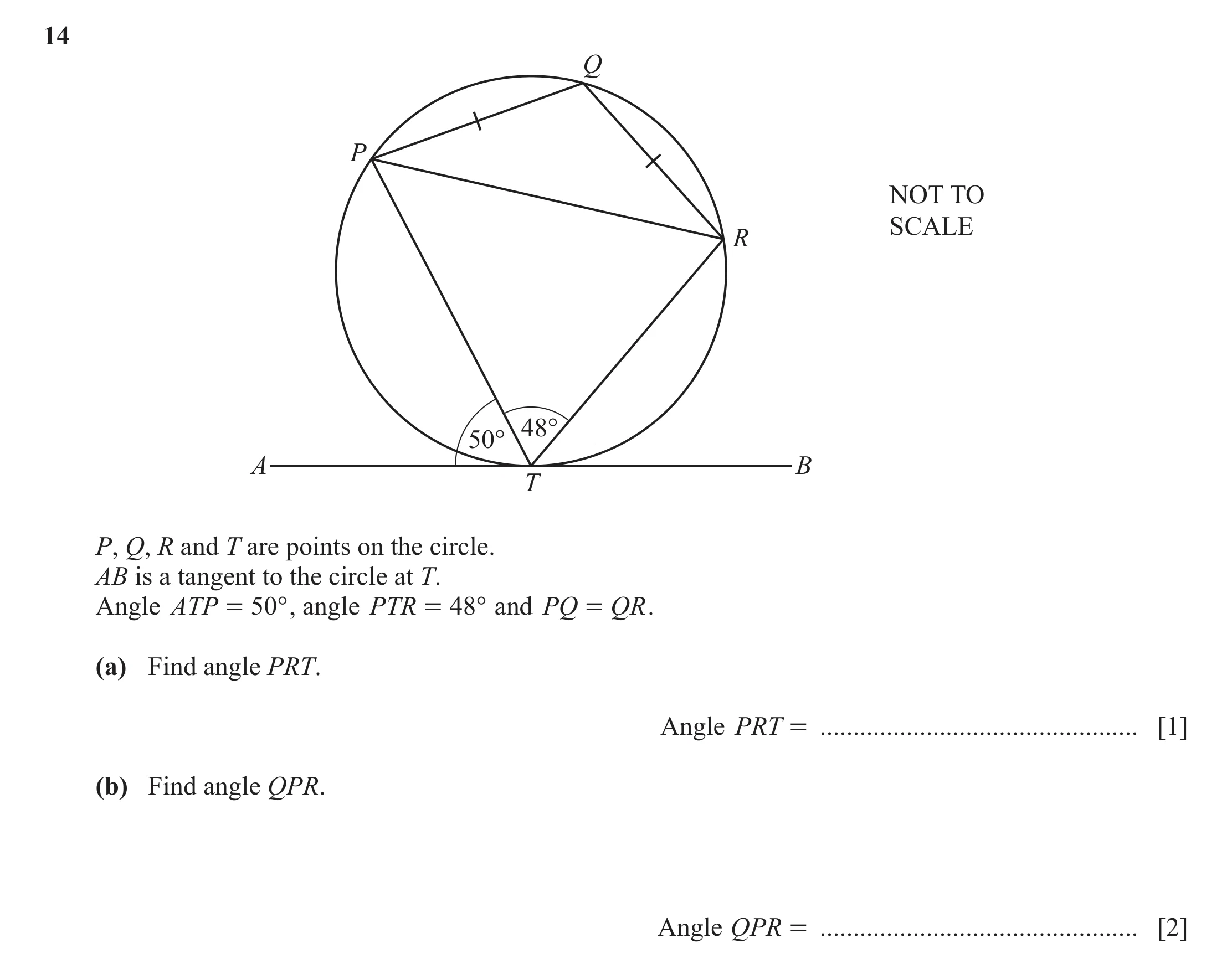
Q39 · Q P NOT TO SCALE R 48° 50° A B T P, Q, R and T are points on the circle 0580/23 May/June 2024
14 Q P NOT TO SCALE R 48° 50° A B T P, Q, R and T are points on the circle. AB is a tangent to the circle at T. Angle ATP = 50° , angle PTR = 48° and PQ = QR . (a) Find angle PRT. Angle PRT = … [1] (b) Find angle QPR. Angle QPR = … [2]
3 marks
Mark scheme: 14(a) 50 1 14(b) 24 2 B1 for angle PQR = 132 soi 180 180 48 or M1 for 2
This question in 0580/23 May/June 2024
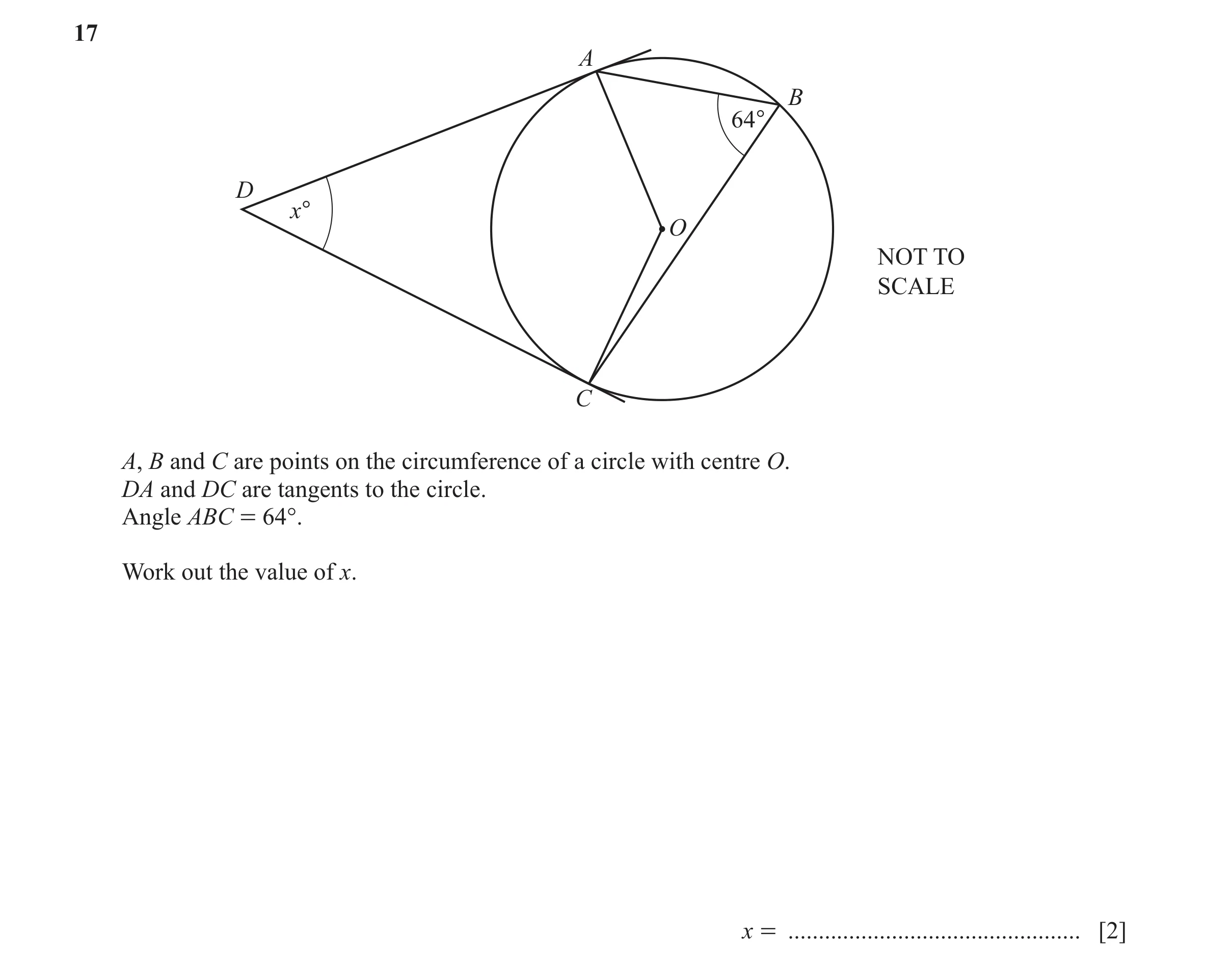
Q40 · A B 64° D x° O NOT TO SCALE C A, B and C are points on the circumference of a circle with… 0580/22 Oct/Nov 2024
17 A B 64° D x° O NOT TO SCALE C A, B and C are points on the circumference of a circle with centre O. DA and DC are tangents to the circle. Angle ABC = 64°. Work out the value of x. x = … [2]
2 marks
Mark scheme: 17 52 2 M1 for 360 – 90 – 90 – 128 oe or B1 for [obtuse angle] AOC = 128 or AOD or COD = 64 or DAO or DCO = 90
This question in 0580/22 Oct/Nov 2024
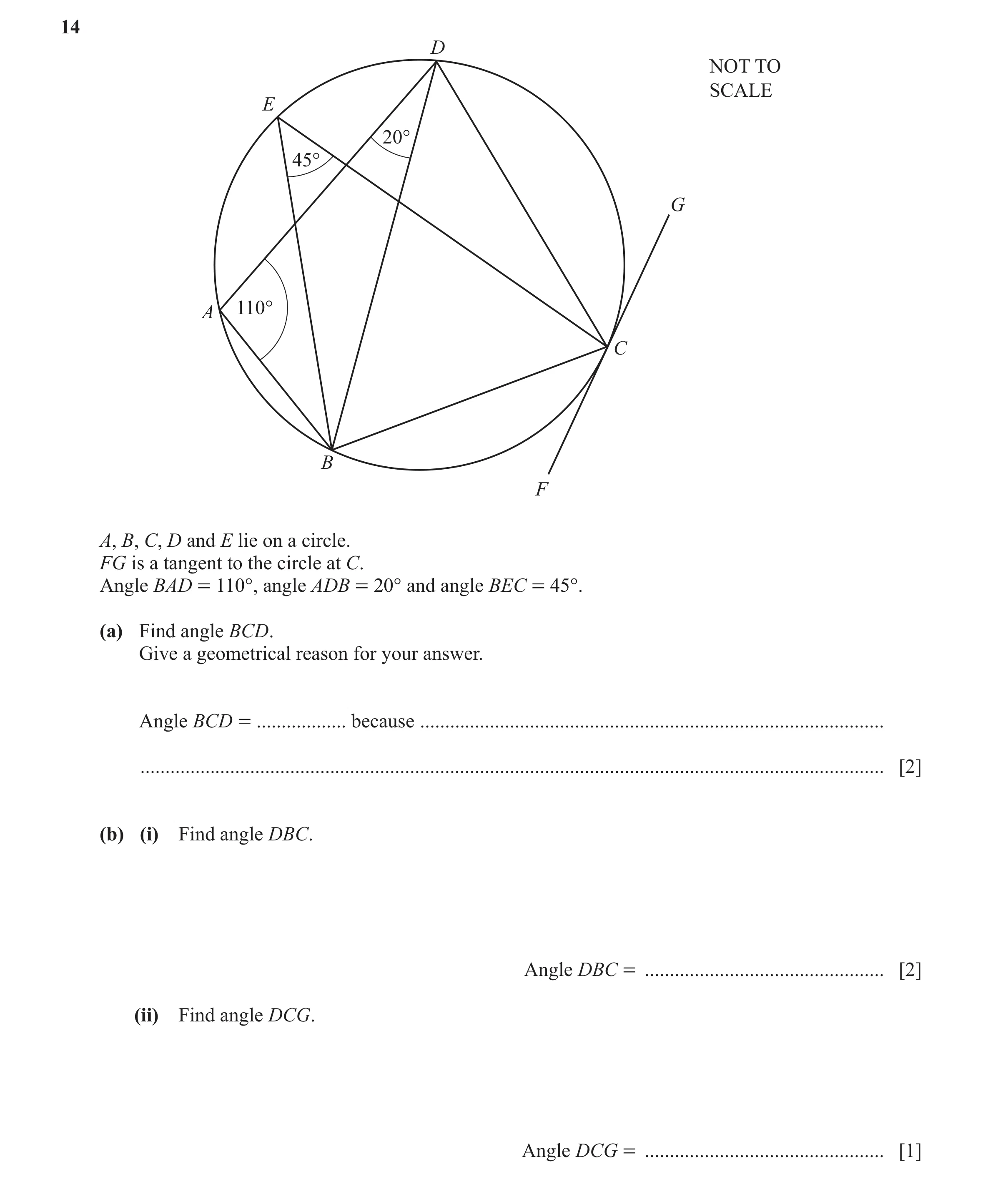
Q41 · D NOT TO SCALE E 20° 45° G A 110° C B F A, B, C, D and E lie on a circle 0580/22 Feb/March 2025
14 D NOT TO SCALE E 20° 45° G A 110° C B F A, B, C, D and E lie on a circle. FG is a tangent to the circle at C. Angle BAD = 110°, angle ADB = 20° and angle BEC = 45°. (a) Find angle BCD. Give a geometrical reason for your answer. Angle BCD = … because … … [2] (b) (i) Find angle DBC. Angle DBC = … [2] (ii) Find angle DCG. Angle DCG = … [1]
5 marks
Mark scheme: 14(a) 70 2 B1 for 70 and or for a fully correct reason opposite angles of a cyclic quadrilateral sum to 180 oe 14(b)(i) 65 2 FT 180 – 45 – their 70 for 2 marks B1 for angle BDC = 45 or M1 for 180 – 45 – their 70 oe or for 180 – (20 + 45) – (180 – (110 + 20)) oe 14(b)(ii) 65 1 FT their (b)(i)
This question in 0580/22 Feb/March 2025
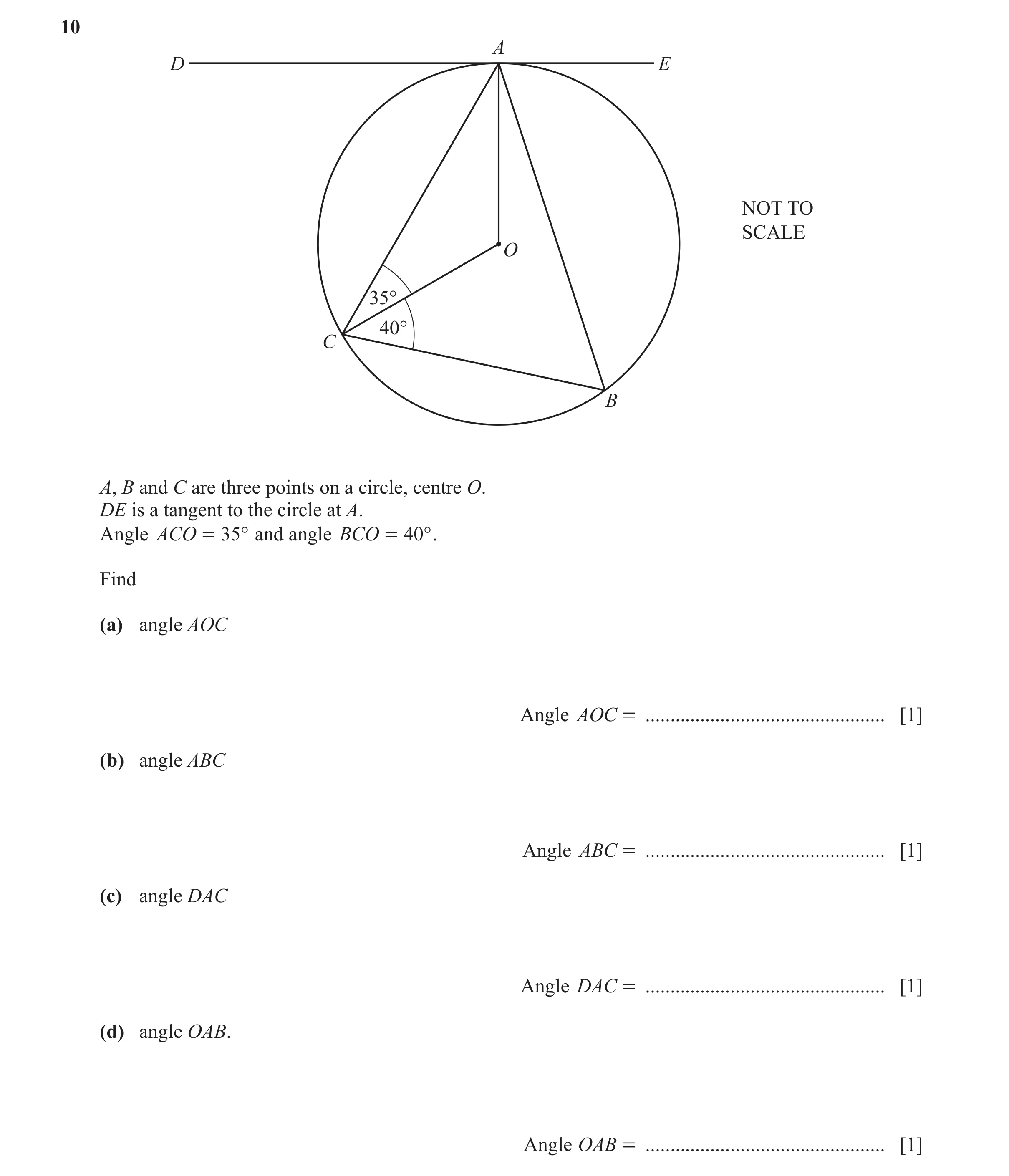
Q42 · A D E NOT TO SCALE O 35° 40° C B A, B and C are three points on a circle, centre O 0580/21 May/June 2025
10 A D E NOT TO SCALE O 35° 40° C B A, B and C are three points on a circle, centre O. DE is a tangent to the circle at A. Angle ACO = 35° and angle BCO = 40° . Find (a) angle AOC Angle AOC = … [1] (b) angle ABC Angle ABC = … [1] (c) angle DAC Angle DAC = … [1] (d) angle OAB. Angle OAB = … [1]
4 marks
Mark scheme: 10(a) 110 1 10(b) 55 1 FT their 110 2 10(c) 55 1 FT their (b) Provided their (b) < 90 10(d) 15 1 FT 70 – their (b) Provided their (b) < 70
This question in 0580/21 May/June 2025
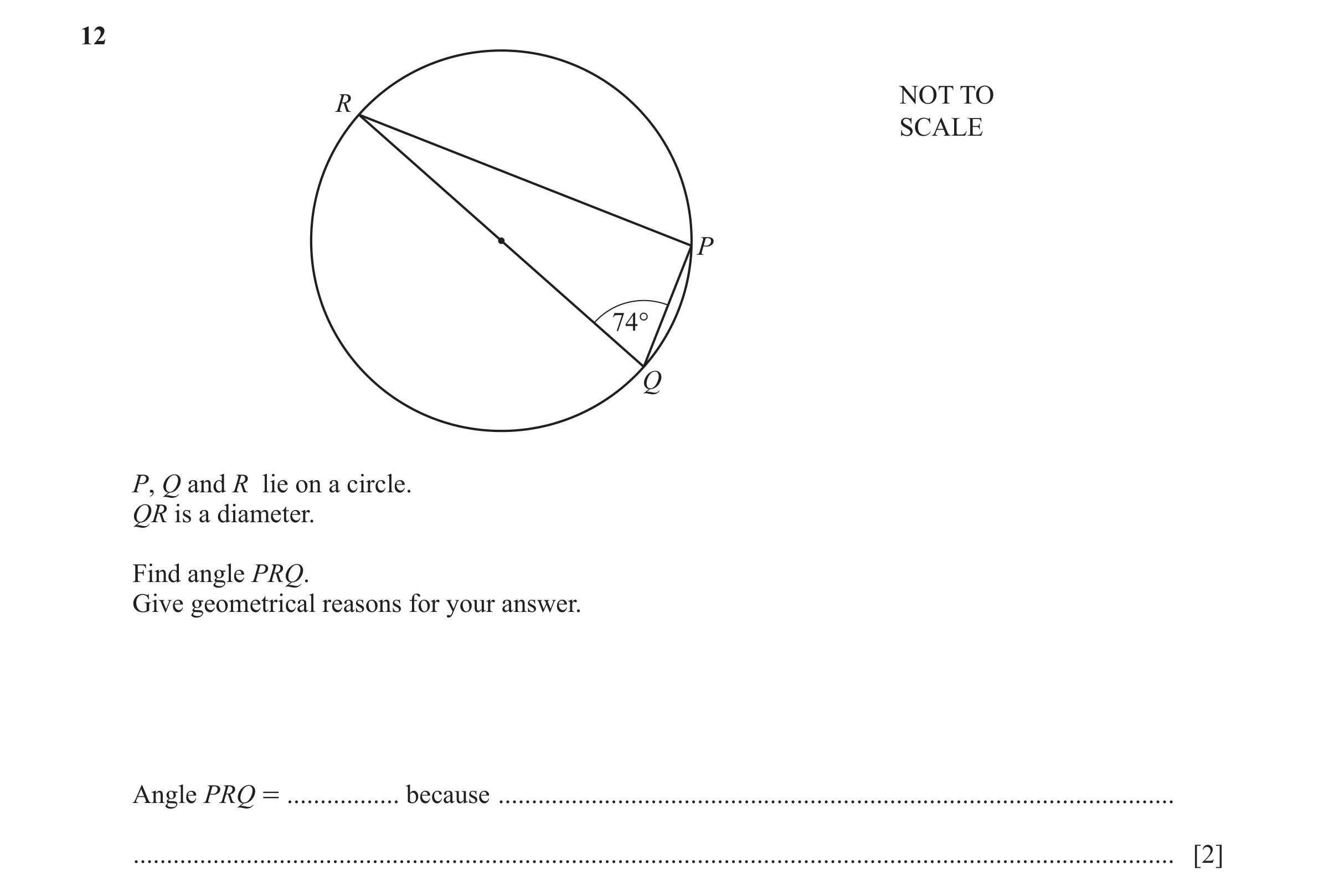
Q43 · NOT TO R SCALE P 74° Q P, Q and R lie on a circle 0580/22 May/June 2025
12 NOT TO R SCALE P 74° Q P, Q and R lie on a circle. QR is a diameter. Find angle PRQ. Give geometrical reasons for your answer. Angle PRQ = … because … … [2]
2 marks
Mark scheme: 12 16 2 B1 for 16 or angle in a semicircle = 90 and angle in a semicircle = 90 and angle sum of a triangle = 180
This question in 0580/22 May/June 2025
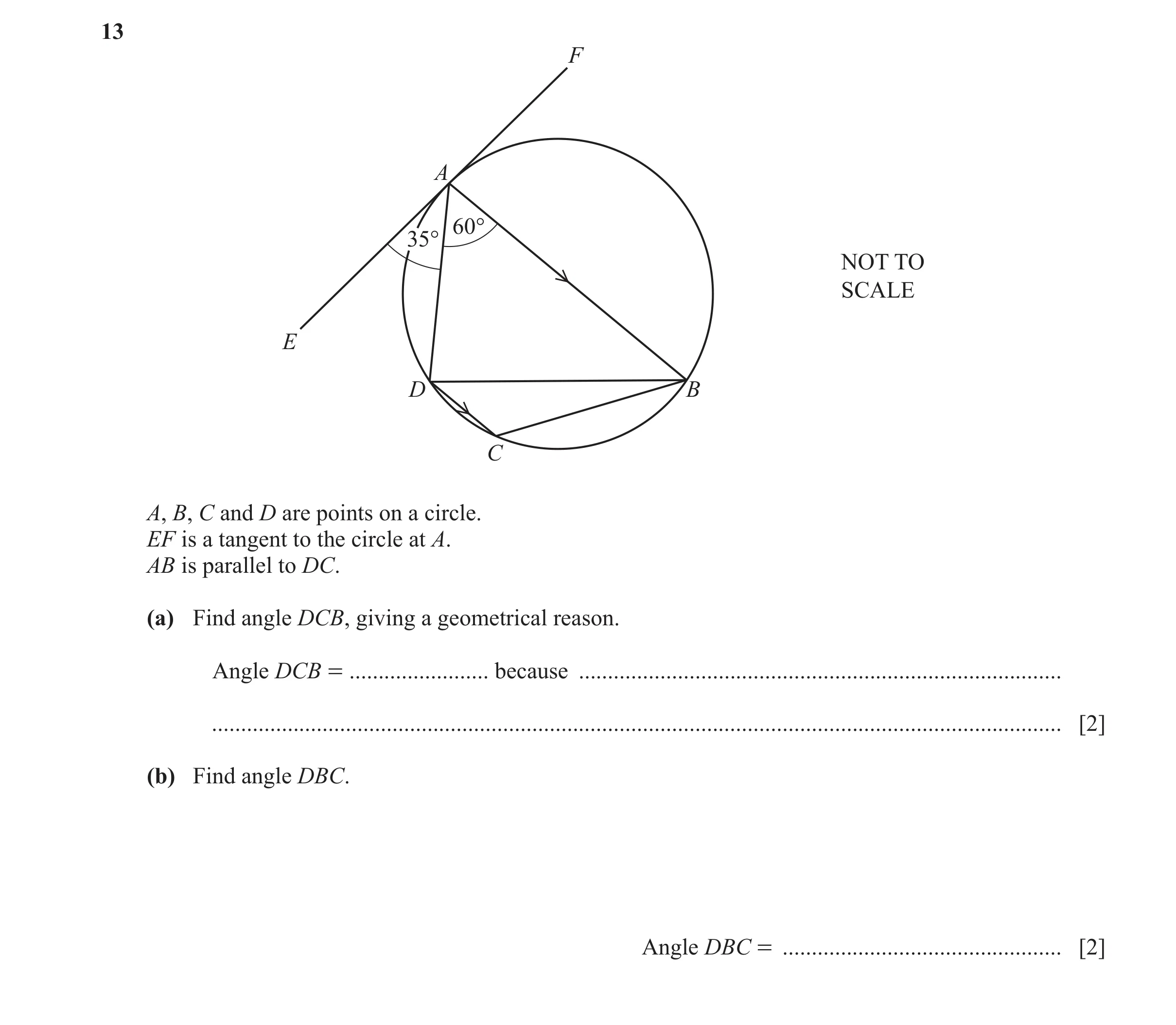
Q44 · F A 60° 35° NOT TO SCALE E D B C A, B, C and D are points on a circle 0580/23 May/June 2025
13 F A 60° 35° NOT TO SCALE E D B C A, B, C and D are points on a circle. EF is a tangent to the circle at A. AB is parallel to DC. (a) Find angle DCB, giving a geometrical reason. Angle DCB = … because … … [2] (b) Find angle DBC. Angle DBC = … [2]
4 marks
Mark scheme: 13(a) 120 2 B1 for 120 or a fully correct reason and opposite angles of a cyclic quadrilateral sum to 180° 13(b) 25 2 M1 for (180 – 120) – 35 or B1 for ABC = 60 or ABD = 35
This question in 0580/23 May/June 2025
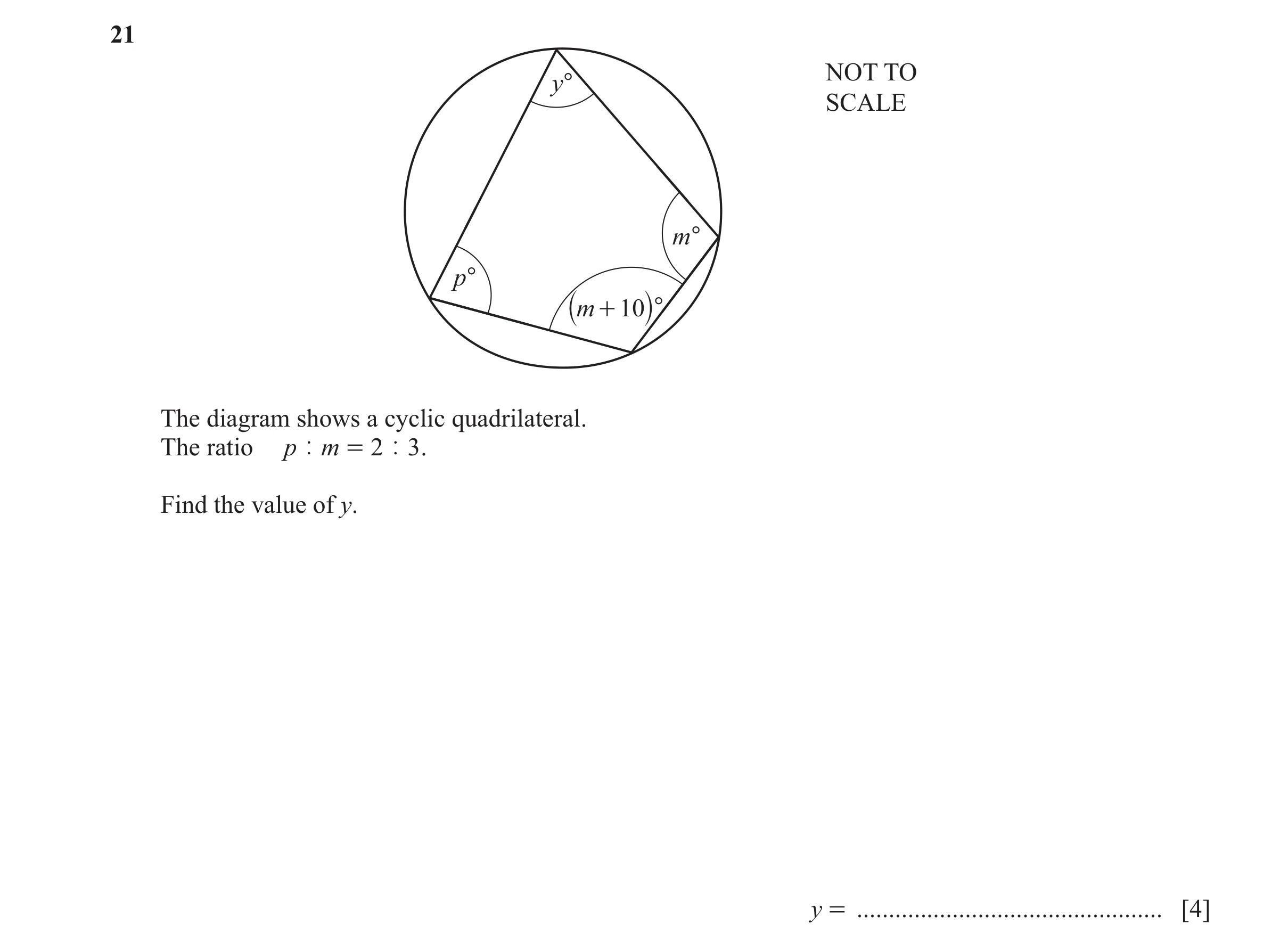
Q45 · NOT TO y° SCALE m° p° `m + 10j°c The diagram shows a cyclic quadrilateral 0580/23 Oct/Nov 2025
21 NOT TO y° SCALE m° p° `m + 10j°c The diagram shows a cyclic quadrilateral. The ratio p | m = 2 | 3 . Find the value of y. y = … [4]
4 marks
Mark scheme: 21 62 4 B3 for [m + 10 =] 118 or B2 for m = 108 or p = 72 180 or M2 for 3 3 + 2 or M1 for recognising opposite angles in a cyclic quadrilateral add up to 180° soi
This question in 0580/23 Oct/Nov 2025
 1 / 36
 2 / 36
 3 / 36
 4 / 36
![Question 5: C NOT TO SCALE D 108° O B A A, B, C and D lie on a circle centre O. Angle ADC = 108°. Work out the obtuse angle AOC. Answer Angle AOC = [2]](https://img.pastlit.com/crops/ce379700-b23b-463f-9604-cfdc896f2408/q6.webp)
 5 / 36
 6 / 36
![Question 8: (a) x° NOT TO SCALE 47° Find the value of x. x = .................................................. [1] (b) 85° 115° NOT TO SCALE 97° y° Fi…](https://img.pastlit.com/crops/be9d8247-46dc-4310-9967-768d83c58d98/q18.webp) 7 / 36
7 / 36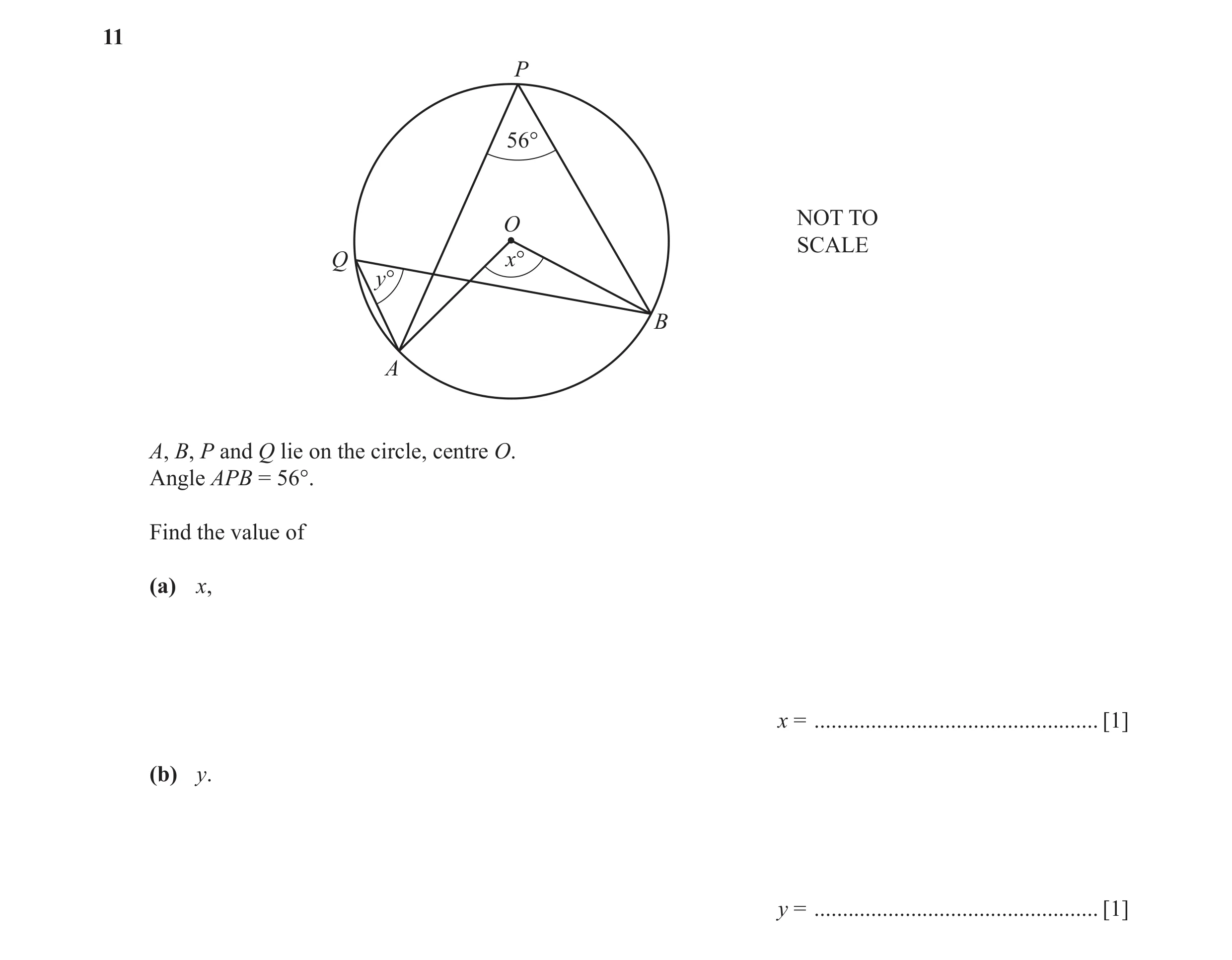 8 / 36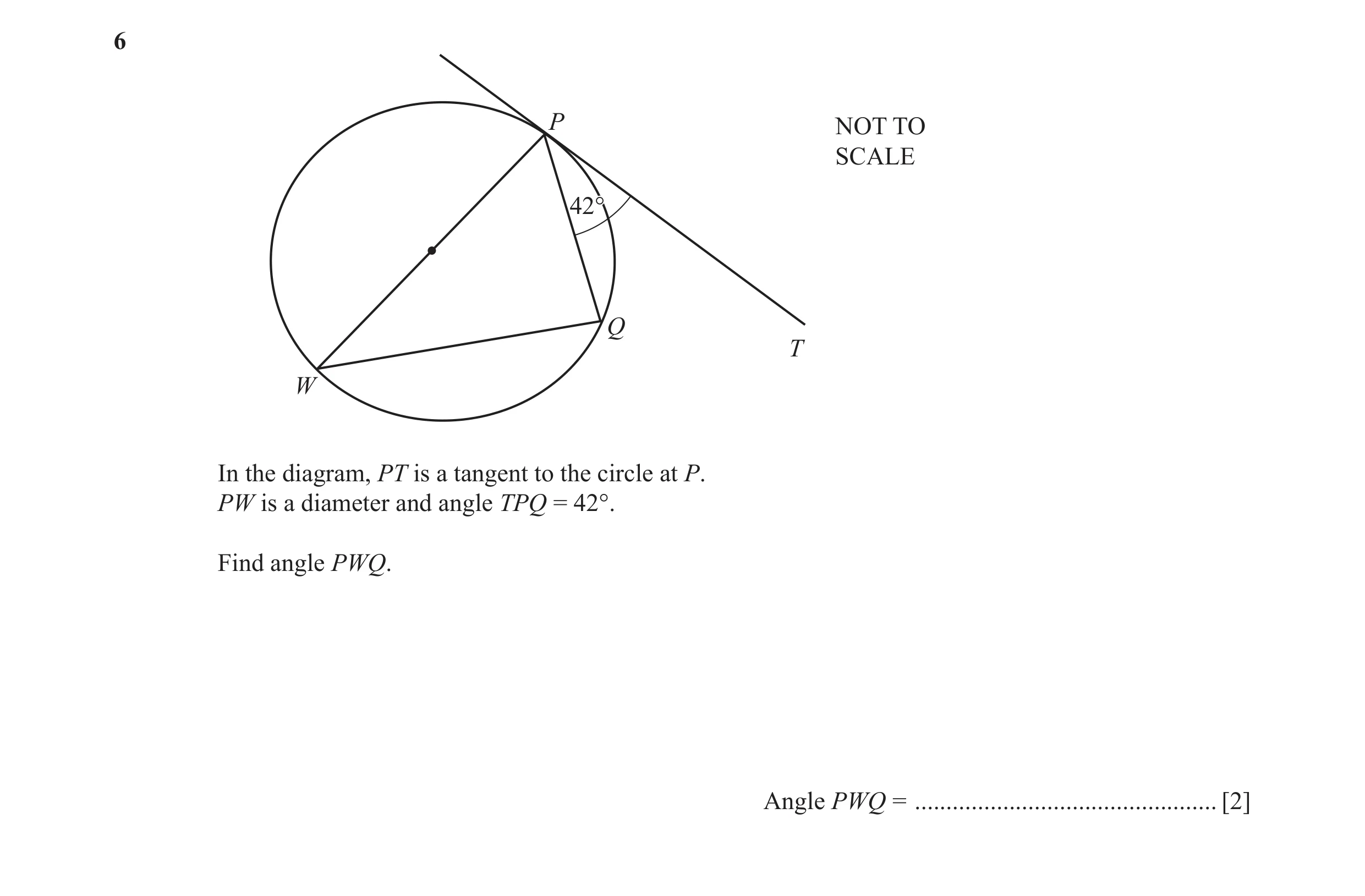
 9 / 36
 10 / 36
 11 / 36
 12 / 36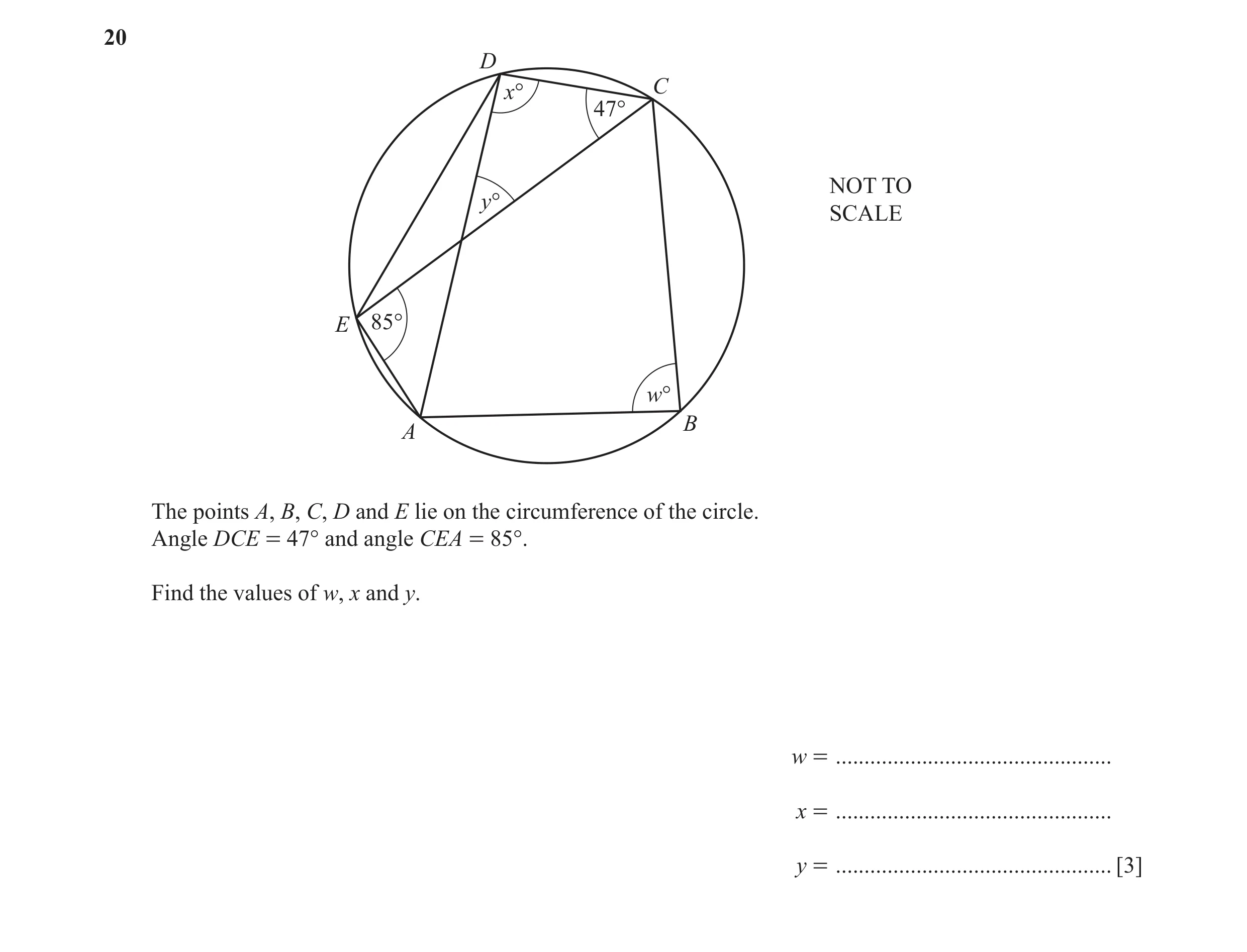
 13 / 36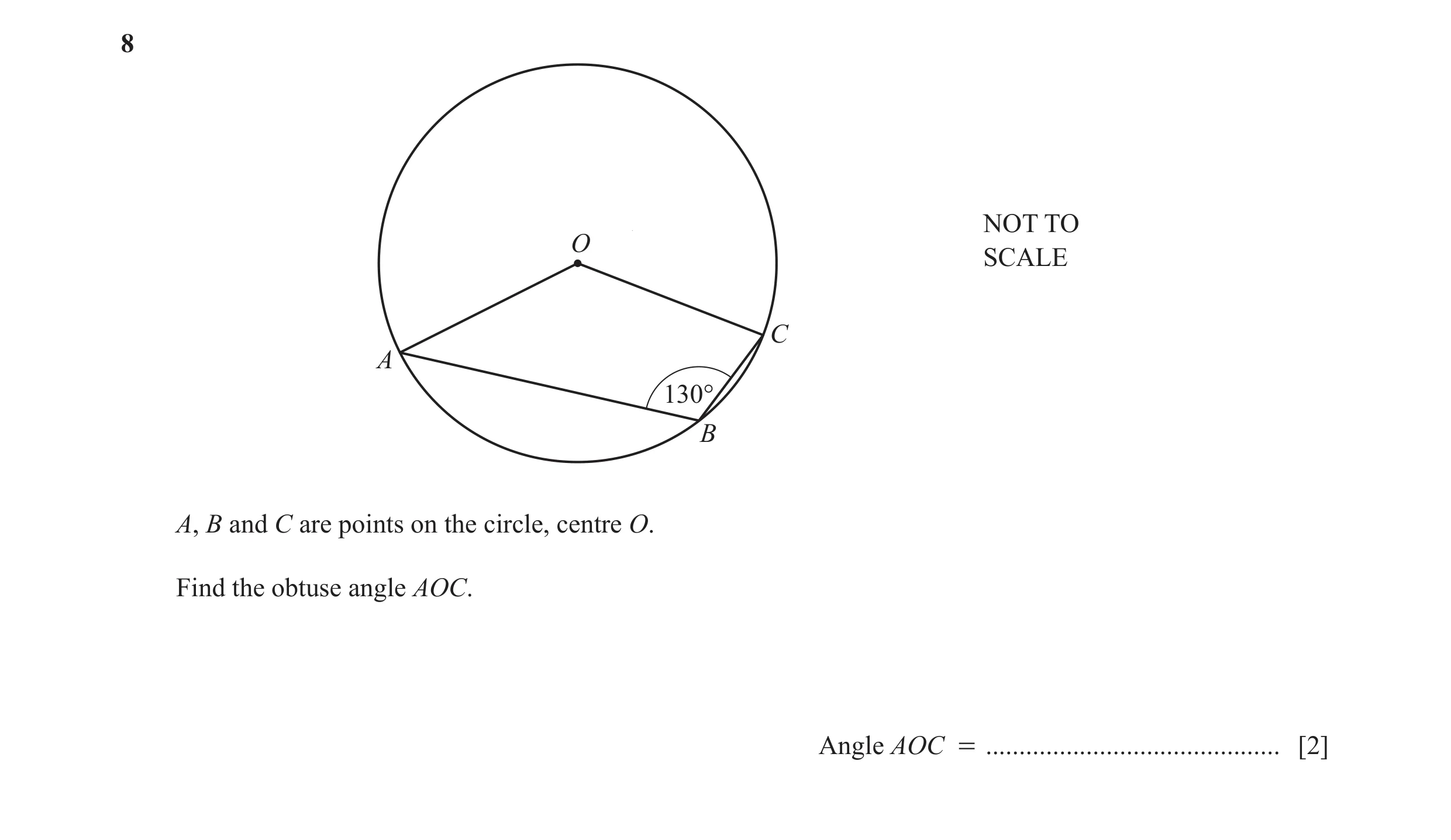
 14 / 36
 15 / 36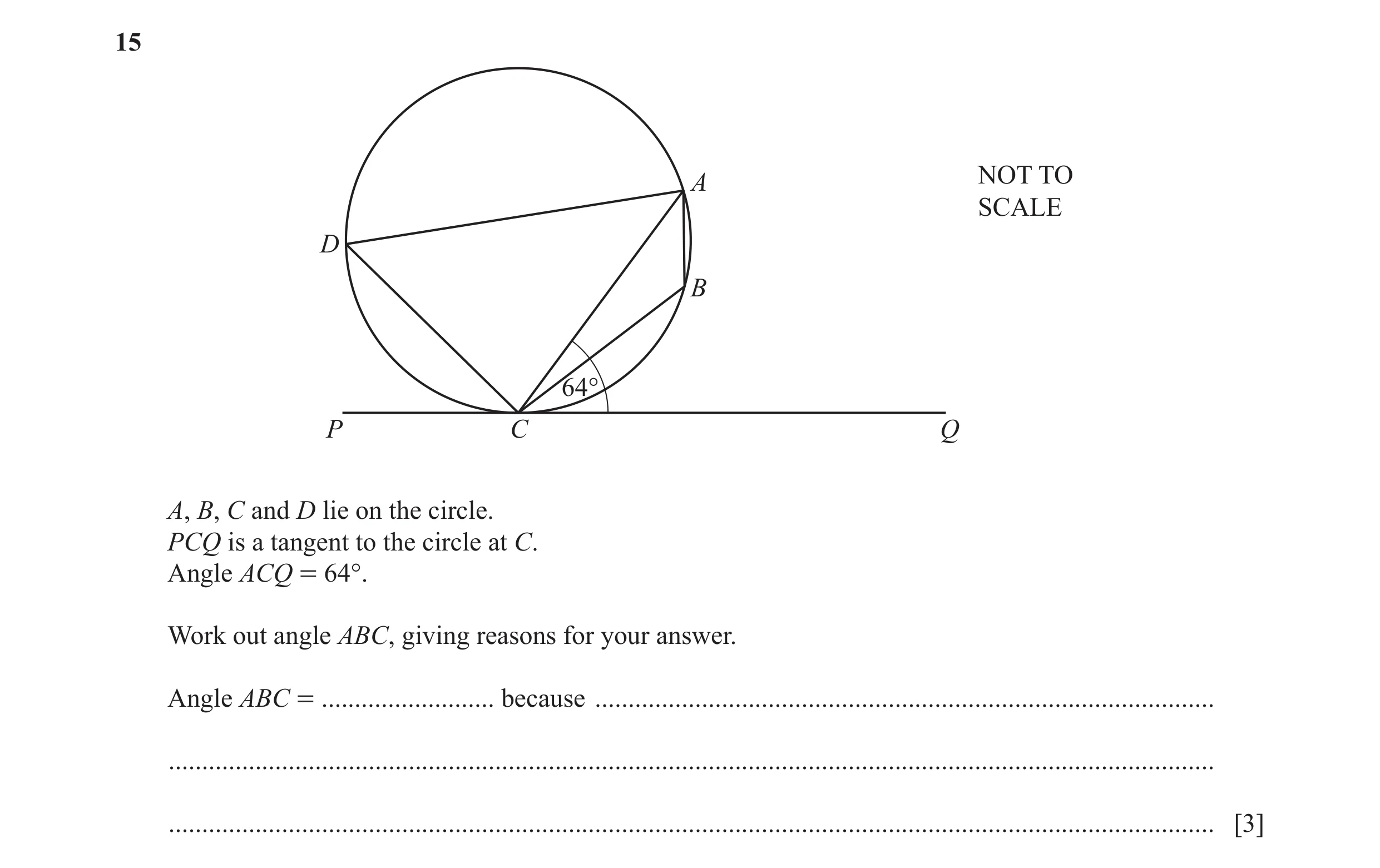
 16 / 36
 17 / 36
 18 / 36
 19 / 36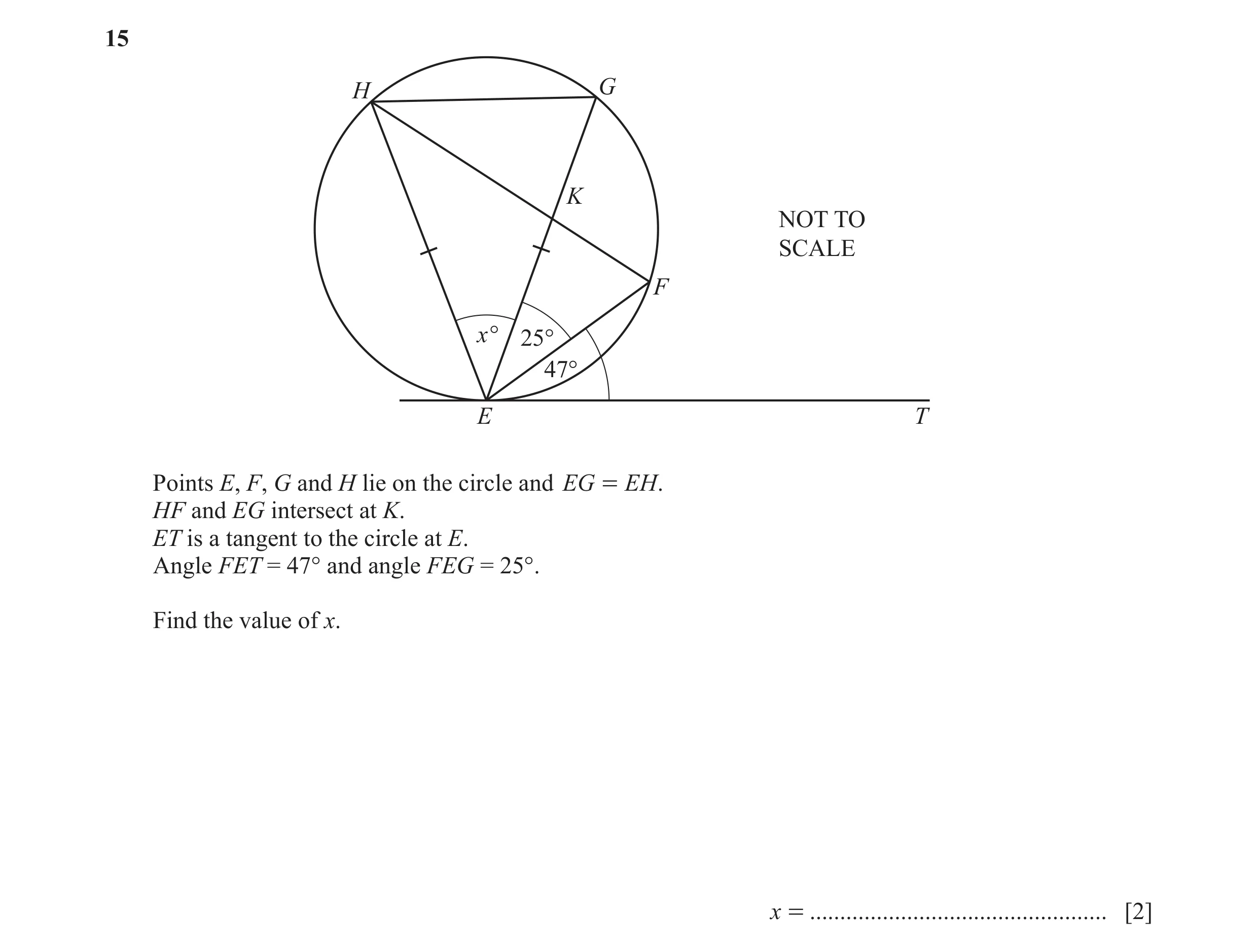
 20 / 36
 21 / 36
 22 / 36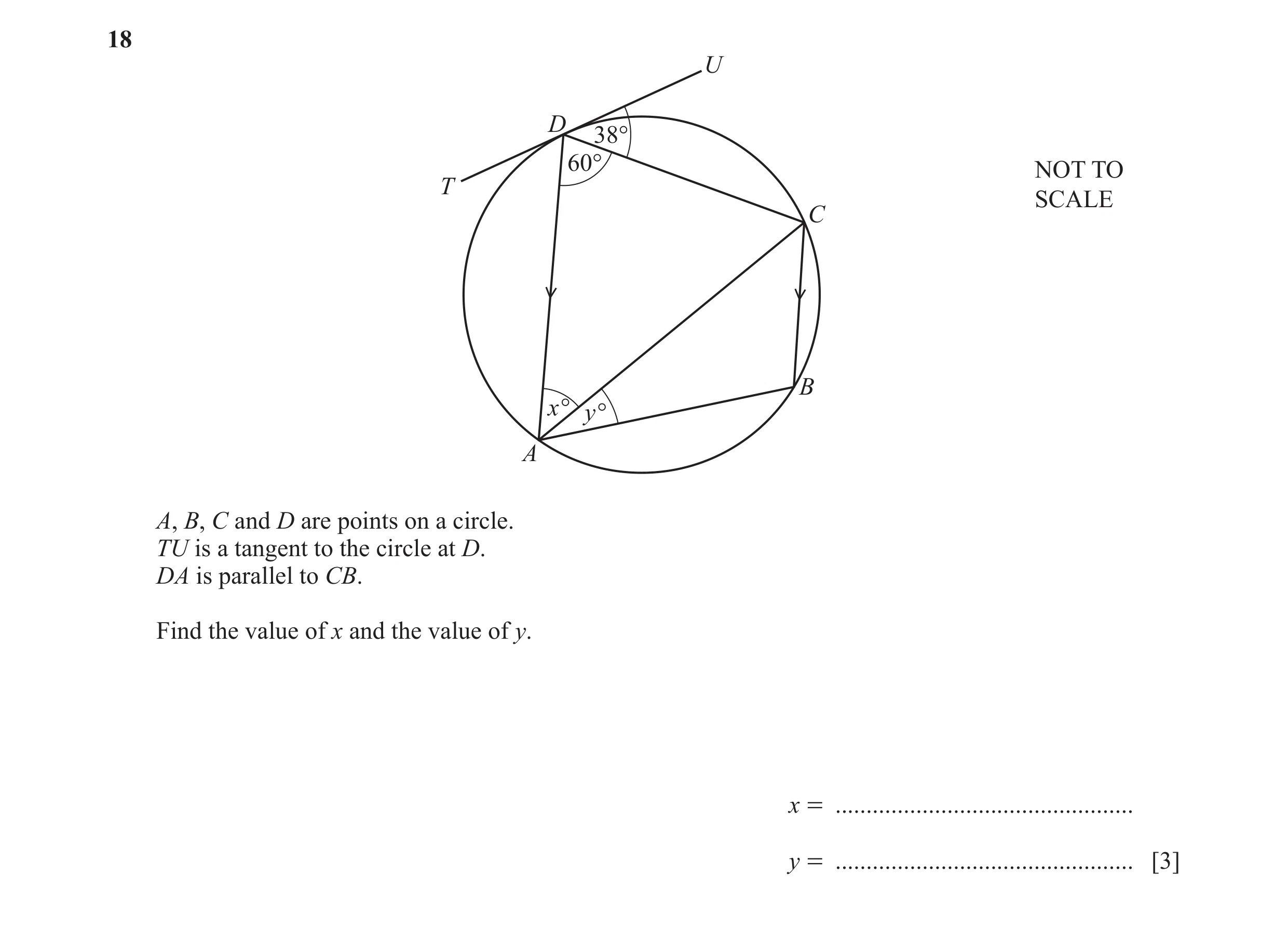
 23 / 36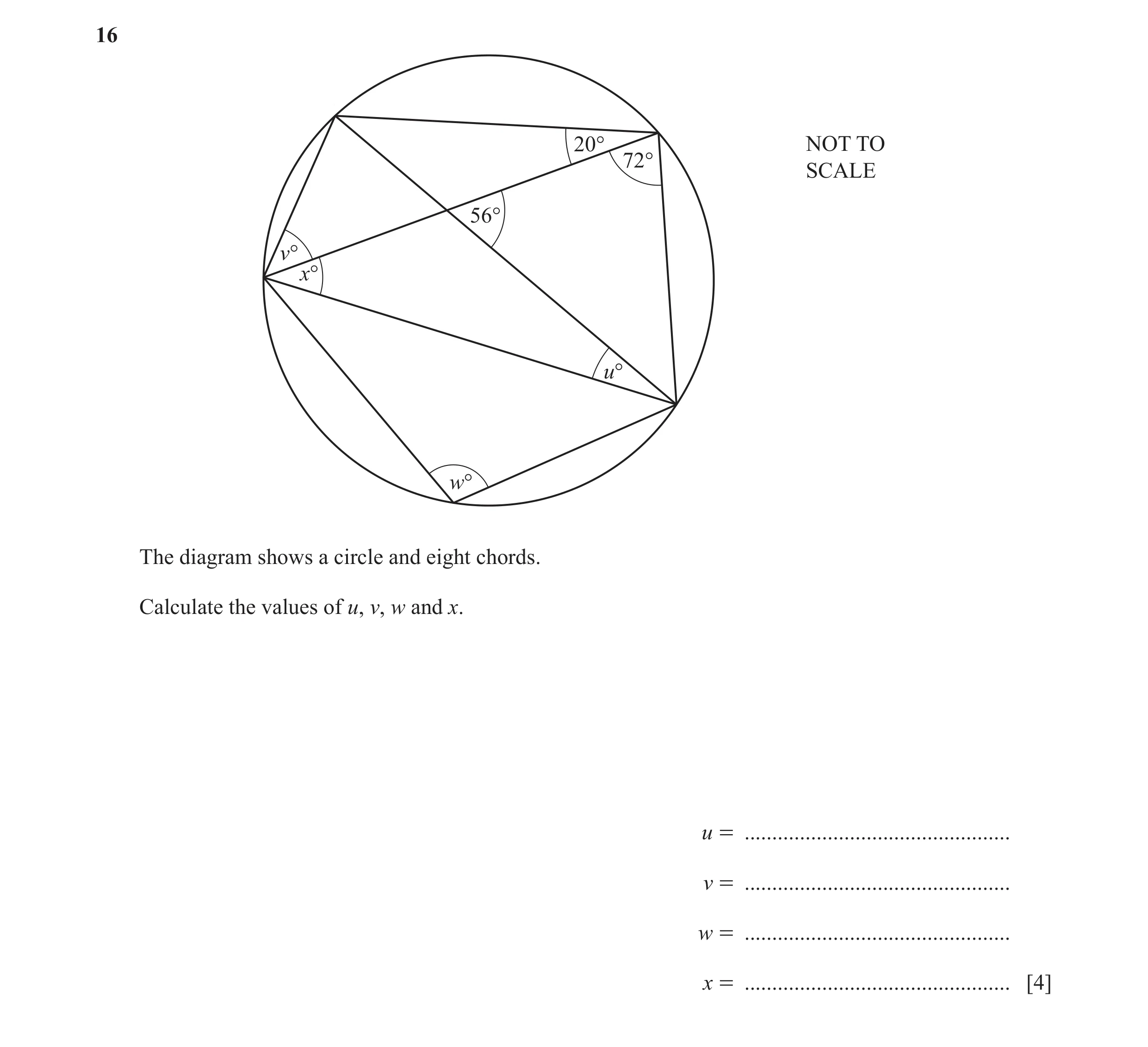
 24 / 36
 25 / 36
 26 / 36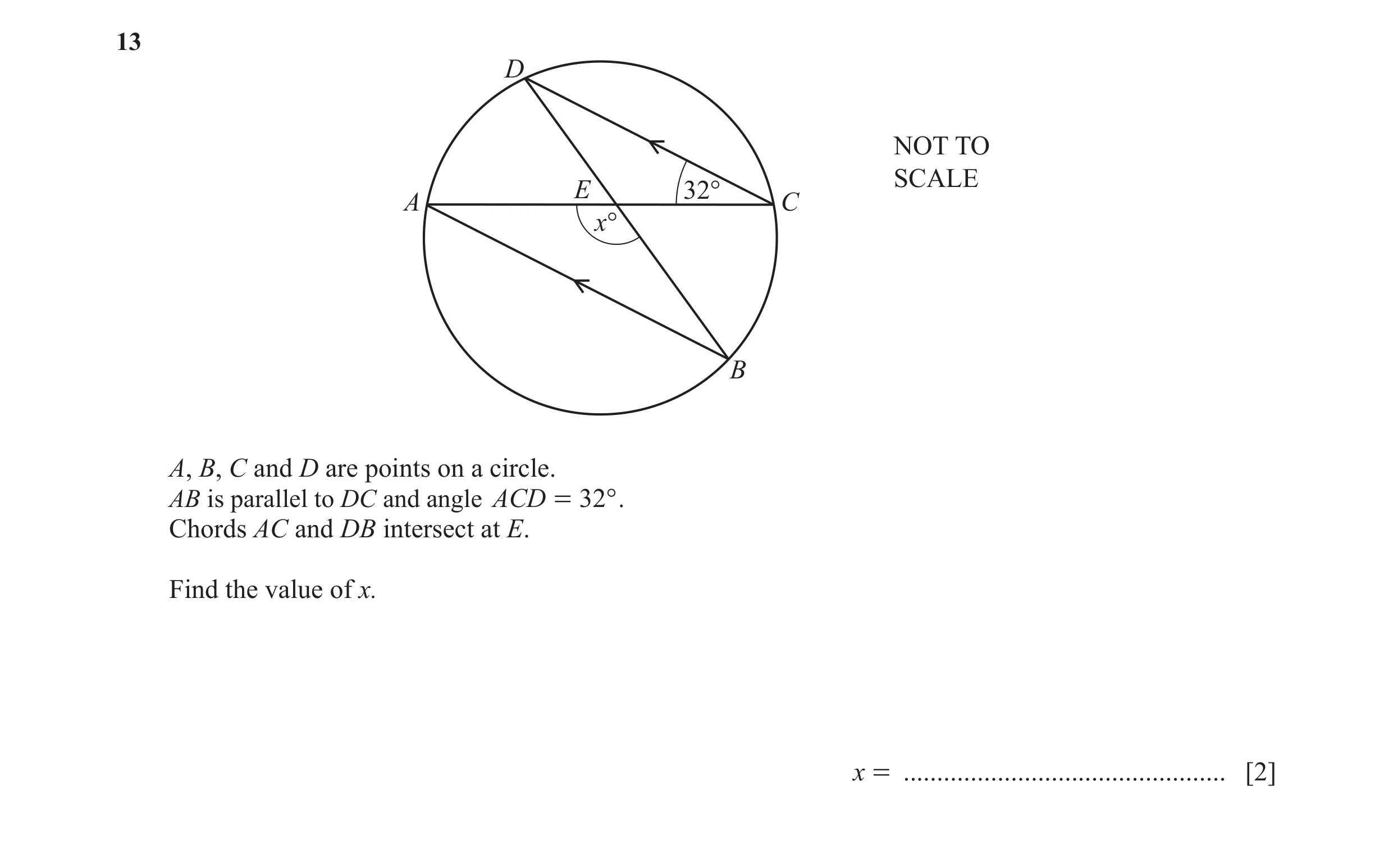
 27 / 36
 28 / 36
 29 / 36
 30 / 36
 31 / 36
 32 / 36
 33 / 36
 34 / 36
 35 / 36
 36 / 36
 4
4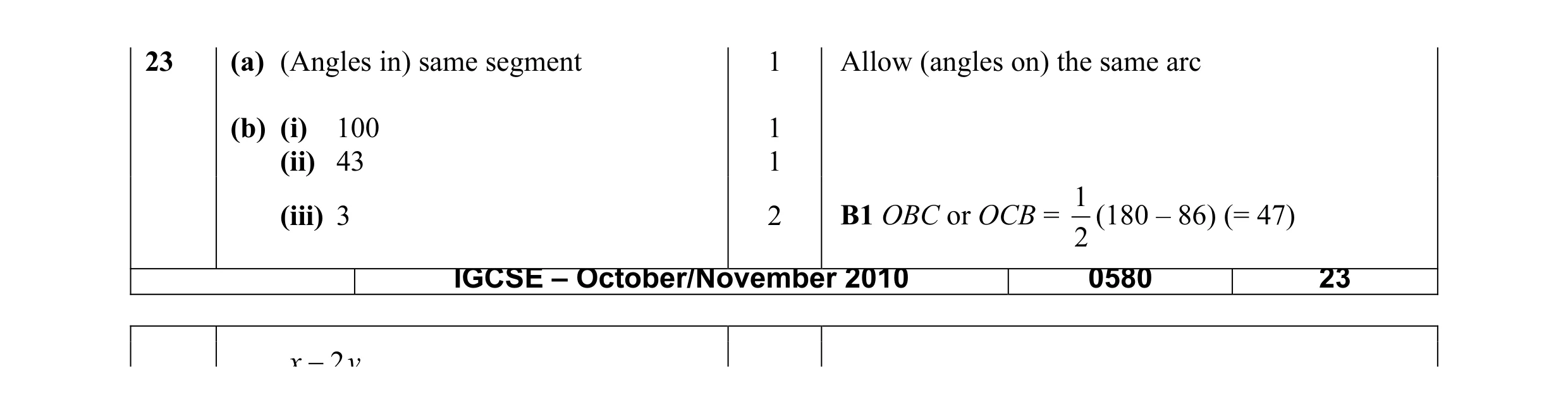 5
5 5
5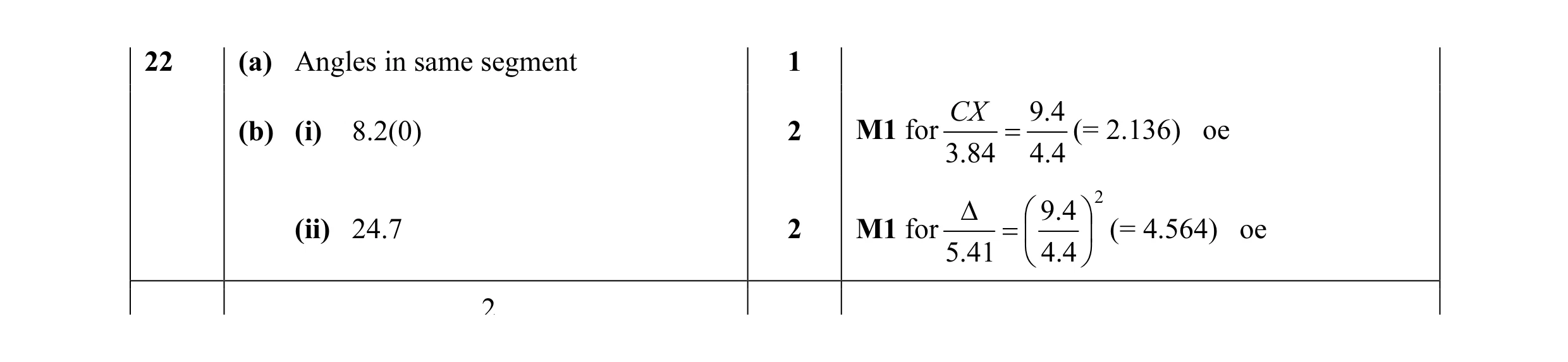 5
5 2
2 3
3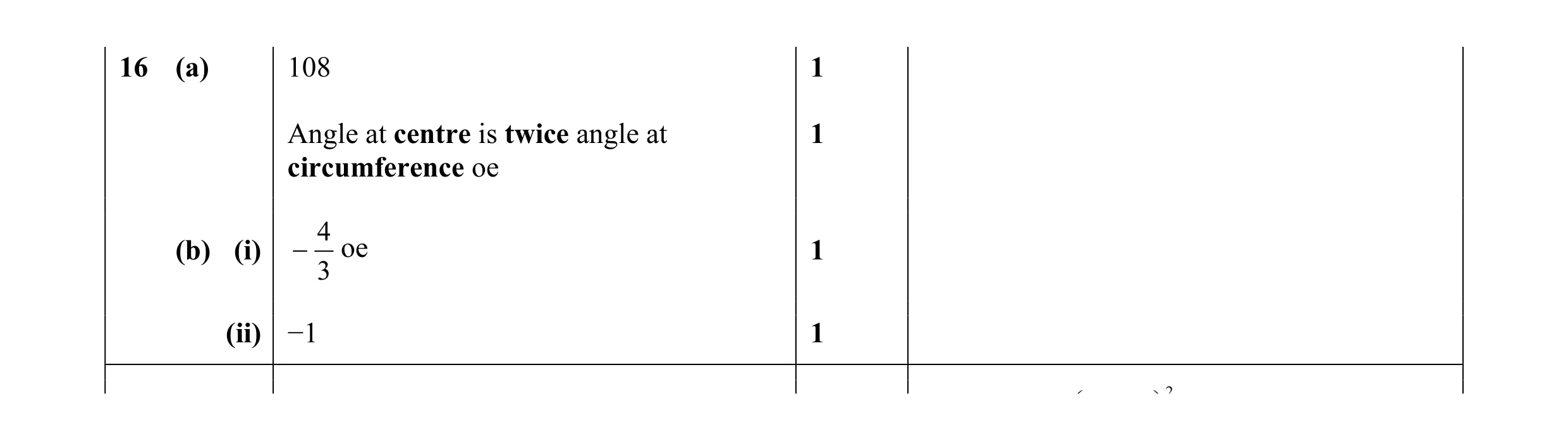 4
4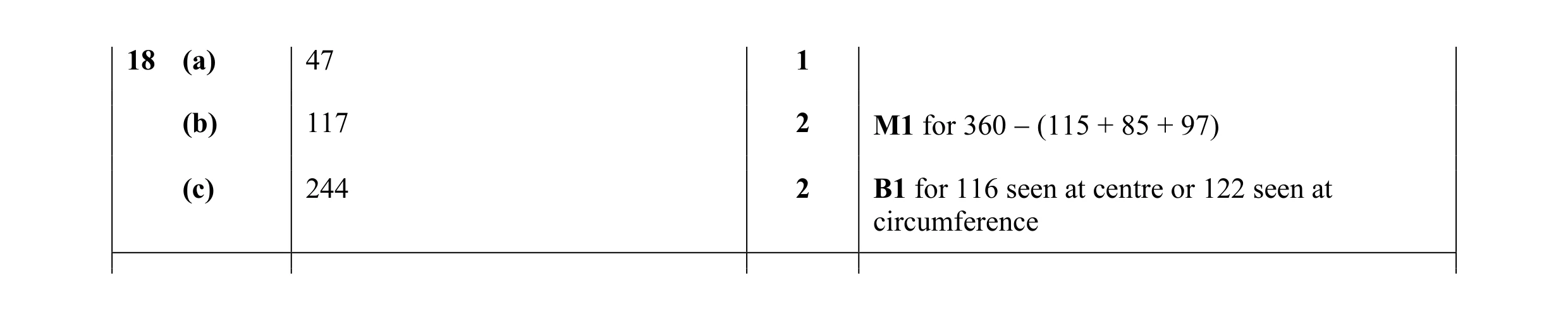 5
5 2
2 2
2 2
2 1
1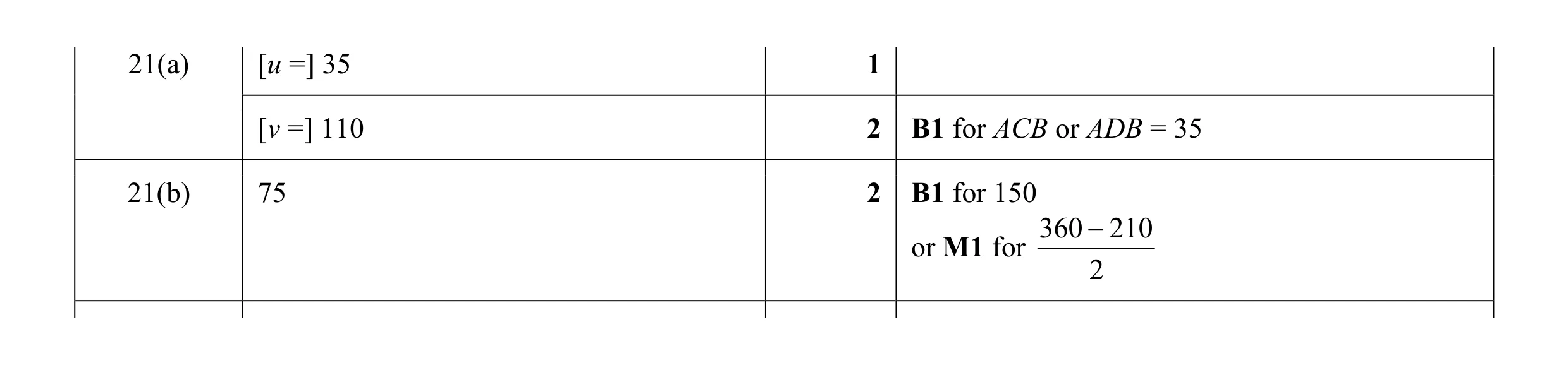 5
5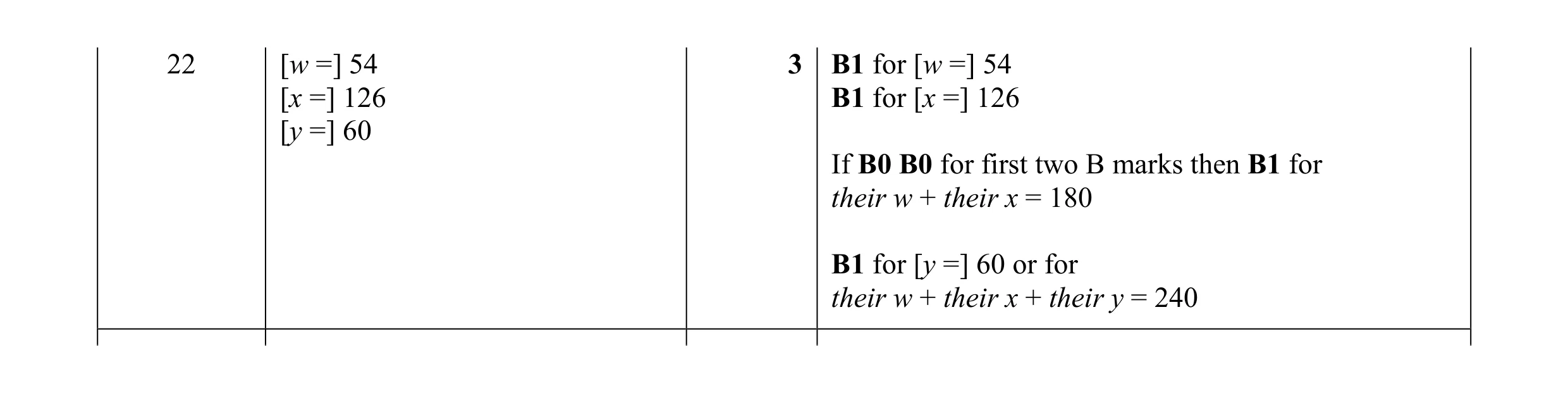 3
3 3
3 3
3 2
2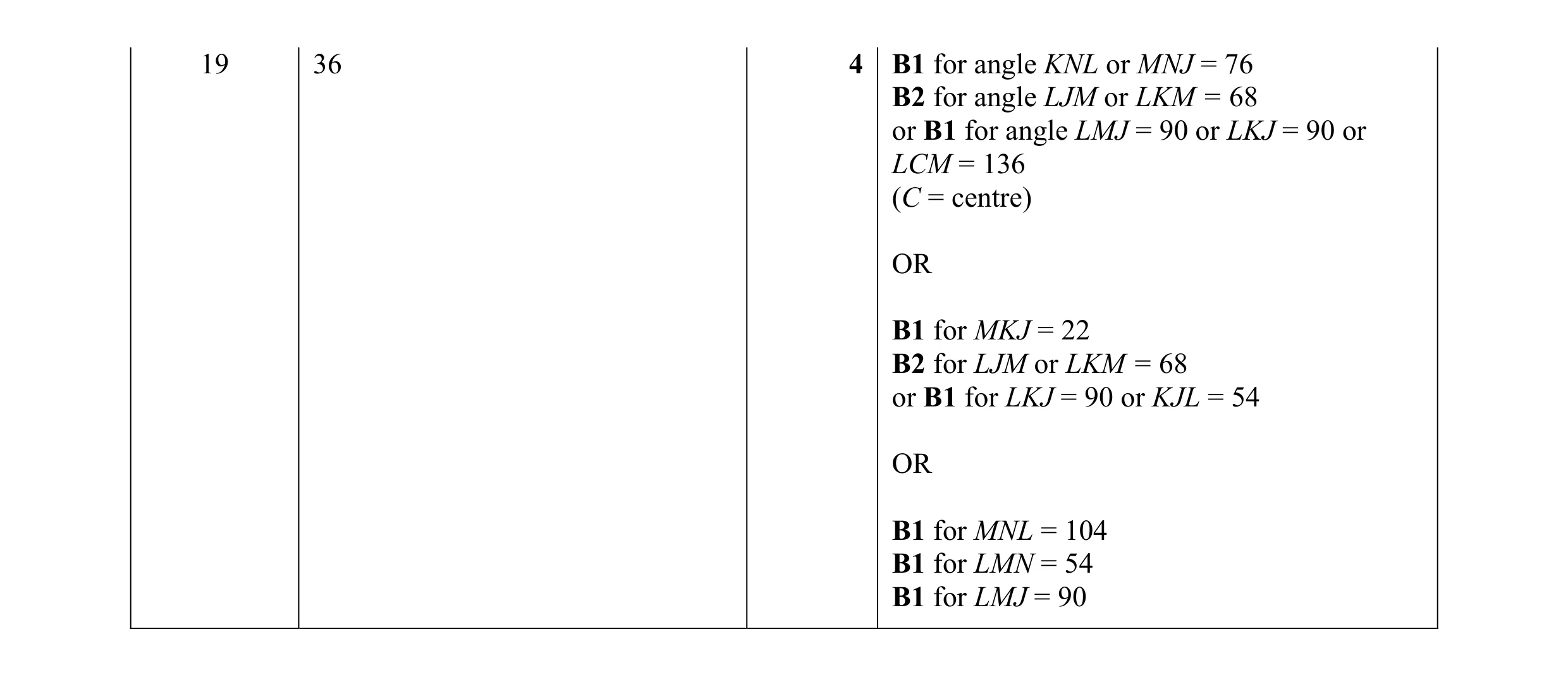 4
4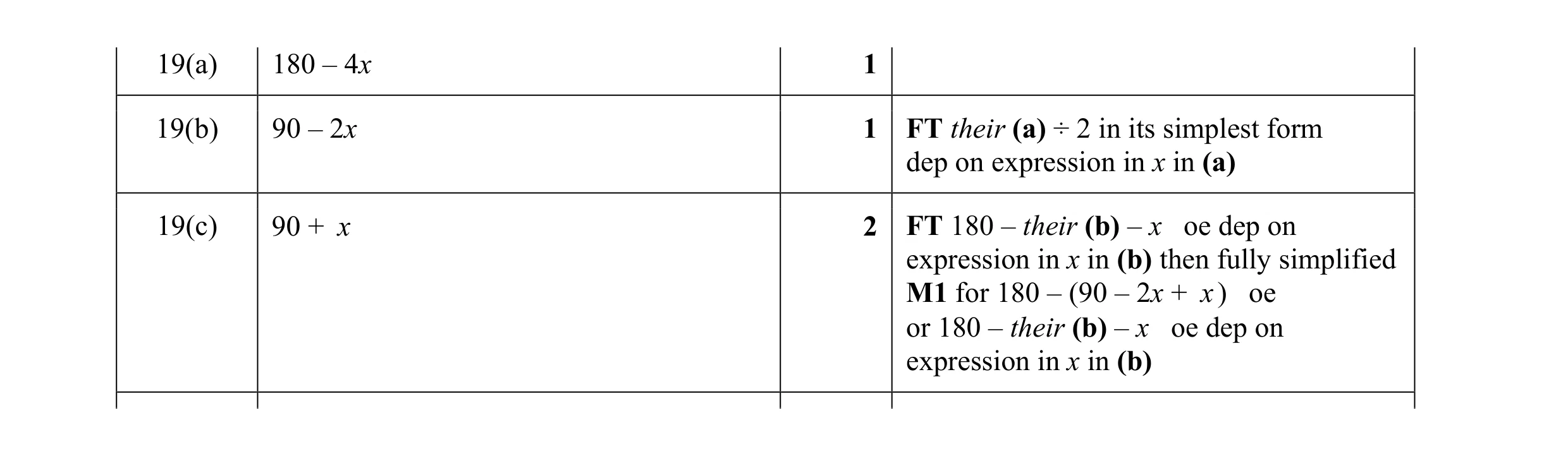 4
4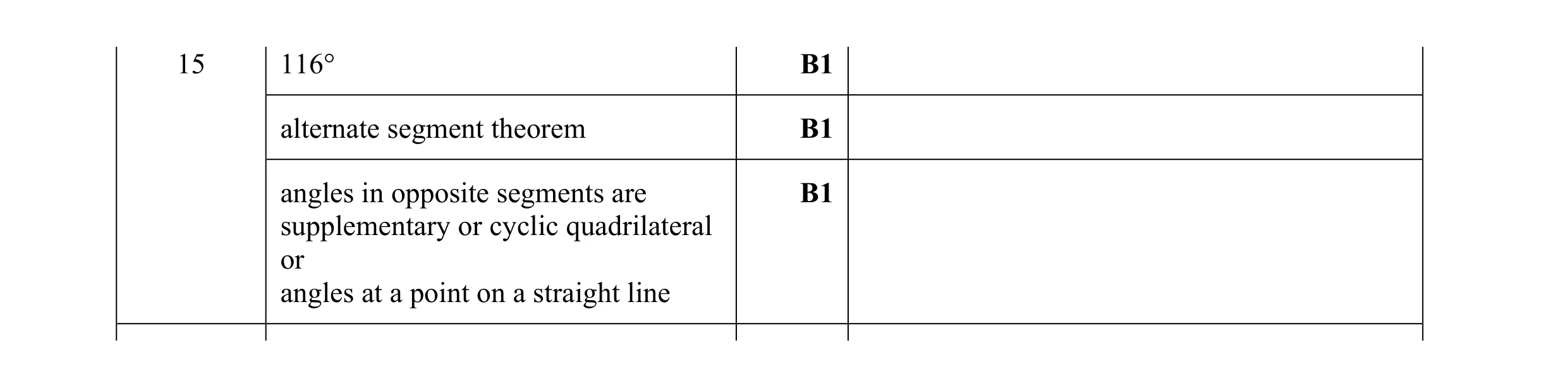 3
3 2
2 3
3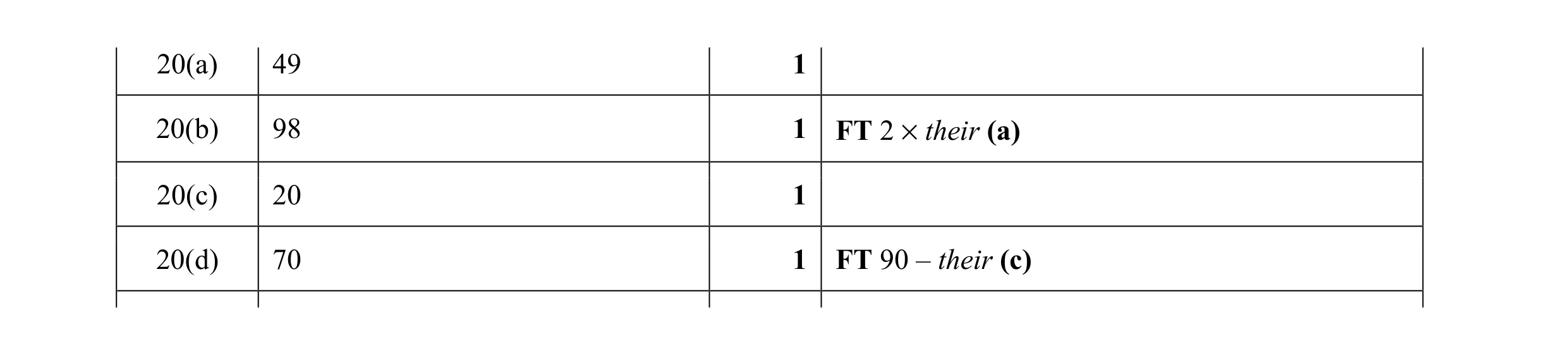 4
4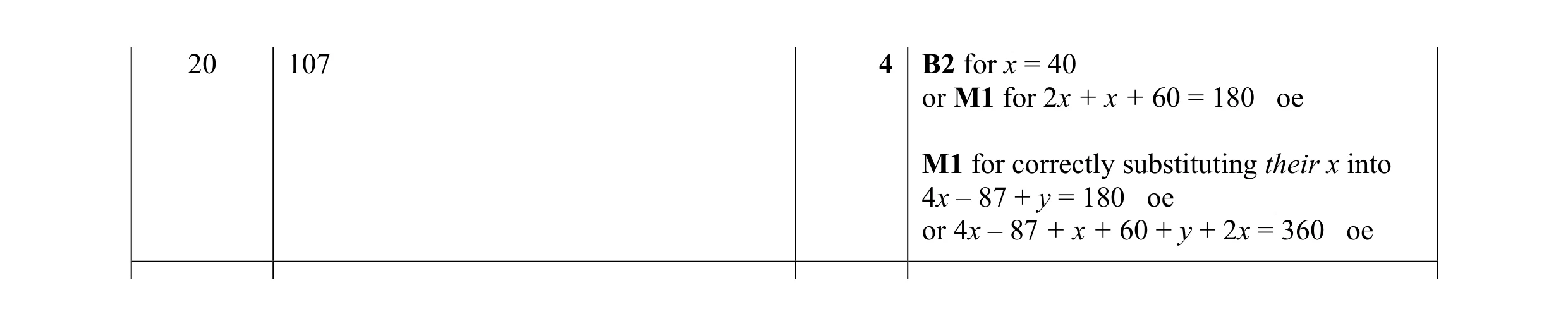 4
4 2
2 3
3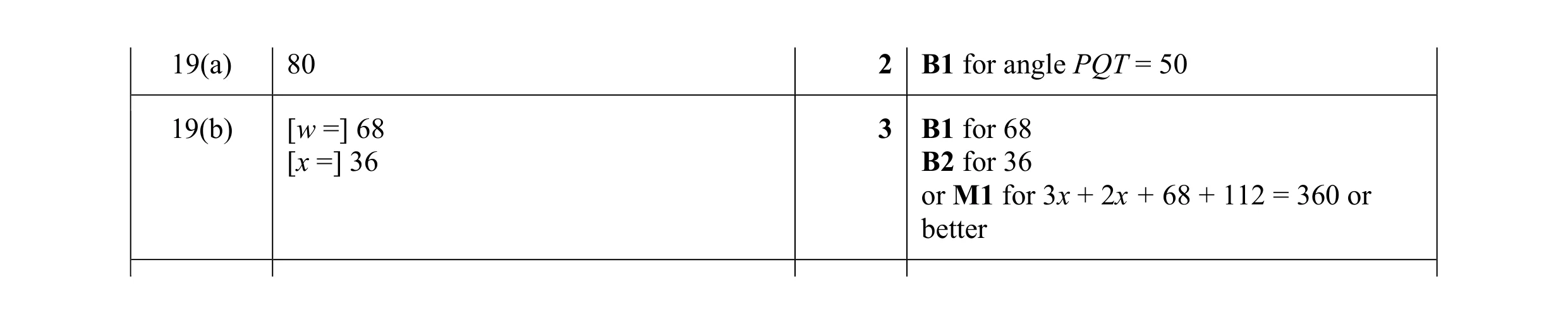 5
5 3
3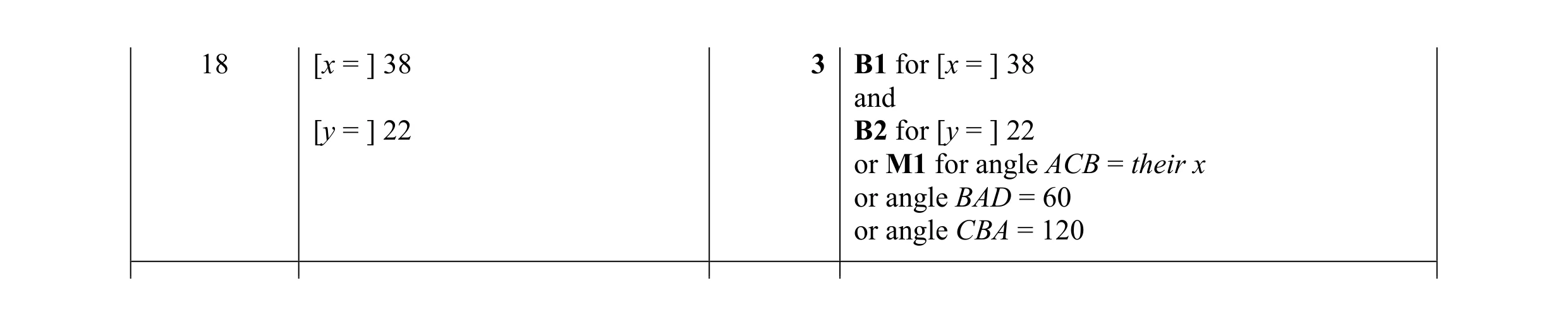 3
3 1
1 4
4 1
1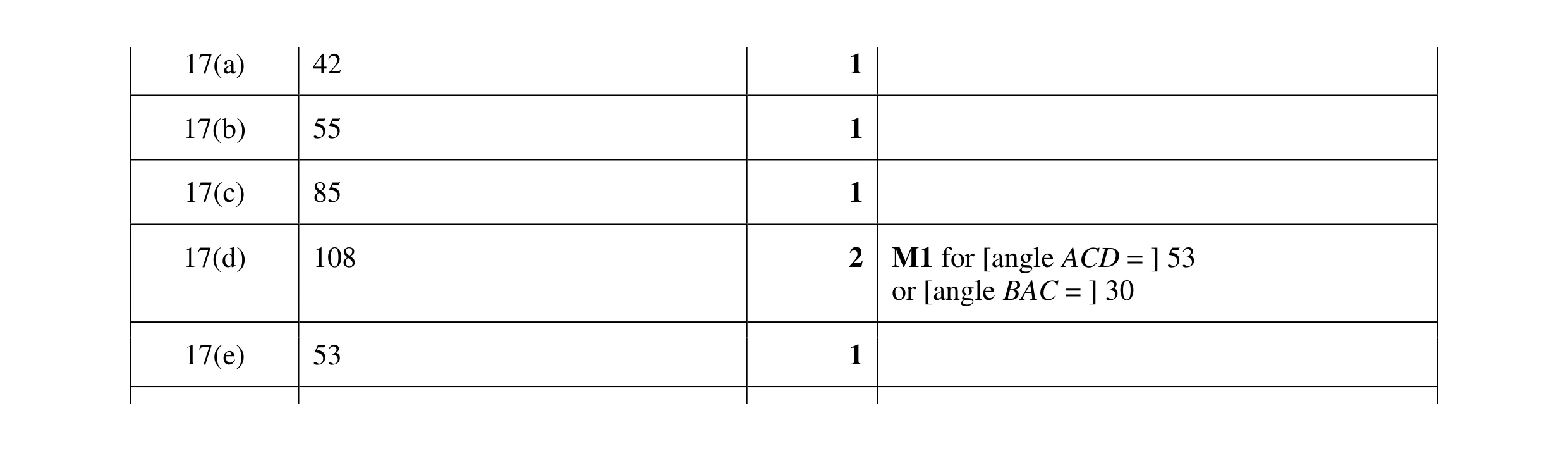 6
6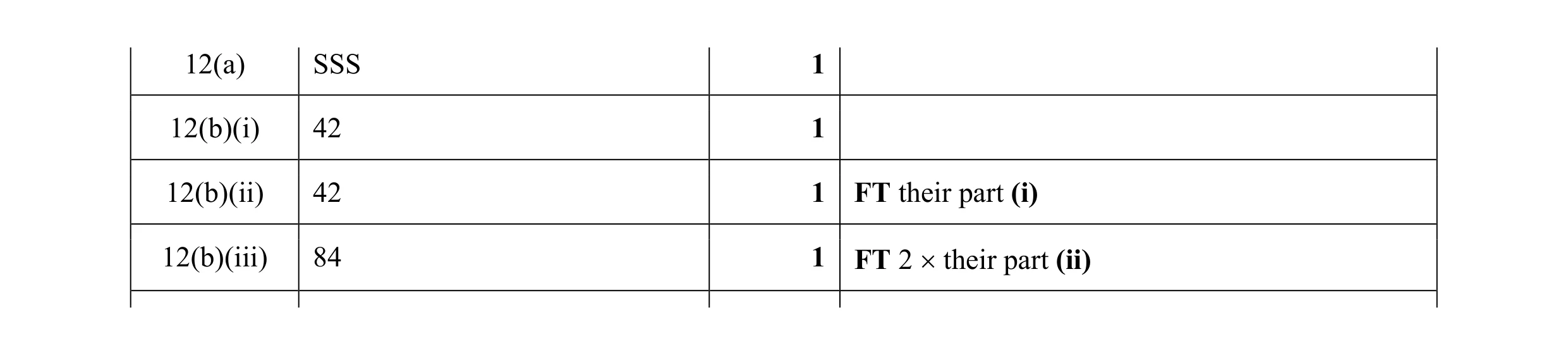 4
4 2
2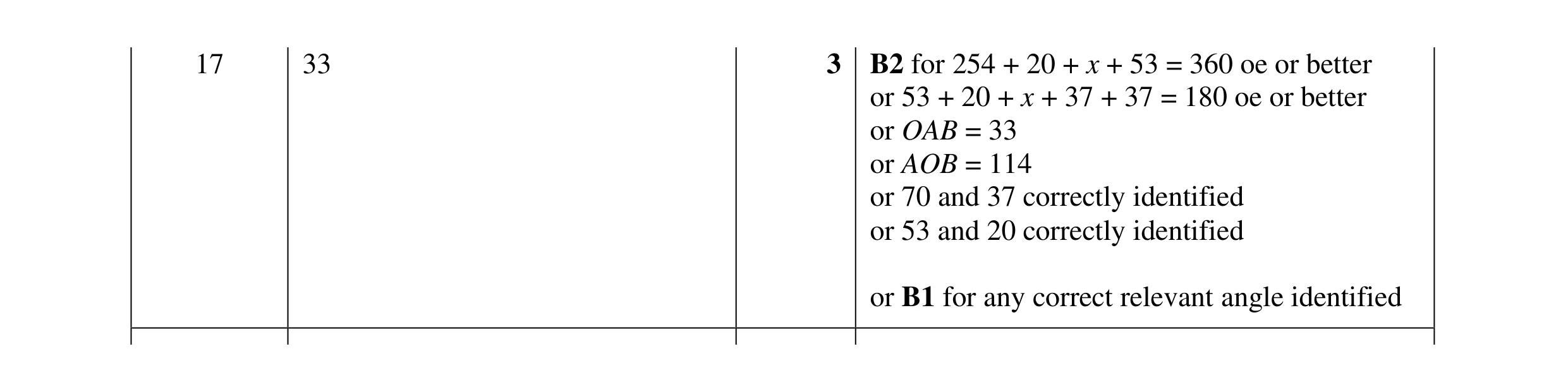 3
3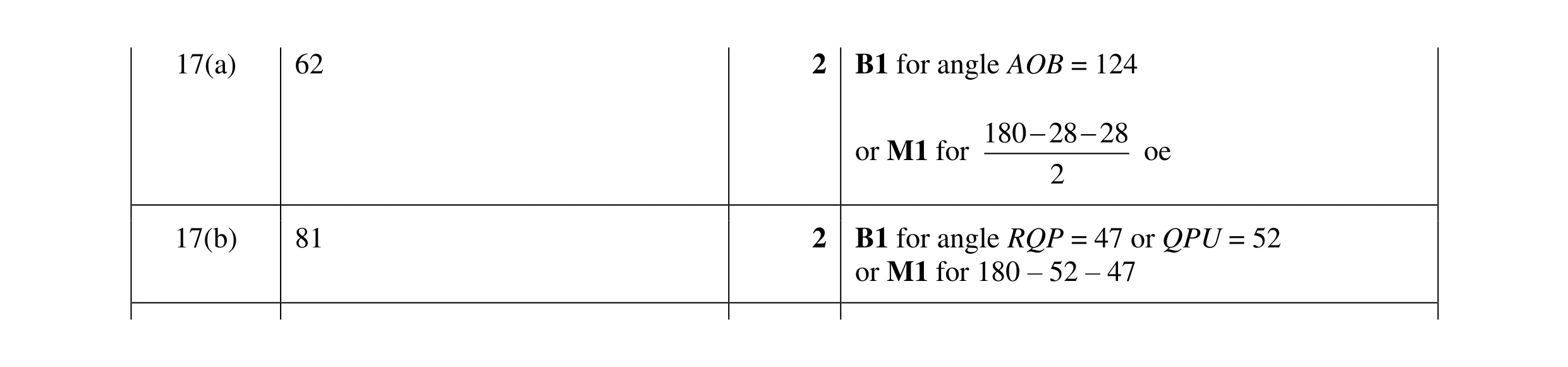 4
4 3
3 3
3 2
2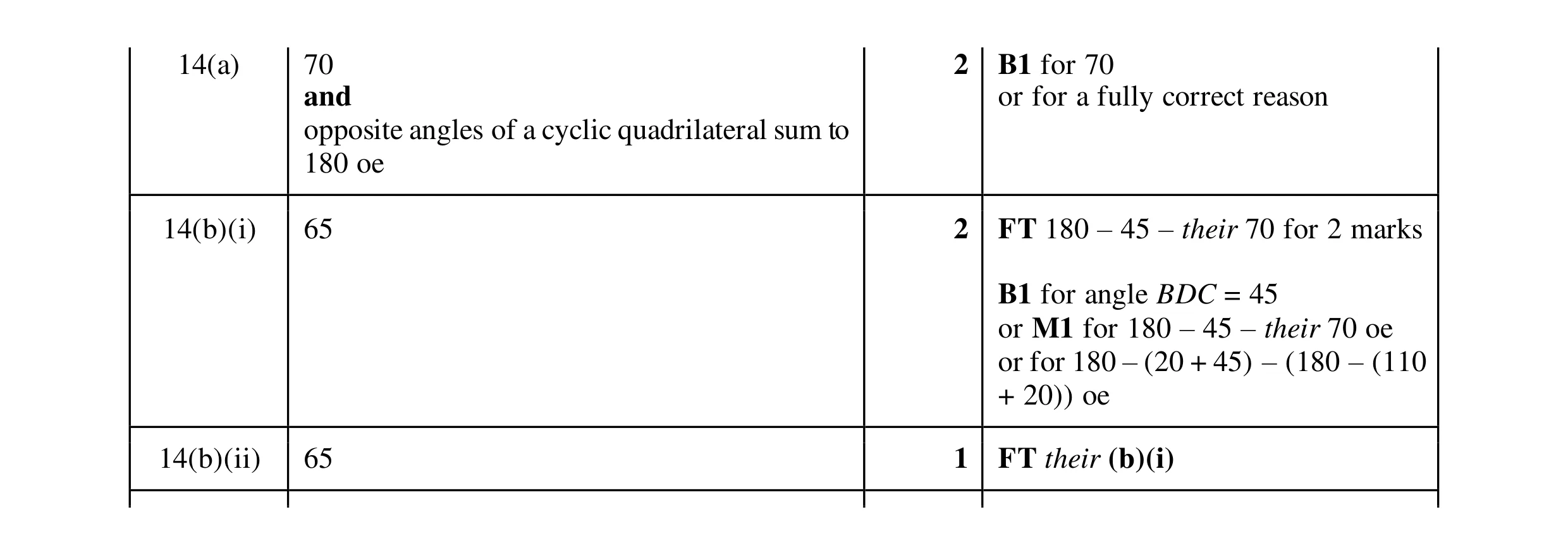 5
5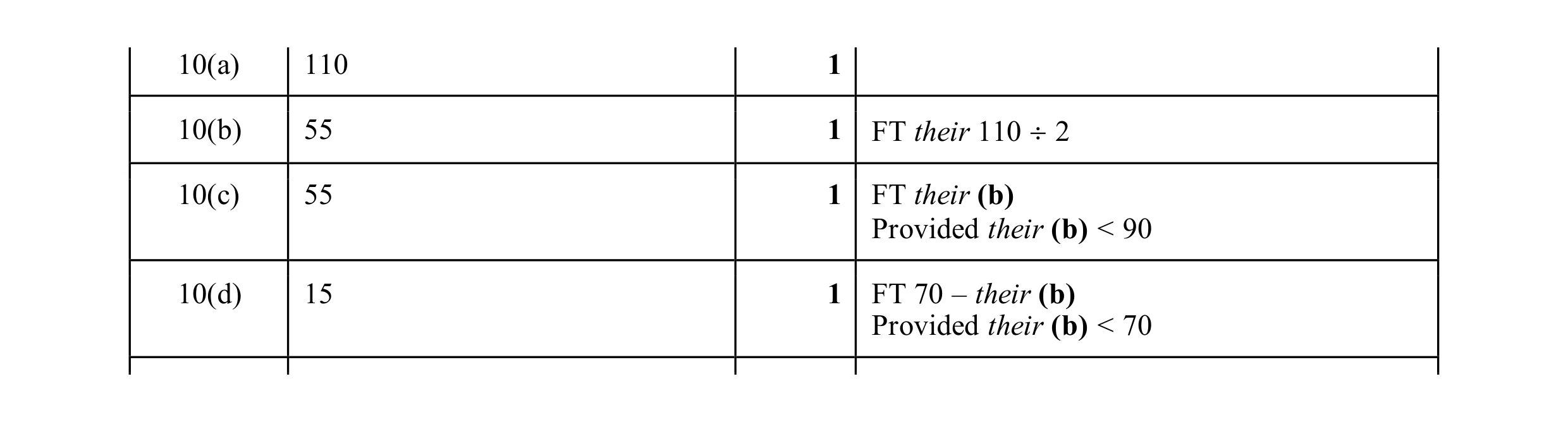 4
4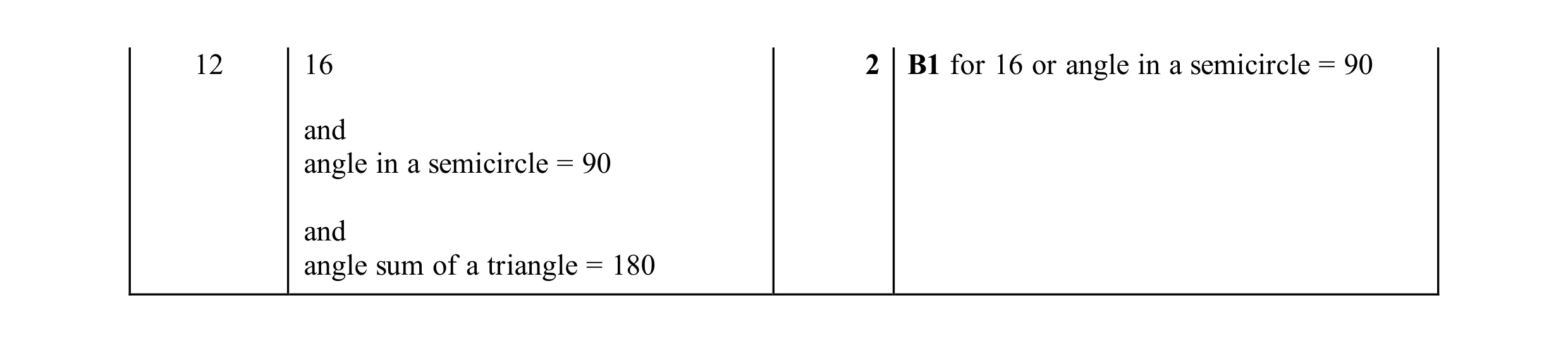 2
2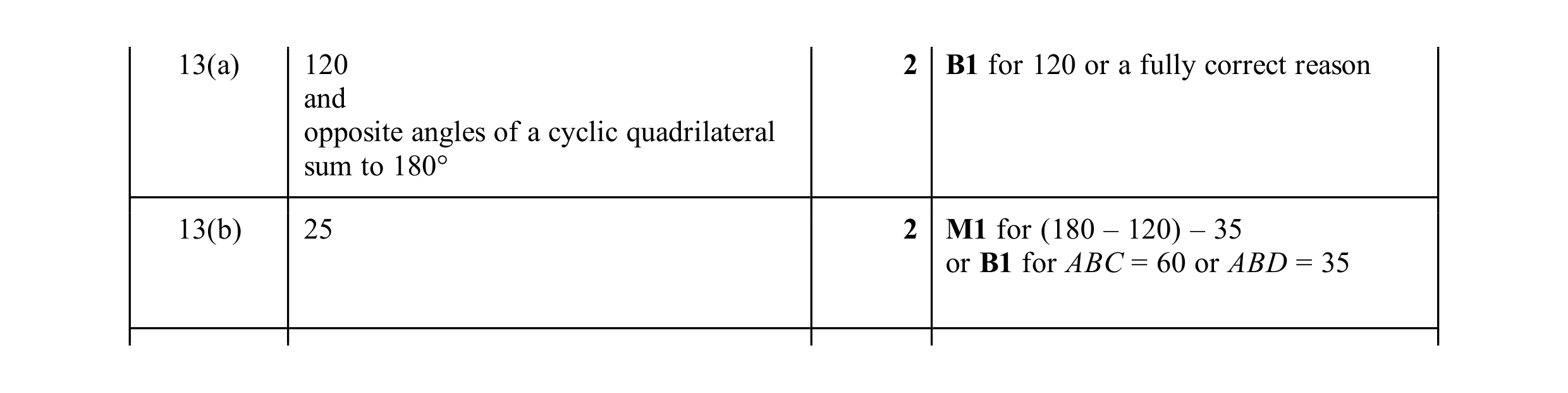 4
4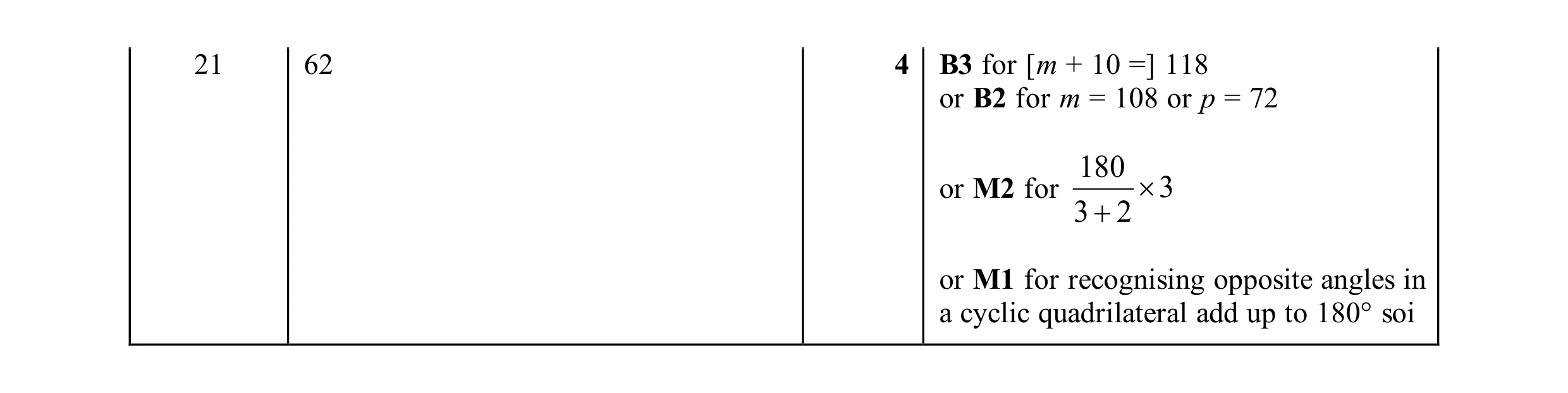 4
4