Cambridge IGCSE Mathematics 0580 — 2024 Oct/Nov Paper 4 · Variant 2
0580/42/O/N/24 · 10 questions · 130 marks · ≈146 min
The question paper and its mark scheme, free to read here and free to download. This is Cambridge’s own paper, exactly as it was sat.
Question paper20 pages
Mark scheme10 pages
Answers below. Sit the paper first if you are practising.
Questions as text
Q1 · Anvi buys a new car
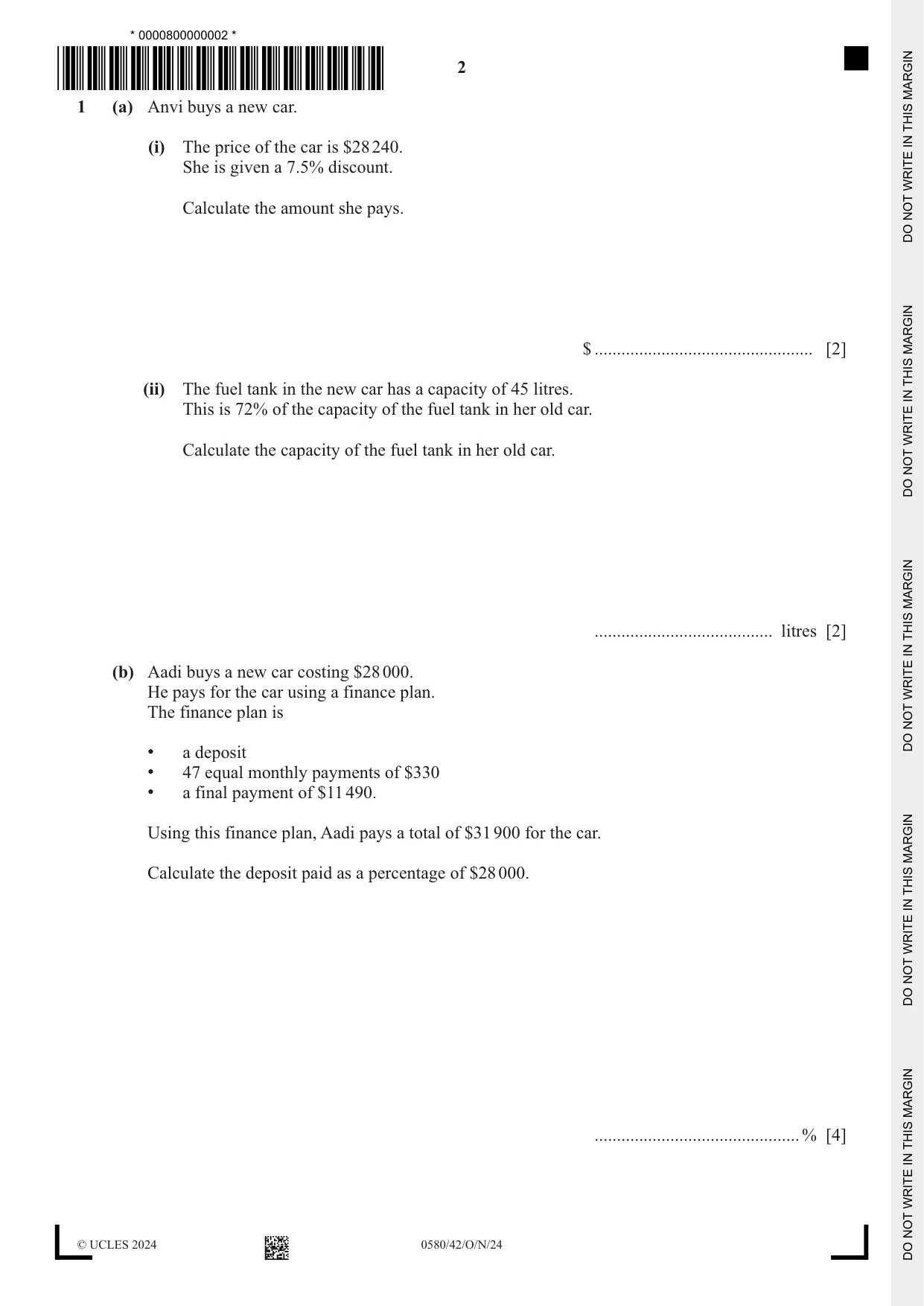
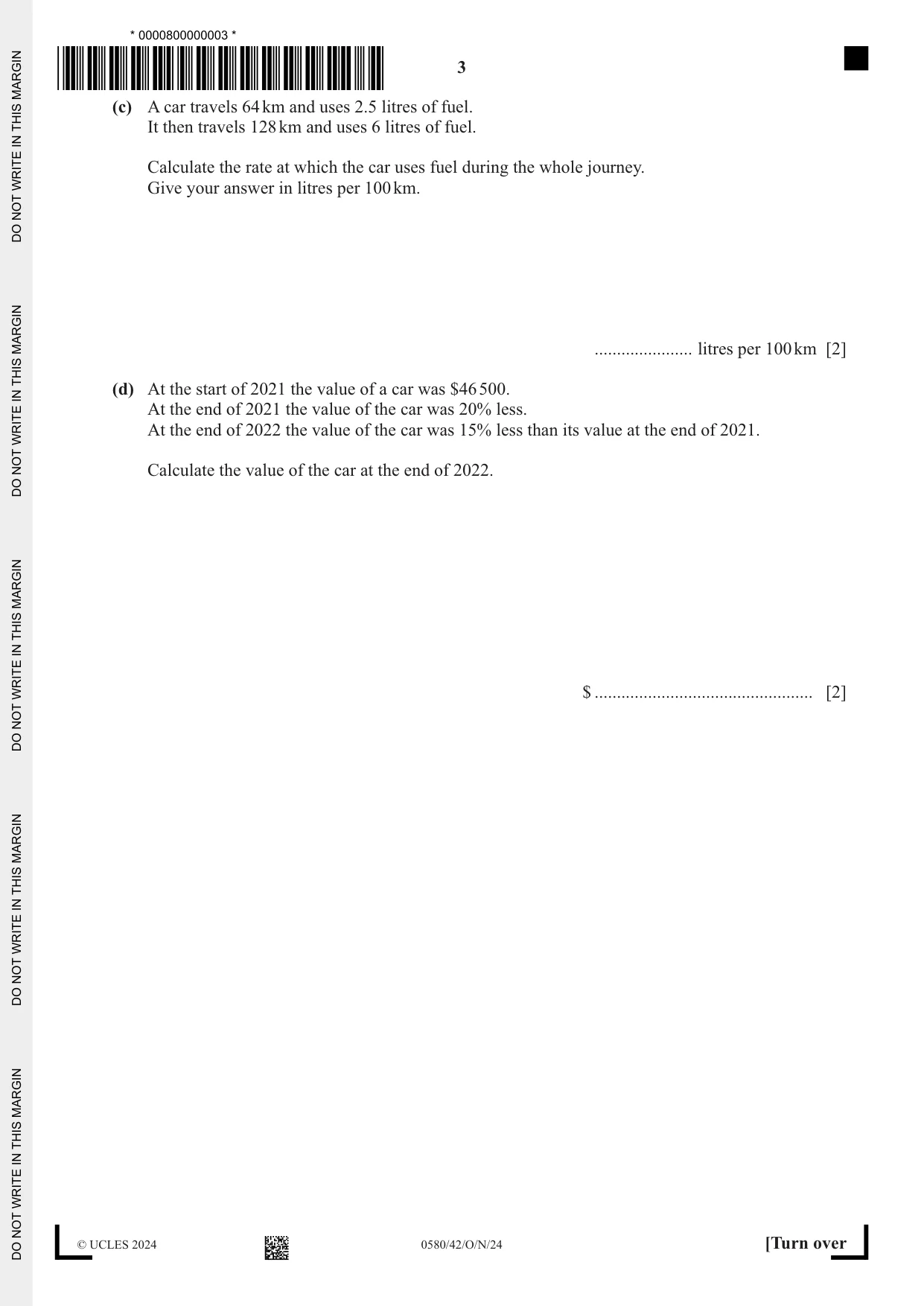
1 (a) Anvi buys a new car. (i) The price of the car is $28 240. She is given a 7.5% discount. Calculate the amount she pays. $ ................................................. [2] (ii) The fuel tank in the new car has a capacity of 45 litres. This is 72% of the capacity of the fuel tank in her old car. Calculate the capacity of the fuel tank in her old car. ........................................ litres [2] (b) Aadi buys a new car costing $28 000. He pays for the car using a finance plan. The finance plan is • a deposit • 47 equal monthly payments of $330 • a final payment of $11 490. Using this finance plan, Aadi pays a total of $31 900 for the car. Calculate the deposit paid as a percentage of $28 000. ..............................................% [4] (c) A car travels 64 km and uses 2.5 litres of fuel. It then travels 128 km and uses 6 litres of fuel. Calculate the rate at which the car uses fuel during the whole journey. Give your answer in litres per 100 km. ...................... litres per 100 km [2] (d) At the start of 2021 the value of a car was $46 500. At the end of 2021 the value of the car was 20% less. At the end of 2022 the value of the car was 15% less than its value at the end of 2021. Calculate the value of the car at the end of 2022. $ ................................................. [2]
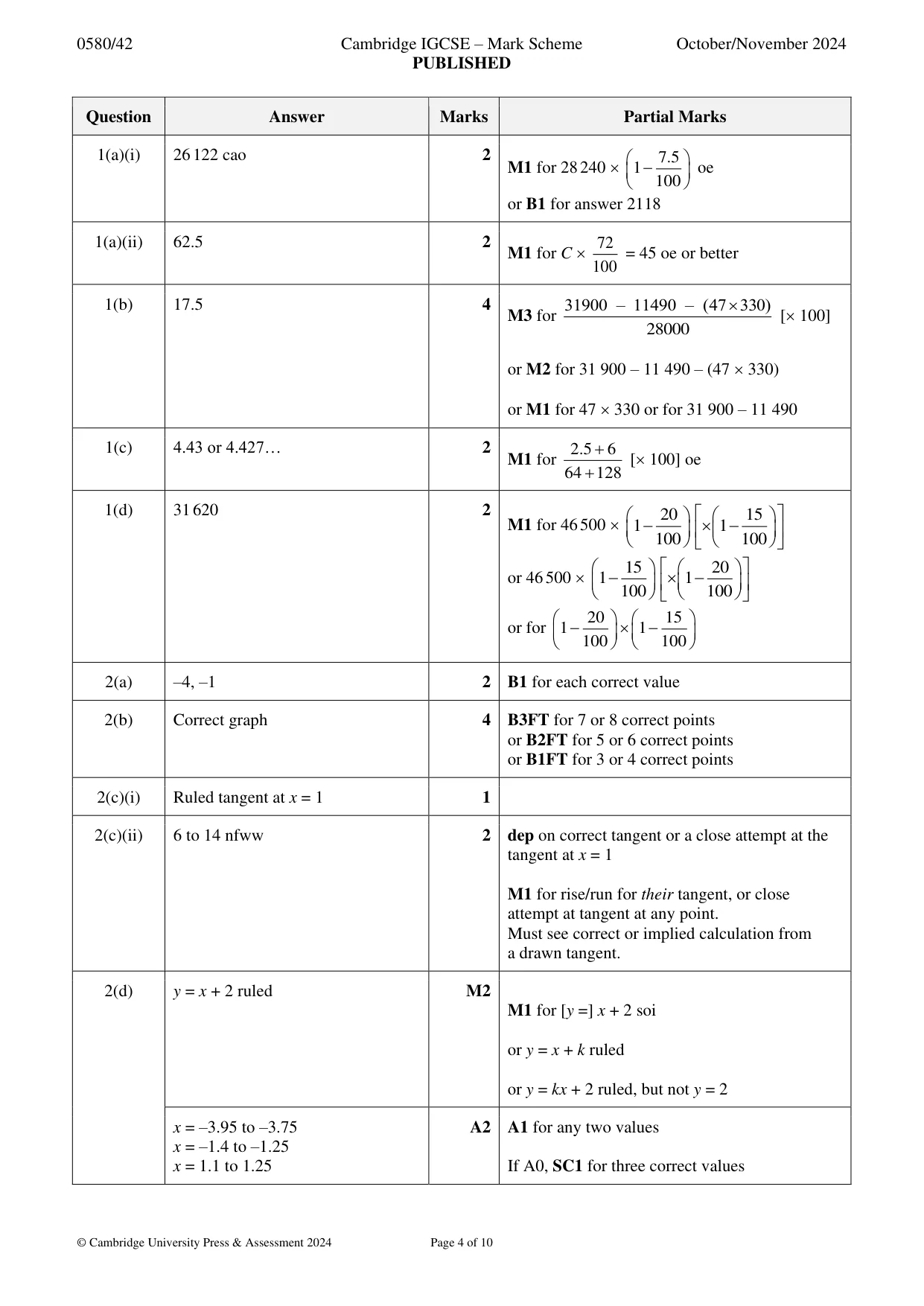
Mark scheme: Question Answer Marks Partial Marks 1(a)(i) 26 122 cao 2 7.5 M1 for 28 240 1 − oe 100 or B1 for answer 2118 1(a)(ii) 62.5 2 72 M1 for C = 45 oe or better 100 1(b) 17.5 4 31900 – 11490 – (47 330) M3 for [ 100] 28000 or M2 for 31 900 – 11 490 – (47 330) or M1 for 47 330 or for 31 900 – 11 490 1(c) 4.43 or 4.427… 2 2.5 + 6 M1 for [ 100] oe 64 + 128 1(d) 31 620 2 20 15 M1 for 46 500 1 − 1 − 100 100 15 20 or 46 500 1 − 1 − 100 100 20 15 or for 1 − 1 − 100 100
Q2 · The table shows some values for y = x 3 + 4x 2 - 4
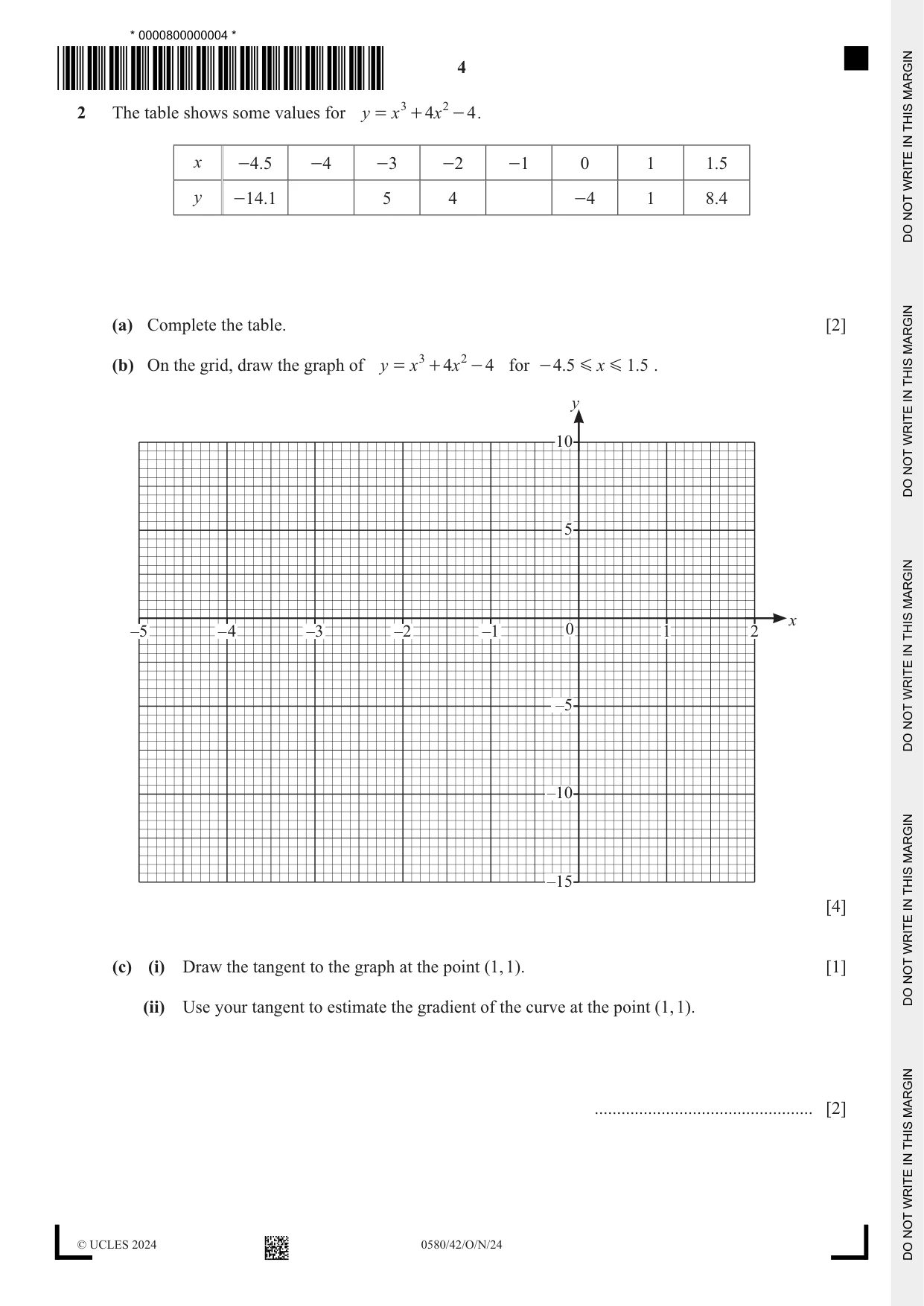
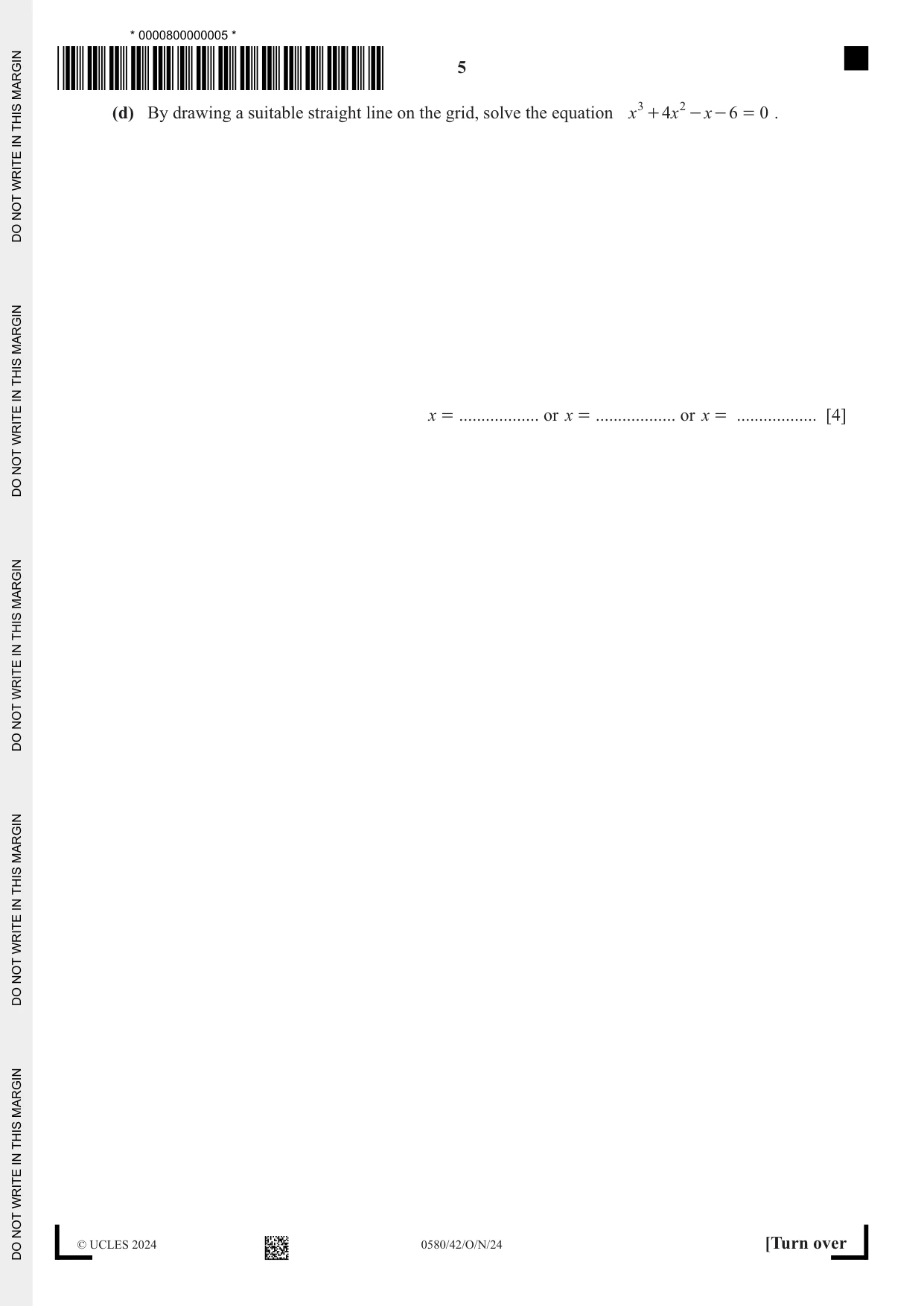
2 The table shows some values for y = x 3 + 4x 2 - 4 . x -4.5 -4 -3 -2 -1 0 1 1.5 y -14.1 5 4 -4 1 8.4 (a) Complete the table. [2] (b) On the grid, draw the graph of y = x 3 + 4x 2 - 4 for - 4.5 G x G 1. 5 . y 10 5 x –5 – 4 –3 –2 –1 0 1 2 –5 –10 –15 [4] (c) (i) Draw the tangent to the graph at the point (1, 1). [1] (ii) Use your tangent to estimate the gradient of the curve at the point (1, 1). ................................................. [2] (d) By drawing a suitable straight line on the grid, solve the equation x 3 + 4x 2 - x - 6 = 0 . x = .................. or x = .................. or x = .................. [4]
Mark scheme: 2(a) –4, –1 2 B1 for each correct value 2(b) Correct graph 4 B3FT for 7 or 8 correct points or B2FT for 5 or 6 correct points or B1FT for 3 or 4 correct points 2(c)(i) Ruled tangent at x = 1 1 2(c)(ii) 6 to 14 nfww 2 dep on correct tangent or a close attempt at the tangent at x = 1 M1 for rise/run for their tangent, or close attempt at tangent at any point. Must see correct or implied calculation from a drawn tangent. 2(d) y = x + 2 ruled M2 M1 for [y =] x + 2 soi or y = x + k ruled or y = kx + 2 ruled, but not y = 2 x = –3.95 to –3.75 A2 A1 for any two values x = –1.4 to –1.25 x = 1.1 to 1.25 If A0, SC1 for three correct values
Question 3
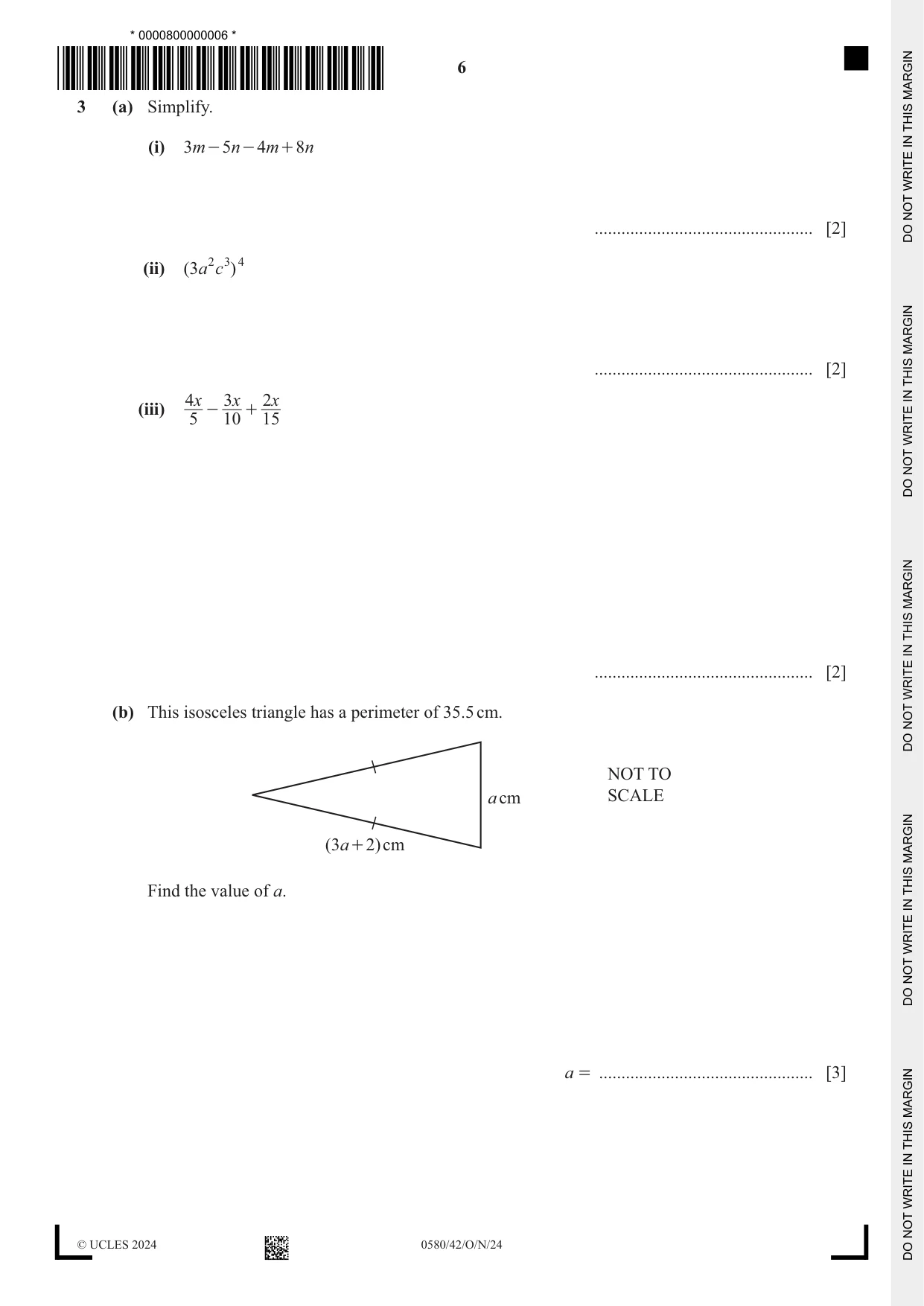
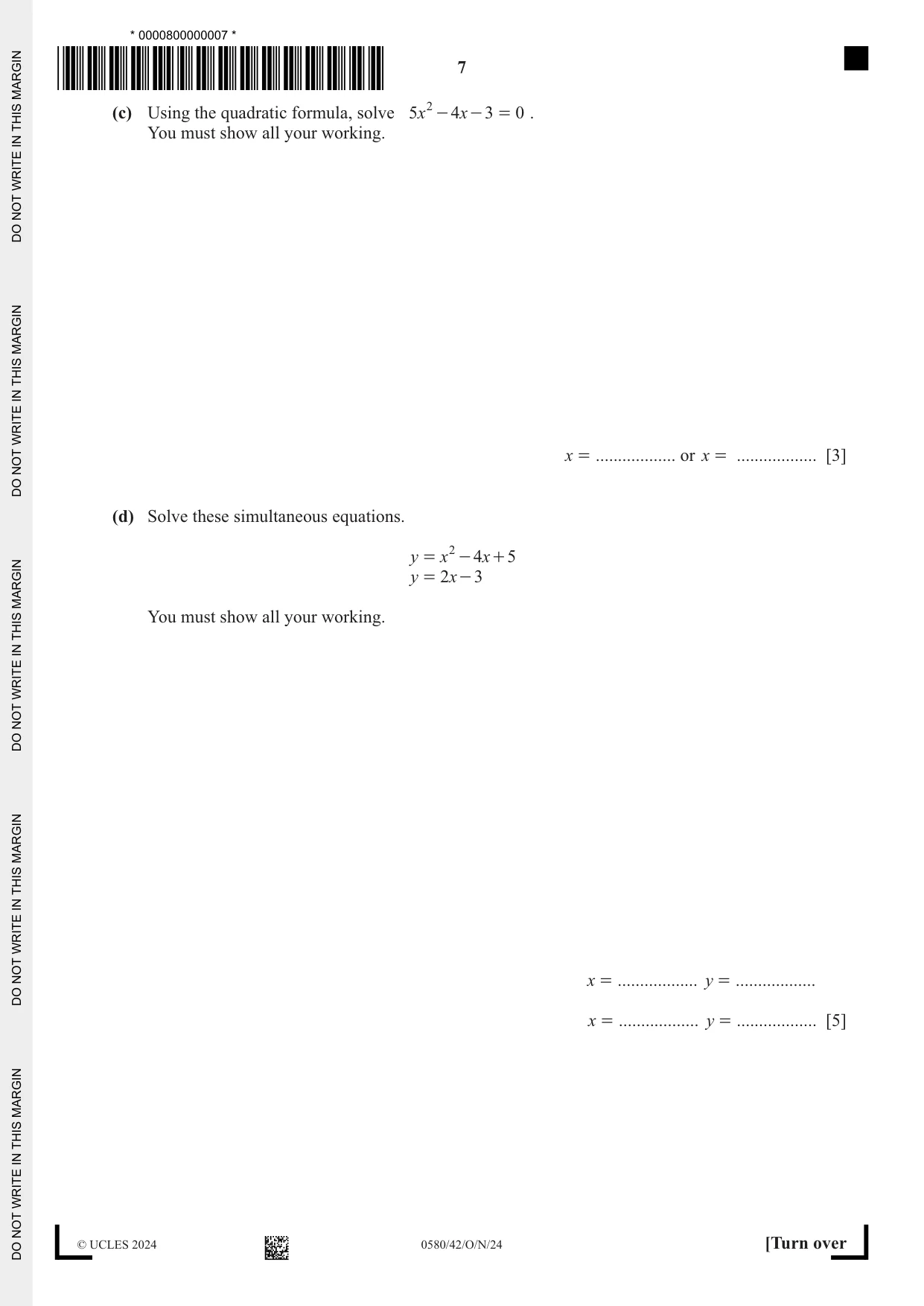
3 (a) Simplify. (i) 3m - 5n - 4 m + 8 n ................................................. [2] (ii) ( 3a 2 c 3 ) 4 ................................................. [2] 4 x 3 x 2x (iii) - + 5 10 15 ................................................. [2] (b) This isosceles triangle has a perimeter of 35.5 cm. NOT TO a cm SCALE ( 3a + 2) cm Find the value of a. a = ................................................ [3] (c) Using the quadratic formula, solve 5x 2 - 4 x - 3 = 0 . You must show all your working. x = .................. or x = .................. [3] (d) Solve these simultaneous equations. y = x 2 - 4x + 5 y = 2x - 3 You must show all your working. x = .................. y = .................. x = .................. y = .................. [5]
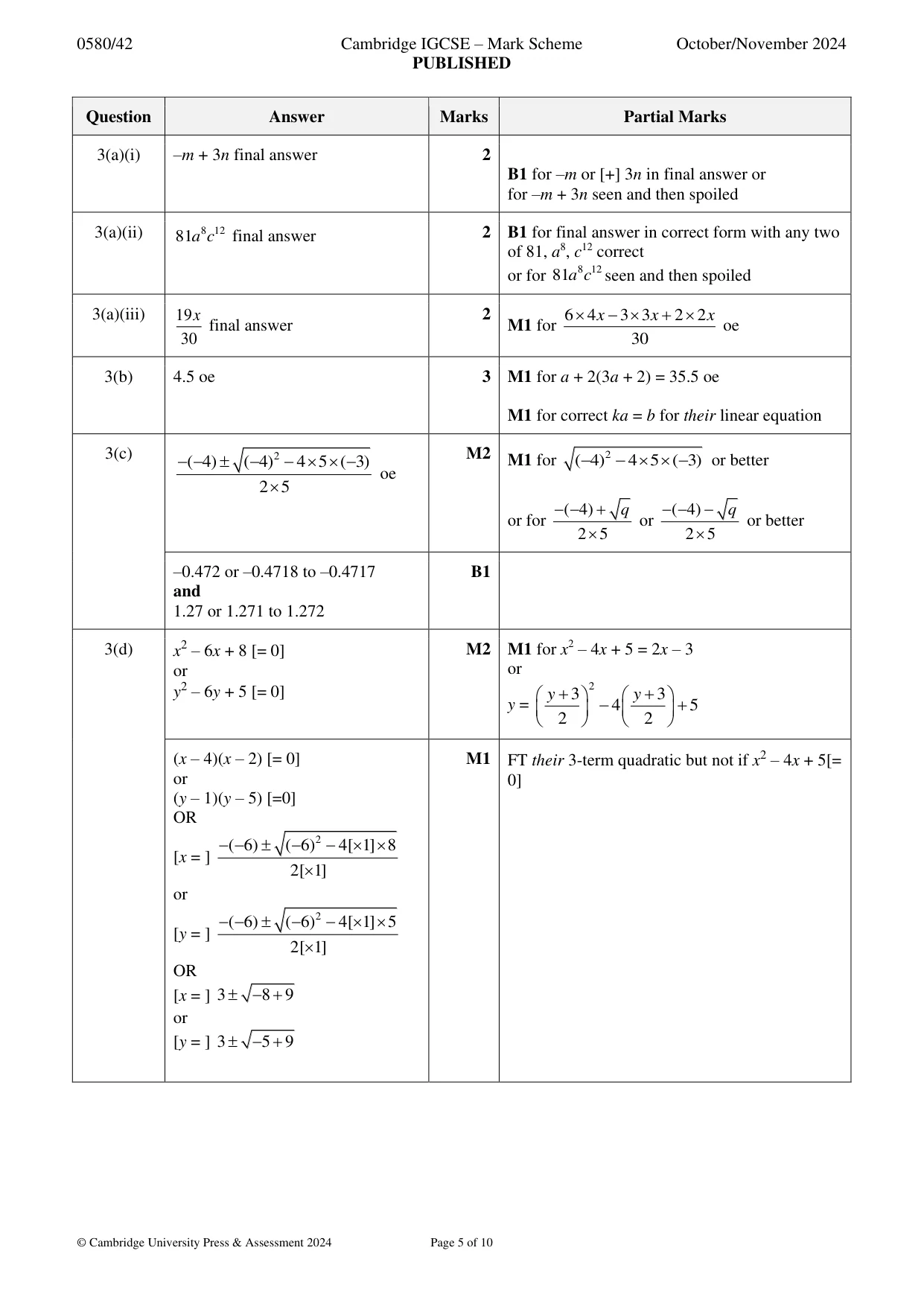
Mark scheme: 3(a)(i) –m + 3n final answer 2 B1 for –m or [+] 3n in final answer or for –m + 3n seen and then spoiled 3(a)(ii) 81a 8 c12 final answer 2 B1 for final answer in correct form with any two of 81, a8, c12 correct or for 81a 8 c12 seen and then spoiled 3(a)(iii) 19 x 2 6 4 x −3 3 x + 2 2 x final answer M1 for oe 30 30 3(b) 4.5 oe 3 M1 for a + 2(3a + 2) = 35.5 oe M1 for correct ka = b for their linear equation 3(c) 2 M2 2 −−( 4) ( −4) −−4 5 ( 3) M1 for ( −4) −−4 5 ( 3) or better oe 2 5 −−( 4) + q −−( 4) − q or for or or better 2 5 2 5 –0.472 or –0.4718 to –0.4717 B1 and 1.27 or 1.271 to 1.272 3(d) x2 – 6x + 8 [= 0] M2 M1 for x2 – 4x + 5 = 2x – 3 or or y2 – 6y + 5 [= 0] y + 3 2 y + 3 y = − 4 + 5 2 2 (x – 4)(x – 2) [= 0] M1 FT their 3-term quadratic but not if x2 – 4x + 5[= or 0] (y – 1)(y – 5) [=0] OR −−( 6) ( −6) 2 − 4[1] 8 [x = ] 2[ 1] or −−( 6) ( −6) 2 − 4[1] 5 [y = ] 2[ 1] OR [x = ] 3 −+8 9 or [y = ] 3 −+5 9
Q4 · The angles of a quadrilateral are w°, x°, y° and z°
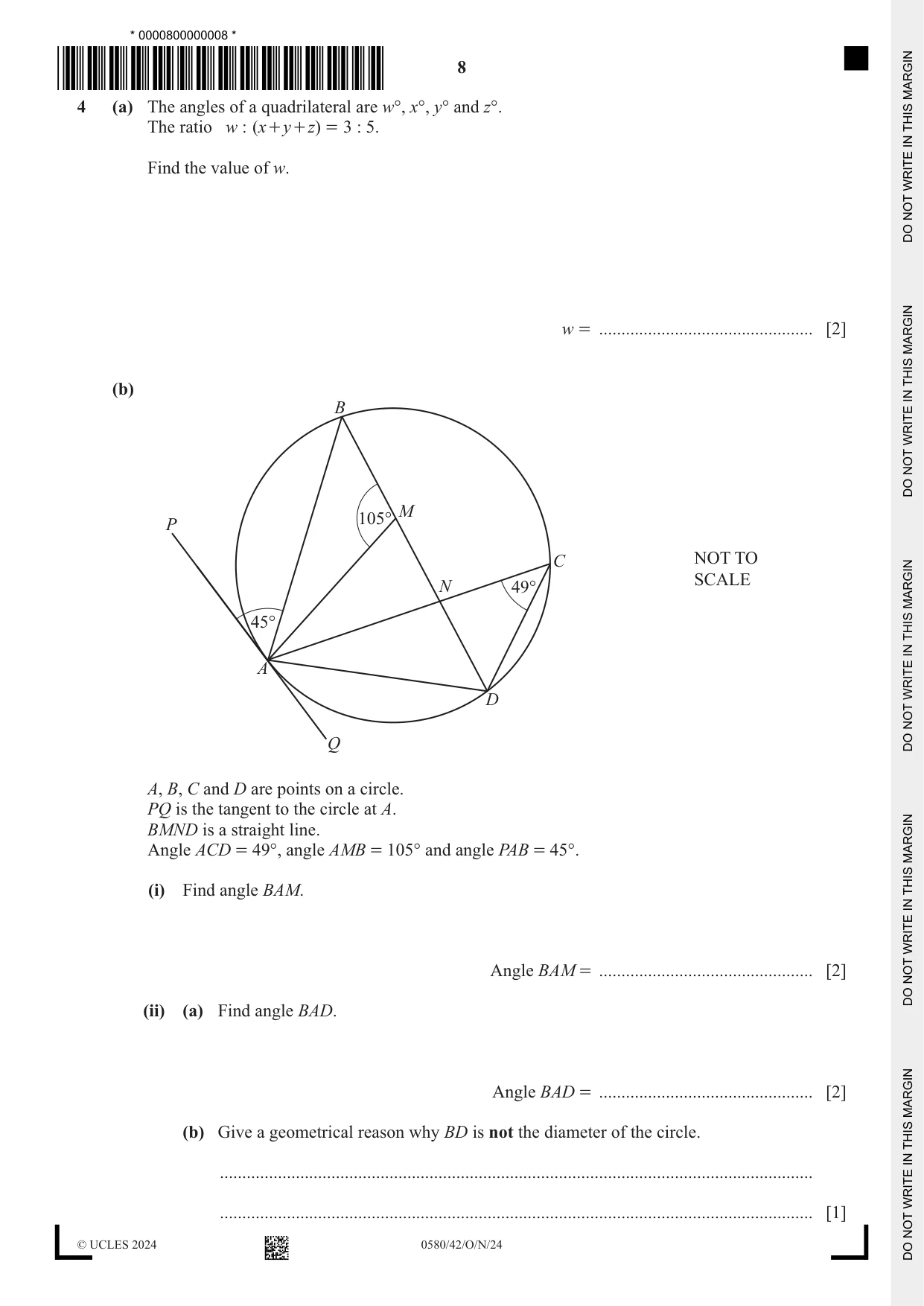
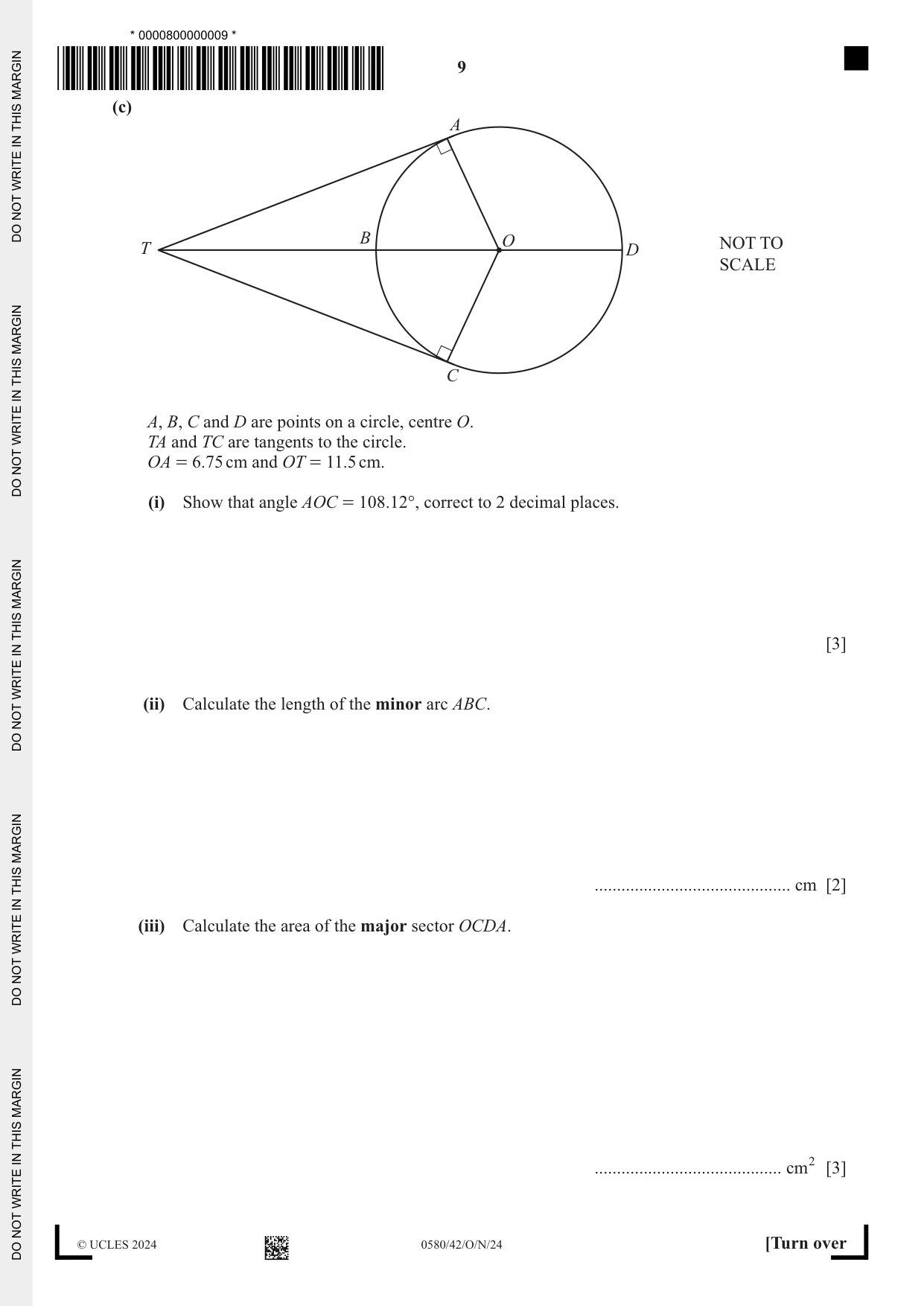
4 (a) The angles of a quadrilateral are w°, x°, y° and z°. The ratio w : ( x + y + z) = 3 : 5. Find the value of w. w = ................................................ [2] (b) B M 105° P C NOT TO SCALE N 49° 45° A D Q A, B, C and D are points on a circle. PQ is the tangent to the circle at A. BMND is a straight line. Angle ACD = 49°, angle AMB = 105° and angle PAB = 45°. (i) Find angle BAM. Angle BAM = ................................................ [2] (ii) (a) Find angle BAD. Angle BAD = ................................................ [2] (b) Give a geometrical reason why BD is not the diameter of the circle. ..................................................................................................................................... ..................................................................................................................................... [1] (c) A B O NOT TO T D SCALE C A, B, C and D are points on a circle, centre O. TA and TC are tangents to the circle. OA = 6.75 cm and OT = 11.5 cm. (i) Show that angle AOC = 108.12°, correct to 2 decimal places. [3] (ii) Calculate the length of the minor arc ABC. ............................................ cm [2] (iii) Calculate the area of the major sector OCDA. .......................................... cm2 [3]
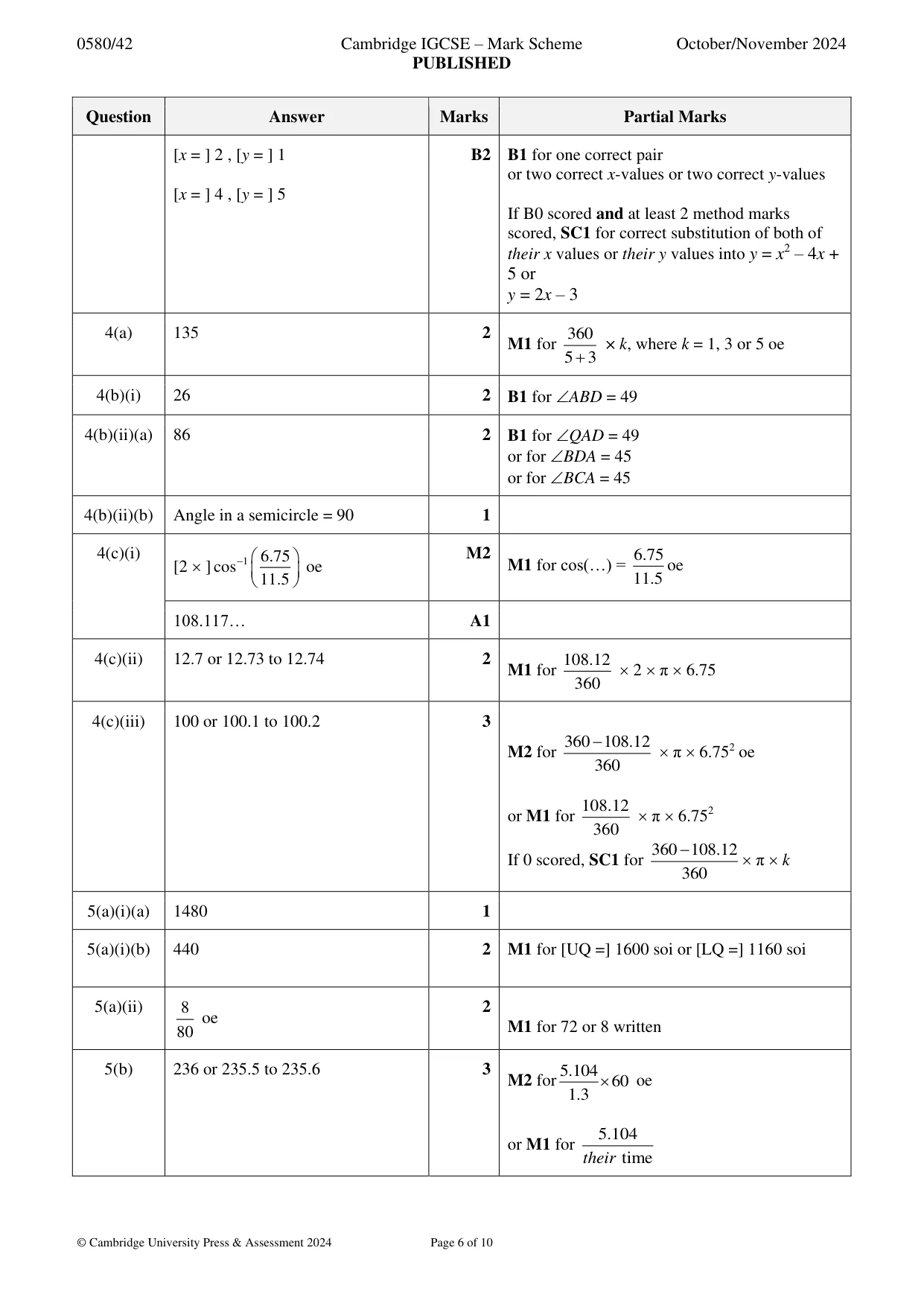
Mark scheme: 4(a) 135 2 360 M1 for × k, where k = 1, 3 or 5 oe 5 + 3 4(b)(i) 26 2 B1 for ABD = 49 4(b)(ii)(a) 86 2 B1 for QAD = 49 or for BDA = 45 or for BCA = 45 4(b)(ii)(b) Angle in a semicircle = 90 1 4(c)(i) −1 6.75 M2 6.75 [2 ] cos oe M1 for cos(…) = oe 11.5 11.5 108.117… A1 4(c)(ii) 12.7 or 12.73 to 12.74 2 108.12 M1 for 2 π 6.75 360 4(c)(iii) 100 or 100.1 to 100.2 3 360 − 108.12 M2 for π 6.752 oe 360 108.12 or M1 for π 6.752 360 360 − 108.12 If 0 scored, SC1 for π k 360
Q5 · The cumulative frequency diagram shows information about the distance travelled by each…
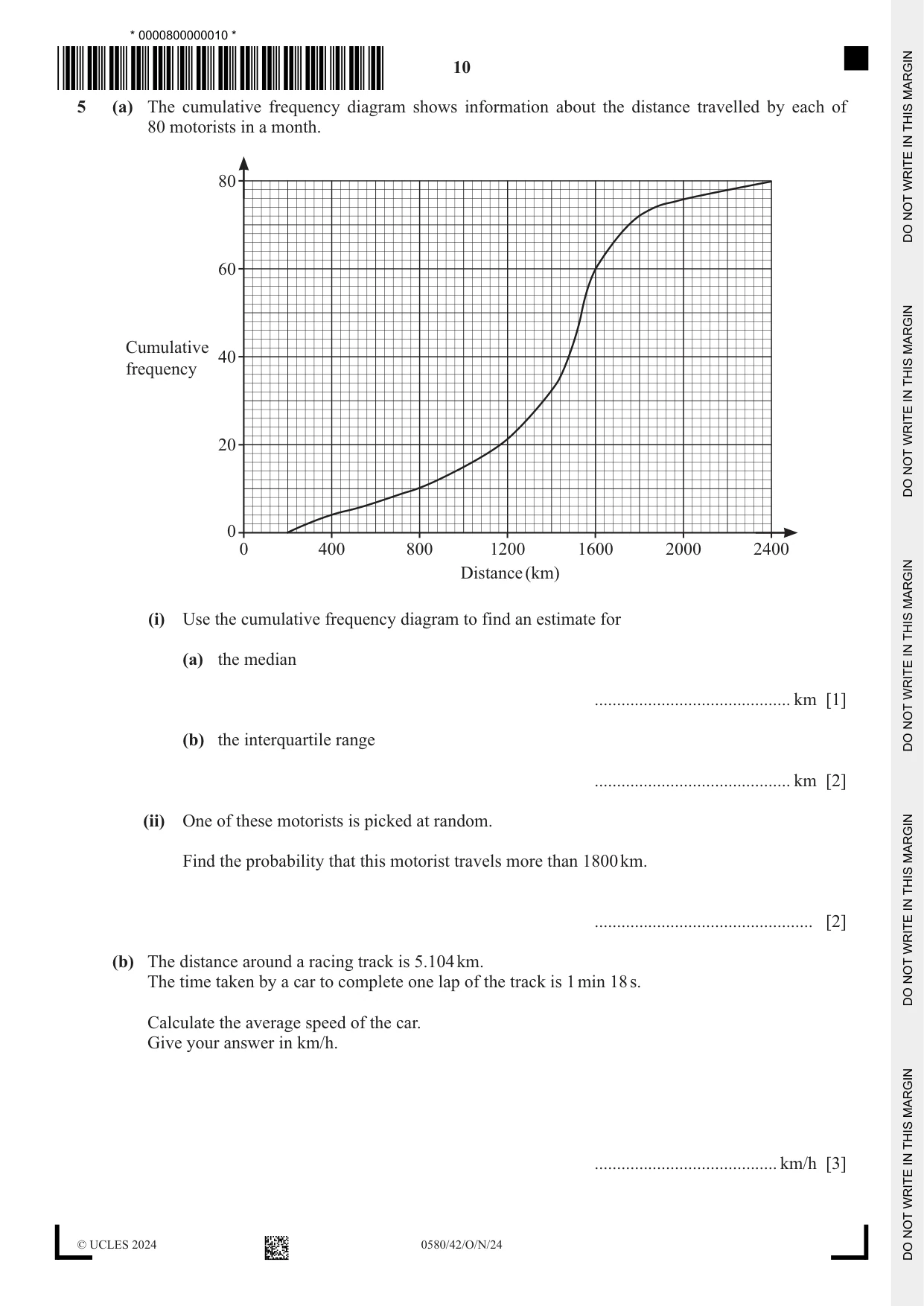
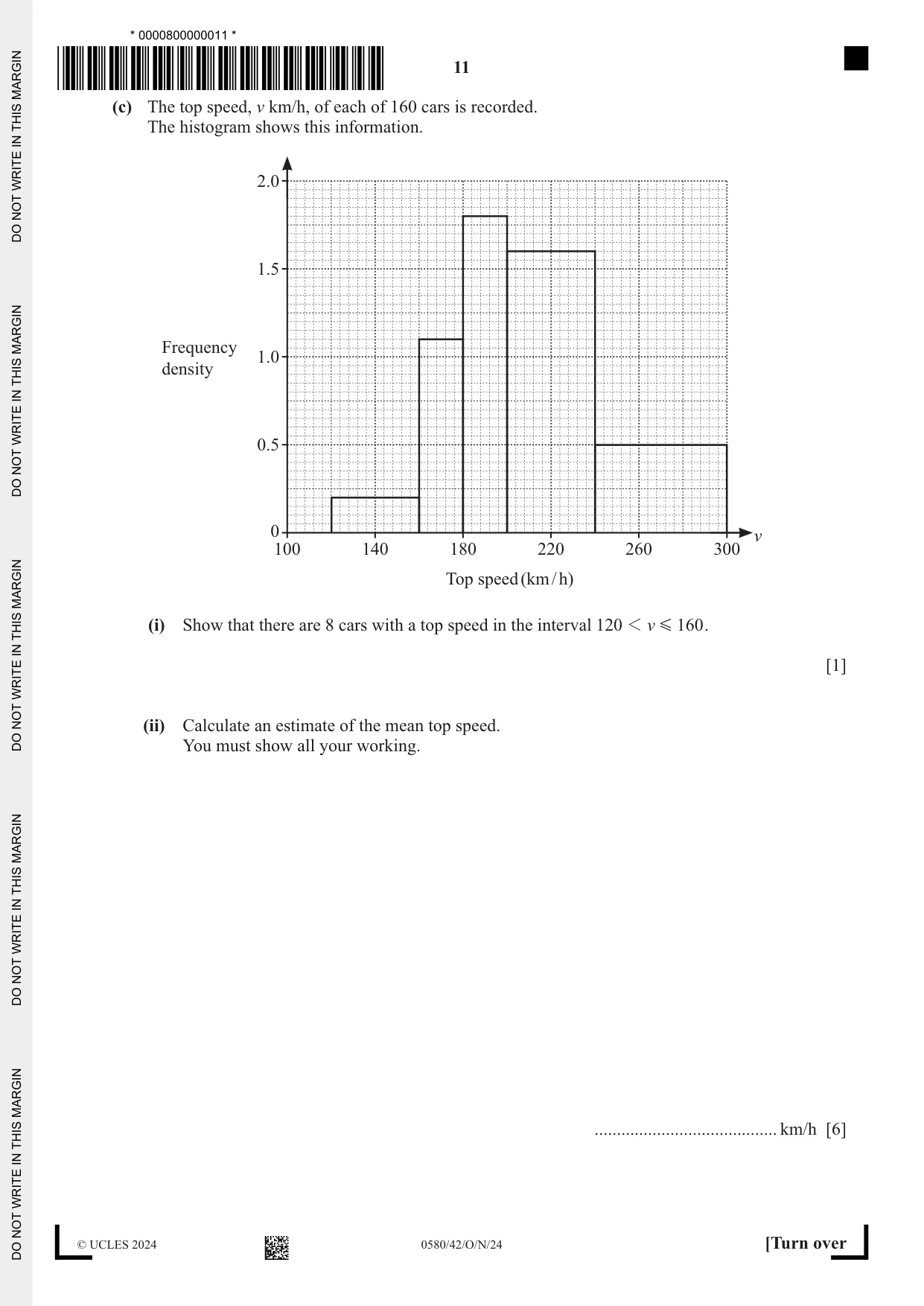
5 (a) The cumulative frequency diagram shows information about the distance travelled by each of 80 motorists in a month. 80 60 Cumulative 40 frequency 20 0 0 400 800 1200 1600 2000 2400 Distance (km) (i) Use the cumulative frequency diagram to find an estimate for (a) the median ............................................ km [1] (b) the interquartile range ............................................ km [2] (ii) One of these motorists is picked at random. Find the probability that this motorist travels more than 1800 km. ................................................. [2] (b) The distance around a racing track is 5.104 km. The time taken by a car to complete one lap of the track is 1 min 18 s. Calculate the average speed of the car. Give your answer in km/h. ......................................... km/h [3] (c) The top speed, v km/h, of each of 160 cars is recorded. The histogram shows this information. 2.0 1.5 Frequency 1.0 density 0.5 0 v 100 140 180 220 260 300 Top speed (km / h) (i) Show that there are 8 cars with a top speed in the interval 120 1 v G 160 . [1] (ii) Calculate an estimate of the mean top speed. You must show all your working. ......................................... km/h [6]
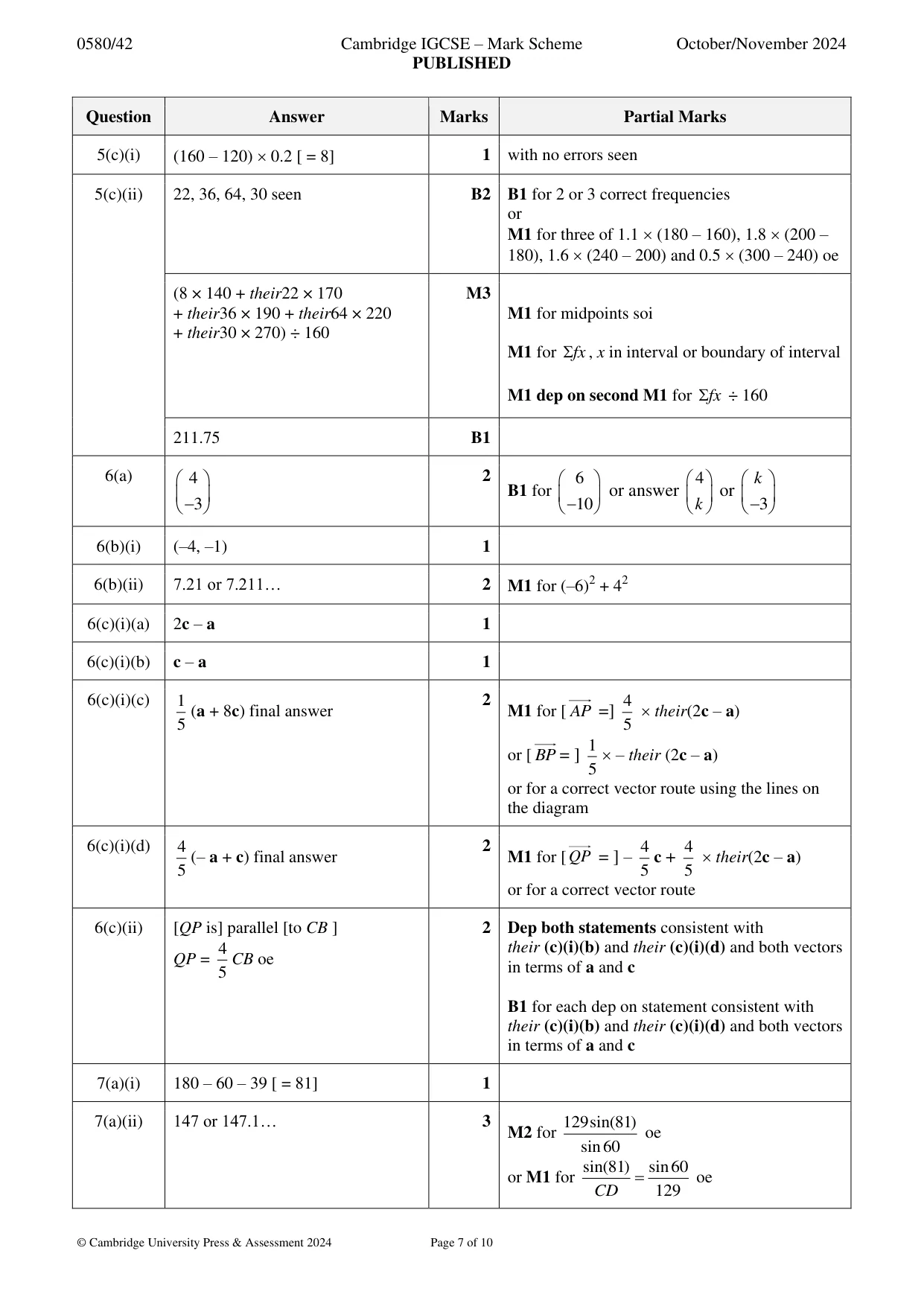
Mark scheme: 5(a)(i)(a) 1480 1 5(a)(i)(b) 440 2 M1 for [UQ =] 1600 soi or [LQ =] 1160 soi 5(a)(ii) 8 2 oe M1 for 72 or 8 written 80 5(b) 236 or 235.5 to 235.6 3 5.104 M2 for 60 oe 1.3 5.104 or M1 for their time 5(c)(i) (160 – 120) 0.2 [ = 8] 1 with no errors seen 5(c)(ii) 22, 36, 64, 30 seen B2 B1 for 2 or 3 correct frequencies or M1 for three of 1.1 (180 – 160), 1.8 (200 – 180), 1.6 (240 – 200) and 0.5 (300 – 240) oe (8 × 140 + their22 × 170 M3 + their36 × 190 + their64 × 220 M1 for midpoints soi + their30 × 270) ÷ 160 M1 for fx , x in interval or boundary of interval M1 dep on second M1 for fx ÷ 160 211.75 B1
Q6 · 2 6 (a) Work out 2 e o - e o
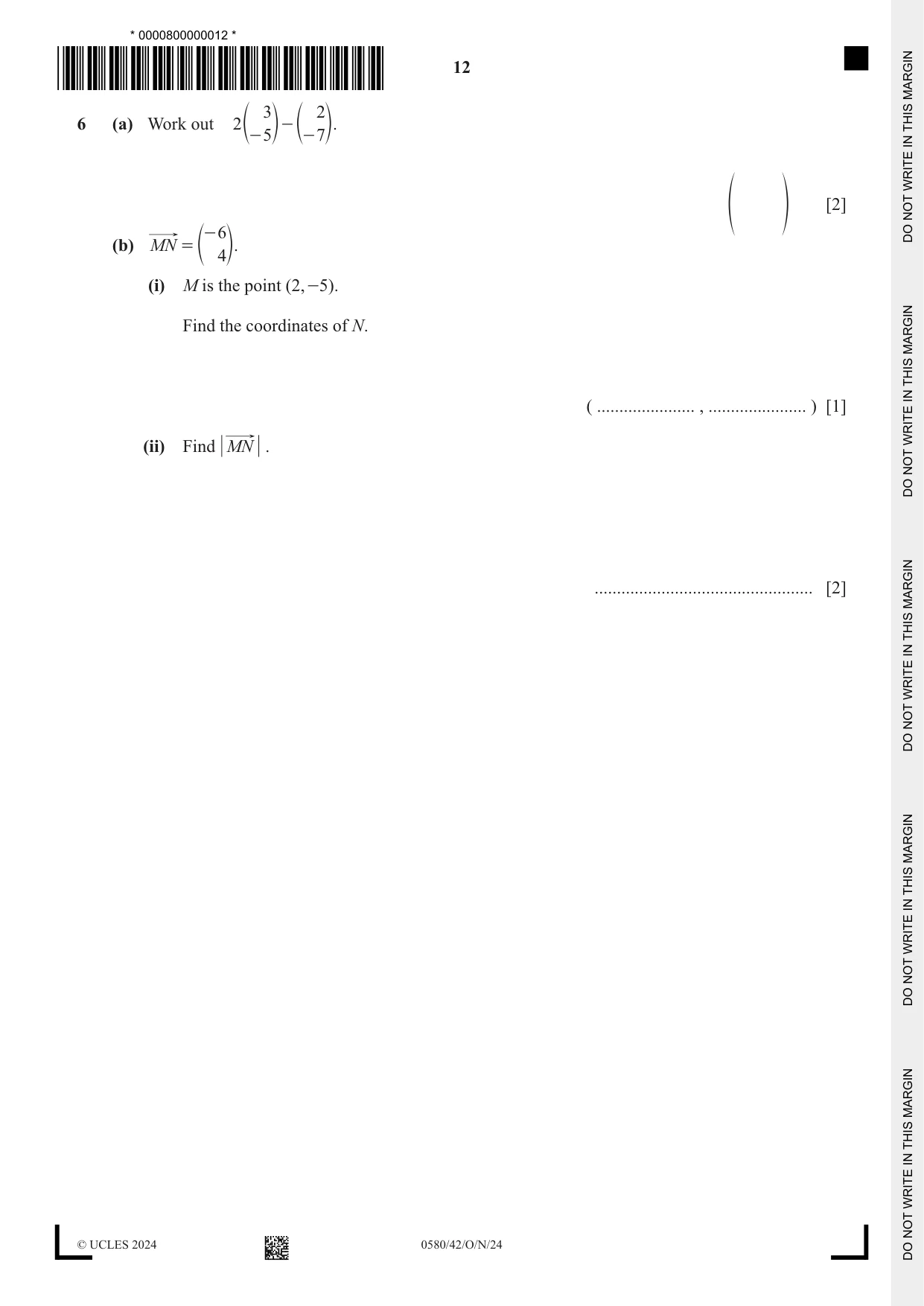
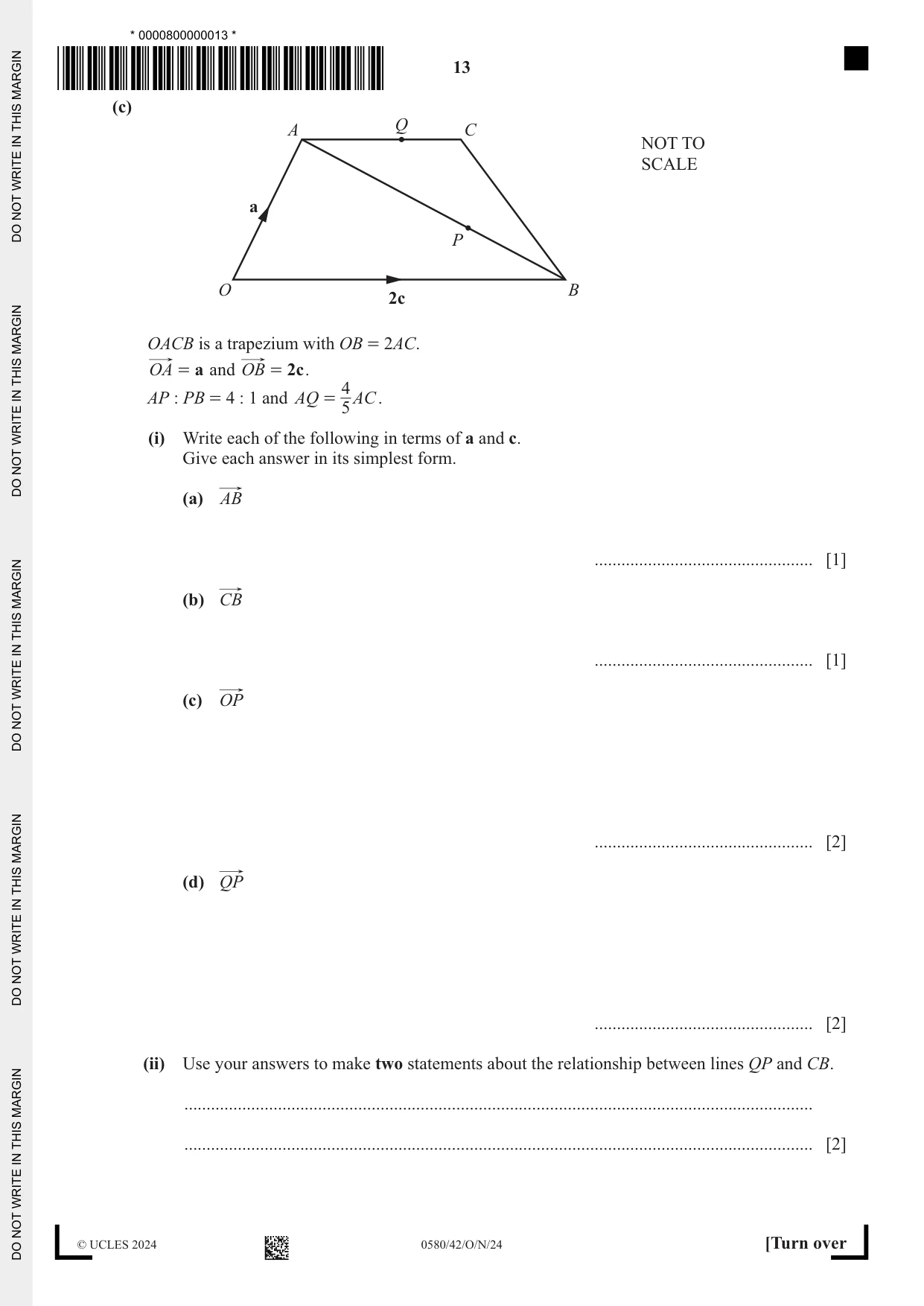
3 2 6 (a) Work out 2 e o - e o. - 5 - 7 f p [2] - 6 (b) MN = e o. 4 (i) M is the point (2, -5). Find the coordinates of N. ( ...................... , ...................... ) [1] (ii) Find MN . ................................................. [2] (c) A Q C NOT TO SCALE a P O B 2c OACB is a trapezium with OB = 2AC. OA = a and OB = 2c . 4 AP : PB = 4 : 1 and AQ = AC . 5 (i) Write each of the following in terms of a and c. Give each answer in its simplest form. (a) AB ................................................. [1] (b) CB ................................................. [1] (c) OP ................................................. [2] (d) QP ................................................. [2] (ii) Use your answers to make two statements about the relationship between lines QP and CB. ............................................................................................................................................. ............................................................................................................................................. [2]
Mark scheme: 6(a) 4 2 6 4 k B1 for or answer or −3 −10 k −3 6(b)(i) (–4, –1) 1 6(b)(ii) 7.21 or 7.211… 2 M1 for (–6)2 + 42 6(c)(i)(a) 2c – a 1 6(c)(i)(b) c – a 1 6(c)(i)(c) 1 2 4 (a + 8c) final answer M1 for [ AP =] their(2c – a) 5 5 1 or [ BP = ] – their (2c – a) 5 or for a correct vector route using the lines on the diagram 6(c)(i)(d) 4 2 4 4 (– a + c) final answer M1 for [QP = ] – c + their(2c – a) 5 5 5 or for a correct vector route 6(c)(ii) [QP is] parallel [to CB ] 2 Dep both statements consistent with 4 their (c)(i)(b) and their (c)(i)(d) and both vectors QP = CB oe in terms of a and c 5 B1 for each dep on statement consistent with their (c)(i)(b) and their (c)(i)(d) and both vectors in terms of a and c
Q7 · C 60° North B NOT TO SCALE 85 m 129 m 39° A 72 m D The diagram shows a field, ABCD with B…
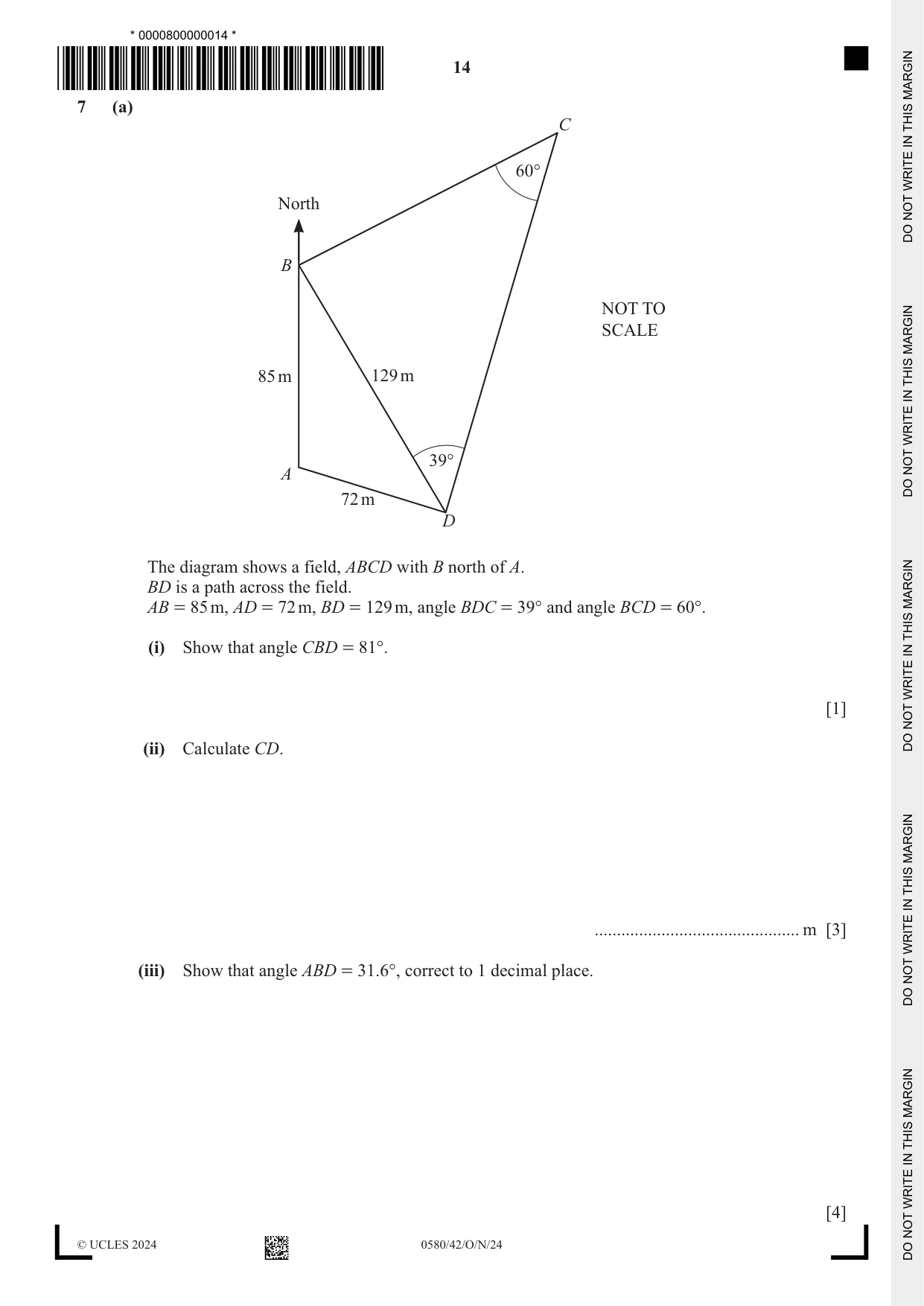
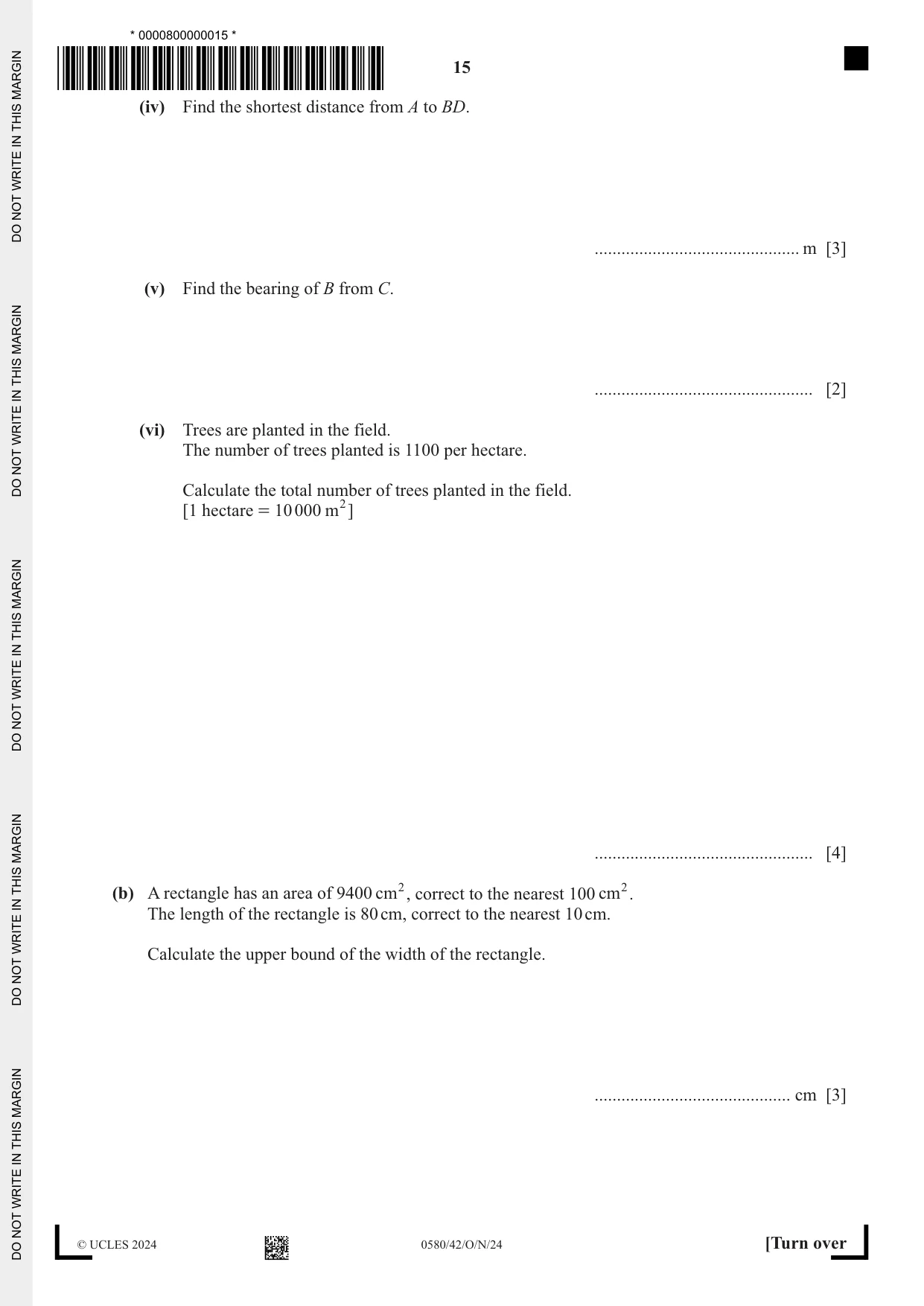
7 (a) C 60° North B NOT TO SCALE 85 m 129 m 39° A 72 m D The diagram shows a field, ABCD with B north of A. BD is a path across the field. AB = 85 m, AD = 72 m, BD = 129 m, angle BDC = 39° and angle BCD = 60°. (i) Show that angle CBD = 81°. [1] (ii) Calculate CD. .............................................. m [3] (iii) Show that angle ABD = 31.6°, correct to 1 decimal place. [4] (iv) Find the shortest distance from A to BD. .............................................. m [3] (v) Find the bearing of B from C. ................................................. [2] (vi) Trees are planted in the field. The number of trees planted is 1100 per hectare. Calculate the total number of trees planted in the field. [1 hectare = 10 000 m2] ................................................. [4] (b) A rectangle has an area of 9400 cm2, correct to the nearest 100 cm2. The length of the rectangle is 80 cm, correct to the nearest 10 cm. Calculate the upper bound of the width of the rectangle. ............................................ cm [3]
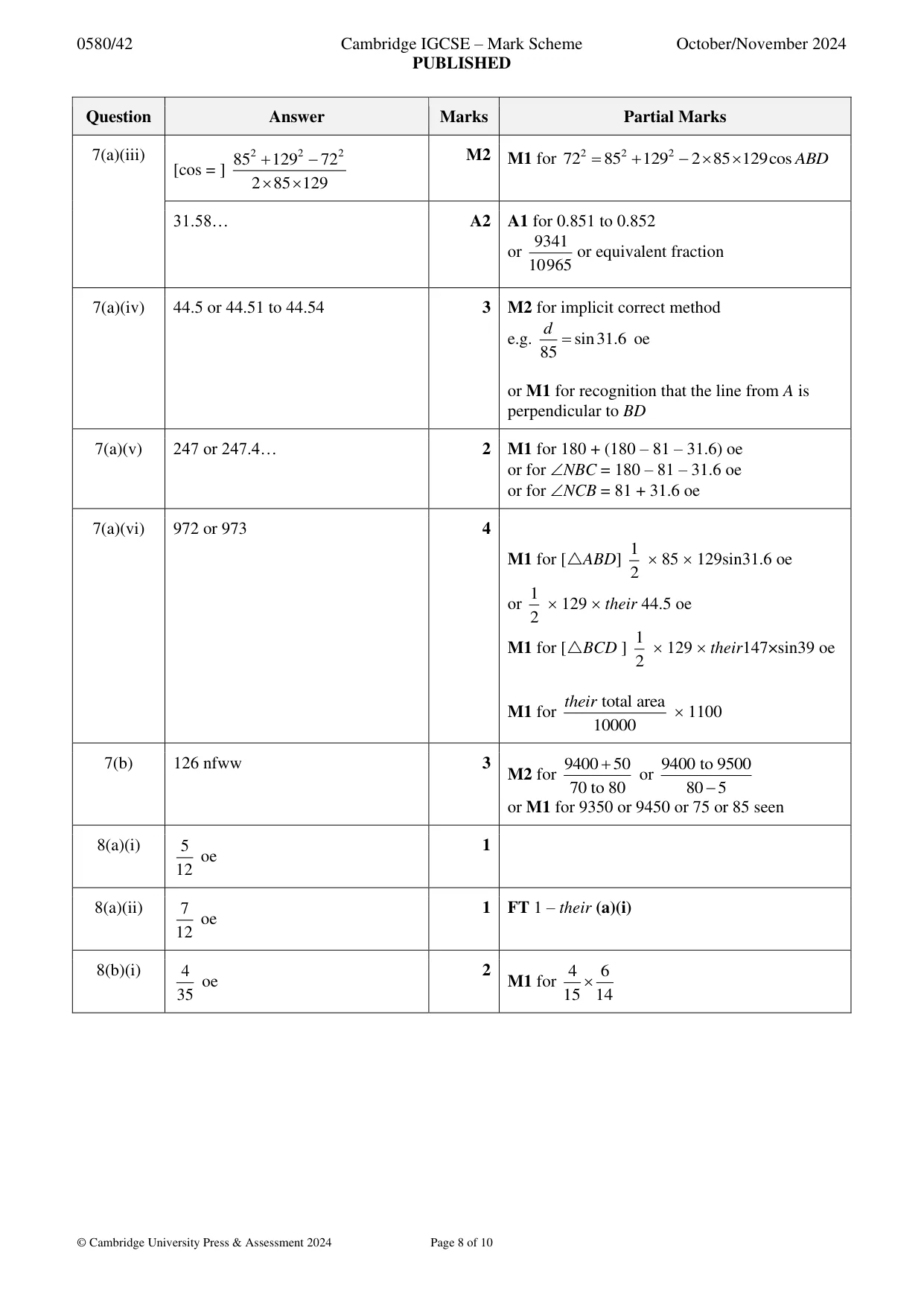
Mark scheme: 7(a)(i) 180 – 60 – 39 [ = 81] 1 7(a)(ii) 147 or 147.1… 3 129sin(81) M2 for oe sin60 sin(81) sin60 or M1 for = oe CD 129 7(a)(iii) 85 2 + 129 2 − 72 2 M2 M1 for 72 2 = 852 + 129 2 −2 85 129cos ABD [cos = ] 2 85 129 31.58… A2 A1 for 0.851 to 0.852 9341 or or equivalent fraction 10965 7(a)(iv) 44.5 or 44.51 to 44.54 3 M2 for implicit correct method d e.g. = sin31.6 oe 85 or M1 for recognition that the line from A is perpendicular to BD 7(a)(v) 247 or 247.4… 2 M1 for 180 + (180 – 81 – 31.6) oe or for NBC = 180 – 81 – 31.6 oe or for NCB = 81 + 31.6 oe 7(a)(vi) 972 or 973 4 1 M1 for [ABD] 85 129sin31.6 oe 2 1 or 129 their 44.5 oe 2 1 M1 for [BCD ] 129 their147×sin39 oe 2 their total area M1 for 1100 10000 7(b) 126 nfww 3 9400 + 50 9400 to 9500 M2 for or 70 to 80 80 − 5 or M1 for 9350 or 9450 or 75 or 85 seen
Q8 · A bag contains 24 coloured beads
8 (a) A bag contains 24 coloured beads. Some are red, some are blue and 10 are yellow. One bead is picked at random from the bag. Find the probability that (i) the bead is yellow ................................................. [1] (ii) the bead is not yellow. ................................................. [1] (b) Another bag contains 5 green marbles, 6 white marbles and 4 black marbles. Meera picks 2 marbles at random from the bag, without replacement. Find the probability that (i) the first marble is black and the second marble is white ................................................. [2] (ii) both marbles have different colours. ................................................. [4]
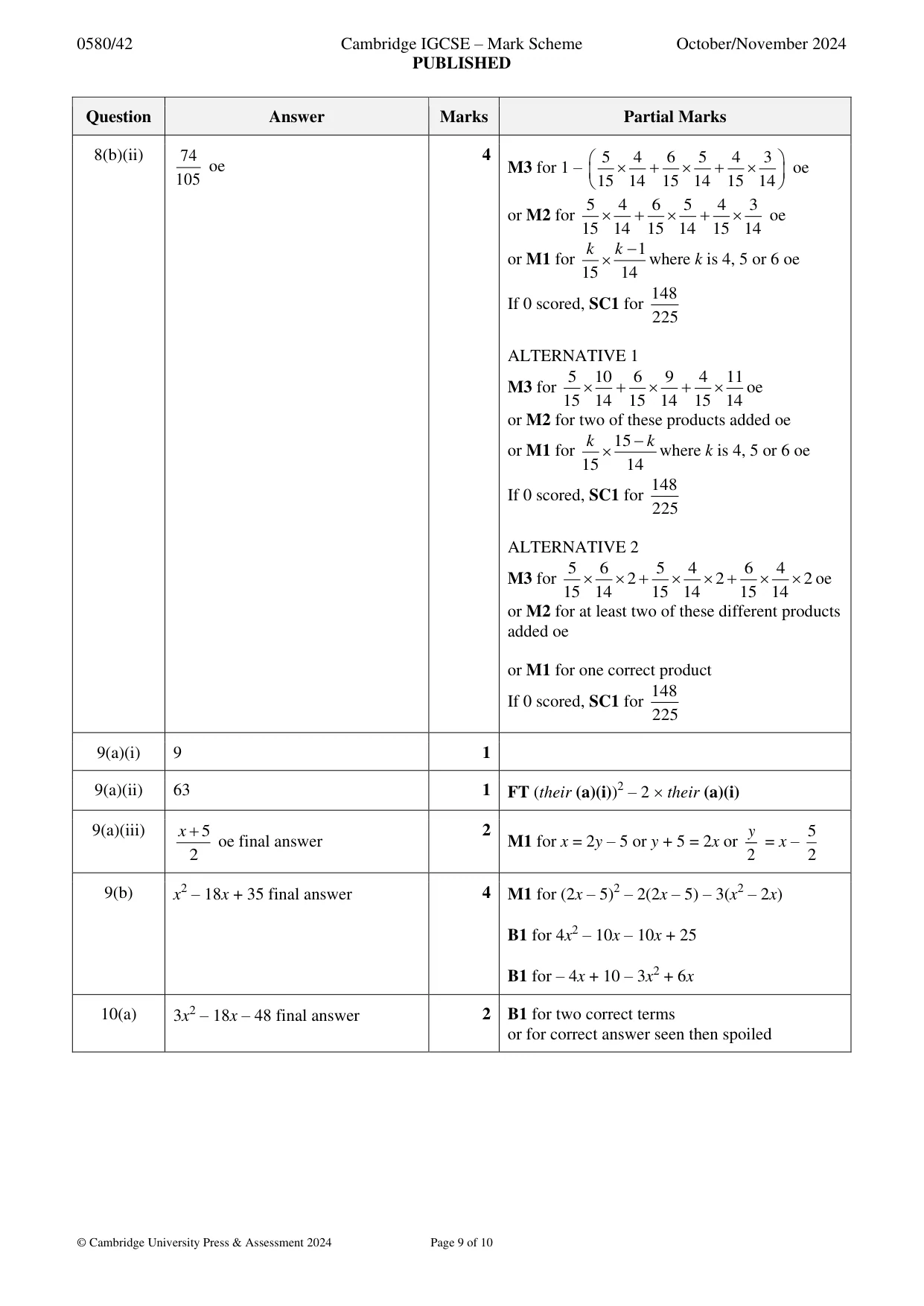
Mark scheme: 8(a)(i) 5 1 oe 12 8(a)(ii) 7 1 FT 1 – their (a)(i) oe 12 8(b)(i) 4 2 4 6 oe M1 for 35 15 14 8(b)(ii) 74 4 5 4 6 5 4 3 oe M3 for 1 – + + oe 105 15 14 15 14 15 14 5 4 6 5 4 3 or M2 for + + oe 15 14 15 14 15 14 k k − 1 or M1 for where k is 4, 5 or 6 oe 15 14 148 If 0 scored, SC1 for 225 ALTERNATIVE 1 5 10 6 9 4 11 M3 for + + oe 15 14 15 14 15 14 or M2 for two of these products added oe k 15 − k or M1 for where k is 4, 5 or 6 oe 15 14 148 If 0 scored, SC1 for 225 ALTERNATIVE 2 5 6 5 4 6 4 M3 for 2 + 2 + 2 oe 15 14 15 14 15 14 or M2 for at least two of these different products added oe or M1 for one correct product 148 If 0 scored, SC1 for 225
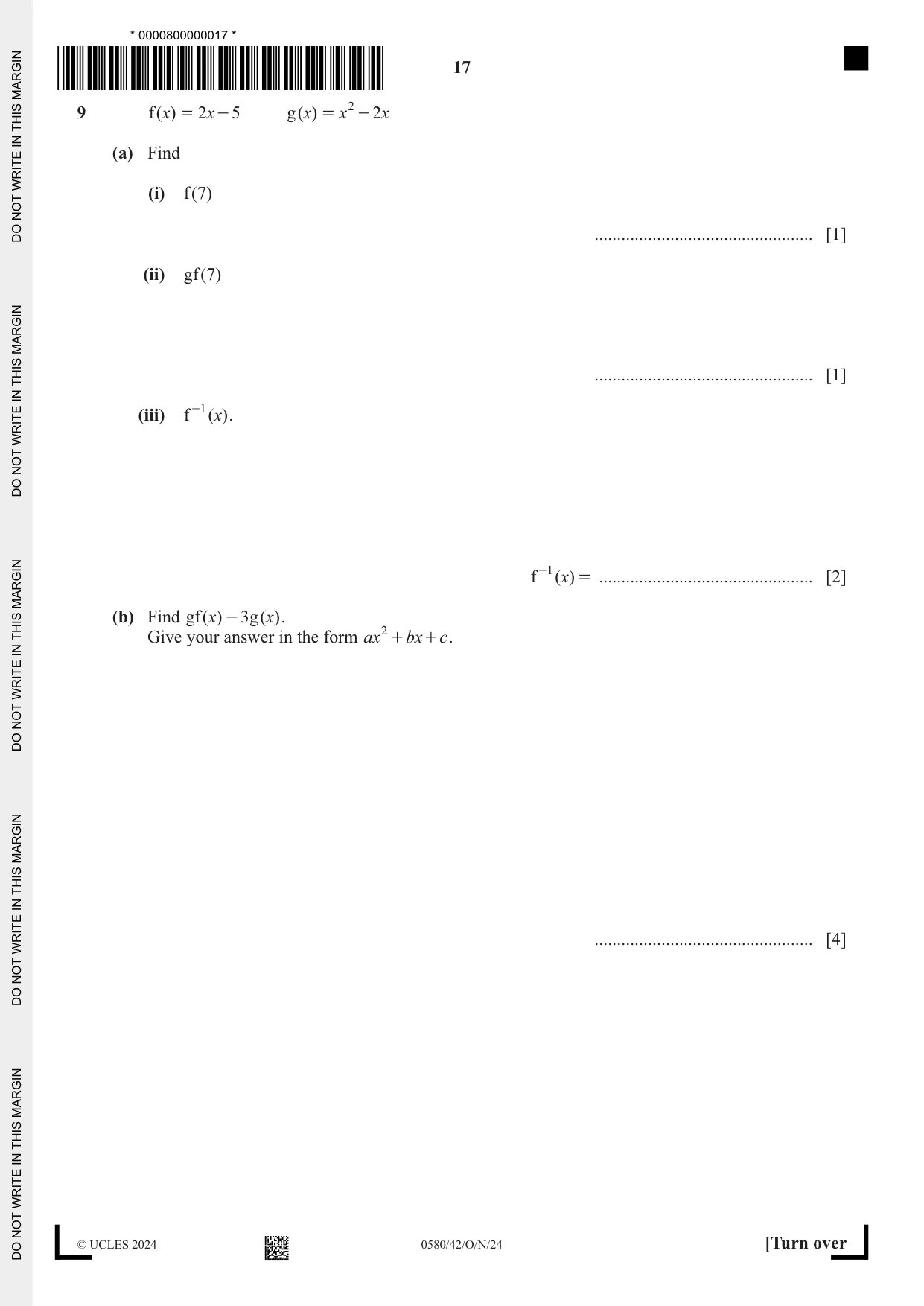
Q9 · F ( )x = 2x - 5 g ( )x = x 2 - 2x (a) Find (i) f ( 7 )…
9 f ( )x = 2x - 5 g ( )x = x 2 - 2x (a) Find (i) f ( 7 ) ................................................. [1] (ii) gf ( 7 ) ................................................. [1] (iii) f -1 ( )x . f -1 ( )x = ................................................ [2] (b) Find gf ( x) - 3g ( )x . Give your answer in the form ax 2 + bx + c . ................................................. [4]
Mark scheme: 9(a)(i) 9 1 9(a)(ii) 63 1 FT (their (a)(i))2 – 2 their (a)(i) 9(a)(iii) x + 5 2 y 5 oe final answer M1 for x = 2y – 5 or y + 5 = 2x or = x – 2 2 2 9(b) x2 – 18x + 35 final answer 4 M1 for (2x – 5)2 – 2(2x – 5) – 3(x2 – 2x) B1 for 4x2 – 10x – 10x + 25 B1 for – 4x + 10 – 3x2 + 6x
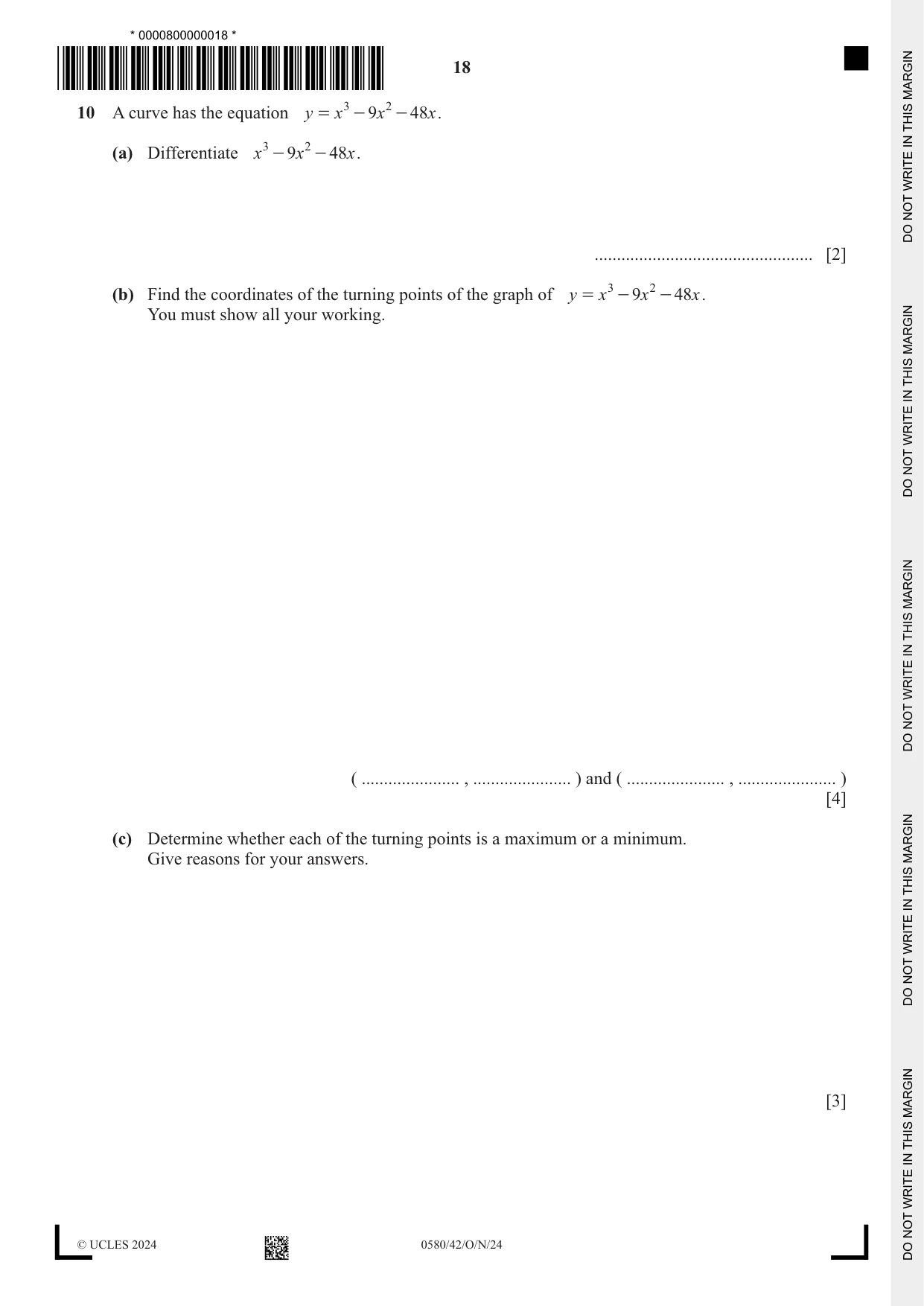
Q10 · A curve has the equation y = x 3 - 9x 2 - 48 x
10 A curve has the equation y = x 3 - 9x 2 - 48 x . (a) Differentiate x 3 - 9x 2 - 48x . ................................................. [2] (b) Find the coordinates of the turning points of the graph of y = x 3 - 9x 2 - 48 x . You must show all your working. ( ...................... , ...................... ) and ( ...................... , ...................... ) [4] (c) Determine whether each of the turning points is a maximum or a minimum. Give reasons for your answers. [3]
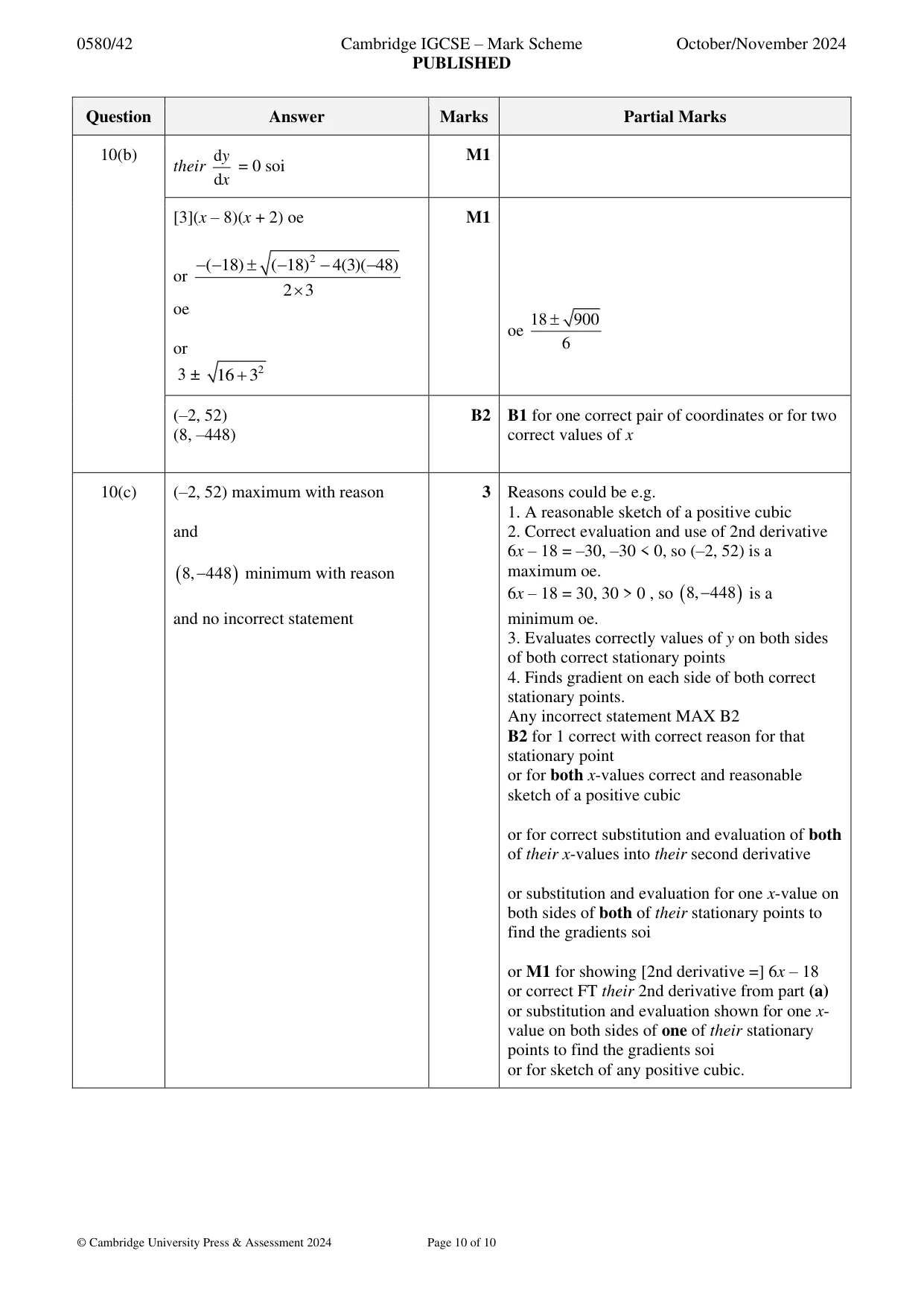
Mark scheme: 10(a) 3x2 – 18x – 48 final answer 2 B1 for two correct terms or for correct answer seen then spoiled 10(b) d y M1 their = 0 soi d x [3](x – 8)(x + 2) oe M1 −−( 18) ( −18) 2 − 4(3)( −48) or 2 3 oe 18 900 oe or 6 3 ± 16 + 32 (–2, 52) B2 B1 for one correct pair of coordinates or for two (8, –448) correct values of x 10(c) (–2, 52) maximum with reason 3 Reasons could be e.g. 1. A reasonable sketch of a positive cubic and 2. Correct evaluation and use of 2nd derivative 6x – 18 = –30, –30 < 0, so (–2, 52) is a ( 8, − 448 ) minimum with reason maximum oe. 6x – 18 = 30, 30 > 0 , so ( 8, − 448 ) is a and no incorrect statement minimum oe. 3. Evaluates correctly values of y on both sides of both correct stationary points 4. Finds gradient on each side of both correct stationary points. Any incorrect statement MAX B2 B2 for 1 correct with correct reason for that stationary point or for both x-values correct and reasonable sketch of a positive cubic or for correct substitution and evaluation of both of their x-values into their second derivative or substitution and evaluation for one x-value on both sides of both of their stationary points to find the gradients soi or M1 for showing [2nd derivative =] 6x – 18 or correct FT their 2nd derivative from part (a) or substitution and evaluation shown for one x- value on both sides of one of their stationary points to find the gradients soi or for sketch of any positive cubic.
What was in this paper
The subtopics covered by these 10 questions, and how many questions each got. Open one in a new tab to see every Cambridge question on it.
What you needed in this session
Cambridge’s own grade thresholds for 2024 Oct/Nov, Paper 4 · Variant 2. A higher threshold means an easier paper — the bar moves with how the cohort did.