Cambridge IGCSE Mathematics 0580 — 2017 May/June Paper 4 · Variant 3
0580/43/M/J/17 · 11 questions · 130 marks · ≈146 min
The question paper and its mark scheme, free to read here and free to download. This is Cambridge’s own paper, exactly as it was sat.
Question paper20 pages
Mark scheme7 pages
Answers below. Sit the paper first if you are practising.
Questions as text
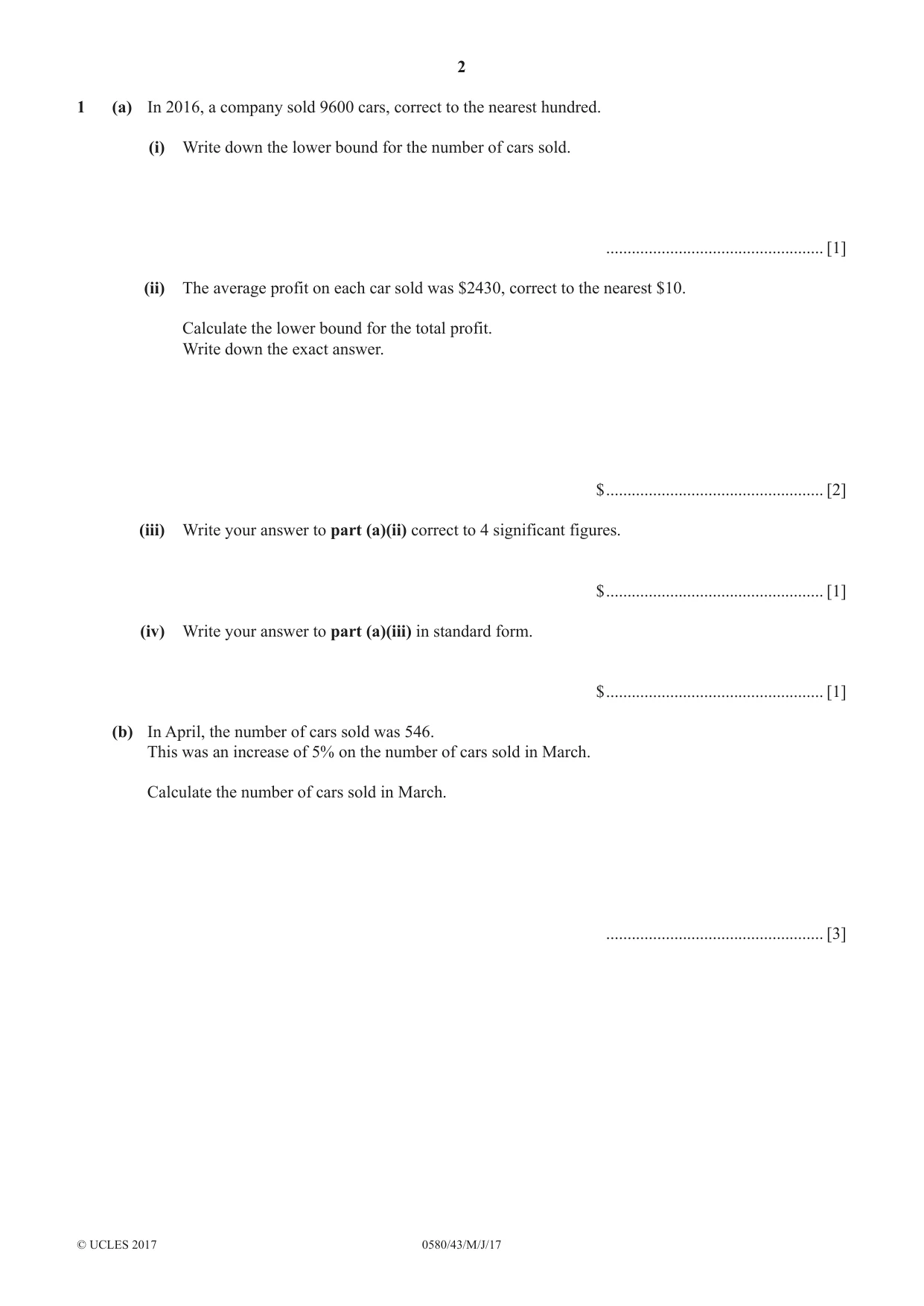
Q1 · In 2016, a company sold 9600 cars, correct to the nearest hundred
1 (a) In 2016, a company sold 9600 cars, correct to the nearest hundred. (i) Write down the lower bound for the number of cars sold. ................................................... [1] (ii) The average profit on each car sold was $2430, correct to the nearest $10. Calculate the lower bound for the total profit. Write down the exact answer. $ ................................................... [2] (iii) Write your answer to part (a)(ii) correct to 4 significant figures. $ ................................................... [1] (iv) Write your answer to part (a)(iii) in standard form. $ ................................................... [1] (b) In April, the number of cars sold was 546. This was an increase of 5% on the number of cars sold in March. Calculate the number of cars sold in March. ................................................... [3] (c) The price of a new car grows exponentially by 3% per year. A new car has a price of $3000 in 2013. Find the price of a new car 4 years later. $ ................................................... [2]
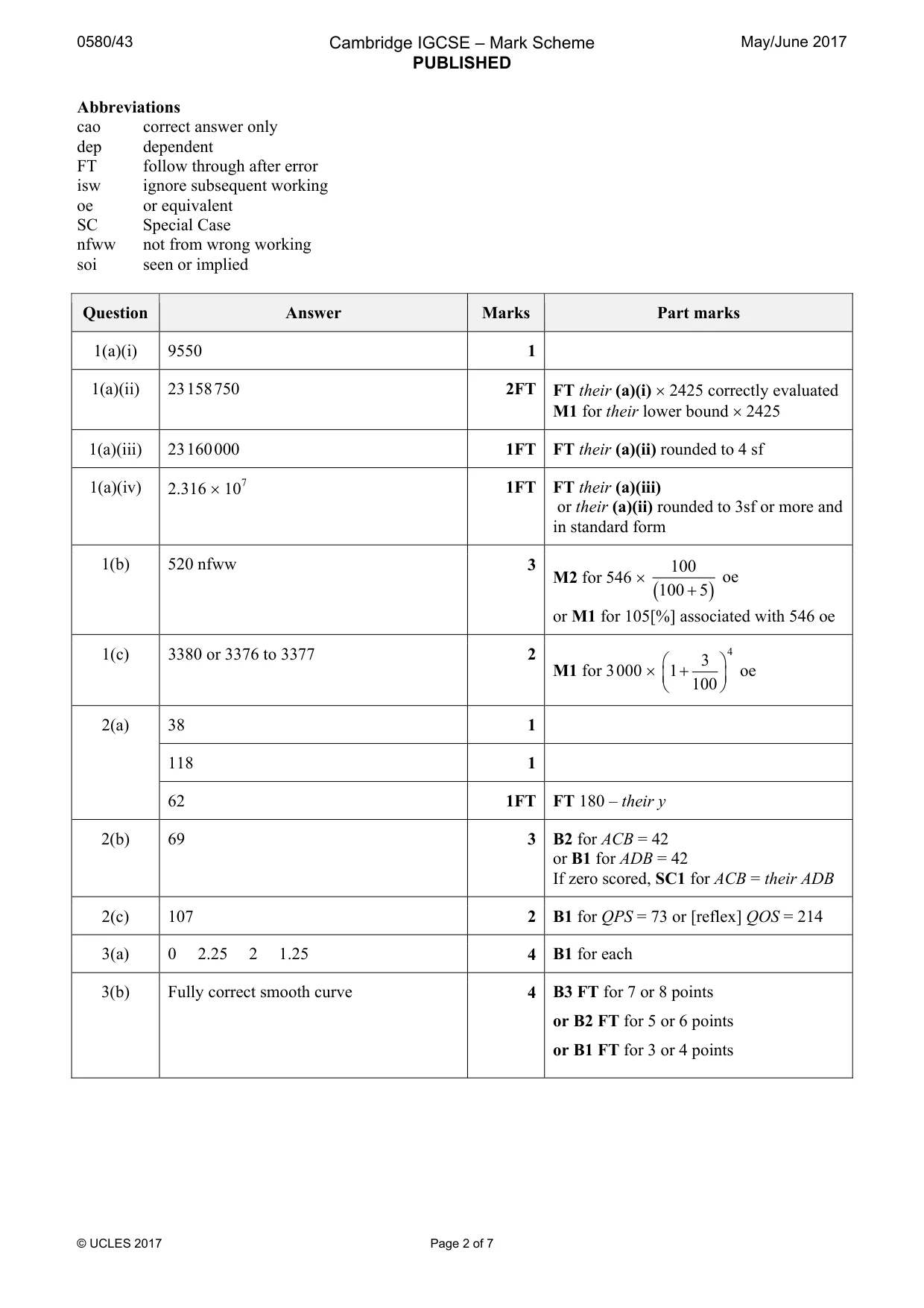
Mark scheme: Question Answer Marks Part marks 1(a)(i) 9550 1 1(a)(ii) 23 158 750 2FT FT their (a)(i) × 2425 correctly evaluated M1 for their lower bound × 2425 1(a)(iii) 23 160 000 1FT FT their (a)(ii) rounded to 4 sf 1(a)(iv) 2.316 × 10⁷ 1FT FT their (a)(iii) or their (a)(ii) rounded to 3sf or more and in standard form 1(b) 520 nfww 3 100 M2 for 546 × oe (100 + 5 ) or M1 for 105[%] associated with 546 oe 1(c) 3380 or 3376 to 3377 2 4 3 M1 for 3 000 × 1 + oe 100
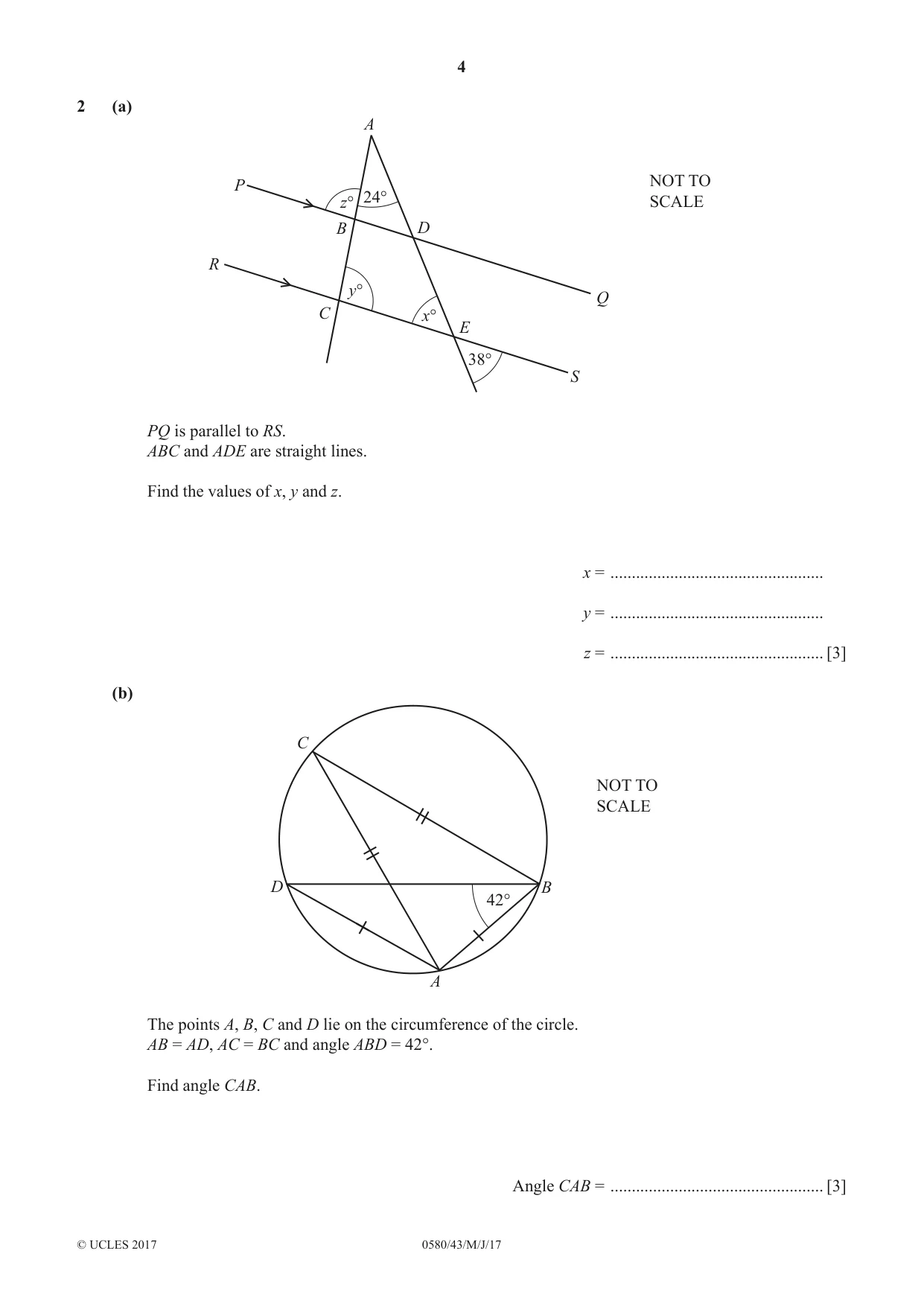
Q2 · A P NOT TO 24° SCALE z° B D R y° Q C x° E 38° S PQ is parallel to RS
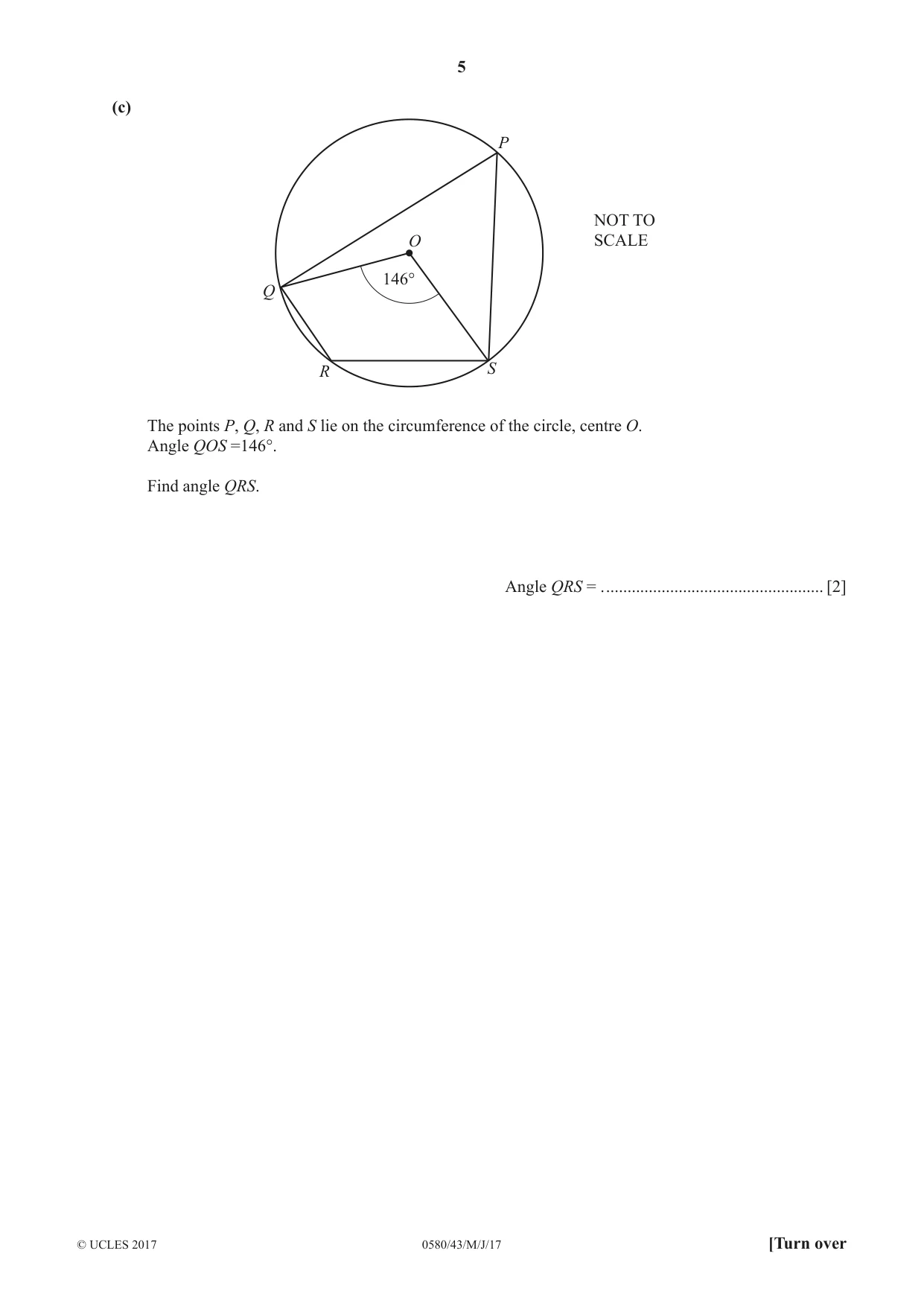
2 (a) A P NOT TO 24° SCALE z° B D R y° Q C x° E 38° S PQ is parallel to RS. ABC and ADE are straight lines. Find the values of x, y and z. x = .................................................. y = .................................................. z = .................................................. [3] (b) C NOT TO SCALE D B 42° A The points A, B, C and D lie on the circumference of the circle. AB = AD, AC = BC and angle ABD = 42°. Find angle CAB. Angle CAB = .................................................. [3] (c) P NOT TO O SCALE 146° Q R S The points P, Q, R and S lie on the circumference of the circle, centre O. Angle QOS =146°. Find angle QRS. Angle QRS = . ................................................... [2]
Mark scheme: 2(a) 38 1 118 1 62 1FT FT 180 – their y 2(b) 69 3 B2 for ACB = 42 or B1 for ADB = 42 If zero scored, SC1 for ACB = their ADB 2(c) 107 2 B1 for QPS = 73 or [reflex] QOS = 214
Q3 · The table shows some values for y = 2x 3 + 4x 2
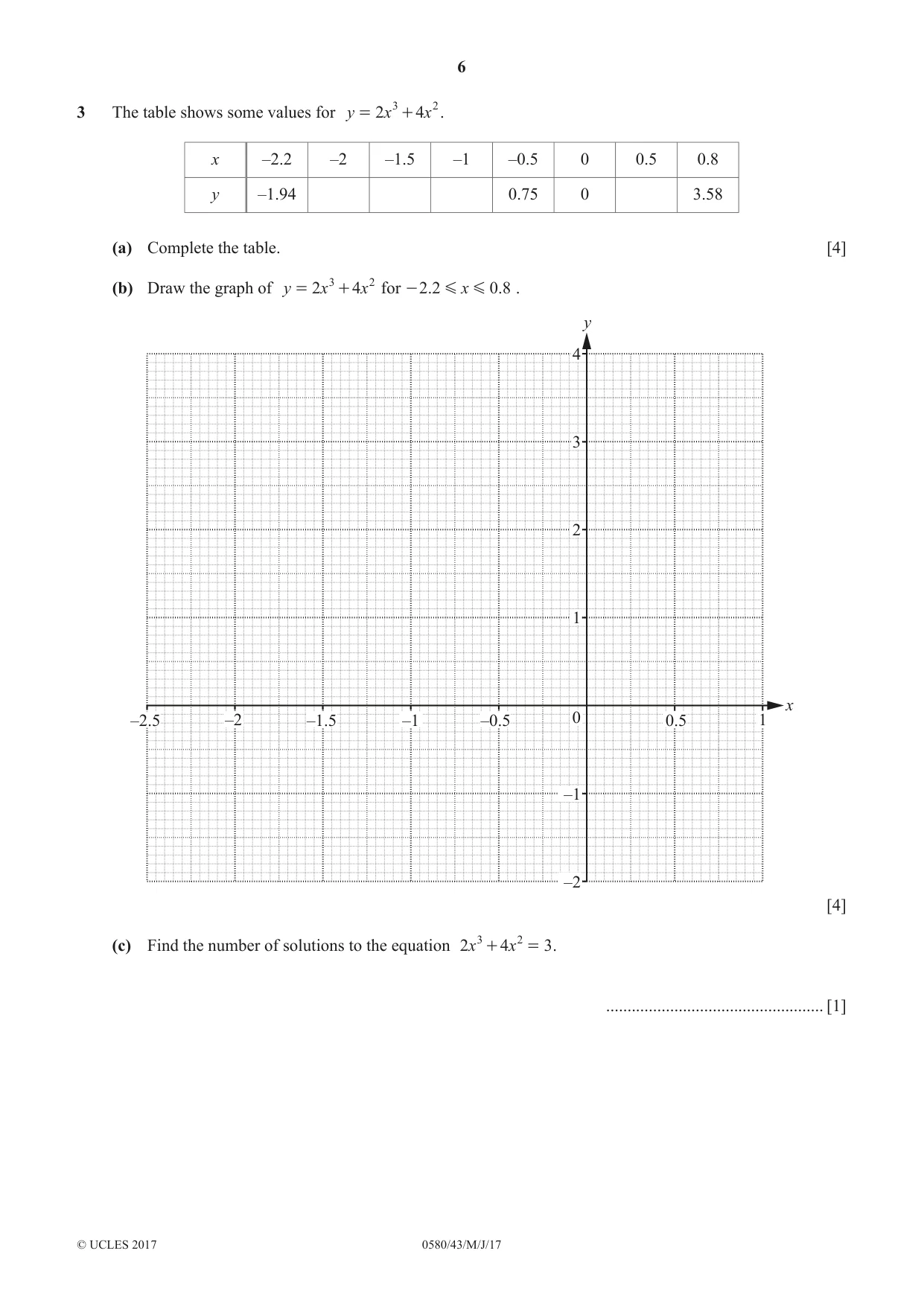
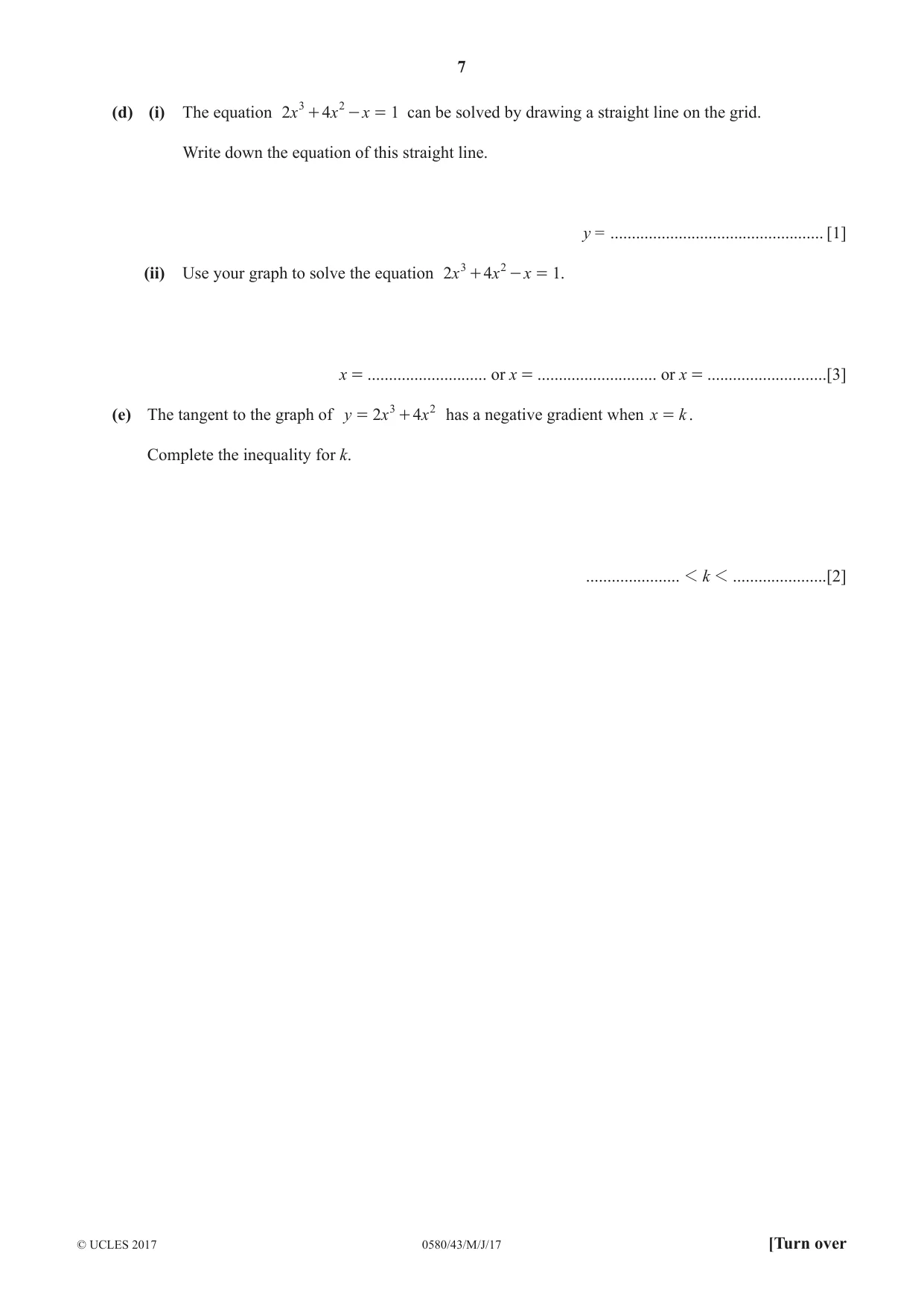
3 The table shows some values for y = 2x 3 + 4x 2 . x –2.2 –2 –1.5 –1 –0.5 0 0.5 0.8 y –1.94 0.75 0 3.58 (a) Complete the table. [4] (b) Draw the graph of y = 2x 3 + 4x 2 for - 2.2 G x G 0.8 . y 4 3 2 1 x –2.5 –2 –1.5 –1 –0.5 0 0.5 1 –1 –2 [4] (c) Find the number of solutions to the equation 2x 3 + 4x 2 = 3 . ................................................... [1] (d) (i) The equation 2x 3 + 4x 2 - x = 1 can be solved by drawing a straight line on the grid. Write down the equation of this straight line. y = .................................................. [1] (ii) Use your graph to solve the equation 2x 3 + 4x 2 - x = 1. x = ............................ or x = ............................ or x = ............................[3] (e) The tangent to the graph of y = 2x 3 + 4x 2 has a negative gradient when x = k . Complete the inequality for k. ...................... 1 k 1 ......................[2]
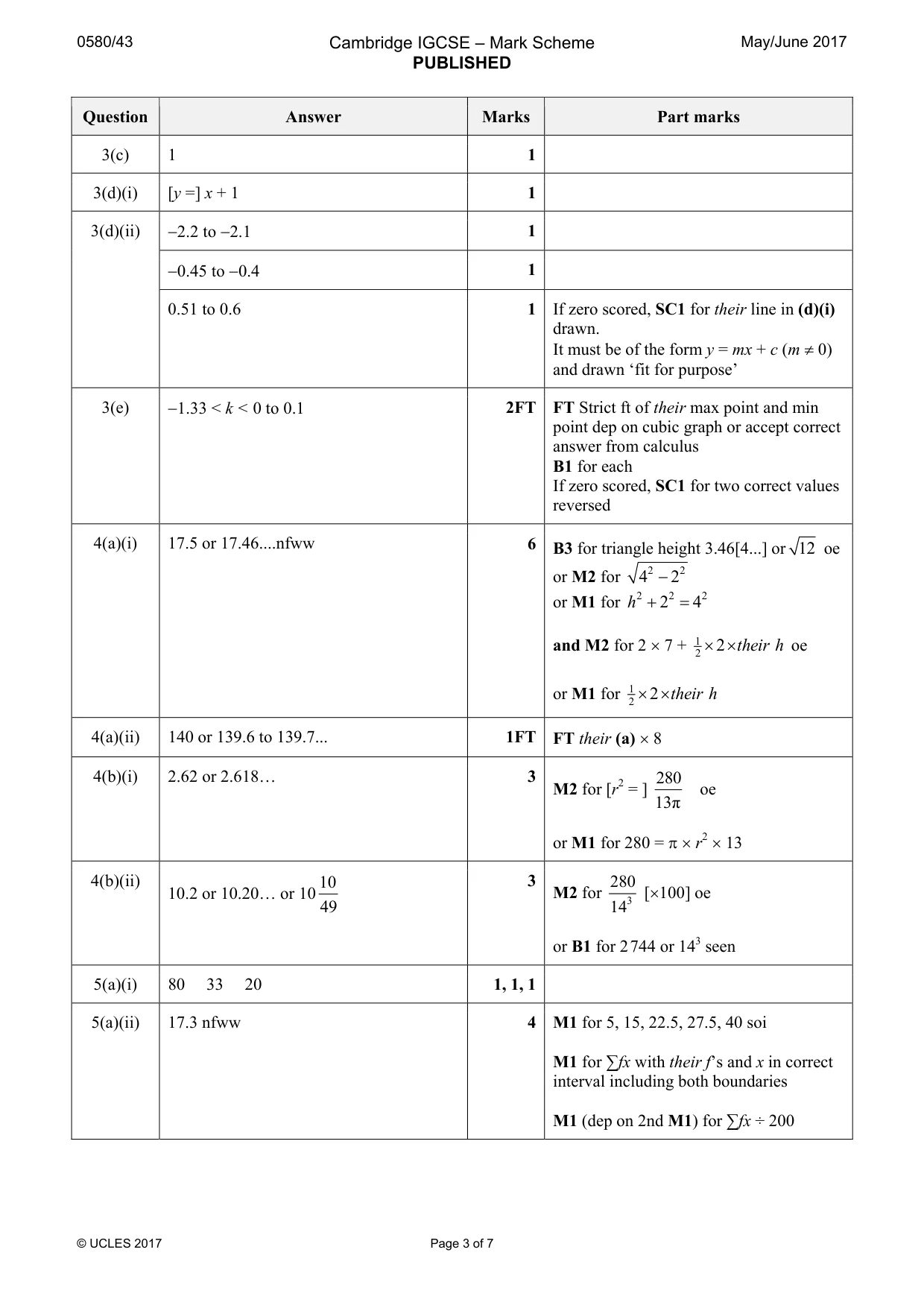
Mark scheme: 3(a) 0 2.25 2 1.25 4 B1 for each 3(b) Fully correct smooth curve 4 B3 FT for 7 or 8 points or B2 FT for 5 or 6 points or B1 FT for 3 or 4 points 3(c) 1 1 3(d)(i) [y =] x + 1 1 3(d)(ii) −2.2 to −2.1 1 −0.45 to −0.4 1 0.51 to 0.6 1 If zero scored, SC1 for their line in (d)(i) drawn. It must be of the form y = mx + c (m ≠ 0) and drawn ‘fit for purpose’ 3(e) −1.33 < k < 0 to 0.1 2FT FT Strict ft of their max point and min point dep on cubic graph or accept correct answer from calculus B1 for each If zero scored, SC1 for two correct values reversed
Q4 · The diagram shows a solid metal prism with cross section ABCDE
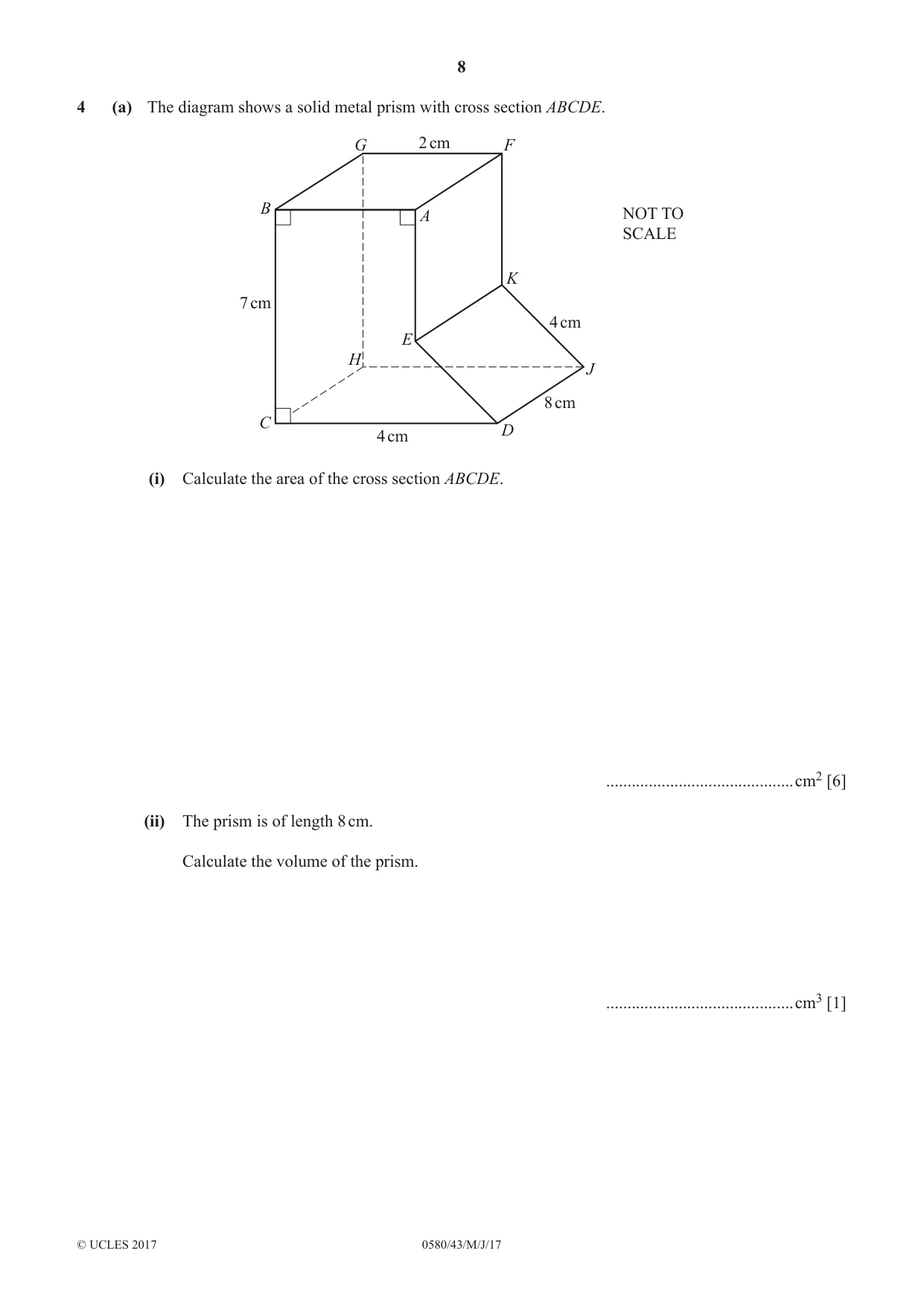
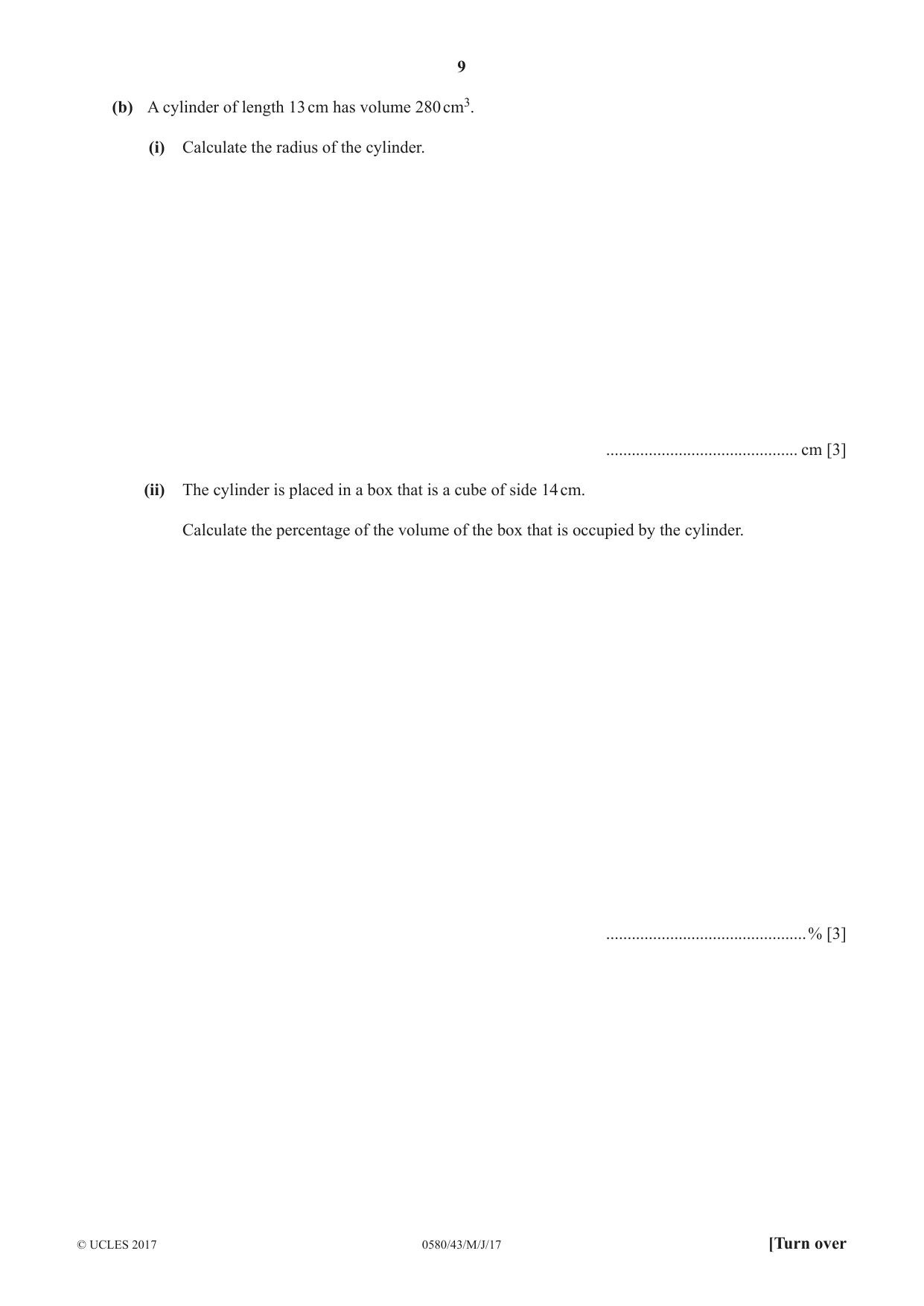
4 (a) The diagram shows a solid metal prism with cross section ABCDE. G 2 cm F B A NOT TO SCALE K 7 cm 4 cm E H J 8 cm C D 4 cm (i) Calculate the area of the cross section ABCDE. ............................................cm2 [6] (ii) The prism is of length 8 cm. Calculate the volume of the prism. ............................................cm3 [1] (b) A cylinder of length 13 cm has volume 280 cm3. (i) Calculate the radius of the cylinder. ............................................. cm [3] (ii) The cylinder is placed in a box that is a cube of side 14 cm. Calculate the percentage of the volume of the box that is occupied by the cylinder. ...............................................% [3]
Mark scheme: 4(a)(i) 17.5 or 17.46....nfww 6 B3 for triangle height 3.46[4...] or 12 oe or M2 for 4 2 − 2 2 or M1 for h 2 + 2 2 = 4 2 and M2 for 2 × 7 + 12 × 2 × their h oe or M1 for 12 × 2 × their h 4(a)(ii) 140 or 139.6 to 139.7... 1FT FT their (a) × 8 4(b)(i) 2.62 or 2.618… 3 280 M2 for [r2 = ] oe 13π or M1 for 280 = π × r2 × 13 4(b)(ii) 10 3 280 10.2 or 10.20… or 10 M2 for 3 [×100] oe 49 14 or B1 for 2 744 or 143 seen
Q5 · Haroon has 200 letters to post
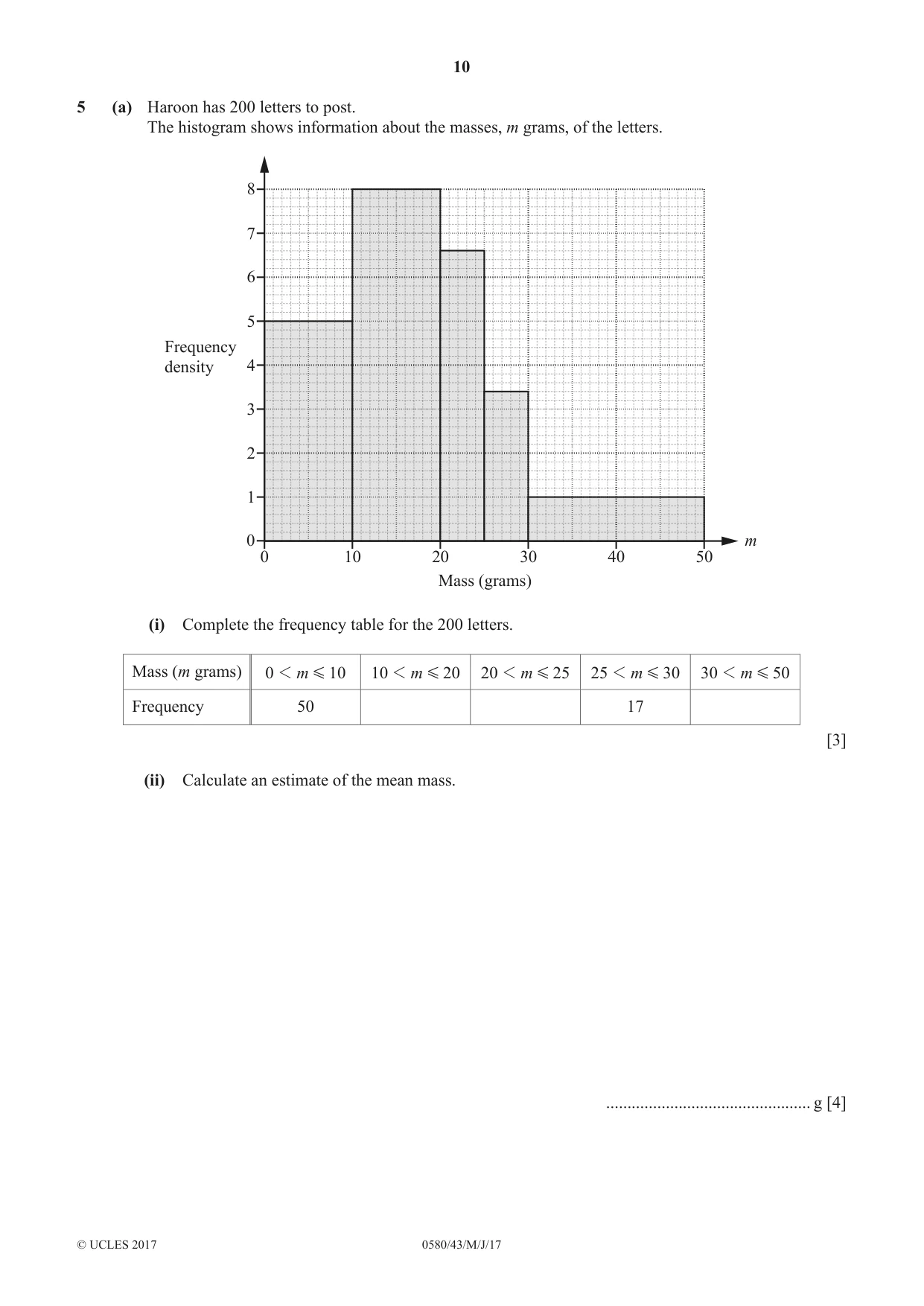
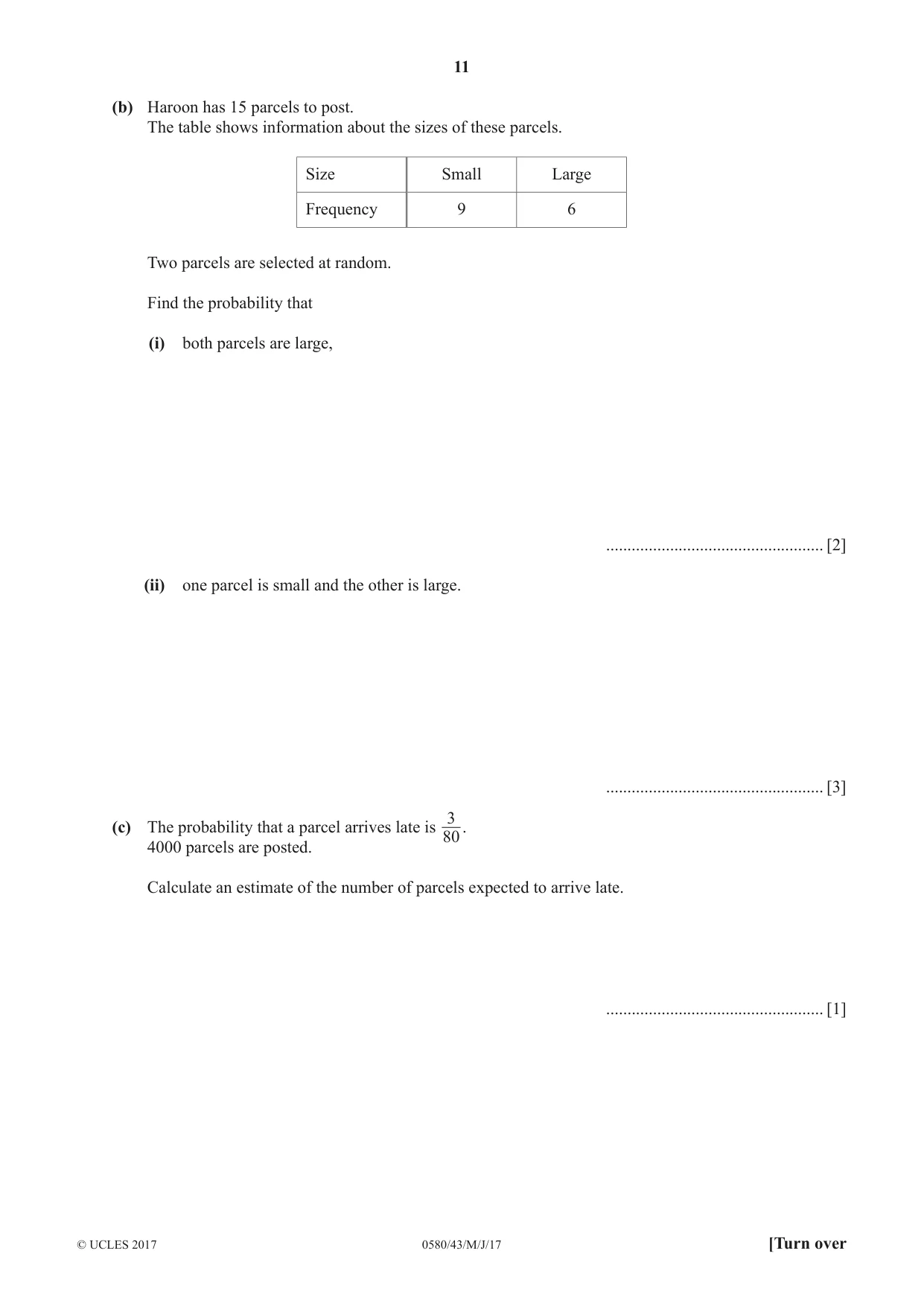
5 (a) Haroon has 200 letters to post. The histogram shows information about the masses, m grams, of the letters. 8 7 6 5 Frequency density 4 3 2 1 0 m 0 10 20 30 40 50 Mass (grams) (i) Complete the frequency table for the 200 letters. Mass (m grams) 0 1 m G 10 10 1 m G 20 20 1 m G 25 25 1 m G 30 30 1 m G 50 Frequency 50 17 [3] (ii) Calculate an estimate of the mean mass. ................................................ g [4] (b) Haroon has 15 parcels to post. The table shows information about the sizes of these parcels. Size Small Large Frequency 9 6 Two parcels are selected at random. Find the probability that (i) both parcels are large, ................................................... [2] (ii) one parcel is small and the other is large. ................................................... [3] 3(c) The probability that a parcel arrives late is . 80 4000 parcels are posted. Calculate an estimate of the number of parcels expected to arrive late. ................................................... [1]
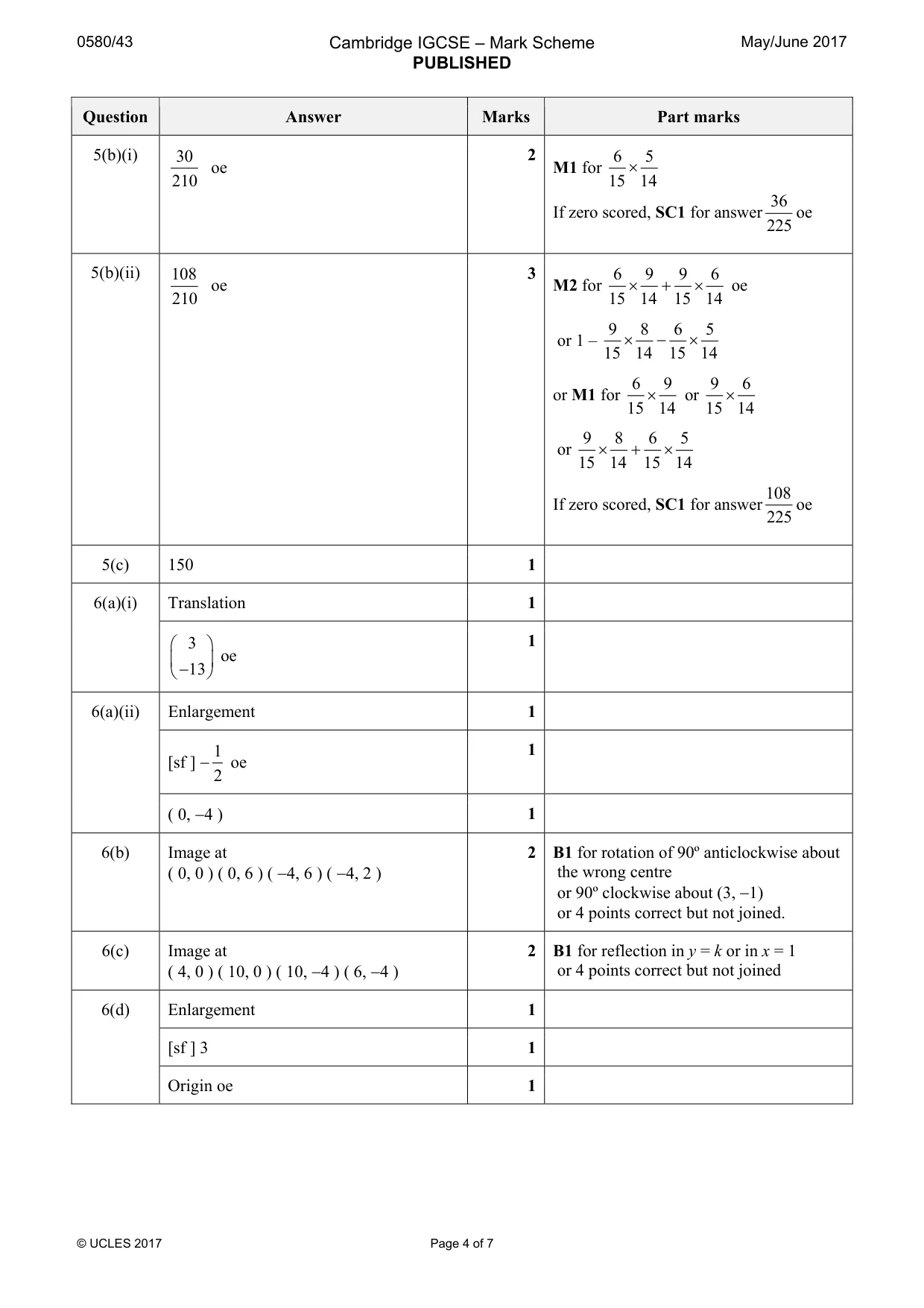
Mark scheme: 5(a)(i) 80 33 20 1, 1, 1 5(a)(ii) 17.3 nfww 4 M1 for 5, 15, 22.5, 27.5, 40 soi M1 for ∑fx with their f’s and x in correct interval including both boundaries M1 (dep on 2nd M1) for ∑fx ÷ 200 5(b)(i) 30 2 6 5 oe M1 for × 210 15 14 36 If zero scored, SC1 for answer oe 225 5(b)(ii) 108 3 6 9 9 6 oe M2 for × + × oe 210 15 14 15 14 9 8 6 5 or 1 – × − × 15 14 15 14 6 9 9 6 or M1 for × or × 15 14 15 14 9 8 6 5 or × + × 15 14 15 14 108 If zero scored, SC1 for answer oe 225 5(c) 150 1
Q6 · Y 12 10 8 6 A 4 2 x –10 –8 –6 –4 –2 0 2 4 6 8 10 12 14 –2 –4 –6 C –8 B –10 –12 (a)…
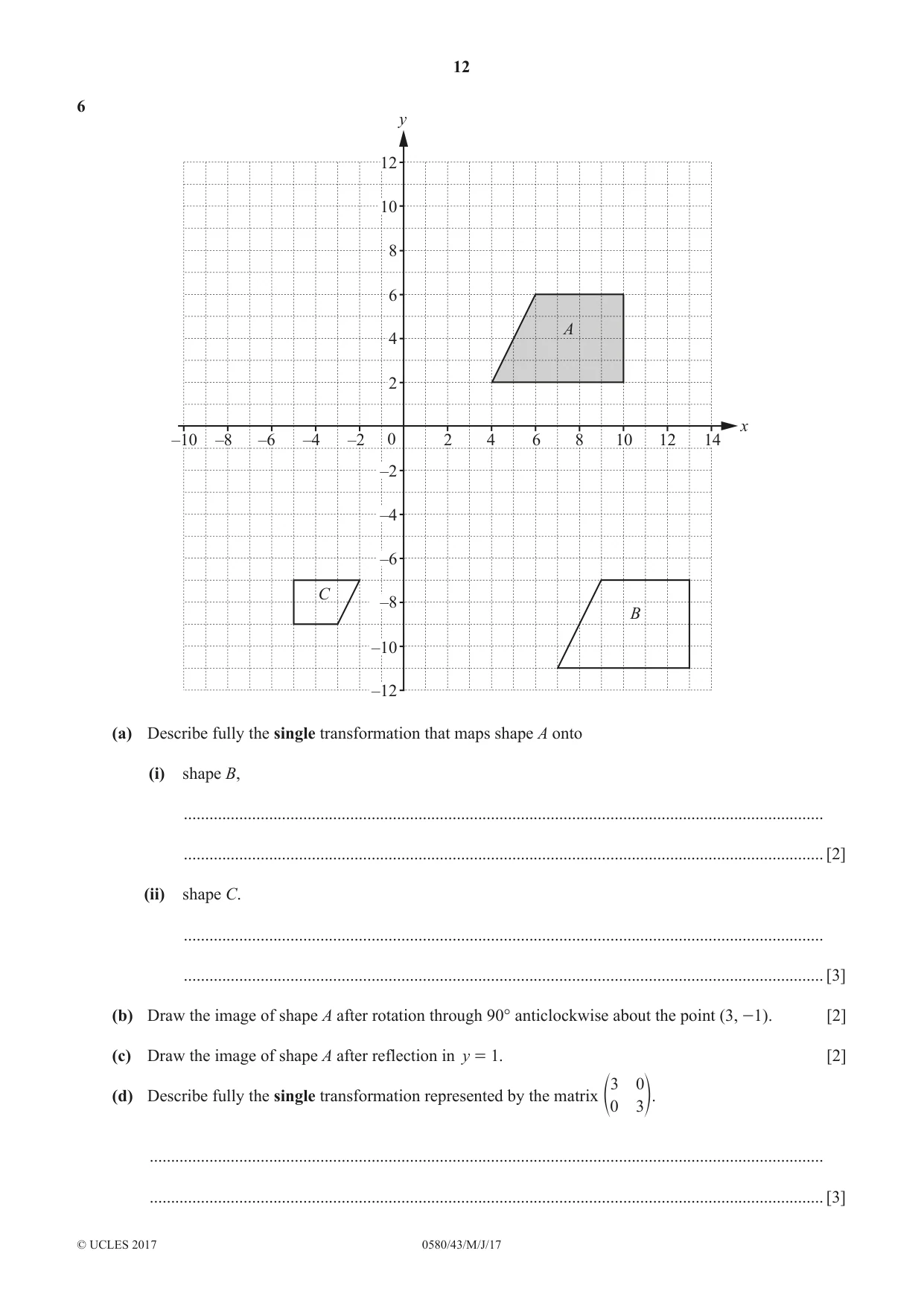
6 y 12 10 8 6 A 4 2 x –10 –8 –6 –4 –2 0 2 4 6 8 10 12 14 –2 –4 –6 C –8 B –10 –12 (a) Describe fully the single transformation that maps shape A onto (i) shape B, ...................................................................................................................................................... ...................................................................................................................................................... [2] (ii) shape C. ...................................................................................................................................................... ...................................................................................................................................................... [3] (b) Draw the image of shape A after rotation through 90° anticlockwise about the point (3, -1). [2] (c) Draw the image of shape A after reflection in y = 1. [2] 3 0 (d) Describe fully the single transformation represented by the matrix f0 3p. .............................................................................................................................................................. .............................................................................................................................................................. [3]
Mark scheme: 6(a)(i) Translation 1 3 1 oe − 13 6(a)(ii) Enlargement 1 1 [sf ] −1 oe 2 ( 0, −4 ) 1 6(b) Image at 2 B1 for rotation of 90º anticlockwise about ( 0, 0 ) ( 0, 6 ) ( −4, 6 ) ( −4, 2 ) the wrong centre or 90º clockwise about (3, −1) or 4 points correct but not joined. 6(c) Image at 2 B1 for reflection in y = k or in x = 1 ( 4, 0 ) ( 10, 0 ) ( 10, −4 ) ( 6, −4 ) or 4 points correct but not joined 6(d) Enlargement 1 [sf ] 3 1 Origin oe 1
Q7 · Solve the simultaneous equations
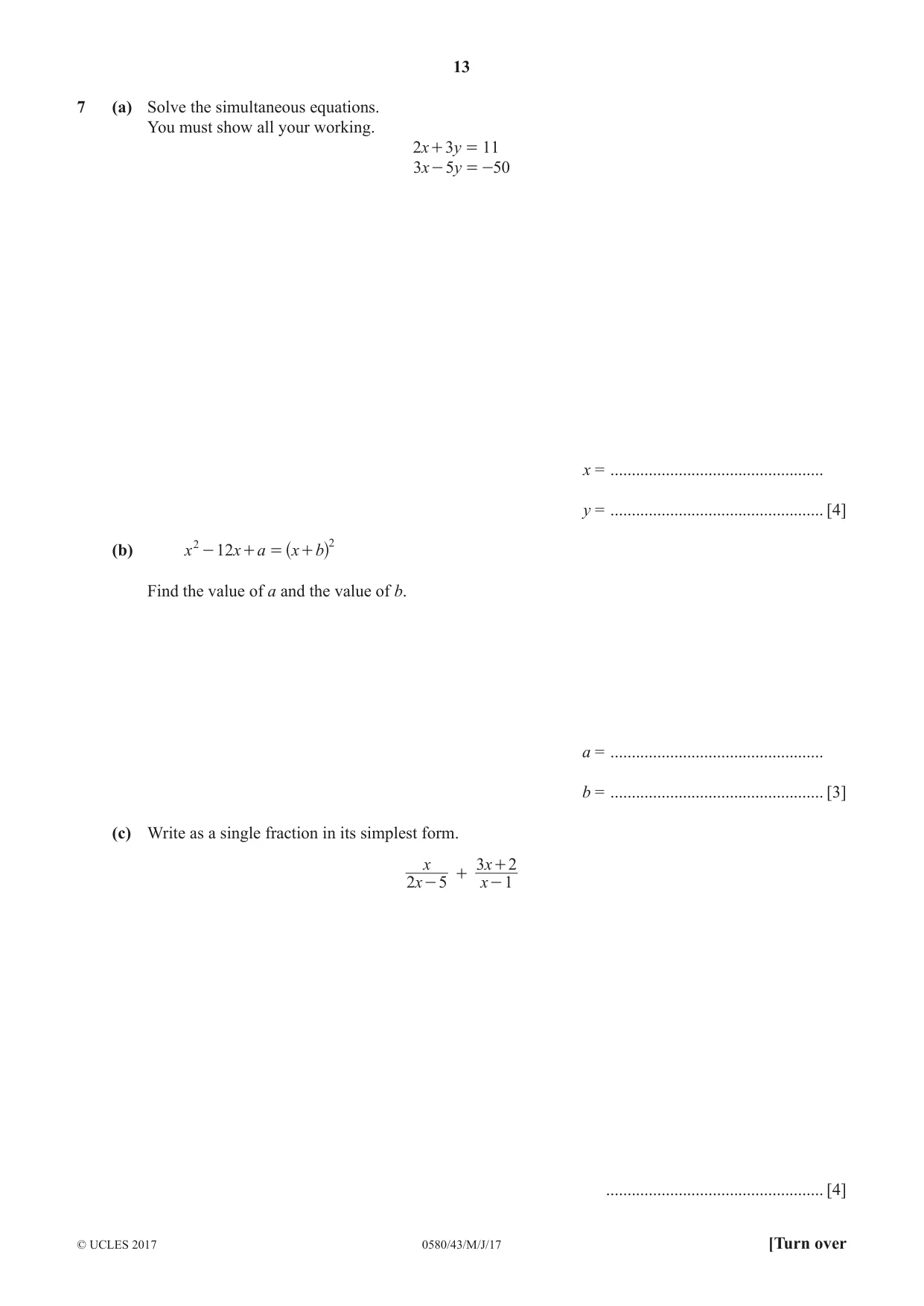
7 (a) Solve the simultaneous equations. You must show all your working. 2x + 3y = 11 3x - 5y = -50 x = .................................................. y = .................................................. [4] (b) x 2 - 12x + a = x + b 2 ^ h Find the value of a and the value of b. a = .................................................. b = .................................................. [3] (c) Write as a single fraction in its simplest form. x 3x + 2 + 2x - 5 x - 1 ................................................... [4]
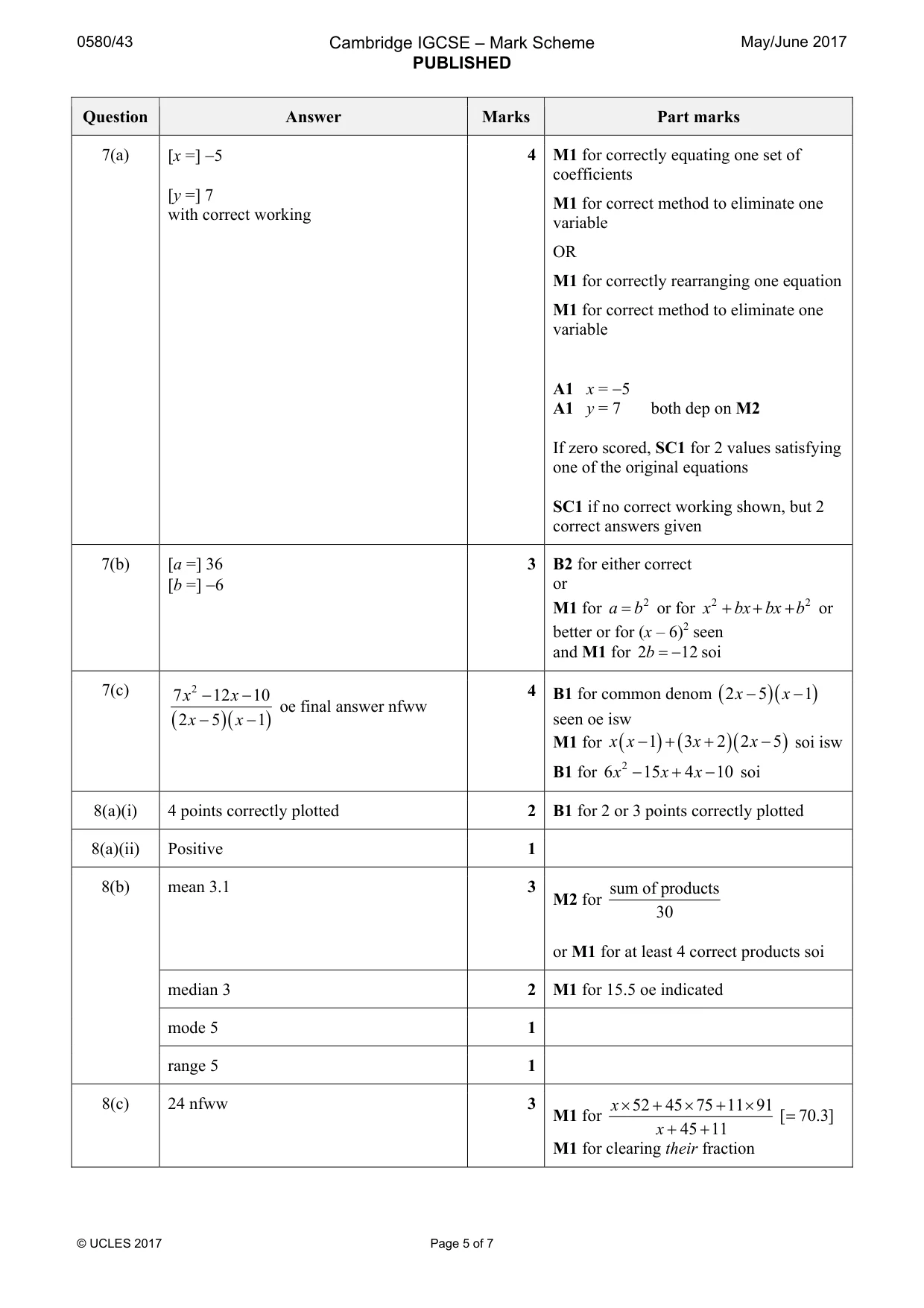
Mark scheme: 7(a) [x =] −5 4 M1 for correctly equating one set of coefficients [y =] 7 M1 for correct method to eliminate one with correct working variable OR M1 for correctly rearranging one equation M1 for correct method to eliminate one variable A1 x = −5 A1 y = 7 both dep on M2 If zero scored, SC1 for 2 values satisfying one of the original equations SC1 if no correct working shown, but 2 correct answers given 7(b) [a =] 36 3 B2 for either correct [b =] −6 or M1 for a = b 2 or for x 2 + bx + bx + b 2 or better or for (x – 6)2 seen and M1 for 2b = − 12 soi 7(c) 7 x 2 − 12 x − 10 4 B1 for common denom ( 2 x − 5 )( x − 1) oe final answer nfww ( 2 x − 5 )( x − 1) seen oe isw M1 for x ( x − 1) + ( 3 x + 2 )( 2 x − 5 ) soi isw B1 for 6 x 2 − 15 x + 4 x − 10 soi
Q8 · The table shows the marks gained by 10 students in their physics test and their…
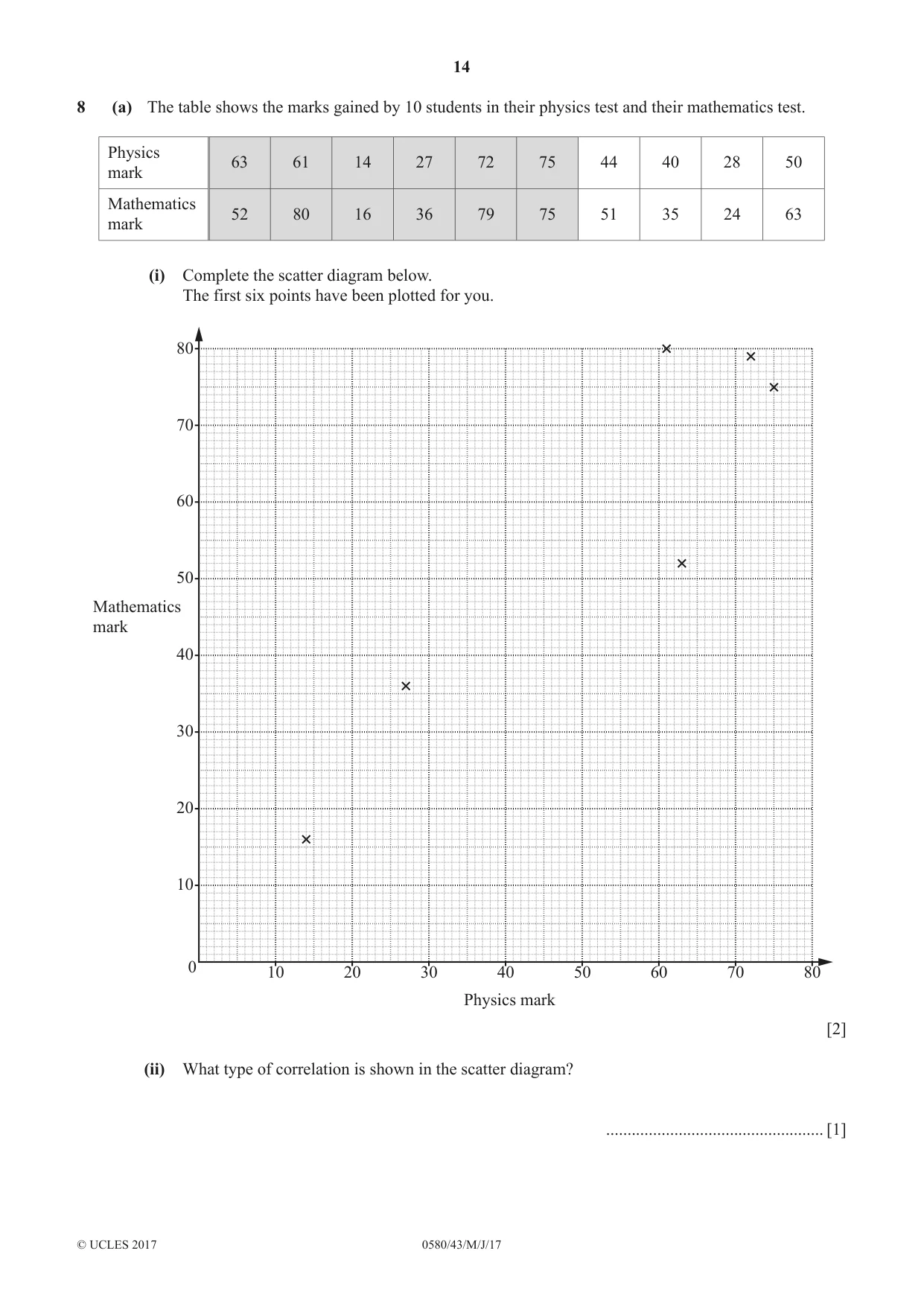
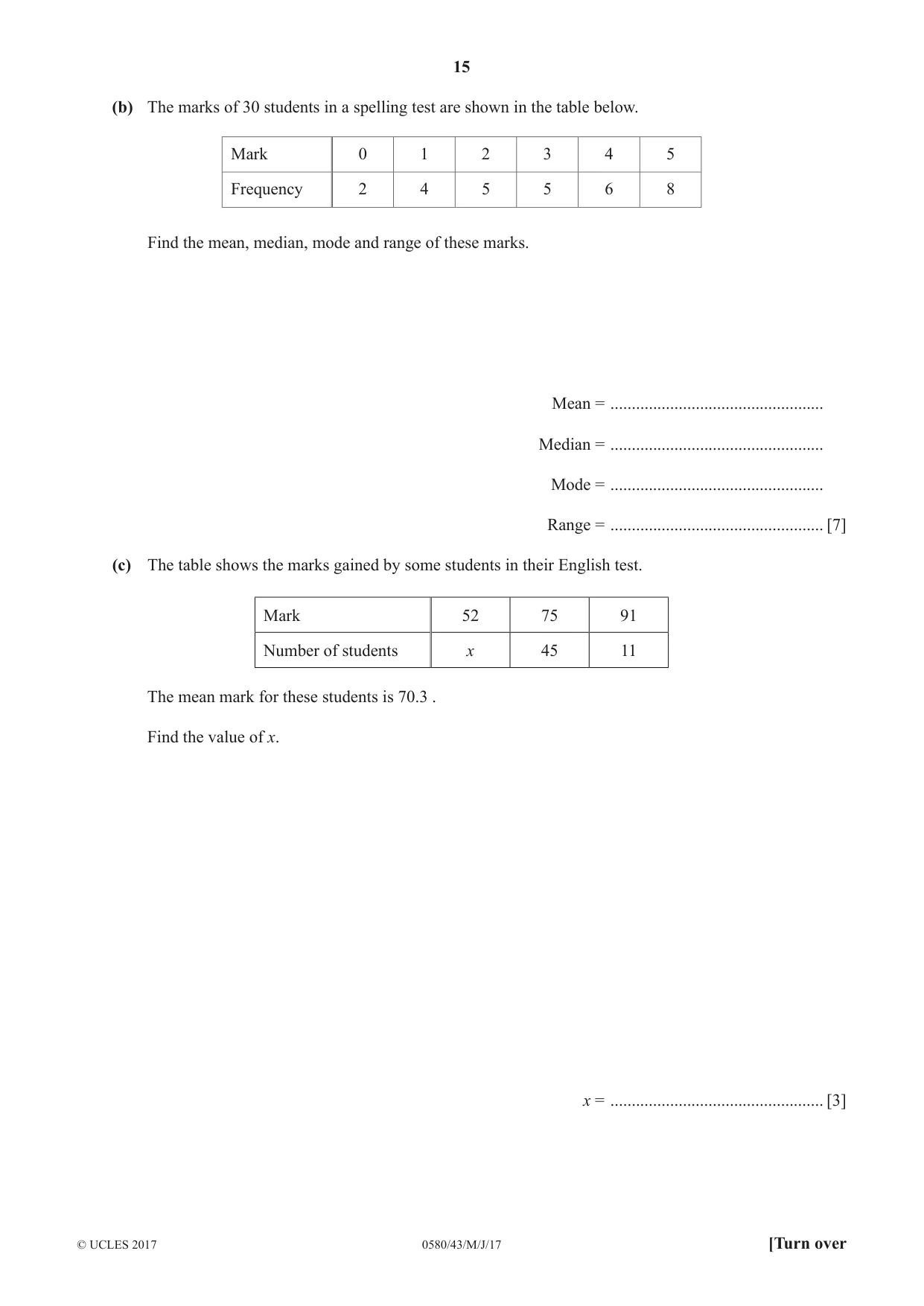
8 (a) The table shows the marks gained by 10 students in their physics test and their mathematics test. Physics 63 61 14 27 72 75 44 40 28 50 mark Mathematics 52 80 16 36 79 75 51 35 24 63 mark (i) Complete the scatter diagram below. The first six points have been plotted for you. 80 70 60 50 Mathematics mark 40 30 20 10 0 10 20 30 40 50 60 70 80 Physics mark [2] (ii) What type of correlation is shown in the scatter diagram? ................................................... [1] (b) The marks of 30 students in a spelling test are shown in the table below. Mark 0 1 2 3 4 5 Frequency 2 4 5 5 6 8 Find the mean, median, mode and range of these marks. Mean = .................................................. Median = .................................................. Mode = .................................................. Range = .................................................. [7] (c) The table shows the marks gained by some students in their English test. Mark 52 75 91 Number of students x 45 11 The mean mark for these students is 70.3 . Find the value of x. x = .................................................. [3]
Mark scheme: 8(a)(i) 4 points correctly plotted 2 B1 for 2 or 3 points correctly plotted 8(a)(ii) Positive 1 8(b) mean 3.1 3 sum of products M2 for 30 or M1 for at least 4 correct products soi median 3 2 M1 for 15.5 oe indicated mode 5 1 range 5 1 8(c) 24 nfww 3 x × 52 + 45 × 75 + 11 × 91 M1 for [ = 70.3] x + 45 + 11 M1 for clearing their fraction
Q9 · Q B 525 m 104° NOT TO 872 m SCALE A C ABC is a triangular field on horizontal ground
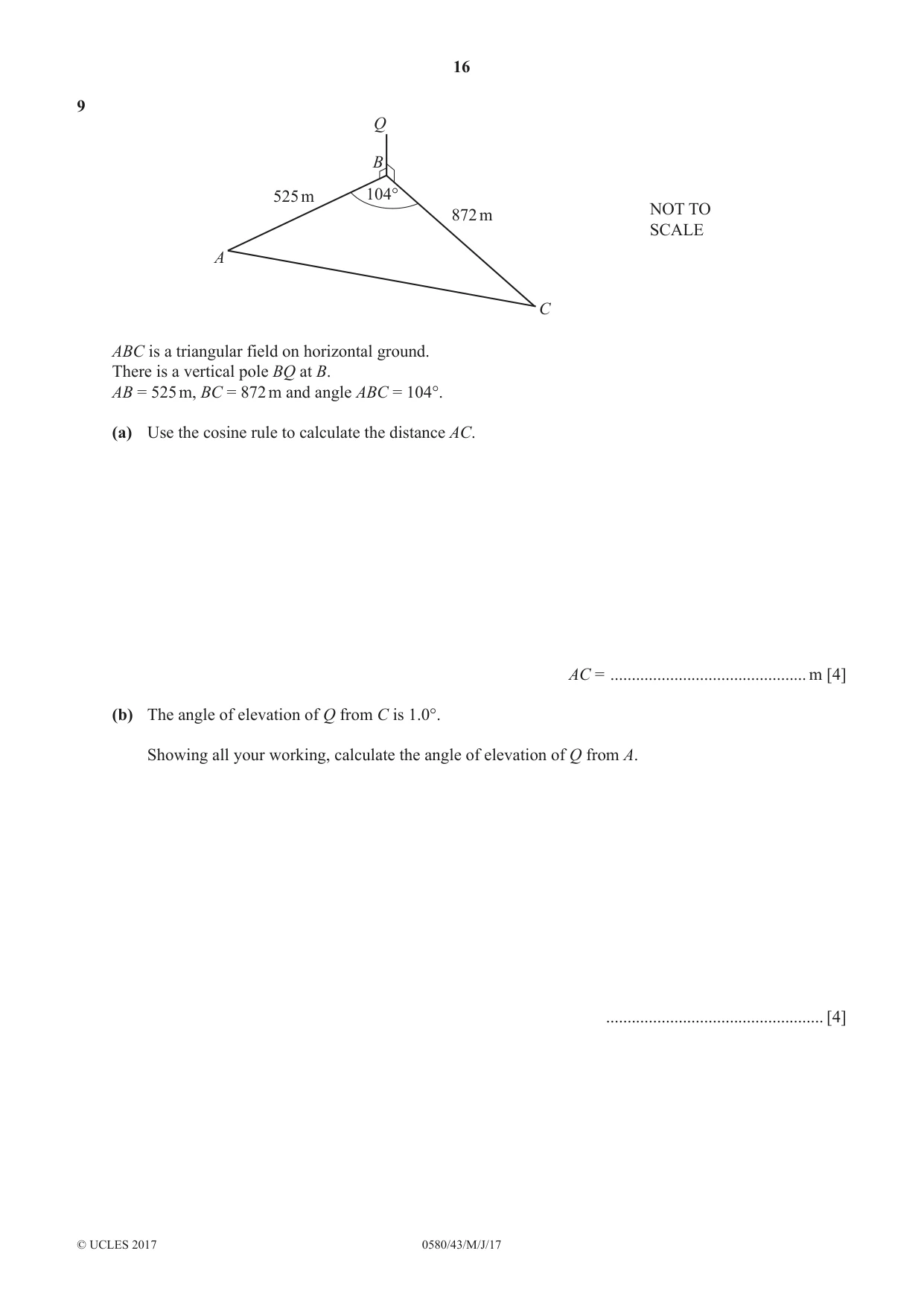
9 Q B 525 m 104° NOT TO 872 m SCALE A C ABC is a triangular field on horizontal ground. There is a vertical pole BQ at B. AB = 525 m, BC = 872 m and angle ABC = 104°. (a) Use the cosine rule to calculate the distance AC. AC = .............................................. m [4] (b) The angle of elevation of Q from C is 1.0°. Showing all your working, calculate the angle of elevation of Q from A. ................................................... [4] (c) (i) Calculate the area of the field. ............................................. m2 [2] (ii) The field is drawn on a map with the scale 1 : 20 000. Calculate the area of the field on the map in cm2. ............................................cm2 [2]
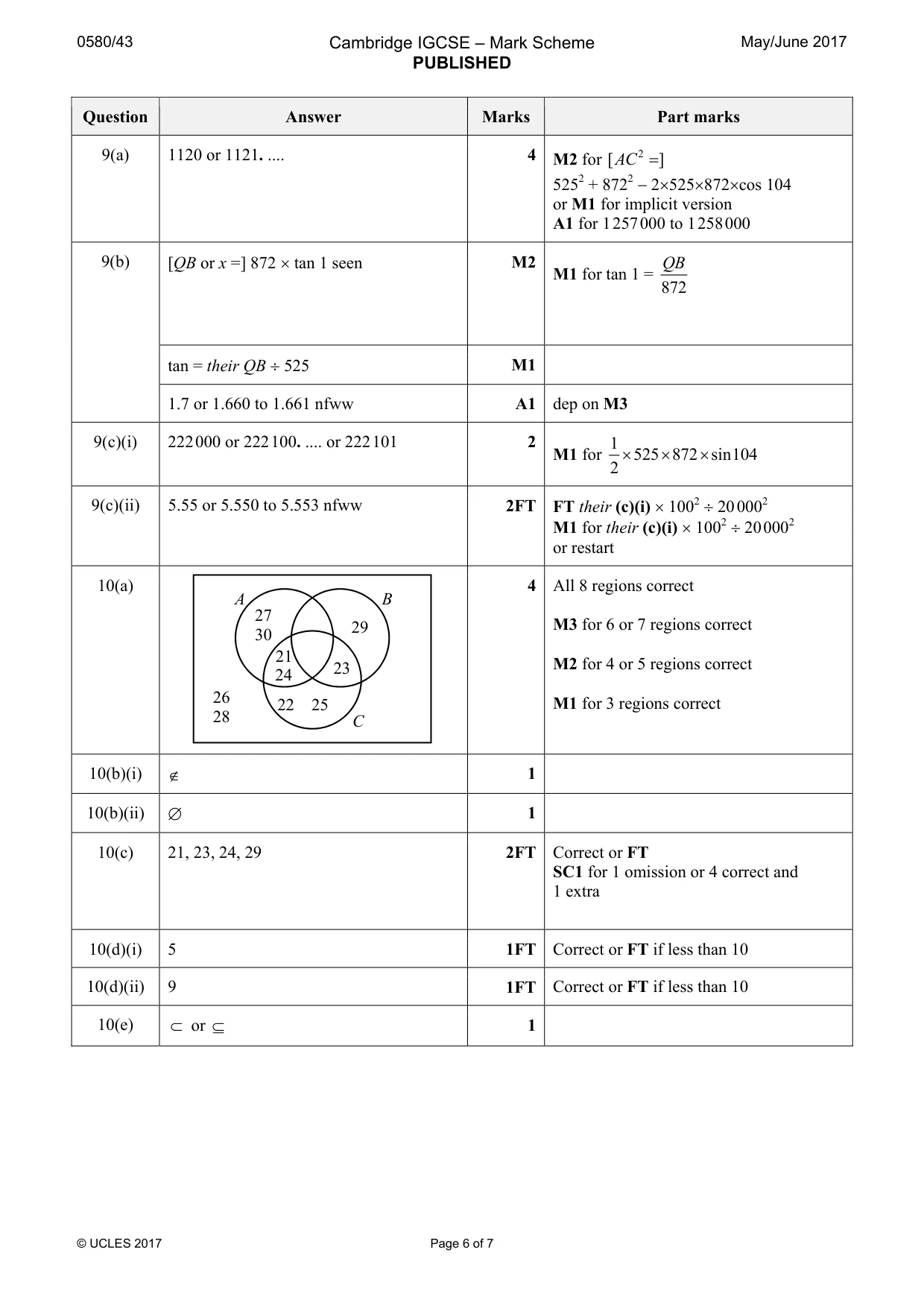
Mark scheme: 9(a) 1120 or 1121. .... 4 M2 for [ AC 2 =] 5252 + 8722 − 2×525×872×cos 104 or M1 for implicit version A1 for 1 257 000 to 1 258 000 9(b) [QB or x =] 872 × tan 1 seen M2 QB M1 for tan 1 = 872 tan = their QB ÷ 525 M1 1.7 or 1.660 to 1.661 nfww A1 dep on M3 9(c)(i) 222 000 or 222 100. .... or 222 101 2 1 M1 for × 525 × 872 × sin104 2 9(c)(ii) 5.55 or 5.550 to 5.553 nfww 2FT FT their (c)(i) × 1002 ÷ 20 0002 M1 for their (c)(i) × 1002 ÷ 20 0002 or restart
Q10 · = {21, 22, 23, 24, 25, 26, 27, 28, 29, 30} A = { x : x is a multiple of 3} B = { x : x…
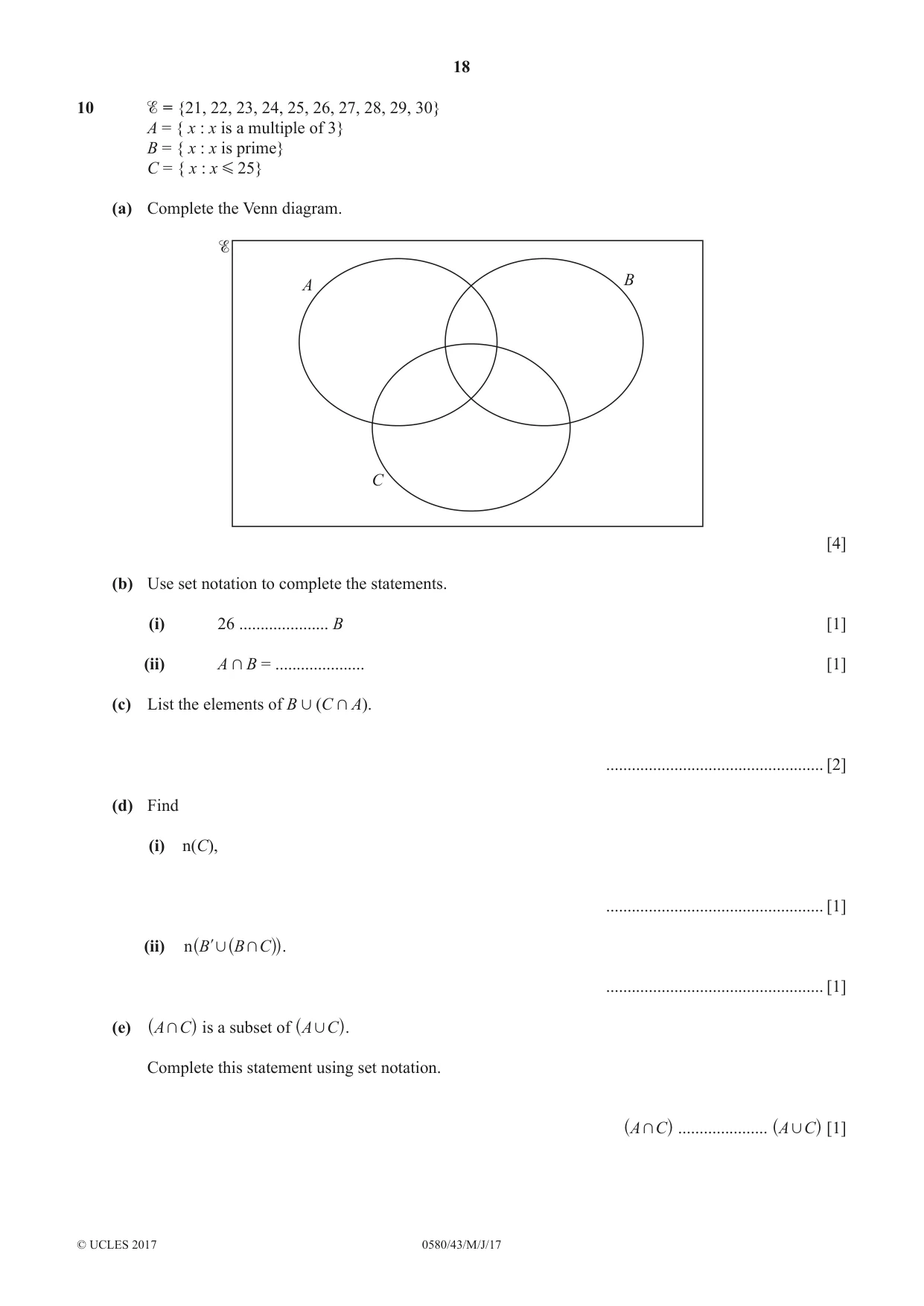
10 = {21, 22, 23, 24, 25, 26, 27, 28, 29, 30} A = { x : x is a multiple of 3} B = { x : x is prime} C = { x : x G 25} (a) Complete the Venn diagram. B A C [4] (b) Use set notation to complete the statements. (i) 26 ..................... B [1] (ii) A + B = ..................... [1] (c) List the elements of B , (C + A). ................................................... [2] (d) Find (i) n(C), ................................................... [1] (ii) n B l , B + C ^ ^ hh. ................................................... [1] (e) A + C is a subset of A , C ^ h ^ h. Complete this statement using set notation. A + C ..................... A , C [1] ^ h ^ h
Mark scheme: 10(a) 4 All 8 regions correct A B 27 29 M3 for 6 or 7 regions correct 30 21 23 M2 for 4 or 5 regions correct 24 26 22 25 M1 for 3 regions correct 28 C 10(b)(i) ∉ 1 10(b)(ii) ∅ 1 10(c) 21, 23, 24, 29 2FT Correct or FT SC1 for 1 omission or 4 correct and 1 extra 10(d)(i) 5 1FT Correct or FT if less than 10 10(d)(ii) 9 1FT Correct or FT if less than 10 10(e) ⊂ or ⊆ 1
Q11 · The table shows the first four terms in sequences A, B, C and D
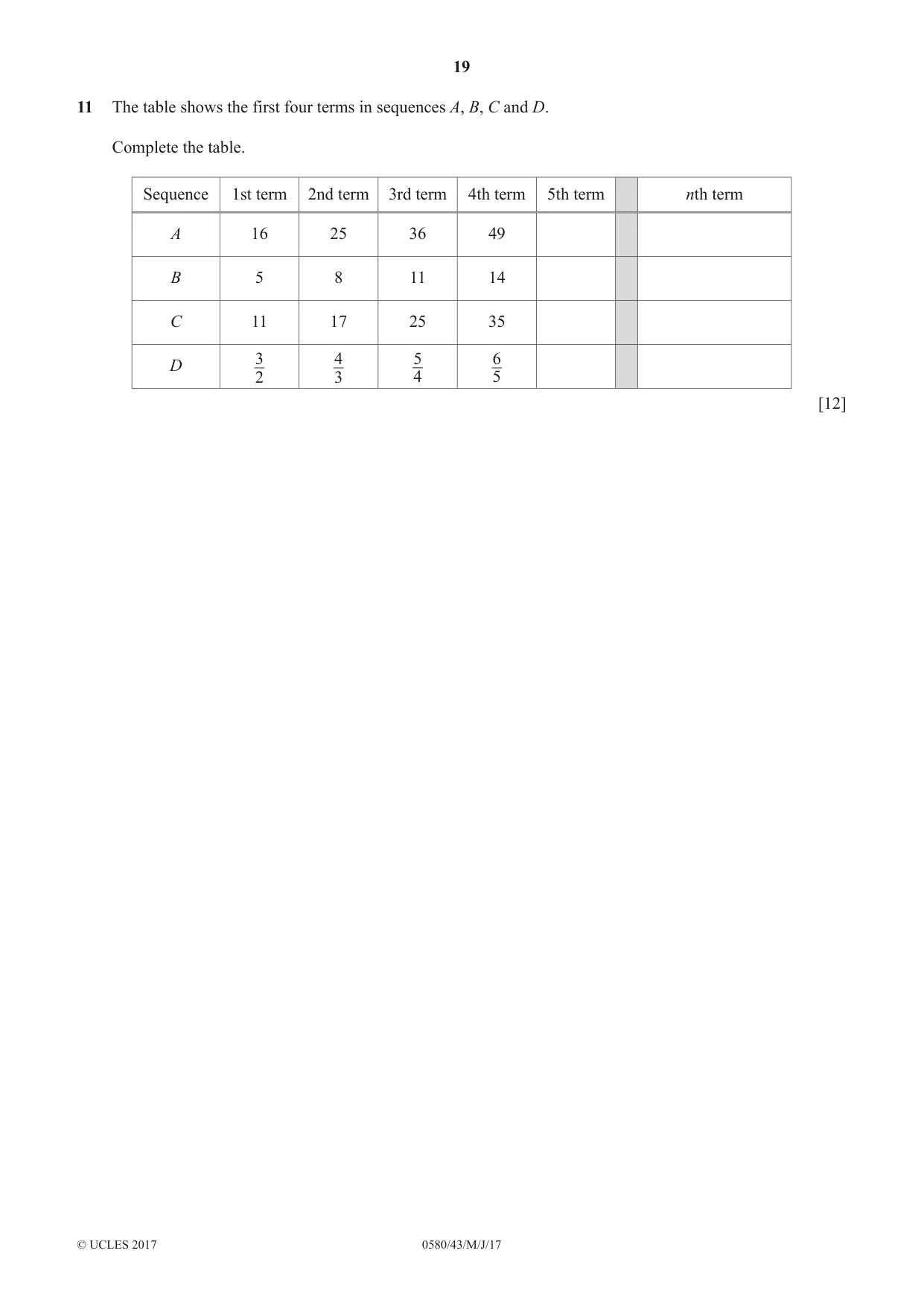
11 The table shows the first four terms in sequences A, B, C and D. Complete the table. Sequence 1st term 2nd term 3rd term 4th term 5th term nth term A 16 25 36 49 B 5 8 11 14 C 11 17 25 35 3 4 5 6 D 2 3 4 5 [12]
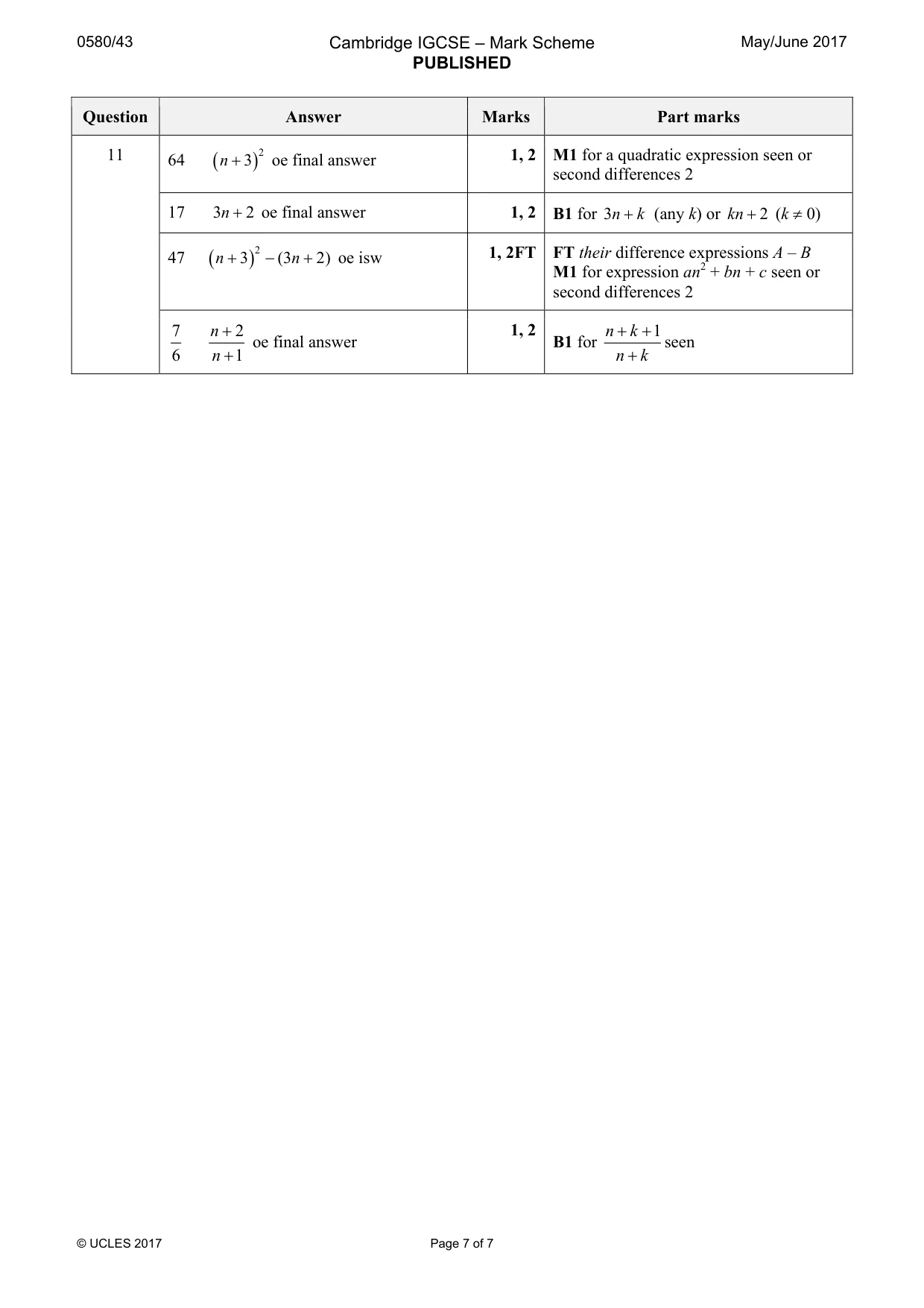
Mark scheme: 11 2 1, 2 M1 for a quadratic expression seen or 64 ( n + 3 ) oe final answer second differences 2 17 3n + 2 oe final answer 1, 2 B1 for 3n + k (any k) or kn + 2 (k ≠ 0) 2 1, 2FT FT their difference expressions A – B 47 ( n + 3 ) − (3n + 2) oe isw M1 for expression an2 + bn + c seen or second differences 2 7 n + 2 1, 2 n + k + 1 oe final answer B1 for seen 6 n + 1 n + k
What was in this paper
The subtopics covered by these 11 questions, and how many questions each got. Open one in a new tab to see every Cambridge question on it.
What you needed in this session
Cambridge’s own grade thresholds for 2017 May/June, Paper 4 · Variant 3. A higher threshold means an easier paper — the bar moves with how the cohort did.