Cambridge IGCSE Mathematics 0580 — 2017 Oct/Nov Paper 4 · Variant 1
0580/41/O/N/17 · 11 questions · 130 marks · ≈146 min
The question paper and its mark scheme, free to read here and free to download. This is Cambridge’s own paper, exactly as it was sat.
Question paper20 pages
Mark scheme8 pages
Answers below. Sit the paper first if you are practising.
Questions as text
Q1 · A library has a total of 10 494 fiction and non-fiction books
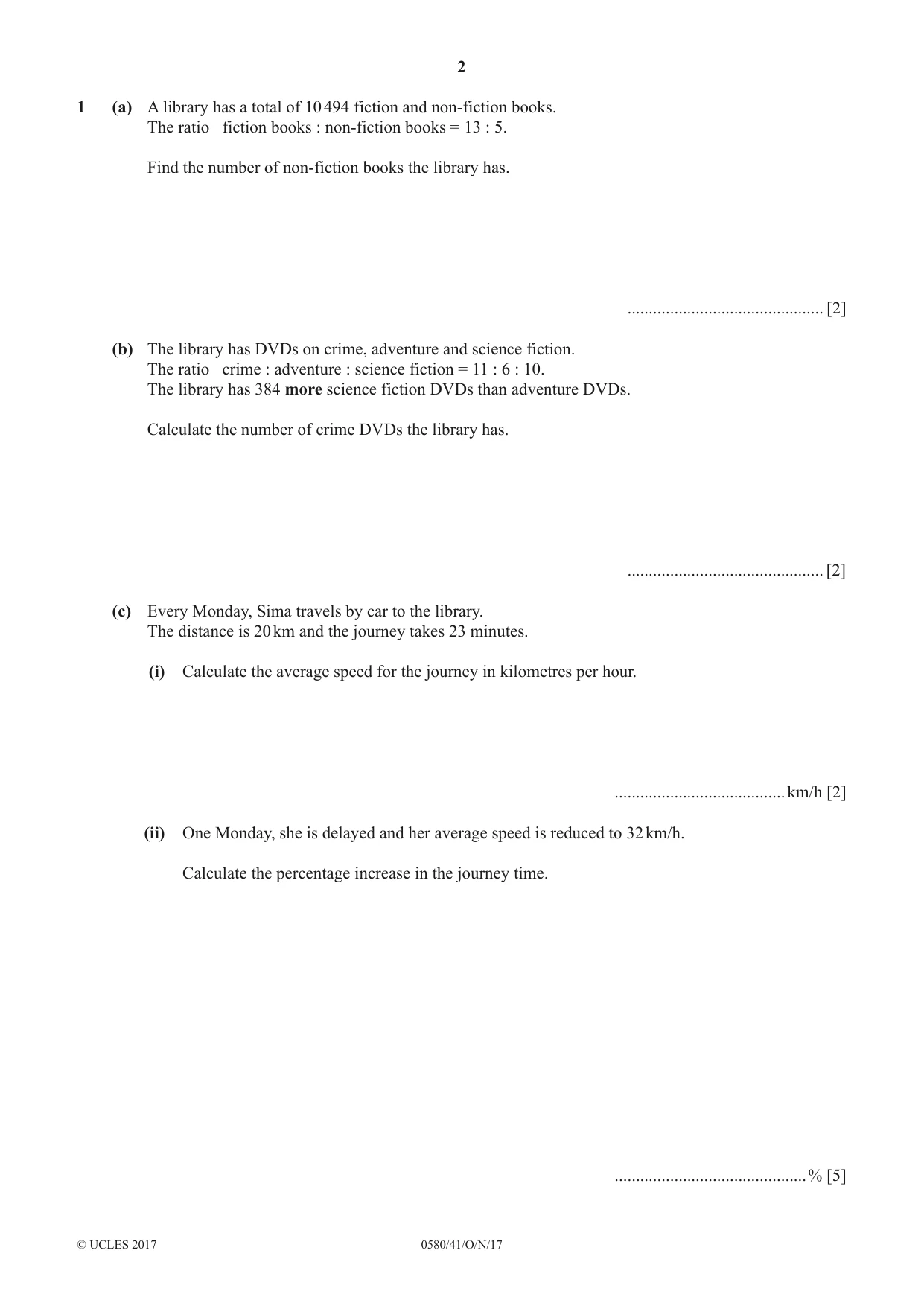
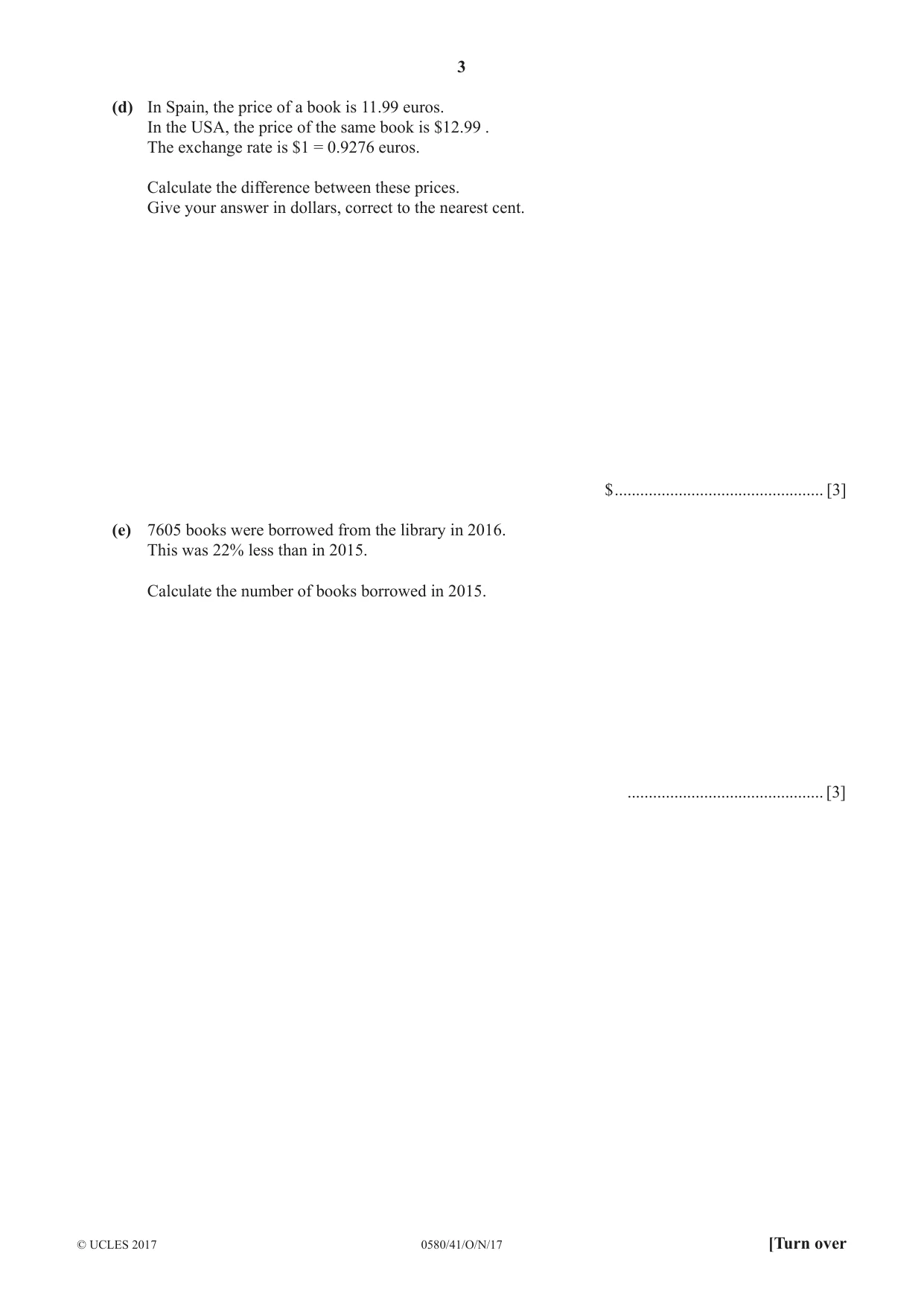
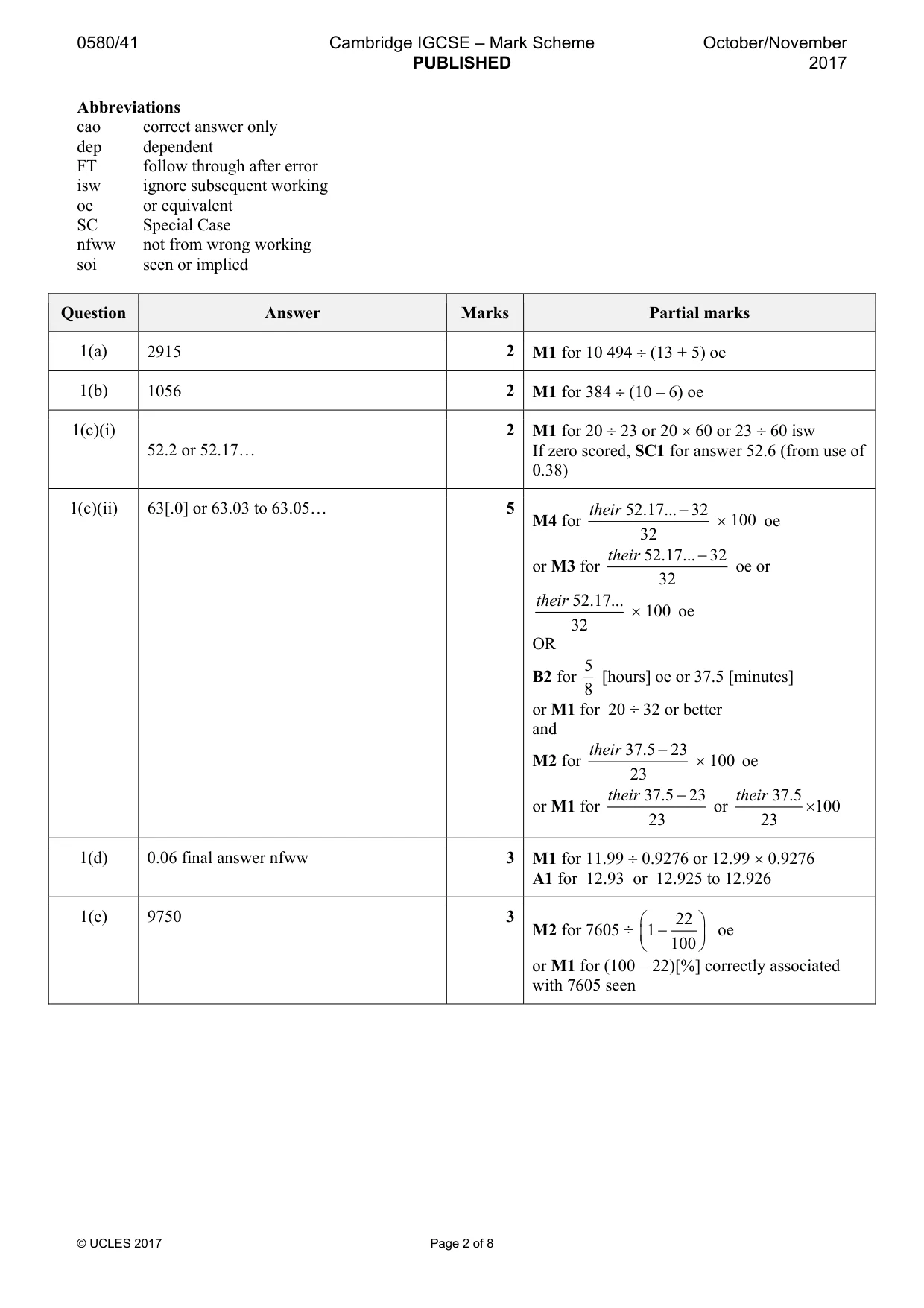
1 (a) A library has a total of 10 494 fiction and non-fiction books. The ratio fiction books : non-fiction books = 13 : 5. Find the number of non-fiction books the library has. .............................................. [2] (b) The library has DVDs on crime, adventure and science fiction. The ratio crime : adventure : science fiction = 11 : 6 : 10. The library has 384 more science fiction DVDs than adventure DVDs. Calculate the number of crime DVDs the library has. .............................................. [2] (c) Every Monday, Sima travels by car to the library. The distance is 20 km and the journey takes 23 minutes. (i) Calculate the average speed for the journey in kilometres per hour. ........................................km/h [2] (ii) One Monday, she is delayed and her average speed is reduced to 32 km/h. Calculate the percentage increase in the journey time. .............................................% [5] (d) In Spain, the price of a book is 11.99 euros. In the USA, the price of the same book is $12.99 . The exchange rate is $1 = 0.9276 euros. Calculate the difference between these prices. Give your answer in dollars, correct to the nearest cent. $ ................................................. [3] (e) 7605 books were borrowed from the library in 2016. This was 22% less than in 2015. Calculate the number of books borrowed in 2015. .............................................. [3]
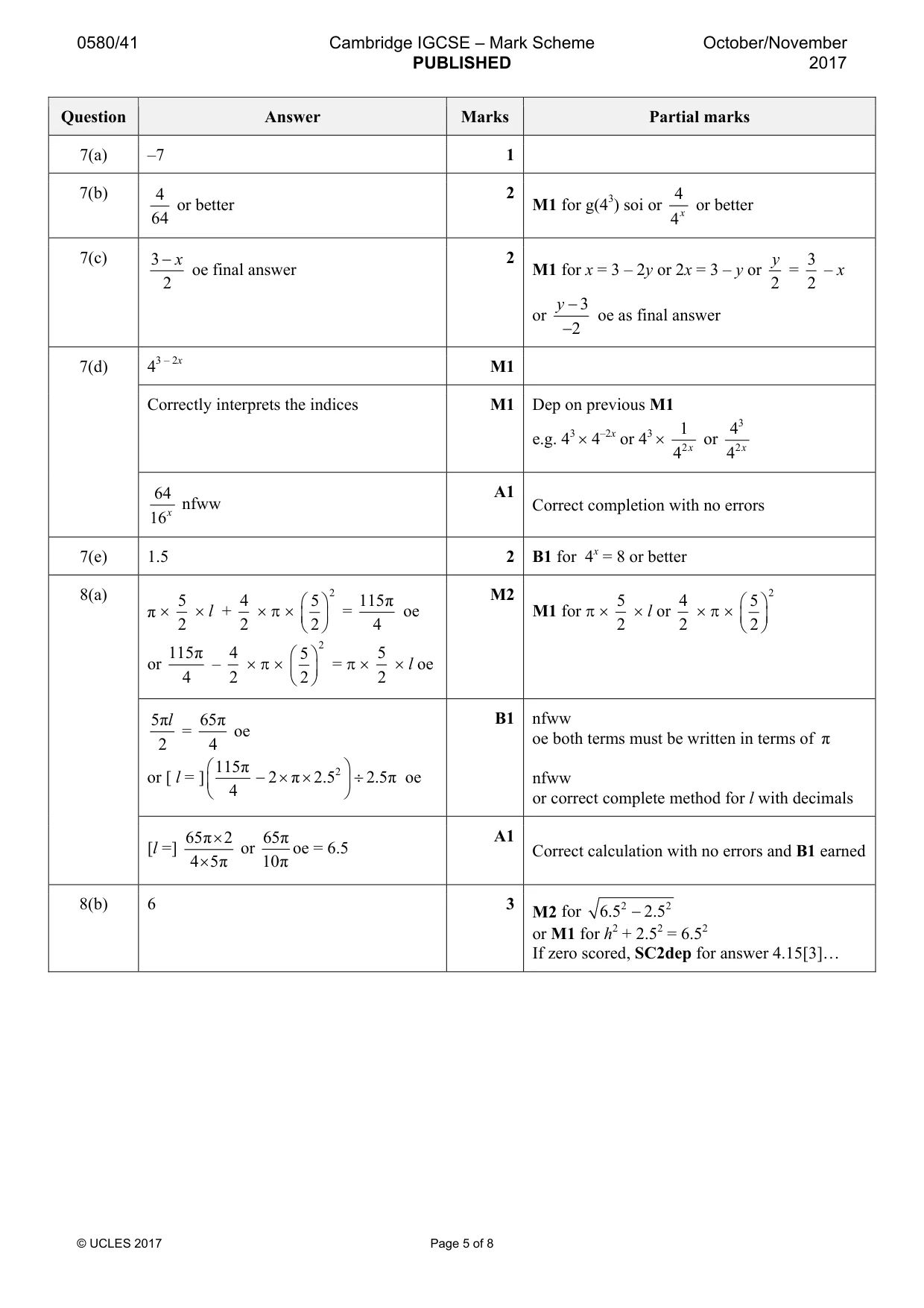
Mark scheme: Question Answer Marks Partial marks 1(a) 2915 2 M1 for 10 494 ÷ (13 + 5) oe 1(b) 1056 2 M1 for 384 ÷ (10 – 6) oe 1(c)(i) 2 M1 for 20 ÷ 23 or 20 × 60 or 23 ÷ 60 isw 52.2 or 52.17… If zero scored, SC1 for answer 52.6 (from use of 0.38) 1(c)(ii) 63[.0] or 63.03 to 63.05… 5 their 52.17... − 32 M4 for × 100 oe 32 their 52.17... − 32 or M3 for oe or 32 their 52.17... × 100 oe 32 OR 5 B2 for [hours] oe or 37.5 [minutes] 8 or M1 for 20 ÷ 32 or better and their 37.5 − 23 M2 for × 100 oe 23 their 37.5 − 23 their 37.5 or M1 for or ×100 23 23 1(d) 0.06 final answer nfww 3 M1 for 11.99 ÷ 0.9276 or 12.99 × 0.9276 A1 for 12.93 or 12.925 to 12.926 1(e) 9750 3 22 M2 for 7605 ÷ 1 − oe 100 or M1 for (100 – 22)[%] correctly associated with 7605 seen
Q2 · X° NOT TO 32° SCALE The diagram shows an octagon
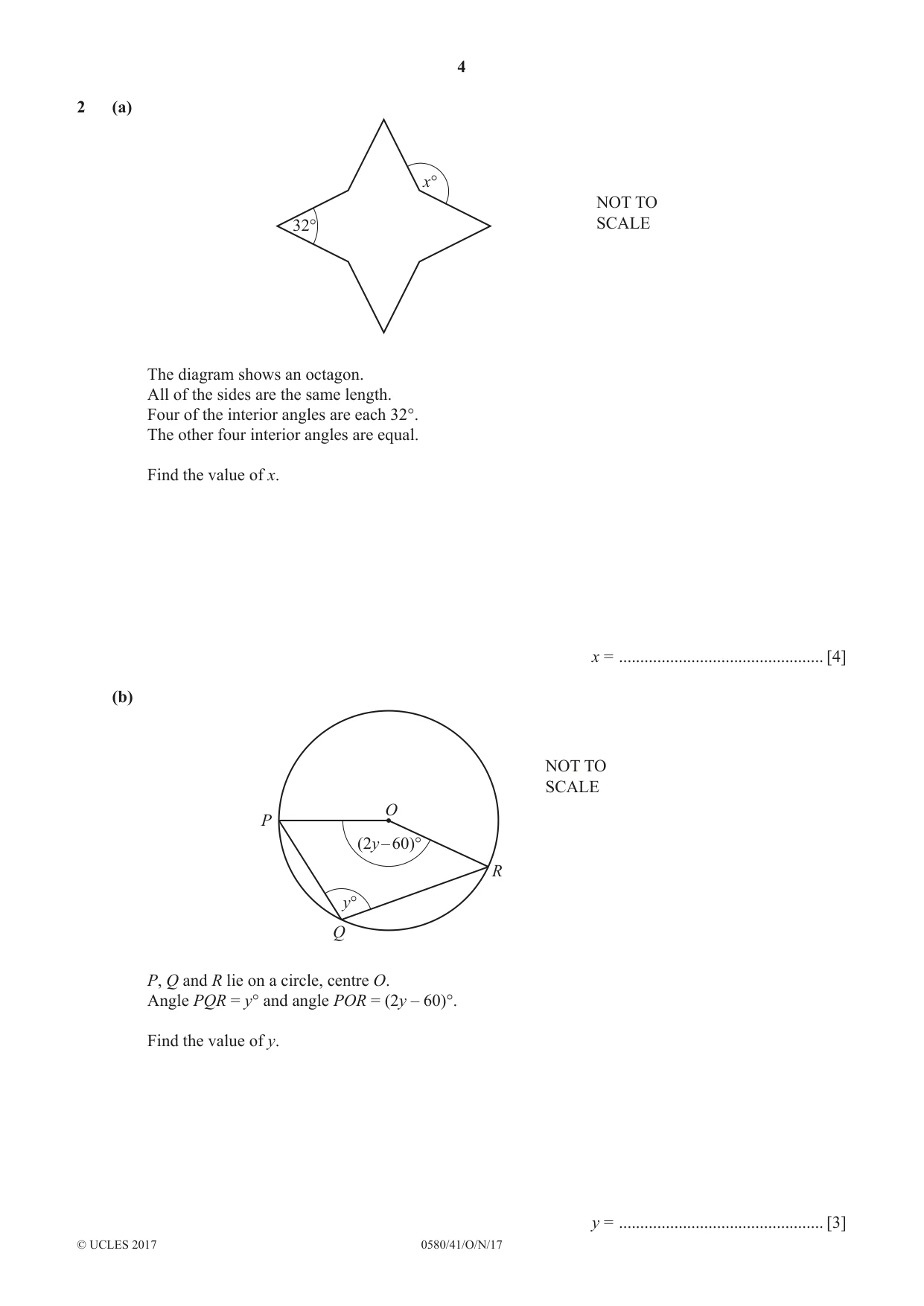
2 (a) x° NOT TO 32° SCALE The diagram shows an octagon. All of the sides are the same length. Four of the interior angles are each 32°. The other four interior angles are equal. Find the value of x. x = ................................................ [4] (b) NOT TO SCALE O P (2y – 60)° R y° Q P, Q and R lie on a circle, centre O. Angle PQR = y° and angle POR = (2y – 60)°. Find the value of y. y = ................................................ [3]
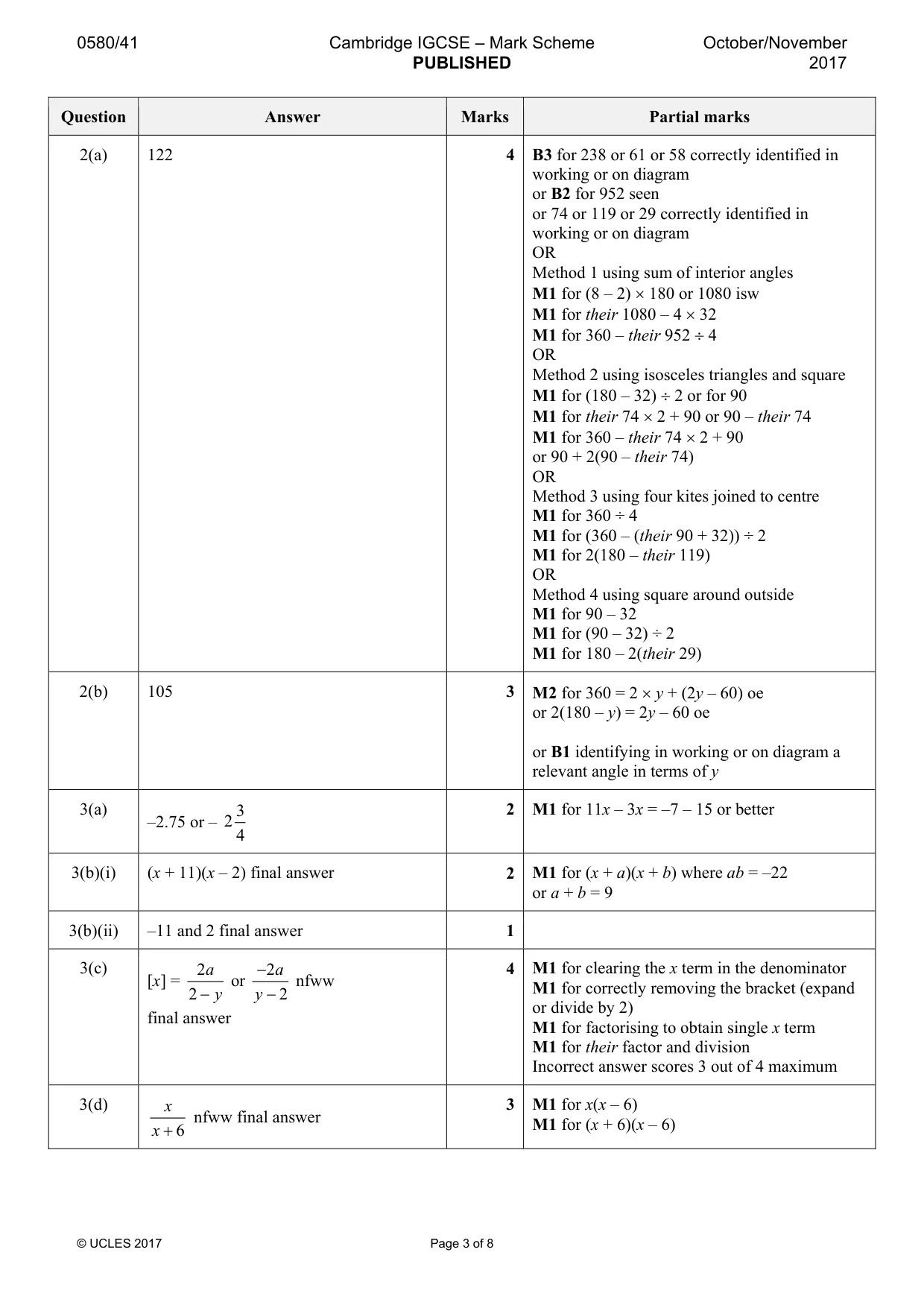
Mark scheme: 2(a) 122 4 B3 for 238 or 61 or 58 correctly identified in working or on diagram or B2 for 952 seen or 74 or 119 or 29 correctly identified in working or on diagram OR Method 1 using sum of interior angles M1 for (8 – 2) × 180 or 1080 isw M1 for their 1080 – 4 × 32 M1 for 360 – their 952 ÷ 4 OR Method 2 using isosceles triangles and square M1 for (180 – 32) ÷ 2 or for 90 M1 for their 74 × 2 + 90 or 90 – their 74 M1 for 360 – their 74 × 2 + 90 or 90 + 2(90 – their 74) OR Method 3 using four kites joined to centre M1 for 360 ÷ 4 M1 for (360 – (their 90 + 32)) ÷ 2 M1 for 2(180 – their 119) OR Method 4 using square around outside M1 for 90 – 32 M1 for (90 – 32) ÷ 2 M1 for 180 – 2(their 29) 2(b) 105 3 M2 for 360 = 2 × y + (2y – 60) oe or 2(180 – y) = 2y – 60 oe or B1 identifying in working or on diagram a relevant angle in terms of y
Question 3
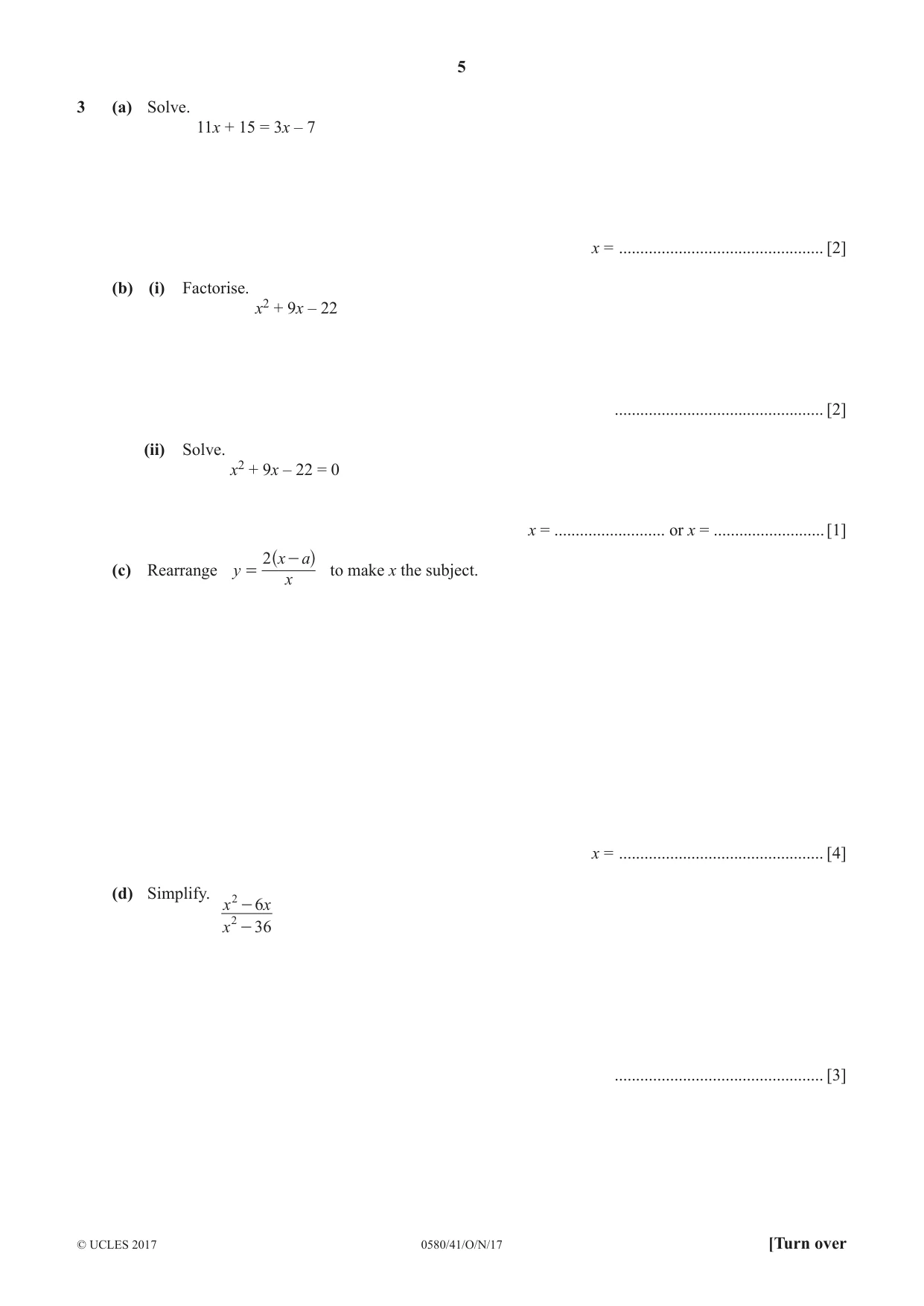
3 (a) Solve. 11x + 15 = 3x – 7 x = ................................................ [2] (b) (i) Factorise. x2 + 9x – 22 ................................................. [2] (ii) Solve. x2 + 9x – 22 = 0 x = .......................... or x = .......................... [1] 2 x - a (c) Rearrange y = ^ h to make x the subject. x x = ................................................ [4] (d) Simplify. 2 x - 6x x 2 - 36 ................................................. [3]
Mark scheme: 3(a) 3 2 M1 for 11x – 3x = –7 – 15 or better –2.75 or – 2 4 3(b)(i) (x + 11)(x – 2) final answer 2 M1 for (x + a)(x + b) where ab = –22 or a + b = 9 3(b)(ii) –11 and 2 final answer 1 3(c) 2 a − 2 a 4 M1 for clearing the x term in the denominator [x] = or nfww M1 for correctly removing the bracket (expand 2 − y y − 2 or divide by 2) final answer M1 for factorising to obtain single x term M1 for their factor and division Incorrect answer scores 3 out of 4 maximum 3(d) x 3 M1 for x(x – 6) nfww final answer M1 for (x + 6)(x – 6) x + 6
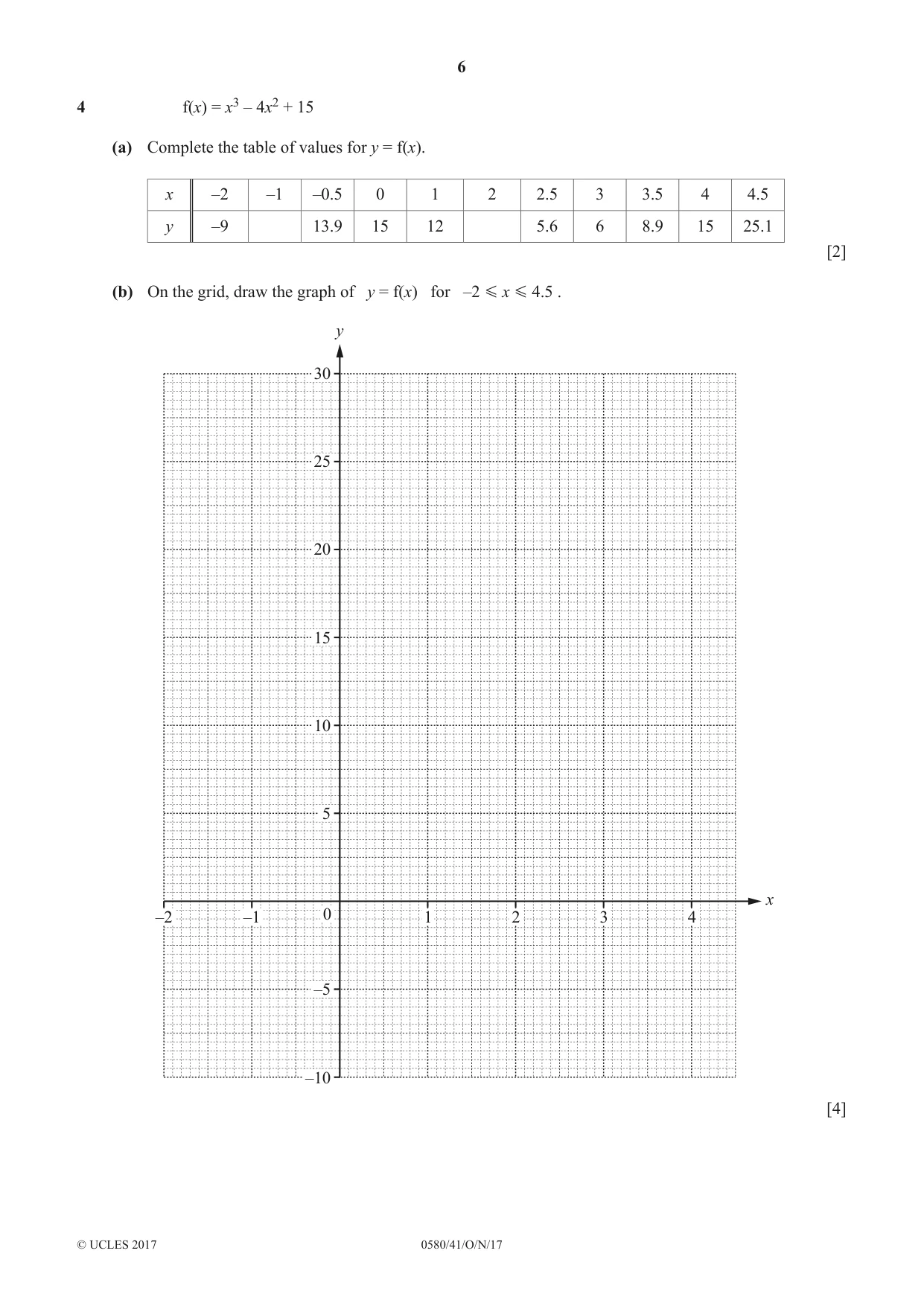
Q4 · F(x) = x3 – 4x2 + 15 (a) Complete the table of values for y = f(x)
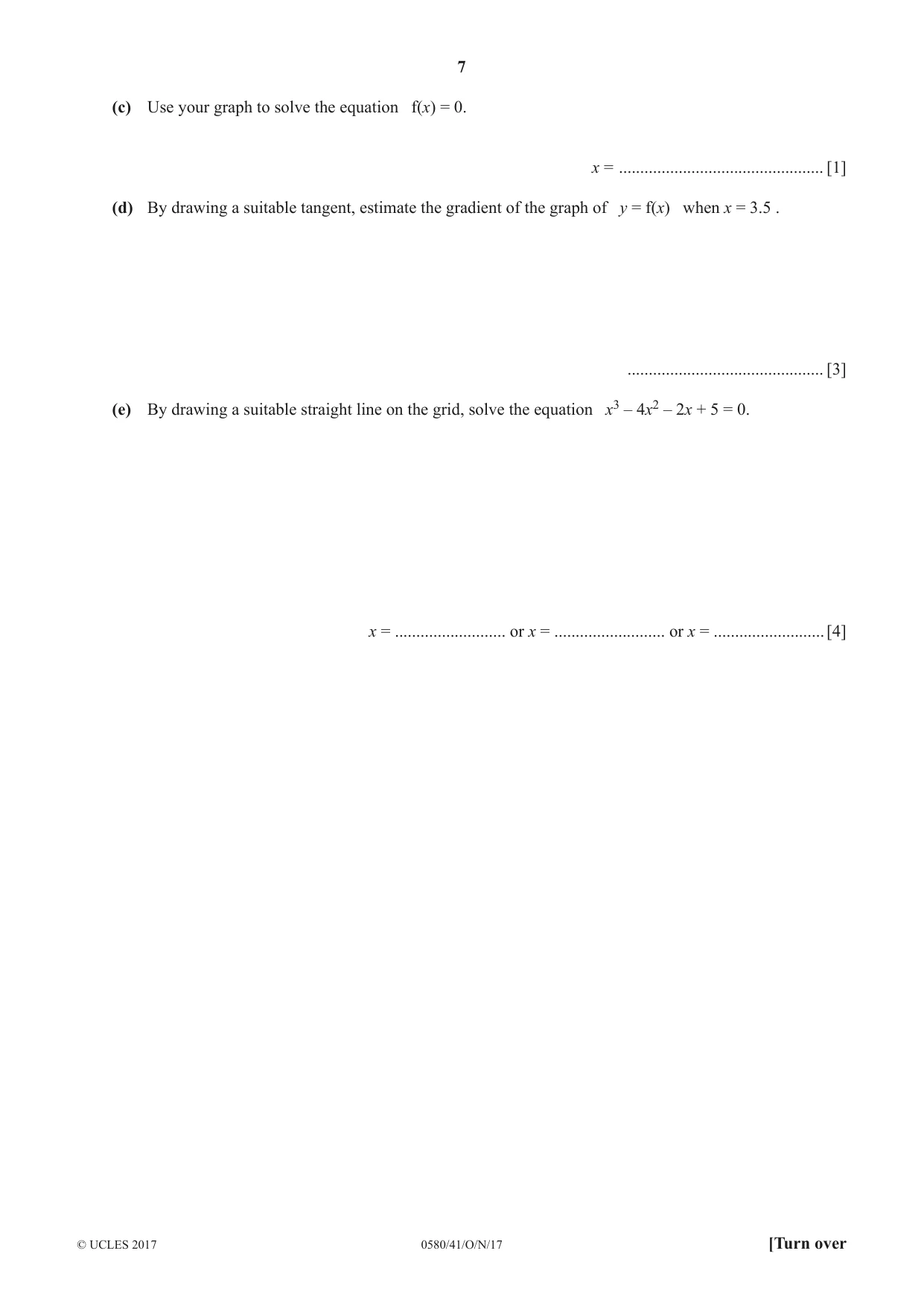
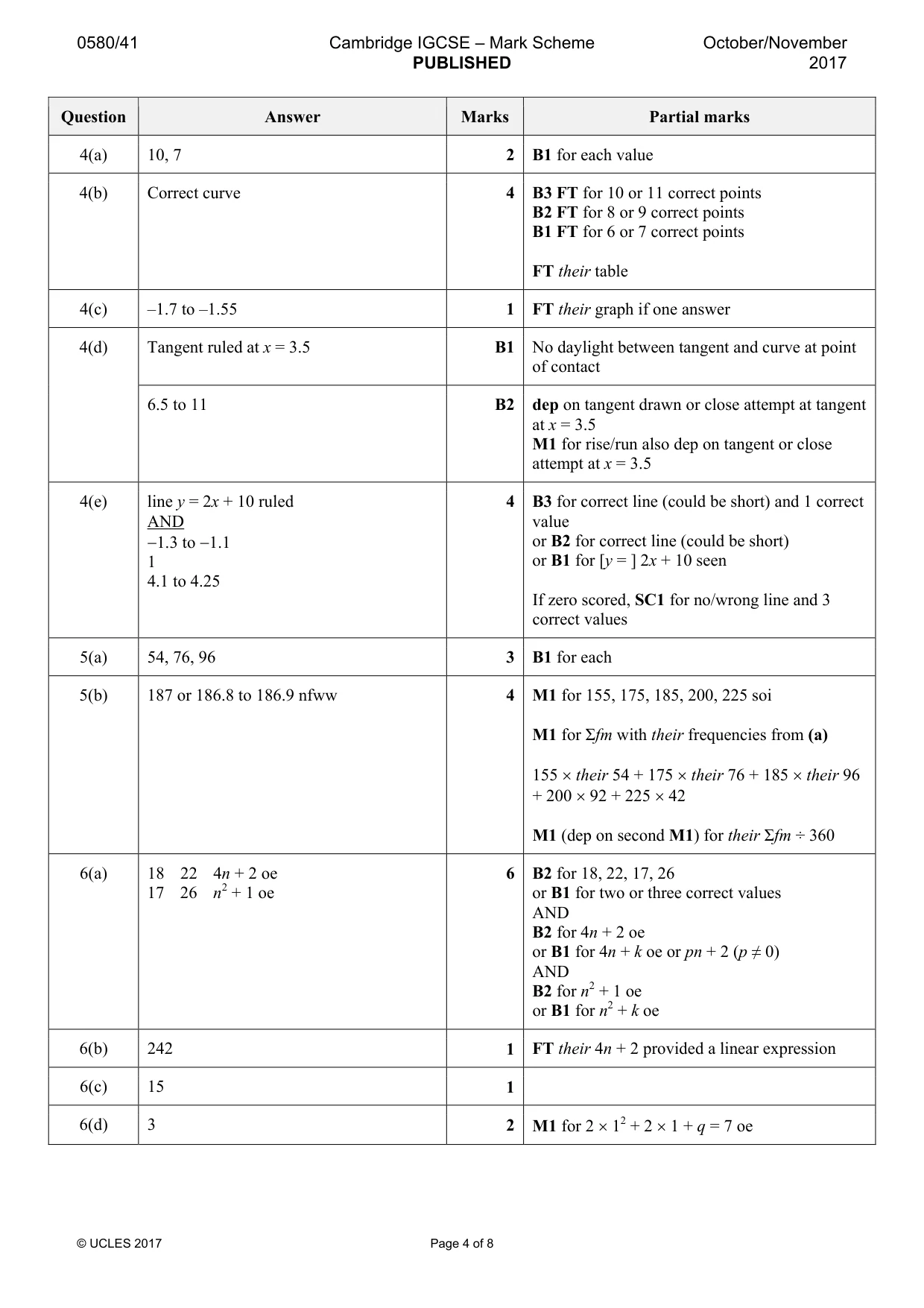
4 f(x) = x3 – 4x2 + 15 (a) Complete the table of values for y = f(x). x –2 –1 –0.5 0 1 2 2.5 3 3.5 4 4.5 y –9 13.9 15 12 5.6 6 8.9 15 25.1 [2] (b) On the grid, draw the graph of y = f(x) for –2 G x G 4.5 . y 30 25 20 15 10 5 x –2 –1 0 1 2 3 4 –5 –10 [4] (c) Use your graph to solve the equation f(x) = 0. x = ................................................ [1] (d) By drawing a suitable tangent, estimate the gradient of the graph of y = f(x) when x = 3.5 . .............................................. [3] (e) By drawing a suitable straight line on the grid, solve the equation x3 – 4x2 – 2x + 5 = 0. x = .......................... or x = .......................... or x = .......................... [4]
Mark scheme: 4(a) 10, 7 2 B1 for each value 4(b) Correct curve 4 B3 FT for 10 or 11 correct points B2 FT for 8 or 9 correct points B1 FT for 6 or 7 correct points FT their table 4(c) –1.7 to –1.55 1 FT their graph if one answer 4(d) Tangent ruled at x = 3.5 B1 No daylight between tangent and curve at point of contact 6.5 to 11 B2 dep on tangent drawn or close attempt at tangent at x = 3.5 M1 for rise/run also dep on tangent or close attempt at x = 3.5 4(e) line y = 2x + 10 ruled 4 B3 for correct line (could be short) and 1 correct AND value −1.3 to −1.1 or B2 for correct line (could be short) 1 or B1 for [y = ] 2x + 10 seen 4.1 to 4.25 If zero scored, SC1 for no/wrong line and 3 correct values
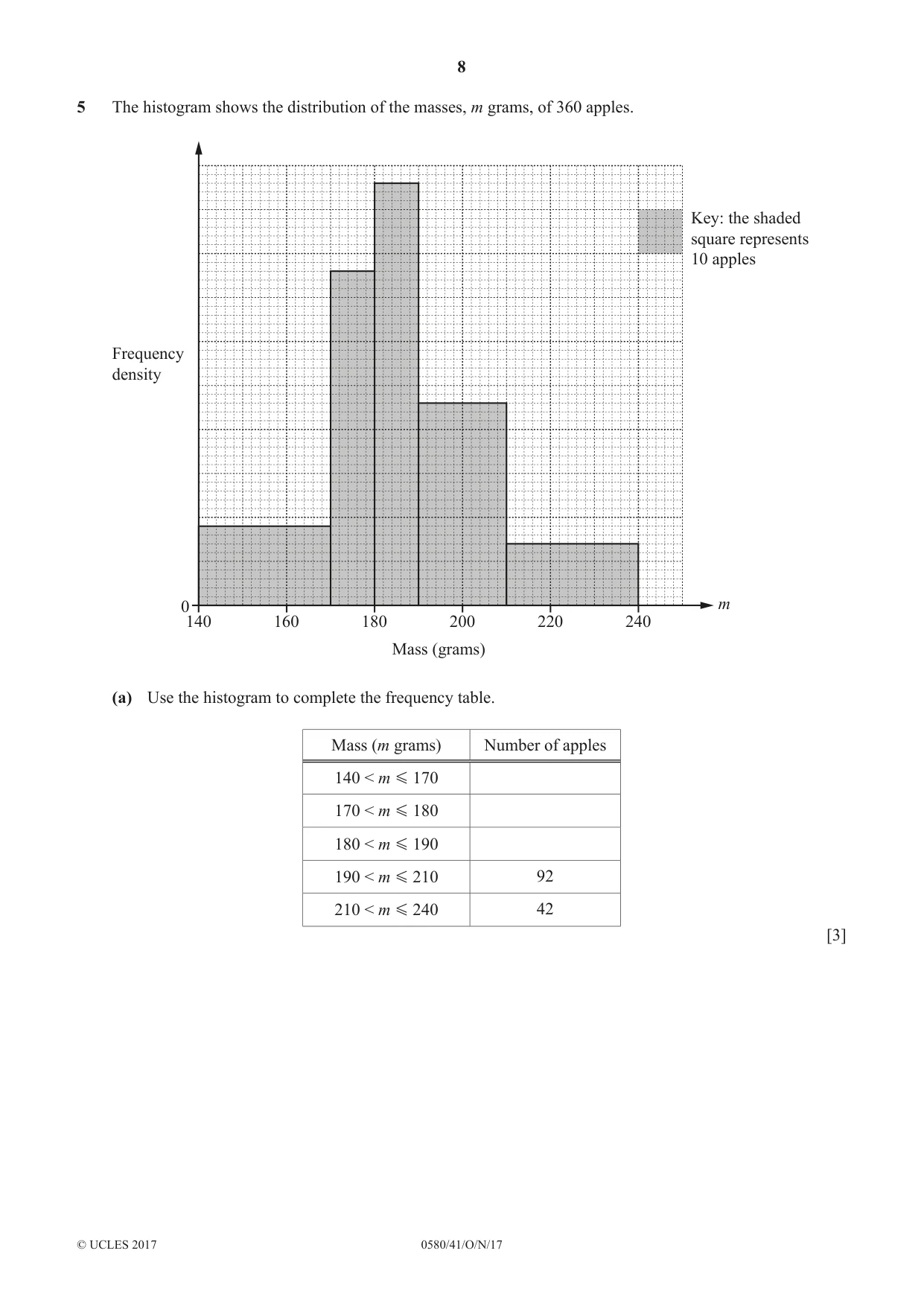
Q5 · The histogram shows the distribution of the masses, m grams, of 360 apples
5 The histogram shows the distribution of the masses, m grams, of 360 apples. Key: the shaded square represents 10 apples Frequency density 0 m 140 160 180 200 220 240 Mass (grams) (a) Use the histogram to complete the frequency table. Mass (m grams) Number of apples 140 < m G 170 170 < m G 180 180 < m G 190 190 < m G 210 92 210 < m G 240 42 [3] (b) Calculate an estimate of the mean mass of the 360 apples. .............................................. g [4]
Mark scheme: 5(a) 54, 76, 96 3 B1 for each 5(b) 187 or 186.8 to 186.9 nfww 4 M1 for 155, 175, 185, 200, 225 soi M1 for Σfm with their frequencies from (a) 155 × their 54 + 175 × their 76 + 185 × their 96 + 200 × 92 + 225 × 42 M1 (dep on second M1) for their Σfm ÷ 360
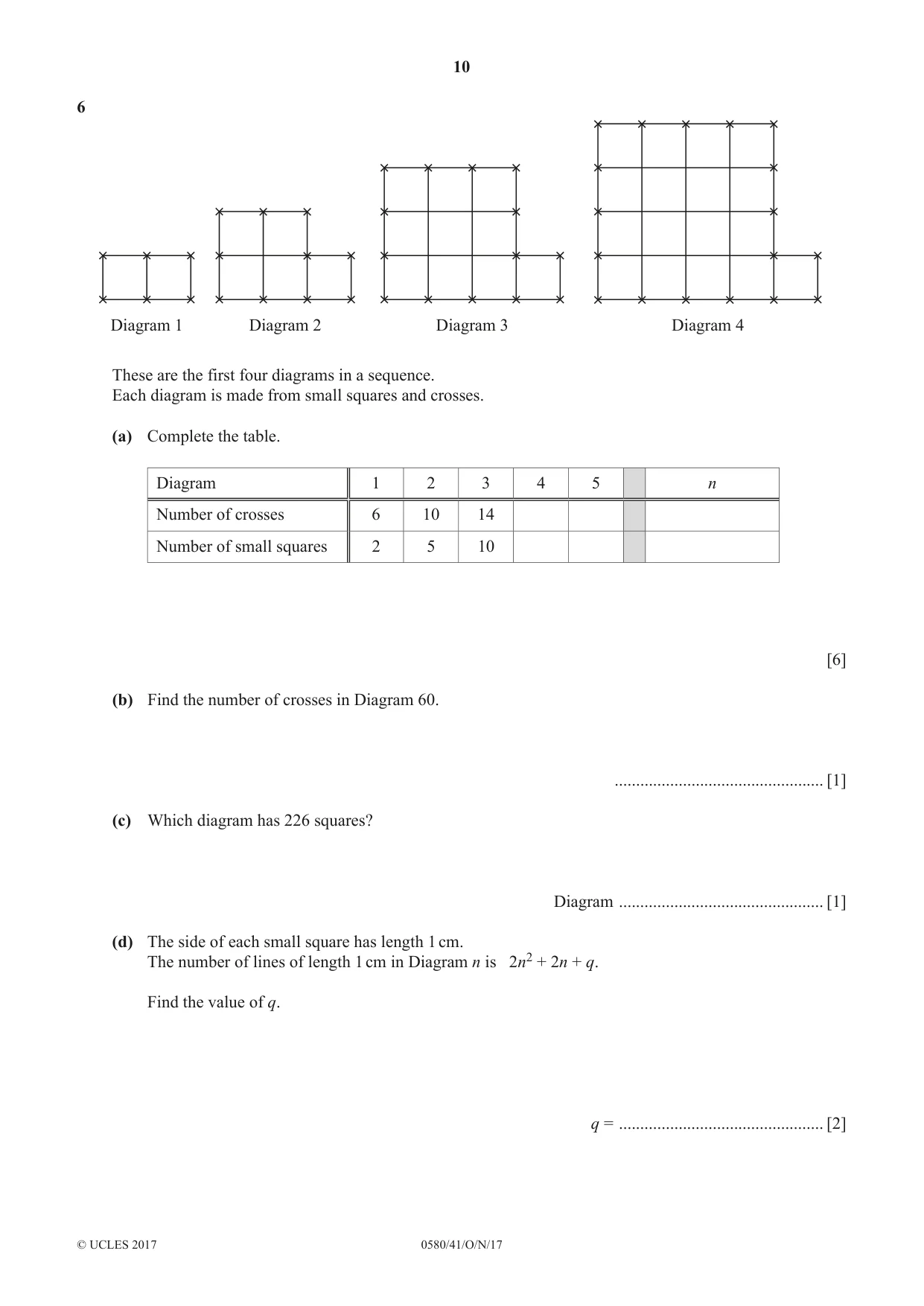
Q6 · Diagram 1 Diagram 2 Diagram 3 Diagram 4 These are the first four diagrams in a sequence
6 Diagram 1 Diagram 2 Diagram 3 Diagram 4 These are the first four diagrams in a sequence. Each diagram is made from small squares and crosses. (a) Complete the table. Diagram 1 2 3 4 5 n Number of crosses 6 10 14 Number of small squares 2 5 10 [6] (b) Find the number of crosses in Diagram 60. ................................................. [1] (c) Which diagram has 226 squares? Diagram ................................................ [1] (d) The side of each small square has length 1 cm. The number of lines of length 1 cm in Diagram n is 2n2 + 2n + q. Find the value of q. q = ................................................ [2]
Mark scheme: 6(a) 18 22 4n + 2 oe 6 B2 for 18, 22, 17, 26 17 26 n2 + 1 oe or B1 for two or three correct values AND B2 for 4n + 2 oe or B1 for 4n + k oe or pn + 2 (p ≠ 0) AND B2 for n2 + 1 oe or B1 for n2 + k oe 6(b) 242 1 FT their 4n + 2 provided a linear expression 6(c) 15 1 6(d) 3 2 M1 for 2 × 12 + 2 × 1 + q = 7 oe
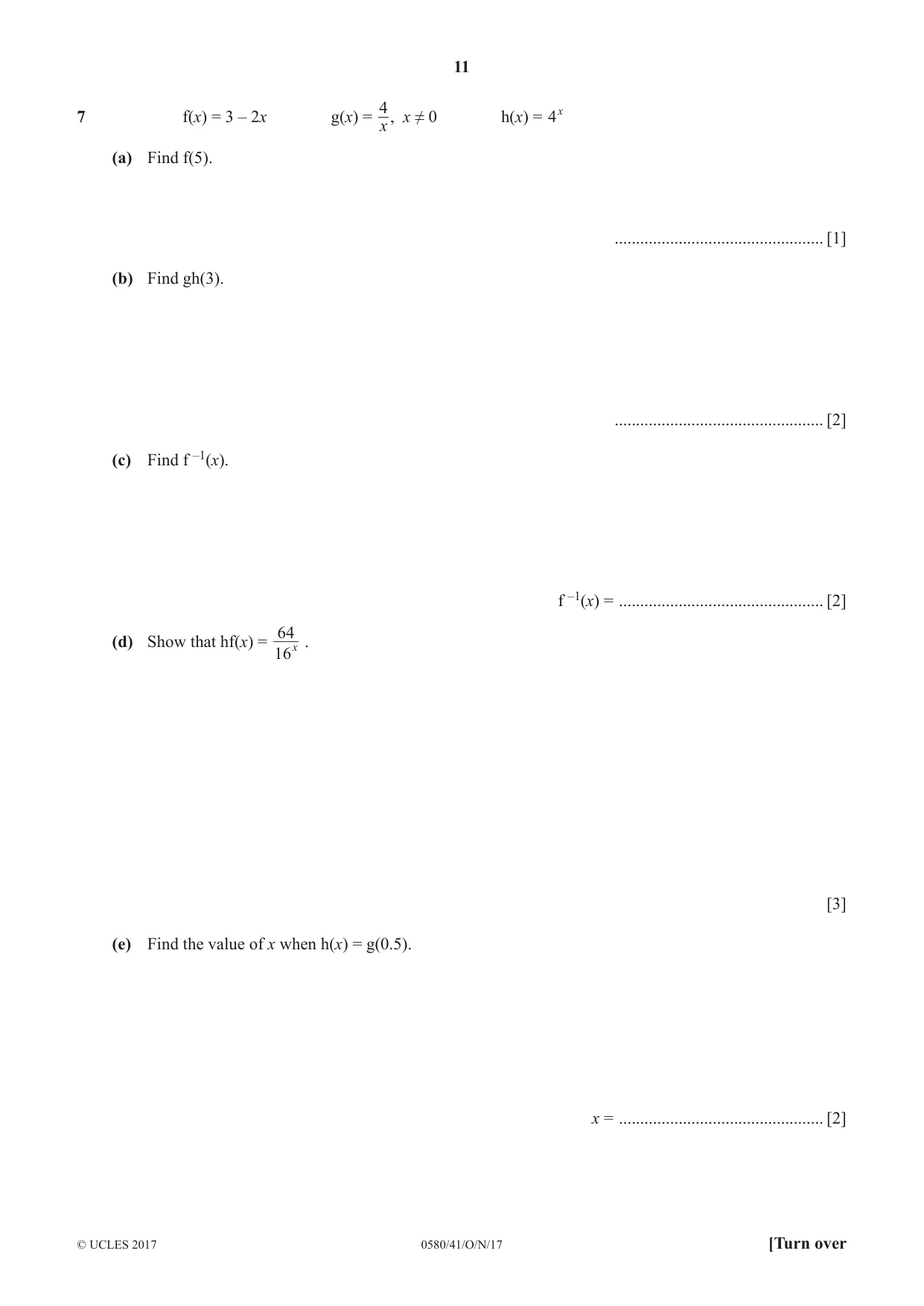
Q7 · F(x) = 3 – 2x g(x) = , x ≠ 0 h(x) = 4x x (a) Find f(5)
47 f(x) = 3 – 2x g(x) = , x ≠ 0 h(x) = 4x x (a) Find f(5). ................................................. [1] (b) Find gh(3). ................................................. [2] (c) Find f –1(x). f –1(x) = ................................................ [2] 64 (d) Show that hf(x) = x . 16 [3] (e) Find the value of x when h(x) = g(0.5). x = ................................................ [2]
Mark scheme: 7(a) –7 1 7(b) 4 2 4 or better M1 for g(43) soi or or better 64 4x 7(c) 3 − x 2 y 3 oe final answer M1 for x = 3 – 2y or 2x = 3 – y or = – x 2 2 2 y − 3 or oe as final answer −2 7(d) 43 – 2x M1 Correctly interprets the indices M1 Dep on previous M1 1 43 e.g. 43 × 4–2x or 43 × or 4 2 x 4 2 x 64 A1 nfww Correct completion with no errors 16x 7(e) 1.5 2 B1 for 4x = 8 or better
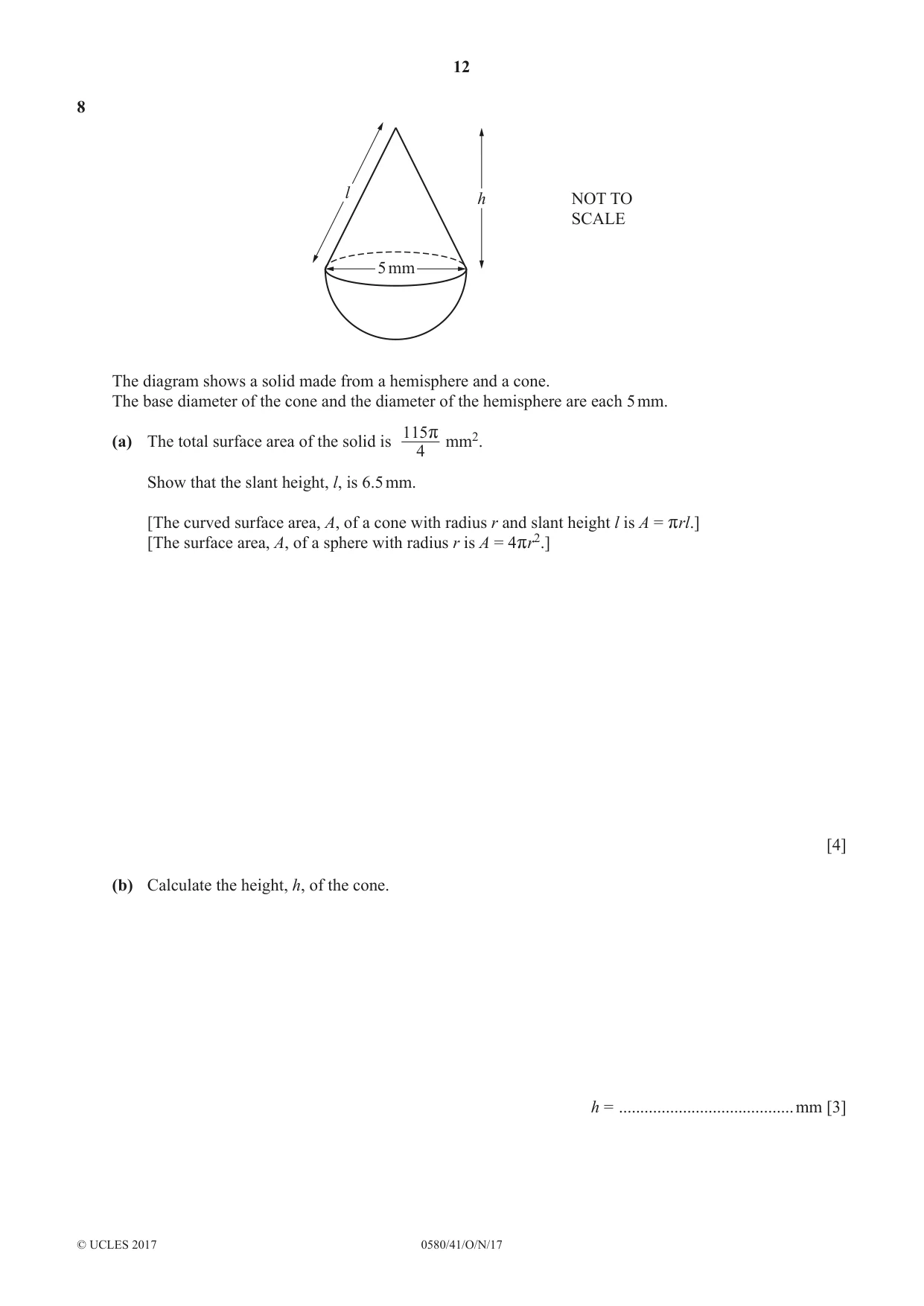
Q8 · L h NOT TO SCALE 5 mm The diagram shows a solid made from a hemisphere and a cone
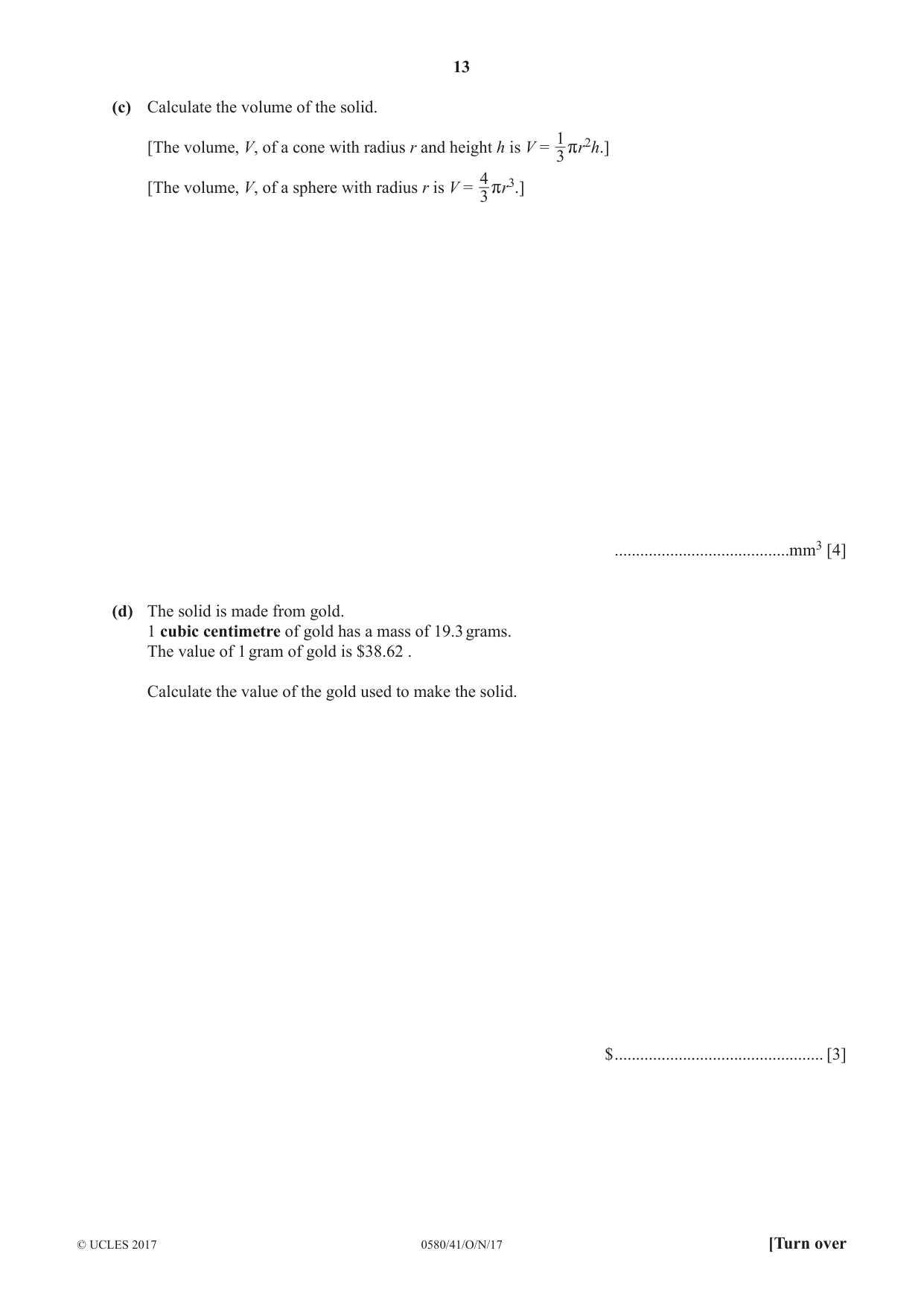
8 l h NOT TO SCALE 5 mm The diagram shows a solid made from a hemisphere and a cone. The base diameter of the cone and the diameter of the hemisphere are each 5 mm. 115r (a) The total surface area of the solid is mm2. 4 Show that the slant height, l, is 6.5 mm. [The curved surface area, A, of a cone with radius r and slant height l is A = rrl.] [The surface area, A, of a sphere with radius r is A = 4rr2.] [4] (b) Calculate the height, h, of the cone. h = .........................................mm [3] (c) Calculate the volume of the solid. 1 [The volume, V, of a cone with radius r and height h is V = rr2h.] 3 4 [The volume, V, of a sphere with radius r is V = rr3.] 3 .........................................mm3 [4] (d) The solid is made from gold. 1 cubic centimetre of gold has a mass of 19.3 grams. The value of 1 gram of gold is $38.62 . Calculate the value of the gold used to make the solid. $ ................................................. [3]
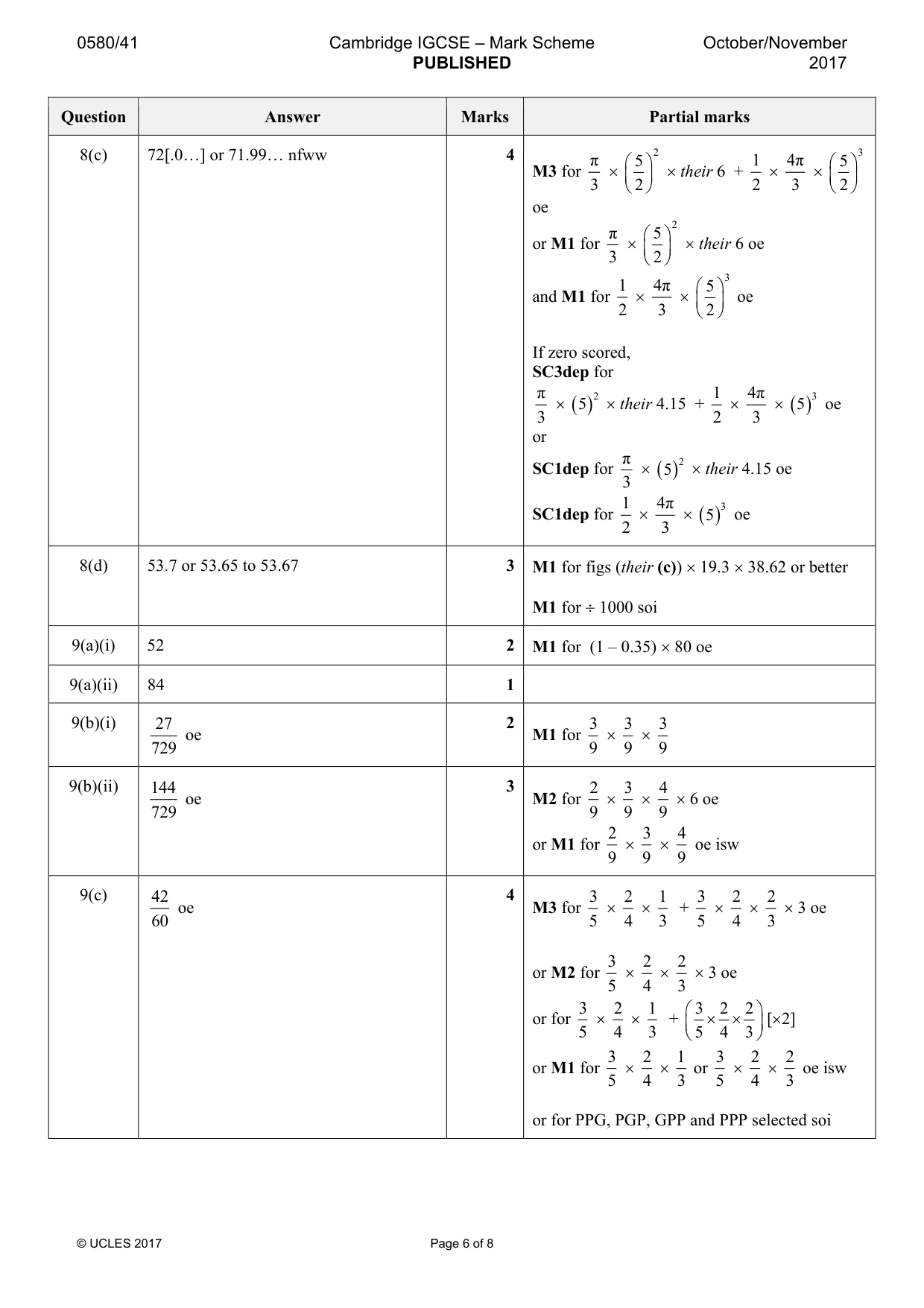
Mark scheme: 8(a) 2 M2 2 5 4 5 115π 5 4 5 π × × l + × π × = oe M1 for π × × l or × π × 2 2 2 4 2 2 2 115π 4 5 2 5 or – × π × = π × × l oe 4 2 2 2 5πl 65π B1 nfww = oe oe both terms must be written in terms of π 2 4 115π 2 or [ l = ] − 2 × π × 2.5 ÷ 2.5π oe nfww 4 or correct complete method for l with decimals 65π × 2 65π A1 [l =] or oe = 6.5 Correct calculation with no errors and B1 earned 4 × 5π 10π 8(b) 6 3 2 2 M2 for 6.5 − 2.5 or M1 for h2 + 2.52 = 6.52 If zero scored, SC2dep for answer 4.15[3]… 8(c) 72[.0…] or 71.99… nfww 4 2 3 π 5 1 4π 5 M3 for × × their 6 + × × 3 2 2 3 2 oe π 5 2 or M1 for × × their 6 oe 3 2 1 4π 5 3 and M1 for × × oe 2 3 2 If zero scored, SC3dep for π 2 1 4π 3 × ( 5 ) × their 4.15 + × × ( 5 ) oe 3 2 3 or π 2 SC1dep for × ( 5 ) × their 4.15 oe 3 1 4π 3 SC1dep for × × ( 5 ) oe 2 3 8(d) 53.7 or 53.65 to 53.67 3 M1 for figs (their (c)) × 19.3 × 38.62 or better M1 for ÷ 1000 soi
Q9 · A bag contains red beads and green beads
9 (a) A bag contains red beads and green beads. There are 80 beads altogether. The probability that a bead chosen at random is green is 0.35 . (i) Find the number of red beads in the bag. ................................................. [2] (ii) Marcos chooses a bead at random and replaces it in the bag. He does this 240 times. Find the number of times he would expect to choose a green bead. ................................................. [1] (b) A different bag contains 2 blue marbles, 3 yellow marbles and 4 white marbles. Huma chooses a marble at random, notes the colour, then replaces it in the bag. She does this three times. Find the probability that (i) all three marbles are yellow, ................................................. [2] (ii) all three marbles are different colours. ................................................. [3] (c) Another bag contains 2 green counters and 3 pink counters. Teresa chooses three counters at random without replacement. Find the probability that she chooses more pink counters than green counters. ................................................. [4]
Mark scheme: 9(a)(i) 52 2 M1 for (1 – 0.35) × 80 oe 9(a)(ii) 84 1 9(b)(i) 27 2 3 3 3 oe M1 for × × 729 9 9 9 9(b)(ii) 144 3 2 3 4 oe M2 for × × × 6 oe 729 9 9 9 2 3 4 or M1 for × × oe isw 9 9 9 9(c) 42 4 3 2 1 3 2 2 oe M3 for × × + × × × 3 oe 60 5 4 3 5 4 3 3 2 2 or M2 for × × × 3 oe 5 4 3 3 2 1 3 2 2 or for × × + × × [× 2] 5 4 3 5 4 3 3 2 1 3 2 2 or M1 for × × or × × oe isw 5 4 3 5 4 3 or for PPG, PGP, GPP and PPP selected soi
Q10 · B 8.5 cm 12.5 cm NOT TO 60° x cm A C SCALE 46° 76° 58° D The diagram shows a…
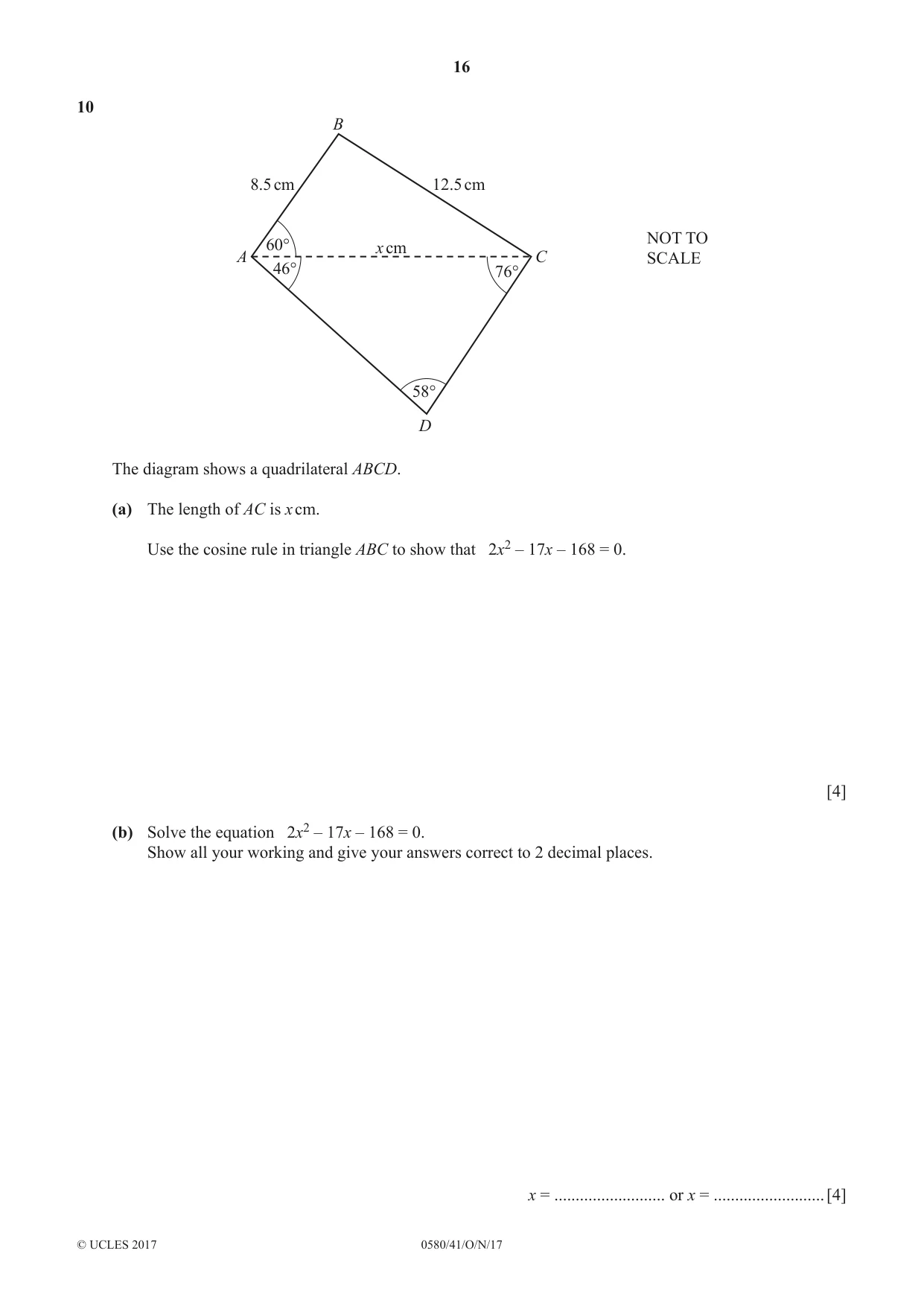
10 B 8.5 cm 12.5 cm NOT TO 60° x cm A C SCALE 46° 76° 58° D The diagram shows a quadrilateral ABCD. (a) The length of AC is x cm. Use the cosine rule in triangle ABC to show that 2x2 – 17x – 168 = 0. [4] (b) Solve the equation 2x2 – 17x – 168 = 0. Show all your working and give your answers correct to 2 decimal places. x = .......................... or x = .......................... [4] (c) Use the sine rule to calculate the length of CD. CD = .......................................... cm [3] (d) Calculate the area of the quadrilateral ABCD. ..........................................cm2 [3]
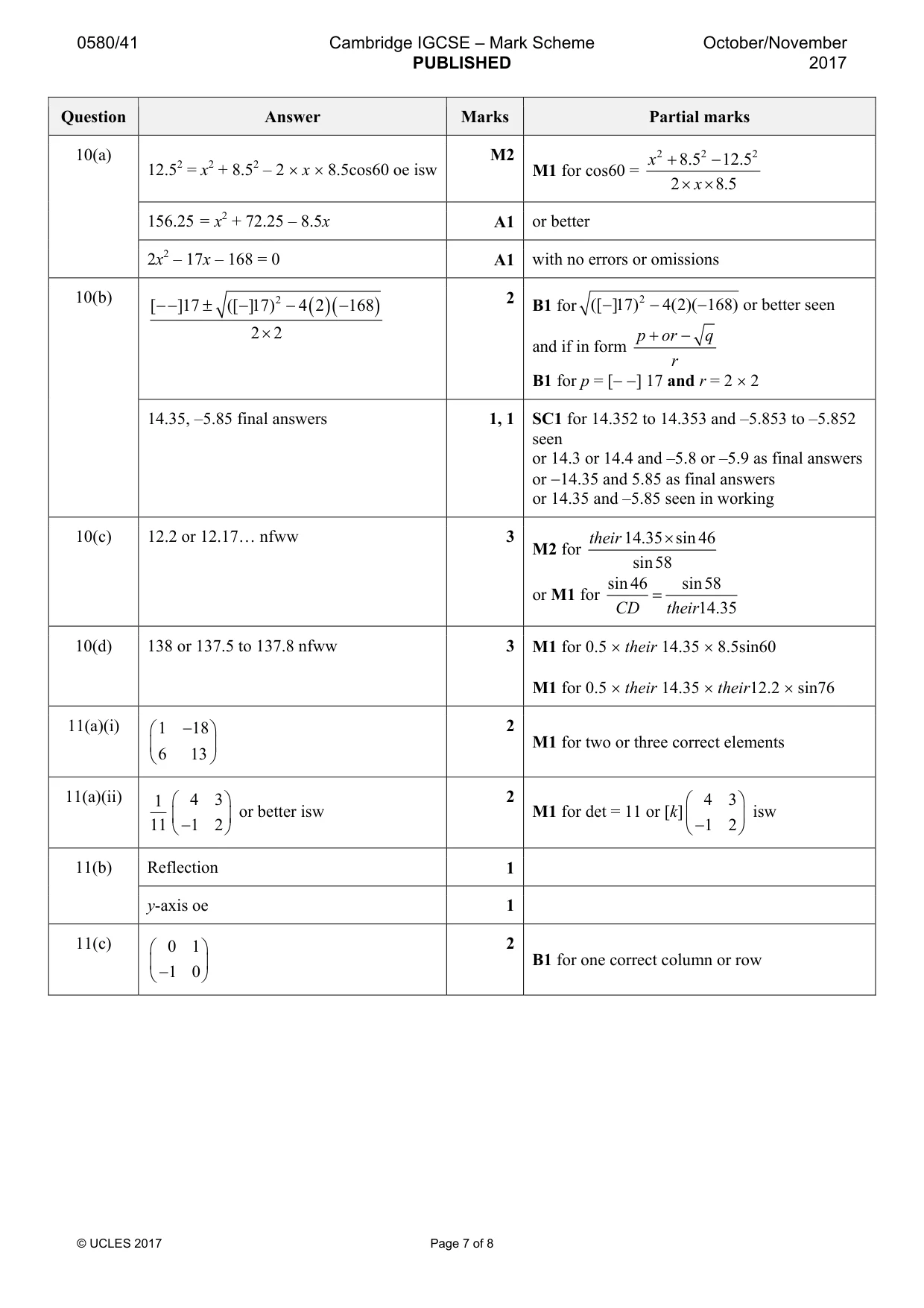
Mark scheme: 10(a) M2 x 2 + 8.5 2 − 12.5 2 12.52 = x2 + 8.52 – 2 × x × 8.5cos60 oe isw M1 for cos60 = 2 × x × 8.5 156.25 = x2 + 72.25 – 8.5x A1 or better 2x2 – 17x – 168 = 0 A1 with no errors or omissions 10(b) 2 2 2 [ −− ]17 ± ([ − ]17) − 4 ( 2 )( −168 ) B1 for ([ − ]17) − 4(2)( −168) or better seen 2 × 2 p + or − q and if in form r B1 for p = [− −] 17 and r = 2 × 2 14.35, –5.85 final answers 1, 1 SC1 for 14.352 to 14.353 and –5.853 to –5.852 seen or 14.3 or 14.4 and –5.8 or –5.9 as final answers or −14.35 and 5.85 as final answers or 14.35 and –5.85 seen in working 10(c) 12.2 or 12.17… nfww 3 their 14.35 × sin46 M2 for sin58 sin 46 sin58 or M1 for = CD their14.35 10(d) 138 or 137.5 to 137.8 nfww 3 M1 for 0.5 × their 14.35 × 8.5sin60 M1 for 0.5 × their 14.35 × their12.2 × sin76
Q11 · - 3 11 (a) A = c1 4 m Find (i) A2, [2] f p (ii) A–1, the inverse of A
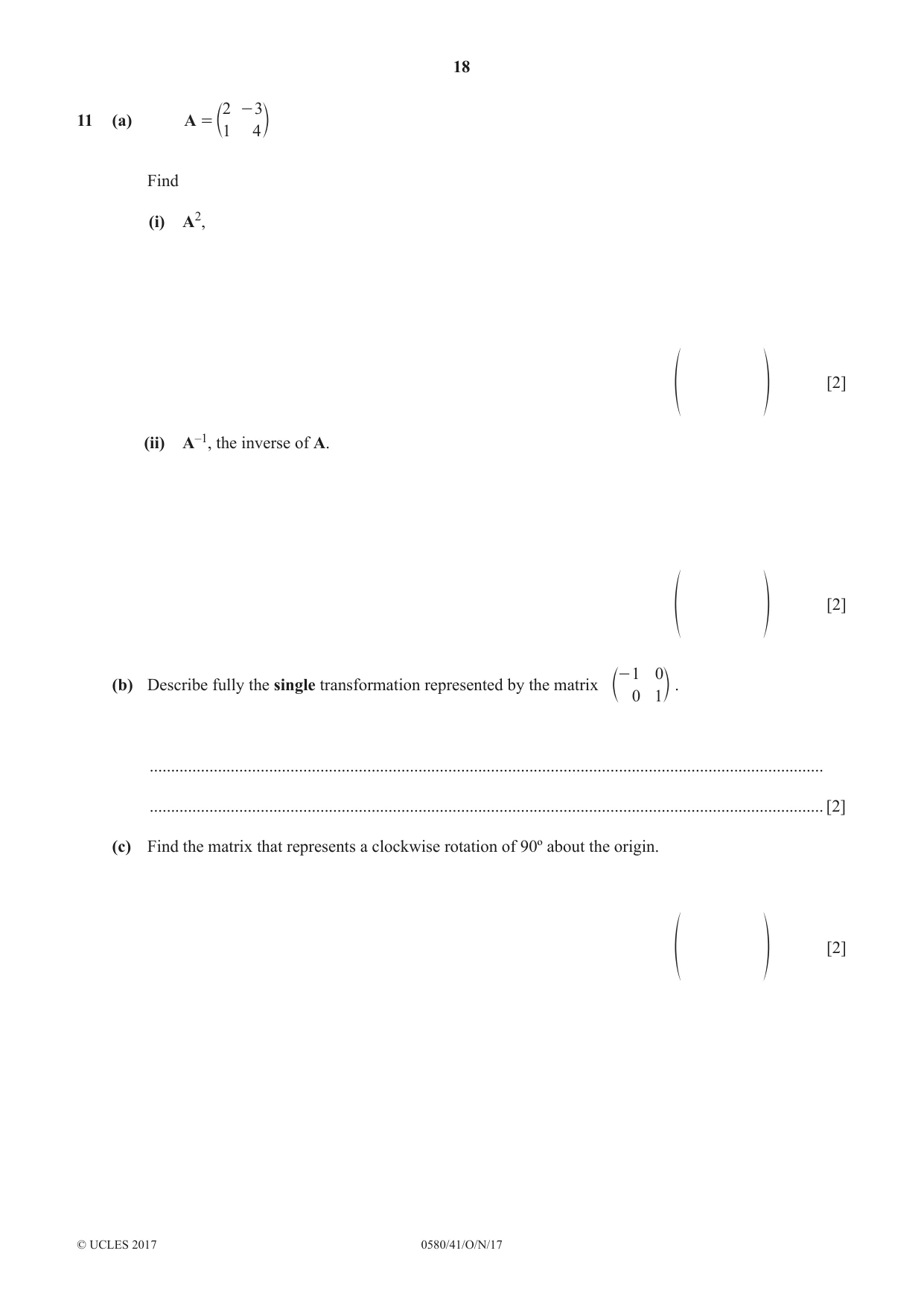
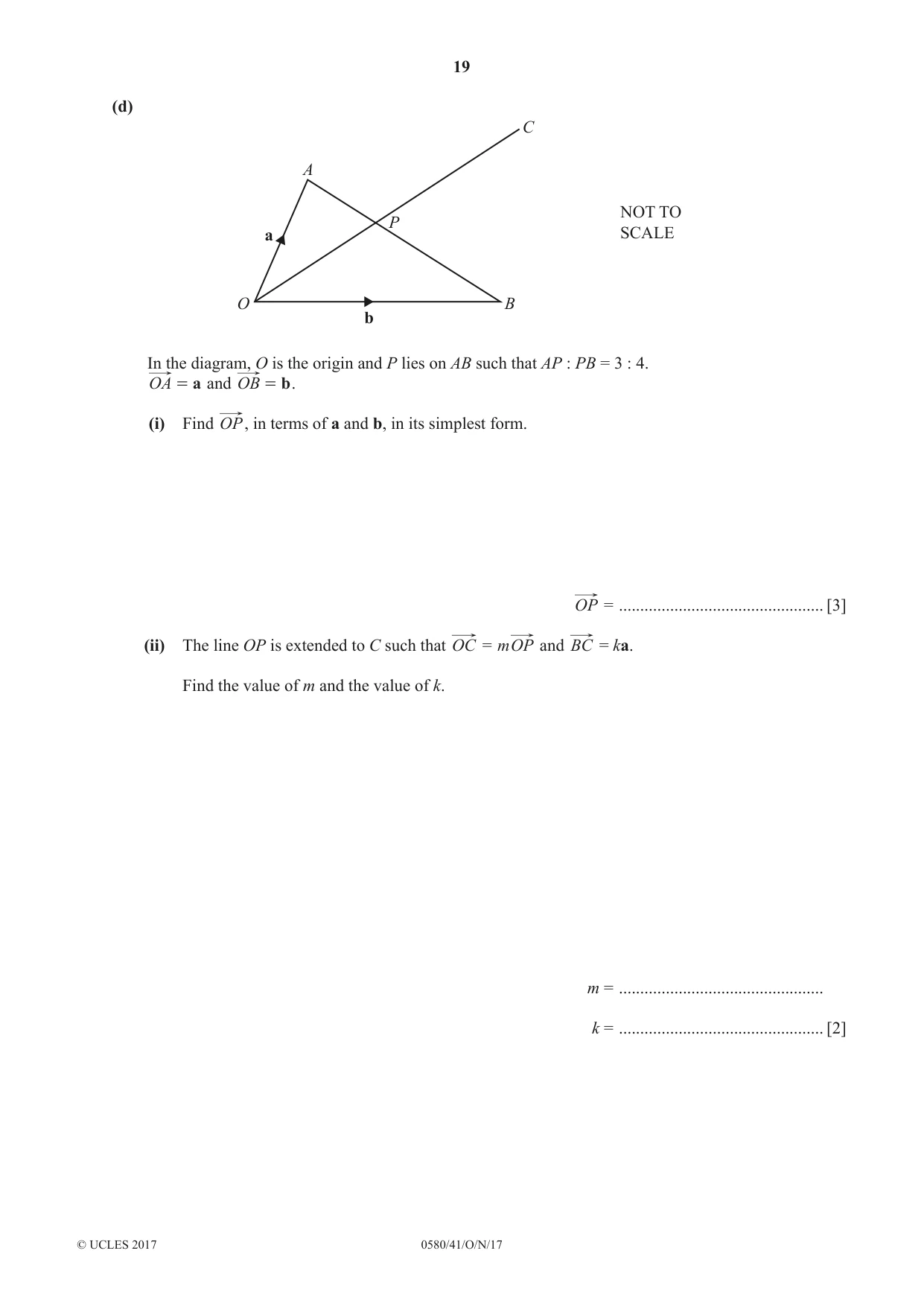
2 - 3 11 (a) A = c1 4 m Find (i) A2, [2] f p (ii) A–1, the inverse of A. [2] f p - 1 0 (b) Describe fully the single transformation represented by the matrix . c 0 1 m .............................................................................................................................................................. .............................................................................................................................................................. [2] (c) Find the matrix that represents a clockwise rotation of 90º about the origin. [2] f p (d) C A NOT TO P a SCALE O B b In the diagram, O is the origin and P lies on AB such that AP : PB = 3 : 4. OA = a and OB = b . (i) Find OP, in terms of a and b, in its simplest form. OP = ................................................ [3] (ii) The line OP is extended to C such that OC = m OP and BC = ka. Find the value of m and the value of k. m = ................................................ k = ................................................ [2]
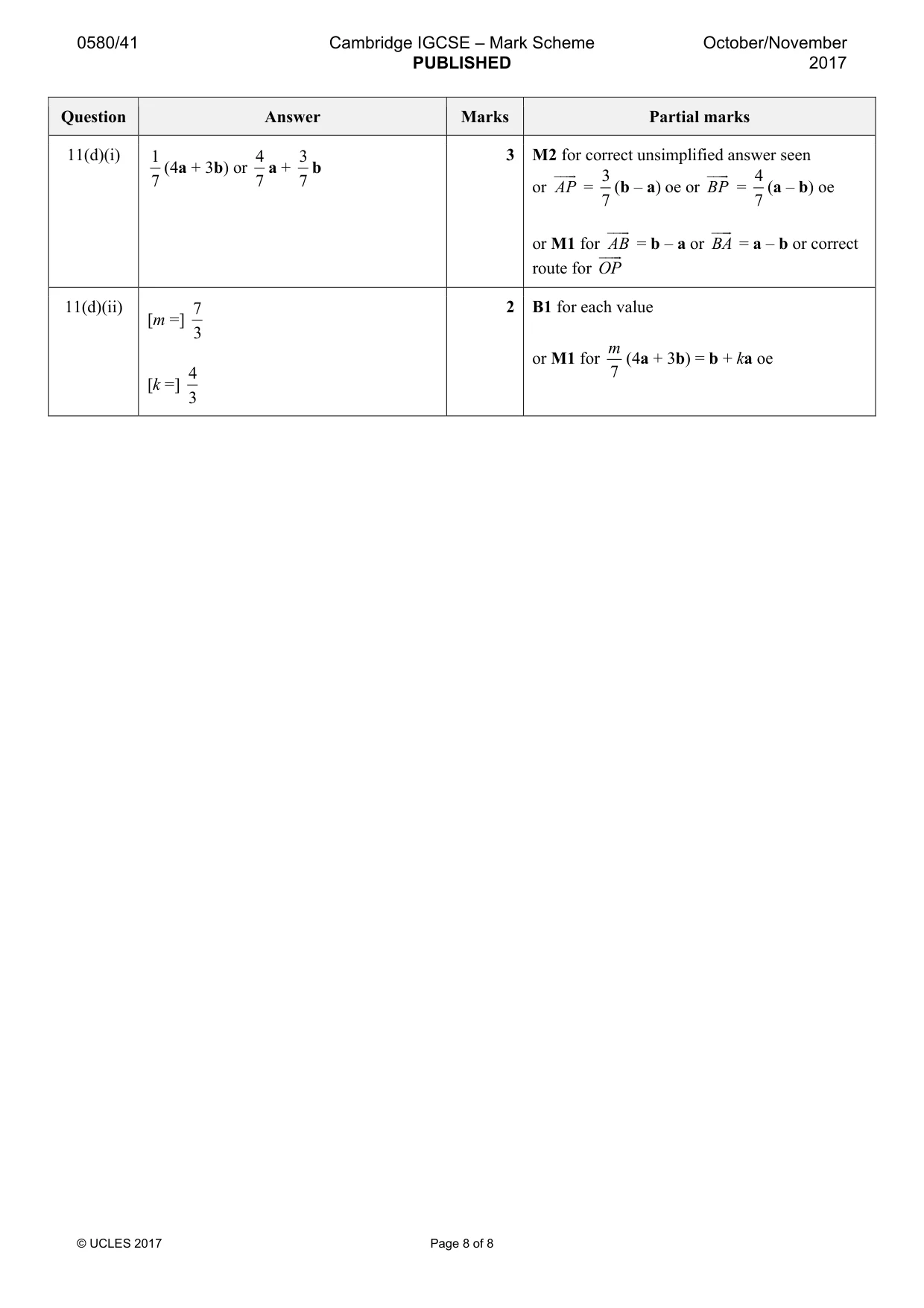
Mark scheme: 11(a)(i) 1 −18 2 M1 for two or three correct elements 6 13 11(a)(ii) 1 4 3 2 4 3 or better isw M1 for det = 11 or [k] isw 11 −1 2 −1 2 11(b) Reflection 1 y-axis oe 1 11(c) 0 1 2 B1 for one correct column or row −1 0 11(d)(i) 1 4 3 3 M2 for correct unsimplified answer seen (4a + 3b) or a + b JJJG 3 JJJG 4 7 7 7 or AP = (b – a) oe or BP = (a – b) oe 7 7 JJJG JJJG or M1 for AB = b – a or BA = a – b or correct JJJG route for OP 11(d)(ii) 7 2 B1 for each value [m =] 3 m or M1 for (4a + 3b) = b + ka oe 4 7 [k =] 3
What was in this paper
The subtopics covered by these 11 questions, and how many questions each got. Open one in a new tab to see every Cambridge question on it.
What you needed in this session
Cambridge’s own grade thresholds for 2017 Oct/Nov, Paper 4 · Variant 1. A higher threshold means an easier paper — the bar moves with how the cohort did.