Cambridge IGCSE Mathematics 0580 — 2023 May/June Paper 4 · Variant 3
0580/43/M/J/23 · 12 questions · 130 marks · ≈146 min
The question paper and its mark scheme, free to read here and free to download. This is Cambridge’s own paper, exactly as it was sat.
Question paper20 pages
Mark scheme11 pages
Answers below. Sit the paper first if you are practising.
Questions as text
Q1 · Tomas sells a computer, a bike and a phone
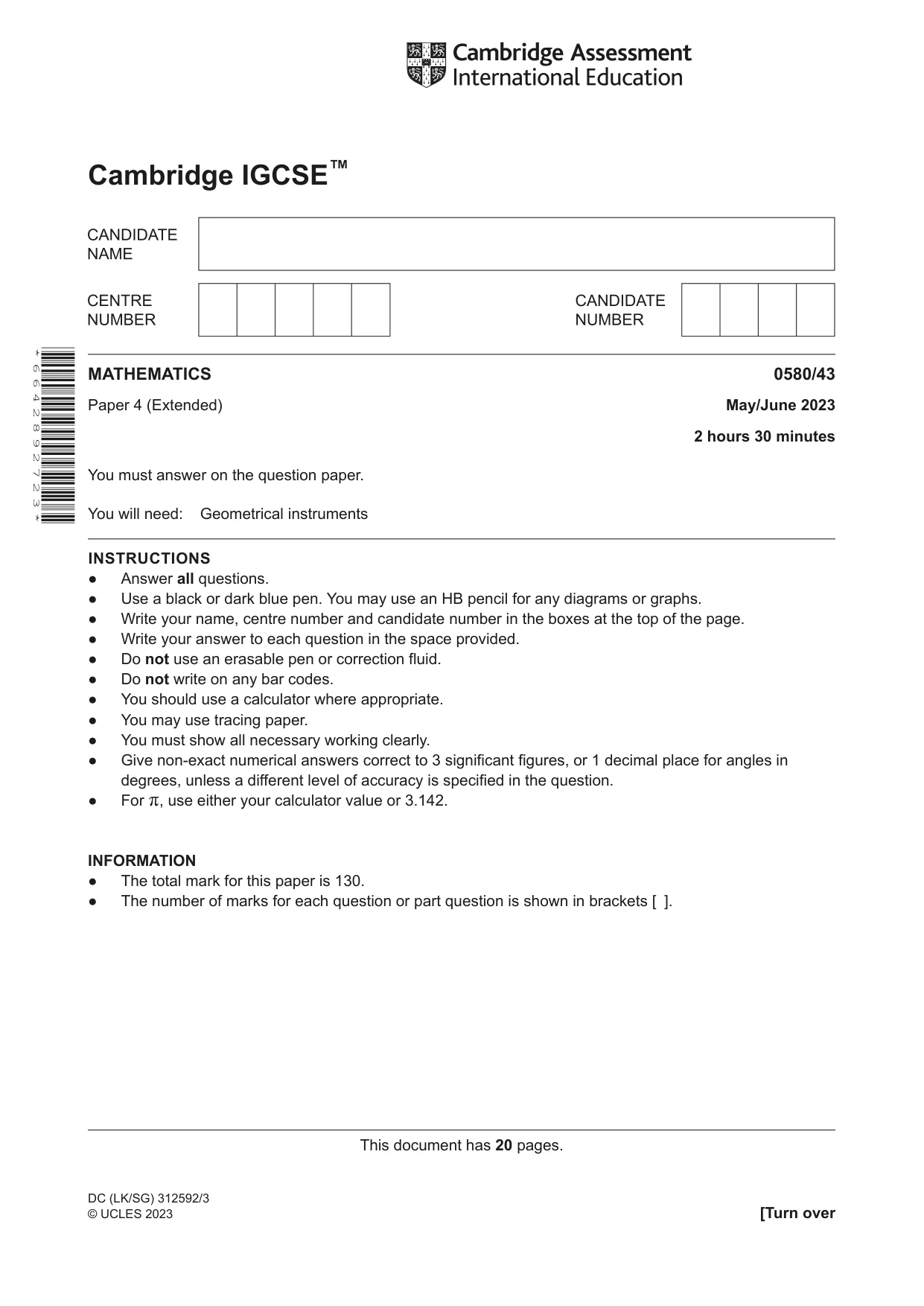
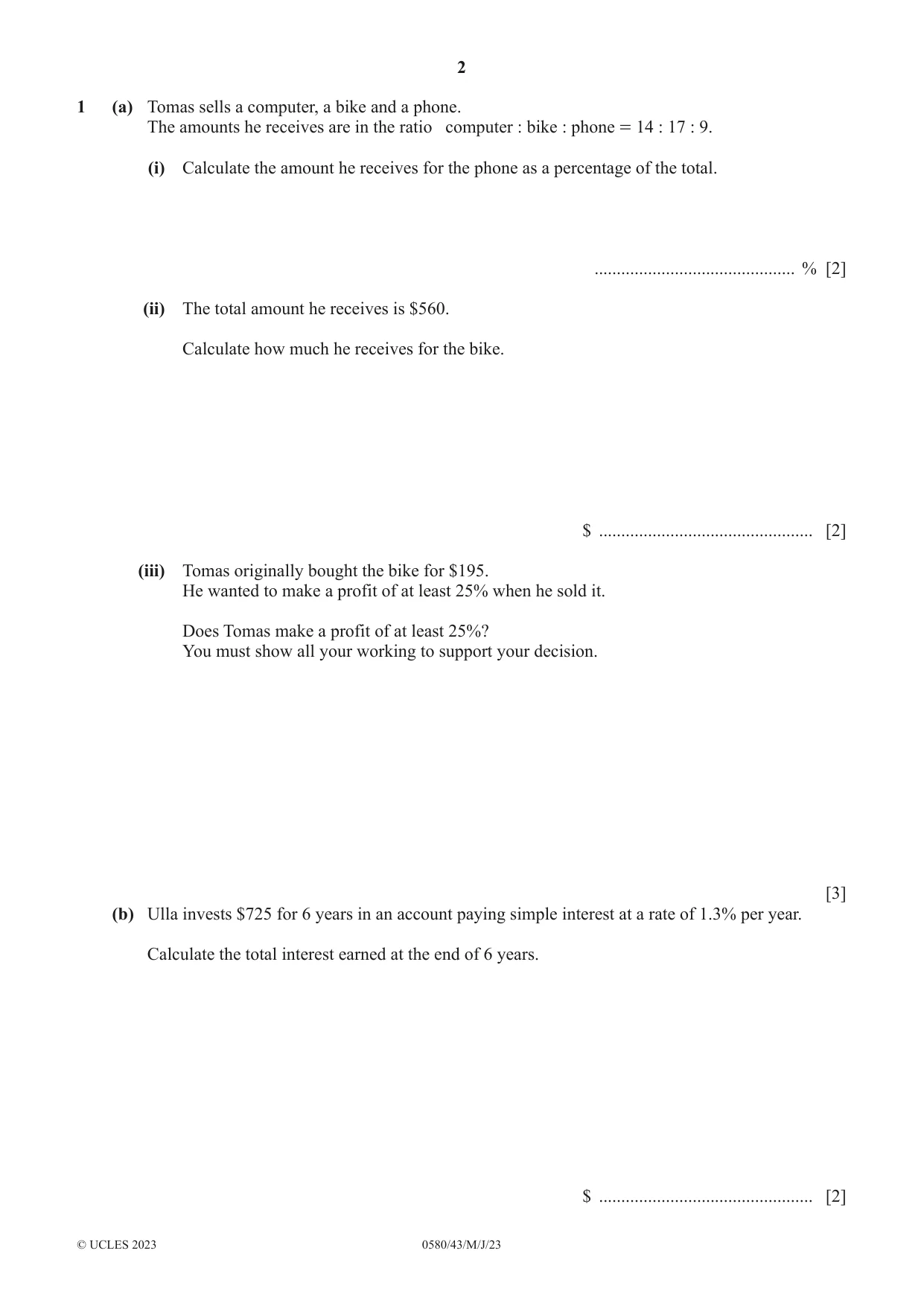
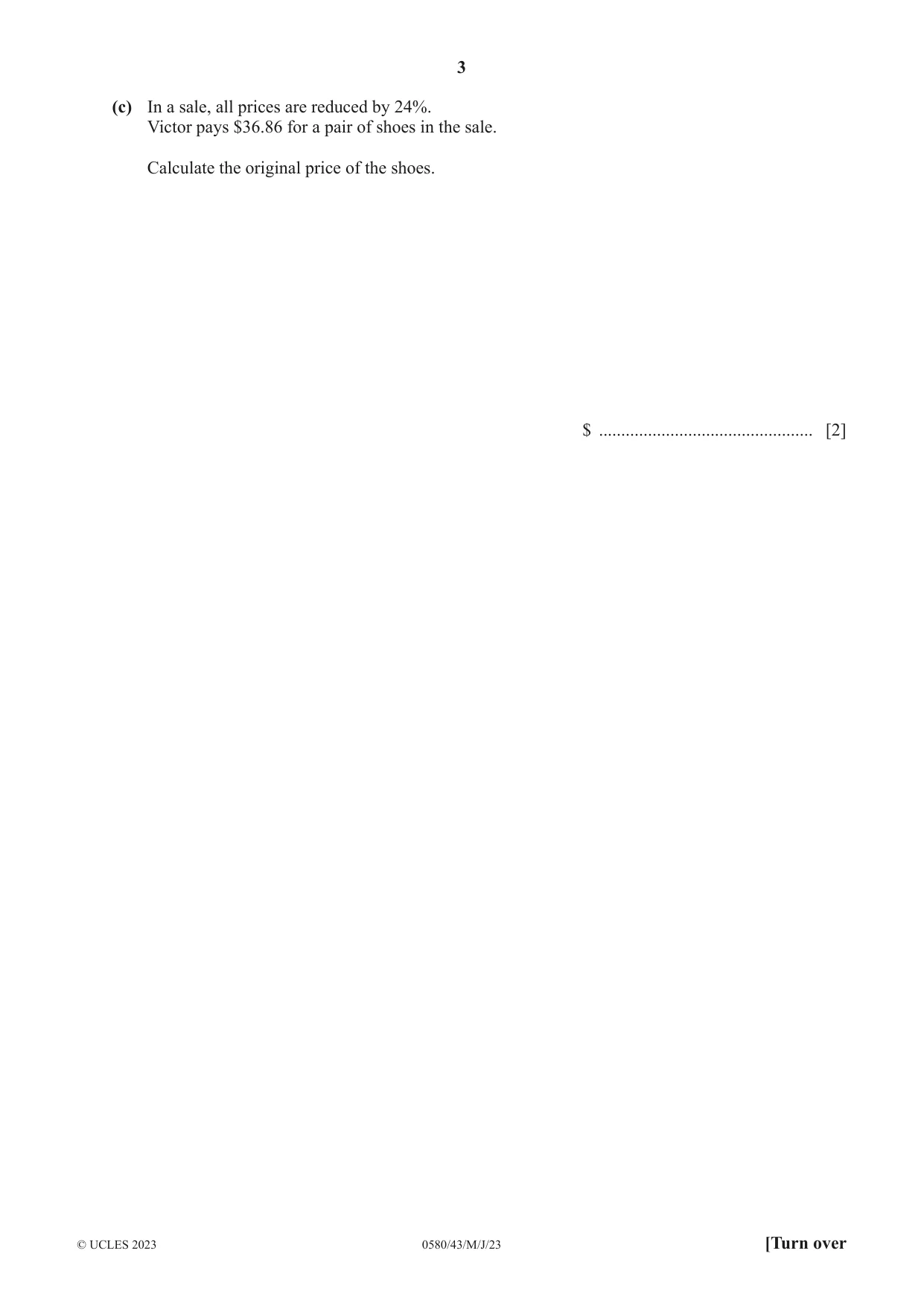
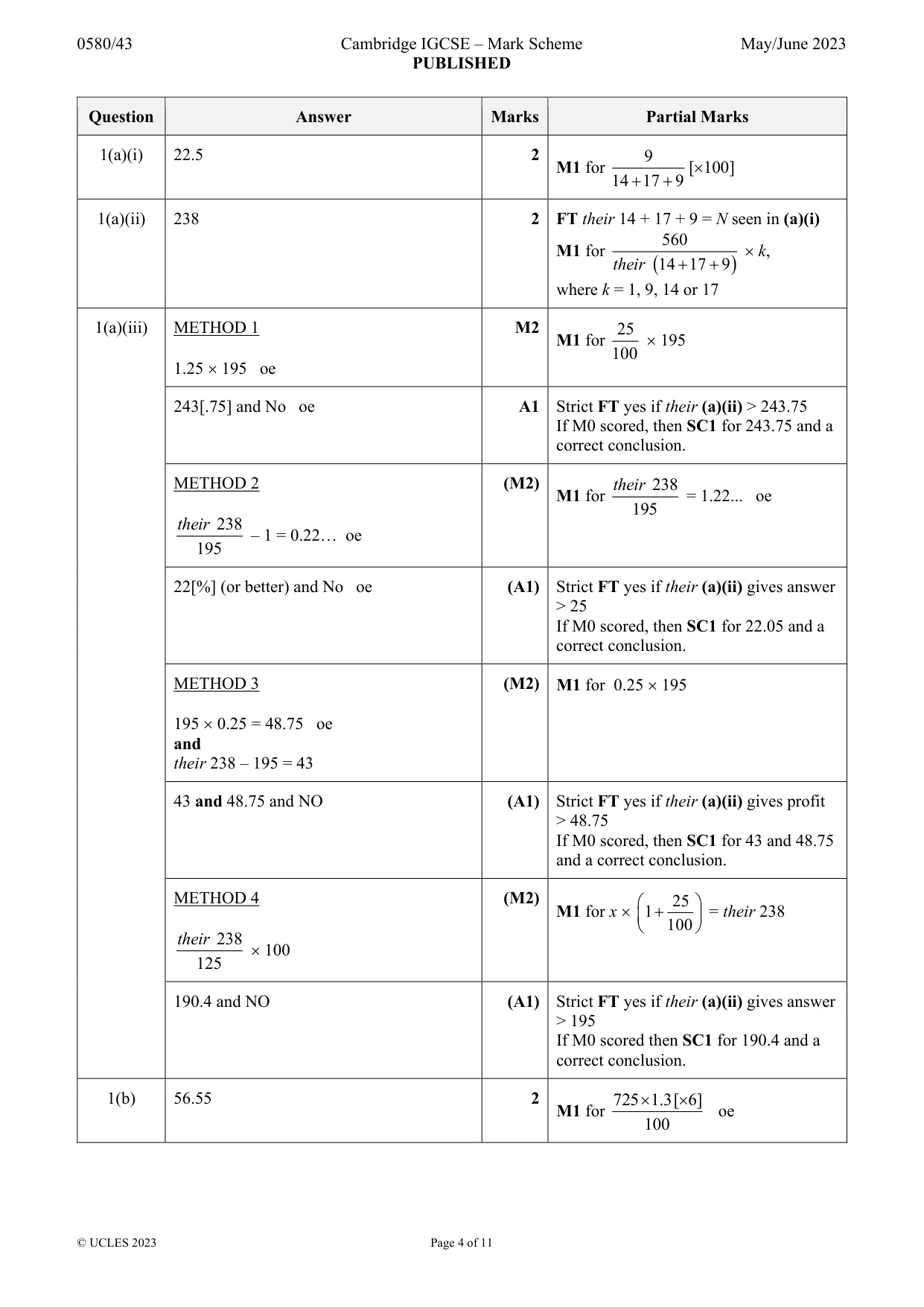
1 (a) Tomas sells a computer, a bike and a phone. The amounts he receives are in the ratio computer : bike : phone = 14 : 17 : 9. (i) Calculate the amount he receives for the phone as a percentage of the total. ............................................. % [2] (ii) The total amount he receives is $560. Calculate how much he receives for the bike. $ ................................................ [2] (iii) Tomas originally bought the bike for $195. He wanted to make a profit of at least 25% when he sold it. Does Tomas make a profit of at least 25%? You must show all your working to support your decision. [3] (b) Ulla invests $725 for 6 years in an account paying simple interest at a rate of 1.3% per year. Calculate the total interest earned at the end of 6 years. $ ................................................ [2] (c) In a sale, all prices are reduced by 24%. Victor pays $36.86 for a pair of shoes in the sale. Calculate the original price of the shoes. $ ................................................ [2]
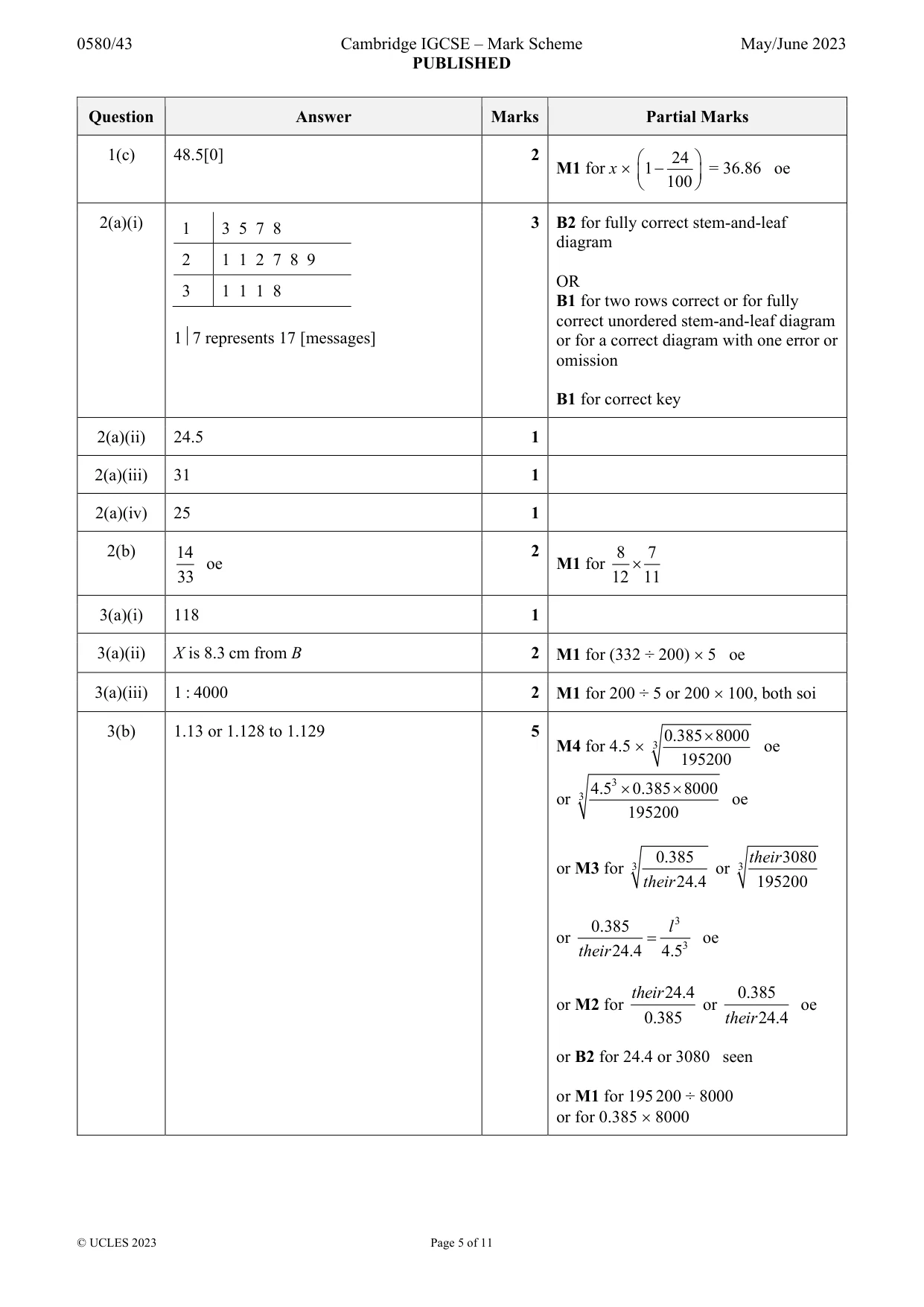
Mark scheme: Question Answer Marks Partial Marks 1(a)(i) 22.5 2 9 M1 for [ 100] 14 17 9 1(a)(ii) 238 2 FT their 14 + 17 + 9 = N seen in (a)(i) 560 M1 for k, their 14 17 9 where k = 1, 9, 14 or 17 1(a)(iii) METHOD 1 M2 25 M1 for 195 100 1.25 195 oe 243[.75] and No oe A1 Strict FT yes if their (a)(ii) > 243.75 If M0 scored, then SC1 for 243.75 and a correct conclusion. METHOD 2 (M2) their 238 M1 for = 1.22... oe 195 their 238 – 1 = 0.22… oe 195 22[%] (or better) and No oe (A1) Strict FT yes if their (a)(ii) gives answer > 25 If M0 scored, then SC1 for 22.05 and a correct conclusion. METHOD 3 (M2) M1 for 0.25 195 195 0.25 = 48.75 oe and their 238 – 195 = 43 43 and 48.75 and NO (A1) Strict FT yes if their (a)(ii) gives profit > 48.75 If M0 scored, then SC1 for 43 and 48.75 and a correct conclusion. METHOD 4 (M2) 25 M1 for x 1 = their 238 100 their 238 100 125 190.4 and NO (A1) Strict FT yes if their (a)(ii) gives answer > 195 If M0 scored then SC1 for 190.4 and a correct conclusion. 1(b) 56.55 2 725 1.3[ 6] M1 for oe 100 1(c) 48.5[0] 2 24 M1 for x 1 = 36.86 oe 100
Q2 · Anna records the number of text messages she receives for 14 days
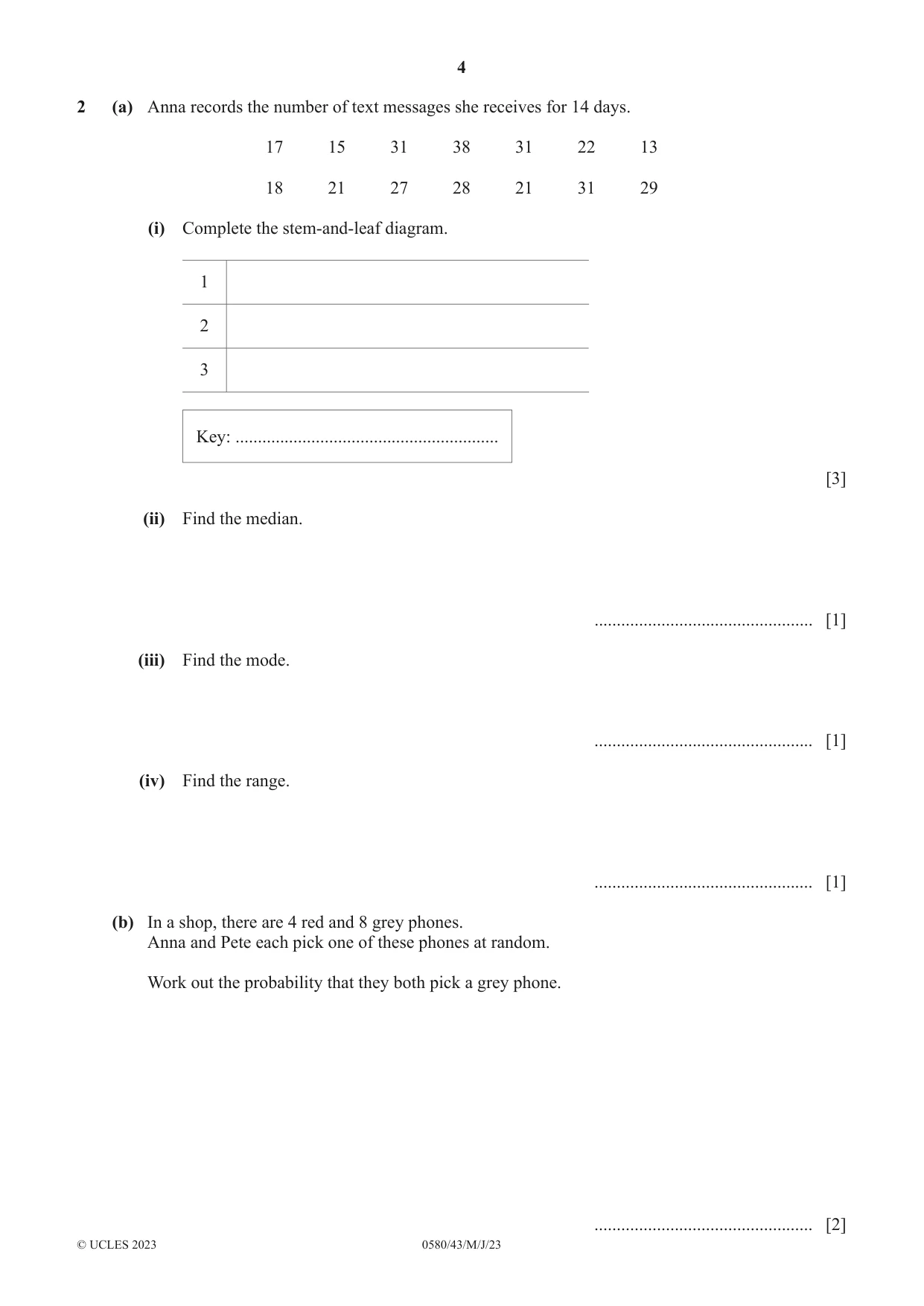
2 (a) Anna records the number of text messages she receives for 14 days. 17 15 31 38 31 22 13 18 21 27 28 21 31 29 (i) Complete the stem-and-leaf diagram. 1 2 3 Key: ........................................................... [3] (ii) Find the median. ................................................. [1] (iii) Find the mode. ................................................. [1] (iv) Find the range. ................................................. [1] (b) In a shop, there are 4 red and 8 grey phones. Anna and Pete each pick one of these phones at random. Work out the probability that they both pick a grey phone. ................................................. [2]
Mark scheme: 2(a)(i) 3 B2 for fully correct stem-and-leaf 1 3 5 7 8 diagram 2 1 1 2 7 8 9 OR 3 1 1 1 8 B1 for two rows correct or for fully correct unordered stem-and-leaf diagram 17 represents 17 [messages] or for a correct diagram with one error or omission B1 for correct key 2(a)(ii) 24.5 1 2(a)(iii) 31 1 2(a)(iv) 25 1 2(b) 14 2 8 7 oe M1 for 33 12 11
Q3 · The scale drawing shows two sides, AB and BC, of a field
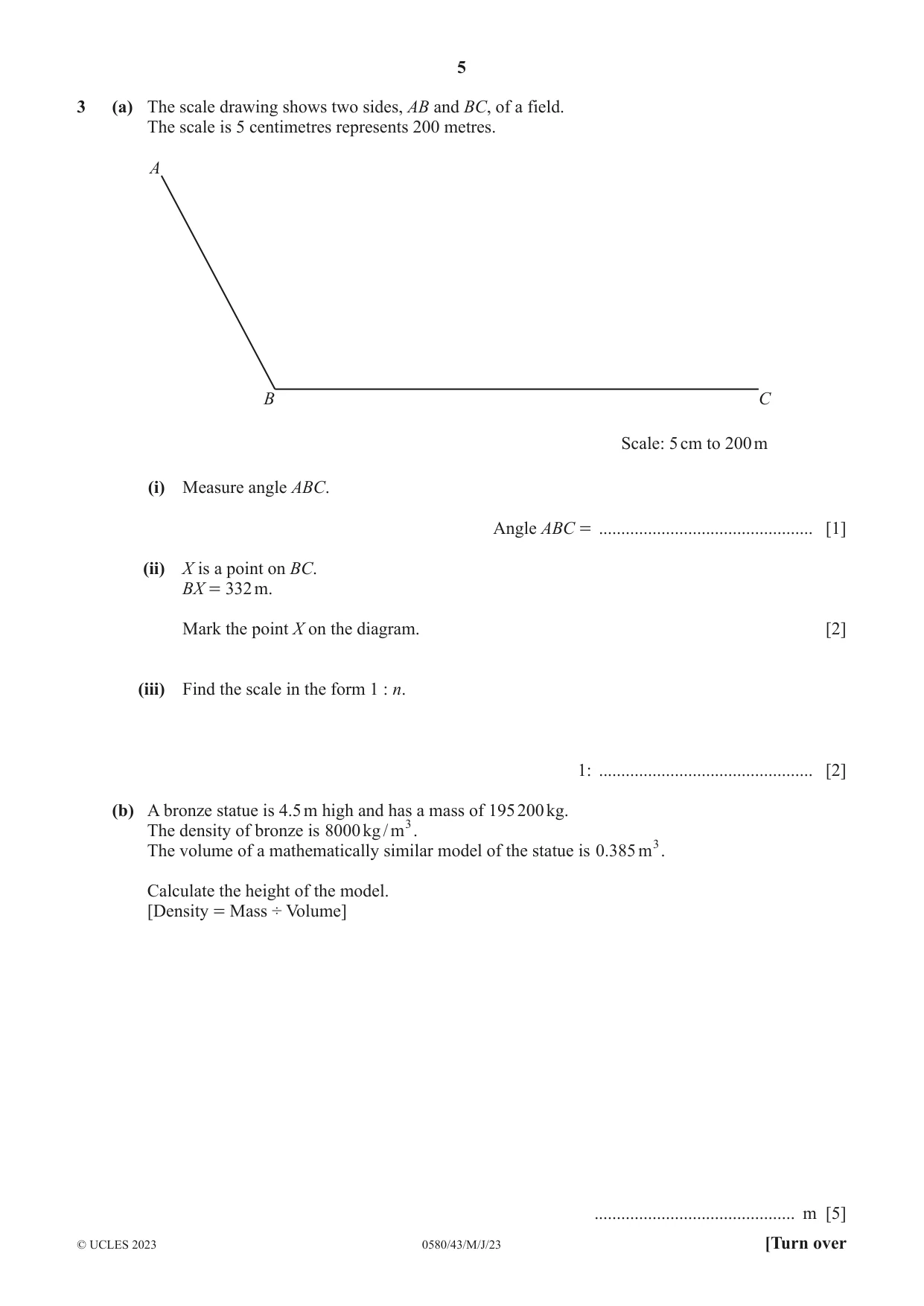
3 (a) The scale drawing shows two sides, AB and BC, of a field. The scale is 5 centimetres represents 200 metres. A B C Scale: 5 cm to 200 m (i) Measure angle ABC. Angle ABC = ................................................ [1] (ii) X is a point on BC. BX = 332 m. Mark the point X on the diagram. [2] (iii) Find the scale in the form 1 : n. 1: ................................................ [2] (b) A bronze statue is 4.5 m high and has a mass of 195 200 kg. The density of bronze is 8000 kg / m 3. The volume of a mathematically similar model of the statue is 0.385 m 3. Calculate the height of the model. [Density = Mass ÷ Volume] ............................................. m [5]
Mark scheme: 3(a)(i) 118 1 3(a)(ii) X is 8.3 cm from B 2 M1 for (332 ÷ 200) 5 oe 3(a)(iii) 1 : 4000 2 M1 for 200 ÷ 5 or 200 100, both soi 3(b) 1.13 or 1.128 to 1.129 5 0.385 8000 M4 for 4.5 3 oe 195200 4.53 0.385 8000 or 3 oe 195200 0.385 their 3080 or M3 for 3 or 3 their 24.4 195200 0.385 l 3 or oe their 24.4 4.53 their 24.4 0.385 or M2 for or oe 0.385 their 24.4 or B2 for 24.4 or 3080 seen or M1 for 195 200 ÷ 8000 or for 0.385 8000
Q4 · North 114° A NOT TO SCALE C B A, B and C are three towns and the bearing of C from A is…
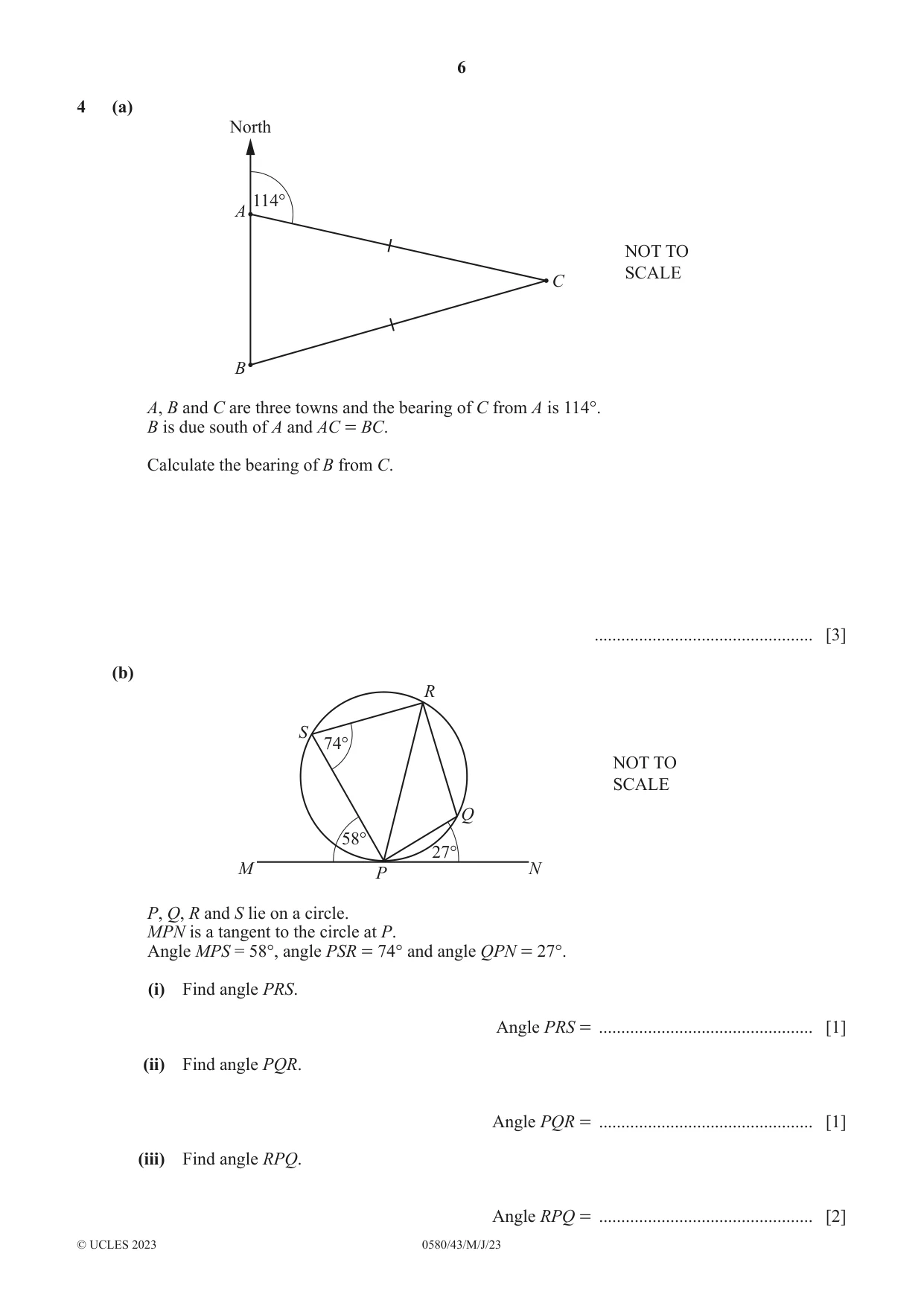
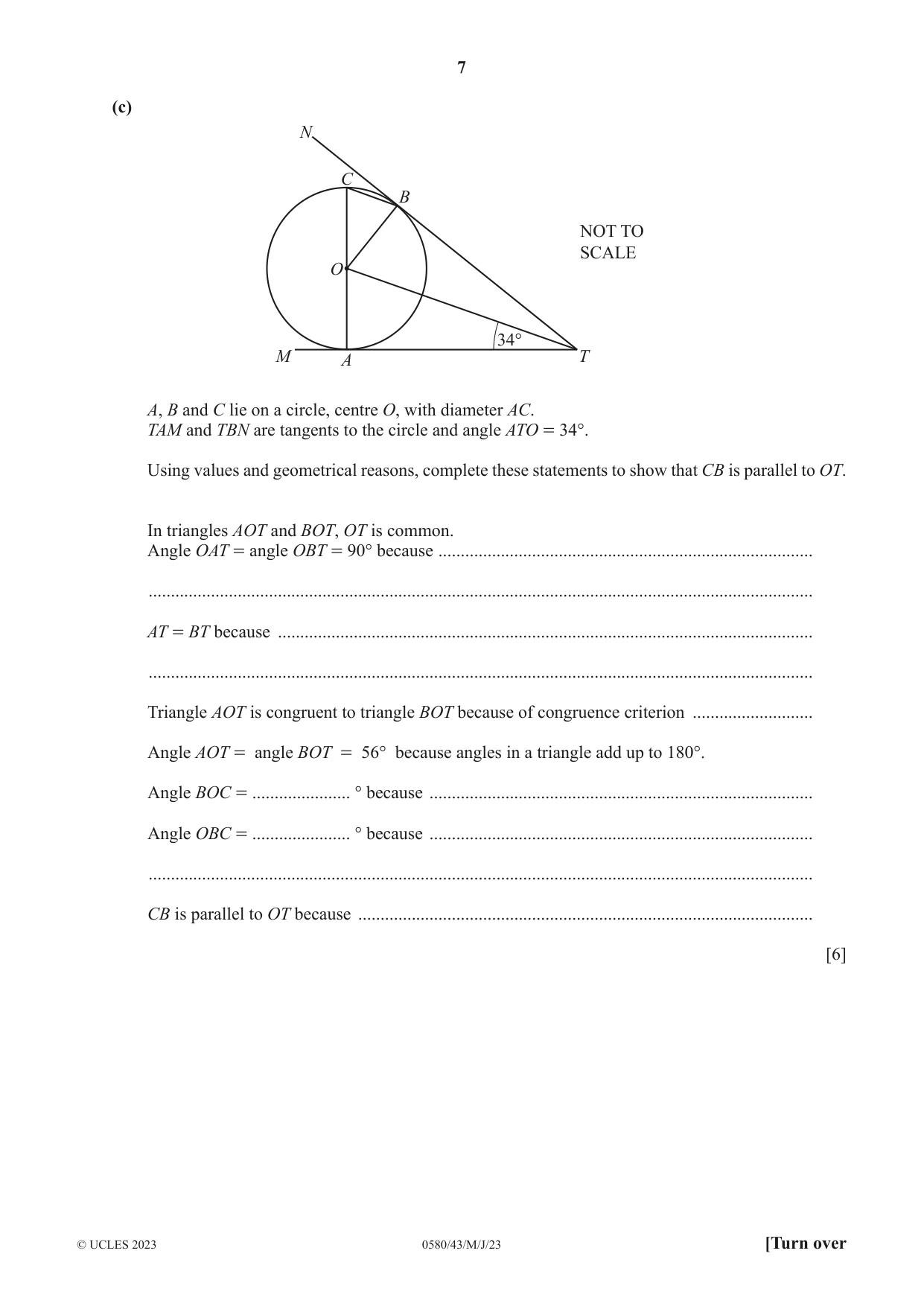
4 (a) North 114° A NOT TO SCALE C B A, B and C are three towns and the bearing of C from A is 114°. B is due south of A and AC = BC. Calculate the bearing of B from C. ................................................. [3] (b) R S 74° NOT TO SCALE Q 58° 27° M P N P, Q, R and S lie on a circle. MPN is a tangent to the circle at P. Angle MPS = 58°, angle PSR = 74° and angle QPN = 27°. (i) Find angle PRS. Angle PRS = ................................................ [1] (ii) Find angle PQR. Angle PQR = ................................................ [1] (iii) Find angle RPQ. Angle RPQ = ................................................ [2] (c) N C B NOT TO SCALE O 34° M A T A, B and C lie on a circle, centre O, with diameter AC. TAM and TBN are tangents to the circle and angle ATO = 34°. Using values and geometrical reasons, complete these statements to show that CB is parallel to OT. In triangles AOT and BOT, OT is common. Angle OAT = angle OBT = 90° because .................................................................................... ..................................................................................................................................................... AT = BT because ........................................................................................................................ ..................................................................................................................................................... Triangle AOT is congruent to triangle BOT because of congruence criterion ........................... Angle AOT = angle BOT = 56° because angles in a triangle add up to 180°. Angle BOC = ...................... ° because ...................................................................................... Angle OBC = ...................... ° because ...................................................................................... ..................................................................................................................................................... CB is parallel to OT because ...................................................................................................... [6]
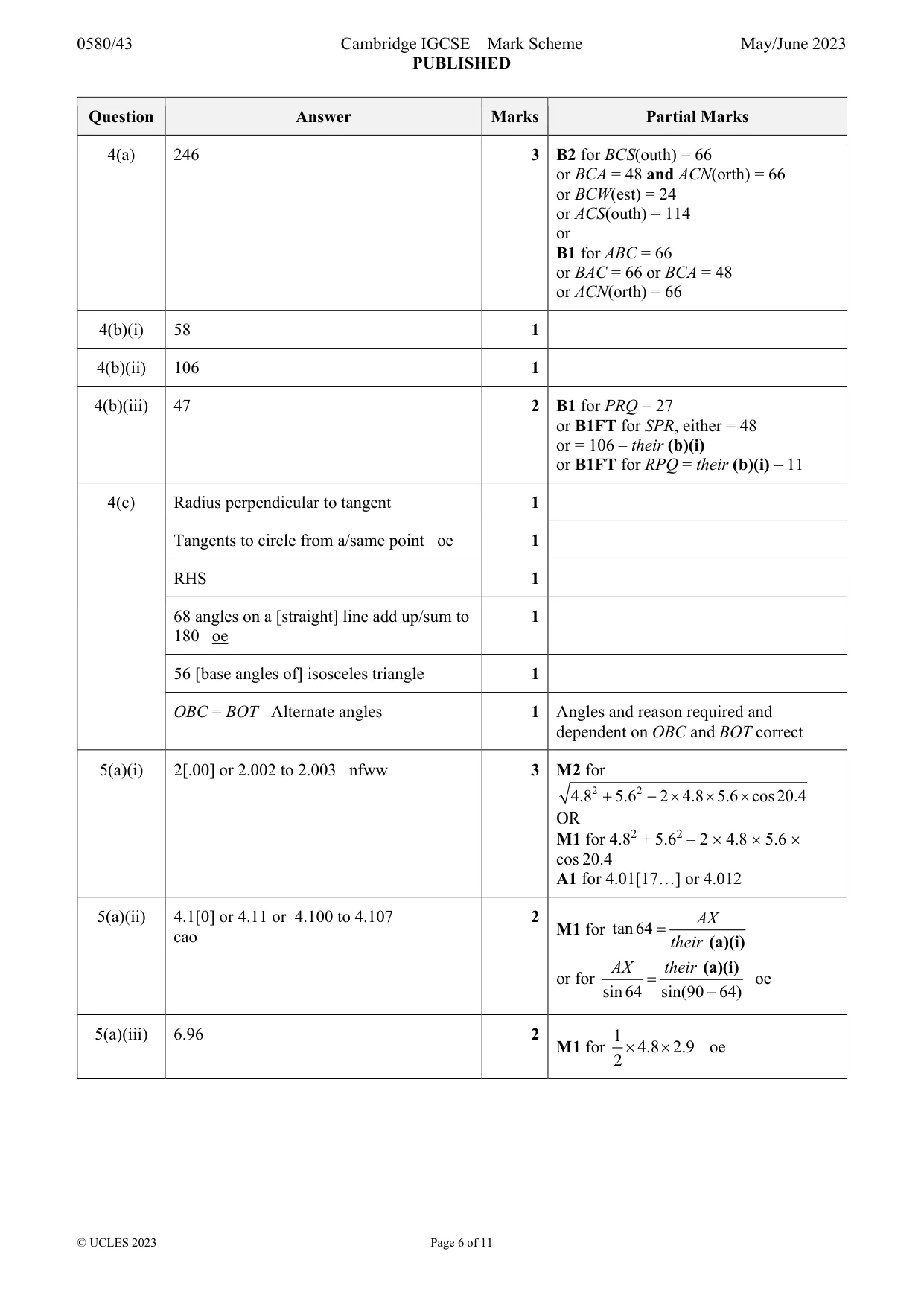
Mark scheme: 4(a) 246 3 B2 for BCS(outh) = 66 or BCA = 48 and ACN(orth) = 66 or BCW(est) = 24 or ACS(outh) = 114 or B1 for ABC = 66 or BAC = 66 or BCA = 48 or ACN(orth) = 66 4(b)(i) 58 1 4(b)(ii) 106 1 4(b)(iii) 47 2 B1 for PRQ = 27 or B1FT for SPR, either = 48 or = 106 – their (b)(i) or B1FT for RPQ = their (b)(i) – 11 4(c) Radius perpendicular to tangent 1 Tangents to circle from a/same point oe 1 RHS 1 68 angles on a [straight] line add up/sum to 1 180 oe 56 [base angles of] isosceles triangle 1 OBC = BOT Alternate angles 1 Angles and reason required and dependent on OBC and BOT correct
Q5 · X Y NOT TO SCALE 4.8 m A 20.4° C 5.6 m B ABC is a scalene triangle on horizontal ground
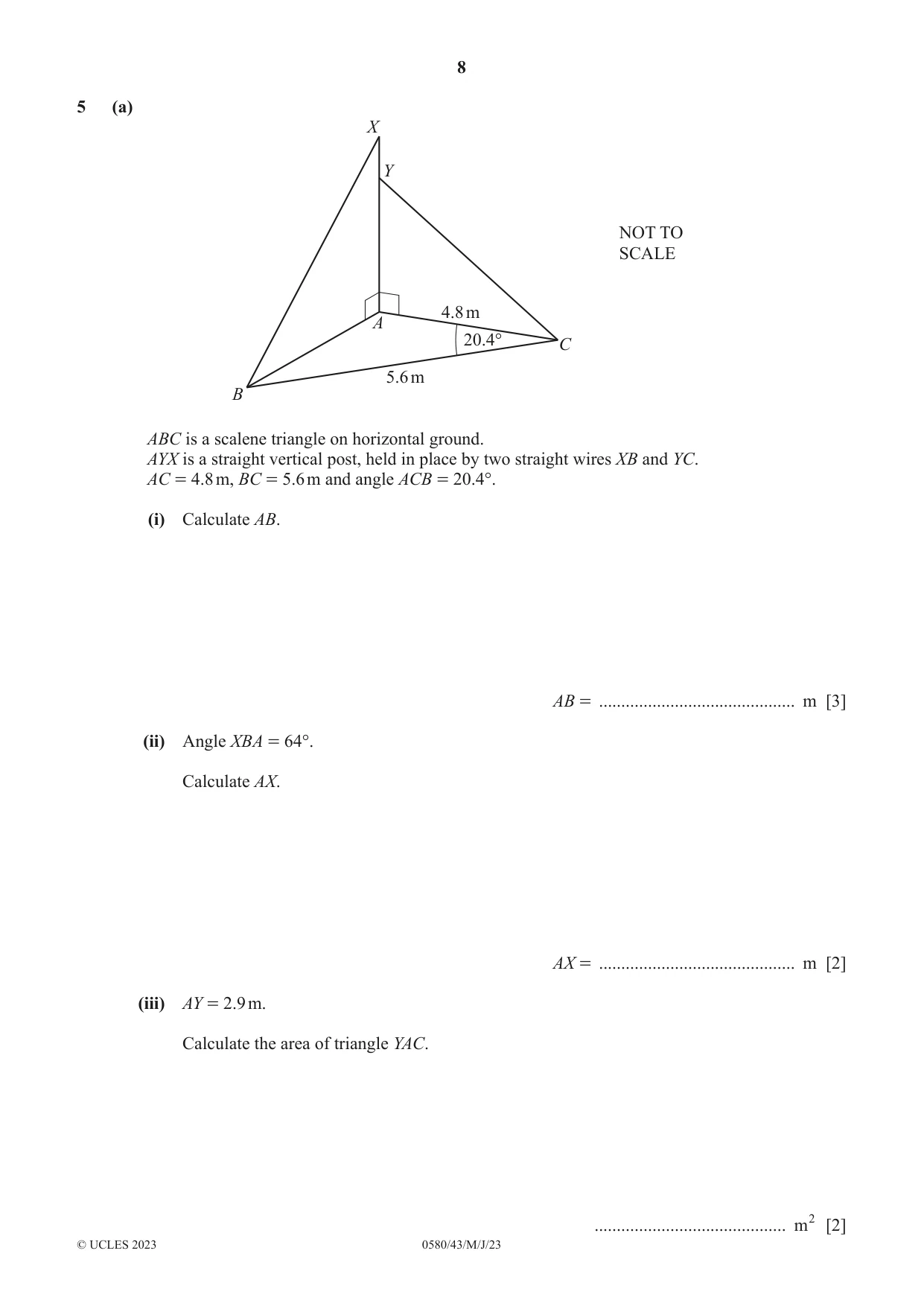
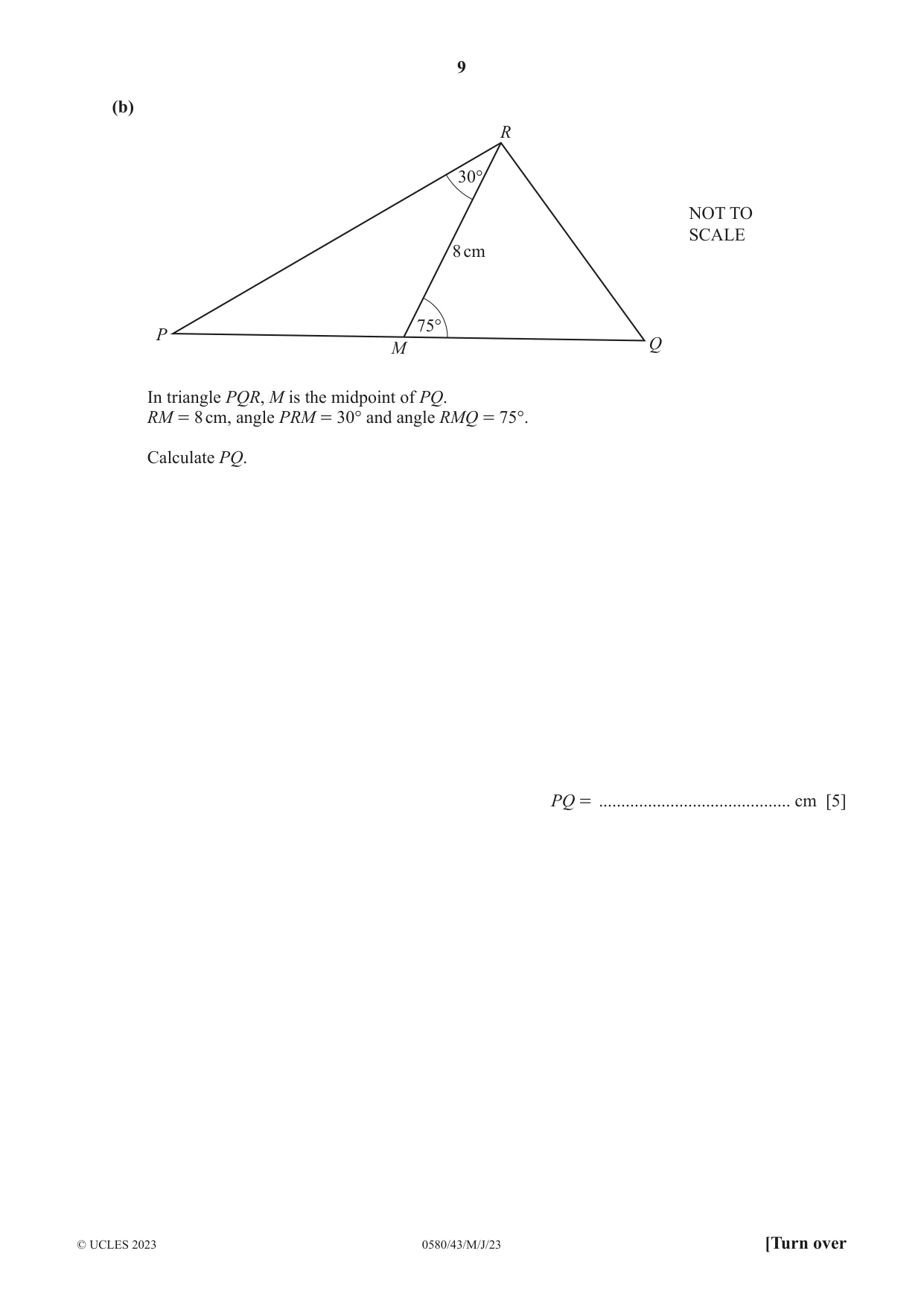
5 (a) X Y NOT TO SCALE 4.8 m A 20.4° C 5.6 m B ABC is a scalene triangle on horizontal ground. AYX is a straight vertical post, held in place by two straight wires XB and YC. AC = 4.8 m, BC = 5.6 m and angle ACB = 20.4°. (i) Calculate AB. AB = ............................................ m [3] (ii) Angle XBA = 64°. Calculate AX. AX = ............................................ m [2] (iii) AY = 2.9 m. Calculate the area of triangle YAC. ........................................... m2 [2] (b) R 30° NOT TO SCALE 8 cm 75° P M Q In triangle PQR, M is the midpoint of PQ. RM = 8 cm, angle PRM = 30° and angle RMQ = 75°. Calculate PQ. PQ = ........................................... cm [5]
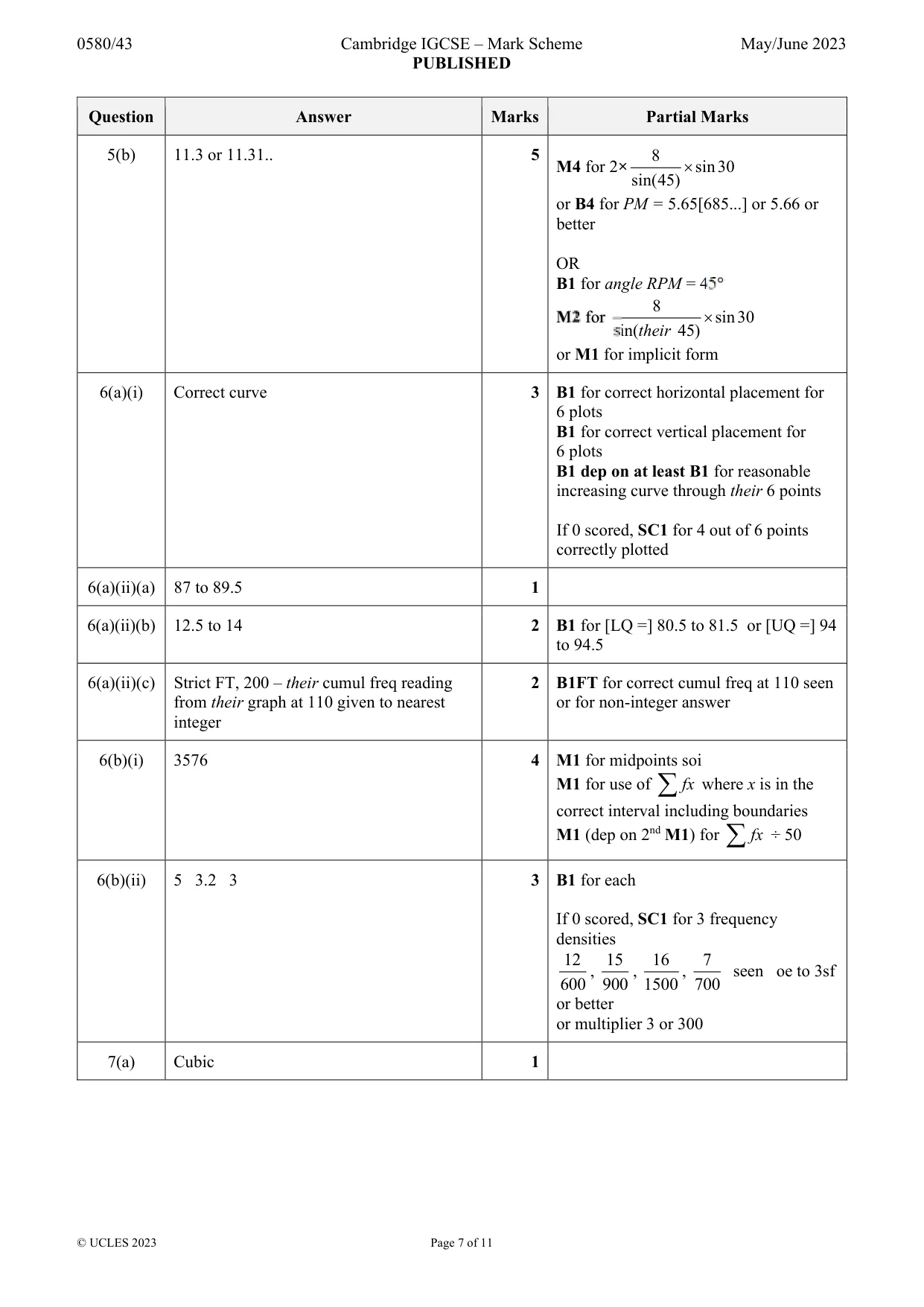
Mark scheme: 5(a)(i) 2[.00] or 2.002 to 2.003 nfww 3 M2 for 4.8 2 5.6 2 2 4.8 5.6 cos20.4 OR M1 for 4.82 + 5.62 – 2 4.8 5.6 cos 20.4 A1 for 4.01[17…] or 4.012 5(a)(ii) 4.1[0] or 4.11 or 4.100 to 4.107 2 AX M1 for tan64 cao their (a)(i) AX their (a)(i) or for oe sin64 sin(90 64) 5(a)(iii) 6.96 2 1 M1 for 4.8 2.9 oe 2 5(b) 11.3 or 11.31.. 5 8 M4 for 2× sin30 sin(45) or B4 for PM = 5.65[685...] or 5.66 or better OR B1 for angle RPM = 45° 8 M2 for sin30 sin(their 45) or M1 for implicit form
Q6 · The cumulative frequency table shows information about the speed of each of 200 cars as…
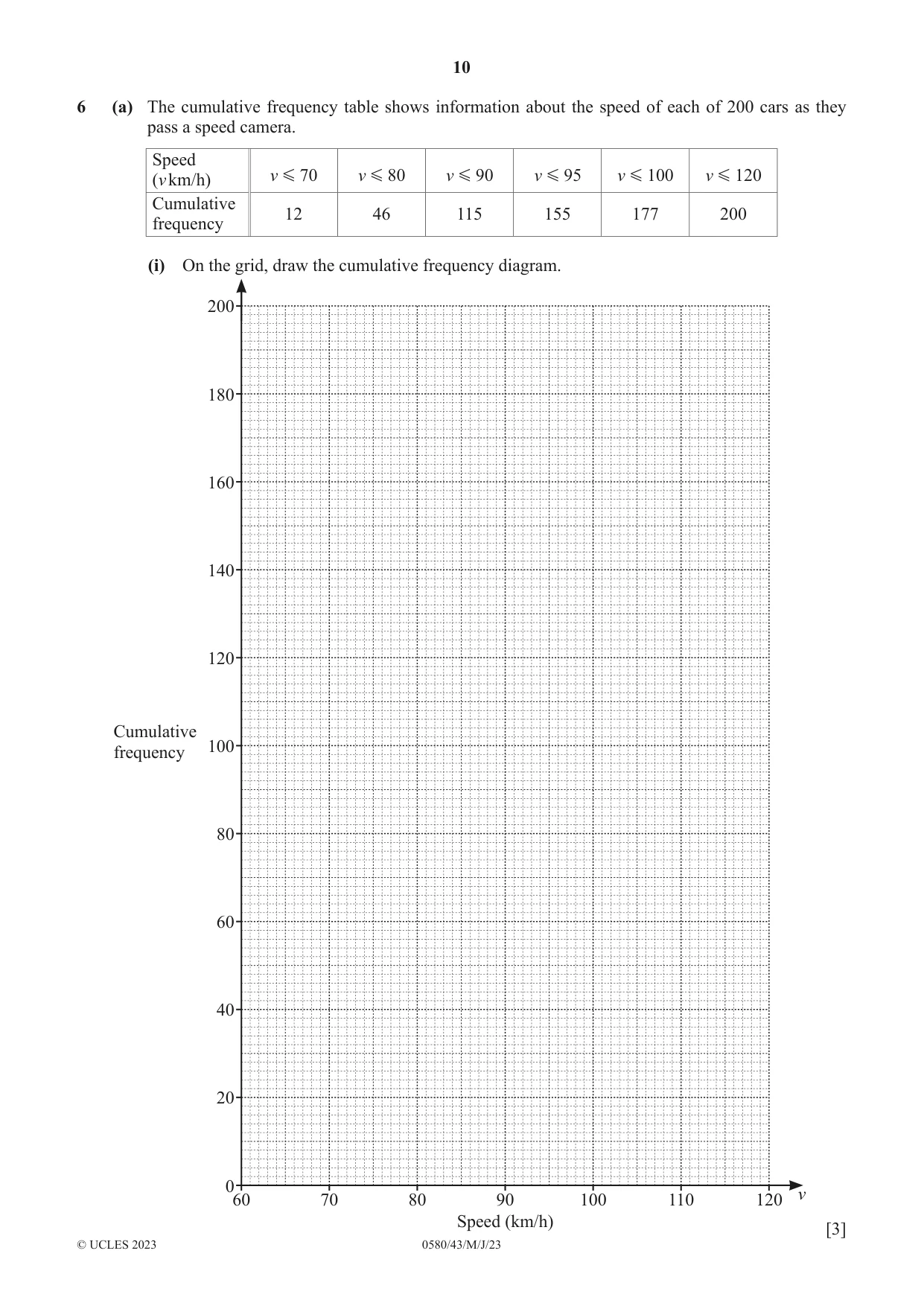
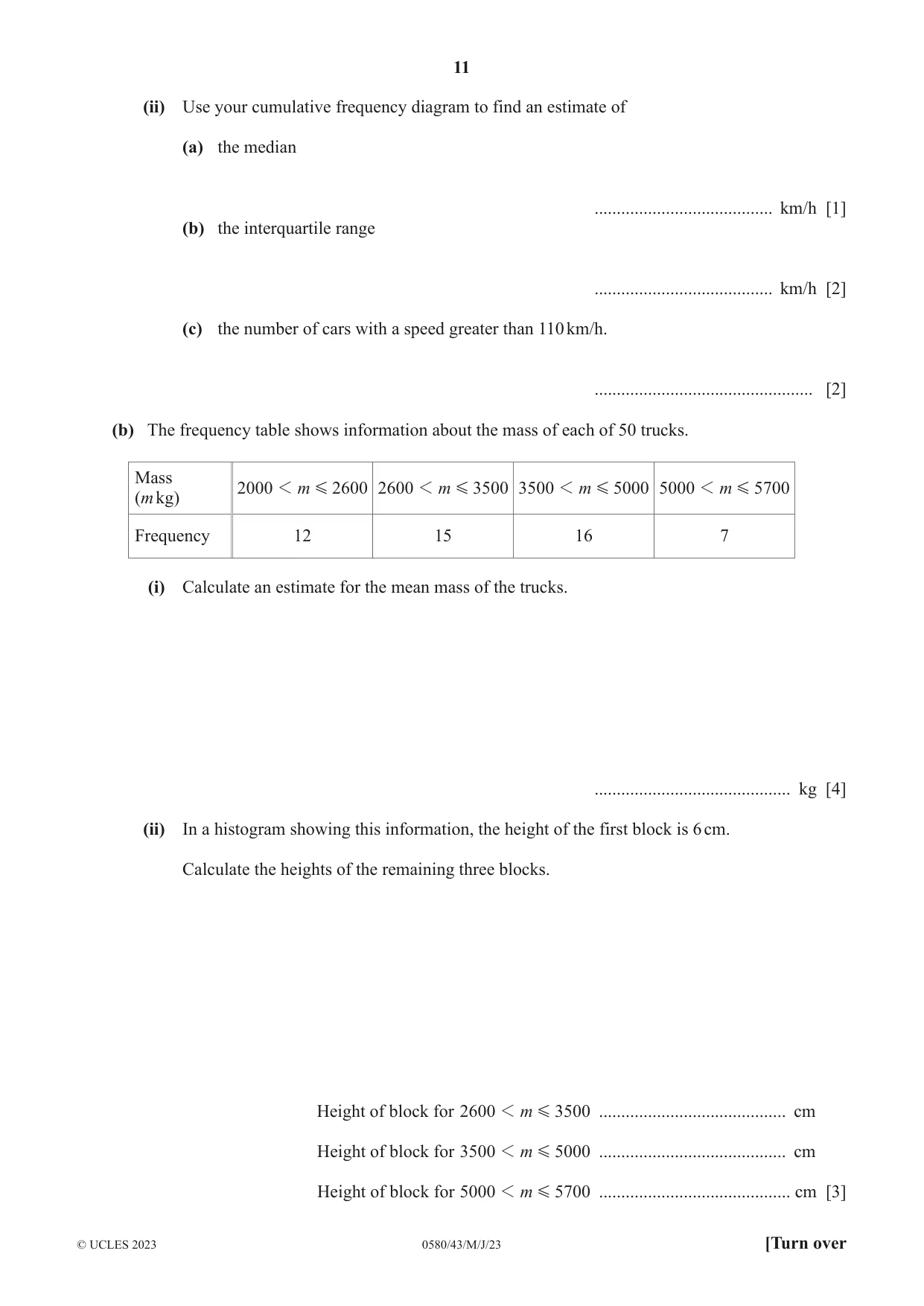
6 (a) The cumulative frequency table shows information about the speed of each of 200 cars as they pass a speed camera. Speed v G 70 v G 80 v G 90 v G 95 v G 100 v G 120 (v km/h) Cumulative 12 46 115 155 177 200 frequency (i) On the grid, draw the cumulative frequency diagram. 200 180 160 140 120 Cumulative 100 frequency 80 60 40 20 0 v 60 70 80 90 100 110 120 Speed (km/h) [3] (ii) Use your cumulative frequency diagram to find an estimate of (a) the median ........................................ km/h [1] (b) the interquartile range ........................................ km/h [2] (c) the number of cars with a speed greater than 110 km/h. ................................................. [2] (b) The frequency table shows information about the mass of each of 50 trucks. Mass 2000 1 m G 2600 2600 1 m G 3500 3500 1 m G 5000 5000 1 m G 5700 (m kg) Frequency 12 15 16 7 (i) Calculate an estimate for the mean mass of the trucks. ............................................ kg [4] (ii) In a histogram showing this information, the height of the first block is 6 cm. Calculate the heights of the remaining three blocks. Height of block for 2600 1 m G 3500 .......................................... cm Height of block for 3500 1 m G 5000 .......................................... cm Height of block for 5000 1 m G 5700 ........................................... cm [3]
Mark scheme: 6(a)(i) Correct curve 3 B1 for correct horizontal placement for 6 plots B1 for correct vertical placement for 6 plots B1 dep on at least B1 for reasonable increasing curve through their 6 points If 0 scored, SC1 for 4 out of 6 points correctly plotted 6(a)(ii)(a) 87 to 89.5 1 6(a)(ii)(b) 12.5 to 14 2 B1 for [LQ =] 80.5 to 81.5 or [UQ =] 94 to 94.5 6(a)(ii)(c) Strict FT, 200 – their cumul freq reading 2 B1FT for correct cumul freq at 110 seen from their graph at 110 given to nearest or for non-integer answer integer 6(b)(i) 3576 4 M1 for midpoints soi M1 for use of fx where x is in the correct interval including boundaries M1 (dep on 2nd M1) for fx ÷ 50 6(b)(ii) 5 3.2 3 3 B1 for each If 0 scored, SC1 for 3 frequency densities 12 15 16 7 , , , seen oe to 3sf 600 900 1500 700 or better or multiplier 3 or 300
Q7 · The diagram shows the graph of a function
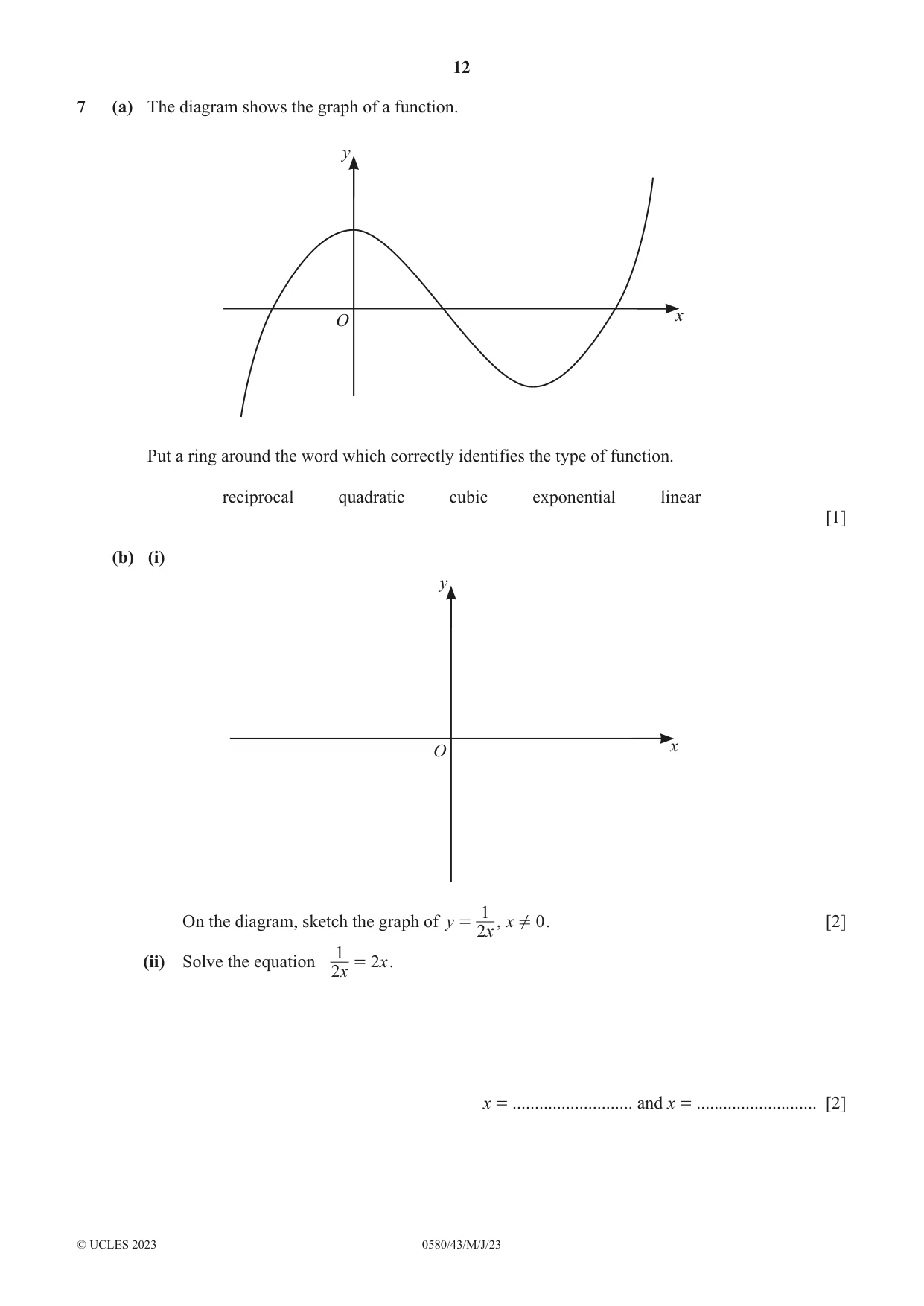
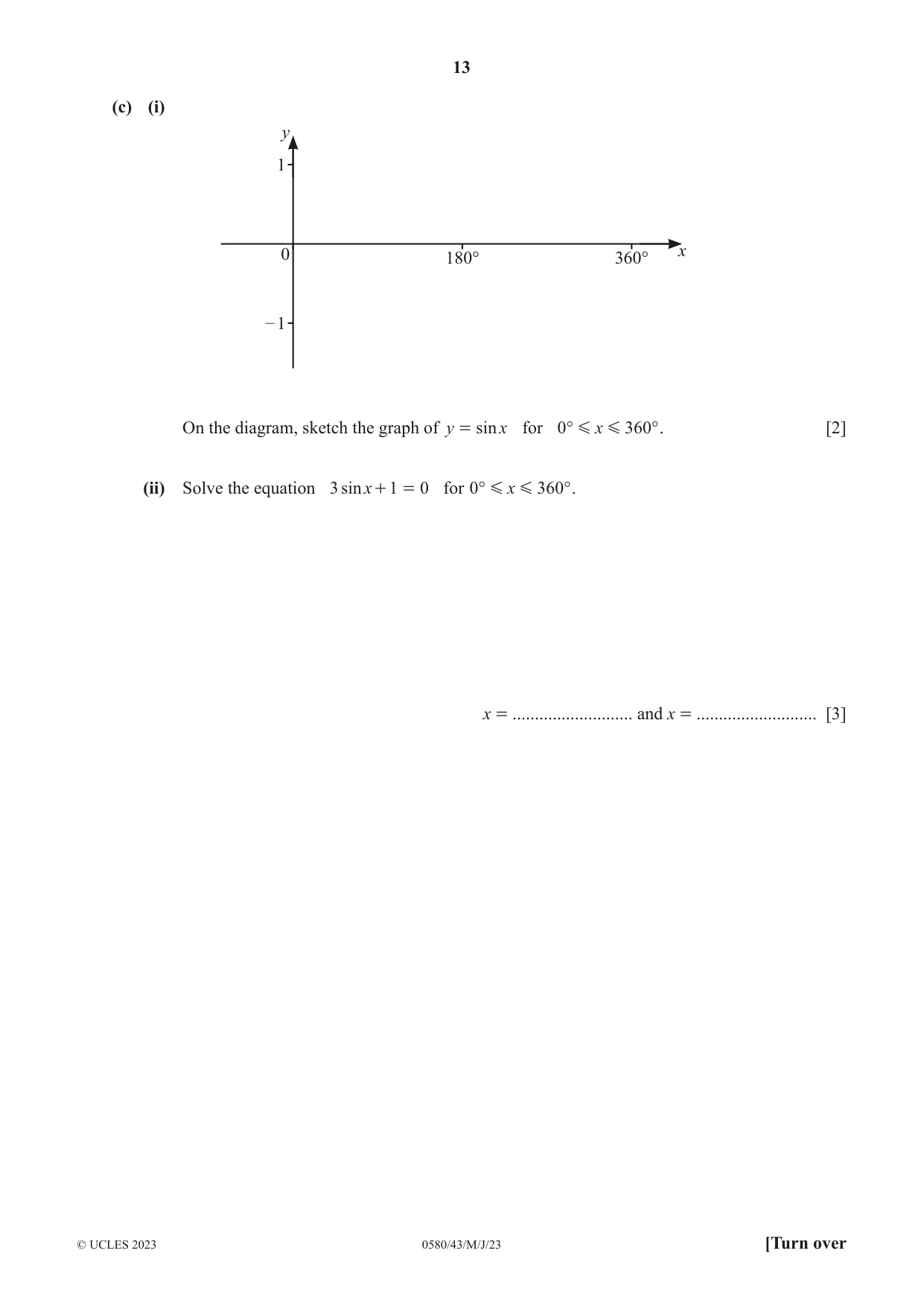
7 (a) The diagram shows the graph of a function. y x O Put a ring around the word which correctly identifies the type of function. reciprocal quadratic cubic exponential linear [1] (b) (i) y x O 1 On the diagram, sketch the graph of y = , x ! 0 . [2] 2 x 1 (ii) Solve the equation = 2x . 2 x x = ........................... and x = ........................... [2] (c) (i) y 1 0 180° 360° x – 1 On the diagram, sketch the graph of y = sin x for 0° G x G 360 ° . [2] (ii) Solve the equation 3 sinx + 1 = 0 for 0° G x G 360° . x = ........................... and x = ........................... [3]
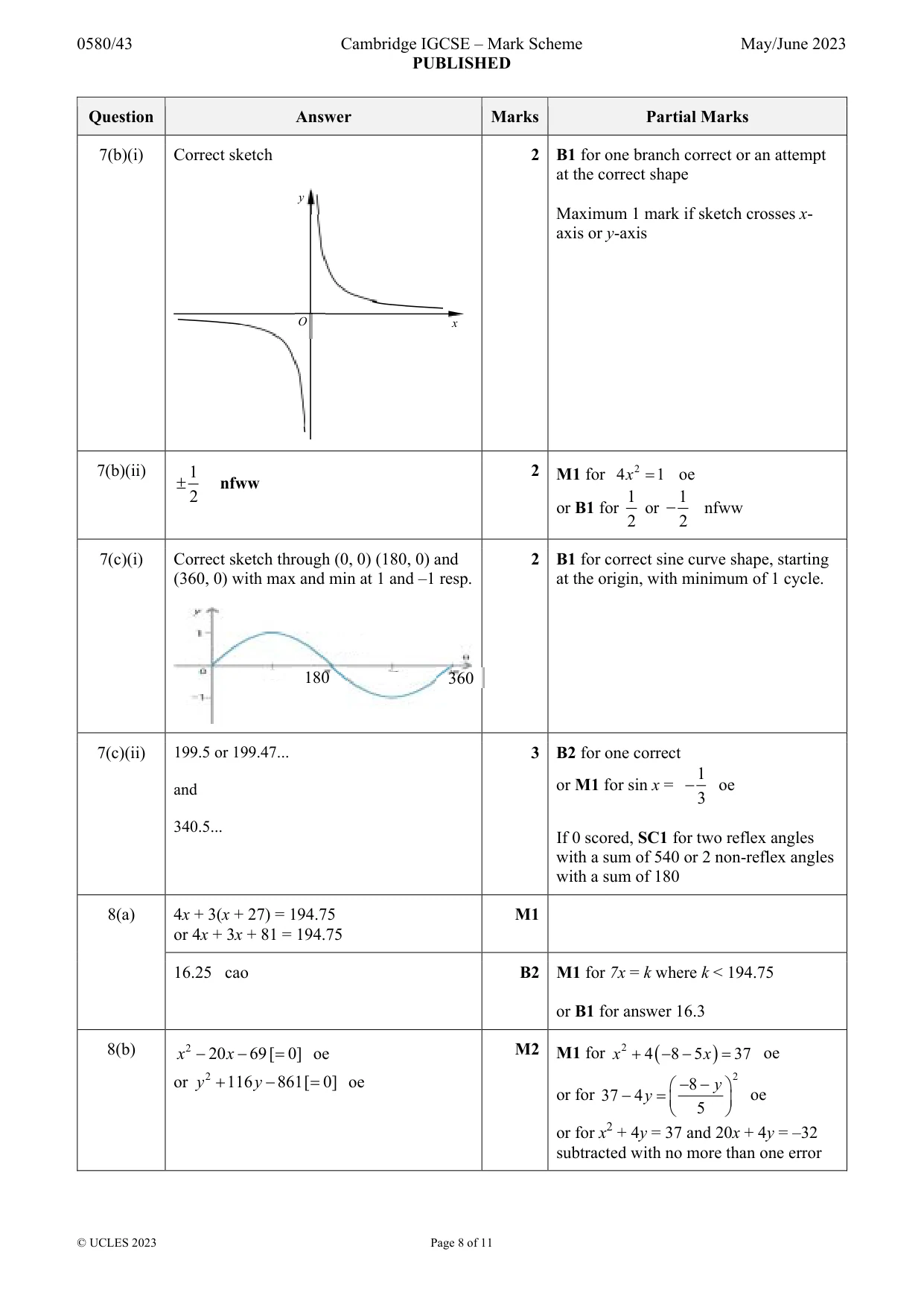
Mark scheme: 7(a) Cubic 1 7(b)(i) Correct sketch 2 B1 for one branch correct or an attempt at the correct shape y Maximum 1 mark if sketch crosses x- axis or y-axis O x 7(b)(ii) 1 2 M1 for 4 x 2 1 oe nfww 2 1 1 or B1 for or nfww 2 2 7(c)(i) Correct sketch through (0, 0) (180, 0) and 2 B1 for correct sine curve shape, starting (360, 0) with max and min at 1 and –1 resp. at the origin, with minimum of 1 cycle. 180 360 7(c)(ii) 199.5 or 199.47... 3 B2 for one correct 1 and or M1 for sin x = oe 3 340.5... If 0 scored, SC1 for two reflex angles with a sum of 540 or 2 non-reflex angles with a sum of 180
Q8 · A shop sells shirts for $x and jackets for $(x + 27)
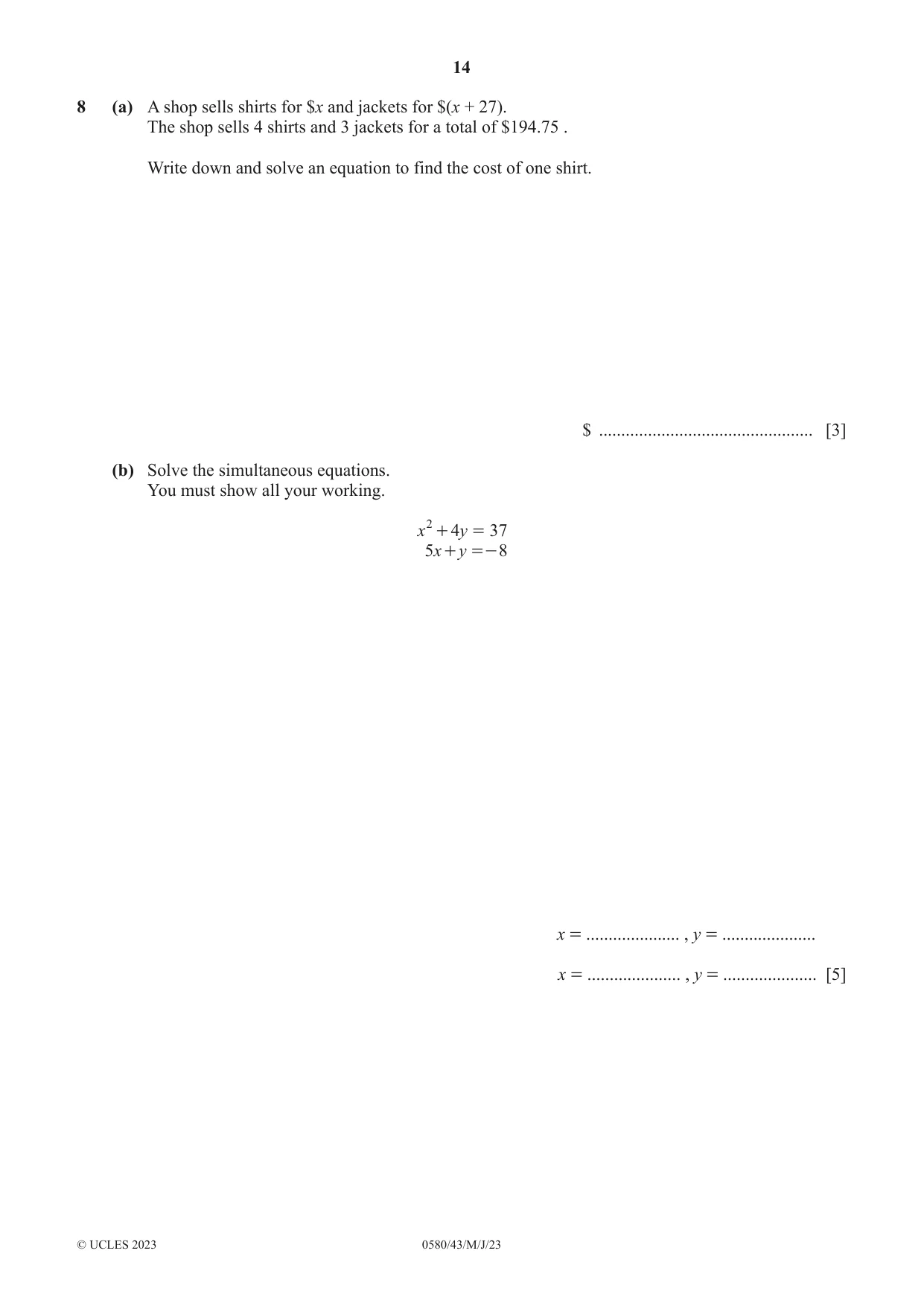
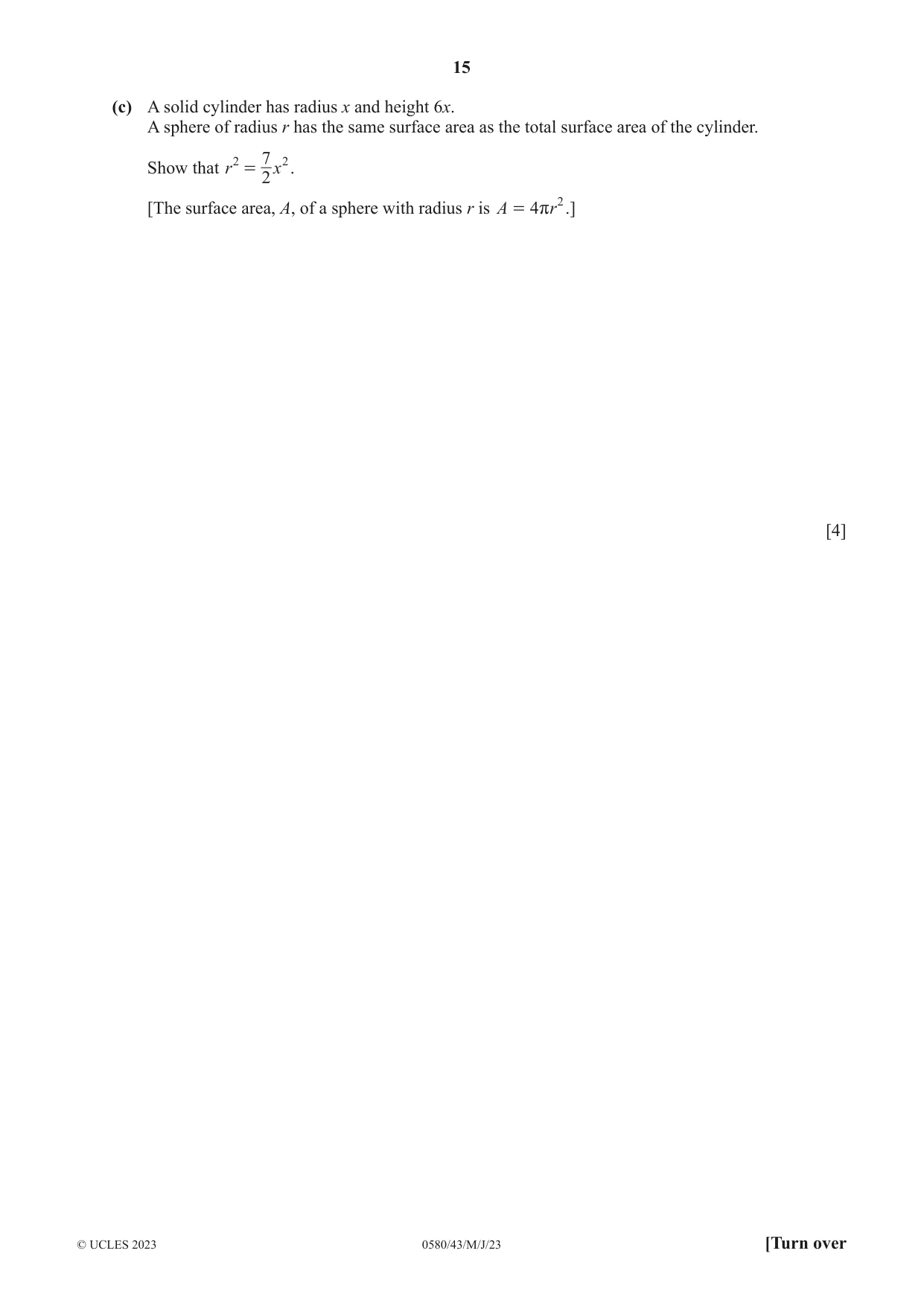
8 (a) A shop sells shirts for $x and jackets for $(x + 27). The shop sells 4 shirts and 3 jackets for a total of $194.75 . Write down and solve an equation to find the cost of one shirt. $ ................................................ [3] (b) Solve the simultaneous equations. You must show all your working. x 2 + 4y = 37 5x + y =- 8 x = ..................... , y = ..................... x = ..................... , y = ..................... [5] (c) A solid cylinder has radius x and height 6x. A sphere of radius r has the same surface area as the total surface area of the cylinder. 2 7 2 Show that r = x . 2 [The surface area, A, of a sphere with radius r is A = 4rr 2 .] [4]
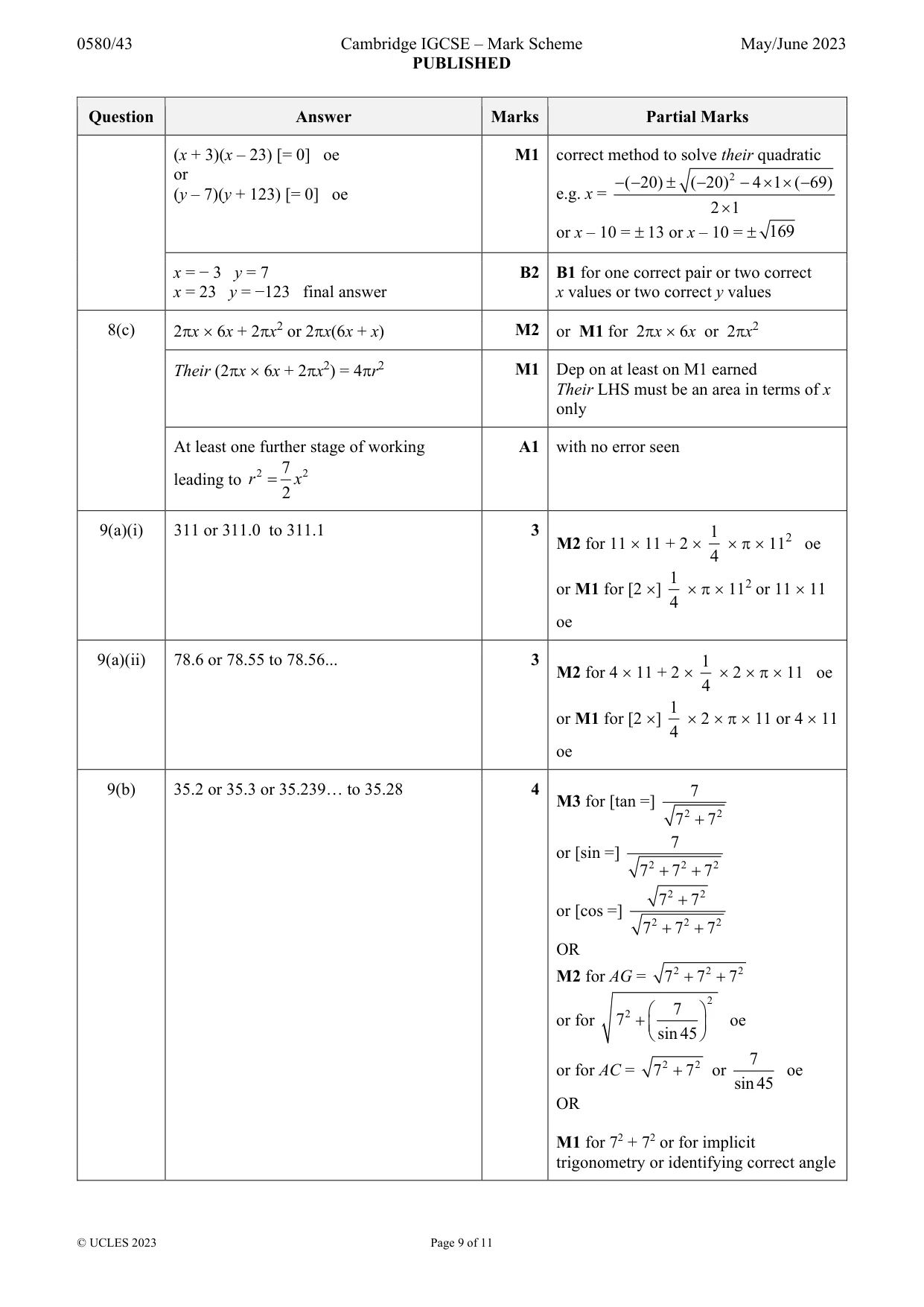
Mark scheme: 8(a) 4x + 3(x + 27) = 194.75 M1 or 4x + 3x + 81 = 194.75 16.25 cao B2 M1 for 7x = k where k < 194.75 or B1 for answer 16.3 8(b) x 2 20 x 69[ 0] oe M2 M1 for x 2 4 8 5 x 37 oe or y 2 116 y 861[ 0] oe 8 y 2 or for 37 4 y oe 5 or for x2 + 4y = 37 and 20x + 4y = –32 subtracted with no more than one error (x + 3)(x – 23) [= 0] oe M1 correct method to solve their quadratic or 2 ( 20) ( 20) 4 1 ( 69) (y – 7)(y + 123) [= 0] oe e.g. x = 2 1 or x – 10 = 13 or x – 10 = 169 x = − 3 y = 7 B2 B1 for one correct pair or two correct x = 23 y = −123 final answer x values or two correct y values 8(c) 2x 6x + 2x2 or 2x(6x + x) M2 or M1 for 2x 6x or 2x2 Their (2x 6x + 2x2) = 4r2 M1 Dep on at least on M1 earned Their LHS must be an area in terms of x only At least one further stage of working A1 with no error seen 2 7 2 leading to r x 2
Q9 · M A B NOT TO SCALE D C N The diagram shows a shape made from a square ABCD and two equal…
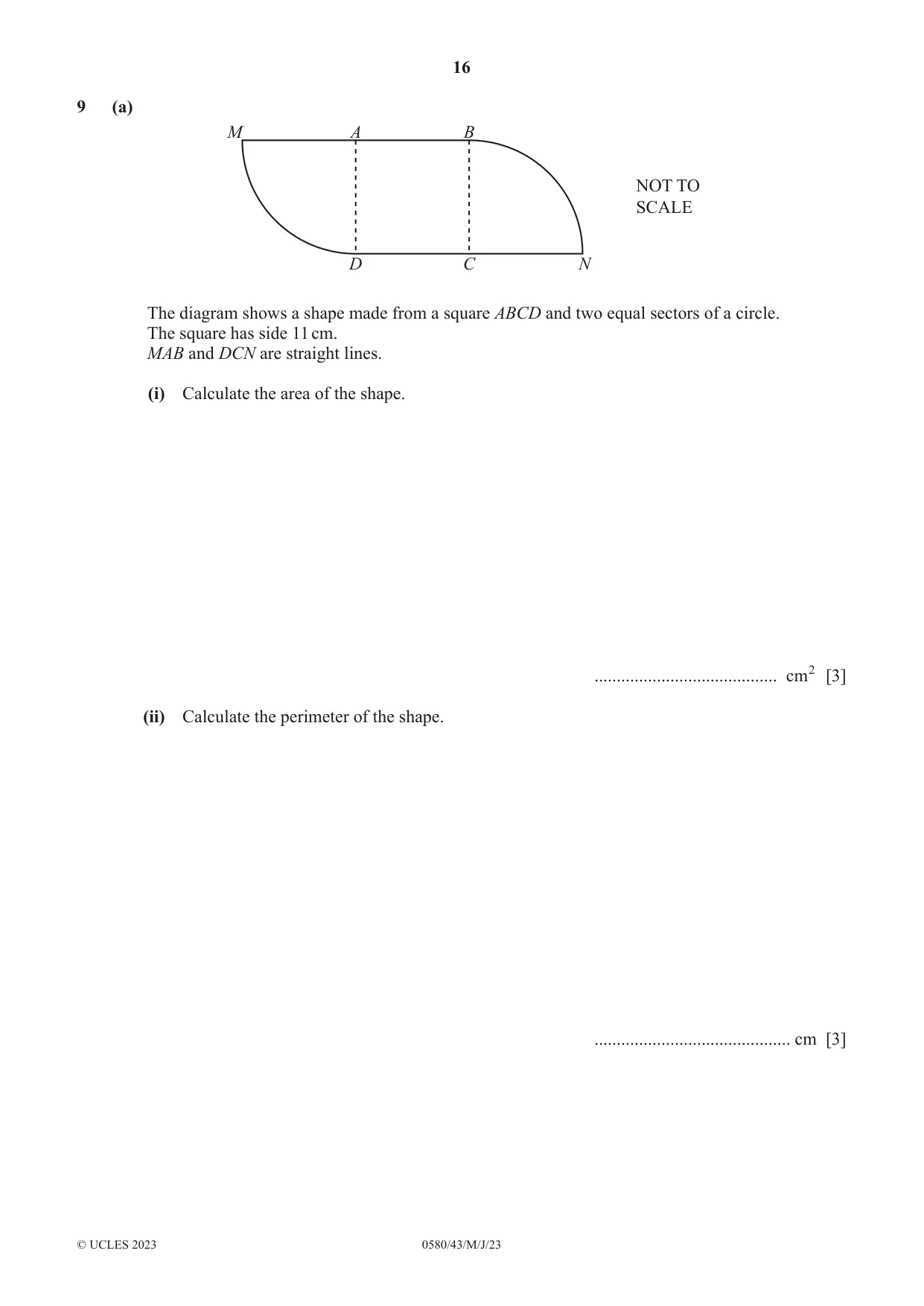
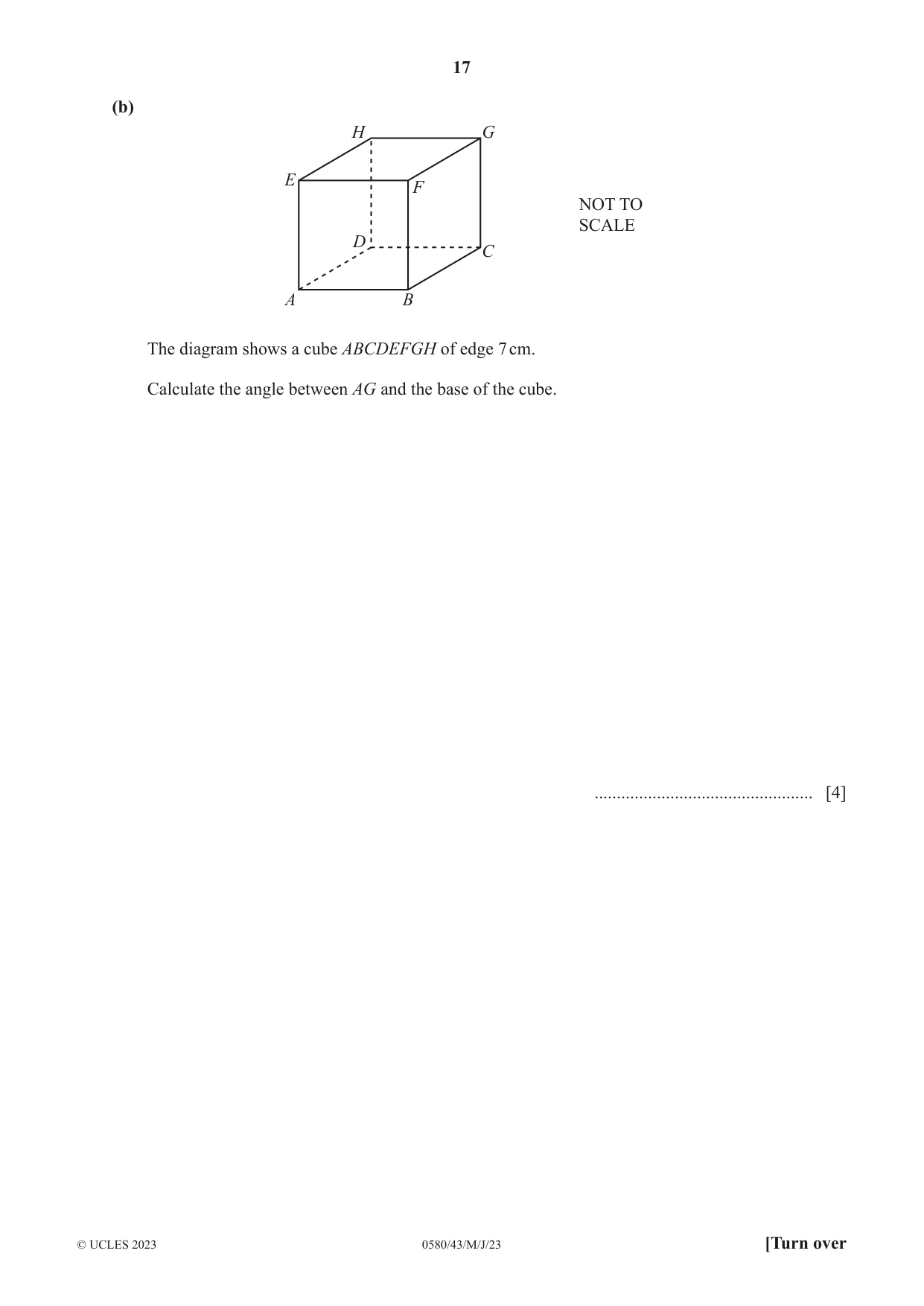
9 (a) M A B NOT TO SCALE D C N The diagram shows a shape made from a square ABCD and two equal sectors of a circle. The square has side 11 cm. MAB and DCN are straight lines. (i) Calculate the area of the shape. ......................................... cm2 [3] (ii) Calculate the perimeter of the shape. ............................................ cm [3] (b) H G E F NOT TO SCALE D C A B The diagram shows a cube ABCDEFGH of edge 7 cm. Calculate the angle between AG and the base of the cube. ................................................. [4]
Mark scheme: 9(a)(i) 311 or 311.0 to 311.1 3 1 M2 for 11 11 + 2 112 oe 4 1 or M1 for [2 ] 112 or 11 11 4 oe 9(a)(ii) 78.6 or 78.55 to 78.56... 3 1 M2 for 4 11 + 2 2 11 oe 4 1 or M1 for [2 ] 2 11 or 4 11 4 oe 9(b) 35.2 or 35.3 or 35.239… to 35.28 4 7 M3 for [tan =] 7 2 7 2 7 or [sin =] 7 2 7 2 7 2 7 2 7 2 or [cos =] 7 2 7 2 7 2 OR M2 for AG = 7 2 7 2 7 2 2 7 2 or for 7 oe sin 45 2 2 7 or for AC = 7 7 or oe sin45 OR M1 for 72 + 72 or for implicit trigonometry or identifying correct angle
Q10 · The table shows some values for y = 2 x - 3
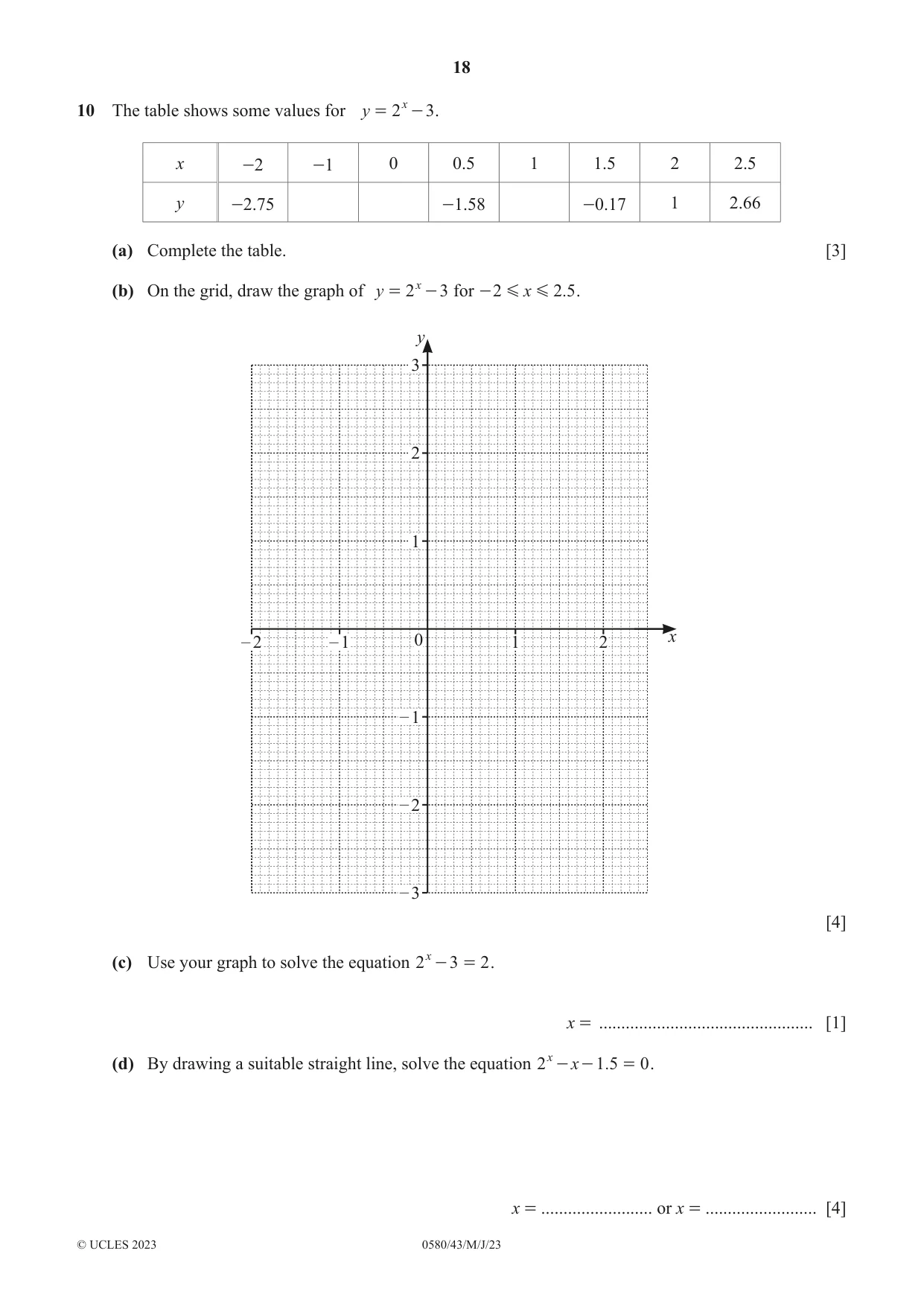
10 The table shows some values for y = 2 x - 3 . x -2 -1 0 0.5 1 1.5 2 2.5 y -2.75 -1.58 -0.17 1 2.66 (a) Complete the table. [3] (b) On the grid, draw the graph of y = 2 x - 3 for - 2 G x G 2.5 . y 3 2 1 – 2 – 1 0 1 2 x – 1 – 2 – 3 [4] (c) Use your graph to solve the equation 2 x - 3 = 2 . x = ................................................ [1] (d) By drawing a suitable straight line, solve the equation 2 x - x - 1.5 = 0 . x = ......................... or x = ......................... [4]
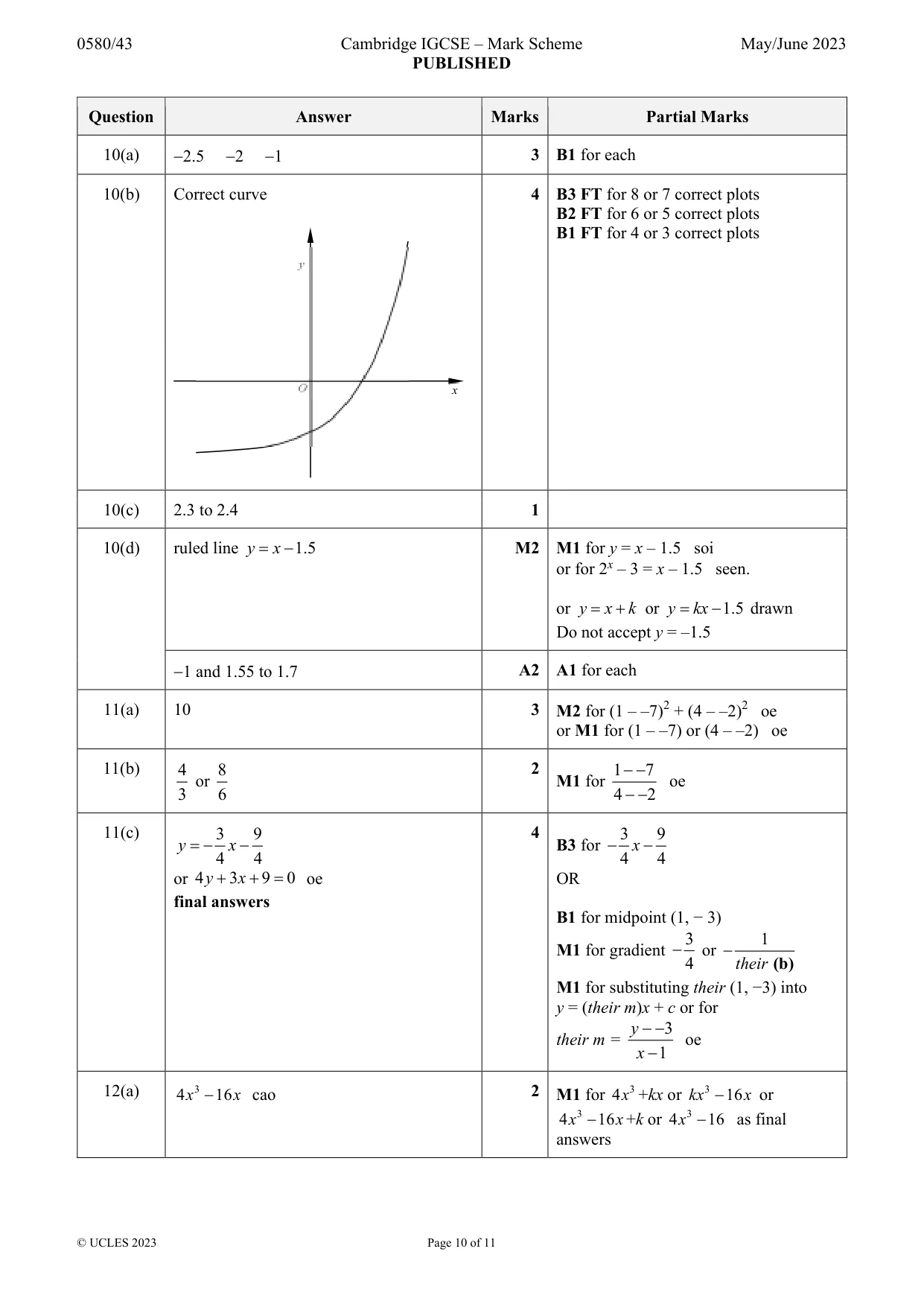
Mark scheme: 10(a) 2.5 2 1 3 B1 for each 10(b) Correct curve 4 B3 FT for 8 or 7 correct plots B2 FT for 6 or 5 correct plots B1 FT for 4 or 3 correct plots y O x 10(c) 2.3 to 2.4 1 10(d) ruled line y x 1.5 M2 M1 for y = x – 1.5 soi or for 2x – 3 = x – 1.5 seen. or y x k or y kx 1.5 drawn Do not accept y = –1.5 1 and 1.55 to 1.7 A2 A1 for each
Q11 · M has coordinates (4, 1) and N has coordinates ( -2, -7)
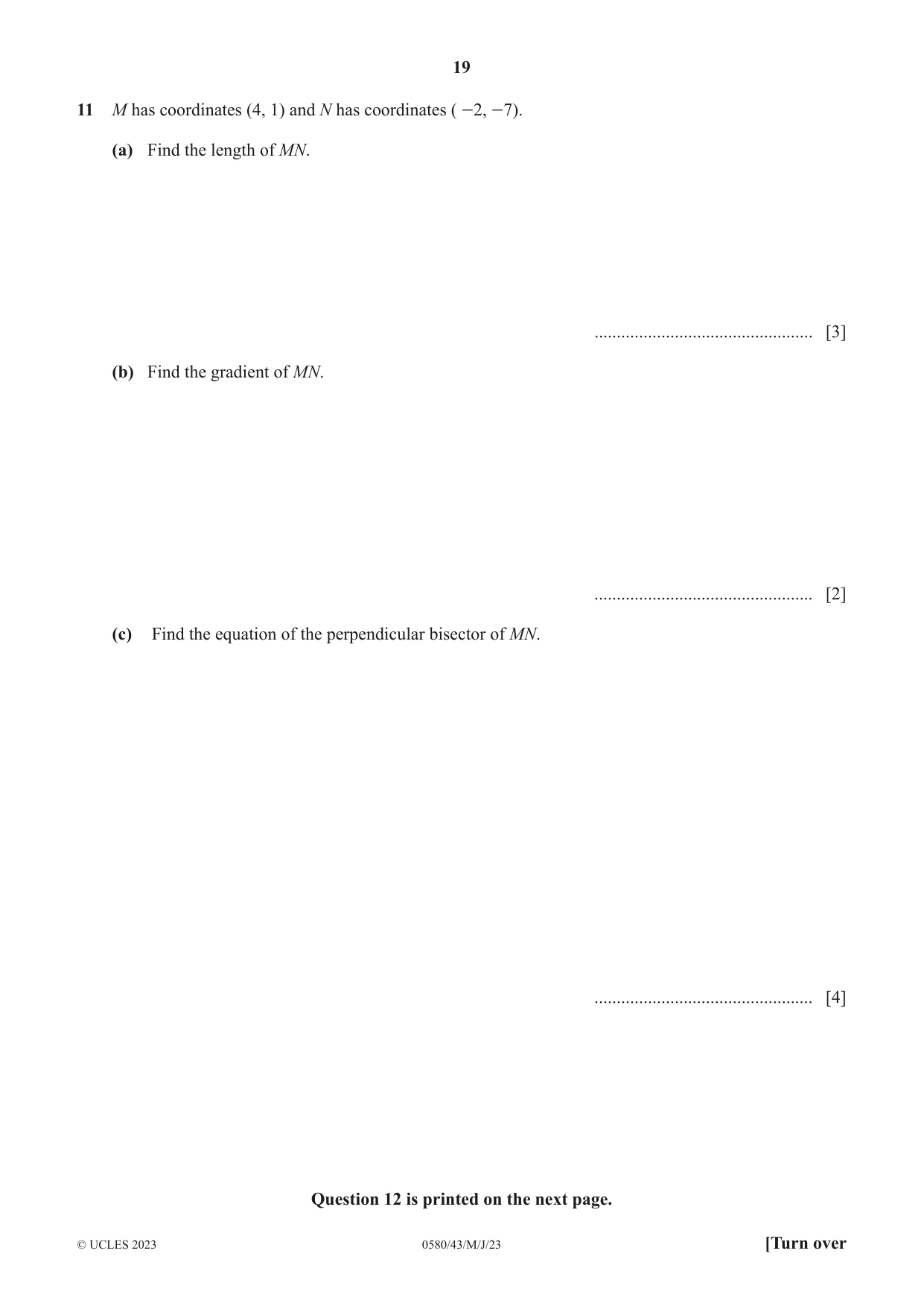
11 M has coordinates (4, 1) and N has coordinates ( -2, -7). (a) Find the length of MN. ................................................. [3] (b) Find the gradient of MN. ................................................. [2] (c) Find the equation of the perpendicular bisector of MN. ................................................. [4] Question 12 is printed on the next page.
Mark scheme: 11(a) 10 3 M2 for (1 – –7)2 + (4 – –2)2 oe or M1 for (1 – –7) or (4 – –2) oe 11(b) 4 8 2 1 7 or M1 for oe 3 6 4 2 11(c) 3 9 4 3 9 y x B3 for x 4 4 4 4 or 4 y 3 x 9 0 oe OR final answers B1 for midpoint (1, − 3) 3 1 M1 for gradient or 4 their (b) M1 for substituting their (1, −3) into y = (their m)x + c or for y 3 their m = oe x 1
Q12 · The equation of a curve is y = x 4 - 8x 2 + 5
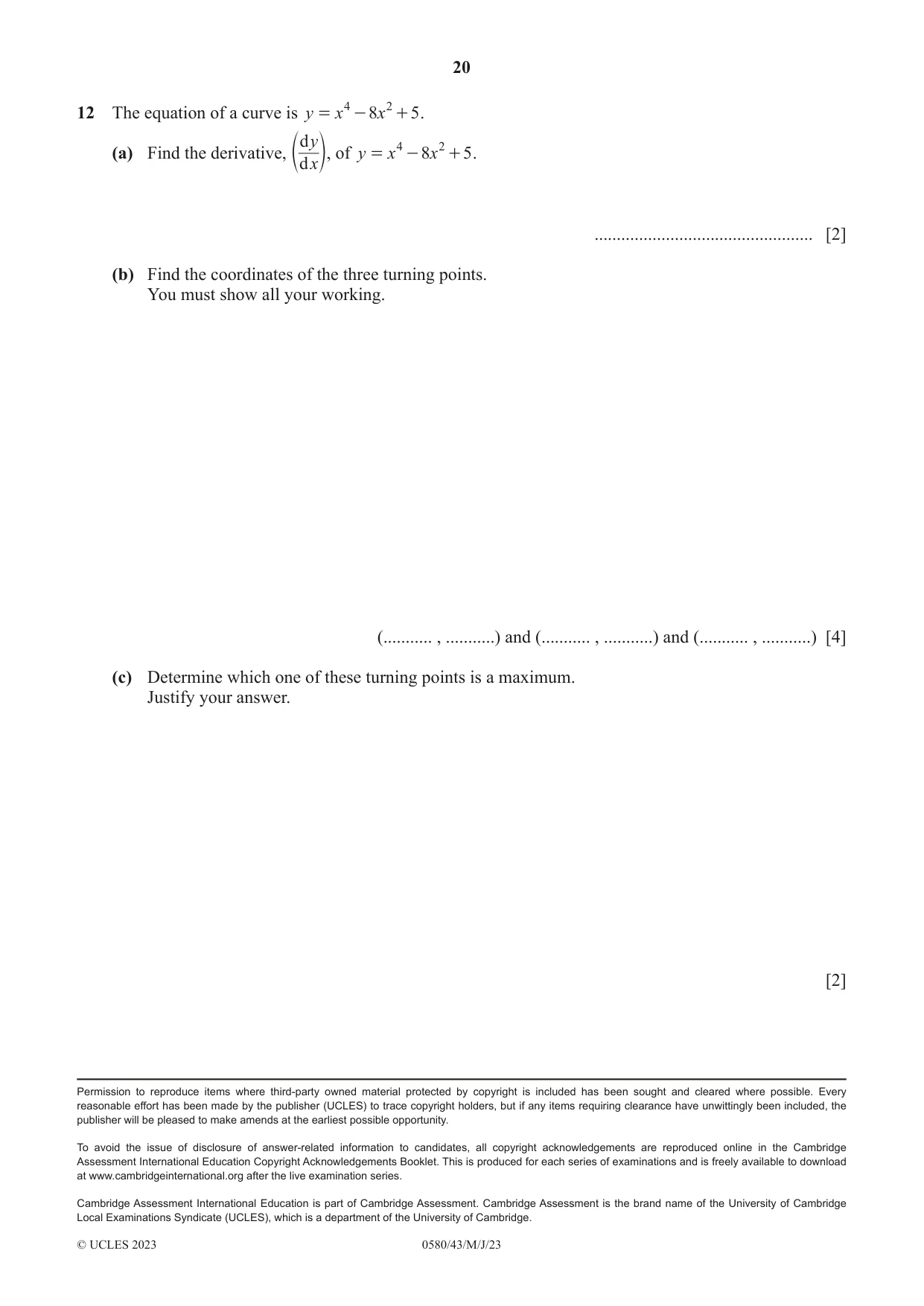
12 The equation of a curve is y = x 4 - 8x 2 + 5 . d y 4 2 (a) Find the derivative, of y = x - 8x + 5 . e d x o, ................................................. [2] (b) Find the coordinates of the three turning points. You must show all your working. (........... , ...........) and (........... , ...........) and (........... , ...........) [4] (c) Determine which one of these turning points is a maximum. Justify your answer. [2]
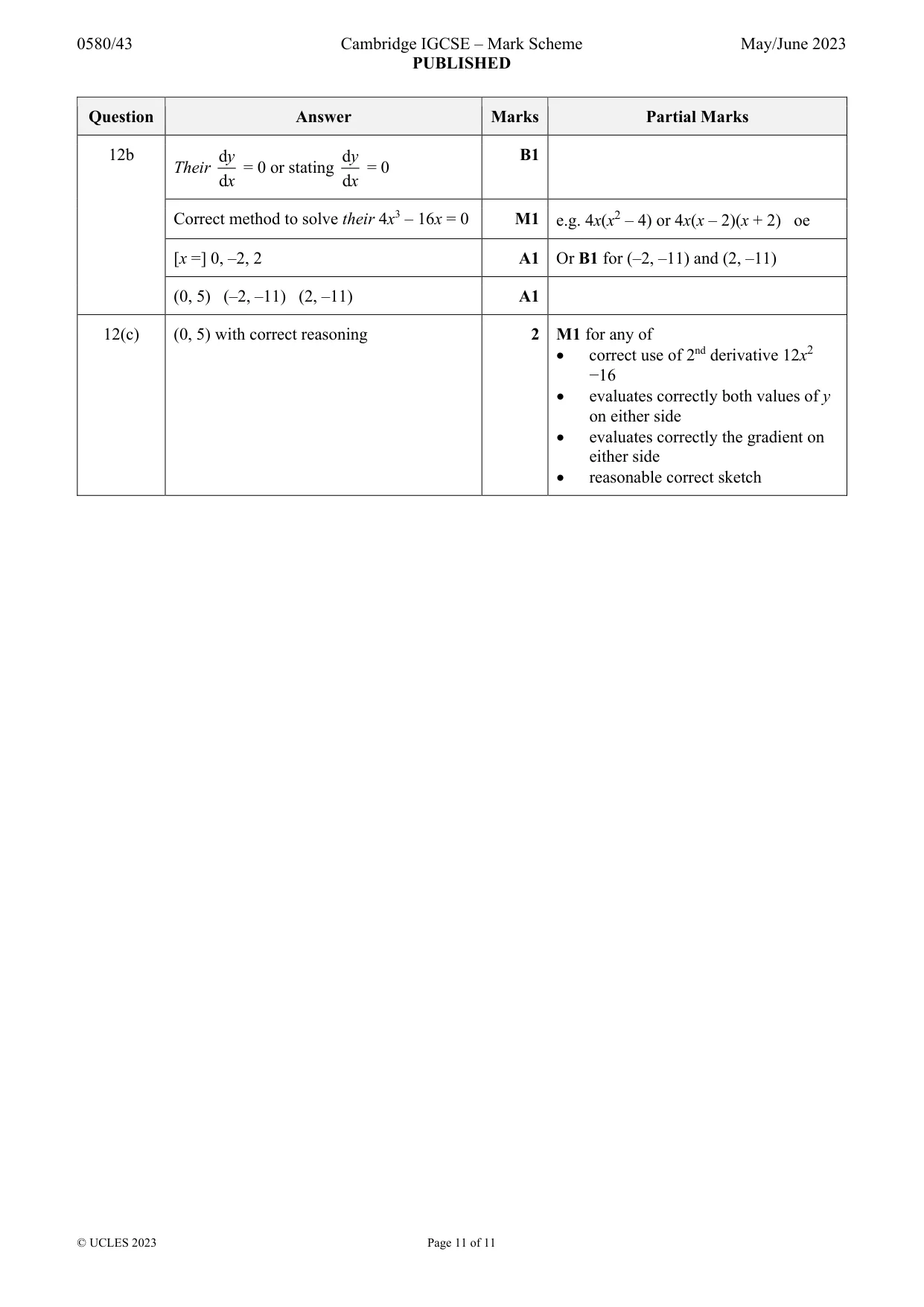
Mark scheme: 12(a) 4 x 3 16 x cao 2 M1 for 4x 3 +kx or kx 3 16 x or 4 x 3 16 x +k or 4 x 3 16 as final answers 12b dy dy B1 Their = 0 or stating = 0 dx dx Correct method to solve their 4x3 – 16x = 0 M1 e.g. 4x(x2 – 4) or 4x(x – 2)(x + 2) oe [x =] 0, –2, 2 A1 Or B1 for (–2, –11) and (2, –11) (0, 5) (–2, –11) (2, –11) A1 12(c) (0, 5) with correct reasoning 2 M1 for any of correct use of 2nd derivative 12x2 −16 evaluates correctly both values of y on either side evaluates correctly the gradient on either side reasonable correct sketch
What was in this paper
The subtopics covered by these 12 questions, and how many questions each got. Open one in a new tab to see every Cambridge question on it.
What you needed in this session
Cambridge’s own grade thresholds for 2023 May/June, Paper 4 · Variant 3. A higher threshold means an easier paper — the bar moves with how the cohort did.