Cambridge IGCSE Mathematics 0580 — 2019 May/June Paper 4 · Variant 2
0580/42/M/J/19 · 11 questions · 130 marks · ≈146 min
The question paper and its mark scheme, free to read here and free to download. This is Cambridge’s own paper, exactly as it was sat.
Question paper20 pages
Mark scheme9 pages
Answers below. Sit the paper first if you are practising.
Questions as text
Q1 · The price of a newspaper increased from $0.97 to $1.13
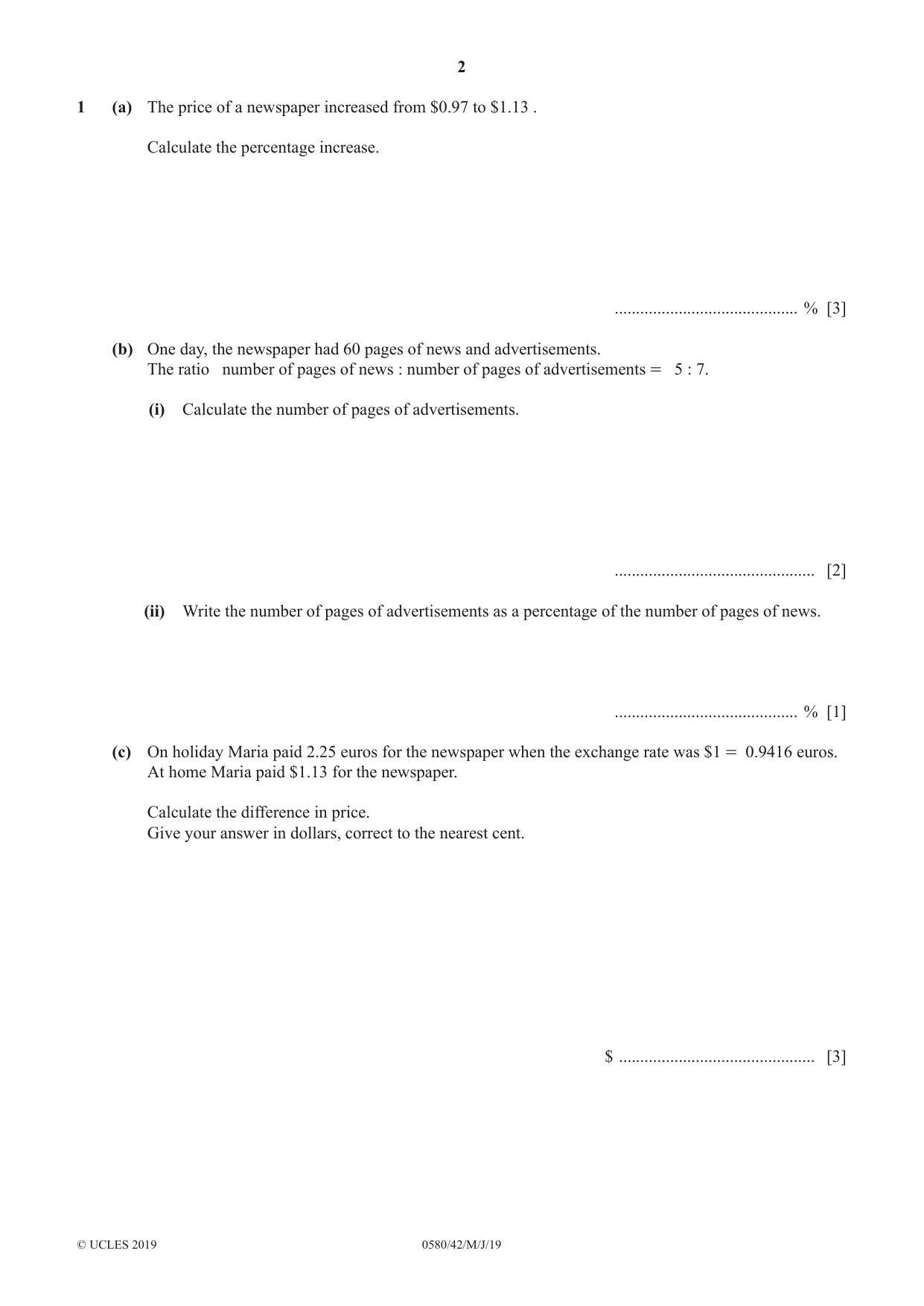
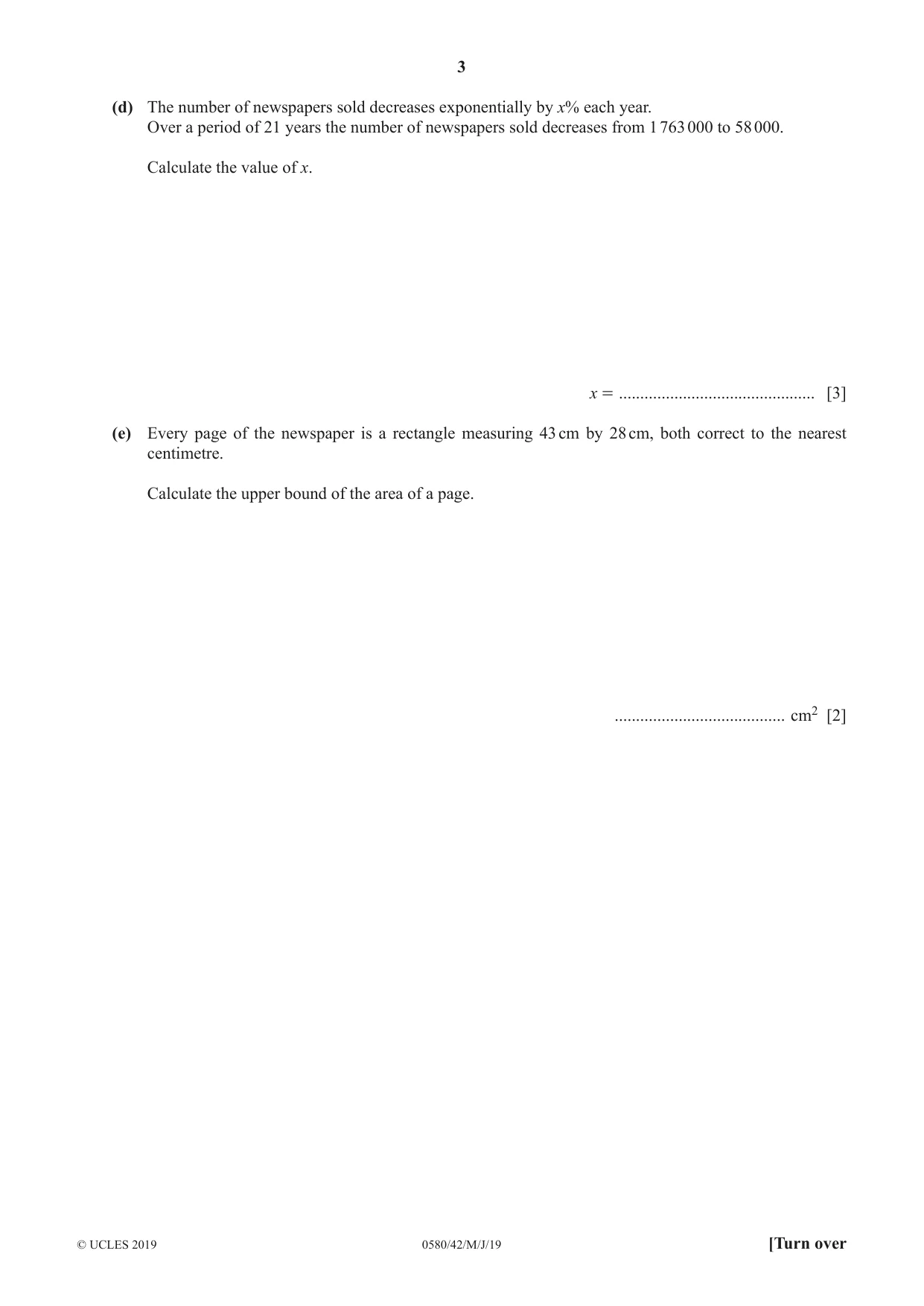
1 (a) The price of a newspaper increased from $0.97 to $1.13 . Calculate the percentage increase. ........................................... % [3] (b) One day, the newspaper had 60 pages of news and advertisements. The ratio number of pages of news : number of pages of advertisements = 5 : 7. (i) Calculate the number of pages of advertisements. ............................................... [2] (ii) Write the number of pages of advertisements as a percentage of the number of pages of news. ........................................... % [1] (c) On holiday Maria paid 2.25 euros for the newspaper when the exchange rate was $1 = 0.9416 euros. At home Maria paid $1.13 for the newspaper. Calculate the difference in price. Give your answer in dollars, correct to the nearest cent. $ .............................................. [3] (d) The number of newspapers sold decreases exponentially by x% each year. Over a period of 21 years the number of newspapers sold decreases from 1 763 000 to 58 000. Calculate the value of x. x = .............................................. [3] (e) Every page of the newspaper is a rectangle measuring 43 cm by 28 cm, both correct to the nearest centimetre. Calculate the upper bound of the area of a page. ........................................ cm2 [2]
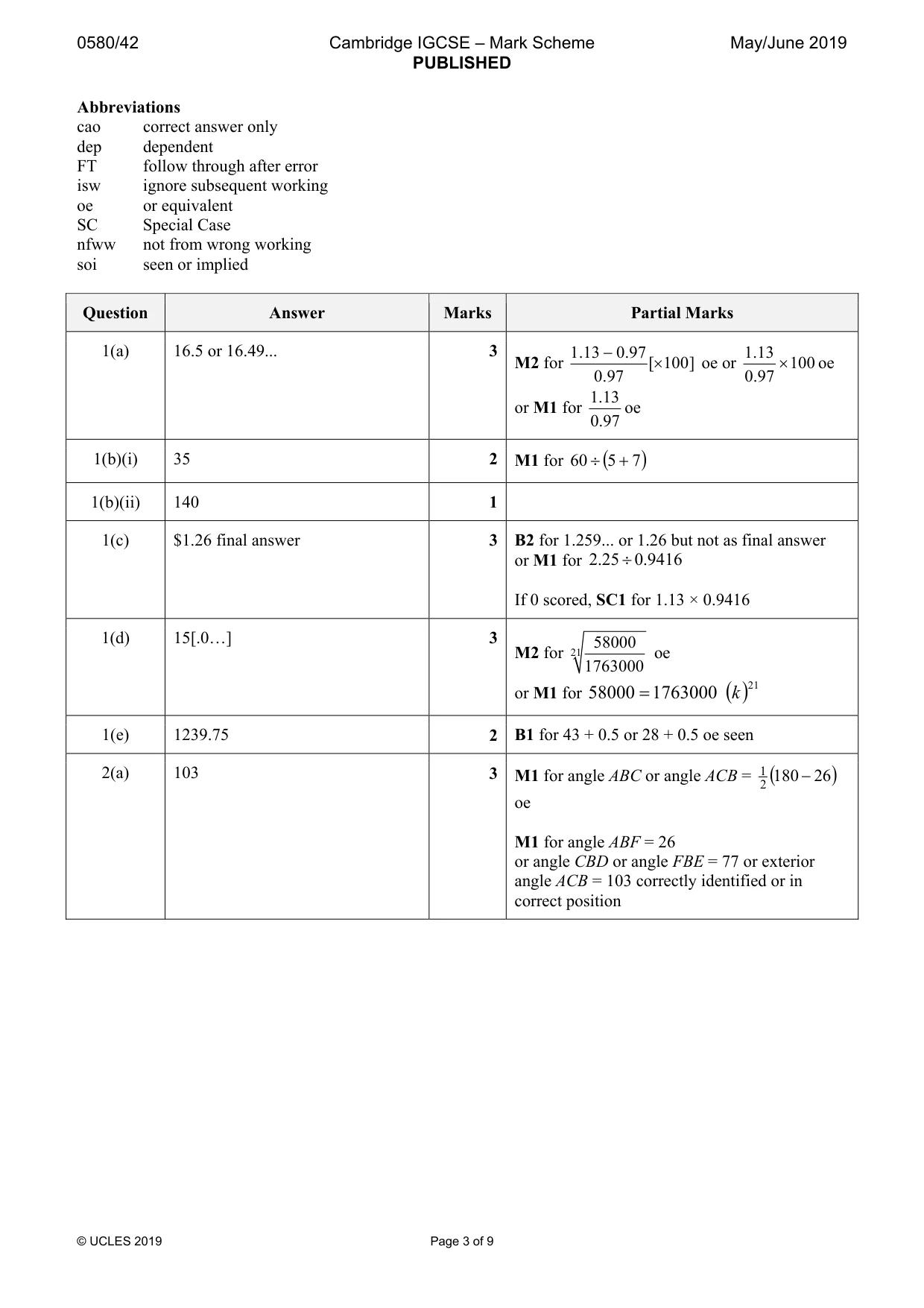
Mark scheme: Question Answer Marks Partial Marks 1(a) 16.5 or 16.49... 3 .1 13 − .0 97 .1 13 M2 for [× 100 ] oe or × 100 oe .0 97 .0 97 .1 13 or M1 for oe .0 97 1(b)(i) 35 2 M1 for 60 ÷ (5 + 7 ) 1(b)(ii) 140 1 1(c) $1.26 final answer 3 B2 for 1.259... or 1.26 but not as final answer or M1 for .225 ÷ .09416 If 0 scored, SC1 for 1.13 × 0.9416 1(d) 15[.0…] 3 58000 M2 for 21 oe 1763000 21 or M1 for 58000 = 1763000 (k ) 1(e) 1239.75 2 B1 for 43 + 0.5 or 28 + 0.5 oe seen
Q2 · A C 26° NOT TO SCALE F B x° D E AC is parallel to FBD, ABC is an isosceles triangle and…
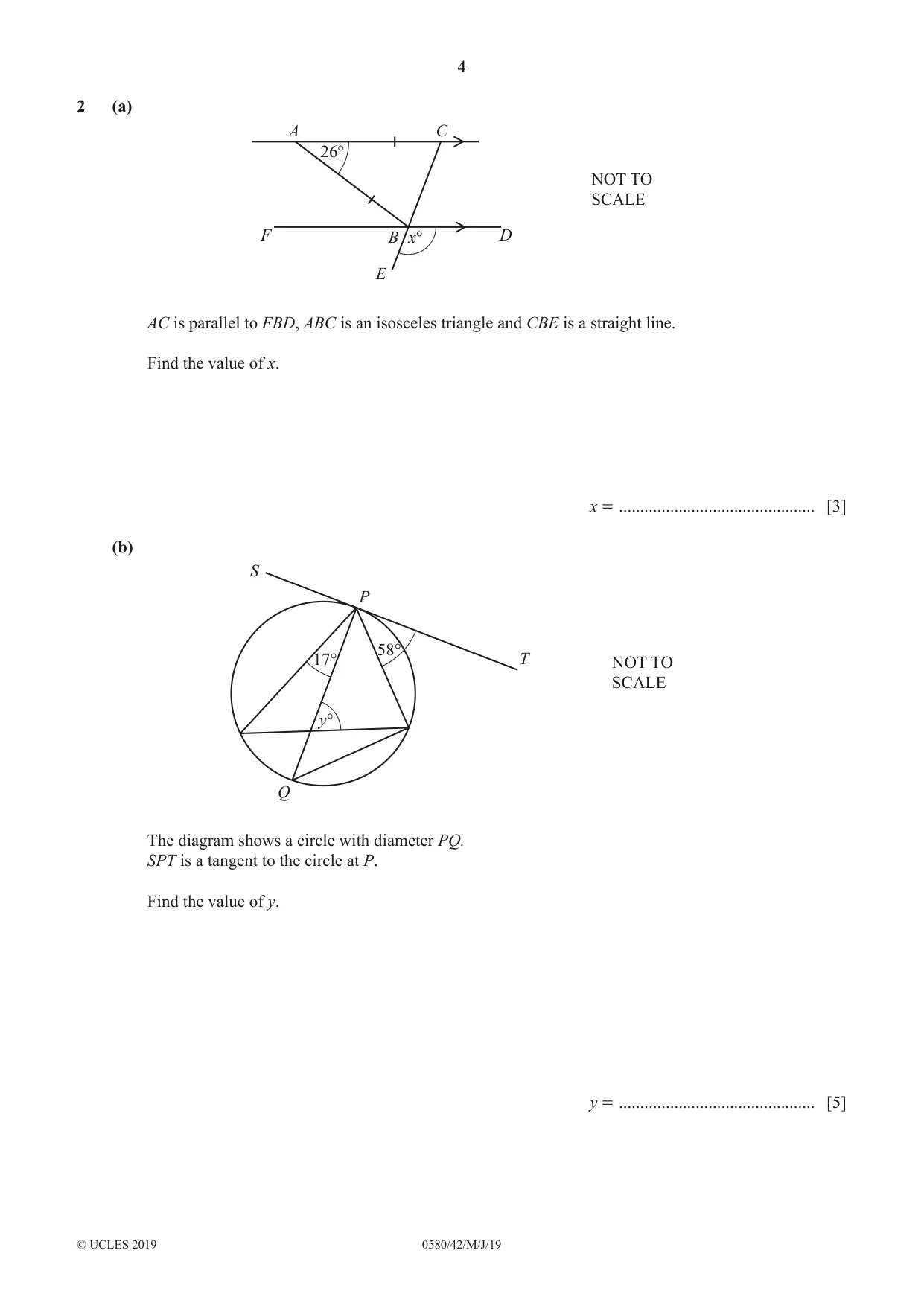
2 (a) A C 26° NOT TO SCALE F B x° D E AC is parallel to FBD, ABC is an isosceles triangle and CBE is a straight line. Find the value of x. x = .............................................. [3] (b) S P 58° 17° T NOT TO SCALE y° Q The diagram shows a circle with diameter PQ. SPT is a tangent to the circle at P. Find the value of y. y = .............................................. [5]
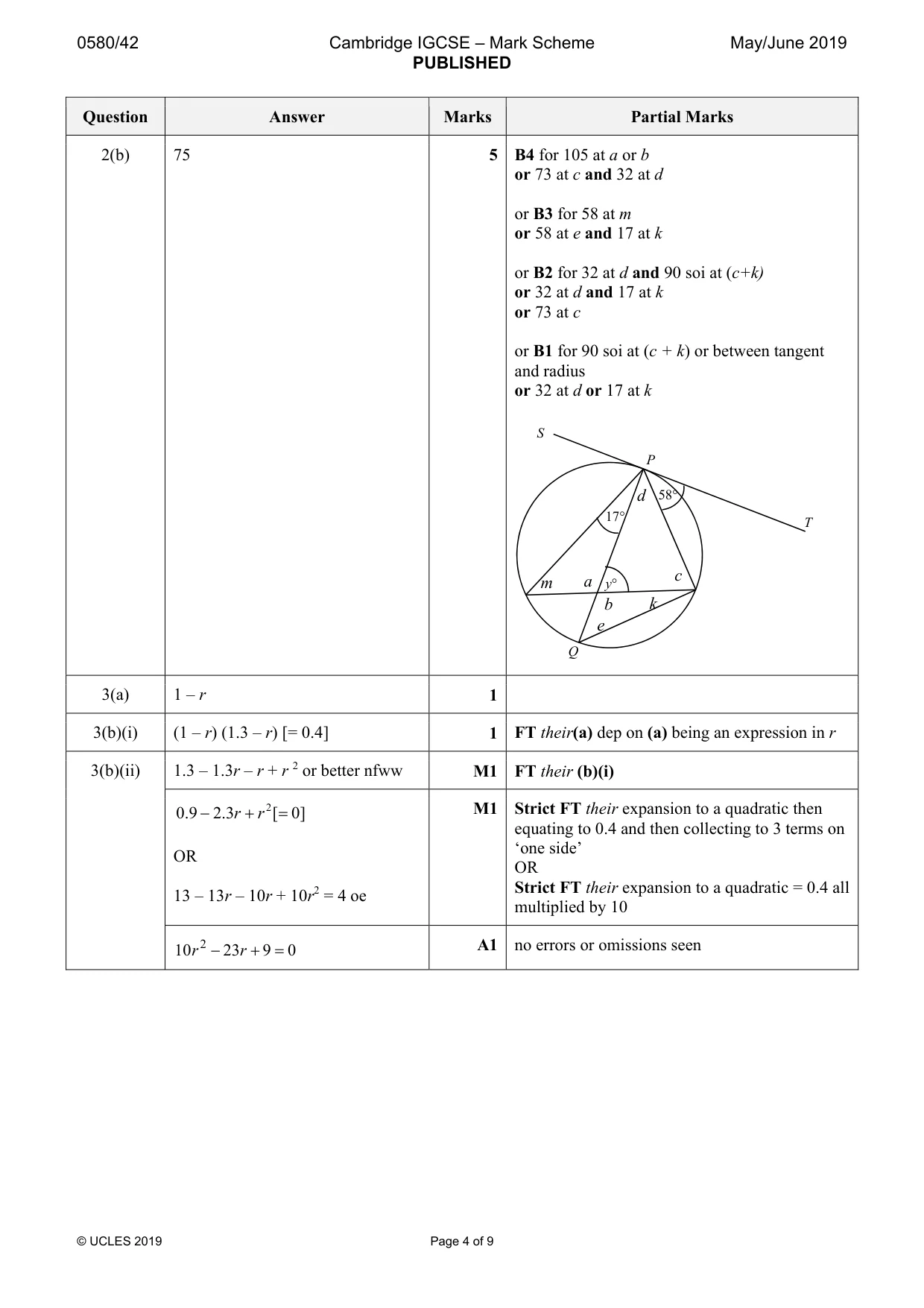
Mark scheme: 2(a) 103 3 M1 for angle ABC or angle ACB = 1 (180 − 26 ) 2 oe M1 for angle ABF = 26 or angle CBD or angle FBE = 77 or exterior angle ACB = 103 correctly identified or in correct position 2(b) 75 5 B4 for 105 at a or b or 73 at c and 32 at d or B3 for 58 at m or 58 at e and 17 at k or B2 for 32 at d and 90 soi at (c+k) or 32 at d and 17 at k or 73 at c or B1 for 90 soi at (c + k) or between tangent and radius or 32 at d or 17 at k S P d 58° 17° T c m a y° b k e Q
Q3 · The probability that Andrei cycles to school is r
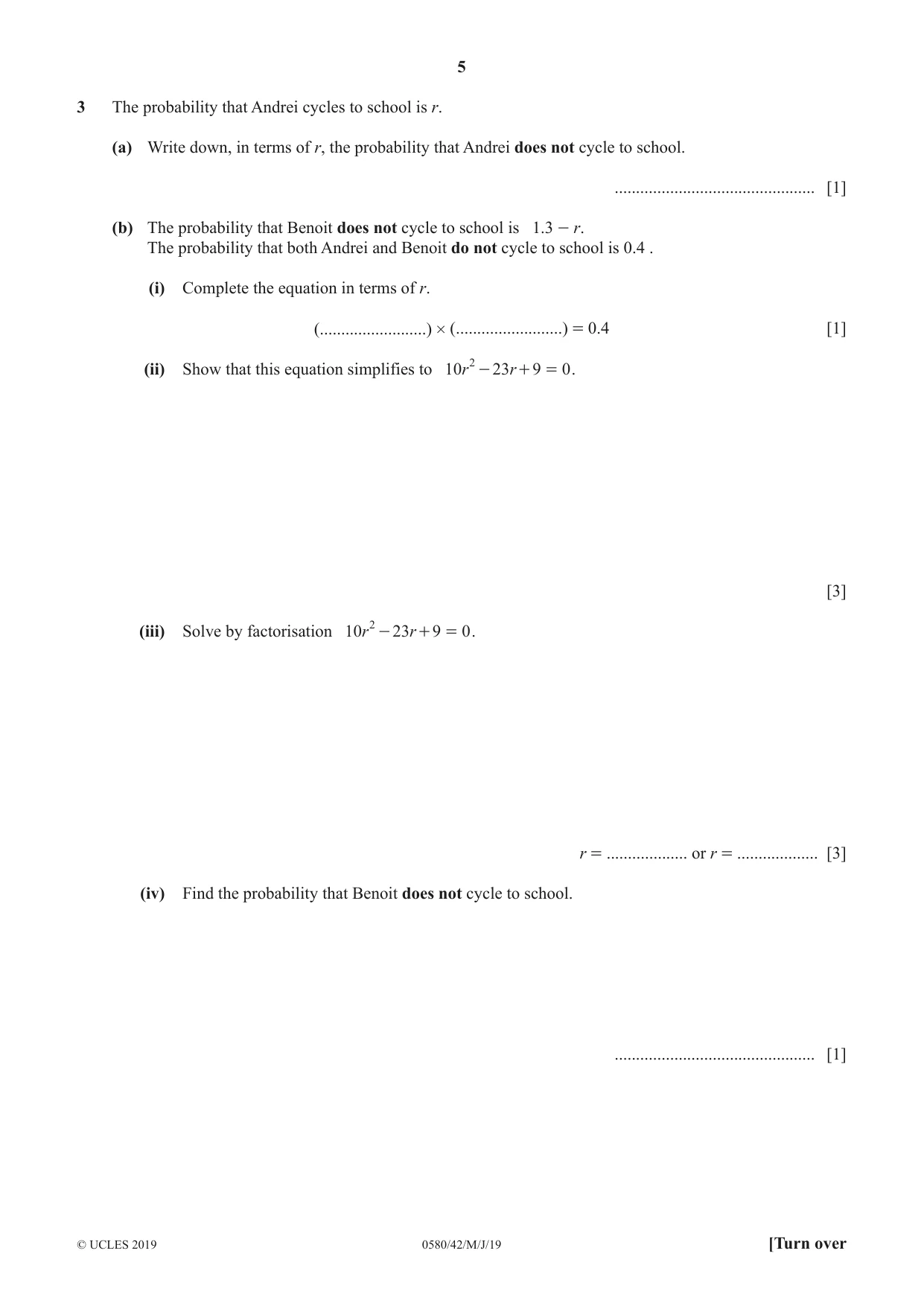
3 The probability that Andrei cycles to school is r. (a) Write down, in terms of r, the probability that Andrei does not cycle to school. ............................................... [1] (b) The probability that Benoit does not cycle to school is 1.3 - r. The probability that both Andrei and Benoit do not cycle to school is 0.4 . (i) Complete the equation in terms of r. (.........................) # (.........................) = 0.4 [1] (ii) Show that this equation simplifies to 10r 2 - 23 r + 9 = 0 . [3] (iii) Solve by factorisation 10r 2 - 23r + 9 = 0 . r = ................... or r = ................... [3] (iv) Find the probability that Benoit does not cycle to school. ............................................... [1]
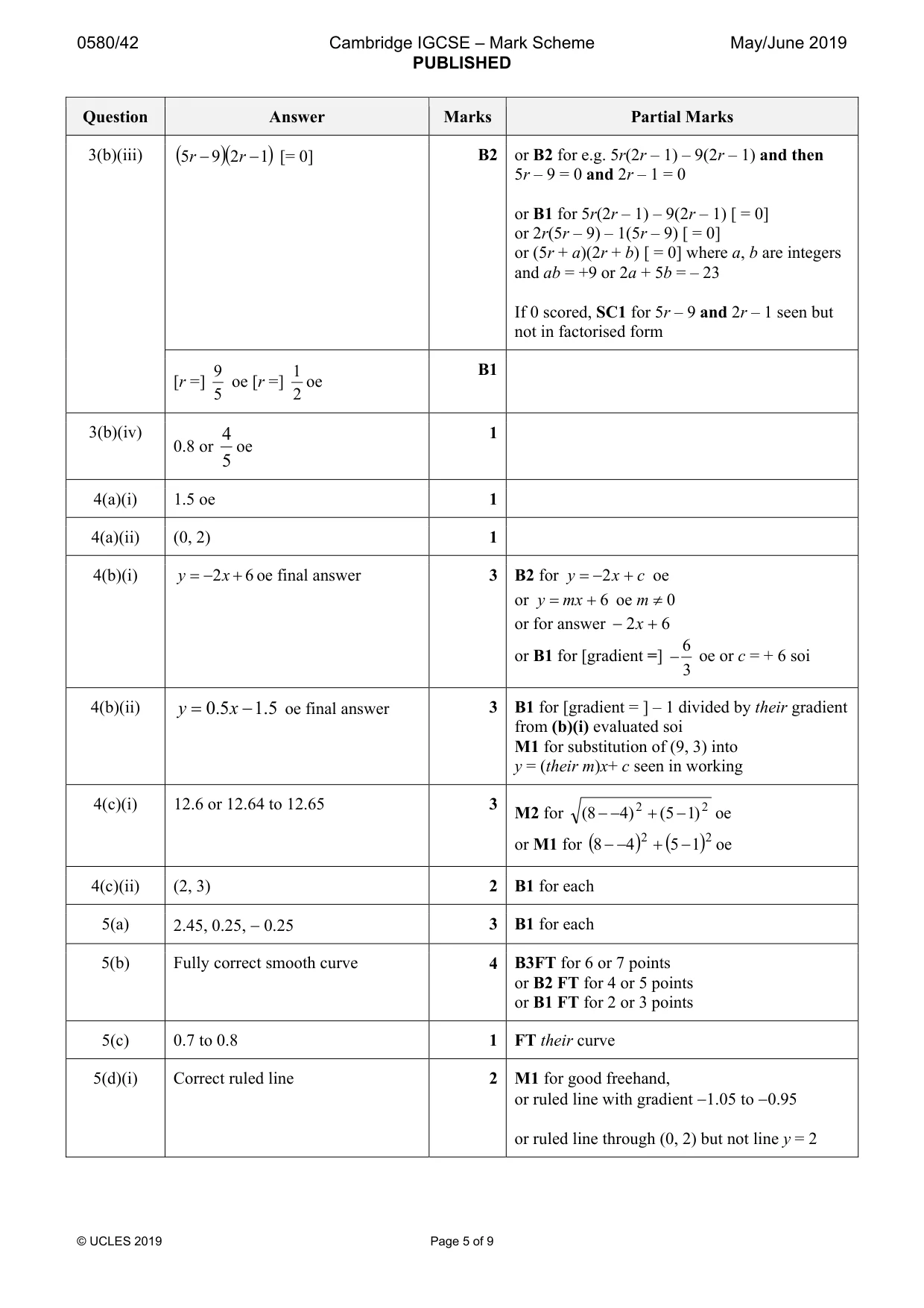
Mark scheme: 3(a) 1 – r 1 3(b)(i) (1 – r) (1.3 – r) [= 0.4] 1 FT their(a) dep on (a) being an expression in r 3(b)(ii) 1.3 – 1.3r – r + r 2 or better nfww M1 FT their (b)(i) 0.9 − 2.3r + r 2 [ = 0] M1 Strict FT their expansion to a quadratic then equating to 0.4 and then collecting to 3 terms on ‘one side’ OR OR Strict FT their expansion to a quadratic = 0.4 all 13 – 13r – 10r + 10r2 = 4 oe multiplied by 10 2 A1 no errors or omissions seen 10 r − 23 r + 9 = 0 3(b)(iii) (5r − 9 )(2 r − )1 [= 0] B2 or B2 for e.g. 5r(2r – 1) – 9(2r – 1) and then 5r – 9 = 0 and 2r – 1 = 0 or B1 for 5r(2r – 1) – 9(2r – 1) [ = 0] or 2r(5r – 9) – 1(5r – 9) [ = 0] or (5r + a)(2r + b) [ = 0] where a, b are integers and ab = +9 or 2a + 5b = – 23 If 0 scored, SC1 for 5r – 9 and 2r – 1 seen but not in factorised form 9 1 B1 [r =] oe [r =] oe 5 2 3(b)(iv) 4 1 0.8 or oe 5
Q4 · The equation of a straight line is 2y = 3x + 4
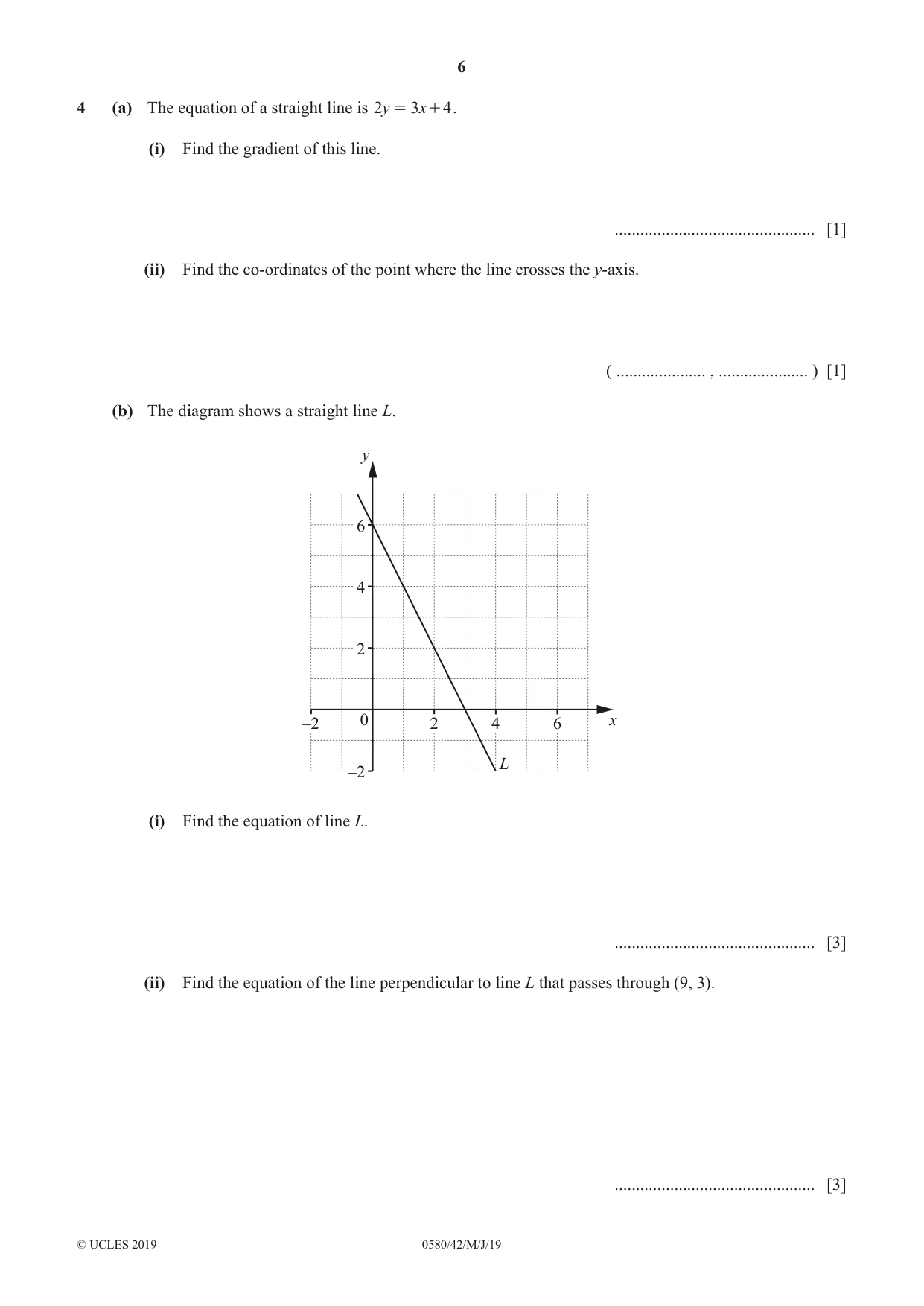
4 (a) The equation of a straight line is 2y = 3x + 4 . (i) Find the gradient of this line. ............................................... [1] (ii) Find the co-ordinates of the point where the line crosses the y-axis. ( ..................... , ..................... ) [1] (b) The diagram shows a straight line L. y 6 4 2 –2–2 0 22 4 6 x L –2 (i) Find the equation of line L. ............................................... [3] (ii) Find the equation of the line perpendicular to line L that passes through (9, 3). ............................................... [3] (c) A is the point (8, 5) and B is the point (- 4, 1). (i) Calculate the length of AB. ............................................... [3] (ii) Find the co-ordinates of the midpoint of AB. ( ..................... , ..................... ) [2]
Mark scheme: 4(a)(i) 1.5 oe 1 4(a)(ii) (0, 2) 1 4(b)(i) y = −2 x + 6 oe final answer 3 B2 for y = − 2 x + c oe or y = mx + 6 oe m ≠ 0 or for answer −x2 + 6 6 or B1 for [gradient =] − oe or c = + 6 soi 3 4(b)(ii) y = 5.0 x − 5.1 oe final answer 3 B1 for [gradient = ] – 1 divided by their gradient from (b)(i) evaluated soi M1 for substitution of (9, 3) into y = (their m)x+ c seen in working 4(c)(i) 12.6 or 12.64 to 12.65 3 2 2 M2 for (8 − − 4) + ( 5 − )1 oe or M1 for (8 − −4 ) 2 + (5 − 1)2 oe 4(c)(ii) (2, 3) 2 B1 for each
Q5 · X5 The table shows some values of y = - for 0.15 G x G 3.5
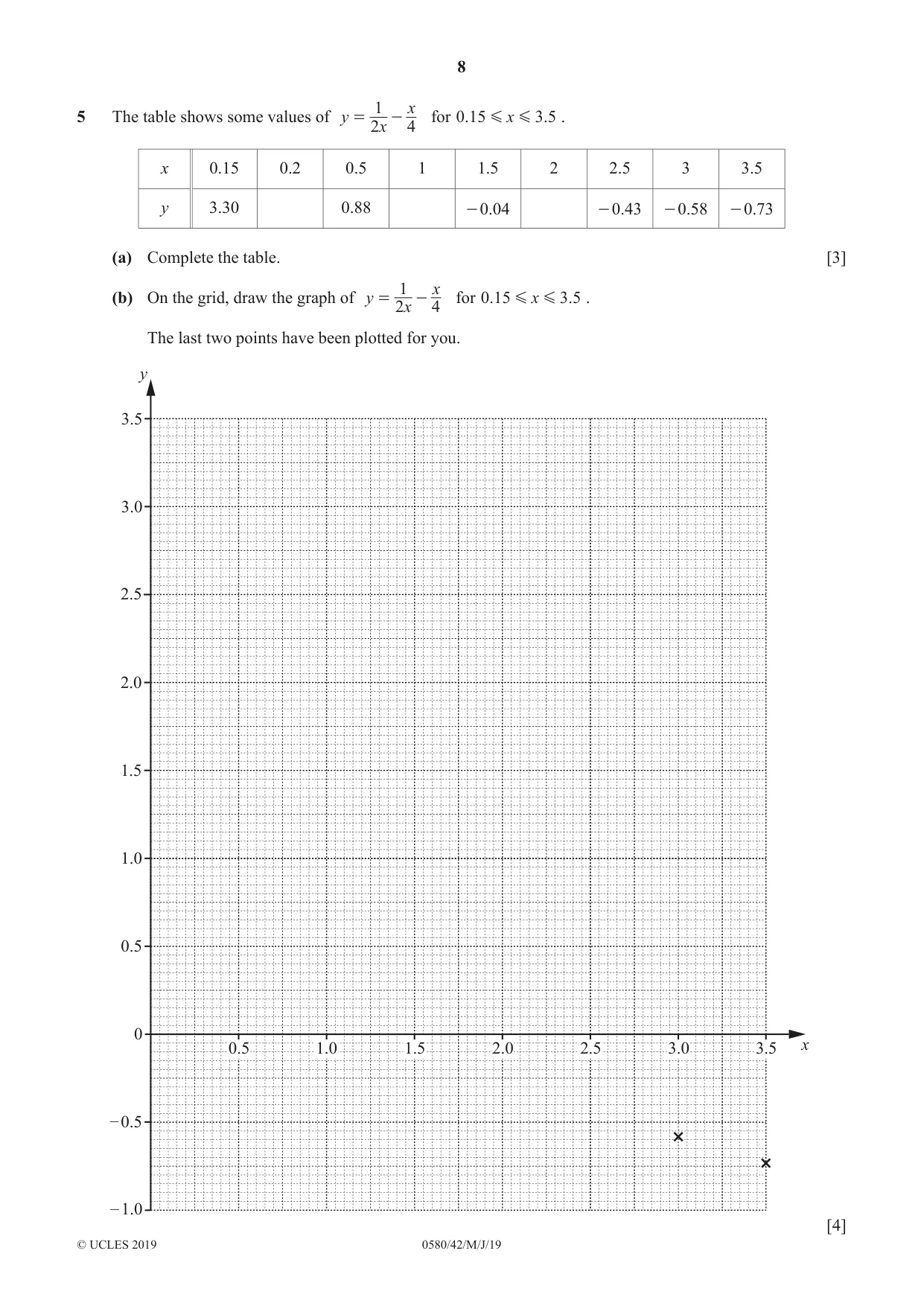
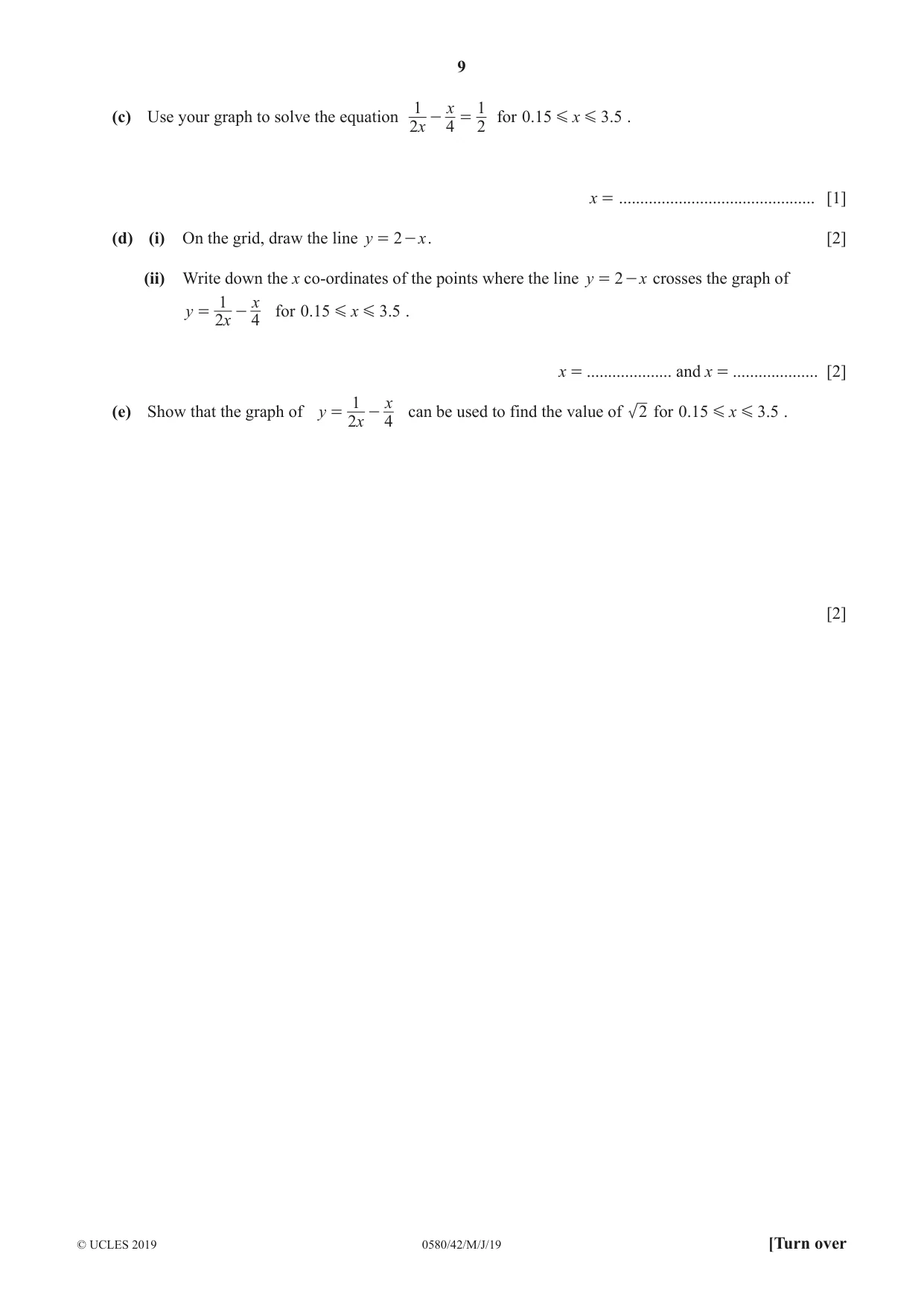
1 x5 The table shows some values of y = - for 0.15 G x G 3.5 . 2x 4 x 0.15 0.2 0.5 1 1.5 2 2.5 3 3.5 y 3.30 0.88 - 0.04 - 0.43 - 0.58 - 0.73 (a) Complete the table. [3] 1 x (b) On the grid, draw the graph of y = - for 0.15 G x G 3.5 . 2x 4 The last two points have been plotted for you. y 3.5 3.0 2.5 2.0 1.5 1.0 0.5 0 0.5 1.0 1.5 2.0 2.5 3.0 3.5 x – 0.5 – 1.0 [4] 1 x 1(c) Use your graph to solve the equation - = for 0.15 G x G 3.5 . 2x 4 2 x = .............................................. [1] (d) (i) On the grid, draw the line y = 2 - x . [2] (ii) Write down the x co-ordinates of the points where the line y = 2 - x crosses the graph of 1 x y = - for 0.15 G x G 3.5 . 2x 4 x = .................... and x = .................... [2] 1 x(e) Show that the graph of y = - can be used to find the value of 2 for 0.15 G x G 3.5 . 2x 4 [2]
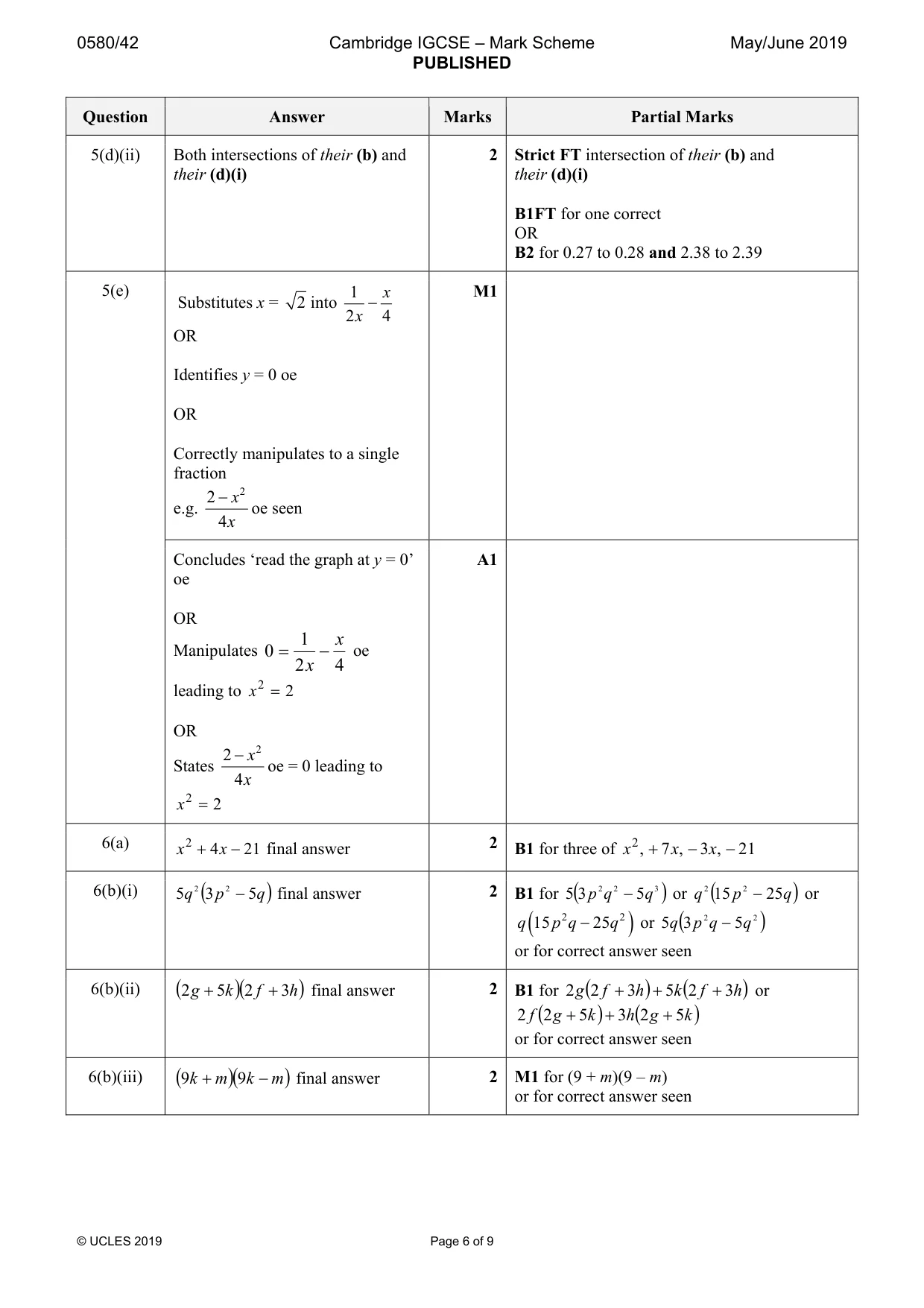
Mark scheme: 5(a) 2.45, 0.25, − 0.25 3 B1 for each 5(b) Fully correct smooth curve 4 B3FT for 6 or 7 points or B2 FT for 4 or 5 points or B1 FT for 2 or 3 points 5(c) 0.7 to 0.8 1 FT their curve 5(d)(i) Correct ruled line 2 M1 for good freehand, or ruled line with gradient −1.05 to −0.95 or ruled line through (0, 2) but not line y = 2 5(d)(ii) Both intersections of their (b) and 2 Strict FT intersection of their (b) and their (d)(i) their (d)(i) B1FT for one correct OR B2 for 0.27 to 0.28 and 2.38 to 2.39 5(e) 1 x M1 Substitutes x = 2 into − 2 x 4 OR Identifies y = 0 oe OR Correctly manipulates to a single fraction 2 − x 2 e.g. oe seen 4 x Concludes ‘read the graph at y = 0’ A1 oe OR 1 x Manipulates 0 = − oe 2 x 4 leading to x 2 = 2 OR 2 − x 2 States oe = 0 leading to 4 x x 2 = 2
Question 6
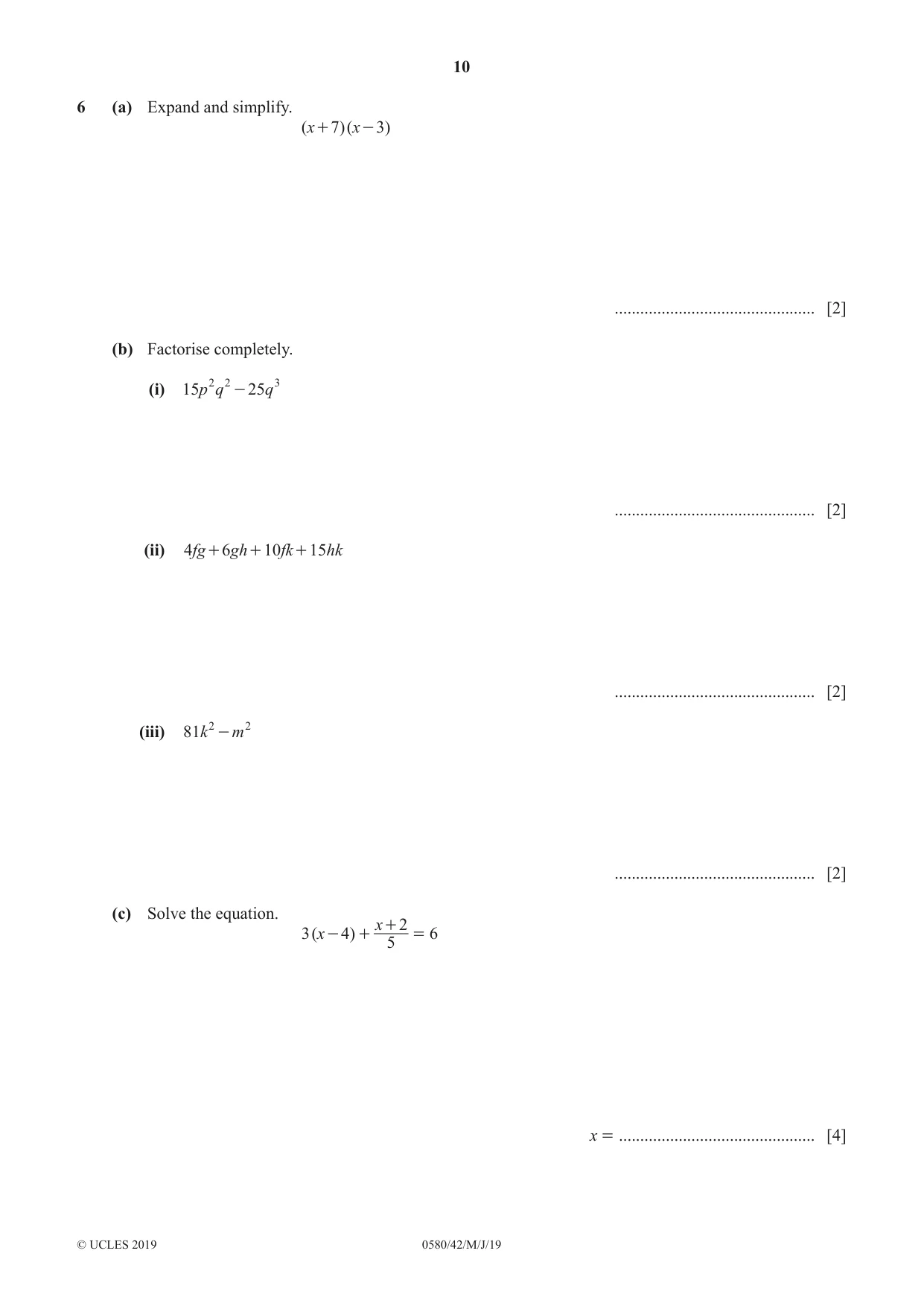
6 (a) Expand and simplify. (x + 7)(x - 3) ............................................... [2] (b) Factorise completely. (i) 15p 2 q 2 - 25q 3 ............................................... [2] (ii) 4fg + 6gh + 10fk + 15hk ............................................... [2] (iii) 81k 2 - m 2 ............................................... [2] (c) Solve the equation. x + 2 3 (x - 4) + = 6 5 x = .............................................. [4]
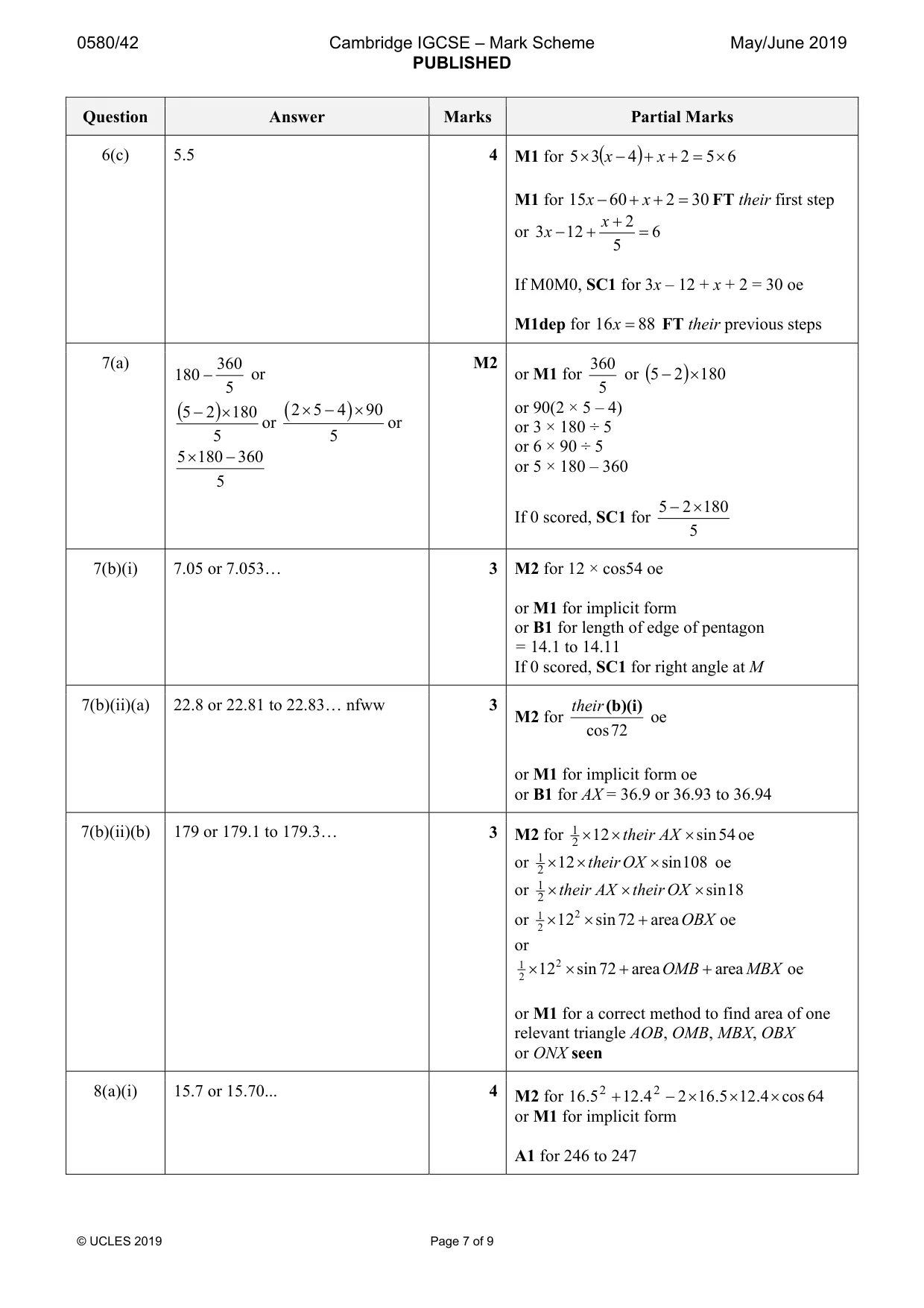
Mark scheme: 6(a) 2 2 2 x + 4 x − 21 final answer B1 for three of x , + 7 x , − 3 x , − 21 2 6(b)(i) 5 q 2 (3 p 2 − 5 q ) final answer 2 B1 for 5(3 p 2 q 2 − 5 q 3 ) or q (15 p 2 − 25 q ) or q 15 p 2 q − 25 q 2 or 5 q (3 p 2 q − 5 q 2 ) ( ) or for correct answer seen 6(b)(ii) (2 g + 5k )(2 f + 3h ) final answer 2 B1 for 2 g (2 f + 3h ) + 5k (2 f + 3h ) or 2 f (2 g + 5 k ) + 3h (2 g + 5 k ) or for correct answer seen 6(b)(iii) (9 k + m )(9 k − m ) final answer 2 M1 for (9 + m)(9 – m) or for correct answer seen 6(c) 5.5 4 M1 for 5 × 3( x − 4 ) + x + 2 = 5 × 6 M1 for 15 x − 60 + x + 2 = 30 FT their first step x + 2 or 3 x − 12 + = 6 5 If M0M0, SC1 for 3x – 12 + x + 2 = 30 oe M1dep for 16 x = 88 FT their previous steps
Q7 · Show that each interior angle of a regular pentagon is 108°
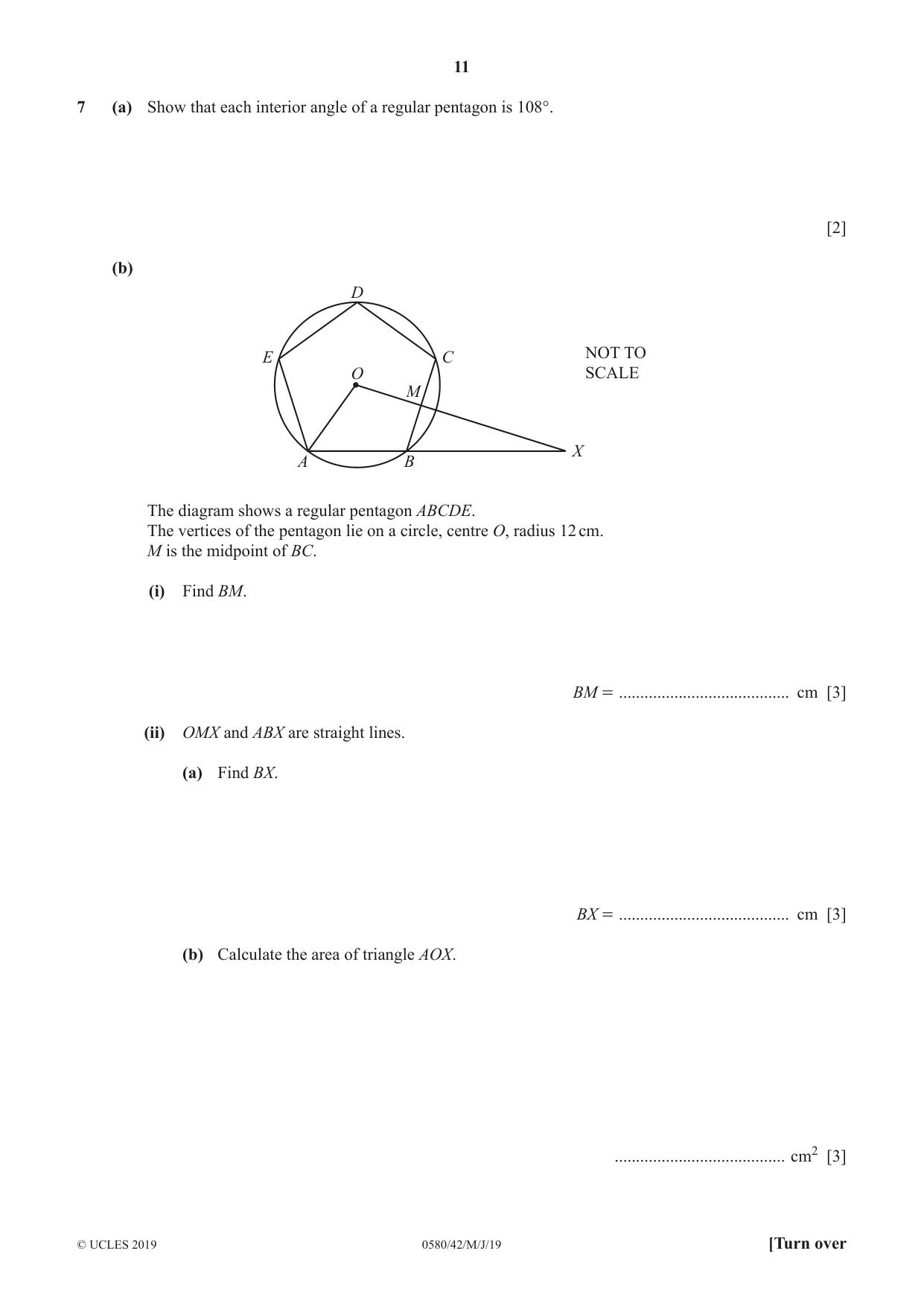
7 (a) Show that each interior angle of a regular pentagon is 108°. [2] (b) D E C NOT TO O SCALE M X A B The diagram shows a regular pentagon ABCDE. The vertices of the pentagon lie on a circle, centre O, radius 12 cm. M is the midpoint of BC. (i) Find BM. BM = ........................................ cm [3] (ii) OMX and ABX are straight lines. (a) Find BX. BX = ........................................ cm [3] (b) Calculate the area of triangle AOX. ........................................ cm2 [3]
Mark scheme: 7(a) 360 M2 360 180 − or or M1 for or (5 − 2 ) × 180 5 5 (5 − 2 ) × 180 ( 2 × 5 − 4 ) × 90 or 90(2 × 5 – 4) or or or 3 × 180 ÷ 5 5 5 or 6 × 90 ÷ 5 5 × 180 − 360 or 5 × 180 – 360 5 5 − 2 × 180 If 0 scored, SC1 for 5 7(b)(i) 7.05 or 7.053… 3 M2 for 12 × cos54 oe or M1 for implicit form or B1 for length of edge of pentagon = 14.1 to 14.11 If 0 scored, SC1 for right angle at M 7(b)(ii)(a) 22.8 or 22.81 to 22.83… nfww 3 their(b)(i) M2 for oe cos72 or M1 for implicit form oe or B1 for AX = 36.9 or 36.93 to 36.94 7(b)(ii)(b) 179 or 179.1 to 179.3… 3 M2 for 1 × 12 × their AX × sin54 oe 2 or 1 × 12 × theirOX × sin108 oe 2 or 1 × their AX × theirOX × sin18 2 or 12 × 12 2 × sin72 + areaOBX oe or 1 2 × 12 2 × sin72 + area OMB + area MBX oe or M1 for a correct method to find area of one relevant triangle AOB, OMB, MBX, OBX or ONX seen
Q8 · D 64° 53° 16.5 cm NOT TO SCALE 12.4 cm A 95° B C The diagram shows two triangles ABD and…
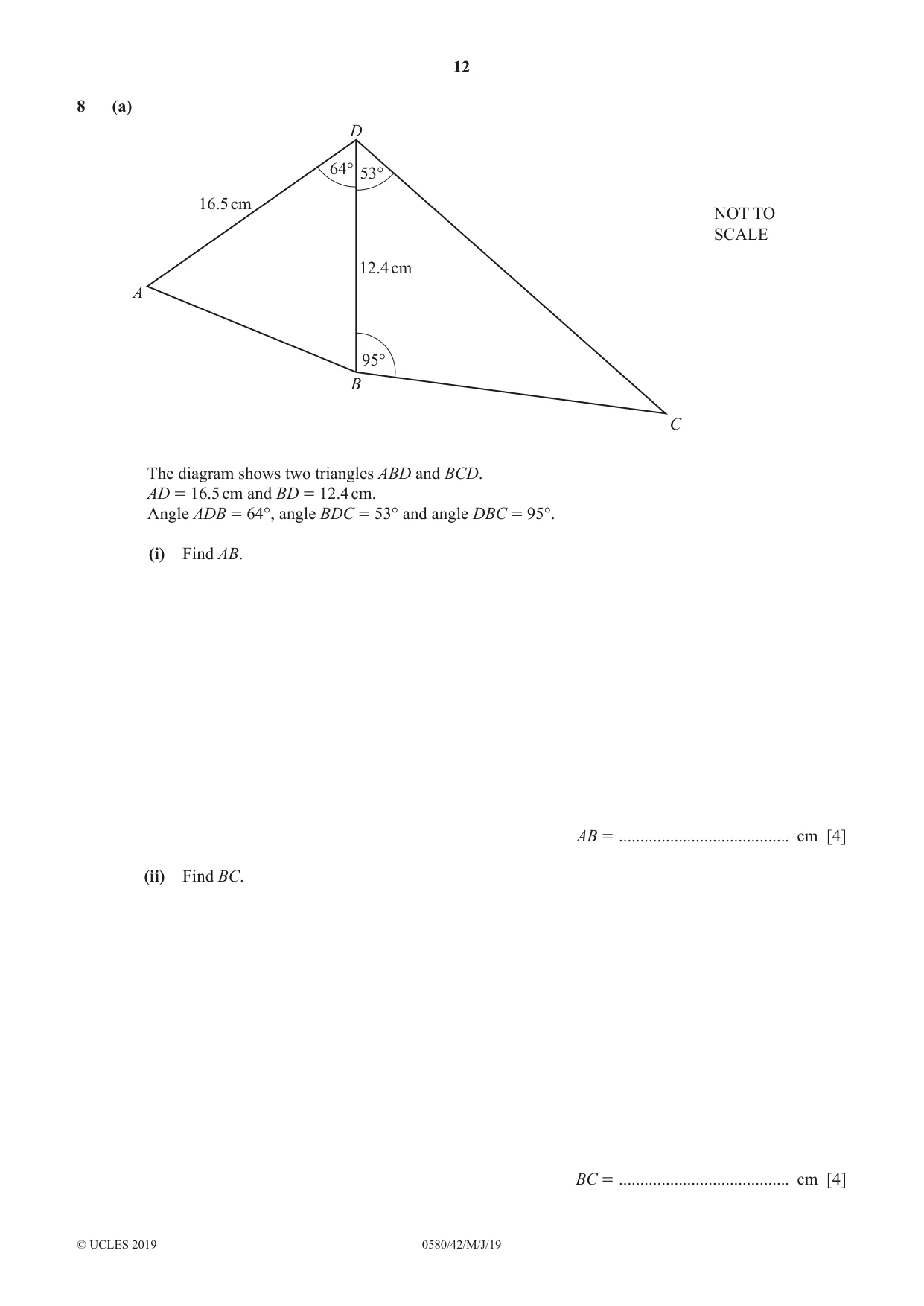
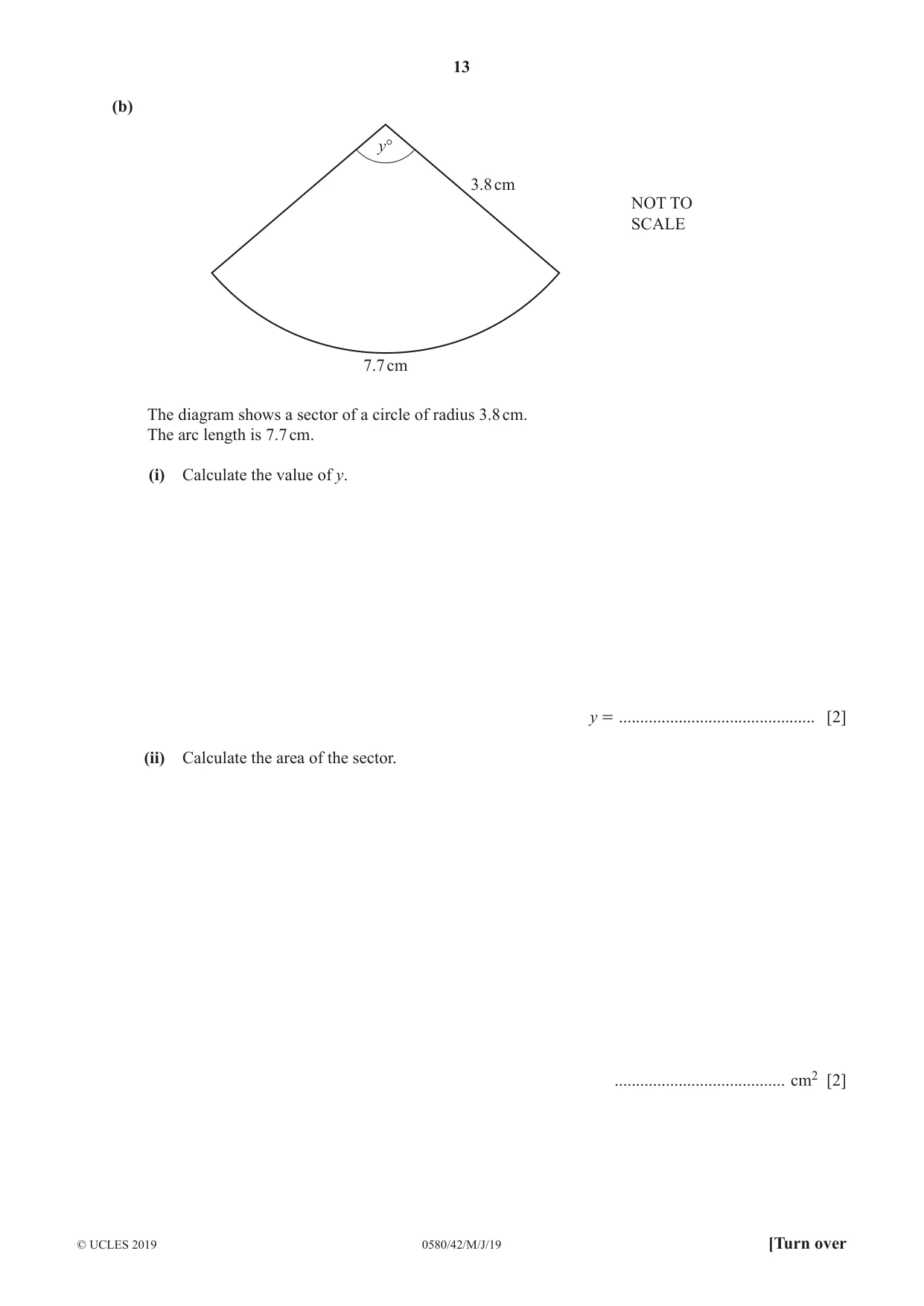
8 (a) D 64° 53° 16.5 cm NOT TO SCALE 12.4 cm A 95° B C The diagram shows two triangles ABD and BCD. AD = 16.5 cm and BD = 12.4 cm. Angle ADB = 64°, angle BDC = 53° and angle DBC = 95°. (i) Find AB. AB = ........................................ cm [4] (ii) Find BC. BC = ........................................ cm [4] (b) y° 3.8 cm NOT TO SCALE 7.7 cm The diagram shows a sector of a circle of radius 3.8 cm. The arc length is 7.7 cm. (i) Calculate the value of y. y = .............................................. [2] (ii) Calculate the area of the sector. ........................................ cm2 [2]
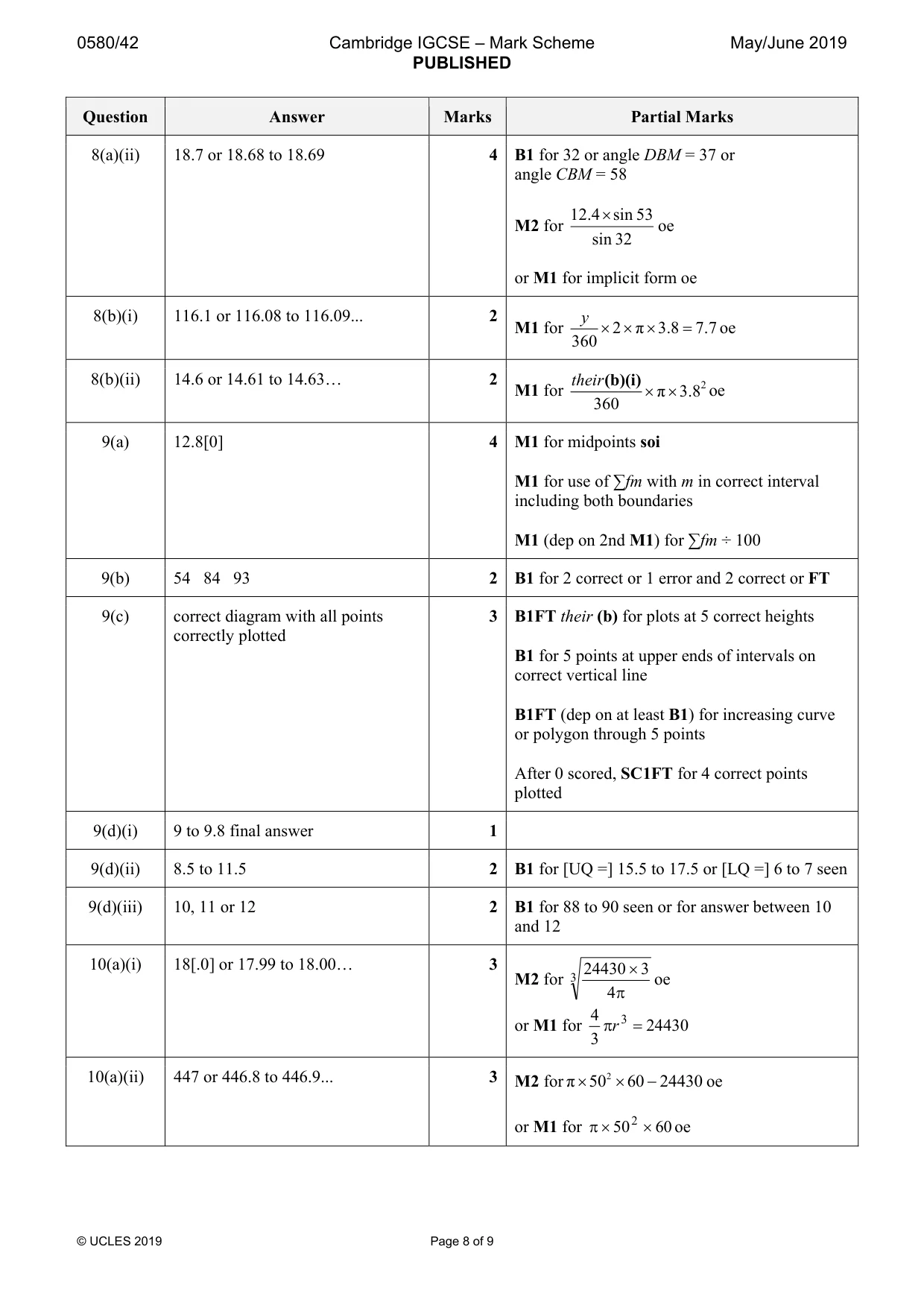
Mark scheme: 8(a)(i) 15.7 or 15.70... 4 2 2 M2 for 16 5. + 12 4. − 2 × 16 5. × 12 4. × cos 64 or M1 for implicit form A1 for 246 to 247 8(a)(ii) 18.7 or 18.68 to 18.69 4 B1 for 32 or angle DBM = 37 or angle CBM = 58 12 4. × sin 53 M2 for oe sin 32 or M1 for implicit form oe 8(b)(i) 116.1 or 116.08 to 116.09... 2 y M1 for × 2 × π × 3.8 = 7.7 oe 360 8(b)(ii) 14.6 or 14.61 to 14.63… 2 their (b)(i) 2 M1 for × π × 3.8 oe 360
Q9 · 100 students were each asked how much money, $m, they spent in one week
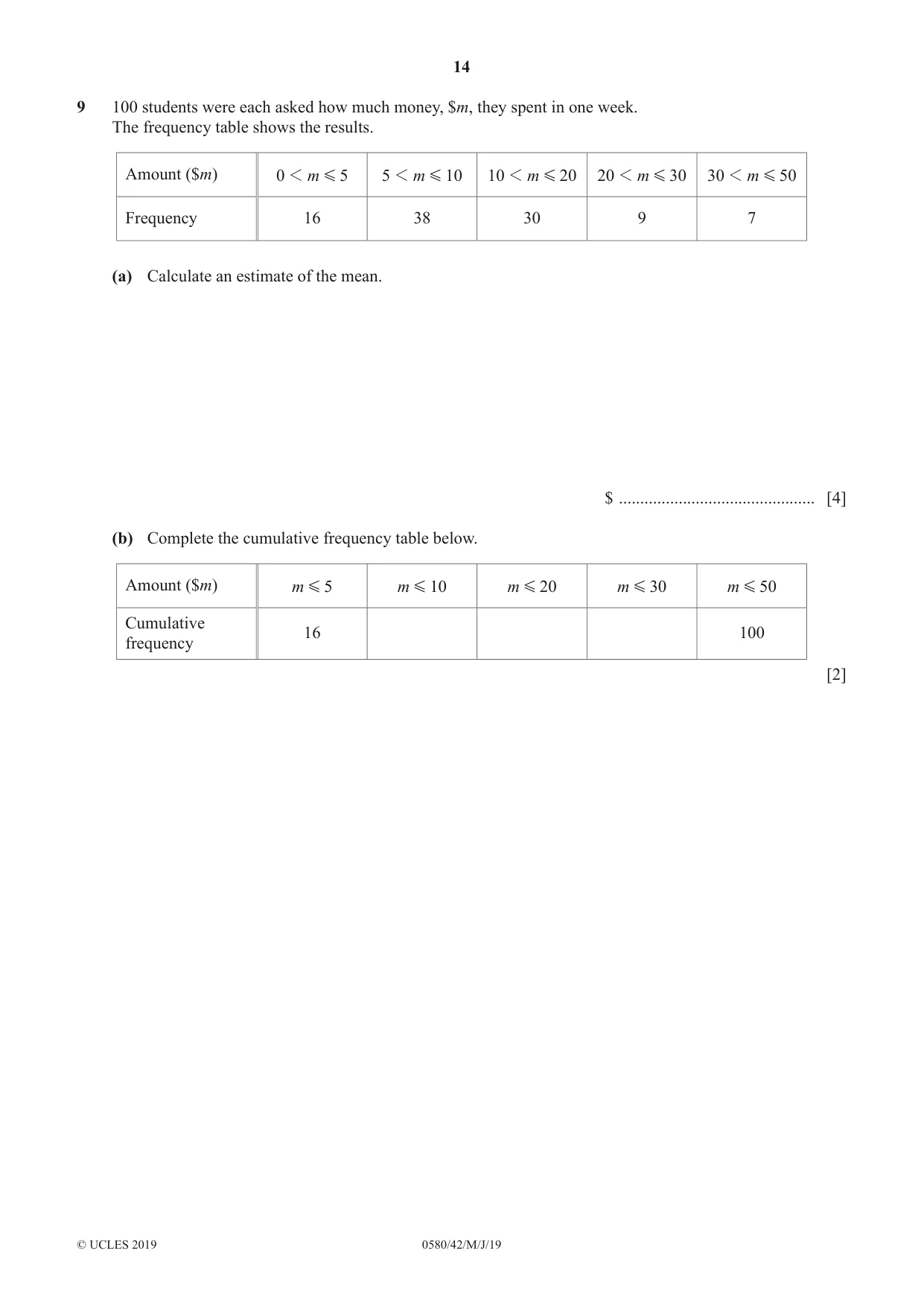
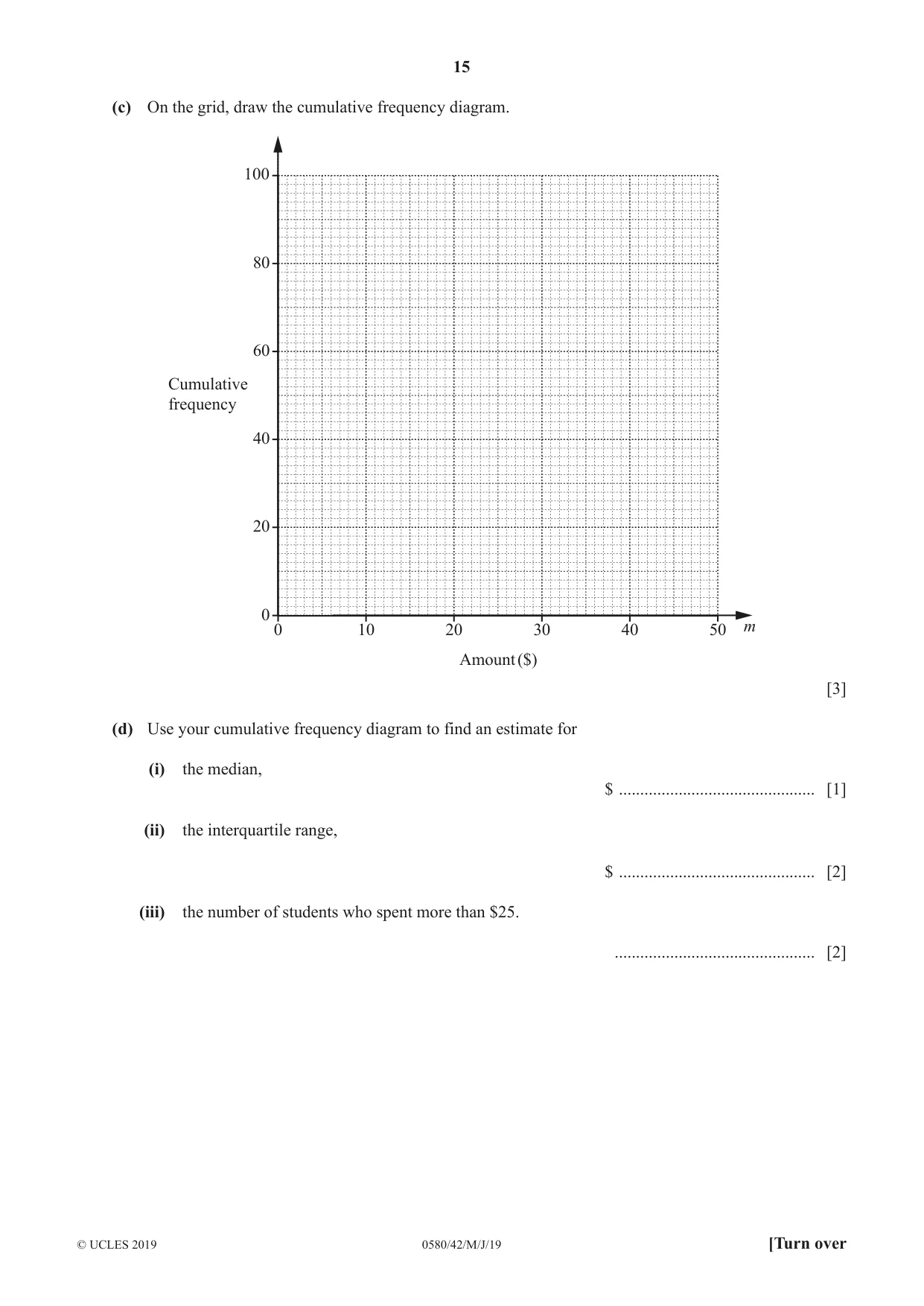
9 100 students were each asked how much money, $m, they spent in one week. The frequency table shows the results. Amount ($m) 0 1 m G 5 5 1 m G 10 10 1 m G 20 20 1 m G 30 30 1 m G 50 Frequency 16 38 30 9 7 (a) Calculate an estimate of the mean. $ .............................................. [4] (b) Complete the cumulative frequency table below. Amount ($m) m G 5 m G 10 m G 20 m G 30 m G 50 Cumulative 16 100 frequency [2] (c) On the grid, draw the cumulative frequency diagram. 100 80 60 Cumulative frequency 40 20 0 0 10 20 30 40 50 m Amount ($) [3] (d) Use your cumulative frequency diagram to find an estimate for (i) the median, $ .............................................. [1] (ii) the interquartile range, $ .............................................. [2] (iii) the number of students who spent more than $25. ............................................... [2]
Mark scheme: 9(a) 12.8[0] 4 M1 for midpoints soi M1 for use of ∑fm with m in correct interval including both boundaries M1 (dep on 2nd M1) for ∑fm ÷ 100 9(b) 54 84 93 2 B1 for 2 correct or 1 error and 2 correct or FT 9(c) correct diagram with all points 3 B1FT their (b) for plots at 5 correct heights correctly plotted B1 for 5 points at upper ends of intervals on correct vertical line B1FT (dep on at least B1) for increasing curve or polygon through 5 points After 0 scored, SC1FT for 4 correct points plotted 9(d)(i) 9 to 9.8 final answer 1 9(d)(ii) 8.5 to 11.5 2 B1 for [UQ =] 15.5 to 17.5 or [LQ =] 6 to 7 seen 9(d)(iii) 10, 11 or 12 2 B1 for 88 to 90 seen or for answer between 10 and 12
Q10 · The volume of a solid metal sphere is 24 430 cm3
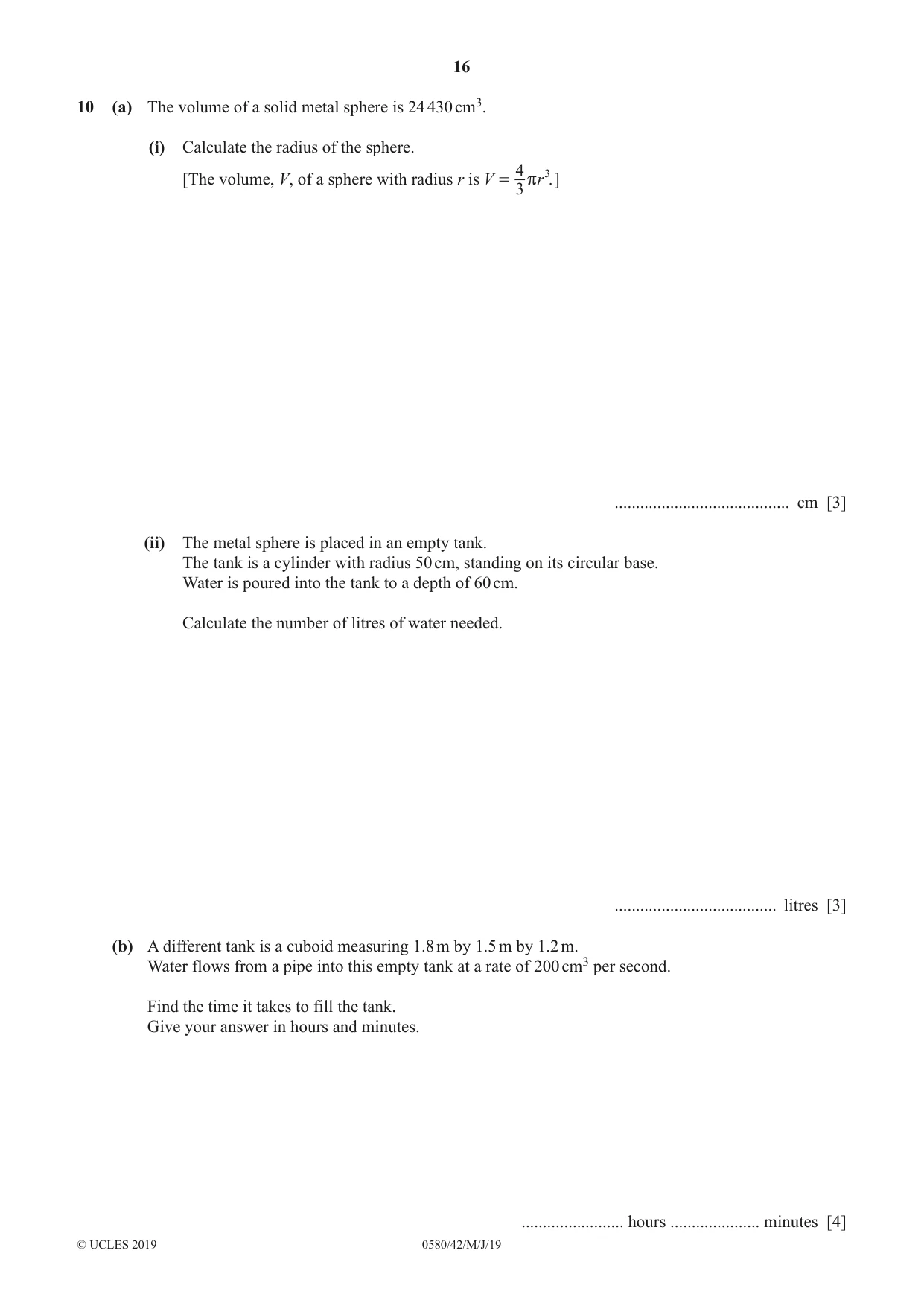
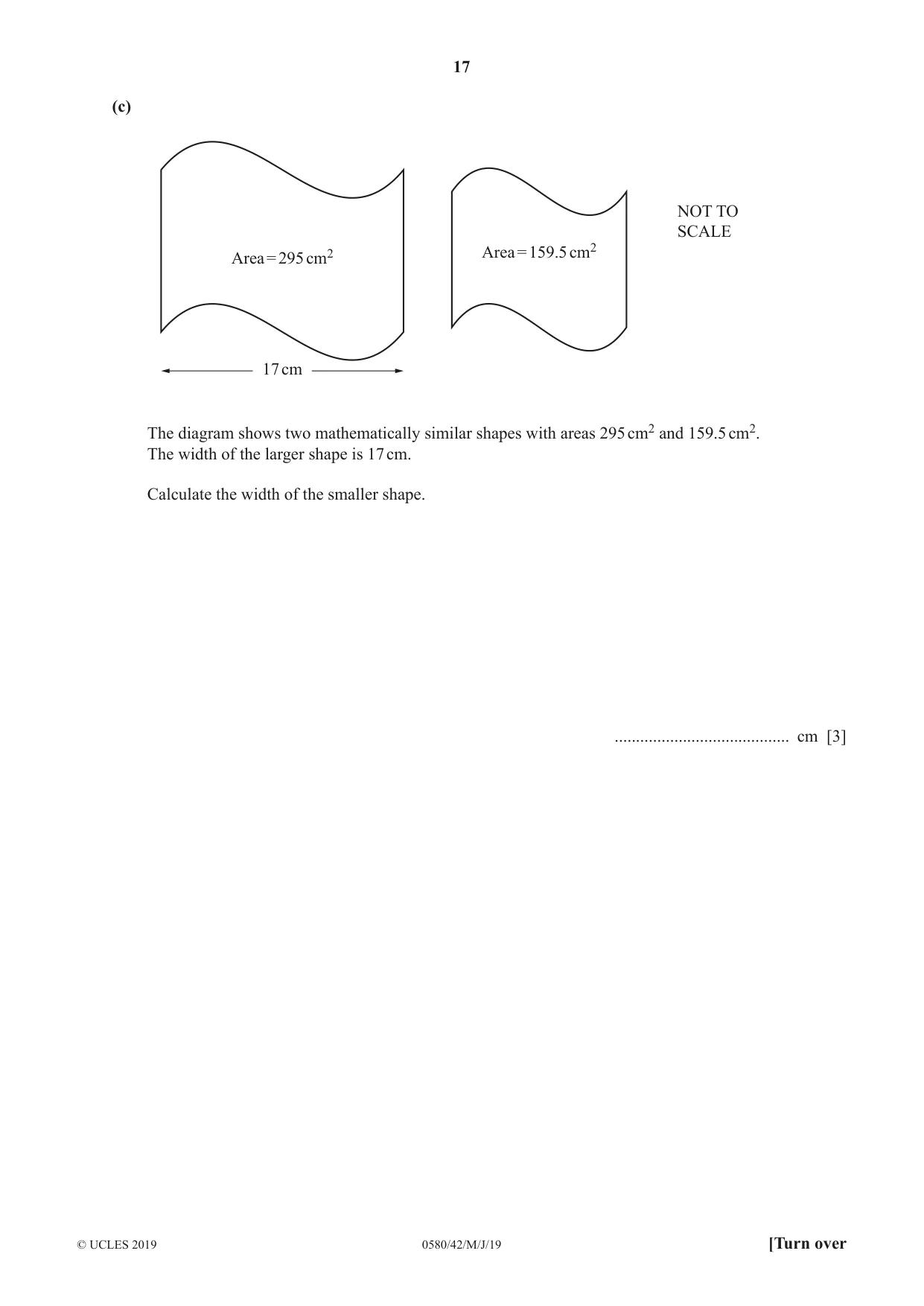
10 (a) The volume of a solid metal sphere is 24 430 cm3. (i) Calculate the radius of the sphere. 4 3 [The volume, V, of a sphere with radius r is V = r r . ] 3 ......................................... cm [3] (ii) The metal sphere is placed in an empty tank. The tank is a cylinder with radius 50 cm, standing on its circular base. Water is poured into the tank to a depth of 60 cm. Calculate the number of litres of water needed. ...................................... litres [3] (b) A different tank is a cuboid measuring 1.8 m by 1.5 m by 1.2 m. Water flows from a pipe into this empty tank at a rate of 200 cm3 per second. Find the time it takes to fill the tank. Give your answer in hours and minutes. ........................ hours ..................... minutes [4] (c) NOT TO SCALE Area = 159.5 cm2 Area = 295 cm2 17 cm The diagram shows two mathematically similar shapes with areas 295 cm2 and 159.5 cm2. The width of the larger shape is 17 cm. Calculate the width of the smaller shape. ......................................... cm [3]
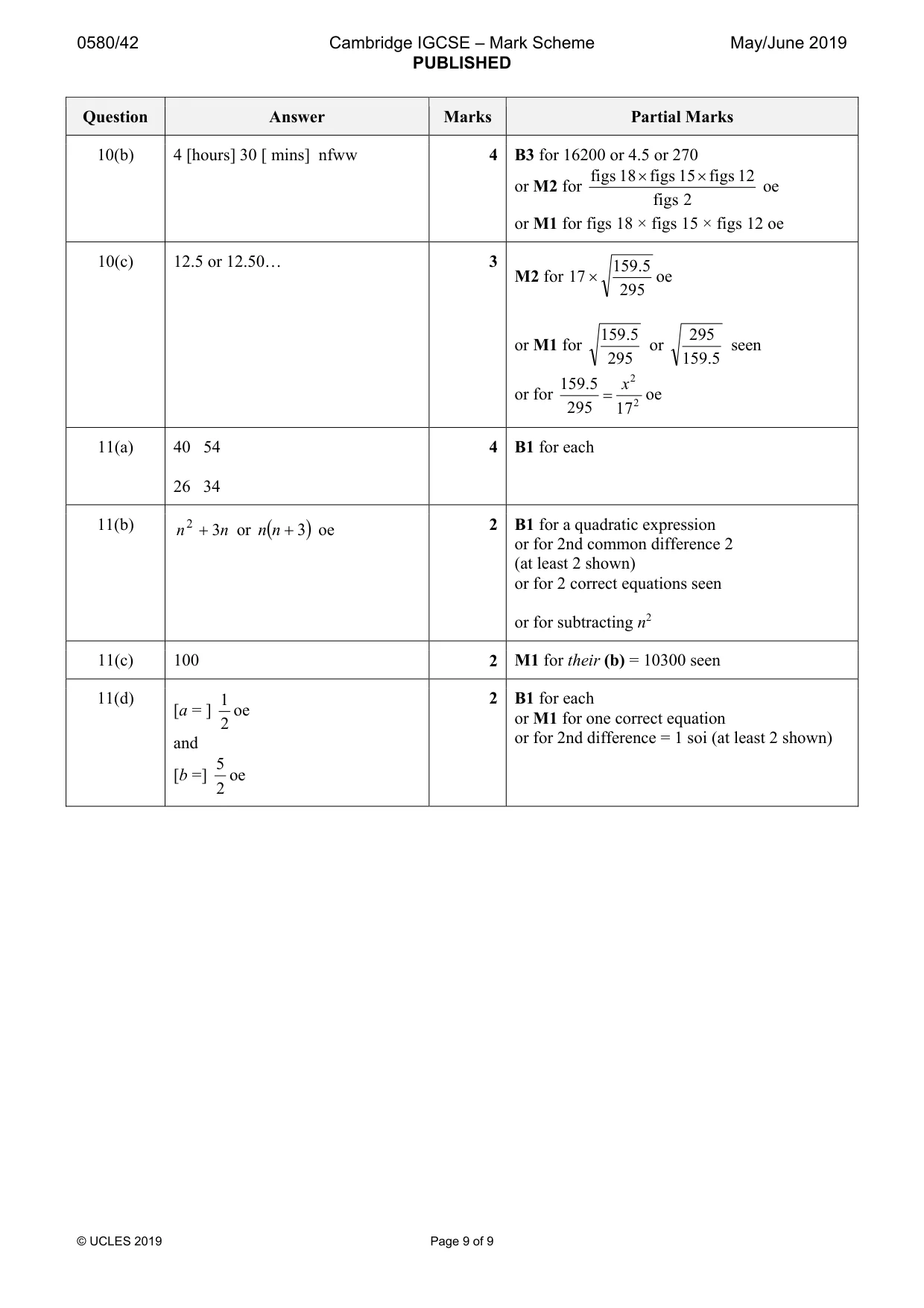
Mark scheme: 10(a)(i) 18[.0] or 17.99 to 18.00… 3 24430 × 3 M2 for 3 oe 4 π 4 3 or M1 for πr = 24430 3 10(a)(ii) 447 or 446.8 to 446.9... 3 M2 for π × 50 2 × 60 − 24430 oe or M1 for π × 502 × 60 oe 10(b) 4 [hours] 30 [ mins] nfww 4 B3 for 16200 or 4.5 or 270 figs 18 × figs 15 × figs 12 or M2 for oe figs 2 or M1 for figs 18 × figs 15 × figs 12 oe 10(c) 12.5 or 12.50… 3 159 5. M2 for 17 × oe 295 159 5. 295 or M1 for or seen 295 159 5. 159.5 x 2 or for = oe 295 17 2
Q11 · Diagram 1 Diagram 2 Diagram 3 Diagram 4 Diagram 5 The sequence of diagrams above is made…
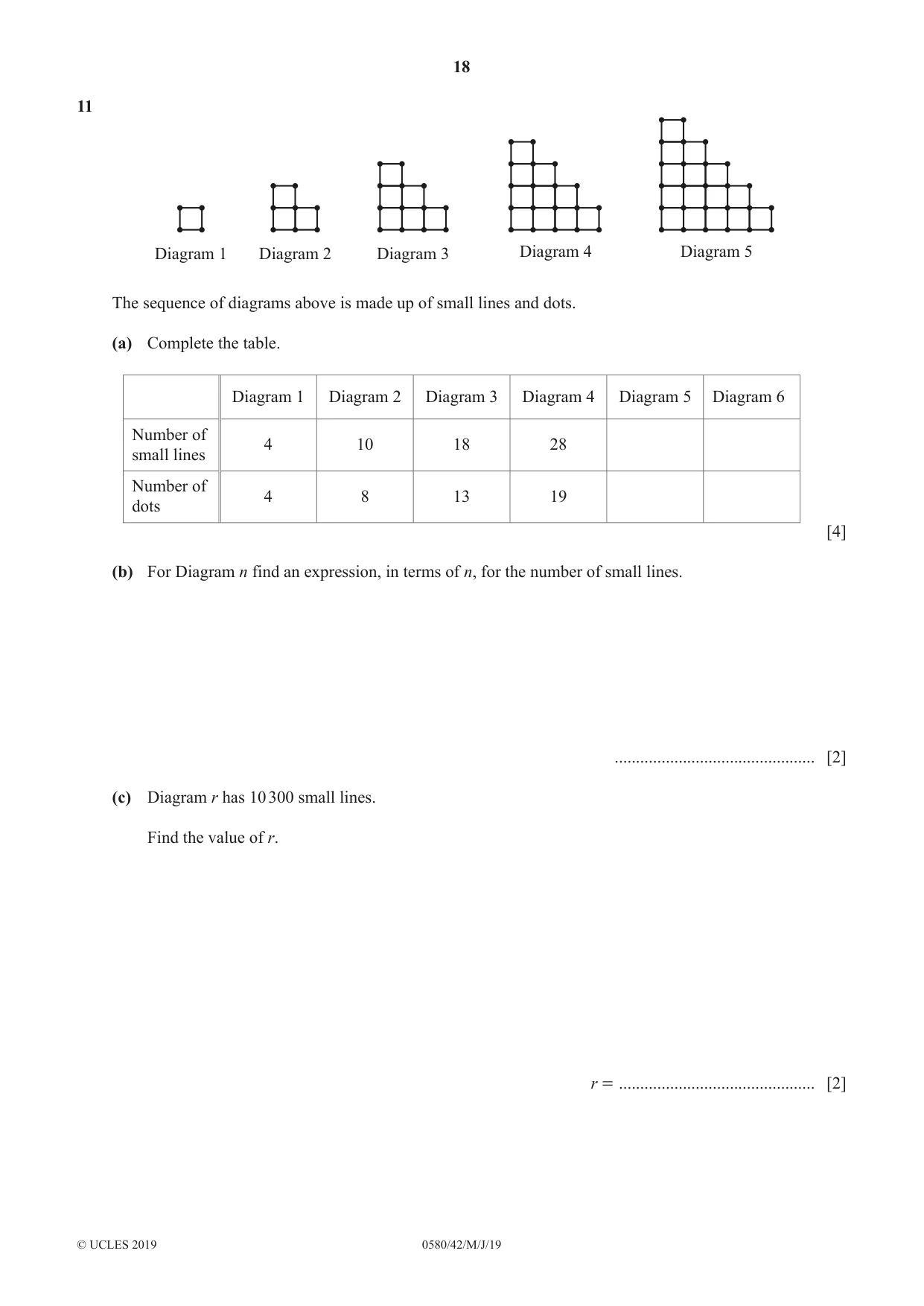
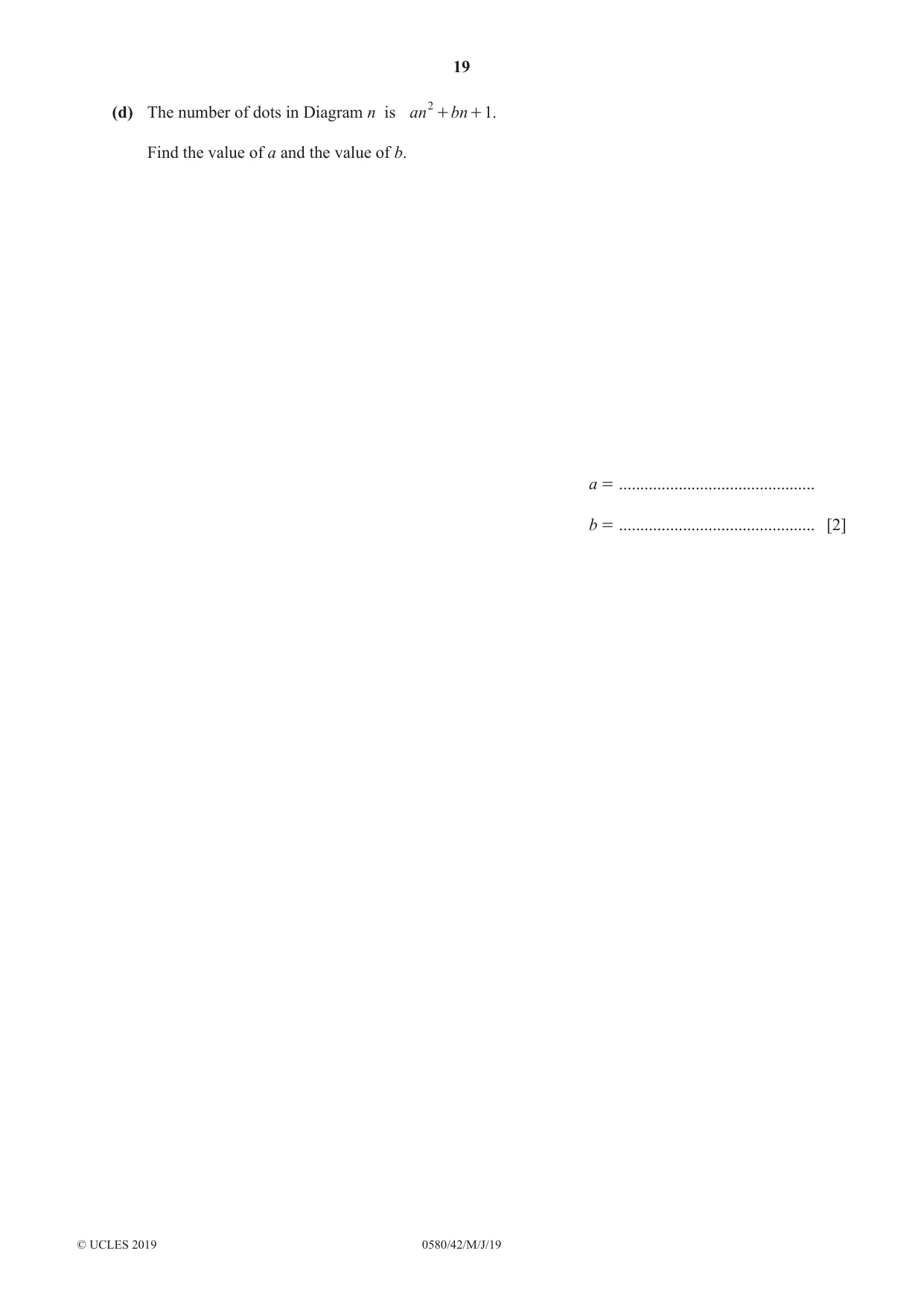
11 Diagram 1 Diagram 2 Diagram 3 Diagram 4 Diagram 5 The sequence of diagrams above is made up of small lines and dots. (a) Complete the table. Diagram 1 Diagram 2 Diagram 3 Diagram 4 Diagram 5 Diagram 6 Number of 4 10 18 28 small lines Number of 4 8 13 19 dots [4] (b) For Diagram n find an expression, in terms of n, for the number of small lines. ............................................... [2] (c) Diagram r has 10 300 small lines. Find the value of r. r = .............................................. [2] (d) The number of dots in Diagram n is an 2 + bn + 1. Find the value of a and the value of b. a = .............................................. b = .............................................. [2]
Mark scheme: 11(a) 40 54 4 B1 for each 26 34 11(b) 2 2 B1 for a quadratic expression n + 3n or n (n + 3) oe or for 2nd common difference 2 (at least 2 shown) or for 2 correct equations seen or for subtracting n2 11(c) 100 2 M1 for their (b) = 10300 seen 11(d) 1 2 B1 for each [a = ] oe or M1 for one correct equation 2 or for 2nd difference = 1 soi (at least 2 shown) and 5 [b =] oe 2
What was in this paper
The subtopics covered by these 11 questions, and how many questions each got. Open one in a new tab to see every Cambridge question on it.
What you needed in this session
Cambridge’s own grade thresholds for 2019 May/June, Paper 4 · Variant 2. A higher threshold means an easier paper — the bar moves with how the cohort did.