Cambridge IGCSE Mathematics 0580 — 2021 Feb/March Paper 4 · Variant 2
0580/42/F/M/21 · 12 questions · 130 marks · ≈146 min
The question paper and its mark scheme, free to read here and free to download. This is Cambridge’s own paper, exactly as it was sat.
Question paper20 pages
Mark scheme10 pages
Answers below. Sit the paper first if you are practising.
Questions as text
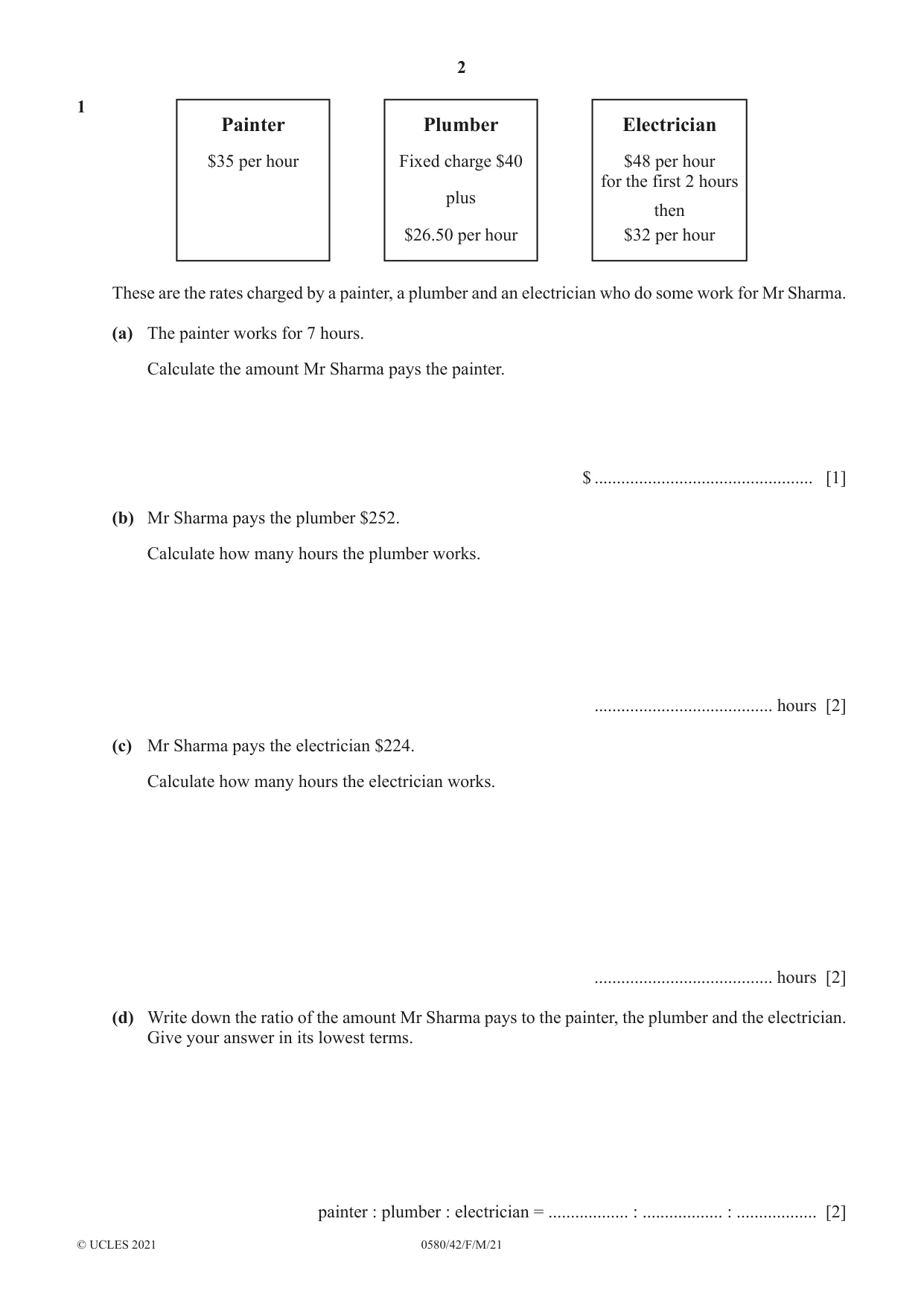
Q1 · Painter Plumber Electrician $35 per hour Fixed charge $40 $48 per hour for the first 2…
1 Painter Plumber Electrician $35 per hour Fixed charge $40 $48 per hour for the first 2 hours plus then $26.50 per hour $32 per hour These are the rates charged by a painter, a plumber and an electrician who do some work for Mr Sharma. (a) The painter works for 7 hours. Calculate the amount Mr Sharma pays the painter. $ ................................................. [1] (b) Mr Sharma pays the plumber $252. Calculate how many hours the plumber works. ........................................ hours [2] (c) Mr Sharma pays the electrician $224. Calculate how many hours the electrician works. ........................................ hours [2] (d) Write down the ratio of the amount Mr Sharma pays to the painter, the plumber and the electrician. Give your answer in its lowest terms. painter : plumber : electrician = .................. : .................. : .................. [2]
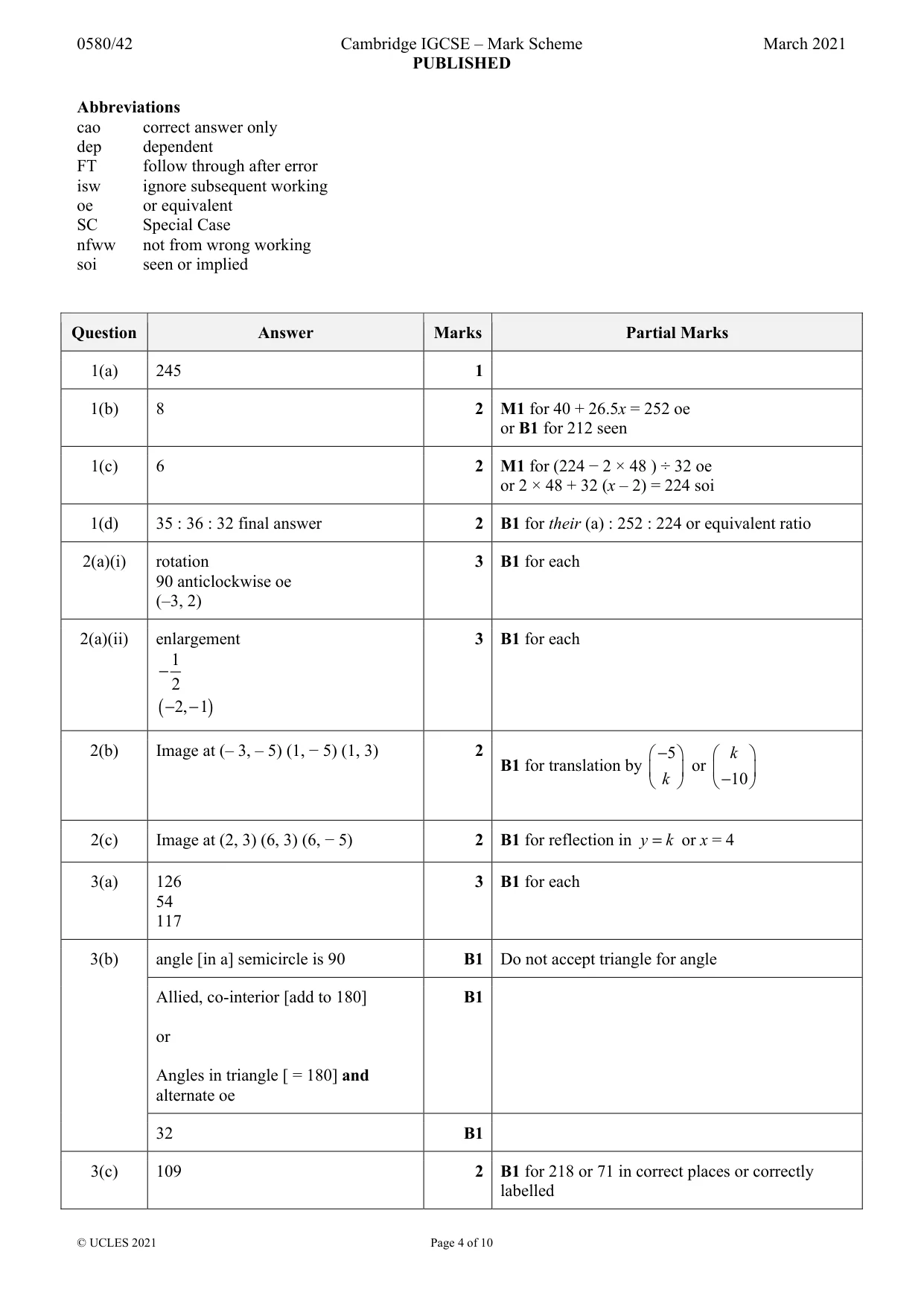
Mark scheme: Question Answer Marks Partial Marks 1(a) 245 1 1(b) 8 2 M1 for 40 + 26.5x = 252 oe or B1 for 212 seen 1(c) 6 2 M1 for (224 − 2 × 48 ) ÷ 32 oe or 2 × 48 + 32 (x – 2) = 224 soi 1(d) 35 : 36 : 32 final answer 2 B1 for their (a) : 252 : 224 or equivalent ratio
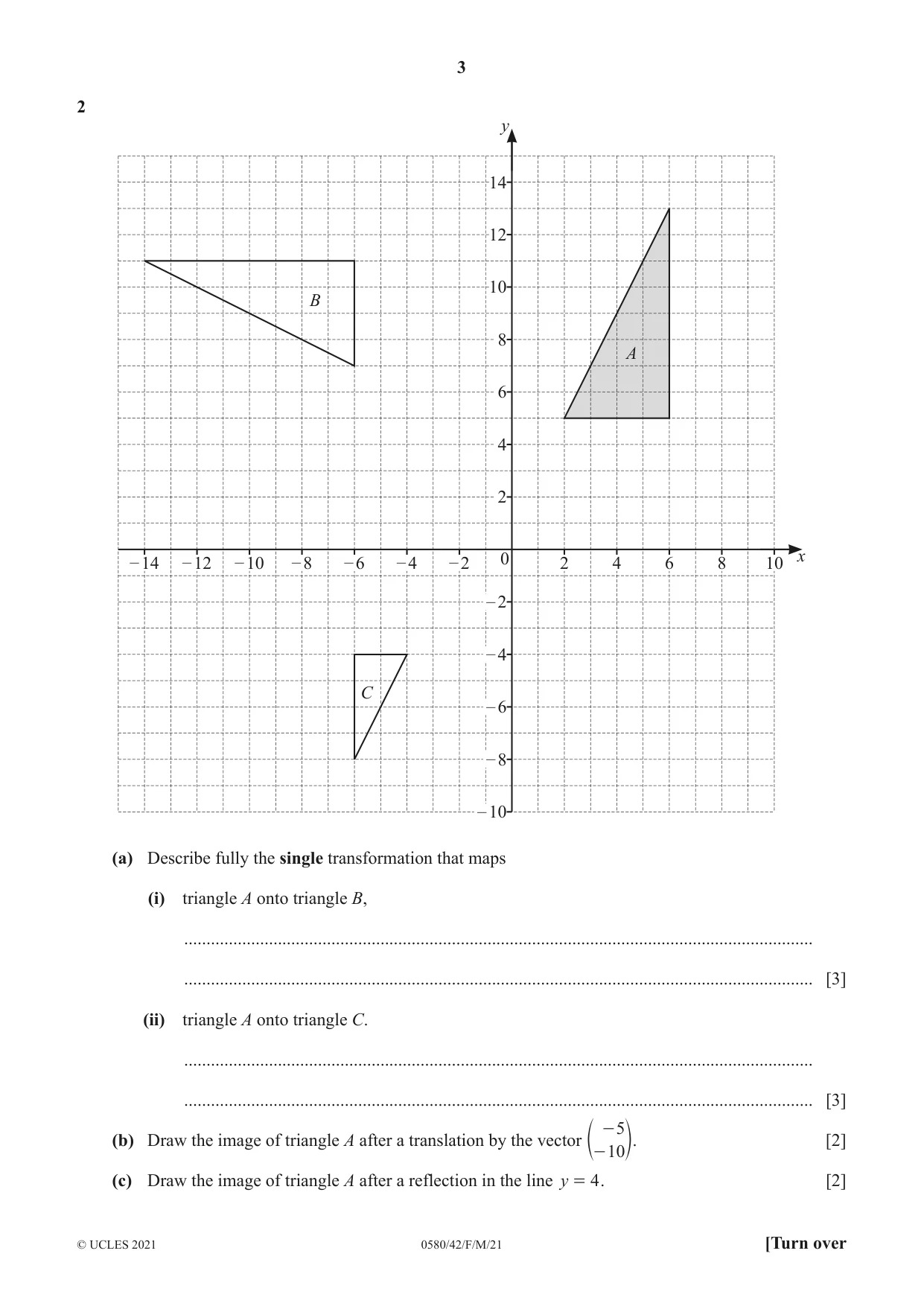
Q2 · Y 14 12 10 B 8 A 6 4 2 – 14 – 12 – 10 – 8 – 6 – 4 – 2 0 2 4 6 8 10 x – 2 – 4 C – 6 – 8…
2 y 14 12 10 B 8 A 6 4 2 – 14 – 12 – 10 – 8 – 6 – 4 – 2 0 2 4 6 8 10 x – 2 – 4 C – 6 – 8 – 10 (a) Describe fully the single transformation that maps (i) triangle A onto triangle B, ............................................................................................................................................. ............................................................................................................................................. [3] (ii) triangle A onto triangle C. ............................................................................................................................................. ............................................................................................................................................. [3] - 5 (b) Draw the image of triangle A after a translation by the vector [2] e- 10o. (c) Draw the image of triangle A after a reflection in the line y = 4 . [2]
Mark scheme: 2(a)(i) rotation 3 B1 for each 90 anticlockwise oe (–3, 2) 2(a)(ii) enlargement 3 B1 for each 1 − 2 ( −2, − 1) 2(b) Image at (– 3, – 5) (1, − 5) (1, 3) 2 − 5 k B1 for translation by or k −10 2(c) Image at (2, 3) (6, 3) (6, − 5) 2 B1 for reflection in y = k or x = 4
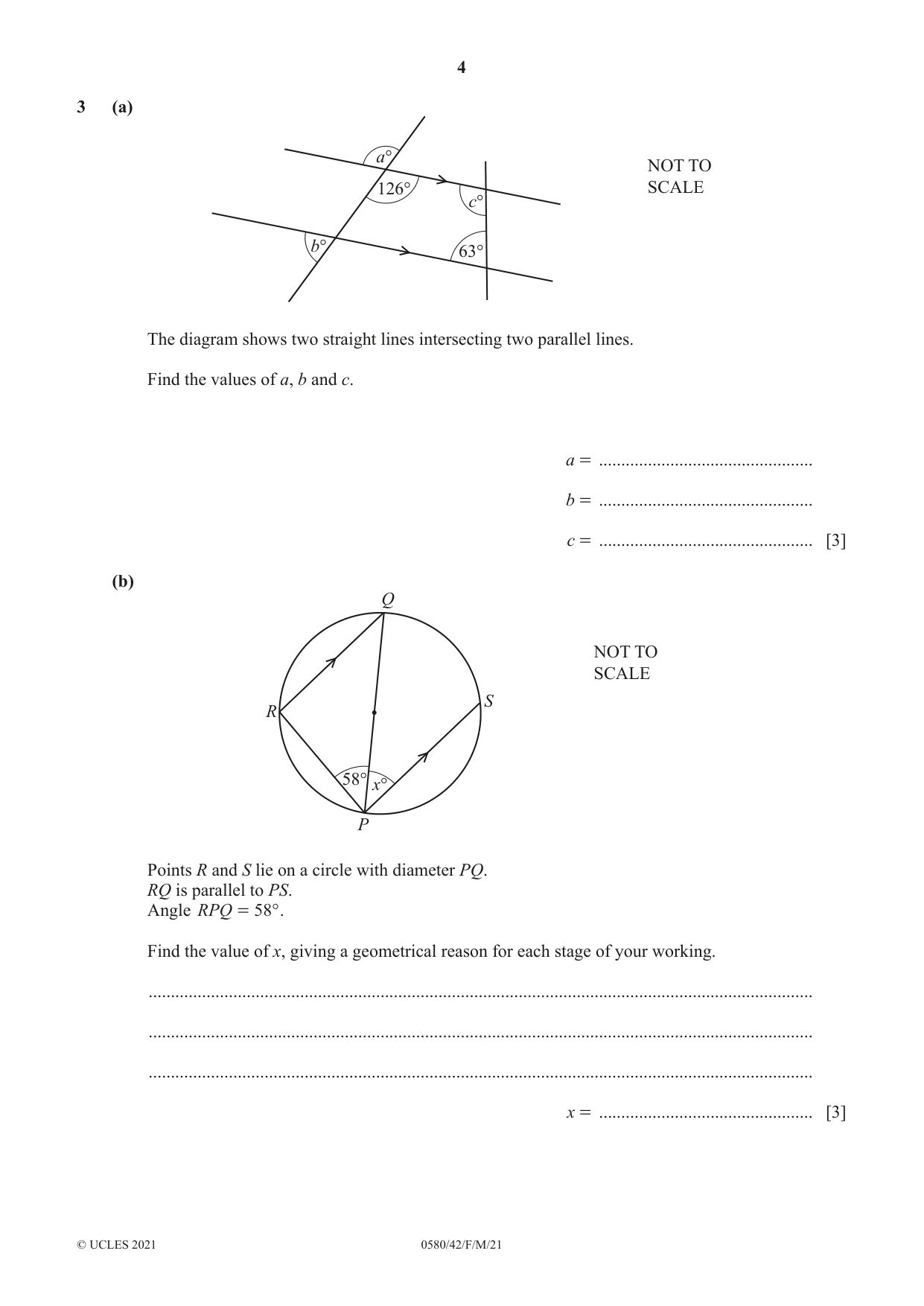
Q3 · A° NOT TO 126° SCALE c° b° 63° The diagram shows two straight lines intersecting two…
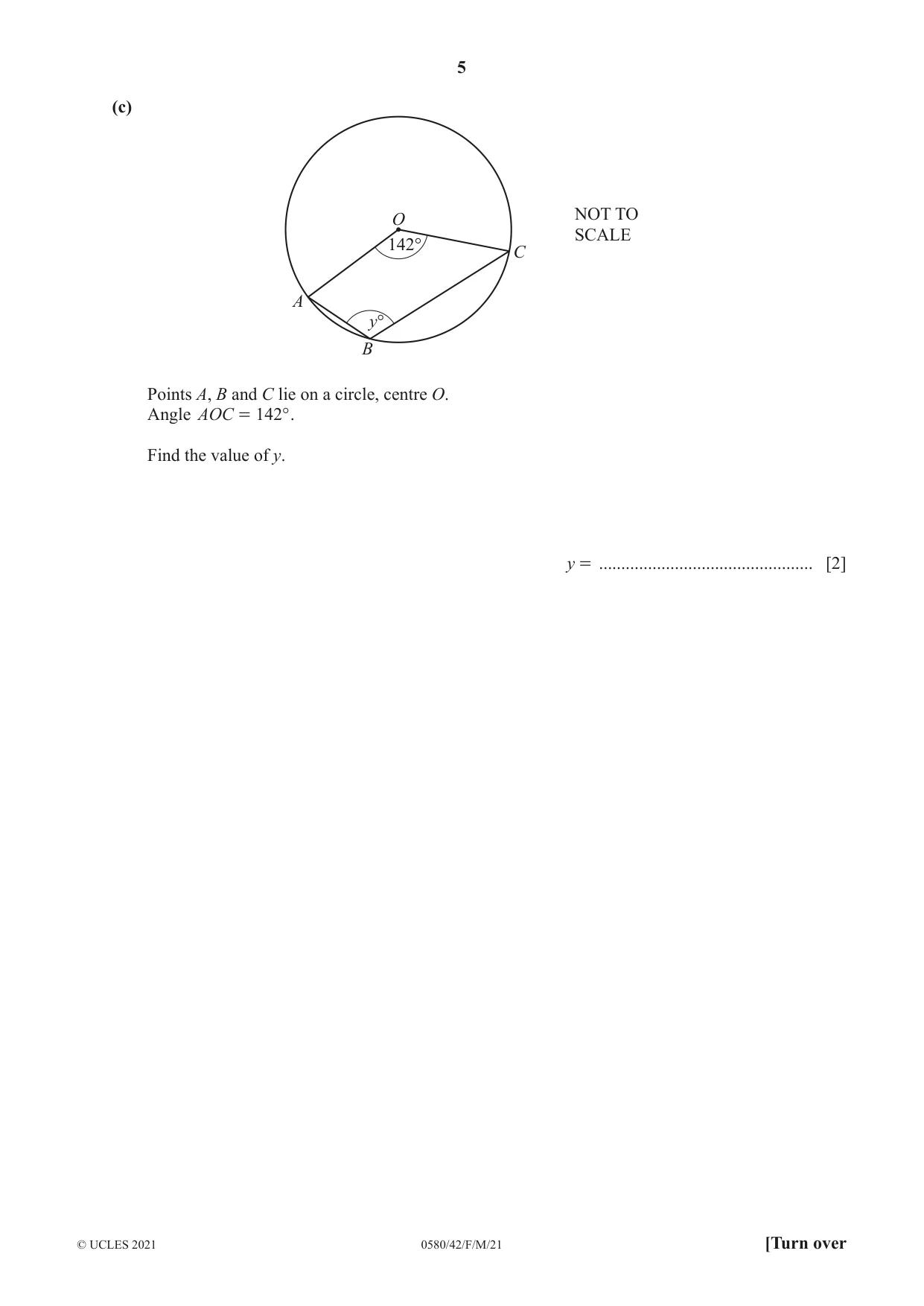
3 (a) a° NOT TO 126° SCALE c° b° 63° The diagram shows two straight lines intersecting two parallel lines. Find the values of a, b and c. a = ................................................ b = ................................................ c = ................................................ [3] (b) Q NOT TO SCALE S R 58° x° P Points R and S lie on a circle with diameter PQ. RQ is parallel to PS. Angle RPQ = 58° . Find the value of x, giving a geometrical reason for each stage of your working. ..................................................................................................................................................... ..................................................................................................................................................... ..................................................................................................................................................... x = ................................................ [3] (c) NOT TO O SCALE 142° C A y° B Points A, B and C lie on a circle, centre O. Angle AOC = 142° . Find the value of y. y = ................................................ [2]
Mark scheme: 3(a) 126 3 B1 for each 54 117 3(b) angle [in a] semicircle is 90 B1 Do not accept triangle for angle Allied, co-interior [add to 180] B1 or Angles in triangle [ = 180] and alternate oe 32 B1 3(c) 109 2 B1 for 218 or 71 in correct places or correctly labelled
Q4 · A shop gives each of 1000 people a voucher
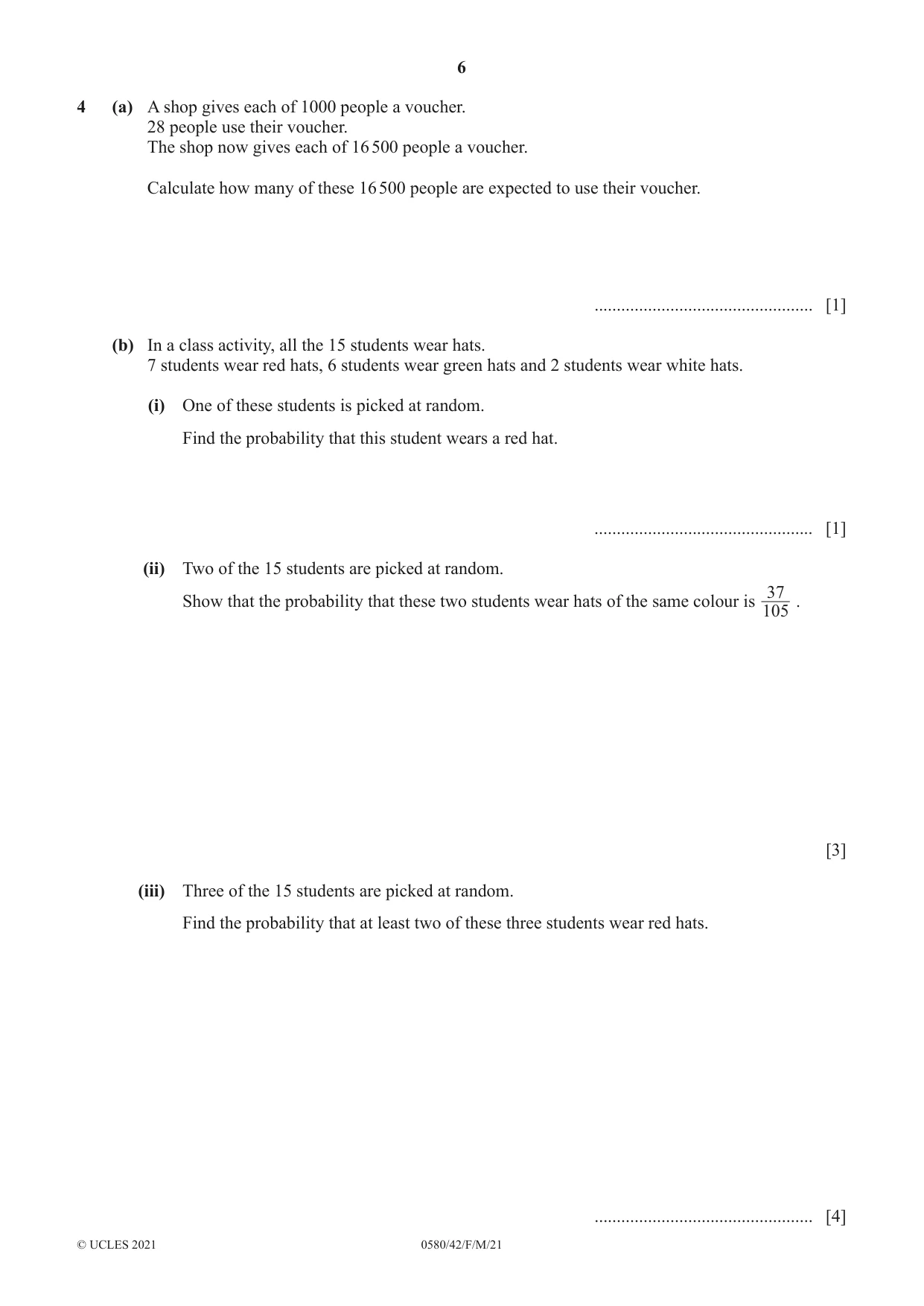
4 (a) A shop gives each of 1000 people a voucher. 28 people use their voucher. The shop now gives each of 16 500 people a voucher. Calculate how many of these 16 500 people are expected to use their voucher. ................................................. [1] (b) In a class activity, all the 15 students wear hats. 7 students wear red hats, 6 students wear green hats and 2 students wear white hats. (i) One of these students is picked at random. Find the probability that this student wears a red hat. ................................................. [1] (ii) Two of the 15 students are picked at random. 37 Show that the probability that these two students wear hats of the same colour is . 105 [3] (iii) Three of the 15 students are picked at random. Find the probability that at least two of these three students wear red hats. ................................................. [4]
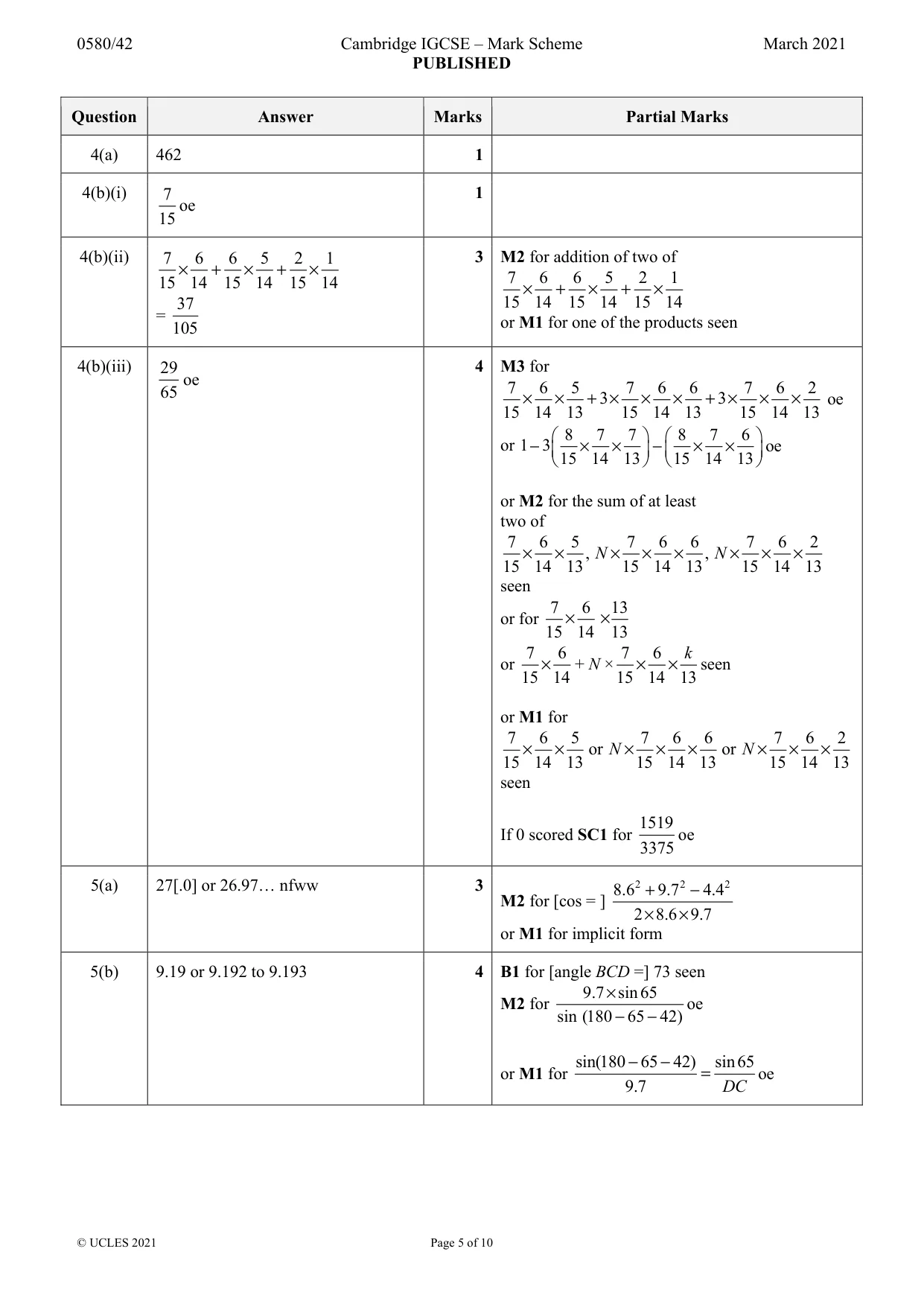
Mark scheme: 4(a) 462 1 4(b)(i) 7 1 oe 15 4(b)(ii) 7 6 6 5 2 1 3 M2 for addition of two of × + × + × 7 6 6 5 2 1 15 14 15 14 15 14 × + × + × 37 15 14 15 14 15 14 = or M1 for one of the products seen 105 4(b)(iii) 29 4 M3 for oe 7 6 5 7 6 6 7 6 2 65 × × + 3 × × × + 3 × × × oe 15 14 13 15 14 13 15 14 13 8 7 7 8 7 6 or 1 − 3 × × − × × oe 15 14 13 15 14 13 or M2 for the sum of at least two of 7 6 5 7 6 6 7 6 2 × × , N × × × , N × × × 15 14 13 15 14 13 15 14 13 seen 7 6 13 or for × × 15 14 13 7 6 7 6 k or × + N × × × seen 15 14 15 14 13 or M1 for 7 6 5 7 6 6 7 6 2 × × or N × × × or N × × × 15 14 13 15 14 13 15 14 13 seen 1519 If 0 scored SC1 for oe 3375
Q5 · C B 65° NOT TO SCALE 4.4 cm 9.7 cm A 8.6 cm 42° D (a) Calculate angle ADB
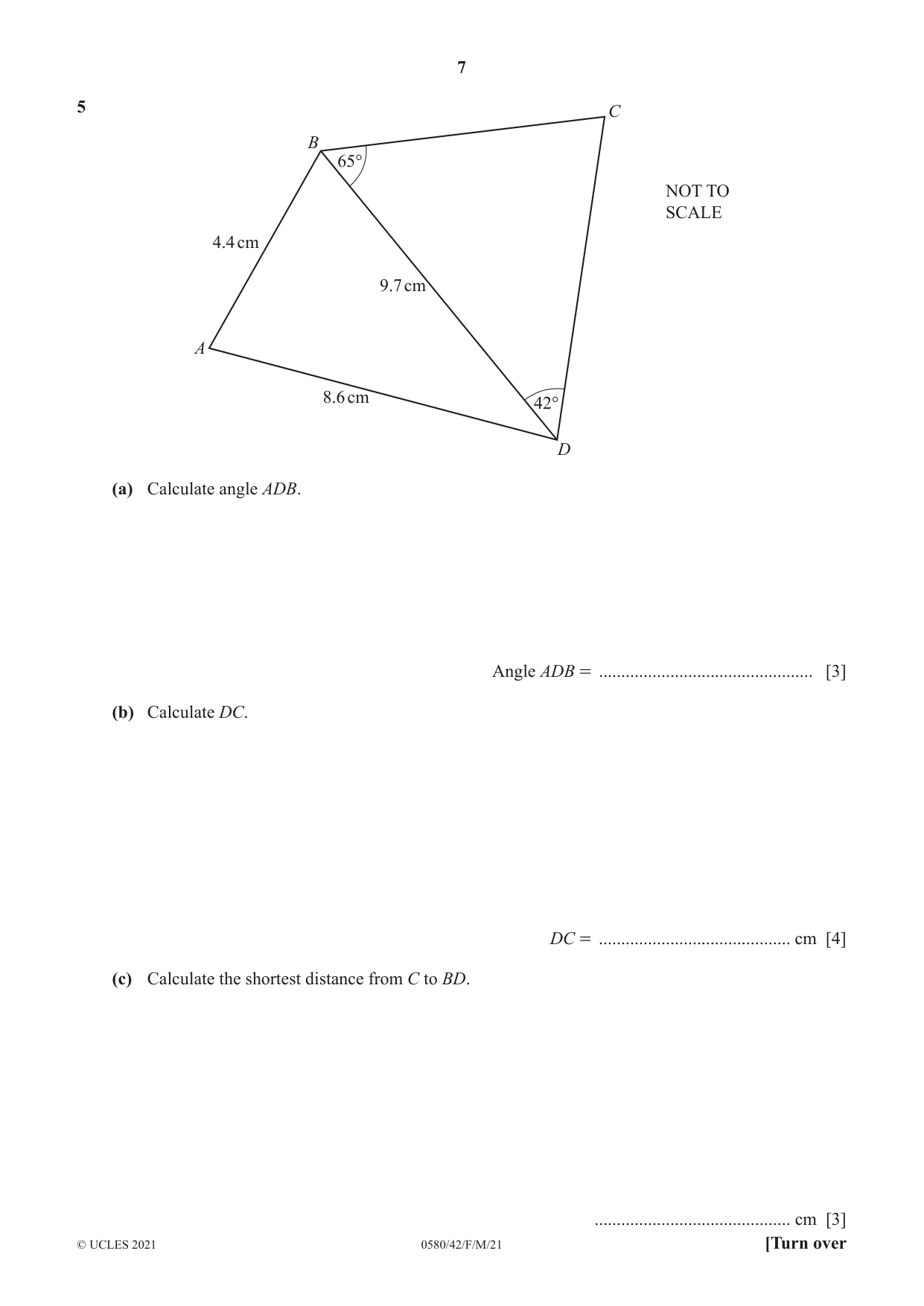
5 C B 65° NOT TO SCALE 4.4 cm 9.7 cm A 8.6 cm 42° D (a) Calculate angle ADB. Angle ADB = ................................................ [3] (b) Calculate DC. DC = ........................................... cm [4] (c) Calculate the shortest distance from C to BD. ............................................ cm [3]
Mark scheme: 5(a) 27[.0] or 26.97… nfww 3 8.6 2 + 9.7 2 − 4.4 2 M2 for [cos = ] 2 × 8.6 × 9.7 or M1 for implicit form 5(b) 9.19 or 9.192 to 9.193 4 B1 for [angle BCD =] 73 seen 9.7 × sin65 M2 for oe sin (180 − 65 − 42) sin(180 − 65 − 42) sin65 or M1 for = oe 9.7 DC 5(c) 6.15 or 6.149 to 6.151… 3 d M2 for = sin42 oe their 9.19 or M1 for right angle between line from C to BD and BD soi
Q6 · Y 5 4 3 2 1 x – 2 – 1 0 1 2 – 1 – 2 (a) The grid shows the graph of y = a + bx2
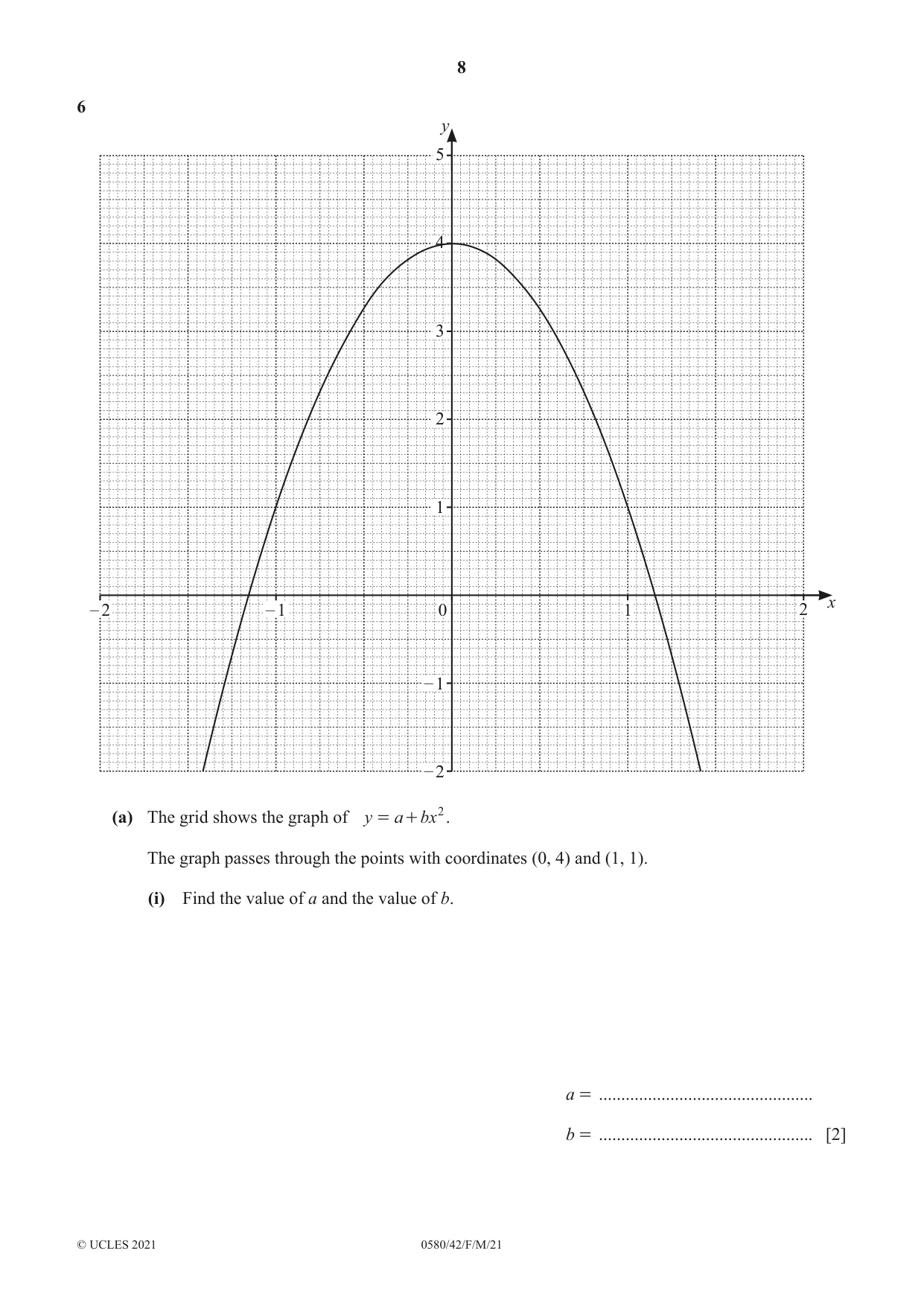
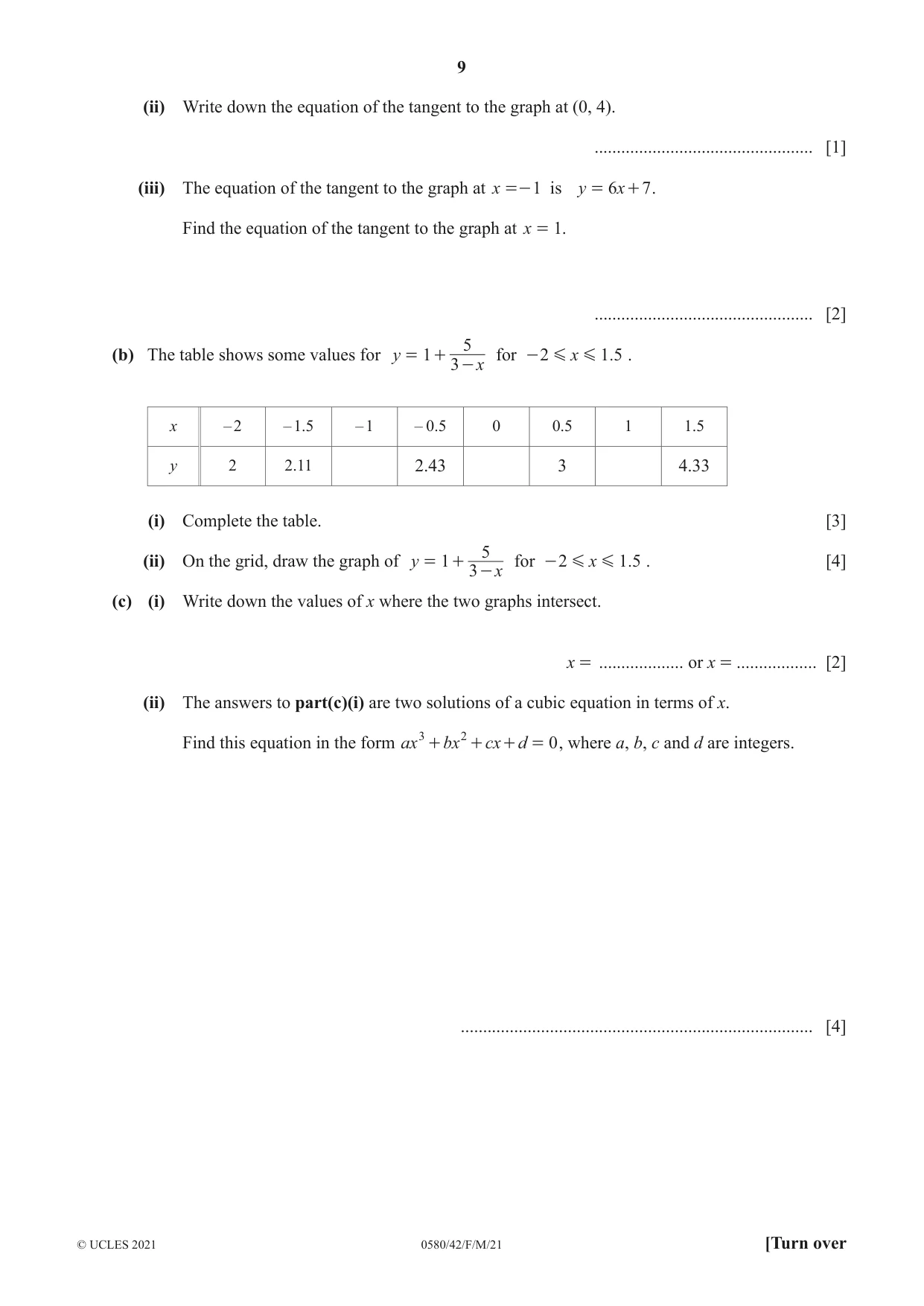
6 y 5 4 3 2 1 x – 2 – 1 0 1 2 – 1 – 2 (a) The grid shows the graph of y = a + bx2 . The graph passes through the points with coordinates (0, 4) and (1, 1). (i) Find the value of a and the value of b. a = ................................................ b = ................................................ [2] (ii) Write down the equation of the tangent to the graph at (0, 4). ................................................. [1] (iii) The equation of the tangent to the graph at x =- 1 is y = 6x + 7 . Find the equation of the tangent to the graph at x = 1. ................................................. [2] 5(b) The table shows some values for y = 1 + for - 2 G x G 1.5 . 3 - x x – 2 – 1.5 – 1 – 0.5 0 0.5 1 1.5 y 2 2.11 2.43 3 4.33 (i) Complete the table. [3] 5 (ii) On the grid, draw the graph of y = 1 + for - 2 G x G 1.5 . [4] 3 - x (c) (i) Write down the values of x where the two graphs intersect. x = ................... or x = .................. [2] (ii) The answers to part(c)(i) are two solutions of a cubic equation in terms of x. Find this equation in the form ax 3 + bx 2 + cx + d = 0 , where a, b, c and d are integers. ............................................................................... [4]
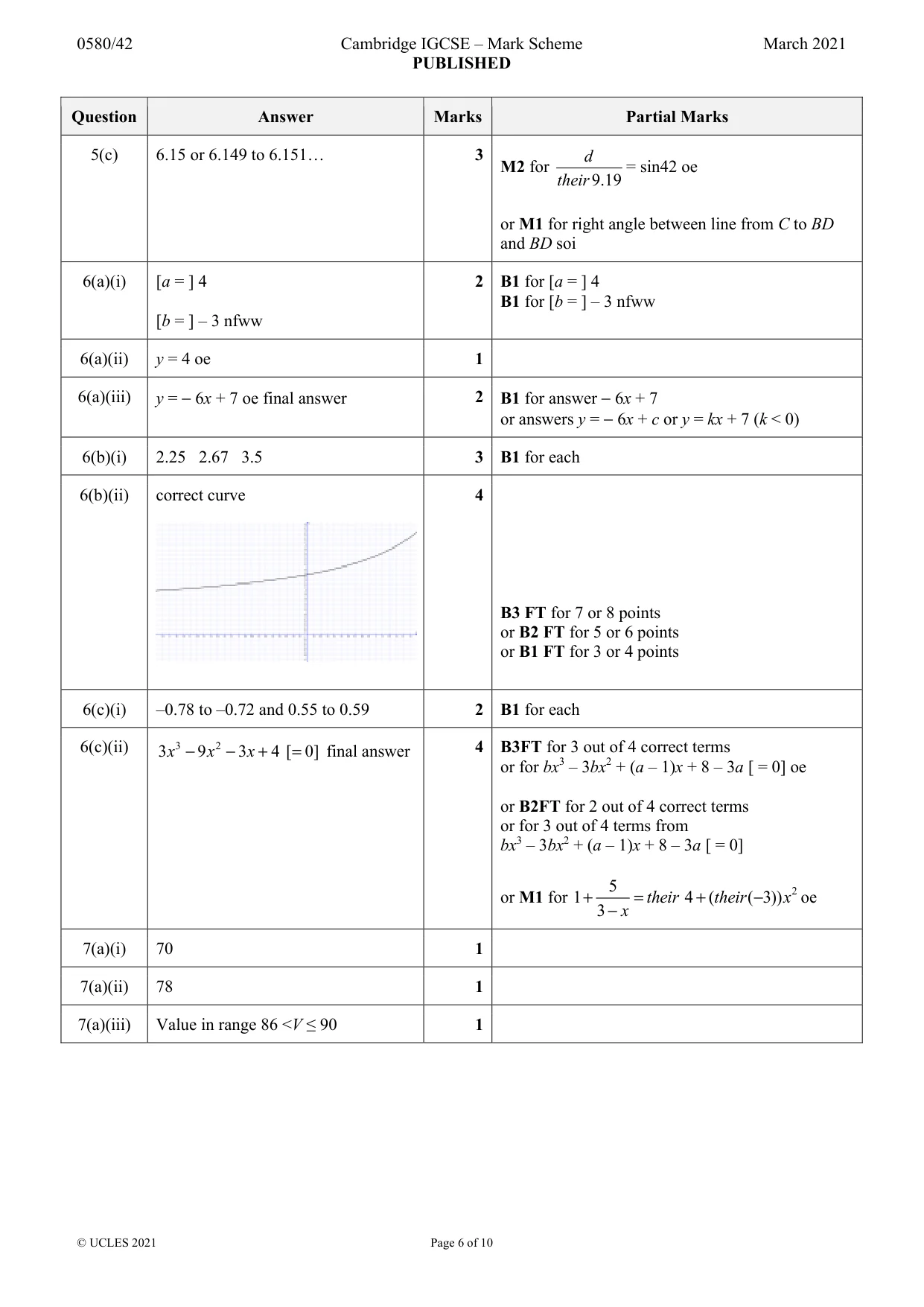
Mark scheme: 6(a)(i) [a = ] 4 2 B1 for [a = ] 4 B1 for [b = ] – 3 nfww [b = ] – 3 nfww 6(a)(ii) y = 4 oe 1 6(a)(iii) y = − 6x + 7 oe final answer 2 B1 for answer − 6x + 7 or answers y = − 6x + c or y = kx + 7 (k < 0) 6(b)(i) 2.25 2.67 3.5 3 B1 for each 6(b)(ii) correct curve 4 B3 FT for 7 or 8 points or B2 FT for 5 or 6 points or B1 FT for 3 or 4 points 6(c)(i) –0.78 to –0.72 and 0.55 to 0.59 2 B1 for each 6(c)(ii) 3 x 3 − 9 x 2 − 3 x + 4 [ = 0] final answer 4 B3FT for 3 out of 4 correct terms or for bx3 – 3bx2 + (a – 1)x + 8 – 3a [ = 0] oe or B2FT for 2 out of 4 correct terms or for 3 out of 4 terms from bx3 – 3bx2 + (a – 1)x + 8 – 3a [ = 0] 5 2 or M1 for 1 + = their 4 + (their ( −3)) x oe 3 − x
Q7 · The box-and-whisker plot shows information about the marks scored by some students in a…
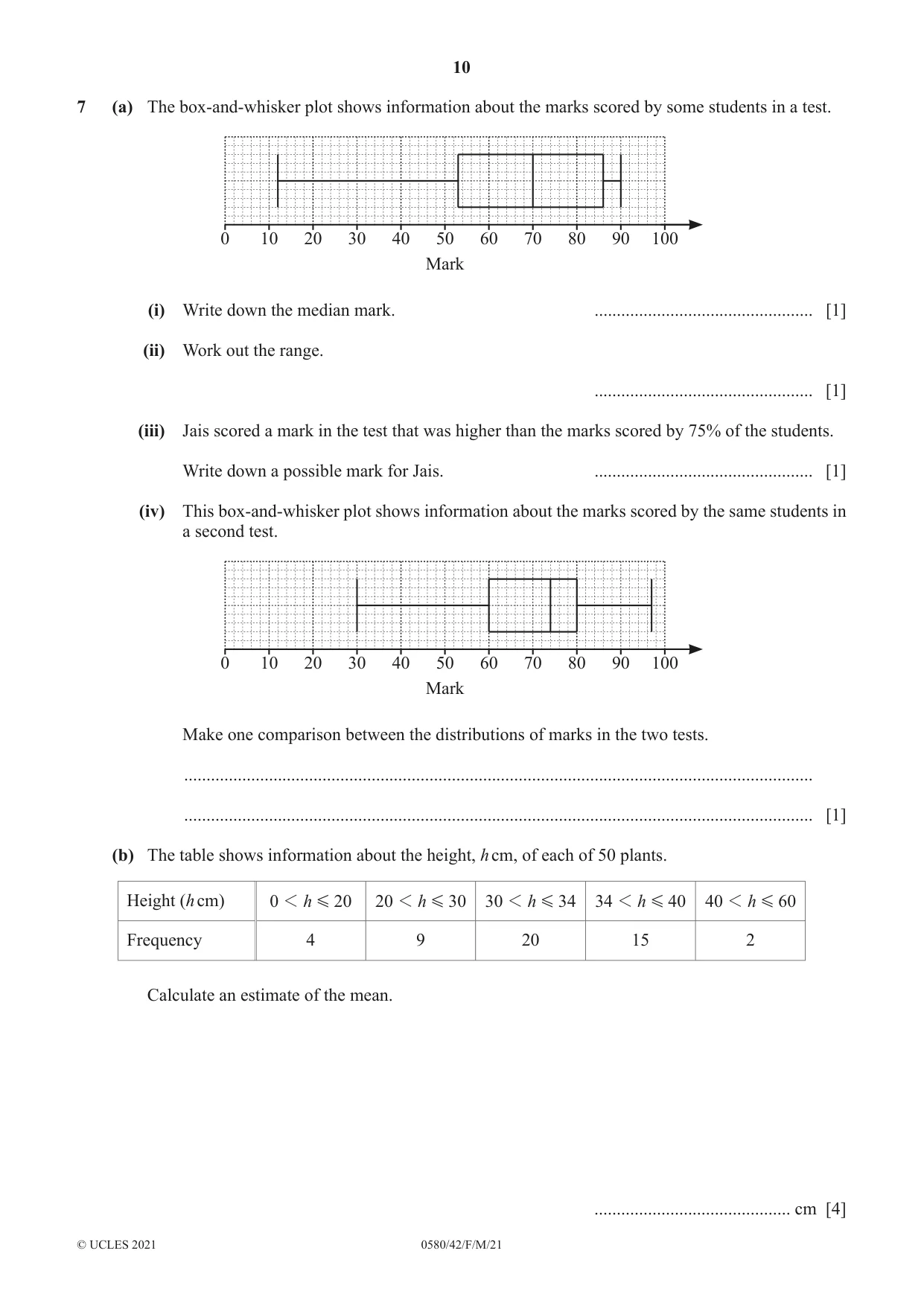
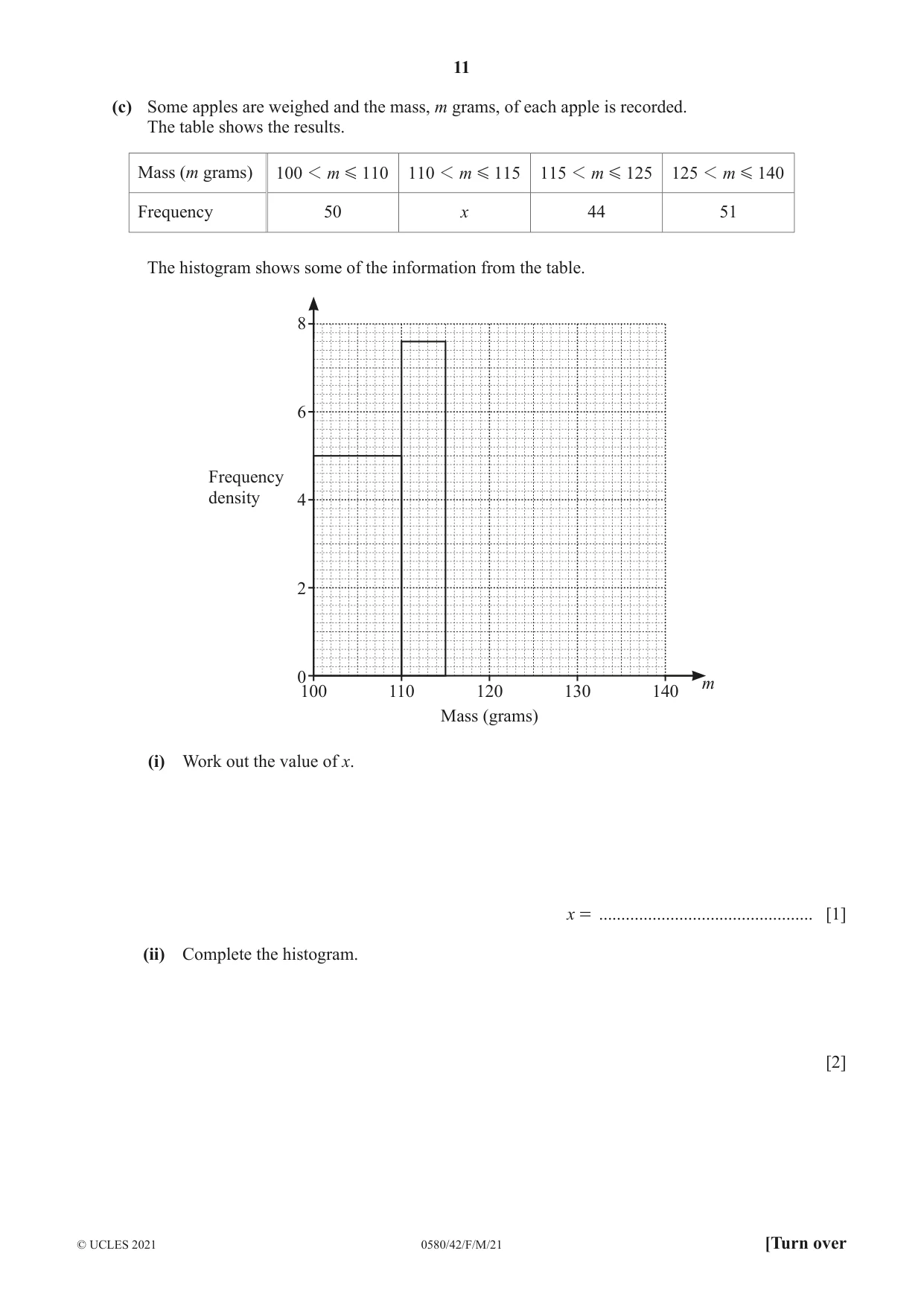
7 (a) The box-and-whisker plot shows information about the marks scored by some students in a test. 0 10 20 30 40 50 60 70 80 90 100 Mark (i) Write down the median mark. ................................................. [1] (ii) Work out the range. ................................................. [1] (iii) Jais scored a mark in the test that was higher than the marks scored by 75% of the students. Write down a possible mark for Jais. ................................................. [1] (iv) This box-and-whisker plot shows information about the marks scored by the same students in a second test. 0 10 20 30 40 50 60 70 80 90 100 Mark Make one comparison between the distributions of marks in the two tests. ............................................................................................................................................. ............................................................................................................................................. [1] (b) The table shows information about the height, h cm, of each of 50 plants. Height (h cm) 0 1 h G 20 20 1 h G 30 30 1 h G 34 34 1 h G 40 40 1 h G 60 Frequency 4 9 20 15 2 Calculate an estimate of the mean. ............................................ cm [4] (c) Some apples are weighed and the mass, m grams, of each apple is recorded. The table shows the results. Mass (m grams) 100 1 m G 110 110 1 m G 115 115 1 m G 125 125 1 m G 140 Frequency 50 x 44 51 The histogram shows some of the information from the table. 8 6 Frequency density 4 2 0 m 100 110 120 130 140 Mass (grams) (i) Work out the value of x. x = ................................................ [1] (ii) Complete the histogram. [2]
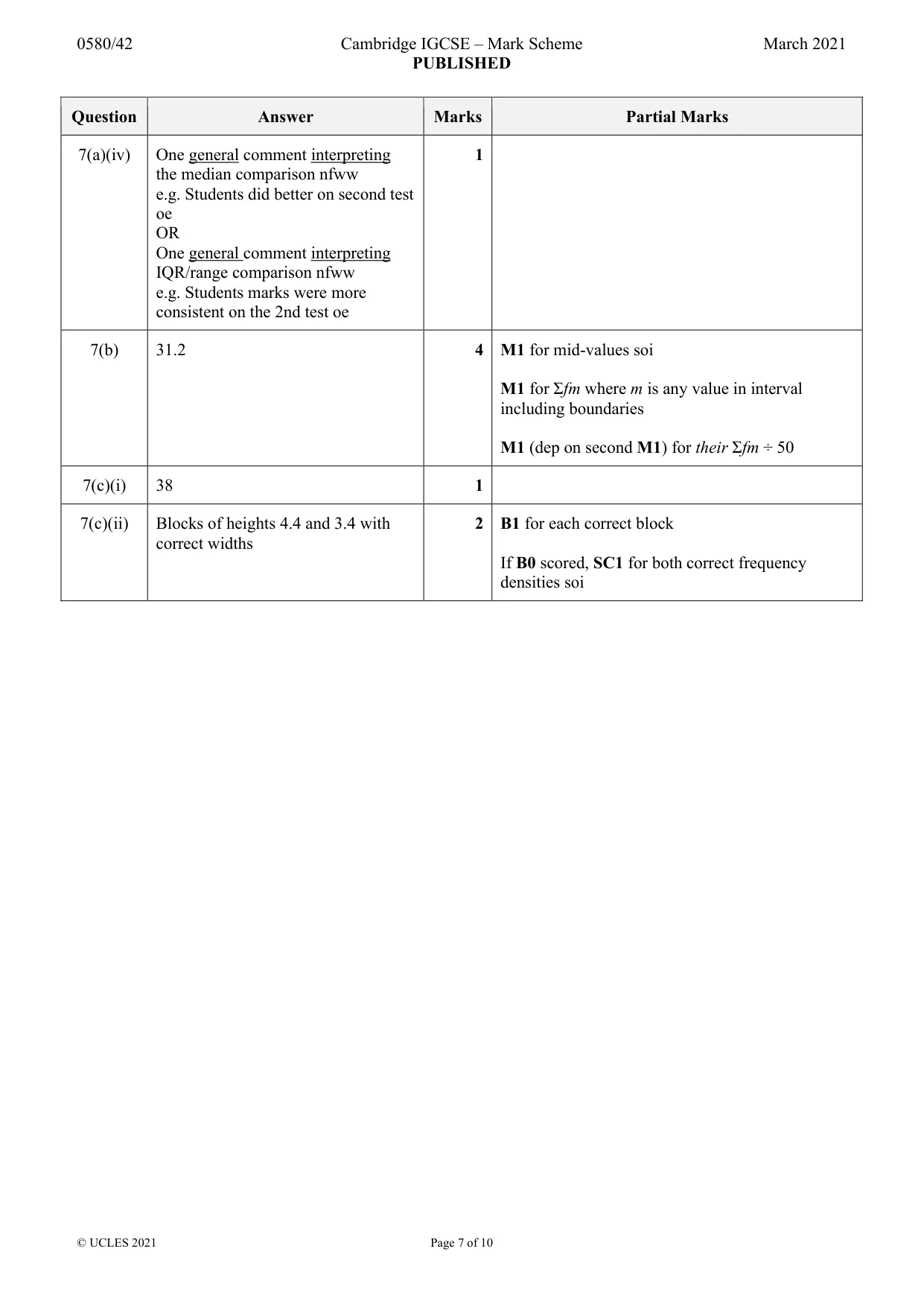
Mark scheme: 7(a)(i) 70 1 7(a)(ii) 78 1 7(a)(iii) Value in range 86 <V ≤ 90 1 7(a)(iv) One general comment interpreting 1 the median comparison nfww e.g. Students did better on second test oe OR One general comment interpreting IQR/range comparison nfww e.g. Students marks were more consistent on the 2nd test oe 7(b) 31.2 4 M1 for mid-values soi M1 for Σfm where m is any value in interval including boundaries M1 (dep on second M1) for their Σfm ÷ 50 7(c)(i) 38 1 7(c)(ii) Blocks of heights 4.4 and 3.4 with 2 B1 for each correct block correct widths If B0 scored, SC1 for both correct frequency densities soi
Q8 · O 53° NOT TO 9.5 cm A B SCALE X Y The diagram shows a sector OXY of a circle with centre…
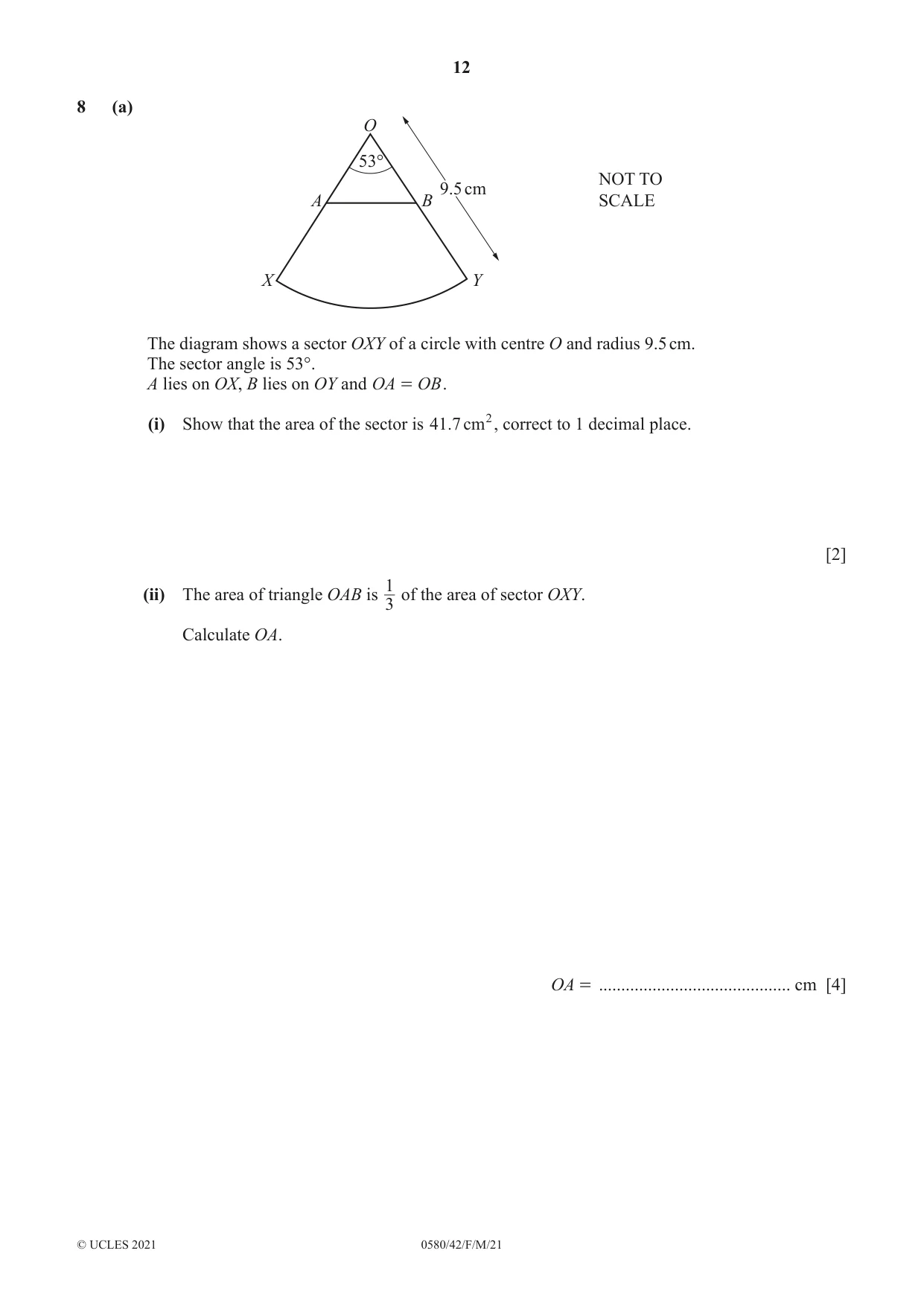
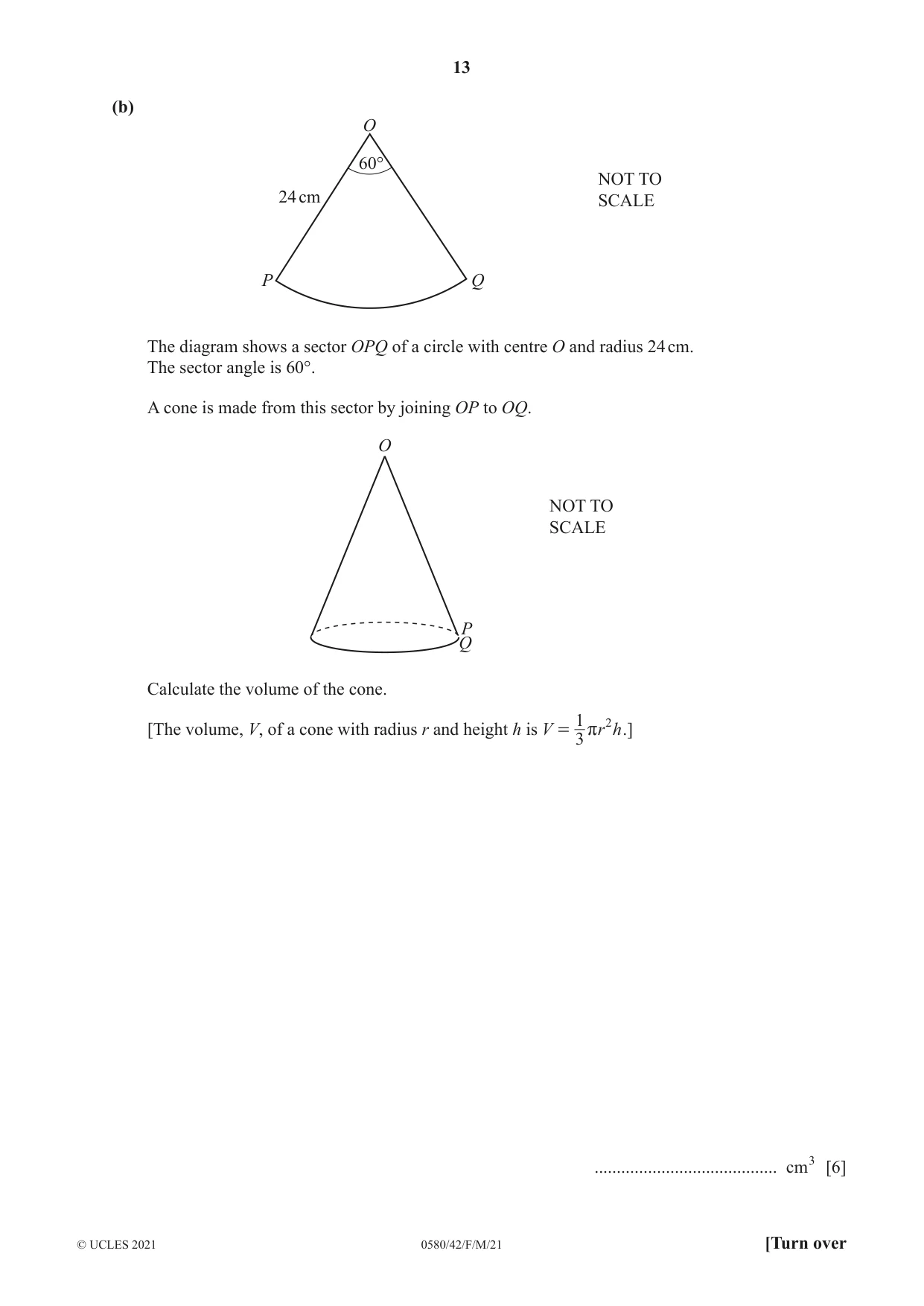
8 (a) O 53° NOT TO 9.5 cm A B SCALE X Y The diagram shows a sector OXY of a circle with centre O and radius 9.5 cm. The sector angle is 53°. A lies on OX, B lies on OY and OA = OB . (i) Show that the area of the sector is 41.7 cm 2, correct to 1 decimal place. [2] 1 (ii) The area of triangle OAB is of the area of sector OXY. 3 Calculate OA. OA = ........................................... cm [4] (b) O 60° NOT TO 24 cm SCALE P Q The diagram shows a sector OPQ of a circle with centre O and radius 24 cm. The sector angle is 60°. A cone is made from this sector by joining OP to OQ. O NOT TO SCALE P Q Calculate the volume of the cone. 1 2 [The volume, V, of a cone with radius r and height h is V = rr h .] 3 ......................................... cm3 [6]
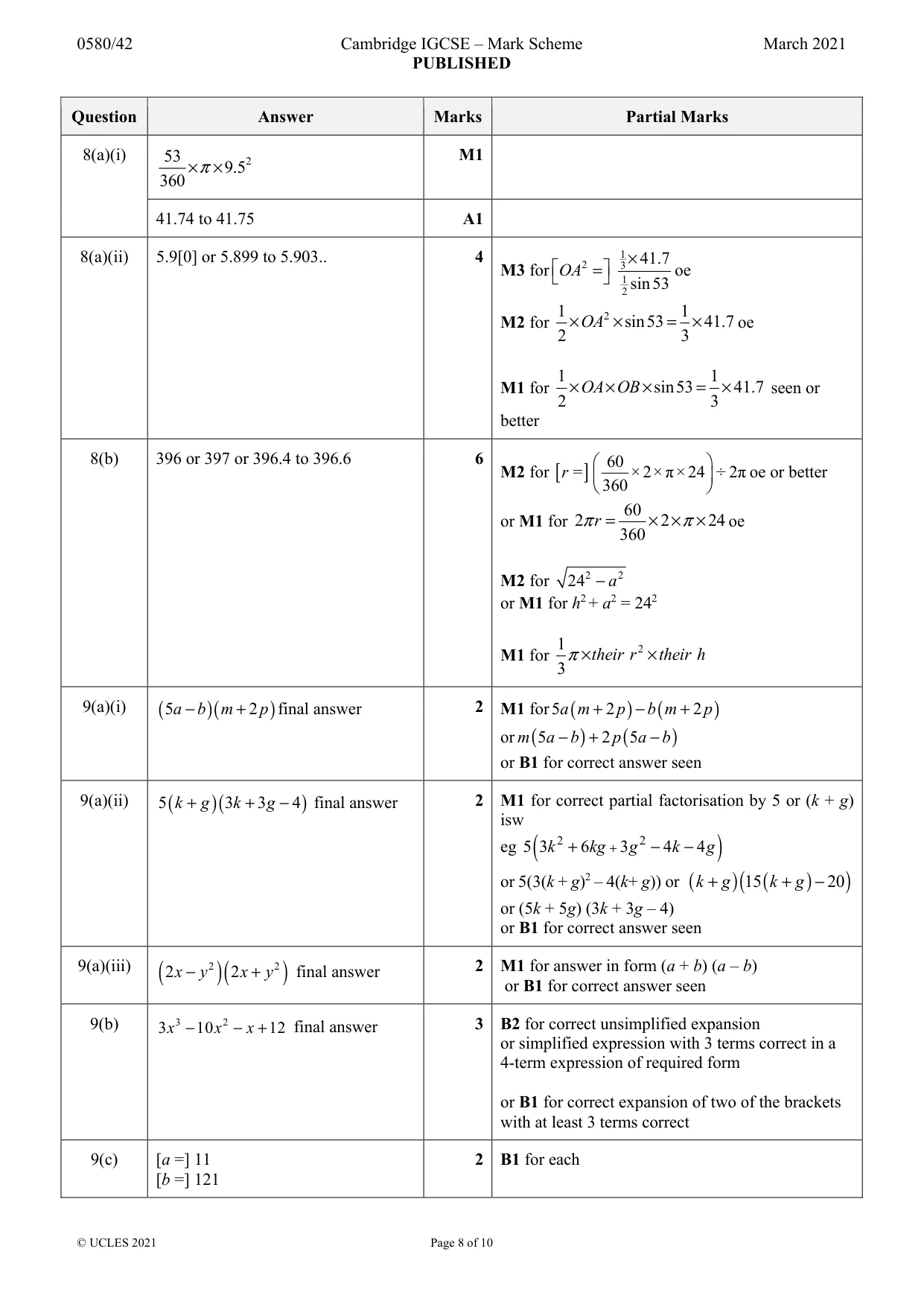
Mark scheme: 8(a)(i) 53 2 M1 × π× 9.5 360 41.74 to 41.75 A1 8(a)(ii) 5.9[0] or 5.899 to 5.903.. 4 2 13 × 41.7 M3 for OA = oe 1 2 sin53 1 2 1 M2 for × OA × sin53 = × 41.7 oe 2 3 1 1 M1 for × OA × OB × sin53 = × 41.7 seen or 2 3 better 8(b) 396 or 397 or 396.4 to 396.6 6 60 M2 for [ r = ] ×2× π×24 ÷ 2π oe or better 360 60 or M1 for 2πr = × 2 × π× 24 oe 360 M2 for 24 2 −a 2 or M1 for h2 + a2 = 242 1 2 M1 for 3π× their r × their h
Question 9
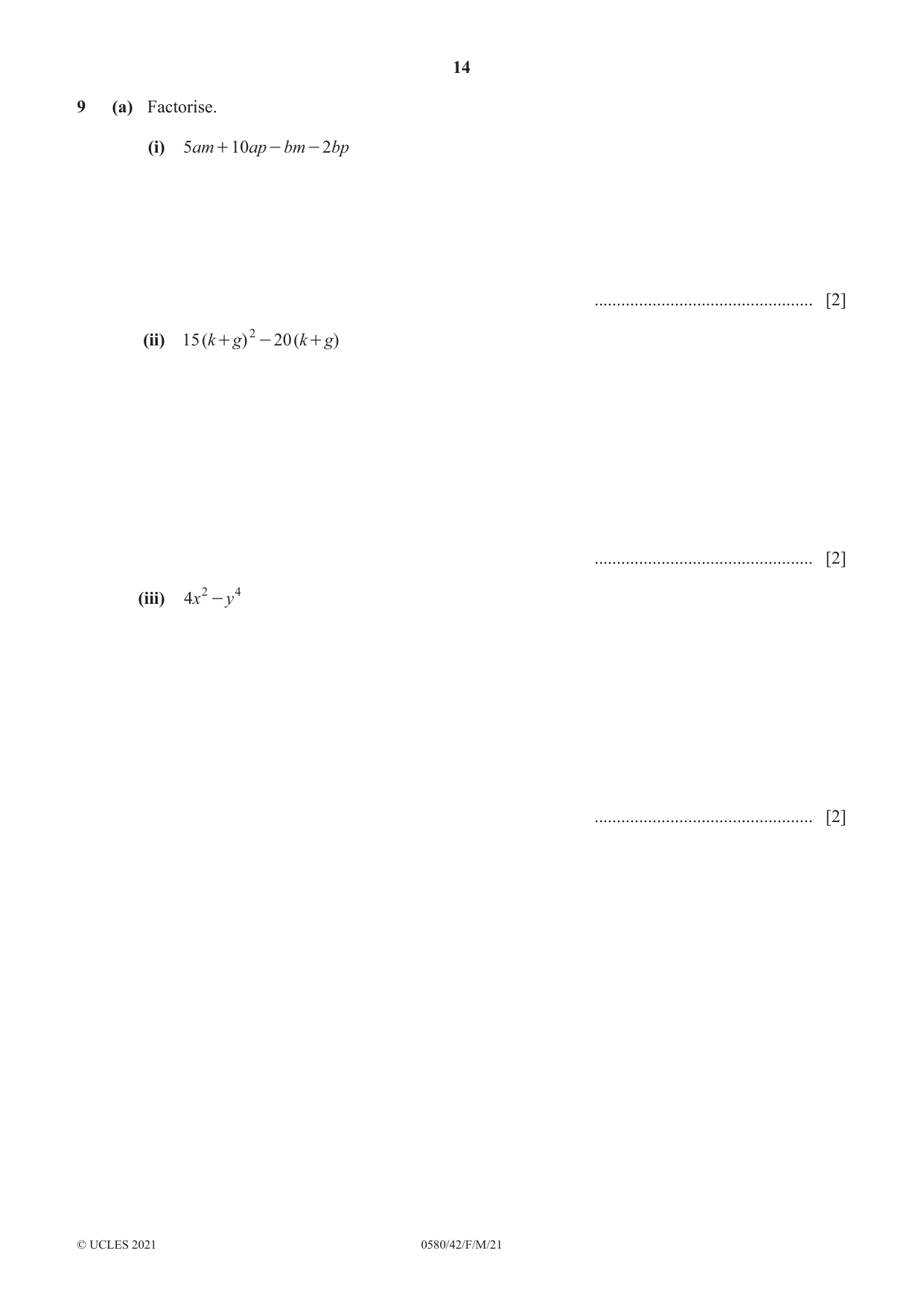
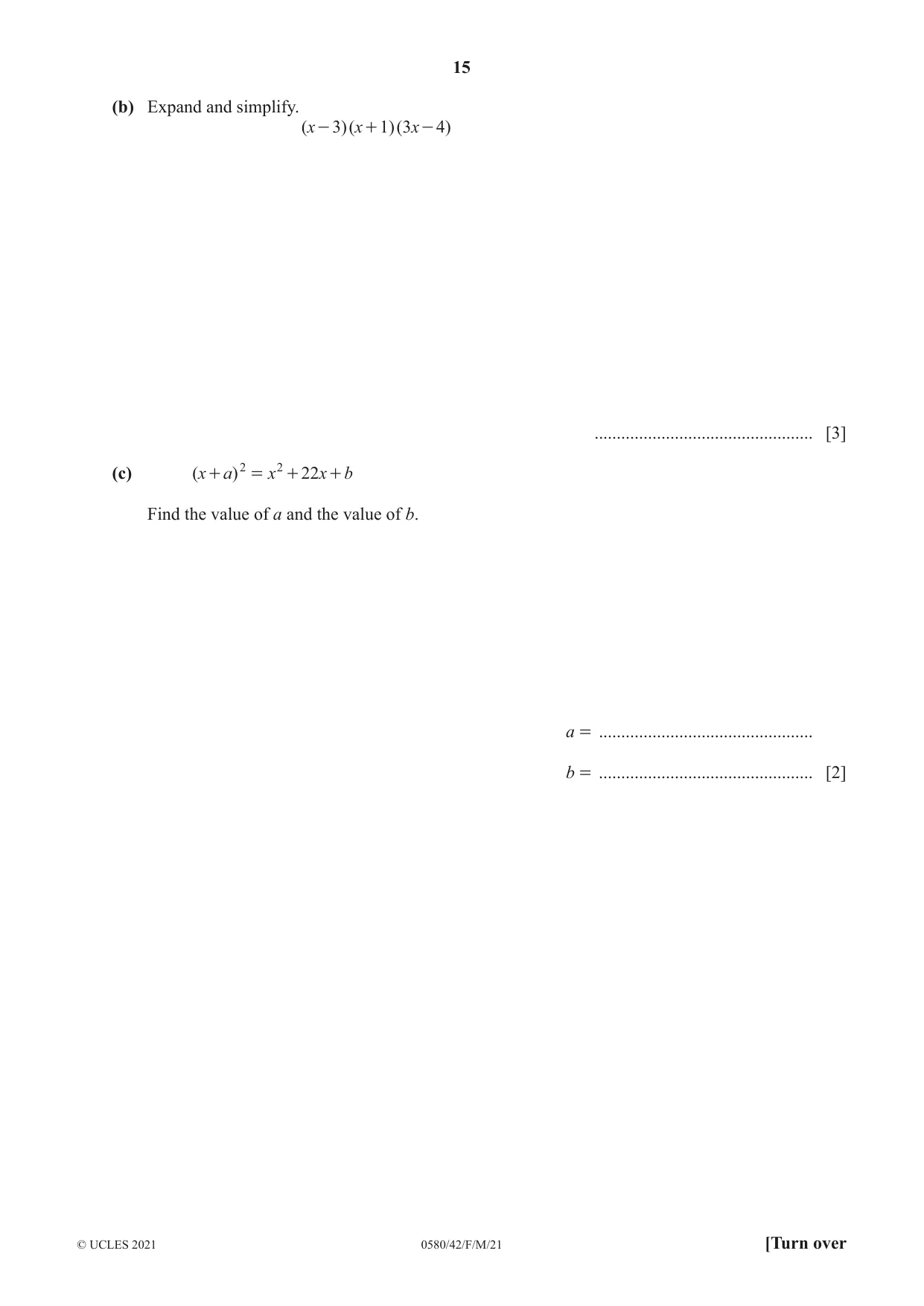
9 (a) Factorise. (i) 5am + 10ap - bm - 2bp ................................................. [2] (ii) 15 ( k + g) 2 - 20 ( k + g) ................................................. [2] (iii) 4x 2 - y 4 ................................................. [2] (b) Expand and simplify. ( x - 3)( x + 1)( 3x - 4) ................................................. [3] (c) ( x + a) 2 = x 2 + 22x + b Find the value of a and the value of b. a = ................................................ b = ................................................ [2]
Mark scheme: 9(a)(i) ( 5a − b )( m + 2 p ) final answer 2 M1 for 5 a ( m + 2 p ) − b ( m + 2 p ) or m ( 5 a − b ) + 2 p ( 5 a − b ) or B1 for correct answer seen 9(a)(ii) 5 ( k + g )( 3k + 3 g − 4 ) final answer 2 M1 for correct partial factorisation by 5 or (k + g) isw eg 5 ( 3k 2 + 6 kg + 3 g 2 − 4 k − 4 g ) or 5(3(k + g)2 – 4(k+ g)) or ( k + g ) (15 ( k + g ) − 20 ) or (5k + 5g) (3k + 3g – 4) or B1 for correct answer seen 9(a)(iii) 2 2 2 M1 for answer in form (a + b) (a – b) 2 x − y 2 x + y final answer ( )( ) or B1 for correct answer seen 9(b) 3 x 3 − 10 x 2 − x + 12 final answer 3 B2 for correct unsimplified expansion or simplified expression with 3 terms correct in a 4-term expression of required form or B1 for correct expansion of two of the brackets with at least 3 terms correct 9(c) [a =] 11 2 B1 for each [b =] 121
Q10 · A box is a cuboid with length 45 cm, width 30 cm and height 42 cm
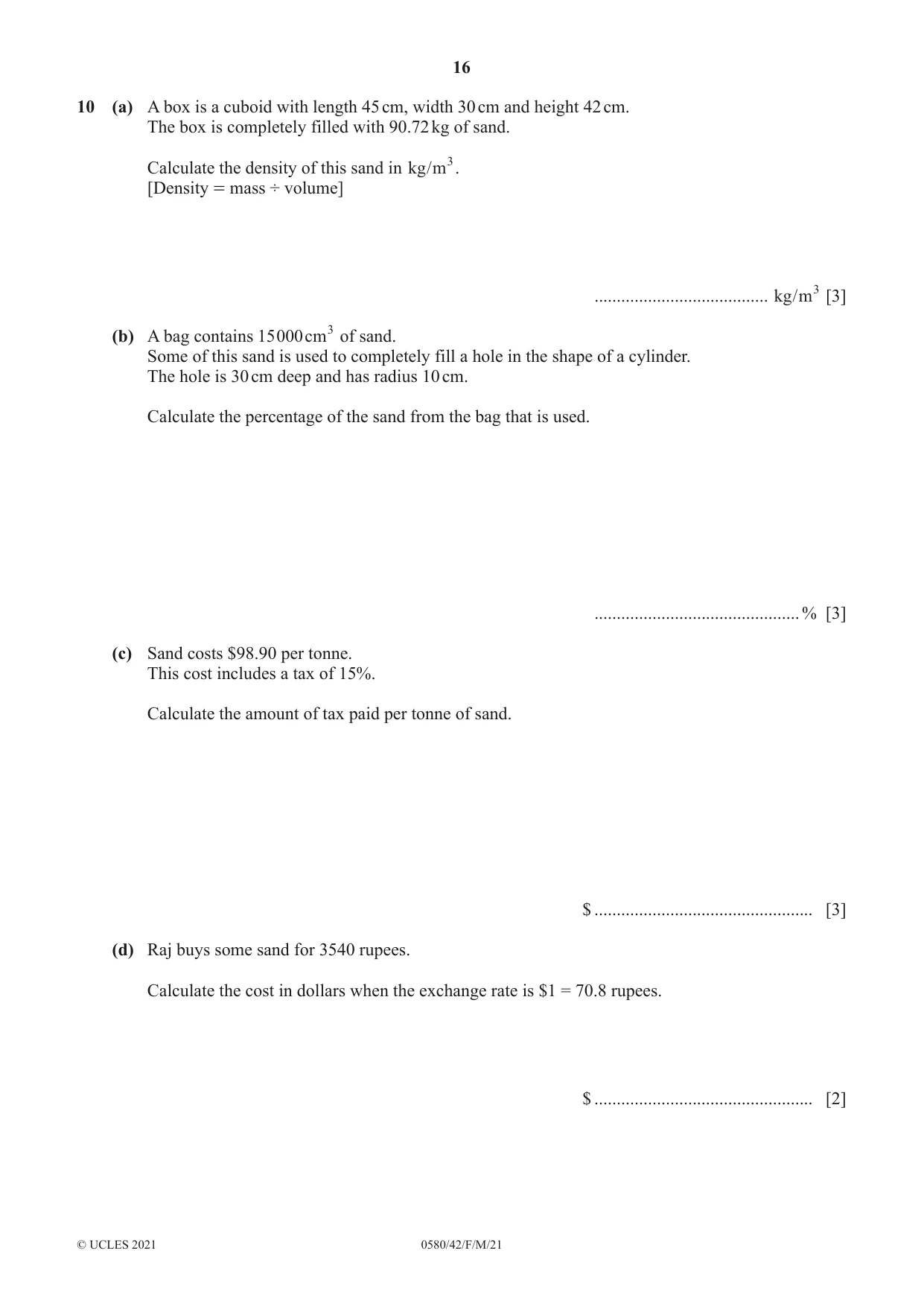
10 (a) A box is a cuboid with length 45 cm, width 30 cm and height 42 cm. The box is completely filled with 90.72 kg of sand. Calculate the density of this sand in kg/m3. [Density = mass ÷ volume] ....................................... kg/m3 [3] (b) A bag contains 15000 cm 3 of sand. Some of this sand is used to completely fill a hole in the shape of a cylinder. The hole is 30 cm deep and has radius 10 cm. Calculate the percentage of the sand from the bag that is used. ..............................................% [3] (c) Sand costs $98.90 per tonne. This cost includes a tax of 15%. Calculate the amount of tax paid per tonne of sand. $ ................................................. [3] (d) Raj buys some sand for 3540 rupees. Calculate the cost in dollars when the exchange rate is $1 = 70.8 rupees. $ ................................................. [2]
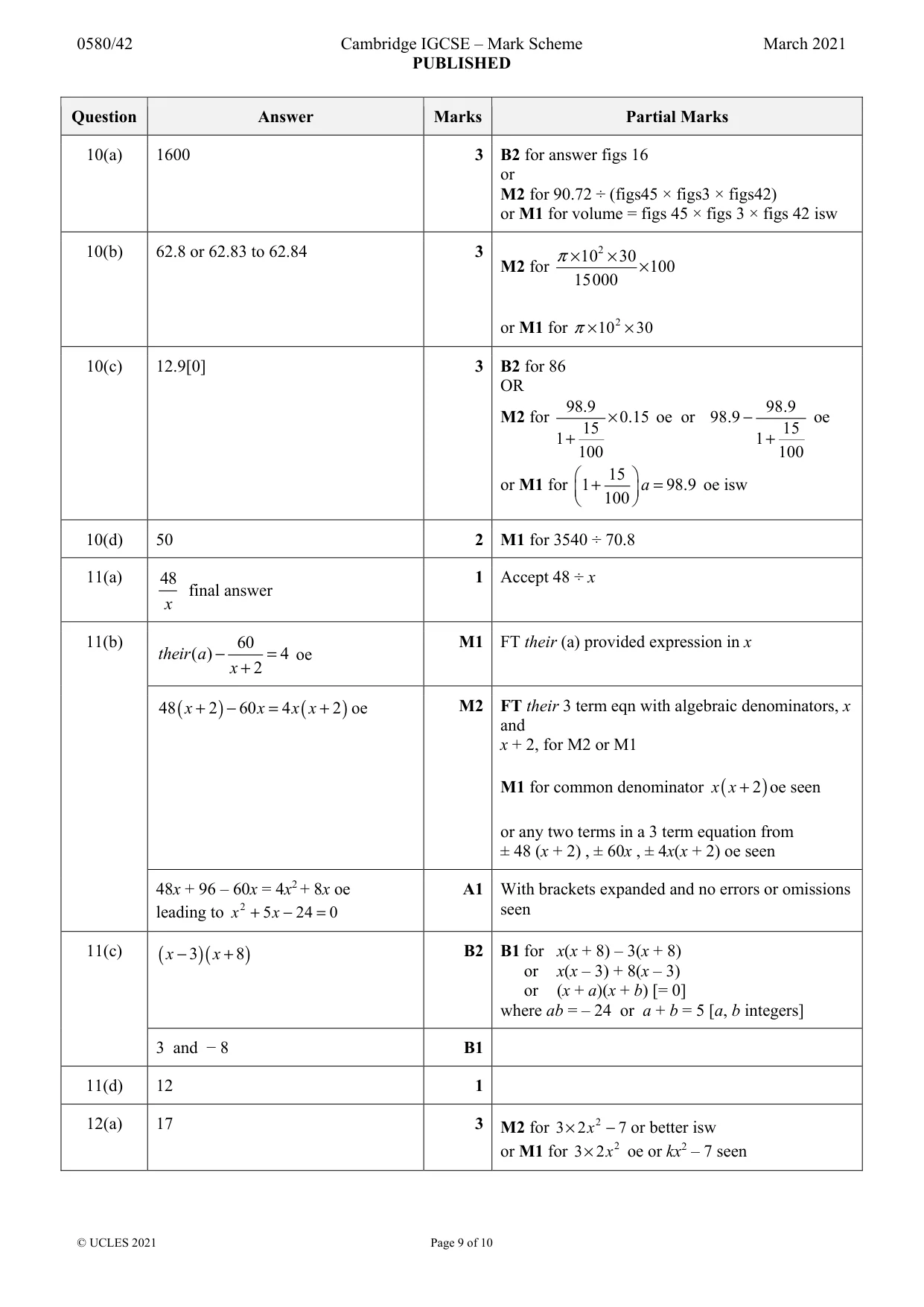
Mark scheme: 10(a) 1600 3 B2 for answer figs 16 or M2 for 90.72 ÷ (figs45 × figs3 × figs42) or M1 for volume = figs 45 × figs 3 × figs 42 isw 10(b) 62.8 or 62.83 to 62.84 3 π× 10 2 × 30 M2 for × 100 15000 or M1 for π × 10 2 × 30 10(c) 12.9[0] 3 B2 for 86 OR 98.9 98.9 M2 for × 0.15 oe or 98.9 − oe 15 15 1 + 1 + 100 100 15 or M1 for 1 + a = 98.9 oe isw 100 10(d) 50 2 M1 for 3540 ÷ 70.8
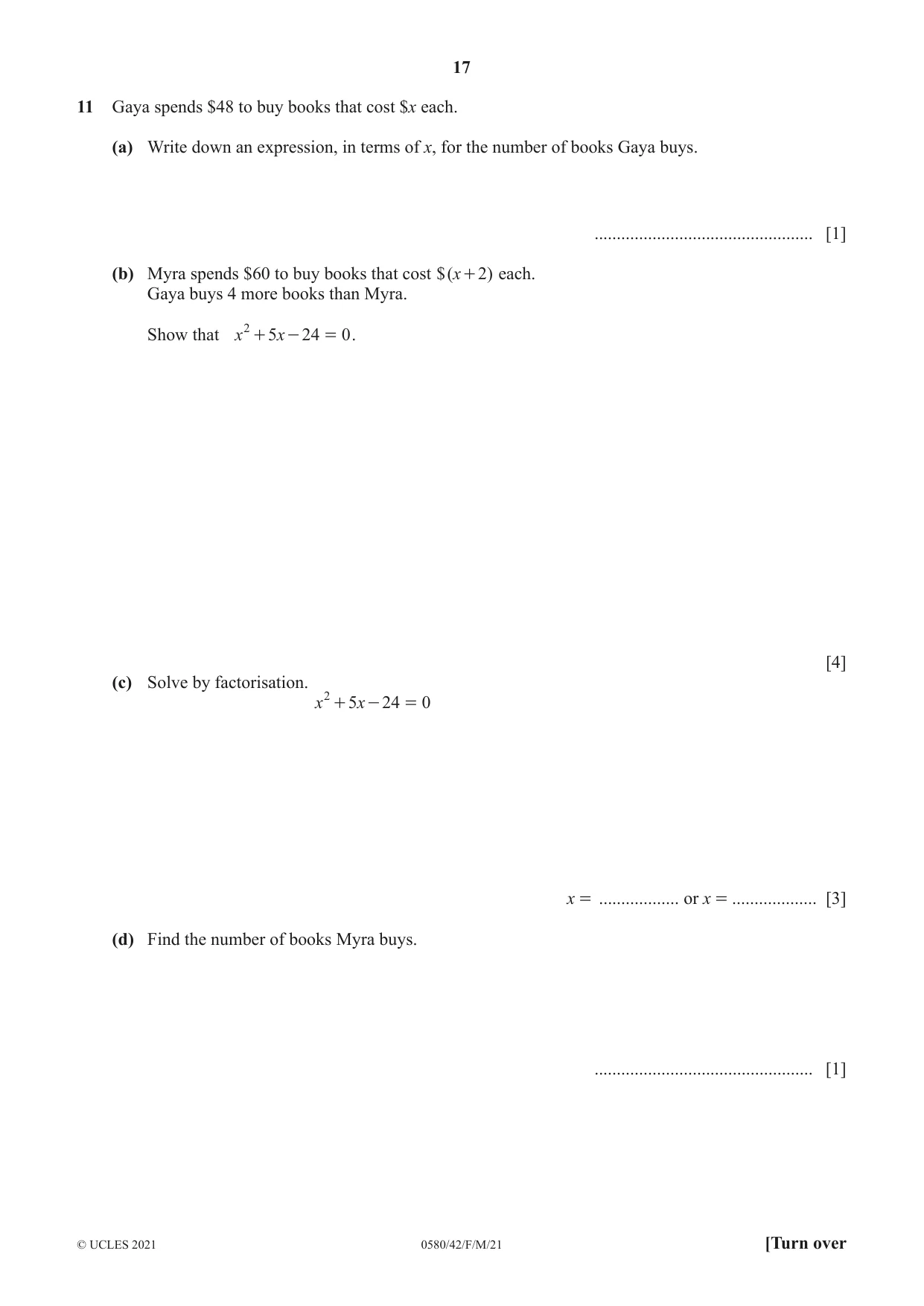
Q11 · Gaya spends $48 to buy books that cost $x each
11 Gaya spends $48 to buy books that cost $x each. (a) Write down an expression, in terms of x, for the number of books Gaya buys. ................................................. [1] (b) Myra spends $60 to buy books that cost $( x + 2) each. Gaya buys 4 more books than Myra. Show that x 2 + 5x - 24 = 0 . [4] (c) Solve by factorisation. x 2 + 5x - 24 = 0 x = .................. or x = ................... [3] (d) Find the number of books Myra buys. ................................................. [1]
Mark scheme: 11(a) 48 1 Accept 48 ÷ x final answer x 11(b) 60 M1 FT their (a) provided expression in x their ( a ) − = 4 oe x + 2 48 ( x + 2 ) − 60 x = 4 x ( x + 2 ) oe M2 FT their 3 term eqn with algebraic denominators, x and x + 2, for M2 or M1 M1 for common denominator x ( x + 2 ) oe seen or any two terms in a 3 term equation from ± 48 (x + 2) , ± 60x , ± 4x(x + 2) oe seen 48x + 96 – 60x = 4x2 + 8x oe A1 With brackets expanded and no errors or omissions leading to x 2 + 5 x − 24 = 0 seen 11(c) ( x − 3 )( x + 8 ) B2 B1 for x(x + 8) – 3(x + 8) or x(x – 3) + 8(x – 3) or (x + a)(x + b) [= 0] where ab = – 24 or a + b = 5 [a, b integers] 3 and − 8 B1 11(d) 12 1
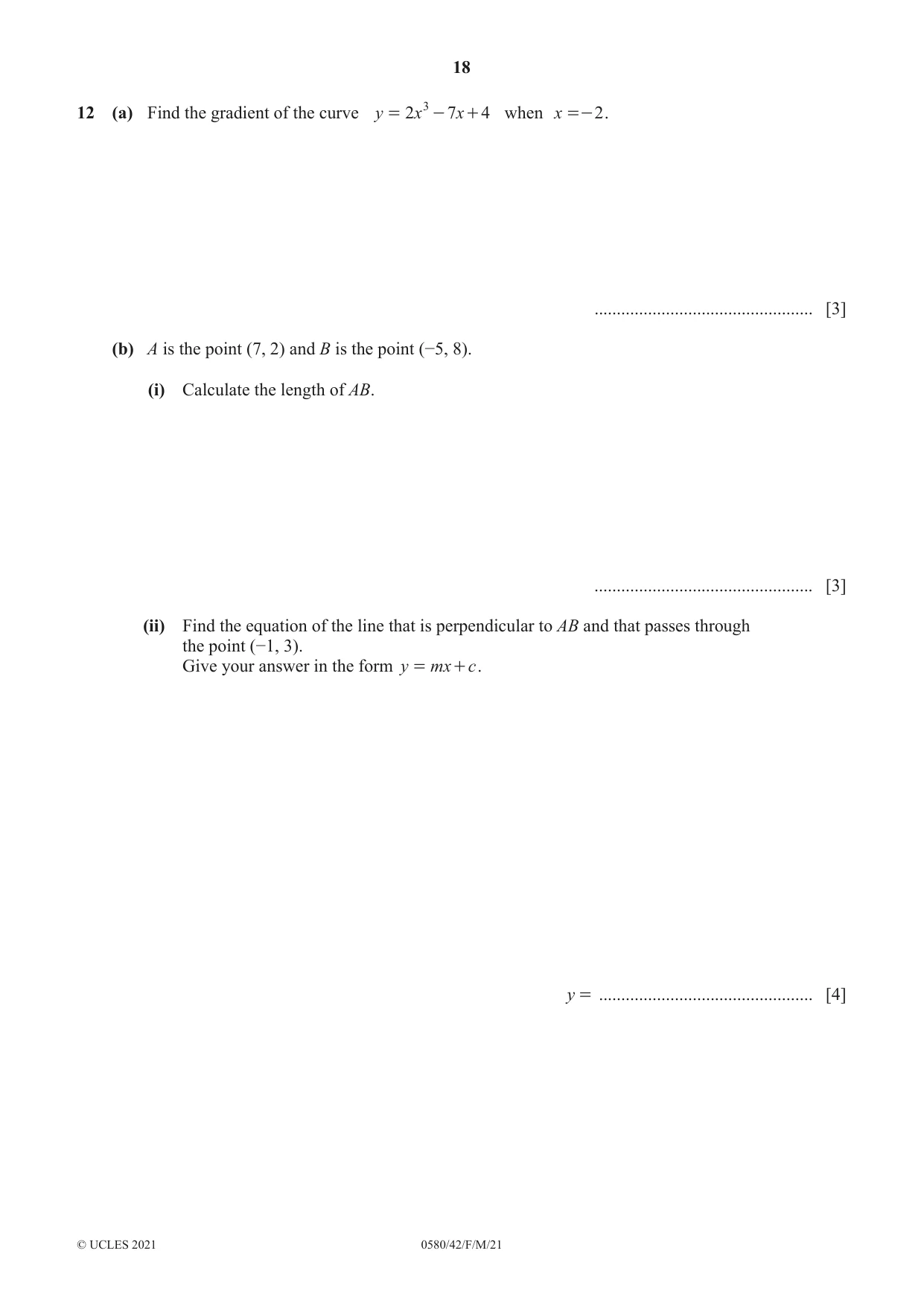
Q12 · Find the gradient of the curve y = 2x 3 - 7x + 4 when x =- 2
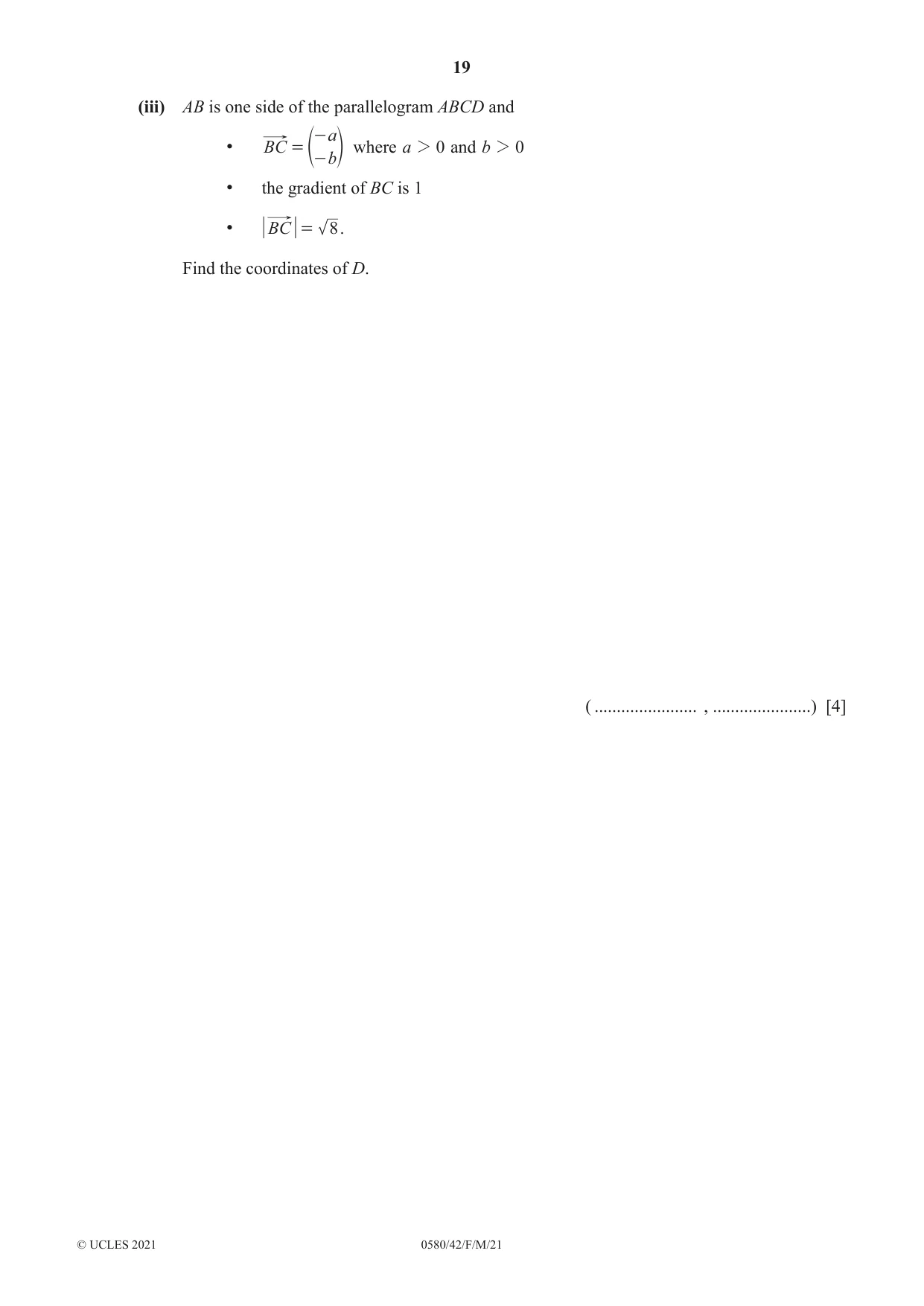
12 (a) Find the gradient of the curve y = 2x 3 - 7x + 4 when x =- 2 . ................................................. [3] (b) A is the point (7, 2) and B is the point (−5, 8). (i) Calculate the length of AB. ................................................. [3] (ii) Find the equation of the line that is perpendicular to AB and that passes through the point (−1, 3). Give your answer in the form y = mx + c . y = ................................................ [4] (iii) AB is one side of the parallelogram ABCD and - a • BC = where a 2 0 and b 2 0 e- bo • the gradient of BC is 1 • BC = 8 . Find the coordinates of D. ( ....................... , ......................) [4]
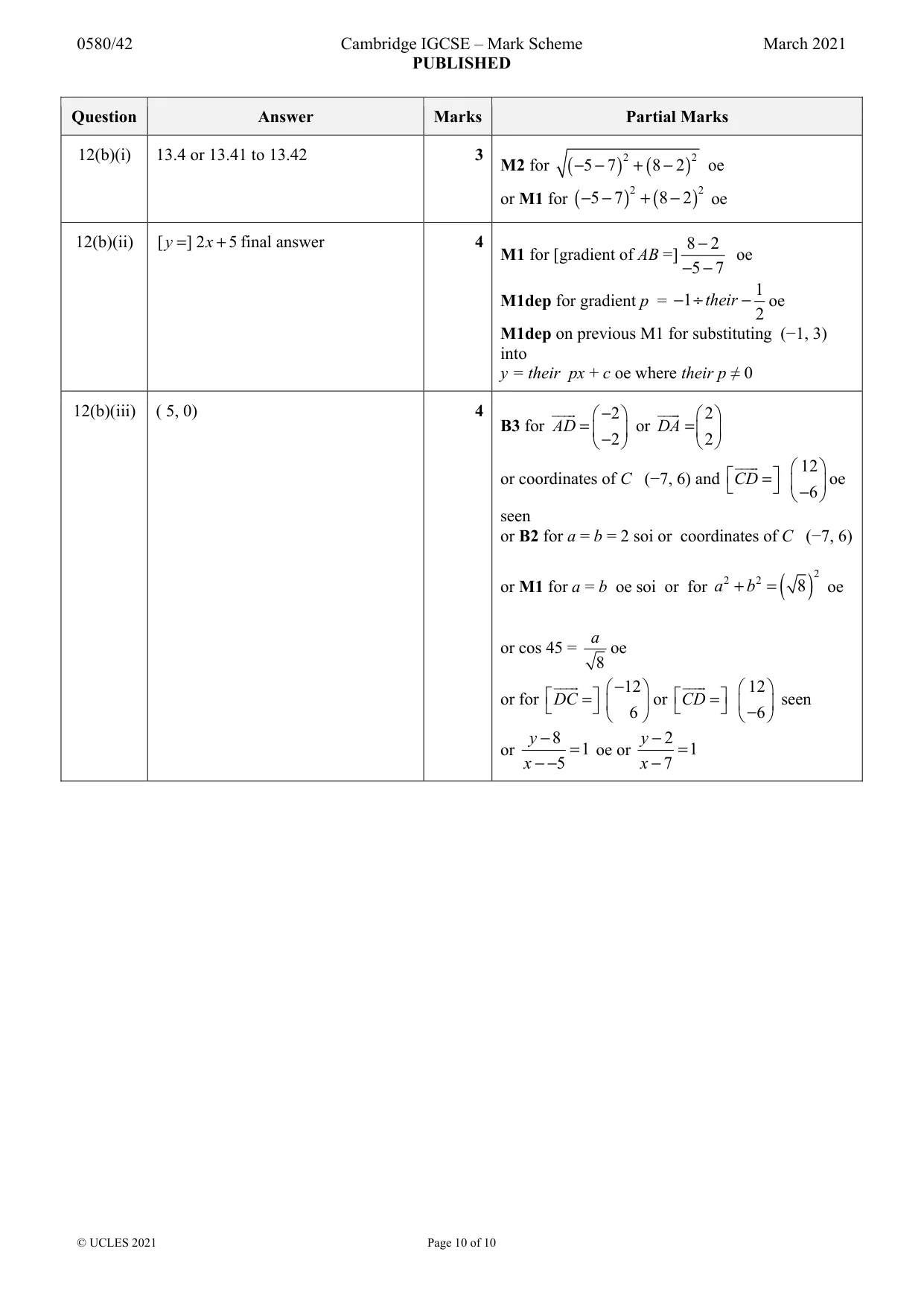
Mark scheme: 12(a) 17 3 M2 for 3 × 2 x 2 − 7 or better isw or M1 for 3 × 2 x 2 oe or kx2 – 7 seen 12(b)(i) 13.4 or 13.41 to 13.42 3 2 2 M2 for ( −−5 7 ) + ( 8 − 2 ) oe 2 2 or M1 for ( −−5 7 ) + ( 8 − 2 ) oe 12(b)(ii) [ y = ] 2 x + 5 final answer 4 8 − 2 M1 for [gradient of AB =] oe −−5 7 1 M1dep for gradient p = −÷1 their − oe 2 M1dep on previous M1 for substituting (−1, 3) into y = their px + c oe where their p ≠ 0 12(b)(iii) ( 5, 0) 4 − 2 2 B3 for AD = or DA = − 2 2 12 or coordinates of C (−7, 6) and CD = oe − 6 seen or B2 for a = b = 2 soi or coordinates of C (−7, 6) 2 8 oe or M1 for a = b oe soi or for a 2 + b 2 = ( ) a or cos 45 = oe 8 −12 12 = DC = or for or CD seen 6 − 6 y − 8 y − 2 or = 1 oe or = 1 x −−5 x − 7
What was in this paper
The subtopics covered by these 12 questions, and how many questions each got. Open one in a new tab to see every Cambridge question on it.
What you needed in this session
Cambridge’s own grade thresholds for 2021 Feb/March, Paper 4 · Variant 2. A higher threshold means an easier paper — the bar moves with how the cohort did.