Cambridge IGCSE Mathematics 0580 — 2017 Feb/March Paper 4 · Variant 2
0580/42/F/M/17 · 11 questions · 130 marks · ≈146 min
The question paper and its mark scheme, free to read here and free to download. This is Cambridge’s own paper, exactly as it was sat.
Question paper20 pages
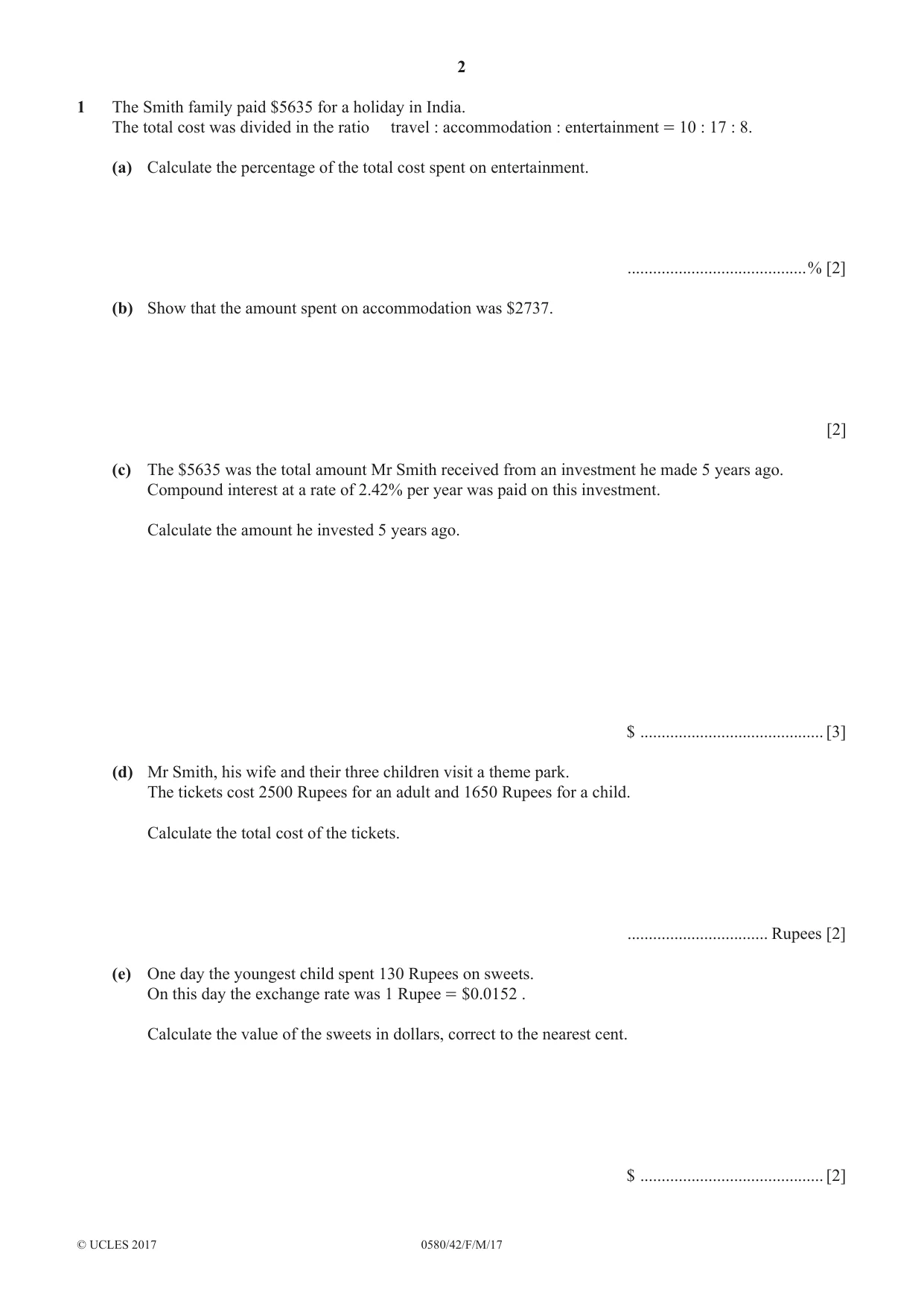
Mark scheme7 pages
Answers below. Sit the paper first if you are practising.
Questions as text
Q1 · The Smith family paid $5635 for a holiday in India
1 The Smith family paid $5635 for a holiday in India. The total cost was divided in the ratio travel : accommodation : entertainment = 10 : 17 : 8. (a) Calculate the percentage of the total cost spent on entertainment. ..........................................% [2] (b) Show that the amount spent on accommodation was $2737. [2] (c) The $5635 was the total amount Mr Smith received from an investment he made 5 years ago. Compound interest at a rate of 2.42% per year was paid on this investment. Calculate the amount he invested 5 years ago. $ ........................................... [3] (d) Mr Smith, his wife and their three children visit a theme park. The tickets cost 2500 Rupees for an adult and 1650 Rupees for a child. Calculate the total cost of the tickets. ................................. Rupees [2] (e) One day the youngest child spent 130 Rupees on sweets. On this day the exchange rate was 1 Rupee = $0.0152 . Calculate the value of the sweets in dollars, correct to the nearest cent. $ ........................................... [2]
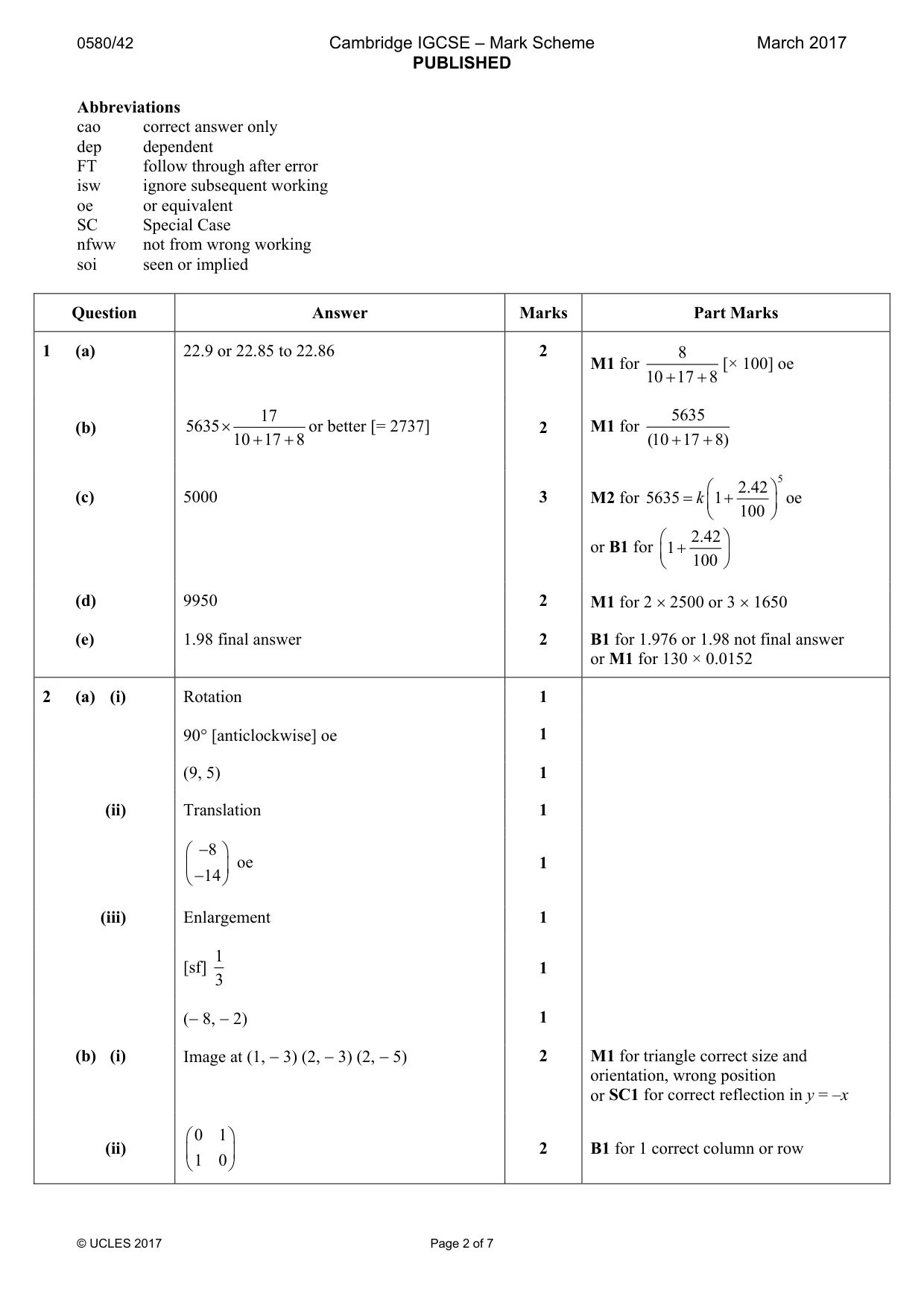
Mark scheme: Question Answer Marks Part Marks 1 (a) 22.9 or 22.85 to 22.86 2 8 M1 for [× 100] oe 10 + 17 + 8 17 5635 (b) 5635 × or better [= 2737] 2 M1 for 10 + 17 + 8 (10 + 17 + 8) 2.42 5 (c) 5000 3 M2 for 5635 = k 1 + oe 100 2.42 or B1 for 1 + 100 (d) 9950 2 M1 for 2 × 2500 or 3 × 1650 (e) 1.98 final answer 2 B1 for 1.976 or 1.98 not final answer or M1 for 130 × 0.0152
Q2 · Y 12 10 P 8 6 4 2 S Q x –10 –8 –6 –4 –2 0 2 4 6 8 10 –2 –4 R –6 –8 (a) Describe fully the…
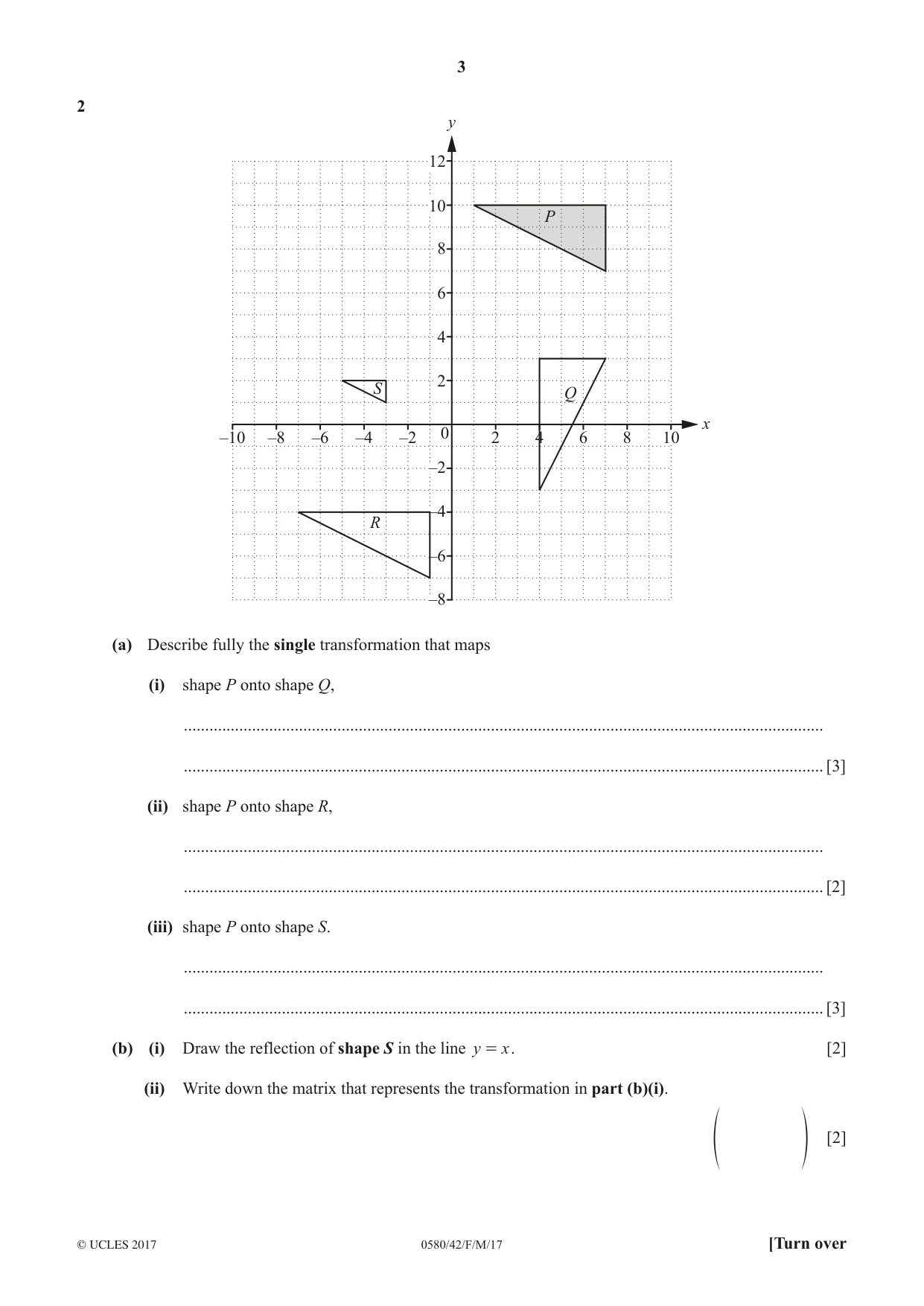
2 y 12 10 P 8 6 4 2 S Q x –10 –8 –6 –4 –2 0 2 4 6 8 10 –2 –4 R –6 –8 (a) Describe fully the single transformation that maps (i) shape P onto shape Q, ...................................................................................................................................................... ...................................................................................................................................................... [3] (ii) shape P onto shape R, ...................................................................................................................................................... ...................................................................................................................................................... [2] (iii) shape P onto shape S. ...................................................................................................................................................... ...................................................................................................................................................... [3] (b) (i) Draw the reflection of shape S in the line y = x . [2] (ii) Write down the matrix that represents the transformation in part (b)(i). [2] f p
Mark scheme: 2 (a) (i) Rotation 1 90° [anticlockwise] oe 1 (9, 5) 1 (ii) Translation 1 −8 oe 1 −14 (iii) Enlargement 1 1 [sf] 1 3 (− 8, − 2) 1 (b) (i) Image at (1, − 3) (2, − 3) (2, − 5) 2 M1 for triangle correct size and orientation, wrong position or SC1 for correct reflection in y = –x 0 1 (ii) 2 B1 for 1 correct column or row 1 0
Q3 · The table shows some values for y = 1.5 x - 1
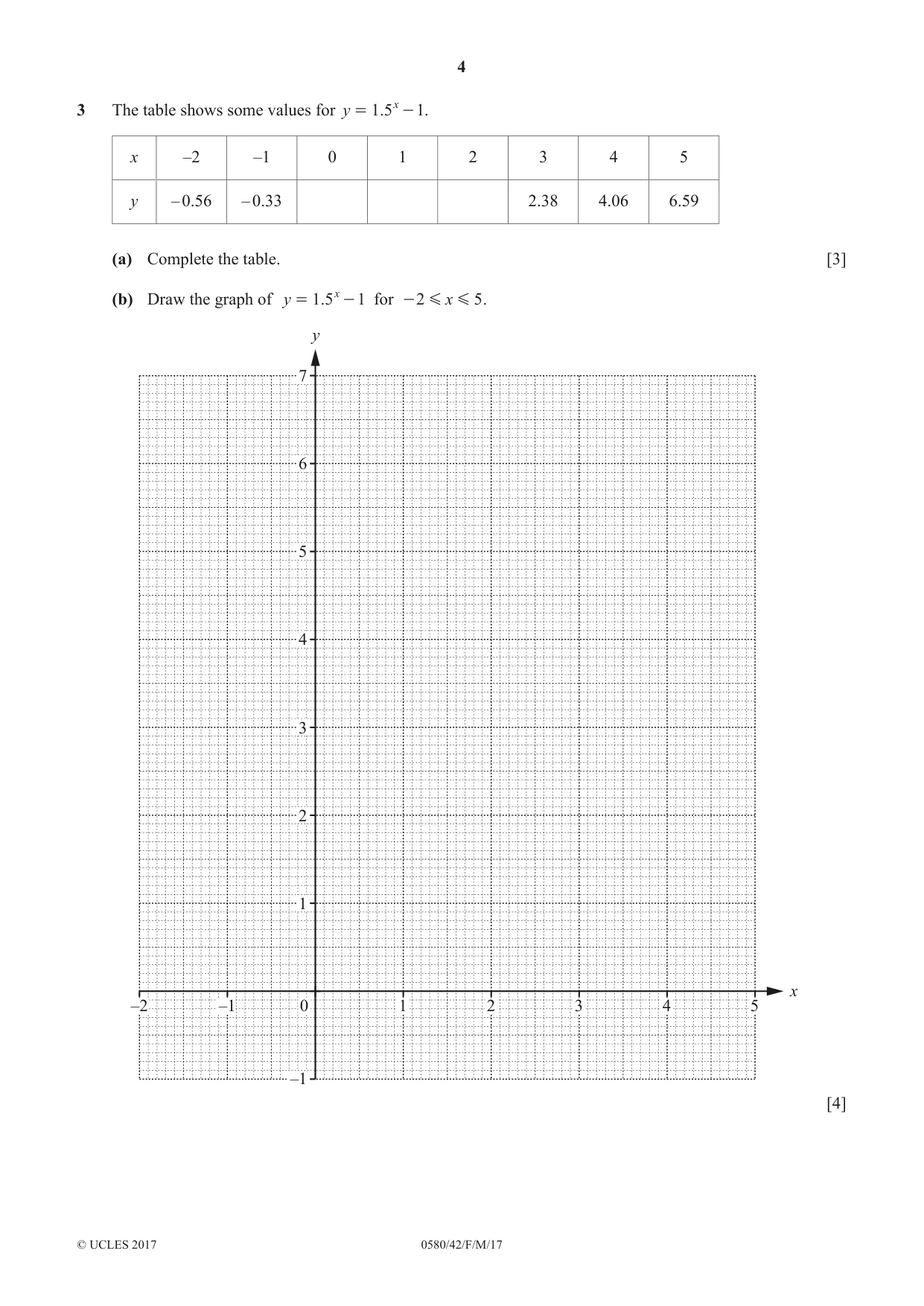
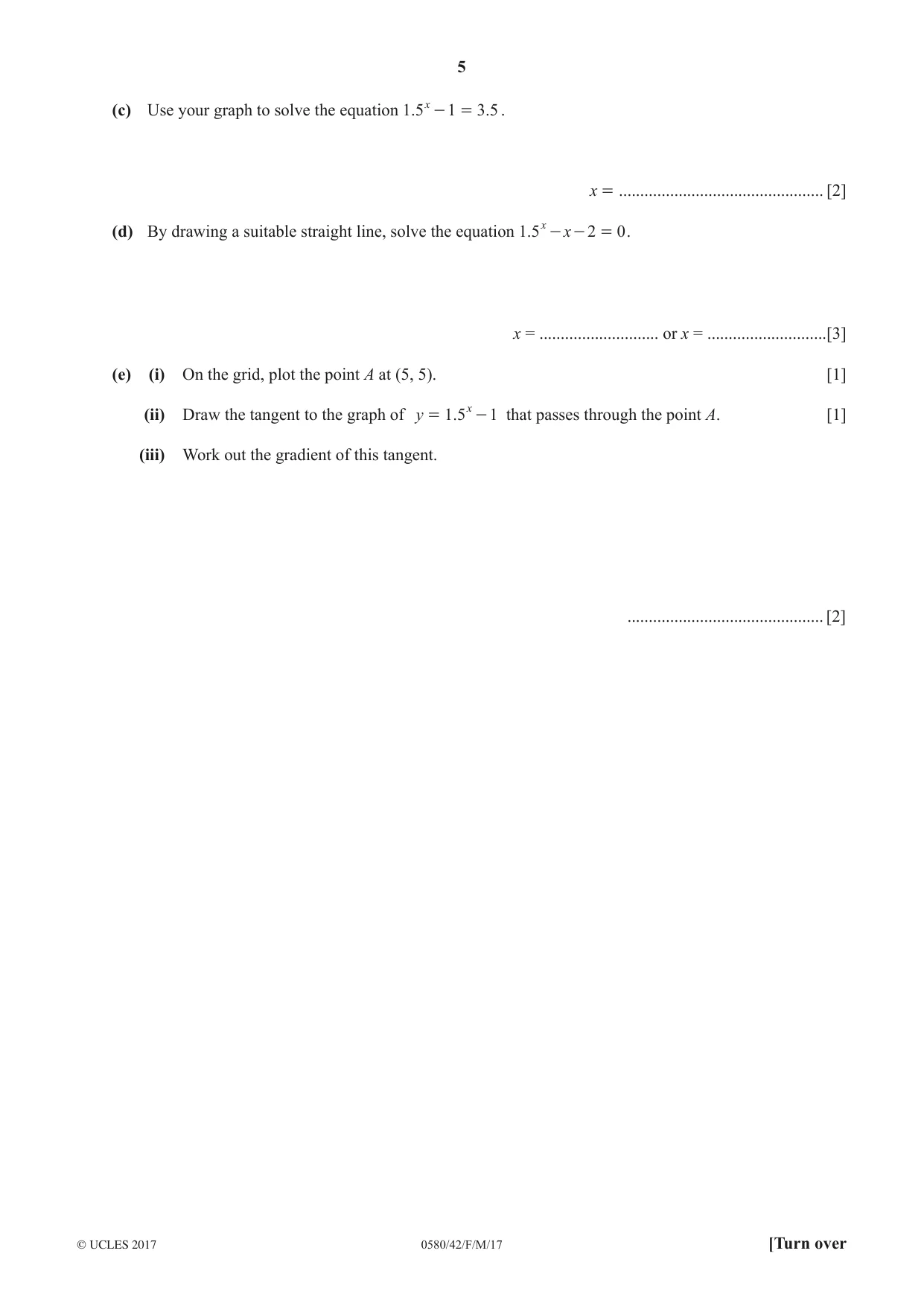
3 The table shows some values for y = 1.5 x - 1. x –2 –1 0 1 2 3 4 5 y – 0.56 – 0.33 2.38 4.06 6.59 (a) Complete the table. [3] (b) Draw the graph of y = 1.5 x - 1 for - 2 G x G 5 . y 7 6 5 4 3 2 1 x –2 –1 0 1 2 3 4 5 –1 [4] (c) Use your graph to solve the equation 1.5 x - 1 = 3. 5 . x = ................................................ [2] (d) By drawing a suitable straight line, solve the equation 1.5 x - x - 2 = 0 . x = ............................ or x = ............................[3] (e) (i) On the grid, plot the point A at (5, 5). [1] (ii) Draw the tangent to the graph of y = 1.5 x - 1 that passes through the point A. [1] (iii) Work out the gradient of this tangent. .............................................. [2]
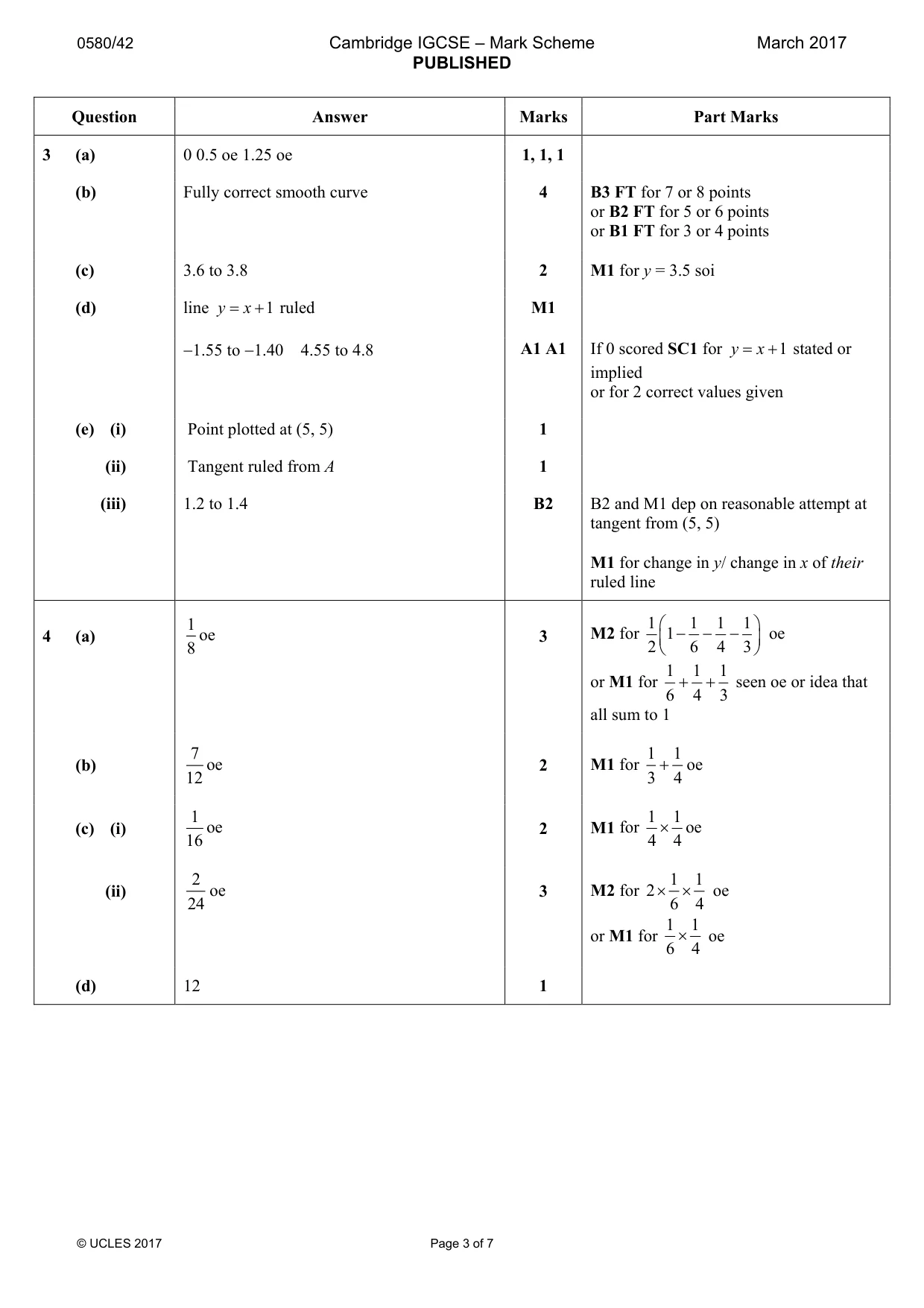
Mark scheme: 3 (a) 0 0.5 oe 1.25 oe 1, 1, 1 (b) Fully correct smooth curve 4 B3 FT for 7 or 8 points or B2 FT for 5 or 6 points or B1 FT for 3 or 4 points (c) 3.6 to 3.8 2 M1 for y = 3.5 soi (d) line y = x + 1 ruled M1 −1.55 to −1.40 4.55 to 4.8 A1 A1 If 0 scored SC1 for y = x + 1 stated or implied or for 2 correct values given (e) (i) Point plotted at (5, 5) 1 (ii) Tangent ruled from A 1 (iii) 1.2 to 1.4 B2 B2 and M1 dep on reasonable attempt at tangent from (5, 5) M1 for change in y/ change in x of their ruled line 1 1 1 1 1
Q4 · Ravi spins a biased 5-sided spinner, numbered 1 to 5
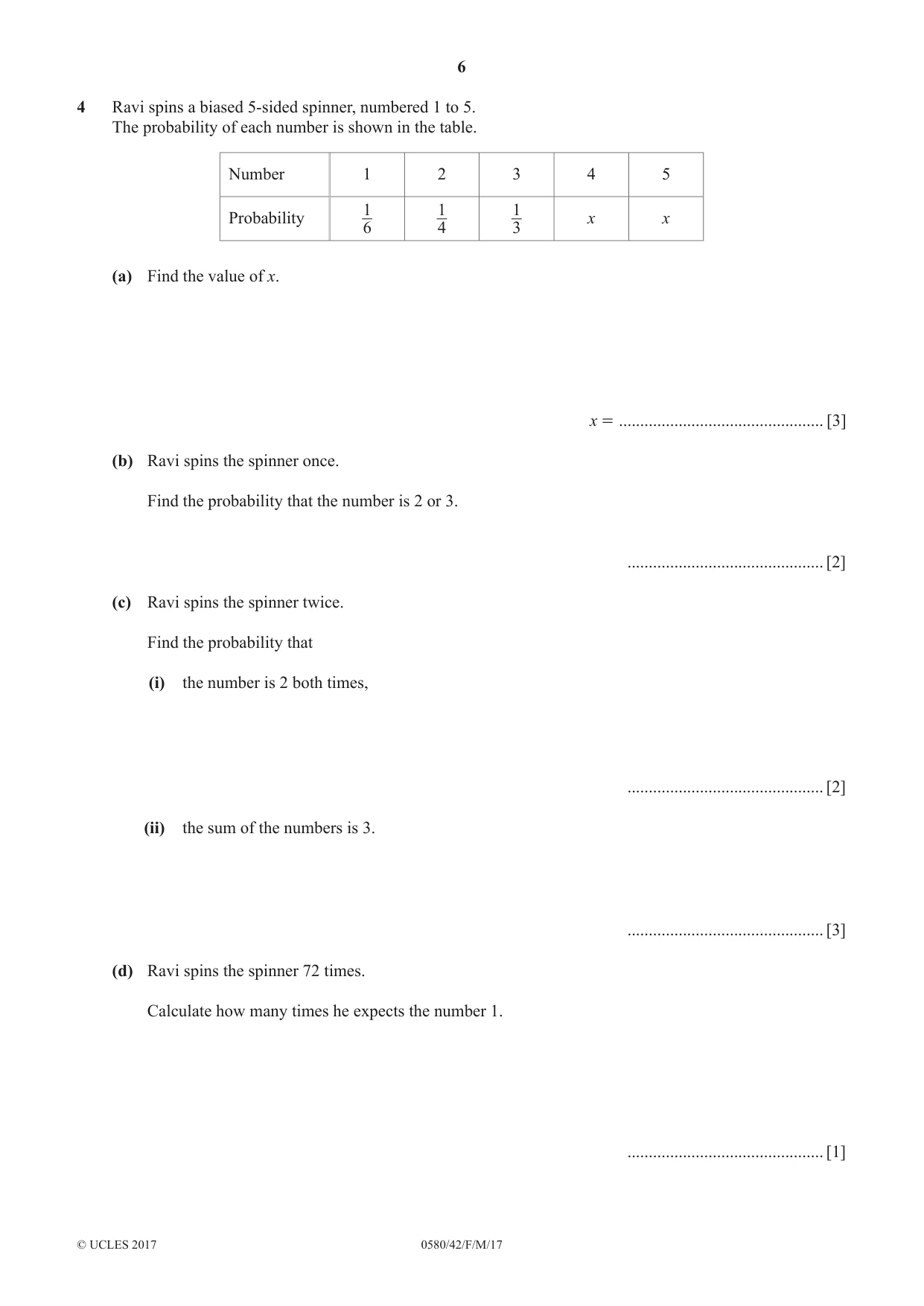
4 Ravi spins a biased 5-sided spinner, numbered 1 to 5. The probability of each number is shown in the table. Number 1 2 3 4 5 1 1 1 Probability x x 6 4 3 (a) Find the value of x. x = ................................................ [3] (b) Ravi spins the spinner once. Find the probability that the number is 2 or 3. .............................................. [2] (c) Ravi spins the spinner twice. Find the probability that (i) the number is 2 both times, .............................................. [2] (ii) the sum of the numbers is 3. .............................................. [3] (d) Ravi spins the spinner 72 times. Calculate how many times he expects the number 1. .............................................. [1]
Mark scheme: 1 1 1 1 1 4 (a) oe 3 M2 for 1 − − − oe 8 2 6 4 3 1 1 1 or M1 for + + seen oe or idea that 6 4 3 all sum to 1 7 1 1 (b) oe 2 M1 for + oe 12 3 4 1 1 1 (c) (i) oe 2 M1 for × oe 16 4 4 2 1 1 (ii) oe 3 M2 for 2 × × oe 24 6 4 1 1 or M1 for × oe 6 4 (d) 12 1
Q5 · Factorise 3x 2 + 11x - 4
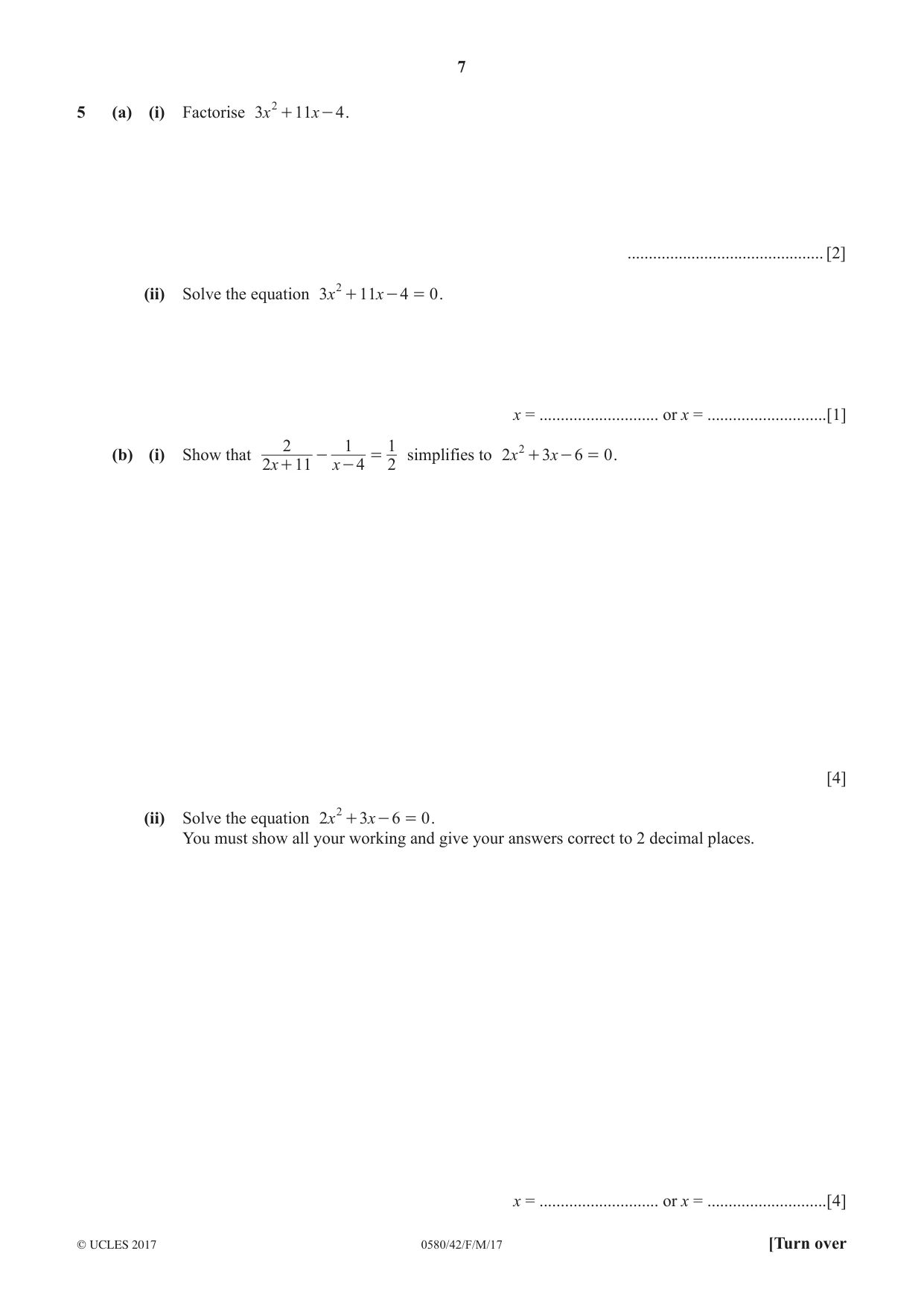
5 (a) (i) Factorise 3x 2 + 11x - 4 . .............................................. [2] (ii) Solve the equation 3x 2 + 11x - 4 = 0 . x = ............................ or x = ............................[1] 2 1 1 2 (b) (i) Show that - = simplifies to 2x + 3x - 6 = 0 . 2x + 11 x - 4 2 [4] (ii) Solve the equation 2x 2 + 3x - 6 = 0 . You must show all your working and give your answers correct to 2 decimal places. x = ............................ or x = ............................[4]
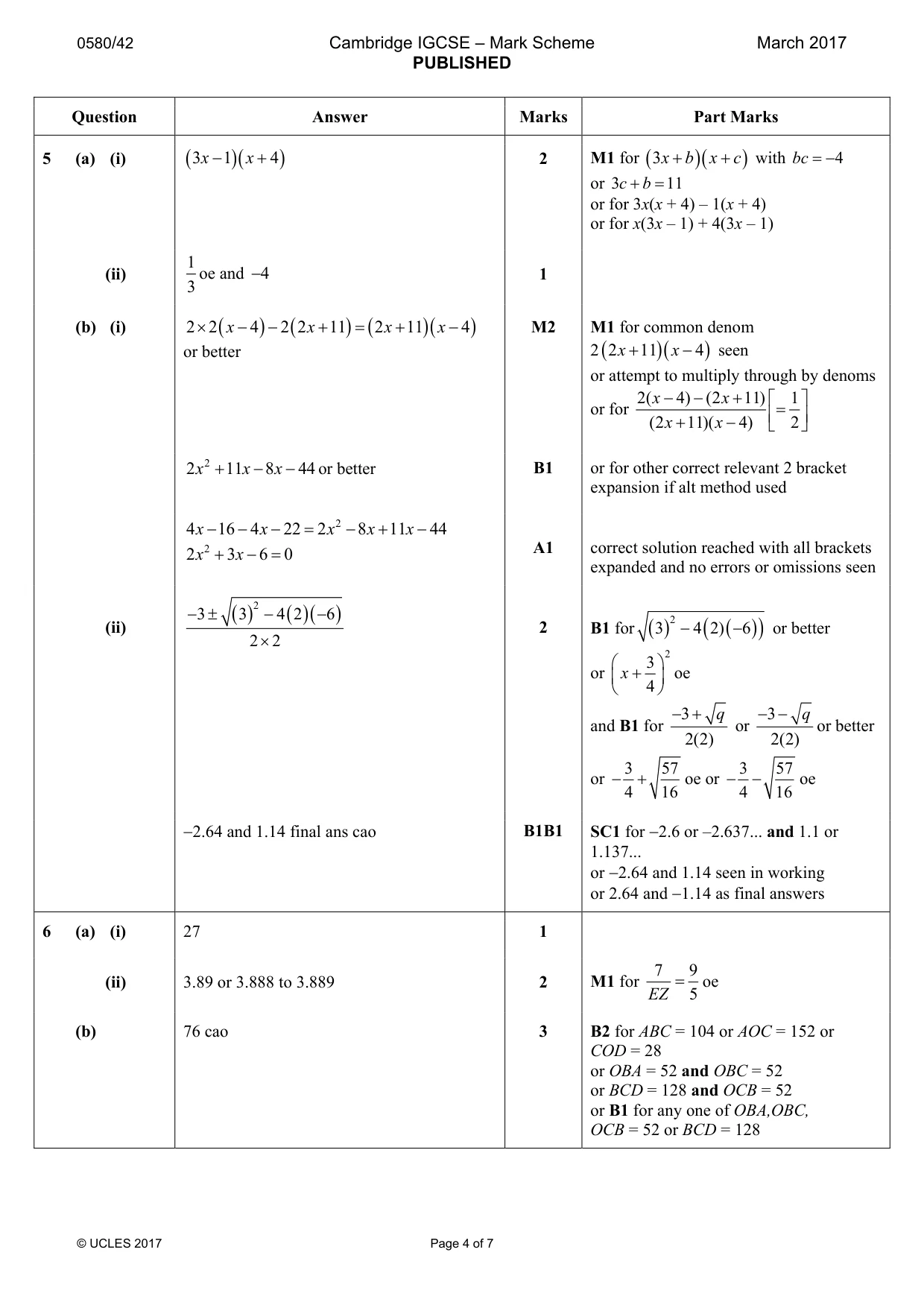
Mark scheme: 5 (a) (i) ( 3 x − 1)( x + 4 ) 2 M1 for ( 3 x + b )( x + c ) with bc = − 4 or 3c + b = 11 or for 3x(x + 4) – 1(x + 4) or for x(3x – 1) + 4(3x – 1) 1 (ii) oe and −4 1 3 (b) (i) 2 × 2 ( x − 4 ) − 2 ( 2 x + 11) = ( 2 x + 11)( x − 4 ) M2 M1 for common denom or better 2( 2 x + 11)( x − 4 ) seen or attempt to multiply through by denoms 2( x − 4) − (2 x + 11) 1 or for = (2 x + 11)( x − 4) 2 2 x 2 + 11x − 8 x − 44 or better B1 or for other correct relevant 2 bracket expansion if alt method used 4 x − 16 − 4 x − 22 = 2 x 2 − 8 x + 11x − 44 2 A1 correct solution reached with all brackets 2 x + 3 x − 6 = 0 expanded and no errors or omissions seen −±3 ( 3 ) 2 − 4 ( 2 )( − 6 ) 2 (ii) 2 B1 for ( 3 ) − 4 ( 2) ( −6 ) ) or better 2 × 2 3 2 or x + oe 4 −+3 q −−3 q and B1 for or or better 2(2) 2(2) 3 57 3 57 or − + oe or − − oe 4 16 4 16 −2.64 and 1.14 final ans cao B1B1 SC1 for −2.6 or –2.637... and 1.1 or 1.137... or −2.64 and 1.14 seen in working or 2.64 and −1.14 as final answers
Q6 · G H x° Z NOT TO SCALE E 27° F In the diagram, EH is parallel to FG
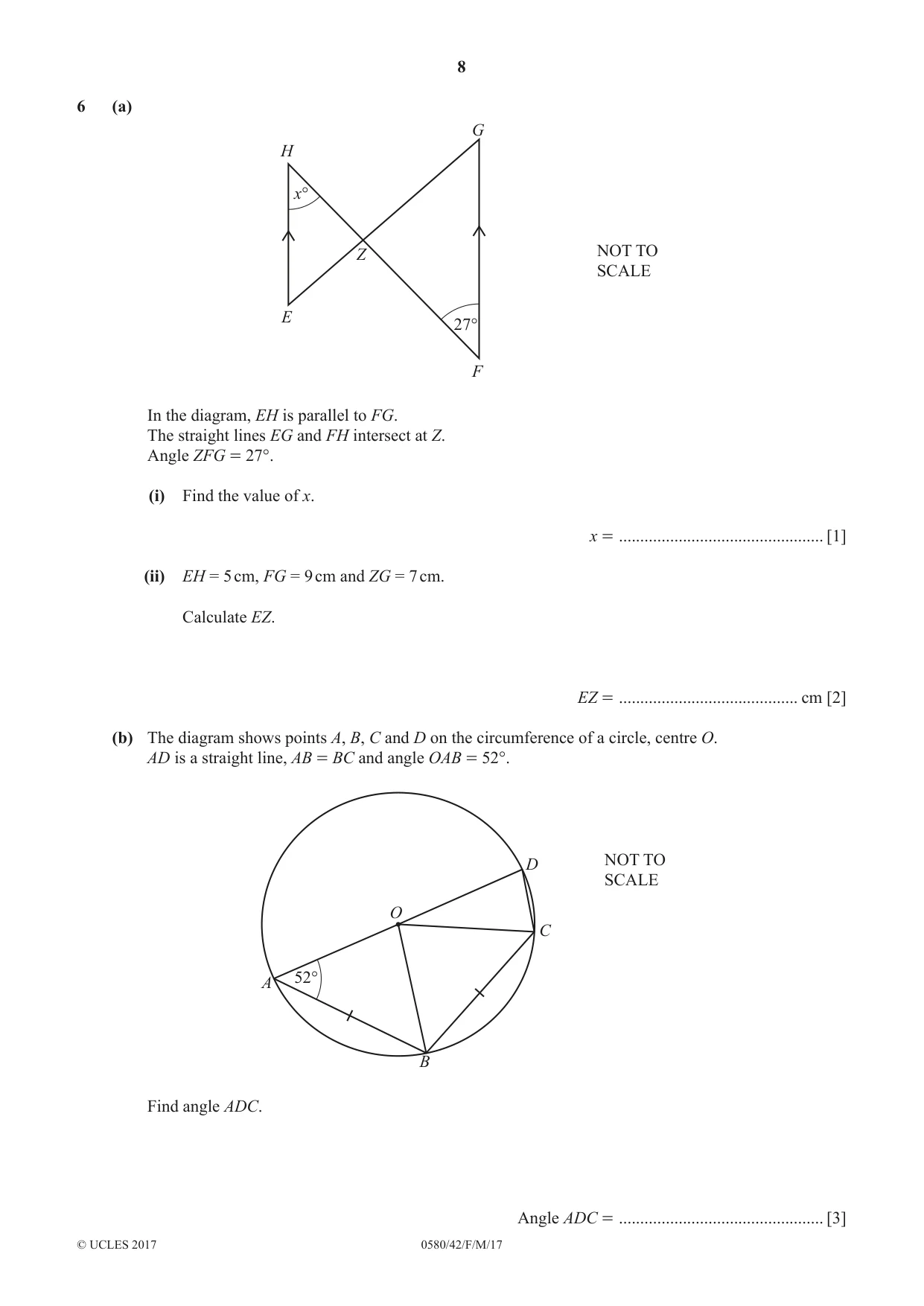
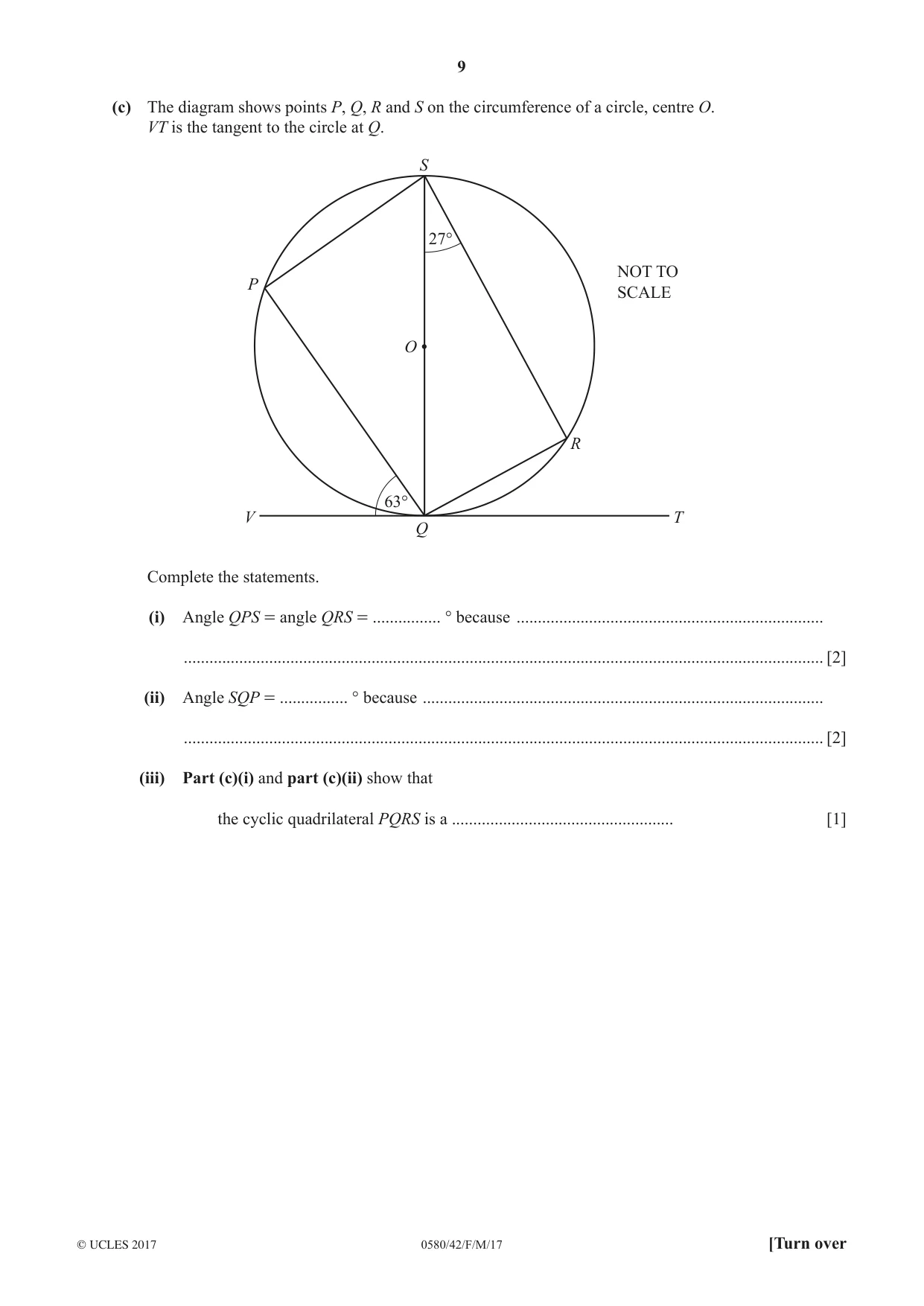
6 (a) G H x° Z NOT TO SCALE E 27° F In the diagram, EH is parallel to FG. The straight lines EG and FH intersect at Z. Angle ZFG = 27°. (i) Find the value of x. x = ................................................ [1] (ii) EH = 5 cm, FG = 9 cm and ZG = 7 cm. Calculate EZ. EZ = .......................................... cm [2] (b) The diagram shows points A, B, C and D on the circumference of a circle, centre O. AD is a straight line, AB = BC and angle OAB = 52°. D NOT TO SCALE O C A 52° B Find angle ADC. Angle ADC = ................................................ [3] (c) The diagram shows points P, Q, R and S on the circumference of a circle, centre O. VT is the tangent to the circle at Q. S 27° NOT TO P SCALE O R 63° V T Q Complete the statements. (i) Angle QPS = angle QRS = ................ ° because ........................................................................ ...................................................................................................................................................... [2] (ii) Angle SQP = ................ ° because .............................................................................................. ...................................................................................................................................................... [2] (iii) Part (c)(i) and part (c)(ii) show that the cyclic quadrilateral PQRS is a .................................................... [1]
Mark scheme: 6 (a) (i) 27 1 7 9 (ii) 3.89 or 3.888 to 3.889 2 M1 for = oe EZ 5 (b) 76 cao 3 B2 for ABC = 104 or AOC = 152 or COD = 28 or OBA = 52 and OBC = 52 or BCD = 128 and OCB = 52 or B1 for any one of OBA,OBC, OCB = 52 or BCD = 128
Q7 · The table shows information about the time taken by 400 people to complete a race
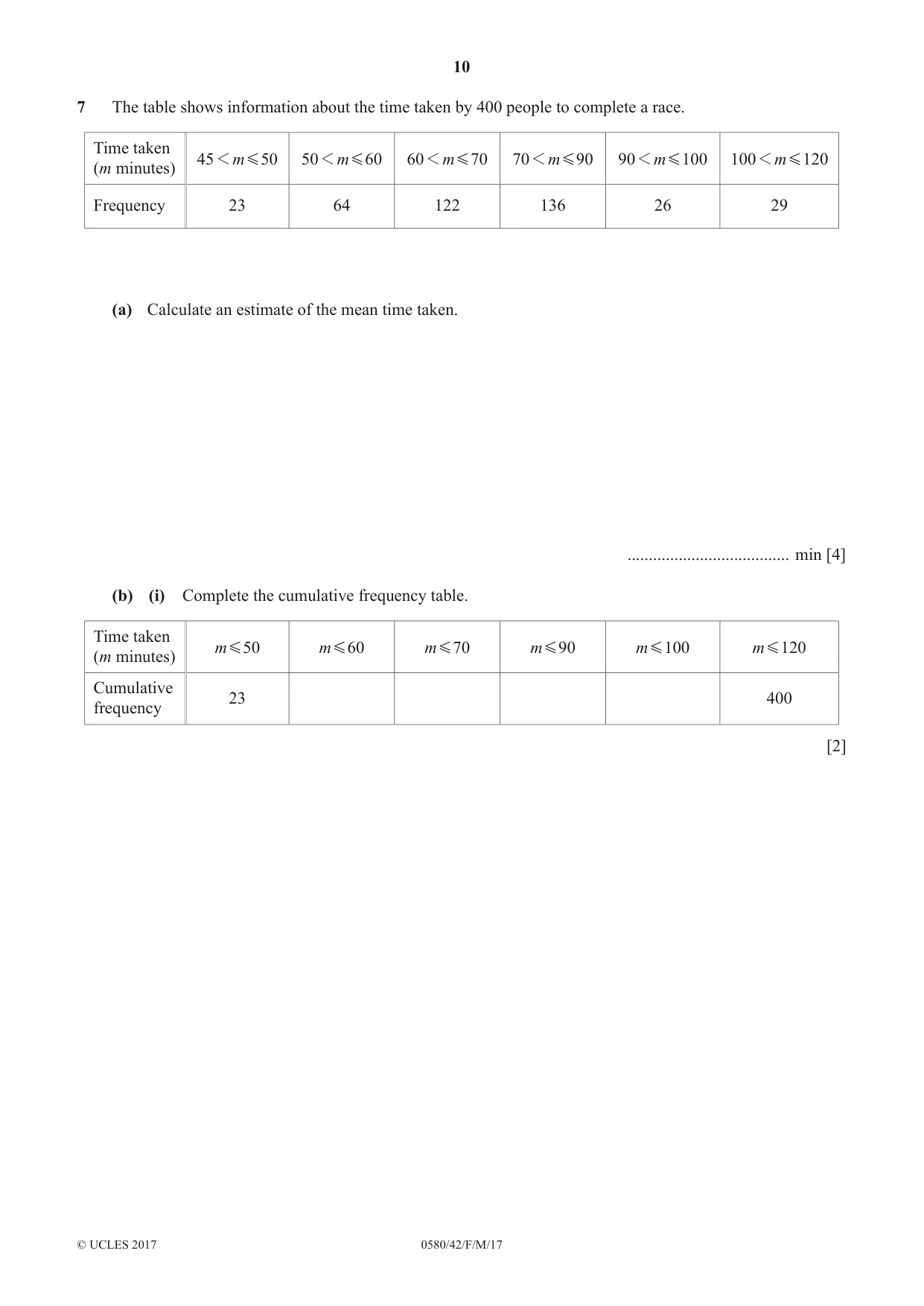
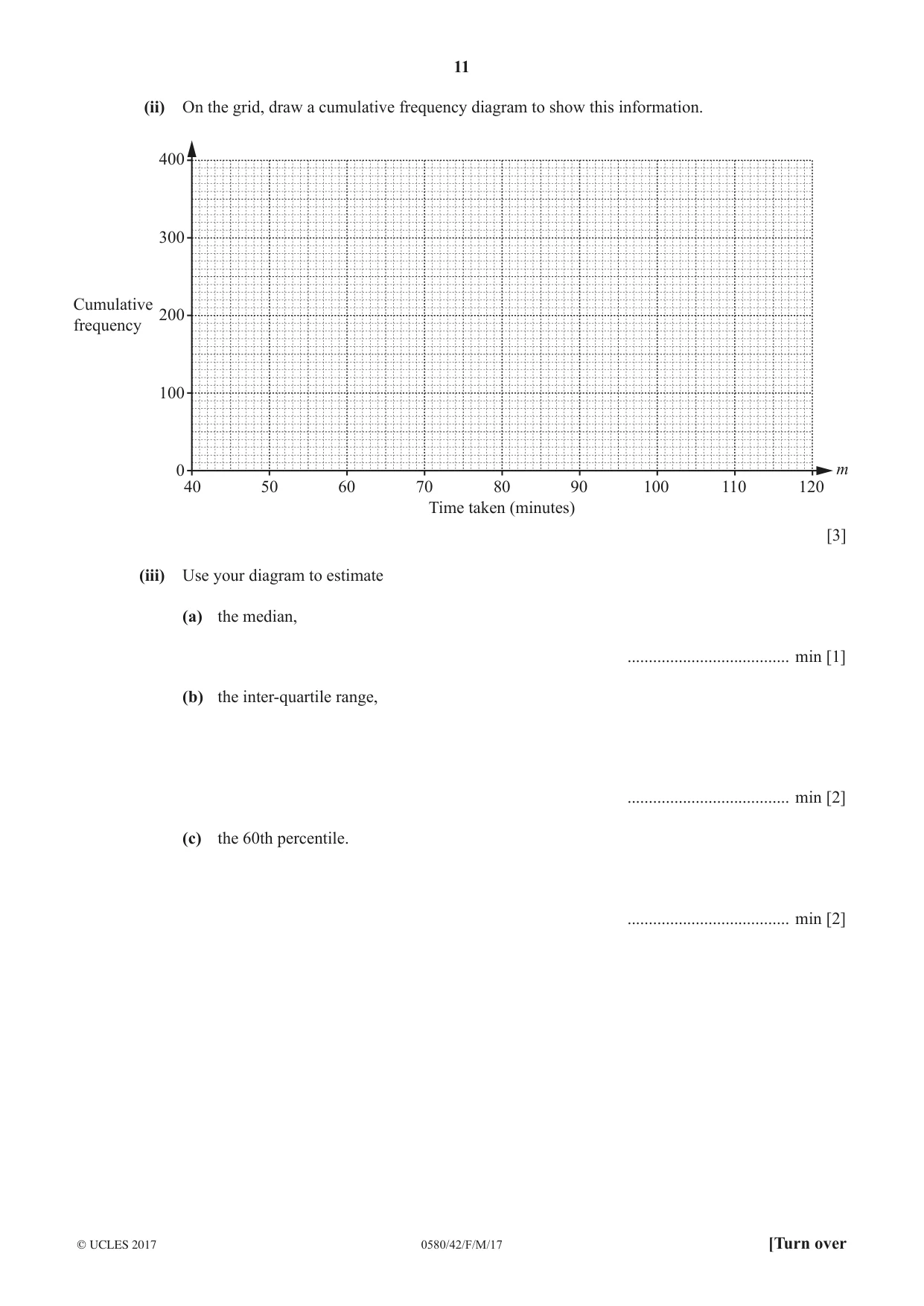
7 The table shows information about the time taken by 400 people to complete a race. Time taken 45 1 m G 50 50 1 m G 60 60 1 m G 70 70 1 m G 90 90 1 m G 100 100 1 m G 120 (m minutes) Frequency 23 64 122 136 26 29 (a) Calculate an estimate of the mean time taken. ...................................... min [4] (b) (i) Complete the cumulative frequency table. Time taken m G 50 m G 60 m G 70 m G 90 m G 100 m G 120 (m minutes) Cumulative 23 400 frequency [2] (ii) On the grid, draw a cumulative frequency diagram to show this information. 400 300 Cumulative 200frequency 100 0 m 40 50 60 70 80 90 100 110 120 Time taken (minutes) [3] (iii) Use your diagram to estimate (a) the median, ...................................... min [1] (b) the inter-quartile range, ...................................... min [2] (c) the 60th percentile. ...................................... min [2]
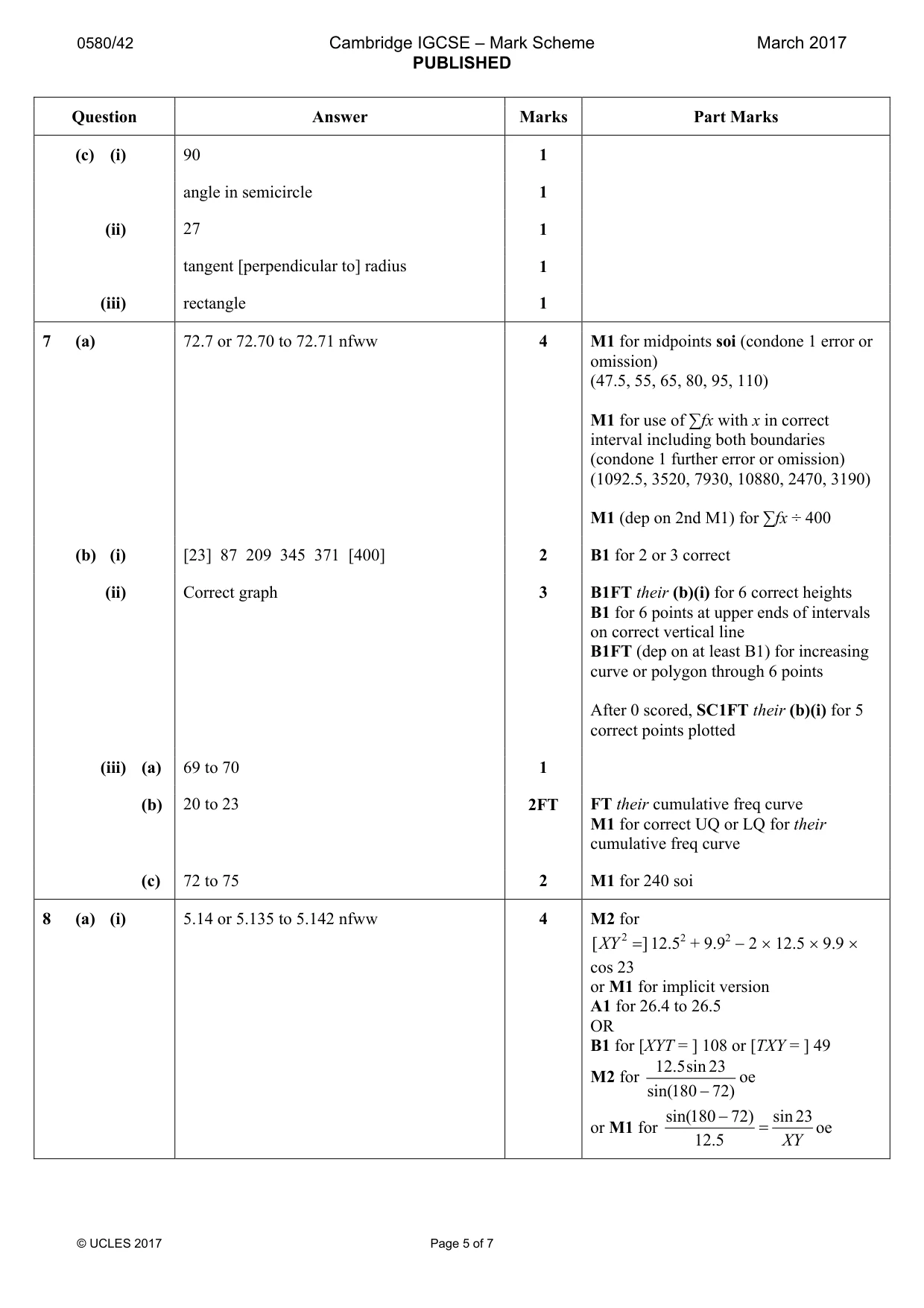
Mark scheme: 7 (a) 72.7 or 72.70 to 72.71 nfww 4 M1 for midpoints soi (condone 1 error or omission) (47.5, 55, 65, 80, 95, 110) M1 for use of ∑fx with x in correct interval including both boundaries (condone 1 further error or omission) (1092.5, 3520, 7930, 10880, 2470, 3190) M1 (dep on 2nd M1) for ∑fx ÷ 400 (b) (i) [23] 87 209 345 371 [400] 2 B1 for 2 or 3 correct (ii) Correct graph 3 B1FT their (b)(i) for 6 correct heights B1 for 6 points at upper ends of intervals on correct vertical line B1FT (dep on at least B1) for increasing curve or polygon through 6 points After 0 scored, SC1FT their (b)(i) for 5 correct points plotted (iii) (a) 69 to 70 1 (b) 20 to 23 2FT FT their cumulative freq curve M1 for correct UQ or LQ for their cumulative freq curve (c) 72 to 75 2 M1 for 240 soi
Q8 · In triangle TXZ, TX = 12.5 cm and angle TZX = 37°
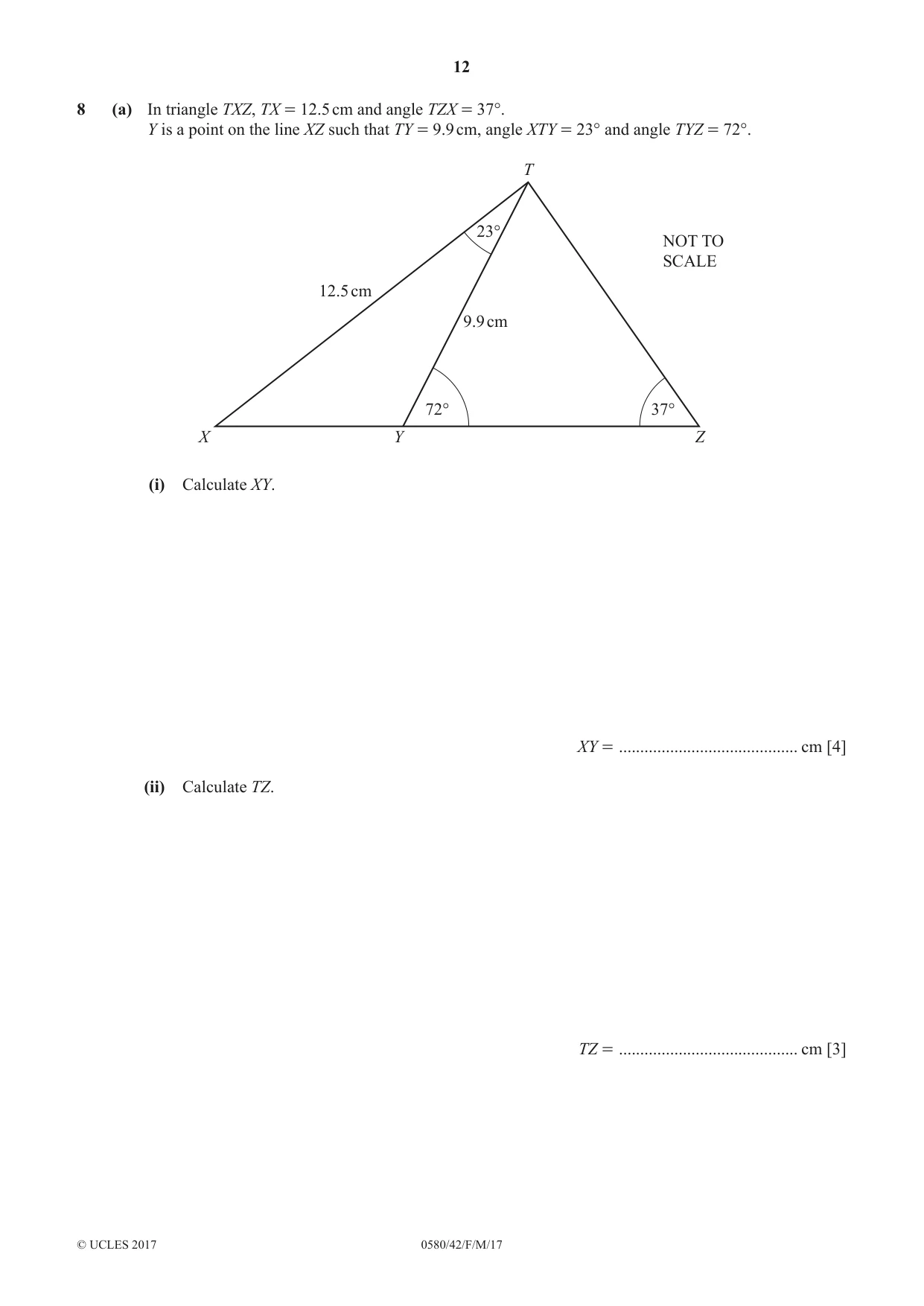
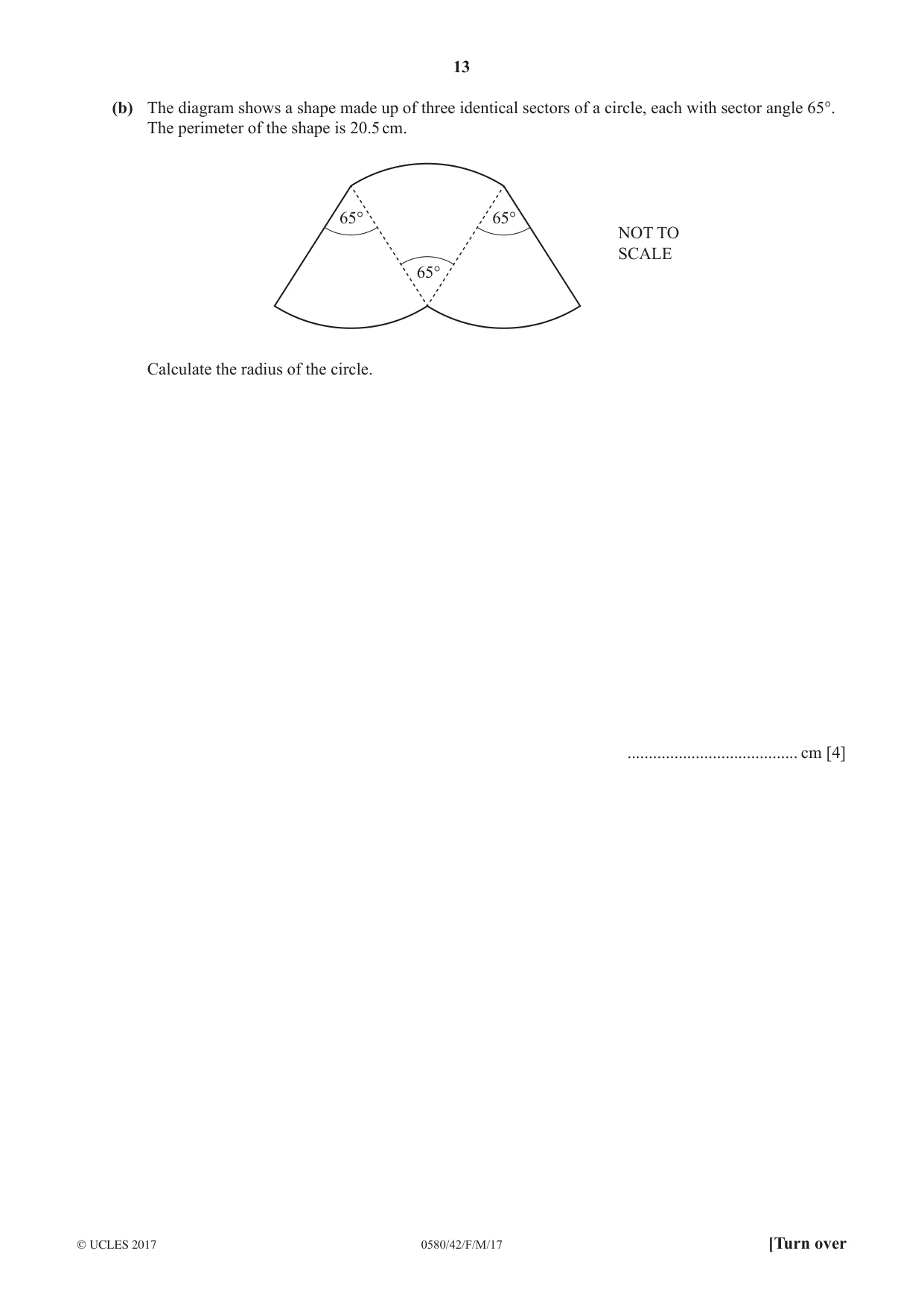
8 (a) In triangle TXZ, TX = 12.5 cm and angle TZX = 37°. Y is a point on the line XZ such that TY = 9.9 cm, angle XTY = 23° and angle TYZ = 72°. T 23° NOT TO SCALE 12.5 cm 9.9 cm 72° 37° X Y Z (i) Calculate XY. XY = .......................................... cm [4] (ii) Calculate TZ. TZ = .......................................... cm [3] (b) The diagram shows a shape made up of three identical sectors of a circle, each with sector angle 65°. The perimeter of the shape is 20.5 cm. 65° 65° NOT TO SCALE 65° Calculate the radius of the circle. ........................................ cm [4]
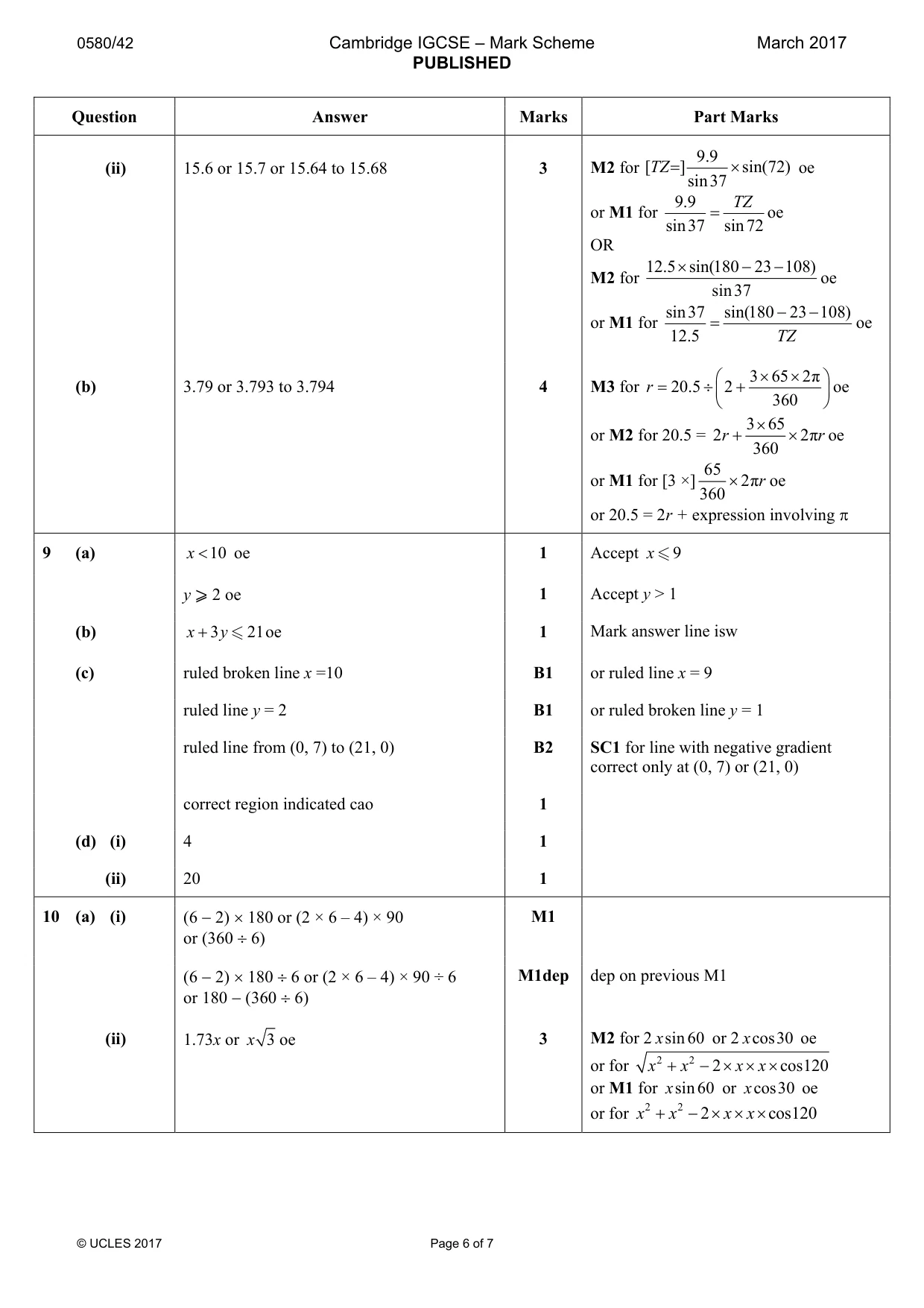
Mark scheme: 8 (a) (i) 5.14 or 5.135 to 5.142 nfww 4 M2 for [ XY 2 = ] 12.52 + 9.92 − 2 × 12.5 × 9.9 × cos 23 or M1 for implicit version A1 for 26.4 to 26.5 OR B1 for [XYT = ] 108 or [TXY = ] 49 12.5sin 23 M2 for oe sin(180 − 72) sin(180 − 72) sin23 or M1 for = oe 12.5 XY
Q9 · Bernie buys x packets of seeds and y plants for his garden
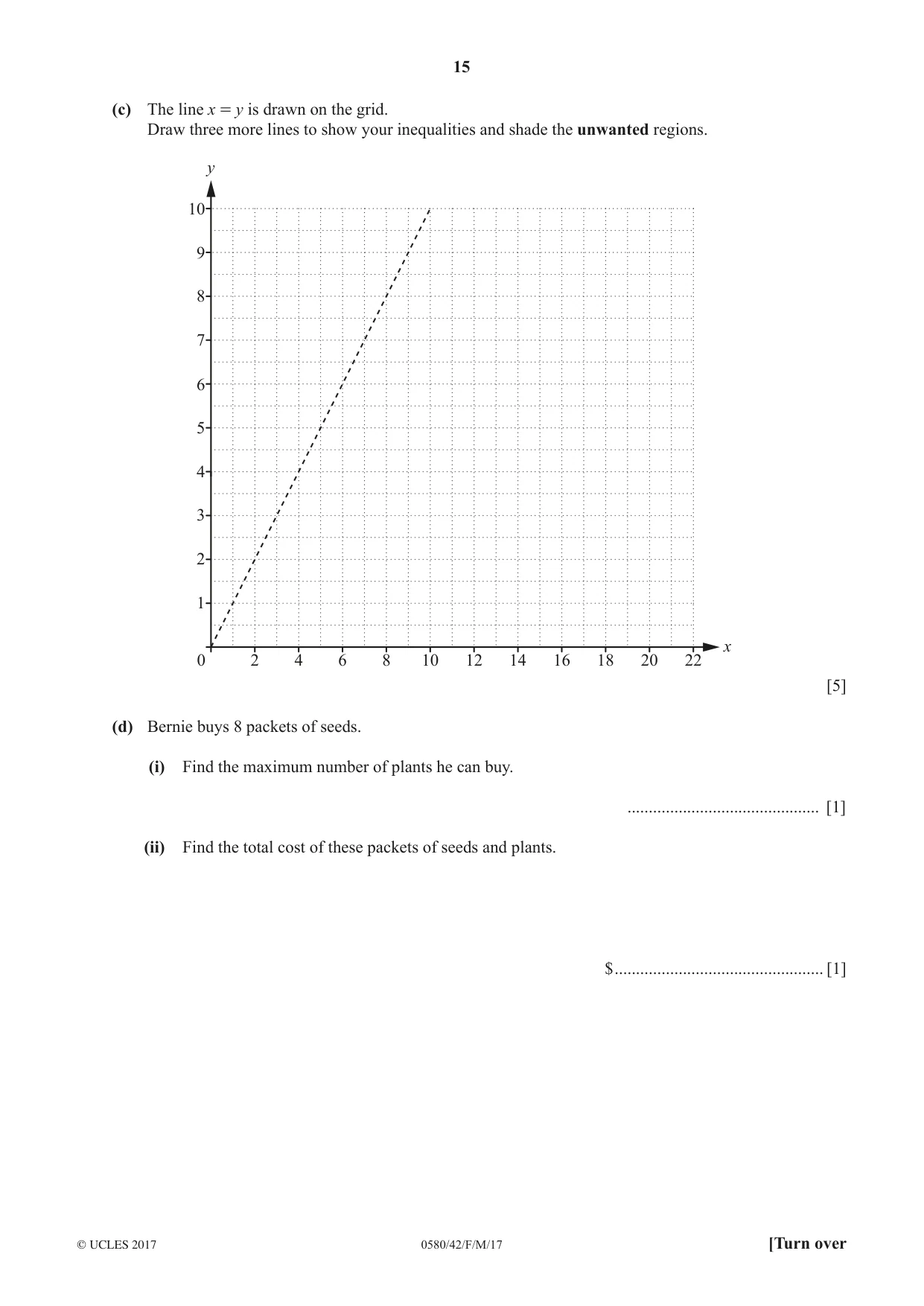
9 Bernie buys x packets of seeds and y plants for his garden. He wants to buy more packets of seeds than plants. The inequality x 2 y shows this information. He also wants to buy • less than 10 packets of seeds • at least 2 plants. (a) Write down two more inequalities in x or y to show this information. .............................................. .............................................. [2] (b) Each packet of seeds costs $1 and each plant costs $3. The maximum amount Bernie can spend is $21. Write down another inequality in x and y to show this information. .............................................. [1] (c) The line x = y is drawn on the grid. Draw three more lines to show your inequalities and shade the unwanted regions. y 10 9 8 7 6 5 4 3 2 1 x 0 2 4 6 8 10 12 14 16 18 20 22 [5] (d) Bernie buys 8 packets of seeds. (i) Find the maximum number of plants he can buy. ............................................. [1] (ii) Find the total cost of these packets of seeds and plants. $ ................................................. [1]
Mark scheme: 9 (a) x < 10 oe 1 Accept x - 9 y ⩾ 2 oe 1 Accept y > 1 (b) x + 3 y - 21 oe 1 Mark answer line isw (c) ruled broken line x =10 B1 or ruled line x = 9 ruled line y = 2 B1 or ruled broken line y = 1 ruled line from (0, 7) to (21, 0) B2 SC1 for line with negative gradient correct only at (0, 7) or (21, 0) correct region indicated cao 1 (d) (i) 4 1 (ii) 20 1
Q10 · The diagram shows a regular F E hexagon ABCDEF of side 10 cm
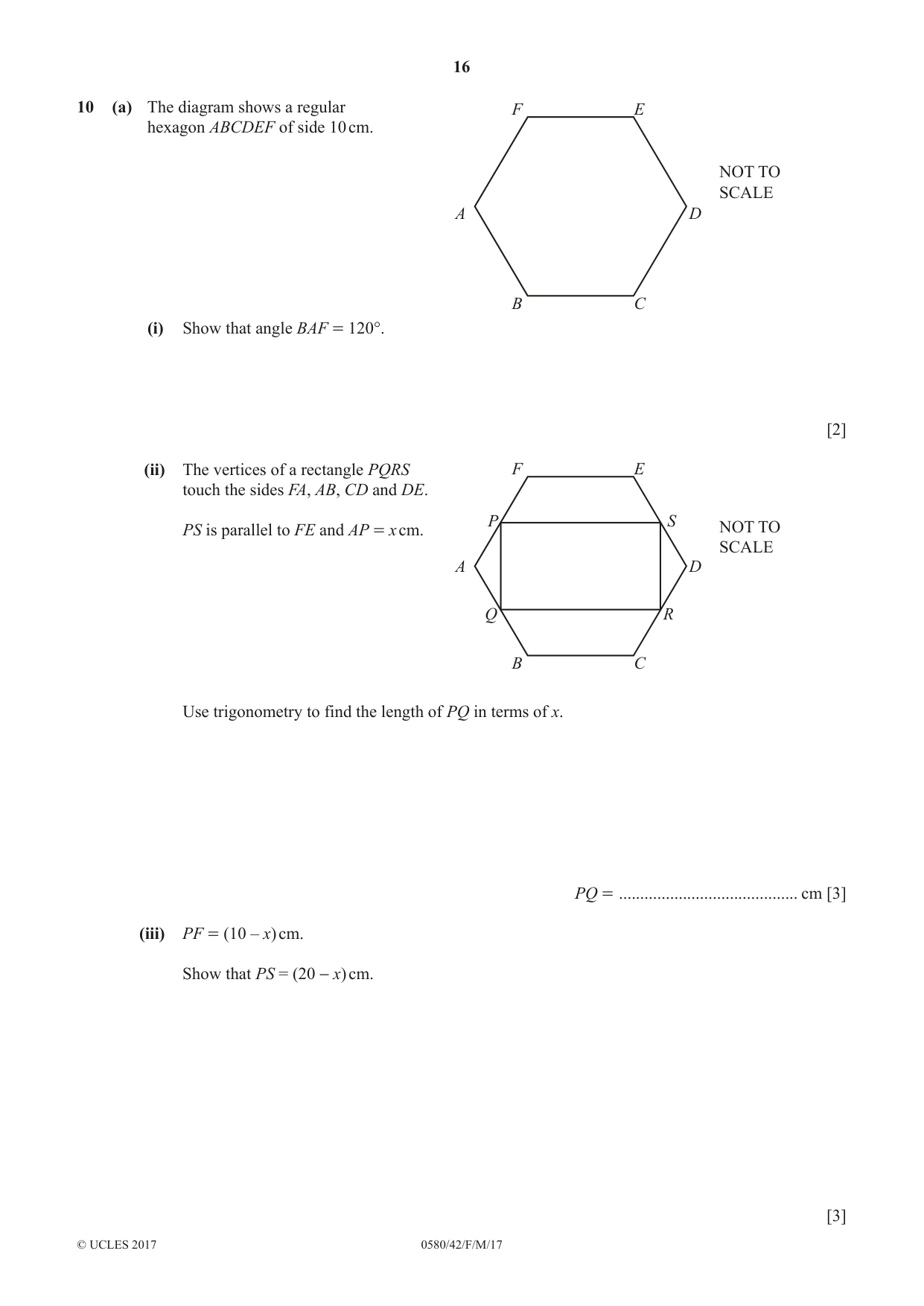
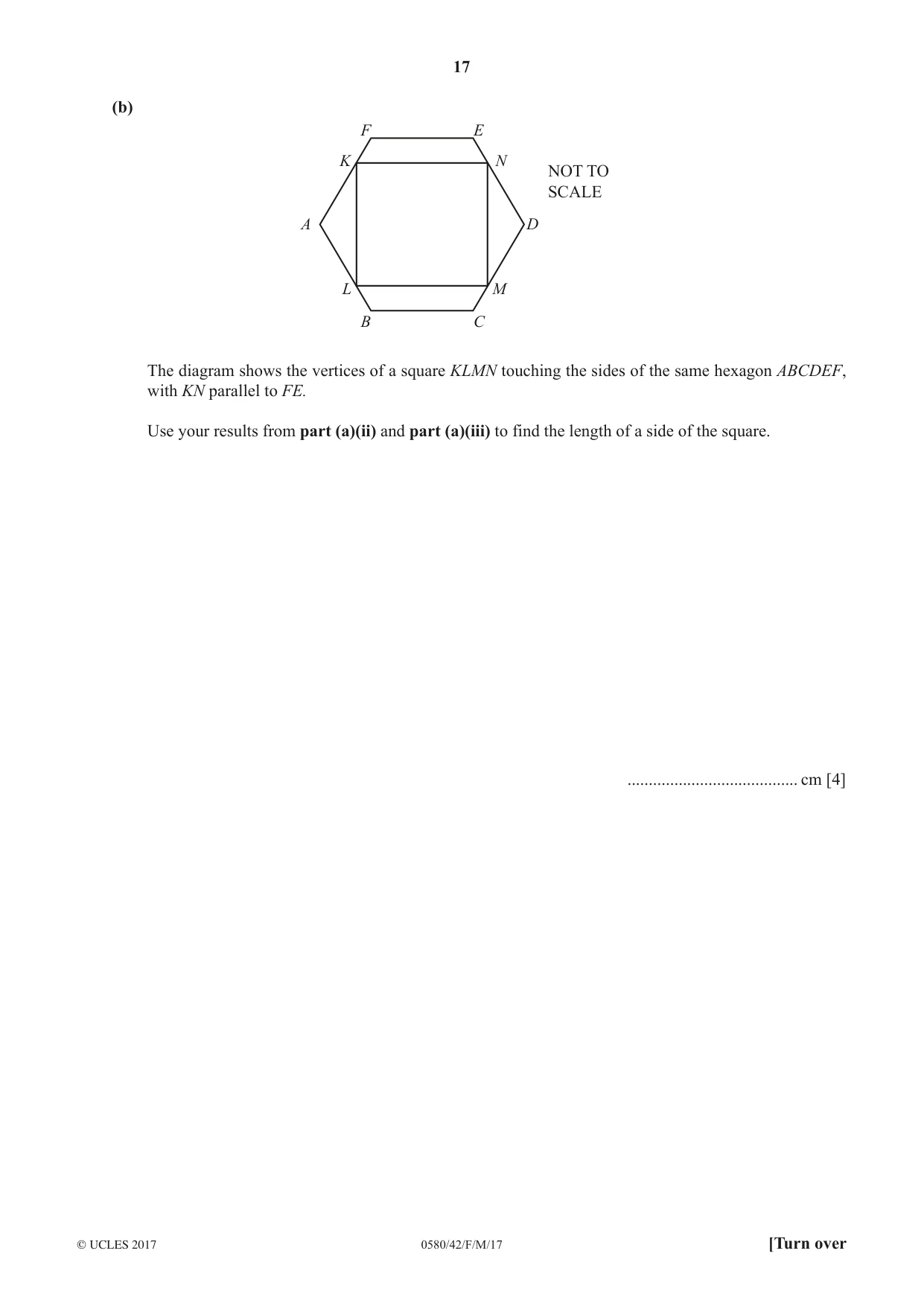
10 (a) The diagram shows a regular F E hexagon ABCDEF of side 10 cm. NOT TO SCALE A D B C (i) Show that angle BAF = 120°. [2] (ii) The vertices of a rectangle PQRS F E touch the sides FA, AB, CD and DE. P S PS is parallel to FE and AP = x cm. NOT TO SCALE A D Q R B C Use trigonometry to find the length of PQ in terms of x. PQ = .......................................... cm [3] (iii) PF = (10 – x) cm. Show that PS = (20 − x) cm. [3] (b) F E K N NOT TO SCALE A D L M B C The diagram shows the vertices of a square KLMN touching the sides of the same hexagon ABCDEF, with KN parallel to FE. Use your results from part (a)(ii) and part (a)(iii) to find the length of a side of the square. ........................................ cm [4]
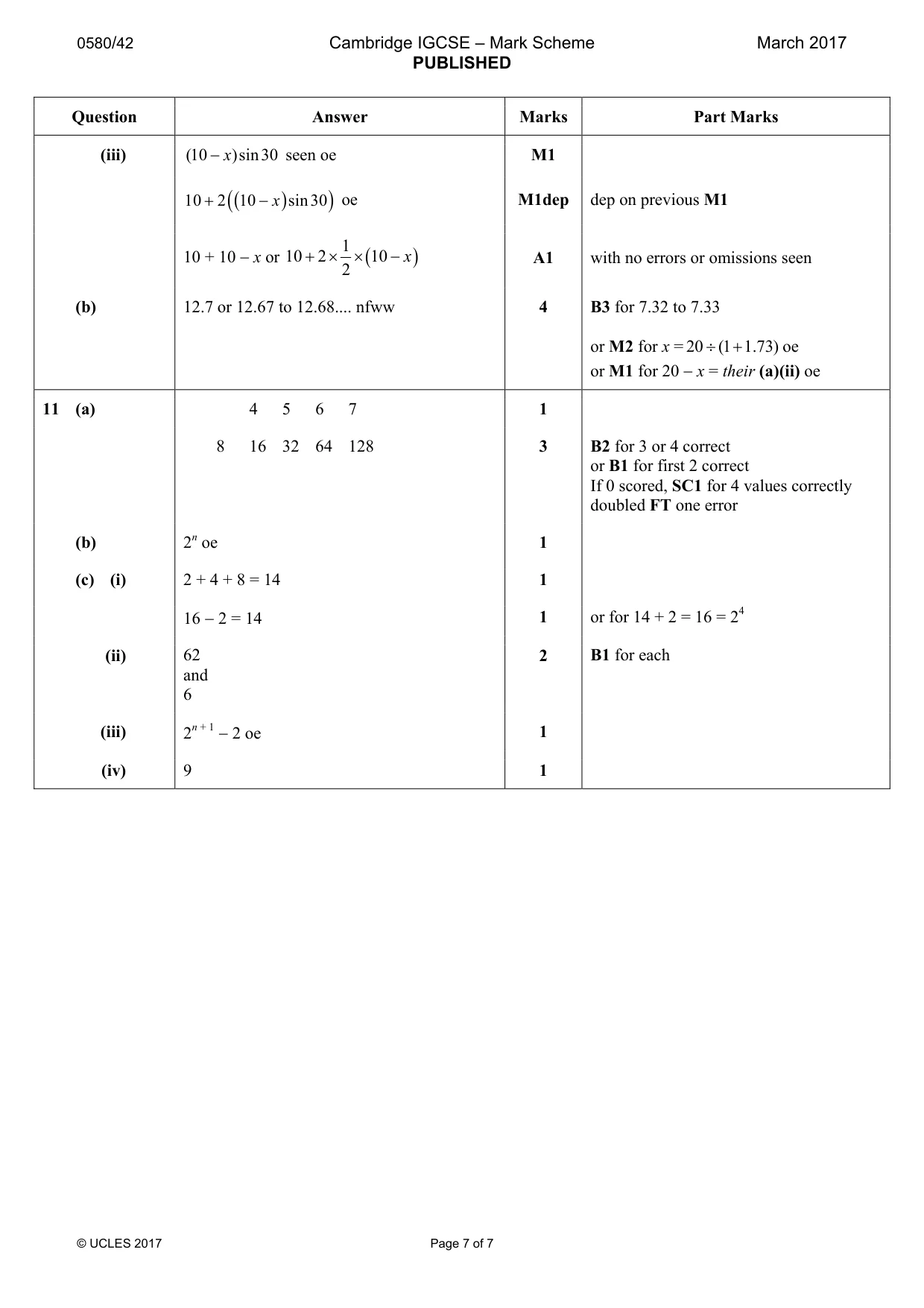
Mark scheme: 10 (a) (i) (6 − 2) × 180 or (2 × 6 – 4) × 90 M1 or (360 ÷ 6) (6 − 2) × 180 ÷ 6 or (2 × 6 – 4) × 90 ÷ 6 M1dep dep on previous M1 or 180 − (360 ÷ 6) (ii) 1.73x or x 3 oe 3 M2 for 2 x sin60 or 2 x cos30 oe or for x 2 + x 2 − 2 × x × x × cos120 or M1 for x sin60 or x cos30 oe or for x 2 + x 2 −×2 x × x × cos120
Q11 · On Monday, Ankuri sent this text message to two friends
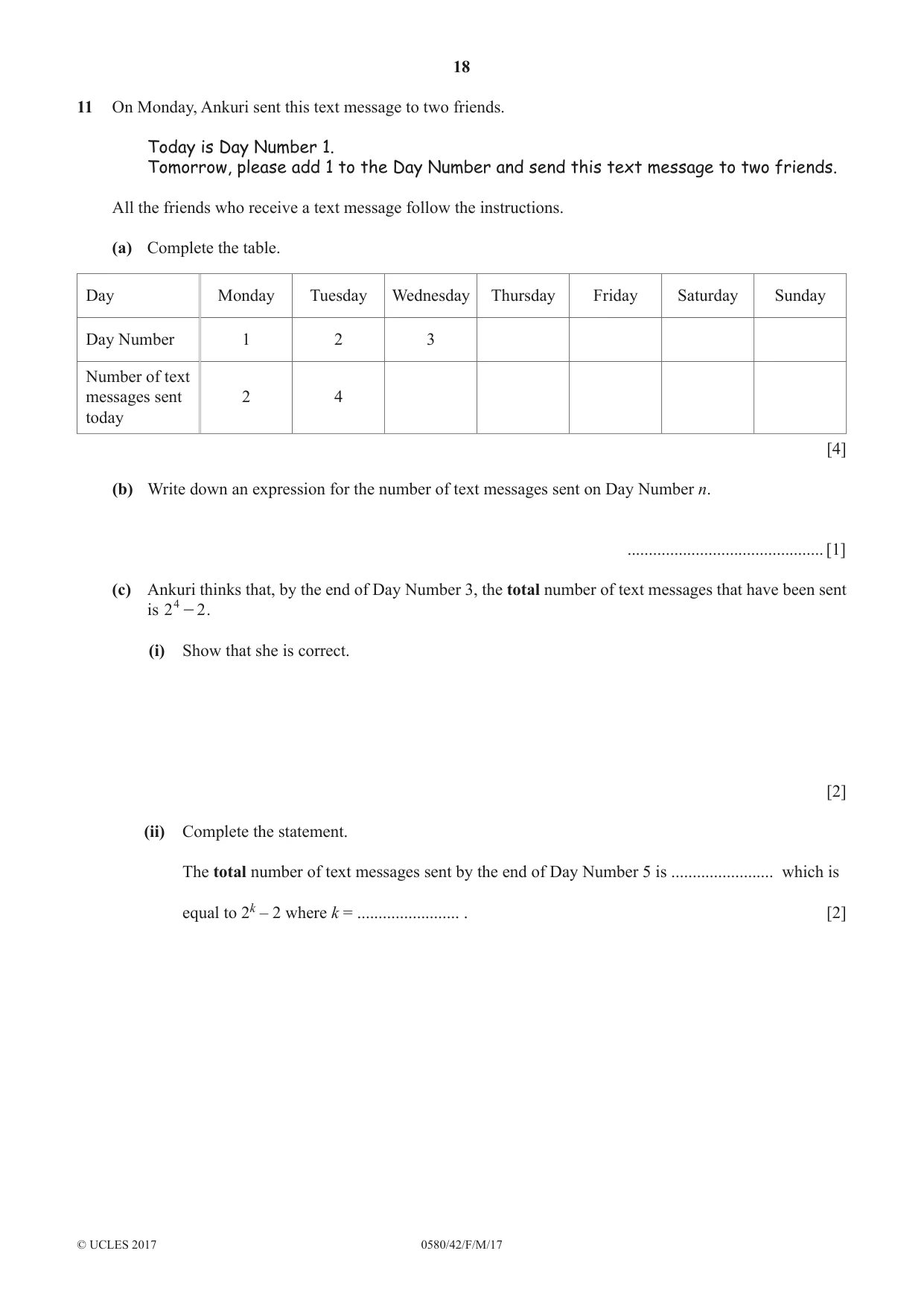
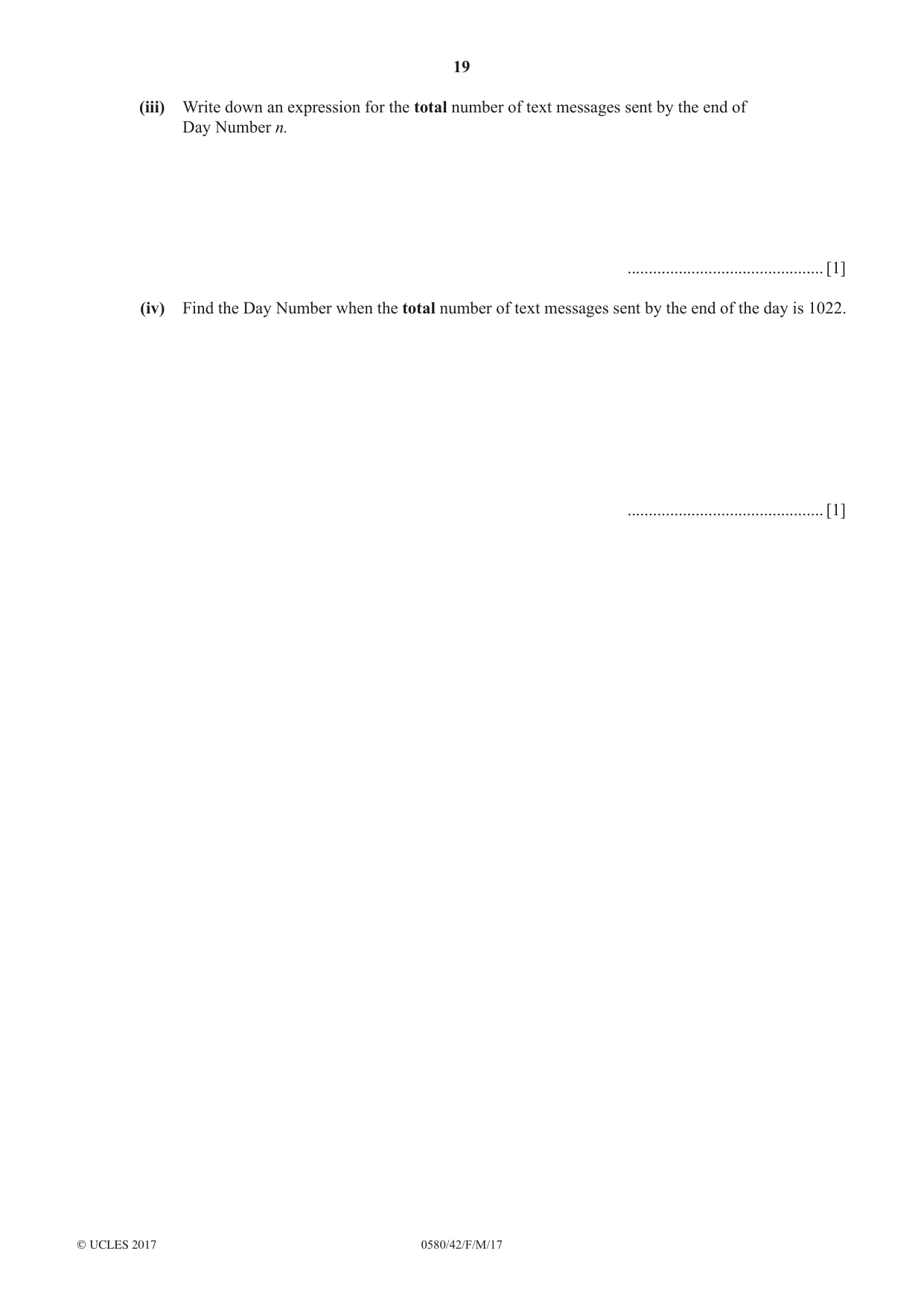
11 On Monday, Ankuri sent this text message to two friends. Today is Day Number 1. Tomorrow, please add 1 to the Day Number and send this text message to two friends. All the friends who receive a text message follow the instructions. (a) Complete the table. Day Monday Tuesday Wednesday Thursday Friday Saturday Sunday Day Number 1 2 3 Number of text messages sent 2 4 today [4] (b) Write down an expression for the number of text messages sent on Day Number n. .............................................. [1] (c) Ankuri thinks that, by the end of Day Number 3, the total number of text messages that have been sent is 2 4 - 2 . (i) Show that she is correct. [2] (ii) Complete the statement. The total number of text messages sent by the end of Day Number 5 is ........................ which is equal to 2k – 2 where k = ........................ . [2] (iii) Write down an expression for the total number of text messages sent by the end of Day Number n. .............................................. [1] (iv) Find the Day Number when the total number of text messages sent by the end of the day is 1022. .............................................. [1]
Mark scheme: 11 (a) 4 5 6 7 1 8 16 32 64 128 3 B2 for 3 or 4 correct or B1 for first 2 correct If 0 scored, SC1 for 4 values correctly doubled FT one error (b) 2n oe 1 (c) (i) 2 + 4 + 8 = 14 1 16 − 2 = 14 1 or for 14 + 2 = 16 = 24 (ii) 62 2 B1 for each and 6 (iii) 2n + 1 − 2 oe 1 (iv) 9 1
What was in this paper
The subtopics covered by these 11 questions, and how many questions each got. Open one in a new tab to see every Cambridge question on it.
What you needed in this session
Cambridge’s own grade thresholds for 2017 Feb/March, Paper 4 · Variant 2. A higher threshold means an easier paper — the bar moves with how the cohort did.