Cambridge IGCSE Mathematics 0580 — 2020 Oct/Nov Paper 4 · Variant 3
0580/43/O/N/20 · 11 questions · 130 marks · ≈146 min
The question paper and its mark scheme, free to read here and free to download. This is Cambridge’s own paper, exactly as it was sat.
Question paper20 pages
Mark scheme9 pages
Answers below. Sit the paper first if you are practising.
Questions as text
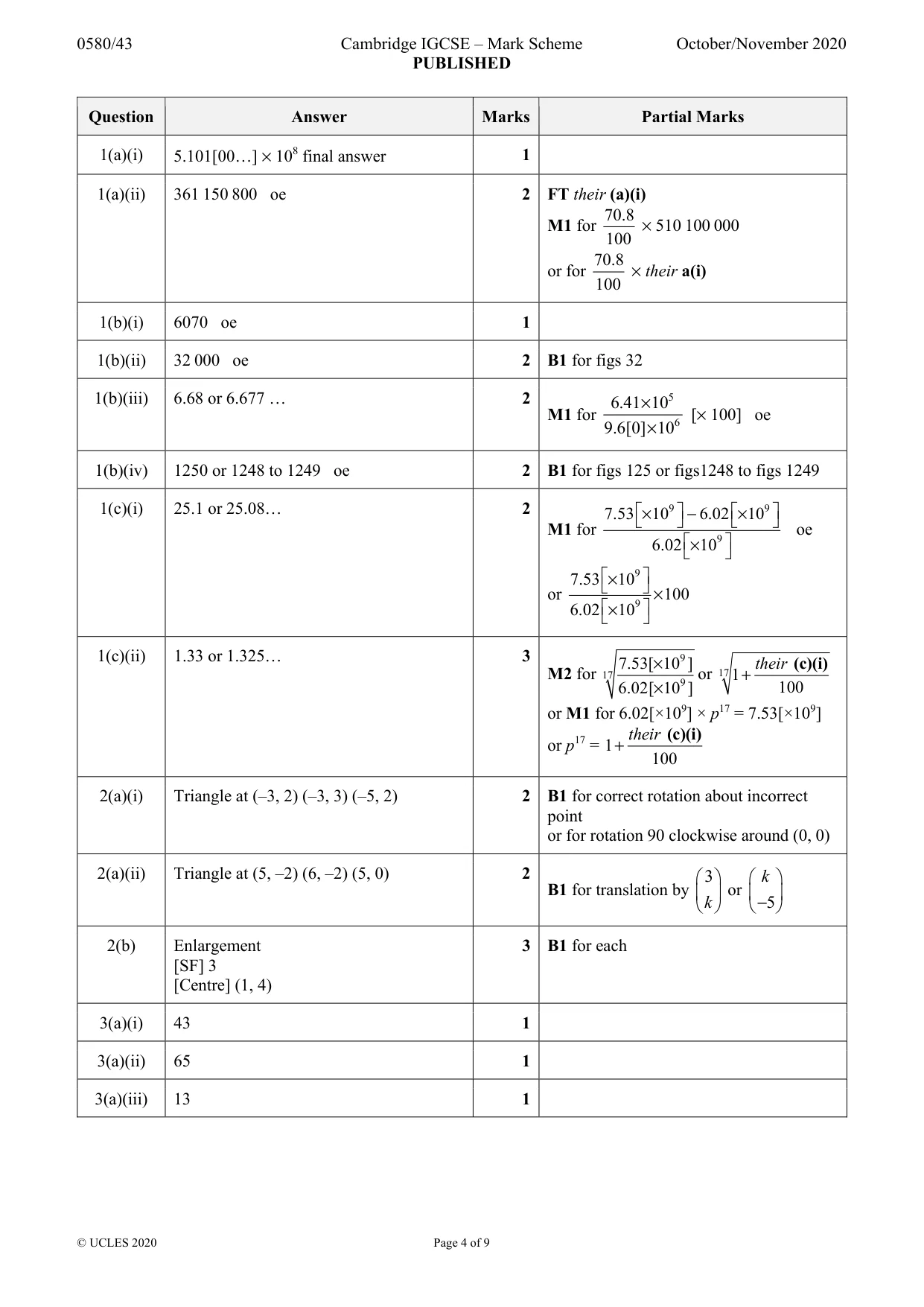
Q1 · The Earth has a surface area of approximately 510 100 000 km2
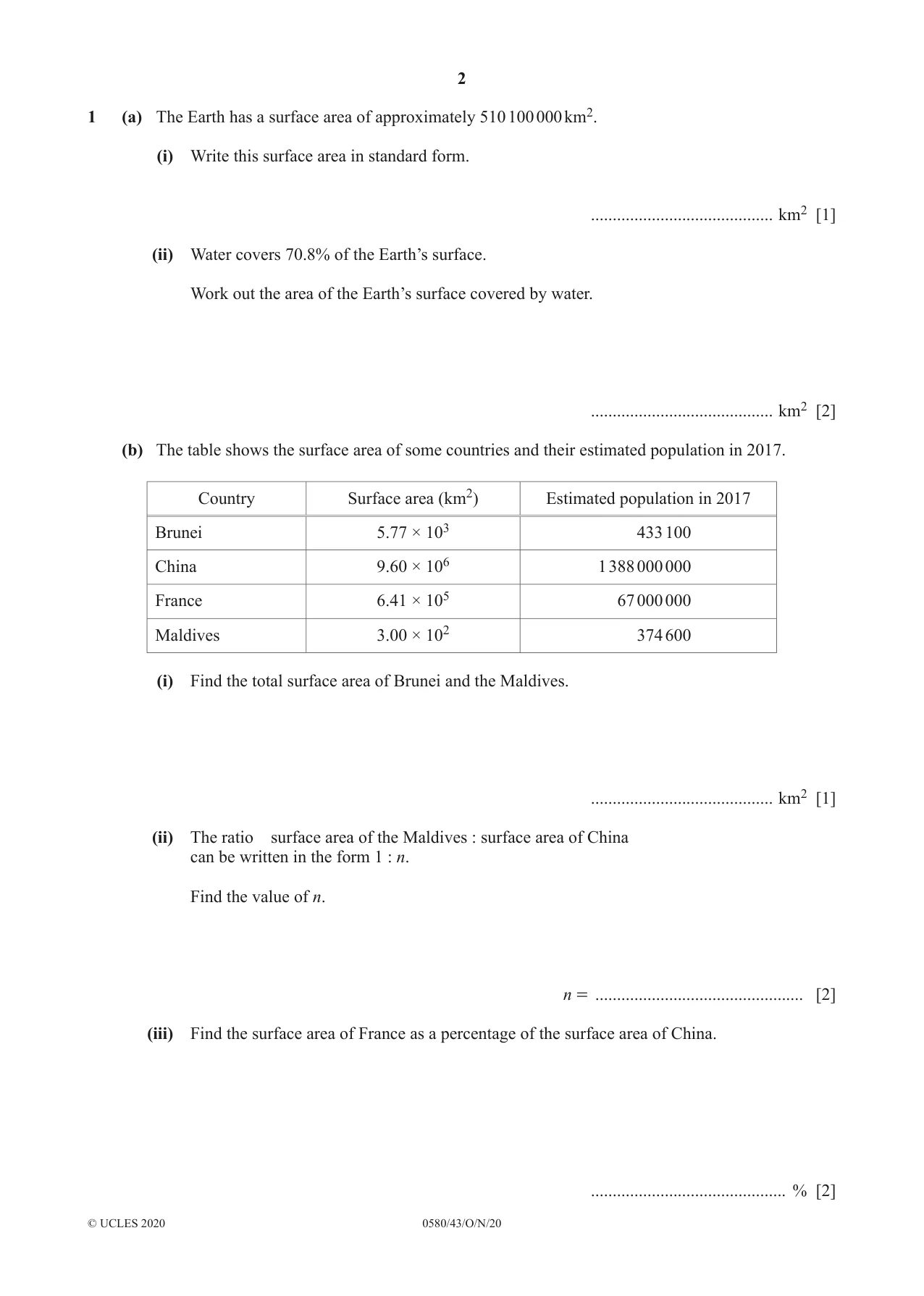
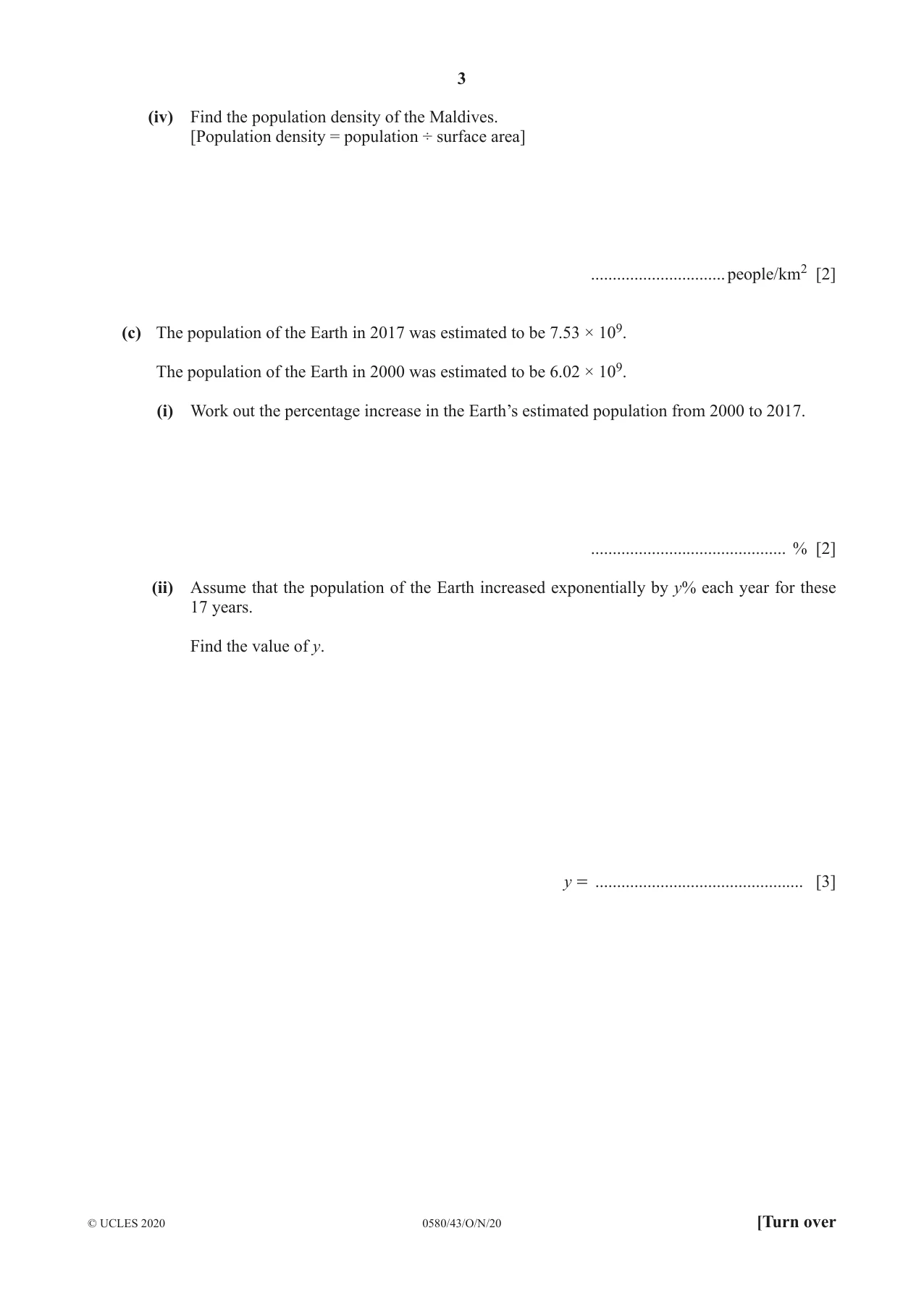
1 (a) The Earth has a surface area of approximately 510 100 000 km2. (i) Write this surface area in standard form. .......................................... km2 [1] (ii) Water covers 70.8% of the Earth’s surface. Work out the area of the Earth’s surface covered by water. .......................................... km2 [2] (b) The table shows the surface area of some countries and their estimated population in 2017. Country Surface area (km2) Estimated population in 2017 Brunei 5.77 × 10³ 433 100 China 9.60 × 10⁶ 1 388 000 000 France 6.41 × 10⁵ 67 000 000 Maldives 3.00 × 10² 374 600 (i) Find the total surface area of Brunei and the Maldives. .......................................... km2 [1] (ii) The ratio surface area of the Maldives : surface area of China can be written in the form 1 : n. Find the value of n. n = ................................................ [2] (iii) Find the surface area of France as a percentage of the surface area of China. ............................................. % [2] (iv) Find the population density of the Maldives. [Population density = population ÷ surface area] ...............................people/km2 [2] (c) The population of the Earth in 2017 was estimated to be 7.53 × 10⁹. The population of the Earth in 2000 was estimated to be 6.02 × 10⁹. (i) Work out the percentage increase in the Earth’s estimated population from 2000 to 2017. ............................................. % [2] (ii) Assume that the population of the Earth increased exponentially by y% each year for these 17 years. Find the value of y. y = ................................................ [3]
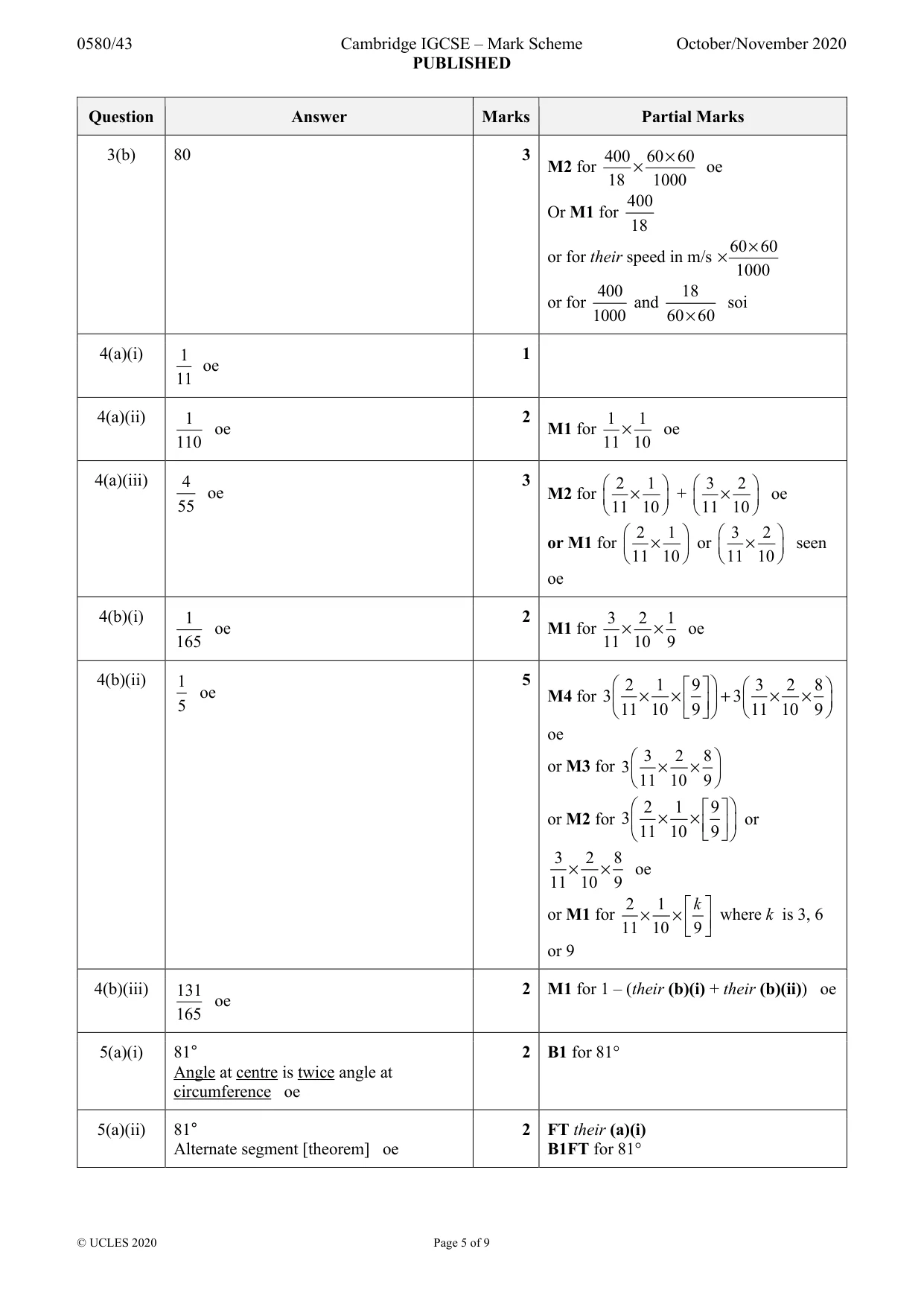
Mark scheme: Question Answer Marks Partial Marks 1(a)(i) 5.101[00…] × 108 final answer 1 1(a)(ii) 361 150 800 oe 2 FT their (a)(i) 70.8 M1 for × 510 100 000 100 70.8 or for × their a(i) 100 1(b)(i) 6070 oe 1 1(b)(ii) 32 000 oe 2 B1 for figs 32 1(b)(iii) 6.68 or 6.677 … 2 6.41 × 10⁵ M1 for [× 100] oe 9.6[0] × 106 1(b)(iv) 1250 or 1248 to 1249 oe 2 B1 for figs 125 or figs1248 to figs 1249 1(c)(i) 25.1 or 25.08… 2 7.53 × 10 9 − 6.02 × 10 9 M1 for oe 6.02 × 10 9 7.53 × 10 9 or × 100 6.02 × 10 9 1(c)(ii) 1.33 or 1.325… 3 9 7.53[× 10 ] their (c)(i) M2 for 17 or 17 1 + 6.02[× 10 9 ] 100 or M1 for 6.02[×109] × p17 = 7.53[×109] their (c)(i) or p17 = 1 + 100
Q2 · Y 8 7 6 5 4 A B 3 2 1 0 x – 6 – 5 – 4 – 3 – 2 – 1 1 2 3 4 5 6 7 8 – 1 – 2 – 3 – 4 – 5 – 6…
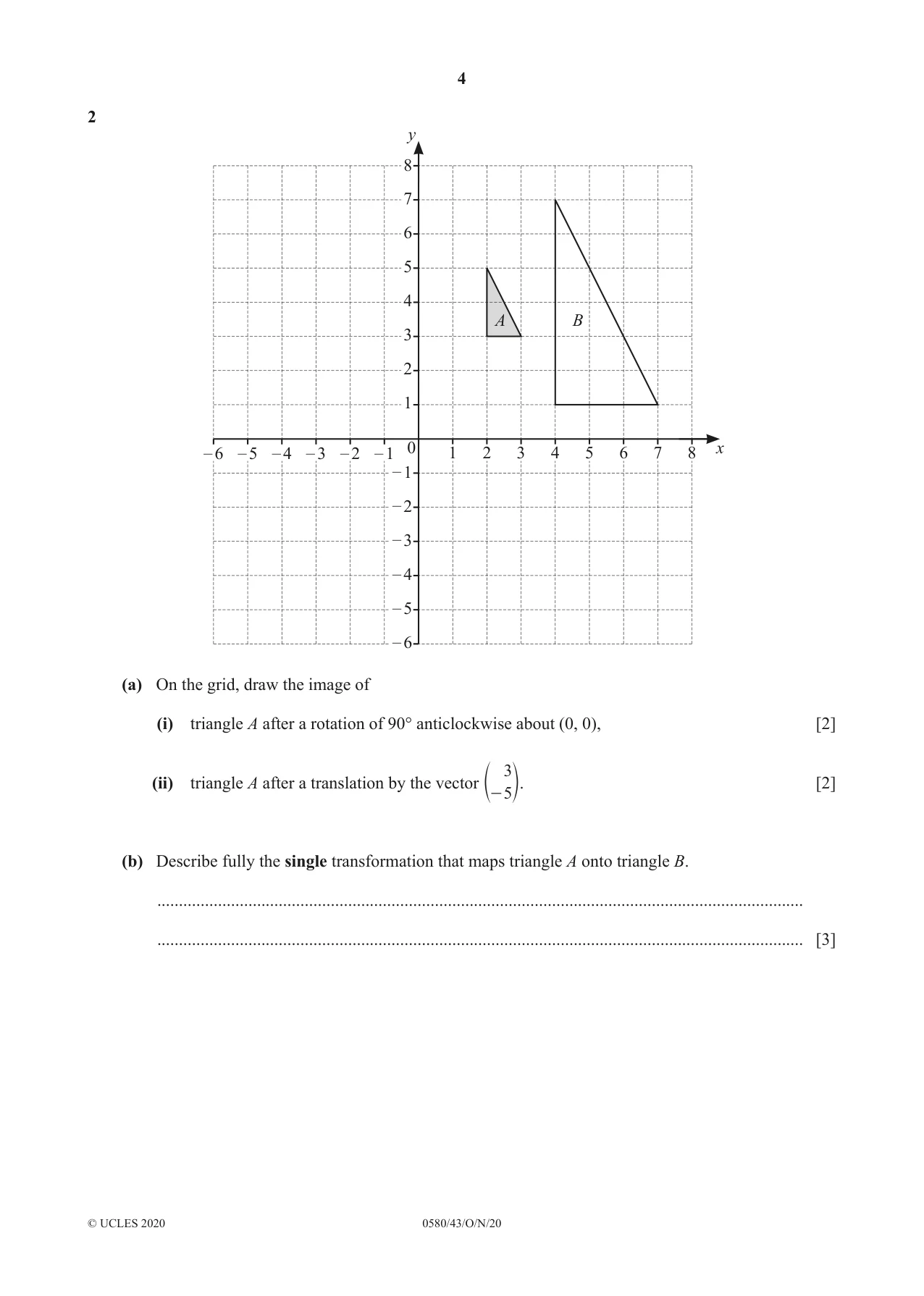
2 y 8 7 6 5 4 A B 3 2 1 0 x – 6 – 5 – 4 – 3 – 2 – 1 1 2 3 4 5 6 7 8 – 1 – 2 – 3 – 4 – 5 – 6 (a) On the grid, draw the image of (i) triangle A after a rotation of 90° anticlockwise about (0, 0), [2] 3 (ii) triangle A after a translation by the vector [2] e- 5o. (b) Describe fully the single transformation that maps triangle A onto triangle B. ..................................................................................................................................................... ..................................................................................................................................................... [3]
Mark scheme: 2(a)(i) Triangle at (–3, 2) (–3, 3) (–5, 2) 2 B1 for correct rotation about incorrect point or for rotation 90 clockwise around (0, 0) 2(a)(ii) Triangle at (5, –2) (6, –2) (5, 0) 2 3 k B1 for translation by or k −5 2(b) Enlargement 3 B1 for each [SF] 3 [Centre] (1, 4)
Q3 · The average speeds, in km/h, of cars travelling along a road are recorded
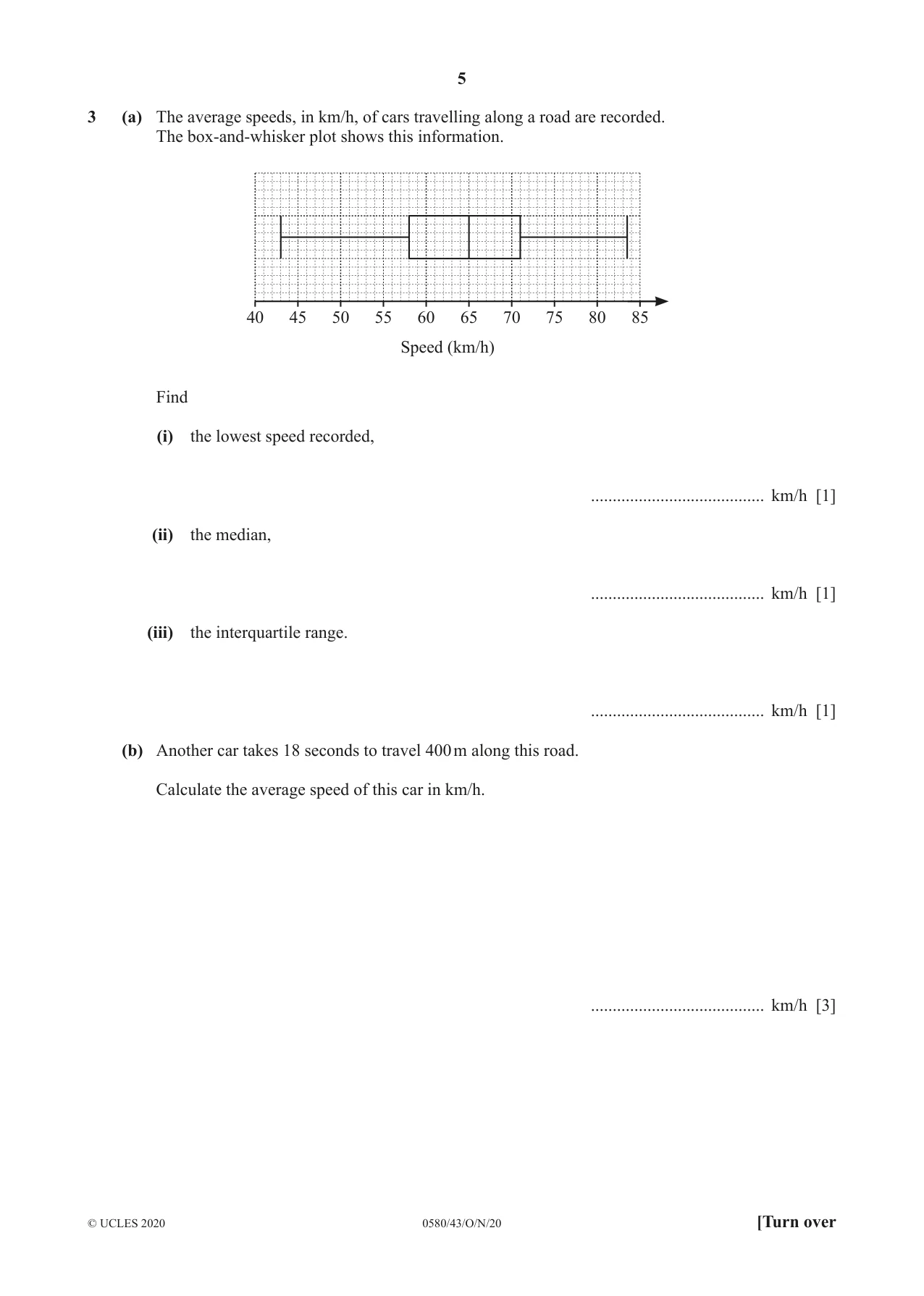
3 (a) The average speeds, in km/h, of cars travelling along a road are recorded. The box-and-whisker plot shows this information. 40 45 50 55 60 65 70 75 80 85 Speed (km/h) Find (i) the lowest speed recorded, ........................................ km/h [1] (ii) the median, ........................................ km/h [1] (iii) the interquartile range. ........................................ km/h [1] (b) Another car takes 18 seconds to travel 400 m along this road. Calculate the average speed of this car in km/h. ........................................ km/h [3]
Mark scheme: 3(a)(i) 43 1 3(a)(ii) 65 1 3(a)(iii) 13 1 3(b) 80 3 400 60 × 60 M2 for × oe 18 1000 400 Or M1 for 18 60 × 60 or for their speed in m/s × 1000 400 18 or for and soi 1000 60 × 60
Q4 · P O S S I B I L I T Y Morgan picks two of these letters, at random, without replacement
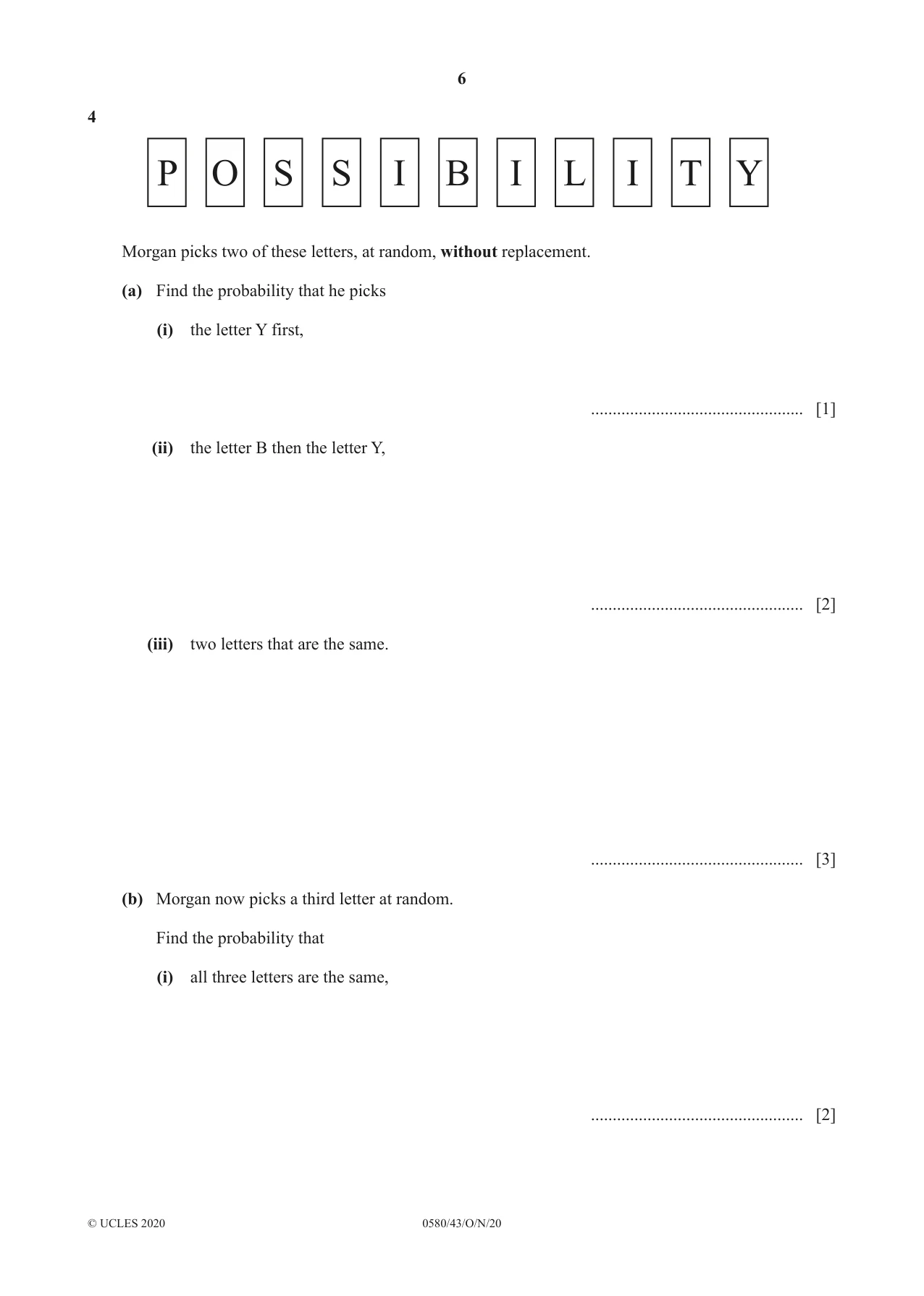
4 P O S S I B I L I T Y Morgan picks two of these letters, at random, without replacement. (a) Find the probability that he picks (i) the letter Y first, ................................................. [1] (ii) the letter B then the letter Y, ................................................. [2] (iii) two letters that are the same. ................................................. [3] (b) Morgan now picks a third letter at random. Find the probability that (i) all three letters are the same, ................................................. [2] (ii) exactly two of the three letters are the same, ................................................. [5] (iii) all three letters are different. ................................................. [2]
Mark scheme: 4(a)(i) 1 1 oe 11 4(a)(ii) 1 2 1 1 oe M1 for × oe 110 11 10 4(a)(iii) 4 3 2 1 3 2 oe M2 for × + × oe 55 11 10 11 10 2 1 3 2 or M1 for × or × seen 11 10 11 10 oe 4(b)(i) 1 2 3 2 1 oe M1 for × × oe 165 11 10 9 4(b)(ii) 1 5 2 1 9 3 2 8 × × × oe M4 for 3 + 3 × 5 10 10 9 9 11 11 oe 3 2 8 or M3 for 3 × × 11 10 9 2 1 9 or M2 for 3 × × or 11 10 9 3 2 8 × × oe 11 10 9 2 1 k or M1 for × × where k is 3, 6 11 10 9 or 9 4(b)(iii) 131 2 M1 for 1 – (their (b)(i) + their (b)(ii)) oe oe 165
Q5 · C B z A x NOT TO O 162° SCALE 42° y E D F A, B, C and D are points on the circle, centre O
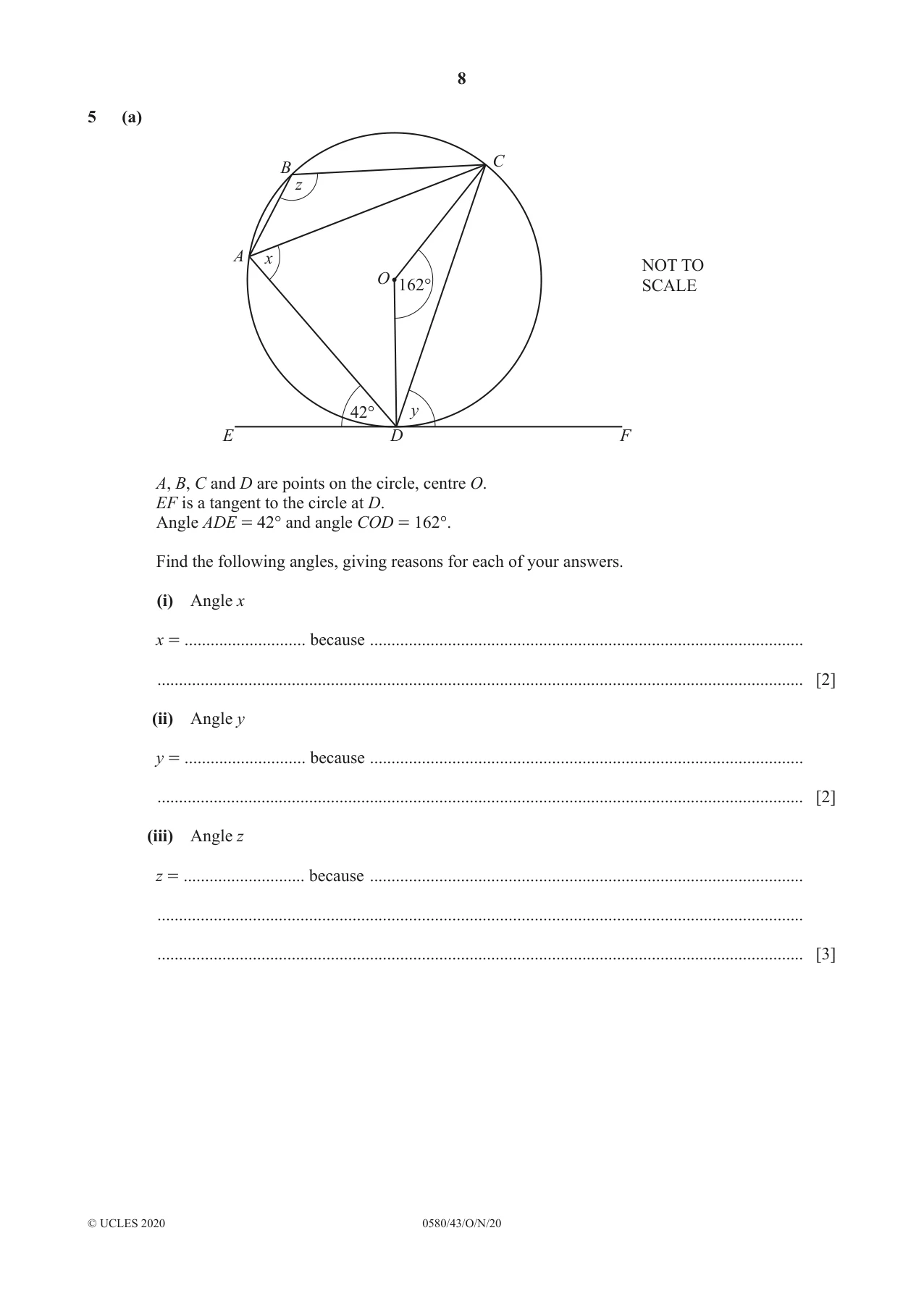
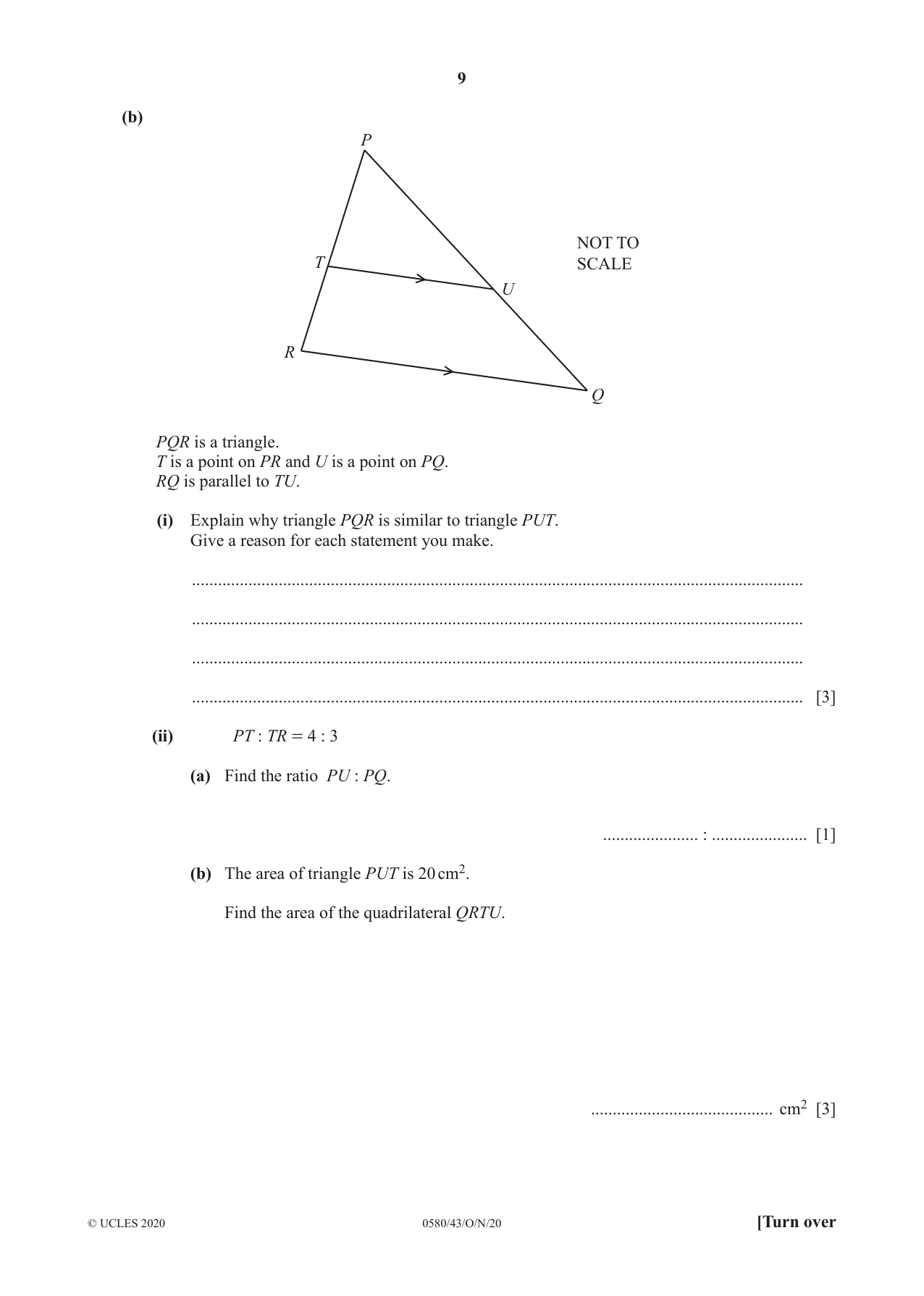
5 (a) C B z A x NOT TO O 162° SCALE 42° y E D F A, B, C and D are points on the circle, centre O. EF is a tangent to the circle at D. Angle ADE = 42° and angle COD = 162°. Find the following angles, giving reasons for each of your answers. (i) Angle x x = ............................ because .................................................................................................... ..................................................................................................................................................... [2] (ii) Angle y y = ............................ because .................................................................................................... ..................................................................................................................................................... [2] (iii) Angle z z = ............................ because .................................................................................................... ..................................................................................................................................................... ..................................................................................................................................................... [3] (b) P NOT TO T SCALE U R Q PQR is a triangle. T is a point on PR and U is a point on PQ. RQ is parallel to TU. (i) Explain why triangle PQR is similar to triangle PUT. Give a reason for each statement you make. ............................................................................................................................................. ............................................................................................................................................. ............................................................................................................................................. ............................................................................................................................................. [3] (ii) PT : TR = 4 : 3 (a) Find the ratio PU : PQ. ...................... : ...................... [1] (b) The area of triangle PUT is 20 cm2. Find the area of the quadrilateral QRTU. .......................................... cm2 [3]
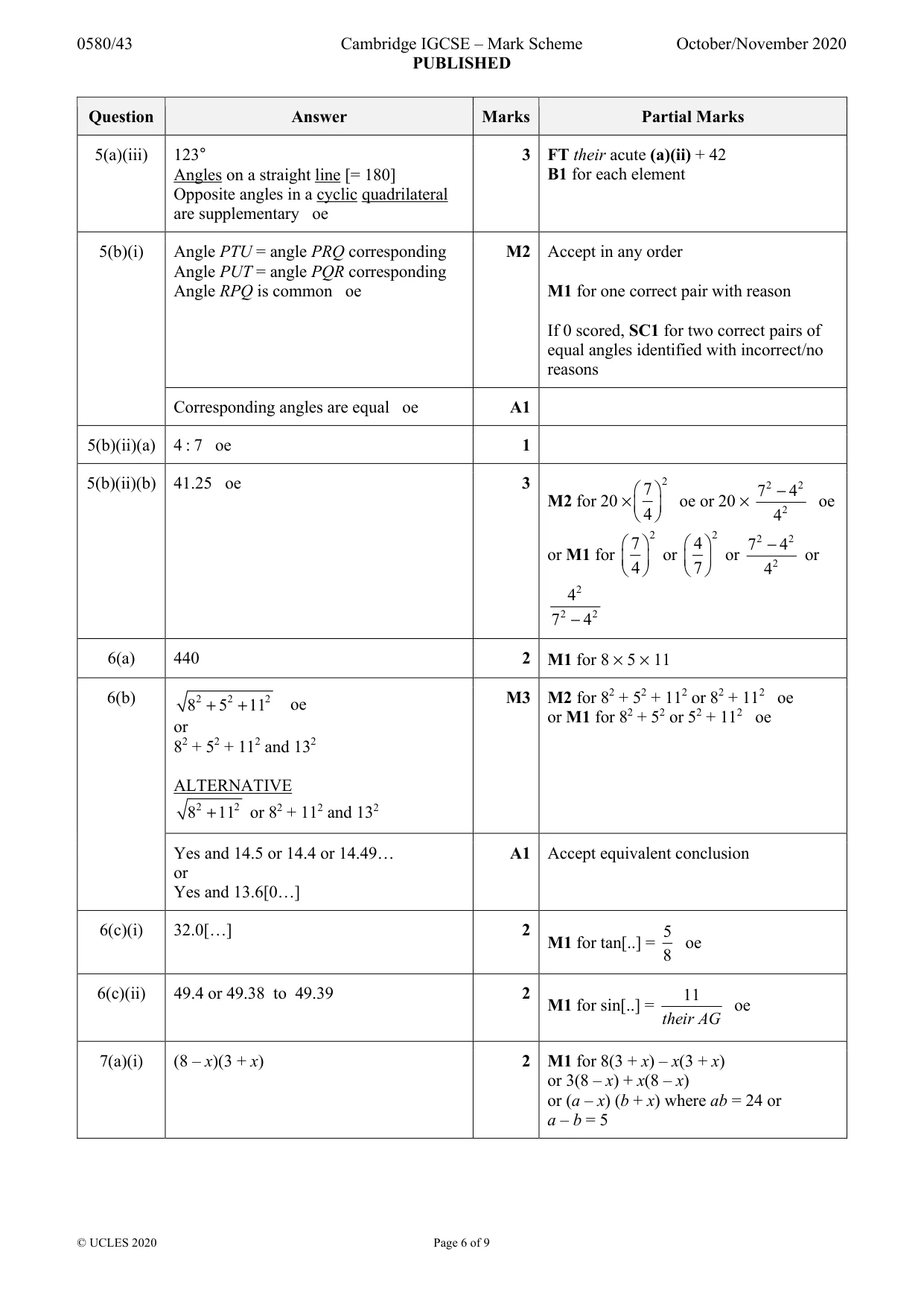
Mark scheme: 5(a)(i) 81° 2 B1 for 81° Angle at centre is twice angle at circumference oe 5(a)(ii) 81° 2 FT their (a)(i) Alternate segment [theorem] oe B1FT for 81° 5(a)(iii) 123° 3 FT their acute (a)(ii) + 42 Angles on a straight line [= 180] B1 for each element Opposite angles in a cyclic quadrilateral are supplementary oe 5(b)(i) Angle PTU = angle PRQ corresponding M2 Accept in any order Angle PUT = angle PQR corresponding Angle RPQ is common oe M1 for one correct pair with reason If 0 scored, SC1 for two correct pairs of equal angles identified with incorrect/no reasons Corresponding angles are equal oe A1 5(b)(ii)(a) 4 : 7 oe 1 5(b)(ii)(b) 41.25 oe 3 2 2 2 7 7 − 4 M2 for 20 × oe or 20 × 2 oe 4 4 7 2 4 2 7 2 − 4 2 or M1 for or or 2 or 4 7 4 4 2 7 2 − 4 2
Q6 · H G F E 11 cm NOT TO SCALE D C 5 cm A 8 cm B ABCDEFGH is a cuboid
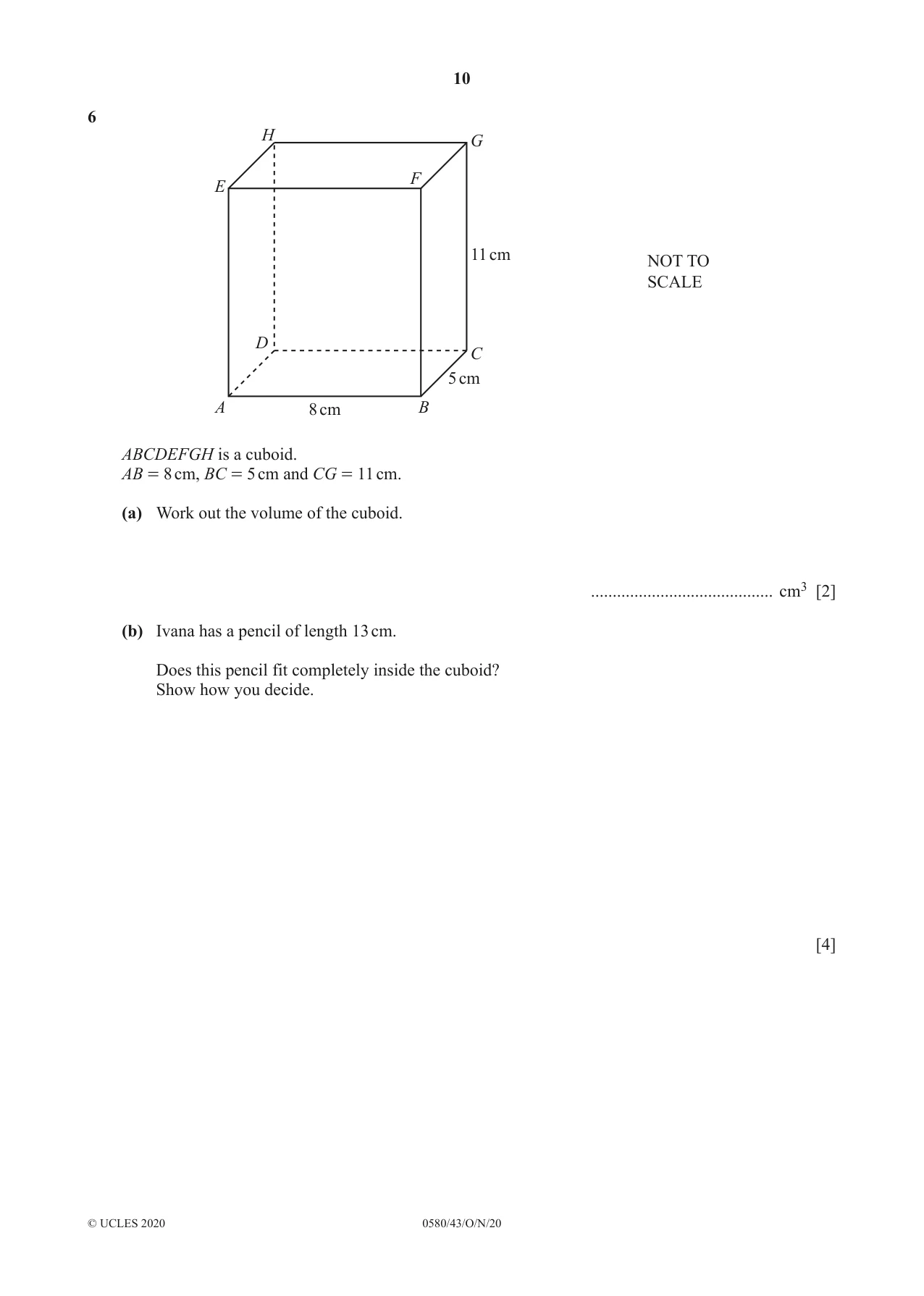
6 H G F E 11 cm NOT TO SCALE D C 5 cm A 8 cm B ABCDEFGH is a cuboid. AB = 8 cm, BC = 5 cm and CG = 11 cm. (a) Work out the volume of the cuboid. .......................................... cm3 [2] (b) Ivana has a pencil of length 13 cm. Does this pencil fit completely inside the cuboid? Show how you decide. [4] (c) (i) Calculate angle CAB. Angle CAB = ................................................ [2] (ii) Calculate angle GAC. Angle GAC = ................................................ [2]
Mark scheme: 6(a) 440 2 M1 for 8 × 5 × 11 6(b) 2 2 2 M3 M2 for 82 + 52 + 112 or 82 + 112 oe 8 + 5 + 11 oe or M1 for 82 + 52 or 52 + 112 oe or 82 + 52 + 112 and 132 ALTERNATIVE 8 2 + 112 or 82 + 112 and 132 Yes and 14.5 or 14.4 or 14.49… A1 Accept equivalent conclusion or Yes and 13.6[0…] 6(c)(i) 32.0[…] 2 5 M1 for tan[..] = oe 8 6(c)(ii) 49.4 or 49.38 to 49.39 2 11 M1 for sin[..] = oe their AG
Q7 · Factorise 24 + 5x - x 2
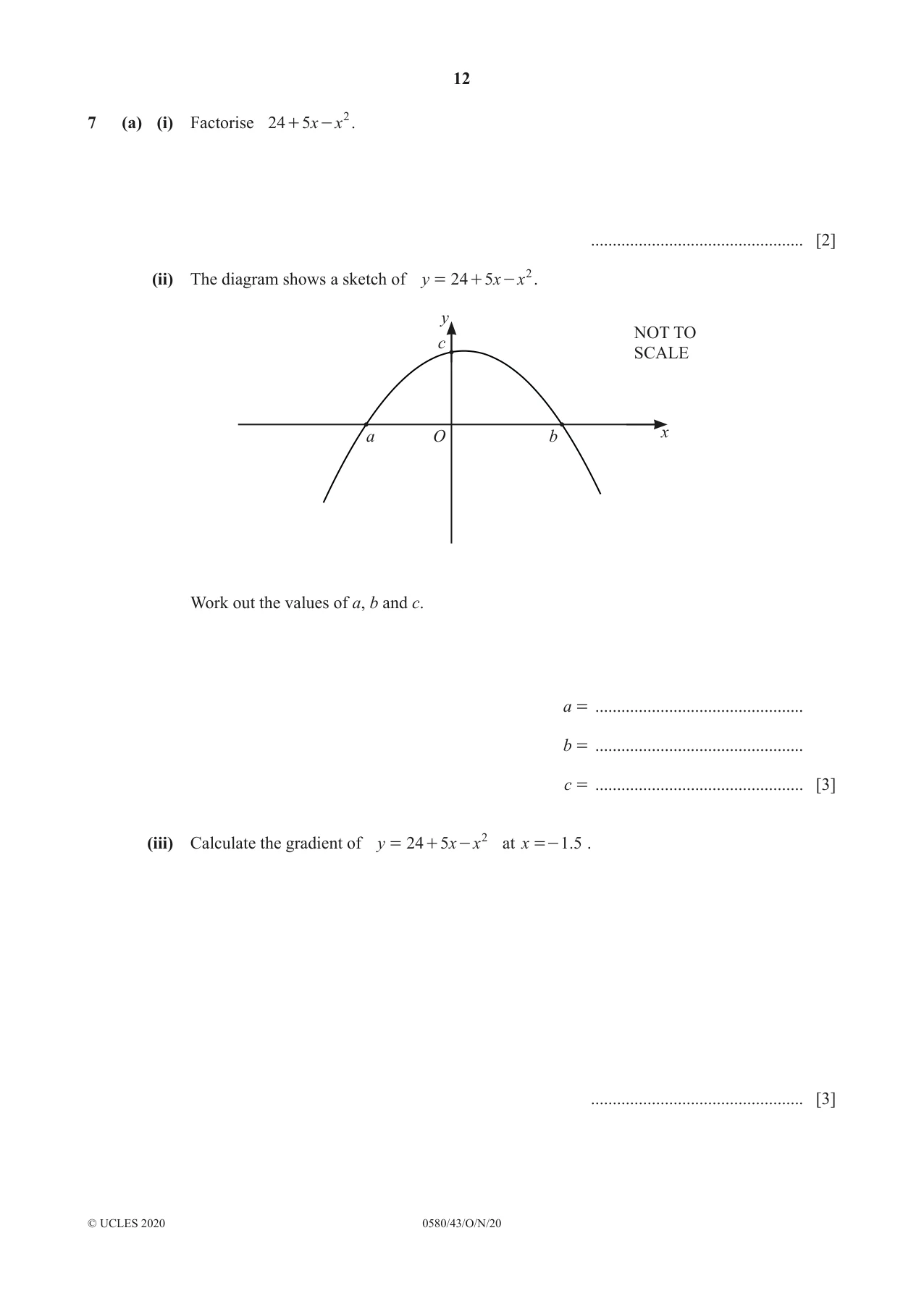
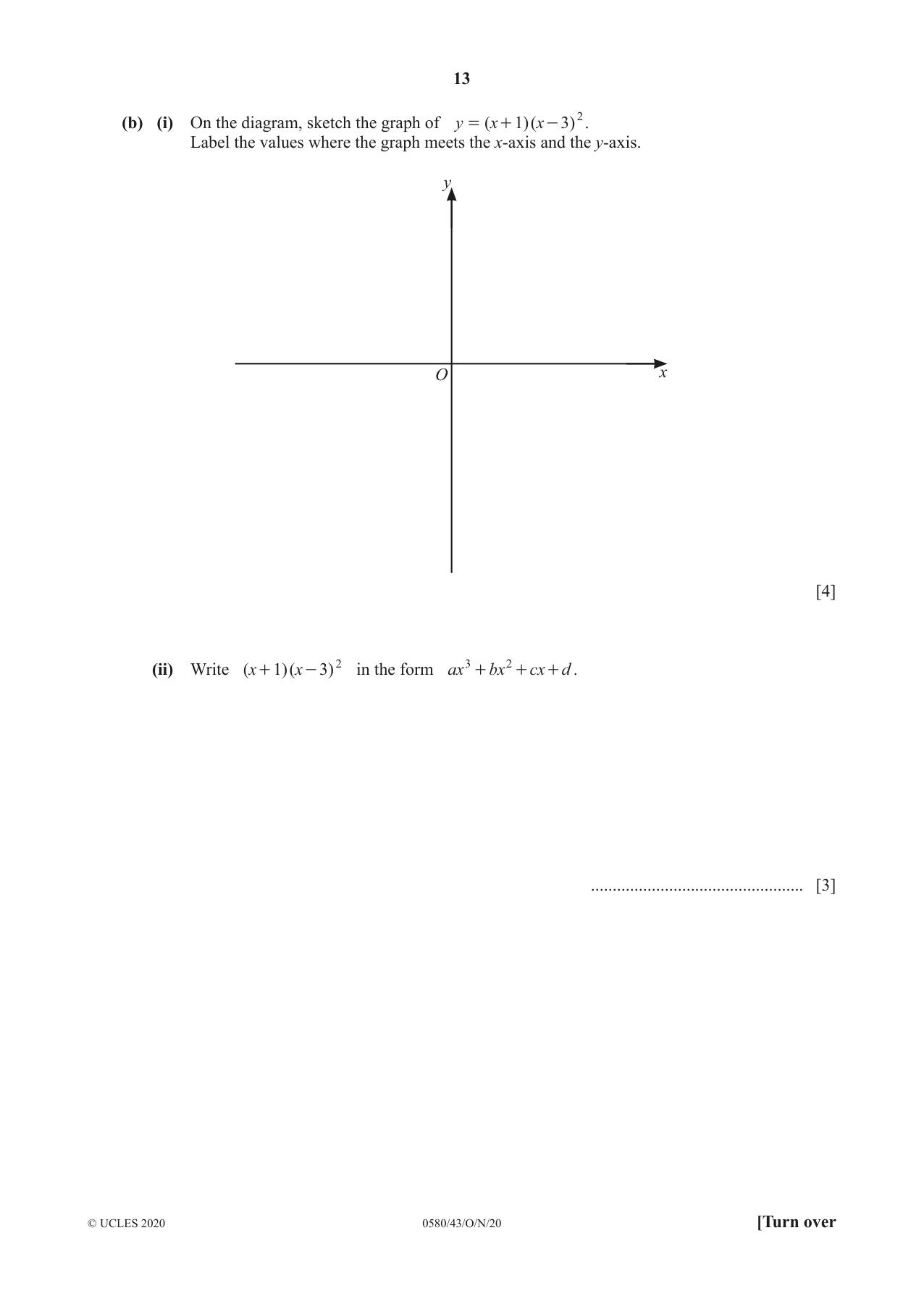
7 (a) (i) Factorise 24 + 5x - x 2 . ................................................. [2] (ii) The diagram shows a sketch of y = 24 + 5 x - x 2 . y NOT TO c SCALE a O b x Work out the values of a, b and c. a = ................................................ b = ................................................ c = ................................................ [3] (iii) Calculate the gradient of y = 24 + 5x - x 2 at x =- 1.5 . ................................................. [3] (b) (i) On the diagram, sketch the graph of y = ( x + 1)( x - 3) 2 . Label the values where the graph meets the x-axis and the y-axis. y O x [4] (ii) Write ( x + 1)( x - 3) 2 in the form ax 3 + bx 2 + cx + d . ................................................. [3]
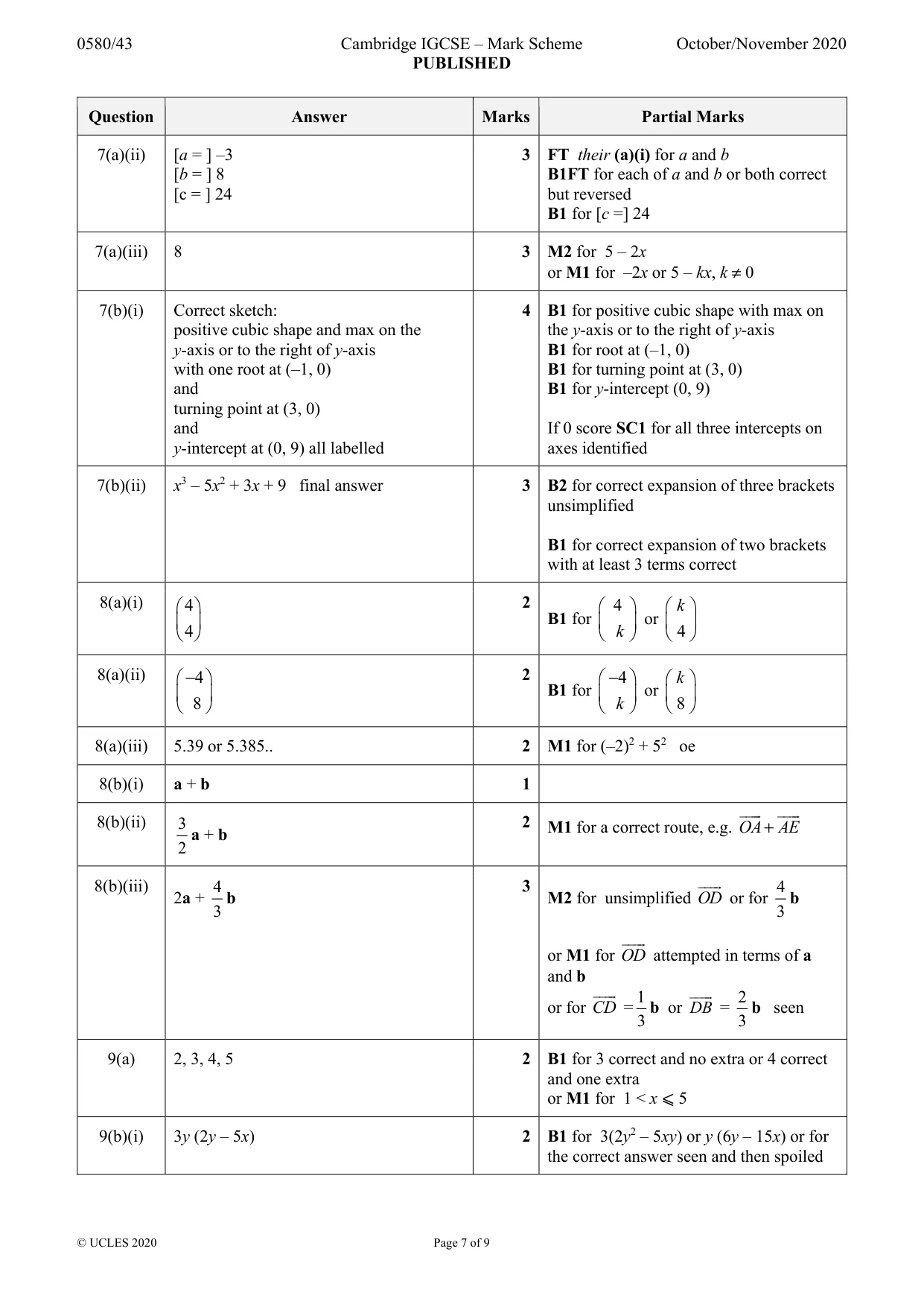
Mark scheme: 7(a)(i) (8 – x)(3 + x) 2 M1 for 8(3 + x) – x(3 + x) or 3(8 – x) + x(8 – x) or (a – x) (b + x) where ab = 24 or a – b = 5 7(a)(ii) [a = ] –3 3 FT their (a)(i) for a and b [b = ] 8 B1FT for each of a and b or both correct [c = ] 24 but reversed B1 for [c =] 24 7(a)(iii) 8 3 M2 for 5 – 2x or M1 for –2x or 5 – kx, k ≠ 0 7(b)(i) Correct sketch: 4 B1 for positive cubic shape with max on positive cubic shape and max on the the y-axis or to the right of y-axis y-axis or to the right of y-axis B1 for root at (–1, 0) with one root at (–1, 0) B1 for turning point at (3, 0) and B1 for y-intercept (0, 9) turning point at (3, 0) and If 0 score SC1 for all three intercepts on y-intercept at (0, 9) all labelled axes identified 7(b)(ii) x3 – 5x2 + 3x + 9 final answer 3 B2 for correct expansion of three brackets unsimplified B1 for correct expansion of two brackets with at least 3 terms correct
Q8 · - 2 2 8 (a) AB = BC = DC = e- 1o e 5o e- 3o Find (i) AC, AC = [2] f p (ii) BD, BD = [2] f…
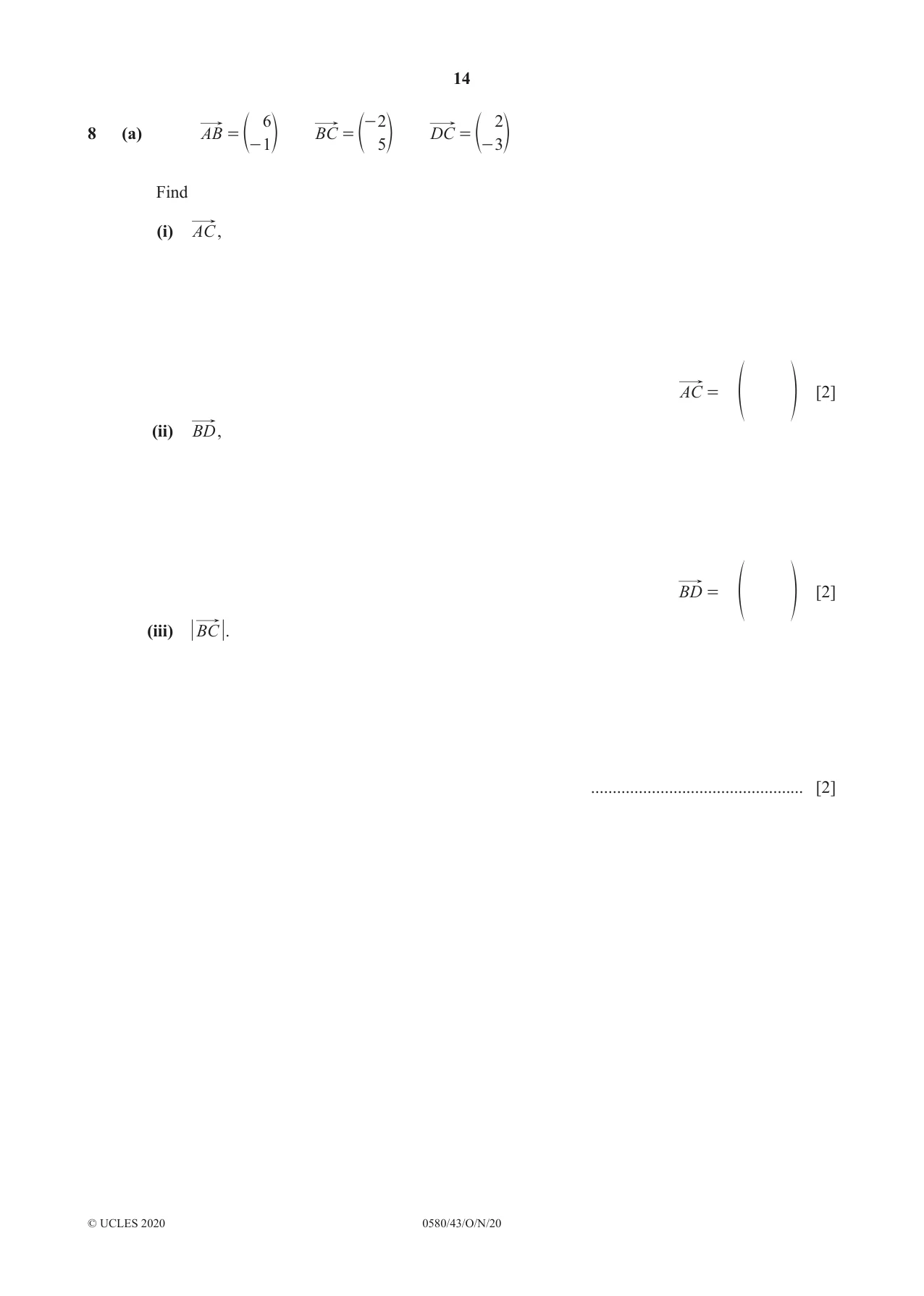
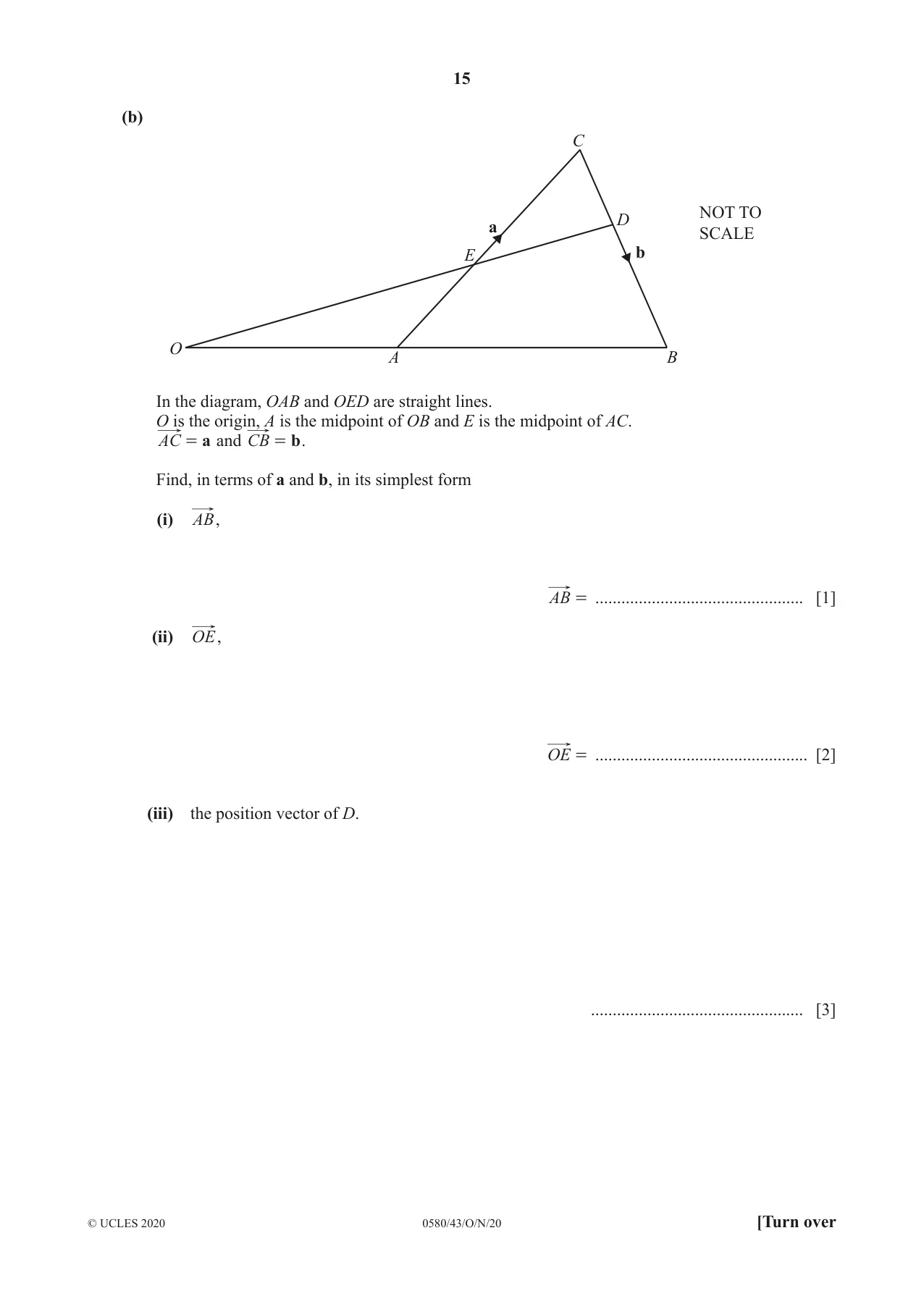
6 - 2 2 8 (a) AB = BC = DC = e- 1o e 5o e- 3o Find (i) AC, AC = [2] f p (ii) BD, BD = [2] f p (iii) BC . ................................................. [2] (b) C NOT TO D a SCALE E b O A B In the diagram, OAB and OED are straight lines. O is the origin, A is the midpoint of OB and E is the midpoint of AC. AC = a and CB = b . Find, in terms of a and b, in its simplest form (i) AB, AB = ................................................ [1] (ii) OE, OE = ................................................. [2] (iii) the position vector of D. ................................................. [3]
Mark scheme: 8(a)(i) 4 2 4 k B1 for or 4 k 4 8(a)(ii) −4 2 −4 k B1 for or 8 k 8 8(a)(iii) 5.39 or 5.385.. 2 M1 for (–2)2 + 52 oe 8(b)(i) a + b 1 8(b)(ii) 3 2 M1 for a correct route, e.g. OA + AE a + b 2 8(b)(iii) 4 3 4 2a + b M2 for unsimplified OD or for b 3 3 or M1 for OD attempted in terms of a and b 1 2 or for CD = b or DB = b seen 3 3
Q9 · Find the integer values that satisfy the inequality 2 1 2 x G 10
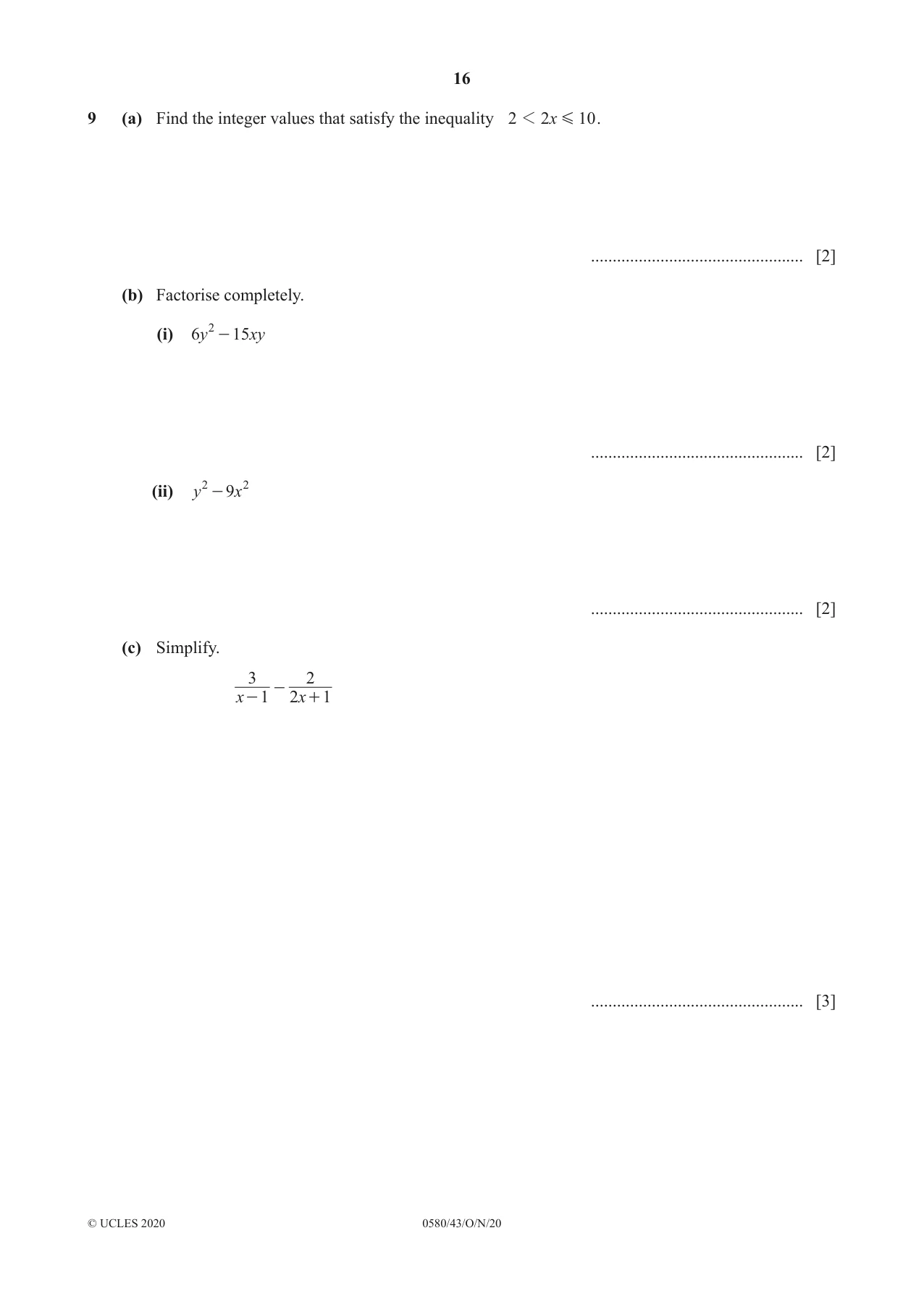
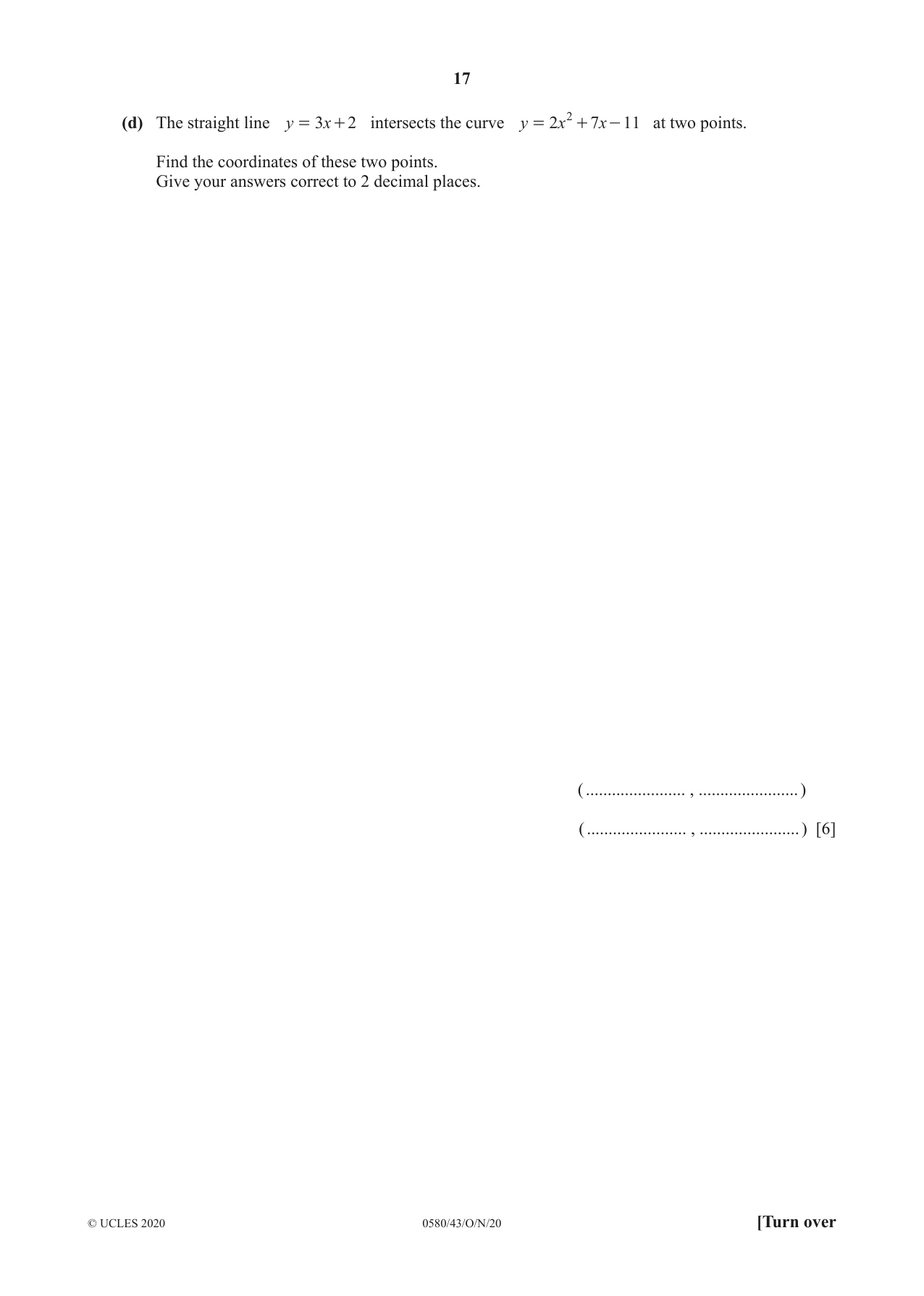
9 (a) Find the integer values that satisfy the inequality 2 1 2 x G 10 . ................................................. [2] (b) Factorise completely. (i) 6y 2 - 15 xy ................................................. [2] (ii) y 2 - 9x 2 ................................................. [2] (c) Simplify. 3 2 - x - 1 2x + 1 ................................................. [3] (d) The straight line y = 3x + 2 intersects the curve y = 2x 2 + 7x - 11 at two points. Find the coordinates of these two points. Give your answers correct to 2 decimal places. ( ....................... , ....................... ) ( ....................... , ....................... ) [6]
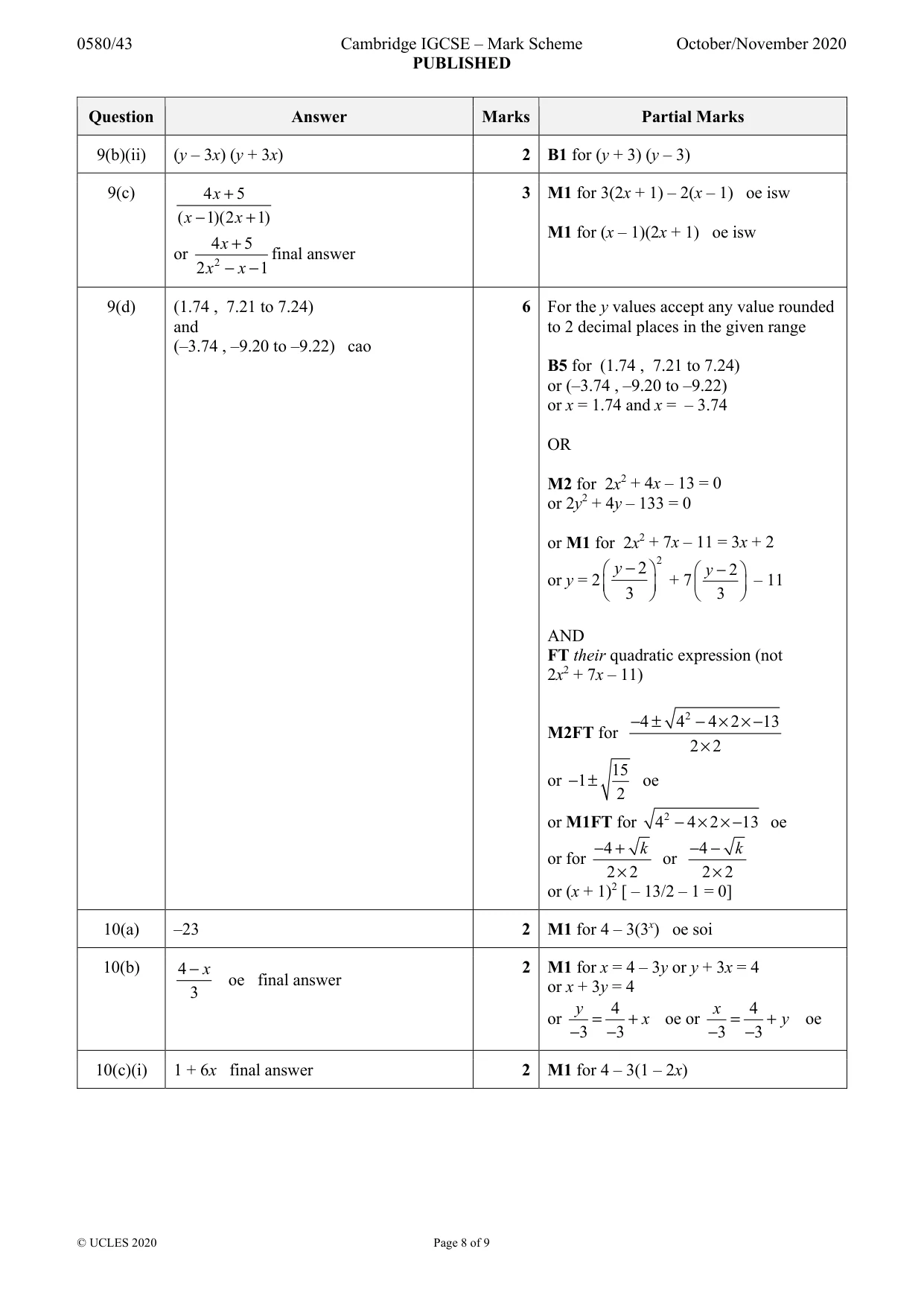
Mark scheme: 9(a) 2, 3, 4, 5 2 B1 for 3 correct and no extra or 4 correct and one extra or M1 for 1 < x ⩽ 5 9(b)(i) 3y (2y – 5x) 2 B1 for 3(2y2 – 5xy) or y (6y – 15x) or for the correct answer seen and then spoiled 9(b)(ii) (y – 3x) (y + 3x) 2 B1 for (y + 3) (y – 3) 9(c) 4 x + 5 3 M1 for 3(2x + 1) – 2(x – 1) oe isw ( x − 1)(2 x + 1) M1 for (x – 1)(2x + 1) oe isw 4 x + 5 or final answer 2 x 2 − x − 1 9(d) (1.74 , 7.21 to 7.24) 6 For the y values accept any value rounded and to 2 decimal places in the given range (–3.74 , –9.20 to –9.22) cao B5 for (1.74 , 7.21 to 7.24) or (–3.74 , –9.20 to –9.22) or x = 1.74 and x = – 3.74 OR M2 for 2x2 + 4x – 13 = 0 or 2y2 + 4y – 133 = 0 or M1 for 2x2 + 7x – 11 = 3x + 2 y − 2 2 y − 2 or y = 2 + 7 – 11 3 3 AND FT their quadratic expression (not 2x2 + 7x – 11) −±4 4 2 −×4 2 × −13 M2FT for 2 × 2 15 or −±1 oe 2 or M1FT for 4 2 − 4 × 2 × −13 oe −+4 k −−4 k or for or 2 × 2 2 × 2 or (x + 1)2 [ – 13/2 – 1 = 0]
Q10 · F ( x) = 4 - 3 x g ( x) = x2 + x h ( x) = 3x (a) Find fh(2)
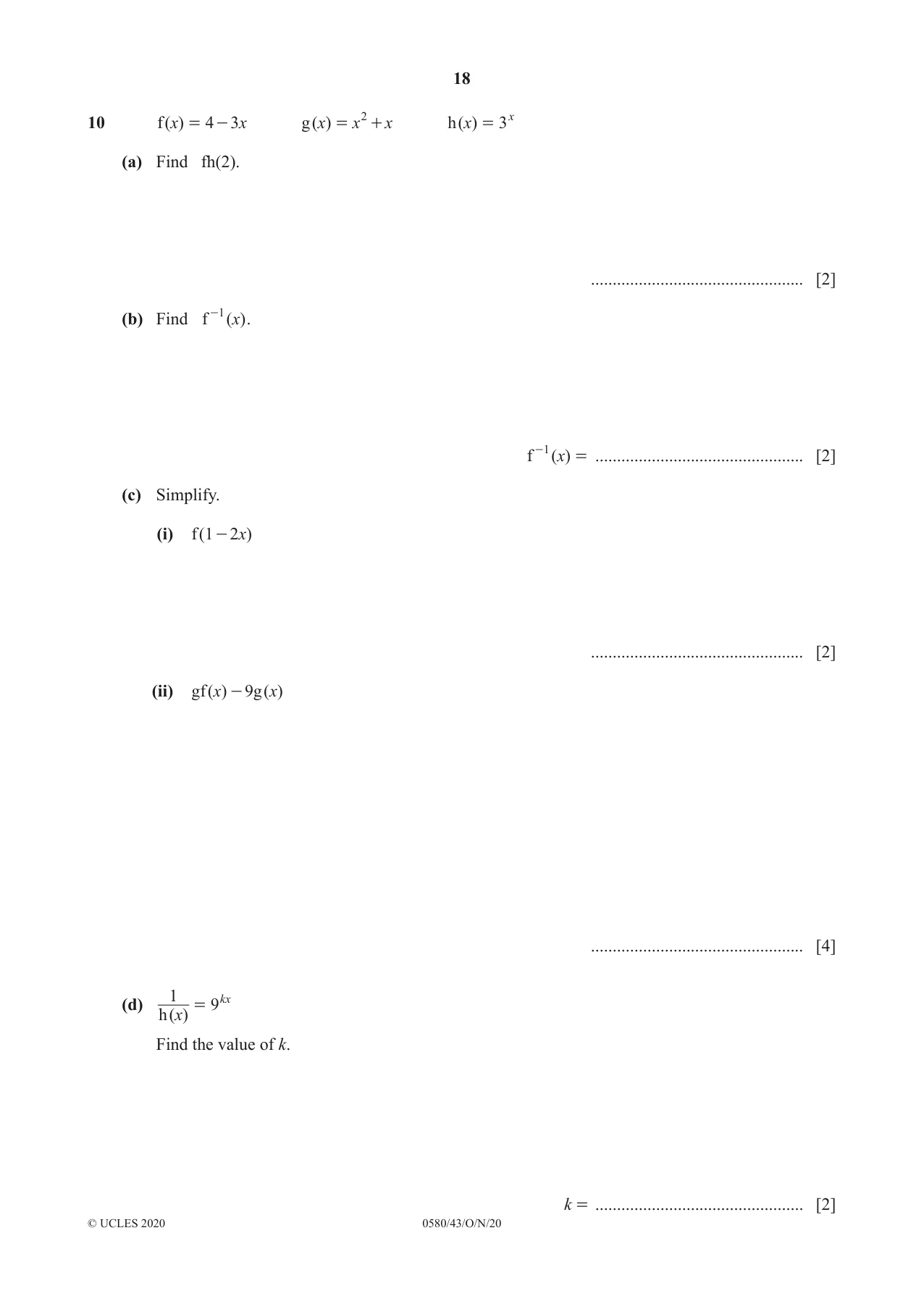
10 f ( x) = 4 - 3 x g ( x) = x2 + x h ( x) = 3x (a) Find fh(2). ................................................. [2] (b) Find f -1 ( x) . f -1 ( x) = ................................................ [2] (c) Simplify. (i) f ( 1 - 2 x) ................................................. [2] (ii) gf ( x) - 9g ( x) ................................................. [4] 1 (d) = 9kx h ( x) Find the value of k. k = ................................................ [2]
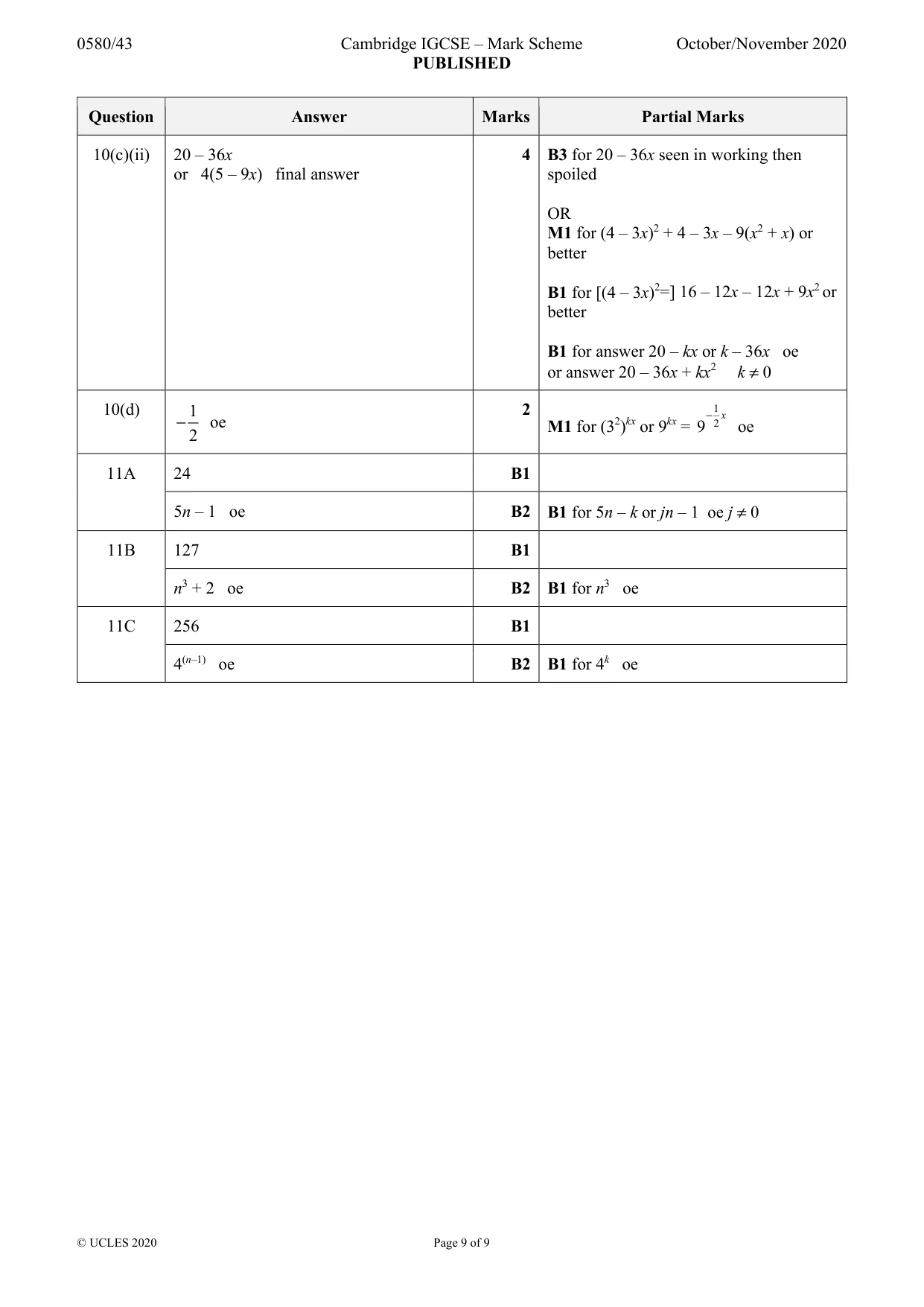
Mark scheme: 10(a) –23 2 M1 for 4 – 3(3x) oe soi 10(b) 4 − x 2 M1 for x = 4 – 3y or y + 3x = 4 oe final answer or x + 3y = 4 3 y 4 x 4 or = + x oe or = + y oe −3 −3 −3 −3 10(c)(i) 1 + 6x final answer 2 M1 for 4 – 3(1 – 2x) 10(c)(ii) 20 – 36x 4 B3 for 20 – 36x seen in working then or 4(5 – 9x) final answer spoiled OR M1 for (4 – 3x)2 + 4 – 3x – 9(x2 + x) or better B1 for [(4 – 3x)2=] 16 – 12x – 12x + 9x2 or better B1 for answer 20 – kx or k – 36x oe or answer 20 – 36x + kx2 k ≠ 0 10(d) 1 2 − 1 x 2 oe − oe M1 for (32)kx or 9kx = 9 2 11A 24 B1 5n – 1 oe B2 B1 for 5n – k or jn – 1 oe j ≠ 0 11B 127 B1 n3 + 2 oe B2 B1 for n3 oe 11C 256 B1 4(n–1) oe B2 B1 for 4k oe
Q11 · The table shows the first four terms in sequences A, B, and C
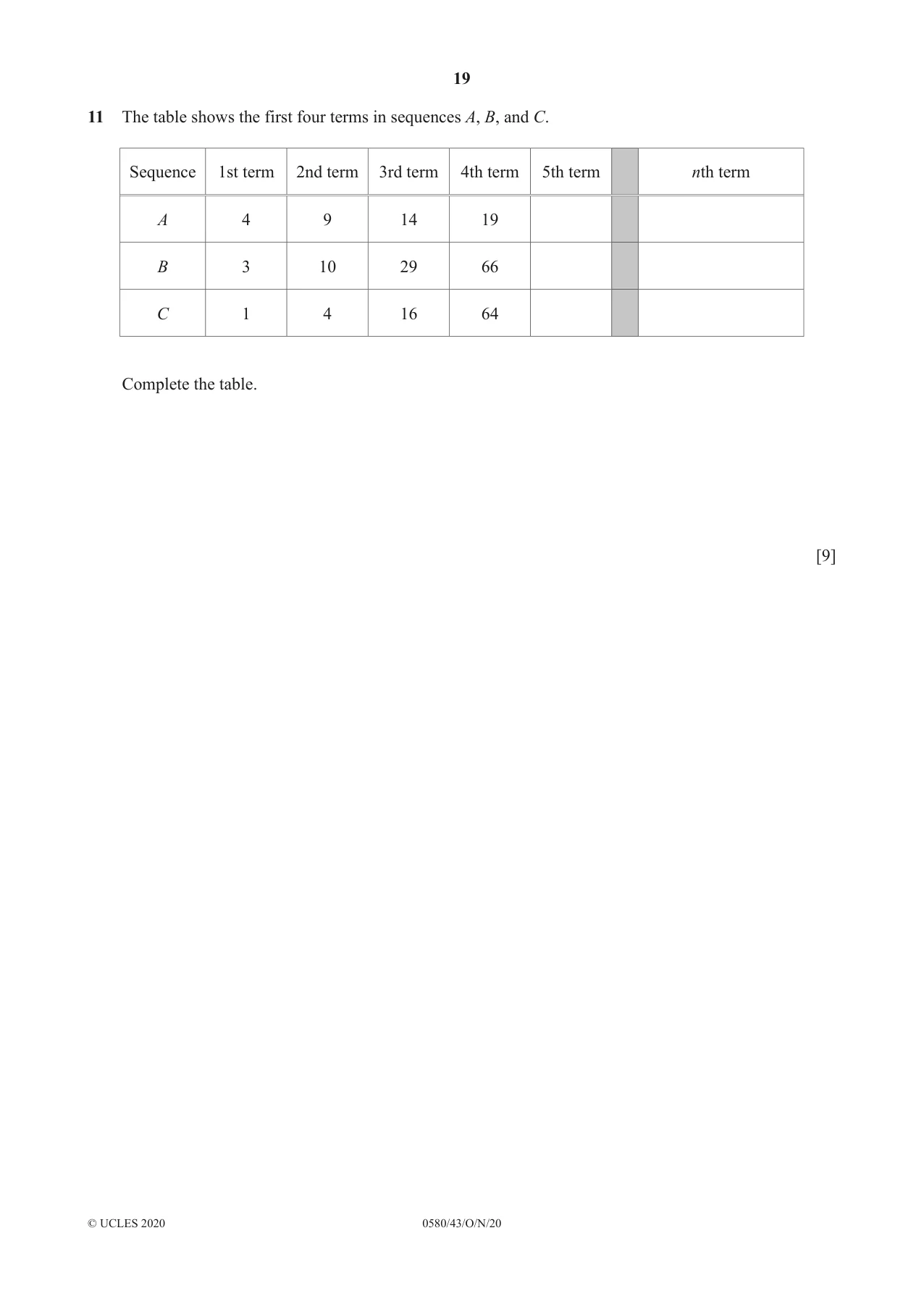
11 The table shows the first four terms in sequences A, B, and C. Sequence 1st term 2nd term 3rd term 4th term 5th term nth term A 4 9 14 19 B 3 10 29 66 C 1 4 16 64 Complete the table. [9]
What was in this paper
The subtopics covered by these 11 questions, and how many questions each got. Open one in a new tab to see every Cambridge question on it.
What you needed in this session
Cambridge’s own grade thresholds for 2020 Oct/Nov, Paper 4 · Variant 3. A higher threshold means an easier paper — the bar moves with how the cohort did.