Cambridge IGCSE Mathematics 0580 — 2024 May/June Paper 4 · Variant 2
0580/42/M/J/24 · 11 questions · 130 marks · ≈146 min
The question paper and its mark scheme, free to read here and free to download. This is Cambridge’s own paper, exactly as it was sat.
Question paper20 pages
Mark scheme10 pages
Answers below. Sit the paper first if you are practising.
Questions as text
Q1 · A fruit drink is made using 1.5 litres of apple juice and 450 millilitres of mango juice
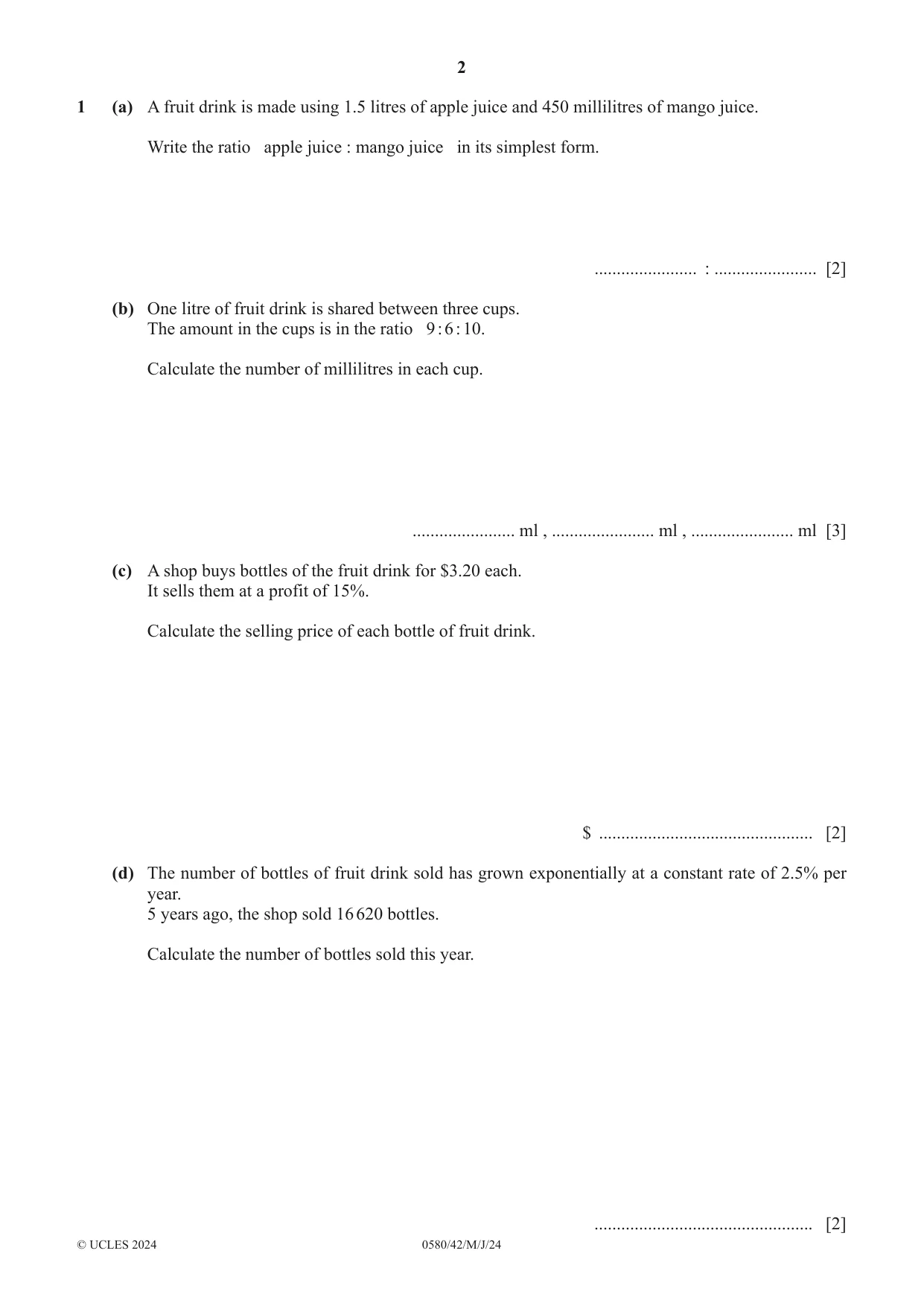
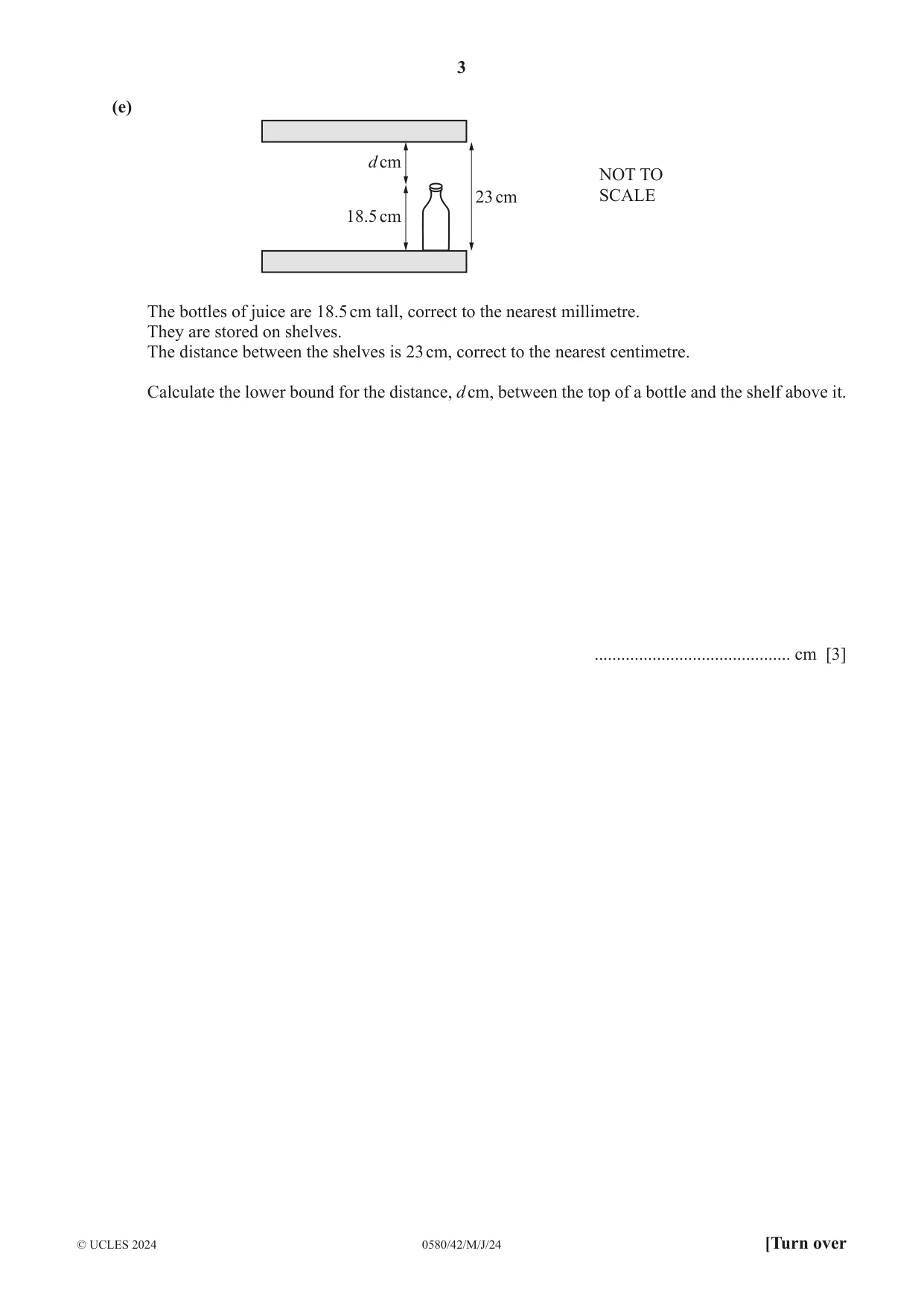
1 (a) A fruit drink is made using 1.5 litres of apple juice and 450 millilitres of mango juice. Write the ratio apple juice : mango juice in its simplest form. ....................... : ....................... [2] (b) One litre of fruit drink is shared between three cups. The amount in the cups is in the ratio 9 : 6 : 10. Calculate the number of millilitres in each cup. ....................... ml , ....................... ml , ....................... ml [3] (c) A shop buys bottles of the fruit drink for $3.20 each. It sells them at a profit of 15%. Calculate the selling price of each bottle of fruit drink. $ ................................................ [2] (d) The number of bottles of fruit drink sold has grown exponentially at a constant rate of 2.5% per year. 5 years ago, the shop sold 16 620 bottles. Calculate the number of bottles sold this year. ................................................. [2] (e) d cm NOT TO 23 cm SCALE 18.5 cm The bottles of juice are 18.5 cm tall, correct to the nearest millimetre. They are stored on shelves. The distance between the shelves is 23 cm, correct to the nearest centimetre. Calculate the lower bound for the distance, d cm, between the top of a bottle and the shelf above it. ............................................ cm [3]
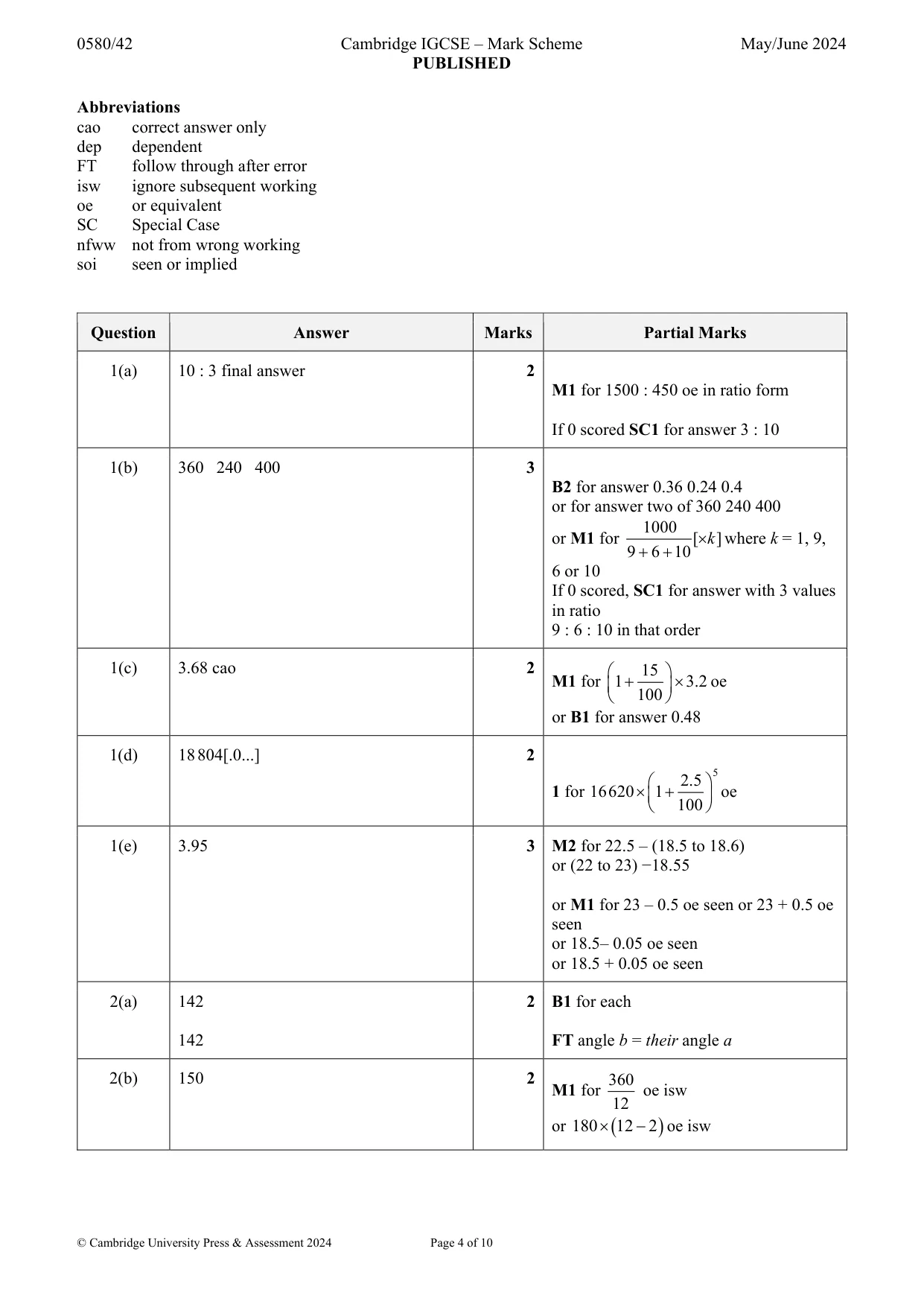
Mark scheme: Question Answer Marks Partial Marks 1(a) 10 : 3 final answer 2 M1 for 1500 : 450 oe in ratio form If 0 scored SC1 for answer 3 : 10 1(b) 360 240 400 3 B2 for answer 0.36 0.24 0.4 or for answer two of 360 240 400 1000 or M1 for [ k ] where k = 1, 9, 9 6 10 6 or 10 If 0 scored, SC1 for answer with 3 values in ratio 9 : 6 : 10 in that order 1(c) 3.68 cao 2 15 M1 for 1 3.2 oe 100 or B1 for answer 0.48 1(d) 18 804[.0...] 2 2.5 5 1 for 16620 1 oe 100 1(e) 3.95 3 M2 for 22.5 – (18.5 to 18.6) or (22 to 23) −18.55 or M1 for 23 – 0.5 oe seen or 23 + 0.5 oe seen or 18.5– 0.05 oe seen or 18.5 + 0.05 oe seen
Q2 · 38° NOT TO SCALE a° b° The diagram shows a straight line intersecting two parallel lines
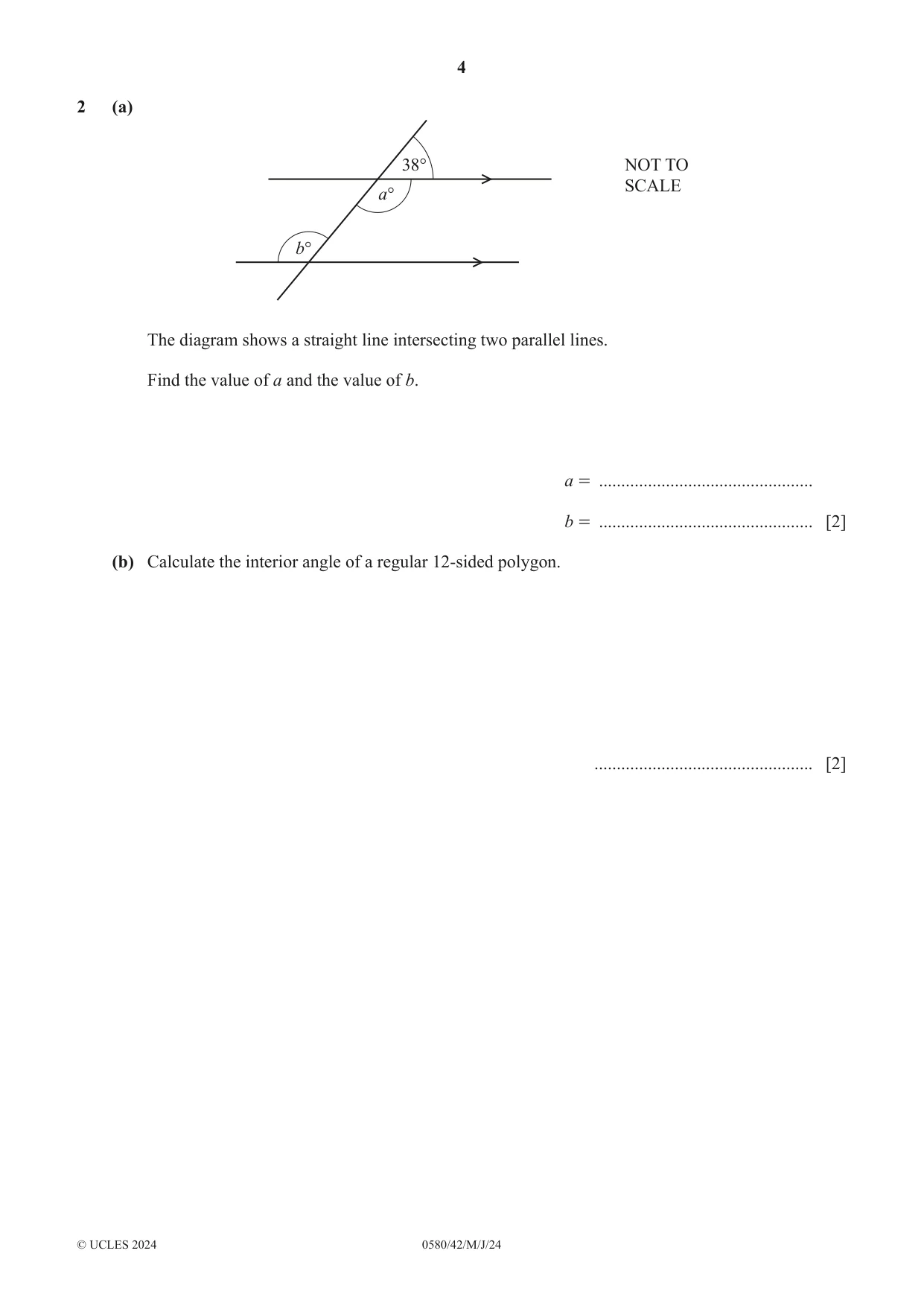
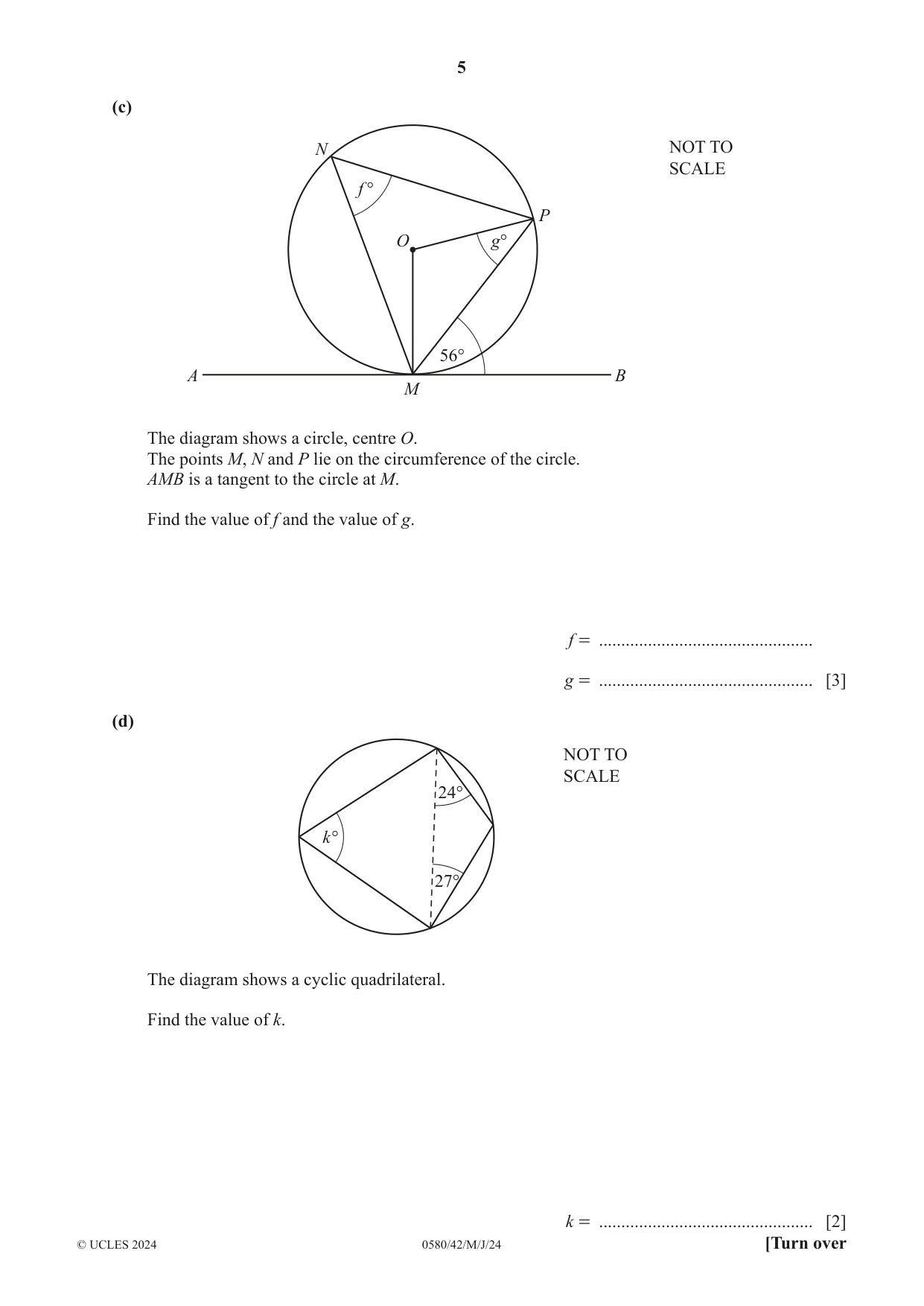
2 (a) 38° NOT TO SCALE a° b° The diagram shows a straight line intersecting two parallel lines. Find the value of a and the value of b. a = ................................................ b = ................................................ [2] (b) Calculate the interior angle of a regular 12-sided polygon. ................................................. [2] (c) N NOT TO SCALE f ° P O g° 56° A B M The diagram shows a circle, centre O. The points M, N and P lie on the circumference of the circle. AMB is a tangent to the circle at M. Find the value of f and the value of g. f = ................................................ g = ................................................ [3] (d) NOT TO SCALE 24° k ° 27° The diagram shows a cyclic quadrilateral. Find the value of k. k = ................................................ [2]
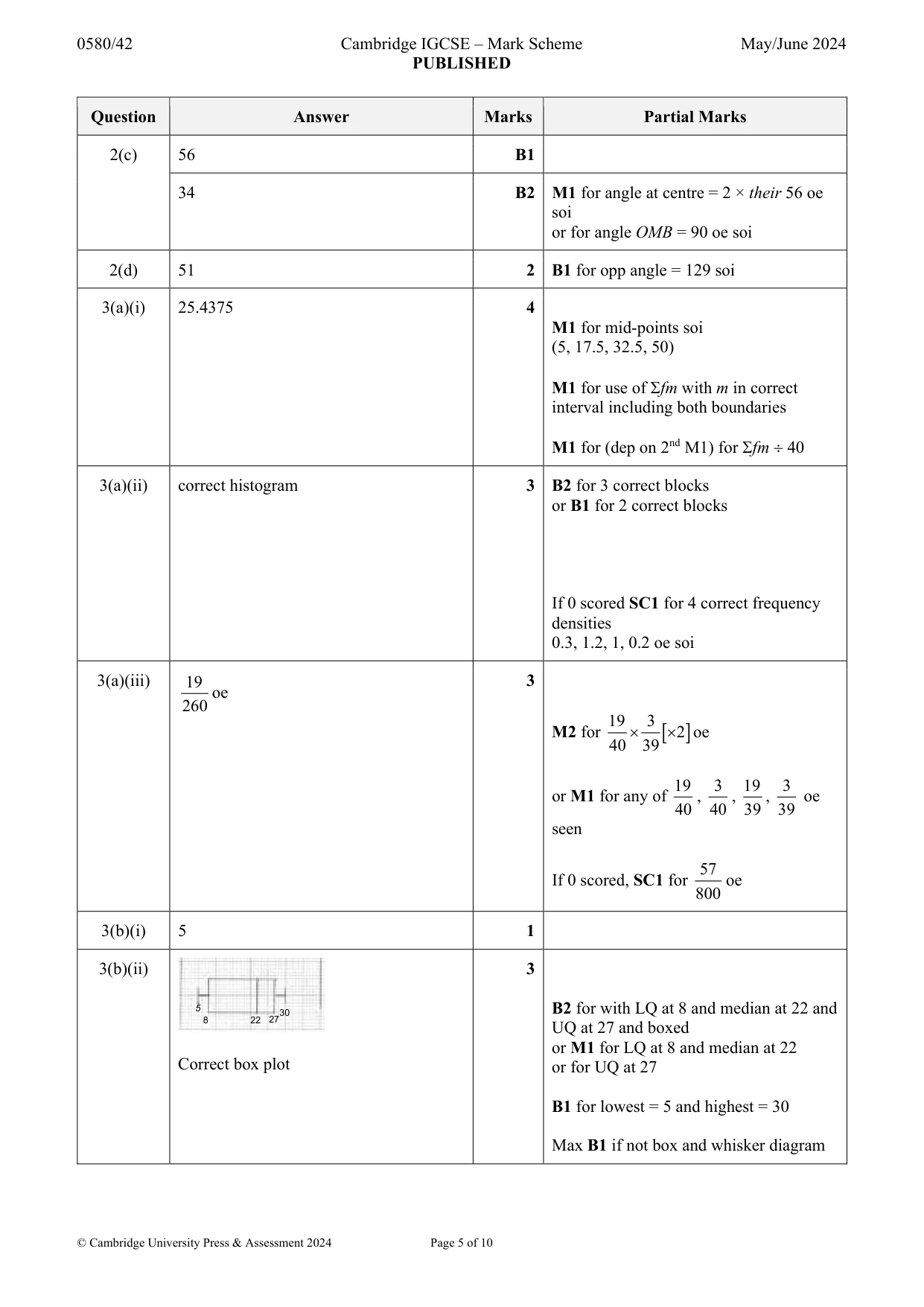
Mark scheme: 2(a) 142 2 B1 for each 142 FT angle b = their angle a 2(b) 150 2 360 M1 for oe isw 12 or 180 12 2 oe isw 2(c) 56 B1 34 B2 M1 for angle at centre = 2 × their 56 oe soi or for angle OMB = 90 oe soi 2(d) 51 2 B1 for opp angle = 129 soi
Q3 · The table shows the time that each of 40 students takes to travel to school
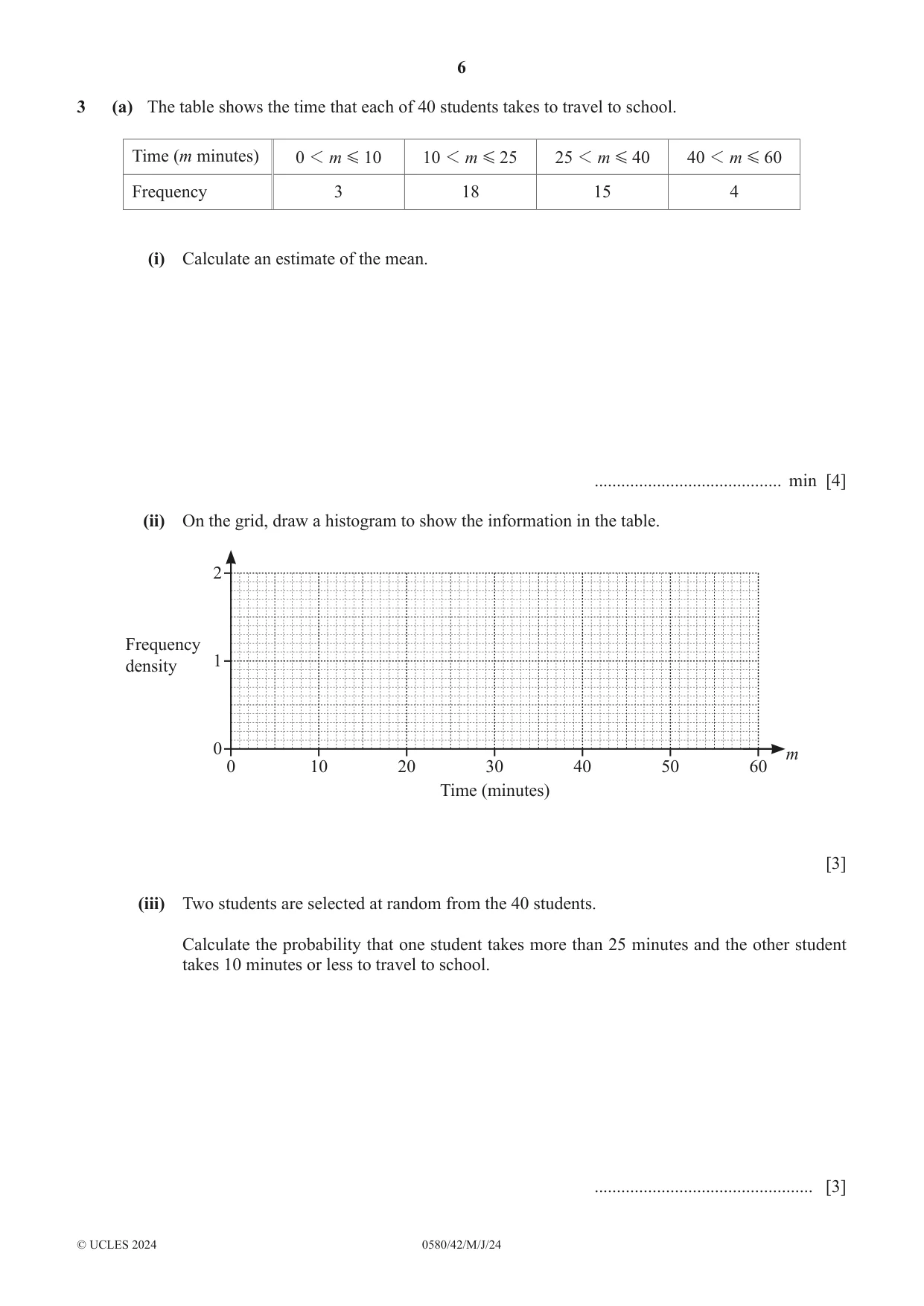
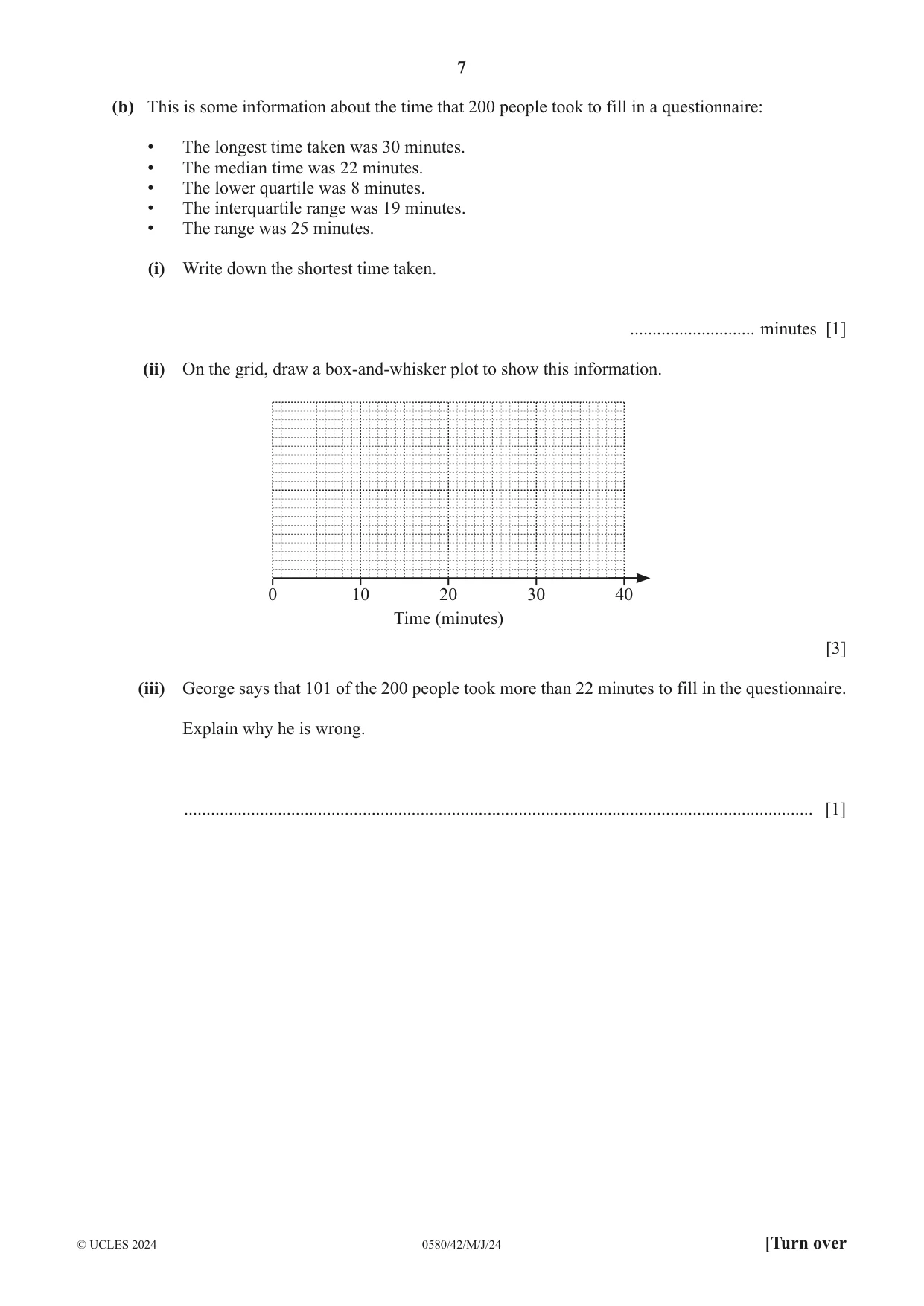
3 (a) The table shows the time that each of 40 students takes to travel to school. Time (m minutes) 0 1 m G 10 10 1 m G 25 25 1 m G 40 40 1 m G 60 Frequency 3 18 15 4 (i) Calculate an estimate of the mean. .......................................... min [4] (ii) On the grid, draw a histogram to show the information in the table. 2 Frequency 1 density 0 m 0 10 20 30 40 50 60 Time (minutes) [3] (iii) Two students are selected at random from the 40 students. Calculate the probability that one student takes more than 25 minutes and the other student takes 10 minutes or less to travel to school. ................................................. [3] (b) This is some information about the time that 200 people took to fill in a questionnaire: • The longest time taken was 30 minutes. • The median time was 22 minutes. • The lower quartile was 8 minutes. • The interquartile range was 19 minutes. • The range was 25 minutes. (i) Write down the shortest time taken. ............................ minutes [1] (ii) On the grid, draw a box-and-whisker plot to show this information. 0 10 20 30 40 Time (minutes) [3] (iii) George says that 101 of the 200 people took more than 22 minutes to fill in the questionnaire. Explain why he is wrong. ............................................................................................................................................. [1]
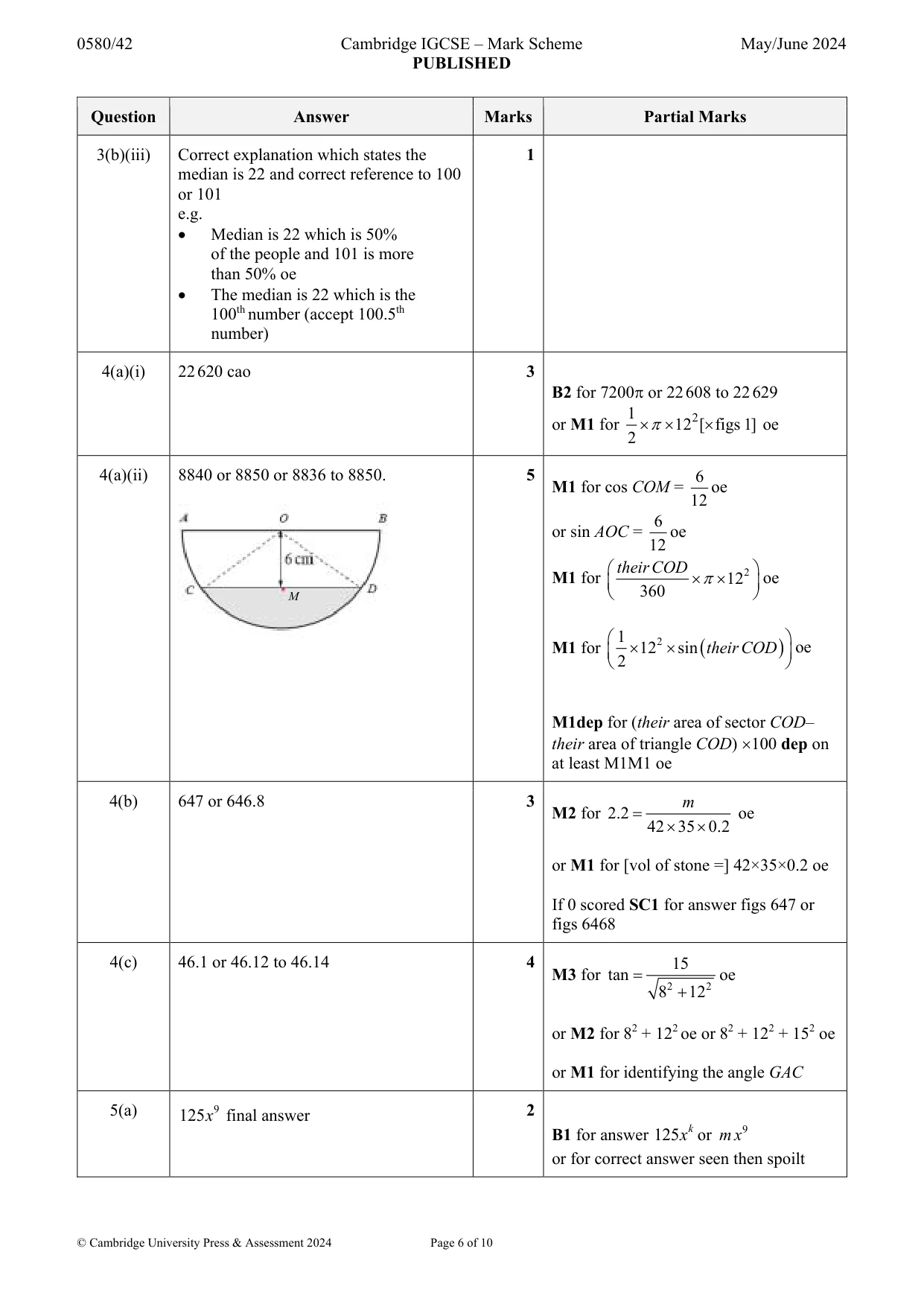
Mark scheme: 3(a)(i) 25.4375 4 M1 for mid-points soi (5, 17.5, 32.5, 50) M1 for use of fm with m in correct interval including both boundaries M1 for (dep on 2nd M1) for fm 40 3(a)(ii) correct histogram 3 B2 for 3 correct blocks or B1 for 2 correct blocks If 0 scored SC1 for 4 correct frequency densities 0.3, 1.2, 1, 0.2 oe soi 3(a)(iii) 19 3 oe 260 19 3 M2 for 2 oe 40 39 19 3 19 3 or M1 for any of , , , oe 40 40 39 39 seen 57 If 0 scored, SC1 for oe 800 3(b)(i) 5 1 3(b)(ii) 3 5 30 B2 for with LQ at 8 and median at 22 and 8 22 27 UQ at 27 and boxed or M1 for LQ at 8 and median at 22 Correct box plot or for UQ at 27 B1 for lowest = 5 and highest = 30 Max B1 if not box and whisker diagram 3(b)(iii) Correct explanation which states the 1 median is 22 and correct reference to 100 or 101 e.g. Median is 22 which is 50% of the people and 101 is more than 50% oe The median is 22 which is the 100th number (accept 100.5th number)
Q4 · NOT TO SCALE 12 cm 1 m The diagram shows a tank in the shape of a half-cylinder of radius…
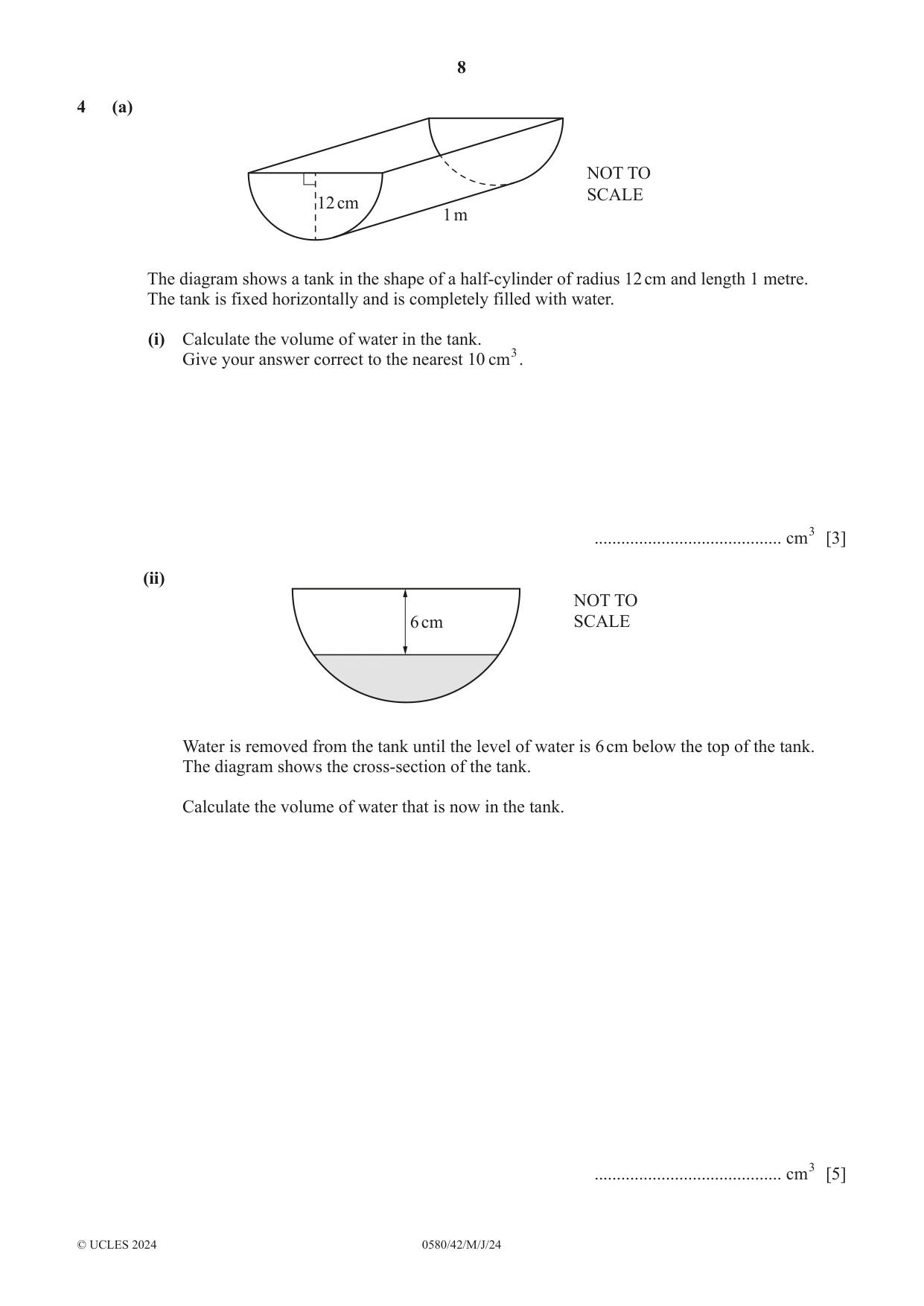
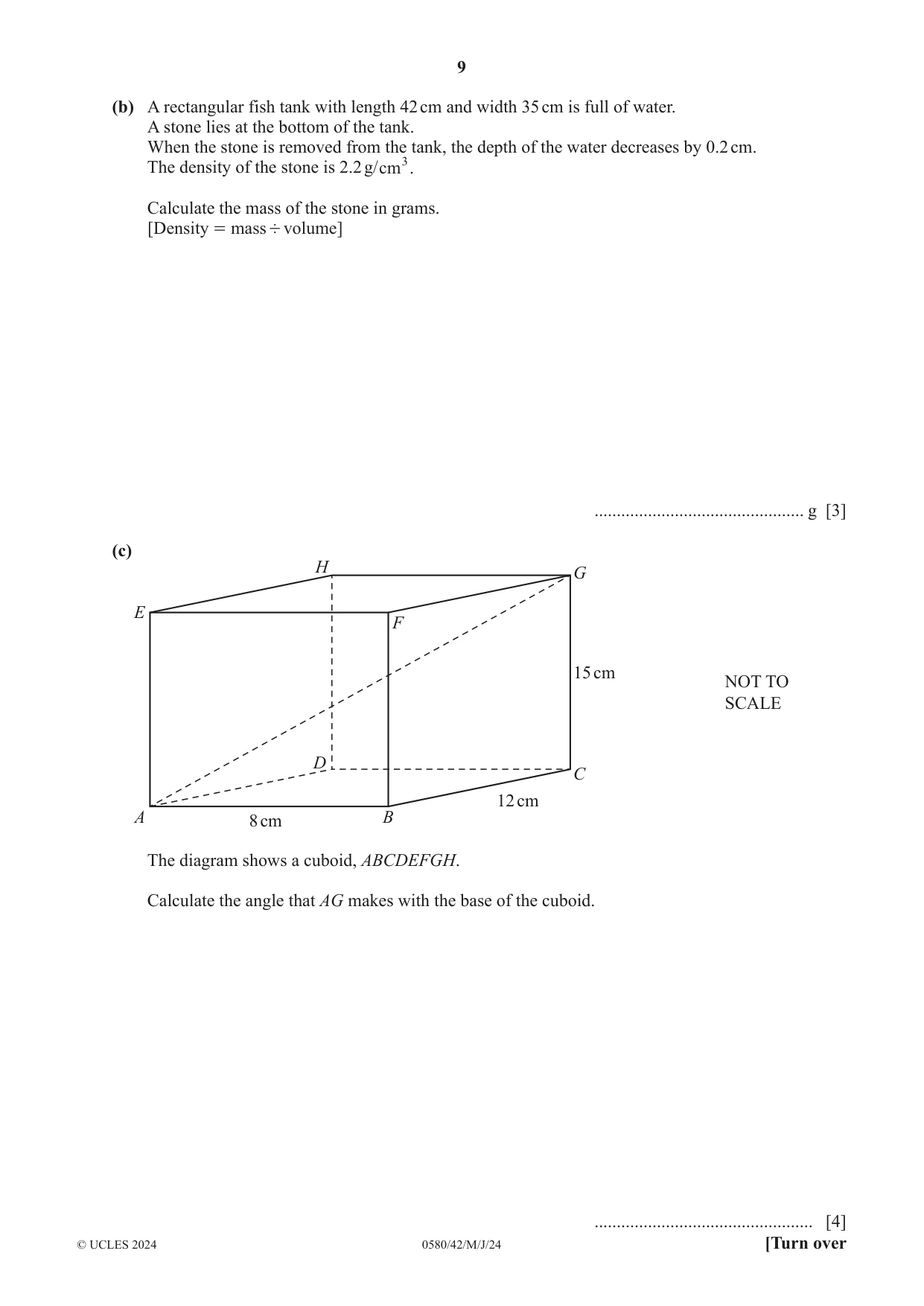
4 (a) NOT TO SCALE 12 cm 1 m The diagram shows a tank in the shape of a half-cylinder of radius 12 cm and length 1 metre. The tank is fixed horizontally and is completely filled with water. (i) Calculate the volume of water in the tank. Give your answer correct to the nearest 10 cm3. .......................................... cm3 [3] (ii) NOT TO 6 cm SCALE Water is removed from the tank until the level of water is 6 cm below the top of the tank. The diagram shows the cross-section of the tank. Calculate the volume of water that is now in the tank. .......................................... cm3 [5] (b) A rectangular fish tank with length 42 cm and width 35 cm is full of water. A stone lies at the bottom of the tank. When the stone is removed from the tank, the depth of the water decreases by 0.2 cm. The density of the stone is 2.2 g/cm3. Calculate the mass of the stone in grams. [ Density = mass ' volume] ............................................... g [3] (c) H G E F 15 cm NOT TO SCALE D C 12 cm A 8 cm B The diagram shows a cuboid, ABCDEFGH. Calculate the angle that AG makes with the base of the cuboid. ................................................. [4]
Mark scheme: 4(a)(i) 22 620 cao 3 B2 for 7200 or 22 608 to 22 629 1 2 or M1 for 12 [ figs 1] oe 2 4(a)(ii) 8840 or 8850 or 8836 to 8850. 5 6 M1 for cos COM = oe 12 6 or sin AOC = oe 12 theirCOD 2 M1 for 12 oe M 360 1 2 oe M1 for 12 sin theirCOD 2 M1dep for (their area of sector COD– their area of triangle COD) 100 dep on at least M1M1 oe 4(b) 647 or 646.8 3 m M2 for 2.2 oe 42 35 0.2 or M1 for [vol of stone =] 42×35×0.2 oe If 0 scored SC1 for answer figs 647 or figs 6468 4(c) 46.1 or 46.12 to 46.14 4 15 M3 for tan oe 8 2 12 2 or M2 for 82 + 122 oe or 82 + 122 + 152 oe or M1 for identifying the angle GAC
Q5 · 5 (a) Simplify 25x 6 2
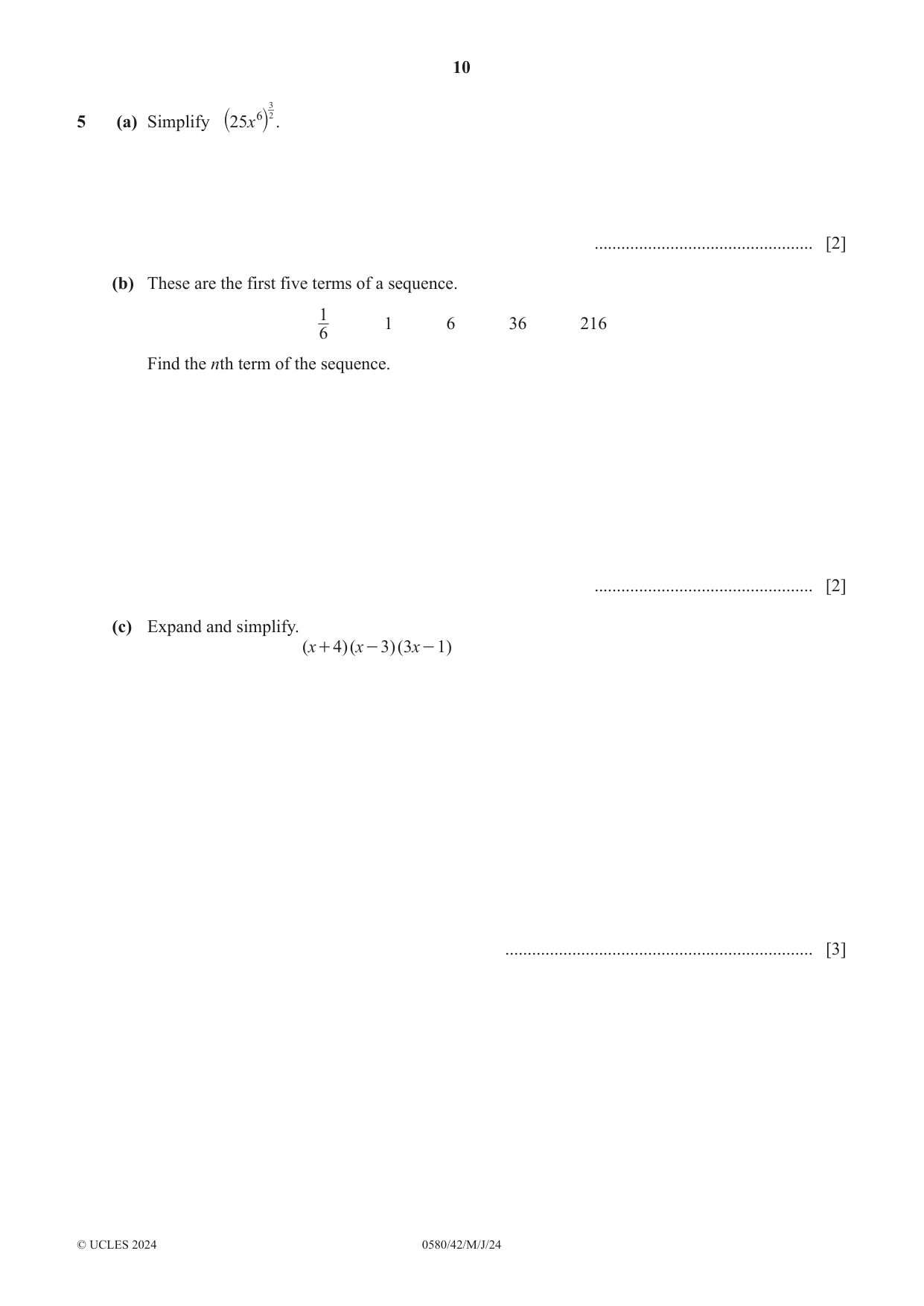
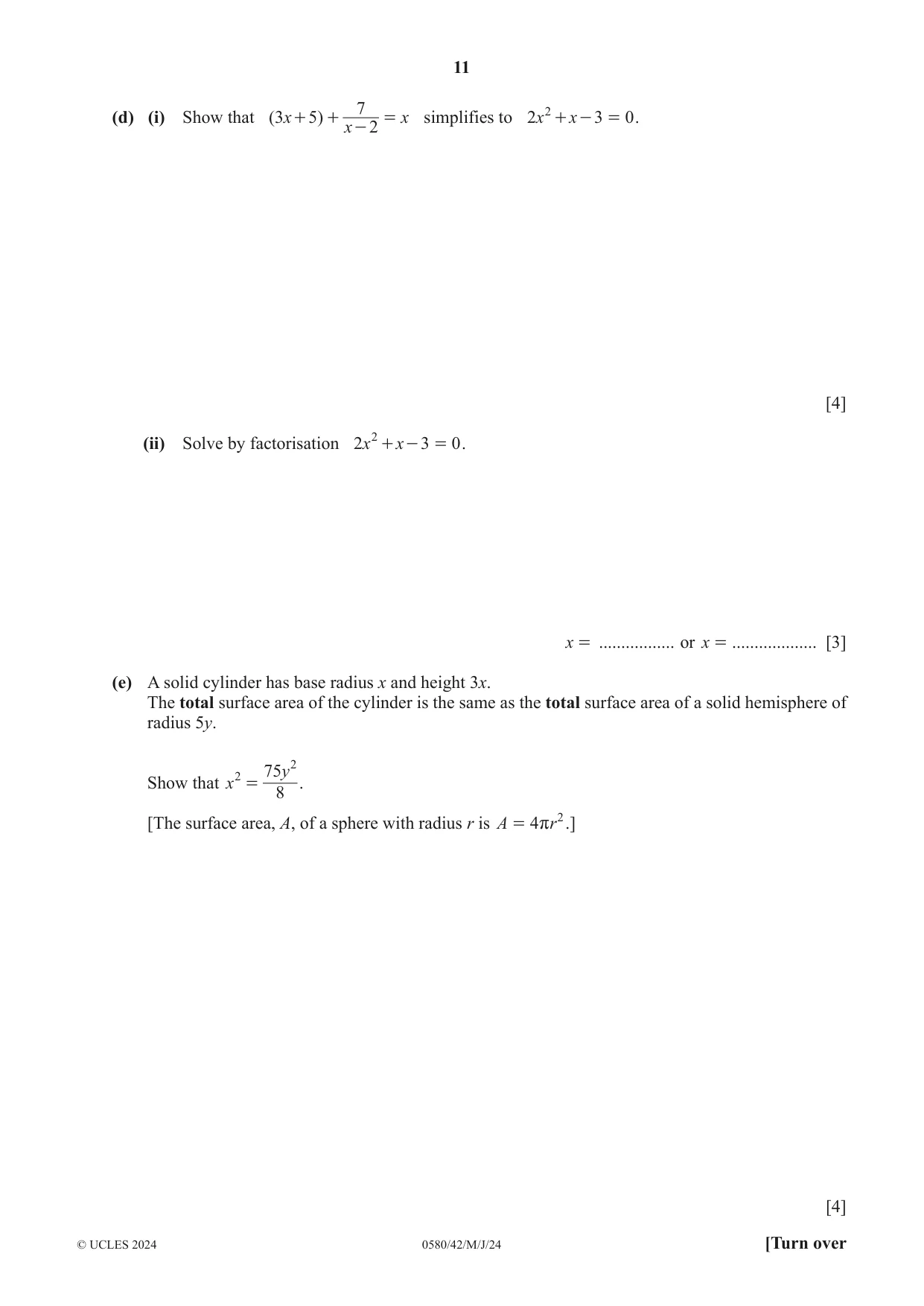
3 5 (a) Simplify 25x 6 2 . ` j ................................................. [2] (b) These are the first five terms of a sequence. 1 1 6 36 216 6 Find the nth term of the sequence. ................................................. [2] (c) Expand and simplify. ( x + 4)( x - 3)( 3x - 1) ..................................................................... [3] 7 2(d) (i) Show that ( 3x + 5) + = x simplifies to 2x + x - 3 = 0 . x - 2 [4] (ii) Solve by factorisation 2x 2 + x - 3 = 0 . x = ................. or x = ................... [3] (e) A solid cylinder has base radius x and height 3x. The total surface area of the cylinder is the same as the total surface area of a solid hemisphere of radius 5y. 2 75y 2 Show that x = . 8 [The surface area, A, of a sphere with radius r is A = 4rr 2 .] [4]
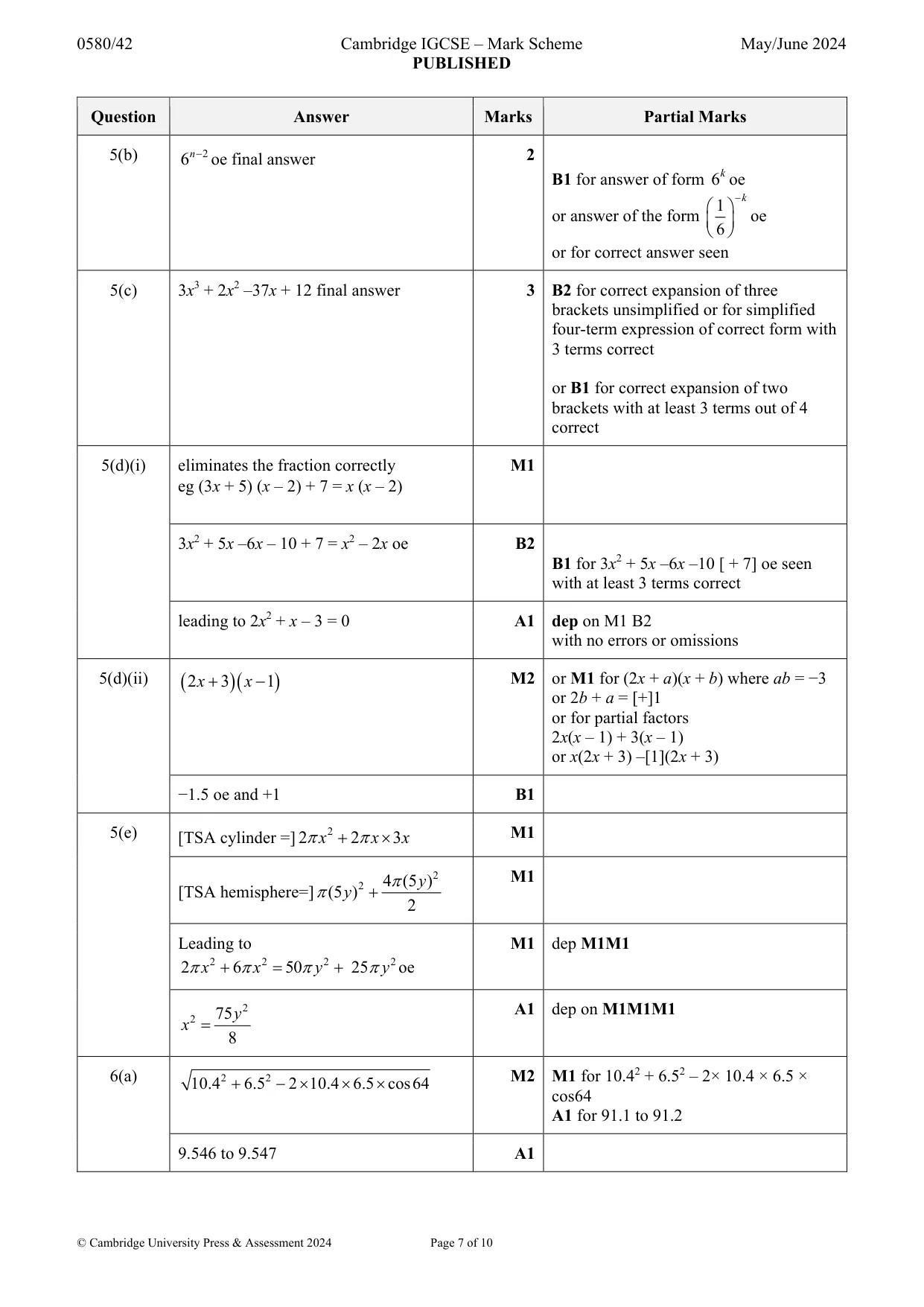
Mark scheme: 5(a) 125x 9 final answer 2 B1 for answer 125 kx or m x 9 or for correct answer seen then spoilt 5(b) 6 n 2 oe final answer 2 B1 for answer of form 6k oe k 1 or answer of the form oe 6 or for correct answer seen 5(c) 3x3 + 2x2 –37x + 12 final answer 3 B2 for correct expansion of three brackets unsimplified or for simplified four-term expression of correct form with 3 terms correct or B1 for correct expansion of two brackets with at least 3 terms out of 4 correct 5(d)(i) eliminates the fraction correctly M1 eg (3x + 5) (x – 2) + 7 = x (x – 2) 3x2 + 5x –6x – 10 + 7 = x2 – 2x oe B2 B1 for 3x2 + 5x –6x –10 [ + 7] oe seen with at least 3 terms correct leading to 2x2 + x – 3 = 0 A1 dep on M1 B2 with no errors or omissions 5(d)(ii) 2 x 3 x 1 M2 or M1 for (2x + a)(x + b) where ab = −3 or 2b + a = [+]1 or for partial factors 2x(x – 1) + 3(x – 1) or x(2x + 3) –[1](2x + 3) −1.5 oe and +1 B1 5(e) 2 M1 [TSA cylinder =] 2x 2x 3 x 2 4(5 y ) 2 M1 [TSA hemisphere=] (5 y ) 2 Leading to M1 dep M1M1 2x 2 6x 2 50y 2 25y 2 oe 2 75 y 2 A1 dep on M1M1M1 x 8
Q6 · D 6.5 cm 26° NOT TO C 64° SCALE A 42° 10.4 cm B ABCD is a quadrilateral with AB = 10.4 cm…
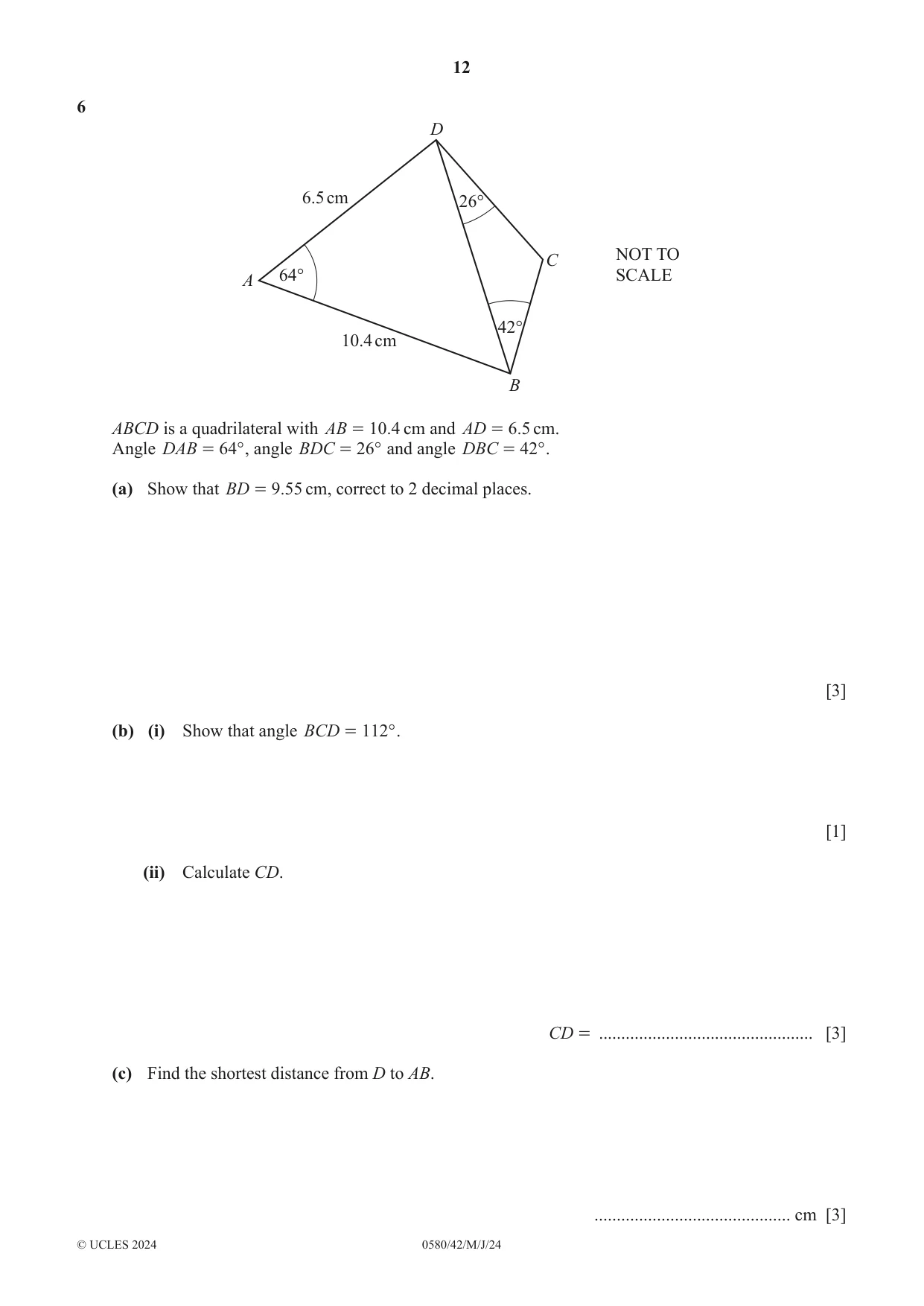
6 D 6.5 cm 26° NOT TO C 64° SCALE A 42° 10.4 cm B ABCD is a quadrilateral with AB = 10.4 cm and AD = 6.5 cm. Angle DAB = 64° , angle BDC = 26° and angle DBC = 42° . (a) Show that BD = 9.55 cm, correct to 2 decimal places. [3] (b) (i) Show that angle BCD = 112° . [1] (ii) Calculate CD. CD = ................................................ [3] (c) Find the shortest distance from D to AB. ............................................ cm [3]
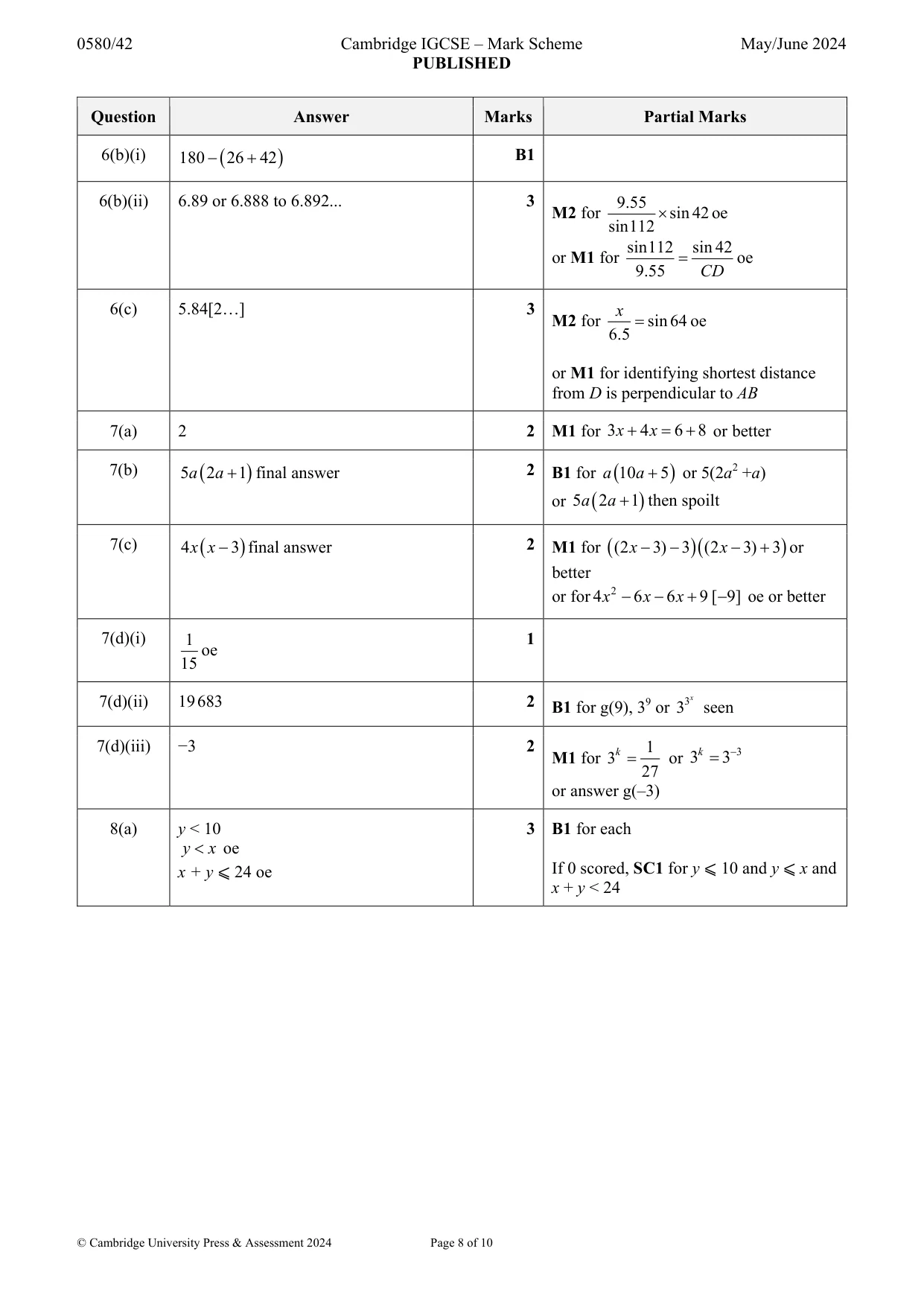
Mark scheme: 6(a) 2 2 M2 M1 for 10.42 + 6.52 – 2× 10.4 × 6.5 × 10.4 6.5 2 10.4 6.5 cos64 cos64 A1 for 91.1 to 91.2 9.546 to 9.547 A1 6(b)(i) 180 26 42 B1 6(b)(ii) 6.89 or 6.888 to 6.892... 3 9.55 M2 for sin 42 oe sin112 sin112 sin 42 or M1 for oe 9.55 CD 6(c) 5.84[2…] 3 x M2 for sin64 oe 6.5 or M1 for identifying shortest distance from D is perpendicular to AB
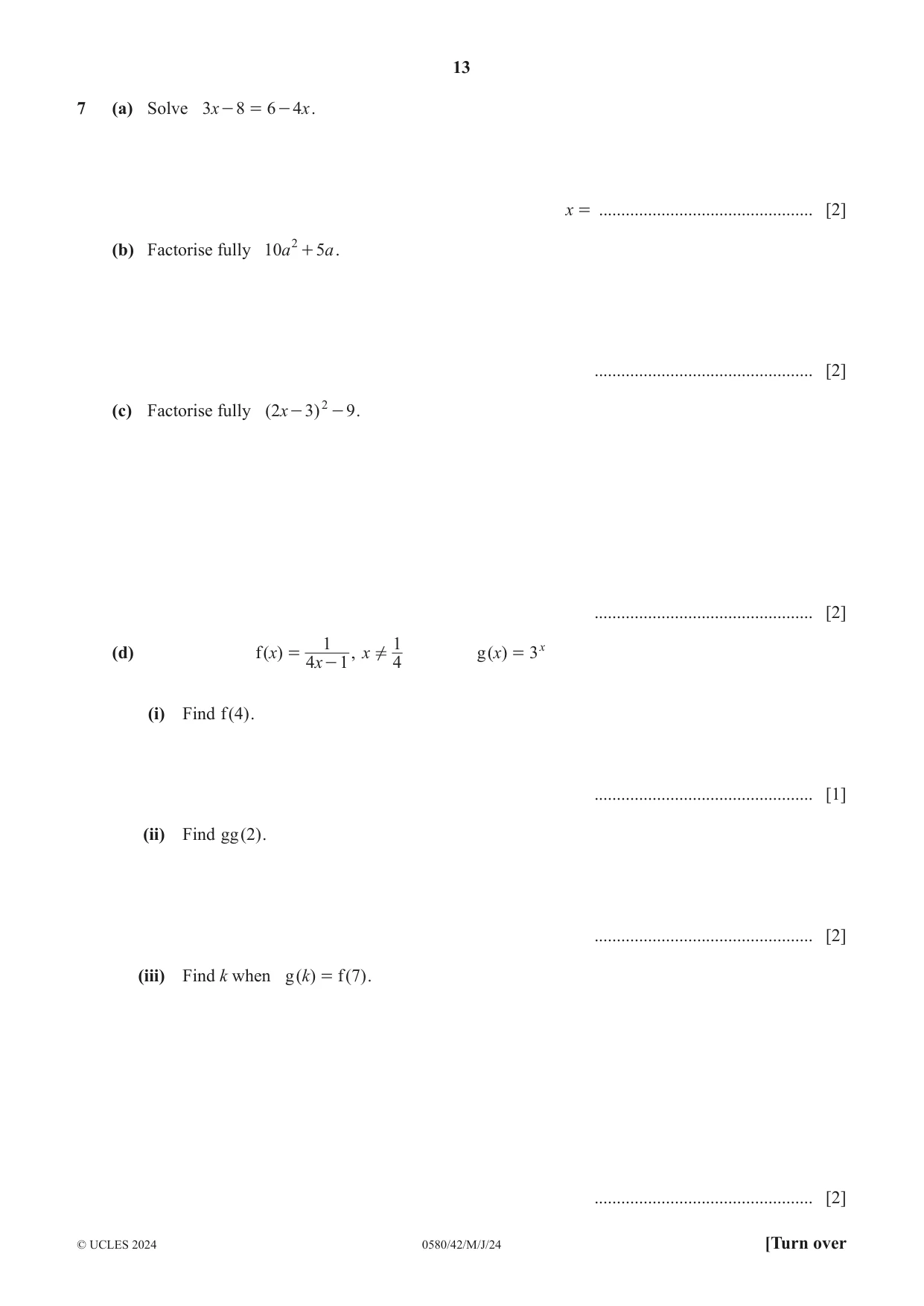
Q7 · Solve 3x - 8 = 6 - 4x
7 (a) Solve 3x - 8 = 6 - 4x . x = ................................................ [2] (b) Factorise fully 10a 2 + 5a . ................................................. [2] (c) Factorise fully ( 2x - 3) 2 - 9 . ................................................. [2] 1 1 x (d) f ( )x = , x ! g ( )x = 3 4x - 1 4 (i) Find f ( 4) . ................................................. [1] (ii) Find gg ( 2) . ................................................. [2] (iii) Find k when g ( k) = f ( 7) . ................................................. [2]
Mark scheme: 7(a) 2 2 M1 for 3 x 4 x 6 8 or better 7(b) 5a 2 a 1 final answer 2 B1 for a 10 a 5 or 5(2a2 +a) or 5a 2 a 1 then spoilt 7(c) 4 x x 3 final answer 2 M1 for (2 x 3) 3 (2 x 3) 3 or better or for 4 x 2 6 x 6 x 9 [ 9] oe or better 7(d)(i) 1 1 oe 15 7(d)(ii) 19 683 2 3 x B1 for g(9), 39 or 3 seen 7(d)(iii) −3 2 k 1 k 3 M1 for 3 or 3 3 27 or answer g(–3)
Q8 · A baker decorates x small cakes and y large cakes
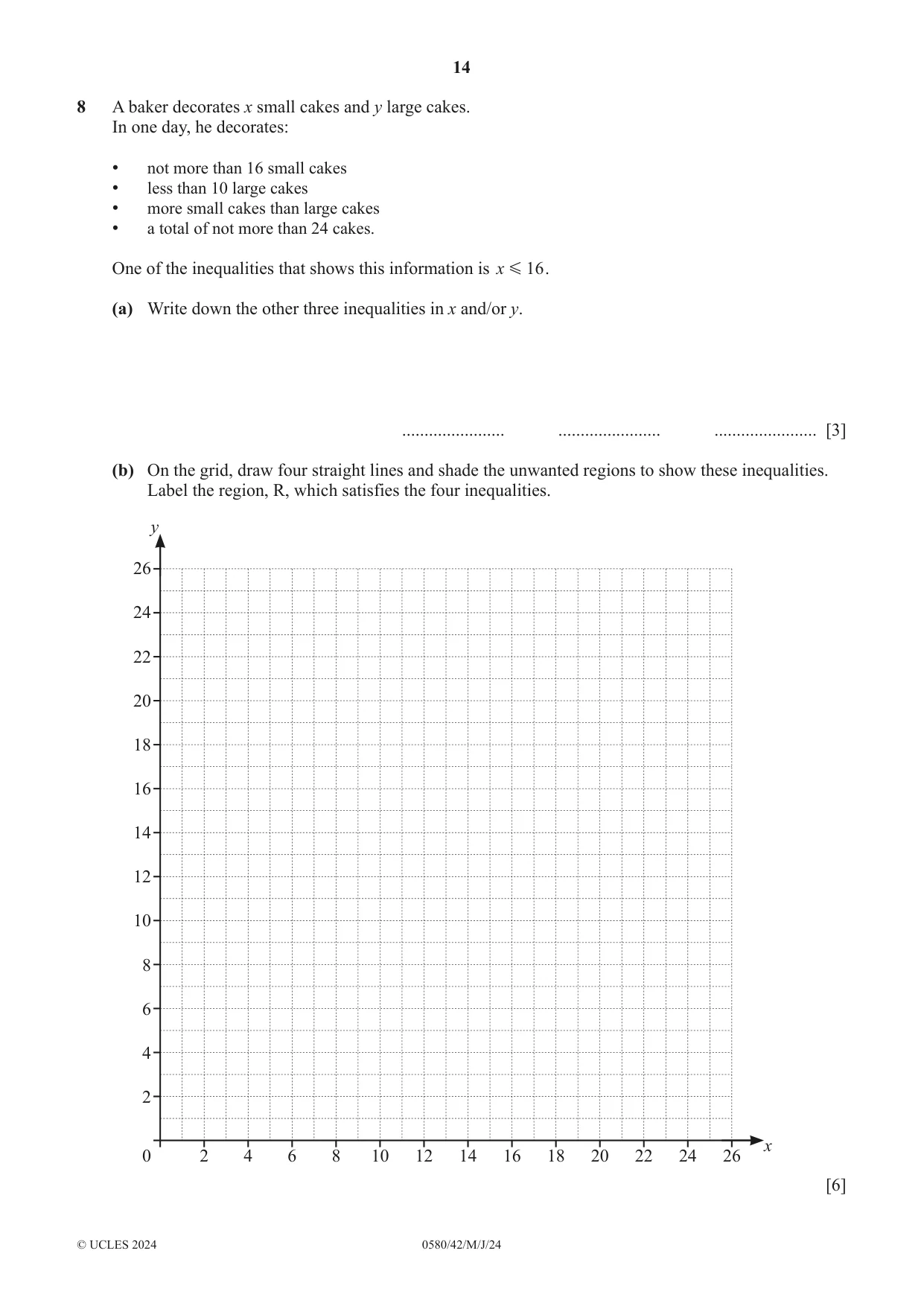
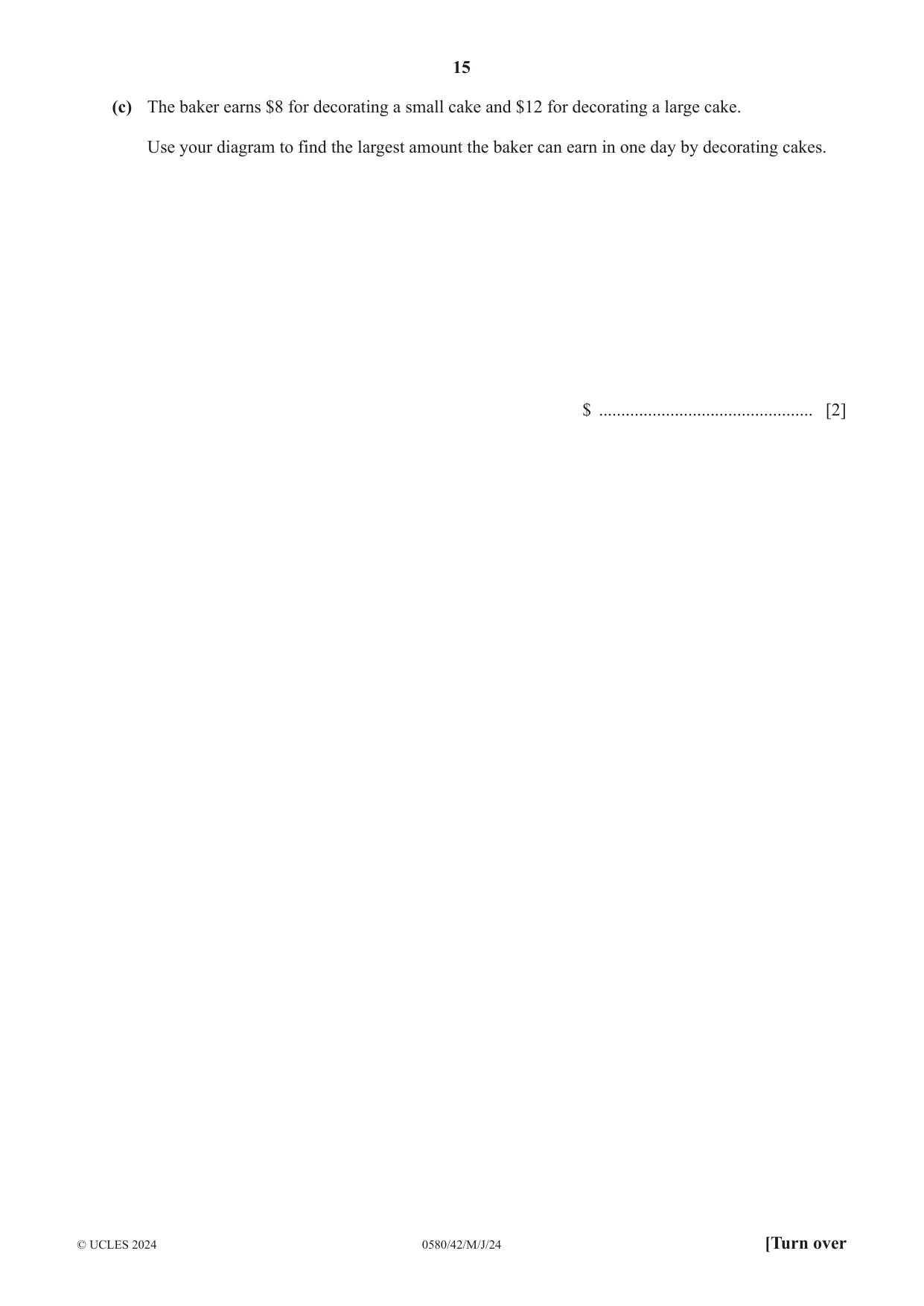
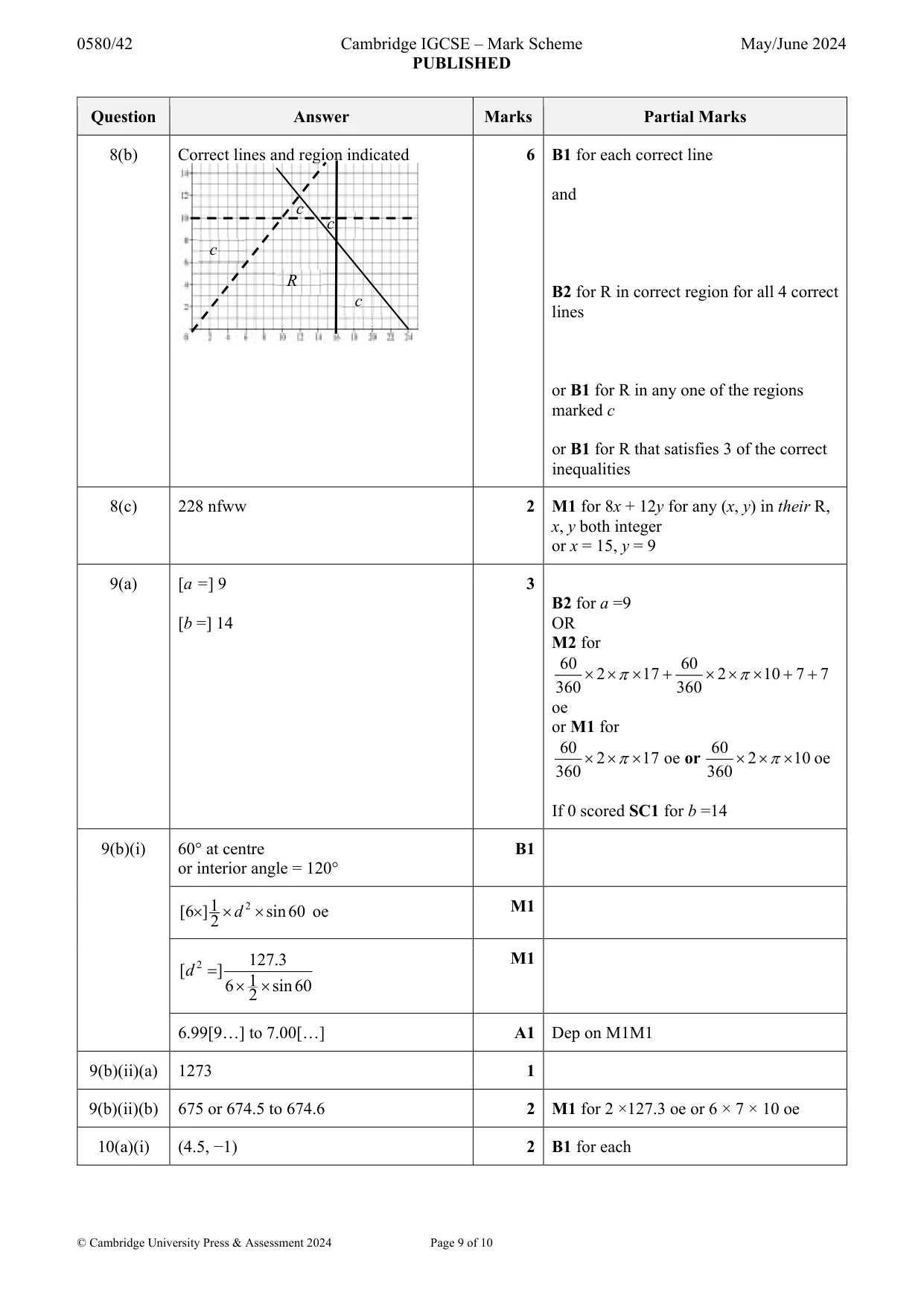
8 A baker decorates x small cakes and y large cakes. In one day, he decorates: • not more than 16 small cakes • less than 10 large cakes • more small cakes than large cakes • a total of not more than 24 cakes. One of the inequalities that shows this information is x G 16 . (a) Write down the other three inequalities in x and/or y. ....................... ....................... ....................... [3] (b) On the grid, draw four straight lines and shade the unwanted regions to show these inequalities. Label the region, R, which satisfies the four inequalities. y 26 24 22 20 18 16 14 12 10 8 6 4 2 x 0 2 4 6 8 10 12 14 16 18 20 22 24 26 [6] (c) The baker earns $8 for decorating a small cake and $12 for decorating a large cake. Use your diagram to find the largest amount the baker can earn in one day by decorating cakes. $ ................................................ [2]
Mark scheme: 8(a) y < 10 3 B1 for each y x oe x + y ⩽ 24 oe If 0 scored, SC1 for y ⩽ 10 and y ⩽ x and x + y < 24 8(b) Correct lines and region indicated 6 B1 for each correct line and c c c R B2 for R in correct region for all 4 correct c lines or B1 for R in any one of the regions marked c or B1 for R that satisfies 3 of the correct inequalities 8(c) 228 nfww 2 M1 for 8x + 12y for any (x, y) in their R, x, y both integer or x = 15, y = 9
Q9 · O NOT TO 60° 10 cm SCALE 17 cm D C A B OAB is a sector of a circle, centre O, radius 17 cm
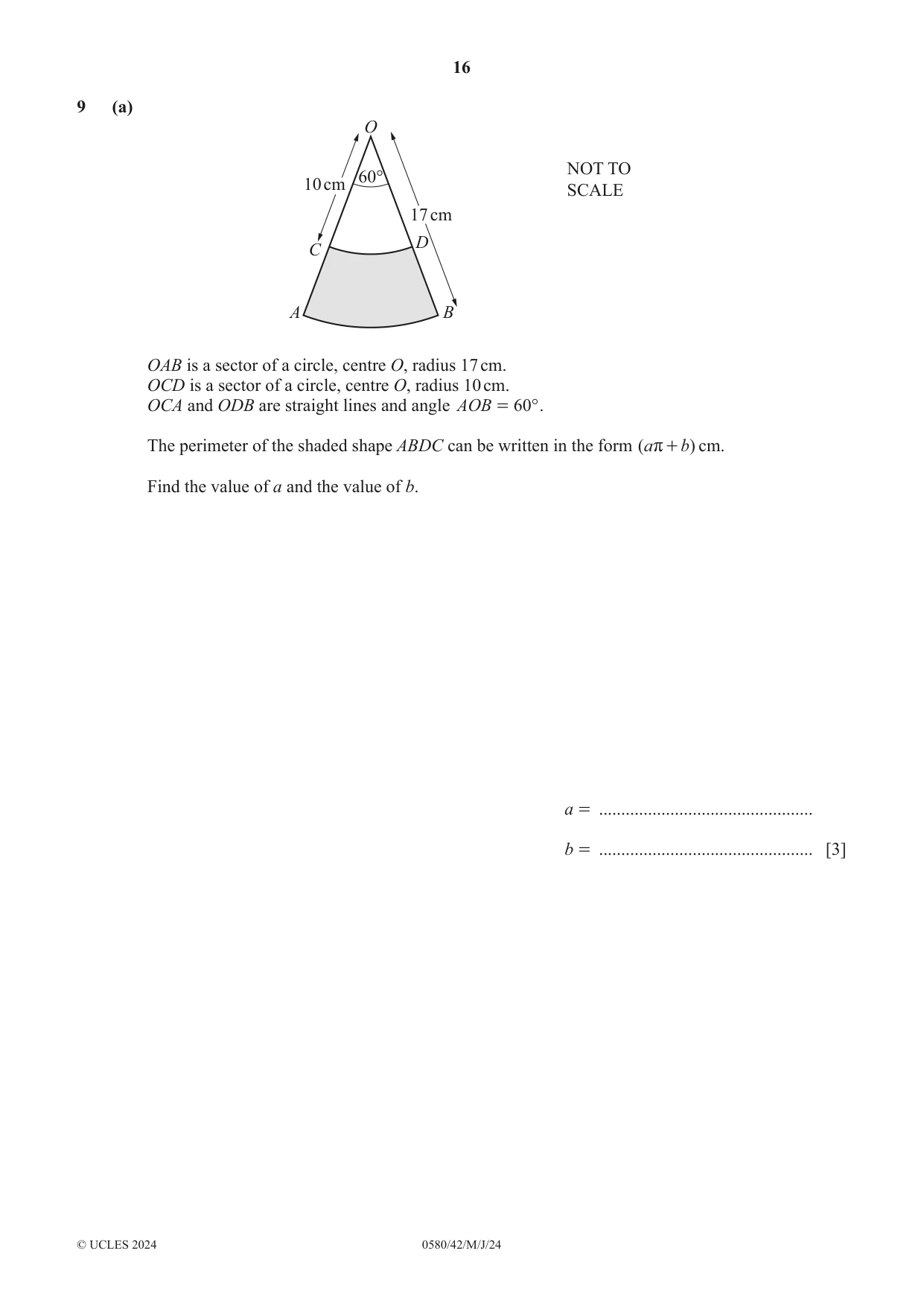
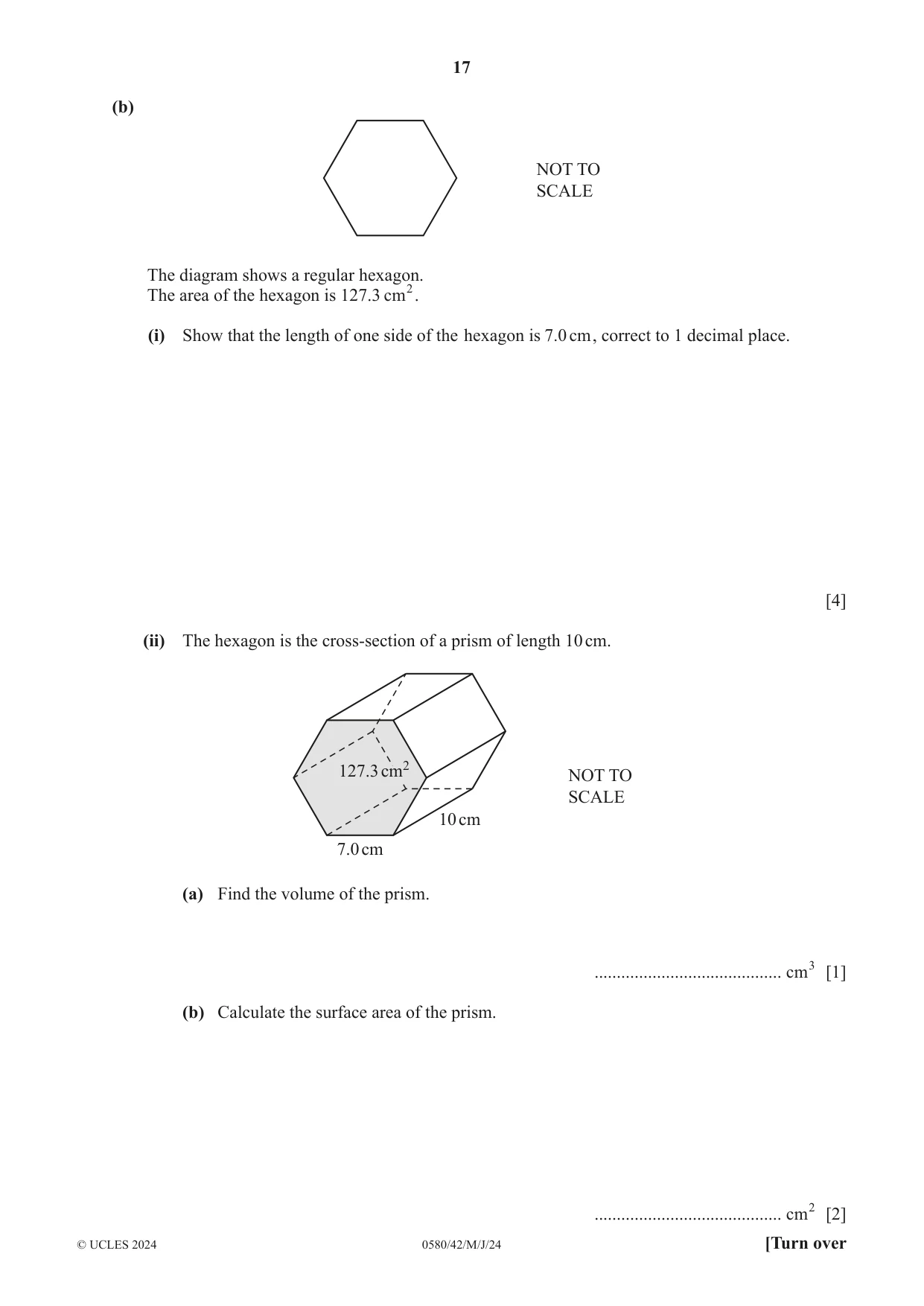
9 (a) O NOT TO 60° 10 cm SCALE 17 cm D C A B OAB is a sector of a circle, centre O, radius 17 cm. OCD is a sector of a circle, centre O, radius 10 cm. OCA and ODB are straight lines and angle AOB = 60° . The perimeter of the shaded shape ABDC can be written in the form ( a r+ b ) cm. Find the value of a and the value of b. a = ................................................ b = ................................................ [3] (b) NOT TO SCALE The diagram shows a regular hexagon. The area of the hexagon is 127.3 cm2. (i) Show that the length of one side of the hexagon is 7.0 cm , correct to 1 decimal place. [4] (ii) The hexagon is the cross-section of a prism of length 10 cm. 127.3 cm2 NOT TO SCALE 10 cm 7.0 cm (a) Find the volume of the prism. .......................................... cm3 [1] (b) Calculate the surface area of the prism. .......................................... cm2 [2]
Mark scheme: 9(a) [a =] 9 3 B2 for a =9 [b =] 14 OR M2 for 60 60 2 17 2 10 7 7 360 360 oe or M1 for 60 60 2 17 oe or 2 10 oe 360 360 If 0 scored SC1 for b =14 9(b)(i) 60° at centre B1 or interior angle = 120° 1 2 M1 [6] d sin60 oe 2 2 127.3 M1 [ d ] 1 6 sin60 2 6.99[9…] to 7.00[…] A1 Dep on M1M1 9(b)(ii)(a) 1273 1 9(b)(ii)(b) 675 or 674.5 to 674.6 2 M1 for 2 ×127.3 oe or 6 × 7 × 10 oe
Q10 · A is the point (6, 2) and B is the point (3, - 4 )
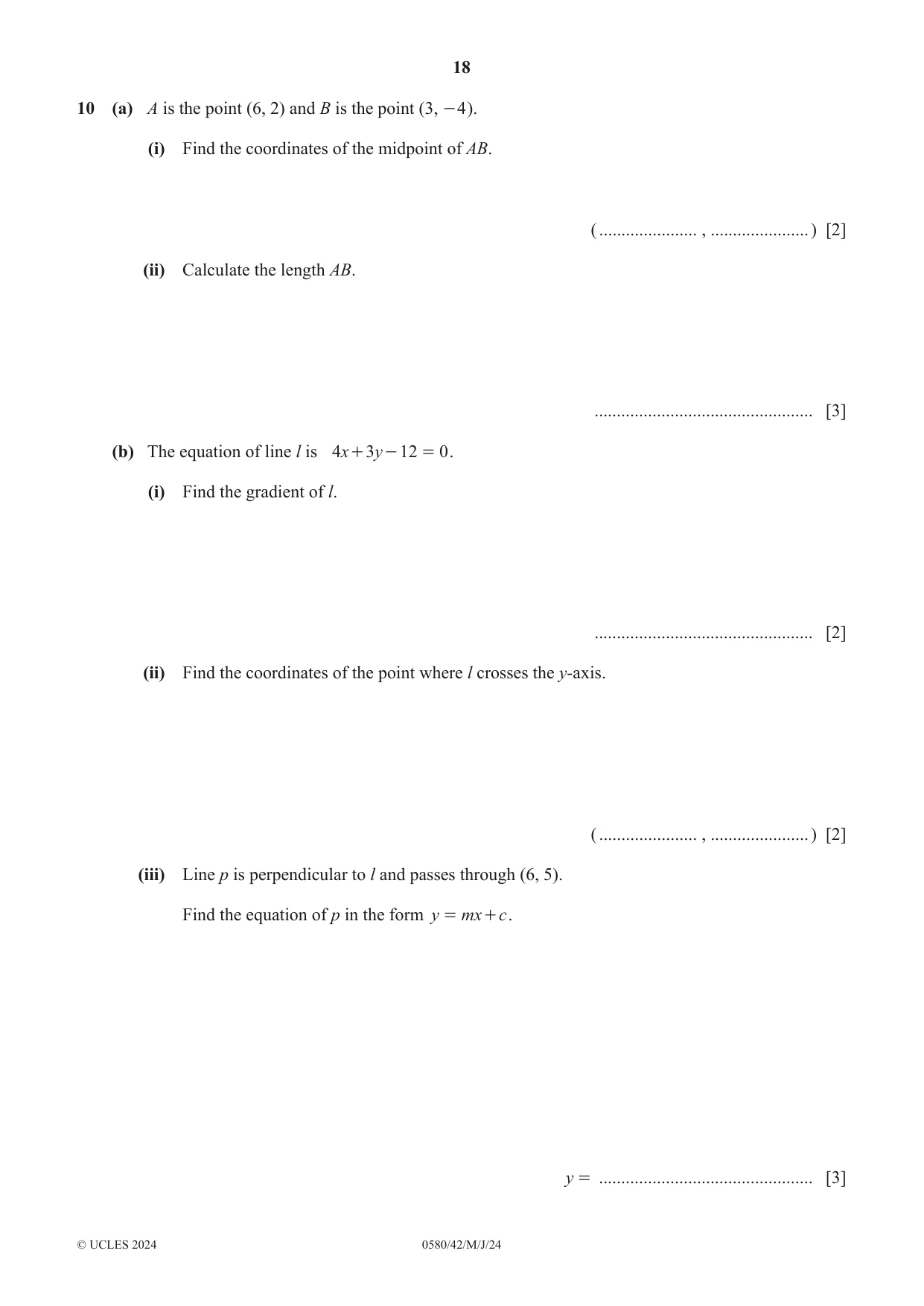
10 (a) A is the point (6, 2) and B is the point (3, - 4 ). (i) Find the coordinates of the midpoint of AB. ( ...................... , ...................... ) [2] (ii) Calculate the length AB. ................................................. [3] (b) The equation of line l is 4x + 3y - 12 = 0 . (i) Find the gradient of l. ................................................. [2] (ii) Find the coordinates of the point where l crosses the y-axis. ( ...................... , ...................... ) [2] (iii) Line p is perpendicular to l and passes through (6, 5). Find the equation of p in the form y = mx + c . y = ................................................ [3]
Mark scheme: 10(a)(i) (4.5, −1) 2 B1 for each 10(a)(ii) 6.71 or 6.708... 3 M2 for (6 – 3)2 + (2 – – 4)2 oe or better or M1 for [–] 6 3 and [–] 2 4 oe or for ([–]3)2 and ([–]6)2 oe 10(b)(i) 4 2 M1 for 3 y 4 x 12 3 4 12 or x y [= 0] or better seen 3 3 10(b)(ii) (0, 4) 2 B1 for each or for y = 4 not in coordinate form 10(b)(iii) 3 1 3 3 1 [ y ] x final answer M1 for gradient or oe or 4 2 4 their(b)(i) better 3 M1 for (6, 5) substituted into y = x + c 4 or y = their mx + c oe
Q11 · The point ( - 1, 6) lies on a curve
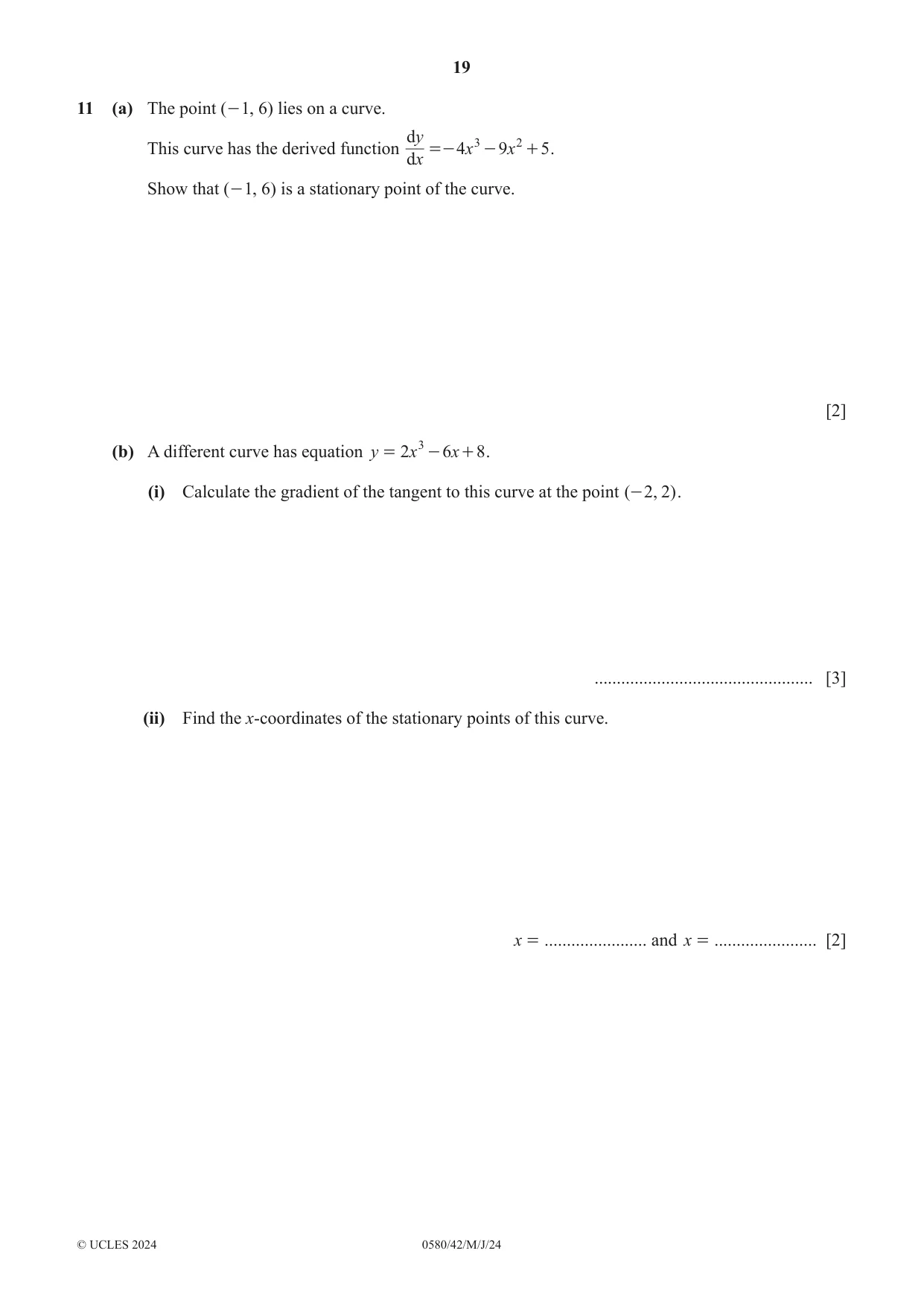
11 (a) The point ( - 1, 6) lies on a curve. dy 3 2 This curve has the derived function =- 4 x - 9 x + 5 . dx Show that ( - 1, 6) is a stationary point of the curve. [2] (b) A different curve has equation y = 2x 3 - 6x + 8 . (i) Calculate the gradient of the tangent to this curve at the point ( - 2, 2) . ................................................. [3] (ii) Find the x-coordinates of the stationary points of this curve. x = ....................... and x = ....................... [2]
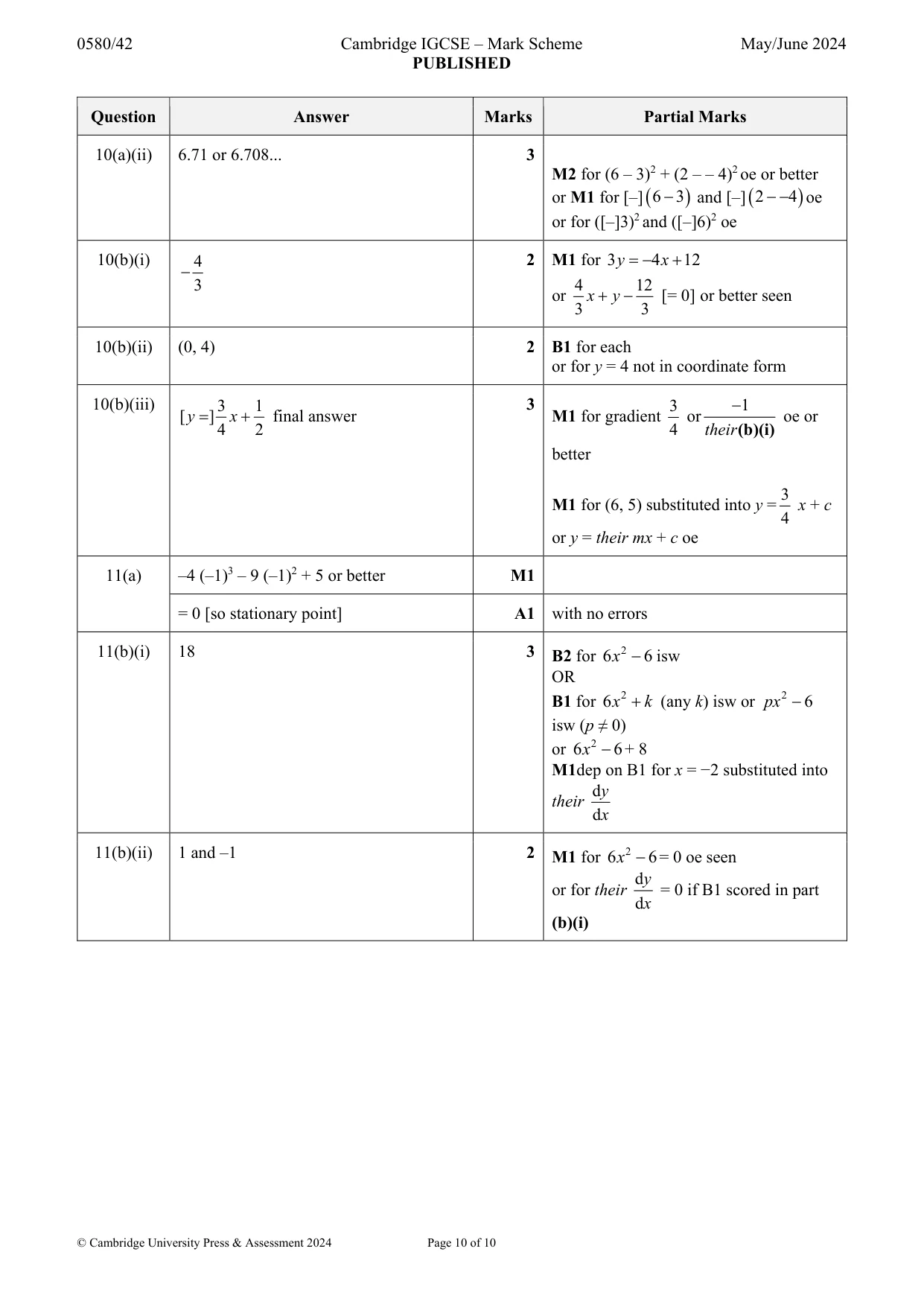
Mark scheme: 11(a) –4 (–1)3 – 9 (–1)2 + 5 or better M1 = 0 [so stationary point] A1 with no errors 11(b)(i) 18 3 B2 for 6 x 2 6 isw OR B1 for 6 x 2 k (any k) isw or px 2 6 isw (p ≠ 0) or 6 x 2 6 + 8 M1dep on B1 for x = −2 substituted into d y their d x 11(b)(ii) 1 and –1 2 M1 for 6 x 2 6 = 0 oe seen d y or for their = 0 if B1 scored in part d x (b)(i)
What was in this paper
The subtopics covered by these 11 questions, and how many questions each got. Open one in a new tab to see every Cambridge question on it.
What you needed in this session
Cambridge’s own grade thresholds for 2024 May/June, Paper 4 · Variant 2. A higher threshold means an easier paper — the bar moves with how the cohort did.