Cambridge IGCSE Mathematics 0580 — 2018 May/June Paper 4 · Variant 2
0580/42/M/J/18 · 9 questions · 130 marks · ≈146 min
The question paper and its mark scheme, free to read here and free to download. This is Cambridge’s own paper, exactly as it was sat.
Question paper16 pages
Mark scheme8 pages
Answers below. Sit the paper first if you are practising.
Questions as text
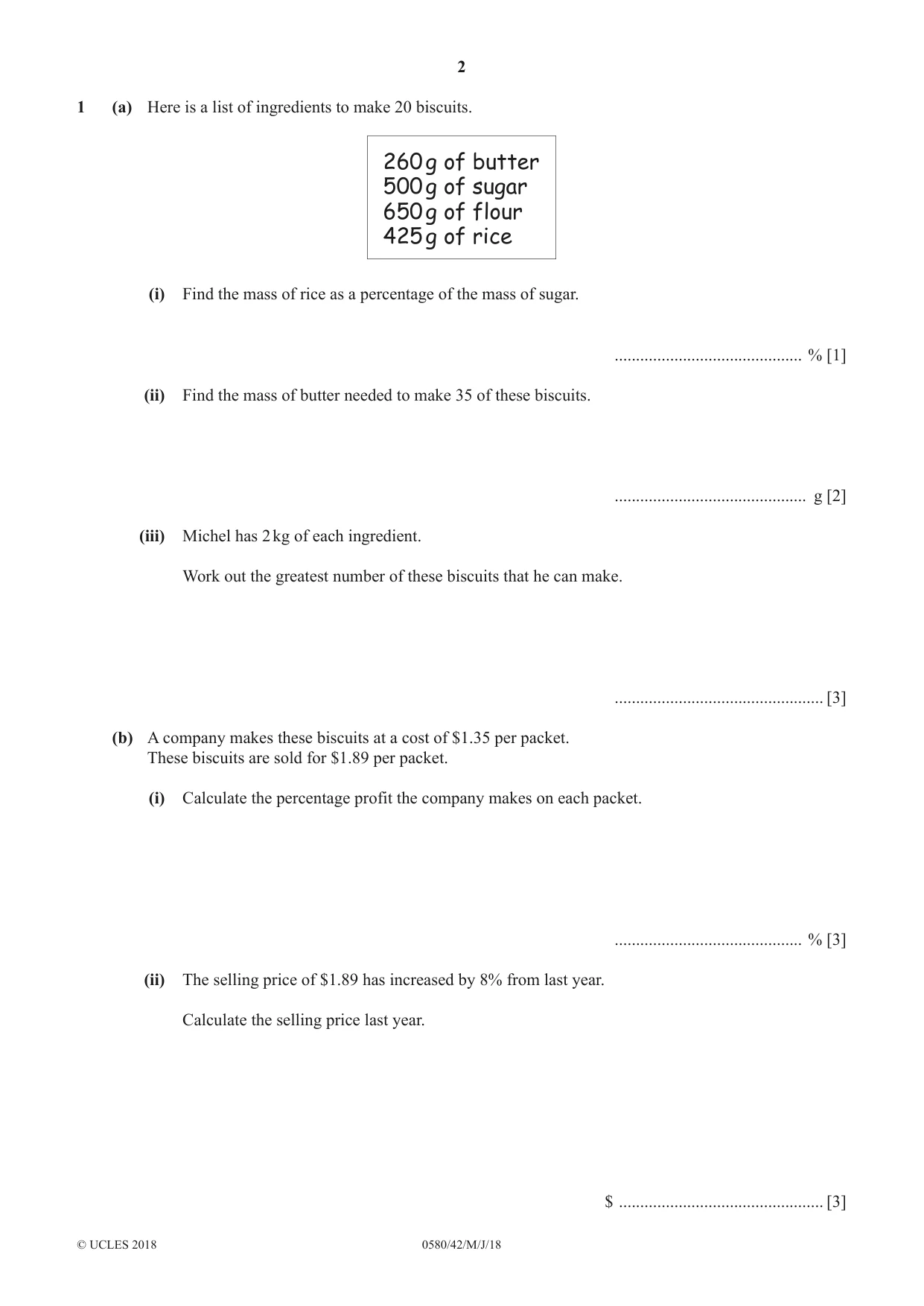
Q1 · Here is a list of ingredients to make 20 biscuits
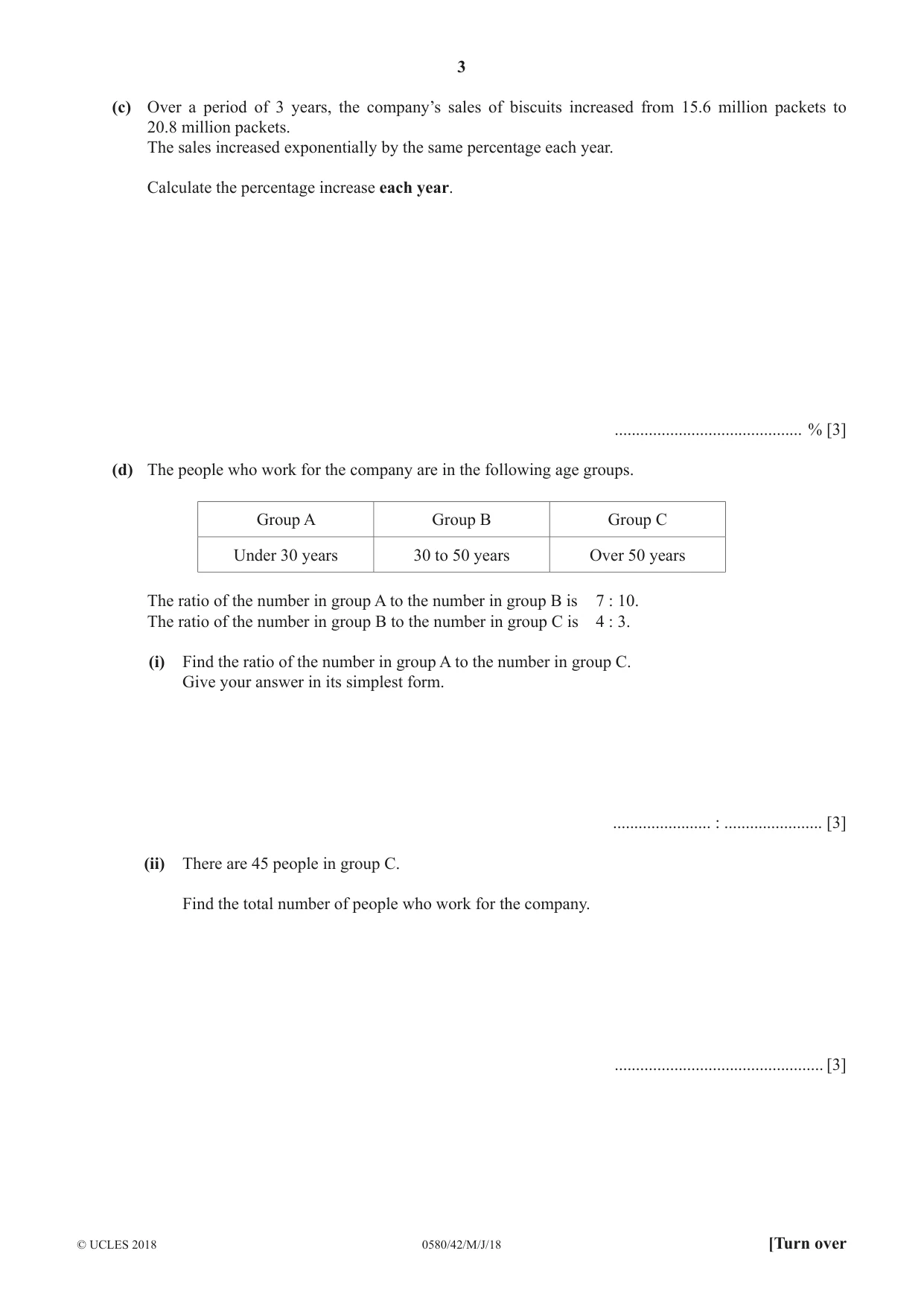
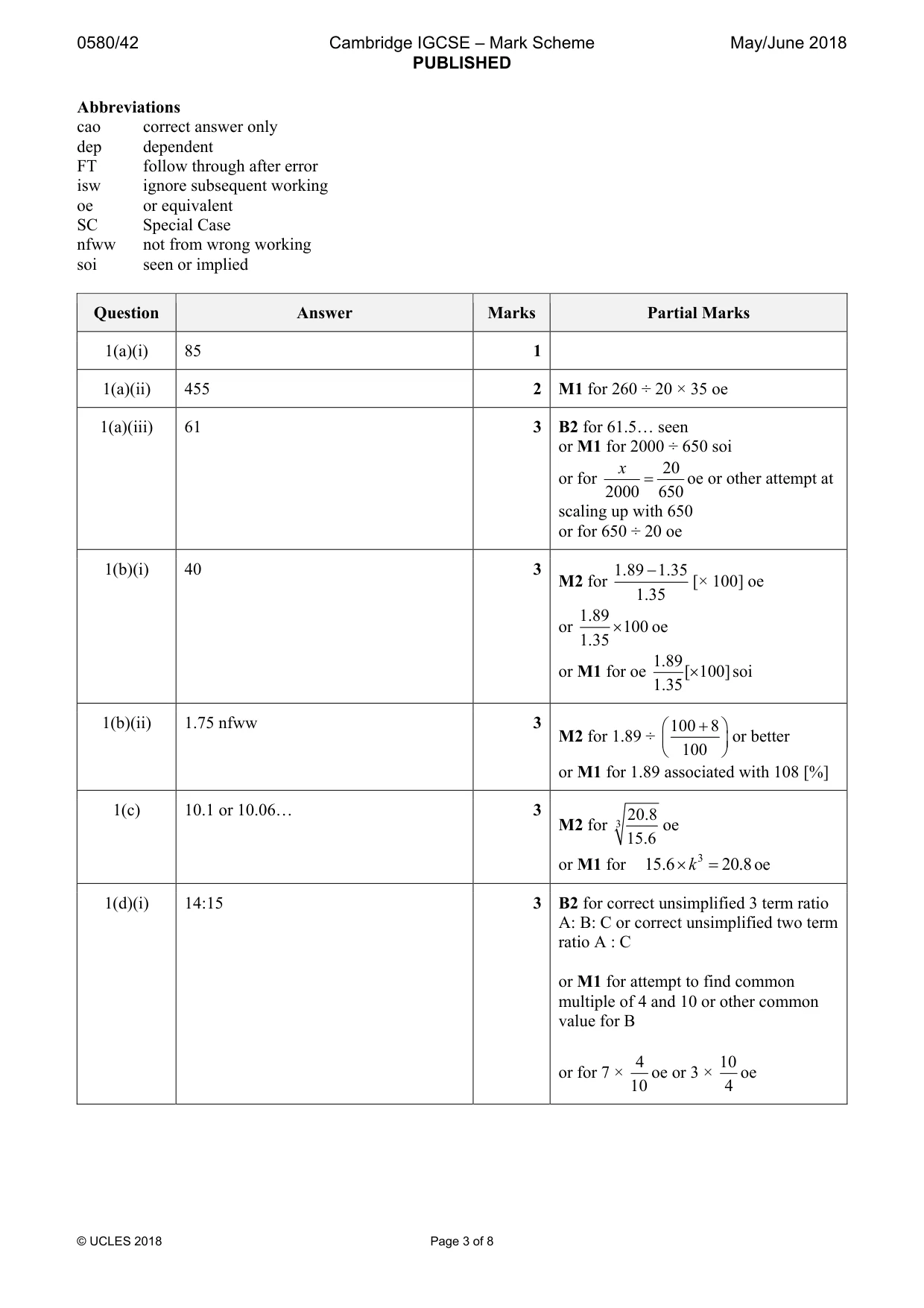
1 (a) Here is a list of ingredients to make 20 biscuits. 260 g of butter 500 g of sugar 650 g of flour 425 g of rice (i) Find the mass of rice as a percentage of the mass of sugar. ............................................ % [1] (ii) Find the mass of butter needed to make 35 of these biscuits. ............................................. g [2] (iii) Michel has 2 kg of each ingredient. Work out the greatest number of these biscuits that he can make. ................................................. [3] (b) A company makes these biscuits at a cost of $1.35 per packet. These biscuits are sold for $1.89 per packet. (i) Calculate the percentage profit the company makes on each packet. ............................................ % [3] (ii) The selling price of $1.89 has increased by 8% from last year. Calculate the selling price last year. $ ................................................ [3] (c) Over a period of 3 years, the company’s sales of biscuits increased from 15.6 million packets to 20.8 million packets. The sales increased exponentially by the same percentage each year. Calculate the percentage increase each year. ............................................ % [3] (d) The people who work for the company are in the following age groups. Group A Group B Group C Under 30 years 30 to 50 years Over 50 years The ratio of the number in group A to the number in group B is 7 : 10. The ratio of the number in group B to the number in group C is 4 : 3. (i) Find the ratio of the number in group A to the number in group C. Give your answer in its simplest form. ....................... : ....................... [3] (ii) There are 45 people in group C. Find the total number of people who work for the company. ................................................. [3]
Mark scheme: Question Answer Marks Partial Marks 1(a)(i) 85 1 1(a)(ii) 455 2 M1 for 260 ÷ 20 × 35 oe 1(a)(iii) 61 3 B2 for 61.5… seen or M1 for 2000 ÷ 650 soi x 20 or for = oe or other attempt at 2000 650 scaling up with 650 or for 650 ÷ 20 oe 1(b)(i) 40 3 1.89 − 1.35 M2 for [× 100] oe 1.35 1.89 or × 100 oe 1.35 or M1 for oe 1.89[× 100] soi 1.35 1(b)(ii) 1.75 nfww 3 100 + 8 M2 for 1.89 ÷ or better 100 or M1 for 1.89 associated with 108 [%] 1(c) 10.1 or 10.06… 3 20.8 M2 for 3 oe 15.6 or M1 for 15.6 × k 3 = 20.8 oe 1(d)(i) 14:15 3 B2 for correct unsimplified 3 term ratio A: B: C or correct unsimplified two term ratio A : C or M1 for attempt to find common multiple of 4 and 10 or other common value for B 4 10 or for 7 × oe or 3 × oe 10 4 1(d)(ii) 147 3 45 M2 for (14 + 20 [ +15] ) oe or 15 45 ÷ 3 × 4 + (45 ÷ 3 × 4) ÷ 10 × 7 [+ 45] or M1 for 45 ÷ 3 oe or 45 ÷ their (d)(i) value for C shown
Q2 · The time taken for each of 120 students to complete a cooking challenge is shown in the…
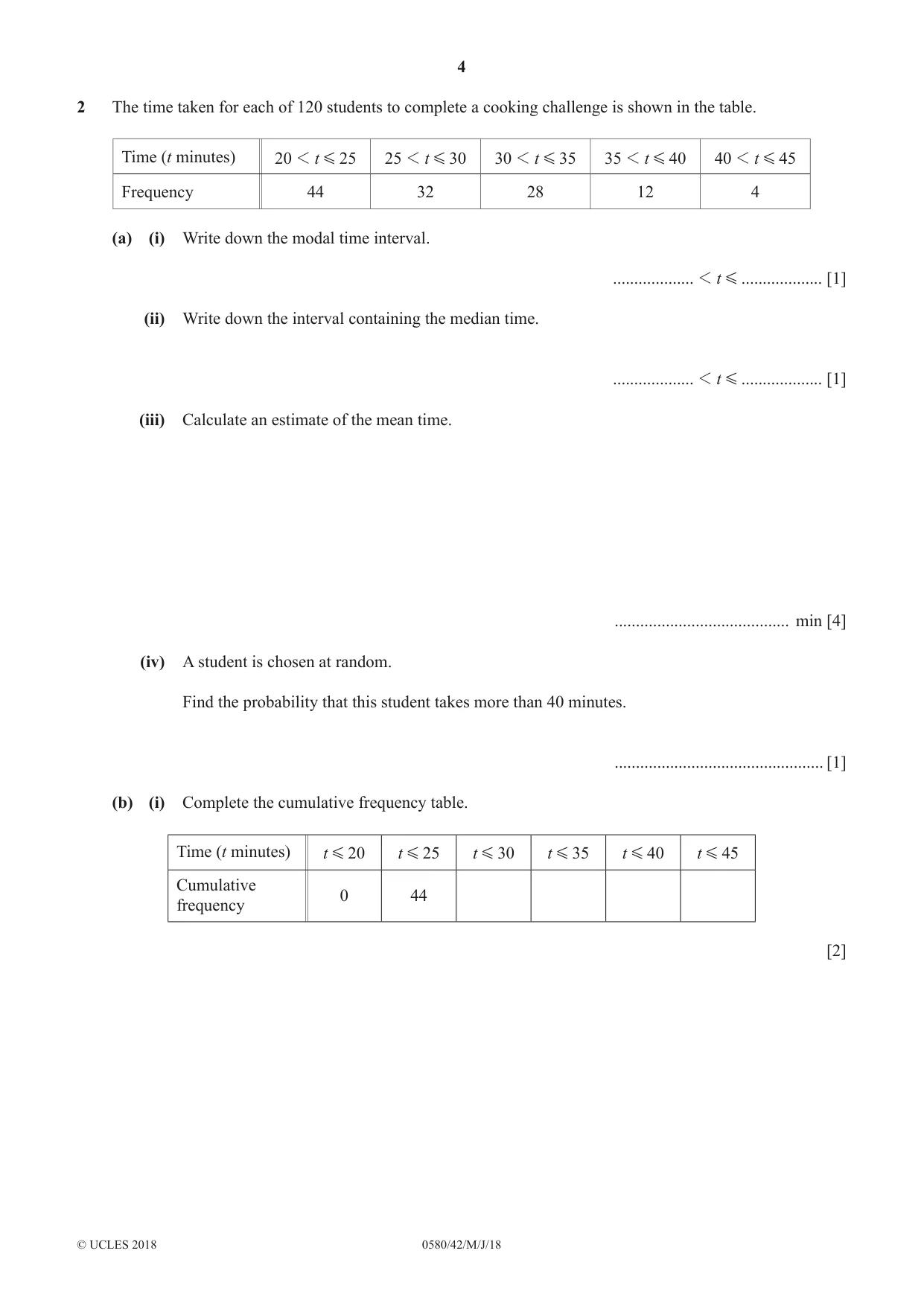
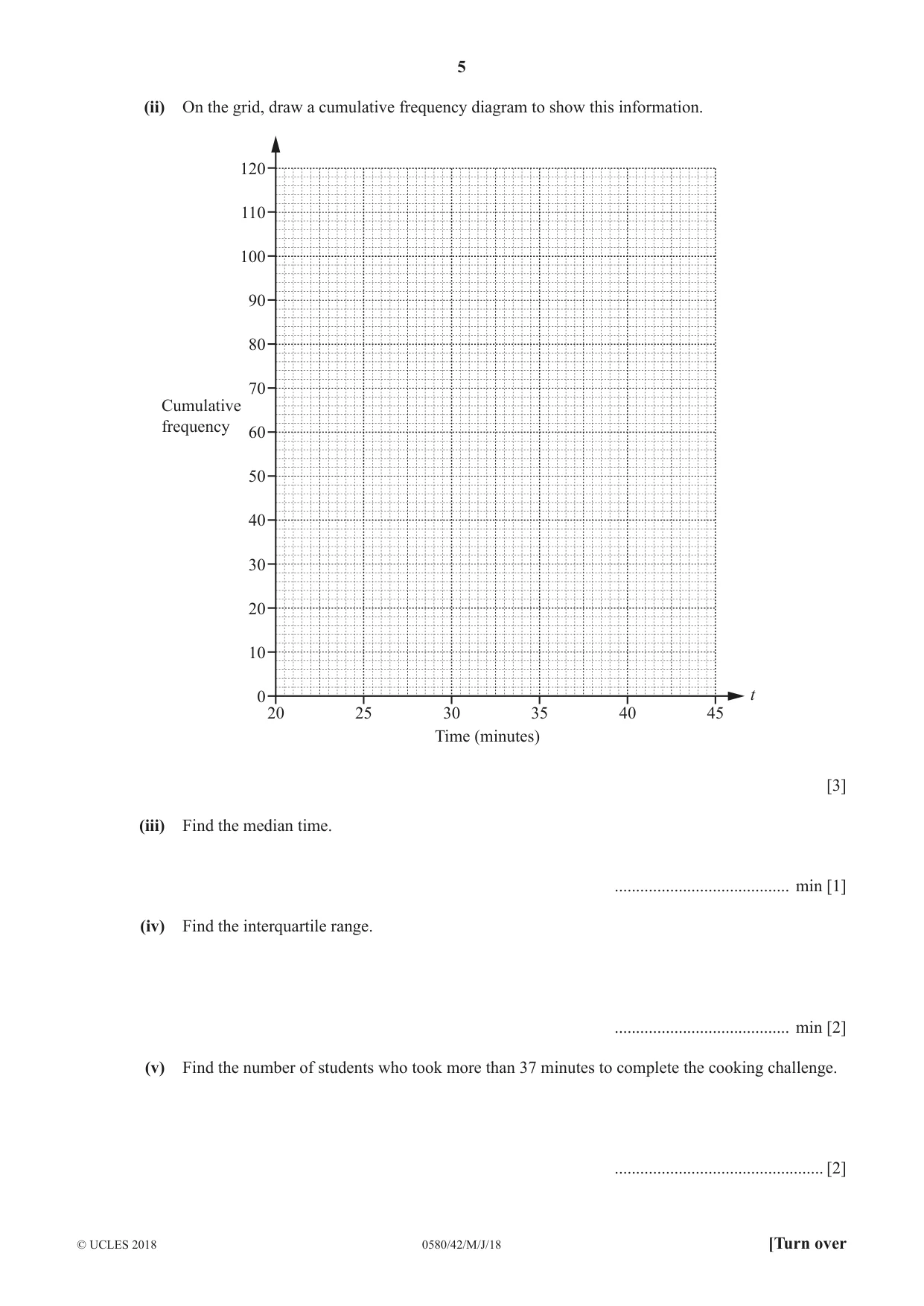
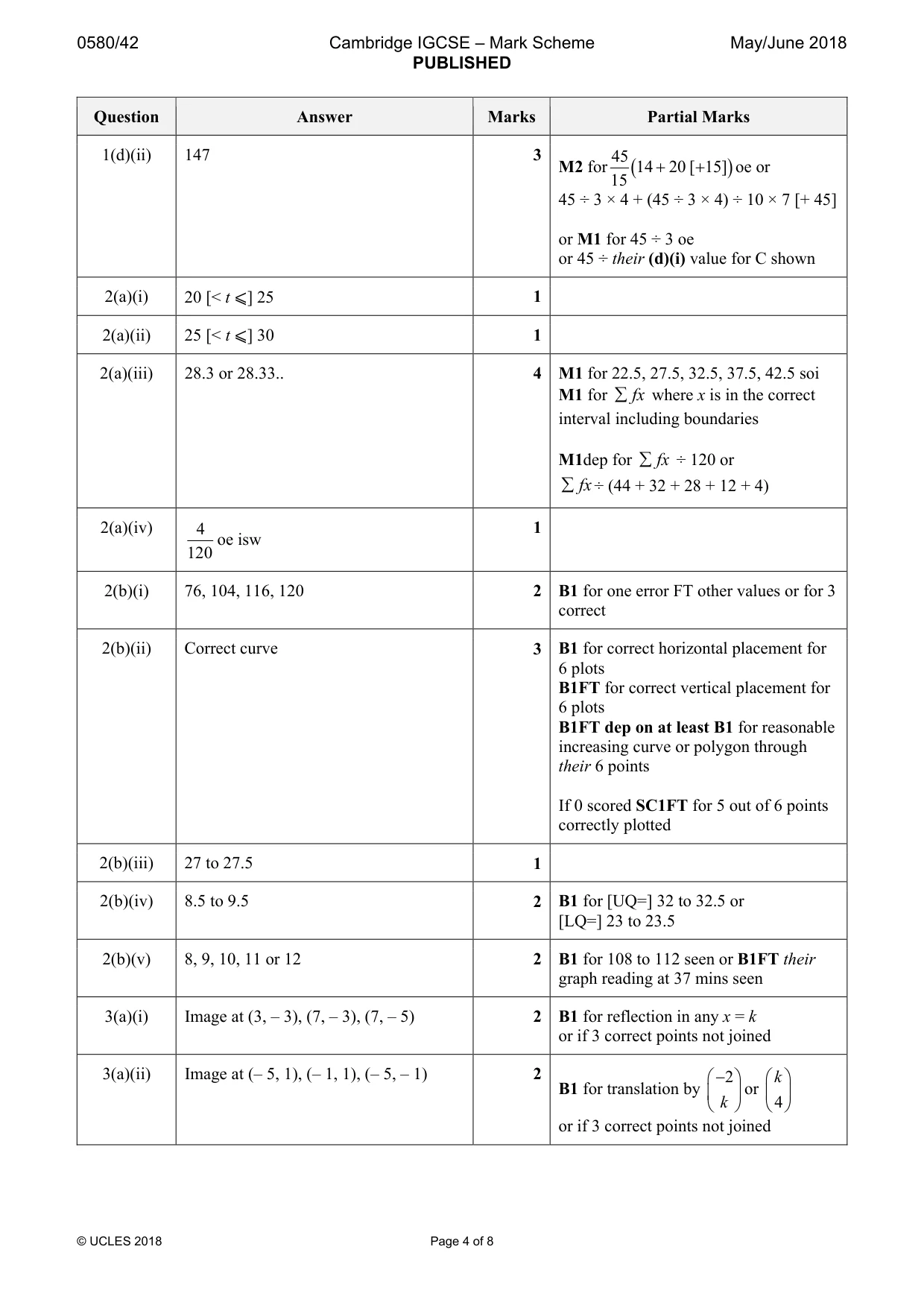
2 The time taken for each of 120 students to complete a cooking challenge is shown in the table. Time (t minutes) 20 1 t G 25 25 1 t G 30 30 1 t G 35 35 1 t G 40 40 1 t G 45 Frequency 44 32 28 12 4 (a) (i) Write down the modal time interval. ................... 1 t G ................... [1] (ii) Write down the interval containing the median time. ................... 1 t G ................... [1] (iii) Calculate an estimate of the mean time. ......................................... min [4] (iv) A student is chosen at random. Find the probability that this student takes more than 40 minutes. ................................................. [1] (b) (i) Complete the cumulative frequency table. Time (t minutes) t G 20 t G 25 t G 30 t G 35 t G 40 t G 45 Cumulative 0 44 frequency [2] (ii) On the grid, draw a cumulative frequency diagram to show this information. 120 110 100 90 80 70 Cumulative frequency 60 50 40 30 20 10 0 t 20 25 30 35 40 45 Time (minutes) [3] (iii) Find the median time. ......................................... min [1] (iv) Find the interquartile range. ......................................... min [2] (v) Find the number of students who took more than 37 minutes to complete the cooking challenge. ................................................. [2]
Mark scheme: 2(a)(i) 20 [< t ⩽] 25 1 2(a)(ii) 25 [< t ⩽] 30 1 2(a)(iii) 28.3 or 28.33.. 4 M1 for 22.5, 27.5, 32.5, 37.5, 42.5 soi M1 for ∑fx where x is in the correct interval including boundaries M1dep for ∑fx ÷ 120 or ∑fx ÷ (44 + 32 + 28 + 12 + 4) 2(a)(iv) 4 1 oe isw 120 2(b)(i) 76, 104, 116, 120 2 B1 for one error FT other values or for 3 correct 2(b)(ii) Correct curve 3 B1 for correct horizontal placement for 6 plots B1FT for correct vertical placement for 6 plots B1FT dep on at least B1 for reasonable increasing curve or polygon through their 6 points If 0 scored SC1FT for 5 out of 6 points correctly plotted 2(b)(iii) 27 to 27.5 1 2(b)(iv) 8.5 to 9.5 2 B1 for [UQ=] 32 to 32.5 or [LQ=] 23 to 23.5 2(b)(v) 8, 9, 10, 11 or 12 2 B1 for 108 to 112 seen or B1FT their graph reading at 37 mins seen
Q3 · Y 6 5 4 3 B 2 1 x 0 –7 –6 –5 –4 –3 –2 –1 1 2 3 4 5 6 7 8 –1 –2 –3 A –4 –5 –6 (a) (i) Draw…
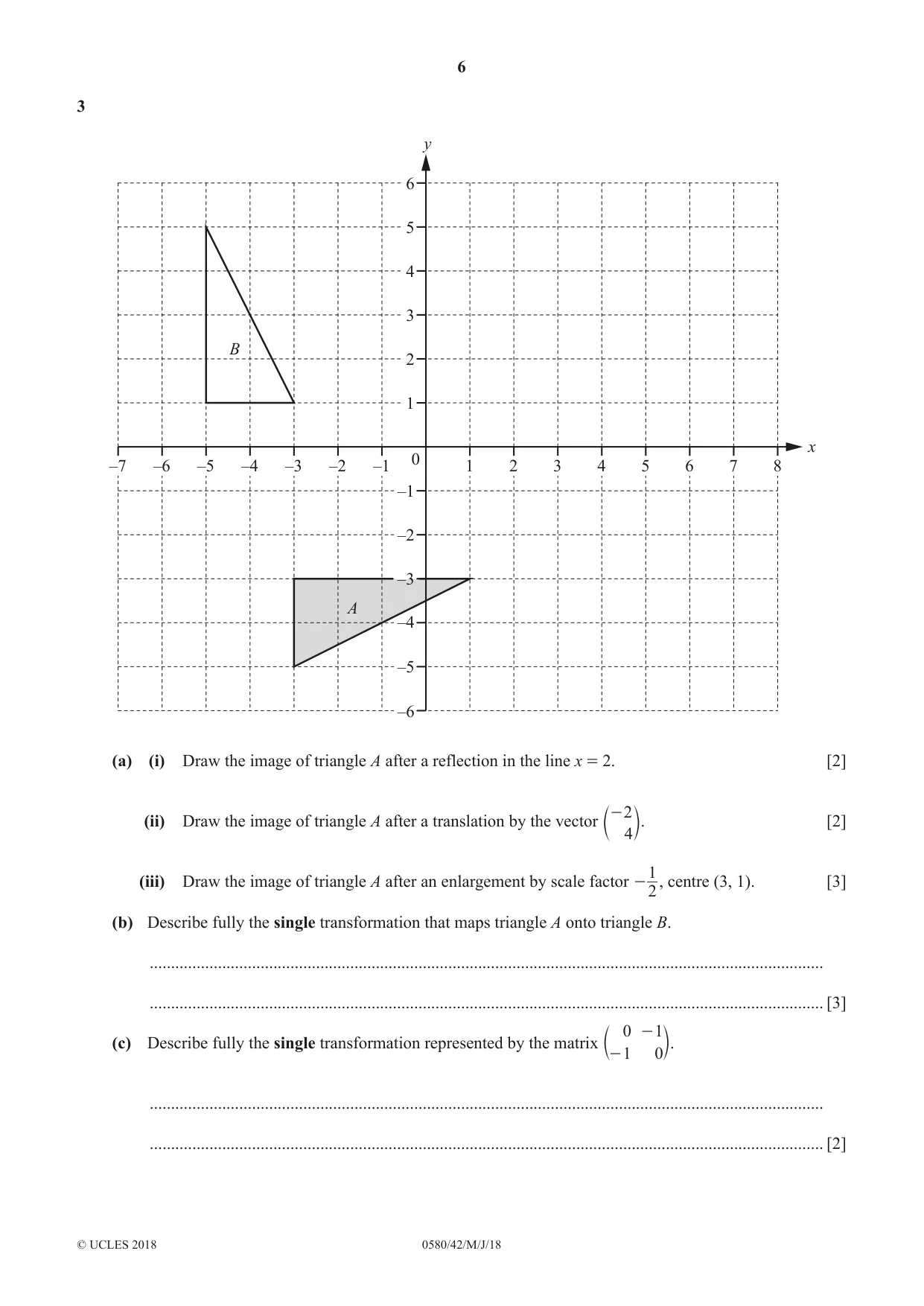
3 y 6 5 4 3 B 2 1 x 0 –7 –6 –5 –4 –3 –2 –1 1 2 3 4 5 6 7 8 –1 –2 –3 A –4 –5 –6 (a) (i) Draw the image of triangle A after a reflection in the line x = 2. [2] - 2 (ii) Draw the image of triangle A after a translation by the vector [2] c 4 m. 1 (iii) Draw the image of triangle A after an enlargement by scale factor - , centre (3, 1). [3] 2 (b) Describe fully the single transformation that maps triangle A onto triangle B. .............................................................................................................................................................. .............................................................................................................................................................. [3] 0 - 1 (c) Describe fully the single transformation represented by the matrix c- 1 0m. .............................................................................................................................................................. .............................................................................................................................................................. [2]
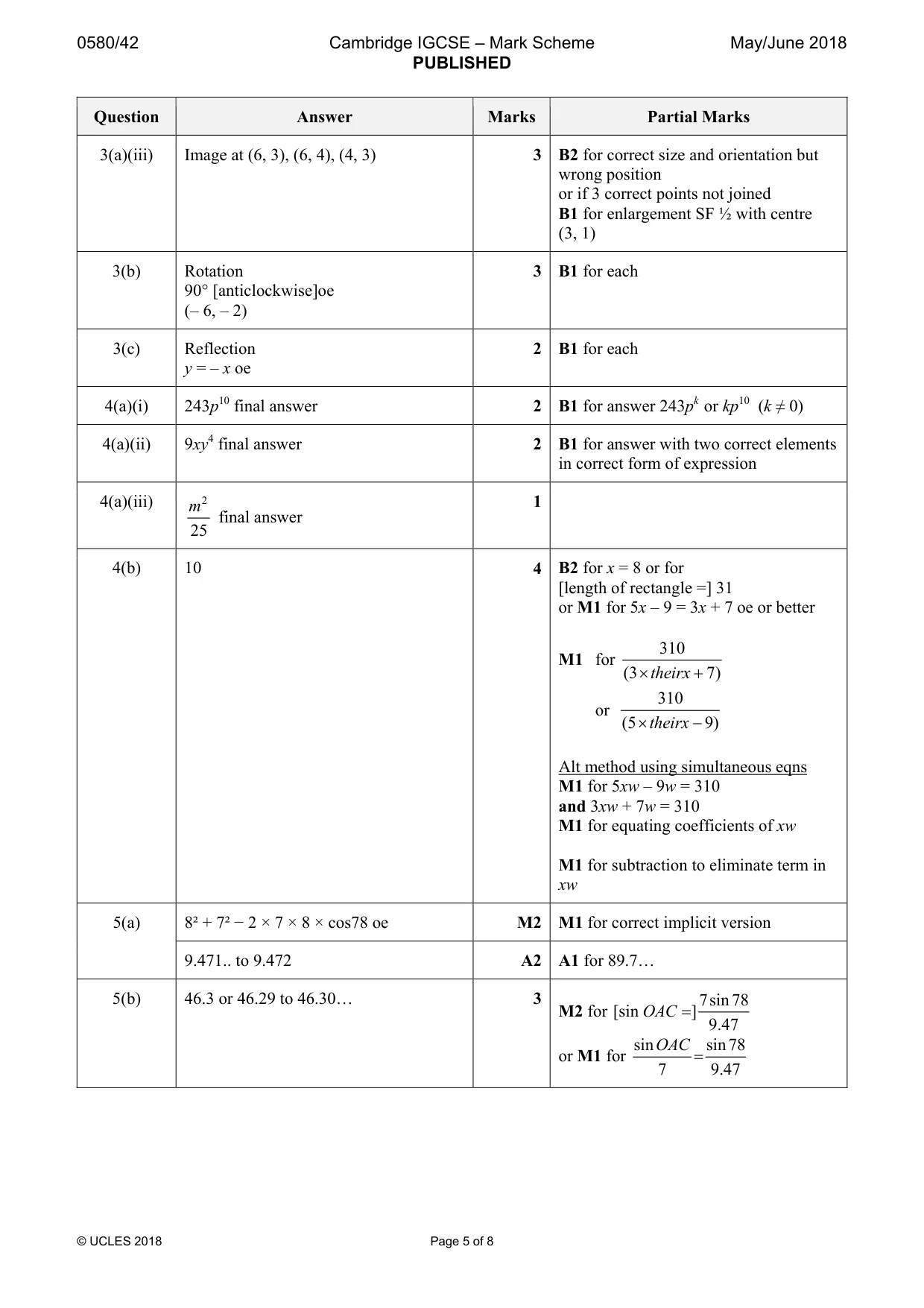
Mark scheme: 3(a)(i) Image at (3, – 3), (7, – 3), (7, – 5) 2 B1 for reflection in any x = k or if 3 correct points not joined 3(a)(ii) Image at (– 5, 1), (– 1, 1), (– 5, – 1) 2 −2 k B1 for translation by or k 4 or if 3 correct points not joined 3(a)(iii) Image at (6, 3), (6, 4), (4, 3) 3 B2 for correct size and orientation but wrong position or if 3 correct points not joined B1 for enlargement SF ½ with centre (3, 1) 3(b) Rotation 3 B1 for each 90° [anticlockwise]oe (– 6, – 2) 3(c) Reflection 2 B1 for each y = – x oe k
Question 4
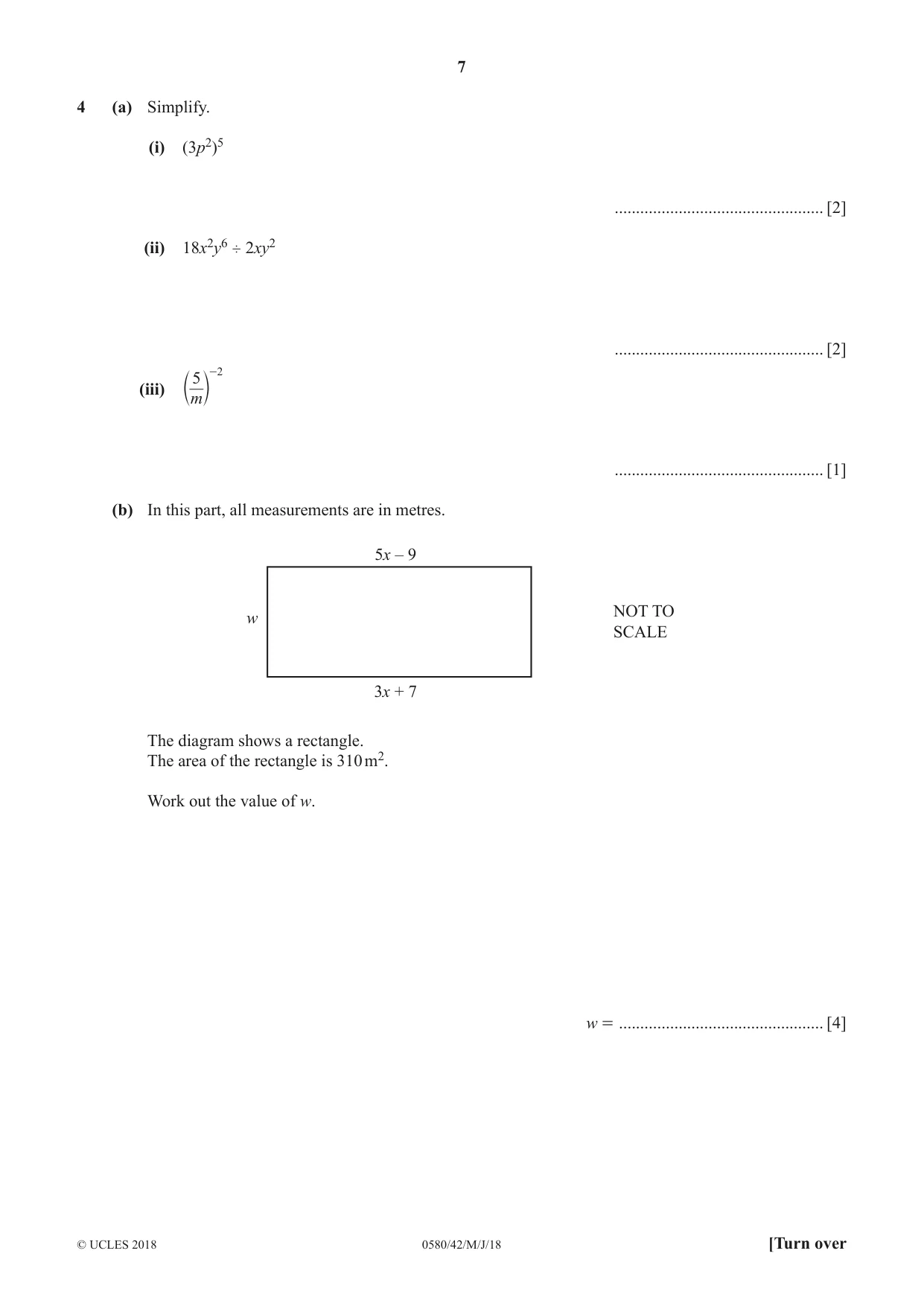
4 (a) Simplify. (i) (3p2)5 ................................................. [2] (ii) 18x2y6 ' 2xy2 ................................................. [2] 5 -2 (iii) c m m ................................................. [1] (b) In this part, all measurements are in metres. 5x – 9 NOT TO w SCALE 3x + 7 The diagram shows a rectangle. The area of the rectangle is 310 m2. Work out the value of w. w = ................................................ [4]
Mark scheme: 4(a)(i) 243p10 final answer 2 B1 for answer 243pk or kp10 (k ≠ 0) 4(a)(ii) 9xy4 final answer 2 B1 for answer with two correct elements in correct form of expression 4(a)(iii) m 2 1 final answer 25 4(b) 10 4 B2 for x = 8 or for [length of rectangle =] 31 or M1 for 5x – 9 = 3x + 7 oe or better 310 M1 for (3 × theirx + 7) 310 or (5 × theirx − 9) Alt method using simultaneous eqns M1 for 5xw – 9w = 310 and 3xw + 7w = 310 M1 for equating coefficients of xw M1 for subtraction to eliminate term in xw
Q5 · A O NOT TO SCALE 8 cm 7 cm 78° C B The diagram shows a design made from a triangle AOC…
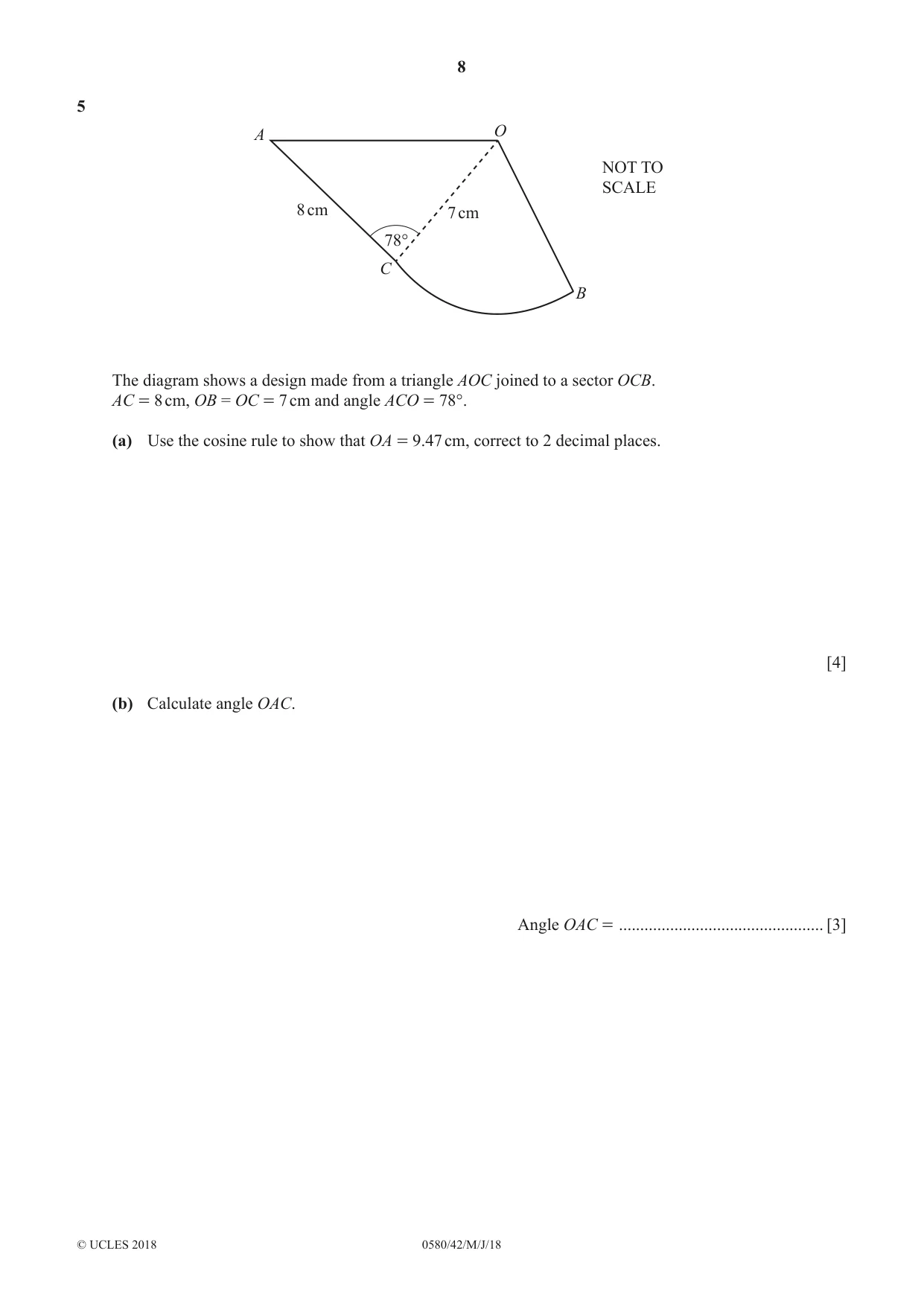
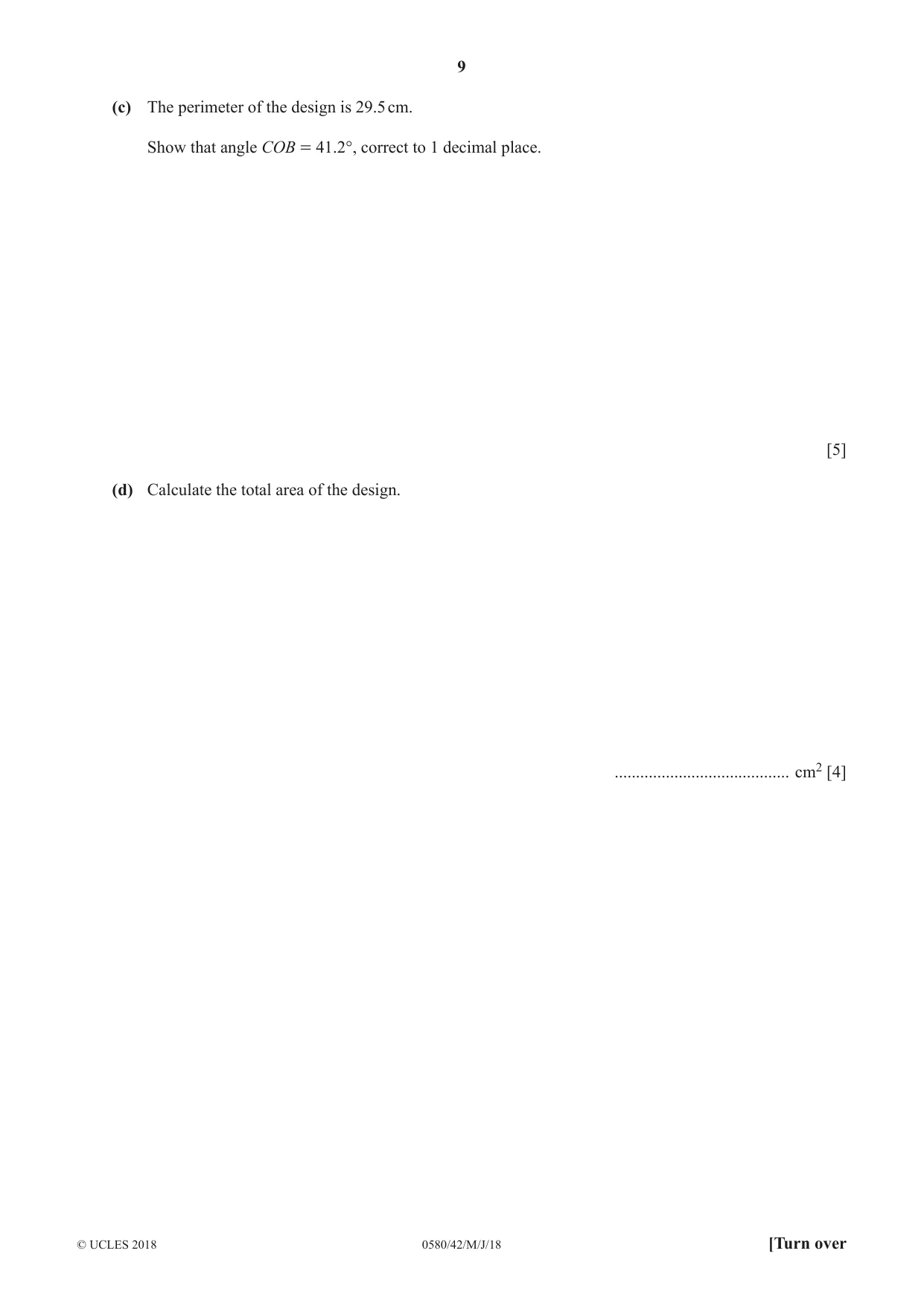
5 A O NOT TO SCALE 8 cm 7 cm 78° C B The diagram shows a design made from a triangle AOC joined to a sector OCB. AC = 8 cm, OB = OC = 7 cm and angle ACO = 78°. (a) Use the cosine rule to show that OA = 9.47 cm, correct to 2 decimal places. [4] (b) Calculate angle OAC. Angle OAC = ................................................ [3] (c) The perimeter of the design is 29.5 cm. Show that angle COB = 41.2°, correct to 1 decimal place. [5] (d) Calculate the total area of the design. ......................................... cm2 [4]
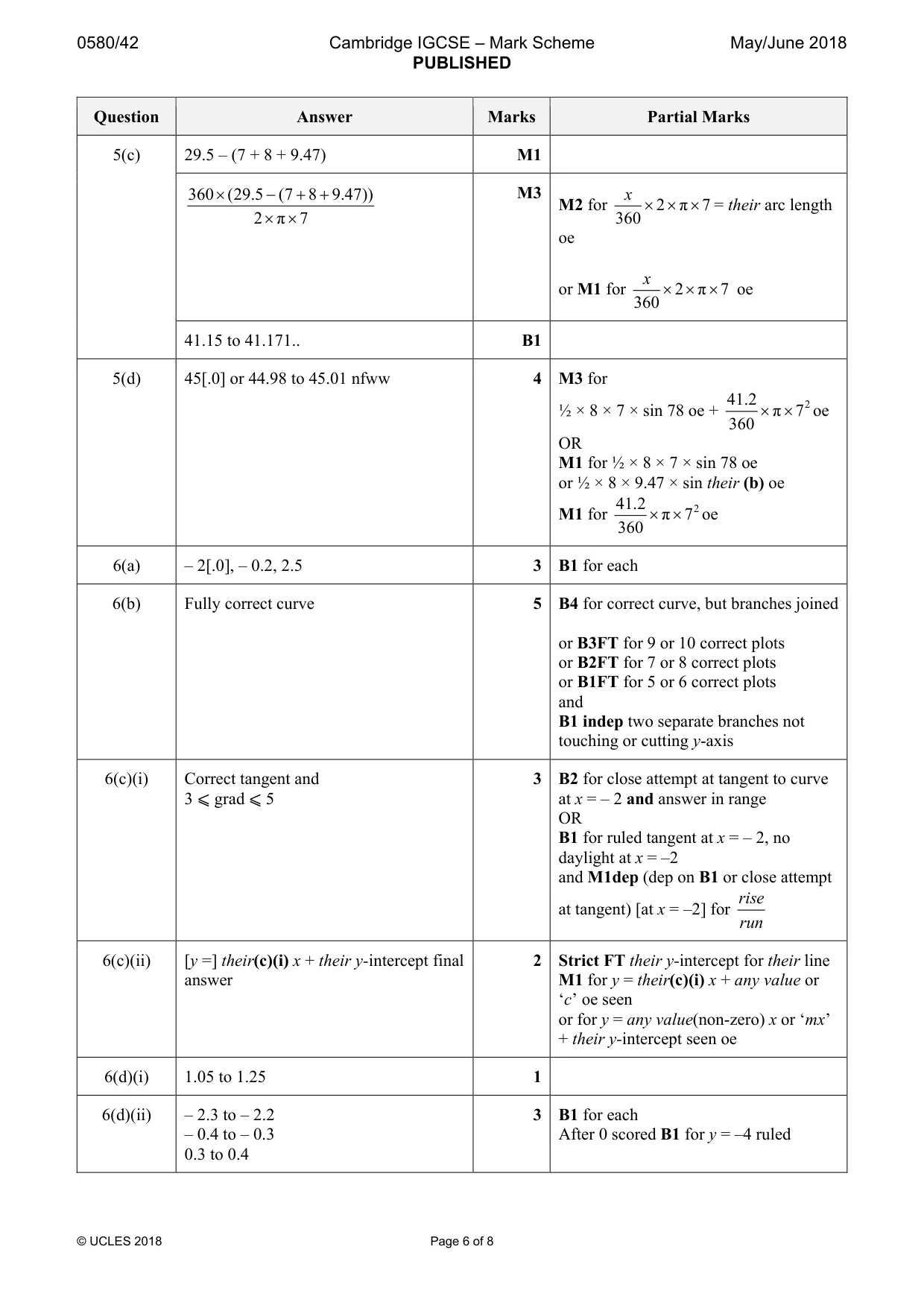
Mark scheme: 5(a) 8² + 7² − 2 × 7 × 8 × cos78 oe M2 M1 for correct implicit version 9.471.. to 9.472 A2 A1 for 89.7… 5(b) 46.3 or 46.29 to 46.30… 3 7sin78 M2 for [sin OAC = ] 9.47 sin OAC sin78 or M1 for = 7 9.47 5(c) 29.5 – (7 + 8 + 9.47) M1 360 × (29.5 − (7 + 8 + 9.47)) M3 x M2 for × 2 × π × 7 = their arc length 2 × π × 7 360 oe x or M1 for × 2 × π × 7 oe 360 41.15 to 41.171.. B1 5(d) 45[.0] or 44.98 to 45.01 nfww 4 M3 for 41.2 2 ½ × 8 × 7 × sin 78 oe + × π × 7 oe 360 OR M1 for ½ × 8 × 7 × sin 78 oe or ½ × 8 × 9.47 × sin their (b) oe 41.2 2 M1 for × π × 7 oe 360
Q6 · X 3 16 (a) Complete the table of values for y = - 2 , x !
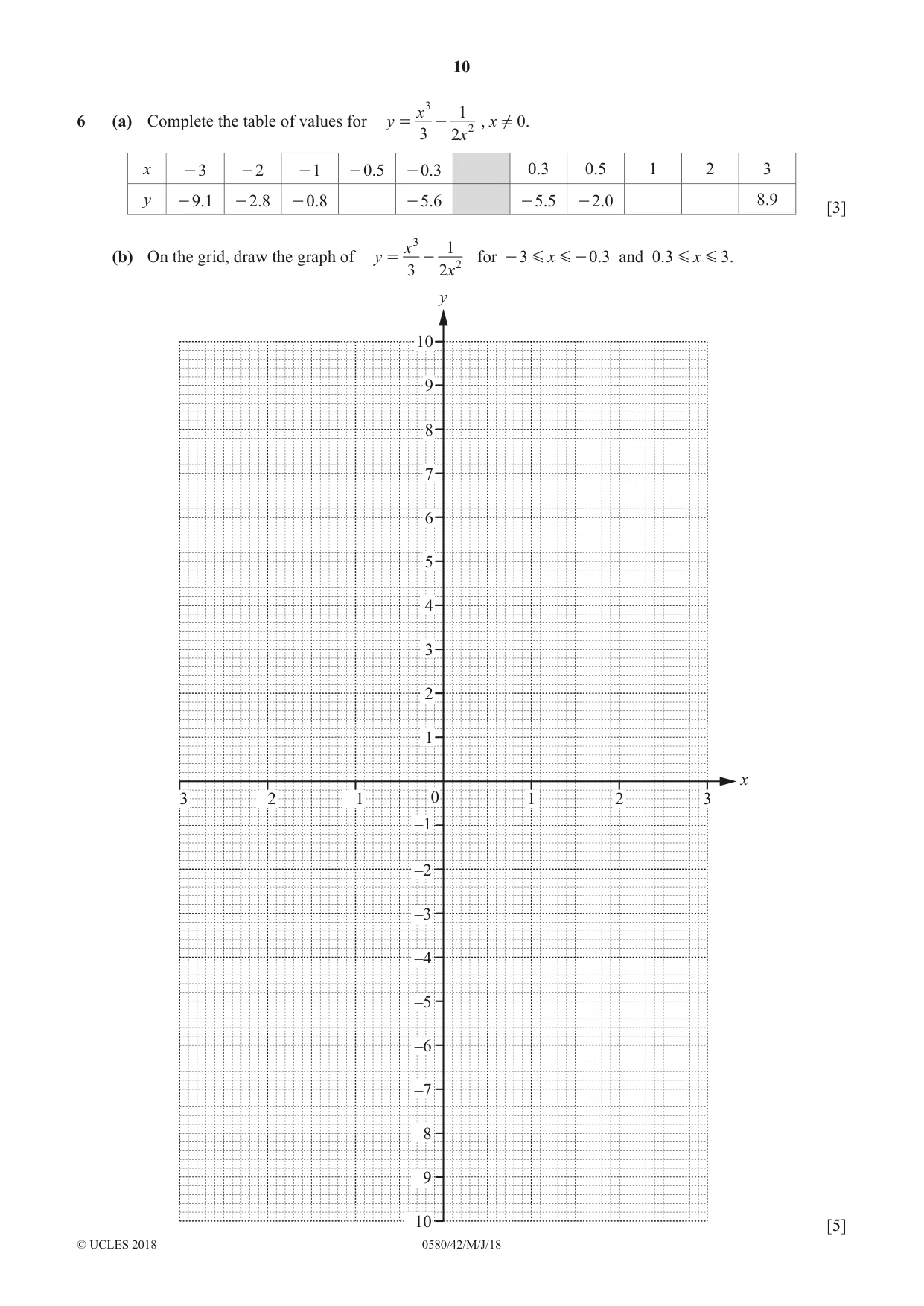
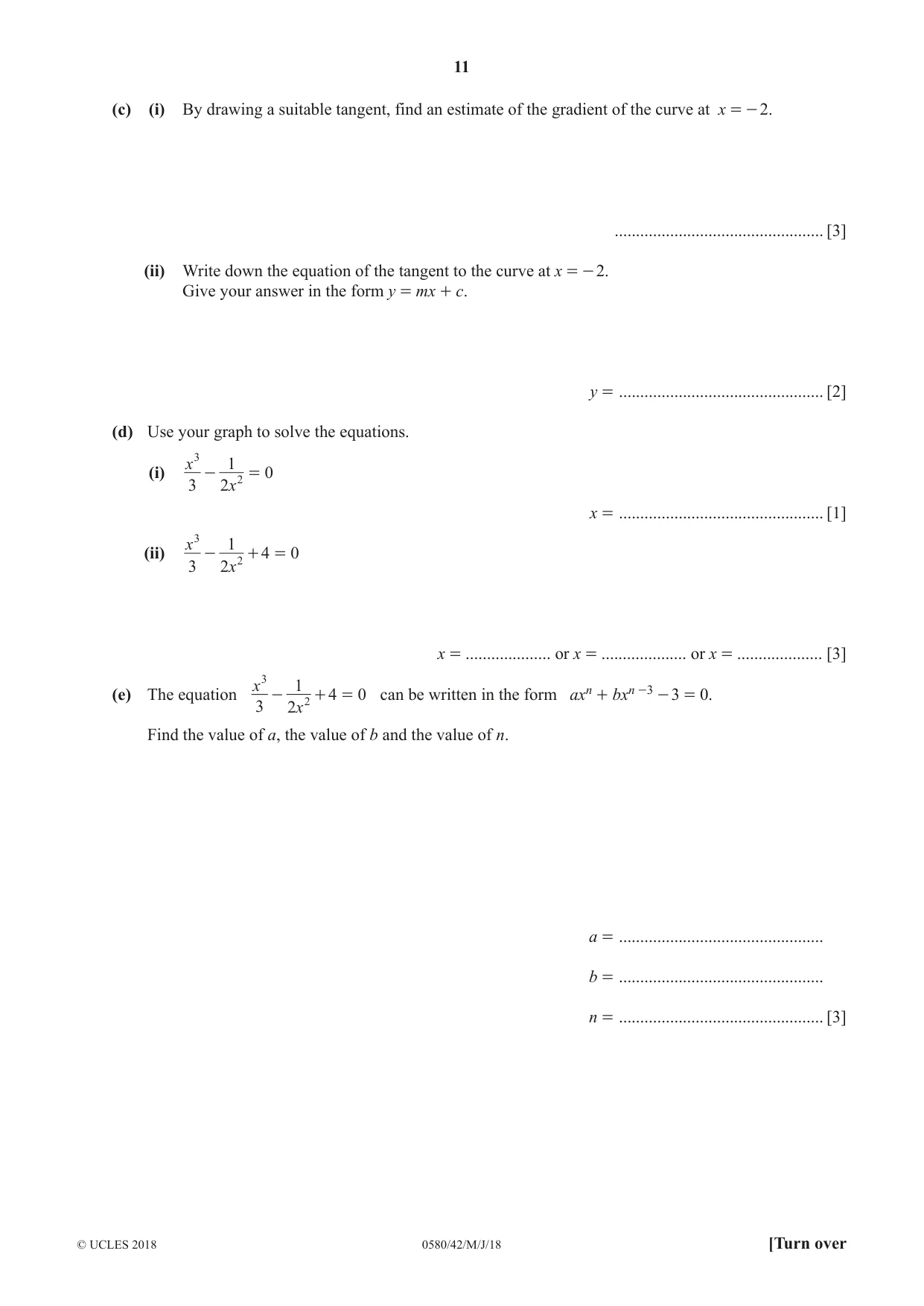
x 3 16 (a) Complete the table of values for y = - 2 , x ! 0. 3 2x x - 3 - 2 - 1 - 0.5 - 0.3 0.3 0.5 1 2 3 y - 9.1 - 2.8 - 0.8 - 5.6 - 5.5 - 2.0 8.9 [3] x 3 1 (b) On the grid, draw the graph of y = - 2 for - 3 G x G - 0.3 and 0.3 G x G 3. 3 2x y 10 9 8 7 6 5 4 3 2 1 x –3 –2 –1 0 1 2 3 –1 –2 –3 –4 –5 –6 –7 –8 –9 –10 [5] (c) (i) By drawing a suitable tangent, find an estimate of the gradient of the curve at x = - 2. ................................................. [3] (ii) Write down the equation of the tangent to the curve at x = - 2. Give your answer in the form y = mx + c. y = ................................................ [2] (d) Use your graph to solve the equations. x 3 1 (i) - 2 = 0 3 2x x = ................................................ [1] x 3 1 (ii) - 2 + 4 = 0 3 2x x = .................... or x = .................... or x = .................... [3] x 3 1 -3 + bxn - 3 = 0.(e) The equation - 2 + 4 = 0 can be written in the form axn 3 2x Find the value of a, the value of b and the value of n. a = ................................................ b = ................................................ n = ................................................ [3]
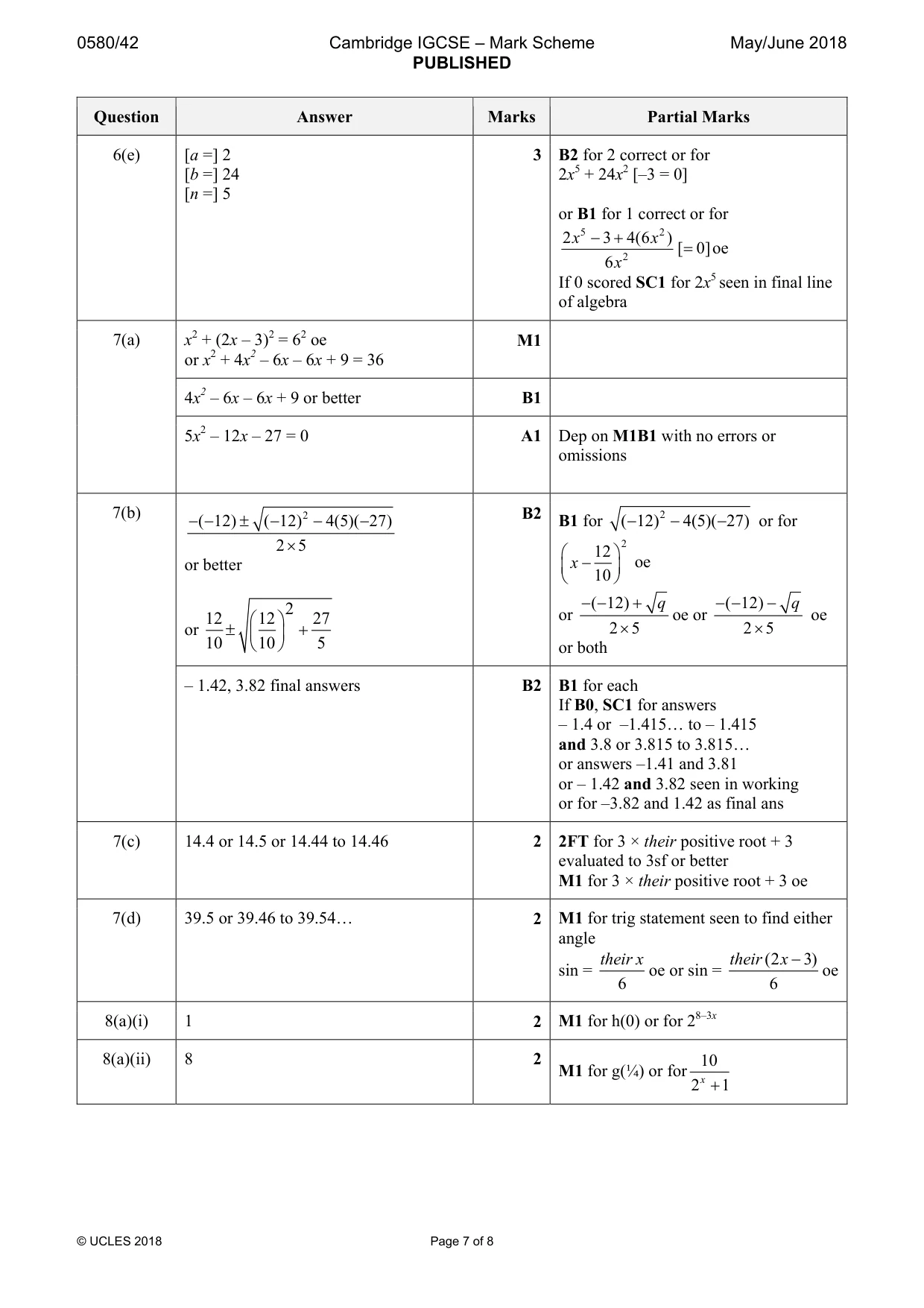
Mark scheme: 6(a) – 2[.0], – 0.2, 2.5 3 B1 for each 6(b) Fully correct curve 5 B4 for correct curve, but branches joined or B3FT for 9 or 10 correct plots or B2FT for 7 or 8 correct plots or B1FT for 5 or 6 correct plots and B1 indep two separate branches not touching or cutting y-axis 6(c)(i) Correct tangent and 3 B2 for close attempt at tangent to curve 3 ⩽ grad ⩽ 5 at x = – 2 and answer in range OR B1 for ruled tangent at x = – 2, no daylight at x = –2 and M1dep (dep on B1 or close attempt rise at tangent) [at x = –2] for run 6(c)(ii) [y =] their(c)(i) x + their y-intercept final 2 Strict FT their y-intercept for their line answer M1 for y = their(c)(i) x + any value or ‘c’ oe seen or for y = any value(non-zero) x or ‘mx’ + their y-intercept seen oe 6(d)(i) 1.05 to 1.25 1 6(d)(ii) – 2.3 to – 2.2 3 B1 for each – 0.4 to – 0.3 After 0 scored B1 for y = –4 ruled 0.3 to 0.4 6(e) [a =] 2 3 B2 for 2 correct or for [b =] 24 2x5 + 24x2 [–3 = 0] [n =] 5 or B1 for 1 correct or for 2 x 5 − 3 + 4(6 x 2 ) [ = 0] oe 6 x 2 If 0 scored SC1 for 2x5 seen in final line of algebra
Q7 · In this question, all measurements are in metres
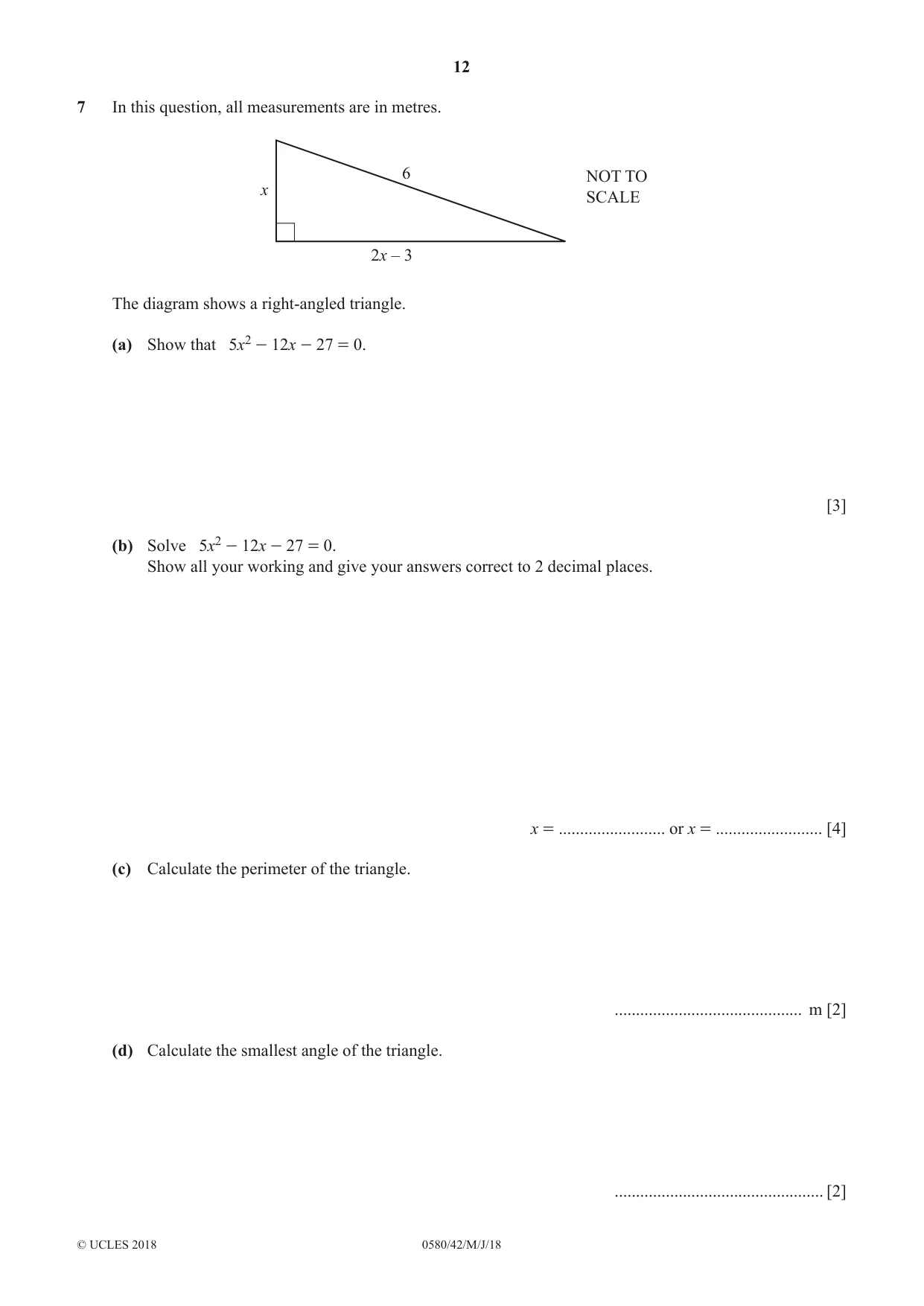
7 In this question, all measurements are in metres. 6 NOT TO x SCALE 2x – 3 The diagram shows a right-angled triangle. (a) Show that 5x2 - 12x - 27 = 0. [3] (b) Solve 5x2 - 12x - 27 = 0. Show all your working and give your answers correct to 2 decimal places. x = ......................... or x = ......................... [4] (c) Calculate the perimeter of the triangle. ............................................ m [2] (d) Calculate the smallest angle of the triangle. ................................................. [2]
Mark scheme: 7(a) x2 + (2x – 3)2 = 62 oe M1 or x2 + 4x2 – 6x – 6x + 9 = 36 4x2 – 6x – 6x + 9 or better B1 5x2 – 12x – 27 = 0 A1 Dep on M1B1 with no errors or omissions 7(b) 2 B2 2 −−( 12) ± ( − 12) − 4(5)( − 27) B1 for ( −12) − 4(5)( −27) or for 2 × 5 2 12 or better x − oe 10 −−( 12) + q −−( 12) − q 2 12 12 27 or oe or oe or ± + 2 × 5 2 × 5 10 10 5 or both – 1.42, 3.82 final answers B2 B1 for each If B0, SC1 for answers – 1.4 or –1.415… to – 1.415 and 3.8 or 3.815 to 3.815… or answers –1.41 and 3.81 or – 1.42 and 3.82 seen in working or for –3.82 and 1.42 as final ans 7(c) 14.4 or 14.5 or 14.44 to 14.46 2 2FT for 3 × their positive root + 3 evaluated to 3sf or better M1 for 3 × their positive root + 3 oe 7(d) 39.5 or 39.46 to 39.54… 2 M1 for trig statement seen to find either angle their x their (2 x − 3) sin = oe or sin = oe 6 6
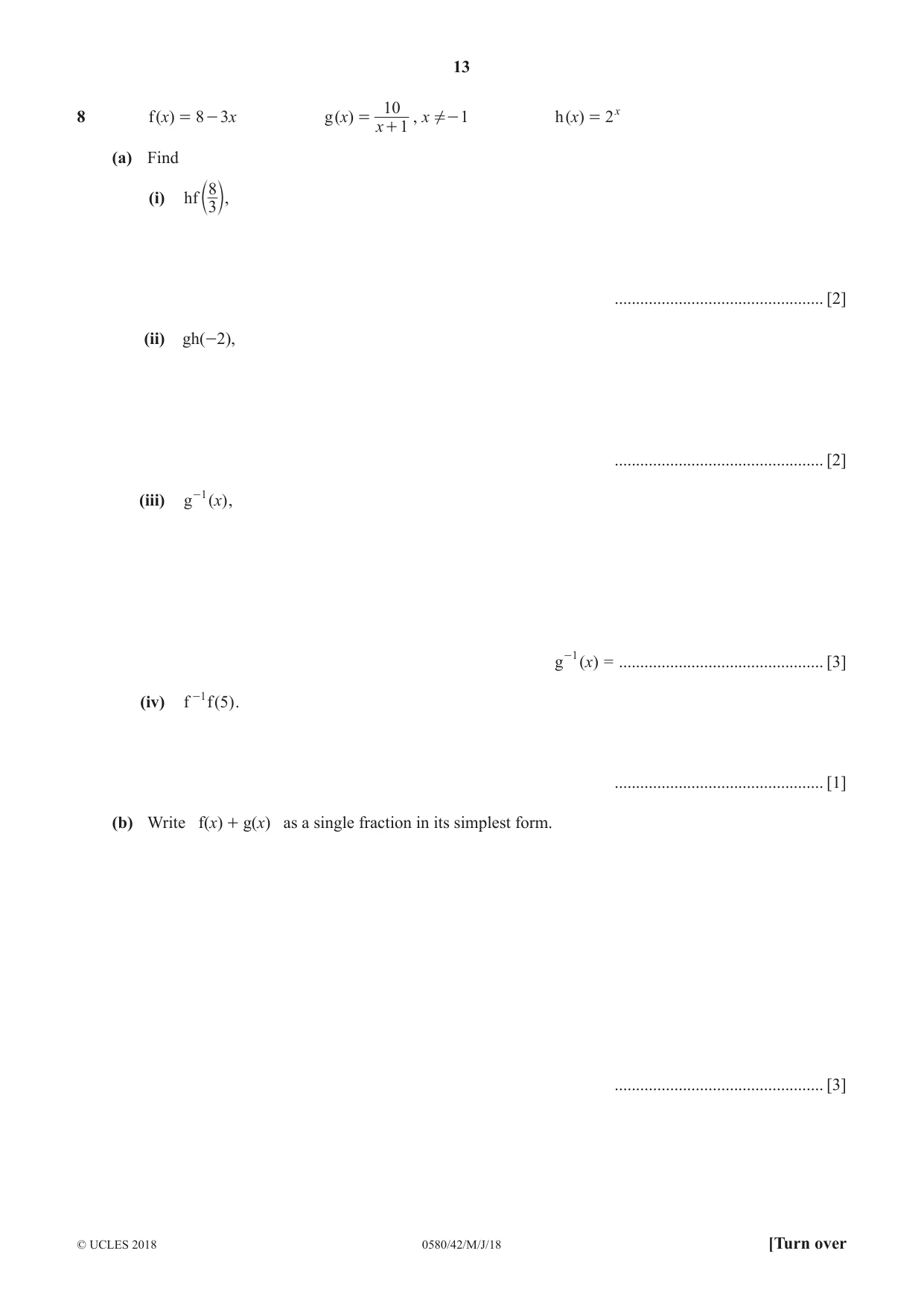
Q8 · X8 f ()x = 8 - 3x g (x) = , x !
10 x8 f ()x = 8 - 3x g (x) = , x ! - 1 h ()x = 2 x + 1 (a) Find 8 (i) hf c 3 m, ................................................. [2] (ii) gh(-2), ................................................. [2] (iii) g -1 ()x , g -1 ()x = ................................................ [3] (iv) f -1 f (5 ) . ................................................. [1] (b) Write f(x) + g(x) as a single fraction in its simplest form. ................................................. [3]
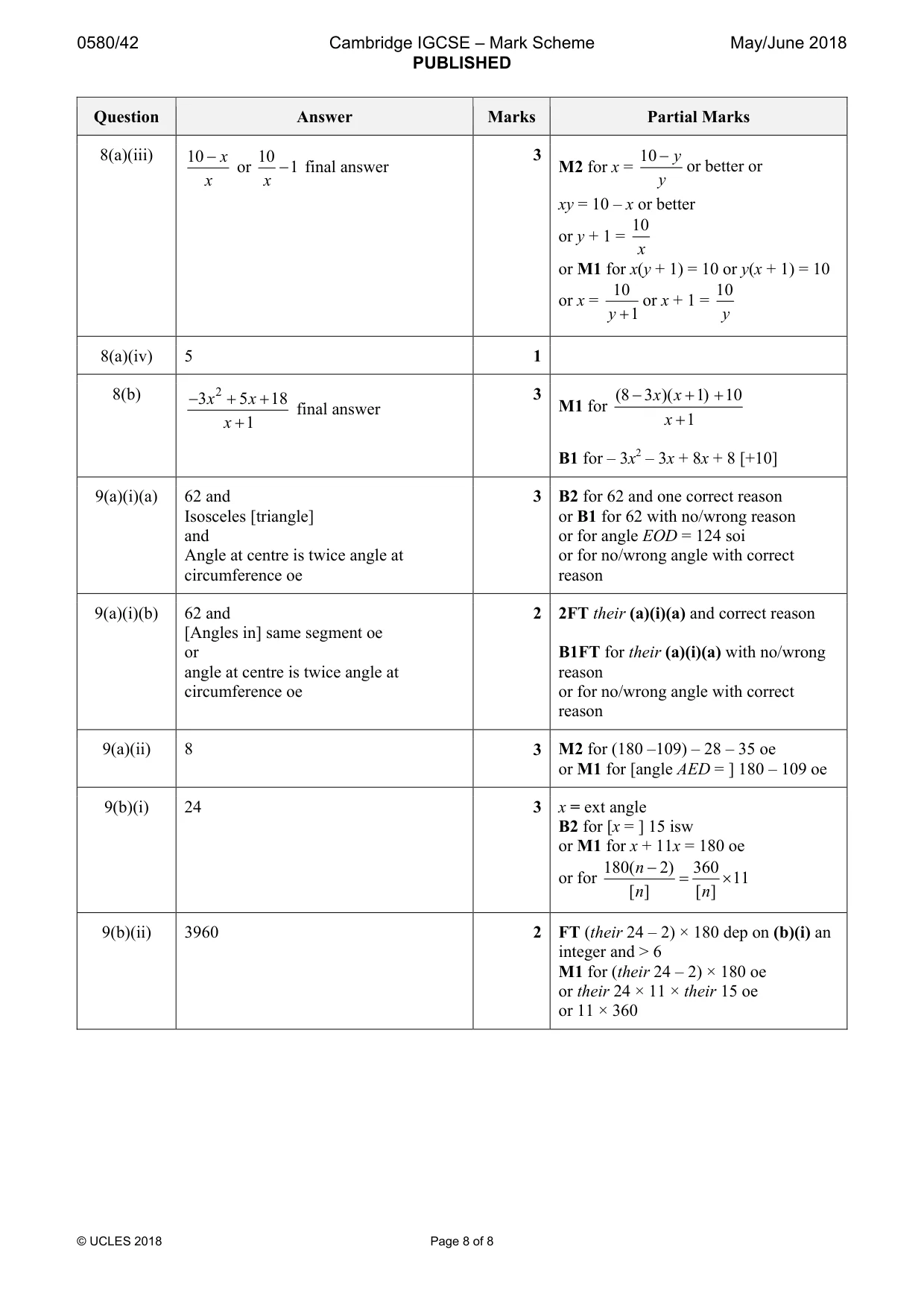
Mark scheme: 8(a)(i) 1 2 M1 for h(0) or for 28–3x 8(a)(ii) 8 2 10 M1 for g(¼) or for 2 x + 1 8(a)(iii) 10 −x 10 3 10 −y or − 1 final answer M2 for x = or better or x x y xy = 10 – x or better 10 or y + 1 = x or M1 for x(y + 1) = 10 or y(x + 1) = 10 10 10 or x = or x + 1 = y + 1 y 8(a)(iv) 5 1 8(b) −3 x 2 + 5 x + 18 3 (8 − 3 x )( x + 1) + 10 final answer M1 for x + 1 x + 1 B1 for – 3x2 – 3x + 8x + 8 [+10]
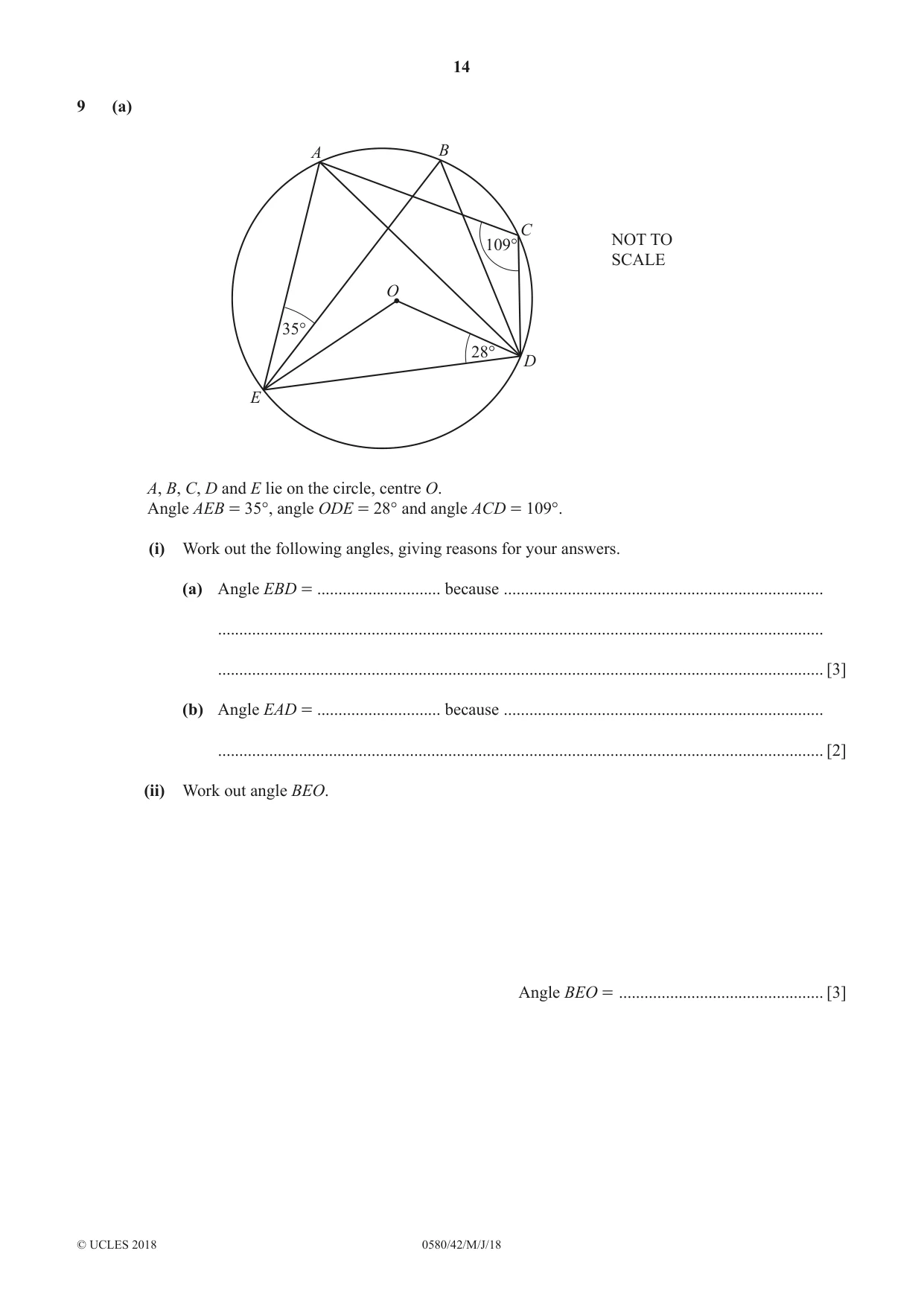
Q9 · A B C NOT TO 109° SCALE O 35° 28° D E A, B, C, D and E lie on the circle, centre O
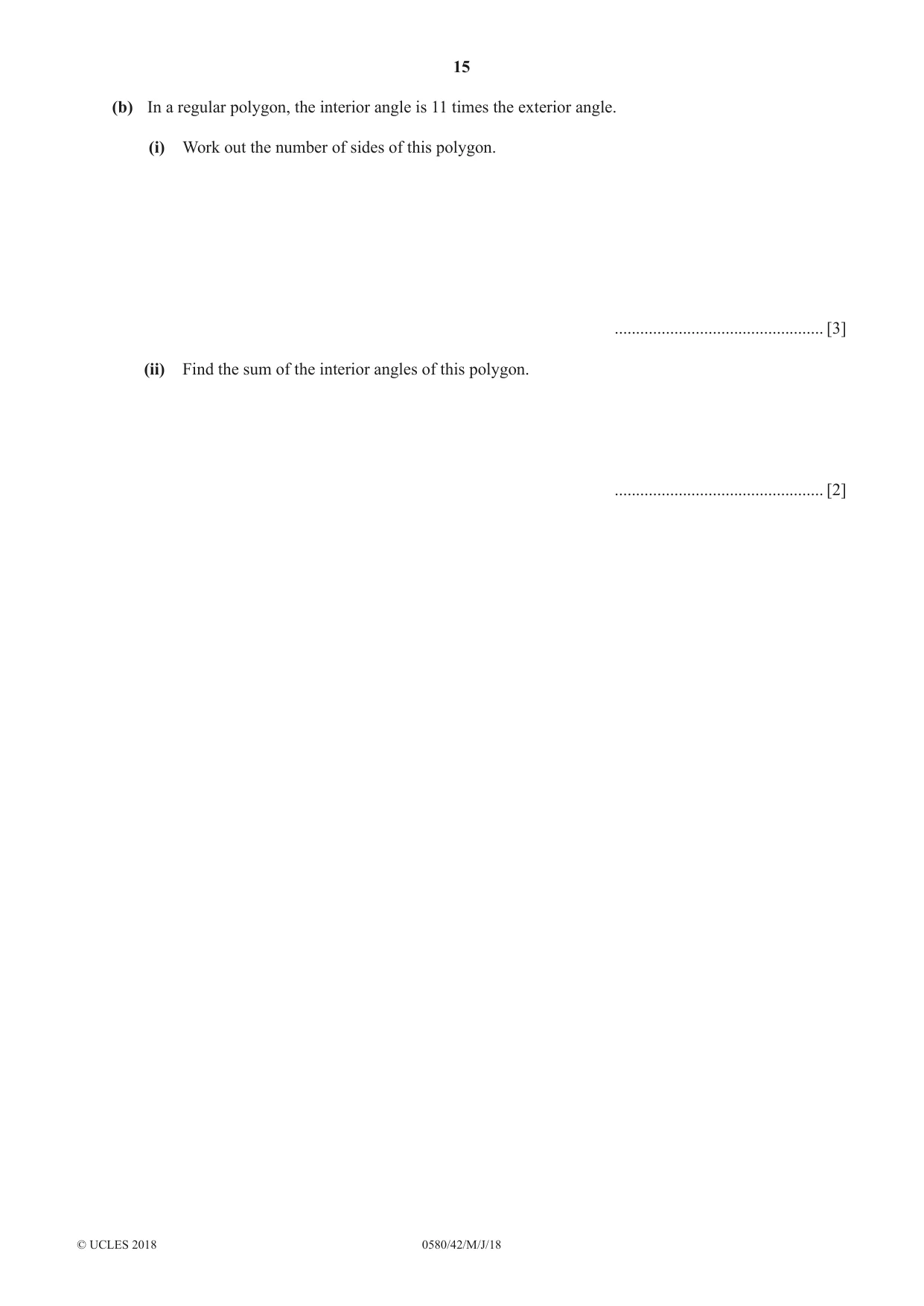
9 (a) A B C NOT TO 109° SCALE O 35° 28° D E A, B, C, D and E lie on the circle, centre O. Angle AEB = 35°, angle ODE = 28° and angle ACD = 109°. (i) Work out the following angles, giving reasons for your answers. (a) Angle EBD = ............................. because ........................................................................... .............................................................................................................................................. .............................................................................................................................................. [3] (b) Angle EAD = ............................. because ........................................................................... .............................................................................................................................................. [2] (ii) Work out angle BEO. Angle BEO = ................................................ [3] (b) In a regular polygon, the interior angle is 11 times the exterior angle. (i) Work out the number of sides of this polygon. ................................................. [3] (ii) Find the sum of the interior angles of this polygon. ................................................. [2]
Mark scheme: 9(a)(i)(a) 62 and 3 B2 for 62 and one correct reason Isosceles [triangle] or B1 for 62 with no/wrong reason and or for angle EOD = 124 soi Angle at centre is twice angle at or for no/wrong angle with correct circumference oe reason 9(a)(i)(b) 62 and 2 2FT their (a)(i)(a) and correct reason [Angles in] same segment oe or B1FT for their (a)(i)(a) with no/wrong angle at centre is twice angle at reason circumference oe or for no/wrong angle with correct reason 9(a)(ii) 8 3 M2 for (180 –109) – 28 – 35 oe or M1 for [angle AED = ] 180 – 109 oe 9(b)(i) 24 3 x = ext angle B2 for [x = ] 15 isw or M1 for x + 11x = 180 oe 180( n − 2) 360 or for = × 11 [ n ] [ n ] 9(b)(ii) 3960 2 FT (their 24 – 2) × 180 dep on (b)(i) an integer and > 6 M1 for (their 24 – 2) × 180 oe or their 24 × 11 × their 15 oe or 11 × 360
What was in this paper
The subtopics covered by these 9 questions, and how many questions each got. Open one in a new tab to see every Cambridge question on it.
What you needed in this session
Cambridge’s own grade thresholds for 2018 May/June, Paper 4 · Variant 2. A higher threshold means an easier paper — the bar moves with how the cohort did.