Cambridge IGCSE Mathematics 0580 — 2018 Oct/Nov Paper 4 · Variant 2
0580/42/O/N/18 · 12 questions · 130 marks · ≈146 min
The question paper and its mark scheme, free to read here and free to download. This is Cambridge’s own paper, exactly as it was sat.
Question paper20 pages
Mark scheme8 pages
Answers below. Sit the paper first if you are practising.
Questions as text
Q1 · The Muller family are on holiday in New Zealand
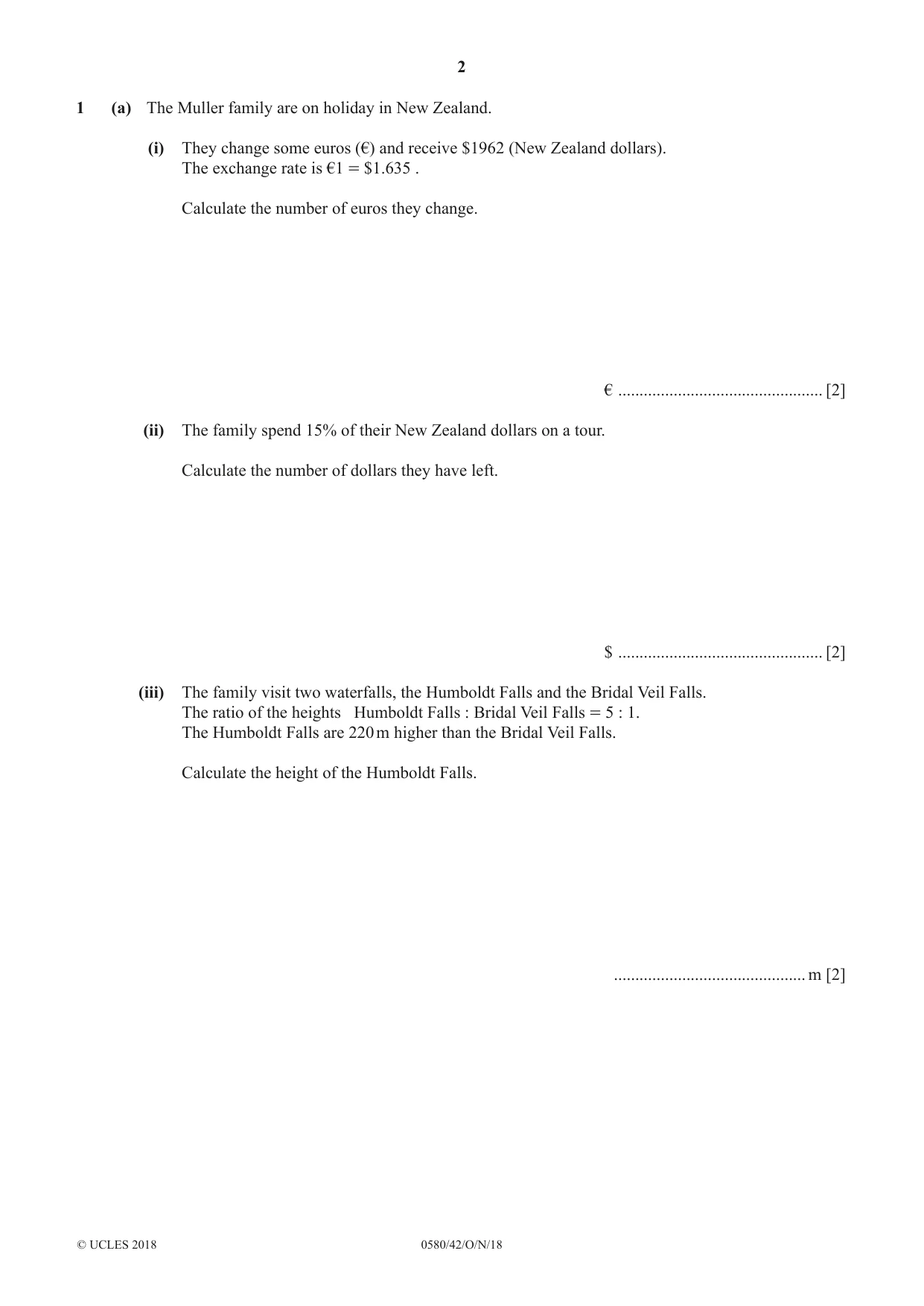
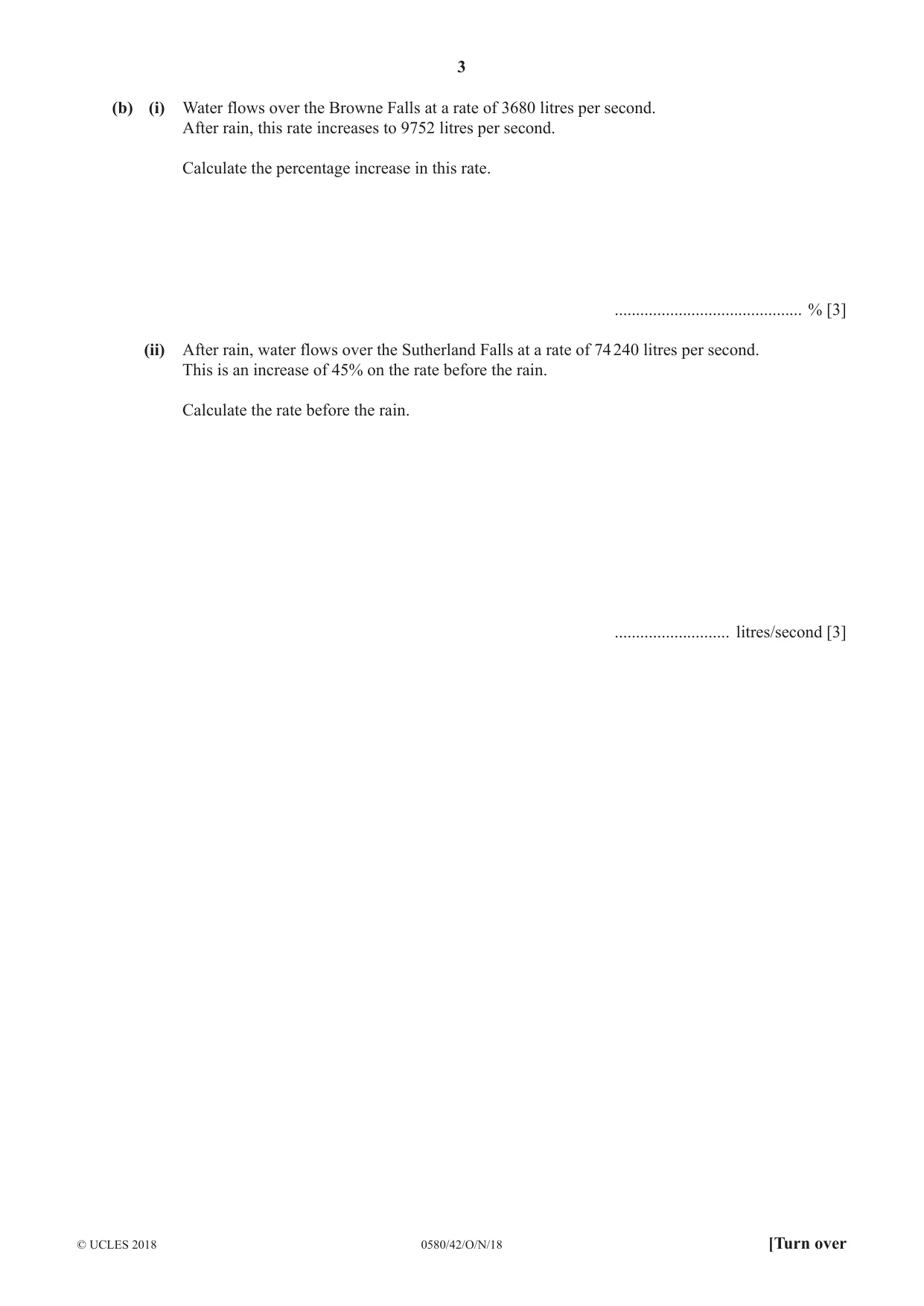
1 (a) The Muller family are on holiday in New Zealand. (i) They change some euros (€) and receive $1962 (New Zealand dollars). The exchange rate is €1 = $1.635 . Calculate the number of euros they change. € ................................................ [2] (ii) The family spend 15% of their New Zealand dollars on a tour. Calculate the number of dollars they have left. $ ................................................ [2] (iii) The family visit two waterfalls, the Humboldt Falls and the Bridal Veil Falls. The ratio of the heights Humboldt Falls : Bridal Veil Falls = 5 : 1. The Humboldt Falls are 220 m higher than the Bridal Veil Falls. Calculate the height of the Humboldt Falls. ............................................. m [2] (b) (i) Water flows over the Browne Falls at a rate of 3680 litres per second. After rain, this rate increases to 9752 litres per second. Calculate the percentage increase in this rate. ............................................ % [3] (ii) After rain, water flows over the Sutherland Falls at a rate of 74 240 litres per second. This is an increase of 45% on the rate before the rain. Calculate the rate before the rain. ........................... litres/second [3]
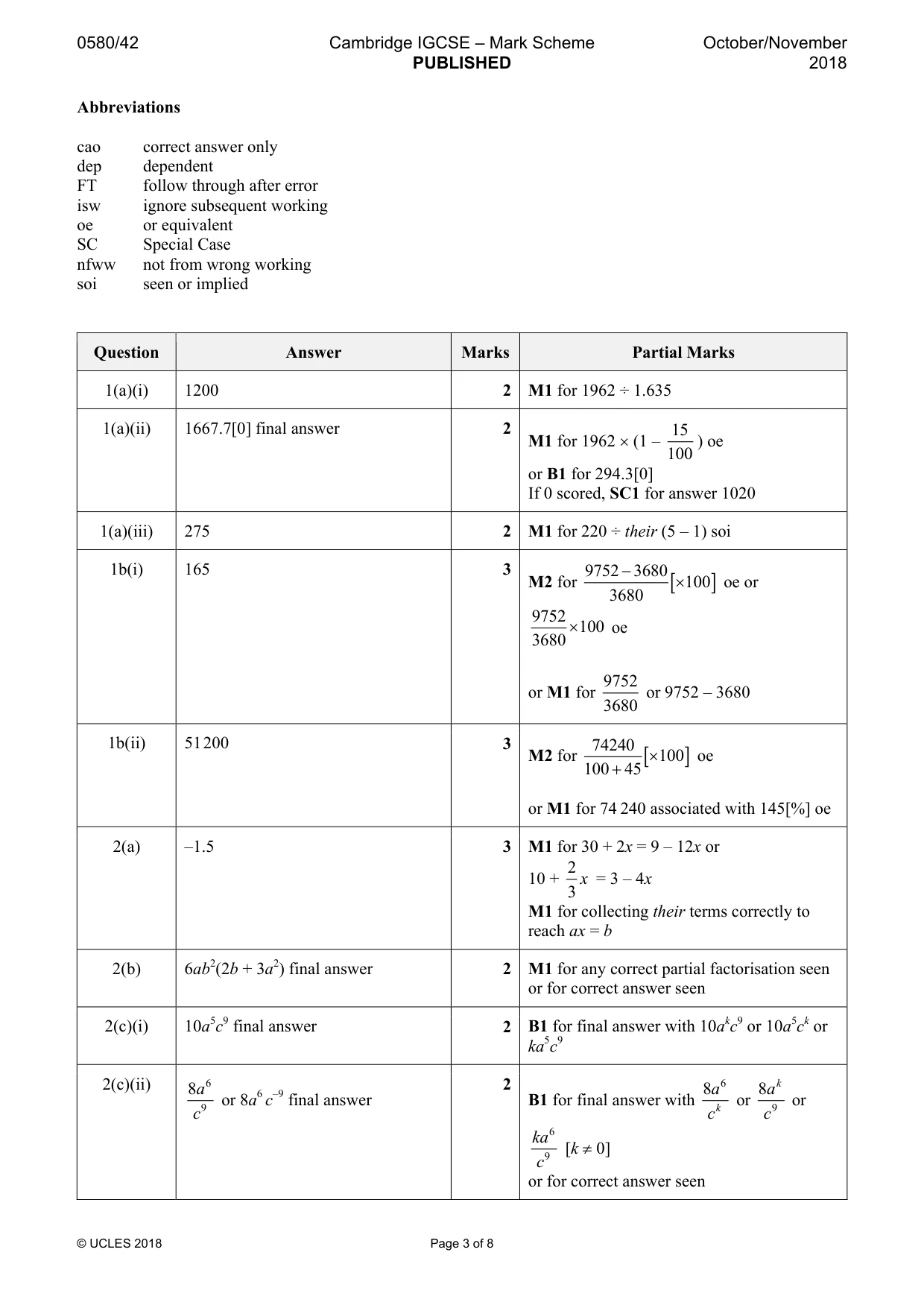
Mark scheme: Question Answer Marks Partial Marks 1(a)(i) 1200 2 M1 for 1962 ÷ 1.635 1(a)(ii) 1667.7[0] final answer 2 15 M1 for 1962 × (1 – ) oe 100 or B1 for 294.3[0] If 0 scored, SC1 for answer 1020 1(a)(iii) 275 2 M1 for 220 ÷ their (5 – 1) soi 1b(i) 165 3 9752 − 3680 M2 for [× 100 ] oe or 3680 9752 × 100 oe 3680 9752 or M1 for or 9752 – 3680 3680 1b(ii) 51 200 3 74240 M2 for [× 100 ] oe 100 + 45 or M1 for 74 240 associated with 145[%] oe
Q2 · Solve 30 + 2x = 3(3 – 4x)
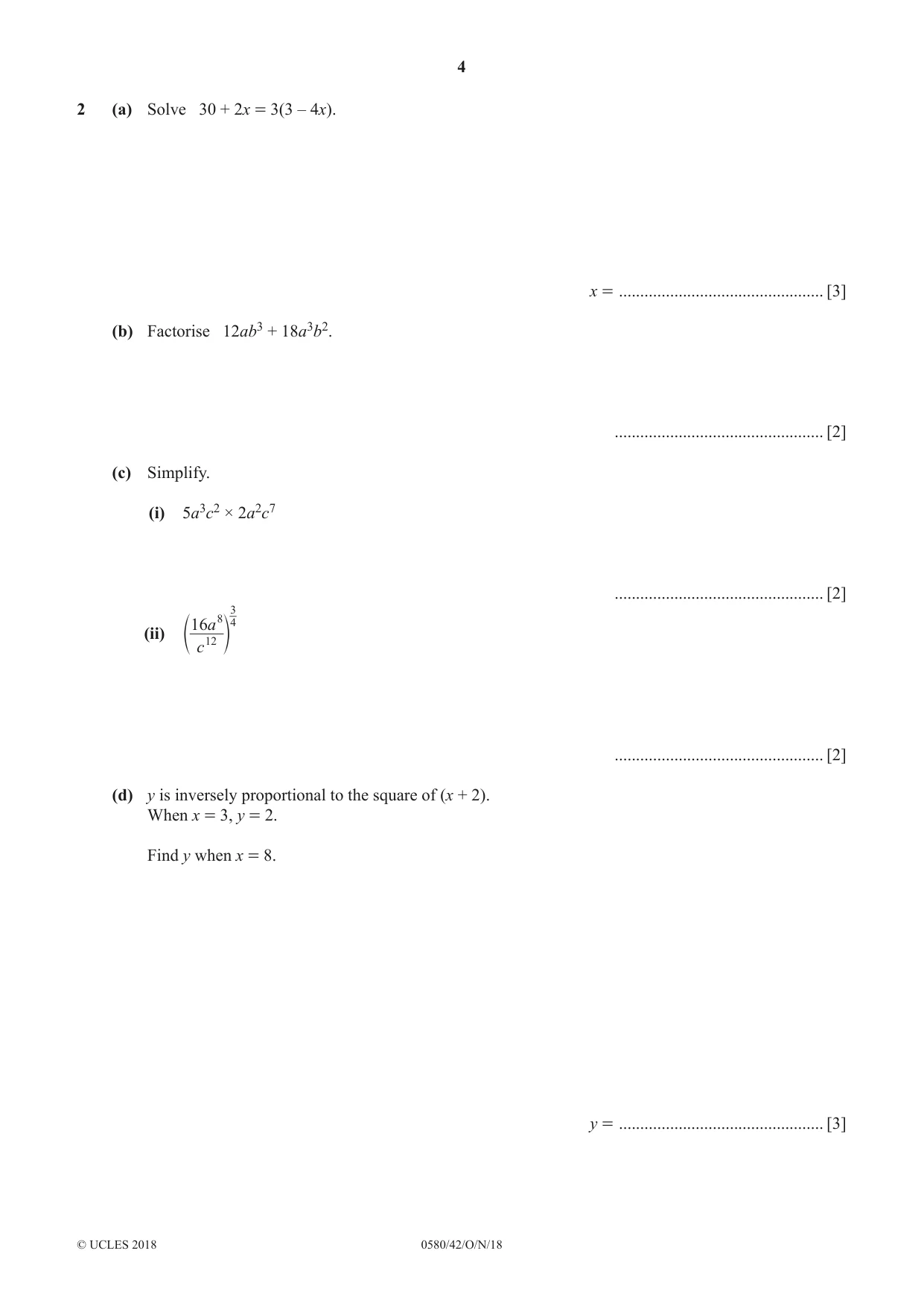
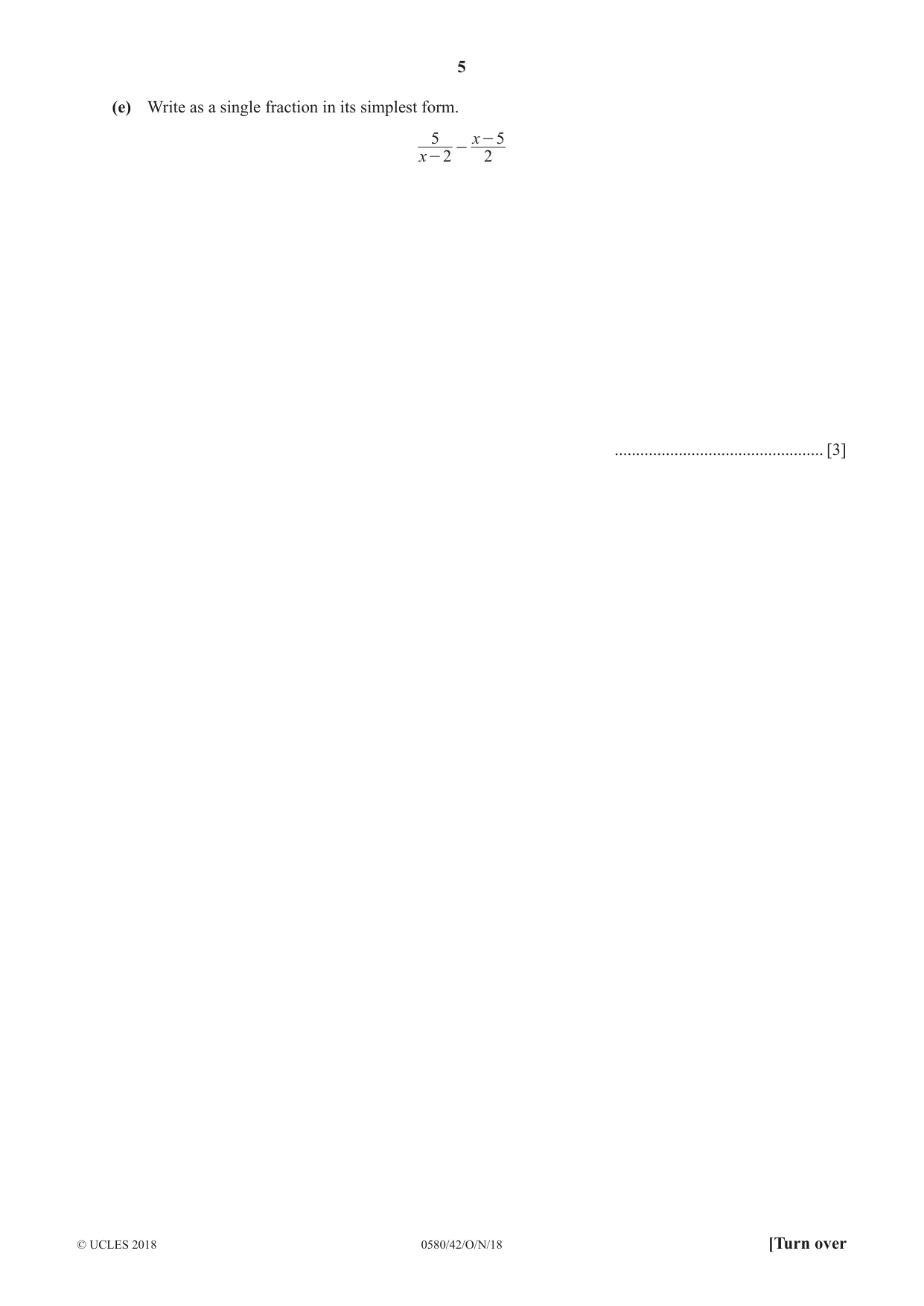
2 (a) Solve 30 + 2x = 3(3 – 4x). x = ................................................ [3] (b) Factorise 12ab3 + 18a3b2. ................................................. [2] (c) Simplify. (i) 5a3c2 × 2a2c7 ................................................. [2] 3 16a 8 4 (ii) 12 e c o ................................................. [2] (d) y is inversely proportional to the square of (x + 2). When x = 3, y = 2. Find y when x = 8. y = ................................................ [3] (e) Write as a single fraction in its simplest form. 5 x - 5 - x - 2 2 ................................................. [3]
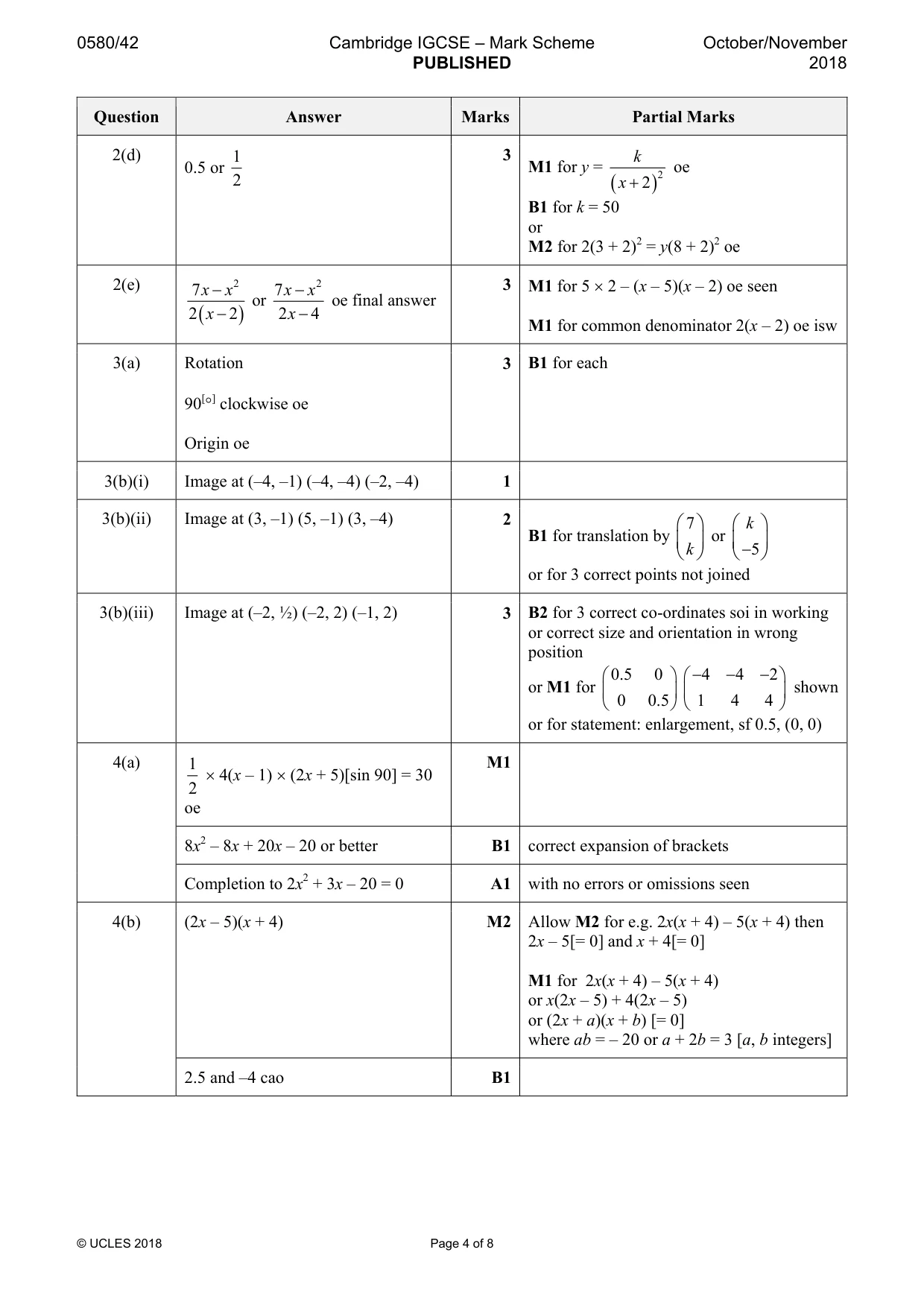
Mark scheme: 2(a) –1.5 3 M1 for 30 + 2x = 9 – 12x or 2 10 + x = 3 – 4x 3 M1 for collecting their terms correctly to reach ax = b 2(b) 6ab2(2b + 3a2) final answer 2 M1 for any correct partial factorisation seen or for correct answer seen 2(c)(i) 10a5c9 final answer 2 B1 for final answer with 10akc9 or 10a5ck or ka5c9 2(c)(ii) 6 2 6 k 8a 8a 8a 9 or 8a6 c–9 final answer B1 for final answer with k or 9 or c c c ka 6 9 [k ≠ 0] c or for correct answer seen 2(d) 1 3 k 0.5 or M1 for y = 2 oe 2 ( x + 2 ) B1 for k = 50 or M2 for 2(3 + 2)2 = y(8 + 2)2 oe 2(e) 7 x − x 2 7 x − x 2 3 M1 for 5 × 2 – (x – 5)(x – 2) oe seen or oe final answer 2 ( x − 2 ) 2 x − 4 M1 for common denominator 2(x – 2) oe isw
Q3 · Y 7 6 5 4 A B 3 2 1 –7 –6 –5 –4 –3 –2 –1 0 1 2 3 4 5 6 x –1 –2 –3 –4 –5 (a) Describe…
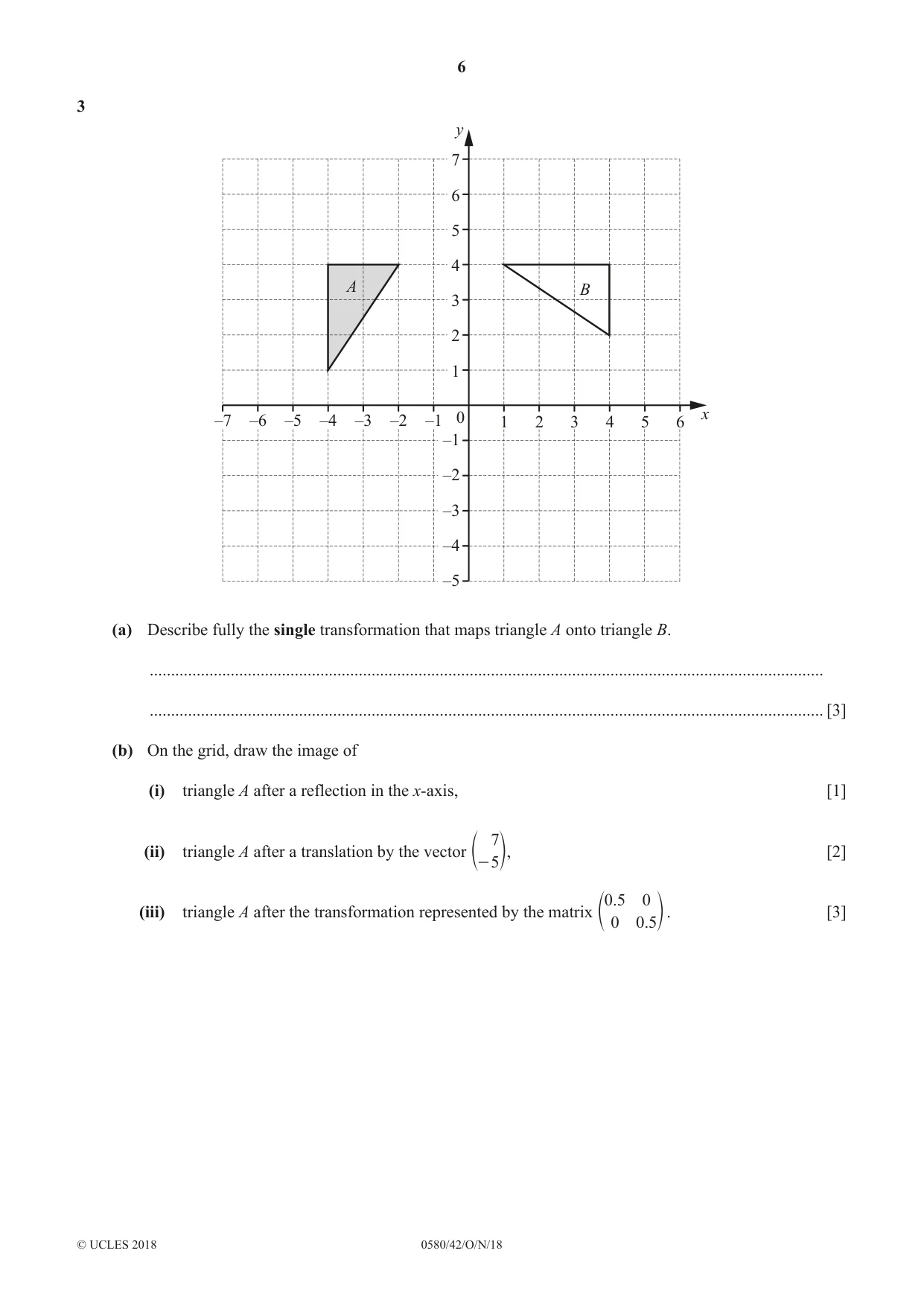
3 y 7 6 5 4 A B 3 2 1 –7 –6 –5 –4 –3 –2 –1 0 1 2 3 4 5 6 x –1 –2 –3 –4 –5 (a) Describe fully the single transformation that maps triangle A onto triangle B. .............................................................................................................................................................. .............................................................................................................................................................. [3] (b) On the grid, draw the image of (i) triangle A after a reflection in the x-axis, [1] 7 (ii) triangle A after a translation by the vector [2] e- 5o, 0.5 0 (iii) triangle A after the transformation represented by the matrix . [3] e 0 0.5o
Mark scheme: 3(a) Rotation 3 B1 for each 90[°] clockwise oe Origin oe 3(b)(i) Image at (–4, –1) (–4, –4) (–2, –4) 1 3(b)(ii) Image at (3, –1) (5, –1) (3, –4) 2 7 k B1 for translation by or k − 5 or for 3 correct points not joined 3(b)(iii) Image at (–2, ½) (–2, 2) (–1, 2) 3 B2 for 3 correct co-ordinates soi in working or correct size and orientation in wrong position 0.5 0 −4 −4 −2 or M1 for shown 0 0.5 1 4 4 or for statement: enlargement, sf 0.5, (0, 0)
Q4 · The diagram shows a right-angled triangle ABC
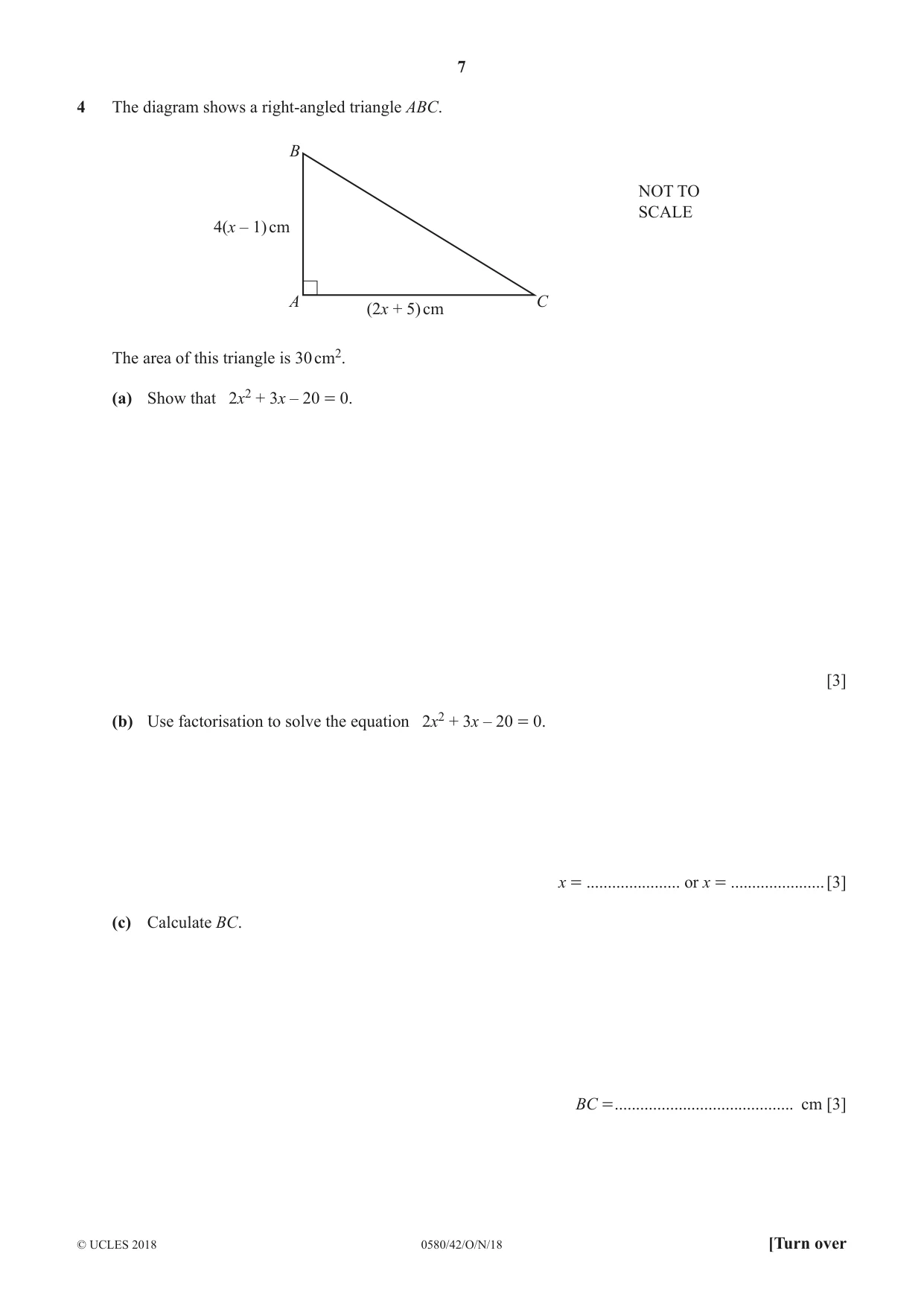
4 The diagram shows a right-angled triangle ABC. B NOT TO SCALE 4(x – 1) cm A C (2x + 5) cm The area of this triangle is 30 cm2. (a) Show that 2x2 + 3x – 20 = 0. [3] (b) Use factorisation to solve the equation 2x2 + 3x – 20 = 0. x = ...................... or x = ...................... [3] (c) Calculate BC. BC = .......................................... cm [3]
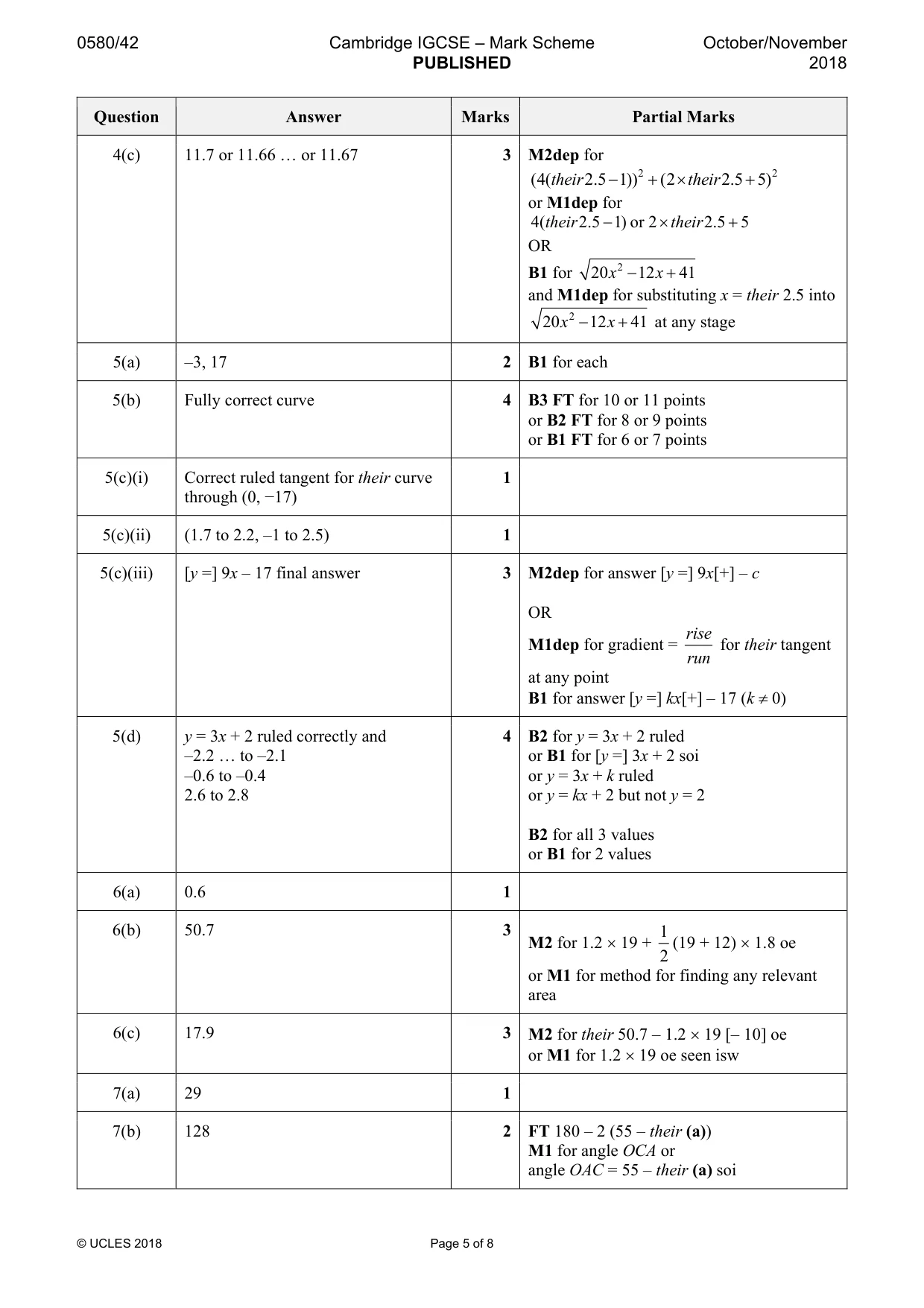
Mark scheme: 4(a) 1 M1 × 4(x – 1) × (2x + 5)[sin 90] = 30 2 oe 8x2 – 8x + 20x – 20 or better B1 correct expansion of brackets Completion to 2x2 + 3x – 20 = 0 A1 with no errors or omissions seen 4(b) (2x – 5)(x + 4) M2 Allow M2 for e.g. 2x(x + 4) – 5(x + 4) then 2x – 5[= 0] and x + 4[= 0] M1 for 2x(x + 4) – 5(x + 4) or x(2x – 5) + 4(2x – 5) or (2x + a)(x + b) [= 0] where ab = – 20 or a + 2b = 3 [a, b integers] 2.5 and –4 cao B1 4(c) 11.7 or 11.66 … or 11.67 3 M2dep for (4(their 2.5 − 1)) 2 + (2 × their 2.5 + 5) 2 or M1dep for 4( their 2.5 − 1) or 2 × their 2.5 + 5 OR B1 for 20 x 2 − 12 x + 41 and M1dep for substituting x = their 2.5 into 20 x 2 − 12 x + 41 at any stage
Q5 · The table shows some values of y = x3 – 3x – 1
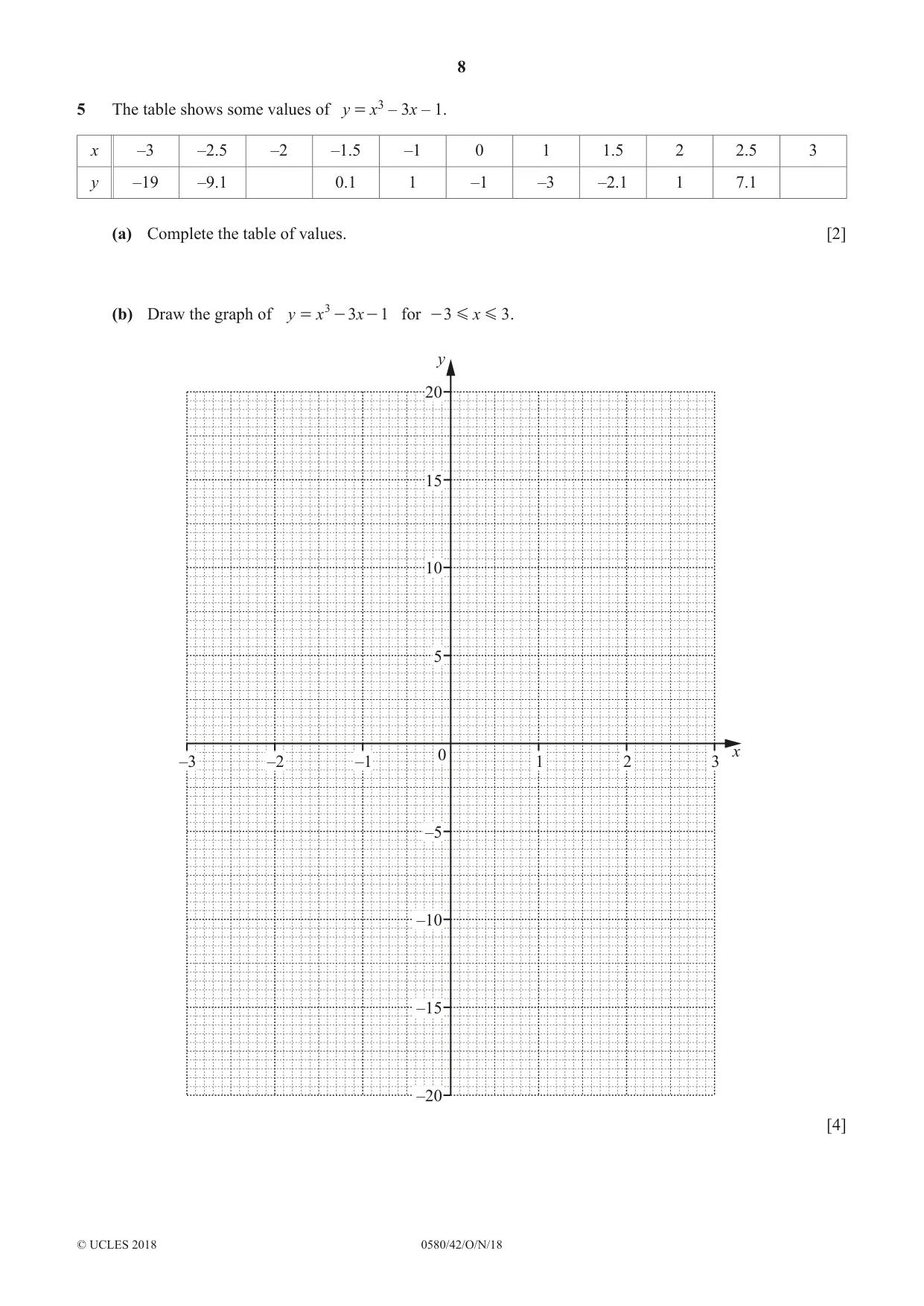
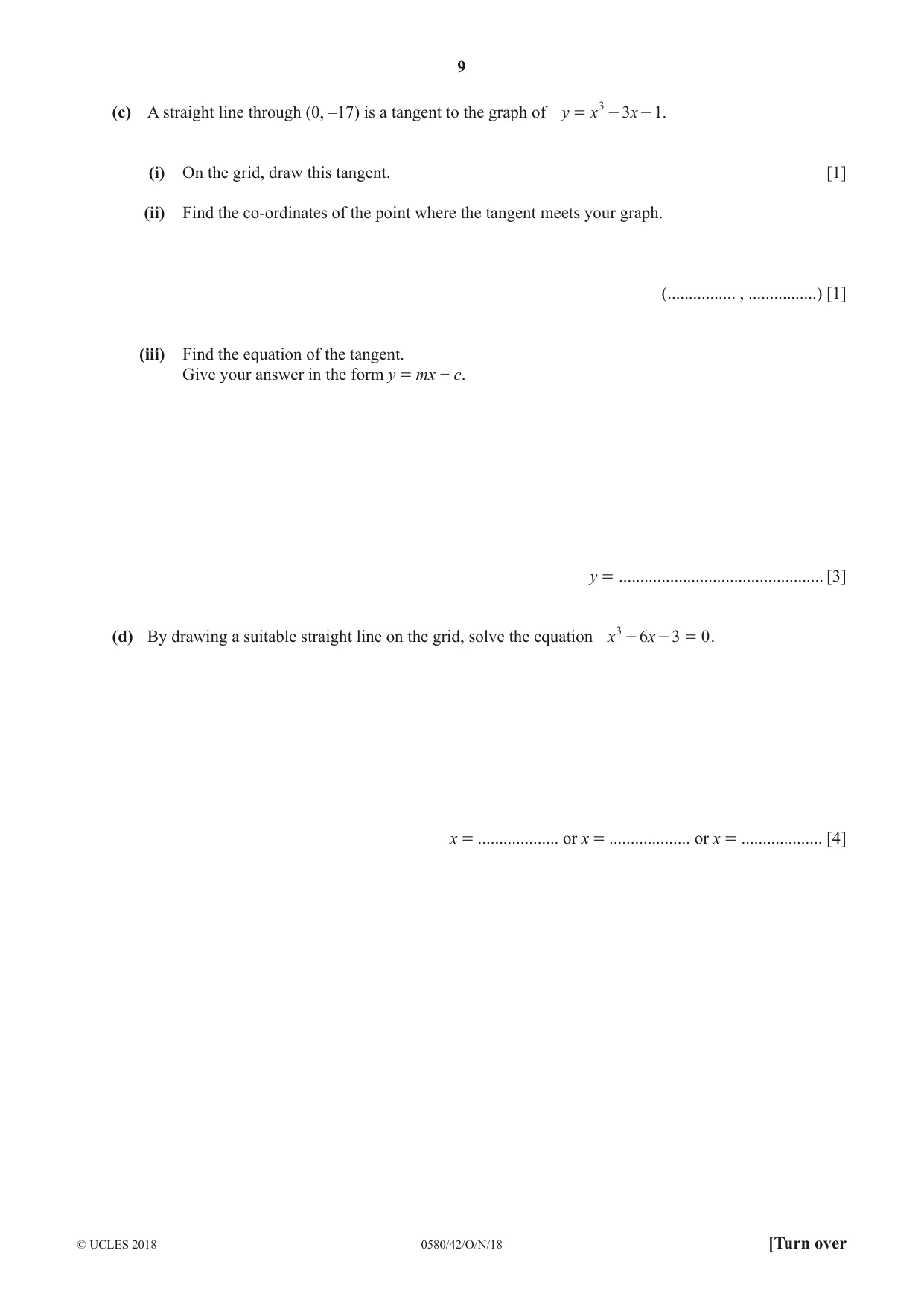
5 The table shows some values of y = x3 – 3x – 1. x –3 –2.5 –2 –1.5 –1 0 1 1.5 2 2.5 3 y –19 –9.1 0.1 1 –1 –3 –2.1 1 7.1 (a) Complete the table of values. [2] (b) Draw the graph of y = x 3 - 3x - 1 for - 3 G x G 3 . y 20 15 10 5 0 x –3 –2 –1 1 2 3 –5 –10 –15 –20 [4] (c) A straight line through (0, –17) is a tangent to the graph of y = x 3 - 3x - 1. (i) On the grid, draw this tangent. [1] (ii) Find the co-ordinates of the point where the tangent meets your graph. (................ , ................) [1] (iii) Find the equation of the tangent. Give your answer in the form y = mx + c. y = ................................................ [3] (d) By drawing a suitable straight line on the grid, solve the equation x 3 - 6x - 3 = 0 . x = ................... or x = ................... or x = ................... [4]
Mark scheme: 5(a) –3, 17 2 B1 for each 5(b) Fully correct curve 4 B3 FT for 10 or 11 points or B2 FT for 8 or 9 points or B1 FT for 6 or 7 points 5(c)(i) Correct ruled tangent for their curve 1 through (0, −17) 5(c)(ii) (1.7 to 2.2, –1 to 2.5) 1 5(c)(iii) [y =] 9x – 17 final answer 3 M2dep for answer [y =] 9x[+] – c OR rise M1dep for gradient = for their tangent run at any point B1 for answer [y =] kx[+] – 17 (k ≠ 0) 5(d) y = 3x + 2 ruled correctly and 4 B2 for y = 3x + 2 ruled –2.2 … to –2.1 or B1 for [y =] 3x + 2 soi –0.6 to –0.4 or y = 3x + k ruled 2.6 to 2.8 or y = kx + 2 but not y = 2 B2 for all 3 values or B1 for 2 values
Q6 · The diagram shows the speed−time graph for part of a journey for two people, a runner and…
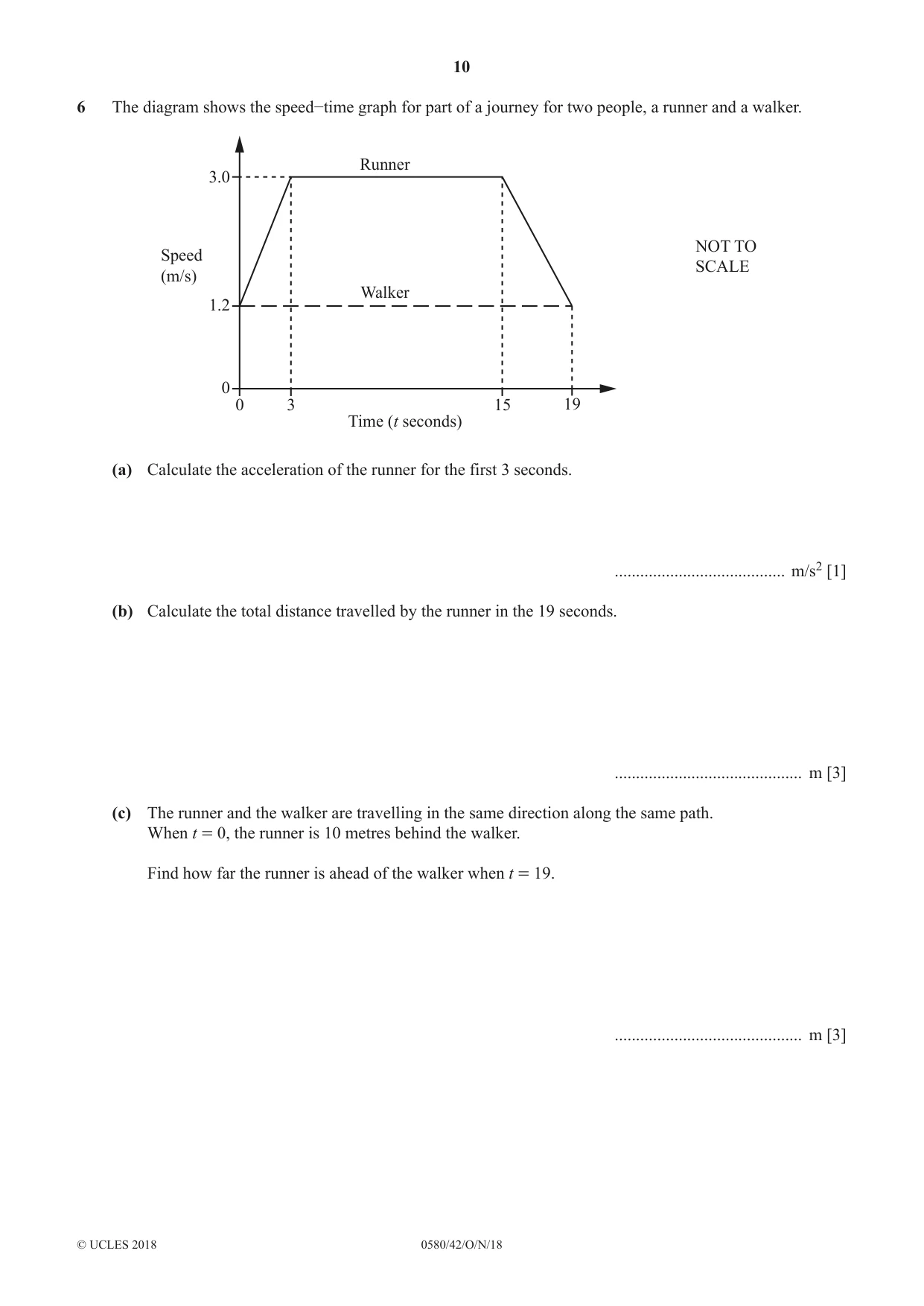
6 The diagram shows the speed−time graph for part of a journey for two people, a runner and a walker. Runner 3.0 NOT TO Speed SCALE (m/s) Walker 1.2 0 0 3 15 19 Time (t seconds) (a) Calculate the acceleration of the runner for the first 3 seconds. ........................................ m/s2 [1] (b) Calculate the total distance travelled by the runner in the 19 seconds. ............................................ m [3] (c) The runner and the walker are travelling in the same direction along the same path. When t = 0, the runner is 10 metres behind the walker. Find how far the runner is ahead of the walker when t = 19. ............................................ m [3]
Mark scheme: 6(a) 0.6 1 6(b) 50.7 3 1 M2 for 1.2 × 19 + (19 + 12) × 1.8 oe 2 or M1 for method for finding any relevant area 6(c) 17.9 3 M2 for their 50.7 – 1.2 × 19 [– 10] oe or M1 for 1.2 × 19 oe seen isw
Q7 · C B NOT TO O SCALE D 55° 61° E A In the diagram, A, B, C and D lie on the circle, centre O
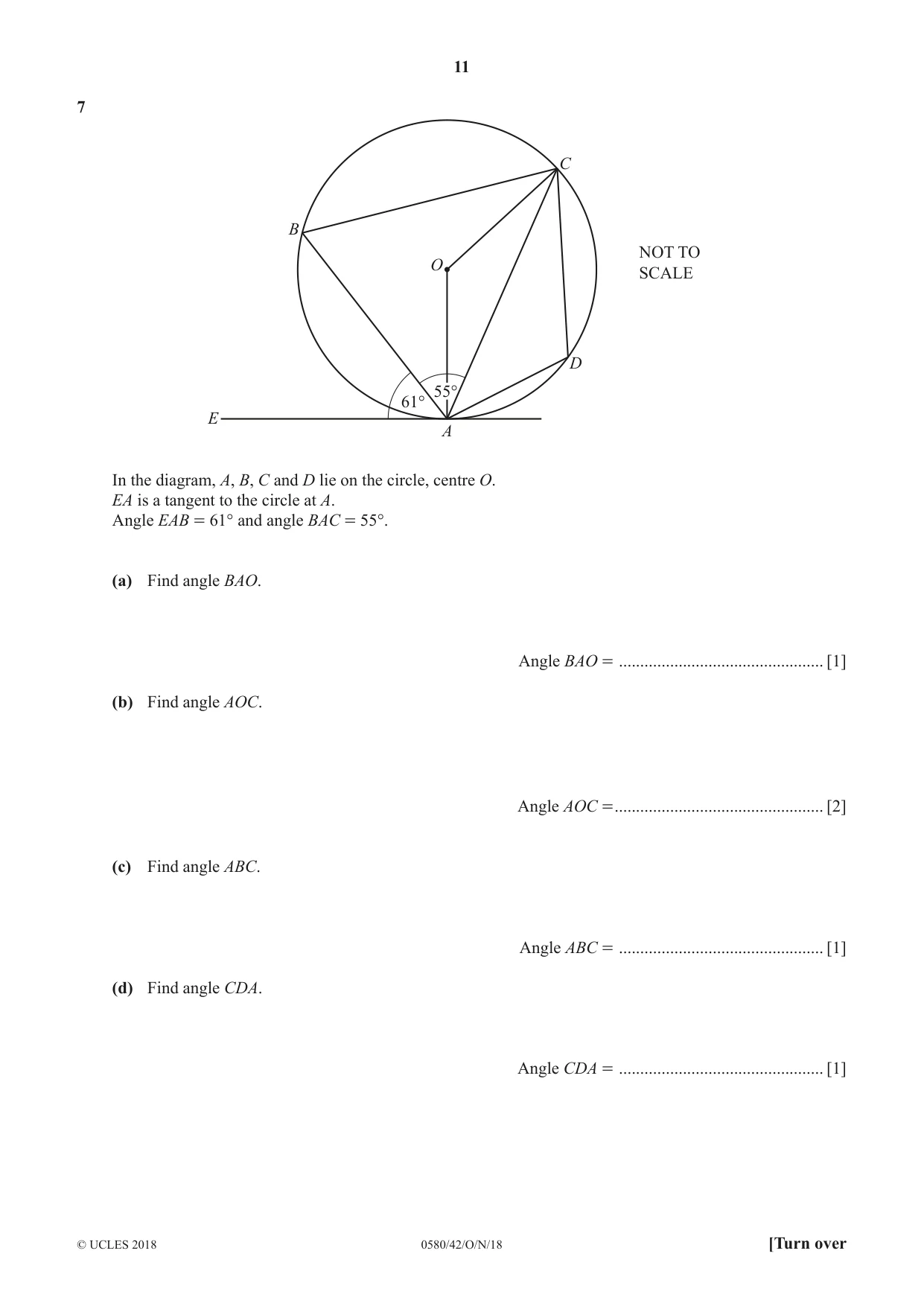
7 C B NOT TO O SCALE D 55° 61° E A In the diagram, A, B, C and D lie on the circle, centre O. EA is a tangent to the circle at A. Angle EAB = 61° and angle BAC = 55°. (a) Find angle BAO. Angle BAO = ................................................ [1] (b) Find angle AOC. Angle AOC = ................................................. [2] (c) Find angle ABC. Angle ABC = ................................................ [1] (d) Find angle CDA. Angle CDA = ................................................ [1]
Mark scheme: 7(a) 29 1 7(b) 128 2 FT 180 – 2 (55 – their (a)) M1 for angle OCA or angle OAC = 55 – their (a) soi 7(c) 64 1 FT their (b) ÷ 2 7(d) 116 1 FT 180 – their (c)
Q8 · The diagram shows the positions of three cities, Geneva (G), Budapest (B) and Hamburg (H)
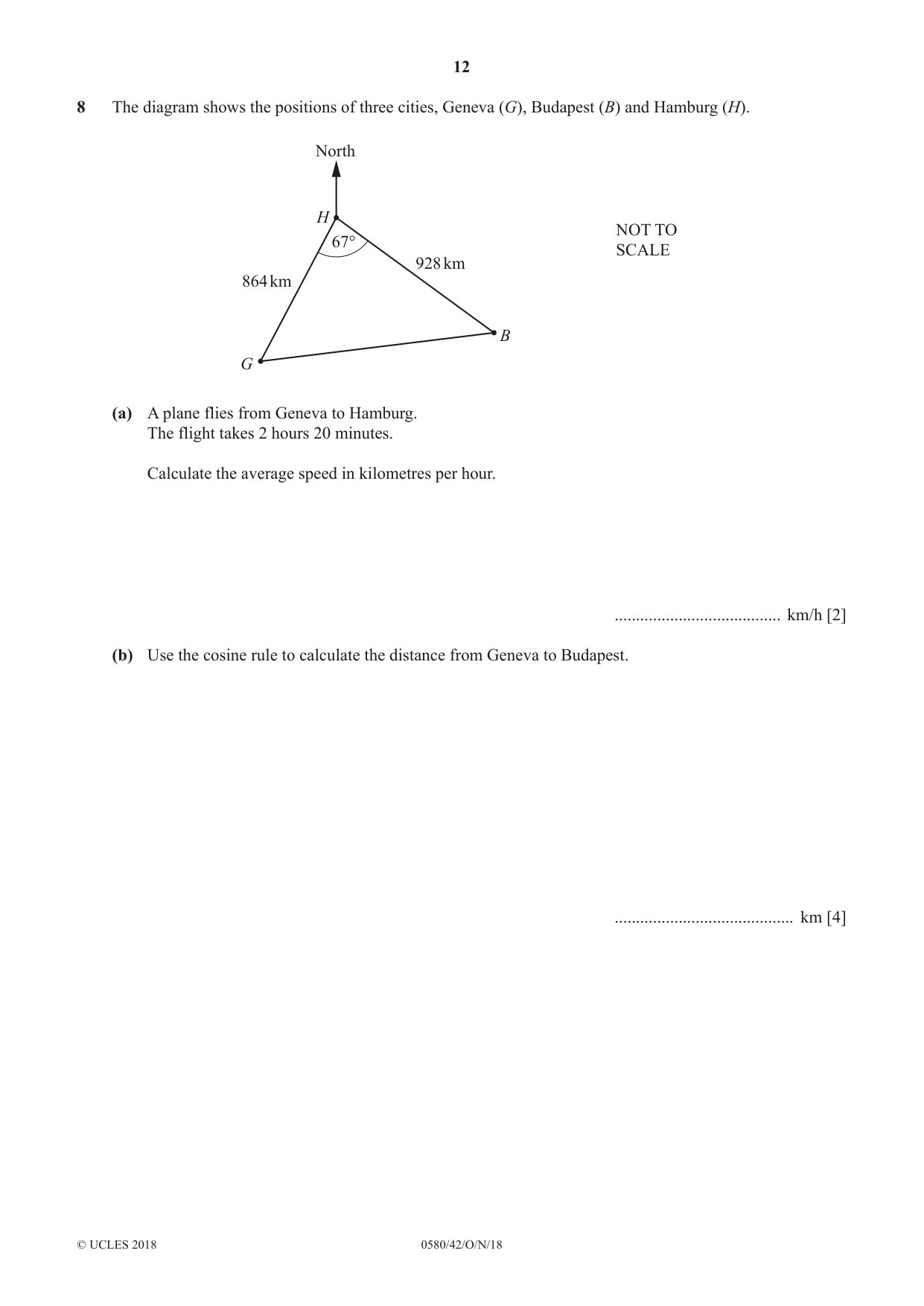
8 The diagram shows the positions of three cities, Geneva (G), Budapest (B) and Hamburg (H). North H NOT TO 67° SCALE 928 km 864 km B G (a) A plane flies from Geneva to Hamburg. The flight takes 2 hours 20 minutes. Calculate the average speed in kilometres per hour. ....................................... km/h [2] (b) Use the cosine rule to calculate the distance from Geneva to Budapest. .......................................... km [4] (c) The bearing of Budapest from Hamburg is 133°. (i) Find the bearing of Hamburg from Budapest. ................................................. [2] (ii) Calculate the bearing of Budapest from Geneva. ................................................. [4]
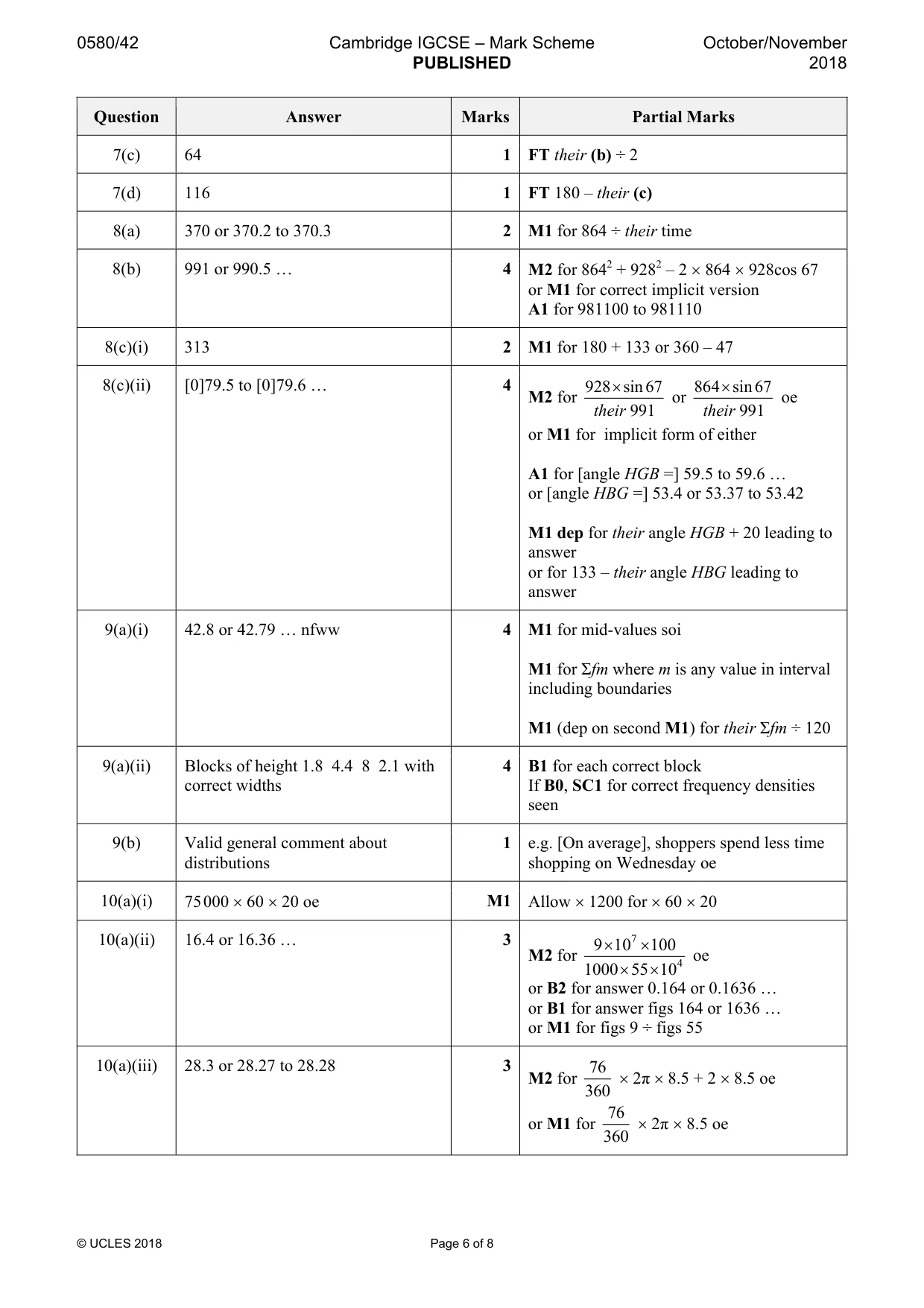
Mark scheme: 8(a) 370 or 370.2 to 370.3 2 M1 for 864 ÷ their time 8(b) 991 or 990.5 … 4 M2 for 8642 + 9282 – 2 × 864 × 928cos 67 or M1 for correct implicit version A1 for 981100 to 981110 8(c)(i) 313 2 M1 for 180 + 133 or 360 – 47 8(c)(ii) [0]79.5 to [0]79.6 … 4 928 × sin67 864 × sin67 M2 for or oe their 991 their 991 or M1 for implicit form of either A1 for [angle HGB =] 59.5 to 59.6 … or [angle HBG =] 53.4 or 53.37 to 53.42 M1 dep for their angle HGB + 20 leading to answer or for 133 – their angle HBG leading to answer
Q9 · The table shows the amount of time, T minutes, 120 people each spend in a supermarket one…
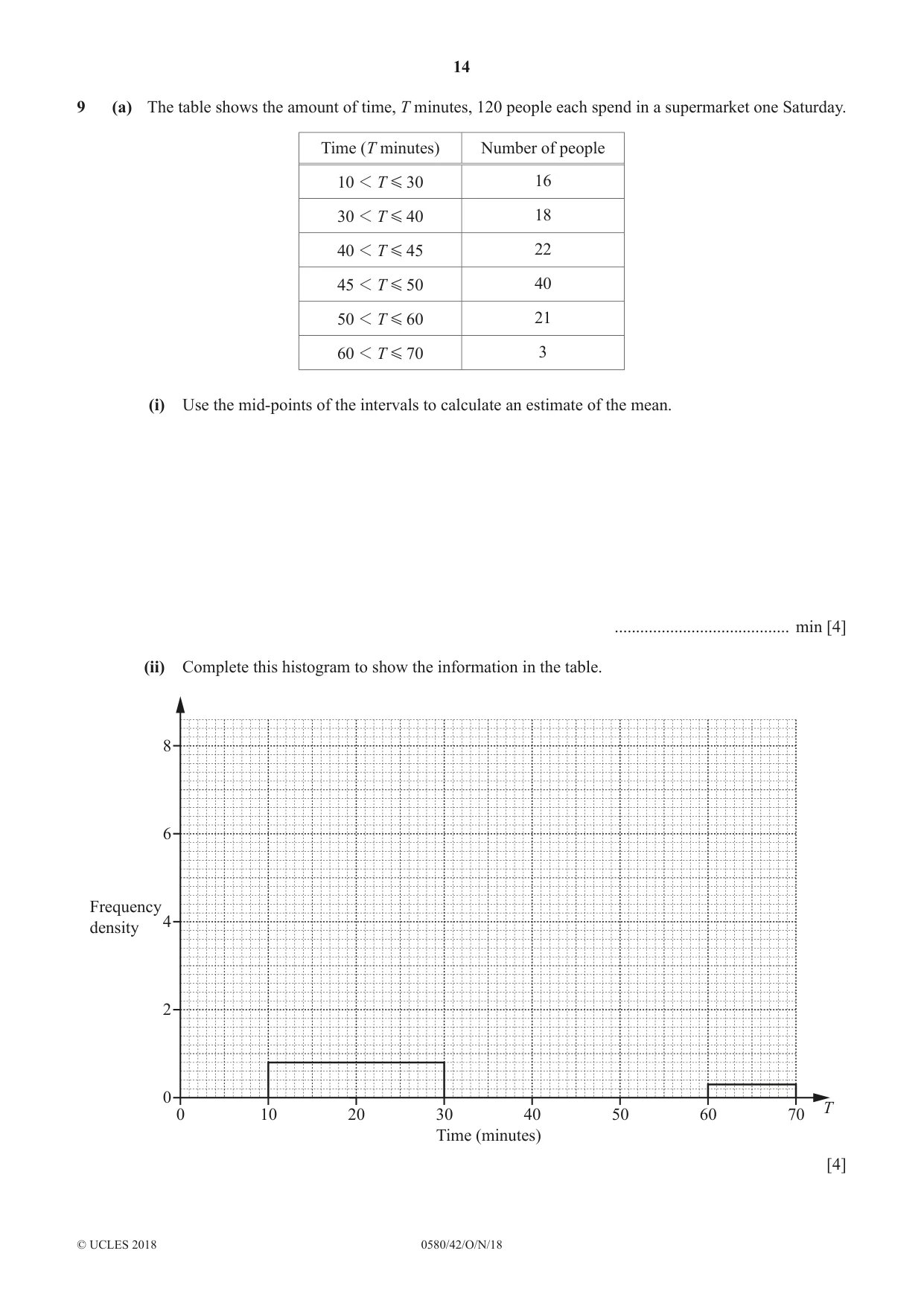
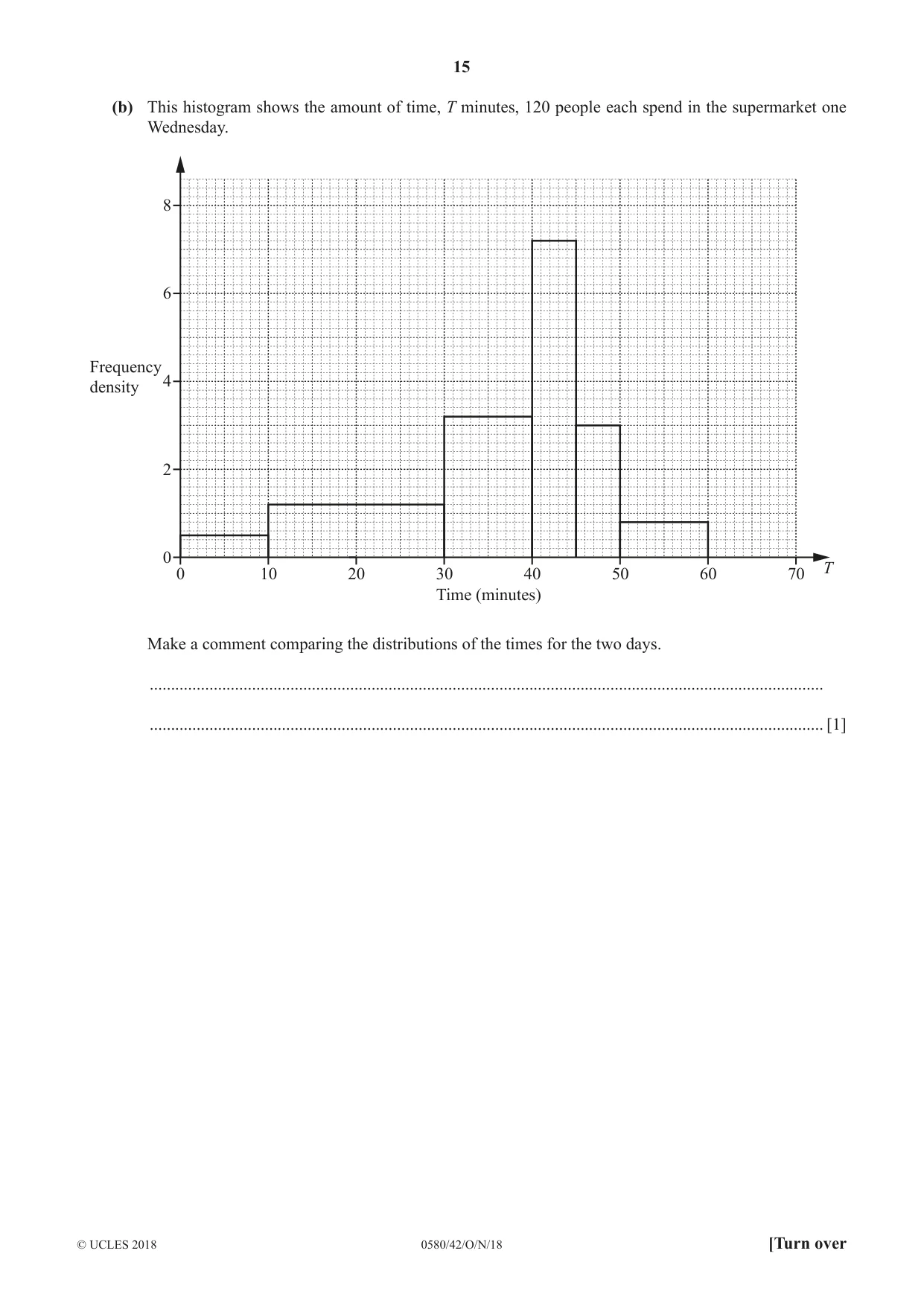
9 (a) The table shows the amount of time, T minutes, 120 people each spend in a supermarket one Saturday. Time (T minutes) Number of people 10 1 T G 30 16 30 1 T G 40 18 40 1 T G 45 22 45 1 T G 50 40 50 1 T G 60 21 60 1 T G 70 3 (i) Use the mid-points of the intervals to calculate an estimate of the mean. ......................................... min [4] (ii) Complete this histogram to show the information in the table. 8 6 Frequency 4 density 2 0 T 0 10 20 30 40 50 60 70 Time (minutes) [4] (b) This histogram shows the amount of time, T minutes, 120 people each spend in the supermarket one Wednesday. 8 6 Frequency 4density 2 0 T 0 10 20 30 40 50 60 70 Time (minutes) Make a comment comparing the distributions of the times for the two days. .............................................................................................................................................................. .............................................................................................................................................................. [1]
Mark scheme: 9(a)(i) 42.8 or 42.79 … nfww 4 M1 for mid-values soi M1 for Σfm where m is any value in interval including boundaries M1 (dep on second M1) for their Σfm ÷ 120 9(a)(ii) Blocks of height 1.8 4.4 8 2.1 with 4 B1 for each correct block correct widths If B0, SC1 for correct frequency densities seen 9(b) Valid general comment about 1 e.g. [On average], shoppers spend less time distributions shopping on Wednesday oe
Q10 · The lake behind a dam has an area of 55 hectares
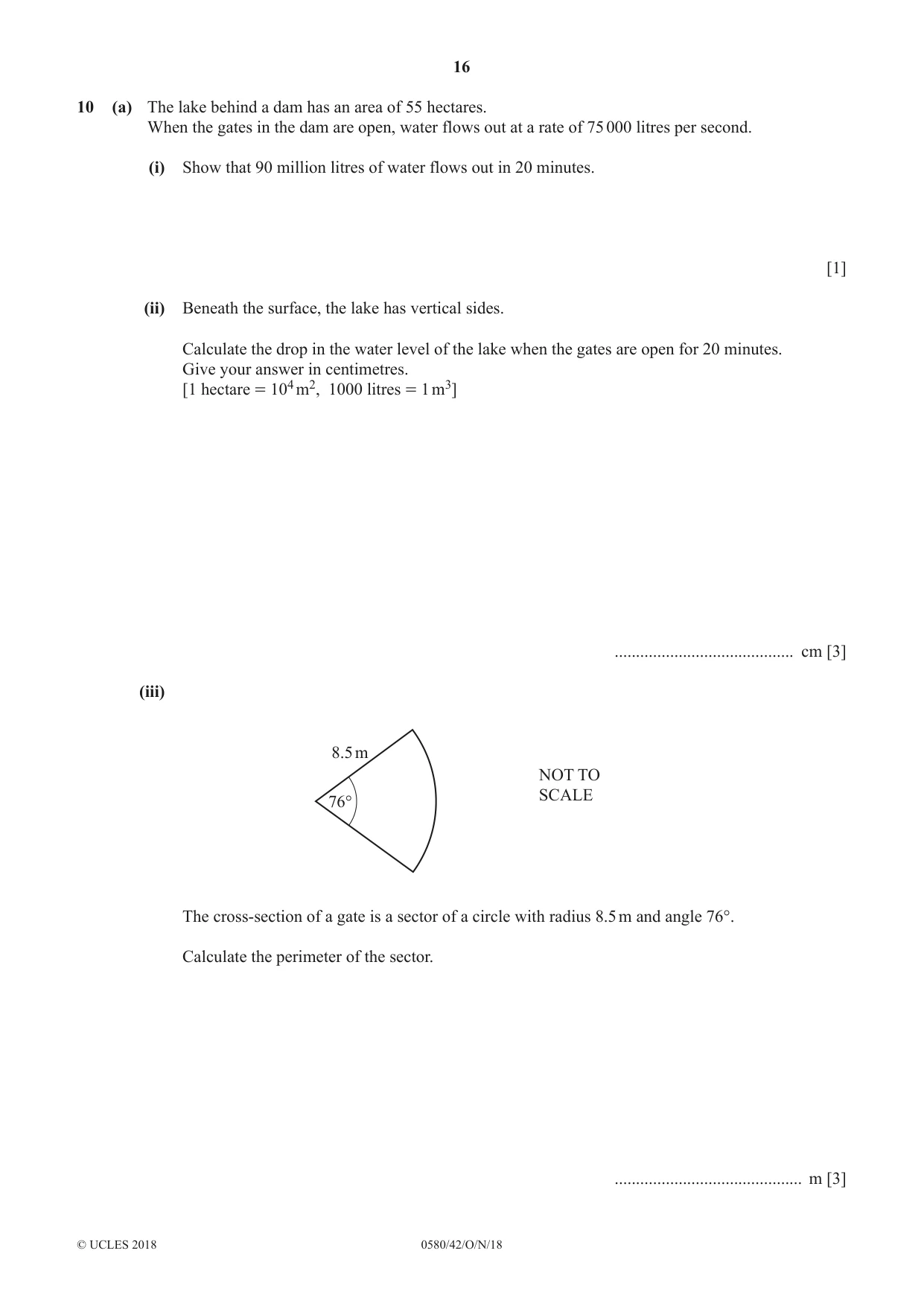
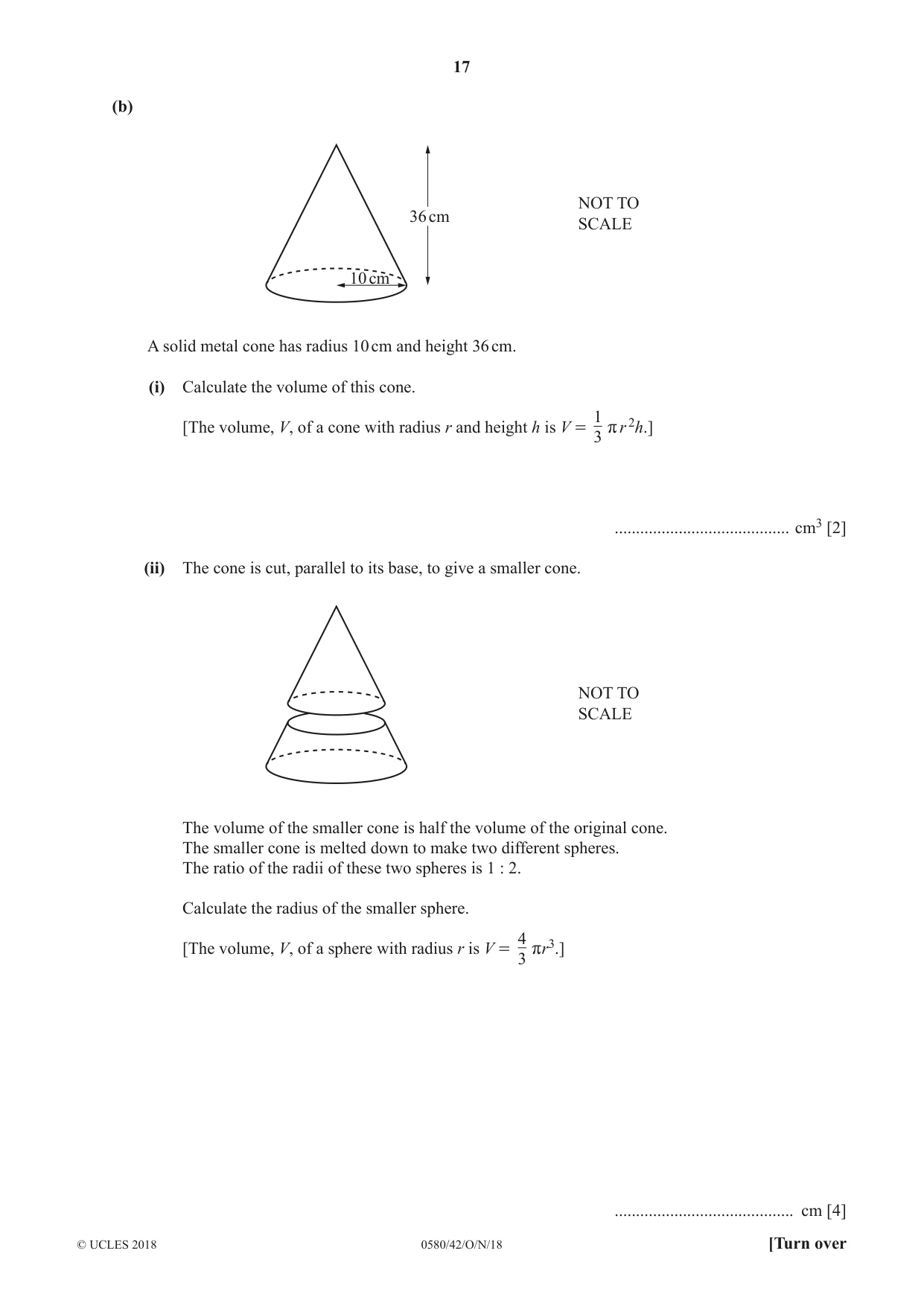
10 (a) The lake behind a dam has an area of 55 hectares. When the gates in the dam are open, water flows out at a rate of 75 000 litres per second. (i) Show that 90 million litres of water flows out in 20 minutes. [1] (ii) Beneath the surface, the lake has vertical sides. Calculate the drop in the water level of the lake when the gates are open for 20 minutes. Give your answer in centimetres. [1 hectare = 104 m2, 1000 litres = 1 m3] .......................................... cm [3] (iii) 8.5 m NOT TO SCALE 76° The cross-section of a gate is a sector of a circle with radius 8.5 m and angle 76°. Calculate the perimeter of the sector. ............................................ m [3] (b) NOT TO 36 cm SCALE 10 cm A solid metal cone has radius 10 cm and height 36 cm. (i) Calculate the volume of this cone. 1 [The volume, V, of a cone with radius r and height h is V = r r 2h.] 3 ......................................... cm3 [2] (ii) The cone is cut, parallel to its base, to give a smaller cone. NOT TO SCALE The volume of the smaller cone is half the volume of the original cone. The smaller cone is melted down to make two different spheres. The ratio of the radii of these two spheres is 1 : 2. Calculate the radius of the smaller sphere. 4 [The volume, V, of a sphere with radius r is V = rr3.] 3 .......................................... cm [4]
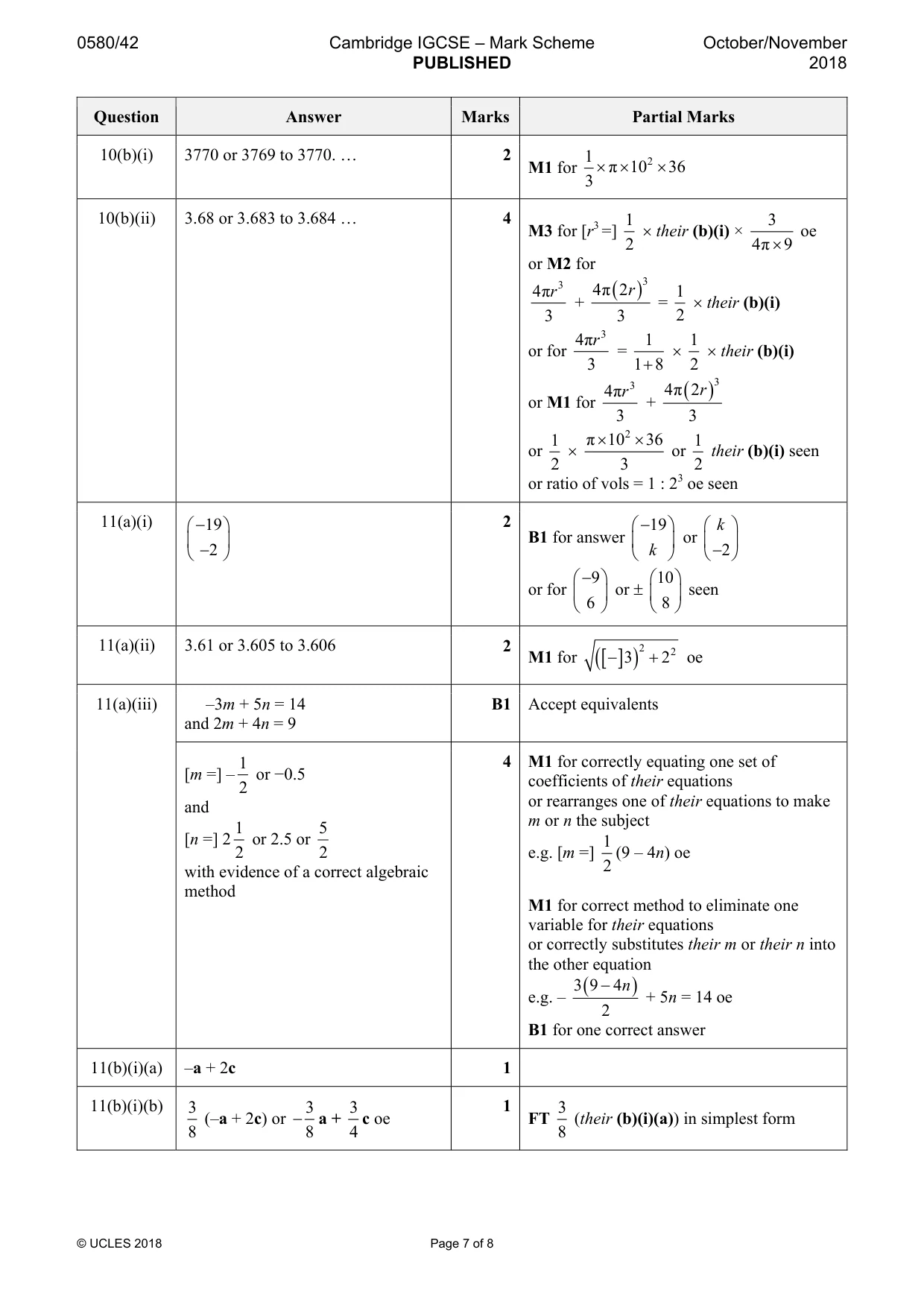
Mark scheme: 10(a)(i) 75 000 × 60 × 20 oe M1 Allow × 1200 for × 60 × 20 10(a)(ii) 16.4 or 16.36 … 3 9 × 10 7 × 100 M2 for 4 oe 1000 × 55 × 10 or B2 for answer 0.164 or 0.1636 … or B1 for answer figs 164 or 1636 … or M1 for figs 9 ÷ figs 55 10(a)(iii) 28.3 or 28.27 to 28.28 3 76 M2 for × 2π × 8.5 + 2 × 8.5 oe 360 76 or M1 for × 2π × 8.5 oe 360 10(b)(i) 3770 or 3769 to 3770. … 2 1 2 M1 for × π × 10 × 36 3 10(b)(ii) 3.68 or 3.683 to 3.684 … 4 1 3 M3 for [r3 =] × their (b)(i) × oe 2 4π × 9 or M2 for 4πr 3 4π ( 2 r ) 3 1 + = × their (b)(i) 3 3 2 4πr 3 1 1 or for = × × their (b)(i) 3 1 + 8 2 4πr 3 4π ( 2 r ) 3 or M1 for + 3 3 1 π × 10 2 × 36 1 or × or their (b)(i) seen 2 3 2 or ratio of vols = 1 : 23 oe seen
Q11 · - 3 5 14 11 (a) a = b = c = e 2o e 4 o e 9 o (i) Find 3a – 2b
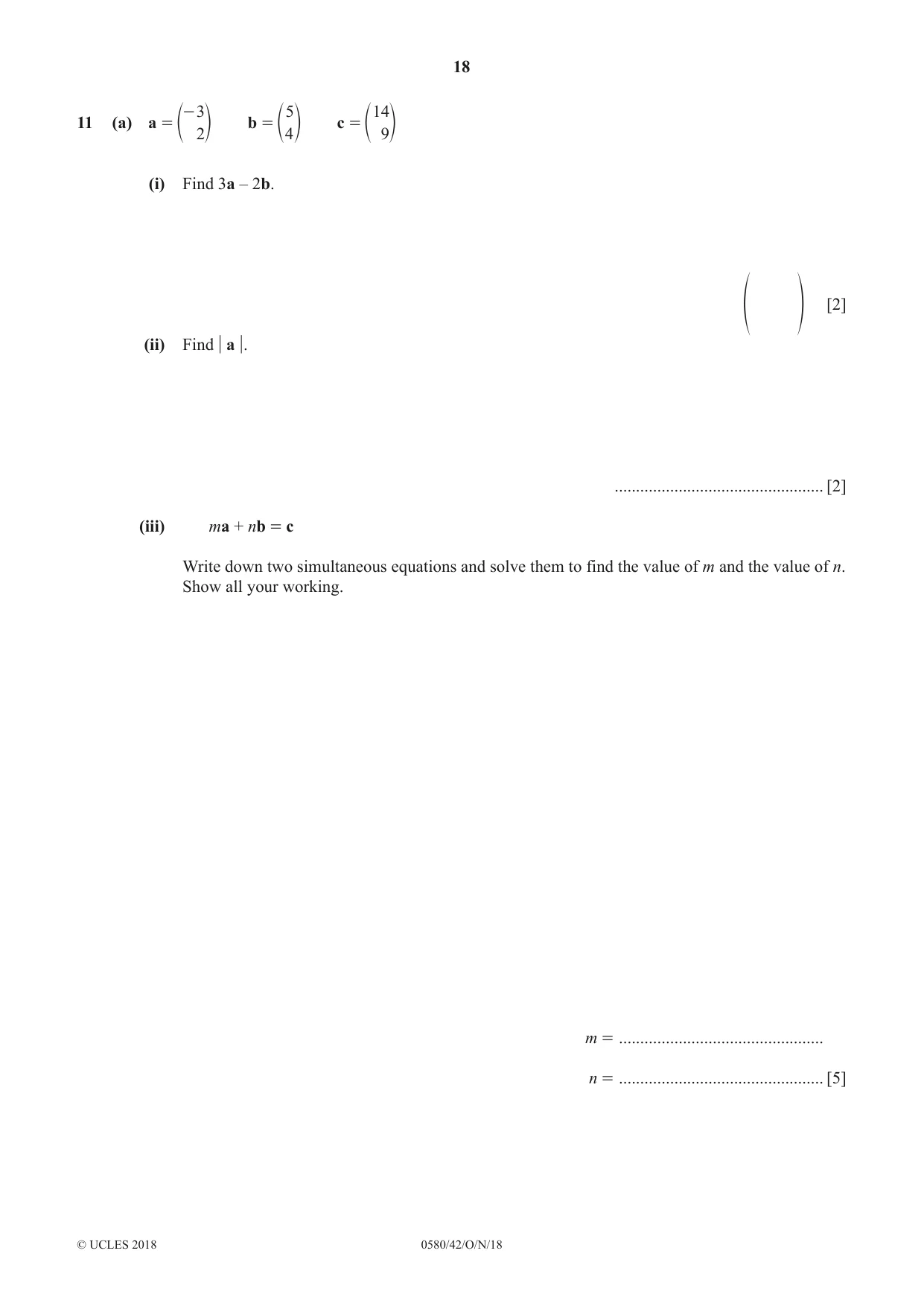
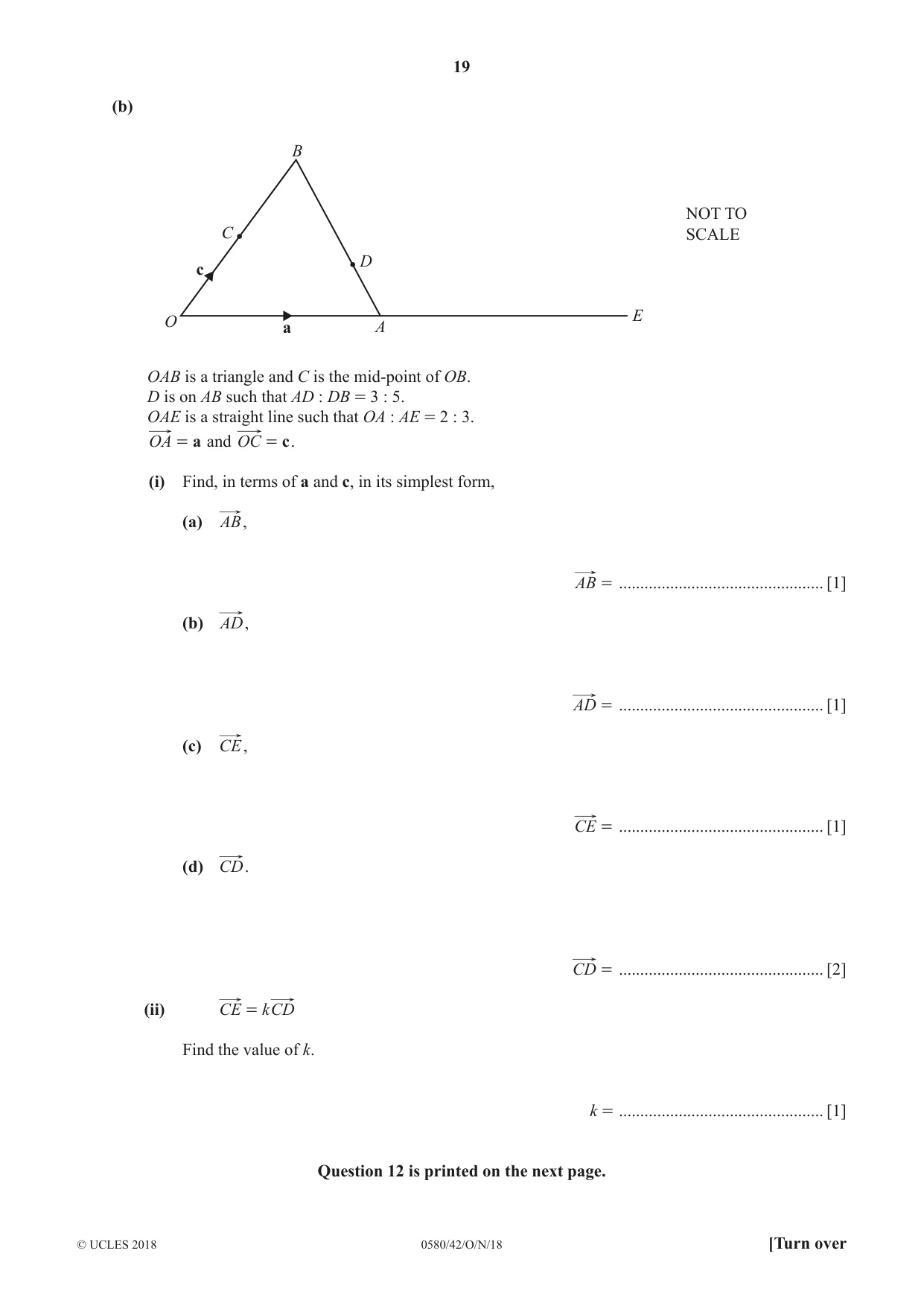
- 3 5 14 11 (a) a = b = c = e 2o e 4 o e 9 o (i) Find 3a – 2b. [2] f p (ii) Find a . ................................................. [2] (iii) ma + nb = c Write down two simultaneous equations and solve them to find the value of m and the value of n. Show all your working. m = ................................................ n = ................................................ [5] (b) B NOT TO C SCALE D c E O a A OAB is a triangle and C is the mid-point of OB. D is on AB such that AD : DB = 3 : 5. OAE is a straight line such that OA : AE = 2 : 3. OA = a and OC = c . (i) Find, in terms of a and c, in its simplest form, (a) AB, AB = ................................................ [1] (b) AD, AD = ................................................ [1] (c) CE, CE = ................................................ [1] (d) CD. CD = ................................................ [2] (ii) CE = kCD Find the value of k. k = ................................................ [1] Question 12 is printed on the next page.
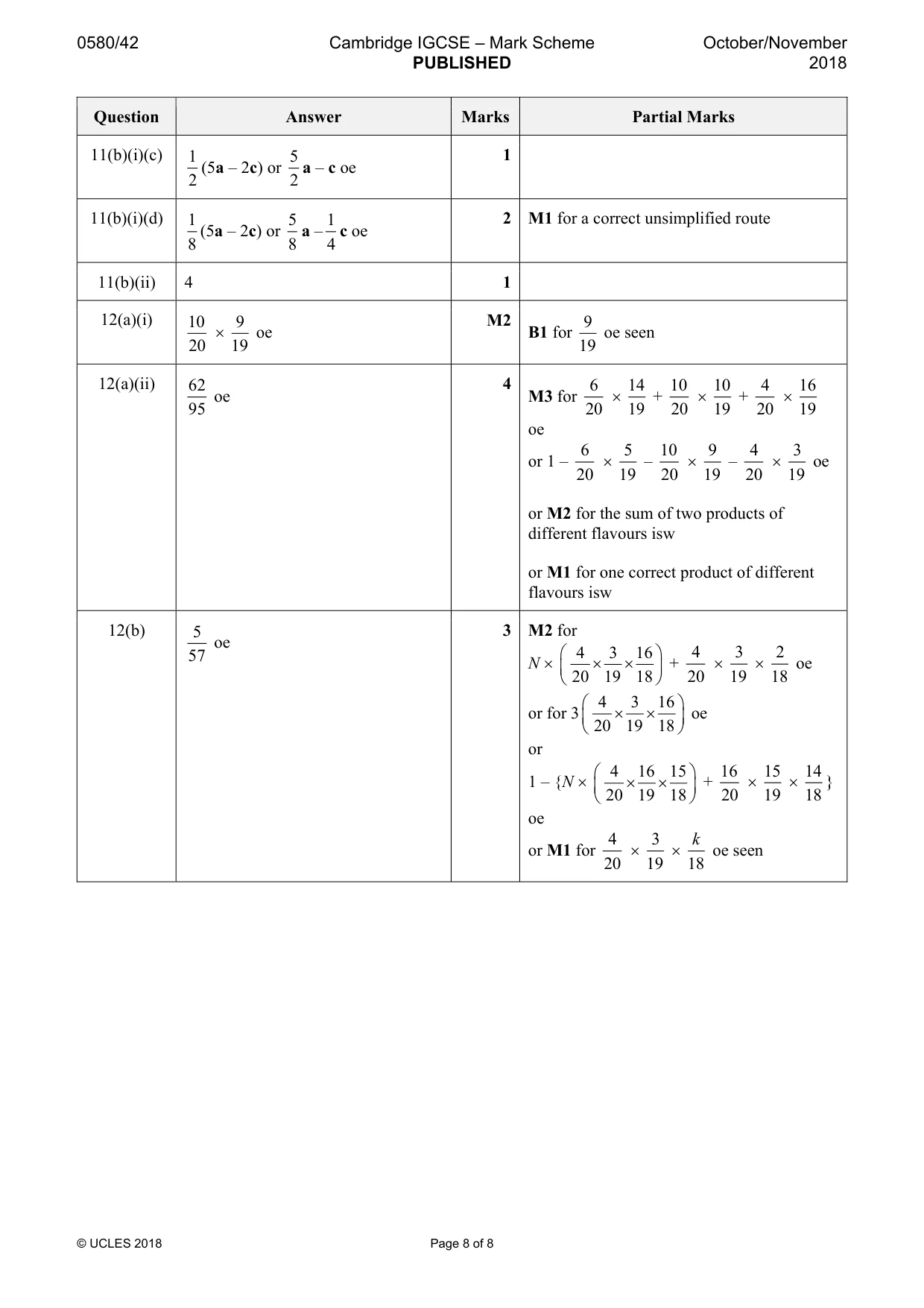
Mark scheme: 11(a)(i) −19 2 −19 k B1 for answer or −2 k −2 −9 10 or for or ± seen 6 8 11(a)(ii) 3.61 or 3.605 to 3.606 2 2 2 M1 for ( [ − ] 3 ) + 2 oe 11(a)(iii) –3m + 5n = 14 B1 Accept equivalents and 2m + 4n = 9 1 4 M1 for correctly equating one set of [m =] – or −0.5 coefficients of their equations 2 or rearranges one of their equations to make and m or n the subject 1 5 [n =] 2 or 2.5 or 1 2 2 e.g. [m =] (9 – 4n) oe 2 with evidence of a correct algebraic method M1 for correct method to eliminate one variable for their equations or correctly substitutes their m or their n into the other equation 3 ( 9 −n4 ) e.g. – + 5n = 14 oe 2 B1 for one correct answer 11(b)(i)(a) –a + 2c 1 11(b)(i)(b) 3 3 3 1 3 (–a + 2c) or − a + c oe FT (their (b)(i)(a)) in simplest form 8 8 4 8 11(b)(i)(c) 1 5 1 (5a – 2c) or a – c oe 2 2 11(b)(i)(d) 1 5 1 2 M1 for a correct unsimplified route (5a – 2c) or a – c oe 8 8 4 11(b)(ii) 4 1
Q12 · A box contains 20 packets of potato chips
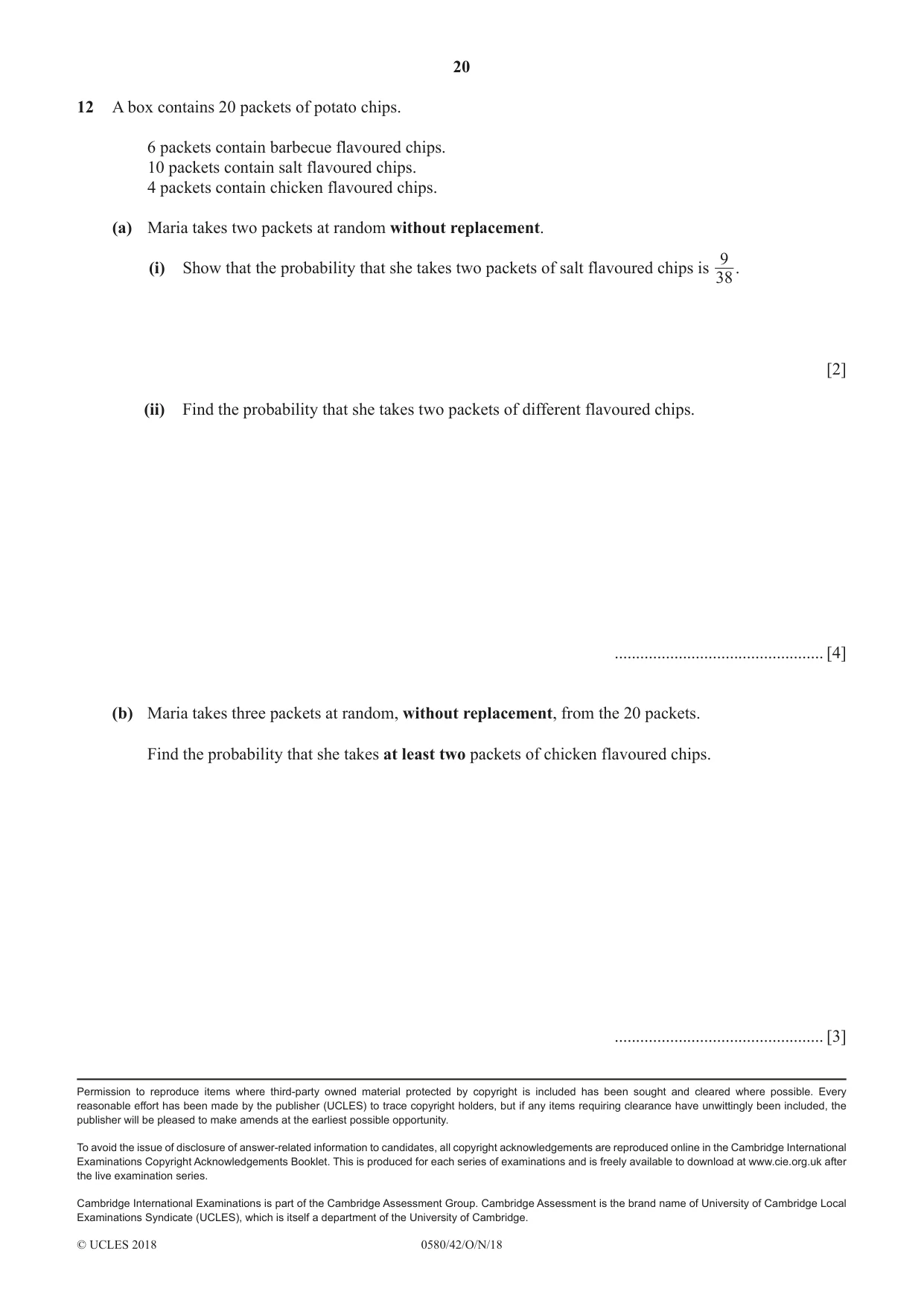
12 A box contains 20 packets of potato chips. 6 packets contain barbecue flavoured chips. 10 packets contain salt flavoured chips. 4 packets contain chicken flavoured chips. (a) Maria takes two packets at random without replacement. 9 (i) Show that the probability that she takes two packets of salt flavoured chips is . 38 [2] (ii) Find the probability that she takes two packets of different flavoured chips. ................................................. [4] (b) Maria takes three packets at random, without replacement, from the 20 packets. Find the probability that she takes at least two packets of chicken flavoured chips. ................................................. [3]
Mark scheme: 12(a)(i) 10 9 M2 9 × oe B1 for oe seen 20 19 19 12(a)(ii) 62 4 6 14 10 10 4 16 oe M3 for × + × + × 95 20 19 20 19 20 19 oe 6 5 10 9 4 3 or 1 – × – × – × oe 20 19 20 19 20 19 or M2 for the sum of two products of different flavours isw or M1 for one correct product of different flavours isw 12(b) 5 3 M2 for oe 57 4 3 16 4 3 2 N × × × + × × oe 20 19 18 20 19 18 4 3 16 or for 3 × × oe 20 19 18 or 4 16 15 16 15 14 1 – {N × × × + × × } 20 19 18 20 19 18 oe 4 3 k or M1 for × × oe seen 20 19 18
What was in this paper
The subtopics covered by these 12 questions, and how many questions each got. Open one in a new tab to see every Cambridge question on it.
What you needed in this session
Cambridge’s own grade thresholds for 2018 Oct/Nov, Paper 4 · Variant 2. A higher threshold means an easier paper — the bar moves with how the cohort did.