Cambridge IGCSE Mathematics 0580 — 2015 May/June Paper 4 · Variant 3
0580/43/M/J/15 · 7 questions · 130 marks · ≈146 min
The question paper and its mark scheme, free to read here and free to download. This is Cambridge’s own paper, exactly as it was sat.
Question paper16 pages
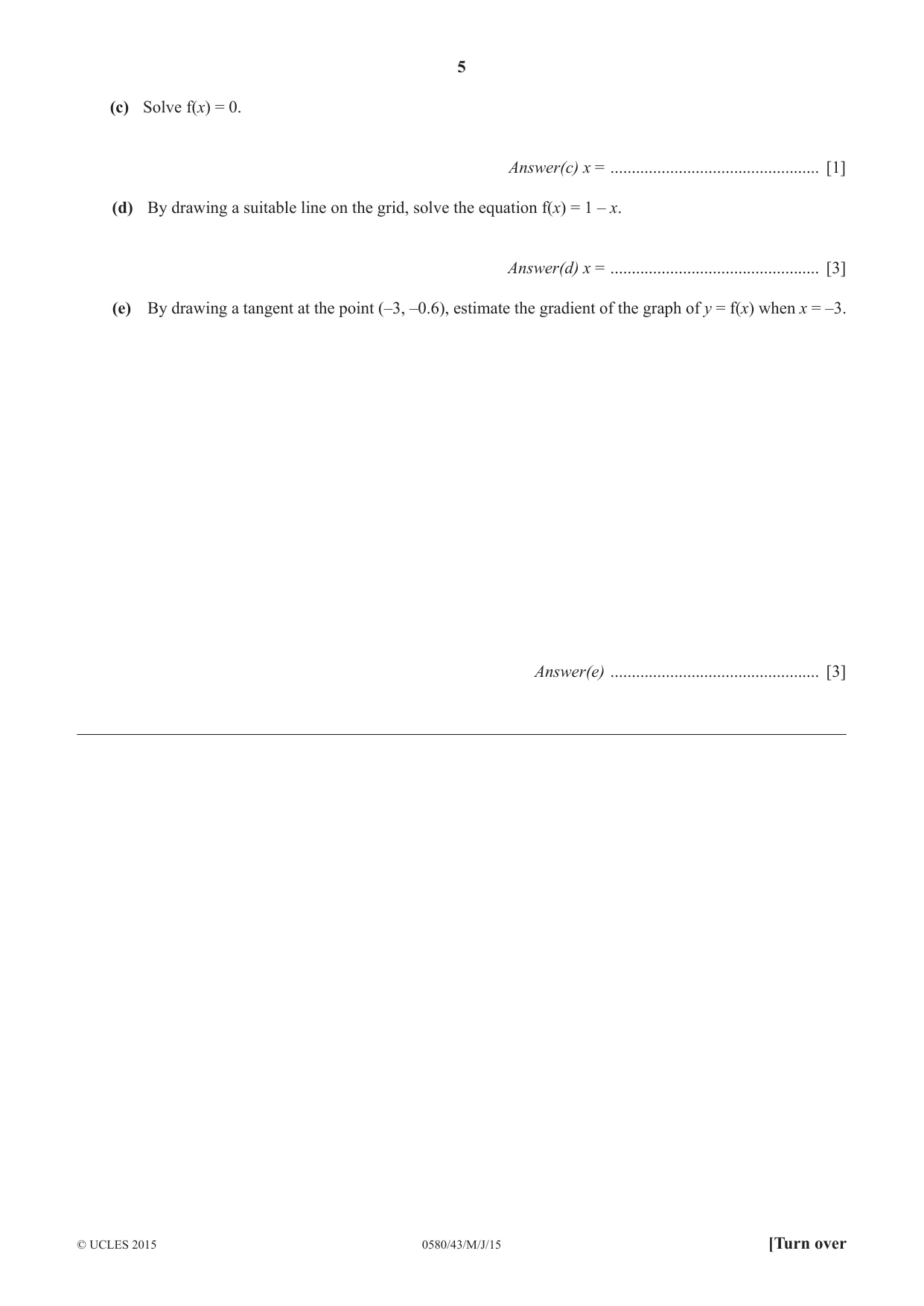
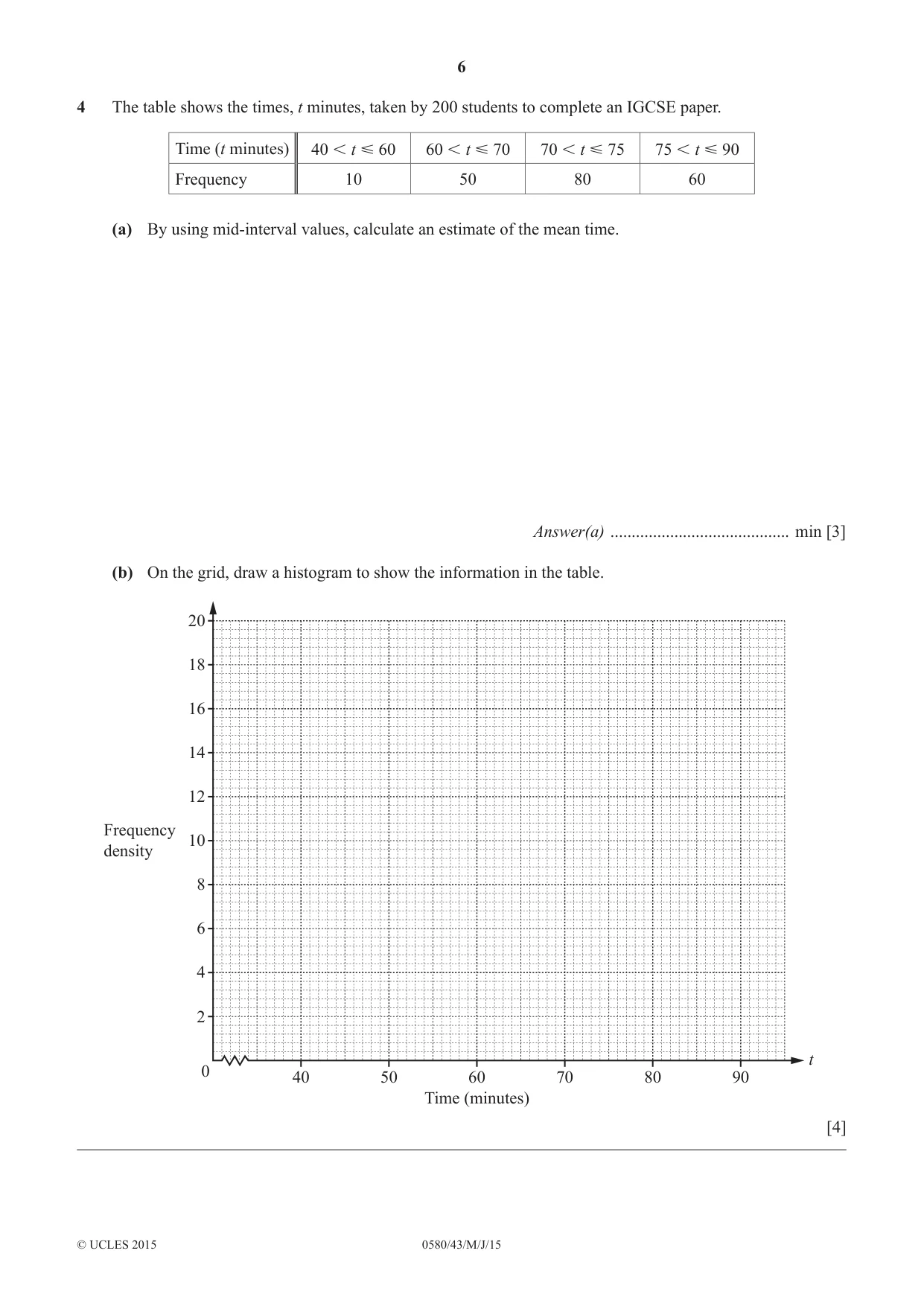
Mark scheme9 pages
Answers below. Sit the paper first if you are practising.
Questions as text
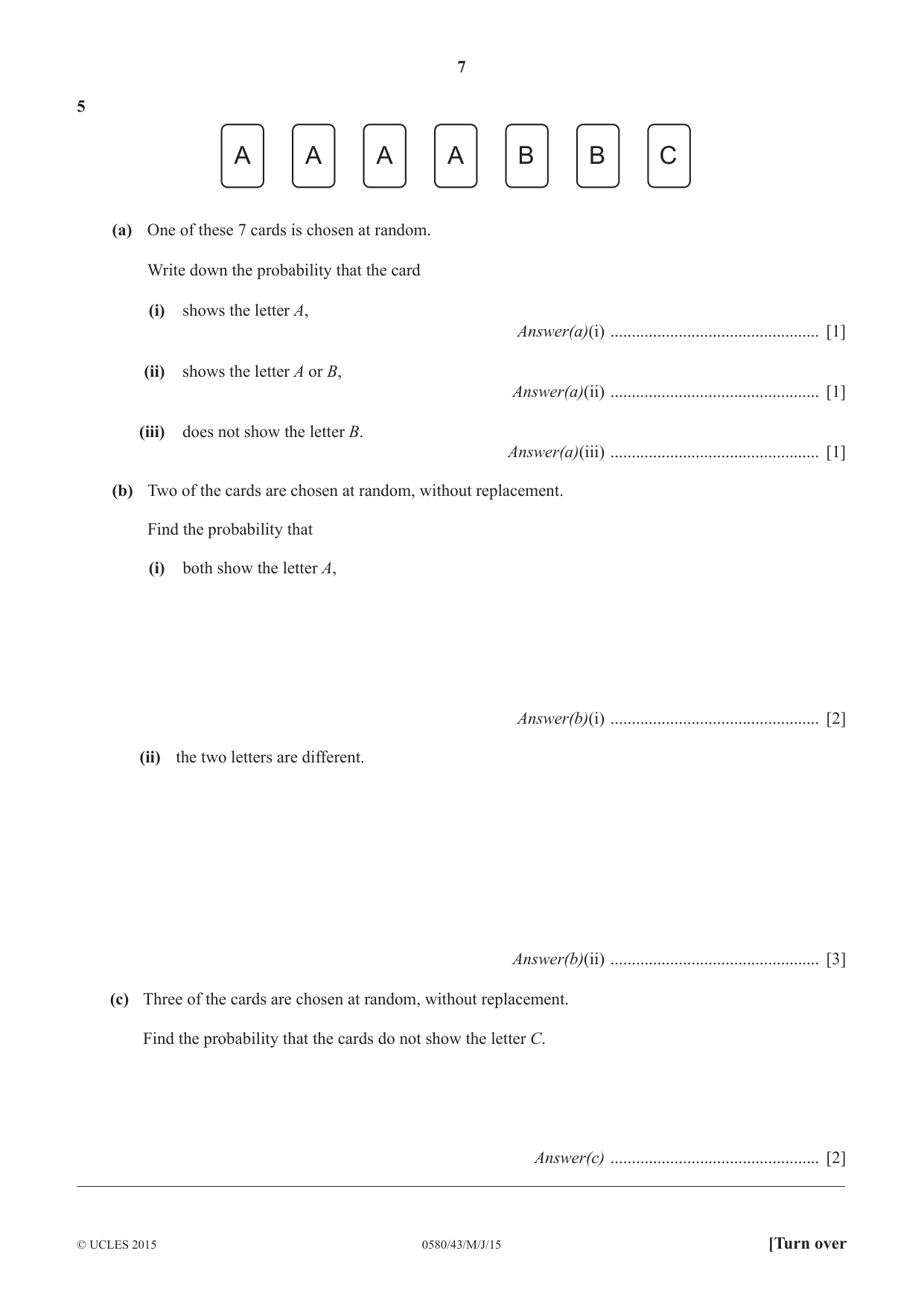
Q5 · A A A A B B C (a) One of these 7 cards is chosen at random
5 A A A A B B C (a) One of these 7 cards is chosen at random. Write down the probability that the card (i) shows the letter A, Answer(a)(i) ................................................. [1] (ii) shows the letter A or B, Answer(a)(ii) ................................................. [1] (iii) does not show the letter B. Answer(a)(iii) ................................................. [1] (b) Two of the cards are chosen at random, without replacement. Find the probability that (i) both show the letter A, Answer(b)(i) ................................................. [2] (ii) the two letters are different. Answer(b)(ii) ................................................. [3] (c) Three of the cards are chosen at random, without replacement. Find the probability that the cards do not show the letter C. Answer(c) ................................................. [2] __________________________________________________________________________________________
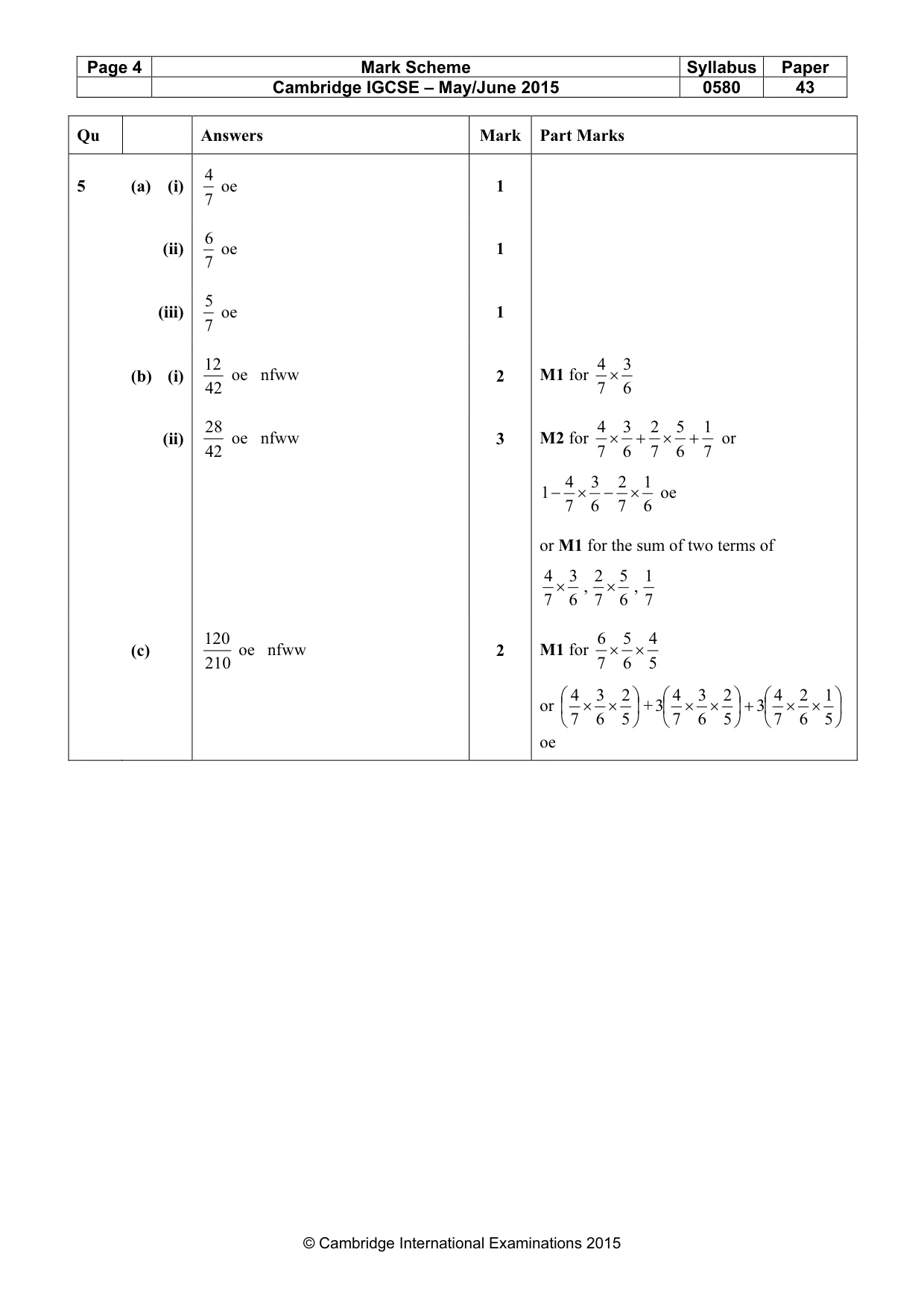
Mark scheme: 4 5 (a) (i) oe 1 7 6 (ii) oe 1 7 5 (iii) oe 1 7 12 4 3 (b) (i) oe nfww 2 M1 for × 42 7 6 28 4 3 2 5 1 (ii) oe nfww 3 M2 for × + × + or 42 7 6 7 6 7 4 3 2 1 1 − × − × oe 7 6 7 6 or M1 for the sum of two terms of 4 3 2 5 1 × , × , 7 6 7 6 7 120 6 5 4 (c) oe nfww 2 M1 for × × 210 7 6 5 4 3 2 4 3 2 4 2 1 or × × + 3 × × + 3 × × 7 6 5 7 6 5 7 6 5 oe Qu Answers Mark Part Marks
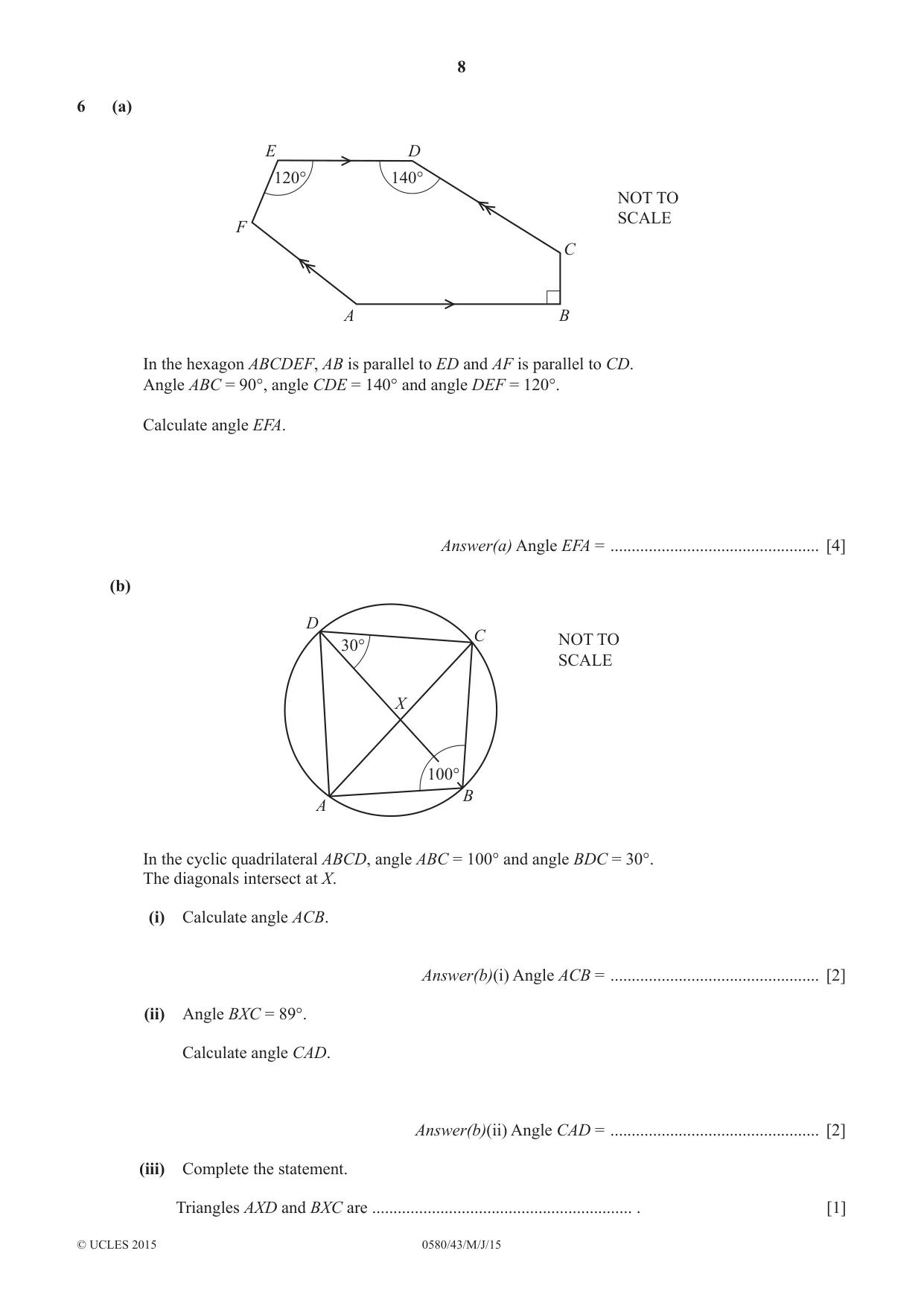
Q6 · E D 120° 140° NOT TO SCALE F C A B In the hexagon ABCDEF, AB is parallel to ED and AF is…
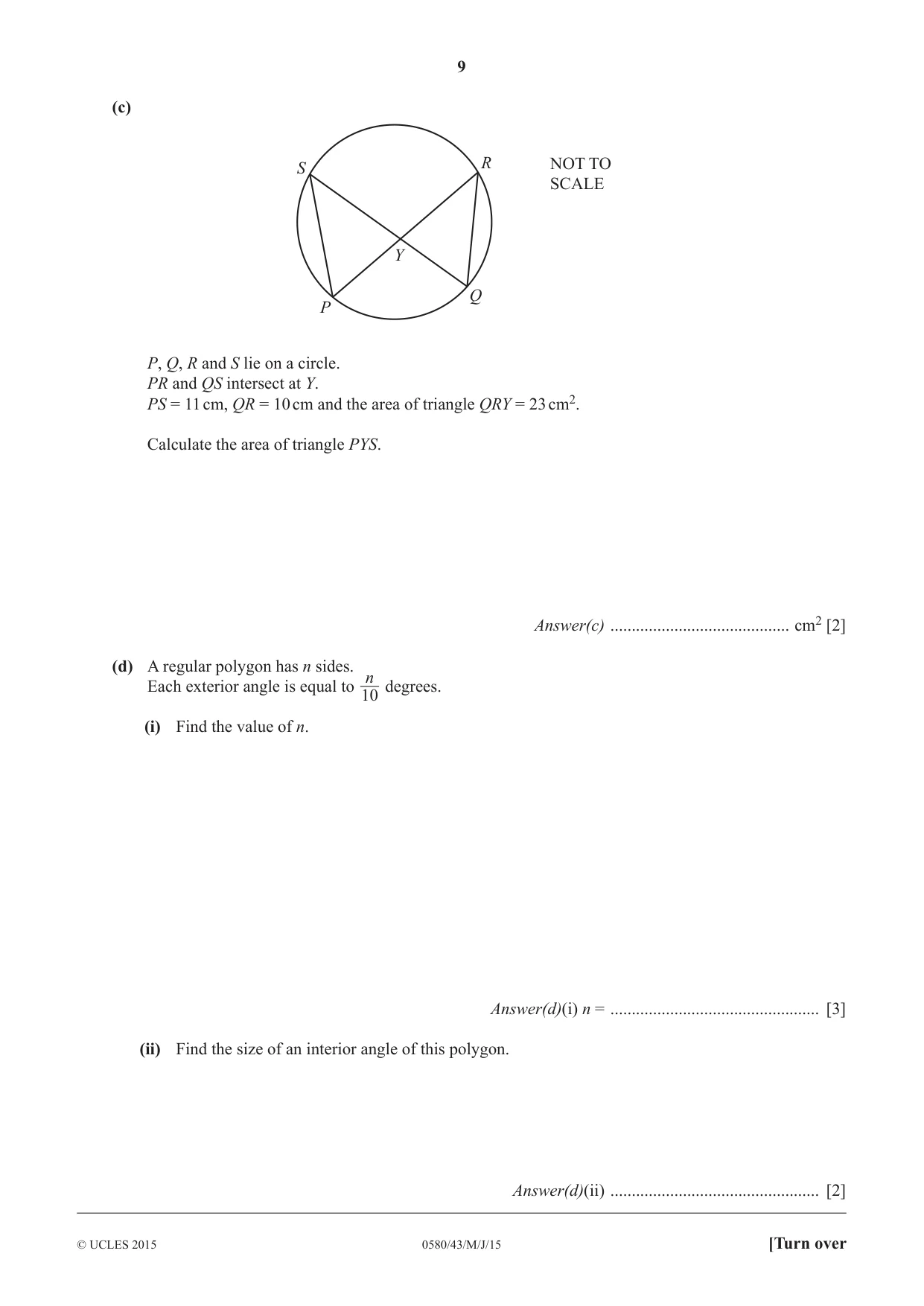
6 (a) E D 120° 140° NOT TO SCALE F C A B In the hexagon ABCDEF, AB is parallel to ED and AF is parallel to CD. Angle ABC = 90°, angle CDE = 140° and angle DEF = 120°. Calculate angle EFA. Answer(a) Angle EFA = ................................................. [4] (b) D C NOT TO 30° SCALE X 100° B A In the cyclic quadrilateral ABCD, angle ABC = 100° and angle BDC = 30°. The diagonals intersect at X. (i) Calculate angle ACB. Answer(b)(i) Angle ACB = ................................................. [2] (ii) Angle BXC = 89°. Calculate angle CAD. Answer(b)(ii) Angle CAD = ................................................. [2] (iii) Complete the statement. Triangles AXD and BXC are ............................................................. . [1] (c) R NOT TO S SCALE Y Q P P, Q, R and S lie on a circle. PR and QS intersect at Y. PS = 11 cm, QR = 10 cm and the area of triangle QRY = 23 cm2. Calculate the area of triangle PYS. Answer(c) .......................................... cm2 [2] (d) A regular polygon has n sides. n Each exterior angle is equal to 10 degrees. (i) Find the value of n. Answer(d)(i) n = ................................................. [3] (ii) Find the size of an interior angle of this polygon. Answer(d)(ii) ................................................. [2]
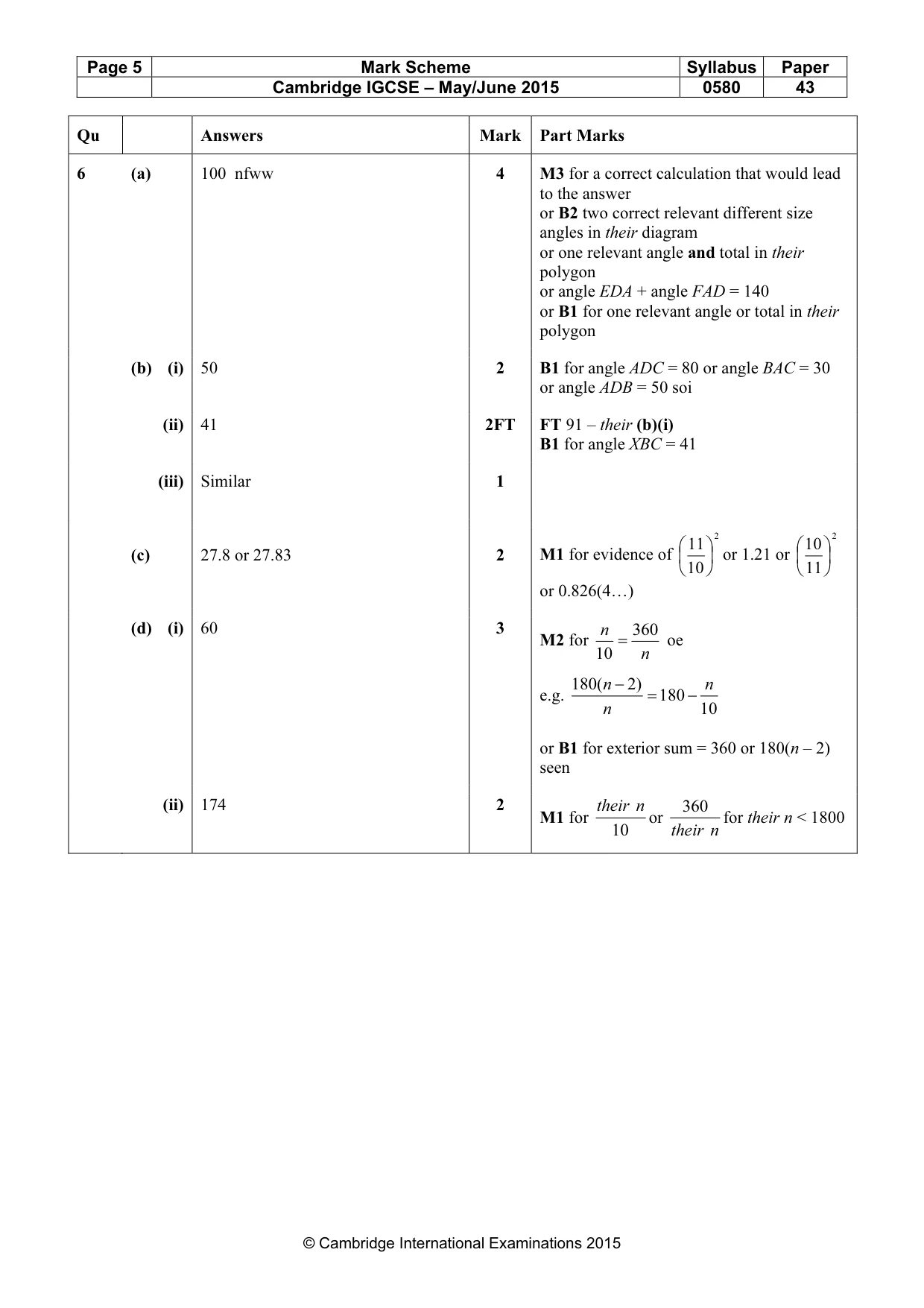
Mark scheme: 6 (a) 100 nfww 4 M3 for a correct calculation that would lead to the answer or B2 two correct relevant different size angles in their diagram or one relevant angle and total in their polygon or angle EDA + angle FAD = 140 or B1 for one relevant angle or total in their polygon (b) (i) 50 2 B1 for angle ADC = 80 or angle BAC = 30 or angle ADB = 50 soi (ii) 41 2FT FT 91 – their (b)(i) B1 for angle XBC = 41 (iii) Similar 1 2 10 2 (c) 27.8 or 27.83 2 M1 for evidence of 11 or 1.21 or 10 11 or 0.826(4…) (d) (i) 60 3 n 360 M2 for = oe 10 n 180( n − 2) n e.g. = 180 − n 10 or B1 for exterior sum = 360 or 180(n – 2) seen (ii) 174 2 their n 360 M1 for or for their n < 1800 10 their n Qu Answers Mark Part Marks
Q7 · The total surface area of a cone is given by the formula A = πrl + πr2
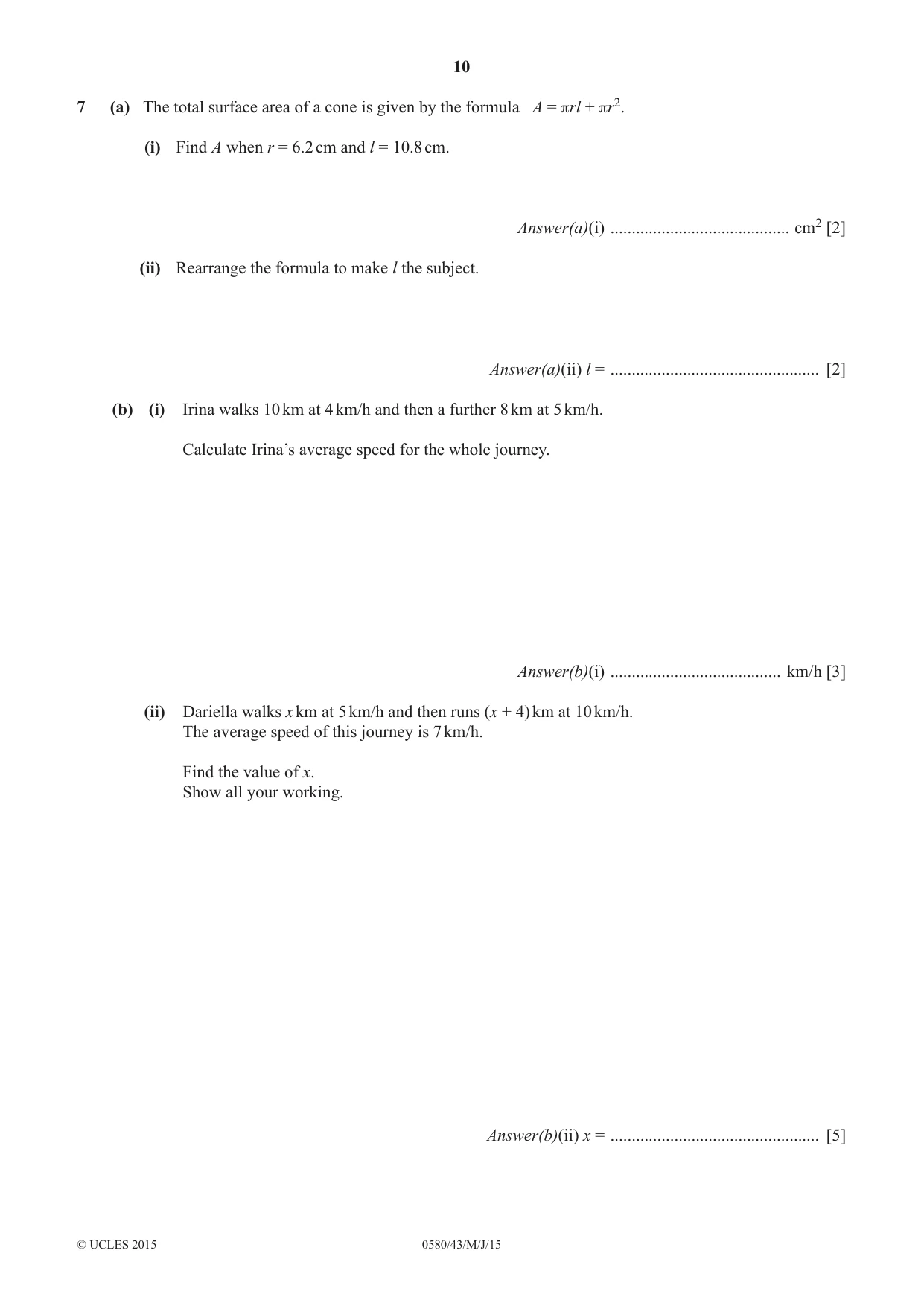
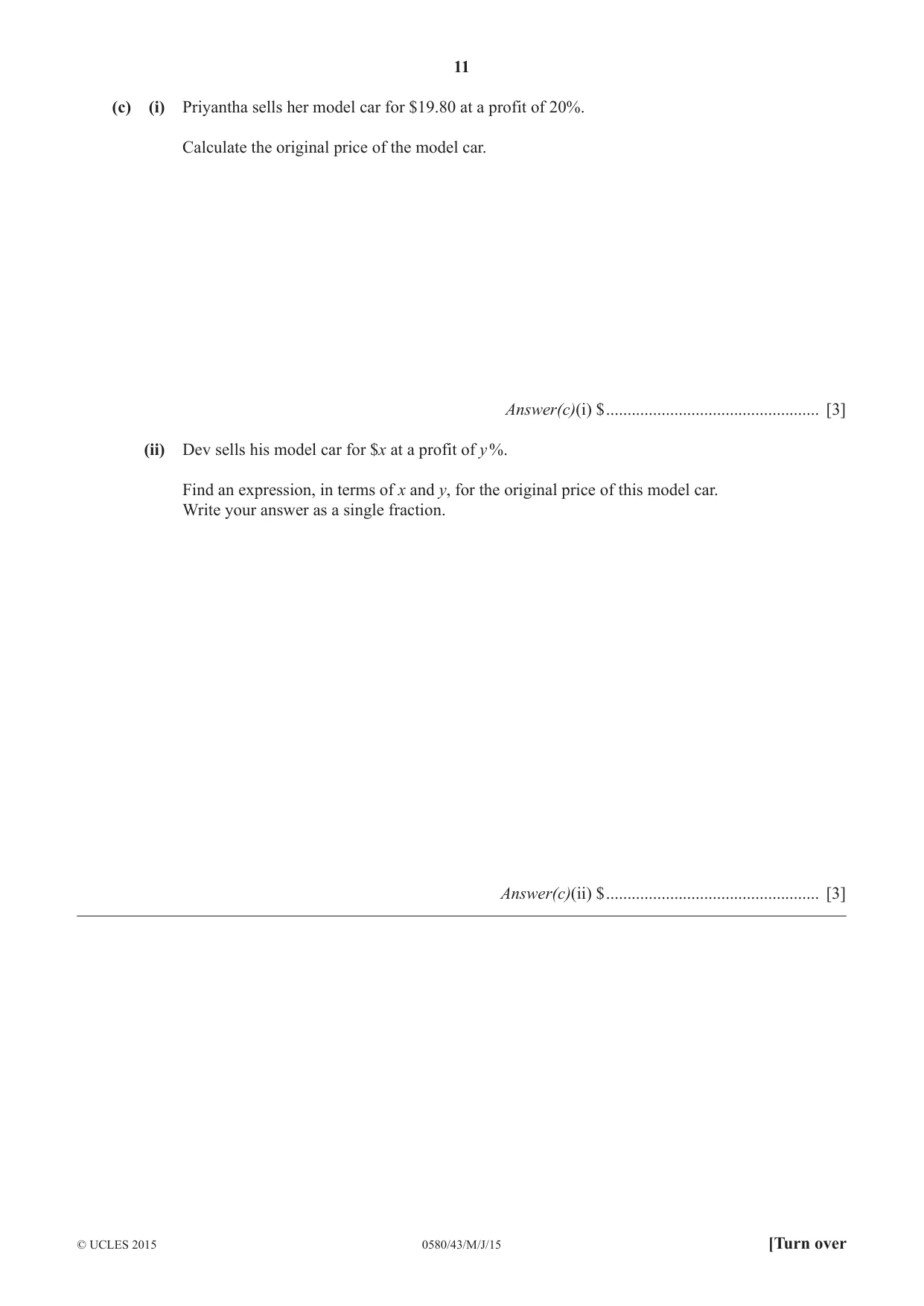
7 (a) The total surface area of a cone is given by the formula A = πrl + πr2. (i) Find A when r = 6.2 cm and l = 10.8 cm. Answer(a)(i) .......................................... cm2 [2] (ii) Rearrange the formula to make l the subject. Answer(a)(ii) l = ................................................. [2] (b) (i) Irina walks 10 km at 4 km/h and then a further 8 km at 5 km/h. Calculate Irina’s average speed for the whole journey. Answer(b)(i) ........................................ km/h [3] (ii) Dariella walks x km at 5 km/h and then runs (x + 4) km at 10 km/h. The average speed of this journey is 7 km/h. Find the value of x. Show all your working. Answer(b)(ii) x = ................................................. [5] (c) (i) Priyantha sells her model car for $19.80 at a profit of 20%. Calculate the original price of the model car. Answer(c)(i) $ .................................................. [3] (ii) Dev sells his model car for $x at a profit of y %. Find an expression, in terms of x and y, for the original price of this model car. Write your answer as a single fraction. Answer(c)(ii) $ .................................................. [3]
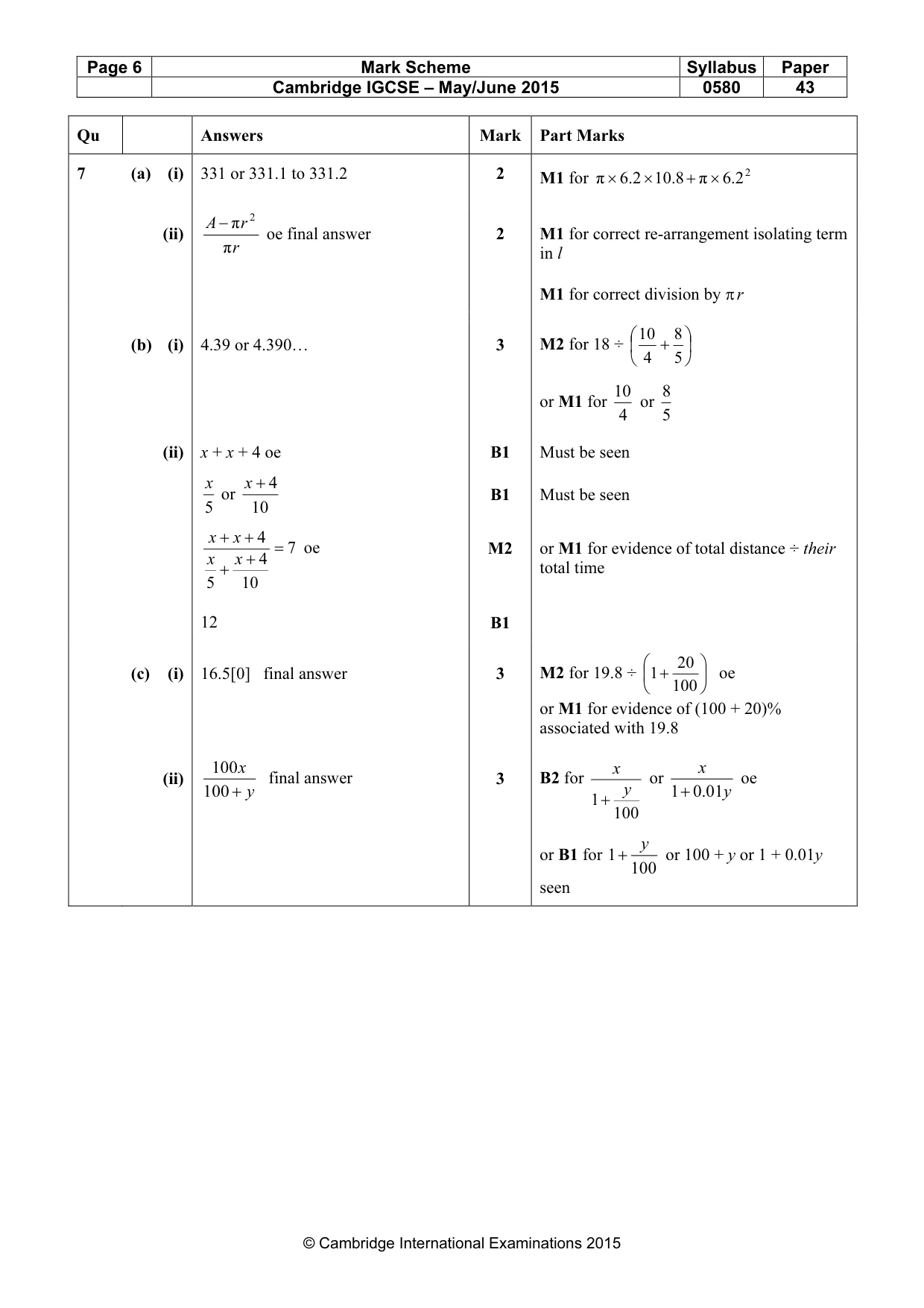
Mark scheme: 27 (a) (i) 331 or 331.1 to 331.2 2 M1 for π × 2.6 × 10⁸. + π × 2.6 A − π r 2 (ii) oe final answer 2 M1 for correct re-arrangement isolating term π r in l M1 for correct division by π r 10 8 (b) (i) 4.39 or 4.390… 3 M2 for 18 ÷ + 4 5 10 8 or M1 for or 4 5 (ii) x + x + 4 oe B1 Must be seen x x + 4 or B1 Must be seen 5 10 x + x + 4 = 7 oe M2 or M1 for evidence of total distance ÷ their x x + 4 + total time 5 10 12 B1 20 (c) (i) 16.5[0] final answer 3 M2 for 19.8 ÷ + 1 oe 100 or M1 for evidence of (100 + 20)% associated with 19.8 100 x x x (ii) final answer 3 B2 for or oe 100 + y y 1+ .001 y 1 + 100 y or B1 for 1 + or 100 + y or 1 + 0.01y 100 seen Qu Answers Mark Part Marks ( )
Q8 · A cylindrical tank contains 180 000 cm3 of water
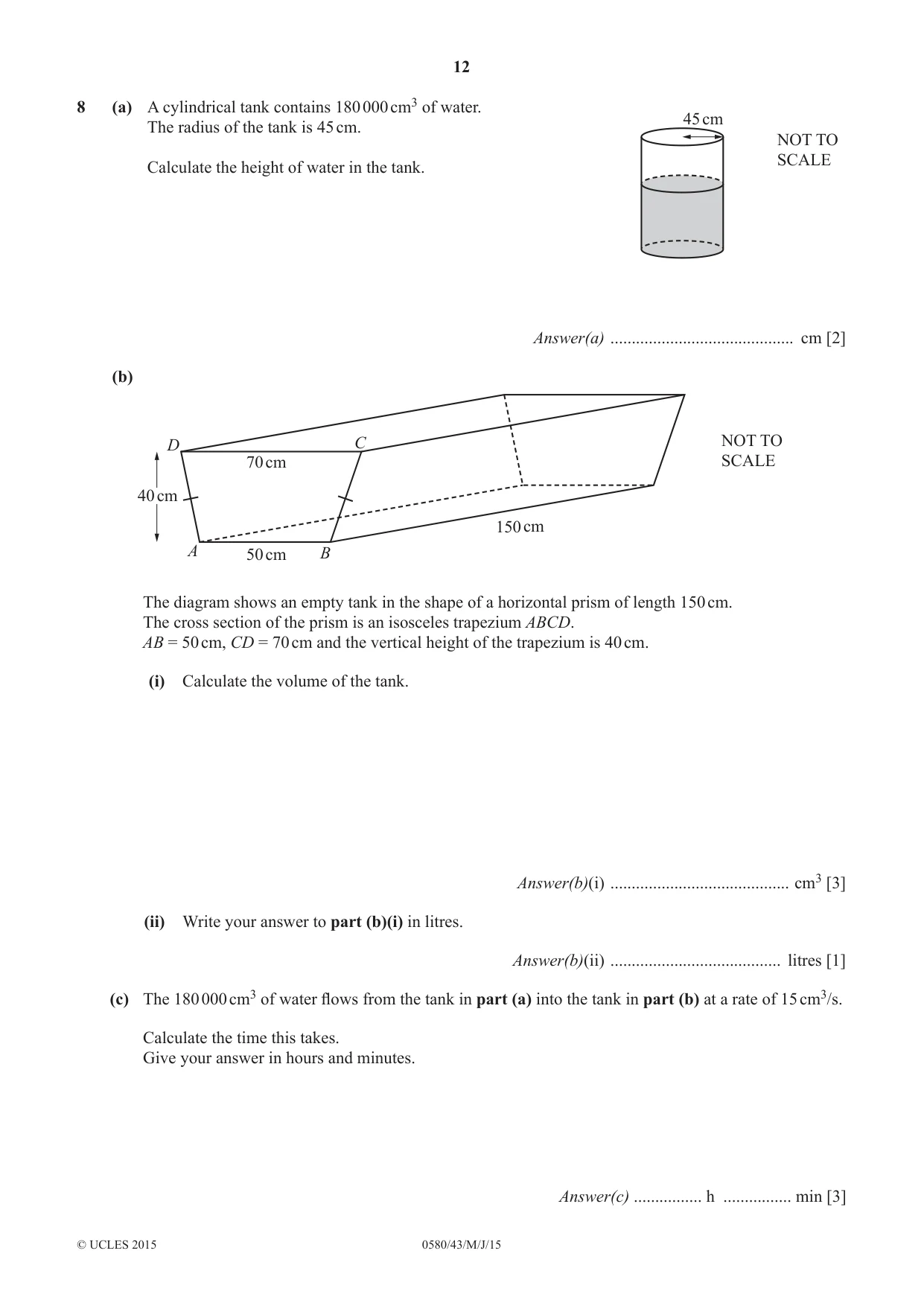
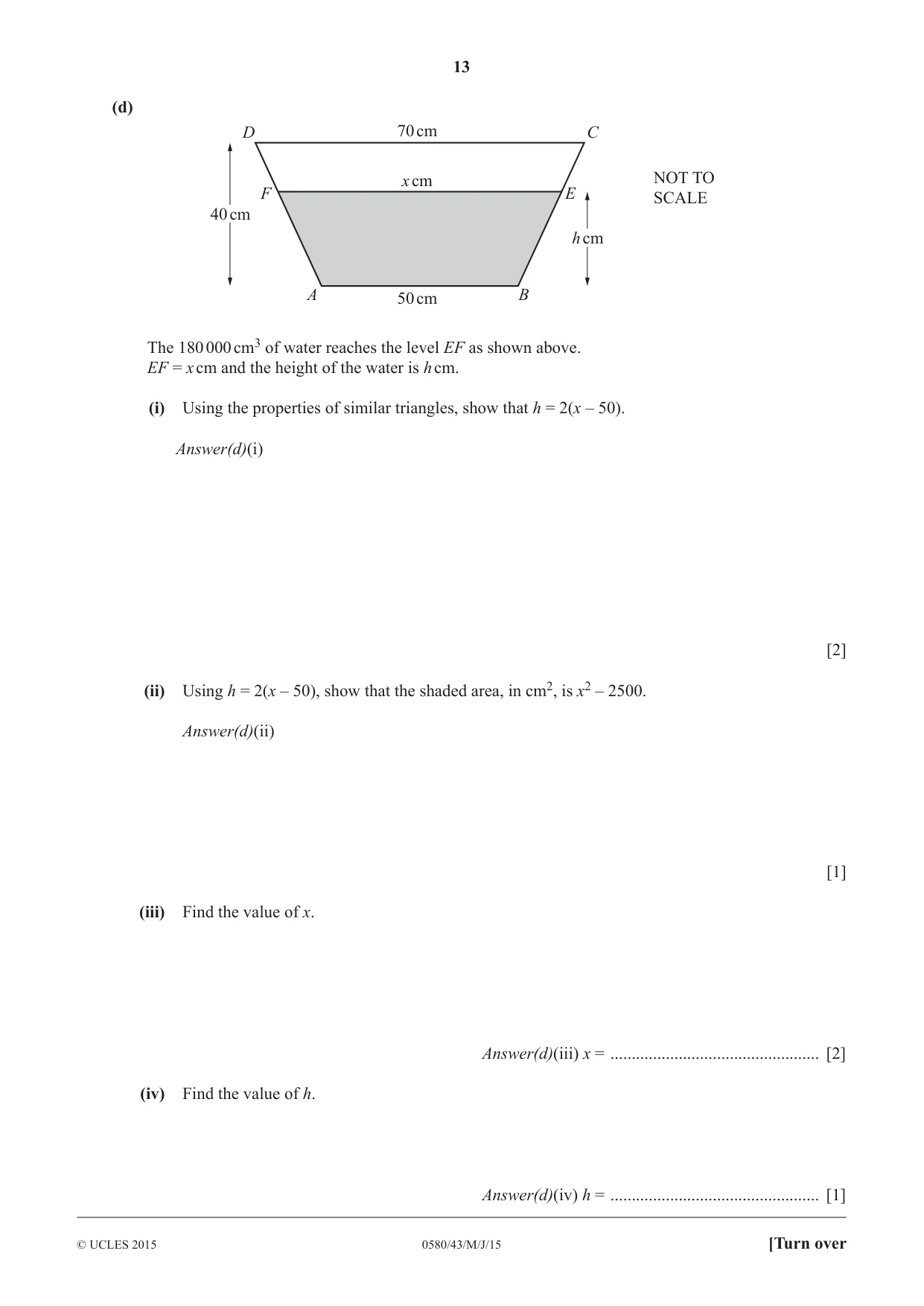
8 (a) A cylindrical tank contains 180 000 cm3 of water. 45 cm The radius of the tank is 45 cm. NOT TO SCALE Calculate the height of water in the tank. Answer(a) ........................................... cm [2] (b) D C NOT TO 70 cm SCALE 40 cm 150 cm A 50 cm B The diagram shows an empty tank in the shape of a horizontal prism of length 150 cm. The cross section of the prism is an isosceles trapezium ABCD. AB = 50 cm, CD = 70 cm and the vertical height of the trapezium is 40 cm. (i) Calculate the volume of the tank. Answer(b)(i) .......................................... cm3 [3] (ii) Write your answer to part (b)(i) in litres. Answer(b)(ii) ........................................ litres [1] (c) The 180 000 cm3 of water flows from the tank in part (a) into the tank in part (b) at a rate of 15 cm3/s. Calculate the time this takes. Give your answer in hours and minutes. Answer(c) ................ h ................ min [3] (d) D 70 cm C x cm NOT TO F E SCALE 40 cm h cm A 50 cm B The 180 000 cm3 of water reaches the level EF as shown above. EF = x cm and the height of the water is h cm. (i) Using the properties of similar triangles, show that h = 2(x – 50). Answer(d)(i) [2] (ii) Using h = 2(x – 50), show that the shaded area, in cm2, is x2 – 2500. Answer(d)(ii) [1] (iii) Find the value of x. Answer(d)(iii) x = ................................................. [2] (iv) Find the value of h. Answer(d)(iv) h = ................................................. [1]
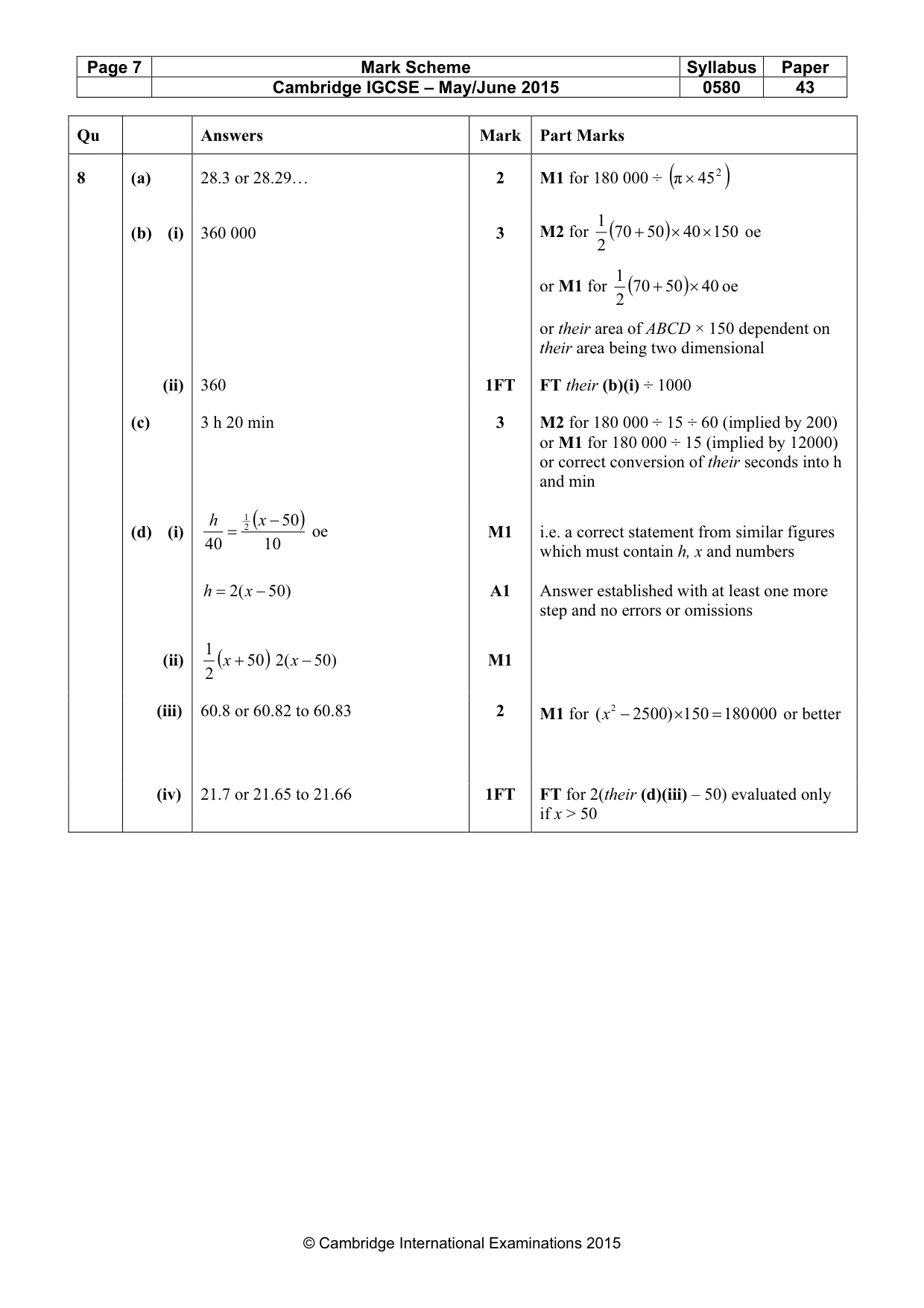
Mark scheme: 28 (a) 28.3 or 28.29… 2 M1 for 180 000 ÷ (π × 45 ) 1 (b) (i) 360 000 3 M2 for (70 + 50 ) × 40 × 150 oe 2 1 or M1 for (70 + 50 ) × 40 oe 2 or their area of ABCD × 150 dependent on their area being two dimensional (ii) 360 1FT FT their (b)(i) ÷ 1000 (c) 3 h 20 min 3 M2 for 180 000 ÷ 15 ÷ 60 (implied by 200) or M1 for 180 000 ÷ 15 (implied by 12000) or correct conversion of their seconds into h and min h 12 ( x − 50 ) (d) (i) = oe M1 i.e. a correct statement from similar figures 40 10 which must contain h, x and numbers h = 2 ( x − 50 ) A1 Answer established with at least one more step and no errors or omissions 1 (ii) ( x + 50 ) 2( x − 50) M1 2 2 − 2500) ×150 = 180 000 or better (iii) 60.8 or 60.82 to 60.83 2 M1 for ( x (iv) 21.7 or 21.65 to 21.66 1FT FT for 2(their (d)(iii) – 50) evaluated only if x > 50 Qu Answers Mark Part Marks 2 13
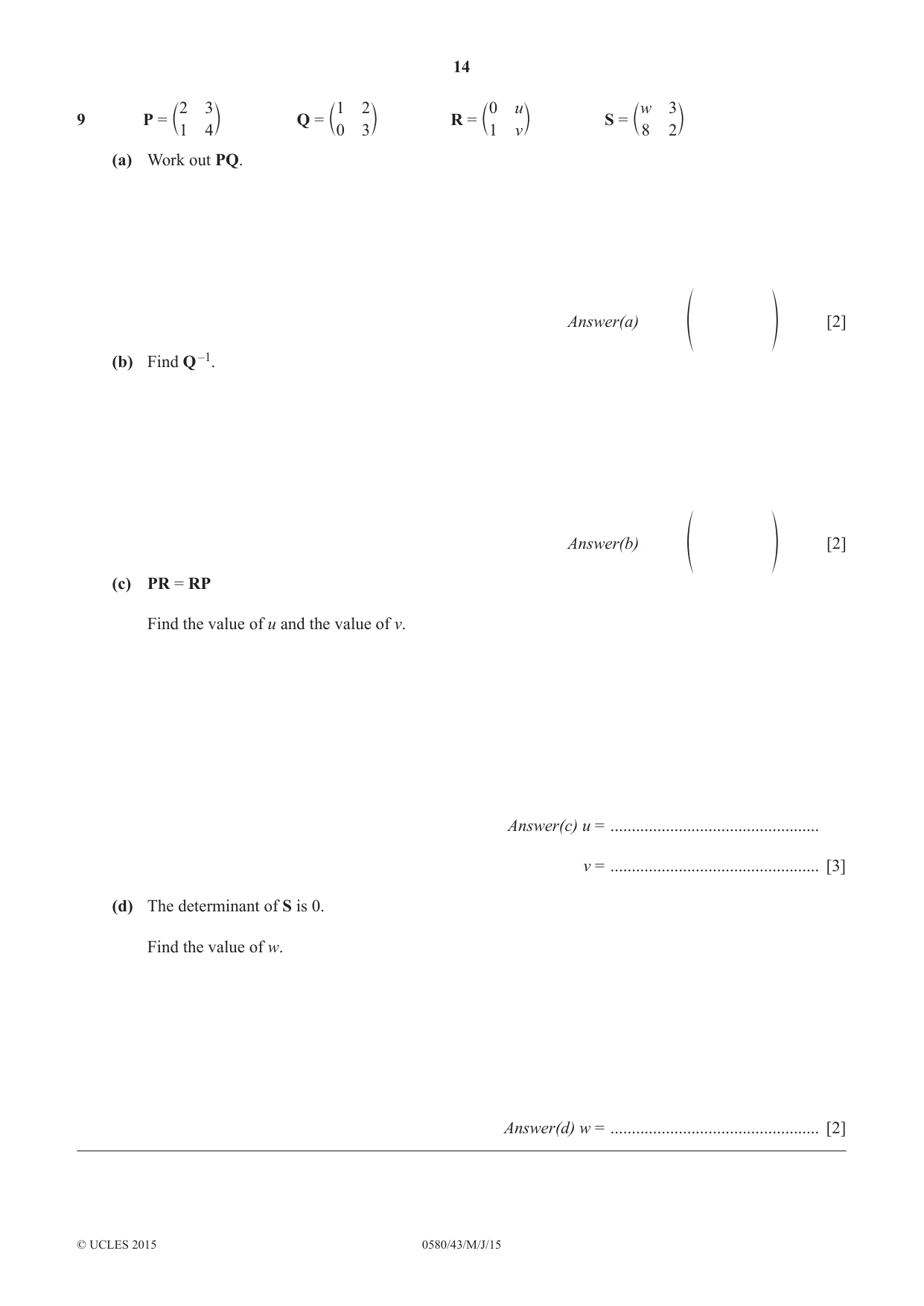
Q9 · 3 1 2 0 u w 3 9 P = Q = R = S = c 1 4 m c 0 3 m c 1 m c 8 2 m v (a) Work out PQ
2 3 1 2 0 u w 3 9 P = Q = R = S = c 1 4 m c 0 3 m c 1 m c 8 2 m v (a) Work out PQ. Answer(a) [2] f p (b) Find Q –1. Answer(b) [2] f p (c) PR = RP Find the value of u and the value of v. Answer(c) u = ................................................. v = ................................................. [3] (d) The determinant of S is 0. Find the value of w. Answer(d) w = ................................................. [2]
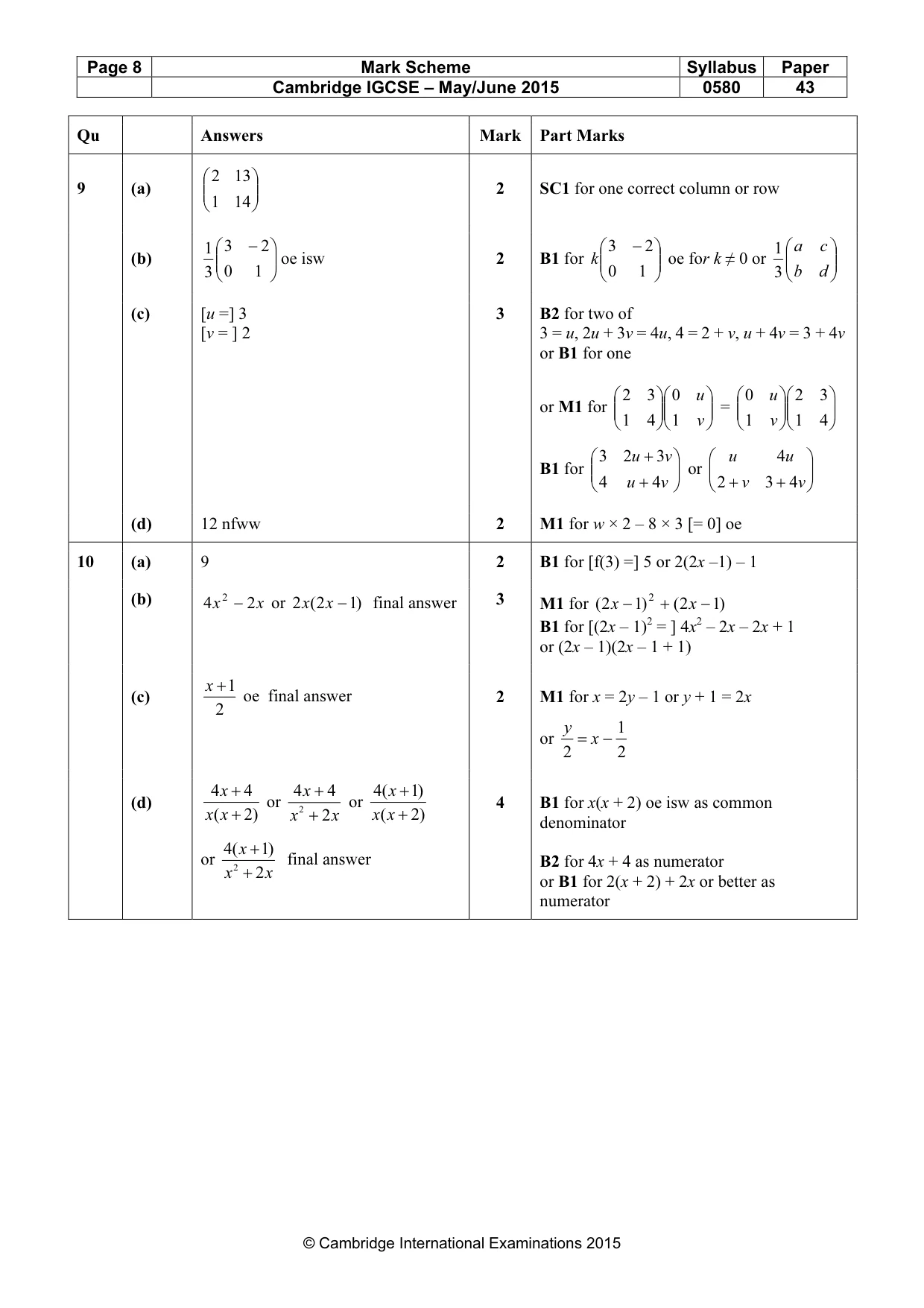
Mark scheme: 2 13 9 (a) 2 SC1 for one correct column or row 1 14 1 3 − 2 3 − 2 1 a c (b) oe for k ≠ 0 or oe isw 2 B1 for k b d 3 3 0 1 0 1 (c) [u =] 3 3 B2 for two of [v = ] 2 3 = u, 2u + 3v = 4u, 4 = 2 + v, u + 4v = 3 + 4v or B1 for one 2 3 0 u 0 u 2 3 or M1 for = 1 4 1 v 1 v 1 4 3 2u + 3v u 4u B1 for or 4 u + 4v 2 + v 3 + 4 v (d) 12 nfww 2 M1 for w × 2 – 8 × 3 [= 0] oe
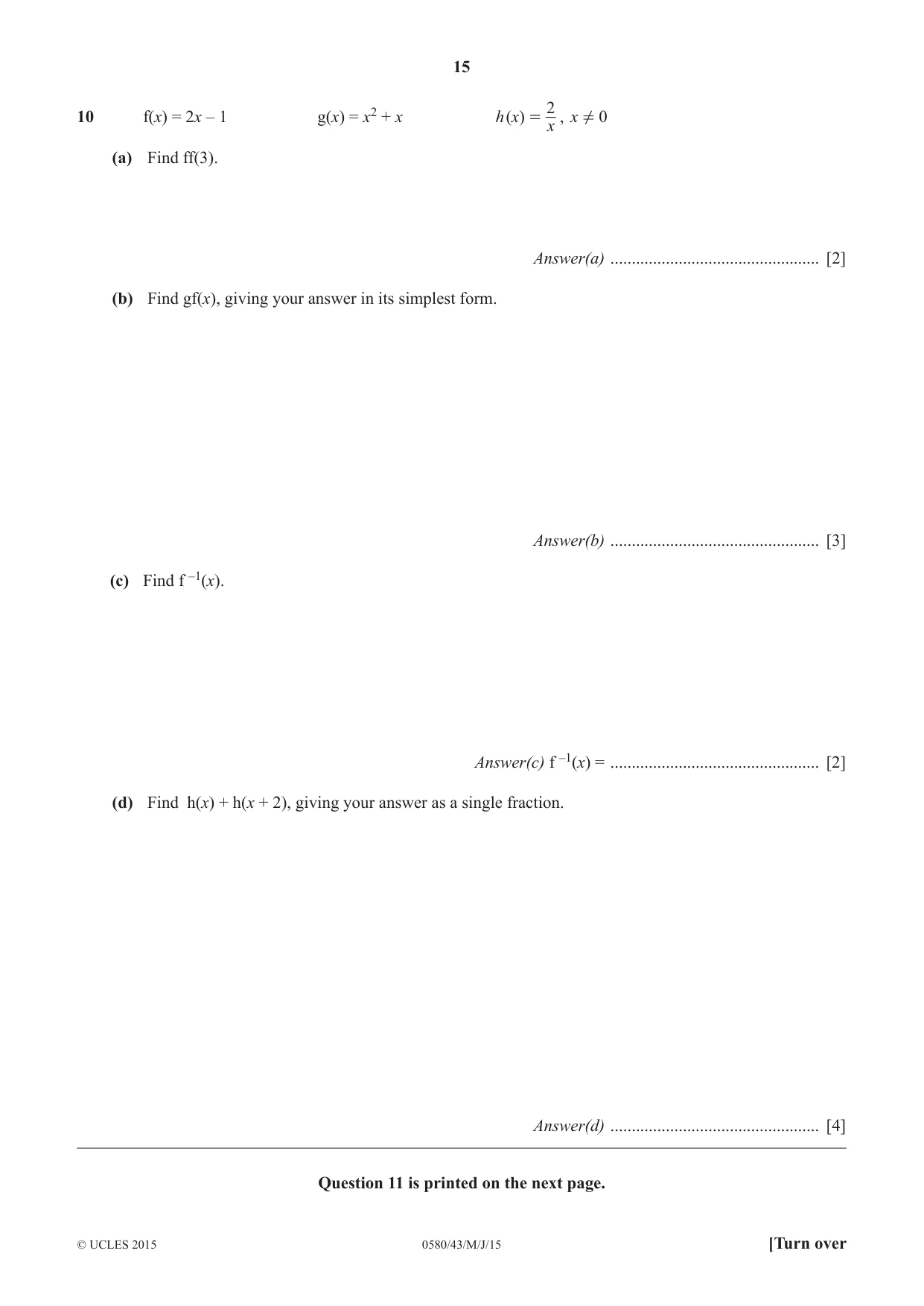
Q10 · F(x) = 2x – 1 g(x) = x2 + x h ( x) = 2 , x !
10 f(x) = 2x – 1 g(x) = x2 + x h ( x) = 2 , x ! 0 x (a) Find ff(3). Answer(a) ................................................. [2] (b) Find gf(x), giving your answer in its simplest form. Answer(b) ................................................. [3] (c) Find f –1(x). Answer(c) f –1(x) = ................................................. [2] (d) Find h(x) + h(x + 2), giving your answer as a single fraction. Answer(d) ................................................. [4] Question 11 is printed on the next page.
Mark scheme: 10 (a) 9 2 B1 for [f(3) =] 5 or 2(2x –1) – 1 (b) 2 + ( 2 x − )1 4 x 2 − 2 x or 2 x ( 2 x − )1 final answer 3 M1 for ( 2 x − )1 B1 for [(2x – 1)2 = ] 4x2 – 2x – 2x + 1 or (2x – 1)(2x – 1 + 1) x + 1 (c) oe final answer 2 M1 for x = 2y – 1 or y + 1 = 2x 2 y 1 or = x − 2 2 4 x + 4 4 x + 4 4( x + )1 (d) or 2 or 4 B1 for x(x + 2) oe isw as common x ( x + 2) x + 2 x x ( x + 2) denominator 4 ( x + )1 or 2 final answer B2 for 4x + 4 as numerator x + 2 x or B1 for 2(x + 2) + 2x or better as numerator Qu Answers Mark Part Marks 5 n
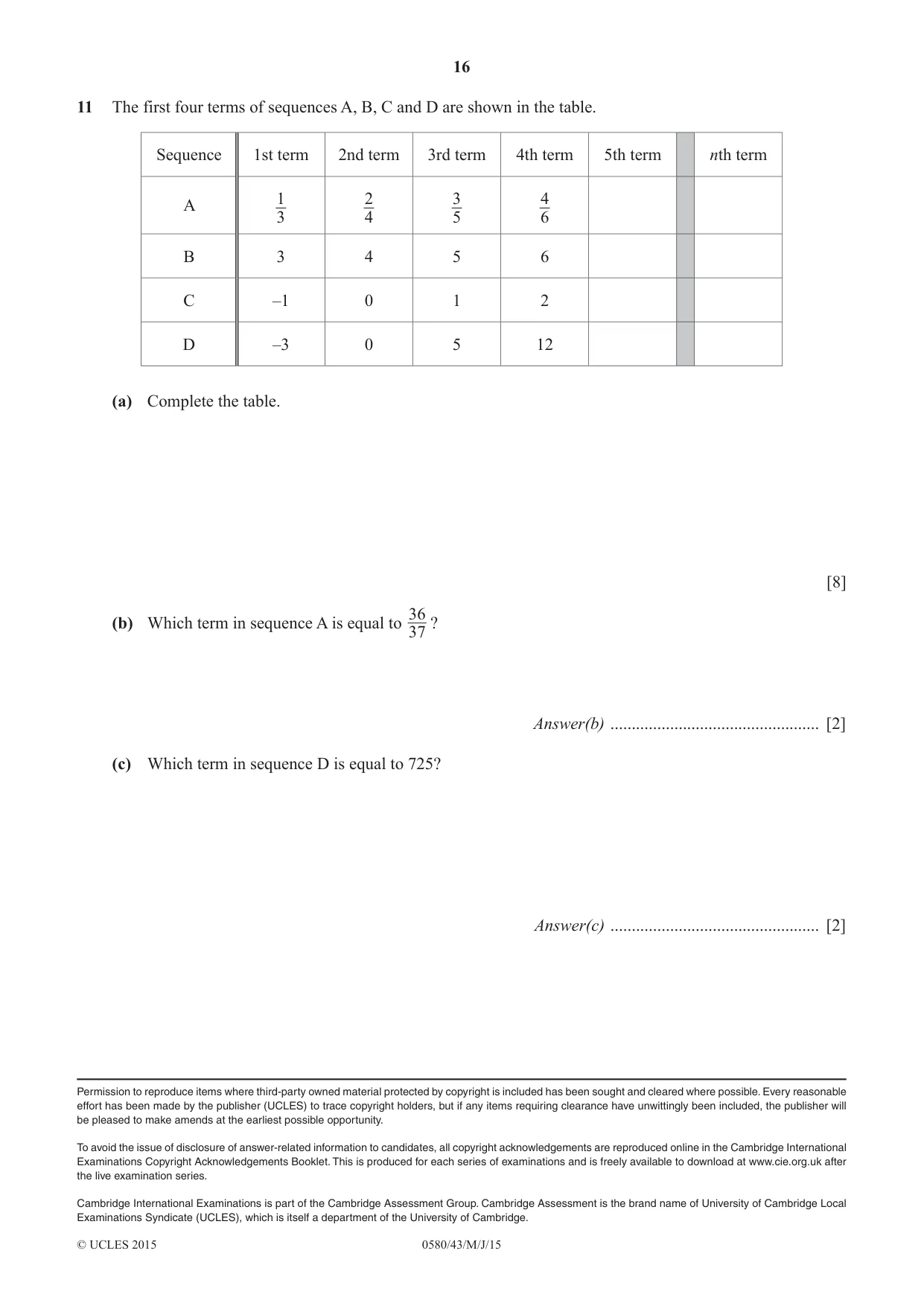
Q11 · The first four terms of sequences A, B, C and D are shown in the table
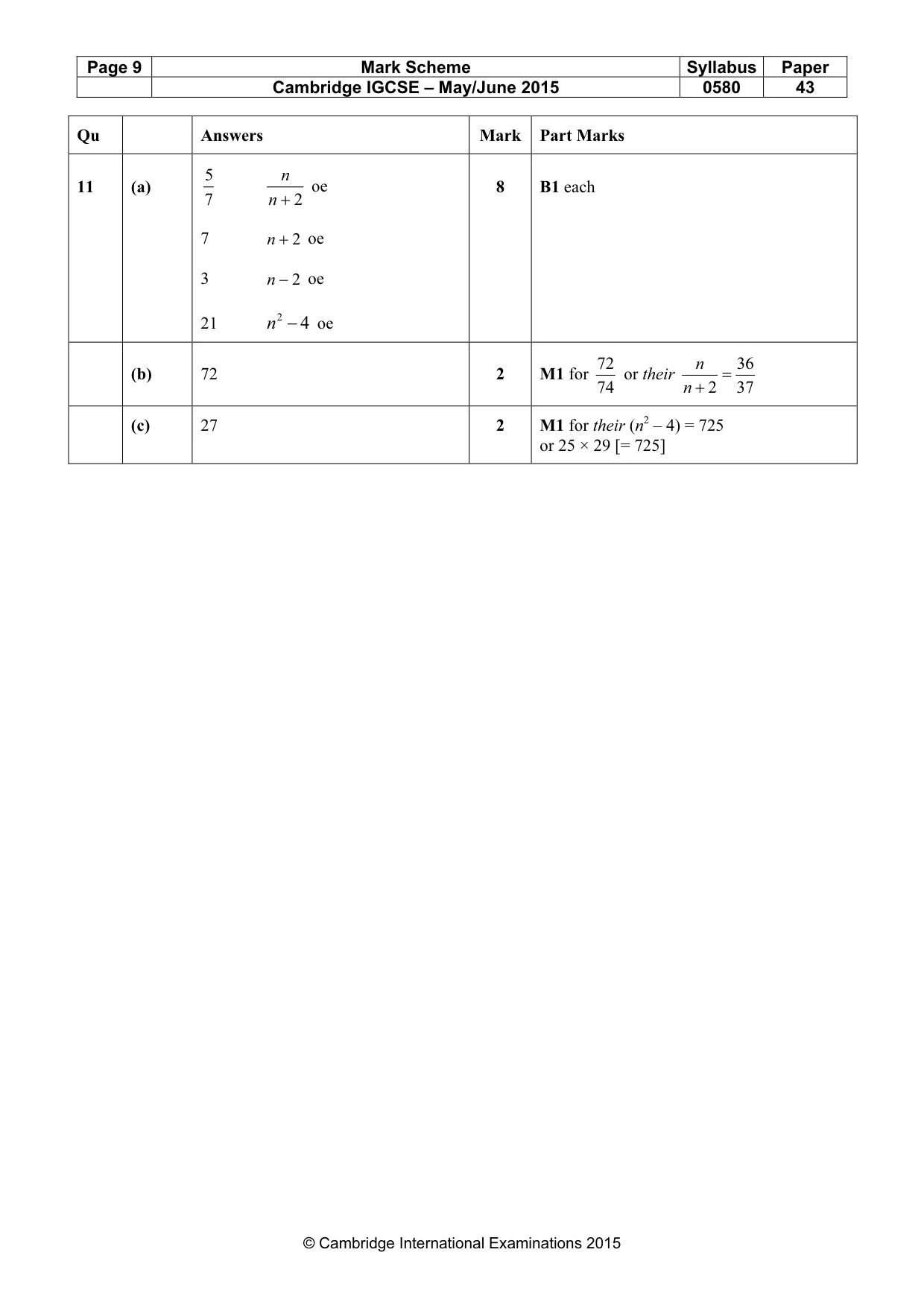
11 The first four terms of sequences A, B, C and D are shown in the table. Sequence 1st term 2nd term 3rd term 4th term 5th term nth term 1 2 3 4 A 3 4 5 6 B 3 4 5 6 C –1 0 1 2 D –3 0 5 12 (a) Complete the table. [8] 36 (b) Which term in sequence A is equal to 37 ? Answer(b) ................................................. [2] (c) Which term in sequence D is equal to 725? Answer(c) ................................................. [2]
Mark scheme: 5 n 11 (a) oe 8 B1 each 7 n + 2 7 n + 2 oe 3 n − 2 oe 21 n 2 − 4 oe 72 n 36 (b) 72 2 M1 for or their = 74 n + 2 37 (c) 27 2 M1 for their (n2 – 4) = 725 or 25 × 29 [= 725]
What was in this paper
The subtopics covered by these 7 questions, and how many questions each got. Open one in a new tab to see every Cambridge question on it.
What you needed in this session
Cambridge’s own grade thresholds for 2015 May/June, Paper 4 · Variant 3. A higher threshold means an easier paper — the bar moves with how the cohort did.