Cambridge IGCSE Mathematics 0580 — 2014 May/June Paper 4 · Variant 2
0580/42/M/J/14 · 9 questions · 130 marks · ≈146 min
The question paper and its mark scheme, free to read here and free to download. This is Cambridge’s own paper, exactly as it was sat.
Question paper16 pages
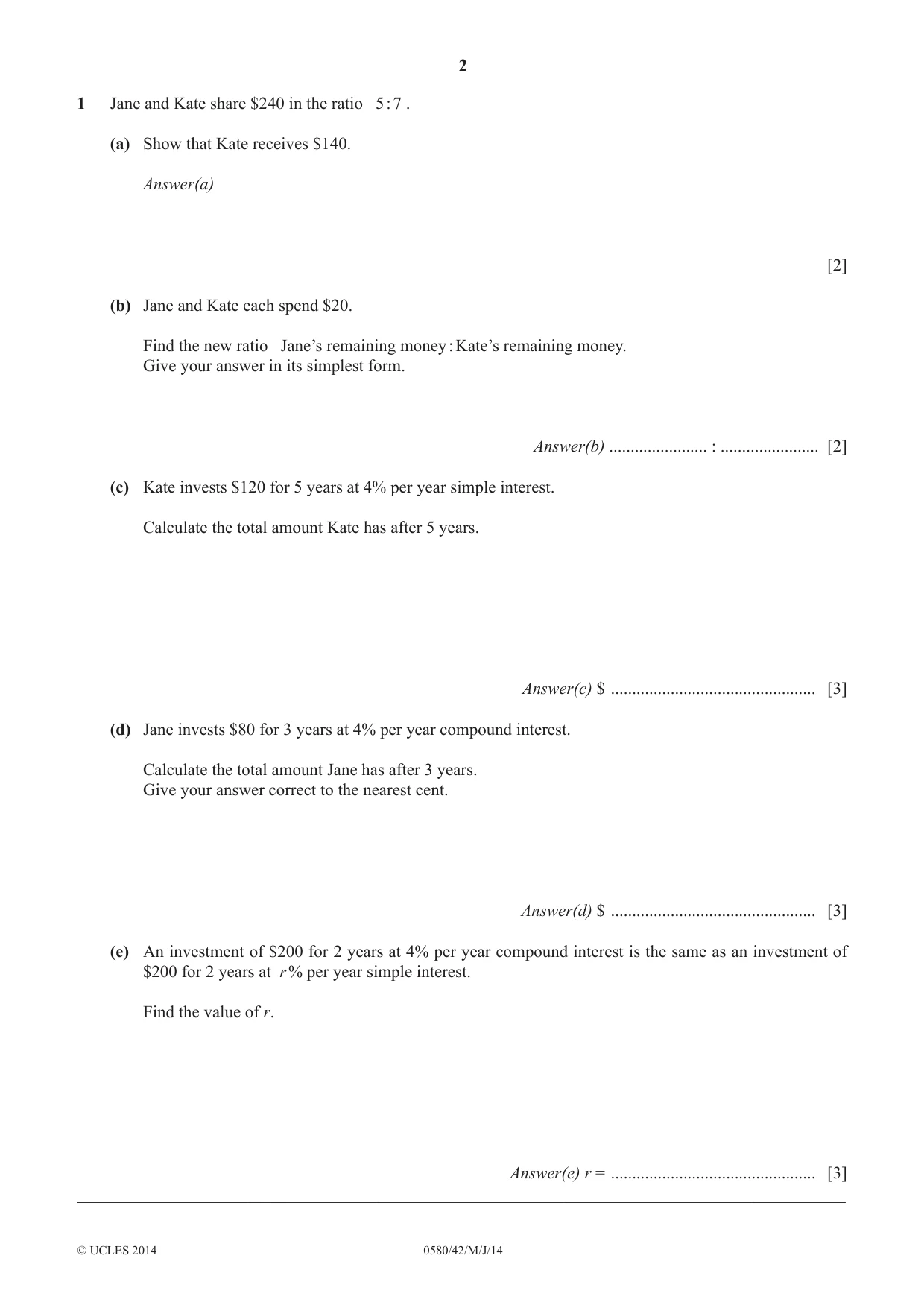
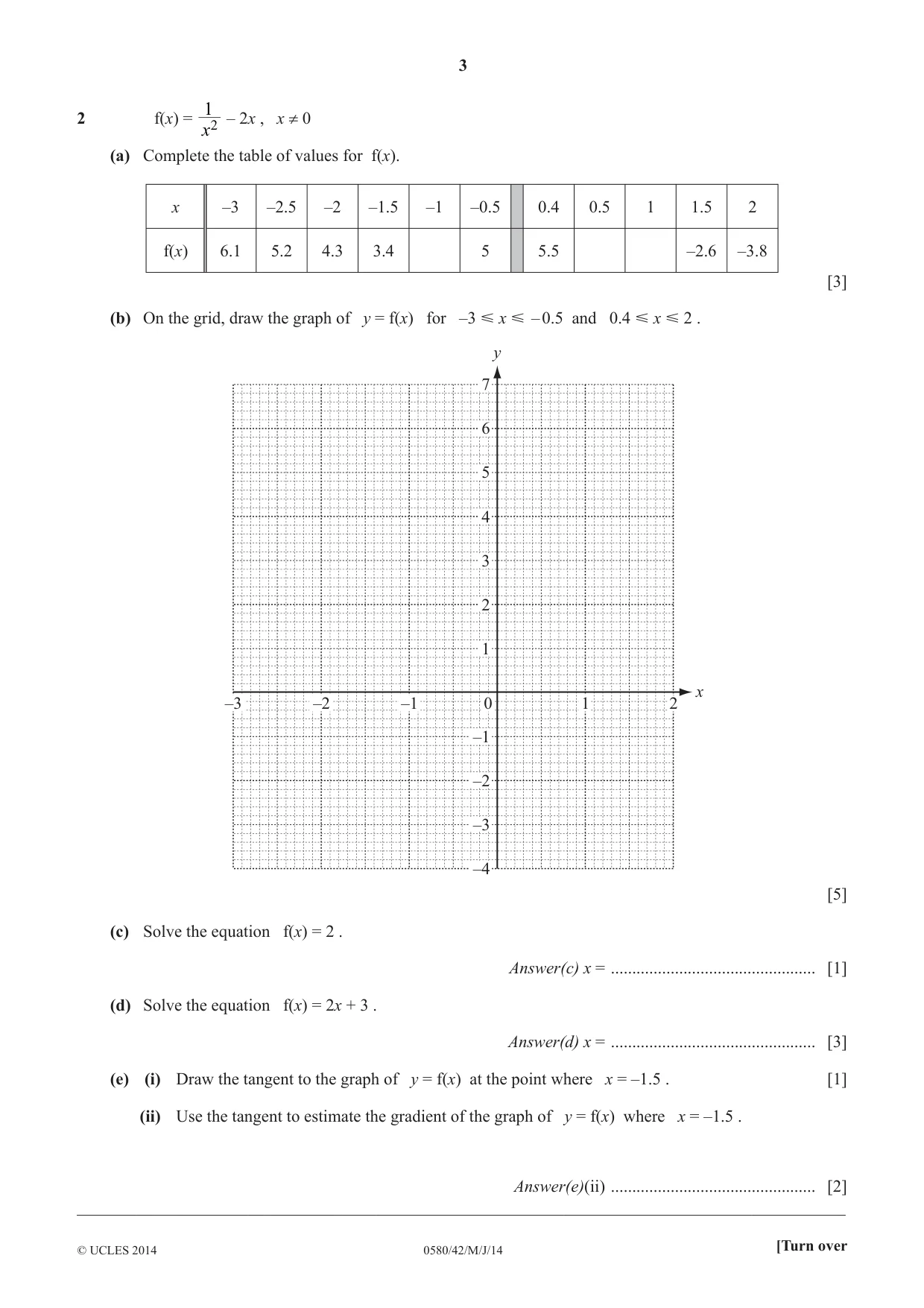
Mark scheme10 pages
Answers below. Sit the paper first if you are practising.
Questions as text
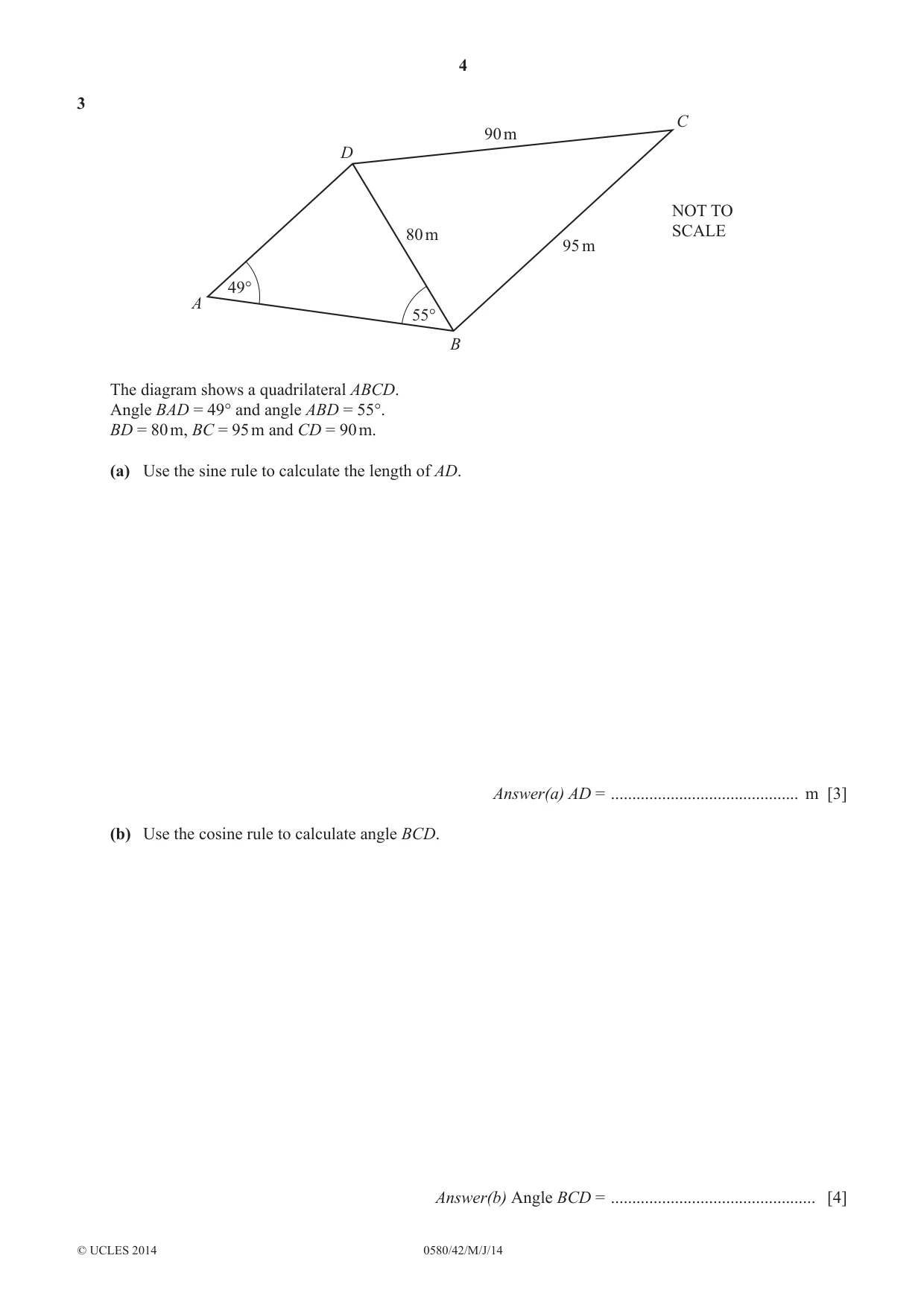
Q3 · C 90 m D NOT TO 80 m SCALE 95 m 49° A 55° B The diagram shows a quadrilateral ABCD
3 C 90 m D NOT TO 80 m SCALE 95 m 49° A 55° B The diagram shows a quadrilateral ABCD. Angle BAD = 49° and angle ABD = 55°. BD = 80 m, BC = 95 m and CD = 90 m. (a) Use the sine rule to calculate the length of AD. Answer(a) AD = ............................................ m [3] (b) Use the cosine rule to calculate angle BCD. Answer(b) Angle BCD = ................................................ [4] (c) Calculate the area of the quadrilateral ABCD. Answer(c) ........................................... m2 [3] (d) The quadrilateral represents a fi eld. Corn seeds are sown across the whole fi eld at a cost of $3250 per hectare. Calculate the cost of the corn seeds used. 1 hectare = 10 000 m2 Answer(d) $ ................................................ [3] __________________________________________________________________________________________
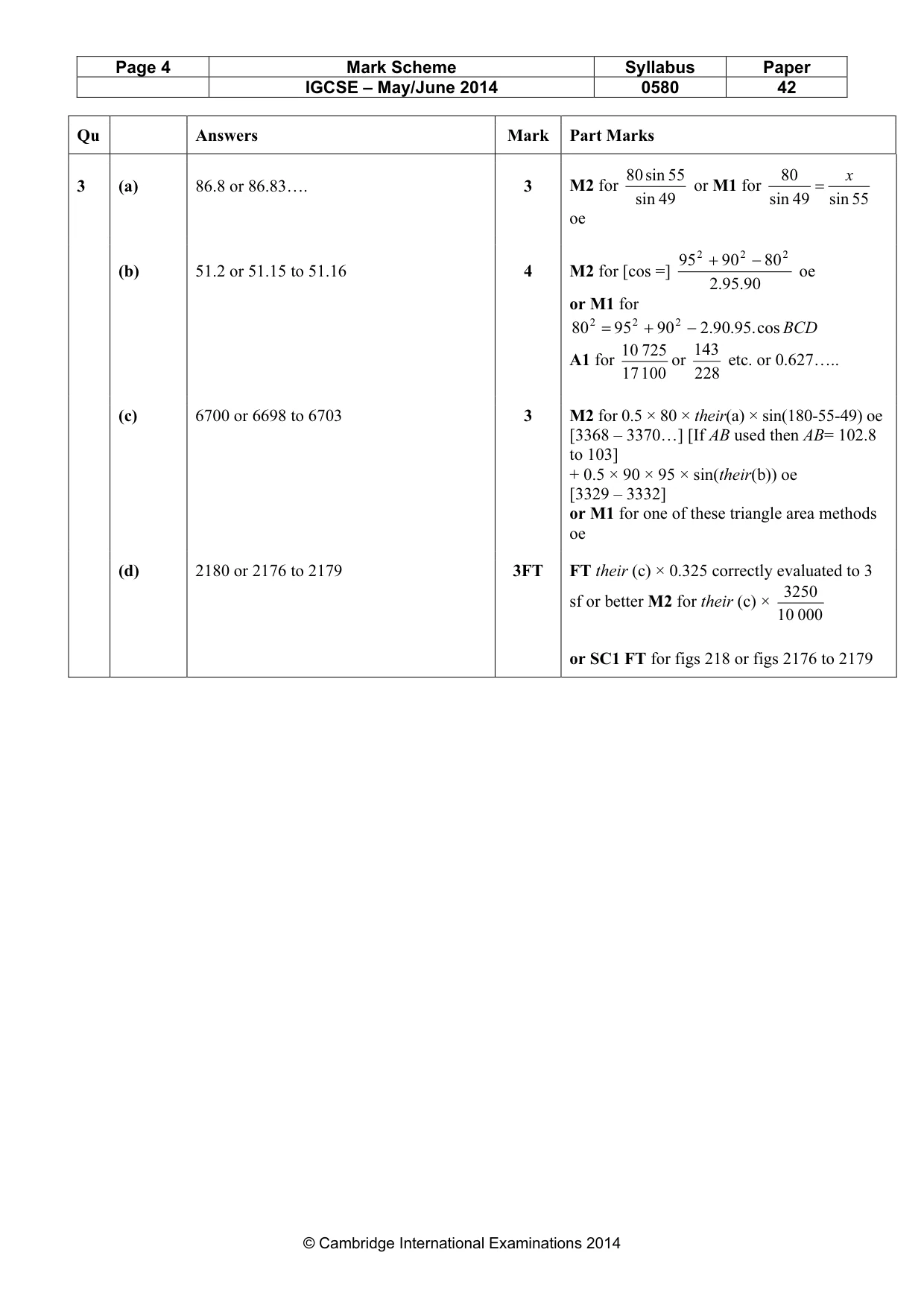
Mark scheme: 80 sin 55 80 x 3 (a) 86.8 or 86.83…. 3 M2 for or M1 for = sin 49 sin 49 sin 55 oe 95 2 + 90 2 − 80 2 (b) 51.2 or 51.15 to 51.16 4 M2 for [cos =] oe .2 95. 90 or M1 for 80 2 = 95 2 + 90 2 − .290.95. cos BCD 10 725 143 A1 for or etc. or 0.627….. 17 100 228 (c) 6700 or 6698 to 6703 3 M2 for 0.5 × 80 × their(a) × sin(180-55-49) oe [3368 – 3370…] [If AB used then AB= 102.8 to 103] + 0.5 × 90 × 95 × sin(their(b)) oe [3329 – 3332] or M1 for one of these triangle area methods oe (d) 2180 or 2176 to 2179 3FT FT their (c) × 0.325 correctly evaluated to 3 3250 sf or better M2 for their (c) × 10 000 or SC1 FT for figs 218 or figs 2176 to 2179 IGCSE – May/June 2014 0580 42 Qu Answers Mark Part Marks
Q4 · Y 8 7 6 5 4 3 Q 2 1 x –8 –7 –6 –5 –4 –3 –2 –1 0 1 2 3 4 5 6 7 8 –1 –2 –3 –4 –5 –6 –7 –8…
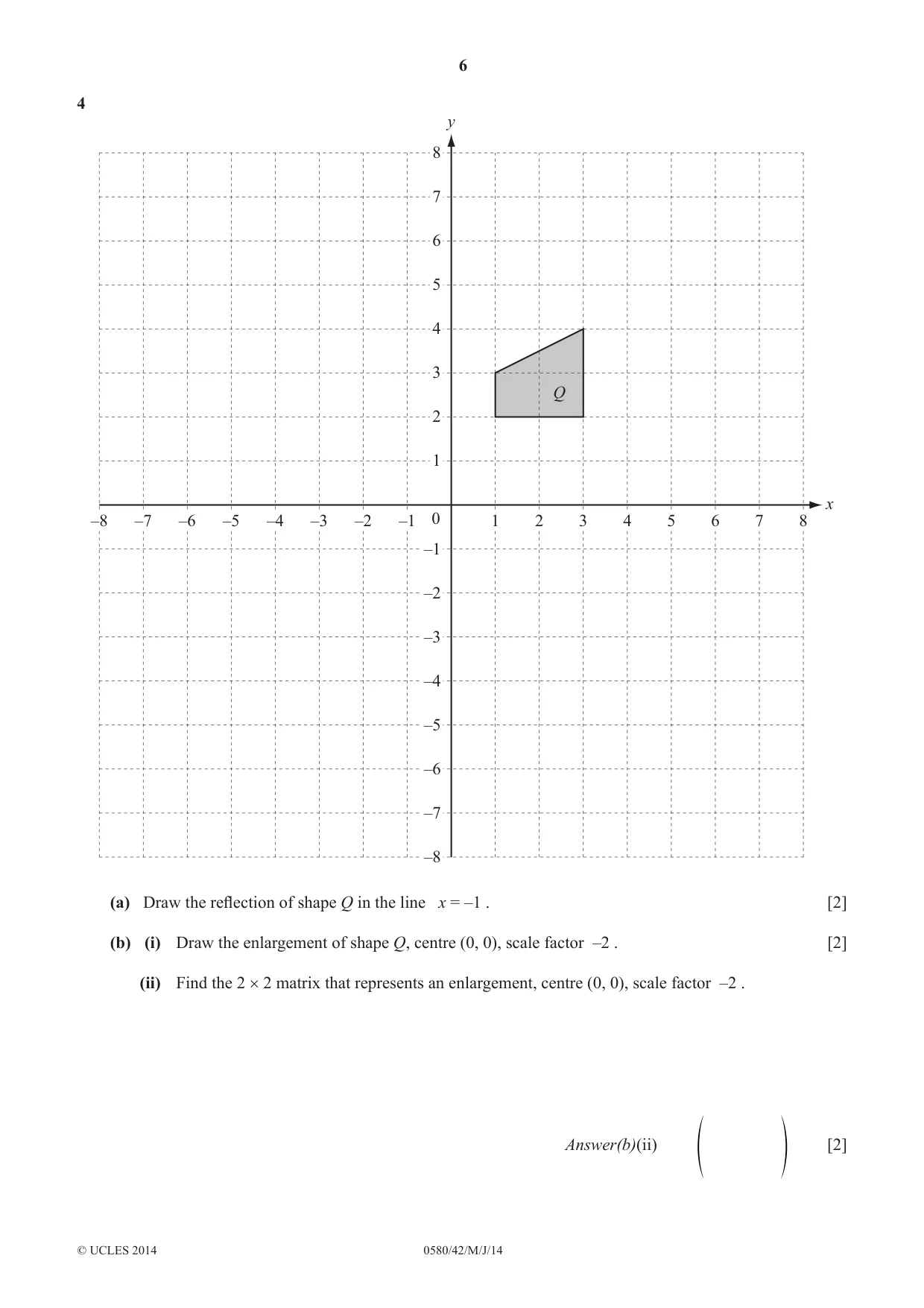
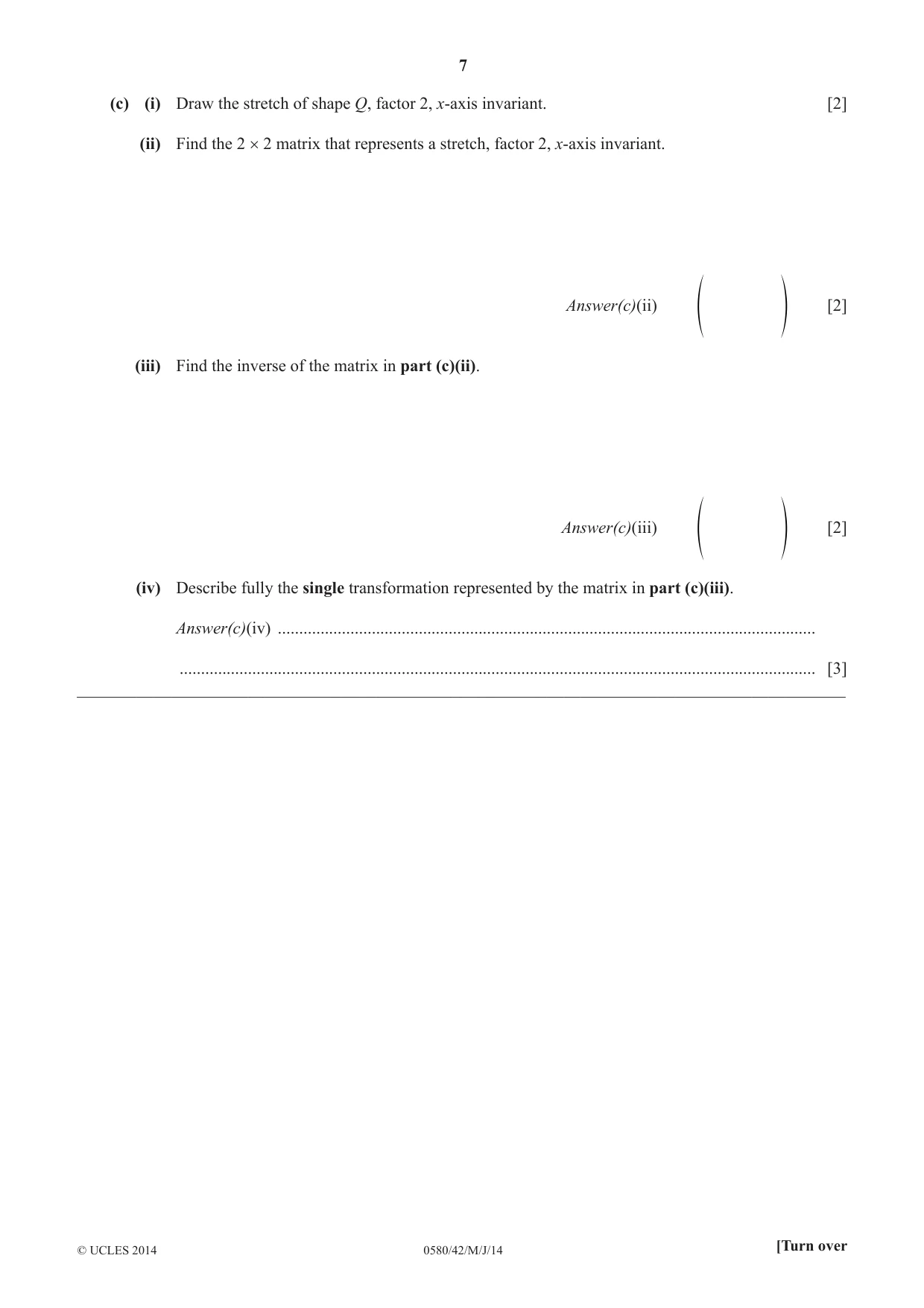
4 y 8 7 6 5 4 3 Q 2 1 x –8 –7 –6 –5 –4 –3 –2 –1 0 1 2 3 4 5 6 7 8 –1 –2 –3 –4 –5 –6 –7 –8 (a) Draw the refl ection of shape Q in the line x = –1 . [2] (b) (i) Draw the enlargement of shape Q, centre (0, 0), scale factor –2 . [2] (ii) Find the 2 × 2 matrix that represents an enlargement, centre (0, 0), scale factor –2 . Answer(b)(ii) [2] f p (c) (i) Draw the stretch of shape Q, factor 2, x-axis invariant. [2] (ii) Find the 2 × 2 matrix that represents a stretch, factor 2, x-axis invariant. Answer(c)(ii) [2] f p (iii) Find the inverse of the matrix in part (c)(ii). Answer(c)(iii) [2] f p (iv) Describe fully the single transformation represented by the matrix in part (c)(iii). Answer(c)(iv) .............................................................................................................................. ..................................................................................................................................................... [3] __________________________________________________________________________________________
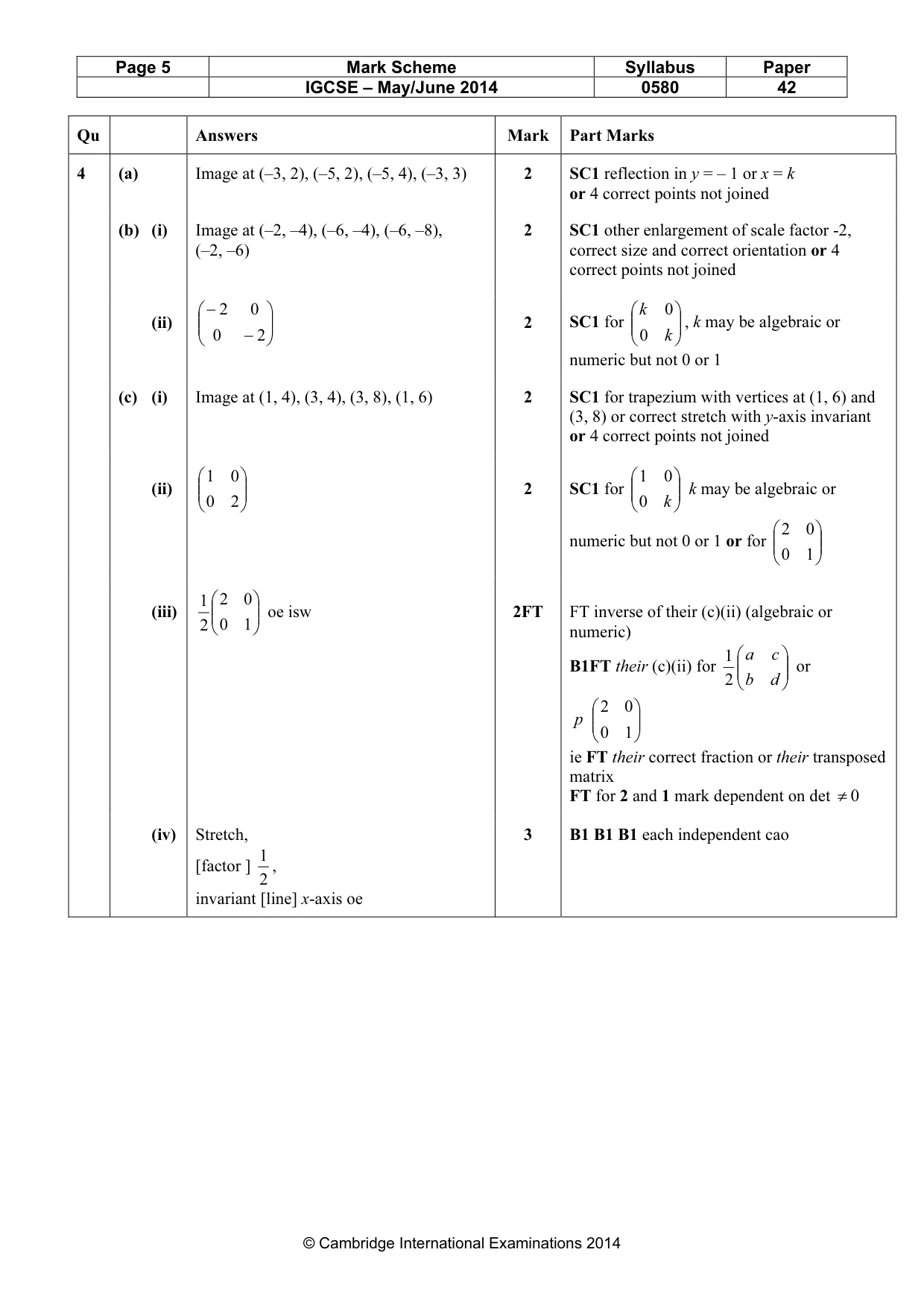
Mark scheme: 4 (a) Image at (–3, 2), (–5, 2), (–5, 4), (–3, 3) 2 SC1 reflection in y = – 1 or x = k or 4 correct points not joined (b) (i) Image at (–2, –4), (–6, –4), (–6, –8), 2 SC1 other enlargement of scale factor -2, (–2, –6) correct size and correct orientation or 4 correct points not joined − 2 0 k 0 (ii) 2 SC1 for , k may be algebraic or 0 − 2 0 k numeric but not 0 or 1 (c) (i) Image at (1, 4), (3, 4), (3, 8), (1, 6) 2 SC1 for trapezium with vertices at (1, 6) and (3, 8) or correct stretch with y-axis invariant or 4 correct points not joined 1 0 1 0 (ii) 2 SC1 for k may be algebraic or 0 2 0 k 2 0 numeric but not 0 or 1 or for 0 1 1 2 0 (iii) oe isw 2FT FT inverse of their (c)(ii) (algebraic or 2 0 1 numeric) 1 a c or B1FT their (c)(ii) for b d 2 2 0 p 0 1 ie FT their correct fraction or their transposed matrix FT for 2 and 1 mark dependent on det ≠ 0 (iv) Stretch, 3 B1 B1 B1 each independent cao 1 [factor ] , 2 invariant [line] x-axis oe IGCSE – May/June 2014 0580 42 Qu Answers Mark Part Marks
Q5 · 8 cm 12 cm NOT TO SCALE 10 cm 4 cm The diagram shows a cylinder with radius 8 cm and…
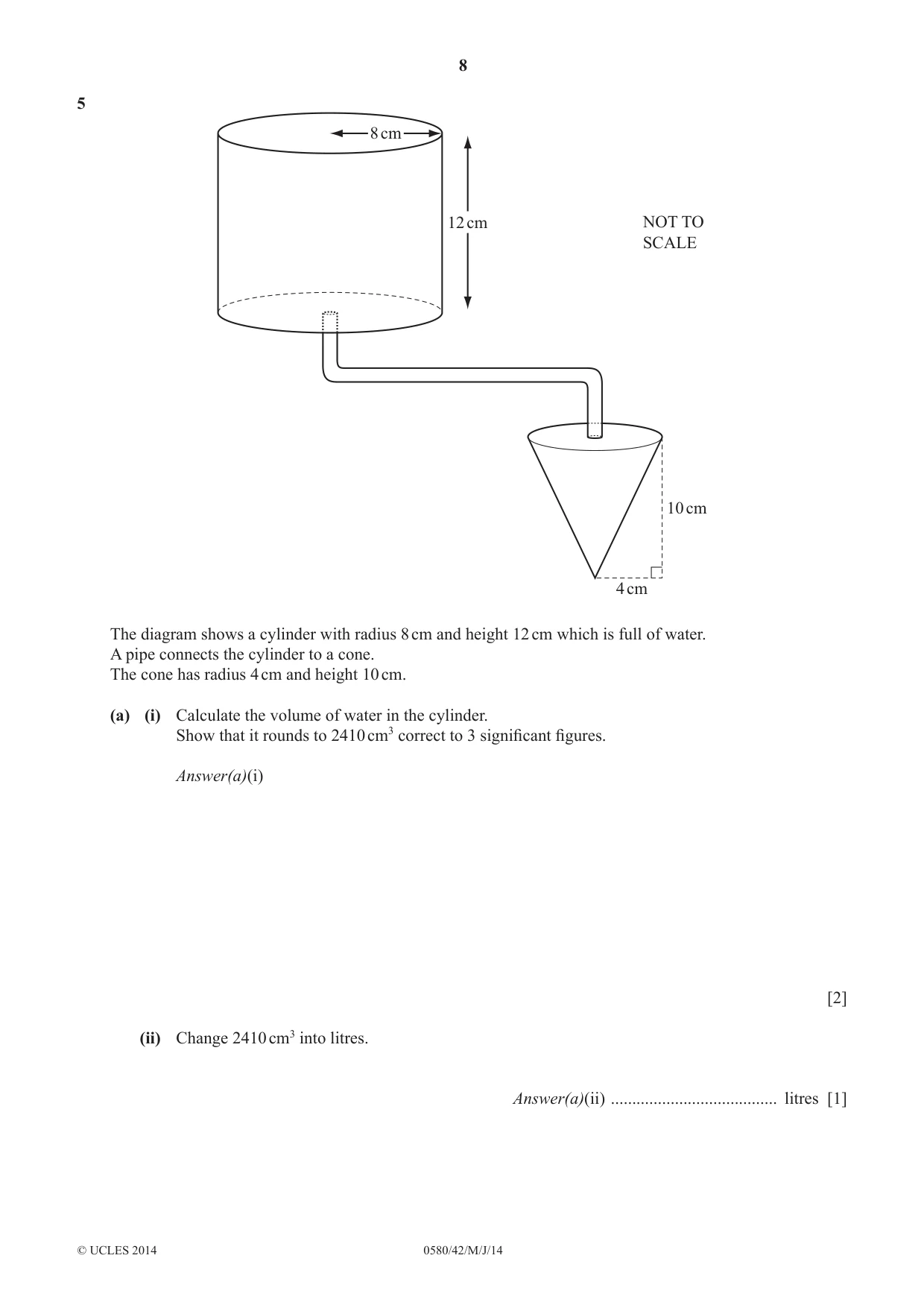
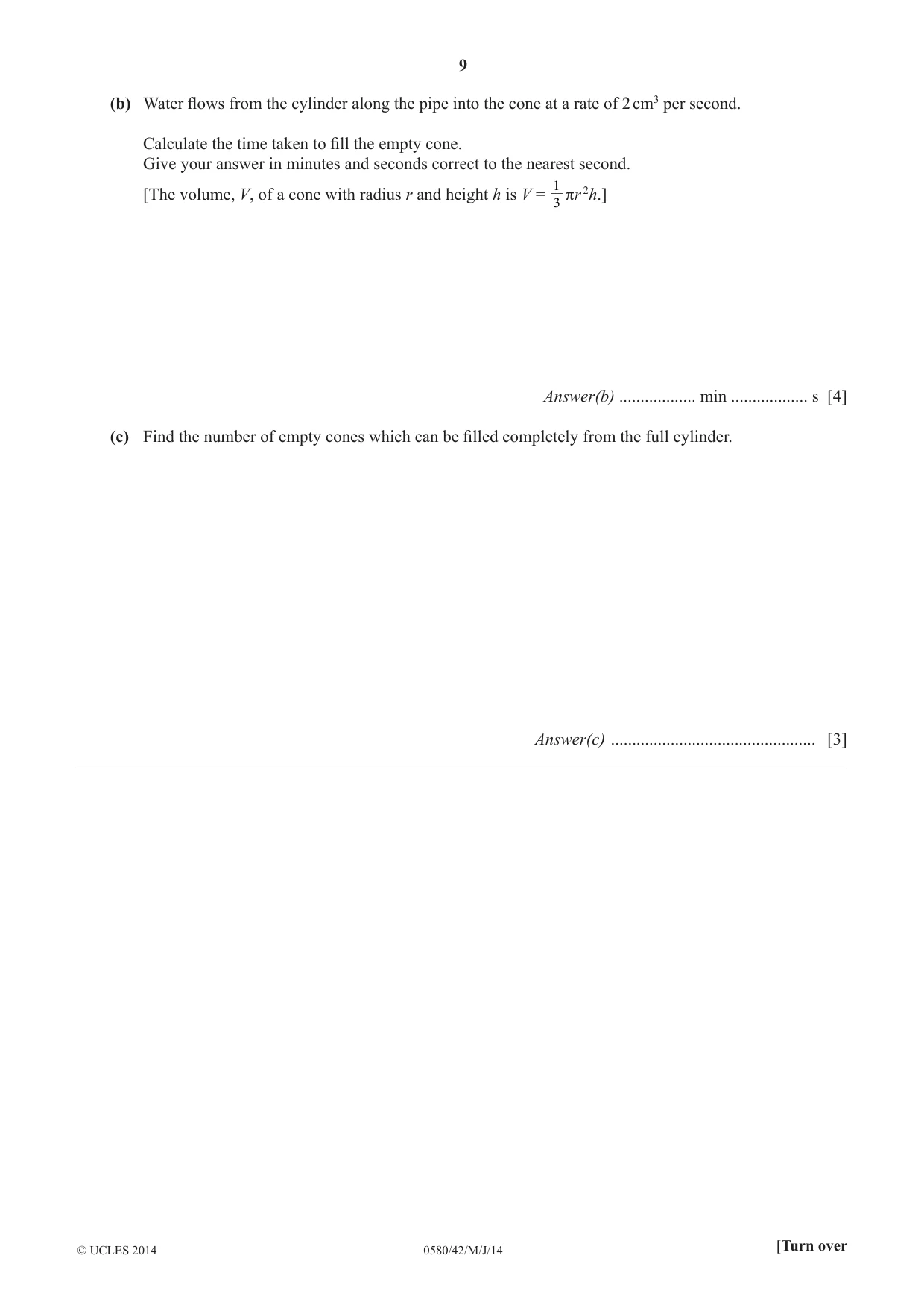
5 8 cm 12 cm NOT TO SCALE 10 cm 4 cm The diagram shows a cylinder with radius 8 cm and height 12 cm which is full of water. A pipe connects the cylinder to a cone. The cone has radius 4 cm and height 10 cm. (a) (i) Calculate the volume of water in the cylinder. Show that it rounds to 2410 cm3 correct to 3 signifi cant fi gures. Answer(a)(i) [2] (ii) Change 2410 cm3 into litres. Answer(a)(ii) ....................................... litres [1] (b) Water fl ows from the cylinder along the pipe into the cone at a rate of 2 cm3 per second. Calculate the time taken to fi ll the empty cone. Give your answer in minutes and seconds correct to the nearest second. 1 [The volume, V, of a cone with radius r and height h is V = πr 2h.] 3 Answer(b) .................. min .................. s [4] (c) Find the number of empty cones which can be fi lled completely from the full cylinder. Answer(c) ................................................ [3] __________________________________________________________________________________________
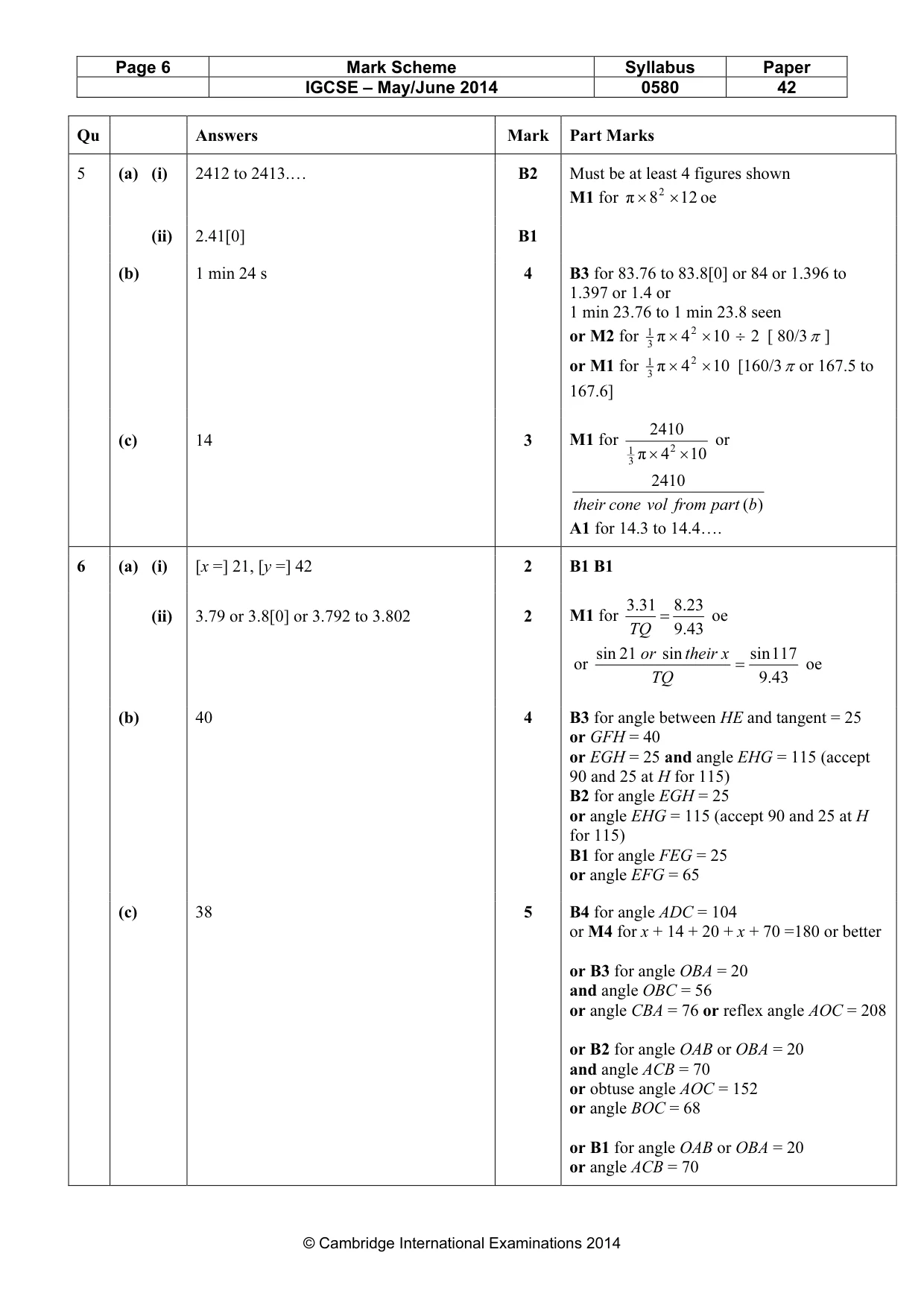
Mark scheme: 5 (a) (i) 2412 to 2413.… B2 Must be at least 4 figures shown M1 for π × 8 2 × 12 oe (ii) 2.41[0] B1 (b) 1 min 24 s 4 B3 for 83.76 to 83.8[0] or 84 or 1.396 to 1.397 or 1.4 or 1 min 23.76 to 1 min 23.8 seen or M2 for 13 π × 4 2 × 10 ÷ 2 [ 80/3π ] or M1 for 13 π × 4 2 × 10 [160/3π or 167.5 to 167.6] 2410 or (c) 14 3 M1 for 1 2 3 π × 4 × 10 2410 their cone vol from part ( b ) A1 for 14.3 to 14.4….
Q6 · NOT TO S SCALE 21° R 117° T y° Q x° P (a) The chords PR and SQ of the circle intersect at…
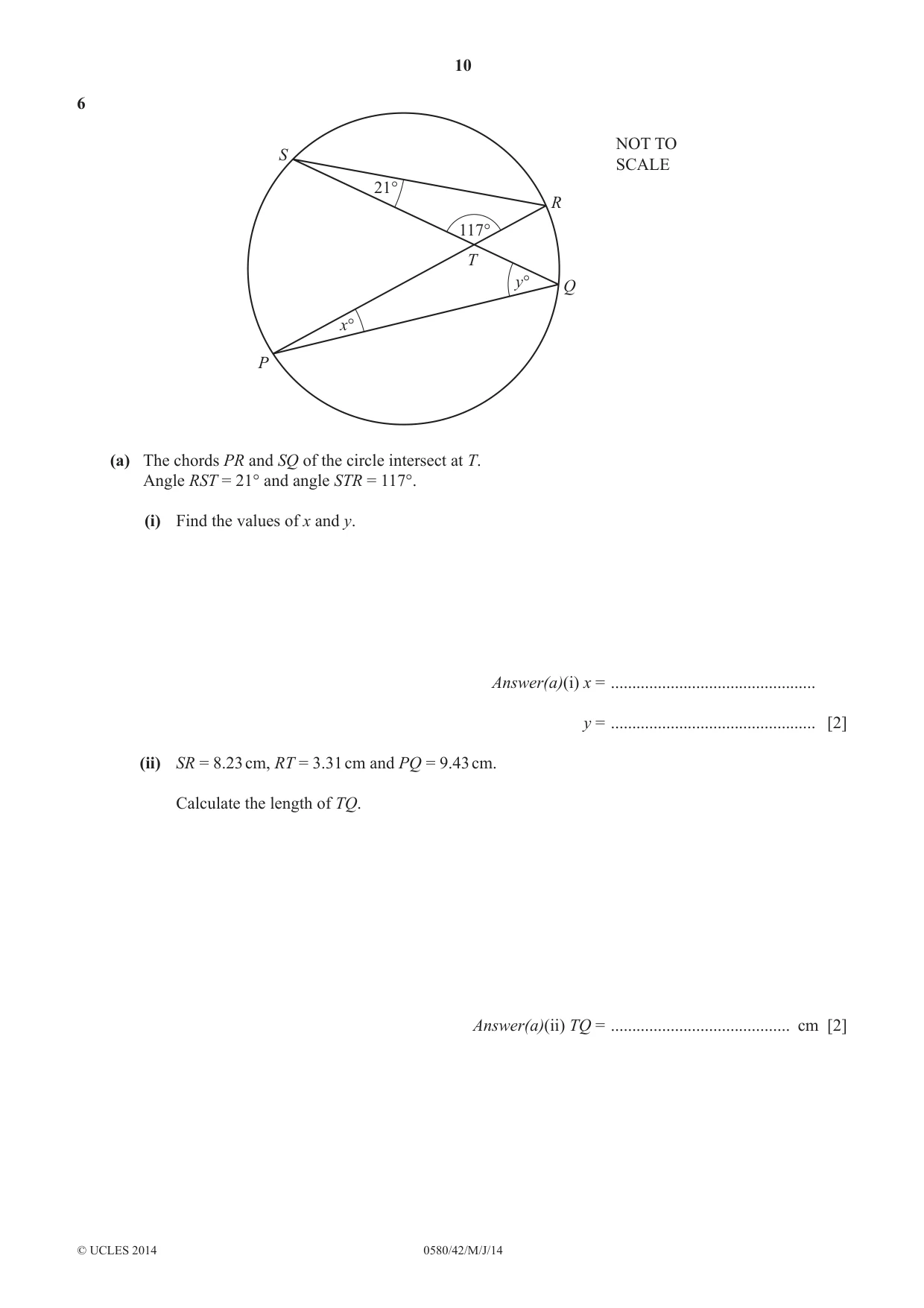
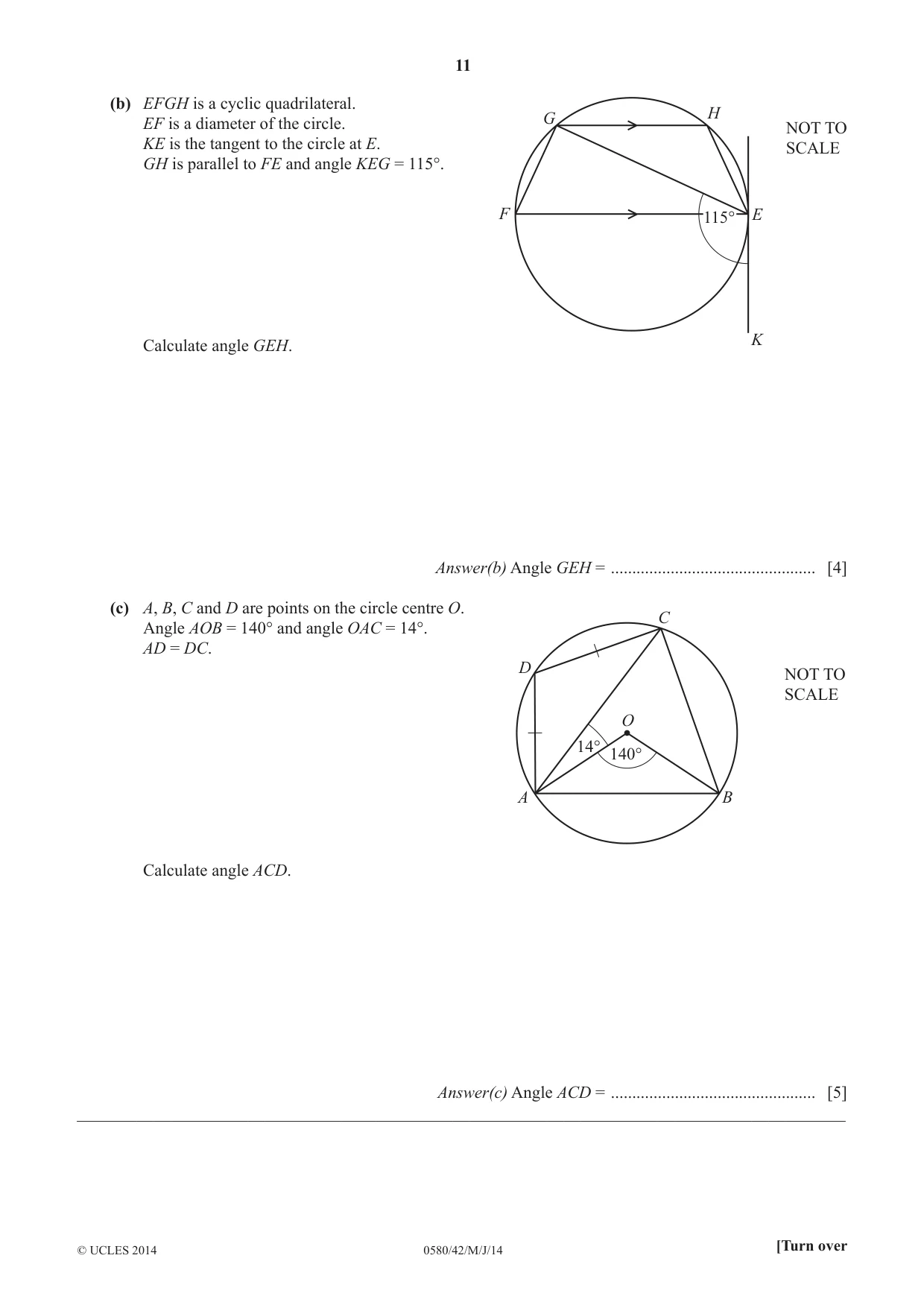
6 NOT TO S SCALE 21° R 117° T y° Q x° P (a) The chords PR and SQ of the circle intersect at T. Angle RST = 21° and angle STR = 117°. (i) Find the values of x and y. Answer(a)(i) x = ................................................ y = ................................................ [2] (ii) SR = 8.23 cm, RT = 3.31 cm and PQ = 9.43 cm. Calculate the length of TQ. Answer(a)(ii) TQ = .......................................... cm [2] (b) EFGH is a cyclic quadrilateral. H EF is a diameter of the circle. G NOT TO KE is the tangent to the circle at E. SCALE GH is parallel to FE and angle KEG = 115°. F 115° E Calculate angle GEH. K Answer(b) Angle GEH = ................................................ [4] (c) A, B, C and D are points on the circle centre O. C Angle AOB = 140° and angle OAC = 14°. AD = DC. D NOT TO SCALE O 14° 140° A B Calculate angle ACD. Answer(c) Angle ACD = ................................................ [5] __________________________________________________________________________________________
Mark scheme: 6 (a) (i) [x =] 21, [y =] 42 2 B1 B1 .331 .8 23 (ii) 3.79 or 3.8[0] or 3.792 to 3.802 2 M1 for = oe TQ .943 sin 21 or sin their x sin 117 or = oe TQ .9 43 (b) 40 4 B3 for angle between HE and tangent = 25 or GFH = 40 or EGH = 25 and angle EHG = 115 (accept 90 and 25 at H for 115) B2 for angle EGH = 25 or angle EHG = 115 (accept 90 and 25 at H for 115) B1 for angle FEG = 25 or angle EFG = 65 (c) 38 5 B4 for angle ADC = 104 or M4 for x + 14 + 20 + x + 70 =180 or better or B3 for angle OBA = 20 and angle OBC = 56 or angle CBA = 76 or reflex angle AOC = 208 or B2 for angle OAB or OBA = 20 and angle ACB = 70 or obtuse angle AOC = 152 or angle BOC = 68 or B1 for angle OAB or OBA = 20 or angle ACB = 70 IGCSE – May/June 2014 0580 42 Qu Answers Mark Part Marks 24
Q7 · 1.0 0.8 0.6 Frequency density 0.4 0.2 m 0 10 20 30 40 50 60 70 80 90 100 Mass (grams) The…
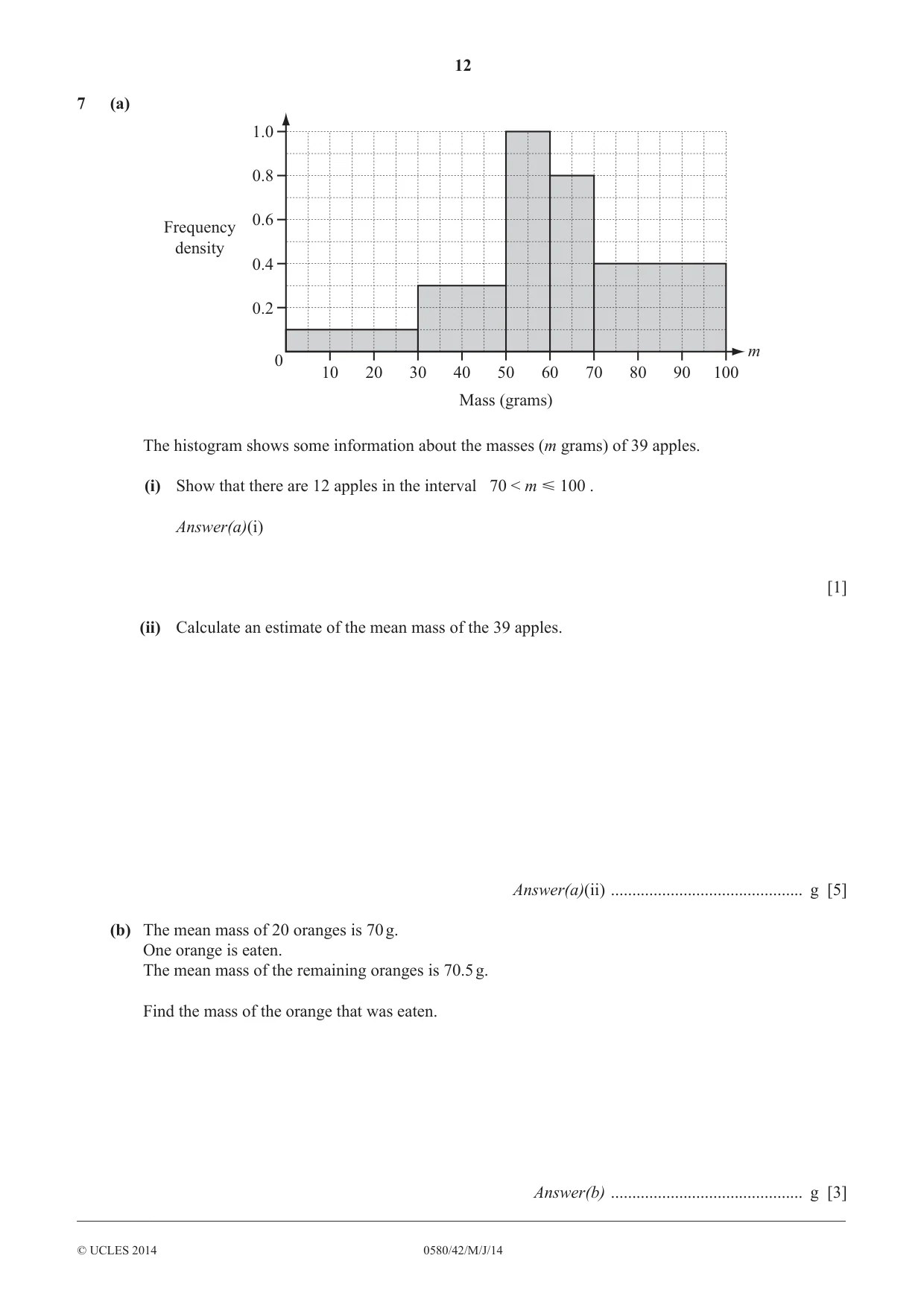
7 (a) 1.0 0.8 0.6 Frequency density 0.4 0.2 m 0 10 20 30 40 50 60 70 80 90 100 Mass (grams) The histogram shows some information about the masses (m grams) of 39 apples. (i) Show that there are 12 apples in the interval 70 < m Y 100 . Answer(a)(i) [1] (ii) Calculate an estimate of the mean mass of the 39 apples. Answer(a)(ii) ............................................. g [5] (b) The mean mass of 20 oranges is 70 g. One orange is eaten. The mean mass of the remaining oranges is 70.5 g. Find the mass of the orange that was eaten. Answer(b) ............................................. g [3] __________________________________________________________________________________________
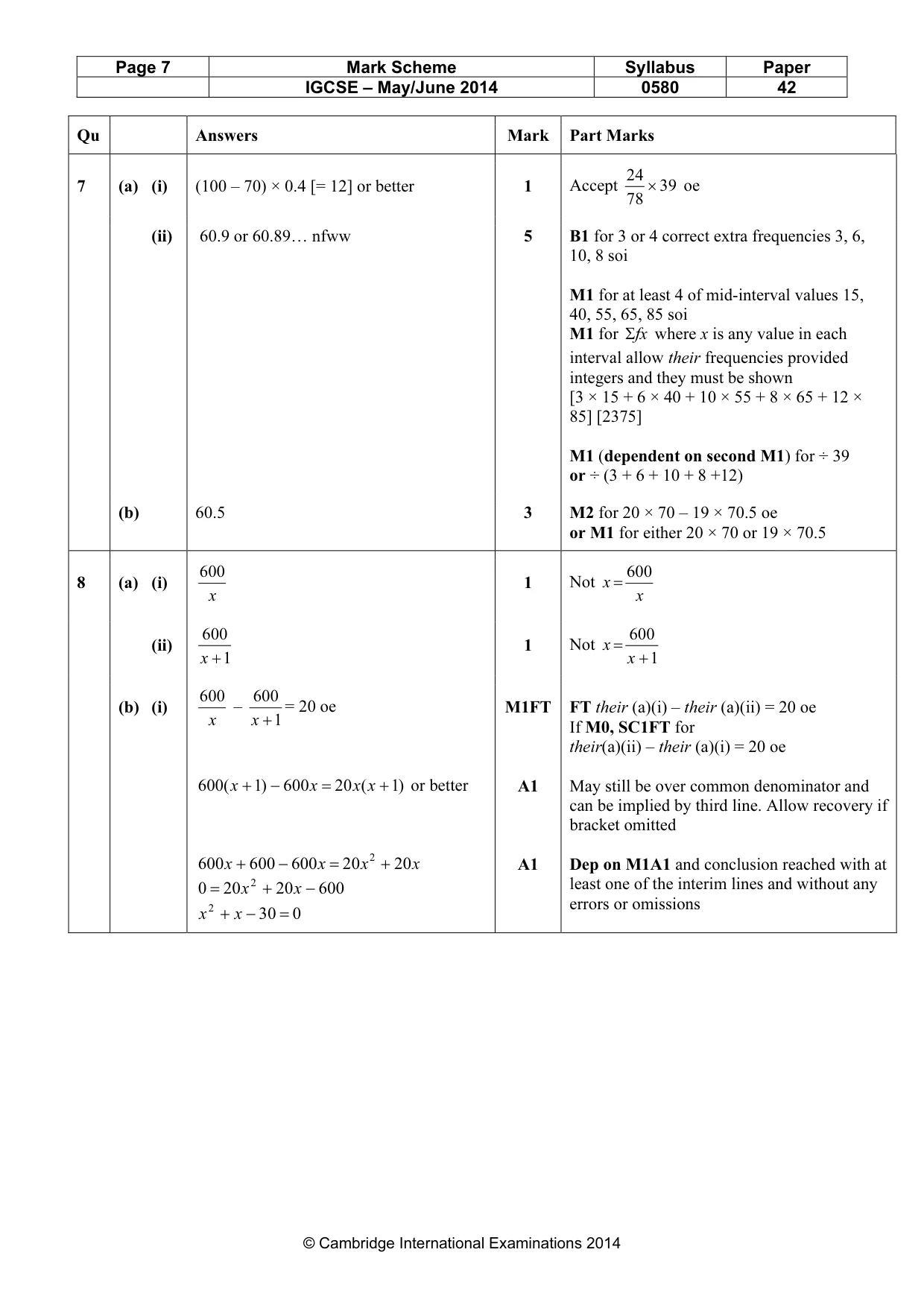
Mark scheme: 24 7 (a) (i) (100 – 70) × 0.4 [= 12] or better 1 Accept × 39 oe 78 (ii) 60.9 or 60.89… nfww 5 B1 for 3 or 4 correct extra frequencies 3, 6, 10, 8 soi M1 for at least 4 of mid-interval values 15, 40, 55, 65, 85 soi M1 for Σfx where x is any value in each interval allow their frequencies provided integers and they must be shown [3 × 15 + 6 × 40 + 10 × 55 + 8 × 65 + 12 × 85] [2375] M1 (dependent on second M1) for ÷ 39 or ÷ (3 + 6 + 10 + 8 +12) (b) 60.5 3 M2 for 20 × 70 – 19 × 70.5 oe or M1 for either 20 × 70 or 19 × 70.5 600 600
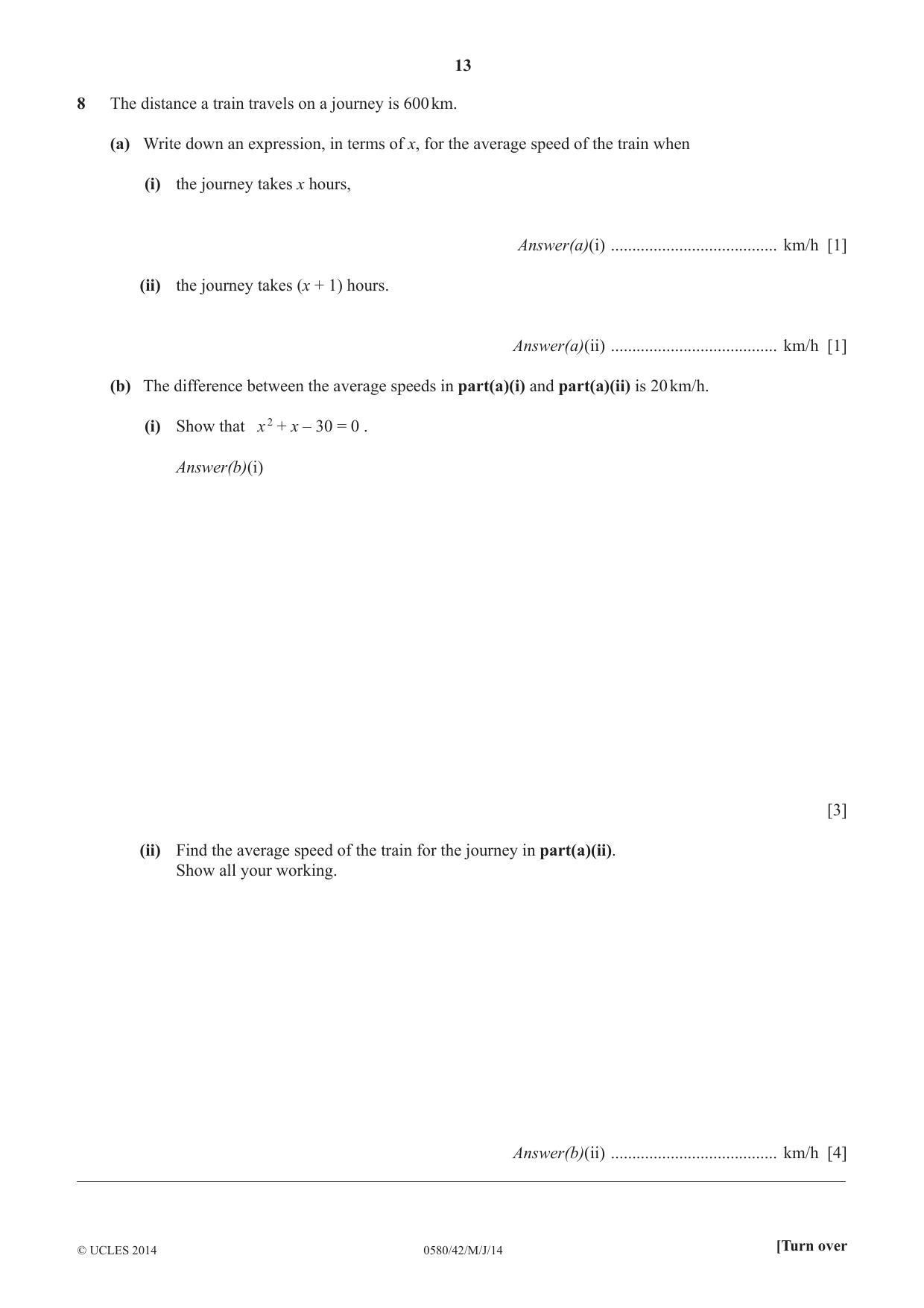
Q8 · The distance a train travels on a journey is 600 km
8 The distance a train travels on a journey is 600 km. (a) Write down an expression, in terms of x, for the average speed of the train when (i) the journey takes x hours, Answer(a)(i) ....................................... km/h [1] (ii) the journey takes (x + 1) hours. Answer(a)(ii) ....................................... km/h [1] (b) The difference between the average speeds in part(a)(i) and part(a)(ii) is 20 km/h. (i) Show that x 2 + x – 30 = 0 . Answer(b)(i) [3] (ii) Find the average speed of the train for the journey in part(a)(ii). Show all your working. Answer(b)(ii) ....................................... km/h [4] __________________________________________________________________________________________
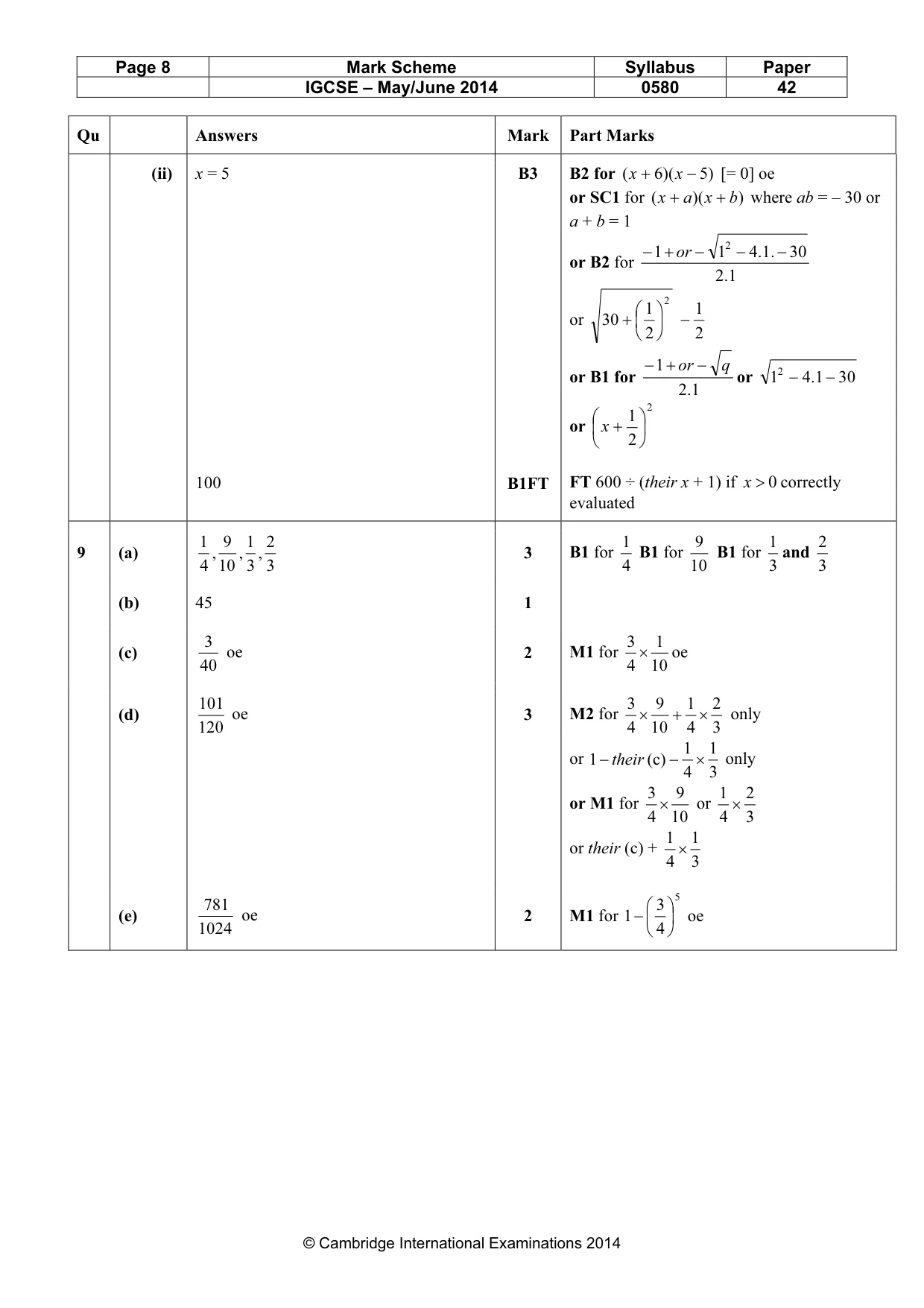
Mark scheme: 600 600 8 (a) (i) 1 Not x = x x 600 600 (ii) 1 Not x = x + 1 x + 1 600 600 (b) (i) – = 20 oe M1FT FT their (a)(i) – their (a)(ii) = 20 oe x x + 1 If M0, SC1FT for their(a)(ii) – their (a)(i) = 20 oe 600 ( x + )1 − 600 x = 20 x ( x + )1 or better A1 May still be over common denominator and can be implied by third line. Allow recovery if bracket omitted 600 x + 600 − 600 x = 20 x 2 + 20 x A1 Dep on M1A1 and conclusion reached with at 0 = 20 x 2 + 20 x − 600 least one of the interim lines and without any 2 errors or omissions x + x − 30 = 0 IGCSE – May/June 2014 0580 42 Qu Answers Mark Part Marks (ii) x = 5 B3 B2 for ( x + 6 )( x − 5) [= 0] oe or SC1 for ( x + a )( x + b ) where ab = – 30 or a + b = 1 − 1 + or − 12 − .1.4 − 30 or B2 for 1.2 2 1 1 or 30 + − 2 2 − 1 + or − q or B1 for or 12 − 1.4 − 30 1.2 2 1 or x + 2 100 B1FT FT 600 ÷ (their x + 1) if x > 0 correctly evaluated 1 9 1 2 1 9 1 2
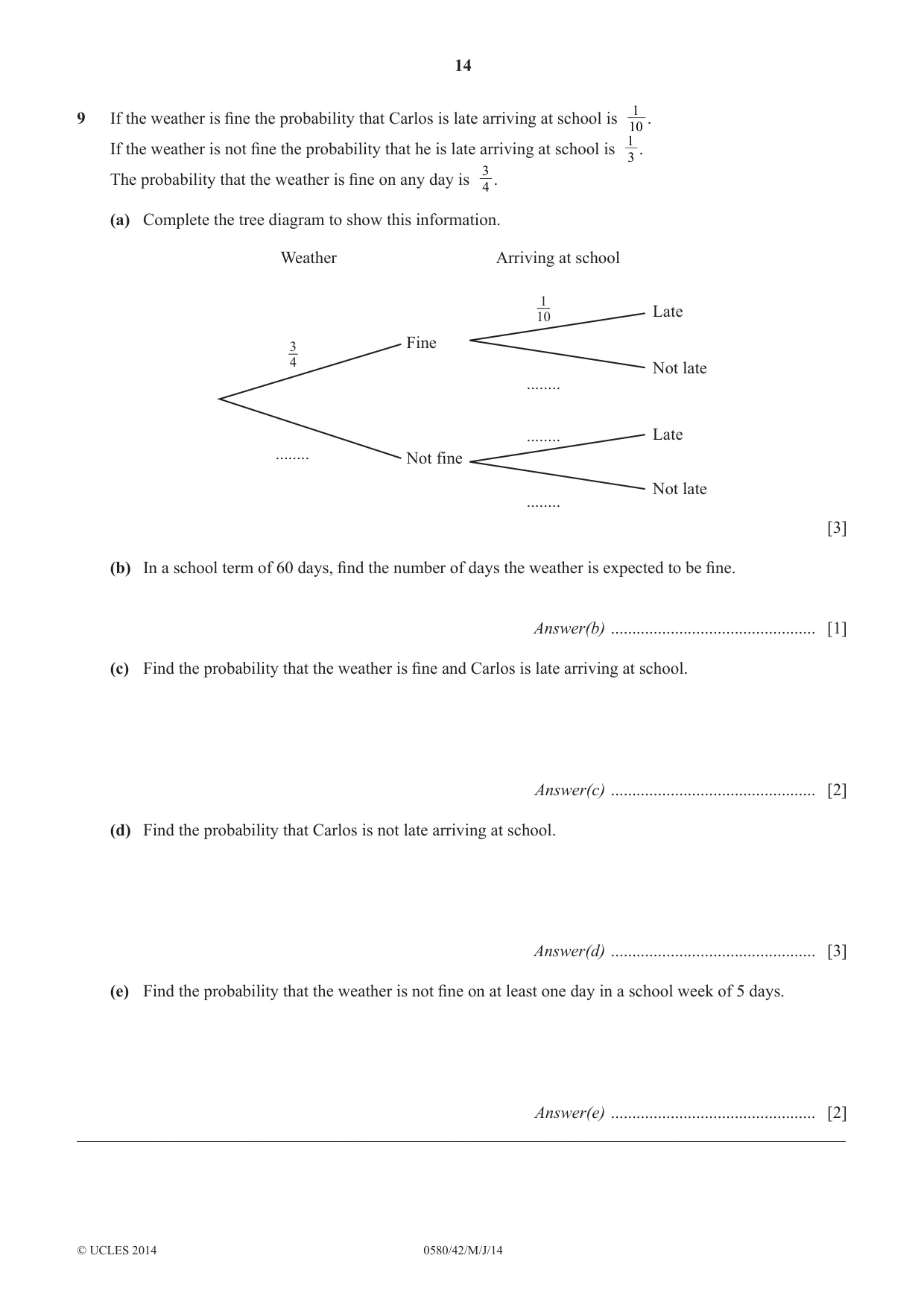
Q9 · 9 If the weather is fi ne the probability that Carlos is late arriving at school is
1 9 If the weather is fi ne the probability that Carlos is late arriving at school is . 10 1 If the weather is not fi ne the probability that he is late arriving at school is . 3 3 The probability that the weather is fi ne on any day is . 4 (a) Complete the tree diagram to show this information. Weather Arriving at school 1 10 Late 3 Fine 4 Not late ........ ........ Late ........ Not fine Not late ........ [3] (b) In a school term of 60 days, fi nd the number of days the weather is expected to be fi ne. Answer(b) ................................................ [1] (c) Find the probability that the weather is fi ne and Carlos is late arriving at school. Answer(c) ................................................ [2] (d) Find the probability that Carlos is not late arriving at school. Answer(d) ................................................ [3] (e) Find the probability that the weather is not fi ne on at least one day in a school week of 5 days. Answer(e) ................................................ [2] __________________________________________________________________________________________
Mark scheme: 1 9 1 2 1 9 1 2 9 (a) , , , 3 B1 for B1 for B1 for and 4 10 3 3 4 10 3 3 (b) 45 1 3 3 1 (c) oe 2 M1 for × oe 40 4 10 101 3 9 1 2 (d) oe 3 M2 for × + × only 120 4 10 4 3 1 1 or 1 −their (c) − × only 4 3 3 9 1 2 or M1 for × or × 4 10 4 3 1 1 or their (c) + × 4 3 5 781 3 (e) oe 2 M1 for 1 − oe 1024 4 IGCSE – May/June 2014 0580 42 Qu Answers Mark Part Marks 1 1 1
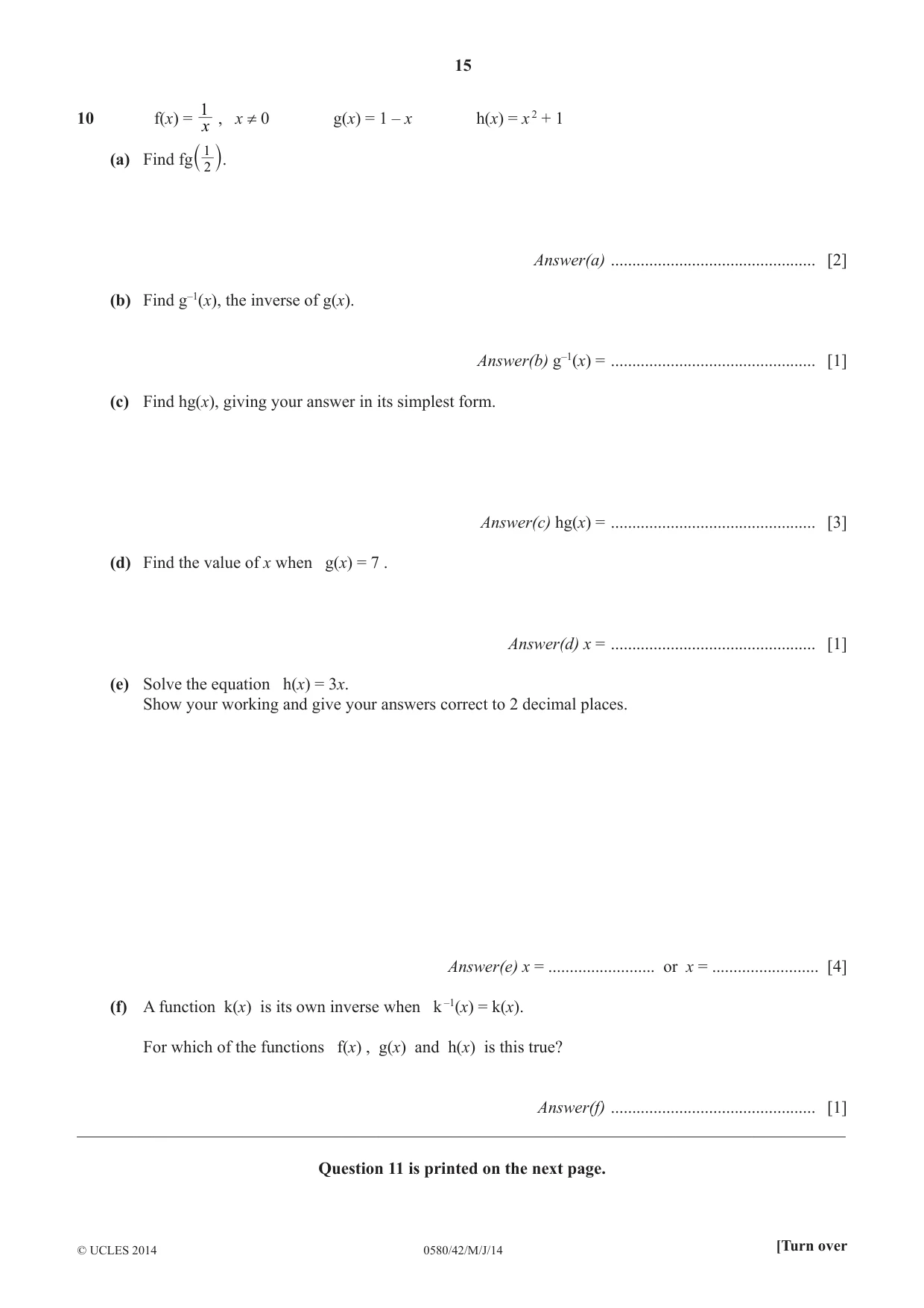
Q10 · 210 f(x) = , x ≠ 0 g(x) = 1 – x h(x) = x + 1 x 1 (a) Find fg 2 ` j
1 210 f(x) = , x ≠ 0 g(x) = 1 – x h(x) = x + 1 x 1 (a) Find fg 2 ` j. Answer(a) ................................................ [2] (b) Find g–1(x), the inverse of g(x). Answer(b) g–1(x) = ................................................ [1] (c) Find hg(x), giving your answer in its simplest form. Answer(c) hg(x) = ................................................ [3] (d) Find the value of x when g(x) = 7 . Answer(d) x = ................................................ [1] (e) Solve the equation h(x) = 3x. Show your working and give your answers correct to 2 decimal places. Answer(e) x = ......................... or x = ......................... [4] (f) A function k(x) is its own inverse when k –1(x) = k(x). For which of the functions f(x) , g(x) and h(x) is this true? Answer(f) ................................................ [1] __________________________________________________________________________________________ Question 11 is printed on the next page.
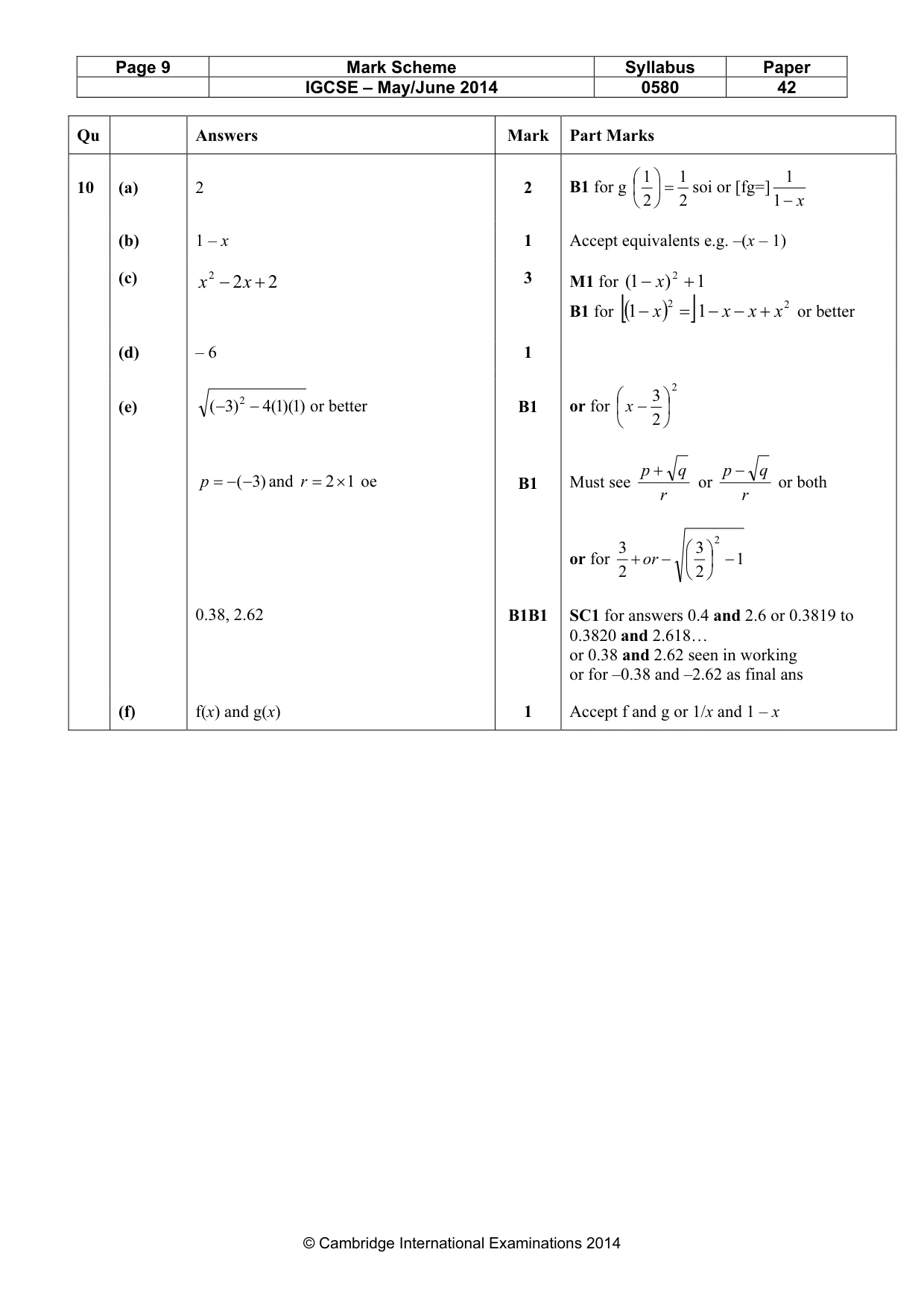
Mark scheme: 1 1 110 (a) 2 2 B1 for g = soi or [fg=] 2 2 1 − x (b) 1 – x 1 Accept equivalents e.g. –(x – 1) (c) x 2 −x2 + 2 3 M1 for 1( −x ) 2 + 1 2 or better B1 for [(1 − x ) 2 = ] 1 − x − x + x (d) – 6 1 2 2 3 (e) ( −3) − 41()()1 or better B1 or for x − 2 p + q p − q p = − (−3) and r = 2× 1 oe B1 Must see or or both r r 2 3 3 or for + or − − 1 2 2 0.38, 2.62 B1B1 SC1 for answers 0.4 and 2.6 or 0.3819 to 0.3820 and 2.618… or 0.38 and 2.62 seen in working or for –0.38 and –2.62 as final ans (f) f(x) and g(x) 1 Accept f and g or 1/x and 1 – x IGCSE – May/June 2014 0580 42 Qu Answers Mark Part Marks 1
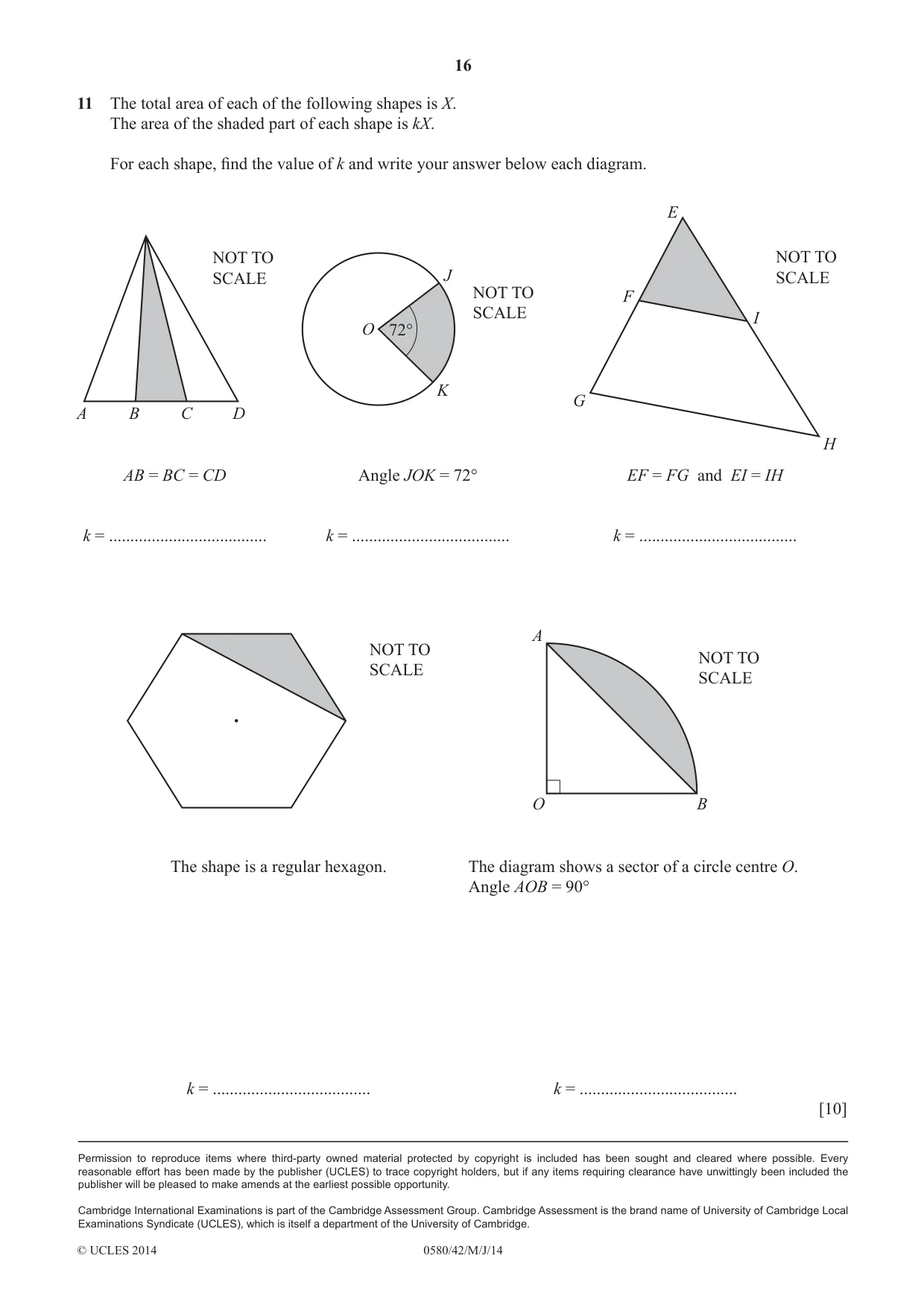
Q11 · The total area of each of the following shapes is X
11 The total area of each of the following shapes is X. The area of the shaded part of each shape is kX. For each shape, fi nd the value of k and write your answer below each diagram. E NOT TO NOT TO SCALE J SCALE NOT TO F SCALE I O 72° K G A B C D H AB = BC = CD Angle JOK = 72° EF = FG and EI = IH k = ..................................... k = ..................................... k = ..................................... A NOT TO NOT TO SCALE SCALE O B The shape is a regular hexagon. The diagram shows a sector of a circle centre O. Angle AOB = 90° k = ..................................... k = ..................................... [10]
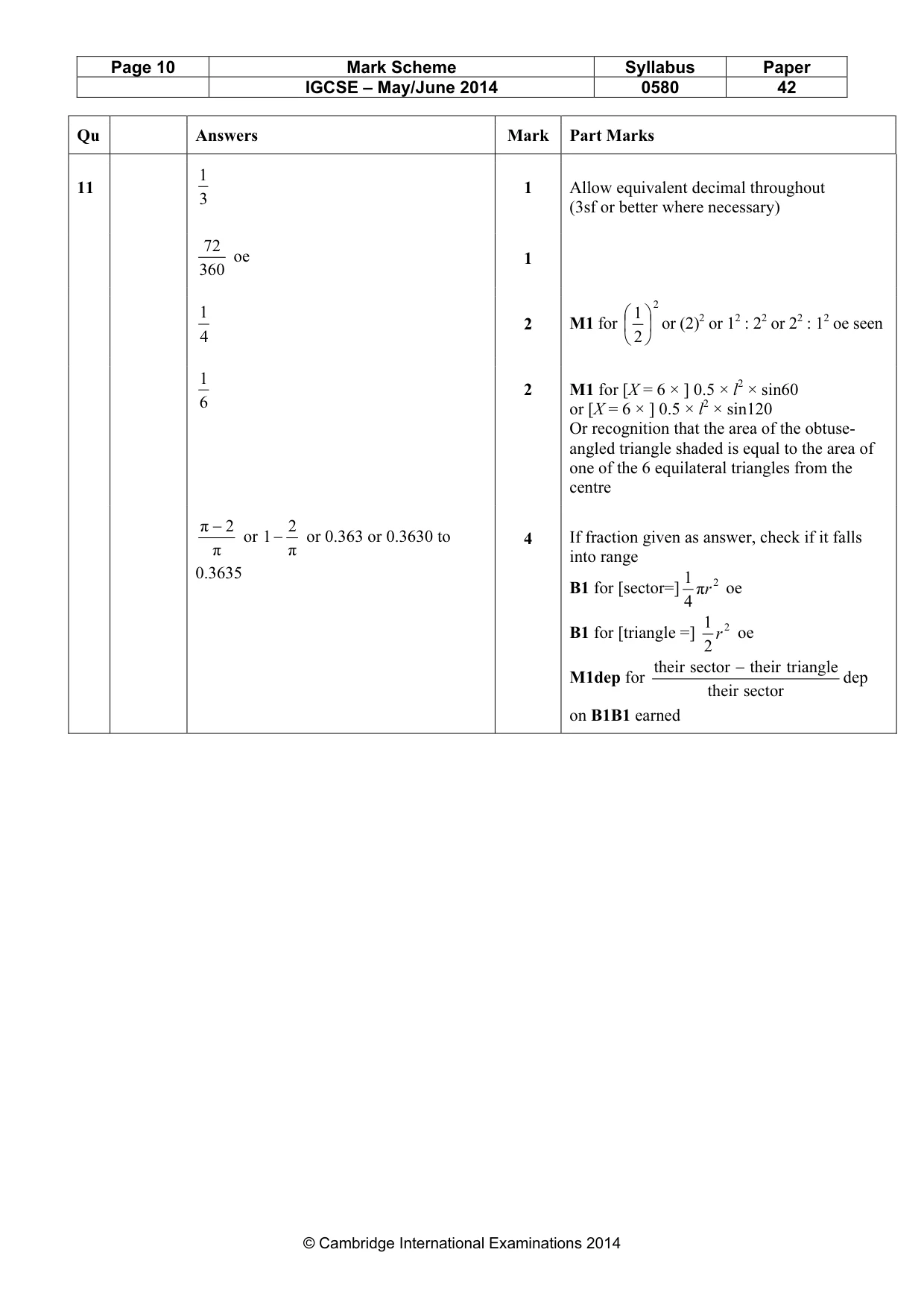
Mark scheme: 1 11 1 Allow equivalent decimal throughout 3 (3sf or better where necessary) 72 oe 1 360 2 1 1 2 M1 for or (2)2 or 12 : 22 or 22 : 12 oe seen 4 2 1 2 M1 for [X = 6 × ] 0.5 × l2 × sin60 6 or [X = 6 × ] 0.5 × l2 × sin120 Or recognition that the area of the obtuse- angled triangle shaded is equal to the area of one of the 6 equilateral triangles from the centre π − 2 2 or 1− or 0.363 or 0.3630 to 4 If fraction given as answer, check if it falls π π into range 0.3635 1 2 B1 for [sector=] π r oe 4 1 2 B1 for [triangle =] r oe 2 their sector − their triangle M1dep for dep their sector on B1B1 earned
What was in this paper
The subtopics covered by these 9 questions, and how many questions each got. Open one in a new tab to see every Cambridge question on it.
What you needed in this session
Cambridge’s own grade thresholds for 2014 May/June, Paper 4 · Variant 2. A higher threshold means an easier paper — the bar moves with how the cohort did.