Cambridge IGCSE Mathematics 0580 — 2015 May/June Paper 4 · Variant 2
0580/42/M/J/15 · 11 questions · 130 marks · ≈146 min
The question paper and its mark scheme, free to read here and free to download. This is Cambridge’s own paper, exactly as it was sat.
Question paper20 pages
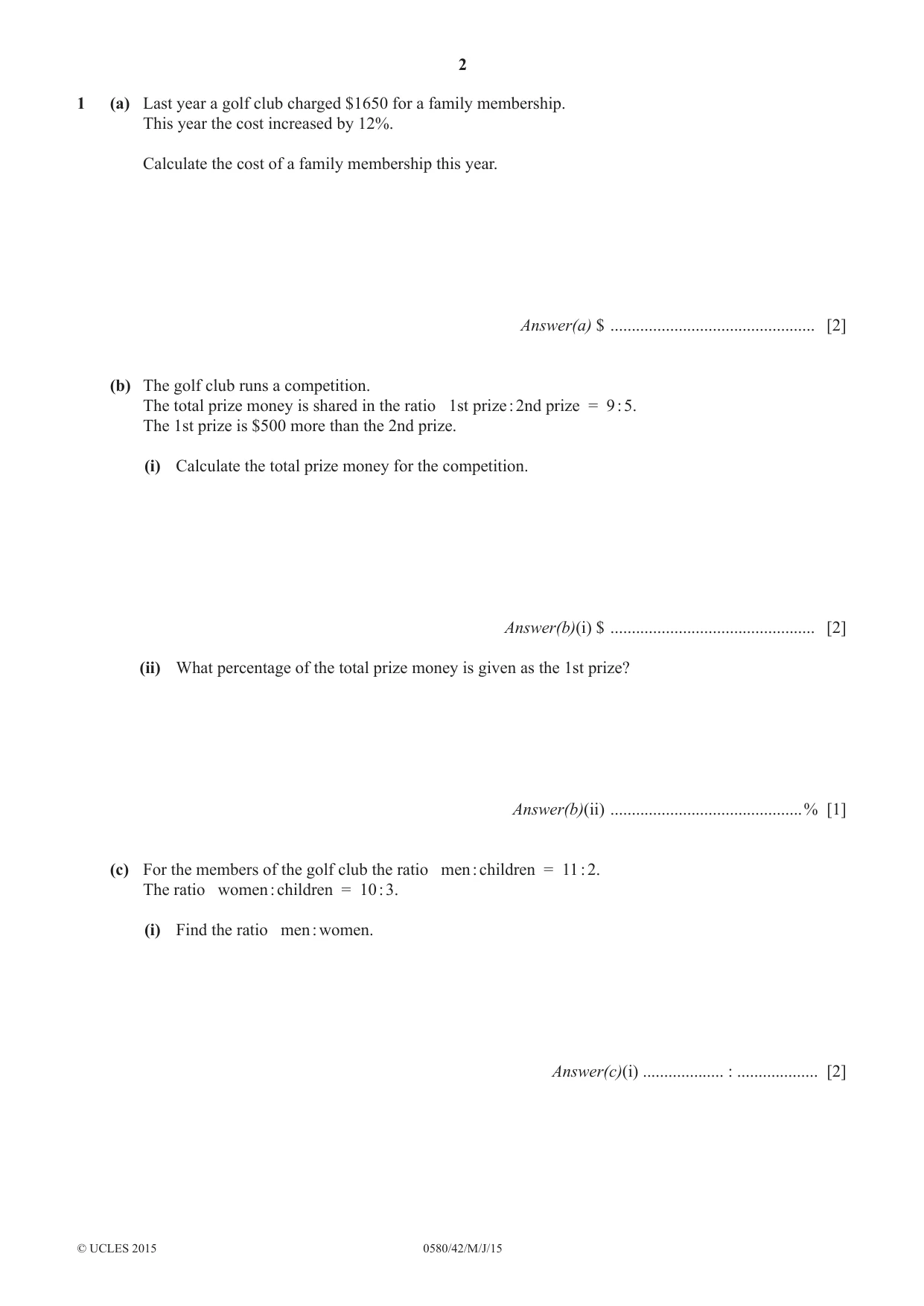
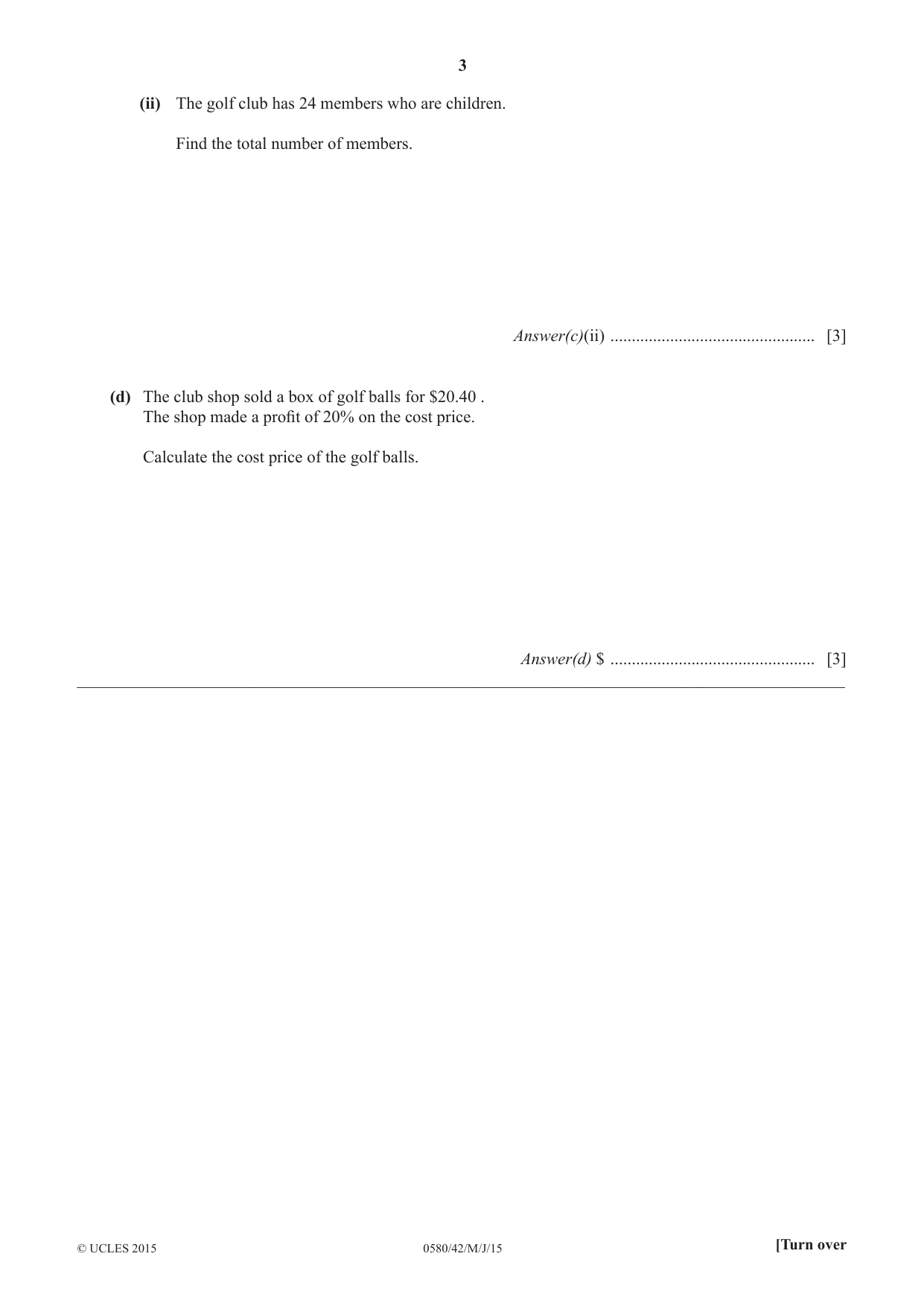
Mark scheme11 pages
Answers below. Sit the paper first if you are practising.
Questions as text
Q1 · Last year a golf club charged $1650 for a family membership
1 (a) Last year a golf club charged $1650 for a family membership. This year the cost increased by 12%. Calculate the cost of a family membership this year. Answer(a) $ ................................................ [2] (b) The golf club runs a competition. The total prize money is shared in the ratio 1st prize : 2nd prize = 9 : 5. The 1st prize is $500 more than the 2nd prize. (i) Calculate the total prize money for the competition. Answer(b)(i) $ ................................................ [2] (ii) What percentage of the total prize money is given as the 1st prize? Answer(b)(ii) .............................................% [1] (c) For the members of the golf club the ratio men : children = 11 : 2. The ratio women : children = 10 : 3. (i) Find the ratio men : women. Answer(c)(i) ................... : ................... [2] (ii) The golf club has 24 members who are children. Find the total number of members. Answer(c)(ii) ................................................ [3] (d) The club shop sold a box of golf balls for $20.40 . The shop made a profit of 20% on the cost price. Calculate the cost price of the golf balls. Answer(d) $ ................................................ [3] __________________________________________________________________________________________
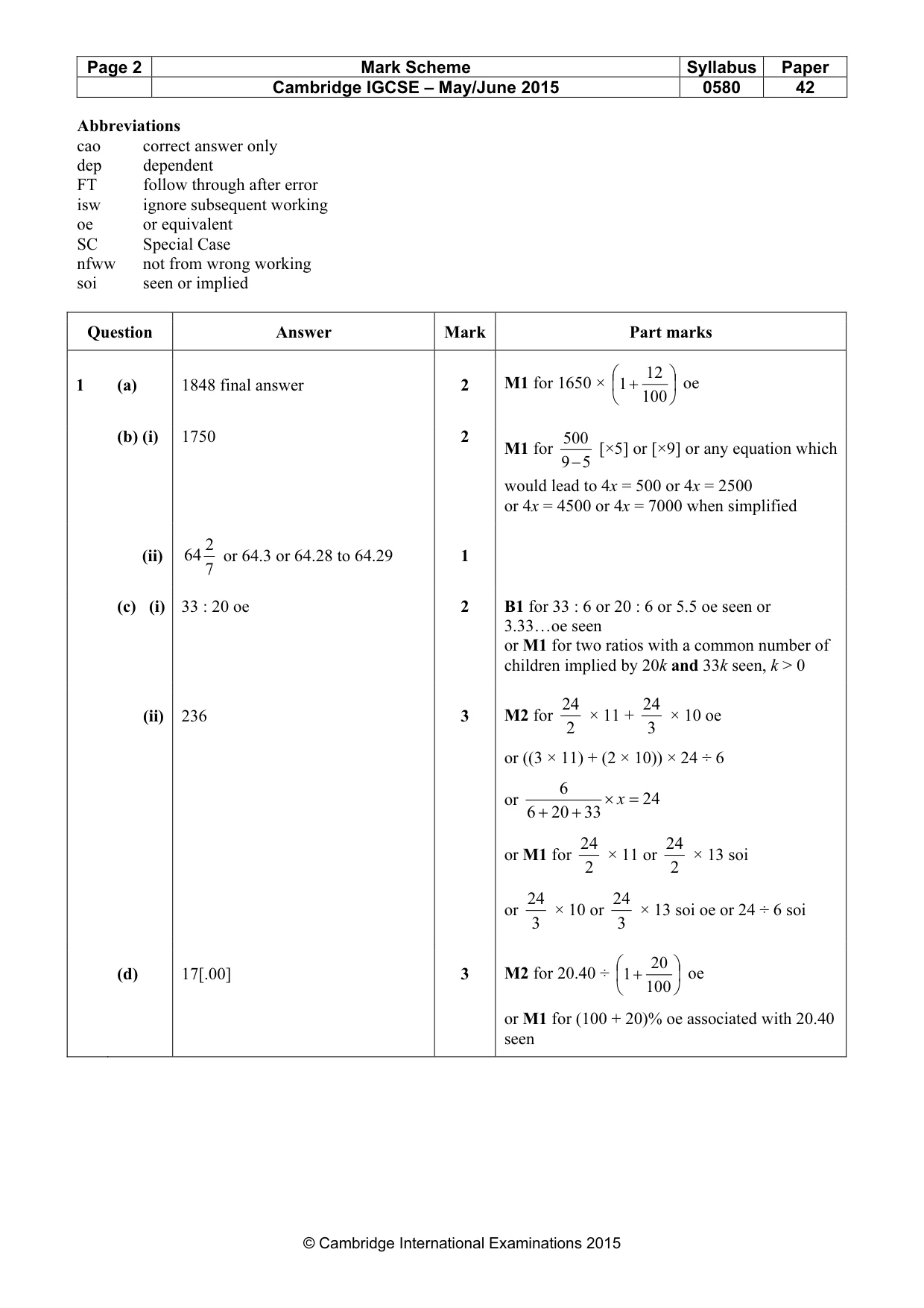
Mark scheme: Question Answer Mark Part marks 1 (a) 1848 final answer 2 M1 for 1650 × + 1 1212 oe 100 (b) (i) 1750 2 500 M1 for [×5] or [×9] or any equation which 9 − 5 would lead to 4x = 500 or 4x = 2500 or 4x = 4500 or 4x = 7000 when simplified 2 (ii) 64 or 64.3 or 64.28 to 64.29 1 7 (c) (i) 33 : 20 oe 2 B1 for 33 : 6 or 20 : 6 or 5.5 oe seen or 3.33…oe seen or M1 for two ratios with a common number of children implied by 20k and 33k seen, k > 0 24 24 (ii) 236 3 M2 for × 11 + × 10 oe 2 3 or ((3 × 11) + (2 × 10)) × 24 ÷ 6 6 or × x = 24 6 + 20 + 33 24 24 or M1 for × 11 or × 13 soi 2 2 24 24 or × 10 or × 13 soi oe or 24 ÷ 6 soi 3 3 (d) 17[.00] 3 M2 for 20.40 ÷ + 1 20 oe 100 or M1 for (100 + 20)% oe associated with 20.40 seen
Q2 · D NOT TO O SCALE C E 48° A B In the diagram, B, C, D and E lie on the circle, centre O
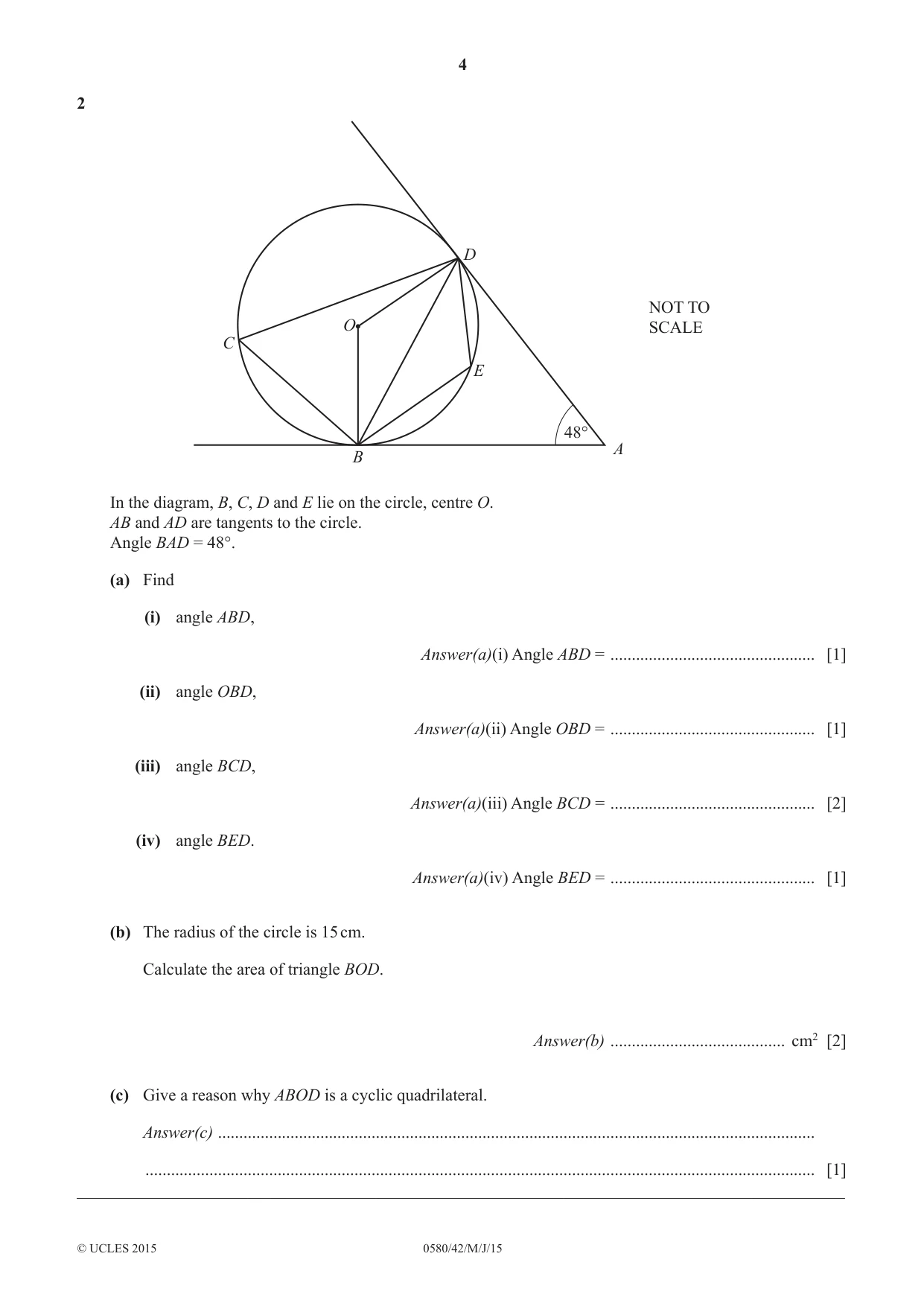
2 D NOT TO O SCALE C E 48° A B In the diagram, B, C, D and E lie on the circle, centre O. AB and AD are tangents to the circle. Angle BAD = 48°. (a) Find (i) angle ABD, Answer(a)(i) Angle ABD = ................................................ [1] (ii) angle OBD, Answer(a)(ii) Angle OBD = ................................................ [1] (iii) angle BCD, Answer(a)(iii) Angle BCD = ................................................ [2] (iv) angle BED. Answer(a)(iv) Angle BED = ................................................ [1] (b) The radius of the circle is 15 cm. Calculate the area of triangle BOD. Answer(b) ......................................... cm2 [2] (c) Give a reason why ABOD is a cyclic quadrilateral. Answer(c) ............................................................................................................................................ ............................................................................................................................................................. [1] __________________________________________________________________________________________
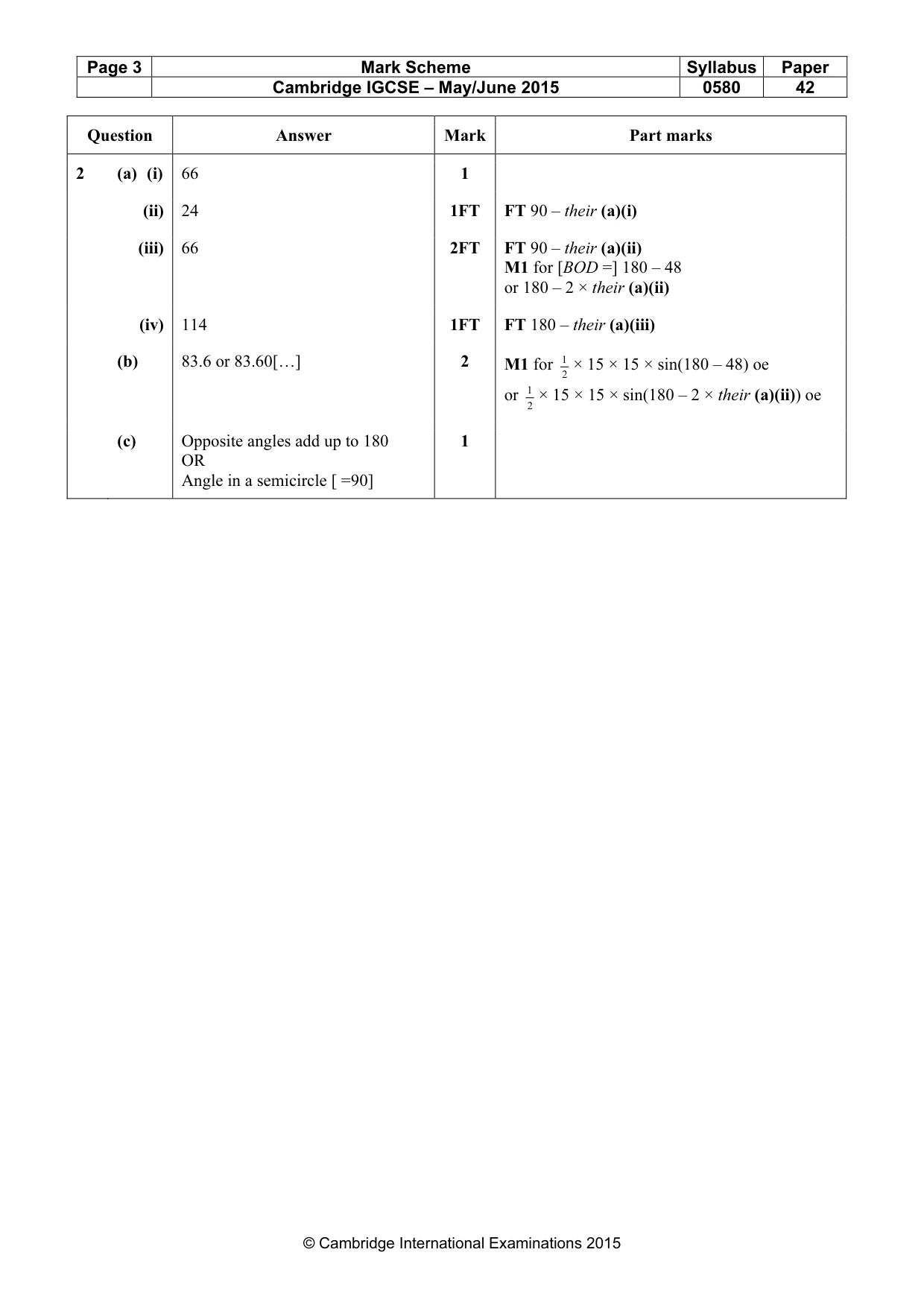
Mark scheme: 2 (a) (i) 66 1 (ii) 24 1FT FT 90 – their (a)(i) (iii) 66 2FT FT 90 – their (a)(ii) M1 for [BOD =] 180 – 48 or 180 – 2 × their (a)(ii) (iv) 114 1FT FT 180 – their (a)(iii) (b) 83.6 or 83.60[…] 2 M1 for 1 × 15 × 15 × sin(180 – 48) oe 2 or 1 × 15 × 15 × sin(180 – 2 × their (a)(ii)) oe 2 (c) Opposite angles add up to 180 1 OR Angle in a semicircle [ =90]
Q3 · On the first part of a journey, Alan drove a distance of x km and his car used 6 litres…
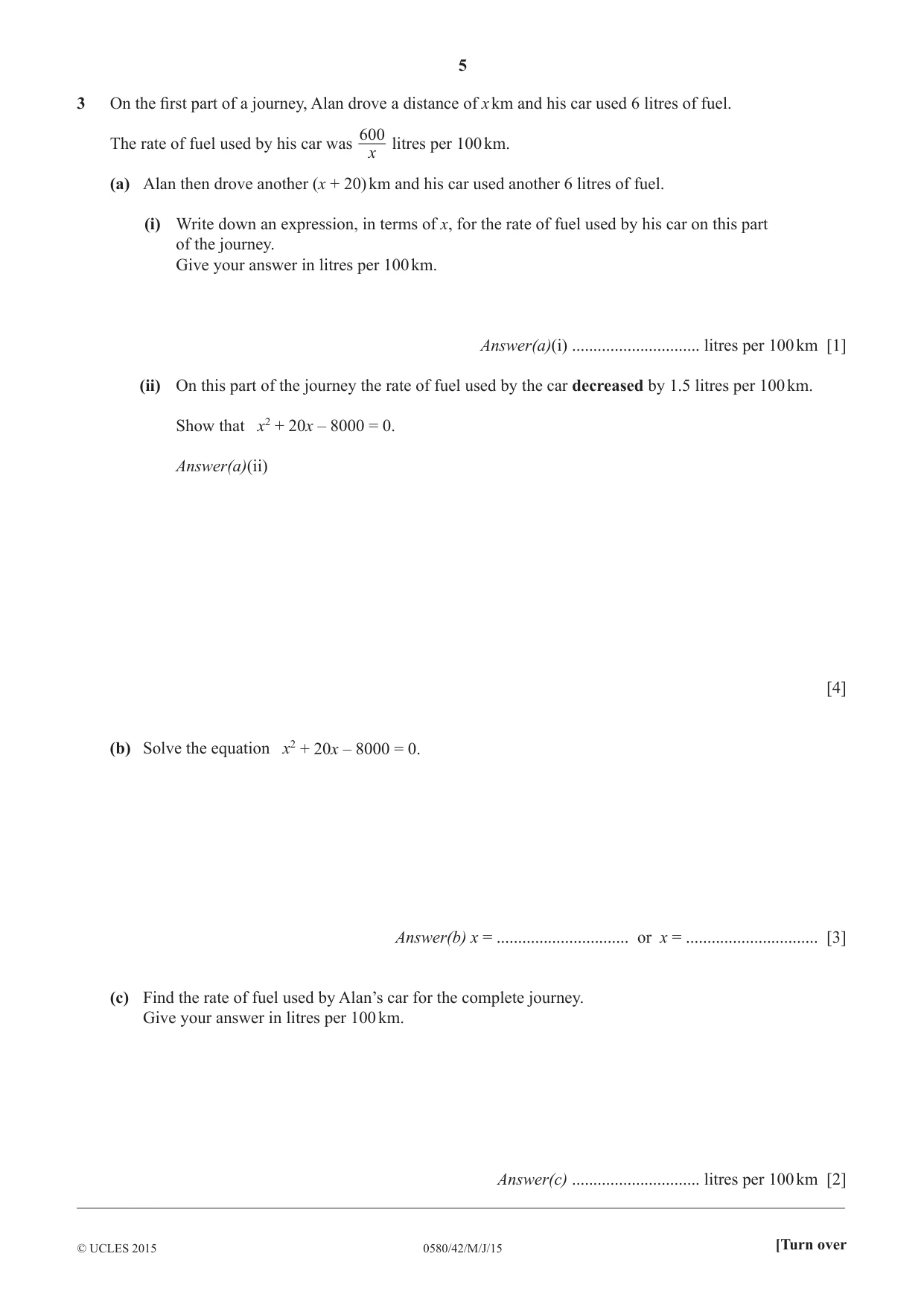
3 On the first part of a journey, Alan drove a distance of x km and his car used 6 litres of fuel. 600 The rate of fuel used by his car was litres per 100 km. x (a) Alan then drove another (x + 20) km and his car used another 6 litres of fuel. (i) Write down an expression, in terms of x, for the rate of fuel used by his car on this part of the journey. Give your answer in litres per 100 km. Answer(a)(i) .............................. litres per 100 km [1] (ii) On this part of the journey the rate of fuel used by the car decreased by 1.5 litres per 100 km. Show that x2 + 20x – 8000 = 0. Answer(a)(ii) [4] (b) Solve the equation x2 + 20x – 8000 = 0. Answer(b) x = ............................... or x = ............................... [3] (c) Find the rate of fuel used by Alan’s car for the complete journey. Give your answer in litres per 100 km. Answer(c) .............................. litres per 100 km [2] __________________________________________________________________________________________
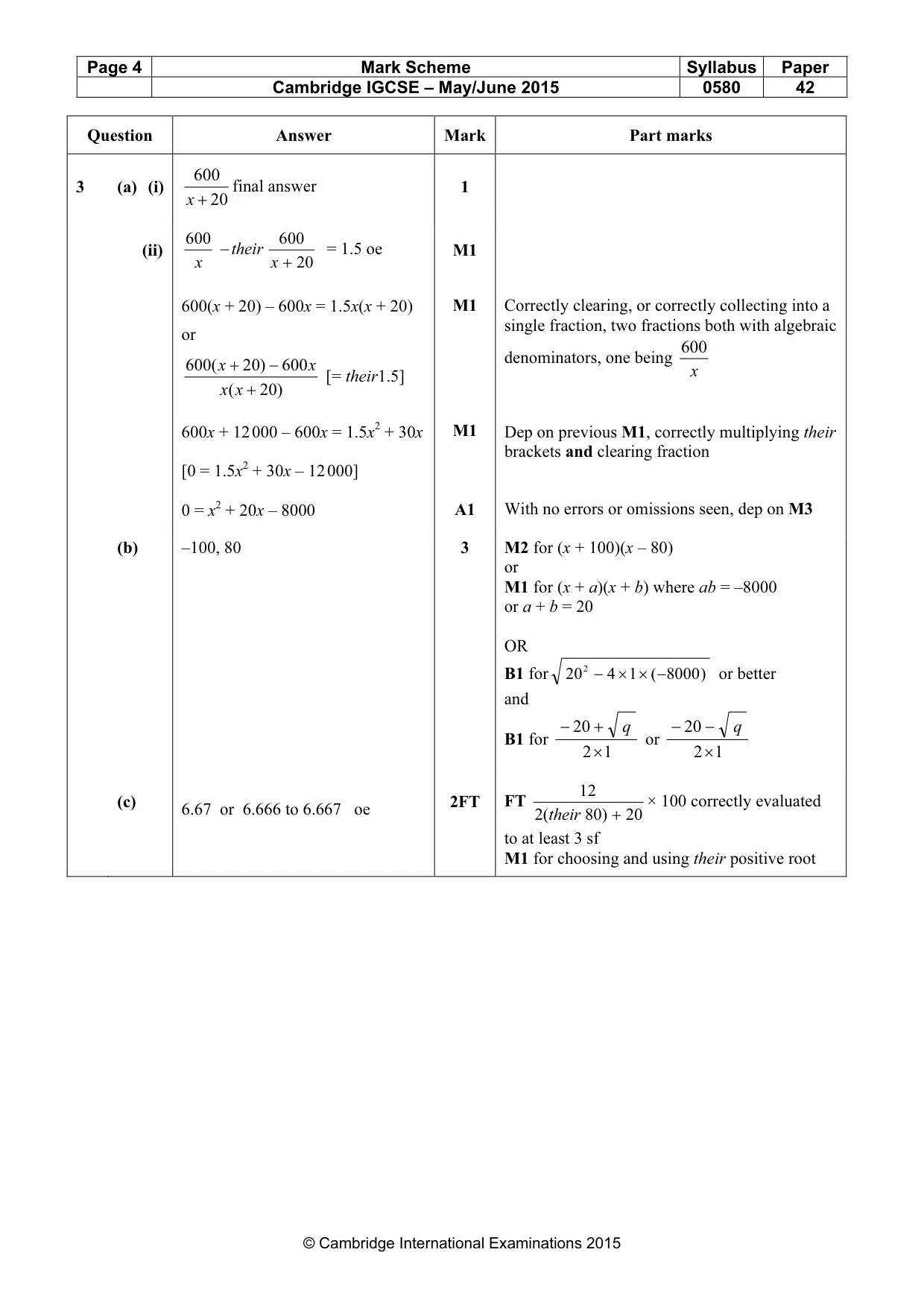
Mark scheme: 600 3 (a) (i) final answer 1 x + 20 600 600 (ii) − their = 1.5 oe M1 x x + 20 600(x + 20) – 600x = 1.5x(x + 20) M1 Correctly clearing, or correctly collecting into a single fraction, two fractions both with algebraic or 600 denominators, one being 600( x + 20) − 600 x x [= their1.5] x ( x + 20 ) 600x + 12 000 – 600x = 1.5x2 + 30x M1 Dep on previous M1, correctly multiplying their brackets and clearing fraction [0 = 1.5x2 + 30x – 12 000] 0 = x2 + 20x – 8000 A1 With no errors or omissions seen, dep on M3 (b) –100, 80 3 M2 for (x + 100)(x – 80) or M1 for (x + a)(x + b) where ab = –8000 or a + b = 20 OR B1 for 20 2 − 4 × 1 × ( − 8000 ) or better and − 20 + q − 20 − q B1 for or 2 × 1 2 × 1 12 (c) 2FT FT × 100 correctly evaluated 6.67 or 6.666 to 6.667 oe 2(their 80) + 20 to at least 3 sf M1 for choosing and using their positive root
Q4 · A sector of a circle has radius 12 cm and an angle of 135°
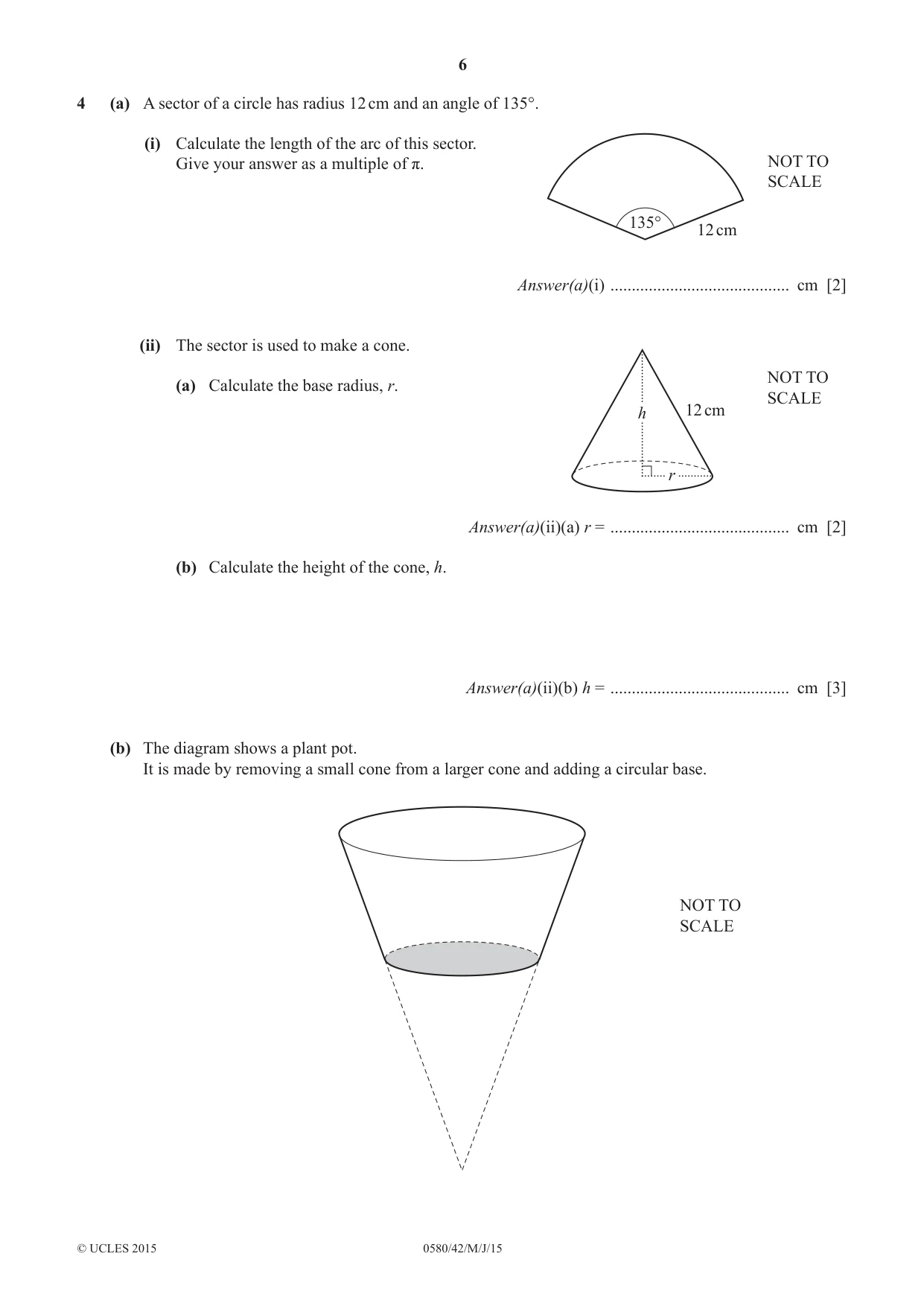
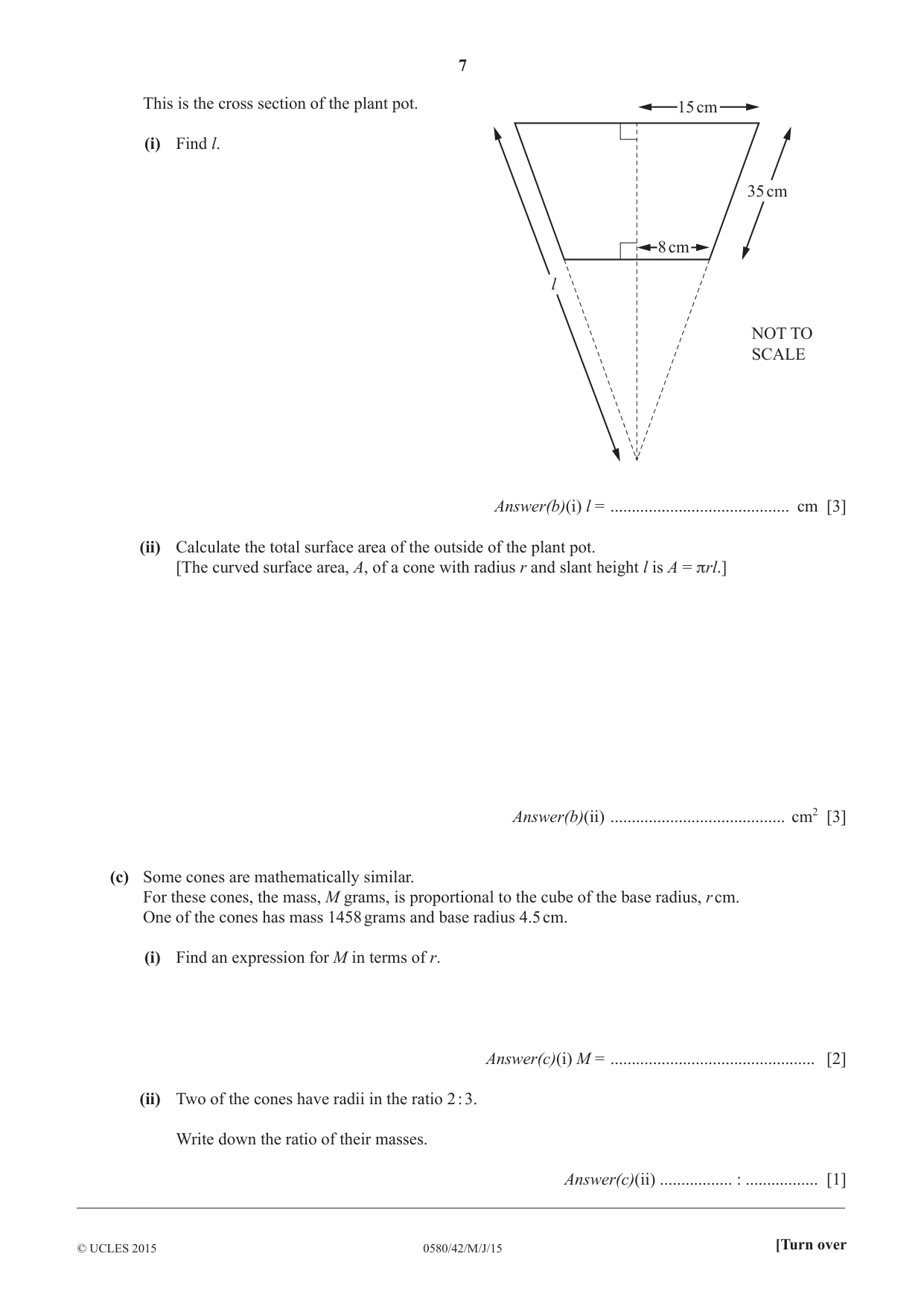
4 (a) A sector of a circle has radius 12 cm and an angle of 135°. (i) Calculate the length of the arc of this sector. Give your answer as a multiple of π. NOT TO SCALE 135° 12 cm Answer(a)(i) .......................................... cm [2] (ii) The sector is used to make a cone. NOT TO (a) Calculate the base radius, r. SCALE h 12 cm r Answer(a)(ii)(a) r = .......................................... cm [2] (b) Calculate the height of the cone, h. Answer(a)(ii)(b) h = .......................................... cm [3] (b) The diagram shows a plant pot. It is made by removing a small cone from a larger cone and adding a circular base. NOT TO SCALE This is the cross section of the plant pot. 15 cm (i) Find l. 35 cm 8 cm l NOT TO SCALE Answer(b)(i) l = .......................................... cm [3] (ii) Calculate the total surface area of the outside of the plant pot. [The curved surface area, A, of a cone with radius r and slant height l is A = πrl.] Answer(b)(ii) ......................................... cm2 [3] (c) Some cones are mathematically similar. For these cones, the mass, M grams, is proportional to the cube of the base radius, r cm. One of the cones has mass 1458 grams and base radius 4.5 cm. (i) Find an expression for M in terms of r. Answer(c)(i) M = ................................................ [2] (ii) Two of the cones have radii in the ratio 2 : 3. Write down the ratio of their masses. Answer(c)(ii) ................. : ................. [1] __________________________________________________________________________________________
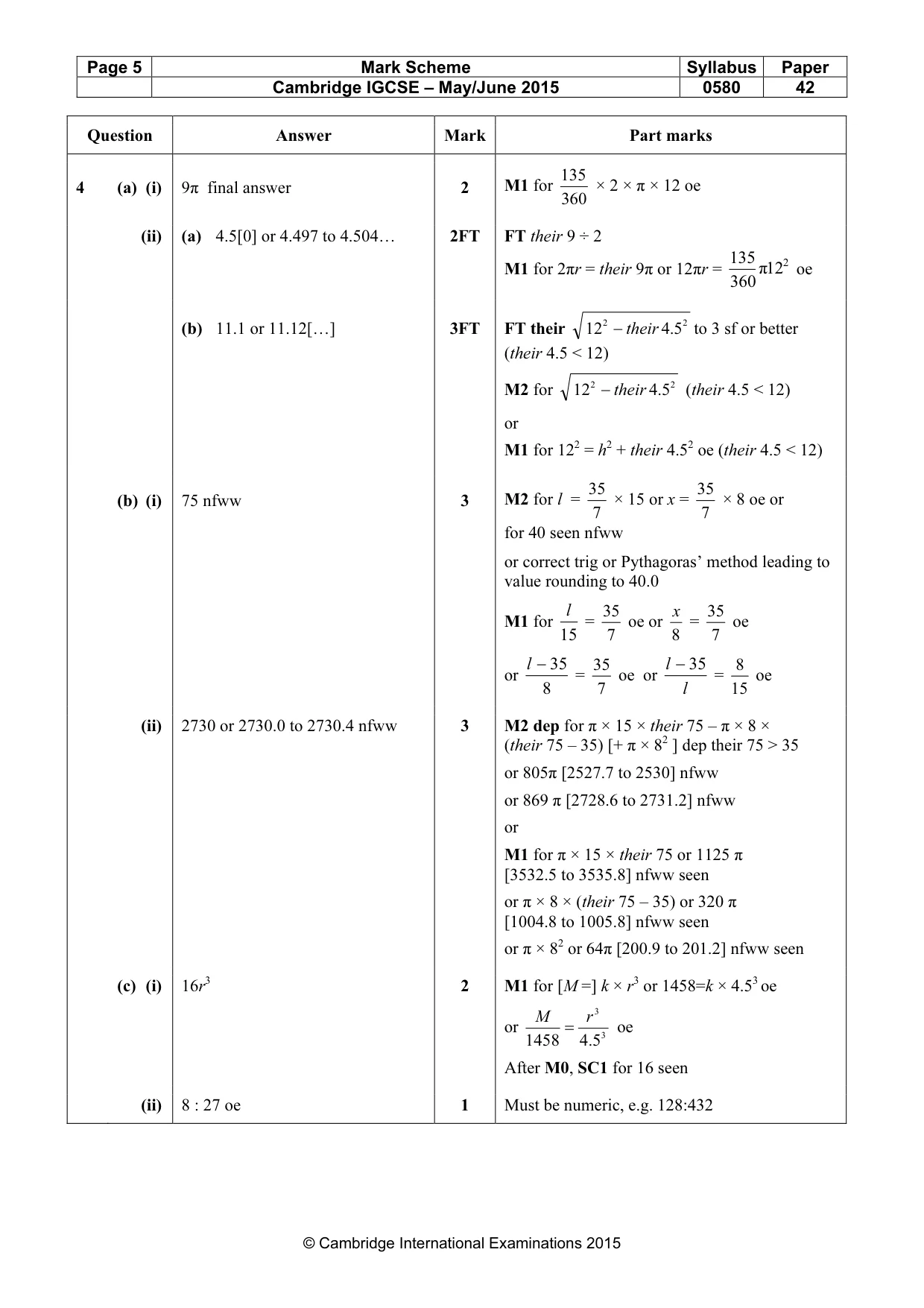
Mark scheme: 135 4 (a) (i) 9π final answer 2 M1 for × 2 × π × 12 oe 360 (ii) (a) 4.5[0] or 4.497 to 4.504… 2FT FT their 9 ÷ 2 135 2 M1 for 2πr = their 9π or 12πr = π12 oe 360 (b) 11.1 or 11.12[…] 3FT FT their 12 2 − their 5.4 2 to 3 sf or better (their 4.5 < 12) M2 for 12 2 − their 5.4 2 (their 4.5 < 12) or M1 for 122 = h2 + their 4.52 oe (their 4.5 < 12) 35 35 (b) (i) 75 nfww 3 M2 for l = × 15 or x = × 8 oe or 7 7 for 40 seen nfww or correct trig or Pythagoras’ method leading to value rounding to 40.0 l 35 x 35 M1 for = oe or = oe 15 7 8 7 l − 35 35 l − 35 8 or = oe or = oe 8 7 l 15 (ii) 2730 or 2730.0 to 2730.4 nfww 3 M2 dep for π × 15 × their 75 – π × 8 × (their 75 – 35) [+ π × 82 ] dep their 75 > 35 or 805π [2527.7 to 2530] nfww or 869 π [2728.6 to 2731.2] nfww or M1 for π × 15 × their 75 or 1125 π [3532.5 to 3535.8] nfww seen or π × 8 × (their 75 – 35) or 320 π [1004.8 to 1005.8] nfww seen or π × 82 or 64π [200.9 to 201.2] nfww seen (c) (i) 16r3 2 M1 for [M =] k × r3 or 1458=k × 4.53 oe M r 3 or = 3 oe 1458 5.4 After M0, SC1 for 16 seen (ii) 8 : 27 oe 1 Must be numeric, e.g. 128:432
Q5 · 5 y = x2 – 2x + , x !
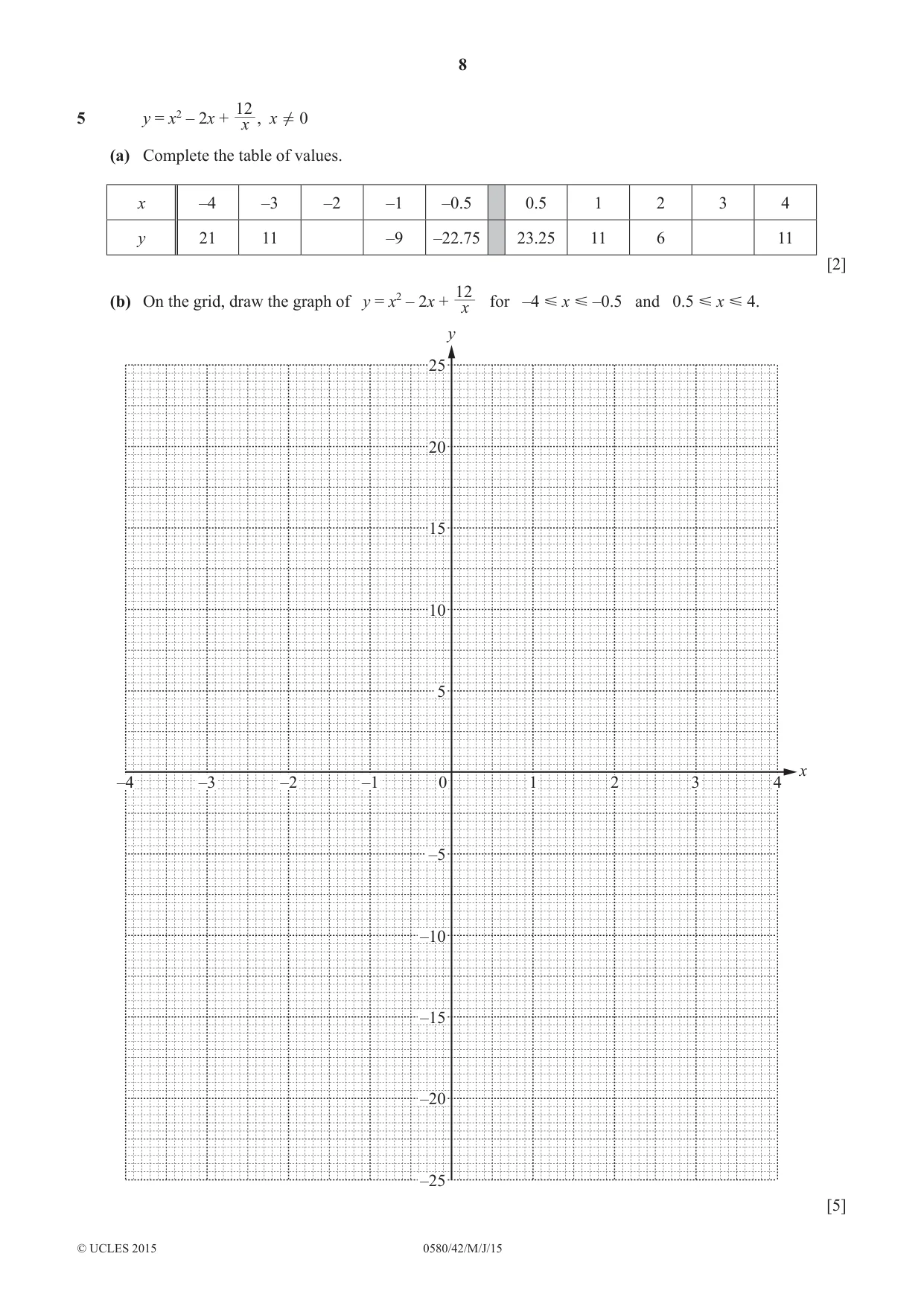
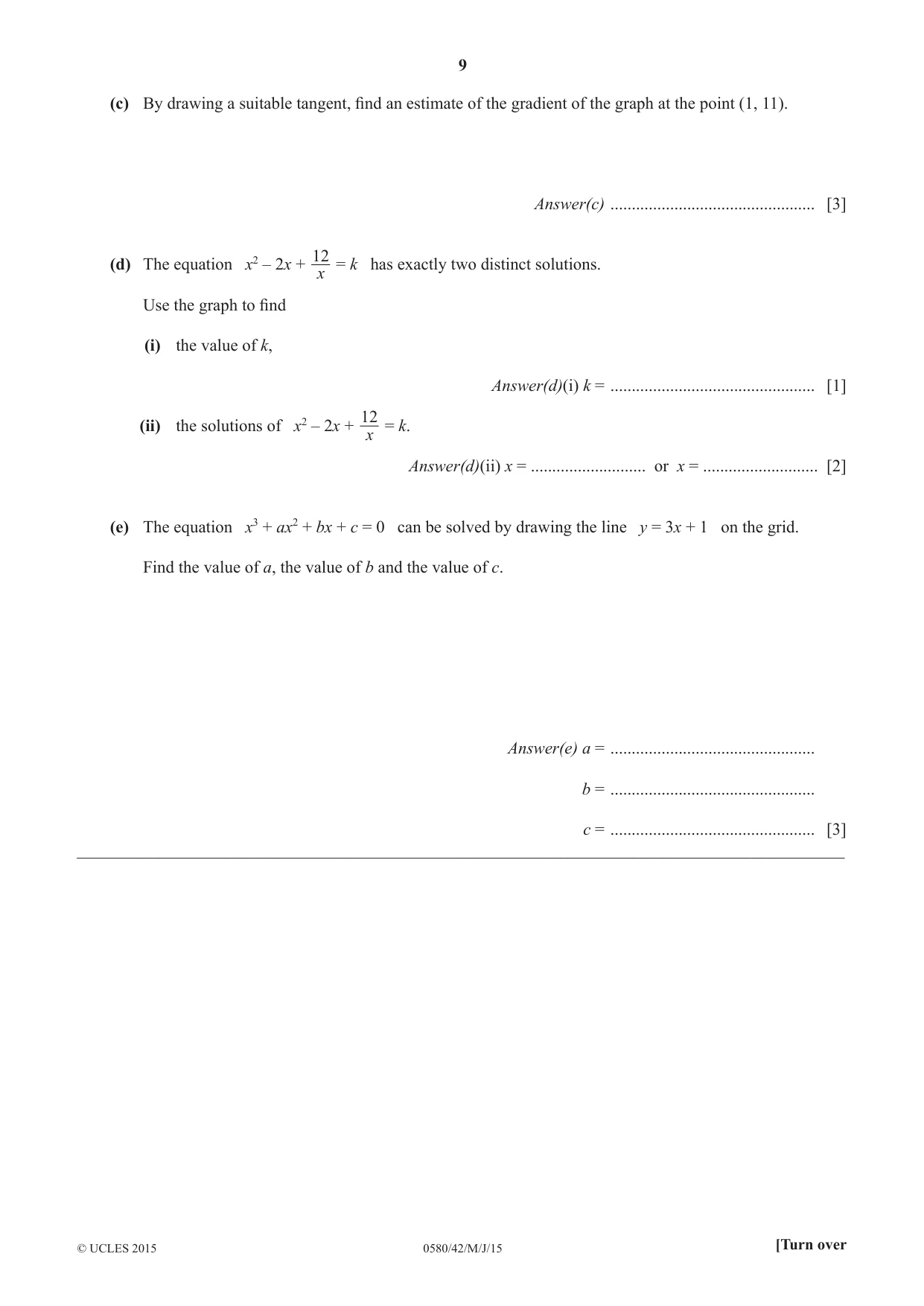
12 5 y = x2 – 2x + , x ! 0 x (a) Complete the table of values. x –4 –3 –2 –1 –0.5 0.5 1 2 3 4 y 21 11 –9 –22.75 23.25 11 6 11 [2] 12 (b) On the grid, draw the graph of y = x2 – 2x + for –4 x –0.5 and 0.5 x 4. x y 25 20 15 10 5 x –4 –3 –2 –1 0 1 2 3 4 –5 –10 –15 –20 –25 [5] (c) By drawing a suitable tangent, find an estimate of the gradient of the graph at the point (1, 11). Answer(c) ................................................ [3] 12 (d) The equation x2 – 2x + = k has exactly two distinct solutions. x Use the graph to find (i) the value of k, Answer(d)(i) k = ................................................ [1] 12 (ii) the solutions of x2 – 2x + = k. x Answer(d)(ii) x = ........................... or x = ........................... [2] (e) The equation x3 + ax2 + bx + c = 0 can be solved by drawing the line y = 3x + 1 on the grid. Find the value of a, the value of b and the value of c. Answer(e) a = ................................................ b = ................................................ c = ................................................ [3] __________________________________________________________________________________________
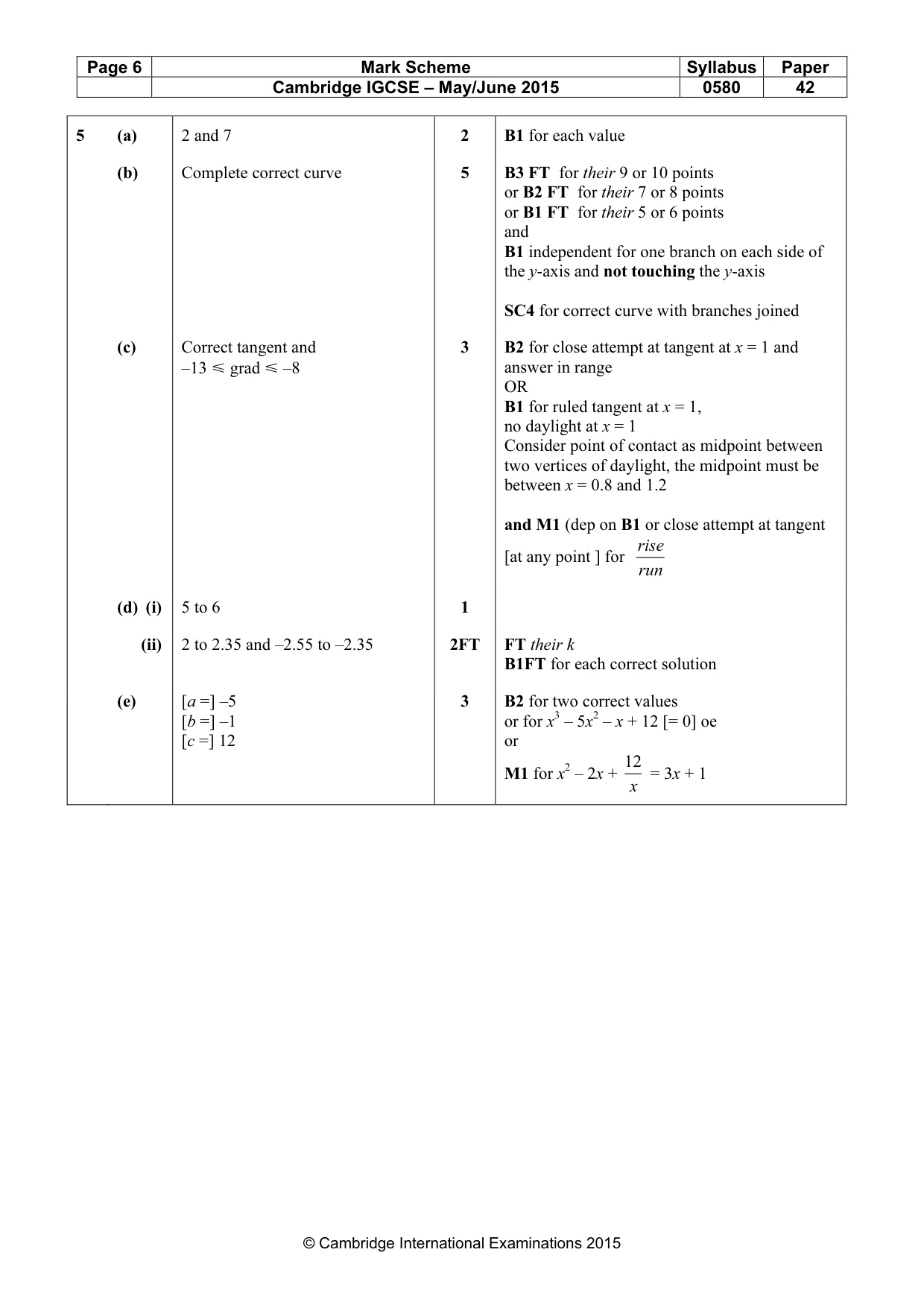
Mark scheme: 5 (a) 2 and 7 2 B1 for each value (b) Complete correct curve 5 B3 FT for their 9 or 10 points or B2 FT for their 7 or 8 points or B1 FT for their 5 or 6 points and B1 independent for one branch on each side of the y-axis and not touching the y-axis SC4 for correct curve with branches joined (c) Correct tangent and 3 B2 for close attempt at tangent at x = 1 and –13 Y grad Y –8 answer in range OR B1 for ruled tangent at x = 1, no daylight at x = 1 Consider point of contact as midpoint between two vertices of daylight, the midpoint must be between x = 0.8 and 1.2 and M1 (dep on B1 or close attempt at tangent rise [at any point ] for run (d) (i) 5 to 6 1 (ii) 2 to 2.35 and –2.55 to –2.35 2FT FT their k B1FT for each correct solution (e) [a =] –5 3 B2 for two correct values [b =] –1 or for x3 – 5x2 – x + 12 [= 0] oe [c =] 12 or 12 M1 for x2 – 2x + = 3x + 1 x 2 2 955. 2 + 831.2 − AB 2 f
Q6 · The diagram shows the positions of two ships, A and B, and a coastguard station, C
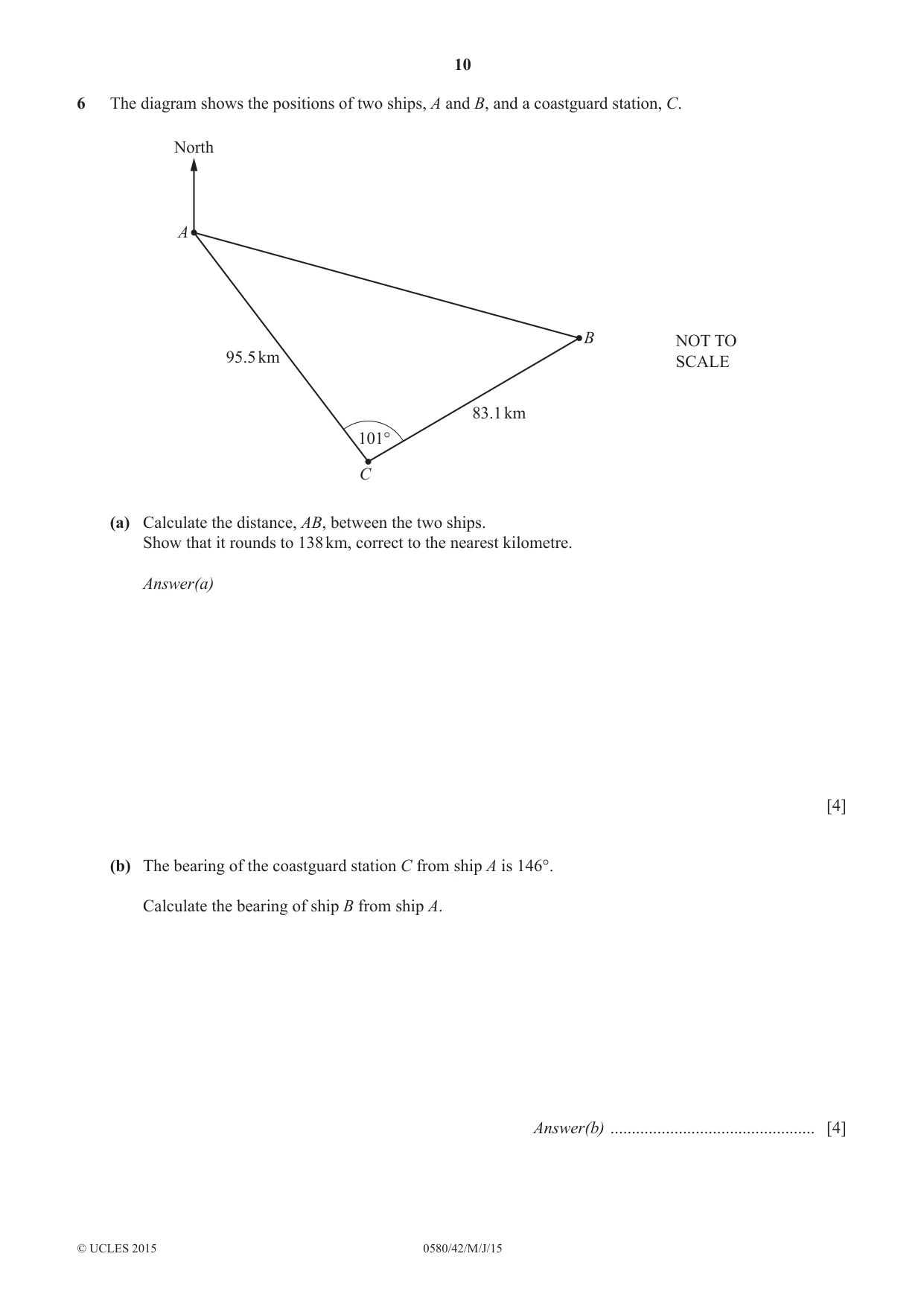
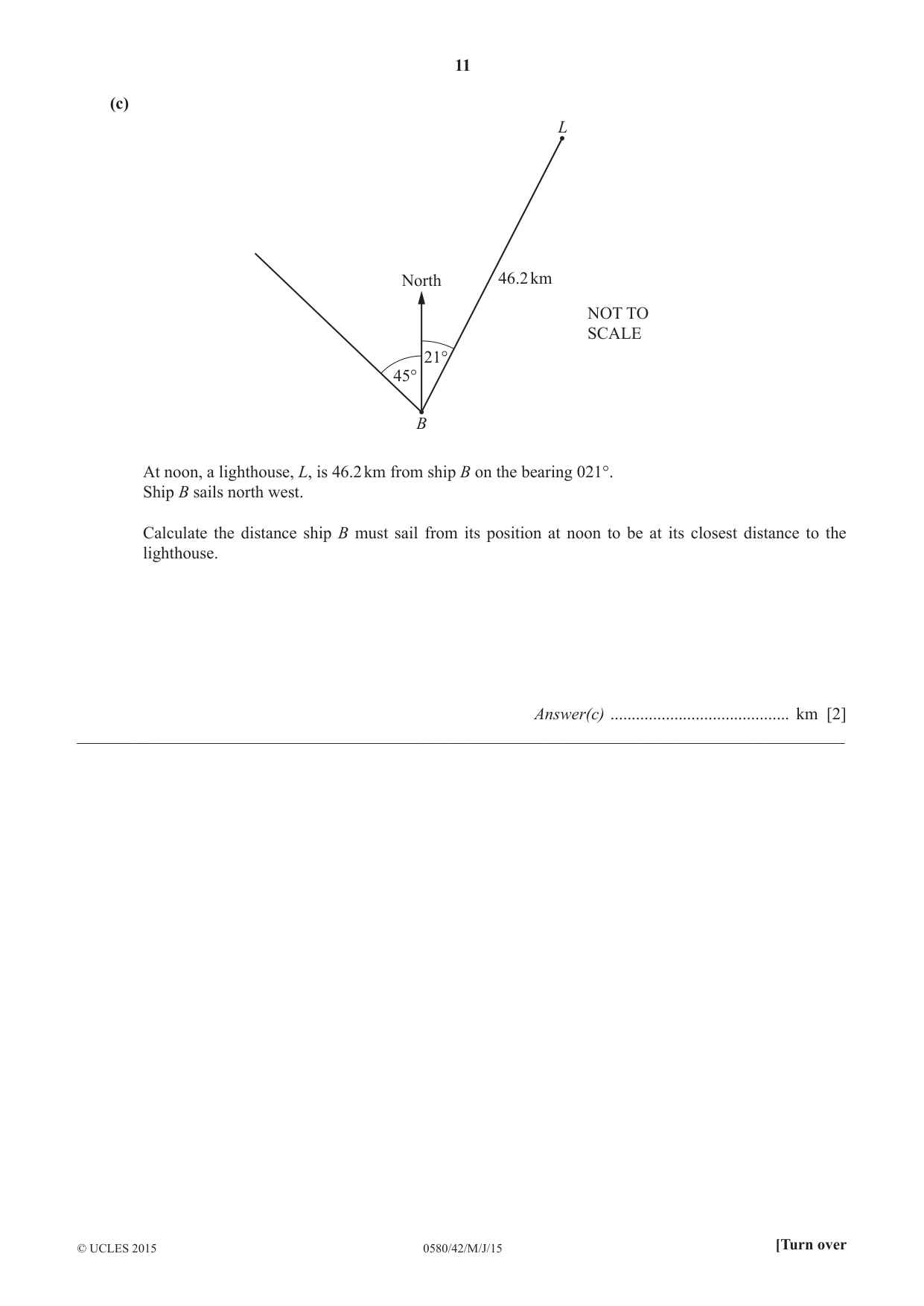
6 The diagram shows the positions of two ships, A and B, and a coastguard station, C. North A B NOT TO 95.5 km SCALE 83.1 km 101° C (a) Calculate the distance, AB, between the two ships. Show that it rounds to 138 km, correct to the nearest kilometre. Answer(a) [4] (b) The bearing of the coastguard station C from ship A is 146°. Calculate the bearing of ship B from ship A. Answer(b) ................................................ [4] (c) L North 46.2 km NOT TO SCALE 21° 45° B At noon, a lighthouse, L, is 46.2 km from ship B on the bearing 021°. Ship B sails north west. Calculate the distance ship B must sail from its position at noon to be at its closest distance to the lighthouse. Answer(c) .......................................... km [2] __________________________________________________________________________________________
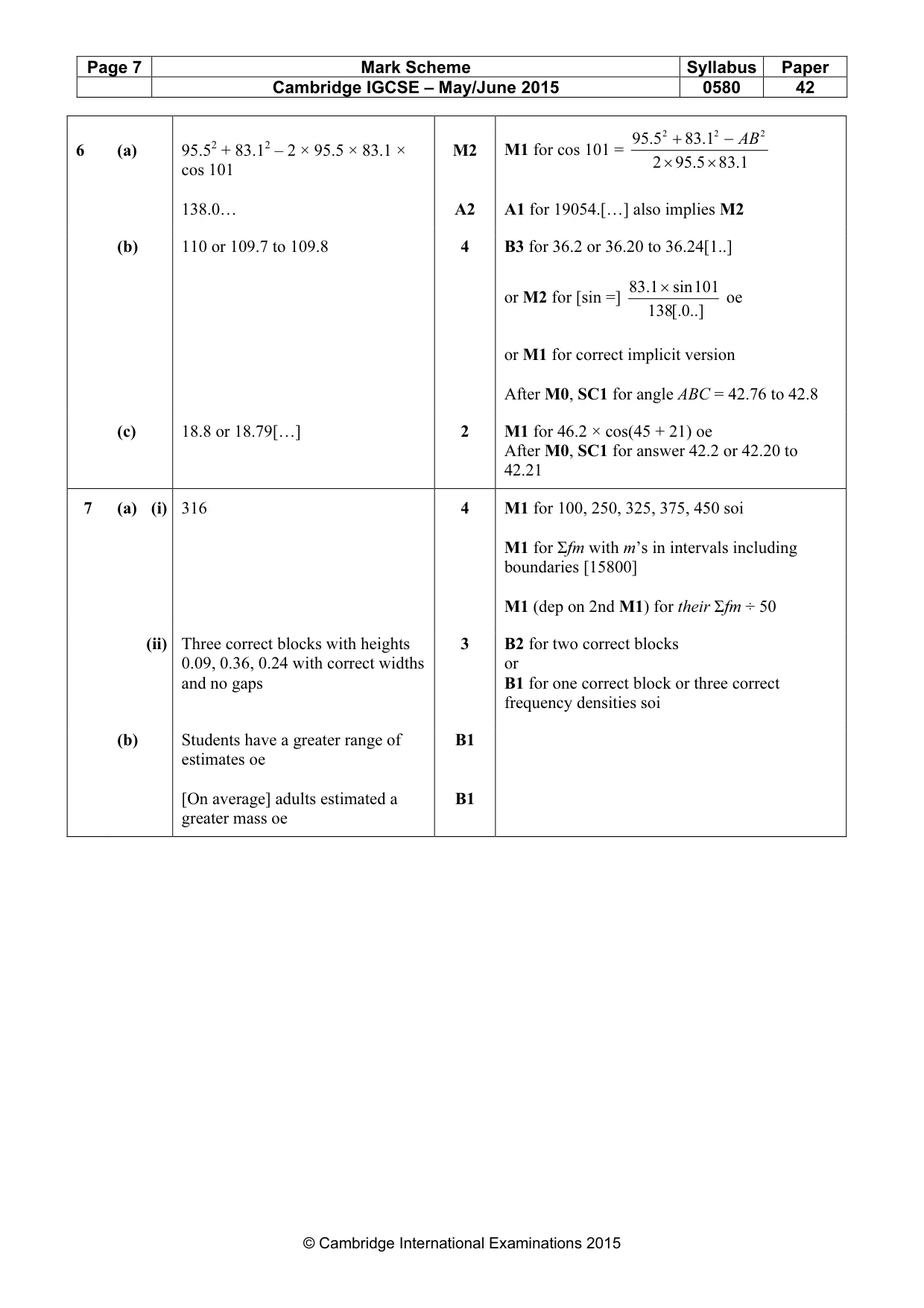
Mark scheme: 955. + 831. AB 6 (a) 95.52 + 83.12 – 2 × 95.5 × 83.1 × M2 M1 for cos 101 = 2 × 955. × 831. cos 101 138.0… A2 A1 for 19054.[…] also implies M2 (b) 110 or 109.7 to 109.8 4 B3 for 36.2 or 36.20 to 36.24[1..] 831. × sin 101 or M2 for [sin =] oe 138[.0..] or M1 for correct implicit version After M0, SC1 for angle ABC = 42.76 to 42.8 (c) 18.8 or 18.79[…] 2 M1 for 46.2 × cos(45 + 21) oe After M0, SC1 for answer 42.2 or 42.20 to 42.21
Q7 · A group of 50 students estimated the mass, M grams, of sweets in a jar
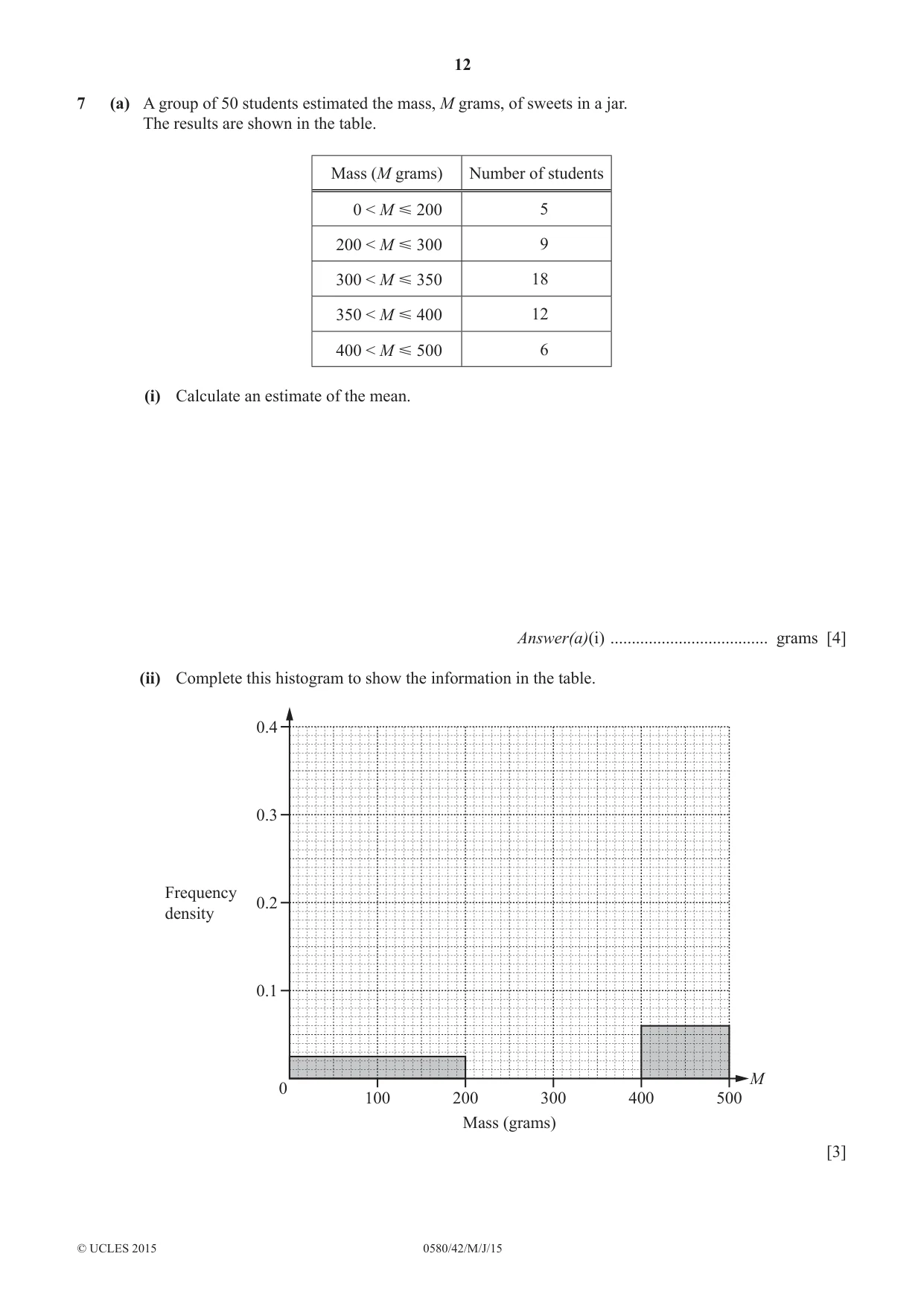
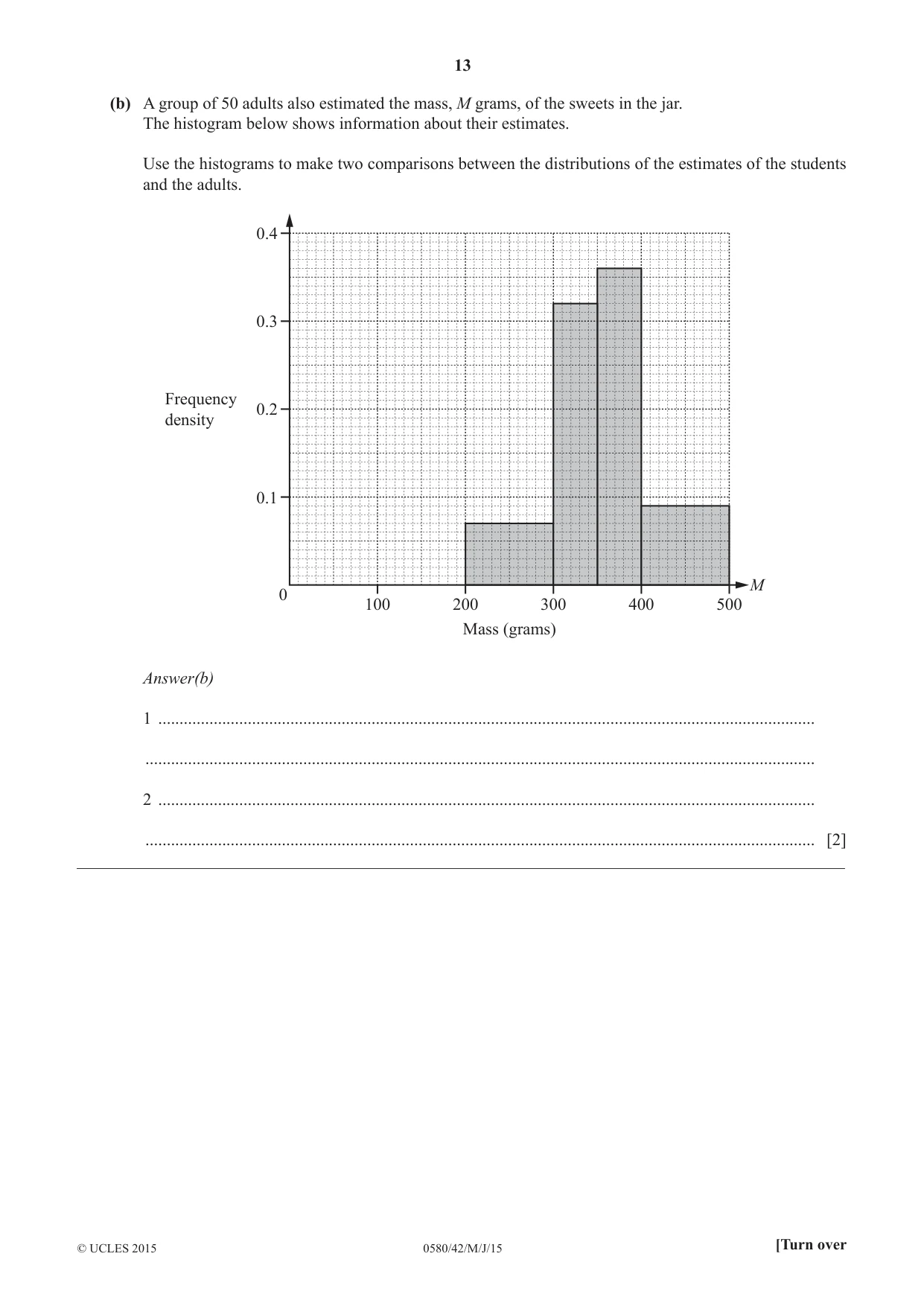
7 (a) A group of 50 students estimated the mass, M grams, of sweets in a jar. The results are shown in the table. Mass (M grams) Number of students 0 < M 200 5 200 < M 300 9 300 < M 350 18 350 < M 400 12 400 < M 500 6 (i) Calculate an estimate of the mean. Answer(a)(i) ..................................... grams [4] (ii) Complete this histogram to show the information in the table. 0.4 0.3 Frequency 0.2 density 0.1 M 0 100 200 300 400 500 Mass (grams) [3] (b) A group of 50 adults also estimated the mass, M grams, of the sweets in the jar. The histogram below shows information about their estimates. Use the histograms to make two comparisons between the distributions of the estimates of the students and the adults. 0.4 0.3 Frequency 0.2 density 0.1 M 0 100 200 300 400 500 Mass (grams) Answer(b) 1 .......................................................................................................................................................... ............................................................................................................................................................. 2 .......................................................................................................................................................... ............................................................................................................................................................. [2] __________________________________________________________________________________________
Mark scheme: 7 (a) (i) 316 4 M1 for 100, 250, 325, 375, 450 soi M1 for Σfm with m’s in intervals including boundaries [15800] M1 (dep on 2nd M1) for their Σfm ÷ 50 (ii) Three correct blocks with heights 3 B2 for two correct blocks 0.09, 0.36, 0.24 with correct widths or and no gaps B1 for one correct block or three correct frequency densities soi (b) Students have a greater range of B1 estimates oe [On average] adults estimated a B1 greater mass oe
Q8 · Sima sells x biscuits and y cakes
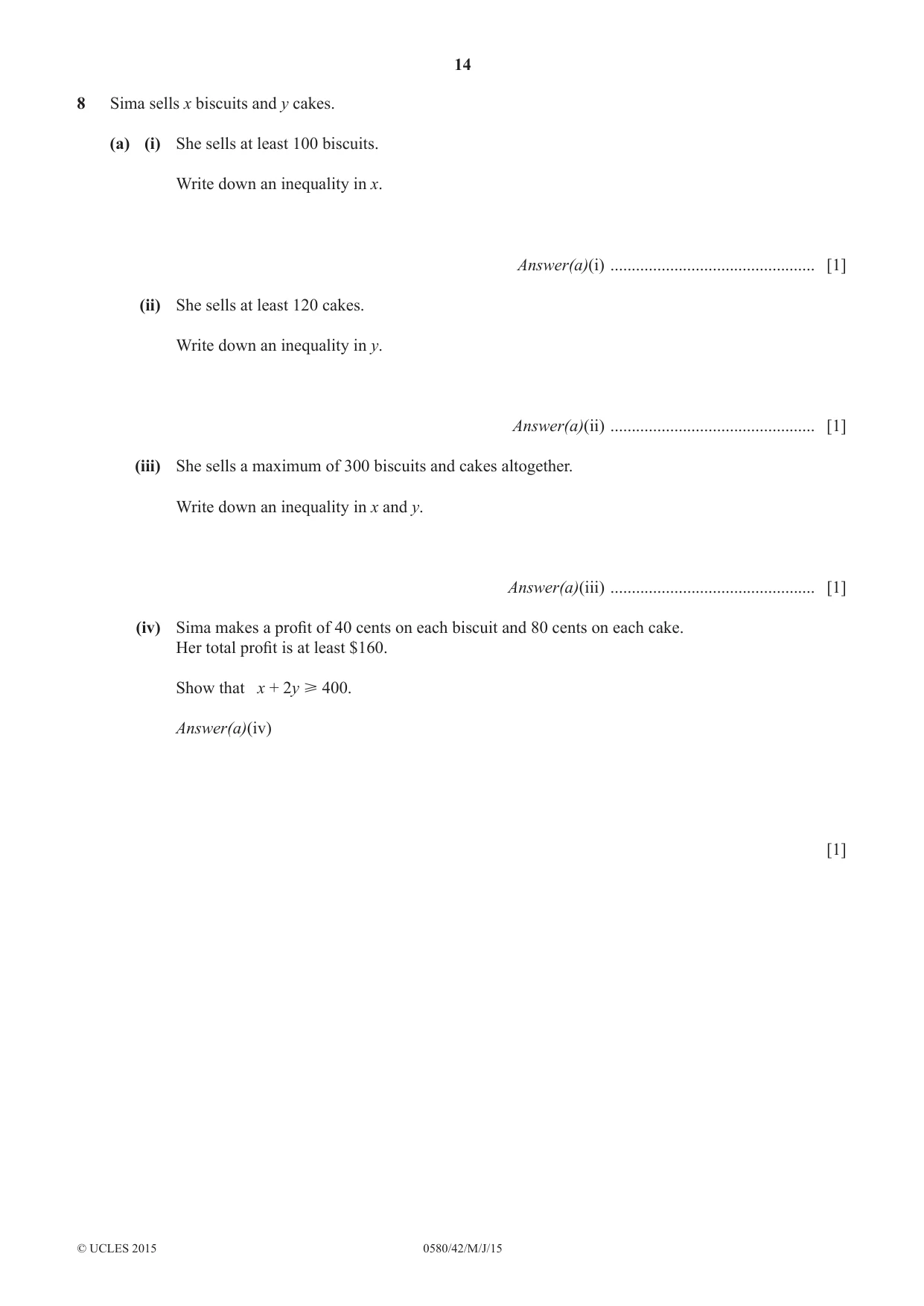
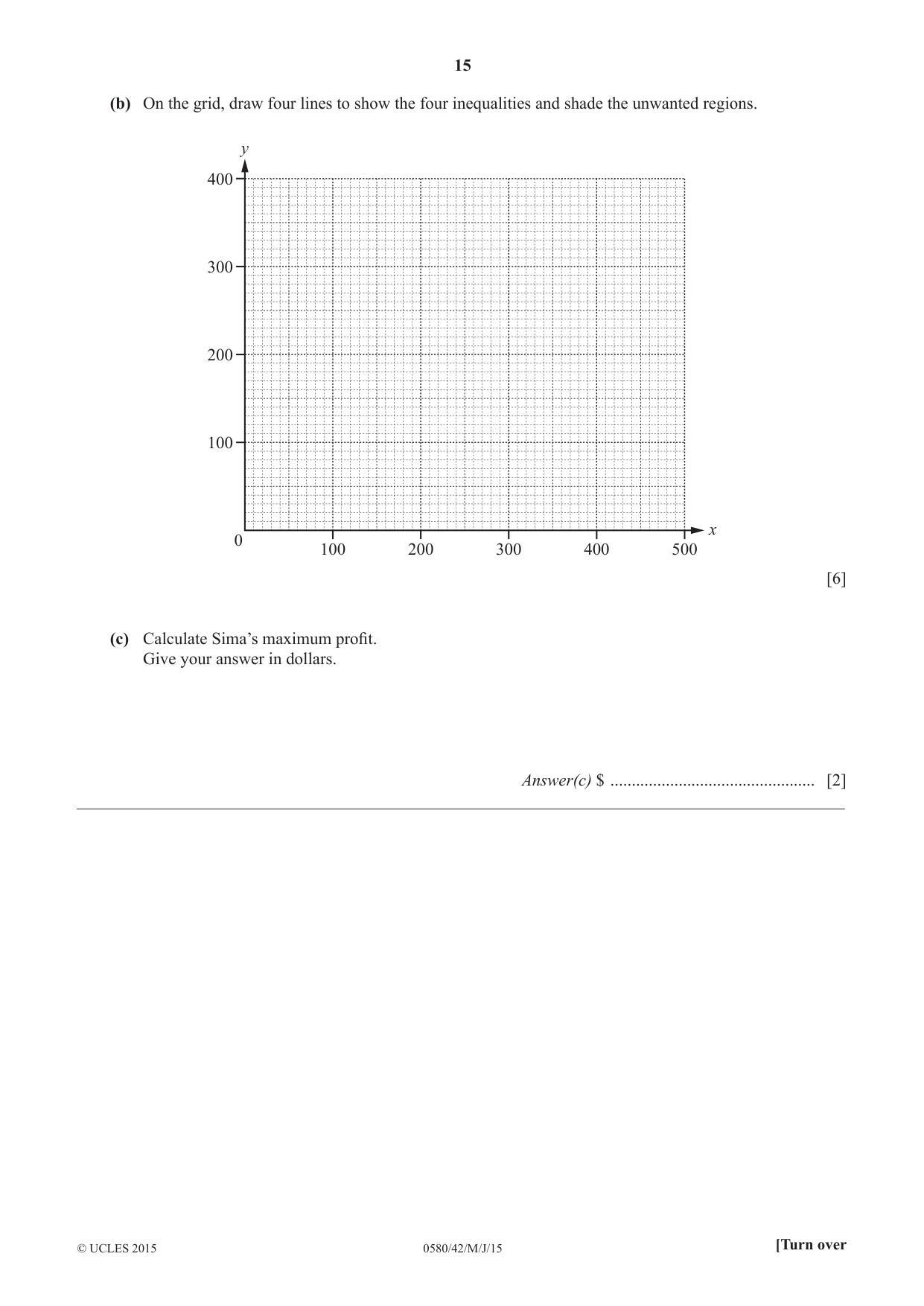
8 Sima sells x biscuits and y cakes. (a) (i) She sells at least 100 biscuits. Write down an inequality in x. Answer(a)(i) ................................................ [1] (ii) She sells at least 120 cakes. Write down an inequality in y. Answer(a)(ii) ................................................ [1] (iii) She sells a maximum of 300 biscuits and cakes altogether. Write down an inequality in x and y. Answer(a)(iii) ................................................ [1] (iv) Sima makes a profit of 40 cents on each biscuit and 80 cents on each cake. Her total profit is at least $160. Show that x + 2y 400. Answer(a)(iv) [1] (b) On the grid, draw four lines to show the four inequalities and shade the unwanted regions. y 400 300 200 100 x 0 100 200 300 400 500 [6] (c) Calculate Sima’s maximum profit. Give your answer in dollars. Answer(c) $ ................................................ [2] __________________________________________________________________________________________
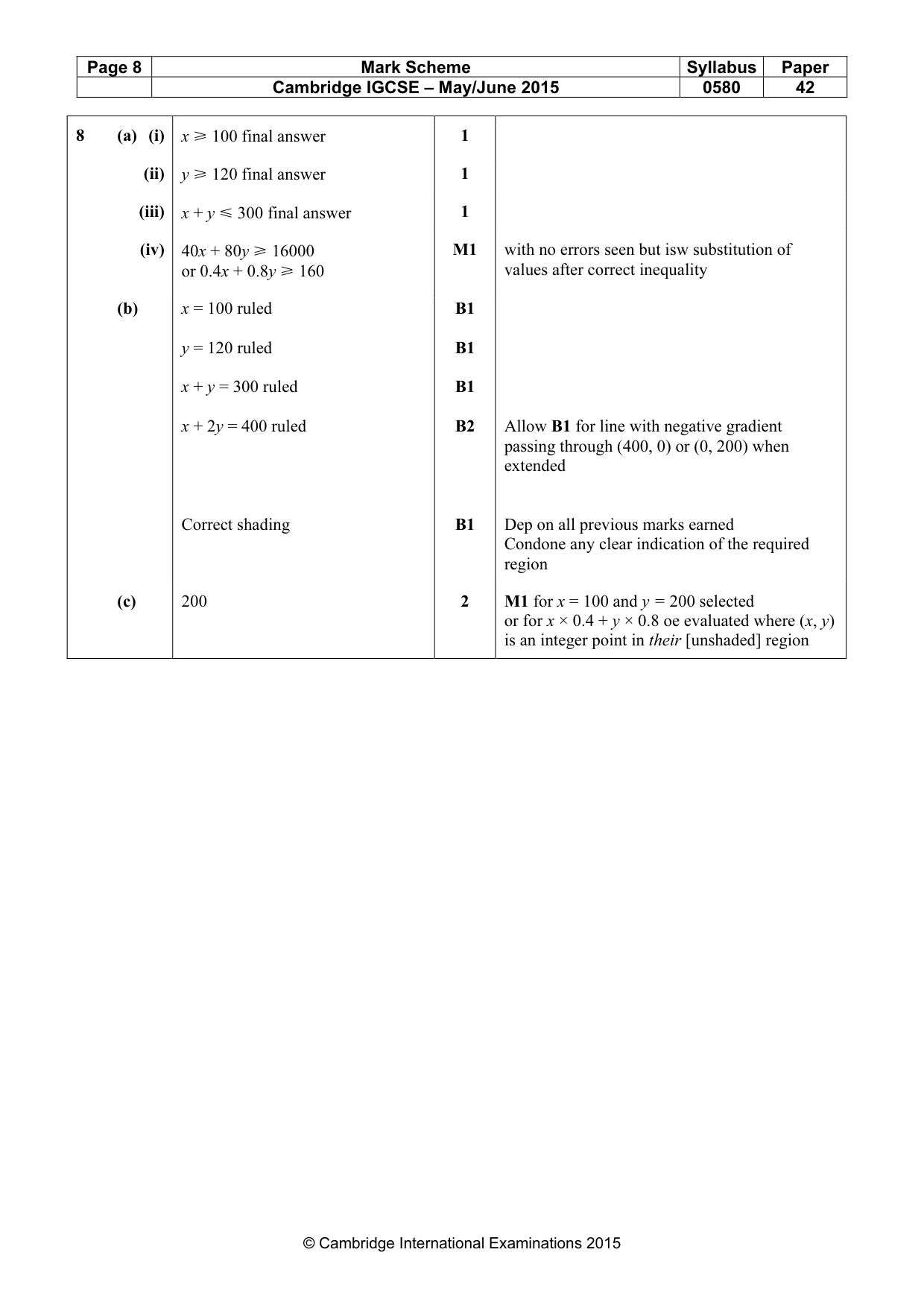
Mark scheme: 8 (a) (i) x [ 100 final answer 1 (ii) y [ 120 final answer 1 (iii) x + y Y 300 final answer 1 (iv) 40x + 80y [ 16000 M1 with no errors seen but isw substitution of or 0.4x + 0.8y [ 160 values after correct inequality (b) x = 100 ruled B1 y = 120 ruled B1 x + y = 300 ruled B1 x + 2y = 400 ruled B2 Allow B1 for line with negative gradient passing through (400, 0) or (0, 200) when extended Correct shading B1 Dep on all previous marks earned Condone any clear indication of the required region (c) 200 2 M1 for x = 100 and y = 200 selected or for x × 0.4 + y × 0.8 oe evaluated where (x, y) is an integer point in their [unshaded] region 2 2 2
Question 9
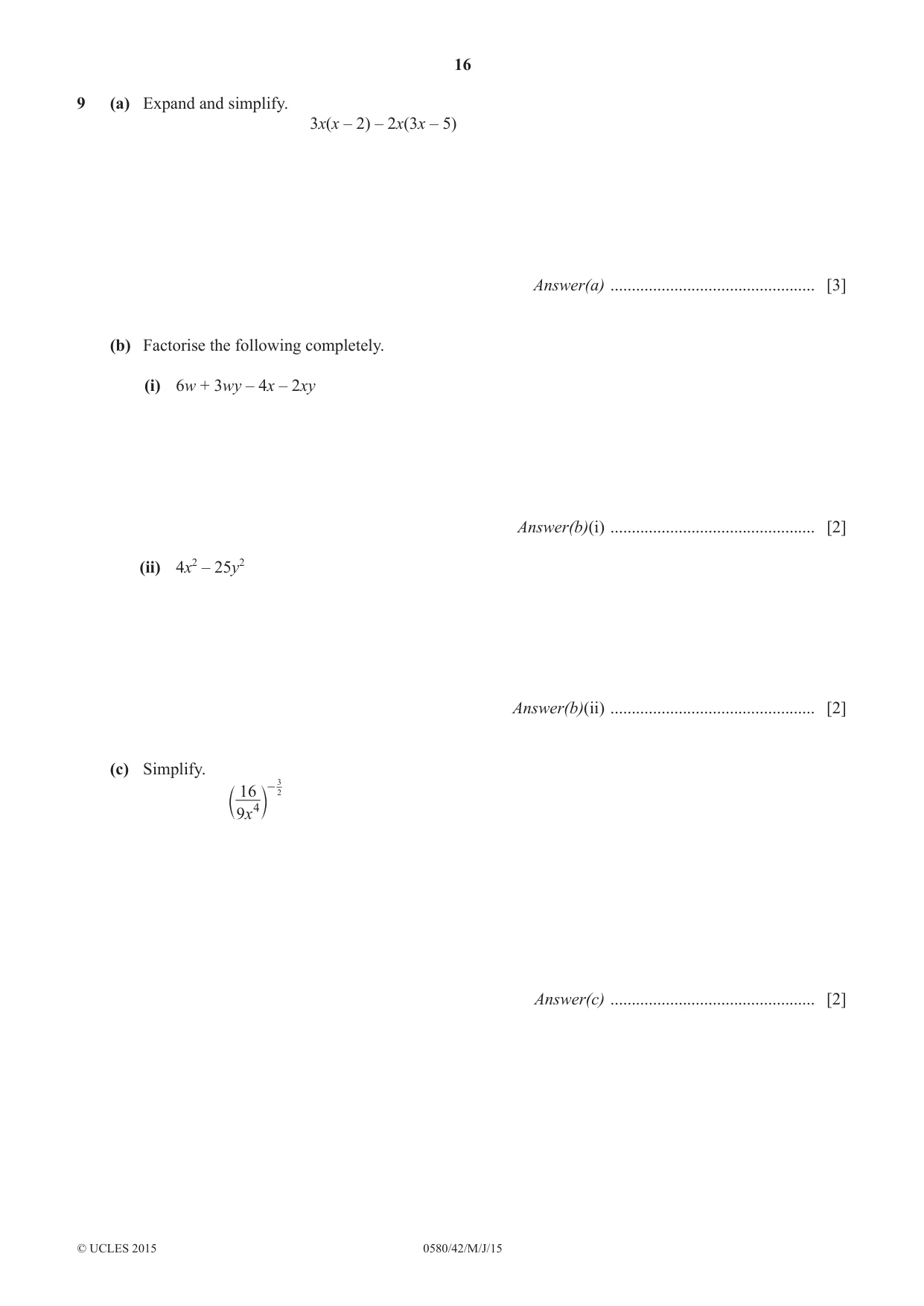
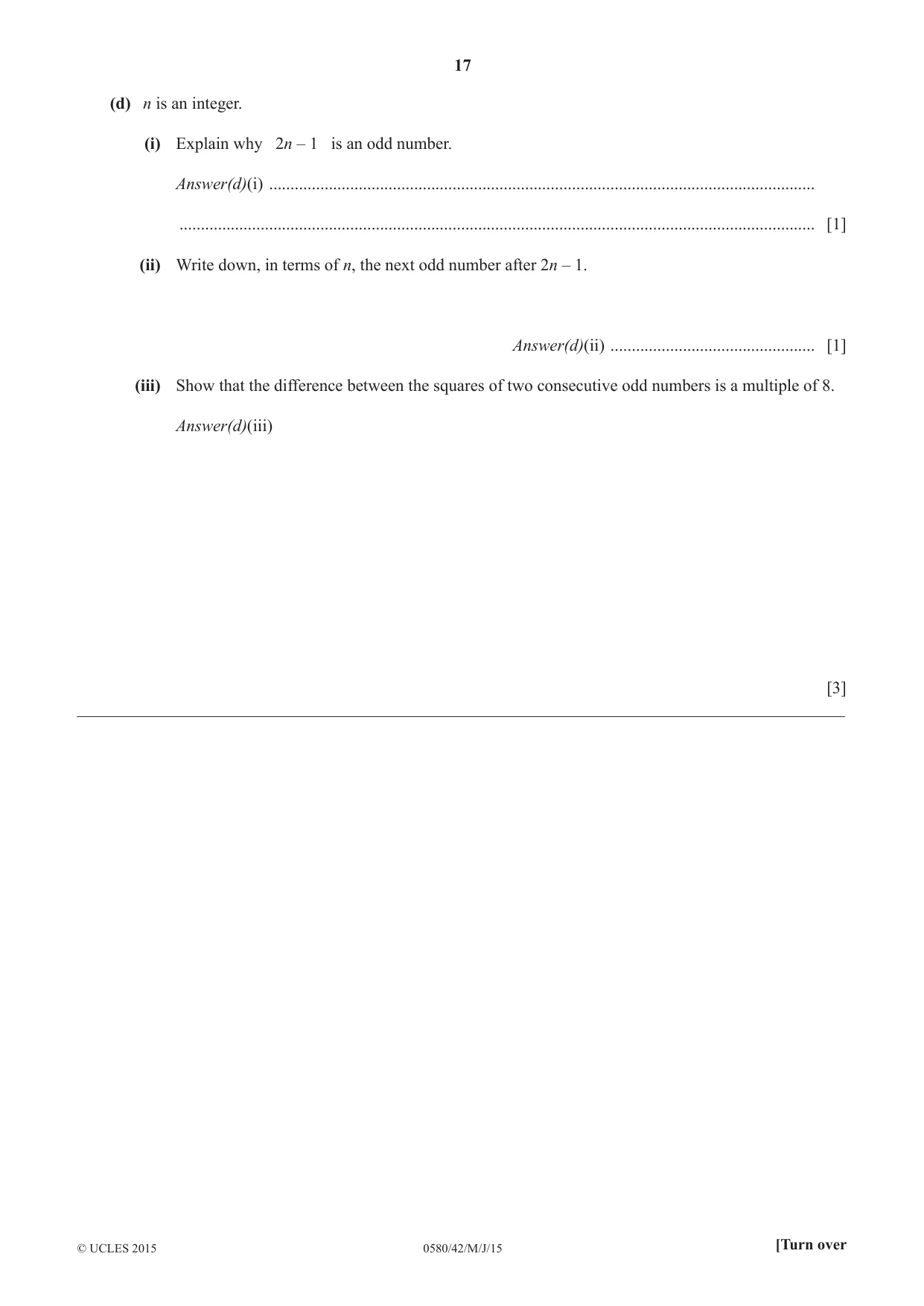
9 (a) Expand and simplify. 3x(x – 2) – 2x(3x – 5) Answer(a) ................................................ [3] (b) Factorise the following completely. (i) 6w + 3wy – 4x – 2xy Answer(b)(i) ................................................ [2] (ii) 4x2 – 25y2 Answer(b)(ii) ................................................ [2] (c) Simplify. 16 - 32 4 c 9 m x Answer(c) ................................................ [2] (d) n is an integer. (i) Explain why 2n – 1 is an odd number. Answer(d)(i) ................................................................................................................................ ..................................................................................................................................................... [1] (ii) Write down, in terms of n, the next odd number after 2n – 1. Answer(d)(ii) ................................................ [1] (iii) Show that the difference between the squares of two consecutive odd numbers is a multiple of 8. Answer(d)(iii) [3] __________________________________________________________________________________________
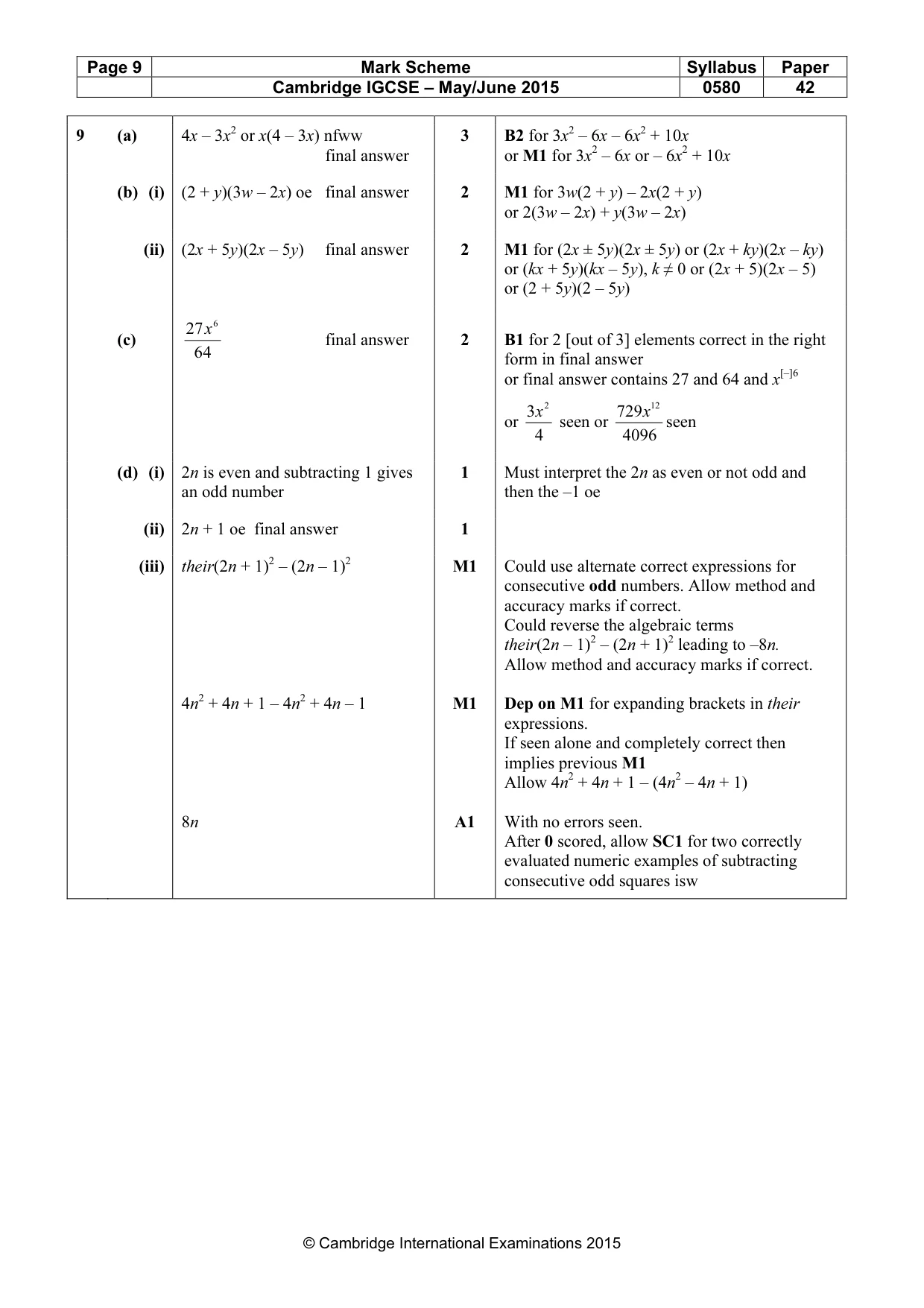
Mark scheme: 9 (a) 4x – 3x2 or x(4 – 3x) nfww 3 B2 for 3x2 – 6x – 6x2 + 10x final answer or M1 for 3x2 – 6x or – 6x2 + 10x (b) (i) (2 + y)(3w – 2x) oe final answer 2 M1 for 3w(2 + y) – 2x(2 + y) or 2(3w – 2x) + y(3w – 2x) (ii) (2x + 5y)(2x – 5y) final answer 2 M1 for (2x ± 5y)(2x ± 5y) or (2x + ky)(2x – ky) or (kx + 5y)(kx – 5y), k ≠ 0 or (2x + 5)(2x – 5) or (2 + 5y)(2 – 5y) 27 6x (c) final answer 2 B1 for 2 [out of 3] elements correct in the right 64 form in final answer or final answer contains 27 and 64 and x[–]6 3 2x 729 x 12 or seen or seen 4 4096 (d) (i) 2n is even and subtracting 1 gives 1 Must interpret the 2n as even or not odd and an odd number then the –1 oe (ii) 2n + 1 oe final answer 1 (iii) their(2n + 1)2 – (2n – 1)2 M1 Could use alternate correct expressions for consecutive odd numbers. Allow method and accuracy marks if correct. Could reverse the algebraic terms their(2n – 1)2 – (2n + 1)2 leading to –8n. Allow method and accuracy marks if correct. 4n2 + 4n + 1 – 4n2 + 4n – 1 M1 Dep on M1 for expanding brackets in their expressions. If seen alone and completely correct then implies previous M1 Allow 4n2 + 4n + 1 – (4n2 – 4n + 1) 8n A1 With no errors seen. After 0 scored, allow SC1 for two correctly evaluated numeric examples of subtracting consecutive odd squares isw 2 2
Q10 · 10 (a) = c - 8 m (i) Find the value of
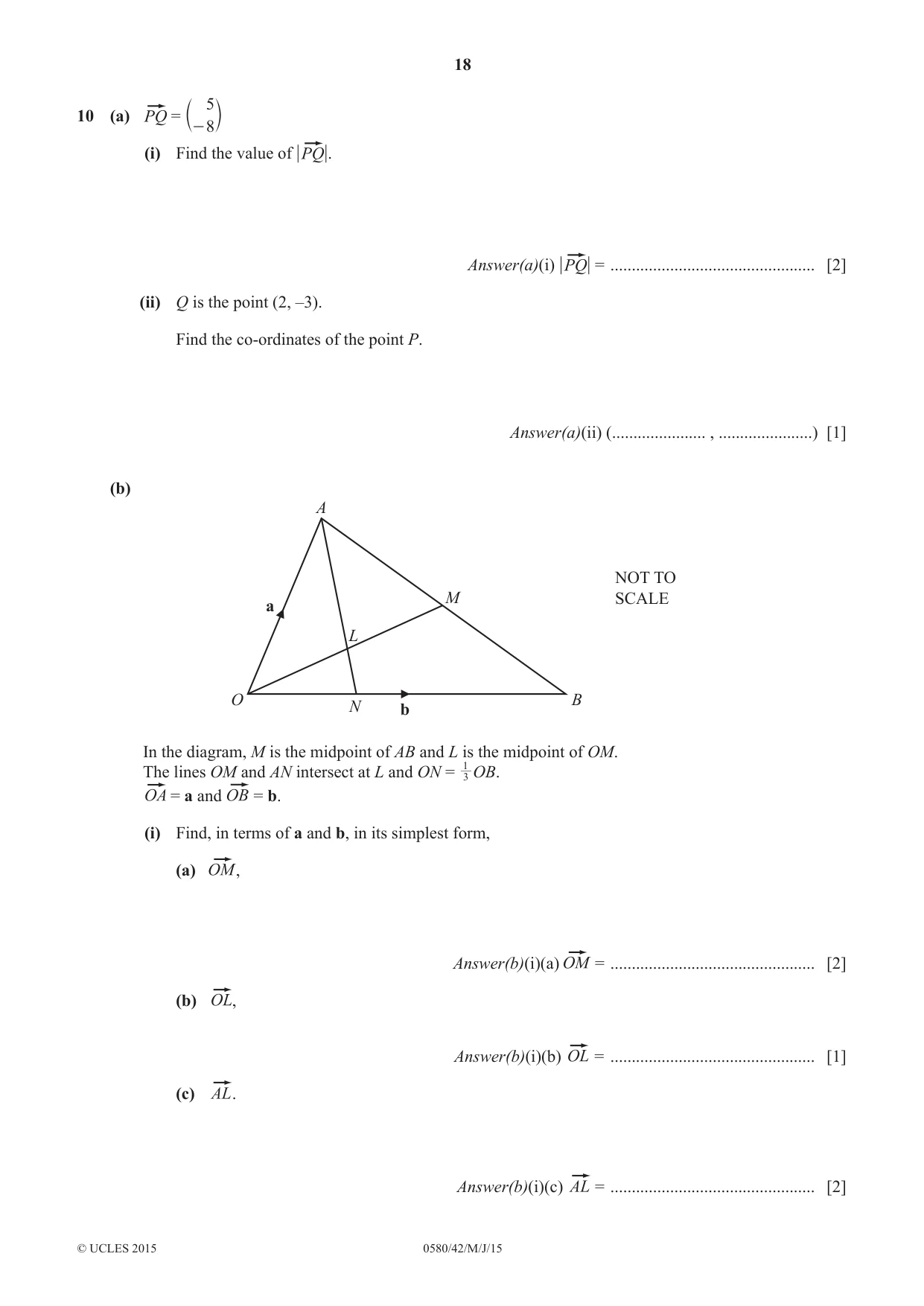
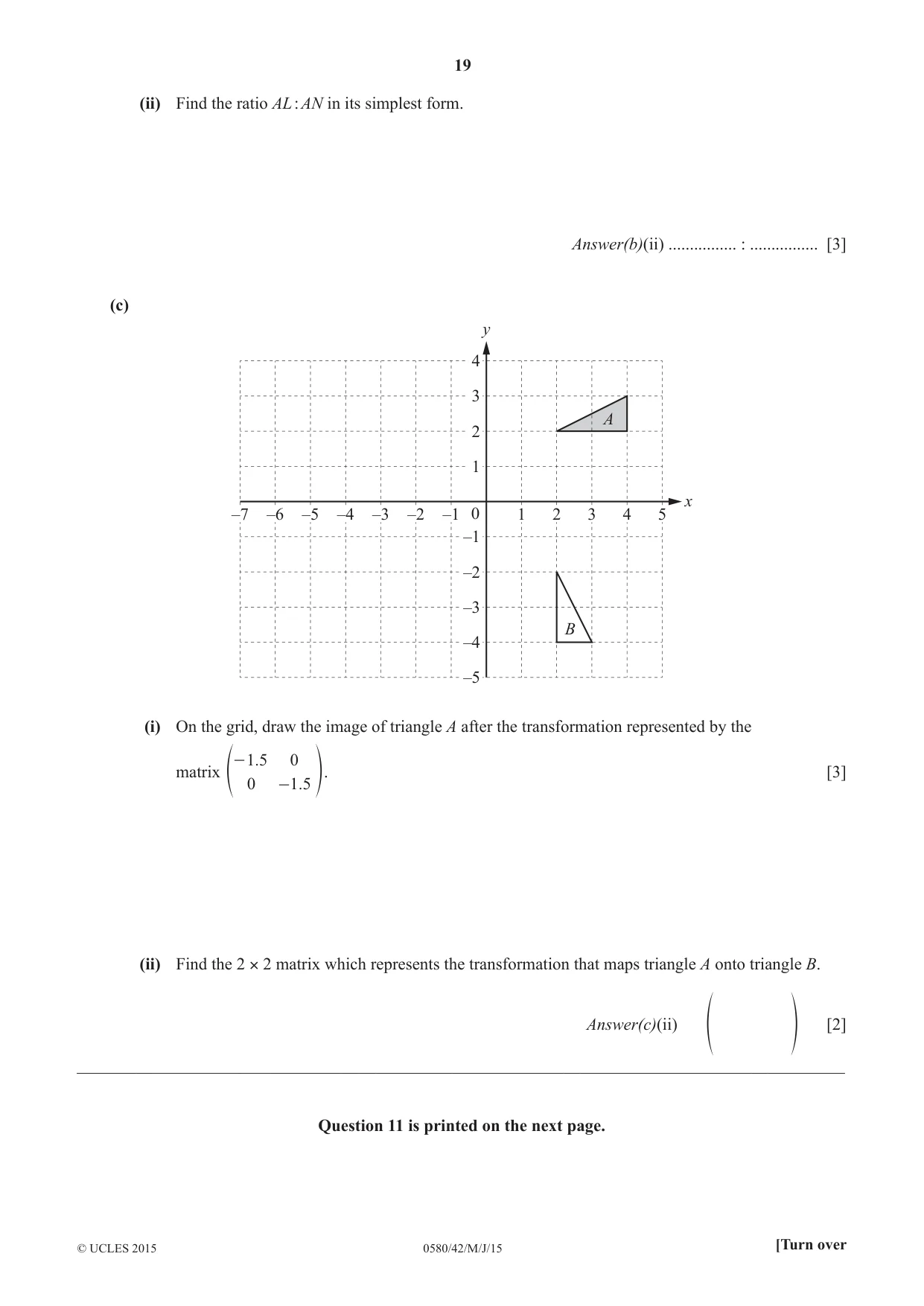
5 10 (a) = c - 8 m (i) Find the value of . Answer(a)(i) = ................................................ [2] (ii) Q is the point (2, –3). Find the co-ordinates of the point P. Answer(a)(ii) (...................... , ......................) [1] (b) A NOT TO M SCALE a L O B N b In the diagram, M is the midpoint of AB and L is the midpoint of OM. The lines OM and AN intersect at L and ON = 13 OB. = a and = b. (i) Find, in terms of a and b, in its simplest form, (a) , Answer(b)(i)(a) = ................................................ [2] (b) , Answer(b)(i)(b) = ................................................ [1] (c) . Answer(b)(i)(c) = ................................................ [2] (ii) Find the ratio AL : AN in its simplest form. Answer(b)(ii) ................ : ................ [3] (c) y 4 3 A 2 1 x –7 –6 –5 –4 –3 –2 –1 0 1 2 3 4 5 –1 –2 –3 B –4 –5 (i) On the grid, draw the image of triangle A after the transformation represented by the - 1.5 0 matrix [3] f 0 - 1.5 p. (ii) Find the 2 × 2 matrix which represents the transformation that maps triangle A onto triangle B. Answer(c)(ii) [2] f p __________________________________________________________________________________________ Question 11 is printed on the next page.
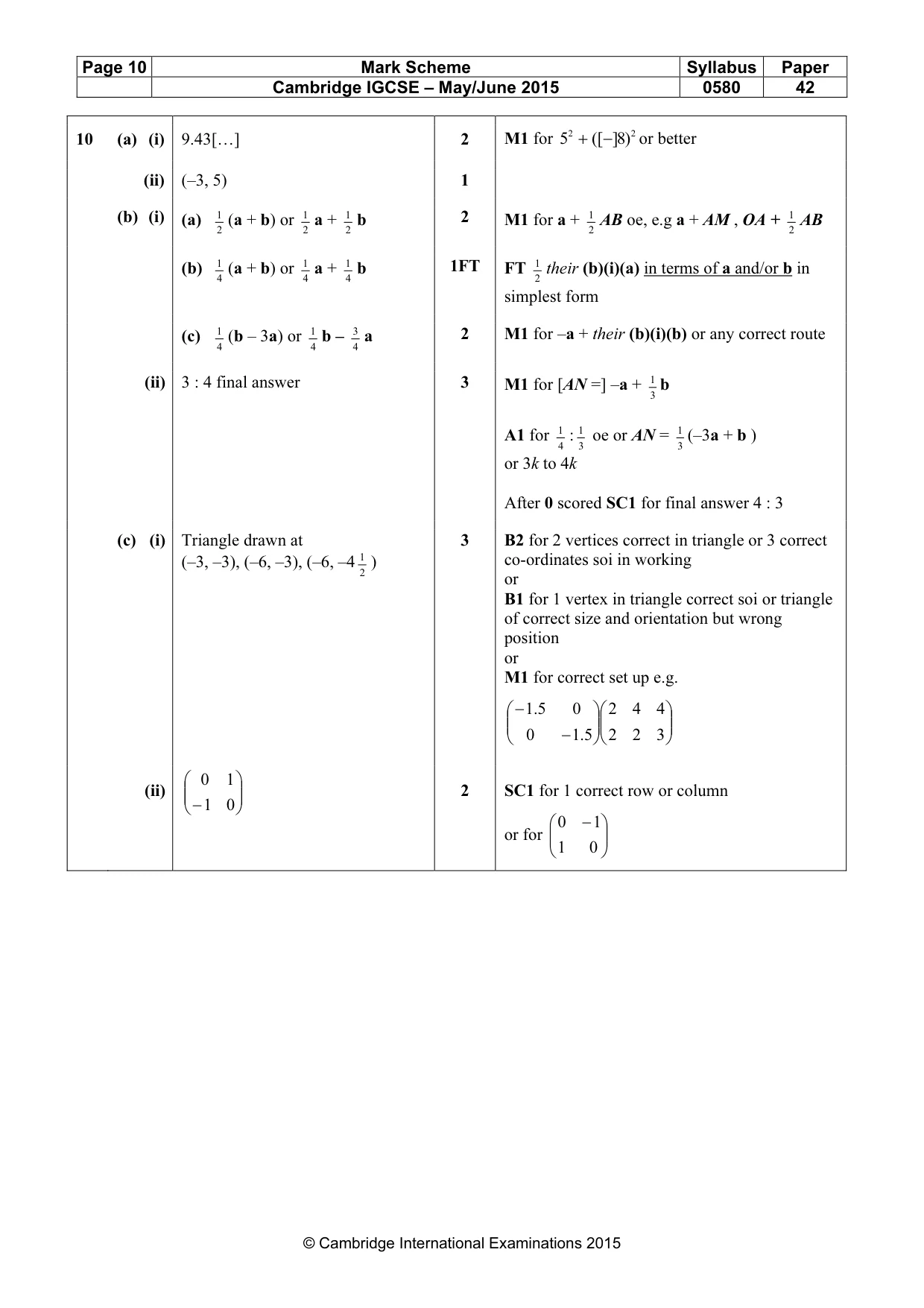
Mark scheme: 10 (a) (i) 9.43[…] 2 M1 for 52 + ([−)8] 2 or better (ii) (–3, 5) 1 (b) (i) (a) 1 (a + b) or 1 a + 1 b 2 M1 for a + 1 AB oe, e.g a + AM , OA + 1 AB 2 2 2 2 2 (b) 1 (a + b) or 1 a + 1 b 1FT FT 1 their (b)(i)(a) in terms of a and/or b in 4 4 4 2 simplest form (c) 1 (b – 3a) or 1 b – 3 a 2 M1 for –a + their (b)(i)(b) or any correct route 4 4 4 (ii) 3 : 4 final answer 3 M1 for [AN =] –a + 1 b 3 A1 for 1 : 1 oe or AN = 1 (–3a + b ) 4 3 3 or 3k to 4k After 0 scored SC1 for final answer 4 : 3 (c) (i) Triangle drawn at 3 B2 for 2 vertices correct in triangle or 3 correct (–3, –3), (–6, –3), (–6, –4 1 ) co-ordinates soi in working 2 or B1 for 1 vertex in triangle correct soi or triangle of correct size and orientation but wrong position or M1 for correct set up e.g. − 5.1 0 2 4 4 0 − 5.1 2 2 3 0 1 (ii) 2 SC1 for 1 correct row or column − 1 0 0 − 1 or for 1 0 38 19
Q11 · Gareth has 8 sweets in a bag
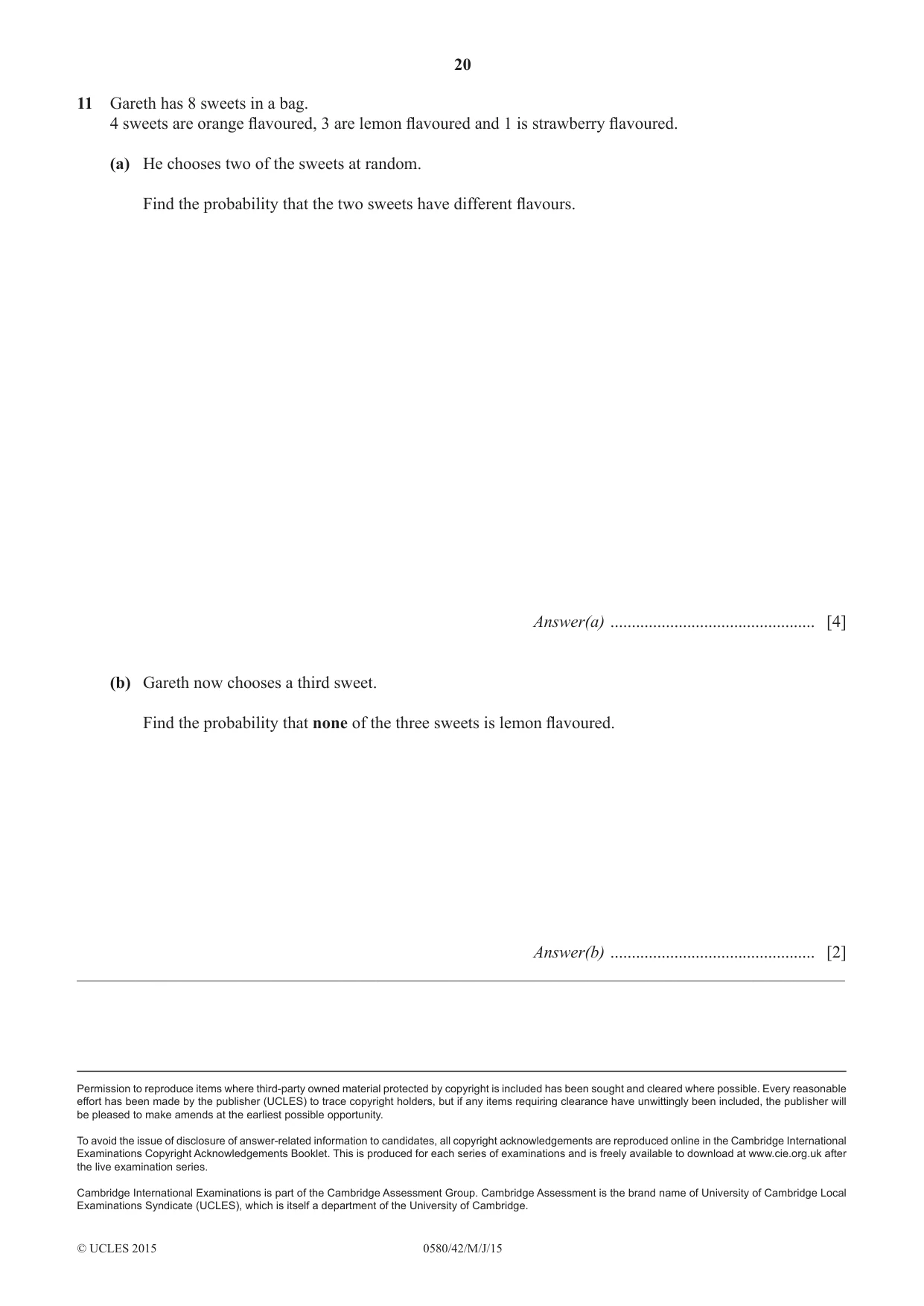
11 Gareth has 8 sweets in a bag. 4 sweets are orange flavoured, 3 are lemon flavoured and 1 is strawberry flavoured. (a) He chooses two of the sweets at random. Find the probability that the two sweets have different flavours. Answer(a) ................................................ [4] (b) Gareth now chooses a third sweet. Find the probability that none of the three sweets is lemon flavoured. Answer(b) ................................................ [2] __________________________________________________________________________________________
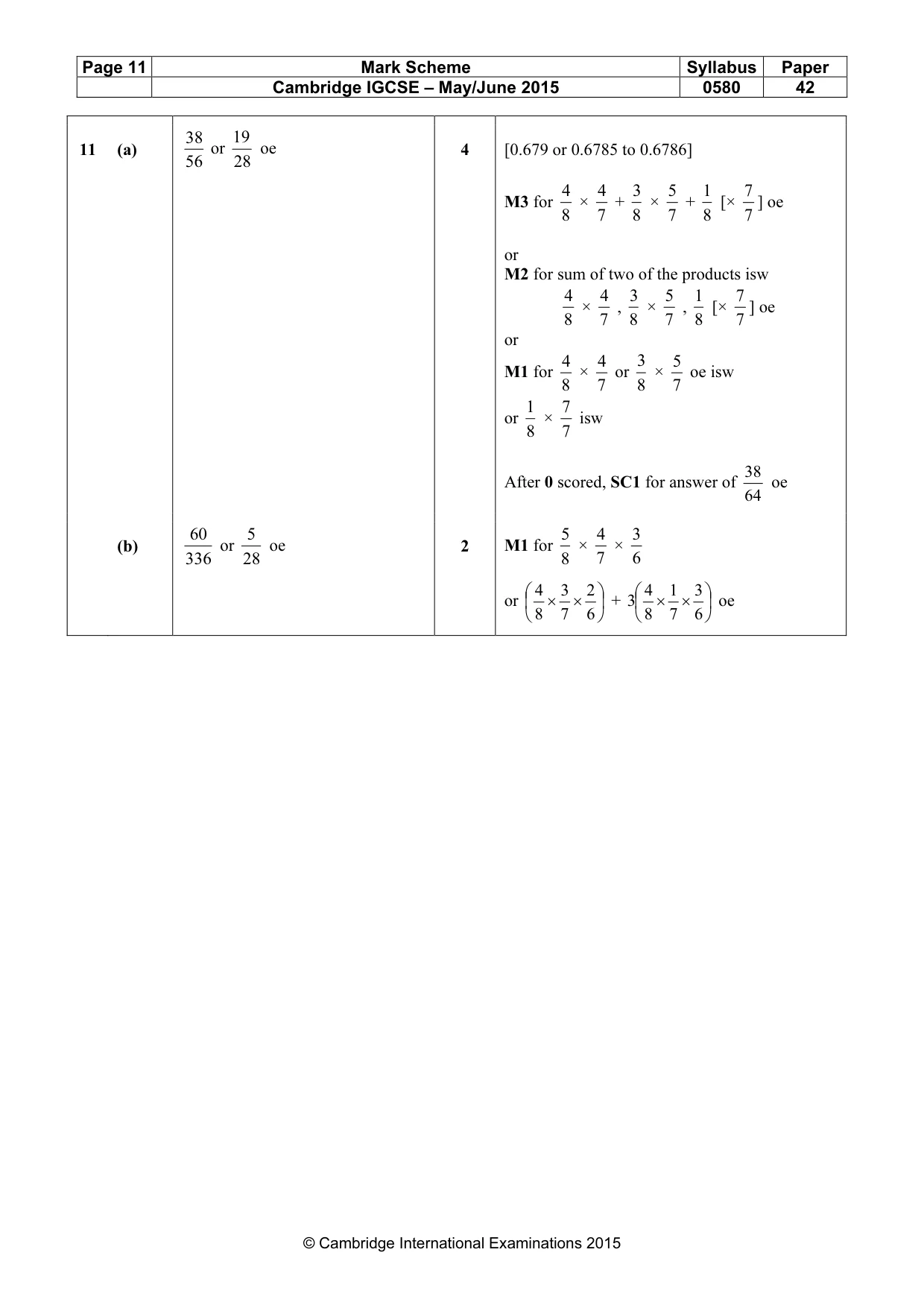
Mark scheme: 38 19 11 (a) or oe 4 [0.679 or 0.6785 to 0.6786] 56 28 4 4 3 5 1 7 M3 for × + × + [× ] oe 8 7 8 7 8 7 or M2 for sum of two of the products isw 4 4 3 5 1 7 × , × , [× ] oe 8 7 8 7 8 7 or 4 4 3 5 M1 for × or × oe isw 8 7 8 7 1 7 or × isw 8 7 38 After 0 scored, SC1 for answer of oe 64 60 5 5 4 3 (b) or oe 2 M1 for × × 336 28 8 7 6 4 3 2 4 1 3 or × × + 3 × × oe 8 7 6 8 7 6
What was in this paper
The subtopics covered by these 11 questions, and how many questions each got. Open one in a new tab to see every Cambridge question on it.
What you needed in this session
Cambridge’s own grade thresholds for 2015 May/June, Paper 4 · Variant 2. A higher threshold means an easier paper — the bar moves with how the cohort did.