Cambridge IGCSE Mathematics 0580 — 2024 Feb/March Paper 4 · Variant 2
0580/42/F/M/24 · 12 questions · 130 marks · ≈146 min
The question paper and its mark scheme, free to read here and free to download. This is Cambridge’s own paper, exactly as it was sat.
Question paper20 pages
Mark scheme11 pages
Answers below. Sit the paper first if you are practising.
Questions as text
Q1 · A grocer sells potatoes, mushrooms and carrots
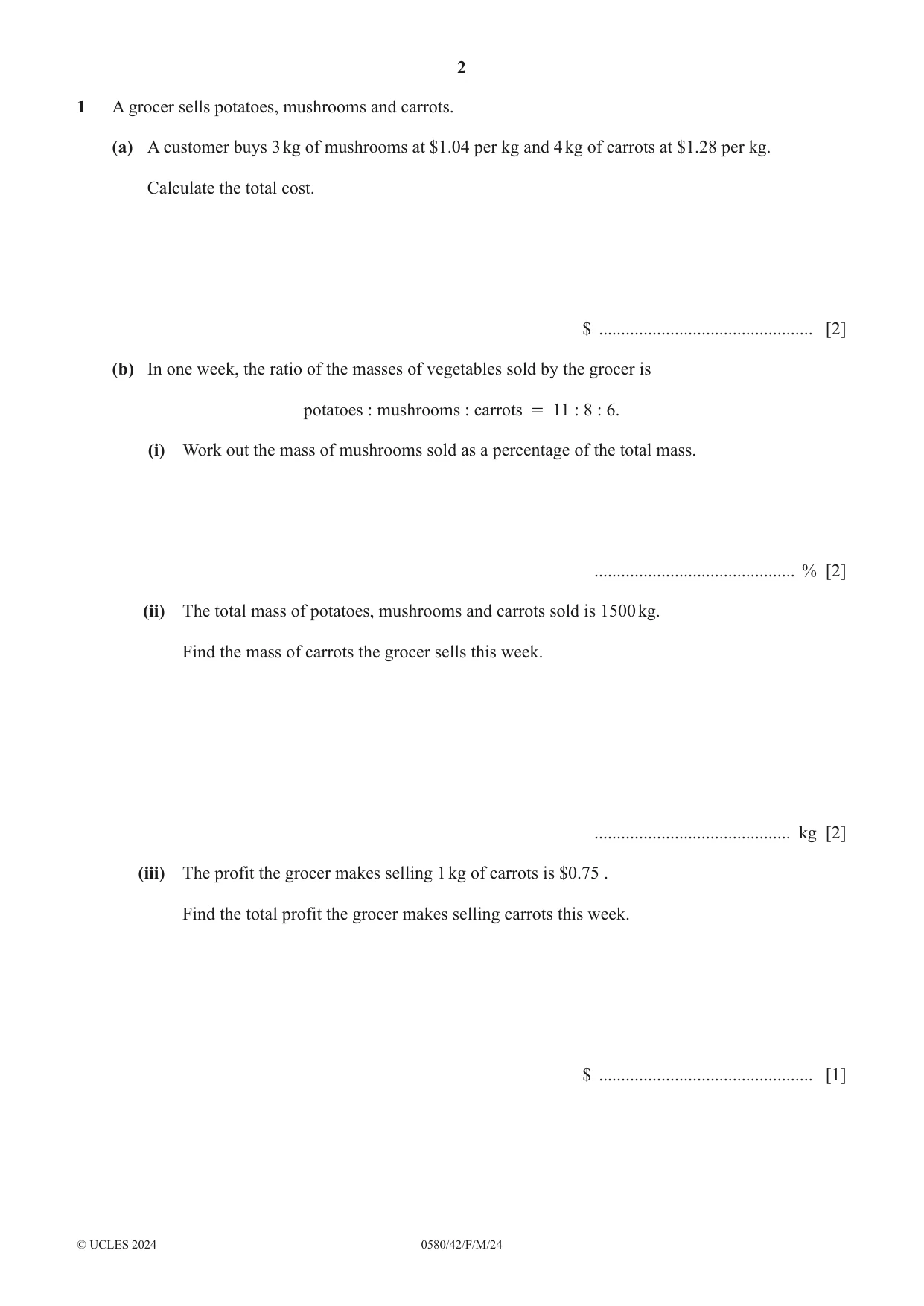
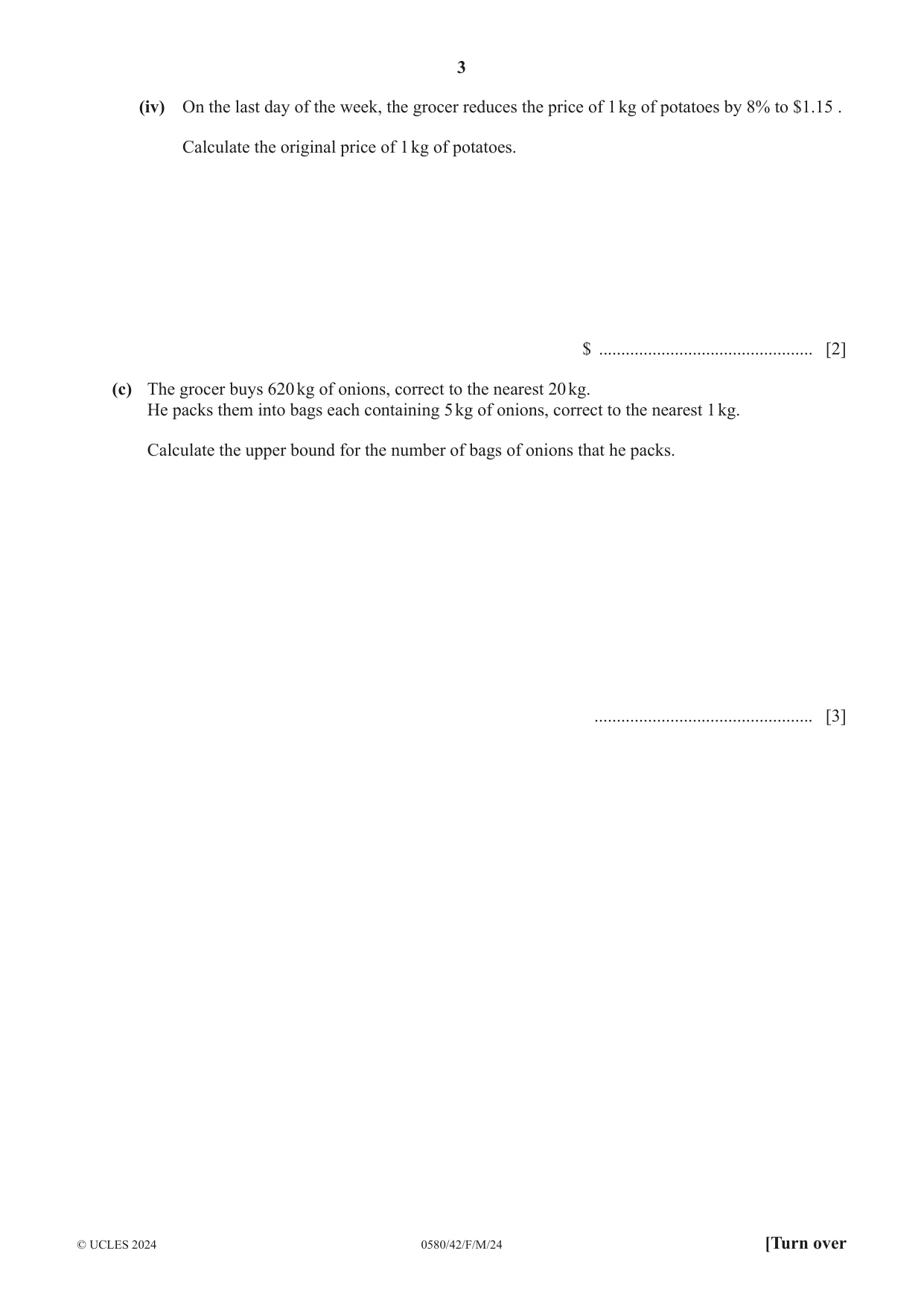
1 A grocer sells potatoes, mushrooms and carrots. (a) A customer buys 3 kg of mushrooms at $1.04 per kg and 4 kg of carrots at $1.28 per kg. Calculate the total cost. $ ................................................ [2] (b) In one week, the ratio of the masses of vegetables sold by the grocer is potatoes : mushrooms : carrots = 11 : 8 : 6. (i) Work out the mass of mushrooms sold as a percentage of the total mass. ............................................. % [2] (ii) The total mass of potatoes, mushrooms and carrots sold is 1500 kg. Find the mass of carrots the grocer sells this week. ............................................ kg [2] (iii) The profit the grocer makes selling 1 kg of carrots is $0.75 . Find the total profit the grocer makes selling carrots this week. $ ................................................ [1] (iv) On the last day of the week, the grocer reduces the price of 1 kg of potatoes by 8% to $1.15 . Calculate the original price of 1 kg of potatoes. $ ................................................ [2] (c) The grocer buys 620 kg of onions, correct to the nearest 20 kg. He packs them into bags each containing 5 kg of onions, correct to the nearest 1 kg. Calculate the upper bound for the number of bags of onions that he packs. ................................................. [3]
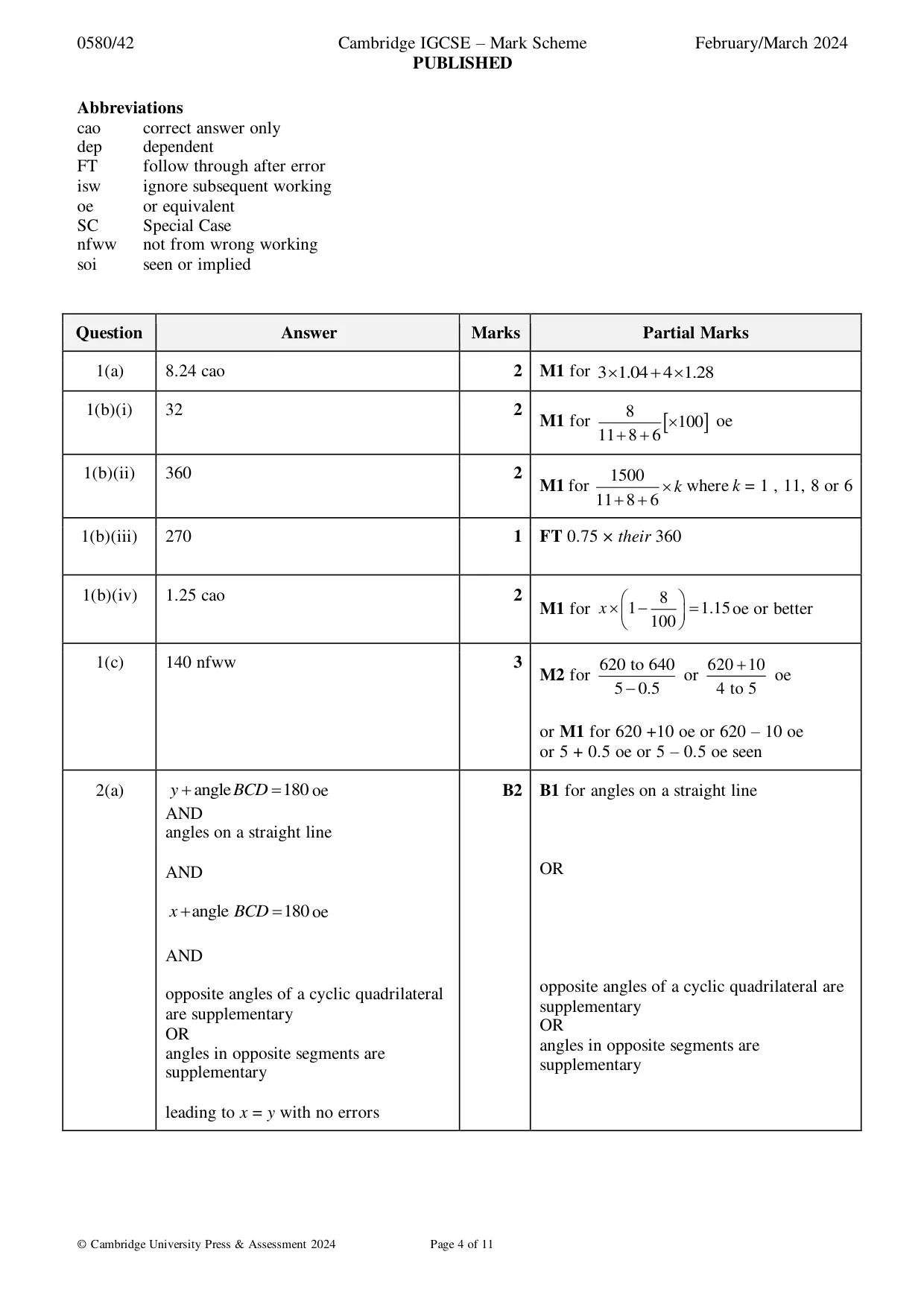
Mark scheme: Question Answer Marks Partial Marks 1(a) 8.24 cao 2 M1 for 3 1.04 + 4 1.28 1(b)(i) 32 2 8 M1 for 100 oe 11 + 8 + 6 1(b)(ii) 360 2 1500 M1 for k where k = 1 , 11, 8 or 6 11 + 8 + 6 1(b)(iii) 270 1 FT 0.75 × their 360 1(b)(iv) 1.25 cao 2 8 M1 for x 1 − = 1.15 oe or better 100 1(c) 140 nfww 3 620 to 640 620 + 10 M2 for or oe 5 − 0.5 4 to 5 or M1 for 620 +10 oe or 620 – 10 oe or 5 + 0.5 oe or 5 – 0.5 oe seen
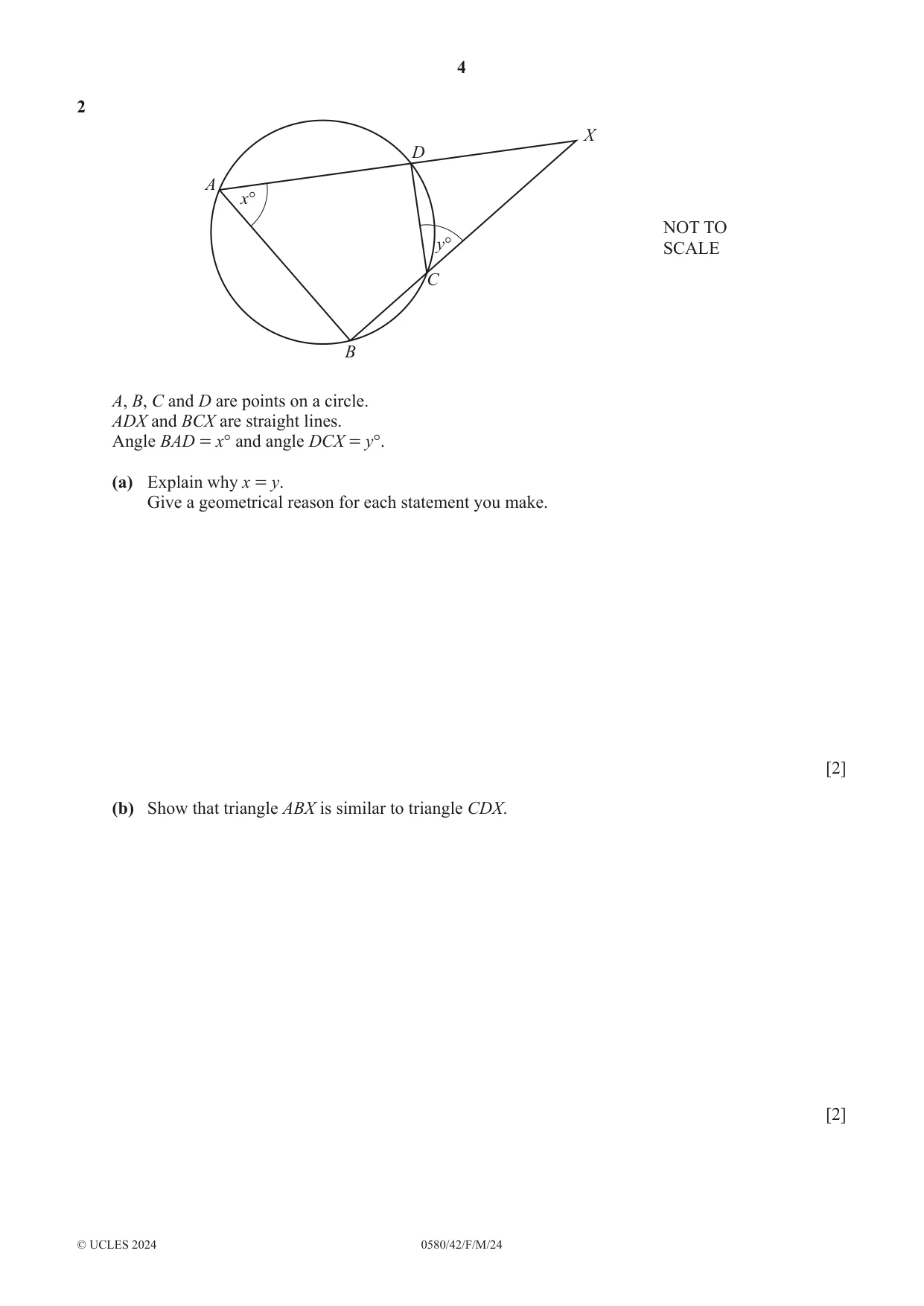
Q2 · X D A x° NOT TO y° SCALE C B A, B, C and D are points on a circle
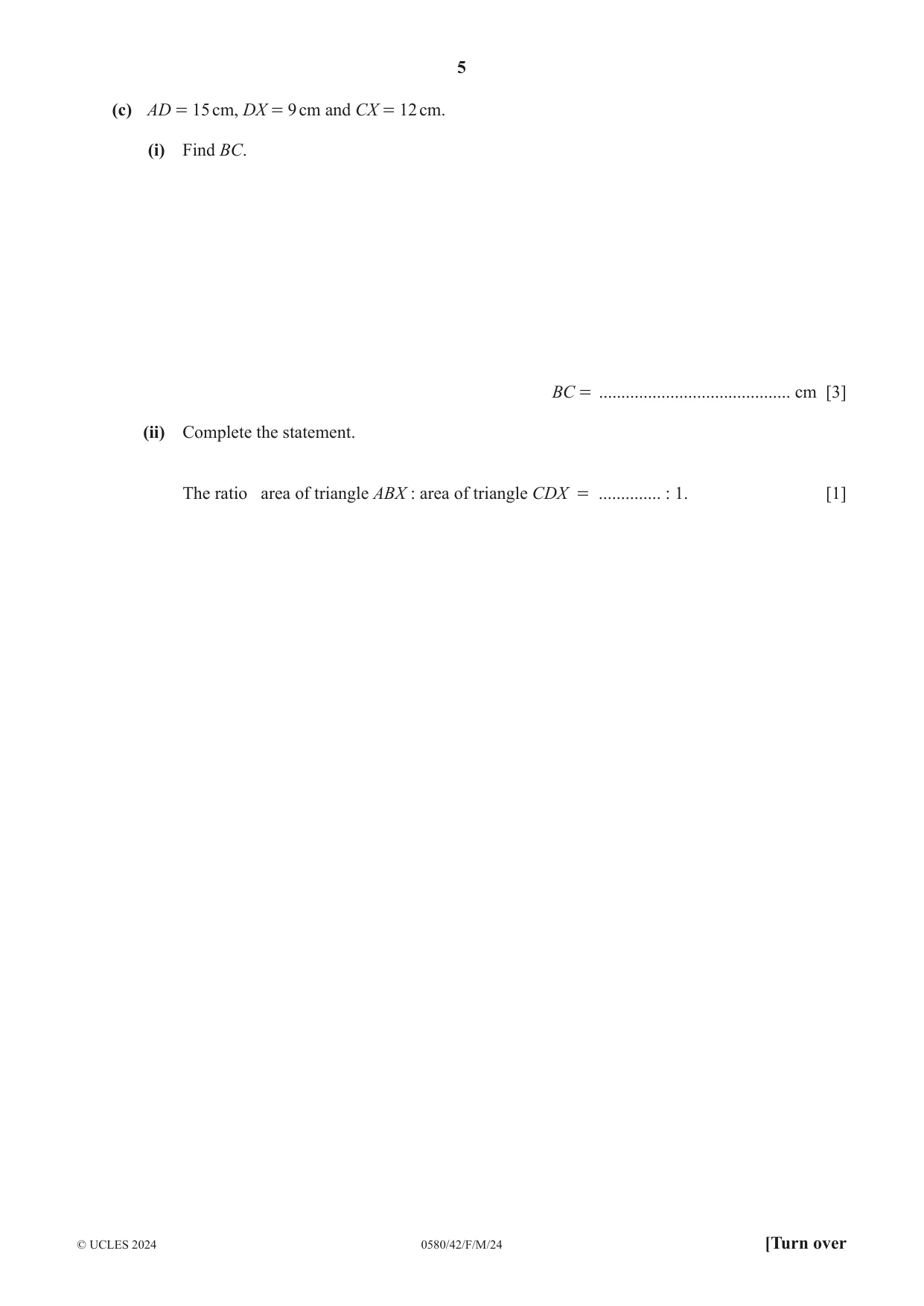
2 X D A x° NOT TO y° SCALE C B A, B, C and D are points on a circle. ADX and BCX are straight lines. Angle BAD = x° and angle DCX = y°. (a) Explain why x = y. Give a geometrical reason for each statement you make. [2] (b) Show that triangle ABX is similar to triangle CDX. [2] (c) AD = 15 cm, DX = 9 cm and CX = 12 cm. (i) Find BC. BC = ........................................... cm [3] (ii) Complete the statement. The ratio area of triangle ABX : area of triangle CDX = .............. : 1. [1]
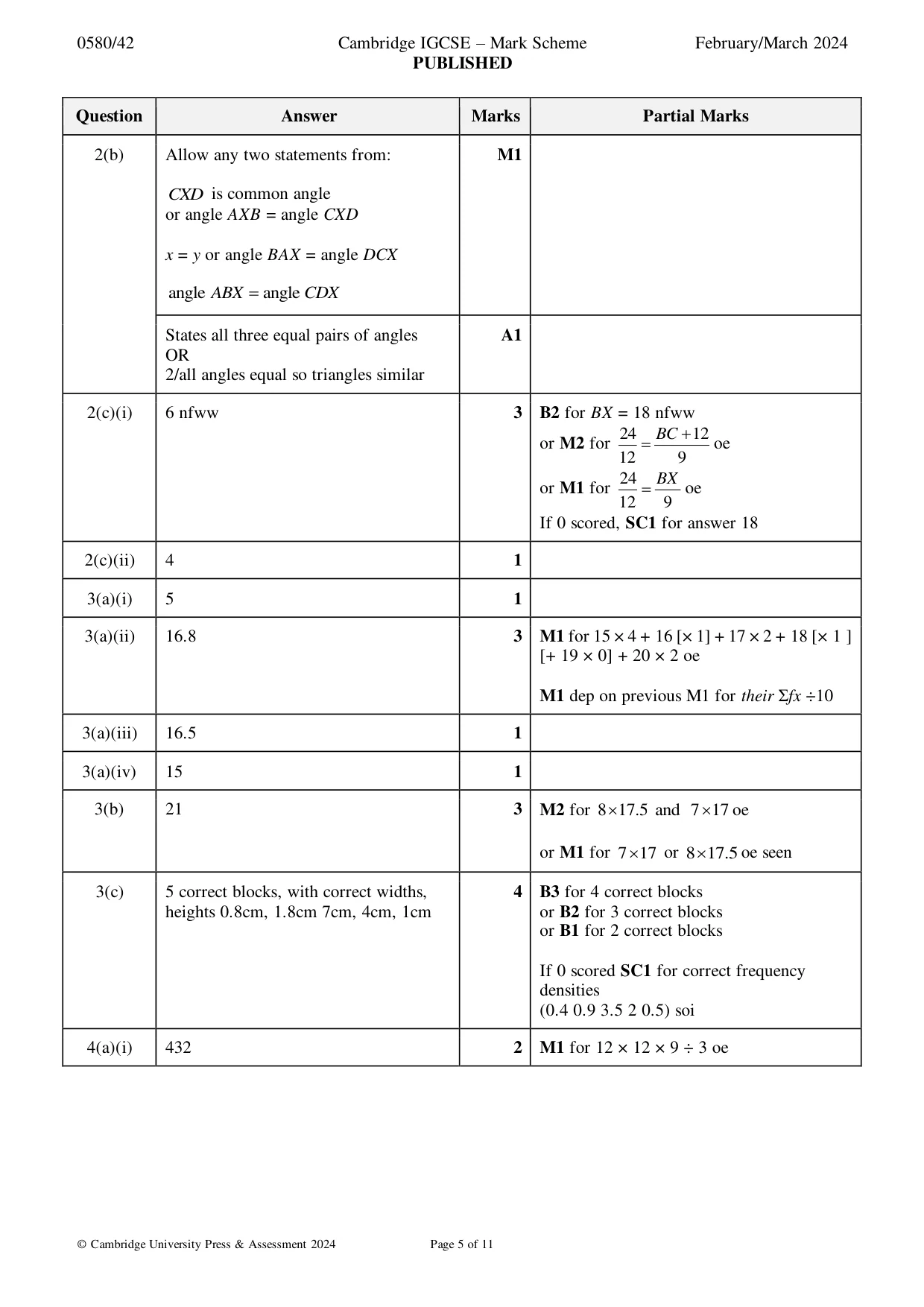
Mark scheme: 2(a) y + angle BCD = 180 oe B2 B1 for angles on a straight line AND angles on a straight line AND OR x + angle BCD = 180 oe AND opposite angles of a cyclic quadrilateral are opposite angles of a cyclic quadrilateral supplementary are supplementary OR OR angles in opposite segments are angles in opposite segments are supplementary supplementary leading to x = y with no errors 2(b) Allow any two statements from: M1 CXD is common angle or angle AXB = angle CXD x = y or angle BAX = angle DCX angle ABX = angle CDX States all three equal pairs of angles A1 OR 2/all angles equal so triangles similar 2(c)(i) 6 nfww 3 B2 for BX = 18 nfww 24 BC + 12 or M2 for = oe 12 9 24 BX or M1 for = oe 12 9 If 0 scored, SC1 for answer 18 2(c)(ii) 4 1
Q3 · The table shows information about the marks gained by each of 10 students in a test
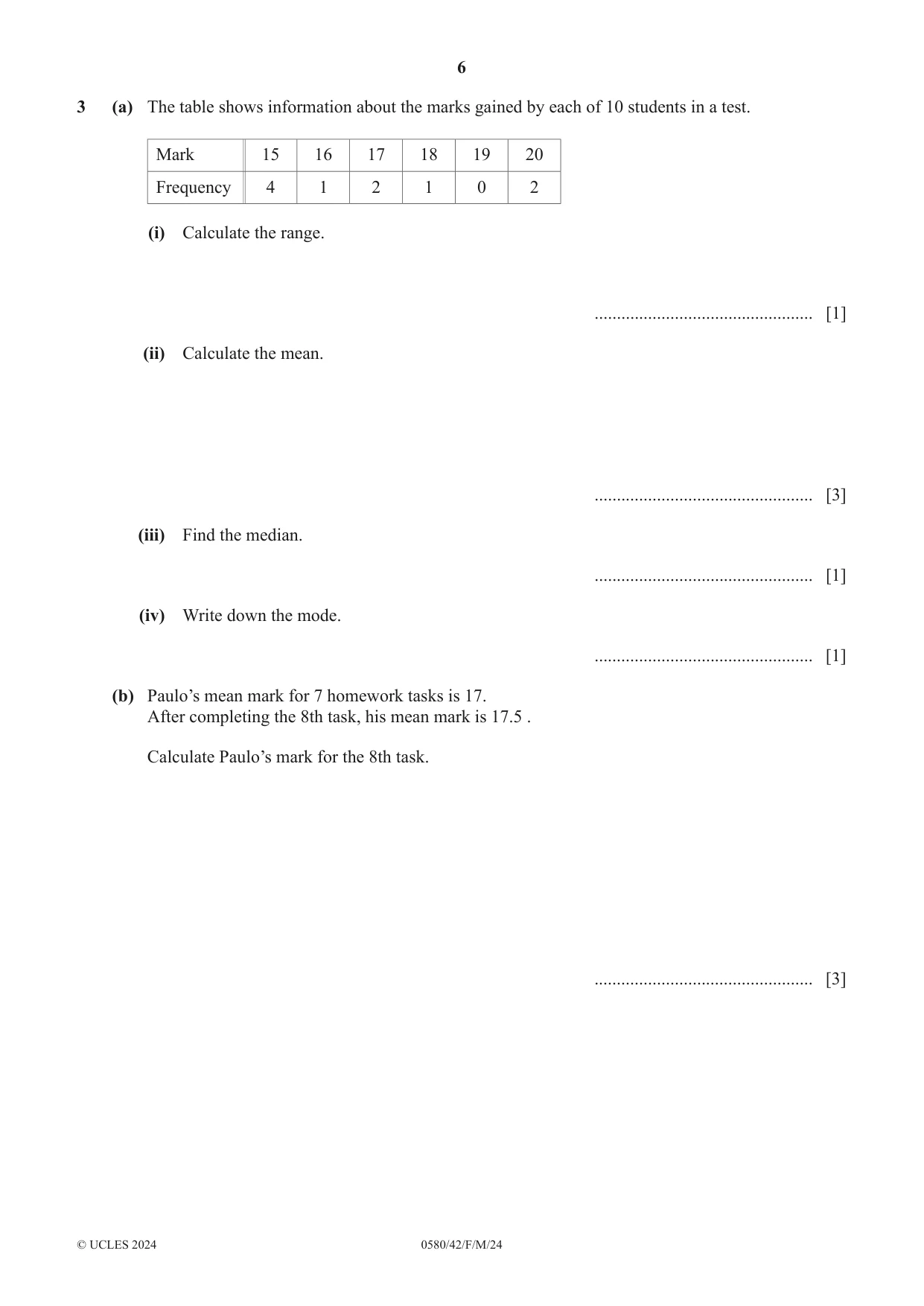
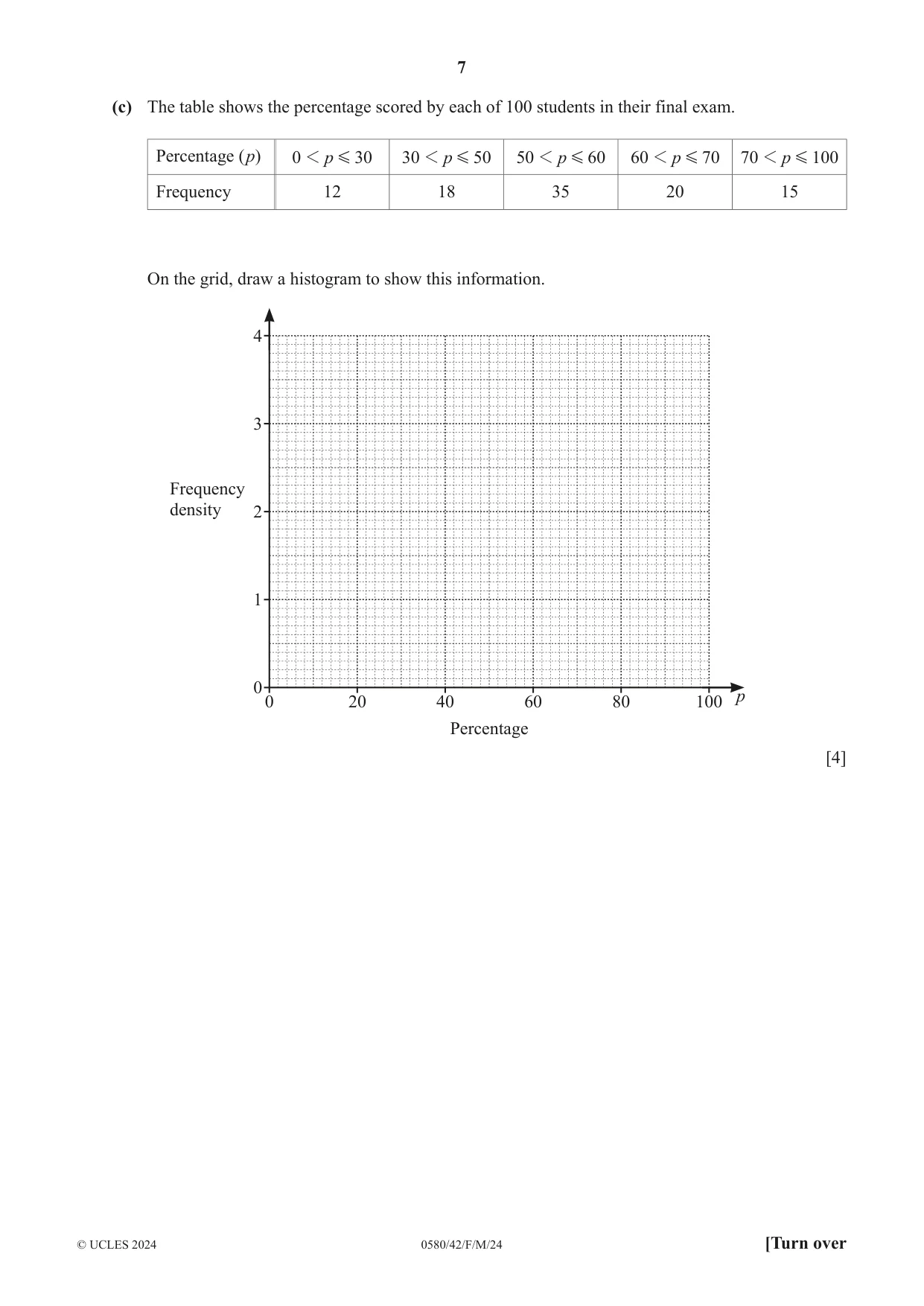
3 (a) The table shows information about the marks gained by each of 10 students in a test. Mark 15 16 17 18 19 20 Frequency 4 1 2 1 0 2 (i) Calculate the range. ................................................. [1] (ii) Calculate the mean. ................................................. [3] (iii) Find the median. ................................................. [1] (iv) Write down the mode. ................................................. [1] (b) Paulo’s mean mark for 7 homework tasks is 17. After completing the 8th task, his mean mark is 17.5 . Calculate Paulo’s mark for the 8th task. ................................................. [3] (c) The table shows the percentage scored by each of 100 students in their final exam. Percentage ( p) 0 1 p G 30 30 1 p G 50 50 1 p G 60 60 1 p G 70 70 1 p G 100 Frequency 12 18 35 20 15 On the grid, draw a histogram to show this information. 4 3 Frequency density 2 1 0 p 0 20 40 60 80 100 Percentage [4]
Mark scheme: 3(a)(i) 5 1 3(a)(ii) 16.8 3 M1 for 15 × 4 + 16 [× 1] + 17 × 2 + 18 [× 1 ] [+ 19 × 0] + 20 × 2 oe M1 dep on previous M1 for their Σfx ÷10 3(a)(iii) 16.5 1 3(a)(iv) 15 1 3(b) 21 3 M2 for 8 17.5 and 7 17 oe or M1 for 7 17 or 8 17.5 oe seen 3(c) 5 correct blocks, with correct widths, 4 B3 for 4 correct blocks heights 0.8cm, 1.8cm 7cm, 4cm, 1cm or B2 for 3 correct blocks or B1 for 2 correct blocks If 0 scored SC1 for correct frequency densities (0.4 0.9 3.5 2 0.5) soi
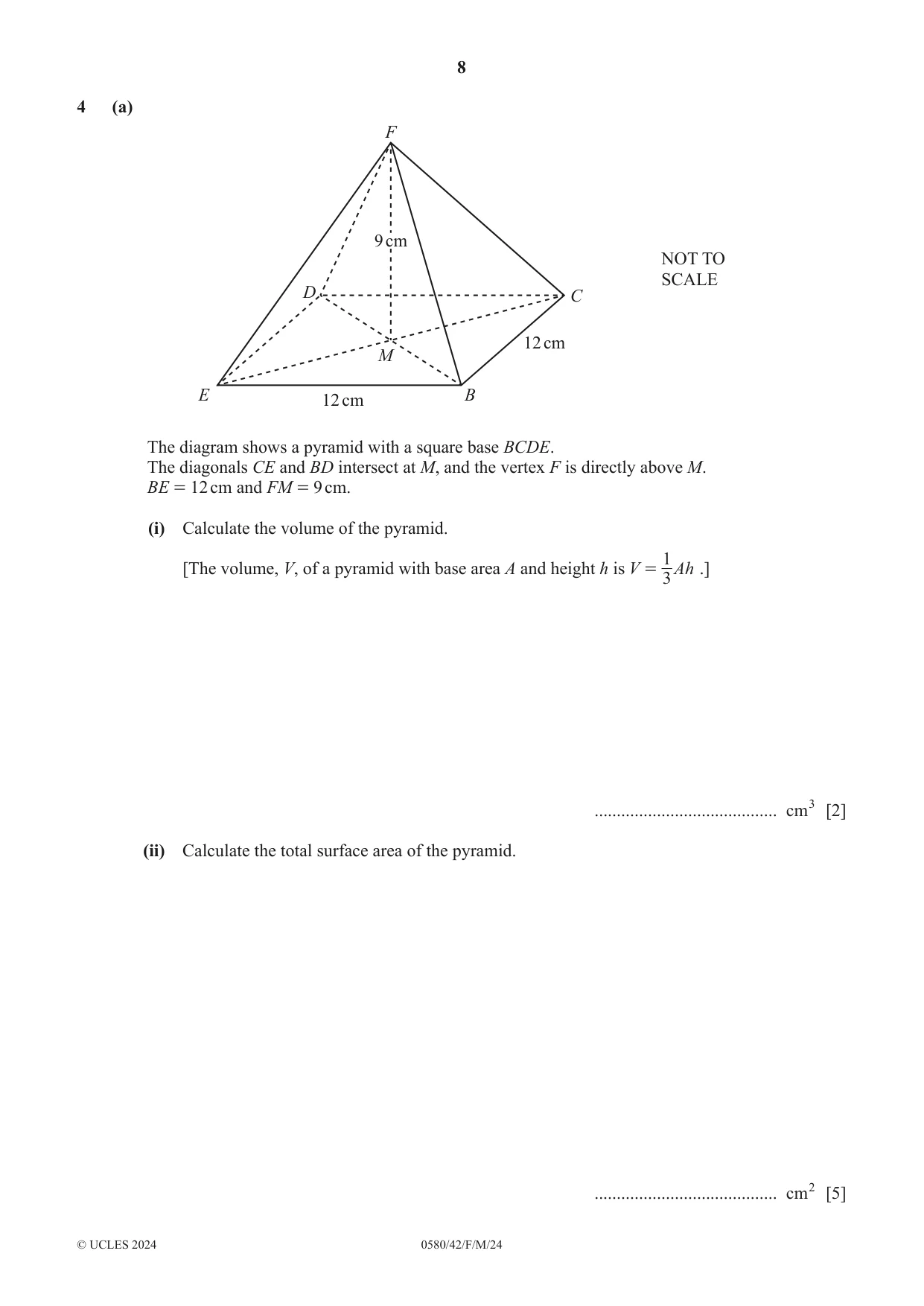
Q4 · F 9 cm NOT TO SCALE D C 12 cm M E B 12 cm The diagram shows a pyramid with a square base…
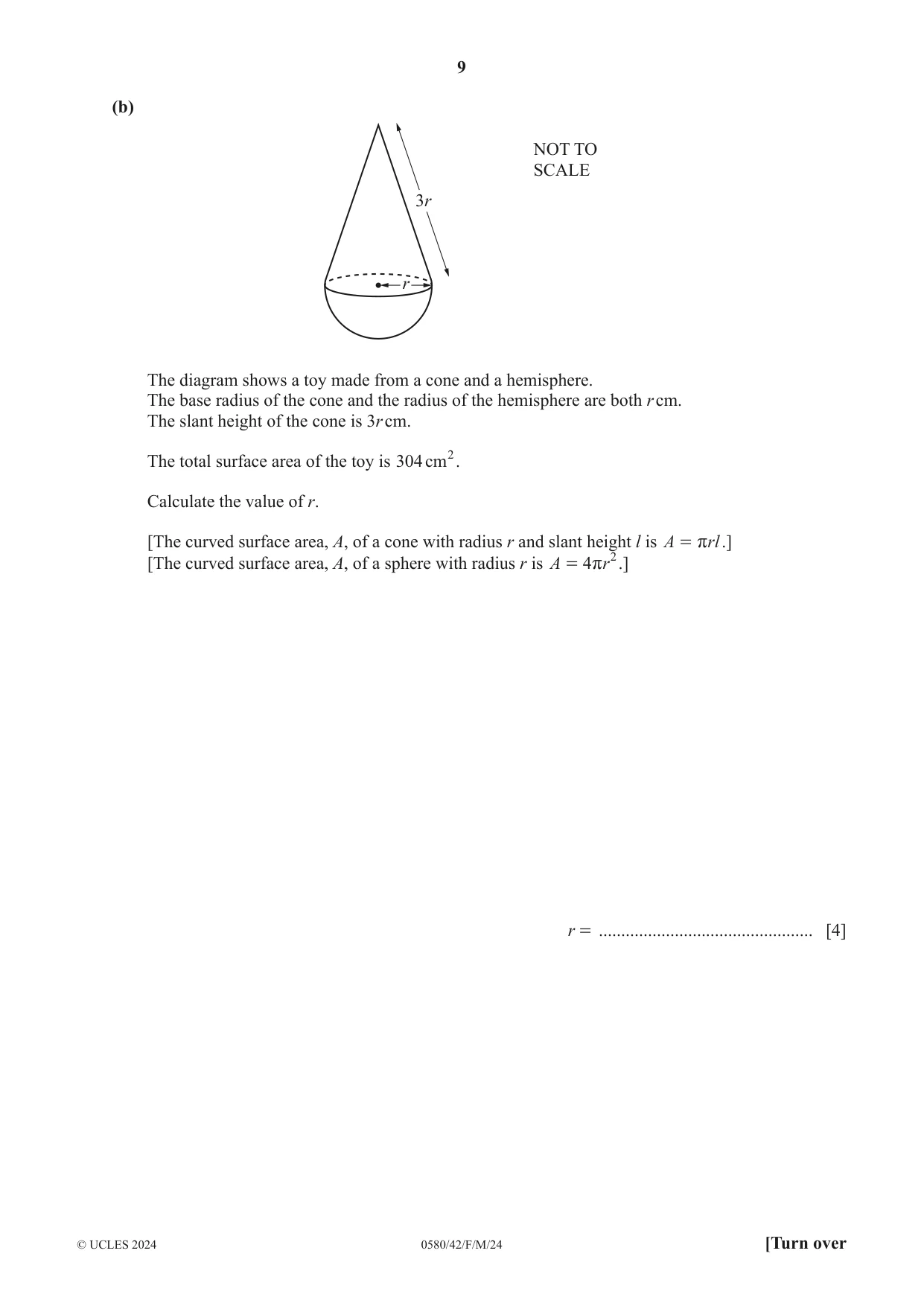
4 (a) F 9 cm NOT TO SCALE D C 12 cm M E B 12 cm The diagram shows a pyramid with a square base BCDE. The diagonals CE and BD intersect at M, and the vertex F is directly above M. BE = 12 cm and FM = 9 cm. (i) Calculate the volume of the pyramid. 1 [The volume, V, of a pyramid with base area A and height h is V = Ah .] 3 ......................................... cm3 [2] (ii) Calculate the total surface area of the pyramid. ......................................... cm2 [5] (b) NOT TO SCALE 3r r The diagram shows a toy made from a cone and a hemisphere. The base radius of the cone and the radius of the hemisphere are both r cm. The slant height of the cone is 3r cm. The total surface area of the toy is 304 cm 2. Calculate the value of r. [The curved surface area, A, of a cone with radius r and slant height l is A = rrl .] [The curved surface area, A, of a sphere with radius r is A = 4rr 2 .] r = ................................................ [4]
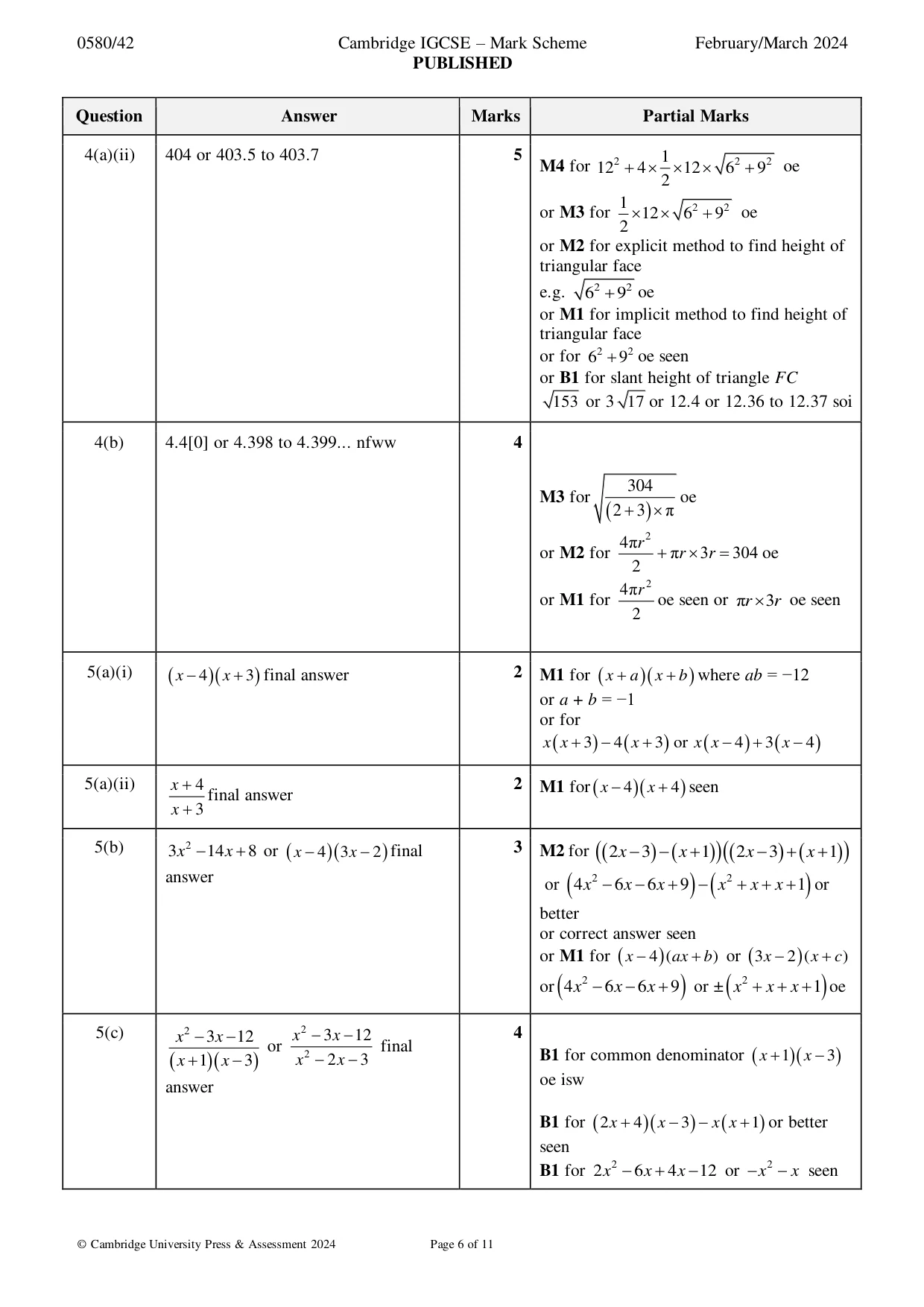
Mark scheme: 4(a)(i) 432 2 M1 for 12 × 12 × 9 ÷ 3 oe 4(a)(ii) 404 or 403.5 to 403.7 5 2 1 2 2 M4 for 12 + 4 12 6 + 9 oe 2 1 2 2 or M3 for 12 6 + 9 oe 2 or M2 for explicit method to find height of triangular face e.g. 62 + 92 oe or M1 for implicit method to find height of triangular face or for 6 2 + 9 2 oe seen or B1 for slant height of triangle FC 153 or 3 17 or 12.4 or 12.36 to 12.37 soi 4(b) 4.4[0] or 4.398 to 4.399... nfww 4 304 M3 for oe ( 2 + 3 ) π 4πr 2 or M2 for + πr 3r = 304 oe 2 4π r 2 or M1 for oe seen or πr 3r oe seen 2
Question 5
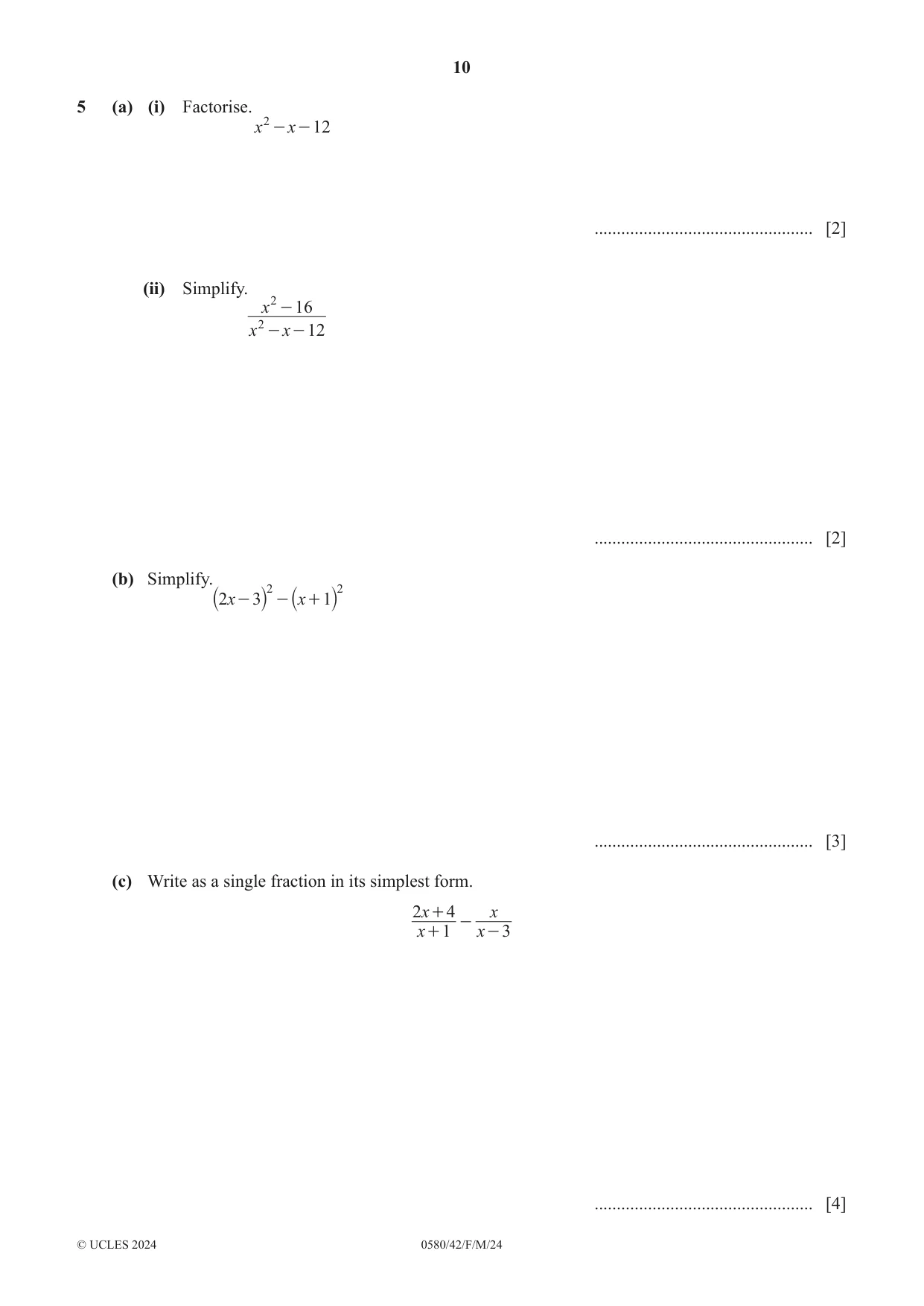
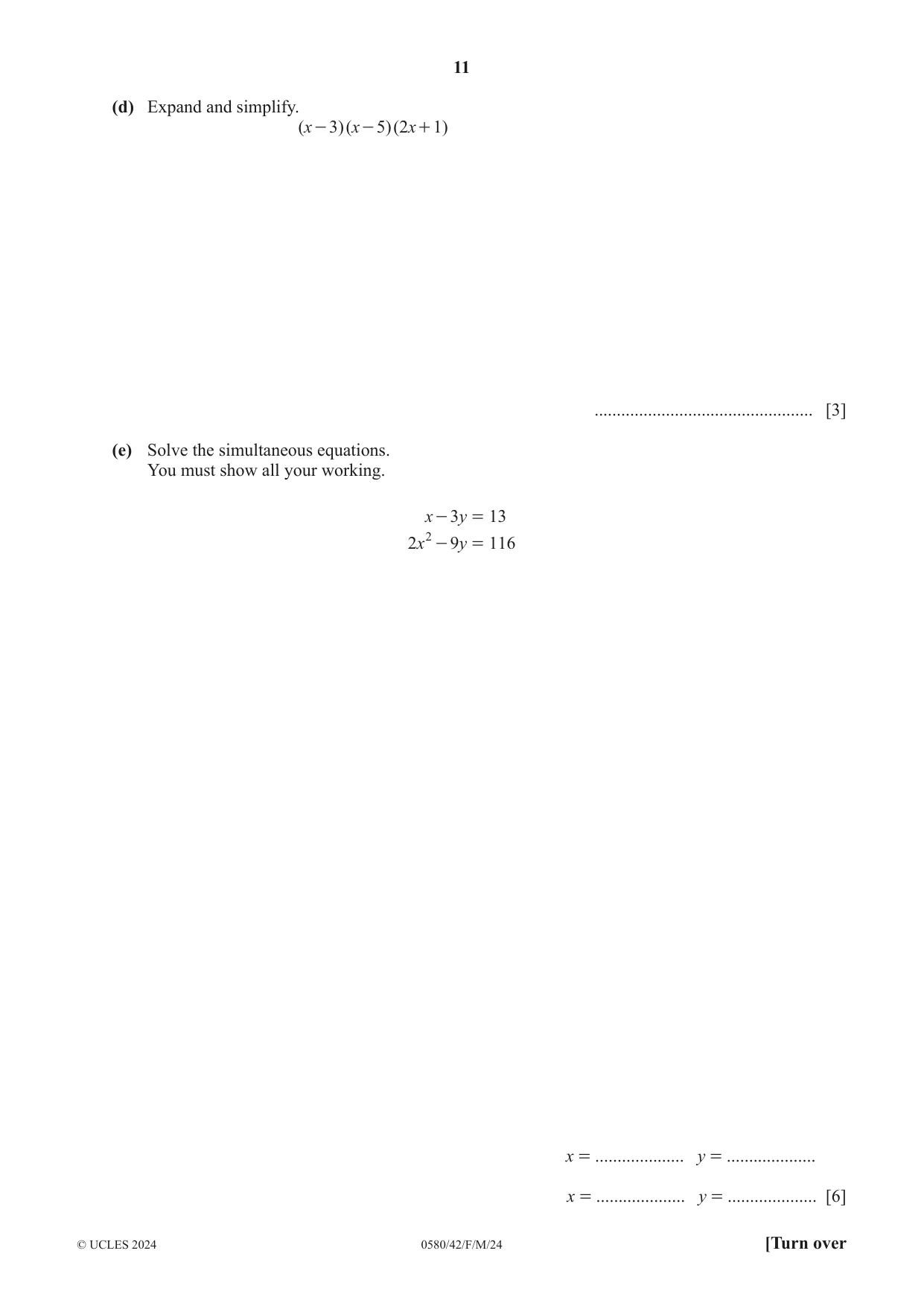
5 (a) (i) Factorise. x 2 - x - 12 ................................................. [2] (ii) Simplify. x 2 - 16 x 2 - x - 12 ................................................. [2] (b) Simplify. 2 2 2x - 3 - x + 1 ` j ` j ................................................. [3] (c) Write as a single fraction in its simplest form. 2x + 4 x - x + 1 x - 3 ................................................. [4] (d) Expand and simplify. ( x - 3)( x - 5)( 2x + 1) ................................................. [3] (e) Solve the simultaneous equations. You must show all your working. x - 3y = 13 2x 2 - 9y = 116 x = .................... y = .................... x = .................... y = .................... [6]
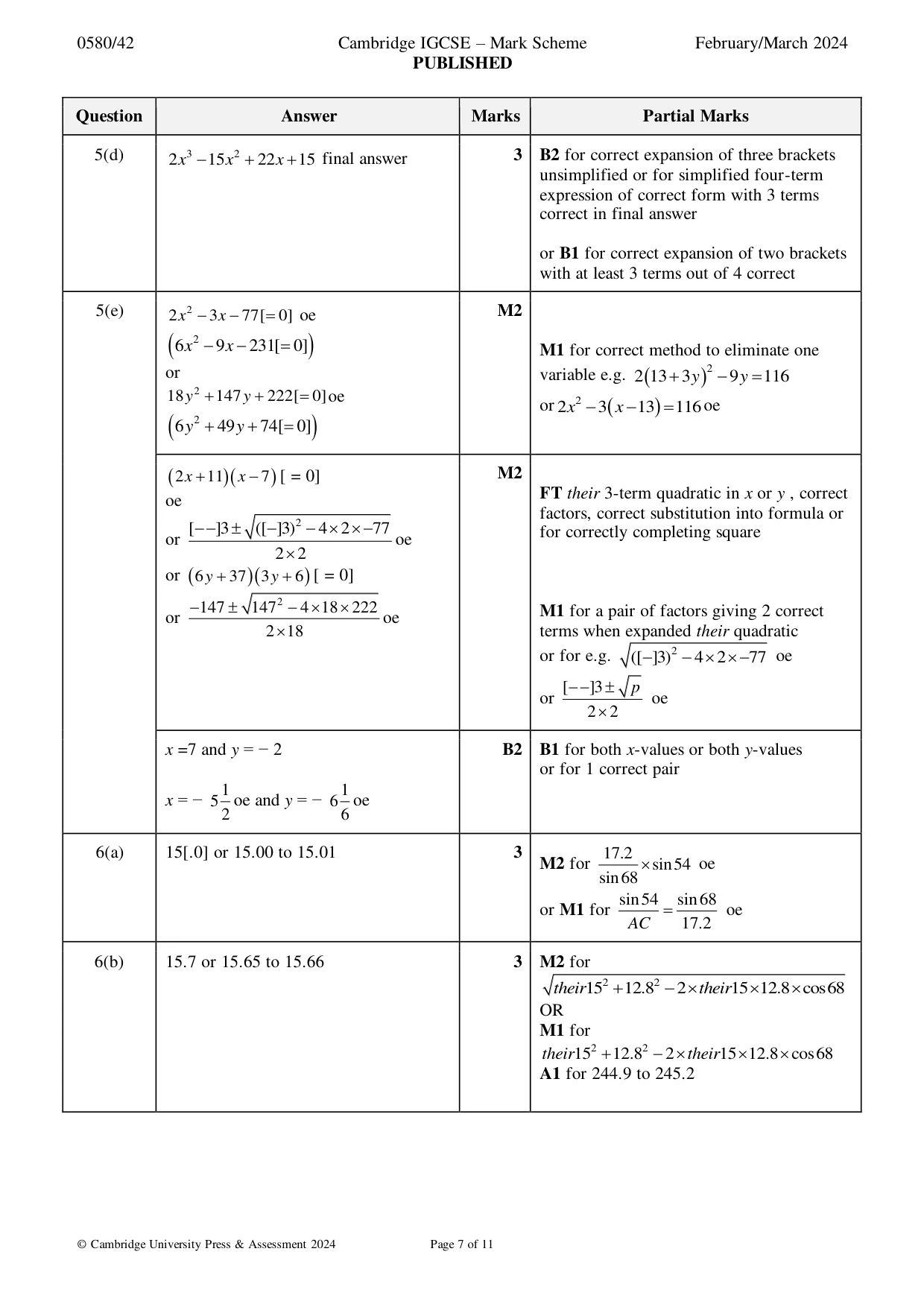
Mark scheme: 5(a)(i) ( x − 4 )( x + 3 ) final answer 2 M1 for ( x + a )( x + b ) where ab = −12 or a + b = −1 or for x ( x + 3 ) − 4 ( x + 3 ) or x ( x − 4 ) + 3 ( x − 4 ) 5(a)(ii) x + 4 2 M1 for( x − 4 )( x + 4 ) seen final answer x + 3 5(b) 3 x 2 − 14 x + 8 or ( x − 4 )( 3 x − 2 ) final 3 M2 for ( ( 2 x − 3) − ( x + 1) ) ( ( 2 x − 3) + ( x + 1) ) answer 2 2 or 4 x − 6 x − 6 x + 9 − x + x + x + 1 or ( ) ( ) better or correct answer seen or M1 for ( x − 4 ) ( ax + b ) or ( 3 x − 2 ) ( x + c ) 4 x 2 − 6 x − 6 x + 9 or x 2 + x + x + 1 oe or( ) ±( ) 5(c) x 2 − 3 x − 12 x 2 − 3 x − 12 4 or final B1 for common denominator ( x + 1)( x − 3 ) x 2 − 2 x − 3 ( x + 1)( x − 3 ) oe isw answer B1 for ( 2 x + 4 )( x − 3 ) − x ( x + 1) or better seen B1 for 2 x 2 − 6 x + 4 x − 12 or − x 2 − x seen 5(d) 2 x 3 − 15 x 2 + 22 x + 15 final answer 3 B2 for correct expansion of three brackets unsimplified or for simplified four-term expression of correct form with 3 terms correct in final answer or B1 for correct expansion of two brackets with at least 3 terms out of 4 correct 5(e) 2 x 2 − 3 x − 77[ = 0] oe M2 6 x 2 − 9 x − 231[ = 0] ( ) M1 for correct method to eliminate one or variable e.g. 2 (13 + 3 y ) 2 − 9 y = 116 18 y 2 + 147 y + 222[ = 0] oe 2 or 2 x − 3 ( x − 13) = 116 oe 6 y 2 + 49 y + 74[ = 0] ( ) ( 2 x + 11)( x − 7 ) [ = 0] M2 FT their 3-term quadratic in x or y , correct oe factors, correct substitution into formula or [ −−]3 ([ −]3) 2 −−4 2 77 for correctly completing square or oe 2 2 or ( 6 y + 37 )( 3 y + 6 ) [ = 0] −147 147 2 − 4 18 222 M1 for a pair of factors giving 2 correct or oe 2 18 terms when expanded their quadratic or for e.g. ([ −]3) 2 −−4 2 77 oe [ −− ]3 p or oe 2 2 x =7 and y = − 2 B2 B1 for both x-values or both y-values or for 1 correct pair 1 1 x = − 5 oe and y = − 6 oe 2 6
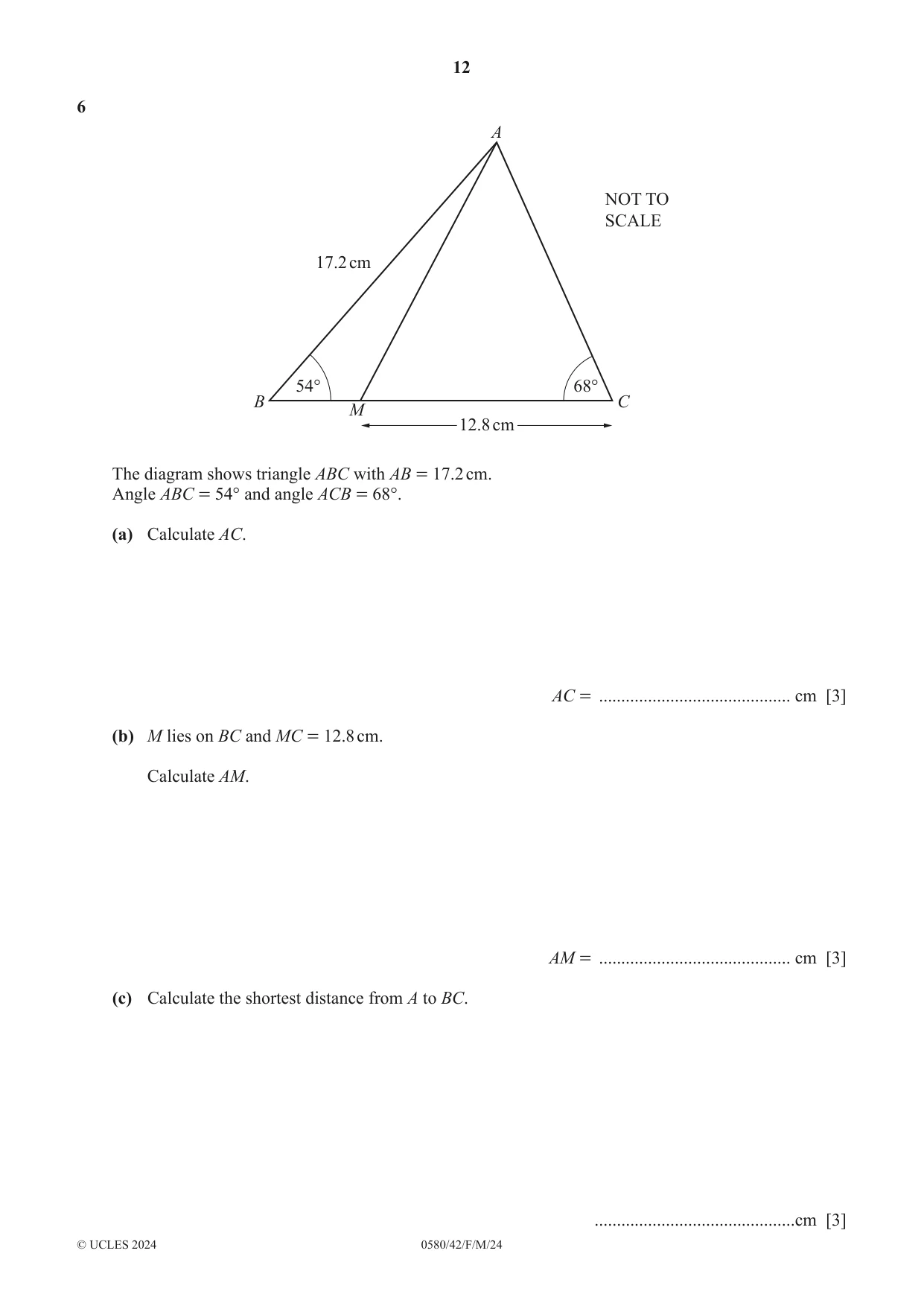
Q6 · A NOT TO SCALE 17.2 cm 54° 68° B C M 12.8 cm The diagram shows triangle ABC with AB =…
6 A NOT TO SCALE 17.2 cm 54° 68° B C M 12.8 cm The diagram shows triangle ABC with AB = 17.2 cm. Angle ABC = 54° and angle ACB = 68°. (a) Calculate AC. AC = ........................................... cm [3] (b) M lies on BC and MC = 12.8 cm. Calculate AM. AM = ........................................... cm [3] (c) Calculate the shortest distance from A to BC. .............................................cm [3]
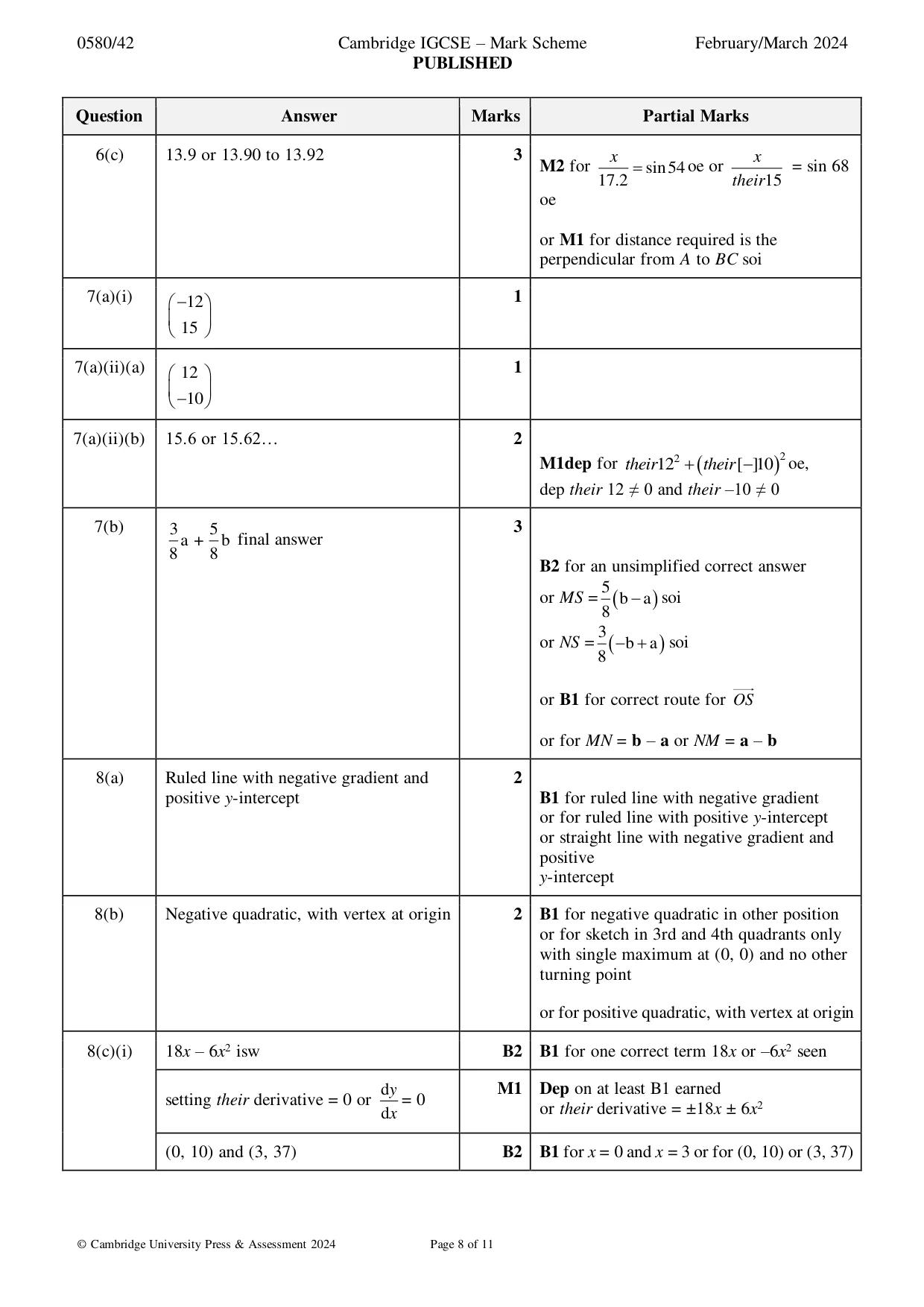
Mark scheme: 6(a) 15[.0] or 15.00 to 15.01 3 17.2 M2 for sin54 oe sin68 sin54 sin68 or M1 for = oe AC 17.2 6(b) 15.7 or 15.65 to 15.66 3 M2 for their152 + 12.82 −2 their15 12.8 cos68 OR M1 for their152 + 12.82 −2 their15 12.8 cos68 A1 for 244.9 to 245.2 6(c) 13.9 or 13.90 to 13.92 3 x x M2 for = sin54 oe or = sin 68 17.2 their15 oe or M1 for distance required is the perpendicular from A to BC soi
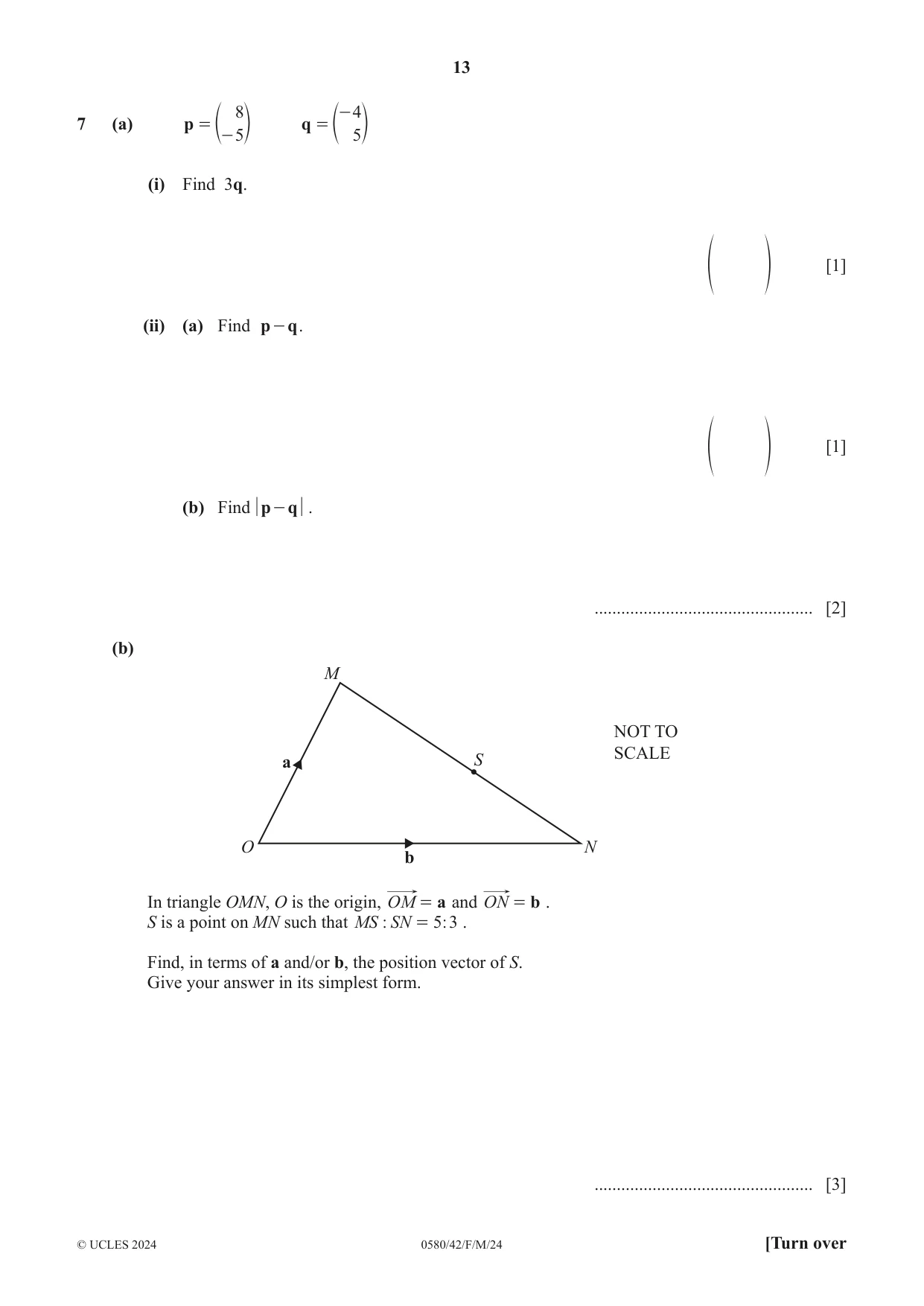
Q7 · - 4 7 (a) p = q = e- 5o e 5o (i) Find 3q
8 - 4 7 (a) p = q = e- 5o e 5o (i) Find 3q. [1] f p (ii) (a) Find p - q . [1] f p (b) Find p - q . ................................................. [2] (b) M NOT TO SCALE a S O N b In triangle OMN, O is the origin, OM = a and ON = b . S is a point on MN such that MS : SN = 5 : 3 . Find, in terms of a and/or b, the position vector of S. Give your answer in its simplest form. ................................................. [3]
Mark scheme: 7(a)(i) −12 1 15 7(a)(ii)(a) 1 12 −10 7(a)(ii)(b) 15.6 or 15.62… 2 M1dep for their122 + ( their [ −]10 ) 2 oe, dep their 12 ≠ 0 and their –10 ≠ 0 7(b) 3 5 3 a + b final answer 8 8 B2 for an unsimplified correct answer 5 or MS = ( b − a ) soi 8 3 or NS = ( −+b a ) soi 8 or B1 for correct route for OS or for MN = b – a or NM = a – b
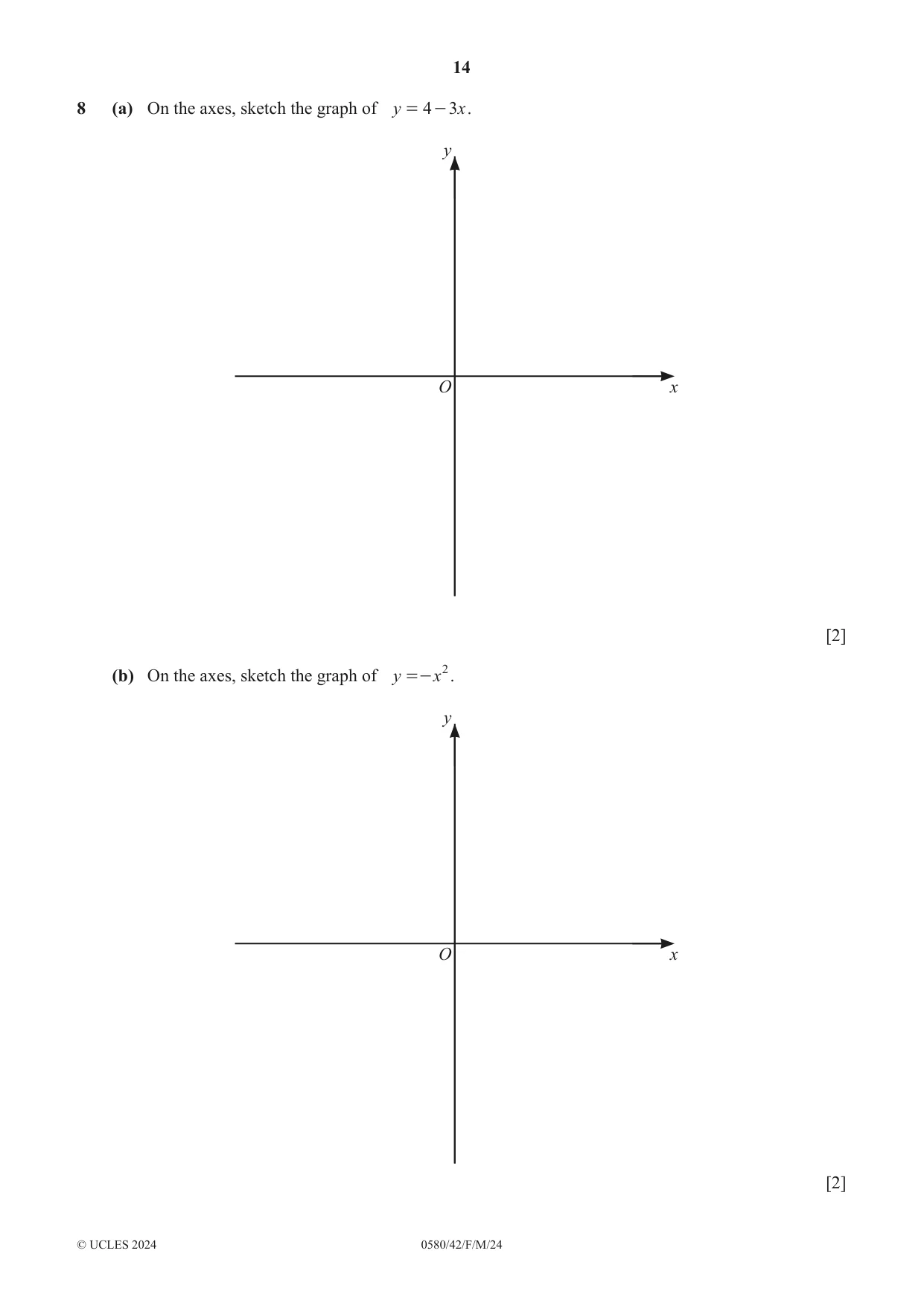
Q8 · On the axes, sketch the graph of y = 4 - 3 x
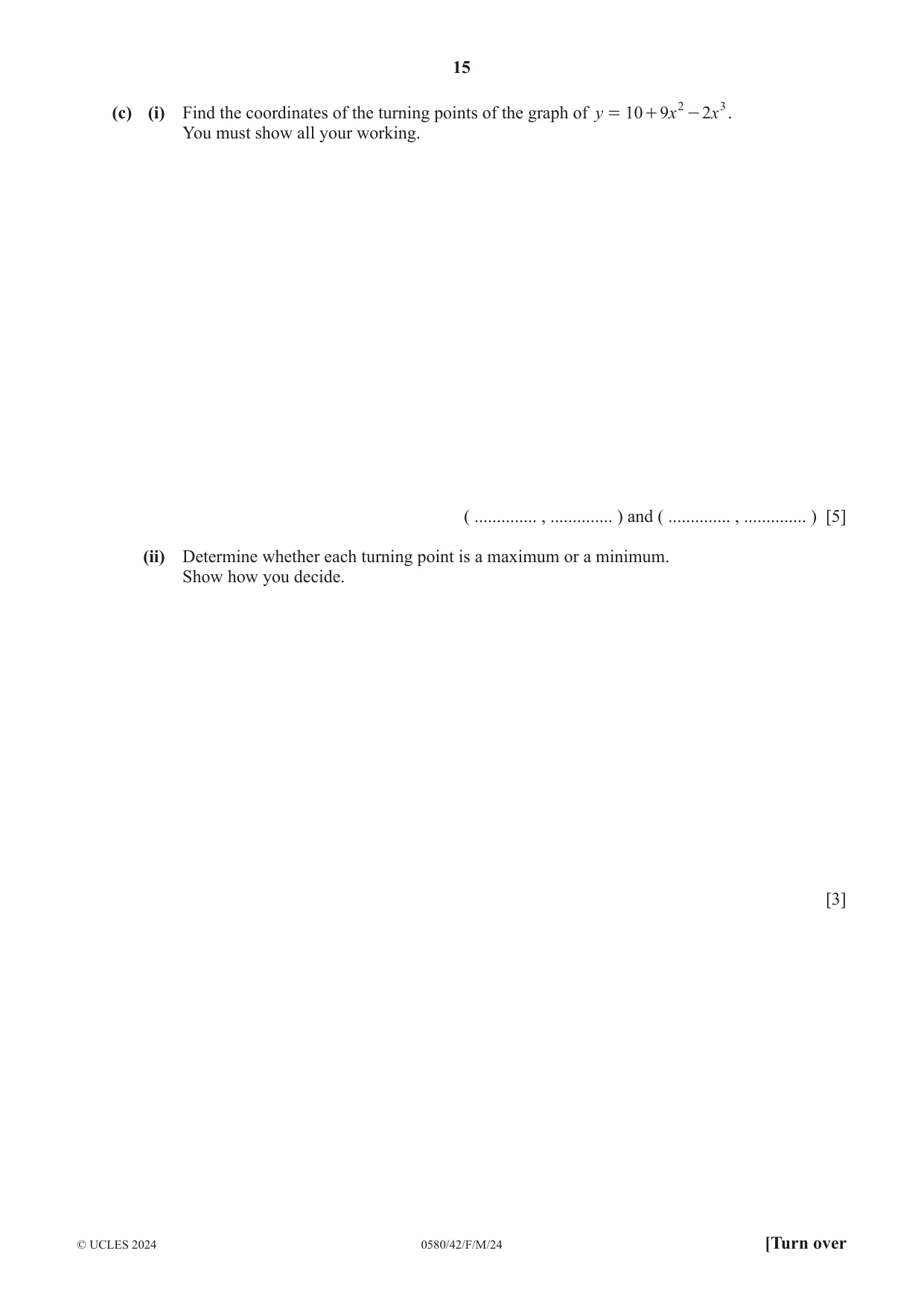
8 (a) On the axes, sketch the graph of y = 4 - 3 x . y O x [2] (b) On the axes, sketch the graph of y =- x2 . y O x [2] (c) (i) Find the coordinates of the turning points of the graph of y = 10 + 9 x 2 - 2x 3 . You must show all your working. ( .............. , .............. ) and ( .............. , .............. ) [5] (ii) Determine whether each turning point is a maximum or a minimum. Show how you decide. [3]
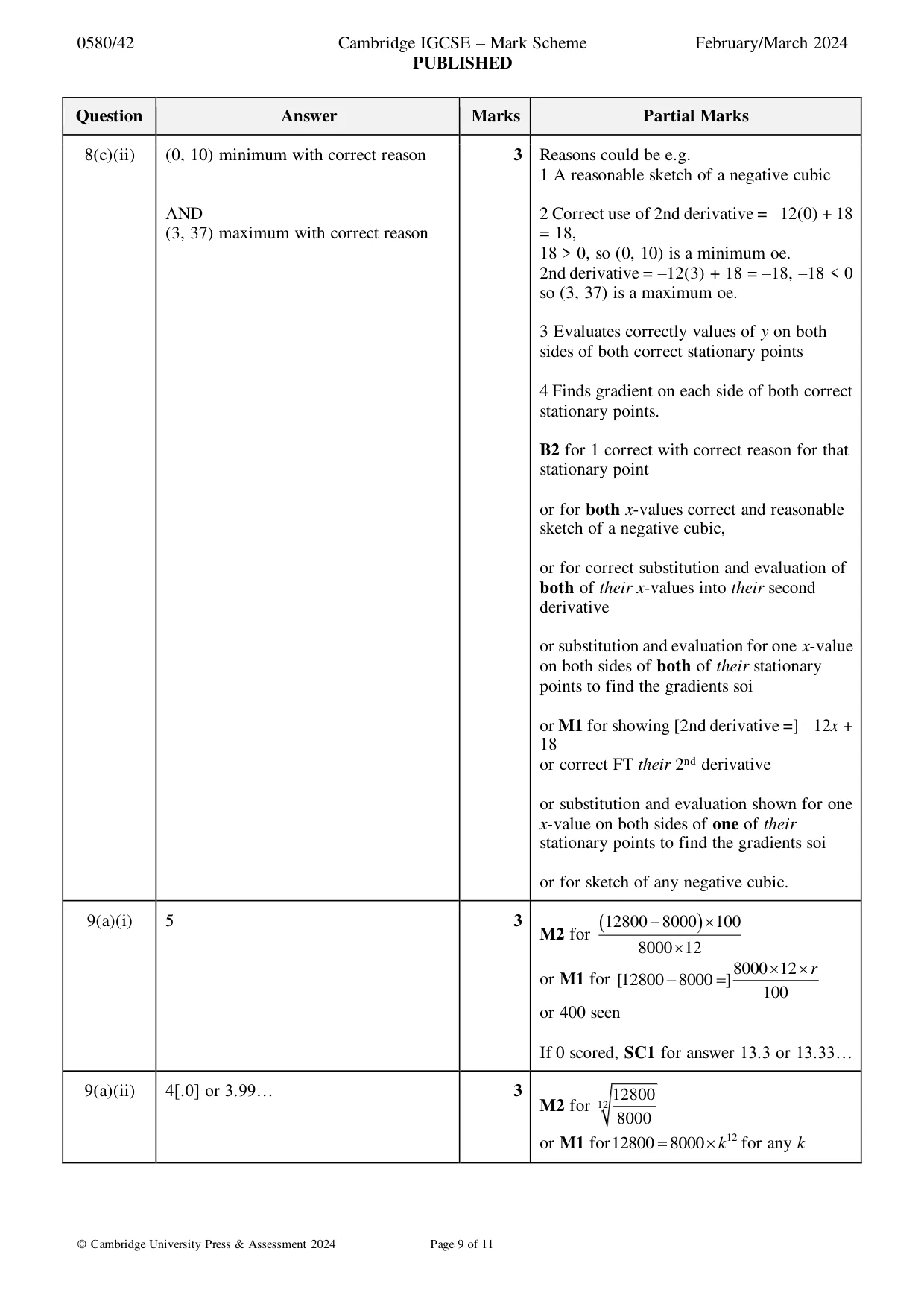
Mark scheme: 8(a) Ruled line with negative gradient and 2 positive y-intercept B1 for ruled line with negative gradient or for ruled line with positive y-intercept or straight line with negative gradient and positive y-intercept 8(b) Negative quadratic, with vertex at origin 2 B1 for negative quadratic in other position or for sketch in 3rd and 4th quadrants only with single maximum at (0, 0) and no other turning point or for positive quadratic, with vertex at origin 8(c)(i) 18x – 6x2 isw B2 B1 for one correct term 18x or –6x2 seen d y M1 Dep on at least B1 earned setting their derivative = 0 or = 0 or their derivative = ±18x ± 6x2 d x (0, 10) and (3, 37) B2 B1 for x = 0 and x = 3 or for (0, 10) or (3, 37) 8(c)(ii) (0, 10) minimum with correct reason 3 Reasons could be e.g. 1 A reasonable sketch of a negative cubic AND 2 Correct use of 2nd derivative = –12(0) + 18 (3, 37) maximum with correct reason = 18, 18 > 0, so (0, 10) is a minimum oe. 2nd derivative = –12(3) + 18 = –18, –18 < 0 so (3, 37) is a maximum oe. 3 Evaluates correctly values of y on both sides of both correct stationary points 4 Finds gradient on each side of both correct stationary points. B2 for 1 correct with correct reason for that stationary point or for both x-values correct and reasonable sketch of a negative cubic, or for correct substitution and evaluation of both of their x-values into their second derivative or substitution and evaluation for one x-value on both sides of both of their stationary points to find the gradients soi or M1 for showing [2nd derivative =] –12x + 18 or correct FT their 2nd derivative or substitution and evaluation shown for one x-value on both sides of one of their stationary points to find the gradients soi or for sketch of any negative cubic. 9(a)(i) 5 3 (12800 − 8000 ) 100 M2 for 8000 12 8000 12 r or M1 for [12800 − 8000 =] 100 or 400 seen If 0 scored, SC1 for answer 13.3 or 13.33…
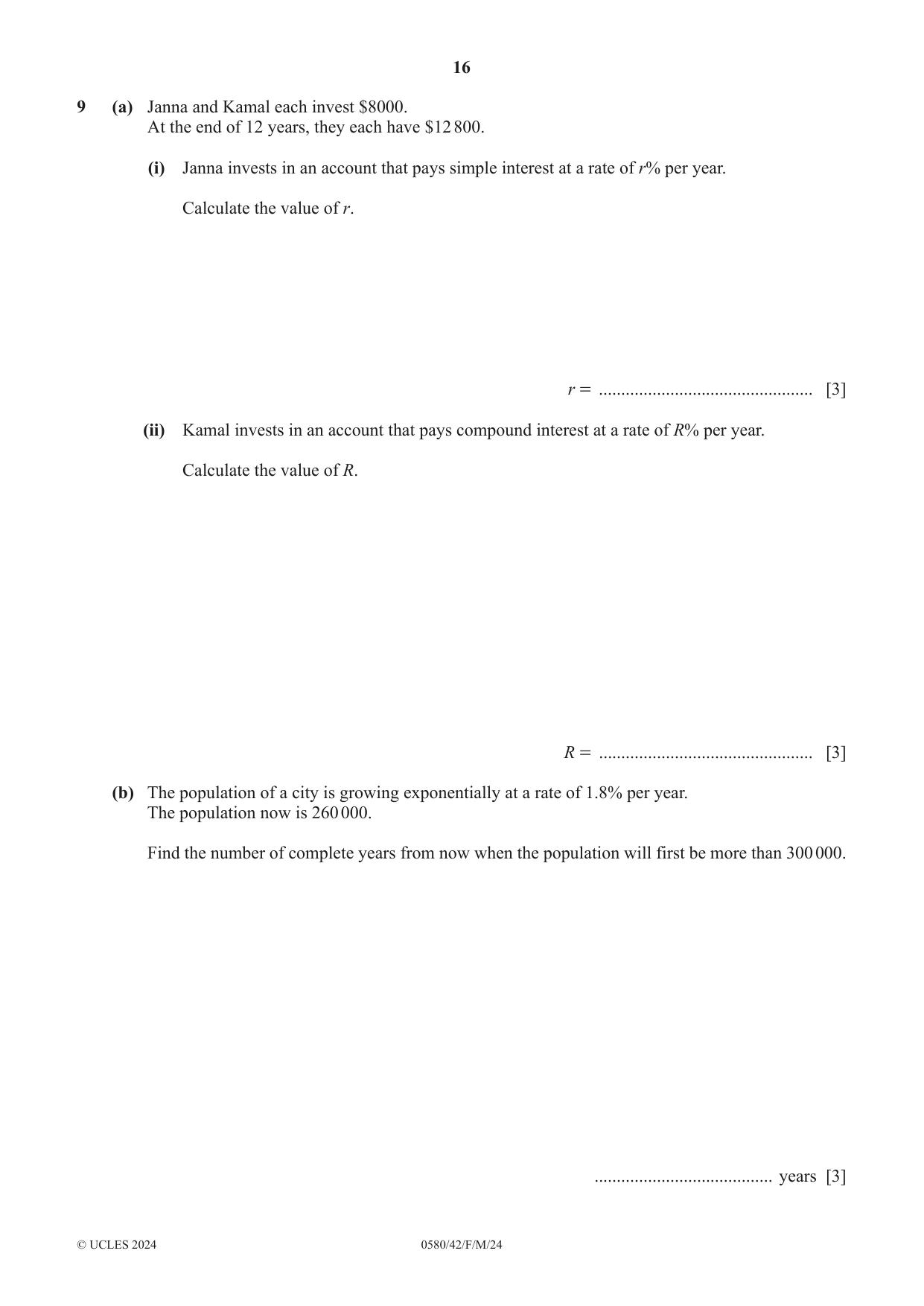
Q9 · Janna and Kamal each invest $8000
9 (a) Janna and Kamal each invest $8000. At the end of 12 years, they each have $12 800. (i) Janna invests in an account that pays simple interest at a rate of r% per year. Calculate the value of r. r = ................................................ [3] (ii) Kamal invests in an account that pays compound interest at a rate of R% per year. Calculate the value of R. R = ................................................ [3] (b) The population of a city is growing exponentially at a rate of 1.8% per year. The population now is 260 000. Find the number of complete years from now when the population will first be more than 300 000. ........................................ years [3]
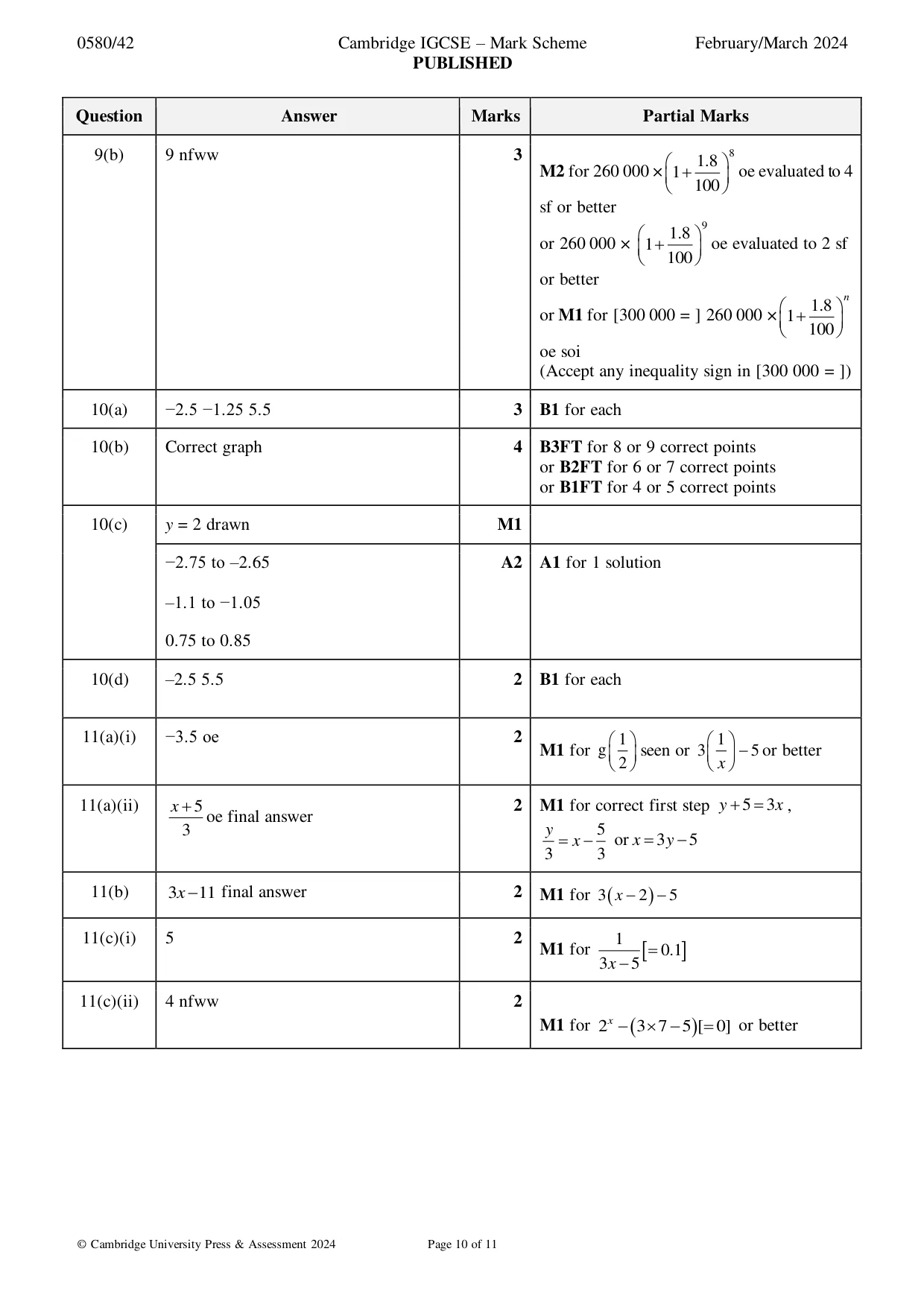
Mark scheme: 9(a)(ii) 4[.0] or 3.99… 3 12800 M2 for 12 8000 or M1 for 12800 = 8000 k 12 for any k 9(b) 9 nfww 3 8 1.8 M2 for 260 000 × 1 + oe evaluated to 4 100 sf or better 1.8 9 or 260 000 × 1 + oe evaluated to 2 sf 100 or better 1.8 n or M1 for [300 000 = ] 260 000 × 1 + 100 oe soi (Accept any inequality sign in [300 000 = ])
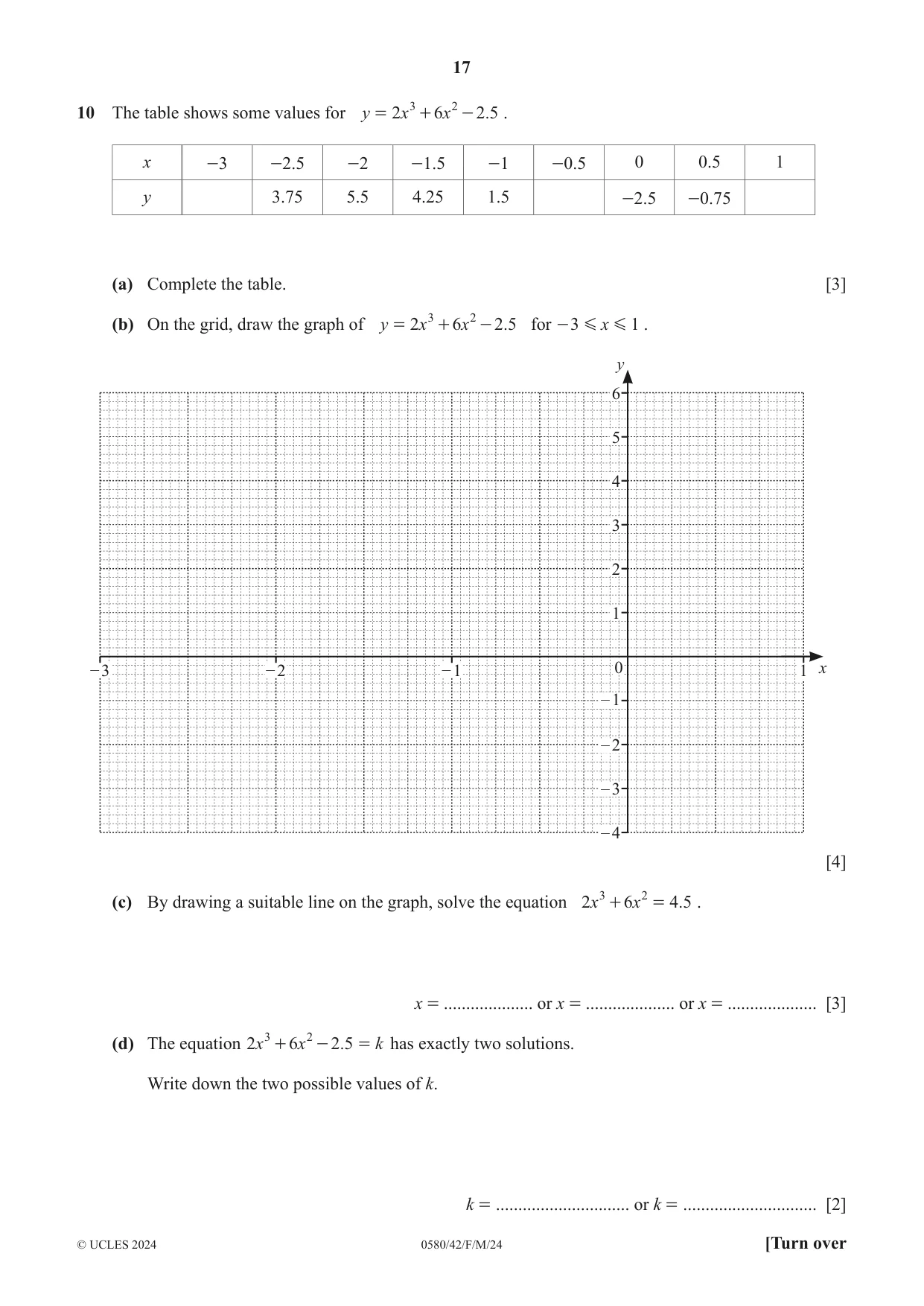
Q10 · The table shows some values for y = 2x 3 + 6x 2 - 2.5
10 The table shows some values for y = 2x 3 + 6x 2 - 2.5 . x -3 -2.5 -2 -1.5 -1 -0.5 0 0.5 1 y 3.75 5.5 4.25 1.5 -2.5 -0.75 (a) Complete the table. [3] (b) On the grid, draw the graph of y = 2x 3 + 6x 2 - 2.5 for - 3 G x G 1 . y 6 5 4 3 2 1 – 3 – 2 – 1 0 1 x – 1 – 2 – 3 – 4 [4] (c) By drawing a suitable line on the graph, solve the equation 2x 3 + 6x 2 = 4.5 . x = .................... or x = .................... or x = .................... [3] (d) The equation 2x 3 + 6x 2 - 2.5 = k has exactly two solutions. Write down the two possible values of k. k = .............................. or k = .............................. [2]
Mark scheme: 10(a) −2.5 −1.25 5.5 3 B1 for each 10(b) Correct graph 4 B3FT for 8 or 9 correct points or B2FT for 6 or 7 correct points or B1FT for 4 or 5 correct points 10(c) y = 2 drawn M1 −2.75 to –2.65 A2 A1 for 1 solution –1.1 to −1.05 0.75 to 0.85 10(d) –2.5 5.5 2 B1 for each
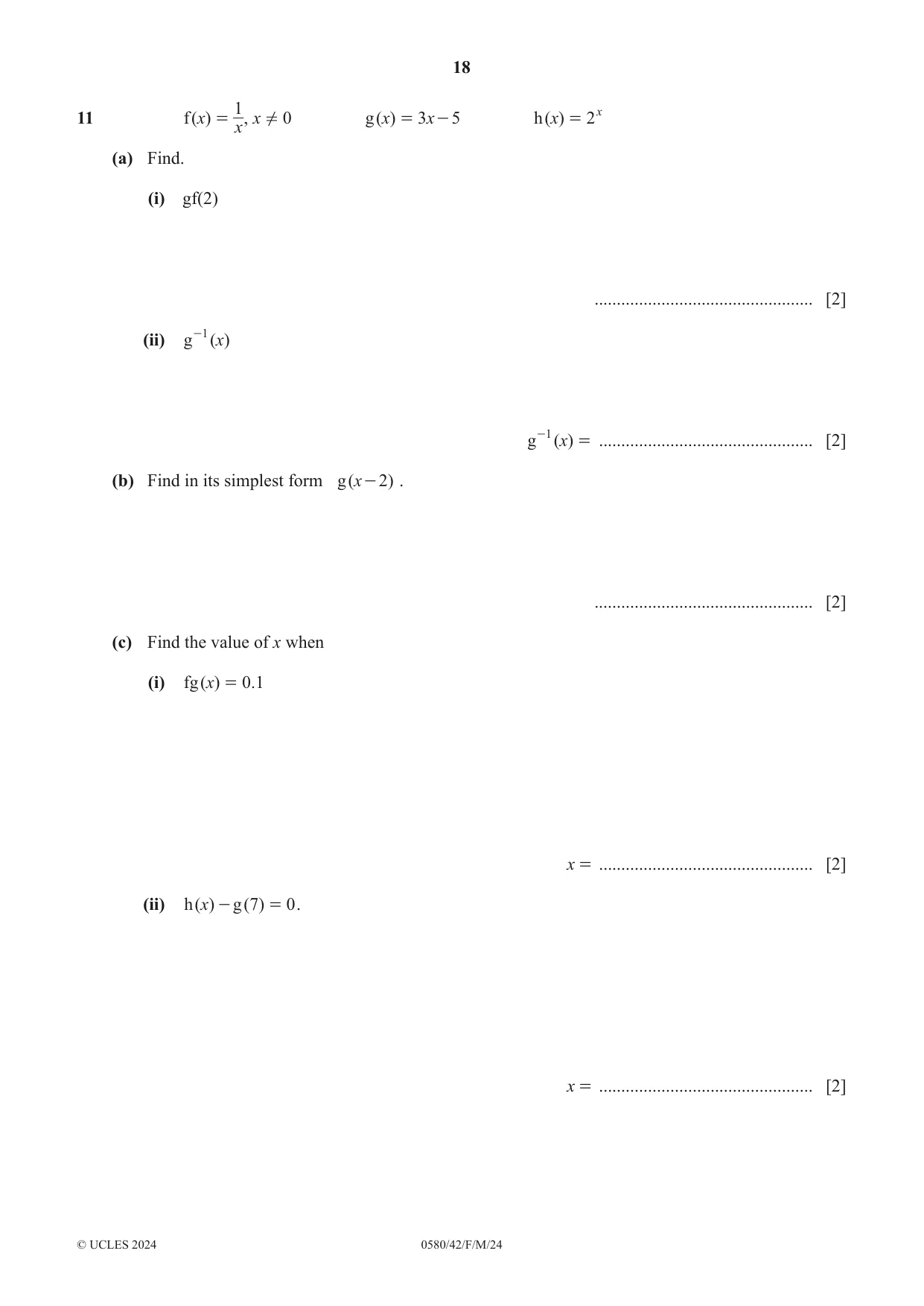
Q11 · X11 f ( x) = , x !
1 x11 f ( x) = , x ! 0 g ( )x = 3 x - 5 h ( )x = 2 x (a) Find. (i) gf(2) ................................................. [2] (ii) g -1 ( )x g -1 ( )x = ................................................ [2] (b) Find in its simplest form g ( x - 2) . ................................................. [2] (c) Find the value of x when (i) fg ( x) = 0.1 x = ................................................ [2] (ii) h ( x) - g ( 7) = 0 . x = ................................................ [2]
Mark scheme: 11(a)(i) −3.5 oe 2 1 1 M1 for g seen or 3 − 5 or better 2 x 11(a)(ii) x + 5 2 M1 for correct first step y + 5 = 3 x , oe final answer 3 y 5 = x − or x = 3 y − 5 3 3 11(b) 3x− 11 final answer 2 M1 for 3 ( x − 2 ) − 5 11(c)(i) 5 2 1 M1 for = 0.1 3 x − 5 11(c)(ii) 4 nfww 2 M1 for 2 x − ( 3 −7 5 ) [ = 0] or better
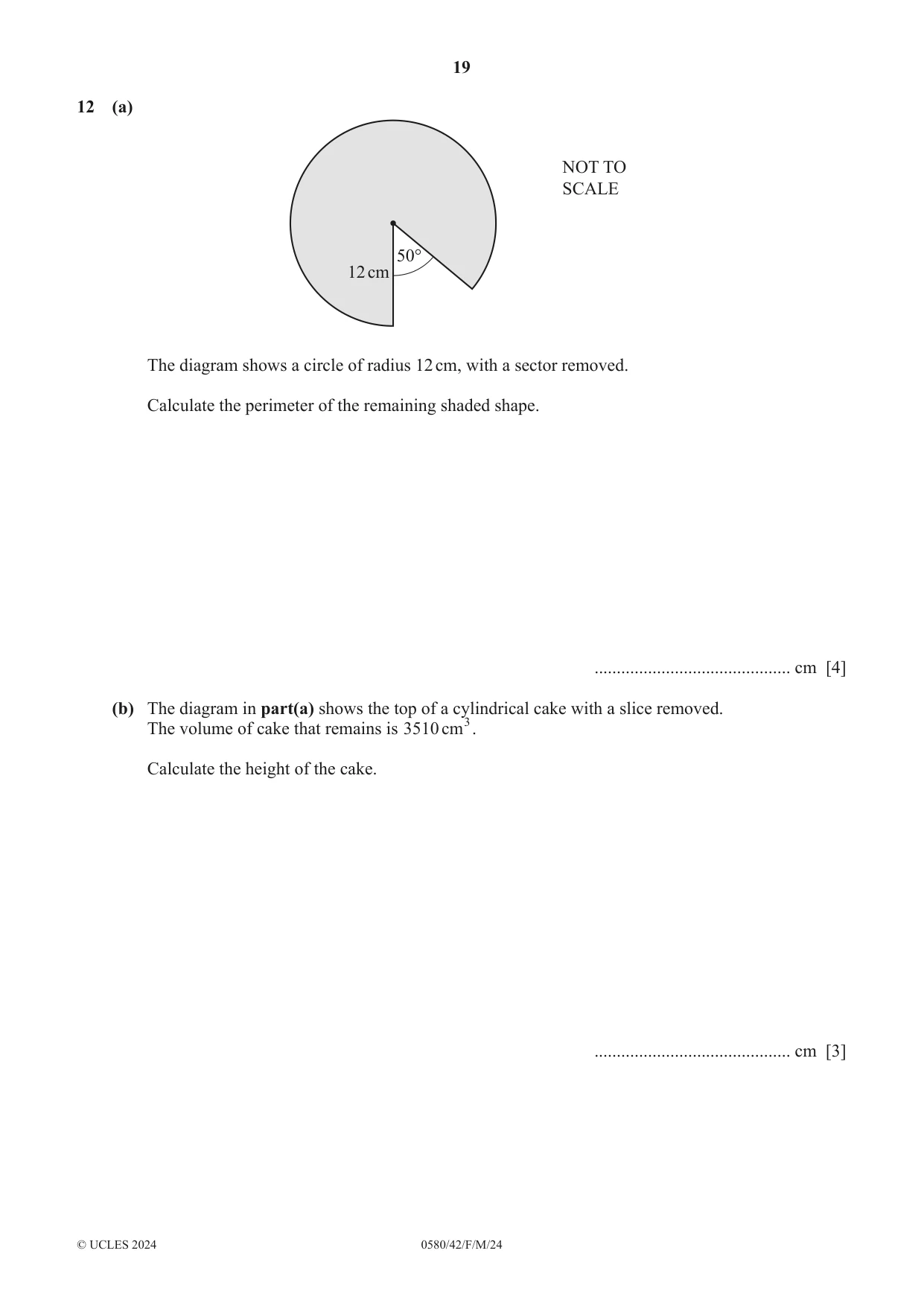
Q12 · NOT TO SCALE 50° 12 cm The diagram shows a circle of radius 12 cm, with a sector removed
12 (a) NOT TO SCALE 50° 12 cm The diagram shows a circle of radius 12 cm, with a sector removed. Calculate the perimeter of the remaining shaded shape. ............................................ cm [4] (b) The diagram in part(a) shows the top of a cylindrical cake with a slice removed. The volume of cake that remains is 3510 cm 3. Calculate the height of the cake. ............................................ cm [3]
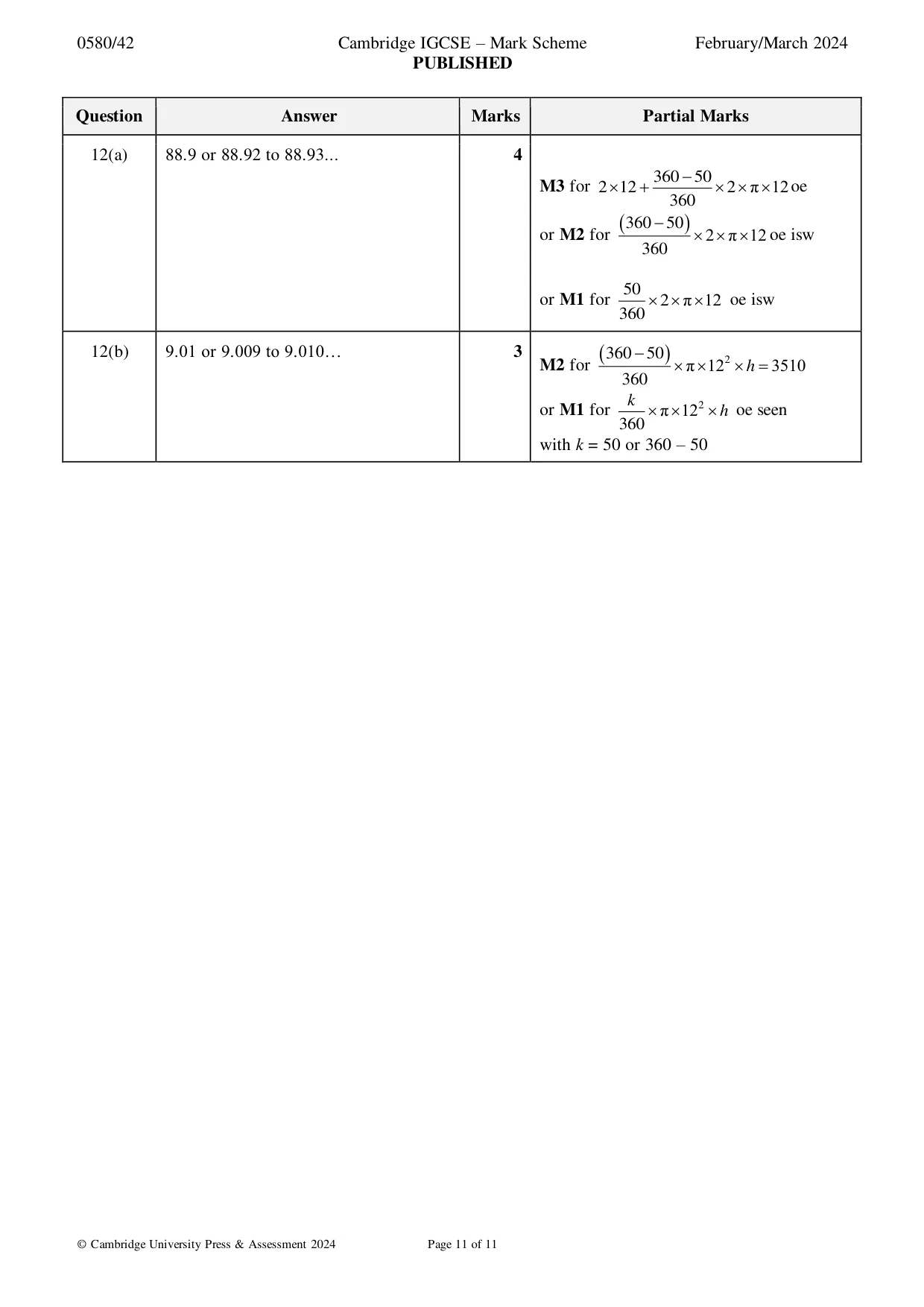
Mark scheme: 12(a) 88.9 or 88.92 to 88.93... 4 360 − 50 M3 for 2 12 + 2 π 12 oe 360 ( 360 − 50 ) or M2 for 2 π 12 oe isw 360 50 or M1 for 2 π 12 oe isw 360 12(b) 9.01 or 9.009 to 9.010… 3 ( 360 − 50 ) 2 M2 for π 12 h = 3510 360 k 2 or M1 for π 12 h oe seen 360 with k = 50 or 360 – 50
What was in this paper
The subtopics covered by these 12 questions, and how many questions each got. Open one in a new tab to see every Cambridge question on it.
What you needed in this session
Cambridge’s own grade thresholds for 2024 Feb/March, Paper 4 · Variant 2. A higher threshold means an easier paper — the bar moves with how the cohort did.