Questions as text
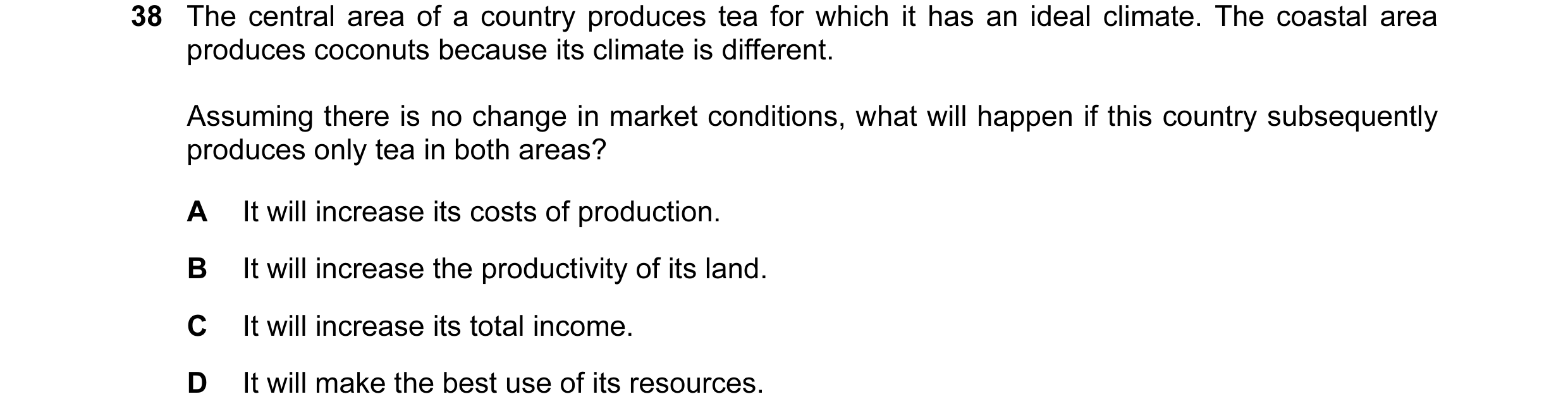
Q1 · The central area of a country produces tea for which it has an ideal climate 0455/11 May/June 2006
38 The central area of a country produces tea for which it has an ideal climate. The coastal area produces coconuts because its climate is different. Assuming there is no change in market conditions, what will happen if this country subsequently produces only tea in both areas? A It will increase its costs of production. B It will increase the productivity of its land. C It will increase its total income. D It will make the best use of its resources.
1 marks
Answer: A
This question in 0455/11 May/June 2006
Q2 · What might encourage international specialisation between countries? 0455/11 May/June 2006
39 What might encourage international specialisation between countries? A free trade B inefficiencies in production C labour immobility D tariffs
1 marks
Answer: A
This question in 0455/11 May/June 2006
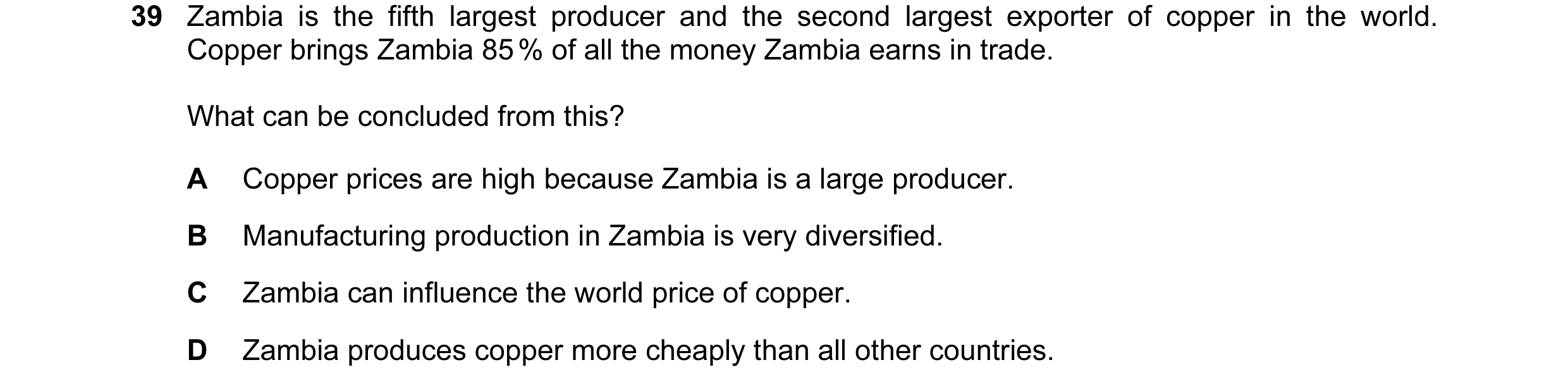
Q3 · Zambia is the fifth largest producer and the second largest exporter of copper in the… 0455/11 May/June 2007
39 Zambia is the fifth largest producer and the second largest exporter of copper in the world. Copper brings Zambia 85 % of all the money Zambia earns in trade. What can be concluded from this? A Copper prices are high because Zambia is a large producer. B Manufacturing production in Zambia is very diversified. C Zambia can influence the world price of copper. D Zambia produces copper more cheaply than all other countries.
1 marks
Answer: C
This question in 0455/11 May/June 2007
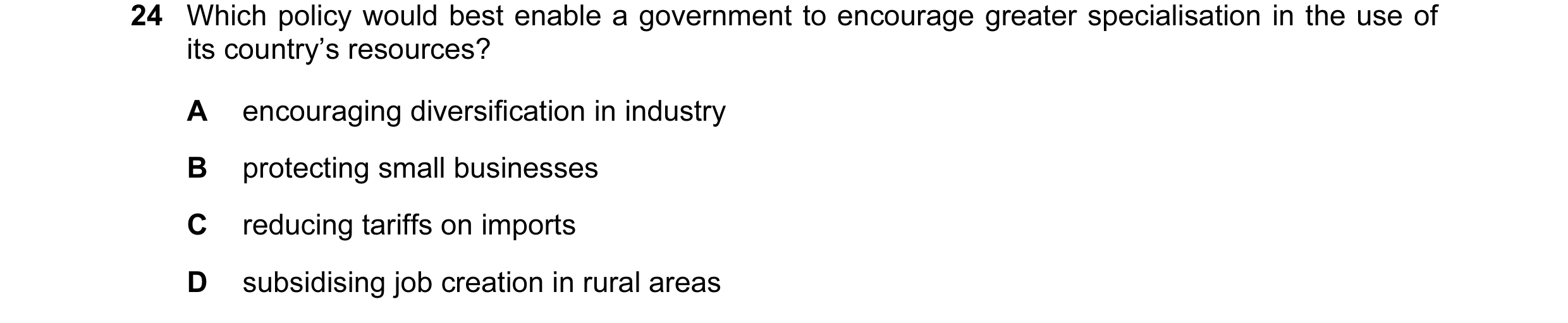
Q4 · Which policy would best enable a government to encourage greater specialisation in the… 0455/11 Oct/Nov 2007
24 Which policy would best enable a government to encourage greater specialisation in the use of its country’s resources? A encouraging diversification in industry B protecting small businesses C reducing tariffs on imports D subsidising job creation in rural areas
1 marks
Answer: C
This question in 0455/11 Oct/Nov 2007
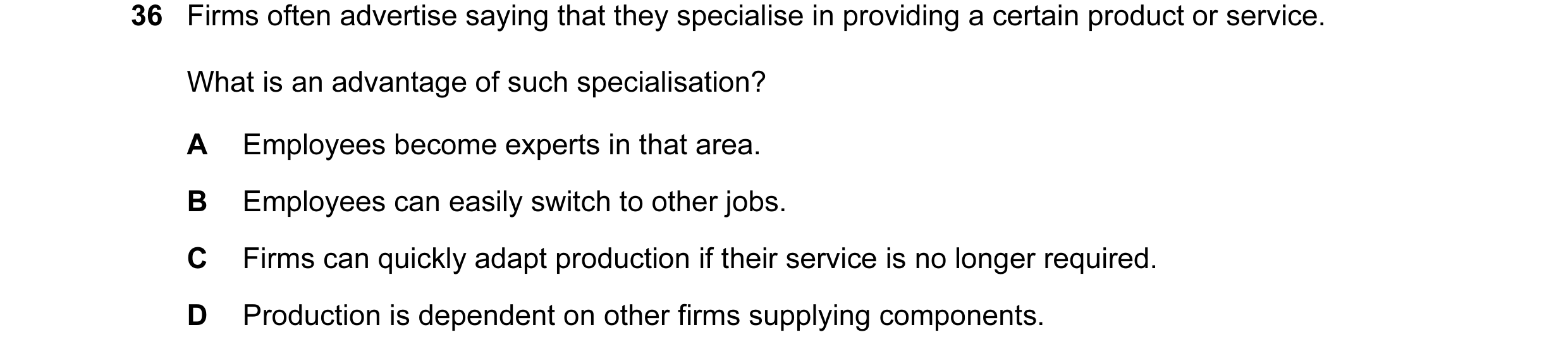
Q5 · Firms often advertise saying that they specialise in providing a certain product or… 0455/11 Oct/Nov 2007
36 Firms often advertise saying that they specialise in providing a certain product or service. What is an advantage of such specialisation? A Employees become experts in that area. B Employees can easily switch to other jobs. C Firms can quickly adapt production if their service is no longer required. D Production is dependent on other firms supplying components.
1 marks
Answer: A
This question in 0455/11 Oct/Nov 2007
Q6 · What is an advantage if a region specialises in a narrow range of products? 0455/11 May/June 2008
38 What is an advantage if a region specialises in a narrow range of products? A Other regions will become over-dependent on the region. B Scarce resources are used more efficiently. C The level of production in the region will decrease. D The region’s system of transport is improved.
1 marks
Answer: B
This question in 0455/11 May/June 2008
Q7 · Which of the following increases specialisation? 0455/11 Oct/Nov 2008
38 Which of the following increases specialisation? A A farmer decides to convert some of his farm buildings into holiday cottages for rent. B A government decides that a country should be more self-sufficient in food production. C A restaurant owner decides to have only vegetarian meals on his menu. D A taxi driver decides to train for an additional licence to drive a bus.
1 marks
Answer: C
This question in 0455/11 Oct/Nov 2008
Q8 · What is not an advantage of specialisation and division of labour? 0455/11 May/June 2009
28 What is not an advantage of specialisation and division of labour? A A product is manufactured in separate stages, making it easier to use machinery. B Some workers become more dependent on other workers. C Workers complete a limited range of tasks and become more efficient at them. D Workers spend less time moving from one task to another.
1 marks
Answer: B
This question in 0455/11 May/June 2009
Q9 · What benefit is likely to result from the extension of specialisation within… 0455/11 Oct/Nov 2009
28 What benefit is likely to result from the extension of specialisation within manufacturing? A For a consumer, there are more individually made goods available. B For a consumer, there could be a lower cost of living. C For an employee, job satisfaction will increase. D For an employee, the nature of work is more varied.
1 marks
Answer: B
This question in 0455/11 Oct/Nov 2009
Q10 · Which policy would best enable a government to encourage greater specialisation in the… 0455/11 May/June 2010
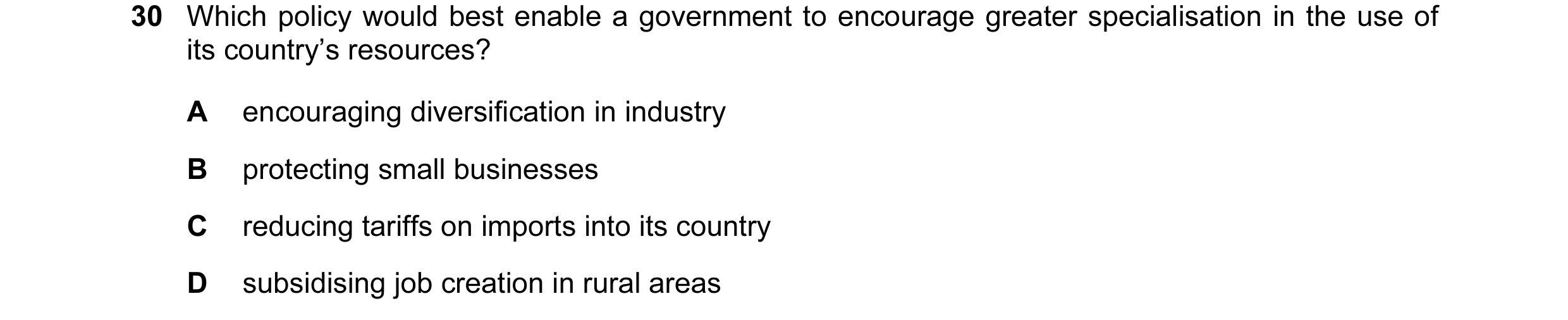
30 Which policy would best enable a government to encourage greater specialisation in the use of its country’s resources? A encouraging diversification in industry B protecting small businesses C reducing tariffs on imports into its country D subsidising job creation in rural areas
1 marks
Answer: C
This question in 0455/11 May/June 2010
Q11 · Which policy would best enable a government to encourage greater specialisation in the… 0455/12 May/June 2010
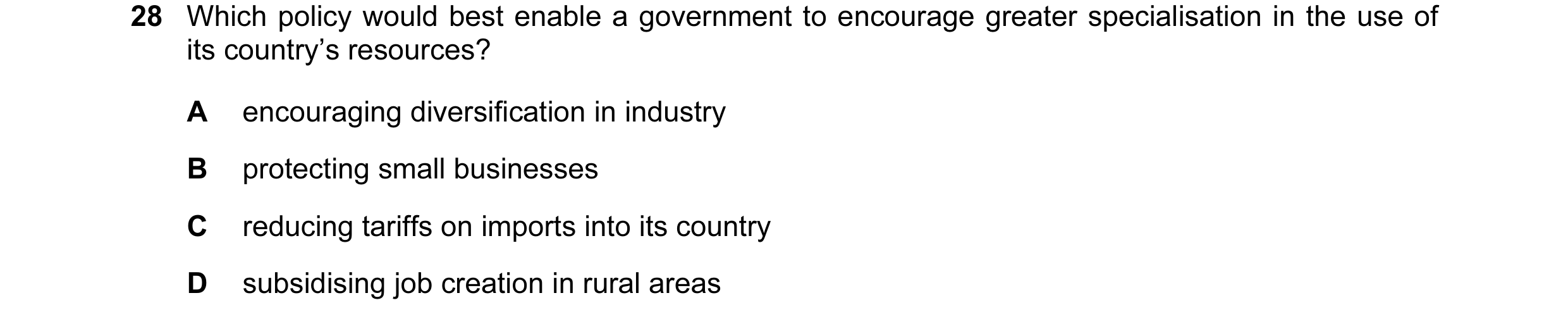
28 Which policy would best enable a government to encourage greater specialisation in the use of its country’s resources? A encouraging diversification in industry B protecting small businesses C reducing tariffs on imports into its country D subsidising job creation in rural areas
1 marks
Answer: C
This question in 0455/12 May/June 2010
Q12 · What might be a direct benefit to the individual worker of a specialised job? 0455/11 Oct/Nov 2010
13 What might be a direct benefit to the individual worker of a specialised job? A Specialisation can enable the worker to become more skilled. B Specialisation enables a better quality product to be produced. C Specialisation enables the firm to introduce more machinery. D Specialisation makes better use of resources.
1 marks
Answer: A
This question in 0455/11 Oct/Nov 2010
Q13 · What might be a direct benefit to the individual worker of a specialised job? 0455/13 Oct/Nov 2010
10 What might be a direct benefit to the individual worker of a specialised job? A Specialisation can enable the worker to become more skilled. B Specialisation enables a better quality product to be produced. C Specialisation enables the firm to introduce more machinery. D Specialisation makes better use of resources.
1 marks
Answer: A
This question in 0455/13 Oct/Nov 2010
Q14 · What is an advantage to a country of free trade? 0455/11 May/June 2012
29 What is an advantage to a country of free trade? A greater international diversification of production B greater range of domestically produced goods C greater reliance on other countries D greater specialisation in the use of resources
1 marks
Answer: D
This question in 0455/11 May/June 2012
Q15 · Changes in demand mean that the government of Bangladesh hopes to switch some production… 0455/13 May/June 2012
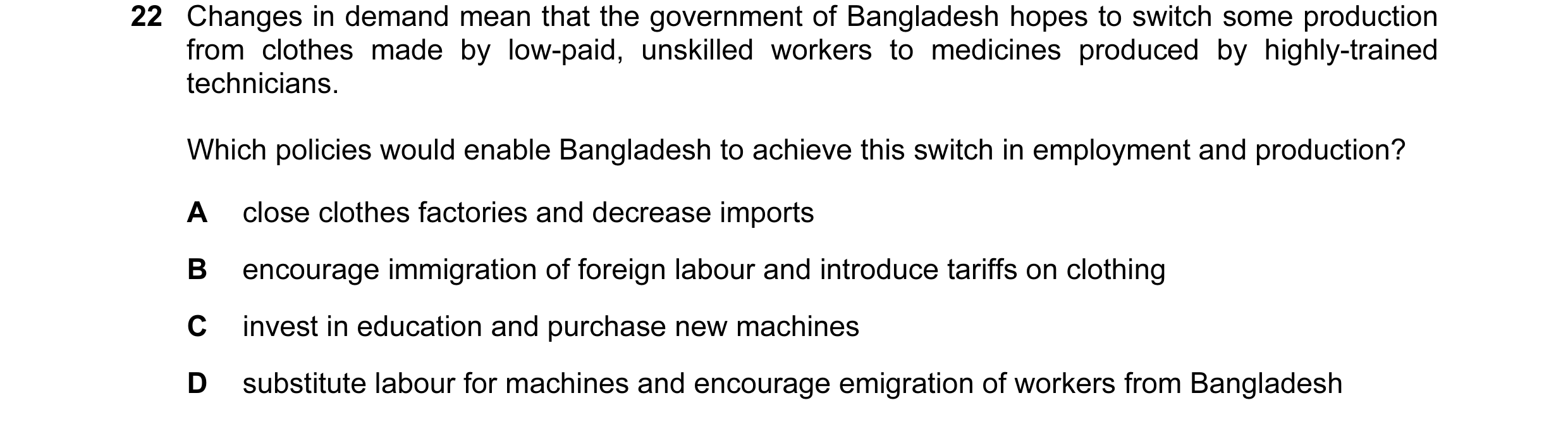
22 Changes in demand mean that the government of Bangladesh hopes to switch some production from clothes made by low-paid, unskilled workers to medicines produced by highly-trained technicians. Which policies would enable Bangladesh to achieve this switch in employment and production? A close clothes factories and decrease imports B encourage immigration of foreign labour and introduce tariffs on clothing C invest in education and purchase new machines D substitute labour for machines and encourage emigration of workers from Bangladesh
1 marks
Answer: C
This question in 0455/13 May/June 2012
Q16 · What is thought to be a benefit of global free trade? 0455/11 May/June 2013
29 What is thought to be a benefit of global free trade? A It increases the opportunity for domestic producers to specialise. B It increases the protection for domestic producers. C It reduces a country’s reliance on other countries. D It reduces the transport costs involved in trading.
1 marks
Answer: A
This question in 0455/11 May/June 2013
Q17 · What might be a direct benefit to the individual worker of a specialised job? 0455/11 Oct/Nov 2013
21 What might be a direct benefit to the individual worker of a specialised job? A Specialisation enables a better quality product to be produced. B Specialisation enables the firm to introduce more machinery. C Specialisation enables the worker to become more skilled. D Specialisation makes better use of resources.
1 marks
Answer: C
This question in 0455/11 Oct/Nov 2013
Q18 · A developing country’s two major sources of income from international trade are fishing… 0455/11 Oct/Nov 2013
26 A developing country’s two major sources of income from international trade are fishing and tourism. If the country’s exchange rate depreciated, what is likely to happen? A Imported goods would become cheaper for local people. B The country would definitely become poorer. C The price of fish sold as exports would become cheaper. D Tourists to the country would be discouraged by higher prices.
1 marks
Answer: C
This question in 0455/11 Oct/Nov 2013
Q19 · What might be a direct benefit to the individual worker of a specialised job? 0455/12 Oct/Nov 2013
12 What might be a direct benefit to the individual worker of a specialised job? A Specialisation enables a better quality product to be produced. B Specialisation enables the firm to introduce more machinery. C Specialisation enables the worker to become more skilled. D Specialisation makes better use of resources.
1 marks
Answer: C
This question in 0455/12 Oct/Nov 2013
Q20 · What might be a direct benefit to the individual worker of a specialised job? 0455/13 Oct/Nov 2013
12 What might be a direct benefit to the individual worker of a specialised job? A Specialisation enables a better quality product to be produced. B Specialisation enables the firm to introduce more machinery. C Specialisation enables the worker to become more skilled. D Specialisation makes better use of resources.
1 marks
Answer: C
This question in 0455/13 Oct/Nov 2013
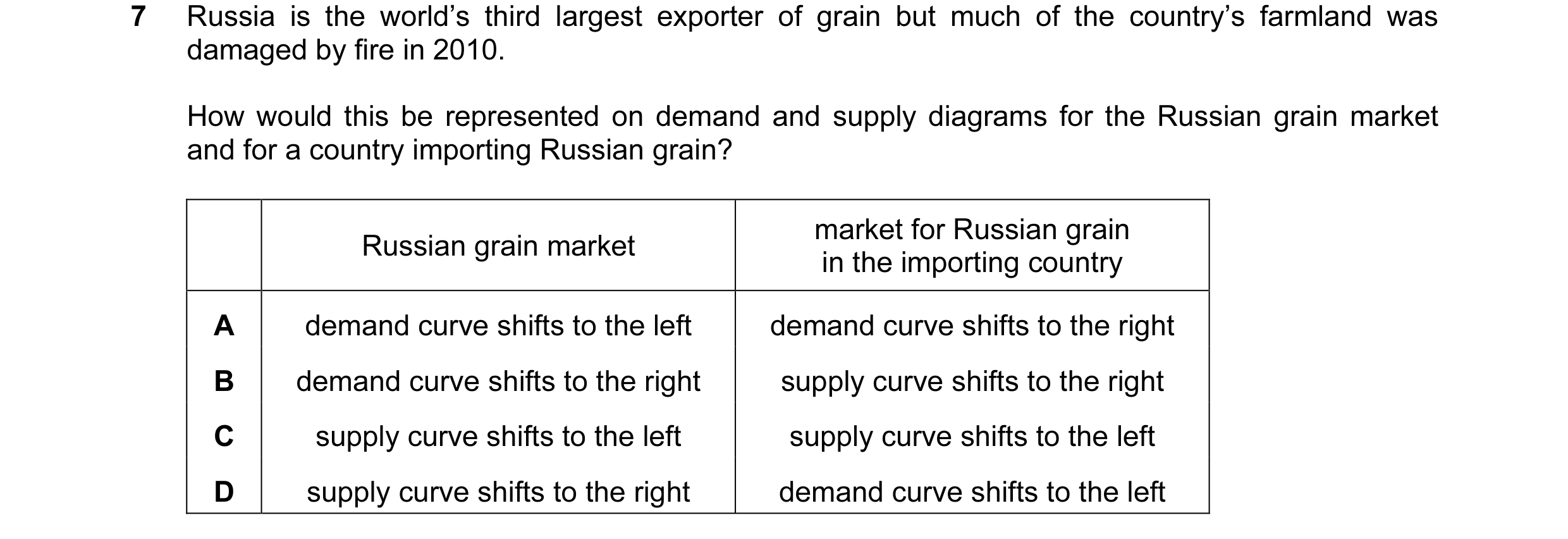
Q21 · Russia is the world’s third largest exporter of grain but much of the country’s farmland… 0455/11 May/June 2014
7 Russia is the world’s third largest exporter of grain but much of the country’s farmland was damaged by fire in 2010. How would this be represented on demand and supply diagrams for the Russian grain market and for a country importing Russian grain? market for Russian grain Russian grain market in the importing country A demand curve shifts to the left demand curve shifts to the right B demand curve shifts to the right supply curve shifts to the right C supply curve shifts to the left supply curve shifts to the left D supply curve shifts to the right demand curve shifts to the left
1 marks
Answer: C
This question in 0455/11 May/June 2014
Q22 · The citizens of a country which avoids international trade may benefit from A an increase… 0455/12 May/June 2014
28 The citizens of a country which avoids international trade may benefit from A an increase in specialisation. B better political and cultural ties. C competitive pressure to improve the quality of goods. D more employment in their industries.
1 marks
Answer: D
This question in 0455/12 May/June 2014
Q23 · In 2012, Nokia, a mobile phone manufacturer, produced 18% of Finland’s exports 0455/12 May/June 2014
29 In 2012, Nokia, a mobile phone manufacturer, produced 18% of Finland’s exports. Why might this be undesirable for Finland? A Foreign demand for mobile phone firms may grow continuously. B Nokia may introduce new technology which raises total costs by less than output. C There may be a reduction in trade restrictions on mobile phones. D There may be an industrial dispute at Nokia.
1 marks
Answer: D
This question in 0455/12 May/June 2014
Q24 · What is an advantage of international specialisation? 0455/11 May/June 2015
28 What is an advantage of international specialisation? A choice is limited B countries become overdependent on each other C resources are used more efficiently D transport costs are decreased
1 marks
Answer: C
This question in 0455/11 May/June 2015
Q25 · What is an advantage of international specialisation? 0455/12 May/June 2015
28 What is an advantage of international specialisation? A choice is limited B countries become overdependent on each other C resources are used more efficiently D transport costs are decreased
1 marks
Answer: C
This question in 0455/12 May/June 2015
Q26 · What is an advantage of international specialisation? 0455/13 May/June 2015
28 What is an advantage of international specialisation? A choice is limited B countries become overdependent on each other C resources are used more efficiently D transport costs are decreased
1 marks
Answer: C
This question in 0455/13 May/June 2015
Q27 · What is most likely to encourage international specialisation? 0455/11 Oct/Nov 2015
29 What is most likely to encourage international specialisation? A similarities in climate in different countries B the ability to produce products more cheaply than other countries C the discovery of oil in a country that had no oil before D very high international transport costs
1 marks
Answer: B
This question in 0455/11 Oct/Nov 2015
Q28 · What is most likely to encourage international specialisation? 0455/12 Oct/Nov 2015
29 What is most likely to encourage international specialisation? A similarities in climate in different countries B the ability to produce products more cheaply than other countries C the discovery of oil in a country that had no oil before D very high international transport costs
1 marks
Answer: B
This question in 0455/12 Oct/Nov 2015
Q29 · What is a disadvantage for a trade union representing workers in a company that has… 0455/12 Feb/March 2016
8 What is a disadvantage for a trade union representing workers in a company that has increased specialisation? A Capital equipment can be substituted for labour. B Different abilities can be used fully. C Production levels are decreased. D Workers are able to gain a higher level of skill.
1 marks
Answer: A
This question in 0455/12 Feb/March 2016
Q30 · What encourages international specialisation? 0455/12 Oct/Nov 2016
27 What encourages international specialisation? A a foreign exchange shortage B diseconomies of scale C free trade D quotas
1 marks
This question in 0455/12 Oct/Nov 2016
Q31 · What encourages international specialisation? 0455/13 Oct/Nov 2016
27 What encourages international specialisation? A a foreign exchange shortage B diseconomies of scale C free trade D quotas
1 marks
Answer: C
This question in 0455/13 Oct/Nov 2016
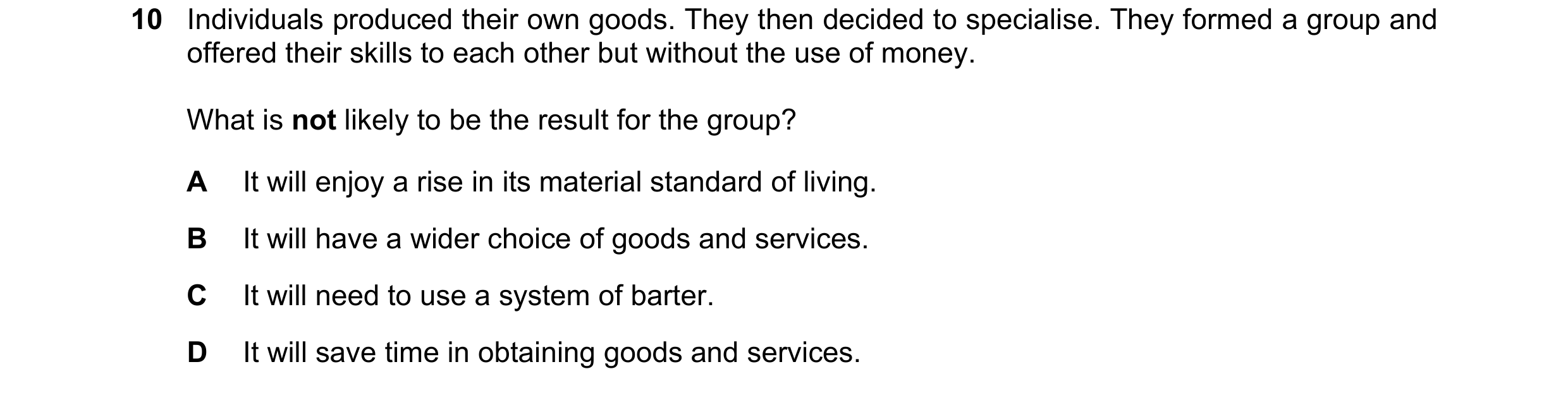
Q32 · Individuals produced their own goods 0455/11 May/June 2017
10 Individuals produced their own goods. They then decided to specialise. They formed a group and offered their skills to each other but without the use of money. What is not likely to be the result for the group? A It will enjoy a rise in its material standard of living. B It will have a wider choice of goods and services. C It will need to use a system of barter. D It will save time in obtaining goods and services.
1 marks
Answer: D
This question in 0455/11 May/June 2017
Q33 · What might encourage international specialisation between countries? 0455/12 May/June 2017
28 What might encourage international specialisation between countries? A free trade B inefficiencies in production C labour immobility D tariffs
1 marks
Answer: A
This question in 0455/12 May/June 2017
Q34 · What is the best example of specialisation? 0455/13 Oct/Nov 2017
8 What is the best example of specialisation? A a diversified engineering company B a general repairs handyman C a self-sufficient, non-trading country D an old person’s helper and care assistant
1 marks
Answer: D
This question in 0455/13 Oct/Nov 2017
Q35 · What policy would encourage greater international specialisation? 0455/13 Oct/Nov 2017
30 What policy would encourage greater international specialisation? A the promotion of industrial diversification B the protection of new businesses C the reduction of tariffs D the subsidising of service industries
1 marks
Answer: C
This question in 0455/13 Oct/Nov 2017
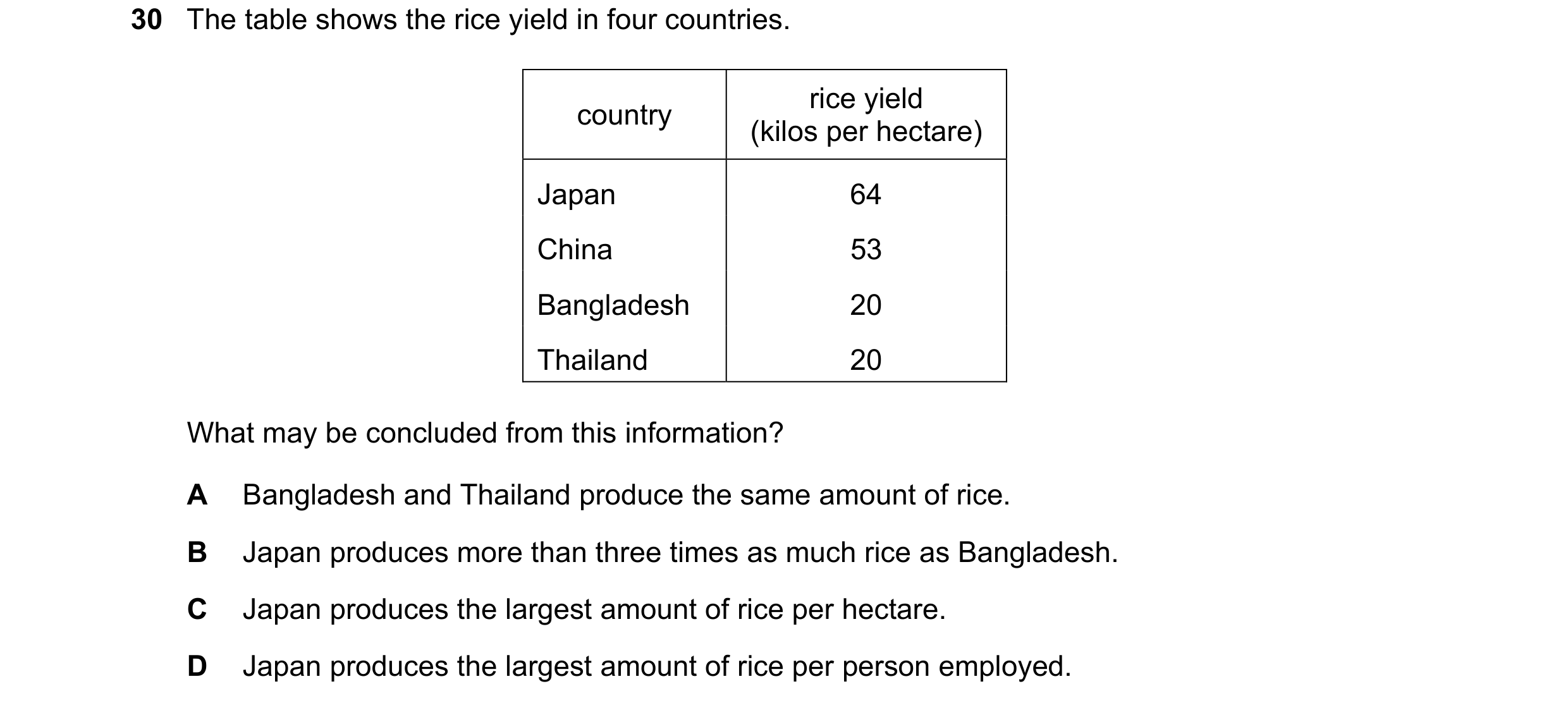
Q36 · The table shows the rice yield in four countries 0455/13 May/June 2018
30 The table shows the rice yield in four countries. rice yield country (kilos per hectare) Japan 64 China 53 Bangladesh 20 Thailand 20 What may be concluded from this information? A Bangladesh and Thailand produce the same amount of rice. B Japan produces more than three times as much rice as Bangladesh. C Japan produces the largest amount of rice per hectare. D Japan produces the largest amount of rice per person employed.
1 marks
Answer: C
This question in 0455/13 May/June 2018
Q37 · What is the most likely disadvantage of international specialisation? 0455/12 May/June 2019
29 What is the most likely disadvantage of international specialisation? A decreased levels of global output B increased average production costs C increased productivity levels D overdependence on other economies
1 marks
Answer: D
This question in 0455/12 May/June 2019
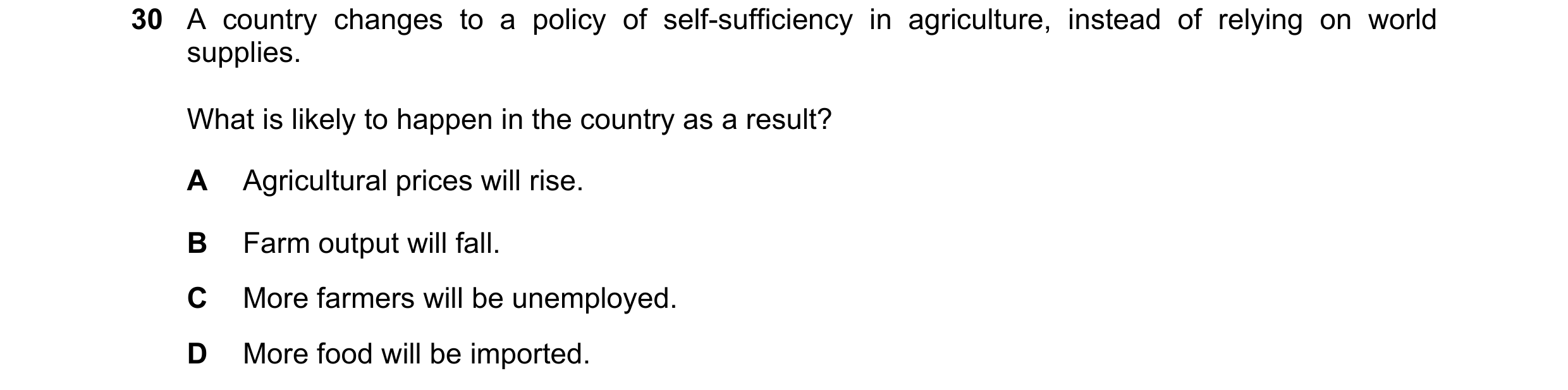
Q38 · A country changes to a policy of self-sufficiency in agriculture, instead of relying on… 0455/12 Feb/March 2020
30 A country changes to a policy of self-sufficiency in agriculture, instead of relying on world supplies. What is likely to happen in the country as a result? A Agricultural prices will rise. B Farm output will fall. C More farmers will be unemployed. D More food will be imported.
1 marks
This question in 0455/12 Feb/March 2020
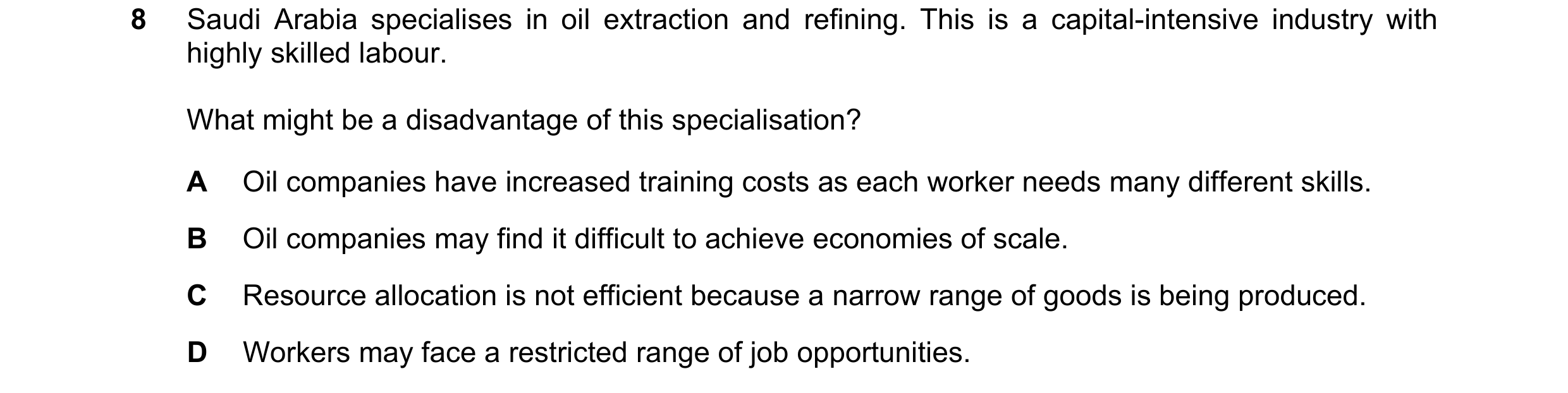
Q39 · Saudi Arabia specialises in oil extraction and refining 0455/12 May/June 2020
8 Saudi Arabia specialises in oil extraction and refining. This is a capital-intensive industry with highly skilled labour. What might be a disadvantage of this specialisation? A Oil companies have increased training costs as each worker needs many different skills. B Oil companies may find it difficult to achieve economies of scale. C Resource allocation is not efficient because a narrow range of goods is being produced. D Workers may face a restricted range of job opportunities.
1 marks
Answer: D
This question in 0455/12 May/June 2020
Q40 · What is a disadvantage of increased specialisation by a country? 0455/12 May/June 2020
29 What is a disadvantage of increased specialisation by a country? A It becomes more reliant on imports to meet all its needs. B It reduces the potential for international trade. C It results in access to a greater variety of goods for consumers. D It results in lower costs for home produced goods.
1 marks
Answer: A
This question in 0455/12 May/June 2020
Q41 · What is most likely to discourage international specialisation and trade for an economy? 0455/13 Oct/Nov 2020
28 What is most likely to discourage international specialisation and trade for an economy? A decreasing labour supply B decreasing transport costs C increasing oil prices D increasing trade barriers
1 marks
Answer: D
This question in 0455/13 Oct/Nov 2020
Q42 · What is a disadvantage of increasing international specialisation? 0455/11 May/June 2021
27 What is a disadvantage of increasing international specialisation? A Consumers pay higher prices for goods and services reducing their welfare. B Domestic firms may be uncompetitive leading to structural unemployment. C Domestic firms may experience rising costs as they pay more for imports. D Resources may be used less efficiently as domestic firms face less competition.
1 marks
Answer: B
This question in 0455/11 May/June 2021
Q43 · What would be a disadvantage of specialisation for a worker? 0455/12 May/June 2021
10 What would be a disadvantage of specialisation for a worker? A a low price of the product that they make B boredom due to repetition of the same task C higher quality of the good D the opportunity to undertake training
1 marks
Answer: B
This question in 0455/12 May/June 2021
Q44 · Why can specialisation cause economic growth? 0455/11 Oct/Nov 2021
27 Why can specialisation cause economic growth? A Specialisation can allow a country to produce many different goods and services. B Specialisation can lead to a reduction in average costs of production. C Specialisation can mean that firms in a country will face diseconomies of scale. D Specialisation can reduce a country’s need to depend on other economies.
1 marks
Answer: B
This question in 0455/11 Oct/Nov 2021
Q45 · A country specialises in the production of steel, toys and textiles 0455/12 Oct/Nov 2021
27 A country specialises in the production of steel, toys and textiles. What is a disadvantage of specialisation for the country’s workers? A They cannot afford to buy products from other countries. B They could become structurally unemployed if global demand changes. C They have to learn a variety of skills. D They have too much choice which wastes their time.
1 marks
Answer: B
This question in 0455/12 Oct/Nov 2021
Q46 · Malaysia and Indonesia specialise in the production of palm oil 0455/13 Oct/Nov 2021
27 Malaysia and Indonesia specialise in the production of palm oil. What is a disadvantage of specialisation? A concentration of labour in the activity in which it is most productive B creation of jobs to meet world demand C reliance on trade with other countries for other goods D rising palm oil prices
1 marks
Answer: C
This question in 0455/13 Oct/Nov 2021
Q47 · When are countries most likely to specialise and trade with each other? 0455/13 May/June 2022
27 When are countries most likely to specialise and trade with each other? A when the cost of transport between them is high B when there are large differences in their resource allocations C when they have access to the same technology D when they have high tariffs and other protective measures
1 marks
Answer: B
This question in 0455/13 May/June 2022
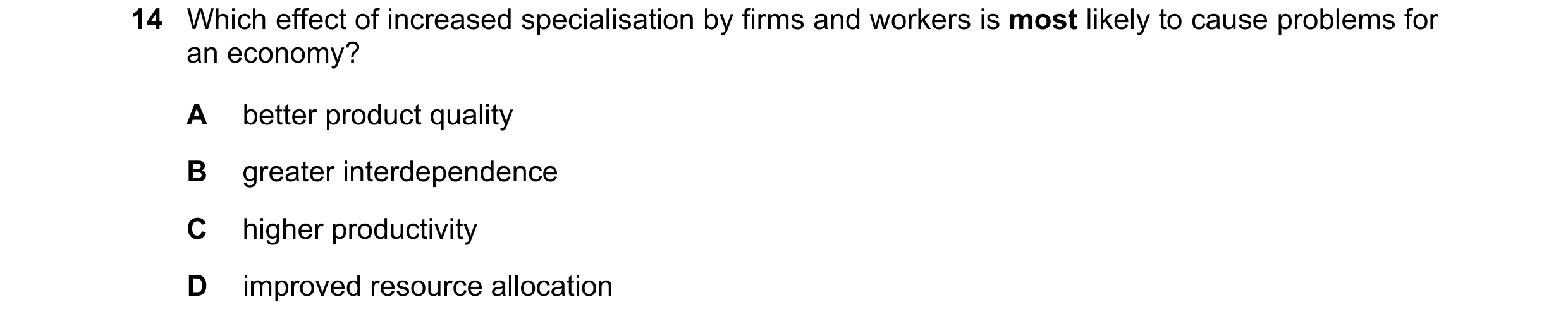
Q48 · Which effect of increased specialisation by firms and workers is most likely to cause… 0455/12 Oct/Nov 2022
14 Which effect of increased specialisation by firms and workers is most likely to cause problems for an economy? A better product quality B greater interdependence C higher productivity D improved resource allocation
1 marks
Answer: B
This question in 0455/12 Oct/Nov 2022
Q49 · What is most likely to result from an extension of specialisation in manufacturing? 0455/11 Oct/Nov 2023
27 What is most likely to result from an extension of specialisation in manufacturing? A for the consumer some prices will be reduced B for the country there will be less dependency on international trade C for the employee the work will become more varied D for the producer there will be less efficiency
1 marks
Answer: A
This question in 0455/11 Oct/Nov 2023
Q50 · What is most likely to encourage international specialisation? 0455/13 Oct/Nov 2023
27 What is most likely to encourage international specialisation? A similarities in climate in different countries B the ability to produce products more cheaply than other countries C the discovery of oil in a country that had no oil before D very high international transport costs
1 marks
Answer: B
This question in 0455/13 Oct/Nov 2023
Q51 · Two countries wish to use their scarce resources to specialise in production and trade… 0455/12 Feb/March 2024
27 Two countries wish to use their scarce resources to specialise in production and trade with each other. Under which conditions is this most likely to happen? the ability of each the resource country to allocations of the reallocate their two countries resources A different difficult B different easy C similar difficult D similar easy
1 marks
Answer: B
This question in 0455/12 Feb/March 2024
Q52 · What is most likely to promote international specialisation? 0455/13 May/June 2024
27 What is most likely to promote international specialisation? A similarities in climate in different countries B similarities in the availability of natural resources in different countries C instability in foreign exchange rates D the abolition of tariffs and customs duties
1 marks
Answer: D
This question in 0455/13 May/June 2024
Q53 · Which statement shows two benefits for consumers from specialisation at a national level? 0455/11 Oct/Nov 2024
27 Which statement shows two benefits for consumers from specialisation at a national level? A decreased prices and better quality B decreased profits and high-quality raw materials C increased choice and high transport costs D increased productivity and increased economies of scale
1 marks
Answer: A
This question in 0455/11 Oct/Nov 2024
Q54 · What might encourage international specialisation between countries? 0455/12 Oct/Nov 2024
27 What might encourage international specialisation between countries? A free trade B inefficiencies in production C labour immobility D tariffs
1 marks
Answer: A
This question in 0455/12 Oct/Nov 2024
Q55 · What encourages international specialisation? 0455/13 Oct/Nov 2024
27 What encourages international specialisation? A a foreign exchange shortage B diseconomies of scale C free trade D quotas
1 marks
Answer: C
This question in 0455/13 Oct/Nov 2024
Q56 · A country has large reserves of oil 0455/12 Feb/March 2025
27 A country has large reserves of oil. It decides to produce a wide range of goods rather than specialise in oil production. What is not an acceptable reason in support of this decision? A Oil is a non-renewable resource that could be exhausted quickly. B Producing a wide range of goods increases the benefits from free trade. C Relying on other countries for vital goods and services makes a country vulnerable. D The price of oil is volatile, making export revenue unstable.
1 marks
Answer: B
This question in 0455/12 Feb/March 2025
Q57 · What will increase the level of specialisation in an economy? 0455/11 May/June 2025
27 What will increase the level of specialisation in an economy? A A computer manufacturer takes over an advertising company. B A retail store issues its own credit card. C A travel agent provides transport to the airport. D A vehicle assembler reduces its range of vehicles.
1 marks
Answer: D
This question in 0455/11 May/June 2025
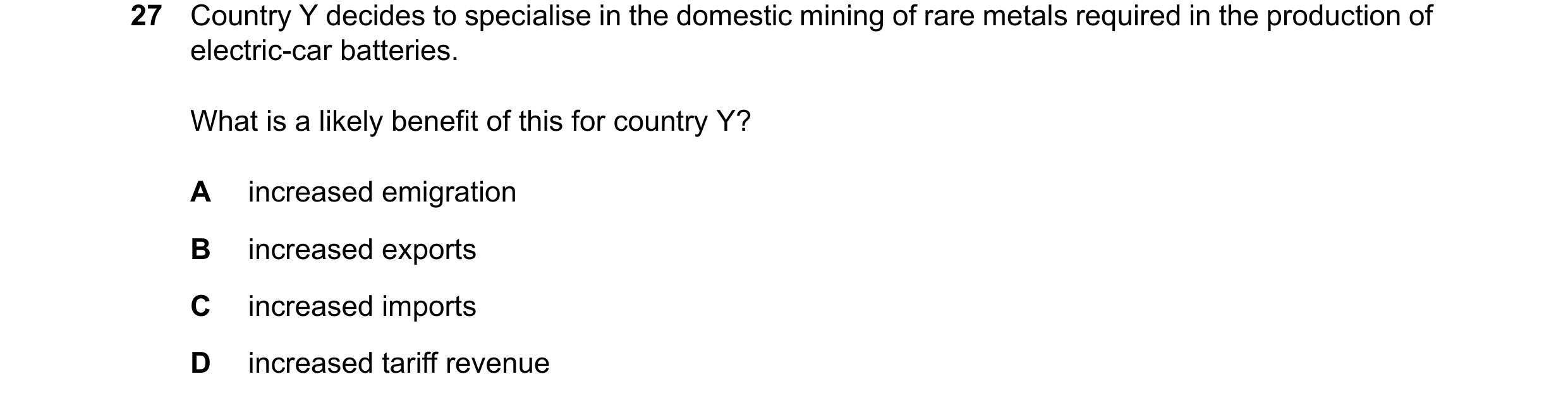
Q58 · Country Y decides to specialise in the domestic mining of rare metals required in the… 0455/13 May/June 2025
27 Country Y decides to specialise in the domestic mining of rare metals required in the production of electric-car batteries. What is a likely benefit of this for country Y? A increased emigration B increased exports C increased imports D increased tariff revenue
1 marks
Answer: B
This question in 0455/13 May/June 2025
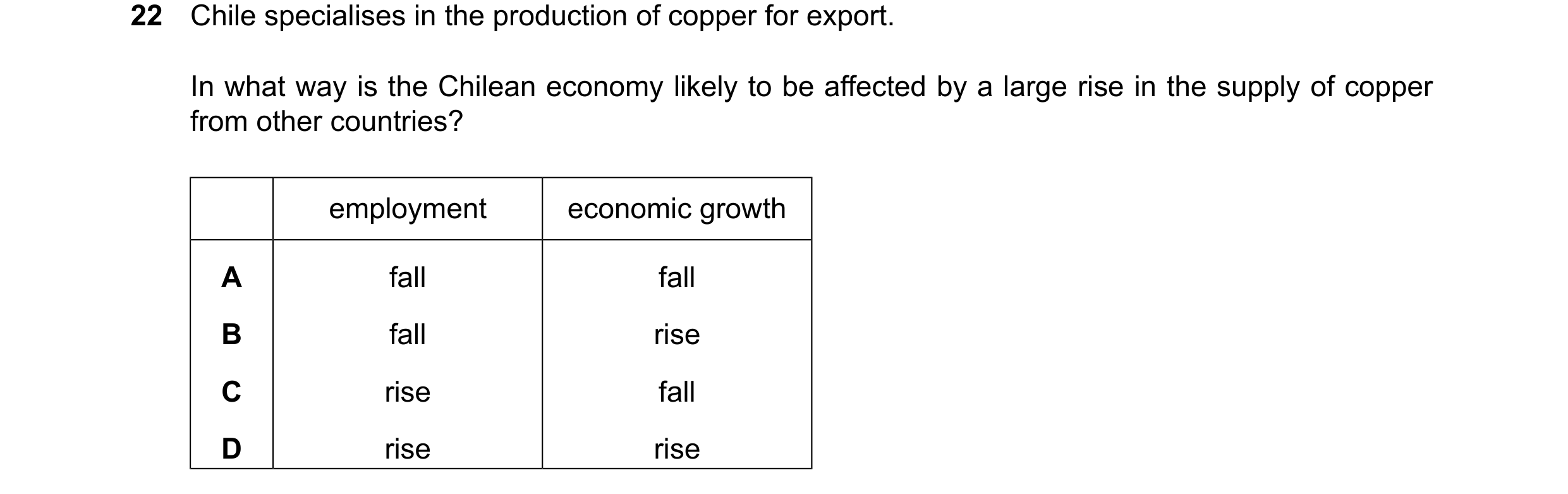
Q59 · Chile specialises in the production of copper for export 0455/11 Oct/Nov 2025
22 Chile specialises in the production of copper for export. In what way is the Chilean economy likely to be affected by a large rise in the supply of copper from other countries? employment economic growth A fall fall B fall rise C rise fall D rise rise
1 marks
Answer: A
This question in 0455/11 Oct/Nov 2025
Q60 · What is an advantage for consumers from international specialisation? 0455/11 Oct/Nov 2025
27 What is an advantage for consumers from international specialisation? A competition between firms results in lower prices B labour can move more freely between countries C less wealth is created throughout the world D multinational companies can increase their profits
1 marks
Answer: A
This question in 0455/11 Oct/Nov 2025
Q61 · What is an advantage of international specialisation? 0455/12 Oct/Nov 2025
27 What is an advantage of international specialisation? A Choice is limited. B Countries become over-dependent on each other. C Resources are used more efficiently. D Transport costs are decreased.
1 marks
Answer: C
This question in 0455/12 Oct/Nov 2025
Q62 · What is a likely benefit of increased national specialisation? 0455/13 Oct/Nov 2025
27 What is a likely benefit of increased national specialisation? A It guarantees a balance of trade in goods and services surplus. B It increases dependency on other economies. C It lengthens international supply chains. D It reduces the cost of living.
1 marks
Answer: D
This question in 0455/13 Oct/Nov 2025

 1 / 12



 2 / 12



 3 / 12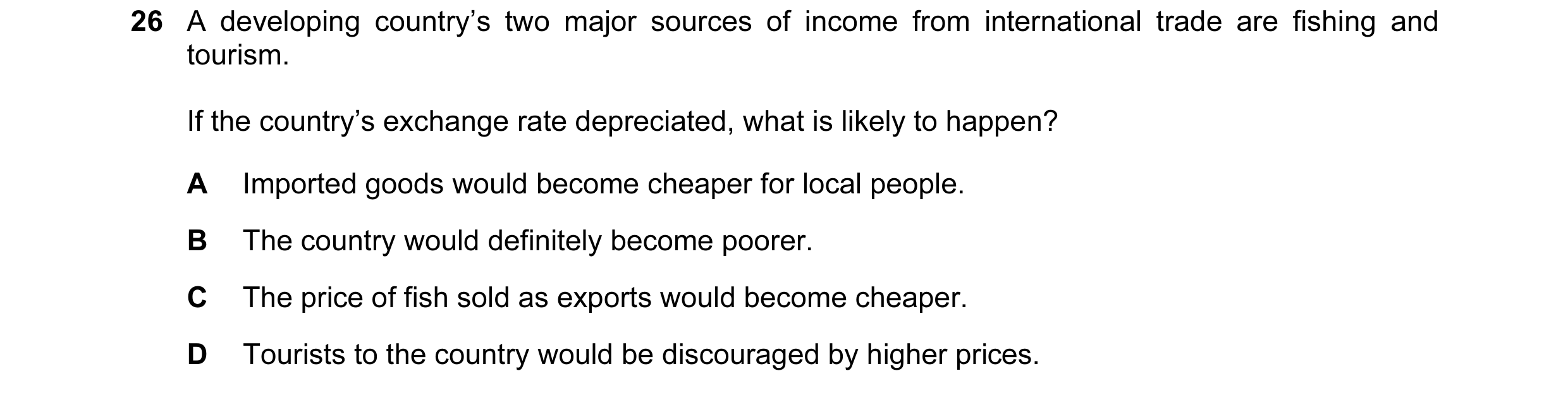


 4 / 12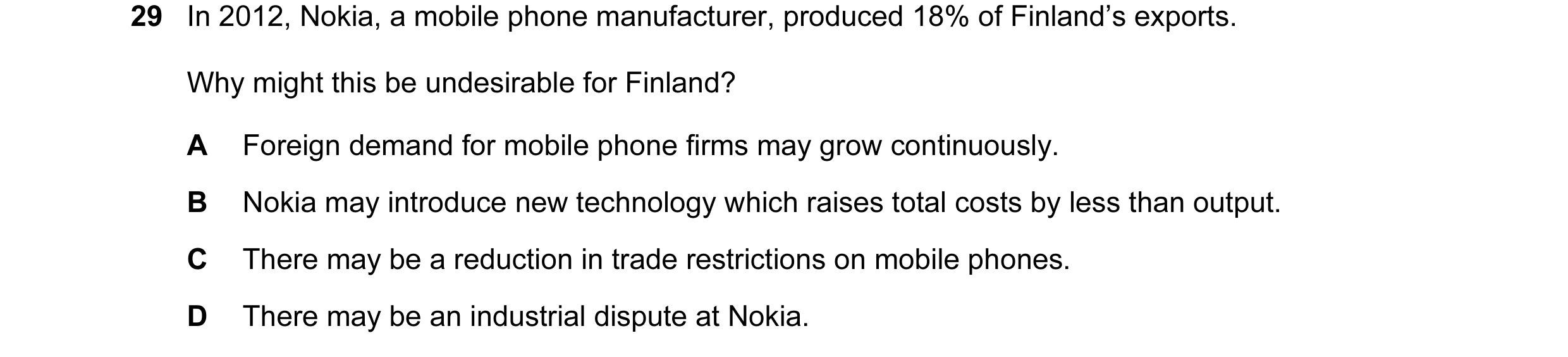




 5 / 12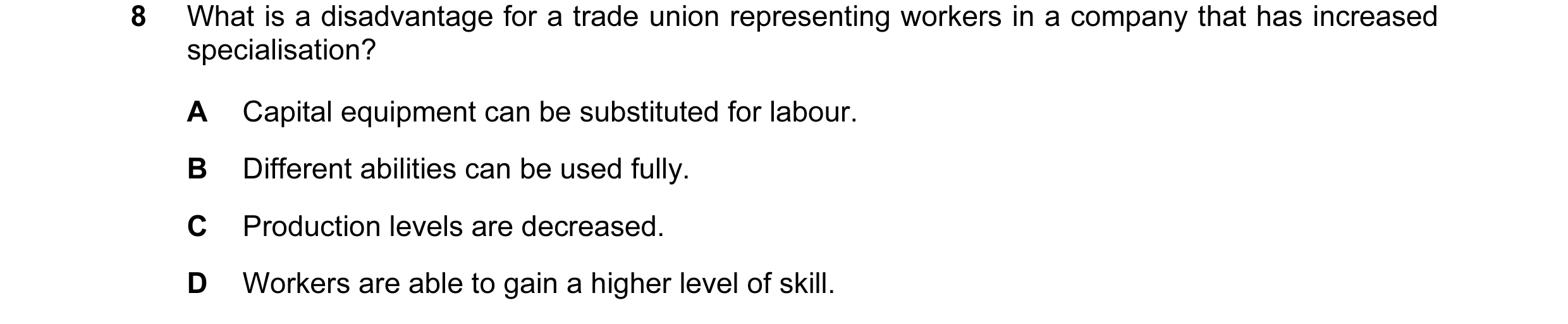



 6 / 12

 7 / 12




 8 / 12


 9 / 12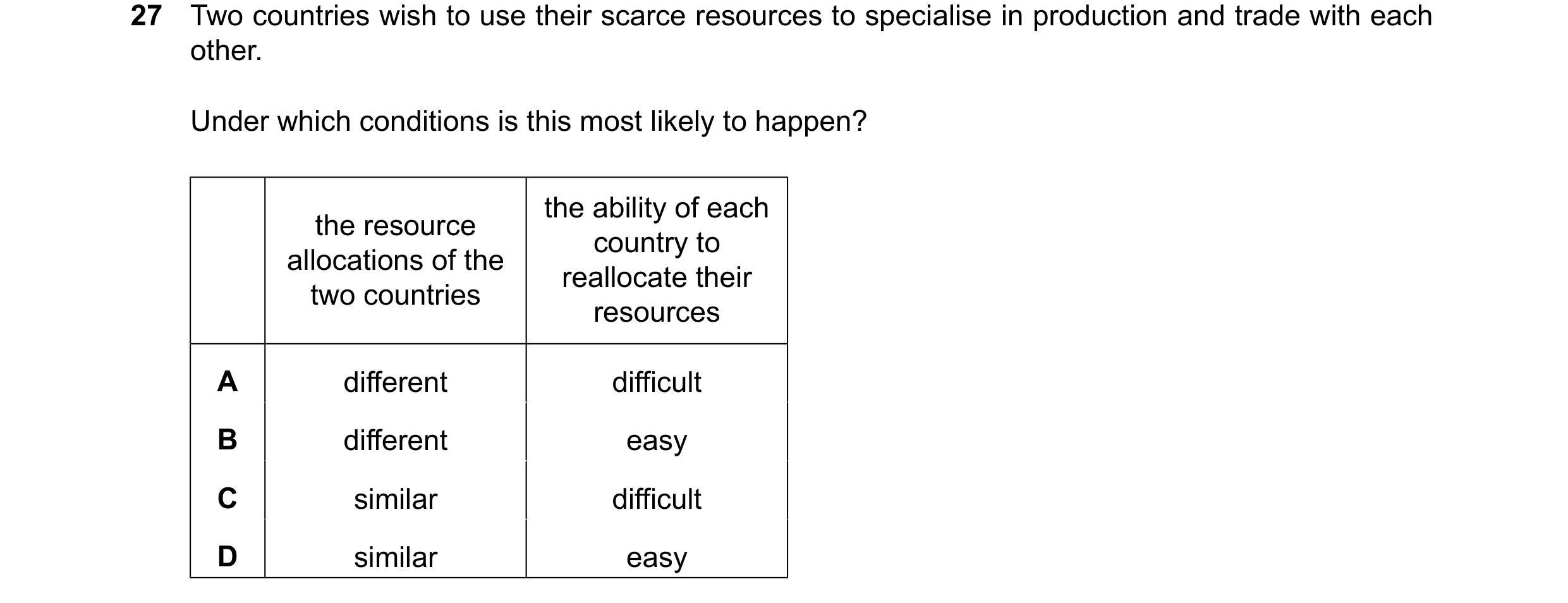



 10 / 12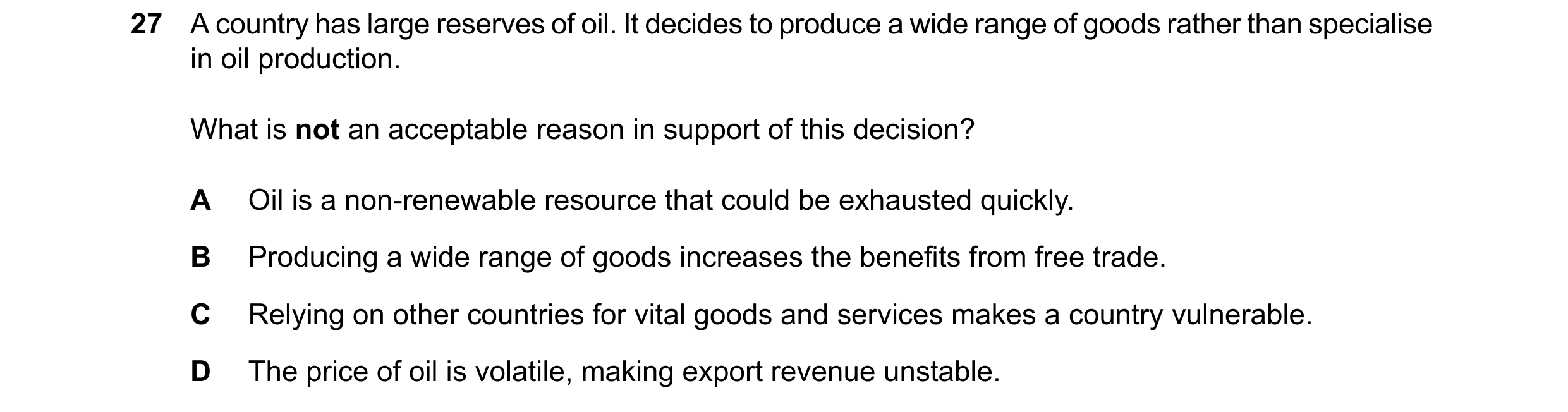

 11 / 12
 12 / 12