Questions as text
Q1 · What is usually a function of a trade union? 0455/11 Oct/Nov 2004
5 What is usually a function of a trade union? A It advertises the products that the members make. B It appoints company employees. C It negotiates with employers for increased wages. D It negotiates with suppliers for reduced costs of materials.
1 marks
Answer: C
This question in 0455/11 Oct/Nov 2004
Q2 · When will a trade union be most effective in pursuing its members' interests? 0455/11 Oct/Nov 2004
9 When will a trade union be most effective in pursuing its members' interests? A The economy is in recession with rising unemployment. B The employers have few orders for the product. C The government passes a law to increase competition in the labour market. D The members' wages make up a small part of total costs.
1 marks
Answer: D
This question in 0455/11 Oct/Nov 2004
Q3 · UK flights were severely disrupted in August 2004 after a pay dispute involving trade… 0455/11 Oct/Nov 2006
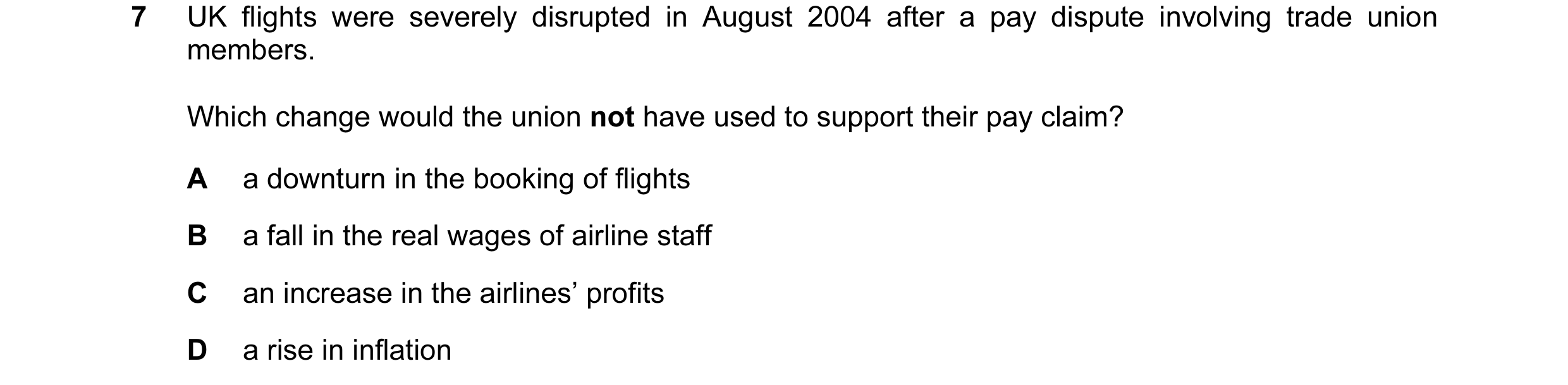
7 UK flights were severely disrupted in August 2004 after a pay dispute involving trade union members. Which change would the union not have used to support their pay claim? A a downturn in the booking of flights B a fall in the real wages of airline staff C an increase in the airlines’ profits D a rise in inflation
1 marks
Answer: A
This question in 0455/11 Oct/Nov 2006
Q4 · When will a trade union be most effective in pursuing its members' interests? 0455/11 May/June 2007
6 When will a trade union be most effective in pursuing its members' interests? A The economy is in recession with rising unemployment. B The employers have few orders for the product. C The government passes a law to increase competition in the labour market. D The members' wages make up a small part of total costs.
1 marks
Answer: D
This question in 0455/11 May/June 2007
Q5 · What is the main purpose of a trade union? 0455/11 Oct/Nov 2007
9 What is the main purpose of a trade union? A to achieve profit maximisation B to encourage free trade C to promote private ownership of industry D to protect the interests of its members
1 marks
Answer: D
This question in 0455/11 Oct/Nov 2007
Q6 · What is not a function of a trade union? 0455/11 May/June 2008
8 What is not a function of a trade union? A to act as a pressure group to change labour laws B to negotiate with employers over conditions of work C to promote the sales of products made by its members D to protect the living standards of its members
1 marks
Answer: C
This question in 0455/11 May/June 2008
Q7 · In which situation will a trade union be least likely to be effective in supporting the… 0455/11 Oct/Nov 2008
7 In which situation will a trade union be least likely to be effective in supporting the interests of its members? A The economy is experiencing an increase in unemployment. B The firms have a large increase in demand for the product. C The government passes a law weakening the powers of employers. D The workers’ wages are a small proportion of total costs.
1 marks
Answer: A
This question in 0455/11 Oct/Nov 2008
Q8 · What is a function of a trade union? 0455/11 May/June 2010
12 What is a function of a trade union? A to negotiate workers’ contracts B to promote workers to more responsible jobs C to recruit workers for the firm D to supervise the workers in the firm
1 marks
Answer: A
This question in 0455/11 May/June 2010
Q9 · What is a function of a trade union? 0455/12 May/June 2010
13 What is a function of a trade union? A to negotiate workers’ contracts B to promote workers to more responsible jobs C to recruit workers for the firm D to supervise the workers in the firm
1 marks
Answer: A
This question in 0455/12 May/June 2010
Q10 · A group of workers in a firm join a trade union 0455/11 Oct/Nov 2011
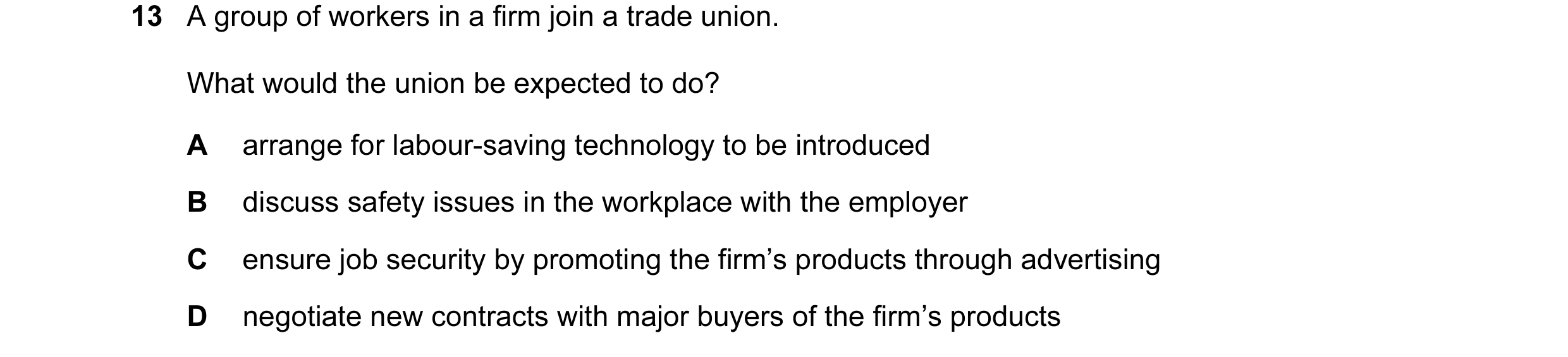
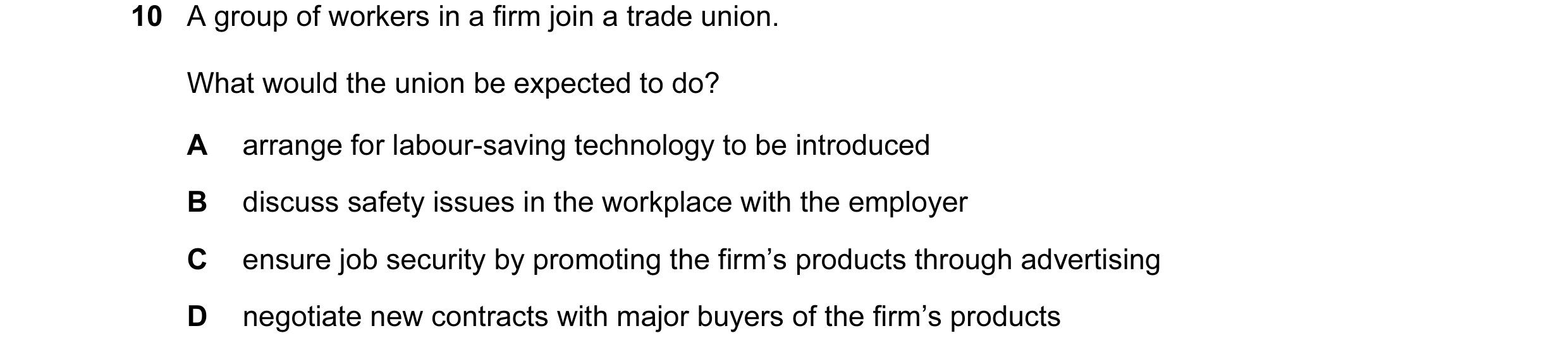
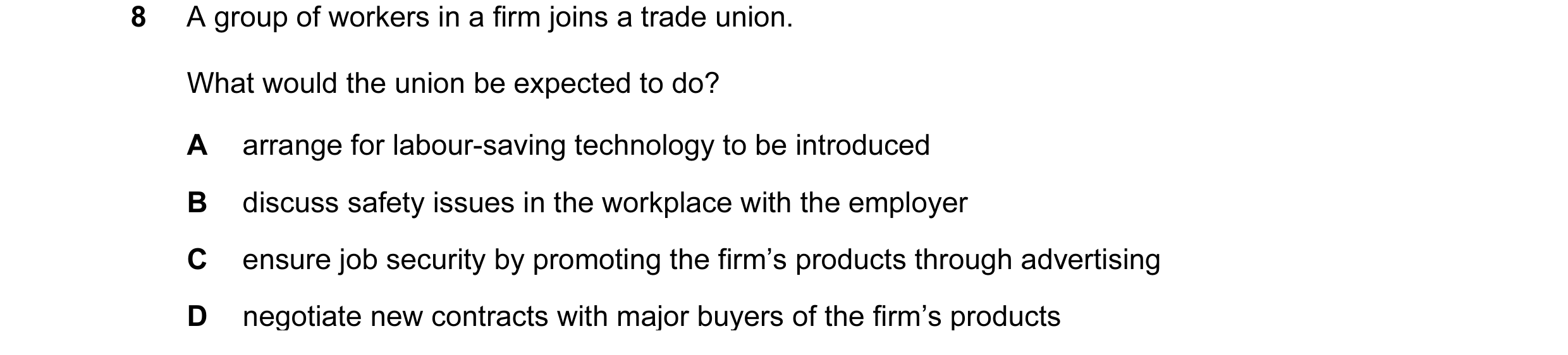
13 A group of workers in a firm join a trade union. What would the union be expected to do? A arrange for labour-saving technology to be introduced B discuss safety issues in the workplace with the employer C ensure job security by promoting the firm’s products through advertising D negotiate new contracts with major buyers of the firm’s products
1 marks
Answer: B
This question in 0455/11 Oct/Nov 2011
Q11 · A group of workers in a firm join a trade union 0455/12 Oct/Nov 2011
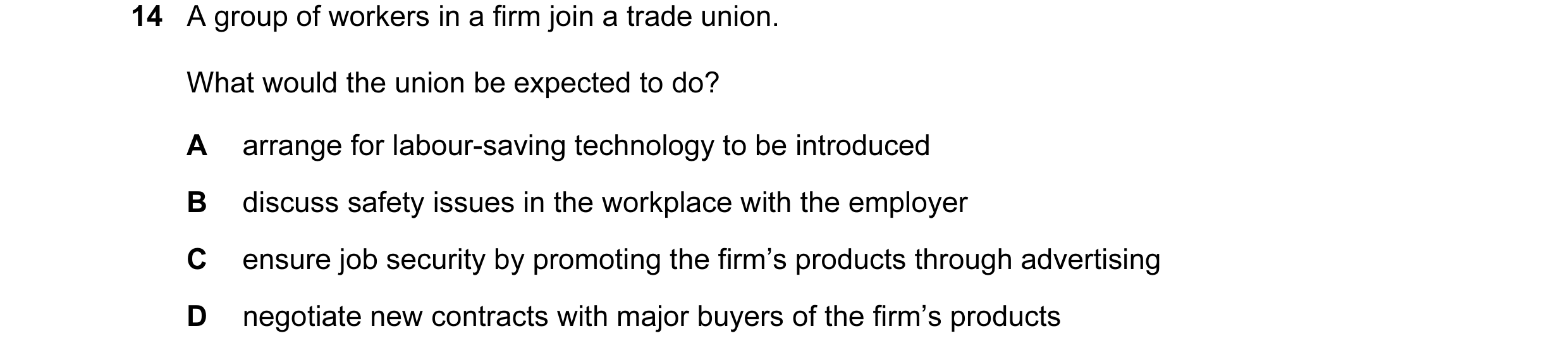
14 A group of workers in a firm join a trade union. What would the union be expected to do? A arrange for labour-saving technology to be introduced B discuss safety issues in the workplace with the employer C ensure job security by promoting the firm’s products through advertising D negotiate new contracts with major buyers of the firm’s products
1 marks
Answer: B
This question in 0455/12 Oct/Nov 2011
Q12 · A group of workers in a firm join a trade union 0455/13 Oct/Nov 2011
10 A group of workers in a firm join a trade union. What would the union be expected to do? A arrange for labour-saving technology to be introduced B discuss safety issues in the workplace with the employer C ensure job security by promoting the firm’s products through advertising D negotiate new contracts with major buyers of the firm’s products
1 marks
Answer: B
This question in 0455/13 Oct/Nov 2011
Q13 · What might be an advantage to a trade union when arguing for an increase in its members’… 0455/12 May/June 2012
11 What might be an advantage to a trade union when arguing for an increase in its members’ pay? A an increase in imports of a similar product B the development of a new and profitable brand of the company’s product C the development of new machines requiring fewer workers D the establishment of a local college providing training
1 marks
Answer: B
This question in 0455/12 May/June 2012
Q14 · What might be an advantage to a trade union when arguing for an increase in its members’… 0455/13 May/June 2012
11 What might be an advantage to a trade union when arguing for an increase in its members’ pay? A an increase in imports of a similar product B the development of a new and profitable brand of the company’s product C the development of new machines requiring fewer workers D the establishment of a local college providing training
1 marks
Answer: B
This question in 0455/13 May/June 2012
Q15 · What could reduce the ability of a trade union to gain a pay rise for its members in a… 0455/11 Oct/Nov 2012
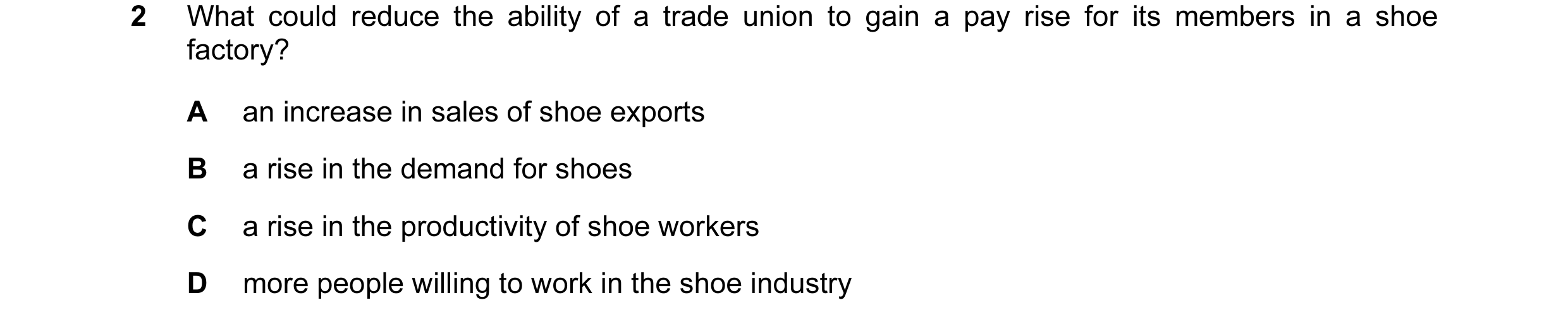
2 What could reduce the ability of a trade union to gain a pay rise for its members in a shoe factory? A an increase in sales of shoe exports B a rise in the demand for shoes C a rise in the productivity of shoe workers D more people willing to work in the shoe industry
1 marks
Answer: D
This question in 0455/11 Oct/Nov 2012
Q16 · What could reduce the ability of a trade union to gain a pay rise for its members in a… 0455/12 Oct/Nov 2012
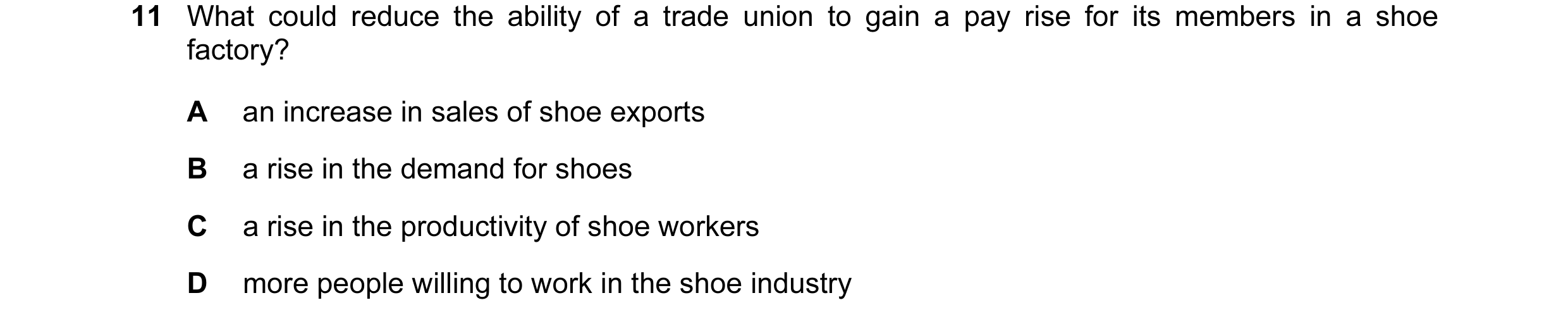
11 What could reduce the ability of a trade union to gain a pay rise for its members in a shoe factory? A an increase in sales of shoe exports B a rise in the demand for shoes C a rise in the productivity of shoe workers D more people willing to work in the shoe industry
1 marks
Answer: D
This question in 0455/12 Oct/Nov 2012
Q17 · What are the actions of a trade union intended to achieve in the long run? 0455/13 Oct/Nov 2012
11 What are the actions of a trade union intended to achieve in the long run? A benefits to society B harm to employers C help for members D reduced company profits
1 marks
Answer: C
This question in 0455/13 Oct/Nov 2012
Q18 · What is a function of a trade union? 0455/11 May/June 2013
13 What is a function of a trade union? A to negotiate workers’ contracts B to promote workers to more responsible jobs C to recruit workers for the firm D to supervise the workers in the firm
1 marks
Answer: A
This question in 0455/11 May/June 2013
Q19 · Which of the following is most likely to limit wage increases in an industry? 0455/12 May/June 2013
12 Which of the following is most likely to limit wage increases in an industry? A an increased demand for the industry’s product B a rise in the industry’s profits C a rise in wages for workers in similar jobs D the replacement of workers with robots
1 marks
Answer: D
This question in 0455/12 May/June 2013
Q20 · What is a function of a trade union? 0455/12 May/June 2013
13 What is a function of a trade union? A to negotiate workers’ contracts B to promote workers to more responsible jobs C to recruit workers for the firm D to supervise the workers in the firm
1 marks
Answer: A
This question in 0455/12 May/June 2013
Q21 · What is a function of a trade union? 0455/13 May/June 2013
22 What is a function of a trade union? A to negotiate workers’ contracts B to promote workers to more responsible jobs C to recruit workers for the firm D to supervise the workers in the firm
1 marks
Answer: A
This question in 0455/13 May/June 2013
Q22 · When will a trade union find it easier to achieve higher wages for its members? 0455/11 Oct/Nov 2013
20 When will a trade union find it easier to achieve higher wages for its members? A when consumers demand more of the product made B when the company has a decrease in profits C when the cost of raw materials increases D when unemployment increases
1 marks
Answer: A
This question in 0455/11 Oct/Nov 2013
Q23 · When will a trade union find it easier to achieve higher wages for its members? 0455/12 Oct/Nov 2013
11 When will a trade union find it easier to achieve higher wages for its members? A when consumers demand more of the product made B when the company has a decrease in profits C when the cost of raw materials increases D when unemployment increases
1 marks
Answer: A
This question in 0455/12 Oct/Nov 2013
Q24 · When will a trade union find it easier to achieve higher wages for its members? 0455/13 Oct/Nov 2013
11 When will a trade union find it easier to achieve higher wages for its members? A when consumers demand more of the product made B when the company has a decrease in profits C when the cost of raw materials increases D when unemployment increases
1 marks
Answer: A
This question in 0455/13 Oct/Nov 2013
Q25 · Official statistics in 2010 showed South Africa had a very high unemployment rate at… 0455/13 Oct/Nov 2013
26 Official statistics in 2010 showed South Africa had a very high unemployment rate at around 25%, yet wages were still double those in Brazil. What might be a reason for South Africa’s high wages in a time of unemployment compared with Brazil? A a skilled workforce in Brazil B high levels of savings in South Africa C increased use of labour-intensive production in Brazil D strong trade unions in South Africa
1 marks
Answer: D
This question in 0455/13 Oct/Nov 2013
Q26 · A trade union is negotiating a wage rise for its members 0455/11 May/June 2014
11 A trade union is negotiating a wage rise for its members. What will increase the chance of the wage rise being granted? A The company’s product has many substitutes. B The economy is entering a period of recession. C The government has made strike action illegal. D Wages are a small part of the company’s costs.
1 marks
Answer: D
This question in 0455/11 May/June 2014
Q27 · A trade union is negotiating a wage rise for its members 0455/12 May/June 2014
11 A trade union is negotiating a wage rise for its members. What will increase the chance of the wage rise being granted? A The company’s product has many substitutes. B The economy is entering a period of recession. C The government has made strike action illegal. D Wages are a small part of the company’s costs.
1 marks
Answer: D
This question in 0455/12 May/June 2014
Q28 · A trade union is negotiating a wage rise for its members 0455/13 May/June 2014
12 A trade union is negotiating a wage rise for its members. What will increase the chance of the wage rise being granted? A The company’s product has many substitutes. B The economy is entering a period of recession. C The government has made strike action illegal. D Wages are a small part of the company’s costs.
1 marks
Answer: D
This question in 0455/13 May/June 2014
Q29 · A group of workers in a firm joins a trade union 0455/11 Oct/Nov 2014
8 A group of workers in a firm joins a trade union. What would the union be expected to do? A arrange for labour-saving technology to be introduced B discuss safety issues in the workplace with the employer C ensure job security by promoting the firm’s products through advertising D negotiate new contracts with major buyers of the firm’s products
1 marks
Answer: B
This question in 0455/11 Oct/Nov 2014
Q30 · A group of workers in a firm joins a trade union 0455/12 Oct/Nov 2014
8 A group of workers in a firm joins a trade union. What would the union be expected to do? A arrange for labour-saving technology to be introduced B discuss safety issues in the workplace with the employer C ensure job security by promoting the firm’s products through advertising D negotiate new contracts with major buyers of the firm’s products
1 marks
Answer: B
This question in 0455/12 Oct/Nov 2014
Q31 · A group of workers in a firm joins a trade union 0455/13 Oct/Nov 2014
8 A group of workers in a firm joins a trade union. What would the union be expected to do? A arrange for labour-saving technology to be introduced B discuss safety issues in the workplace with the employer C ensure job security by promoting the firm’s products through advertising D negotiate new contracts with major buyers of the firm’s products
1 marks
Answer: B
This question in 0455/13 Oct/Nov 2014
Q32 · The table shows a country’s trade union membership in millions between 2008 and 2011 0455/11 May/June 2015
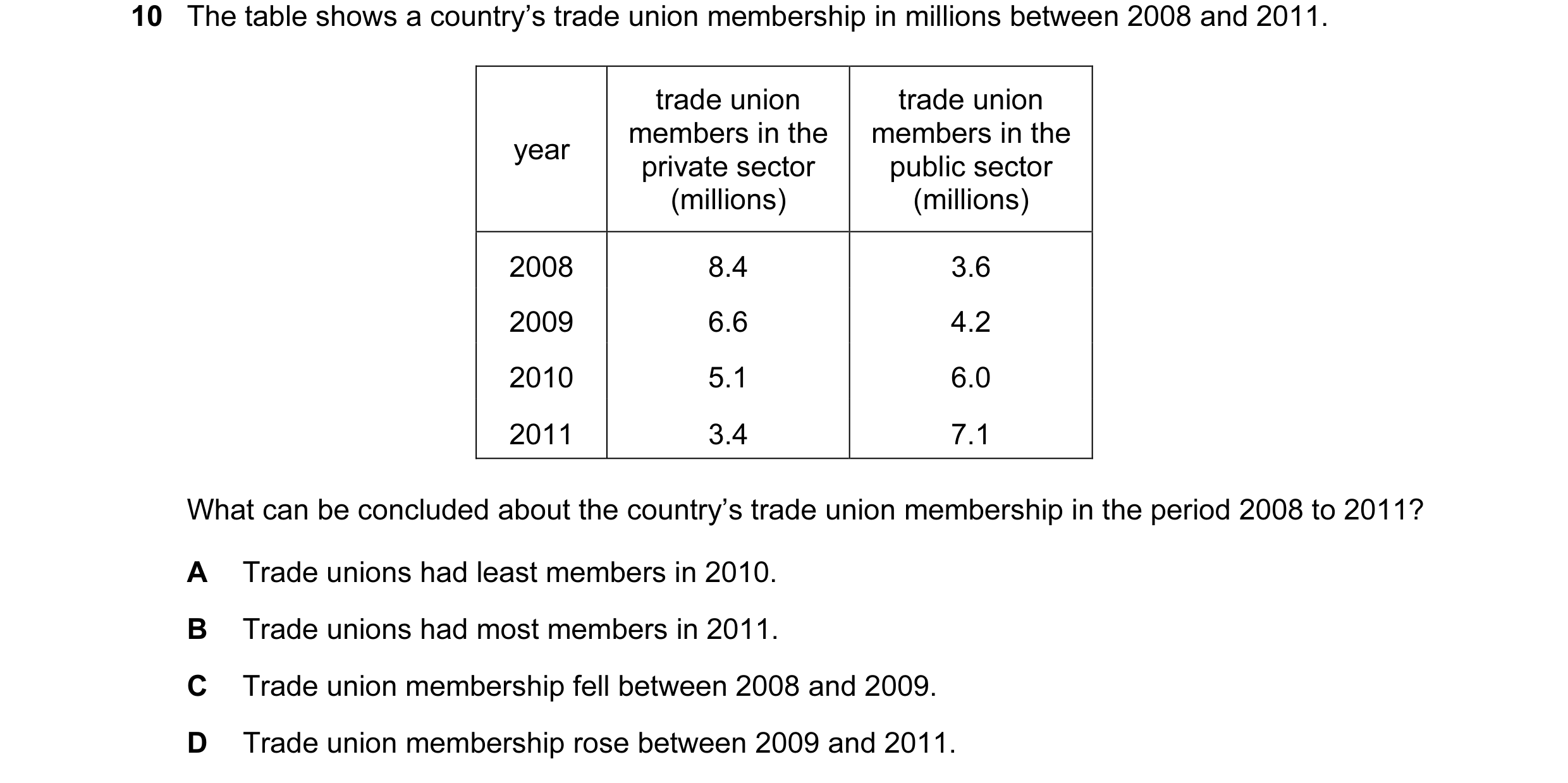
10 The table shows a country’s trade union membership in millions between 2008 and 2011. trade union trade union members in the members in the year private sector public sector (millions) (millions) 2008 8.4 3.6 2009 6.6 4.2 2010 5.1 6.0 2011 3.4 7.1 What can be concluded about the country’s trade union membership in the period 2008 to 2011? A Trade unions had least members in 2010. B Trade unions had most members in 2011. C Trade union membership fell between 2008 and 2009. D Trade union membership rose between 2009 and 2011.
1 marks
Answer: C
This question in 0455/11 May/June 2015
Q33 · What is not a function of a trade union? 0455/13 May/June 2015
9 What is not a function of a trade union? A to arrange promotion for its members B to discuss members’ working conditions C to negotiate members’ wages D to represent members in disputes
1 marks
Answer: A
This question in 0455/13 May/June 2015
Q34 · When will a trade union be less likely to be able to achieve a rise in wages for its… 0455/11 Oct/Nov 2015
10 When will a trade union be less likely to be able to achieve a rise in wages for its members? A during a recession B in an economic boom C when productivity is rising D where there is a limited supply of labour
1 marks
Answer: A
This question in 0455/11 Oct/Nov 2015
Q35 · A national trade union wishes to increase the wages of its members without reducing the… 0455/12 Oct/Nov 2015
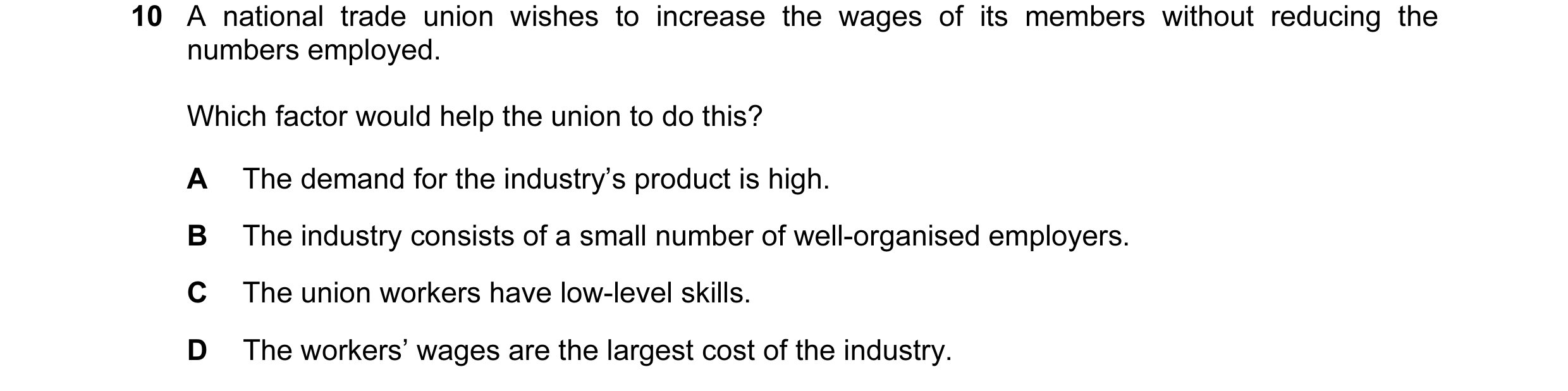
10 A national trade union wishes to increase the wages of its members without reducing the numbers employed. Which factor would help the union to do this? A The demand for the industry’s product is high. B The industry consists of a small number of well-organised employers. C The union workers have low-level skills. D The workers’ wages are the largest cost of the industry.
1 marks
Answer: A
This question in 0455/12 Oct/Nov 2015
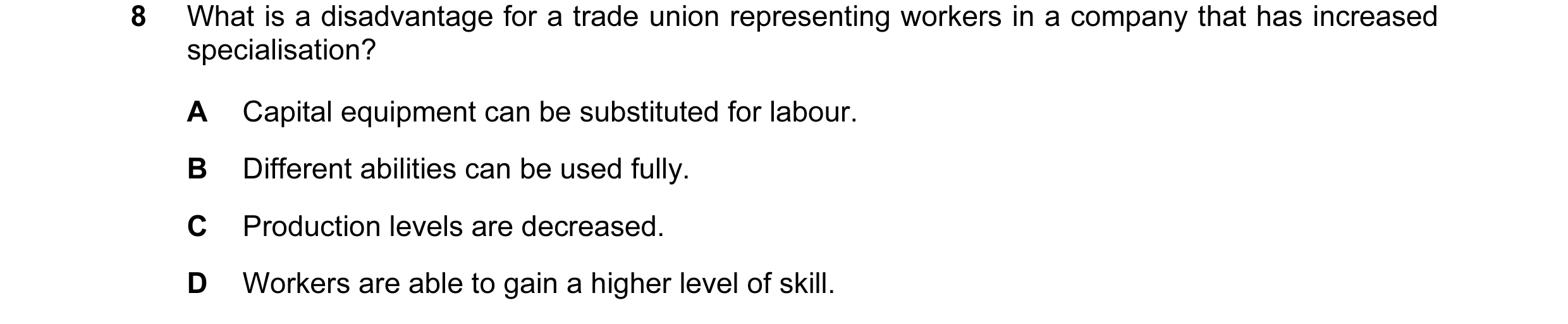
Q36 · What is a disadvantage for a trade union representing workers in a company that has… 0455/12 Feb/March 2016
8 What is a disadvantage for a trade union representing workers in a company that has increased specialisation? A Capital equipment can be substituted for labour. B Different abilities can be used fully. C Production levels are decreased. D Workers are able to gain a higher level of skill.
1 marks
Answer: A
This question in 0455/12 Feb/March 2016
Q37 · What might a trade union usually be expected to do for its members? 0455/11 May/June 2016
8 What might a trade union usually be expected to do for its members? A arrange childcare facilities for members’ children B ensure adequate promotion prospects exist C negotiate better working conditions D provide medical insurance
1 marks
Answer: C
This question in 0455/11 May/June 2016
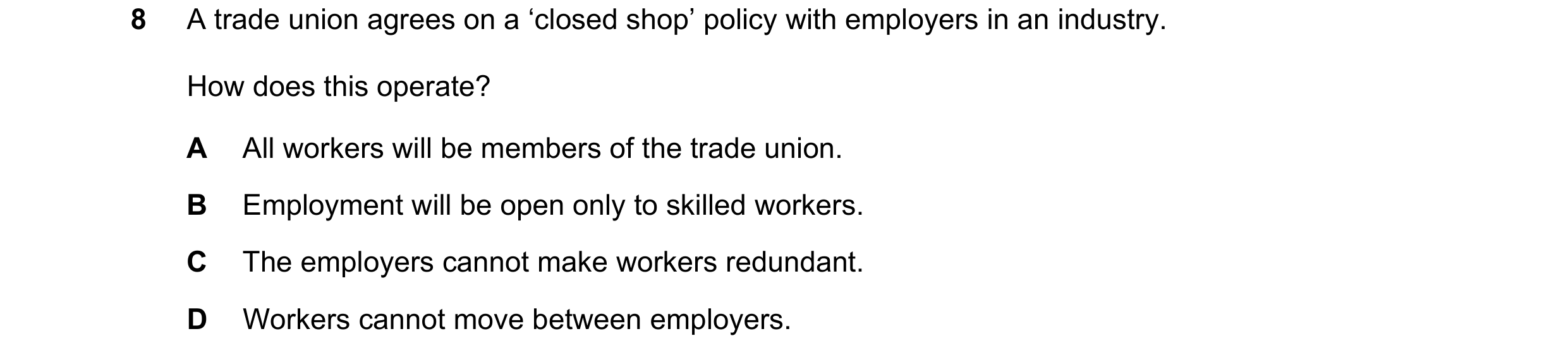
Q38 · A trade union agrees on a ‘closed shop’ policy with employers in an industry 0455/12 May/June 2016
8 A trade union agrees on a ‘closed shop’ policy with employers in an industry. How does this operate? A All workers will be members of the trade union. B Employment will be open only to skilled workers. C The employers cannot make workers redundant. D Workers cannot move between employers.
1 marks
Answer: A
This question in 0455/12 May/June 2016
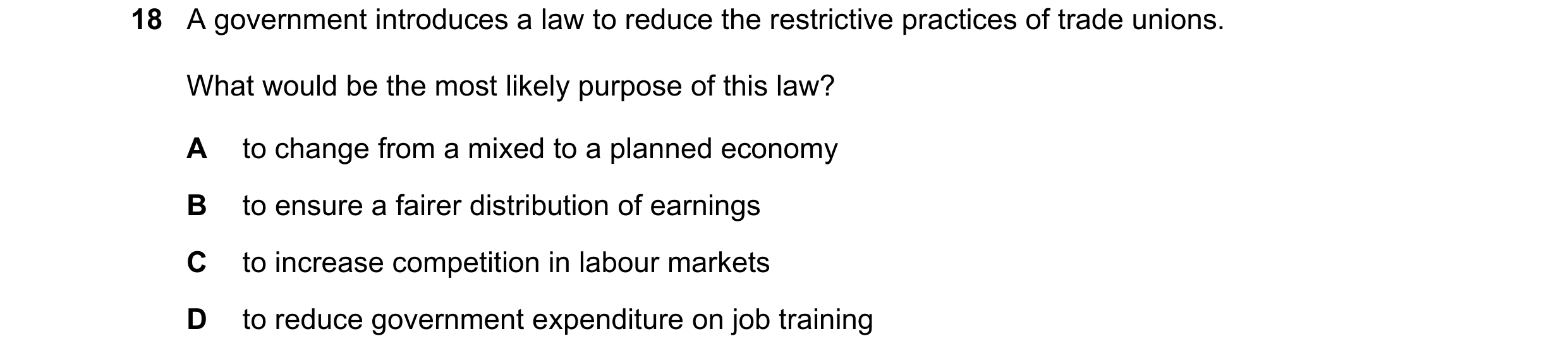
Q39 · A government introduces a law to reduce the restrictive practices of trade unions 0455/12 May/June 2016
18 A government introduces a law to reduce the restrictive practices of trade unions. What would be the most likely purpose of this law? A to change from a mixed to a planned economy B to ensure a fairer distribution of earnings C to increase competition in labour markets D to reduce government expenditure on job training
1 marks
Answer: C
This question in 0455/12 May/June 2016
Q40 · What does the term ‘closed shop’ mean? 0455/13 May/June 2016
8 What does the term ‘closed shop’ mean? A a bankrupt retail establishment B a trade union that is approved by the government C an agreement that all workers must be members of the same trade union D an agreement by trade unions to share members
1 marks
Answer: C
This question in 0455/13 May/June 2016
Q41 · What might be a disadvantage to a trade union when arguing for an increase in its… 0455/12 Oct/Nov 2016
8 What might be a disadvantage to a trade union when arguing for an increase in its members’ pay? A an increase in imports of a cheaper, similar product B the closure of a local training college resulting in fewer potential workers C the development of a new and profitable brand of the company’s product D the development of new techniques that increase productivity
1 marks
This question in 0455/12 Oct/Nov 2016
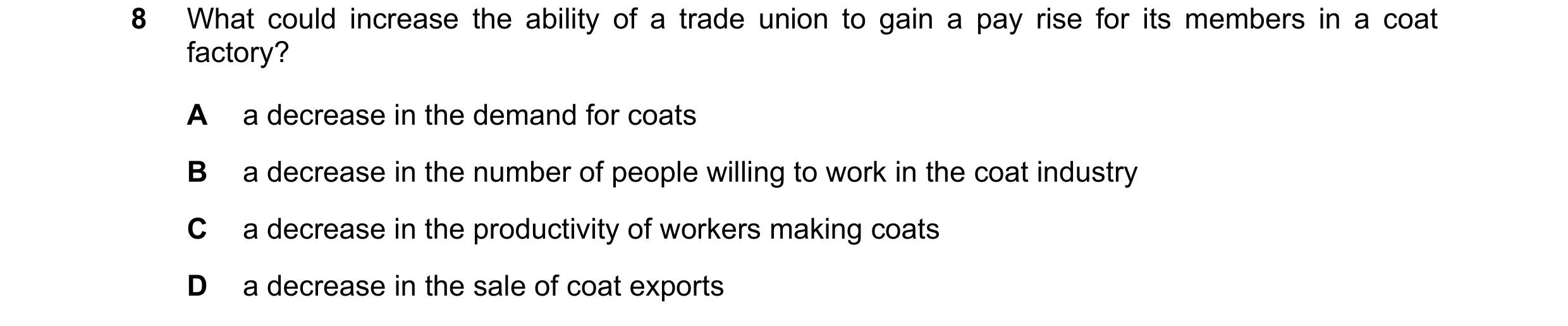
Q42 · What could increase the ability of a trade union to gain a pay rise for its members in a… 0455/13 Oct/Nov 2016
8 What could increase the ability of a trade union to gain a pay rise for its members in a coat factory? A a decrease in the demand for coats B a decrease in the number of people willing to work in the coat industry C a decrease in the productivity of workers making coats D a decrease in the sale of coat exports
1 marks
Answer: B
This question in 0455/13 Oct/Nov 2016
Q43 · What is usually a function of a trade union? 0455/12 Feb/March 2017
11 What is usually a function of a trade union? A It advertises the products that the members make. B It conducts negotiations with employers for increased wages. C It hires company employees. D It negotiates with suppliers for reduced costs of materials.
1 marks
Answer: B
This question in 0455/12 Feb/March 2017
Q44 · What is most likely to be used to support a claim for wage increases in an industry? 0455/12 May/June 2017
9 What is most likely to be used to support a claim for wage increases in an industry? A a decrease in the industry’s sales B a decrease in the need for specialist training C an increase in cheap imports of a rival product D an increase in wages in a similar industry
1 marks
Answer: D
This question in 0455/12 May/June 2017
Q45 · The Congress of South African Trade Unions (COSATU) is the biggest union federation in… 0455/13 May/June 2017
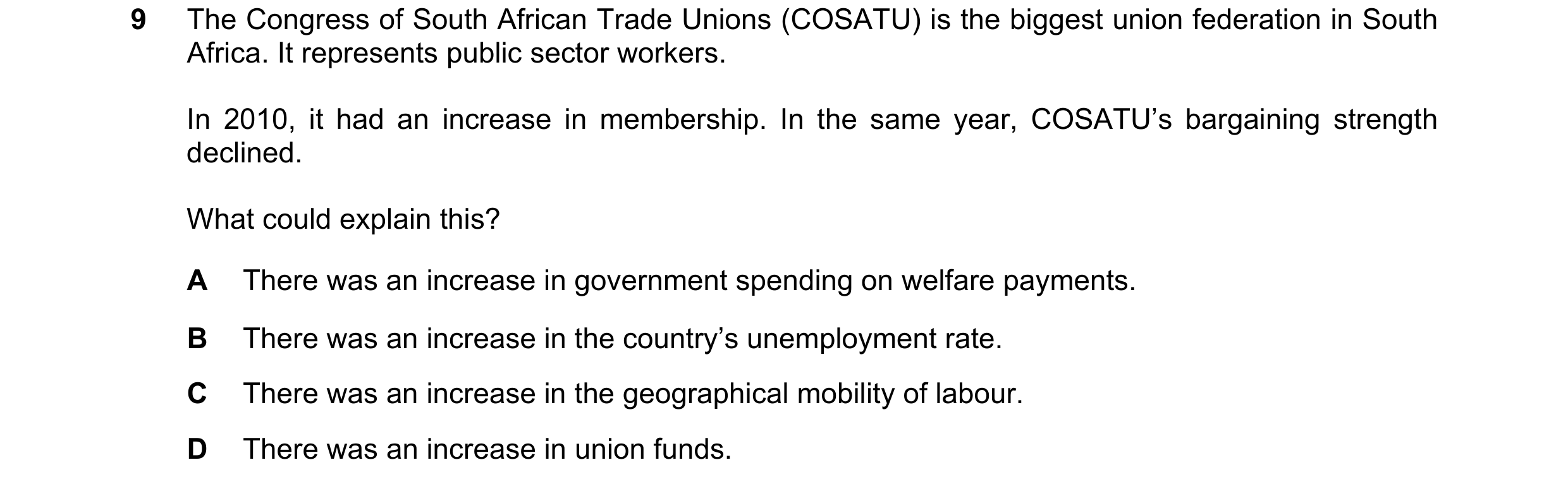
9 The Congress of South African Trade Unions (COSATU) is the biggest union federation in South Africa. It represents public sector workers. In 2010, it had an increase in membership. In the same year, COSATU’s bargaining strength declined. What could explain this? A There was an increase in government spending on welfare payments. B There was an increase in the country’s unemployment rate. C There was an increase in the geographical mobility of labour. D There was an increase in union funds.
1 marks
Answer: B
This question in 0455/13 May/June 2017
Q46 · When will a trade union be most likely to succeed in achieving the aims of its members? 0455/11 Oct/Nov 2017
9 When will a trade union be most likely to succeed in achieving the aims of its members? A when firms are trying to cut costs of production B when the rate of unemployment in the country is high C when trade union membership in the industry is compulsory D when workers are unskilled
1 marks
Answer: C
This question in 0455/11 Oct/Nov 2017
Q47 · When is a trade union likely to have more power to increase its members’ wages? 0455/11 May/June 2018
10 When is a trade union likely to have more power to increase its members’ wages? A when imports are increasing B when labour supply is increasing C when output is increasing D when unemployment is increasing
1 marks
Answer: C
This question in 0455/11 May/June 2018
Q48 · What is most likely to help a trade union’s claim for wage increases in an industry? 0455/12 May/June 2018
10 What is most likely to help a trade union’s claim for wage increases in an industry? A a decrease in the price of a close substitute for the product B a decrease in the qualifications needed for the job C an increase in the number of workers D an increase in the profits of the industry
1 marks
Answer: D
This question in 0455/12 May/June 2018
Q49 · What is the most likely reason a firm might welcome the introduction of a trade union for… 0455/13 May/June 2018
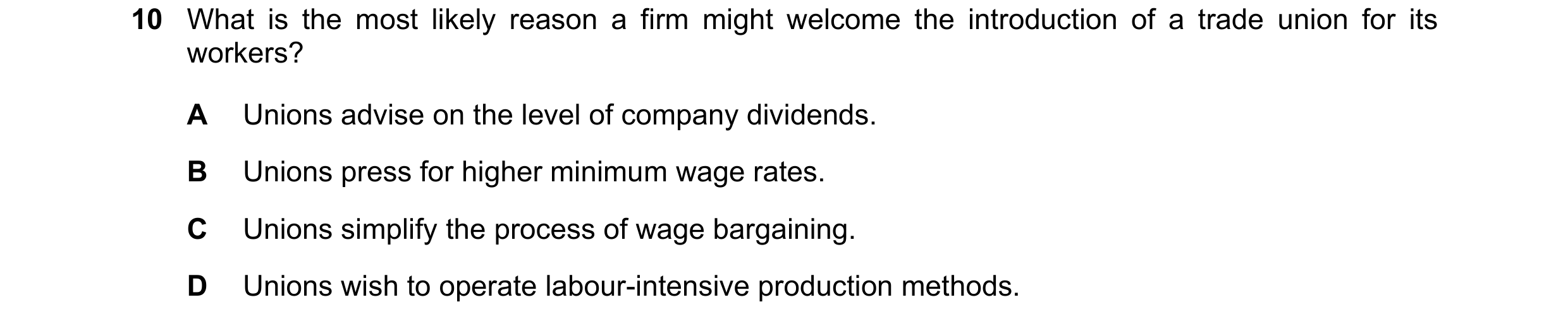
10 What is the most likely reason a firm might welcome the introduction of a trade union for its workers? A Unions advise on the level of company dividends. B Unions press for higher minimum wage rates. C Unions simplify the process of wage bargaining. D Unions wish to operate labour-intensive production methods.
1 marks
Answer: C
This question in 0455/13 May/June 2018
Q50 · What will make it harder for a trade union to increase the wage rate for its members… 0455/11 Oct/Nov 2018
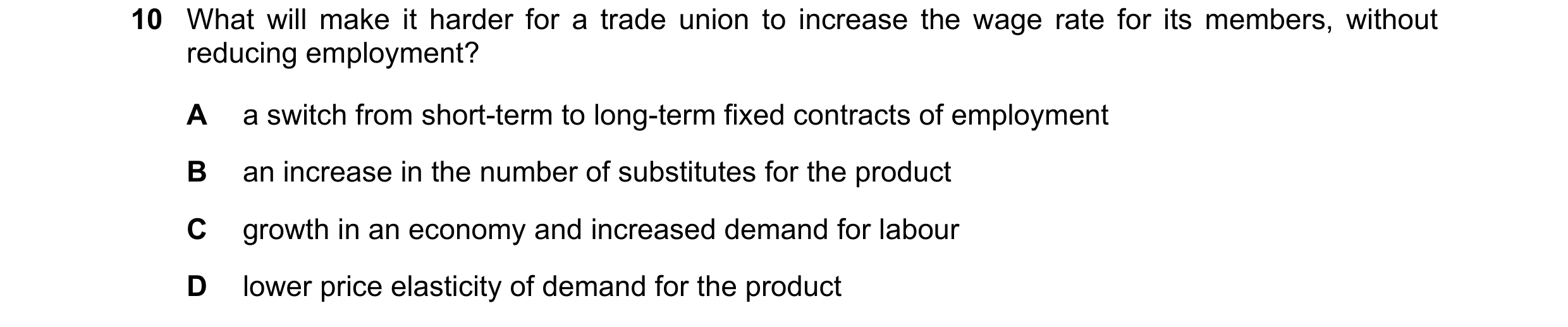
10 What will make it harder for a trade union to increase the wage rate for its members, without reducing employment? A a switch from short-term to long-term fixed contracts of employment B an increase in the number of substitutes for the product C growth in an economy and increased demand for labour D lower price elasticity of demand for the product
1 marks
Answer: B
This question in 0455/11 Oct/Nov 2018
Q51 · What would put a trade union in a strong bargaining position to negotiate higher wages… 0455/13 Oct/Nov 2018
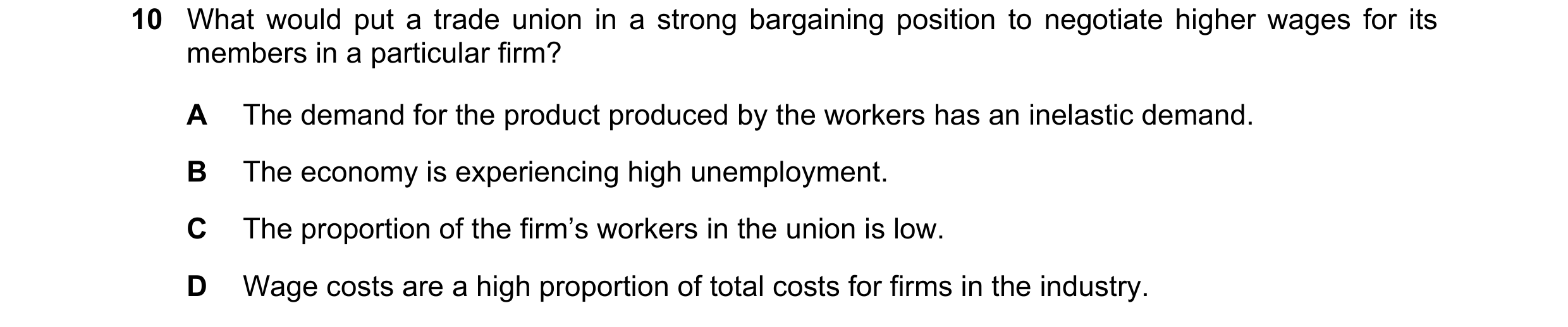
10 What would put a trade union in a strong bargaining position to negotiate higher wages for its members in a particular firm? A The demand for the product produced by the workers has an inelastic demand. B The economy is experiencing high unemployment. C The proportion of the firm’s workers in the union is low. D Wage costs are a high proportion of total costs for firms in the industry.
1 marks
Answer: A
This question in 0455/13 Oct/Nov 2018
Q52 · A trade union succeeds in raising the wages in an industry above the current equilibrium… 0455/13 Oct/Nov 2019
29 A trade union succeeds in raising the wages in an industry above the current equilibrium wage. How would the demand and supply of labour change? change in quantity change in quantity of labour demanded of labour supplied A fall fall B fall rise C rise fall D rise rise
1 marks
Answer: B
This question in 0455/13 Oct/Nov 2019
Q53 · What is a trade union? 0455/12 Feb/March 2020
8 What is a trade union? A a business organisation in which all workers share ownership B an area where there are no barriers to trade C an organisation of employers from an industry D an organisation that represents the interests of workers
1 marks
This question in 0455/12 Feb/March 2020
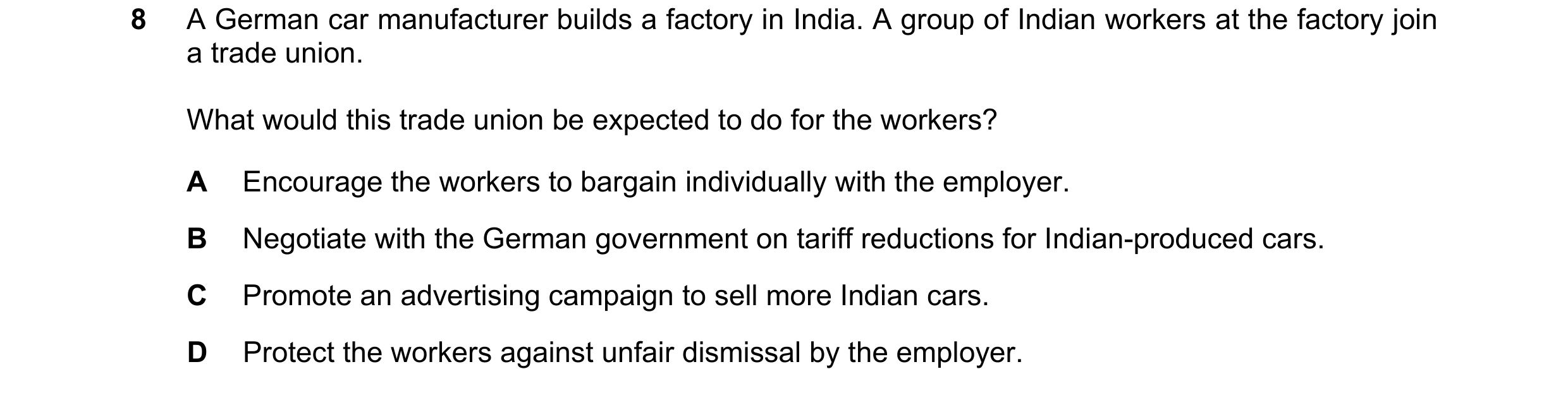
Q54 · A German car manufacturer builds a factory in India 0455/11 Oct/Nov 2020
8 A German car manufacturer builds a factory in India. A group of Indian workers at the factory join a trade union. What would this trade union be expected to do for the workers? A Encourage the workers to bargain individually with the employer. B Negotiate with the German government on tariff reductions for Indian-produced cars. C Promote an advertising campaign to sell more Indian cars. D Protect the workers against unfair dismissal by the employer.
1 marks
Answer: D
This question in 0455/11 Oct/Nov 2020
Q55 · Which task is not a function of a trade union? 0455/12 Oct/Nov 2020
8 Which task is not a function of a trade union? A agreeing the minimum number to be employed on a particular job B deciding on the level of a national minimum wage C negotiating working hours and conditions of work D providing legal advice on unfair dismissal
1 marks
Answer: B
This question in 0455/12 Oct/Nov 2020
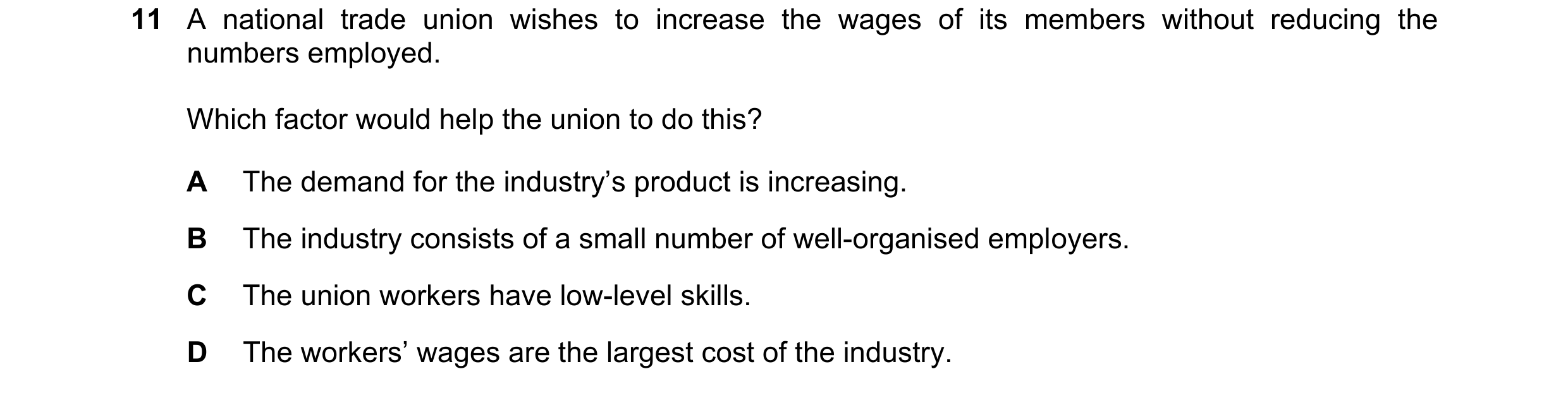
Q56 · A national trade union wishes to increase the wages of its members without reducing the… 0455/12 Feb/March 2021
11 A national trade union wishes to increase the wages of its members without reducing the numbers employed. Which factor would help the union to do this? A The demand for the industry’s product is increasing. B The industry consists of a small number of well-organised employers. C The union workers have low-level skills. D The workers’ wages are the largest cost of the industry.
1 marks
Answer: A
This question in 0455/12 Feb/March 2021
Q57 · The diagram shows the demand for and supply of labour in an industry 0455/11 May/June 2021
11 The diagram shows the demand for and supply of labour in an industry. The original equilibrium is X. A trade union then negotiates a wage rate of W. wage rate S ($) W X D O R S T quantity of labour What identifies the change in employment? A OR B OT C RS D RT
1 marks
Answer: C
This question in 0455/11 May/June 2021
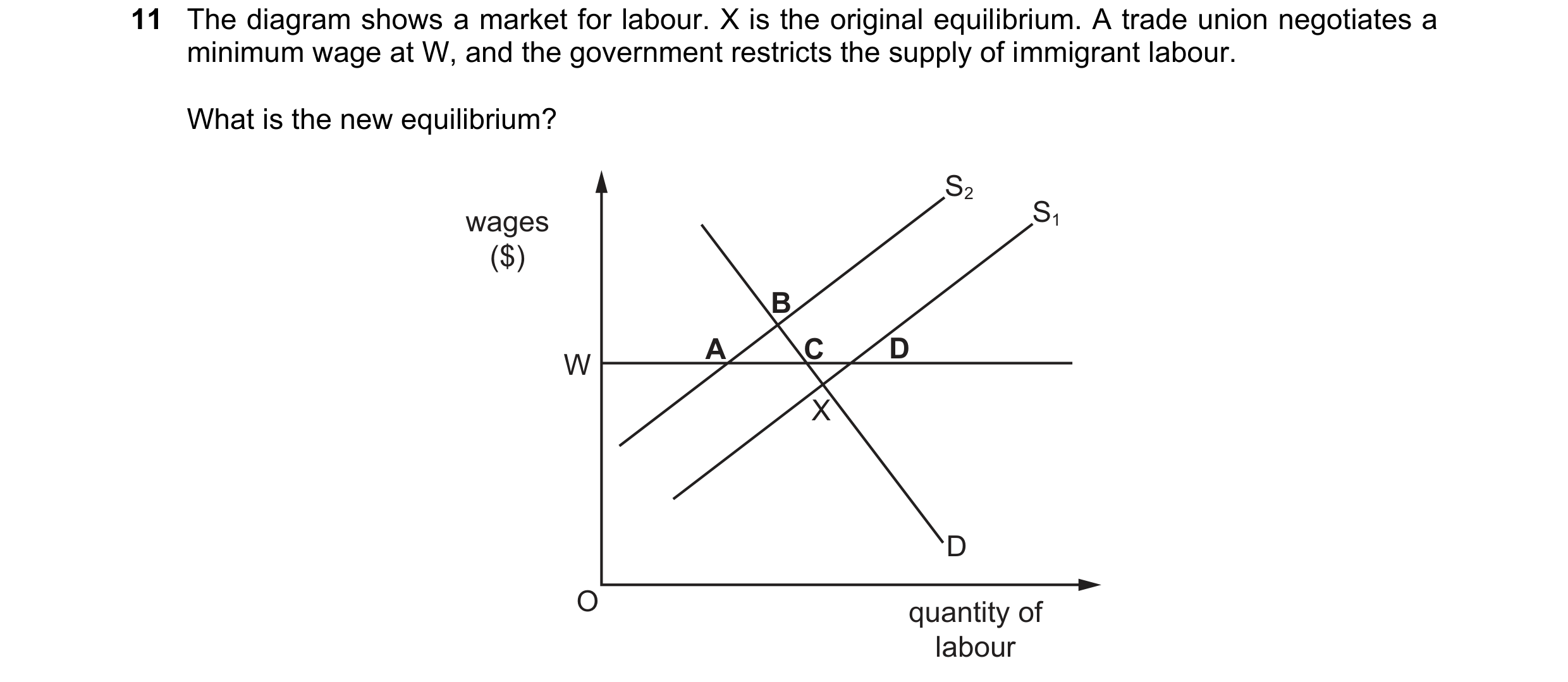
Q58 · The diagram shows a market for labour 0455/12 May/June 2021
11 The diagram shows a market for labour. X is the original equilibrium. A trade union negotiates a minimum wage at W, and the government restricts the supply of immigrant labour. What is the new equilibrium? S2 wages S1 ($) B A C D W X D O quantity of labour
1 marks
Answer: B
This question in 0455/12 May/June 2021
Q59 · What is a benefit to a worker of being a member of a trade union? 0455/13 May/June 2021
11 What is a benefit to a worker of being a member of a trade union? A access to advice B guaranteed employment C opportunity to work extra hours D payment of subscriptions
1 marks
Answer: A
This question in 0455/13 May/June 2021
Q60 · What is not a benefit of trade union membership for a worker? 0455/12 Feb/March 2023
14 What is not a benefit of trade union membership for a worker? A achieving higher wages for workers B negotiating a higher rate of interest on a bank loan for workers C providing support to workers when being made unemployed D an improvement in health and safety standards at work
1 marks
Answer: B
This question in 0455/12 Feb/March 2023
Q61 · Which factor would not increase the bargaining strength of a trade union to raise wages? 0455/11 May/June 2023
13 Which factor would not increase the bargaining strength of a trade union to raise wages? A a rapidly growing economy B high union membership in the industry C legislation limiting strike action D workers are in short supply
1 marks
Answer: C
This question in 0455/11 May/June 2023
Q62 · Which trade union activity will be beneficial for firms? 0455/12 May/June 2023
13 Which trade union activity will be beneficial for firms? A balloting for industrial action to prevent redundancies B campaigning to raise wages of trade union members C instructing workers to strike over a safety dispute D providing training which raises productivity of workers
1 marks
Answer: D
This question in 0455/12 May/June 2023
Q63 · What is likely to increase the bargaining power of a trade union? 0455/13 May/June 2023
13 What is likely to increase the bargaining power of a trade union? A when the economy is experiencing rising cyclical unemployment B when the labour market moves from long-term to short-term contracts of employment C when the price elasticity of demand for the product is price-elastic D when the trade union supplies all the labour required by the employer
1 marks
Answer: D
This question in 0455/13 May/June 2023
Q64 · What is a trade union most likely to protect? 0455/11 Oct/Nov 2023
13 What is a trade union most likely to protect? A the profit of a firm B the rights of a group of workers C the satisfaction of consumers D the social welfare of everybody
1 marks
Answer: B
This question in 0455/11 Oct/Nov 2023
Q65 · What is the best definition of a trade union? 0455/13 May/June 2024
12 What is the best definition of a trade union? A a group of countries that negotiates trade agreements B a group of firms that negotiates removing obstacles to trade C a group of workers that negotiates collectively on pay D a group of workers that negotiates fixing prices
1 marks
Answer: C
This question in 0455/13 May/June 2024
Q66 · Workers in a country have been concerned about their wages not keeping pace with inflation 0455/13 Oct/Nov 2024
14 Workers in a country have been concerned about their wages not keeping pace with inflation. How can trade unions assist workers in getting a pay rise? A advise the workers to ask individually for a pay rise B negotiate on behalf of their members to secure a pay rise C offer to contribute financially to a pay rise D request improved working conditions
1 marks
Answer: B
This question in 0455/13 Oct/Nov 2024
Q67 · In some countries, there has been a significant reduction in the number of trade union… 0455/12 Feb/March 2025
12 In some countries, there has been a significant reduction in the number of trade union members. Who are the members of trade unions? A employers B exporters C importers D workers
1 marks
Answer: D
This question in 0455/12 Feb/March 2025
Q68 · What is a function of a trade union? 0455/11 May/June 2025
13 What is a function of a trade union? A to negotiate workers’ contracts B to promote workers to more responsible jobs C to recruit workers for the firm D to supervise the workers in the firm
1 marks
Answer: A
This question in 0455/11 May/June 2025
Q69 · What is a feature of every trade union? 0455/11 Oct/Nov 2025
13 What is a feature of every trade union? A members are unskilled workers B members use collective bargaining C members work for the same employer D members work in the same industry
1 marks
Answer: B
This question in 0455/11 Oct/Nov 2025
Q70 · How might a trade union increase its bargaining power? 0455/12 Oct/Nov 2025
13 How might a trade union increase its bargaining power? A by expanding the market for the product B by increasing the cost of union membership for workers C by restricting the entry of workers to the industry D by supporting wage claims in other industries
1 marks
Answer: C
This question in 0455/12 Oct/Nov 2025
Q71 · What would increase the strength of a trade union? 0455/13 Oct/Nov 2025
12 What would increase the strength of a trade union? A a growth in part-time employment B a growth in the membership C a rise in the national minimum wage D a rise in the standard of living
1 marks
Answer: B
This question in 0455/13 Oct/Nov 2025




 1 / 13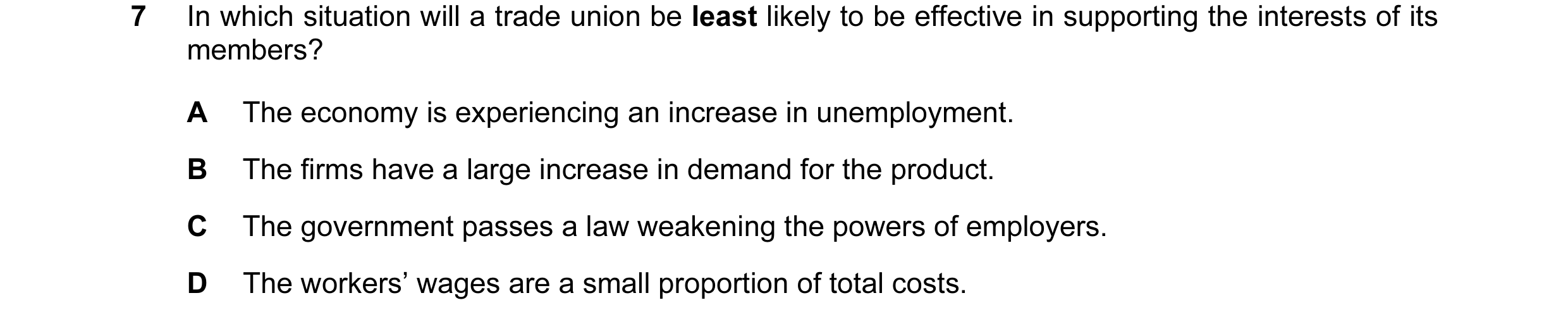


 2 / 13


 3 / 13




 4 / 13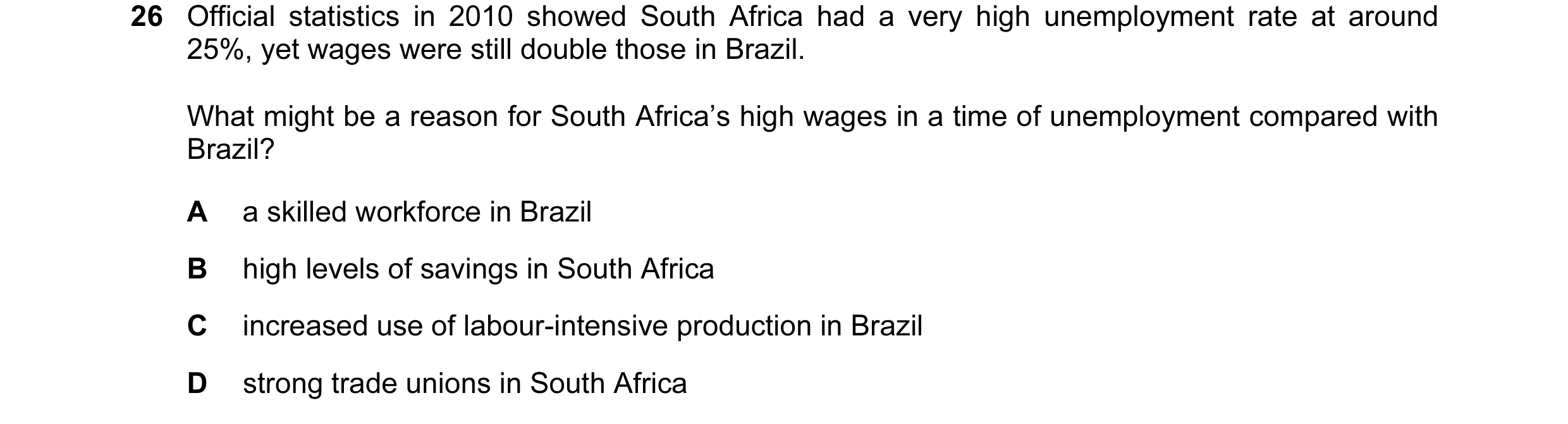
 5 / 13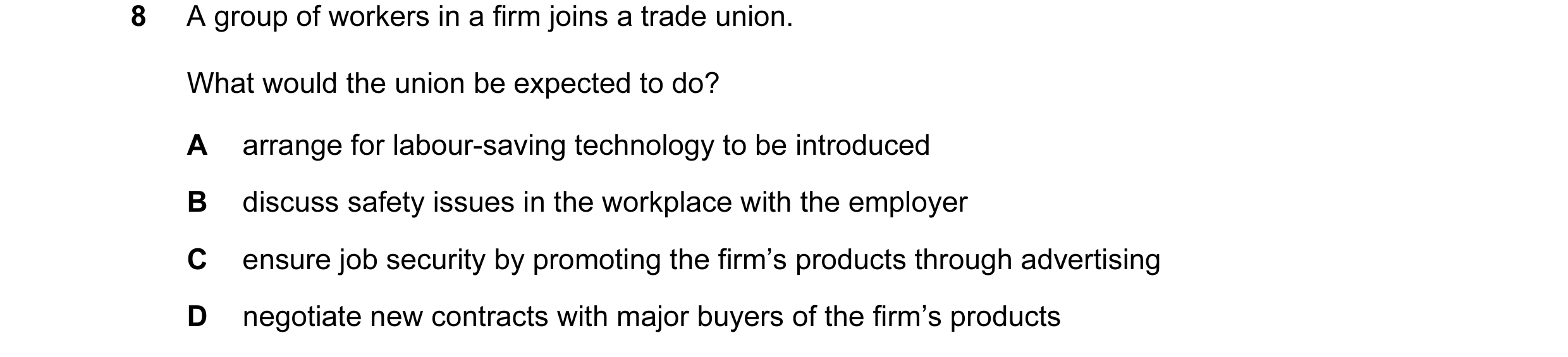
 6 / 13

 7 / 13



 8 / 13


 9 / 13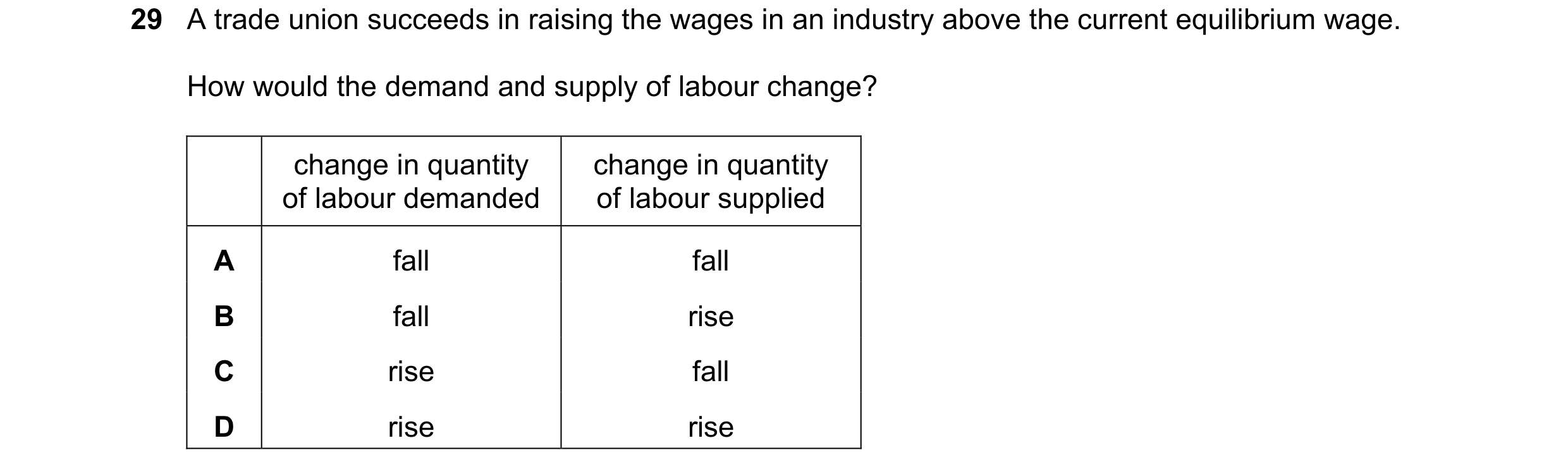


 10 / 13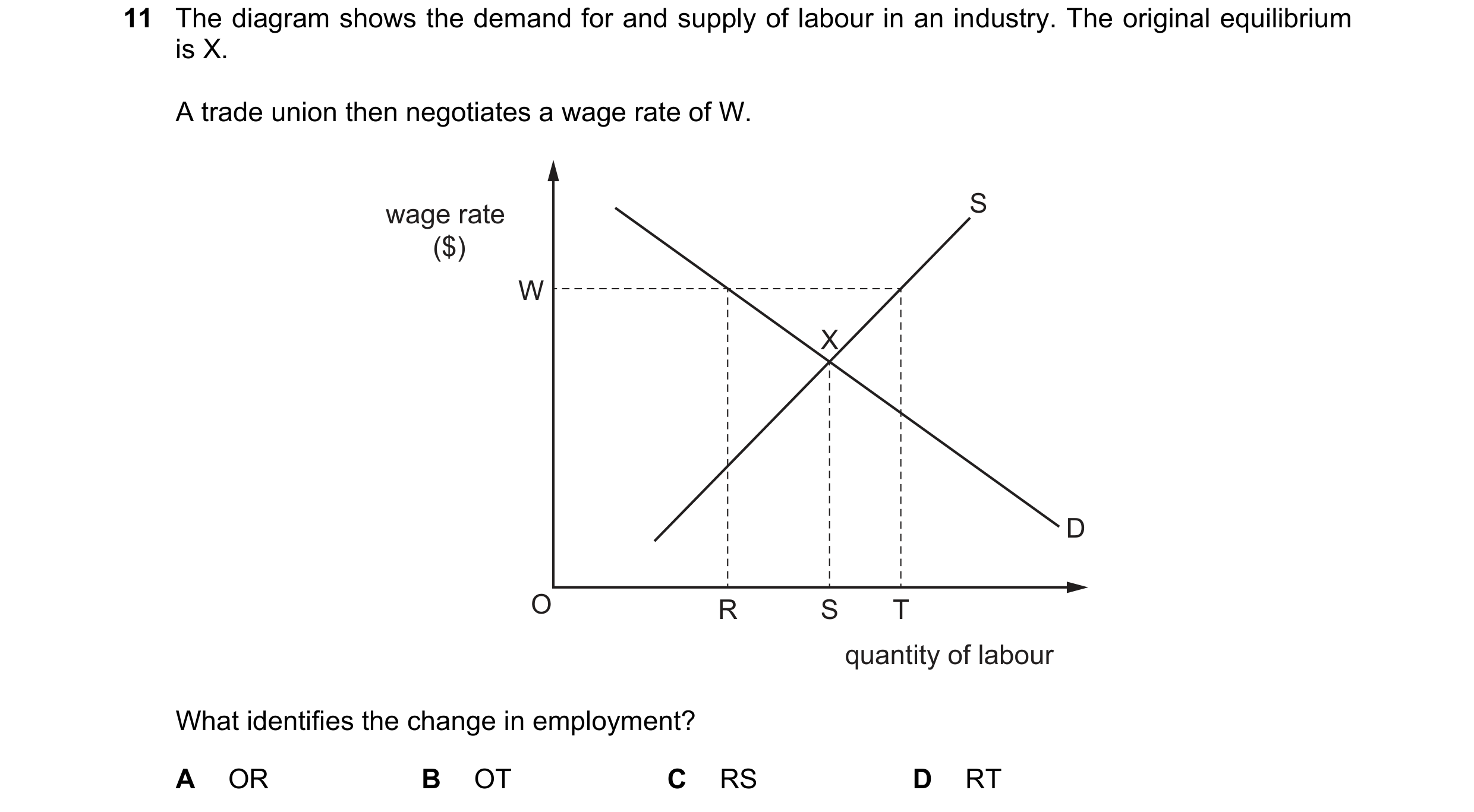
 11 / 13




 12 / 13



 13 / 13