Questions as text
Q1 · At the start of 2015, dockworkers on the west coast of the USA took industrial action in… 0455/22 Feb/March 2017
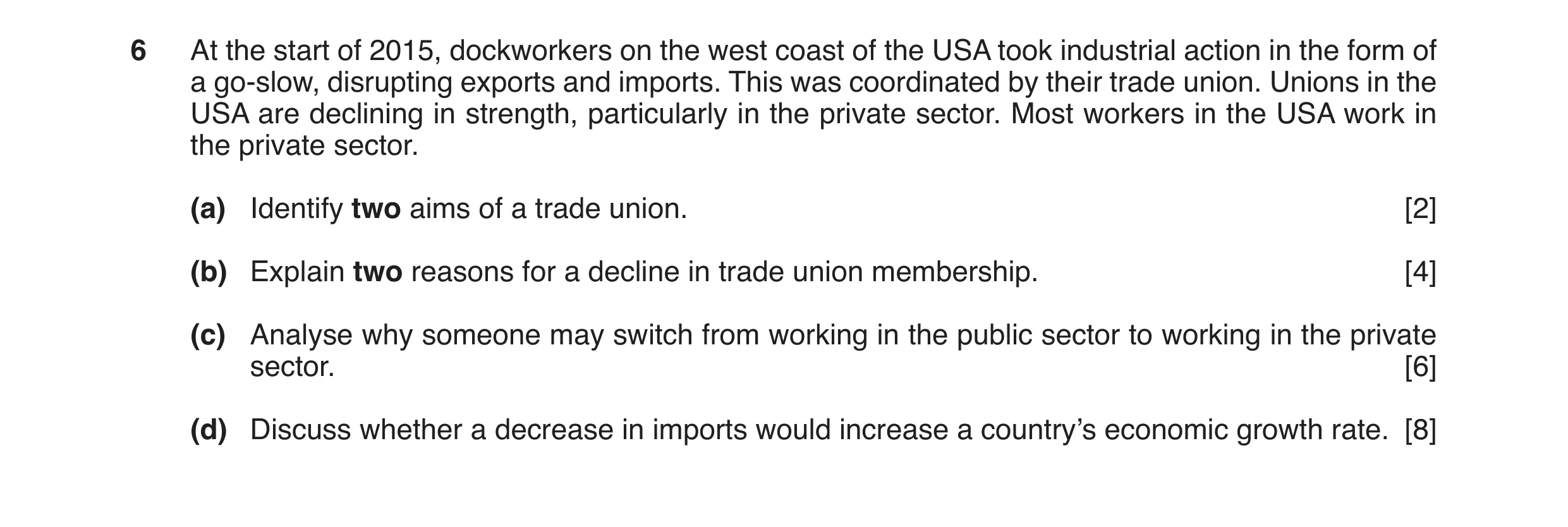
6 At the start of 2015, dockworkers on the west coast of the USA took industrial action in the form of a go-slow, disrupting exports and imports. This was coordinated by their trade union. Unions in the USA are declining in strength, particularly in the private sector. Most workers in the USA work in the private sector. (a) Identify two aims of a trade union. [2] (b) Explain two reasons for a decline in trade union membership. [4] (c) Analyse why someone may switch from working in the public sector to working in the private sector. [6] (d) Discuss whether a decrease in imports would increase a country’s economic growth rate. [8]
20 marks
Mark scheme: 6(a) Identify two aims of a trade union. 1 mark each for each of two aims identified: • higher wages • increased job security • better working conditions • provision of benefits • lobbying the government • reduction in discrimination 2 6(b) Explain two reasons for a decline in trade union membership. 1 mark each for each of two reasons identified: • lower employment • increase in subscriptions • government legislation • firms’ discouragement • change in pattern of employment • less efficient trade unions/decline in strength • greater reluctance to take industrial action • more satisfied with e.g. working hours and conditions. 1 mark each for each of two reasons explained: • lower employment will mean that there will be fewer workers to join trade unions/may make those still in employment be concerned that joining a trade union may increase the risk of being made redundant • workers may be reluctant to pay increased subscriptions • government legislation may reduce the power of trade unions • firms may make it clear that they will not employ trade union members • fewer workers in the private sector tend to be union members • workers would expect less advantages from joining a trade union • do not want to be asked to e.g. strike as earnings could be lost • workers may have better relations with employers. 4 Question Answer Marks Guidance 6(c) Analyse why someone may switch from working in the public sector to working in the private sector. Jobs in the public sector may be declining (1) so a public sector worker may fear being made redundant (1) so private sector may provide more job security (1). Wages in the private sector may be higher/increasing more than those in the public sector (1) higher wages will increase living standards (1) enabling workers to e.g. enjoy better healthcare (1). May want to work in a smaller organisation (1) may think labour relations will be better (1). Non-wage factors may be better in the private sector (1) examples e.g. pensions (1) greater promotion chances (1), Working hours may have been reduced/be shorter (1). 6 Note: maximum of 3 marks for a list-like approach. 6(d) Discuss whether a decrease in imports would increase a country’s economic growth rate. Up to 5 marks for why it might: Lower imports may be the result of an increase in the international competitiveness of domestic products (1). Imports may be replaced by domestic products (1) total demand would increase (1) this may increase output (1) infant industries may be able to expand (1) domestic employment may increase (1). Up to 5 marks for why it might not: Imports may decline due to consumers spending less in total (1) they may not be replaced by domestic products (1). If imports of raw materials or capital goods fall (1) there will be fewer resources available (1) to make domestic output (1). A decrease in imports will reduce incomes of other countries (1) may reduce demand for the country’s exports (1). Lower imports may push up the exchange rate (1) raise the price of exports (1) if both imports and exports fall output may be unchanged or even lower (1). If lower imports are the result of the imposition of trade restrictions (1) there may be retaliation (1) reducing the country’s exports (1). 8
This question in 0455/22 Feb/March 2017
Q2 · Between 2009 and 2014, Delaware was the only US state to experience a fall in earnings 0455/22 May/June 2017
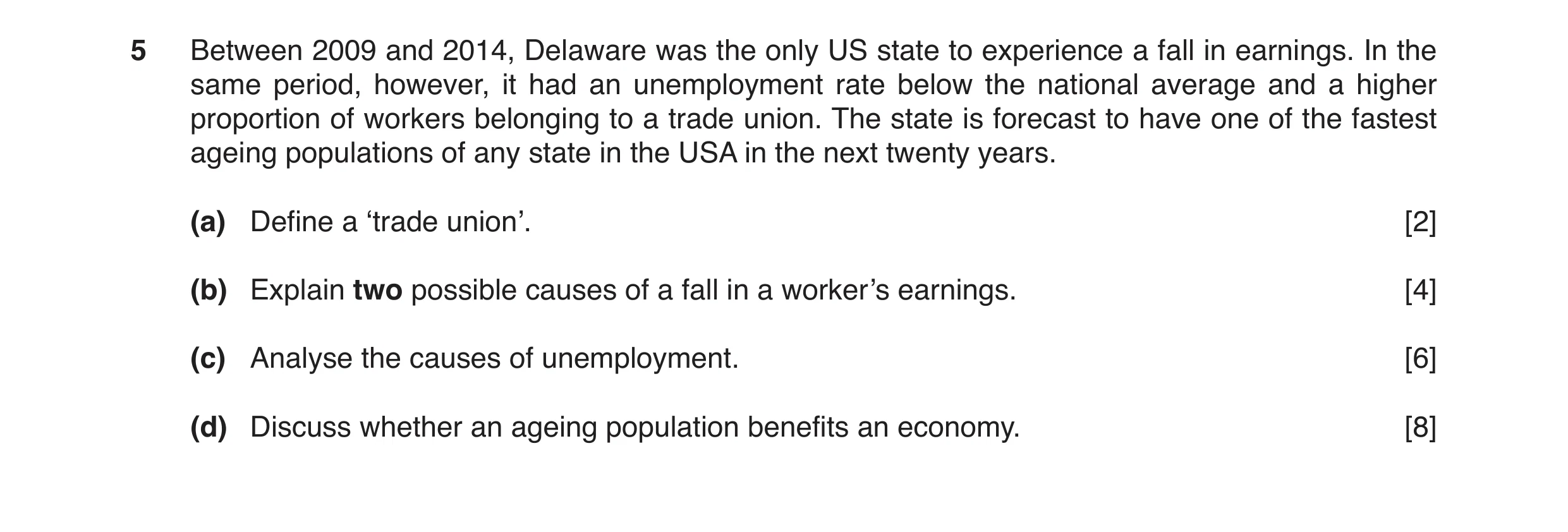
5 Between 2009 and 2014, Delaware was the only US state to experience a fall in earnings. In the same period, however, it had an unemployment rate below the national average and a higher proportion of workers belonging to a trade union. The state is forecast to have one of the fastest ageing populations of any state in the USA in the next twenty years. (a) Define a ‘trade union’. [2] (b) Explain two possible causes of a fall in a worker’s earnings. [4] (c) Analyse the causes of unemployment. [6] (d) Discuss whether an ageing population benefits an economy. [8]
20 marks
Mark scheme: 5(a) Define a ‘trade union’. • An association/body/group/organisation (1) which represents its members/workers by protecting workers’ rights/seeks to improve workers’ pay and/or working conditions (1). 2 5(b) Explain two possible causes of a fall in a worker’s earnings. • A change to a lower paid job (1) a worker may decide that non-wage factors, e.g. working conditions, are more important than wages (1) • A reduction in the hours worked (1) a worker may decide to do less overtime or may decide to switch to part-time work (1) • A replacement of some earnings by fringe benefits (1) an employer may cut wages in return for increasing fringe benefits such as free housing (1) • A decrease in output produced (1) a worker paid by piece rates will be paid less if their productivity falls (1) • A reduction in demand for labour (1) caused by a fall in demand for the product/recession (1) • An increase in the supply of labour (1) caused by immigration (1) • Weaker trade unions (1) weaker trade unions will have less bargaining power to protect workers’ wages (1) • Inflation (1) real wages will fall if wages rise by less than the inflation rate (1) • Firms may want to cut costs of production (1) to increase or maintain profits (1) • A rise in (direct/income tax) taxation (1) reducing disposable/net earnings (1) 4 Maximum of 2 marks for a list of causes. 1 mark for each cause identified (×2) 1 mark for each associated explanation (×2) Question Answer Marks Guidance 5(c) Analyse the causes of unemployment. • A lack of total demand (1) low output (1) cyclical unemployment (1) • Lack of skills/qualifications/training (1) resulting in occupational immobility (1) • A lack of geographical mobility (1) caused by e.g. differences in house prices (1) resulting in regional unemployment (1) • Decline of domestic industries (1) resulting in structural unemployment (1) • Workers being replaced by machines (1) resulting in technological unemployment (1) • A time delay between workers changing jobs (1) lack of information about job vacancies (1) frictional unemployment (1) • High unemployment benefits discouraging people from seeking employment (1) voluntary unemployment (1) • Demand for labour may fall at certain times of the year (1) resulting in seasonal unemployment (1) example (1) 6 Maximum of 3 marks for a list- like approach. Question Answer Marks Guidance 5(d) Discuss whether an ageing population benefits an economy. Up to 5 marks for why it might: • A rise in the average age from a young age (1) may increase the size of the labour force (1) which may reduce dependency ratio (1). • Older workers may be more experienced/skilled (1) more reliable (1) leading to higher productivity/efficiency (1) resulting in higher economic growth/lower unit costs (1). • May indicate longer life expectancy/better health (1) higher living standards (1) raising the level of economic development (1). • The outcome will depend on the cause (1) may be the result of a fall in the birth rate (1) or a fall in the death rate (1). Up to 5 marks for why it might not: • May increase need for healthcare (1) tax revenue used to provide healthcare could have been used for another purpose/opportunity cost (1) example (1) • Increase cost of pensions (1) which may require higher taxation (1) which may place a burden on workers (1). • May increase dependency ratio (1) more non-workers will have to be supported by fewer workers (1). • Reduce mobility of the labour force (1) older workers may be less geographically/occupationally mobile (1). • Older workers may be less familiar with advances in technology (1) less productive (1). 8 An ageing population does not necessarily increase, it would have to be established why growth may occur. A response may develop a mixture of relevant points to achieve up to 5 marks on either side. Maximum of 2 marks on each side of the discussion for a list- like approach.
This question in 0455/22 May/June 2017
Q3 · In June 2015, trade unions in Argentina demanded higher wages and lower taxes 0455/23 Oct/Nov 2017
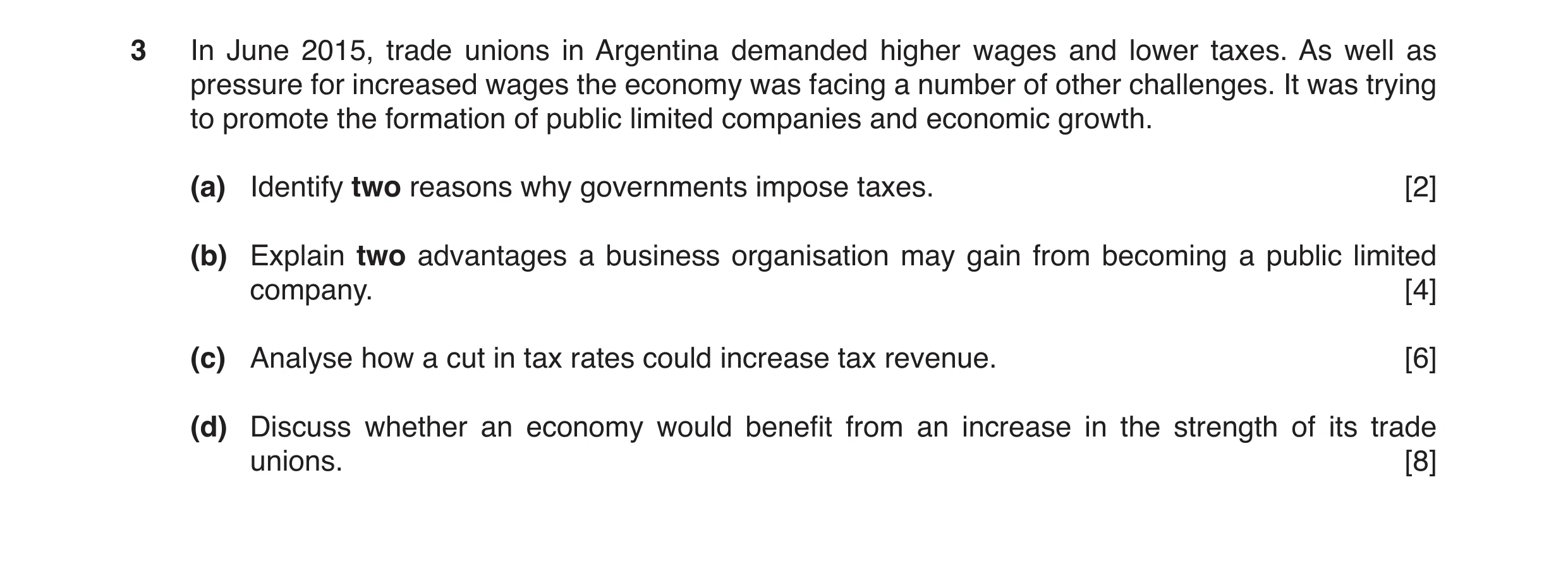
3 In June 2015, trade unions in Argentina demanded higher wages and lower taxes. As well as pressure for increased wages the economy was facing a number of other challenges. It was trying to promote the formation of public limited companies and economic growth. (a) Identify two reasons why governments impose taxes. [2] (b) Explain two advantages a business organisation may gain from becoming a public limited company. [4] (c) Analyse how a cut in tax rates could increase tax revenue. [6] (d) Discuss whether an economy would benefit from an increase in the strength of its trade unions. [8]
20 marks
Mark scheme: 3(a) Identify two reasons why governments impose taxes. 1 mark each for each of two reasons identified: • raise revenue • discourage consumption of harmful products / correct market failure / negative externalities • discourage purchase of imports • redistribute income / reduce income inequality • reduce total demand / reduce rate of inflation. 2 reference to demerit goods. Question Answer Marks Guidance 3(b) Explain two advantages a business organisation may gain from becoming a public limited company. 1 mark each for each of two advantages identified: • relatively easy to raise finance • likely to be relatively large • sustainability • take advantage of limited liability. 1 mark each for each of two explanations given: • able to sell shares on the stock exchange / limited liability may attract shareholders / banks may be more willing to lend • the ability to raise finance can allow firms to expand/take advantage of economies of scale • not dependent on current owners for survival of firm • owners can only lose the value of their shares. 4 3(c) Analyse how a cut in taxes would increase tax revenue. A cut in income tax rates (1) may increase the incentive to work (1) an increase in disposable income (1) would increase the financial reward from working (1) reduces tax evasion (1). A cut in corporation tax (1) may increase the incentive for firms to increase output (1) increasing the total value of profits that can be taxed (1). A cut in indirect taxes (1) may increase spending (1) raising expenditure that can be taxed (1). 6 Question Answer Marks Guidance 3(d) Discuss whether an economy would benefit from an increase in the strength of its trade unions. Up to 5 marks for why it might: Stronger trade unions may achieve higher wages (1) this could increase living standards (1) enabling workers to afford e.g. better healthcare (1) improve training / skills of workers (1) motivate workers (1). Stronger trade unions may improve working conditions (1) prevent workers being discriminated against (1) this may increase labour productivity (1) can make exports more competitive (1) improving balance of payments (1) which can increase economic growth (1). Stronger trade unions may increase communication between workers and employers (1) may help promote training (1) reduce cost of negotiations / making negotiations more effective (1). Up to 5 marks for why it might not: Stronger trade unions may raise firms’ costs of production (1) higher costs of production can reduce firms’ profits (1) cause wage/price spiral (1) resulting in a fall in output (1) increase in unemployment (1) causing cost push inflation (1). Stronger trade unions may increase industrial action (1) will disrupt firms’ production (1) result in a fall in orders (1) fall in investor confidence (1). Stronger trade unions may restrict the ability of firms to change their output (1) reducing their responsiveness to changes in market conditions (1). 8
This question in 0455/23 Oct/Nov 2017
Q4 · The government of Slovenia has introduced a range of supply-side policy measures to… 0455/21 May/June 2018
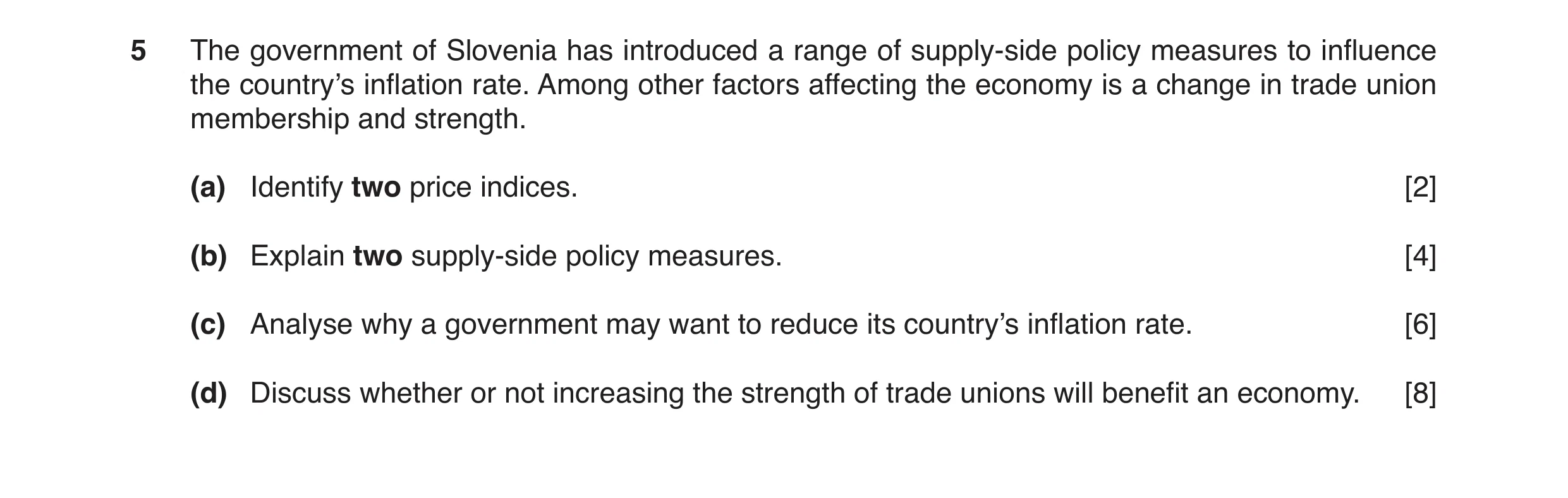
5 The government of Slovenia has introduced a range of supply-side policy measures to influence the country’s inflation rate. Among other factors affecting the economy is a change in trade union membership and strength. (a) Identify two price indices. [2] (b) Explain two supply-side policy measures. [4] (c) Analyse why a government may want to reduce its country’s inflation rate. [6] (d) Discuss whether or not increasing the strength of trade unions will benefit an economy. [8]
20 marks
Mark scheme: 5(a) Identify TWO price indices. RPI (1) CPI (1). other valid indices. 5(b) Explain TWO supply-side policy measures. Improvements in education/training (1) to raise skills/labour productivity (1). Cutting income tax (1) to encourage the reward for working (1). Cutting corporation tax (1) to encourage enterprise/increase investment/lower costs of production (1). Privatisation (1) transferring assets from the public to the private sector/to stimulate competition/improve efficiency (1). Deregulation (1) removing rules and restrictions/increase competition/lower costs of production (1). Subsidies (1) may reduce costs of production/stimulate output (1). 4 1 mark each for up to 2 identifications, plus up to 2 marks for explanation 5(c) Analyse why a government may want to reduce its country’s inflation rate. A lower inflation rate may increase a country’s international competitiveness (1) increase exports (1) reduce imports (1) improve the current account position (1). A lower inflation rate may create greater certainty (1) encourage investment (1) increase economic growth (1). A lower inflation rate may benefit savers (1) create funds for investment (1). A lower inflation rate will reduce the rate at which money loses its purchasing power/value (1) protect living standards (1) make products more affordable (1) helps people on fixed incomes (1). If cost-push inflation, total demand will fall/unemployment rise (1). Lower inflation tends to have larger benefits for the poor than the rich (1) and helps towards reducing inequality (1). There may be hyperinflation (1) which could lead to a breakdown in economic activity (1). 6 Reward an approach that analyses the disadvantages of inflation. Question Answer Marks Guidance 5(d) Discuss whether or not increasing the strength of trade unions will benefit an economy. Up to 5 marks for why it might: Stronger bargaining power with employers (1) may improve working conditions of workers (1) increase health and safety (1). May raise the wages of workers (1) may reduce poverty (1) may increase labour productivity (1) through increasing worker morale/motivation (1). May counterbalance the power of employers (1) protecting the rights of workers (1). May provide worker training (1) increasing skills/productivity (1). Up to 5 marks for why it might not: May lead to more industrial disputes (1) e.g. strikes/go slows (1) reduce output (1) may discourage investment/discourage MNCs (1) which would damage long run economic growth (1). May cause inflation (1) by raising labour costs (1) make products less internationally competitive (1) increasing a current account deficit/reducing a current account surplus (1). Higher wage costs could reduce profits (1) raise unemployment (1). 8 NB: Max 5 marks for a static answer (i.e. that discusses benefits and drawbacks of trade unions, not the impact of the increasing strength of TUs).
This question in 0455/21 May/June 2018
Q5 · In 2016, the trade union representing doctors in the UK was involved in collective… 0455/23 May/June 2018
2 In 2016, the trade union representing doctors in the UK was involved in collective bargaining with the government over proposed changes to doctors’ contracts. The trade union considered that the aim of the changes was to reduce the cost to the government of providing healthcare. It may also result in fewer individuals training to become doctors in the future. (a) Identify two influences on the strength of a trade union’s collective bargaining power. [2] (b) Explain the likely impact of trade unions on the welfare of their members. [4] (c) Analyse the impact of a reduction in government expenditure on healthcare on a country’s unemployment rate. [6] (d) Discuss whether or not a decrease in the number of doctors will reduce living standards. [8]
20 marks
Mark scheme: 2(a) Identify two influences on the strength of a trade union’s collective bargaining power. • size of membership • financial position • level of employment • government legislation • willingness to take industrial action 2 If more than 3 answers given only consider the first three. 2(b) Explain the likely impact of trade unions on the welfare of their members. Increase or maintain wages of members (1) increase or maintain material standard of living (1). Improve or maintain working conditions (1) e.g. improved safety / less stress (1). Protect workers’ rights (1) e.g. working hours / sick pay / paternity leave (1). Protect jobs (1) reduce risk of unemployment (1). Provide training (1) helping employees find better jobs / better paid jobs (1). 4 2(c) Analyse the impact of a reduction in government expenditure on healthcare on a country’s unemployment rate. Less spending on healthcare may result in less employment of doctors and nurses (1) causing structural unemployment (1) but may mean less skilled (cheaper) doctors and nurses employed (1) leaving unemployment rate the same (1). Lower government spending is contractionary fiscal policy (1) this will reduce total (aggregate) demand (1) firms’ output will fall (1) causing demand for labour to fall (1) as derived demand (1) causing cyclical unemployment (1). Quantity / quality of healthcare may decline (1) this may reduce labour productivity (1) international competitiveness (1) reducing demand for the country’s products and labour (1). 6 Question Answer Mark Guidance 2(d) Discuss whether or not a decrease in the number of doctors will reduce living standards. Up to 5 marks for why it might: If there are less doctors patients may receive worse quality healthcare (1) reducing life expectancy (1). The productive capacity of the economy could fall in the long run (1) as a result of life expectancy falling / more sick days as a result of a worse quality health service (1). Worse healthcare can decrease productivity (1) causing wages to fall (1). A shortage of doctors would cause their wages to rise (1) making health care less affordable / less available / poor patients can’t afford it (1). Up to 5 marks for why it might not: Technological advancement (1) could mean the quality of healthcare is improving even though the number of doctors is falling (1) I increased expenditure on facilities / equipment (1) could offset the impact of fewer doctors (1) Access to healthcare is more important in determining living standards in the country (1) – there may be less doctors but if healthcare is now more affordable living standards on the whole may be rising (1). If population is increasing (1) less need for doctors / number of doctors per head may not change (1) 8
This question in 0455/23 May/June 2018
Q6 · In 2016, Argentina’s annual inflation was 20%, down from 40% in 2015 0455/21 Oct/Nov 2019
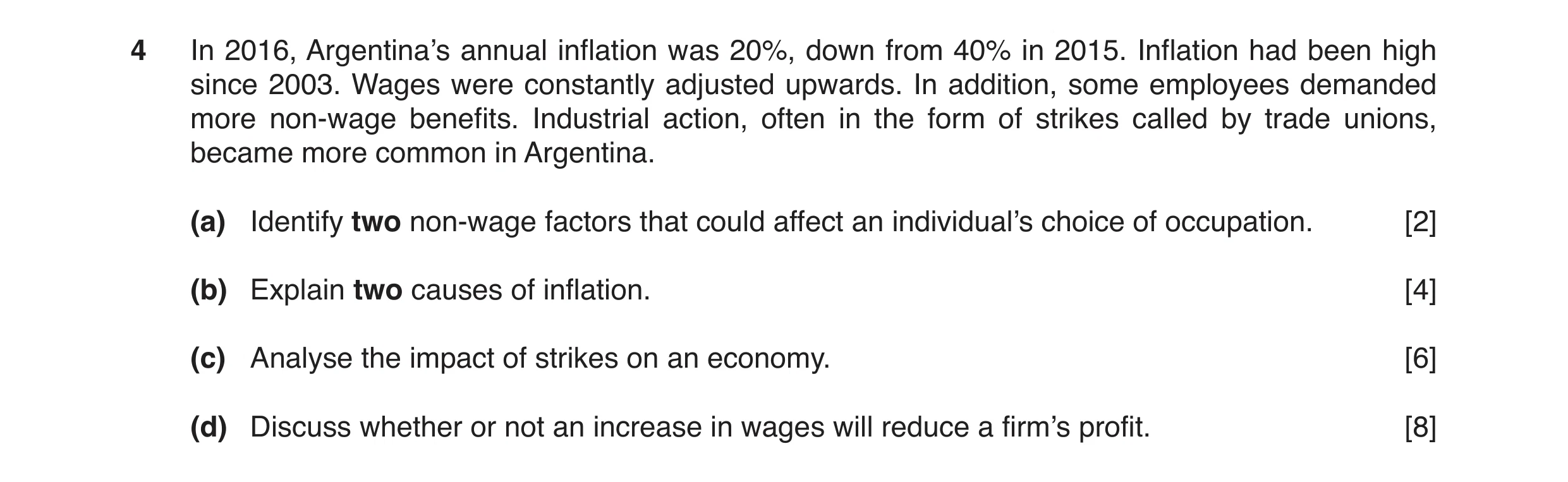
4 In 2016, Argentina’s annual inflation was 20%, down from 40% in 2015. Inflation had been high since 2003. Wages were constantly adjusted upwards. In addition, some employees demanded more non-wage benefits. Industrial action, often in the form of strikes called by trade unions, became more common in Argentina. (a) Identify two non-wage factors that could affect an individual’s choice of occupation. [2] (b) Explain two causes of inflation. [4] (c) Analyse the impact of strikes on an economy. [6] (d) Discuss whether or not an increase in wages will reduce a firm’s profit. [8]
20 marks
Mark scheme: 4(a) Identify two non-wage factors that could affect an individual’s choice of occupation. • opportunity for promotion • job security • satisfactory work • varied work • pleasant working conditions • fringe benefits • location • danger 2 4(b) Explain two causes of inflation. • demand-pull inflation (1) increase in total demand/ lower interest rate / increase business confidence / increase consumer confidence / depreciation of the currency / lower income tax / lower cost of borrowing / increase disposable income / increase exports (1) increase in money supply (1) • cost-push / increase in costs (1) increase price of commodities / increase cost of production / depreciation of the currency / increase indirect taxes (1) 4 4(c) Analyse the impact of strikes on an economy. Disrupted production (1) loss of output (1) decreased productivity (1) less economic growth (1) increased cost of firms (1) reduced profits (1) rising prices / inflation (1) unemployment (1). Better working conditions of the workers (1) higher wages (1). Exports decreasing (1) increase current account deficit / decrease current account surplus (1). Less investment by MNCs (1). There may be capital investment to replace workers (1). 6 Question Answer Marks Guidance 4(d) Discuss whether or not an increase in wages will reduce a firm’s profit. Up to 5 marks for why it might: Higher wages will mean a higher wage bill (1) if output does not increase by more than wages, labour costs per unit will increase (1) costs of production will increase (1) profit is revenue minus costs (1) with higher costs and the same revenue, profit will fall (1). Prices will rise (1) if demand is elastic, revenue will fall (1) Up to 5 marks for why it might not: Paying higher wages may prevent strikes (1) this can reduce costs of production (1). Higher wages may motivate workers (1) this can increase productivity (1) reduce costs of production (1). Higher wages may make it easier to recruit skilled workers (1) this will raise productivity (1) reduce costs of production (1) increase profits (1) Other costs may be falling (1) e.g. rent, corporation tax (1). Demand for the firm’s products may be increasing (1) this will raise revenue (1). Higher wages may be paid to a smaller labour force (1) reducing the wage bill (1). Replace workers with machines (1) may leave costs unchanged (1). 8 2 marks could be awarded for an accurately drawn Demand and Supply diagram.
This question in 0455/21 Oct/Nov 2019
Q7 · Driverless cars and advances in technology It is predicted that driverless cars, powered… 0455/22 Oct/Nov 2019
1 Driverless cars and advances in technology It is predicted that driverless cars, powered by electricity, will be on the roads by 2030. Driverless cars have already been tried out on the roads in some cities, including Pittsburgh in the USA. It is thought that driverless cars will reduce accidents, will have lower repair costs and will create less pollution. At first, the supply of driverless cars may exceed the demand, but it is expected that they will soon grow in popularity. As more driverless cars come into use, the demand for bus travel and petrol stations may decline, and some taxi drivers may be made redundant. In contrast, the increased access to transport that driverless cars will give to people, including the elderly, is likely to increase demand for out of town restaurants and places of entertainment. It has been forecast that the technology being developed in connection with driverless cars will make the supply of them elastic. It is predicted that an 8% rise in the price of driverless cars would cause a 20% rise in the quantity supplied. Advances in technology and the replacement of workers by machines are forecast to destroy 80 million jobs in the USA. Job losses are also forecast in other countries and trade unions are likely to be less able to resist these due to a fall in membership and governments reducing the power of trade unions. Among the jobs thought to be at risk are accountants, train drivers and financial advisers. Demand for workers in other occupations, including doctors and dentists, may increase but there is a risk that unemployment may rise. The more educated workers are, the more easily they can move from one occupation to another. Table 1.1 shows education spending as a percentage (%) of GDP and the unemployment rate in selected countries. Table 1.1 Education spending and the unemployment rate in selected countries Education spending Unemployment rate Country as a % of GDP (%) Argentina 5.3 8.0 Brazil 5.8 13.5 Ghana 6.5 12.0 New Zealand 7.3 4.8 South Africa 6.0 26.0 USA 8.2 4.7 Jobs selling houses and flats may decline but it is expected that the demand for building workers may increase. Some people welcome house building in their area but others oppose it. (a) Identify, from the extract, two pairs of substitutes. [2] (b) Explain, using information from the extract, whether the market for driverless cars is expected to be in equilibrium in 2030. [2] (c) Calculate, using information from the extract, the price elasticity of supply (PES) of driverless cars. [2] (d) Explain, using information from the extract, two external costs that driverless cars could reduce. [4] (e) Analyse, using Table 1.1, the relationship between educational spending and the unemployment rate. [5] (f) Discuss whether or not an increase in house building will benefit the people who live in the area. [5] (g) Explain, using information from the extract, two reasons why the power of trade unions may decline in the future. [4] (h) Discuss whether or not a rise in unemployment is harmful. [6]
30 marks
Mark scheme: 1(a) Identify, from the extract, two pairs of substitutes. • Driverless cars and bus travel • Driverless cars and taxi travel • Bus travel and taxi travel • Machines / advanced technology and workers 2 1(b) Explain, using information form the extract, whether the market for driverless cars is expected to be in equilibrium in 2030. No (1) supply is expected to exceed demand (1). 2 1(c) Calculate, using information from the extract, the price elasticity of supply (PES) of driverless cars. 2.5 (2). Correct working: 20% / 8% OR 20 / 8 (1). 2 1(d) Explain, using information from the extract, two external costs that driverless cars could reduce. • accidents (1) people are injured and killed as a result of other people’s driving / accidents impose costs on hospitals and healthcare / less human error / driverless cars reduce the death rate / accidents can cause traffic congestion / fewer accidents may reduce cost of repairs (1) • pollution (1) cars emit carbon dioxide / pollution causes health problems / driverless cars are more environmentally friendly / use electricity which causes less pollution (1) • lower cost of insurance to (other) drivers (1) as a result of less accidents / lower cost of repairs (1) 4 Question Answer Marks Guidance 1(e) Analyse, using Table 1.1, the relationship between educational spending and the unemployment rate. Expected relationship – a country that spends more (a high proportion) of their GDP on education would have a low unemployment rate / a country with a higher unemployment rate is likely to spend less on education / it is an inverse relationship (1). Reasons for expected relationship – workers would be likely to be more skilled and productive / higher unemployment may result in less tax revenue to spend on education (1). Evidence in support of expected relationship – e.g. New Zealand or US (1) highest spenders and lowest unemployment rates (1). Evidence against expected relationship – e.g. Argentina or South Africa (1) Argentina spends a lower proportion than Ghana and Brazil but has a lower unemployment rate / South Africa spends more a higher proportion than Argentina and Brazil but has a higher unemployment rate (1). 5 A pattern of analysis is expected in response to this type of question. If there is no expected pattern of analysis, the following may be worthy of some reward, e.g.: • it is not a consistent relationship (1) • there are other influences on the unemployment rate (1) However, do not reward simple statements (repetition) of the figures given in the table. For example, USA spends 8.2% on education and has an unemployment rate of 4.7%, is not to be rewarded. Question Answer Marks Guidance 1(f) Discuss whether or not an increase in house building will benefit the people who live in the area. Up to 3 marks for why it might: House building may create jobs (1) lower unemployment (1) generate income / raise wages / raise living standards (1). House building will increase the supply of housing (1) the lower price of housing (1) makes houses more affordable (1) fewer homeless (1). May attract more firms to set up in the area (1) more services may be provided (1) due to more people living in the area / larger labour force (1). May save travel time for those working nearby (1) reduce pollution / congestion (1). Up to 3 marks for why it might not: House building may cause external costs (1) examples (2). More houses may reduce the value of people’s homes (1) reduce their wealth (1). There is an opportunity cost (1) the area used could have been used for e.g. school buildings (1). Demand for extra services may not be met (1). Jobs may only be temporary / seasonal unemployment (1). More housing may create overcrowding in the area. (1). 5 Apply this example to all questions with the command word DISCUSS (1(g), 1(h), 2(d), 3(d), 4(d) and 5(d)) Each point may be credited only once, on either side of an argument, but separate development as to how/why the outcome may differ is rewarded. Generic example Mark Tax revenue may decrease « 1 ... because of reason e.g. incomes may be lower. 1 Tax revenue may increase because incomes may be higher i.e. reverse of a previous argument. 0 Tax revenue may increase because of a different reason i.e. not the reverse of a previous argument e.g. government spending on subsidies may stimulate the economy more than spending on education. 1 Question Answer Marks Guidance 1(g) Explain, using information from the extract, two reasons why the power of trade unions may decline in the future. Fall in membership (1) lower funds / less bargaining power (1). Rise in unemployment / workers being replaced by machines (1) trade unions may be reluctant to take industrial action for fear that members will be replaced by unemployed / non-member workers (1). Government may reduce the power of trade unions (1) making it harder for trade unions to protect workers’ rights (1). Movement from primary to tertiary sector (1) which may be less unionised / better working conditions (1). 4 Some points may be interchangeable e.g. rise in unemployment (1) resulting in fall in membership (1). Question Answer Marks Guidance 1(h) Discuss whether or not a rise in unemployment is harmful. Up to 4 marks for why it is: Output is likely to fall (1) incomes will decline / poverty increase (1) living standards will fall (1) lower total (aggregate) demand (1). Tax revenue will fall (1) government may have to cut spending on e.g. education and healthcare (1). Government may increase tax rates (1) which may create disincentive effect (1). The government will have to spend more on unemployment benefit (1) this will involve an opportunity cost (1) may result in a budget deficit (1). Unemployed workers may lose skills / become out of date (1) may need retraining (1). May increase emigration (1) lose skilled workers (1). May cause social problems e.g. crime / mental health problems (1). Up to 4 marks for why it is not: Inflation may fall (1) due to lower total (aggregate) demand (1). Firms may find it easier to recruit new workers (1) this will make it easier to expand (1) at lower wage costs (1). Productivity may be higher (1) more skilled workers kept (1). Unemployment may give the unemployed time to search for a better job (1) eventually raises their incomes (1). Rise may only be temporary (1). May reduce demand for imports (1) improve current account of the balance of payments (1). May be less pollution with lower output (1). 6 Reward but do not expect reference to a downward multiplier effect and/or not reaching productive capacity.
This question in 0455/22 Oct/Nov 2019
Q8 · Calculate the number of Germans aged over 65 in 2017 0455/22 Feb/March 2021
1 (a) Calculate the number of Germans aged over 65 in 2017. [1] (b) Identify two measures of living standards. [2] (c) Explain one cause of globalisation. [2] (d) Explain two advantages of an increase in the occupational mobility of labour. [4] (e) Analyse why the price of German luxury cars may have increased in 2018. [4] (f) Analyse whether the strength of German trade unions increased from 2013–2016. [5] (g) Discuss whether or not an ageing labour force will reduce productivity. [6] (h) Discuss whether or not immigration will increase a country’s budget surplus. [6]
30 marks
Mark scheme: 1(a) Calculate the number of Germans aged over 65 in 2017. 17.82m / 17 820 000 (1). 1 Accept 17.8 m and 18 m. 1(b) Identify two measures of living standards. Two from: • GDP per head / average income • HDI • quality of education / education 2 If more than two are given, consider the first two. 1(c) Explain one cause of globalisation. Fall in transport costs (1) reducing costs of exporting and importing / increasing international trade (1). Improvement in communications (1) due to advances in technology / increasing growth in MNCs / encouraging consumers to buy from other countries / enabling branches in different countries to keep in touch (1). 2 One mark for the cause identified and one mark for the explanation. 1(d) Explain two advantages of an increase in the occupational mobility of labour. Logical explanation which might include: Lower unemployment / increase employment (1) workers losing one job will find another job more quickly / find another job more easily / maybe more skilled / reduce frictional unemployment / reduce structural unemployment (1). Higher output / higher GDP / economic growth (1) firms experiencing higher demand will be able to expand more quickly / more elastic supply / quicker adjustment to changes in market conditions / workers may be able to multitask / change roles / may be more skilled / fewer unfilled vacancies / greater use of resources / fewer idle resources (1). 4 One mark each for each of two advantages identified and one mark each for each of two explanations. Do not credit ‘more skilled’ more than once. Question Answer Marks Guidance 1(e) Analyse why the price of German luxury cars may have increased in 2018. Coherent analysis which might include: Increase in demand (1) rise in incomes (1) people buy more luxury cars as they get richer / luxury cars become more affordable (1). rise in price of US luxury cars (1) these are substitutes to German luxury cars (1). Fall in the price of petrol / gas (1) petrol / gas is a complement to cars (1) firms can raise revenue / profits by increasing price (1). Decrease in supply (1) rise in wages (1) increasing costs of production (1). 4 Question Answer Marks Guidance 1(f) Analyse whether the strength of German trade unions increased from 2013–2016. Coherent analysis which might include: Overview Trade union membership fell (1) unemployment fell and / or wages rose (1). Analysis of why trade union strength may have fallen Trade union members represented a smaller proportion of labour force / proportion fell from 42.7% to 39.3% / number of members fell by approx. 5.6% (1). Fewer members so funds of / subscriptions to trade unions may have fallen (1) reduces ability to take industrial action / reduces collective bargaining strength (1). Lower unemployment / higher wages may mean workers feel less need to join a union (1). Analysis of why trade union strength may have increased Lower unemployment / higher wages may be the result of successful collective bargaining (1) firms would have found it more difficult to replace members asking for better wages / better working conditions / firms may be reluctant to dismiss staff (1) industrial action would have more effect / collective bargaining power may be stronger (1). Output / profits / demand for products may have increased (1) Comments. Other factors may have influenced trade union power e.g. government trade union legislation (1). Other factors may have influenced wages / unemployment e.g. national minimum wage / higher output /more skilled labour force (1). 5 Question Answer Marks Guidance 1(g) Discuss whether or not an ageing labour force will reduce productivity. Award up to 4 marks for why it might: • May discourage investment (1) workers will have less capital equipment to work with (1). • Older workers may find it more difficult to adapt to new technology (1) may resist change (1) there may not be the time to train them (1) may be less mobile (1). • Older workers may be less fit (1) less able to do manual work (1) may have time off sick (1) may have less energy / get tired (1) work slower (1). Award up to 4 marks for why it might not: • May encourage investment because of shortage of workers / desire to rely less on labour / help workers (1). • Older workers may have more experience (1) built up more skills / qualifications (1) may need less training / have received more training (1) may train young workers (1) make fewer mistakes / produce better quality output (1). • May be more reliable (1) e.g. better punctuality (1). • May stay with the employer longer / lower rate of labour turnover (1). 6 Apply this example to all questions with the command word DISCUSS (1g, 1h, 2d, 3d, 4d and 5d) Each point may be credited only once, on either side of an argument, but separate development as to how/why the outcome may differ is rewarded. Generic example Mark Tax revenue may decrease… 1 ...because of reason e.g. incomes may be lower. 1 Tax revenue may increase because incomes may be higher i.e. reverse of a previous argument. 0 Tax revenue may increase because of a different reason i.e. not the reverse of a previous argument e.g. government spending on subsidies may stimulate the economy more than spending on education. 1 Question Answer Marks Guidance 1(h) Discuss whether or not immigration will increase a country’s budget surplus. Award up to 4 marks for reasons why it might: • May increase size of the labour force (1) quality of the labour force may rise (1) employment may rise (1) more people with incomes (1) higher tax revenue (1) more income tax / direct tax revenue (1) more spending / higher total demand (1) more indirect tax revenue (1) higher profits may increase corporate tax revenue (1). Award up to 4 marks for reasons why it might not: • Some immigrants may be dependents (1) some may be unemployed (1) increase government spending on state benefits / unemployment benefits (1) pensions (1). • The government may have to spend more on education (1) healthcare (1) housing / infrastructure (1). • Labour force / population may not increase if matched by emigration (1), • Larger population size may result in the government having to spend more on measures to reduce pollution (1). 6 Increase in the size of the labour force linked to why it might.
This question in 0455/22 Feb/March 2021
Q9 · Some economists criticise high government spending and trade unions for creating market… 0455/21 Oct/Nov 2021
5 Some economists criticise high government spending and trade unions for creating market disequilibrium. However, trade unions may also play a key role in economic development. There are over 60 trade unions in Singapore, in both labour-intensive and capital-intensive industries. (a) Define market disequilibrium. [2] (b) Explain the difference between labour-intensive and capital-intensive industries. [4] (c) Analyse how trade unions could increase economic development. [6] (d) Discuss whether or not high government spending can help a government achieve its macroeconomic aims. [8]
20 marks
Mark scheme: 5(a) Define market disequilibrium. When quantity demanded does not equal quantity supplied (2). When there are shortages (1) or surpluses (1) of a product. 2 5(b) Explain the difference between labour-intensive and capital- intensive industries Logical explanation which might include: Labour-intensive industries rely more on human labour (1) i.e. workers (1) low-cost labour may be available (1) example of industry (1) Capital-intensive industries rely more on capital (1) i.e. machines (1) capital more efficient / cheaper than labour (1) example of industry 4 5(c) Analyse how trade unions could increase economic development. Coherent analysis which might include: Trade unions could help engage in collective bargaining on wages (1) higher wages (1) leads to higher purchasing power of workers (1). May increase motivation of workers (1) increase output (1). Better working hours (1) improved working conditions (1) protect workers’ rights (1) better health and safety (1) more job security (1) leads to higher standards of living (1) higher life expectancy (1). Increased productivity / efficiency of workers (1) decreases cost of production (1) decrease final price of goods and services produced in the country (1) increase competitiveness (1) higher output / economic growth (1). May help with training (1) raise quality of output (1). 6 Question Answer Marks Guidance 5(d) Discuss whether or not high government spending can help a government achieve its macroeconomic aims. In assessing each answer, use the table opposite. Why high government spending can help a government achieve its macroeconomic aims: • economic growth – increase total demand • full employment/low unemployment – increase demand for workers through more government infrastructure projects • government spending on education may raise workers’ skills and so lower unemployment • balance of payments stability – through subsidies for producers • redistribution of income – through spending on social welfare. Why high government spending cannot help a government achieve its macroeconomic aims: • increased total demand could lead to increase demand-pull inflation • too much government spending could lead to less private investments • overreliance of government subsidies could lead to complacency • high spending on social welfare could discourage the unemployed from trying to find jobs • may be accompanied by higher taxes which could be a disincentive to effort and enterprise • may increase budget deficit which could reduce confidence in the economy. 8 Level Description Marks 3 A reasoned discussion which accurately examines both sides of the economic argument, making use of economic information and clear and logical analysis to evaluate economic issues and situations. One side of the argument may have more depth than the other, but overall both sided of the argument are considered and developed. There is thoughtful evaluation of economic concepts, terminology, information and/or data appropriate to the question. The discussion may also point out the possible uncertainties of alternative decisions and outcomes. 6–8 Question Answer Marks Guidance 5(d) Level Description Marks 2 A reasoned discussion which makes use of economic information and clear analysis to evaluate economic issues and situations. The answer may lack some depth and development may be one- sided. There is relevant use of economic concepts, terminology, information and data appropriate to the question. 3–5 1 There is a simple attempt at u sing economic definitions and terminology. Some reference may be made to economic theory, with occasional understanding. 1–2 0 A mark of zero should be awarded for no creditable content. 0
This question in 0455/21 Oct/Nov 2021
Q10 · In Tunisia, resource allocation decisions are made by both the public sector and private… 0455/22 Oct/Nov 2021
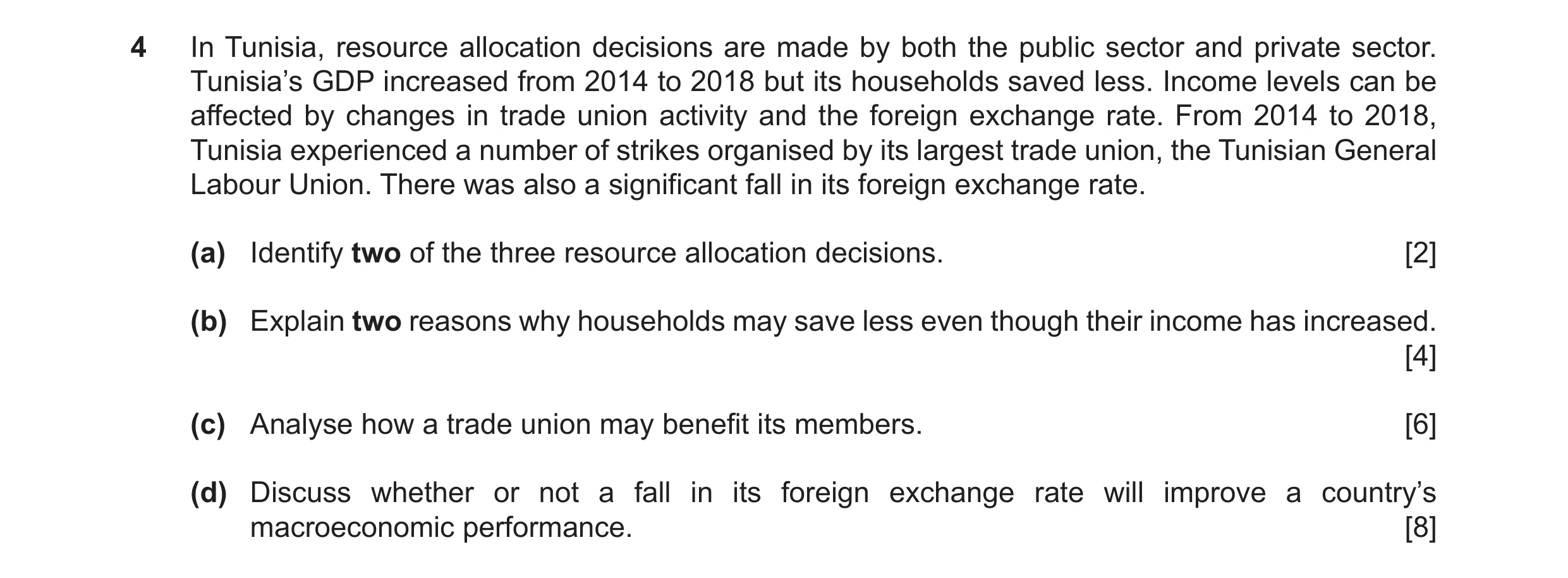
4 In Tunisia, resource allocation decisions are made by both the public sector and private sector. Tunisia’s GDP increased from 2014 to 2018 but its households saved less. Income levels can be affected by changes in trade union activity and the foreign exchange rate. From 2014 to 2018, Tunisia experienced a number of strikes organised by its largest trade union, the Tunisian General Labour Union. There was also a significant fall in its foreign exchange rate. (a) Identify two of the three resource allocation decisions. [2] (b) Explain two reasons why households may save less even though their income has increased. [4] (c) Analyse how a trade union may benefit its members. [6] (d) Discuss whether or not a fall in its foreign exchange rate will improve a country’s macroeconomic performance. [8]
20 marks
Mark scheme: 4(a) Identify two of the three resource allocation decisions. Two from: • what to produce • how to produce • who to produce for 2 Question Answer Marks Guidance 4(b) Explain two reasons why households may save less even though their income has increased. Logical explanation which might include: Fall in the rate of interest (1) which would reduce the return from saving / spend/borrow rather than save (1). Inflation (1) spend more now before prices rise further / may reduce the real rate of interest (1). Increase in confidence about the future (1) less motive to save for hard times / less concerned will experience unemployment or fall in income (1). Fall in range, number or reliability of financial institutions (1) which would reduce the safe places to save (1). Greater consumption opportunities / spend more / higher living standards (1) with the introduction of new products / lower prices / may be able to afford private education / healthcare (1). Increase in taxes (1) reducing disposable income (1). Rise in family size (1) increasing household expenses (1). Rise in debt (1) may reduce ability of households to e.g. to put money into a savings account (1). Change in social attitudes (1) due to e.g. change in age of households (1). 4 One mark each for each of two reasons identified and one mark each for each of two explanations. Question Answer Marks Guidance 4(c) Analyse how a trade union may benefit its members. Coherent analysis which might include: A trade union may negotiate with employers (1) to raise wages (1) improve working conditions (1) example (1) increase fringe benefits (1) example (1) through collective bargaining (1) and sometimes industrial action / strikes (1). A trade union may settle disputes between the employer and the workers (1) e.g. over changes in working practices (1) protect workers’ rights (1). A trade union may seek to protect the employment of its members (1) in some cases negotiate favourable redundancy terms (1). A trade union may negotiate / put pressure on the government (1) to e.g. raise a national minimum wage or reduce the retirement age (1). In some countries, trade unions provide benefits and services to members (1) e.g. training services (1). 6 Question Answer Marks Guidance 4(d) Discuss whether or not a fall in its foreign exchange rate will improve a country’s macroeconomic performance. In assessing each answer, use the table opposite. Why it might: • export prices will fall and import prices will rise • demand for exports may rise and demand for imports may fall • domestic output will increase, economic growth may rise • more workers may be employed, reducing unemployment • a deficit on the current account of the balance of payments may be reduced or a surplus increased • may encourage foreign investment if it is thought assets can be bought more cheaply. Why it might not: • rise in price of imported capital goods and raw materials may increase costs of production, causing cost-push inflation • higher total (aggregate) demand may cause demand-pull inflation, especially if the economy is working close to full capacity • demand for exports and imports may be price inelastic, causing export revenue to fall and import expenditure to rise – in such a case may benefit more from a rise in the exchange rate • trade restrictions imposed by other countries may prevent the country from exporting more products • may discourage foreign investment due to a lack of confidence in the country’s future economic prospects. 8 Level Description Marks 3 A reasoned discussion which accurately examines both sides of the economic argument, making use of economic information and clear and logical analysis to evaluate economic issues and situations. One side of the argument may have more depth than the other, but overall, both sides of the argument are considered and developed. There is thoughtful evaluation of economic concepts, terminology, information and/or data appropriate to the question. The discussion may also point out the possible uncertainties of alternative decisions and outcomes. 6–8 2 A reasoned discussion which makes use of economic information and clear analysis to evaluate economic issues and situations. The answer may lack some depth and development may be one-sided. There is relevant use of economic concepts, terminology, information and data appropriate to the question. 3–5 1 There is a simple attempt at u sing economic definitions and terminology. Some reference may be made to economic theory, with occasional understanding. 1–2 Question Answer Marks Guidance 4(d) Level Description Marks 0 A mark of zero should be awarded for no creditable content. 0
This question in 0455/22 Oct/Nov 2021
Q11 · Trade union membership is much higher in Sweden than in most countries 0455/21 May/June 2022
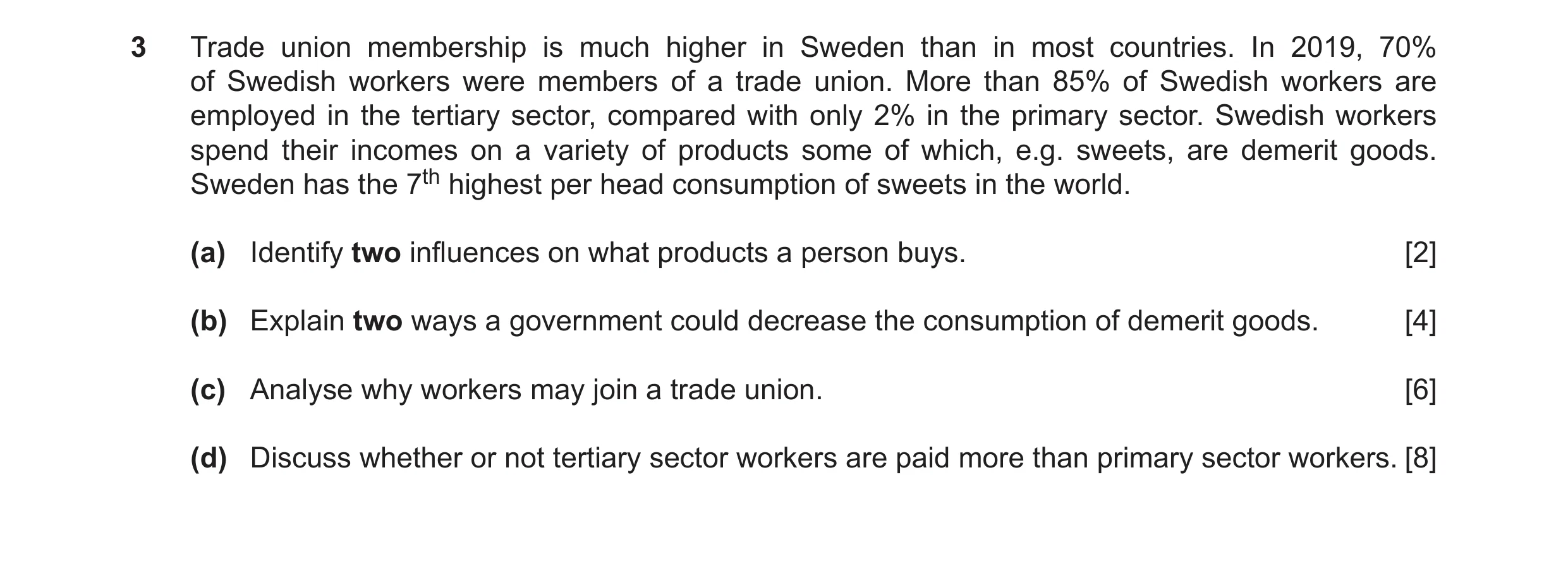
3 Trade union membership is much higher in Sweden than in most countries. In 2019, 70% of Swedish workers were members of a trade union. More than 85% of Swedish workers are employed in the tertiary sector, compared with only 2% in the primary sector. Swedish workers spend their incomes on a variety of products some of which, e.g. sweets, are demerit goods. Sweden has the 7th highest per head consumption of sweets in the world. (a) Identify two influences on what products a person buys. [2] (b) Explain two ways a government could decrease the consumption of demerit goods. [4] (c) Analyse why workers may join a trade union. [6] (d) Discuss whether or not tertiary sector workers are paid more than primary sector workers. [8]
20 marks
Mark scheme: 3(a) Identify two influences on what products a person buys. Two from e.g.: Price (1) income (1) tastes / habit / culture (1) advertising (1) availability (1) social media / influencers (1) quality (1) government regulations/ laws (1) age (1). 3(b) Explain two ways a government could decrease the consumption of demerit goods. Logical explanation which might include: Impose an (indirect) tax / tariff on goods (1) raise the price (1). Provide information (1) about harmful effects (1). Ban / regulate (1) to stop or reduce the availability of the product (1). Set minimum price above market price (1) raise prices (1). Import quota (1) restricts availability for purchase (1). 4 One mark for each of two ways identified and one mark for each explanation. Question Answer Marks Guidance 3(c) Analyse why workers may join a trade union. Coherent analysis which might include: Understanding of role of trade union (1) to gain greater bargaining power (1) through industrial action (1) to negotiate with employers (1) for higher wages (1) better working conditions / health & safety (1) fringe benefits (1). To represent them (1) in disputes with employers (1) e.g., to protect their rights (1) against unfair dismissal / discrimination (1) increase job security (1) compensation for work injuries (1). To gain greater influence on the government (1) to e.g., increase a national minimum wage (1) increase job opportunities (1). Unions may provide services to members (1) training courses (1) improving health and safety (1) benefits e.g. discounts at gyms (1) financial and legal advice (1). 6 Award no marks for examples of industrial action Question Answer Marks Guidance 3(d) Discuss whether or not tertiary sector workers are paid more than primary sector workers. In assessing each answer, use the table opposite. Why they might be: may be more skilled / qualified may be more productive tertiary products may have higher value added tertiary products may have higher demand, so industries may have greater ability to pay higher wages. Why they might not be: may be less likely to belong to a trade union some workers may be in lower paid jobs e.g., cleaners some tertiary sector firms / occupations may be declining some may be less experienced some may not be in promoted posts primary sector products may have higher value added e.g., oil primary sector workers in a developed country may be paid more than tertiary workers in an undeveloped country. primary jobs may be more dangerous e.g., mining 8 Level Description Marks 3 A reasoned discussion which accurately examines both sides of the economic argument, making use of economic information and clear and logical analysis to evaluate economic issues and situations. One side of the argument may have more depth than the other, but overall, both sides of the argument are considered and developed. There is thoughtful evaluation of economic concepts, terminology, information and / or data appropriate to the question. The discussion may also point out the possible uncertainties of alternative decisions and outcomes. 68 Question Answer Marks Guidance 3(d) Level Description Marks 2 A reasoned discussion which makes use of economic information and clear analysis to evaluate economic issues and situations. The answer may lack some depth and development may be one- sided. There is relevant use of economic concepts, terminology, information and data appropriate to the question. 35 1 There is a simple attempt at using economic definitions and terminology. Some reference may be made to economic theory, with occasional understanding. 12 0 A mark of zero should be awarded for no creditable content. 0 Note: accept approach that discusses why primary sector workers may be better paid. Define privatisation. Privatisation is the sale of state-owned / public sector firms / public sector assets (1) to the private sector / investors / individuals (1). 2 Award 1 mark for an understanding of the private sector Accept change / movement / turned from public to private sector
This question in 0455/21 May/June 2022
Q12 · More government spending creates opportunity costs 0455/23 May/June 2022
5 More government spending creates opportunity costs. This was one of the problems that the president of France faced in 2017. Since he came to power, he has focused on using supply-side policy measures, rather than monetary policy. Trade union membership has reduced in France in recent years. (a) Define monetary policy. [2] (b) Explain, using an example, the influence of opportunity cost on government decision-making. [4] (c) Analyse the reasons why trade union membership has reduced in some countries. [6] (d) Discuss whether or not supply-side policy measures always promote economic growth. [8]
20 marks
Mark scheme: 5(a) Define monetary policy. Supply of money (1) interest rates / foreign exchange rates (1) affecting total demand / inflation (1) 5(b) Explain, using an example, the influence of opportunity cost on government decision-making. Logical explanation which might include: Opportunity cost is the (next) best alternative (1) forgone / given up / sacrificed (1) Governments (always) consider opportunity cost when making a decision on spending money (1) to maximise the welfare of society (1). Governments have to make a choice as they have a limited income/budget (1). For example, if the government spends on building a new hospital (1) the opportunity cost may be a new school (1) as the government thinks that the opportunity cost of building a new a new hospital is lower than building a new school (1). 4 Don't reward examples using personal consumption e.g. tea / coffee Question Answer Marks Guidance 5(c) Analyse the reasons why trade union membership has reduced in some countries. Coherent analysis which might include: Improved working conditions (1) improved wages (1) in a country may have reduced the need for trade unions to negotiate them / have made unions more reluctant to take industrial action (1). High unemployment (1) fear of losing jobs (1). Capital intensive production (1) fewer workers available to join trade unions (1) Government measures against trade unions (1) have reduced the ability of trade unions (1) to influence wages (1) and working conditions (1). Changes in the pattern of employment (1) more self-employed / part-time employed / gig economy / zero hours contract (1) more people working in the private sector (1) where trade union membership has traditionally been low (1). Globalisation (1) and growth of MNCs (1) has increase competition amongst labour (1). Dissatisfaction over trade unions (1) the high fees for joining trade unions (1) not wanting to take strike action (1) different political views (1) disincentivises people from joining (1). Government introduction of health and safety regulations (1) and minimum wages (1) reduced the key reasons for the existence of trade unions (1). Removal of mandatory trade union membership (closed shops) (1) means that membership is reduced because it is now voluntary (1) 6 Question Answer Marks Guidance 5(d) Discuss whether or not supply-side policy measures always promote economic growth In assessing each answer, use the table opposite. Why supply-side policy measures are effective in promoting economic growth: education and training – increase productivity of labour lower direct taxes – increase incentive to work (reduction in income tax) and increase incentive to invest (reduction in corporation tax) subsidies - reduce business costs and encourage investment deregulation – reducing red tape / barriers to entry which could lead to an increase in number of firms and increase competition privatisation – put in profit-maximisation incentive for private firms to invest and innovate and be more productive reducing trade union power – increases incentive to work harder. Why supply-side policy measures are not effective in promoting economic growth: takes a long time for it to have an impact on the economy reduces the revenues for government (e.g. cutting taxes) opportunity cost for government subsidies can lead to over-reliance on them could lower the quality of goods and services (race to the bottom) and welfare of society lack of total demand. 8 Level Description Marks 3 A reasoned discussion which accurately examines both sides of the economic argument, making use of economic information and clear and logical analysis to evaluate economic issues and situations. One side of the argument may have more depth than the other, but overall both sides of the argument are considered and developed. There is thoughtful evaluation of economic concepts, terminology, information and/or data appropriate to the question. The discussion may also point out the possible uncertainties of alternative decisions and outcomes. 6–8 Question Answer Marks Guidance 5(d) Level Description Marks 2 A reasoned discussion which makes use of economic information and clear analysis to evaluate economic issues and situations. The answer may lack some depth and development may be one-sided. There is relevant use of economic concepts, terminology, information and data appropriate to the question. 3–5 1 There is a simple attempt at using economic definitions and terminology. Some reference may be made to economic theory, with occasional understanding. 1–2 0 A mark of zero should be awarded for no creditable content. 0
This question in 0455/23 May/June 2022
Q13 · Serbia is the world’s second largest producer of raspberries, a product with elastic… 0455/22 Feb/March 2023
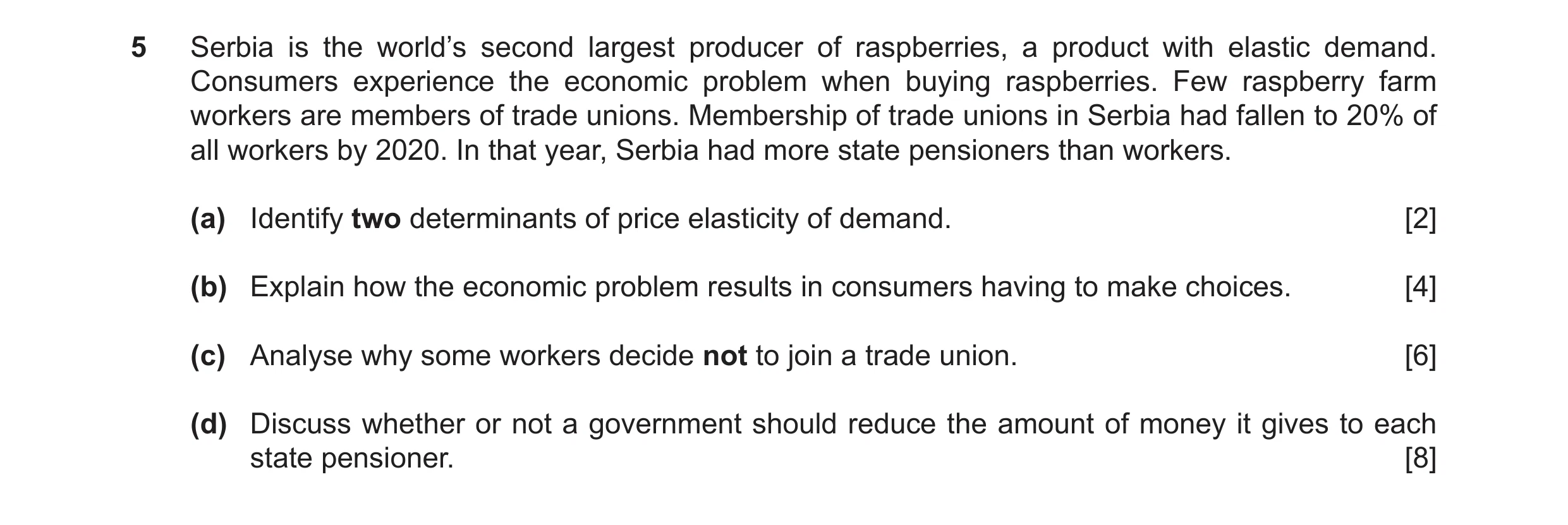
5 Serbia is the world’s second largest producer of raspberries, a product with elastic demand. Consumers experience the economic problem when buying raspberries. Few raspberry farm workers are members of trade unions. Membership of trade unions in Serbia had fallen to 20% of all workers by 2020. In that year, Serbia had more state pensioners than workers. (a) Identify two determinants of price elasticity of demand. [2] (b) Explain how the economic problem results in consumers having to make choices. [4] (c) Analyse why some workers decide not to join a trade union. [6] (d) Discuss whether or not a government should reduce the amount of money it gives to each state pensioner. [8]
20 marks
Mark scheme: 5(a) Identify two determinants of price elasticity of 2 If more than two determinants given, consider the first three. demand. Two from: • substitutes • whether a luxury or necessity • proportion of income taken • whether habit forming / addictive • whether the purchase can be postponed • time period • breadth of definition • brand loyalty • number of uses • complements 5(b) Explain how the economic problem results in 4 consumers having to make choices. Logical explanation which might include: The economic problem is unlimited / infinite wants (1) exceeding limited / finite / scare resources (1) resulting in scarcity (1). Consumers have limited incomes (1) and so cannot buy everything they want (1). Buying one product involves an opportunity cost (1) in the form of another product sacrificed / example (1). 5(c) Analyse why some workers decide not to join a 6 trade union. Coherent analysis which might include: Trade unions charge a subscription fee (1) workers cannot afford to join (1) may be unemployed / have low income (1). Government legislation may prevent trade union membership / government may discourage membership (1) may reduce the power of trade unions (1) less benefit from joining (1). Employers may discourage membership (1) may think it will reduce chance of employment / increase chance of unemployment (1) chance of promotion (1). May be satisfied with wages (1) working conditions (1) may have job security (1) no need for collective bargaining (1). May be employed in industries that do not have a history of trade union membership (1). May be reluctant to take industrial action (1) may lose pay during a strike (1). May not agree with the objectives of the trade union (1). May follow example of fellow workers (1). 5(d) Discuss whether or not a government should 8 Level Description Marks reduce the amount of money it gives to each state pensioner. 3 A reasoned discussion which accurately 6–8 examines both sides of the economic In assessing each answer, use the table opposite. argument, making use of economic information and clear and logical analysis Why it should: to evaluate economic issues and • ageing population can mean the amount of situations. One side of the argument may government spending on pensions rises have more depth than the other, but significantly overall, both sided of the argument are • a reduction in the state pension could reduce a considered and developed. There is budget deficit thoughtful evaluation of economic • may persuade people to work longer, raising concepts, terminology, information and / output and tax revenue or data appropriate to the question. The • paying pensions involves an opportunity cost, discussion may also point out the could spend more on e.g. education possible uncertainties of alternative decisions and outcomes. Why it should not: 2 A reasoned discussion which makes use 3–5 • will reduce living standards of pensioners of economic information and clear • may increase the numbers living in absolute analysis to evaluate economic issues poverty and situations. The answer may lack • will reduce total demand some depth and development may be • lower spending by pensioners could reduce one-sided. There is relevant use of output and increase unemployment. economic concepts, terminology, information and data appropriate to the question. 1 There is a simple attempt at using 1–2 economic definitions and terminology. Some reference may be made to economic theory, with occasional understanding. 0 A mark of zero should be awarded for no 0 creditable content.
This question in 0455/22 Feb/March 2023
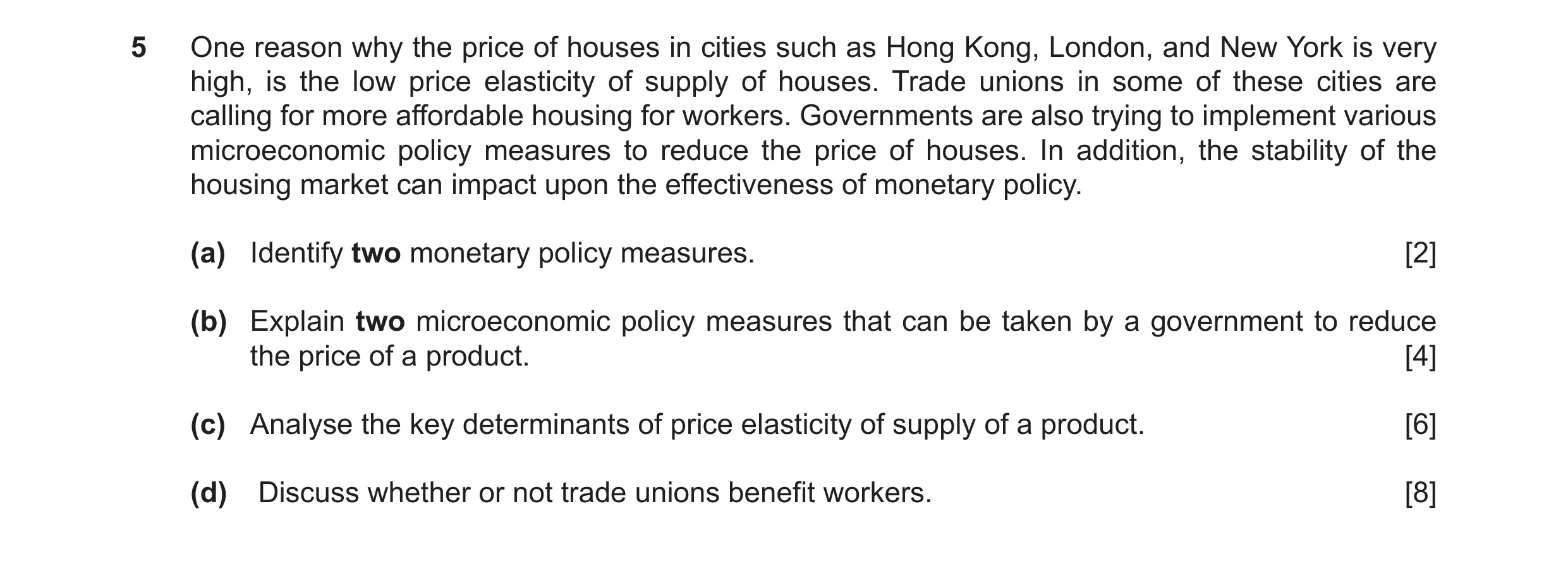
Q14 · One reason why the price of houses in cities such as Hong Kong, London, and New York is… 0455/21 Oct/Nov 2023
5 One reason why the price of houses in cities such as Hong Kong, London, and New York is very high, is the low price elasticity of supply of houses. Trade unions in some of these cities are calling for more affordable housing for workers. Governments are also trying to implement various microeconomic policy measures to reduce the price of houses. In addition, the stability of the housing market can impact upon the effectiveness of monetary policy. (a) Identify two monetary policy measures. [2] (b) Explain two microeconomic policy measures that can be taken by a government to reduce the price of a product. [4] (c) Analyse the key determinants of price elasticity of supply of a product. [6] (d) Discuss whether or not trade unions benefit workers. [8]
20 marks
Mark scheme: 5(a) Identify two monetary policy measures. 2 Accept, but do not expect, quantitative easing as an alternative to money supply. If more than two measures Changes in: interest rates (1) money supply (1) foreign are given, consider the first three. exchange rates (1). 5(b) Explain two microeconomic policy measures that can be 4 Examples could be related to any market – does not taken by a government to reduce the price of a product. have to be housing market. Logical explanation which might include: If more than two policy measures are given, consider the first three. • maximum prices (1) e.g. maximum rents / rent controls (1) • subsidies (1) reduce cost of production (1) e.g. housing subsidies (1) • nationalisation (1) government sets lower prices (1) • direct provision of goods (1) increase supply of goods (1) e.g. government providing public housing (1) • regulation (1) e.g. prohibiting foreign house buying (1) reduce demand (1) • deregulation (1) allowing more firms in the market / more competition (1) • lower (sales) taxes (1) if sellers reduce prices as a result (1). 5(c) Analyse the key determinants of price elasticity of supply of 6 Also accept an approach based on why PES may be a product. inelastic as shown in third bullet point. Coherent analysis which might include: • availability of stocks (1) finished goods which are unsold (1) with a high level of stocks, supply will be elastic (1) • level of spare capacity (1) factors of production available but unused (1) e.g. workers not working full time (1) supply will be more elastic if levels of spare capacity are high (1) • time period under consideration (1) short run / long run (1) short run has inelastic supply (1) with at least one fixed factor of production (1) which makes it more difficult to produce (1) long run has elastic supply (1) when all factors of production are variable (1) making it easier to produce more (1) • difficulty of production process / length of production time (1) produce that is easy to produce will be more elastic (1) e.g. bread is easier to produce compared to a smartphone (1). 5(d) Discuss whether or not trade unions benefit workers. 8 Level Description Marks In assessing each answer, use the table opposite. 3 A reasoned discussion which 6–8 accurately examines both sides of the Why they might: economic argument, making use of economic information and clear and • collective bargaining can result in higher wages logical analysis to evaluate economic • better working hours and working conditions can be issues and situations. One side of the negotiated argument may have more depth than • trade unions may protect employment giving more job the other, but overall both sided of the security argument are considered and • trade unions may influence governments to give favourable developed. There is thoughtful policies for workers, e.g. maternity pay evaluation of economic concepts, • trade unions may provide services for workers e.g. training. terminology, information and / or data appropriate to the question. The Why they might not: discussion may also point out the possible uncertainties of alternative • higher wages negotiated by trade unions may increase decisions and outcomes. costs of production, firms may reduce number of workers to cut costs 2 A reasoned discussion which makes 3–5 • may promote industrial actions / strikes, reducing use of economic information and clear productivity, reducing wages of workers analysis to evaluate economic issues • may reduce competitiveness of the economy, reducing and situations. The answer may lack investment and therefore reducing the demand for workers. some depth and development may be • workers may not agree with the objectives of a trade union one-sided. There is relevant use of • workers may feel that the fees to join a trade union are too economic concepts, terminology, high compared to the benefits they could receive from information and data appropriate to the membership. question. 5(d) Level Description Marks 1 There is a simple attempt at using 1–2 economic definitions and terminology. Some reference may be made to economic theory, with occasional understanding. 0 A mark of zero should be awarded for 0 no creditable content.
This question in 0455/21 Oct/Nov 2023
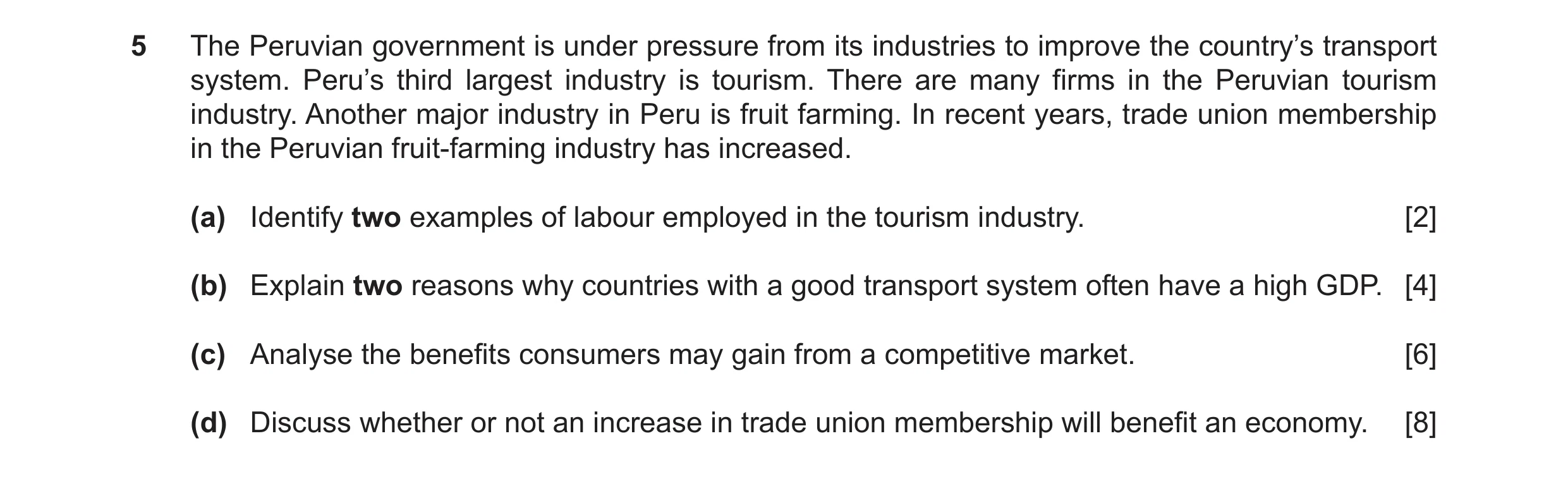
Q15 · The Peruvian government is under pressure from its industries to improve the country’s… 0455/22 Oct/Nov 2024
5 The Peruvian government is under pressure from its industries to improve the country’s transport system. Peru’s third largest industry is tourism. There are many firms in the Peruvian tourism industry. Another major industry in Peru is fruit farming. In recent years, trade union membership in the Peruvian fruit-farming industry has increased. (a) Identify two examples of labour employed in the tourism industry. [2] (b) Explain two reasons why countries with a good transport system often have a high GDP. [4] (c) Analyse the benefits consumers may gain from a competitive market. [6] (d) Discuss whether or not an increase in trade union membership will benefit an economy. [8]
20 marks
Mark scheme: 5(a) Identify two examples of labour employed in the tourism 2 Also accept skilled and unskilled. industry. Do not accept driver or car driver on their own. Could accept Two from e.g. e.g. a driver who transports tourists, • tour guides • hotel manager / hotel worker • travel agent • flight attendant • coach / bus driver 5(b) Explain two reasons why countries with a good 4 One mark each for each of two reasons identified and one transport system often have a high GDP. mark for each of two explanations. Logical explanation which might include: Accept: increase accessibility. Lower firms’ costs of production (1) cheaper to move goods/imports/exports / move goods/raw materials//imports/exports more efficiently / increase international competitiveness and so increase exports / higher income / increase size of markets / higher total demand (1). Reduce wastage (1) food etc more likely to arrive fresh and so increase earnings for sale of e.g food / higher profits (1). Increase labour mobility / easier to get to work (1) reduce unemployment / increase productivity (1). Less congestion (1) less stress / less time lost (1). Increase (earnings from) tourism (1) cheaper / easier to move around the country (1). Attract MNCs/FDI / increase investment (1) increase employment (1) increase productive capacity (1). Fewer accidents (1) avoid loss of workers / avoid loss of working hours (1). Less pollution (1) healthier labour force (1). 5(c) Analyse the benefits consumers may gain from a 6 competitive market. Coherent analysis which might include: A competitive market has a large number of firms producing the product / no barriers to entry (1) substitutes available (1). Low prices (1) as firms try to gain a larger share of the market / attract consumers / increase purchasing power (1). High quality (1) as competition can increase efficiency (1) increase innovation (1). Choice (1) different versions of the product may be produced / greater range of products / greater variety (1). Responsive to changes in consumer demand (1) consumer sovereignty (1). 5(d) Discuss whether or not an increase in trade union Maximum of L2 4 marks if candidate answers in reverse membership will benefit an economy. based on a misinterpretation – an increase in trade union fees. In assessing each answer, use the table opposite. Level Description Marks Why it might: • rise in wages and improved working conditions may 3 A reasoned discussion which 6–8 increase productivity accurately examines both sides of the • higher wages may increase total demand which may economic argument, making use of increase real GDP economic information and clear and • improved working conditions would increase living logical analysis to evaluate economic standards issues and situations. One side of the • by providing a channel of communication, it may reduce argument may have more depth than conflicts between workers and employers the other, but overall both sided of the • by helping with training may raise output. argument are considered and developed. There is thoughtful evaluation of economic concepts, Why it might not: terminology, information and/or data • higher wages may increase inflation appropriate to the question. The • may take industrial action e.g. strikes which could lower discussion may also point out the output / GDP possible uncertainties of alternative • may resist job losses / introduction of new technology decisions and outcomes. which may prevent increases in efficiency. 2 A reasoned discussion which makes 3–5 use of economic information and clear analysis to evaluate economic issues and situations. The answer may lack some depth and development may be one-sided. There is relevant use of economic concepts, terminology, information and data appropriate to the question. 5(d) Level Description Marks 1 There is a simple attempt at using 1–2 economic definitions and terminology. Some reference may be made to economic theory, with occasional understanding. 0 A mark of zero should be awarded for 0 no creditable content.
This question in 0455/22 Oct/Nov 2024
 1 / 5
1 / 5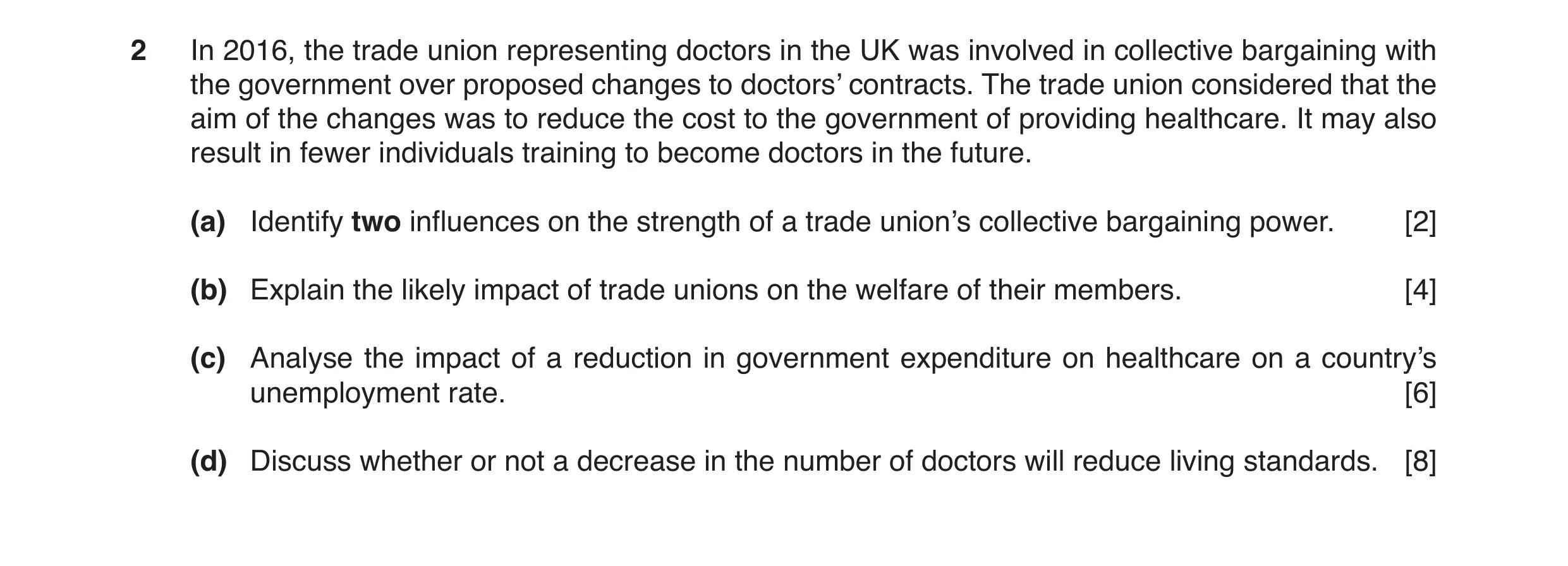
 2 / 5
2 / 5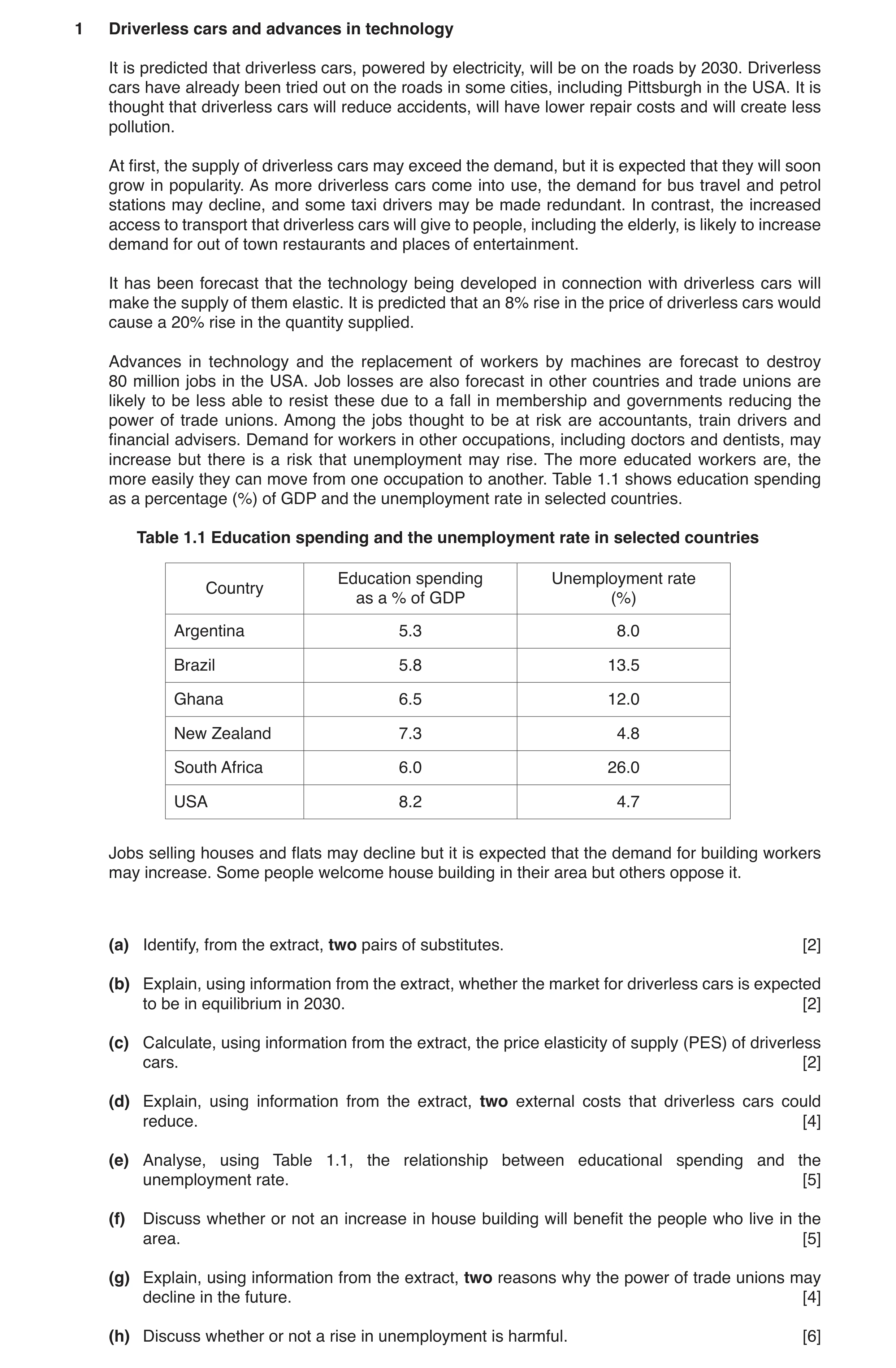
![Question 8: (a) Calculate the number of Germans aged over 65 in 2017. [1] (b) Identify two measures of living standards. [2] (c) Explain one cause of g…](https://img.pastlit.com/crops/4285558b-8258-4228-a407-9d8cc03545cd/q1.webp) 3 / 5
3 / 5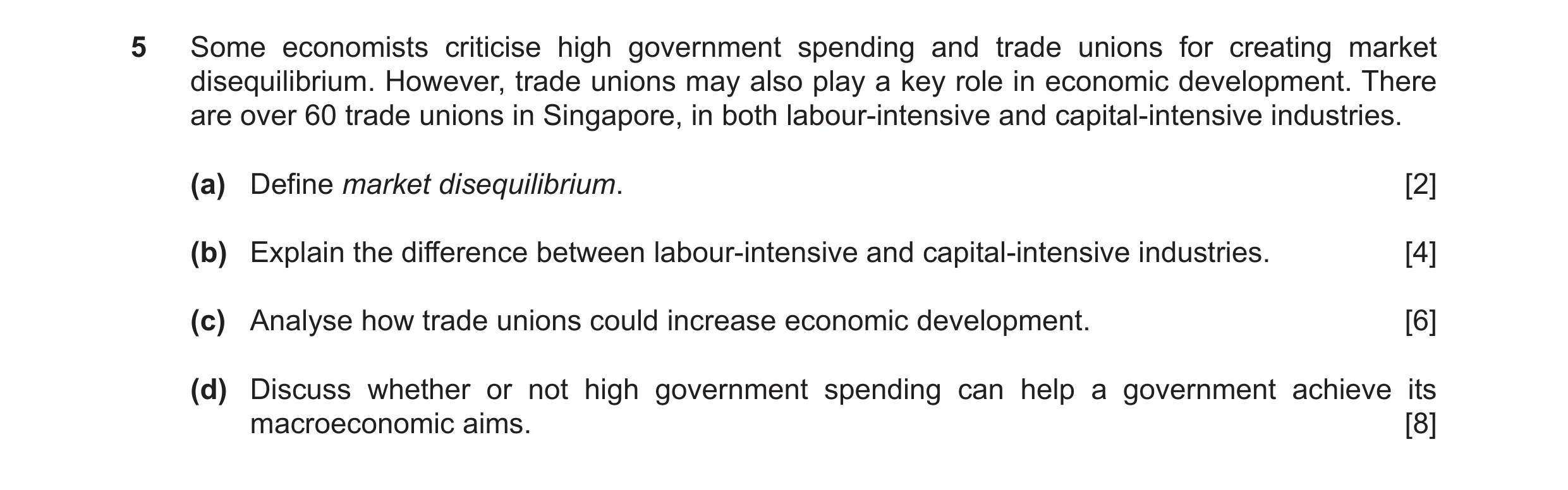
 4 / 5
4 / 5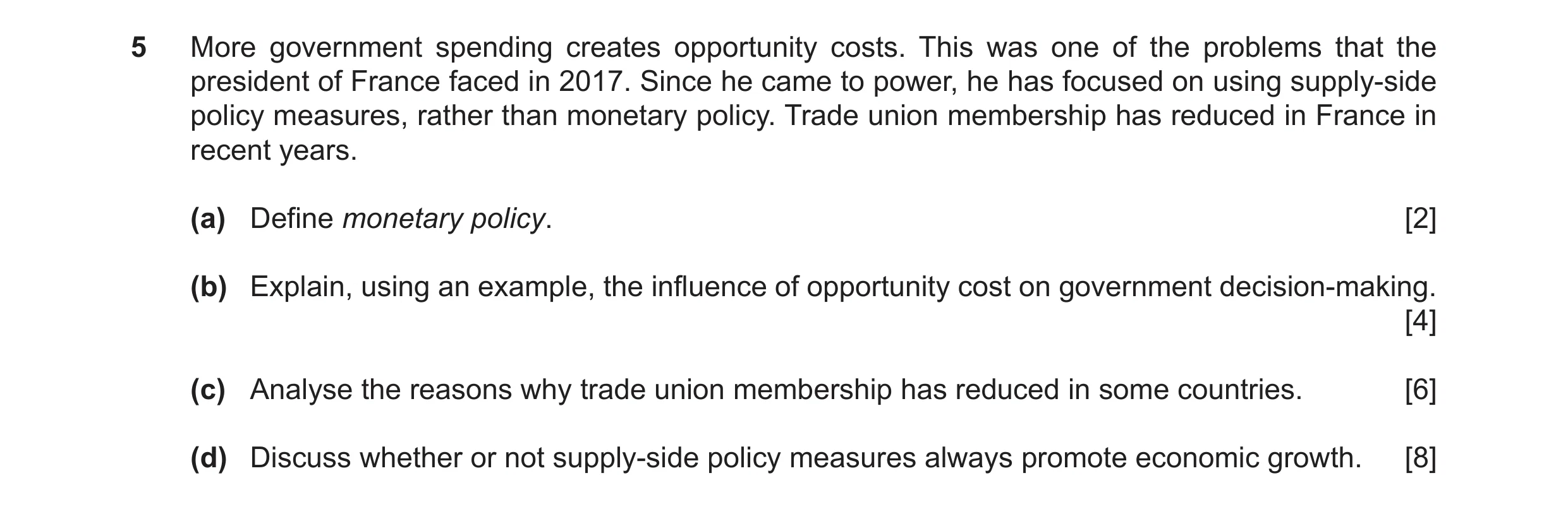
 5 / 5
5 / 5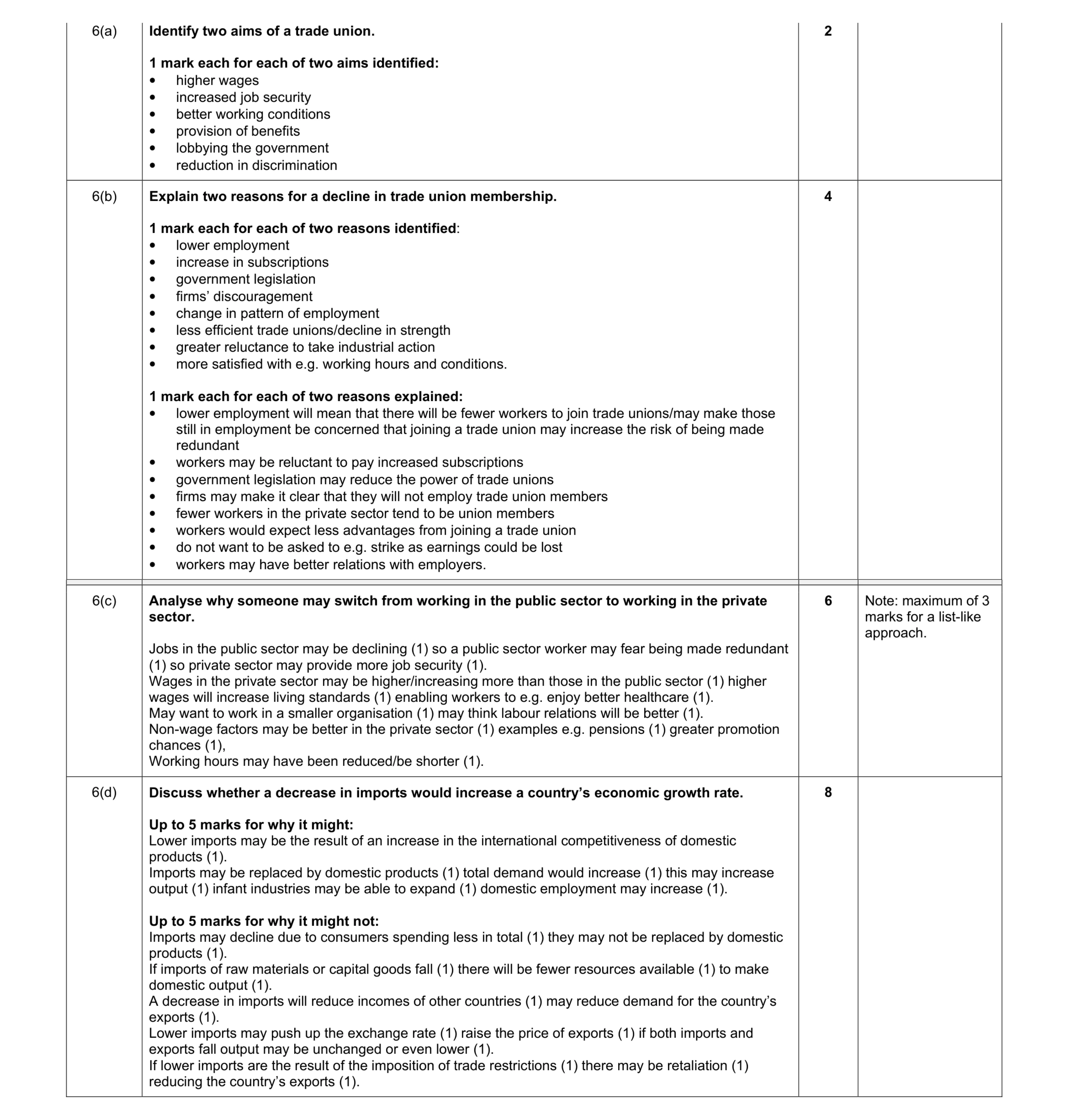 20
20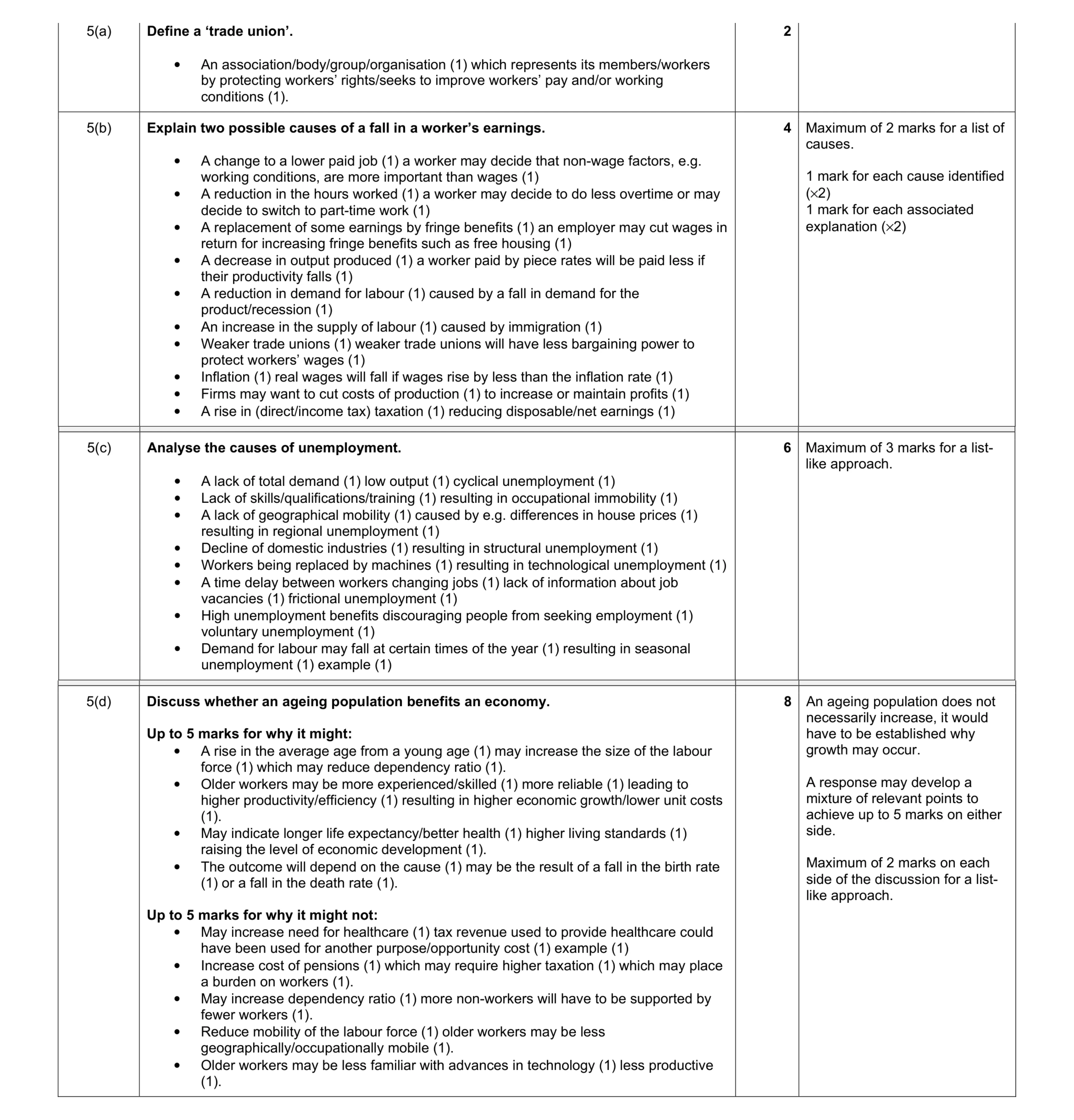 20
20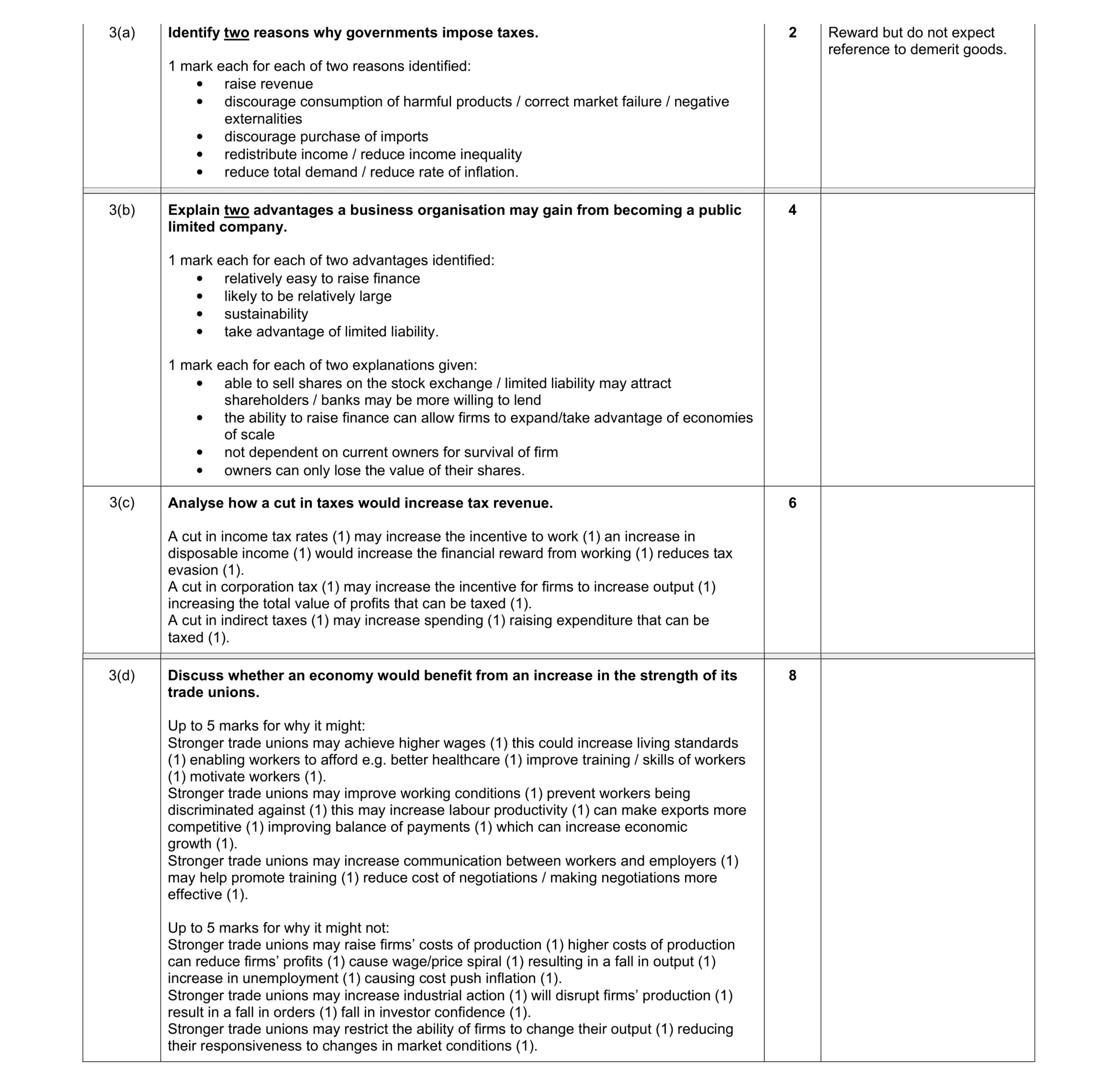 20
20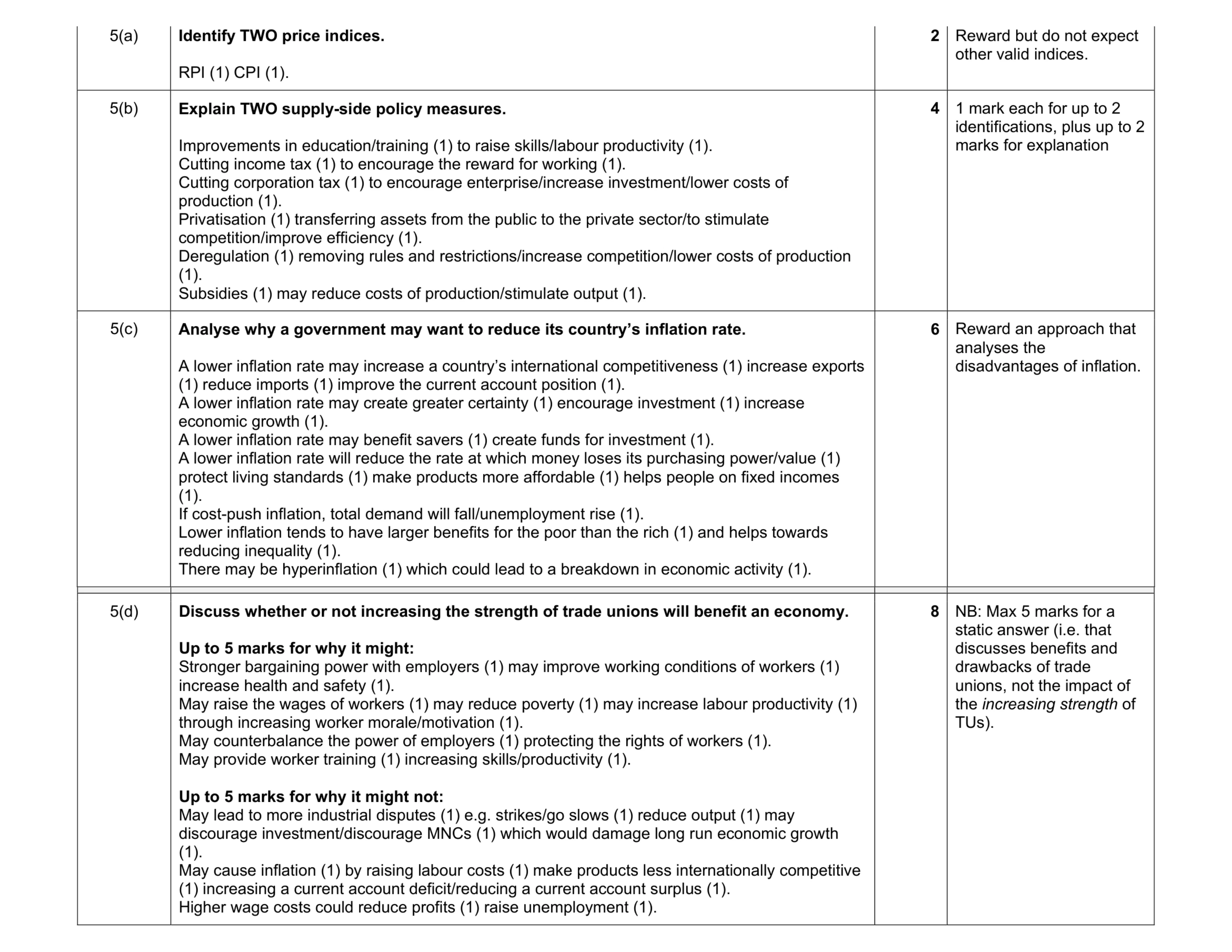 20
20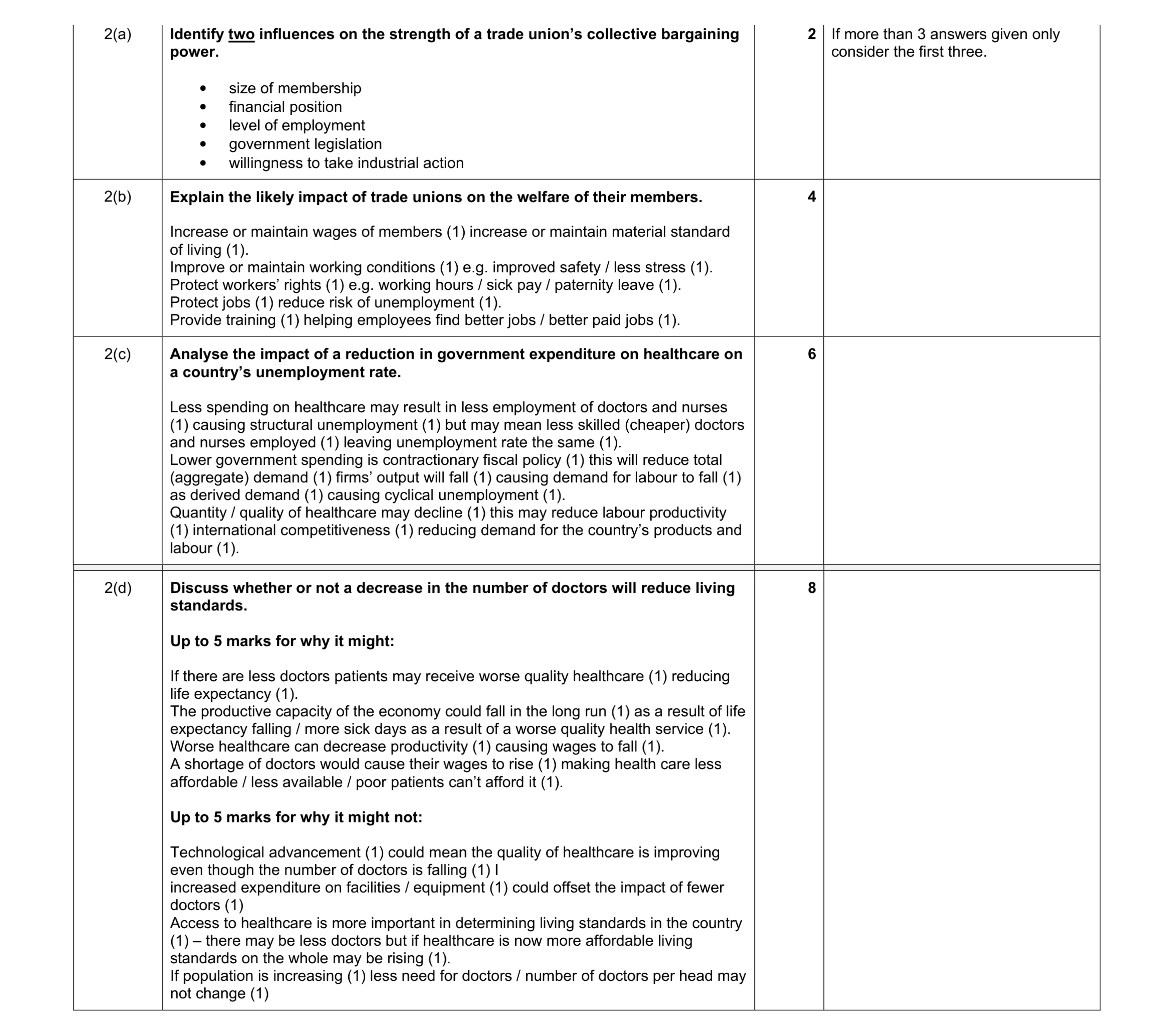 20
20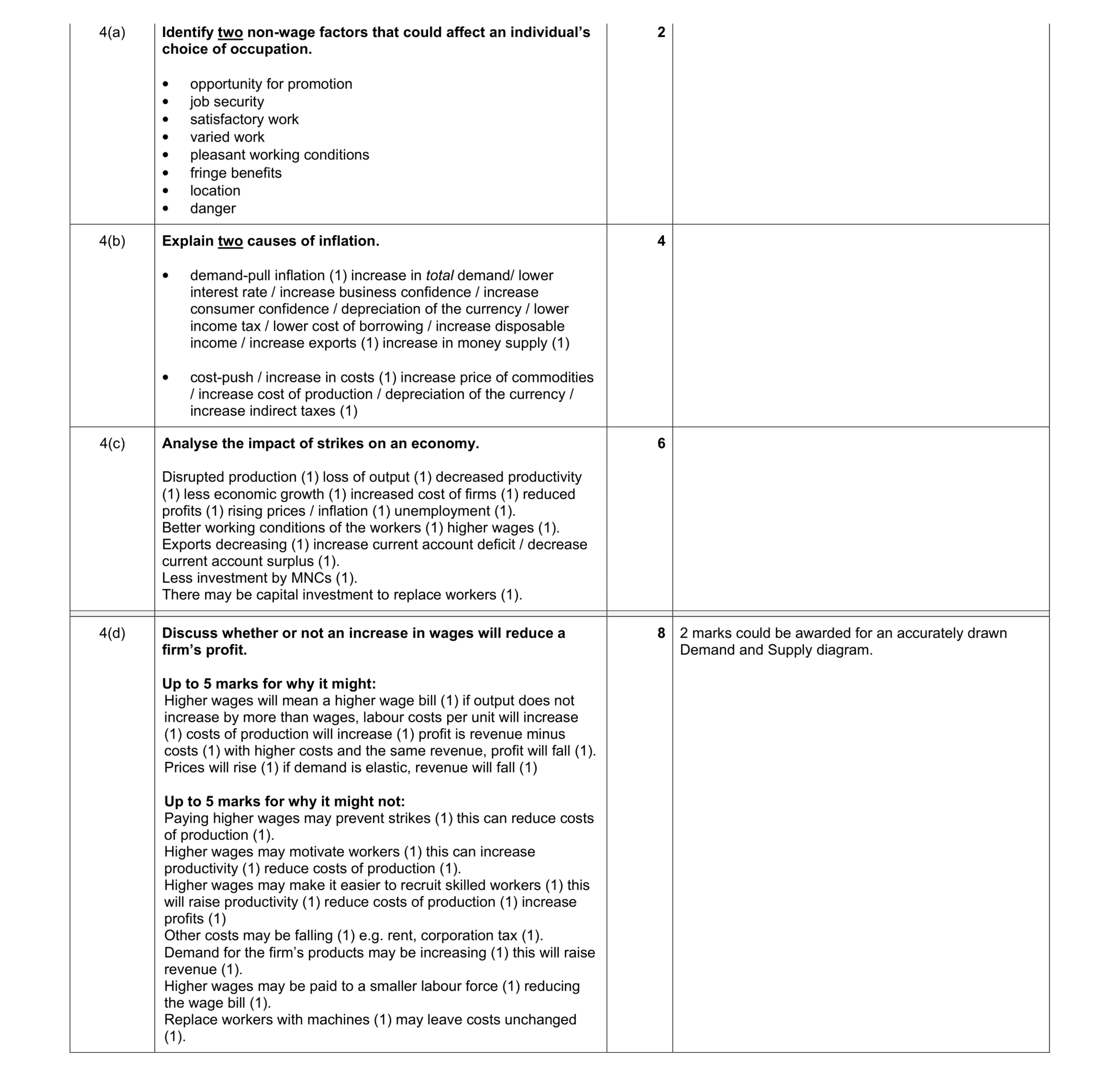 20
20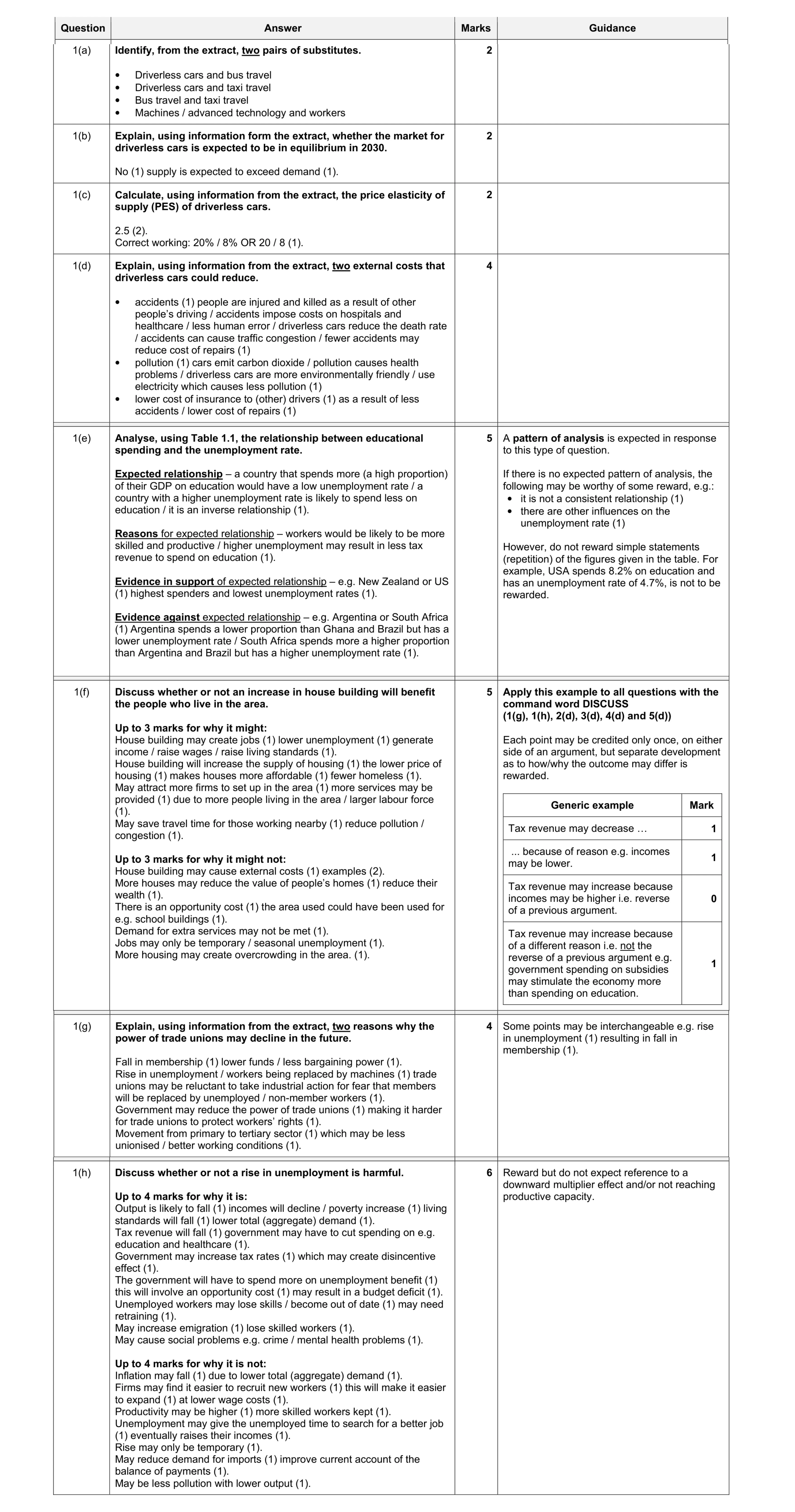 30
30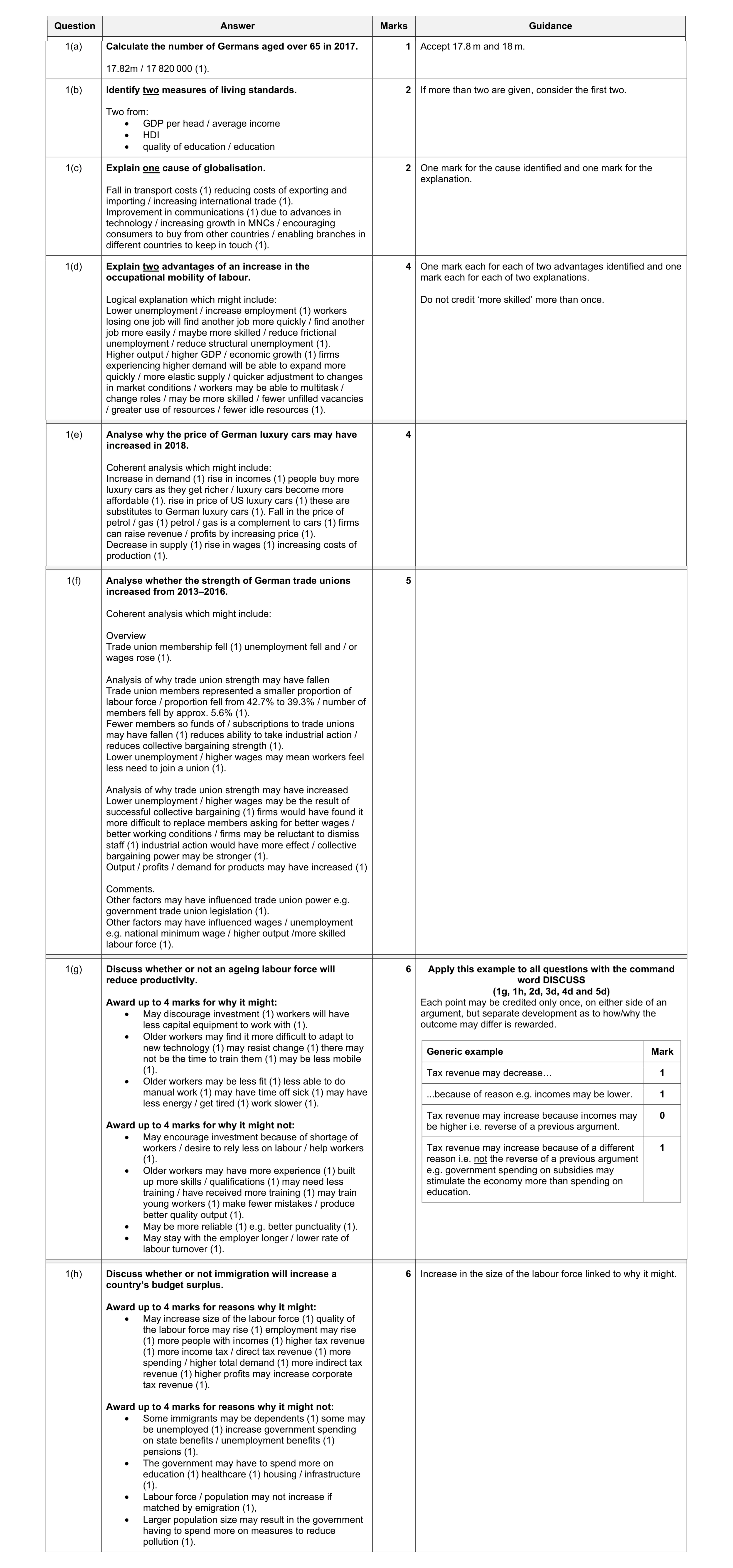 30
30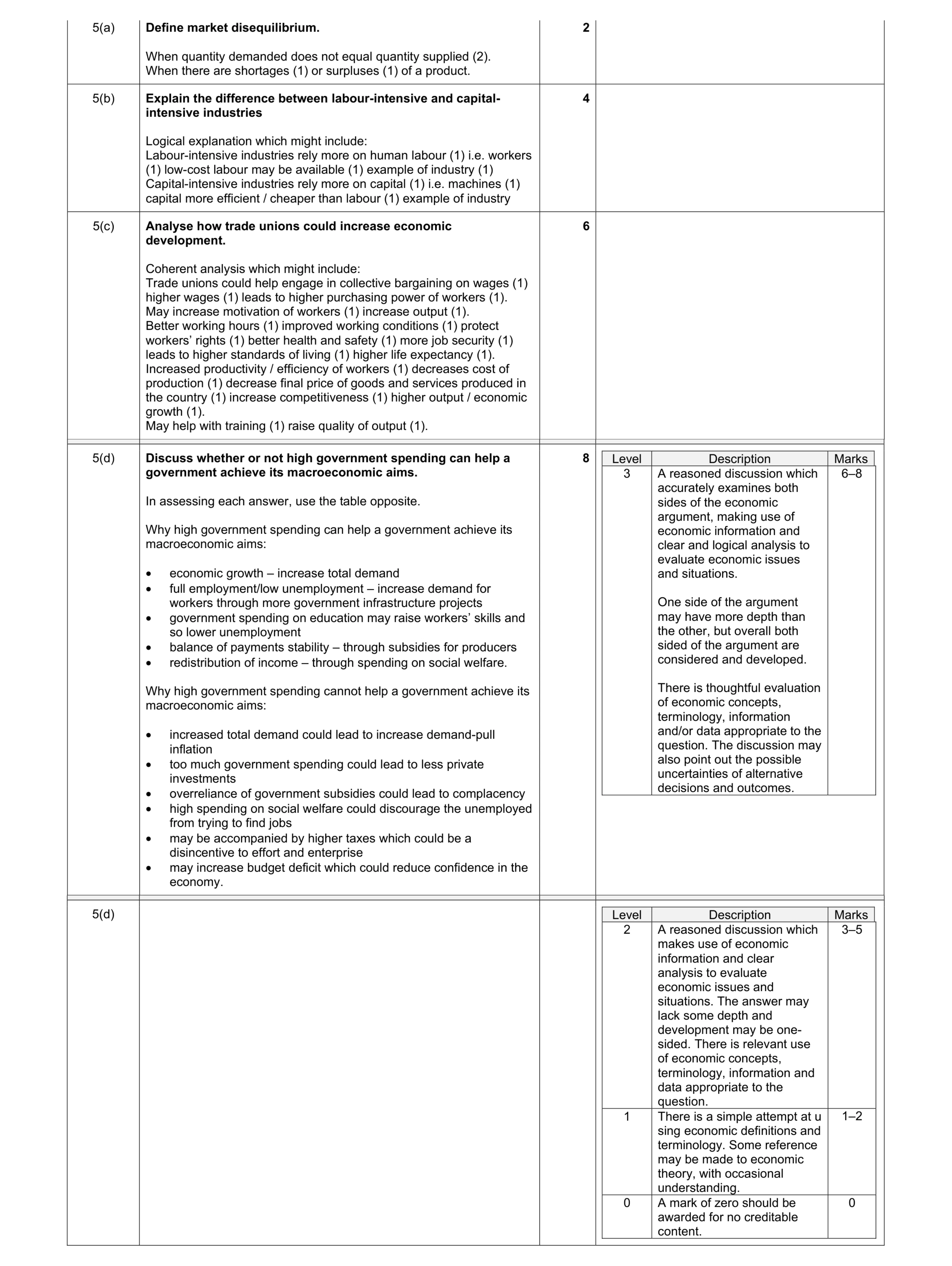 20
20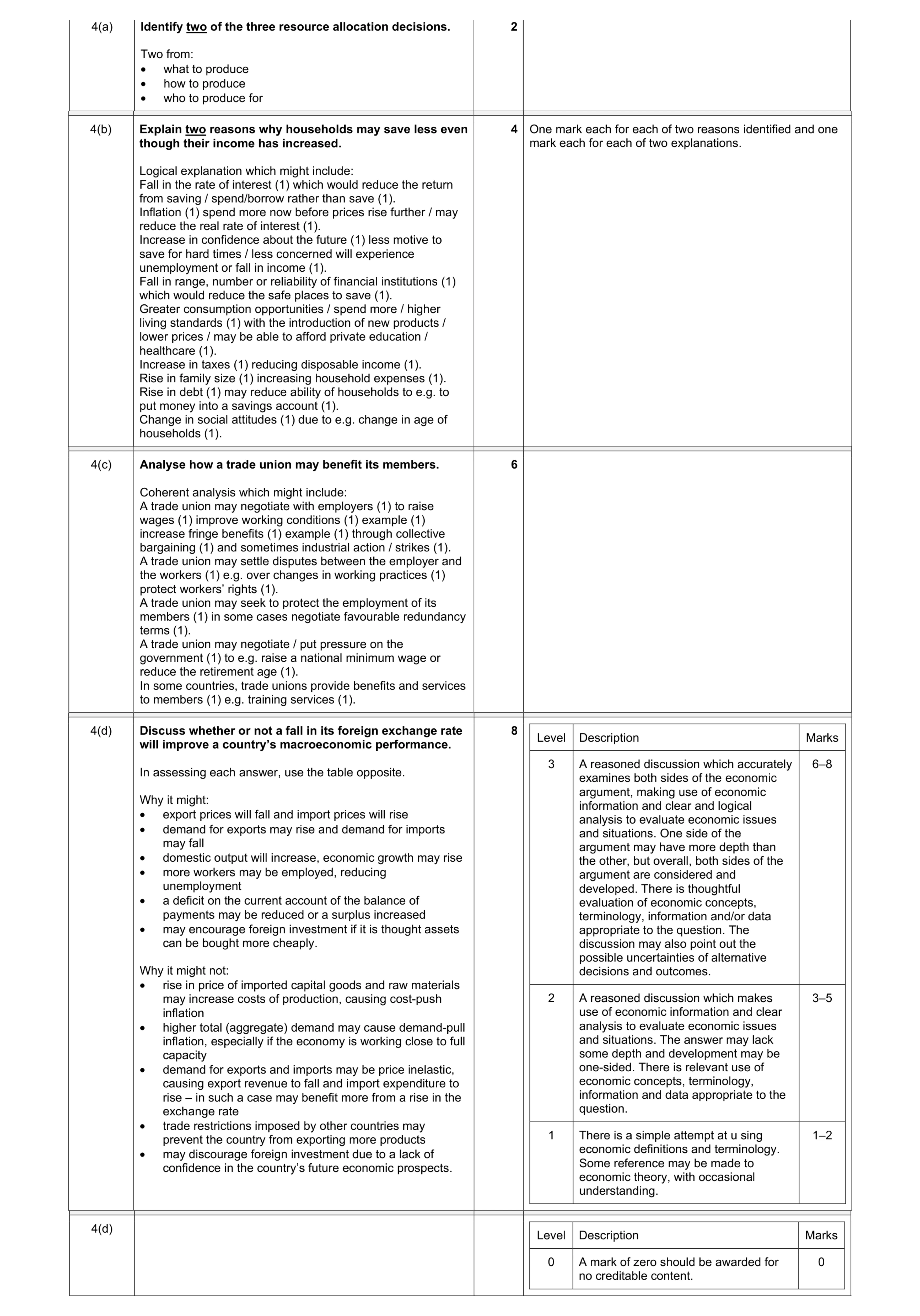 20
20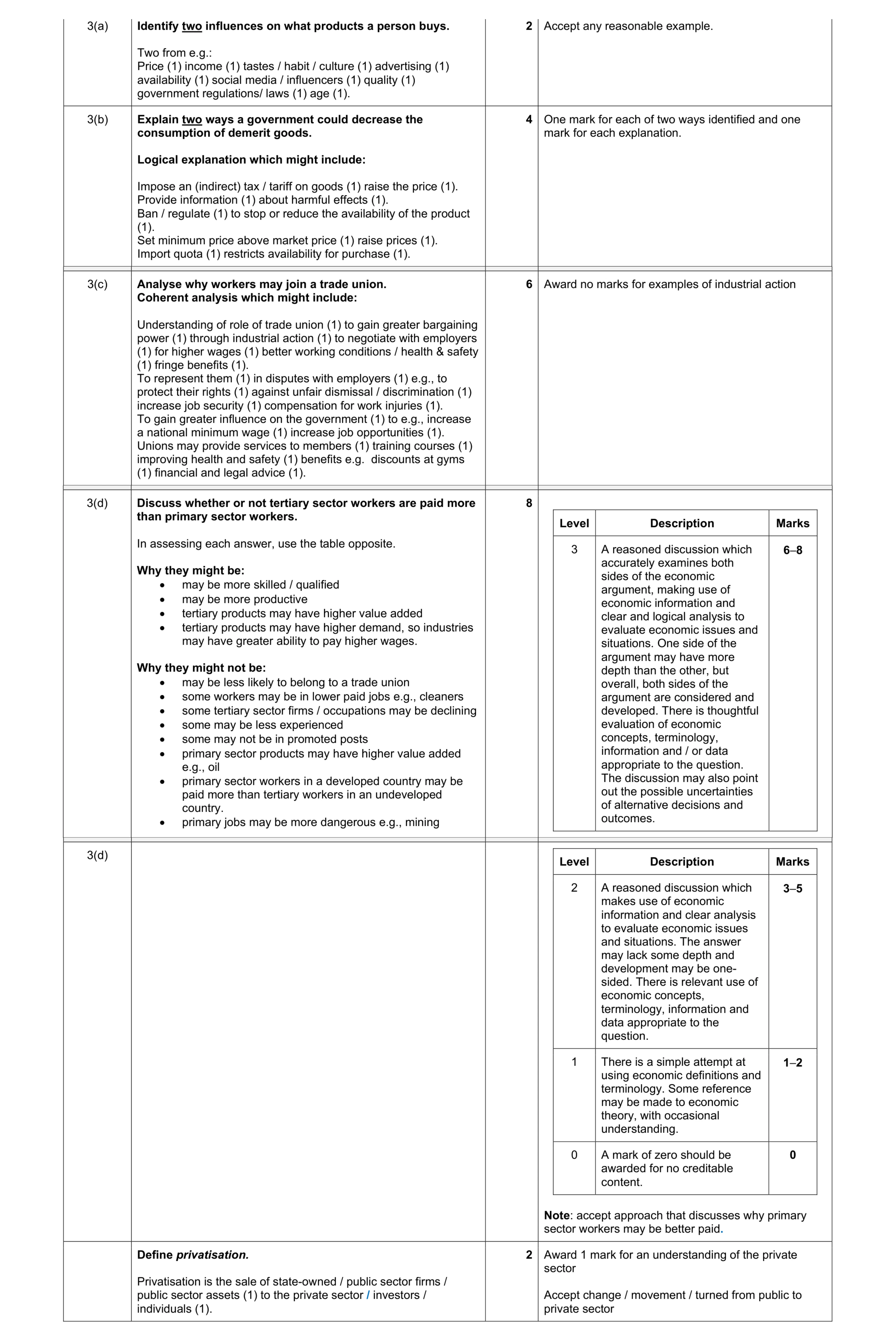 20
20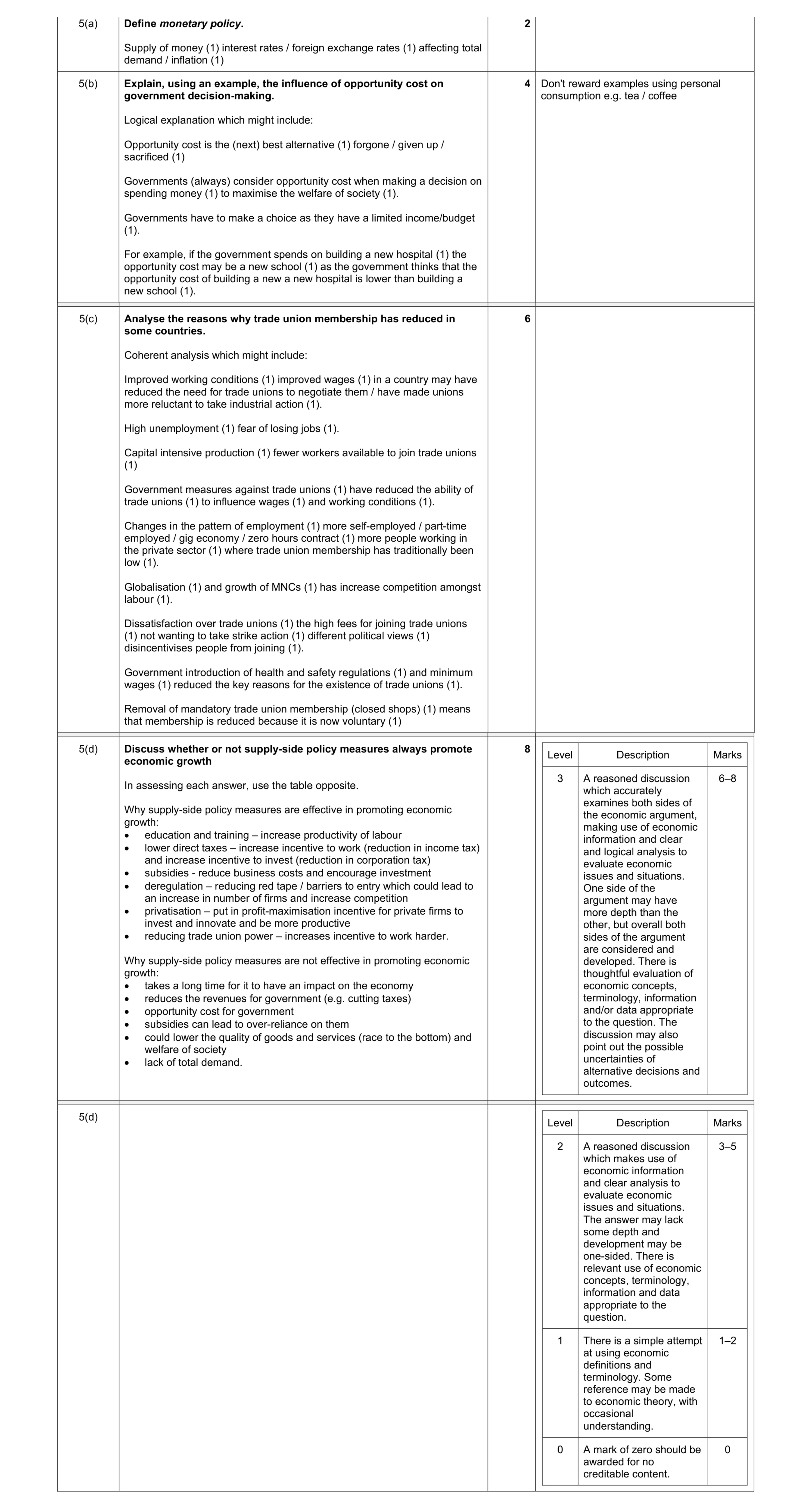 20
20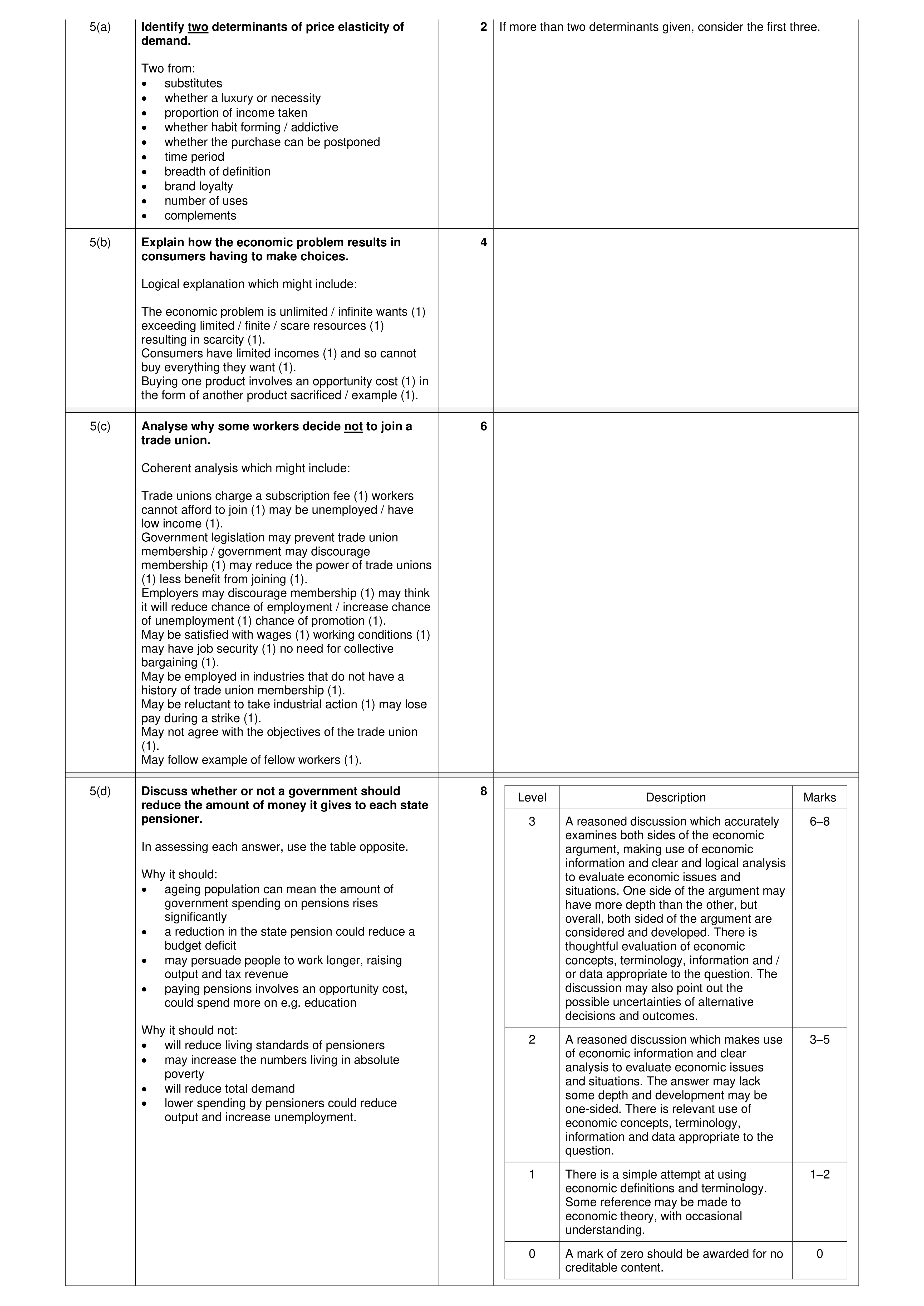 20
20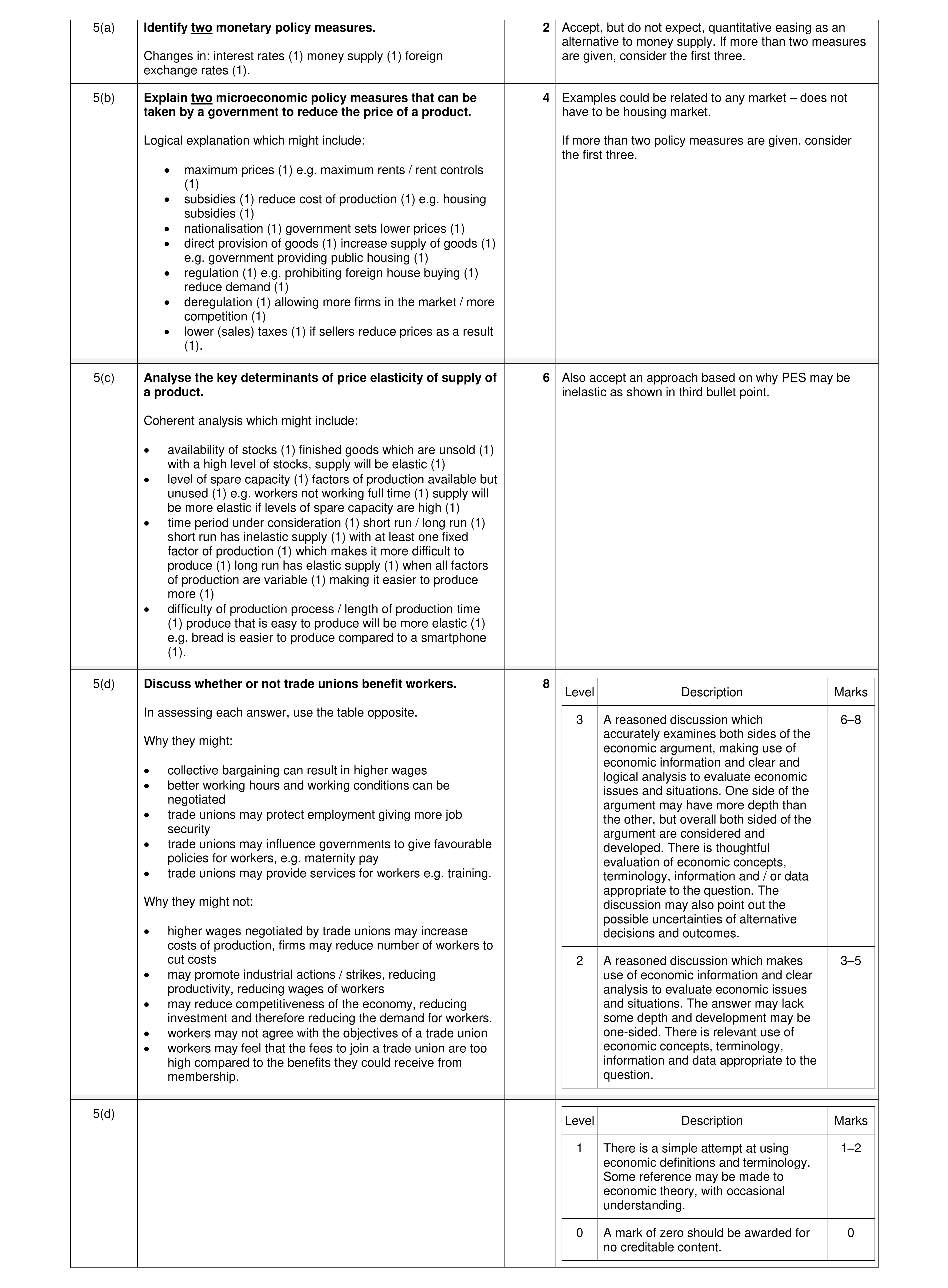 20
20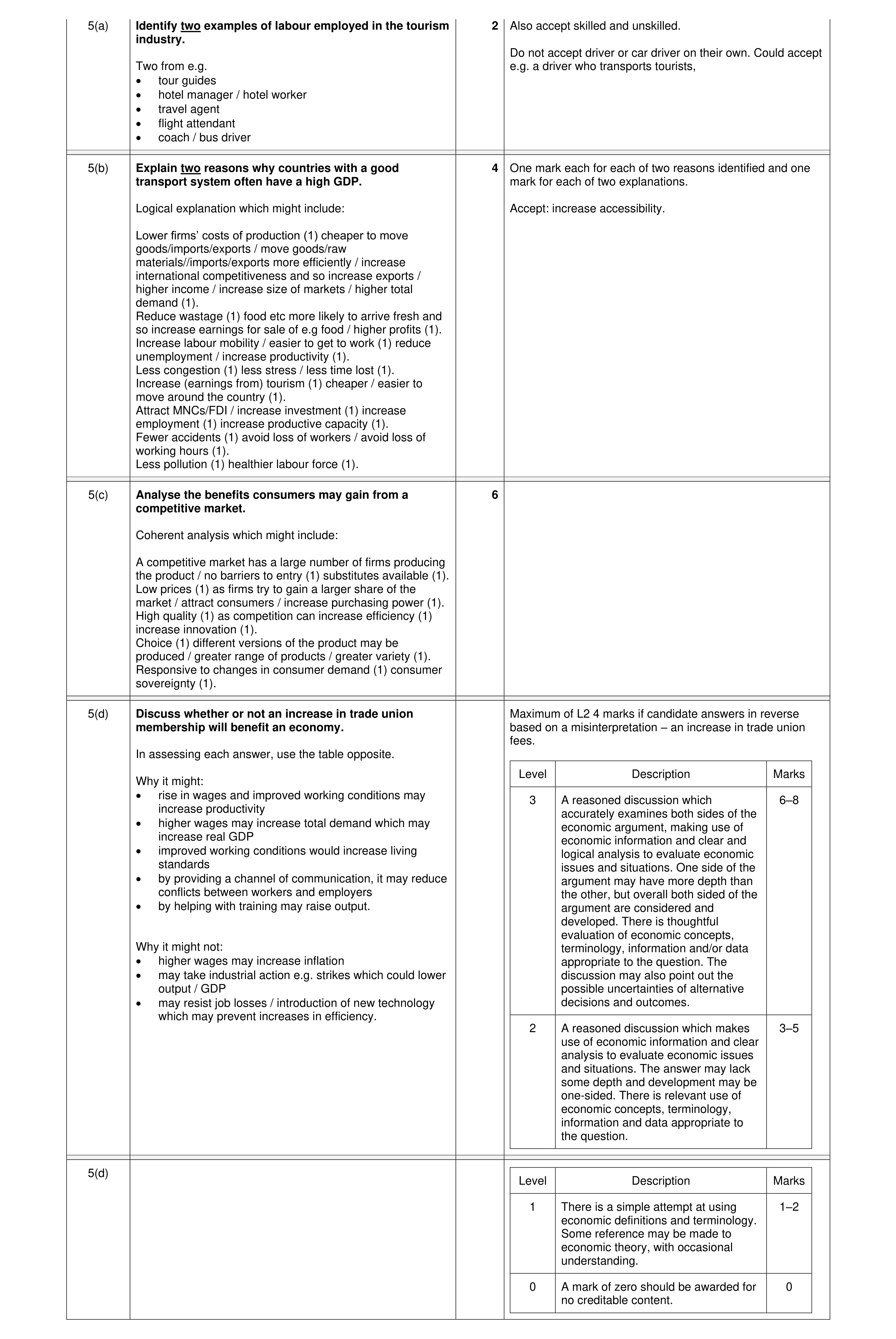 20
20