Questions as text
Q1 · Five elements are listed in order of reactivity 0654/43 Oct/Nov 2018
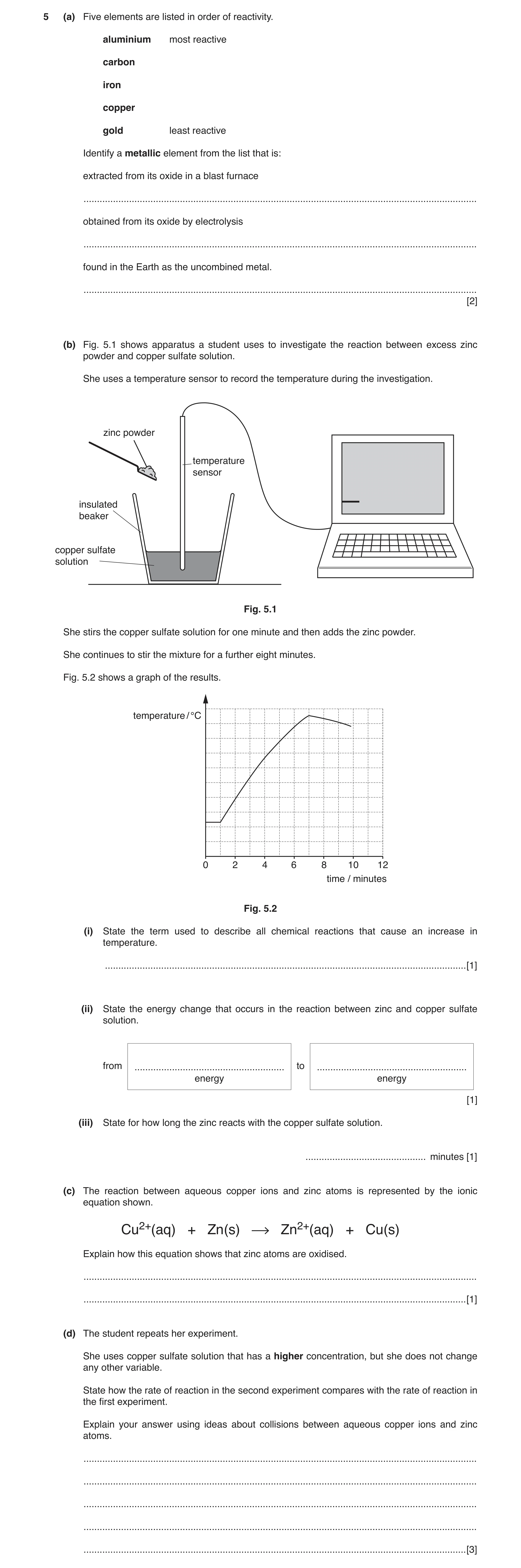
5 (a) Five elements are listed in order of reactivity. aluminium most reactive carbon iron copper gold least reactive Identify a metallic element from the list that is: extracted from its oxide in a blast furnace … obtained from its oxide by electrolysis … found in the Earth as the uncombined metal. … [2] (b) Fig. 5.1 shows apparatus a student uses to investigate the reaction between excess zinc powder and copper sulfate solution. She uses a temperature sensor to record the temperature during the investigation. zinc powder temperature sensor insulated beaker copper sulfate solution Fig. 5.1 She stirs the copper sulfate solution for one minute and then adds the zinc powder. She continues to stir the mixture for a further eight minutes. Fig. 5.2 shows a graph of the results. temperature / °C 0 2 4 6 8 10 12 time / minutes Fig. 5.2 (i) State the term used to describe all chemical reactions that cause an increase in temperature. … [1] (ii) State the energy change that occurs in the reaction between zinc and copper sulfate solution. from … to … energy energy [1] (iii) State for how long the zinc reacts with the copper sulfate solution. … minutes [1] (c) The reaction between aqueous copper ions and zinc atoms is represented by the ionic equation shown. Cu2+(aq) + Zn(s) Zn2+(aq) + Cu(s) Explain how this equation shows that zinc atoms are oxidised. … … [1] (d) The student repeats her experiment. She uses copper sulfate solution that has a higher concentration, but she does not change any other variable. State how the rate of reaction in the second experiment compares with the rate of reaction in the first experiment. Explain your answer using ideas about collisions between aqueous copper ions and zinc atoms. … … … … … [3]
9 marks
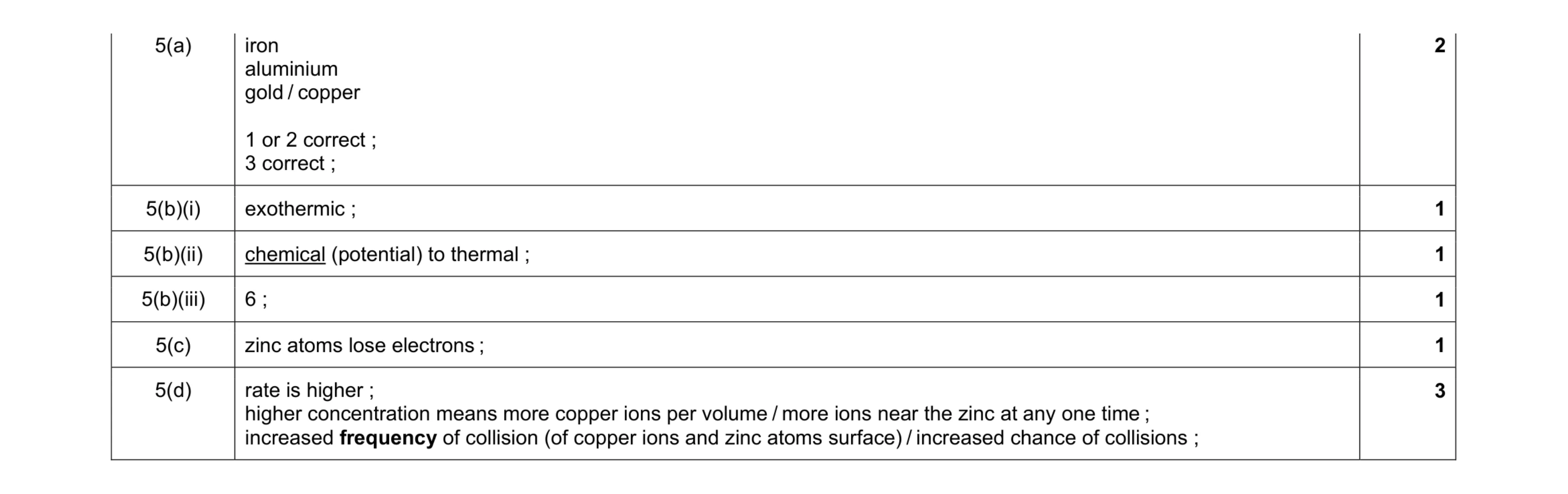
Mark scheme: 5(a) iron aluminium gold / copper 1 or 2 correct ; 3 correct ; 2 5(b)(i) exothermic ; 1 5(b)(ii) chemical (potential) to thermal ; 1 5(b)(iii) 6 ; 1 5(c) zinc atoms lose electrons ; 1 5(d) rate is higher ; higher concentration means more copper ions per volume / more ions near the zinc at any one time ; increased frequency of collision (of copper ions and zinc atoms surface) / increased chance of collisions ; 3
This question in 0654/43 Oct/Nov 2018
Q2 · The thermite reaction is a redox reaction between aluminium and iron oxide, Fe2O3 0654/42 May/June 2019
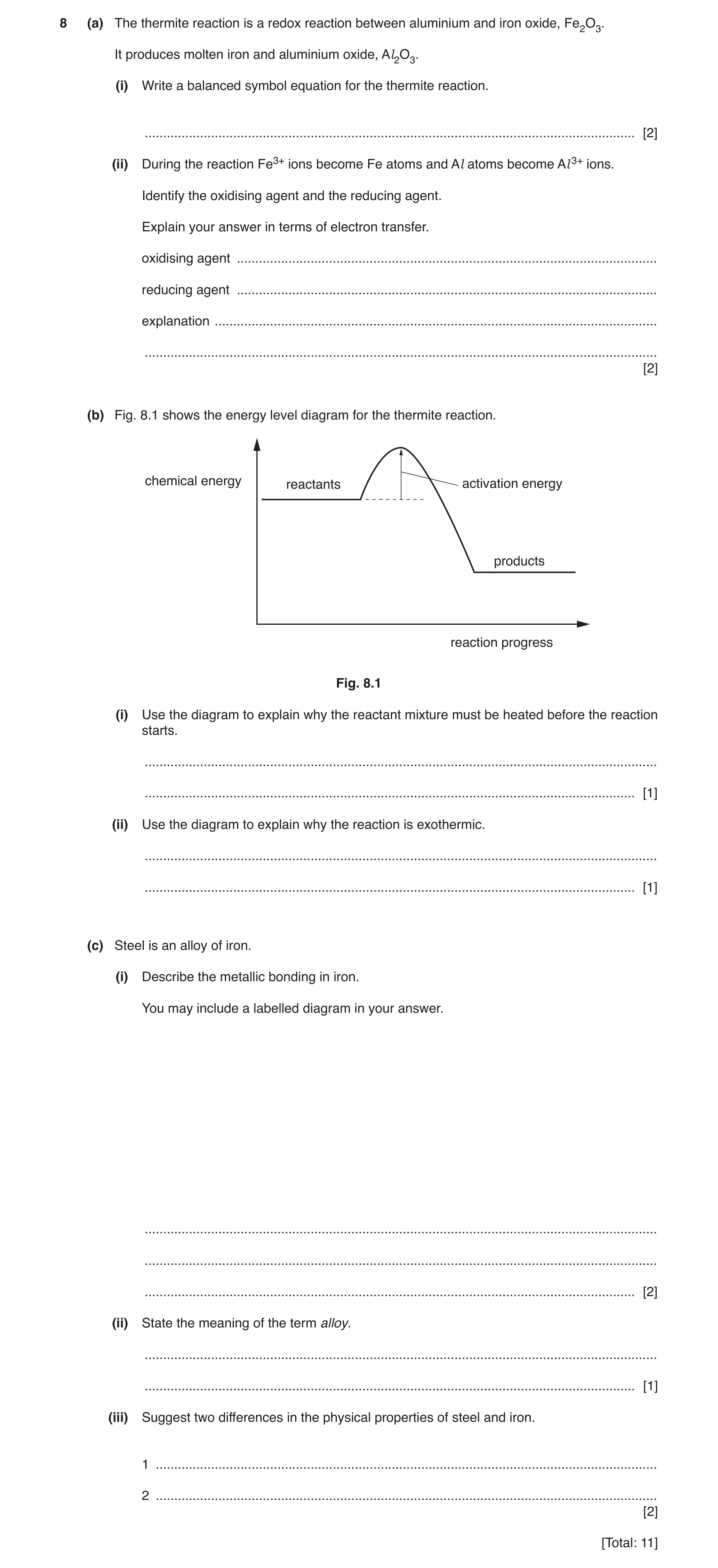
8 (a) The thermite reaction is a redox reaction between aluminium and iron oxide, Fe2O3. It produces molten iron and aluminium oxide, Al2O3. (i) Write a balanced symbol equation for the thermite reaction. … [2] (ii) During the reaction Fe3+ ions become Fe atoms and Al atoms become Al 3+ ions. Identify the oxidising agent and the reducing agent. Explain your answer in terms of electron transfer. oxidising agent … reducing agent … explanation … … [2] (b) Fig. 8.1 shows the energy level diagram for the thermite reaction. chemical energy reactants activation energy products reaction progress Fig. 8.1 (i) Use the diagram to explain why the reactant mixture must be heated before the reaction starts. … … [1] (ii) Use the diagram to explain why the reaction is exothermic. … … [1] (c) Steel is an alloy of iron. (i) Describe the metallic bonding in iron. You may include a labelled diagram in your answer. … … … [2] (ii) State the meaning of the term alloy. … … [1] (iii) Suggest two differences in the physical properties of steel and iron. 1 … 2 … [2] [Total: 11]
11 marks
Mark scheme: 8(a)(i) correct formulae ; balanced ; 2 8(a)(ii) oxidising agent: Fe3+ / Fe2O3 / iron oxide and reducing agent: Al / aluminium ; oxidising agent gains electrons and reducing agent loses electrons ; 2 8(b)(i) to supply activation energy / described ; 1 8(b)(ii) products have less (chemical) energy than reactants ; 1 8(c)(i) reference to delocalised electrons ; lattice of positive ions ; 2 8(c)(ii) mixture of a metal with other elements ; 1 8(c)(iii) hardness ; malleability ; ductility ; melting / boiling, point ; max 2
This question in 0654/42 May/June 2019
Q3 · Industrial processes carried out to make some useful materials from petroleum 0654/43 May/June 2019
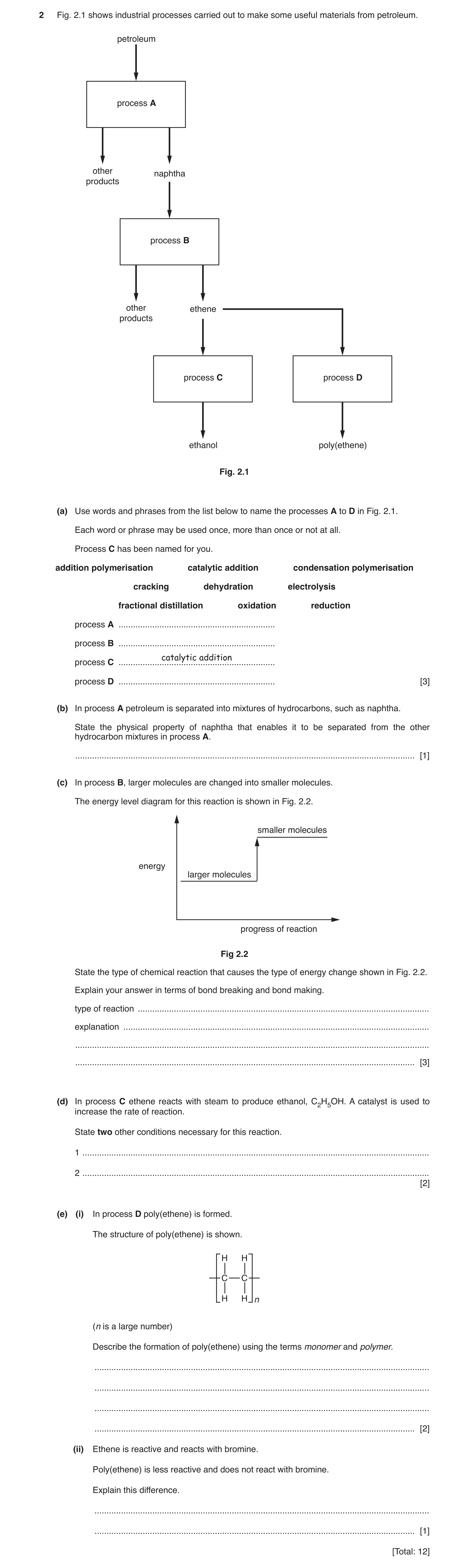
2 Fig. 2.1 shows industrial processes carried out to make some useful materials from petroleum. petroleum process A other naphtha products process B other ethene products process C process D ethanol poly(ethene) Fig. 2.1 (a) Use words and phrases from the list below to name the processes A to D in Fig. 2.1. Each word or phrase may be used once, more than once or not at all. Process C has been named for you. addition polymerisation catalytic addition condensation polymerisation cracking dehydration electrolysis fractional distillation oxidation reduction process A … process B … catalytic addition process C … process D … [3] (b) In process A petroleum is separated into mixtures of hydrocarbons, such as naphtha. State the physical property of naphtha that enables it to be separated from the other hydrocarbon mixtures in process A. … [1] (c) In process B, larger molecules are changed into smaller molecules. The energy level diagram for this reaction is shown in Fig. 2.2. smaller molecules energy larger molecules progress of reaction Fig 2.2 State the type of chemical reaction that causes the type of energy change shown in Fig. 2.2. Explain your answer in terms of bond breaking and bond making. type of reaction … explanation … … … [3] (d) In process C ethene reacts with steam to produce ethanol, C2H5OH. A catalyst is used to increase the rate of reaction. State two other conditions necessary for this reaction. 1 … 2 … [2] (e) (i) In process D poly(ethene) is formed. The structure of poly(ethene) is shown. H H C C H H n (n is a large number) Describe the formation of poly(ethene) using the terms monomer and polymer. … … … … [2] (ii) Ethene is reactive and reacts with bromine. Poly(ethene) is less reactive and does not react with bromine. Explain this difference. … … [1] [Total: 12]
12 marks
Mark scheme: 2(a) A fractional distillation ; B cracking ; (C catalytic addition) D addition polymerisation ; 3 2(b) boiling point (range) ; 1 2(c) endothermic ; bond breaking takes in energy / is an endothermic process and bond formation gives out energy / is an exothermic process ; more energy taken in than given out ; 3 2(d) high temperature ; high pressure ; 2 2(e)(i) ethene is monomer ; many (monomers / molecules) join to make (long chain) polymer ; 2 2(e)(ii) poly(ethene) is not an alkene / does not have double bond / is saturated ; 1
This question in 0654/43 May/June 2019
Q4 · Limestone consists mainly of calcium carbonate 0654/41 Oct/Nov 2019
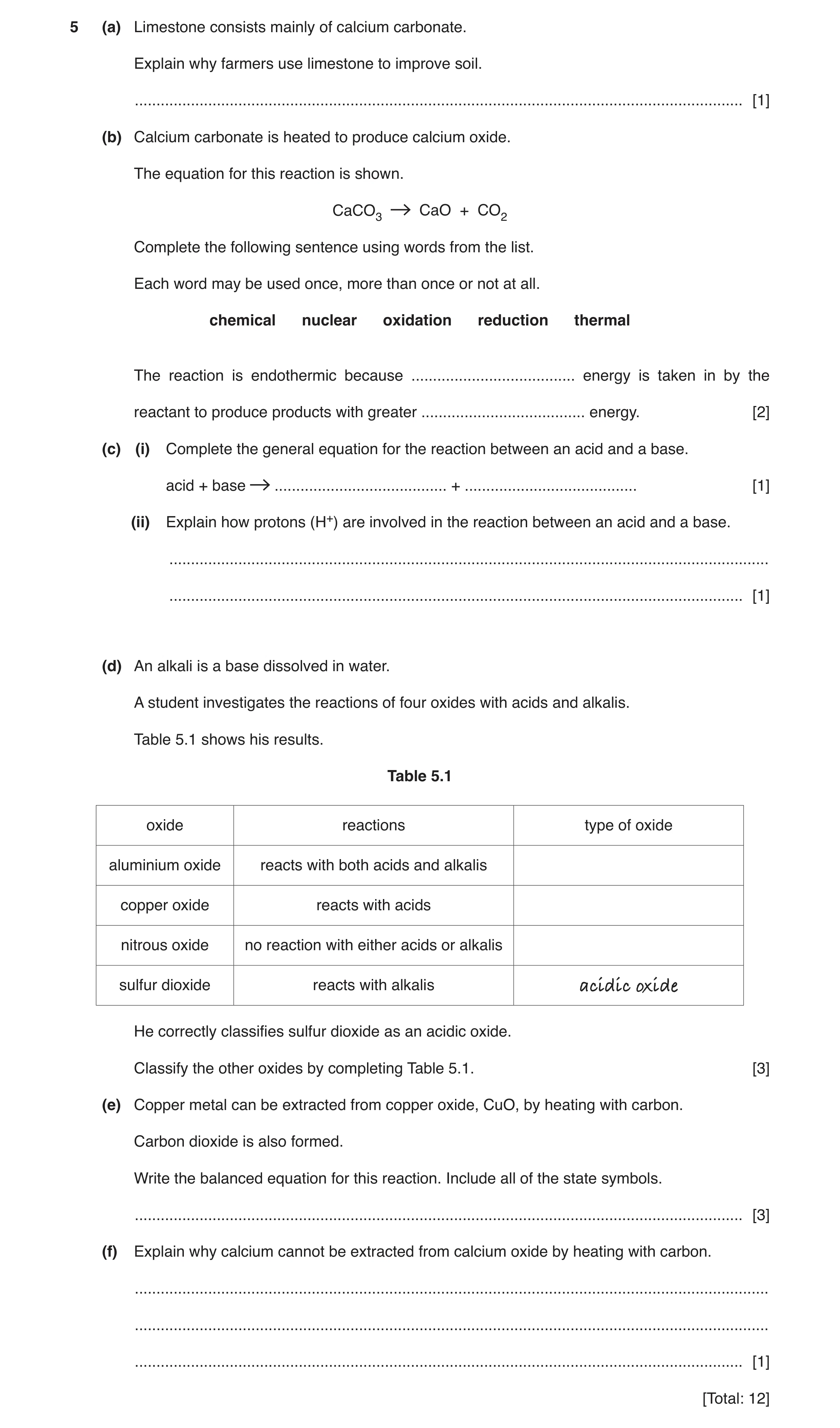
5 (a) Limestone consists mainly of calcium carbonate. Explain why farmers use limestone to improve soil. … [1] (b) Calcium carbonate is heated to produce calcium oxide. The equation for this reaction is shown. CaCO3 CaO + CO2 Complete the following sentence using words from the list. Each word may be used once, more than once or not at all. chemical nuclear oxidation reduction thermal The reaction is endothermic because … energy is taken in by the reactant to produce products with greater … energy. [2] (c) (i) Complete the general equation for the reaction between an acid and a base. acid + base … + … [1] (ii) Explain how protons (H+) are involved in the reaction between an acid and a base. … … [1] (d) An alkali is a base dissolved in water. A student investigates the reactions of four oxides with acids and alkalis. Table 5.1 shows his results. Table 5.1 oxide reactions type of oxide aluminium oxide reacts with both acids and alkalis copper oxide reacts with acids nitrous oxide no reaction with either acids or alkalis sulfur dioxide reacts with alkalis acidic oxide He correctly classifies sulfur dioxide as an acidic oxide. Classify the other oxides by completing Table 5.1. [3] (e) Copper metal can be extracted from copper oxide, CuO, by heating with carbon. Carbon dioxide is also formed. Write the balanced equation for this reaction. Include all of the state symbols. … [3] (f) Explain why calcium cannot be extracted from calcium oxide by heating with carbon. … … … [1] [Total: 12]
12 marks
Mark scheme: 5(a) reduces acidity ; 1 5(b) thermal ; chemical ; 2 5(c)(i) → salt + water ; 1 5(c)(ii) protons / H+ transferred from acid to base ; 1 5(d) amphoteric ; basic ; neutral ; 3 5(e) 2CuO(s) + C(s) → 2Cu(s) + CO2(g) formulae ; state symbols ; balancing ; 3 5(f) calcium more reactive than carbon ; 1
This question in 0654/41 Oct/Nov 2019
Q5 · Ammonia is manufactured in the Haber process 0654/42 Oct/Nov 2019
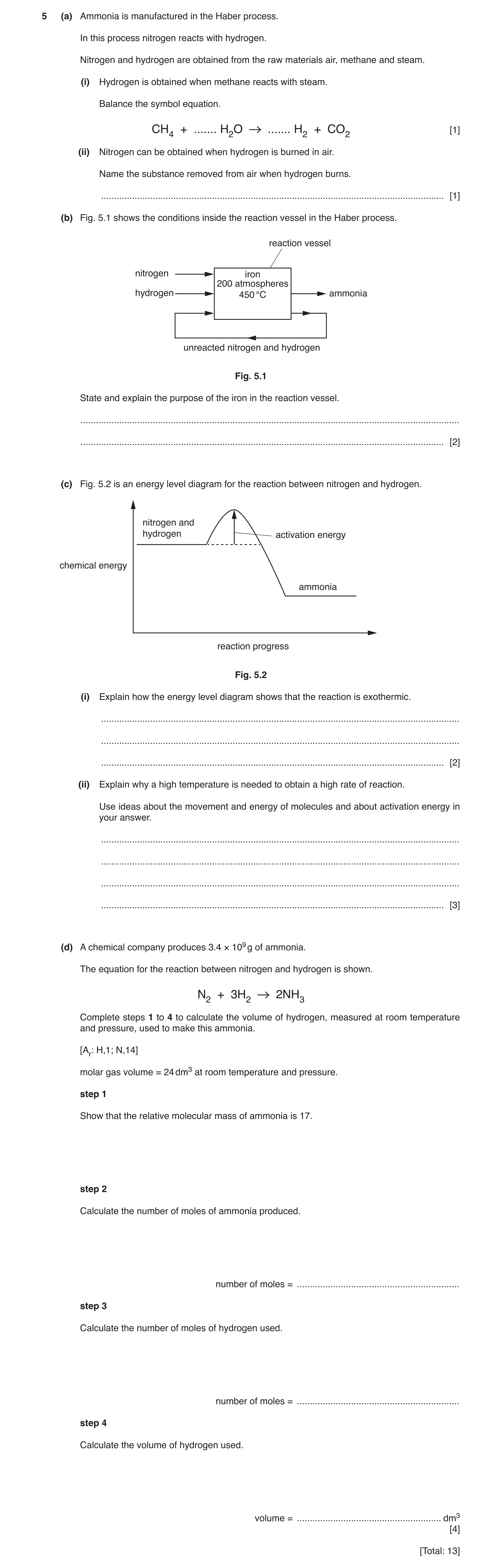
5 (a) Ammonia is manufactured in the Haber process. In this process nitrogen reacts with hydrogen. Nitrogen and hydrogen are obtained from the raw materials air, methane and steam. (i) Hydrogen is obtained when methane reacts with steam. Balance the symbol equation. [1] CH4 + … H2O … H2 + CO2 (ii) Nitrogen can be obtained when hydrogen is burned in air. Name the substance removed from air when hydrogen burns. … [1] (b) Fig. 5.1 shows the conditions inside the reaction vessel in the Haber process. reaction vessel nitrogen iron 200 atmospheres hydrogen 450 °C ammonia unreacted nitrogen and hydrogen Fig. 5.1 State and explain the purpose of the iron in the reaction vessel. … … [2] (c) Fig. 5.2 is an energy level diagram for the reaction between nitrogen and hydrogen. nitrogen and hydrogen activation energy chemical energy ammonia reaction progress Fig. 5.2 (i) Explain how the energy level diagram shows that the reaction is exothermic. … … … [2] (ii) Explain why a high temperature is needed to obtain a high rate of reaction. Use ideas about the movement and energy of molecules and about activation energy in your answer. … … … … [3] (d) A chemical company produces 3.4 × 10⁹ g of ammonia. The equation for the reaction between nitrogen and hydrogen is shown. N2 + 3H2 2NH3 Complete steps 1 to 4 to calculate the volume of hydrogen, measured at room temperature and pressure, used to make this ammonia. [Ar: H,1; N,14] molar gas volume = 24 dm3 at room temperature and pressure. step 1 Show that the relative molecular mass of ammonia is 17. step 2 Calculate the number of moles of ammonia produced. number of moles = … step 3 Calculate the number of moles of hydrogen used. number of moles = … step 4 Calculate the volume of hydrogen used. volume = … dm3 [4] [Total: 13]
13 marks
Mark scheme: 5(a)(i) CH4 + 2H2O → 4H2 + CO2 ; 1 5(a)(ii) oxygen ; 1 5(b) catalyst ; speeds up reaction ; lowers activation energy ; max 2 2 5(c)(i) product stores less energy than reactants ; (surplus) energy released (from system) ; 2 5(c)(ii) high temperature provides molecules with more (kinetic) energy / increases speed of molecules ; more molecules have the activation energy / sufficient energy to react ; increased frequency of (successful) collisions ; 3 5(d) 14 + 3(1) (=17) ; ( 3.4 × 10⁹ 17 =) 2.0 × 10⁸ ; ( 3 × 2.0 × 108 2 ) = 3.0 × 10⁸ ; 3.0 × 108 × 24 = 7.2 × 10⁹ (dm3) ; 4
This question in 0654/42 Oct/Nov 2019
Q6 · What happens when a teacher ignites a mixture of hydrogen and air 0654/43 Oct/Nov 2019
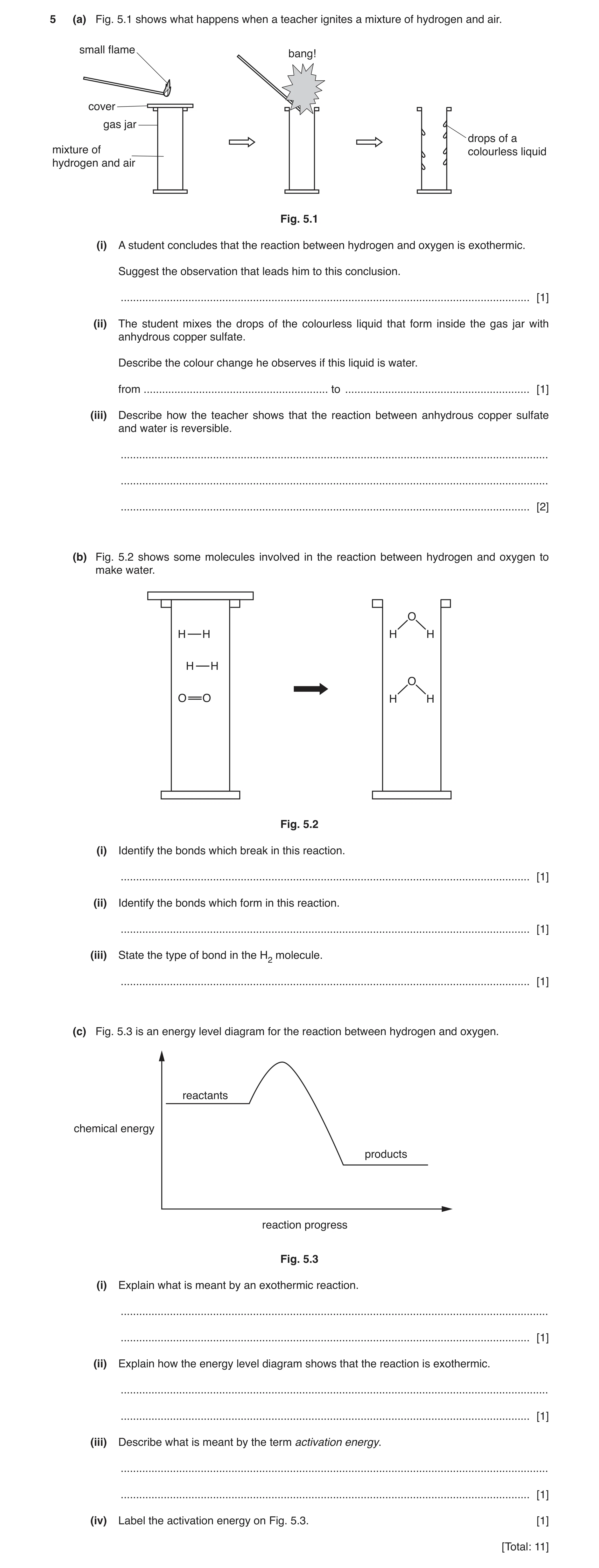
5 (a) Fig. 5.1 shows what happens when a teacher ignites a mixture of hydrogen and air. small flame bang! cover gas jar drops of a mixture of colourless liquid hydrogen and air Fig. 5.1 (i) A student concludes that the reaction between hydrogen and oxygen is exothermic. Suggest the observation that leads him to this conclusion. … [1] (ii) The student mixes the drops of the colourless liquid that form inside the gas jar with anhydrous copper sulfate. Describe the colour change he observes if this liquid is water. from … to … [1] (iii) Describe how the teacher shows that the reaction between anhydrous copper sulfate and water is reversible. … … … [2] (b) Fig. 5.2 shows some molecules involved in the reaction between hydrogen and oxygen to make water. O H H H H H H O O O H H Fig. 5.2 (i) Identify the bonds which break in this reaction. … [1] (ii) Identify the bonds which form in this reaction. … [1] (iii) State the type of bond in the H2 molecule. … [1] (c) Fig. 5.3 is an energy level diagram for the reaction between hydrogen and oxygen. reactants chemical energy products reaction progress Fig. 5.3 (i) Explain what is meant by an exothermic reaction. … … [1] (ii) Explain how the energy level diagram shows that the reaction is exothermic. … … [1] (iii) Describe what is meant by the term activation energy. … … [1] (iv) Label the activation energy on Fig. 5.3. [1] [Total: 11]
11 marks
Mark scheme: 5(a)(i) flash / (bigger) flame / explosion ; 1 5(a)(ii) white to blue ; 1 5(a)(iii) heat ; blue to white / colour change reversed ; 2 5(b)(i) H—H AND O=O ; 1 5(b)(ii) O—H / H—O ; 1 5(b)(iii) covalent ; 1 5(c)(i) thermal energy is given out ; 1 5(c)(ii) products have less (chemical) energy than reactants ; 1 5(c)(iii) minimum energy for particles / reactants to react ; 1 5(c)(iv) reactant energy to peak identified and labelled ; 1
This question in 0654/43 Oct/Nov 2019
Q7 · Calcium carbonate, CaCO3, reacts with dilute hydrochloric acid 0654/41 May/June 2020
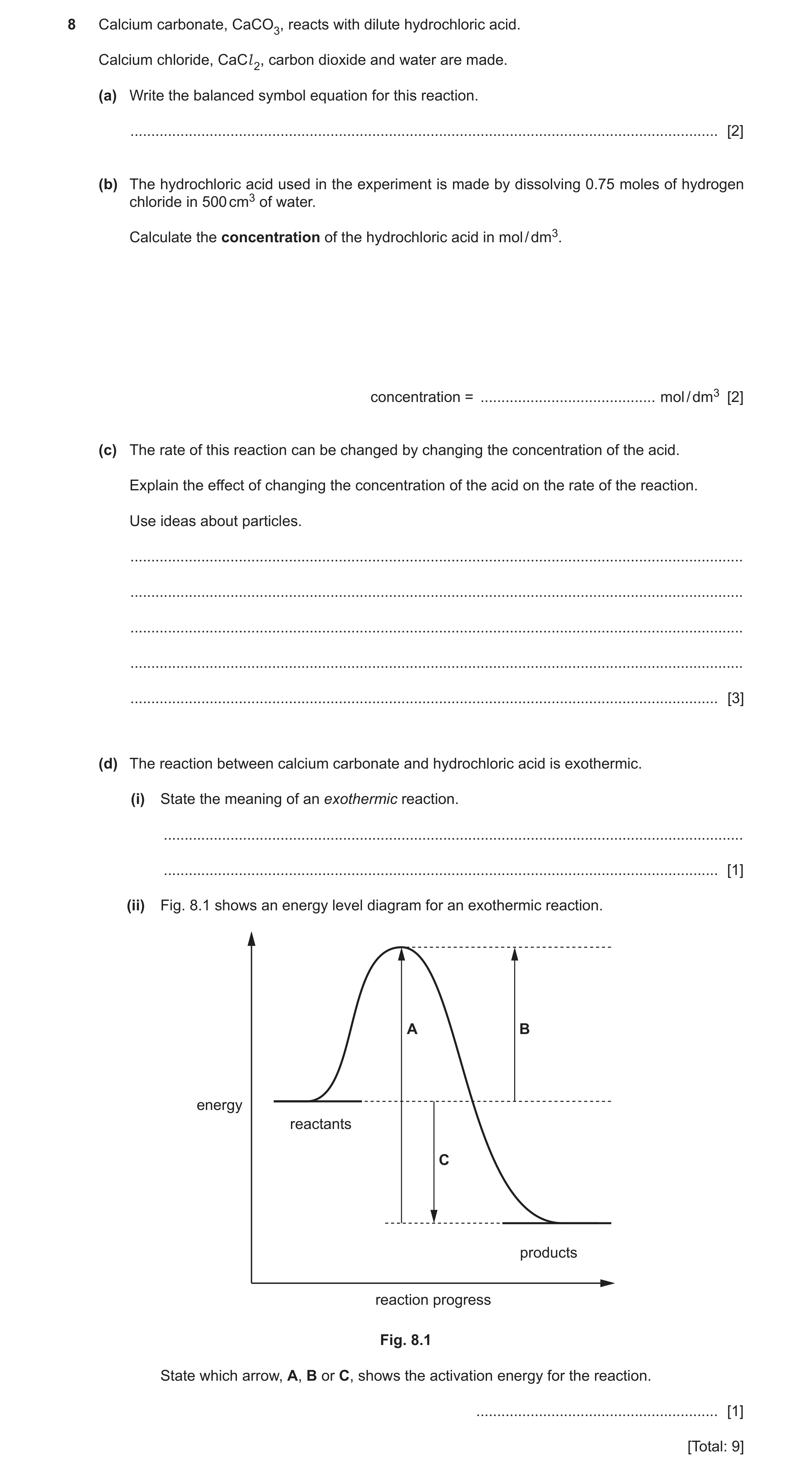
8 Calcium carbonate, CaCO3, reacts with dilute hydrochloric acid. Calcium chloride, CaCl 2, carbon dioxide and water are made. (a) Write the balanced symbol equation for this reaction. … [2] (b) The hydrochloric acid used in the experiment is made by dissolving 0.75 moles of hydrogen chloride in 500 cm3 of water. Calculate the concentration of the hydrochloric acid in mol / dm3. concentration = … mol / dm3 [2] (c) The rate of this reaction can be changed by changing the concentration of the acid. Explain the effect of changing the concentration of the acid on the rate of the reaction. Use ideas about particles. … … … … … [3] (d) The reaction between calcium carbonate and hydrochloric acid is exothermic. (i) State the meaning of an exothermic reaction. … … [1] (ii) Fig. 8.1 shows an energy level diagram for an exothermic reaction. A B energy reactants C products reaction progress Fig. 8.1 State which arrow, A, B or C, shows the activation energy for the reaction. … [1] [Total: 9]
9 marks
Mark scheme: 8(a) CaCO3 + 2HCl → CaCl2 + H2O + CO2 correct formulae ; correctly balanced ; Question Answer Marks 8(b) (0.75 × 1000) ÷ 500 ; 1.5 (mol/dm3) ; or volume of water = 0.500 dm3 ; (0.75 ÷ 0.500 =) 1.5 (mol/dm3) ; 2 8(c) higher the concentration, higher the rate of reaction ; particles are more crowded / more particles per unit volume / more particles per cm3 / increased chance of collision ; more frequent collisions / more collisions per second ; 3 8(d)(i) (reaction in which), thermal energy / heat, is given out / more energy is given out than taken in / energy of products is less than energy of reactants ; 1 8(d)(ii) B 1
This question in 0654/41 May/June 2020
Q8 · Methanol, CH3OH, is made by reacting carbon dioxide with hydrogen 0654/41 Oct/Nov 2020
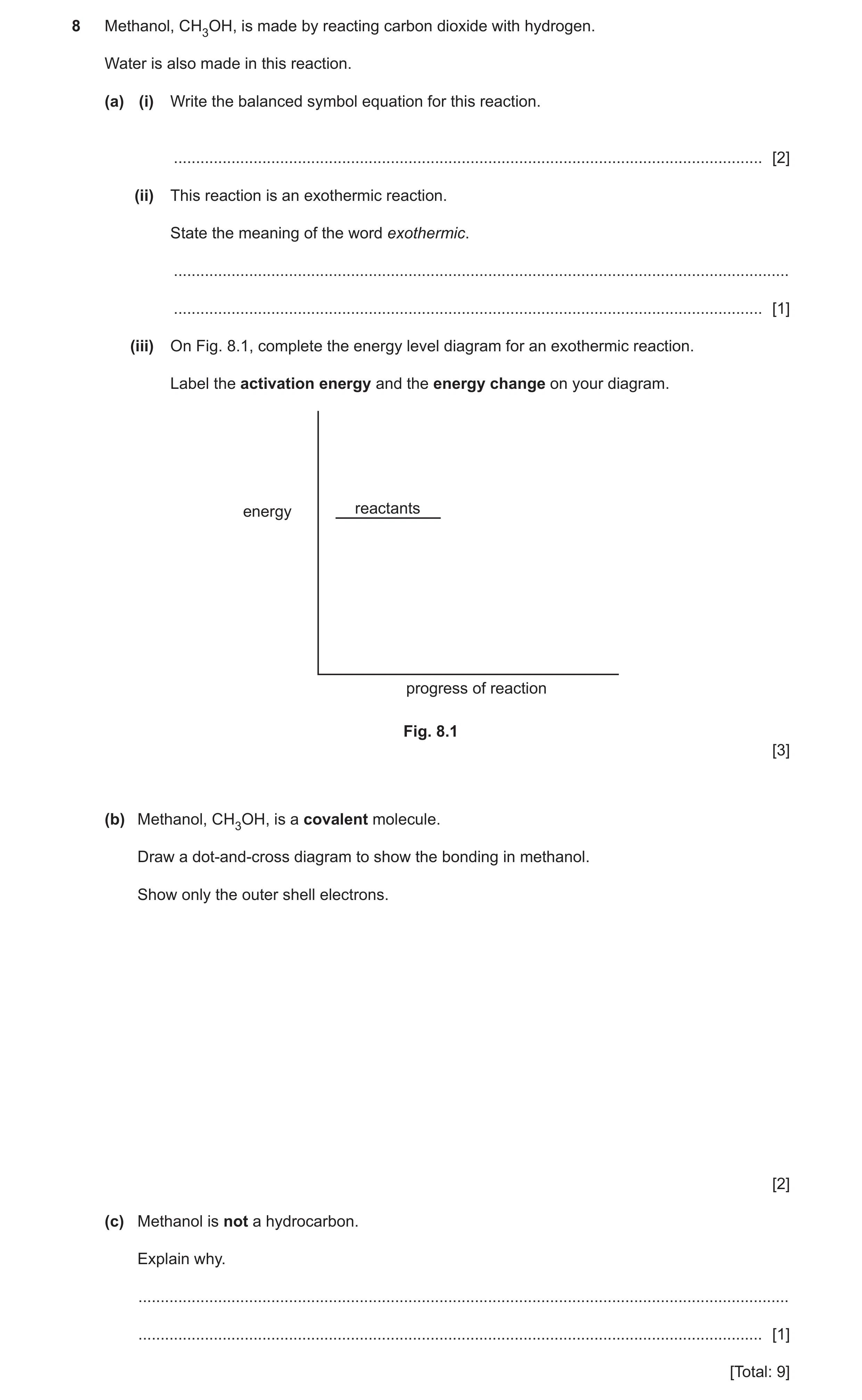
8 Methanol, CH3OH, is made by reacting carbon dioxide with hydrogen. Water is also made in this reaction. (a) (i) Write the balanced symbol equation for this reaction. … [2] (ii) This reaction is an exothermic reaction. State the meaning of the word exothermic. … … [1] (iii) On Fig. 8.1, complete the energy level diagram for an exothermic reaction. Label the activation energy and the energy change on your diagram. energy reactants progress of reaction Fig. 8.1 [3] (b) Methanol, CH3OH, is a covalent molecule. Draw a dot‑and‑cross diagram to show the bonding in methanol. Show only the outer shell electrons. [2] (c) Methanol is not a hydrocarbon. Explain why. … … [1] [Total: 9]
9 marks
Mark scheme: 8(a)(i) CO2 + 3H2 → CH3OH + H2O correct formulae ; correctly balanced ; 2 8(a)(ii) (reaction in which) energy is given out ; 1 8(a)(iii) 3 8(b) ;; 2 8(c) (methanol) contains an oxygen atom / (methanol) is not just carbon and hydrogen / AW ; 1 energy change energy activation energy
This question in 0654/41 Oct/Nov 2020
Q9 · A student investigates the reaction between sodium thiosulfate solution and dilute… 0654/42 Oct/Nov 2020
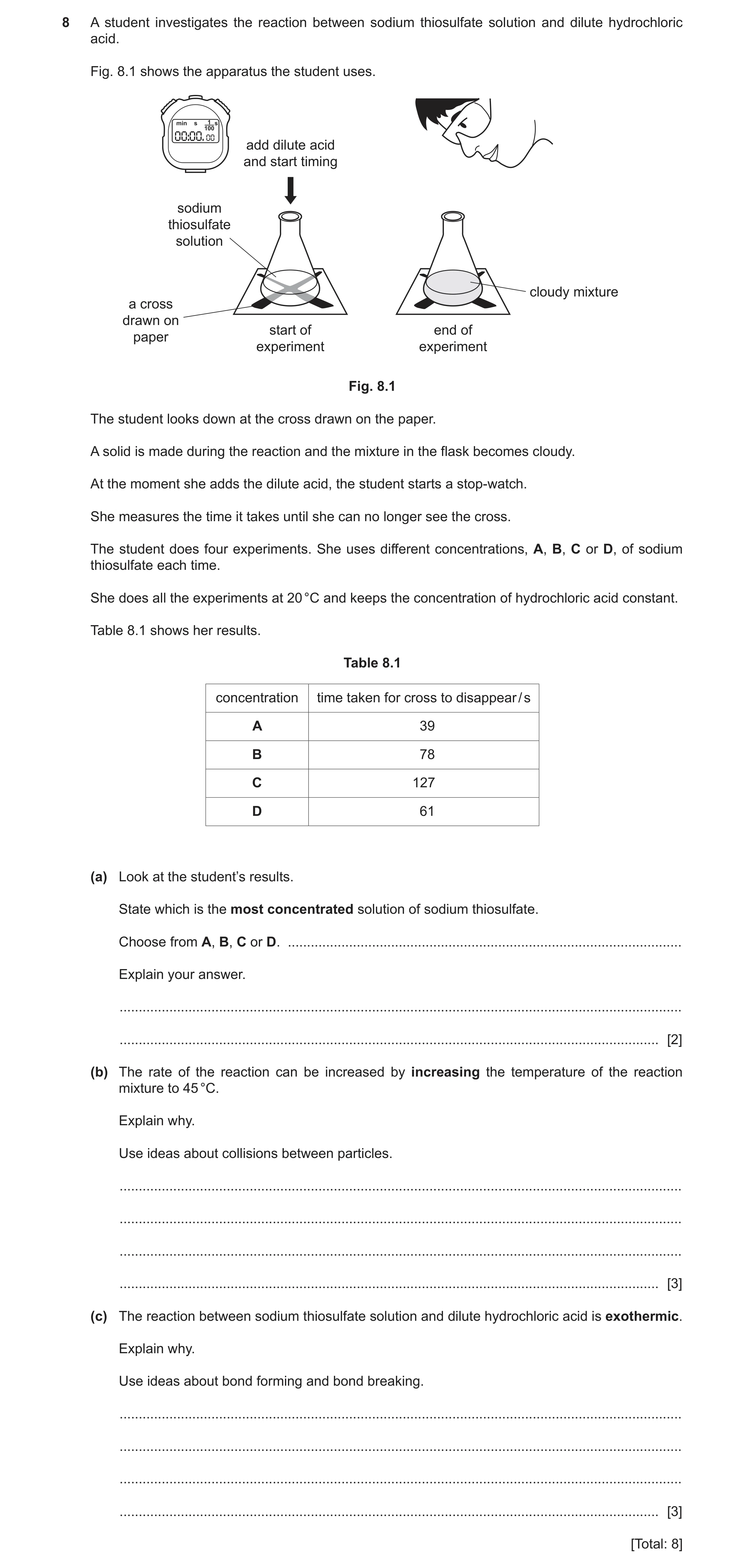
8 A student investigates the reaction between sodium thiosulfate solution and dilute hydrochloric acid. Fig. 8.1 shows the apparatus the student uses. min s 1 s 00:00. 10000 add dilute acid and start timing sodium thiosulfate solution cloudy mixture a cross drawn on start of end of paper experiment experiment Fig. 8.1 The student looks down at the cross drawn on the paper. A solid is made during the reaction and the mixture in the flask becomes cloudy. At the moment she adds the dilute acid, the student starts a stop-watch. She measures the time it takes until she can no longer see the cross. The student does four experiments. She uses different concentrations, A, B, C or D, of sodium thiosulfate each time. She does all the experiments at 20 °C and keeps the concentration of hydrochloric acid constant. Table 8.1 shows her results. Table 8.1 concentration time taken for cross to disappear / s A 39 B 78 C 127 D 61 (a) Look at the student’s results. State which is the most concentrated solution of sodium thiosulfate. Choose from A, B, C or D. … Explain your answer. … … [2] (b) The rate of the reaction can be increased by increasing the temperature of the reaction mixture to 45 °C. Explain why. Use ideas about collisions between particles. … … … … [3] (c) The reaction between sodium thiosulfate solution and dilute hydrochloric acid is exothermic. Explain why. Use ideas about bond forming and bond breaking. … … … … [3] [Total: 8]
8 marks
Mark scheme: 8(a) A ; fastest reaction / shortest time ; 2 8(b) particles have more kinetic energy / move faster ; more collisions per second / greater collision frequency; more particles have the, minimum / activation energy ; 3 8(c) bond breaking absorbs energy / bond breaking is endothermic ; bond making releases energy / bond making is exothermic ; more energy released than absorbed / ORA ; 3
This question in 0654/42 Oct/Nov 2020
Q10 · Petroleum is a fossil fuel 0654/42 Feb/March 2021
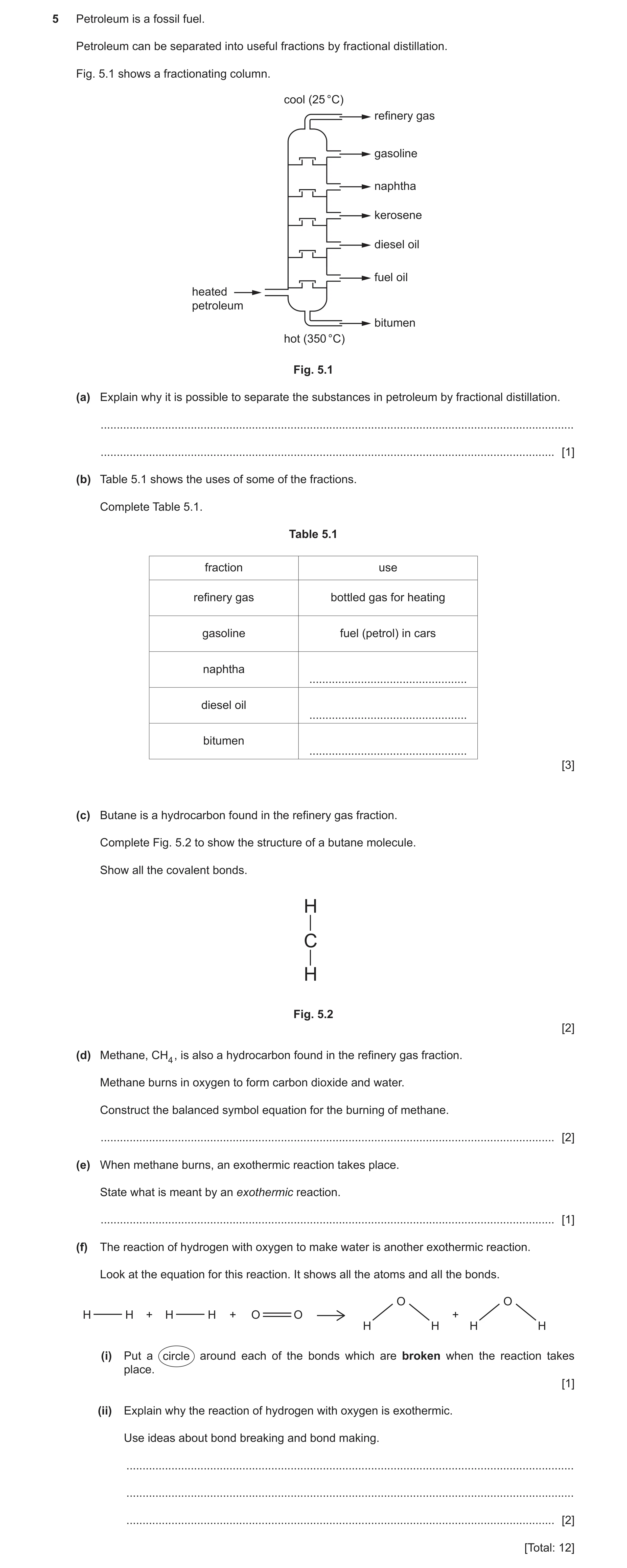
5 Petroleum is a fossil fuel. Petroleum can be separated into useful fractions by fractional distillation. Fig. 5.1 shows a fractionating column. cool (25 °C) refinery gas gasoline naphtha kerosene diesel oil fuel oil heated petroleum bitumen hot (350 °C) Fig. 5.1 (a) Explain why it is possible to separate the substances in petroleum by fractional distillation. … … [1] (b) Table 5.1 shows the uses of some of the fractions. Complete Table 5.1. Table 5.1 fraction use refinery gas bottled gas for heating gasoline fuel (petrol) in cars naphtha … diesel oil … bitumen … [3] (c) Butane is a hydrocarbon found in the refinery gas fraction. Complete Fig. 5.2 to show the structure of a butane molecule. Show all the covalent bonds. H C H Fig. 5.2 [2] (d) Methane, CH4 , is also a hydrocarbon found in the refinery gas fraction. Methane burns in oxygen to form carbon dioxide and water. Construct the balanced symbol equation for the burning of methane. … [2] (e) When methane burns, an exothermic reaction takes place. State what is meant by an exothermic reaction. … [1] (f) The reaction of hydrogen with oxygen to make water is another exothermic reaction. Look at the equation for this reaction. It shows all the atoms and all the bonds. O O H H + H H + O O + H H H H (i) Put a circle around each of the bonds which are broken when the reaction takes place. [1] (ii) Explain why the reaction of hydrogen with oxygen is exothermic. Use ideas about bond breaking and bond making. … … … [2] [Total: 12]
12 marks
Mark scheme: 5(a) substances have different boiling points ; 1 5(b) fraction use refinery gas bottled gas for heating gasoline fuel (petrol) in cars naphtha feedstock for making chemicals ; diesel oil fuel in diesel engines ; bitumen road surfaces ; 3 Question Answer Marks 5(c) ;; 2 5(d) CH4 + 2O2 → CO2 + 2H2O ;; 2 5(e) reaction in which thermal energy is given out ; 1 5(f)(i) + → ; 1 5(f)(ii) bond breaking is endothermic / owtte AND bond making is exothermic / owtte ; more energy is given out in bond making than is taken in in bond breaking ; 2
This question in 0654/42 Feb/March 2021
Q11 · A student is investigating indigestion tablets 0654/42 May/June 2021
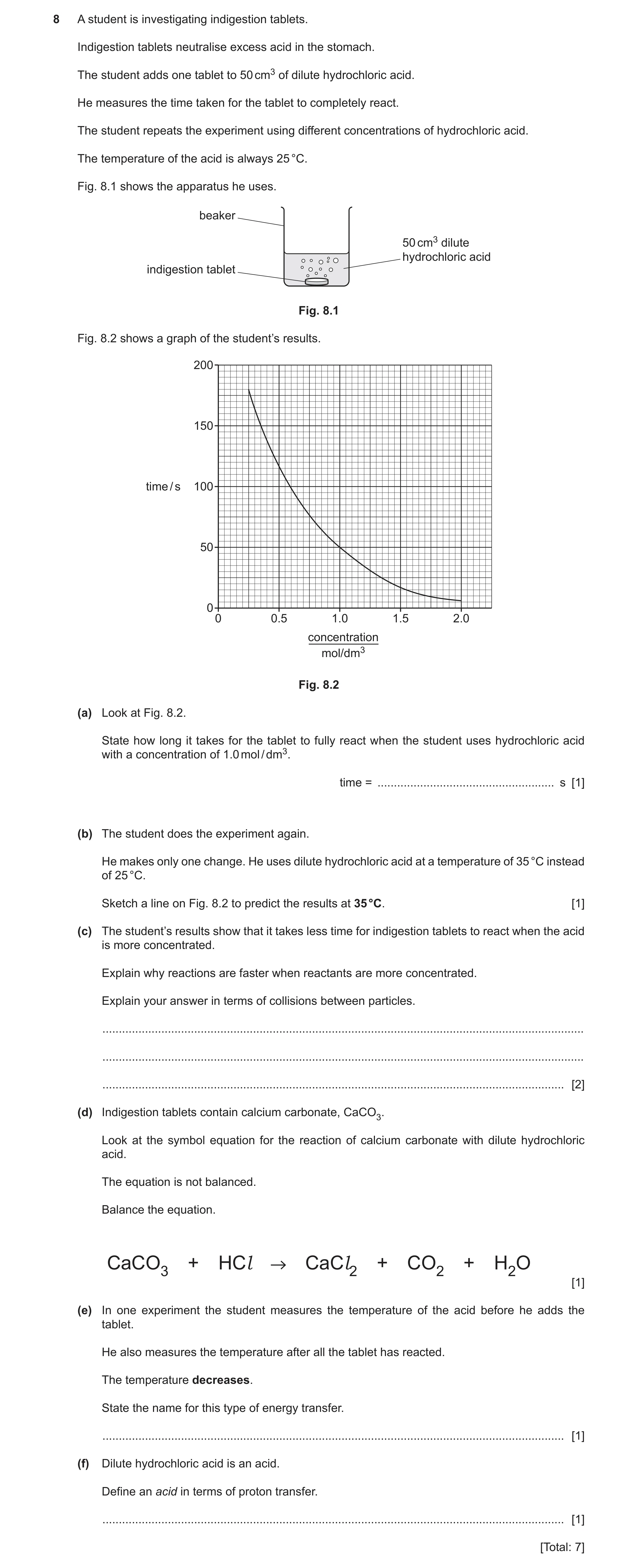
8 A student is investigating indigestion tablets. Indigestion tablets neutralise excess acid in the stomach. The student adds one tablet to 50 cm3 of dilute hydrochloric acid. He measures the time taken for the tablet to completely react. The student repeats the experiment using different concentrations of hydrochloric acid. The temperature of the acid is always 25 °C. Fig. 8.1 shows the apparatus he uses. beaker 50 cm3 dilute hydrochloric acid indigestion tablet Fig. 8.1 Fig. 8.2 shows a graph of the student’s results. 200 150 time / s 100 50 0 0 0.5 1.0 1.5 2.0 concentration mol/dm3 Fig. 8.2 (a) Look at Fig. 8.2. State how long it takes for the tablet to fully react when the student uses hydrochloric acid with a concentration of 1.0 mol / dm3. time = … s [1] (b) The student does the experiment again. He makes only one change. He uses dilute hydrochloric acid at a temperature of 35 °C instead of 25 °C. Sketch a line on Fig. 8.2 to predict the results at 35 °C. [1] (c) The student’s results show that it takes less time for indigestion tablets to react when the acid is more concentrated. Explain why reactions are faster when reactants are more concentrated. Explain your answer in terms of collisions between particles. … … … [2] (d) Indigestion tablets contain calcium carbonate, CaCO3. Look at the symbol equation for the reaction of calcium carbonate with dilute hydrochloric acid. The equation is not balanced. Balance the equation. CaCO3 + HCl CaCl2 + CO2 + H2O [1] (e) In one experiment the student measures the temperature of the acid before he adds the tablet. He also measures the temperature after all the tablet has reacted. The temperature decreases. State the name for this type of energy transfer. … [1] (f) Dilute hydrochloric acid is an acid. Define an acid in terms of proton transfer. … [1] [Total: 7]
7 marks
Mark scheme: 8(a) 50 (seconds) ; 1 8(b) line is same shape as original and is always underneath it ; 1 8(c) more particles per unit volume / more particles per cm3 ; more frequent collisions / more collisions per second ; 2 8(d) CaCO3 + 2 HCl → CaCl2 + CO2 + H2O ; 1 8(e) endothermic ; 1 8(f) (acid is a) proton donor / donates protons / owtte ; 1
This question in 0654/42 May/June 2021
Q12 · The fractional distillation of petroleum makes useful fractions 0654/43 May/June 2021
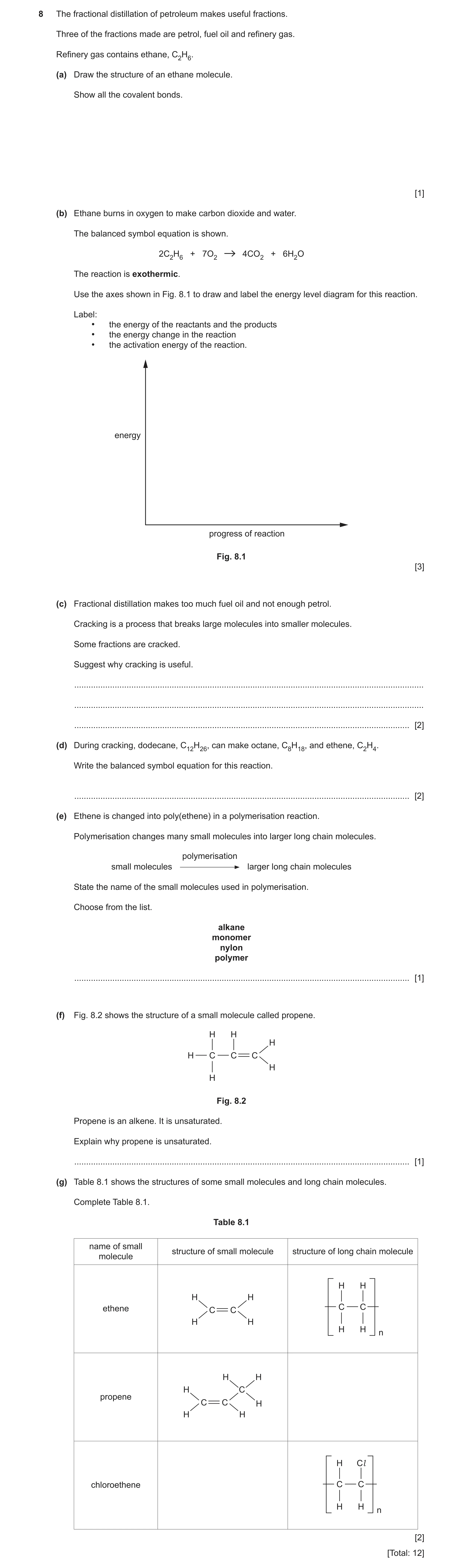
8 The fractional distillation of petroleum makes useful fractions. Three of the fractions made are petrol, fuel oil and refinery gas. Refinery gas contains ethane, C2H6. (a) Draw the structure of an ethane molecule. Show all the covalent bonds. [1] (b) Ethane burns in oxygen to make carbon dioxide and water. The balanced symbol equation is shown. 2C2H6 + 7O2 4CO2 + 6H2O The reaction is exothermic. Use the axes shown in Fig. 8.1 to draw and label the energy level diagram for this reaction. Label: • the energy of the reactants and the products • the energy change in the reaction • the activation energy of the reaction. energy progress of reaction Fig. 8.1 [3] (c) Fractional distillation makes too much fuel oil and not enough petrol. Cracking is a process that breaks large molecules into smaller molecules. Some fractions are cracked. Suggest why cracking is useful. … … … [2] (d) During cracking, dodecane, C12H26, can make octane, C8H18, and ethene, C2H4. Write the balanced symbol equation for this reaction. … [2] (e) Ethene is changed into poly(ethene) in a polymerisation reaction. Polymerisation changes many small molecules into larger long chain molecules. polymerisation small molecules larger long chain molecules State the name of the small molecules used in polymerisation. Choose from the list. alkane monomer nylon polymer … [1] (f) Fig. 8.2 shows the structure of a small molecule called propene. H H H H C C C H H Fig. 8.2 Propene is an alkene. It is unsaturated. Explain why propene is unsaturated. … [1] (g) Table 8.1 shows the structures of some small molecules and long chain molecules. Complete Table 8.1. Table 8.1 name of small structure of small molecule structure of long chain molecule molecule H H H H ethene C C C C H H H H n H H H C propene C C H H H H Cl chloroethene C C H H n [2] [Total: 12]
12 marks
Mark scheme: 8(a) ; 8(b) products shown below reactants ; energy change or correctly labelled ; activation energy correctly labelled ; 3 8(c) cracking makes more petrol / matches supply with demand ; cracking makes alkanes which can be used as fuels ; cracking makes alkenes which can be used to make plastics / alcohol / ethanol ; max 2 2 Activation Energy Energy Energy Change Question Answer Marks 8(d) C12H26 → C8H18 + 2C2H4 formulae ; balancing ; 2 8(e) monomer ; 1 8(f) (propene contains) a (carbon to carbon) double bond ; 1 8(g) (propene) (chloroethene) 2
This question in 0654/43 May/June 2021
Q13 · Clean air contains nitrogen gas and oxygen gas 0654/42 May/June 2022
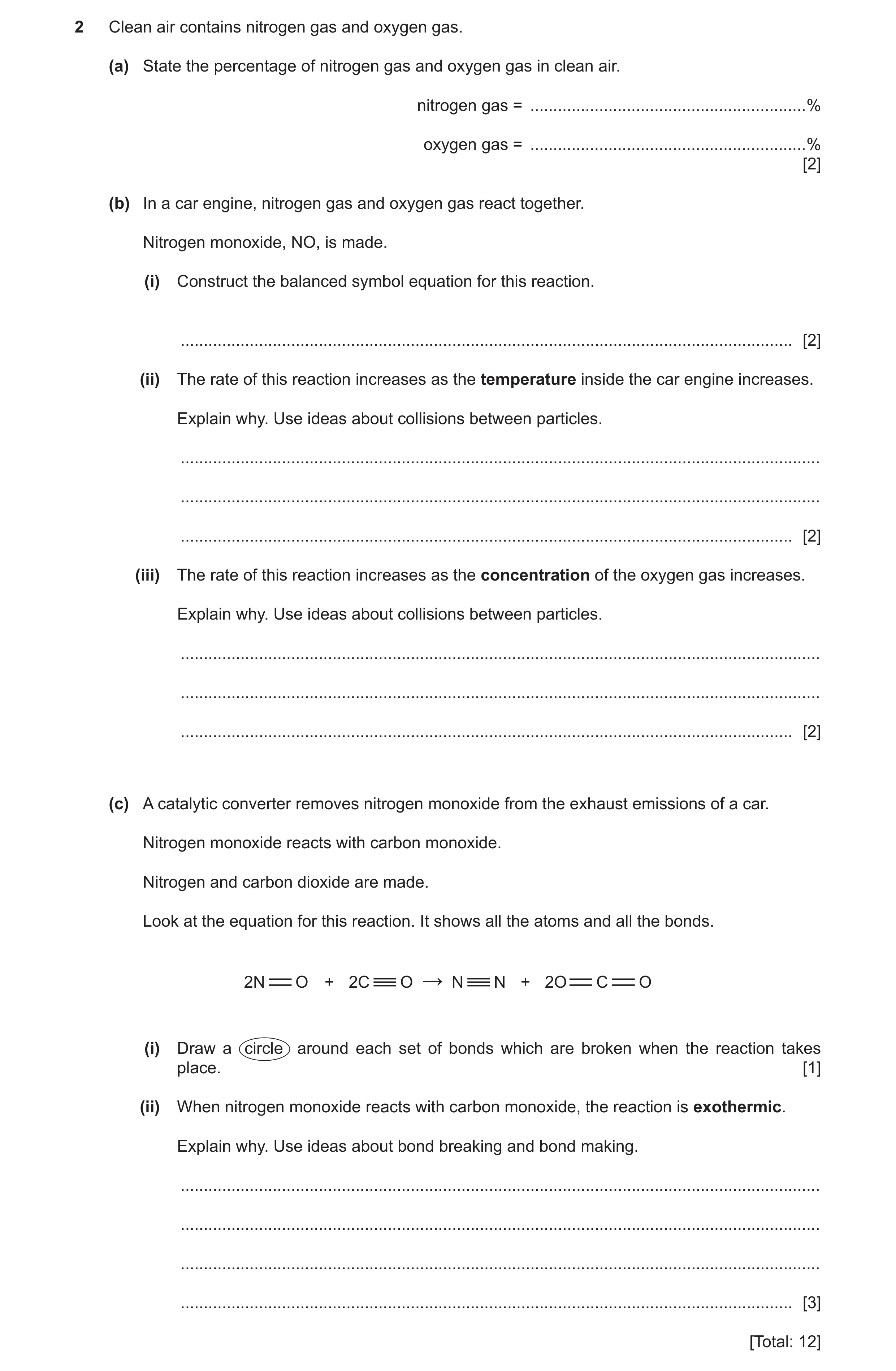
2 Clean air contains nitrogen gas and oxygen gas. (a) State the percentage of nitrogen gas and oxygen gas in clean air. nitrogen gas = … % oxygen gas = … % [2] (b) In a car engine, nitrogen gas and oxygen gas react together. Nitrogen monoxide, NO, is made. (i) Construct the balanced symbol equation for this reaction. … [2] (ii) The rate of this reaction increases as the temperature inside the car engine increases. Explain why. Use ideas about collisions between particles. … … … [2] (iii) The rate of this reaction increases as the concentration of the oxygen gas increases. Explain why. Use ideas about collisions between particles. … … … [2] (c) A catalytic converter removes nitrogen monoxide from the exhaust emissions of a car. Nitrogen monoxide reacts with carbon monoxide. Nitrogen and carbon dioxide are made. Look at the equation for this reaction. It shows all the atoms and all the bonds. 2N O + 2C O → N N + 2O C O (i) Draw a circle around each set of bonds which are broken when the reaction takes place. [1] (ii) When nitrogen monoxide reacts with carbon monoxide, the reaction is exothermic. Explain why. Use ideas about bond breaking and bond making. … … … … [3] [Total: 12]
12 marks
Mark scheme: 2(a) nitrogen gas – 78% ; oxygen gas – 21% ; 2 2(b)(i) N2 + O2 2NO ;; 2 2(b)(ii) any two from: particles move faster / particles have more kinetic energy ; more particles have, activation energy / sufficient energy, to react ; increased rate of (successful) collisions ; 2 2(b)(iii) more particles per unit volume / less space between particles ; increased rate of (successful) collisions ; 2 Question Answer Marks 2(c)(i) 2 + 2 ; 1 2(c)(ii) bond breaking, is endothermic / absorbs energy owtte ; bond making, is exothermic / releases energy owtte ; more energy is given out (in bond making) than is taken in (in bond breaking) ; 3
This question in 0654/42 May/June 2022
Q14 · Sulfuric acid is made by the Contact process 0654/43 May/June 2022
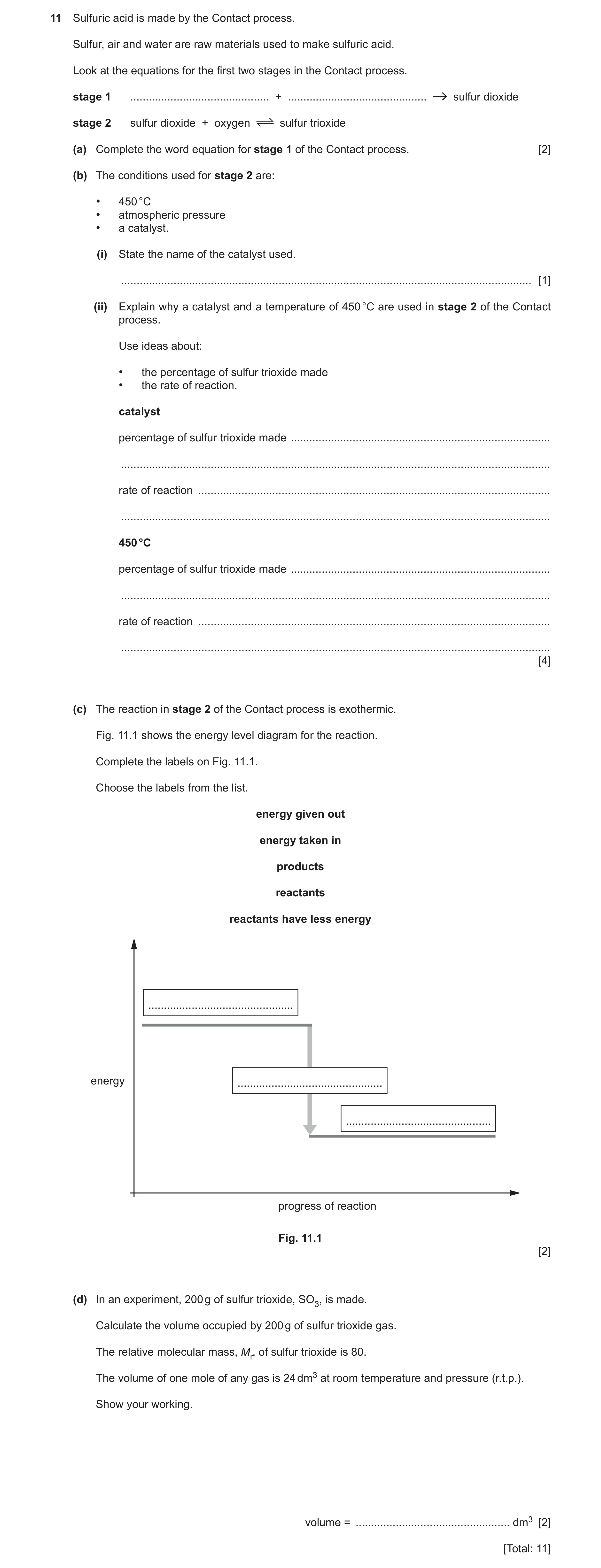
11 Sulfuric acid is made by the Contact process. Sulfur, air and water are raw materials used to make sulfuric acid. Look at the equations for the first two stages in the Contact process. stage 1 … + … sulfur dioxide stage 2 sulfur dioxide + oxygen sulfur trioxide (a) Complete the word equation for stage 1 of the Contact process. [2] (b) The conditions used for stage 2 are: • 450 °C • atmospheric pressure • a catalyst. (i) State the name of the catalyst used. … [1] (ii) Explain why a catalyst and a temperature of 450 °C are used in stage 2 of the Contact process. Use ideas about: • the percentage of sulfur trioxide made • the rate of reaction. catalyst percentage of sulfur trioxide made … … rate of reaction … … 450 °C percentage of sulfur trioxide made … … rate of reaction … … [4] (c) The reaction in stage 2 of the Contact process is exothermic. Fig. 11.1 shows the energy level diagram for the reaction. Complete the labels on Fig. 11.1. Choose the labels from the list. energy given out energy taken in products reactants reactants have less energy … energy … … progress of reaction Fig. 11.1 [2] (d) In an experiment, 200 g of sulfur trioxide, SO3, is made. Calculate the volume occupied by 200 g of sulfur trioxide gas. The relative molecular mass, Mr, of sulfur trioxide is 80. The volume of one mole of any gas is 24 dm3 at room temperature and pressure (r.t.p.). Show your working. volume = … dm3 [2] [Total: 11]
11 marks
Mark scheme: 11(a) sulfur ; oxygen ; 2 11(b)(i) vanadium(V) oxide / vanadium pentoxide ; 1 11(b)(ii) Due to an issue with question 11(b)(ii), the question has been removed from the question paper Question Answer Marks 11(c) ;; 2 11(d) moles of SO3 = 200 ÷ 80 = 2.5 ; volume of SO3 = 2.5 24 = 60 dm³ ; 2 reactants products energy given out
This question in 0654/43 May/June 2022
Q15 · Alkanes are a type of hydrocarbon 0654/41 Oct/Nov 2022
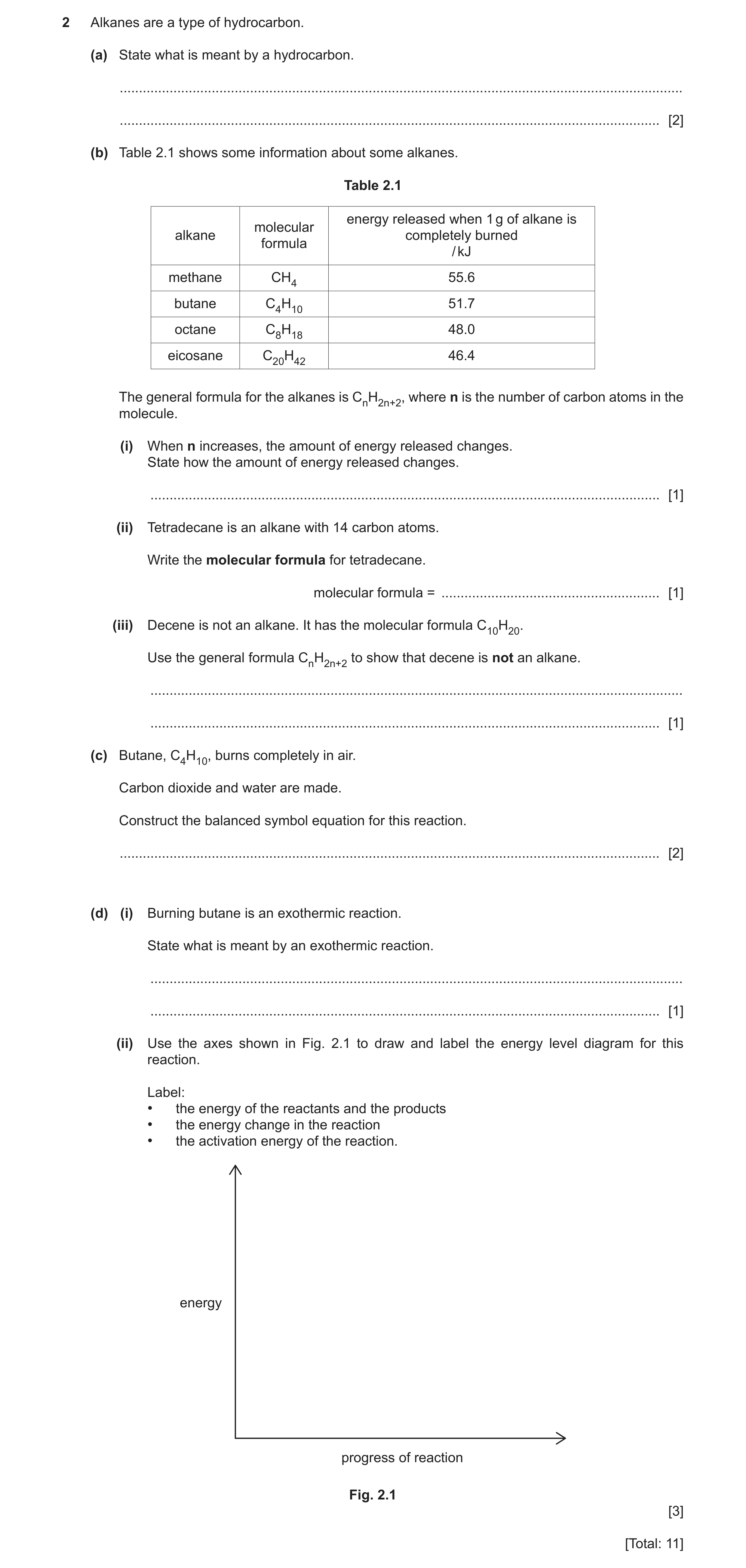
2 Alkanes are a type of hydrocarbon. (a) State what is meant by a hydrocarbon. … … [2] (b) Table 2.1 shows some information about some alkanes. Table 2.1 energy released when 1 g of alkane is molecular alkane completely burned formula / kJ methane CH4 55.6 butane C4H10 51.7 octane C8H18 48.0 eicosane C20H42 46.4 The general formula for the alkanes is CnH2n+2, where n is the number of carbon atoms in the molecule. (i) When n increases, the amount of energy released changes. State how the amount of energy released changes. … [1] (ii) Tetradecane is an alkane with 14 carbon atoms. Write the molecular formula for tetradecane. molecular formula = … [1] (iii) Decene is not an alkane. It has the molecular formula C10H20. Use the general formula CnH2n+2 to show that decene is not an alkane. … … [1] (c) Butane, C4H10, burns completely in air. Carbon dioxide and water are made. Construct the balanced symbol equation for this reaction. … [2] (d) (i) Burning butane is an exothermic reaction. State what is meant by an exothermic reaction. … … [1] (ii) Use the axes shown in Fig. 2.1 to draw and label the energy level diagram for this reaction. Label: • the energy of the reactants and the products • the energy change in the reaction • the activation energy of the reaction. energy progress of reaction Fig. 2.1 [3] [Total: 11]
11 marks
Mark scheme: 2(a) (compound that contains) carbon and hydrogen ; 2 only / owtte ; 2(b)(i) decreases / owtte ; 1 2(b)(ii) C14H30 ; 1 2(b)(iii) idea that if n = 10 then H will be 22, but in decene it is 20 ; 1 2(c) 2C4H10 + 13O2→8CO2 + 10H2O 2 correct formulae ; correct balancing ; 2(d)(i) (reaction in which) energy is given out / heat is given out ; 1 2(d)(ii) 3 products shown below reactants; energy change or H correctly labelled; activation energy or Ea correctly labelled;
This question in 0654/41 Oct/Nov 2022
Q16 · A student investigates two liquid fuels, A and B, to find out which fuel releases most… 0654/43 Oct/Nov 2022
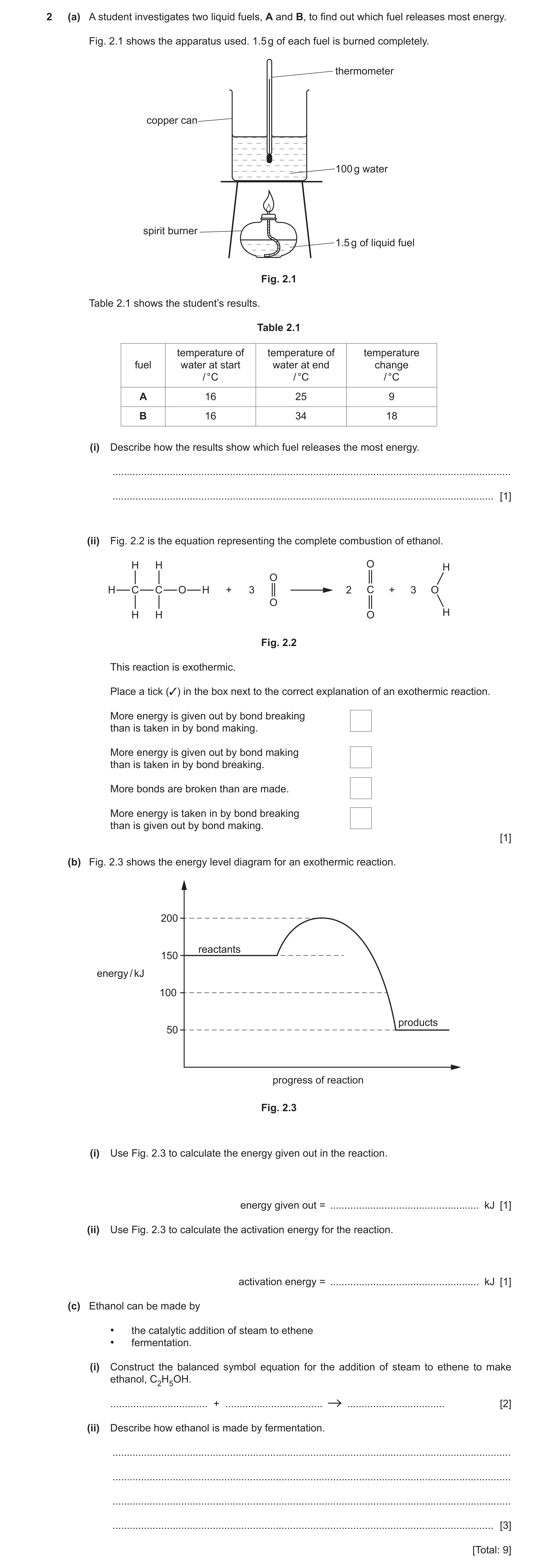
2 (a) A student investigates two liquid fuels, A and B, to find out which fuel releases most energy. Fig. 2.1 shows the apparatus used. 1.5 g of each fuel is burned completely. thermometer copper can 100 g water spirit burner 1.5 g of liquid fuel Fig. 2.1 Table 2.1 shows the student’s results. Table 2.1 temperature of temperature of temperature fuel water at start water at end change / °C / °C / °C A 16 25 9 B 16 34 18 (i) Describe how the results show which fuel releases the most energy. … … [1] (ii) Fig. 2.2 is the equation representing the complete combustion of ethanol. H H O H O H C C O H + 3 2 C + 3 O O H H O H Fig. 2.2 This reaction is exothermic. Place a tick (3) in the box next to the correct explanation of an exothermic reaction. More energy is given out by bond breaking than is taken in by bond making. More energy is given out by bond making than is taken in by bond breaking. More bonds are broken than are made. More energy is taken in by bond breaking than is given out by bond making. [1] (b) Fig. 2.3 shows the energy level diagram for an exothermic reaction. 200 reactants 150 energy / kJ 100 products 50 progress of reaction Fig. 2.3 (i) Use Fig. 2.3 to calculate the energy given out in the reaction. energy given out = … kJ [1] (ii) Use Fig. 2.3 to calculate the activation energy for the reaction. activation energy = … kJ [1] (c) Ethanol can be made by • the catalytic addition of steam to ethene • fermentation. (i) Construct the balanced symbol equation for the addition of steam to ethene to make ethanol, C2H5OH. … + … … [2] (ii) Describe how ethanol is made by fermentation. … … … … [3] [Total: 9]
9 marks
Mark scheme: 2(a)(i) (B) 1 because the temperature change is greatest / 18 is greater than 9 / end temperature is highest (and starting temperature is the same) ; 2(a)(ii) more energy is given out during bond making than is taken in during bond breaking ticked ; 1 2(b)(i) 100 (kJ) ; 1 2(b)(ii) 50 (kJ) ; 1 2(c)(i) C2H4 + H2O → C2H5OH ;; 2 2(c)(ii) reference to yeast ; 3 (uses) glucose / (named) sugar (solution) ; absence of air or oxygen / anaerobic conditions / anaerobic respiration ;
This question in 0654/43 Oct/Nov 2022
Q17 · The structures of some compounds of carbon 0654/42 Feb/March 2023
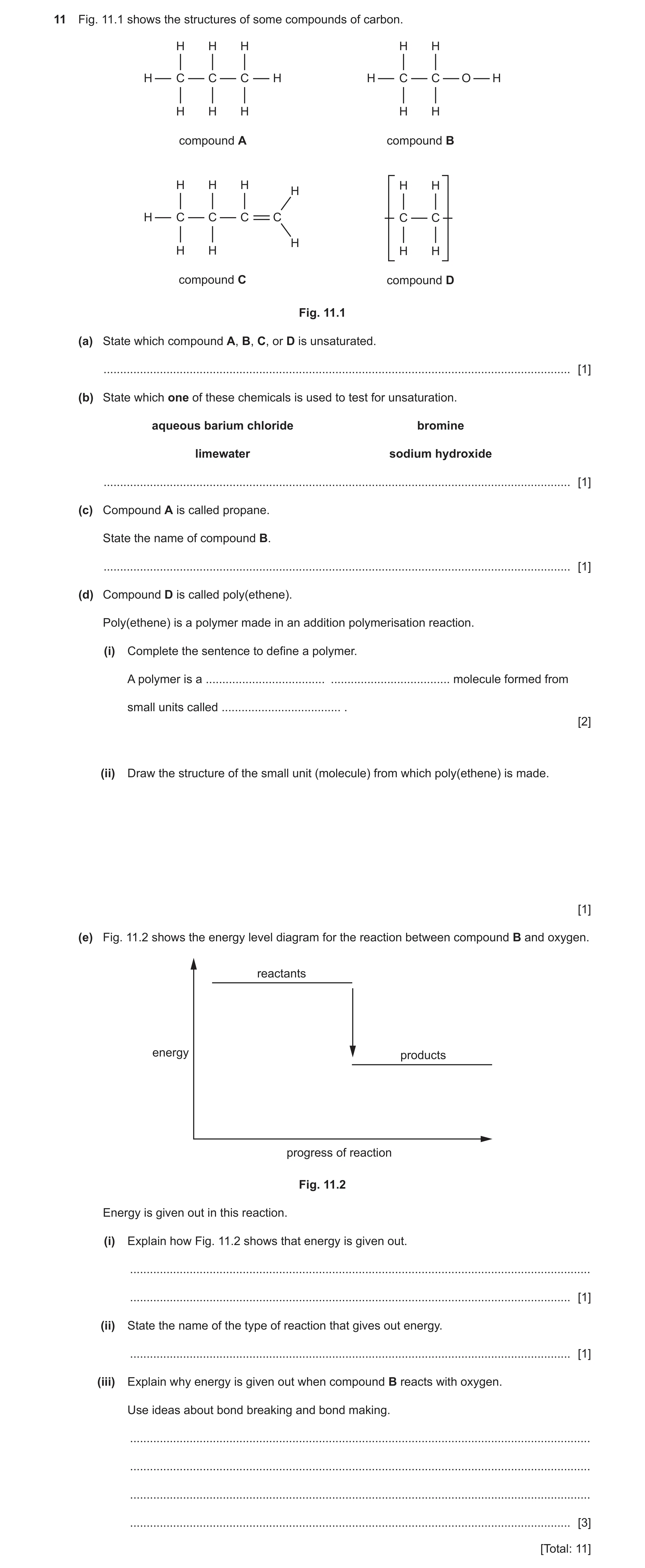
11 Fig. 11.1 shows the structures of some compounds of carbon. H H H H H H C C C H H C C O H H H H H H compound A compound B H H H H H H H C C C C C C H H H H H compound C compound D Fig. 11.1 (a) State which compound A, B, C, or D is unsaturated. … [1] (b) State which one of these chemicals is used to test for unsaturation. aqueous barium chloride bromine limewater sodium hydroxide … [1] (c) Compound A is called propane. State the name of compound B. … [1] (d) Compound D is called poly(ethene). Poly(ethene) is a polymer made in an addition polymerisation reaction. (i) Complete the sentence to define a polymer. A polymer is a … … molecule formed from small units called … . [2] (ii) Draw the structure of the small unit (molecule) from which poly(ethene) is made. [1] (e) Fig. 11.2 shows the energy level diagram for the reaction between compound B and oxygen. reactants energy products progress of reaction Fig. 11.2 Energy is given out in this reaction. (i) Explain how Fig. 11.2 shows that energy is given out. … … [1] (ii) State the name of the type of reaction that gives out energy. … [1] (iii) Explain why energy is given out when compound B reacts with oxygen. Use ideas about bond breaking and bond making. … … … … [3] [Total: 11]
11 marks
Mark scheme: 11(a) C ; 1 11(b) bromine ; 1 11(c) ethanol ; 1 11(d)(i) long chain ; 2 monomers ; 11(d)(ii) 1 ; 11(e)(i) idea that products have less energy than the reactants ; 1 11(e)(ii) exothermic ; 1 11(e)(iii) bond breaking is endothermic / owtte ; 3 bond making is exothermic / owtte ; more energy is given out (in bond making) than is taken in (in bond breaking) ;
This question in 0654/42 Feb/March 2023
Q18 · A student investigates the rate of reaction between dilute hydrochloric acid, HCl, and… 0654/41 May/June 2023
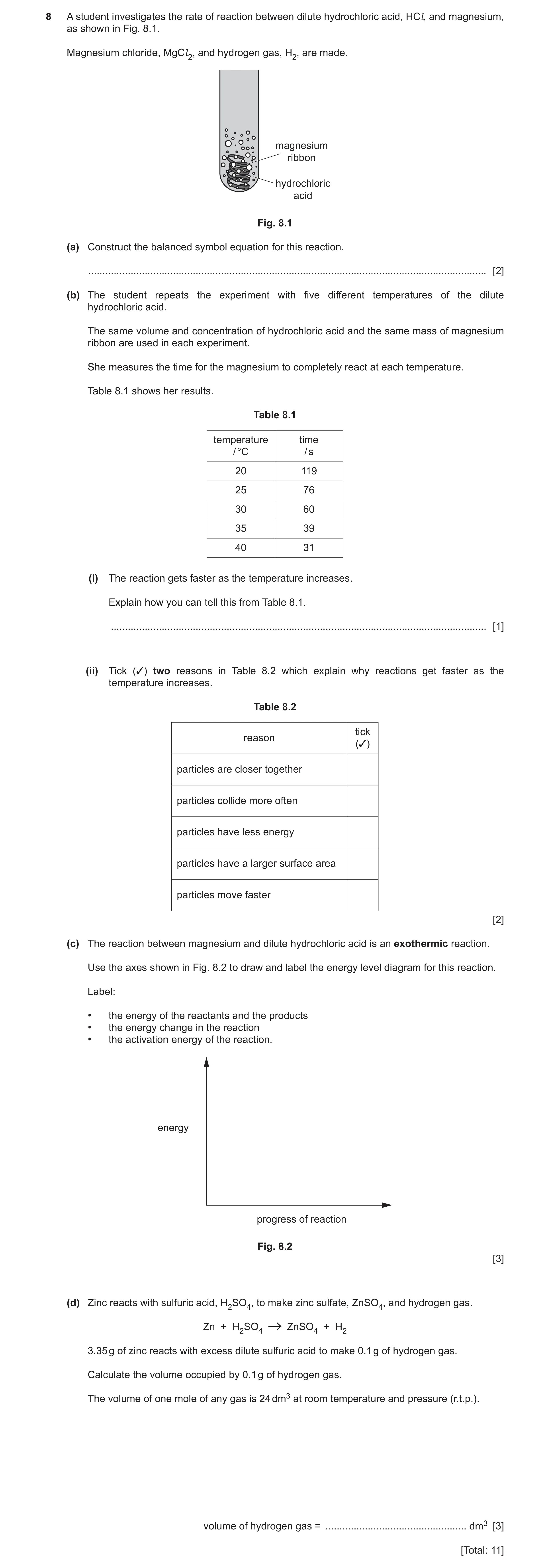
8 A student investigates the rate of reaction between dilute hydrochloric acid, HCl, and magnesium, as shown in Fig. 8.1. Magnesium chloride, MgCl 2, and hydrogen gas, H2, are made. magnesium ribbon hydrochloric acid Fig. 8.1 (a) Construct the balanced symbol equation for this reaction. … [2] (b) The student repeats the experiment with five different temperatures of the dilute hydrochloric acid. The same volume and concentration of hydrochloric acid and the same mass of magnesium ribbon are used in each experiment. She measures the time for the magnesium to completely react at each temperature. Table 8.1 shows her results. Table 8.1 temperature time / °C / s 20 119 25 76 30 60 35 39 40 31 (i) The reaction gets faster as the temperature increases. Explain how you can tell this from Table 8.1. … [1] (ii) Tick (3) two reasons in Table 8.2 which explain why reactions get faster as the temperature increases. Table 8.2 tick reason (3) particles are closer together particles collide more often particles have less energy particles have a larger surface area particles move faster [2] (c) The reaction between magnesium and dilute hydrochloric acid is an exothermic reaction. Use the axes shown in Fig. 8.2 to draw and label the energy level diagram for this reaction. Label: • the energy of the reactants and the products • the energy change in the reaction • the activation energy of the reaction. energy progress of reaction Fig. 8.2 [3] (d) Zinc reacts with sulfuric acid, H2SO4, to make zinc sulfate, ZnSO4, and hydrogen gas. Zn + H2SO4 ZnSO4 + H2 3.35 g of zinc reacts with excess dilute sulfuric acid to make 0.1 g of hydrogen gas. Calculate the volume occupied by 0.1 g of hydrogen gas. The volume of one mole of any gas is 24 dm3 at room temperature and pressure (r.t.p.). volume of hydrogen gas = … dm3 [3] [Total: 11]
11 marks
Mark scheme: 8(a) Correct formulae ; Correct balancing ; 2 8(b)(i) (as the temperature increases) the time decreases / owtte ; 1 Question Answer Marks 8(b)(ii) reason tick () particles are closer together particles collide more often particles have less energy particles have a larger surface area particles move faster ;; 2 8(c) products shown below reactants ; energy change or H correctly labelled ; activation energy correctly labelled ; 3 Question Answer Marks 8(d) Mr of H2 = 2 ; moles of H2 = 0.1 ÷ 2 = 0.05 / M / Mr ; volume of H2 = 0.05 24 = 1.2 dm³ ; 3
This question in 0654/41 May/June 2023
Q19 · Ammonia is made from the reaction of nitrogen and hydrogen in the Haber process 0654/42 May/June 2023
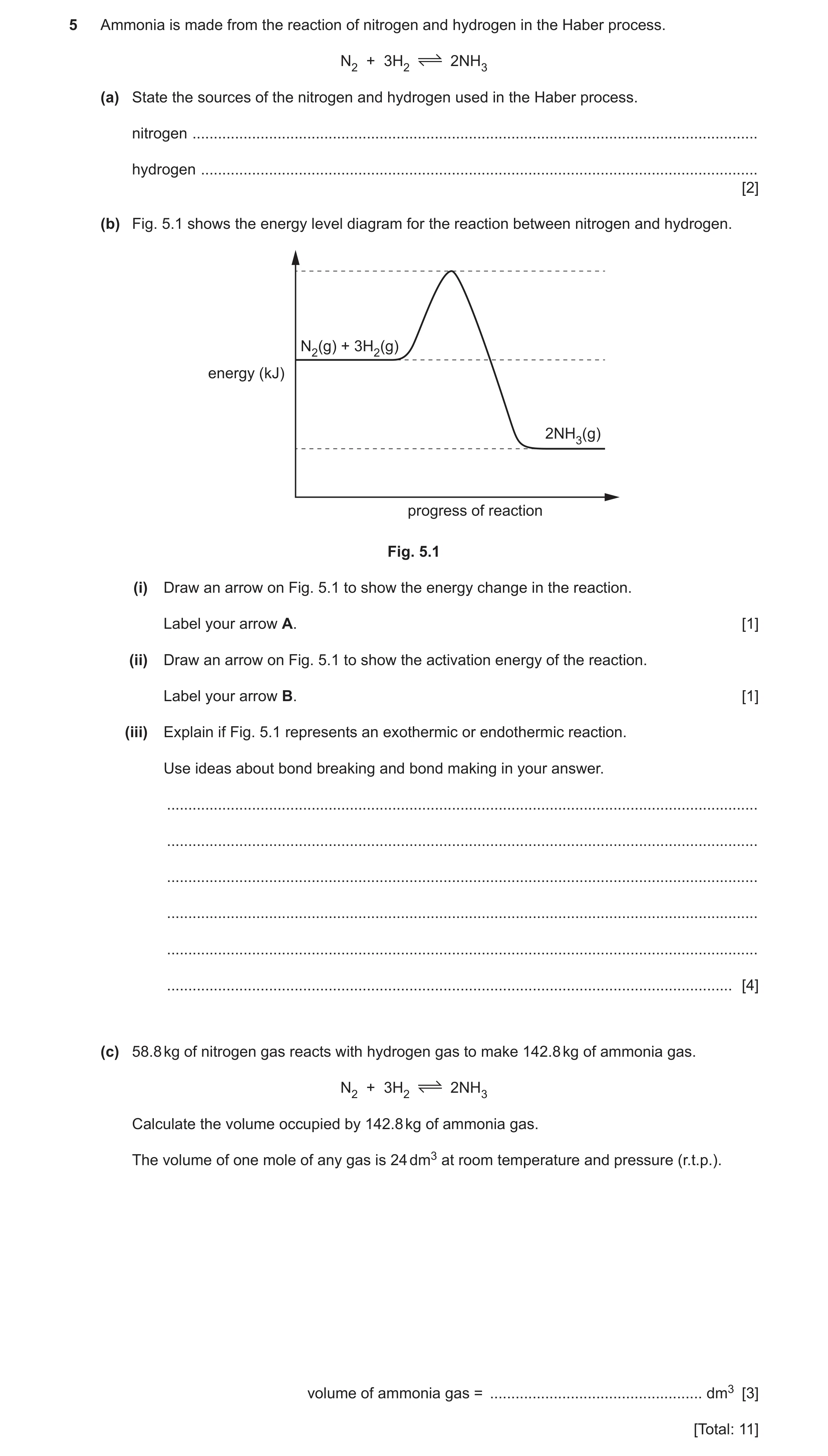
5 Ammonia is made from the reaction of nitrogen and hydrogen in the Haber process. N2 + 3H2 2NH3 (a) State the sources of the nitrogen and hydrogen used in the Haber process. nitrogen … hydrogen … [2] (b) Fig. 5.1 shows the energy level diagram for the reaction between nitrogen and hydrogen. N2(g) + 3H2(g) energy (kJ) 2NH3(g) progress of reaction Fig. 5.1 (i) Draw an arrow on Fig. 5.1 to show the energy change in the reaction. Label your arrow A. [1] (ii) Draw an arrow on Fig. 5.1 to show the activation energy of the reaction. Label your arrow B. [1] (iii) Explain if Fig. 5.1 represents an exothermic or endothermic reaction. Use ideas about bond breaking and bond making in your answer. … … … … … … [4] (c) 58.8 kg of nitrogen gas reacts with hydrogen gas to make 142.8 kg of ammonia gas. N2 + 3H2 2NH3 Calculate the volume occupied by 142.8 kg of ammonia gas. The volume of one mole of any gas is 24 dm3 at room temperature and pressure (r.t.p.). volume of ammonia gas = … dm3 [3] [Total: 11]
11 marks
Mark scheme: 5(a) nitrogen – (from the) air ; hydrogen – from the reaction of methane / natural gas with steam ; 2 5(b)(i) ; 1 5(b)(ii) ; 1 A B Question Answer Marks 5(b)(iii) (exothermic because) energy change is negative / energy is given out in the reaction / energy of reactants is higher than energy of products ; bond breaking is endothermic / owtte ; bond making is exothermic / owtte ; more energy is given out (in bond making) than is taken in (in bond breaking) ; 4 5(c) Mr of NH3 = 17 ; moles of NH3 = 142 800 ÷ 17 = 8400 ; volume of NH3 = 8400 24 = 201 600 (dm³) ; 3
This question in 0654/42 May/June 2023
Q20 · A student investigates the reaction between large marble chips and excess dilute… 0654/42 Oct/Nov 2023
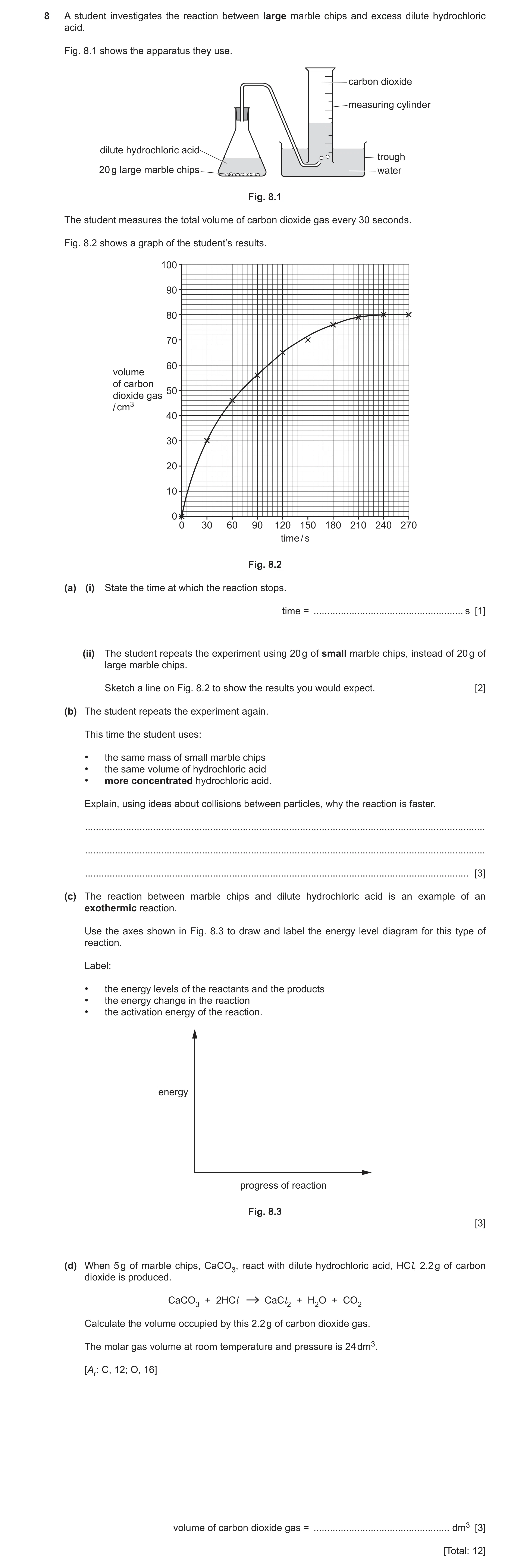
8 A student investigates the reaction between large marble chips and excess dilute hydrochloric acid. Fig. 8.1 shows the apparatus they use. carbon dioxide measuring cylinder dilute hydrochloric acid trough 20 g large marble chips water Fig. 8.1 The student measures the total volume of carbon dioxide gas every 30 seconds. Fig. 8.2 shows a graph of the student’s results. 100 90 80 70 60 volume of carbon 50 dioxide gas / cm3 40 30 20 10 0 0 30 60 90 120 150 180 210 240 270 time / s Fig. 8.2 (a) (i) State the time at which the reaction stops. time = … s [1] (ii) The student repeats the experiment using 20 g of small marble chips, instead of 20 g of large marble chips. Sketch a line on Fig. 8.2 to show the results you would expect. [2] (b) The student repeats the experiment again. This time the student uses: • the same mass of small marble chips • the same volume of hydrochloric acid • more concentrated hydrochloric acid. Explain, using ideas about collisions between particles, why the reaction is faster. … … … [3] (c) The reaction between marble chips and dilute hydrochloric acid is an example of an exothermic reaction. Use the axes shown in Fig. 8.3 to draw and label the energy level diagram for this type of reaction. Label: • the energy levels of the reactants and the products • the energy change in the reaction • the activation energy of the reaction. energy progress of reaction Fig. 8.3 [3] (d) When 5 g of marble chips, CaCO3, react with dilute hydrochloric acid, HCl, 2.2 g of carbon dioxide is produced. CaCO3 + 2HCl CaCl2 + H2O + CO2 Calculate the volume occupied by this 2.2 g of carbon dioxide gas. The molar gas volume at room temperature and pressure is 24 dm3. [Ar: C, 12; O, 16] volume of carbon dioxide gas = … dm3 [3] [Total: 12]
12 marks
Mark scheme: 8(a)(i) 240 (s) ; 1 8(a)(ii) line starting at the origin but steeper than the original ; 2 levels off at 80 (cm3) ; 8(b) particles are more crowded / more particles per unit volume / 3 more particles per cm3 ; more collisions ; more frequent collisions / more collisions per second ; 8(c) 3 products shown below reactants ; energy change or H correctly clearly indicated and labelled ; activation energy clearly indicated and labelled ; 8(d) Mr of CO2 = 44 ; 3 moles of CO2 = 0.05 ; volume of H2 (= 0.05 24) = 1.2 dm3 ;
This question in 0654/42 Oct/Nov 2023
Q21 · Butane, C4H10, is an alkane 0654/42 Feb/March 2024
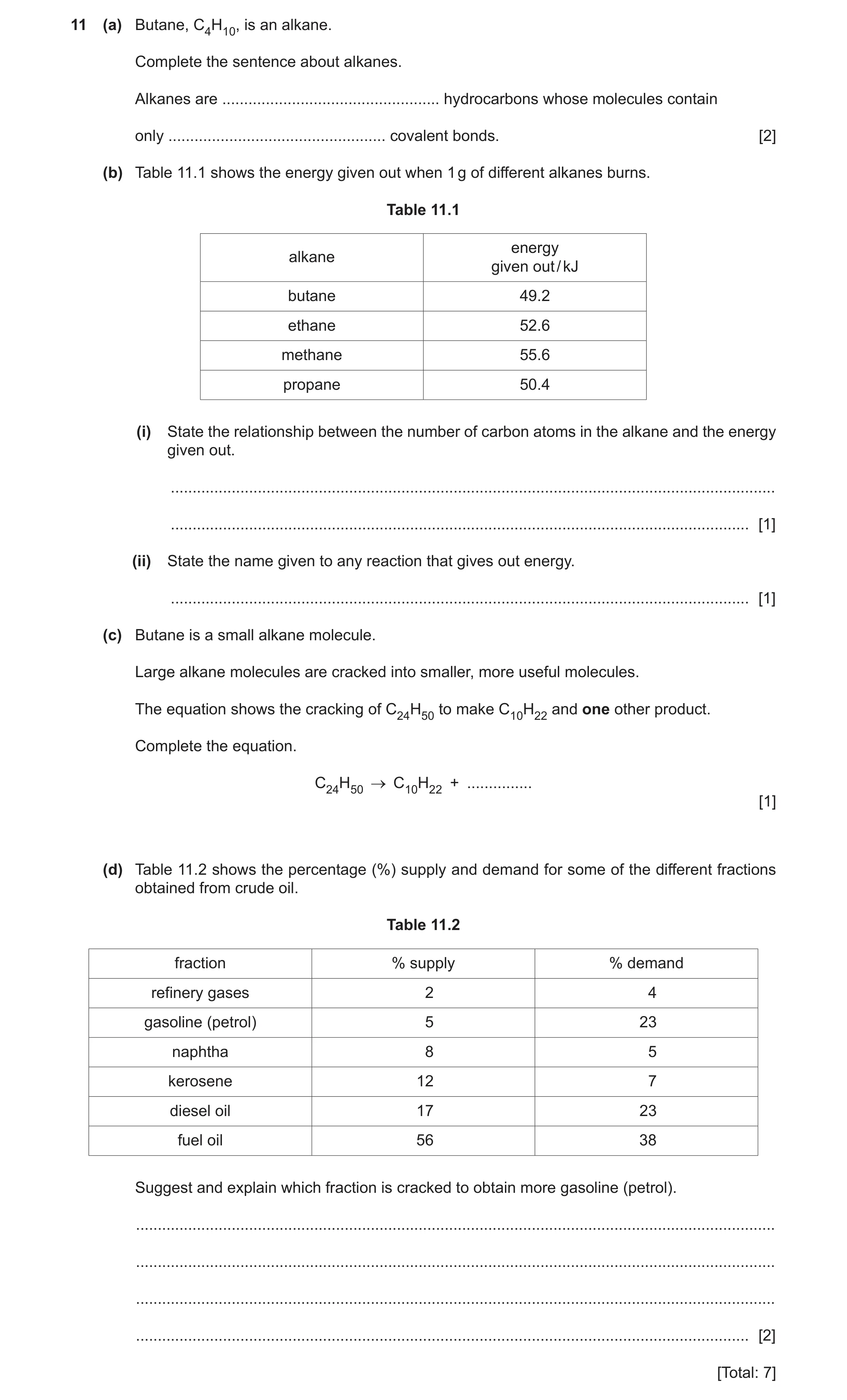
11 (a) Butane, C4H10, is an alkane. Complete the sentence about alkanes. Alkanes are … hydrocarbons whose molecules contain only … covalent bonds. [2] (b) Table 11.1 shows the energy given out when 1 g of different alkanes burns. Table 11.1 energy alkane given out / kJ butane 49.2 ethane 52.6 methane 55.6 propane 50.4 (i) State the relationship between the number of carbon atoms in the alkane and the energy given out. … … [1] (ii) State the name given to any reaction that gives out energy. … [1] (c) Butane is a small alkane molecule. Large alkane molecules are cracked into smaller, more useful molecules. The equation shows the cracking of C24H50 to make C10H22 and one other product. Complete the equation. C24H50 C10H22 + … [1] (d) Table 11.2 shows the percentage (%) supply and demand for some of the different fractions obtained from crude oil. Table 11.2 fraction % supply % demand refinery gases 2 4 gasoline (petrol) 5 23 naphtha 8 5 kerosene 12 7 diesel oil 17 23 fuel oil 56 38 Suggest and explain which fraction is cracked to obtain more gasoline (petrol). … … … … [2] [Total: 7]
7 marks
Mark scheme: 11(a) saturated ; 2 single; 11(b)(i) idea that the higher the number of carbon atoms the lower the energy given out / ORA ✓ 1 11(b)(ii) exothermic ; 1 11(c) C14H28 ; 1 11(d) fuel oil / kerosene / naphtha ; 2 idea that the supply is greater than the demand ;
This question in 0654/42 Feb/March 2024
Q22 · Petroleum is a mixture of hydrocarbons 0654/43 May/June 2024
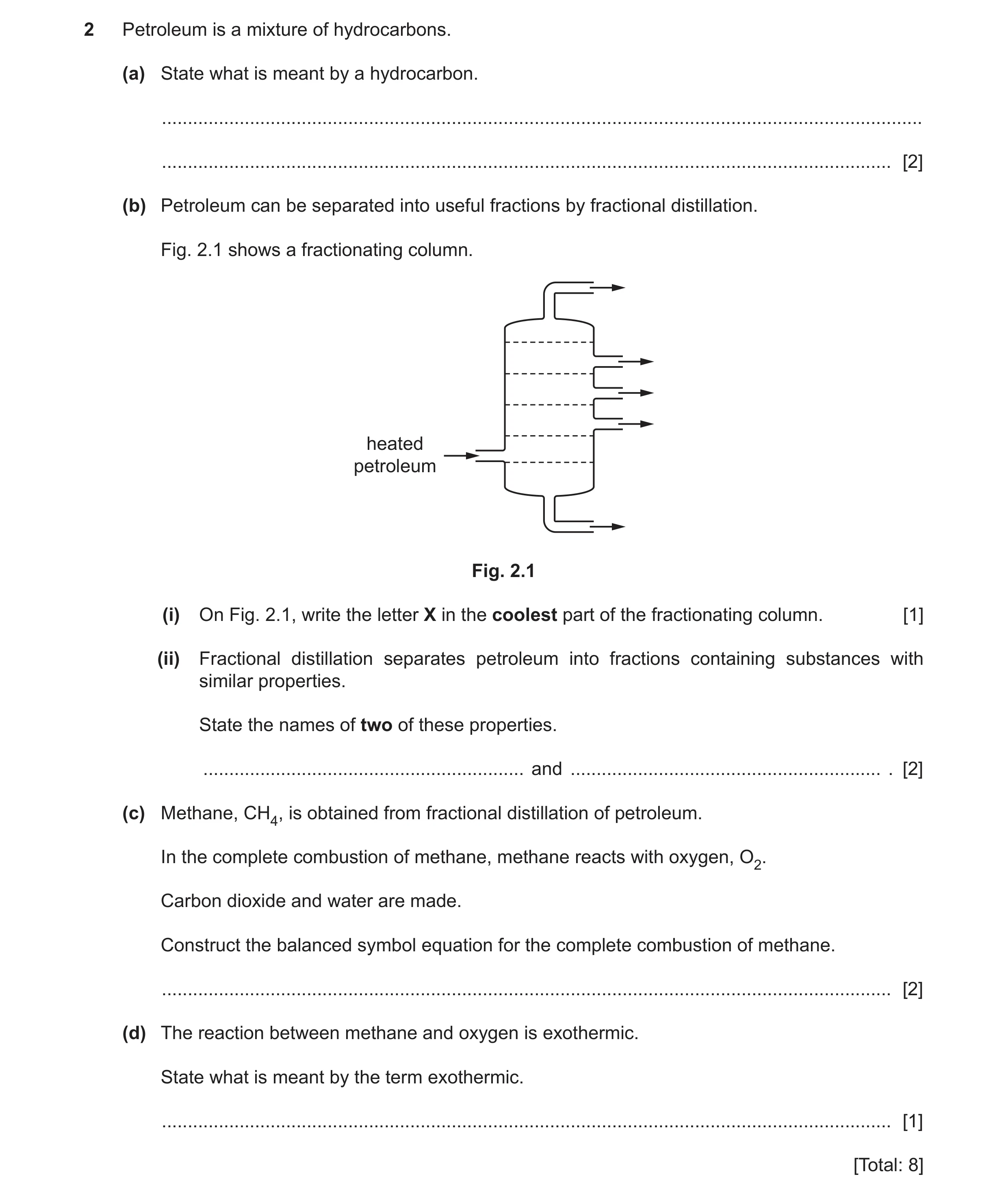
2 Petroleum is a mixture of hydrocarbons. (a) State what is meant by a hydrocarbon. … … [2] (b) Petroleum can be separated into useful fractions by fractional distillation. Fig. 2.1 shows a fractionating column. heated petroleum Fig. 2.1 (i) On Fig. 2.1, write the letter X in the coolest part of the fractionating column. [1] (ii) Fractional distillation separates petroleum into fractions containing substances with similar properties. State the names of two of these properties. … and … . [2] (c) Methane, CH4, is obtained from fractional distillation of petroleum. In the complete combustion of methane, methane reacts with oxygen, O2. Carbon dioxide and water are made. Construct the balanced symbol equation for the complete combustion of methane. … [2] (d) The reaction between methane and oxygen is exothermic. State what is meant by the term exothermic. … [1] [Total: 8]
8 marks
Mark scheme: 2(a) (compound containing) carbon and hydrogen (atoms) ; only ; 2 2(b)(i) X inside the column, either inside the pipe or anywhere above the top dotted line ; e.g. 1 2(b)(ii) Any two from: boiling point / volatility / viscosity / flammability / density ;; 2 2(c) CH4 + 2O2 CO2 + 2H2O ;; 2 2(d) Idea of thermal energy given out ; 1
This question in 0654/43 May/June 2024
Q23 · A student investigates the reaction between calcium carbonate and dilute hydrochloric acid 0654/42 Oct/Nov 2024
8 A student investigates the reaction between calcium carbonate and dilute hydrochloric acid. The student does the experiment using three different sets of conditions, A, B and C. All other variables are kept the same. Fig. 8.1 shows the three sets of conditions. A B C thermometer 45 °C 30 °C 45 °C 0.1 mol / dm3 0.05 mol / dm3 0.1 mol / dm3 hydrochloric acid hydrochloric acid hydrochloric acid lump of calcium small pieces of powdered calcium carbonate calcium carbonate carbonate Fig. 8.1 (a) State which set of conditions, A, B or C, will give the fastest rate of reaction. … [1] (b) The equation for the reaction in the student’s experiment is shown. CaCO3 + 2HCl CaCl 2 + H2O + CO2 Calculate the mass of 1.2 dm3 of carbon dioxide gas measured at room temperature and pressure (r.t.p.). The volume of one mole of any gas is 24 dm3 at r.t.p. Show your working. [Ar: C, 12; O, 16] mass of carbon dioxide gas = … g [3] (c) The reaction between calcium carbonate and dilute hydrochloric acid is exothermic. State what is meant by an exothermic reaction. … … [1] (d) A food company is making new self-heating cans of soup. n H Ca ot ot C H ng an Self heati Self heati ng Soup Soup Creamy Creamy chicken tomato iinn 33 minuteminutess!! HHotot iinn 33 minuteminutess!! HHotot They investigate three different reactions. Fig. 8.2 shows the reaction profiles for the three reactions, X, Y and Z. X Y Z energy reactants energy energy products reactants products products reactants progress of reaction progress of reaction progress of reaction Fig. 8.2 The reaction profiles show: • the energy change in the reaction • the activation energy of the reaction. (i) State what is meant by activation energy. … … … [2] (ii) Suggest which reaction, X, Y or Z, would be most suitable to use in the self-heating cans. Explain your answer. reaction … explanation … … … [3] [Total: 10]
10 marks
Mark scheme: 8(a) C ; 1 8(b) (Mr of CO2 =) 44 ; 3 (moles of CO2 = 1.2 ÷ 24 =) 0.05 ; (mass of CO2 = 0.05 44 =) 2.2 (g) ; 8(c) (reaction in which) energy is given out / heat is given out ; 1 8(d)(i) minimum amount of energy ; 2 required for reaction to take place ; 8(d)(ii) (reaction) X ; 3 (because) Z is endothermic / Z does not give out heat (energy) ; (because) X has a lower activation energy than Y / X gives out more energy / heat than Y ;
This question in 0654/42 Oct/Nov 2024
Q24 · A student investigates the reaction between calcium carbonate and dilute hydrochloric acid 0654/43 Oct/Nov 2024
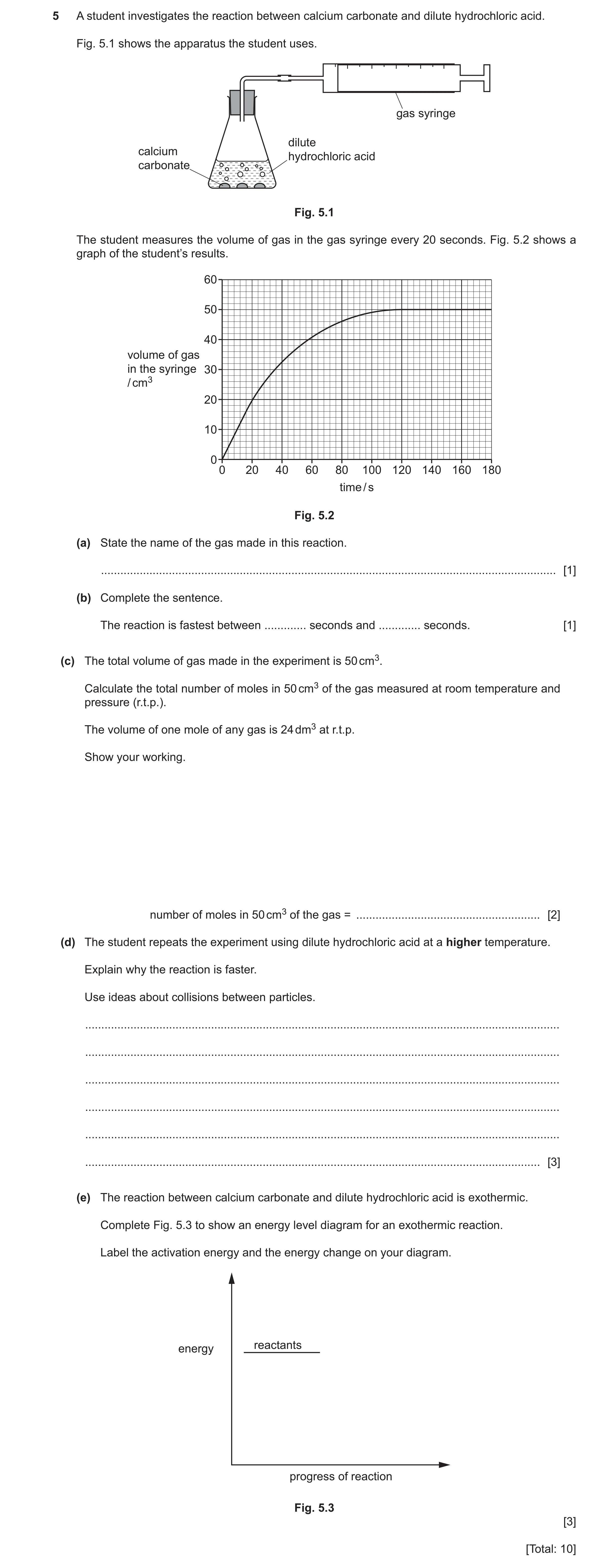
5 A student investigates the reaction between calcium carbonate and dilute hydrochloric acid. Fig. 5.1 shows the apparatus the student uses. gas syringe dilute calcium hydrochloric acid carbonate Fig. 5.1 The student measures the volume of gas in the gas syringe every 20 seconds. Fig. 5.2 shows a graph of the student’s results. 60 50 40 volume of gas in the syringe 30 / cm3 20 10 0 0 20 40 60 80 100 120 140 160 180 time / s Fig. 5.2 (a) State the name of the gas made in this reaction. … [1] (b) Complete the sentence. The reaction is fastest between … seconds and … seconds. [1] (c) The total volume of gas made in the experiment is 50 cm3. Calculate the total number of moles in 50 cm3 of the gas measured at room temperature and pressure (r.t.p.). The volume of one mole of any gas is 24 dm3 at r.t.p. Show your working. number of moles in 50 cm3 of the gas = … [2] (d) The student repeats the experiment using dilute hydrochloric acid at a higher temperature. Explain why the reaction is faster. Use ideas about collisions between particles. … … … … … … [3] (e) The reaction between calcium carbonate and dilute hydrochloric acid is exothermic. Complete Fig. 5.3 to show an energy level diagram for an exothermic reaction. Label the activation energy and the energy change on your diagram. reactants energy progress of reaction Fig. 5.3 [3] [Total: 10]
10 marks
Mark scheme: 5(a) carbon dioxide ; 1 5(b) the reaction is fastest between 0 seconds and 16 seconds ; 1 5(c) (50 cm3 =) 0.050 dm3 ; 2 (moles = 0.050 ÷ 24) = 0.0021 ; OR (24 dm3 =) 24 000 cm3 ; moles = (50 / 24000 =) 0.0021 ; 5(d) molecules have higher (average) energy / 3 molecules are moving faster ; more molecules with activation energy ; frequency of collision (of molecules) is higher / more collisions per second / more successful collisions ; 5(e) 3 products shown below reactants ; energy change or H correctly clearly indicated and labelled ; activation energy clearly indicated and labelled ;
This question in 0654/43 Oct/Nov 2024
Q25 · Magnesium reacts with dilute hydrochloric acid 0654/42 Feb/March 2025
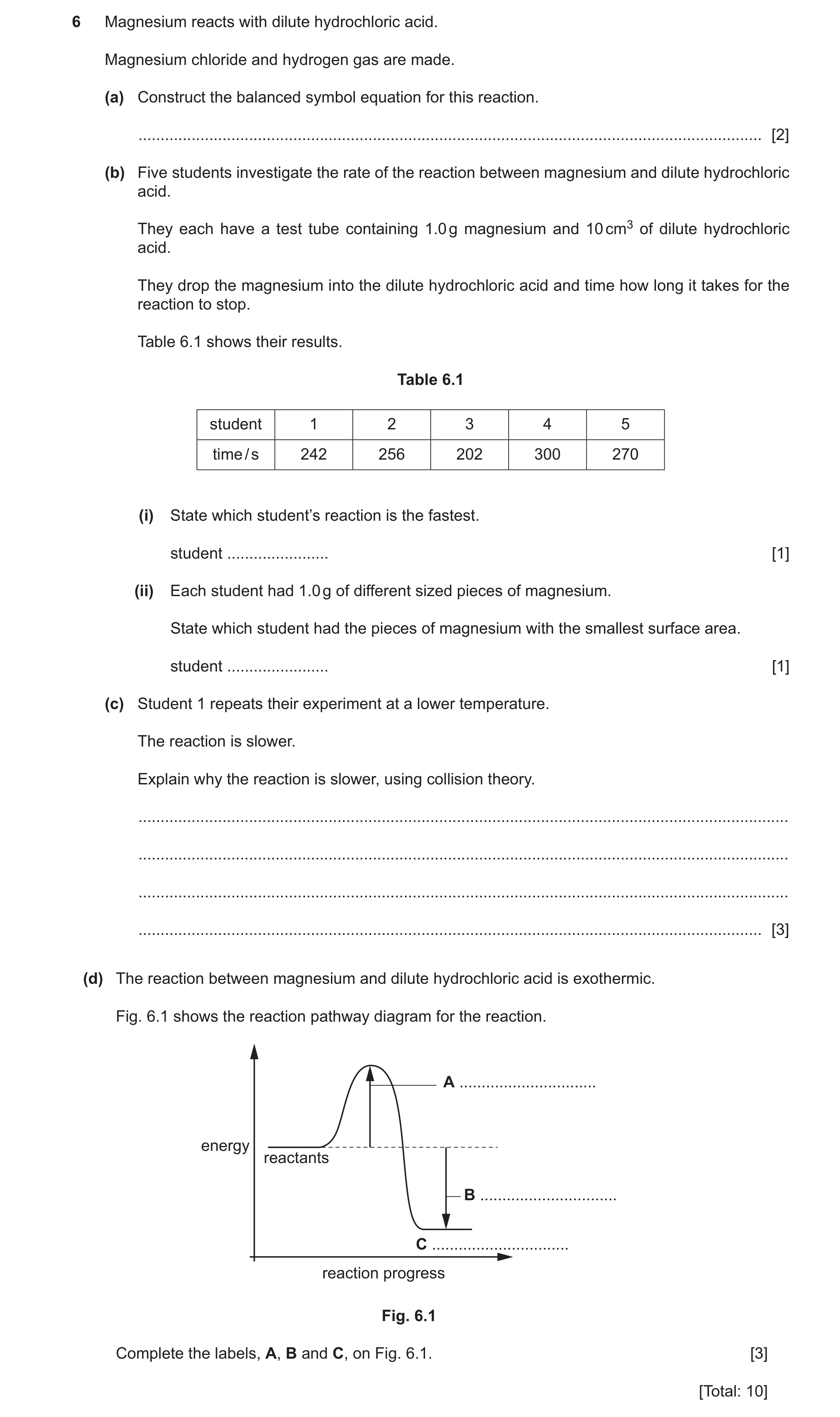
6 Magnesium reacts with dilute hydrochloric acid. Magnesium chloride and hydrogen gas are made. (a) Construct the balanced symbol equation for this reaction. … [2] (b) Five students investigate the rate of the reaction between magnesium and dilute hydrochloric acid. They each have a test tube containing 1.0 g magnesium and 10 cm3 of dilute hydrochloric acid. They drop the magnesium into the dilute hydrochloric acid and time how long it takes for the reaction to stop. Table 6.1 shows their results. Table 6.1 student 1 2 3 4 5 time / s 242 256 202 300 270 (i) State which student’s reaction is the fastest. student … [1] (ii) Each student had 1.0 g of different sized pieces of magnesium. State which student had the pieces of magnesium with the smallest surface area. student … [1] (c) Student 1 repeats their experiment at a lower temperature. The reaction is slower. Explain why the reaction is slower, using collision theory. … … … … [3] (d) The reaction between magnesium and dilute hydrochloric acid is exothermic. Fig. 6.1 shows the reaction pathway diagram for the reaction. A … energy reactants B … C … reaction progress Fig. 6.1 Complete the labels, A, B and C, on Fig. 6.1. [3] [Total: 10]
10 marks
Mark scheme: 6(a) Mg + 2HCl → MgCl2 + H2 ; ; 2 6(b)(i) (student) 3 ; 1 6(b)(ii) (student) 4 ; 1 6(c) any three from: 3 molecules have lower (average) energy / molecules are moving slower fewer molecules with activation energy frequency of collision of molecules is, lower / fewer, collisions per second less successful collisions ; ; ; 6(d) A - Activation energy ; 3 B - Enthalpy change; C - Products ;
This question in 0654/42 Feb/March 2025
Q26 · The metal iron is extracted from hematite in a blast furnace 0654/41 May/June 2025
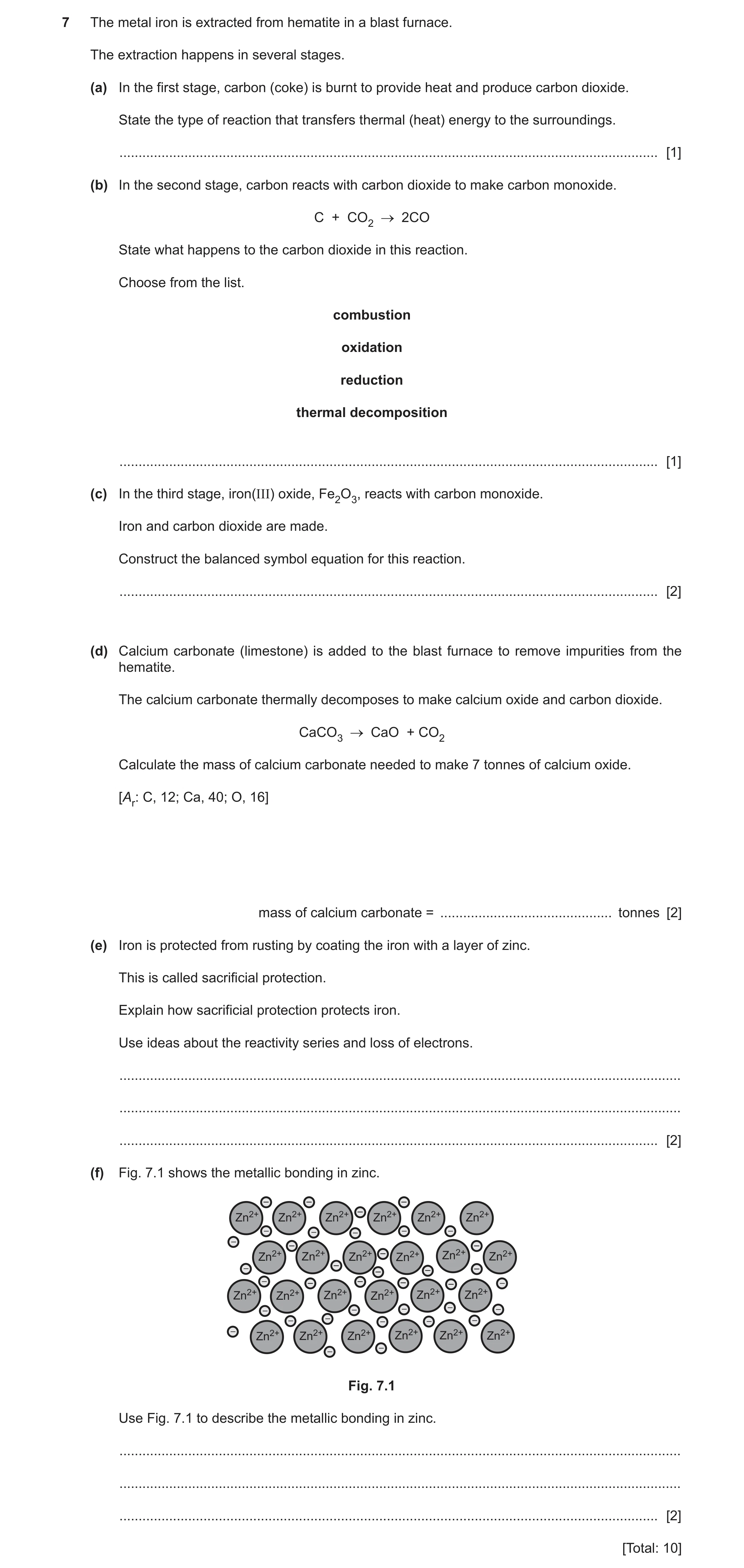
7 The metal iron is extracted from hematite in a blast furnace. The extraction happens in several stages. (a) In the first stage, carbon (coke) is burnt to provide heat and produce carbon dioxide. State the type of reaction that transfers thermal (heat) energy to the surroundings. … [1] (b) In the second stage, carbon reacts with carbon dioxide to make carbon monoxide. C + CO2 2CO State what happens to the carbon dioxide in this reaction. Choose from the list. combustion oxidation reduction thermal decomposition … [1] (c) In the third stage, iron(III) oxide, Fe2O3, reacts with carbon monoxide. Iron and carbon dioxide are made. Construct the balanced symbol equation for this reaction. … [2] (d) Calcium carbonate (limestone) is added to the blast furnace to remove impurities from the hematite. The calcium carbonate thermally decomposes to make calcium oxide and carbon dioxide. CaCO3 CaO + CO2 Calculate the mass of calcium carbonate needed to make 7 tonnes of calcium oxide. [Ar: C, 12; Ca, 40; O, 16] mass of calcium carbonate = … tonnes [2] (e) Iron is protected from rusting by coating the iron with a layer of zinc. This is called sacrificial protection. Explain how sacrificial protection protects iron. Use ideas about the reactivity series and loss of electrons. … … … [2] (f) Fig. 7.1 shows the metallic bonding in zinc. – – – Zn2+ Zn2+ Zn2+ – Zn2+ Zn2+ Zn2+ – – – – – – – – Zn2+ Zn2+ Zn2+ – Zn2+ Zn2+ Zn2+ – – – – – – – – – – – Zn2+ Zn2+ Zn2+ Zn2+ Zn2+ Zn2+ – – – – – – – – – – – Zn2+ Zn2+ Zn2+ Zn2+ Zn2+ Zn2+ – – Fig. 7.1 Use Fig. 7.1 to describe the metallic bonding in zinc. … … … [2] [Total: 10]
10 marks
Mark scheme: 7(a) exothermic ; 1 7(b) reduction ; 1 7(c) Fe2O3 + 3CO → 2Fe + 3CO2 ;; 2 7(d) Mr of CaCO3 = 100 and Mr of CaO = 56 ; 2 100 7 = 12.5 (tonnes) ; 56 7(e) zinc is more reactive than iron / ORA ; 2 zinc loses electrons more easily than iron / ORA ; 7(f) electrostatic attraction ; 2 between positive (zinc / metal) ions and (a ‘sea’ of) delocalised electrons ;
This question in 0654/41 May/June 2025
Q27 · A student reacts hydrochloric acid with sodium carbonate 0654/43 May/June 2025
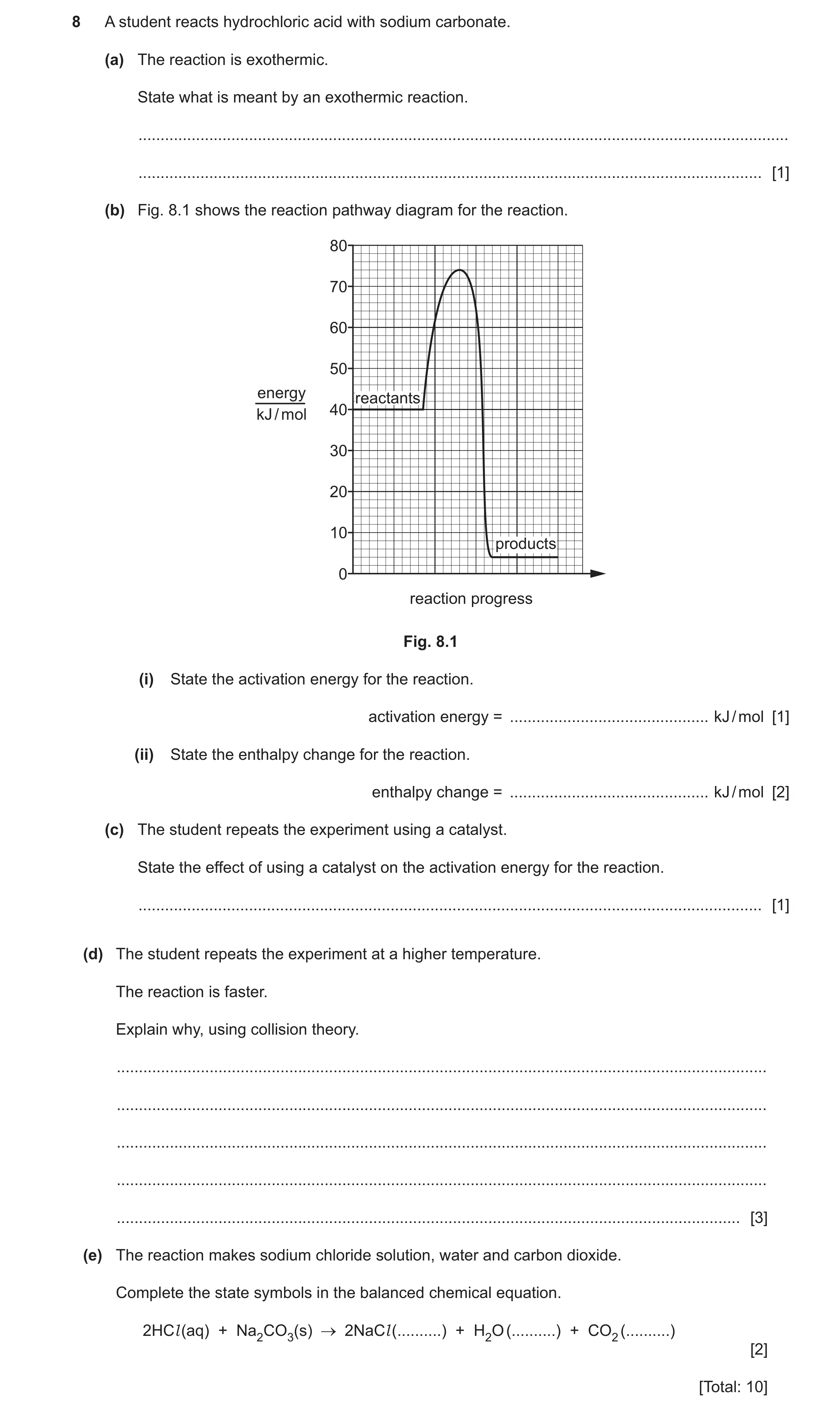
8 A student reacts hydrochloric acid with sodium carbonate. (a) The reaction is exothermic. State what is meant by an exothermic reaction. … … [1] (b) Fig. 8.1 shows the reaction pathway diagram for the reaction. 80 70 60 50 energy reactants 40 kJ / mol 30 20 10 products 0 reaction progress Fig. 8.1 (i) State the activation energy for the reaction. activation energy = … kJ / mol [1] (ii) State the enthalpy change for the reaction. enthalpy change = … kJ / mol [2] (c) The student repeats the experiment using a catalyst. State the effect of using a catalyst on the activation energy for the reaction. … [1] (d) The student repeats the experiment at a higher temperature. The reaction is faster. Explain why, using collision theory. … … … … … [3] (e) The reaction makes sodium chloride solution, water and carbon dioxide. Complete the state symbols in the balanced chemical equation. 2HCl (aq) + Na2CO3(s) 2NaCl ( … ) + H2O ( … ) + CO2 ( … ) [2] [Total: 10]
10 marks
Mark scheme: 8(a) (reaction that) transfers / releases thermal energy to the surroundings; 1 8(b)(i) 34 (kJ/ mol); 1 8(b)(ii) 36 (kJ/ mol); 2 –; 8(c) decreases / AW; 1 8(d) any three from: 3 molecules have higher (average) kinetic energy / molecules are moving faster; more molecules / collisions with (energy greater than or equal to) activation energy; more successful collisions; 8(e) NaCl (aq) 2 H2O (l) CO2 (g);;
This question in 0654/43 May/June 2025
Q28 · A student investigates the decomposition of hydrogen peroxide, H2O2 0654/43 Oct/Nov 2025
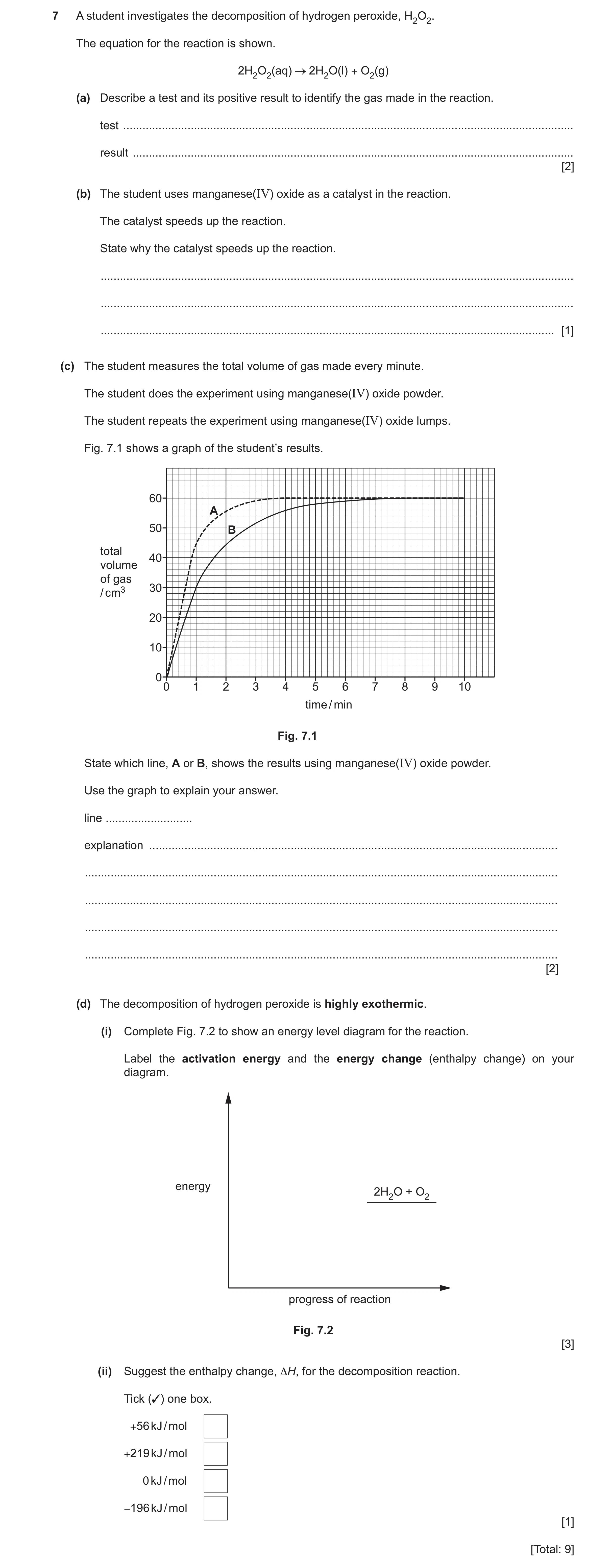
7 A student investigates the decomposition of hydrogen peroxide, H2O2. The equation for the reaction is shown. 2H2O2(aq) 2H2O(l) + O2(g) (a) Describe a test and its positive result to identify the gas made in the reaction. test … result … [2] (b) The student uses manganese(IV) oxide as a catalyst in the reaction. The catalyst speeds up the reaction. State why the catalyst speeds up the reaction. … … … [1] (c) The student measures the total volume of gas made every minute. The student does the experiment using manganese(IV) oxide powder. The student repeats the experiment using manganese(IV) oxide lumps. Fig. 7.1 shows a graph of the student’s results. 60 A 50 B total 40 volume of gas / cm3 30 20 10 0 0 1 2 3 4 5 6 7 8 9 10 time / min Fig. 7.1 State which line, A or B, shows the results using manganese(IV) oxide powder. Use the graph to explain your answer. line … explanation … … … … … [2] (d) The decomposition of hydrogen peroxide is highly exothermic. (i) Complete Fig. 7.2 to show an energy level diagram for the reaction. Label the activation energy and the energy change (enthalpy change) on your diagram. energy 2H2O + O2 progress of reaction Fig. 7.2 [3] (ii) Suggest the enthalpy change, ΔH, for the decomposition reaction. Tick (3) one box. +56 kJ / mol +219 kJ / mol 0 kJ / mol −196 kJ / mol [1] [Total: 9]
9 marks
Mark scheme: 7(a) test: glowing splint ; 2 result: relights ; 7(b) (catalyst) decrease the activation energy (of the reaction) / (catalyst) decrease the Ea (of the reaction) ; 1 7(c) (line A) 2 the line is steeper / line has larger gradient ; higher rate of reaction / reaction is faster / the reaction finishes first / volume of gas increases faster ; 7(d)(i) 3 reactants line drawn above products line ; arrow correctly labelled activation energy ; arrow correctly labelled energy change ; 7(d)(ii) 1 +56 kJ / mol +219 kJ / mol 0 kJ / mol –196 kJ / mol ✓
This question in 0654/43 Oct/Nov 2025
 42 / 53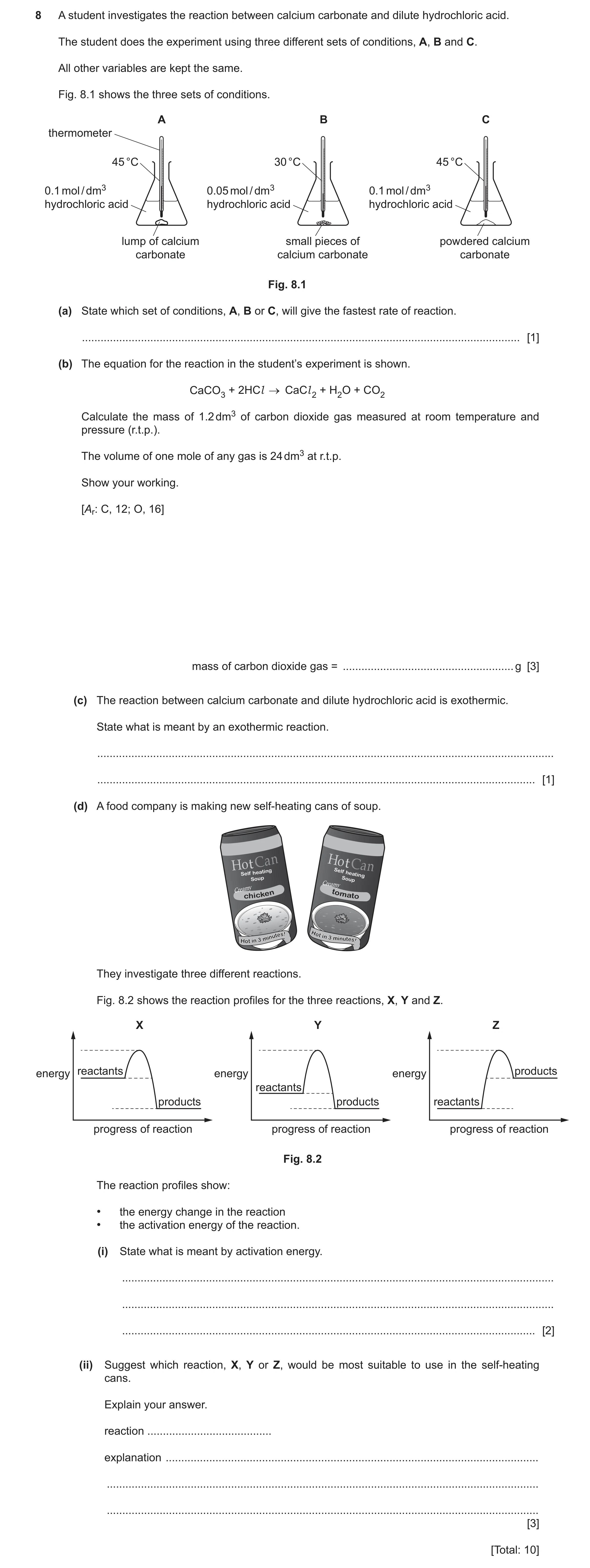
 9
9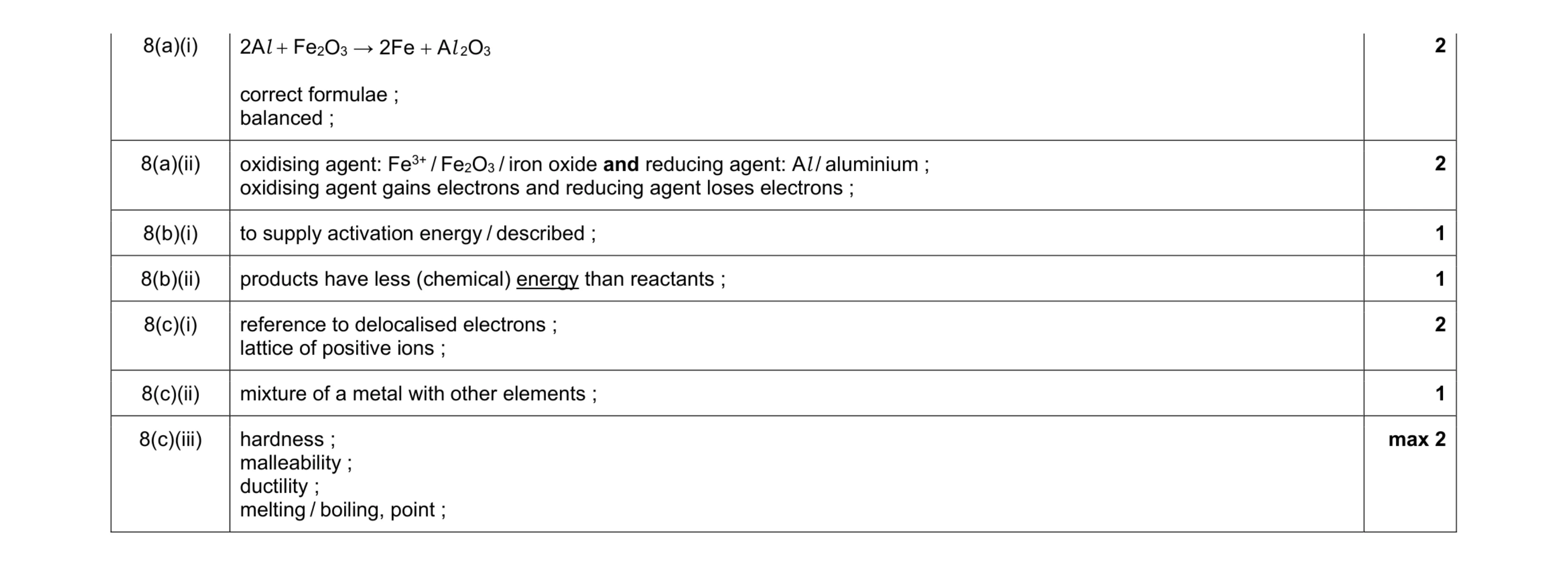 11
11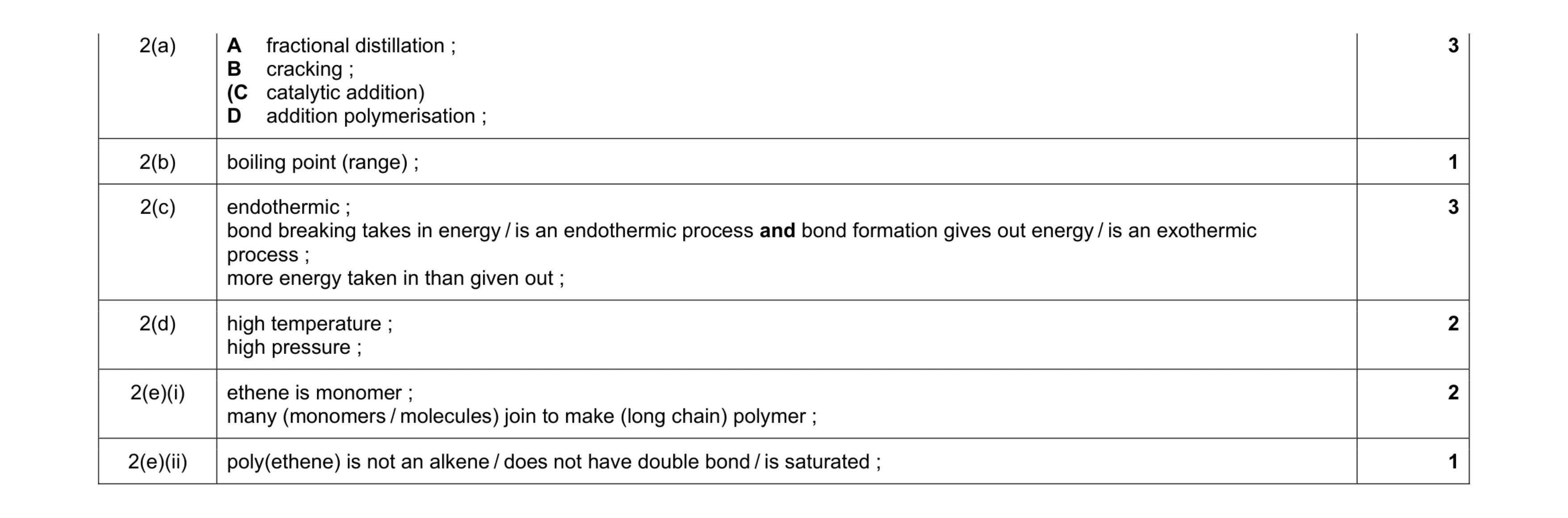 12
12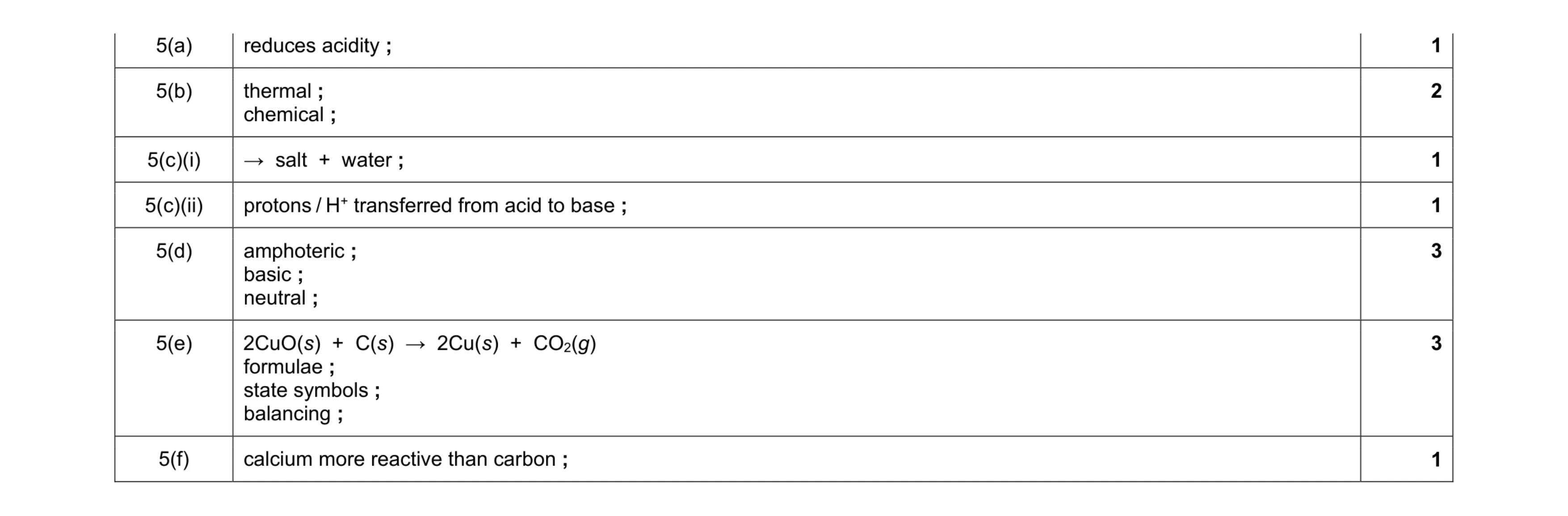 12
12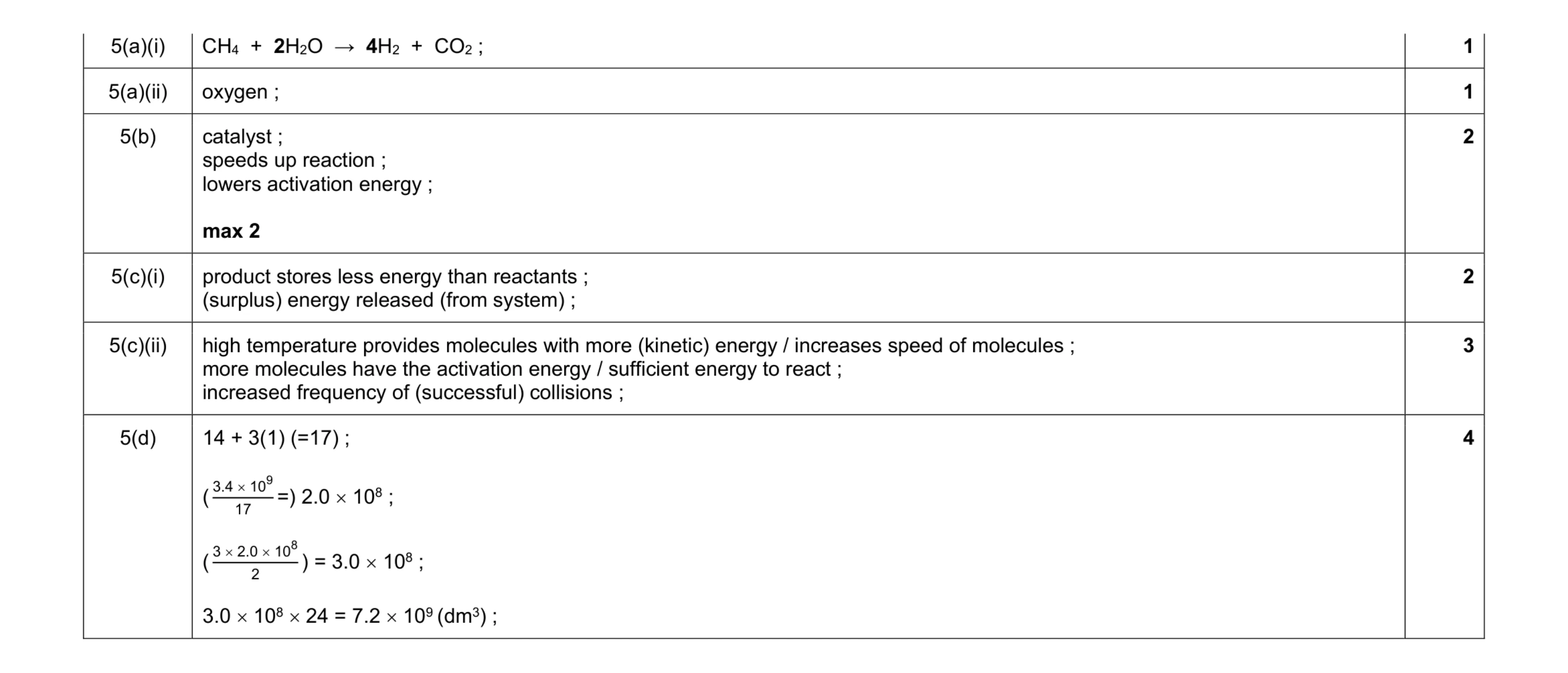 13
13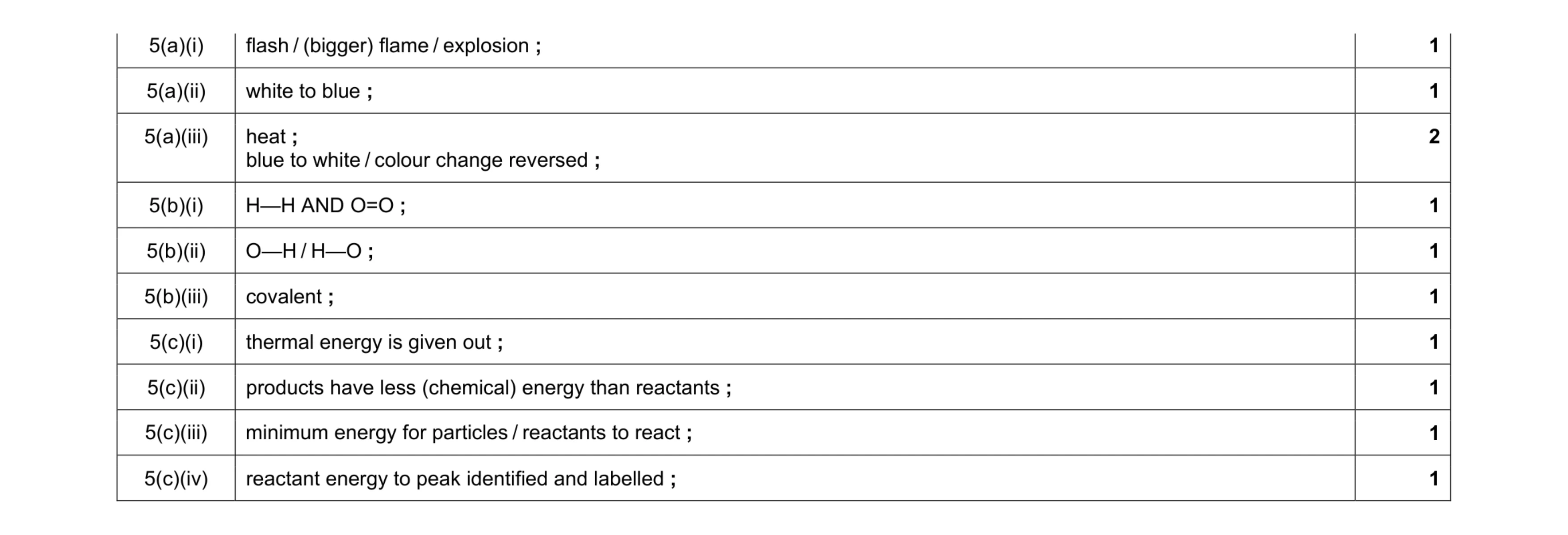 11
11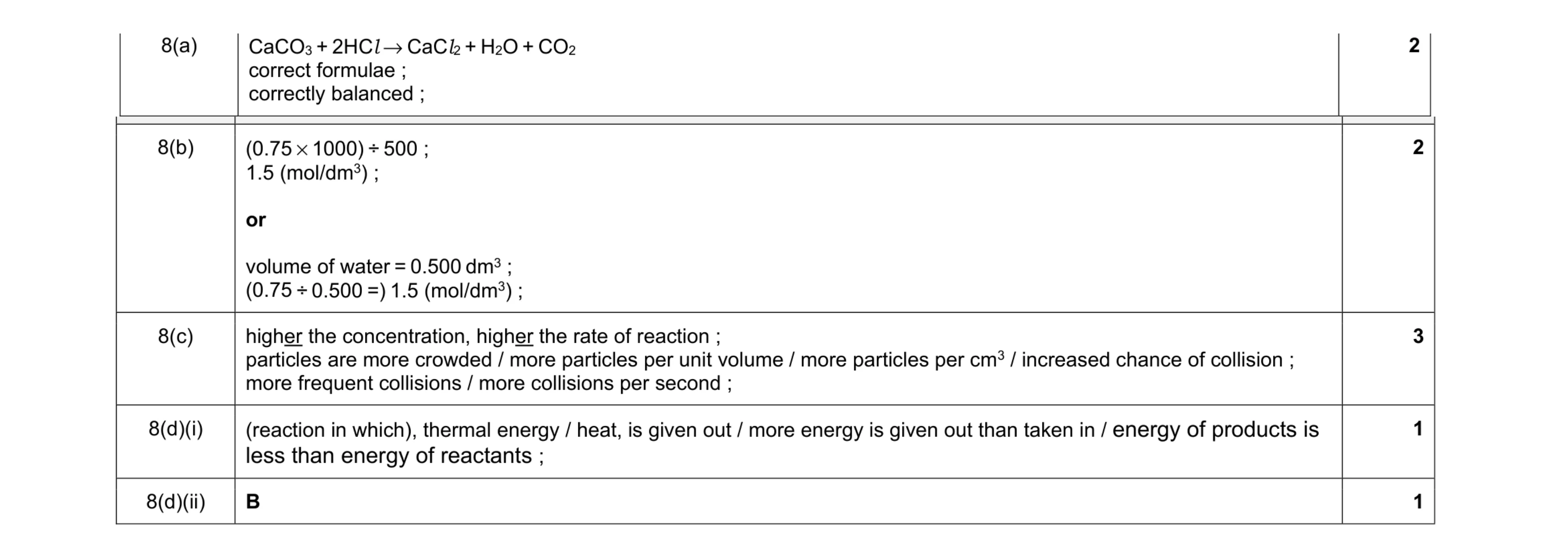 9
9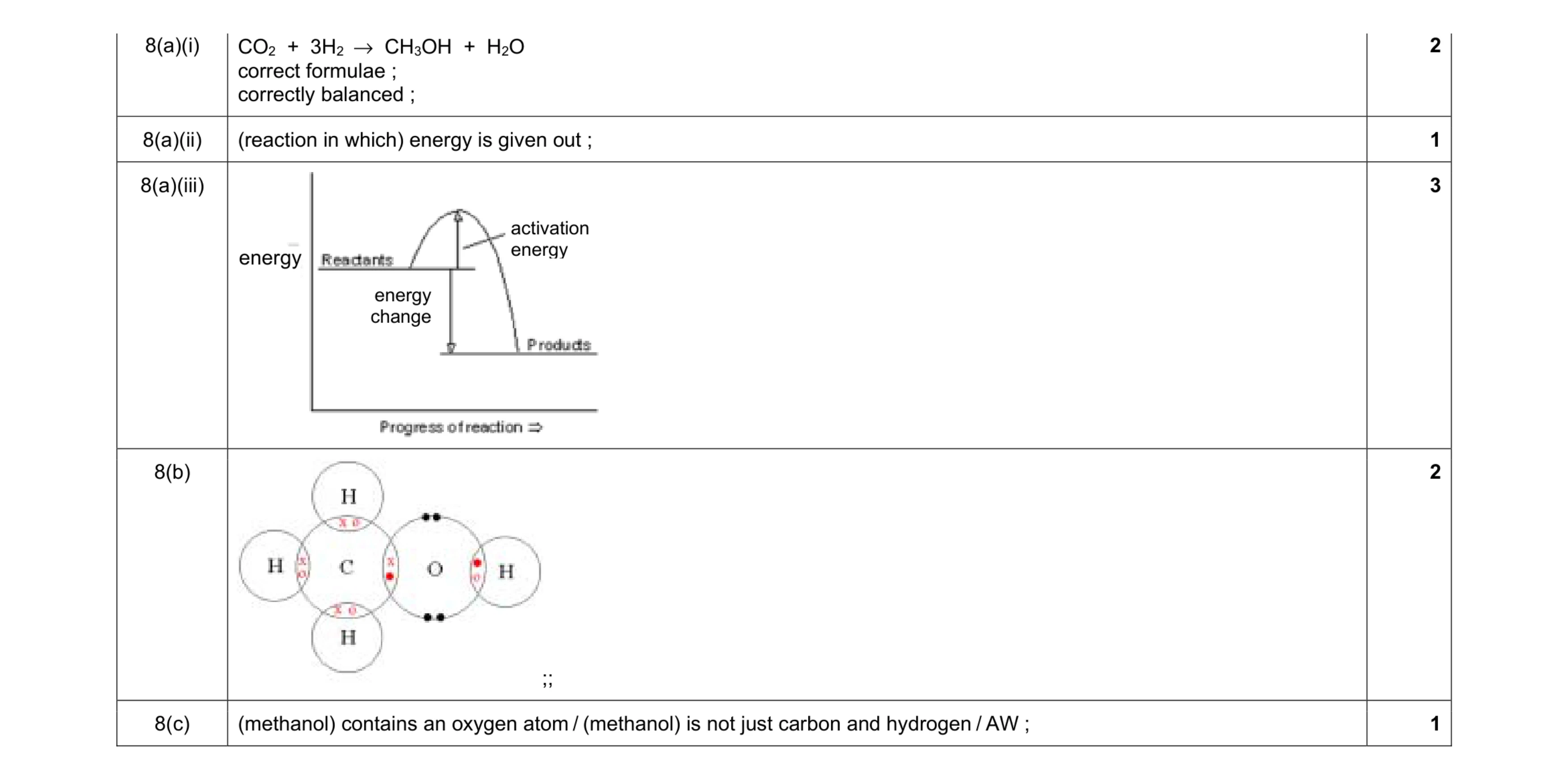 9
9 8
8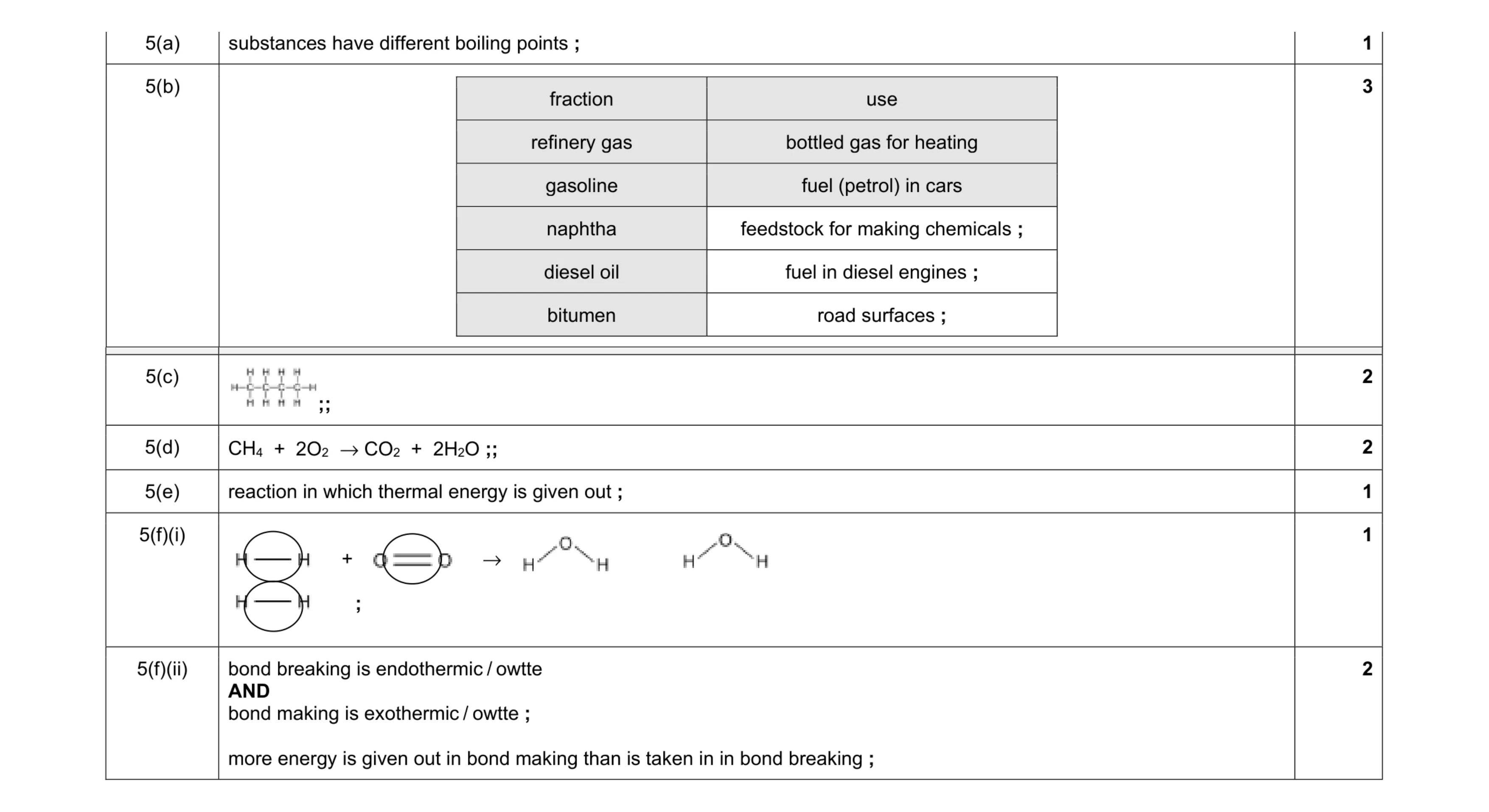 12
12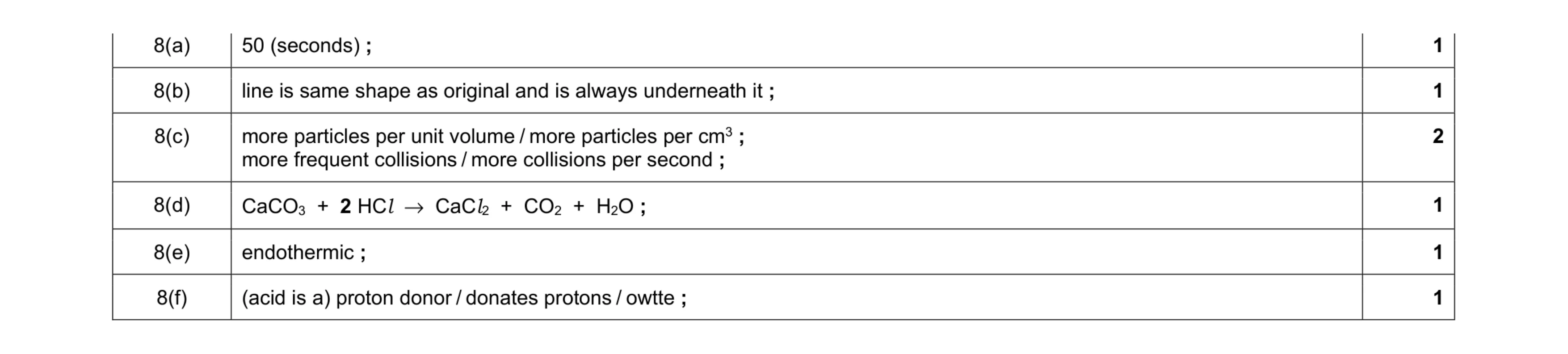 7
7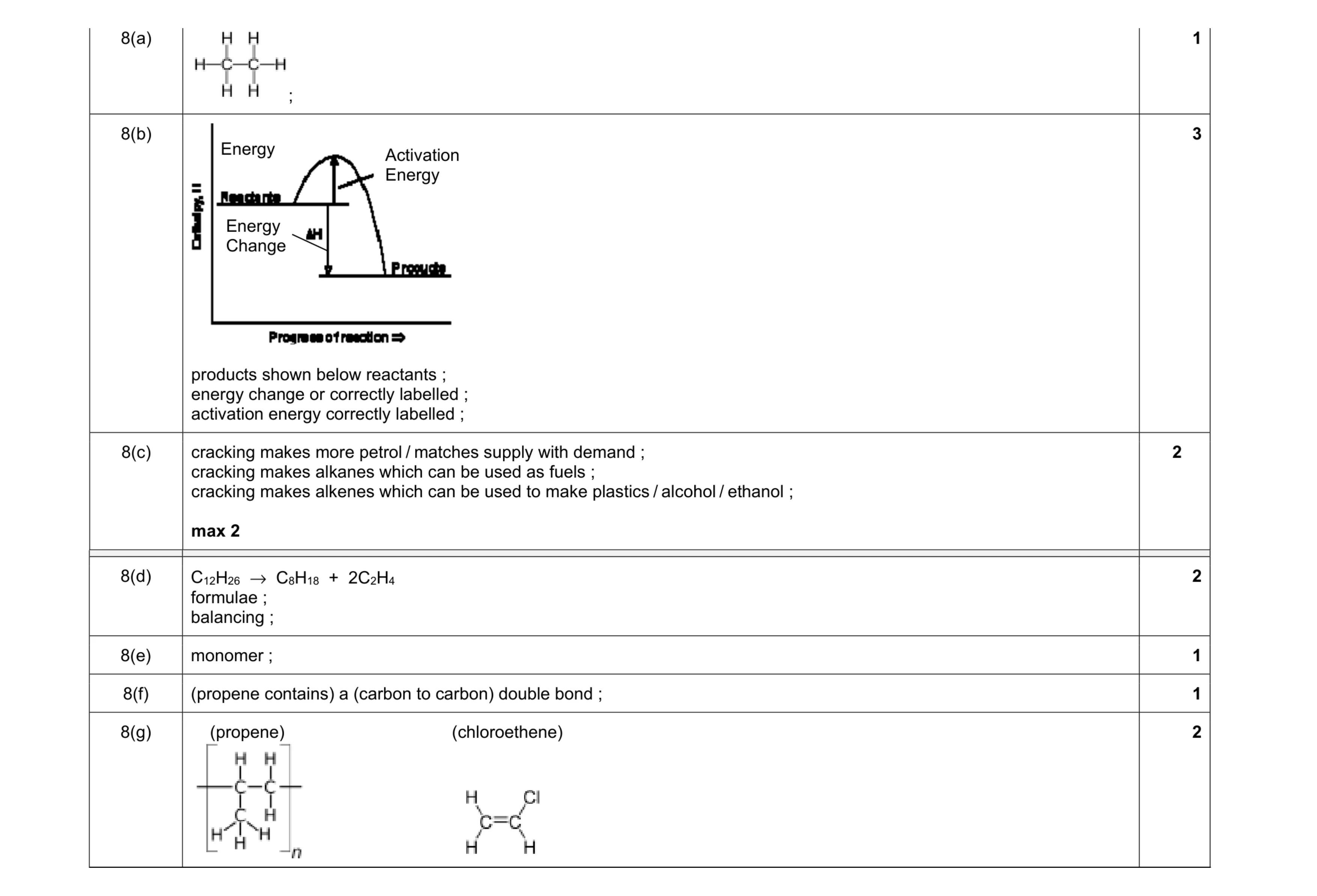 12
12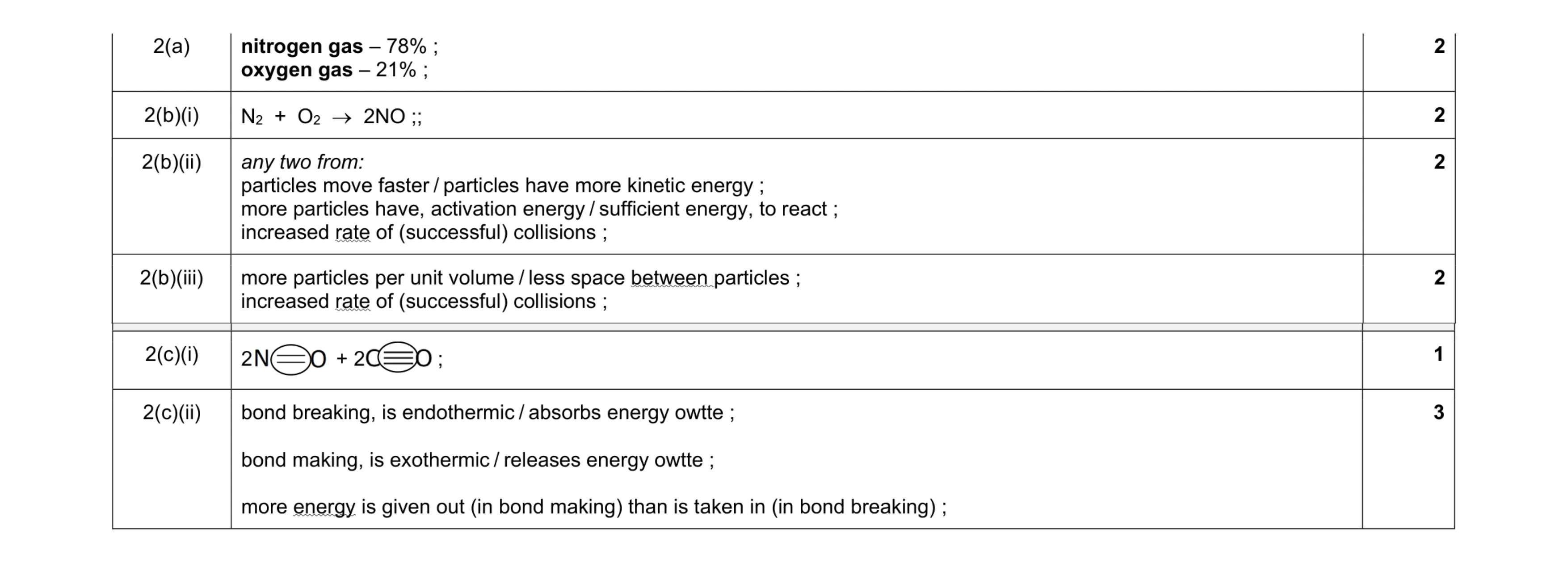 12
12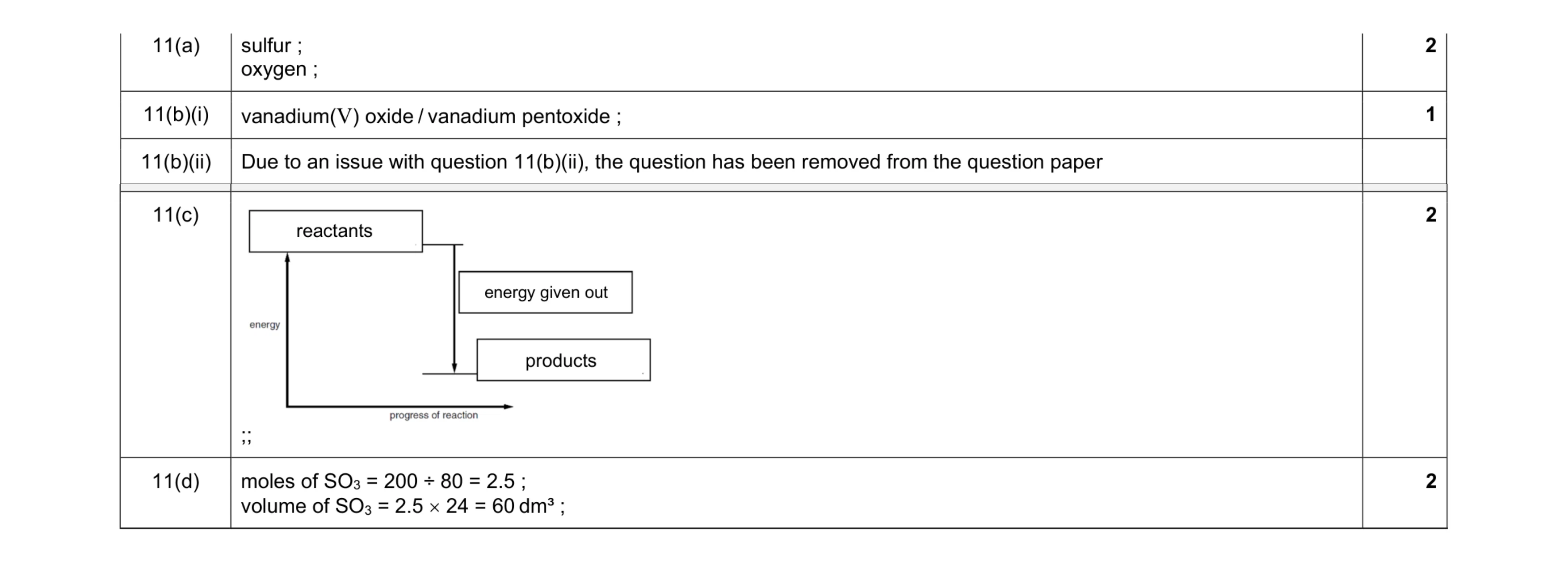 11
11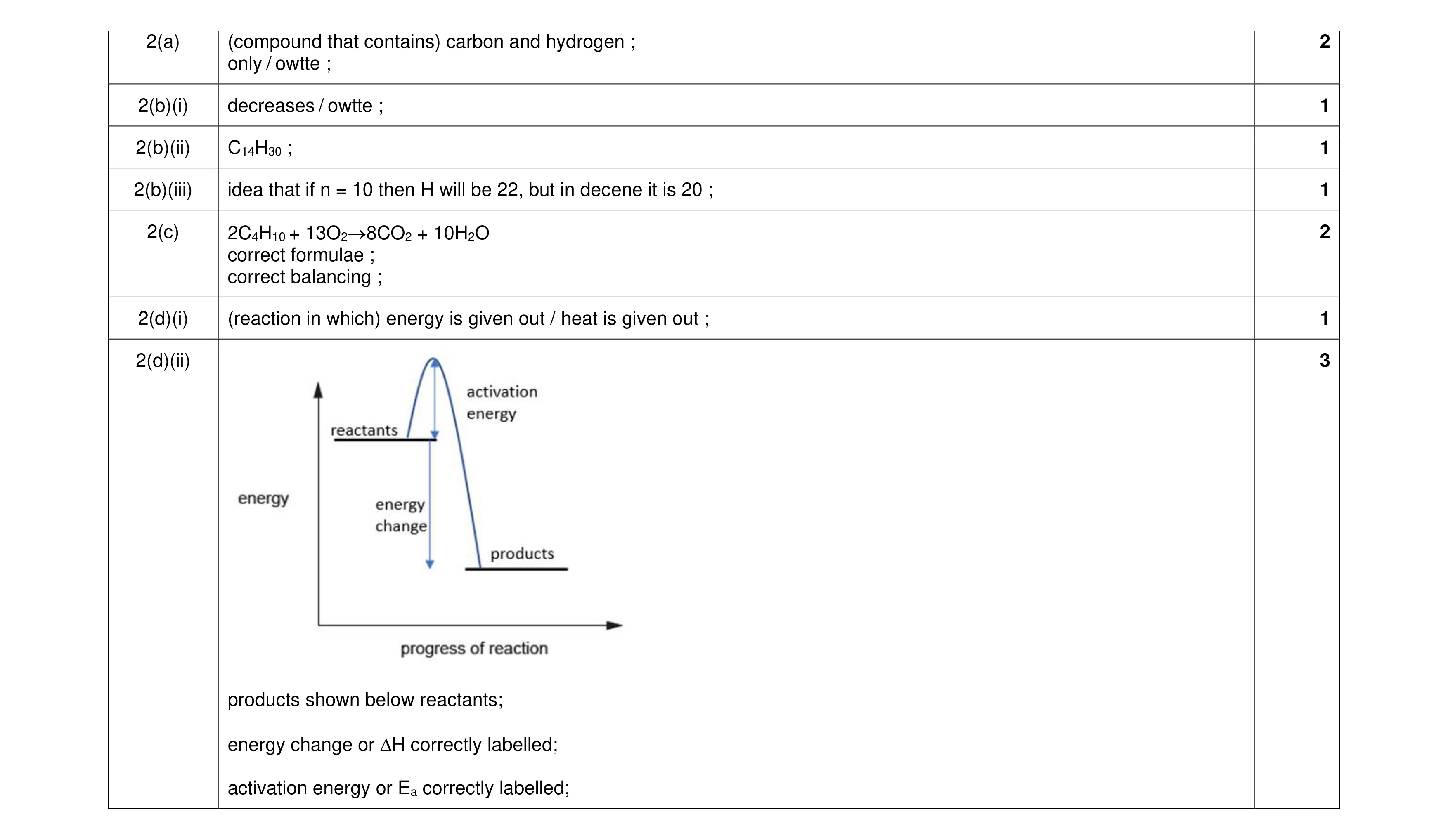 11
11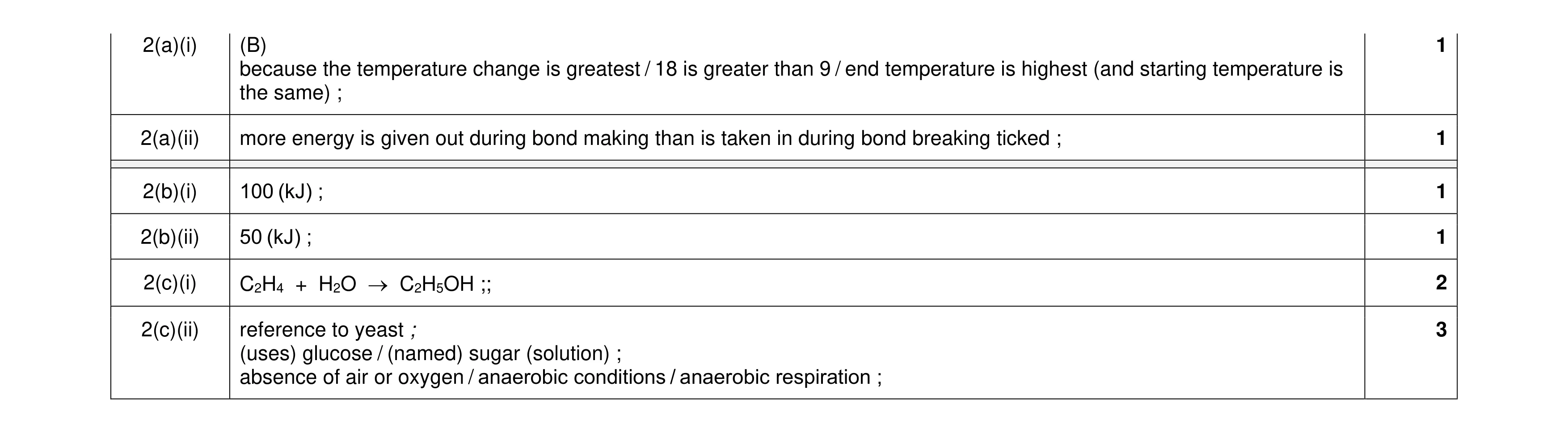 9
9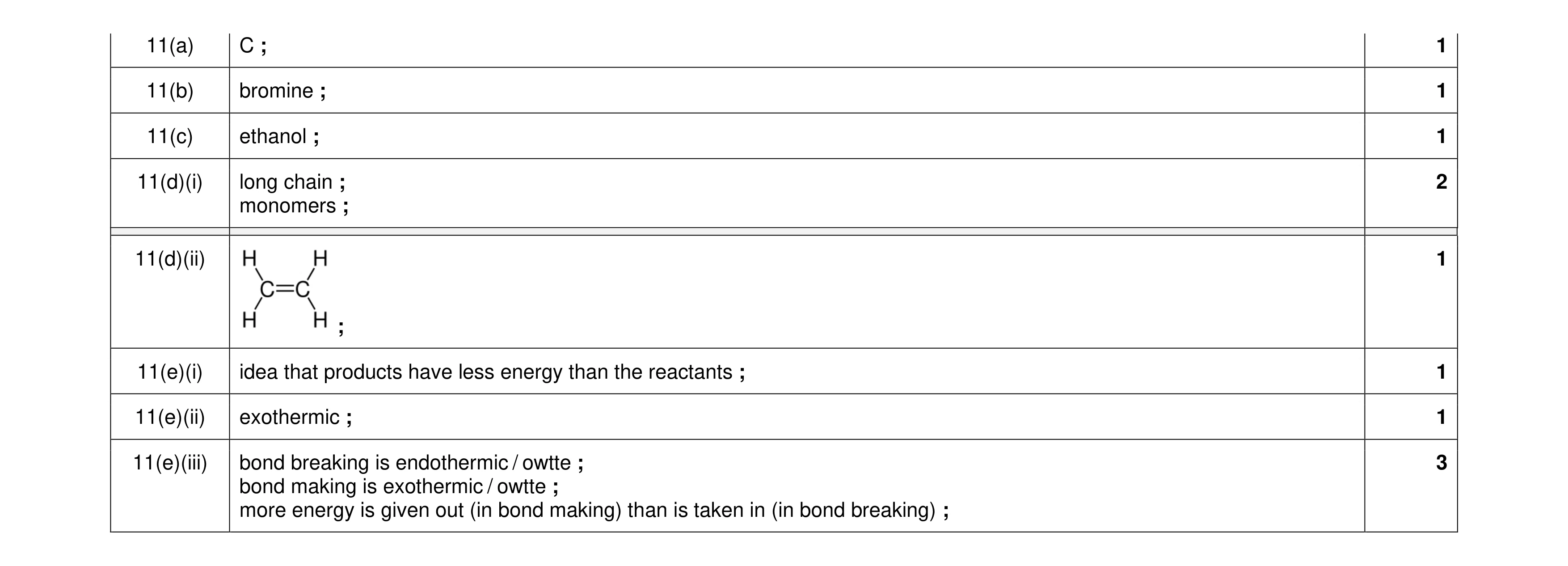 11
11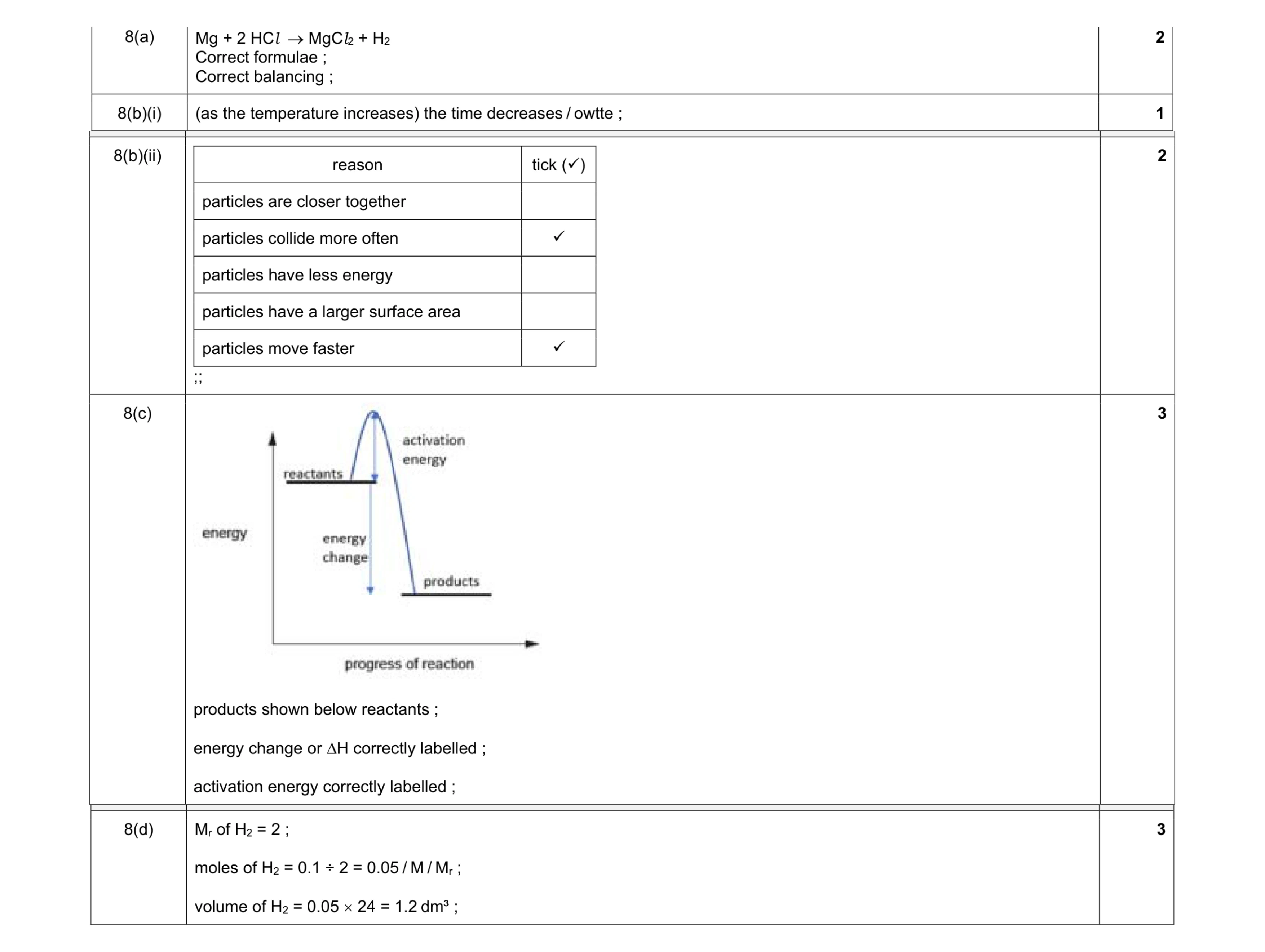 11
11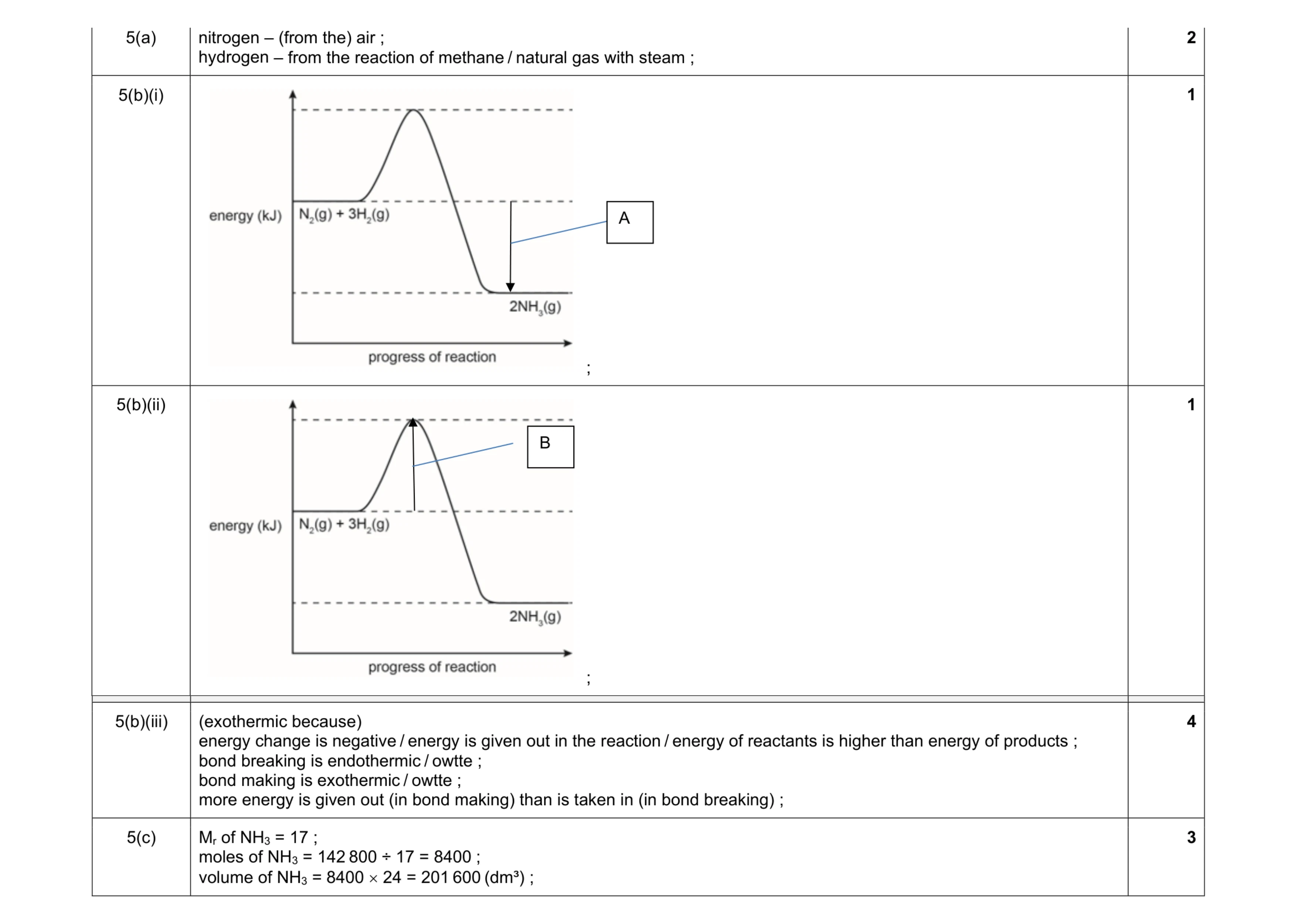 11
11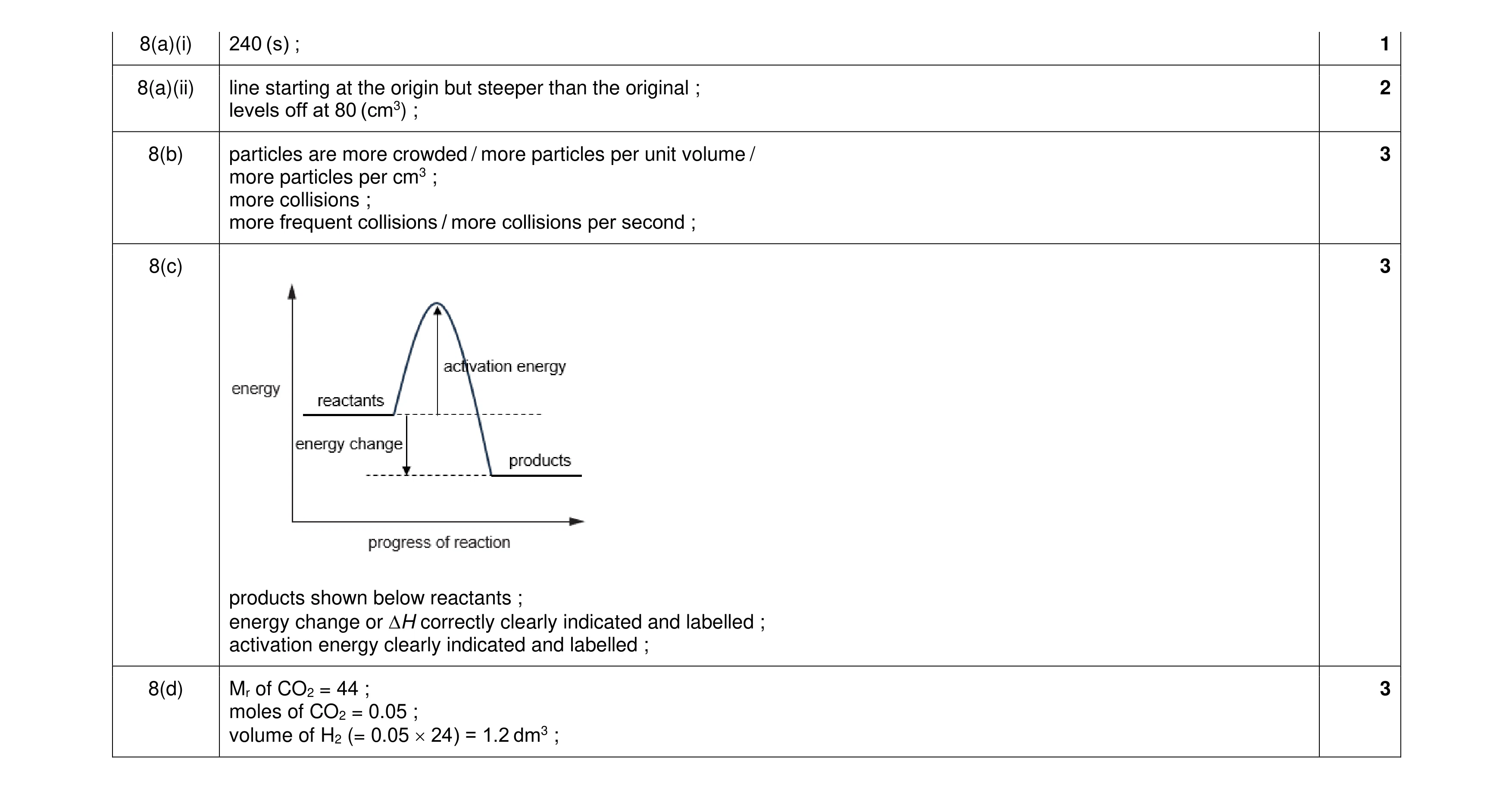 12
12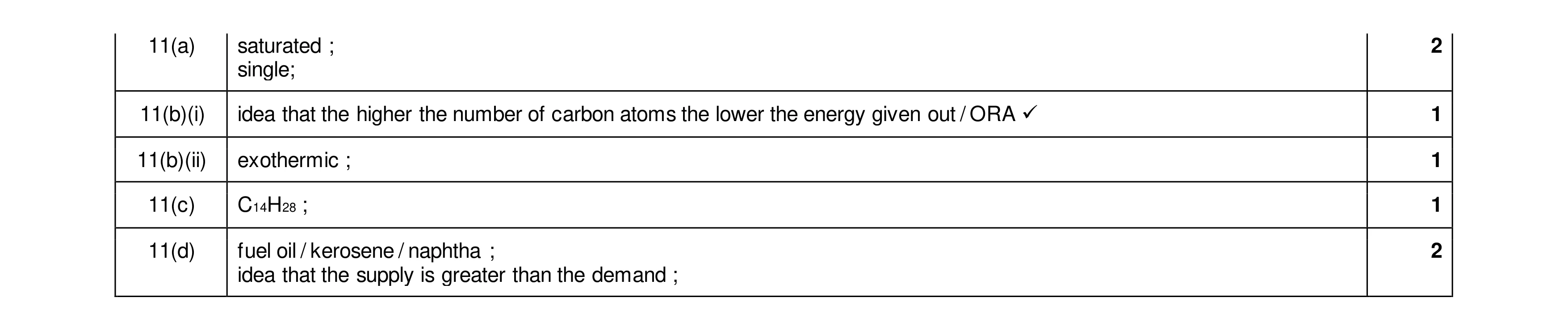 7
7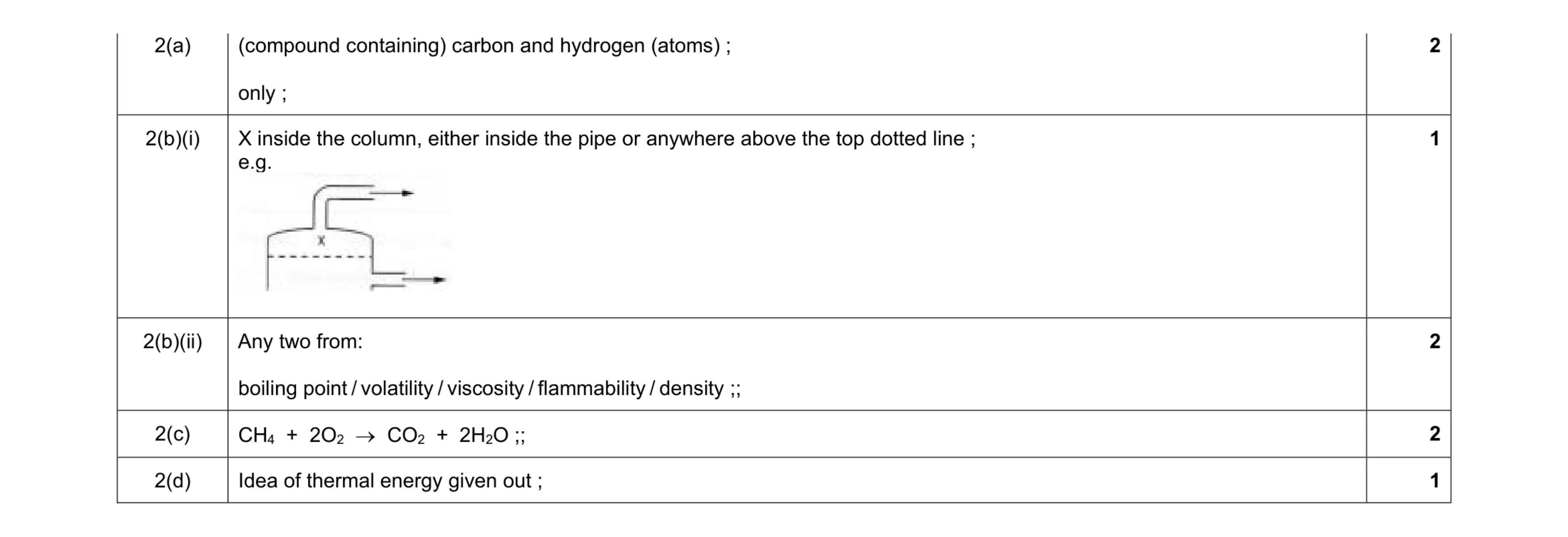 8
8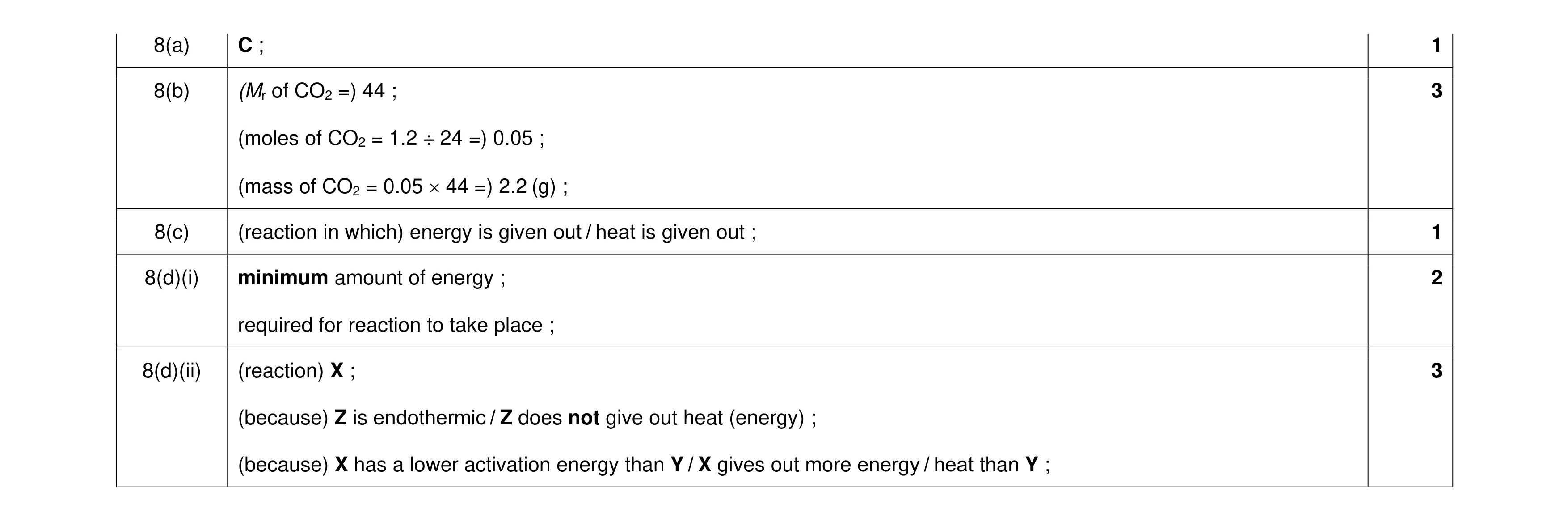 10
10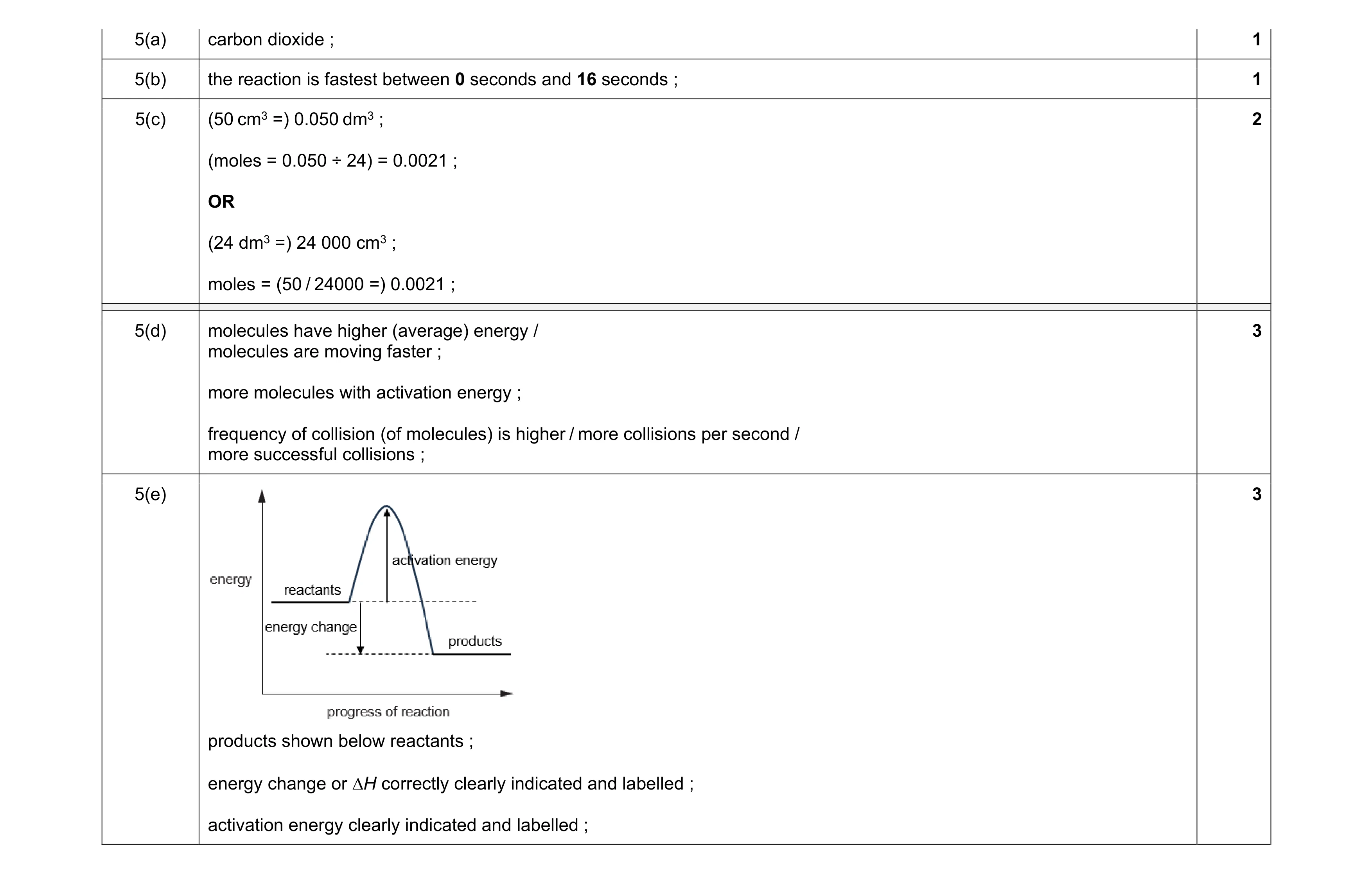 10
10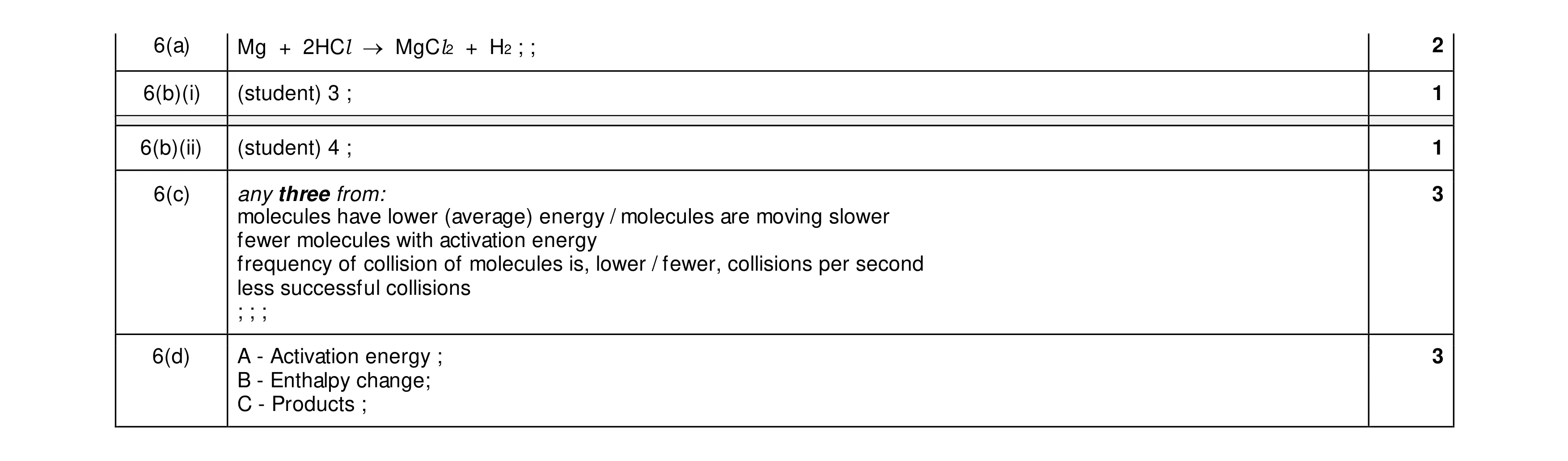 10
10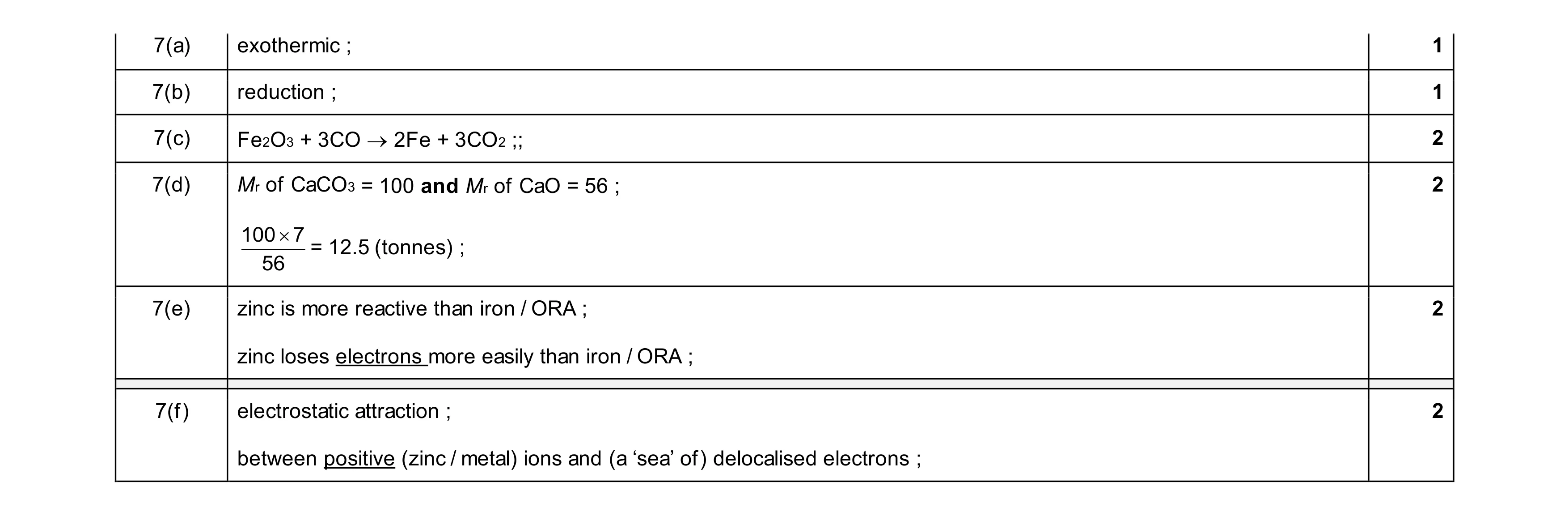 10
10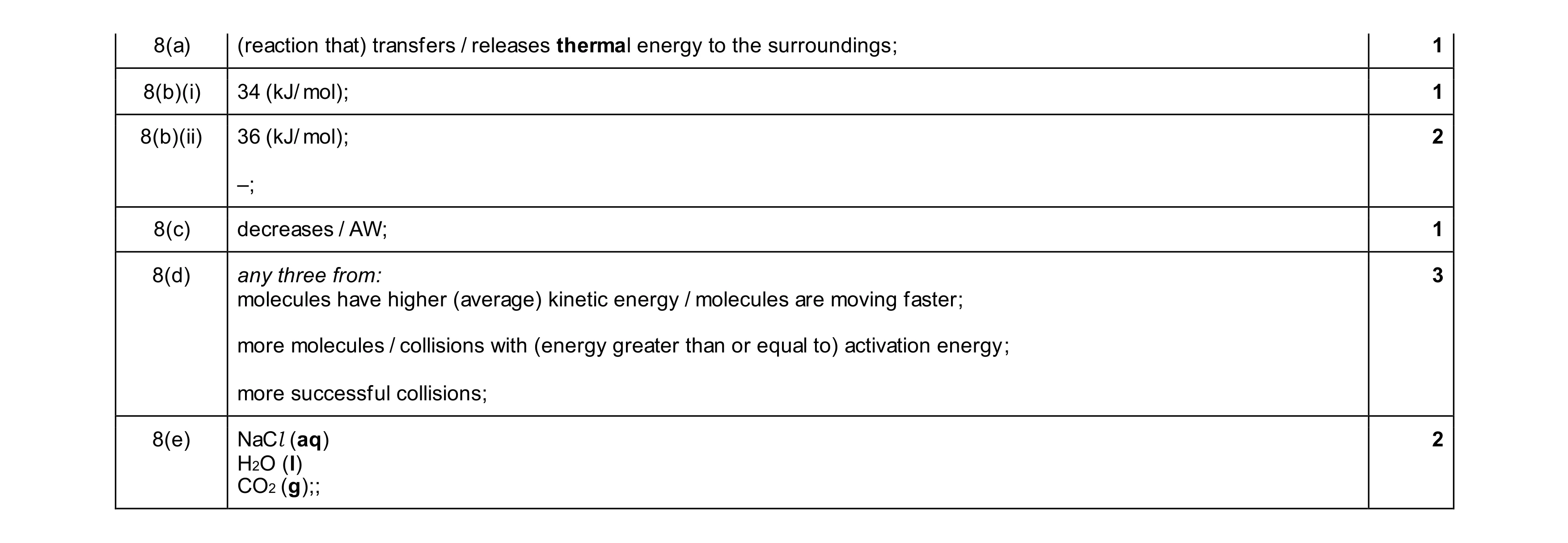 10
10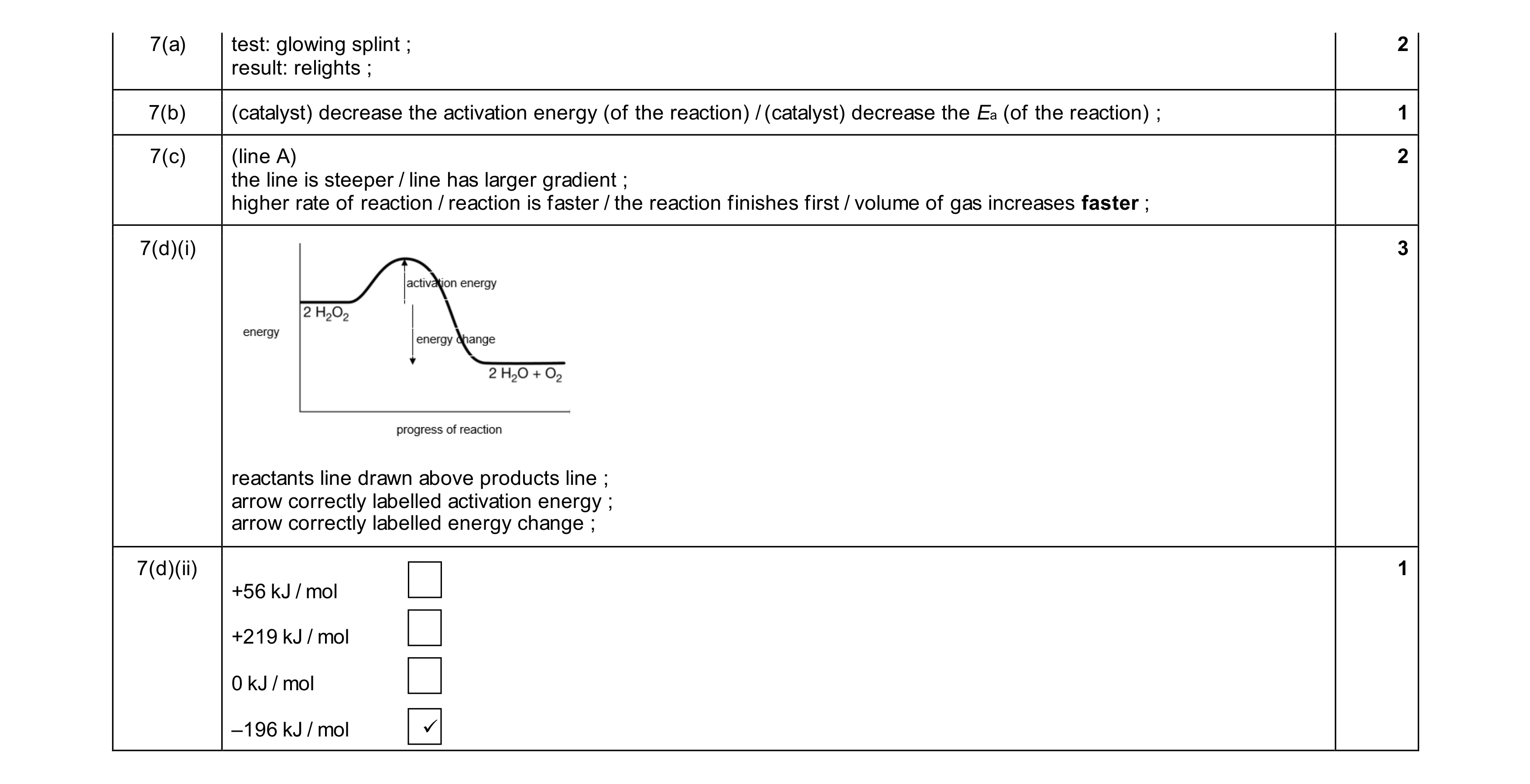 9
9