Questions as text
Q1 · Useful products containing hydrocarbons are obtained from petroleum 0654/31 Oct/Nov 2018
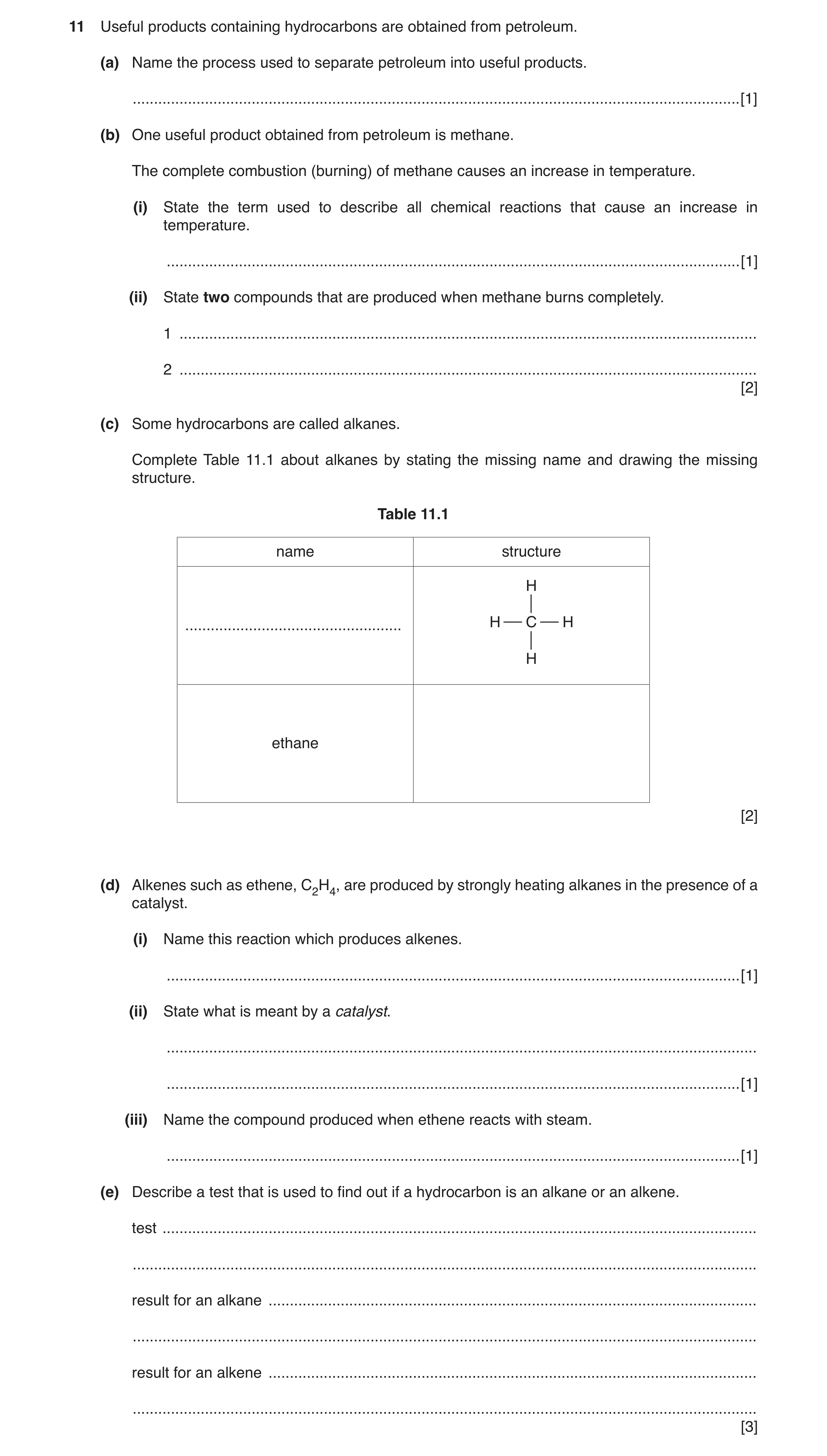
11 Useful products containing hydrocarbons are obtained from petroleum. (a) Name the process used to separate petroleum into useful products. … [1] (b) One useful product obtained from petroleum is methane. The complete combustion (burning) of methane causes an increase in temperature. (i) State the term used to describe all chemical reactions that cause an increase in temperature. … [1] (ii) State two compounds that are produced when methane burns completely. 1 … 2 … [2] (c) Some hydrocarbons are called alkanes. Complete Table 11.1 about alkanes by stating the missing name and drawing the missing structure. Table 11.1 name structure H … H C H H ethane [2] (d) Alkenes such as ethene, C2H4, are produced by strongly heating alkanes in the presence of a catalyst. (i) Name this reaction which produces alkenes. … [1] (ii) State what is meant by a catalyst. … … [1] (iii) Name the compound produced when ethene reacts with steam. … [1] (e) Describe a test that is used to find out if a hydrocarbon is an alkane or an alkene. test … … result for an alkane … … result for an alkene … … [3]
12 marks
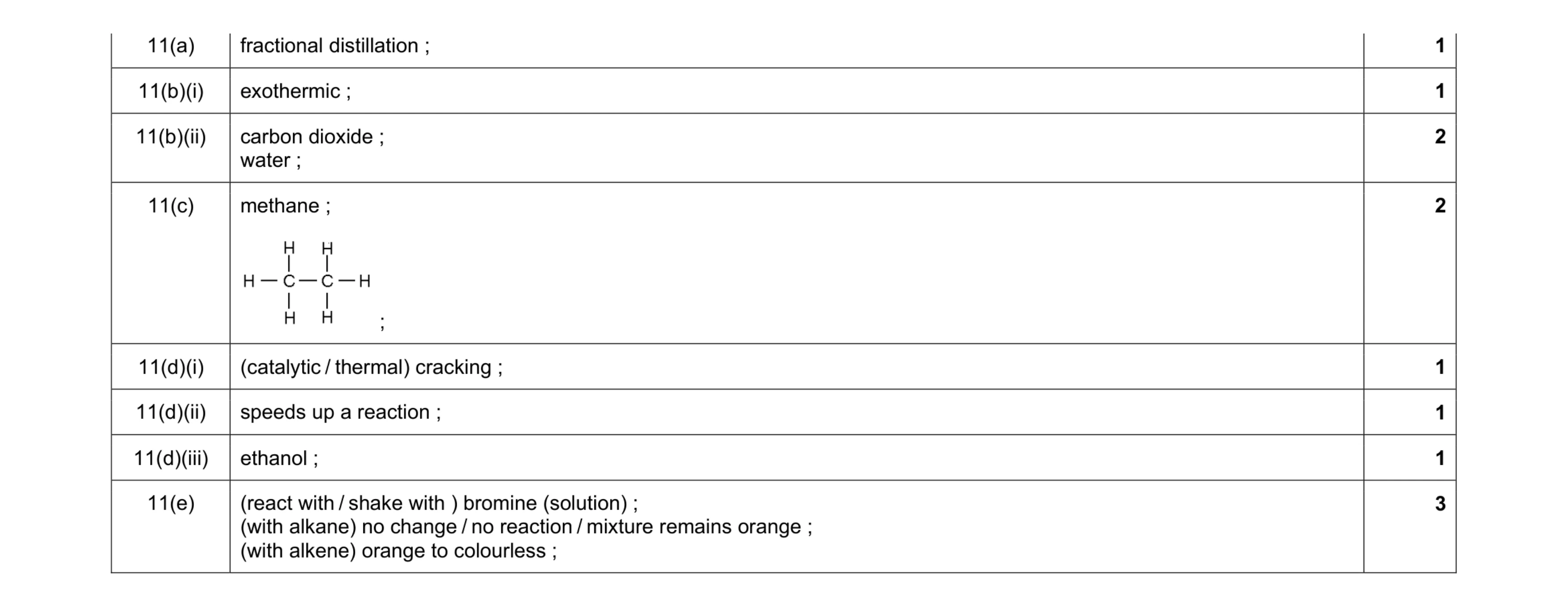
Mark scheme: 11(a) fractional distillation ; 1 11(b)(i) exothermic ; 1 11(b)(ii) carbon dioxide ; water ; 2 11(c) methane ; ; 2 11(d)(i) (catalytic / thermal) cracking ; 1 11(d)(ii) speeds up a reaction ; 1 11(d)(iii) ethanol ; 1 11(e) (react with / shake with ) bromine (solution) ; (with alkane) no change / no reaction / mixture remains orange ; (with alkene) orange to colourless ; 3
This question in 0654/31 Oct/Nov 2018
Q2 · Natural gas is used as a fuel 0654/32 Oct/Nov 2018
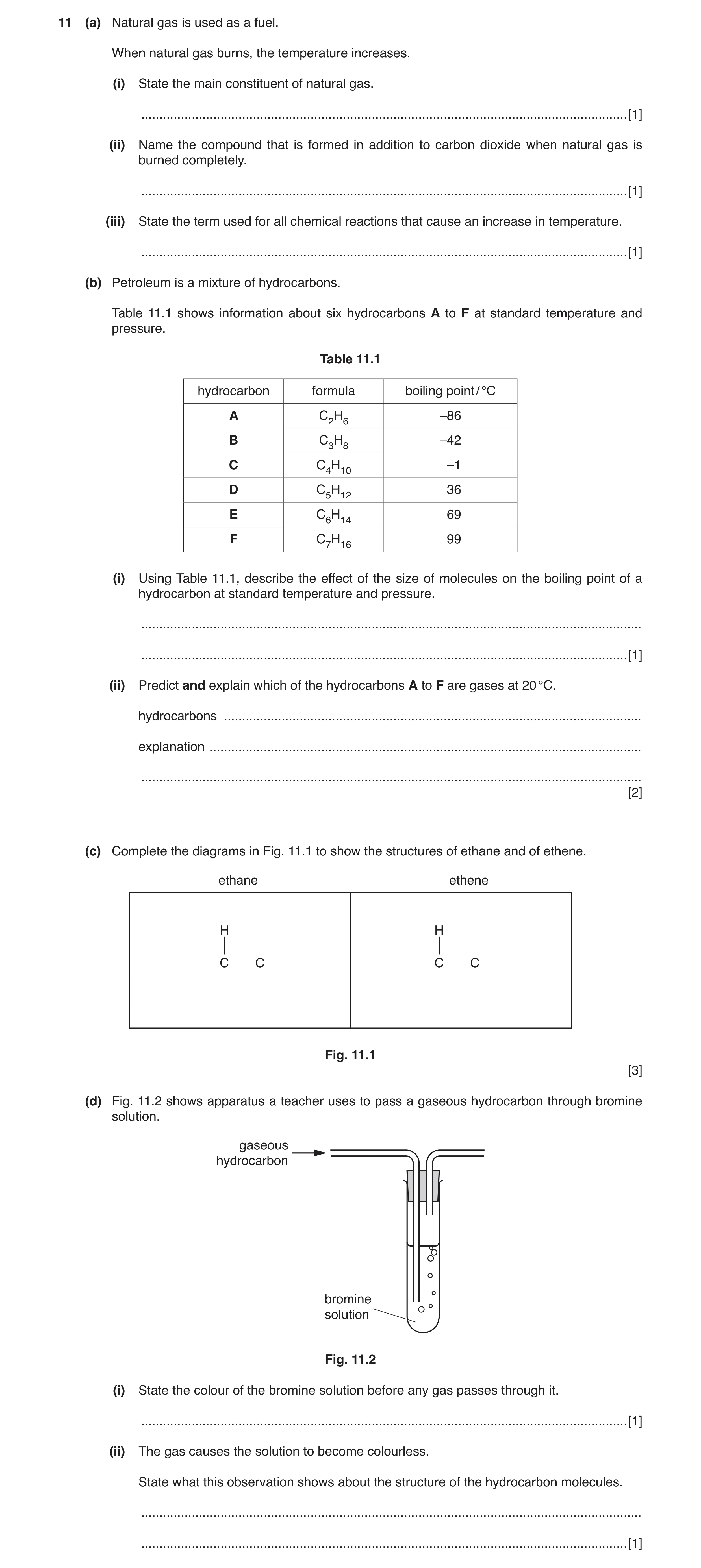
11 (a) Natural gas is used as a fuel. When natural gas burns, the temperature increases. (i) State the main constituent of natural gas. … [1] (ii) Name the compound that is formed in addition to carbon dioxide when natural gas is burned completely. … [1] (iii) State the term used for all chemical reactions that cause an increase in temperature. … [1] (b) Petroleum is a mixture of hydrocarbons. Table 11.1 shows information about six hydrocarbons A to F at standard temperature and pressure. Table 11.1 hydrocarbon formula boiling point / °C A C2H6 –86 B C3H8 –42 C C4H10 –1 D C5H12 36 E C6H14 69 F C7H16 99 (i) Using Table 11.1, describe the effect of the size of molecules on the boiling point of a hydrocarbon at standard temperature and pressure. … … [1] (ii) Predict and explain which of the hydrocarbons A to F are gases at 20 °C. hydrocarbons … explanation … … [2] (c) Complete the diagrams in Fig. 11.1 to show the structures of ethane and of ethene. ethane ethene H H C C C C Fig. 11.1 [3] (d) Fig. 11.2 shows apparatus a teacher uses to pass a gaseous hydrocarbon through bromine solution. gaseous hydrocarbon bromine solution Fig. 11.2 (i) State the colour of the bromine solution before any gas passes through it. … [1] (ii) The gas causes the solution to become colourless. State what this observation shows about the structure of the hydrocarbon molecules. … … [1]
11 marks
Mark scheme: 11(a)(i) methane / CH4; 1 11(a)(ii) water; 1 11(a)(iii) exothermic; 1 11(b)(i) the larger the molecules the higher the boiling point; 1 11(b)(ii) A B C; boiling point is below 20 °C / at 20 °C they will have boiled; 2 11(c) single C-C in ethane and double C=C in ethene; 6 × H and all correct in ethane; 4 × H and all correct in ethene; 3 11(d)(i) orange / brown / yellow; 1 11(d)(ii) unsaturated / contain double (C to C) bonds; 1
This question in 0654/32 Oct/Nov 2018
Q3 · Alkanes and alkenes are types of hydrocarbons 0654/33 Oct/Nov 2018
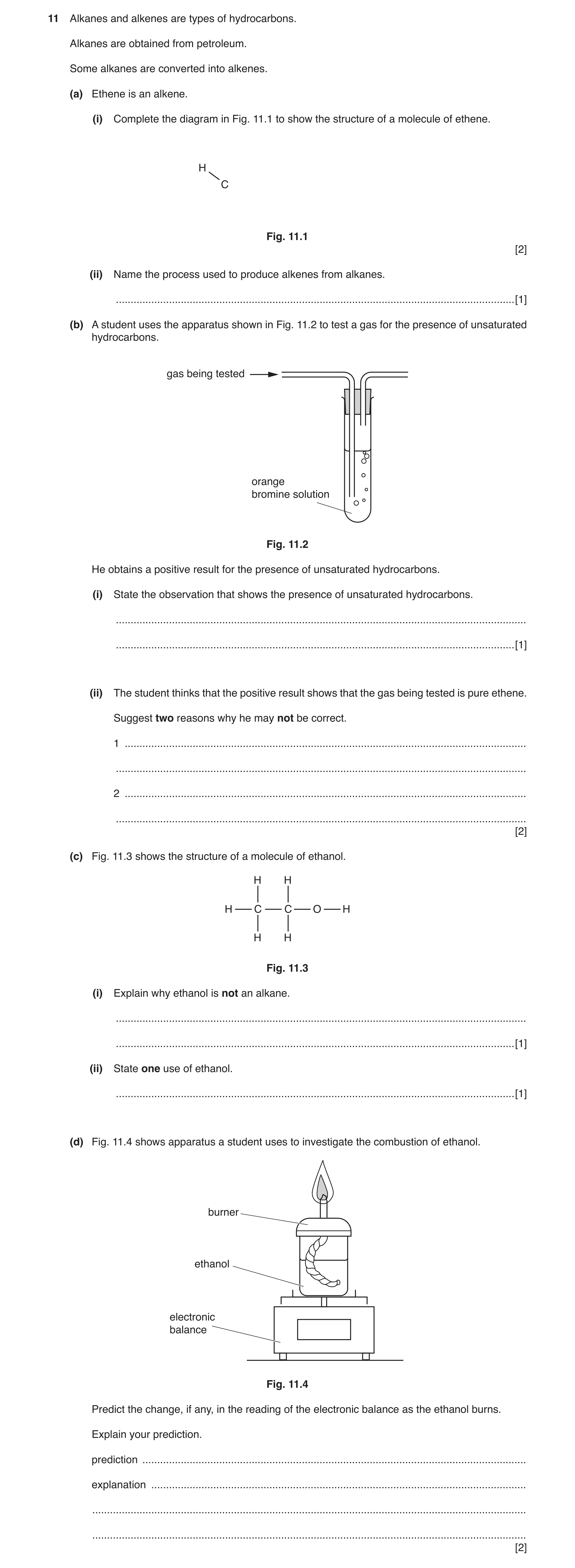
11 Alkanes and alkenes are types of hydrocarbons. Alkanes are obtained from petroleum. Some alkanes are converted into alkenes. (a) Ethene is an alkene. (i) Complete the diagram in Fig. 11.1 to show the structure of a molecule of ethene. H C Fig. 11.1 [2] (ii) Name the process used to produce alkenes from alkanes. … [1] (b) A student uses the apparatus shown in Fig. 11.2 to test a gas for the presence of unsaturated hydrocarbons. gas being tested orange bromine solution Fig. 11.2 He obtains a positive result for the presence of unsaturated hydrocarbons. (i) State the observation that shows the presence of unsaturated hydrocarbons. … … [1] (ii) The student thinks that the positive result shows that the gas being tested is pure ethene. Suggest two reasons why he may not be correct. 1 … … 2 … … [2] (c) Fig. 11.3 shows the structure of a molecule of ethanol. H H H C C O H H H Fig. 11.3 (i) Explain why ethanol is not an alkane. … … [1] (ii) State one use of ethanol. … [1] (d) Fig. 11.4 shows apparatus a student uses to investigate the combustion of ethanol. burner ethanol electronic balance Fig. 11.4 Predict the change, if any, in the reading of the electronic balance as the ethanol burns. Explain your prediction. prediction … explanation … … … [2]
10 marks
Mark scheme: 11(a)(i) carbon - carbon double bond ; 4 carbon hydrogen bonds ; 2 11(a)(ii) (catalytic / thermal) cracking ; 1 11(b)(i) (orange solution) becomes colourless ; 1 11(b)(ii) get the same result if ethene is impure ; get the same result with other alkenes ; 2 11(c)(i) alkanes contain only hydrogen and carbon / do not contain oxygen ; 1 11(c)(ii) solvent / fuel ; 1 11(d) reading decreases ; water (vapour) / carbon dioxide are released / the idea that the amount of matter in the burner reduces ; 2
This question in 0654/33 Oct/Nov 2018
Q4 · The substances calcium, calcium carbonate and calcium oxide react separately with dilute… 0654/32 May/June 2019
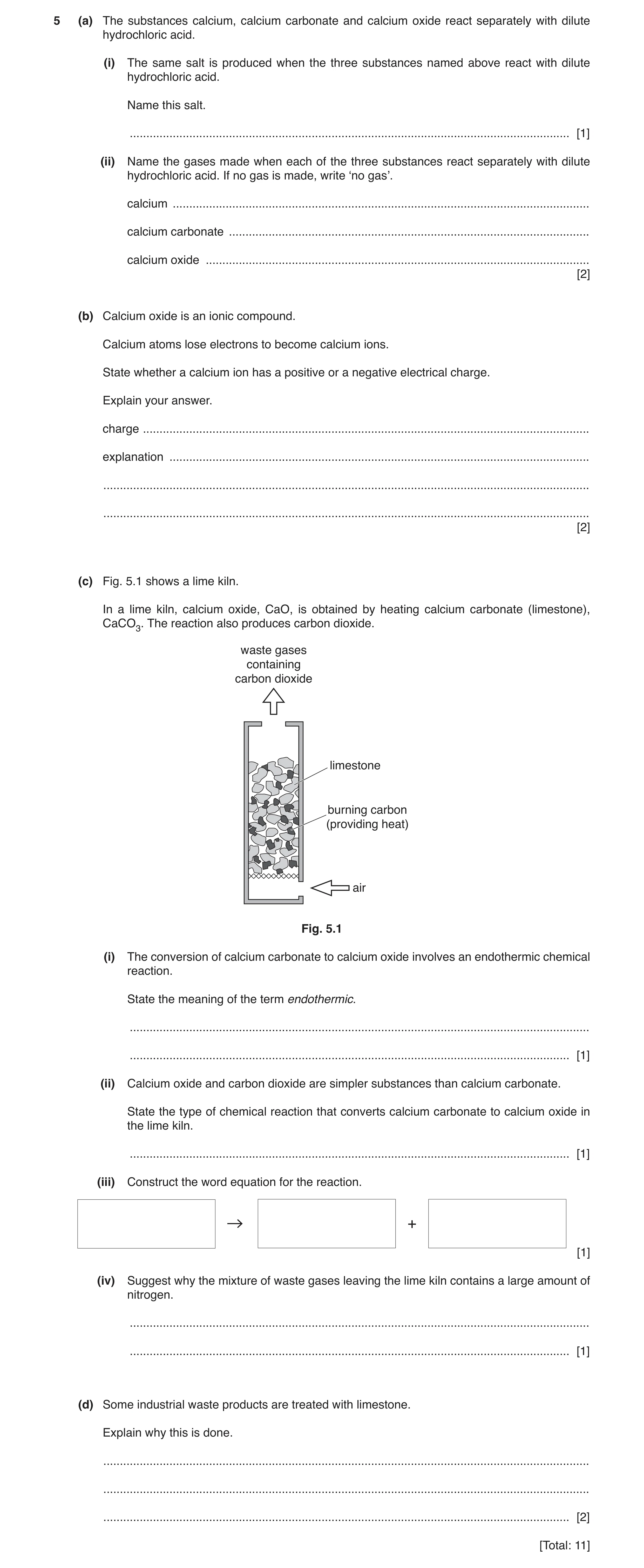
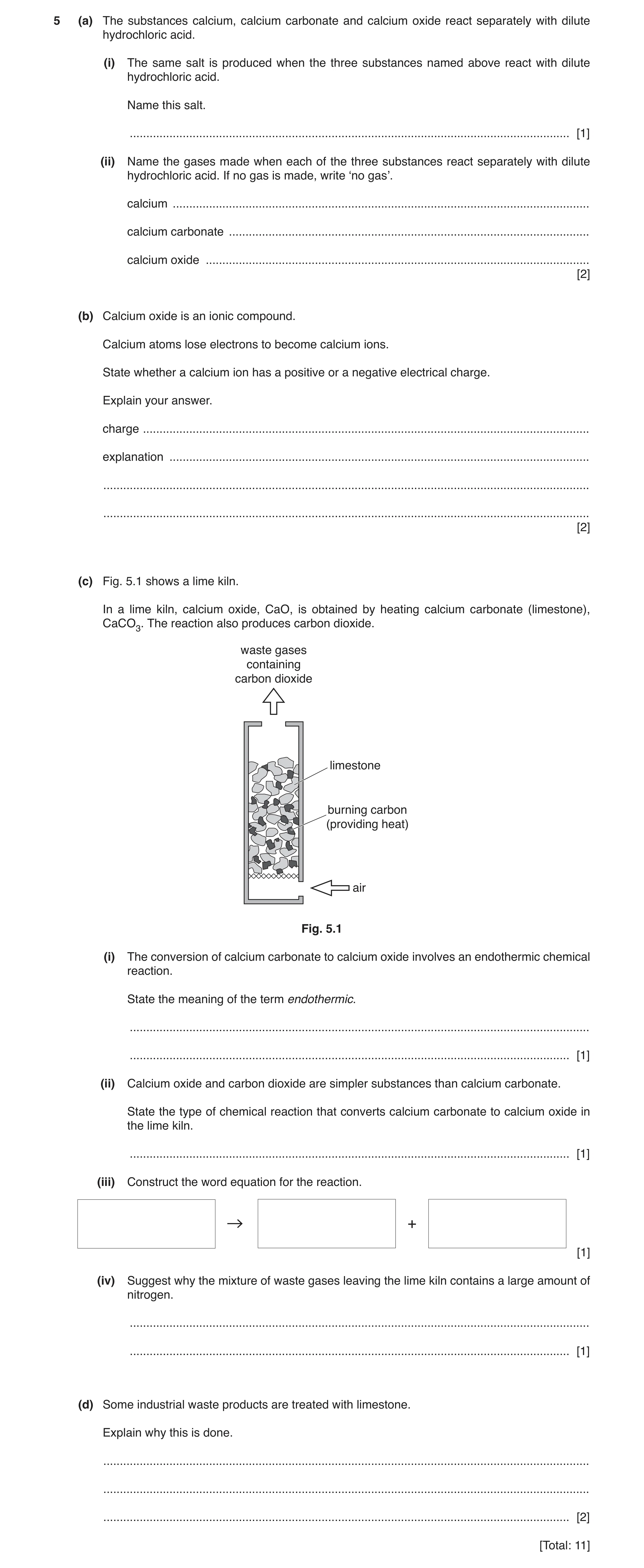
5 (a) The substances calcium, calcium carbonate and calcium oxide react separately with dilute hydrochloric acid. (i) The same salt is produced when the three substances named above react with dilute hydrochloric acid. Name this salt. … [1] (ii) Name the gases made when each of the three substances react separately with dilute hydrochloric acid. If no gas is made, write ‘no gas’. calcium … calcium carbonate … calcium oxide … [2] (b) Calcium oxide is an ionic compound. Calcium atoms lose electrons to become calcium ions. State whether a calcium ion has a positive or a negative electrical charge. Explain your answer. charge … explanation … … … [2] (c) Fig. 5.1 shows a lime kiln. In a lime kiln, calcium oxide, CaO, is obtained by heating calcium carbonate (limestone), CaCO3. The reaction also produces carbon dioxide. waste gases containing carbon dioxide limestone burning carbon (providing heat) air Fig. 5.1 (i) The conversion of calcium carbonate to calcium oxide involves an endothermic chemical reaction. State the meaning of the term endothermic. … … [1] (ii) Calcium oxide and carbon dioxide are simpler substances than calcium carbonate. State the type of chemical reaction that converts calcium carbonate to calcium oxide in the lime kiln. … [1] (iii) Construct the word equation for the reaction. + [1] (iv) Suggest why the mixture of waste gases leaving the lime kiln contains a large amount of nitrogen. … … [1] (d) Some industrial waste products are treated with limestone. Explain why this is done. … … … [2] [Total: 11]
11 marks
Mark scheme: 5(a)(i) calcium chloride ; 1 5(a)(ii) hydrogen carbon dioxide no gas 1 or 2 correct ; all 3 correct ; 2 5(b) (positive / + ) electrons are negative ; more positive charges than negative charges/fewer electrons than protons ; 2 5(c)(i) thermal / heat energy taken in by reacting substances / a reaction ; 1 5(c)(ii) thermal decomposition ; 1 5(c)(iii) calcium carbonate → calcium oxide + carbon dioxide ; 1 5(c)(iv) reference to nitrogen entering kiln in air / idea that nitrogen passes through unchanged ; 1 5(d) waste is acidic ; waste is neutralised ; 2
This question in 0654/32 May/June 2019
Q5 · The substances calcium, calcium carbonate and calcium oxide react separately with dilute… 0654/33 May/June 2019
5 (a) The substances calcium, calcium carbonate and calcium oxide react separately with dilute hydrochloric acid. (i) The same salt is produced when the three substances named above react with dilute hydrochloric acid. Name this salt. … [1] (ii) Name the gases made when each of the three substances react separately with dilute hydrochloric acid. If no gas is made, write ‘no gas’. calcium … calcium carbonate … calcium oxide … [2] (b) Calcium oxide is an ionic compound. Calcium atoms lose electrons to become calcium ions. State whether a calcium ion has a positive or a negative electrical charge. Explain your answer. charge … explanation … … … [2] (c) Fig. 5.1 shows a lime kiln. In a lime kiln, calcium oxide, CaO, is obtained by heating calcium carbonate (limestone), CaCO3. The reaction also produces carbon dioxide. waste gases containing carbon dioxide limestone burning carbon (providing heat) air Fig. 5.1 (i) The conversion of calcium carbonate to calcium oxide involves an endothermic chemical reaction. State the meaning of the term endothermic. … … [1] (ii) Calcium oxide and carbon dioxide are simpler substances than calcium carbonate. State the type of chemical reaction that converts calcium carbonate to calcium oxide in the lime kiln. … [1] (iii) Construct the word equation for the reaction. + [1] (iv) Suggest why the mixture of waste gases leaving the lime kiln contains a large amount of nitrogen. … … [1] (d) Some industrial waste products are treated with limestone. Explain why this is done. … … … [2] [Total: 11]
11 marks
Mark scheme: 5(a)(i) calcium chloride ; 1 5(a)(ii) hydrogen carbon dioxide no gas 1 or 2 correct ; all 3 correct ; 2 5(b) (positive / + ) electrons are negative ; more positive charges than negative charges/fewer electrons than protons ; 2 5(c)(i) thermal / heat energy taken in by reacting substances / a reaction ; 1 5(c)(ii) thermal decomposition ; 1 5(c)(iii) calcium carbonate → calcium oxide + carbon dioxide ; 1 5(c)(iv) reference to nitrogen entering kiln in air / idea that nitrogen passes through unchanged ; 1 5(d) waste is acidic ; waste is neutralised ; 2
This question in 0654/33 May/June 2019
Q6 · Metal oxides are formed when metals and oxygen react 0654/31 Oct/Nov 2020
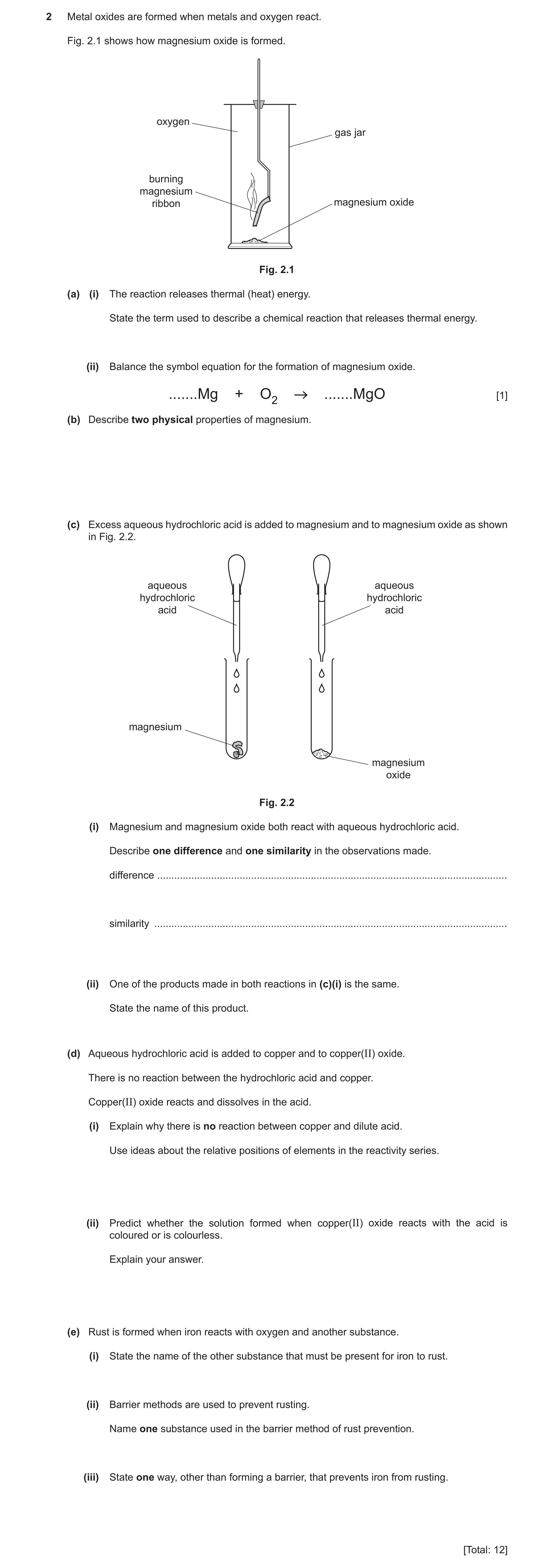
2 Metal oxides are formed when metals and oxygen react. Fig. 2.1 shows how magnesium oxide is formed. oxygen gas jar burning magnesium ribbon magnesium oxide Fig. 2.1 (a) (i) The reaction releases thermal (heat) energy. State the term used to describe a chemical reaction that releases thermal energy. (ii) Balance the symbol equation for the formation of magnesium oxide. [1] … Mg + O2 … MgO (b) Describe two physical properties of magnesium. (c) Excess aqueous hydrochloric acid is added to magnesium and to magnesium oxide as shown in Fig. 2.2. aqueous aqueous hydrochloric hydrochloric acid acid magnesium magnesium oxide Fig. 2.2 (i) Magnesium and magnesium oxide both react with aqueous hydrochloric acid. Describe one difference and one similarity in the observations made. difference �������������������������������������������������������������������������������������������������������������������������� similarity ���������������������������������������������������������������������������������������������������������������������������� (ii) One of the products made in both reactions in (c)(i) is the same. State the name of this product. (d) Aqueous hydrochloric acid is added to copper and to copper(II) oxide. There is no reaction between the hydrochloric acid and copper. Copper(II) oxide reacts and dissolves in the acid. (i) Explain why there is no reaction between copper and dilute acid. Use ideas about the relative positions of elements in the reactivity series. (ii) Predict whether the solution formed when copper(II) oxide reacts with the acid is coloured or is colourless. Explain your answer. (e) Rust is formed when iron reacts with oxygen and another substance. (i) State the name of the other substance that must be present for iron to rust. (ii) Barrier methods are used to prevent rusting. Name one substance used in the barrier method of rust prevention. (iii) State one way, other than forming a barrier, that prevents iron from rusting. [Total: 12]
12 marks
Mark scheme: 2(a)(i) exothermic ; 1 2(a)(ii) 2Mg + O2 → 2MgO ; 1 2(b) (magnesium is) malleable ; ductile ; good (electrical / thermal) conductor ; 2 2(c)(i) difference – gas released with magnesium (and not with the oxide) ; similarity – the solid reacts to form a soluble product / solid dissolves ; 2 2(c)(ii) magnesium chloride / MgCl2 ; 1 Question Answer Marks 2(d)(i) copper is low in the reactivity series ; copper is less reactive than hydrogen ; 1 2(d)(ii) (coloured) copper is a transition metal / transition metal compounds are (usually) coloured / copper compounds are coloured ; 1 2(e)(i) water / water vapour ; 1 2(e)(ii) paint / oil / plastic / (named) unreactive metal ; 1 2(e)(iii) (add other metals to) make it into an alloy / stainless steel ; 1
This question in 0654/31 Oct/Nov 2020
Q7 · Metal oxides are formed when metals and oxygen react 0654/33 Oct/Nov 2020
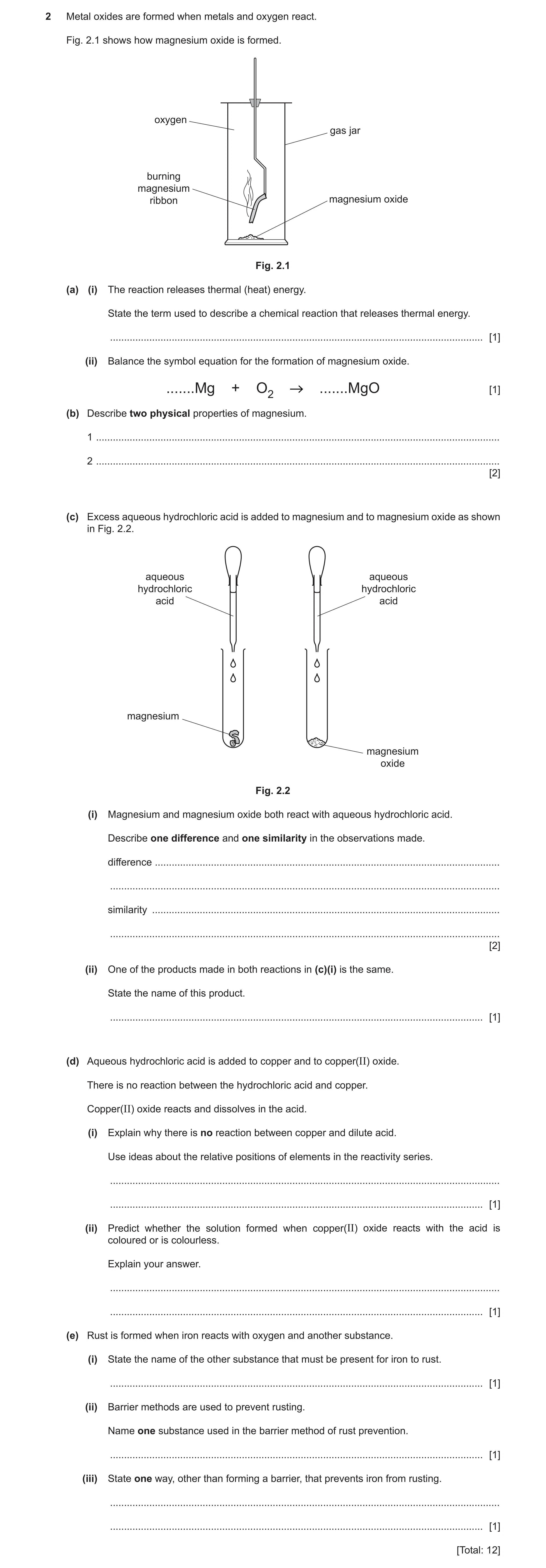
2 Metal oxides are formed when metals and oxygen react. Fig. 2.1 shows how magnesium oxide is formed. oxygen gas jar burning magnesium ribbon magnesium oxide Fig. 2.1 (a) (i) The reaction releases thermal (heat) energy. State the term used to describe a chemical reaction that releases thermal energy. … [1] (ii) Balance the symbol equation for the formation of magnesium oxide. [1] … Mg + O2 … MgO (b) Describe two physical properties of magnesium. 1 … 2 … [2] (c) Excess aqueous hydrochloric acid is added to magnesium and to magnesium oxide as shown in Fig. 2.2. aqueous aqueous hydrochloric hydrochloric acid acid magnesium magnesium oxide Fig. 2.2 (i) Magnesium and magnesium oxide both react with aqueous hydrochloric acid. Describe one difference and one similarity in the observations made. difference … … similarity … … [2] (ii) One of the products made in both reactions in (c)(i) is the same. State the name of this product. … [1] (d) Aqueous hydrochloric acid is added to copper and to copper(II) oxide. There is no reaction between the hydrochloric acid and copper. Copper(II) oxide reacts and dissolves in the acid. (i) Explain why there is no reaction between copper and dilute acid. Use ideas about the relative positions of elements in the reactivity series. … … [1] (ii) Predict whether the solution formed when copper(II) oxide reacts with the acid is coloured or is colourless. Explain your answer. … … [1] (e) Rust is formed when iron reacts with oxygen and another substance. (i) State the name of the other substance that must be present for iron to rust. … [1] (ii) Barrier methods are used to prevent rusting. Name one substance used in the barrier method of rust prevention. … [1] (iii) State one way, other than forming a barrier, that prevents iron from rusting. … … [1] [Total: 12]
12 marks
Mark scheme: 2(a)(i) exothermic ; 1 2(a)(ii) 2Mg + O2 → 2MgO ; 1 2(b) (magnesium is) malleable ; ductile ; good (electrical / thermal) conductor ; 2 2(c)(i) difference – gas released with magnesium (and not with the oxide) ; similarity – the solid reacts to form a soluble product / solid dissolves ; 2 2(c)(ii) magnesium chloride / MgCl2 ; 1 Question Answer Marks 2(d)(i) copper is low in the reactivity series ; copper is less reactive than hydrogen ; 1 2(d)(ii) (coloured) copper is a transition metal / transition metal compounds are (usually) coloured / copper compounds are coloured ; 1 2(e)(i) water / water vapour ; 1 2(e)(ii) paint / oil / plastic / (named) unreactive metal ; 1 2(e)(iii) (add other metals to) make it into an alloy / stainless steel ; 1
This question in 0654/33 Oct/Nov 2020
Q8 · Three molecules A, B and C 0654/31 May/June 2021
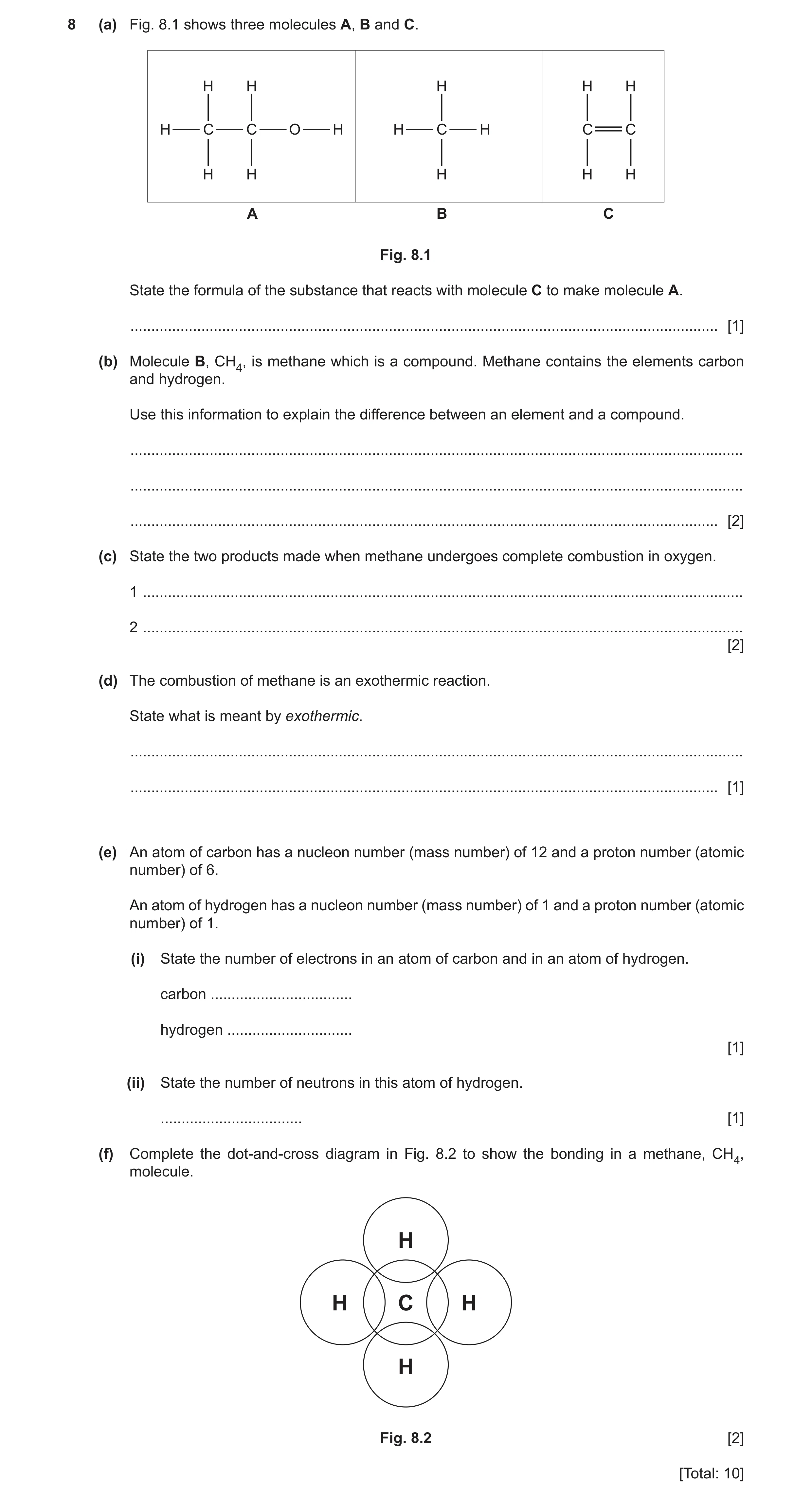
8 (a) Fig. 8.1 shows three molecules A, B and C. H H H H H H C C O H H C H C C H H H H H A B C Fig. 8.1 State the formula of the substance that reacts with molecule C to make molecule A. … [1] (b) Molecule B, CH4, is methane which is a compound. Methane contains the elements carbon and hydrogen. Use this information to explain the difference between an element and a compound. … … … [2] (c) State the two products made when methane undergoes complete combustion in oxygen. 1 … 2 … [2] (d) The combustion of methane is an exothermic reaction. State what is meant by exothermic. … … [1] (e) An atom of carbon has a nucleon number (mass number) of 12 and a proton number (atomic number) of 6. An atom of hydrogen has a nucleon number (mass number) of 1 and a proton number (atomic number) of 1. (i) State the number of electrons in an atom of carbon and in an atom of hydrogen. carbon … hydrogen … [1] (ii) State the number of neutrons in this atom of hydrogen. … [1] (f) Complete the dot‑and‑cross diagram in Fig. 8.2 to show the bonding in a methane, CH4, molecule. H H C H H Fig. 8.2 [2] [Total: 10]
10 marks
Mark scheme: 8(a) H2O ; 1 8(b) an element (e.g. carbon) contains only one type of atom ; a compound (e.g. methane) contains two or more elements / different atoms chemically combined ; 2 8(c) carbon dioxide ; water ; 2 8(d) releases thermal energy ; 1 8(e)(i) carbon 6 and hydrogen 1 ; 1 8(e)(ii) zero ; 1 Question Answer Marks 8(f) one shared pair seen ; all correct ;; 2
This question in 0654/31 May/June 2021
Q9 · The melting points and reactivity with water of three Group I metals 0654/32 Oct/Nov 2021
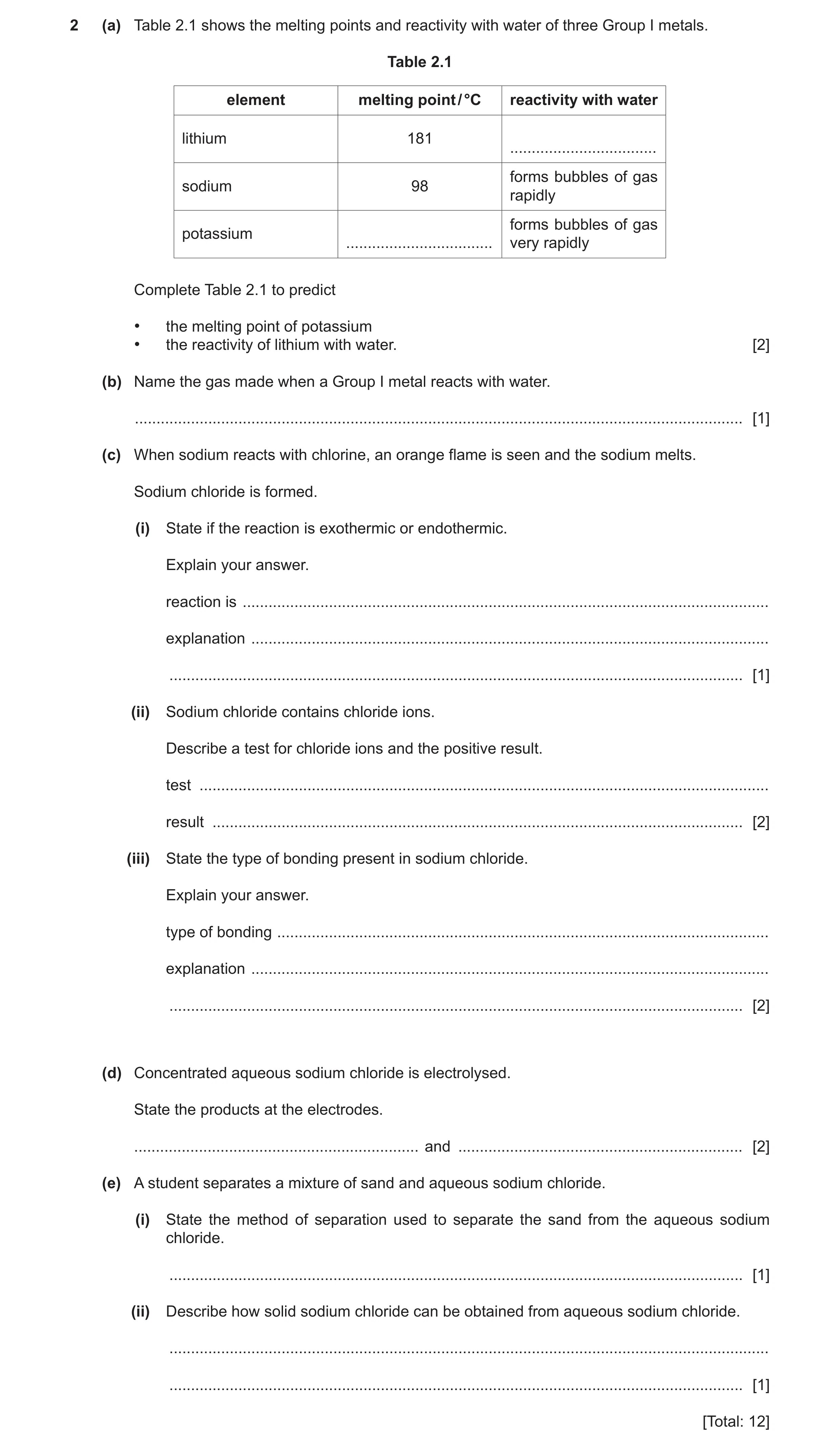
2 (a) Table 2.1 shows the melting points and reactivity with water of three Group I metals. Table 2.1 element melting point / °C reactivity with water lithium 181 … forms bubbles of gas sodium 98 rapidly forms bubbles of gas potassium … very rapidly Complete Table 2.1 to predict • the melting point of potassium • the reactivity of lithium with water. [2] (b) Name the gas made when a Group I metal reacts with water. … [1] (c) When sodium reacts with chlorine, an orange flame is seen and the sodium melts. Sodium chloride is formed. (i) State if the reaction is exothermic or endothermic. Explain your answer. reaction is … explanation … … [1] (ii) Sodium chloride contains chloride ions. Describe a test for chloride ions and the positive result. test … result … [2] (iii) State the type of bonding present in sodium chloride. Explain your answer. type of bonding … explanation … … [2] (d) Concentrated aqueous sodium chloride is electrolysed. State the products at the electrodes. … and … [2] (e) A student separates a mixture of sand and aqueous sodium chloride. (i) State the method of separation used to separate the sand from the aqueous sodium chloride. … [1] (ii) Describe how solid sodium chloride can be obtained from aqueous sodium chloride. … … [1] [Total: 12]
12 marks
Mark scheme: 2(a) below 90 °C ; reacts / forms bubbles of gas slowly / moderately ; 2 2(b) hydrogen ; 1 2(c)(i) exothermic because (thermal) energy released (to melt sodium) ; 1 2(c)(ii) aqueous silver nitrate ; white precipitate ; 2 Question Answer Marks 2(c)(iii) ionic ; bonding between a metal and a non-metal / electron transfer ; 2 2(d) hydrogen ; chlorine ; 2 2(e)(i) filtration ; 1 2(e)(ii) evaporation / crystallisation ; 1
This question in 0654/32 Oct/Nov 2021
Q10 · Three hydrocarbon molecules, A, B and C 0654/31 Oct/Nov 2022
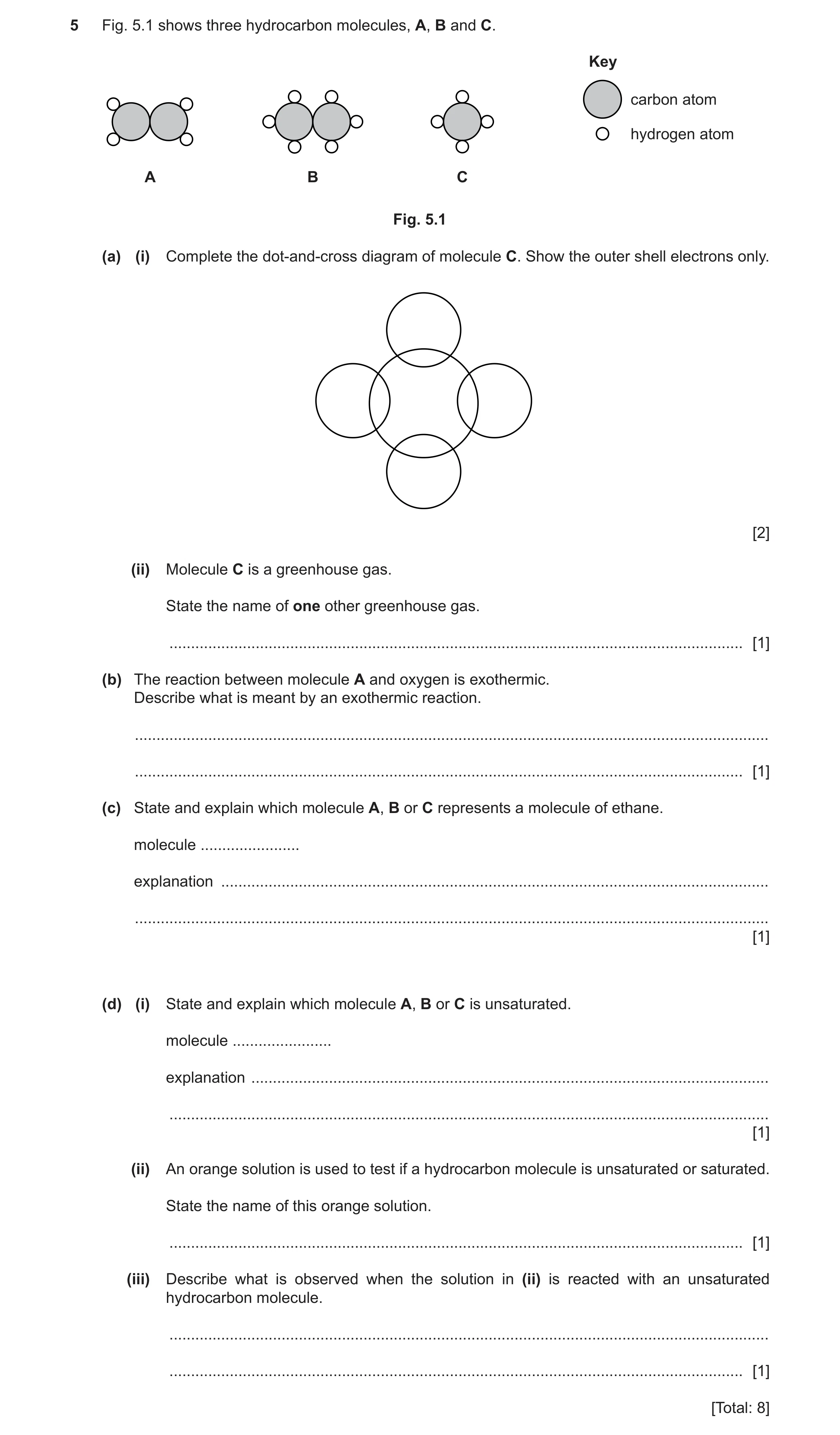
5 Fig. 5.1 shows three hydrocarbon molecules, A, B and C. Key carbon atom hydrogen atom A B C Fig. 5.1 (a) (i) Complete the dot-and-cross diagram of molecule C. Show the outer shell electrons only. [2] (ii) Molecule C is a greenhouse gas. State the name of one other greenhouse gas. … [1] (b) The reaction between molecule A and oxygen is exothermic. Describe what is meant by an exothermic reaction. … … [1] (c) State and explain which molecule A, B or C represents a molecule of ethane. molecule … explanation … … [1] (d) (i) State and explain which molecule A, B or C is unsaturated. molecule … explanation … … [1] (ii) An orange solution is used to test if a hydrocarbon molecule is unsaturated or saturated. State the name of this orange solution. … [1] (iii) Describe what is observed when the solution in (ii) is reacted with an unsaturated hydrocarbon molecule. … … [1] [Total: 8]
8 marks
Mark scheme: 5(a)(i) 1 shared pair ; 2 all else correct ; 5(a)(ii) water vapour ; carbon dioxide ; 1 5(b) (thermal) energy released ; 1 5(c) B – no mark and 1 has formula C2H6 ; 5(d)(i) A – no mark and 1 has two carbons but only four hydrogens / has general formula CnH2n ; 5(d)(ii) (aqueous) bromine ; 1 5(d)(iii) decolourises ; 1
This question in 0654/31 Oct/Nov 2022
Q11 · An isotope of magnesium has a proton number (atomic number) of 12 and a nucleon number… 0654/32 Oct/Nov 2022
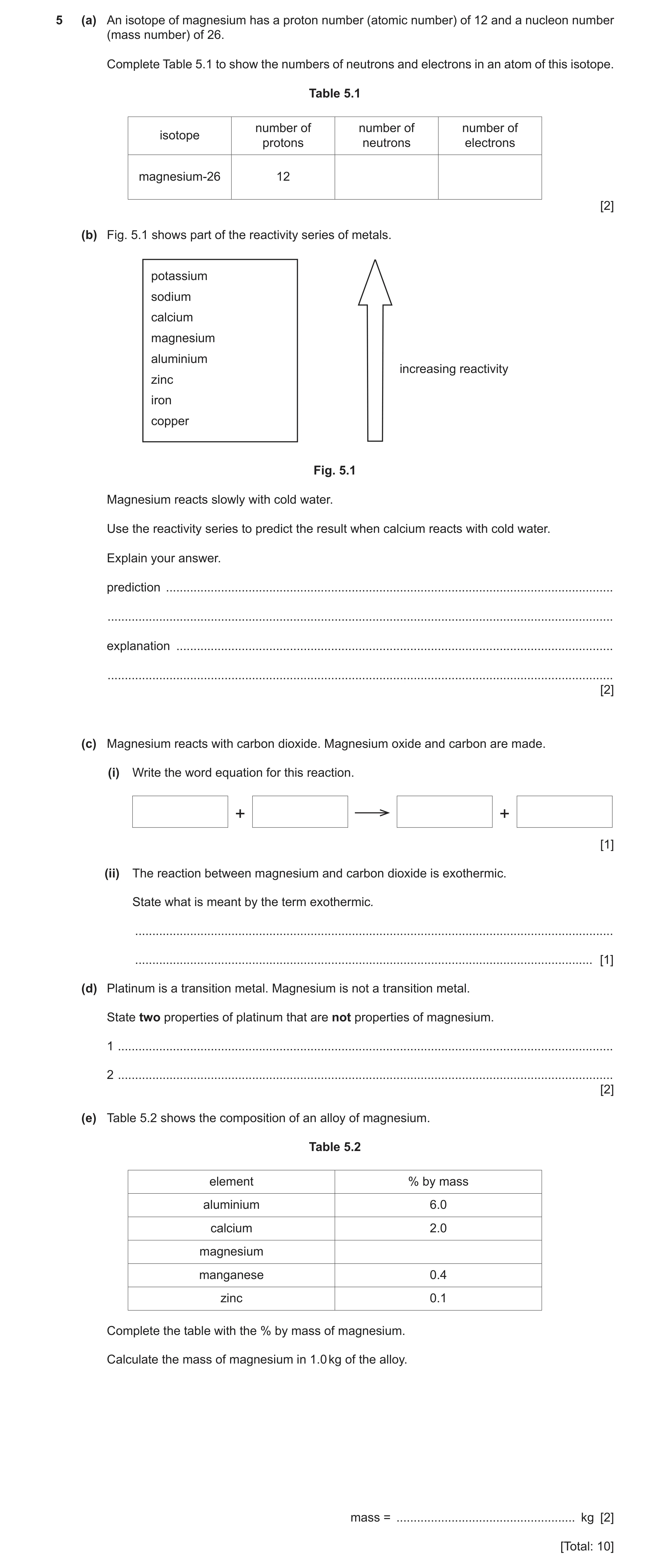
5 (a) An isotope of magnesium has a proton number (atomic number) of 12 and a nucleon number (mass number) of 26. Complete Table 5.1 to show the numbers of neutrons and electrons in an atom of this isotope. Table 5.1 number of number of number of isotope protons neutrons electrons magnesium-26 12 [2] (b) Fig. 5.1 shows part of the reactivity series of metals. potassium sodium calcium magnesium aluminium increasing reactivity zinc iron copper Fig. 5.1 Magnesium reacts slowly with cold water. Use the reactivity series to predict the result when calcium reacts with cold water. Explain your answer. prediction … … explanation … … [2] (c) Magnesium reacts with carbon dioxide. Magnesium oxide and carbon are made. (i) Write the word equation for this reaction. + + [1] (ii) The reaction between magnesium and carbon dioxide is exothermic. State what is meant by the term exothermic. … … [1] (d) Platinum is a transition metal. Magnesium is not a transition metal. State two properties of platinum that are not properties of magnesium. 1 … 2 … [2] (e) Table 5.2 shows the composition of an alloy of magnesium. Table 5.2 element % by mass aluminium 6.0 calcium 2.0 magnesium manganese 0.4 zinc 0.1 Complete the table with the % by mass of magnesium. Calculate the mass of magnesium in 1.0 kg of the alloy. mass = … kg [2] [Total: 10]
10 marks
Mark scheme: 5(a) 2 isotope number of number of number of protons neutrons electrons magnesium-26 12 14; 12; 5(b) calcium reacts quickly/quicker ; 2 calcium is higher in reactivity series than magnesium ; 5(c)(i) magnesium + carbon dioxide → magnesium oxide + carbon ; 1 5(c)(ii) releases (thermal) energy ; 1 5(d) any two from: 2 forms coloured compounds ; acts as catalyst ; variable valency ; 5(e) 91.5 (%) ; 2 0.915 (kg) ;
This question in 0654/32 Oct/Nov 2022
Q12 · An atom of calcium has 20 protons and 20 neutrons 0654/32 May/June 2023
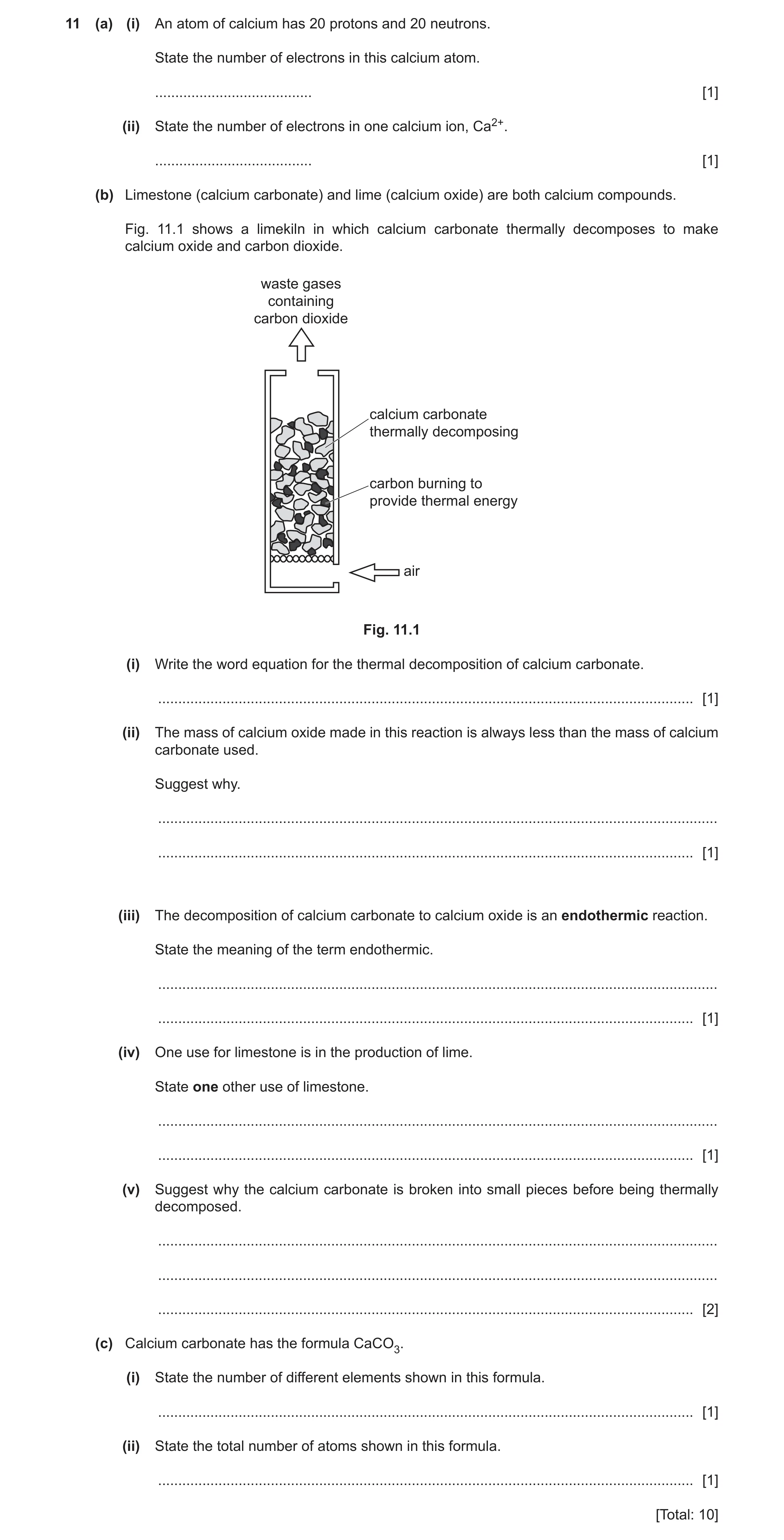
11 (a) (i) An atom of calcium has 20 protons and 20 neutrons. State the number of electrons in this calcium atom. … [1] (ii) State the number of electrons in one calcium ion, Ca2+. … [1] (b) Limestone (calcium carbonate) and lime (calcium oxide) are both calcium compounds. Fig. 11.1 shows a limekiln in which calcium carbonate thermally decomposes to make calcium oxide and carbon dioxide. waste gases containing carbon dioxide calcium carbonate thermally decomposing carbon burning to provide thermal energy air Fig. 11.1 (i) Write the word equation for the thermal decomposition of calcium carbonate. … [1] (ii) The mass of calcium oxide made in this reaction is always less than the mass of calcium carbonate used. Suggest why. … … [1] (iii) The decomposition of calcium carbonate to calcium oxide is an endothermic reaction. State the meaning of the term endothermic. … … [1] (iv) One use for limestone is in the production of lime. State one other use of limestone. … … [1] (v) Suggest why the calcium carbonate is broken into small pieces before being thermally decomposed. … … … [2] (c) Calcium carbonate has the formula CaCO3. (i) State the number of different elements shown in this formula. … [1] (ii) State the total number of atoms shown in this formula. … [1] [Total: 10]
10 marks
Mark scheme: 11(a)(i) 20 (electrons) ; 1 11(a)(ii) 18 (electrons) ; 1 11(b)(i) calcium carbonate calcium oxide carbon dioxide ; 1 11(b)(ii) carbon dioxide released ; 1 11(b)(iii) (thermal) energy taken in ; 1 11(b)(iv) neutralising acidified soil ; 1 Question Answer Marks 11(b)(v) to increase surface area ; so that reaction is faster ; 2 11(c)(i) three ; 1 11(c)(ii) five ; 1
This question in 0654/32 May/June 2023
Q13 · The observations for the reactions of four metals with water 0654/31 Oct/Nov 2024
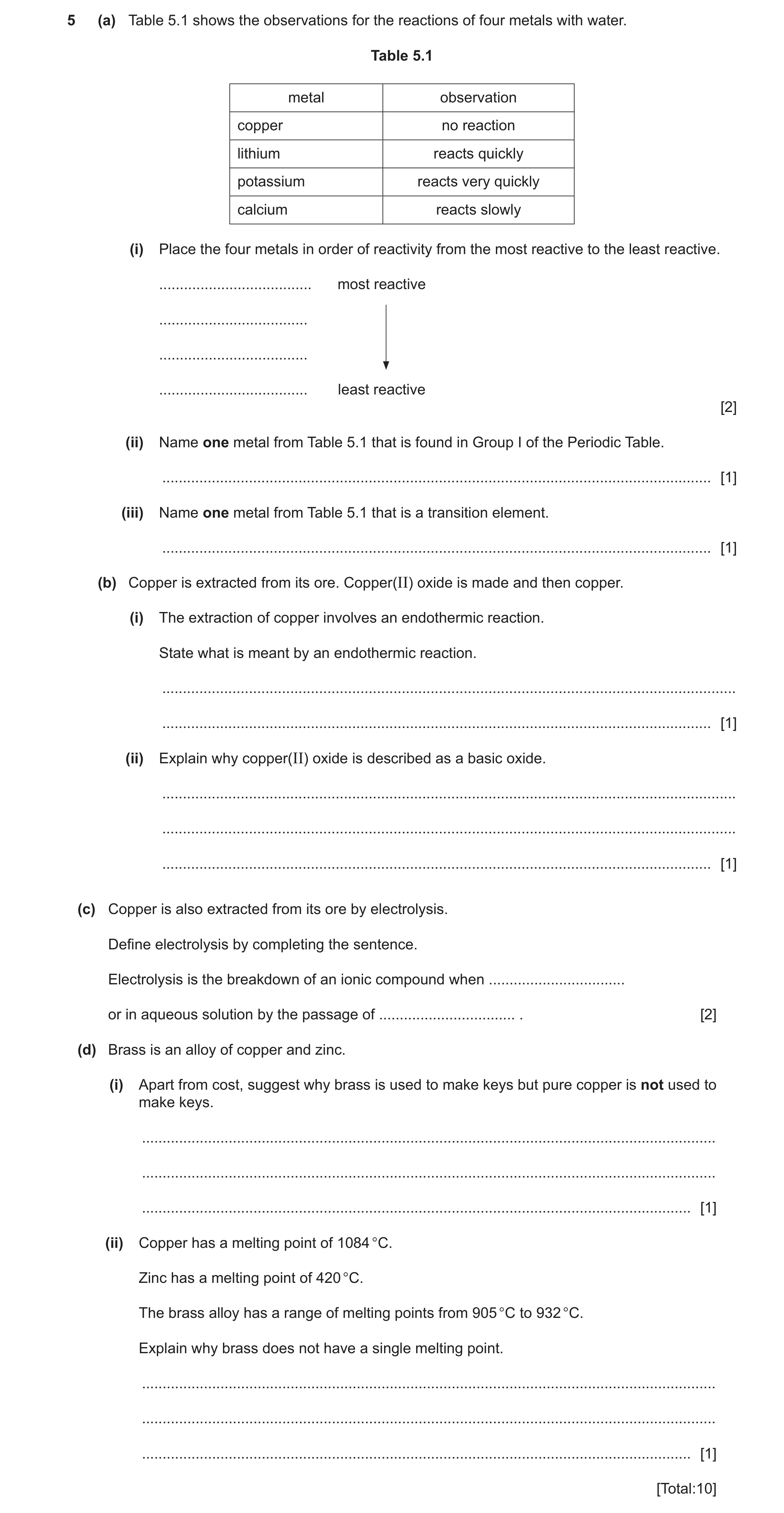
5 (a) Table 5.1 shows the observations for the reactions of four metals with water. Table 5.1 metal observation copper no reaction lithium reacts quickly potassium reacts very quickly calcium reacts slowly (i) Place the four metals in order of reactivity from the most reactive to the least reactive. … most reactive … … … least reactive [2] (ii) Name one metal from Table 5.1 that is found in Group I of the Periodic Table. … [1] (iii) Name one metal from Table 5.1 that is a transition element. … [1] (b) Copper is extracted from its ore. Copper(II) oxide is made and then copper. (i) The extraction of copper involves an endothermic reaction. State what is meant by an endothermic reaction. … … [1] (ii) Explain why copper(II) oxide is described as a basic oxide. … … … [1] (c) Copper is also extracted from its ore by electrolysis. Define electrolysis by completing the sentence. Electrolysis is the breakdown of an ionic compound when … or in aqueous solution by the passage of … . [2] (d) Brass is an alloy of copper and zinc. (i) Apart from cost, suggest why brass is used to make keys but pure copper is not used to make keys. … … … [1] (ii) Copper has a melting point of 1084 °C. Zinc has a melting point of 420 °C. The brass alloy has a range of melting points from 905 °C to 932 °C. Explain why brass does not have a single melting point. … … … [1] [Total:10]
10 marks
Mark scheme: 5(a)(i) potassium 2 lithium calcium copper potassium and copper correct ; lithium and calcium correct ; 5(a)(ii) lithium / potassium ; 1 5(a)(iii) copper ; 1 5(b)(i) temperature decreases / thermal energy is absorbed (from the surroundings) ; 1 5(b)(ii) is a metal oxide ; 1 5(c) molten / liquid ; 2 electricity ; 5(d)(i) brass is more hardwearing / stronger ; 1 5(d)(ii) brass is a mixture ; 1
This question in 0654/31 Oct/Nov 2024
Q14 · Chlorine is an element in Group VII of the Periodic Table 0654/32 Feb/March 2025
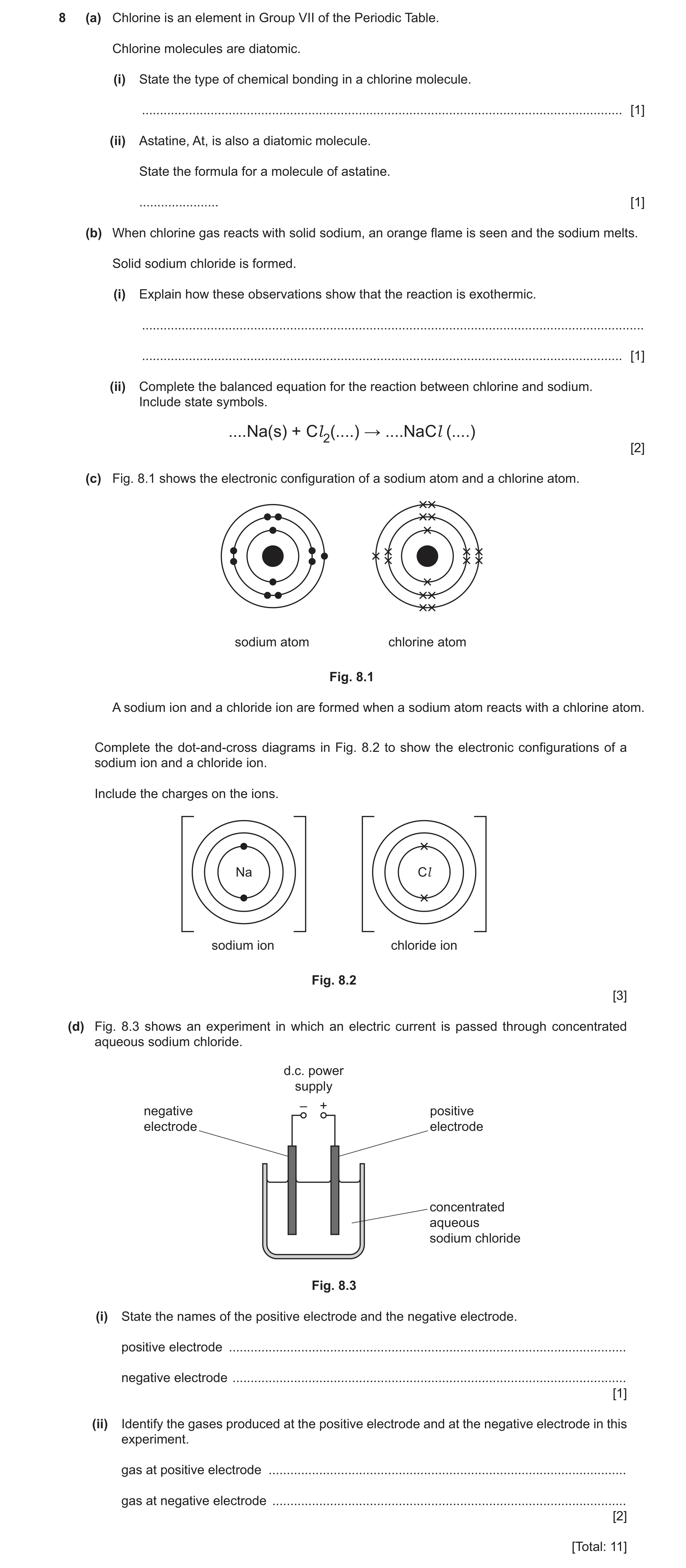
8 (a) Chlorine is an element in Group VII of the Periodic Table. Chlorine molecules are diatomic. (i) State the type of chemical bonding in a chlorine molecule. … [1] (ii) Astatine, At, is also a diatomic molecule. State the formula for a molecule of astatine. … [1] (b) When chlorine gas reacts with solid sodium, an orange flame is seen and the sodium melts. Solid sodium chloride is formed. (i) Explain how these observations show that the reaction is exothermic. … … [1] (ii) Complete the balanced equation for the reaction between chlorine and sodium. Include state symbols. … Na(s) + Cl 2( … ) → … NaCl ( … ) [2] (c) Fig. 8.1 shows the electronic configuration of a sodium atom and a chlorine atom. sodium atom chlorine atom Fig. 8.1 A sodium ion and a chloride ion are formed when a sodium atom reacts with a chlorine atom. Complete the dot-and-cross diagrams in Fig. 8.2 to show the electronic configurations of a sodium ion and a chloride ion. Include the charges on the ions. Na Cl sodium ion chloride ion Fig. 8.2 [3] (d) Fig. 8.3 shows an experiment in which an electric current is passed through concentrated aqueous sodium chloride. d.c. power supply – + negative positive electrode electrode concentrated aqueous sodium chloride Fig. 8.3 (i) State the names of the positive electrode and the negative electrode. positive electrode … negative electrode … [1] (ii) Identify the gases produced at the positive electrode and at the negative electrode in this experiment. gas at positive electrode … gas at negative electrode … [2] [Total: 11]
11 marks
Mark scheme: 8(a)(i) covalent ; 1 8(a)(ii) At2 ; 1 8(b)(i) (thermal) energy released ; 1 8(b)(ii) 2Na (s) + Cl2 ( g) → 2NaCl ( s) 2 ; ; 8(c) (the electronic configuration shown on the diagram) 3 sodium ion- 2, 8 ; chloride ion- 2, 8, 8 ; (the charge on the ions in diagram) sodium ion +1 and chloride ion -1 ; 8(d)(i) anode 1 cathode ; (in that order) 8(d)(ii) chlorine ; 2 hydrogen ; (in that order)
This question in 0654/32 Feb/March 2025
Q15 · Lead is extracted from lead oxide by reaction with carbon 0654/31 Oct/Nov 2025
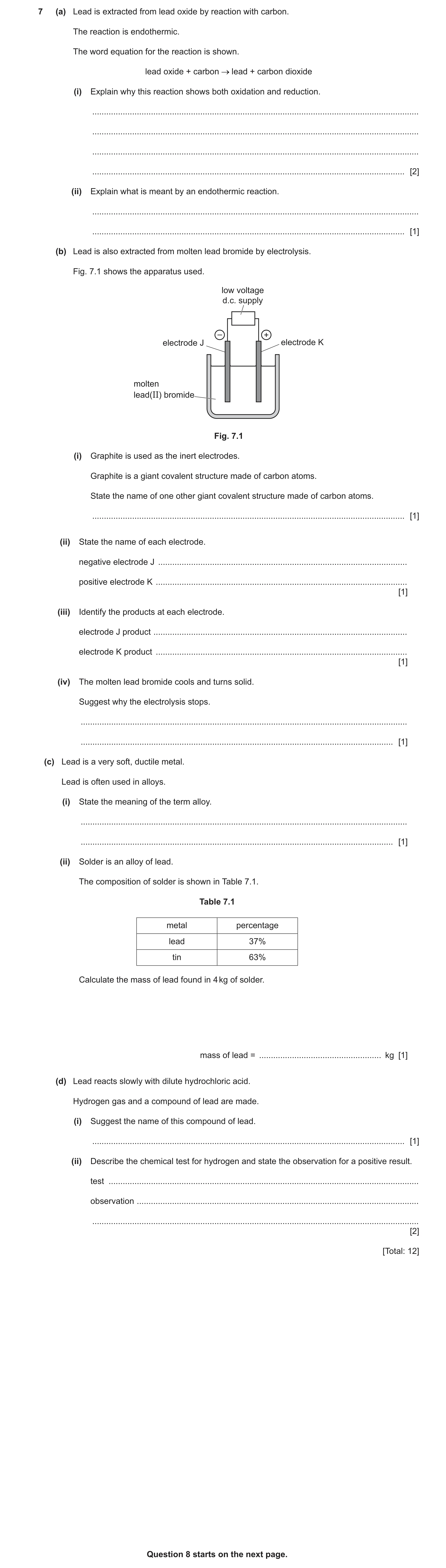
7 (a) Lead is extracted from lead oxide by reaction with carbon. The reaction is endothermic. The word equation for the reaction is shown. lead oxide + carbon lead + carbon dioxide (i) Explain why this reaction shows both oxidation and reduction. … … … … [2] (ii) Explain what is meant by an endothermic reaction. … … [1] (b) Lead is also extracted from molten lead bromide by electrolysis. Fig. 7.1 shows the apparatus used. low voltage d.c. supply – + electrode J electrode K molten lead(II) bromide Fig. 7.1 (i) Graphite is used as the inert electrodes. Graphite is a giant covalent structure made of carbon atoms. State the name of one other giant covalent structure made of carbon atoms. … [1] (ii) State the name of each electrode. negative electrode J … positive electrode K … [1] (iii) Identify the products at each electrode. electrode J product … electrode K product … [1] (iv) The molten lead bromide cools and turns solid. Suggest why the electrolysis stops. … … [1] (c) Lead is a very soft, ductile metal. Lead is often used in alloys. (i) State the meaning of the term alloy. … … [1] (ii) Solder is an alloy of lead. The composition of solder is shown in Table 7.1. Table 7.1 metal percentage lead 37% tin 63% Calculate the mass of lead found in 4 kg of solder. mass of lead = … kg [1] (d) Lead reacts slowly with dilute hydrochloric acid. Hydrogen gas and a compound of lead are made. (i) Suggest the name of this compound of lead. … [1] (ii) Describe the chemical test for hydrogen and state the observation for a positive result. test … observation … … [2] [Total: 12] Question 8 starts on the next page.
12 marks
Mark scheme: 7(a)(i) oxidation is gain of oxygen and reduction is loss of oxygen ; 2 carbon gains oxygen / lead ions lose oxygen ; 7(a)(ii) takes in (thermal) energy (from the surroundings) ; 1 7(b)(i) diamond ; 1 7(b)(ii) (J electrode) cathode and (K electrode) anode ; 1 7(b)(iii) (J product) lead and (K product) bromine ; 1 7(b)(iv) ions need to be mobile / AW 1 OR solids are not good conductors / solids are poor conductors / ORA 7(c)(i) mixture of a metal and another element ; 1 7(c)(ii) 1.5 (kg) ; 1 7(d)(i) lead(II) chloride ; 1 7(d)(ii) lighted splint ; 2 goes pop / AW ;
This question in 0654/31 Oct/Nov 2025
 12
12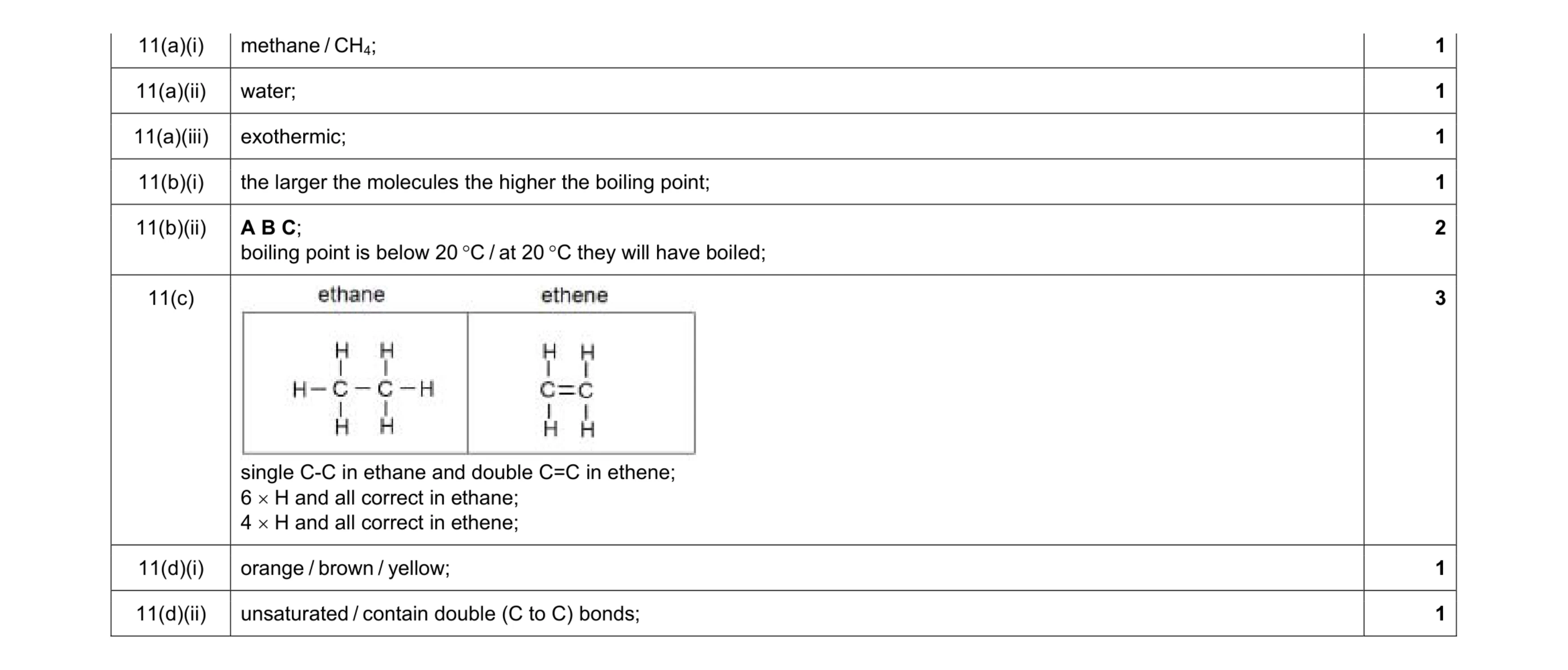 11
11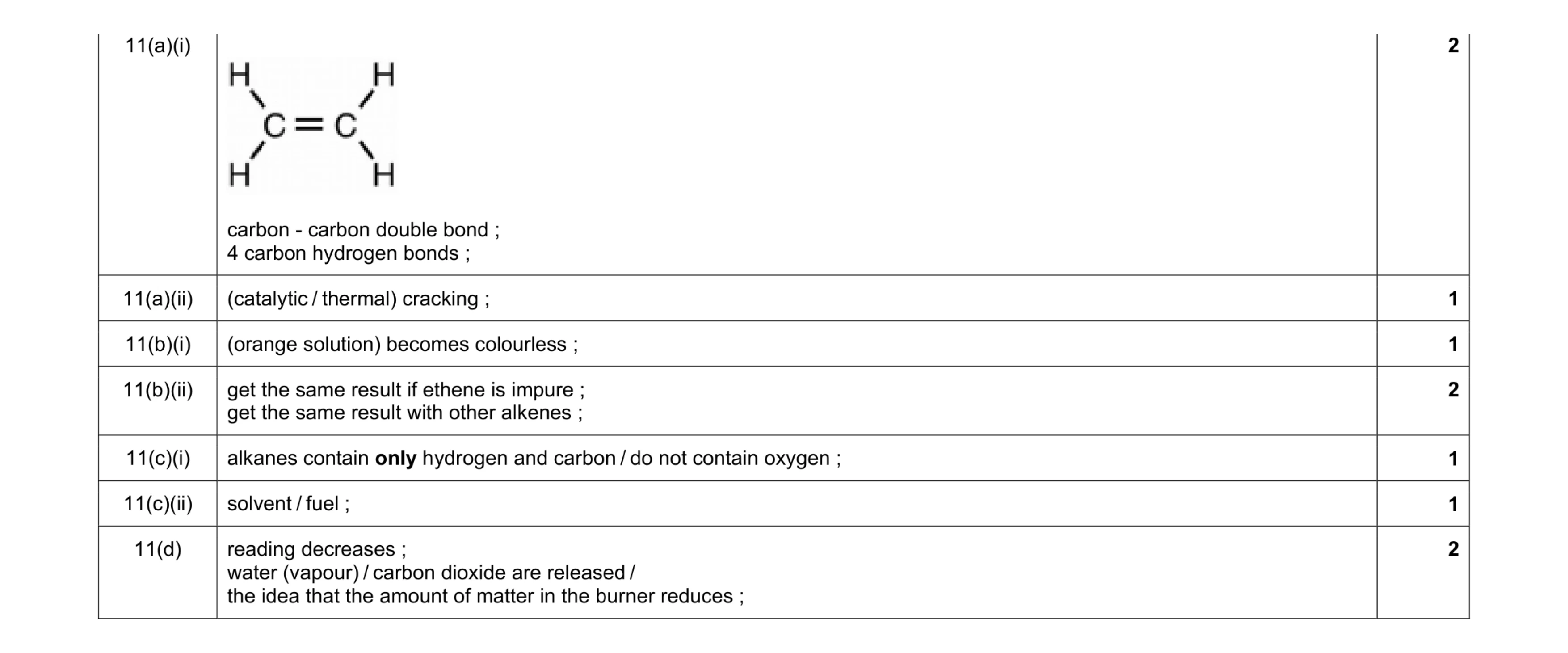 10
10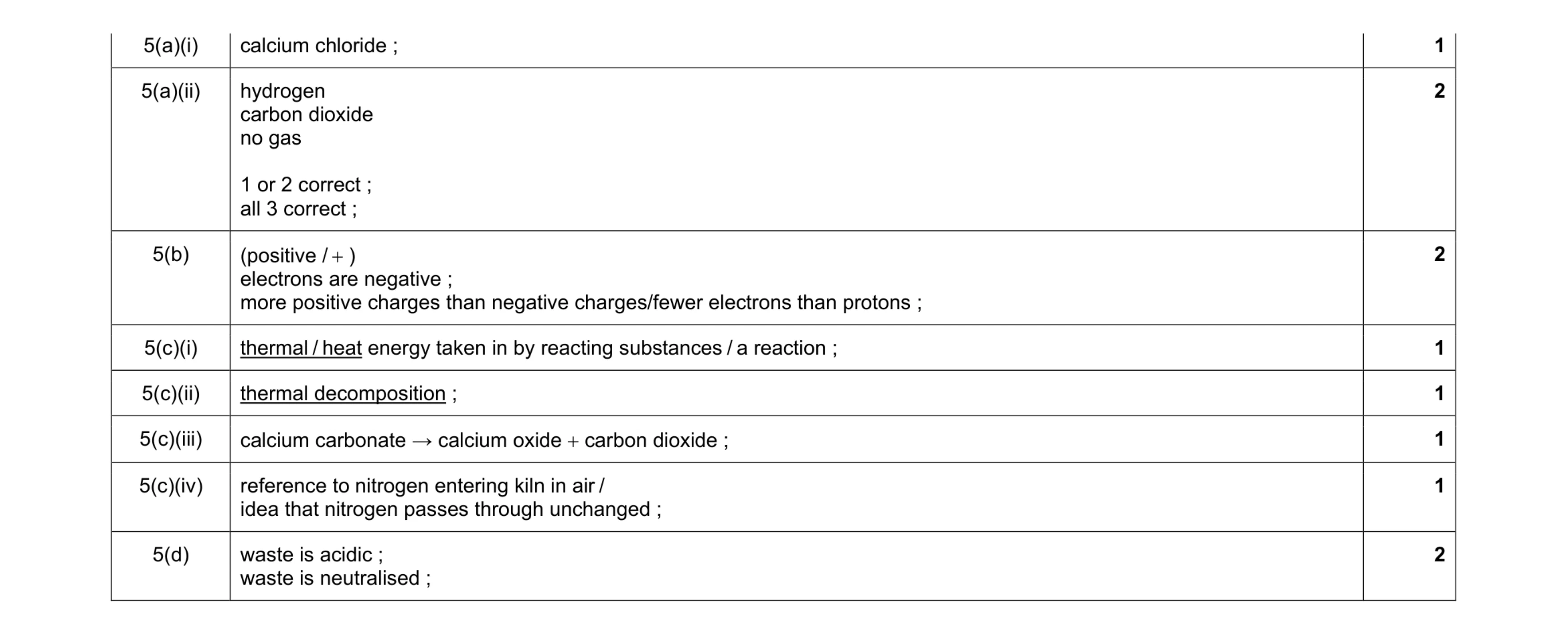 11
11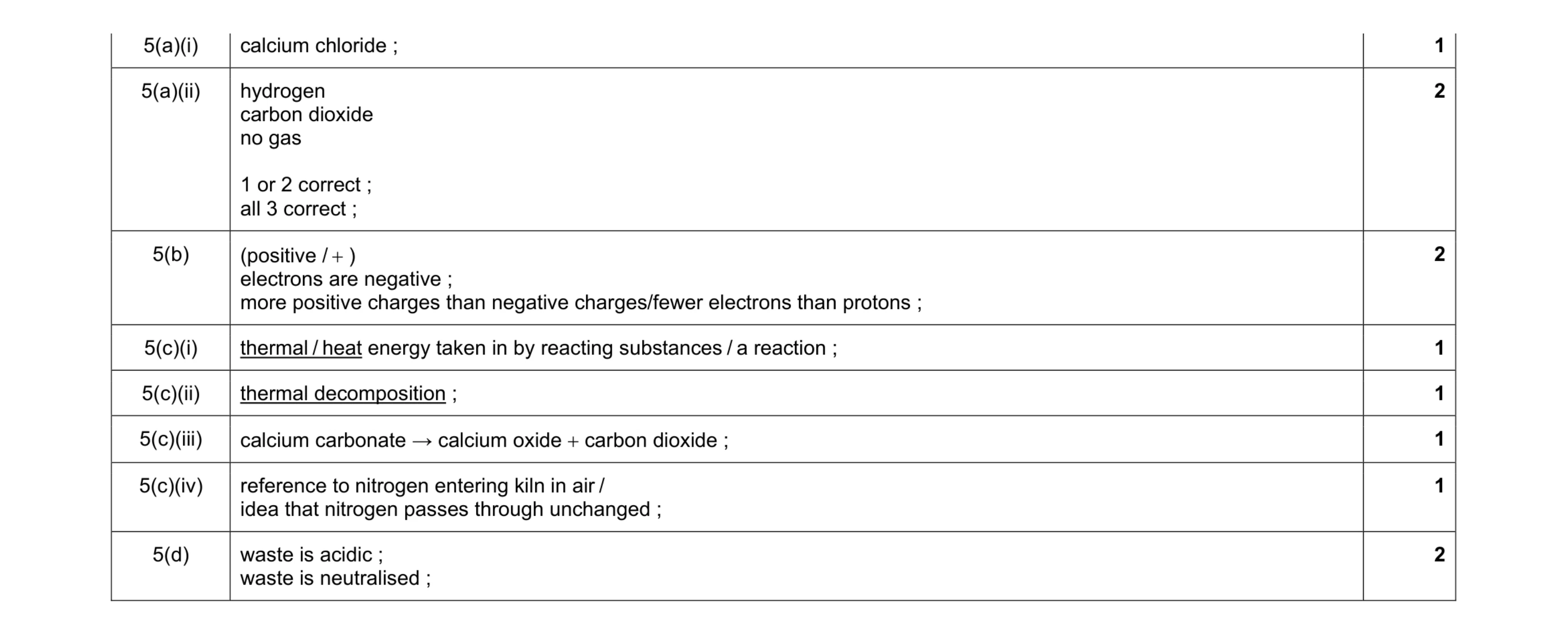 11
11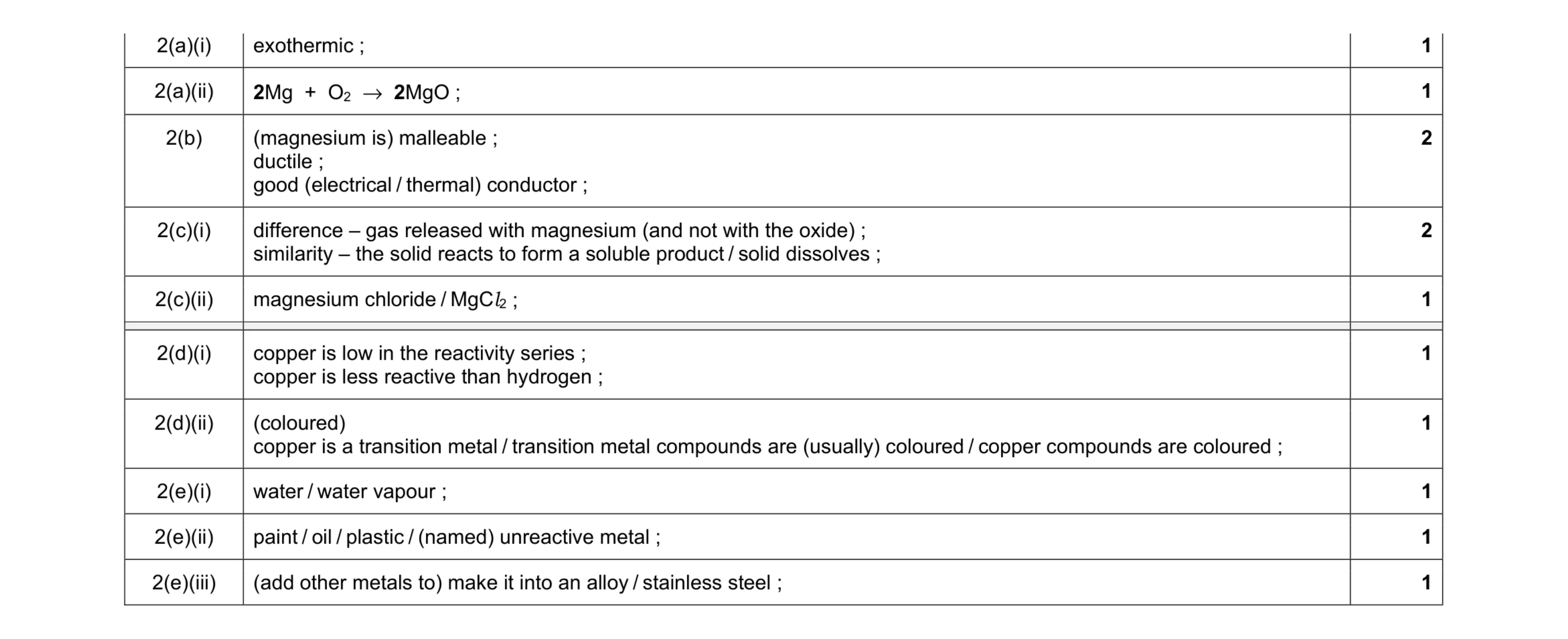 12
12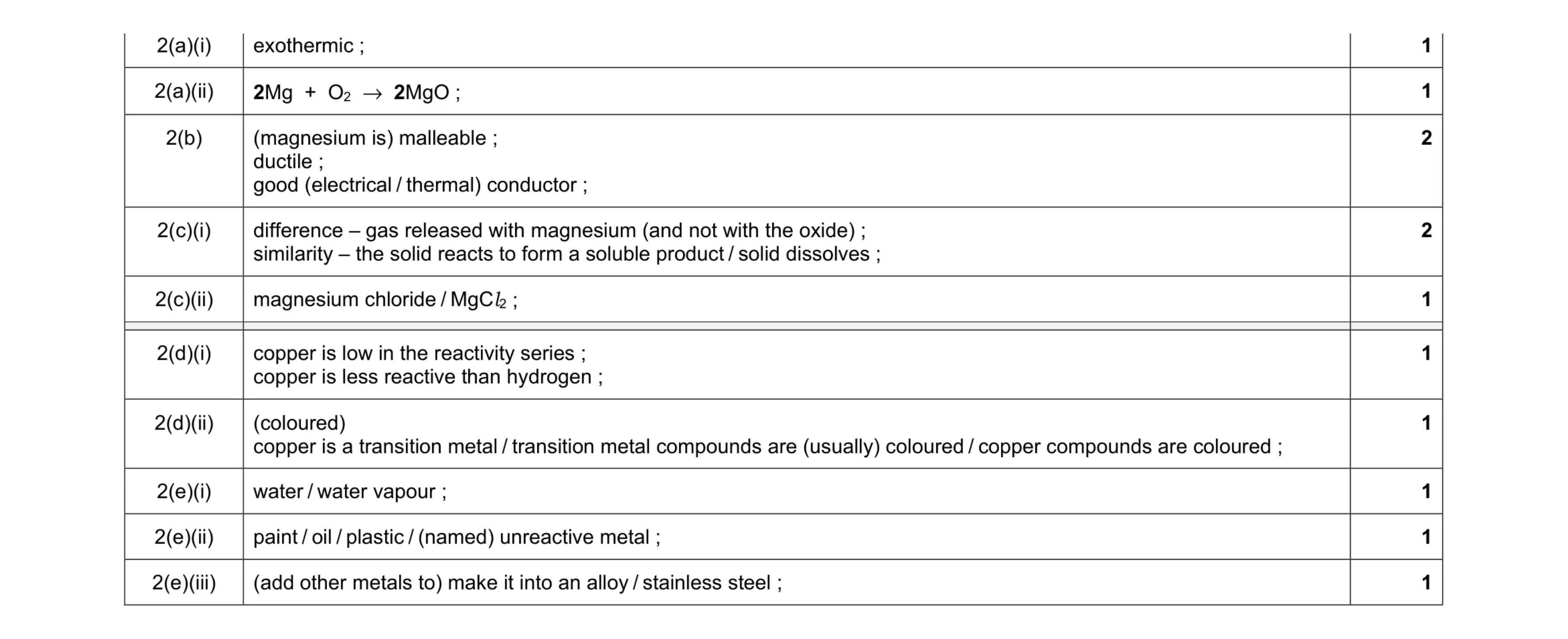 12
12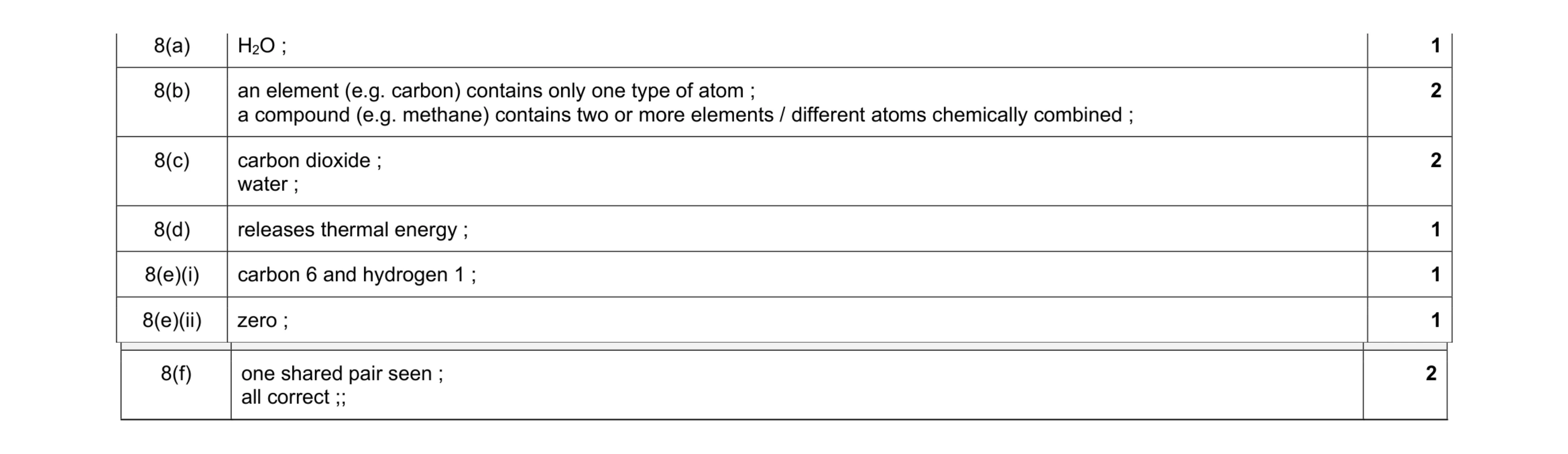 10
10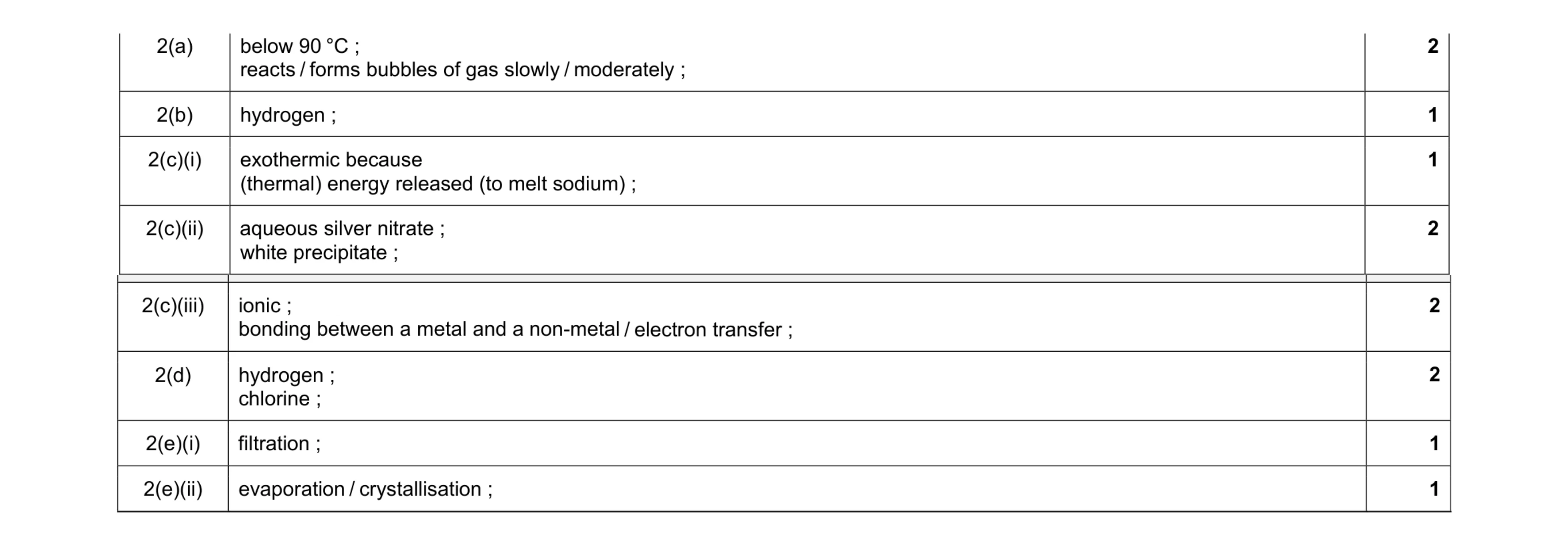 12
12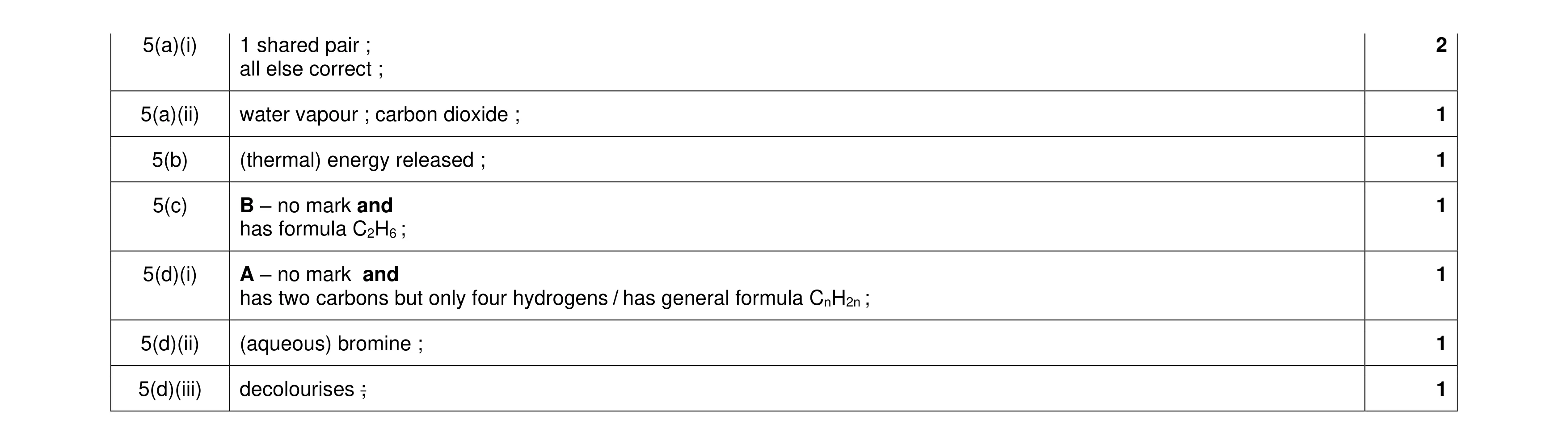 8
8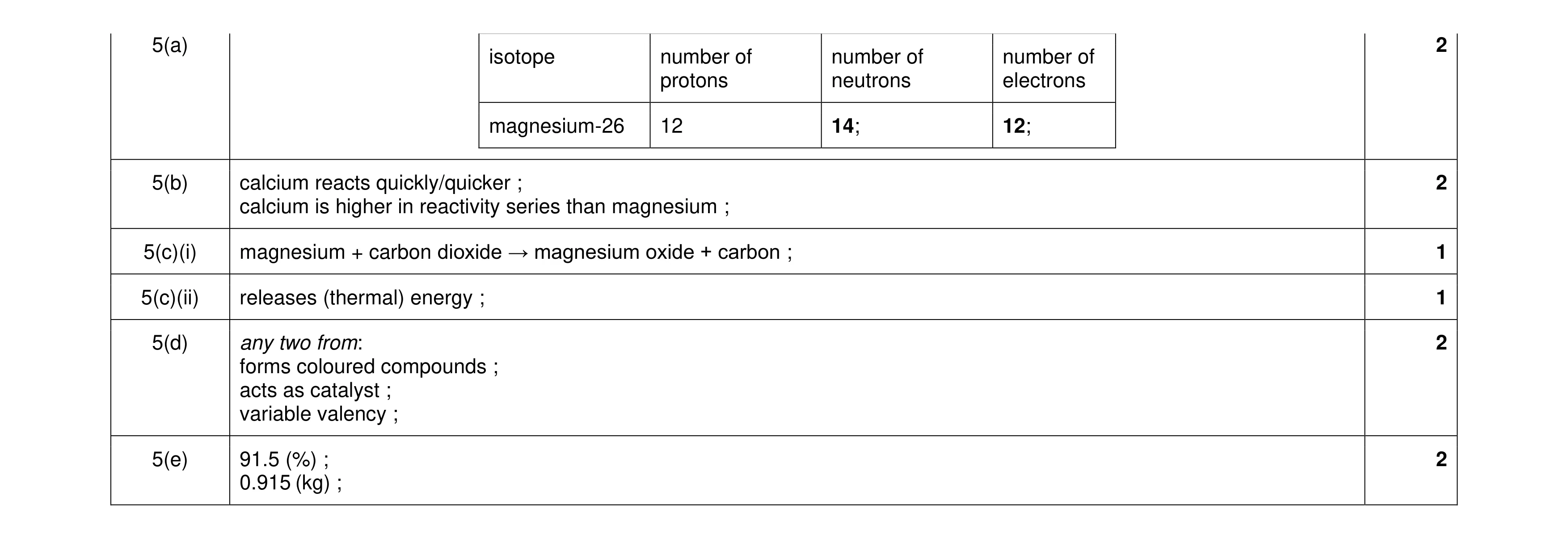 10
10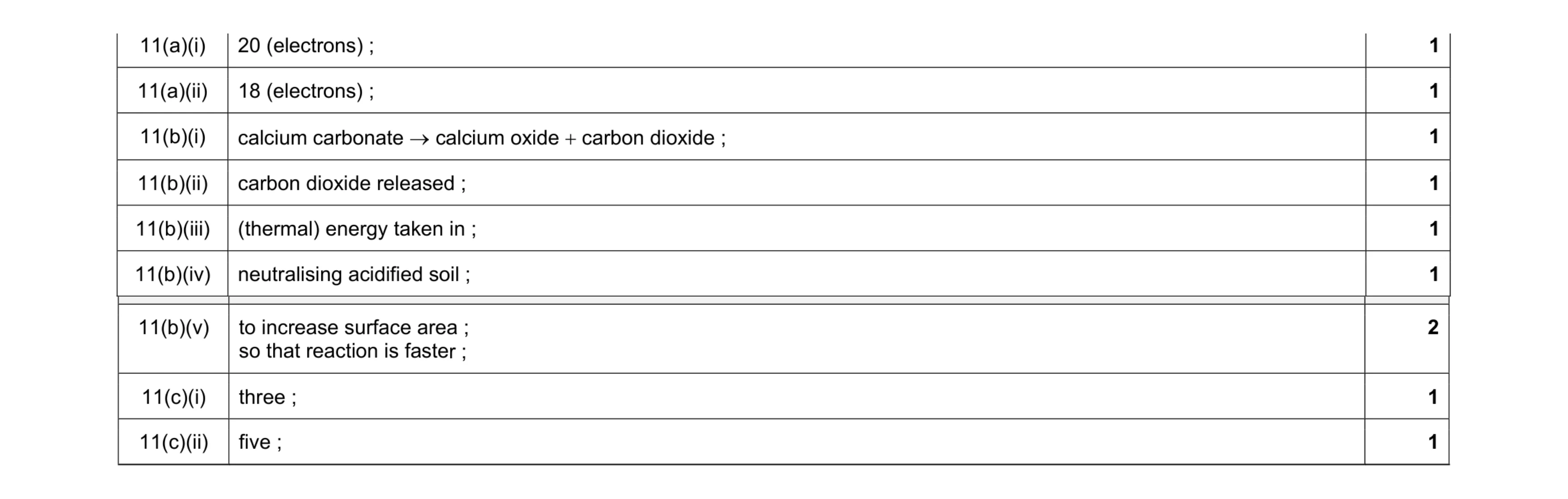 10
10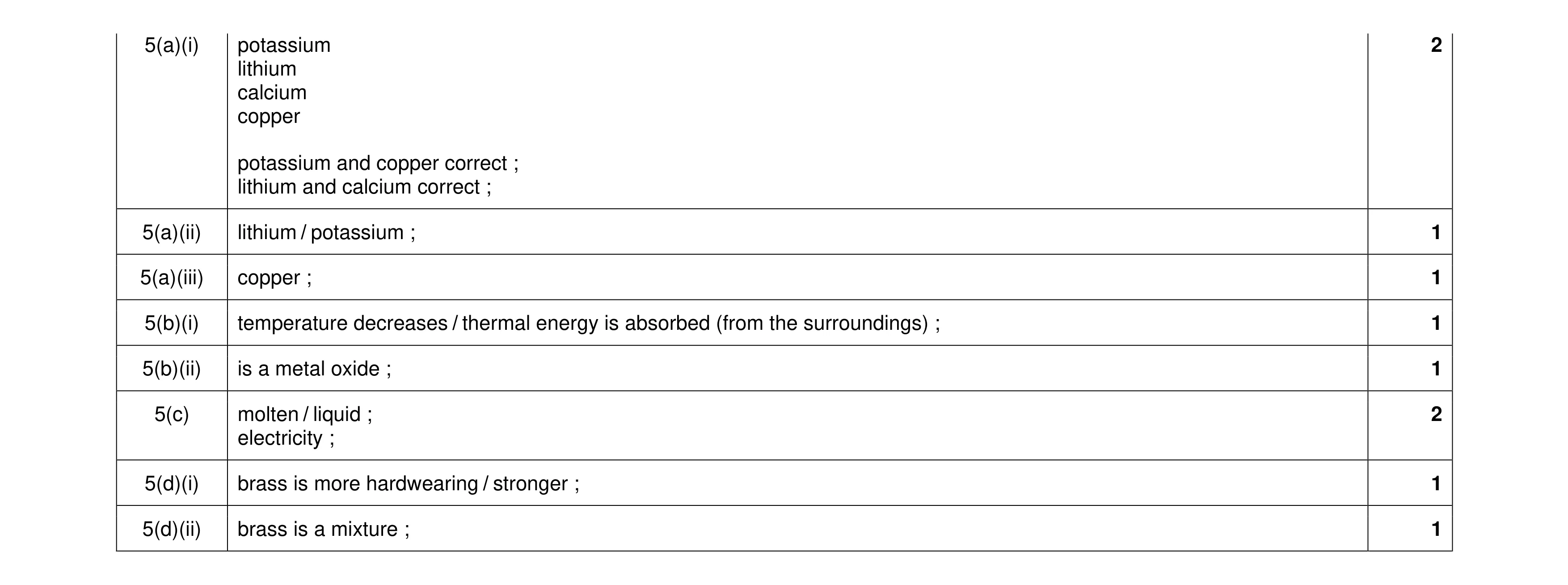 10
10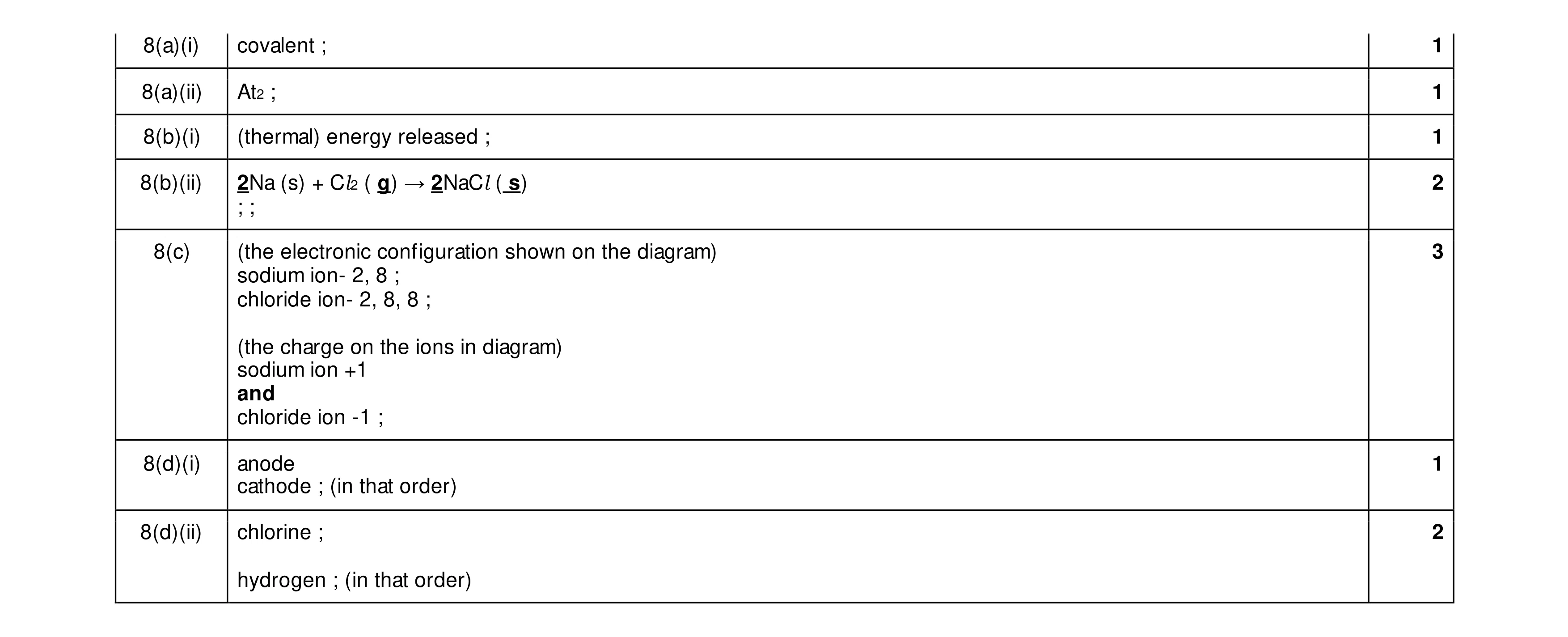 11
11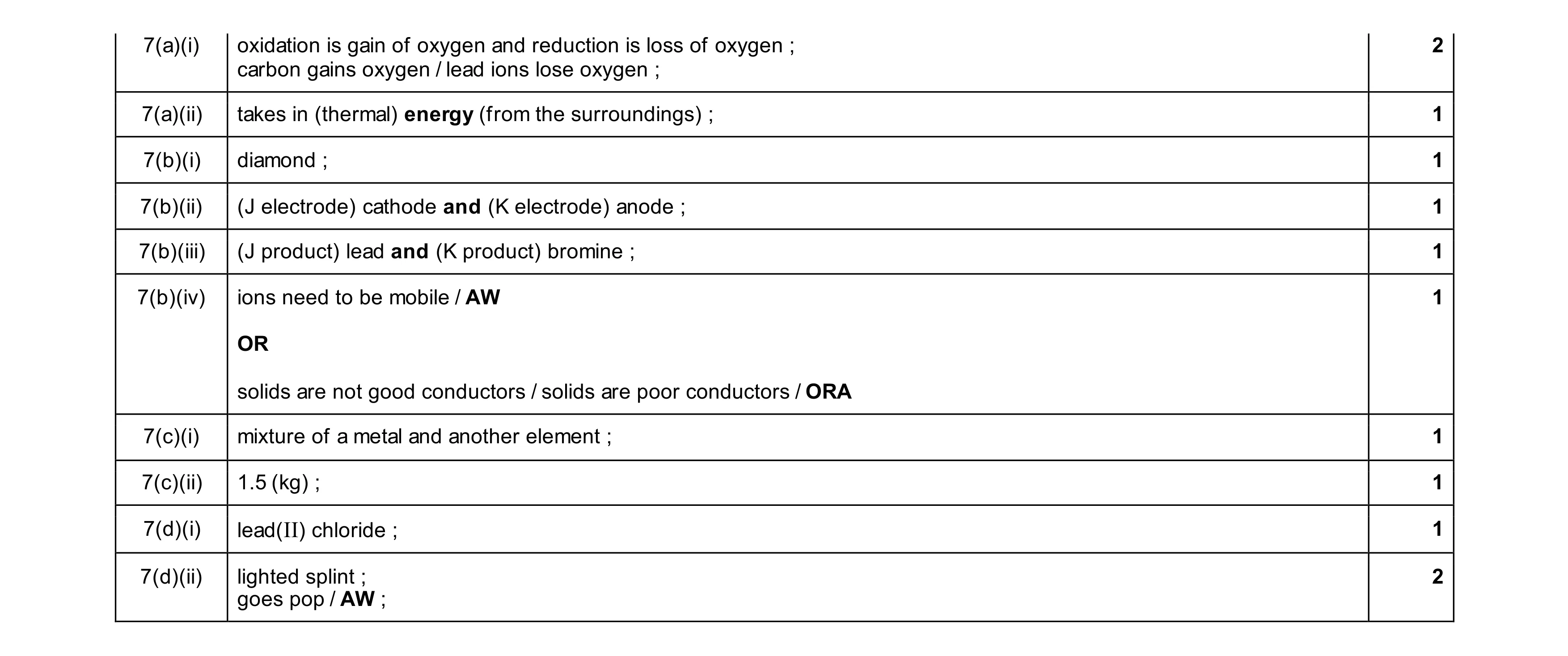 12
12