Questions as text
Q1 · Argon is a gas used to fill lamp bulbs 0653/11 May/June 2006
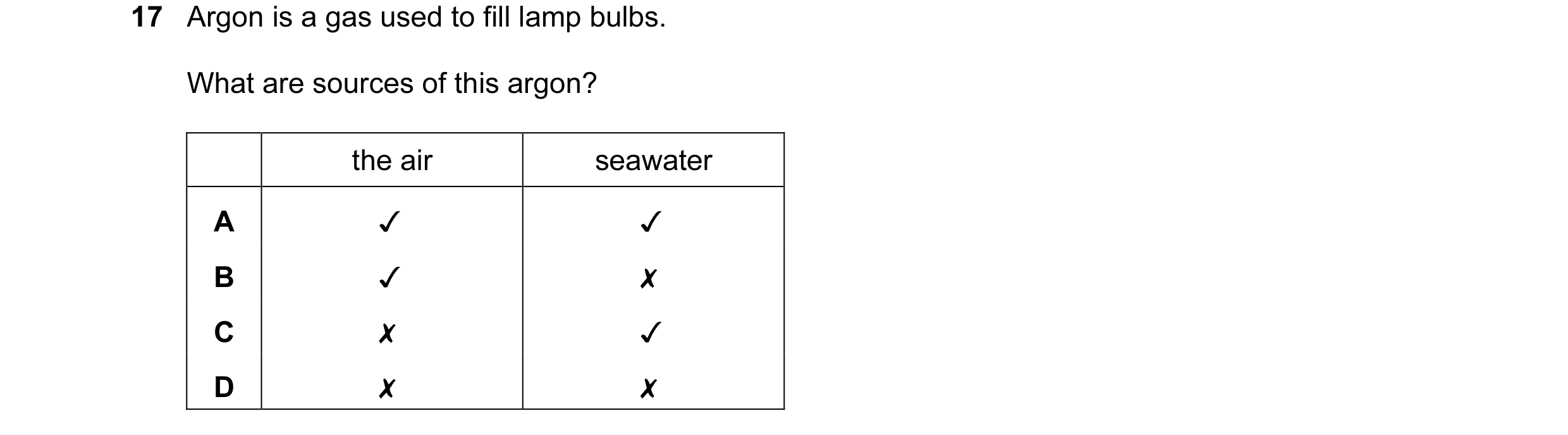
17 Argon is a gas used to fill lamp bulbs.
What are sources of this argon?
the air seawater
A v v
B v x
Cc x v
D x x
1 marks
Answer: B
This question in 0653/11 May/June 2006
Q2 · Why are noble gases unreactive? 0653/11 May/June 2007
17 Why are noble gases unreactive? A They have a complete outer shell of electrons. B They have an even number of electrons. C They have an even number of shells of electrons. D They have two electrons in the first shell.
1 marks
Answer: A
This question in 0653/11 May/June 2007
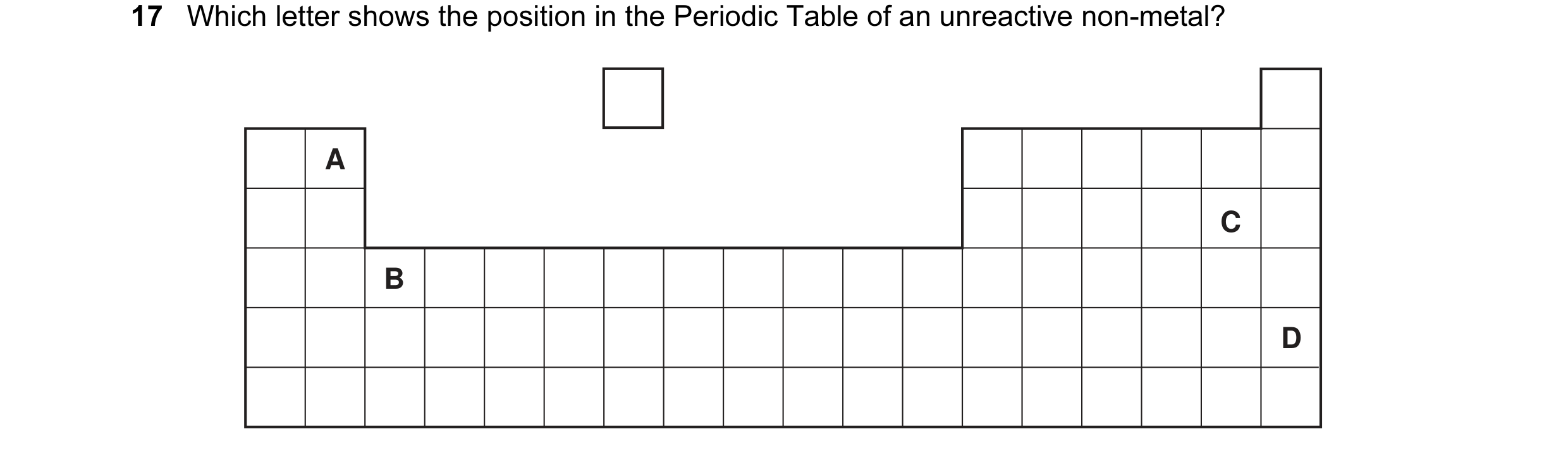
Q3 · Which letter shows the position in the Periodic Table of an unreactive non-metal? 0653/11 May/June 2010
17 Which letter shows the position in the Periodic Table of an unreactive non-metal? A C B D
1 marks
Answer: D
This question in 0653/11 May/June 2010
Q4 · Which letter shows the position in the Periodic Table of an unreactive non-metal? 0653/12 May/June 2010
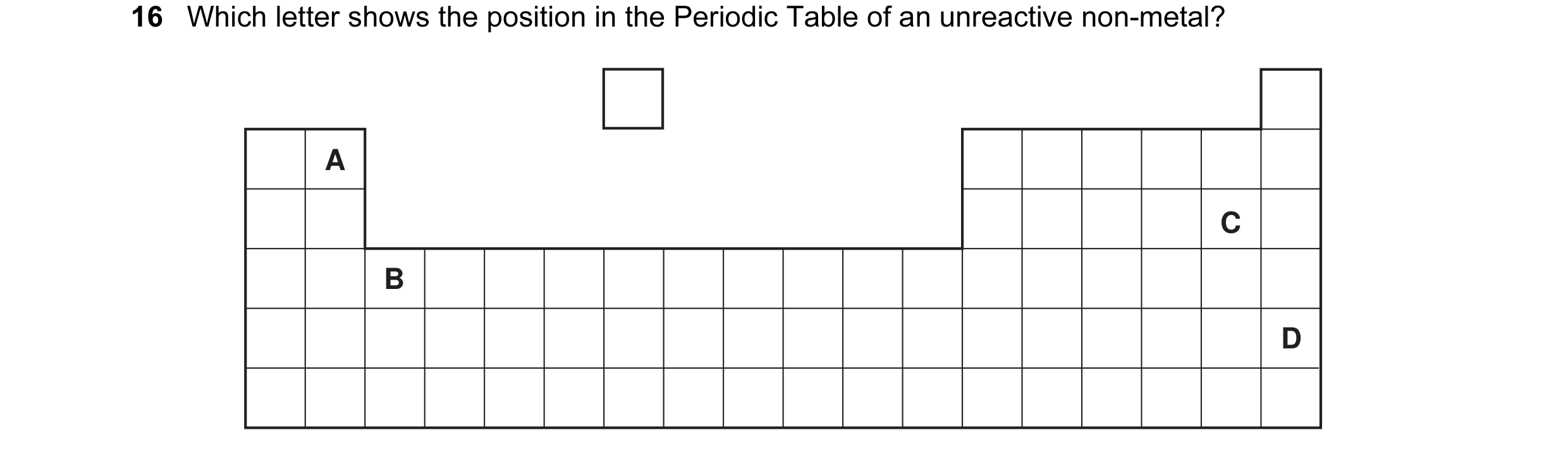
16 Which letter shows the position in the Periodic Table of an unreactive non-metal? A C B D
1 marks
Answer: D
This question in 0653/12 May/June 2010
Q5 · Which letter shows the position in the Periodic Table of an unreactive non-metal? 0653/13 May/June 2010
16 Which letter shows the position in the Periodic Table of an unreactive non-metal? A C B D
1 marks
Answer: D
This question in 0653/13 May/June 2010
Q6 · Element X has a nucleon number of 40 0653/11 Oct/Nov 2011
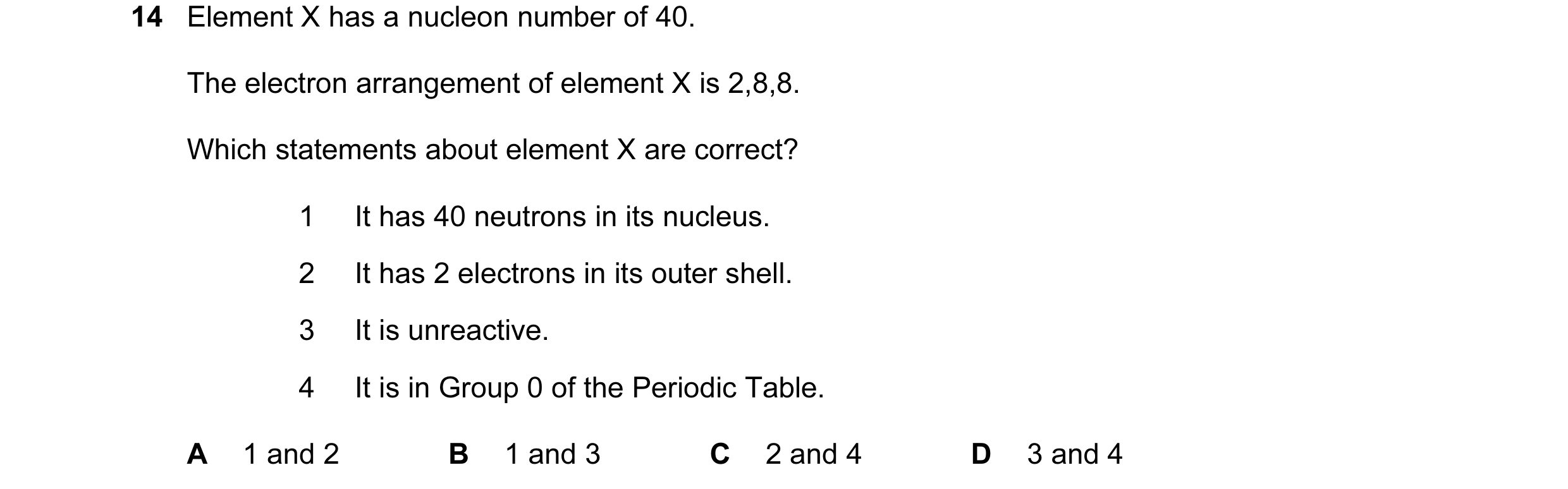
14 Element X has a nucleon number of 40. The electron arrangement of element X is 2,8,8. Which statements about element X are correct? 1 It has 40 neutrons in its nucleus. 2 It has 2 electrons in its outer shell. 3 It is unreactive. 4 It is in Group 0 of the Periodic Table. A 1 and 2 B 1 and 3 C 2 and 4 D 3 and 4
1 marks
Answer: D
This question in 0653/11 Oct/Nov 2011
Q7 · Element X has a nucleon number of 40 0653/12 Oct/Nov 2011
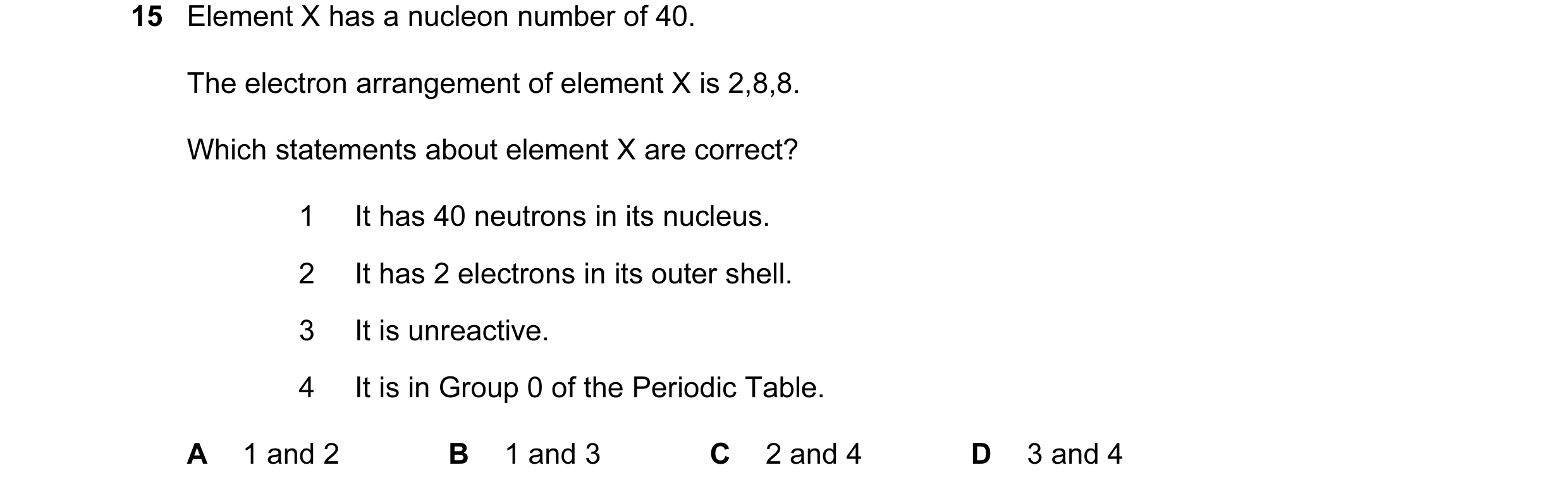
15 Element X has a nucleon number of 40. The electron arrangement of element X is 2,8,8. Which statements about element X are correct? 1 It has 40 neutrons in its nucleus. 2 It has 2 electrons in its outer shell. 3 It is unreactive. 4 It is in Group 0 of the Periodic Table. A 1 and 2 B 1 and 3 C 2 and 4 D 3 and 4
1 marks
Answer: D
This question in 0653/12 Oct/Nov 2011
Q8 · Element X has a nucleon number of 40 0653/13 Oct/Nov 2011
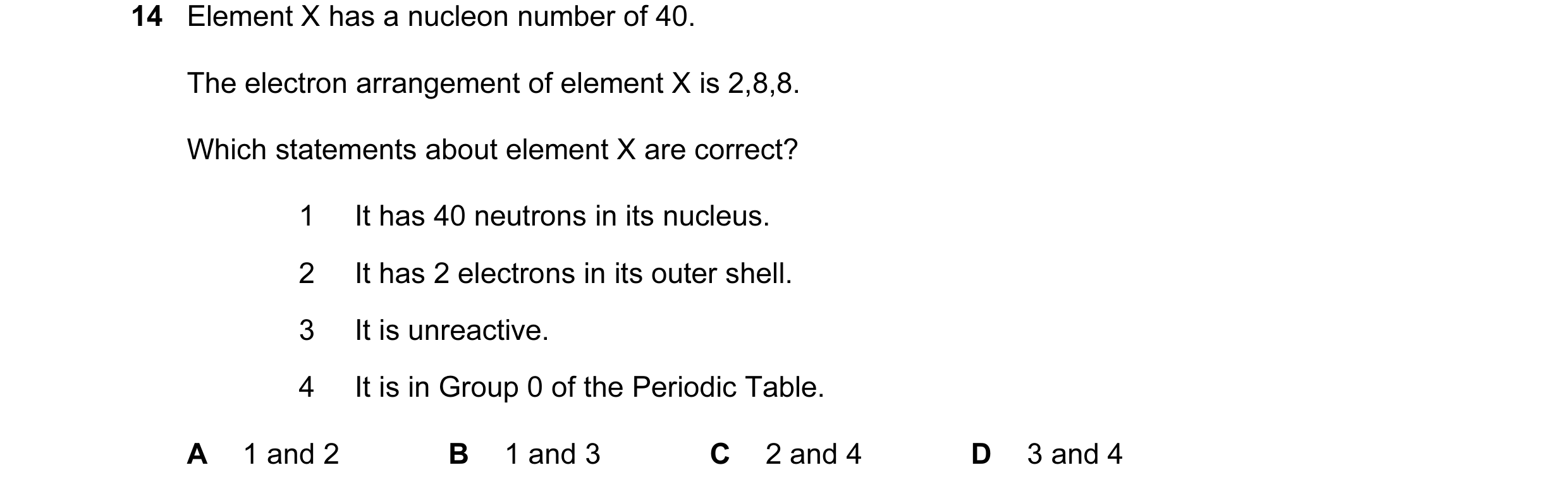
14 Element X has a nucleon number of 40. The electron arrangement of element X is 2,8,8. Which statements about element X are correct? 1 It has 40 neutrons in its nucleus. 2 It has 2 electrons in its outer shell. 3 It is unreactive. 4 It is in Group 0 of the Periodic Table. A 1 and 2 B 1 and 3 C 2 and 4 D 3 and 4
1 marks
Answer: D
This question in 0653/13 Oct/Nov 2011
Q9 · The noble gases make up Group 0 of the Periodic Table 0653/13 Oct/Nov 2014
24 The noble gases make up Group 0 of the Periodic Table. Which statement is correct? A Argon exists as non-bonded atoms. B Krypton is very poisonous. C Neon burns in pure oxygen with a red flame. D The chemical formula for helium is He2.
1 marks
Answer: A
This question in 0653/13 Oct/Nov 2014
Q10 · Element Y has a proton number of 18 and a nucleon number of 40 0653/11 Oct/Nov 2015
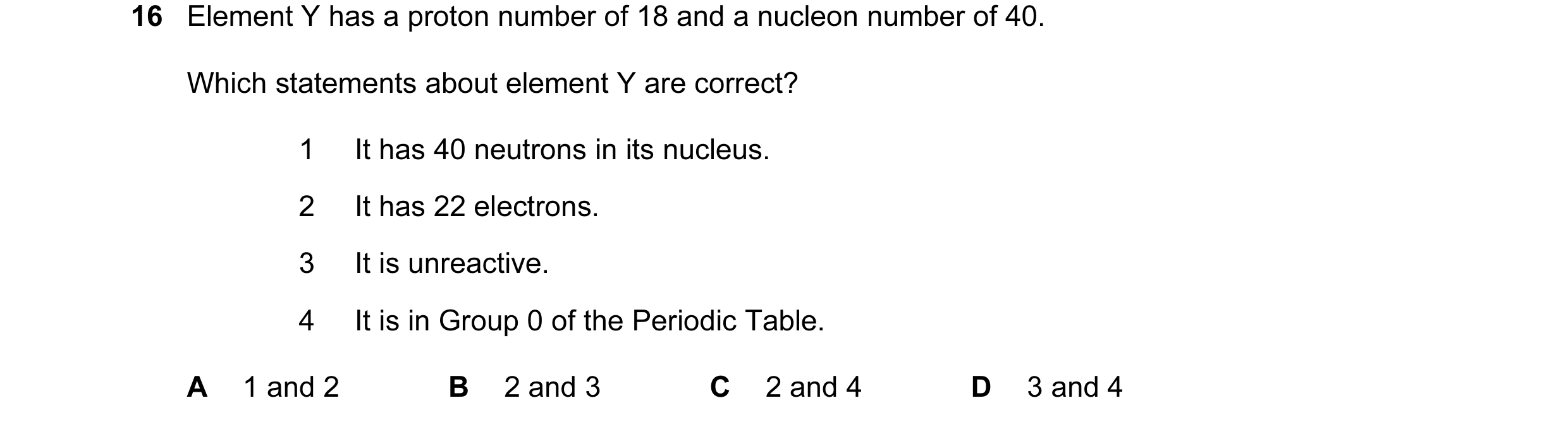
16 Element Y has a proton number of 18 and a nucleon number of 40. Which statements about element Y are correct? 1 It has 40 neutrons in its nucleus. 2 It has 22 electrons. 3 It is unreactive. 4 It is in Group 0 of the Periodic Table. A 1 and 2 B 2 and 3 C 2 and 4 D 3 and 4
1 marks
Answer: D
This question in 0653/11 Oct/Nov 2015
Q11 · Element Y has a proton number of 18 and a nucleon number of 40 0653/12 Oct/Nov 2015
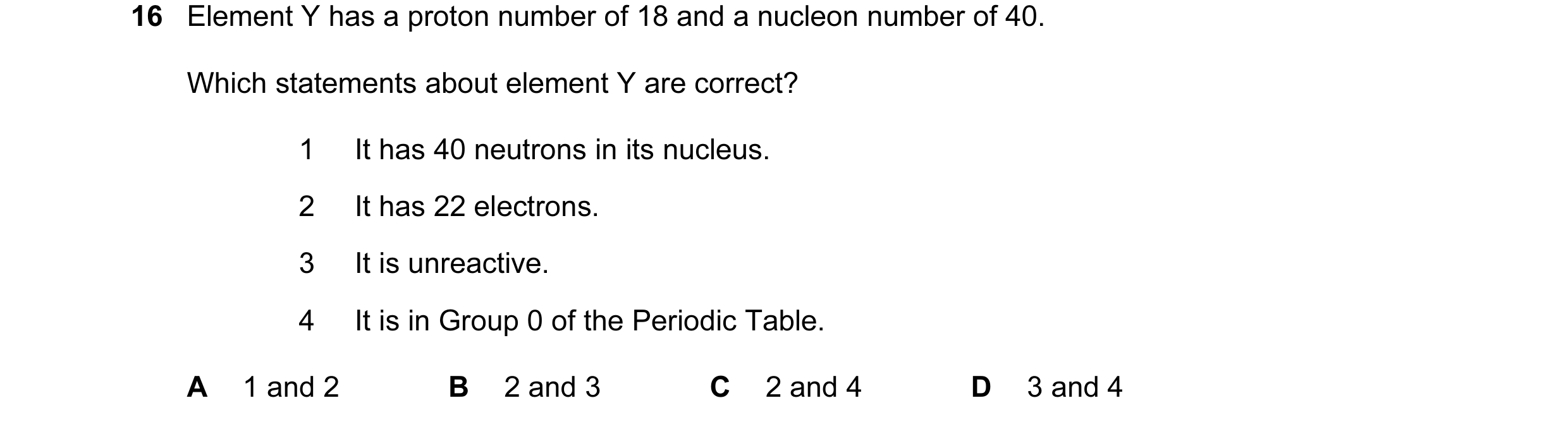
16 Element Y has a proton number of 18 and a nucleon number of 40. Which statements about element Y are correct? 1 It has 40 neutrons in its nucleus. 2 It has 22 electrons. 3 It is unreactive. 4 It is in Group 0 of the Periodic Table. A 1 and 2 B 2 and 3 C 2 and 4 D 3 and 4
1 marks
Answer: D
This question in 0653/12 Oct/Nov 2015
Q12 · Element Y has a proton number of 18 and a nucleon number of 40 0653/13 Oct/Nov 2015
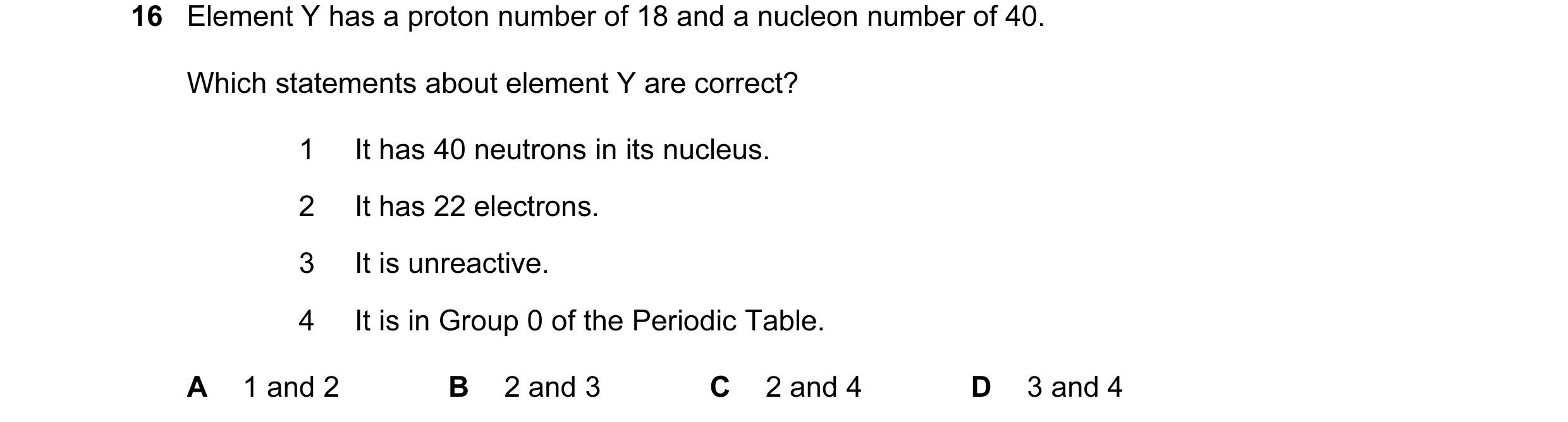
16 Element Y has a proton number of 18 and a nucleon number of 40. Which statements about element Y are correct? 1 It has 40 neutrons in its nucleus. 2 It has 22 electrons. 3 It is unreactive. 4 It is in Group 0 of the Periodic Table. A 1 and 2 B 2 and 3 C 2 and 4 D 3 and 4
1 marks
Answer: D
This question in 0653/13 Oct/Nov 2015
Q13 · Which describes a noble gas? 0653/12 Oct/Nov 2016
24 Which describes a noble gas? A compound, colourless, does not burn in air B element, colourless, burns in air C element, colourless, does not burn in air D element, green, does not burn in air
1 marks
Answer: C
This question in 0653/12 Oct/Nov 2016
Q14 · P, Q, R and S are four gases found in clean air 0653/13 Oct/Nov 2017
26 P, Q, R and S are four gases found in clean air. P is very unreactive. Q makes up 21% of the air. R makes up 78% of the air. S is formed when fossil fuels are burned. Which row is correct? P Q R S A argon nitrogen oxygen carbon dioxide B argon oxygen nitrogen carbon dioxide C carbon dioxide oxygen nitrogen argon D carbon dioxide nitrogen oxygen argon
1 marks
Answer: B
This question in 0653/13 Oct/Nov 2017
Q15 · The noble gases make up Group VIII of the Periodic Table 0653/12 Feb/March 2018
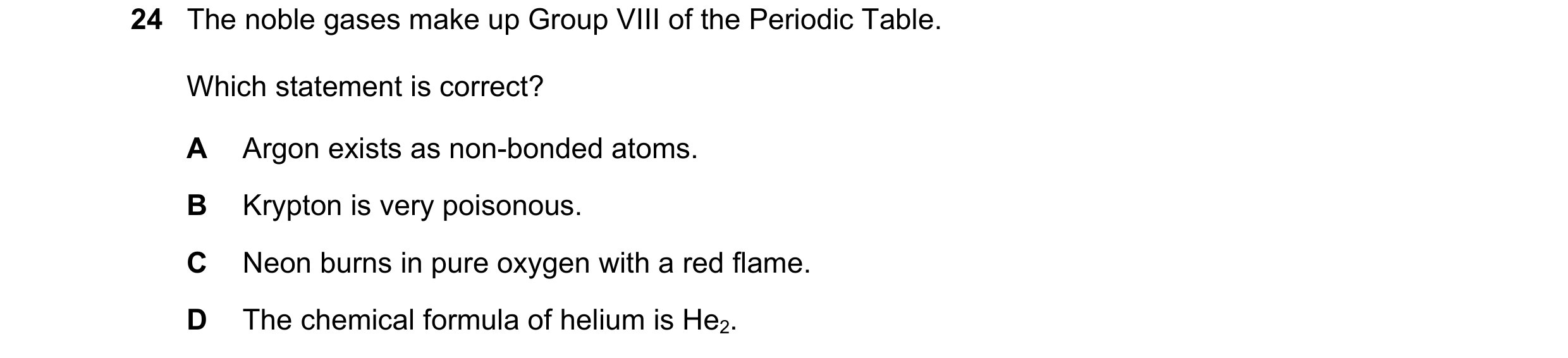
24 The noble gases make up Group VIII of the Periodic Table. Which statement is correct? A Argon exists as non-bonded atoms. B Krypton is very poisonous. C Neon burns in pure oxygen with a red flame. D The chemical formula of helium is He2.
1 marks
Answer: A
This question in 0653/12 Feb/March 2018
Q16 · Which statement describes noble gases? 0653/12 Feb/March 2019
23 Which statement describes noble gases? A They all have eight electrons in their outer shell. B They are monatomic gases. C They form ions with full outer shells of electrons. D They react with oxygen to form unreactive compounds.
1 marks
Answer: B
This question in 0653/12 Feb/March 2019
Q17 · Which gas is used to fill lamps? 0653/11 May/June 2019
23 Which gas is used to fill lamps? A argon B carbon dioxide C hydrogen D oxygen
1 marks
Answer: A
This question in 0653/11 May/June 2019
Q18 · Which row describes the reactivity and the electronic structure of a noble gas? 0653/12 Oct/Nov 2019
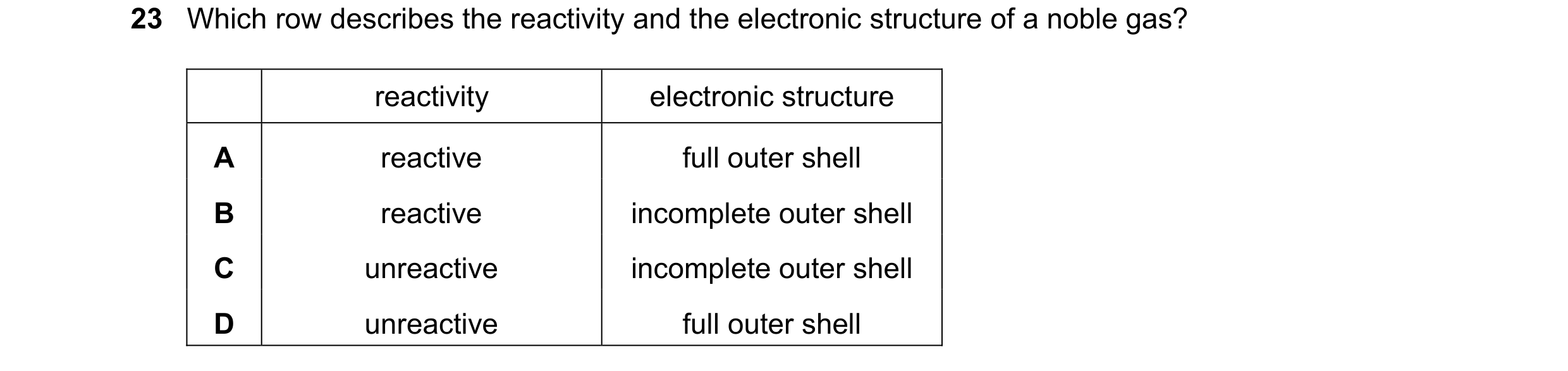
23 Which row describes the reactivity and the electronic structure of a noble gas? reactivity electronic structure A reactive full outer shell B reactive incomplete outer shell C unreactive incomplete outer shell D unreactive full outer shell
1 marks
Answer: D
This question in 0653/12 Oct/Nov 2019
Q19 · Which row describes the reactivity and the electronic structure of a noble gas? 0653/13 Oct/Nov 2019
23 Which row describes the reactivity and the electronic structure of a noble gas? reactivity electronic structure A reactive full outer shell B reactive incomplete outer shell C unreactive incomplete outer shell D unreactive full outer shell
1 marks
Answer: D
This question in 0653/13 Oct/Nov 2019
Q20 · Which words describe a noble gas? 0653/11 May/June 2021
23 Which words describe a noble gas? A compound, colourless, does not burn in air B element, colourless, burns in air C element, colourless, does not burn in air D element, green, does not burn in air
1 marks
Answer: C
This question in 0653/11 May/June 2021
Q21 · Which words describe a noble gas? 0653/12 May/June 2021
23 Which words describe a noble gas? A compound, colourless, does not burn in air B element, colourless, burns in air C element, colourless, does not burn in air D element, green, does not burn in air
1 marks
Answer: C
This question in 0653/12 May/June 2021
Q22 · Which words describe a noble gas? 0653/13 May/June 2021
23 Which words describe a noble gas? A compound, colourless, does not burn in air B element, colourless, burns in air C element, colourless, does not burn in air D element, green, does not burn in air
1 marks
Answer: C
This question in 0653/13 May/June 2021
Q23 · Which statement about noble gases is correct? 0653/12 Feb/March 2022
25 Which statement about noble gases is correct? A Argon is used in lamps because it gives out a bright light when it is heated. B Helium is used to fill balloons because it is more dense than air. C Krypton forms diatomic molecules because it is an unreactive gas. D Neon is unreactive because it has a full outer shell of electrons.
1 marks
Answer: D
This question in 0653/12 Feb/March 2022
Q24 · The noble gases are in Group VIII of the Periodic Table 0653/11 Oct/Nov 2022
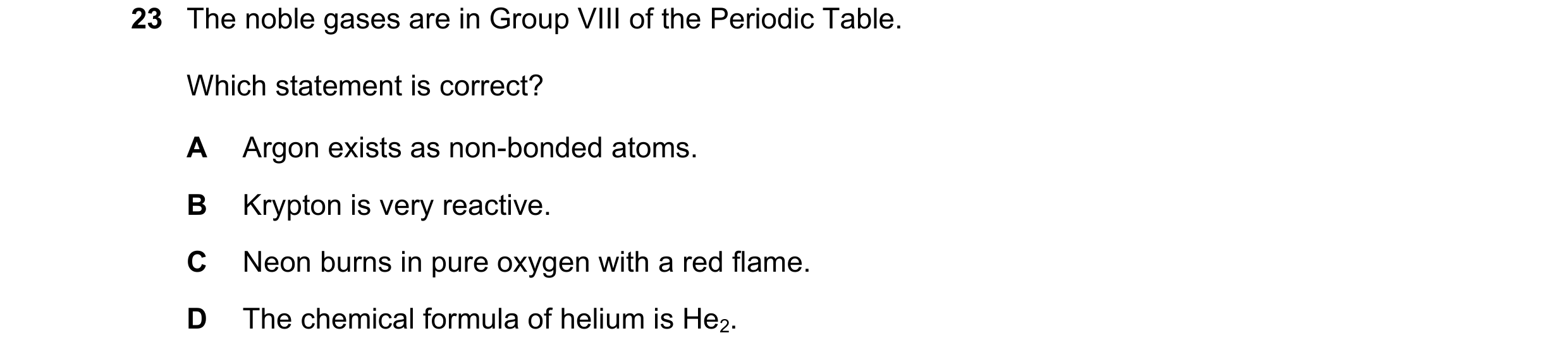
23 The noble gases are in Group VIII of the Periodic Table. Which statement is correct? A Argon exists as non-bonded atoms. B Krypton is very reactive. C Neon burns in pure oxygen with a red flame. D The chemical formula of helium is He2.
1 marks
Answer: A
This question in 0653/11 Oct/Nov 2022
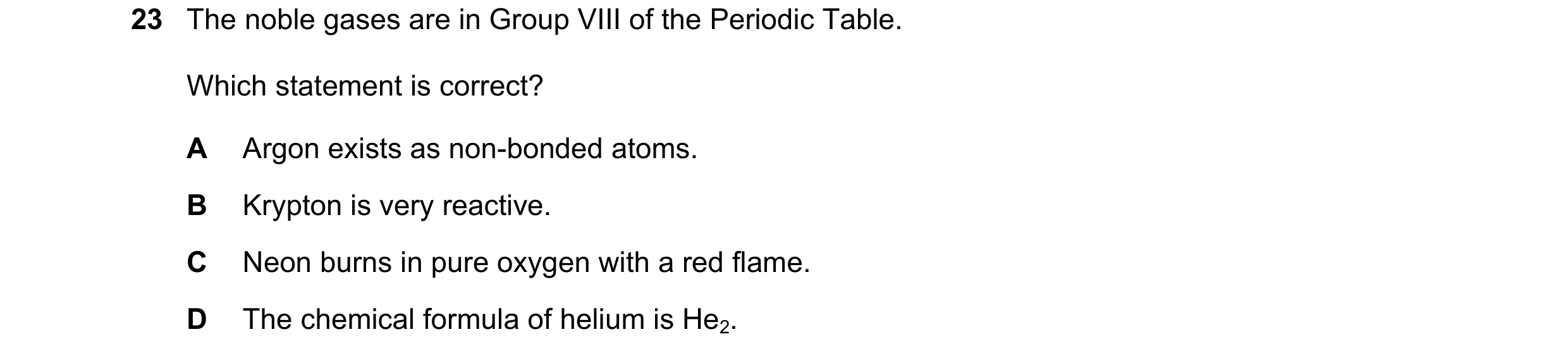
Q25 · The noble gases are in Group VIII of the Periodic Table 0653/12 Oct/Nov 2022
23 The noble gases are in Group VIII of the Periodic Table. Which statement is correct? A Argon exists as non-bonded atoms. B Krypton is very reactive. C Neon burns in pure oxygen with a red flame. D The chemical formula of helium is He2.
1 marks
Answer: A
This question in 0653/12 Oct/Nov 2022
Q26 · The noble gases are in Group VIII of the Periodic Table 0653/13 Oct/Nov 2022
23 The noble gases are in Group VIII of the Periodic Table. Which statement is correct? A Argon exists as non-bonded atoms. B Krypton is very reactive. C Neon burns in pure oxygen with a red flame. D The chemical formula of helium is He2.
1 marks
Answer: A
This question in 0653/13 Oct/Nov 2022
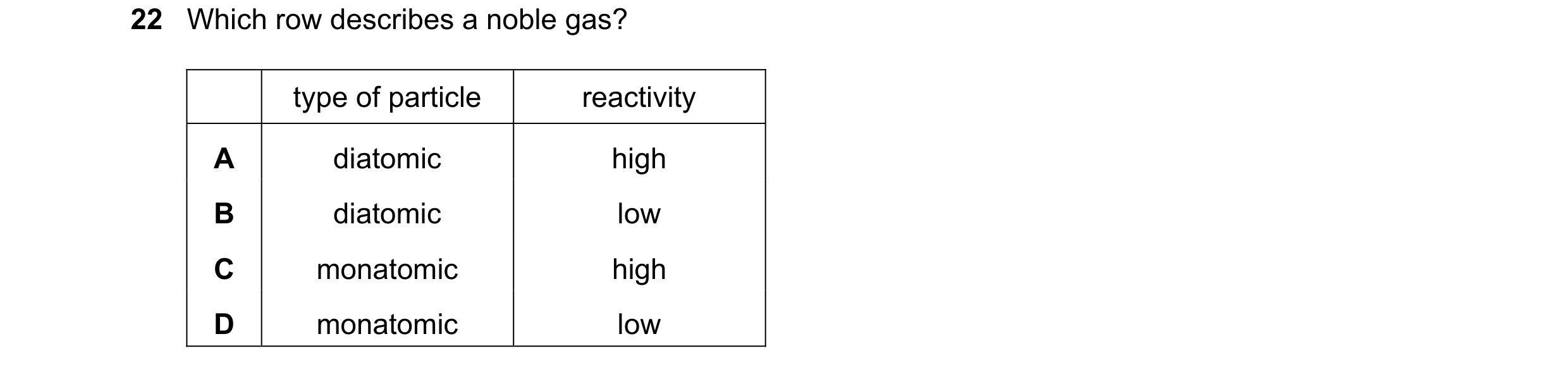
Q27 · Which row describes a noble gas? 0653/12 Feb/March 2023
22 Which row describes a noble gas? type of particle reactivity A diatomic high B diatomic low C monatomic high D monatomic low
1 marks
Answer: D
This question in 0653/12 Feb/March 2023
Q28 · Which statement about noble gases is correct? 0653/12 May/June 2023
24 Which statement about noble gases is correct? A Helium is used to fill filament lamps. B They are all diatomic gases. C Argon and helium are found in clean air. D They are all in Group VII of the Periodic Table.
1 marks
Answer: C
This question in 0653/12 May/June 2023
Q29 · An atom of an element in the Periodic Table has the electronic structure 2,8,8 0653/11 May/June 2024
21 An atom of an element in the Periodic Table has the electronic structure 2,8,8. What is the group number of this element? A I B III C VII D VIII
1 marks
Answer: D
This question in 0653/11 May/June 2024
Q30 · Which statement about the noble gases is correct? 0653/13 May/June 2024
25 Which statement about the noble gases is correct? A They form diatomic molecules. B They all have the same number of electron shells. C They are reactive so they are stored under oil. D They have full outer shells of electrons.
1 marks
Answer: D
This question in 0653/13 May/June 2024
Q31 · Which statement about noble gases is correct? 0653/11 Oct/Nov 2024
22 Which statement about noble gases is correct? A Atoms of noble gases form diatomic molecules. B Atoms of noble gases have full outer shells of electrons. C They form unreactive compounds. D They are good conductors of electricity.
1 marks
Answer: B
This question in 0653/11 Oct/Nov 2024
Q32 · What is the electronic structure of a noble gas? 0653/12 Oct/Nov 2024
22 What is the electronic structure of a noble gas? A 2 B 2,1 C 2,8,2 D 2,8,7
1 marks
Answer: A
This question in 0653/12 Oct/Nov 2024
Q33 · What is the electronic structure of a noble gas? 0653/13 Oct/Nov 2024
22 What is the electronic structure of a noble gas? A 2 B 2,1 C 2,8,2 D 2,8,7
1 marks
Answer: A
This question in 0653/13 Oct/Nov 2024
Q34 · Which electronic configuration represents a noble gas? 0653/13 May/June 2025
14 Which electronic configuration represents a noble gas? A 2 B 2,1 C 2,2 D 2,3
1 marks
Answer: A
This question in 0653/13 May/June 2025
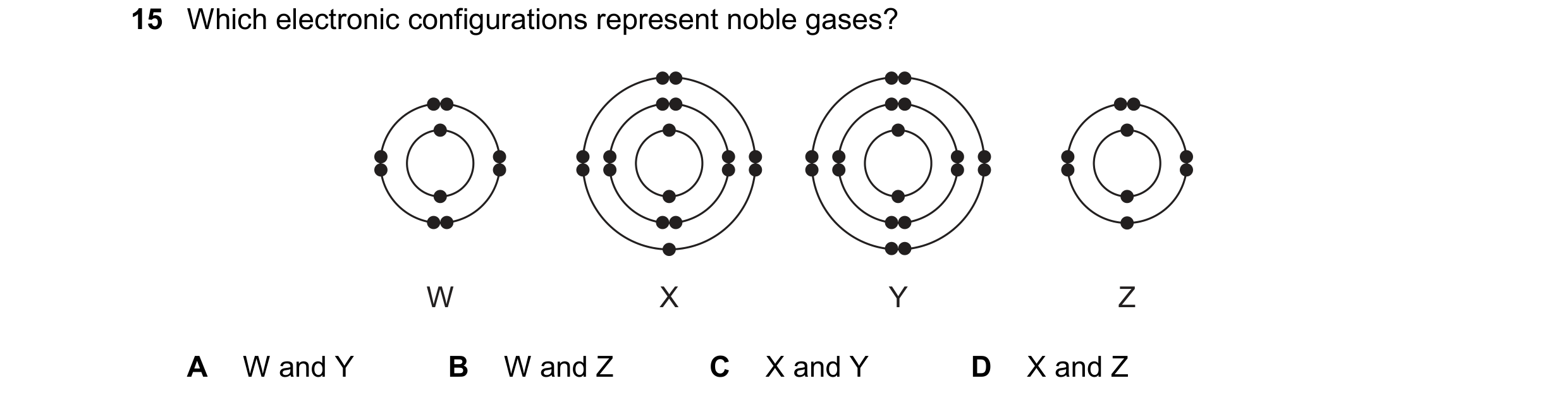
Q35 · Which electronic configurations represent noble gases? 0653/11 Oct/Nov 2025
15 Which electronic configurations represent noble gases? W X Y Z A W and Y B W and Z C X and Y D X and Z
1 marks
Answer: A
This question in 0653/11 Oct/Nov 2025
Q36 · Element Y has a proton number of 18 and a nucleon number of 40 0653/12 Oct/Nov 2025
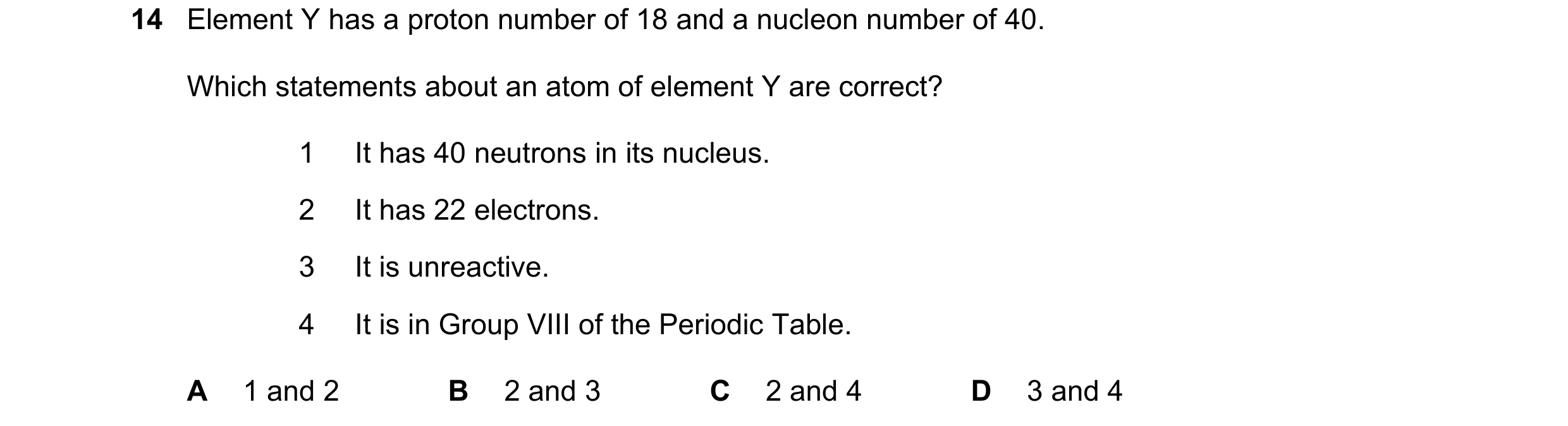
14 Element Y has a proton number of 18 and a nucleon number of 40. Which statements about an atom of element Y are correct? 1 It has 40 neutrons in its nucleus. 2 It has 22 electrons. 3 It is unreactive. 4 It is in Group VIII of the Periodic Table. A 1 and 2 B 2 and 3 C 2 and 4 D 3 and 4
1 marks
Answer: D
This question in 0653/12 Oct/Nov 2025
Q37 · Element Y has a proton number of 18 and a nucleon number of 40 0653/13 Oct/Nov 2025
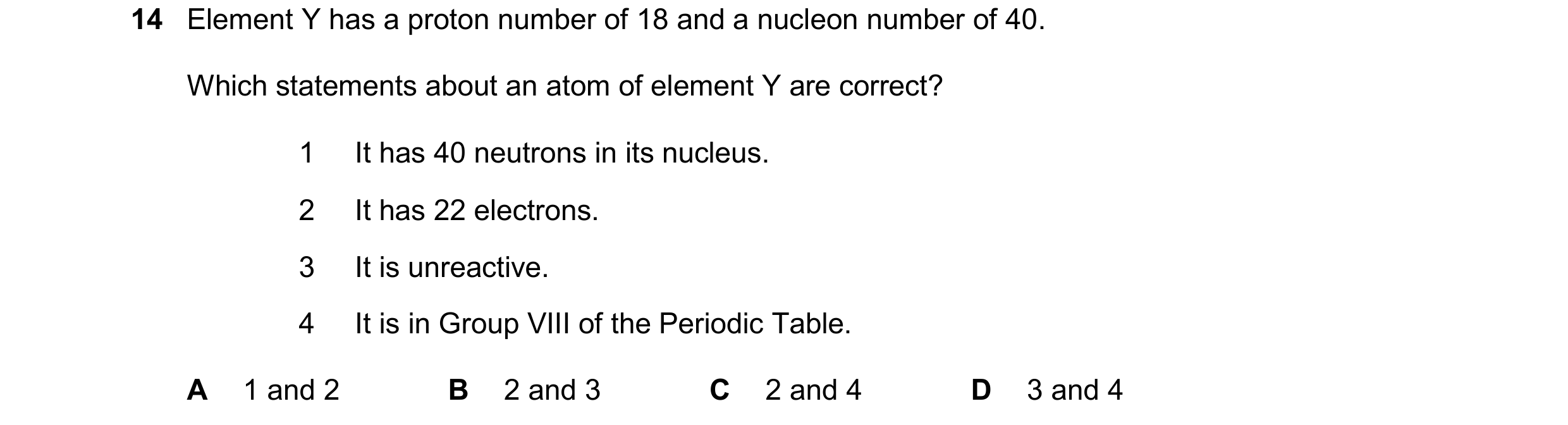
14 Element Y has a proton number of 18 and a nucleon number of 40. Which statements about an atom of element Y are correct? 1 It has 40 neutrons in its nucleus. 2 It has 22 electrons. 3 It is unreactive. 4 It is in Group VIII of the Periodic Table. A 1 and 2 B 2 and 3 C 2 and 4 D 3 and 4
1 marks
Answer: D
This question in 0653/13 Oct/Nov 2025

 1 / 7
1 / 7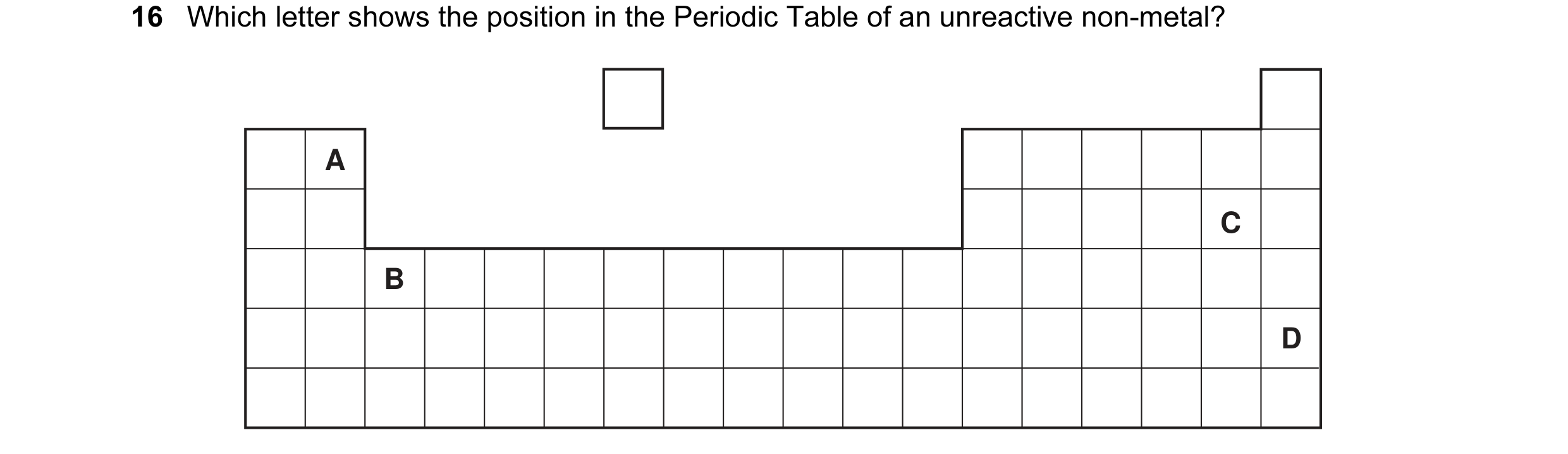
 2 / 7
2 / 7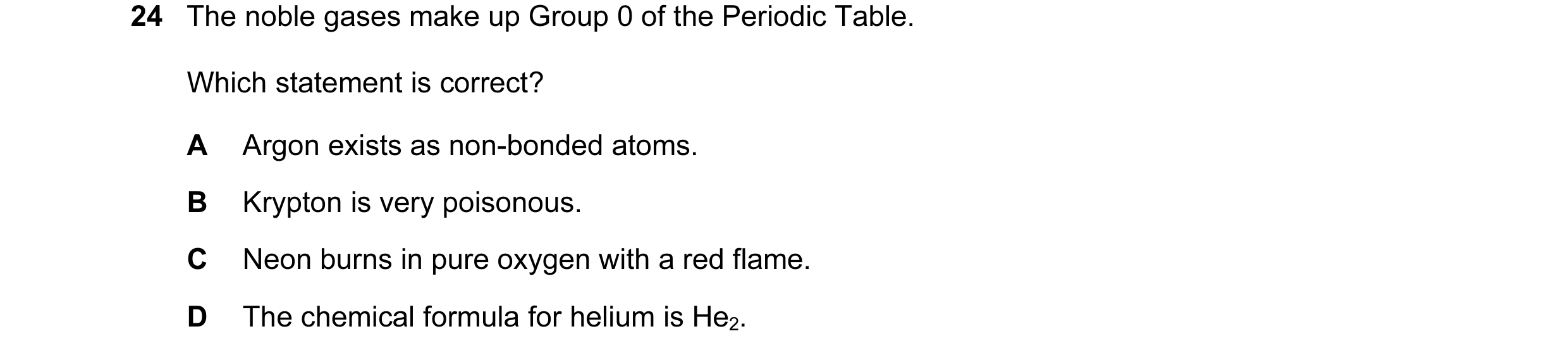
 3 / 7
3 / 7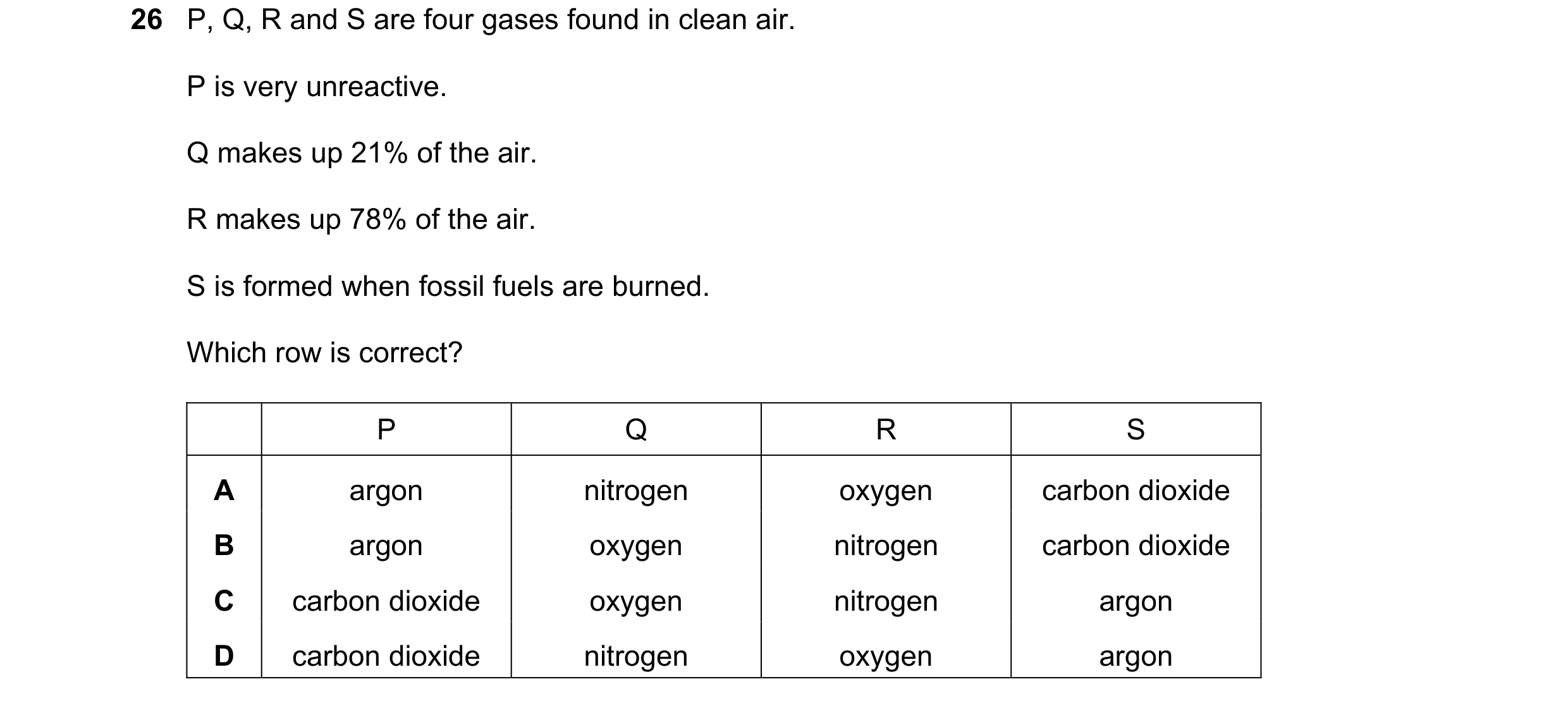


 4 / 7
4 / 7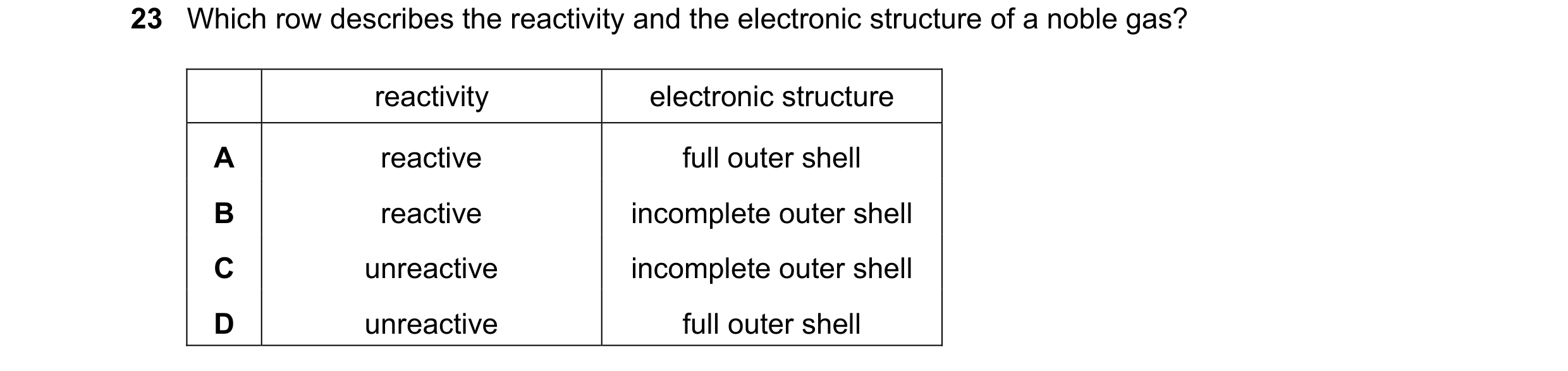




 5 / 7
5 / 7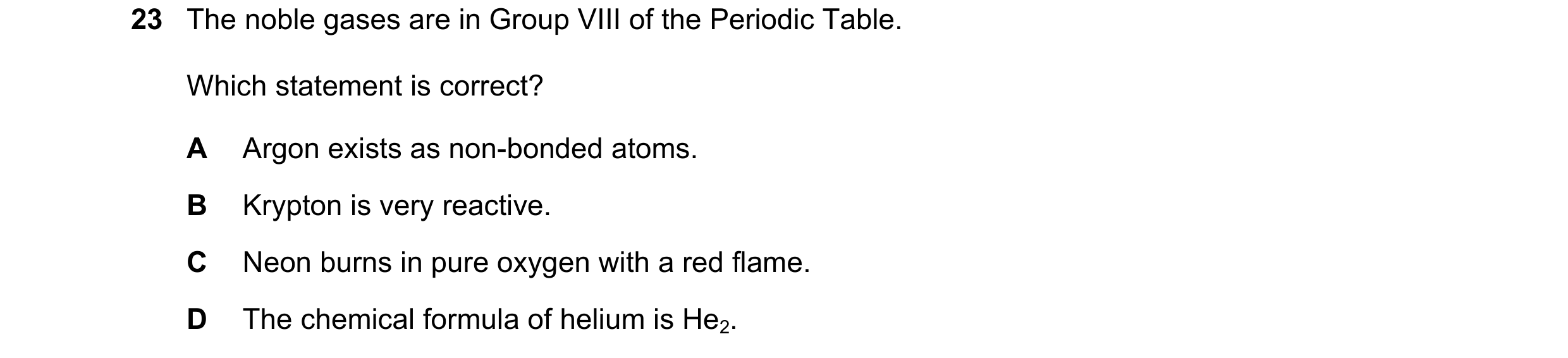


 6 / 7
6 / 7



 7 / 7
7 / 7