Questions as text
Q1 · Use of the Data Booklet is relevant to this question 9701/11 May/June 2006
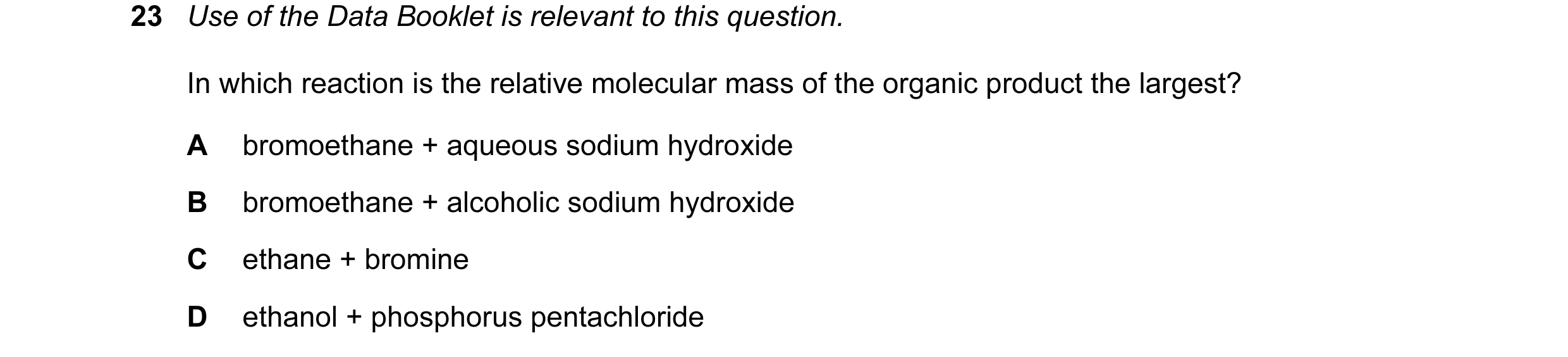
23 Use of the Data Booklet is relevant to this question. In which reaction is the relative molecular mass of the organic product the largest? A bromoethane + aqueous sodium hydroxide B bromoethane + alcoholic sodium hydroxide C ethane + bromine D ethanol + phosphorus pentachloride
1 marks
Answer: C
This question in 9701/11 May/June 2006
Q2 · An element X consists of four isotopes 9701/11 Oct/Nov 2009
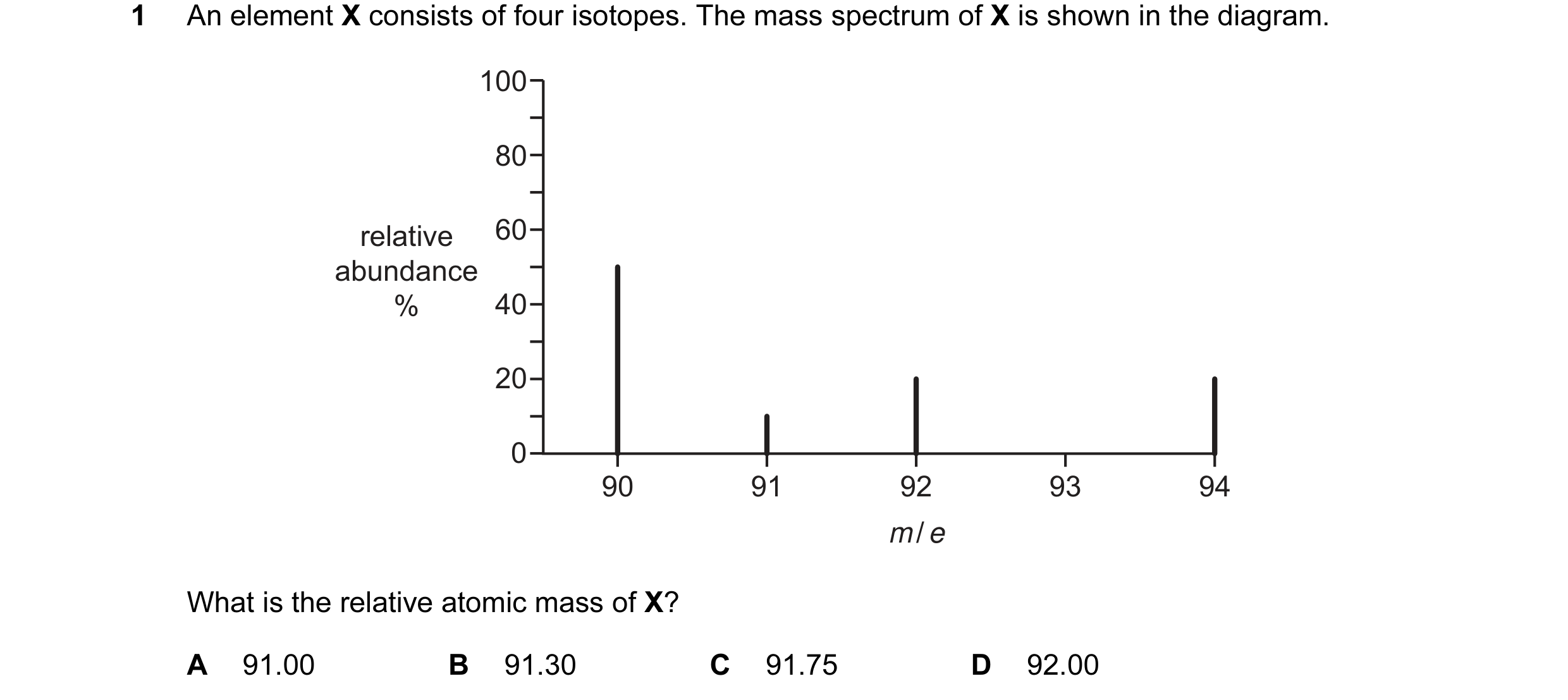
1 An element X consists of four isotopes. The mass spectrum of X is shown in the diagram. 100 80 relative 60 abundance % 40 20 0 90 91 92 93 94 m / e What is the relative atomic mass of X? A 91.00 B 91.30 C 91.75 D 92.00
1 marks
Answer: B
This question in 9701/11 Oct/Nov 2009
Q3 · The ester CH3CH2CH2CO2CH3 is responsible for the aroma of apples 9701/12 May/June 2011
28 The ester CH3CH2CH2CO2CH3 is responsible for the aroma of apples. When this ester is hydrolysed by acid in the stomach, what is the empirical formula of the organic acid produced? A CH2O B CH4O C C2H4O D C3H6O2
1 marks
Answer: C
This question in 9701/12 May/June 2011
Q4 · The general gas equation can be used to calculate the Mr value of a gas 9701/11 May/June 2013
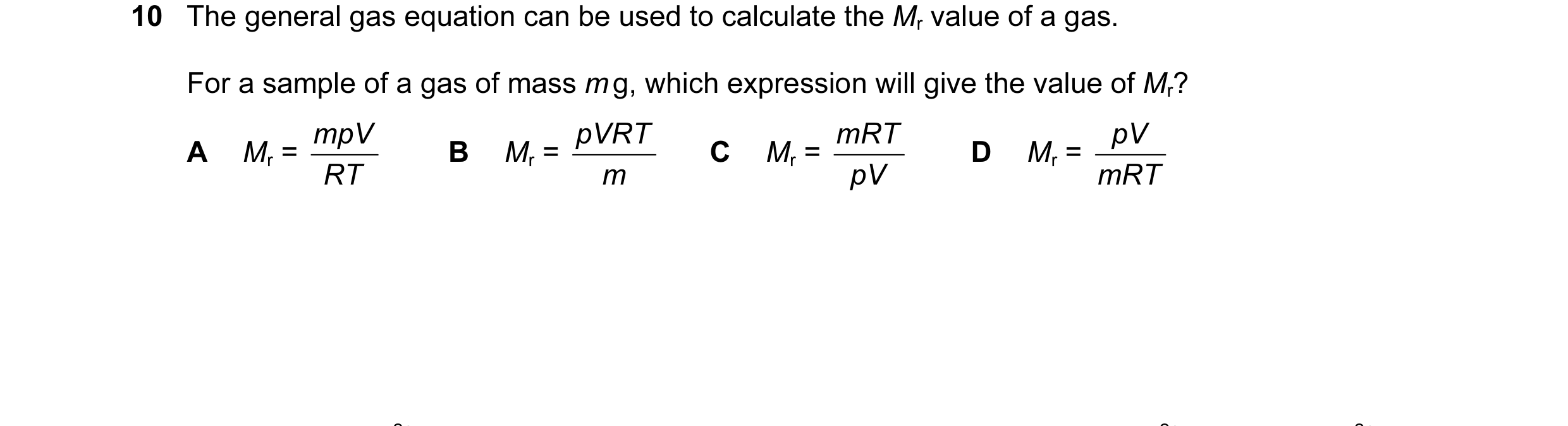
10 The general gas equation can be used to calculate the Mr value of a gas. For a sample of a gas of mass m g, which expression will give the value of Mr? mpV pVRT mRT pV A Mr = RT B Mr = C Mr = pV D Mr = mRT m
1 marks
Answer: C
This question in 9701/11 May/June 2013
Q5 · Use of the Data Booklet is relevant to this question 9701/11 Oct/Nov 2014
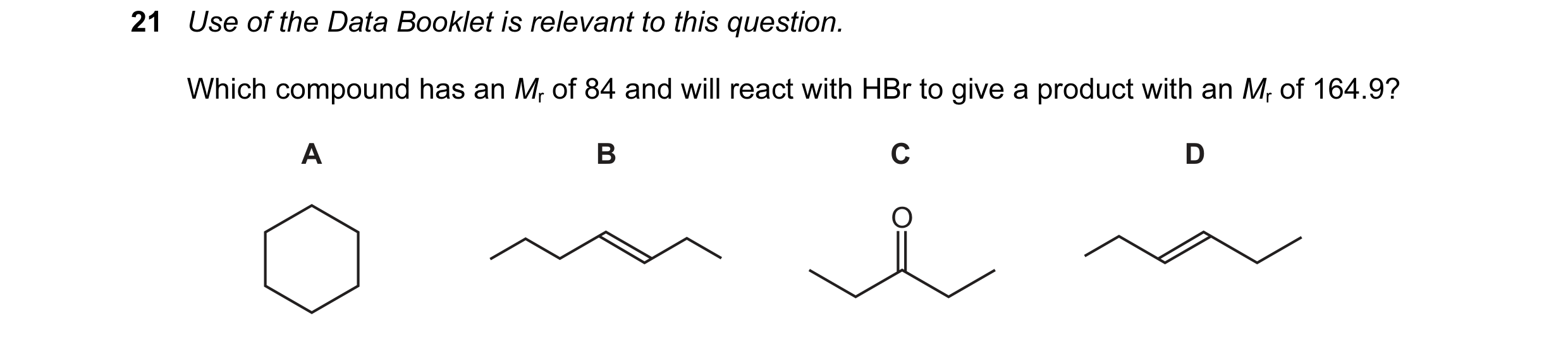
21 Use of the Data Booklet is relevant to this question. Which compound has an Mr of 84 and will react with HBr to give a product with an Mr of 164.9? A B C D O
1 marks
Answer: D
This question in 9701/11 Oct/Nov 2014
Q6 · Use of the Data Booklet is relevant to this question 9701/12 Oct/Nov 2014
21 Use of the Data Booklet is relevant to this question. Which compound has an Mr of 84 and will react with HBr to give a product with an Mr of 164.9? A B C D O
1 marks
Answer: D
This question in 9701/12 Oct/Nov 2014
Q7 · Which equations can apply to an ideal gas? 9701/12 Oct/Nov 2015
33 Which equations can apply to an ideal gas? [p = pressure, V = volume, M = molar mass, ρ = density, c = concentration, R = gas constant, T = temperature] ρ RT cRT 1 p = 2 pV = M 3 pV = MRT M
1 marks
This question in 9701/12 Oct/Nov 2015
Q8 · Which row of the table is correct? 9701/12 Feb/March 2016
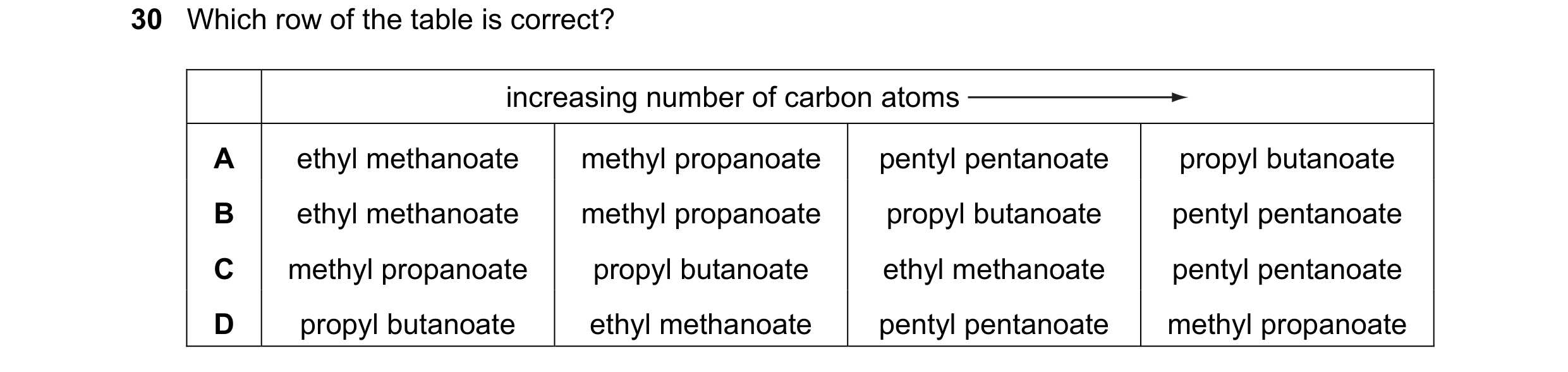
30 Which row of the table is correct? increasing number of carbon atoms A ethyl methanoate methyl propanoate pentyl pentanoate propyl butanoate B ethyl methanoate methyl propanoate propyl butanoate pentyl pentanoate C methyl propanoate propyl butanoate ethyl methanoate pentyl pentanoate D propyl butanoate ethyl methanoate pentyl pentanoate methyl propanoate
1 marks
Answer: B
This question in 9701/12 Feb/March 2016
Q9 · 0.10 g of the volatile liquid X formed 0.025 dm3 of vapour at 100 °C and atmospheric… 9701/12 May/June 2016
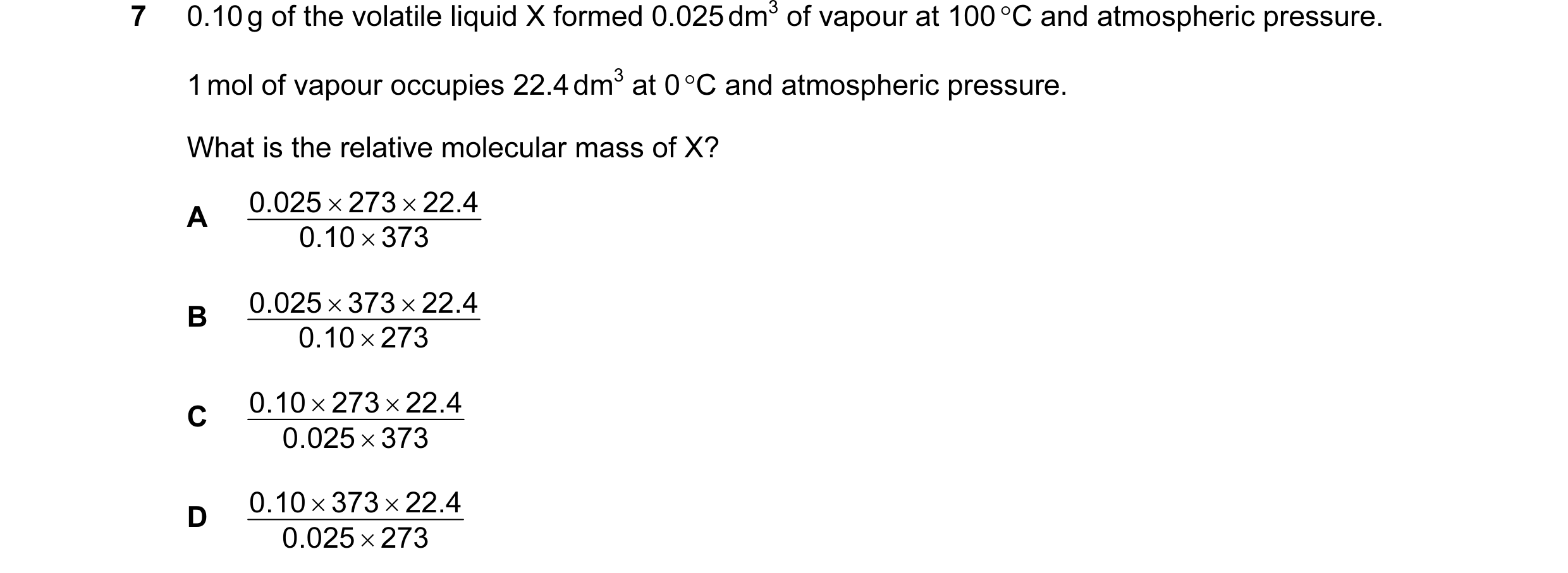
7 0.10 g of the volatile liquid X formed 0.025 dm3 of vapour at 100 °C and atmospheric pressure. 1 mol of vapour occupies 22.4 dm3 at 0 °C and atmospheric pressure. What is the relative molecular mass of X? 0.025 × 273 × 22.4 A 0.10 × 373 0 . 025 × 373 × 22 . 4 B 0 . 10 × 273 0 . 10 × 273 × 22 . 4 C 0 . 025 × 373 0 . 10 × 373 × 22 . 4 D 0 . 025 × 273
1 marks
Answer: D
This question in 9701/12 May/June 2016
Q10 · A sample of boron contains aluminium as the only impurity 9701/11 Oct/Nov 2016
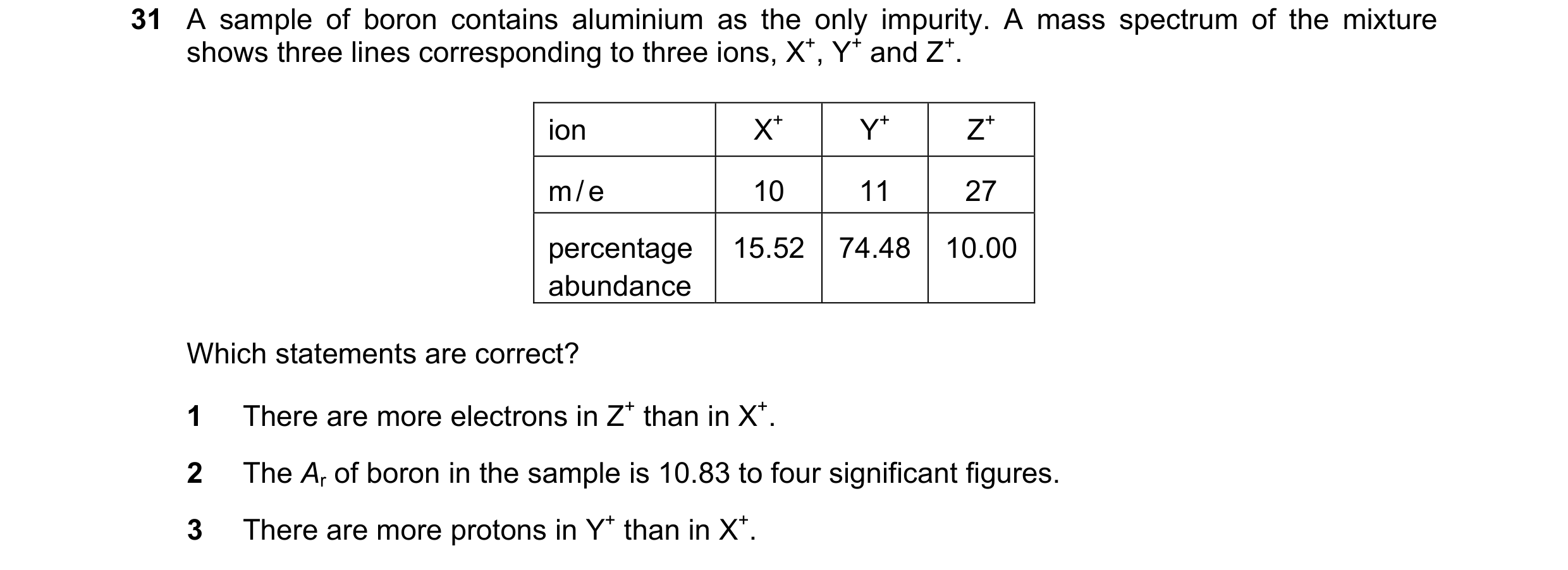
31 A sample of boron contains aluminium as the only impurity. A mass spectrum of the mixture shows three lines corresponding to three ions, X+, Y+ and Z+. ion X+ Y+ Z+ m / e 10 11 27 percentage 15.52 74.48 10.00 abundance Which statements are correct? 1 There are more electrons in Z+ than in X+. 2 The Ar of boron in the sample is 10.83 to four significant figures. 3 There are more protons in Y+ than in X+.
1 marks
Answer: B
This question in 9701/11 Oct/Nov 2016
Q11 · A sample of boron contains aluminium as the only impurity 9701/13 Oct/Nov 2016
31 A sample of boron contains aluminium as the only impurity. A mass spectrum of the mixture shows three lines corresponding to three ions, X+, Y+ and Z+. ion X+ Y+ Z+ m / e 10 11 27 percentage 15.52 74.48 10.00 abundance Which statements are correct? 1 There are more electrons in Z+ than in X+. 2 The Ar of boron in the sample is 10.83 to four significant figures. 3 There are more protons in Y+ than in X+.
1 marks
Answer: B
This question in 9701/13 Oct/Nov 2016
Q12 · The ion Y3– contains 18 electrons and has a mass number of 31 9701/13 May/June 2017
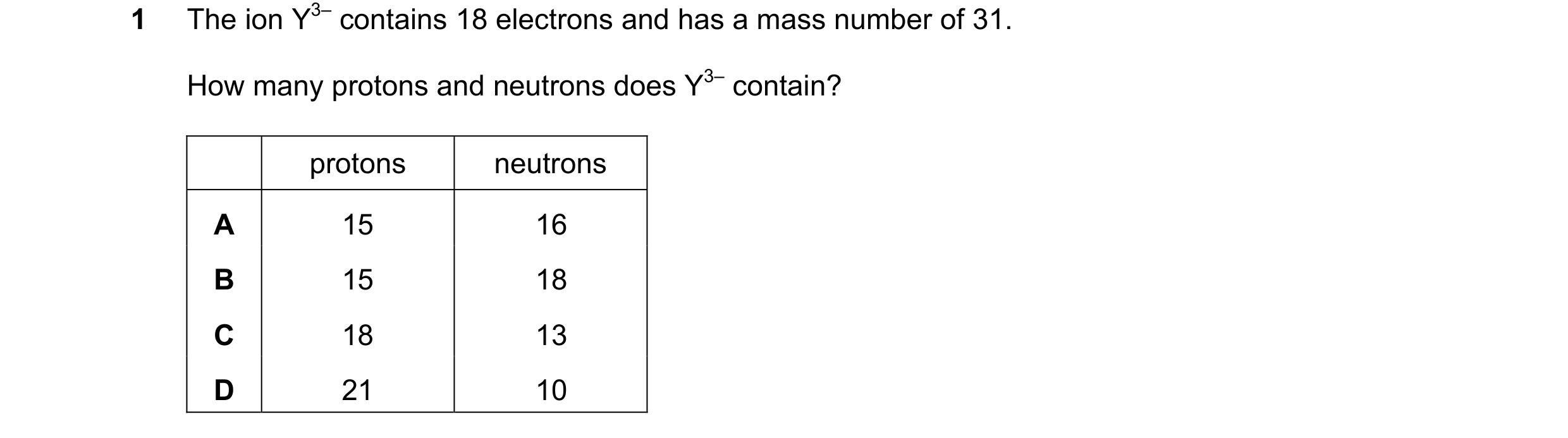
1 The ion Y3– contains 18 electrons and has a mass number of 31. How many protons and neutrons does Y3– contain? protons neutrons A 15 16 B 15 18 C 18 13 D 21 10
1 marks
Answer: A
This question in 9701/13 May/June 2017
Q13 · Two hydrocarbons have the formulae CWHX and CYHZ 9701/12 Oct/Nov 2017
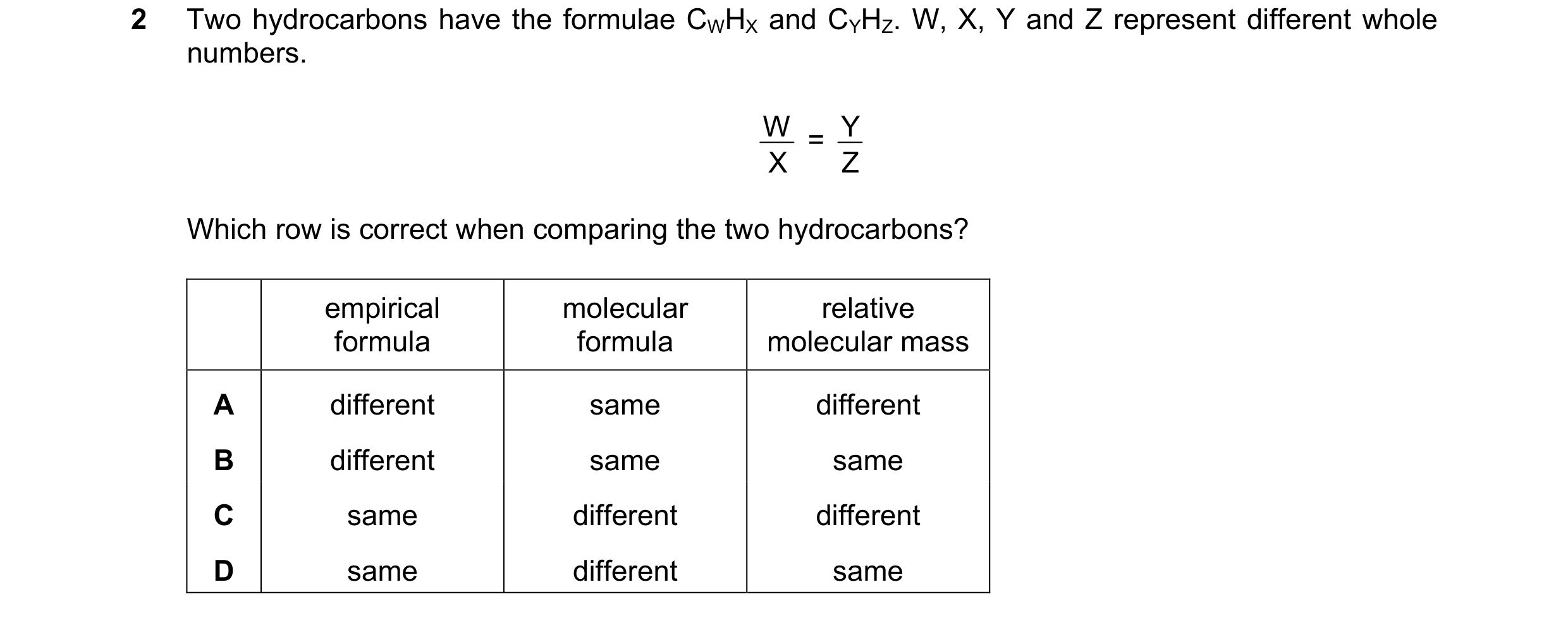
2 Two hydrocarbons have the formulae CWHX and CYHZ. W, X, Y and Z represent different whole numbers. W = Z Y X Which row is correct when comparing the two hydrocarbons? empirical molecular relative formula formula molecular mass A different same different B different same same C same different different D same different same
1 marks
Answer: C
This question in 9701/12 Oct/Nov 2017
Q14 · One mole of sulfuric acid is used to make an aqueous solution 9701/11 May/June 2018
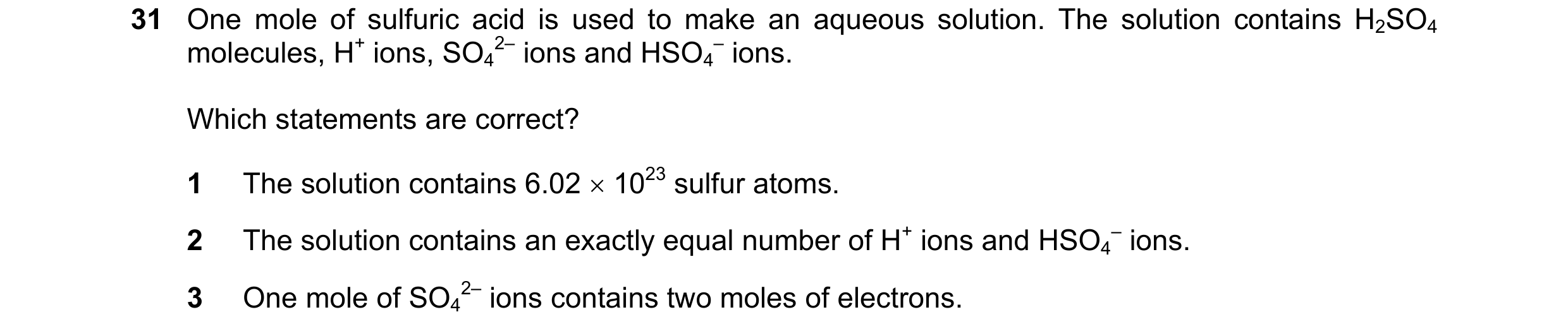
31 One mole of sulfuric acid is used to make an aqueous solution. The solution contains H2SO4 molecules, H+ ions, SO4 2– ions and HSO4 – ions. Which statements are correct? 1 The solution contains 6.02 × 10²³ sulfur atoms. 2 The solution contains an exactly equal number of H+ ions and HSO4 – ions. 3 One mole of SO4 2– ions contains two moles of electrons.
1 marks
Answer: D
This question in 9701/11 May/June 2018
Q15 · When O2 reacts with H2S the products are SO2 and H2O 9701/12 May/June 2019
31 When O2 reacts with H2S the products are SO2 and H2O. Mixture Y contains an equal number of the two molecules shown, and no other molecules. 16 O = 18 O H 1 – 32 S – H 1 8 8 1 16 1 Which statements about Y are correct? 1 The average Mr in Y is 34. 2 If some oxygen molecules are removed from Y, the average Mr of the mixture remains the same. 3 When mixture Y is ignited, some H2S remains unreacted.
1 marks
Answer: A
This question in 9701/12 May/June 2019
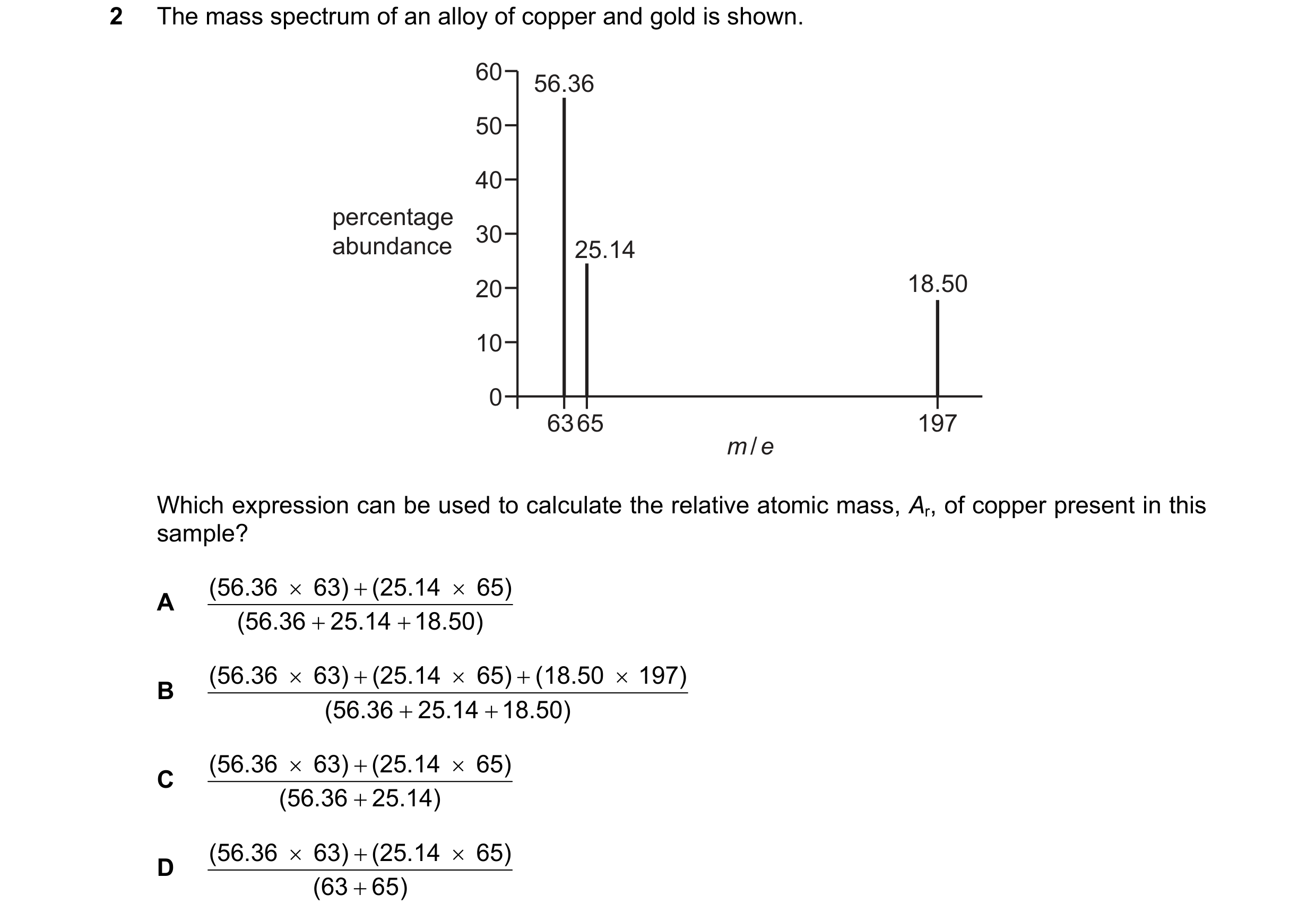
Q16 · The mass spectrum of an alloy of copper and gold is shown 9701/13 May/June 2019
2 The mass spectrum of an alloy of copper and gold is shown. 60 56.36 50 40 percentage 30 abundance 25.14 20 18.50 10 0 6365 197 m / e Which expression can be used to calculate the relative atomic mass, Ar, of copper present in this sample? (56.36 × 63) + (25.14 × 65) A (56.36 + 25.14 + 18.50) (56.36 × 63) + (25.14 × 65) + (18.50 × 197) B (56.36 + 25.14 + 18.50) (56.36 × 63) + (25.14 × 65) C (56.36 + 25.14) (56.36 × 63) + (25.14 × 65) D (63 + 6 5 )
1 marks
Answer: C
This question in 9701/13 May/June 2019
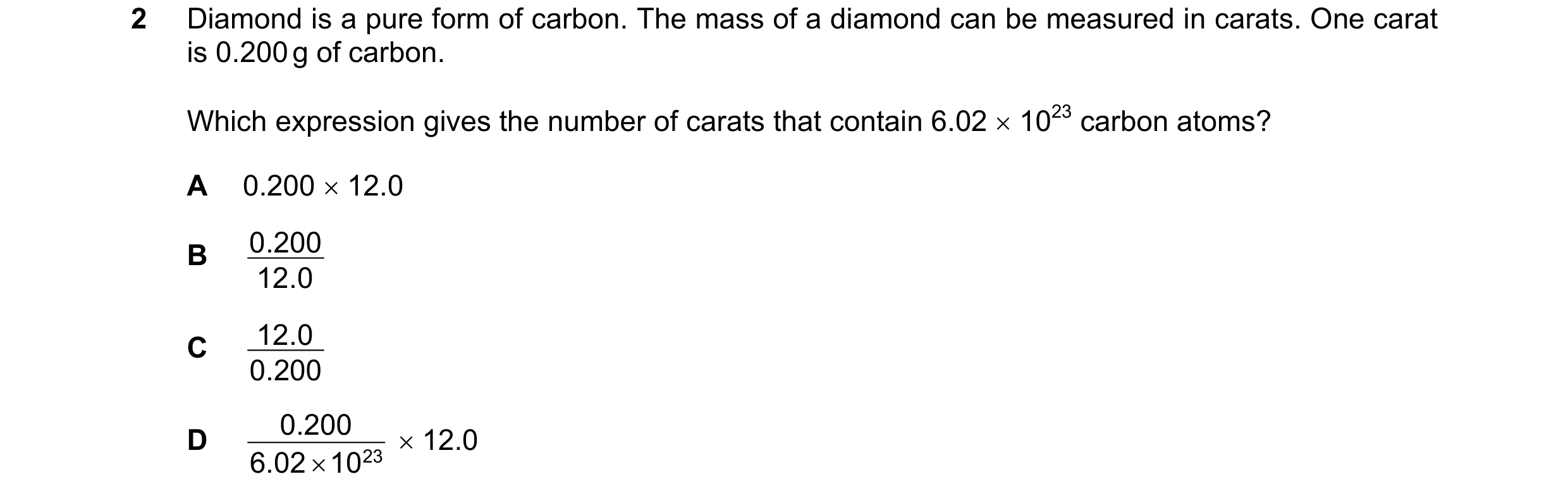
Q17 · Diamond is a pure form of carbon 9701/13 Oct/Nov 2019
2 Diamond is a pure form of carbon. The mass of a diamond can be measured in carats. One carat is 0.200 g of carbon. Which expression gives the number of carats that contain 6.02 × 10²³ carbon atoms? A 0.200 × 12.0 B 0 . 200 12 . 0 C 12 . 0 0 . 200 0.200 × 12.0 D 6.02 × 10 23
1 marks
Answer: C
This question in 9701/13 Oct/Nov 2019
Q18 · The element sulfur produces a mass spectrum with the following peaks 9701/13 May/June 2020
7 The element sulfur produces a mass spectrum with the following peaks. m / e value relative of peak abundance 32 95.02 33 0.76 34 4.20 36 0.02 Which relative atomic mass of sulfur can be calculated from these data, given to four significant figures? A 32.07 B 32.08 C 32.09 D 32.10
1 marks
Answer: C
This question in 9701/13 May/June 2020
Q19 · There are many non-cyclic alcohols that cannot be oxidised by warm acidified MnO4 – ions 9701/13 May/June 2020
22 There are many non-cyclic alcohols that cannot be oxidised by warm acidified MnO4 – ions. Alcohol X is the member of this set of alcohols with the lowest molecular mass. How many moles of oxygen are required for the complete combustion of 1.0 mol of alcohol X? A 3.5 mol B 4.5 mol C 6.0 mol D 6.5 mol
1 marks
Answer: C
This question in 9701/13 May/June 2020
Q20 · Which statement is correct? 9701/11 Oct/Nov 2020
1 Which statement is correct? A Cl has a relative isotopic mass of 35.5. B Cl 2 has a relative molecular mass of 70. C ICl has a relative molecular mass of 162.4. D NaCl has a relative molecular mass of 58.5.
1 marks
Answer: C
This question in 9701/11 Oct/Nov 2020
Q21 · Which statement is correct? 9701/13 Oct/Nov 2020
1 Which statement is correct? A Cl has a relative isotopic mass of 35.5. B Cl 2 has a relative molecular mass of 70. C ICl has a relative molecular mass of 162.4. D NaCl has a relative molecular mass of 58.5.
1 marks
Answer: C
This question in 9701/13 Oct/Nov 2020
Q22 · Originally, chemists thought indium oxide had the formula InO 9701/12 Feb/March 2021
4 Originally, chemists thought indium oxide had the formula InO. By experiment they showed that 4.8 g of indium combined with 1.0 g of oxygen to produce 5.8 g of indium oxide. The Ar of oxygen was known to be 16. Which value for the Ar of indium is calculated using these data? A 38 B 77 C 115 D 154
1 marks
Answer: B
This question in 9701/12 Feb/March 2021
Q23 · The mass spectrum of a sample of neon is shown 9701/11 Oct/Nov 2021
1 The mass spectrum of a sample of neon is shown. The relative abundance of each peak is written in brackets above it. (100) relative abundance (8) (0.3) 20 21 22 mass charge What is the relative atomic mass, Ar, of this sample of neon? A 20.15 B 20.20 C 21.00 D 21.82
1 marks
Answer: A
This question in 9701/11 Oct/Nov 2021
Q24 · The general gas equation can be used to calculate the value of the Mr of a gas 9701/12 Oct/Nov 2021
8 The general gas equation can be used to calculate the value of the Mr of a gas. For a sample of a gas of mass m grams, which expression will give the value of Mr? mRT pVRT mpV pV A Mr = pV B Mr = C Mr = RT D Mr = mRT m
1 marks
Answer: A
This question in 9701/12 Oct/Nov 2021
Q25 · A sample of sulfur consists mostly of 32S 9701/13 May/June 2022
39 A sample of sulfur consists mostly of 32S. It also contains 4.2% 34S and 2.8% 36S. No other isotopes of sulfur are present. What is the relative atomic mass, Ar, of this sample of sulfur? A 32.1 B 32.2 C 34.0 D 34.3
1 marks
Answer: B
This question in 9701/13 May/June 2022
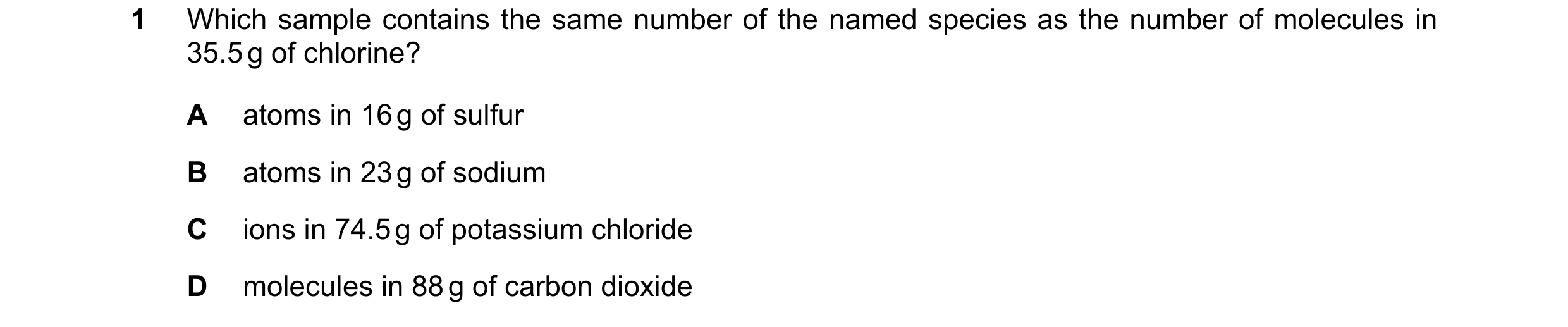
Q26 · Which sample contains the same number of the named species as the number of molecules in… 9701/11 Oct/Nov 2022
1 Which sample contains the same number of the named species as the number of molecules in 35.5 g of chlorine? A atoms in 16 g of sulfur B atoms in 23 g of sodium C ions in 74.5 g of potassium chloride D molecules in 88 g of carbon dioxide
1 marks
Answer: A
This question in 9701/11 Oct/Nov 2022
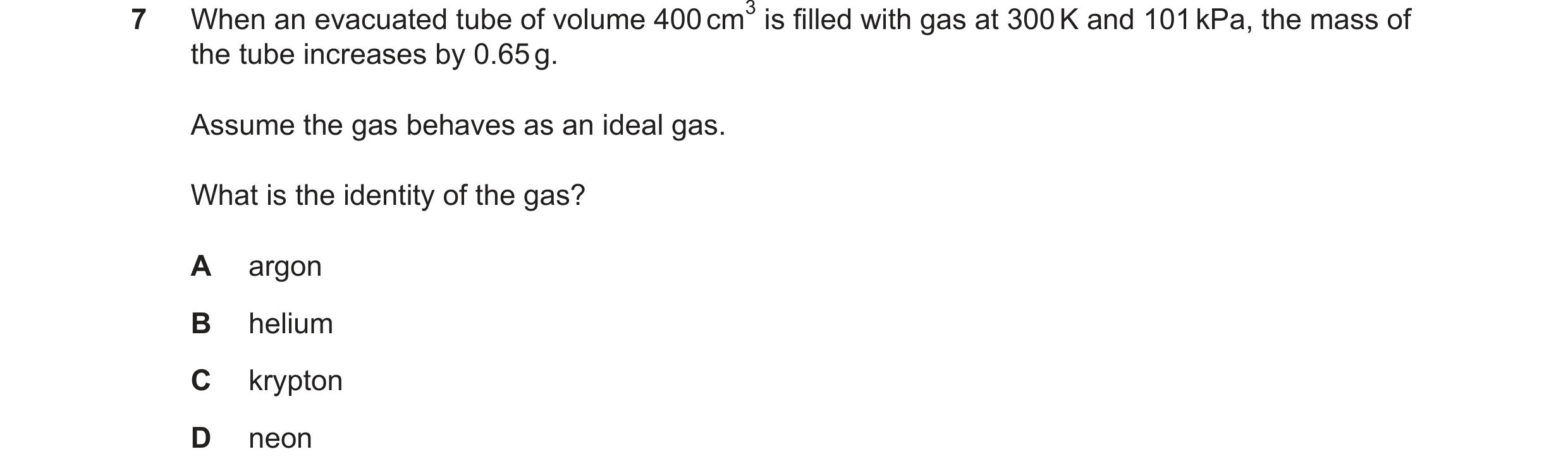
Q27 · The tube increases by 0.65g 9701/11 Oct/Nov 2023
7 the tube increases by 0.65g. Assume the gas behaves as an ideal gas. What is the identity of the gas? A argon B helium C krypton D neon
1 marks
Answer: A
This question in 9701/11 Oct/Nov 2023
Q28 · At a temperature of 2500K and a pressure of 1.00 × 10⁻⁴Pa, a sample of 0.321g of sulfur… 9701/12 Oct/Nov 2023
9 At a temperature of 2500K and a pressure of 1.00 × 10⁻⁴Pa, a sample of 0.321g of sulfur vapour has a volume of 2.08 × 10⁶m3. What is the molecular formula of sulfur under these conditions? A S B S2 C S4 D S8
1 marks
Answer: A
This question in 9701/12 Oct/Nov 2023
Q29 · Which compound has an Mr of 84 and will react with HBr to give a product with an Mr of… 9701/13 Oct/Nov 2023
29 Which compound has an Mr of 84 and will react with HBr to give a product with an Mr of 164.9? A B C D O
1 marks
Answer: D
This question in 9701/13 Oct/Nov 2023
Q30 · The relative atomic mass of antimony is 121.76 9701/11 May/June 2024
40 The relative atomic mass of antimony is 121.76. Antimony has two isotopes. The mass numbers of the two isotopes differ by two. The isotope with the lower mass number is the more abundant. What is the percentage abundance of the isotope with the higher mass number? A 12% B 38% C 62% D 88%
1 marks
Answer: B
This question in 9701/11 May/June 2024
Q31 · Which of these samples of gas contains the same number of atoms as 1 g of hydrogen gas? 9701/13 May/June 2024
2 Which of these samples of gas contains the same number of atoms as 1 g of hydrogen gas? A 22 g of carbon dioxide (Mr: CO2, 44) B 8 g of methane (Mr: CH4, 16) C 20 g of neon (Mr: Ne, 20) D 8 g of ozone (Mr: O3, 48)
1 marks
Answer: C
This question in 9701/13 May/June 2024
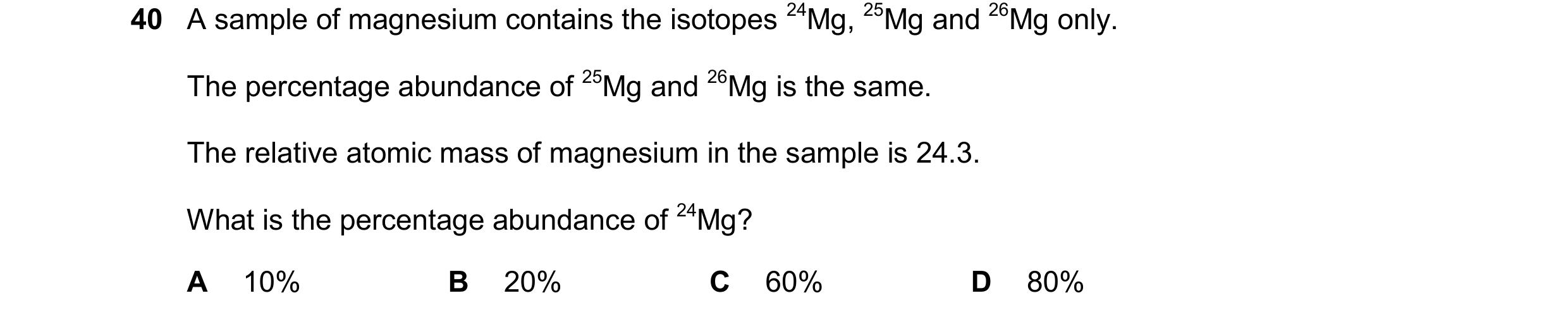
Q32 · A sample of magnesium contains the isotopes 24Mg, 25Mg and 26Mg only 9701/11 Oct/Nov 2025
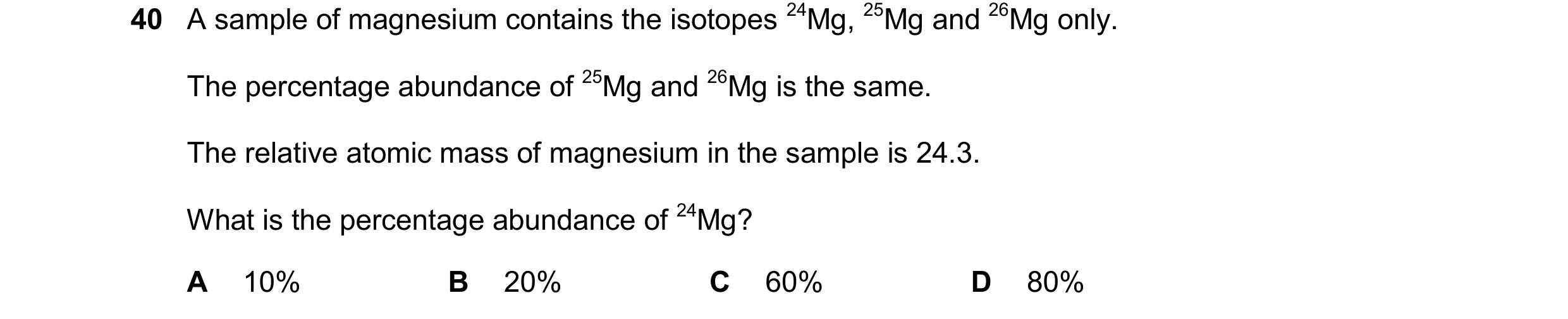
40 A sample of magnesium contains the isotopes 24Mg, 25Mg and 26Mg only. The percentage abundance of 25Mg and 26Mg is the same. The relative atomic mass of magnesium in the sample is 24.3. What is the percentage abundance of 24Mg? A 10% B 20% C 60% D 80%
1 marks
Answer: D
This question in 9701/11 Oct/Nov 2025
Q33 · Which statement is correct? 9701/12 Oct/Nov 2025
4 Which statement is correct? A The relative atomic mass of a 35Cl atom is 35.5. B The relative molecular mass of O2 is 16.0. C The relative formula mass of CaCO3 is 100.1. D The relative isotopic mass of a 24Mg atom is 24.3.
1 marks
Answer: C
This question in 9701/12 Oct/Nov 2025
Q34 · A pure sample of a gas has a density of 2.62 g dm–3 at 101 000 Pa and 25 °C 9701/12 Oct/Nov 2025
8 A pure sample of a gas has a density of 2.62 g dm–3 at 101 000 Pa and 25 °C. The gas behaves ideally under these conditions. Which expression gives the Mr of the gas? 101 000 0.001 A 2.62 8.31 25 101 000 0.001 B 2.62 8.31 298 2.62 8.31 25 C 101 000 0.001 2.62 8.31 298 D 101 000 0.001
1 marks
Answer: D
This question in 9701/12 Oct/Nov 2025
Q35 · A sample of magnesium contains the isotopes 24Mg, 25Mg and 26Mg only 9701/13 Oct/Nov 2025
40 A sample of magnesium contains the isotopes 24Mg, 25Mg and 26Mg only. The percentage abundance of 25Mg and 26Mg is the same. The relative atomic mass of magnesium in the sample is 24.3. What is the percentage abundance of 24Mg? A 10% B 20% C 60% D 80%
1 marks
Answer: D
This question in 9701/13 Oct/Nov 2025

 1 / 8
1 / 8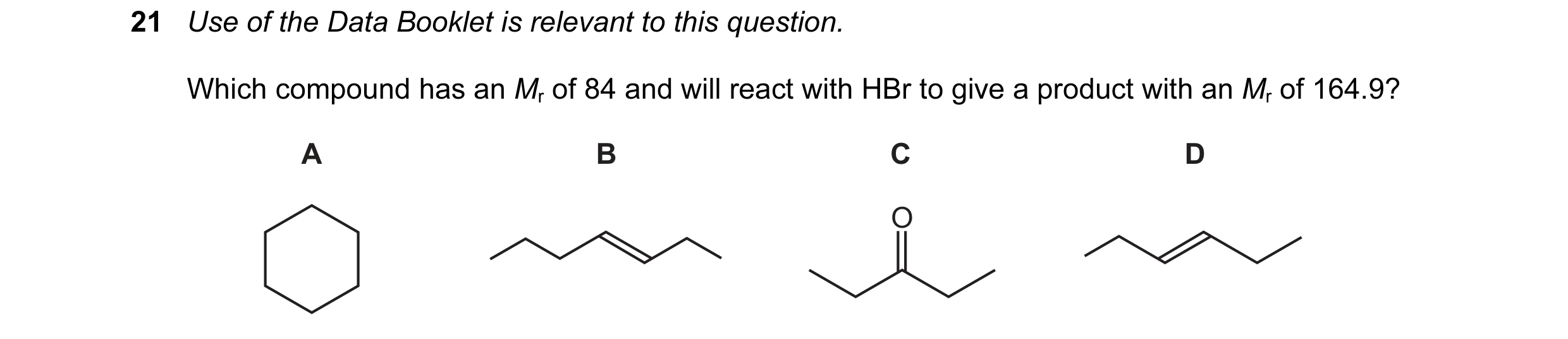

 2 / 8
2 / 8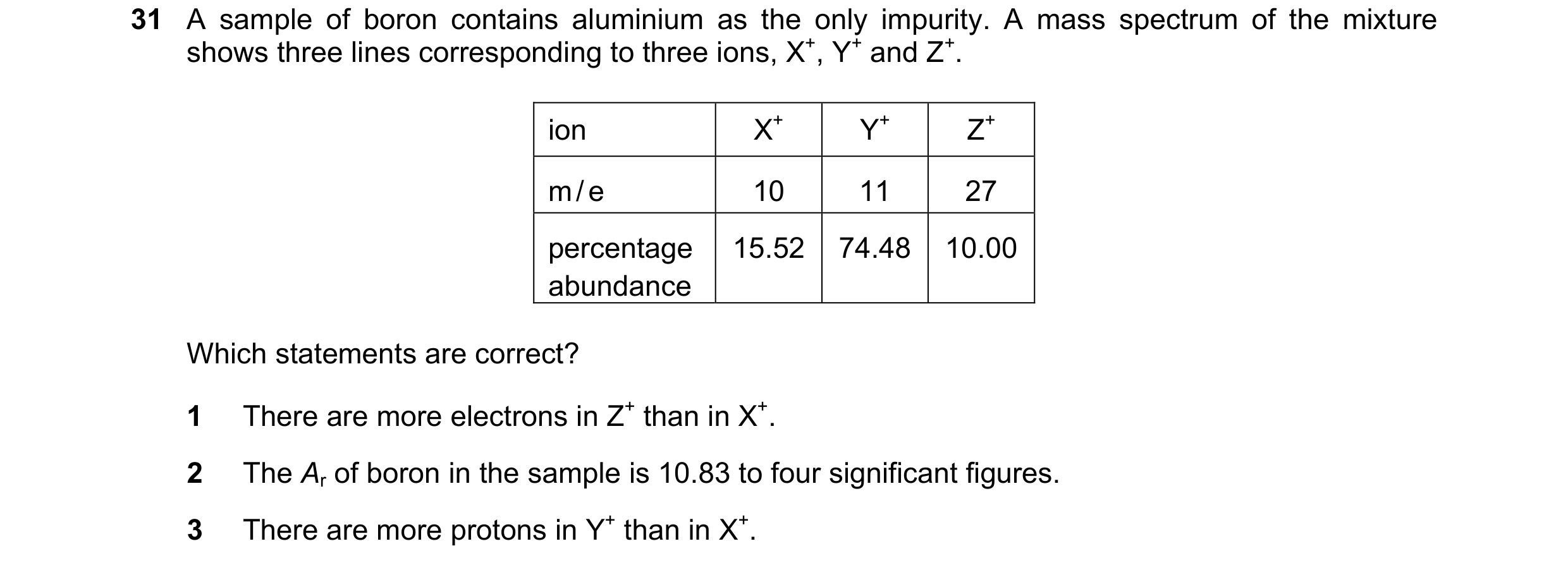
 3 / 8
3 / 8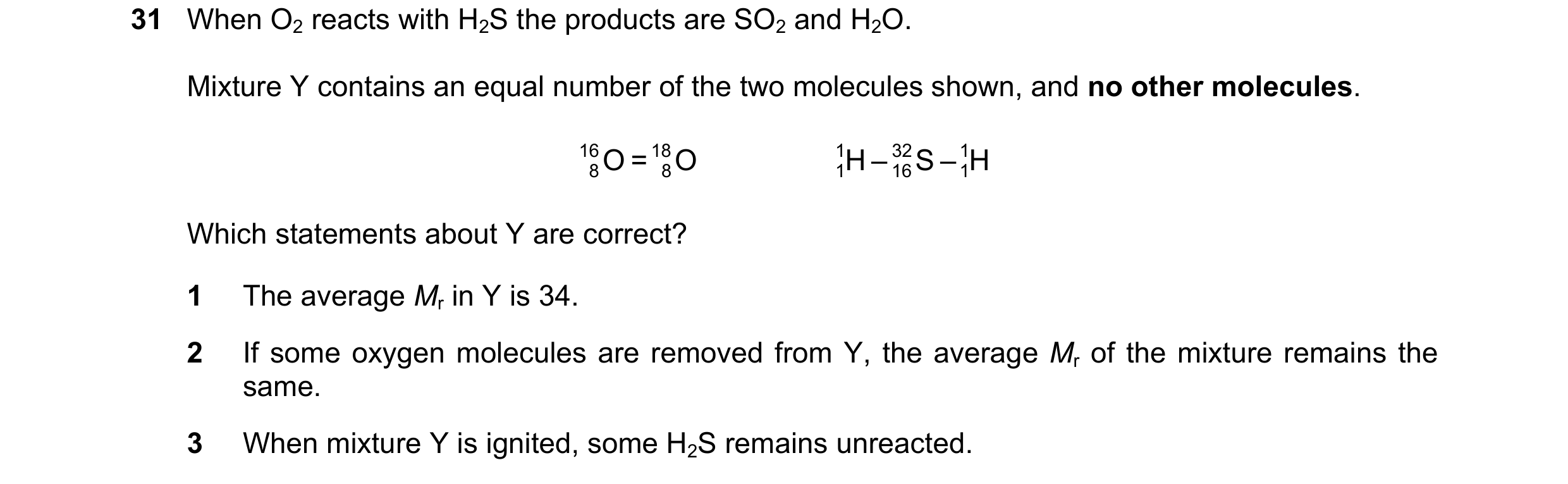
 4 / 8
4 / 8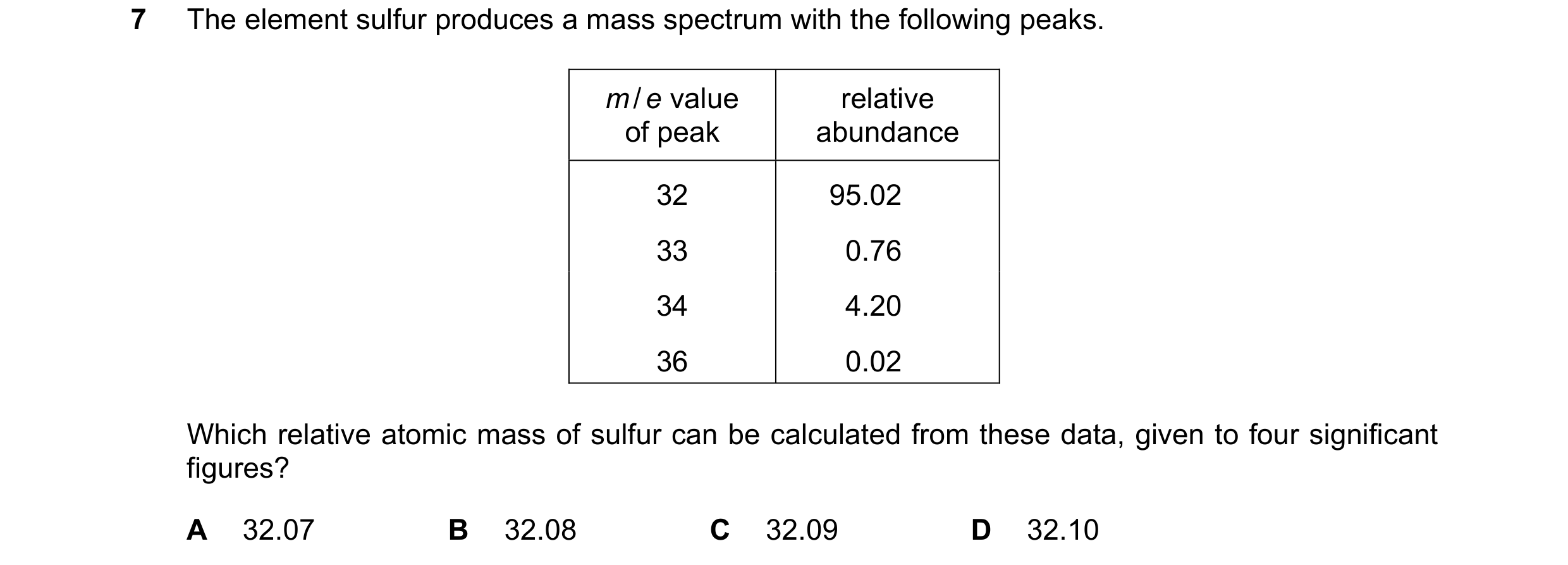



 5 / 8
5 / 8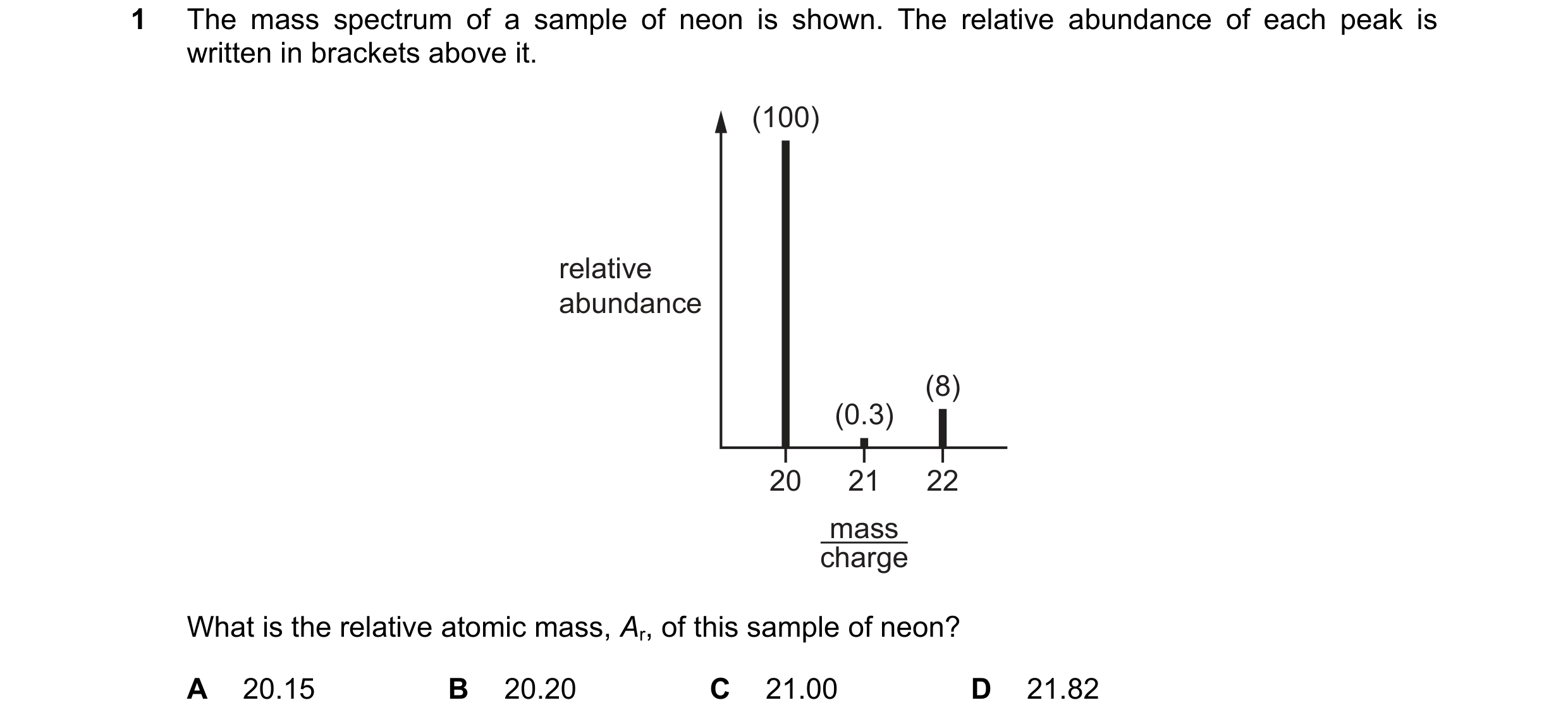


 6 / 8
6 / 8



 7 / 8
7 / 8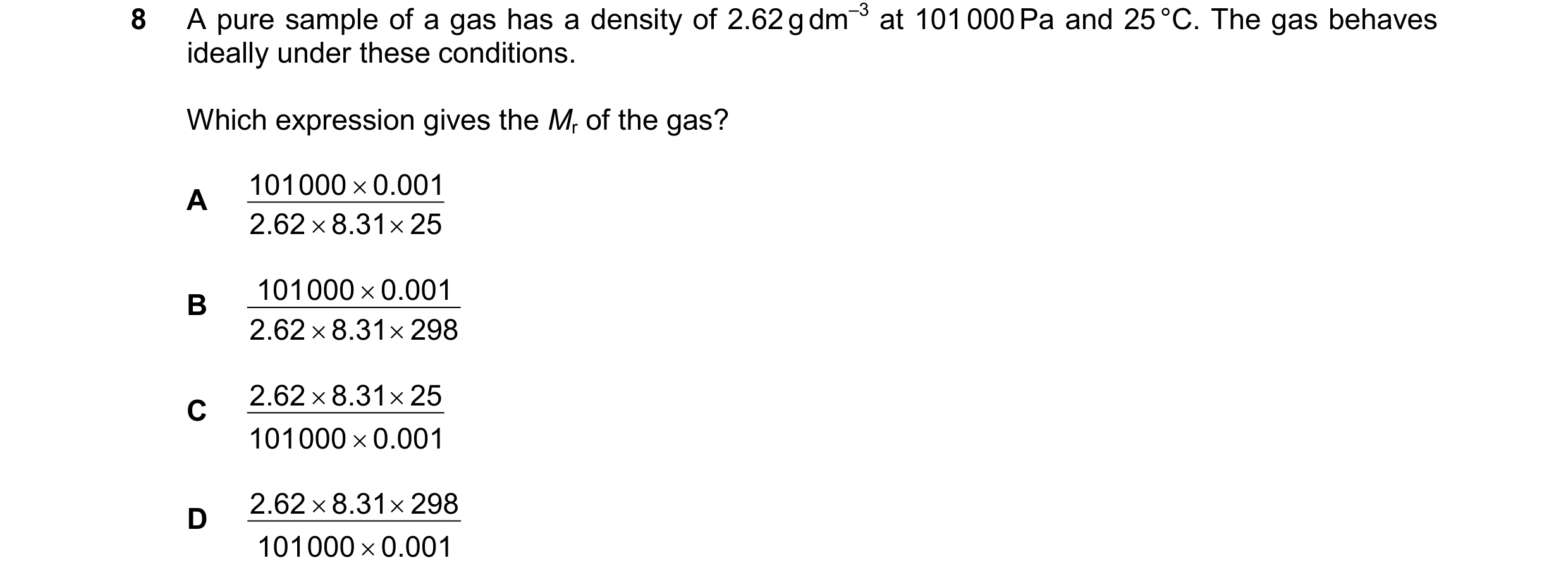
 8 / 8
8 / 8