Questions as text
Q1 · A student investigates the respiration rate of germinating seeds using the apparatus… 0654/41 May/June 2017
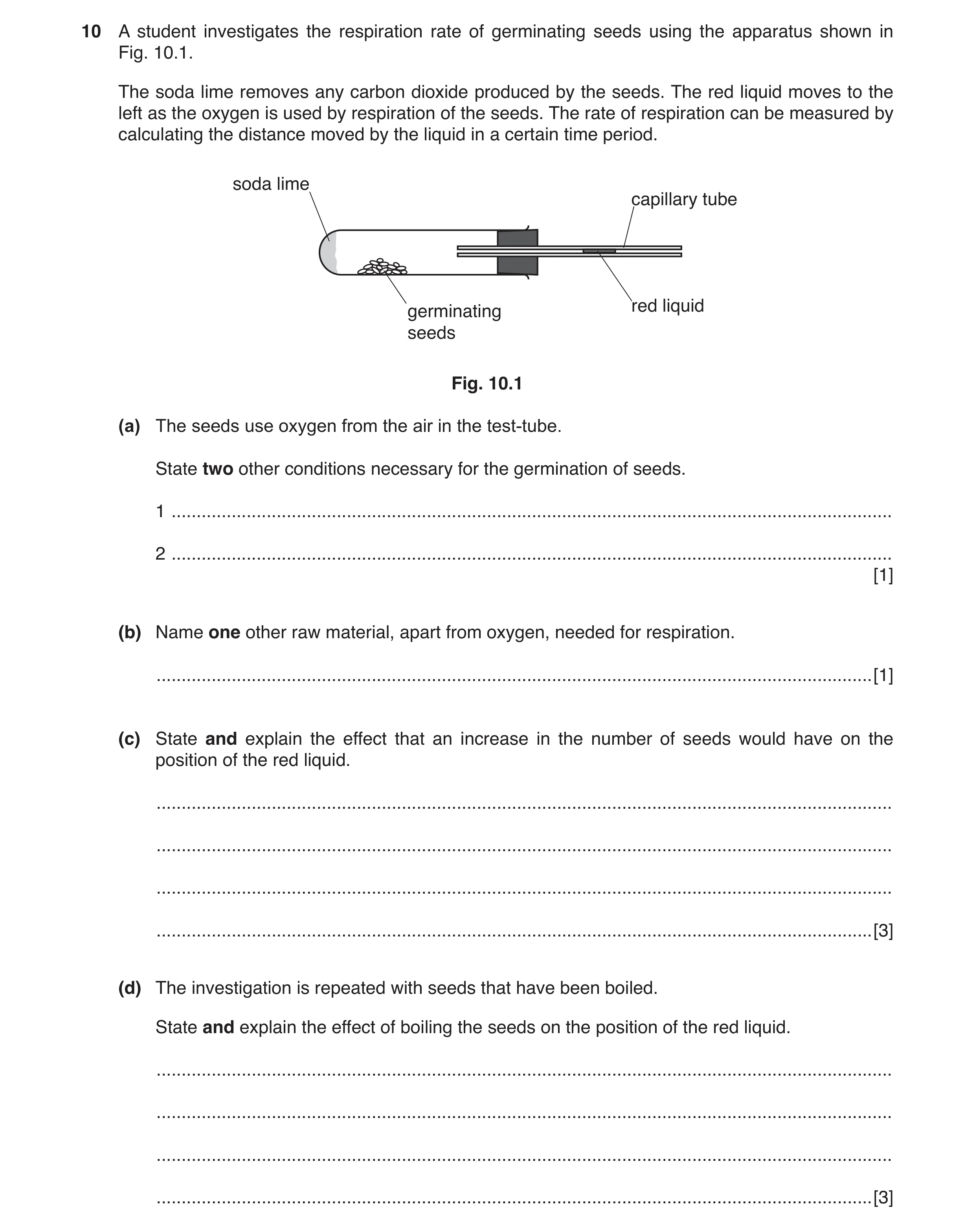
10 A student investigates the respiration rate of germinating seeds using the apparatus shown in Fig. 10.1. The soda lime removes any carbon dioxide produced by the seeds. The red liquid moves to the left as the oxygen is used by respiration of the seeds. The rate of respiration can be measured by calculating the distance moved by the liquid in a certain time period. soda lime capillary tube red liquid germinating seeds Fig. 10.1 (a) The seeds use oxygen from the air in the test-tube. State two other conditions necessary for the germination of seeds. 1 … 2 … [1] (b) Name one other raw material, apart from oxygen, needed for respiration. … [1] (c) State and explain the effect that an increase in the number of seeds would have on the position of the red liquid. … … … … [3] (d) The investigation is repeated with seeds that have been boiled. State and explain the effect of boiling the seeds on the position of the red liquid. … … … … [3]
8 marks
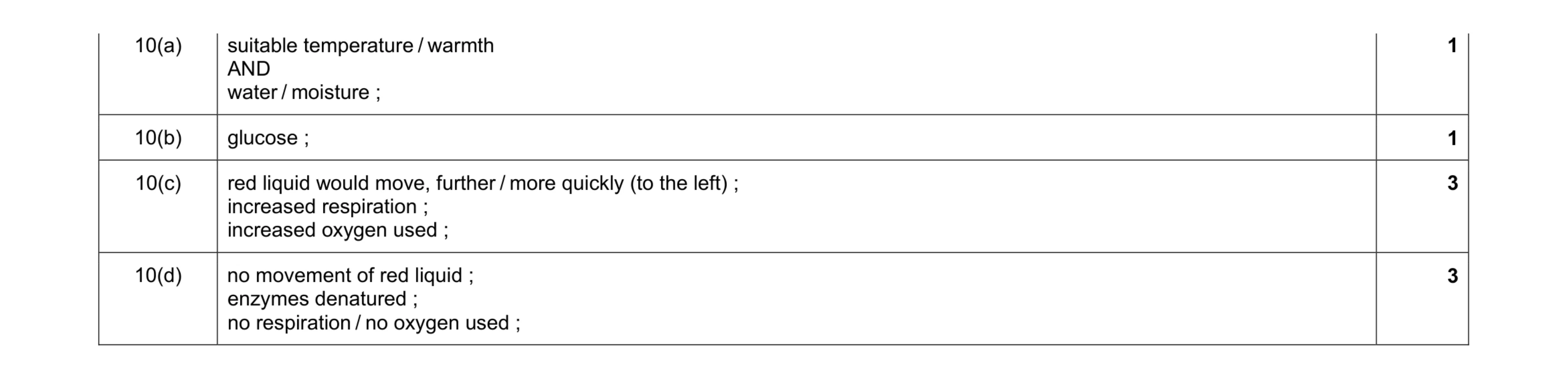
Mark scheme: 10(a) suitable temperature / warmth AND water / moisture ; 1 10(b) glucose ; 1 10(c) red liquid would move, further / more quickly (to the left) ; increased respiration ; increased oxygen used ; 3 10(d) no movement of red liquid ; enzymes denatured ; no respiration / no oxygen used ; 3
This question in 0654/41 May/June 2017
Q2 · A student investigates anaerobic respiration in yeast 0654/42 May/June 2017
12 A student investigates anaerobic respiration in yeast. He sets up the apparatus as shown in Fig. 12.1. The student measures the volume of carbon dioxide produced by the yeast and sugar mixture. The investigation is repeated with the yeast and sugar mixture at different temperatures. gas syringe conical flask layer of oil yeast and sugar mixture Fig. 12.1 Fig. 12.2 is a graph of the results. 100 80 3535 ºCºC 2525 ºCºC 60 volume of 2020 ºCºC carbon dioxide produced / cm3 40 20 0 0 1 2 3 4 5 time / min Fig. 12.2 (a) (i) Use Fig. 12.2 to predict the volume of carbon dioxide produced in 3 minutes at 30 °C. … cm3 [1] (ii) No carbon dioxide was produced when the temperature was increased to 60 °C. Suggest why. … … [1] (iii) State one modification, apart from changing the temperature, the student could make to his investigation to increase the volume of carbon dioxide produced by the yeast in the first 2 minutes. … … [1] (b) Carbon dioxide is produced by the anaerobic respiration of yeast but not by the anaerobic respiration of animals. State one other difference between the anaerobic respiration of yeast and the anaerobic respiration of animals. … … [1] (c) Anaerobic respiration in yeast is used commercially in bread making. Name one other commercial use of the anaerobic respiration in yeast. … [1]
5 marks
Mark scheme: 12(a)(i) 1 12(a)(ii) respiration enzymes denatured / yeast killed ; 1 12(a)(iii) increase / more, food / concentration of sugar mixture / increase / more, initial number of yeast ; 1 12(b) alcohol, produced in anaerobic respiration in yeast / lactic acid is produced in anaerobic respiration in animals ; 1 12(c) brewing / beer making / making alcoholic drinks ; 1
This question in 0654/42 May/June 2017
Q3 · Yeast is used in the brewing industry to make beer 0654/41 Oct/Nov 2017
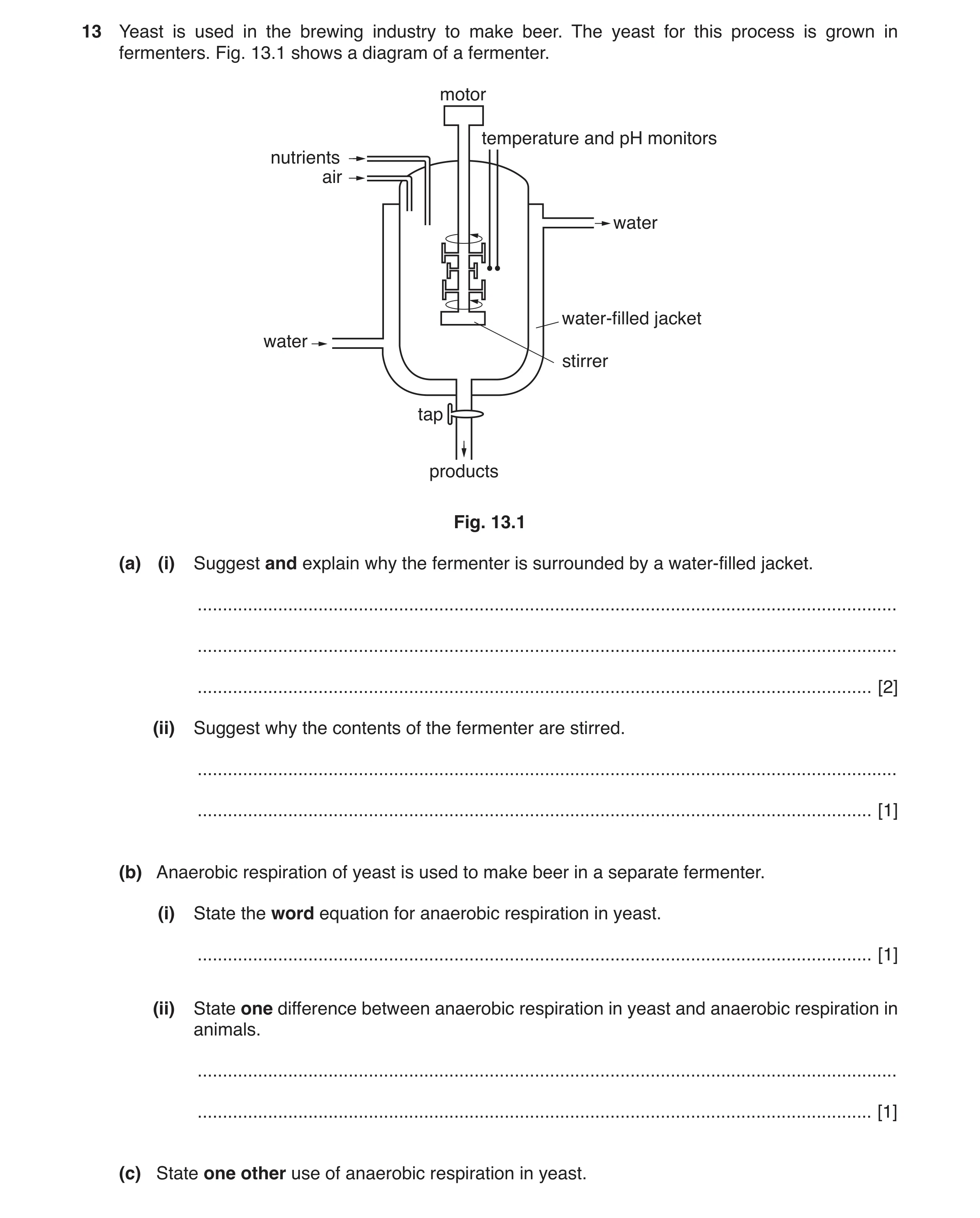
13 Yeast is used in the brewing industry to make beer. The yeast for this process is grown in fermenters. Fig. 13.1 shows a diagram of a fermenter. motor temperature and pH monitors nutrients air water water-filled jacket water stirrer tap products Fig. 13.1 (a) (i) Suggest and explain why the fermenter is surrounded by a water-filled jacket. … … … [2] (ii) Suggest why the contents of the fermenter are stirred. … … [1] (b) Anaerobic respiration of yeast is used to make beer in a separate fermenter. (i) State the word equation for anaerobic respiration in yeast. … [1] (ii) State one difference between anaerobic respiration in yeast and anaerobic respiration in animals. … … [1] (c) State one other use of anaerobic respiration in yeast.
6 marks
Mark scheme: 13(a)(i) regulate/control the temperature ; (prevent) enzyme denaturation / yeast being killed / so that yeast is active ; effect on rate of fermentation / respiration / reaction ; max 2 13(a)(ii) enable all yeast to access the nutrients / oxygen ; maintain even temperature in fermenter ; max 1 13(b)(i) glucose → ethanol / alcohol + carbon dioxide ; 1 13(b)(ii) lactic acid produced in animals (but not in yeast) ; ethanol / alcohol / carbon dioxide not produced in animals ; max 1 13(c) bread making ; 1
This question in 0654/41 Oct/Nov 2017
Q4 · The breathing rate of a student at rest is measured by measuring the volume of air in the… 0654/42 Oct/Nov 2017
7 The breathing rate of a student at rest is measured by measuring the volume of air in the lungs during inhalation and exhalation. The results are shown in Fig. 7.1. 4000 3000 volume of air in lungs 2000 / cm3 1000 0 0 5 10 15 20 25 30 time / seconds Fig. 7.1 (a) The breathing rate of the student was measured again during intense exercise. Describe how the graph line differs during intense exercise. … … … [2] (b) Describe and explain the difference in breathing between rest and intense exercise. … … … [2] (c) Describe and explain why the student’s pulse rate changes during intense exercise. … … … [2] (d) After some time of intense exercise the student develops pain, called cramp, in the leg muscles. (i) Describe what happens to cause cramp. … … … [2] (ii) Explain why the student’s breathing does not return to normal immediately after intense exercise. … … [1]
9 marks
Mark scheme: 7(a) increased amplitude / bigger peaks ; increased frequency / peaks closer together ; 2 7(b) increased, depth / frequency of breathing ; to gain / absorb, more oxygen ; for more respiration ; max 2 7(c) increases to transport more oxygen / glucose to respiring muscles / cells ; for more respiration ; 2 7(d)(i) anaerobic respiration ; lactic acid produced ; 2 7(d)(ii) (oxygen needed) to repay oxygen debt ; 1
This question in 0654/42 Oct/Nov 2017
Q5 · Green plants are living organisms that carry out photosynthesis and respiration 0654/43 Oct/Nov 2017
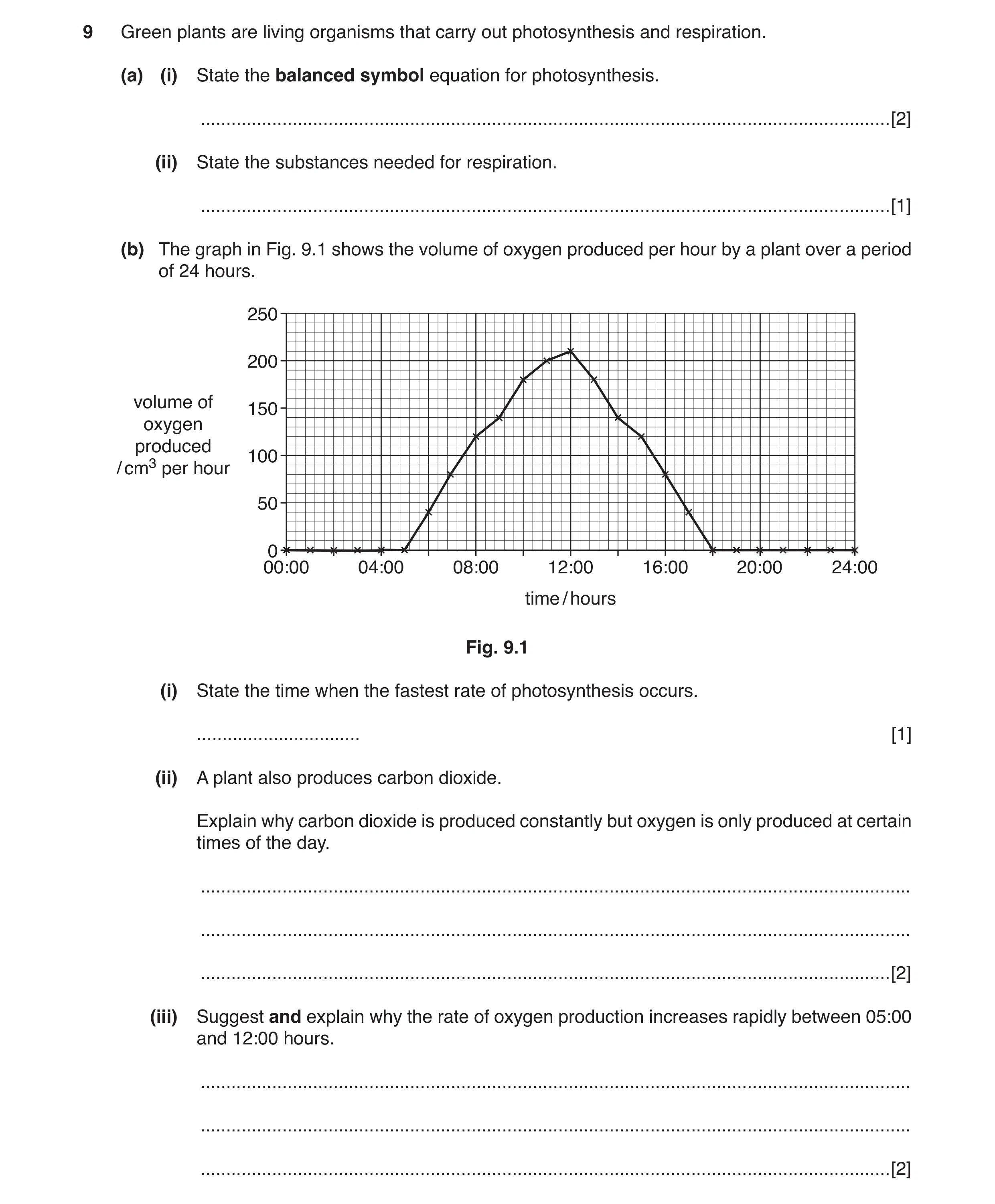
9 Green plants are living organisms that carry out photosynthesis and respiration. (a) (i) State the balanced symbol equation for photosynthesis. … [2] (ii) State the substances needed for respiration. … [1] (b) The graph in Fig. 9.1 shows the volume of oxygen produced per hour by a plant over a period of 24 hours. 250 200 volume of 150 oxygen produced 100 / cm3 per hour 50 0 00:00 04:00 08:00 12:00 16:00 20:00 24:00 time / hours Fig. 9.1 (i) State the time when the fastest rate of photosynthesis occurs. … [1] (ii) A plant also produces carbon dioxide. Explain why carbon dioxide is produced constantly but oxygen is only produced at certain times of the day. … … … [2] (iii) Suggest and explain why the rate of oxygen production increases rapidly between 05:00 and 12:00 hours. … … … [2]
8 marks
Mark scheme: 9(a)(i) 6CO2 + 6H2O → C6H12O6 + 6O2 LHS ; RHS ; 2 9(a)(ii) glucose and oxygen ; 1 9(b)(i) 12:00 ; 1 9(b)(ii) respiration occurs all the time ; photosynthesis only occurs when there is light / in daytime ; 2 9(b)(iii) increase in light intensity ; increase in rate of photosynthesis ; OR increase in temperature ; increase, in enzyme activity / rate of photosynthesis ; max 2
This question in 0654/43 Oct/Nov 2017
Q6 · A diagram of an alveolus with its blood capillary 0654/41 Oct/Nov 2018
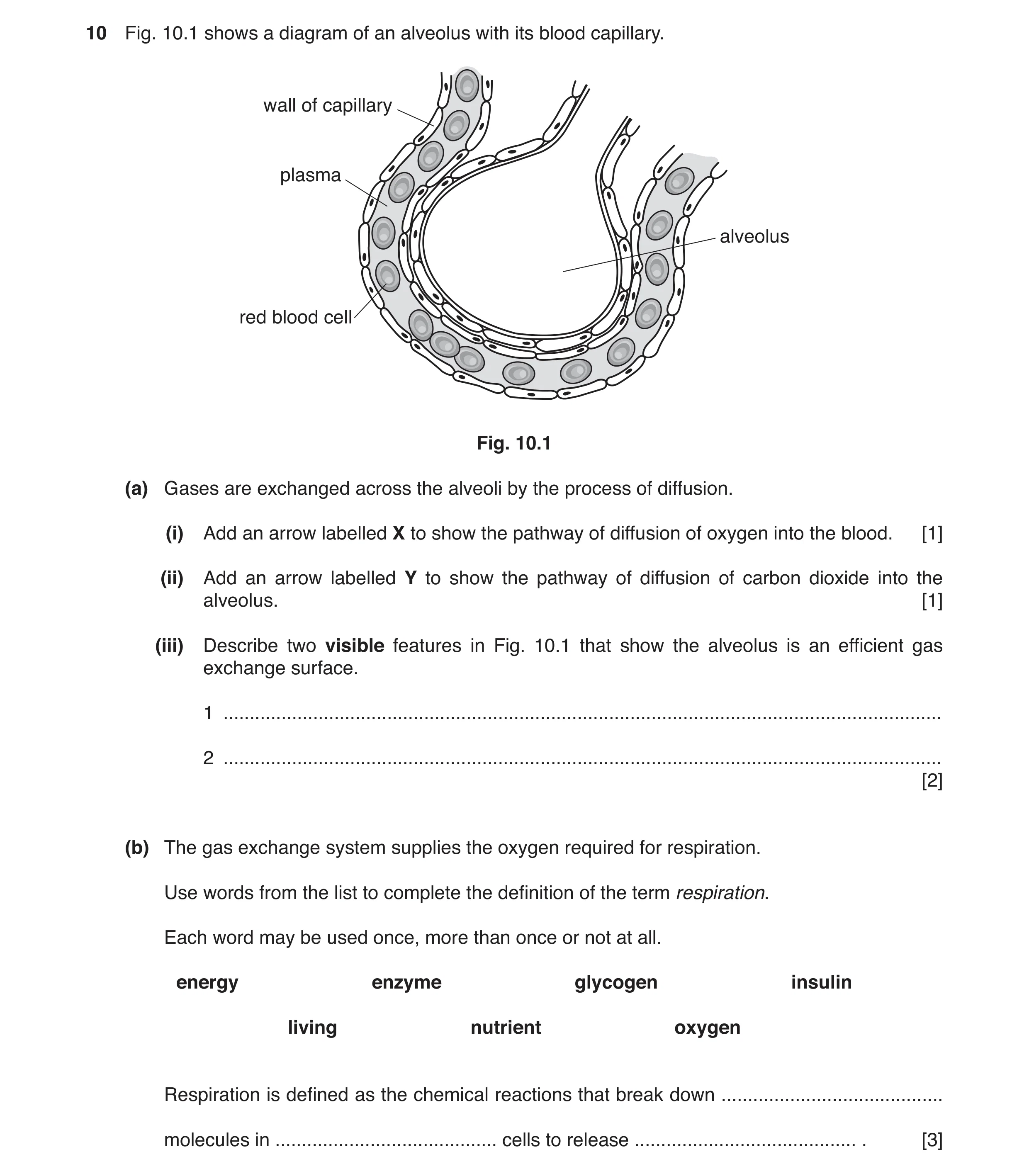
10 Fig. 10.1 shows a diagram of an alveolus with its blood capillary. wall of capillary plasma alveolus red blood cell Fig. 10.1 (a) Gases are exchanged across the alveoli by the process of diffusion. (i) Add an arrow labelled X to show the pathway of diffusion of oxygen into the blood. [1] (ii) Add an arrow labelled Y to show the pathway of diffusion of carbon dioxide into the alveolus. [1] (iii) Describe two visible features in Fig. 10.1 that show the alveolus is an efficient gas exchange surface. 1 … 2 … [2] (b) The gas exchange system supplies the oxygen required for respiration. Use words from the list to complete the definition of the term respiration. Each word may be used once, more than once or not at all. energy enzyme glycogen insulin living nutrient oxygen Respiration is defined as the chemical reactions that break down … molecules in … cells to release … . [3]
7 marks
Mark scheme: 10(a)(i) arrow drawn from alveolus to inside the red blood cell labelled X ; 1 10(a)(ii) arrow drawn from the blood plasma to inside the alveolus labelled Y ; 1 10(a)(iii) thin wall ; (good) blood supply ; large surface area ; max 2 10(b) nutrient ; living ; energy ; 3
This question in 0654/41 Oct/Nov 2018
Q7 · A diagram of an insect-pollinated flower 0654/42 Oct/Nov 2018
10 (a) Fig. 10.1 shows a diagram of an insect-pollinated flower. D C E B A Fig. 10.1 (i) Table 10.1 shows information about some of the parts of the flower in Fig. 10.1. Use Fig. 10.1 to complete Table 10.1. Table 10.1 letter in name of part function Fig. 10.1 anther produces the female gamete (ovule) sepal [3] (ii) Describe how the appearance of the part labelled D in Fig. 10.1 differs in a wind- pollinated plant. … … [1] (b) Pollination often leads to fertilisation and the formation of seeds. Seeds can be dispersed by wind or animals. (i) Describe two ways in which animals can disperse seeds. 1 … … 2 … … [2] (ii) Suggest an advantage to seeds being dispersed in a new area. … … [1] (c) Draw a circle around the name of the gas required by seeds for germination. carbon dioxide carbon monoxide hydrogen nitrogen oxygen sulfur dioxide [1]
8 marks
Mark scheme: 10(a)(i) name of part letter in Fig 10.1 function anther E produces pollen / male gamete ovary A produces the female gamete (ovule) sepal B protect flower in bud / AW 1 row correct ; 2 rows correct ; 3 rows correct ; 3 10(a)(ii) smaller / absent / dull-coloured ; 1 10(b)(i) attached to, fur / hair ; eaten by animals and egested in faeces / droppings ; AVP ; max 2 10(b)(ii) less competition / more space / more nutrients / more water / more sunlight ; 1 10(c) oxygen circled ; 1
This question in 0654/42 Oct/Nov 2018
Q8 · A student investigates the effect of temperature on the rate of diffusion of red dye into… 0654/41 May/June 2019
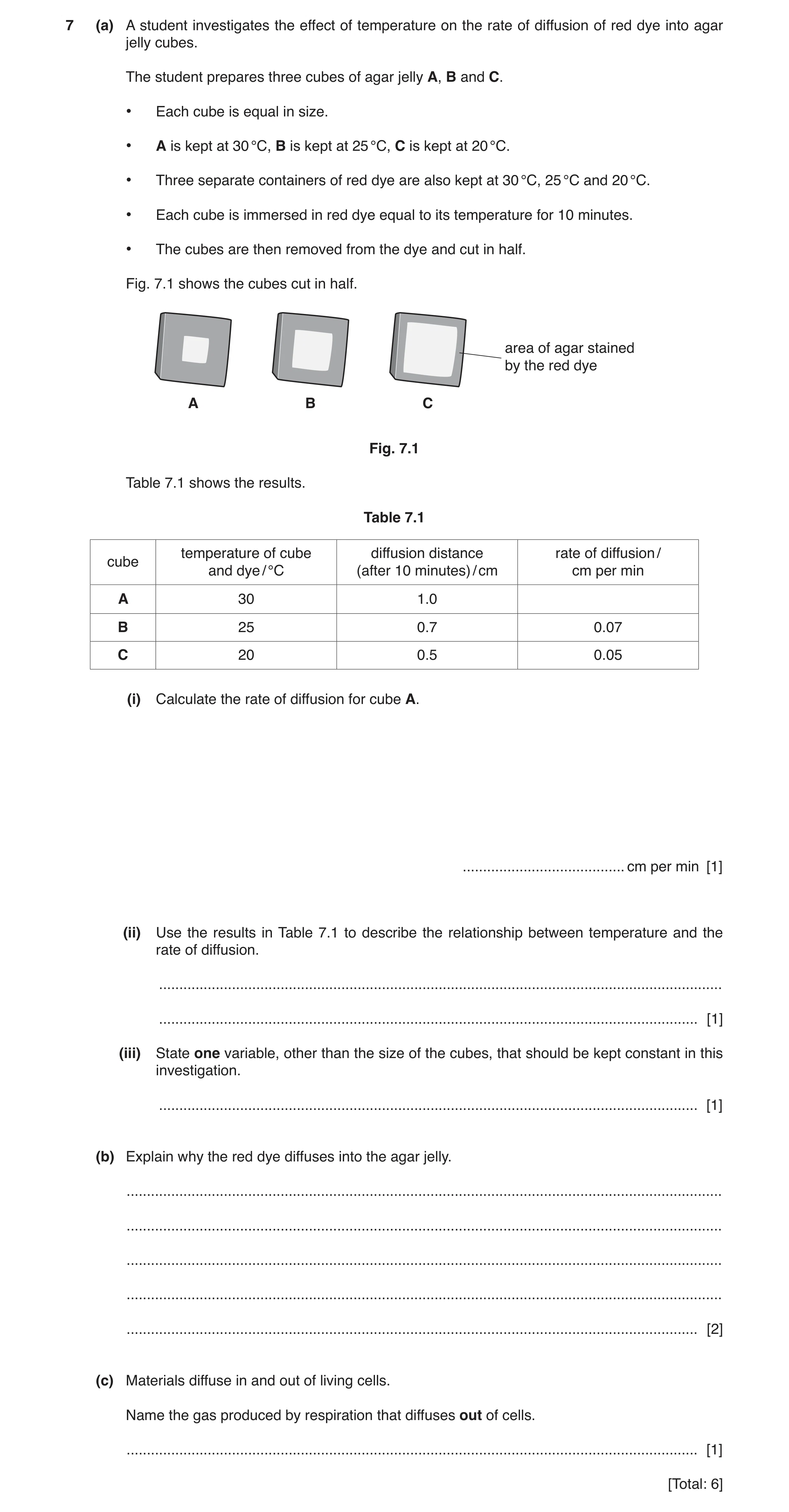
7 (a) A student investigates the effect of temperature on the rate of diffusion of red dye into agar jelly cubes. The student prepares three cubes of agar jelly A, B and C. • Each cube is equal in size. • A is kept at 30 °C, B is kept at 25 °C, C is kept at 20 °C. • Three separate containers of red dye are also kept at 30 °C, 25 °C and 20 °C. • Each cube is immersed in red dye equal to its temperature for 10 minutes. • The cubes are then removed from the dye and cut in half. Fig. 7.1 shows the cubes cut in half. area of agar stained by the red dye A B C Fig. 7.1 Table 7.1 shows the results. Table 7.1 temperature of cube diffusion distance rate of diffusion / cube and dye / °C (after 10 minutes) / cm cm per min A 30 1.0 B 25 0.7 0.07 C 20 0.5 0.05 (i) Calculate the rate of diffusion for cube A. … cm per min [1] (ii) Use the results in Table 7.1 to describe the relationship between temperature and the rate of diffusion. … … [1] (iii) State one variable, other than the size of the cubes, that should be kept constant in this investigation. … [1] (b) Explain why the red dye diffuses into the agar jelly. … … … … … [2] (c) Materials diffuse in and out of living cells. Name the gas produced by respiration that diffuses out of cells. … [1] [Total: 6]
6 marks
Mark scheme: 7(a)(i) 0.1 (cm/min) ; 1 7(a)(ii) as temperature decreases rate of diffusion decreases ; 1 7(a)(iii) concentration of red dye ; 1 7(b) concentration of red dye is higher outside the agar cube ; (movement is) from high to low concentration / down a concentration gradient ; by random motion of dye particles ; max 2 7(c) carbon dioxide ; 1
This question in 0654/41 May/June 2019
Q9 · A diagram of a food web 0654/43 May/June 2019
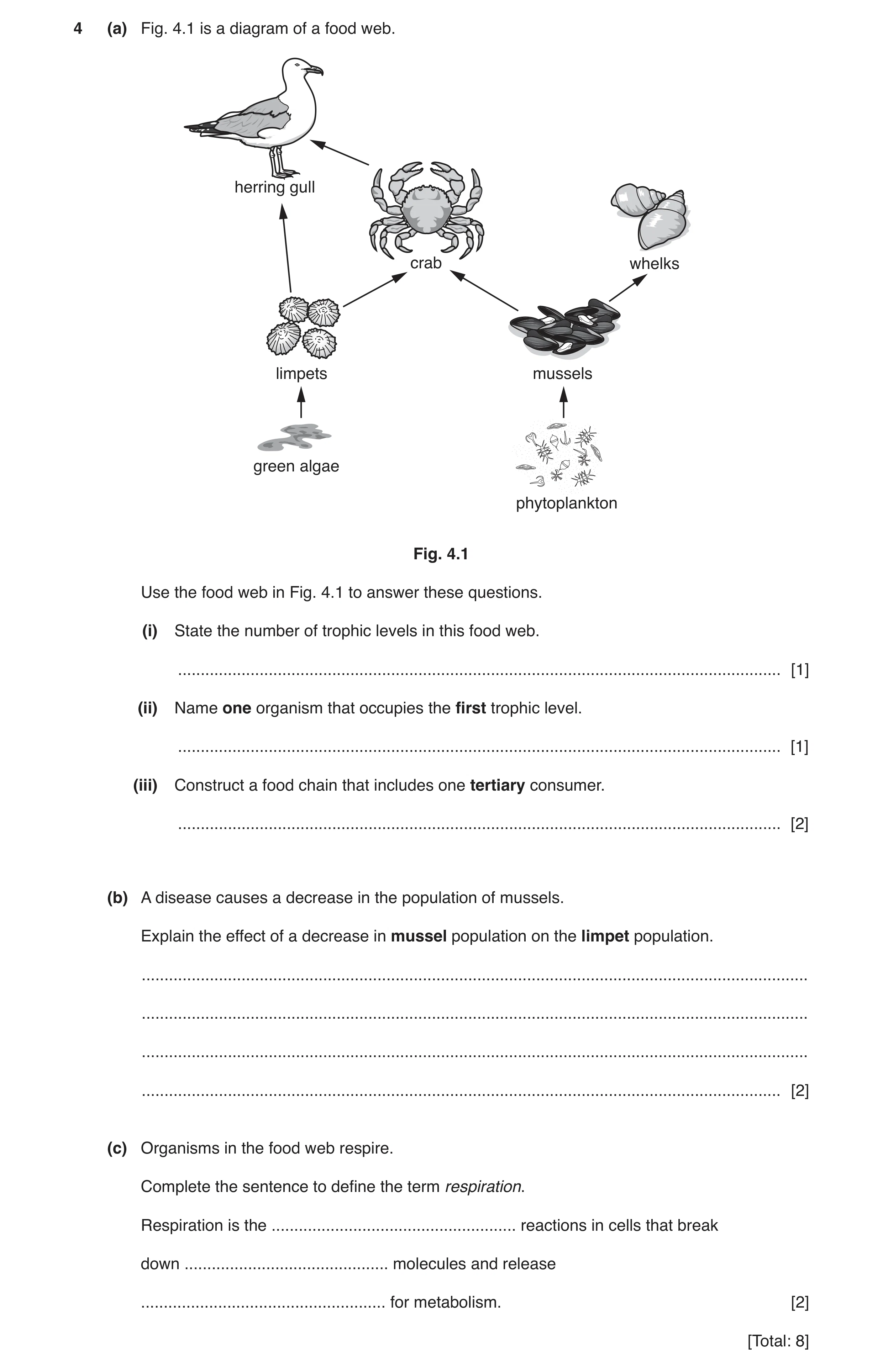
4 (a) Fig. 4.1 is a diagram of a food web. herring gull crab whelks limpets mussels green algae phytoplankton Fig. 4.1 Use the food web in Fig. 4.1 to answer these questions. (i) State the number of trophic levels in this food web. … [1] (ii) Name one organism that occupies the first trophic level. … [1] (iii) Construct a food chain that includes one tertiary consumer. … [2] (b) A disease causes a decrease in the population of mussels. Explain the effect of a decrease in mussel population on the limpet population. … … … … [2] (c) Organisms in the food web respire. Complete the sentence to define the term respiration. Respiration is the … reactions in cells that break down … molecules and release … for metabolism. [2] [Total: 8]
8 marks
Mark scheme: 4(a)(i) 4 ; 1 4(a)(ii) green algae / phytoplankton ; 1 4(a)(iii) green algae → limpets → crab → herring gull / phytoplankton → mussels → crab → herring gull correct order of organisms ; correct direction of arrows ; 2 4(b) limpet population decreases (no mark) crabs lose a source of food ; increased predation of limpets ; 2 4(c) chemical ; nutrient and energy ; 2
This question in 0654/43 May/June 2019
Q10 · Complete the sentence to define the term anaerobic respiration 0654/41 Oct/Nov 2019
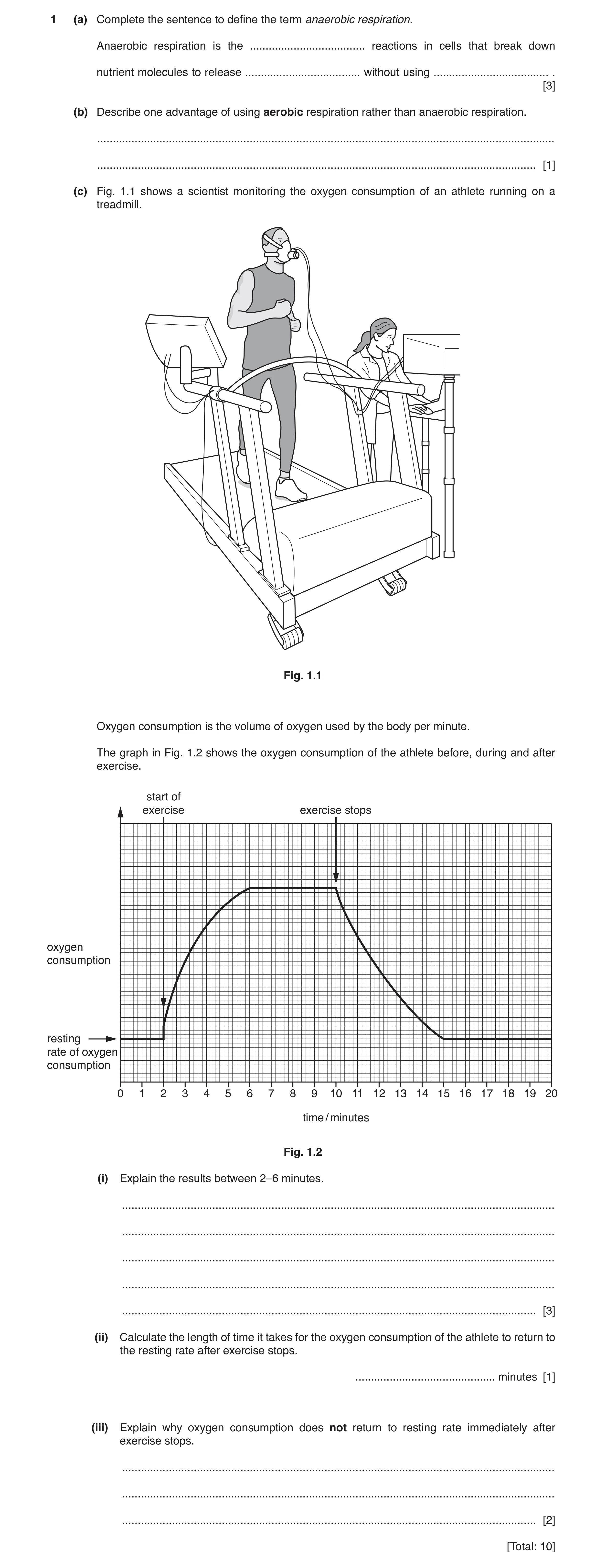
1 (a) Complete the sentence to define the term anaerobic respiration. Anaerobic respiration is the … reactions in cells that break down nutrient molecules to release … without using … . [3] (b) Describe one advantage of using aerobic respiration rather than anaerobic respiration. … … [1] (c) Fig. 1.1 shows a scientist monitoring the oxygen consumption of an athlete running on a treadmill. Fig. 1.1 Oxygen consumption is the volume of oxygen used by the body per minute. The graph in Fig. 1.2 shows the oxygen consumption of the athlete before, during and after exercise. start of exercise exercise stops oxygen consumption resting rate of oxygen consumption 0 1 2 3 4 5 6 7 8 9 10 11 12 13 14 15 16 17 18 19 20 time / minutes Fig. 1.2 (i) Explain the results between 2–6 minutes. … … … … … [3] (ii) Calculate the length of time it takes for the oxygen consumption of the athlete to return to the resting rate after exercise stops. … minutes [1] (iii) Explain why oxygen consumption does not return to resting rate immediately after exercise stops. … … … [2] [Total: 10]
10 marks
Mark scheme: 1(a) chemical ; energy ; oxygen ; 3 1(b) release more energy (per glucose molecule) / does not produce lactic acid ; 1 1(c)(i) increased breathing rate or depth ; increased respiration ; increased need for energy ; increased muscle contraction ; max 3 3 1(c)(ii) 5 (minutes) ; 1 1(c)(iii) anaerobic respiration has taken place ; needs to repay oxygen debt / to remove lactic acid ; 2
This question in 0654/41 Oct/Nov 2019
Q11 · Carbon dioxide is produced during the anaerobic respiration of yeast 0654/42 Oct/Nov 2019
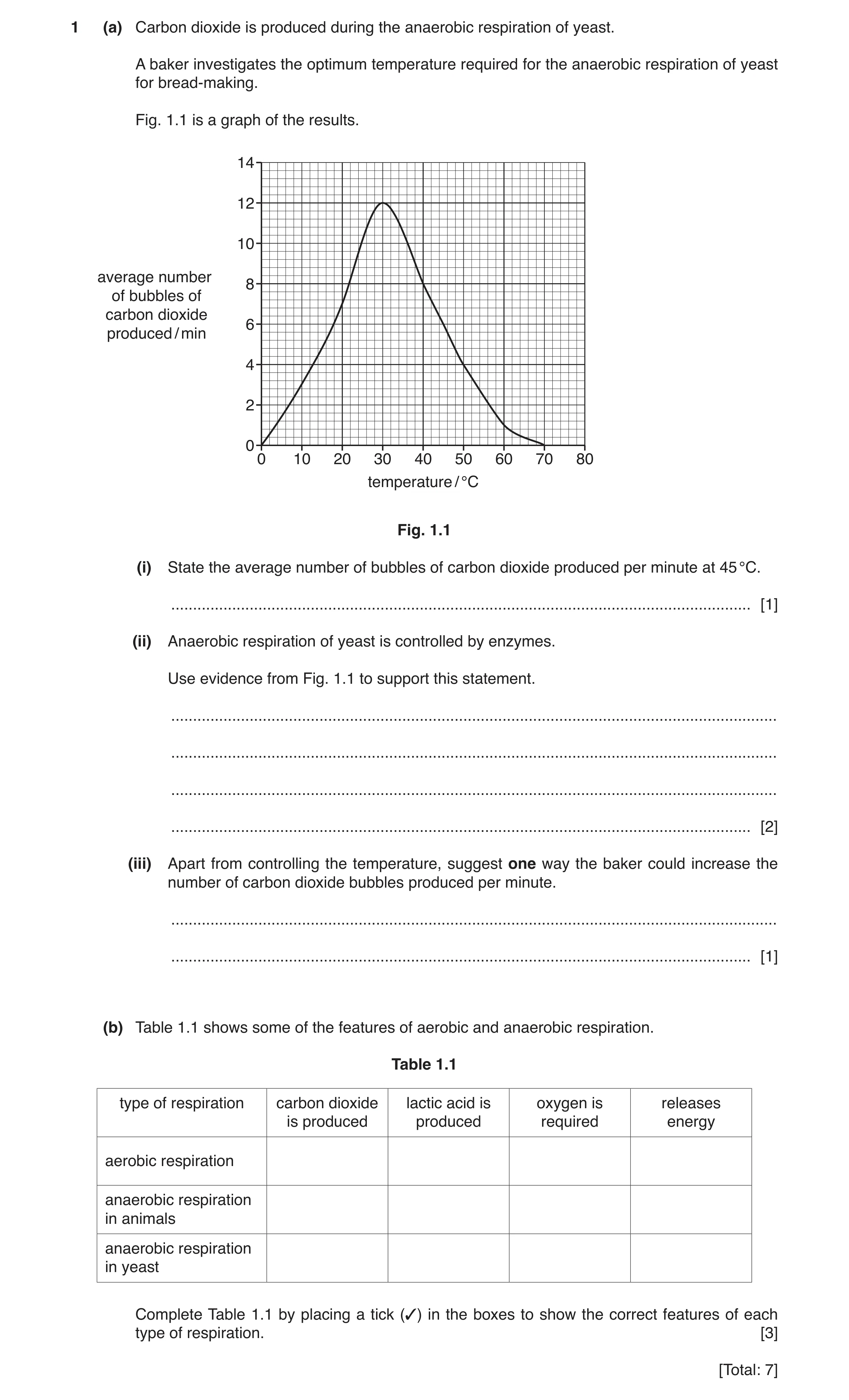
1 (a) Carbon dioxide is produced during the anaerobic respiration of yeast. A baker investigates the optimum temperature required for the anaerobic respiration of yeast for bread-making. Fig. 1.1 is a graph of the results. 14 12 10 average number 8 of bubbles of carbon dioxide 6 produced / min 4 2 0 0 10 20 30 40 50 60 70 80 temperature / °C Fig. 1.1 (i) State the average number of bubbles of carbon dioxide produced per minute at 45 °C. … [1] (ii) Anaerobic respiration of yeast is controlled by enzymes. Use evidence from Fig. 1.1 to support this statement. … … … … [2] (iii) Apart from controlling the temperature, suggest one way the baker could increase the number of carbon dioxide bubbles produced per minute. … … [1] (b) Table 1.1 shows some of the features of aerobic and anaerobic respiration. Table 1.1 type of respiration carbon dioxide lactic acid is oxygen is releases is produced produced required energy aerobic respiration anaerobic respiration in animals anaerobic respiration in yeast Complete Table 1.1 by placing a tick (✓) in the boxes to show the correct features of each type of respiration. [3] [Total: 7]
7 marks
Mark scheme: 1(a)(i) 6 ; 1 1(a)(ii) any two from there is an optimum temperature ; above which rate decreases ; as enzyme denatured ; max 2 2 1(a)(iii) increase the concentration of glucose / nutrients / sugar or more yeast ; 1 1(b) type of respiration carbon dioxide is produced lactic acid is produced oxygen is required releases energy aerobic 3 3 3 anaerobic respiration in animals 3 3 anaerobic respiration in yeast 3 3 ;;; 3
This question in 0654/42 Oct/Nov 2019
Question 12 0654/43 Oct/Nov 2019
1 (a) Respiration releases energy. It can occur aerobically or anaerobically. (i) State the balanced chemical equation for aerobic respiration. … [2] (ii) Name the product of anaerobic respiration in muscles. … [1] (iii) Name the two products of anaerobic respiration in yeast. 1 … 2 … [2] (b) Respiration is one of the characteristics of living organisms. State two other characteristics of living organisms. 1 … 2 … [2] [Total: 7]
7 marks
Mark scheme: 1(a)(i) C6H12O6 + 6O2 → 6CO2 + 6H2O correct LHS ; correct RHS ; 2 1(a)(ii) lactic acid ; 1 1(a)(iii) alcohol ; carbon dioxide ; 2 1(b) any two from movement ; reproduction ; sensitivity ; growth ; excretion ; nutrition ; max 2 2
This question in 0654/43 Oct/Nov 2019
Q13 · Some features of aerobic and anaerobic respiration 0654/41 May/June 2021
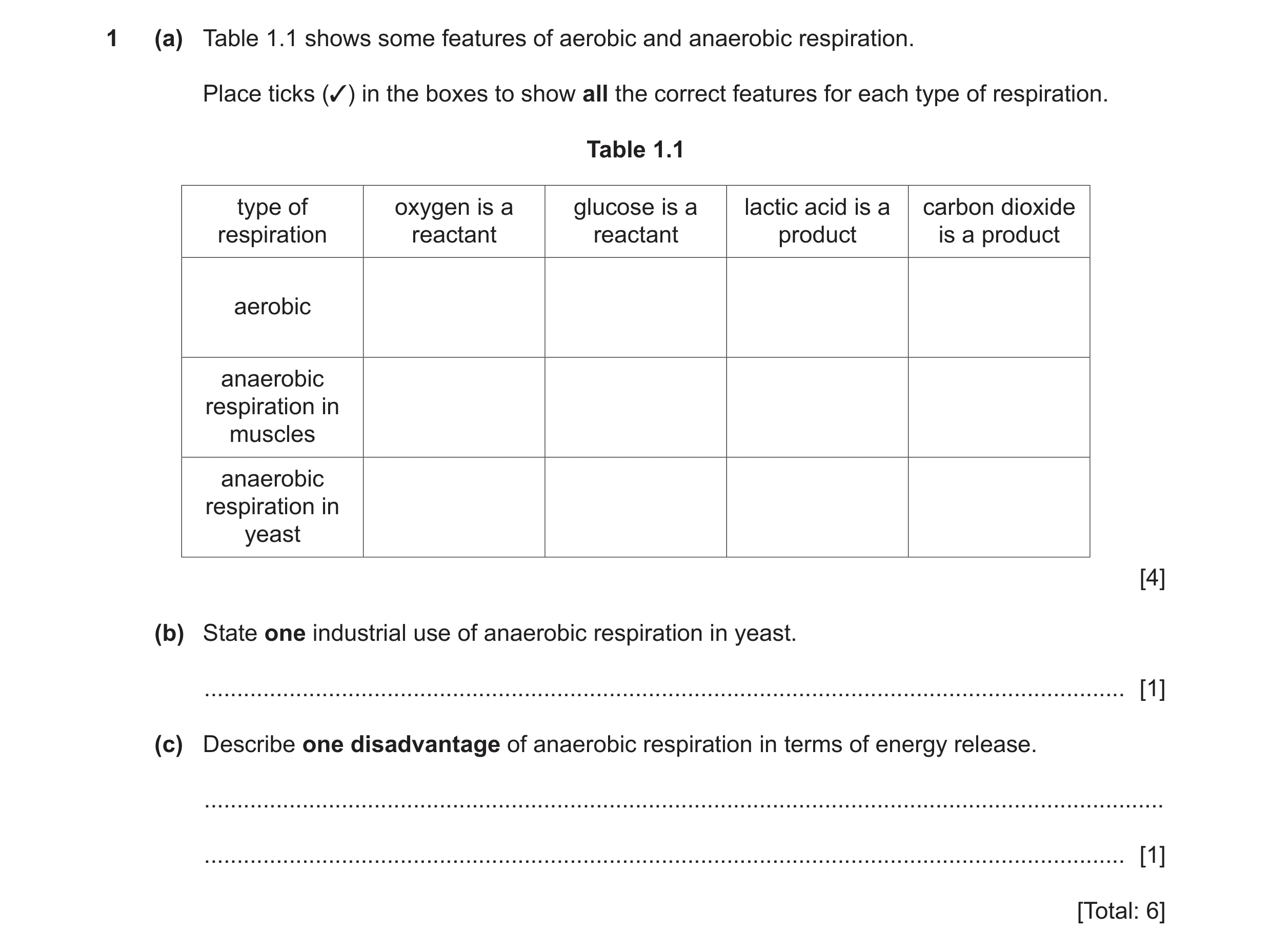
1 (a) Table 1.1 shows some features of aerobic and anaerobic respiration. Place ticks (3) in the boxes to show all the correct features for each type of respiration. Table 1.1 type of oxygen is a glucose is a lactic acid is a carbon dioxide respiration reactant reactant product is a product aerobic anaerobic respiration in muscles anaerobic respiration in yeast [4] (b) State one industrial use of anaerobic respiration in yeast. … [1] (c) Describe one disadvantage of anaerobic respiration in terms of energy release. … … [1] [Total: 6]
6 marks
Mark scheme: 1(a) type of respiration oxygen is a reactant glucose is a reactant lactic acid is a product carbon dioxide is a product aerobic anaerobic respiration in muscles anaerobic respiration in yeast ;;;; 4 1(b) bread making / AVP ; 1 1(c) less energy is released per glucose molecule than aerobic respiration ; 1
This question in 0654/41 May/June 2021
Q14 · Anaerobic respiration in yeast produces carbon dioxide 0654/42 May/June 2021
4 (a) Anaerobic respiration in yeast produces carbon dioxide. A scientist investigates the effect of using different types of sugar on the volume of carbon dioxide produced by yeast in one minute. The results are shown in Fig. 4.1. 25 20 volume of carbon 15 dioxide produced / cm3 10 5 0 fructose glucose lactose sucrose type of sugar Fig. 4.1 (i) Compare the results for the different types of sugar. Include comparative data from Fig. 4.1 in your answer. … … … … … … [3] (ii) State one other product of anaerobic respiration in yeast. … [1] (iii) State the word equation for the anaerobic respiration in muscles. … [2] (b) Carbon dioxide produced by yeast causes bread to rise. The temperature used during bread-making is carefully controlled. At very high temperatures no carbon dioxide is produced. Explain why. Use ideas about enzymes in your answer. … … … … [2] [Total: 8]
8 marks
Mark scheme: 4(a)(i) any two from: glucose produces the most carbon dioxide ; fructose produces the least carbon dioxide ; sucrose / lactose, produce more carbon dioxide than fructose or sucrose / lactose, produce less carbon dioxide than glucose ; plus comparative data quote with correct units / comparative data manipulation ; 4(a)(ii) alcohol ; 1 4(a)(iii) glucose → lactic acid ;; 2 4(b) enzymes denatured ; shape of the active site being changed / enzyme and substrate are no longer complementary / substrate can no longer fit into active site ; 2
This question in 0654/42 May/June 2021
Q15 · The percentage of oxygen in inspired air, in expired air when resting and in expired air… 0654/43 May/June 2021
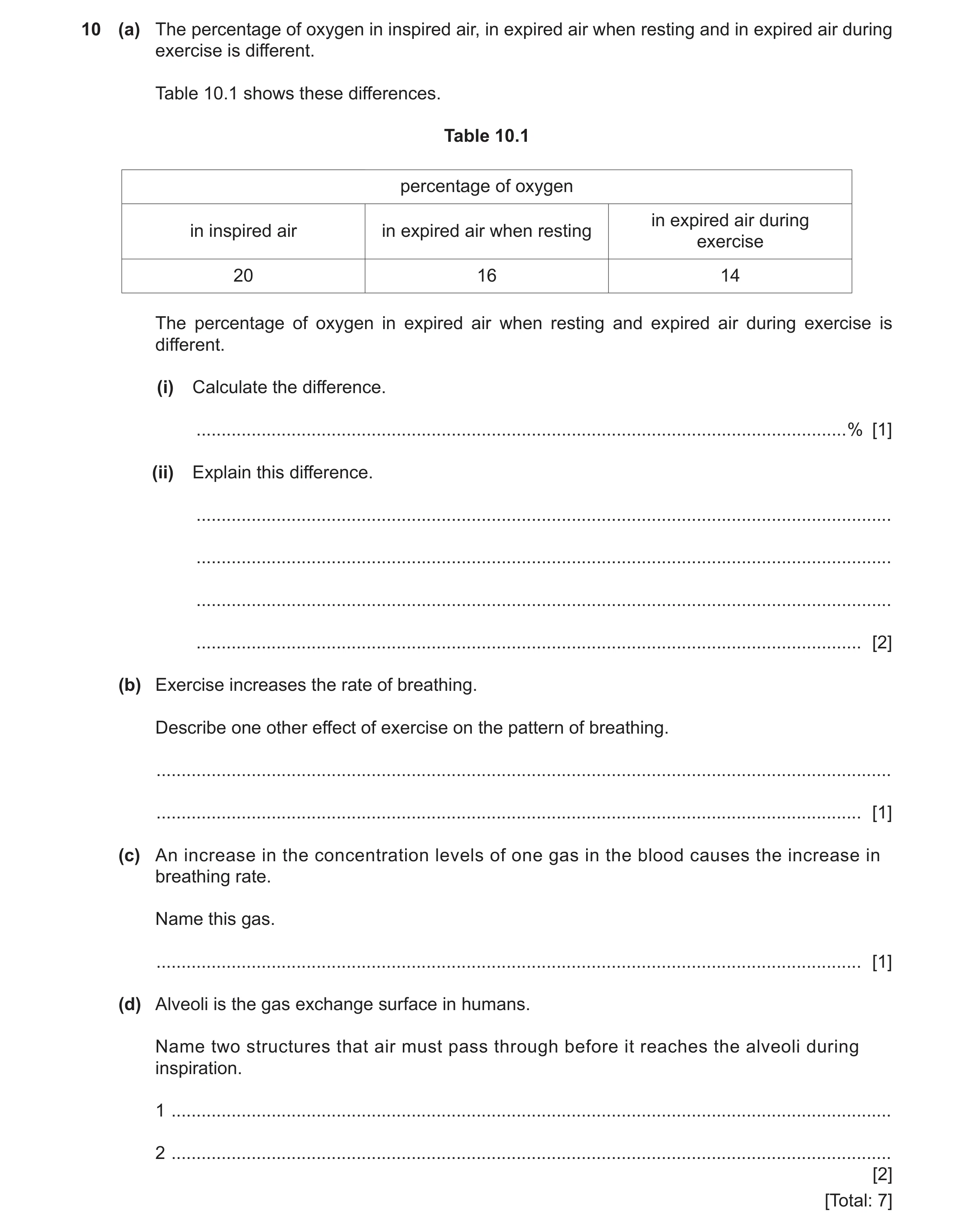
10 (a) The percentage of oxygen in inspired air, in expired air when resting and in expired air during exercise is different. Table 10.1 shows these differences. Table 10.1 percentage of oxygen in expired air during in inspired air in expired air when resting exercise 20 16 14 The percentage of oxygen in expired air when resting and expired air during exercise is different. (i) Calculate the difference. … % [1] (ii) Explain this difference. … … … … [2] (b) Exercise increases the rate of breathing. Describe one other effect of exercise on the pattern of breathing. … … [1] (c) An increase in the concentration levels of one gas in the blood causes the increase in breathing rate. Name this gas. … [1] (d) Alveoli is the gas exchange surface in humans. Name two structures that air must pass through before it reaches the alveoli during inspiration. 1 … 2 … [2] [Total: 7]
7 marks
Mark scheme: 10(a)(i) 2(%) ; 1 10(a)(ii) (more) oxygen used in respiration ; to release energy (for exercise) ; 2 10(b) increased depth of breathing ; 1 10(c) carbon dioxide ; 1 10(d) mouth / nose ; larynx ; trachea ; bronchus ; bronchioles ; max 2 2
This question in 0654/43 May/June 2021
Q16 · Yeast produces carbon dioxide during anaerobic respiration 0654/43 Oct/Nov 2022
7 (a) Yeast produces carbon dioxide during anaerobic respiration. A scientist adds 2 g of yeast to 250 cm3 of glucose solution and leaves the mixture for 10 days. Each day, at the same time, he records the volume of carbon dioxide produced in one hour. Fig. 7.1 shows the results. 40 35 30 25 volume of carbon dioxide 20 produced in one hour / cm3 15 10 5 0 0 2 4 6 8 10 time / days Fig. 7.1 (i) Use Fig. 7.1 to identify the day with the greatest rate of anaerobic respiration. … [1] (ii) Explain why the volume of carbon dioxide decreases as shown in Fig. 7.1. … … … [2] (b) The investigation is repeated with boiled yeast. Explain with reference to enzymes why no carbon dioxide is produced. … … … … [3] (c) Table 7.1 shows some products of different types of respiration. Complete Table 7.1 by placing ticks (3) to show the correct products of each type of respiration. One has been done for you. Table 7.1 products of respiration type of respiration carbon dioxide water lactic acid aerobic in humans anaerobic in humans anaerobic in yeast 3 [3] (d) Substances enter and leave a yeast cell by diffusion. A student writes an incorrect definition of diffusion. Circle the two words that are not correct. ‘Diffusion is the total movement of particles from a region of their higher concentration to a region of their lower concentration up a concentration gradient, as a result of their random movement.’ [2] [Total: 11]
11 marks
Mark scheme: 7(a)(i) 3 ; 1 7(a)(ii) glucose has been used up / AW ; 2 glucose is a requirement for (anaerobic) respiration (which produces carbon dioxide) ; any valid point ;; 7(b) ref to, denatured / denaturation ; 3 active site / enzyme, changes shape ; active site no longer complementary to substrate / substrate no longer fits into active site ; 7(c) 3 type of carbon water lactic acid respiration dioxide aerobic in humans anaerobic in humans anaerobic in () yeast 1 mark for each column ;;; 7(d) total circled ; 2 up circled ;
This question in 0654/43 Oct/Nov 2022
Q17 · The pH of the fluid in muscles changes during vigorous exercise due to the changing… 0654/43 May/June 2023
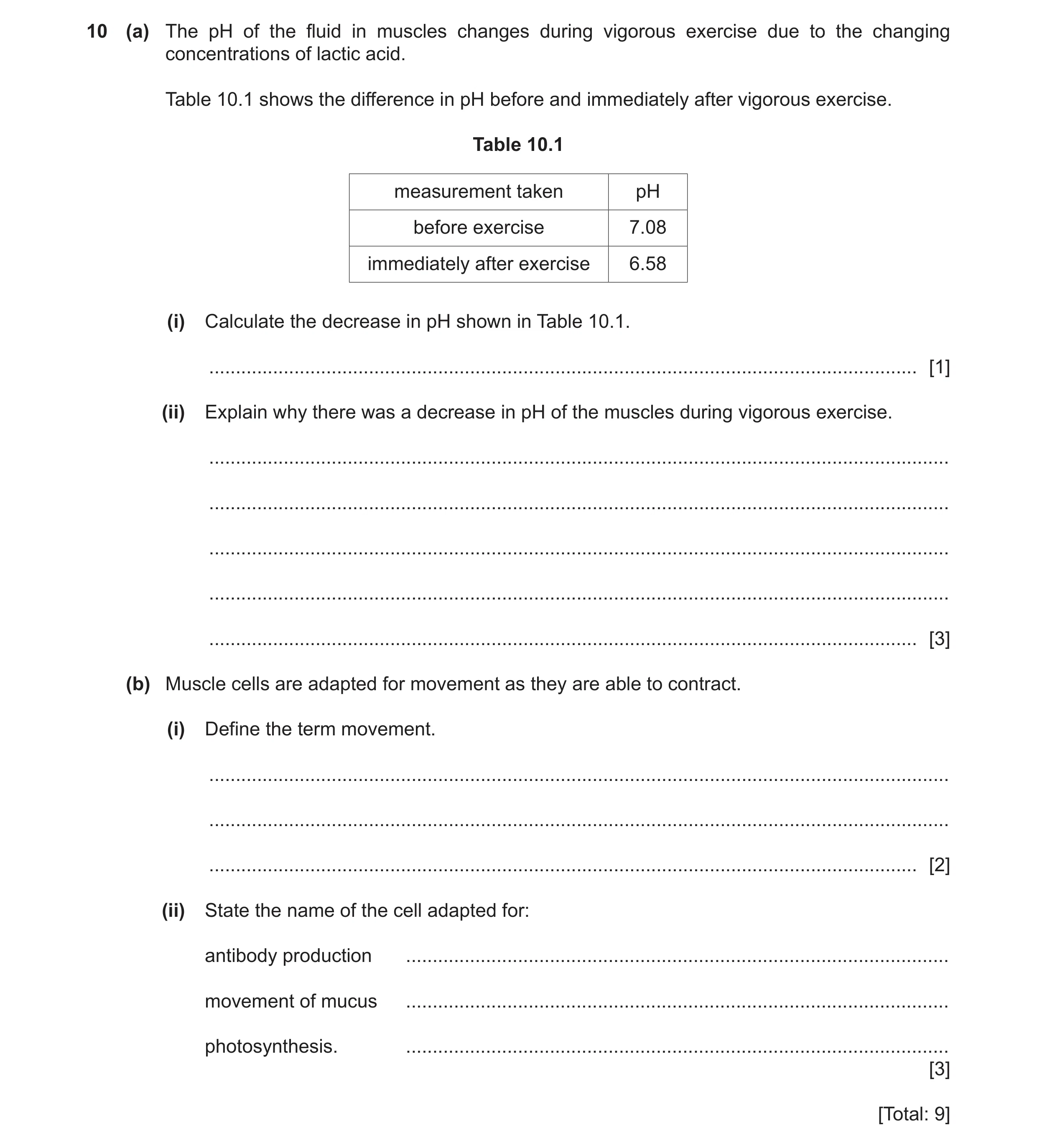
10 (a) The pH of the fluid in muscles changes during vigorous exercise due to the changing concentrations of lactic acid. Table 10.1 shows the difference in pH before and immediately after vigorous exercise. Table 10.1 measurement taken pH before exercise 7.08 immediately after exercise 6.58 (i) Calculate the decrease in pH shown in Table 10.1. … [1] (ii) Explain why there was a decrease in pH of the muscles during vigorous exercise. … … … … … [3] (b) Muscle cells are adapted for movement as they are able to contract. (i) Define the term movement. … … … [2] (ii) State the name of the cell adapted for: antibody production … movement of mucus … photosynthesis. … [3] [Total: 9]
9 marks
Mark scheme: 10(a)(i) 0.50 ; 1 10(a)(ii) not enough oxygen (for aerobic respiration) ; ref to anaerobic respiration ; increasing lactic acid (reduces the pH) ; 3 10(b)(i) (an action by,) an organism / part of an organism ; (causing a) change of, position / place ; 2 10(b)(ii) white blood (cell) ; ciliated (cell) ; palisade (mesophyll cell) ; 3
This question in 0654/43 May/June 2023
Q18 · A student investigates the effect of different types of sugar on the anaerobic… 0654/41 Oct/Nov 2023
4 (a) A student investigates the effect of different types of sugar on the anaerobic respiration in yeast. She mixes yeast with five different types of sugar solutions of the same concentration and measures the volume of gas produced after 2 hours. Table 4.1 shows the results. Table 4.1 sugar volume of gas produced in 2 hours / cm3 A 9 B 16 C 82 D 3 E 65 (i) Identify the sugar in Table 4.1 that produces the largest volume of gas. … [1] (ii) Calculate the rate of anaerobic respiration for sugar A in Table 4.1. rate of anaerobic respiration for sugar A = … cm3 / min [2] (iii) State the name of the gas produced in this investigation. … [1] (iv) State one practical use for the anaerobic respiration of yeast. … [1] (b) Describe three ways that aerobic respiration is different from anaerobic respiration in humans. 1 … … 2 … … 3 … … [3] (c) Respiration is one of the characteristics of living organisms. State one other characteristic. … [1] [Total: 9]
9 marks
Mark scheme: 4(a)(i) C ; 1 4(a)(ii) evidence of unit conversion / (2 hours =) 120 minutes ; 2 0.075 (cm3/min) ; 4(a)(iii) carbon dioxide ; 1 4(a)(iv) bread making / named practical use of anaerobic respiration by yeast ; 1 4(b) any three from: 3 requires oxygen ; (releases) more energy (per glucose molecule) ; produces carbon dioxide ; produces water ; does not produce lactic acid ; 4(c) any one from: 1 movement ; sensitivity ; growth ; reproduction ; excretion ; nutrition ;
This question in 0654/41 Oct/Nov 2023
Q19 · Scientists estimate the percentage of energy used from anaerobic respiration and aerobic… 0654/42 Feb/March 2024
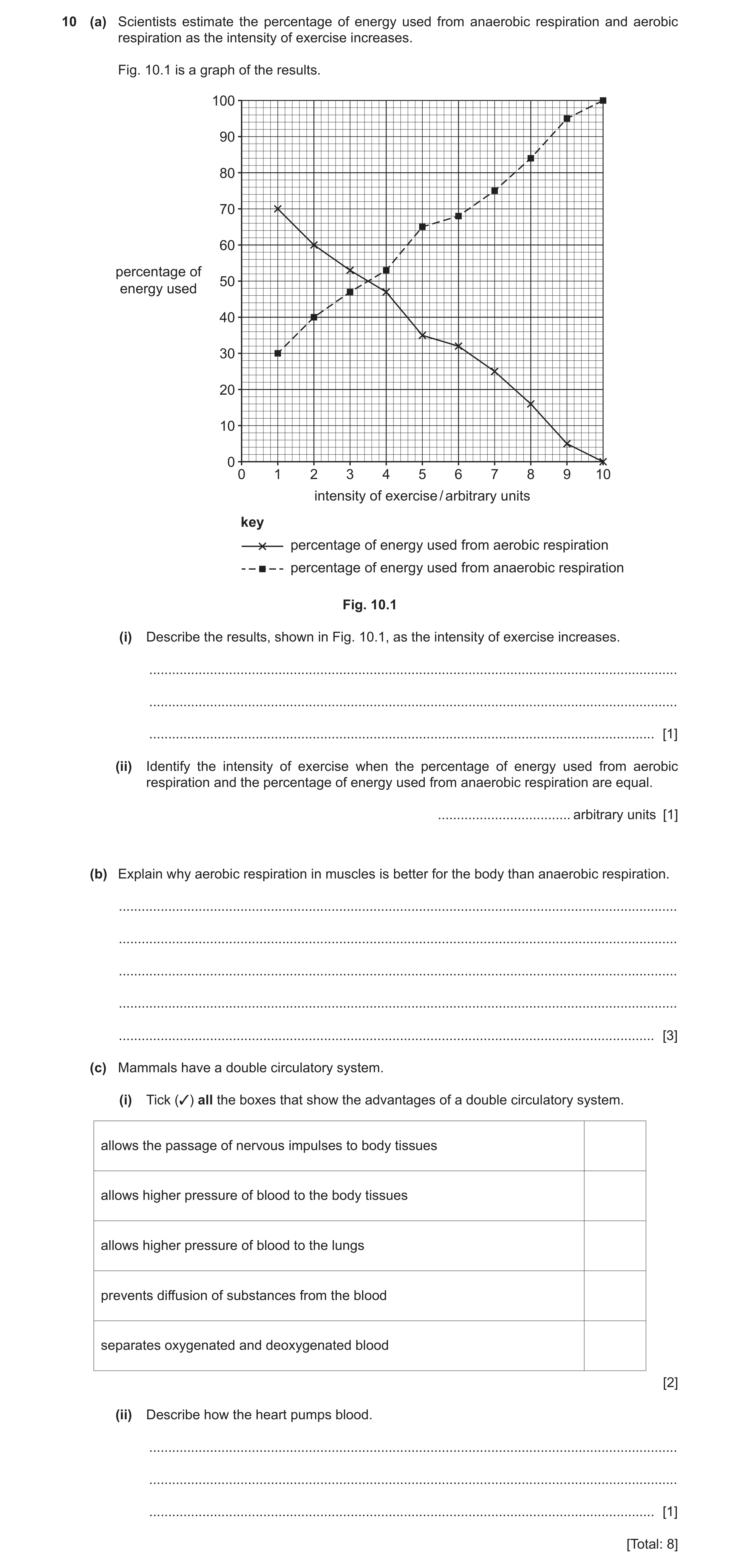
10 (a) Scientists estimate the percentage of energy used from anaerobic respiration and aerobic respiration as the intensity of exercise increases. Fig. 10.1 is a graph of the results. 100 90 80 70 60 percentage of 50 energy used 40 30 20 10 0 0 1 2 3 4 5 6 7 8 9 10 intensity of exercise / arbitrary units key percentage of energy used from aerobic respiration percentage of energy used from anaerobic respiration Fig. 10.1 (i) Describe the results, shown in Fig. 10.1, as the intensity of exercise increases. … … … [1] (ii) Identify the intensity of exercise when the percentage of energy used from aerobic respiration and the percentage of energy used from anaerobic respiration are equal. … arbitrary units [1] (b) Explain why aerobic respiration in muscles is better for the body than anaerobic respiration. … … … … … [3] (c) Mammals have a double circulatory system. (i) Tick (✓) all the boxes that show the advantages of a double circulatory system. allows the passage of nervous impulses to body tissues allows higher pressure of blood to the body tissues allows higher pressure of blood to the lungs prevents diffusion of substances from the blood separates oxygenated and deoxygenated blood [2] (ii) Describe how the heart pumps blood. … … … [1] [Total: 8]
8 marks
Mark scheme: 10(a)(i) percentage of energy used from anaerobic respiration increases and the percentage of energy used from aerobic 1 respiration decreases ; 10(a)(ii) 3.5 (arbitary units) ; 1 10(b) anaerobic respiration produces lactic acid ; 3 (build-up of lactic acid) causes oxygen debt ; anaerobic respiration releases less energy per glucose molecule (than aerobic respiration) ; 10(c)(i) 2 allows the passage of nervous impulses to body tissues allows higher pressure of blood to the body tissues allows higher pressure of blood to the lungs prevents diffusion of substances from the blood separates oxygenated and deoxygenated blood ;; 10(c)(ii) contraction of (heart) muscle / atria / ventricle ; 1
This question in 0654/42 Feb/March 2024
Q20 · A student monitors their heart rate during vigorous exercise for 30 minutes 0654/41 Oct/Nov 2024
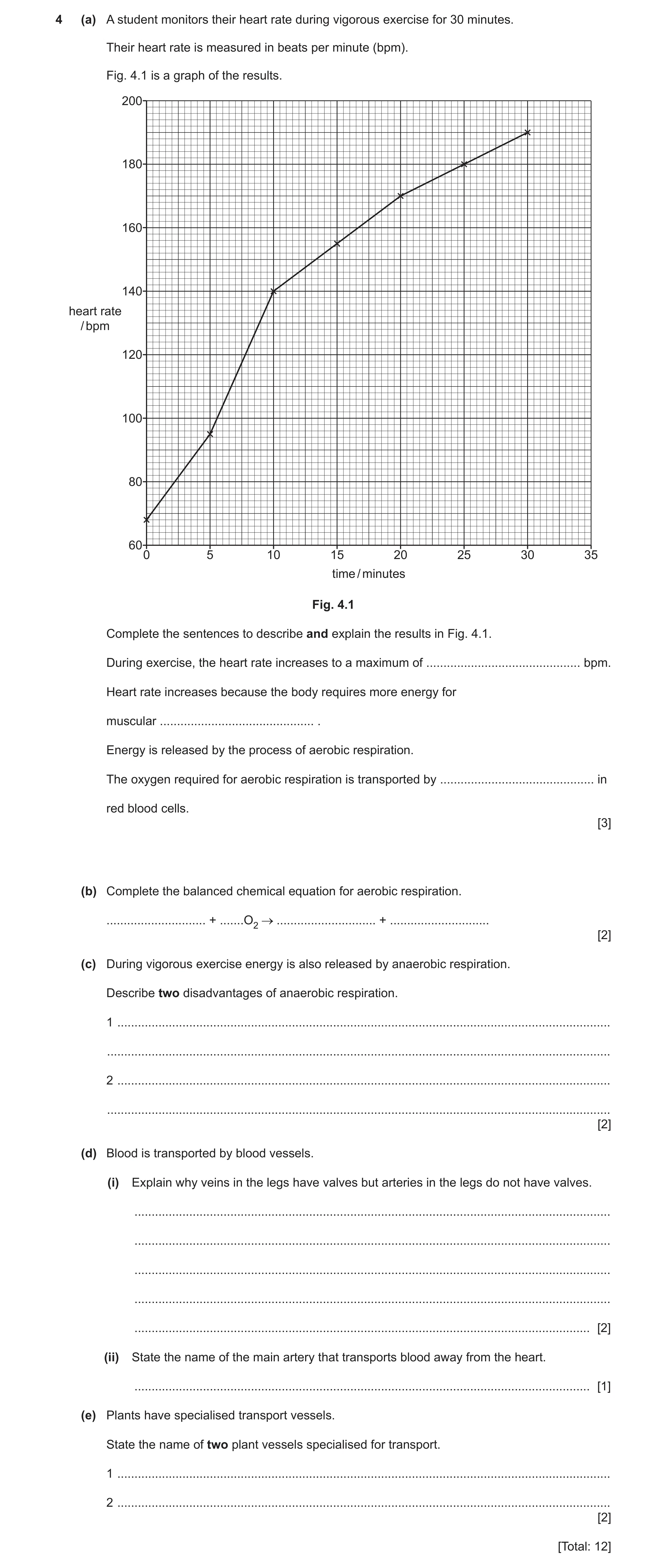
4 (a) A student monitors their heart rate during vigorous exercise for 30 minutes. Their heart rate is measured in beats per minute (bpm). Fig. 4.1 is a graph of the results. 200 180 160 140 heart rate / bpm 120 100 80 60 0 5 10 15 20 25 30 35 time / minutes Fig. 4.1 Complete the sentences to describe and explain the results in Fig. 4.1. During exercise, the heart rate increases to a maximum of … bpm. Heart rate increases because the body requires more energy for muscular … . Energy is released by the process of aerobic respiration. The oxygen required for aerobic respiration is transported by … in red blood cells. [3] (b) Complete the balanced chemical equation for aerobic respiration. … + … O2 … + … [2] (c) During vigorous exercise energy is also released by anaerobic respiration. Describe two disadvantages of anaerobic respiration. 1 … … 2 … … [2] (d) Blood is transported by blood vessels. (i) Explain why veins in the legs have valves but arteries in the legs do not have valves. … … … … … [2] (ii) State the name of the main artery that transports blood away from the heart. … [1] (e) Plants have specialised transport vessels. State the name of two plant vessels specialised for transport. 1 … 2 … [2] [Total: 12]
12 marks
Mark scheme: 4(a) 190 ; 3 contraction ; haemoglobin ; 4(b) C6H12O6 + 6O2 → 6CO2 + 6H2O 2 one mark for correctly balanced reactants ; one mark for correctly balanced products (either order) ; 4(c) releases (much) less energy (per glucose molecule than aerobic respiration) ; 2 produces lactic acid / causes an oxygen debt ; 4(d)(i) transport blood under low(er) pressure ; 2 (valves) ensure one-way flow of blood / AW ; 4(d)(ii) aorta ; 1 4(e) xylem ; 2 phloem ;
This question in 0654/41 Oct/Nov 2024
Q21 · A farmer planted some seeds 0654/43 Oct/Nov 2024
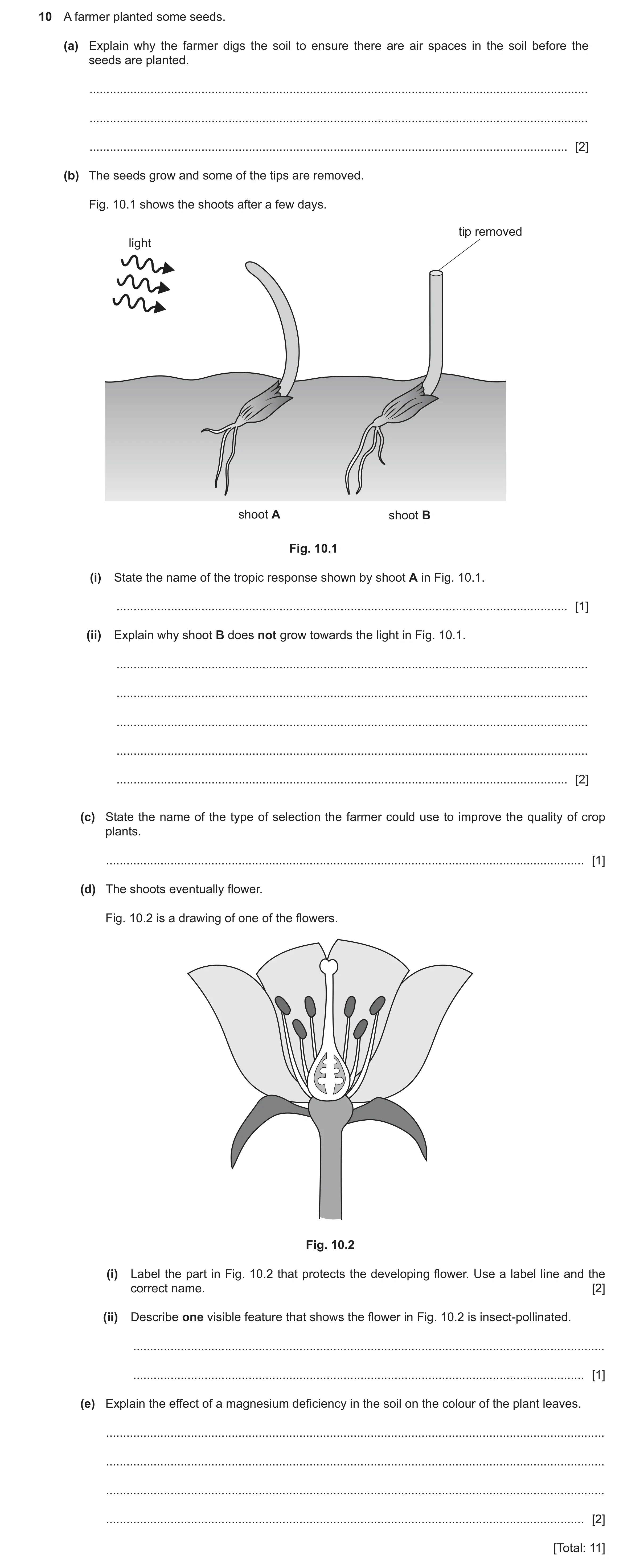
10 A farmer planted some seeds. (a) Explain why the farmer digs the soil to ensure there are air spaces in the soil before the seeds are planted. … … … [2] (b) The seeds grow and some of the tips are removed. Fig. 10.1 shows the shoots after a few days. tip removed light shoot A shoot B Fig. 10.1 (i) State the name of the tropic response shown by shoot A in Fig. 10.1. … [1] (ii) Explain why shoot B does not grow towards the light in Fig. 10.1. … … … … … [2] (c) State the name of the type of selection the farmer could use to improve the quality of crop plants. … [1] (d) The shoots eventually flower. Fig. 10.2 is a drawing of one of the flowers. Fig. 10.2 (i) Label the part in Fig. 10.2 that protects the developing flower. Use a label line and the correct name. [2] (ii) Describe one visible feature that shows the flower in Fig. 10.2 is insect-pollinated. … … [1] (e) Explain the effect of a magnesium deficiency in the soil on the colour of the plant leaves. … … … … [2] [Total: 11]
11 marks
Mark scheme: 10(a) provide oxygen ; 2 for germination ; 10(b)(i) phototropism ; 1 10(b)(ii) auxin is made in the tip only ; 2 so no cell elongation (stimulated) ; 10(c) artificial ; 1 10(d)(i) sepal labelled ;; 2 1 mark for correct part labelled 1 mark for correct name 10(d)(ii) any one from: 1 large petals ; anther / stamen / filament, inside flower ; stigma / style inside flower ; Idea that anther is below the stigma ; 10(e) Less / no, synthesis / making of chlorophyll ; 2 yellow leaves ;
This question in 0654/43 Oct/Nov 2024
Q22 · A patient has been told by his doctor to exercise to reduce his risk of coronary heart… 0654/43 May/June 2025
2 A patient has been told by his doctor to exercise to reduce his risk of coronary heart disease. During exercise, the patient notices these effects: • increased heart rate • increased breathing rate and depth • hotter body temperature. (a) (i) Explain the effects of exercise on heart rate and breathing. … … … … … … [3] (ii) Describe how the patient’s body responds to the increase in body temperature. … … … … … … [3] (b) The patient’s doctor also suggests using a type of drug called statins as well as exercise. (i) State what is meant by the term drug. … … … [2] (ii) State one other way the patient may reduce his risk of coronary heart disease. … … [1] [Total: 9]
9 marks
Mark scheme: 2(a)(i) any three from: 3 increased respiration; increased energy requirement; increased muscle contraction; (muscles) need more oxygen / glucose; increase in carbon dioxide concentration (detected by brain); blood pumped faster; 2(a)(ii) any three from: 3 (blood temperature) detected by brain; (increase in) sweat; vasodilation / widening of arterioles; increased blood flow to capillaries / skin surface; relaxation of hair muscles / hair lies flat; 2(b)(i) a substance/chemical taken into the body; 2 that, affects/modifies/changes, chemical reactions; 2(b)(ii) balanced diet / less stress / stop smoking; 1
This question in 0654/43 May/June 2025
Q23 · A diagram of the breathing system in humans 0654/41 Oct/Nov 2025
2 (a) Fig. 2.1 is a diagram of the breathing system in humans. Fig. 2.1 (i) On Fig. 2.1: draw a label line and letter L to identify the larynx draw a label line and letter B to identify a bronchus. [2] (ii) Describe two features of the gas exchange surface in humans. 1 … … 2 … … [2] (b) (i) State the balanced symbol equation for aerobic respiration. … + … … + … [2] (ii) Anaerobic and aerobic respiration occur in the human body. Describe two ways anaerobic respiration is different from aerobic respiration in the human body. difference 1 … … difference 2 … … [2] (c) Fig. 2.2 shows a diagram of the adaptive features of a sperm. H nucleus G Fig. 2.2 (i) State the function of the part labelled G in Fig. 2.2. … [1] (ii) Name structure H shown in Fig. 2.2 and state its function. name … function … … [2] (iii) The nucleus of the sperm cell is haploid. Describe what is meant by a haploid nucleus. … … [1] [Total: 12]
12 marks
Mark scheme: 2(a)(i) larynx labelled L or larynx ; 2 bronchus labelled B or bronchus ; 2(a)(ii) any two from: 2 • large (surface) area ; • thin (surface) / thin wall ; • good blood supply ; • good ventilation (with air) ; • AVP ; 2(b)(i) C6H12O6 + 6O2 → 6CO2 + 6H2O 2 LHS correct either order = 1 mark RHS correct either order = 1 mark 2(b)(ii) any two from: 2 • anaerobic does not require oxygen / ORA ; • anaerobic produces lactic acid / anaerobic releases lactic acid / ORA ; • anaerobic releases less energy / anaerobic releases less ATP / ORA ; • anaerobic does not produce water / anaerobic does not produce carbon dioxide / ORA ; 2(c)(i) motility / move(ment) / swim(ming) ; 1 2(c)(ii) acrosome ; 2 (contains digestive) enzyme(s) to penetrate egg ; 2(c)(iii) contains a single set of chromosomes / AW ; 1
This question in 0654/41 Oct/Nov 2025
 1 / 32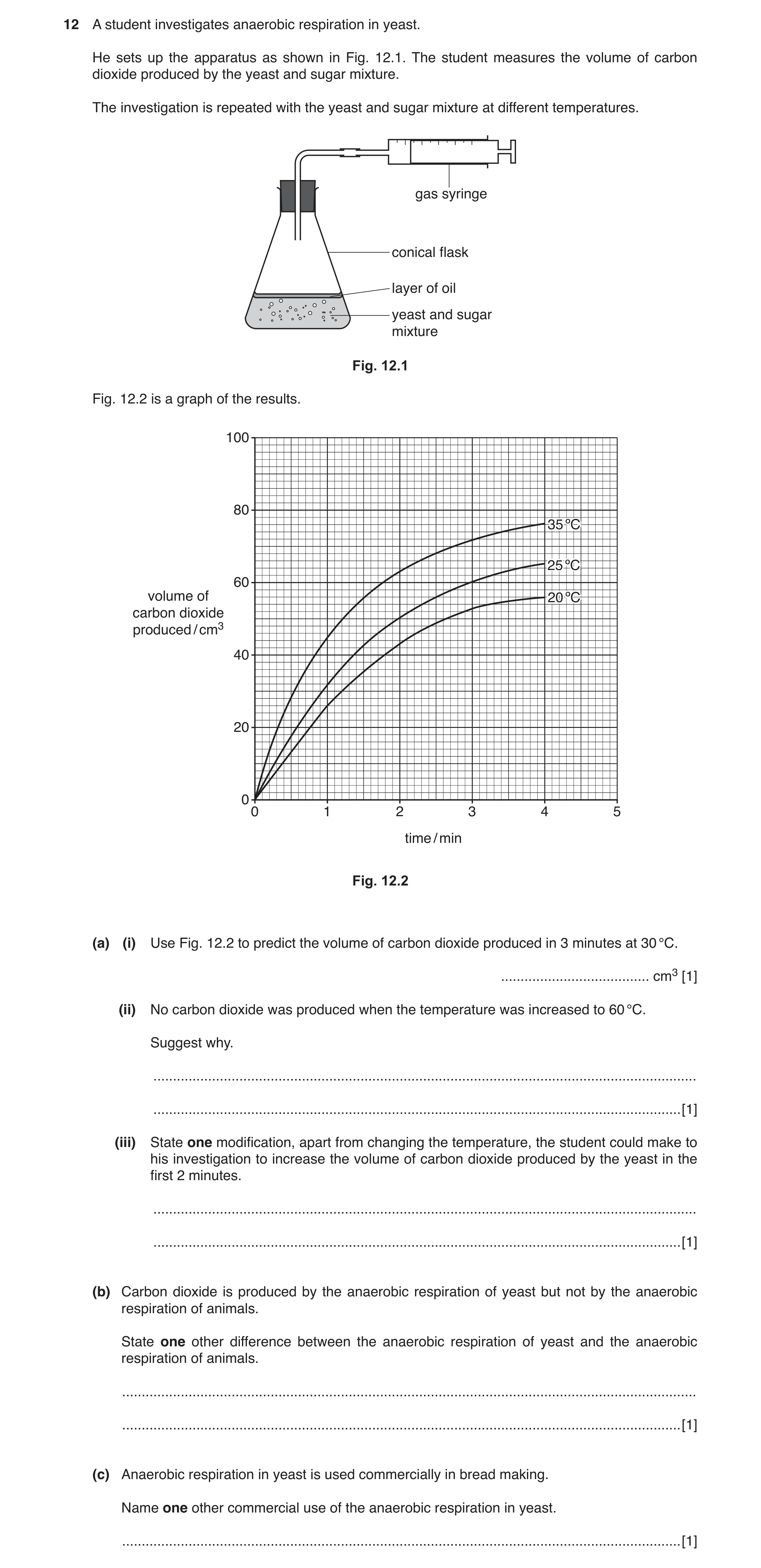
 4 / 32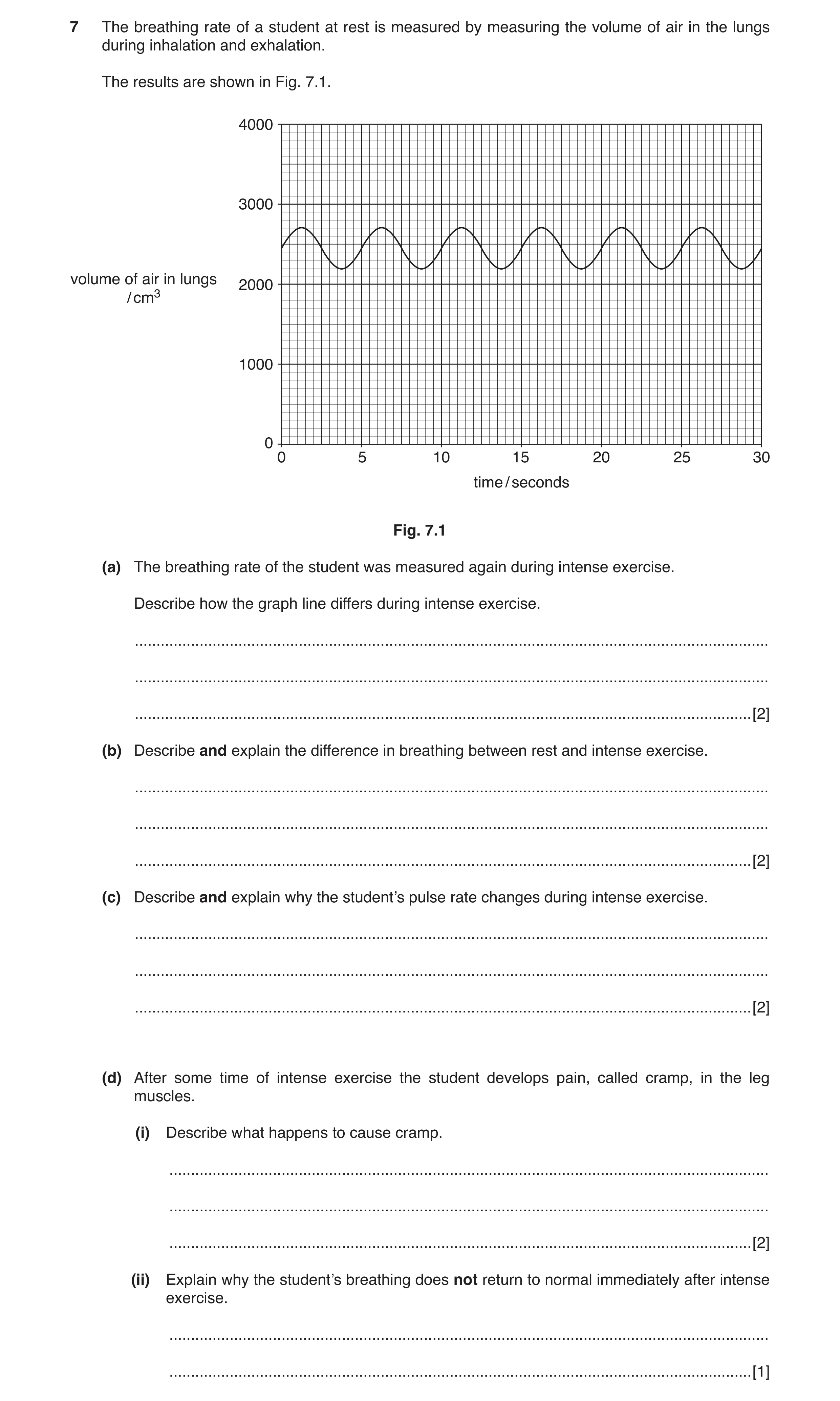
 7 / 32
 8 / 32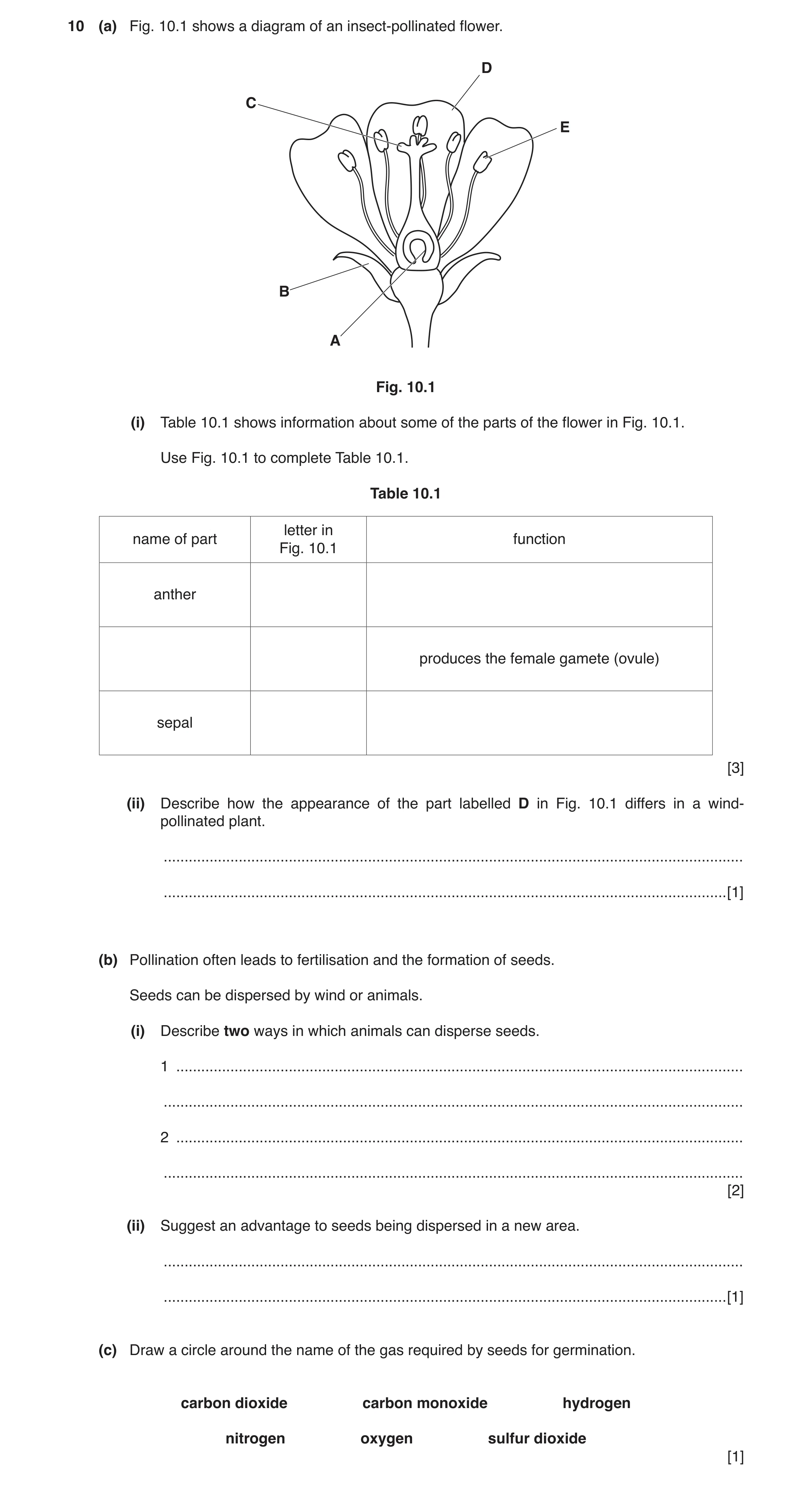
 16 / 32
 17 / 32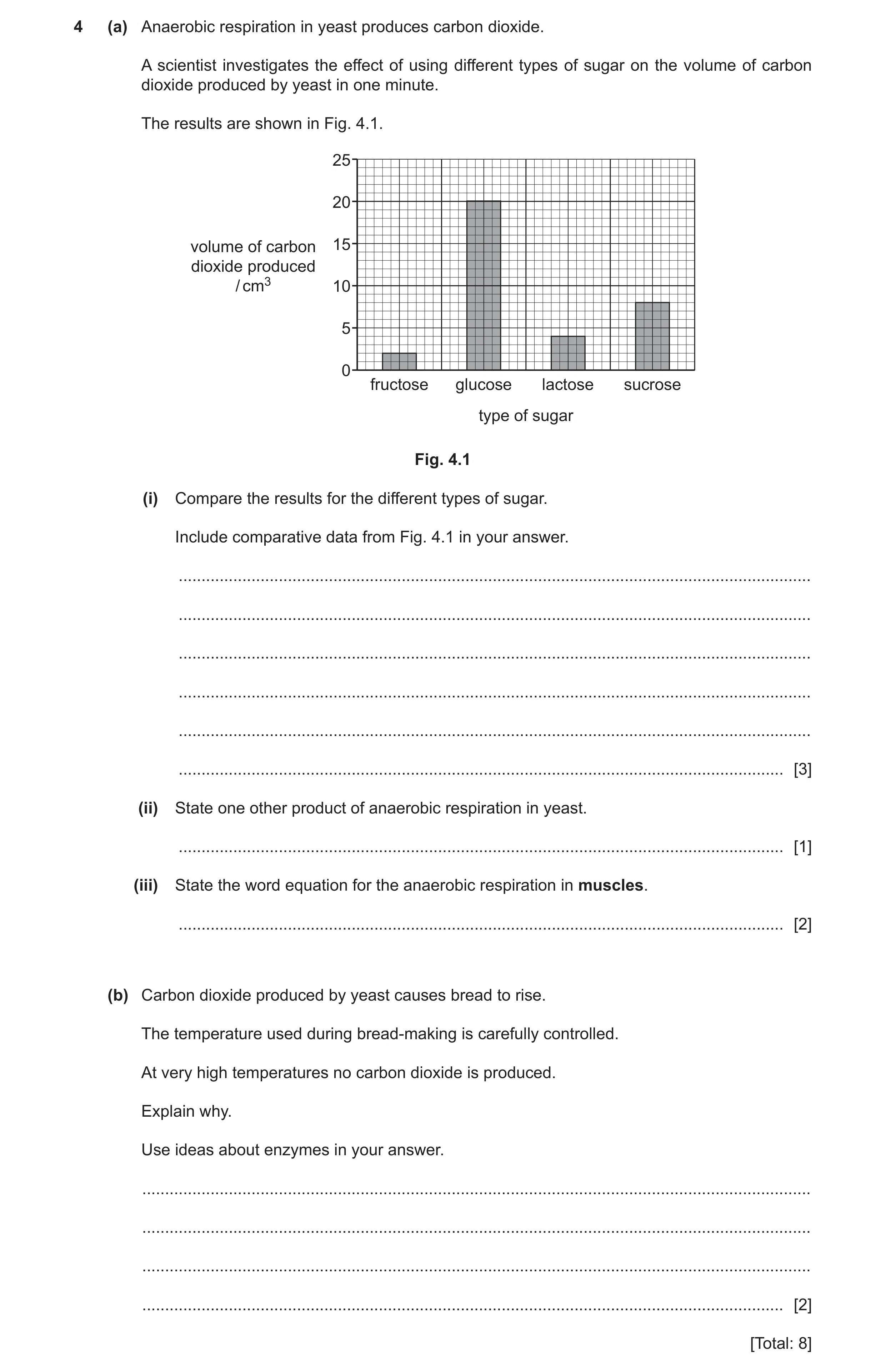
 19 / 32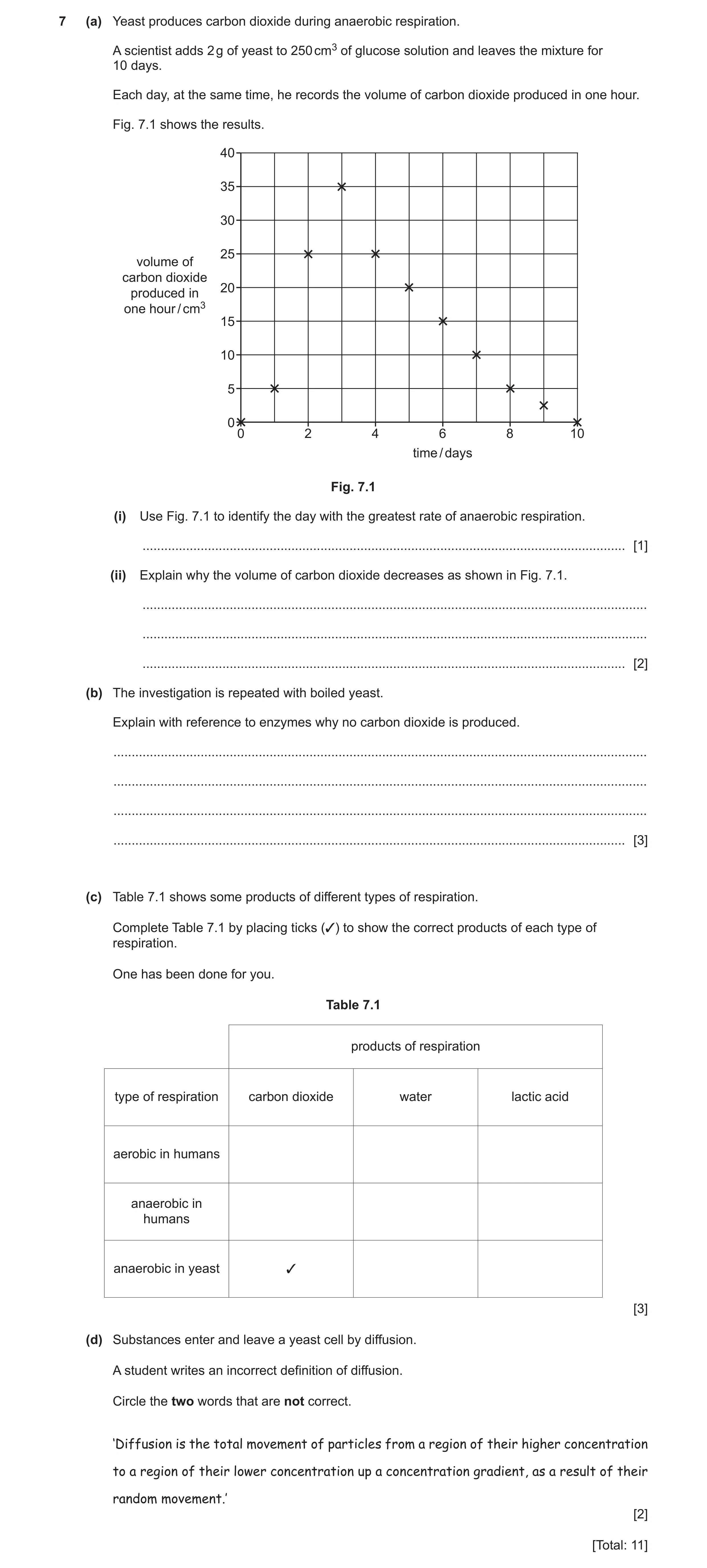
 22 / 32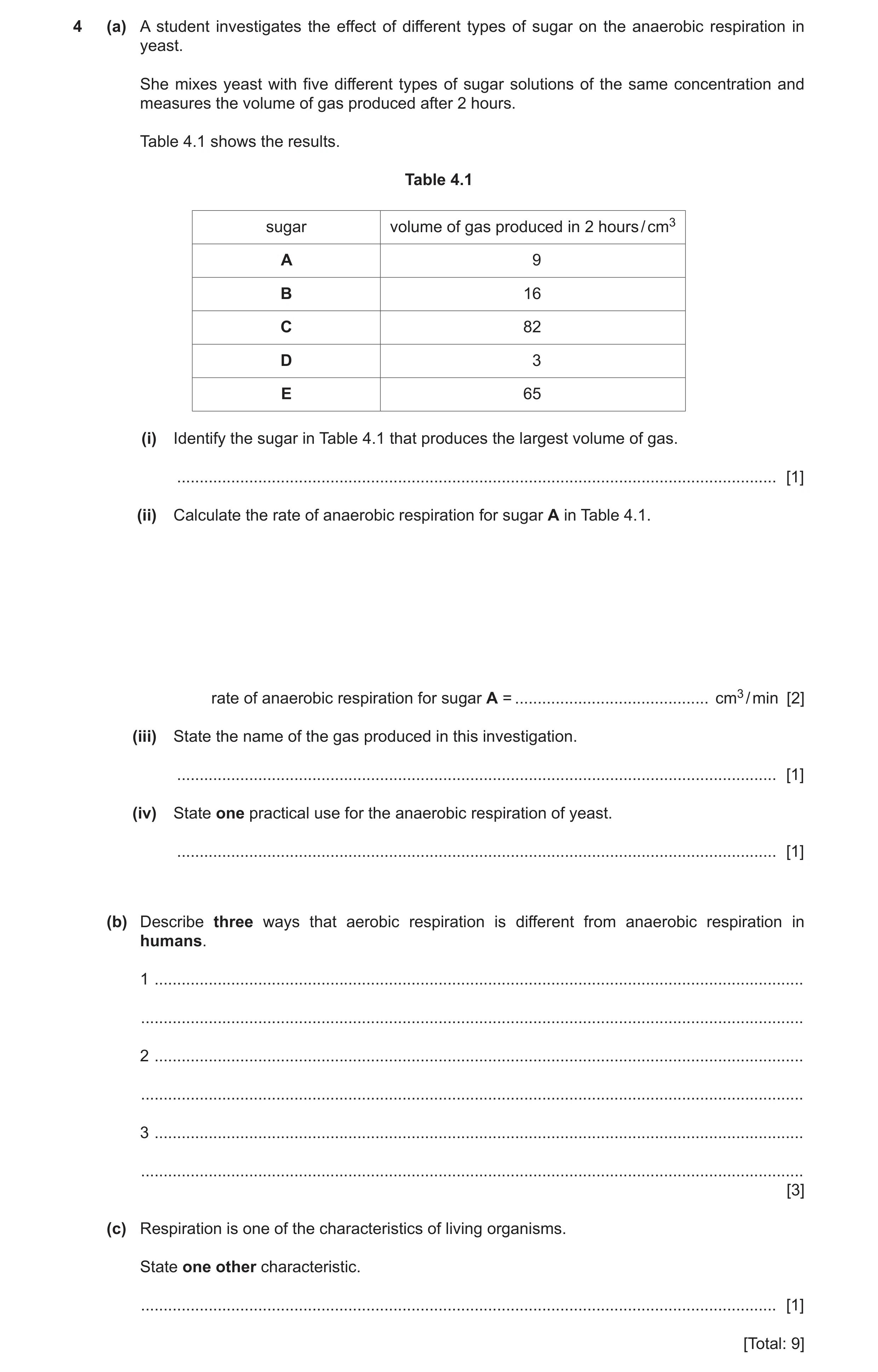
 30 / 32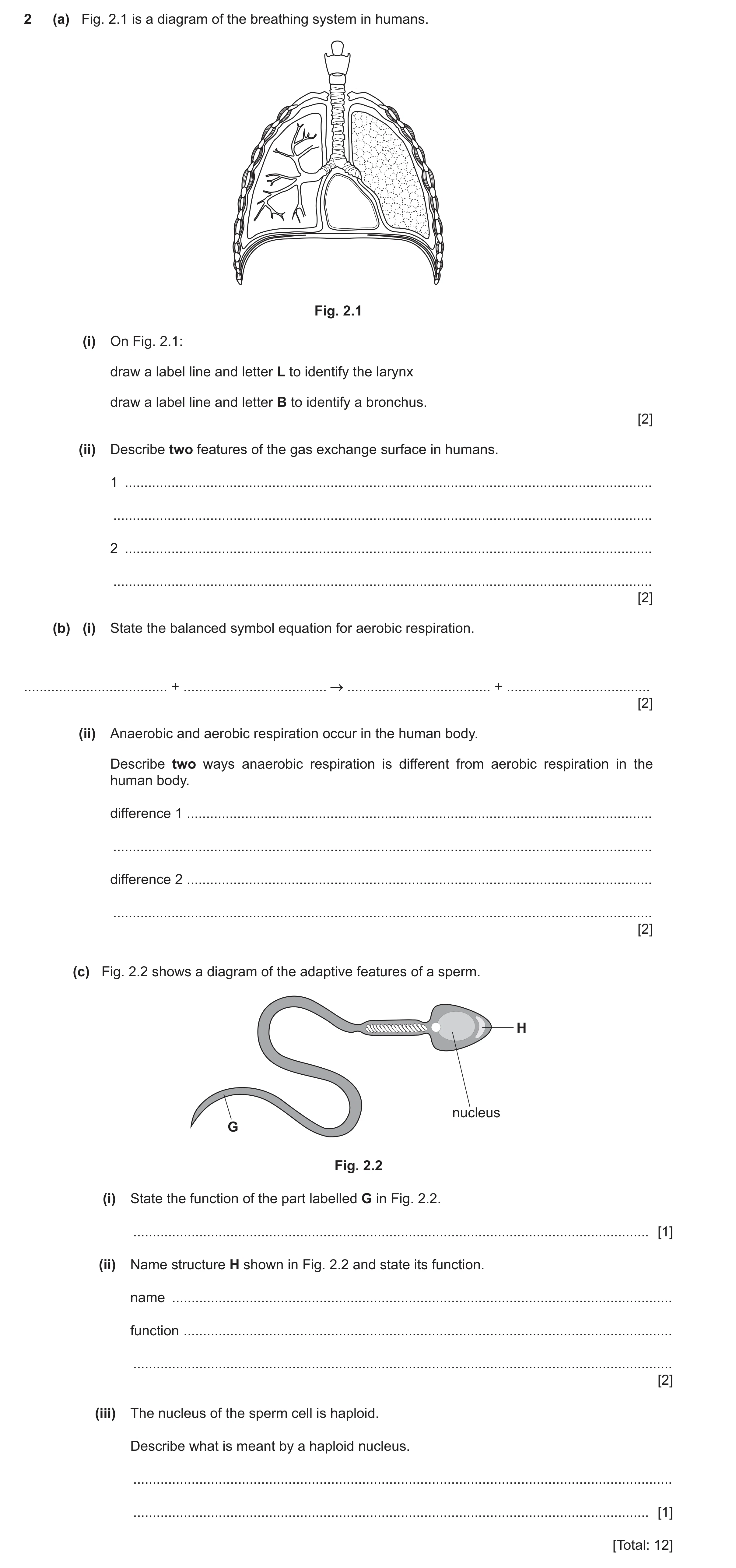
 8
8 5
5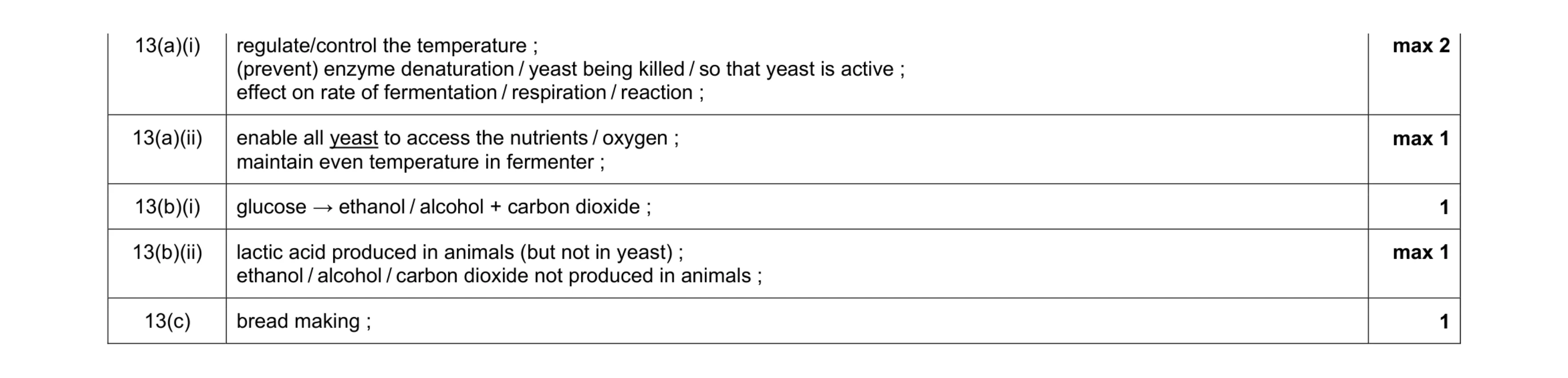 6
6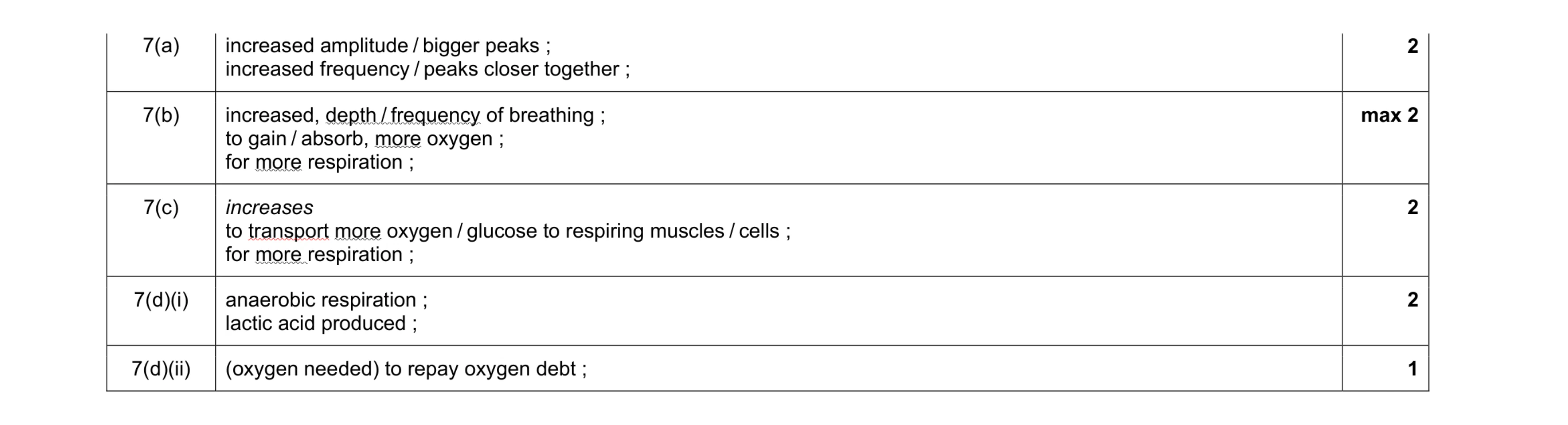 9
9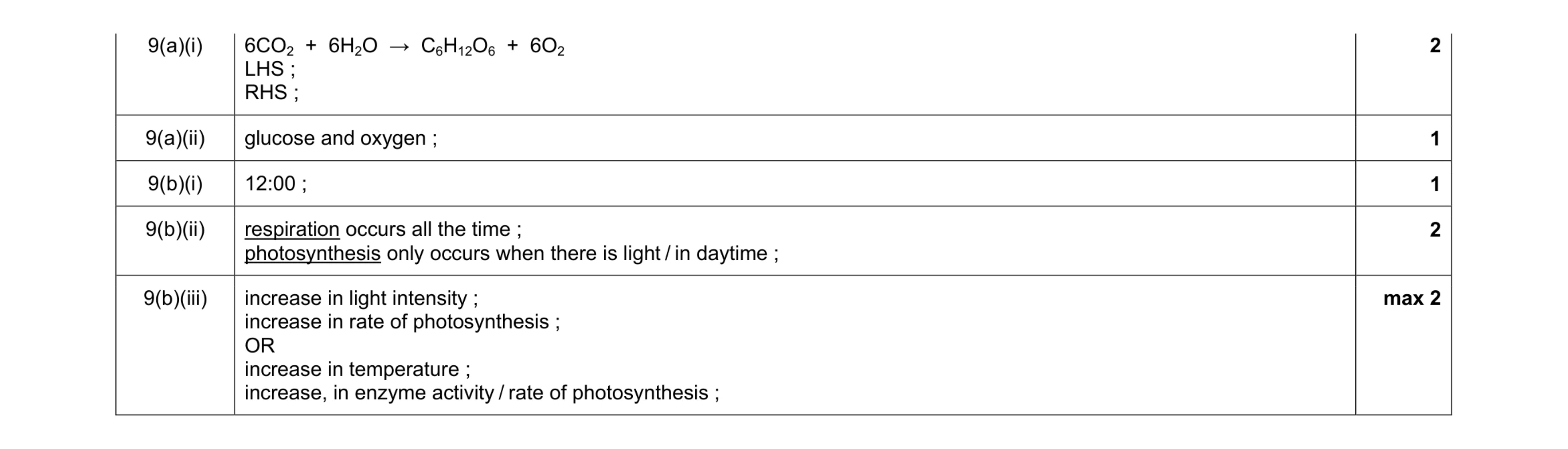 8
8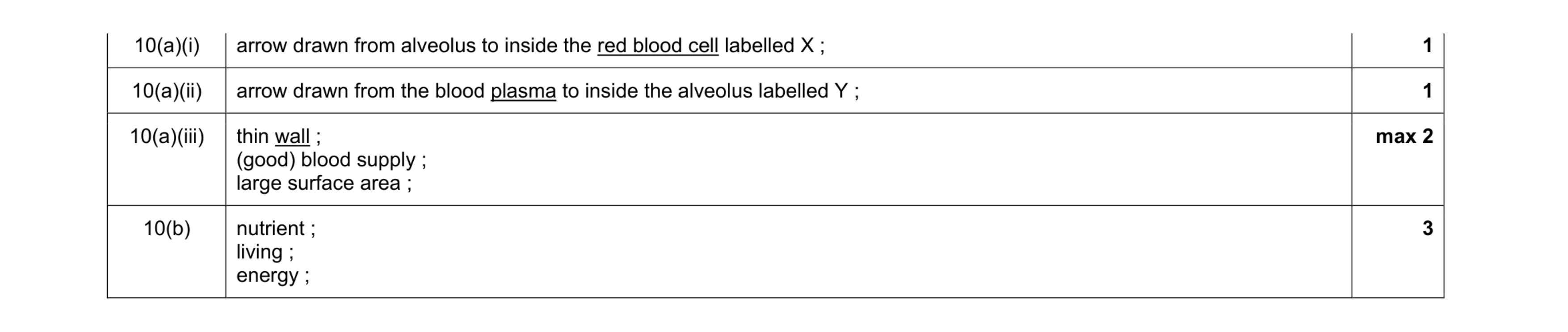 7
7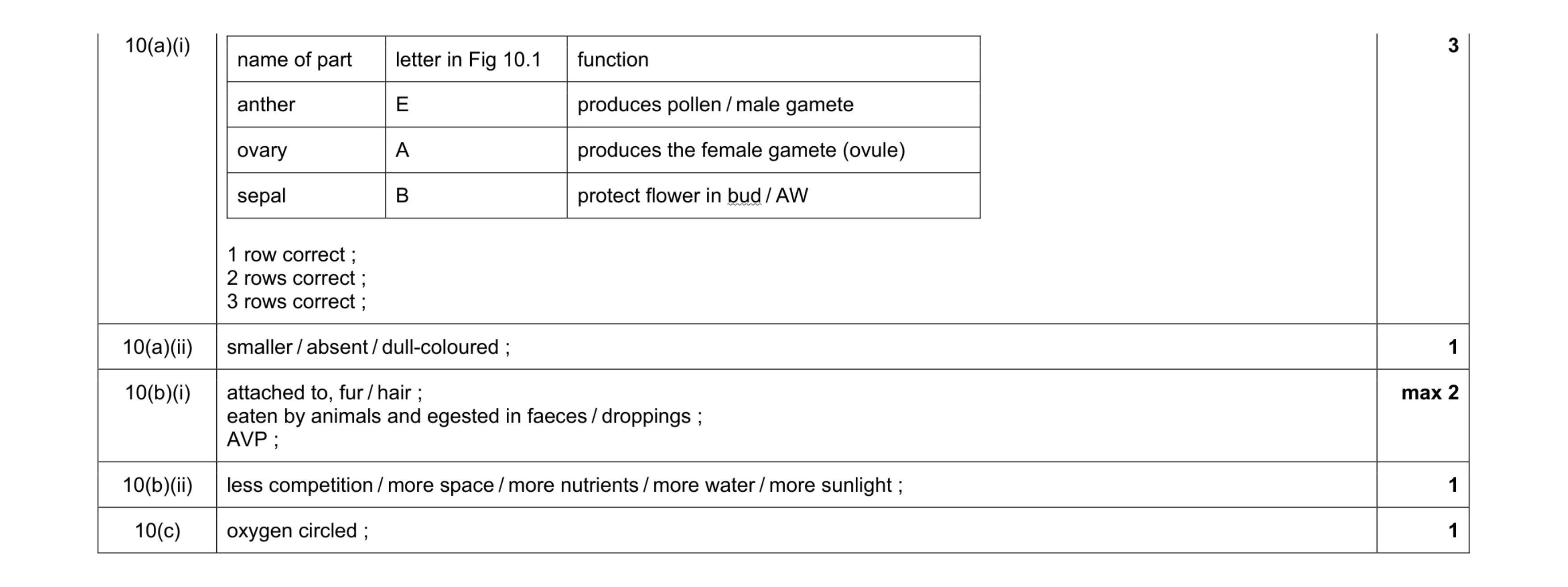 8
8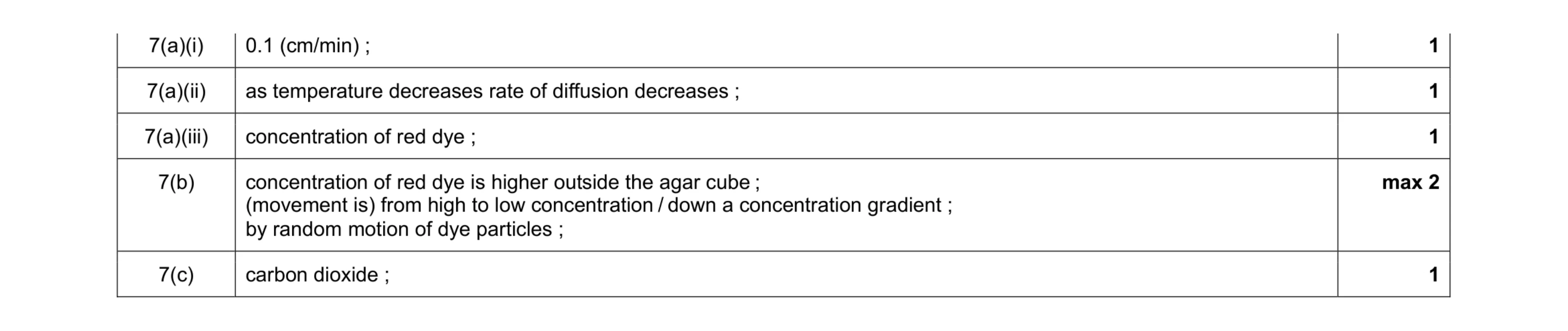 6
6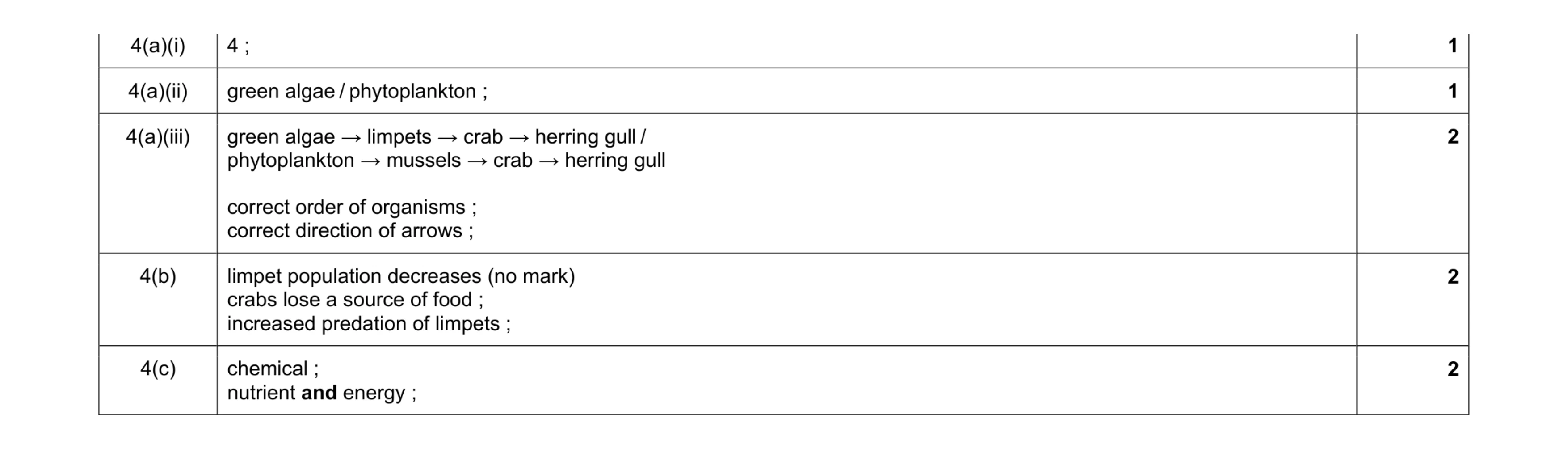 8
8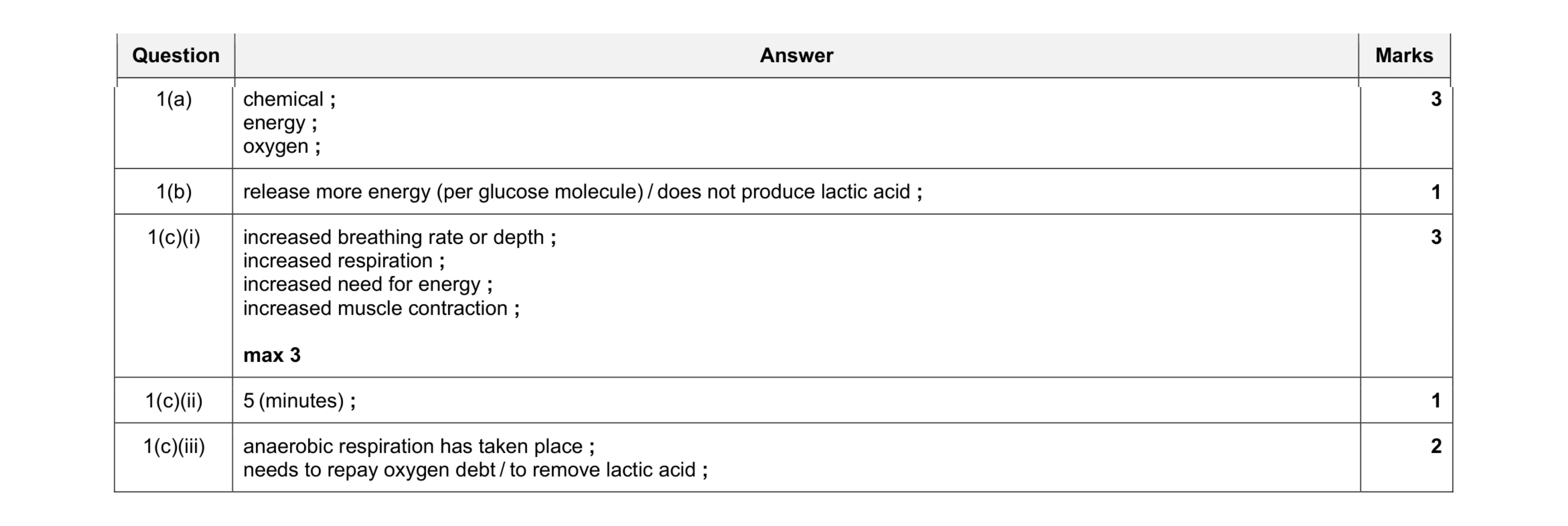 10
10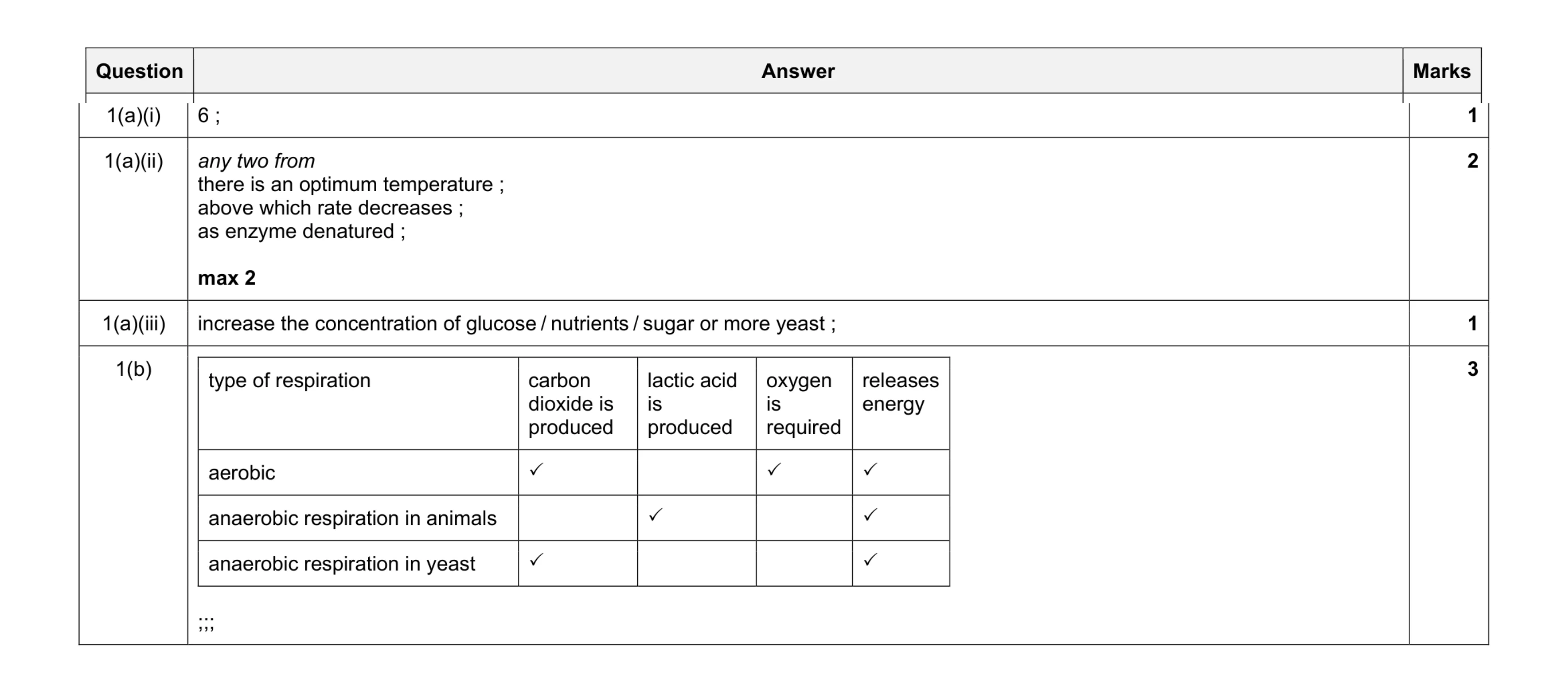 7
7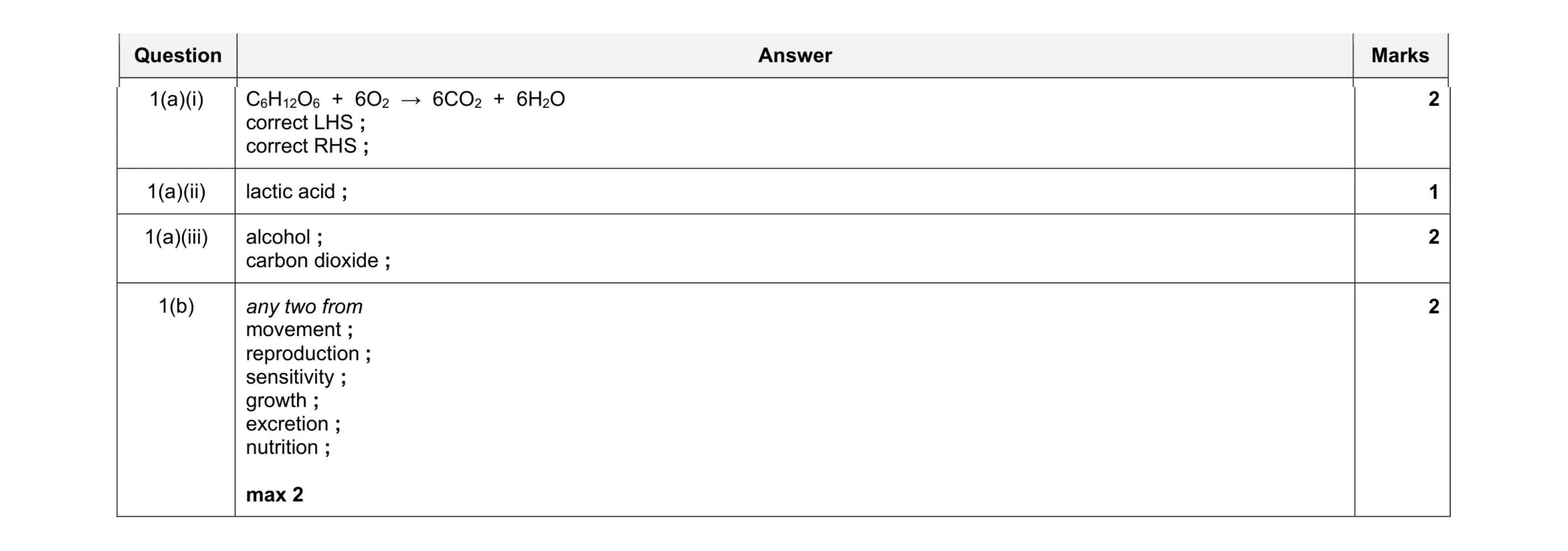 7
7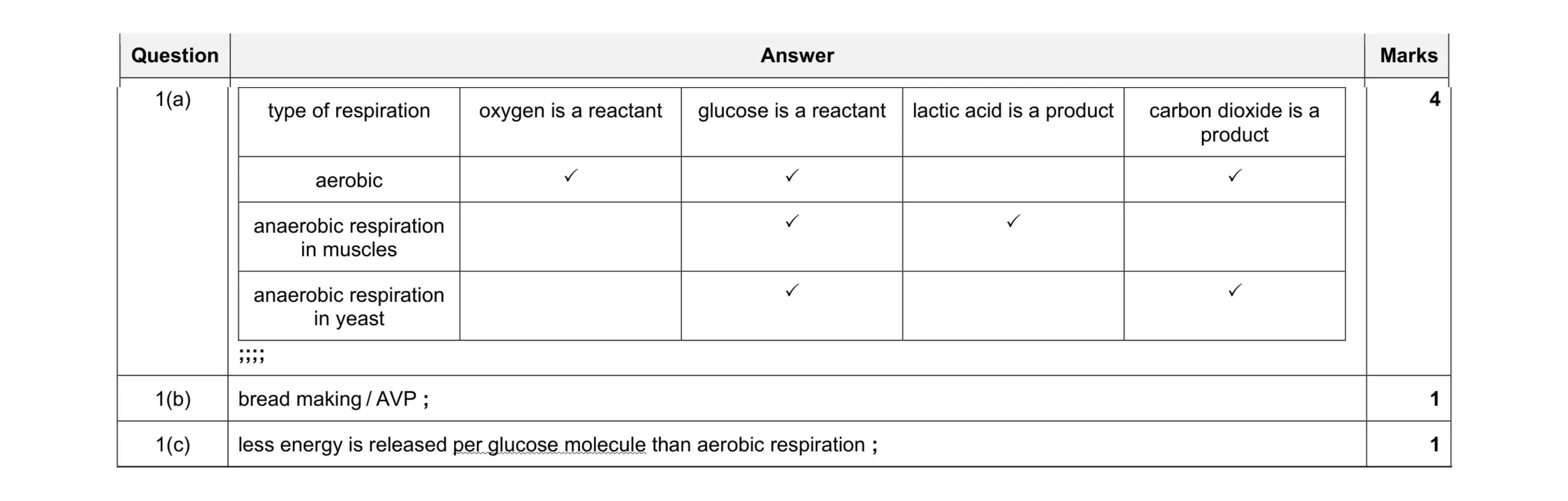 6
6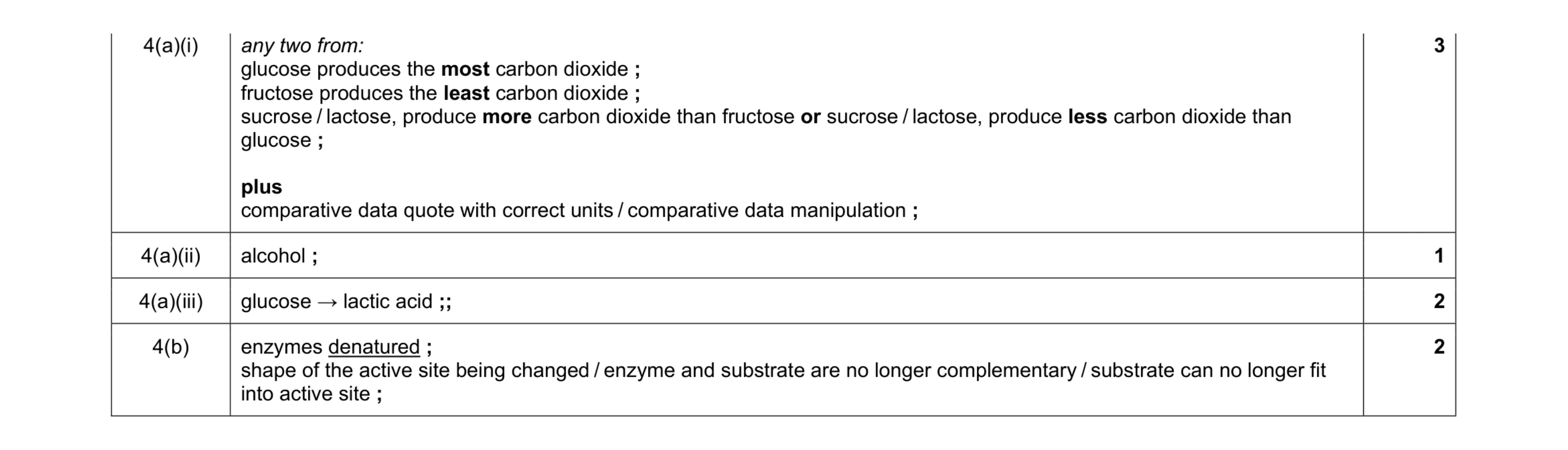 8
8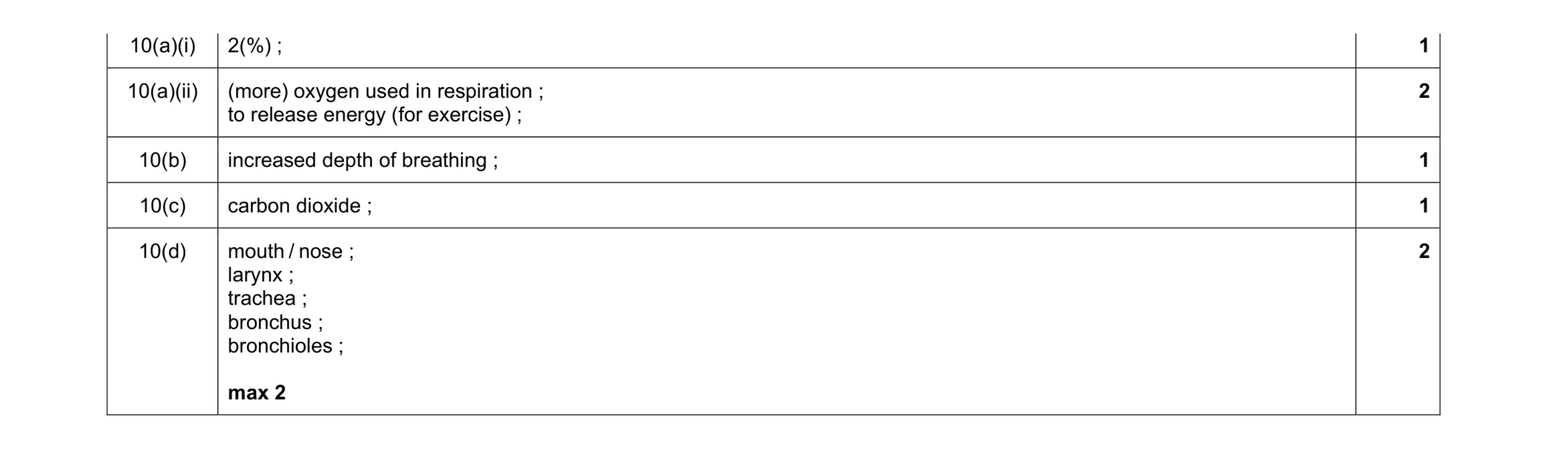 7
7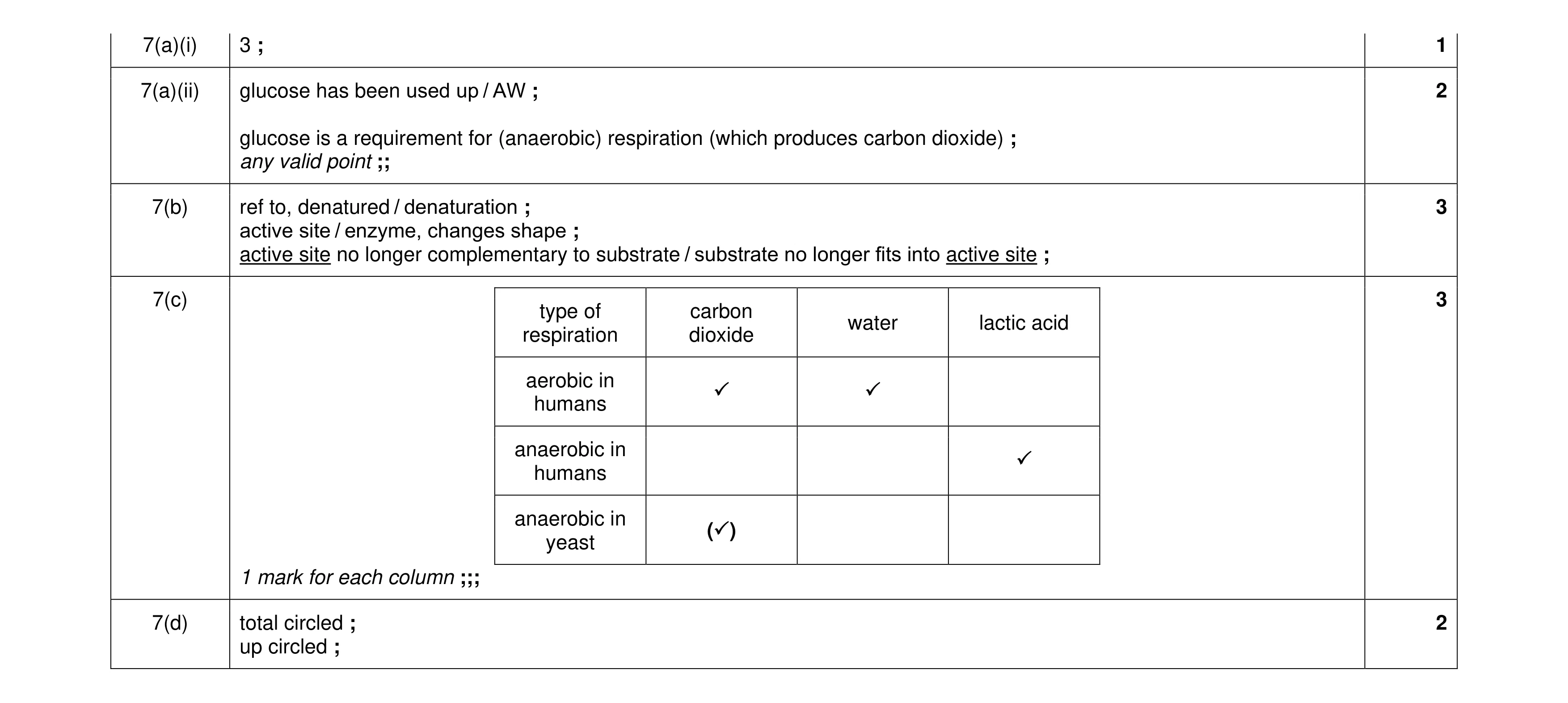 11
11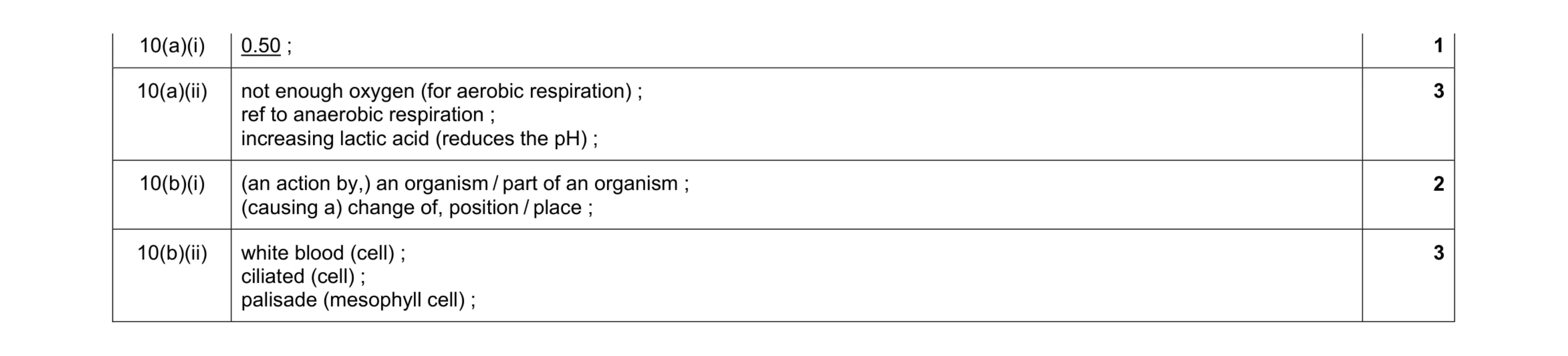 9
9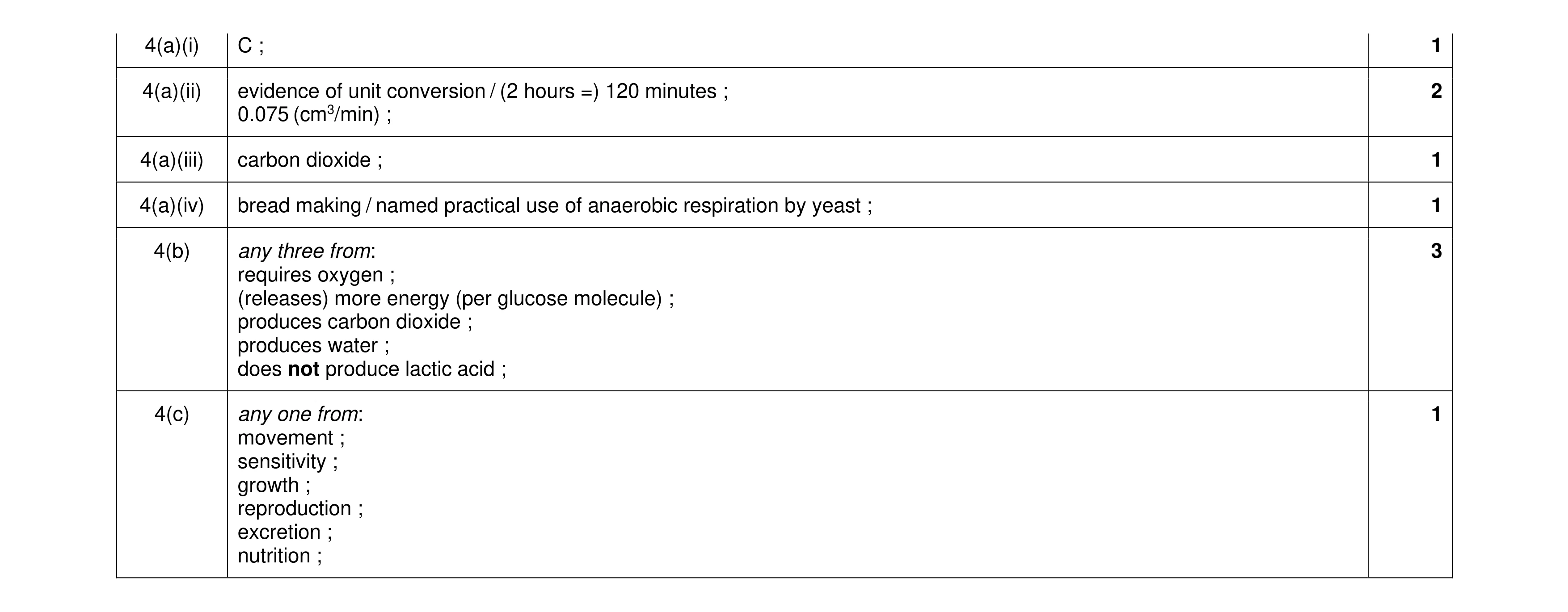 9
9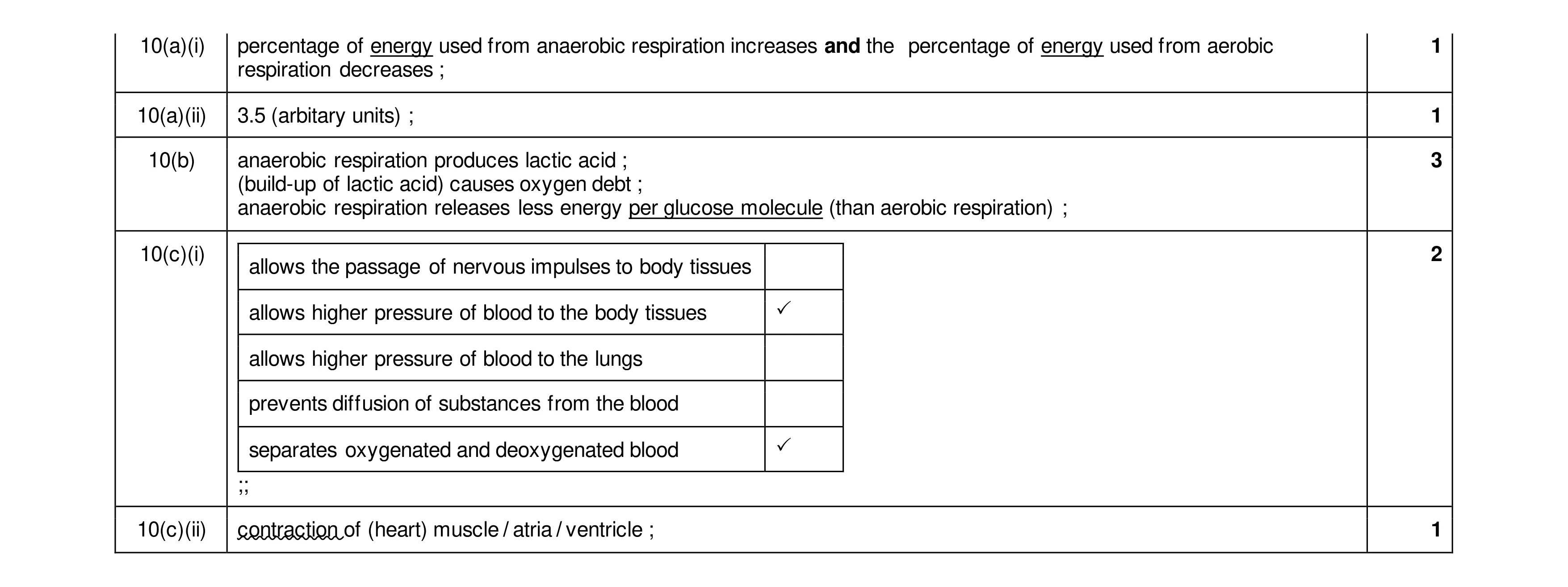 8
8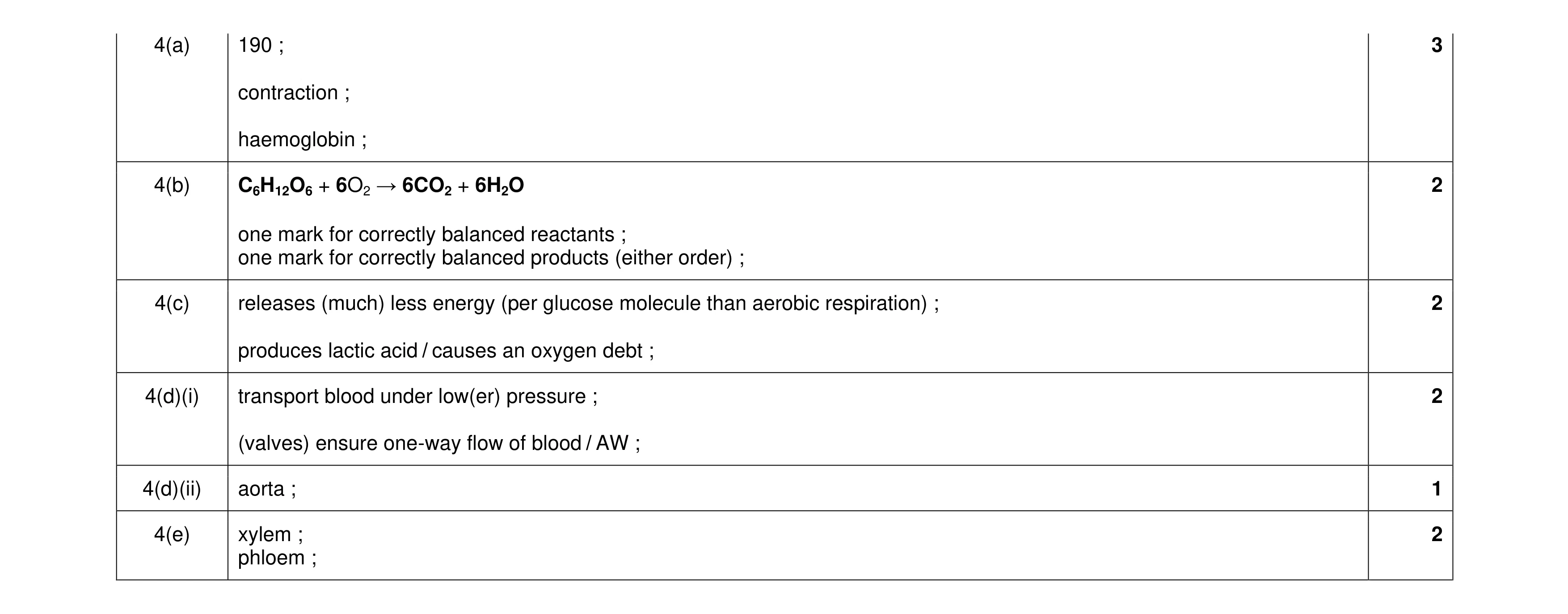 12
12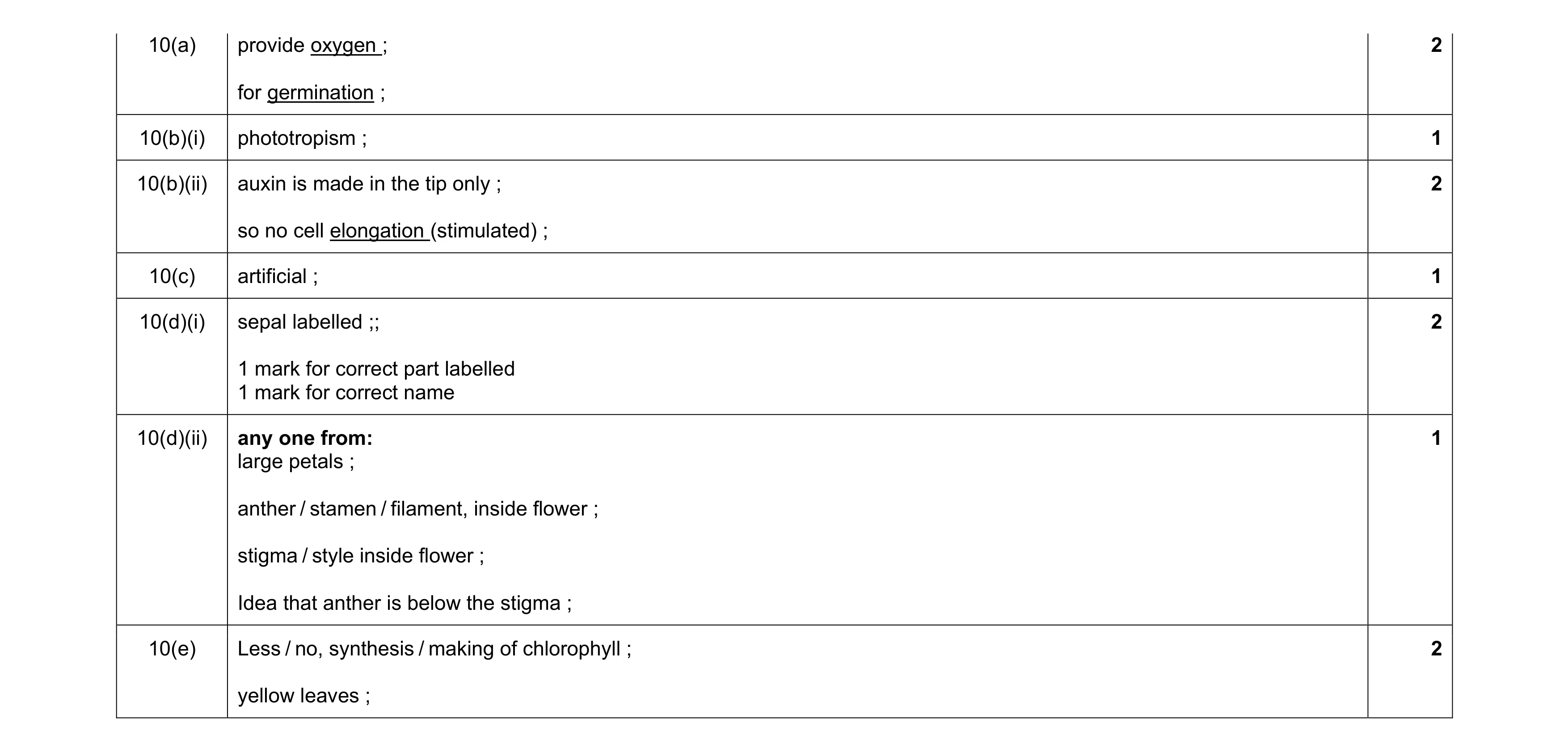 11
11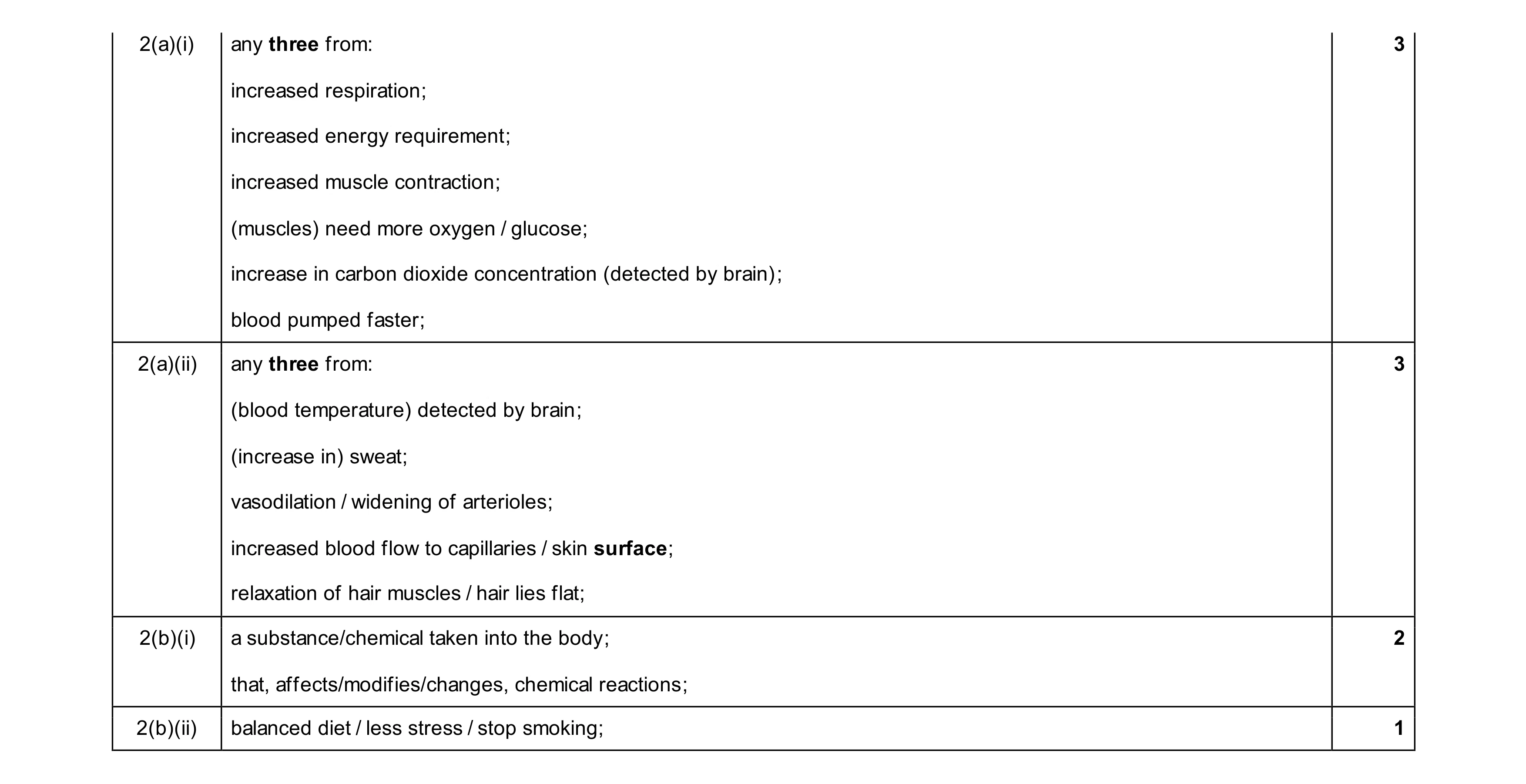 9
9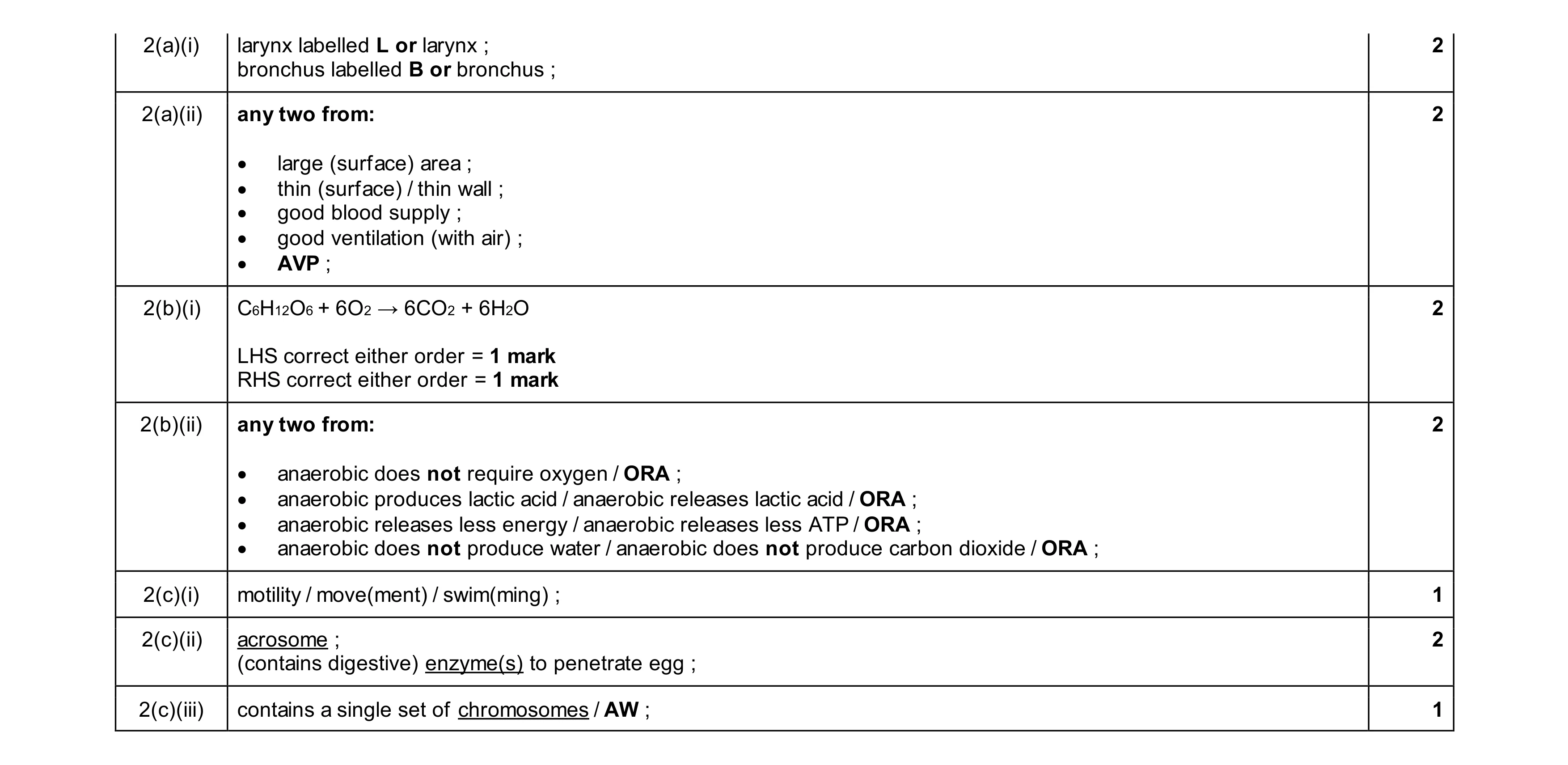 12
12