Questions as text
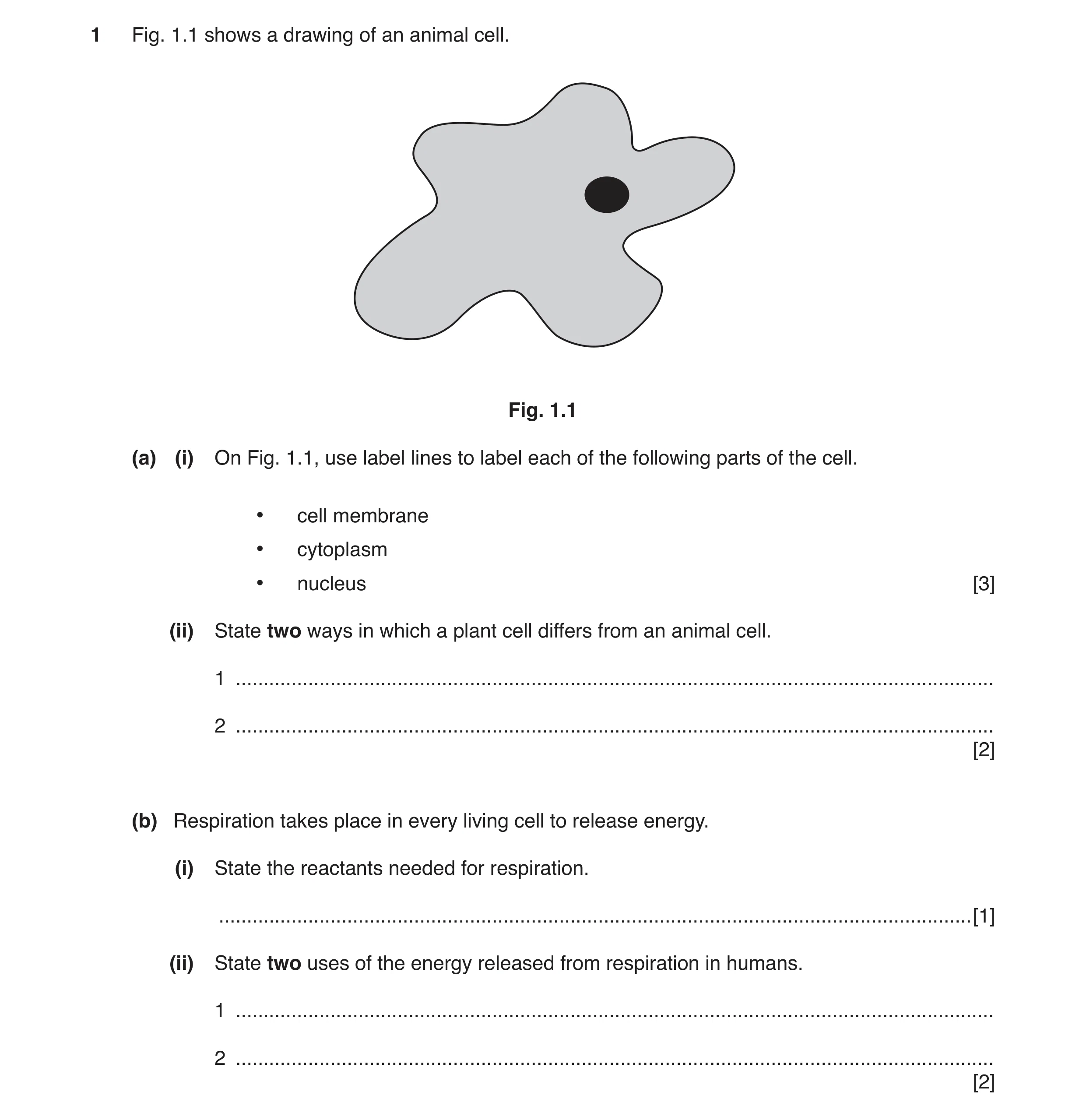
Q1 · A drawing of an animal cell 0654/31 May/June 2017
1 Fig. 1.1 shows a drawing of an animal cell. Fig. 1.1 (a) (i) On Fig. 1.1, use label lines to label each of the following parts of the cell. • cell membrane • cytoplasm • nucleus [3] (ii) State two ways in which a plant cell differs from an animal cell. 1 … 2 … [2] (b) Respiration takes place in every living cell to release energy. (i) State the reactants needed for respiration. … [1] (ii) State two uses of the energy released from respiration in humans. 1 … 2 … [2]
8 marks
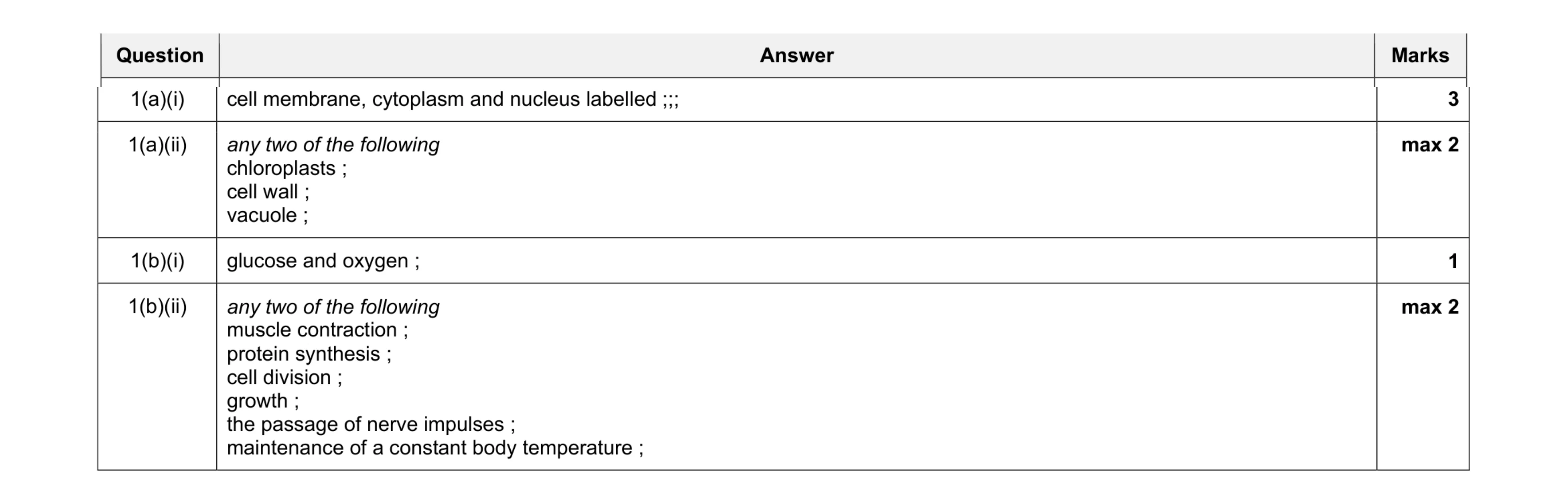
Mark scheme: 1(a)(i) cell membrane, cytoplasm and nucleus labelled ;;; 3 1(a)(ii) any two of the following chloroplasts ; cell wall ; vacuole ; max 2 1(b)(i) glucose and oxygen ; 1 1(b)(ii) any two of the following muscle contraction ; protein synthesis ; cell division ; growth ; the passage of nerve impulses ; maintenance of a constant body temperature ; max 2
This question in 0654/31 May/June 2017
Q2 · A student investigates the changes to her heart rate when she exercises 0654/32 May/June 2017
11 A student investigates the changes to her heart rate when she exercises. The student’s heart rate at rest is 68 beats per minute. The graph in Fig. 11.1 shows the results. 140 120 100 heart rate / 80 beats per minute 60 40 20 0 0 5 10 15 20 25 time / minutes Fig. 11.1 (a) (i) Describe the changes to the student’s heart rate between 0 minutes and 25 minutes. … … … … [2] (ii) Suggest the time that the student starts to exercise. … minutes [1] (iii) The student stops exercising at 15 minutes. State the length of time it takes for her heart rate to return to her resting value. … minutes [1] (b) Blood delivers oxygen to the muscle cells for respiration. (i) State one other reactant required for respiration. … [1] (ii) Name the component of the blood that transports oxygen. … [1] (iii) State two other components of blood. 1 … 2 … [2]
8 marks
Mark scheme: 11(a)(i) (heart rate) increases then decreases ; additional detail ; 2 11(a)(ii) 5 (minutes) ; 1 11(a)(iii) 5 (minutes) ; 1 11(b)(i) glucose ; 1 11(b)(ii) red blood cell ; 1 11(b)(iii) Accept any two from the following: white blood cell platelets plasma AVP ;; max 2
This question in 0654/32 May/June 2017
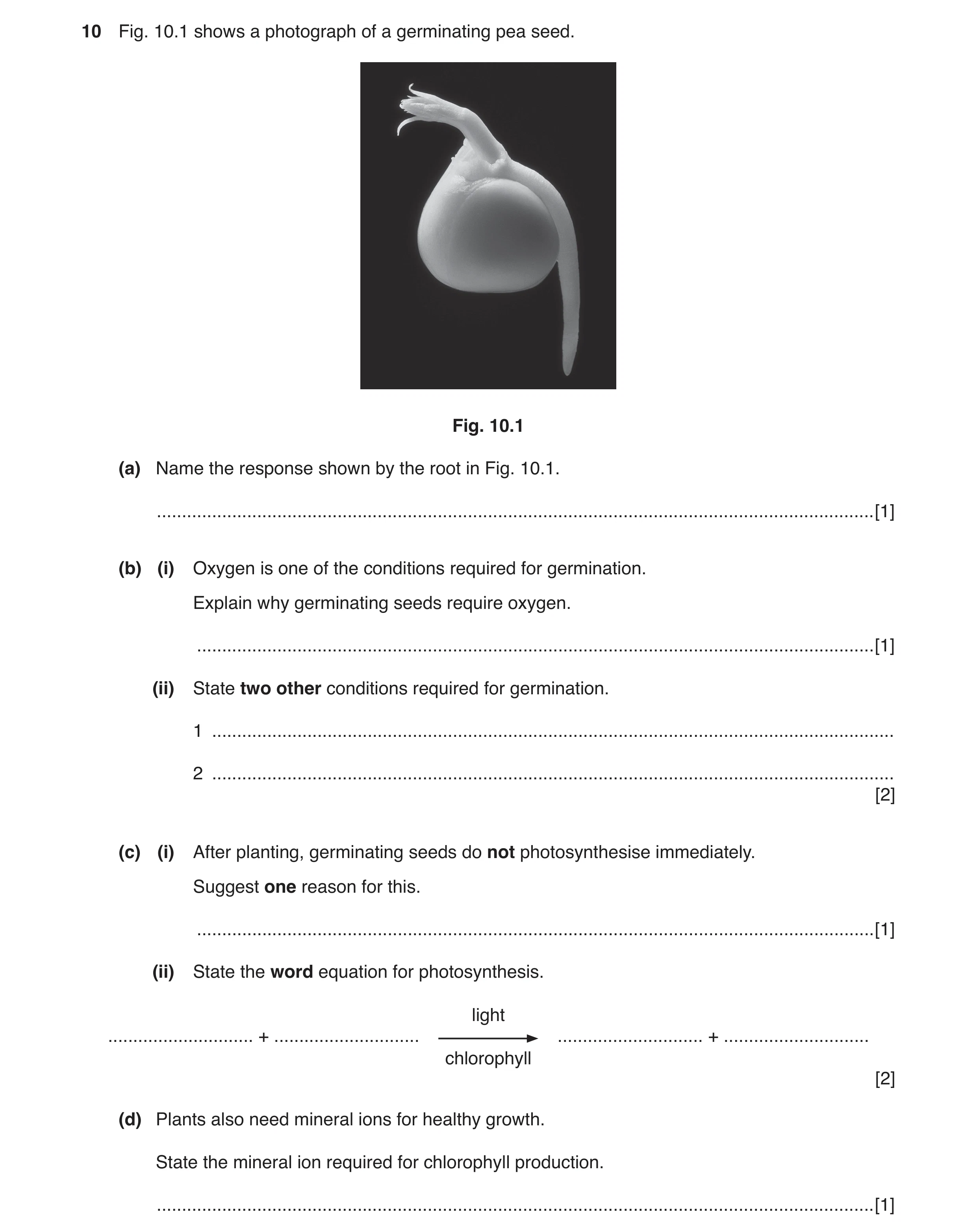
Q3 · A photograph of a germinating pea seed 0654/32 Oct/Nov 2017
10 Fig. 10.1 shows a photograph of a germinating pea seed. Fig. 10.1 (a) Name the response shown by the root in Fig. 10.1. … [1] (b) (i) Oxygen is one of the conditions required for germination. Explain why germinating seeds require oxygen. … [1] (ii) State two other conditions required for germination. 1 … 2 … [2] (c) (i) After planting, germinating seeds do not photosynthesise immediately. Suggest one reason for this. … [1] (ii) State the word equation for photosynthesis. light … + … … + … chlorophyll [2] (d) Plants also need mineral ions for healthy growth. State the mineral ion required for chlorophyll production. … [1]
8 marks
Mark scheme: 10(a) geotropism ; 1 10(b)(i) respiration ; 1 10(b)(ii) moisture / water ; warm (temperature) / suitable temperature ; 2 10(c)(i) (seedling is) underground / no light ; 1 10(c)(ii) LHS carbon dioxide + water ; RHS glucose + oxygen ; 2 10(d) magnesium ; 1
This question in 0654/32 Oct/Nov 2017
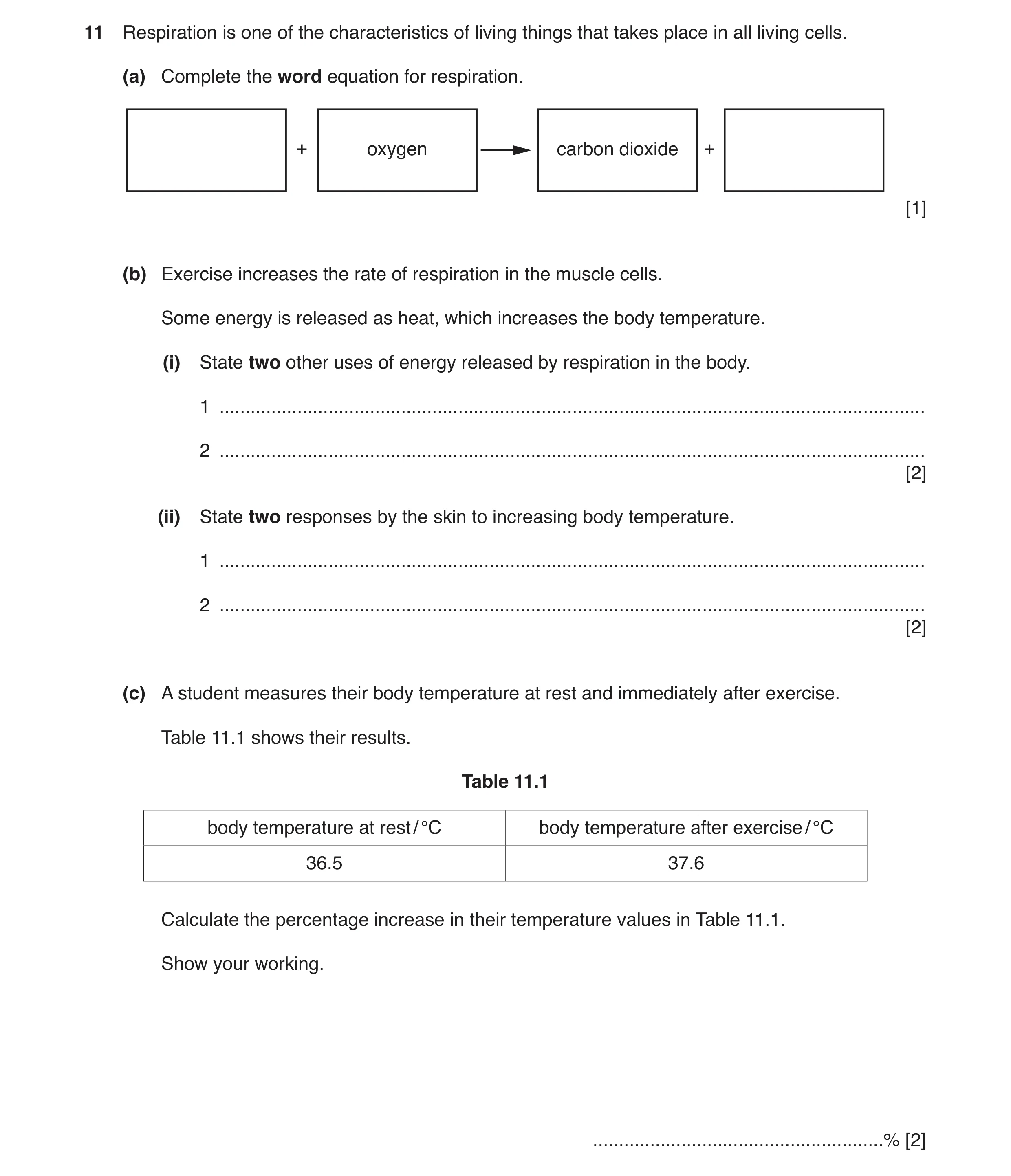
Q4 · Respiration is one of the characteristics of living things that takes place in all living… 0654/33 Oct/Nov 2017
11 Respiration is one of the characteristics of living things that takes place in all living cells. (a) Complete the word equation for respiration. + oxygen carbon dioxide + [1] (b) Exercise increases the rate of respiration in the muscle cells. Some energy is released as heat, which increases the body temperature. (i) State two other uses of energy released by respiration in the body. 1 … 2 … [2] (ii) State two responses by the skin to increasing body temperature. 1 … 2 … [2] (c) A student measures their body temperature at rest and immediately after exercise. Table 11.1 shows their results. Table 11.1 body temperature at rest / °C body temperature after exercise / °C 36.5 37.6 Calculate the percentage increase in their temperature values in Table 11.1. Show your working. … % [2]
7 marks
Mark scheme: 11(a) glucose on LHS AND water on RHS ; 1 11(b)(i) muscle contraction ; protein synthesis ; cell division ; growth ; the passage of nerve impulses ; max 2 11(b)(ii) sweating ; vasodilation / described ; 2 11(c) 37.6 – 36.5 = 1.1 ; 1.1 × 100 / 36.5 = 3 ; 2
This question in 0654/33 Oct/Nov 2017
Q5 · A diagram of a palisade cell 0654/32 Oct/Nov 2018
1 Fig. 1.1 shows a diagram of a palisade cell. Fig. 1.1 (a) On Fig. 1.1, use label lines to label the: • nucleus • cytoplasm. [2] (b) Describe two ways in which the structure of a palisade cell differs from the structure of an animal cell. 1 … … 2 … … [2] (c) Molecules can enter and leave the cell across the cell membrane by the process of diffusion. Describe how molecules enter the cell by diffusion. … … … … [2] (d) Respiration occurs in cells. State one substance required for respiration that will diffuse into cells. … [1]
7 marks
Mark scheme: 1(a) nucleus labelled; cytoplasm labelled; 2 1(b) presence of cell wall; presence of chloroplasts; presence of (permanent) vacuole; max 2 1(c) from higher concentration (outside the cell) to lower concentration (inside the cell); by (molecules) random movement; 2 1(d) glucose / oxygen; 1
This question in 0654/32 Oct/Nov 2018
Q6 · A diagram of an animal cell 0654/32 May/June 2019
1 (a) Fig. 1.1 is a diagram of an animal cell. A B C Fig. 1.1 Table 1.1 shows the parts labelled in Fig. 1.1. Use Fig. 1.1 to complete Table 1.1. Table 1.1 name of part letter in Fig. 1.1 function controls what enters and leaves the cell B contains genetic material [3] (b) Animal cells cannot photosynthesise. Describe the function of photosynthesis, and state why animal cells are unable to photosynthesise. … … … [2] (c) Respiration occurs in living cells. Water is a product of respiration. (i) Name one other product of respiration. … [1] (ii) Describe how water moves out of animal cells. Include the name of the process in your answer. … … … … [3] [Total: 9]
9 marks
Mark scheme: 1(a) 1 or 2 correct ; 3, 4 or 5 correct ; 6 correct ; name of part letter in Fig. 1.1 function cell membrane C control what enters and leaves the cell cytoplasm B chemical reactions occur here nucleus A contains genetic material 3 1(b) (photosynthesis) produces glucose / (named) carbohydrate / sugar ; animals don’t have chloroplasts ; 2 1(c)(i) carbon dioxide ; 1 1(c)(ii) across the, cell / partially permeable, membrane ; by osmosis ; by random movement ; 3
This question in 0654/32 May/June 2019
Q7 · Respiration is a process that is part of the carbon cycle 0654/32 Oct/Nov 2019
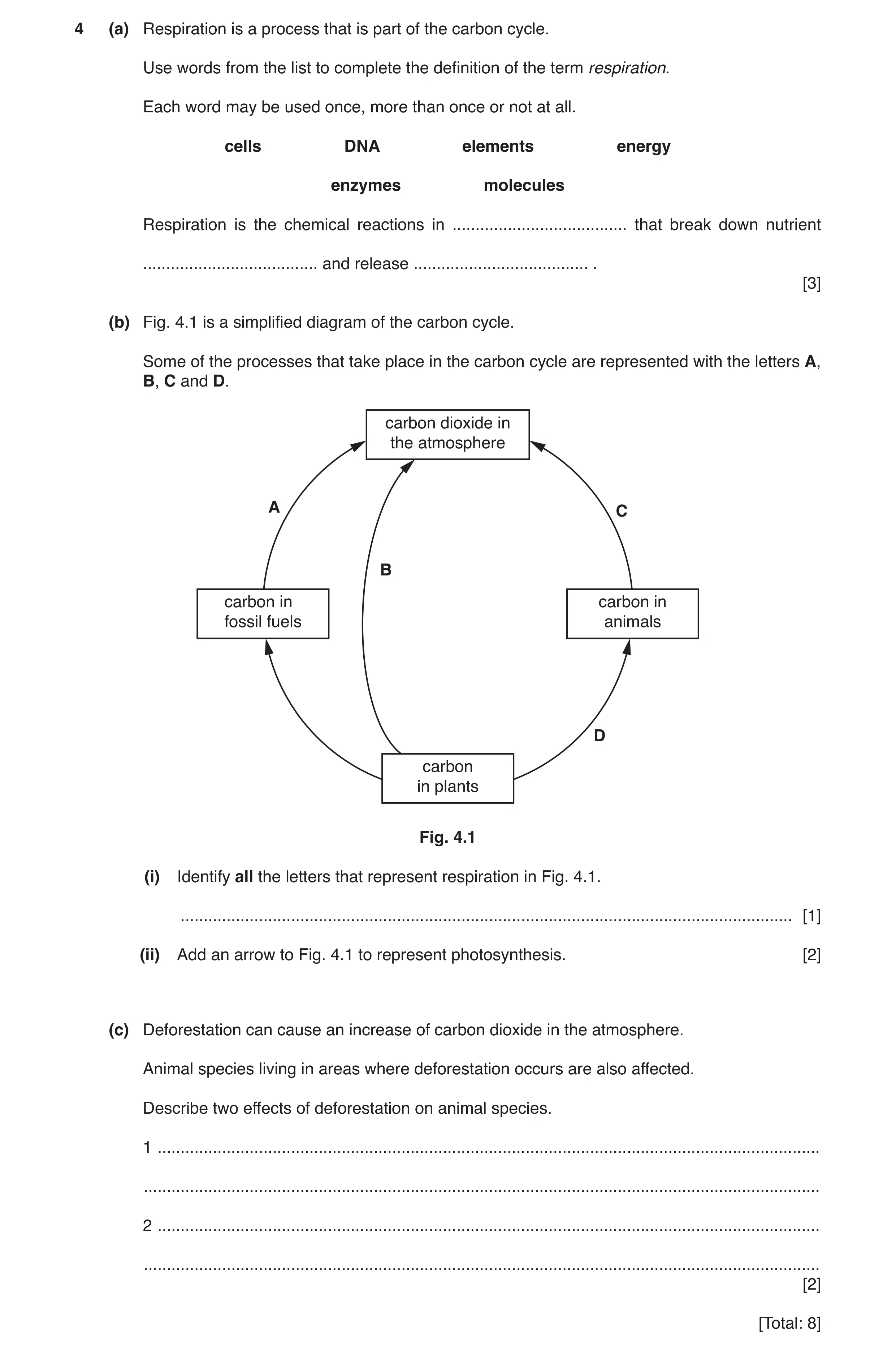
4 (a) Respiration is a process that is part of the carbon cycle. Use words from the list to complete the definition of the term respiration. Each word may be used once, more than once or not at all. cells DNA elements energy enzymes molecules Respiration is the chemical reactions in … that break down nutrient … and release … . [3] (b) Fig. 4.1 is a simplified diagram of the carbon cycle. Some of the processes that take place in the carbon cycle are represented with the letters A, B, C and D. carbon dioxide in the atmosphere A C B carbon in carbon in fossil fuels animals D carbon in plants Fig. 4.1 (i) Identify all the letters that represent respiration in Fig. 4.1. … [1] (ii) Add an arrow to Fig. 4.1 to represent photosynthesis. [2] (c) Deforestation can cause an increase of carbon dioxide in the atmosphere. Animal species living in areas where deforestation occurs are also affected. Describe two effects of deforestation on animal species. 1 … … 2 … … [2] [Total: 8]
8 marks
Mark scheme: 4(a) cells ; molecules ; energy ; 3 4(b)(i) B and C ; 1 4(b)(ii) line drawn between carbon in plants and carbon dioxide in the atmosphere ; arrowhead pointing towards carbon in plants ; 2 4(c) loss of shelter / habitat ; extinction ; loss of food source ; avp ; max 2 2 Question Answer Marks
This question in 0654/32 Oct/Nov 2019
Q8 · A student investigates the conditions needed for germination of cress seeds 0654/33 Oct/Nov 2019
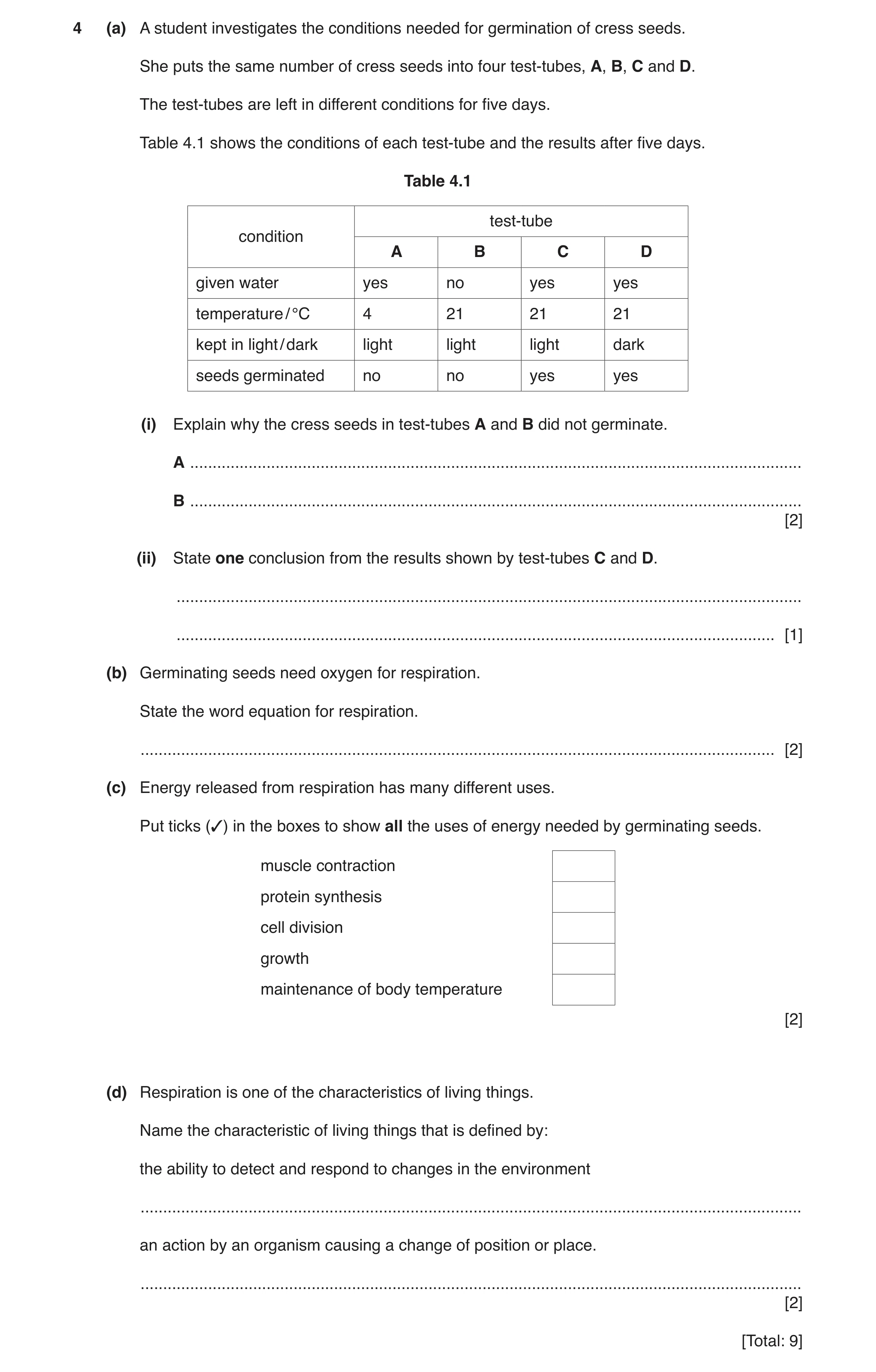
4 (a) A student investigates the conditions needed for germination of cress seeds. She puts the same number of cress seeds into four test-tubes, A, B, C and D. The test-tubes are left in different conditions for five days. Table 4.1 shows the conditions of each test-tube and the results after five days. Table 4.1 test-tube condition A B C D given water yes no yes yes temperature / °C 4 21 21 21 kept in light / dark light light light dark seeds germinated no no yes yes (i) Explain why the cress seeds in test-tubes A and B did not germinate. A … B … [2] (ii) State one conclusion from the results shown by test-tubes C and D. … … [1] (b) Germinating seeds need oxygen for respiration. State the word equation for respiration. … [2] (c) Energy released from respiration has many different uses. Put ticks (3) in the boxes to show all the uses of energy needed by germinating seeds. muscle contraction protein synthesis cell division growth maintenance of body temperature [2] (d) Respiration is one of the characteristics of living things. Name the characteristic of living things that is defined by: the ability to detect and respond to changes in the environment … an action by an organism causing a change of position or place. … [2] [Total: 9]
9 marks
Mark scheme: 4(a)(i) A – too cold / AW; B – not enough water / AW ; 2 4(a)(ii) light is not needed for germination ; 1 4(b) glucose + oxygen → carbon dioxide + water ;; 2 4(c) protein synthesis, cell division, growth ticked ;; 1 or 2 correct = 1 mark, 3 correct = 2 marks 2 4(d) sensitivity ; movement ; 2
This question in 0654/33 Oct/Nov 2019
Q9 · A drawing of a person doing a parachute jump 0654/31 May/June 2020
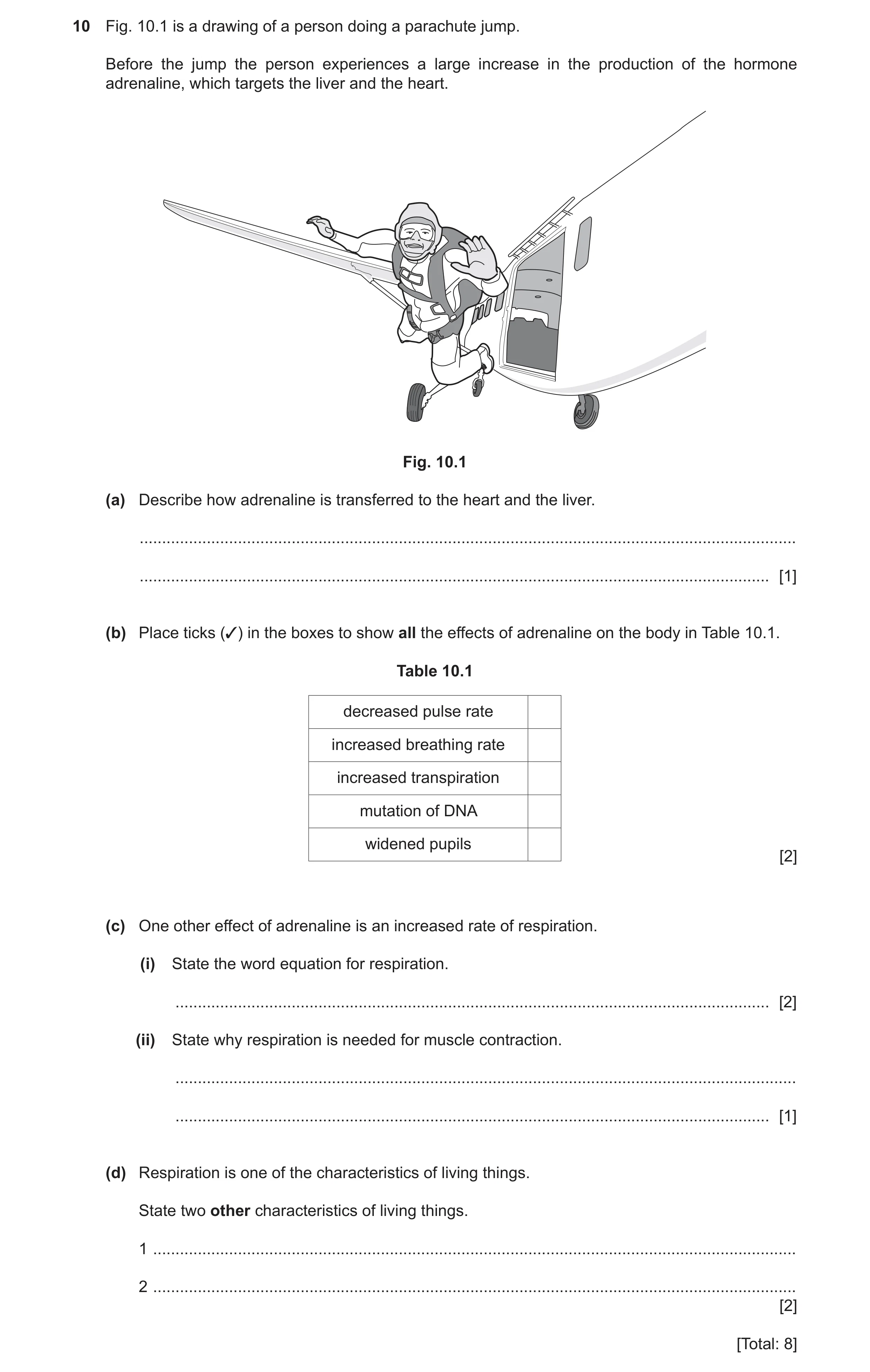
10 Fig. 10.1 is a drawing of a person doing a parachute jump. Before the jump the person experiences a large increase in the production of the hormone adrenaline, which targets the liver and the heart. Fig. 10.1 (a) Describe how adrenaline is transferred to the heart and the liver. … … [1] (b) Place ticks (3) in the boxes to show all the effects of adrenaline on the body in Table 10.1. Table 10.1 decreased pulse rate increased breathing rate increased transpiration mutation of DNA widened pupils [2] (c) One other effect of adrenaline is an increased rate of respiration. (i) State the word equation for respiration. … [2] (ii) State why respiration is needed for muscle contraction. … … [1] (d) Respiration is one of the characteristics of living things. State two other characteristics of living things. 1 … 2 … [2] [Total: 8]
8 marks
Mark scheme: 10(a) in the blood (plasma) ; 1 10(b) increased breathing rate ticked ; widened pupils ticked ; 2 10(c)(i) glucose + oxygen →carbon dioxide + water ;; 2 10(c)(ii) respiration releases energy (needed for muscle contraction) ; 1 Question Answer Marks 10(d) any two from: movement sensitivity growth reproduction excretion nutrition ;; 2
This question in 0654/31 May/June 2020
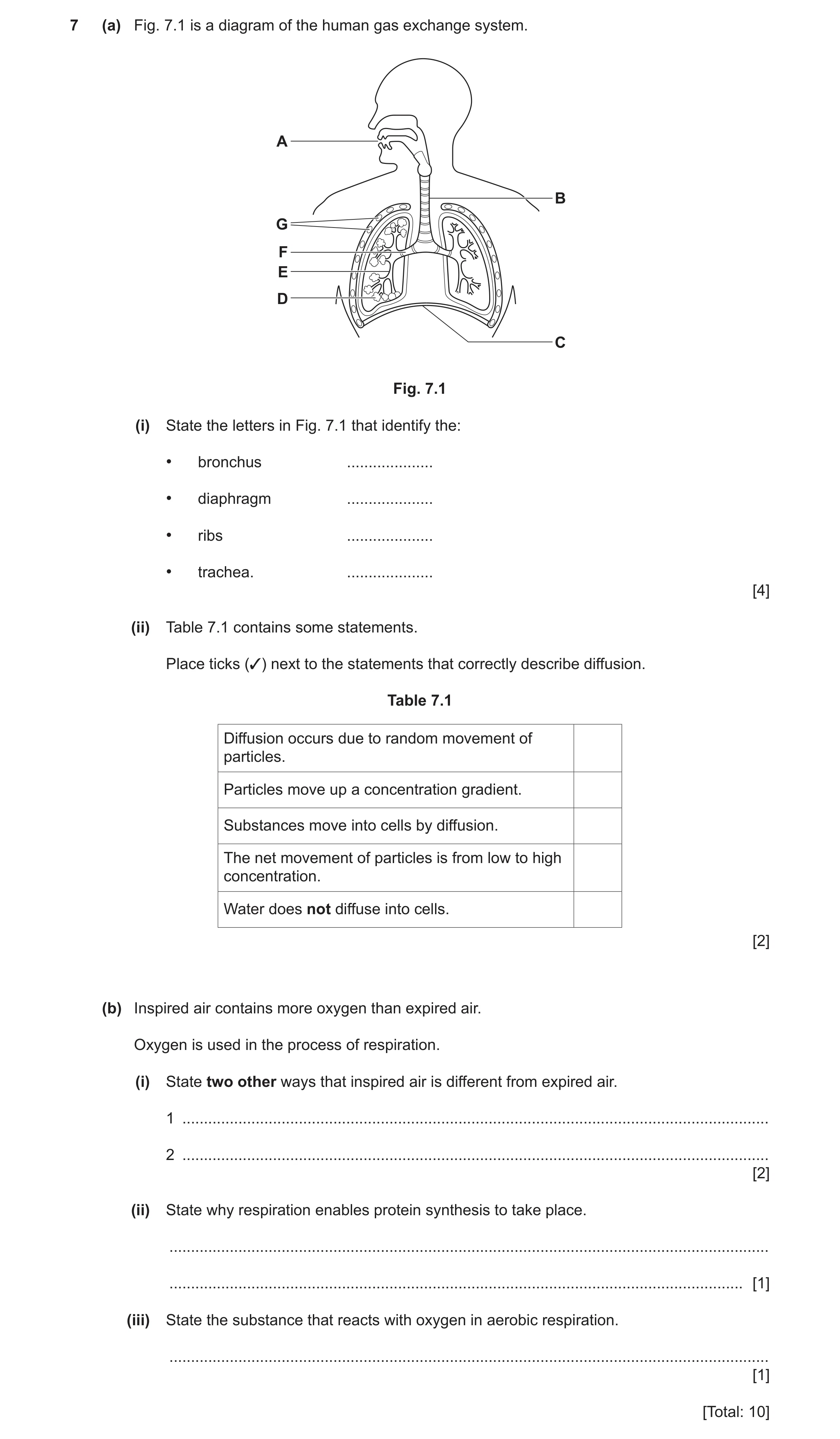
Q10 · A diagram of the human gas exchange system 0654/32 Oct/Nov 2020
7 (a) Fig. 7.1 is a diagram of the human gas exchange system. A B G F E D C Fig. 7.1 (i) State the letters in Fig. 7.1 that identify the: • bronchus … • diaphragm … • ribs … • trachea. … [4] (ii) Table 7.1 contains some statements. Place ticks (3) next to the statements that correctly describe diffusion. Table 7.1 Diffusion occurs due to random movement of particles. Particles move up a concentration gradient. Substances move into cells by diffusion. The net movement of particles is from low to high concentration. Water does not diffuse into cells. [2] (b) Inspired air contains more oxygen than expired air. Oxygen is used in the process of respiration. (i) State two other ways that inspired air is different from expired air. 1 … 2 … [2] (ii) State why respiration enables protein synthesis to take place. … … [1] (iii) State the substance that reacts with oxygen in aerobic respiration. … [1] [Total: 10]
10 marks
Mark scheme: 7(a)(i) F ; C ; G ; B ; 4 7(a)(ii) diffusion occurs due to random movement of particles ticked ; substances move into cells by diffusion ticked ; 2 7(b)(i) (inspired air) contains less carbon dioxide ; (inspired air) contains less water (vapour) ; AVP ; (inspired air) is cooler 2 7(b)(ii) respiration releases energy (for protein synthesis) ; 1 7(b (iii) glucose ; 1
This question in 0654/32 Oct/Nov 2020
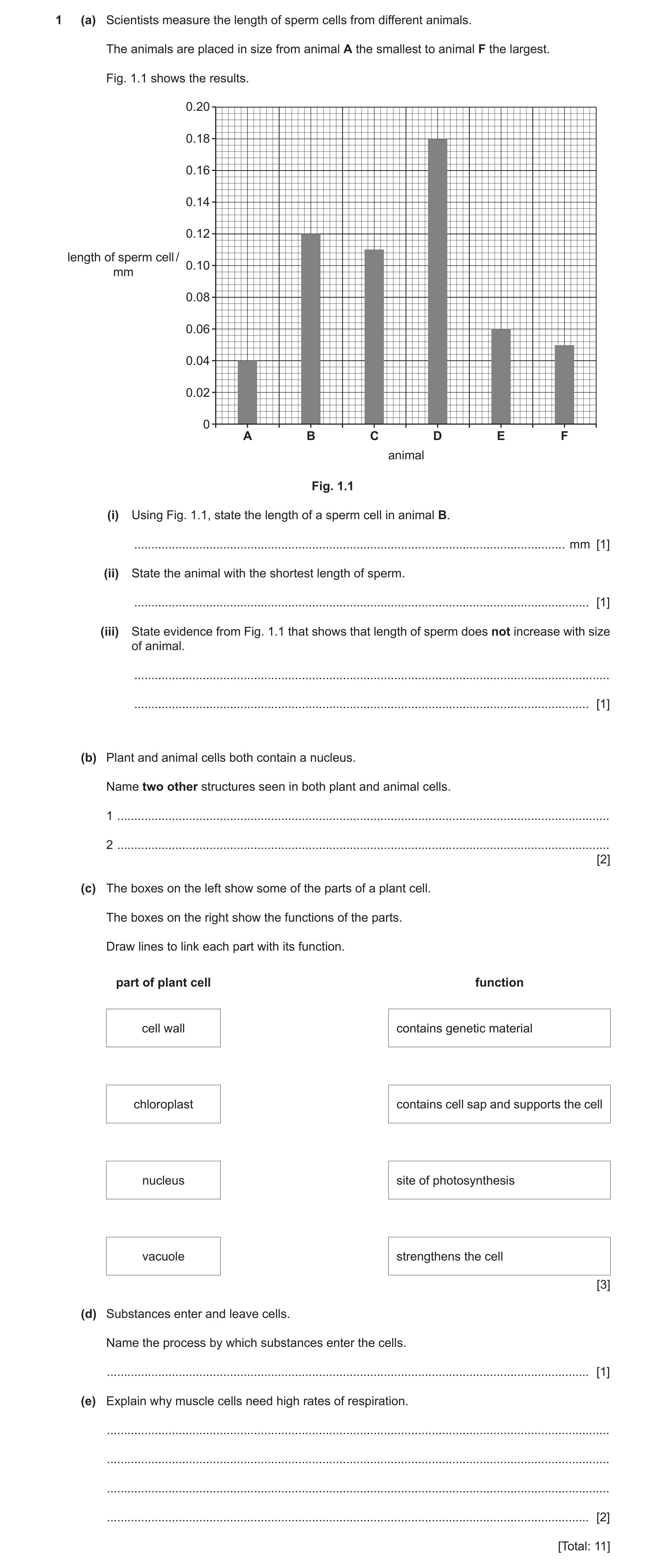
Q11 · Scientists measure the length of sperm cells from different animals 0654/31 Oct/Nov 2021
1 (a) Scientists measure the length of sperm cells from different animals. The animals are placed in size from animal A the smallest to animal F the largest. Fig. 1.1 shows the results. 0.20 0.18 0.16 0.14 0.12 length of sperm cell / 0.10 mm 0.08 0.06 0.04 0.02 0 A B C D E F animal Fig. 1.1 (i) Using Fig. 1.1, state the length of a sperm cell in animal B. … mm [1] (ii) State the animal with the shortest length of sperm. … [1] (iii) State evidence from Fig. 1.1 that shows that length of sperm does not increase with size of animal. … … [1] (b) Plant and animal cells both contain a nucleus. Name two other structures seen in both plant and animal cells. 1 … 2 … [2] (c) The boxes on the left show some of the parts of a plant cell. The boxes on the right show the functions of the parts. Draw lines to link each part with its function. part of plant cell function cell wall contains genetic material chloroplast contains cell sap and supports the cell nucleus site of photosynthesis vacuole strengthens the cell [3] (d) Substances enter and leave cells. Name the process by which substances enter the cells. … [1] (e) Explain why muscle cells need high rates of respiration. … … … … [2] [Total: 11]
11 marks
Mark scheme: 1(a)(i) 0.12 (mm) ; 1 1(a)(ii) A ; 1 1(a)(iii) animal F is the biggest but does not have the longest length of sperm / animal D has the longest sperm but is not the biggest animal / avp ; 1 1(b) any two from: cell membrane ; cytoplasm ; AVP ; e.g. ribosomes / mitochondria 2 1(c) cell wall contains genetic material chloroplast contains cell sap and supports the cell nucleus site of photosynthesis vacuole strengthens the cell ;;; 3 1(d) diffusion ; 1 1(e) respiration releases energy ; (energy is required) for muscle contraction / movement ; 2
This question in 0654/31 Oct/Nov 2021
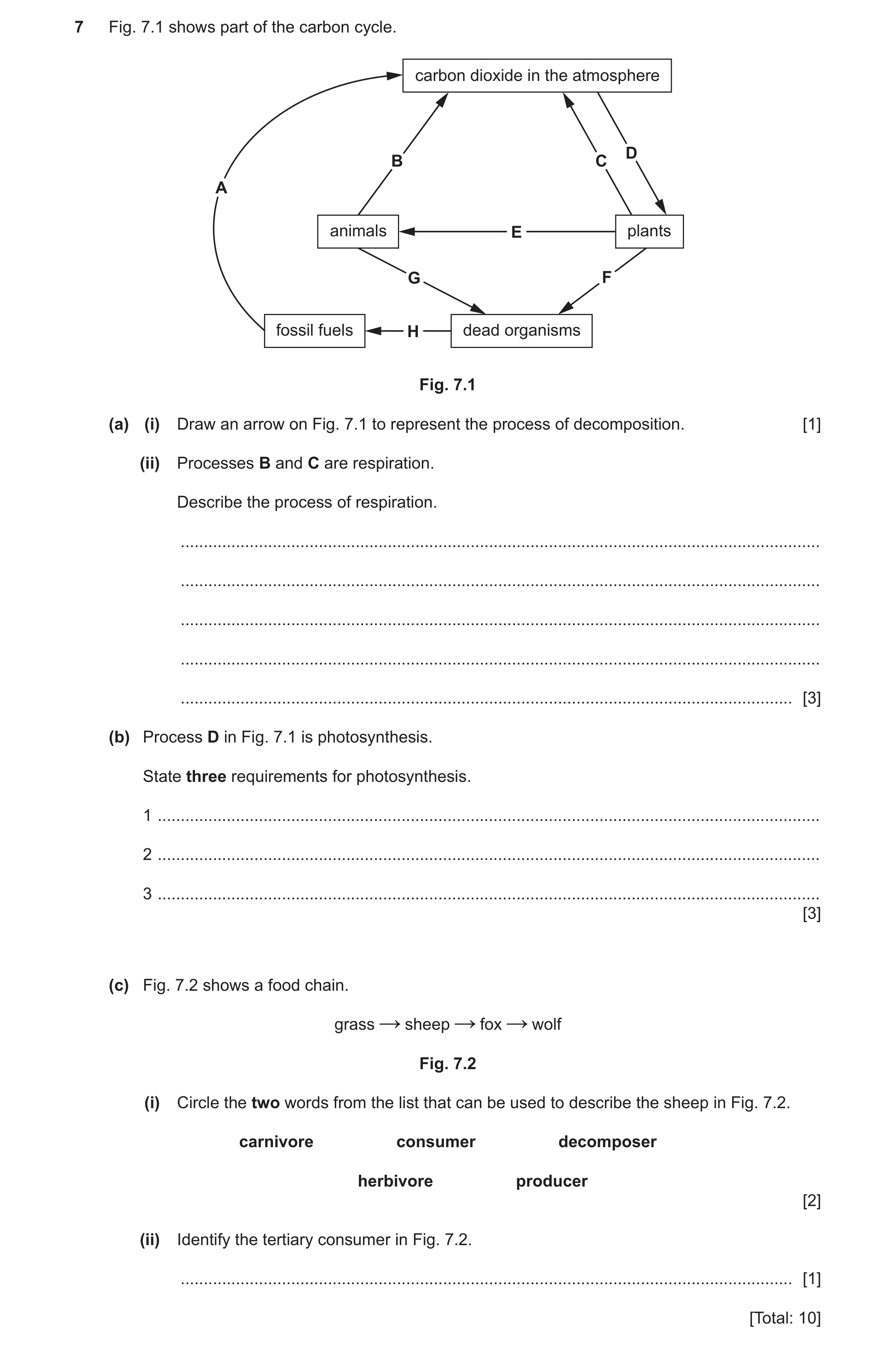
Q12 · Part of the carbon cycle 0654/32 Feb/March 2022
7 Fig. 7.1 shows part of the carbon cycle. carbon dioxide in the atmosphere D B C A animals E plants G F fossil fuels H dead organisms Fig. 7.1 (a) (i) Draw an arrow on Fig. 7.1 to represent the process of decomposition. [1] (ii) Processes B and C are respiration. Describe the process of respiration. … … … … … [3] (b) Process D in Fig. 7.1 is photosynthesis. State three requirements for photosynthesis. 1 … 2 … 3 … [3] (c) Fig. 7.2 shows a food chain. grass sheep fox wolf → → → Fig. 7.2 (i) Circle the two words from the list that can be used to describe the sheep in Fig. 7.2. carnivore consumer decomposer herbivore producer [2] (ii) Identify the tertiary consumer in Fig. 7.2. … [1] [Total: 10]
10 marks
Mark scheme: 7(a)(i) arrow drawn between dead organisms and carbon dioxide in the atmosphere ; 1 7(a)(ii) any three from: chemical reaction that happens in cells ; releases energy ; ref to glucose and oxygen as reactants ; ref to carbon dioxide and water as products ; 3 Question Answer Marks 7(b) any three from: carbon dioxide ; water ; chlorophyll ; light ; warm temperature ; 3 7(c)(i) herbivore circled ; consumer circled ; 2 7(c)(ii) wolf ; 1
This question in 0654/32 Feb/March 2022
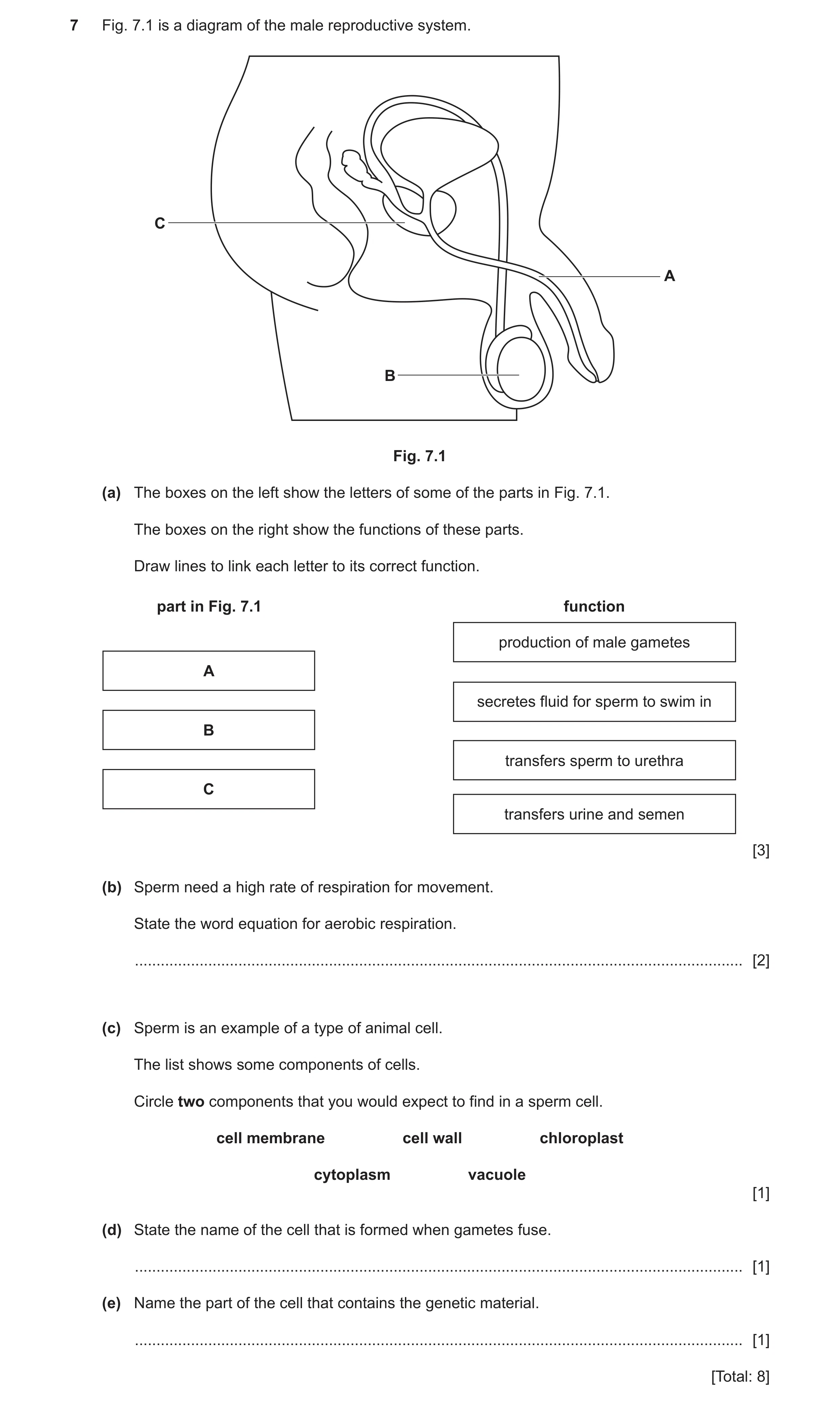
Q13 · A diagram of the male reproductive system 0654/31 May/June 2022
7 Fig. 7.1 is a diagram of the male reproductive system. C A B Fig. 7.1 (a) The boxes on the left show the letters of some of the parts in Fig. 7.1. The boxes on the right show the functions of these parts. Draw lines to link each letter to its correct function. part in Fig. 7.1 function production of male gametes A secretes fluid for sperm to swim in B transfers sperm to urethra C transfers urine and semen [3] (b) Sperm need a high rate of respiration for movement. State the word equation for aerobic respiration. … [2] (c) Sperm is an example of a type of animal cell. The list shows some components of cells. Circle two components that you would expect to find in a sperm cell. cell membrane cell wall chloroplast cytoplasm vacuole [1] (d) State the name of the cell that is formed when gametes fuse. … [1] (e) Name the part of the cell that contains the genetic material. … [1] [Total: 8]
8 marks
Mark scheme: 7(a) production of male gametes A secretes fluid for sperm to swim in B transfers sperm to urethra C transfers urine and semen 3 Question Answer Marks 7(b) glucose + oxygen carbon dioxide + water LHS 1; RHS 1; 2 7(c) cell membrane and cytoplasm circled ; 1 7(d) zygote ; 1 7(e) nucleus ; 1
This question in 0654/31 May/June 2022
Q14 · A diagram representing the concentration of oxygen molecules outside and inside a cell 0654/32 May/June 2023
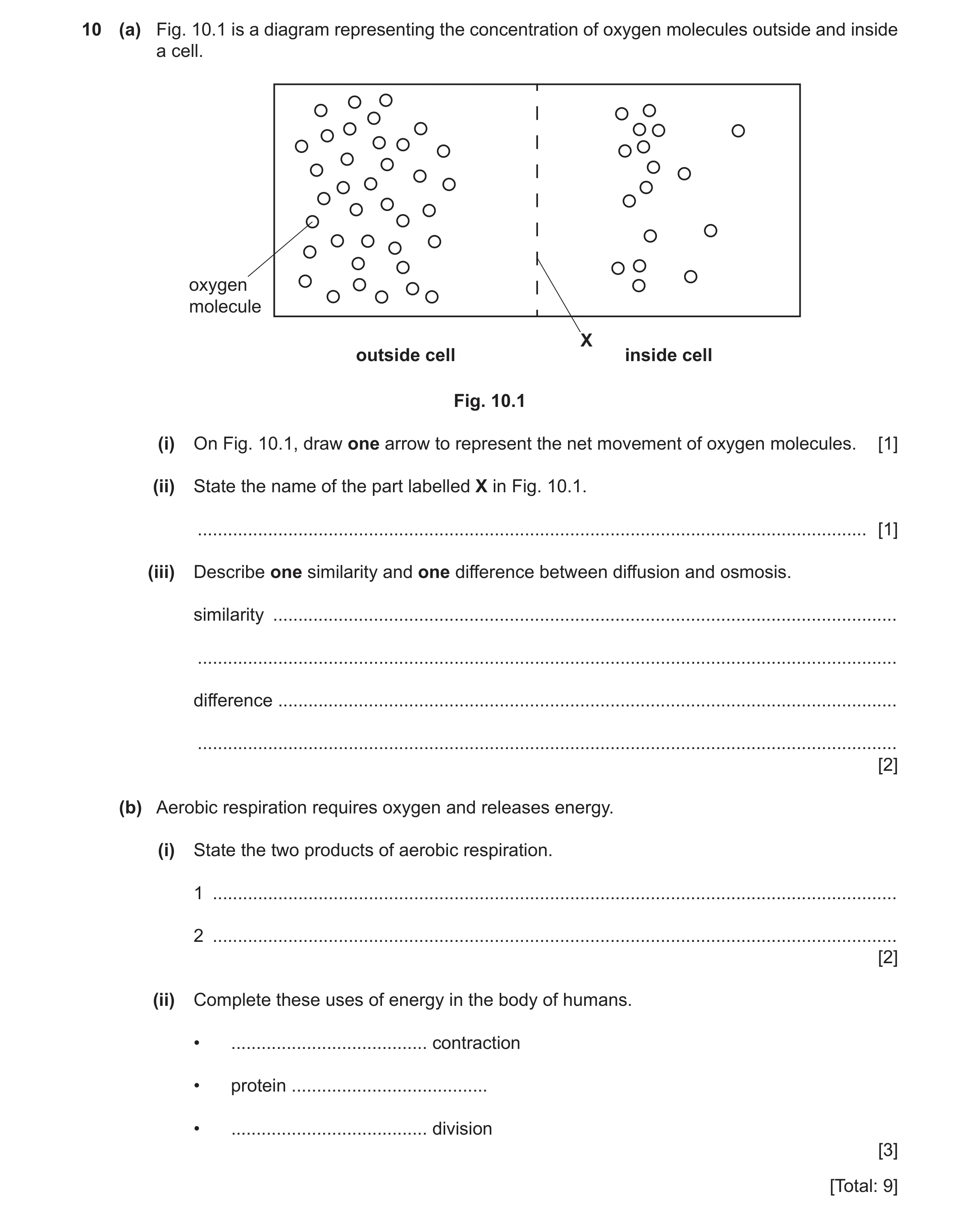
10 (a) Fig. 10.1 is a diagram representing the concentration of oxygen molecules outside and inside a cell. oxygen molecule X outside cell inside cell Fig. 10.1 (i) On Fig. 10.1, draw one arrow to represent the net movement of oxygen molecules. [1] (ii) State the name of the part labelled X in Fig. 10.1. … [1] (iii) Describe one similarity and one difference between diffusion and osmosis. similarity … … difference … … [2] (b) Aerobic respiration requires oxygen and releases energy. (i) State the two products of aerobic respiration. 1 … 2 … [2] (ii) Complete these uses of energy in the body of humans. • … contraction • protein … • … division [3] [Total: 9]
9 marks
Mark scheme: 10(a)(i) arrow drawn from left to right ; 1 10(a)(ii) cell membrane ; 1 10(a)(iii) similarity: both involve random movement of particles / movement is down a concentration gradient ; difference: osmosis is the movement of water (only) / osmosis (only) occurs across partially permeable membrane ; 2 10(b)(i) carbon dioxide ; water ; 2 10(b)(ii) muscle ; synthesis ; cell ; 3
This question in 0654/32 May/June 2023
Q15 · A diagram representing the concentration of oxygen molecules outside and inside a cell 0654/33 May/June 2023
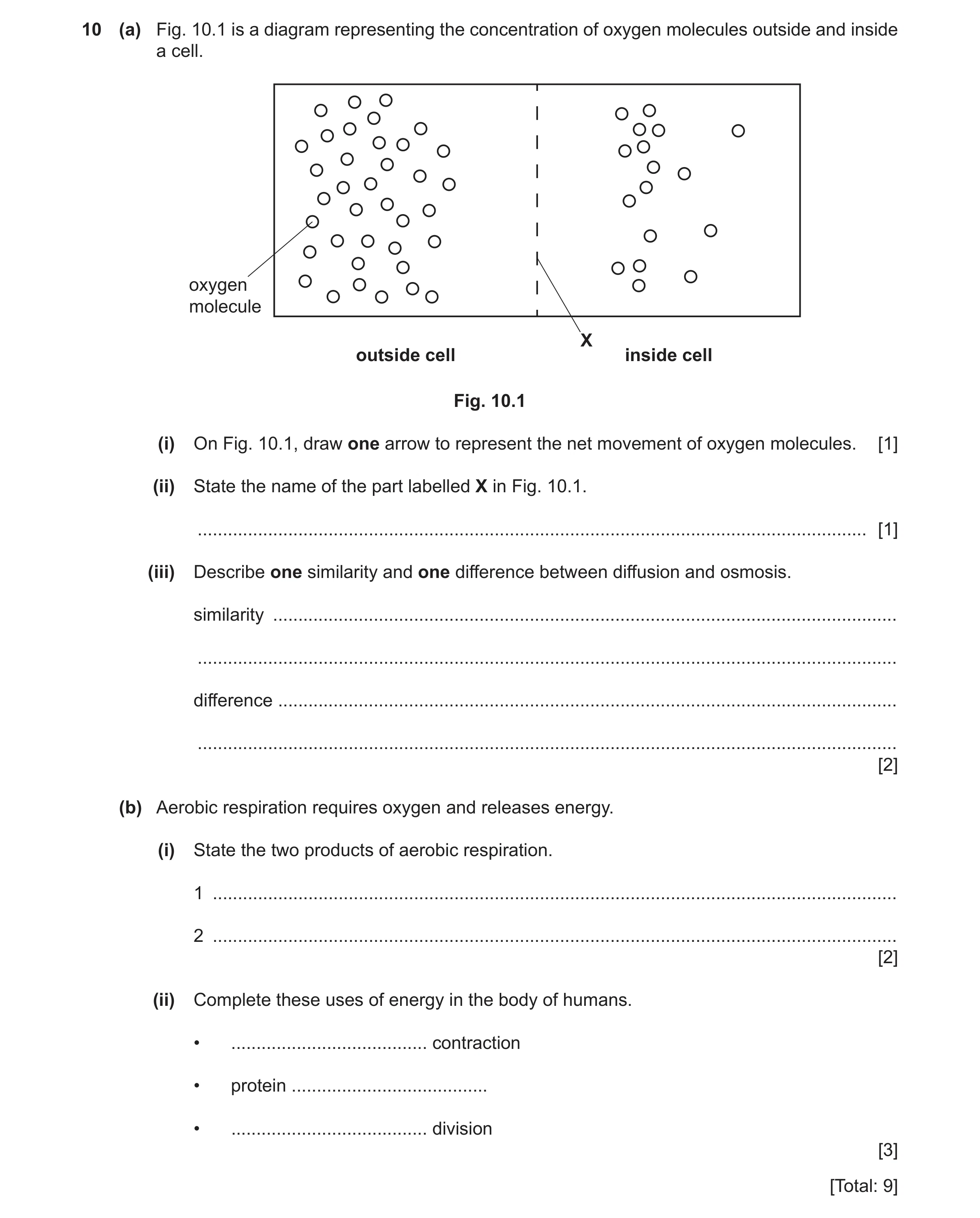
10 (a) Fig. 10.1 is a diagram representing the concentration of oxygen molecules outside and inside a cell. oxygen molecule X outside cell inside cell Fig. 10.1 (i) On Fig. 10.1, draw one arrow to represent the net movement of oxygen molecules. [1] (ii) State the name of the part labelled X in Fig. 10.1. … [1] (iii) Describe one similarity and one difference between diffusion and osmosis. similarity … … difference … … [2] (b) Aerobic respiration requires oxygen and releases energy. (i) State the two products of aerobic respiration. 1 … 2 … [2] (ii) Complete these uses of energy in the body of humans. • … contraction • protein … • … division [3] [Total: 9]
9 marks
Mark scheme: 10(a)(i) arrow drawn from left to right ; 1 10(a)(ii) cell membrane ; 1 10(a)(iii) similarity: both involve random movement of particles / movement is down a concentration gradient ; difference: osmosis is the movement of water (only) / osmosis (only) occurs across partially permeable membrane ; 2 10(b)(i) carbon dioxide ; water ; 2 10(b)(ii) muscle ; synthesis ; cell ; 3
This question in 0654/33 May/June 2023
Q16 · A student records their pulse rate in beats per minute (bpm) during different types of… 0654/31 Oct/Nov 2023
4 (a) A student records their pulse rate in beats per minute (bpm) during different types of activity. Fig. 4.1 shows a bar chart of the results. 160 140 120 100 pulse rate / bpm 80 60 40 20 0 resting cycling running walking yoga type of activity Fig. 4.1 (i) Identify the activity that results in the smallest increase in pulse rate from the resting pulse rate. … [1] (ii) Calculate the percentage increase in pulse rate from resting to running shown in Fig. 4.1. pulse rate during rest … bpm pulse rate during running … bpm percentage increase = … [2] (b) The rate of aerobic respiration increases during exercise. (i) State the two reactants in aerobic respiration. 1 … 2 … [2] (ii) Suggest why the rate of respiration increases during exercise. … … … … [2] (c) A hormone that causes pupils in the eye to widen also affects breathing and pulse rate. (i) State the name of this hormone. … [1] (ii) State the component of blood that transports hormones. … [1] [Total: 9]
9 marks
Mark scheme: 4(a)(i) yoga ; 1 4(a)(ii) pulse rate at rest – 68 and pulse rate during running – 140 ; 2 ((140 − 68) / 68) 100 = 106 ; 4(b)(i) glucose ; 2 oxygen ; 4(b)(ii) any two from: 2 more energy is required ; for muscle contraction ; (aerobic) respiration releases energy ; 4(c)(i) adrenaline ; 1 4(c)(ii) plasma ; 1
This question in 0654/31 Oct/Nov 2023
Q17 · A diagram of the male reproductive system in humans 0654/32 Oct/Nov 2024
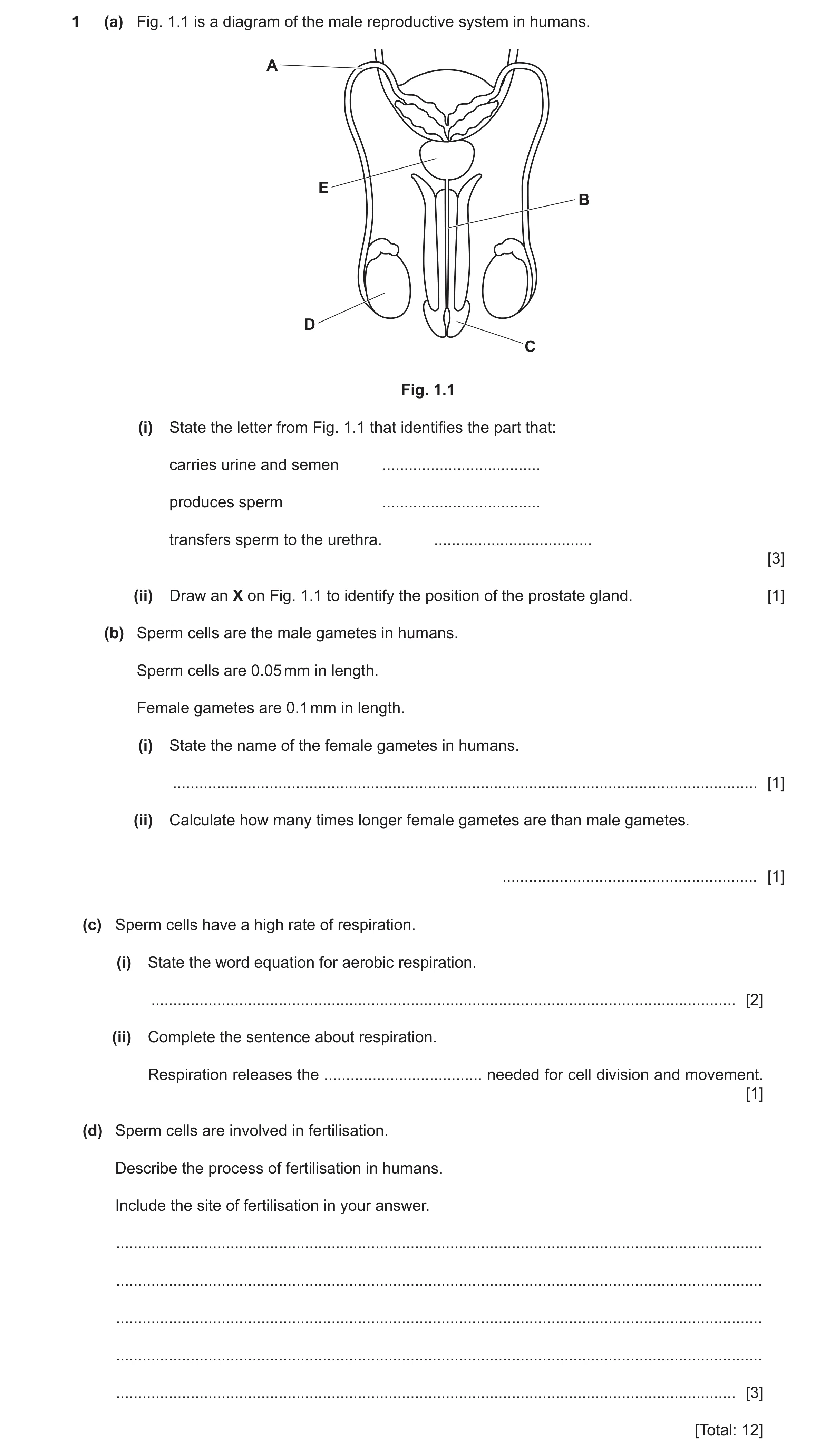
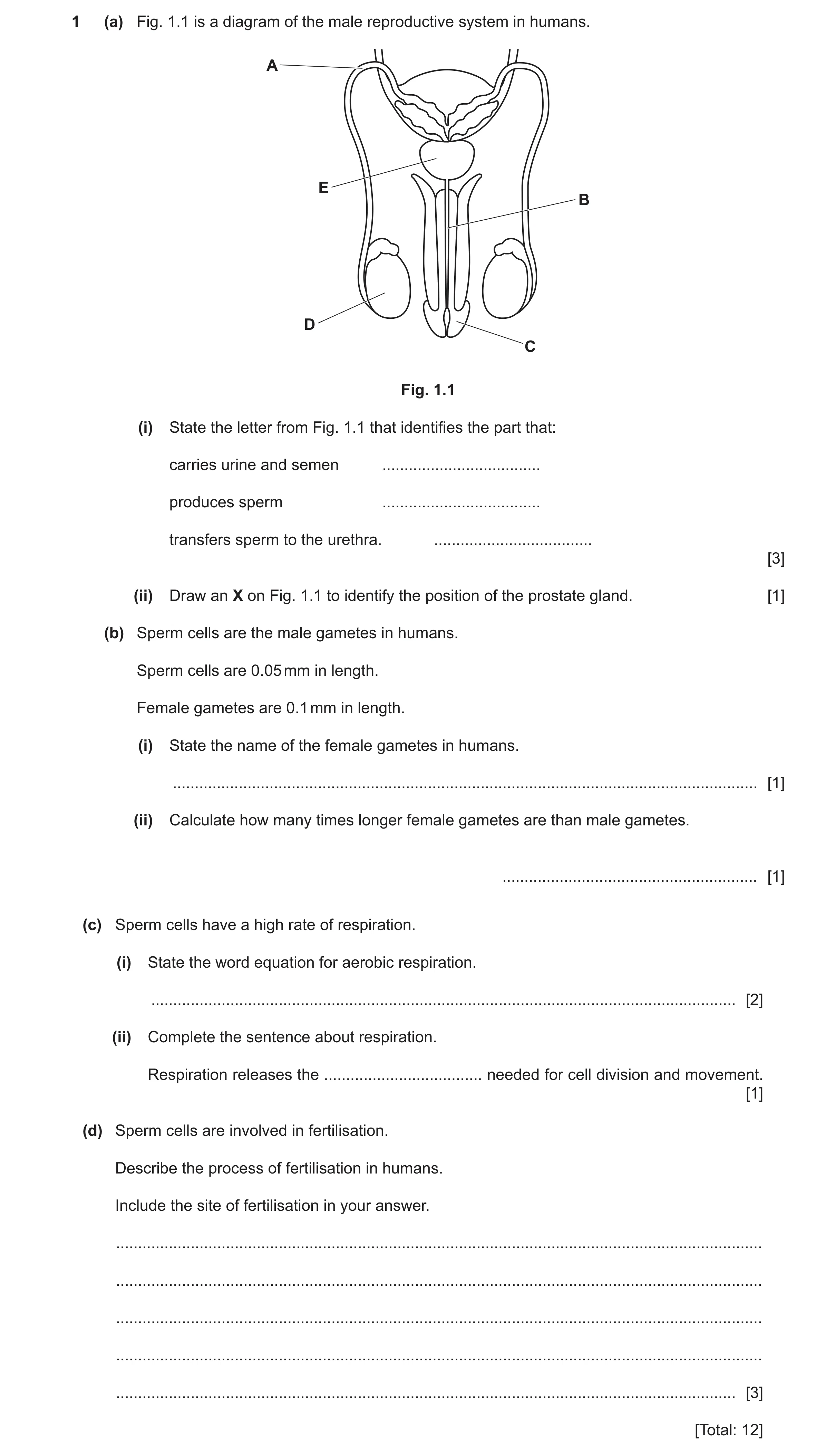
1 (a) Fig. 1.1 is a diagram of the male reproductive system in humans. A E B D C Fig. 1.1 (i) State the letter from Fig. 1.1 that identifies the part that: carries urine and semen … produces sperm … transfers sperm to the urethra. … [3] (ii) Draw an X on Fig. 1.1 to identify the position of the prostate gland. [1] (b) Sperm cells are the male gametes in humans. Sperm cells are 0.05 mm in length. Female gametes are 0.1 mm in length. (i) State the name of the female gametes in humans. … [1] (ii) Calculate how many times longer female gametes are than male gametes. … [1] (c) Sperm cells have a high rate of respiration. (i) State the word equation for aerobic respiration. … [2] (ii) Complete the sentence about respiration. Respiration releases the … needed for cell division and movement. [1] (d) Sperm cells are involved in fertilisation. Describe the process of fertilisation in humans. Include the site of fertilisation in your answer. … … … … … [3] [Total: 12]
12 marks
Mark scheme: Question Answer Marks 1(a)(i) B ; 3 D ; A ; 1(a)(ii) X drawn on prostate gland ; 1 1(b)(i) egg / ova / ovum ; 1 1(b)(ii) (0.1 / 0.05 =) 2 ; 1 1(c)(i) glucose + oxygen → carbon dioxide + water 2 1 mark for reactants ; 1 mark for products ; 1(c)(ii) energy ; 1 1(d) fusion of the, sperm / male gamete, and, egg / female gamete ; 3 ref to nuclei ; fertilisation takes place in the oviduct ;
This question in 0654/32 Oct/Nov 2024
Q18 · A diagram of the male reproductive system in humans 0654/33 Oct/Nov 2024
1 (a) Fig. 1.1 is a diagram of the male reproductive system in humans. A E B D C Fig. 1.1 (i) State the letter from Fig. 1.1 that identifies the part that: carries urine and semen … produces sperm … transfers sperm to the urethra. … [3] (ii) Draw an X on Fig. 1.1 to identify the position of the prostate gland. [1] (b) Sperm cells are the male gametes in humans. Sperm cells are 0.05 mm in length. Female gametes are 0.1 mm in length. (i) State the name of the female gametes in humans. … [1] (ii) Calculate how many times longer female gametes are than male gametes. … [1] (c) Sperm cells have a high rate of respiration. (i) State the word equation for aerobic respiration. … [2] (ii) Complete the sentence about respiration. Respiration releases the … needed for cell division and movement. [1] (d) Sperm cells are involved in fertilisation. Describe the process of fertilisation in humans. Include the site of fertilisation in your answer. … … … … … [3] [Total: 12]
12 marks
Mark scheme: Question Answer Marks 1(a)(i) B ; 3 D ; A ; 1(a)(ii) X drawn on prostate gland ; 1 1(b)(i) egg / ova / ovum ; 1 1(b)(ii) (0.1 / 0.05 =) 2 ; 1 1(c)(i) glucose + oxygen → carbon dioxide + water 2 1 mark for reactants ; 1 mark for products ; 1(c)(ii) energy ; 1 1(d) fusion of the, sperm / male gamete, and, egg / female gamete ; 3 ref to nuclei ; fertilisation takes place in the oviduct ;
This question in 0654/33 Oct/Nov 2024
Q19 · A diagram of a palisade cell from a potato plant 0654/31 May/June 2025
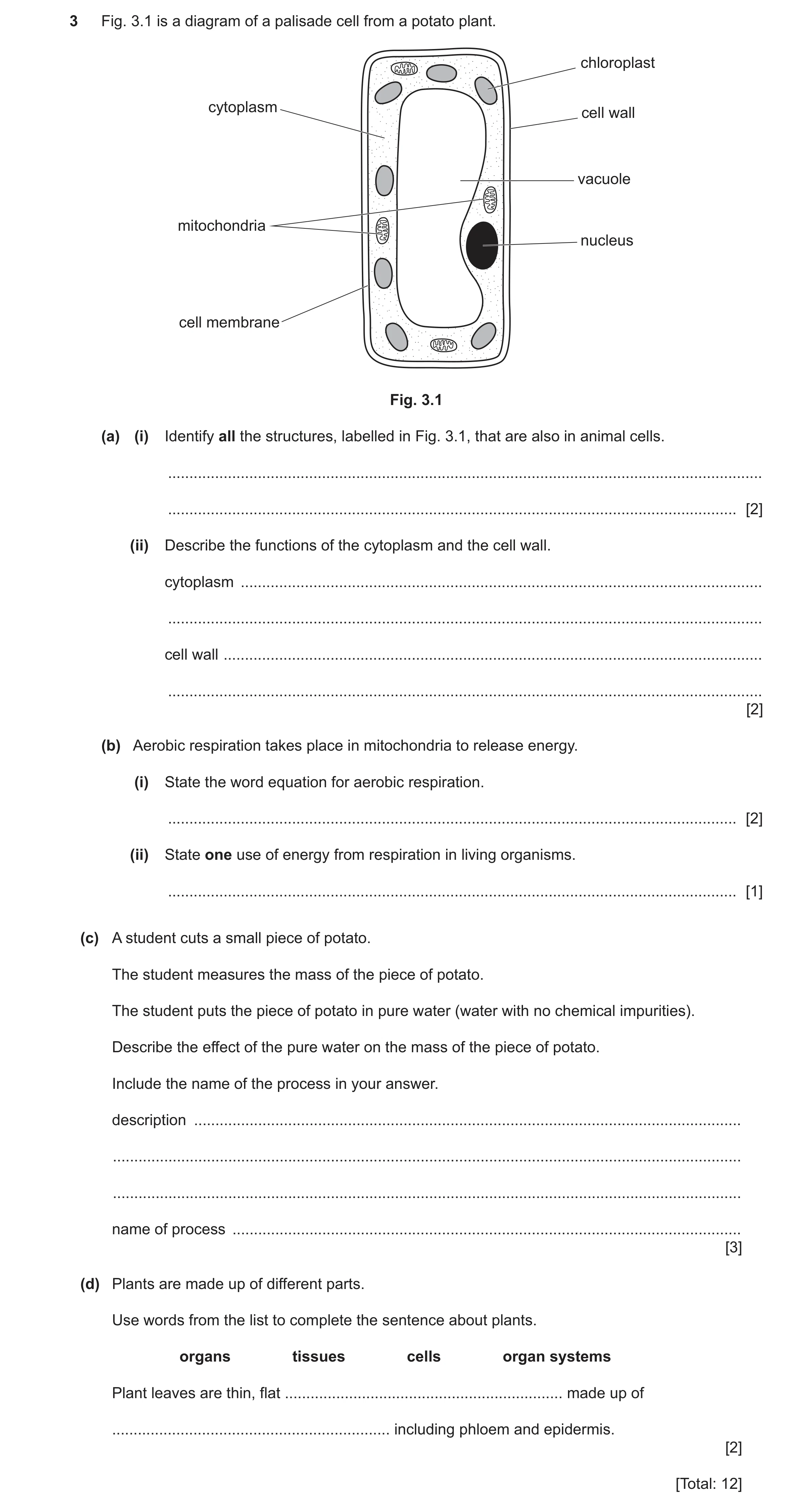
3 Fig. 3.1 is a diagram of a palisade cell from a potato plant. chloroplast cytoplasm cell wall vacuole mitochondria nucleus cell membrane Fig. 3.1 (a) (i) Identify all the structures, labelled in Fig. 3.1, that are also in animal cells. … … [2] (ii) Describe the functions of the cytoplasm and the cell wall. cytoplasm … … cell wall … … [2] (b) Aerobic respiration takes place in mitochondria to release energy. (i) State the word equation for aerobic respiration. … [2] (ii) State one use of energy from respiration in living organisms. … [1] (c) A student cuts a small piece of potato. The student measures the mass of the piece of potato. The student puts the piece of potato in pure water (water with no chemical impurities). Describe the effect of the pure water on the mass of the piece of potato. Include the name of the process in your answer. description … … … name of process … [3] (d) Plants are made up of different parts. Use words from the list to complete the sentence about plants. organs tissues cells organ systems Plant leaves are thin, flat … made up of … including phloem and epidermis. [2] [Total: 12]
12 marks
Mark scheme: 3(a)(i) cell membrane 2 nucleus cytoplasm mitochondria ;; 3(a)(ii) (cytoplasm) site of, metabolic / chemical, reactions / AW ; 2 (cell wall) protects / supports, (the cell) ; 3(b)(i) glucose + oxygen → carbon dioxide + water 2 1 mark for correct reactants (either order) ; 1 mark for correct products (either order) ; 3(b)(ii) protein synthesis / cell division / growth / muscle contraction / passage of nerve impulses / maintenance of constant body 1 temperature / active transport; 3(c) water move into, tissue / potato ; 3 mass will increase / AW ; osmosis ; 3(d) organs ; 2 tissues ;
This question in 0654/31 May/June 2025
 1 / 25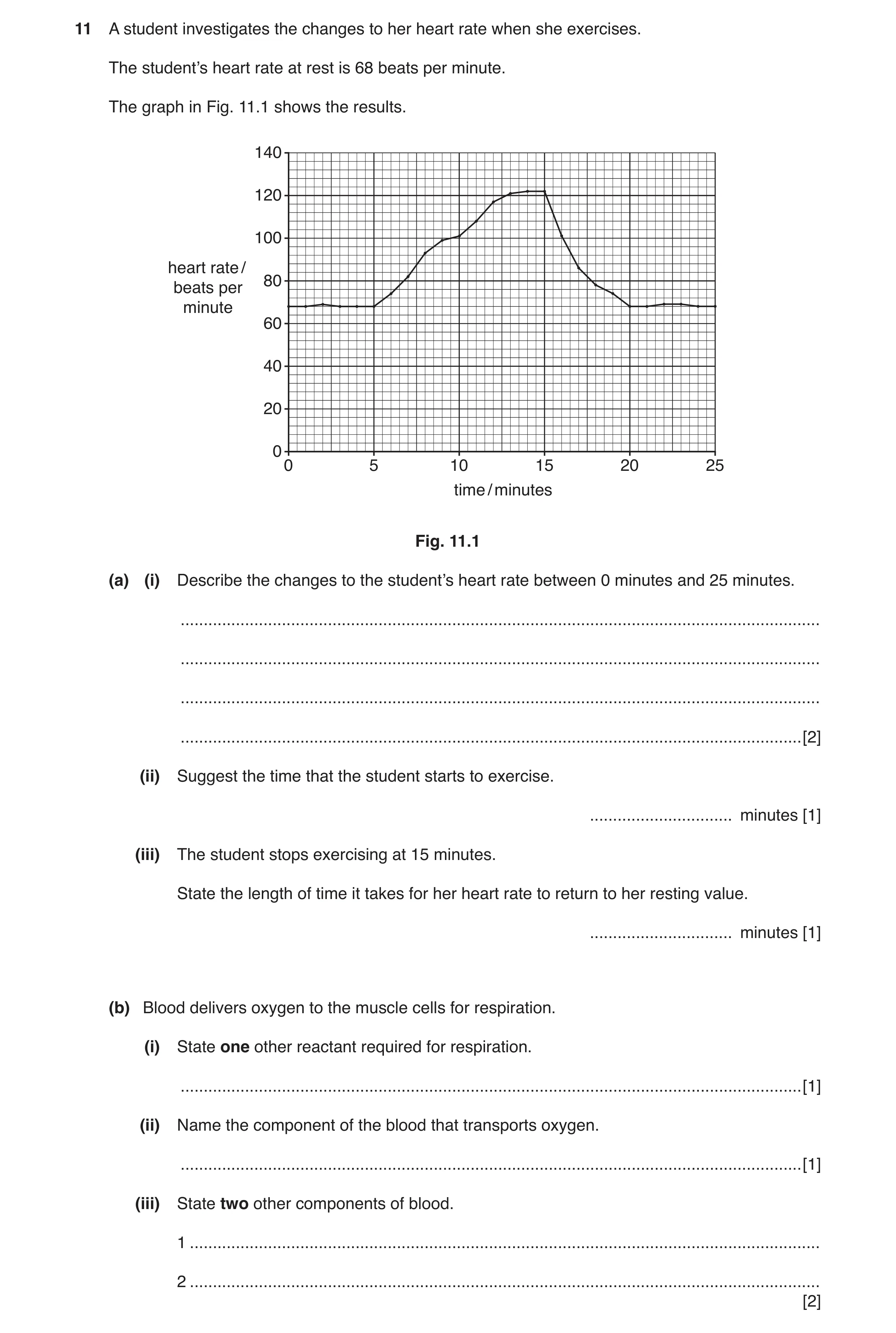
 4 / 25
 5 / 25
![Question 5: Fig. 1.1 shows a diagram of a palisade cell. Fig. 1.1 (a) On Fig. 1.1, use label lines to label the: • nucleus • cytoplasm. [2] (b) Describ…](https://img.pastlit.com/crops/dc75ffe3-b431-4aae-b524-798876e6d157/q1.webp) 6 / 25
6 / 25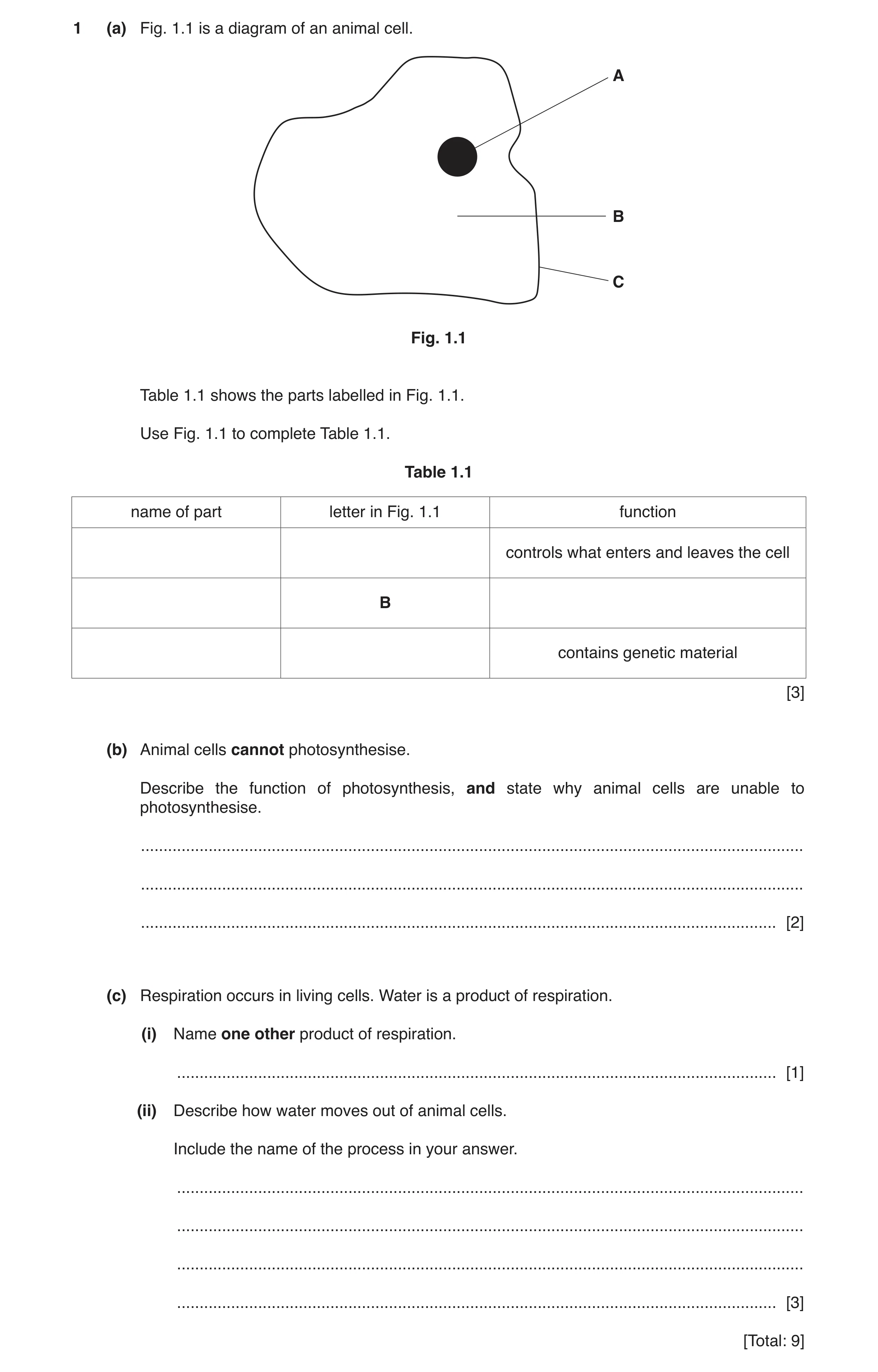
 18 / 25
 19 / 25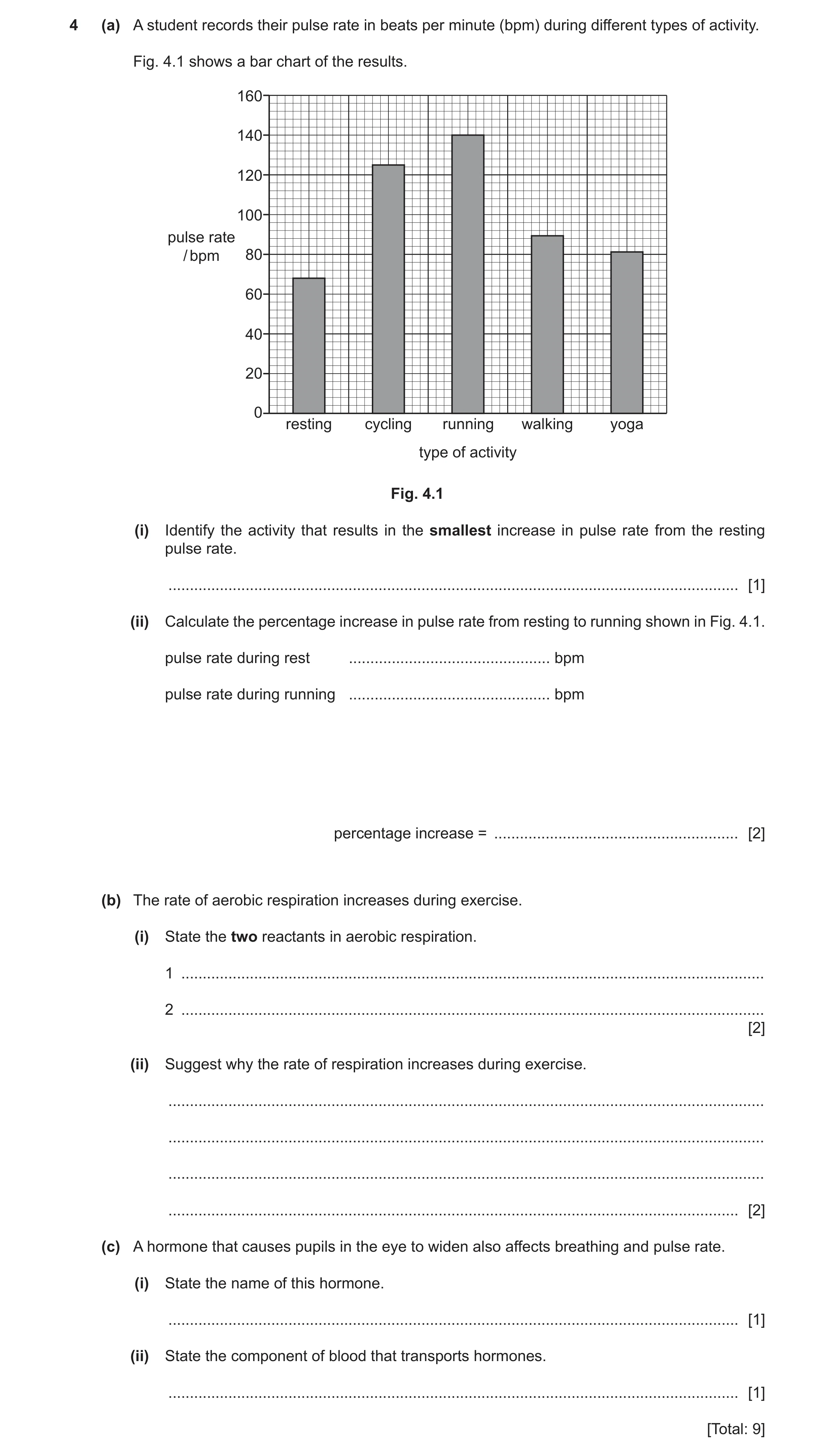
 8
8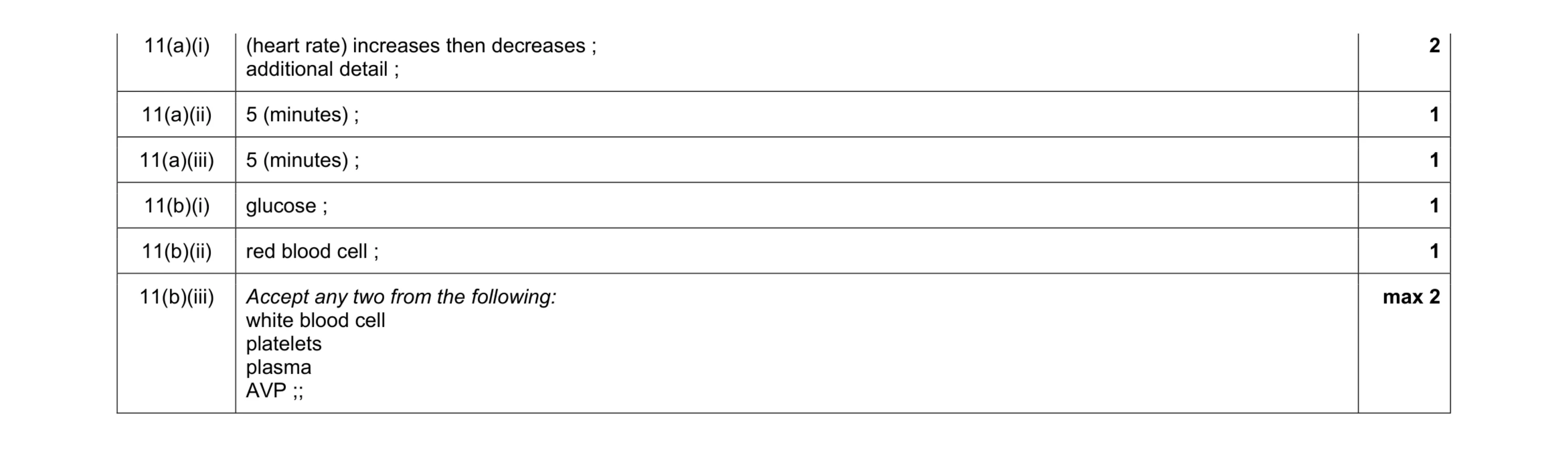 8
8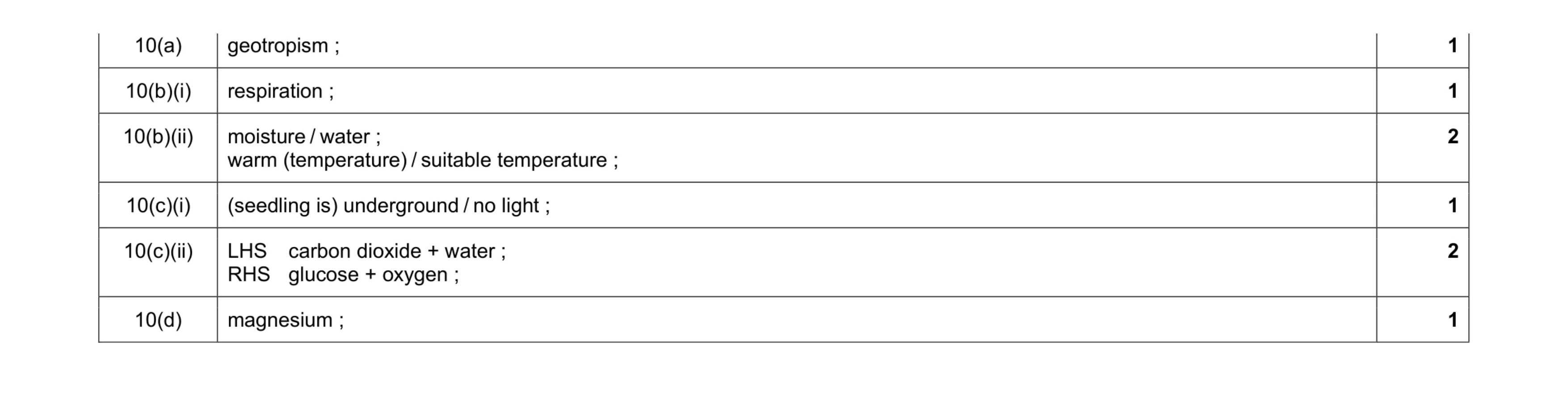 8
8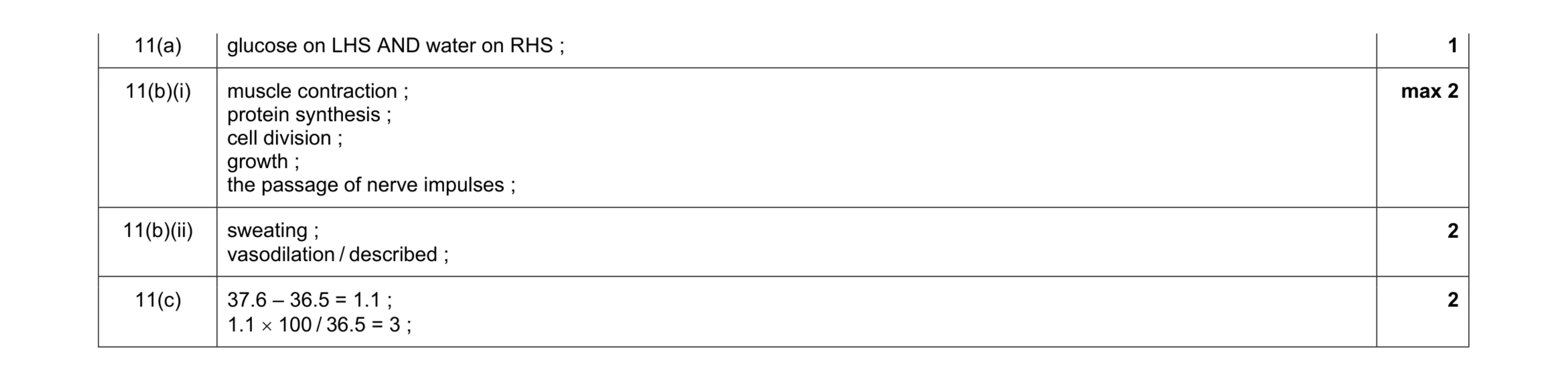 7
7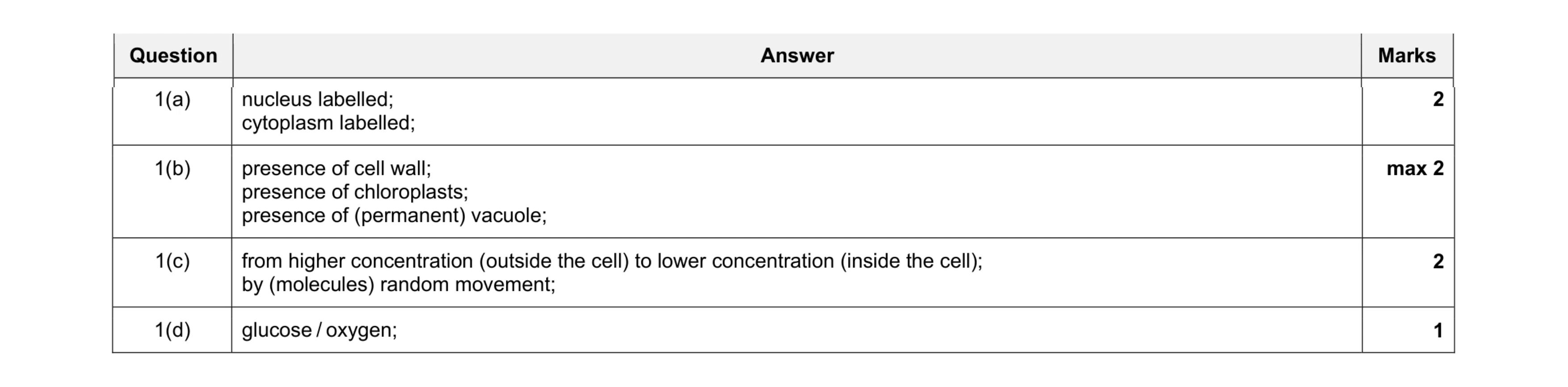 7
7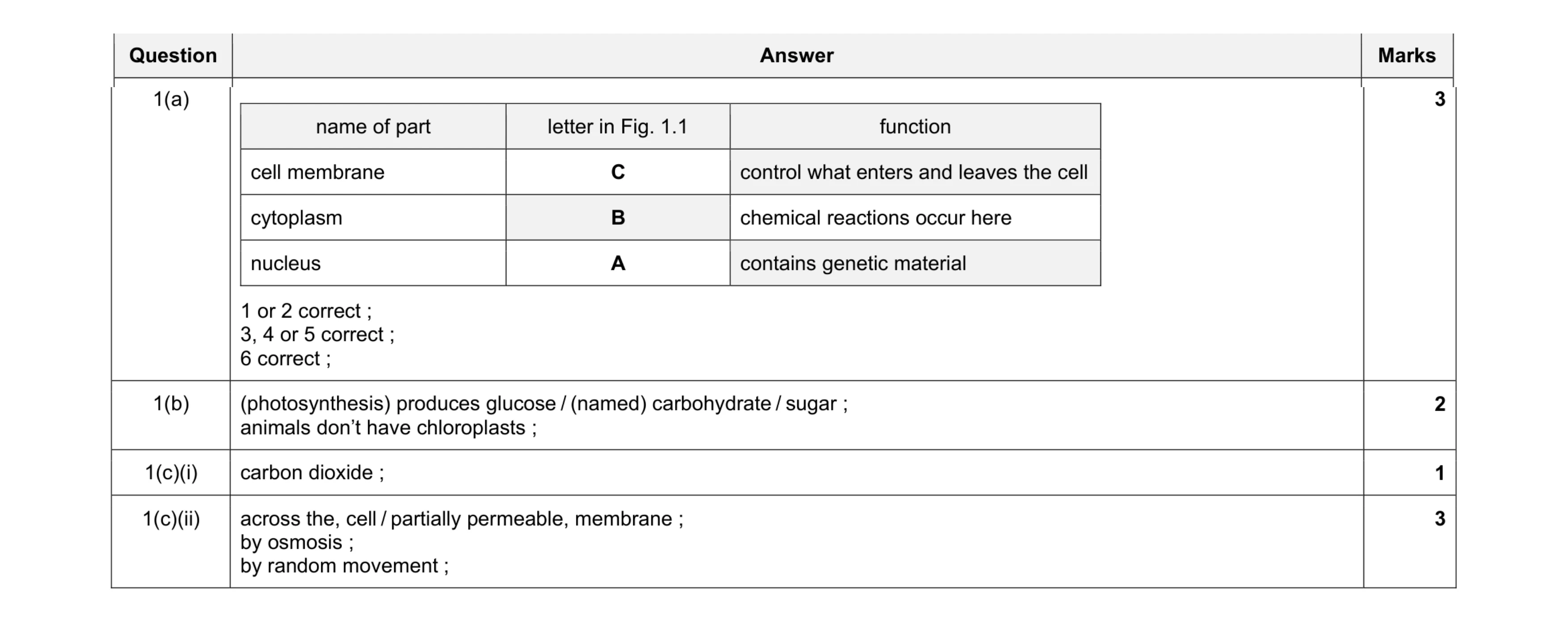 9
9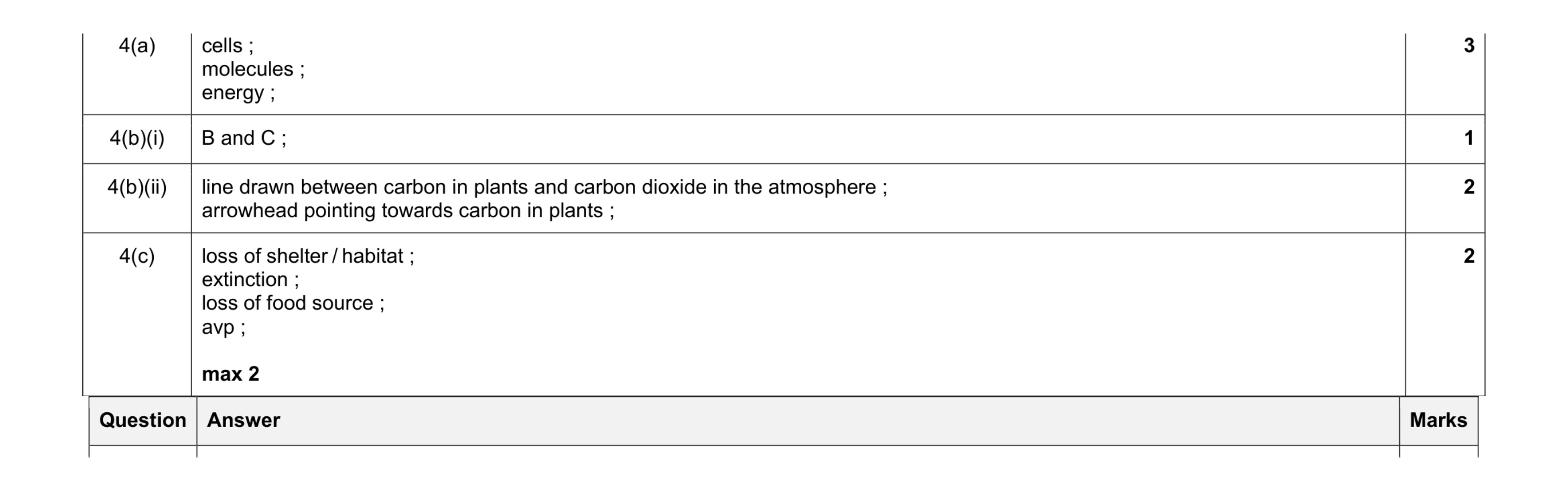 8
8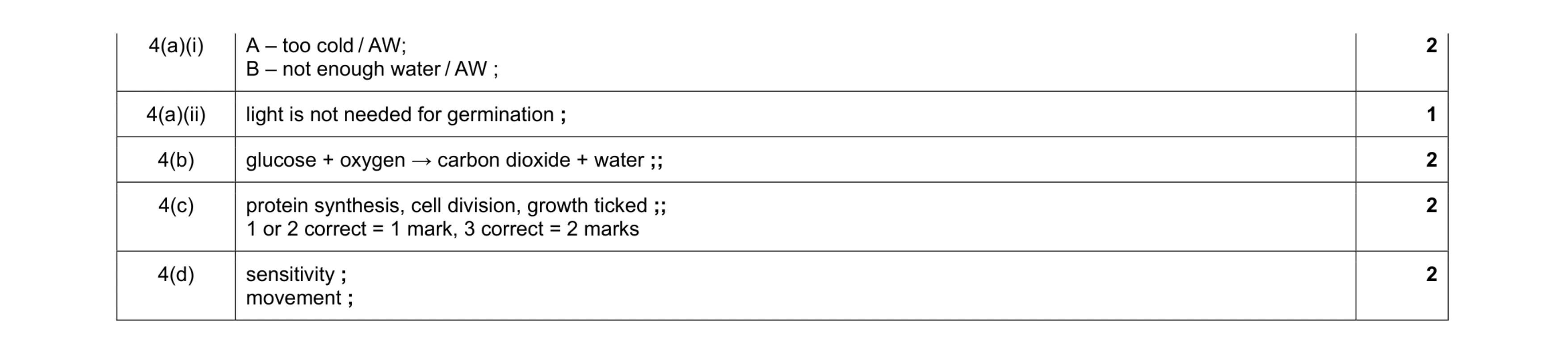 9
9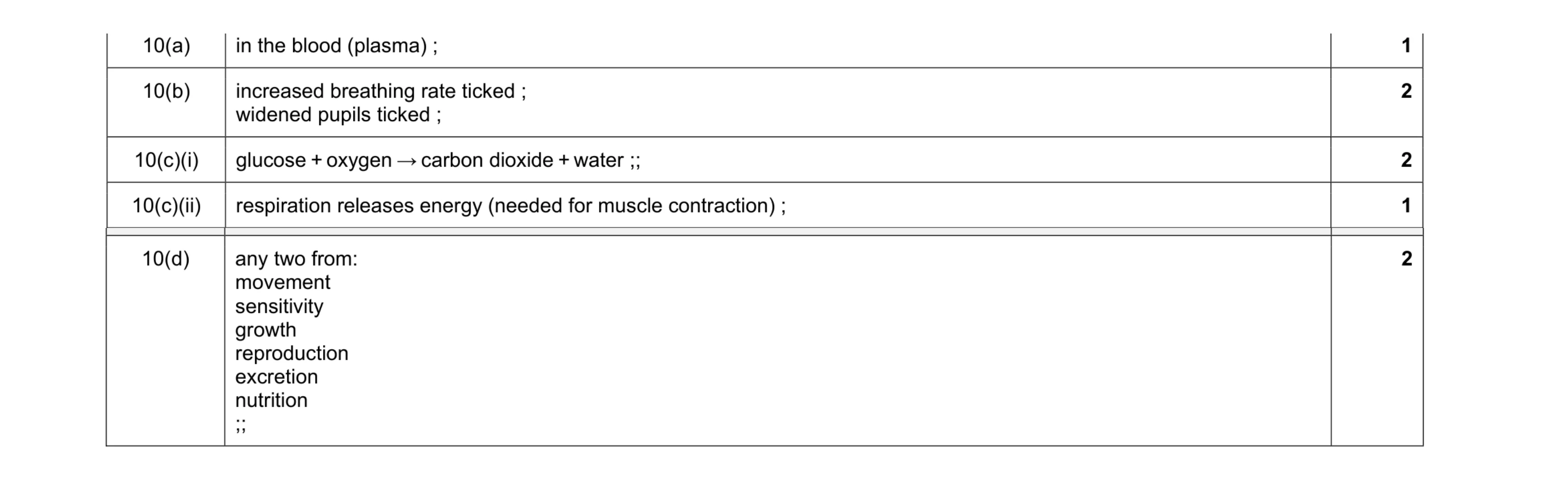 8
8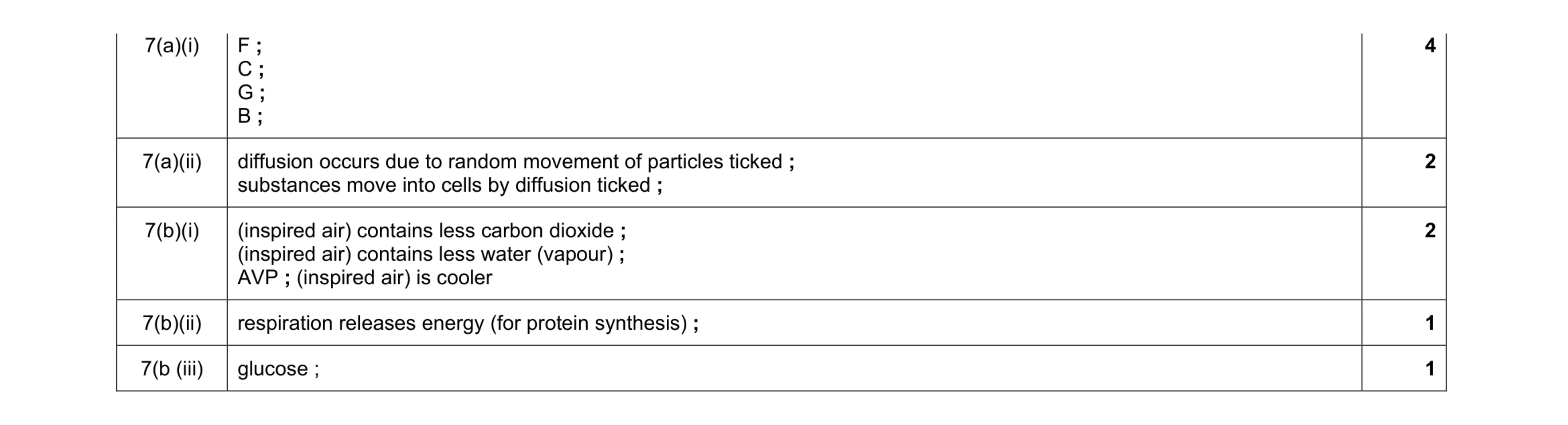 10
10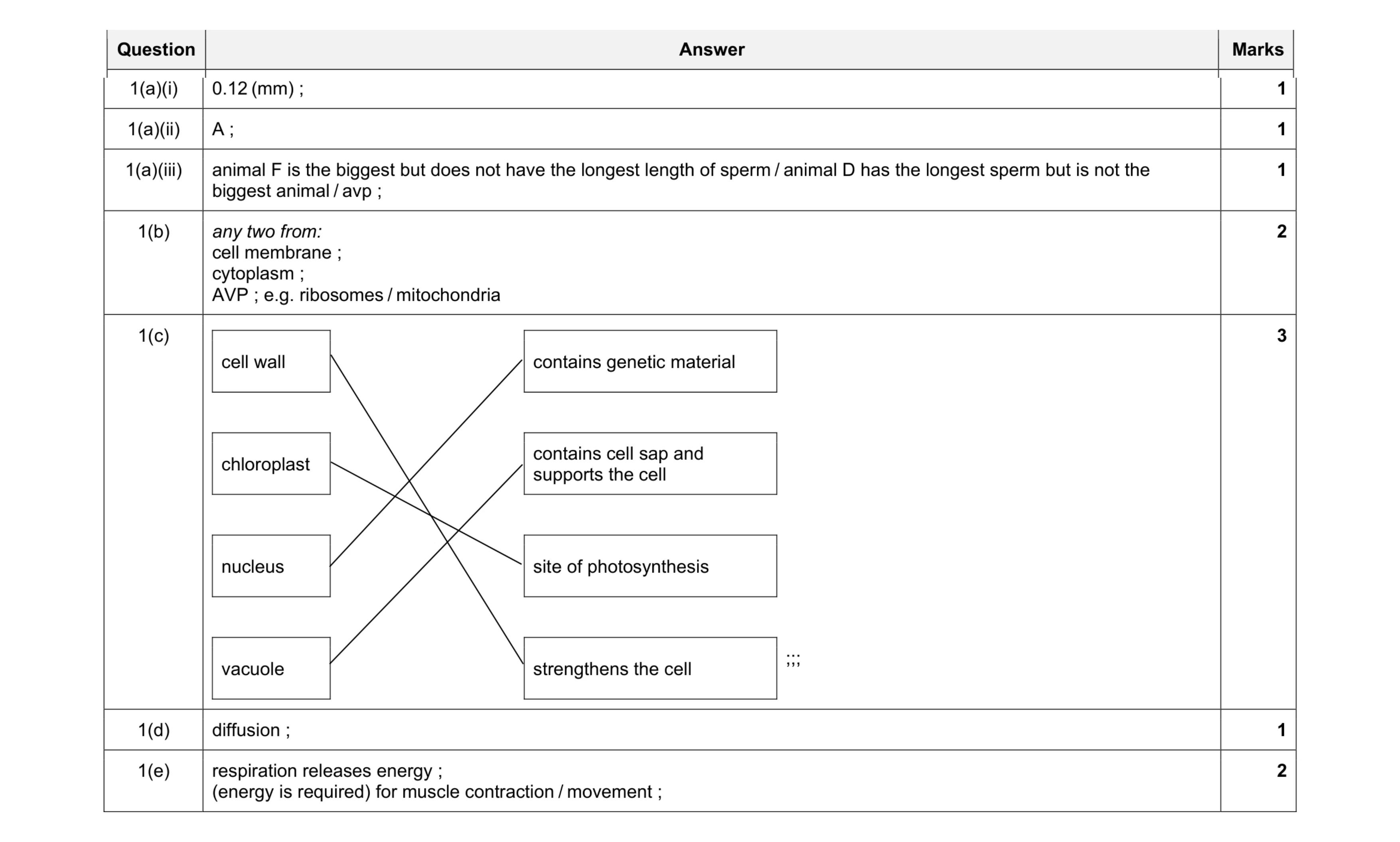 11
11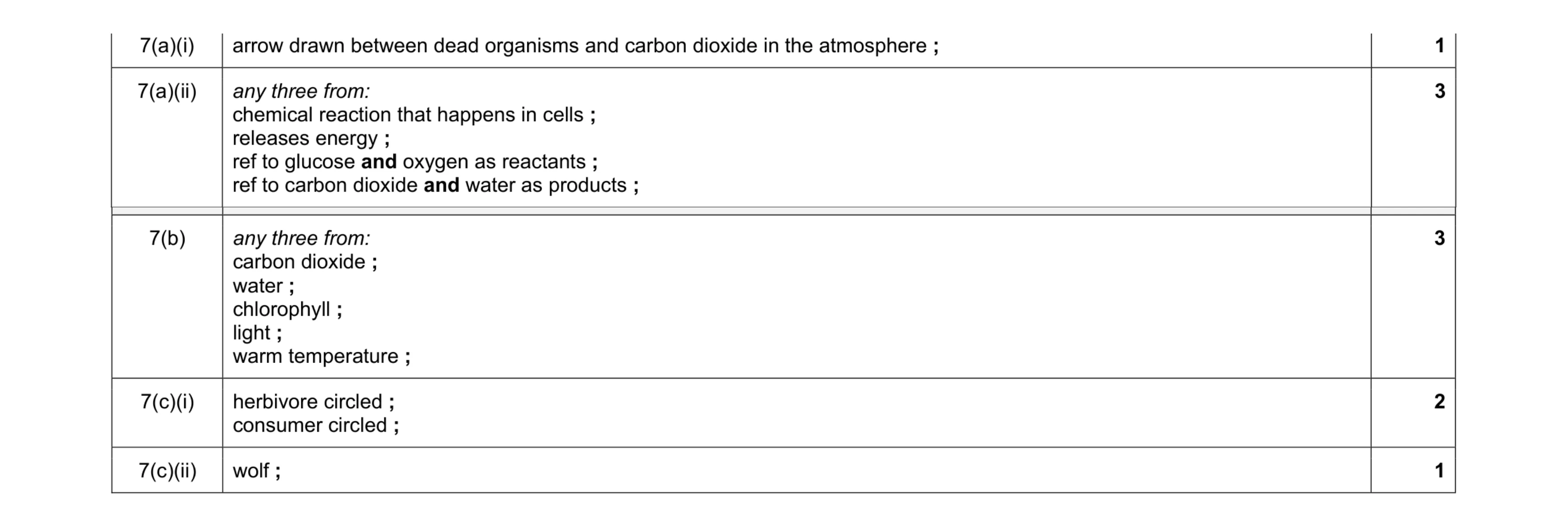 10
10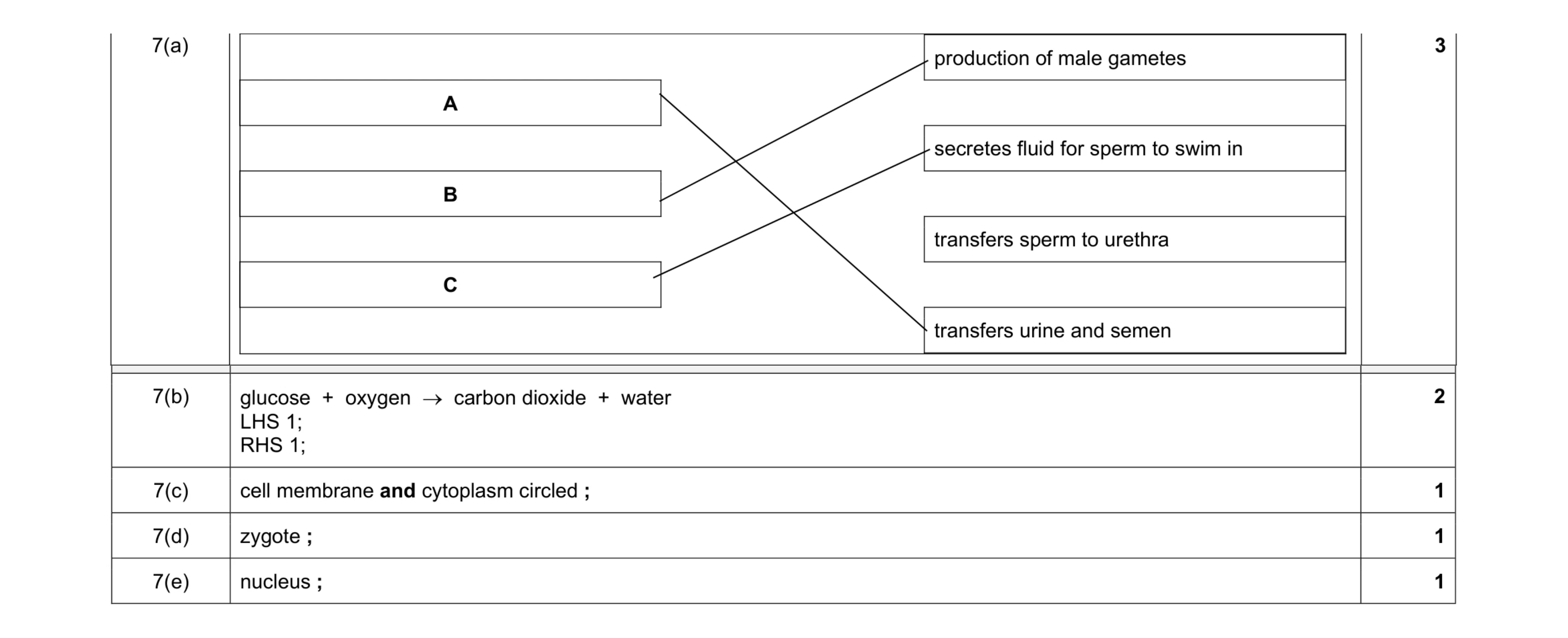 8
8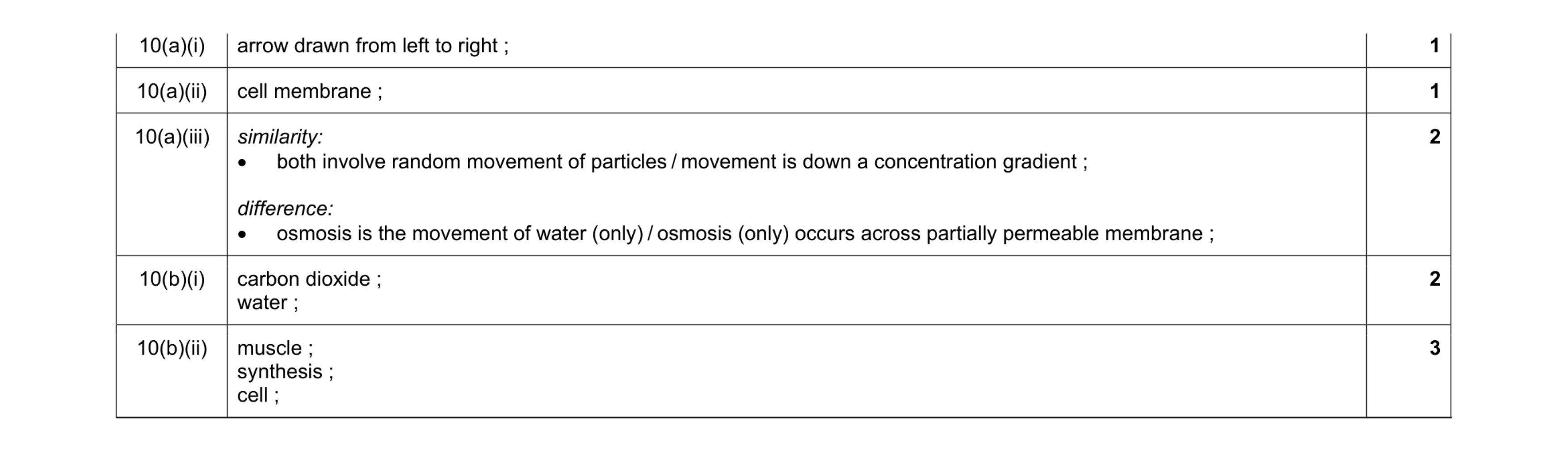 9
9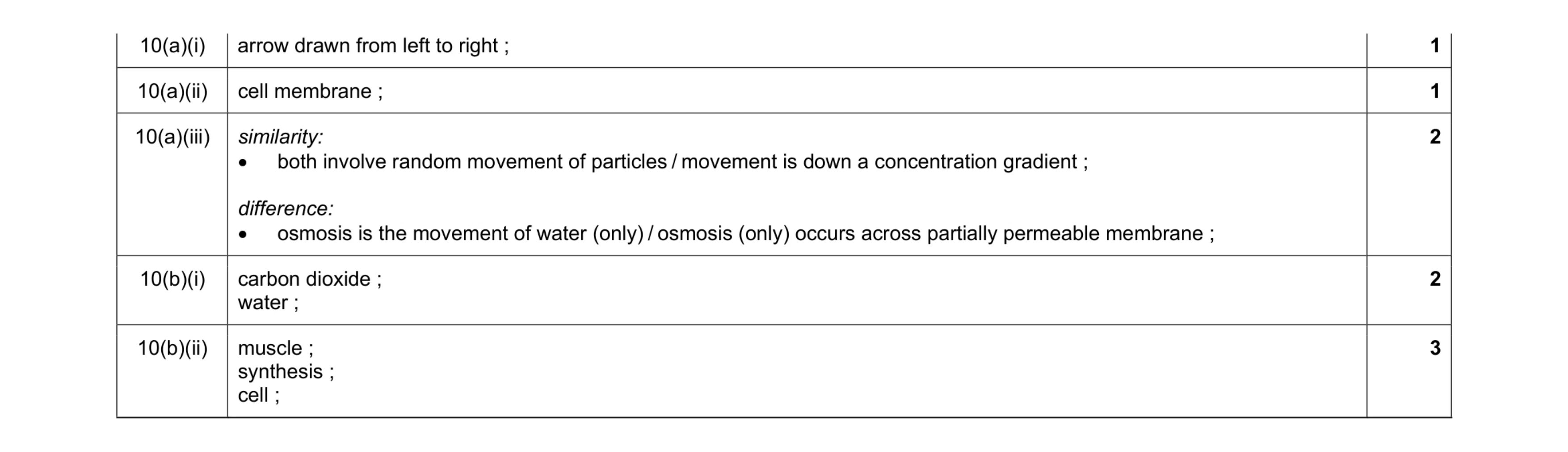 9
9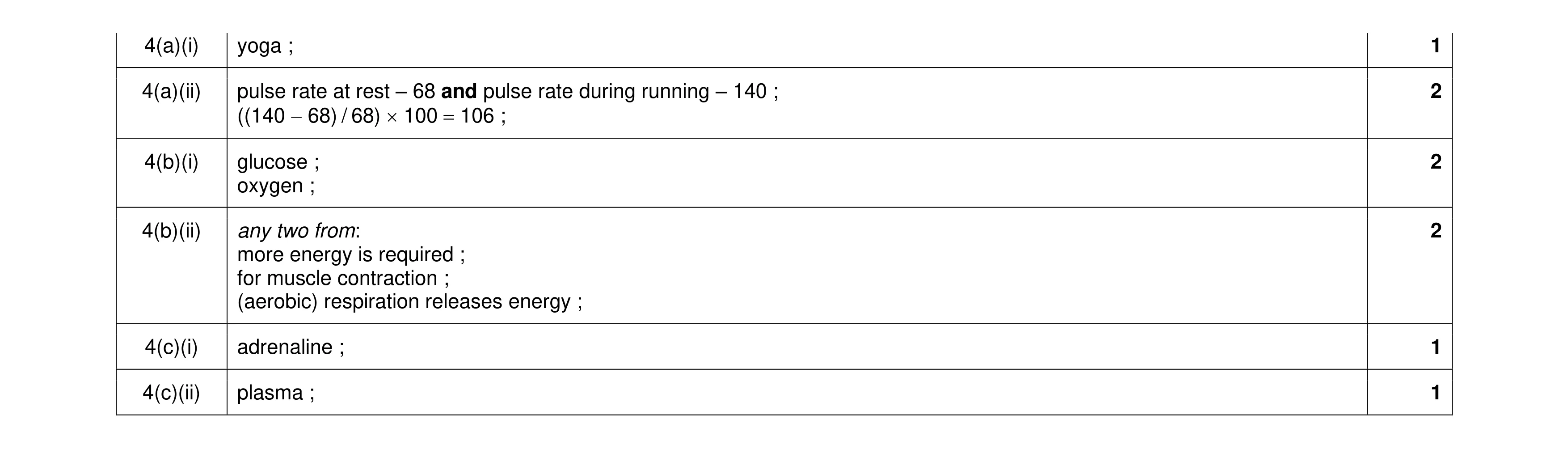 9
9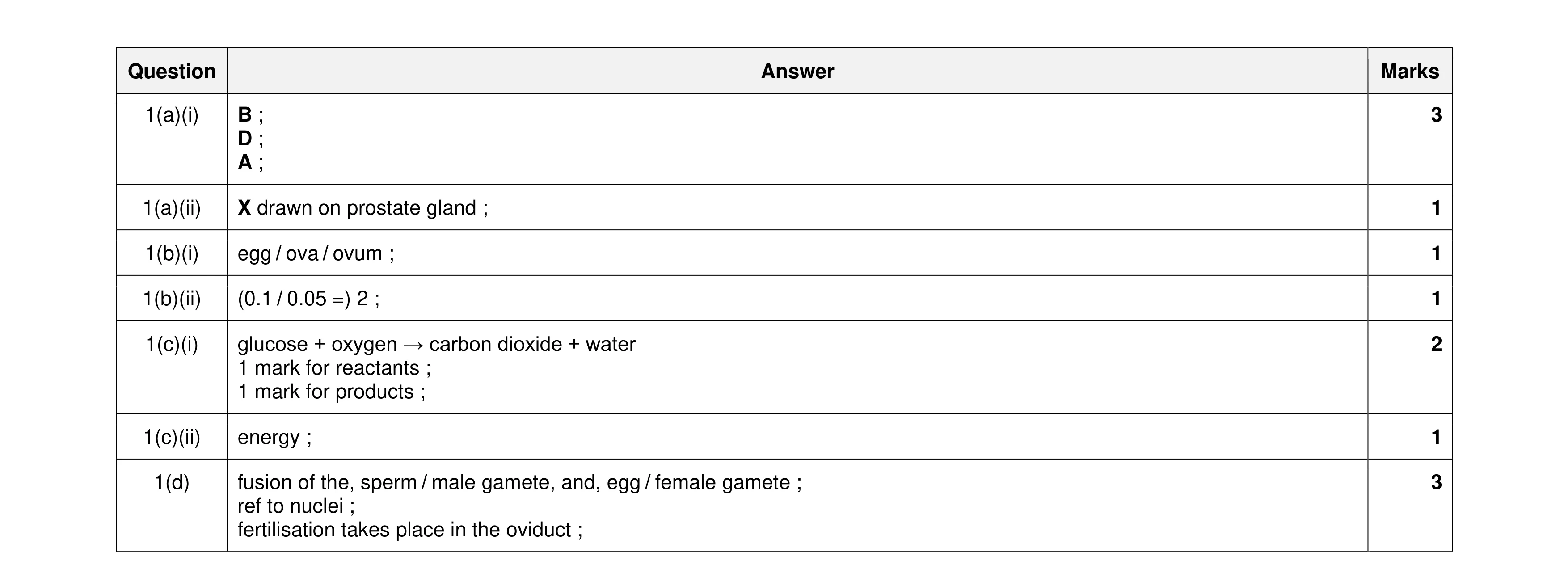 12
12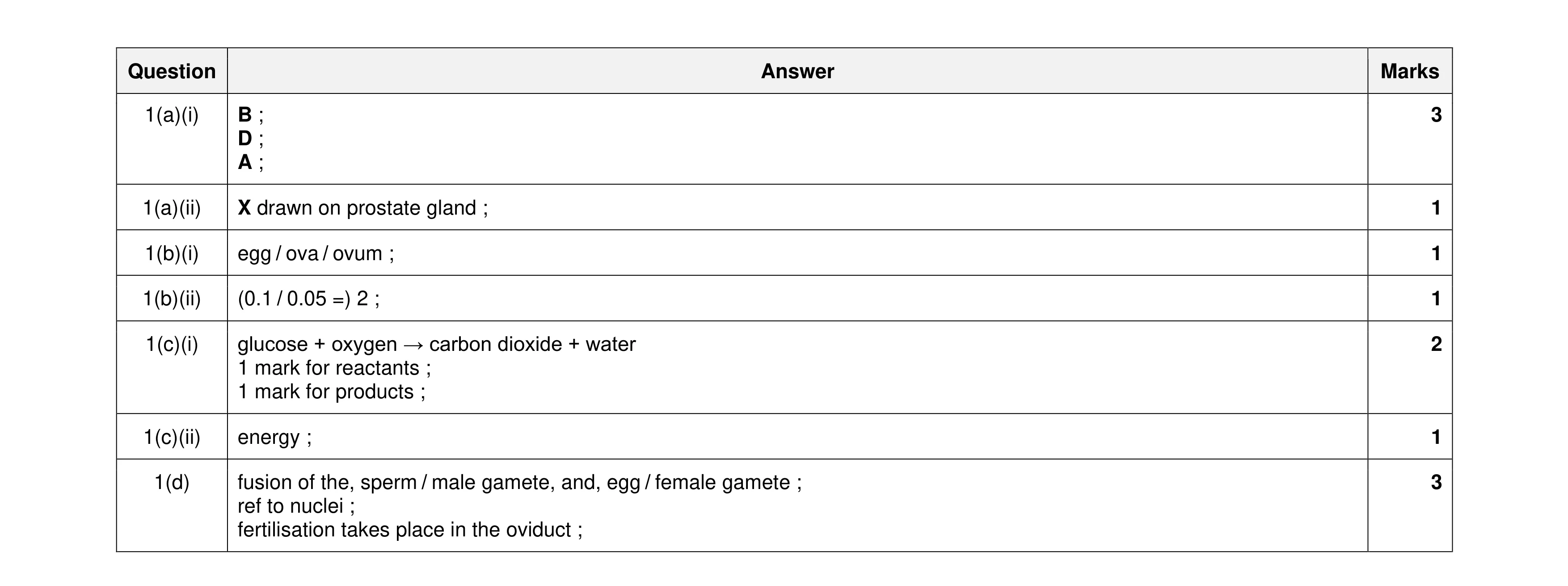 12
12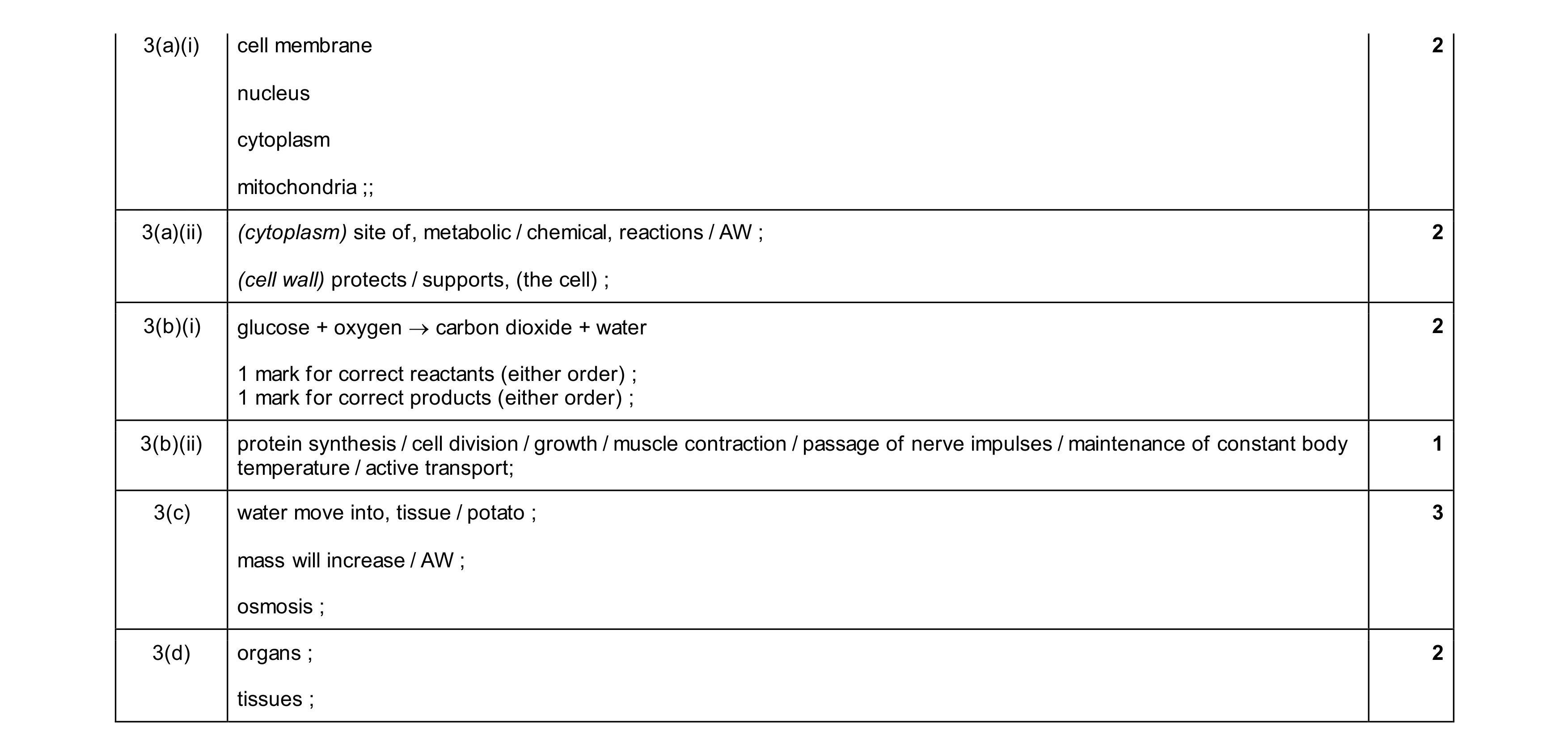 12
12