Questions as text
Q1 · A student investigates the rate of reaction between calcium carbonate and dilute… 0653/42 Feb/March 2017
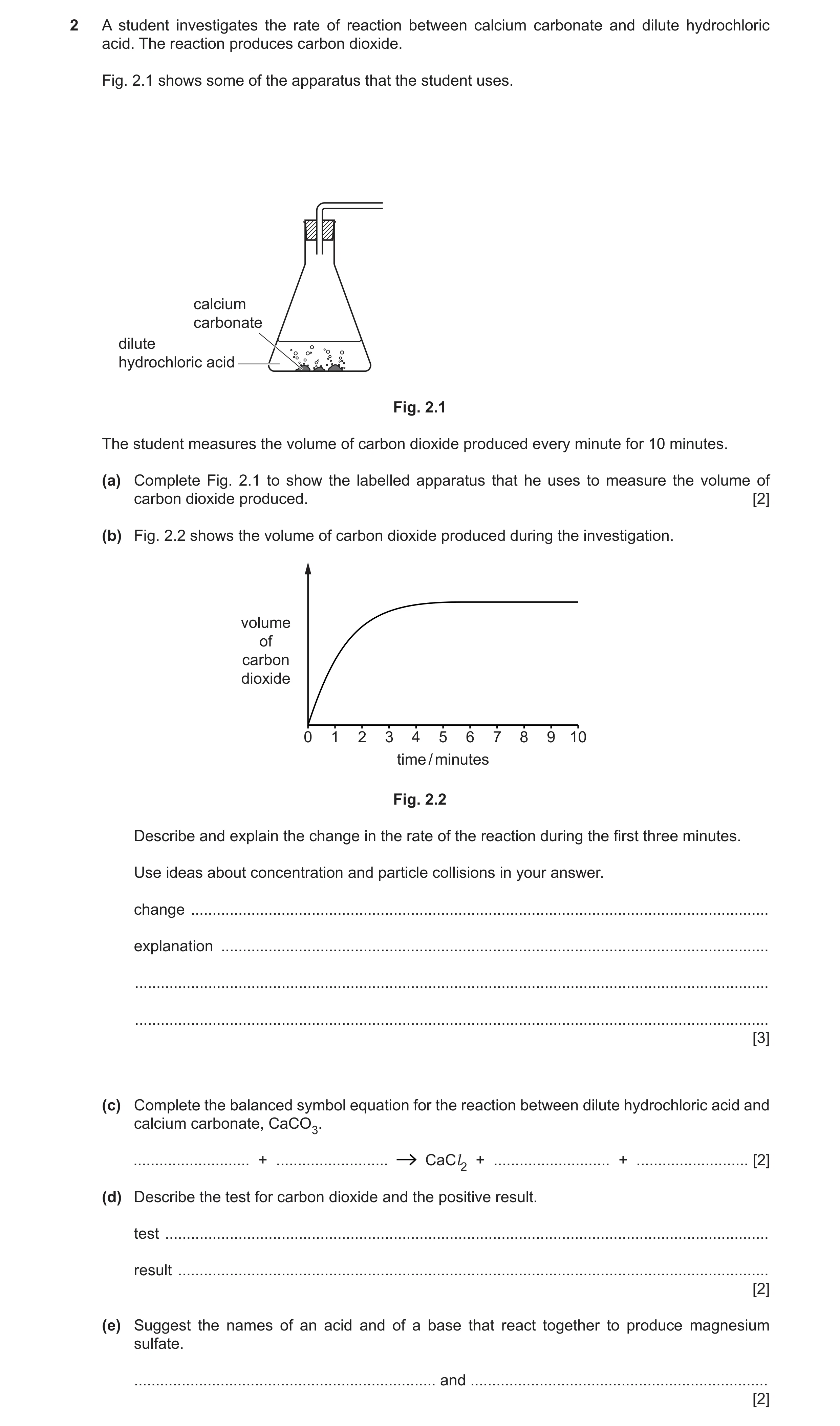
2 A student investigates the rate of reaction between calcium carbonate and dilute hydrochloric acid. The reaction produces carbon dioxide. Fig. 2.1 shows some of the apparatus that the student uses. calcium carbonate dilute hydrochloric acid Fig. 2.1 The student measures the volume of carbon dioxide produced every minute for 10 minutes. (a) Complete Fig. 2.1 to show the labelled apparatus that he uses to measure the volume of carbon dioxide produced. [2] (b) Fig. 2.2 shows the volume of carbon dioxide produced during the investigation. volume of carbon dioxide 0 1 2 3 4 5 6 7 8 9 10 time / minutes Fig. 2.2 Describe and explain the change in the rate of the reaction during the first three minutes. Use ideas about concentration and particle collisions in your answer. change … explanation … … … [3] (c) Complete the balanced symbol equation for the reaction between dilute hydrochloric acid and calcium carbonate, CaCO3. … + … CaCl2 + … + … [2] (d) Describe the test for carbon dioxide and the positive result. test … result … [2] (e) Suggest the names of an acid and of a base that react together to produce magnesium sulfate. … and … [2]
11 marks
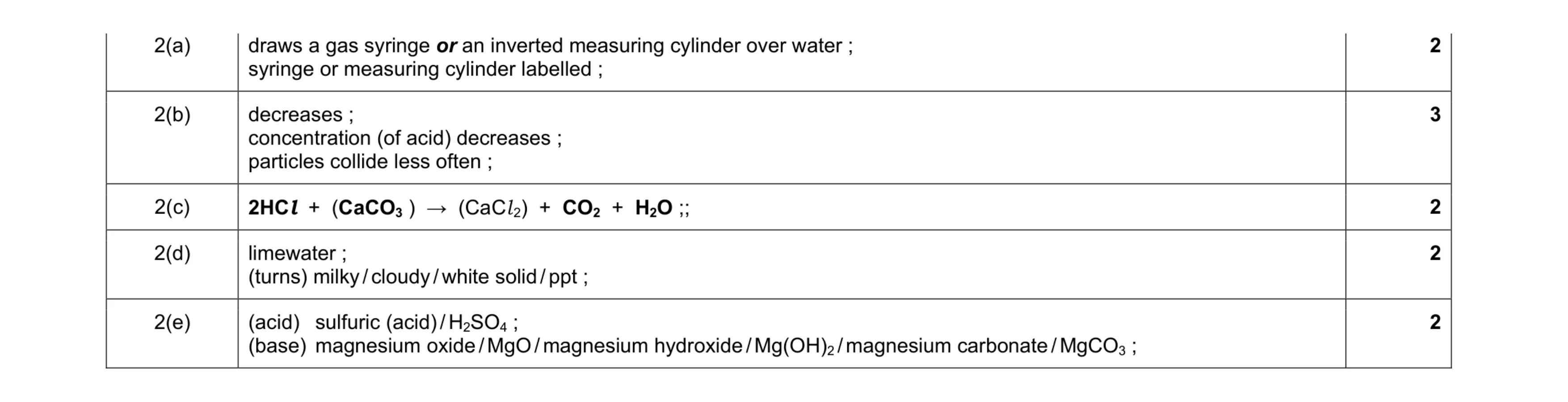
Mark scheme: 2(a) draws a gas syringe or an inverted measuring cylinder over water ; syringe or measuring cylinder labelled ; 2 2(b) decreases ; concentration (of acid) decreases ; particles collide less often ; 3 2(c) 2HCl + (CaCO3 ) → (CaCl 2) + CO2 + H2O ;; 2 2(d) limewater ; (turns) milky / cloudy / white solid / ppt ; 2 2(e) (acid) sulfuric (acid) / H2SO4 ; (base) magnesium oxide / MgO / magnesium hydroxide / Mg(OH)2 / magnesium carbonate / MgCO3 ; 2
This question in 0653/42 Feb/March 2017
Q2 · A student investigates the reaction between dilute sulfuric acid and excess copper(II)… 0653/41 May/June 2017
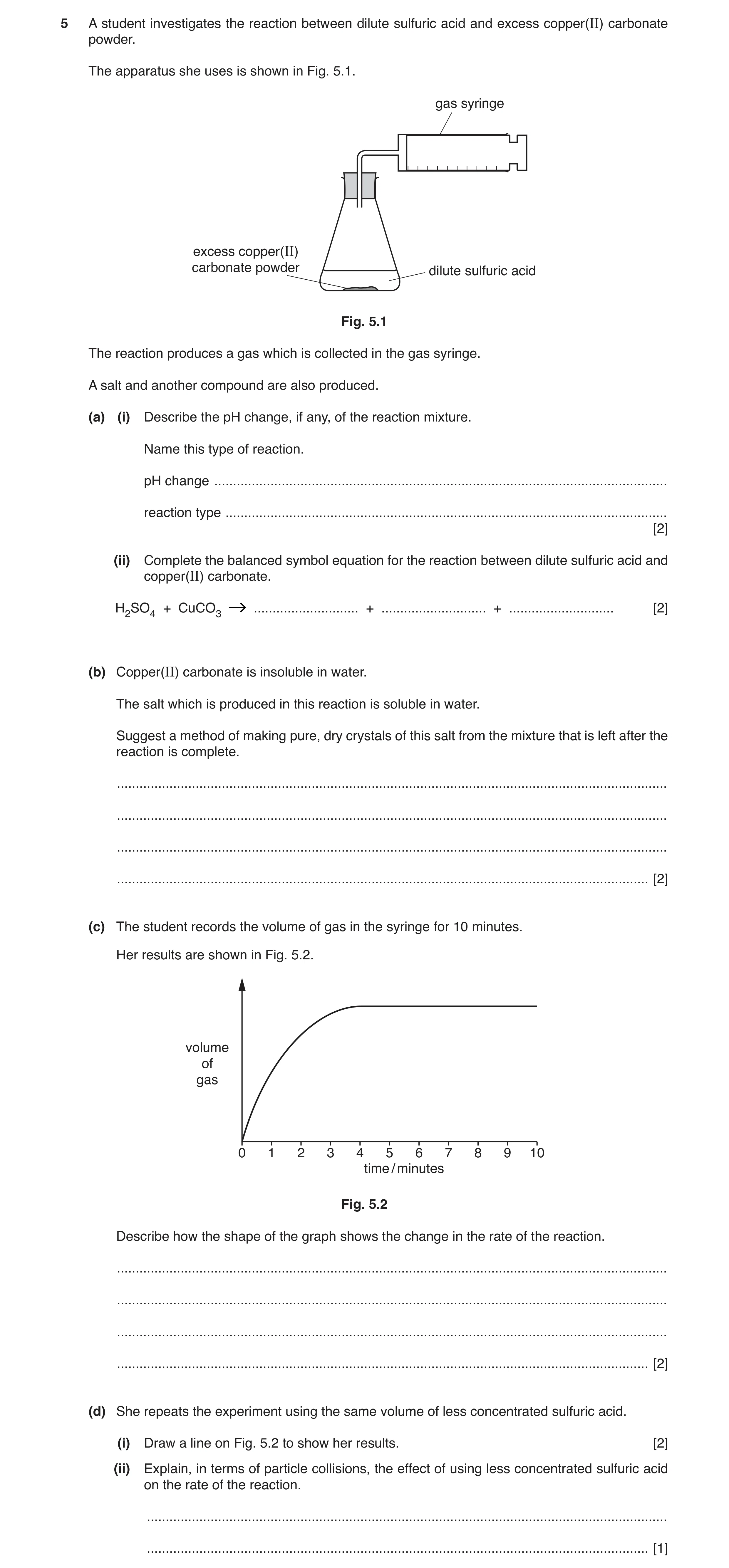
5 A student investigates the reaction between dilute sulfuric acid and excess copper(II) carbonate powder. The apparatus she uses is shown in Fig. 5.1. gas syringe excess copper(II) carbonate powder dilute sulfuric acid Fig. 5.1 The reaction produces a gas which is collected in the gas syringe. A salt and another compound are also produced. (a) (i) Describe the pH change, if any, of the reaction mixture. Name this type of reaction. pH change … reaction type … [2] (ii) Complete the balanced symbol equation for the reaction between dilute sulfuric acid and copper(II) carbonate. H2SO4 + CuCO3 … + … + … [2] (b) Copper(II) carbonate is insoluble in water. The salt which is produced in this reaction is soluble in water. Suggest a method of making pure, dry crystals of this salt from the mixture that is left after the reaction is complete. … … … … [2] (c) The student records the volume of gas in the syringe for 10 minutes. Her results are shown in Fig. 5.2. volume of gas 0 1 2 3 4 5 6 7 8 9 10 time / minutes Fig. 5.2 Describe how the shape of the graph shows the change in the rate of the reaction. … … … … [2] (d) She repeats the experiment using the same volume of less concentrated sulfuric acid. (i) Draw a line on Fig. 5.2 to show her results. [2] (ii) Explain, in terms of particle collisions, the effect of using less concentrated sulfuric acid on the rate of the reaction. … … [1]
11 marks
Mark scheme: 5(a)(i) neutralisation / salt-making; 2 5(a)(ii) CuSO4 ; CO2 and H2O ; 2 5(b) filter (to remove excess solid / copper carbonate) ; heat the solution / filtrate / mixture ; reference to evaporation ; cool / leave (to allow crystals to form) ; 2 5(c) the idea that the gradient decreases ; the idea that the rate decreases ; the idea that the rate becomes zero ; 2 5(d)(i) less steep initial line ; levels off at a lower volume; 2 5(d)(ii) (decreases rate of reaction) because particles collide less frequently / owtte ; 1
This question in 0653/41 May/June 2017
Q3 · Electrolysis is used to break up some compounds into simpler substances 0653/41 Oct/Nov 2017
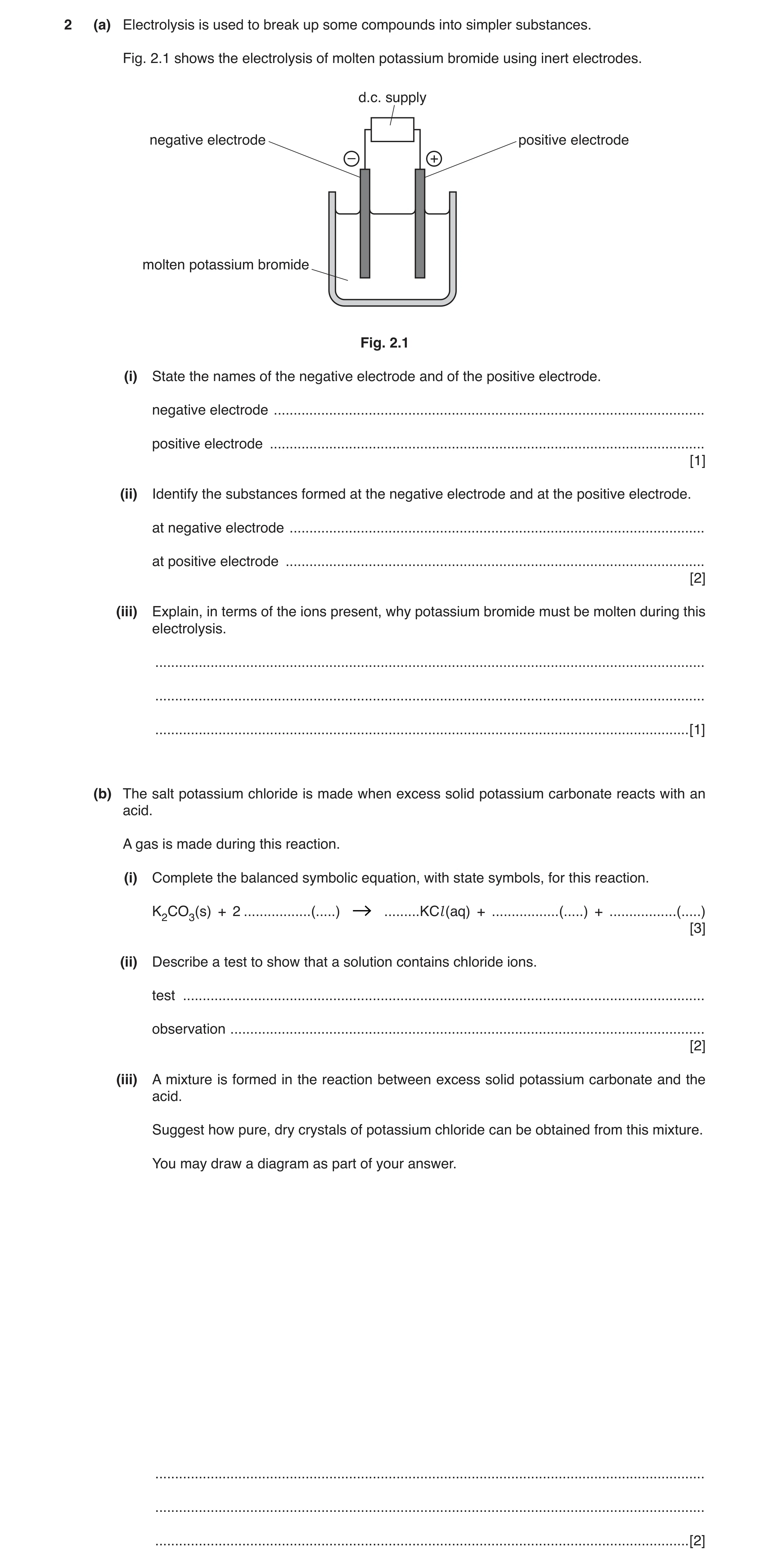
2 (a) Electrolysis is used to break up some compounds into simpler substances. Fig. 2.1 shows the electrolysis of molten potassium bromide using inert electrodes. d.c. supply negative electrode positive electrode – + molten potassium bromide Fig. 2.1 (i) State the names of the negative electrode and of the positive electrode. negative electrode … positive electrode … [1] (ii) Identify the substances formed at the negative electrode and at the positive electrode. at negative electrode … at positive electrode … [2] (iii) Explain, in terms of the ions present, why potassium bromide must be molten during this electrolysis. … … … [1] (b) The salt potassium chloride is made when excess solid potassium carbonate reacts with an acid. A gas is made during this reaction. (i) Complete the balanced symbolic equation, with state symbols, for this reaction. K2CO3(s) + 2 … ( … ) … KCl (aq) + … ( … ) + … ( … ) [3] (ii) Describe a test to show that a solution contains chloride ions. test … observation … [2] (iii) A mixture is formed in the reaction between excess solid potassium carbonate and the acid. Suggest how pure, dry crystals of potassium chloride can be obtained from this mixture. You may draw a diagram as part of your answer. … … … [2]
11 marks
Mark scheme: 2(a)(i) (negative) cathode and (positive) anode ; 1 2(a)(ii) (negative) potassium / K ; (positive) bromine / Br2 ; 2 2(a)(iii) ions must be able to move / be mobile ; 1 2(b)(i) (K2CO3 (s) + 2) «HCl (aq)« → 2 KCl (aq) + «CO2 (g)« + «H2O (l)« HCl ; RHS ; all three states ; 3 2(b)(ii) (test) (acidified) silver nitrate (solution) ; (observation) white precipitate / solid ; 2 Question Answer Marks 2(b)(iii) filter (to remove excess solid / potassium carbonate) ; and then one from heat / boil the solution / filtrate / mixture / diagram showing this process ; reference to evaporation / removal of water ; cool / leave (to allow crystals to form) ; max 2
This question in 0653/41 Oct/Nov 2017
Q4 · Calcium sulfate is an insoluble salt 0653/41 Oct/Nov 2018
5 (a) Calcium sulfate is an insoluble salt. (i) Name two compounds that react together to form calcium sulfate. 1. … 2. … [2] (ii) Suggest the separation method that is used to separate an insoluble salt from an aqueous reaction mixture. Explain how this separation method removes the solid from the liquid. method … explanation … … … [2] (b) Calcium is in Group II in the Periodic Table. (i) Complete the following sentences using words from the list. Each word may be used once, more than once or not at all. good high low poor Calcium is a … electrical conductor. Calcium has a … melting point. [1] (ii) State the electronic structure of a calcium atom. … [1] (c) Caesium is below potassium in Group I of the Periodic Table. Potassium melts at 63 °C and it reacts rapidly with water. Caesium is a solid at room temperature (25 °C). (i) Compare the rate of the reaction between caesium and water with the rate of reaction between potassium and water. … … [1] (ii) Suggest the melting point of caesium. … °C [1] (d) Describe the reaction, if any, which occurs when copper is mixed with aqueous potassium chloride. Explain your answer. reaction … explanation … … [1]
9 marks
Mark scheme: 5(a)(i) sulfuric_acid / H2SO4 ; calcium oxide / CaO / calcium hydroxide / Ca(OH)2 calcium carbonate / CaCO3 ; 2 5(a)(ii) (technique) filter / filtering / filtration ; (explanation) solid (particles) cannot pass through / remain on filter paper / liquid (particles) can pass through filter paper ; 2 5(b)(i) (electrical conductor) good (melting point) high ; (both required) 1 5(b)(ii) 2, 8, 8, 2 ; 1 5(c)(i) more / very rapid / explosive ; 1 5(c)(ii) any stated value ˃ 25 °C and ˂ 63 °C ; 1 5(d) (reaction) no (visible) reaction (explanation) copper is less reactive than potassium ; (both required) 1
This question in 0653/41 Oct/Nov 2018
Q5 · Magnesium chloride is a soluble salt 0653/42 Oct/Nov 2018
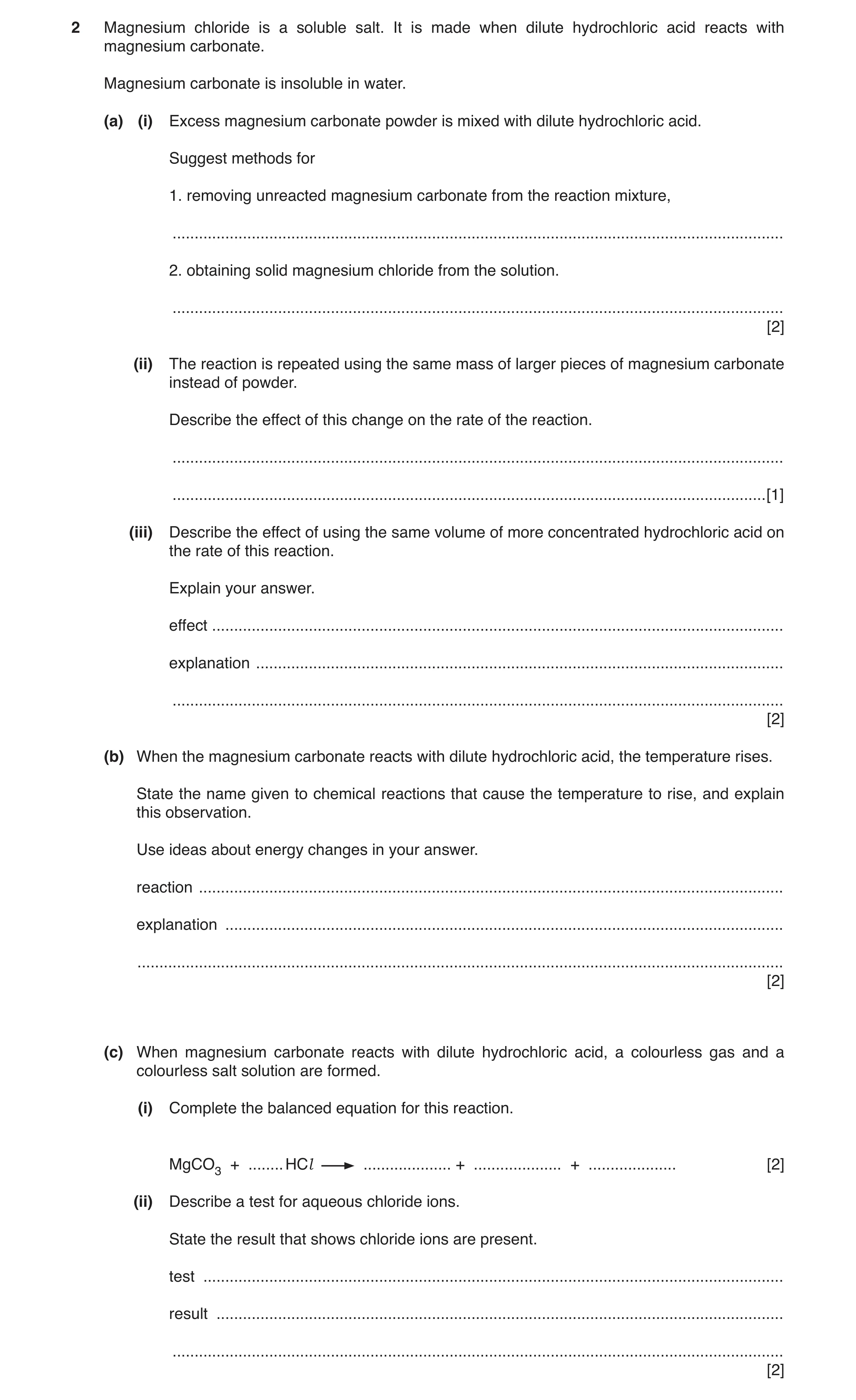
2 Magnesium chloride is a soluble salt. It is made when dilute hydrochloric acid reacts with magnesium carbonate. Magnesium carbonate is insoluble in water. (a) (i) Excess magnesium carbonate powder is mixed with dilute hydrochloric acid. Suggest methods for 1. removing unreacted magnesium carbonate from the reaction mixture, … 2. obtaining solid magnesium chloride from the solution. … [2] (ii) The reaction is repeated using the same mass of larger pieces of magnesium carbonate instead of powder. Describe the effect of this change on the rate of the reaction. … … [1] (iii) Describe the effect of using the same volume of more concentrated hydrochloric acid on the rate of this reaction. Explain your answer. effect … explanation … … [2] (b) When the magnesium carbonate reacts with dilute hydrochloric acid, the temperature rises. State the name given to chemical reactions that cause the temperature to rise, and explain this observation. Use ideas about energy changes in your answer. reaction … explanation … … [2] (c) When magnesium carbonate reacts with dilute hydrochloric acid, a colourless gas and a colourless salt solution are formed. (i) Complete the balanced equation for this reaction. MgCO3 + … HCl … + … + … [2] (ii) Describe a test for aqueous chloride ions. State the result that shows chloride ions are present. test … result … … [2]
11 marks
Mark scheme: 2(a)(i) (remove MgCO3) filtration / filtering / filter ; (obtain solid salt) evaporation / crystallisation ; 2 2(a)(ii) decreases ; 1 2(a)(iii) (effect) increases ; (explanation) particles collide more frequently / more chance of collisions ; 2 2(b) exothermic ; chemical (energy changes) to heat / thermal (energy) ; 2 Question Answer Marks 2(c)(i) (MgCO3) + 2(HCl) → MgCl2 + CO2 + H2O ; formula of magnesium chloride ; all else correct ; 2 2(c)(ii) (test) (dil. nitric acid and) aqueous silver nitrate / AgNO3 ; (result) white precipitate / solid; 2
This question in 0653/42 Oct/Nov 2018
Q6 · Iron is an element in Period 4 of the Periodic Table shown on page 24 0653/42 Feb/March 2019
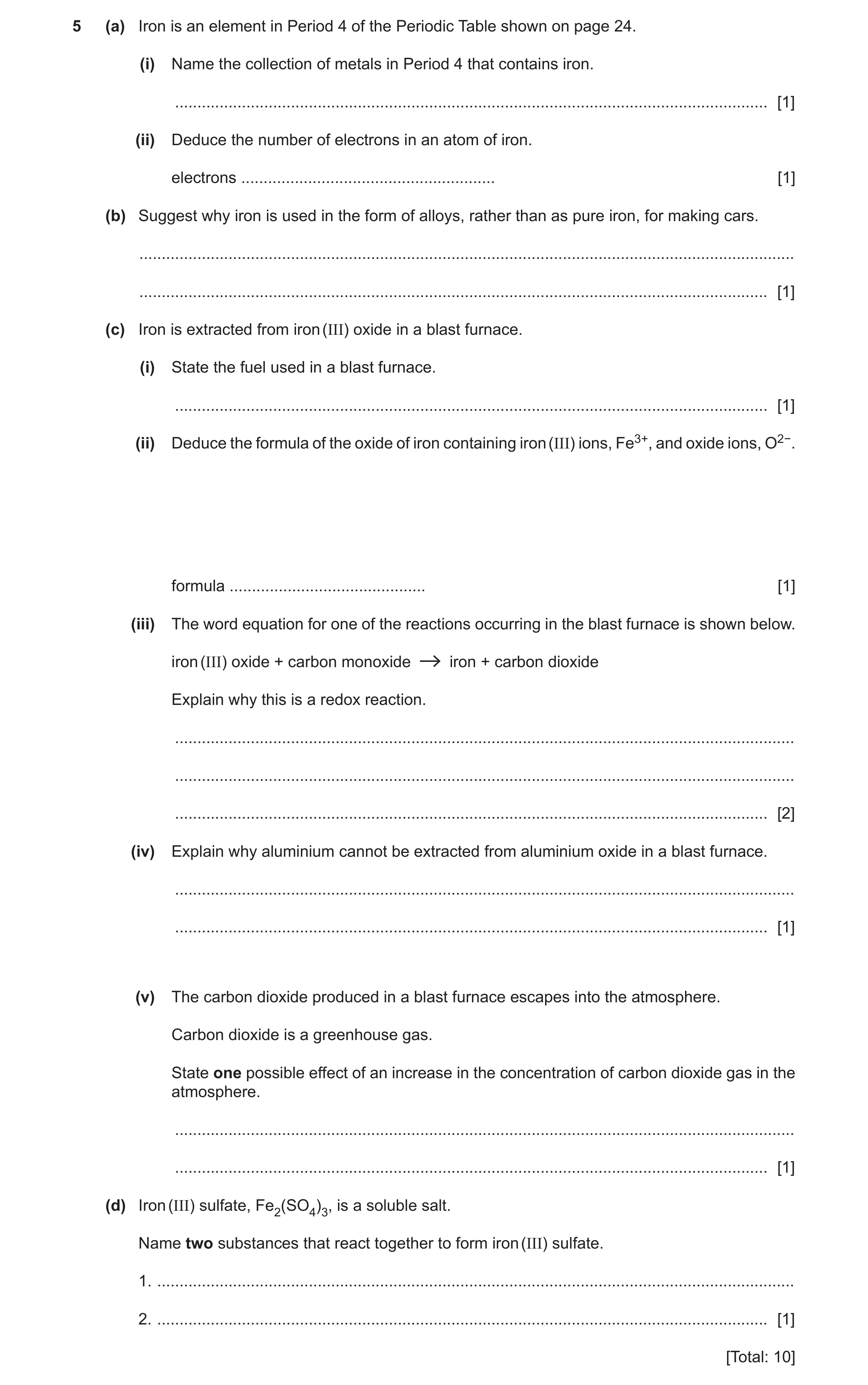
5 (a) Iron is an element in Period 4 of the Periodic Table shown on page 24. (i) Name the collection of metals in Period 4 that contains iron. … [1] (ii) Deduce the number of electrons in an atom of iron. electrons … [1] (b) Suggest why iron is used in the form of alloys, rather than as pure iron, for making cars. … … [1] (c) Iron is extracted from iron (III) oxide in a blast furnace. (i) State the fuel used in a blast furnace. … [1] (ii) Deduce the formula of the oxide of iron containing iron (III) ions, Fe3+, and oxide ions, O2−. formula … [1] (iii) The word equation for one of the reactions occurring in the blast furnace is shown below. iron (III) oxide + carbon monoxide iron + carbon dioxide Explain why this is a redox reaction. … … … [2] (iv) Explain why aluminium cannot be extracted from aluminium oxide in a blast furnace. … … [1] (v) The carbon dioxide produced in a blast furnace escapes into the atmosphere. Carbon dioxide is a greenhouse gas. State one possible effect of an increase in the concentration of carbon dioxide gas in the atmosphere. … … [1] (d) Iron (III) sulfate, Fe2(SO4)3, is a soluble salt. Name two substances that react together to form iron (III) sulfate. 1. … 2. … [1] [Total: 10]
10 marks
Mark scheme: 5(a)(i) transition metals / elements ; 1 5(a)(ii) electrons = 26 ; 1 5(b) stronger more resistant to corrosion ; 1 5(c)(i) coke / carbon ; 1 5(c)(ii) Fe2O3 ; 1 5(c)(iii) iron oxide / Fe3+ reduced ; carbon monoxide oxidised ; 2 5(c)(iv) aluminium is too reactive / aluminium is above carbon in reactivity series ; 1 5(c)(v) (increases) global warming / climate change / consequence of climate change described ; 1 5(d) iron and sulfuric acid ; or iron oxide / iron (III) oxide and (dilute) sulfuric acid ; 1
This question in 0653/42 Feb/March 2019
Q7 · Sodium burns in oxygen to produce sodium oxide, an ionic compound 0653/41 May/June 2019
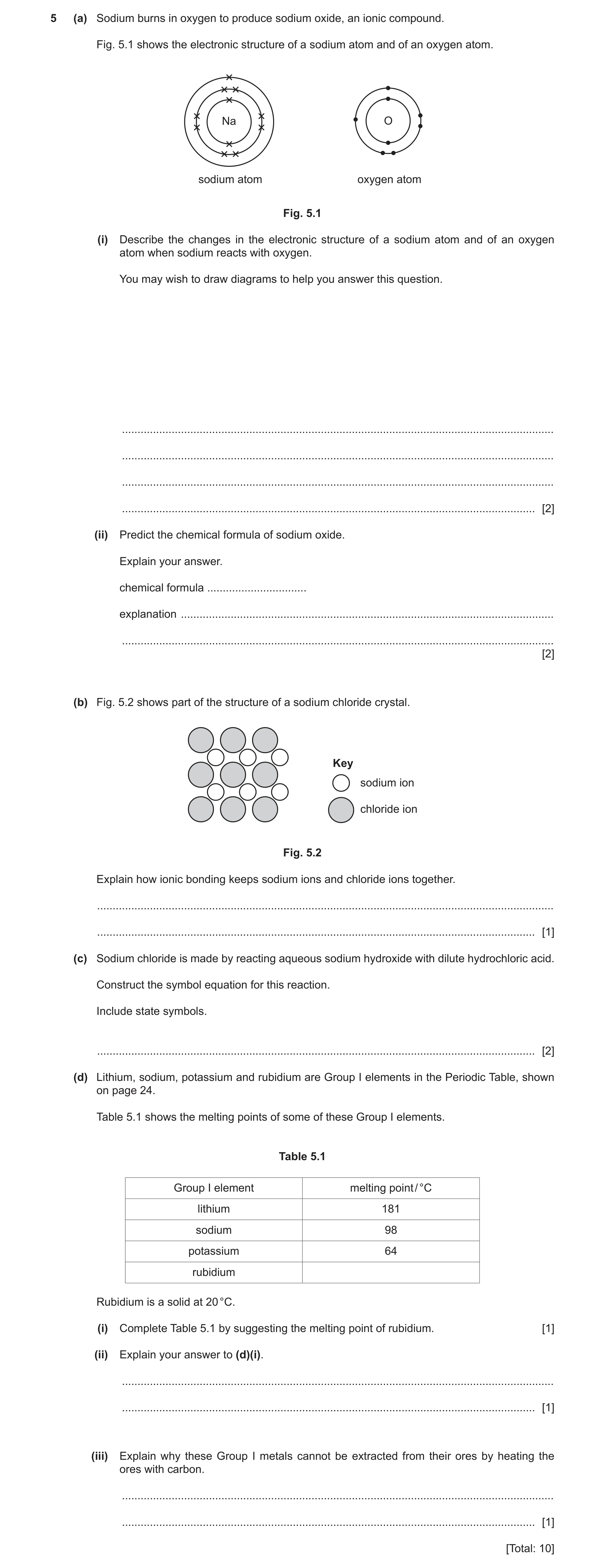
5 (a) Sodium burns in oxygen to produce sodium oxide, an ionic compound. Fig. 5.1 shows the electronic structure of a sodium atom and of an oxygen atom. Na O sodium atom oxygen atom Fig. 5.1 (i) Describe the changes in the electronic structure of a sodium atom and of an oxygen atom when sodium reacts with oxygen. You may wish to draw diagrams to help you answer this question. … … … … [2] (ii) Predict the chemical formula of sodium oxide. Explain your answer. chemical formula … explanation … … [2] (b) Fig. 5.2 shows part of the structure of a sodium chloride crystal. Key sodium ion chloride ion Fig. 5.2 Explain how ionic bonding keeps sodium ions and chloride ions together. … … [1] (c) Sodium chloride is made by reacting aqueous sodium hydroxide with dilute hydrochloric acid. Construct the symbol equation for this reaction. Include state symbols. … [2] (d) Lithium, sodium, potassium and rubidium are Group I elements in the Periodic Table, shown on page 24. Table 5.1 shows the melting points of some of these Group I elements. Table 5.1 Group I element melting point / °C lithium 181 sodium 98 potassium 64 rubidium Rubidium is a solid at 20 °C. (i) Complete Table 5.1 by suggesting the melting point of rubidium. [1] (ii) Explain your answer to (d)(i). … … [1] (iii) Explain why these Group I metals cannot be extracted from their ores by heating the ores with carbon. … … [1] [Total: 10]
10 marks
Mark scheme: 5(a)(i) sodium atom loses one electron ; oxygen atom gains two electrons / oxygen atom achieves filled outer shell by gaining electrons ; 2 5(a)(ii) Na2O ; explanation in terms of balanced charges / implication that charges need to balance ; 2 5(b) opposite / unlike charges (attract) ; 1 5(c) NaOH (aq) + HCl (aq) → NaCl (aq) + H2O (l) all formulae correct ; balanced and at least three correct state symbols ; 2 5(d)(i) in the range 25 °C to 55 °C (inclusive) ; 1 5(d)(ii) melting point decreases down Group 1 ; 1 5(d)(iii) metals are above carbon in reactivity series ; 1
This question in 0653/41 May/June 2019
Q8 · Magnesium is an element in Group II of the Periodic Table, shown on page 20 0653/43 May/June 2019
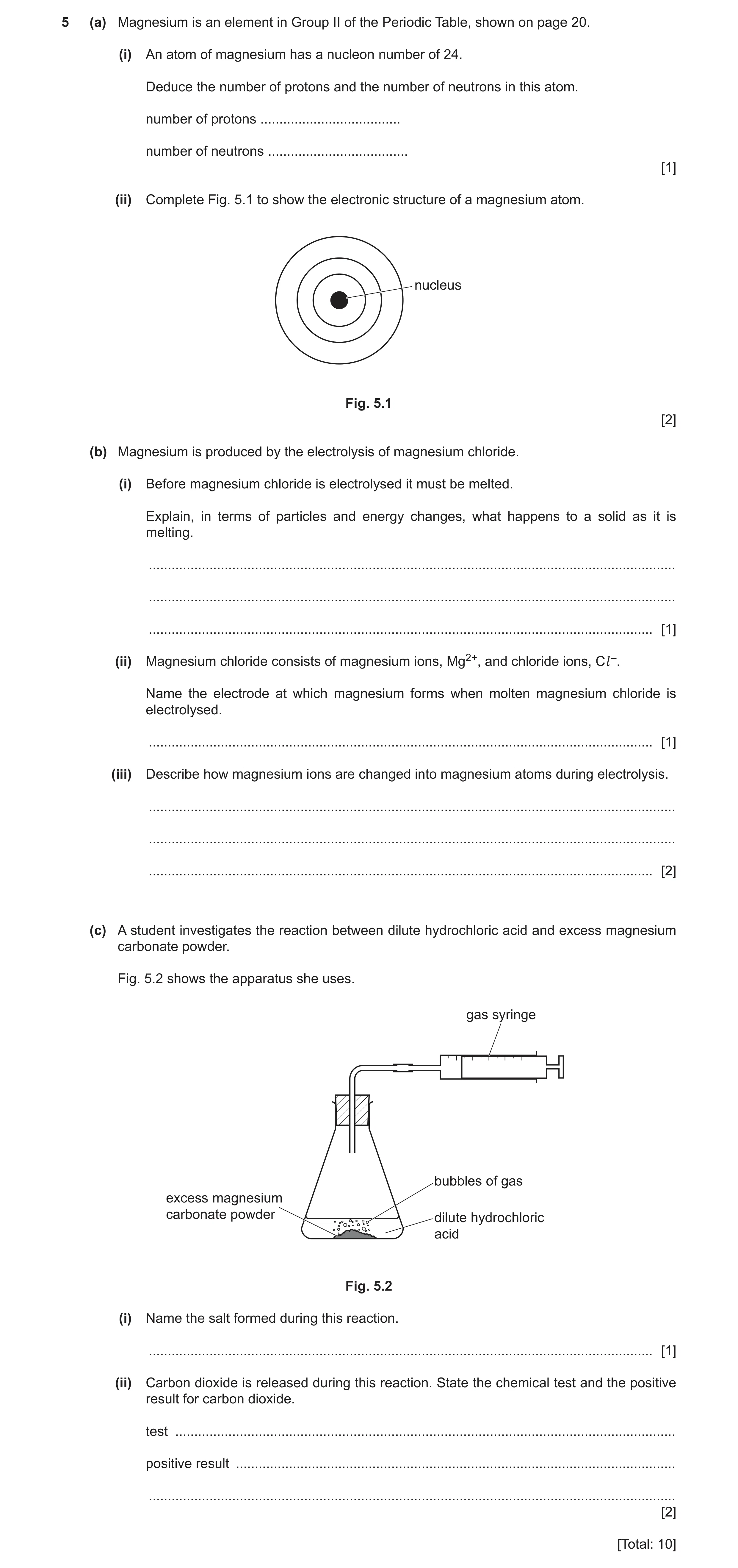
5 (a) Magnesium is an element in Group II of the Periodic Table, shown on page 20. (i) An atom of magnesium has a nucleon number of 24. Deduce the number of protons and the number of neutrons in this atom. number of protons … number of neutrons … [1] (ii) Complete Fig. 5.1 to show the electronic structure of a magnesium atom. nucleus Fig. 5.1 [2] (b) Magnesium is produced by the electrolysis of magnesium chloride. (i) Before magnesium chloride is electrolysed it must be melted. Explain, in terms of particles and energy changes, what happens to a solid as it is melting. … … … [1] (ii) Magnesium chloride consists of magnesium ions, Mg2+, and chloride ions, Cl –. Name the electrode at which magnesium forms when molten magnesium chloride is electrolysed. … [1] (iii) Describe how magnesium ions are changed into magnesium atoms during electrolysis. … … … [2] (c) A student investigates the reaction between dilute hydrochloric acid and excess magnesium carbonate powder. Fig. 5.2 shows the apparatus she uses. gas syringe bubbles of gas excess magnesium carbonate powder dilute hydrochloric acid Fig. 5.2 (i) Name the salt formed during this reaction. … [1] (ii) Carbon dioxide is released during this reaction. State the chemical test and the positive result for carbon dioxide. test … positive result … … [2] [Total: 10]
10 marks
Mark scheme: 5(a)(i) number of protons = 12 and number of neutrons = 12 ; 1 5(a)(ii) 12 electrons shown ; 2,8,2 configuration shown ; 2 5(b)(i) (thermal) energy absorbed which decreases inter-particle forces / allows particles to separate / move around freely ; 1 5(b)(ii) cathode ; 1 5(b)(iii) gain electrons ; (gain) two (electrons) ; 2 Question Answer Marks 5(c)(i) magnesium chloride ; 1 5(c)(ii) limewater ; goes cloudy / milky ; 2
This question in 0653/43 May/June 2019
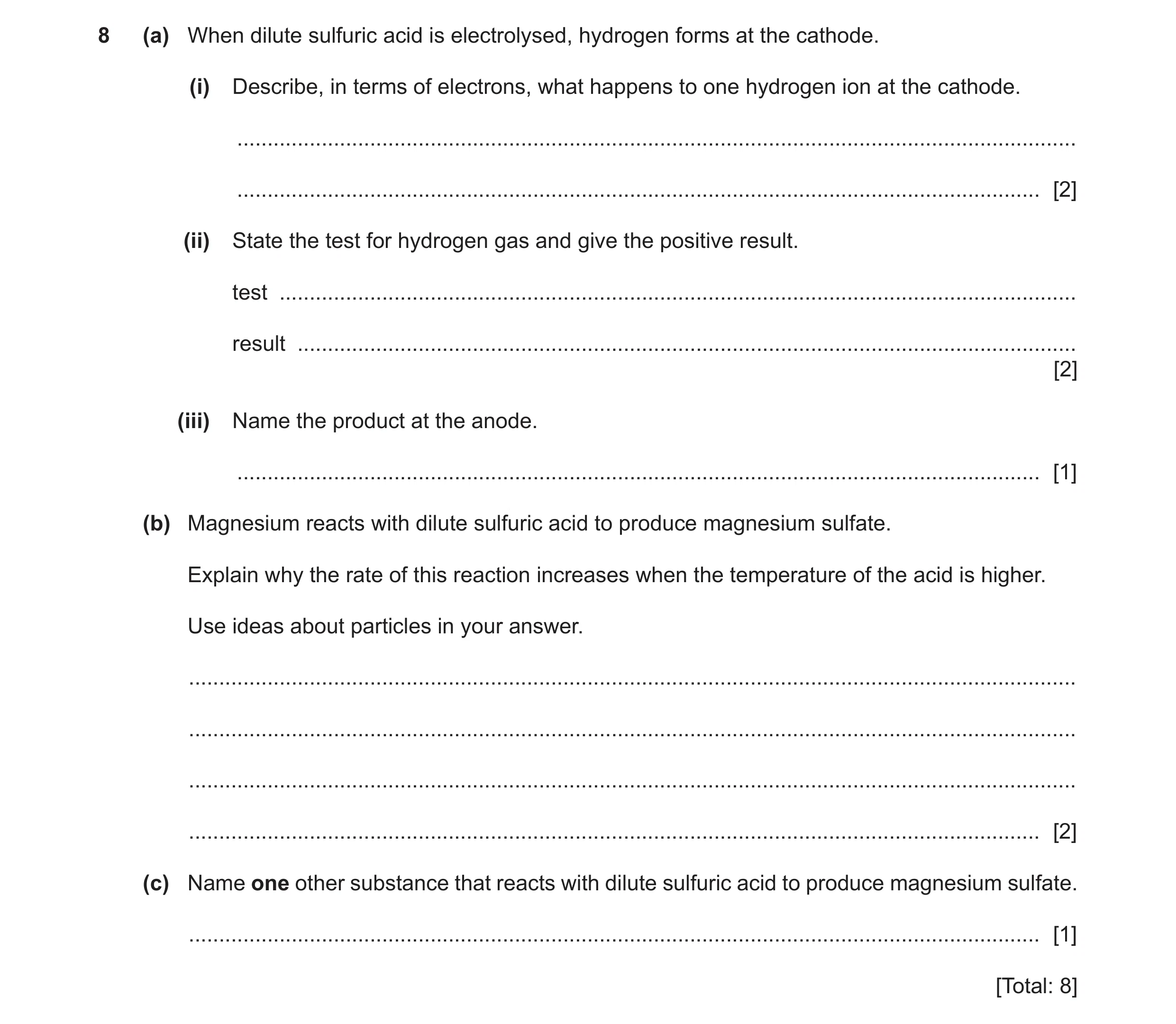
Q9 · When dilute sulfuric acid is electrolysed, hydrogen forms at the cathode 0653/41 May/June 2020
8 (a) When dilute sulfuric acid is electrolysed, hydrogen forms at the cathode. (i) Describe, in terms of electrons, what happens to one hydrogen ion at the cathode. … … [2] (ii) State the test for hydrogen gas and give the positive result. test … result … [2] (iii) Name the product at the anode. … [1] (b) Magnesium reacts with dilute sulfuric acid to produce magnesium sulfate. Explain why the rate of this reaction increases when the temperature of the acid is higher. Use ideas about particles in your answer. … … … … [2] (c) Name one other substance that reacts with dilute sulfuric acid to produce magnesium sulfate. … [1] [Total: 8]
8 marks
Mark scheme: 8(a)(i) (hydrogen ion) gains ; one electron ; 2 8(a)(ii) (test) lighted splint ; (result) goes pop ; 2 8(a)(iii) oxygen ; 1 8(b) any two from: particles, move faster / have more kinetic energy / move more ; particles, collide more frequently / more energetically ; more of the collisions provide the activation energy ; max 2 8(c) magnesium oxide / magnesium carbonate / magnesium hydroxide ; 1
This question in 0653/41 May/June 2020
Q10 · The equation for the reaction between magnesium carbonate and dilute hydrochloric acid is… 0653/42 May/June 2020
5 The equation for the reaction between magnesium carbonate and dilute hydrochloric acid is shown. MgCO3 + 2HCl → MgCl2 + CO2 + H2O (a) The reaction between magnesium carbonate and dilute hydrochloric acid is exothermic. The energy level diagram for this reaction is shown in Fig. 5.1. energy reaction progress Fig. 5.1 (i) On Fig. 5.1, write the words reactants and products in suitable places. [1] (ii) On Fig. 5.1, draw a double headed arrow (↕) to show the activation energy for this reaction. [1] (b) A student investigates the effect of temperature on the rate of reaction between magnesium carbonate and dilute hydrochloric acid. She uses acid with a temperature of 20 °C. She measures the volume of carbon dioxide produced. (i) Fig. 5.2 is a graph of her results. volume of gas 20 °C 0 0 time Fig. 5.2 On Fig. 5.2, sketch a graph of the results she obtains when she repeats the experiment at a temperature of 30 °C. All other variables are kept constant. [2] (ii) Explain your answer to (b)(i) using ideas about particle collisions. … … … [2] (c) Carbon dioxide is one product of the reaction between magnesium carbonate and dilute hydrochloric acid. Explain why scientists are concerned about an increase in the concentration of carbon dioxide in the atmosphere. … … … … [2] (d) Magnesium chloride is another product of the reaction between magnesium carbonate and dilute hydrochloric acid. State one substance, other than magnesium carbonate, that reacts with dilute hydrochloric acid to produce magnesium chloride. … [1] [Total: 9]
9 marks
Mark scheme: 5(a)(i) reactants on left and products on right ; 1 5(a)(ii) activation energy correctly identified ; 1 5(b)(i) steeper ; finish at same volume ; 2 5(b)(ii) particles move faster / have more kinetic energy / move more ; particles collide more frequently / more energetically ; 2 5(c) carbon dioxide is a greenhouse gas ; (which contributes to) enhanced greenhouse effect / global warming / climate change ; 2 5(d) magnesium / magnesium oxide / magnesium hydroxide ; 1
This question in 0653/42 May/June 2020
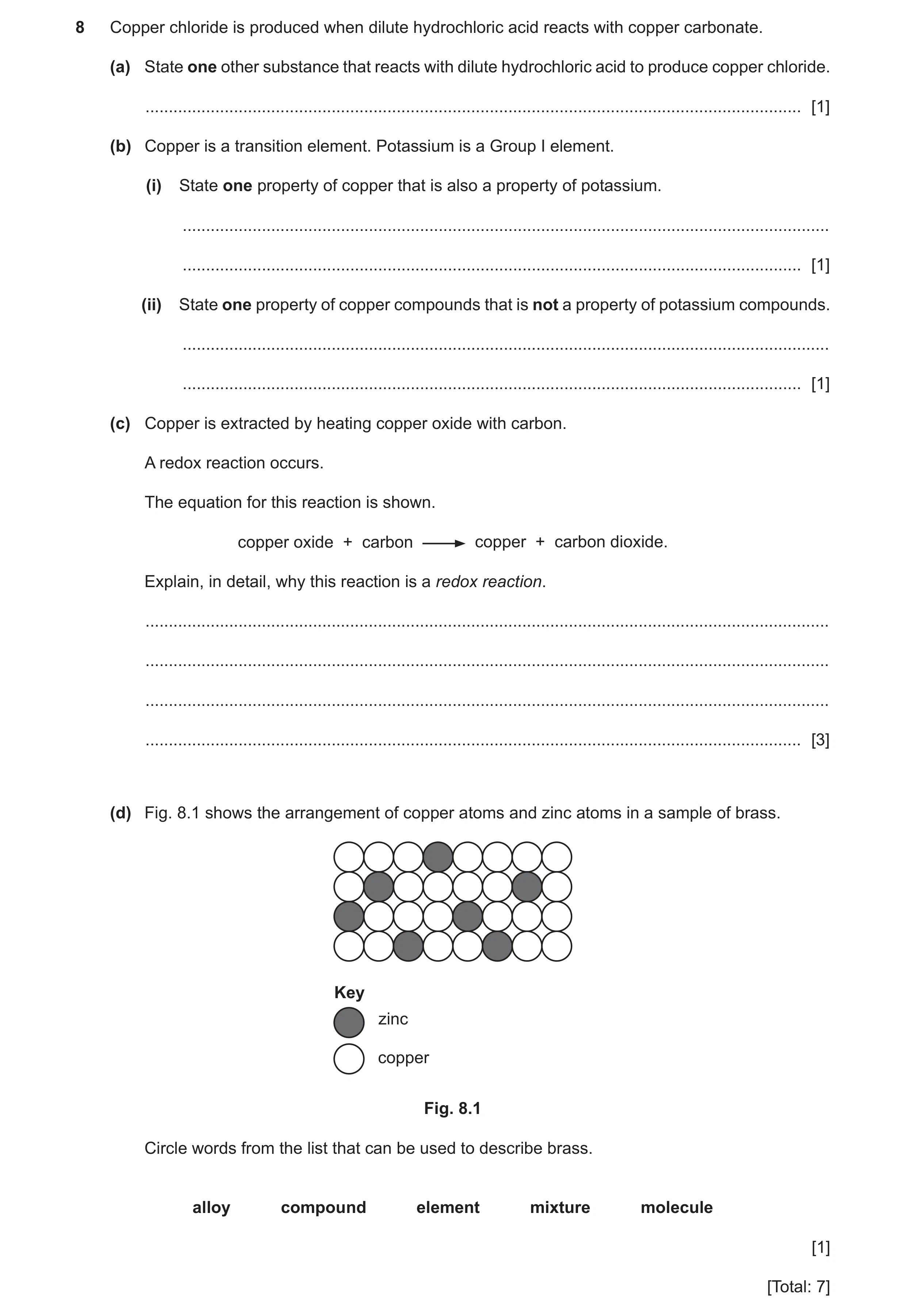
Q11 · Copper chloride is produced when dilute hydrochloric acid reacts with copper carbonate 0653/41 Oct/Nov 2020
8 Copper chloride is produced when dilute hydrochloric acid reacts with copper carbonate. (a) State one other substance that reacts with dilute hydrochloric acid to produce copper chloride. … [1] (b) Copper is a transition element. Potassium is a Group I element. (i) State one property of copper that is also a property of potassium. … … [1] (ii) State one property of copper compounds that is not a property of potassium compounds. … … [1] (c) Copper is extracted by heating copper oxide with carbon. A redox reaction occurs. The equation for this reaction is shown. copper oxide + carbon copper + carbon dioxide. Explain, in detail, why this reaction is a redox reaction. … … … … [3] (d) Fig. 8.1 shows the arrangement of copper atoms and zinc atoms in a sample of brass. Key zinc copper Fig. 8.1 Circle words from the list that can be used to describe brass. alloy compound element mixture molecule [1] [Total: 7]
7 marks
Mark scheme: 8(a) copper oxide / copper sulfide ; 1 8(b)(i) solid (at RT) / high density / malleable / ductile / shiny / (good) conductor of, heat / electricity ; 1 8(b)(ii) coloured (other than white) / reference to catalysis ; 1 8(c) reduction and oxidation both occur (redox) ; copper oxide is reduced / carbon is oxidised ; copper oxide loses oxygen / carbon gains oxygen ; 3 8(d) alloy AND mixture both circled ; 1
This question in 0653/41 Oct/Nov 2020
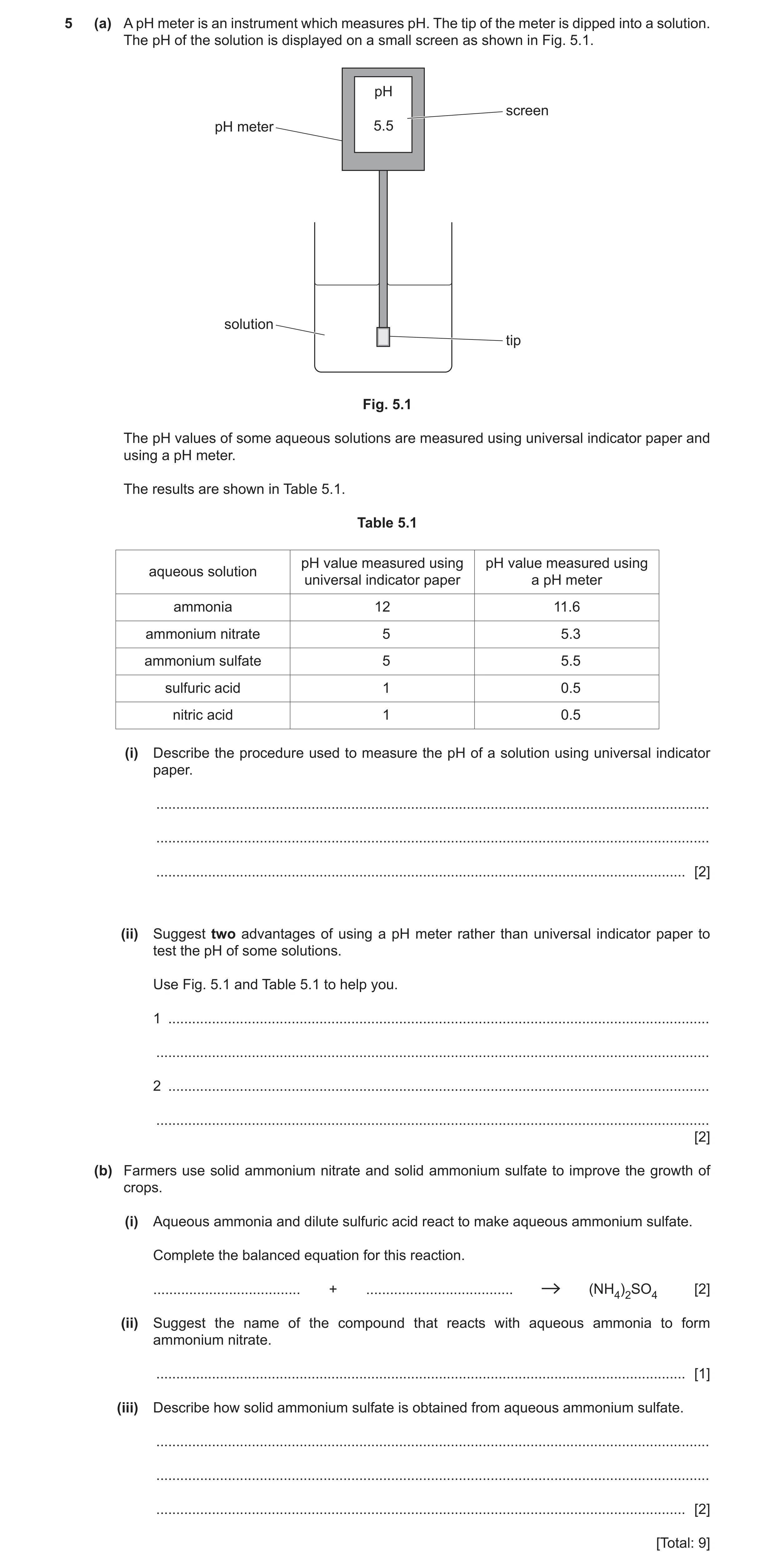
Q12 · A pH meter is an instrument which measures pH 0653/41 May/June 2022
5 (a) A pH meter is an instrument which measures pH. The tip of the meter is dipped into a solution. The pH of the solution is displayed on a small screen as shown in Fig. 5.1. pH screen pH meter 5.5 solution tip Fig. 5.1 The pH values of some aqueous solutions are measured using universal indicator paper and using a pH meter. The results are shown in Table 5.1. Table 5.1 pH value measured using pH value measured using aqueous solution universal indicator paper a pH meter ammonia 12 11.6 ammonium nitrate 5 5.3 ammonium sulfate 5 5.5 sulfuric acid 1 0.5 nitric acid 1 0.5 (i) Describe the procedure used to measure the pH of a solution using universal indicator paper. … … … [2] (ii) Suggest two advantages of using a pH meter rather than universal indicator paper to test the pH of some solutions. Use Fig. 5.1 and Table 5.1 to help you. 1 … … 2 … … [2] (b) Farmers use solid ammonium nitrate and solid ammonium sulfate to improve the growth of crops. (i) Aqueous ammonia and dilute sulfuric acid react to make aqueous ammonium sulfate. Complete the balanced equation for this reaction. … + … (NH4)2SO4 [2] (ii) Suggest the name of the compound that reacts with aqueous ammonia to form ammonium nitrate. … [1] (iii) Describe how solid ammonium sulfate is obtained from aqueous ammonium sulfate. … … … [2] [Total: 9]
9 marks
Mark scheme: 5(a)(i) (dip paper in) and observe the colour ; compare colour to a chart / idea that colour indicates the pH ; 2 5(a)(ii) gives a value to one decimal place idea / idea of greater precision of measurements ; do not need to use a reference chart / can be reused / avoids the uncertainly of judging colours ; 2 5(b)(i) 2NH3 + H2SO4 formula of both correct ; balancing correct dependent on correct formulae ; 2 5(b)(ii) nitric acid ; 1 5(b)(iii) leave in warm place / heat ; evaporate water ; 2
This question in 0653/41 May/June 2022
Q13 · Solid magnesium sulfate, MgSO4, dissolves to form aqueous magnesium sulfate 0653/42 Feb/March 2023
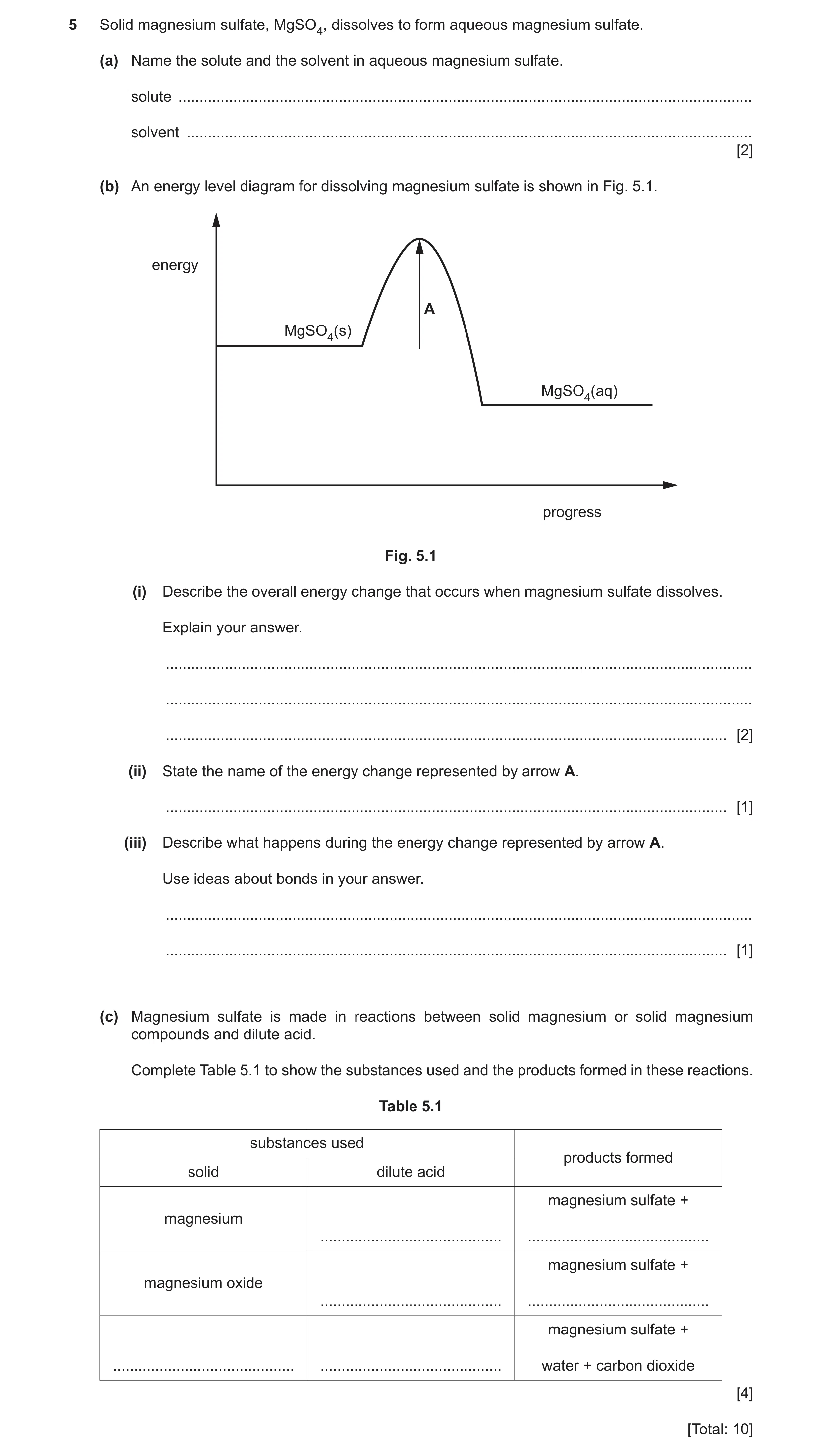
5 Solid magnesium sulfate, MgSO4, dissolves to form aqueous magnesium sulfate. (a) Name the solute and the solvent in aqueous magnesium sulfate. solute … solvent … [2] (b) An energy level diagram for dissolving magnesium sulfate is shown in Fig. 5.1. energy A MgSO4(s) MgSO4(aq) progress Fig. 5.1 (i) Describe the overall energy change that occurs when magnesium sulfate dissolves. Explain your answer. … … … [2] (ii) State the name of the energy change represented by arrow A. … [1] (iii) Describe what happens during the energy change represented by arrow A. Use ideas about bonds in your answer. … … [1] (c) Magnesium sulfate is made in reactions between solid magnesium or solid magnesium compounds and dilute acid. Complete Table 5.1 to show the substances used and the products formed in these reactions. Table 5.1 substances used products formed solid dilute acid magnesium sulfate + magnesium … … magnesium sulfate + magnesium oxide … … magnesium sulfate + … … water + carbon dioxide [4] [Total: 10]
10 marks
Mark scheme: 5(a) solute: (solid) magnesium sulfate ; 2 solvent: water ; 5(b)(i) exothermic / energy is given out ; 2 products are lower than reactants / products have less energy than reactants ; 5(b)(ii) activation energy ; 1 5(b)(iii) bonds are being broken ; 1 5(c) sulfuric acid in all three rows ; 4 hydrogen ; water ; magnesium carbonate ;
This question in 0653/42 Feb/March 2023
Q14 · Magnesium chloride is a soluble salt 0653/42 Oct/Nov 2023
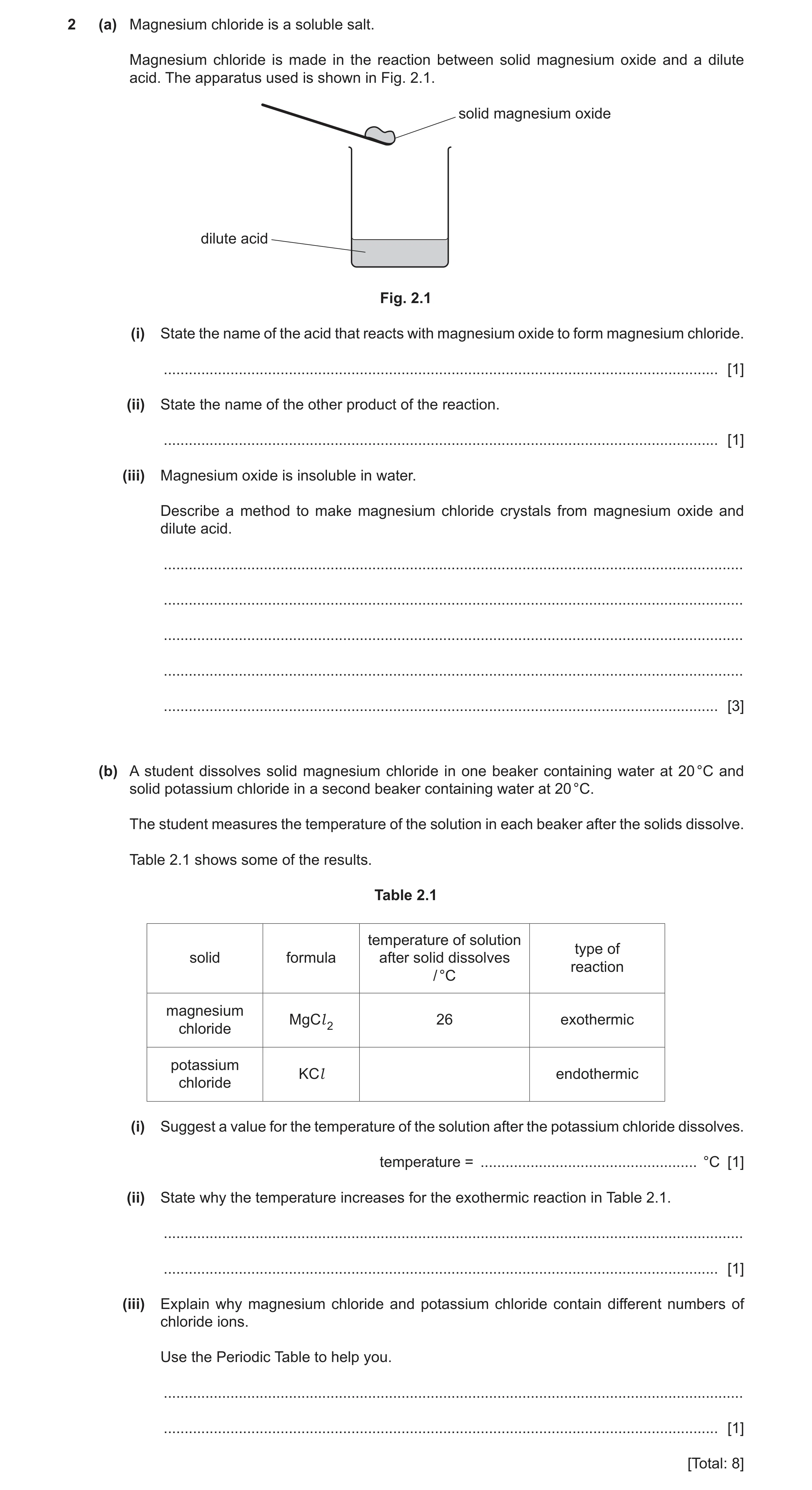
2 (a) Magnesium chloride is a soluble salt. Magnesium chloride is made in the reaction between solid magnesium oxide and a dilute acid. The apparatus used is shown in Fig. 2.1. solid magnesium oxide dilute acid Fig. 2.1 (i) State the name of the acid that reacts with magnesium oxide to form magnesium chloride. … [1] (ii) State the name of the other product of the reaction. … [1] (iii) Magnesium oxide is insoluble in water. Describe a method to make magnesium chloride crystals from magnesium oxide and dilute acid. … … … … … [3] (b) A student dissolves solid magnesium chloride in one beaker containing water at 20 °C and solid potassium chloride in a second beaker containing water at 20 °C. The student measures the temperature of the solution in each beaker after the solids dissolve. Table 2.1 shows some of the results. Table 2.1 temperature of solution type of solid formula after solid dissolves reaction / °C magnesium MgCl 2 26 exothermic chloride potassium KCl endothermic chloride (i) Suggest a value for the temperature of the solution after the potassium chloride dissolves. temperature = … °C [1] (ii) State why the temperature increases for the exothermic reaction in Table 2.1. … … [1] (iii) Explain why magnesium chloride and potassium chloride contain different numbers of chloride ions. Use the Periodic Table to help you. … … [1] [Total: 8]
8 marks
Mark scheme: 2(a)(i) hydrochloric (acid) ; 1 2(a)(ii) water ; 1 2(a)(iii) add excess MgO / add MgO until no more dissolves ; 3 filter (to remove excess MgO) ; evaporate (some) water / heat to remove (some) water / heat to saturation point / heat to crystallisation point ; 2(b)(i) temperature greater than 0 °C and below 20 °C ; 1 2(b)(ii) because, heat / (thermal) energy, is released ; 1 2(b)(iii) idea that Mg and K are in different groups OR have different numbers of electrons in their outer shells OR different 1 valences OR they form ions with different charges ;
This question in 0653/42 Oct/Nov 2023
Q15 · Solid magnesium and some magnesium compounds react with dilute acids to make salts 0653/42 May/June 2024
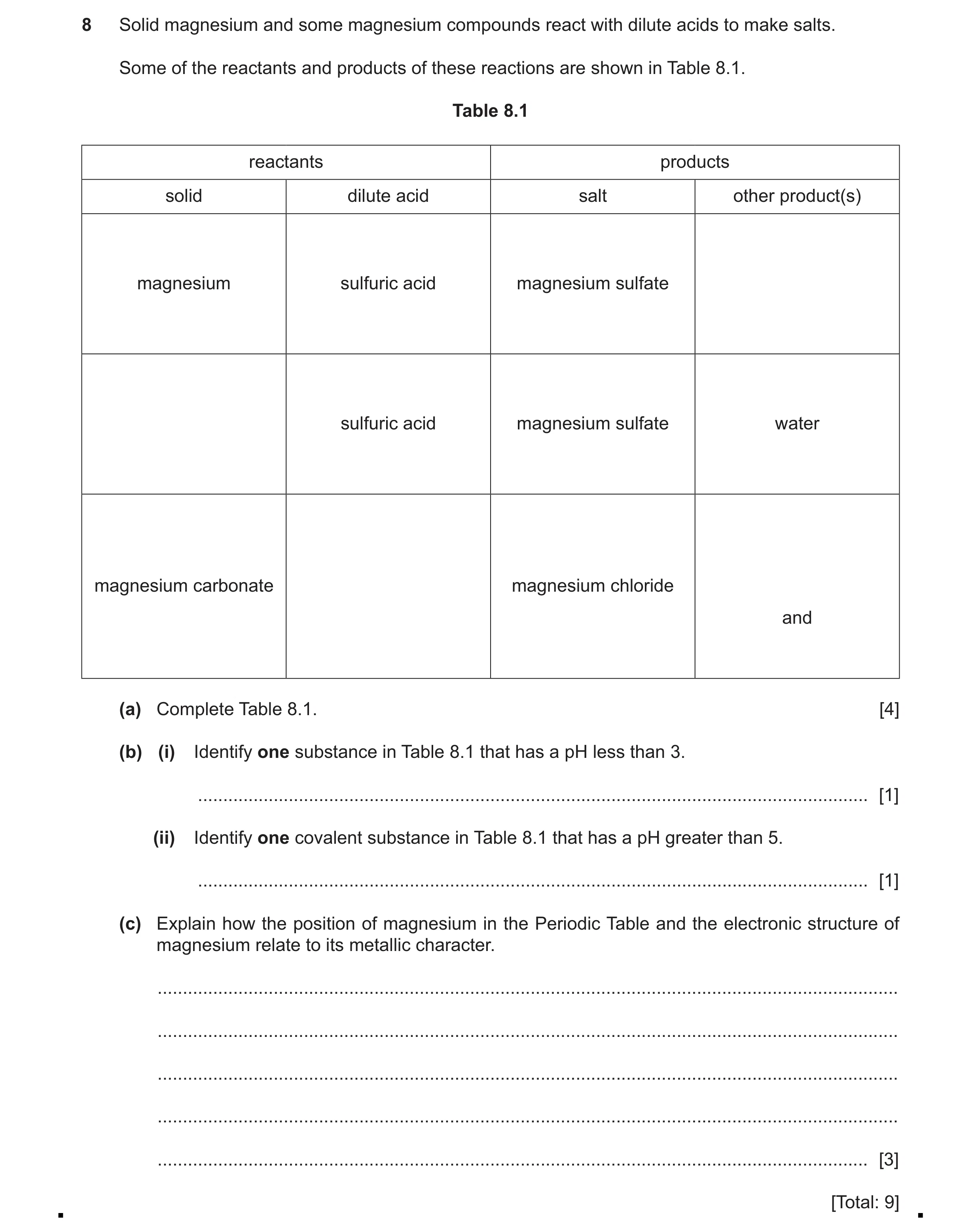
8 Solid magnesium and some magnesium compounds react with dilute acids to make salts. Some of the reactants and products of these reactions are shown in Table 8.1. Table 8.1 reactants products solid dilute acid salt other product(s) magnesium sulfuric acid magnesium sulfate sulfuric acid magnesium sulfate water magnesium carbonate magnesium chloride and (a) Complete Table 8.1. [4] (b) (i) Identify one substance in Table 8.1 that has a pH less than 3. … [1] (ii) Identify one covalent substance in Table 8.1 that has a pH greater than 5. … [1] (c) Explain how the position of magnesium in the Periodic Table and the electronic structure of magnesium relate to its metallic character. … … … … … [3] [Total: 9]
9 marks
Mark scheme: 8(a) hydrogen / H2 ; magnesium oxide / MgO / magnesium hydroxide / Mg(OH)2 ; hydrochloric acid / HCl ; carbon dioxide AND water / CO2 AND H2O ; 4 8(b)(i) sulfuric acid / hydrochloric acid ; 1 8(b)(ii) water ; 1 Question Answer Marks 8(c) any three from: magnesium is in Group II ; magnesium has two electrons in the outer shell ; metals are on left of the Periodic Table ; metals have, low / 1–3, electrons in the outer shells ; 3
This question in 0653/42 May/June 2024
Q16 · Zinc and some zinc compounds react with dilute acids to make salts 0653/43 May/June 2024
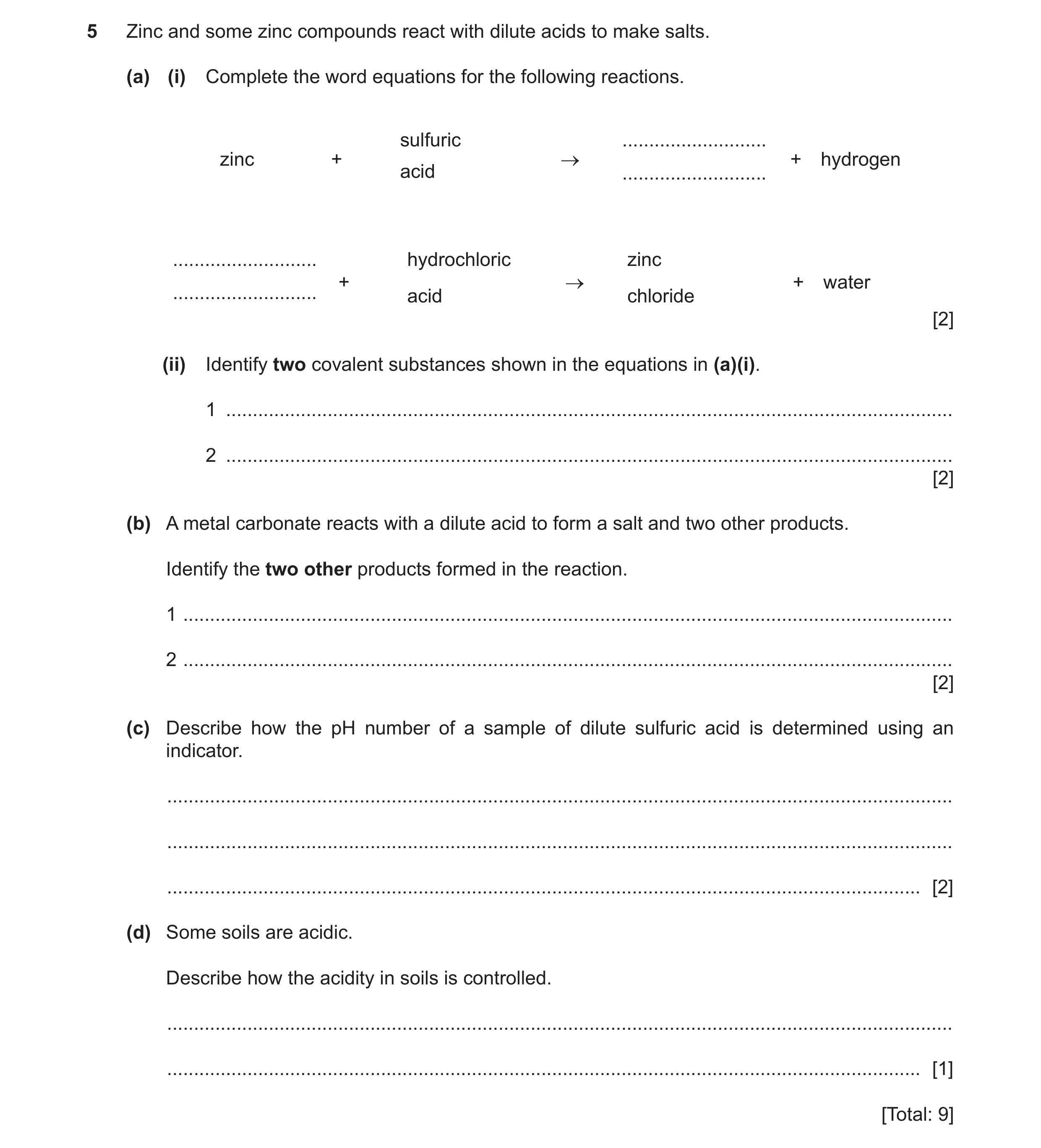
5 Zinc and some zinc compounds react with dilute acids to make salts. (a) (i) Complete the word equations for the following reactions. sulfuric … zinc + + hydrogen acid … … hydrochloric zinc + + water … acid chloride [2] (ii) Identify two covalent substances shown in the equations in (a)(i). 1 … 2 … [2] (b) A metal carbonate reacts with a dilute acid to form a salt and two other products. Identify the two other products formed in the reaction. 1 … 2 … [2] (c) Describe how the pH number of a sample of dilute sulfuric acid is determined using an indicator. … … … [2] (d) Some soils are acidic. Describe how the acidity in soils is controlled. … … [1] [Total: 9]
9 marks
Mark scheme: 5(a)(i) zinc sulfate ; zinc oxide / zinc hydroxide ; 2 5(a)(ii) hydrogen ; water ; 2 5(b) carbon dioxide ; water ; 2 Question Answer Marks 5(c) full range / universal, indicator ; compare (colours) with chart / colour corresponds to a number ; 2 5(d) add, calcium carbonate / limestone / calcium hydroxide / (slaked) lime / add a base ; 1
This question in 0653/43 May/June 2024
Q17 · Silver chloride, magnesium chloride and sodium chloride are salts 0653/41 Oct/Nov 2024
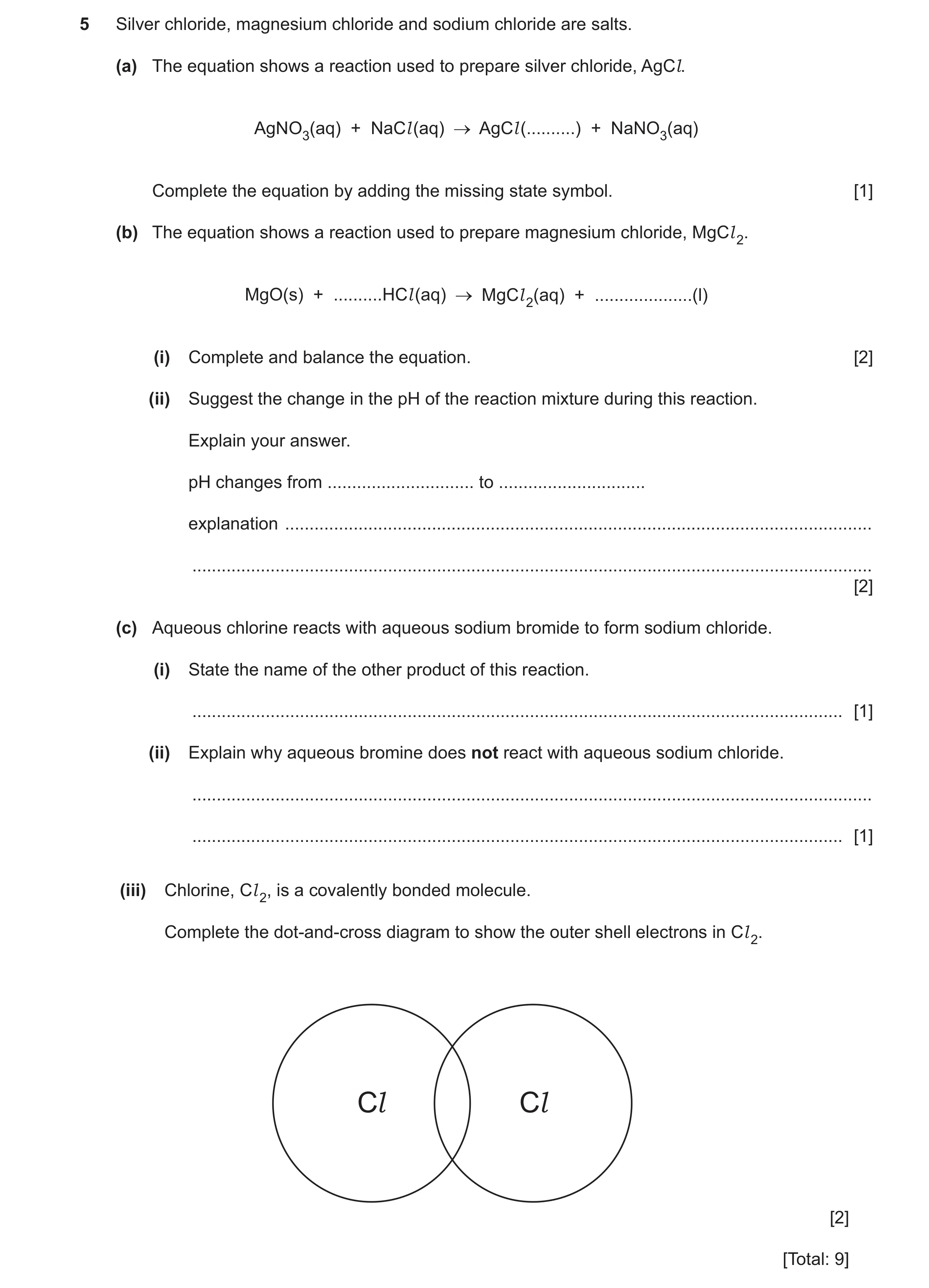
5 Silver chloride, magnesium chloride and sodium chloride are salts. (a) The equation shows a reaction used to prepare silver chloride, AgCl. AgNO3(aq) + NaCl (aq) AgCl ( … ) + NaNO3(aq) Complete the equation by adding the missing state symbol. [1] (b) The equation shows a reaction used to prepare magnesium chloride, MgCl 2. MgO(s) + … HCl (aq) MgCl 2(aq) + … (l) (i) Complete and balance the equation. [2] (ii) Suggest the change in the pH of the reaction mixture during this reaction. Explain your answer. pH changes from … to … explanation … … [2] (c) Aqueous chlorine reacts with aqueous sodium bromide to form sodium chloride. (i) State the name of the other product of this reaction. … [1] (ii) Explain why aqueous bromine does not react with aqueous sodium chloride. … … [1] (iii) Chlorine, Cl 2, is a covalently bonded molecule. Complete the dot-and-cross diagram to show the outer shell electrons in Cl 2. Cl Cl [2] [Total: 9]
9 marks
Mark scheme: 5(a) s ; 1 5(b)(i) 2HCl ; 2 H2O ; 5(b)(ii) from 1 – 3 to 4 – 7 ; 2 the idea that acid is being neutralised / used up ; 5(c)(i) bromine ; 1 5(c)(ii) bromine is less reactive than chlorine ORA ; 1 5(c)(iii) bonding pair shown ; 2 6 non-bonding electrons in each atom ;
This question in 0653/41 Oct/Nov 2024
Q18 · Carbon dioxide is a gas in air 0653/42 Oct/Nov 2024
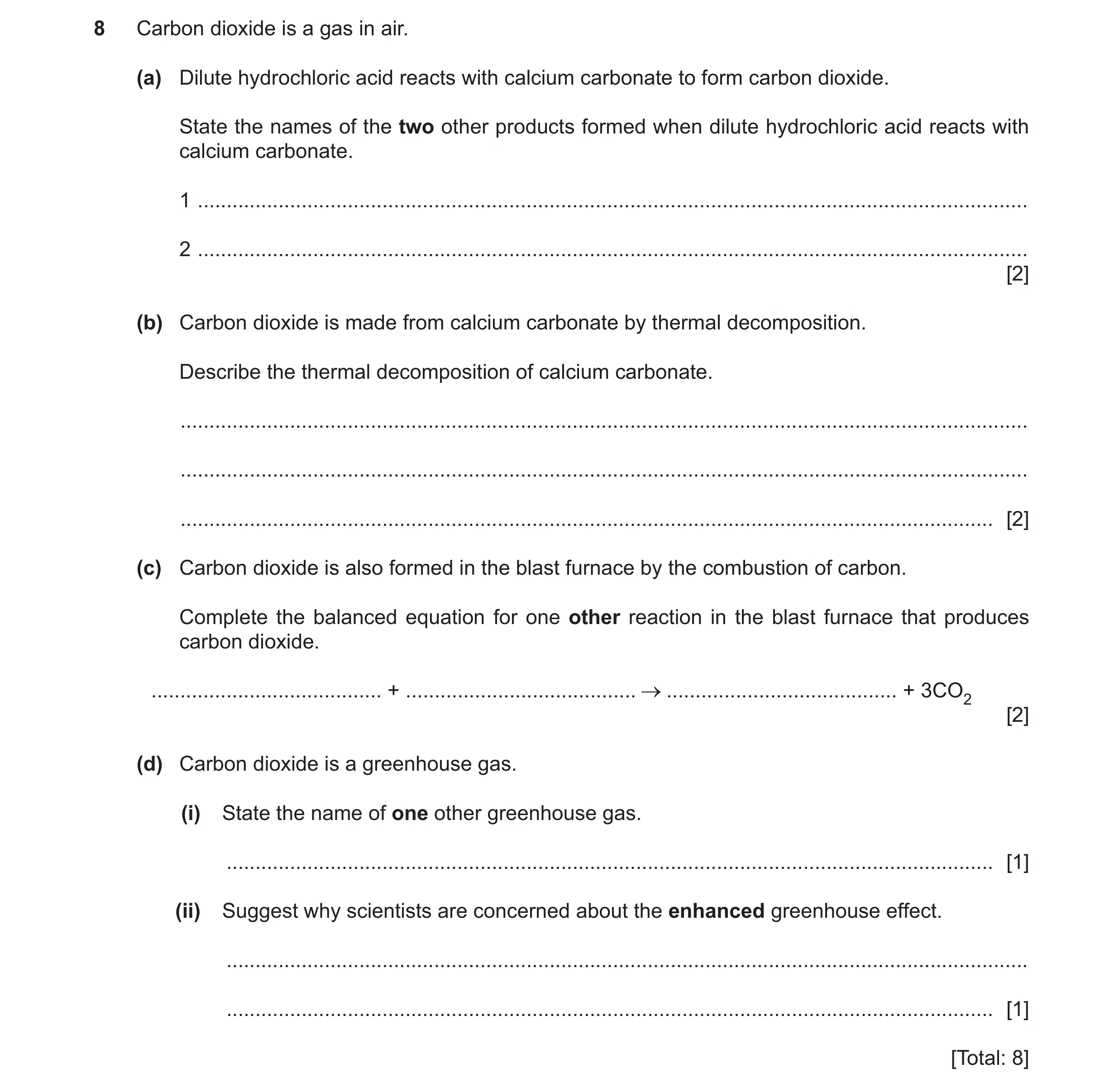
8 Carbon dioxide is a gas in air. (a) Dilute hydrochloric acid reacts with calcium carbonate to form carbon dioxide. State the names of the two other products formed when dilute hydrochloric acid reacts with calcium carbonate. 1 … 2 … [2] (b) Carbon dioxide is made from calcium carbonate by thermal decomposition. Describe the thermal decomposition of calcium carbonate. … … … [2] (c) Carbon dioxide is also formed in the blast furnace by the combustion of carbon. Complete the balanced equation for one other reaction in the blast furnace that produces carbon dioxide. … + … … + 3CO2 [2] (d) Carbon dioxide is a greenhouse gas. (i) State the name of one other greenhouse gas. … [1] (ii) Suggest why scientists are concerned about the enhanced greenhouse effect. … … [1] [Total: 8]
8 marks
Mark scheme: 8(a) calcium chloride ; 2 water ; 8(b) calcium carbonate is heated (to a high temperature) ; 2 (and) breaks down / breaks bonds / separates atoms ; 8(c) Fe2O3 + 3CO → 2Fe + (3CO2) 2 correct formulae ; balanced ; 8(d)(i) methane / AVP ; 1 8(d)(ii) increase in global temperature / climate change / named effect of climate change, e.g. ice caps melting, flooding, etc. ; 1
This question in 0653/42 Oct/Nov 2024
Q19 · This question is about ionic compounds 0653/41 May/June 2025
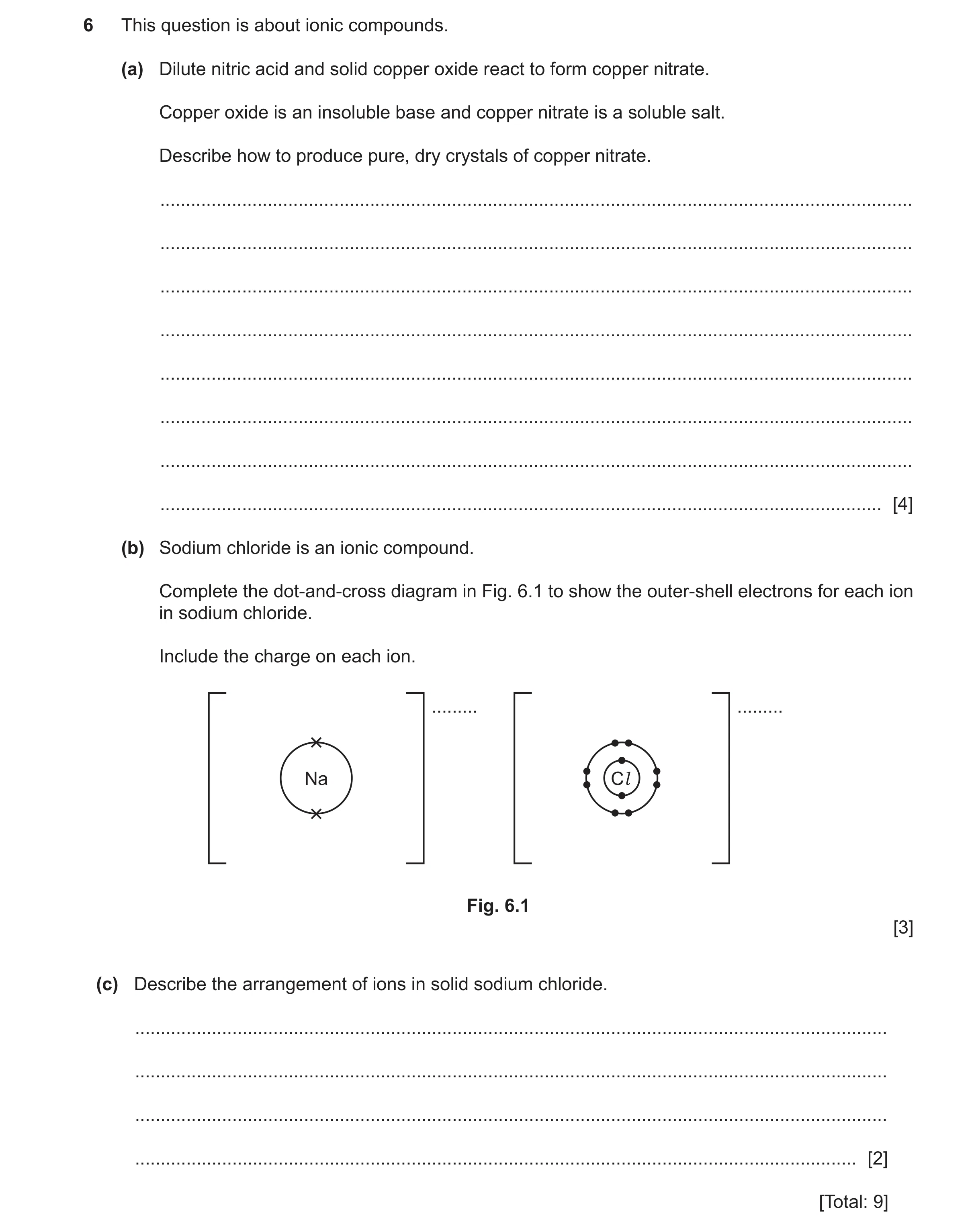
6 This question is about ionic compounds. (a) Dilute nitric acid and solid copper oxide react to form copper nitrate. Copper oxide is an insoluble base and copper nitrate is a soluble salt. Describe how to produce pure, dry crystals of copper nitrate. … … … … … … … … [4] (b) Sodium chloride is an ionic compound. Complete the dot‑and‑cross diagram in Fig. 6.1 to show the outer‑shell electrons for each ion in sodium chloride. Include the charge on each ion. … … Na Cl Fig. 6.1 [3] (c) Describe the arrangement of ions in solid sodium chloride. … … … … [2] [Total: 9]
9 marks
Mark scheme: 6(a) add excess copper oxide (to the acid) ; 4 filter (to remove the excess copper oxide) ; evaporate (some) water ; filter crystals / separate crystals / method of drying crystals slowly (e.g. warm oven / between filter paper / leave in an open space) ; 6(b) sodium with 8 crosses in outer shell ; 3 chloride with 7 dots and 1 cross in outer shell ; (1)+ and (1)− charges ; 6(c) (giant) lattice / regular ; 2 (ions are) alternating ;
This question in 0653/41 May/June 2025
Q20 · Sodium fluoride, NaF, is an ionic compound 0653/42 May/June 2025
4 Sodium fluoride, NaF, is an ionic compound. (a) Tick (3) all the boxes that are properties of sodium fluoride. high boiling point insoluble in water conducts electricity when solid [1] (b) Complete the dot-and-cross diagram in Fig. 4.1 to show the outer-shell electrons for each ion in sodium fluoride. Include the charge on each ion. … … Na F Fig. 4.1 [3] (c) Fig. 4.2 shows equipment used in the electrolysis of molten sodium fluoride. power supply inert electrodes + – molten sodium fluoride Fig. 4.2 (i) Define electrolysis. … … … … [2] (ii) Predict the product formed at the: • positive electrode … • negative electrode. … [2] (d) Aqueous sodium fluoride reacts with aqueous silver nitrate, AgNO3, to form aqueous sodium nitrate, NaNO3, and one other product. Write the balanced symbol equation for this reaction. … [1] [Total: 9]
9 marks
Mark scheme: 4(a) high boiling point ; 1 4(b) sodium with 8 crosses in outer shell ; 3 fluoride with 7 dots and 1 cross in outer shell ; (1)+ and (1)− charges ; 4(c)(i) decomposition of an ionic compound (when molten or in aqueous solution) ; 2 by (the passage of an electric) current ; 4(c)(ii) positive electrode: fluorine / F2 ; 2 negative electrode: sodium / Na ; 4(d) NaF + AgNO3 → NaNO3 + AgF ; 1
This question in 0653/42 May/June 2025
Q21 · Chlorine is in Group VII of the Periodic Table 0653/43 May/June 2025
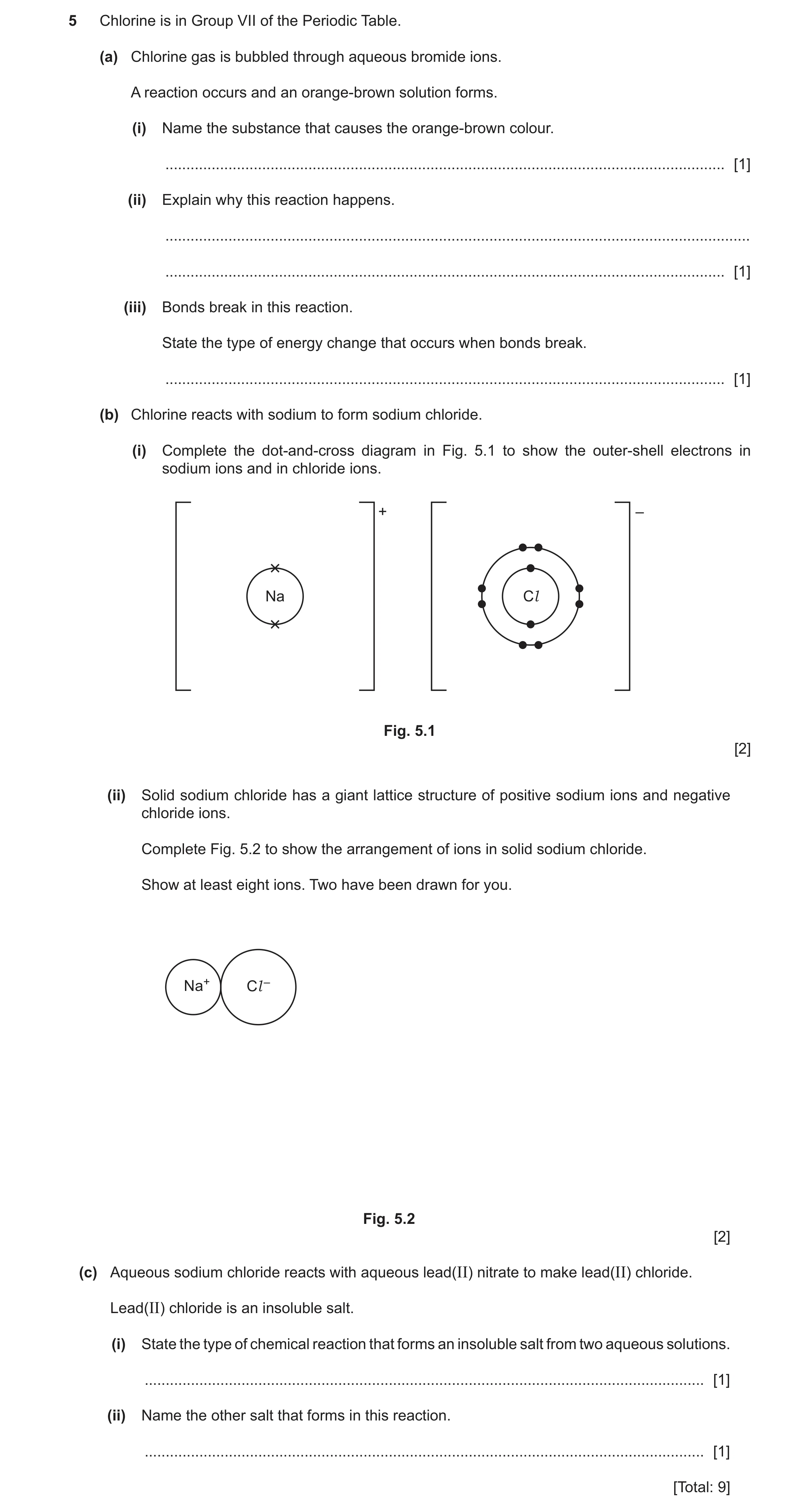
5 Chlorine is in Group VII of the Periodic Table. (a) Chlorine gas is bubbled through aqueous bromide ions. A reaction occurs and an orange-brown solution forms. (i) Name the substance that causes the orange-brown colour. … [1] (ii) Explain why this reaction happens. … … [1] (iii) Bonds break in this reaction. State the type of energy change that occurs when bonds break. … [1] (b) Chlorine reacts with sodium to form sodium chloride. (i) Complete the dot-and-cross diagram in Fig. 5.1 to show the outer-shell electrons in sodium ions and in chloride ions. + – Na Cl Fig. 5.1 [2] (ii) Solid sodium chloride has a giant lattice structure of positive sodium ions and negative chloride ions. Complete Fig. 5.2 to show the arrangement of ions in solid sodium chloride. Show at least eight ions. Two have been drawn for you. Na+ Cl – Fig. 5.2 [2] (c) Aqueous sodium chloride reacts with aqueous lead(II) nitrate to make lead(II) chloride. Lead(II) chloride is an insoluble salt. (i) State the type of chemical reaction that forms an insoluble salt from two aqueous solutions. … [1] (ii) Name the other salt that forms in this reaction. … [1] [Total: 9]
9 marks
Mark scheme: 5(a)(i) bromine ; 1 5(a)(ii) chlorine is more reactive than bromine ORA ; 1 5(a)(iii) endothermic ; 1 5(b)(i) sodium with 8 crosses in outer shell ; 2 chloride with 7 dots and 1 cross in outer shell ; 5(b)(ii) + and – ions alternate along a row or down a column ; 2 an adjacent row or column of correspondingly opposite ions ; 5(c)(i) precipitation ; 1 5(c)(ii) sodium nitrate ; 1 Question Answer Marks
This question in 0653/43 May/June 2025
Q22 · A student investigates the reaction between aqueous sodium hydroxide, NaOH, and dilute… 0653/42 Oct/Nov 2025
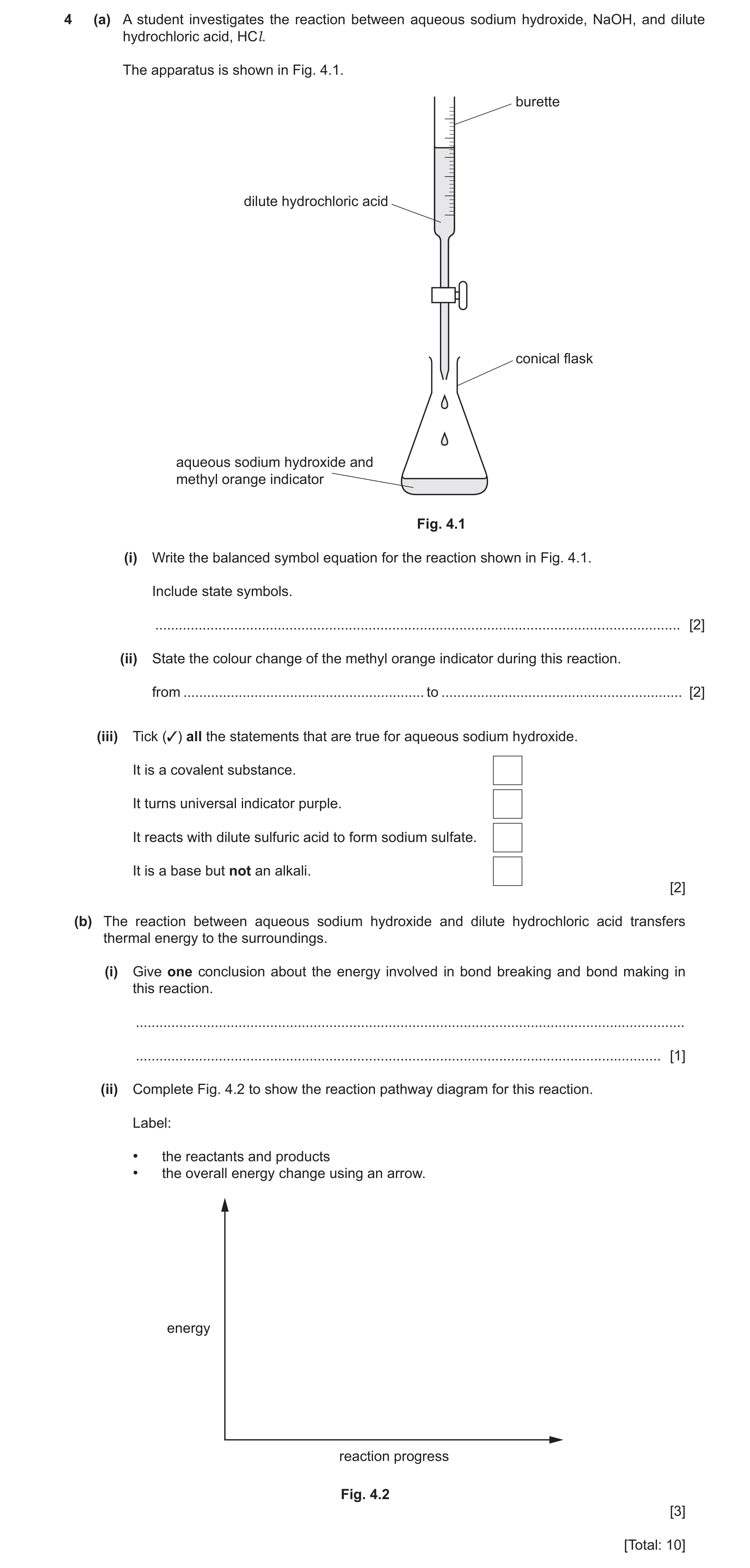
4 (a) A student investigates the reaction between aqueous sodium hydroxide, NaOH, and dilute hydrochloric acid, HCl. The apparatus is shown in Fig. 4.1. burette dilute hydrochloric acid conical flask aqueous sodium hydroxide and methyl orange indicator Fig. 4.1 (i) Write the balanced symbol equation for the reaction shown in Fig. 4.1. Include state symbols. … [2] (ii) State the colour change of the methyl orange indicator during this reaction. from … to … [2] (iii) Tick (✓) all the statements that are true for aqueous sodium hydroxide. It is a covalent substance. It turns universal indicator purple. It reacts with dilute sulfuric acid to form sodium sulfate. It is a base but not an alkali. [2] (b) The reaction between aqueous sodium hydroxide and dilute hydrochloric acid transfers thermal energy to the surroundings. (i) Give one conclusion about the energy involved in bond breaking and bond making in this reaction. … … [1] (ii) Complete Fig. 4.2 to show the reaction pathway diagram for this reaction. Label: • the reactants and products • the overall energy change using an arrow. energy reaction progress Fig. 4.2 [3] [Total: 10]
10 marks
Mark scheme: 4(a)(i) NaOH (aq) + HCl (aq) → NaCl (aq) + H2O(l) 2 fully correct equation ; correct state symbols ; 4(a)(ii) yellow ; 2 orange ; 4(a)(iii) ticks for: 2 turns universal indicator purple ; reacts with dilute sulfuric acid ; 4(b)(i) energy (released by) bond making is greater than needed/absorbed for bond breaking OR energy involved in bond making 1 is greater than energy involved in bond breaking ; 4(b)(ii) labelling: reactants or NaOH + HCl and products or NaCl + H2O ; 3 pathway shows activation energy peaking and products at a lower energy level than the reactants ; overall energy change shown as difference between reactants and products and downward arrow ;
This question in 0653/42 Oct/Nov 2025
 13 / 30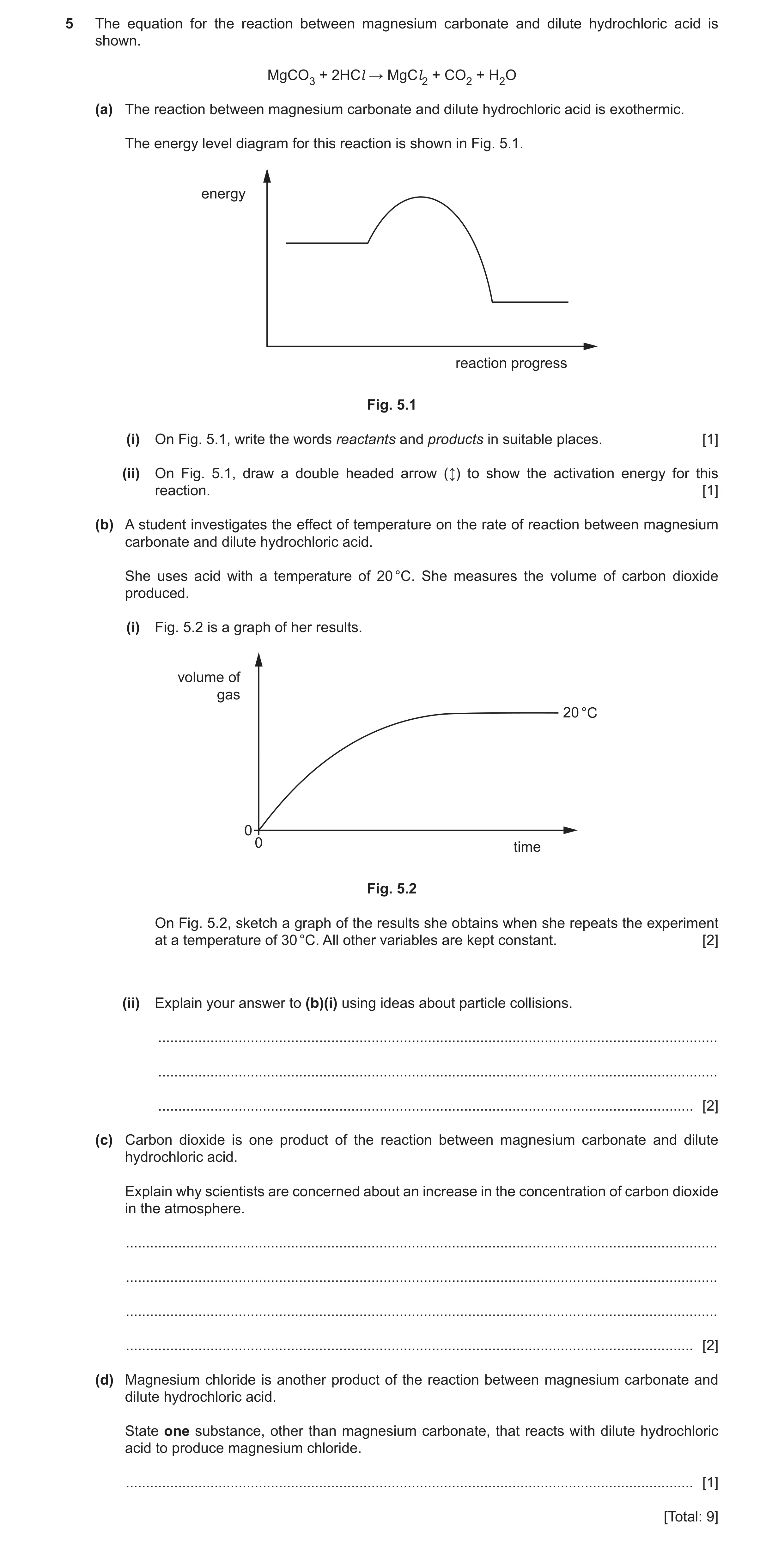
 21 / 30
 22 / 30
 23 / 30
 24 / 30
 25 / 30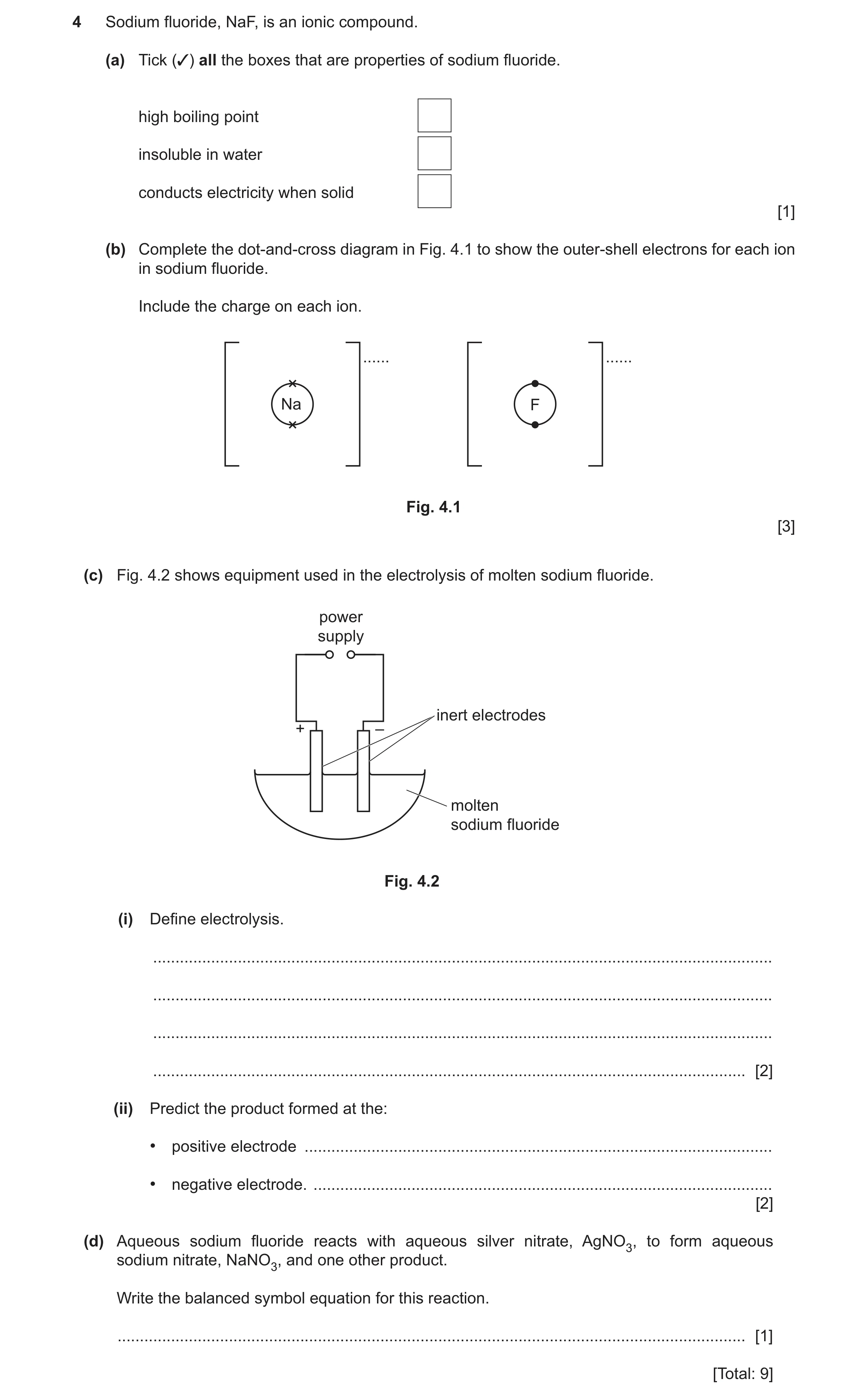
 11
11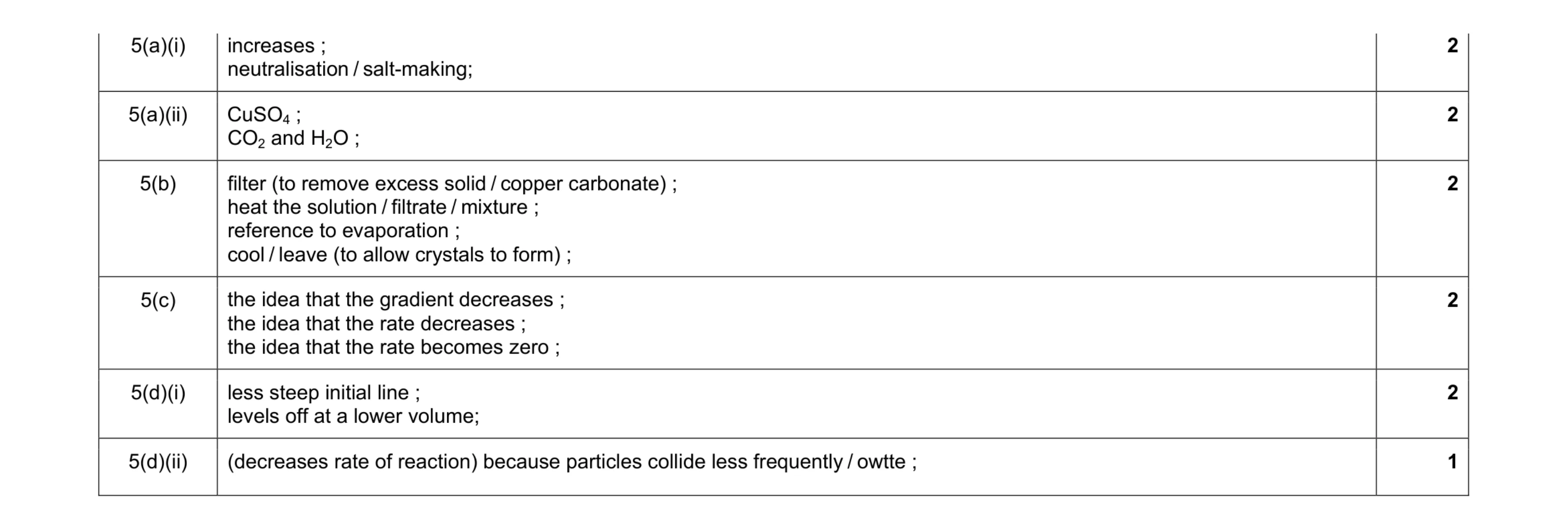 11
11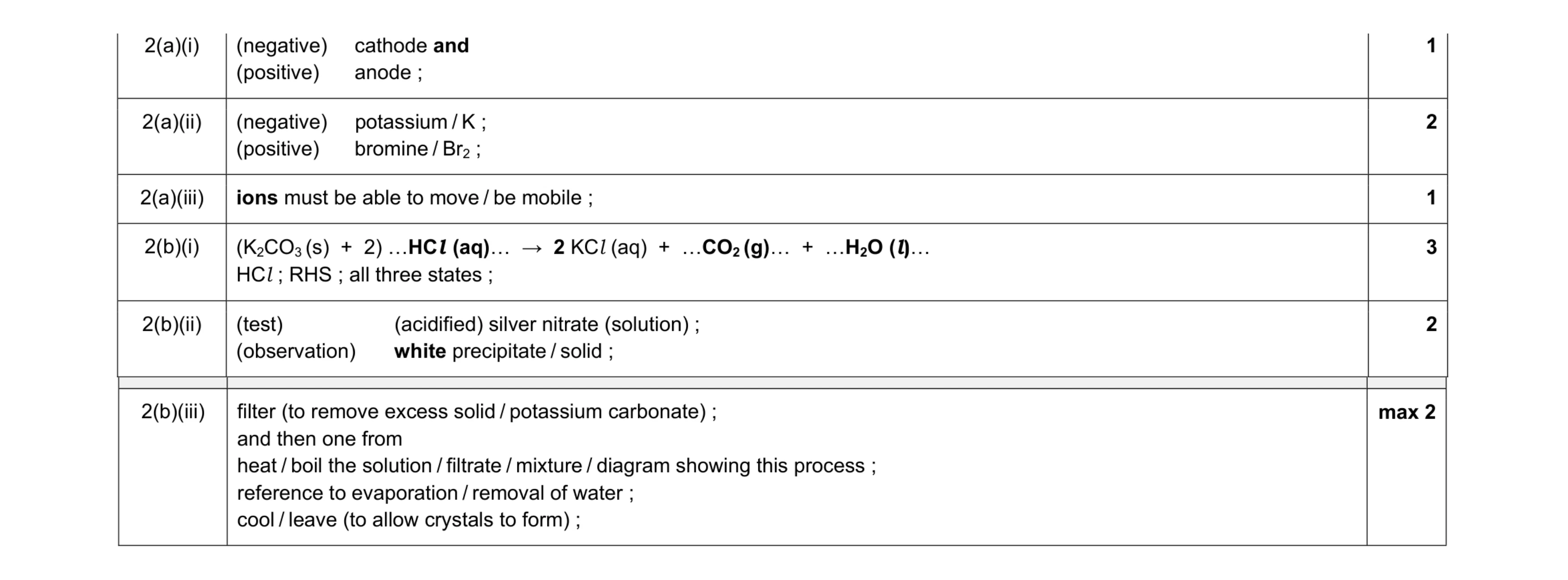 11
11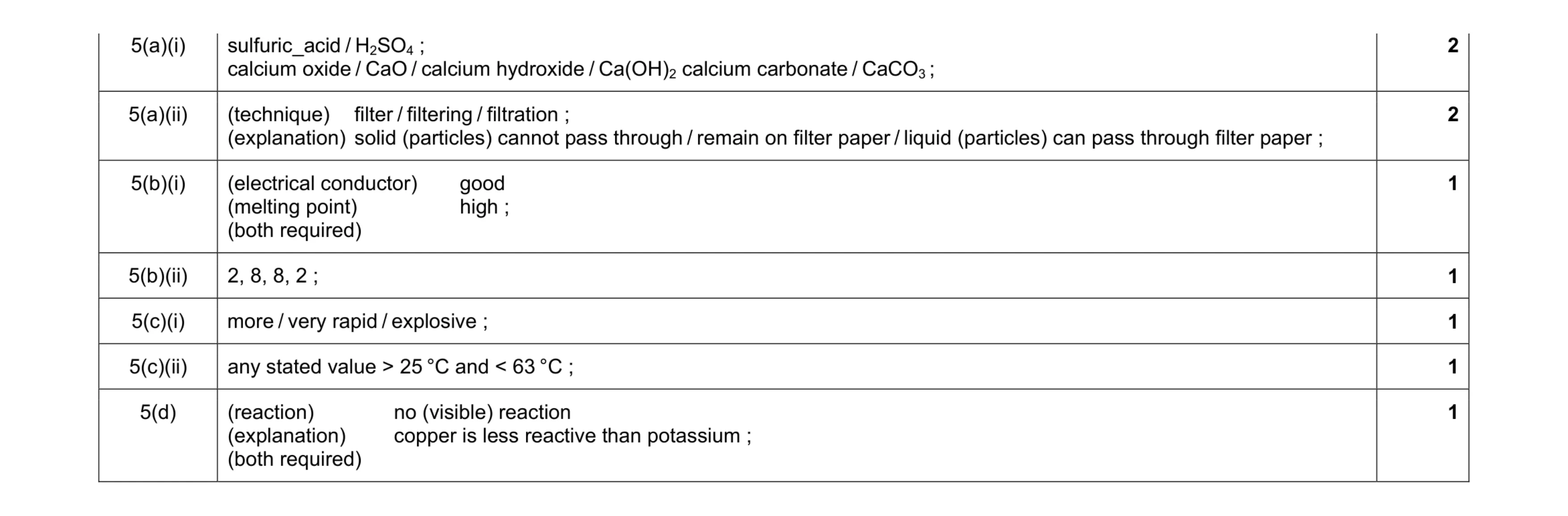 9
9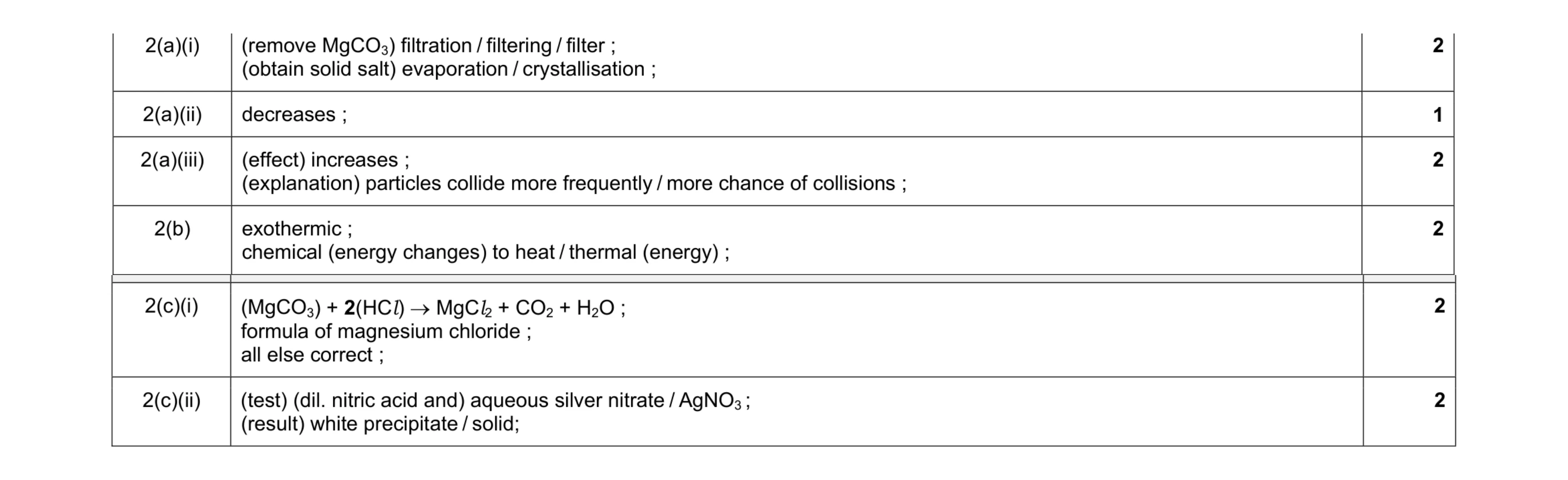 11
11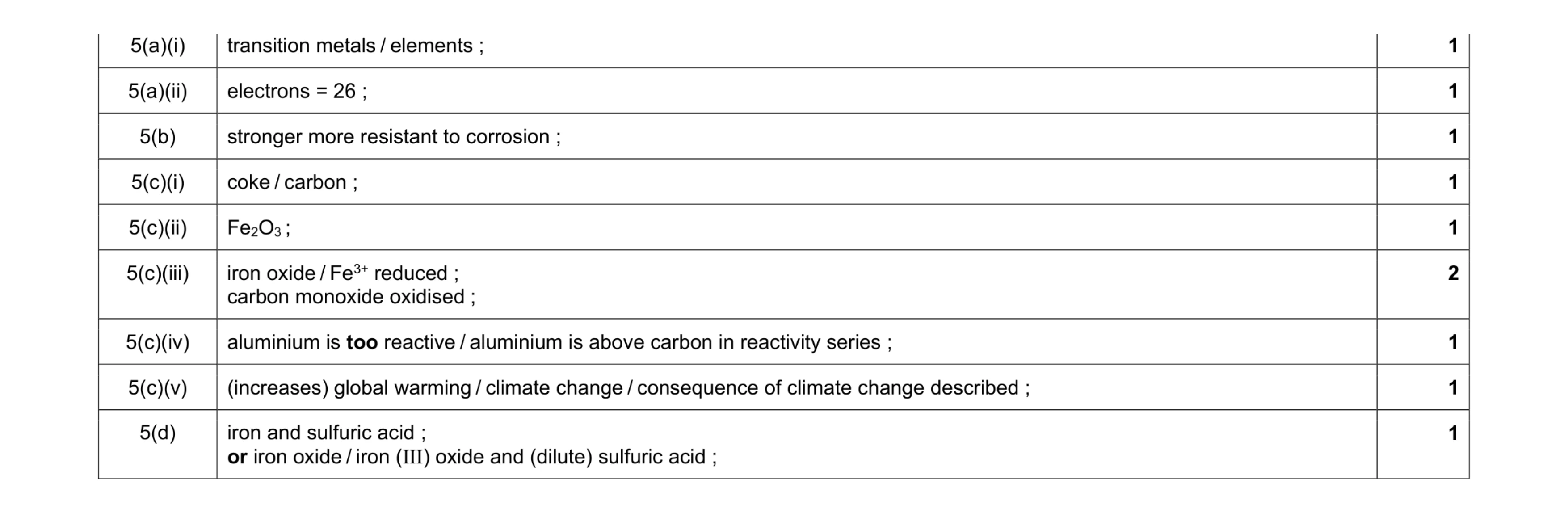 10
10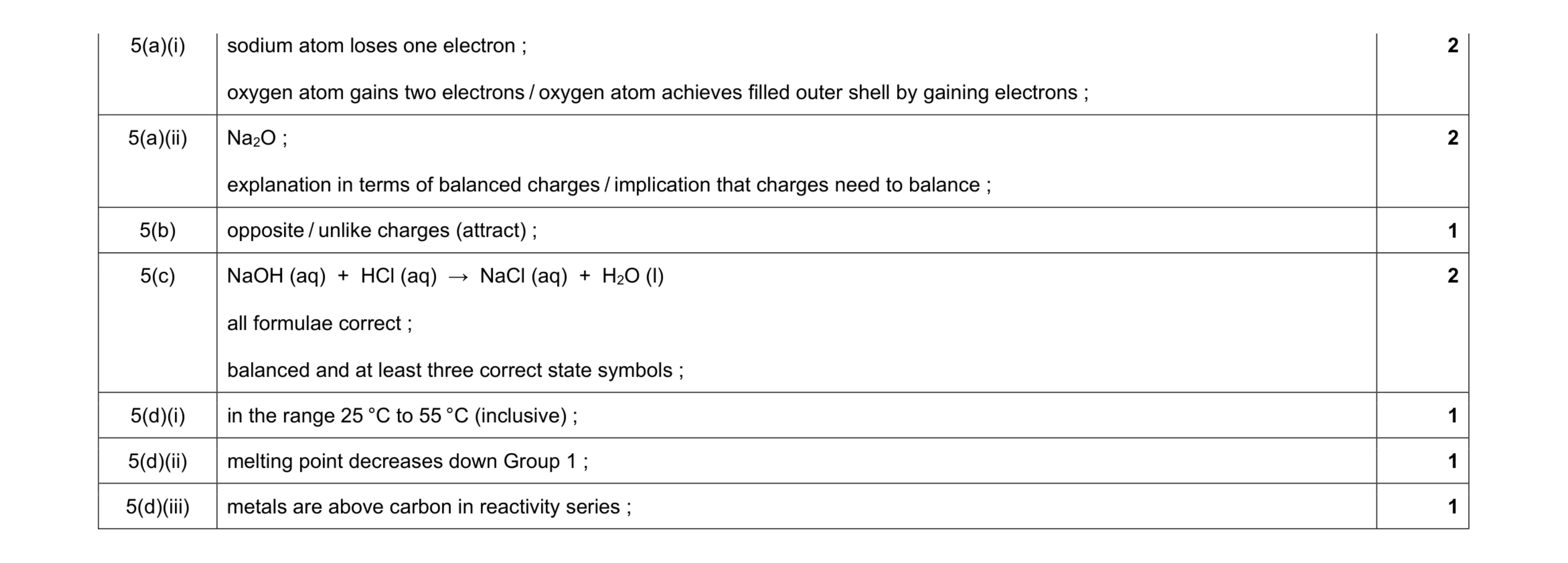 10
10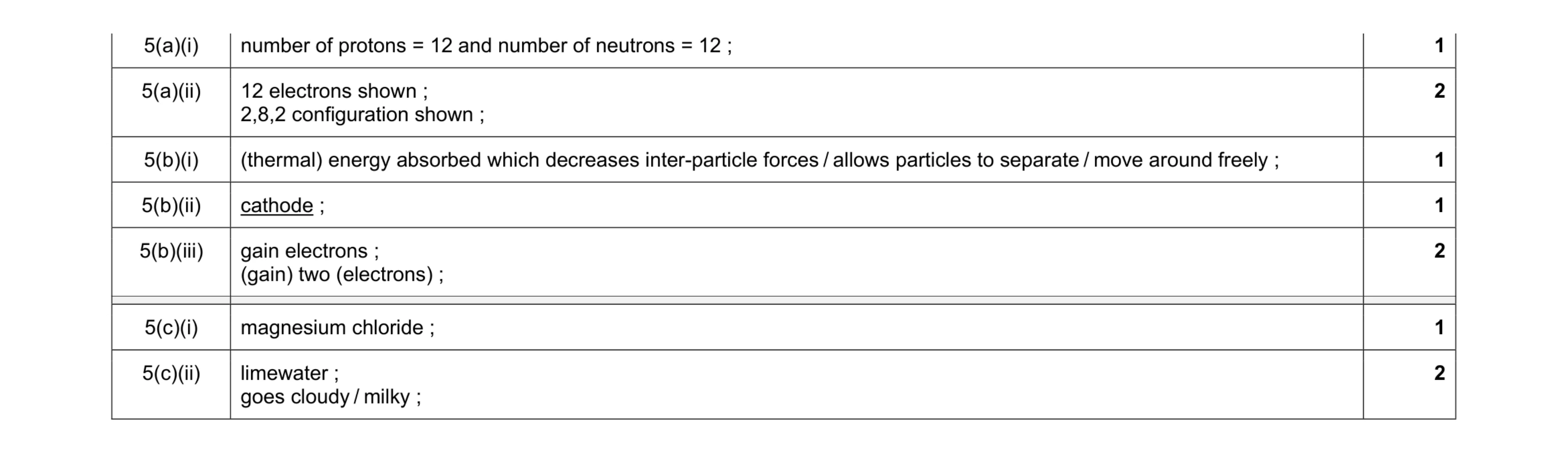 10
10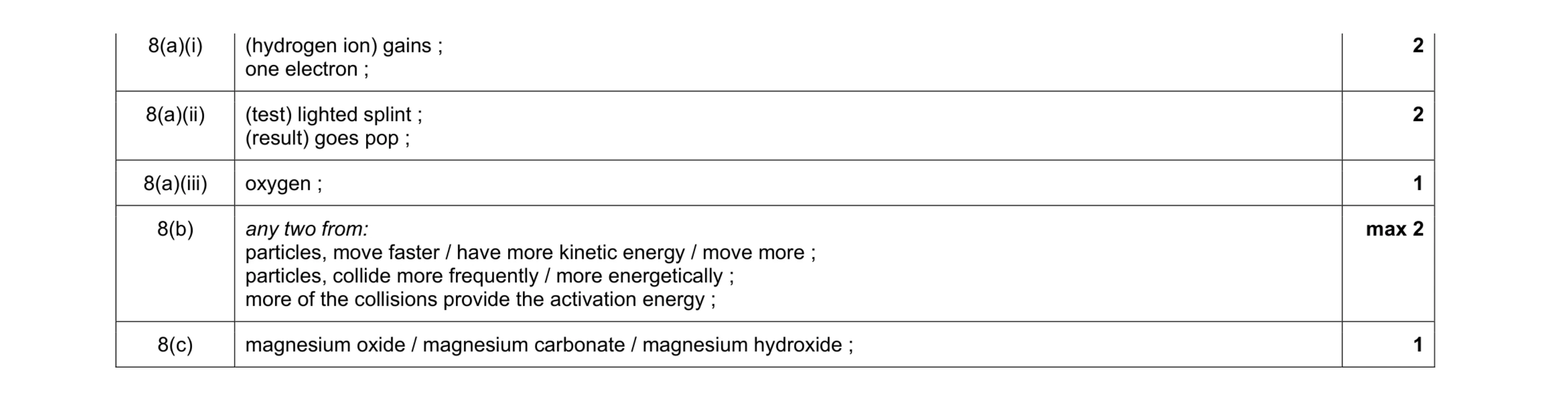 8
8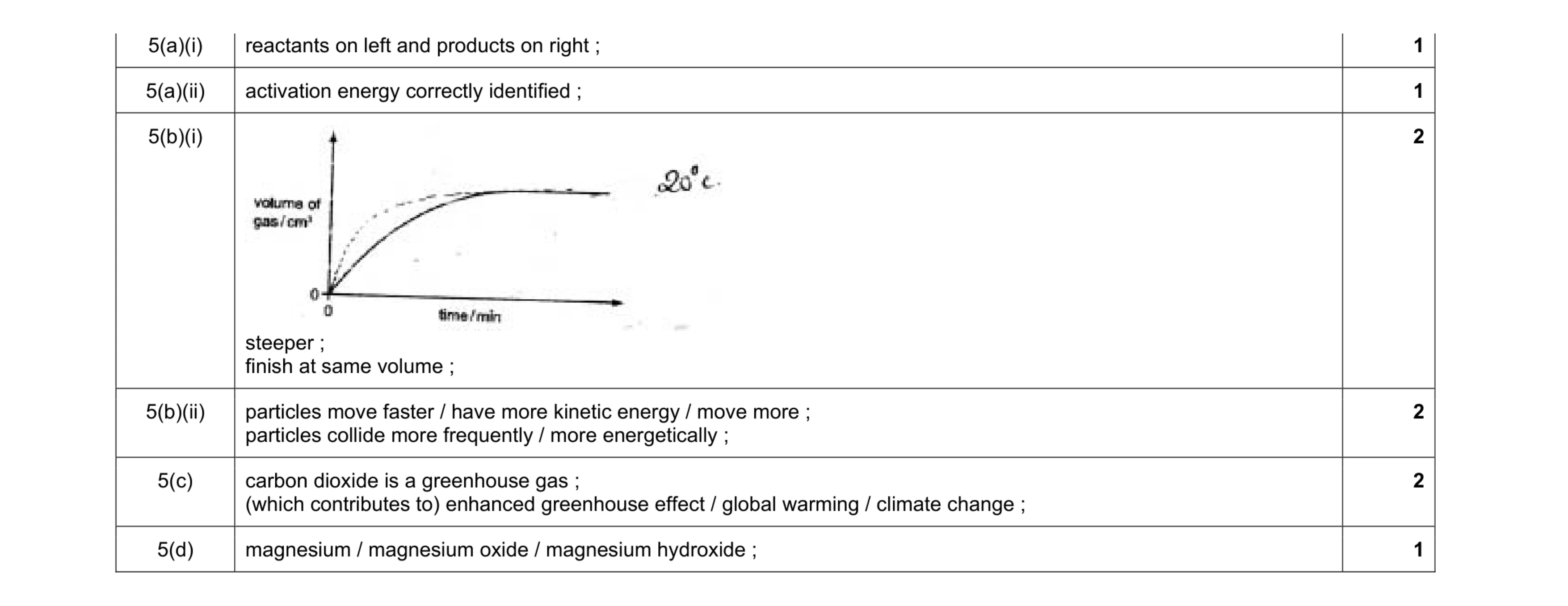 9
9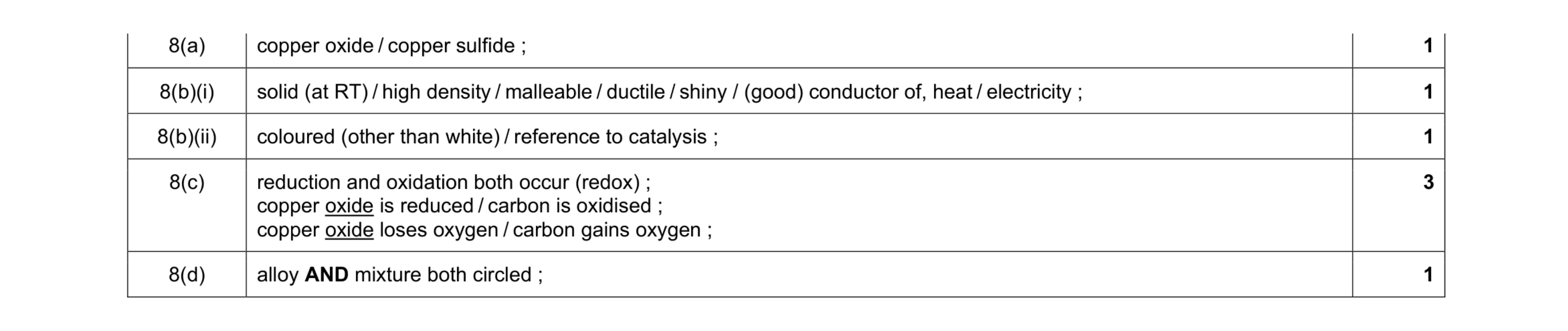 7
7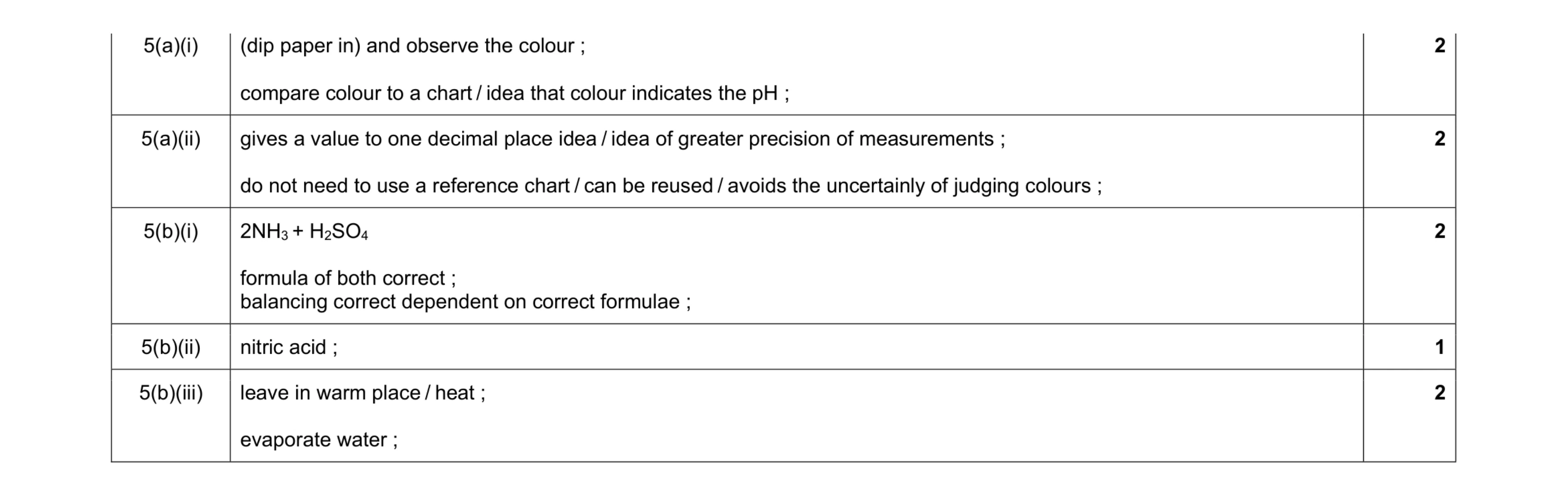 9
9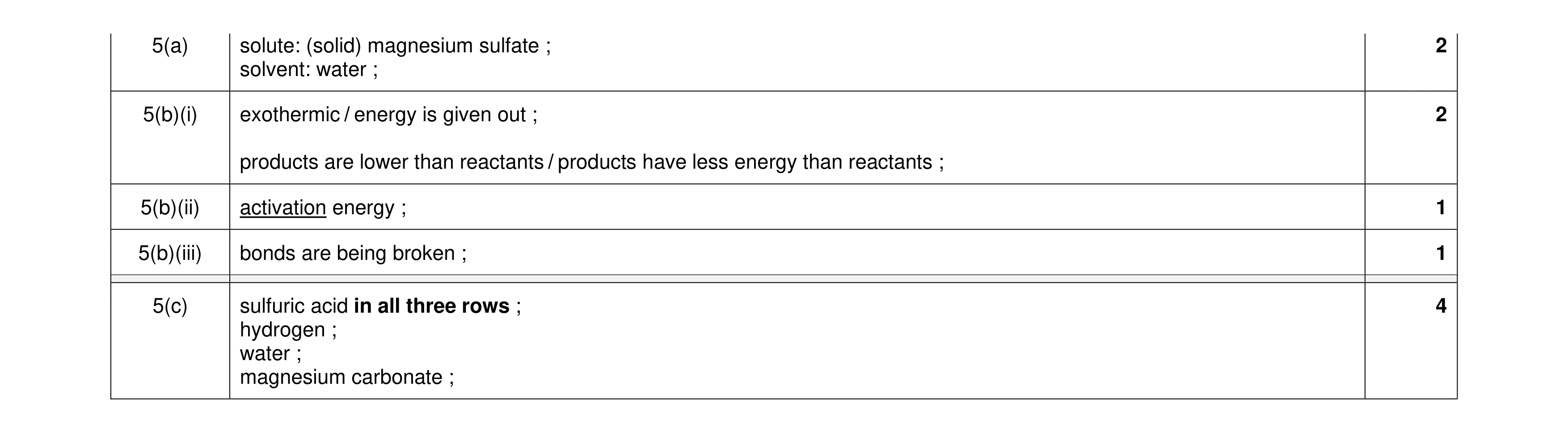 10
10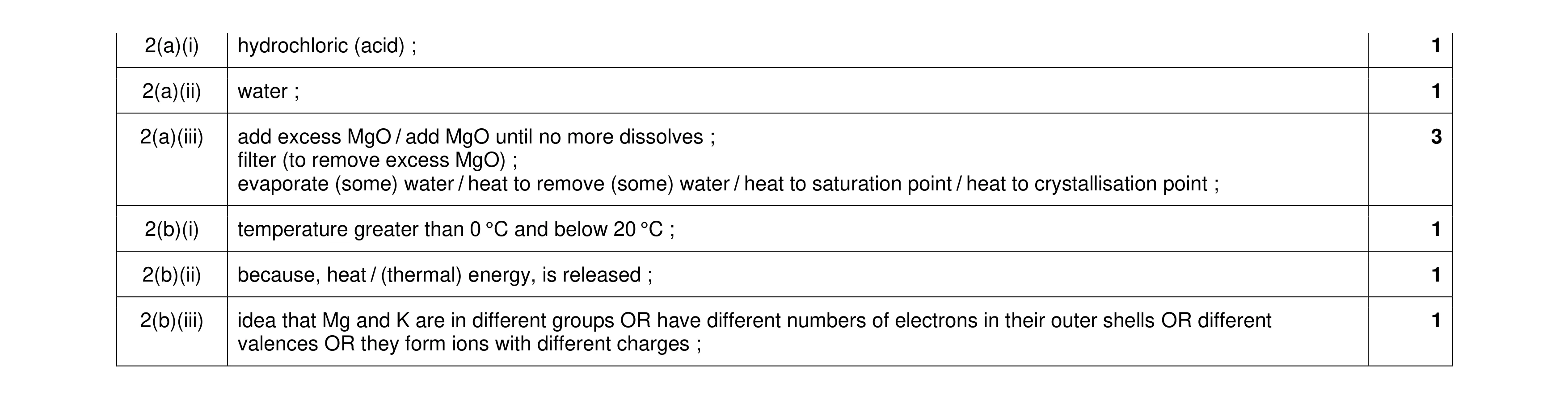 8
8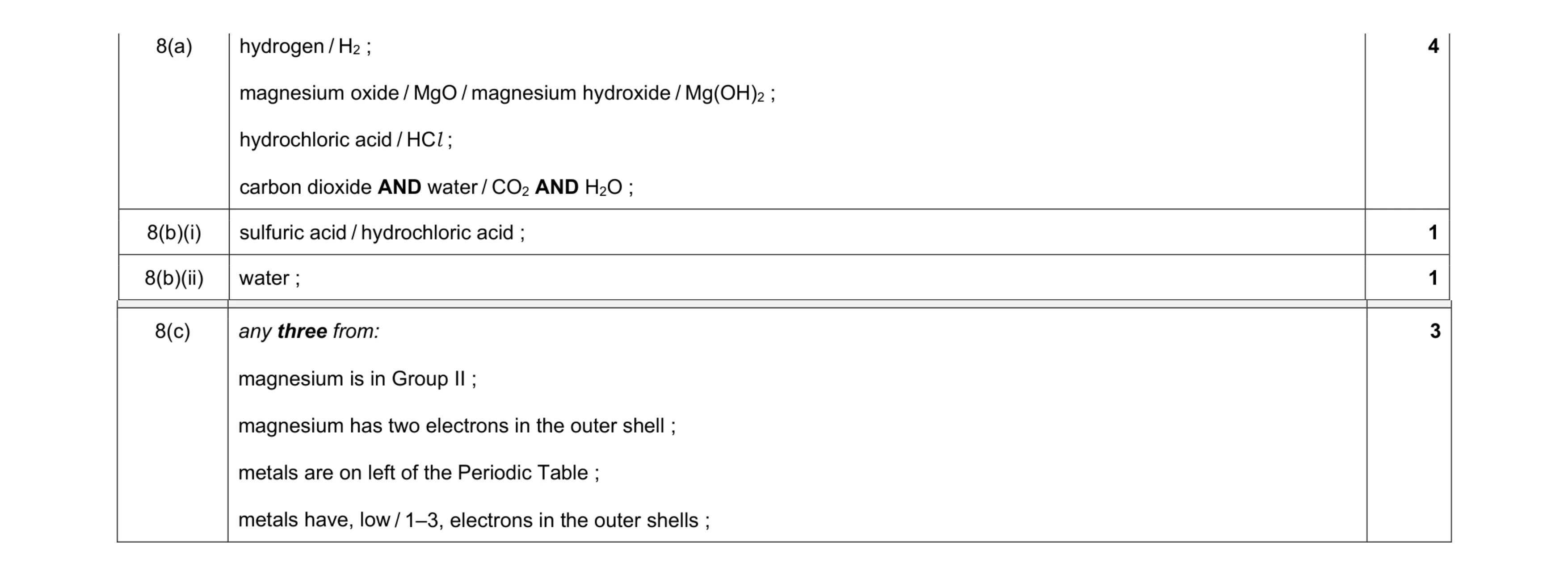 9
9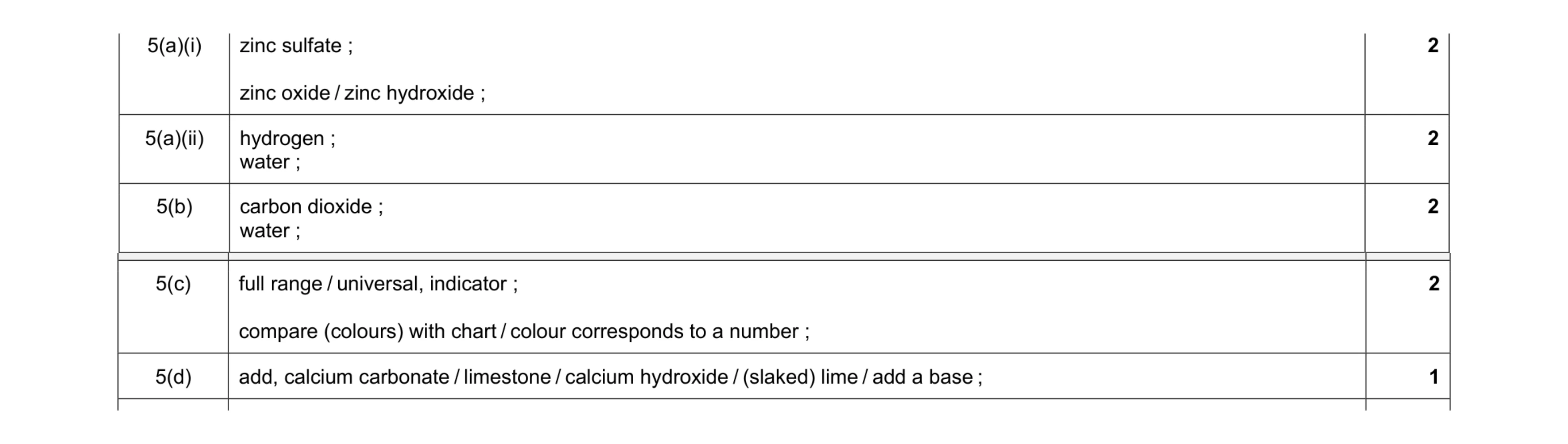 9
9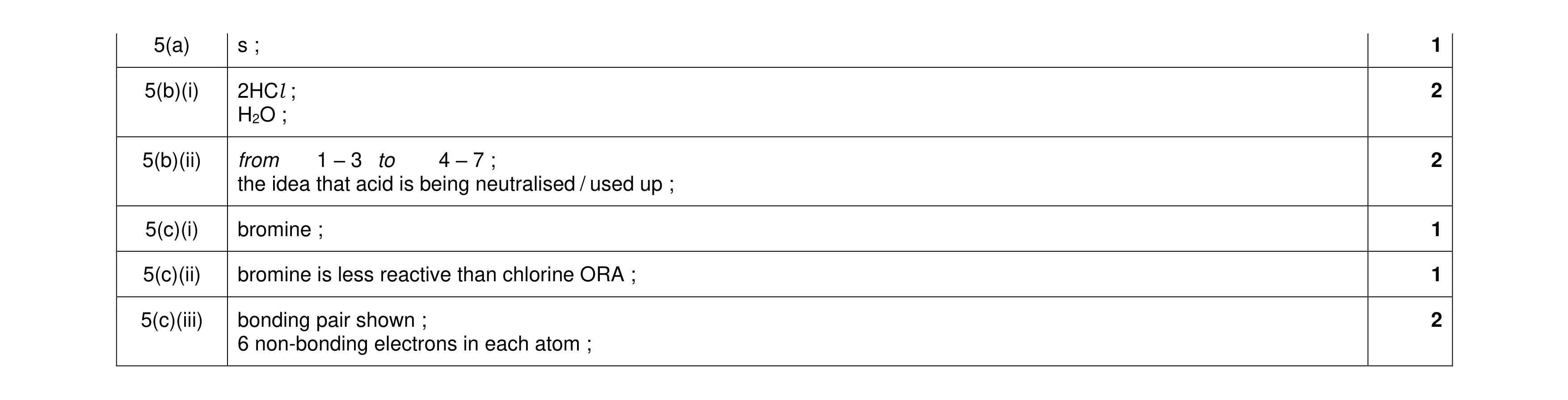 9
9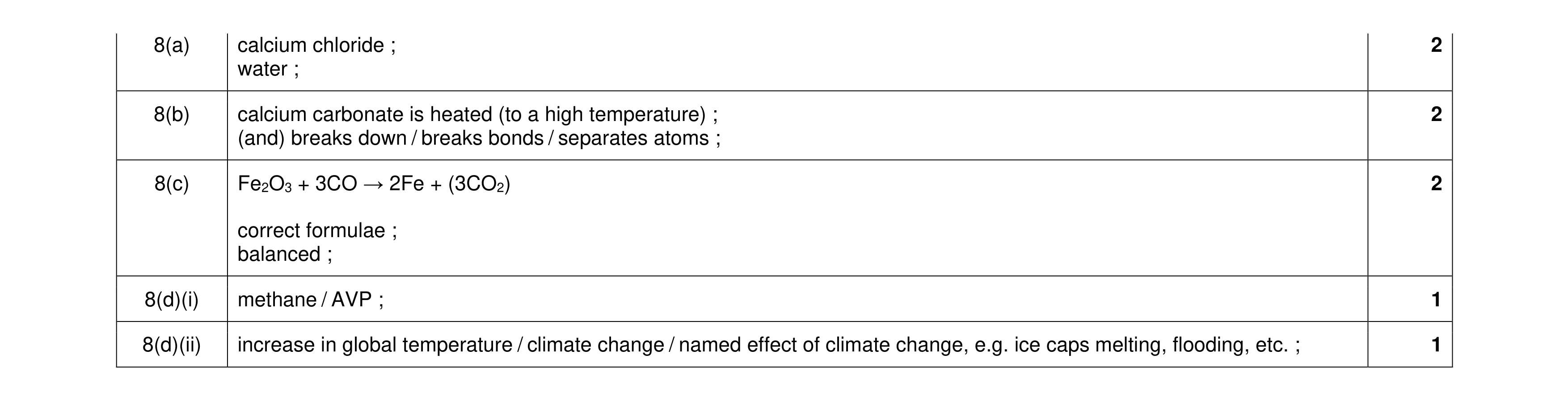 8
8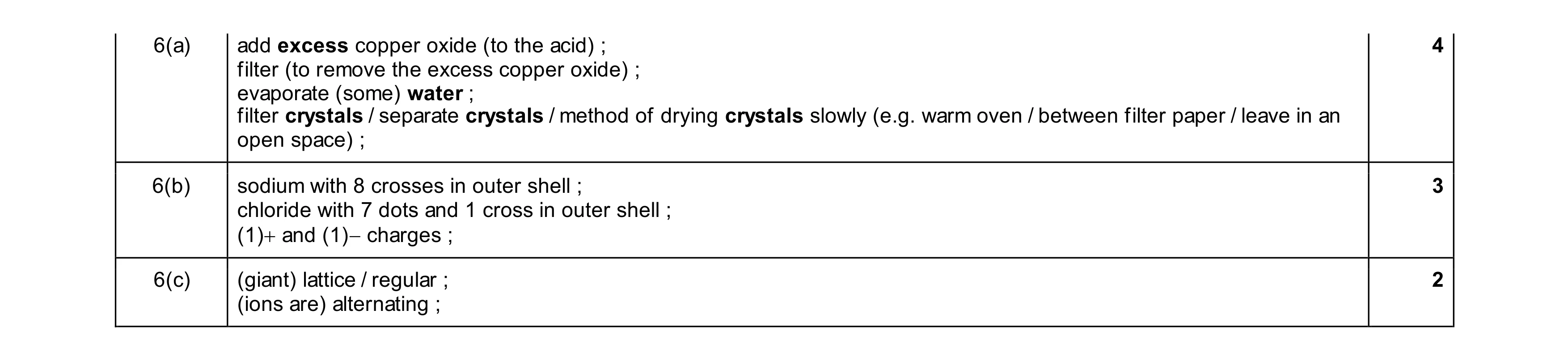 9
9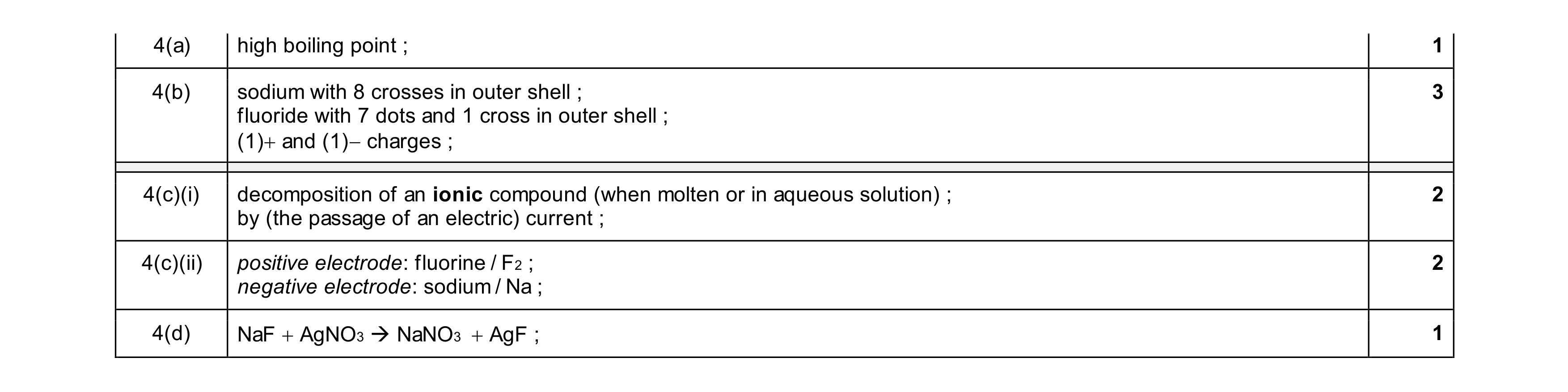 9
9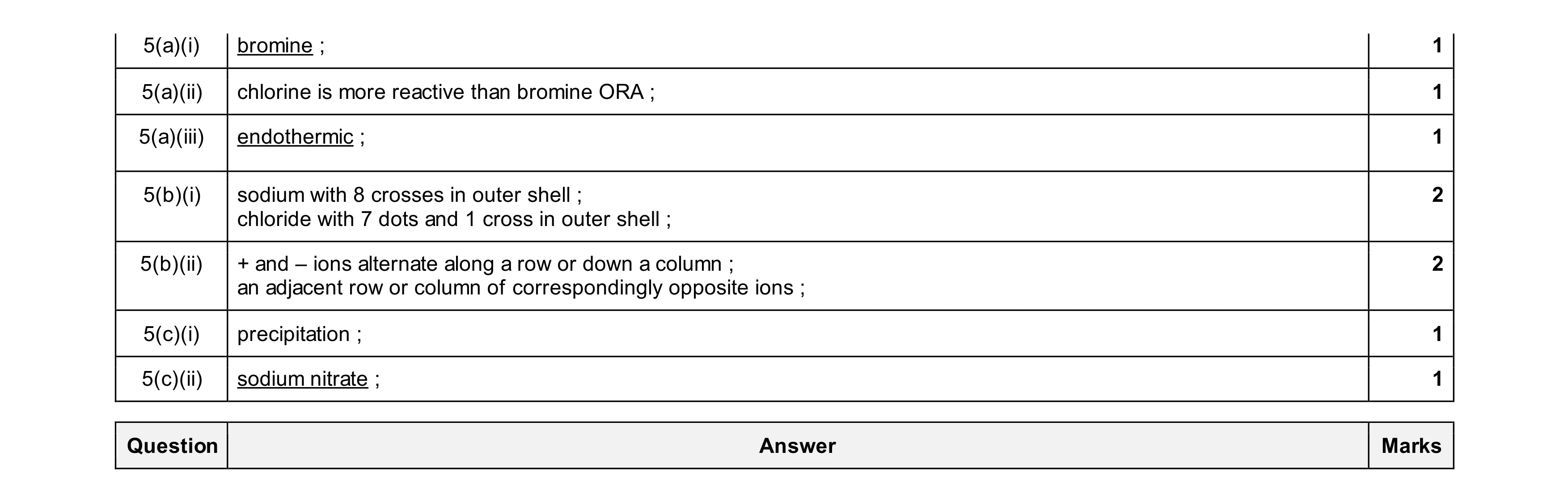 9
9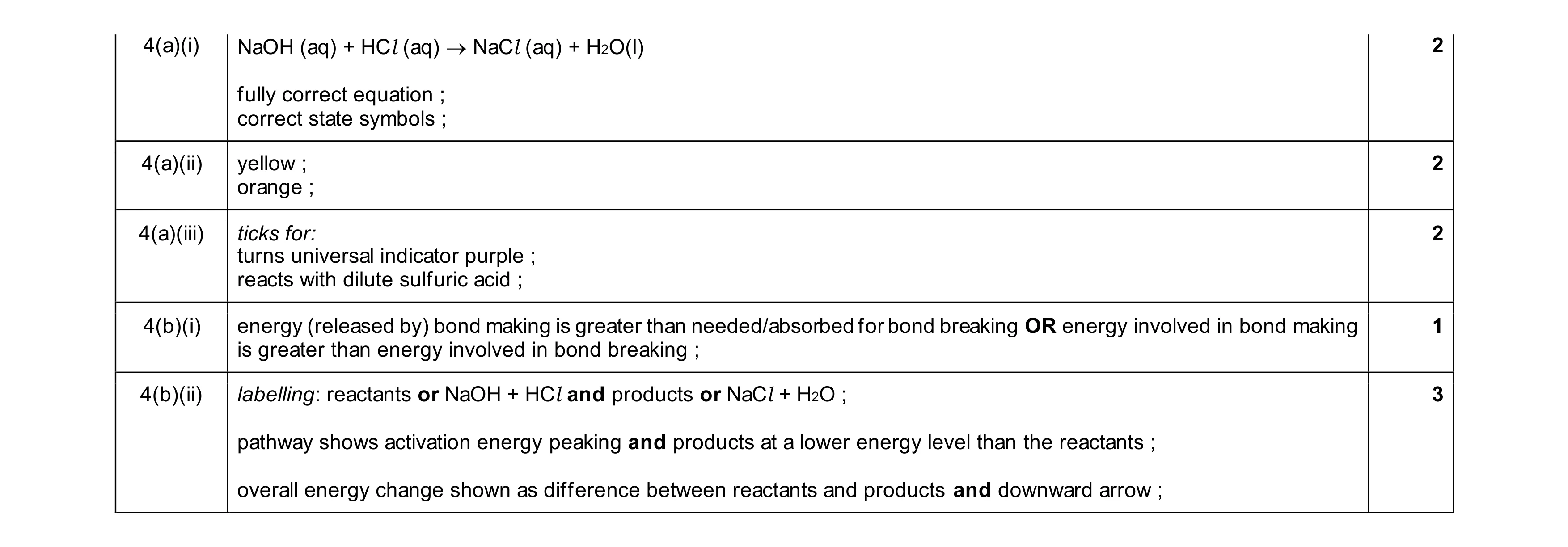 10
10