Questions as text
Q1 · A student investigates the reaction between dilute sulfuric acid and copper(II) carbonate… 0653/31 May/June 2017
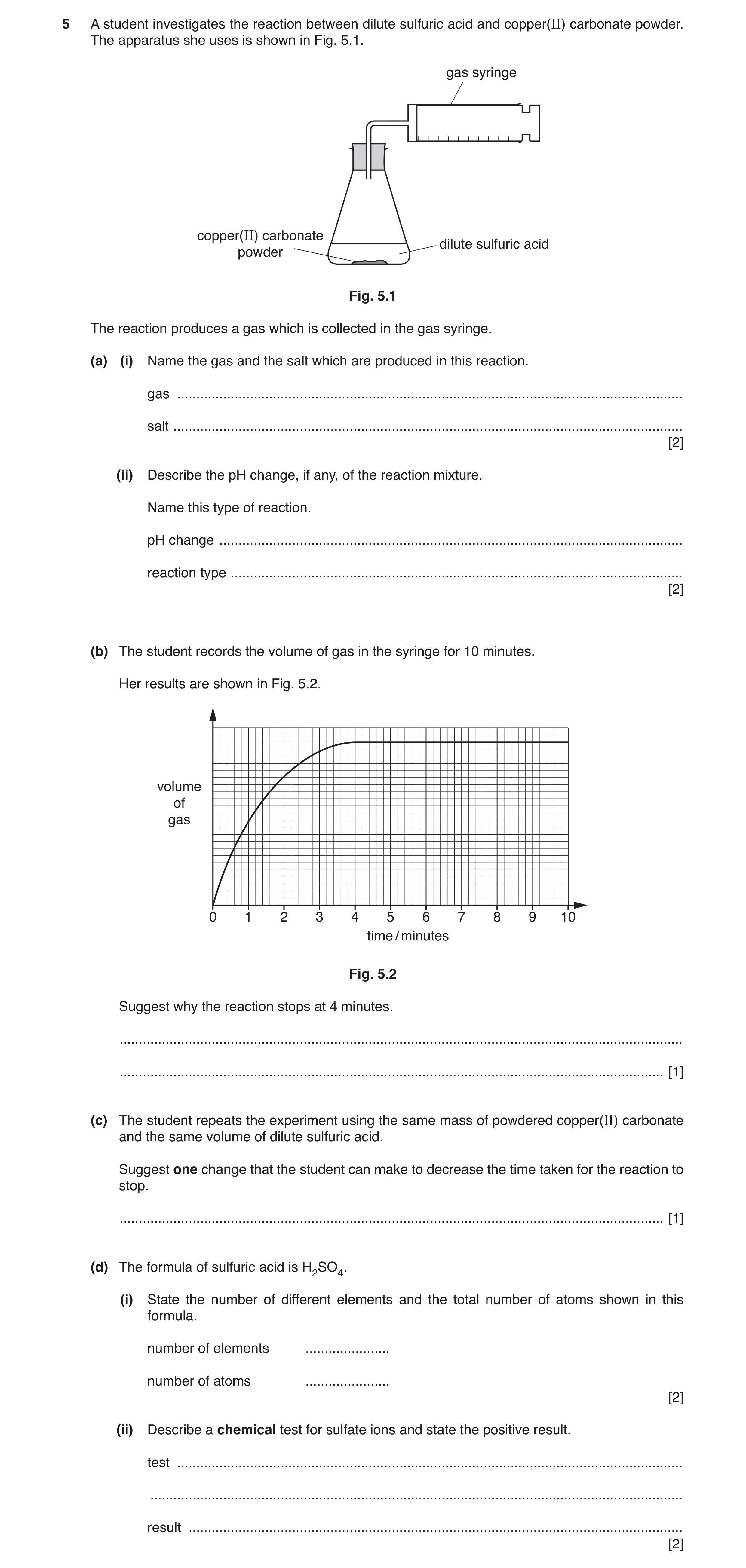
5 A student investigates the reaction between dilute sulfuric acid and copper(II) carbonate powder. The apparatus she uses is shown in Fig. 5.1. gas syringe copper(II) carbonate dilute sulfuric acid powder Fig. 5.1 The reaction produces a gas which is collected in the gas syringe. (a) (i) Name the gas and the salt which are produced in this reaction. gas … salt … [2] (ii) Describe the pH change, if any, of the reaction mixture. Name this type of reaction. pH change … reaction type … [2] (b) The student records the volume of gas in the syringe for 10 minutes. Her results are shown in Fig. 5.2. volume of gas 0 1 2 3 4 5 6 7 8 9 10 time / minutes Fig. 5.2 Suggest why the reaction stops at 4 minutes. … … [1] (c) The student repeats the experiment using the same mass of powdered copper(II) carbonate and the same volume of dilute sulfuric acid. Suggest one change that the student can make to decrease the time taken for the reaction to stop. … [1] (d) The formula of sulfuric acid is H2SO4. (i) State the number of different elements and the total number of atoms shown in this formula. number of elements … number of atoms … [2] (ii) Describe a chemical test for sulfate ions and state the positive result. test … … result … [2]
10 marks
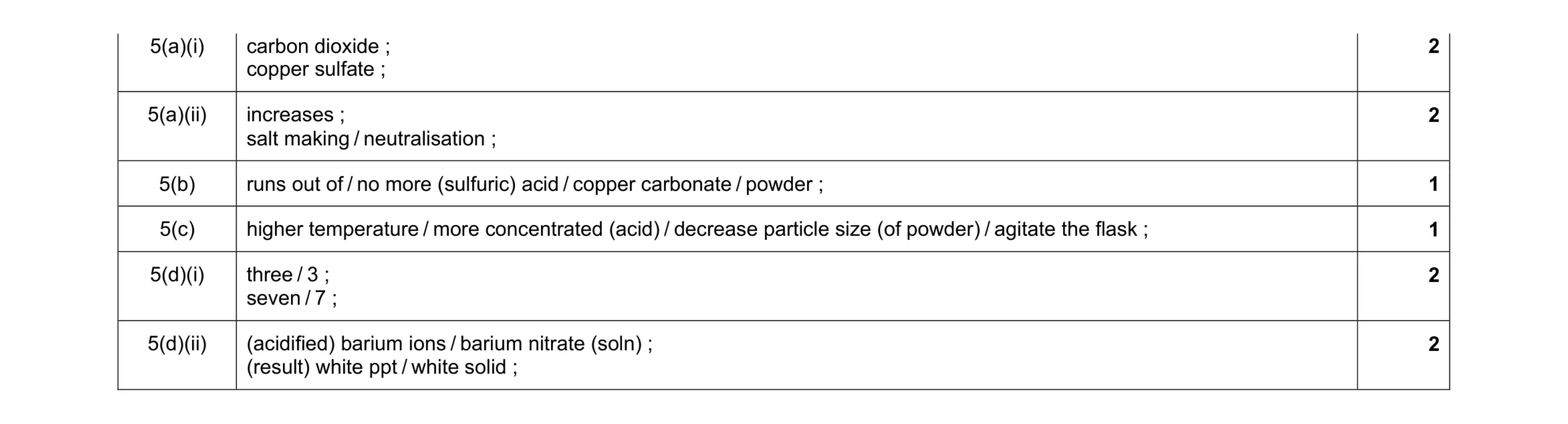
Mark scheme: 5(a)(i) carbon dioxide ; copper sulfate ; 2 5(a)(ii) increases ; salt making / neutralisation ; 2 5(b) runs out of / no more (sulfuric) acid / copper carbonate / powder ; 1 5(c) higher temperature / more concentrated (acid) / decrease particle size (of powder) / agitate the flask ; 1 5(d)(i) three / 3 ; seven / 7 ; 2 5(d)(ii) (acidified) barium ions / barium nitrate (soln) ; (result) white ppt / white solid ; 2
This question in 0653/31 May/June 2017
Q2 · Electrolysis is used to break up some compounds into simpler substances 0653/31 Oct/Nov 2017
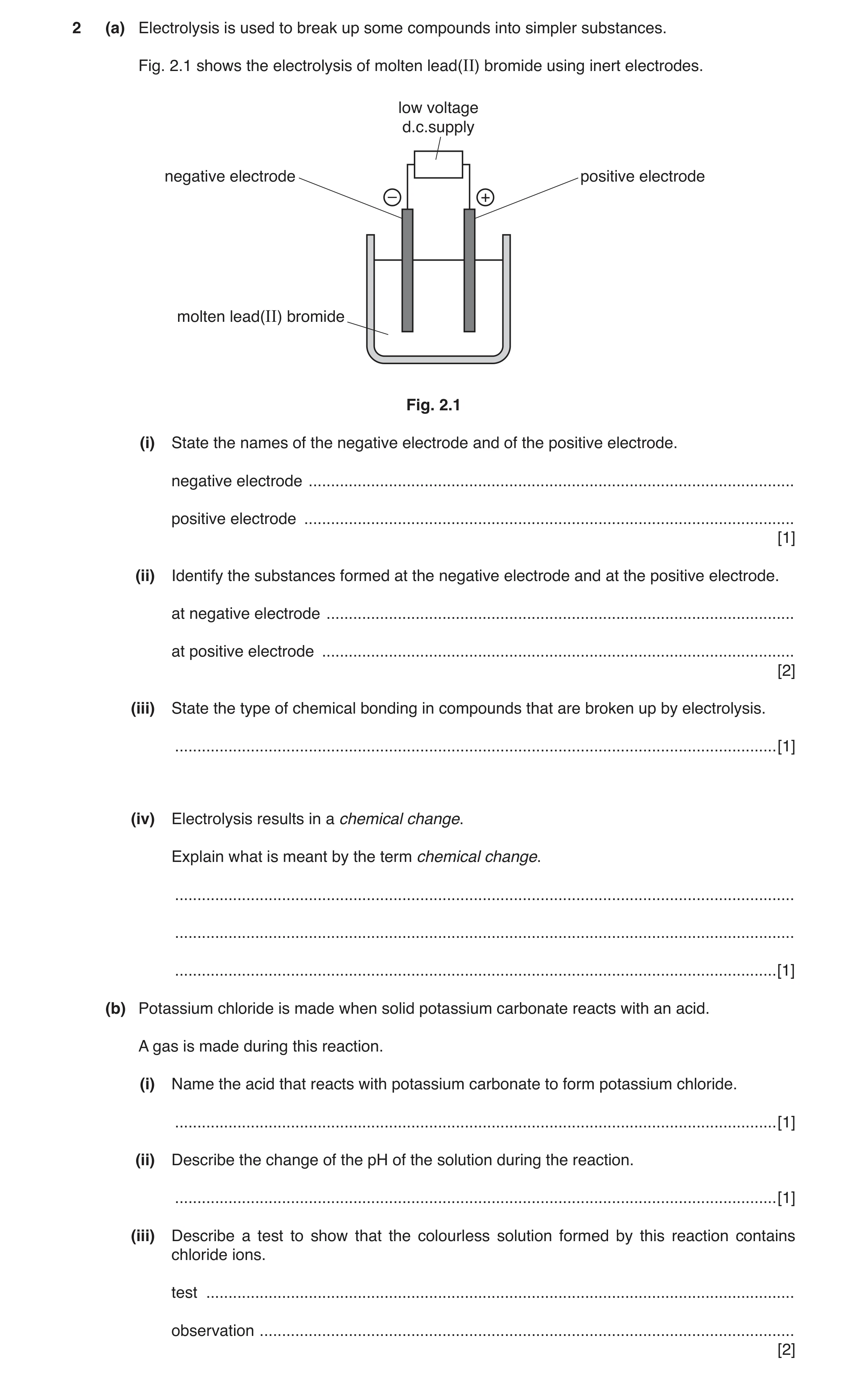
2 (a) Electrolysis is used to break up some compounds into simpler substances. Fig. 2.1 shows the electrolysis of molten lead(II) bromide using inert electrodes. low voltage d.c.supply negative electrode positive electrode – + molten lead(II) bromide Fig. 2.1 (i) State the names of the negative electrode and of the positive electrode. negative electrode … positive electrode … [1] (ii) Identify the substances formed at the negative electrode and at the positive electrode. at negative electrode … at positive electrode … [2] (iii) State the type of chemical bonding in compounds that are broken up by electrolysis. … [1] (iv) Electrolysis results in a chemical change. Explain what is meant by the term chemical change. … … … [1] (b) Potassium chloride is made when solid potassium carbonate reacts with an acid. A gas is made during this reaction. (i) Name the acid that reacts with potassium carbonate to form potassium chloride. … [1] (ii) Describe the change of the pH of the solution during the reaction. … [1] (iii) Describe a test to show that the colourless solution formed by this reaction contains chloride ions. test … observation … [2]
9 marks
Mark scheme: 2(a)(i) (negative) cathode and (positive) anode ; 1 2(a)(ii) (negative) lead ; (positive) bromine / Br2 ; 2 2(a)(iii) ionic / electrovalent ; 1 2(a)(iv) new substance(s) made ; 1 2(b)(i) hydrochloric (acid) / HCl ; 1 2(b)(ii) Increases ; 1 2(b)(iii) (test) (acidified) silver nitrate ; (observation) white precipitate / solid ; 2
This question in 0653/31 Oct/Nov 2017
Q3 · A student makes magnesium sulfate by reacting magnesium with a dilute acid 0653/31 Oct/Nov 2018
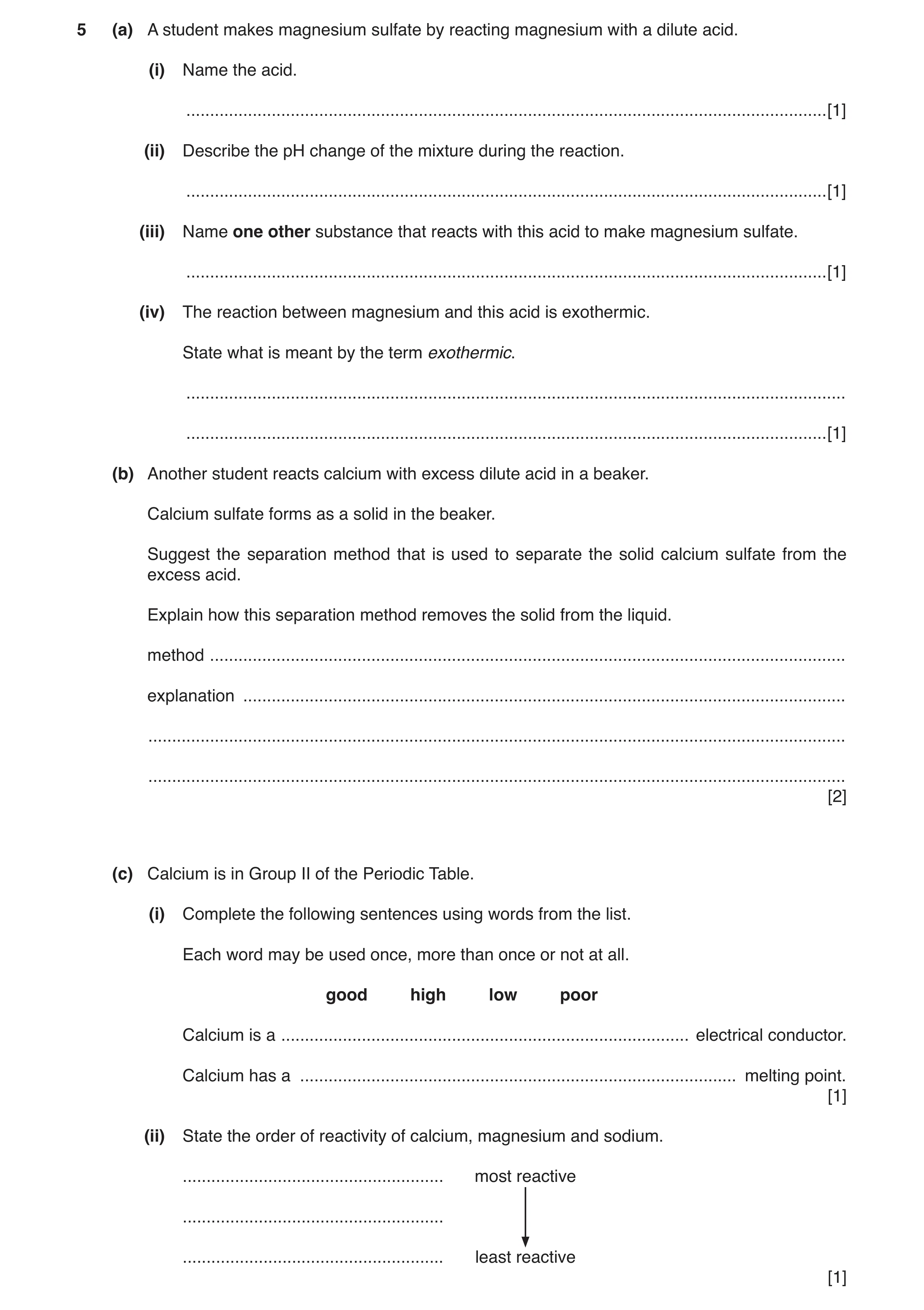
5 (a) A student makes magnesium sulfate by reacting magnesium with a dilute acid. (i) Name the acid. … [1] (ii) Describe the pH change of the mixture during the reaction. … [1] (iii) Name one other substance that reacts with this acid to make magnesium sulfate. … [1] (iv) The reaction between magnesium and this acid is exothermic. State what is meant by the term exothermic. … … [1] (b) Another student reacts calcium with excess dilute acid in a beaker. Calcium sulfate forms as a solid in the beaker. Suggest the separation method that is used to separate the solid calcium sulfate from the excess acid. Explain how this separation method removes the solid from the liquid. method … explanation … … … [2] (c) Calcium is in Group II of the Periodic Table. (i) Complete the following sentences using words from the list. Each word may be used once, more than once or not at all. good high low poor Calcium is a … electrical conductor. Calcium has a … melting point. [1] (ii) State the order of reactivity of calcium, magnesium and sodium. … most reactive … … least reactive [1]
8 marks
Mark scheme: 5(a)(i) sulfuric (acid) ; 1 5(a)(ii) increases ; 1 5(a)(iii) magnesium oxide / magnesium hydroxide / magnesium carbonate; 1 5(a)(iv) temperature increases / release of heat (thermal energy) ; 1 5(b) (method) filter / filtering / filtration ; (explanation) solid (particles) stays on filter paper / cannot pass through filter paper / liquid (particles) can ; 2 5(c)(i) good and high 1 5(c)(ii) (most reactive) sodium / Na calcium / Ca (least reactive) magnesium / Mg ; 1
This question in 0653/31 Oct/Nov 2018
Q4 · A student makes a salt using the apparatus shown in Fig 0653/32 Oct/Nov 2018
2 (a) A student makes a salt using the apparatus shown in Fig. 2.1. process A process B powdered metal carbonate dilute sulfuric acid gentle heat Fig. 2.1 (i) Name process A and process B. process A … process B … [2] (ii) The student uses 1 g of the powdered metal carbonate. Describe the effect of using a single 1 g piece of the metal carbonate on the rate of this reaction. … [1] (iii) Describe the effect of using the same volume of a more concentrated sulfuric acid on the rate of this reaction. … [1] (iv) When the metal carbonate is mixed with dilute sulfuric acid, the temperature increases. State the name given to chemical reactions that cause the temperature to increase. … [1] (b) The student mixes copper carbonate with dilute sulfuric acid. Copper(II) sulfate and a colourless gas and a colourless liquid are formed. (i) Complete the word equation for this reaction. copper + + +carbonate [2] (ii) Describe a test for aqueous copper(II) ions. State the observations that show copper(II) ions are present. test … observations … … [2] (iii) Copper is a transition metal. It forms coloured compounds. Describe one other property of a transition metal. … [1]
10 marks
Mark scheme: 2(a)(i) (process A) filtration / filtering / filter ; (process B) evaporation ; 2 2(a)(ii) decreases ; 1 2(a)(iii) increases ; 1 2(a)(iv) exothermic ; 1 2(b)(i) (copper carbonate) + sulfuric acid Î copper sulfate + carbon dioxide + water sulfuric acid LHS AND copper sulfate RHS ; carbon dioxide AND water RHS ; 2 2(b)(ii) (test) (add) aqueous sodium hydroxide OR aqueous ammonia ; (observations) (light) blue precipitate OR blue ppt (then deep blue solution) ; 2 2(b)(iii) high density / high melting point / (element or compound) act as catalysts ; 1
This question in 0653/32 Oct/Nov 2018
Q5 · Calcium hydroxide, a base, is used to control the acidity of soil 0653/33 May/June 2019
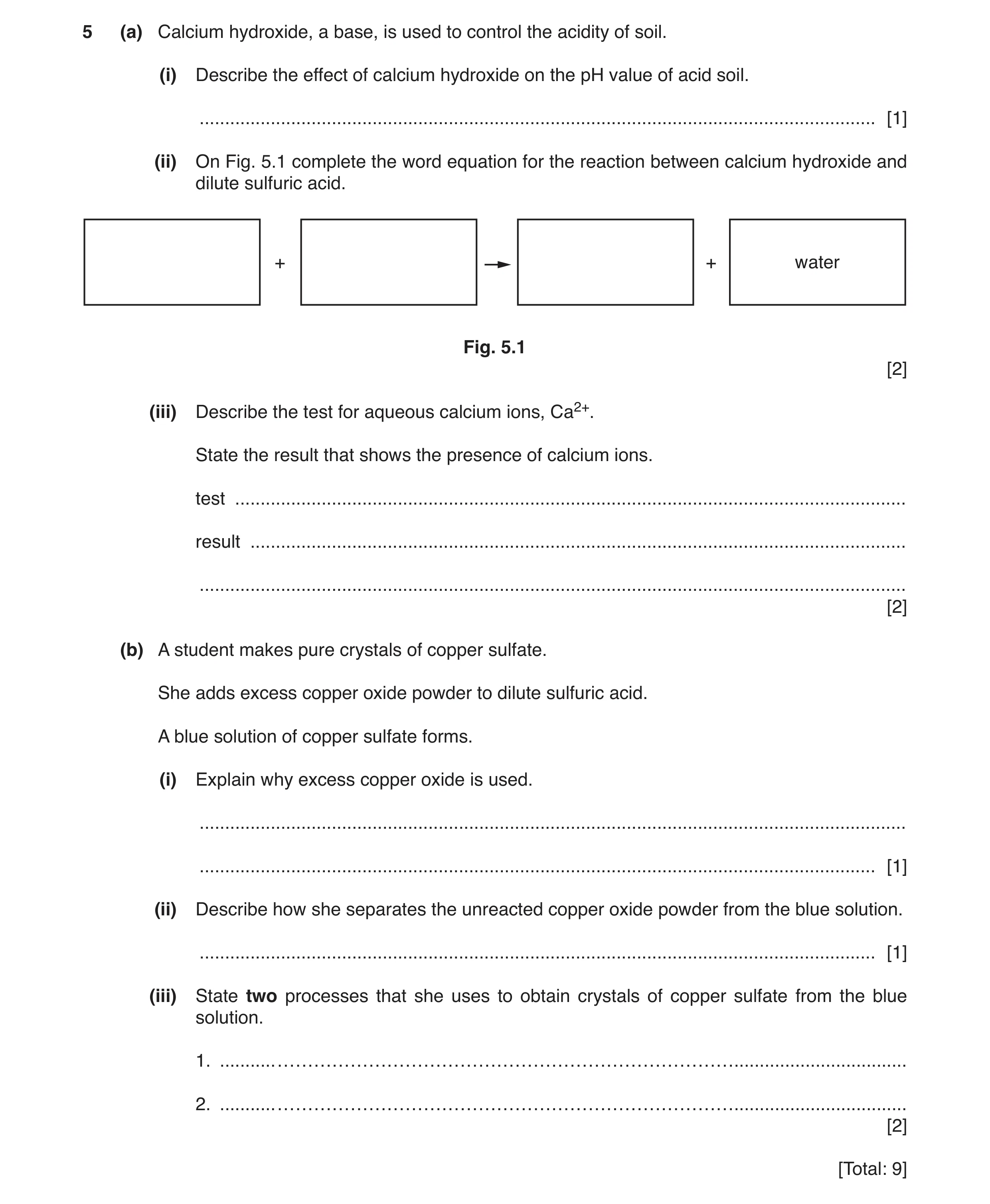
5 (a) Calcium hydroxide, a base, is used to control the acidity of soil. (i) Describe the effect of calcium hydroxide on the pH value of acid soil. … [1] (ii) On Fig. 5.1 complete the word equation for the reaction between calcium hydroxide and dilute sulfuric acid. + + water Fig. 5.1 [2] (iii) Describe the test for aqueous calcium ions, Ca2+. State the result that shows the presence of calcium ions. test … result … … [2] (b) A student makes pure crystals of copper sulfate. She adds excess copper oxide powder to dilute sulfuric acid. A blue solution of copper sulfate forms. (i) Explain why excess copper oxide is used. … … [1] (ii) Describe how she separates the unreacted copper oxide powder from the blue solution. … [1] (iii) State two processes that she uses to obtain crystals of copper sulfate from the blue solution. 1. … ………………………………………………………………… … 2. … ………………………………………………………………… … [2] [Total: 9]
9 marks
Mark scheme: 5(a)(i) increases ; 1 5(a)(ii) ;; LHS (1) RHS (1) 2 5(a)(iii) (test) (aqueous) sodium hydroxide ; (result) white precipitate ; 2 5(b)(i) react with all the acid / (make sure) all acid is used up ; 1 5(b)(ii) filter ; 1 Question Answer Marks 5(b)(iii) any two from heat / boil / evaporate ; leave to crystallise / leave to cool ; filter (crystals) ; 2
This question in 0653/33 May/June 2019
Q6 · Element A is in Group III in the Periodic Table 0653/31 Oct/Nov 2019
2 (a) Element A is in Group III in the Periodic Table. Element B is in Group VII in the Periodic Table. Elements A and B are in the same period in the Periodic Table. (i) Suggest which element, A or B, has more metallic character. Explain your answer. element … explanation … … [1] (ii) Element C is below element B in Group VII. Suggest which element, B or C, has: a darker colour … a lower boiling point. … [1] (b) Element D is a monoatomic gas that is used to provide an inert atmosphere. Element E has a high density and is often used as a catalyst. State the group number or the name of the collection of elements for elements D and E in the Periodic Table. element D … element E … [2] (c) A student adds excess copper oxide powder to dilute sulfuric acid to make copper sulfate and one other product. (i) Complete the word equation for the reaction between copper oxide and dilute sulfuric acid. + + [2] (ii) Explain why copper oxide is added in excess. … … [1] (iii) The type of chemical bond that forms between copper and oxygen is the same as the type of chemical bond that forms between sodium and chlorine. State this type of chemical bond. Use ideas about electrons to explain how these bonds form. bond … explanation … … [2] [Total: 9]
9 marks
Mark scheme: 2(a)(i) A and it is on left of the Periodic Table ; 1 2(a)(ii) C and B ; 1 2(b) (element D) noble gases / Group VIII / Group 0 ; (element E) transition metals / transition elements ; 2 2(c)(i) reactants ; products ; 2 2(c)(ii) to make sure all the acid is used up ; 1 Question Answer Marks 2(c)(iii) (bond) ionic ; (explanation) (electron) transfer / loss and gain ; 2
This question in 0653/31 Oct/Nov 2019
Q7 · A student investigates the rate of reaction between a piece of magnesium and excess… 0653/33 Oct/Nov 2020
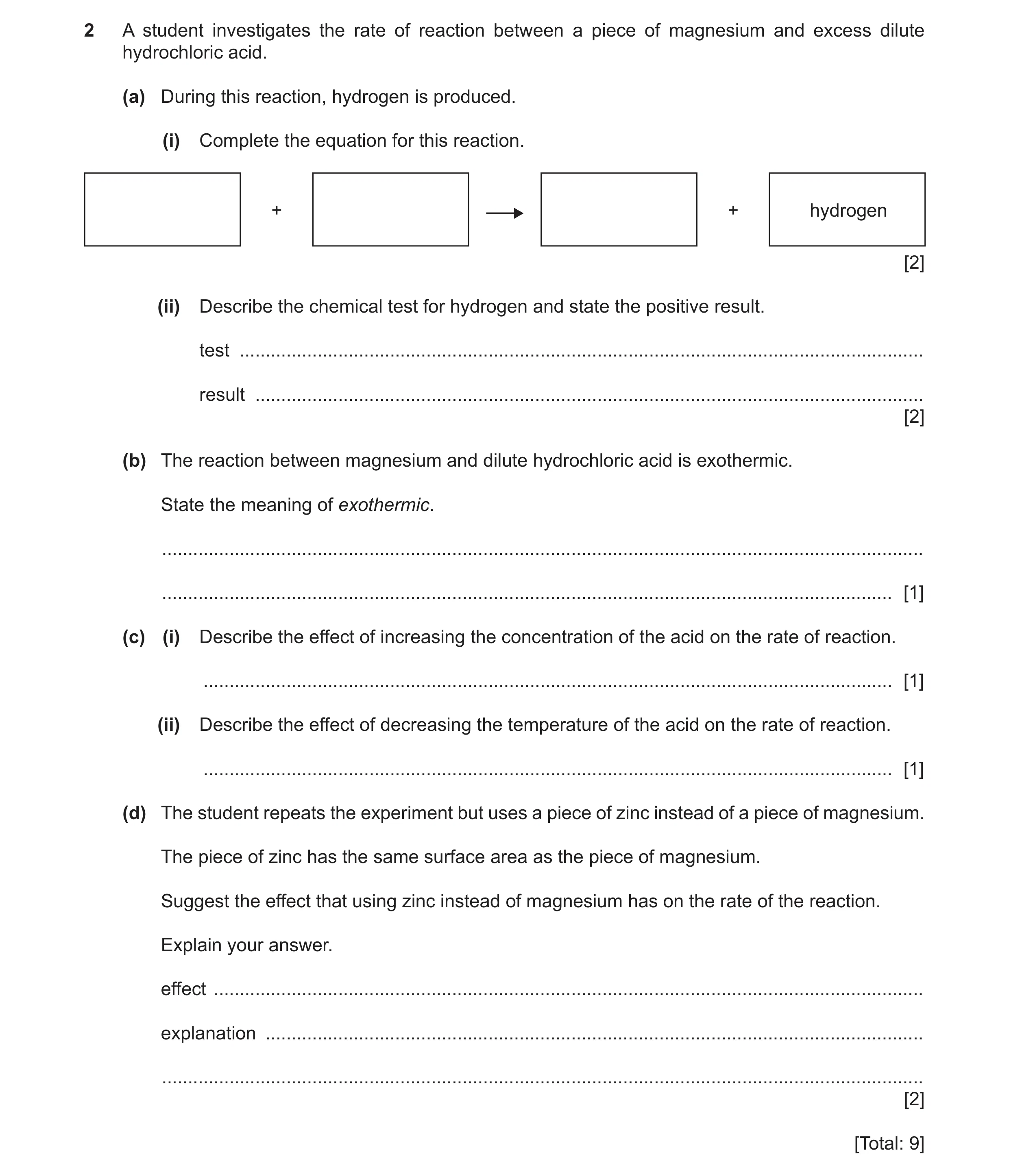
2 A student investigates the rate of reaction between a piece of magnesium and excess dilute hydrochloric acid. (a) During this reaction, hydrogen is produced. (i) Complete the equation for this reaction. + + hydrogen [2] (ii) Describe the chemical test for hydrogen and state the positive result. test … result … [2] (b) The reaction between magnesium and dilute hydrochloric acid is exothermic. State the meaning of exothermic. … … [1] (c) (i) Describe the effect of increasing the concentration of the acid on the rate of reaction. … [1] (ii) Describe the effect of decreasing the temperature of the acid on the rate of reaction. … [1] (d) The student repeats the experiment but uses a piece of zinc instead of a piece of magnesium. The piece of zinc has the same surface area as the piece of magnesium. Suggest the effect that using zinc instead of magnesium has on the rate of the reaction. Explain your answer. effect … explanation … … [2] [Total: 9]
9 marks
Mark scheme: 2(a)(i) magnesium + hydrochloric acid → magnesium chloride + (hydrogen) reactants ; magnesium chloride ; 2(a)(ii) (test) lighted splint ; (result) burns with a squeaky ‘pop’ ; 2 2(b) (thermal) energy / heat, is, released / given out ; 1 2(c)(i) rate increases ; 1 2(c)(ii) rate decreases ; 1 2(d) (effect) rate, decreases / reduces ; (explanation) zinc is less reactive (than magnesium) ; 2
This question in 0653/33 Oct/Nov 2020
Q8 · The boxes on the left of Fig 0653/31 Oct/Nov 2021
5 (a) The boxes on the left of Fig. 5.1 show some separation and collection methods. The boxes on the right of Fig. 5.1 show some substances and the mixtures they come from. Complete Fig. 5.1 to show the method used to separate and collect each substance from its mixture. Draw one line from each box on the left to one box on the right. Distillation of water from salty water has been done as an example for you. method substance and its mixture dyes chromatography ink insoluble copper oxide crystallisation aqueous copper sulfate naphtha distillation petroleum salt filtration salty water water fractional distillation salty water Fig. 5.1 [2] (b) Evaporation is also used to separate some mixtures. During evaporation, a liquid becomes a gas. (i) Explain why evaporation is a physical change and not a chemical change. … … [1] (ii) Describe how the structure of a gas is different to the structure of a liquid in terms of particle arrangement and particle motion. particle arrangement … … particle motion … … [2] (c) Copper sulfate and water are made when copper oxide reacts with an acid. State the name of this acid. … [1] (d) State one use for naphtha. … [1] [Total: 7]
7 marks
Mark scheme: 5(a) two correct ; all correct ; 2 5(b)(i) only a state change / no new substance made ; 1 5(b)(ii) particles in a gas are: ORA far apart / (more) spread out ; move more freely ; 2 5(c) sulfuric (acid) ; 1 5(d) (as a) feedstock / for making chemicals ; 1
This question in 0653/31 Oct/Nov 2021
Q9 · A student investigates the rate of the reaction between lumps of calcium carbonate and… 0653/32 Oct/Nov 2021
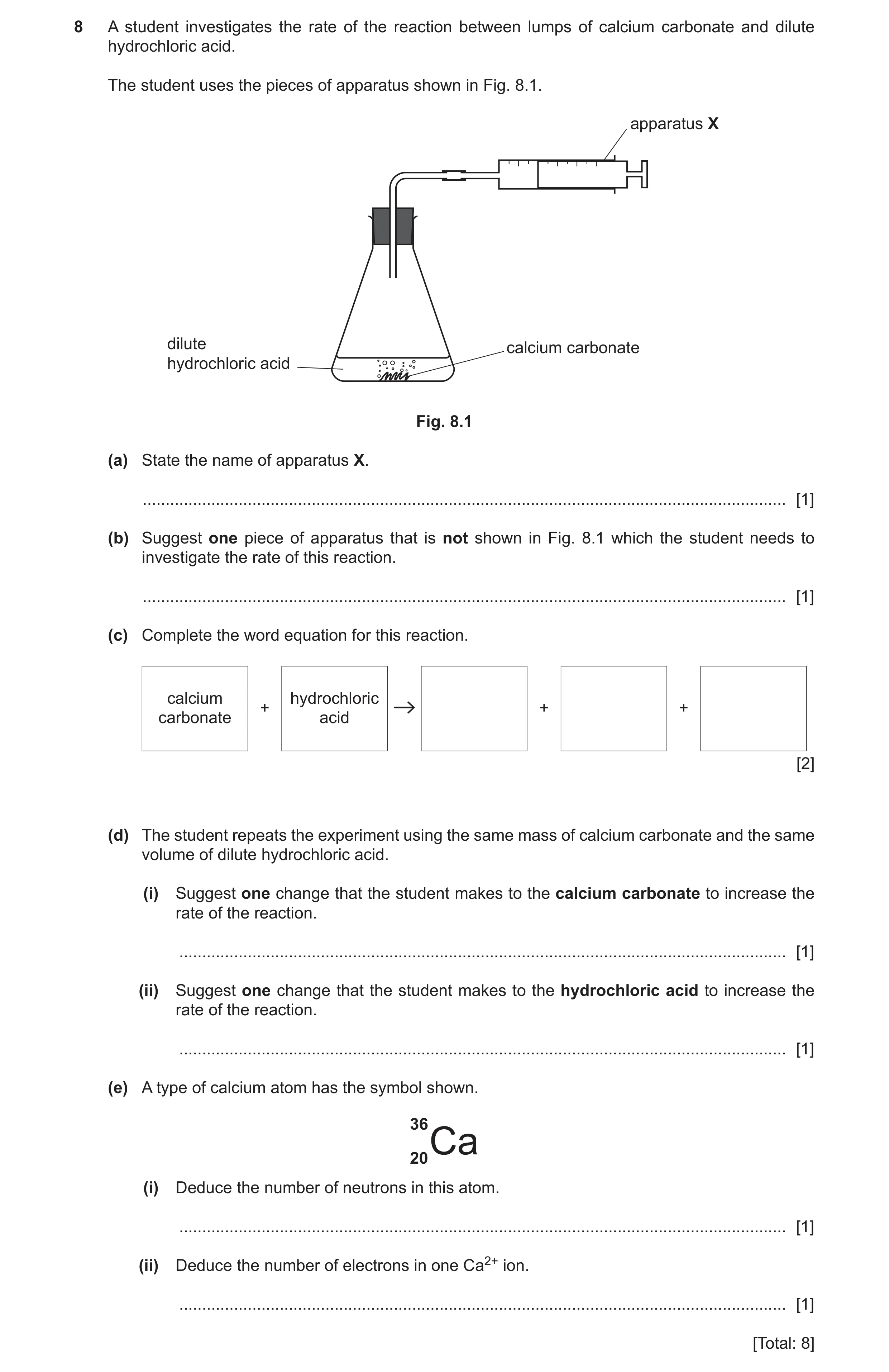
8 A student investigates the rate of the reaction between lumps of calcium carbonate and dilute hydrochloric acid. The student uses the pieces of apparatus shown in Fig. 8.1. apparatus X dilute calcium carbonate hydrochloric acid Fig. 8.1 (a) State the name of apparatus X. … [1] (b) Suggest one piece of apparatus that is not shown in Fig. 8.1 which the student needs to investigate the rate of this reaction. … [1] (c) Complete the word equation for this reaction. calcium hydrochloric + + + carbonate acid [2] (d) The student repeats the experiment using the same mass of calcium carbonate and the same volume of dilute hydrochloric acid. (i) Suggest one change that the student makes to the calcium carbonate to increase the rate of the reaction. … [1] (ii) Suggest one change that the student makes to the hydrochloric acid to increase the rate of the reaction. … [1] (e) A type of calcium atom has the symbol shown. 3620Ca (i) Deduce the number of neutrons in this atom. … [1] (ii) Deduce the number of electrons in one Ca2+ ion. … [1] [Total: 8]
8 marks
Mark scheme: 8(a) (gas) syringe ; 1 8(b) stop-watch ; 1 8(c) calcium carbonate + hydrochloric acid → calcium chloride + water + carbon dioxide calcium chloride / water AND carbon dioxide ; all correct ; 2 8(d)(i) (use) powder / crush (lumps) ; 1 8(d)(ii) (use) more concentrated / increase temperature ; 1 8(e)(i) 16 ; 1 8(e)(ii) 18 ; 1
This question in 0653/32 Oct/Nov 2021
Q10 · A student investigates the rate of the reaction between lumps of calcium carbonate and… 0653/33 Oct/Nov 2021
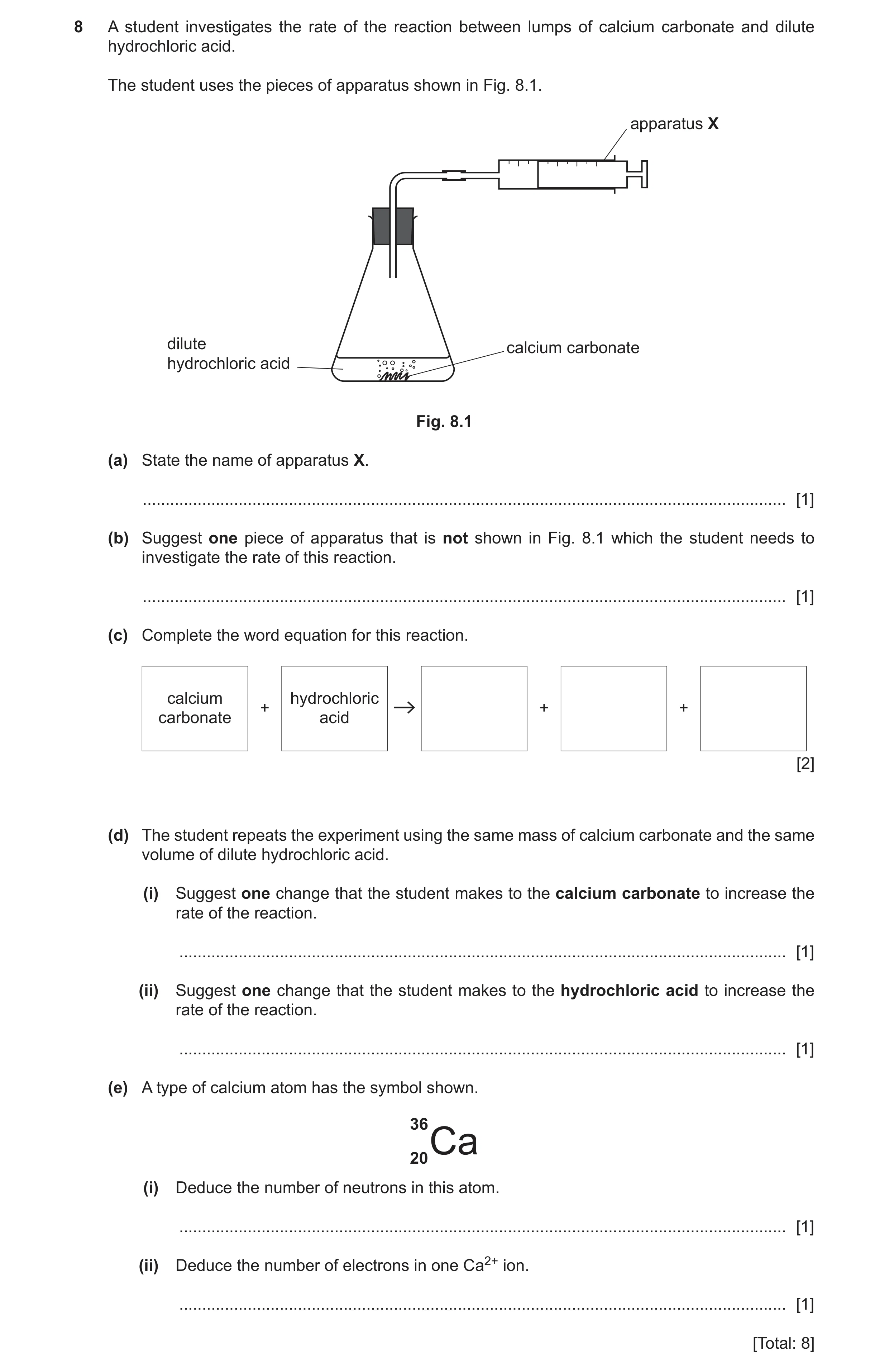
8 A student investigates the rate of the reaction between lumps of calcium carbonate and dilute hydrochloric acid. The student uses the pieces of apparatus shown in Fig. 8.1. apparatus X dilute calcium carbonate hydrochloric acid Fig. 8.1 (a) State the name of apparatus X. … [1] (b) Suggest one piece of apparatus that is not shown in Fig. 8.1 which the student needs to investigate the rate of this reaction. … [1] (c) Complete the word equation for this reaction. calcium hydrochloric + + + carbonate acid [2] (d) The student repeats the experiment using the same mass of calcium carbonate and the same volume of dilute hydrochloric acid. (i) Suggest one change that the student makes to the calcium carbonate to increase the rate of the reaction. … [1] (ii) Suggest one change that the student makes to the hydrochloric acid to increase the rate of the reaction. … [1] (e) A type of calcium atom has the symbol shown. 3620Ca (i) Deduce the number of neutrons in this atom. … [1] (ii) Deduce the number of electrons in one Ca2+ ion. … [1] [Total: 8]
8 marks
Mark scheme: 8(a) (gas) syringe ; 1 8(b) stop-watch ; 1 8(c) calcium carbonate + hydrochloric acid → calcium chloride + water + carbon dioxide calcium chloride / water AND carbon dioxide ; all correct ; 2 8(d)(i) (use) powder / crush (lumps) ; 1 8(d)(ii) (use) more concentrated / increase temperature ; 1 8(e)(i) 16 ; 1 8(e)(ii) 18 ; 1
This question in 0653/33 Oct/Nov 2021
Q11 · Potassium, K, and fluorine, F, are both elements 0653/31 Oct/Nov 2022
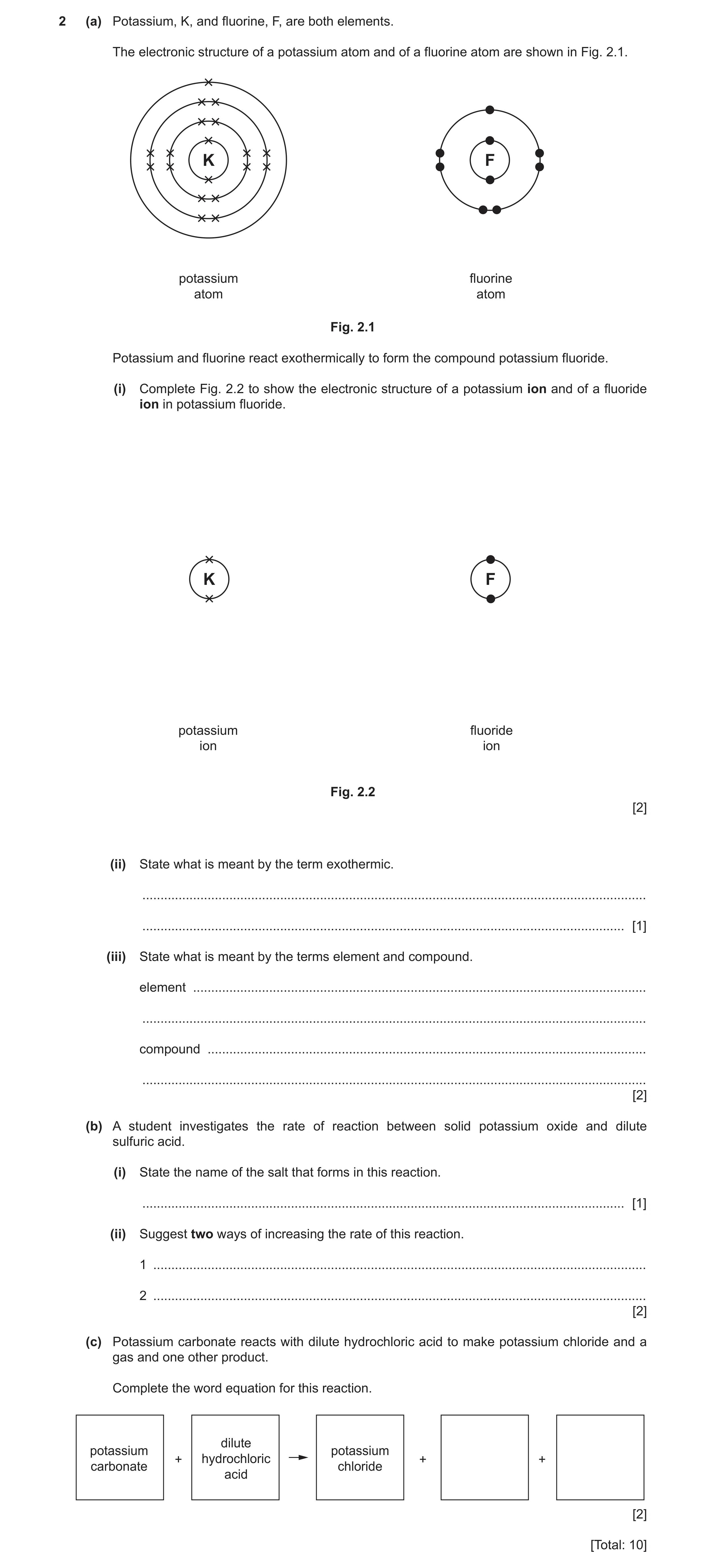
2 (a) Potassium, K, and fluorine, F, are both elements. The electronic structure of a potassium atom and of a fluorine atom are shown in Fig. 2.1. K F potassium fluorine atom atom Fig. 2.1 Potassium and fluorine react exothermically to form the compound potassium fluoride. (i) Complete Fig. 2.2 to show the electronic structure of a potassium ion and of a fluoride ion in potassium fluoride. K F potassium fluoride ion ion Fig. 2.2 [2] (ii) State what is meant by the term exothermic. … … [1] (iii) State what is meant by the terms element and compound. element … … compound … … [2] (b) A student investigates the rate of reaction between solid potassium oxide and dilute sulfuric acid. (i) State the name of the salt that forms in this reaction. … [1] (ii) Suggest two ways of increasing the rate of this reaction. 1 … 2 … [2] (c) Potassium carbonate reacts with dilute hydrochloric acid to make potassium chloride and a gas and one other product. Complete the word equation for this reaction. dilute potassium potassium + hydrochloric + + carbonate chloride acid [2] [Total: 10]
10 marks
Mark scheme: 2(a)(i) potassium any symbols showing 2,8,8 ; 2 fluoride any symbols showing 2,8 ; 2(a)(ii) (a reaction in which) thermal / heat, energy is released ; 1 2(a)(iii) element (contains) one type of atom (only) ; 2 compound two or more elements chemically, combined / bonded / joined together ; 2(b)(i) potassium sulfate ; 1 2(b)(ii) any two from: 2 increase temperature ; decrease particle size (of solid / potassium oxide) ; increase concentration (of acid) ; add a catalyst ; 2(c) 2 carbon dioxide ; water ;
This question in 0653/31 Oct/Nov 2022
Q12 · Copper(II) sulfate, CuSO4, can be made by reacting copper(II) oxide, CuO, with a dilute… 0653/31 May/June 2023
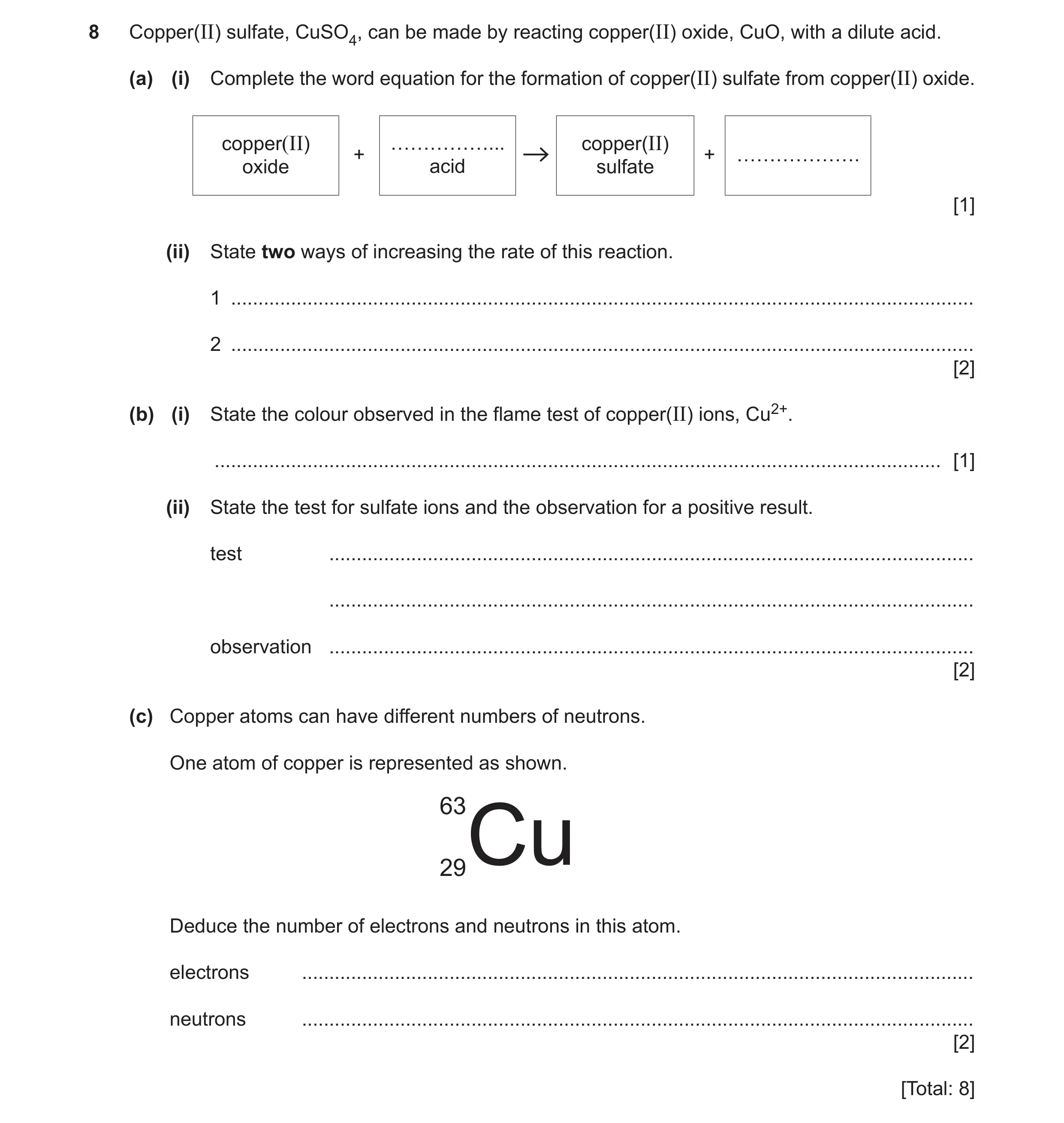
8 Copper(II) sulfate, CuSO4, can be made by reacting copper(II) oxide, CuO, with a dilute acid. (a) (i) Complete the word equation for the formation of copper(II) sulfate from copper(II) oxide. copper(II) ……………... copper(II) + + ………………. oxide acid sulfate [1] (ii) State two ways of increasing the rate of this reaction. 1 … 2 … [2] (b) (i) State the colour observed in the flame test of copper(II) ions, Cu2+. … [1] (ii) State the test for sulfate ions and the observation for a positive result. test … … observation … [2] (c) Copper atoms can have different numbers of neutrons. One atom of copper is represented as shown. 63 29Cu Deduce the number of electrons and neutrons in this atom. electrons … neutrons … [2] [Total: 8]
8 marks
Mark scheme: 8(a)(i) sulfuric (acid) AND water ; 1 Question Answer Marks 8(a)(ii) any two from: increase temperature ; increase surface area (of solid / CuO) ; increase concentration (of acid) ; 2 8(b)(i) blue-green ; 1 8(b)(ii) (test) aqueous barium nitrate ; (observation) white, precipitate / solid ; 2 8(c) (electrons) 29 ; (neutrons) 34 ; 2
This question in 0653/31 May/June 2023
Q13 · A student investigates sodium chloride, NaCl 0653/32 May/June 2023
2 A student investigates sodium chloride, NaCl. (a) The student uses solid sodium chloride to make a concentrated aqueous solution of sodium chloride. The student then uses the apparatus shown in Fig. 2.1 to electrolyse this solution. low voltage d.c. supply negative positive electrode electrode Fig. 2.1 (i) State what is meant by concentrated and aqueous. concentrated … … aqueous … … [2] (ii) State the name of the product formed at the positive electrode. … [1] (iii) State the name of the type of chemical bonding found in compounds that can be electrolysed. … [1] (b) The student adds aqueous silver nitrate to aqueous sodium chloride under acidic conditions. State the observation when these two solutions are mixed. … [1] (c) Aqueous sodium chloride is made when dilute hydrochloric acid is neutralised by aqueous solution X, as shown in Fig. 2.2. The reading on the thermometer increases during the reaction. aqueous solution thermometer X is added dilute hydrochloric acid Fig. 2.2 (i) Suggest the identity of X. … [1] (ii) State what happens to the pH of the mixture when X is added. … [1] (iii) State the type of chemical reaction that causes the reading on the thermometer to increase. … [1] (d) An atom of sodium is represented as shown. 2311Na Deduce the number of electrons and neutrons in this atom. number of electrons = … number of neutrons = … [2] [Total: 10]
10 marks
Mark scheme: 2(a)(i) (concentrated) high ratio of, solute / sodium chloride / ions, to solvent / water OR large (relative) amount of, solute / sodium chloride / ions ; (aqueous) (dissolved) in water / the solvent is water ; 2(a)(ii) chlorine (gas) ; 1 2(a)(iii) ionic ; 1 2(b) white, precipitate / solid ; 1 Question Answer Marks 2(c)(i) sodium hydroxide / NaOH / sodium carbonate / Na2CO3 / sodium hydrogen carbonate / NaHCO3 ; 1 2(c)(ii) increases / rises / goes up to 7 ; 1 2(c)(iii) exothermic ; 1 2(d) (electrons) 11 ; (neutrons) 12 ; 2
This question in 0653/32 May/June 2023
Q14 · Magnesium sulfate is produced by reacting excess magnesium oxide with dilute sulfuric acid 0653/33 May/June 2023
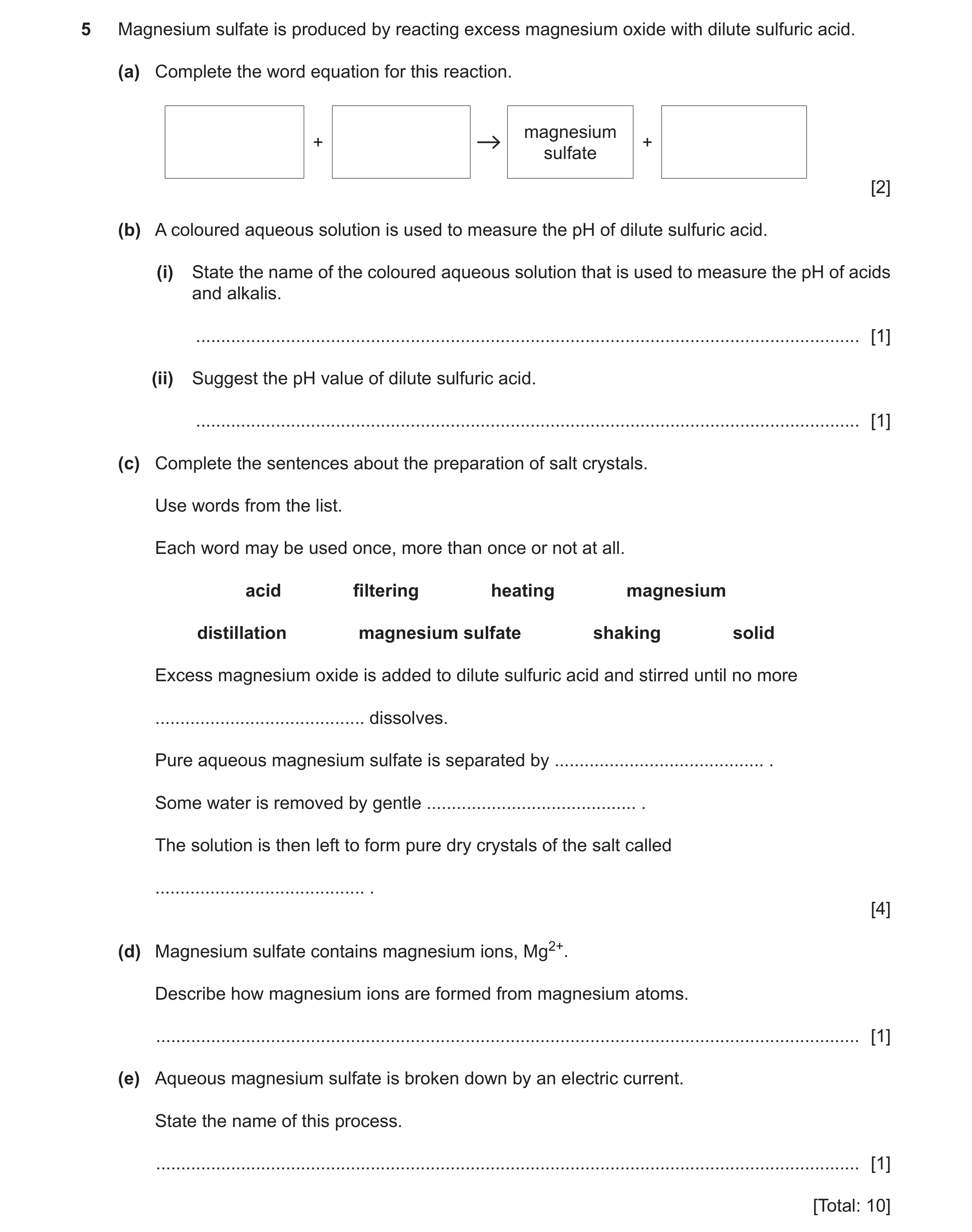
5 Magnesium sulfate is produced by reacting excess magnesium oxide with dilute sulfuric acid. (a) Complete the word equation for this reaction. magnesium + + sulfate [2] (b) A coloured aqueous solution is used to measure the pH of dilute sulfuric acid. (i) State the name of the coloured aqueous solution that is used to measure the pH of acids and alkalis. … [1] (ii) Suggest the pH value of dilute sulfuric acid. … [1] (c) Complete the sentences about the preparation of salt crystals. Use words from the list. Each word may be used once, more than once or not at all. acid filtering heating magnesium distillation magnesium sulfate shaking solid Excess magnesium oxide is added to dilute sulfuric acid and stirred until no more … dissolves. Pure aqueous magnesium sulfate is separated by … . Some water is removed by gentle … . The solution is then left to form pure dry crystals of the salt called … . [4] (d) Magnesium sulfate contains magnesium ions, Mg2+. Describe how magnesium ions are formed from magnesium atoms. … [1] (e) Aqueous magnesium sulfate is broken down by an electric current. State the name of this process. … [1] [Total: 10]
10 marks
Mark scheme: 5(a) magnesium oxide + sulfuric acid magnesium sulfate + water ;; LHS (1) RHS (1) 5(b)(i) universal indicator ; 1 5(b)(ii) 1 – 6 ; 1 5(c) solid ; filtering / filtration ; heating ; magnesium sulfate ; 4 5(d) loss of electrons ; 1 Question Answer Marks 5(e) electrolysis ; 1
This question in 0653/33 May/June 2023
Q15 · A student investigates the rate of reaction between solid magnesium carbonate and dilute… 0653/31 Oct/Nov 2024
2 A student investigates the rate of reaction between solid magnesium carbonate and dilute hydrochloric acid. Fig. 2.1 shows the apparatus. bubbles of gas syringe carbon dioxide gas conical flask lumps of solid magnesium carbonate dilute hydrochloric acid Fig. 2.1 (a) Complete the word equation for the reaction shown in Fig. 2.1. carbon + + water + dioxide [2] (b) The student investigates this reaction using three different concentrations, A, B and C, of dilute hydrochloric acid. All other variables are kept constant. Fig. 2.2 shows the volume of carbon dioxide gas produced over a period of 100 s. 60 50 A 40 B volume of C carbon dioxide gas 30 produced / cm3 20 10 0 0 10 20 30 40 50 60 70 80 90 100 time / s Fig. 2.2 (i) Identify the time at which the acid with concentration B stops reacting. time = … s [1] (ii) Use Fig. 2.2 to identify which concentration, A, B or C, is the lowest concentration of dilute hydrochloric acid. Explain your answer. concentration … explanation … … … [2] (iii) Changing the concentration of dilute hydrochloric acid affects the rate of reaction. State two other ways of affecting the rate of reaction. 1 … 2 … [2] (c) The reaction between dilute hydrochloric acid and magnesium carbonate produces water. (i) State the name of the type of chemical bonding in a water molecule. … [1] (ii) Complete the dot-and-cross diagram in Fig. 2.3 to show the bonding in a water molecule, H2O. Show all the outer-shell electrons. O H H Fig. 2.3 [2] [Total: 10]
10 marks
Mark scheme: 2(a) magnesium carbonate AND hydrochloric acid ; 2 magnesium chloride ; 2(b)(i) 38–40 (s) ; 1 2(b)(ii) C ; 2 lowest rate of reaction / curve is less steep / reaction takes longer to complete ; 2(b)(iii) any two from: 2 change temperature ; use catalyst ; change, size / surface area (of particles / magnesium carbonate) ; 2(c)(i) covalent ; 1 2(c)(ii) bonding pair between each hydrogen and the oxygen ; 2 2 lone pairs / 4 non-bonding electrons on oxygen outer shell AND all else correct ;
This question in 0653/31 Oct/Nov 2024
Q16 · Iron is a transition element 0653/32 May/June 2025
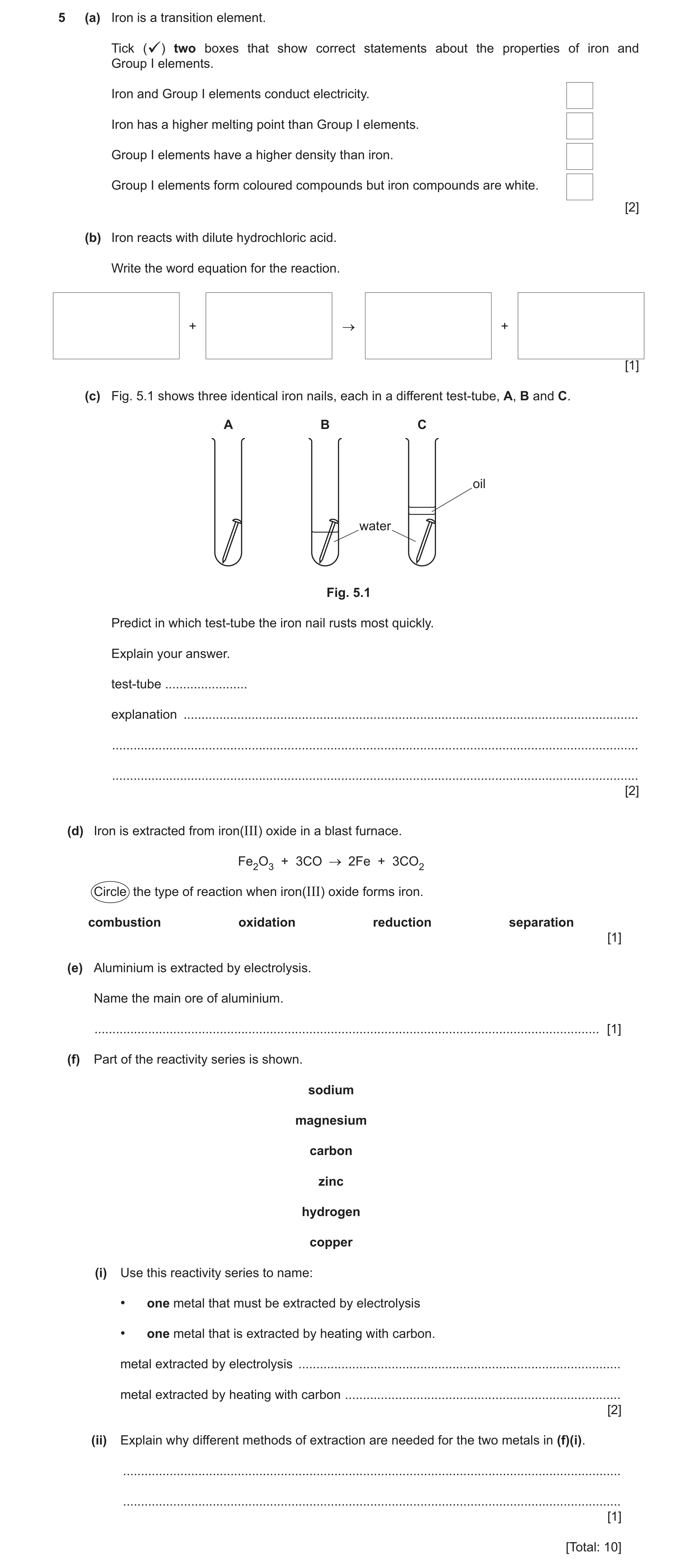
5 (a) Iron is a transition element. Tick () two boxes that show correct statements about the properties of iron and Group I elements. Iron and Group I elements conduct electricity. Iron has a higher melting point than Group I elements. Group I elements have a higher density than iron. Group I elements form coloured compounds but iron compounds are white. [2] (b) Iron reacts with dilute hydrochloric acid. Write the word equation for the reaction. + + [1] (c) Fig. 5.1 shows three identical iron nails, each in a different test-tube, A, B and C. A B C oil water Fig. 5.1 Predict in which test-tube the iron nail rusts most quickly. Explain your answer. test-tube … explanation … … … [2] (d) Iron is extracted from iron(III) oxide in a blast furnace. Fe2O3 + 3CO 2Fe + 3CO2 Circle the type of reaction when iron(III) oxide forms iron. combustion oxidation reduction separation [1] (e) Aluminium is extracted by electrolysis. Name the main ore of aluminium. … [1] (f) Part of the reactivity series is shown. sodium magnesium carbon zinc hydrogen copper (i) Use this reactivity series to name: • one metal that must be extracted by electrolysis • one metal that is extracted by heating with carbon. metal extracted by electrolysis … metal extracted by heating with carbon … [2] (ii) Explain why different methods of extraction are needed for the two metals in (f)(i). … … [1] [Total: 10]
10 marks
Mark scheme: 5(a) first and second boxes ticked ; 2 5(b) iron + hydrochloric acid → iron(II) chloride + hydrogen ; 1 5(c) B ; 2 oxygen and water are needed for rusting ; 5(d) reduction ; 1 5(e) bauxite ; 1 5(f)(i) electrolysis: magnesium or sodium ; 2 carbon: zinc or copper ; 5(f)(ii) metals more reactive than carbon are extracted by electrolysis / metals less reactive than carbon can be extracted by 1 heating (with carbon) ;
This question in 0653/32 May/June 2025
 4 / 23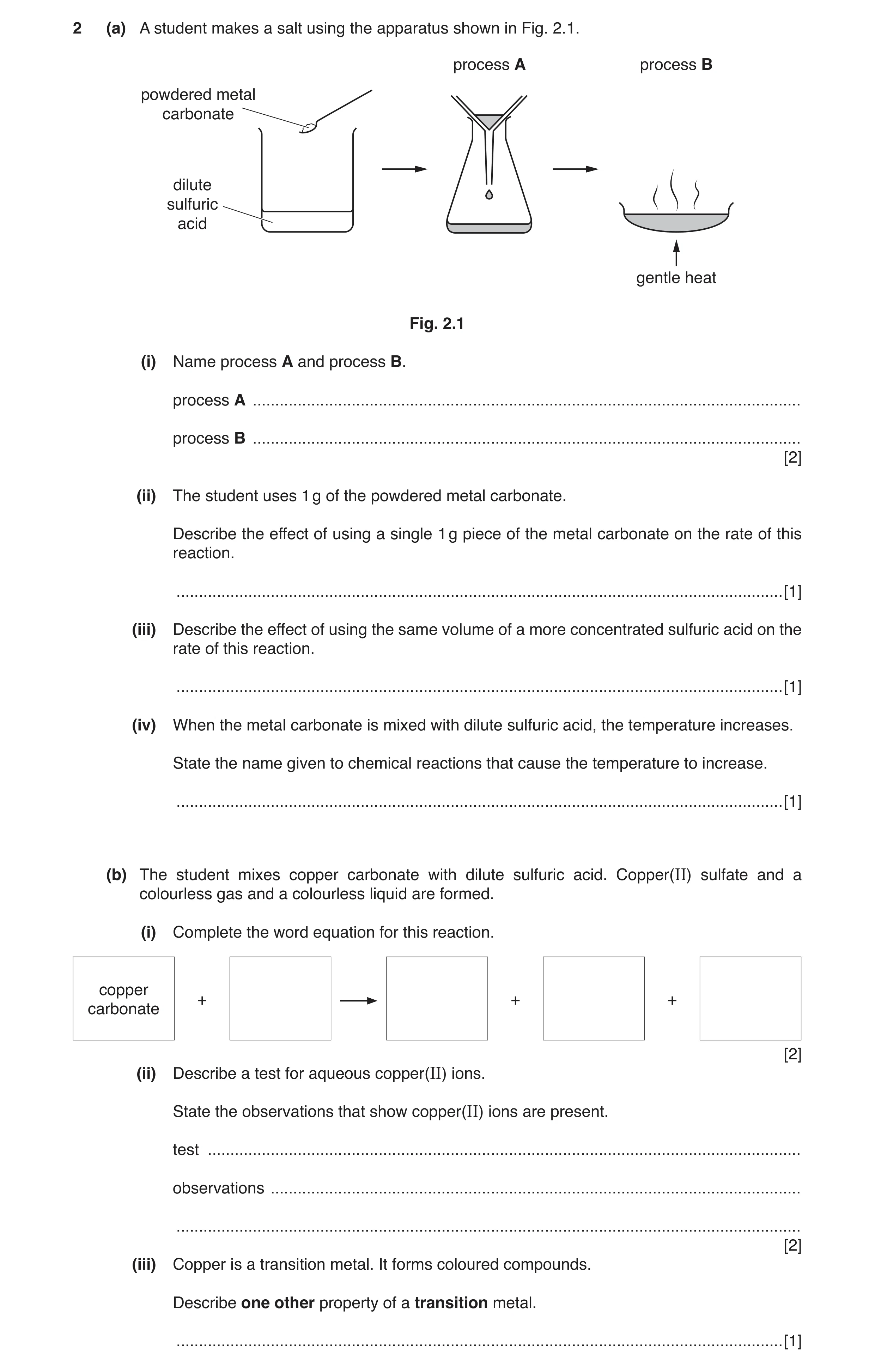
 7 / 23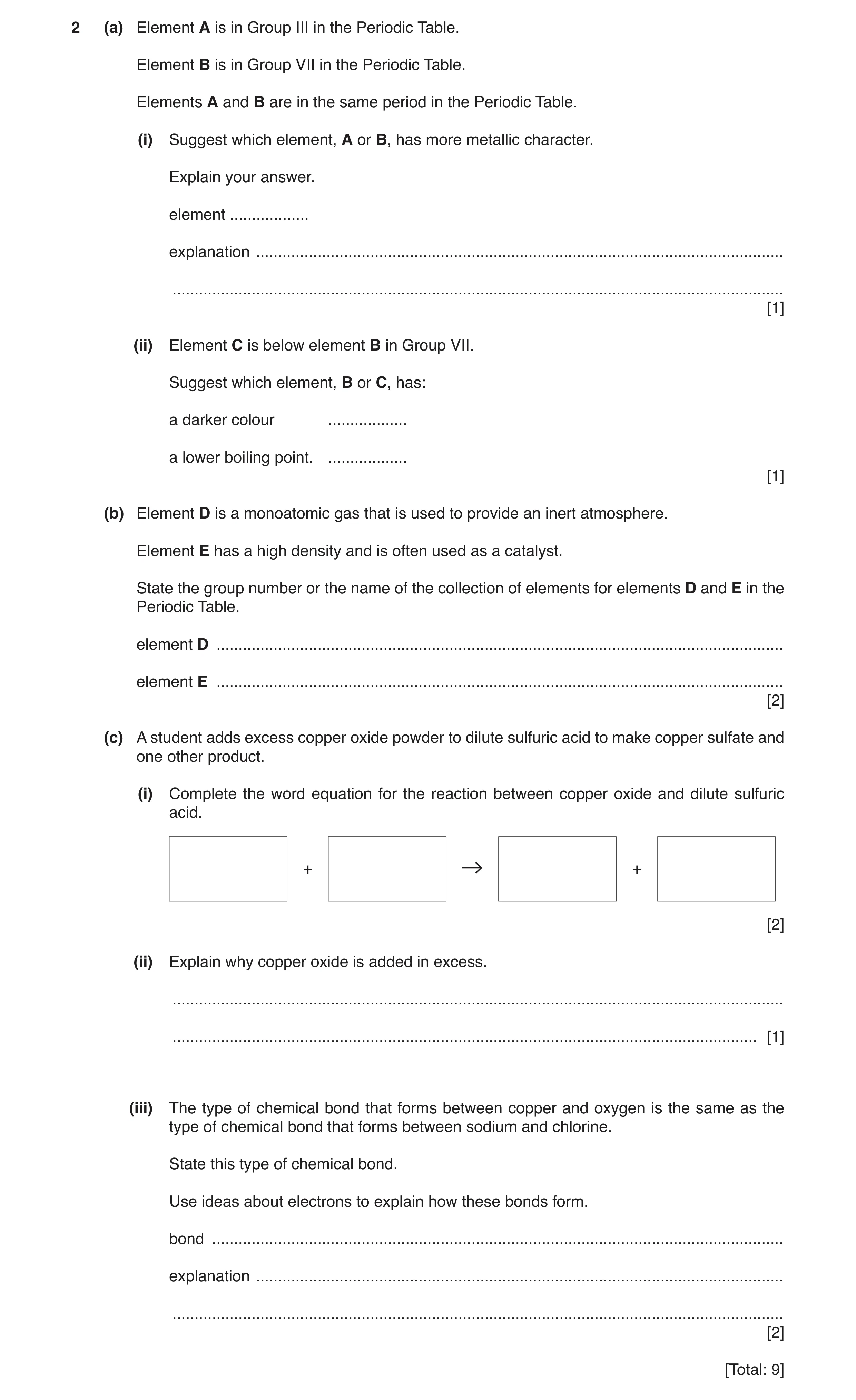
 10 / 23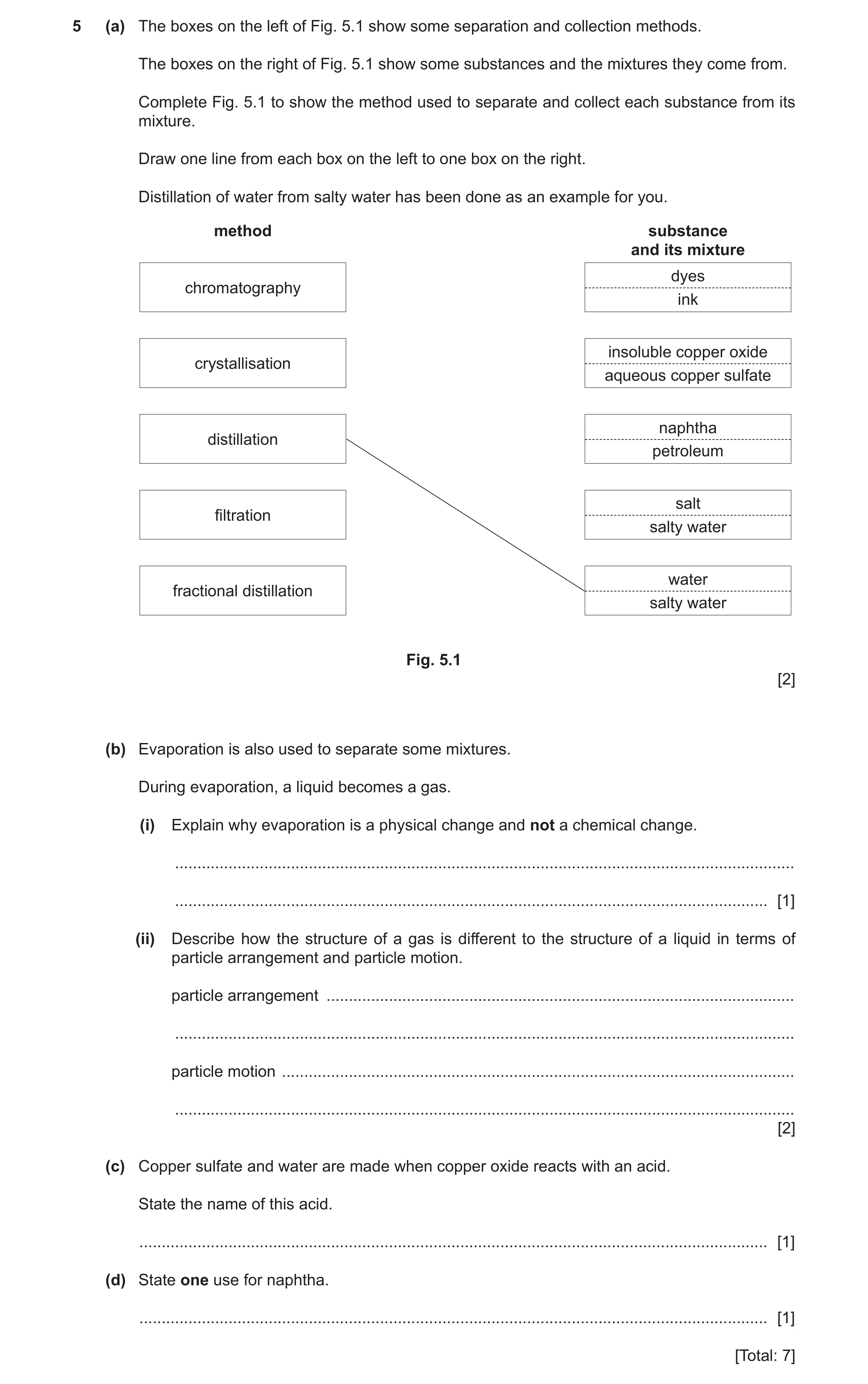
 16 / 23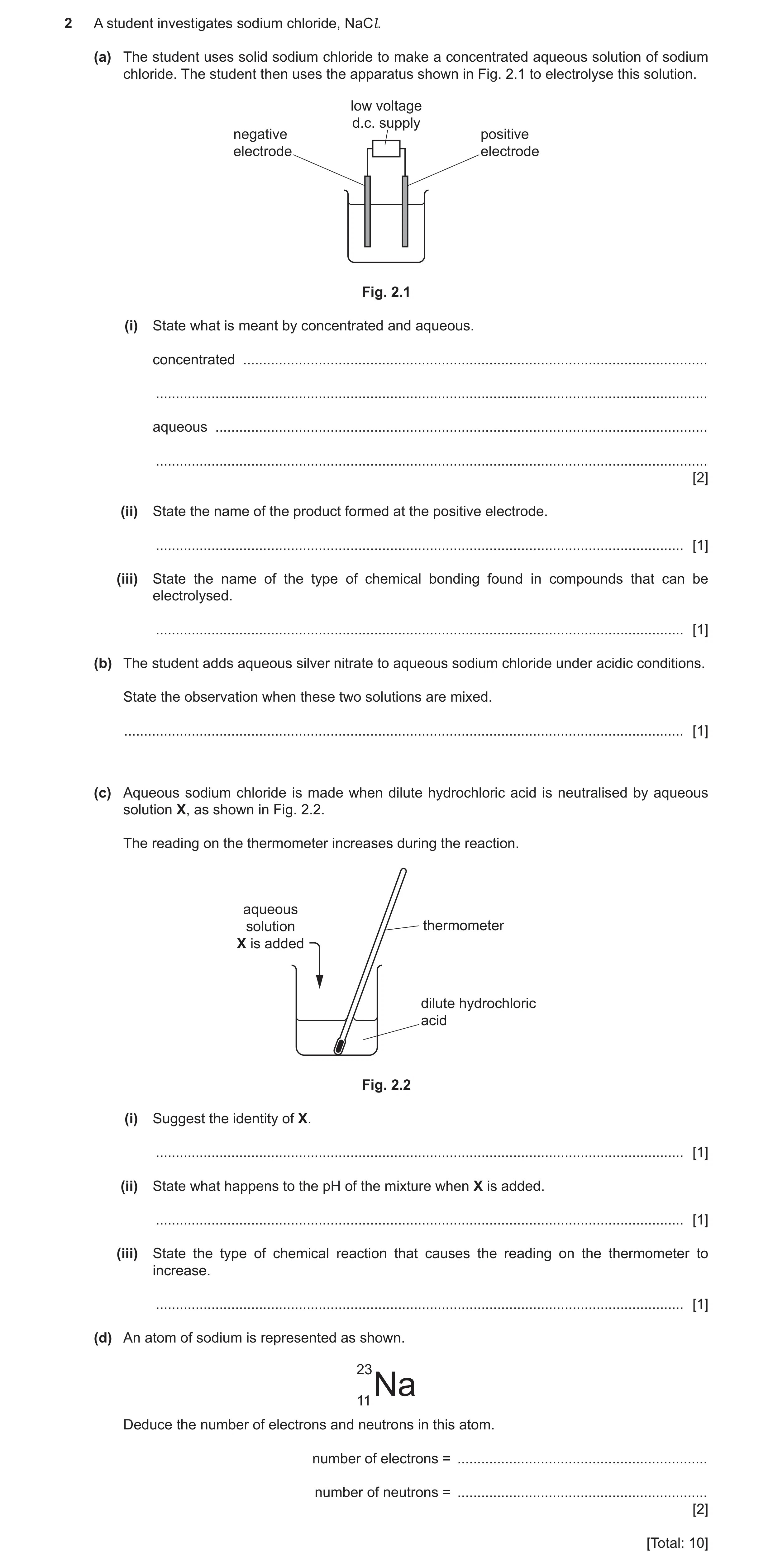
 19 / 23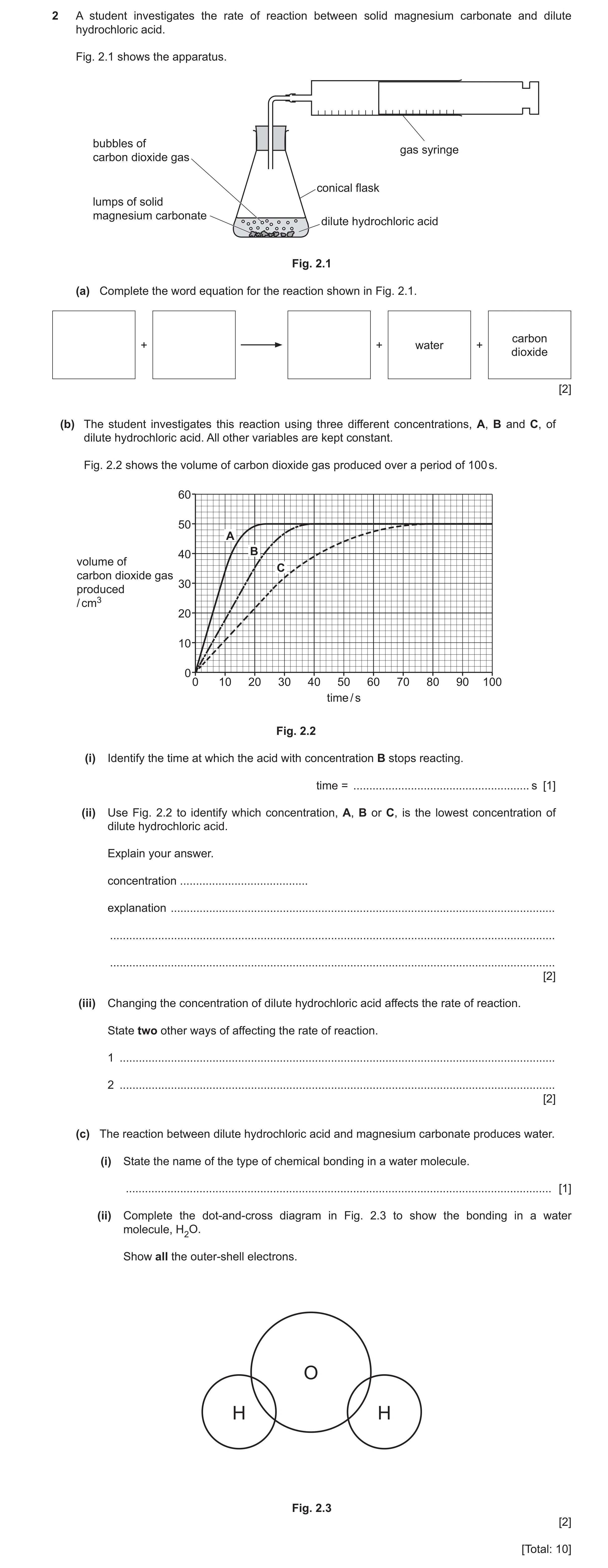
 10
10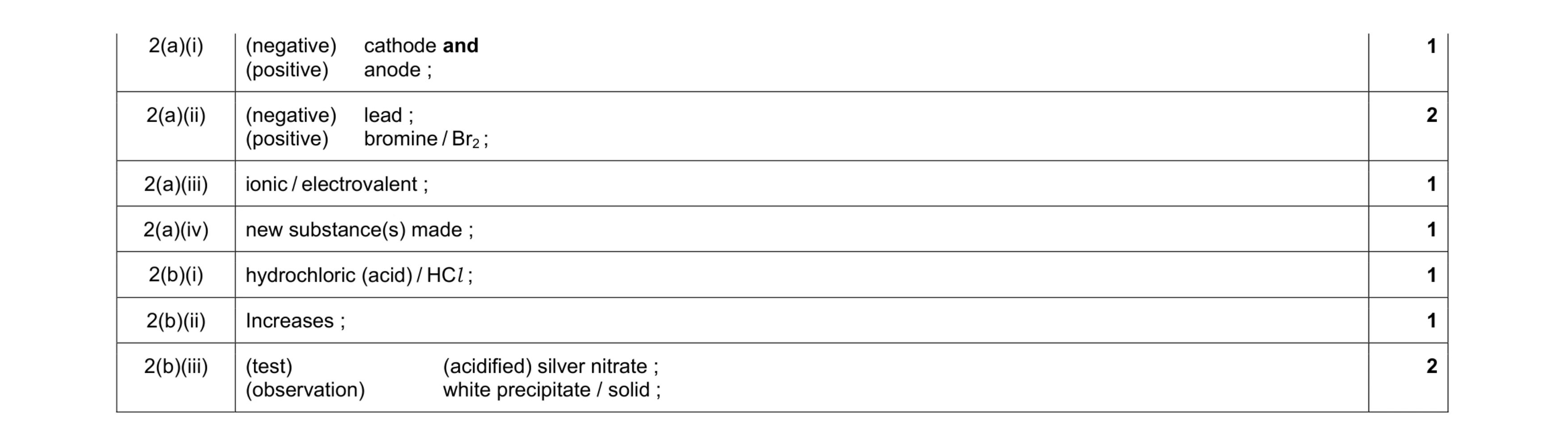 9
9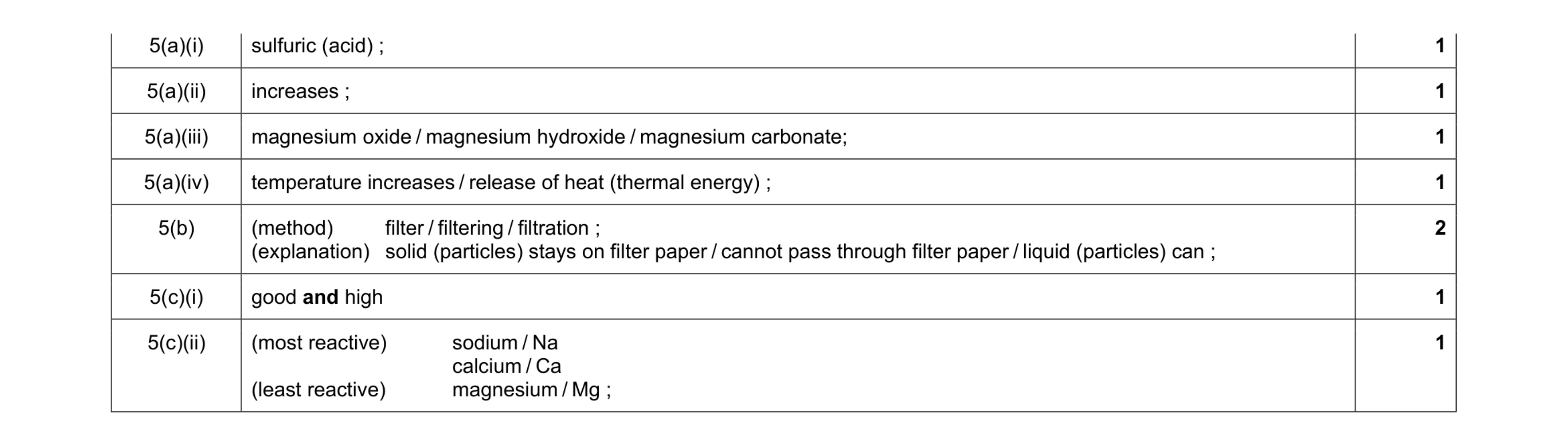 8
8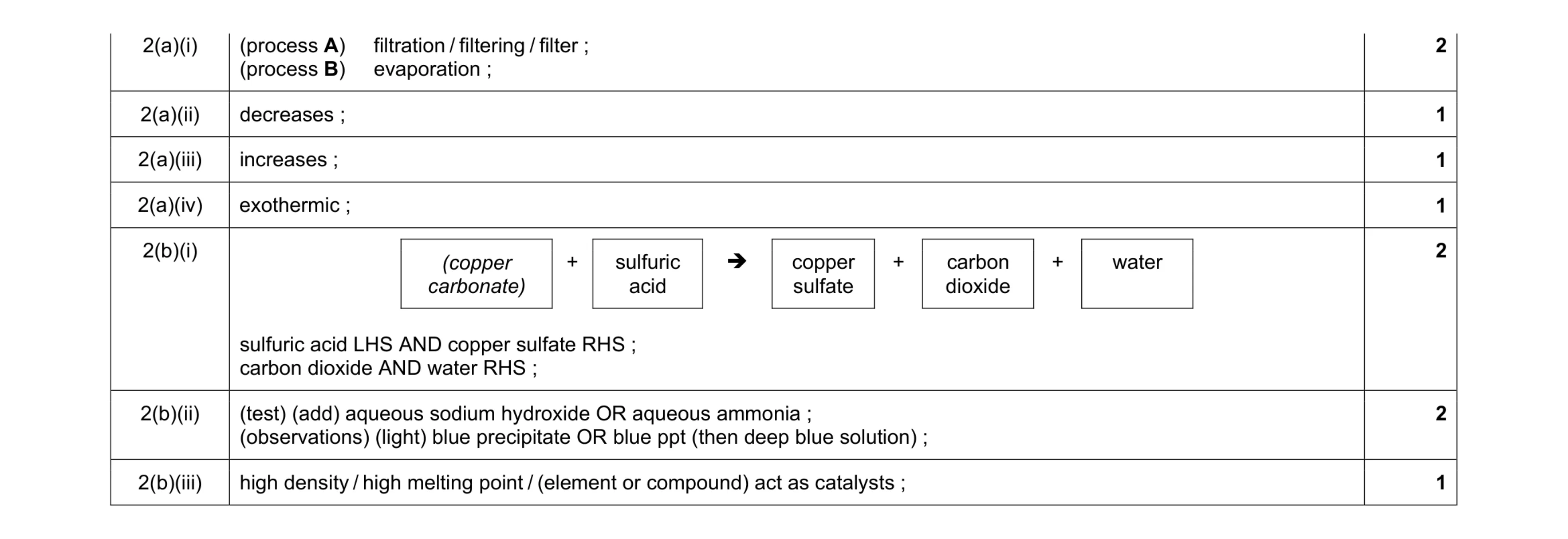 10
10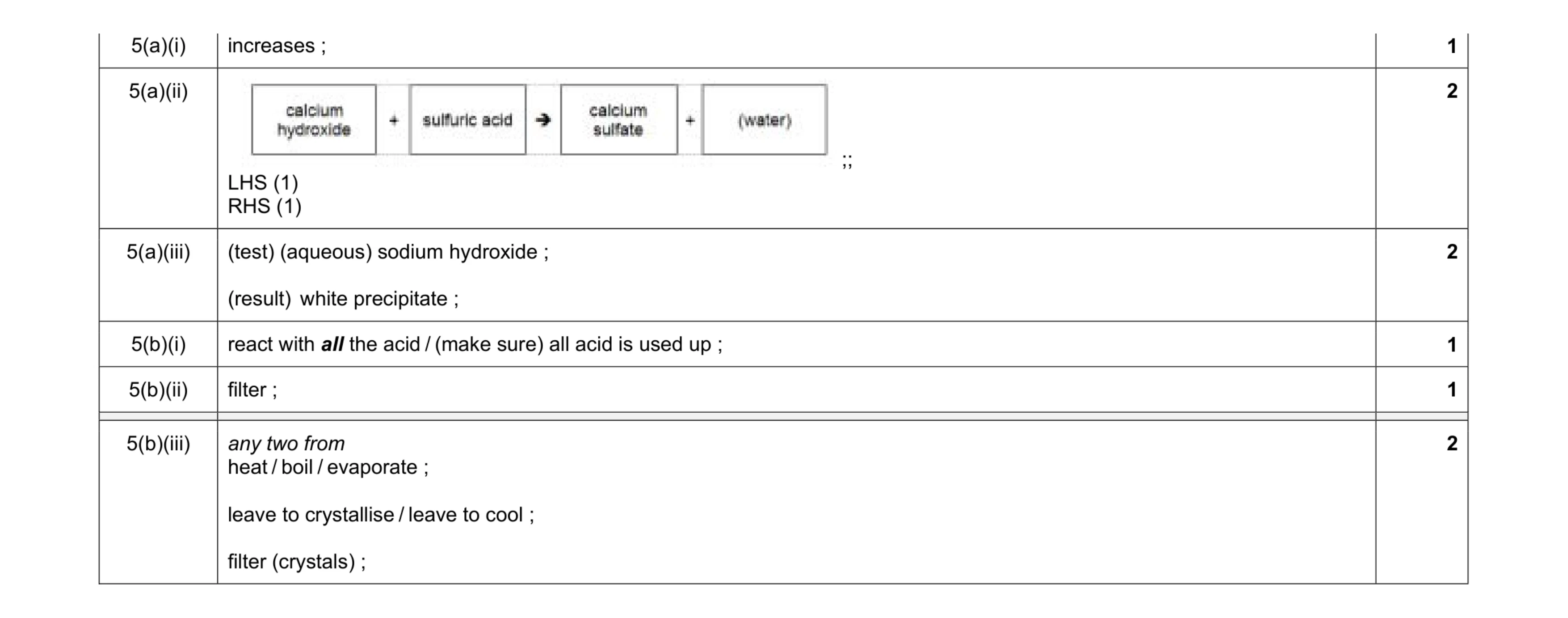 9
9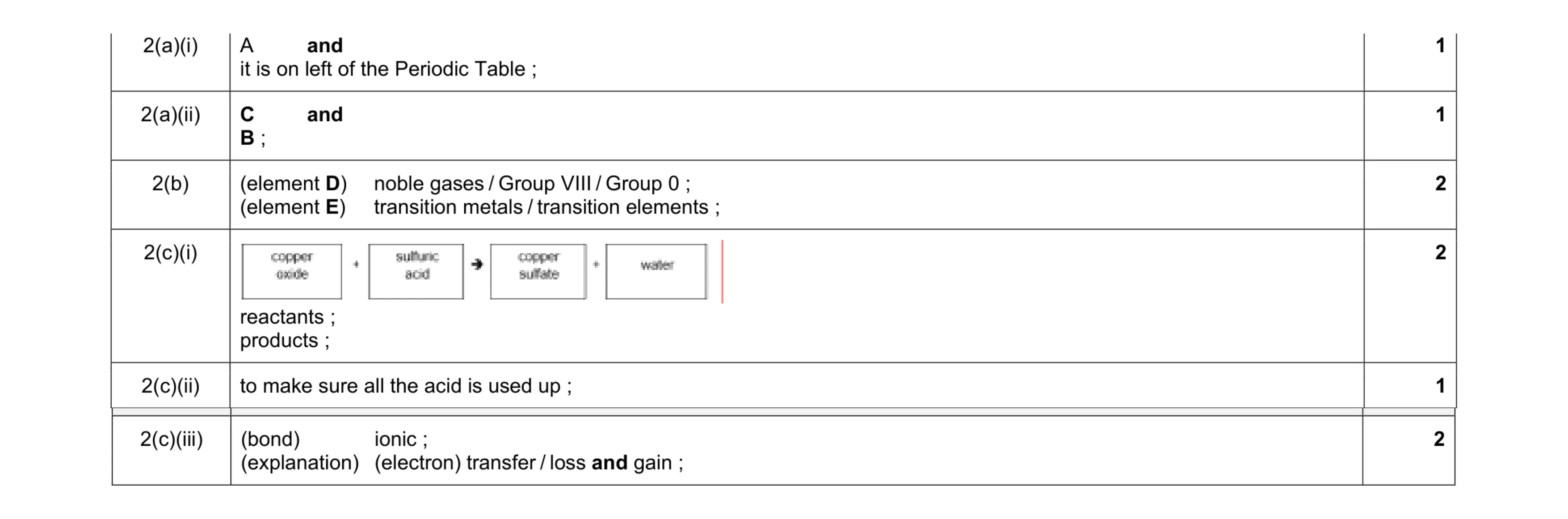 9
9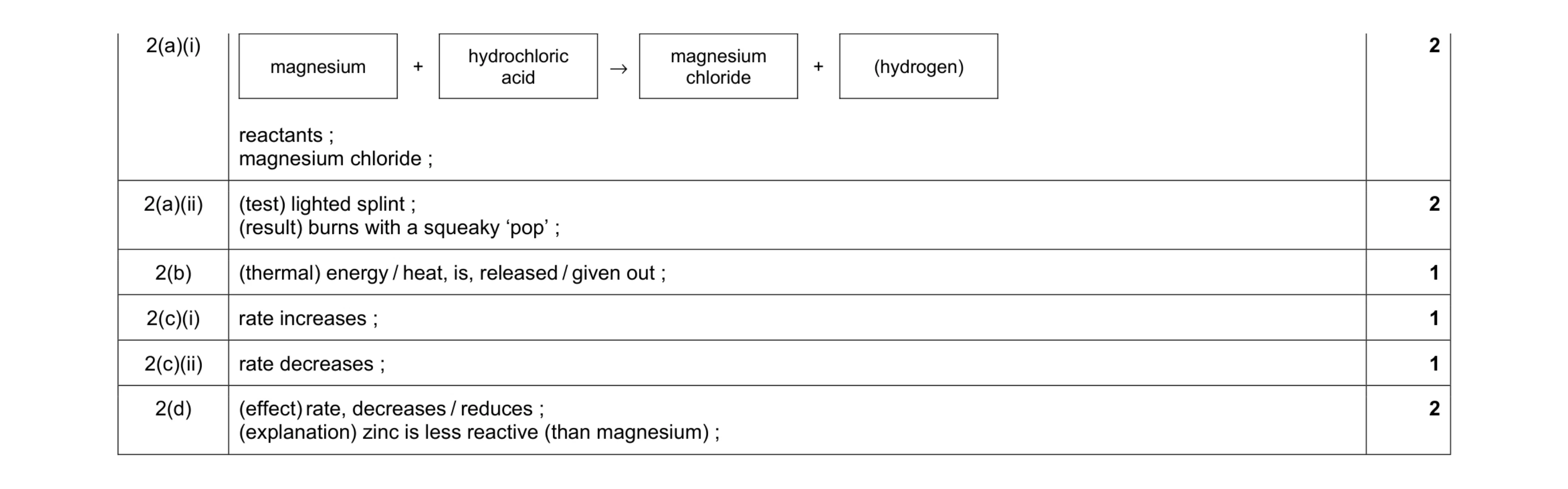 9
9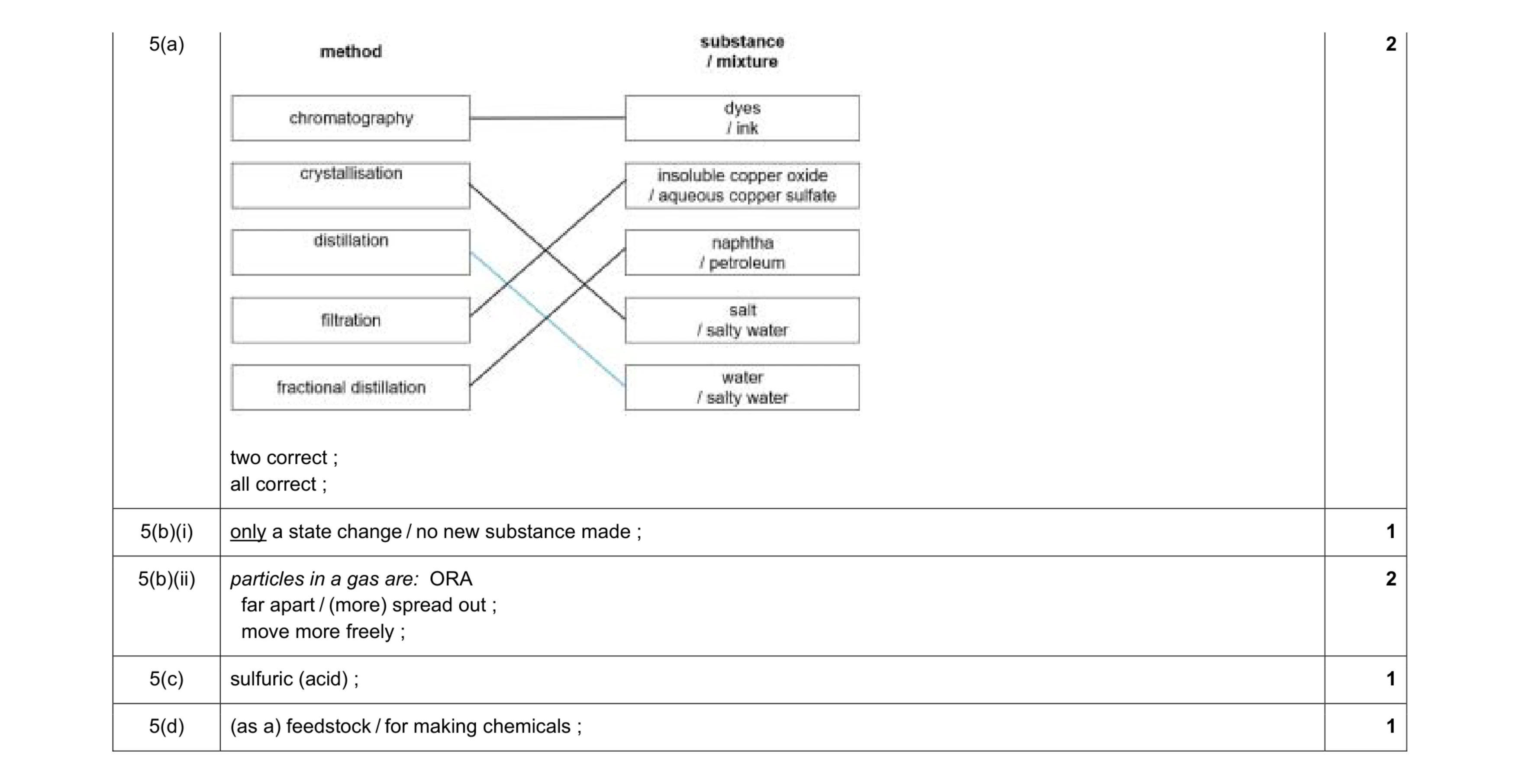 7
7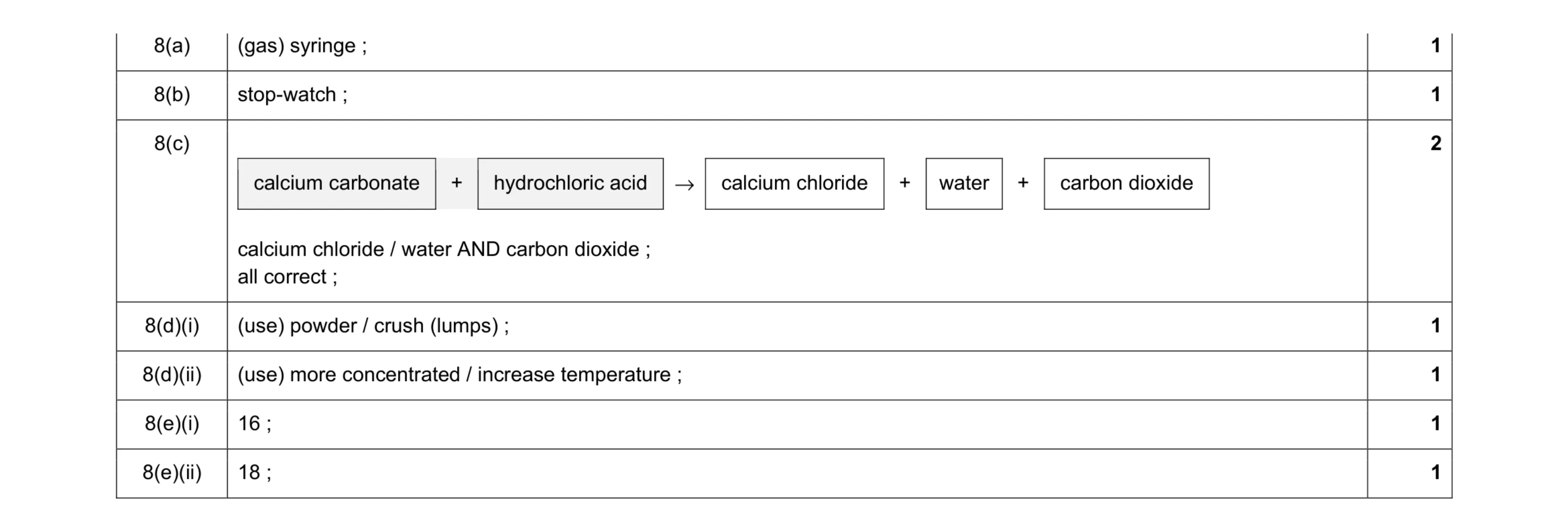 8
8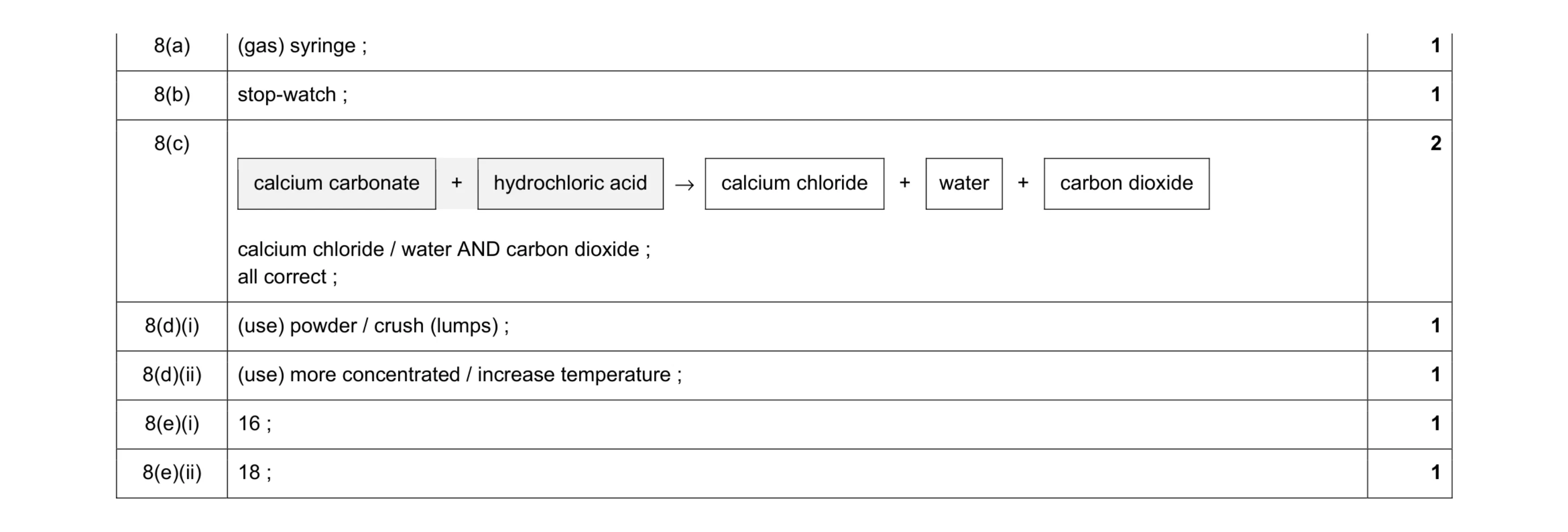 8
8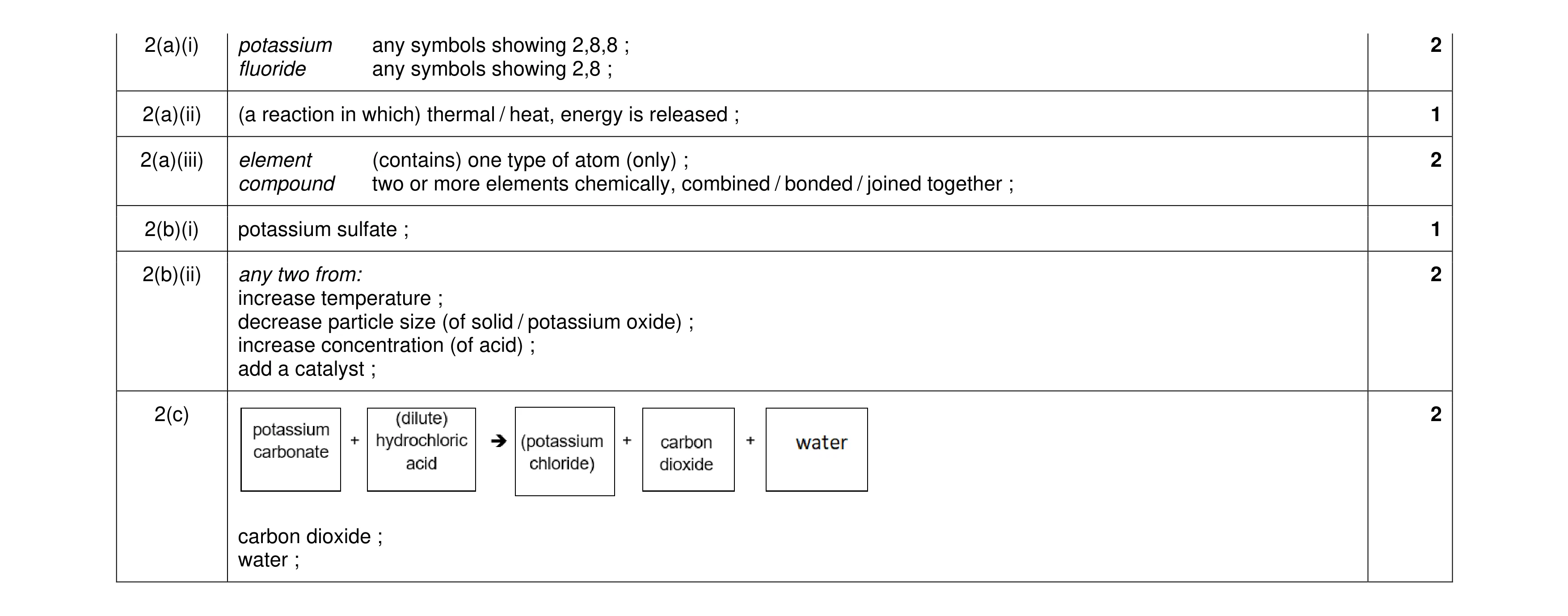 10
10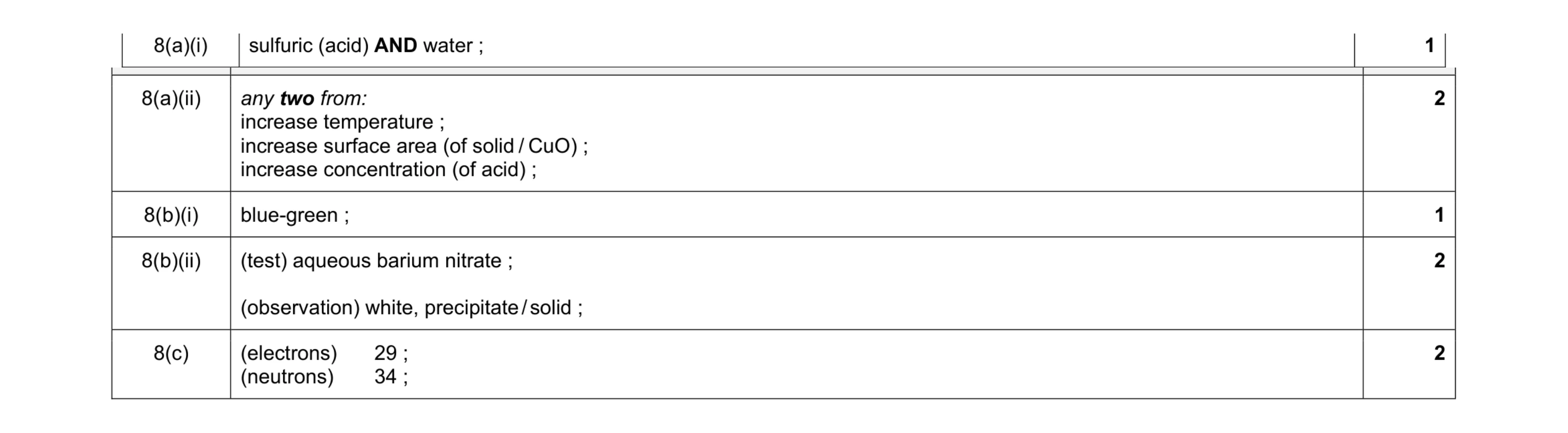 8
8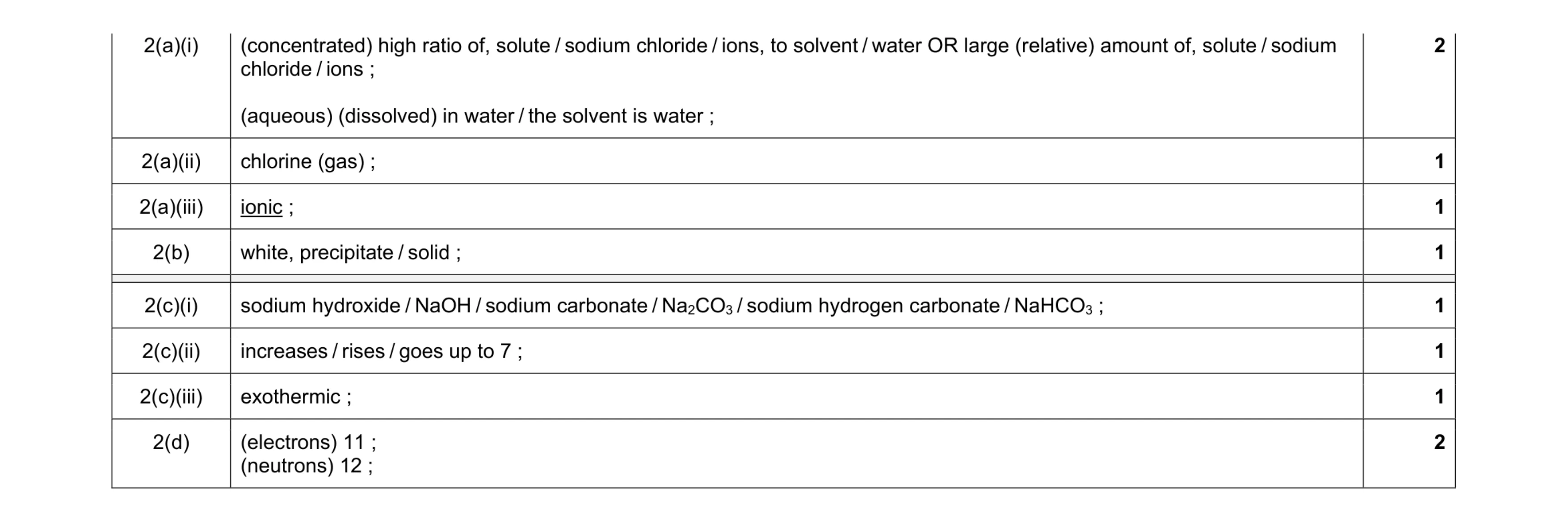 10
10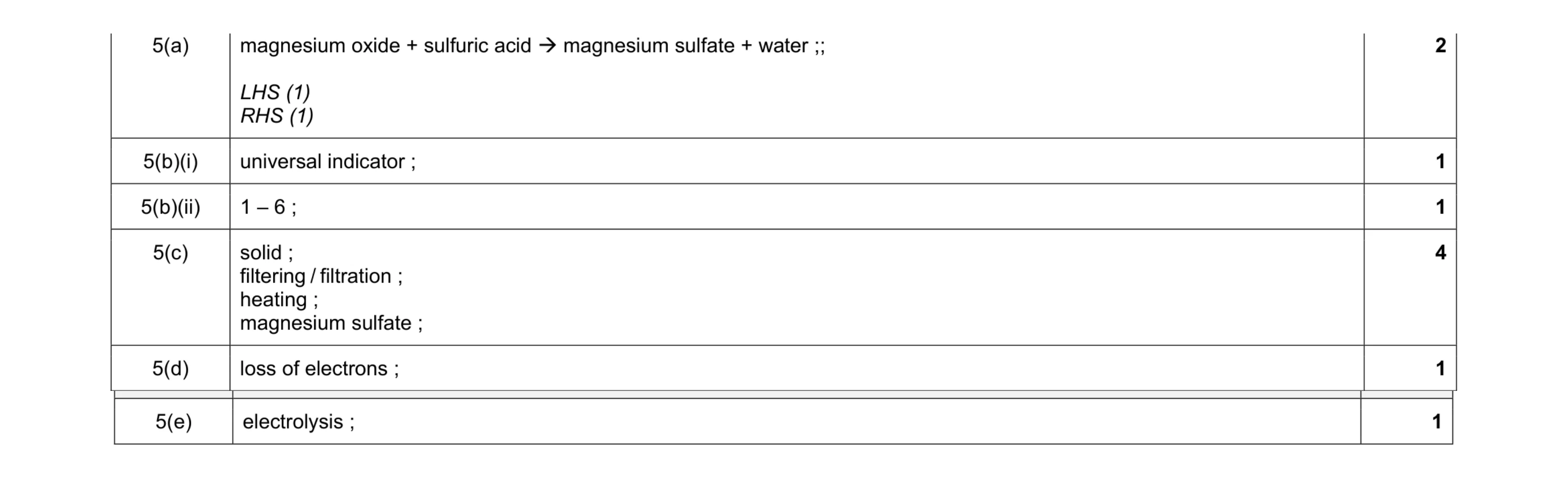 10
10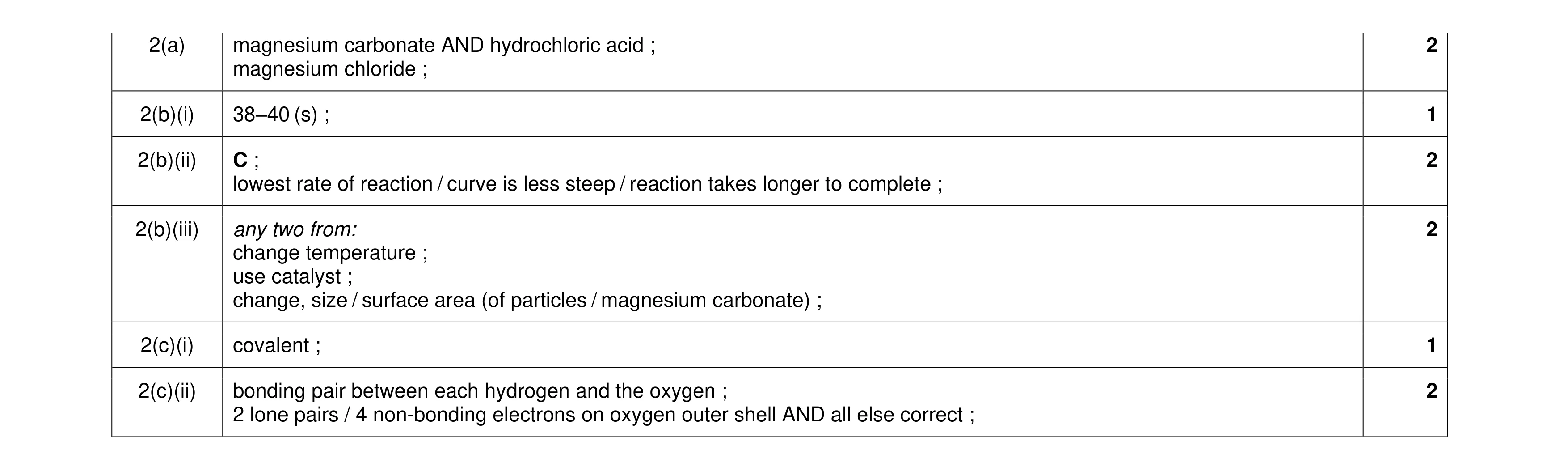 10
10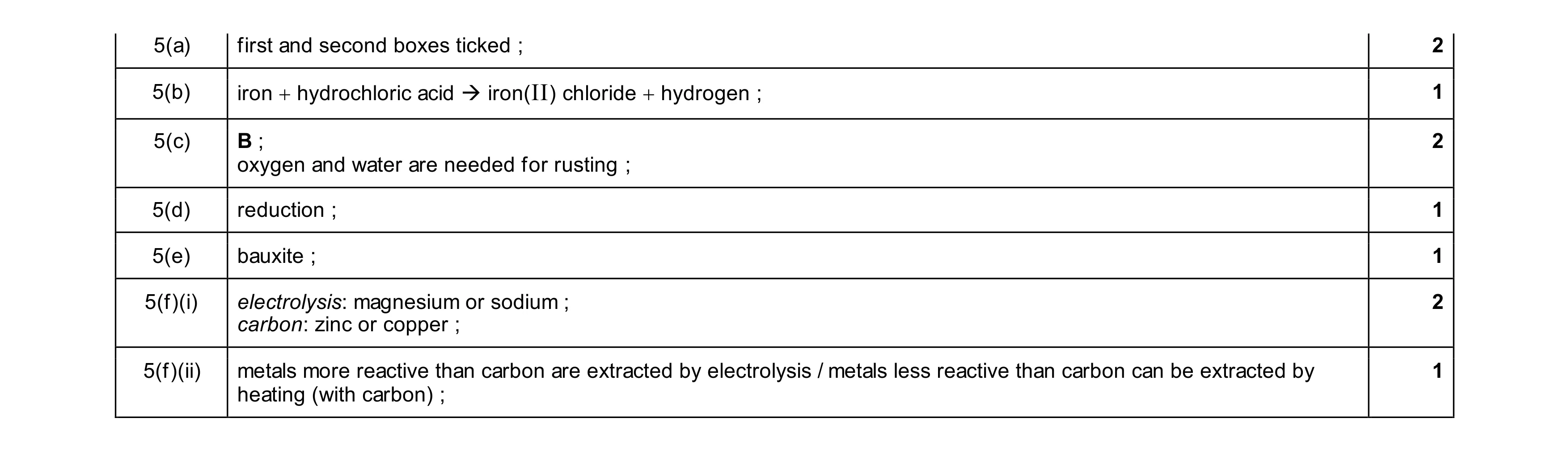 10
10