Questions as text
Q1 · Copper oxide is ……1…… in water 0653/22 Feb/March 2017
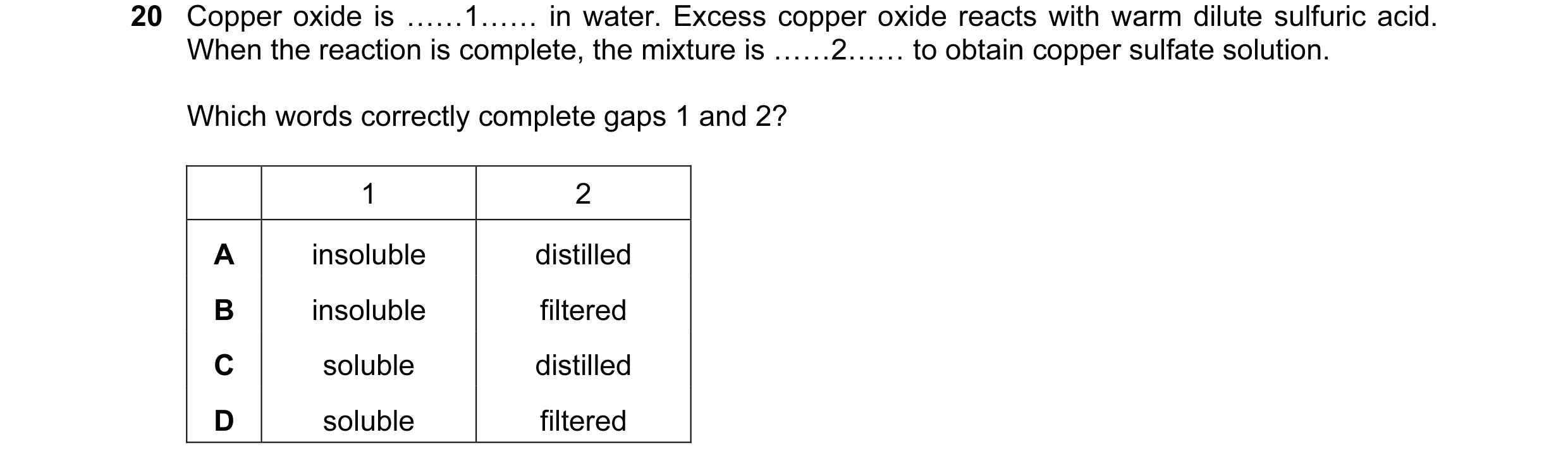
20 Copper oxide is ……1…… in water. Excess copper oxide reacts with warm dilute sulfuric acid. When the reaction is complete, the mixture is ……2…… to obtain copper sulfate solution. Which words correctly complete gaps 1 and 2? 1 2 A insoluble distilled B insoluble filtered C soluble distilled D soluble filtered
1 marks
Answer: B
This question in 0653/22 Feb/March 2017
Q2 · Which method can be used to make pure solid sodium nitrate, NaNO3? 0653/23 May/June 2017
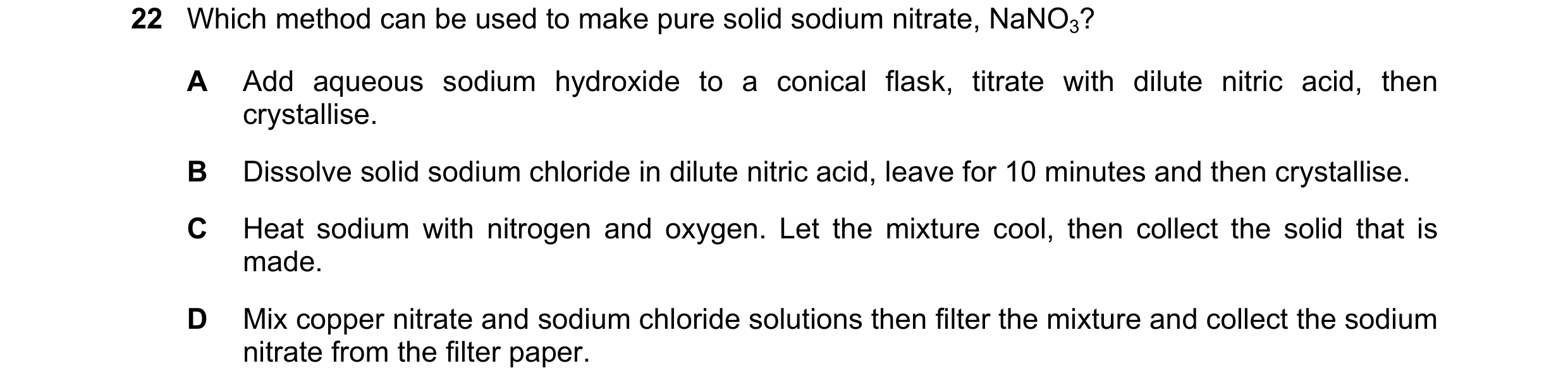
22 Which method can be used to make pure solid sodium nitrate, NaNO3? A Add aqueous sodium hydroxide to a conical flask, titrate with dilute nitric acid, then crystallise. B Dissolve solid sodium chloride in dilute nitric acid, leave for 10 minutes and then crystallise. C Heat sodium with nitrogen and oxygen. Let the mixture cool, then collect the solid that is made. D Mix copper nitrate and sodium chloride solutions then filter the mixture and collect the sodium nitrate from the filter paper.
1 marks
Answer: A
This question in 0653/23 May/June 2017
Q3 · Excess aqueous barium nitrate is added to dilute sulfuric acid to produce barium sulfate 0653/21 Oct/Nov 2017
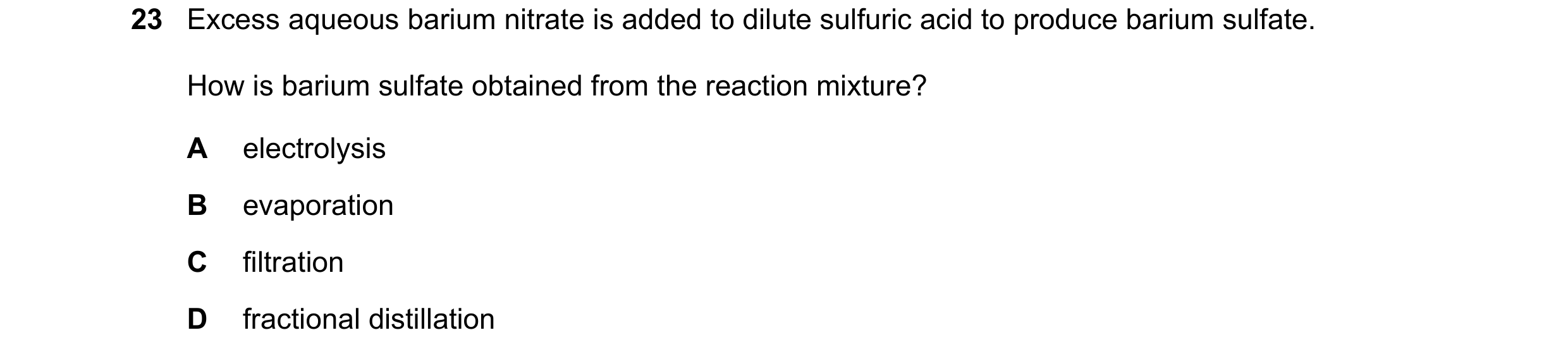
23 Excess aqueous barium nitrate is added to dilute sulfuric acid to produce barium sulfate. How is barium sulfate obtained from the reaction mixture? A electrolysis B evaporation C filtration D fractional distillation
1 marks
Answer: C
This question in 0653/21 Oct/Nov 2017
Q4 · Excess aqueous barium nitrate is added to dilute sulfuric acid to produce barium sulfate 0653/22 Oct/Nov 2017
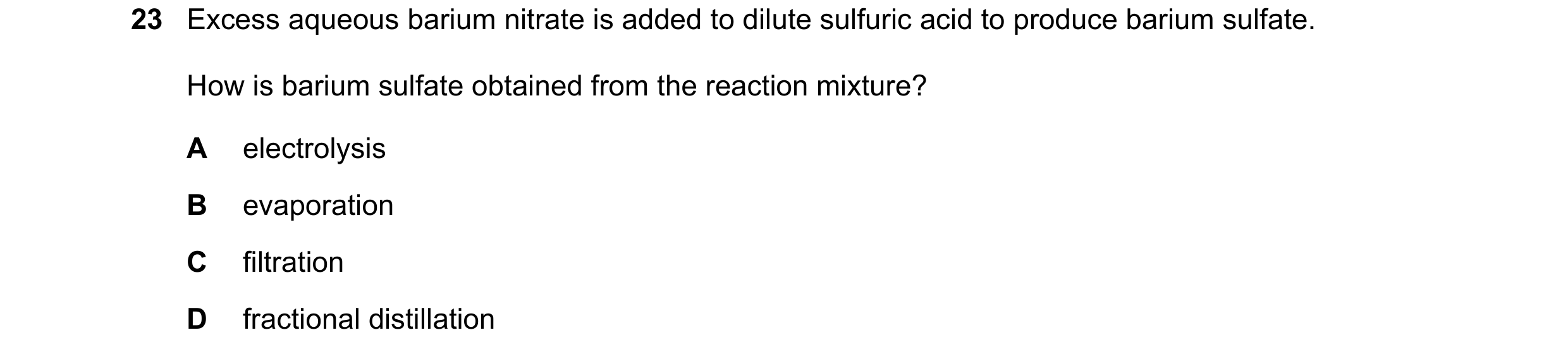
23 Excess aqueous barium nitrate is added to dilute sulfuric acid to produce barium sulfate. How is barium sulfate obtained from the reaction mixture? A electrolysis B evaporation C filtration D fractional distillation
1 marks
Answer: C
This question in 0653/22 Oct/Nov 2017
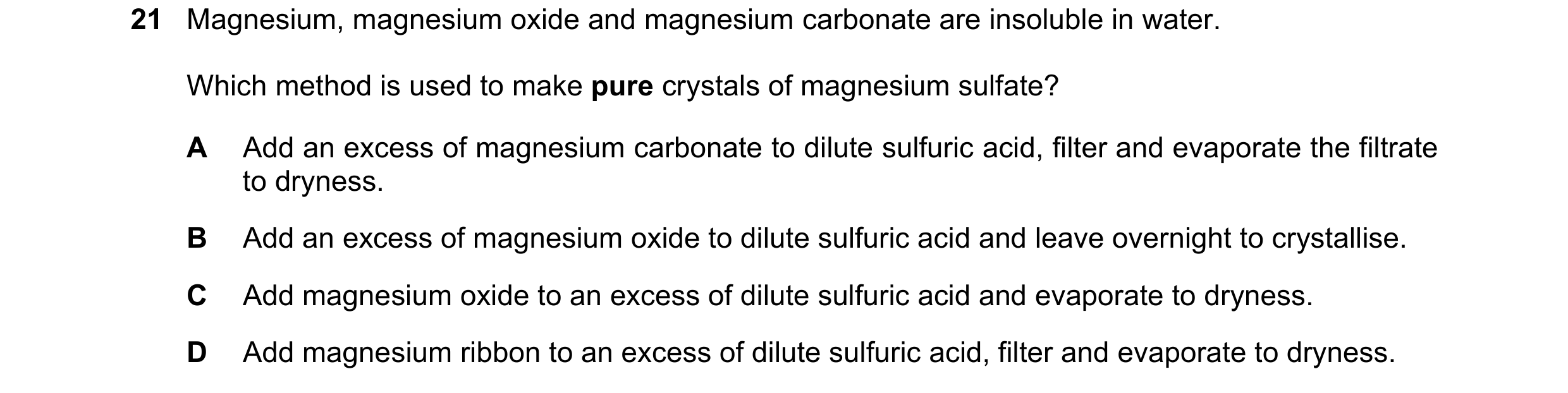
Q5 · Magnesium, magnesium oxide and magnesium carbonate are insoluble in water 0653/22 Feb/March 2018
21 Magnesium, magnesium oxide and magnesium carbonate are insoluble in water. Which method is used to make pure crystals of magnesium sulfate? A Add an excess of magnesium carbonate to dilute sulfuric acid, filter and evaporate the filtrate to dryness. B Add an excess of magnesium oxide to dilute sulfuric acid and leave overnight to crystallise. C Add magnesium oxide to an excess of dilute sulfuric acid and evaporate to dryness. D Add magnesium ribbon to an excess of dilute sulfuric acid, filter and evaporate to dryness.
1 marks
Answer: A
This question in 0653/22 Feb/March 2018
Q6 · Excess solid copper oxide is added to warm dilute sulfuric acid and stirred 0653/21 May/June 2018
23 Excess solid copper oxide is added to warm dilute sulfuric acid and stirred. How are pure copper sulfate crystals obtained from the mixture? A distil the mixture → wash the solid → dry the solid B filter the mixture → distil the filtrate C filter the mixture → heat the filtrate to saturation → cool and filter → dry the solid D heat the mixture to saturation → cool and filter → dry the solid
1 marks
Answer: C
This question in 0653/21 May/June 2018
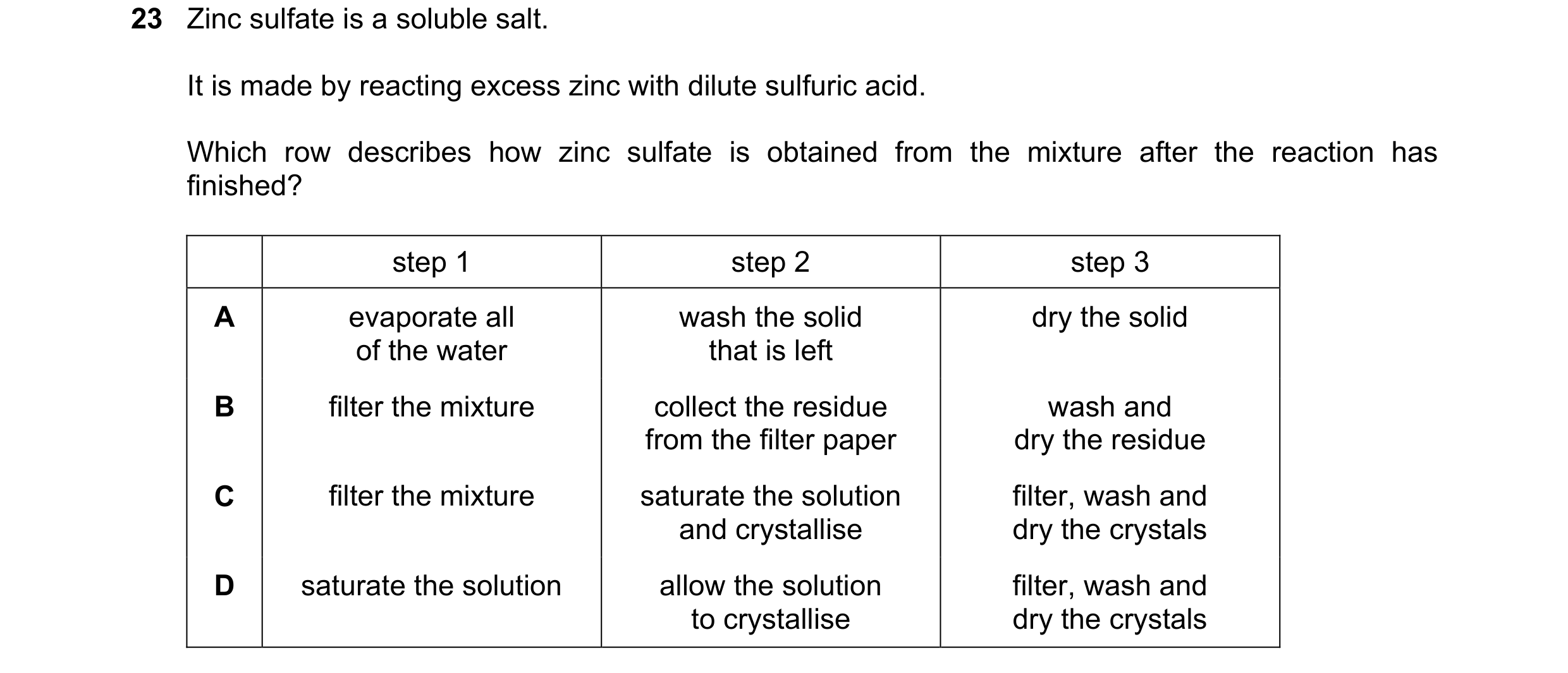
Q7 · Zinc sulfate is a soluble salt 0653/22 May/June 2018
23 Zinc sulfate is a soluble salt. It is made by reacting excess zinc with dilute sulfuric acid. Which row describes how zinc sulfate is obtained from the mixture after the reaction has finished? step 1 step 2 step 3 A evaporate all wash the solid dry the solid of the water that is left B filter the mixture collect the residue wash and from the filter paper dry the residue C filter the mixture saturate the solution filter, wash and and crystallise dry the crystals D saturate the solution allow the solution filter, wash and to crystallise dry the crystals
1 marks
Answer: C
This question in 0653/22 May/June 2018
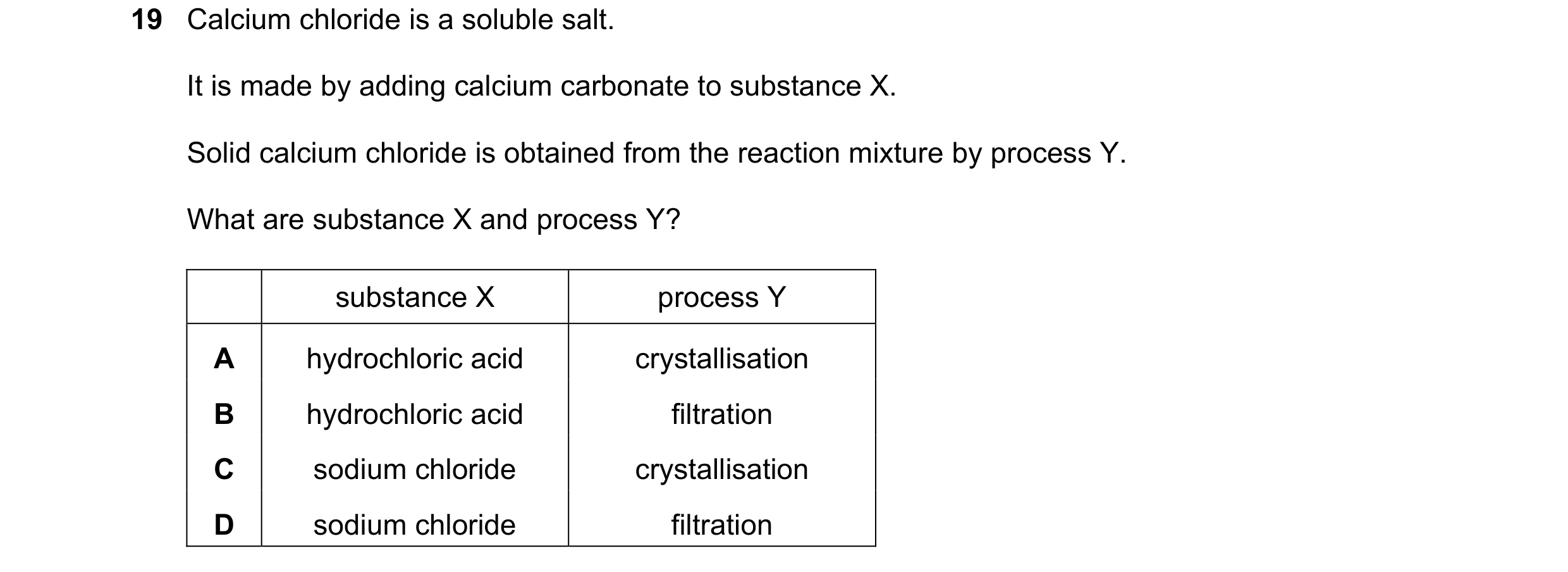
Q8 · Calcium chloride is a soluble salt 0653/21 May/June 2019
19 Calcium chloride is a soluble salt. It is made by adding calcium carbonate to substance X. Solid calcium chloride is obtained from the reaction mixture by process Y. What are substance X and process Y? substance X process Y A hydrochloric acid crystallisation B hydrochloric acid filtration C sodium chloride crystallisation D sodium chloride filtration
1 marks
Answer: A
This question in 0653/21 May/June 2019
Q9 · Which two substances are used to make copper sulfate? 0653/21 Oct/Nov 2019
22 Which two substances are used to make copper sulfate? A copper and dilute sulfuric acid B copper and sulfur C copper oxide and dilute sulfuric acid D copper oxide and sulfur
1 marks
Answer: C
This question in 0653/21 Oct/Nov 2019
Q10 · Copper sulfate is a soluble salt 0653/22 Oct/Nov 2019
20 Copper sulfate is a soluble salt. How are pure crystals of copper sulfate prepared? A Mix copper chloride solution with sodium sulfate solution, filter, rinse and dry. B React copper oxide with excess dilute sulfuric acid, evaporate, cool, filter, rinse and dry. C React excess copper carbonate, with dilute sulfuric acid, filter, evaporate, cool, filter, rinse and dry. D React excess copper with dilute sulfuric acid, filter, evaporate, cool, filter, rinse and dry.
1 marks
Answer: C
This question in 0653/22 Oct/Nov 2019
Q11 · Copper sulfate is a soluble salt which is prepared by reacting insoluble copper oxide… 0653/23 Oct/Nov 2019
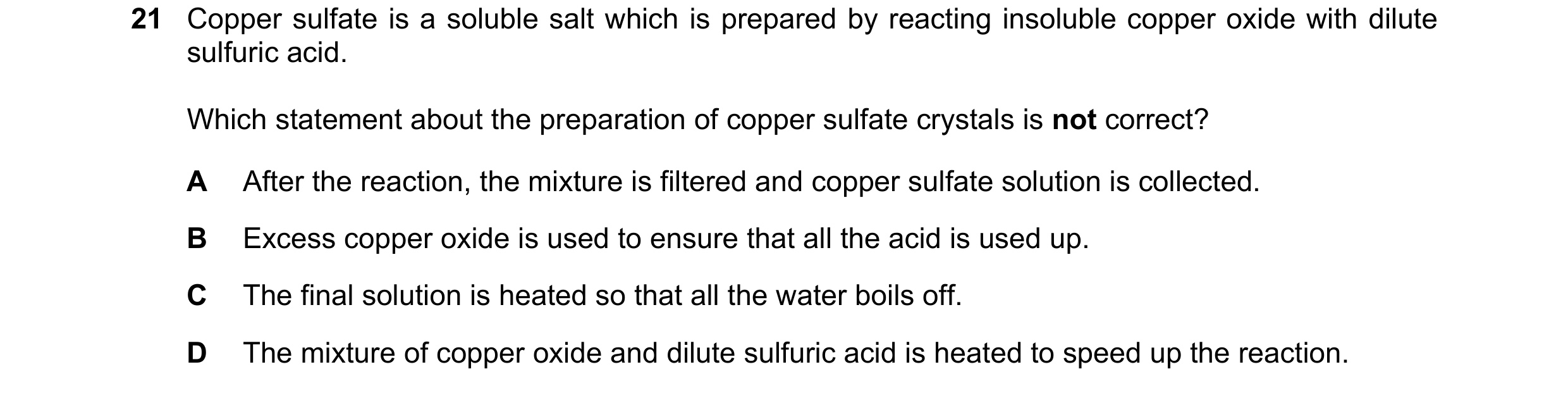
21 Copper sulfate is a soluble salt which is prepared by reacting insoluble copper oxide with dilute sulfuric acid. Which statement about the preparation of copper sulfate crystals is not correct? A After the reaction, the mixture is filtered and copper sulfate solution is collected. B Excess copper oxide is used to ensure that all the acid is used up. C The final solution is heated so that all the water boils off. D The mixture of copper oxide and dilute sulfuric acid is heated to speed up the reaction.
1 marks
Answer: C
This question in 0653/23 Oct/Nov 2019
Q12 · Copper(II) sulfate is prepared by reacting copper(II) oxide with dilute sulfuric acid 0653/21 May/June 2020
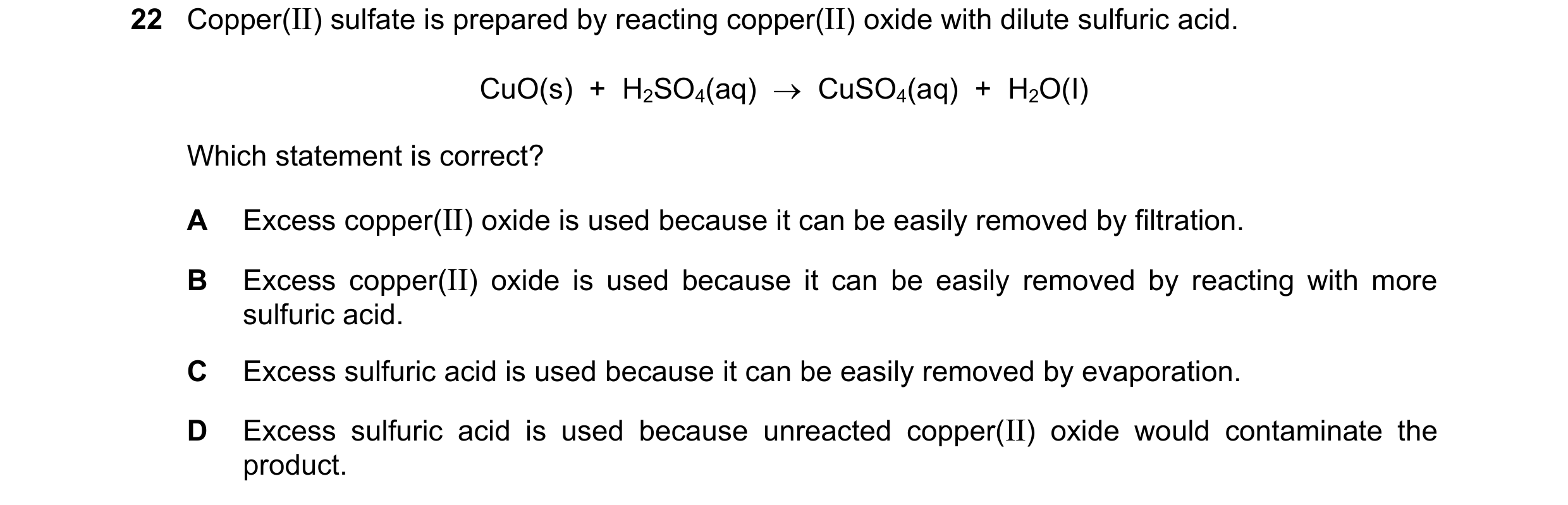
22 Copper(II) sulfate is prepared by reacting copper(II) oxide with dilute sulfuric acid. CuO(s) + H2SO4(aq) → CuSO4(aq) + H2O(I) Which statement is correct? A Excess copper(II) oxide is used because it can be easily removed by filtration. B Excess copper(II) oxide is used because it can be easily removed by reacting with more sulfuric acid. C Excess sulfuric acid is used because it can be easily removed by evaporation. D Excess sulfuric acid is used because unreacted copper(II) oxide would contaminate the product.
1 marks
Answer: A
This question in 0653/21 May/June 2020
Q13 · Copper(II) sulfate is prepared by reacting copper(II) oxide with dilute sulfuric acid 0653/22 May/June 2020
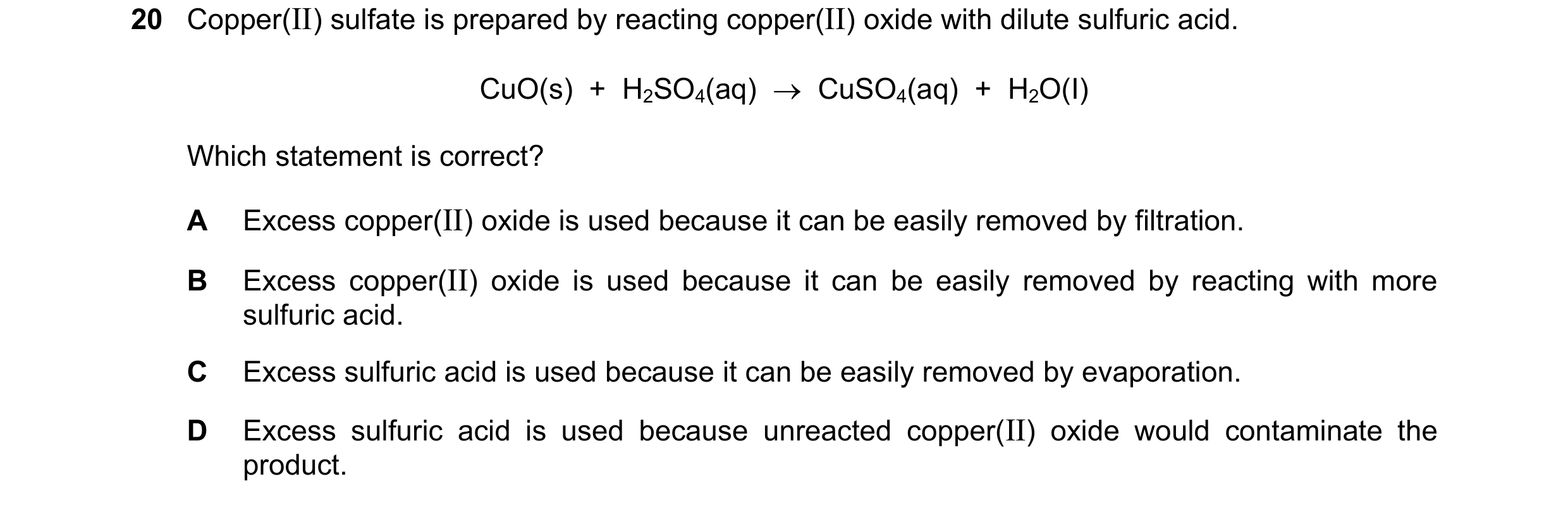
20 Copper(II) sulfate is prepared by reacting copper(II) oxide with dilute sulfuric acid. CuO(s) + H2SO4(aq) → CuSO4(aq) + H2O(I) Which statement is correct? A Excess copper(II) oxide is used because it can be easily removed by filtration. B Excess copper(II) oxide is used because it can be easily removed by reacting with more sulfuric acid. C Excess sulfuric acid is used because it can be easily removed by evaporation. D Excess sulfuric acid is used because unreacted copper(II) oxide would contaminate the product.
1 marks
Answer: A
This question in 0653/22 May/June 2020
Q14 · Aqueous lead(II) nitrate, Pb(NO3)2, reacts with potassium iodide to make a precipitate of… 0653/21 Oct/Nov 2020
17 Aqueous lead(II) nitrate, Pb(NO3)2, reacts with potassium iodide to make a precipitate of lead(II) iodide. What is the ionic equation for this reaction? A Pb+ + I– PbI B Pb2+ + 2I– PbI2 C Pb(NO3)2 + I– PbI + 2NO3 – D Pb2+ + 2NO3 – + 2I– PbI2 + 2NO3 –
1 marks
Answer: B
This question in 0653/21 Oct/Nov 2020
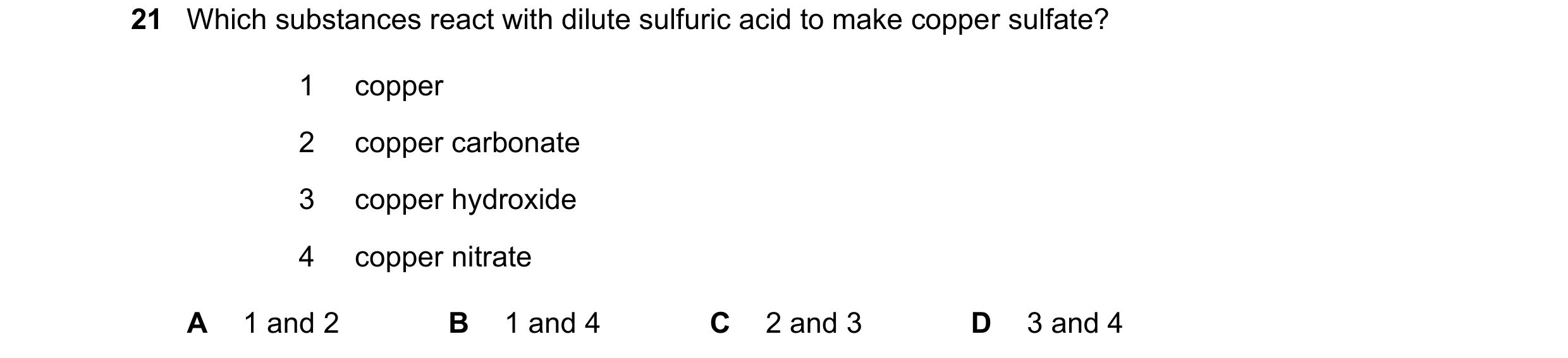
Q15 · Which substances react with dilute sulfuric acid to make copper sulfate? 0653/21 Oct/Nov 2020
21 Which substances react with dilute sulfuric acid to make copper sulfate? 1 copper 2 copper carbonate 3 copper hydroxide 4 copper nitrate A 1 and 2 B 1 and 4 C 2 and 3 D 3 and 4
1 marks
Answer: C
This question in 0653/21 Oct/Nov 2020
Q16 · Which two substances both react with dilute sulfuric acid to make the salt magnesium… 0653/23 Oct/Nov 2020
22 Which two substances both react with dilute sulfuric acid to make the salt magnesium sulfate? A magnesium carbonate and magnesium chloride B magnesium chloride and magnesium nitrate C magnesium oxide and magnesium carbonate D magnesium oxide and magnesium nitrate
1 marks
Answer: C
This question in 0653/23 Oct/Nov 2020
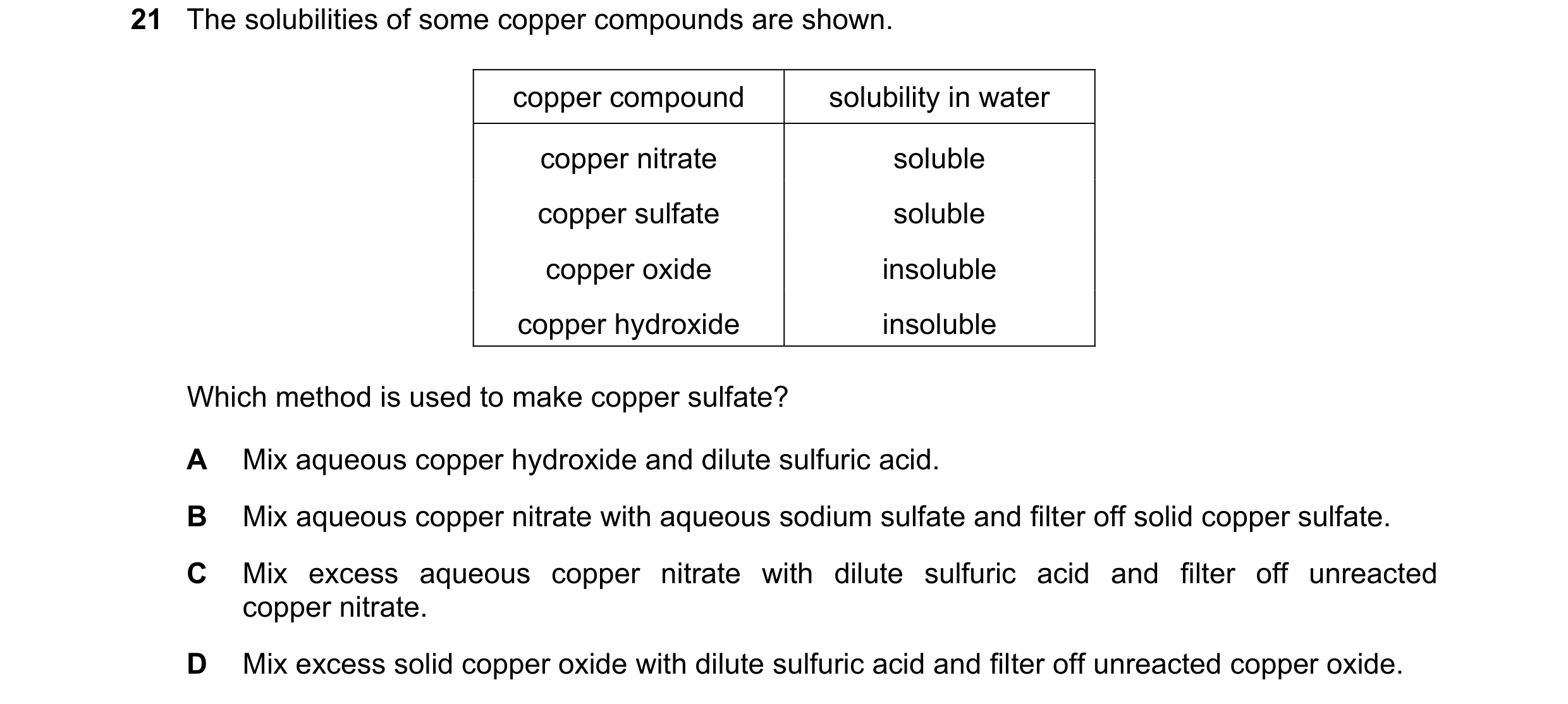
Q17 · The solubilities of some copper compounds are shown 0653/21 May/June 2021
21 The solubilities of some copper compounds are shown. copper compound solubility in water copper nitrate soluble copper sulfate soluble copper oxide insoluble copper hydroxide insoluble Which method is used to make copper sulfate? A Mix aqueous copper hydroxide and dilute sulfuric acid. B Mix aqueous copper nitrate with aqueous sodium sulfate and filter off solid copper sulfate. C Mix excess aqueous copper nitrate with dilute sulfuric acid and filter off unreacted copper nitrate. D Mix excess solid copper oxide with dilute sulfuric acid and filter off unreacted copper oxide.
1 marks
Answer: D
This question in 0653/21 May/June 2021
Q18 · Excess insoluble solid copper carbonate is mixed with dilute nitric acid 0653/22 May/June 2021
21 Excess insoluble solid copper carbonate is mixed with dilute nitric acid. Aqueous copper nitrate is formed. Which row shows the processes used to obtain pure solid copper nitrate from the reaction mixture? process 1 process 2 process 3 A filter the mixture dry the solid on warm in an oven the filter paper B filter the mixture heat the solution filter the mixture and crystallise and dry C heat the solution cool to crystallise filter the mixture and dry D heat the solution filter the mixture dry the solid
1 marks
Answer: B
This question in 0653/22 May/June 2021
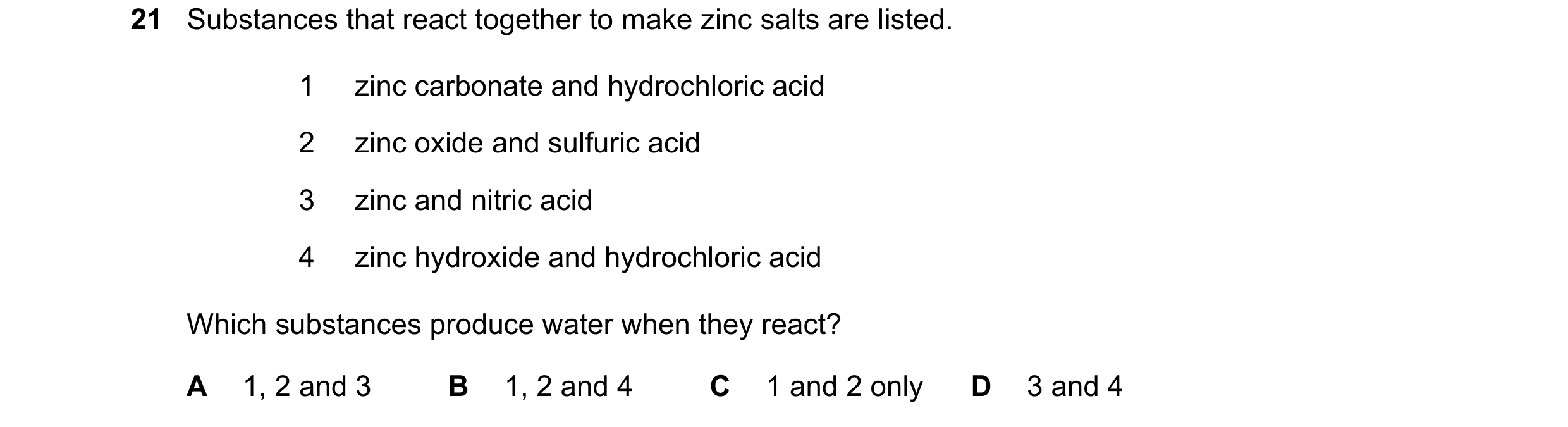
Q19 · Substances that react together to make zinc salts are listed 0653/23 May/June 2021
21 Substances that react together to make zinc salts are listed. 1 zinc carbonate and hydrochloric acid 2 zinc oxide and sulfuric acid 3 zinc and nitric acid 4 zinc hydroxide and hydrochloric acid Which substances produce water when they react? A 1, 2 and 3 B 1, 2 and 4 C 1 and 2 only D 3 and 4
1 marks
Answer: B
This question in 0653/23 May/June 2021
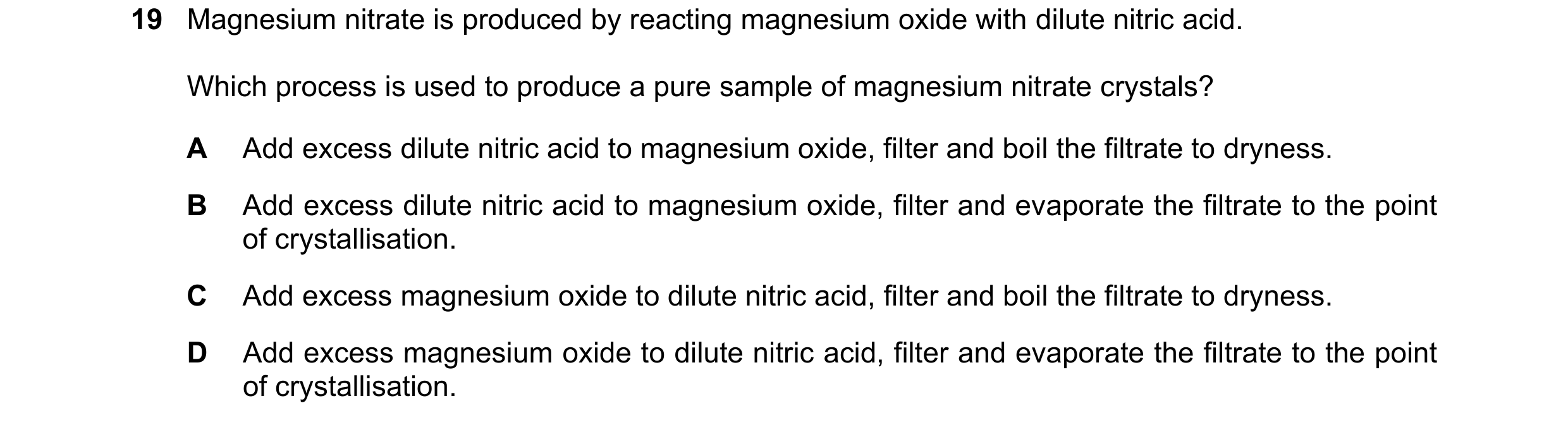
Q20 · Magnesium nitrate is produced by reacting magnesium oxide with dilute nitric acid 0653/22 May/June 2022
19 Magnesium nitrate is produced by reacting magnesium oxide with dilute nitric acid. Which process is used to produce a pure sample of magnesium nitrate crystals? A Add excess dilute nitric acid to magnesium oxide, filter and boil the filtrate to dryness. B Add excess dilute nitric acid to magnesium oxide, filter and evaporate the filtrate to the point of crystallisation. C Add excess magnesium oxide to dilute nitric acid, filter and boil the filtrate to dryness. D Add excess magnesium oxide to dilute nitric acid, filter and evaporate the filtrate to the point of crystallisation.
1 marks
Answer: D
This question in 0653/22 May/June 2022
Q21 · Salt X is produced in the reaction between solid Y and acid Z 0653/23 May/June 2022
20 Salt X is produced in the reaction between solid Y and acid Z. The following method is used to prepare crystals of salt X. ● Solid Y is added to acid Z until no further reaction occurs. ● Any unreacted solid Y is removed by filtration. ● The filtrate is evaporated to the point of crystallisation and left to cool. ● Salt X crystallises. Which row shows the substances that can be used to produce a salt by using this method? solid Y acid Z salt X A insoluble copper dilute hydrochloric acid soluble copper(II) chloride B insoluble lead carbonate dilute sulfuric acid insoluble lead sulfate C soluble sodium hydroxide dilute hydrochloric acid soluble sodium chloride D insoluble zinc oxide dilute sulfuric acid soluble zinc sulfate
1 marks
Answer: D
This question in 0653/23 May/June 2022
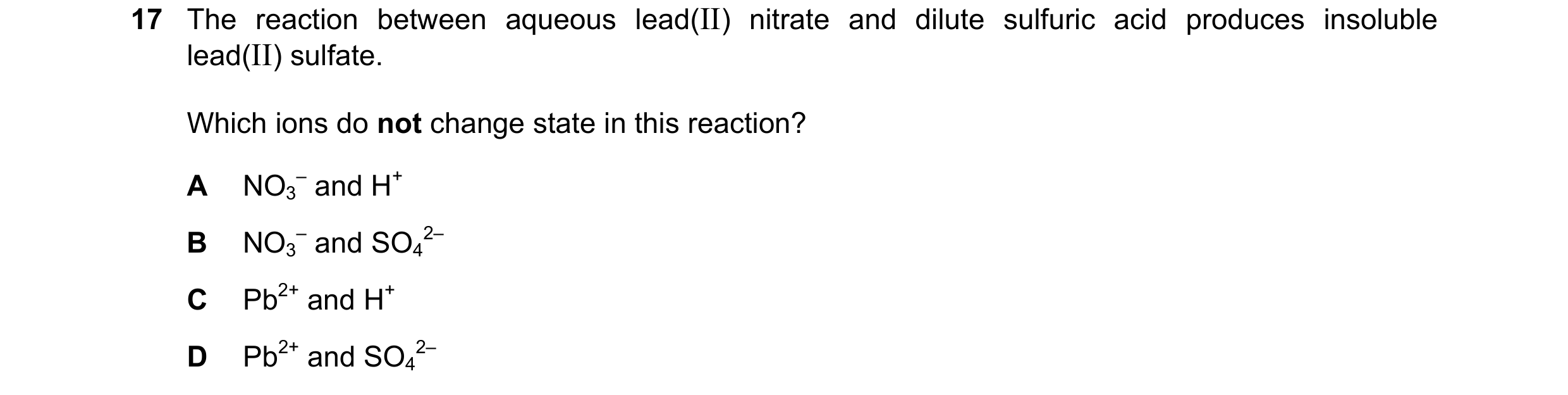
Q22 · The reaction between aqueous lead(II) nitrate and dilute sulfuric acid produces insoluble… 0653/22 Feb/March 2023
17 The reaction between aqueous lead(II) nitrate and dilute sulfuric acid produces insoluble lead(II) sulfate. Which ions do not change state in this reaction? A NO3 – and H+ B NO3 – and SO4 2– C Pb2+ and H+ D Pb2+ and SO4 2–
1 marks
Answer: A
This question in 0653/22 Feb/March 2023
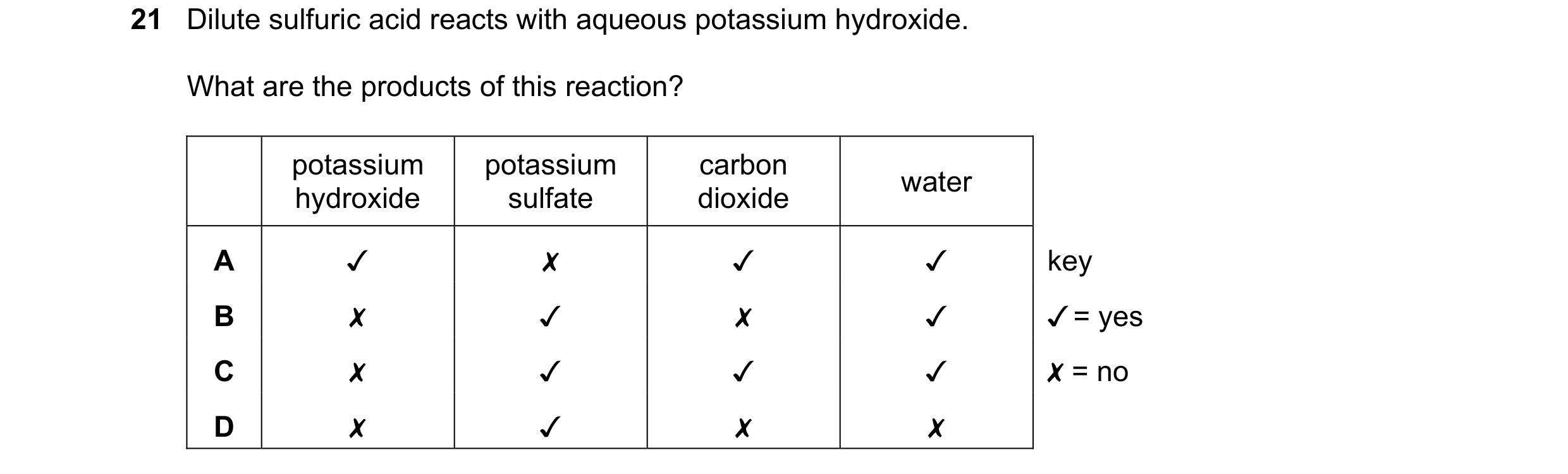
Q23 · Dilute sulfuric acid reacts with aqueous potassium hydroxide 0653/22 May/June 2023
21 Dilute sulfuric acid reacts with aqueous potassium hydroxide.
What are the products of this reaction?
potassium potassium carbon water
hydroxide sulfate dioxide
A Jv x v v
B x Jv x v
Cc x v v Jv
D x v x x
key
/=yes
X =no
1 marks
Answer: B
This question in 0653/22 May/June 2023
Q24 · Which two substances both react with dilute sulfuric acid to make the salt magnesium… 0653/23 May/June 2023
21 Which two substances both react with dilute sulfuric acid to make the salt magnesium sulfate? A magnesium carbonate and magnesium chloride B magnesium chloride and magnesium nitrate C magnesium oxide and magnesium carbonate D magnesium oxide and magnesium nitrate
1 marks
Answer: C
This question in 0653/23 May/June 2023
Q25 · All sodium compounds are soluble 0653/21 May/June 2024
22 All sodium compounds are soluble. Magnesium hydroxide is insoluble. An excess of a solid is added to dilute nitric acid, mixed, filtered and then the filtrate is left to crystallise. Which solids react with dilute nitric acid and can be used separately to prepare crystals of magnesium nitrate? A magnesium hydroxide and sodium carbonate only B magnesium and magnesium hydroxide only C magnesium and sodium carbonate only D magnesium, magnesium hydroxide and sodium carbonate
1 marks
Answer: B
This question in 0653/21 May/June 2024
Q26 · A solution of barium chloride reacts with dilute sulfuric acid to form a precipitate 0653/22 May/June 2024
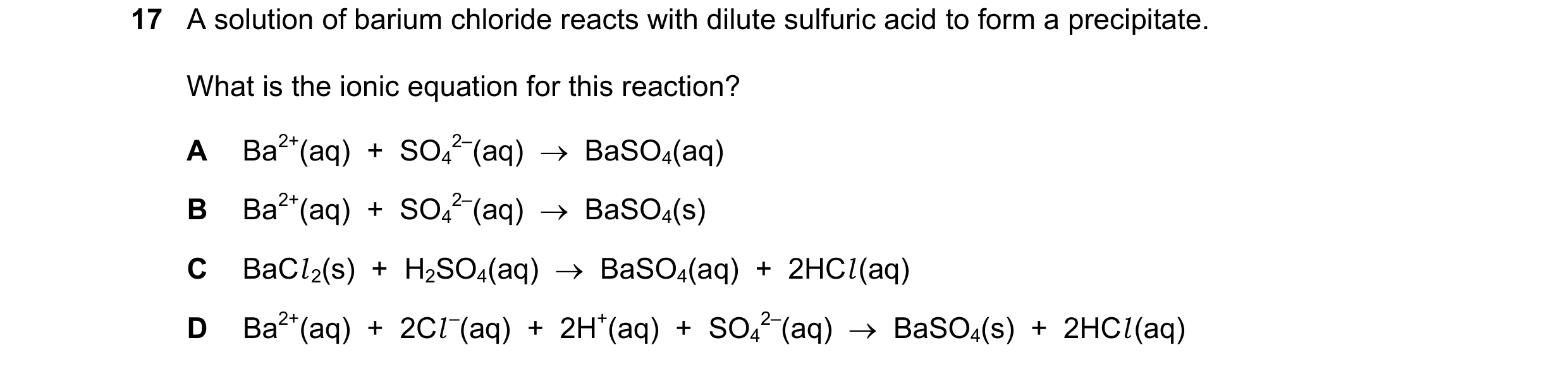
17 A solution of barium chloride reacts with dilute sulfuric acid to form a precipitate. What is the ionic equation for this reaction? A Ba2+(aq) + SO4 2–(aq) BaSO4(aq) B Ba2+(aq) + SO4 2–(aq) BaSO4(s) C BaCl 2(s) + H2SO4(aq) BaSO4(aq) + 2HCl (aq) D Ba2+(aq) + 2Cl –(aq) + 2H+(aq) + SO4 2–(aq) BaSO4(s) + 2HCl (aq)
1 marks
Answer: B
This question in 0653/22 May/June 2024
Q27 · Copper sulfate is a soluble salt which is prepared by reacting insoluble copper oxide… 0653/22 May/June 2024
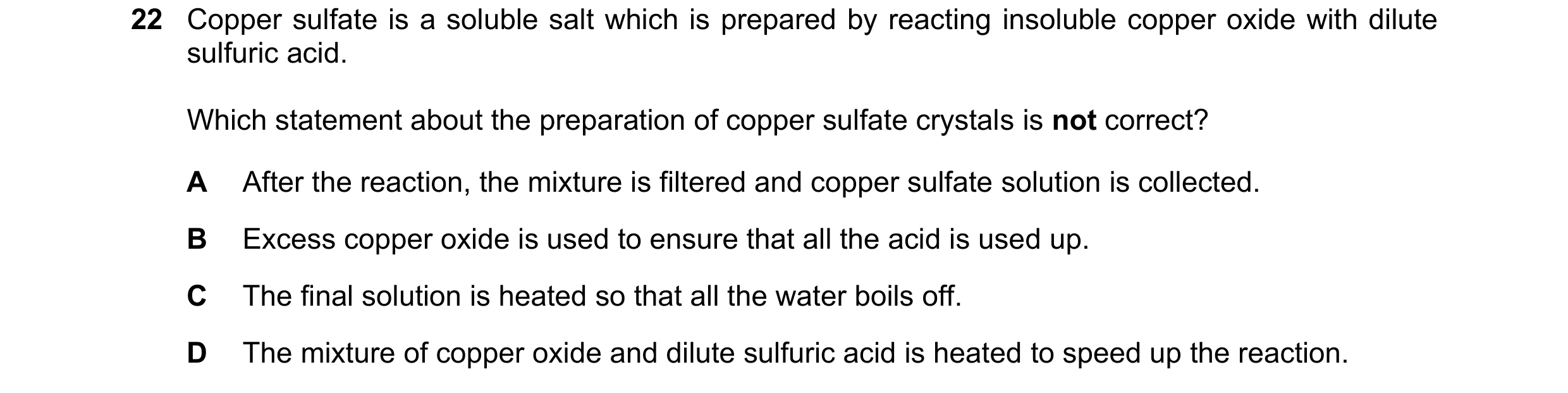
22 Copper sulfate is a soluble salt which is prepared by reacting insoluble copper oxide with dilute sulfuric acid. Which statement about the preparation of copper sulfate crystals is not correct? A After the reaction, the mixture is filtered and copper sulfate solution is collected. B Excess copper oxide is used to ensure that all the acid is used up. C The final solution is heated so that all the water boils off. D The mixture of copper oxide and dilute sulfuric acid is heated to speed up the reaction.
1 marks
Answer: C
This question in 0653/22 May/June 2024
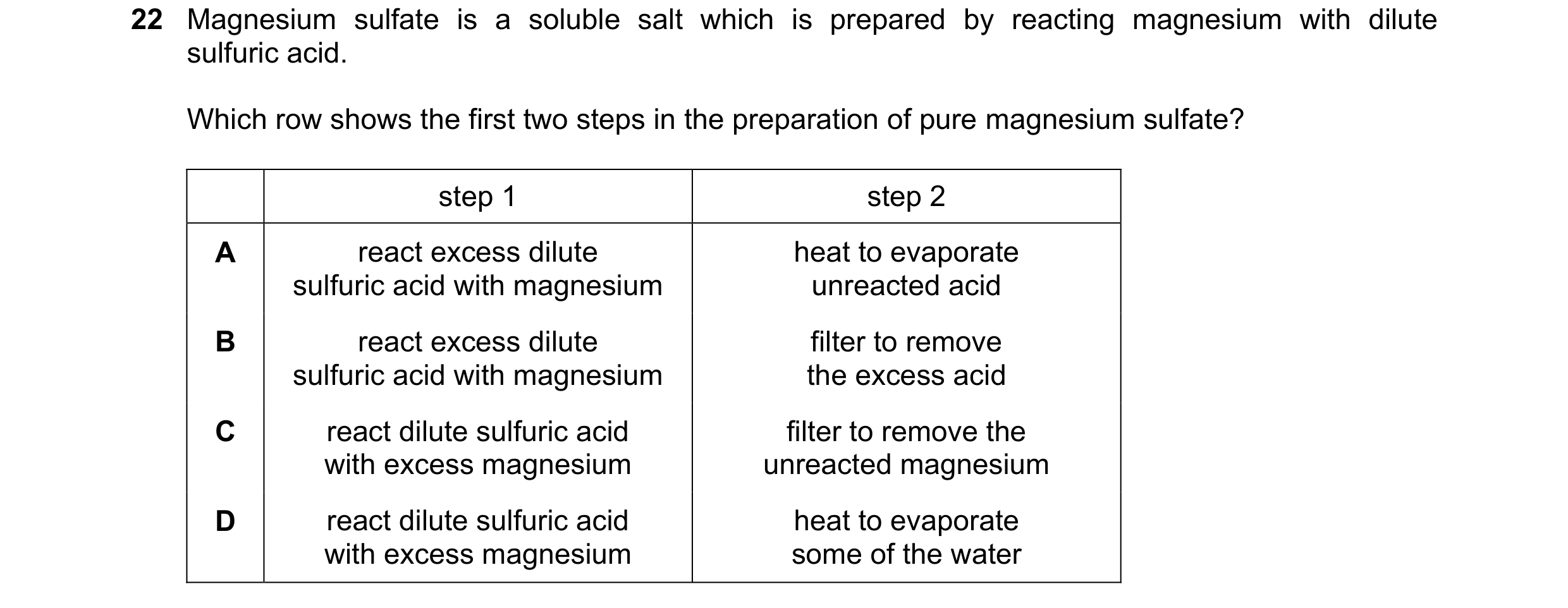
Q28 · Magnesium sulfate is a soluble salt which is prepared by reacting magnesium with dilute… 0653/23 May/June 2024
22 Magnesium sulfate is a soluble salt which is prepared by reacting magnesium with dilute sulfuric acid. Which row shows the first two steps in the preparation of pure magnesium sulfate? step 1 step 2 A react excess dilute heat to evaporate sulfuric acid with magnesium unreacted acid B react excess dilute filter to remove sulfuric acid with magnesium the excess acid C react dilute sulfuric acid filter to remove the with excess magnesium unreacted magnesium D react dilute sulfuric acid heat to evaporate with excess magnesium some of the water
1 marks
Answer: C
This question in 0653/23 May/June 2024
Q29 · Magnesium chloride crystals can be made by reacting solid magnesium carbonate with dilute… 0653/23 Oct/Nov 2024
22 Magnesium chloride crystals can be made by reacting solid magnesium carbonate with dilute hydrochloric acid. What is not used in this process? A excess solid B crystallisation C distillation D filtration
1 marks
Answer: C
This question in 0653/23 Oct/Nov 2024
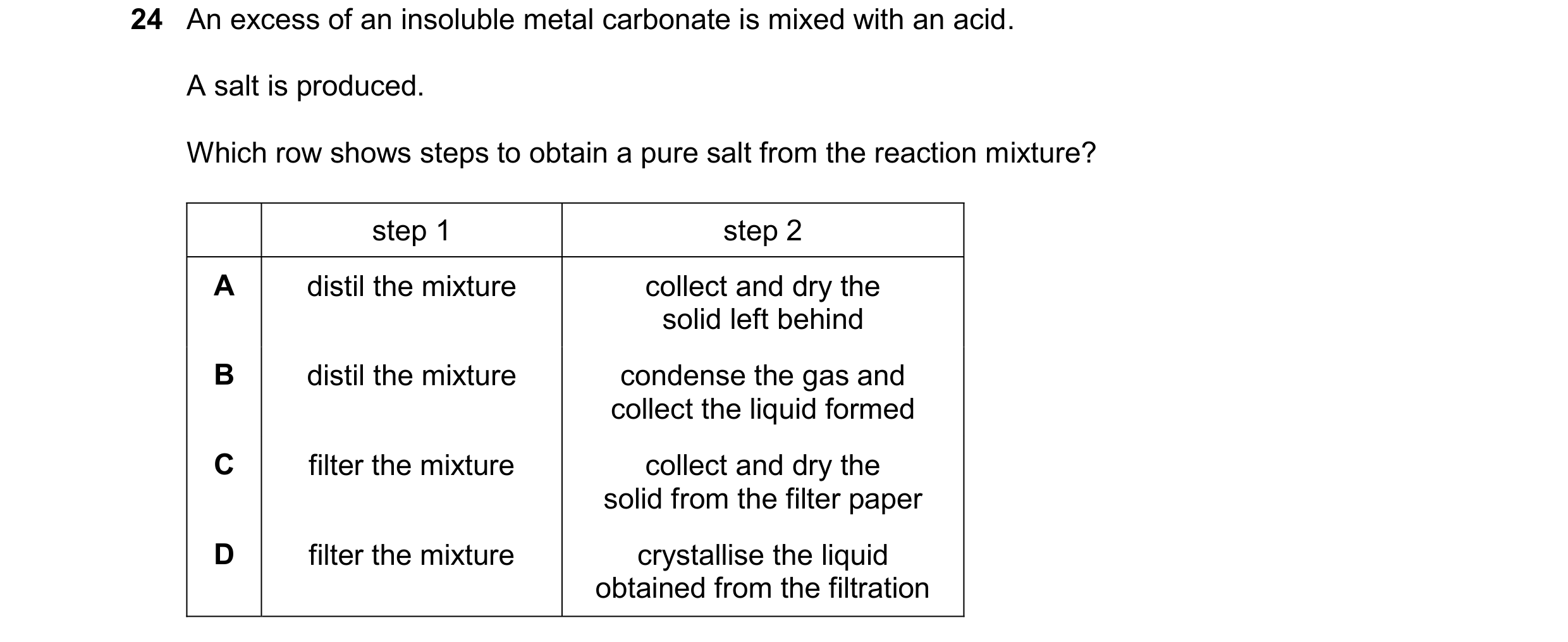
Q30 · An excess of an insoluble metal carbonate is mixed with an acid 0653/21 May/June 2025
24 An excess of an insoluble metal carbonate is mixed with an acid. A salt is produced. Which row shows steps to obtain a pure salt from the reaction mixture? step 1 step 2 A distil the mixture collect and dry the solid left behind B distil the mixture condense the gas and collect the liquid formed C filter the mixture collect and dry the solid from the filter paper D filter the mixture crystallise the liquid obtained from the filtration
1 marks
Answer: D
This question in 0653/21 May/June 2025
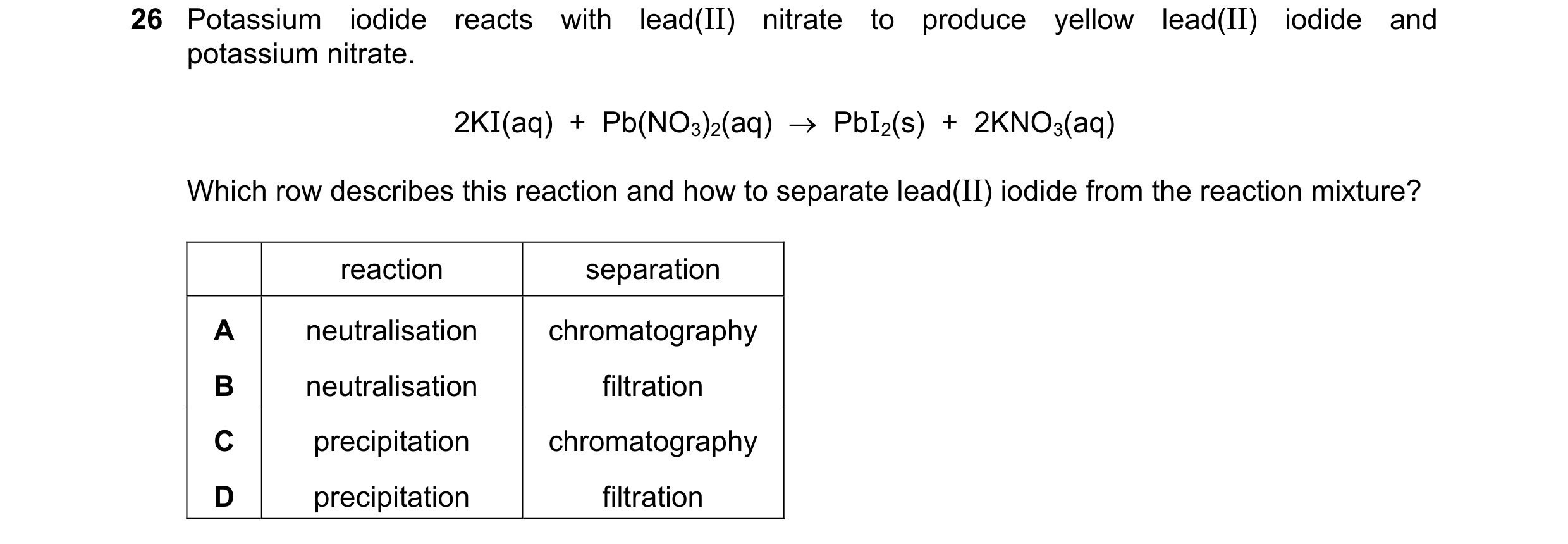
Q31 · Potassium iodide reacts with lead(II) nitrate to produce yellow lead(II) iodide and… 0653/22 May/June 2025
26 Potassium iodide reacts with lead(II) nitrate to produce yellow lead(II) iodide and potassium nitrate. 2KI(aq) + Pb(NO3)2(aq) PbI2(s) + 2KNO3(aq) Which row describes this reaction and how to separate lead(II) iodide from the reaction mixture? reaction separation A neutralisation chromatography B neutralisation filtration C precipitation chromatography D precipitation filtration
1 marks
Answer: D
This question in 0653/22 May/June 2025
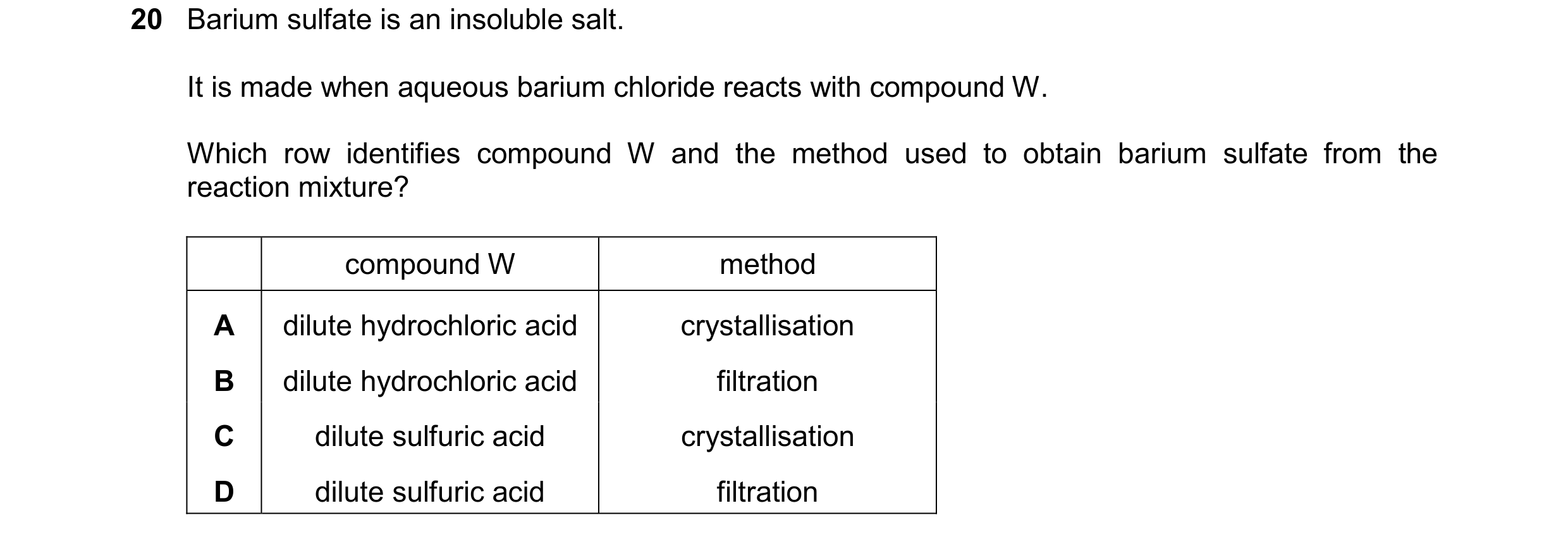
Q32 · Barium sulfate is an insoluble salt 0653/23 May/June 2025
20 Barium sulfate is an insoluble salt. It is made when aqueous barium chloride reacts with compound W. Which row identifies compound W and the method used to obtain barium sulfate from the reaction mixture? compound W method A dilute hydrochloric acid crystallisation B dilute hydrochloric acid filtration C dilute sulfuric acid crystallisation D dilute sulfuric acid filtration
1 marks
Answer: D
This question in 0653/23 May/June 2025
 1 / 8
1 / 8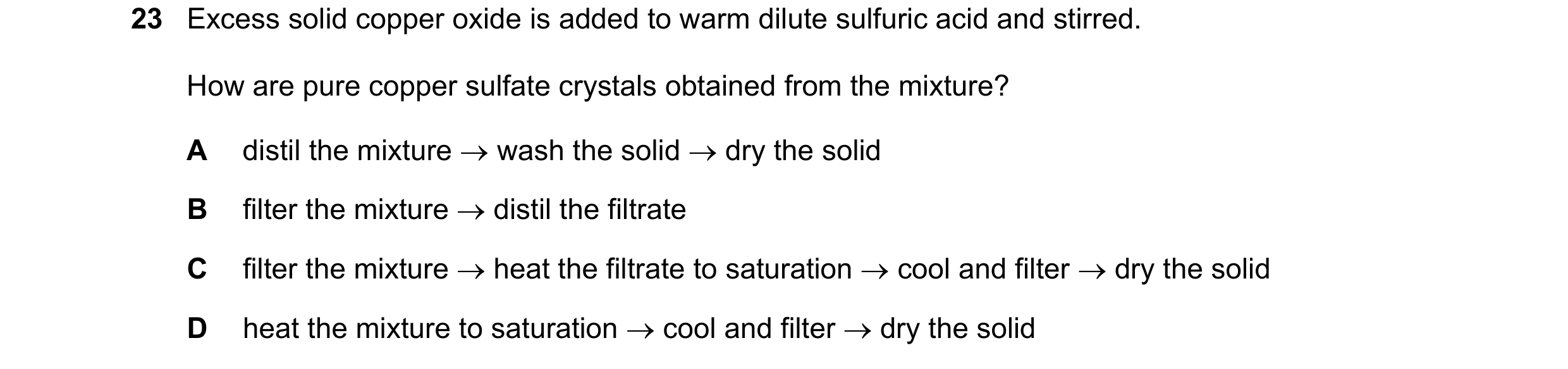
 2 / 8
2 / 8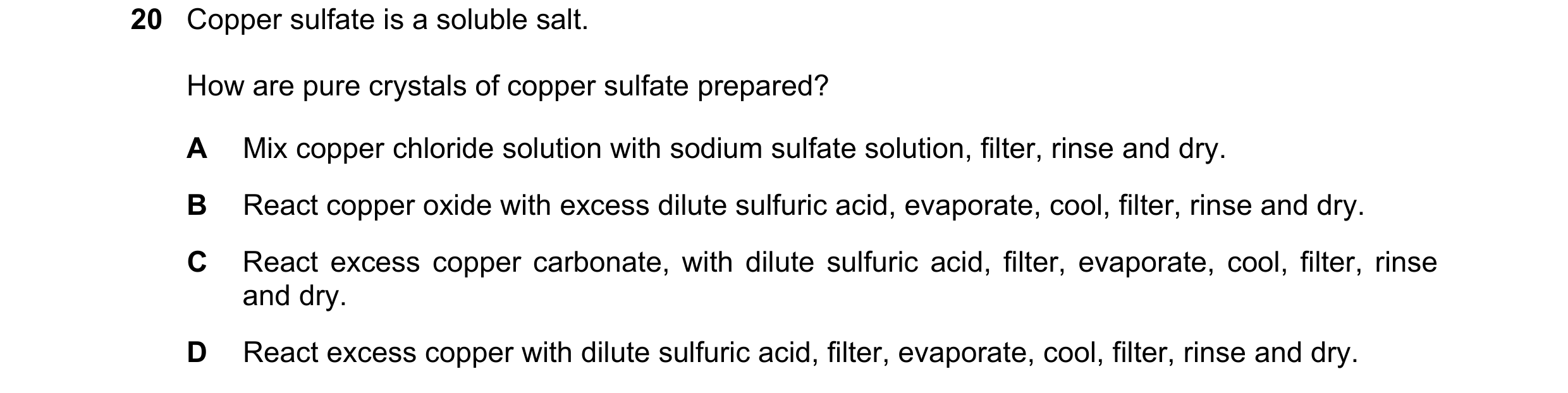
 3 / 8
3 / 8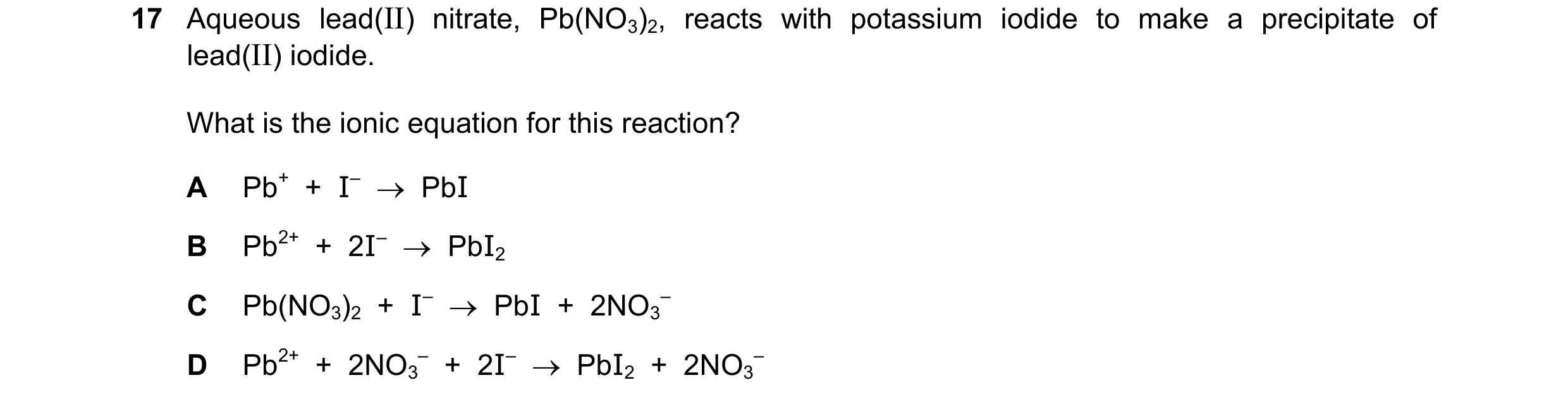

 4 / 8
4 / 8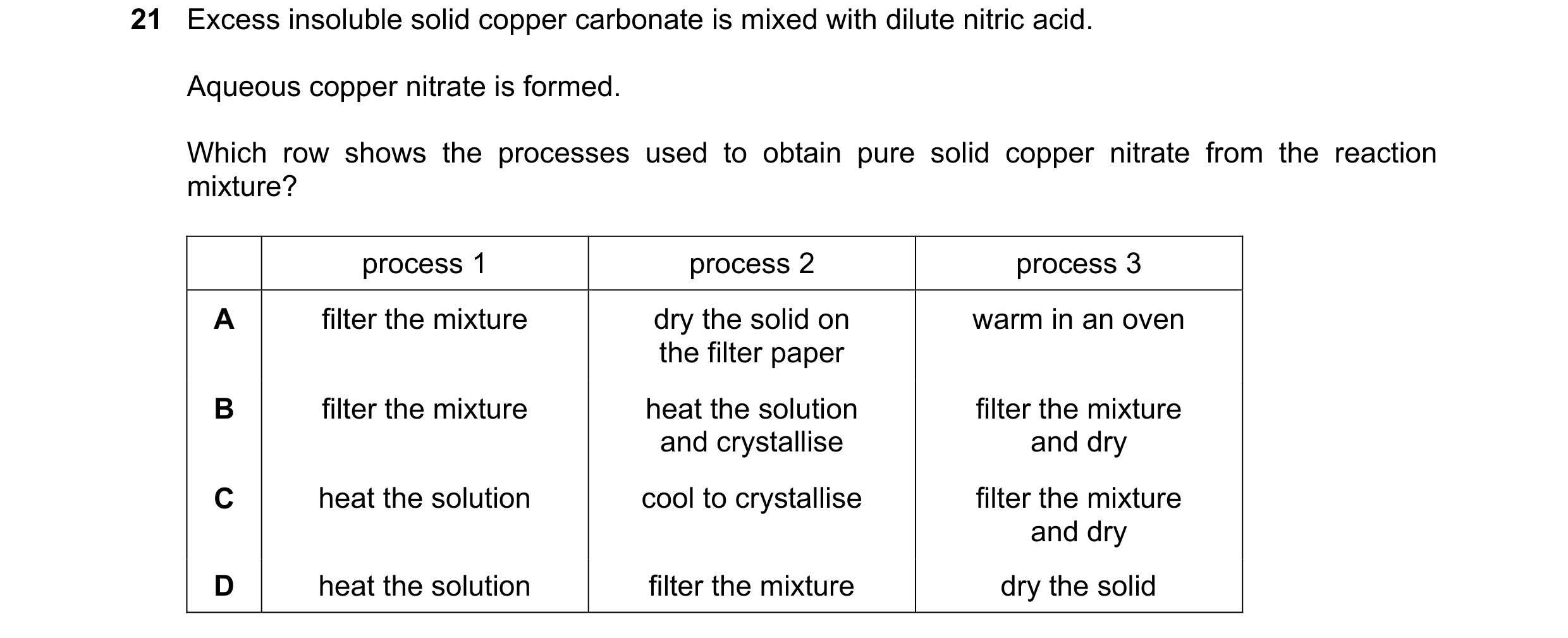
 5 / 8
5 / 8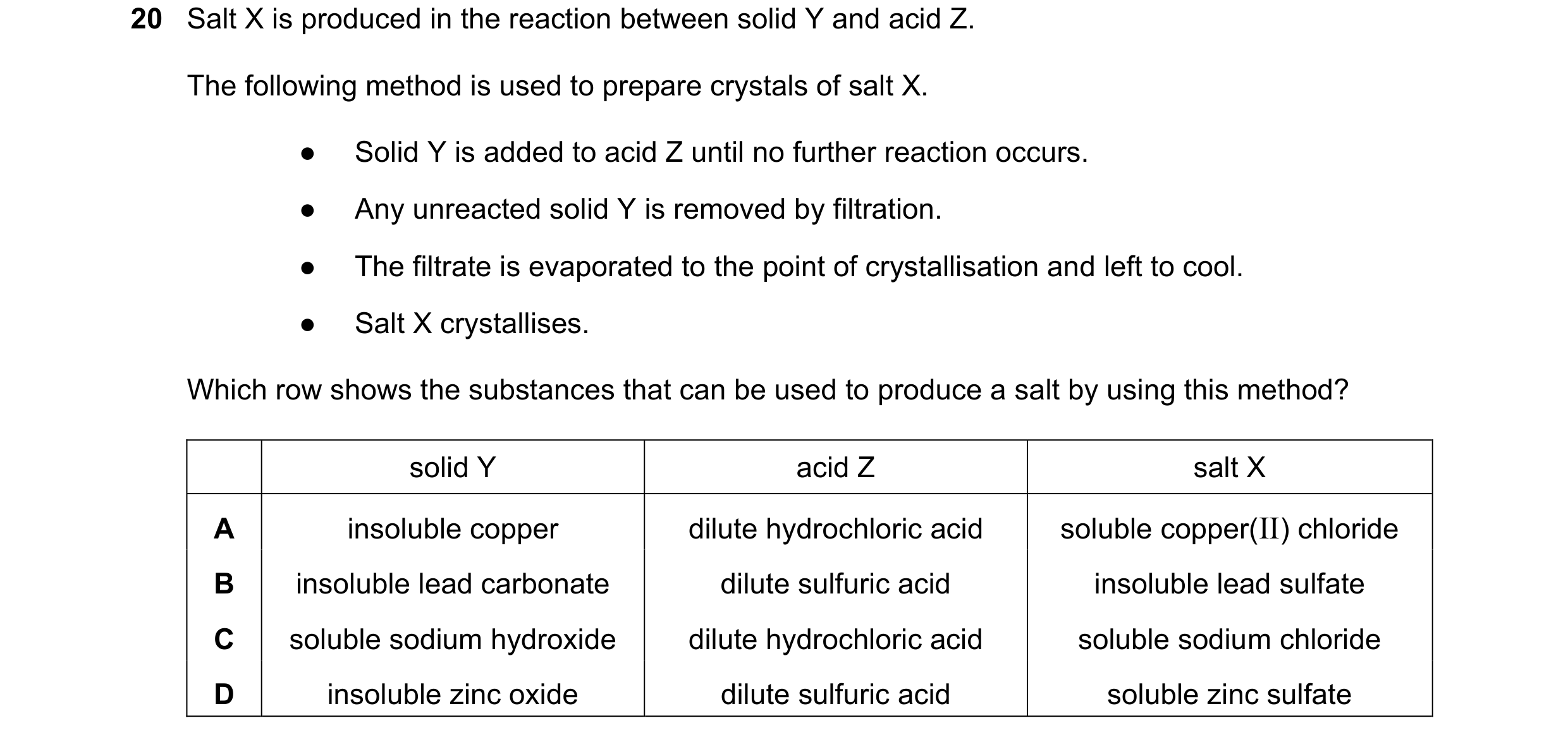
 6 / 8
6 / 8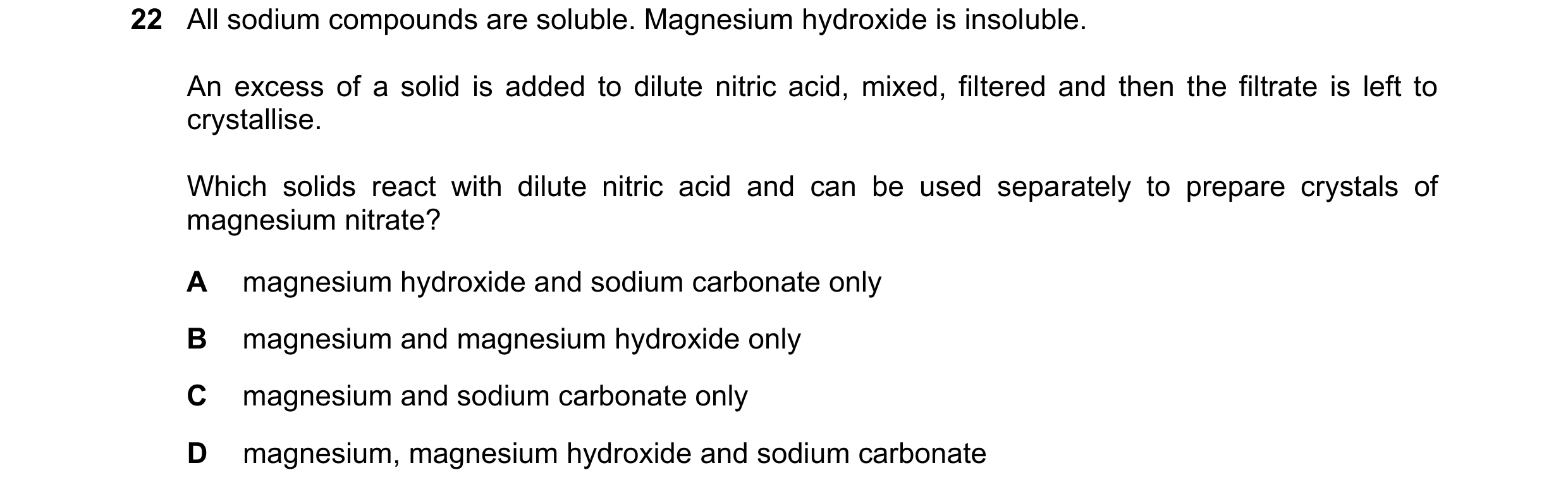
 7 / 8
7 / 8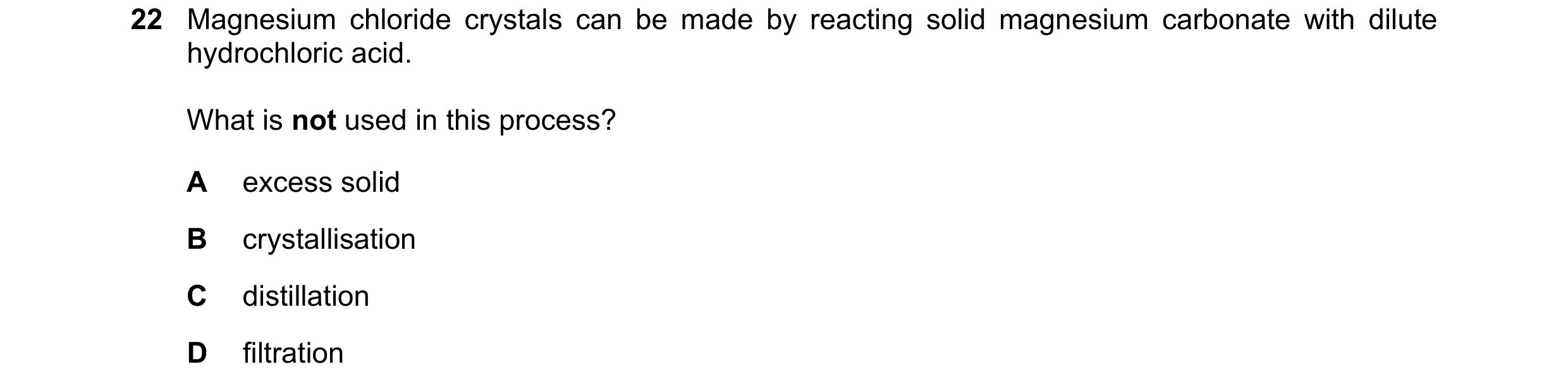
 8 / 8
8 / 8