Questions as text
Q1 · Which of the reactions shown is a thermal decomposition? 0653/11 Oct/Nov 2005
23 Which of the reactions shown is a thermal decomposition? A calcium carbonate → calcium oxide + carbon dioxide B methane + air → carbon dioxide + water C sodium carbonate + hydrochloric acid → sodium chloride + water + carbon dioxide D sodium hydroxide + hydrochloric acid → sodium chloride + water
1 marks
Answer: A
This question in 0653/11 Oct/Nov 2005
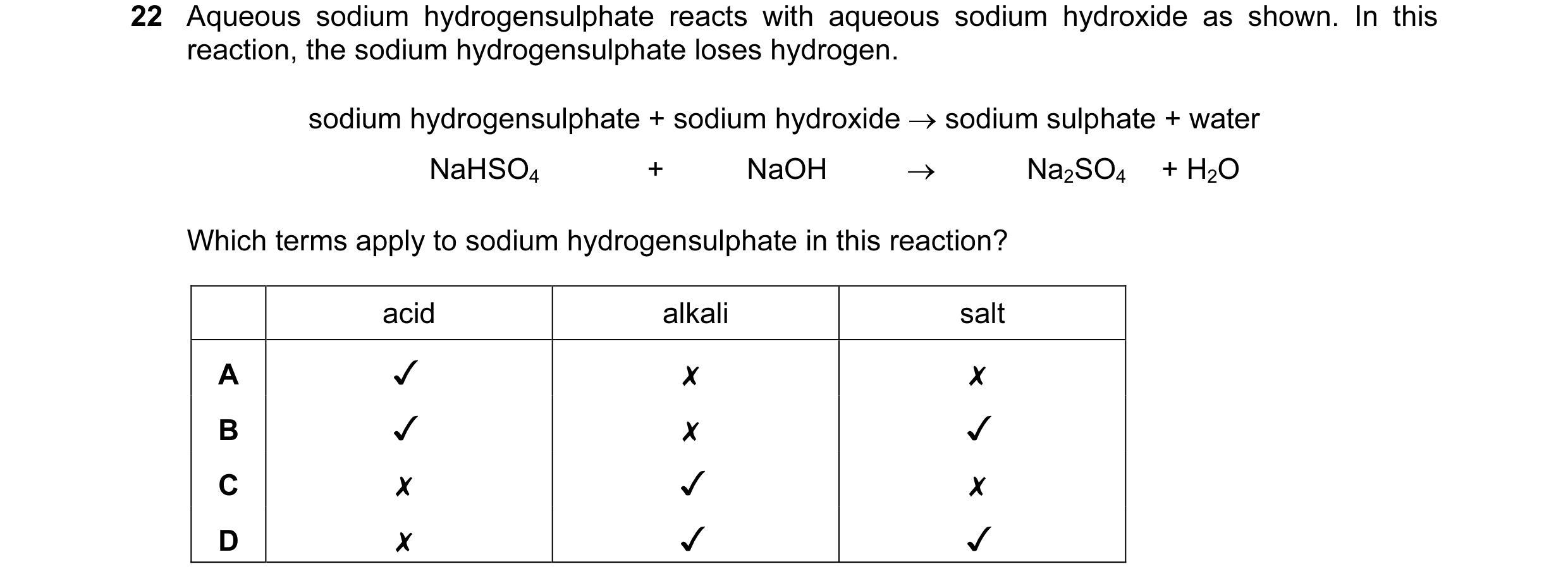
Q2 · Aqueous sodium hydrogensulphate reacts with aqueous sodium hydroxide as shown 0653/11 May/June 2006
22 Aqueous sodium hydrogensulphate reacts with aqueous sodium hydroxide as shown. In this
reaction, the sodium hydrogensulphate loses hydrogen.
sodium hydrogensulphate + sodium hydroxide — sodium sulphate + water
NaHSQ, + NaOH > NazSO, +H20
Which terms apply to sodium hydrogensulphate in this reaction?
acid alkali salt
A v x x
B v x v
Cc x v x
D x v v
1 marks
Answer: B
This question in 0653/11 May/June 2006
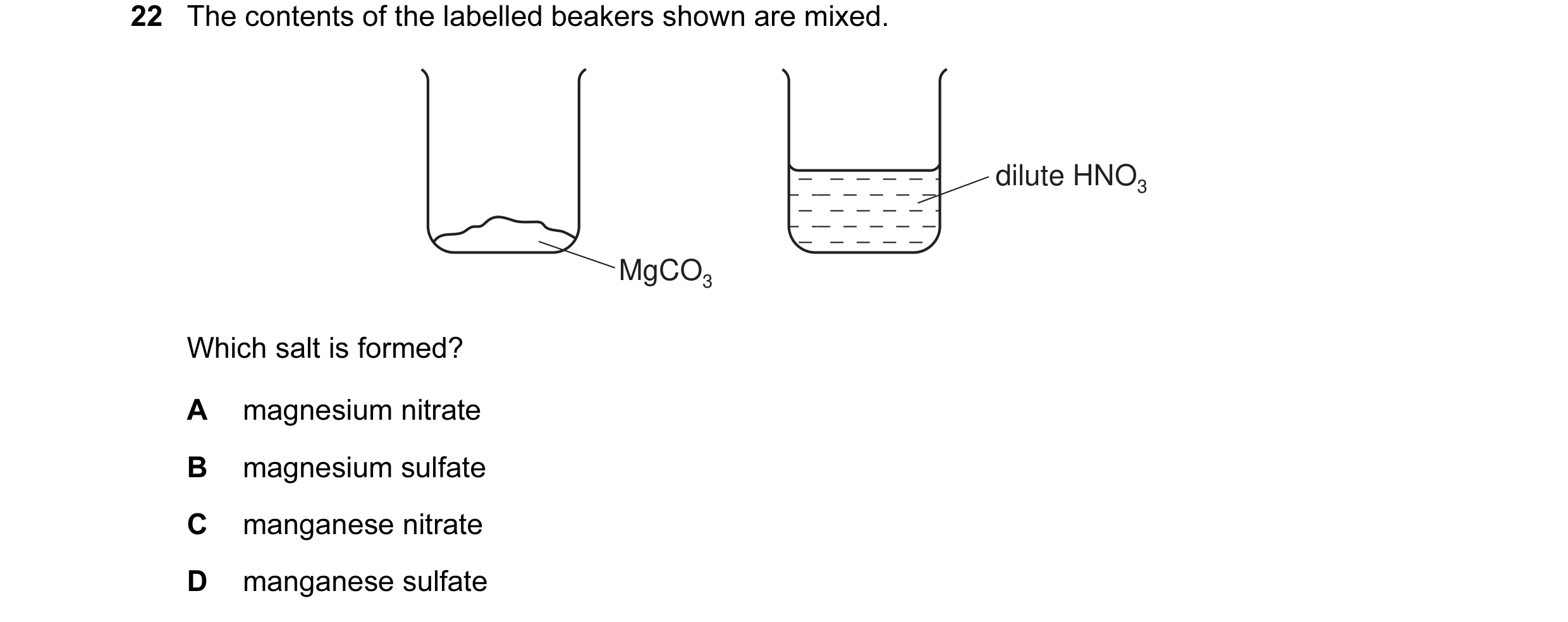
Q3 · The contents of the labelled beakers shown are mixed 0653/11 May/June 2009
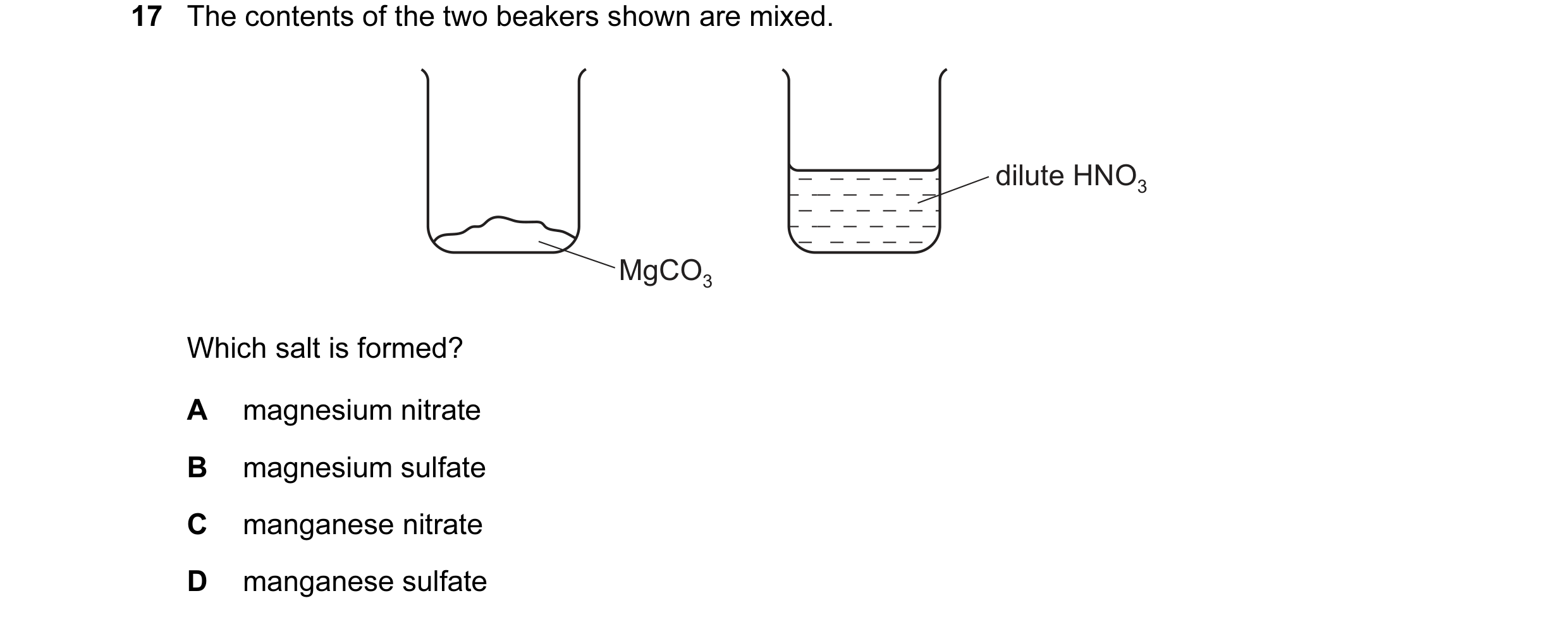
22 The contents of the labelled beakers shown are mixed. dilute HNO3 MgCO3 Which salt is formed? A magnesium nitrate B magnesium sulfate C manganese nitrate D manganese sulfate
1 marks
Answer: A
This question in 0653/11 May/June 2009
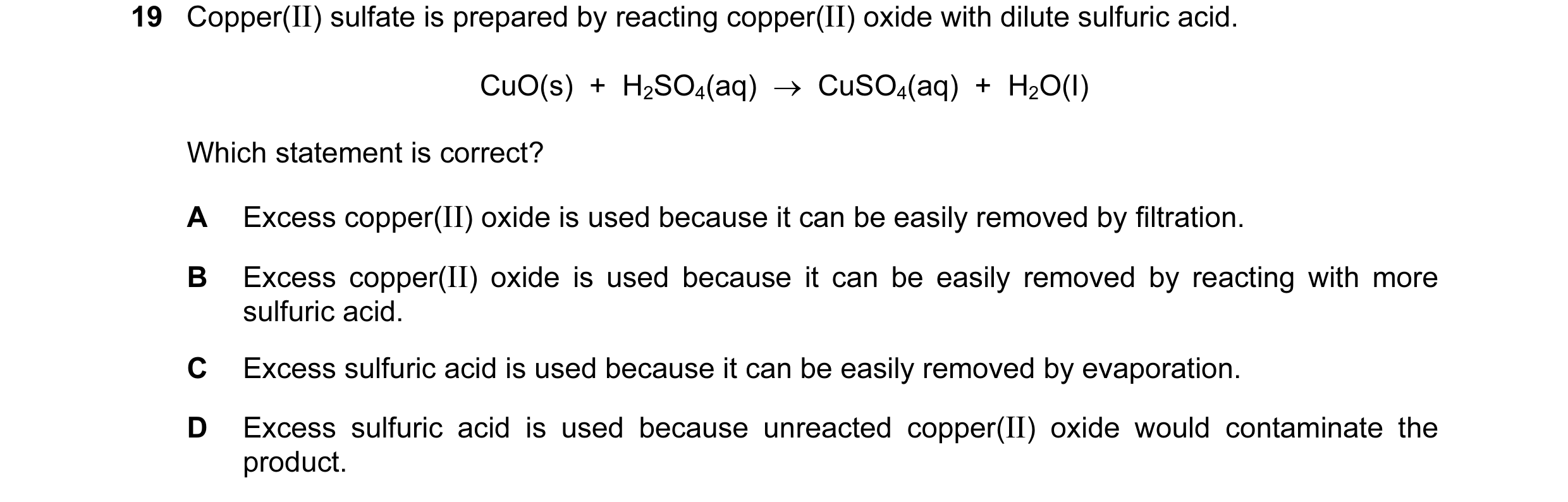
Q4 · Copper(II) sulfate is prepared by reacting copper(II) oxide with dilute sulfuric acid 0653/12 May/June 2013
19 Copper(II) sulfate is prepared by reacting copper(II) oxide with dilute sulfuric acid. CuO(s) + H2SO4(aq) → CuSO4(aq) + H2O(I) Which statement is correct? A Excess copper(II) oxide is used because it can be easily removed by filtration. B Excess copper(II) oxide is used because it can be easily removed by reacting with more sulfuric acid. C Excess sulfuric acid is used because it can be easily removed by evaporation. D Excess sulfuric acid is used because unreacted copper(II) oxide would contaminate the product.
1 marks
Answer: A
This question in 0653/12 May/June 2013
Q5 · The contents of the two beakers shown are mixed 0653/11 Oct/Nov 2014
16 The contents of the two beakers shown are mixed. dilute HNO3 MgCO3 Which salt is formed? A magnesium nitrate B magnesium sulfate C manganese nitrate D manganese sulfate
1 marks
Answer: A
This question in 0653/11 Oct/Nov 2014
Q6 · The contents of the two beakers shown are mixed 0653/12 Oct/Nov 2014
17 The contents of the two beakers shown are mixed. dilute HNO3 MgCO3 Which salt is formed? A magnesium nitrate B magnesium sulfate C manganese nitrate D manganese sulfate
1 marks
Answer: A
This question in 0653/12 Oct/Nov 2014
Q7 · Copper sulfate crystals are prepared by reacting copper oxide with sulfuric acid 0653/13 Oct/Nov 2015
21 Copper sulfate crystals are prepared by reacting copper oxide with sulfuric acid. Which process is not used in the preparation of copper sulfate crystals? A chromatography B crystallisation C evaporation D filtration
1 marks
Answer: A
This question in 0653/13 Oct/Nov 2015
Q8 · Magnesium hydroxide is an insoluble solid 0653/11 May/June 2017
21 Magnesium hydroxide is an insoluble solid. Magnesium sulfate is a soluble solid which is formed when magnesium hydroxide reacts with sulfuric acid. Which method is used to make pure magnesium sulfate? A React excess dilute sulfuric acid with magnesium hydroxide, filter and crystallise. B React excess dilute sulfuric acid with magnesium hydroxide then evaporate until dry. C React excess magnesium hydroxide with dilute sulfuric acid, filter and crystallise. D React excess magnesium hydroxide with dilute sulfuric acid then evaporate until dry.
1 marks
Answer: C
This question in 0653/11 May/June 2017
Q9 · Magnesium sulfate is a soluble solid produced by reacting excess solid magnesium oxide… 0653/12 May/June 2017
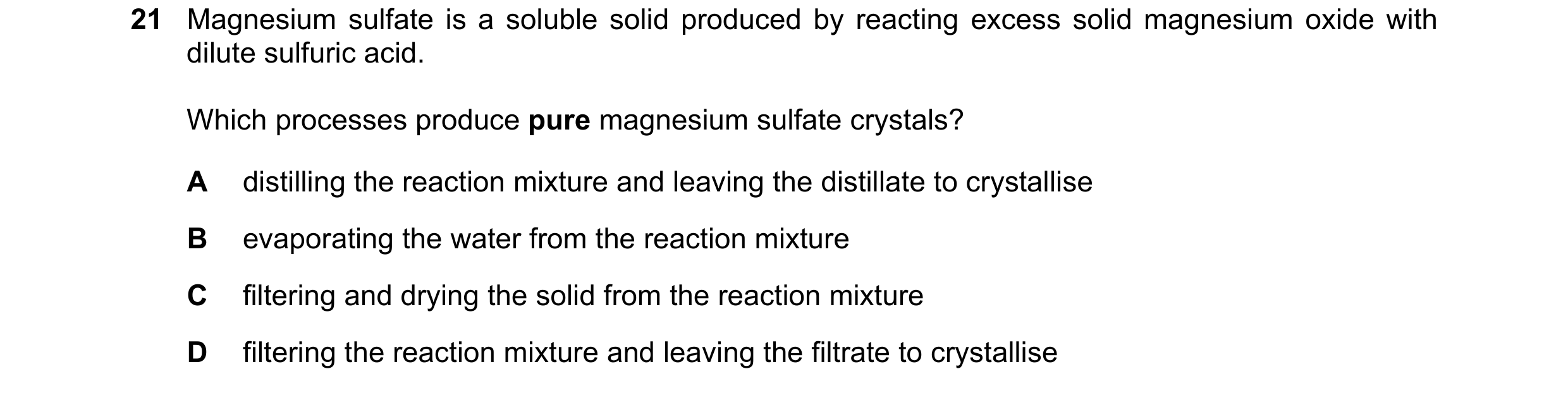
21 Magnesium sulfate is a soluble solid produced by reacting excess solid magnesium oxide with dilute sulfuric acid. Which processes produce pure magnesium sulfate crystals? A distilling the reaction mixture and leaving the distillate to crystallise B evaporating the water from the reaction mixture C filtering and drying the solid from the reaction mixture D filtering the reaction mixture and leaving the filtrate to crystallise
1 marks
Answer: D
This question in 0653/12 May/June 2017
Q10 · Magnesium sulfate is a soluble solid produced by reacting excess solid magnesium oxide… 0653/13 May/June 2017
21 Magnesium sulfate is a soluble solid produced by reacting excess solid magnesium oxide with dilute sulfuric acid. Which processes produce pure magnesium sulfate crystals? A distilling the reaction mixture and leaving the distillate to crystallise B evaporating the water from the reaction mixture C filtering and drying the solid from the reaction mixture D filtering the reaction mixture and leaving the filtrate to crystallise
1 marks
Answer: D
This question in 0653/13 May/June 2017
Q11 · What reacts with dilute hydrochloric acid to make magnesium chloride? 0653/12 Feb/March 2018
22 What reacts with dilute hydrochloric acid to make magnesium chloride? 1 magnesium 2 magnesium carbonate 3 magnesium oxide A 1, 2 and 3 B 1 and 2 only C 1 and 3 only D 2 and 3 only
1 marks
Answer: A
This question in 0653/12 Feb/March 2018
Q12 · Compound X reacts with compound Y to form sodium sulfate, water and carbon dioxide 0653/12 Oct/Nov 2018
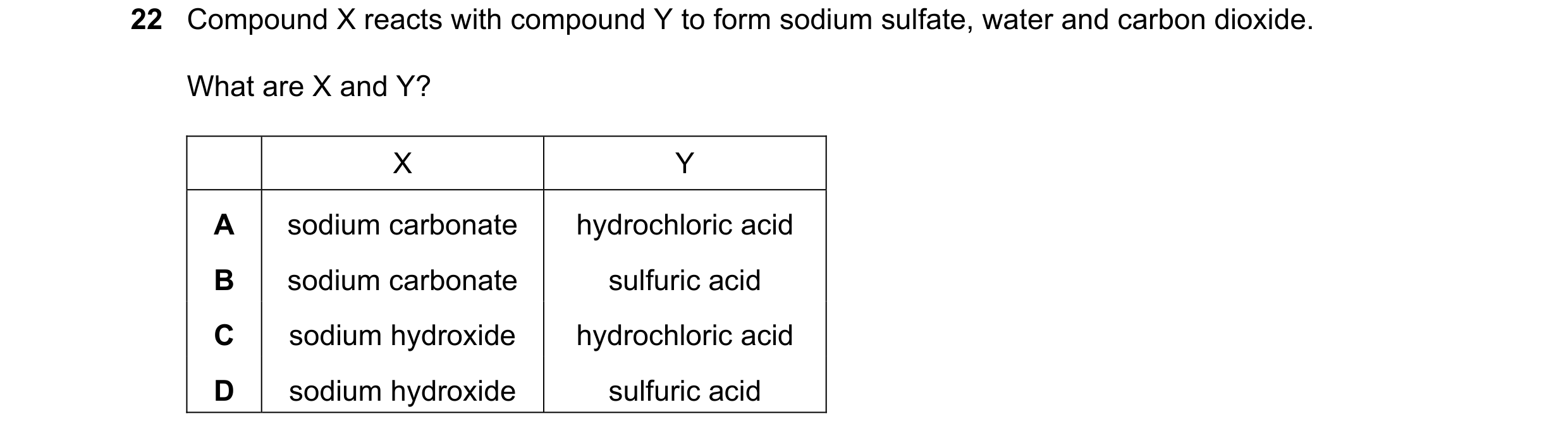
22 Compound X reacts with compound Y to form sodium sulfate, water and carbon dioxide. What are X and Y? X Y A sodium carbonate hydrochloric acid B sodium carbonate sulfuric acid C sodium hydroxide hydrochloric acid D sodium hydroxide sulfuric acid
1 marks
Answer: B
This question in 0653/12 Oct/Nov 2018
Q13 · Copper nitrate is prepared by reacting excess copper oxide with dilute nitric acid 0653/12 Feb/March 2019
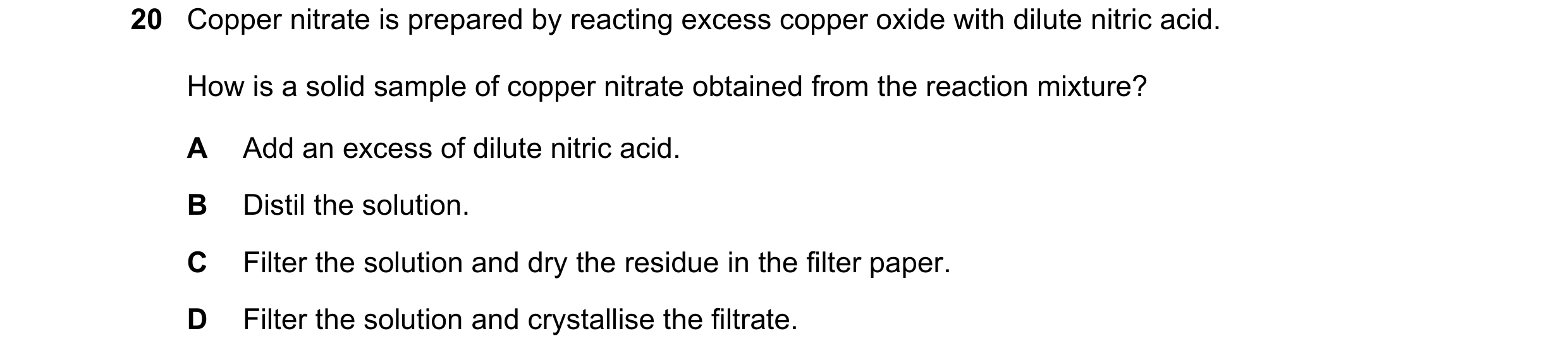
20 Copper nitrate is prepared by reacting excess copper oxide with dilute nitric acid. How is a solid sample of copper nitrate obtained from the reaction mixture? A Add an excess of dilute nitric acid. B Distil the solution. C Filter the solution and dry the residue in the filter paper. D Filter the solution and crystallise the filtrate.
1 marks
Answer: D
This question in 0653/12 Feb/March 2019
Q14 · Which substances react with dilute sulfuric acid to make copper sulfate? 0653/11 Oct/Nov 2020
21 Which substances react with dilute sulfuric acid to make copper sulfate? 1 copper 2 copper carbonate 3 copper hydroxide 4 copper nitrate A 1 and 2 B 1 and 4 C 2 and 3 D 3 and 4
1 marks
Answer: C
This question in 0653/11 Oct/Nov 2020
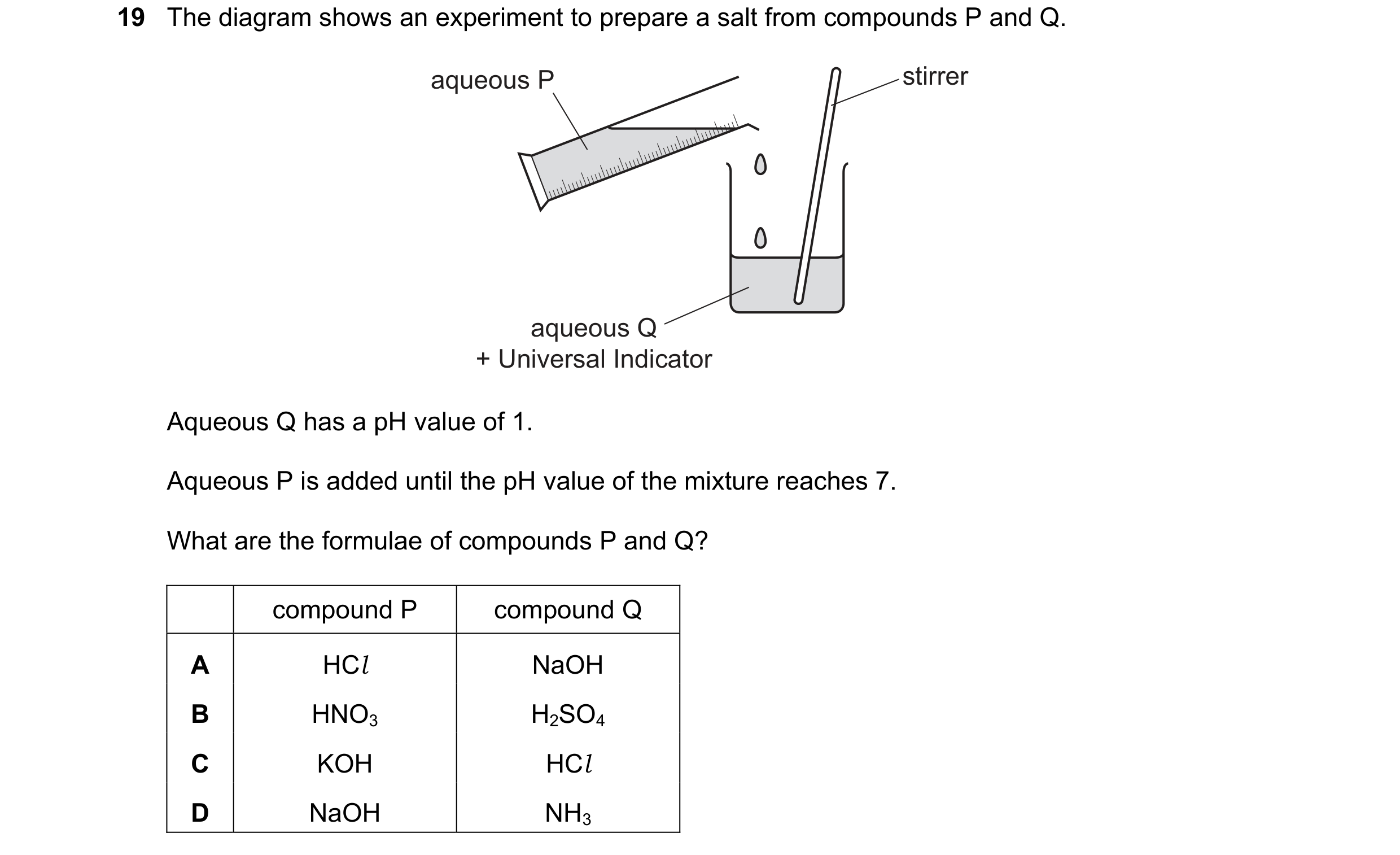
Q15 · The diagram shows an experiment to prepare a salt from compounds P and Q 0653/12 May/June 2021
19 The diagram shows an experiment to prepare a salt from compounds P and Q. aqueous P stirrer aqueous Q + Universal Indicator Aqueous Q has a pH value of 1. Aqueous P is added until the pH value of the mixture reaches 7. What are the formulae of compounds P and Q? compound P compound Q A HCl NaOH B HNO3 H2SO4 C KOH HCl D NaOH NH3
1 marks
Answer: C
This question in 0653/12 May/June 2021
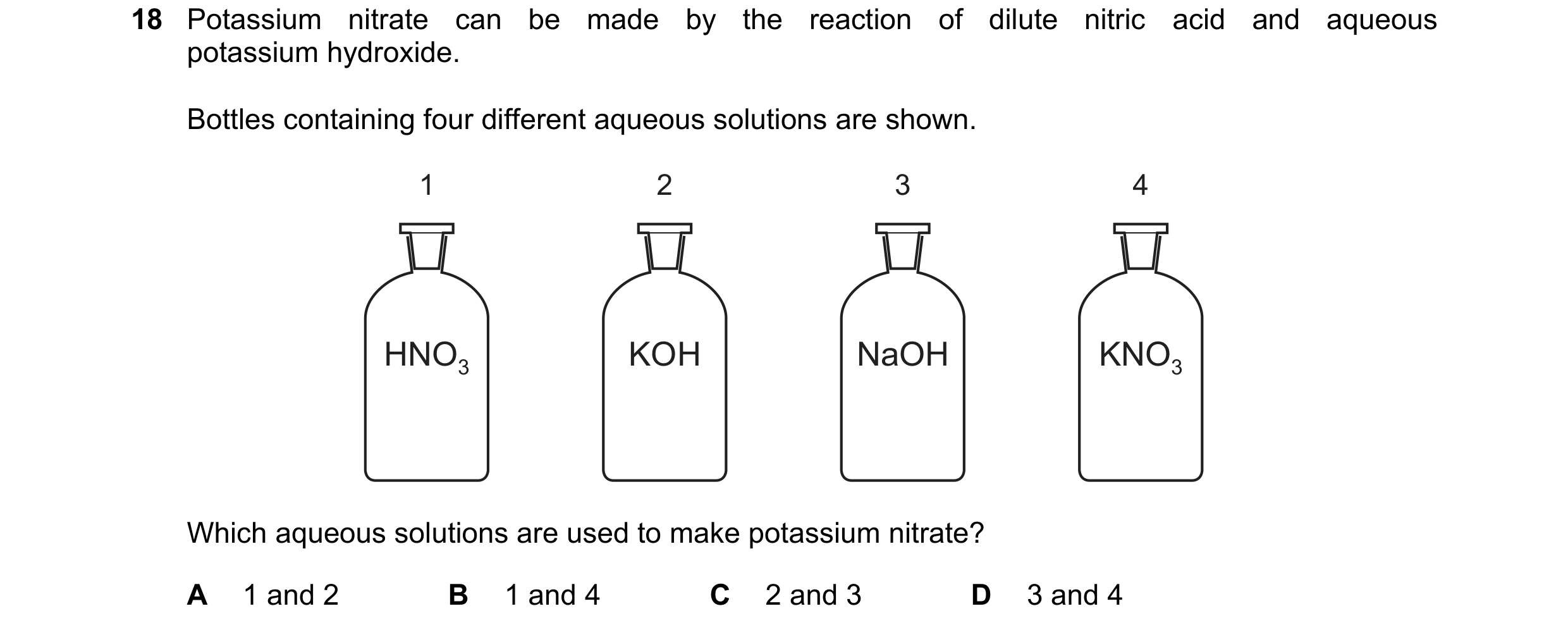
Q16 · Potassium nitrate can be made by the reaction of dilute nitric acid and aqueous potassium… 0653/13 May/June 2022
18 Potassium nitrate can be made by the reaction of dilute nitric acid and aqueous potassium hydroxide. Bottles containing four different aqueous solutions are shown. 1 2 3 4 HNO3 KOH NaOH KNO3 Which aqueous solutions are used to make potassium nitrate? A 1 and 2 B 1 and 4 C 2 and 3 D 3 and 4
1 marks
Answer: A
This question in 0653/13 May/June 2022
Q17 · Dilute sulfuric acid reacts with aqueous potassium hydroxide 0653/12 May/June 2023
21 Dilute sulfuric acid reacts with aqueous potassium hydroxide.
What are the products of this reaction?
potassium potassium carbon water
hydroxide sulfate dioxide
A J x Jv Jv
B x Jv x JV
Cc x J Jv Jv
D x Jv x x
key
/=yes
X =no
1 marks
Answer: B
This question in 0653/12 May/June 2023
Q18 · Which two substances both react with dilute sulfuric acid to make the salt magnesium… 0653/13 May/June 2023
22 Which two substances both react with dilute sulfuric acid to make the salt magnesium sulfate? A magnesium carbonate and magnesium chloride B magnesium chloride and magnesium nitrate C magnesium oxide and magnesium carbonate D magnesium oxide and magnesium nitrate
1 marks
Answer: C
This question in 0653/13 May/June 2023
Q19 · Which substance does not react with dilute hydrochloric acid to produce copper chloride? 0653/12 Oct/Nov 2023
24 Which substance does not react with dilute hydrochloric acid to produce copper chloride? A copper B copper carbonate C copper hydroxide D copper oxide
1 marks
Answer: A
This question in 0653/12 Oct/Nov 2023
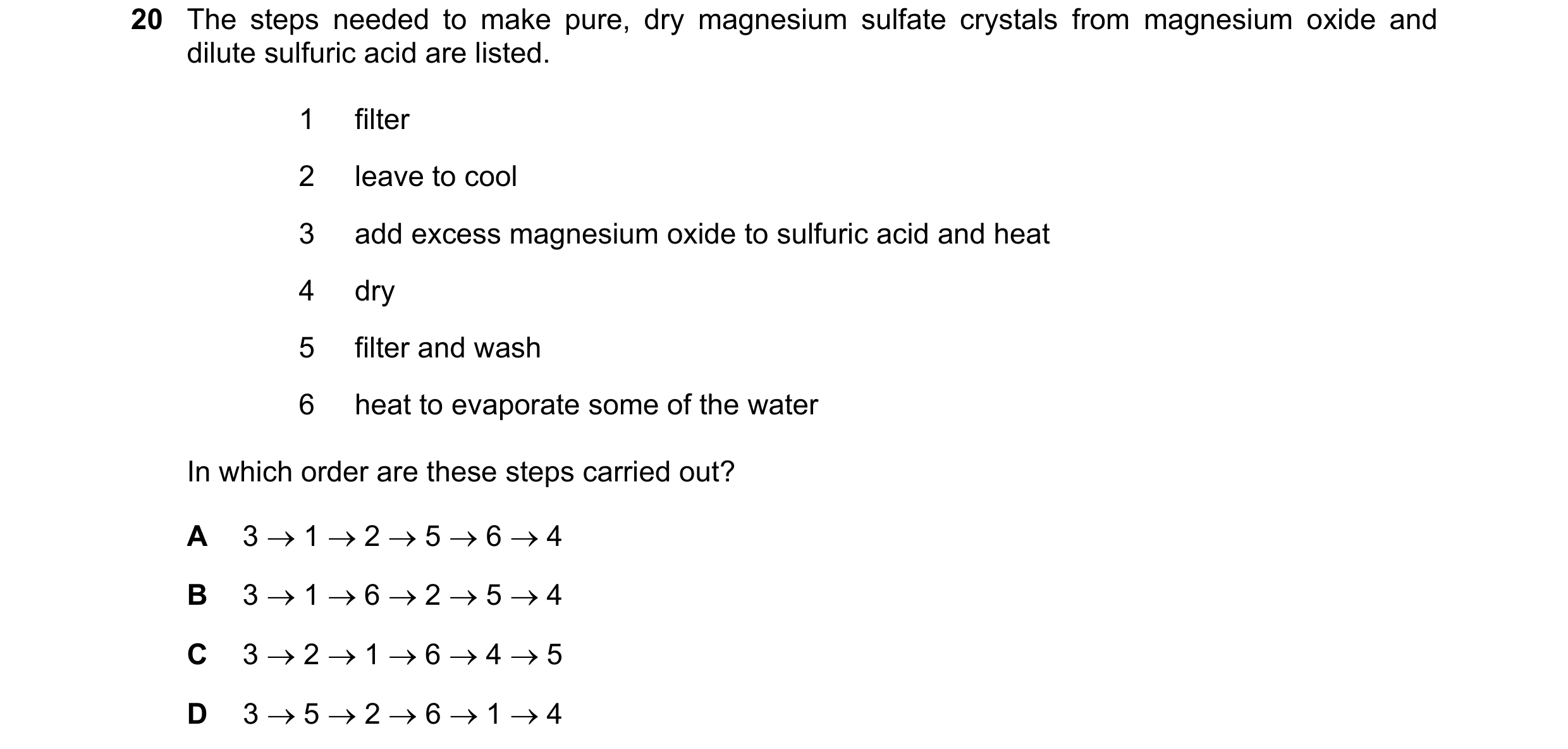
Q20 · The steps needed to make pure, dry magnesium sulfate crystals from magnesium oxide and… 0653/12 Oct/Nov 2024
20 The steps needed to make pure, dry magnesium sulfate crystals from magnesium oxide and dilute sulfuric acid are listed. 1 filter 2 leave to cool 3 add excess magnesium oxide to sulfuric acid and heat 4 dry 5 filter and wash 6 heat to evaporate some of the water In which order are these steps carried out? A 3 1 2 5 6 4 B 3 1 6 2 5 4 C 3 2 1 6 4 5 D 3 5 2 6 1 4
1 marks
Answer: B
This question in 0653/12 Oct/Nov 2024
Q21 · The steps needed to make pure, dry magnesium sulfate crystals from magnesium oxide and… 0653/13 Oct/Nov 2024
20 The steps needed to make pure, dry magnesium sulfate crystals from magnesium oxide and dilute sulfuric acid are listed. 1 filter 2 leave to cool 3 add excess magnesium oxide to sulfuric acid and heat 4 dry 5 filter and wash 6 heat to evaporate some of the water In which order are these steps carried out? A 3 1 2 5 6 4 B 3 1 6 2 5 4 C 3 2 1 6 4 5 D 3 5 2 6 1 4
1 marks
Answer: B
This question in 0653/13 Oct/Nov 2024
Q22 · Excess solid zinc carbonate is added to dilute hydrochloric acid in a beaker 0653/11 May/June 2025
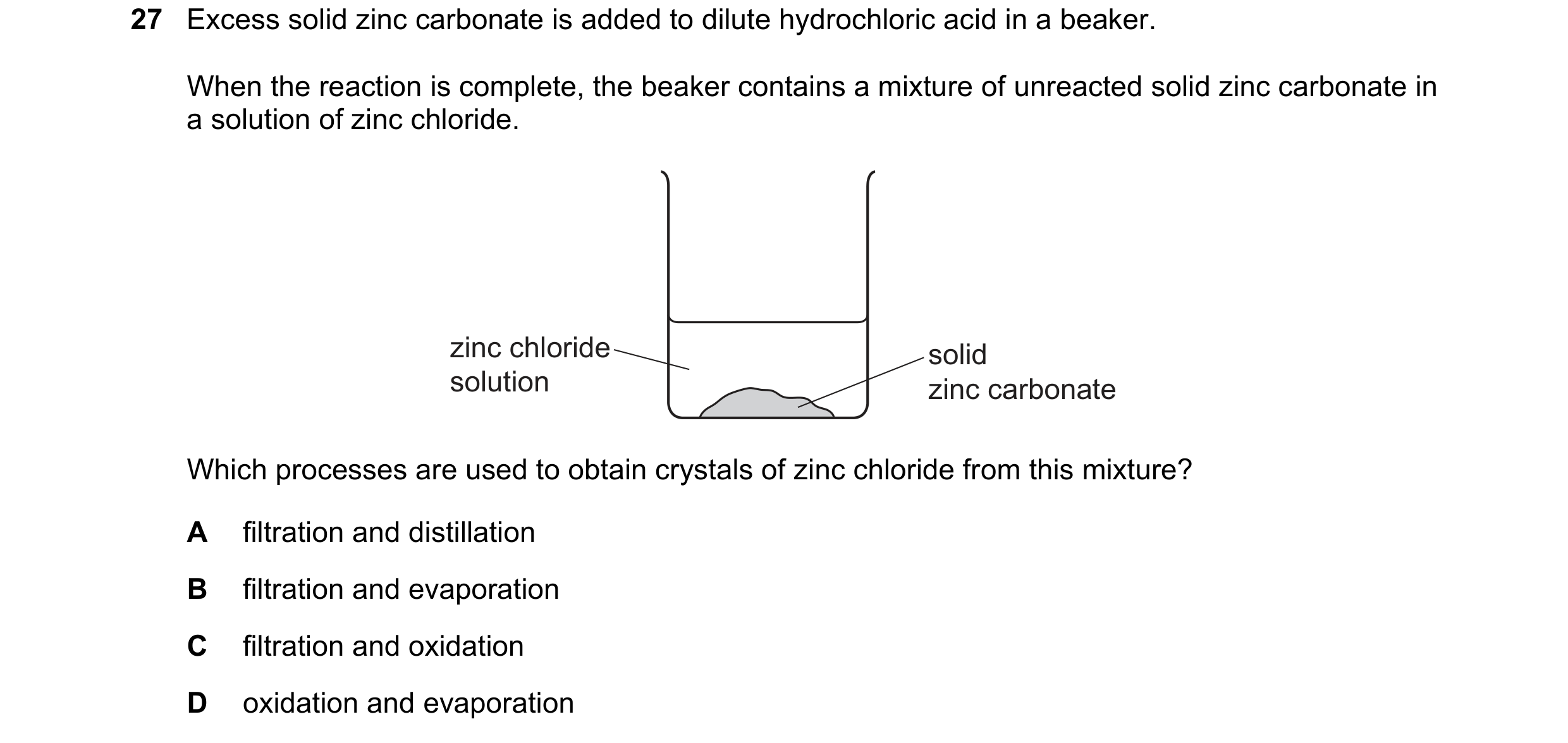
27 Excess solid zinc carbonate is added to dilute hydrochloric acid in a beaker. When the reaction is complete, the beaker contains a mixture of unreacted solid zinc carbonate in a solution of zinc chloride. zinc chloride solid solution zinc carbonate Which processes are used to obtain crystals of zinc chloride from this mixture? A filtration and distillation B filtration and evaporation C filtration and oxidation D oxidation and evaporation
1 marks
Answer: B
This question in 0653/11 May/June 2025
Q23 · Sodium nitrate, NaNO3, is a soluble salt 0653/13 May/June 2025
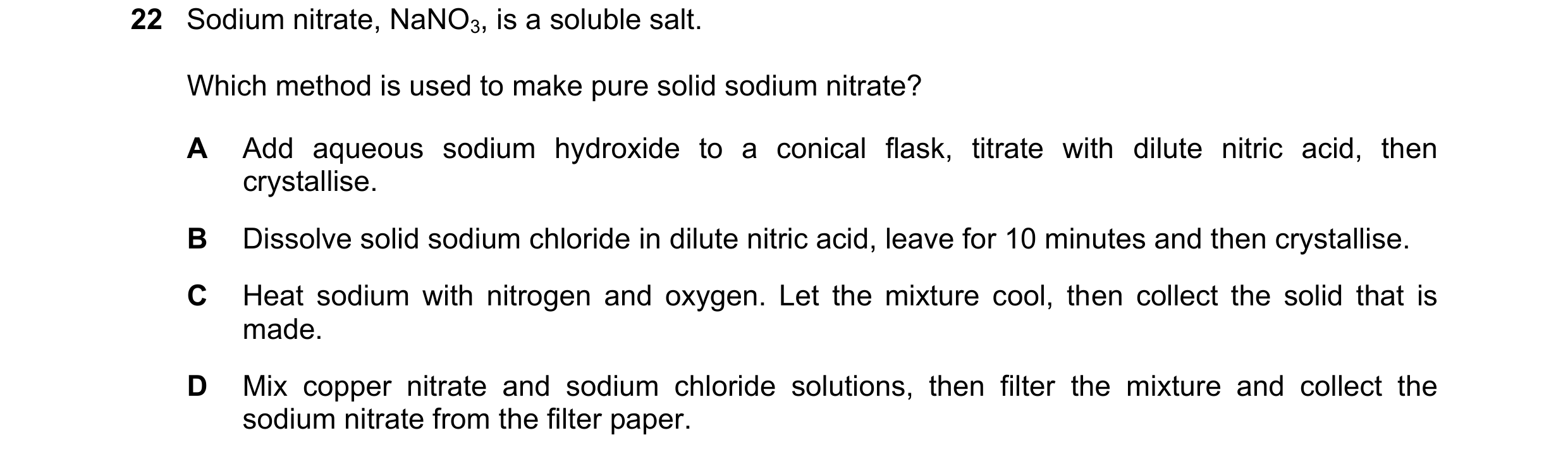
22 Sodium nitrate, NaNO3, is a soluble salt. Which method is used to make pure solid sodium nitrate? A Add aqueous sodium hydroxide to a conical flask, titrate with dilute nitric acid, then crystallise. B Dissolve solid sodium chloride in dilute nitric acid, leave for 10 minutes and then crystallise. C Heat sodium with nitrogen and oxygen. Let the mixture cool, then collect the solid that is made. D Mix copper nitrate and sodium chloride solutions, then filter the mixture and collect the sodium nitrate from the filter paper.
1 marks
Answer: A
This question in 0653/13 May/June 2025
Q24 · Which method is used to obtain a sample of pure, solid salt from an aqueous solution of… 0653/11 Oct/Nov 2025
27 Which method is used to obtain a sample of pure, solid salt from an aqueous solution of the salt? A chromatography B crystallisation C filtration D fractional distillation
1 marks
Answer: B
This question in 0653/11 Oct/Nov 2025

 1 / 7
1 / 7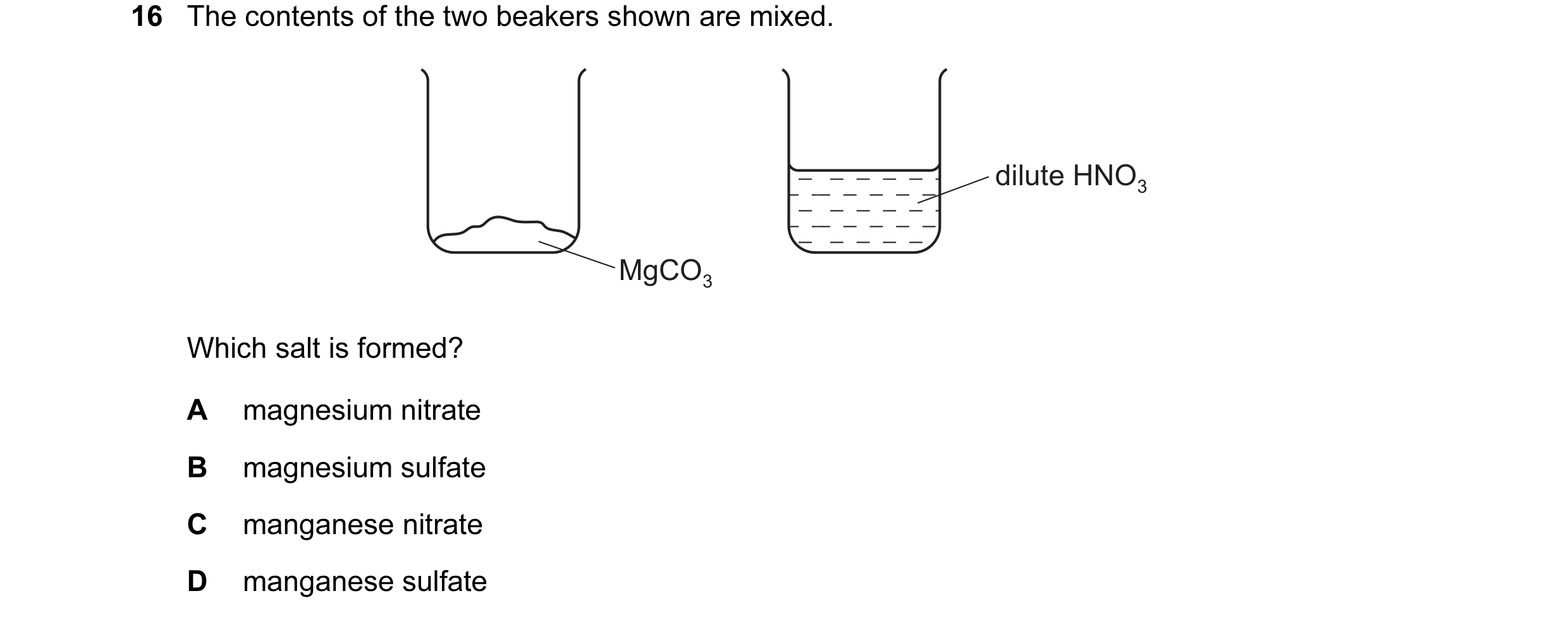
 2 / 7
2 / 7

 3 / 7
3 / 7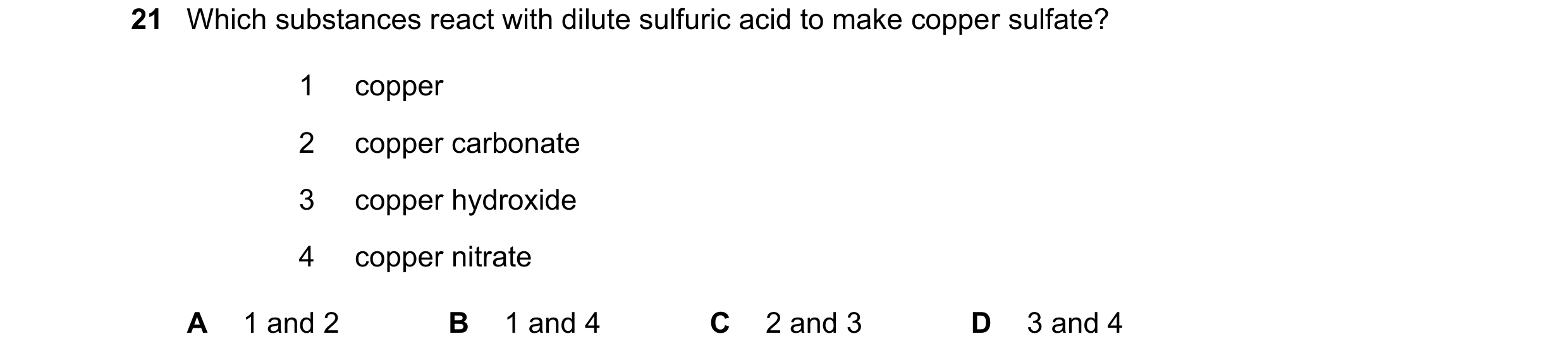
 4 / 7
4 / 7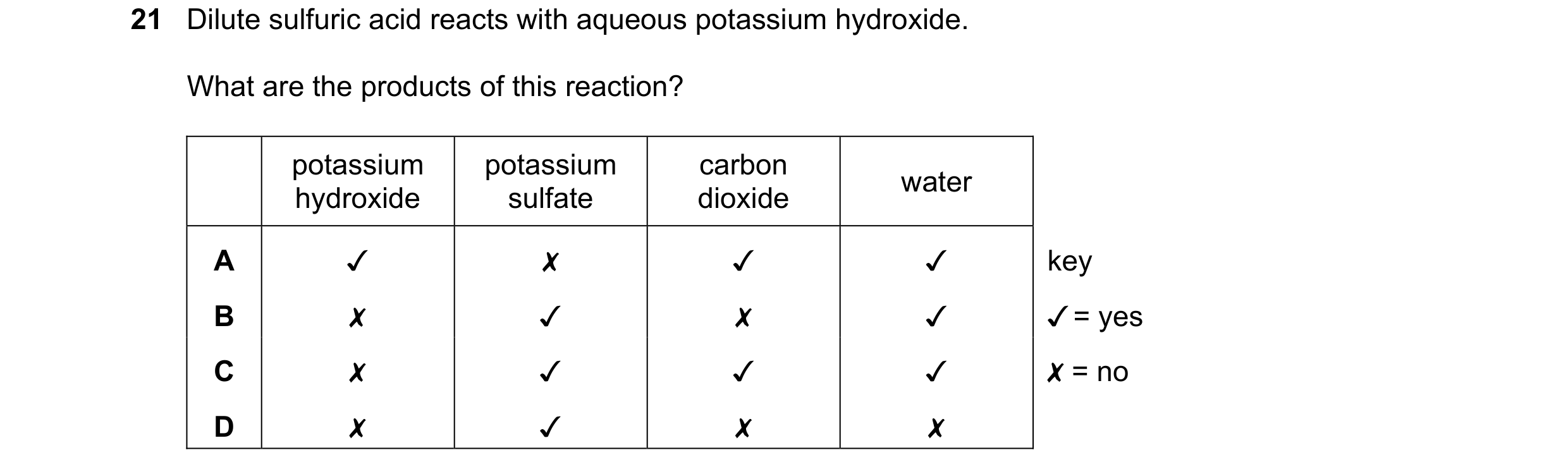


 5 / 7
5 / 7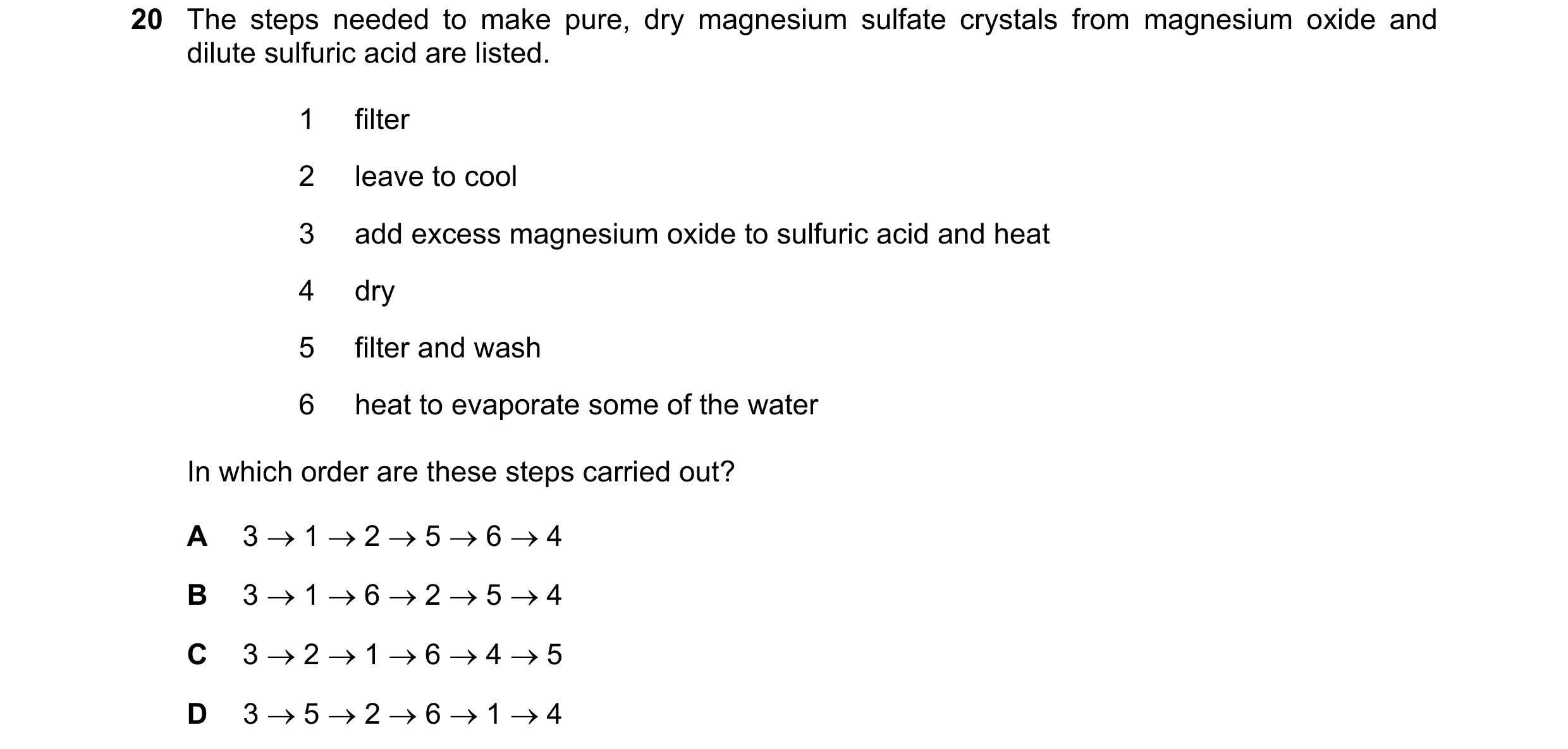
 6 / 7
6 / 7 7 / 7
7 / 7