Questions as text
Q1 · Use lines to connect the box on the left to different boxes on the right 0653/42 Feb/March 2017
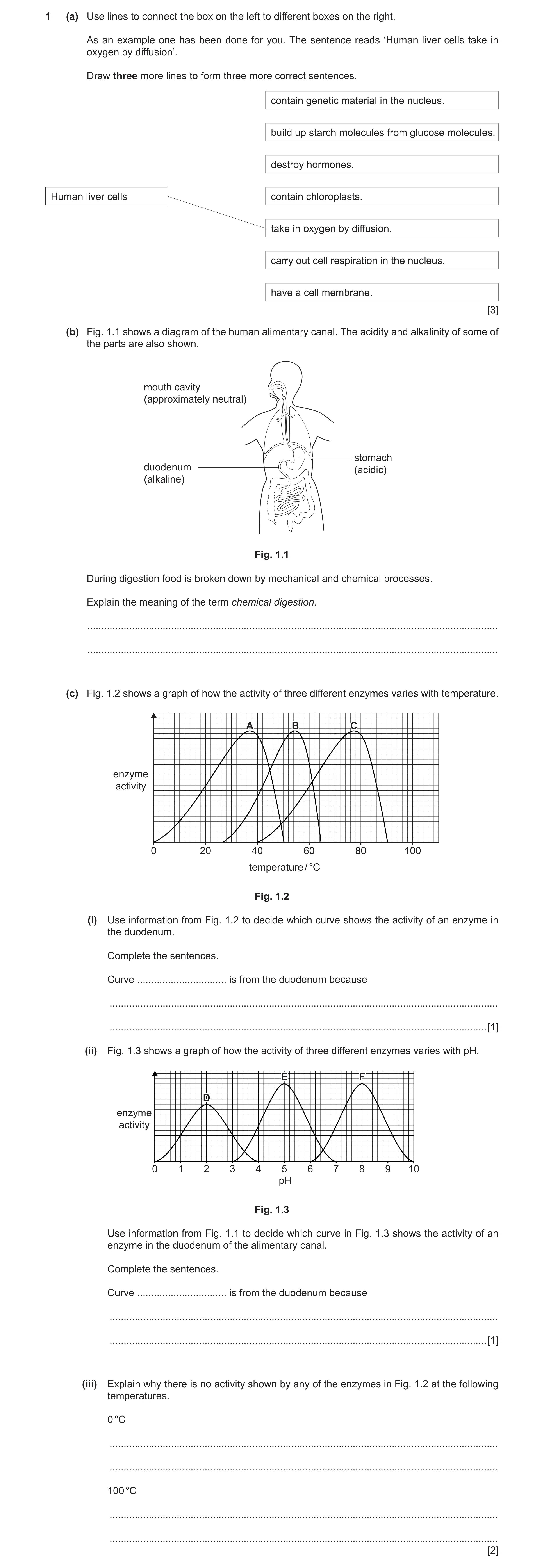
1 (a) Use lines to connect the box on the left to different boxes on the right. As an example one has been done for you. The sentence reads ‘Human liver cells take in oxygen by diffusion’. Draw three more lines to form three more correct sentences. contain genetic material in the nucleus. build up starch molecules from glucose molecules. destroy hormones. Human liver cells contain chloroplasts. take in oxygen by diffusion. carry out cell respiration in the nucleus. have a cell membrane. [3] (b) Fig. 1.1 shows a diagram of the human alimentary canal. The acidity and alkalinity of some of the parts are also shown. mouth cavity (approximately neutral) stomach duodenum (acidic) (alkaline) Fig. 1.1 During digestion food is broken down by mechanical and chemical processes. Explain the meaning of the term chemical digestion. … … (c) Fig. 1.2 shows a graph of how the activity of three different enzymes varies with temperature. AA BB CC enzyme activity 0 20 40 60 80 100 temperature / °C Fig. 1.2 (i) Use information from Fig. 1.2 to decide which curve shows the activity of an enzyme in the duodenum. Complete the sentences. Curve … is from the duodenum because … … [1] (ii) Fig. 1.3 shows a graph of how the activity of three different enzymes varies with pH. E F DD enzyme activity 0 1 2 3 4 5 6 7 8 9 10 pH Fig. 1.3 Use information from Fig. 1.1 to decide which curve in Fig. 1.3 shows the activity of an enzyme in the duodenum of the alimentary canal. Complete the sentences. Curve … is from the duodenum because … … [1] (iii) Explain why there is no activity shown by any of the enzymes in Fig. 1.2 at the following temperatures. 0 °C … … 100 °C … … [2]
9 marks
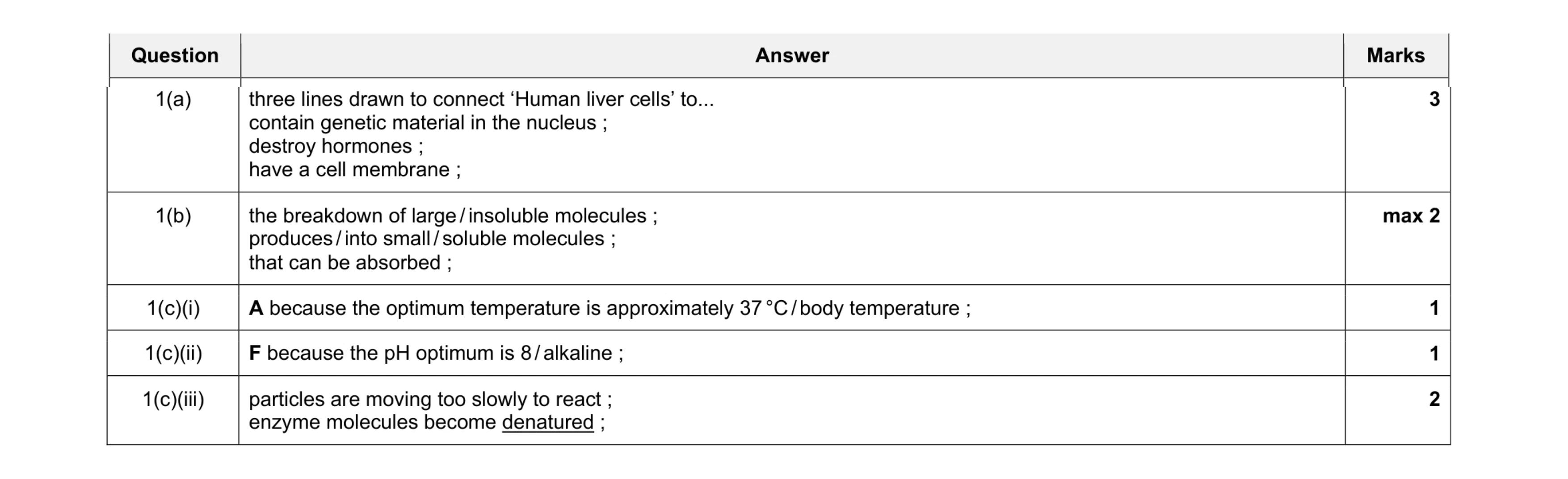
Mark scheme: 1(a) three lines drawn to connect ‘Human liver cells’ to... contain genetic material in the nucleus ; destroy hormones ; have a cell membrane ; 3 1(b) the breakdown of large / insoluble molecules ; produces / into small / soluble molecules ; that can be absorbed ; max 2 1(c)(i) A because the optimum temperature is approximately 37 °C / body temperature ; 1 1(c)(ii) F because the pH optimum is 8 / alkaline ; 1 1(c)(iii) particles are moving too slowly to react ; enzyme molecules become denatured ; 2
This question in 0653/42 Feb/March 2017
Q2 · The mass of some of the contents of three foods in a 100 gram sample of each food 0653/41 May/June 2017
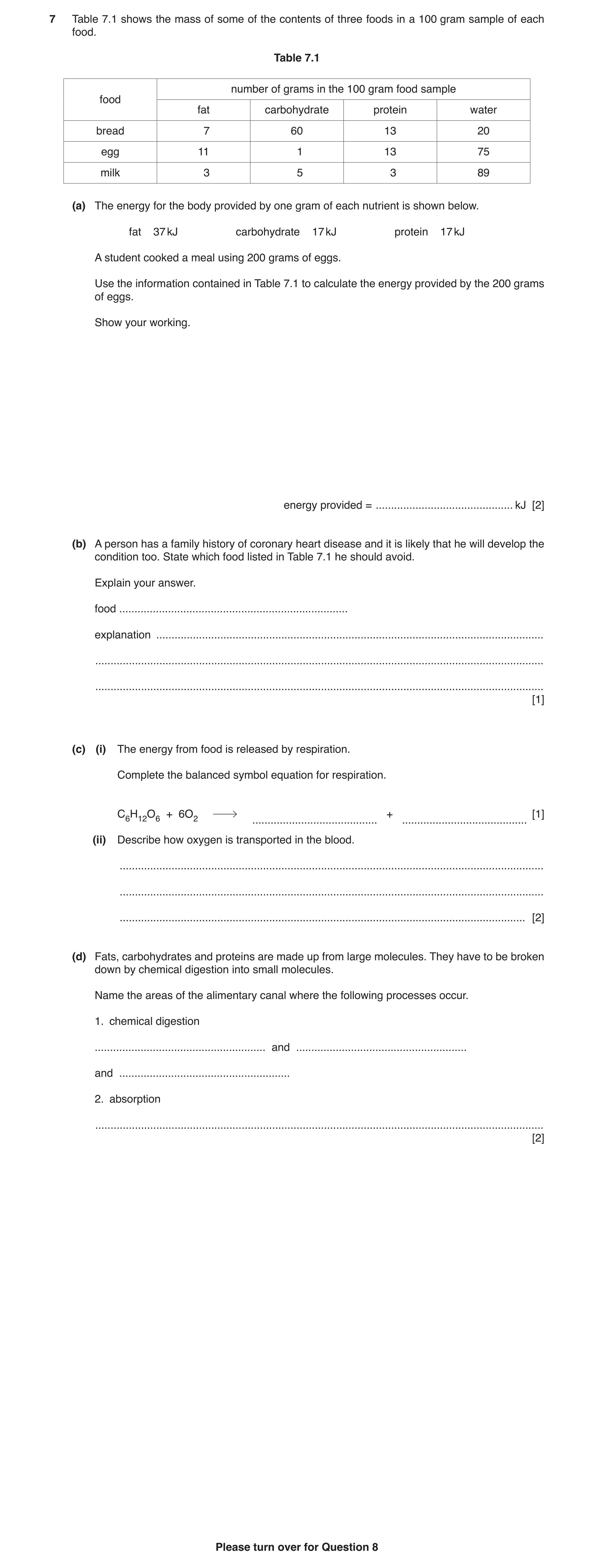
7 Table 7.1 shows the mass of some of the contents of three foods in a 100 gram sample of each food. Table 7.1 number of grams in the 100 gram food sample food fat carbohydrate protein water bread 7 60 13 20 egg 11 1 13 75 milk 3 5 3 89 (a) The energy for the body provided by one gram of each nutrient is shown below. fat 37 kJ carbohydrate 17 kJ protein 17 kJ A student cooked a meal using 200 grams of eggs. Use the information contained in Table 7.1 to calculate the energy provided by the 200 grams of eggs. Show your working. energy provided = … kJ [2] (b) A person has a family history of coronary heart disease and it is likely that he will develop the condition too. State which food listed in Table 7.1 he should avoid. Explain your answer. food … explanation … … … [1] (c) (i) The energy from food is released by respiration. Complete the balanced symbol equation for respiration. C6H12O6 + 6O2 + [1] … … (ii) Describe how oxygen is transported in the blood. … … … [2] (d) Fats, carbohydrates and proteins are made up from large molecules. They have to be broken down by chemical digestion into small molecules. Name the areas of the alimentary canal where the following processes occur. 1. chemical digestion … and … and … 2. absorption … [2] Please turn over for Question 8
8 marks
Mark scheme: 7(a) × 2 = 1290 (kJ) ; 2 7(b) eggs (no mark) contains the most fat ; 1 7(c)(i) 6CO2 and 6H2O ; 1 7(c)(ii) in red (blood) cells ; by haemoglobin ; red cells carried in plasma ; Max 2 7(d) chemical digestion:- mouth, and stomach and small intestine / duodenum / ileum ; absorption:- small intestine / duodenum / ileum ; 2
This question in 0653/41 May/June 2017
Q3 · Enzymes are proteins that function as biological catalysts 0653/43 May/June 2019
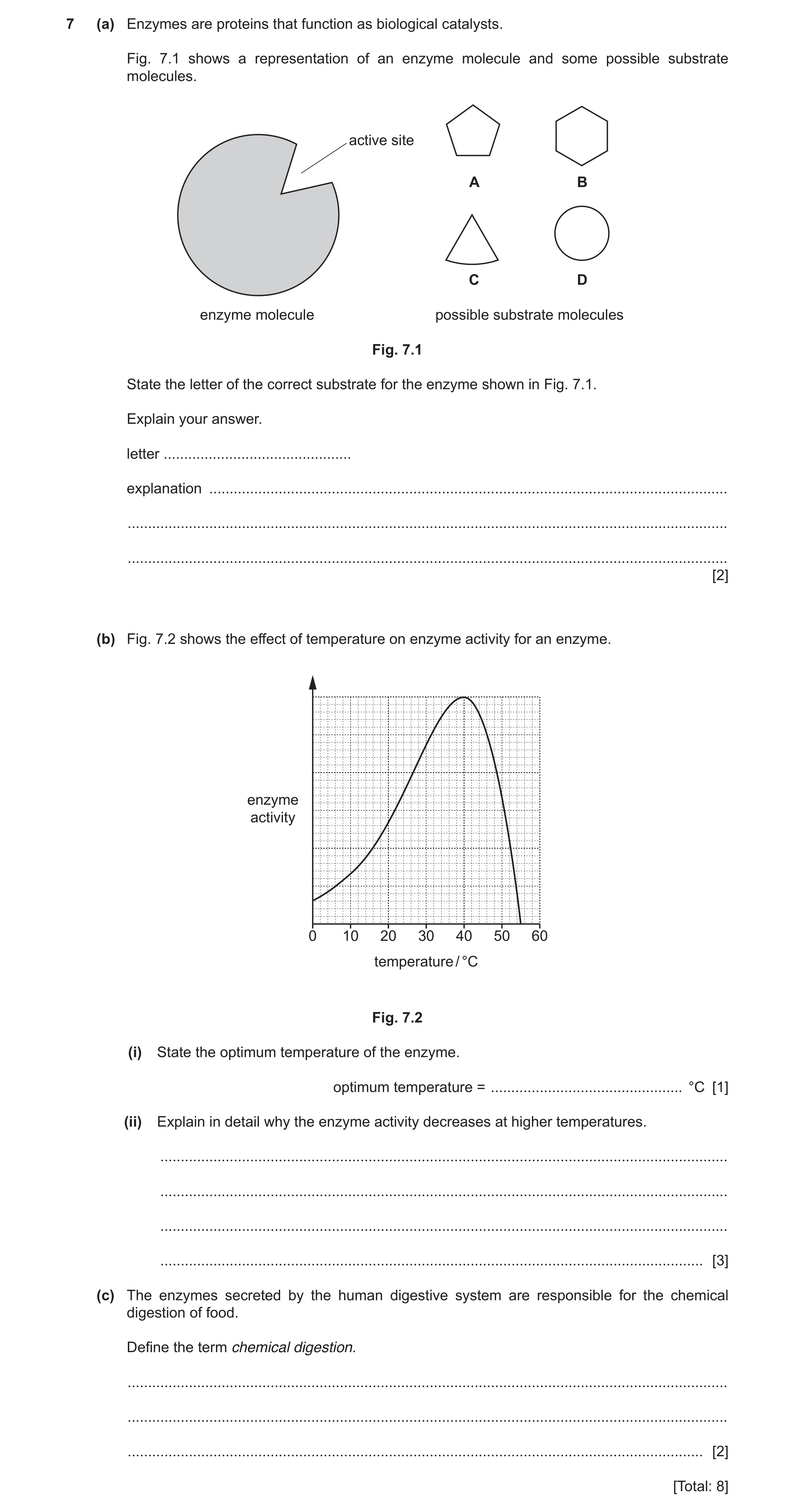
7 (a) Enzymes are proteins that function as biological catalysts. Fig. 7.1 shows a representation of an enzyme molecule and some possible substrate molecules. active site A B C D enzyme molecule possible substrate molecules Fig. 7.1 State the letter of the correct substrate for the enzyme shown in Fig. 7.1. Explain your answer. letter … explanation … … … [2] (b) Fig. 7.2 shows the effect of temperature on enzyme activity for an enzyme. enzyme activity 0 10 20 30 40 50 60 temperature / °C Fig. 7.2 (i) State the optimum temperature of the enzyme. optimum temperature = … °C [1] (ii) Explain in detail why the enzyme activity decreases at higher temperatures. … … … … [3] (c) The enzymes secreted by the human digestive system are responsible for the chemical digestion of food. Define the term chemical digestion. … … … [2] [Total: 8]
8 marks
Mark scheme: 7(a) C ; shape of C is complementary to the active site ; 2 7(b)(i) 40 °C ; 1 7(b)(ii) enzyme is denatured ; shape of active site changes ; substrate no longer fits the enzyme ; 3 7(c) the breakdown of large / insoluble molecules ; into small / soluble molecules ; 2
This question in 0653/43 May/June 2019
Q4 · A person is investigating the effect of the enzyme lipase on milk 0653/42 Oct/Nov 2019
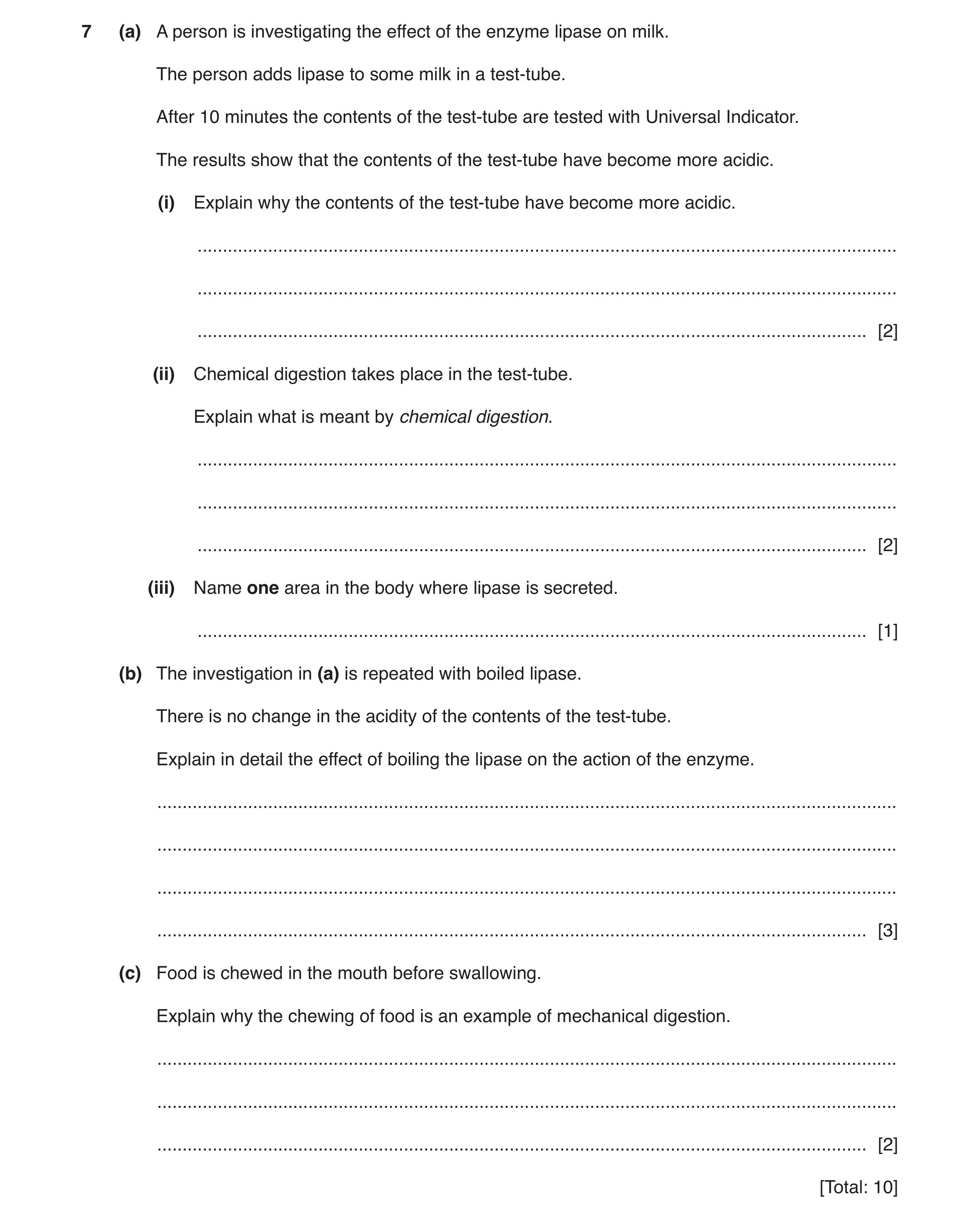
7 (a) A person is investigating the effect of the enzyme lipase on milk. The person adds lipase to some milk in a test-tube. After 10 minutes the contents of the test-tube are tested with Universal Indicator. The results show that the contents of the test-tube have become more acidic. (i) Explain why the contents of the test-tube have become more acidic. … … … [2] (ii) Chemical digestion takes place in the test-tube. Explain what is meant by chemical digestion. … … … [2] (iii) Name one area in the body where lipase is secreted. … [1] (b) The investigation in (a) is repeated with boiled lipase. There is no change in the acidity of the contents of the test-tube. Explain in detail the effect of boiling the lipase on the action of the enzyme. … … … … [3] (c) Food is chewed in the mouth before swallowing. Explain why the chewing of food is an example of mechanical digestion. … … … [2] [Total: 10]
10 marks
Mark scheme: 7(a)(i) (lipase) breaks down fats (in the milk) ; to produce fatty acids ; 1 7(a)(ii) the breakdown of large insoluble molecules ; into small soluble molecules that can be absorbed ; 2 7(a)(iii) pancreas / small intestine ; 1 7(b) enzyme is denatured ; enzyme (molecule) has changed shape / destroyed or active site shape has changed ; substrate no longer fits active site substrate no longer fits enzyme (molecule) ; 3 7(c) food is broken down into smaller pieces ; without chemical change / without action of enzymes / it is a physical change ; 2
This question in 0653/42 Oct/Nov 2019
Q5 · Define the term enzyme 0653/43 Oct/Nov 2019
4 (a) Define the term enzyme. … … [2] (b) Enzymes are found in the digestive system where they help in the chemical digestion of food. Fig. 4.1 shows some digestive enzymes listed in the boxes on the left. enzyme substrate product amylase fats amino acids fatty acids and lipase protein glycerol protease starch simple sugars Fig. 4.1 (i) On Fig. 4.1: • draw one straight line to connect each enzyme with its substrate • draw one straight line to connect each substrate with its product. [3] (ii) State one area of the alimentary canal and its associated organs where protease is secreted. … [1] (c) Explain in detail the activity of a human digestive enzyme at 70 °C. … … … … … [3] (d) State two functions of hydrochloric acid in gastric juice. 1. … … 2. … … [2] [Total: 11]
11 marks
Mark scheme: 4(a) a protein ; (that functions as) a biological catalyst ; 2 4(b)(i) enzyme substrate product amylase fats amino acids lipase protein fatty acids and glycerol protease starch simple sugars 2 or 3 connections correct ; 4 or 5 connections correct ; 6 connections correct ; 3 4(b)(ii) stomach / pancreas / small intestine ; 1 4(c) (no enzyme activity / enzyme activity greatly reduced because) enzyme is denatured ; enzyme (molecule) has changed shape or active site has changed shape ; substrate no longer fits the active site substrate cannot bind to enzyme molecule ; 3 4(d) killing bacteria ; optimum pH for enzymes ; 2
This question in 0653/43 Oct/Nov 2019
Q6 · Food taken in by the body must be digested so that the body can absorb the nutrients 0653/42 Feb/March 2020
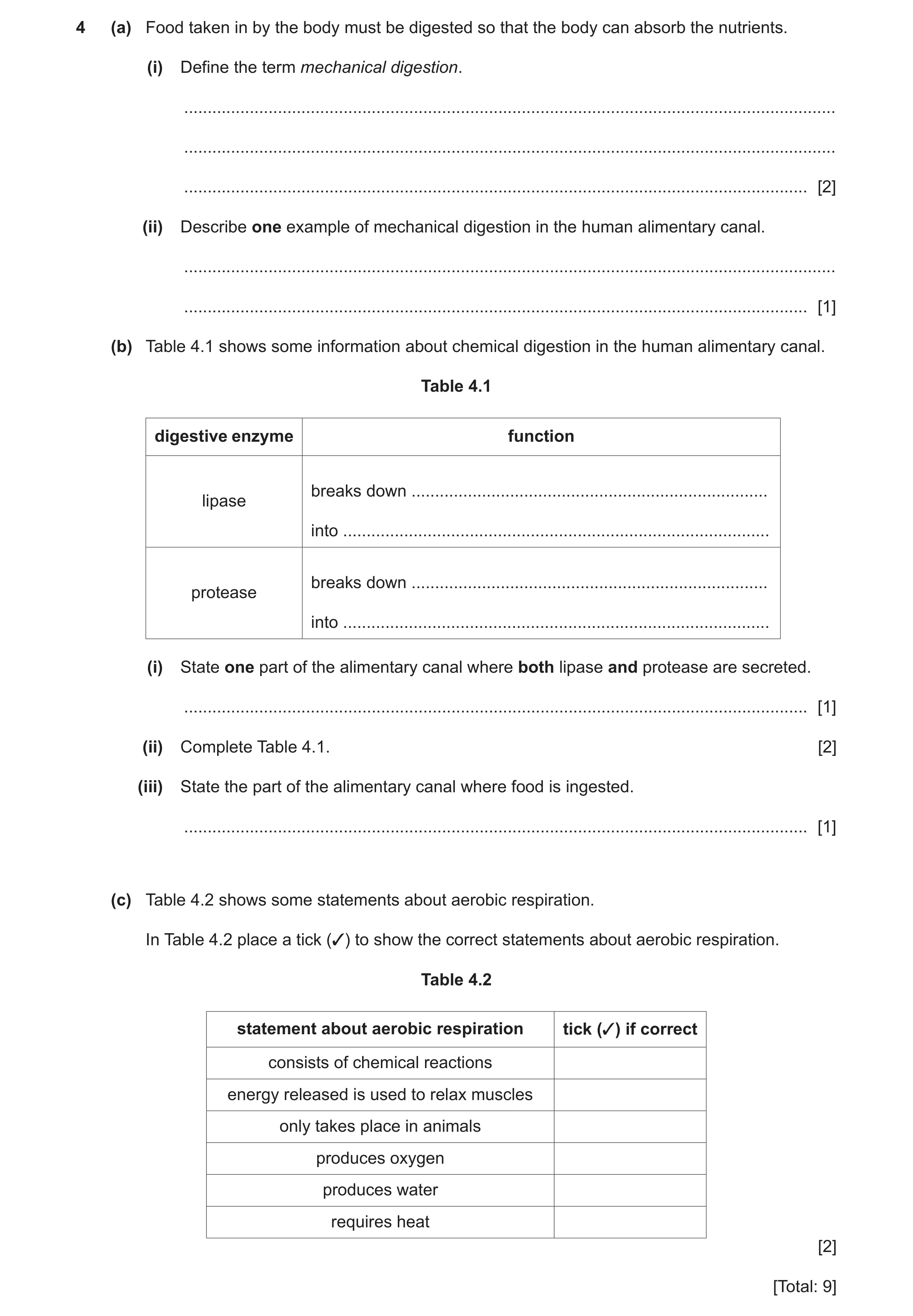
4 (a) Food taken in by the body must be digested so that the body can absorb the nutrients. (i) Define the term mechanical digestion. … … … [2] (ii) Describe one example of mechanical digestion in the human alimentary canal. … … [1] (b) Table 4.1 shows some information about chemical digestion in the human alimentary canal. Table 4.1 digestive enzyme function breaks down … lipase into … breaks down … protease into … (i) State one part of the alimentary canal where both lipase and protease are secreted. … [1] (ii) Complete Table 4.1. [2] (iii) State the part of the alimentary canal where food is ingested. … [1] (c) Table 4.2 shows some statements about aerobic respiration. In Table 4.2 place a tick (✓) to show the correct statements about aerobic respiration. Table 4.2 statement about aerobic respiration tick (✓) if correct consists of chemical reactions energy released is used to relax muscles only takes place in animals produces oxygen produces water requires heat [2] [Total: 9]
9 marks
Mark scheme: 4(a)(i) the breakdown of food into smaller pieces ; without chemical change (to the food molecules) ; Question Answer Marks 4(a)(ii) chewing food / churning action by stomach ; 1 4(b)(i) small intestine ; 1 4(b)(ii) (lipase breaks down) fat (into) fatty acids and glycerol ; (protease breaks down) protein (into) amino acids ; 2 4(b)(iii) mouth ; 1 4(c) consists of chemical reactions ; produces water ; (if more than two statements ticked then incorrect ticks cancel correct ones to a min of 0) 2
This question in 0653/42 Feb/March 2020
Q7 · The substrates and products of three digestive enzymes are shown in Table 7.1 0653/41 May/June 2020
7 (a) The substrates and products of three digestive enzymes are shown in Table 7.1. Complete Table 7.1. Table 7.1 substrate digestive enzyme product amylase sugars … fat … … and fatty acids protein protease … [3] (b) State two functions of the hydrochloric acid in gastric juice in the stomach. 1. . … … 2. … … [2] (c) Fig. 7.1 shows a graph of activity against temperature for two enzymes, A and B. enzyme A enzyme B enzyme activity 0 20 40 60 80 100 120 temperature / °C Fig. 7.1 (i) Identify the temperature of maximum activity of enzyme B. temperature = … °C [1] (ii) The enzyme activity of both enzymes is the same at 47 °C. The temperature is increased to 50 °C. State and explain the effects of this temperature increase on the activity of enzyme A. … … … … … [3] (iii) Amylase is a digestive enzyme secreted in parts of the alimentary canal. Suggest which enzyme, A or B, is amylase. Give a reason for your answer. enzyme … reason … … [1] [Total: 10]
10 marks
Mark scheme: 7(a) (first line) starch ; (second line) lipase and glycerol ; (third line) amino acids ; 3 7(b) kills bacteria ; gives an acid pH for enzymes ; 2 7(c)(i) 77 (°C) ; 1 7(c)(ii) no activity / reaction rate is reduced ; enzyme denatures / loss of 3D shape ; substrate no longer fits active site ; 3 7(c)(iii) (enzyme) A and (reason) high / optimum, activity at body temperature ; 1
This question in 0653/41 May/June 2020
Q8 · Some pasta noodles and some vegetable noodles 0653/42 Oct/Nov 2020
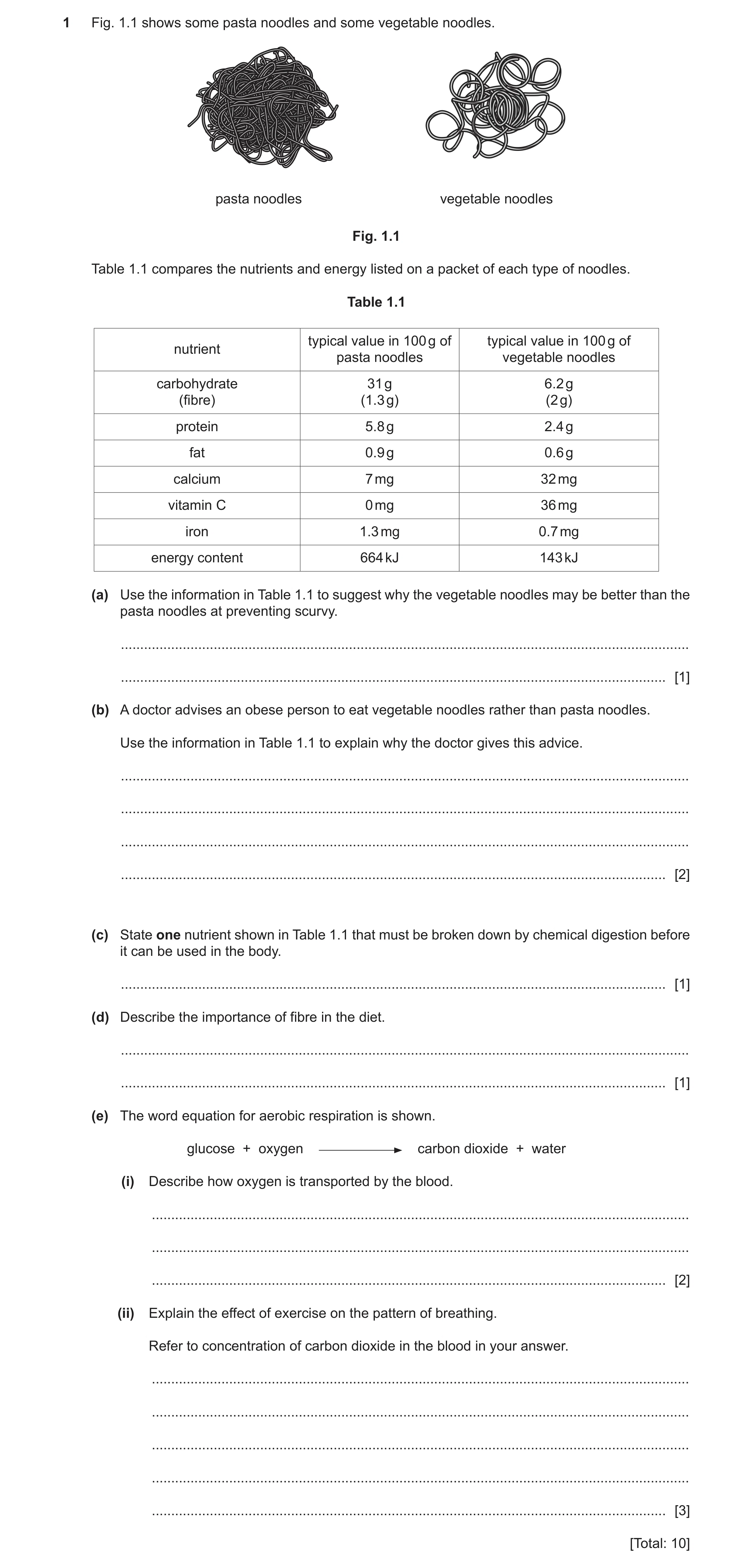
1 Fig. 1.1 shows some pasta noodles and some vegetable noodles. pasta noodles vegetable noodles Fig. 1.1 Table 1.1 compares the nutrients and energy listed on a packet of each type of noodles. Table 1.1 typical value in 100 g of typical value in 100 g of nutrient pasta noodles vegetable noodles carbohydrate 31 g 6.2 g (fibre) (1.3 g) (2 g) protein 5.8 g 2.4 g fat 0.9 g 0.6 g calcium 7 mg 32 mg vitamin C 0 mg 36 mg iron 1.3 mg 0.7 mg energy content 664 kJ 143 kJ (a) Use the information in Table 1.1 to suggest why the vegetable noodles may be better than the pasta noodles at preventing scurvy. … … [1] (b) A doctor advises an obese person to eat vegetable noodles rather than pasta noodles. Use the information in Table 1.1 to explain why the doctor gives this advice. … … … … [2] (c) State one nutrient shown in Table 1.1 that must be broken down by chemical digestion before it can be used in the body. … [1] (d) Describe the importance of fibre in the diet. … … [1] (e) The word equation for aerobic respiration is shown. glucose + oxygen carbon dioxide + water (i) Describe how oxygen is transported by the blood. … … … [2] (ii) Explain the effect of exercise on the pattern of breathing. Refer to concentration of carbon dioxide in the blood in your answer. … … … … … [3] [Total: 10]
10 marks
Mark scheme: 1(a) (vegetable noodles) contain (more) vitamin C ; 1 1(b) (vegetable noodles) contain less energy ; excess energy would be stored as fat / owtte ; 2 1(c) carbohydrate / fat / protein ; 1 1(d) prevents constipation ; 1 1(e)(i) by haemoglobin ; in red blood cells ; 2 1(e)(ii) rate / depth of breathing increases ; (due to) increased carbon dioxide (concentration in the blood) ; (because), (rate of) respiration increases / CO2 is a product of respiration ; 3
This question in 0653/42 Oct/Nov 2020
Q9 · A balanced diet contains all the nutrients in the correct proportions to meet a person’s… 0653/43 Oct/Nov 2020
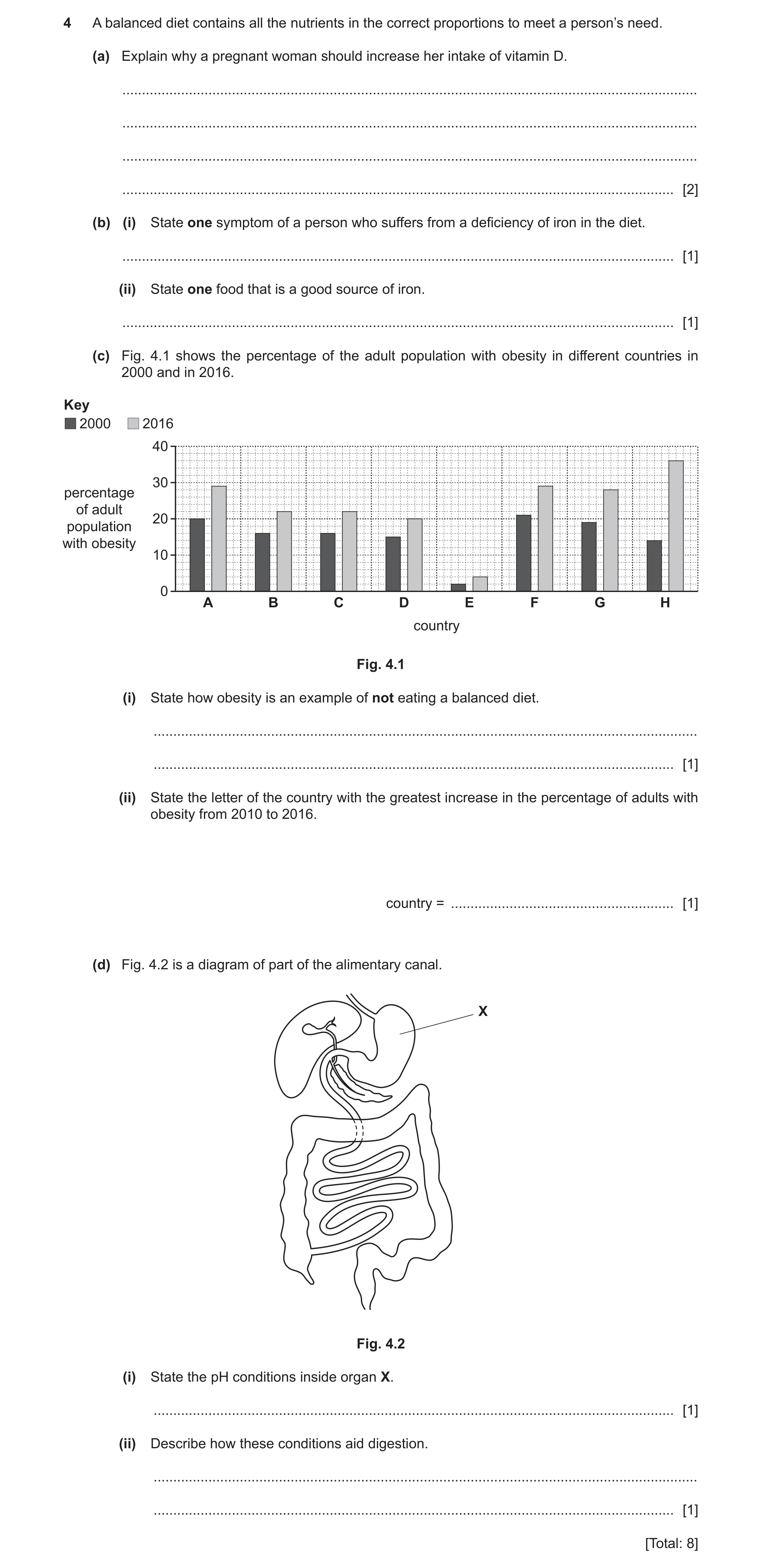
4 A balanced diet contains all the nutrients in the correct proportions to meet a person’s need. (a) Explain why a pregnant woman should increase her intake of vitamin D. … … … … [2] (b) (i) State one symptom of a person who suffers from a deficiency of iron in the diet. … [1] (ii) State one food that is a good source of iron. … [1] (c) Fig. 4.1 shows the percentage of the adult population with obesity in different countries in 2000 and in 2016. Key 2000 2016 40 30 percentage of adult 20 population with obesity 10 0 A B C D E F G H country Fig. 4.1 (i) State how obesity is an example of not eating a balanced diet. … … [1] (ii) State the letter of the country with the greatest increase in the percentage of adults with obesity from 2010 to 2016. country = … [1] (d) Fig. 4.2 is a diagram of part of the alimentary canal. X Fig. 4.2 (i) State the pH conditions inside organ X. … [1] (ii) Describe how these conditions aid digestion. … … [1] [Total: 8]
8 marks
Mark scheme: 4(a) any two from: for growth of bones (of the fetus) ; to, prevent soft bones / keep bones strong / prevent loss of calcium in mother’s bones ; to assist calcium absorption ; 2 4(b)(i) tiredness / feeling dizzy / pale complexion / anaemia ; 1 4(b)(ii) liver / red meat / green leafy vegetables ; 1 4(c)(i) the energy (in the food) taken in exceeds the energy needs of the person ; 1 4(c)(ii) country H ; 1 4(d)(i) acidic conditions / low pH ; 1 4(d)(ii) best pH for, pepsin / enzyme action in the stomach ; 1
This question in 0653/43 Oct/Nov 2020
Q10 · The mass of protein in some different food types 0653/41 May/June 2021
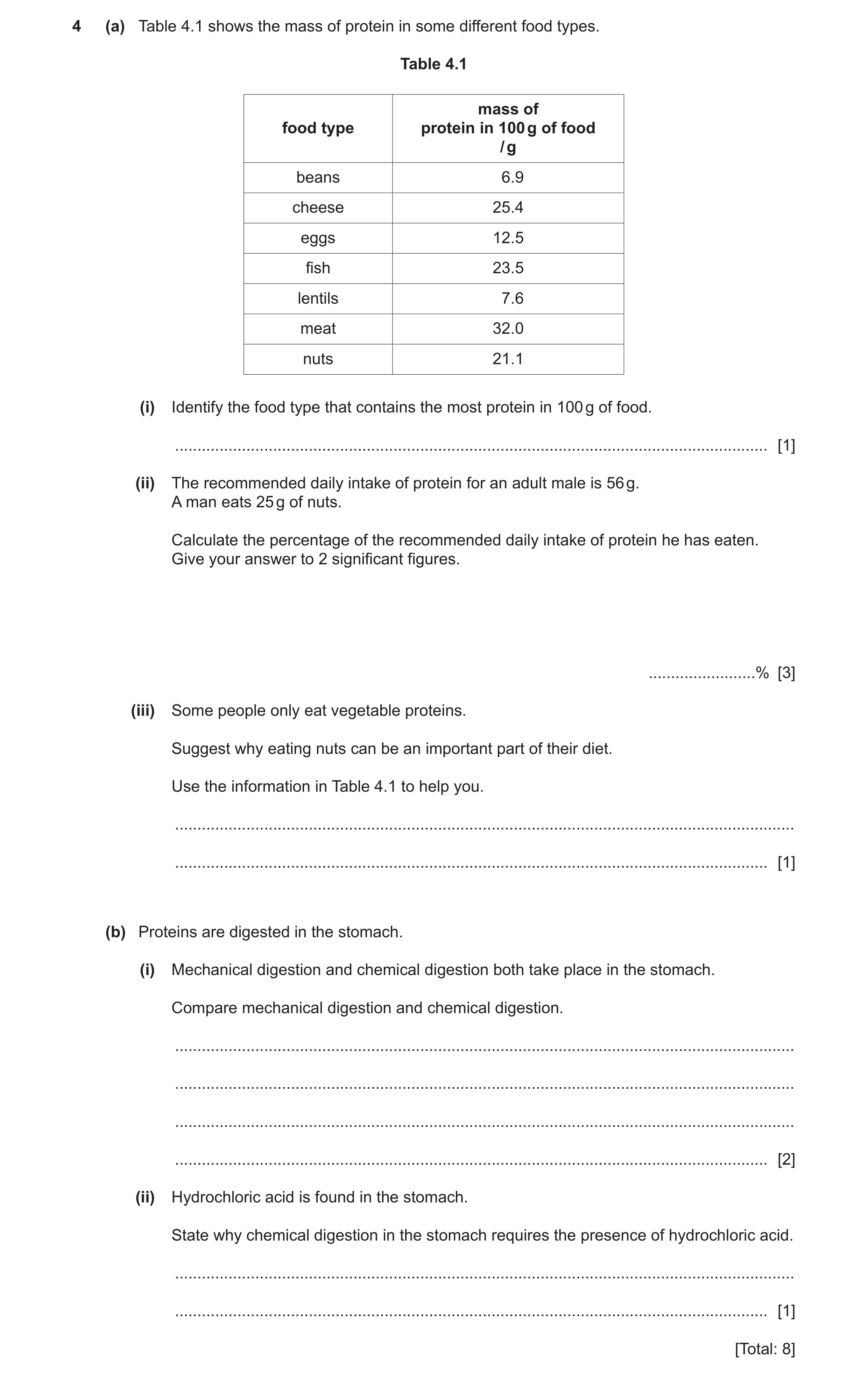
4 (a) Table 4.1 shows the mass of protein in some different food types. Table 4.1 mass of food type protein in 100 g of food / g beans 6.9 cheese 25.4 eggs 12.5 fish 23.5 lentils 7.6 meat 32.0 nuts 21.1 (i) Identify the food type that contains the most protein in 100 g of food. … [1] (ii) The recommended daily intake of protein for an adult male is 56 g. A man eats 25 g of nuts. Calculate the percentage of the recommended daily intake of protein he has eaten. Give your answer to 2 significant figures. … % [3] (iii) Some people only eat vegetable proteins. Suggest why eating nuts can be an important part of their diet. Use the information in Table 4.1 to help you. … … [1] (b) Proteins are digested in the stomach. (i) Mechanical digestion and chemical digestion both take place in the stomach. Compare mechanical digestion and chemical digestion. … … … … [2] (ii) Hydrochloric acid is found in the stomach. State why chemical digestion in the stomach requires the presence of hydrochloric acid. … … [1] [Total: 8]
8 marks
Mark scheme: 4(a)(i) meat ; 1 4(a)(ii) 9.4 / 9.5(%) ;;; MP1 21.1 ÷ 4 / = 5.275 / 5.3 ; MP2 (5.275 ÷ 56) × 100 / = 9.42 OR (5.3 ÷ 56) × 100 / = 9.46 ; MP3 answer given as two significant figures 9.4 or 9.5 % ; 3 4(a)(iii) higher in protein than, the other vegetable based proteins / beans / lentils OWTTE ; 1 4(b)(i) any two from: both types break down, food / protein ; the idea that mechanical digestion results in smaller pieces (of food) AND idea that chemical digestion results in smaller molecules ; chemical digestion involves enzymes / mechanical digestion does not use enzymes ; chemical digestion produces soluble molecules / mechanical digestion may not result in soluble molecules ; 2 4(b)(ii) (provides an acidic pH) for enzymes / for enzymes to work ; 1
This question in 0653/41 May/June 2021
Q11 · The first part of the alimentary canal and associated organs 0653/42 Feb/March 2022
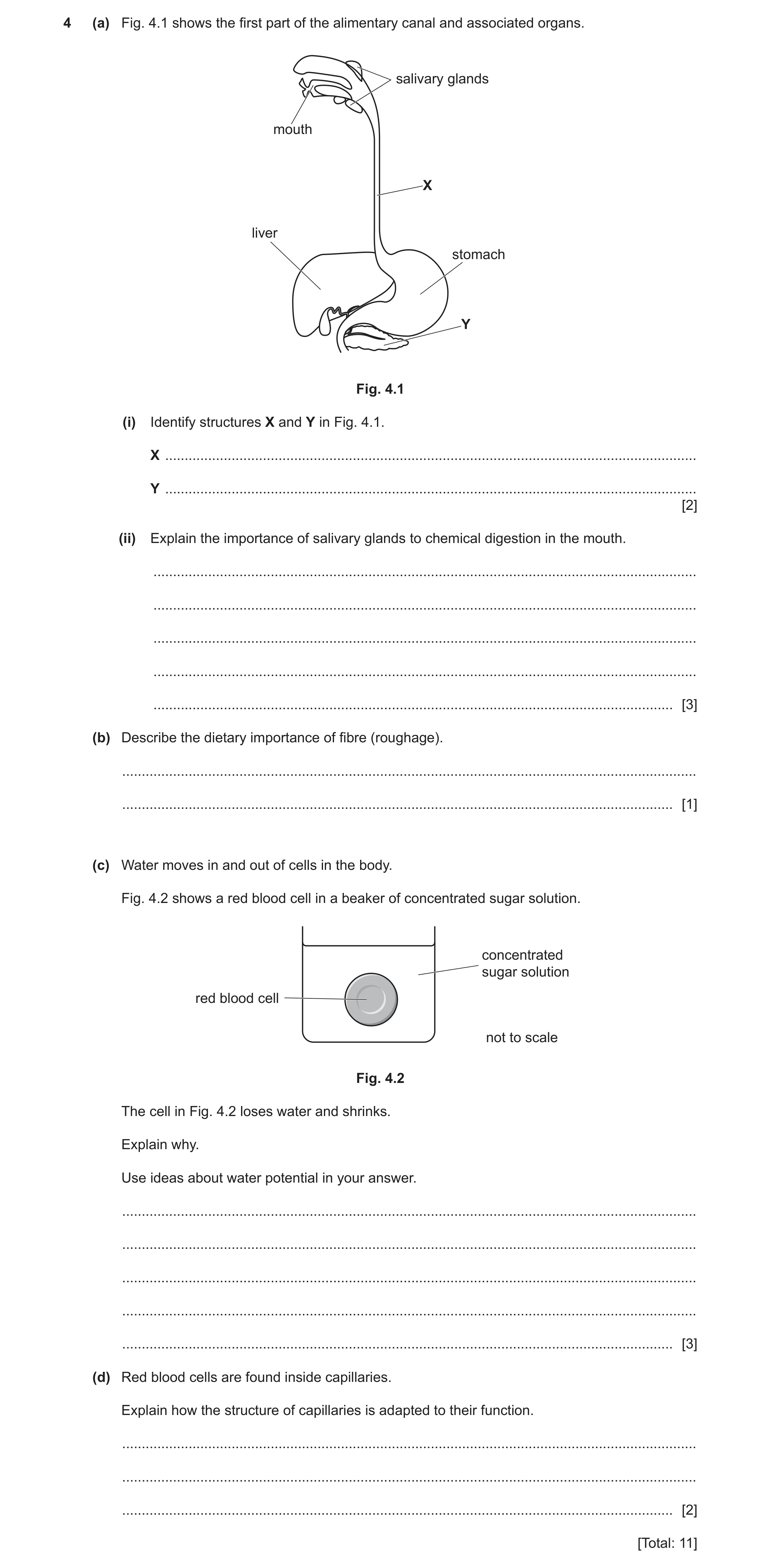
4 (a) Fig. 4.1 shows the first part of the alimentary canal and associated organs. salivary glands mouth X liver stomach Y Fig. 4.1 (i) Identify structures X and Y in Fig. 4.1. X … Y … [2] (ii) Explain the importance of salivary glands to chemical digestion in the mouth. … … … … … [3] (b) Describe the dietary importance of fibre (roughage). … … [1] (c) Water moves in and out of cells in the body. Fig. 4.2 shows a red blood cell in a beaker of concentrated sugar solution. concentrated sugar solution red blood cell not to scale Fig. 4.2 The cell in Fig. 4.2 loses water and shrinks. Explain why. Use ideas about water potential in your answer. … … … … … [3] (d) Red blood cells are found inside capillaries. Explain how the structure of capillaries is adapted to their function. … … … [2] [Total: 11]
11 marks
Mark scheme: 4(a)(i) X – oesophagus ; Y – pancreas ; 2 4(a)(ii) produce / secrete, amylase ; digest starch ; to produce, simpler sugars / glucose ; 3 4(b) prevents constipation ; 1 4(c) water moves from higher to lower water potential ; through a partially permeable membrane ; (by the process of) osmosis ; 3 4(d) thin wall / wall one cell thick ; allow (efficient) exchange of substances ; 2
This question in 0653/42 Feb/March 2022
Q12 · Part of the human alimentary canal and associated organs 0653/41 May/June 2022
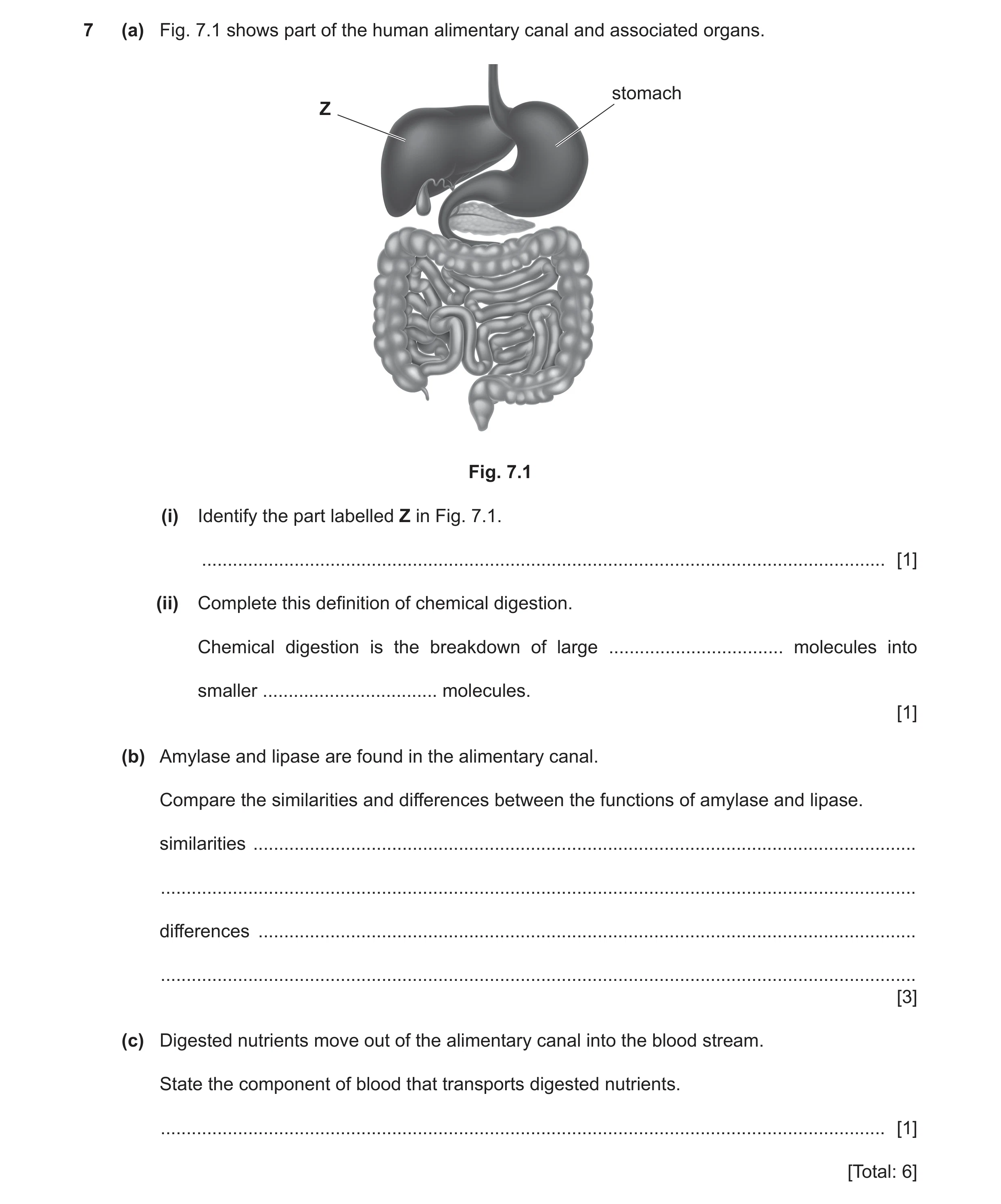
7 (a) Fig. 7.1 shows part of the human alimentary canal and associated organs. stomach Z Fig. 7.1 (i) Identify the part labelled Z in Fig. 7.1. … [1] (ii) Complete this definition of chemical digestion. Chemical digestion is the breakdown of large … molecules into smaller … molecules. [1] (b) Amylase and lipase are found in the alimentary canal. Compare the similarities and differences between the functions of amylase and lipase. similarities … … differences … … [3] (c) Digested nutrients move out of the alimentary canal into the blood stream. State the component of blood that transports digested nutrients. … [1] [Total: 6]
6 marks
Mark scheme: 7(a)(i) liver ; 1 7(a)(ii) insoluble AND soluble ; 1 7(b) any three from: (similarities) are enzymes / speed up digestion ; breakdown large / insoluble, food molecules ; (differences) amylase breaks down / digests starch / carbohydrates / produces sugars ; lipase breaks down / digests fats / oils / lipids / produces fatty acids / glycerol ; 3 7(c) plasma ; 1
This question in 0653/41 May/June 2022
Question 13 0653/42 May/June 2022
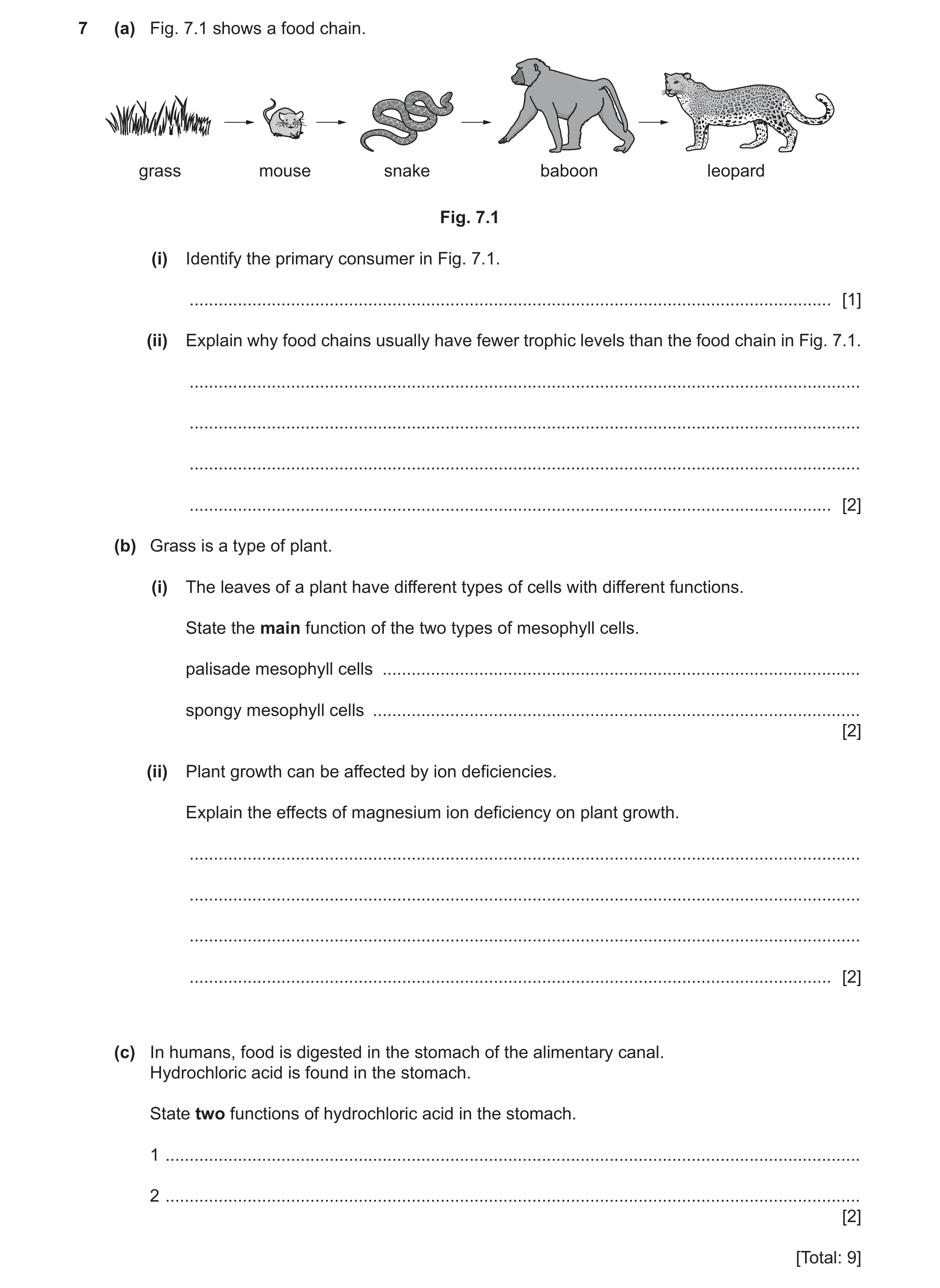
7 (a) Fig. 7.1 shows a food chain. grass mouse snake baboon leopard Fig. 7.1 (i) Identify the primary consumer in Fig. 7.1. … [1] (ii) Explain why food chains usually have fewer trophic levels than the food chain in Fig. 7.1. … … … … [2] (b) Grass is a type of plant. (i) The leaves of a plant have different types of cells with different functions. State the main function of the two types of mesophyll cells. palisade mesophyll cells … spongy mesophyll cells … [2] (ii) Plant growth can be affected by ion deficiencies. Explain the effects of magnesium ion deficiency on plant growth. … … … … [2] (c) In humans, food is digested in the stomach of the alimentary canal. Hydrochloric acid is found in the stomach. State two functions of hydrochloric acid in the stomach. 1 … 2 … [2] [Total: 9]
9 marks
Mark scheme: 7(a)(i) mouse ; 1 7(a)(ii) any two from: energy lost between trophic levels ; named example of energy loss ; so not enough energy to sustain more levels ; 2 7(b)(i) palisade mesophyll cells – photosynthesis ; spongy mesophyll cells – gas exchange ; 2 7(b)(ii) magnesium needed to synthesise chlorophyll / (less Mg means) plant becomes pale / yellow or less growth ; chlorophyll is needed for photosynthesis ; 2 7(c) kill bacteria ; provide (acidic) pH for enzymes ; 2
This question in 0653/42 May/June 2022
Q14 · Chemical digestion and mechanical digestion take place in the alimentary canal 0653/42 Oct/Nov 2022
7 (a) Chemical digestion and mechanical digestion take place in the alimentary canal. Place ticks (✓) in the boxes next to the correct statements about chemical and mechanical digestion. Both types of digestion always form soluble molecules. Both types of digestion take place in the mouth. Both types of digestion use enzymes. Only chemical digestion takes place in the stomach. Only mechanical digestion involves no chemical change. [2] (b) The pancreas secretes the enzyme protease. (i) State the name of one other enzyme secreted by the pancreas. … [1] (ii) State the substrate and product of digestion of the enzyme protease. substrate … product … [1] (c) Fig. 7.1 shows the effect of pH on protease activity. protease activity 0 4 5 6 7 8 9 10 11 pH Fig. 7.1 (i) Explain why protease activity is zero at pH 10.5. … … … … … [3] (ii) Use Fig. 7.1 to explain why this protease is from the pancreas and not from gastric juice. … … … [2] [Total: 9]
9 marks
Mark scheme: 7(a) 2 Both types of digestion always form soluble molecules. Both types of digestion take place in the mouth. ✓ ; Both types of digestion use enzymes. Only chemical digestion takes place in the stomach. Only mechanical digestion involves no chemical change. ✓ ; 7(b)(i) lipase / amylase ; 1 7(b)(ii) substrate protein AND 1 product amino acid ; 7(c)(i) (protease) denatures / changes shape ; 3 reference to active site ; will not, fit / bind with substrate (into active site) ; 7(c)(ii) (protease) does not work / denatures, at low pH / in acid conditions ; 2 gastric juice, contains hydrochloric acid / has a low pH ;
This question in 0653/42 Oct/Nov 2022
Q15 · Enzymes are found in living organisms 0653/42 Feb/March 2023
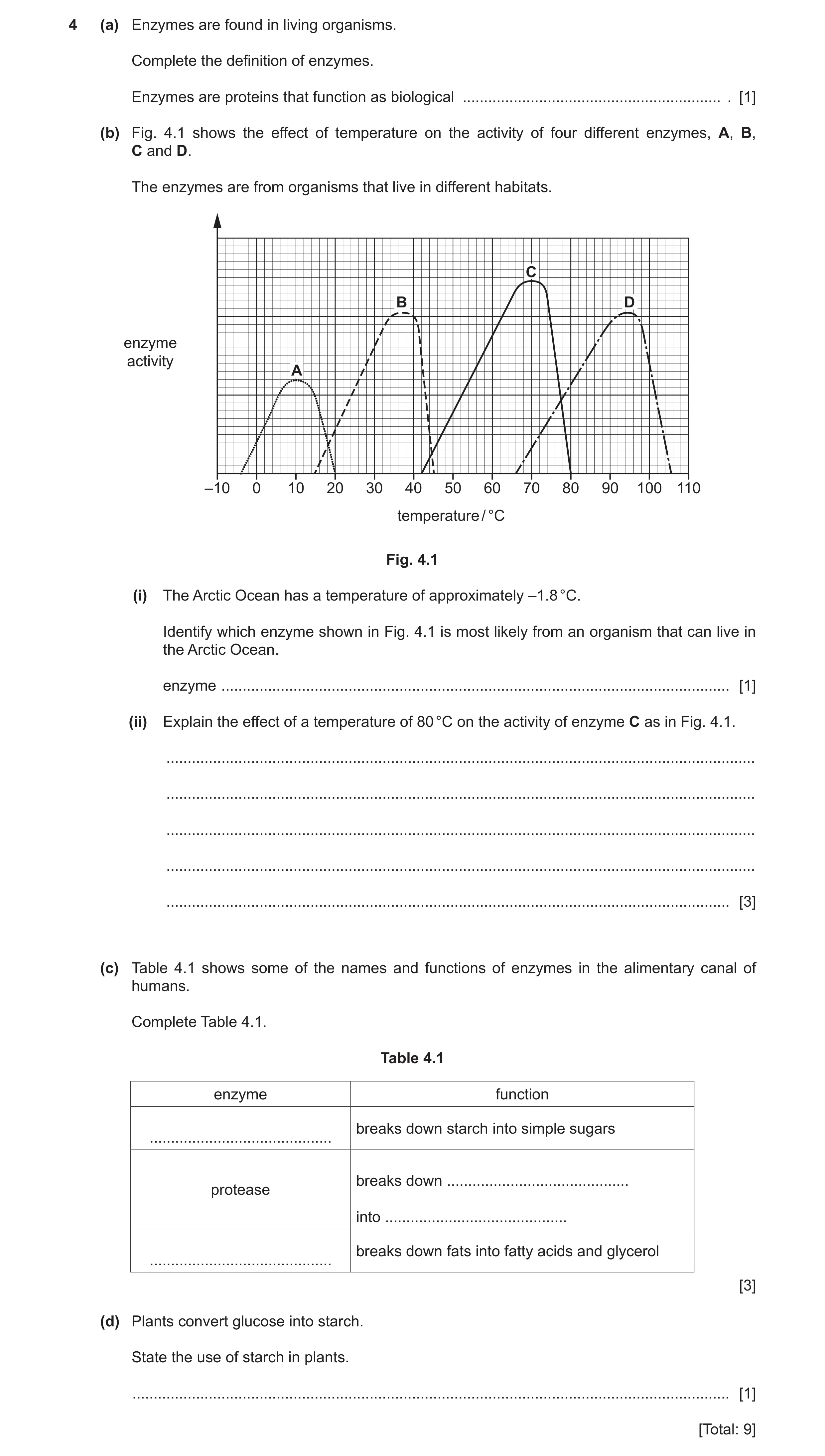
4 (a) Enzymes are found in living organisms. Complete the definition of enzymes. Enzymes are proteins that function as biological … . [1] (b) Fig. 4.1 shows the effect of temperature on the activity of four different enzymes, A, B, C and D. The enzymes are from organisms that live in different habitats. C B D enzyme activity A –10 0 10 20 30 40 50 60 70 80 90 100 110 temperature / °C Fig. 4.1 (i) The Arctic Ocean has a temperature of approximately –1.8 °C. Identify which enzyme shown in Fig. 4.1 is most likely from an organism that can live in the Arctic Ocean. enzyme … [1] (ii) Explain the effect of a temperature of 80 °C on the activity of enzyme C as in Fig. 4.1. … … … … … [3] (c) Table 4.1 shows some of the names and functions of enzymes in the alimentary canal of humans. Complete Table 4.1. Table 4.1 enzyme function breaks down starch into simple sugars … breaks down … protease into … breaks down fats into fatty acids and glycerol … [3] (d) Plants convert glucose into starch. State the use of starch in plants. … [1] [Total: 9]
9 marks
Mark scheme: 4(a) catalysts ; 1 4(b)(i) A ; 1 4(b)(ii) enzyme denatured ; 3 active site changes shape ; substrate no longer fits (into active site) ; 4(c) one mark for each correct row: 3 enzyme function amylase ; (breaks down starch into simple sugars) (protease) (breaks down) protein (into) amino acids ; lipase ; (breaks down fats into fatty acids and glycerol) 4(d) storage ; 1
This question in 0653/42 Feb/March 2023
Q16 · Part of the human alimentary canal and associated organs 0653/42 Feb/March 2024
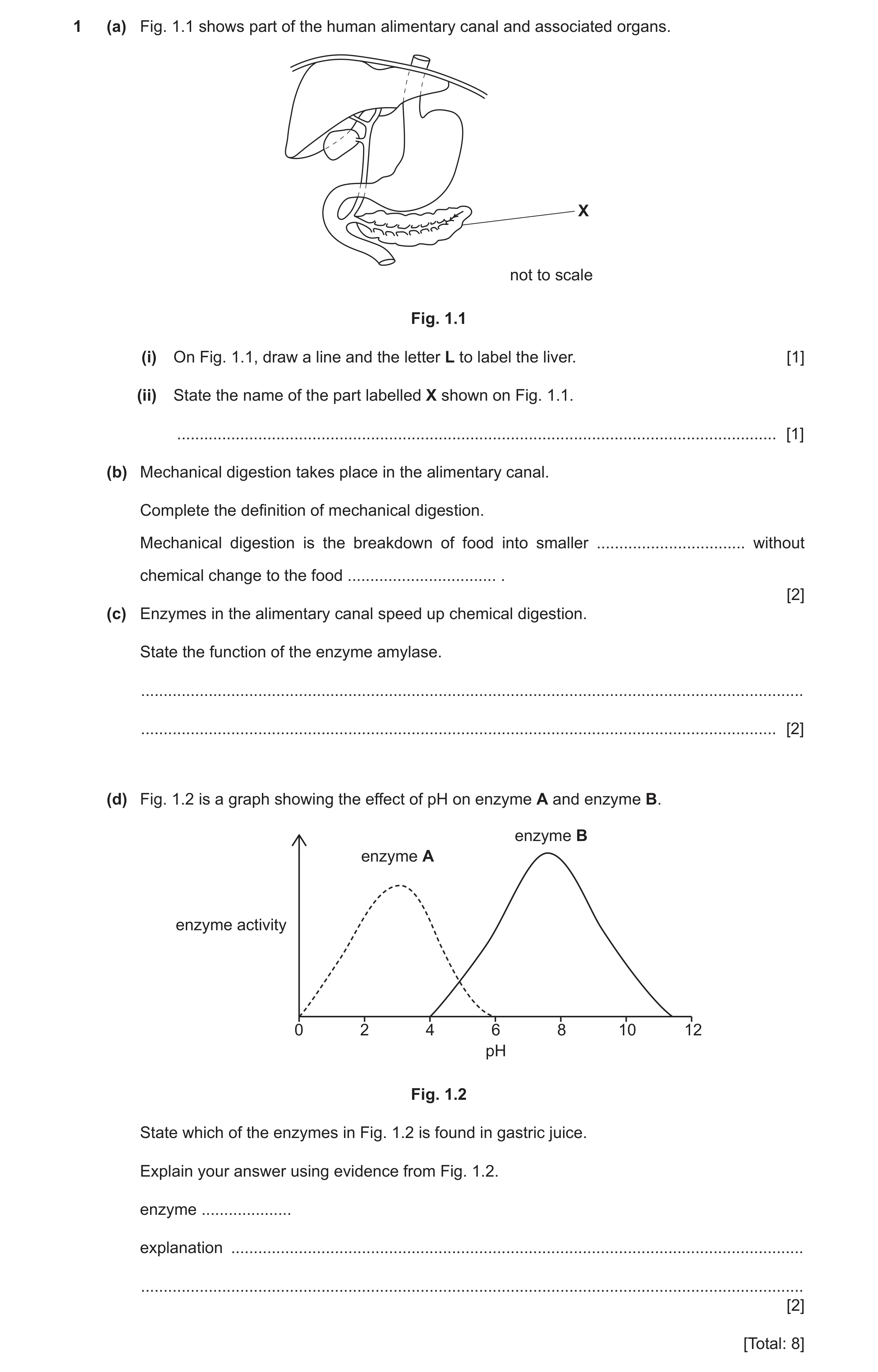
1 (a) Fig. 1.1 shows part of the human alimentary canal and associated organs. X not to scale Fig. 1.1 (i) On Fig. 1.1, draw a line and the letter L to label the liver. [1] (ii) State the name of the part labelled X shown on Fig. 1.1. … [1] (b) Mechanical digestion takes place in the alimentary canal. Complete the definition of mechanical digestion. Mechanical digestion is the breakdown of food into smaller … without chemical change to the food … . [2] (c) Enzymes in the alimentary canal speed up chemical digestion. State the function of the enzyme amylase. … … [2] (d) Fig. 1.2 is a graph showing the effect of pH on enzyme A and enzyme B. enzyme B enzyme A enzyme activity 0 2 4 6 8 10 12 pH Fig. 1.2 State which of the enzymes in Fig. 1.2 is found in gastric juice. Explain your answer using evidence from Fig. 1.2. enzyme … explanation … … [2] [Total: 8]
8 marks
Mark scheme: Question Answer Marks 1(a)(i) liver labelled ; 1 1(a)(ii) pancreas ; 1 1(b) pieces ; 2 molecules ; 1(c) digest / breakdown, starch ; 2 into (simpler) sugars ; 1(d) enzyme: A 2 AND works (best) at low pH / acidic conditions ; gastric juice, contains hydrochloric acid / is acidic ;
This question in 0653/42 Feb/March 2024
Q17 · The alimentary canal and associated organs in humans 0653/42 May/June 2024
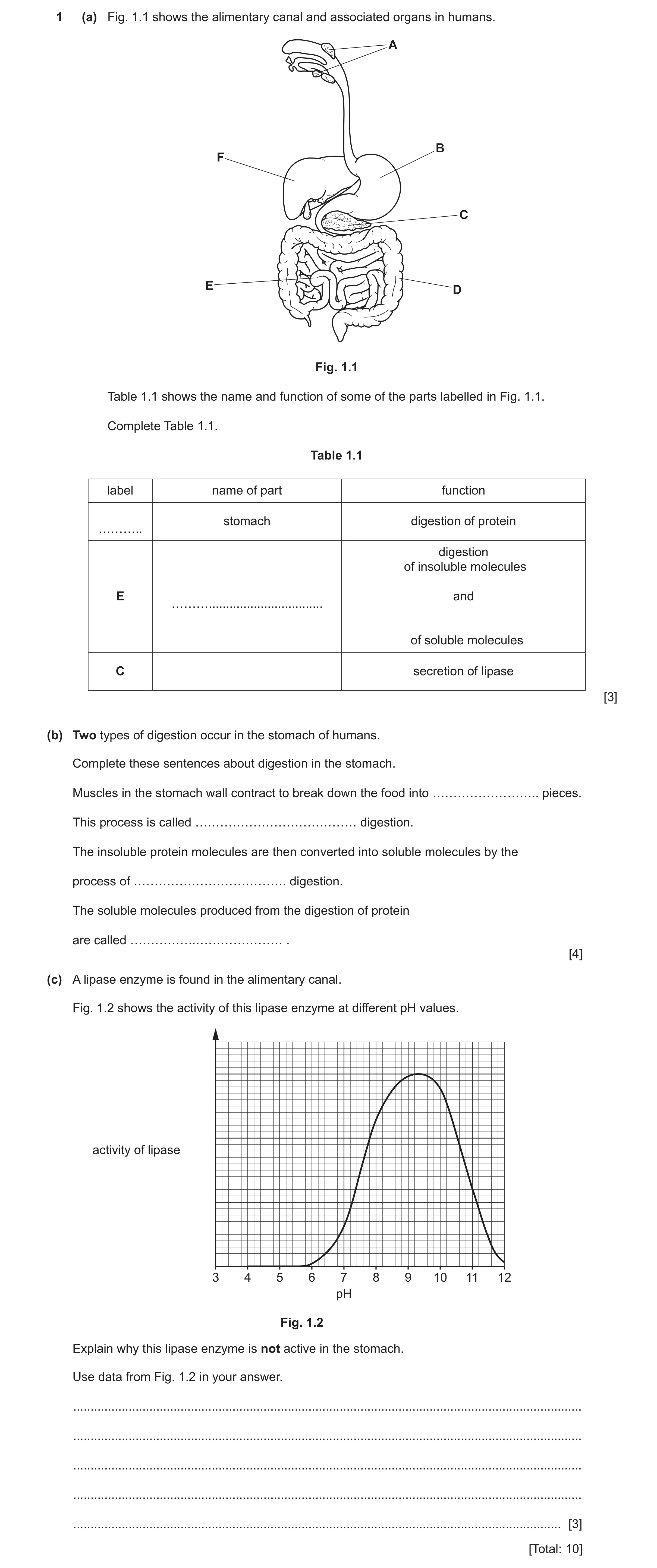
1 (a) Fig. 1.1 shows the alimentary canal and associated organs in humans. A B F C E D Fig. 1.1 Table 1.1 shows the name and function of some of the parts labelled in Fig. 1.1. Complete Table 1.1. Table 1.1 label name of part function stomach digestion of protein ……….. digestion of insoluble molecules E and ……… … of soluble molecules C secretion of lipase [3] (b) Two types of digestion occur in the stomach of humans. Complete these sentences about digestion in the stomach. Muscles in the stomach wall contract to break down the food into …………………….. pieces. This process is called ………………………………… digestion. The insoluble protein molecules are then converted into soluble molecules by the process of ………………………………. digestion. The soluble molecules produced from the digestion of protein are called …………….………………… . [4] (c) A lipase enzyme is found in the alimentary canal. Fig. 1.2 shows the activity of this lipase enzyme at different pH values. activity of lipase 3 4 5 6 7 8 9 10 11 12 pH Fig. 1.2 Explain why this lipase enzyme is not active in the stomach. Use data from Fig. 1.2 in your answer. … … … … … [3] [Total: 10]
10 marks
Mark scheme: 1(a) label name of part function B (stomach) (digestion of protein) (E) small intestine (digestion of insoluble molecules and) absorption (of soluble molecules) (C) pancreas (secretion of lipase) ;;; one mark for each correct row 1(b) small(er) ; mechanical ; chemical ; amino acids ; 4 1(c) any three from: lipase activity between pH6–pH12 / lipase inactive below pH6 / lipase inactive in acidic conditions / stomach pH low / stomach is (very) acidic / stomach pH from 1.5 to 3.5 ; (so) lipase would denature (in stomach) ; active site, changes shape / is no longer complementary (to the substrate) ; lipase is unable to, bind to / fit, substrate ; 3
This question in 0653/42 May/June 2024
Question 18 0653/41 Oct/Nov 2024
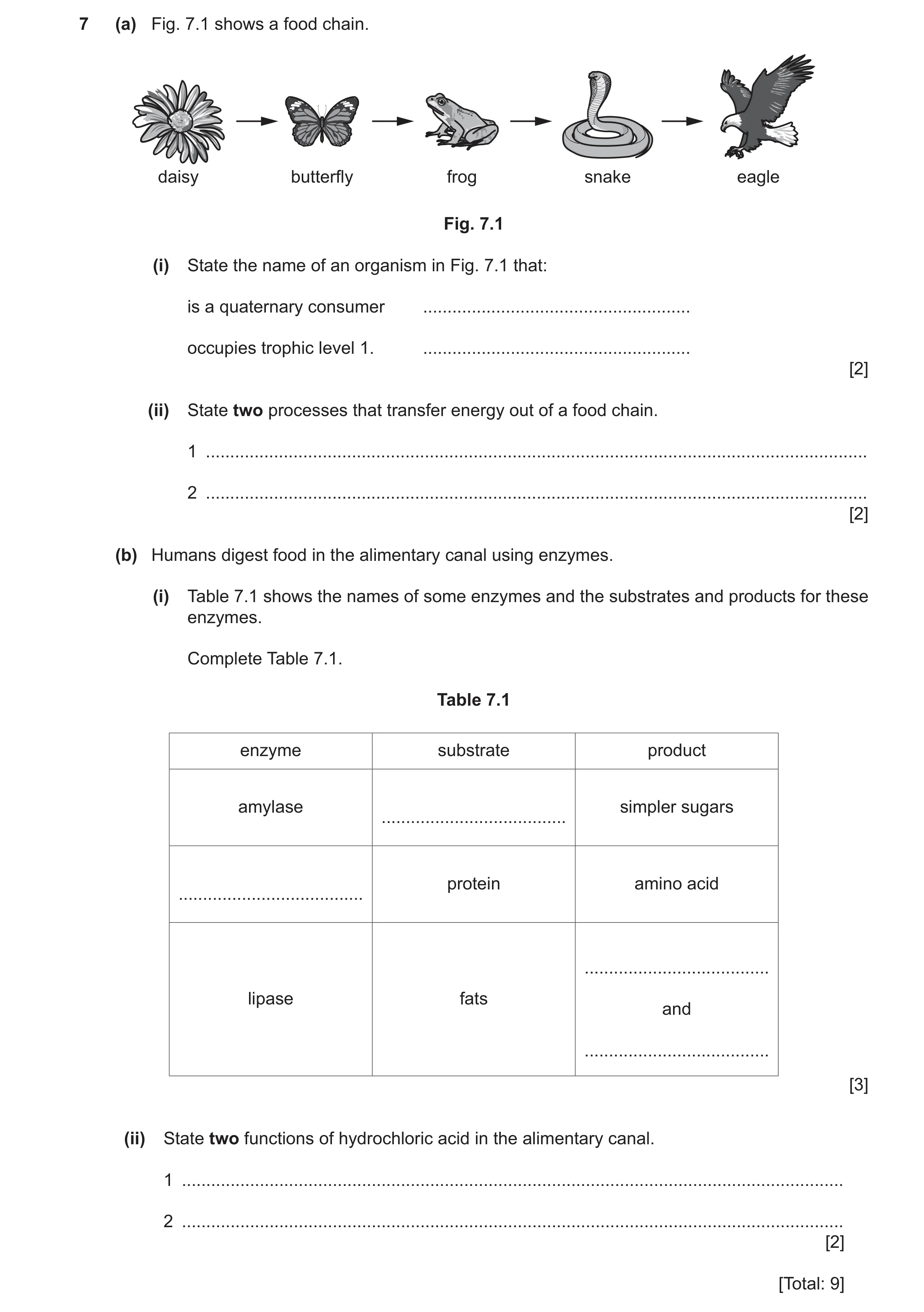
7 (a) Fig. 7.1 shows a food chain. daisy butterfly frog snake eagle Fig. 7.1 (i) State the name of an organism in Fig. 7.1 that: is a quaternary consumer … occupies trophic level 1. … [2] (ii) State two processes that transfer energy out of a food chain. 1 … 2 … [2] (b) Humans digest food in the alimentary canal using enzymes. (i) Table 7.1 shows the names of some enzymes and the substrates and products for these enzymes. Complete Table 7.1. Table 7.1 enzyme substrate product amylase simpler sugars … protein amino acid … … lipase fats and … [3] (ii) State two functions of hydrochloric acid in the alimentary canal. 1 … 2 … [2] [Total: 9]
9 marks
Mark scheme: 7(a)(i) eagle ; 2 daisy ; 7(a)(ii) any two from: 2 respiration ; movement ; excretion ; egestion ; decomposition ; 7(b)(i) substrate starch ; 3 enzyme protease ; product fatty acids AND glycerol ; 7(b)(ii) to kill bacteria ; 2 to provide, acid pH / low pH, for enzymes ;
This question in 0653/41 Oct/Nov 2024
Q19 · The photosynthesis reaction in plants is controlled by enzymes 0653/43 Oct/Nov 2024
4 (a) The photosynthesis reaction in plants is controlled by enzymes. (i) The rate of photosynthesis in a submerged aquatic plant is measured by counting the number of gas bubbles released by the plant in 5 minutes. Table 4.1 shows the effect of temperature on the rate of photosynthesis in an aquatic plant. Table 4.1 temperature number of gas bubbles of water released in / °C 5 minutes 10 30 20 72 30 96 40 42 50 28 60 2 Explain the result for 60 °C in Table 4.1. Use ideas about enzymes in your answer. … … … … … … [3] (ii) Describe the importance of stomata in the process of photosynthesis. … … … [2] (iii) Carbohydrates produced in photosynthesis are stored as starch in plants. State the solution used to test for the presence of starch and the observation for a positive result. solution … observation … [2] (b) Starch is part of a balanced diet for humans. Complete the sentences about starch digestion in the human alimentary canal. Starch is digested by an enzyme called … . The enzyme breaks down starch molecules into smaller carbohydrate molecules called … . The enzyme is secreted into the mouth from the … glands and into the small intestine from the … . [4] [Total: 11]
11 marks
Mark scheme: 4(a)(i) (most) enzyme denatured; 3 active site changes shape / substrate no longer fits active site ; rate of photosynthesis decreases (so fewer bubbles) ; 4(a)(ii) gas exchange takes place through stomata / carbon dioxide enters through stomata / oxygen exits through stomata ; 2 carbon dioxide is needed for photosynthesis / oxygen is produced in photosynthesis ; 4(a)(iii) iodine (solution) ; 2 colour changes (from brown) to blue-black ; 4(b) amylase ; 4 (simpler) sugars ; salivary ; pancreas ;
This question in 0653/43 Oct/Nov 2024
Q20 · A food web from land owned by one farmer 0653/42 Feb/March 2025
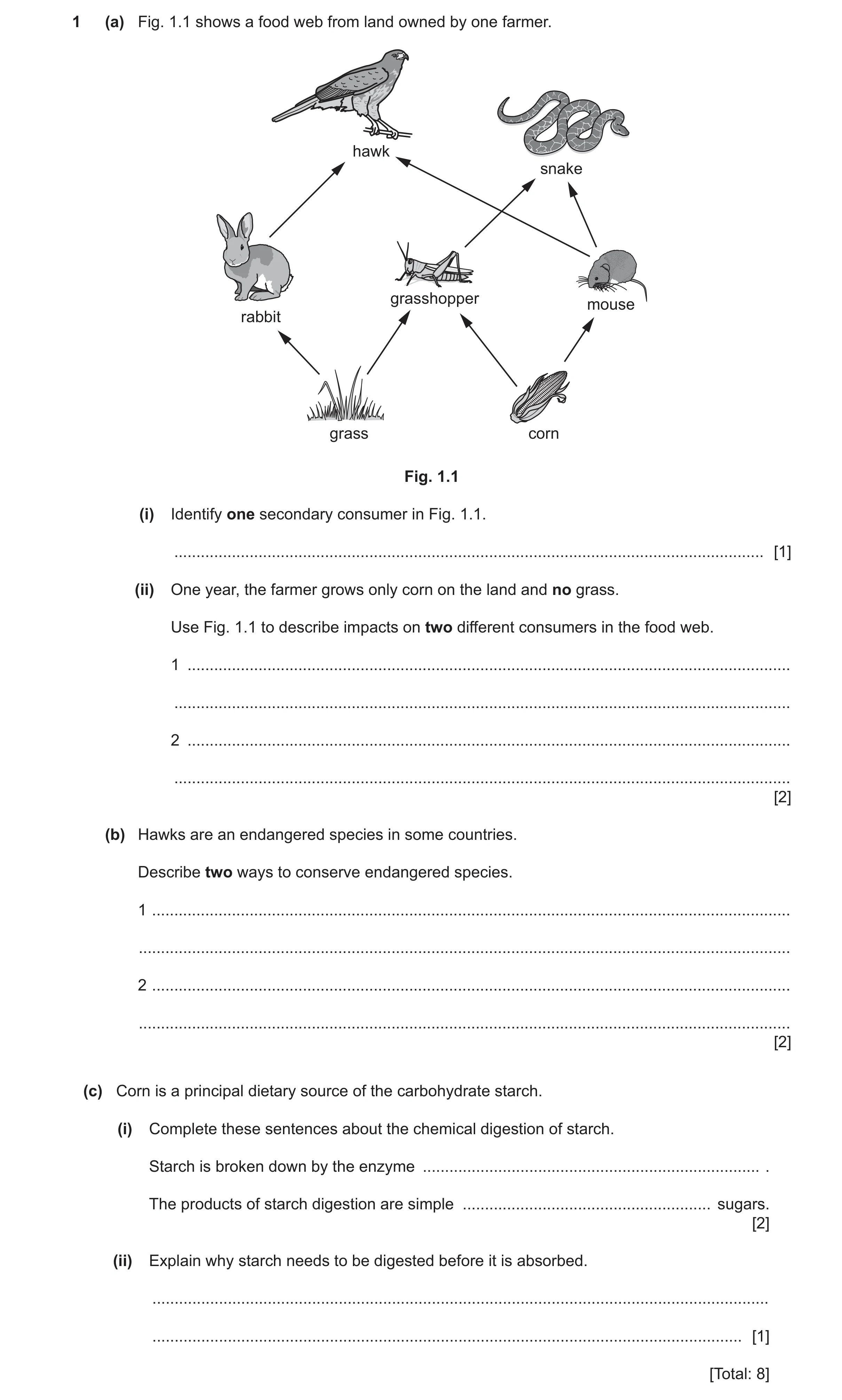
1 (a) Fig. 1.1 shows a food web from land owned by one farmer. hawk snake grasshopper mouse rabbit grass corn Fig. 1.1 (i) Identify one secondary consumer in Fig. 1.1. … [1] (ii) One year, the farmer grows only corn on the land and no grass. Use Fig. 1.1 to describe impacts on two different consumers in the food web. 1 … … 2 … … [2] (b) Hawks are an endangered species in some countries. Describe two ways to conserve endangered species. 1 … … 2 … … [2] (c) Corn is a principal dietary source of the carbohydrate starch. (i) Complete these sentences about the chemical digestion of starch. Starch is broken down by the enzyme … . The products of starch digestion are simple … sugars. [2] (ii) Explain why starch needs to be digested before it is absorbed. … … [1] [Total: 8]
8 marks
Mark scheme: Question Answer Marks 1(a)(i) hawk / snake ; 1 1(a)(ii) any two from: 2 rabbits would have no food / rabbits would decrease in number ; mice would have more food / mice would increase in number ; grasshoppers would eat more corn (rather than grass) ; hawks would eat more mice ; mice would decrease in number because more eaten by hawks ; AVP ; 1(b) any two from: 2 monitoring species ; protecting habitat ; education (qualified) ; (captive) breeding programs ; AVP ; 1(c)(i) amylase ; 2 reducing ; 1(c)(ii) any one from: 1 molecules are too large to pass through ileum wall or capillary wall / molecules are too large to pass into blood ; (starch)molecules are too, large / complex to be absorbed / only small / simple, molecules can be absorbed ; (starch) molecules cannot be absorbed because they are insoluble / only soluble molecules can be absorbed ;
This question in 0653/42 Feb/March 2025
Q21 · Fats are broken down in the small intestine by chemical digestion 0653/41 May/June 2025
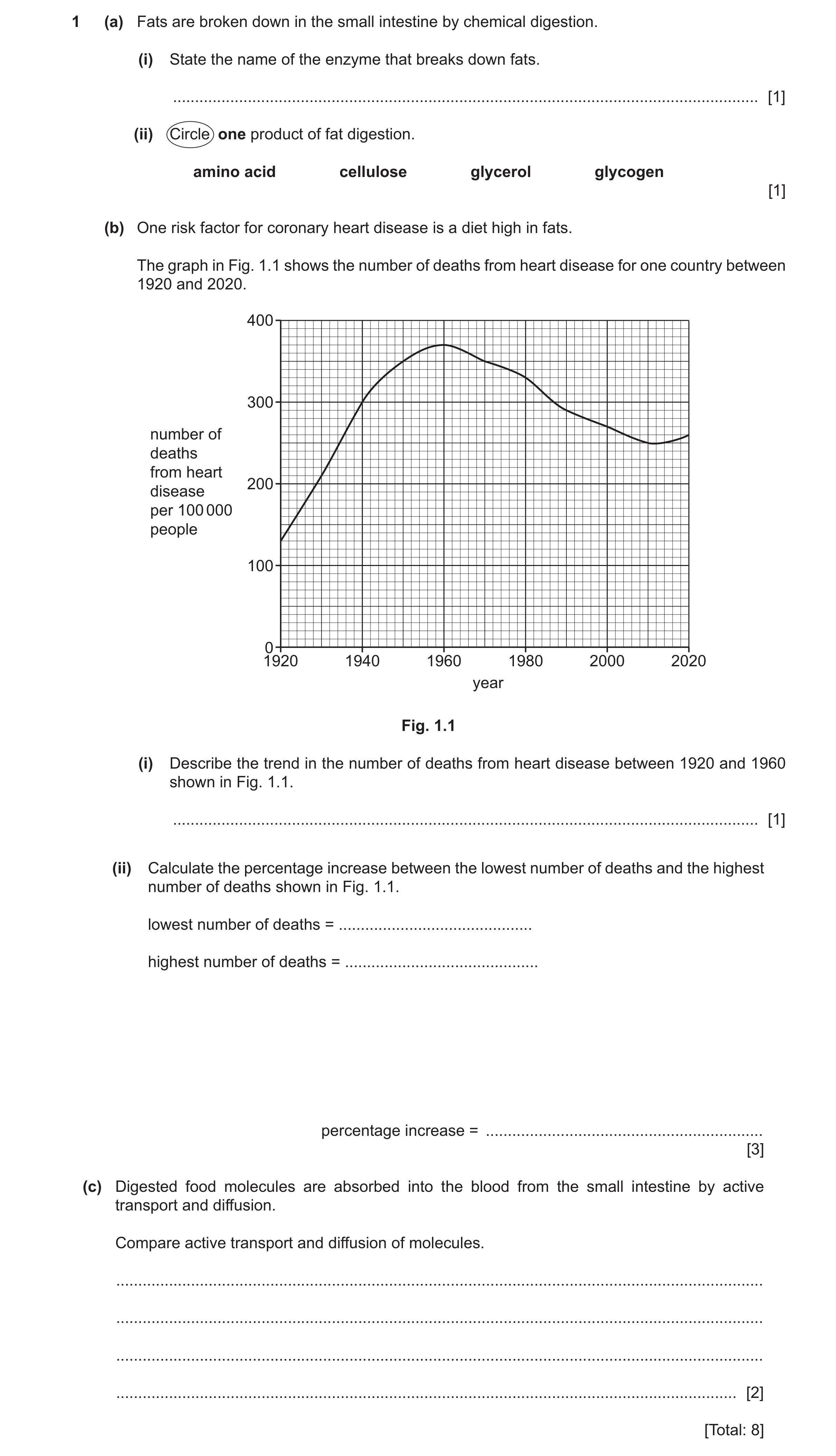
1 (a) Fats are broken down in the small intestine by chemical digestion. (i) State the name of the enzyme that breaks down fats. … [1] (ii) Circle one product of fat digestion. amino acid cellulose glycerol glycogen [1] (b) One risk factor for coronary heart disease is a diet high in fats. The graph in Fig. 1.1 shows the number of deaths from heart disease for one country between 1920 and 2020. 400 300 number of deaths from heart 200 disease per 100 000 people 100 0 1920 1940 1960 1980 2000 2020 year Fig. 1.1 (i) Describe the trend in the number of deaths from heart disease between 1920 and 1960 shown in Fig. 1.1. … [1] (ii) Calculate the percentage increase between the lowest number of deaths and the highest number of deaths shown in Fig. 1.1. lowest number of deaths = … highest number of deaths = … percentage increase = … [3] (c) Digested food molecules are absorbed into the blood from the small intestine by active transport and diffusion. Compare active transport and diffusion of molecules. … … … … [2] [Total: 8]
8 marks
Mark scheme: Question Answer Marks 1(a)(i) lipase ; 1 1(a)(ii) glycerol ; 1 1(b)(i) increases ; 1 1(b)(ii) 130 and 370 ; 3 240 100 OR ((370 ÷ 130) 100 ) − 100 ; 130 185 (%) ; 1(c) active transport is against a concentration gradient and diffusion is down a concentration gradient 2 OR active transport is movement from a low to high concentration and diffusion is movement from high to low concentration / AW ; then any one from: active transport requires energy / diffusion does not require energy ; both transport (food) molecules across a cell membrane ;
This question in 0653/41 May/June 2025
Q22 · A diagram of the digestive system and associated organs 0653/42 May/June 2025
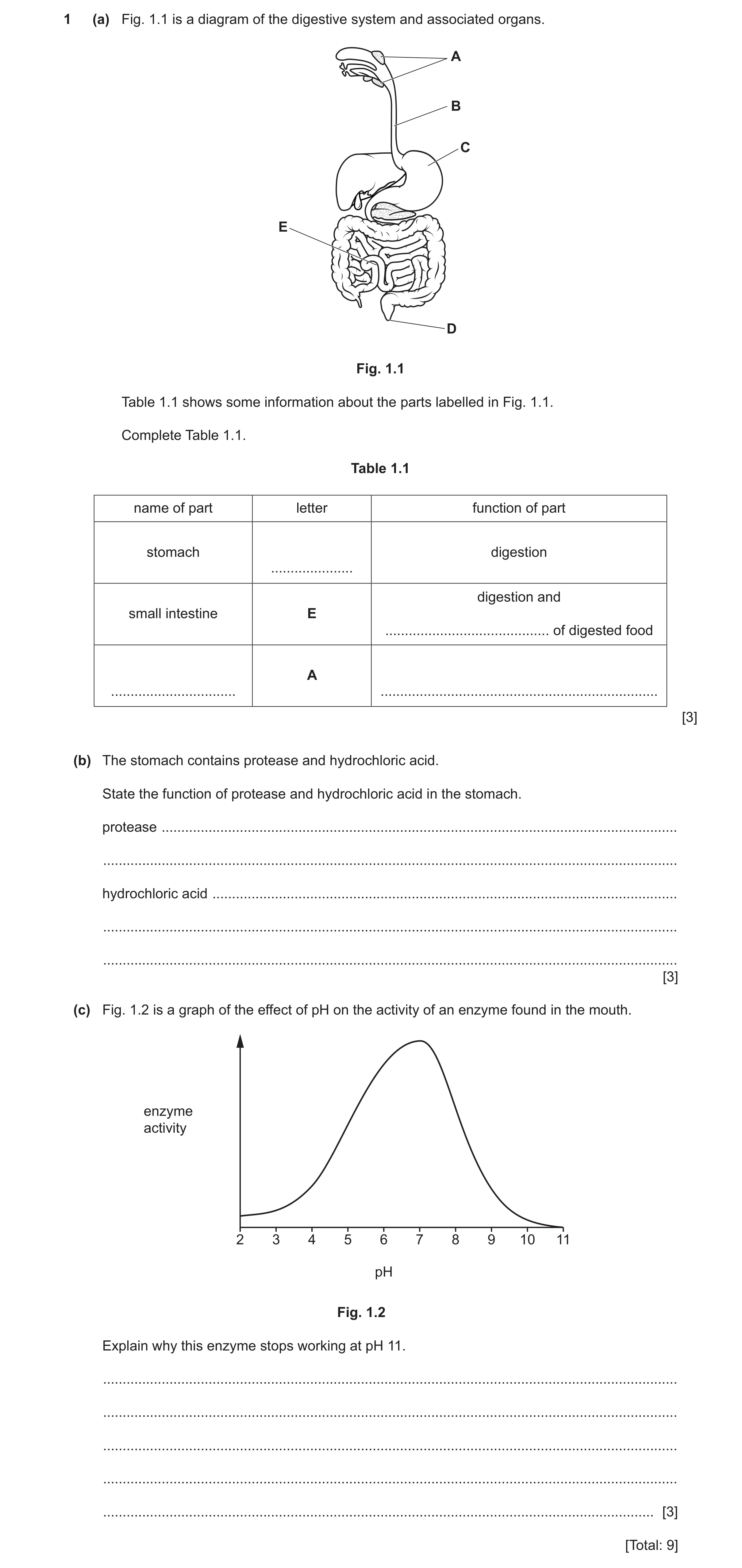
1 (a) Fig. 1.1 is a diagram of the digestive system and associated organs. A B C E D Fig. 1.1 Table 1.1 shows some information about the parts labelled in Fig. 1.1. Complete Table 1.1. Table 1.1 name of part letter function of part stomach digestion … digestion and small intestine E … of digested food A … … [3] (b) The stomach contains protease and hydrochloric acid. State the function of protease and hydrochloric acid in the stomach. protease … … hydrochloric acid … … … [3] (c) Fig. 1.2 is a graph of the effect of pH on the activity of an enzyme found in the mouth. enzyme activity 2 3 4 5 6 7 8 9 10 11 pH Fig. 1.2 Explain why this enzyme stops working at pH 11. … … … … … [3] [Total: 9]
9 marks
Mark scheme: Question Answer Marks 1(a) 3 name of part letter function of part stomach C digestion small intestine E (digestion and) absorption (of digested food) salivary gland A produce, saliva / amylase ;;; one mark for each correct row 1(b) protease: 3 digests / breaks down, proteins (into amino acids) ; hydrochloric acid: kills, (harmful) microorganisms / pathogens / bacteria ; provides optimum / acidic / low pH, for enzyme / protease ; 1(c) enzyme will denature ; 3 active site changes shape ; active site no longer complementary to substrate / substrate no longer fits active site ;
This question in 0653/42 May/June 2025
Q23 · Part of the human alimentary canal and associated organs 0653/43 Oct/Nov 2025
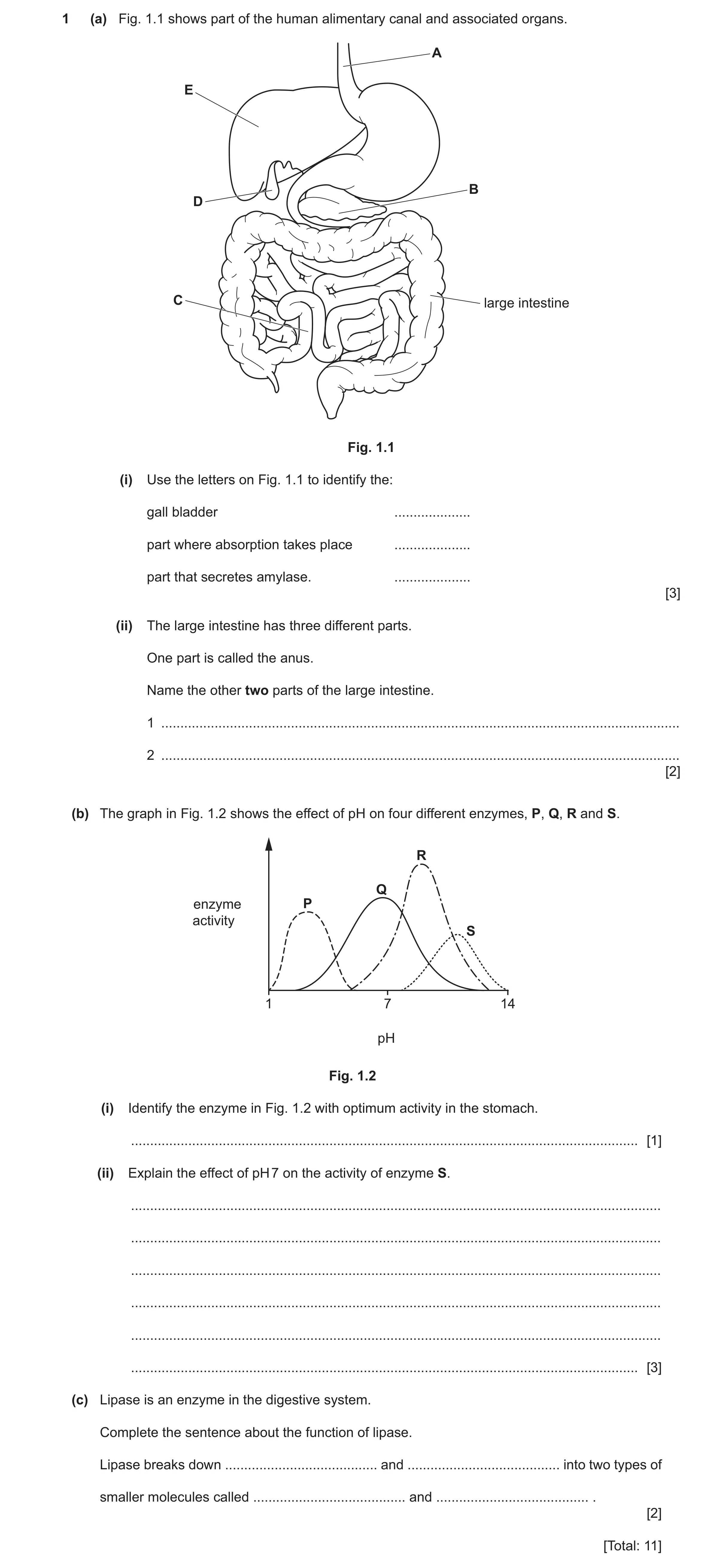
1 (a) Fig. 1.1 shows part of the human alimentary canal and associated organs. A E B D C large intestine Fig. 1.1 (i) Use the letters on Fig. 1.1 to identify the: gall bladder … part where absorption takes place … part that secretes amylase. … [3] (ii) The large intestine has three different parts. One part is called the anus. Name the other two parts of the large intestine. 1 … 2 … [2] (b) The graph in Fig. 1.2 shows the effect of pH on four different enzymes, P, Q, R and S. R Q enzyme P activity S 1 7 14 pH Fig. 1.2 (i) Identify the enzyme in Fig. 1.2 with optimum activity in the stomach. … [1] (ii) Explain the effect of pH 7 on the activity of enzyme S. … … … … … … [3] (c) Lipase is an enzyme in the digestive system. Complete the sentence about the function of lipase. Lipase breaks down … and … into two types of smaller molecules called … and … . [2] [Total: 11]
11 marks
Mark scheme: Question Answer Marks 1(a)(i) D ; 3 C ; B ; 1(a)(ii) colon ; 2 rectum ; 1(b)(i) P ; 1 1(b)(ii) enzyme will denature (at pH 7) ; 3 active site changes shape ; (active site) no longer complementary to substrate / substrate no longer fits active site / enzyme-substrate complexes cannot form ; 1(c) fats AND oils; 2 fatty acids AND glycerol ;
This question in 0653/43 Oct/Nov 2025
 7 / 35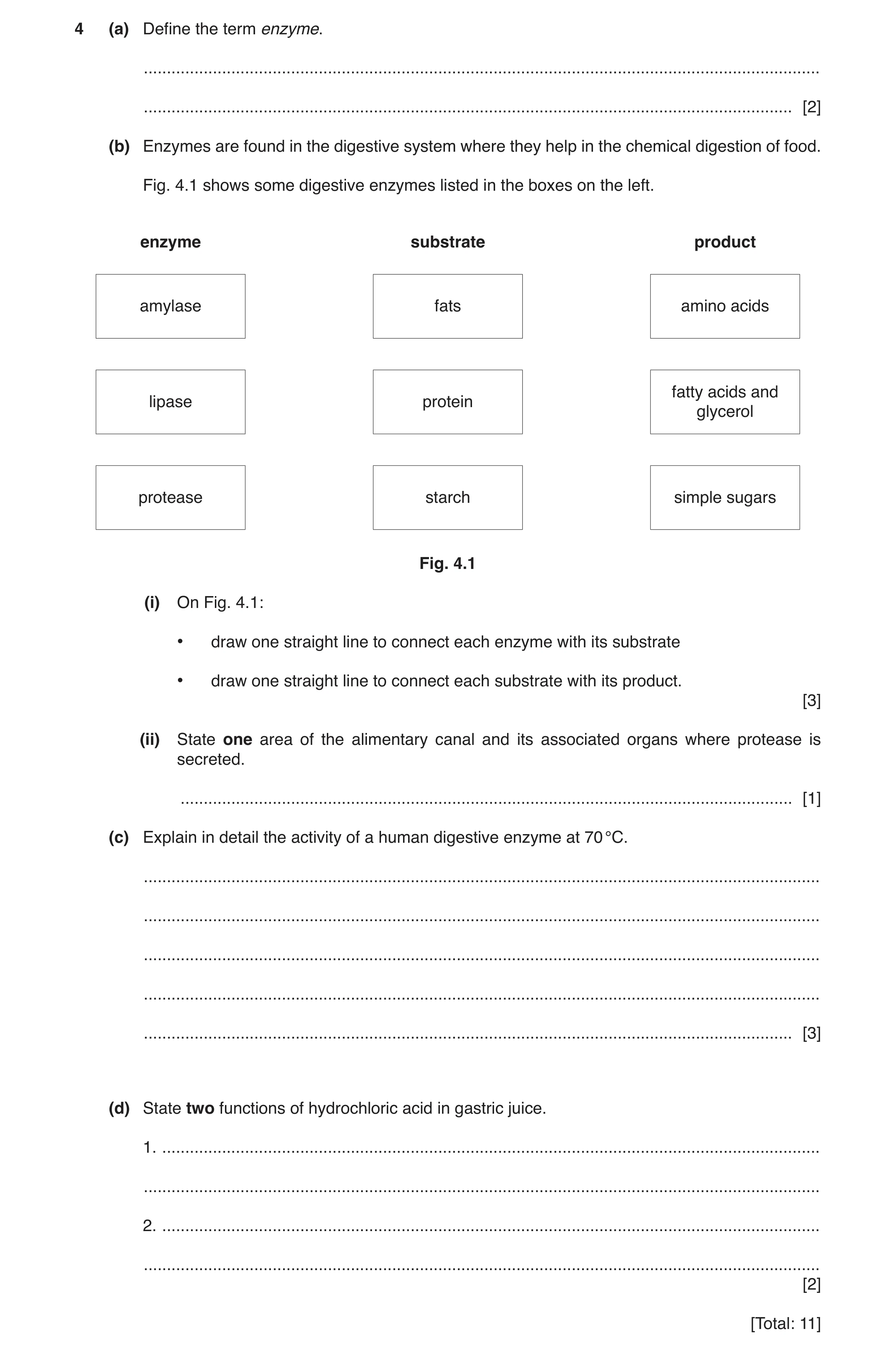
 10 / 35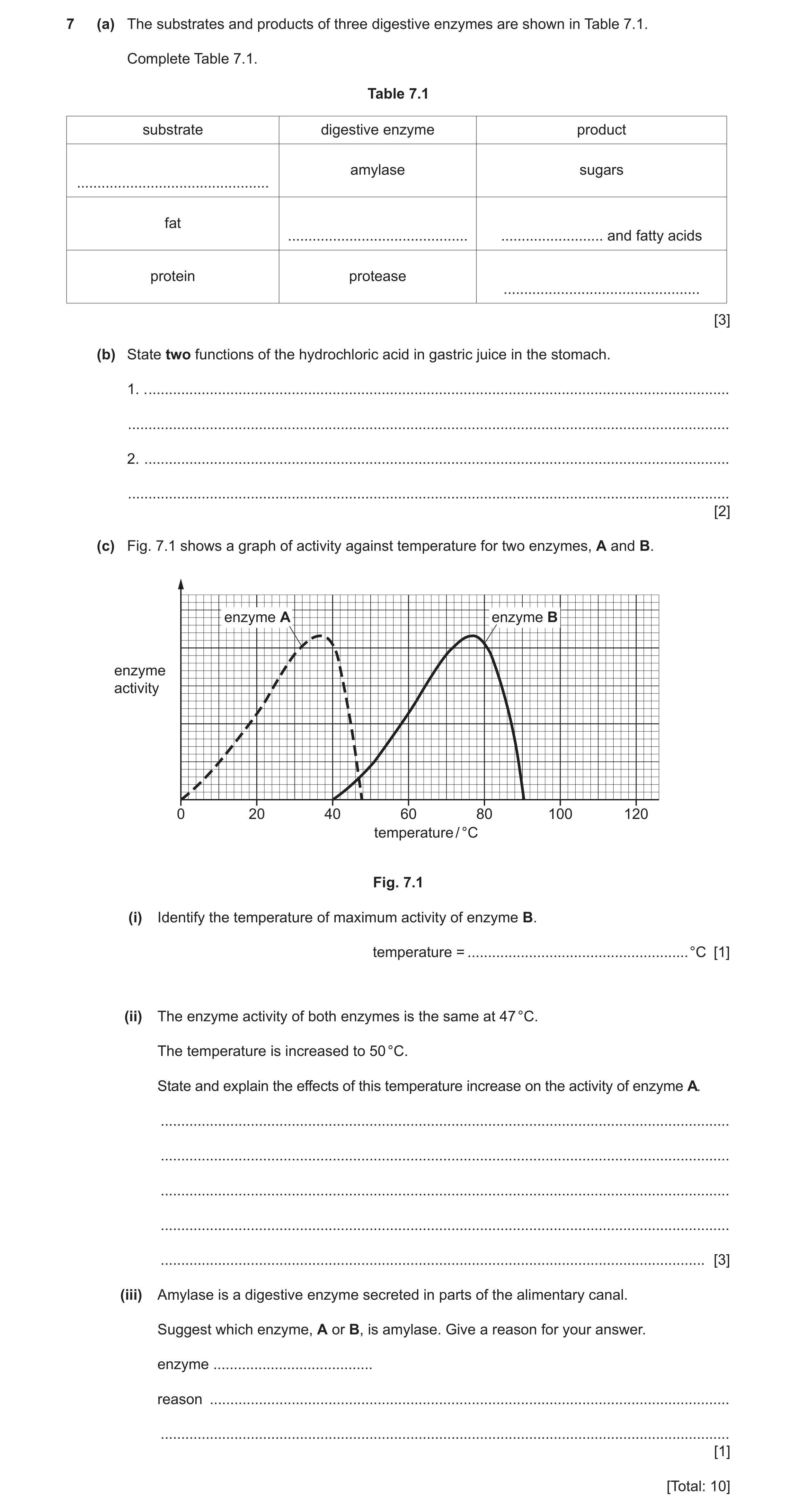
 19 / 35
 20 / 35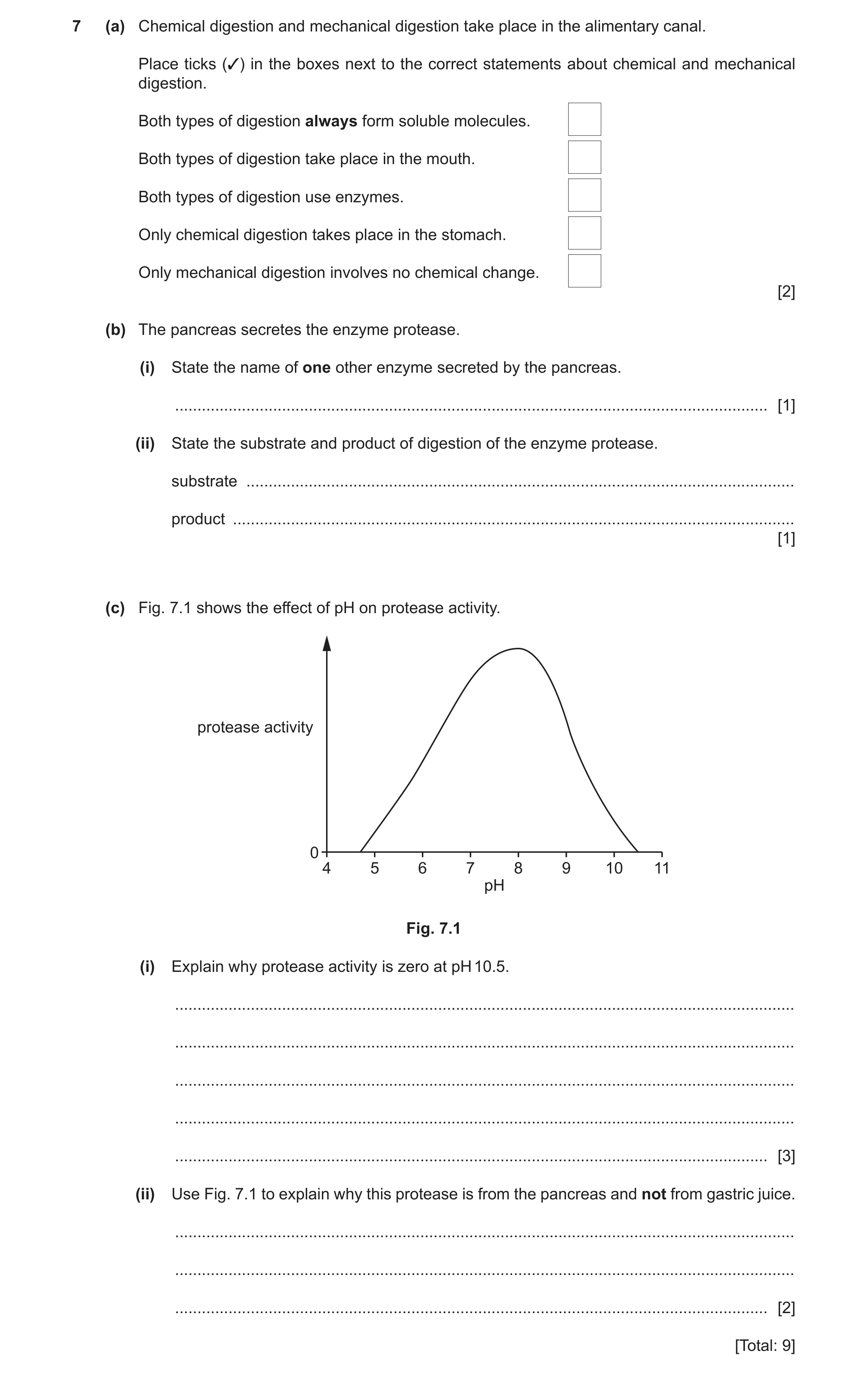
 27 / 35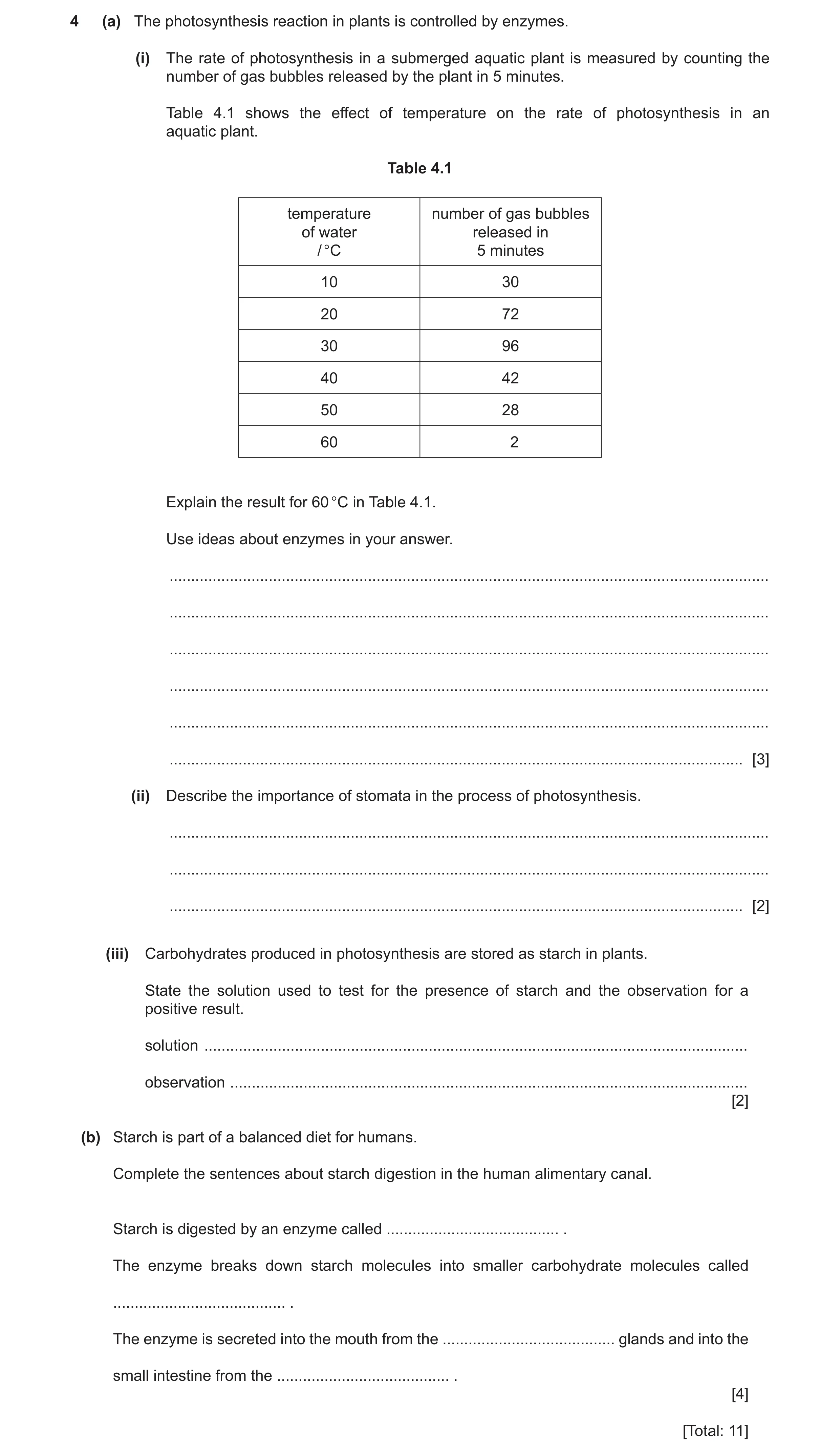
 9
9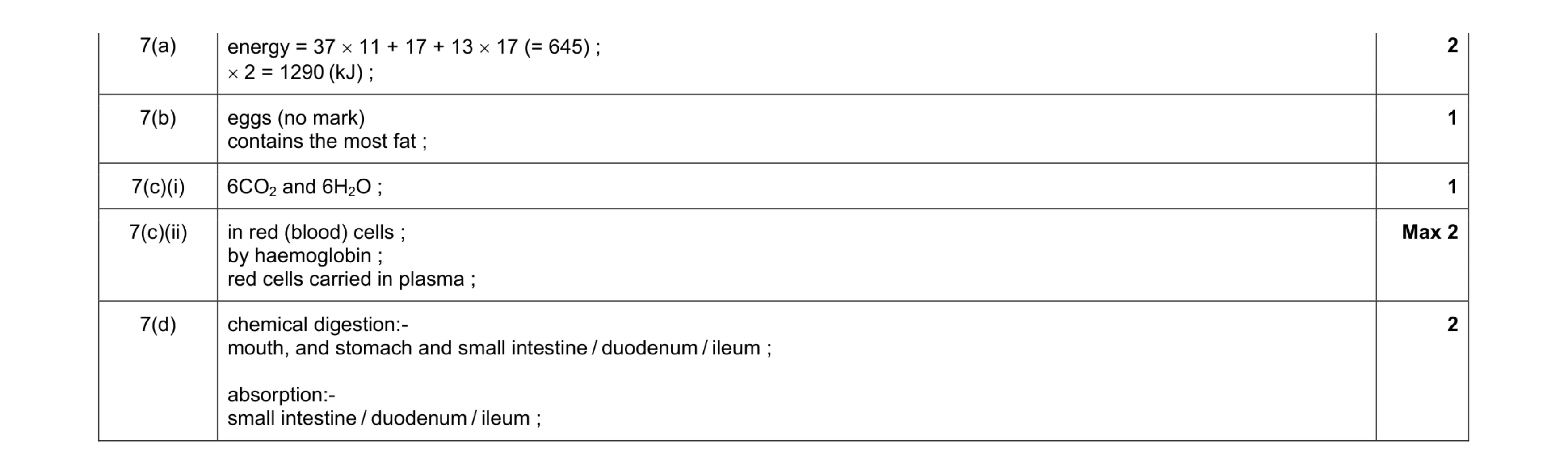 8
8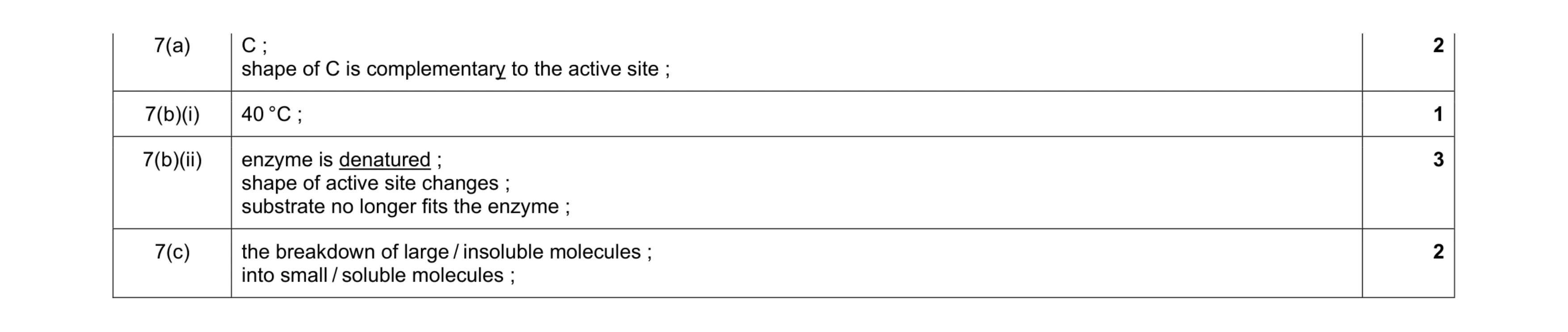 8
8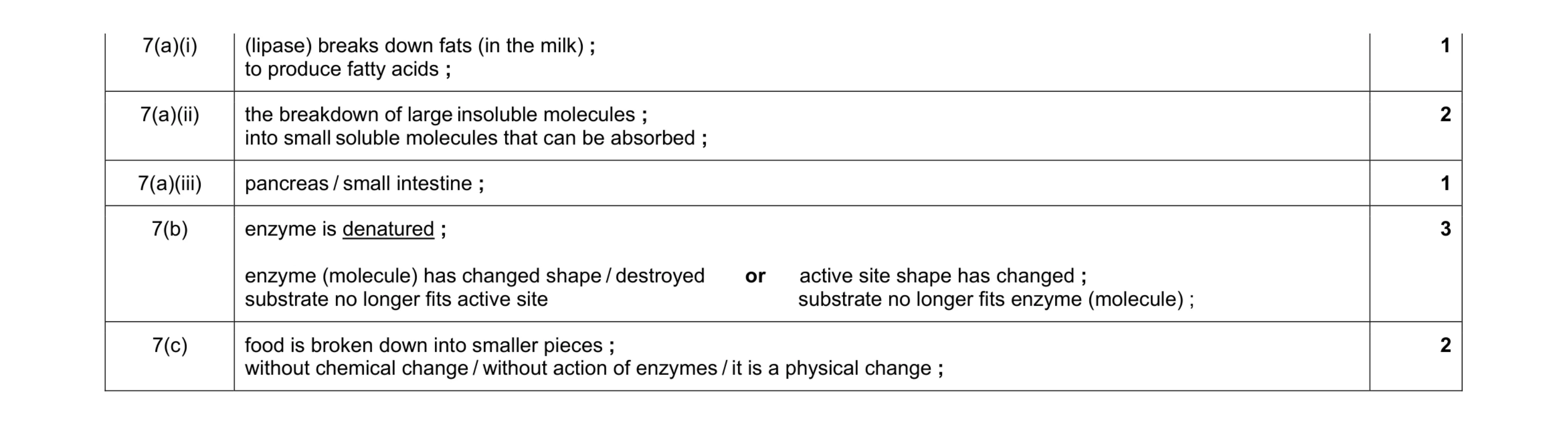 10
10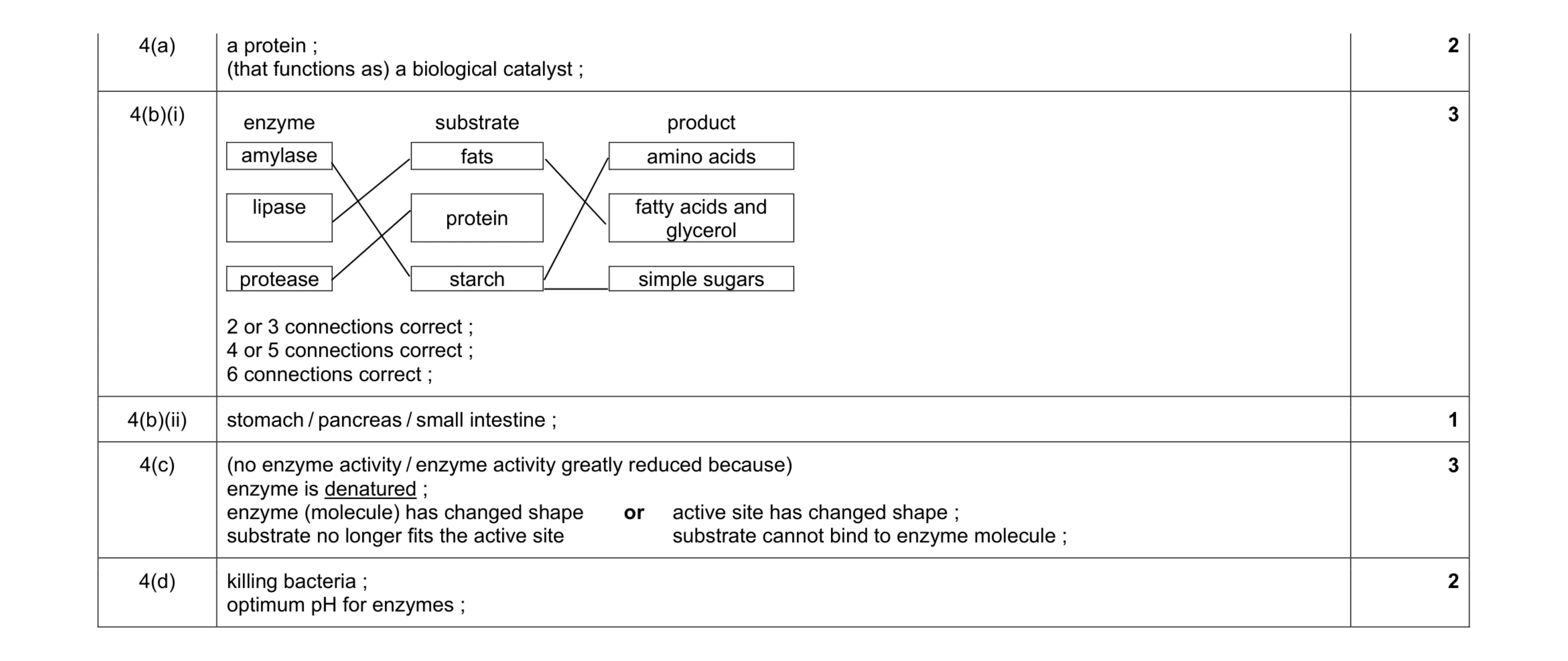 11
11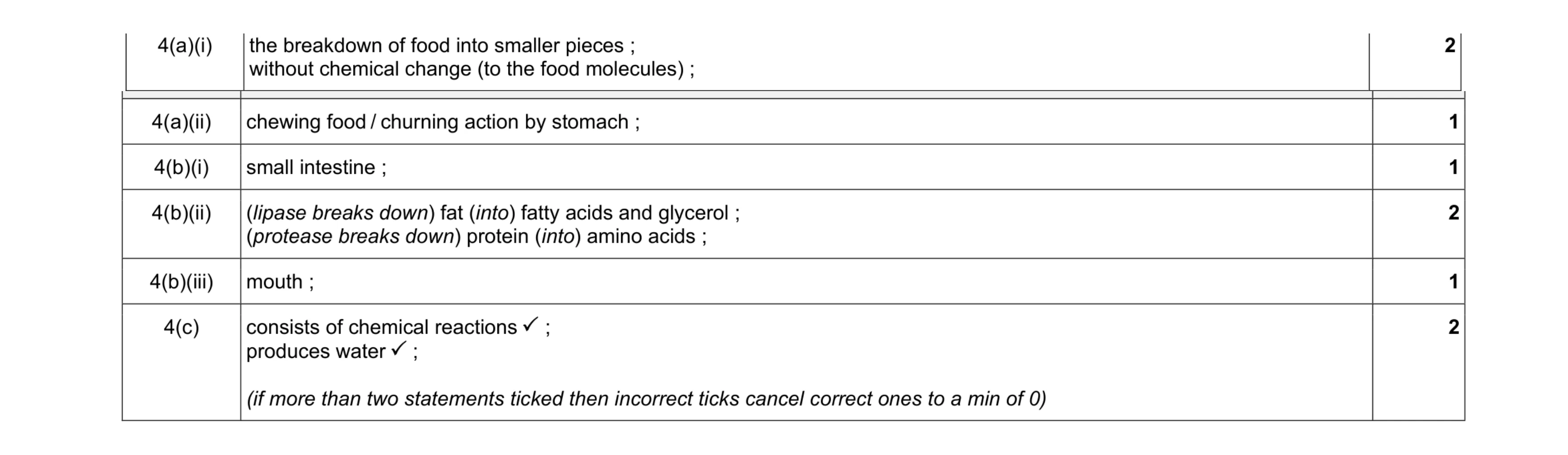 9
9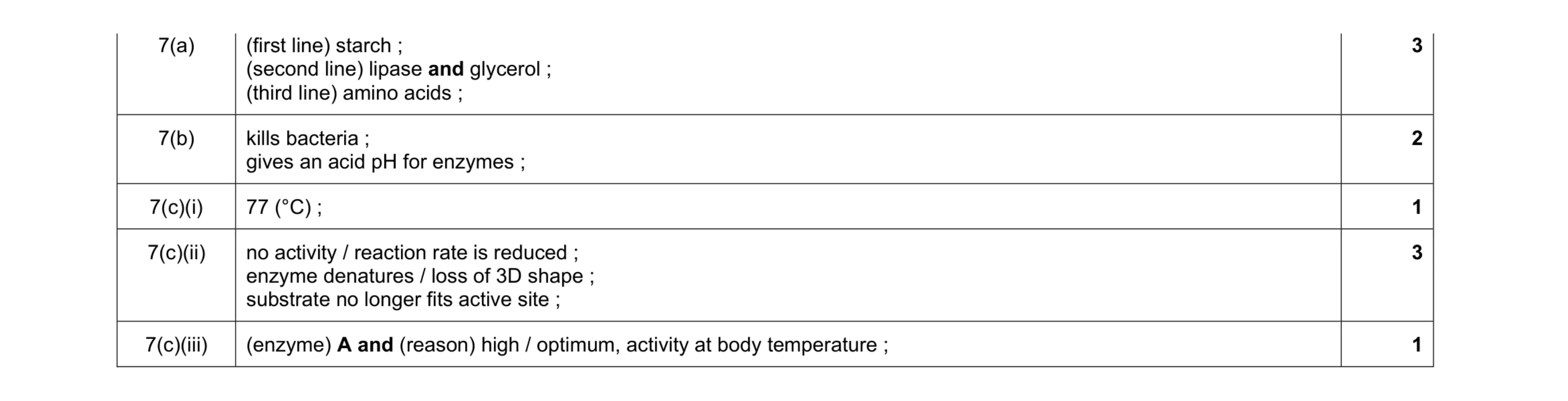 10
10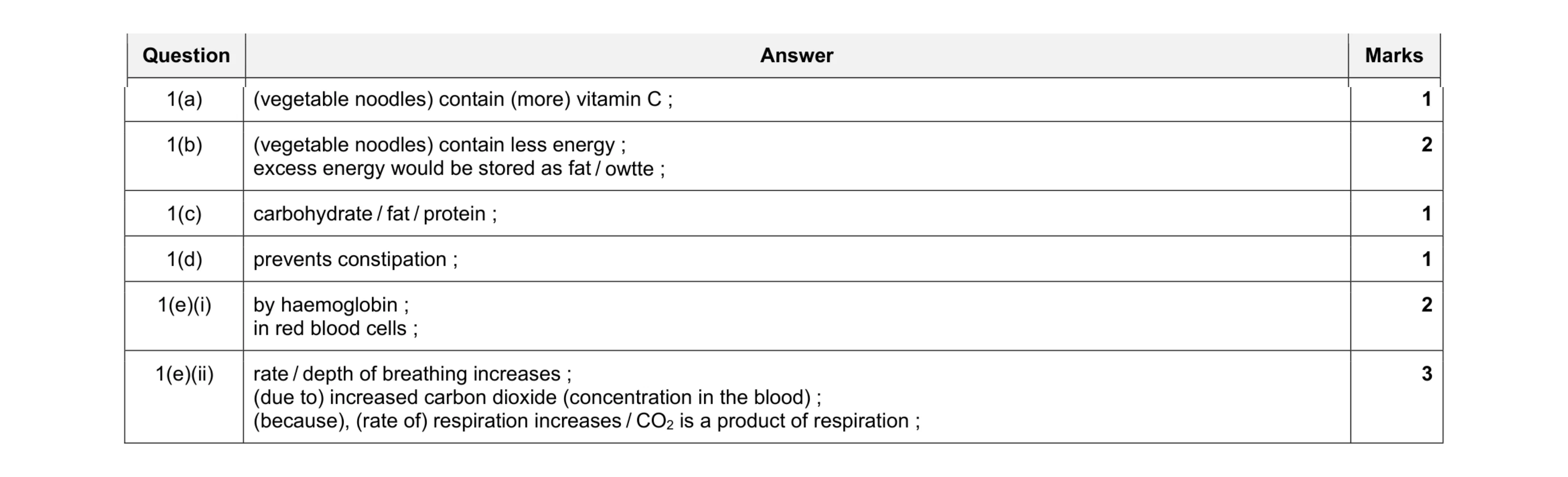 10
10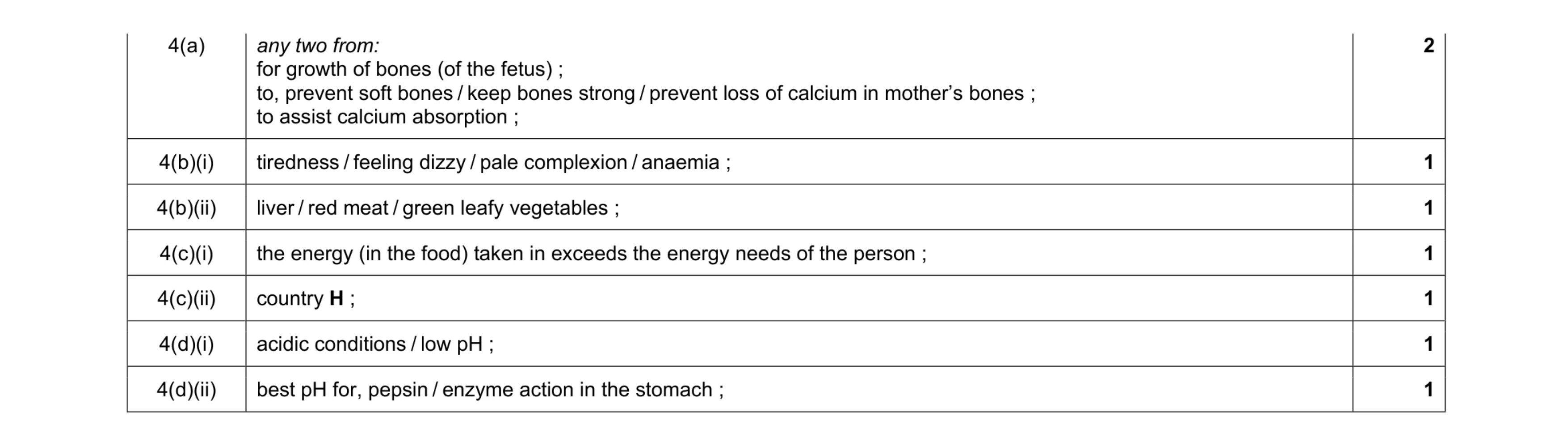 8
8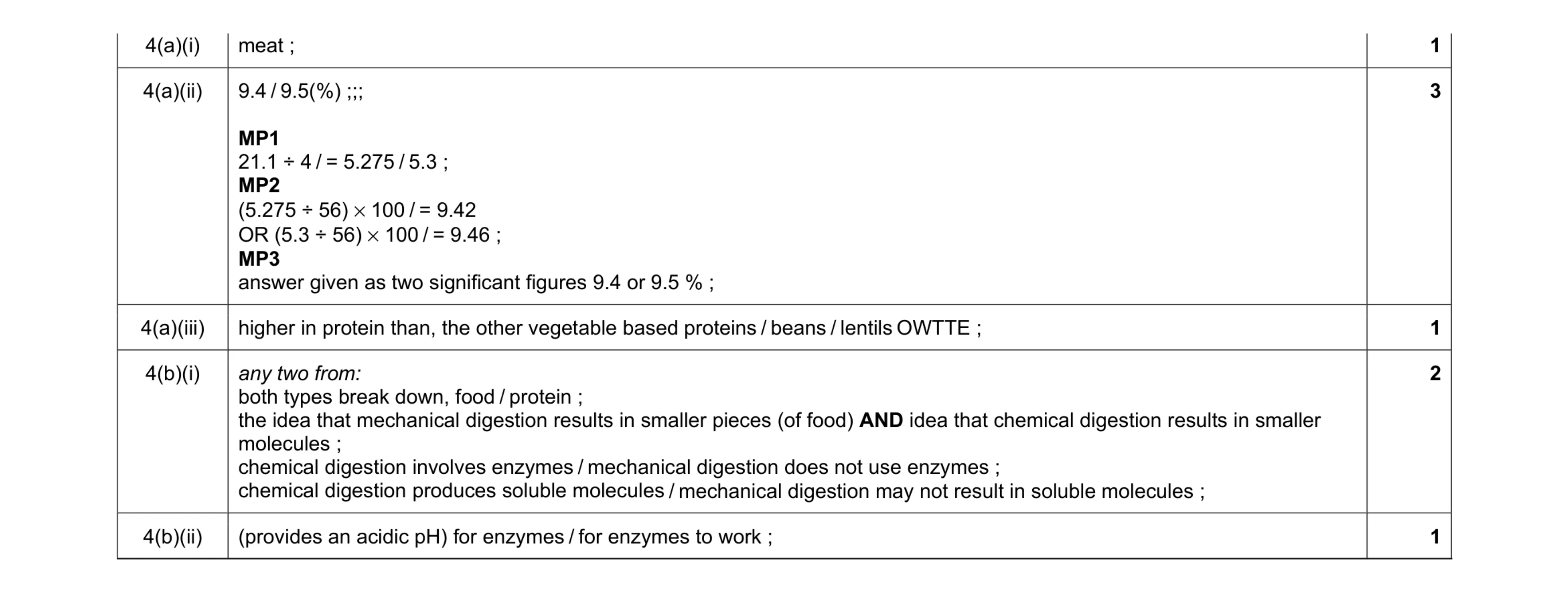 8
8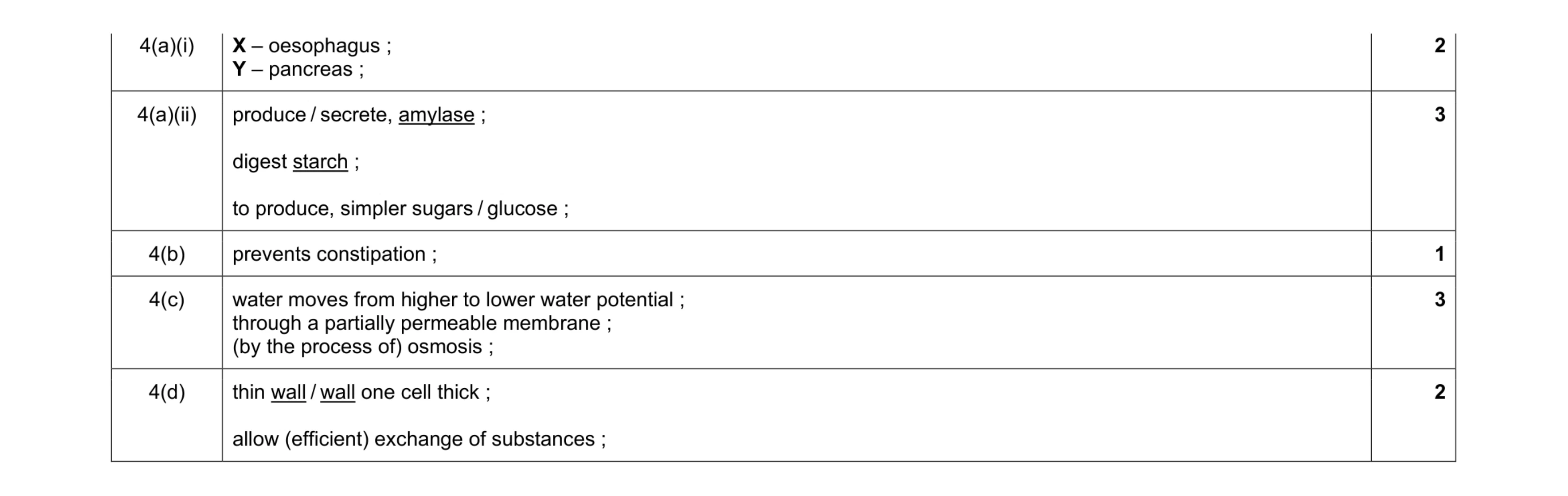 11
11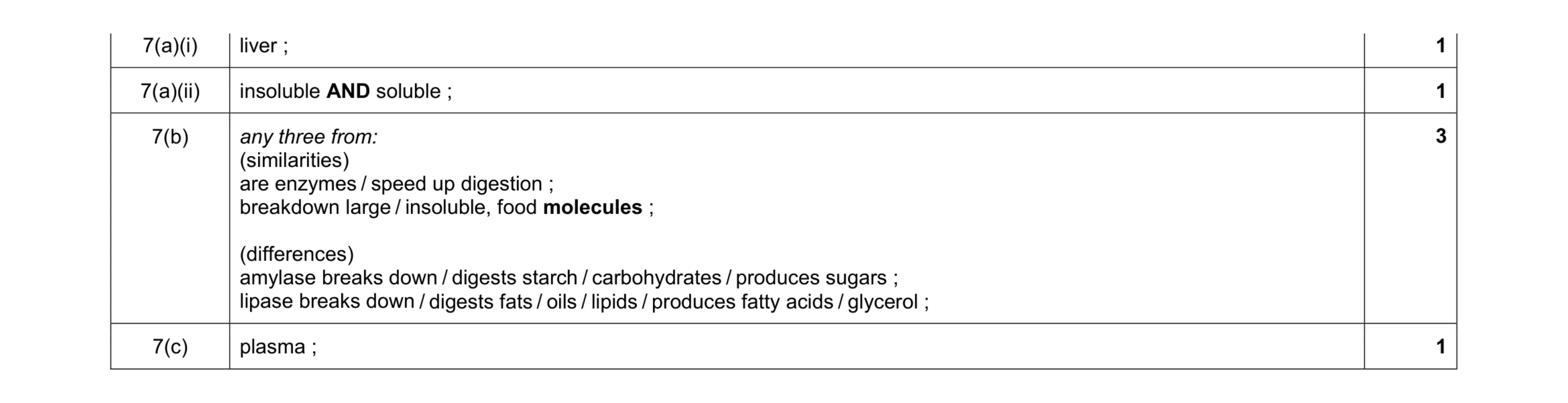 6
6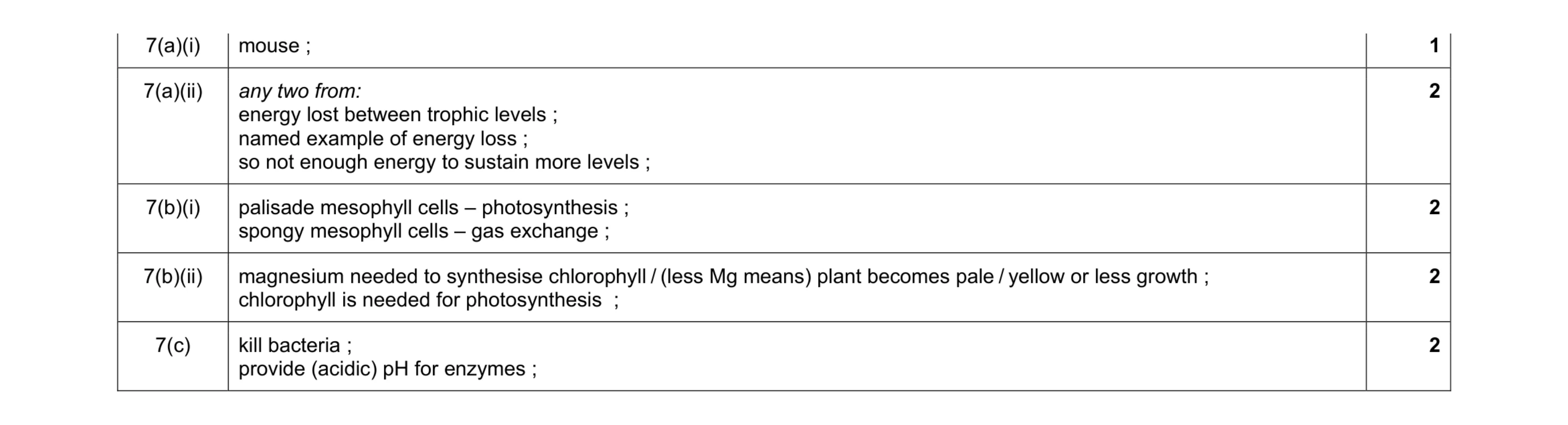 9
9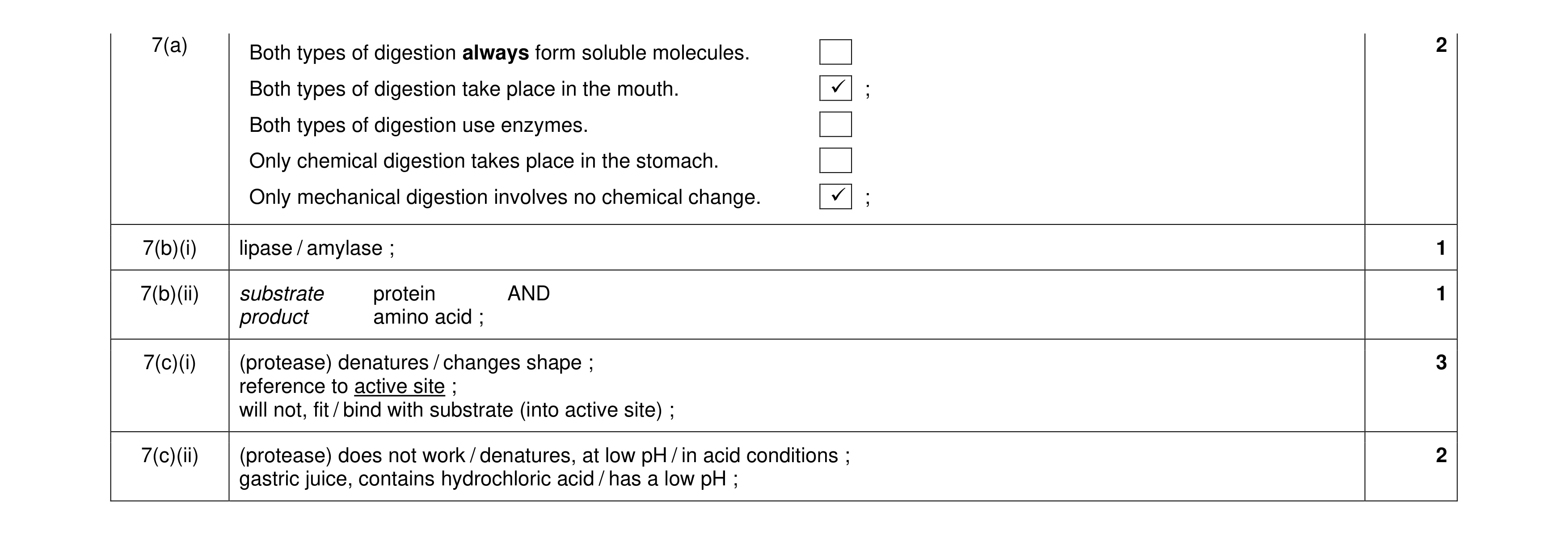 9
9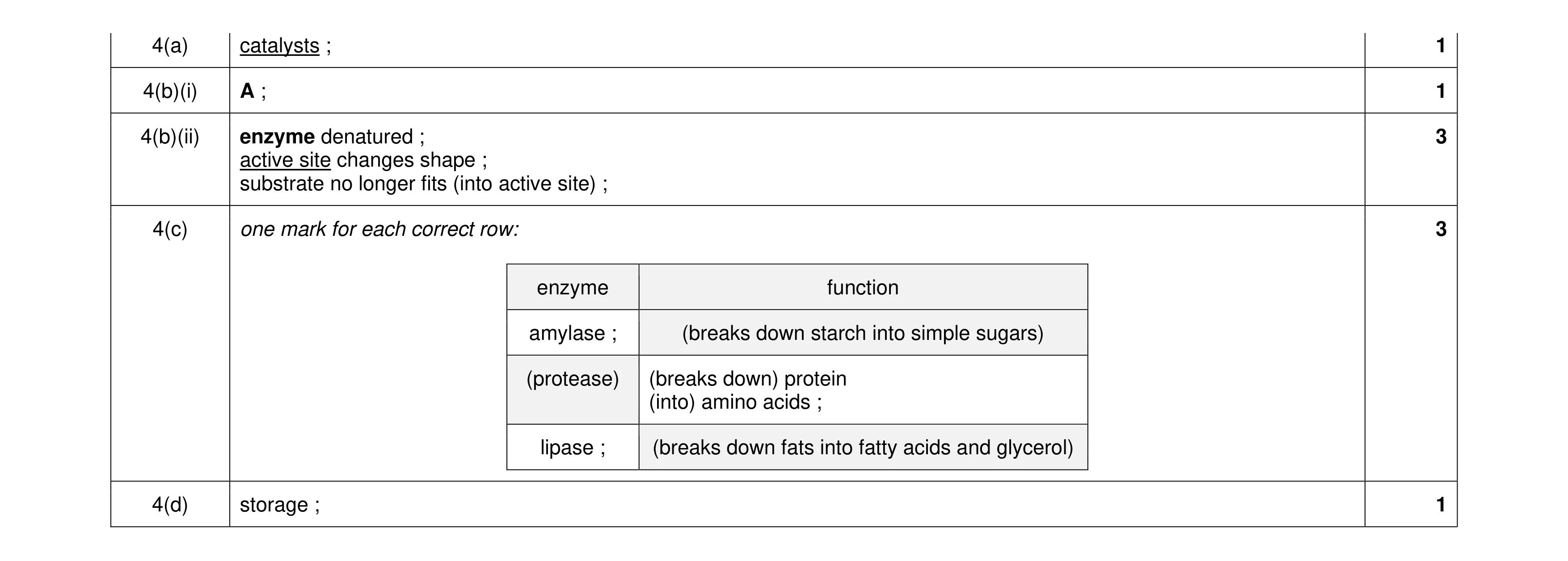 9
9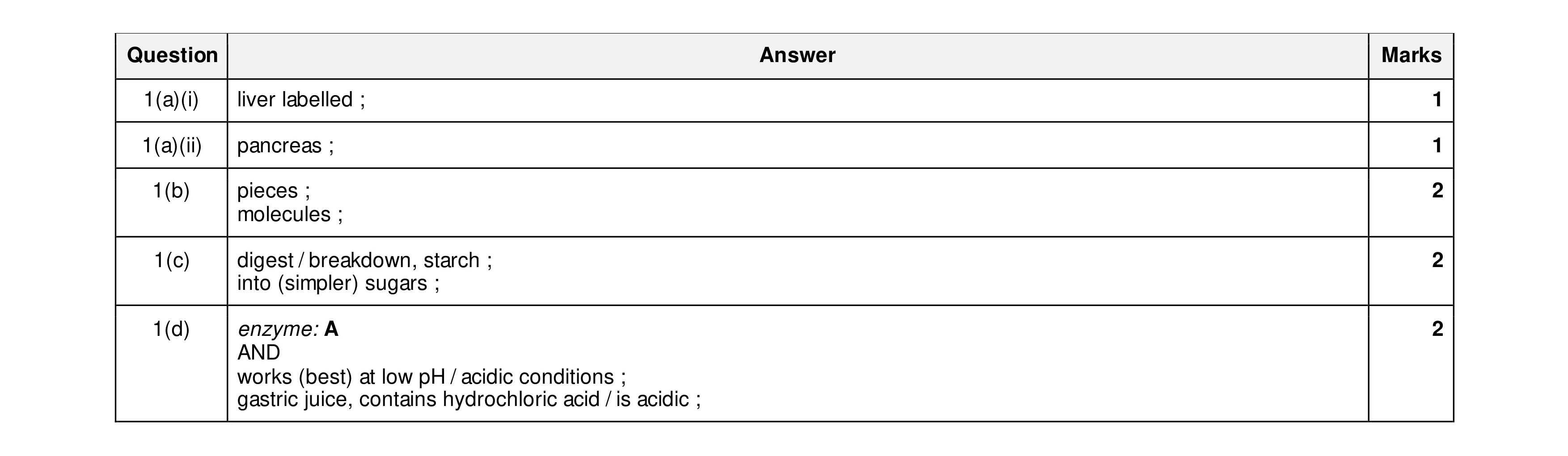 8
8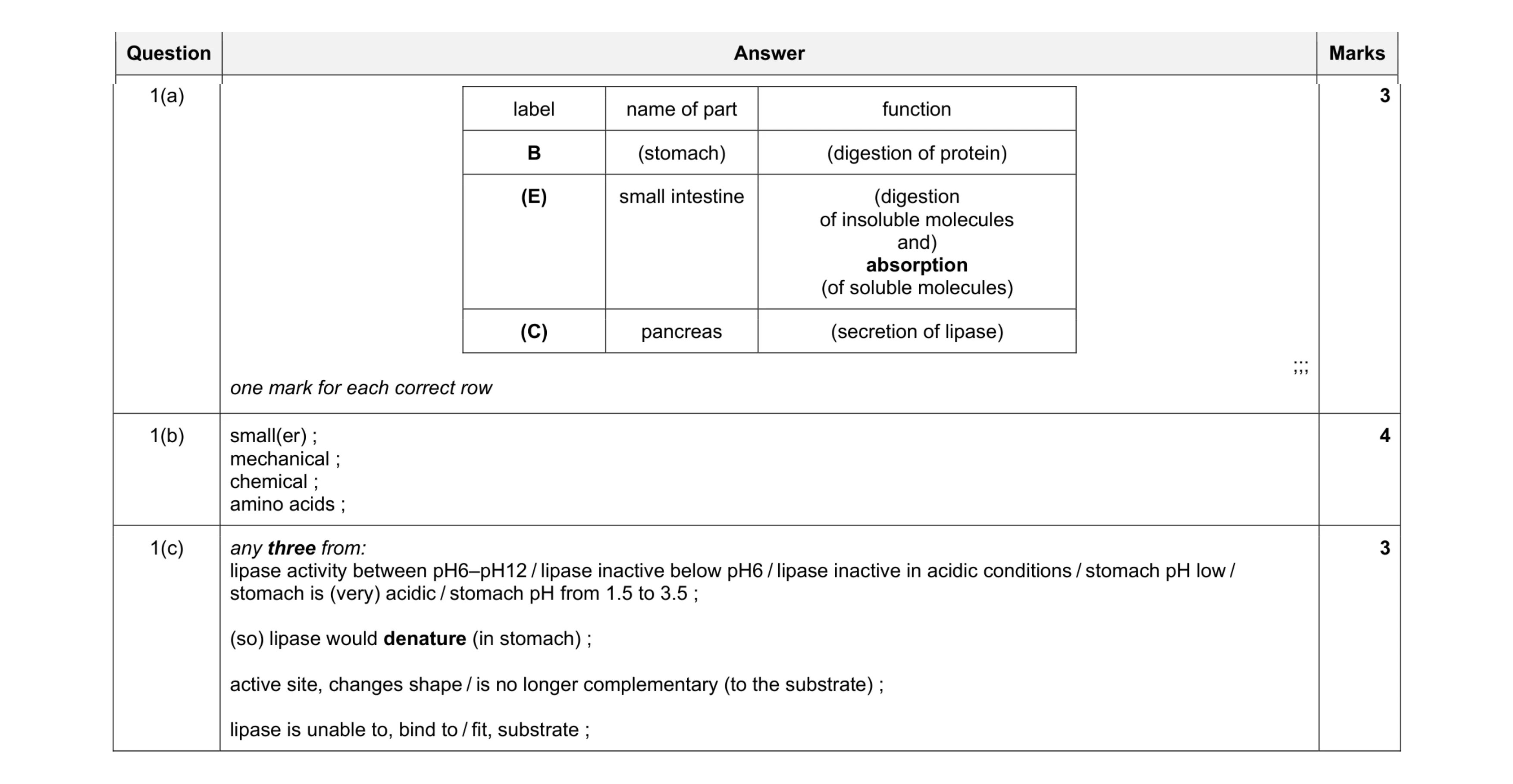 10
10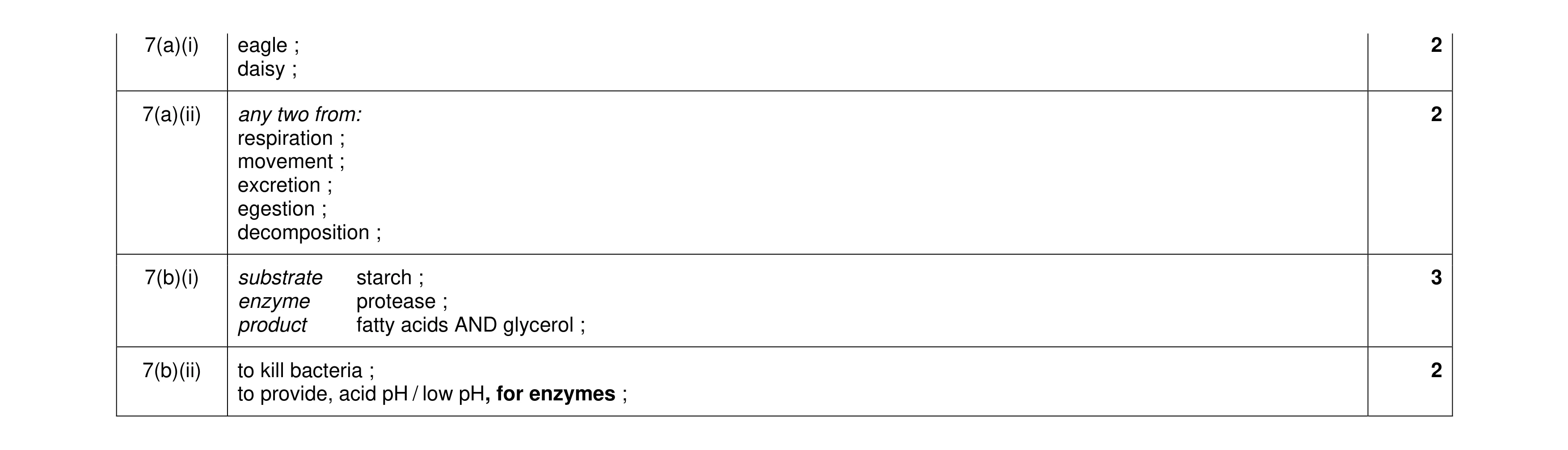 9
9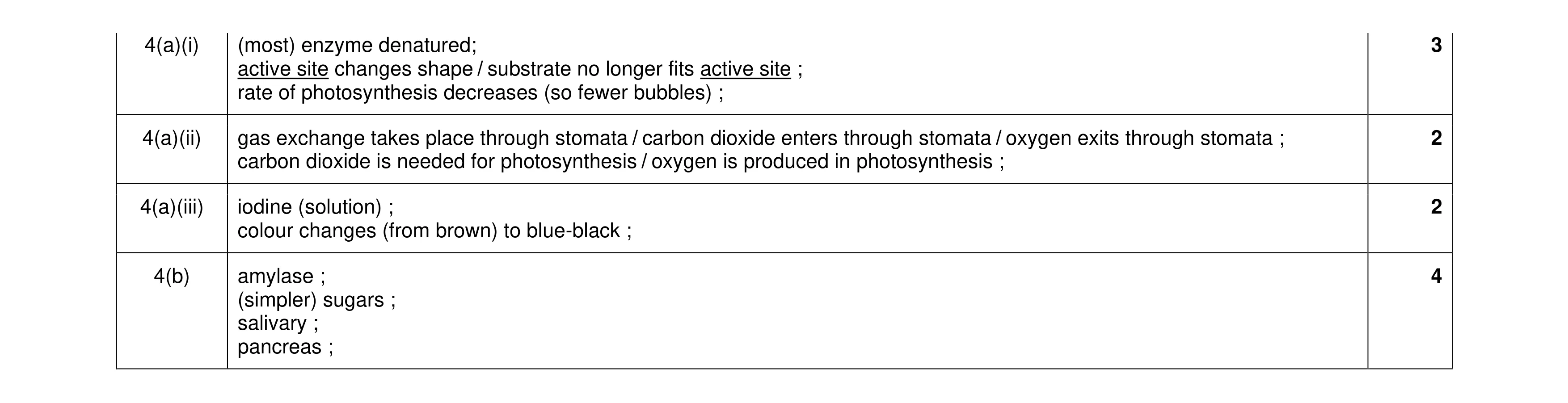 11
11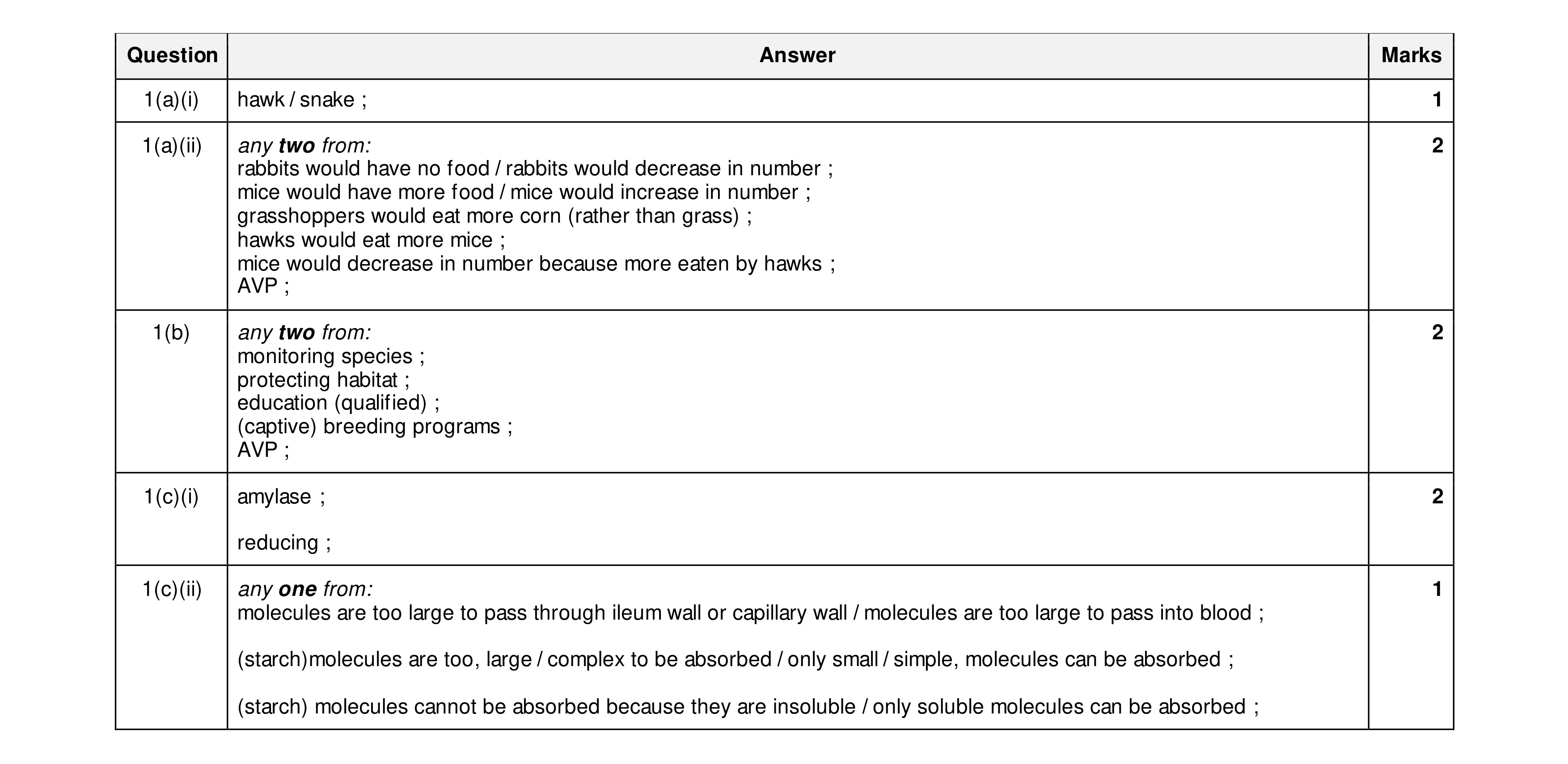 8
8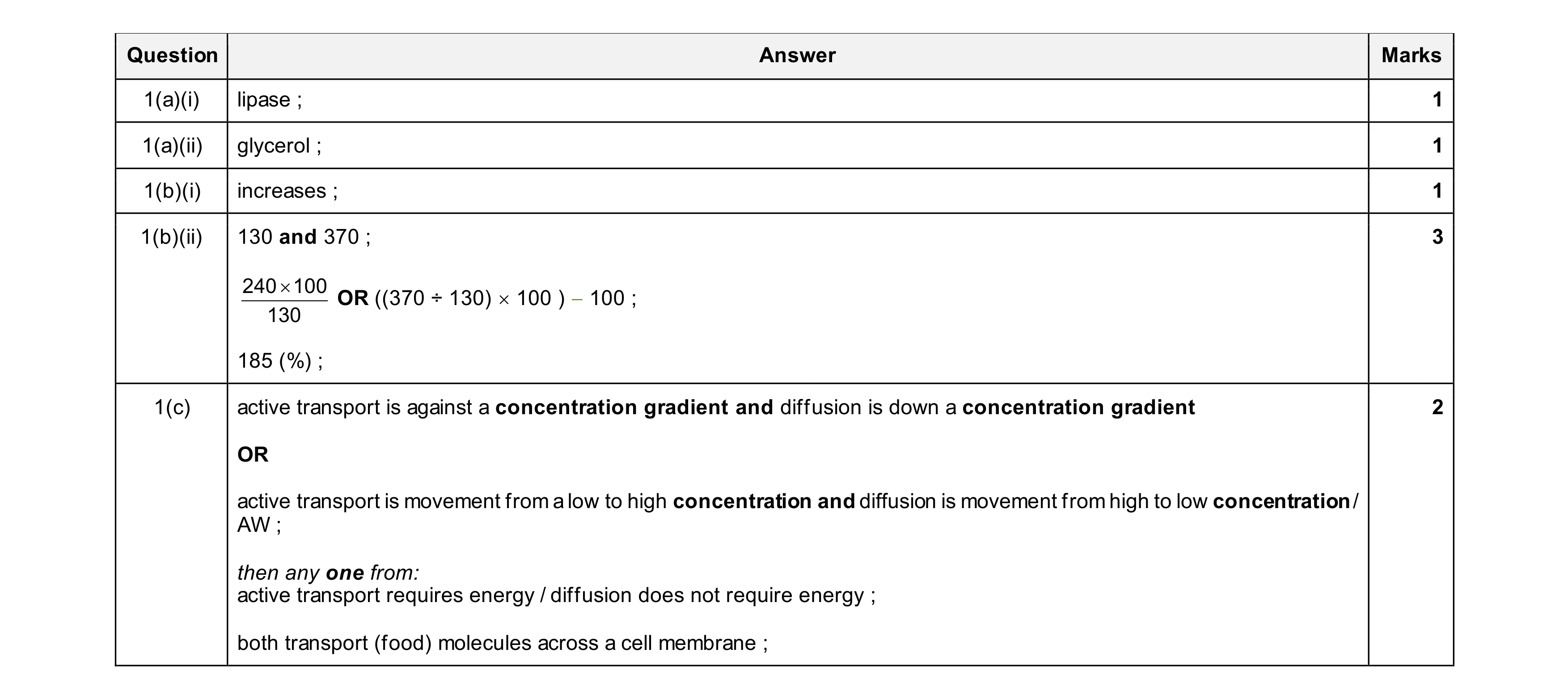 8
8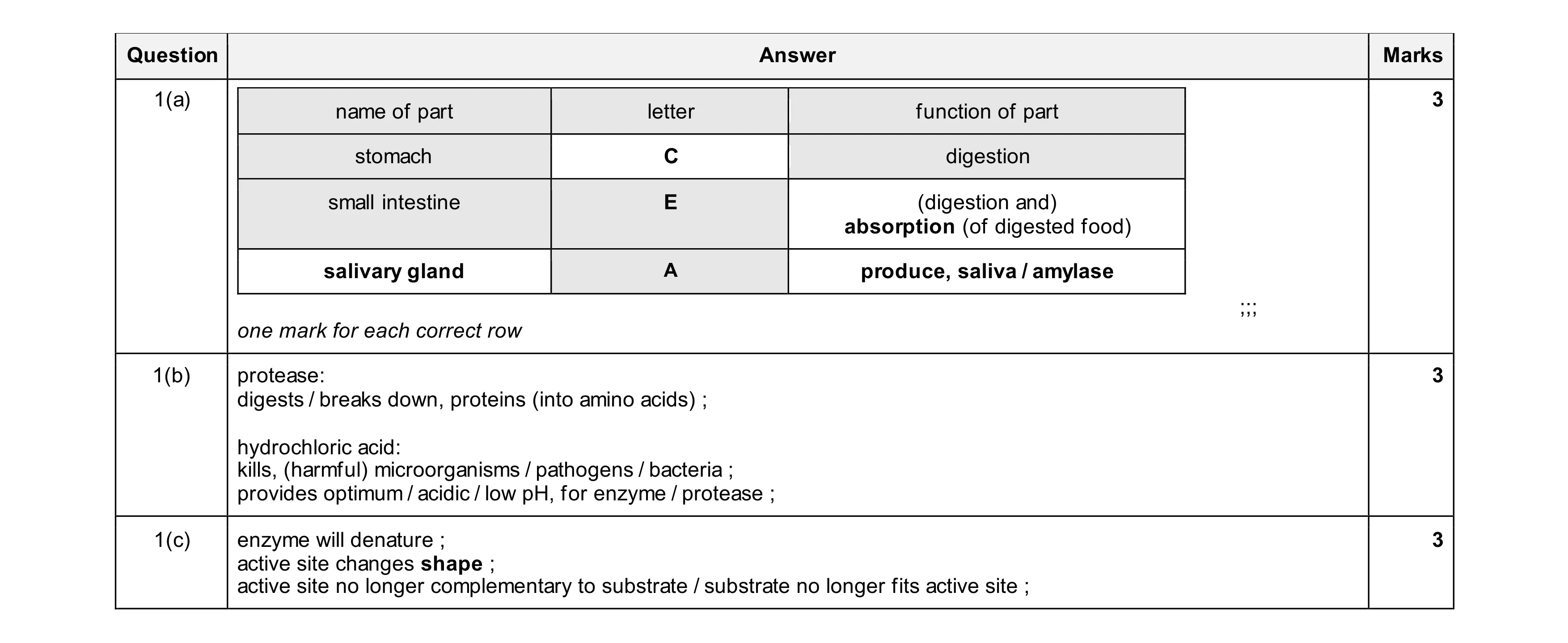 9
9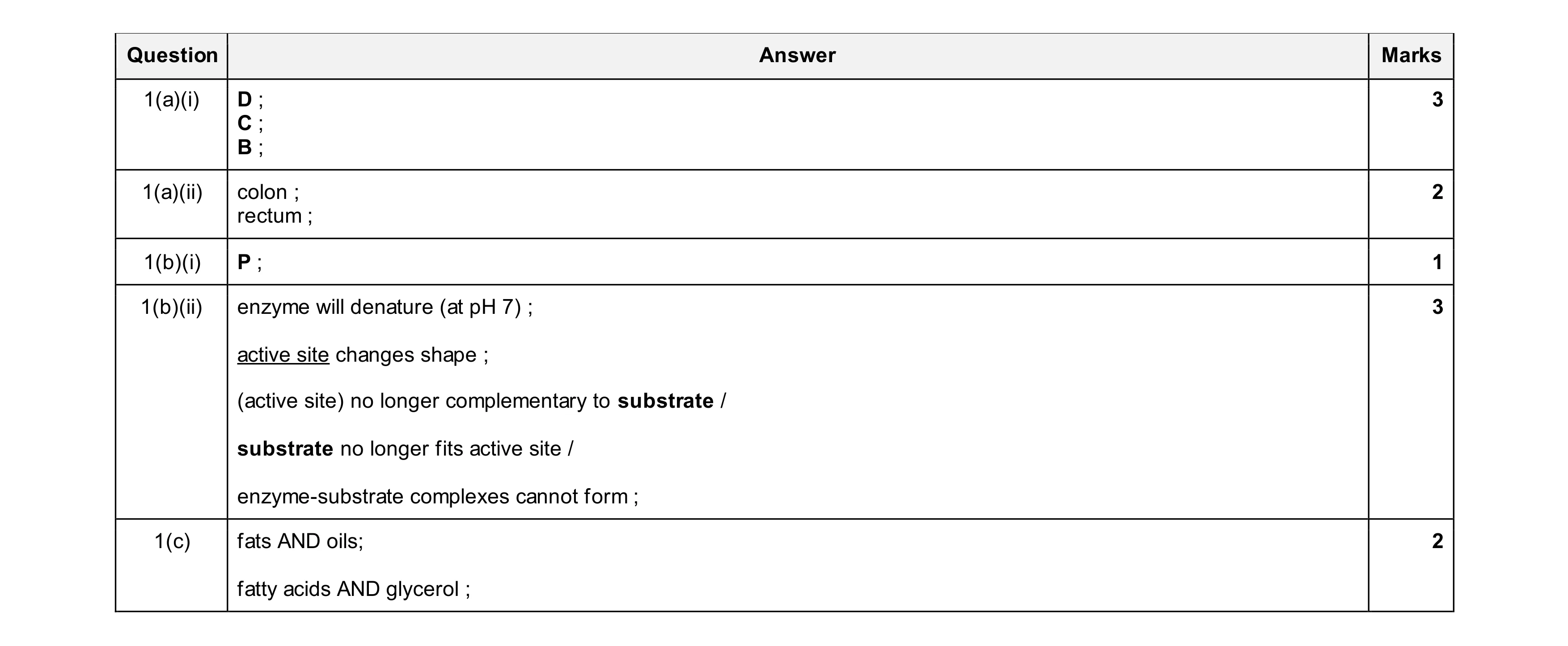 11
11