Questions as text
Q1 · Use lines to connect the box on the left to different boxes on the right 0653/32 Feb/March 2017
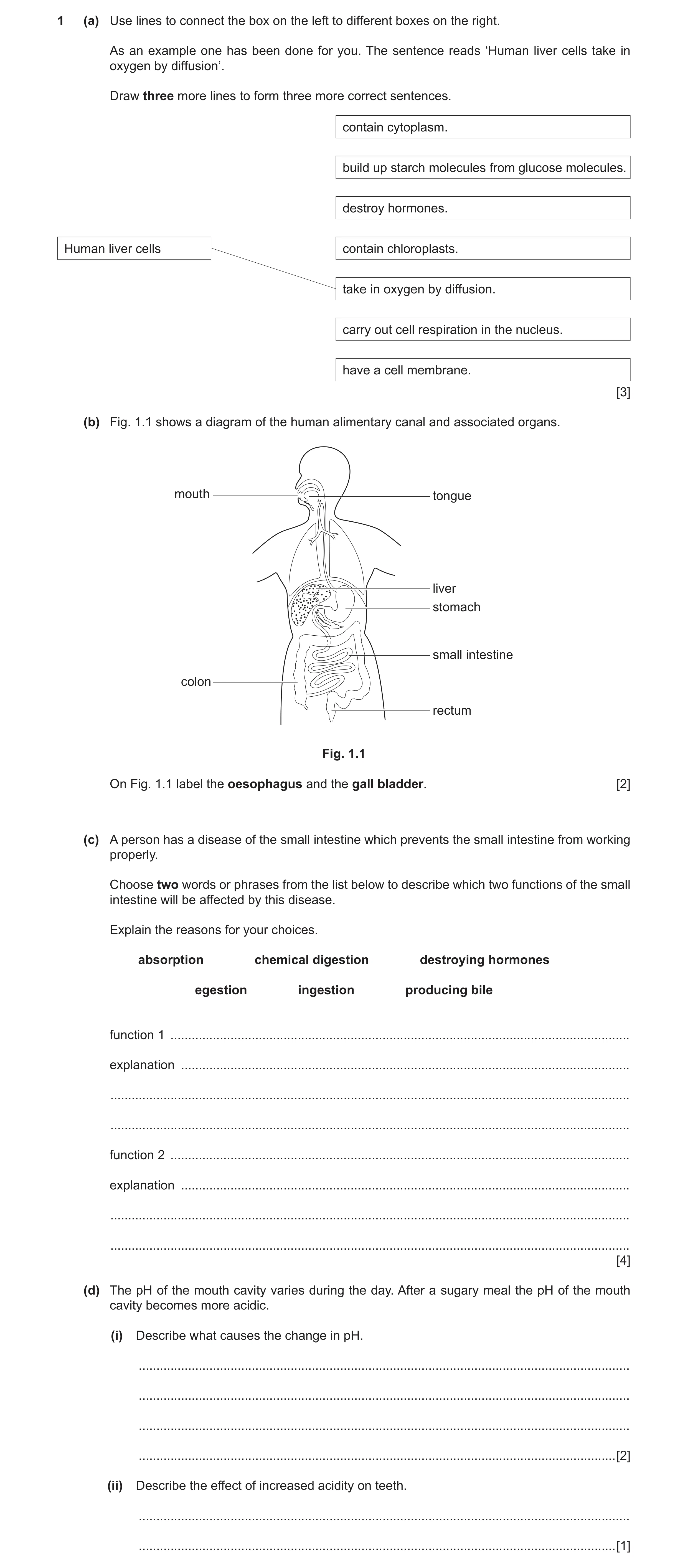
1 (a) Use lines to connect the box on the left to different boxes on the right. As an example one has been done for you. The sentence reads ‘Human liver cells take in oxygen by diffusion’. Draw three more lines to form three more correct sentences. contain cytoplasm. build up starch molecules from glucose molecules. destroy hormones. Human liver cells contain chloroplasts. take in oxygen by diffusion. carry out cell respiration in the nucleus. have a cell membrane. [3] (b) Fig. 1.1 shows a diagram of the human alimentary canal and associated organs. mouth tongue liver stomach small intestine colon rectum Fig. 1.1 On Fig. 1.1 label the oesophagus and the gall bladder. [2] (c) A person has a disease of the small intestine which prevents the small intestine from working properly. Choose two words or phrases from the list below to describe which two functions of the small intestine will be affected by this disease. Explain the reasons for your choices. absorption chemical digestion destroying hormones egestion ingestion producing bile function 1 … explanation … … … function 2 … explanation … … … [4] (d) The pH of the mouth cavity varies during the day. After a sugary meal the pH of the mouth cavity becomes more acidic. (i) Describe what causes the change in pH. … … … … [2] (ii) Describe the effect of increased acidity on teeth. … … [1]
12 marks
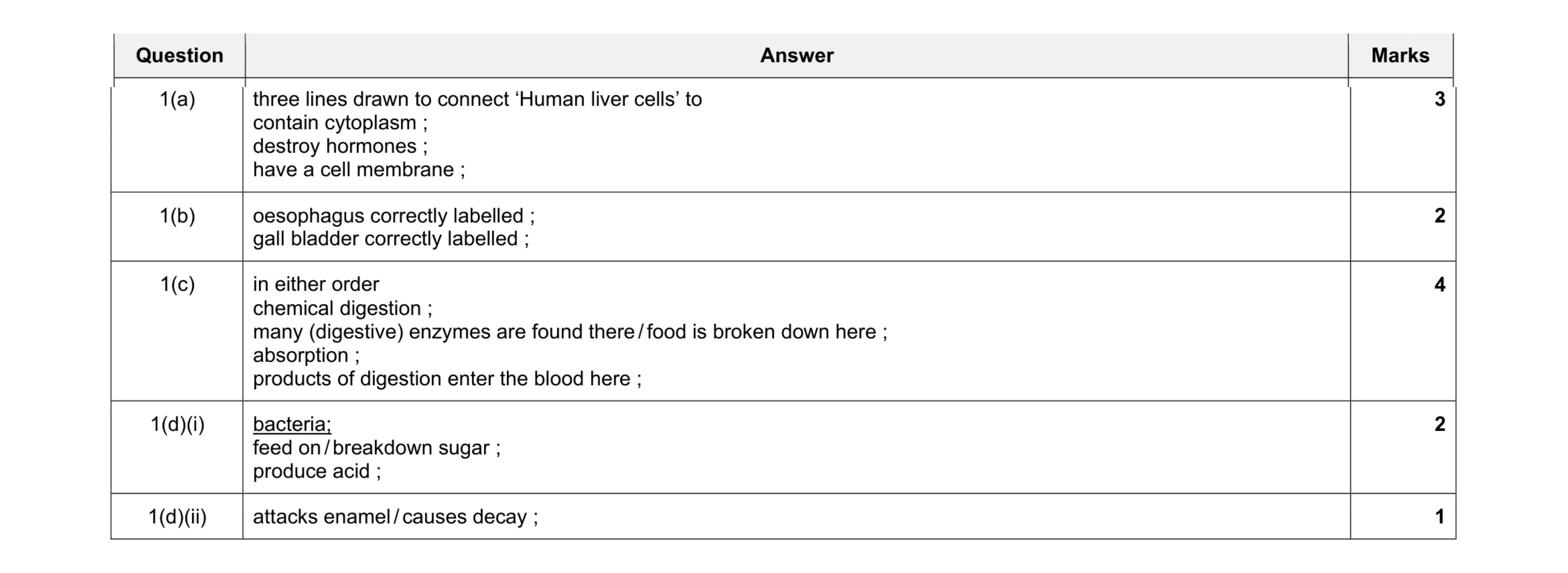
Mark scheme: 1(a) three lines drawn to connect ‘Human liver cells’ to contain cytoplasm ; destroy hormones ; have a cell membrane ; 3 1(b) oesophagus correctly labelled ; gall bladder correctly labelled ; 2 1(c) in either order chemical digestion ; many (digestive) enzymes are found there / food is broken down here ; absorption ; products of digestion enter the blood here ; 4 1(d)(i) bacteria; feed on / breakdown sugar ; produce acid ; 2 1(d)(ii) attacks enamel / causes decay ; 1
This question in 0653/32 Feb/March 2017
Q2 · Use lines to connect the box on the left to different boxes on the right to make correct… 0653/32 May/June 2017
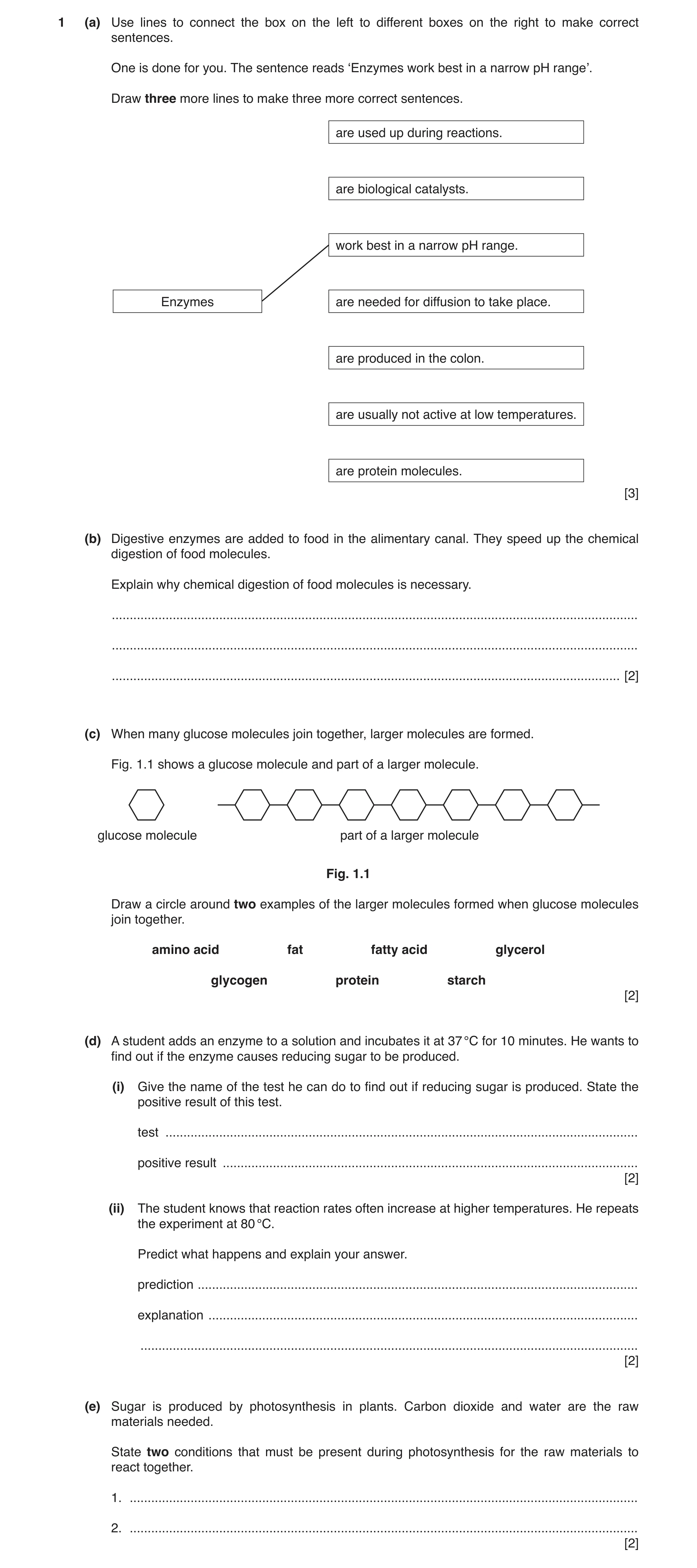
1 (a) Use lines to connect the box on the left to different boxes on the right to make correct sentences. One is done for you. The sentence reads ‘Enzymes work best in a narrow pH range’. Draw three more lines to make three more correct sentences. are used up during reactions. are biological catalysts. work best in a narrow pH range. Enzymes are needed for diffusion to take place. are produced in the colon. are usually not active at low temperatures. are protein molecules. [3] (b) Digestive enzymes are added to food in the alimentary canal. They speed up the chemical digestion of food molecules. Explain why chemical digestion of food molecules is necessary. … … … [2] (c) When many glucose molecules join together, larger molecules are formed. Fig. 1.1 shows a glucose molecule and part of a larger molecule. glucose molecule part of a larger molecule Fig. 1.1 Draw a circle around two examples of the larger molecules formed when glucose molecules join together. amino acid fat fatty acid glycerol glycogen protein starch [2] (d) A student adds an enzyme to a solution and incubates it at 37 °C for 10 minutes. He wants to find out if the enzyme causes reducing sugar to be produced. (i) Give the name of the test he can do to find out if reducing sugar is produced. State the positive result of this test. test … positive result … [2] (ii) The student knows that reaction rates often increase at higher temperatures. He repeats the experiment at 80 °C. Predict what happens and explain your answer. prediction … explanation … … [2] (e) Sugar is produced by photosynthesis in plants. Carbon dioxide and water are the raw materials needed. State two conditions that must be present during photosynthesis for the raw materials to react together. 1. … 2. … [2]
13 marks
Mark scheme: 1(a) lines drawn from Enzymes to are biological catalysts ; are usually not active at low temperatures ; are protein molecules ; 3 1(b) large / insoluble / food molecules are broken down ; into small / soluble molecules / so they can be absorbed ; 2 1(c) glycogen ; starch ; 2 1(d)(i) Benedict’s (test) ; red colour produced ; 2 1(d)(ii) no reaction ; because enzymes become inactive at high temperatures ; 2 1(e) chlorophyll ; light ; 2
This question in 0653/32 May/June 2017
Q3 · Use lines to connect the box on the left to different boxes on the right to make correct… 0653/33 May/June 2017
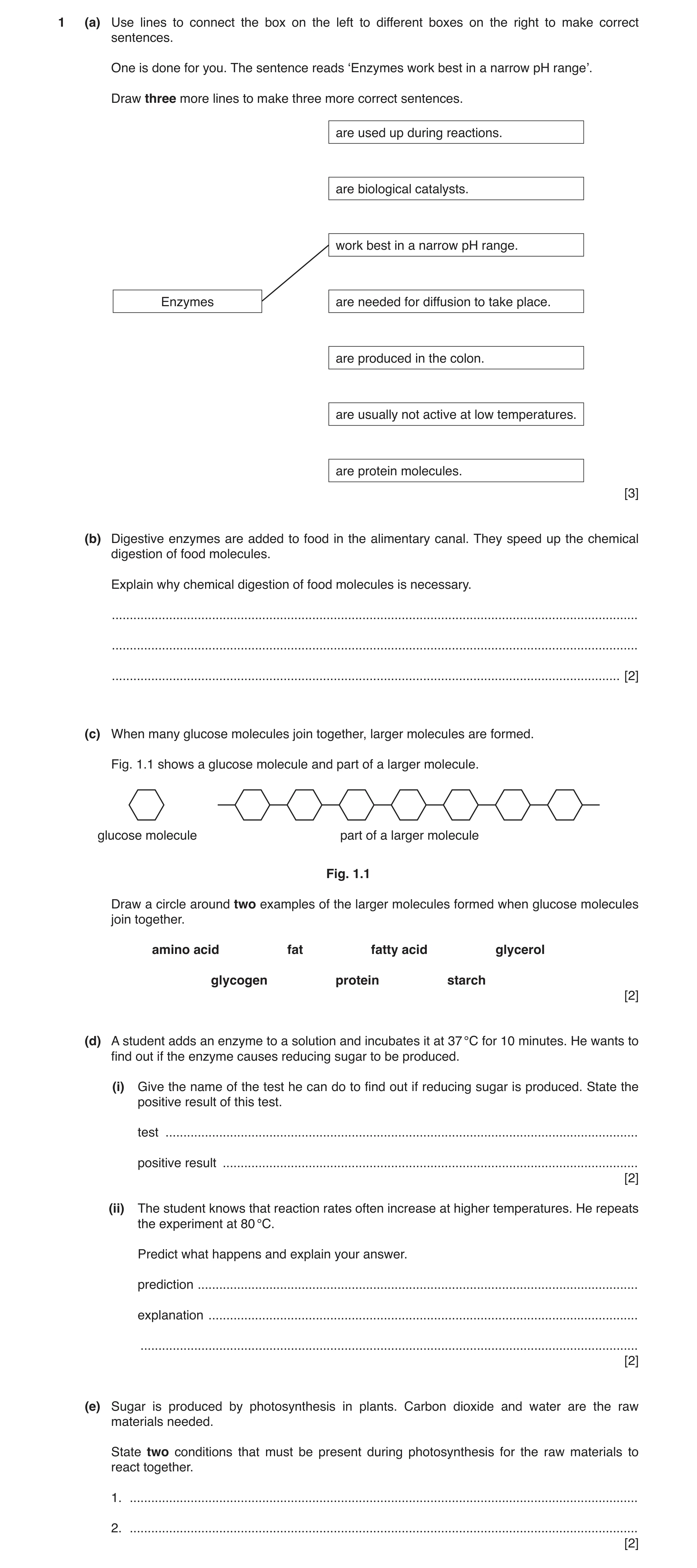
1 (a) Use lines to connect the box on the left to different boxes on the right to make correct sentences. One is done for you. The sentence reads ‘Enzymes work best in a narrow pH range’. Draw three more lines to make three more correct sentences. are used up during reactions. are biological catalysts. work best in a narrow pH range. Enzymes are needed for diffusion to take place. are produced in the colon. are usually not active at low temperatures. are protein molecules. [3] (b) Digestive enzymes are added to food in the alimentary canal. They speed up the chemical digestion of food molecules. Explain why chemical digestion of food molecules is necessary. … … … [2] (c) When many glucose molecules join together, larger molecules are formed. Fig. 1.1 shows a glucose molecule and part of a larger molecule. glucose molecule part of a larger molecule Fig. 1.1 Draw a circle around two examples of the larger molecules formed when glucose molecules join together. amino acid fat fatty acid glycerol glycogen protein starch [2] (d) A student adds an enzyme to a solution and incubates it at 37 °C for 10 minutes. He wants to find out if the enzyme causes reducing sugar to be produced. (i) Give the name of the test he can do to find out if reducing sugar is produced. State the positive result of this test. test … positive result … [2] (ii) The student knows that reaction rates often increase at higher temperatures. He repeats the experiment at 80 °C. Predict what happens and explain your answer. prediction … explanation … … [2] (e) Sugar is produced by photosynthesis in plants. Carbon dioxide and water are the raw materials needed. State two conditions that must be present during photosynthesis for the raw materials to react together. 1. … 2. … [2]
13 marks
Mark scheme: 1(a) lines drawn from Enzymes to are biological catalysts ; are usually not active at low temperatures ; are protein molecules ; 3 1(b) large / insoluble / food molecules are broken down ; into small / soluble molecules / so they can be absorbed ; 2 1(c) glycogen ; starch ; 2 1(d)(i) Benedict’s (test) ; red colour produced ; 2 1(d)(ii) no reaction ; because enzymes become inactive at high temperatures ; 2 1(e) chlorophyll ; light ; 2
This question in 0653/33 May/June 2017
Q4 · A student does an experiment to investigate the germination of barley seeds 0653/32 Oct/Nov 2017
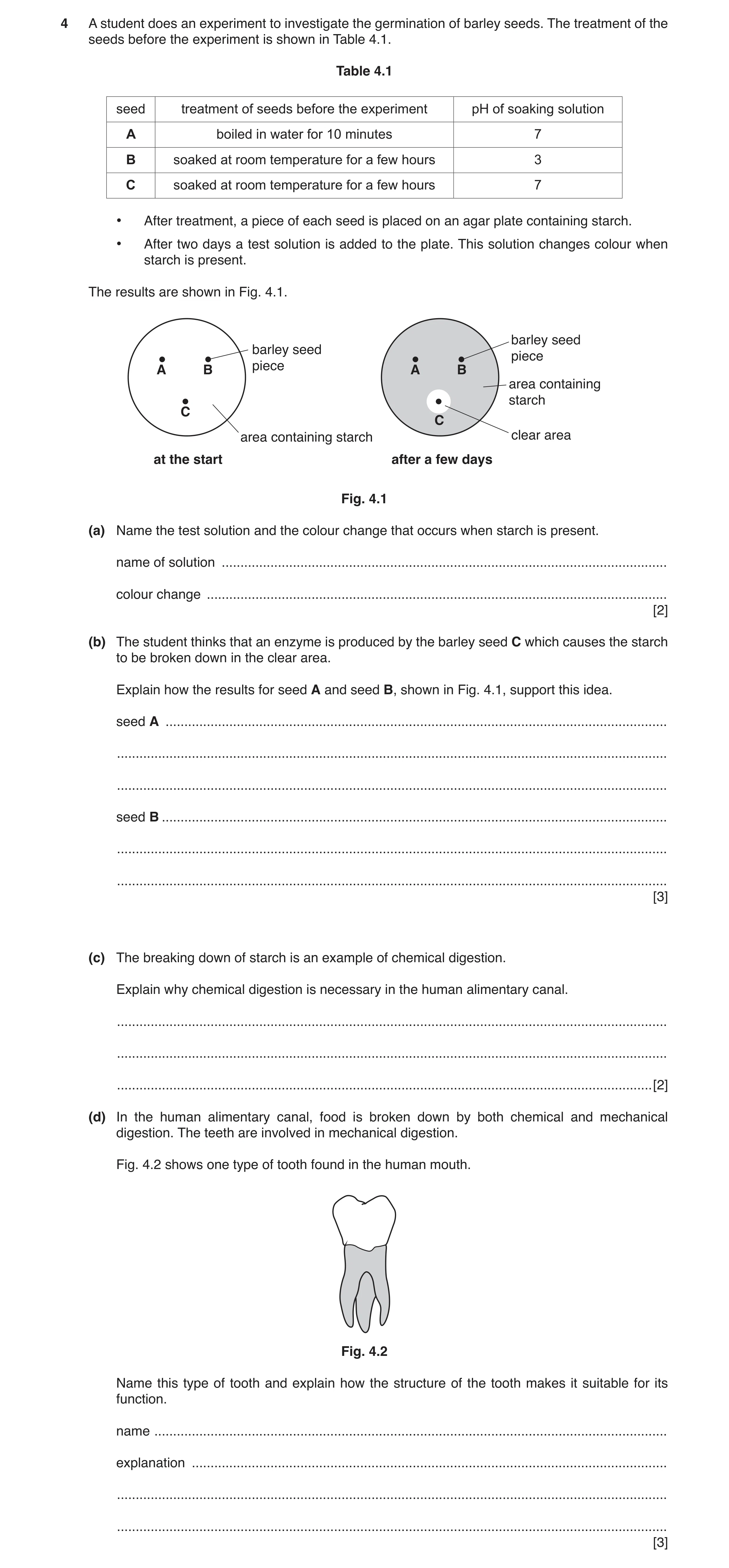
4 A student does an experiment to investigate the germination of barley seeds. The treatment of the seeds before the experiment is shown in Table 4.1. Table 4.1 seed treatment of seeds before the experiment pH of soaking solution A boiled in water for 10 minutes 7 B soaked at room temperature for a few hours 3 C soaked at room temperature for a few hours 7 • After treatment, a piece of each seed is placed on an agar plate containing starch. • After two days a test solution is added to the plate. This solution changes colour when starch is present. The results are shown in Fig. 4.1. barley seed barley seed piece piece A B A B area containing starch C C area containing starch clear area at the start after a few days Fig. 4.1 (a) Name the test solution and the colour change that occurs when starch is present. name of solution … colour change … [2] (b) The student thinks that an enzyme is produced by the barley seed C which causes the starch to be broken down in the clear area. Explain how the results for seed A and seed B, shown in Fig. 4.1, support this idea. seed A … … … seed B … … … [3] (c) The breaking down of starch is an example of chemical digestion. Explain why chemical digestion is necessary in the human alimentary canal. … … … [2] (d) In the human alimentary canal, food is broken down by both chemical and mechanical digestion. The teeth are involved in mechanical digestion. Fig. 4.2 shows one type of tooth found in the human mouth. Fig. 4.2 Name this type of tooth and explain how the structure of the tooth makes it suitable for its function. name … explanation … … … [3]
10 marks
Mark scheme: 4(a) iodine ; goes (from brown) to blue-black ; 2 4(b) Any three from results show starch present (around A and / or B) ; inactive / denatured enzyme ; because A is boiled ; because B is acidic / pH3 ; max 3 4(c) Any two from breaks down large / insoluble molecules ; into small / soluble molecules ; so that they can be absorbed ; max 2 4(d) molar ; flat / has cusps / large surface area ; for grinding food into smaller pieces ; 3
This question in 0653/32 Oct/Nov 2017
Q5 · The boxes on the left show some structures of the alimentary canal and associated organs 0653/33 May/June 2018
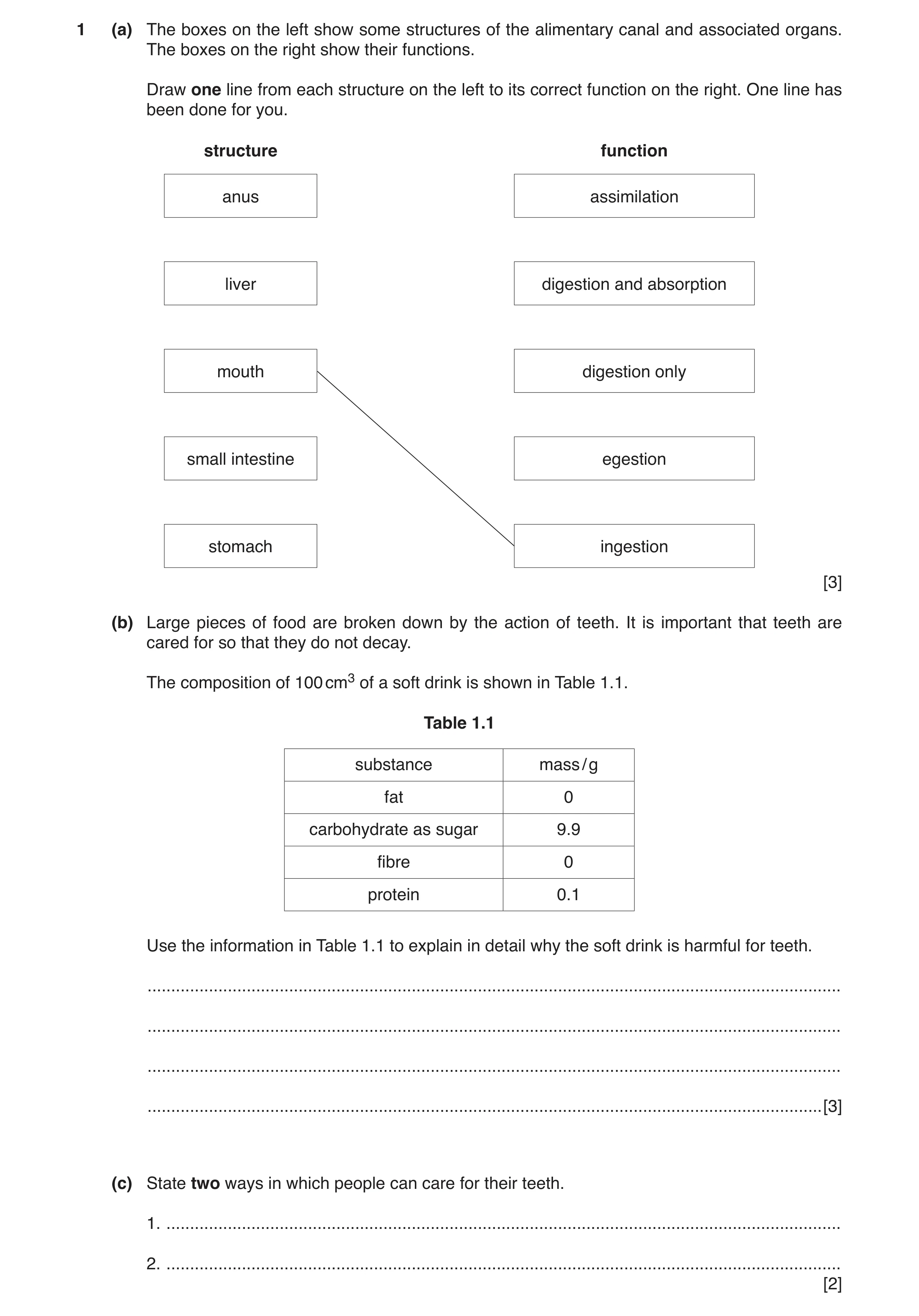
1 (a) The boxes on the left show some structures of the alimentary canal and associated organs. The boxes on the right show their functions. Draw one line from each structure on the left to its correct function on the right. One line has been done for you. structure function anus assimilation liver digestion and absorption mouth digestion only small intestine egestion stomach ingestion [3] (b) Large pieces of food are broken down by the action of teeth. It is important that teeth are cared for so that they do not decay. The composition of 100 cm3 of a soft drink is shown in Table 1.1. Table 1.1 substance mass / g fat 0 carbohydrate as sugar 9.9 fibre 0 protein 0.1 Use the information in Table 1.1 to explain in detail why the soft drink is harmful for teeth. … … … … [3] (c) State two ways in which people can care for their teeth. 1. … 2. … [2]
8 marks
Mark scheme: 1(a) three lines drawn as follows anus assimilation liver digestion and absorption mouth digestion only small intestine egestion stomach ingestion All 4 lines correct = 3 marks 3 or 2 lines correct = 2 marks 1 correct line = 1 mark 3 1(b) idea of large amount of sugar in the drink ; bacteria feed on sugar ; produce acid ; acid attacks enamel ; max 3 1(c) brush teeth regularly ; visit dentist regularly ; reduce consumption of sugar ; max 2 Que estion Answer Ma arks
This question in 0653/33 May/June 2018
Q6 · The boxes in Fig 0653/32 Oct/Nov 2018
1 (a) The boxes in Fig. 1.1 contain the names of cells, diagrams of these cells, and their functions. Draw straight lines to connect each named cell with its correct diagram and function. One is done for you. diagram (not to scale) name of cell function carries out palisade cell photosynthesis red blood defends against cell disease root hair cell male gamete sperm cell transports oxygen white blood water uptake cell [4] Fig. 1.1 (b) One of the cells is shown in Fig. 1.2. Fig. 1.2 The actual diameter of the cell is 0.0070 mm. Calculate the magnification shown by the diagram. magnification = … [2] (c) The list shows some substances that are found in living organisms. amino acids bile carbon dioxide enamel glycogen platelets starch Draw a circle around three substances which are transported by the blood plasma. [2] (d) (i) Describe the importance of chemical digestion in the body. … … … … … [3] (ii) State one organ of the body which produces digestive enzymes. … [1]
12 marks
Mark scheme: 1(a) palisade cell carries out photosynthesis red blood cell defends against disease root hair cell male gamete sperm cell transports oxygen white blood cell water uptake 1 mark for each correct diagram / name / function ;;;; 4 1(b) diameter of red blood cell = 21 mm ; magnification = 21 / 0.007 = 3000 (times) ; 2 1(c) amino acid ; carbon dioxide ; platelets ; All 3 correct = 2 2 or 1 correct = 1 2 Question Answer Marks 1(d)(i) breaks down ; large / insoluble molecules ; into small / soluble molecules ; that can be absorbed ; Max 3 3 1(d)(ii) salivary glands / stomach / pancreas / ileum / small intestine ; 1
This question in 0653/32 Oct/Nov 2018
Q7 · A person’s balanced diet must contain all nutrients in the correct amounts according to… 0653/32 May/June 2019
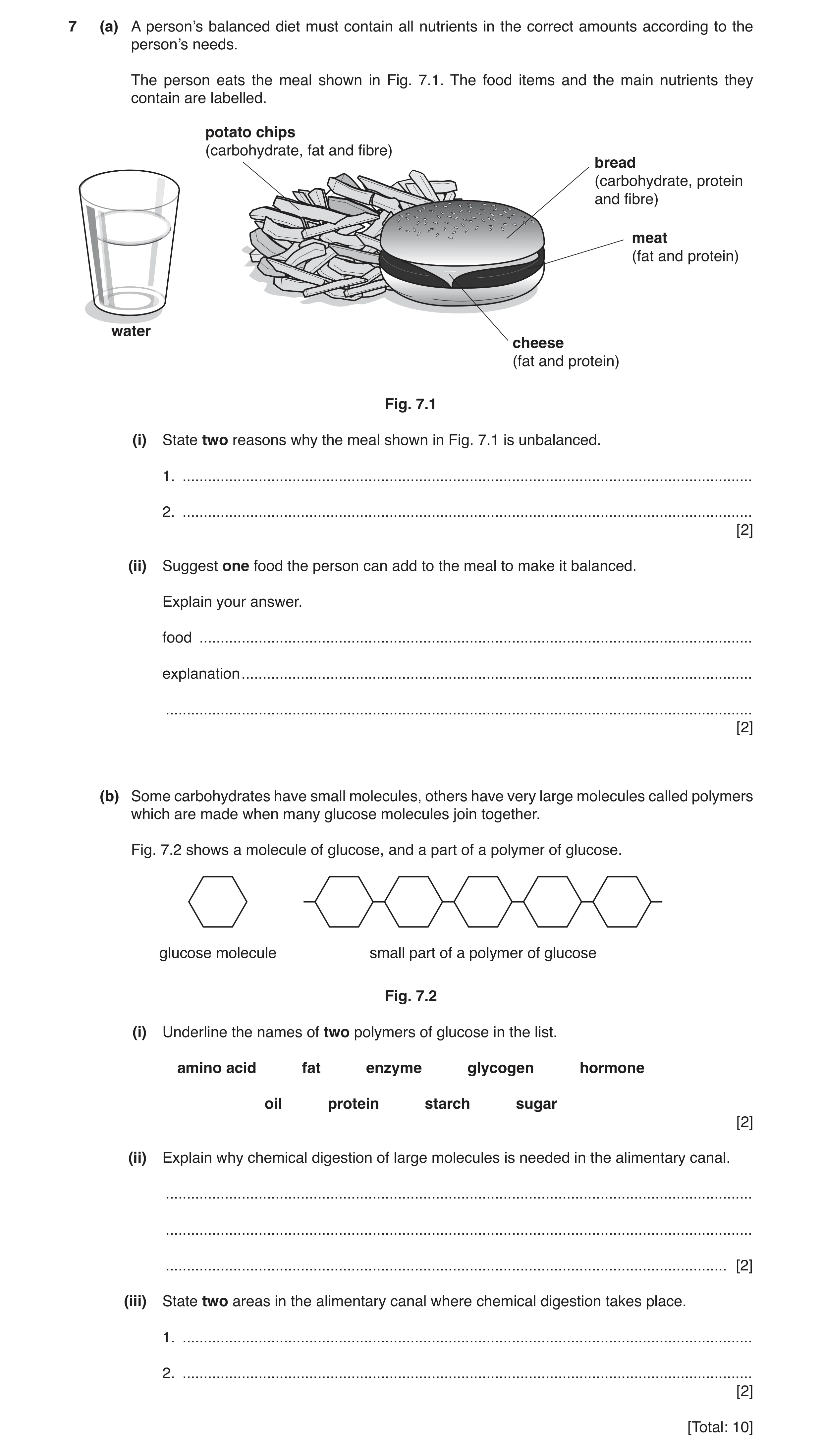
7 (a) A person’s balanced diet must contain all nutrients in the correct amounts according to the person’s needs. The person eats the meal shown in Fig. 7.1. The food items and the main nutrients they contain are labelled. potato chips (carbohydrate, fat and fibre) bread (carbohydrate, protein and fibre) meat (fat and protein) water cheese (fat and protein) Fig. 7.1 (i) State two reasons why the meal shown in Fig. 7.1 is unbalanced. 1. … 2. … [2] (ii) Suggest one food the person can add to the meal to make it balanced. Explain your answer. food … explanation … … [2] (b) Some carbohydrates have small molecules, others have very large molecules called polymers which are made when many glucose molecules join together. Fig. 7.2 shows a molecule of glucose, and a part of a polymer of glucose. glucose molecule small part of a polymer of glucose Fig. 7.2 (i) Underline the names of two polymers of glucose in the list. amino acid fat enzyme glycogen hormone oil protein starch sugar [2] (ii) Explain why chemical digestion of large molecules is needed in the alimentary canal. … … … [2] (iii) State two areas in the alimentary canal where chemical digestion takes place. 1. … 2. … [2] [Total: 10]
10 marks
Mark scheme: 7(a)(i) any two of high in / a lot of fat ; high in / a lot of carbohydrate ; not enough vitamins / named vitamin / not enough mineral salts / named mineral salt ; max 2 7(a)(ii) add fruit / vegetable / named fruit or vegetable ; adds vitamins / minerals ; 2 7(b)(i) glycogen ; starch ; 2 7(b)(ii) makes small / soluble molecules ; that can be absorbed / pass through walls (of alimentary canal) / pass into the blood ; 2 7(b)(iii) any two of mouth (cavity) ; stomach ; small intestine ; max 2
This question in 0653/32 May/June 2019
Q8 · A simplified diagram which shows the human alimentary canal 0653/33 May/June 2019
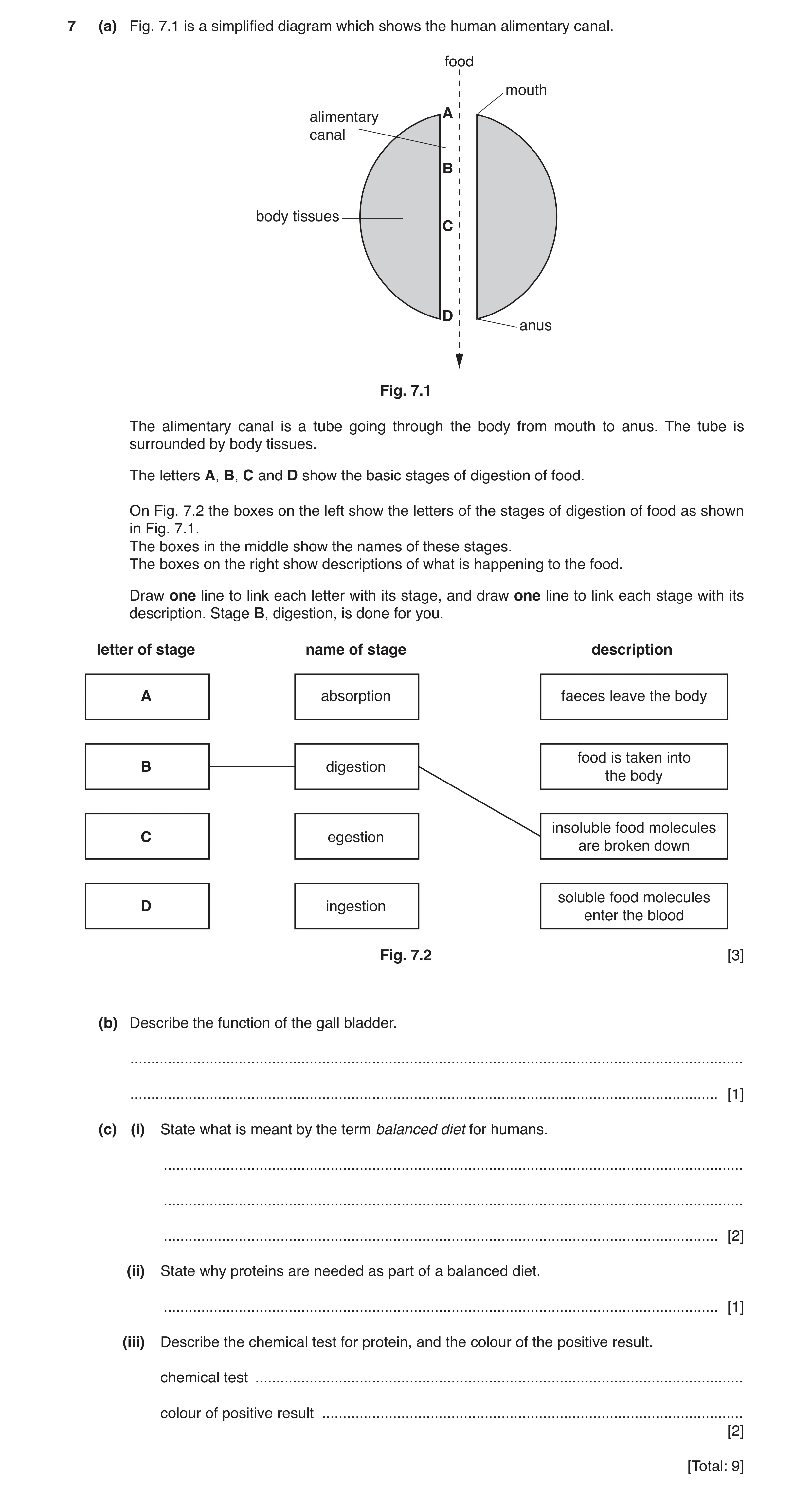
7 (a) Fig. 7.1 is a simplified diagram which shows the human alimentary canal. food mouth alimentary A canal B body tissues C D anus Fig. 7.1 The alimentary canal is a tube going through the body from mouth to anus. The tube is surrounded by body tissues. The letters A, B, C and D show the basic stages of digestion of food. On Fig. 7.2 the boxes on the left show the letters of the stages of digestion of food as shown in Fig. 7.1. The boxes in the middle show the names of these stages. The boxes on the right show descriptions of what is happening to the food. Draw one line to link each letter with its stage, and draw one line to link each stage with its description. Stage B, digestion, is done for you. letter of stage name of stage description A absorption faeces leave the body food is taken into B digestion the body insoluble food molecules C egestion are broken down soluble food molecules D ingestion enter the blood Fig. 7.2 [3] (b) Describe the function of the gall bladder. … … [1] (c) (i) State what is meant by the term balanced diet for humans. … … … [2] (ii) State why proteins are needed as part of a balanced diet. … [1] (iii) Describe the chemical test for protein, and the colour of the positive result. chemical test … colour of positive result … [2] [Total: 9]
9 marks
Mark scheme: 7(a) A absorption faeces leave the body B digestion food is taken into the body C egestion insoluble food molecules are broken down D ingestion soluble food molecules enter the blood ; ; ; 3 7(b) stores bile ; 1 7(c)(i) contains all the nutrients ; in the (correct / appropriate) proportions / amounts / quantities / to meet a person’s needs / for health ; 2 7(c)(ii) growth / repair of tissues ; 1 7(c)(iii) biuret solution ; (biuret solution) goes purple ; 2
This question in 0653/33 May/June 2019
Q9 · Information about the organisms in a food chain 0653/31 Oct/Nov 2019
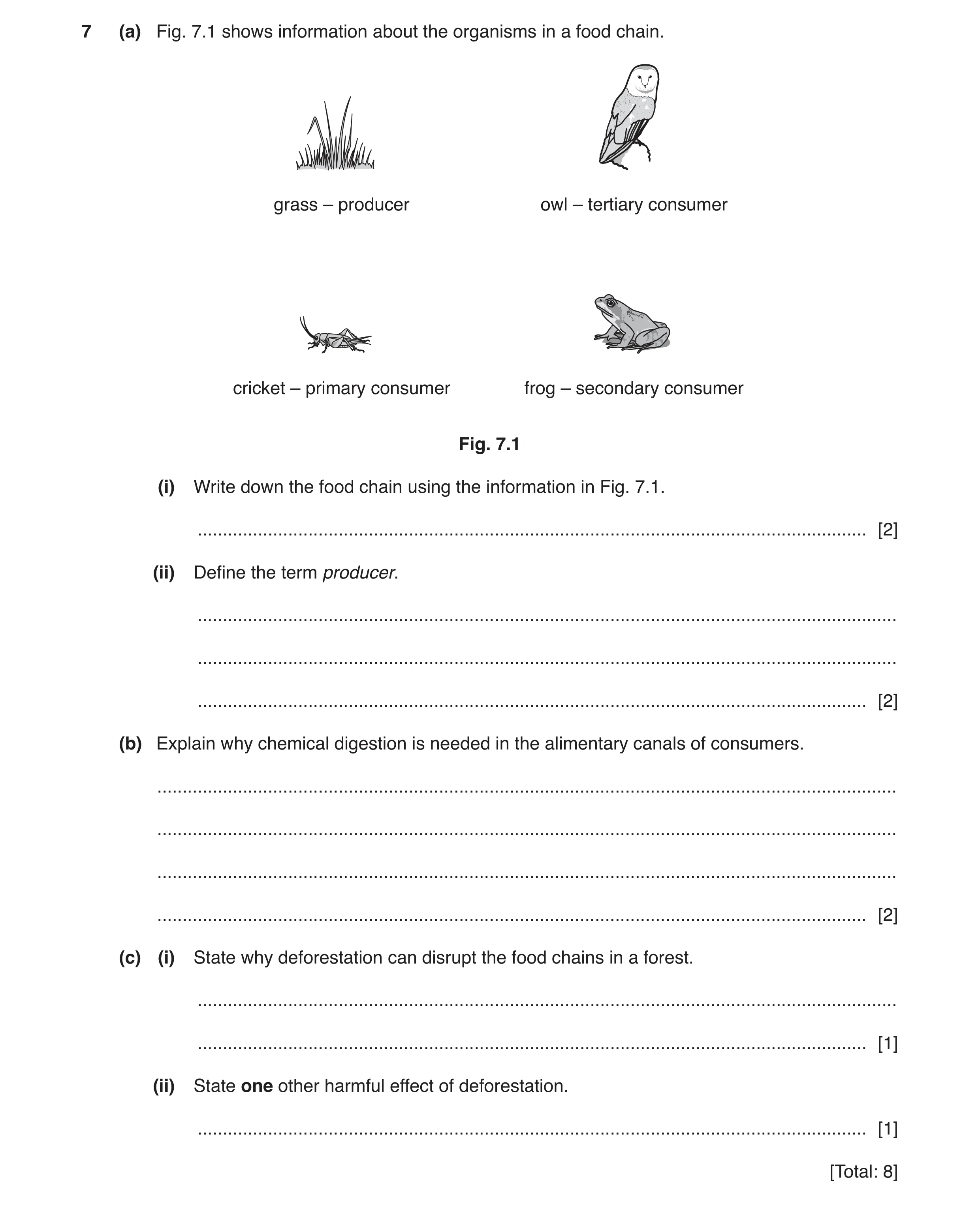
7 (a) Fig. 7.1 shows information about the organisms in a food chain. grass – producer owl – tertiary consumer cricket – primary consumer frog – secondary consumer Fig. 7.1 (i) Write down the food chain using the information in Fig. 7.1. … [2] (ii) Define the term producer. … … … [2] (b) Explain why chemical digestion is needed in the alimentary canals of consumers. … … … … [2] (c) (i) State why deforestation can disrupt the food chains in a forest. … … [1] (ii) State one other harmful effect of deforestation. … [1] [Total: 8]
8 marks
Mark scheme: 7(a)(i) grass cricket frog owl organisms in correct order ; arrows in correct direction ; 2 7(a)(ii) (an organism that) makes its own (organic) nutrients/food ; using energy from (sun)light / photosynthesis ; 2 7(b) any two from: the breakdown of large, insoluble food molecules ; into small water-soluble molecules ; so (small molecules) can be absorbed ; 2 7(c)(i) loss of shelter / loss of habitat / loss of food / reduction in population of part of food chain ; 1 7(c)(ii) loss of soil / flooding / increase of carbon dioxide in the atmosphere ; 1
This question in 0653/31 Oct/Nov 2019
Q10 · Chemical digestion occurs in the alimentary canal 0653/32 Oct/Nov 2019
7 (a) Chemical digestion occurs in the alimentary canal. Use words from the list to complete the sentence about chemical digestion. Each word may be used once, more than once, or not at all. absorbed atoms egested excreted ions molecules Chemical digestion in the alimentary canal produces small, soluble … that can be … . [2] (b) Amylase is an enzyme that breaks down starch into simpler reducing sugars. Starch solution is placed in each of two test‑tubes. Amylase solution is added to test‑tube 1 and water is added to test‑tube 2. The apparatus is shown in Fig. 7.1. amylase solution water starch solution test-tube 1 test-tube 2 starch solution and amylase starch solution and water Fig. 7.1 After 10 minutes the contents of each test‑tube are tested with Benedict’s solution. The results of the investigation are shown in Table 7.1. Table 7.1 reducing sugar colour of result of test‑tube amylase present present Benedict’s test 1 yes yes 2 no no (i) Complete Table 7.1 with the colours of the Benedict’s test results. [2] (ii) The experiment is repeated with boiled enzyme in test‑tube 1. This time there is no reducing sugar present in test‑tube 1 after 10 minutes. Explain why there is no reducing sugar in test‑tube 1. … … … [1] (c) Table 7.2 shows four main processes that occur in the alimentary canal. Complete each row of Table 7.2 with one region of the alimentary canal where each process takes place. One is done for you. Table 7.2 process one region of the alimentary canal absorption small intestine digestion egestion ingestion [3] [Total: 8]
8 marks
Mark scheme: 7(a) molecules ; absorbed ; 2 7(b)(i) (test-tube 1) red / orange / yellow / green ; (test-tube 2) blue ; 2 7(b)(ii) boiling makes the enzyme inactive ; 1 7(c) (digestion) mouth / stomach / small intestine ; (egestion) anus ; (ingestion) mouth ; 3
This question in 0653/32 Oct/Nov 2019
Q11 · Chemical digestion occurs in the alimentary canal 0653/33 Oct/Nov 2019
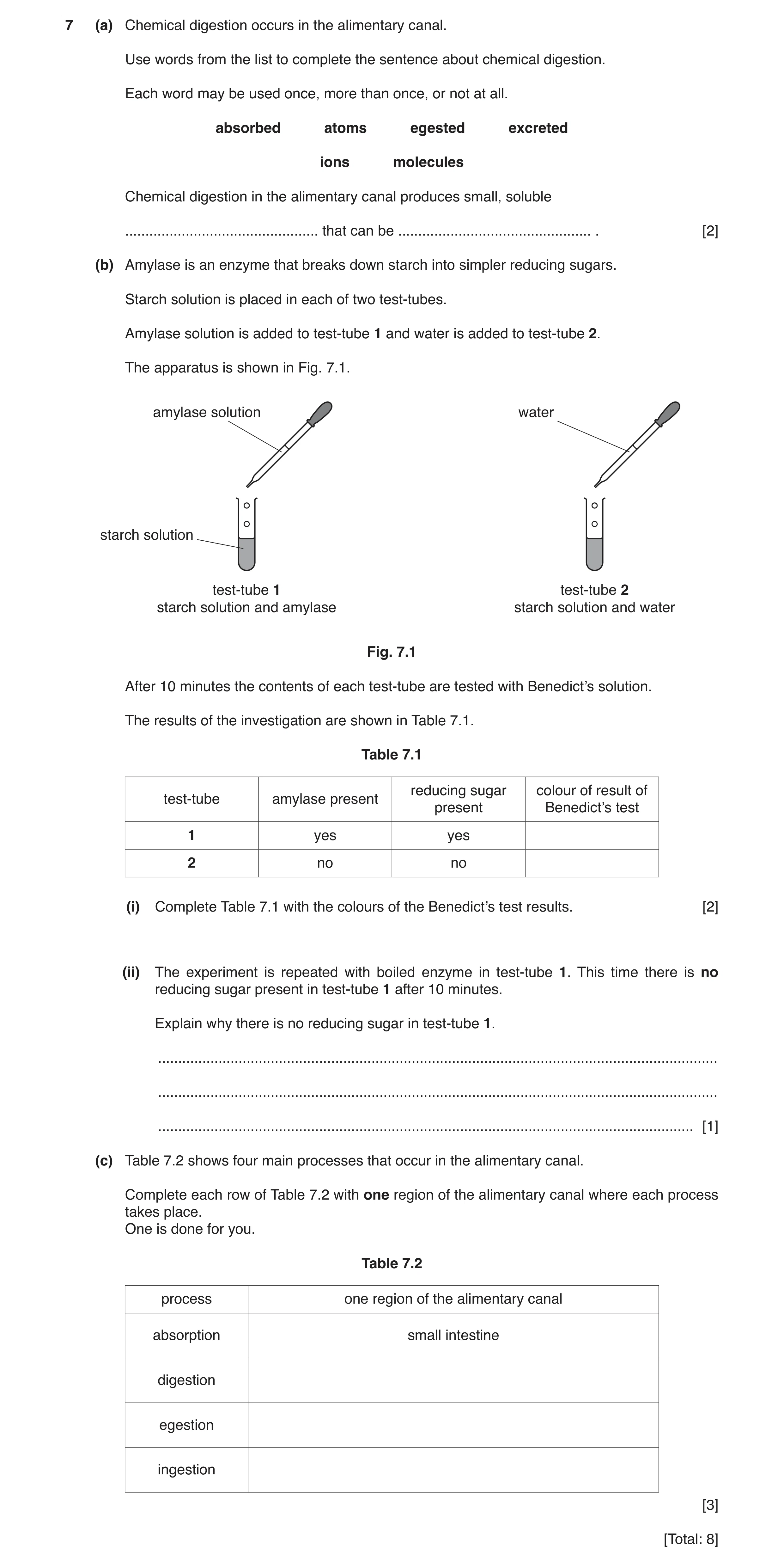
7 (a) Chemical digestion occurs in the alimentary canal. Use words from the list to complete the sentence about chemical digestion. Each word may be used once, more than once, or not at all. absorbed atoms egested excreted ions molecules Chemical digestion in the alimentary canal produces small, soluble … that can be … . [2] (b) Amylase is an enzyme that breaks down starch into simpler reducing sugars. Starch solution is placed in each of two test‑tubes. Amylase solution is added to test‑tube 1 and water is added to test‑tube 2. The apparatus is shown in Fig. 7.1. amylase solution water starch solution test-tube 1 test-tube 2 starch solution and amylase starch solution and water Fig. 7.1 After 10 minutes the contents of each test‑tube are tested with Benedict’s solution. The results of the investigation are shown in Table 7.1. Table 7.1 reducing sugar colour of result of test‑tube amylase present present Benedict’s test 1 yes yes 2 no no (i) Complete Table 7.1 with the colours of the Benedict’s test results. [2] (ii) The experiment is repeated with boiled enzyme in test‑tube 1. This time there is no reducing sugar present in test‑tube 1 after 10 minutes. Explain why there is no reducing sugar in test‑tube 1. … … … [1] (c) Table 7.2 shows four main processes that occur in the alimentary canal. Complete each row of Table 7.2 with one region of the alimentary canal where each process takes place. One is done for you. Table 7.2 process one region of the alimentary canal absorption small intestine digestion egestion ingestion [3] [Total: 8]
8 marks
Mark scheme: 7(a) molecules ; absorbed ; 2 7(b)(i) (test-tube 1) red / orange / yellow / green ; (test-tube 2) blue ; 2 7(b)(ii) boiling makes the enzyme inactive ; 1 7(c) (digestion) mouth / stomach / small intestine ; (egestion) anus ; (ingestion) mouth ; 3
This question in 0653/33 Oct/Nov 2019
Q12 · The names and functions of some organs associated with the alimentary canal 0653/31 Oct/Nov 2021
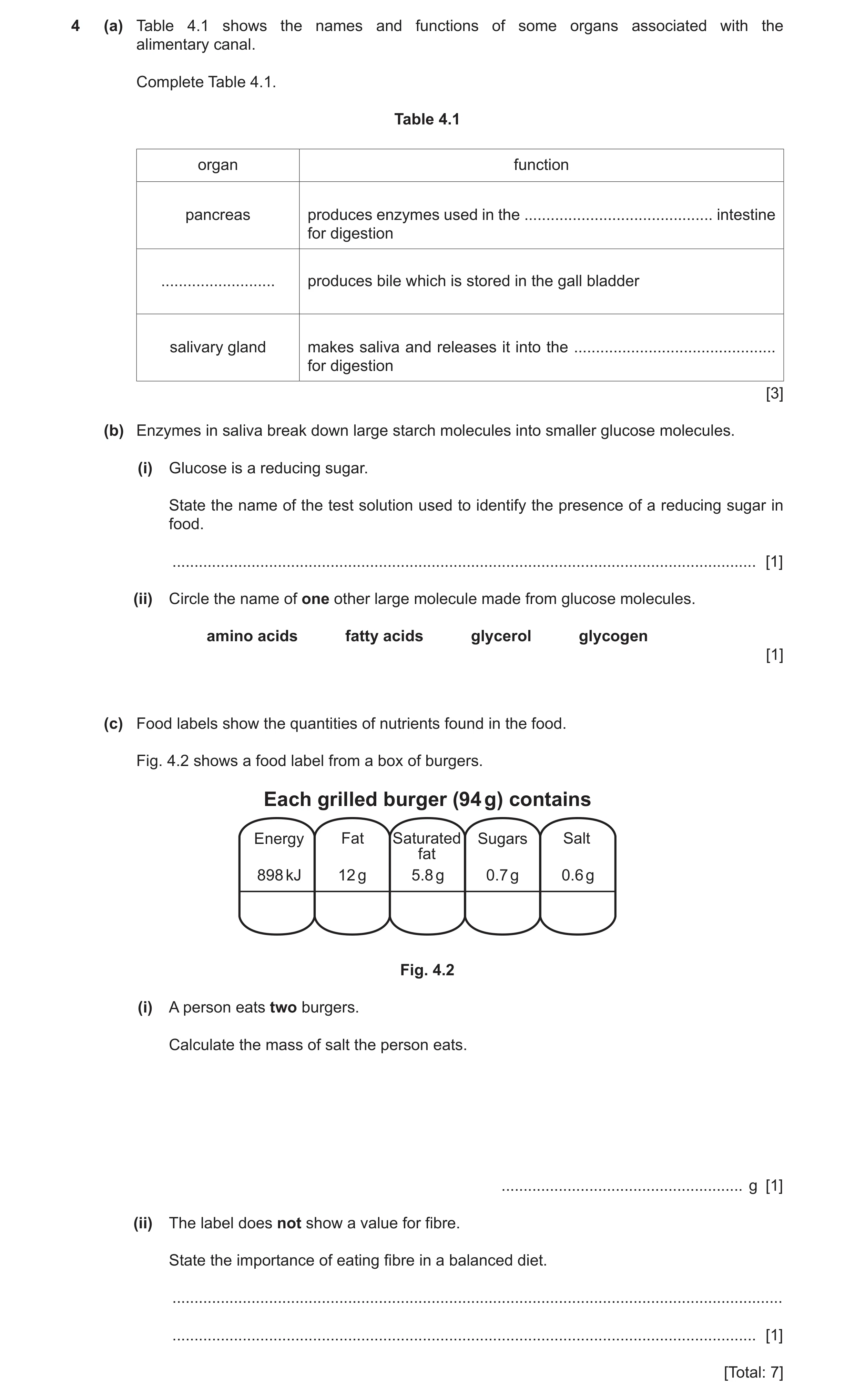
4 (a) Table 4.1 shows the names and functions of some organs associated with the alimentary canal. Complete Table 4.1. Table 4.1 organ function pancreas produces enzymes used in the … intestine for digestion … produces bile which is stored in the gall bladder salivary gland makes saliva and releases it into the … for digestion [3] (b) Enzymes in saliva break down large starch molecules into smaller glucose molecules. (i) Glucose is a reducing sugar. State the name of the test solution used to identify the presence of a reducing sugar in food. … [1] (ii) Circle the name of one other large molecule made from glucose molecules. amino acids fatty acids glycerol glycogen [1] (c) Food labels show the quantities of nutrients found in the food. Fig. 4.2 shows a food label from a box of burgers. Each grilled burger (94 g) contains Energy Fat Saturated Sugars Salt fat 898 kJ 12 g 5.8 g 0.7 g 0.6 g Fig. 4.2 (i) A person eats two burgers. Calculate the mass of salt the person eats. … g [1] (ii) The label does not show a value for fibre. State the importance of eating fibre in a balanced diet. … … [1] [Total: 7]
7 marks
Mark scheme: 4(a) small ; liver ; mouth ; 3 4(b)(i) Benedict's (solution) ; 1 4(b)(ii) glycogen ; 1 4(c)(i) 1.2 (g) ; 1 4(c)(ii) idea of keeping food moving (through alimentary canal) ; 1
This question in 0653/31 Oct/Nov 2021
Q13 · The nuts in Fig 0653/33 May/June 2022
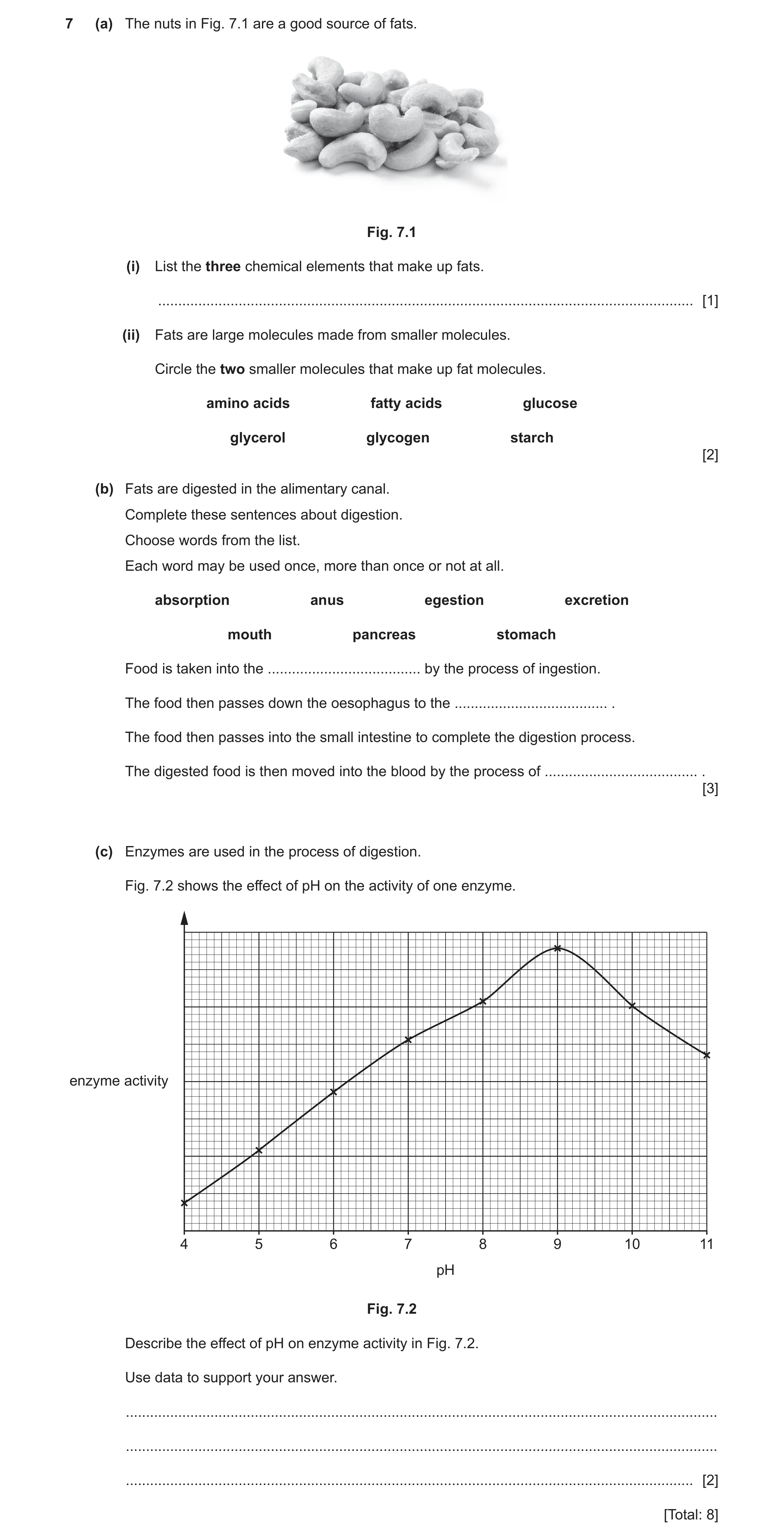
7 (a) The nuts in Fig. 7.1 are a good source of fats. Fig. 7.1 (i) List the three chemical elements that make up fats. … [1] (ii) Fats are large molecules made from smaller molecules. Circle the two smaller molecules that make up fat molecules. amino acids fatty acids glucose glycerol glycogen starch [2] (b) Fats are digested in the alimentary canal. Complete these sentences about digestion. Choose words from the list. Each word may be used once, more than once or not at all. absorption anus egestion excretion mouth pancreas stomach Food is taken into the … by the process of ingestion. The food then passes down the oesophagus to the … . The food then passes into the small intestine to complete the digestion process. The digested food is then moved into the blood by the process of … . [3] (c) Enzymes are used in the process of digestion. Fig. 7.2 shows the effect of pH on the activity of one enzyme. enzyme activity 4 5 6 7 8 9 10 11 pH Fig. 7.2 Describe the effect of pH on enzyme activity in Fig. 7.2. Use data to support your answer. … … … [2] [Total: 8]
8 marks
Mark scheme: 7(a)(i) carbon, hydrogen, oxygen ; 1 7(a)(ii) fatty acids ; glycerol ; 2 7(b) mouth ; stomach ; absorption ; 3 7(c) as pH increases enzyme activity increases then decreases ; idea of peak at pH 9 ; 2
This question in 0653/33 May/June 2022
Q14 · Information about some fruits 0653/33 May/June 2024
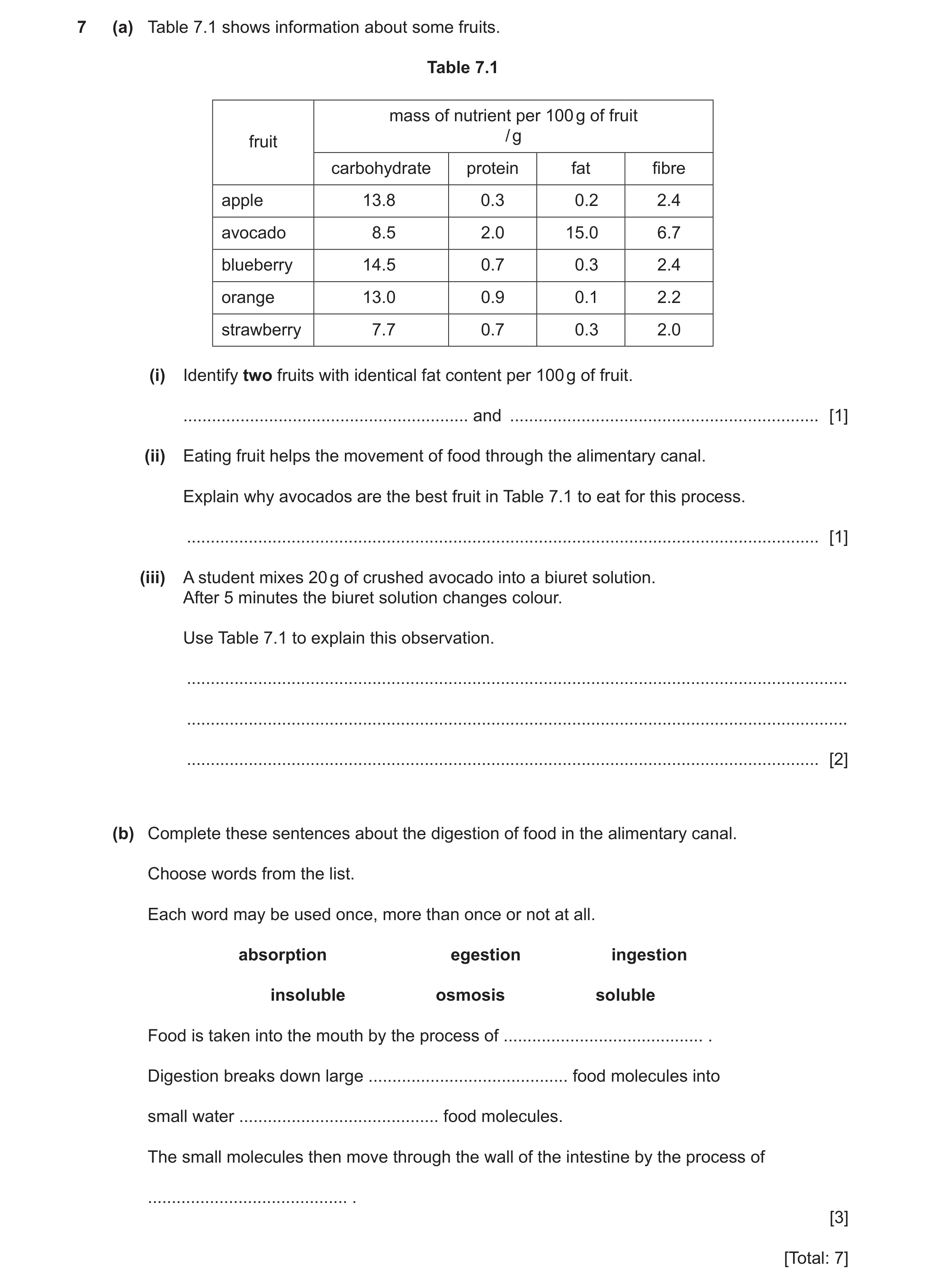
7 (a) Table 7.1 shows information about some fruits. Table 7.1 mass of nutrient per 100 g of fruit / g fruit carbohydrate protein fat fibre apple 13.8 0.3 0.2 2.4 avocado 8.5 2.0 15.0 6.7 blueberry 14.5 0.7 0.3 2.4 orange 13.0 0.9 0.1 2.2 strawberry 7.7 0.7 0.3 2.0 (i) Identify two fruits with identical fat content per 100 g of fruit. … and … [1] (ii) Eating fruit helps the movement of food through the alimentary canal. Explain why avocados are the best fruit in Table 7.1 to eat for this process. … [1] (iii) A student mixes 20 g of crushed avocado into a biuret solution. After 5 minutes the biuret solution changes colour. Use Table 7.1 to explain this observation. … … … [2] (b) Complete these sentences about the digestion of food in the alimentary canal. Choose words from the list. Each word may be used once, more than once or not at all. absorption egestion ingestion insoluble osmosis soluble Food is taken into the mouth by the process of … . Digestion breaks down large … food molecules into small water … food molecules. The small molecules then move through the wall of the intestine by the process of … . [3] [Total: 7]
7 marks
Mark scheme: 7(a)(i) blueberry and strawberry ; 1 7(a)(ii) (avocados have) highest fibre content ; 1 7(a)(iii) biuret tests for protein / protein causes biuret to change colour (to purple) ; (Table 7.1 shows that) avocado contains protein ; 2 7(b) ingestion ; insoluble and soluble (in correct order) ; absorption ; 3
This question in 0653/33 May/June 2024
Q15 · Nutrition is one of the characteristics of living organisms 0653/32 May/June 2025
3 (a) Nutrition is one of the characteristics of living organisms. State two other characteristics of living organisms. 1 … 2 … [2] (b) Table 3.1 shows some information about the digestive system in humans. (i) Complete Table 3.1. Table 3.1 organ function of organ mouth … and digestion of food small intestine digestion and … of food into the blood egestion of undigested food … [3] (ii) Fats are digested in the small intestine. Name the two smaller molecules that fats are made from. ………………………… … and ………………………… … [2] (c) Enzymes are used to digest food in the digestive system. (i) Fig. 3.1 is a graph that shows the effect of pH on the enzyme activity of one enzyme. enzyme activity 0 2 4 6 8 10 12 pH Fig. 3.1 Describe the effect of pH on enzyme activity shown in Fig. 3.1. Include data in your answer. … … … … [2] (ii) State one factor that affects enzyme activity, other than pH. … [1] [Total: 10]
10 marks
Mark scheme: 3(a) any two from: 2 movement ; respiration ; growth ; sensitivity ; reproduction ; excretion ; 3(b)(i) 3 organ function of organ mouth ingestion (and digestion of food) (digestion and) absorption small intestine (of food into the blood) anus egestion undigested food ;;; 3(b)(ii) fatty acids ; 2 glycerol ; 3(c)(i) increasing pH increases then decreases enzyme activity ; 2 use of data, e.g. peak at pH6.8, no activity below pH1 / no activity above pH11.4, etc. ; 3(c)(ii) temperature ; 1
This question in 0653/32 May/June 2025
Q16 · A student investigates the effect of different physical activity on heart rate 0653/33 May/June 2025
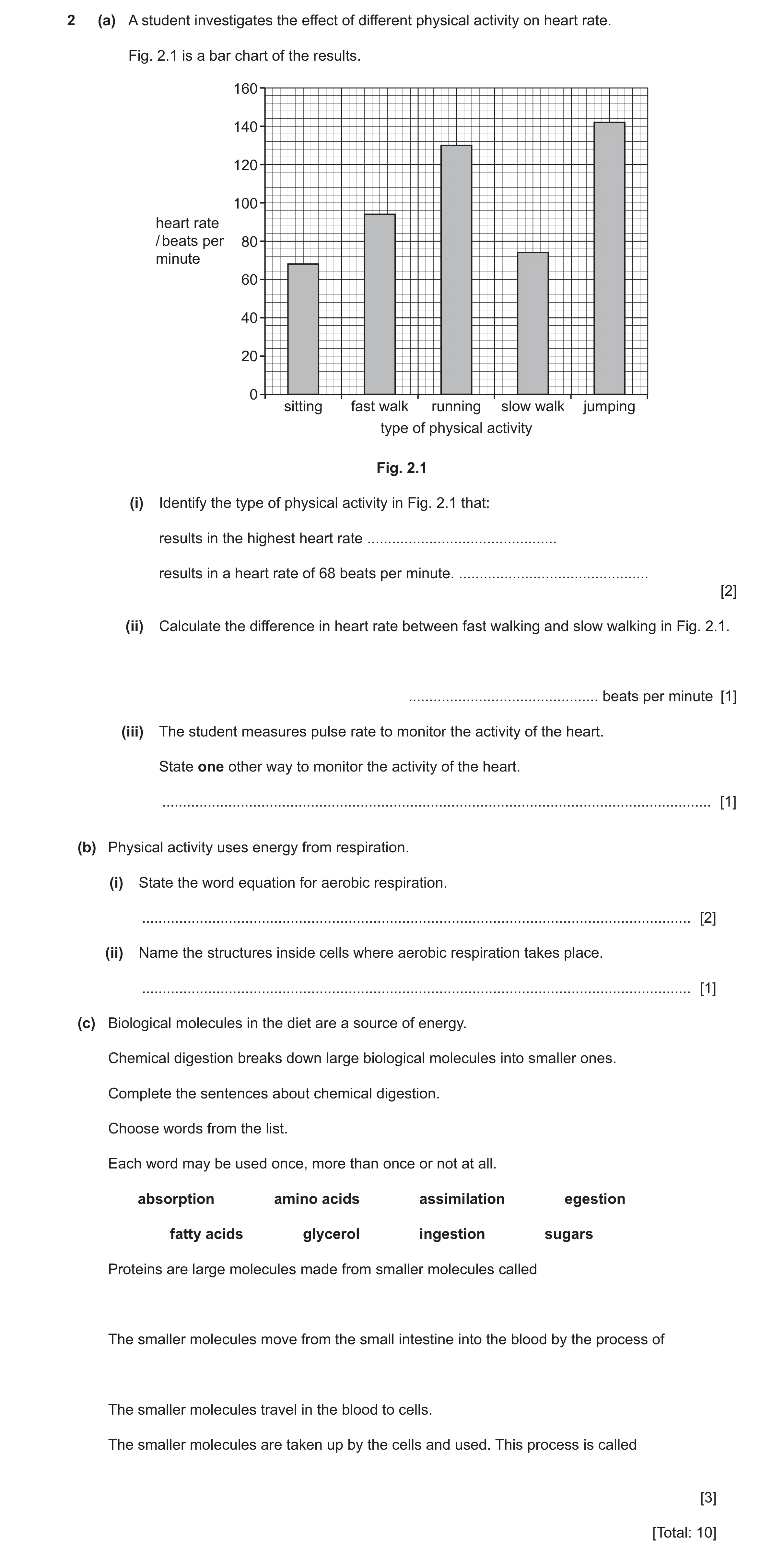
2 (a) A student investigates the effect of different physical activity on heart rate. Fig. 2.1 is a bar chart of the results. 160 140 120 100 heart rate / beats per 80 minute 60 40 20 0 sitting fast walk running slow walk jumping type of physical activity Fig. 2.1 (i) Identify the type of physical activity in Fig. 2.1 that: results in the highest heart rate … results in a heart rate of 68 beats per minute. … [2] (ii) Calculate the difference in heart rate between fast walking and slow walking in Fig. 2.1. … beats per minute [1] (iii) The student measures pulse rate to monitor the activity of the heart. State one other way to monitor the activity of the heart. … [1] (b) Physical activity uses energy from respiration. (i) State the word equation for aerobic respiration. … [2] (ii) Name the structures inside cells where aerobic respiration takes place. … [1] (c) Biological molecules in the diet are a source of energy. Chemical digestion breaks down large biological molecules into smaller ones. Complete the sentences about chemical digestion. Choose words from the list. Each word may be used once, more than once or not at all. absorption amino acids assimilation egestion fatty acids glycerol ingestion sugars Proteins are large molecules made from smaller molecules called The smaller molecules move from the small intestine into the blood by the process of The smaller molecules travel in the blood to cells. The smaller molecules are taken up by the cells and used. This process is called [3] [Total: 10]
10 marks
Mark scheme: 2(a)(i) jumping ; 2 sitting ; 2(a)(ii) (94 – 74 =) 20 (beats per minute) ; 1 2(a)(iii) ECG / electrocardiogram / listening to sounds of valves (closing) / stethoscope ; 1 2(b)(i) glucose + oxygen carbon dioxide + water ;; 2 reactants (either order) = 1 mark products (either order) = 1 mark 2(b)(ii) mitochondria ; 1 2(c) amino acids ; 3 absorption ; assimilation ;
This question in 0653/33 May/June 2025
 8 / 23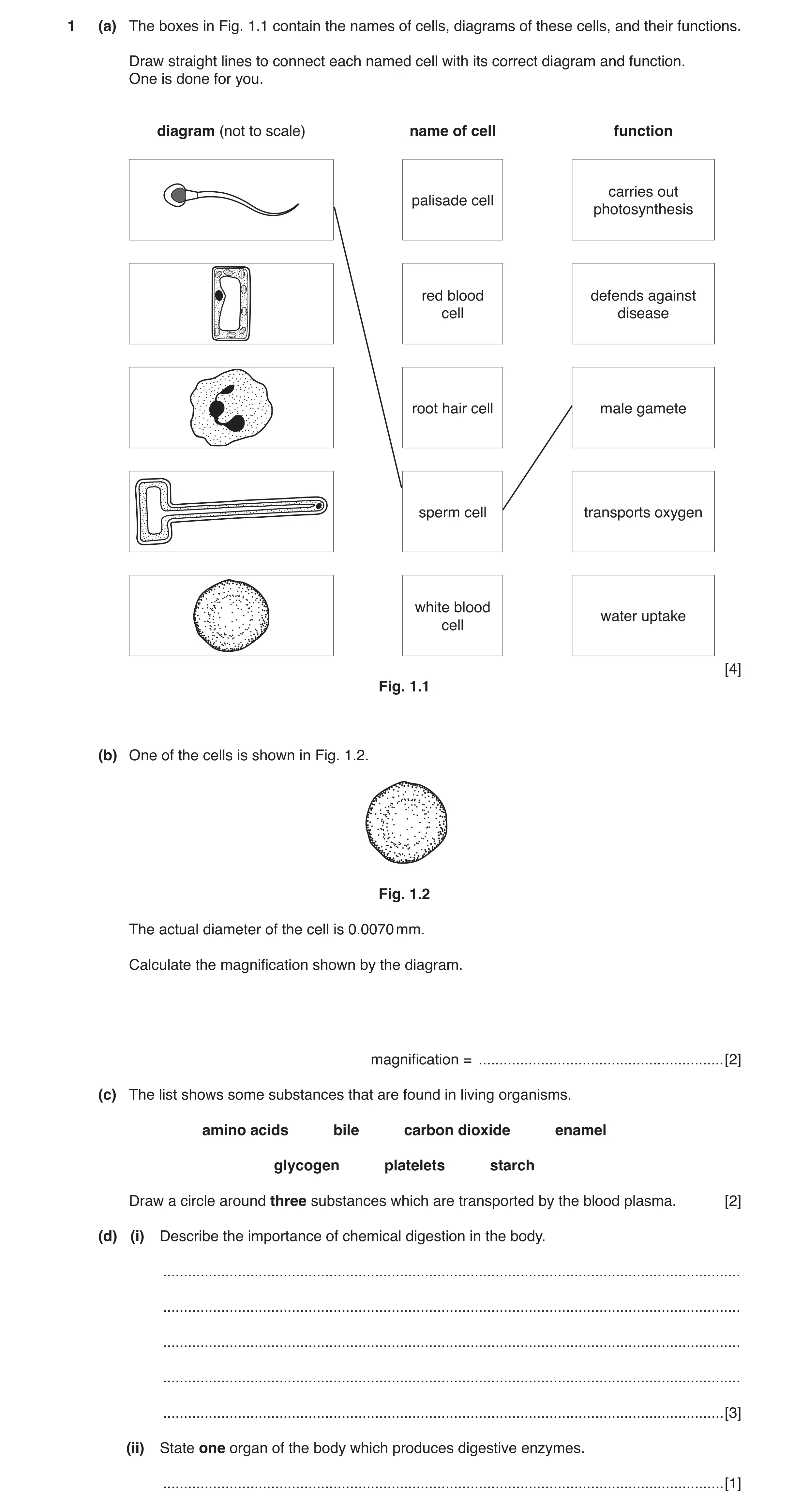
 13 / 23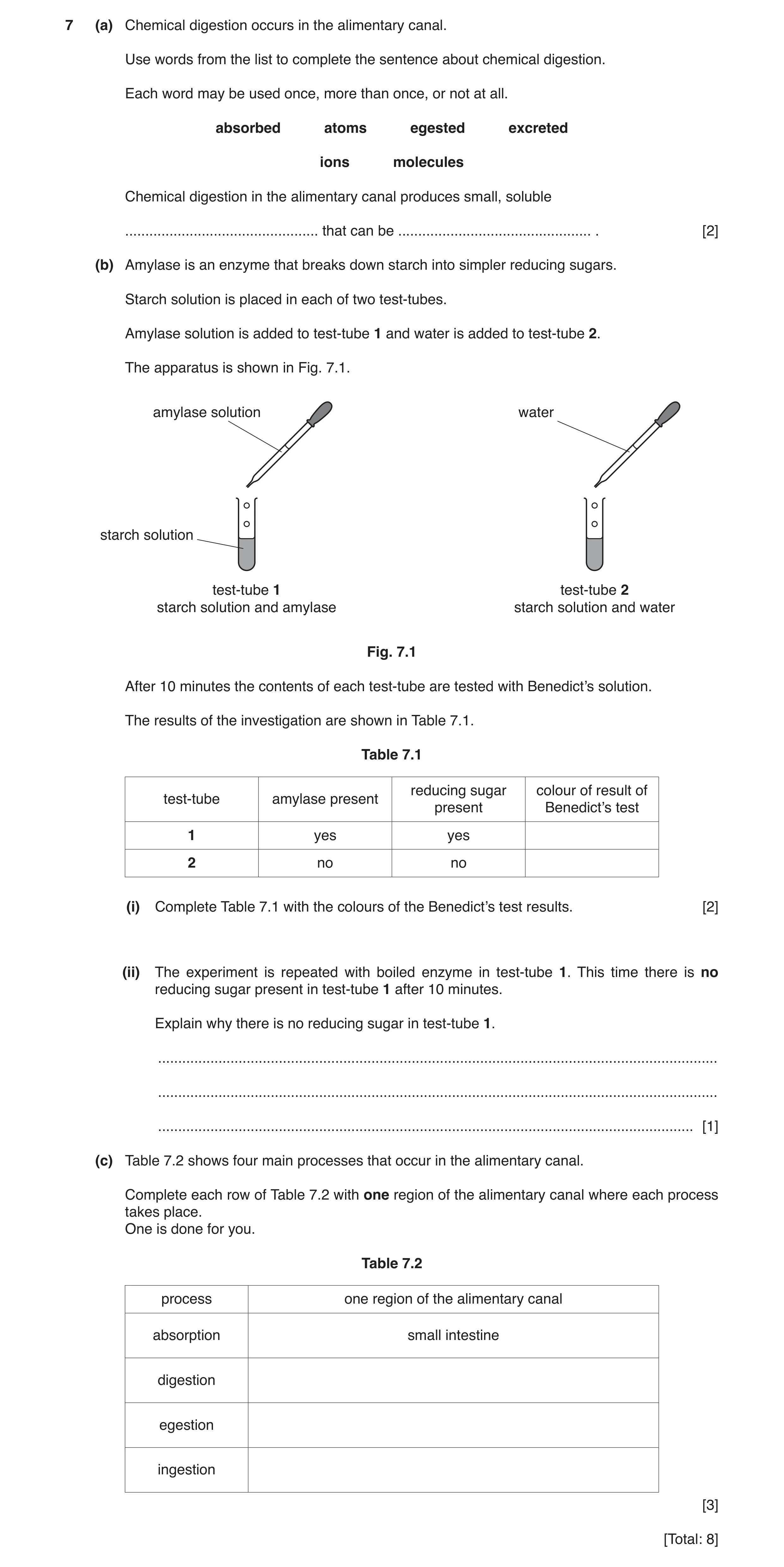
 20 / 23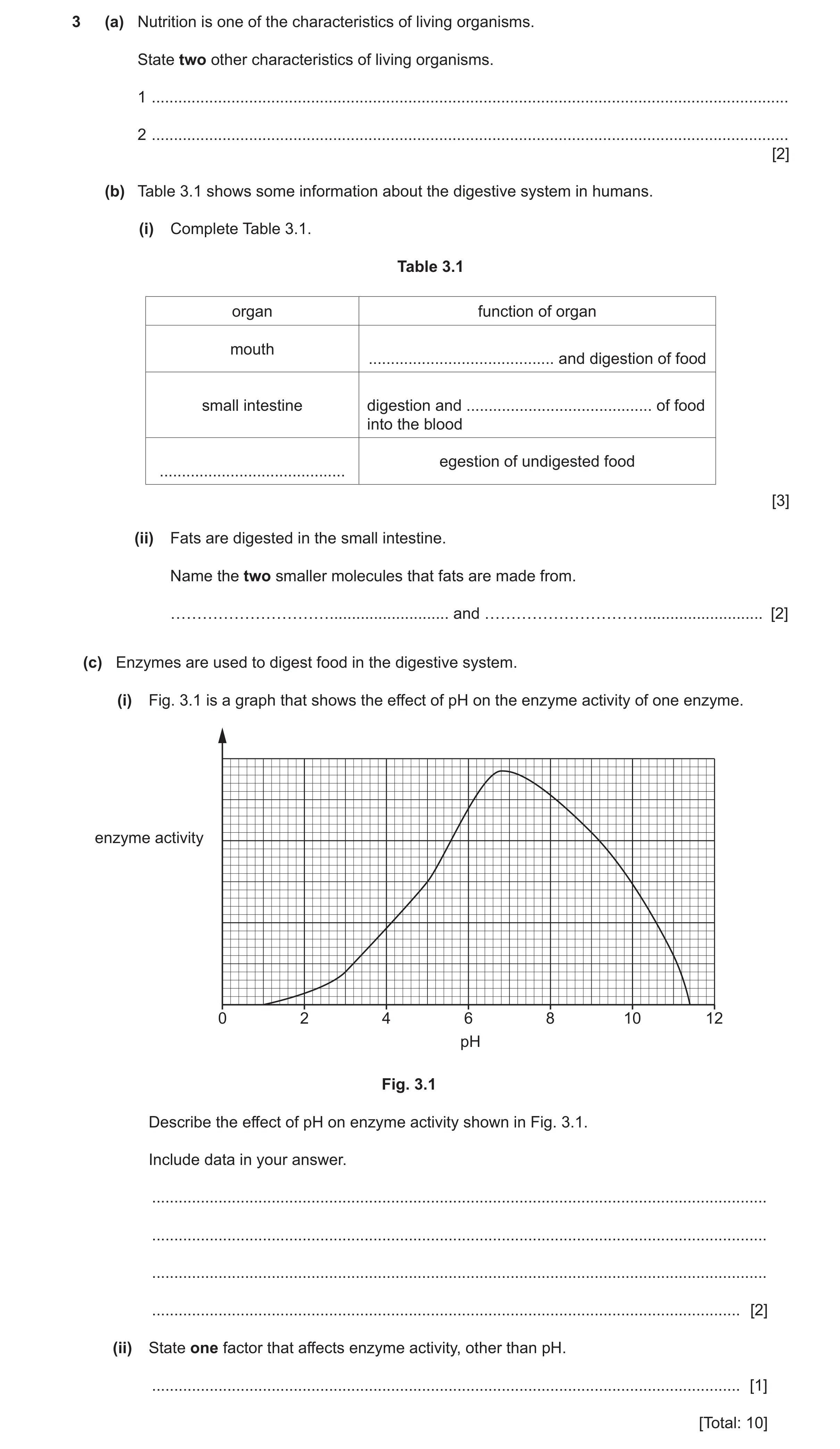
 12
12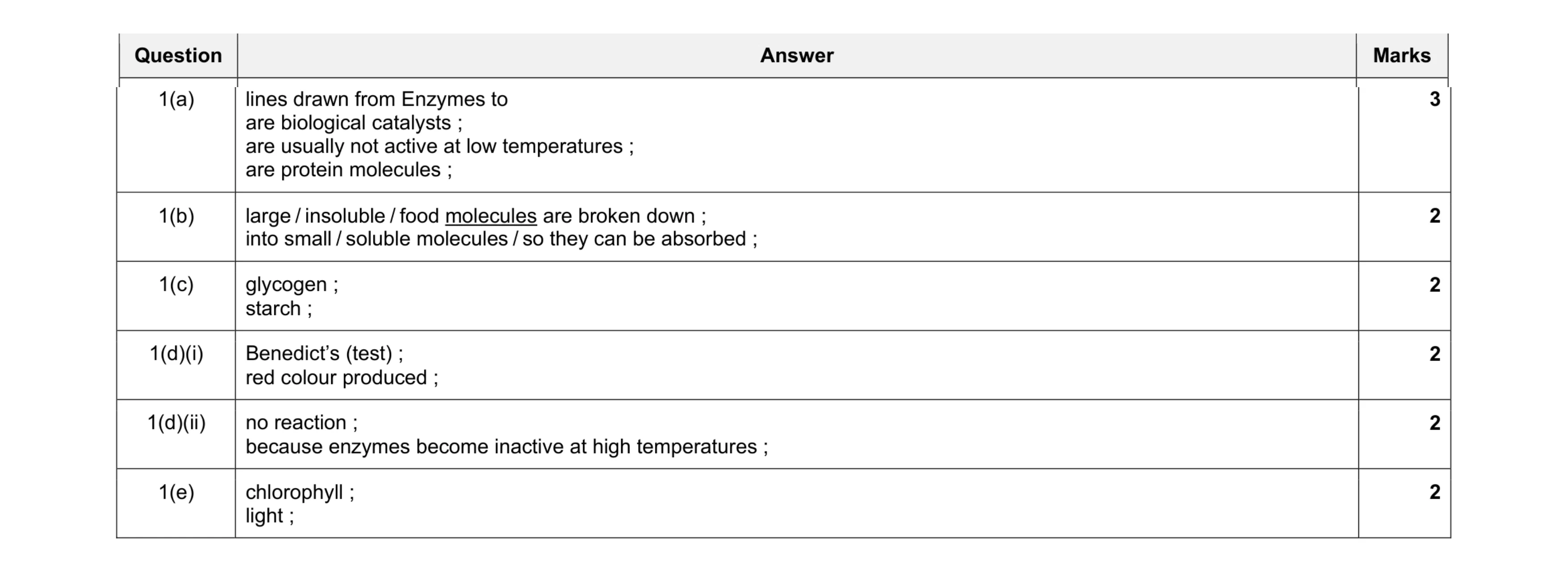 13
13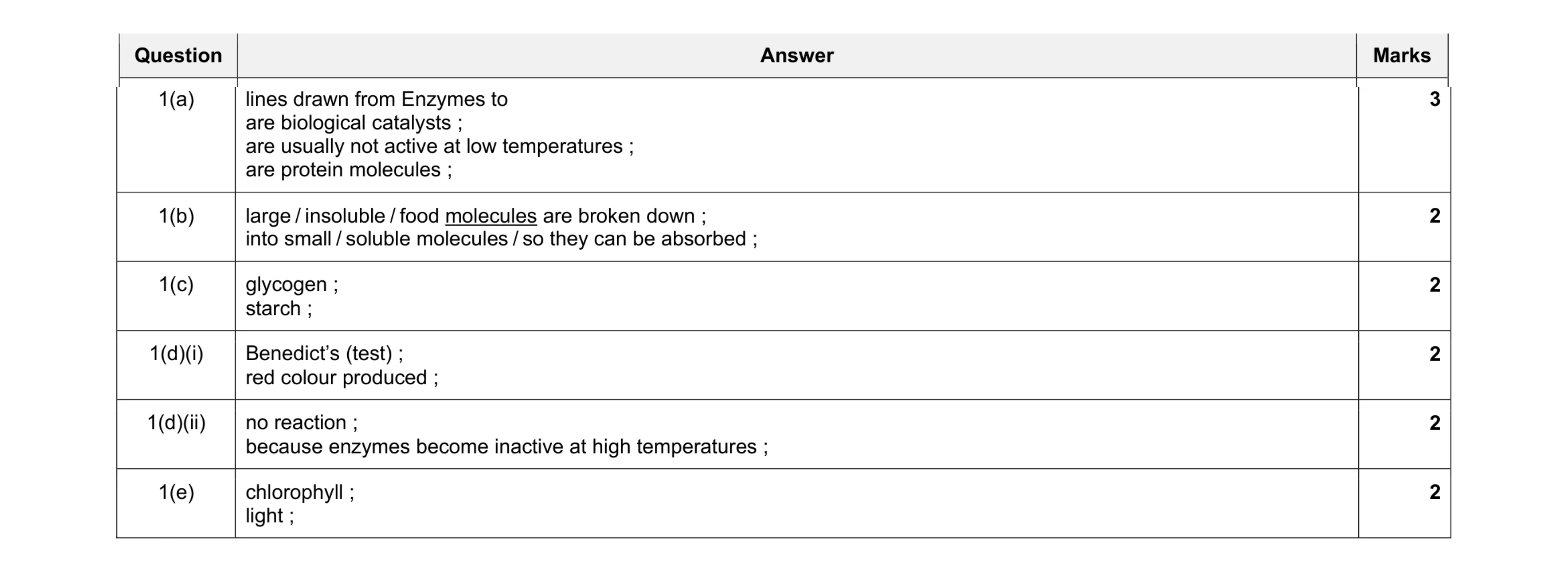 13
13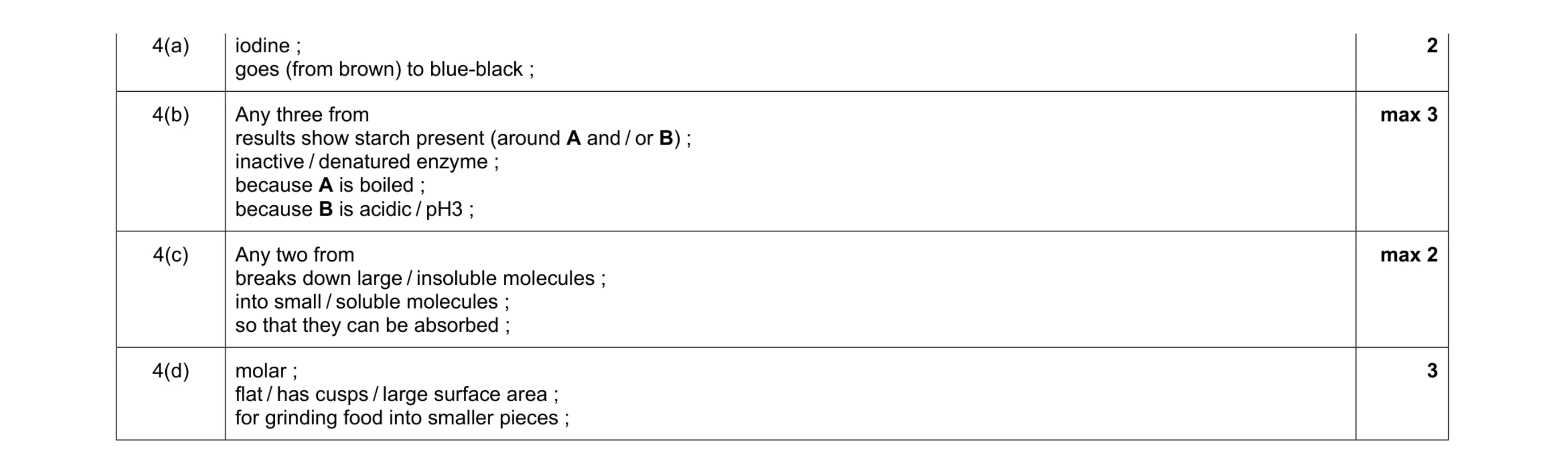 10
10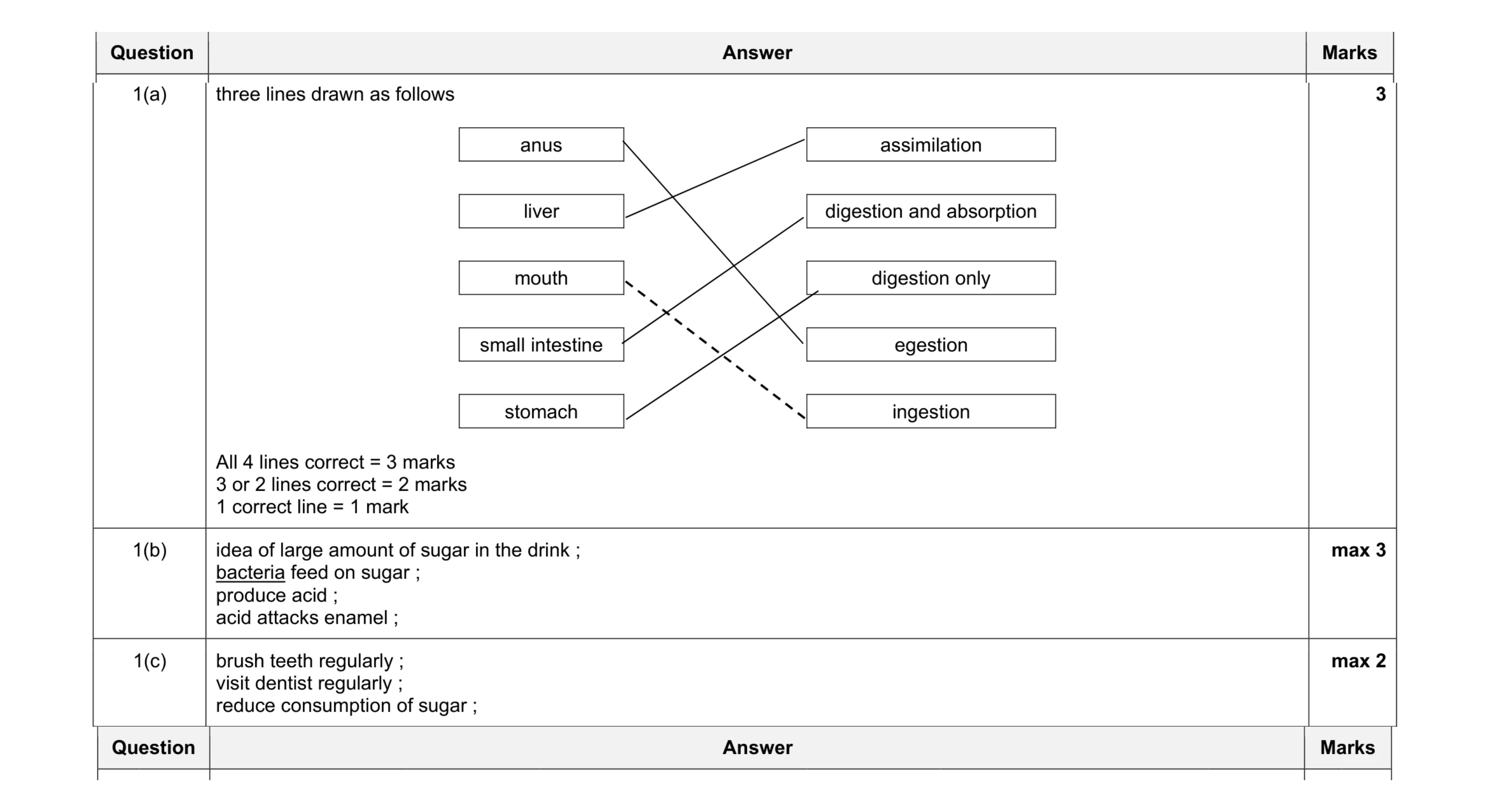 8
8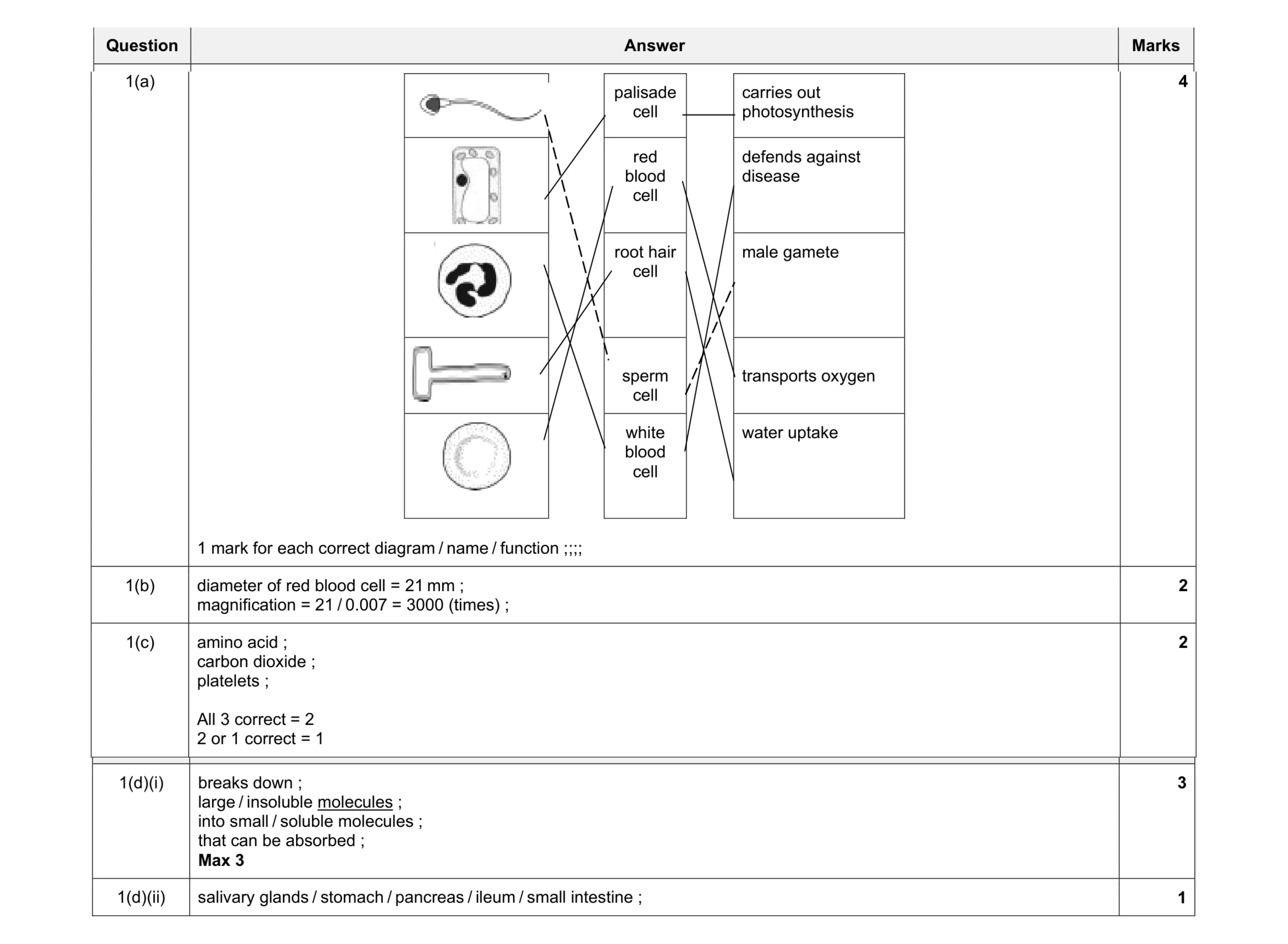 12
12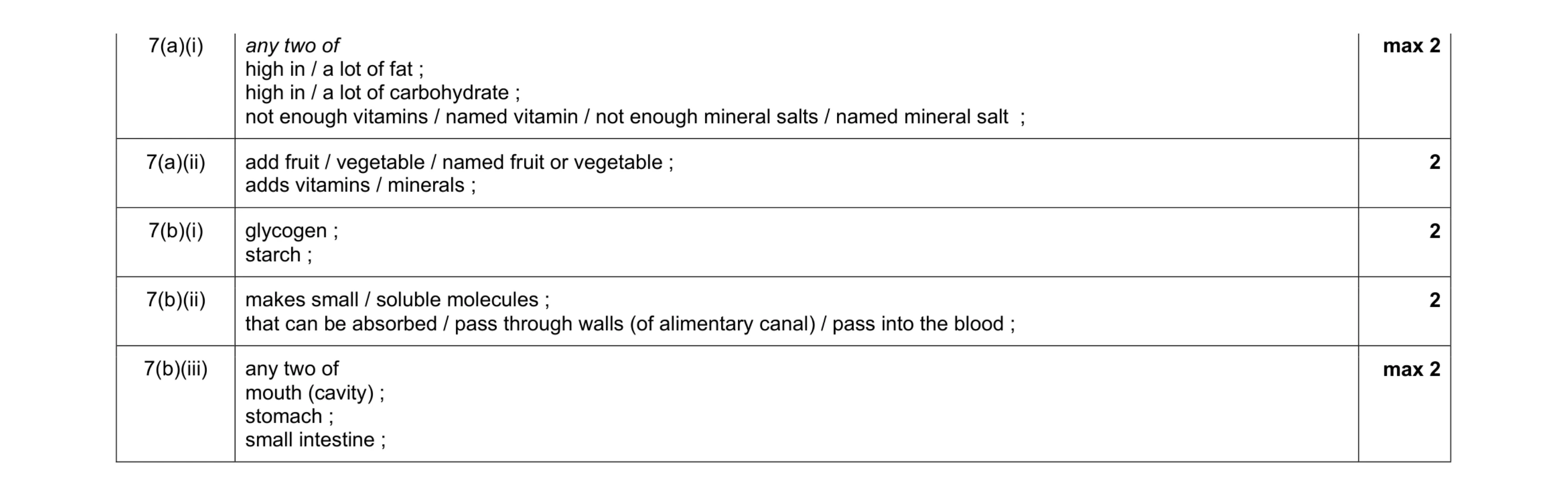 10
10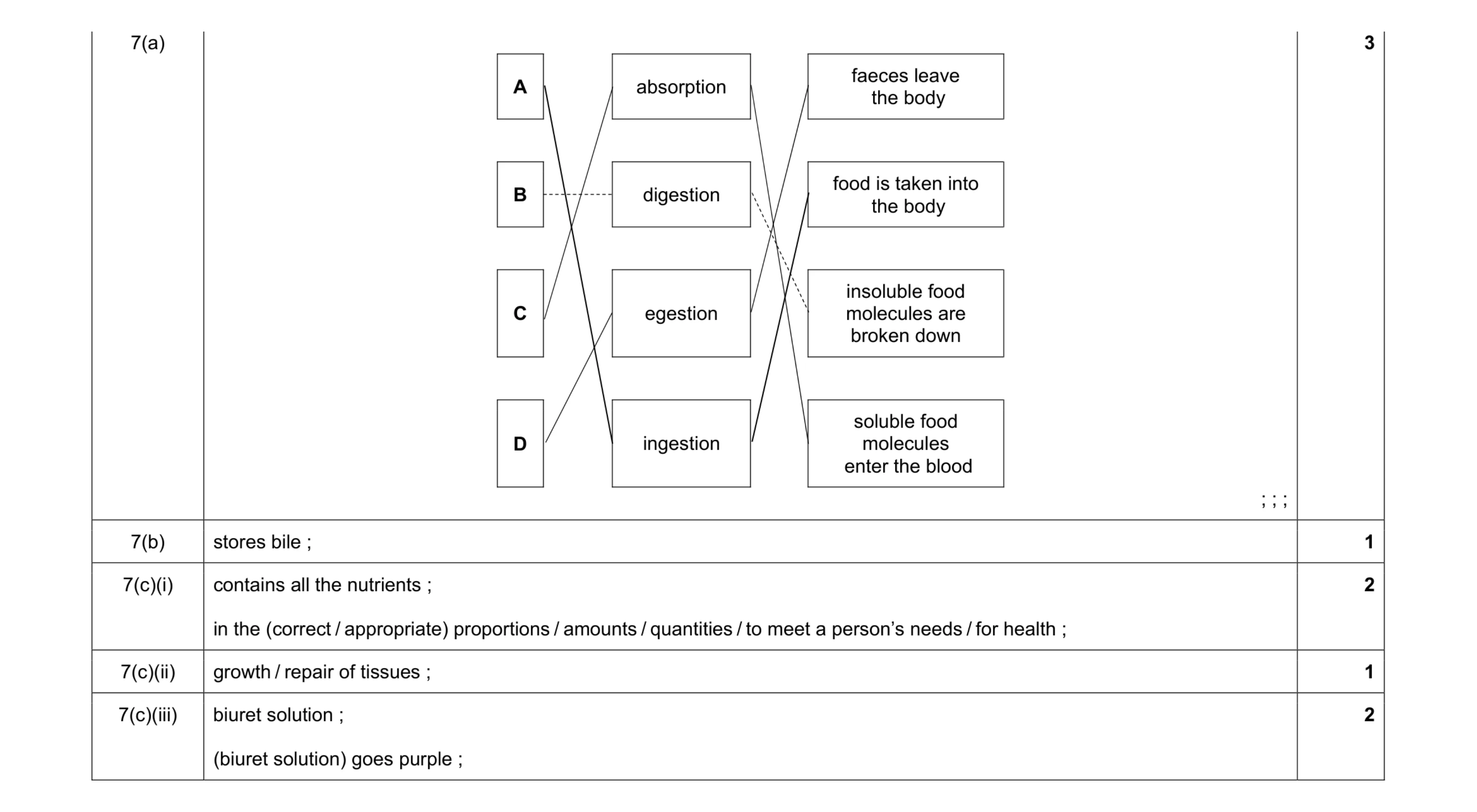 9
9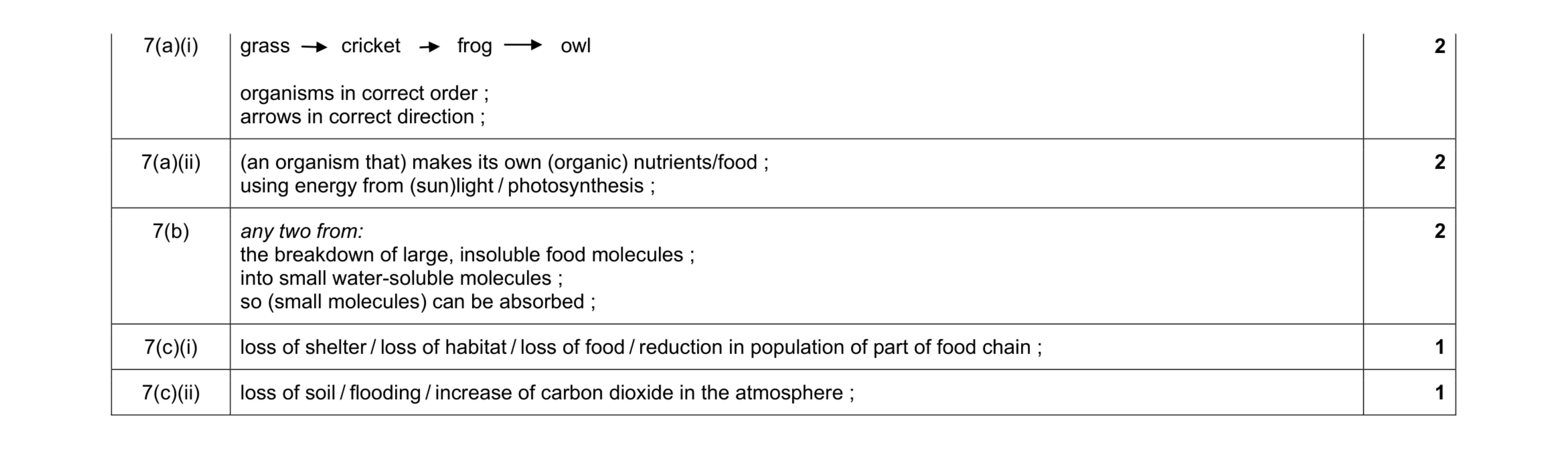 8
8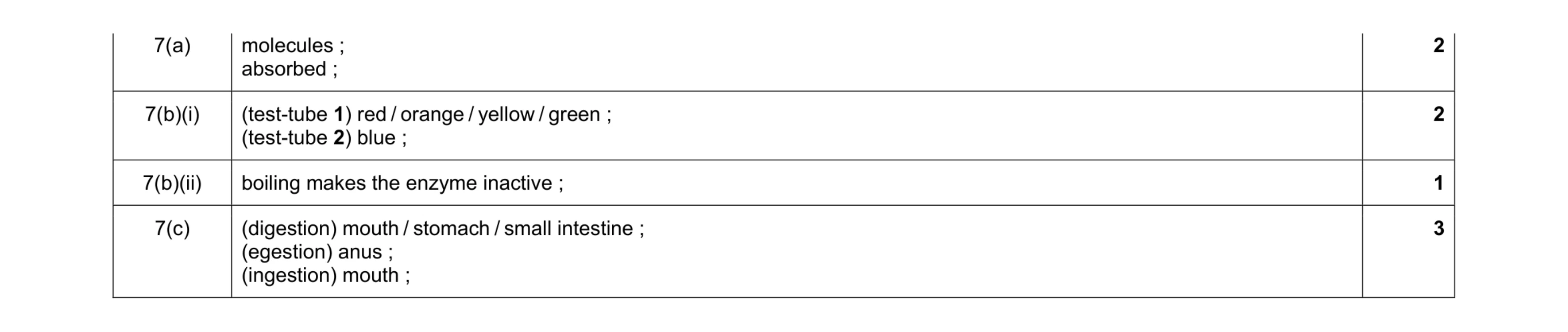 8
8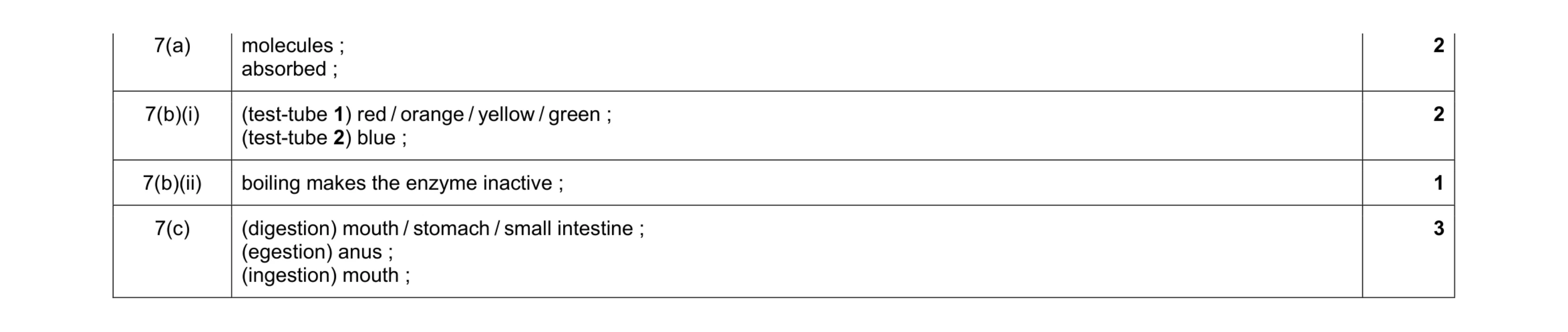 8
8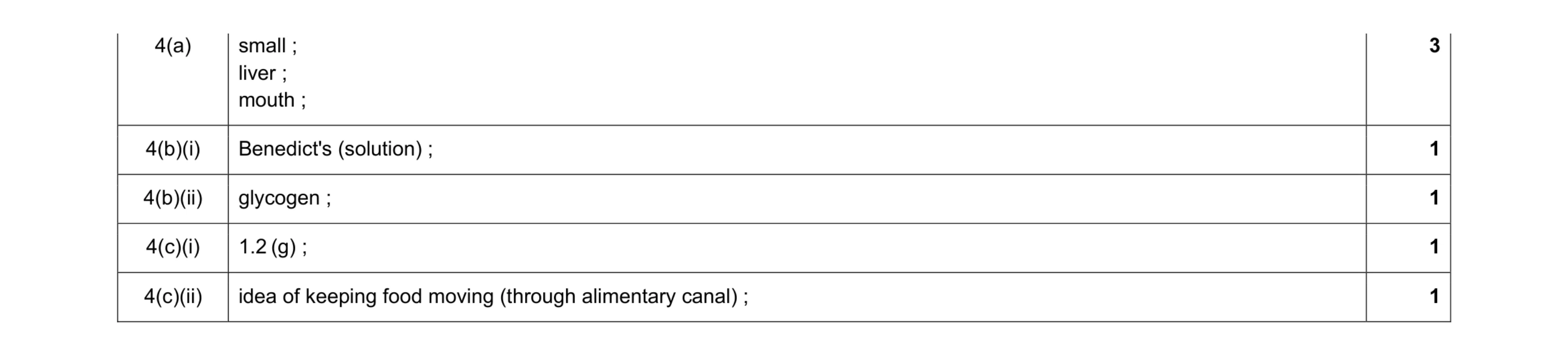 7
7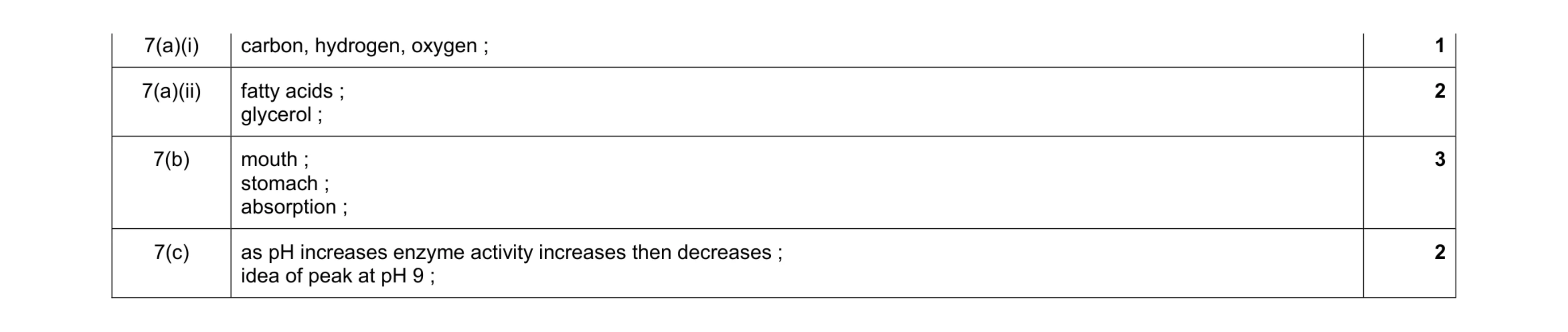 8
8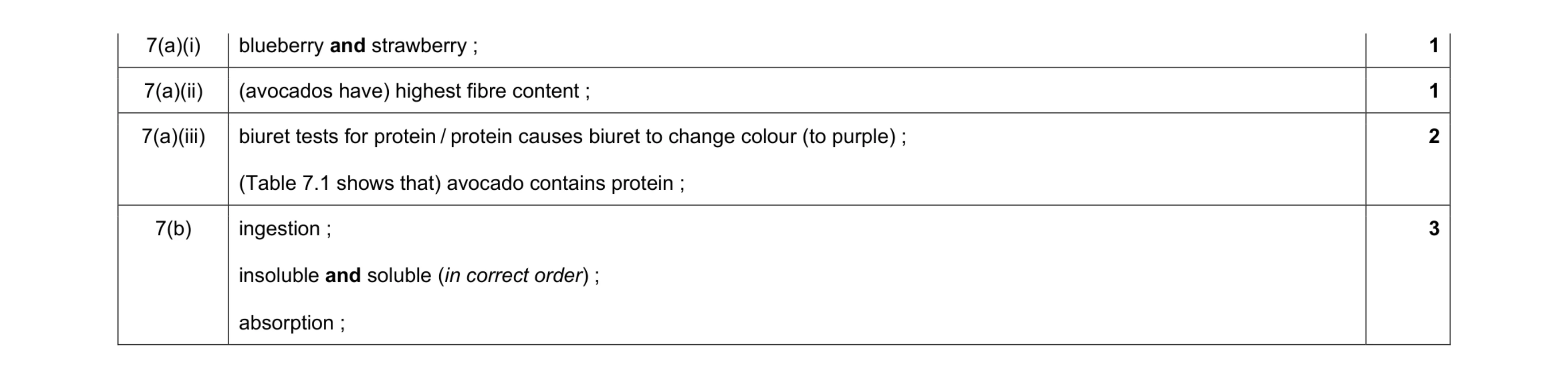 7
7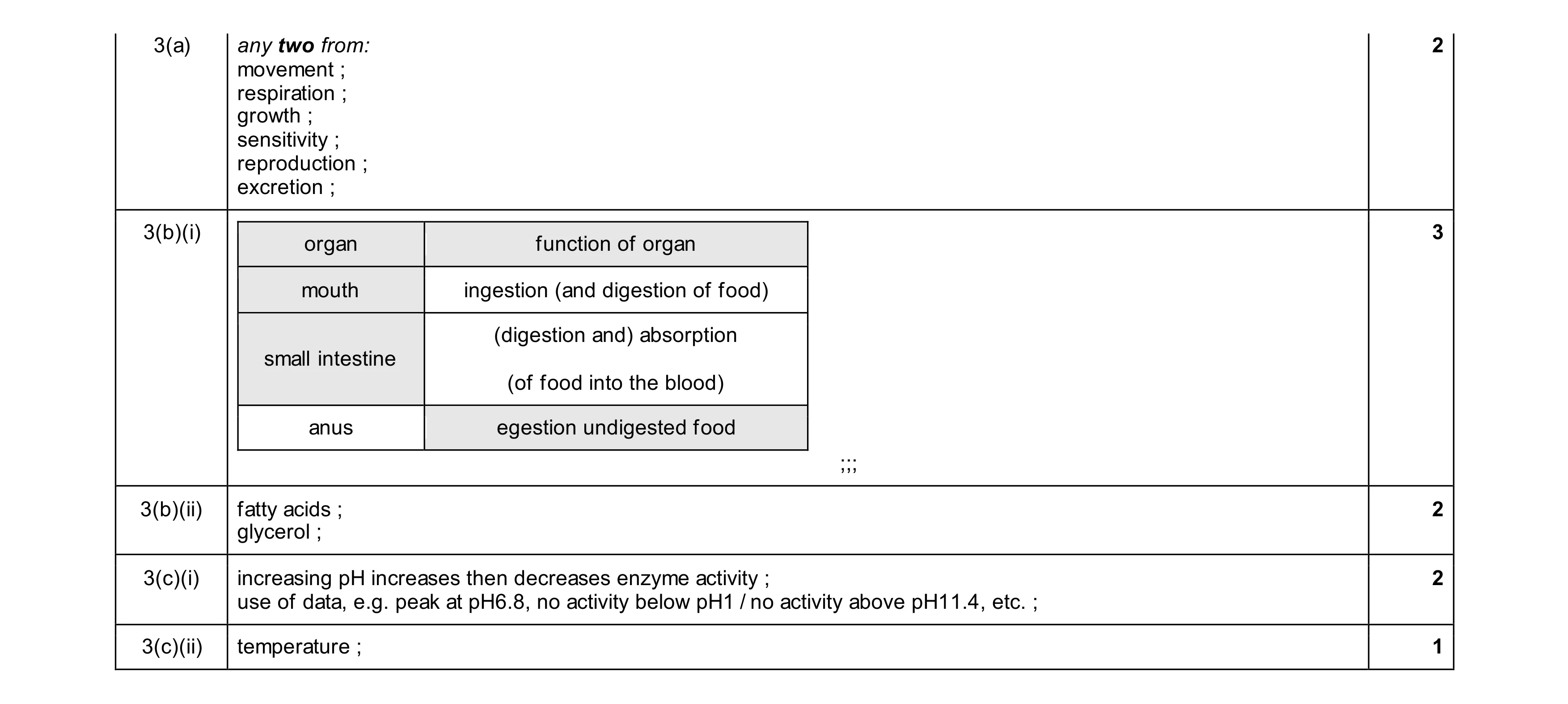 10
10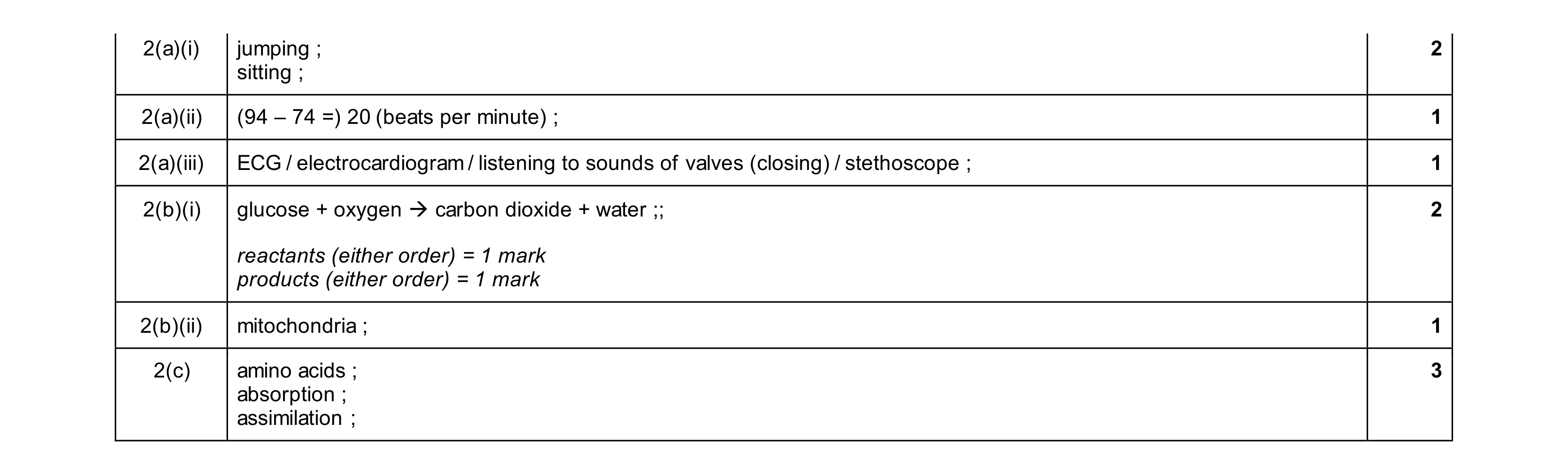 10
10